# Outreach Desk
> A WordPress-powered website.
Language: en
URL: https://outreachdesk.com/
All pages on this site are available as clean Markdown by adding the header `Accept: text/markdown` to any HTTP request.
REST API: https://outreachdesk.com/wp-json/mescio-for-agents/v1/markdown?url={page_url}
## Pages
- [Outsource Link Building Agency Built for Hands-Off Delivery](https://outreachdesk.com/outsource-link-building-agency/): Outsource Link Building Outsource Link Building Agency Built for Hands-Off Delivery Your team hands off the entire link building workflow. Strategy, prospecting, outreach, content production, placement, and reporting all operate within a dedicated team you don't have to manage every
- [Thank You](https://outreachdesk.com/thank-you/): ✦ Submission Received You're All Set! Return Home Your Journey Ahead What happensnext? Here's a clear picture of what to expect after your submission. No surprises. Right Now Confirmation Email Sent Check your inbox — we just sent you a
- [Broken Link Checker](https://outreachdesk.com/broken-link-checker/): Broken Link Checker Find broken links on any website in seconds. Scan a single page or your entire site and get a clear report of 404 and other 4xx errors. Free, with no signup required. What This Tool Does The
- [Tools](https://outreachdesk.com/tools/): Outreach Desk Tools Backlink Cost Calculator Google Index Checker Backlink Monitoring Tool Domain Age Checker Broken Link Checker Link Building ROI Calculator Let’s Build Trust and Credibility the Right Way If you want guest posting built for clarity, relevance, and
- [Backlink Cost Calculator](https://outreachdesk.com/backlink-cost-calculator/): Backlink Cost Calculator Stop overpaying for a backlink. Estimate what a backlink should cost before you spend a dollar. Not every backlink costs the same. A link from a trusted, popular site costs more than one from a newer, smaller
- [Domain Age Checker](https://outreachdesk.com/domain-age-checker/): Domain Age Checker Check the age of any domain in seconds. Enter a URL and get the exact domain age, creation date, last update date, and expiry date, all in one place. What Is Domain Age? A domain is a
- [Google Index Checker](https://outreachdesk.com/google-index-checker/): Google Index Checker Verify instantly whether your page is indexed by Google and is shown in search results. Paste your URL, click on ‘Check Index’, and get an instant result. What is Google Index Checker? A Google Index Checker tells
- [CBD Link Building Services](https://outreachdesk.com/cbd-link-building-services/): CBD Link Building CBD Link Building Services for Sustainable Authority Growth You earn editorial, relevance-driven backlinks that strengthen your authority, improve visibility, and also support lasting SEO, without risking compliance in the CBD market. Appear naturally within the content Avoid
- [Ecommerce Link Building Service](https://outreachdesk.com/ecommerce-link-building-service/): Ecommerce Link Building Ecommerce Link Building Service for Product & Category Authority Your brand earns natural placement inside trusted editorial content, strengthening your authority across search engines, AI platforms, and your target audience. Featured on real, relevant sites Built for
- [Brand Mention Service Page](https://outreachdesk.com/brand-mention-service/): Brand Mention Brand Mention Service That Builds Authority and Visibility Your brand naturally appears in trusted editorial content, strengthening your authority across search engines, AI platforms, and the sites your audience already reads. Featured on trusted, relevant websites. Built for
- [Local Citation Services That Strengthen Local Rankings](https://outreachdesk.com/local-citation-services/): Local Link Building Local Citation Services That Strengthen Local Rankings Your business creates accurate NAP listings on directories, review platforms,and publications; it builds the citation foundation that AI platforms rely on to identify and recommend you in local search visibility.
- [White Hat Link Building Service That Protects Your Rankings](https://outreachdesk.com/white-hat-link-building-service/): White Hat Link Building White Hat Link Building Service That Protects Rankings Your site earns 100% manual, Google-compliant backlinks through editorial outreach, building lasting authority that survives every update without putting your domain at risk. Manual editorial outreach Google-compliant tactics
- [Multilingual Link Building Agency With Native-Speaker Outreach Teams](https://outreachdesk.com/multilingual-link-building-agency/): Multilingual Link Building Multilingual Link Building Agency With Native-Speaker Outreach Teams Your brand earns editorial backlinks in every market you operate in through native-speaker outreach teams familiar with local publishers, editorial standards, and search engine ranking factors that drive international
- [Blogger Outreach Agency for Editorial Backlinks That Move Rankings](https://outreachdesk.com/blogger-outreach-agency/): Blogger Outreach Blogger Outreach Agency for Editorial Backlinks That Move Rankings Your brand earns editorial backlinks, brand mentions, and product reviews through personalized outreach to bloggers, newsletter writers, and expert-led publications your buyers already read. Personalized blogger outreach Multi-format placements
- [Enterprise Link Building Agency for Scaled SEO Programs](https://outreachdesk.com/enterprise-link-building-agency/): Enterprise Link Building Enterprise Link Building Agency for Scaled SEO Programs Your in-house SEO team gets a link building partner with the scale, governance, and reporting depth enterprise programs require. You get brand-safe placements, a procurement-ready process, and reporting designed
- [Profile Backlink Service For Brand Entity Authority That Lasts](https://outreachdesk.com/profile-backlink-service/): Profile Backlinks Profile Backlink Service For Brand Entity Authority That Lasts Your brand earns authoritative profiles on Crunchbase, G2, and Product Hunt, and builds credibility with Google and AI search engines that reward trust signals. Authority directory profiles Entity &
- [Community Mentions Service That Influences Buyer Decisions](https://outreachdesk.com/community-mentions-service/): Community Mentions Community Mentions Service That Influences Buyer Decisions Your brand earns organic mentions across Slack, Discord, LinkedIn, X threads, and private communities where your B2B buyers actually research, compare, and recommend solutions. Slack & Discord mentions LinkedIn & X
- [Forum Link Building Service for Community-Driven Authority](https://outreachdesk.com/forum-link-building-service/): Forum Link Building Forum Link Building Service for Community-Driven Authority Your brand earns links and mentions through real participation in Reddit, Quora, and communities your buyers actually trust. Reddit & Quora engagement Industry forum participation AI citation visibility Book a
- [Link Building ROI Calculator](https://outreachdesk.com/link-building-roi-calculator/): Link Building ROI Calculator Plug in your numbers to see whether your backlink spend pays off, how much time it takes, and what you can expect to earn. Inputs the calculator asks for: Monthly link building budget Number of links
- [Link Building Consultant Services for Real Authority Growth](https://outreachdesk.com/link-building-consultant/): Link Building Consultant Link Building Consultant Services That Drive Authority Work directly with the senior consultant who audits your backlink profile, identifies gaps, and builds a link building roadmap that earns rankings, authority, and lasting traffic growth. Backlink audit and
- [Niche Edit Service for Topical Authority in Your Industry](https://outreachdesk.com/niche-edit-service/): Niche Edits Niche Edit Service for Topical Authority in Your Industry Your site earns backlinks placed inside niche-relevant articles, building the topical authority Google rewards on the keywords your buyers actually search. Niche-relevant sites Industry-aligned articles Topical authority focus Book
- [Digital PR Service](https://outreachdesk.com/digital-pr-service/): Digital PR Digital PR Service for High-Authority Media Backlinks Your brand earns editorial mentions and backlinks that are placed within authoritative publications to strengthen credibility, improve rankings, and build long-term visibility. Real journalists, real publications No paid link schemes. No
- [Link Insertion Service](https://outreachdesk.com/link-insertion-service/): Link Insertion Link Insertion Service Focused on Relevant Link Placements You get contextual links within high-quality existing content to strengthen relevance, authority, and rankings without creating new articles. Real traffic and editorial standards No PBNs. No bulk directories Placement that
- [About Us](https://outreachdesk.com/about-us/): About Us 100% High Authority, Topical Relevance & Niche Alignment Assured. We believe branding and visibility go hand in hand. Ensuring your brand has visibility across authoritative sites and publications is our team’s work towards one goal – topical authority
- [New Service Page](https://outreachdesk.com/new-service-page/): Guest Posting Build Trust and Credibility with Guest Posts That Actually Move Rankings You get high-quality, editorial guest posts published on real websites that actually help your website rank better. Relevant, high-quality editorial links from real, trusted websites. 100% manual
- [Link Building Services Agency – Outreach Desk](https://outreachdesk.com/): Authority-Driven Link Building Services Agency Get strategic and 100% niche-relevant links from real websites. Strengthen your domain authority, improve search rankings, and AI visibility to drive organic growth without spending on paid ads. Book a Strategy Call 4.8/5 Trusted by
- [Saas Link Building Service](https://outreachdesk.com/saas-link-building-solutions/): Trusted By 1K+ Customers SaaS Link Building Service That Drives Rankings & Qualified Leads You get high-quality, relevant links that improve rankings, strengthen authority, and generate qualified demand for your software business. Talk To Our Experts Get In Touch We’re
- [Test](https://outreachdesk.com/test/)
- [Backlink Monitoring Tool](https://outreachdesk.com/backlink-monitoring-tool/): Backlink Monitoring Tool Protect Every Backlink You Build. Backlinks get removed more often than you’d expect, and most people don’t notice until their rankings and traffic have already dropped. With Outreach Desk’s free Backlink Monitoring Tool, you can verify whether
- [AI SEO Services](https://outreachdesk.com/ai-seo-services/): AI SEO AI SEO Services Visibility in AI Search Platforms Your business earns visibility on AI search engines like ChatGPT, Perplexity, Gemini, and Google AI Overviews through structured, authoritative content that signals to these platforms that it is a trusted
- [Blog](https://outreachdesk.com/blog/): Blog outreachdesk wpauser9JvhkygZ September 19, 2024 The Power of Social Media Marketing: How to Build Your… Add Your Heading Text HereThe Power of PPC Advertising: How to Maximize Your ROI Read More wpauser9JvhkygZ September 19, 2024 The Importance of SEO
- [Testimonial](https://outreachdesk.com/testimonial/): Testimonial Michael Frederick CEO at Swovo.com "Outreach Desk has helped my business establish numerous high-quality and relevant backlinks. I am selective when it comes to link building, but Outreach Desk has enabled me to create links on well-known business websites
- [Outsource Link Building Service](https://outreachdesk.com/link-building-outsourcing/): Trusted By 1K+ Customers Outsource Link Building to Gain Authority, Rankings, and Qualified Traffic You outsource link building to a specialized team that delivers relevant, high-quality links with predictable results, faster timelines, and clear ROI. Talk To Our Experts Get
- [White Label Link Building Service](https://outreachdesk.com/white-label-link-building-agency/): Trusted By 1K+ Customers White Label Link Building That Helps You Deliver Authority and Results to Your Clients You get reliable, high-quality link building delivered under your brand, so you can scale client results without expanding your internal team. Talk
- [White Label Link Building Service Page](https://outreachdesk.com/white-label-link-building-services/): White Label Link Building White Label Link Building Services for Agencies You get high-quality editorial links under your brand. Build results for your clients without hiring teams or managing outreach. 50-70% lower costs than in-house teams 100% white label with
- [Guest Posting Service](https://outreachdesk.com/guest-posting-service/): Guest Posting Guest Posting Service That Builds Your Rankings Your rankings grow through high-quality guest posts published on trusted websites, earning relevant links that strengthen authority, improve search visibility, and support long-term organic growth. Most successful campaigns rely on authority
- [SaaS Link Building Agency That Drives Revenue](https://outreachdesk.com/saas-link-building-agency/): SaaS Link Building SaaS Link Building Agency That Drives Revenue You receive high-quality backlinks from relevant SaaS, tech, and product-led publications, built to strengthen your domain authority and scale organic growth. Relevant links from SaaS & tech websites 100% manual
- [Casino Link Building Service](https://outreachdesk.com/casino-link-building-services/): Casino Link Building Casino Link Building Built for Long- Term Authority You get strategic editorial casino backlinks placed within relevant gambling content, strengthening authority, boosting visibility, and supporting stable rankings in highly competitive search results. Contextual gambling placement Authority-building links
- [Contextual Link Building Service for Relevant Backlinks](https://outreachdesk.com/contextual-link-building-service/): Contextual Link Building Contextual Link Building Service for Relevant Backlinks Your site earns contextual links naturally placed within relevant, published content tostrengthen authority, improve rankings, and maintain long-term search visibility. Real sites, with real traffic No PBNs. No Web 2.0
- [Contact Us](https://outreachdesk.com/contact-us/): Let’s Connect ! Don’t hesitate to reach out – we’re eager to discover more about your project. Take a moment to complete the form, and we’ll promptly share innovative ideas and coordinate a call to discuss them. Exclusive Pricing That
- [How We Work](https://outreachdesk.com/how-we-work/): How We Work How does the Outreach Desk team work? We offer a unique approach … aligning with your niche. Discovery & Strategic Alignment Stakeholder interviews to align on business objectives End-to-end site backlinks audit Competitor backlink profiling and analysis
- [Pricing Plan](https://outreachdesk.com/pricing-plan/): Pricing Plans Foundation $300 / Per Link 10 Dofollow Link Per Month Choose Your Plan Choose Your Plan Ideal for Startups Growth Popular $250 / Per Link 20 Dofollow Link Per Month Choose Your Plan Ideal for Businesses Custom Plan
- [Brand Mention Service](https://outreachdesk.com/get-brand-mentions/): Trusted By 1K+ Customers Brand Mention Service That Builds Authority, Trust, and Qualified Visibility You secure credible brand mentions on relevant, authoritative websites that strengthen reputation, increase visibility, and influence real buying decisions. Talk To Our Experts Get In Touch
- [Privacy Policy](https://outreachdesk.com/privacy-policy/): Who we are Suggested text: Our website address is: https://outreachdesk.com/. Comments Suggested text: When visitors leave comments on the site we collect the data shown in the comments form, and also the visitor’s IP address and browser user agent string
## Blog Posts
- [10 Link Building Myths That Waste Your Time and Budget](https://outreachdesk.com/link-building-myths/) (2026-05-27): People tell you that you need backlinks. They also push you to chase sites with high domain ratings and claim that great content earns inbound links on its own, and warn you that paying for any link will get you
- [Use ChatGPT for Link Building Without Sounding Robotic](https://outreachdesk.com/chatgpt-link-building/) (2026-05-26): You've opened ChatGPT, typed "write me a link building outreach email," and pasted the result into Gmail. The website owner you sent it to has seen that exact email dozens of times this month. They didn't reply. So, would you
- [How to Get Cited in AI Search Without Outranking #1](https://outreachdesk.com/how-to-get-cited-in-ai-search/) (2026-05-26): You've been told you need to rank #1 to show up in AI answers. That's half right. AI search platforms like ChatGPT, Perplexity, and Google's AI Overviews don't just pull from top-ranking pages. They pull clear, trustworthy passages they can
- [Link Building Challenges: What’s Really Slowing You Down](https://outreachdesk.com/link-building-challenges/) (2026-05-25): You've been doing outreach. Writing content. Checking Ahrefs every Monday morning. And yet the link count barely moves, or the links you do land aren't shifting rankings the way they used to. The real link building challenges in 2026 are
- [AI Search Link Building: What Really Changes in 2026](https://outreachdesk.com/ai-search-link-building/) (2026-05-23): AI search did not completely change link building. The biggest shifts are the prospecting filter, the pages you build authority toward, and the growing role of unlinked brand mentions and entity signals. The fundamentals still matter: backlinks continue to signal
- [Link Building Pricing: What Links Actually Cost in 2026](https://outreachdesk.com/link-building-pricing/) (2026-05-22): Two agencies can charge 10x different prices for links in the same niche, and both will say their links are “good.” One might charge $200, and another might ask for $2,000. Both sites promise quality, with decent Domain Authority (DR)
- [How to Show Up in AI Overviews: SEO Playbook That Works](https://outreachdesk.com/how-to-show-up-in-ai-overviews-seo/) (2026-05-20): You’ve probably noticed a strong pattern happening in search traffic. Your rankings may stay stable, but clicks keep dropping. The reason sits above the organic results, an AI-generated section of text that answers the question before anyone scrolls to the
- [Benefits of Link Building: What Backlinks Really Do](https://outreachdesk.com/benefits-of-link-building/) (2026-05-20): You've done everything the link building guides on the internet recommend. Published content, fixed metadata, optimized pages, but three months in, nothing moved. Then someone mentioned link building. You tried it. But nobody explained what it actually does for you.
- [How to Track Brand Mentions in Large Language Models](https://outreachdesk.com/track-brand-mentions-in-large-language-models/) (2026-05-19): Right now, your potential customers are asking ChatGPT for the best product in your industry. The answer is shaping their buying decision. When tracking visibility, ask yourself: Does your brand appear in that answer, or does your competitor take the
- [30 Link Building Statistics That Cover SEO and AI Search](https://outreachdesk.com/link-building-statistics/) (2026-05-17): Most link building statistics articles drop numbers without context. No analysis. Nothing useful when you actually need to make a case for link building. Teams that want full execution often work with Outreach Desk specialists on this kind of
- [Monitoring Brand Mentions in ChatGPT: A Step-by-Step Guide](https://outreachdesk.com/monitor-brand-mentions-chatgpt/) (2026-05-15): A buyer asks ChatGPT for the best tool in your category. The answer shows five brands. Yours might appear in the list. Run the same prompt again an hour later, and the answer changes. Try it from a different account,
- [SEO Local Citations: What They Are and Why They Matter](https://outreachdesk.com/seo-local-citations/) (2026-05-13): Most business owners chase backlinks, but ignore the trust signals that decide whether local customers find them. A local citation is any online mention of your business name, address, and phone number. In SEO, that’s called NAP. For brands that
- [Testimonial Link Building: Earn Links From Tools You Use](https://outreachdesk.com/testimonial-link-building/) (2026-05-12): Pull up your billing dashboard and count the SEO tools, plugins, and services your business pays for every month. That billing history is your backlink prospect list the foundation of testimonial link building, and most founders never use it that
- [Link Building For Healthcare That Builds Real Authority](https://outreachdesk.com/link-building-for-healthcare/) (2026-05-11): Most healthcare providers deliver excellent care. But patients can’t choose your practice if they can’t find you online. When your website doesn’t appear in their search results for symptoms, treatments, or providers, patients often end up choosing your competitor instead.
- [How to Run a Backlink Exchange Without Hurting Rankings](https://outreachdesk.com/backlink-exchange/) (2026-05-08): Most SEO advice says backlink exchanges will tank your rankings. But Google rarely penalizes backlink exchanges when both sites are relevant, the content is useful, and the linking pattern doesn’t scream “we traded these.” Outreach Desk's experts handles prospecting, content,
- [How Many Backlinks Do I Need to Rank? (Real Data)](https://outreachdesk.com/how-many-backlinks-do-i-need-to-rank/) (2026-05-05): You want a number. Everyone does. The honest answer is there isn’t one number that works for every keyword,niche or page. But you don’t have to guess. The backlinks you need depend on three things: the keyword you’re targeting, who
- [How to Find Unlinked Mentions and Turn Them Into Links](https://outreachdesk.com/unlinked-mentions/) (2026-05-05): A journalist cited your research last month. Another blog recommended your tool. A roundup mentioned your founder by name. But none of them linked to you, and every one of those is a backlink you can still claim. For brands
- [How to Earn High Quality Backlinks That Move Rankings (2026)](https://outreachdesk.com/high-quality-backlinks/) (2026-05-04): A high-quality backlink is an editorially placed, contextually relevant link from an authoritative, topically relevant website. It sends real trust signals to search engines and drives measurable ranking improvements. Most successful campaigns rely on a professional outreach team to handle
- [Dofollow Backlinks: How to Earn Links That Move Rankings](https://outreachdesk.com/dofollow-backlinks/) (2026-05-02): Most sites stuck on page two of Google tend to have one thing in common: their backlinks have fewer dofollow links compared to sites ranking on the first page Most agencies that scale this approach rely on an experienced SEO
- [Tiered Link Building: How to Structure Layers That Work](https://outreachdesk.com/tiered-link-building/) (2026-05-01): Tiered link building is a strategy where you build backlinks to your existing links. It creates layers where secondary links (tier 2 links) strengthen your primary links (tier 1 links) rather than pointing directly to your main site. Brands looking
- [Backlink Analysis: How To Audit Any Link Profile in 2026](https://outreachdesk.com/backlink-analysis/) (2026-04-30): Your rankings don’t improve just because you build links. They improve when relevant, high-quality links support the right pages. A backlink analysis shows how your current links are shaping your search visibility and where you’re falling behind competitors. Most teams
- [Image Link Building: How to Earn Backlinks With Visuals](https://outreachdesk.com/image-link-building/) (2026-04-29): Image link building means creating images that other websites actually want to use, and in turn, you earn a backlink when they use your image. Partnering with a proven link building agency typically shortens this process from months to weeks.
- [How To Get Backlinks That Actually Move Rankings](https://outreachdesk.com/how-to-get-backlinks/) (2026-04-28): Backlinks are links from other websites pointing to your content or site. Think of them as recommendations. When a trusted site links to yours, search engines treat it as a signal that your page is worth ranking. When the workload
- [SaaS Link Building: What Actually Moves Rankings in 2026](https://outreachdesk.com/saas-link-building/) (2026-04-27): SaaS (software as a service) business models are among the most competitive niches. They require strong backlink profiles, beyond content, to rank higher on search engines like Google and AI platforms in 2026. Most successful campaigns rely on a SaaS
- [AI Search Optimization: Get Cited, Not Just Ranked in 2026](https://outreachdesk.com/ai-search-optimization/) (2026-04-26): Ranking on page one still matters, but it is no longer enough. Traditional SEO helps you get ranked. AI search optimization helps you get cited. In 2026, an increasing number of searches are answered directly by AI, without users ever
- [Blogger Outreach: How to Earn Links That Move Rankings](https://outreachdesk.com/blogger-outreach/) (2026-04-25): If your goal is to build backlinks that support rankings and improve organic visibility, blogger outreach is a reliable off-page SEO technique. It involves contacting relevant bloggers, editors, or site owners, building genuine relationships, and earning backlinks by offering content
- [How to Find and Use Competitor Backlinks in 2026](https://outreachdesk.com/competitor-backlinks/) (2026-04-24): Most teams prospect for months. But the answers are already sitting in your competitors' link profiles. Analyzing competitor backlinks reveals which publications, blogs, and resource pages in your niche are likely to link to relevant external sources. That gives you
- [Should You Buy Backlinks? What the Data Says in 2026](https://outreachdesk.com/buy-backlinks/) (2026-04-23): Buying backlinks is the fastest way to either rank a page or get it removed from Google's index. There's no in-between. In 2026, the line between "calculated paid placement" and "site-killing mistake" comes down to four variables: the source site's
- [SEO Outreach: How To Build Links That Move Rankings in 2026](https://outreachdesk.com/seo-outreach/) (2026-04-23): Most websites don’t struggle with content. They struggle with getting it seen. That’s where SEO outreach comes in. It’s how you connect with website owners, editors, and content creators to earn contextual backlinks that improve your search visibility. Most successful
- [Linkable Assets: How to Create Assets That Earn Backlinks](https://outreachdesk.com/linkable-assets/) (2026-04-22): A linkable asset is content designed to earn backlinks by offering other sites something worth linking to. These content pieces can be original data studies, free tools, or in-depth guides designed to add value for the readers. Working with link
- [Backlink Management: Audit, Monitor, and Grow Your Links](https://outreachdesk.com/backlink-management/) (2026-04-21): Most teams treat backlink management as a quarterly audit and a Search Console glance. That's why their authority leaks faster than it builds. In 2026, the link profile that ranks isn't the one with the most backlinks. It's the one
- [Local Link Building: Improve Your Local SEO Rankings in 2026](https://outreachdesk.com/local-link-building/) (2026-04-19): Local link building is the process of earning backlinks from relevant websites to improve your local search visibility, including the Google Local Pack and AI-generated local answers. It strengthens your presence on platforms like Google Business Profile. Brands serious about
- [Link Building Campaigns That Boost Your Rankings (2026)](https://outreachdesk.com/link-building-campaigns/) (2026-04-18): A link building campaign is a structured, time-bound effort to earn high-quality backlinks from relevant, authoritative sites through outreach, content creation, and relationship building, with a focus on building authority and improving rankings. Outreach Desk's specialists handles prospecting, content, and
- [Off-page SEO: What It Is and How To Build Authority (2026)](https://outreachdesk.com/off-page-seo/) (2026-04-17): Off-page SEO refers to all the actions taken outside of your own website to build your site’s credibility across the web as well as improve your rankings within search engine results pages (SERPs). Many teams turn to a reliable link
- [Black Hat Link Building: What It Is and Why It Fails](https://outreachdesk.com/black-hat-link-building/) (2026-04-15): Black hat link building is the practice of acquiring backlinks through methods that violate Google’s spam policies. These methods include buying links to rank, using private blog networks, or using automated link creation. Brands that need consistent placement quality often
- [Generative Engine Optimization: Boost AI Visibility in 2026](https://outreachdesk.com/generative-engine-optimization/) (2026-04-13): Generative engine optimization (GEO) is the practice of structuring your content to help AI tools like ChatGPT, Perplexity, Google AI Overviews, Gemini, and Copilot find and cite relevant content when answering users' questions. Teams looking to apply this should review
- [HARO Link Building: Is It Still Worth It in 2026?](https://outreachdesk.com/haro-link-building/) (2026-04-08): HARO link building is the process of answering journalist queries on the Help a Reporter Out platform. This is one of the popular ways to earn quality backlinks. But the real question is: does HARO still work in 2026? For
- [What Are Backlinks and Why Do They Matter for SEO?](https://outreachdesk.com/what-are-backlinks/) (2026-04-07): Backlinks are links from one website to another. When a blog, news site, or industry publication links to your page, these links act as a vote of confidence, signaling search engines that your content is worth referencing. The more authoritative
- [Link Building Outreach That Earns Real Replies in 2026](https://outreachdesk.com/link-building-outreach/) (2026-04-07): Link building outreach is how you earn backlinks by reaching out to other websites and explaining why your content deserves a link. Most pitches fail not because the content is weak, but because the email looks identical to every other
- [Guest Posts: How to Earn Quality Backlinks in 2026](https://outreachdesk.com/guest-posts/) (2026-04-06): If you want to rank your website in Google, you need quality backlinks from other trusted websites. Now, if you’re new to SEO or don’t know how to get quality backlinks, then it becomes confusing where to start and how
- [Ecommerce Link Building: Strategies That Work in 2026](https://outreachdesk.com/ecommerce-link-building/) (2026-04-03): Ecommerce link building means getting other websites to link to your online store. It’s one of the most direct ways to improve your search rankings, grow traffic, and increase sales. Many teams turn to an ecommerce link building agency when
- [CBD Link Building: Strategies That Actually Work (2026)](https://outreachdesk.com/cbd-link-building/) (2026-04-03): CBD link building is about building a healthy backlink profile for your CBD website while staying compliant with strict industry and platform guidelines. What actually earns CBD links is topically relevant editorial placements, educational content assets, digital PR, and outreach
- [What Are Niche Edits & How Do They Work? (2026)](https://outreachdesk.com/niche-edits/) (2026-04-01): There are articles that live on the search engine for years; not every page starts from zero. Niche edits give you a way to earn backlinks from those articles. Most agencies that scale this approach rely on outreach experts for
- [Resource Page Link Building: The Guide to Earning Quality Backlinks](https://outreachdesk.com/resource-page-link-building/) (2026-03-31): Resource page link building is a practical way to earn backlinks from relevant resource pages in your niche. Unlike guest posts or link insertions, this tactic targets pages built specifically to link out to valuable resources, which means your outreach
- [Outsource Link Building: When and How to Do It Right](https://outreachdesk.com/outsource-link-building/) (2026-03-31): Outsource link building means hiring an external agency to handle everything, such as finding prospects, reaching out, creating content, and securing placements, so you don’t have to. Brands looking to scale this approach typically work with Outreach Desk's services. Working
- [Link Building for Financial Websites: Build Trust in 2026](https://outreachdesk.com/link-building-for-financial-websites/) (2026-03-26): Link building for financial websites means earning links from trusted, relevant sources to improve your rankings, authority, and credibility in a highly competitive niche. Unlike most niches, financial services link building operates under stricter editorial standards, tighter compliance rules, and
- [Brand Mentions in SEO: When Mentions Matter More Than Links](https://outreachdesk.com/brand-mentions/) (2026-03-26): Search has changed. Ranking today isn't just about who has the most links, it's about who gets talked about the most in the right places. A brand mention is when your company, product, or brand name appears on another website,
- [Enterprise Link Building: Scale Authority for Large Brands](https://outreachdesk.com/enterprise-link-building/) (2026-03-26): Enterprise link building isn't regular link building with a bigger budget. It's a different discipline with different bottlenecks: cross-team coordination, legal review, brand risk thresholds, multi-stakeholder approval cycles, and the scaling math of hundreds of target pages instead of three.
- [Casino Link Building: Strategies to Rank in iGaming in 2026](https://outreachdesk.com/casino-link-building/) (2026-03-24): If search engines don't see your casino website as trustworthy, players will never find it. Earning that trust starts with your backlink profile. Whether you call it gambling link building, iGaming link building, or simply casino link building, the goal
- [Link Building for Startups: Build Authority From Scratch](https://outreachdesk.com/link-building-for-startups/) (2026-03-23): Link building for startups means earning backlinks to a new website with very little or no existing authority. Search engines like Google use backlinks as one of the strongest signals to decide how much to trust your site and where
---
# Full Content
---
title: "Outsource Link Building Agency Built for Hands-Off Delivery"
url: "https://outreachdesk.com/outsource-link-building-agency/"
lang: "en-US"
type: "page"
description: "Outsource Link Building Outsource Link Building Agency Built for Hands-Off Delivery Your team hands off the entire link building workflow. Strategy, prospecting, outreach, content production, placement, and reporting all operate within a dedicated team you don't have to manage every"
last_modified: "2026-05-29T11:29:50+00:00"
custom_fields:
header_style: "header-style-1"
footer_style: "footer-style-1"
---
# Outsource Link Building Agency Built for Hands-Off Delivery
Outsource Link Building
# Outsource Link Building Agency Built for Hands-Off Delivery
Your team hands off the entire link building workflow. Strategy, prospecting, outreach, content production, placement, and reporting all operate within a dedicated team you don’t have to manage every day.
_
Full-Service Delivery

Dedicated Account Team

Low Client Overhead
Book a Strategy Call

4.8/5 _
Trusted by 500+ **agencies &
1,000+ businesses** worldwide.
Average DR
40 – 75
Campaign Dashboard
LIVE
MONTHLY PLACEMENTS
0 → 45
38 unique publishers
TIME SAVED
120 hrs/mo
Vs in-house workflow
COST VS IN-HOUSE
65% lower
$5K vs $14K+ monthly
DEDICATED TEAM
4 Specialists
Strategy, outreach, content
_
Campaigns Managed
80+










Service Overview
## What Outsourcing Link Building Actually Looks Like
Outsourcing link building means handing off your entire link building workflow, including placement delivery, to a dedicated agency team.
Your account team develops the strategy. Agency specialists handle prospecting and manage outreach. Writers produce the content and coordinate with publishers. The agency delivers reports in a structured format, eliminating the need for constant follow-ups or status check-ins.
The math of outsourcing is straightforward. Building a credible in-house link building team requires a strategist, two outreach specialists, and a content writer, along with tool subscriptions like Ahrefs and Pitchbox. It also requires 3-6 months of ramp time before the first placement appears. Total annual investment increases before meaningful link acquisition starts.
An outsourced engagement starts within 14 days, delivers cost efficiency compared to in-house teams, and reaches full execution velocity within 30-60 days. You get the same quality of work without hiring, training, managing, or worrying about retention.
For most businesses, outsourcing link building provides a more efficient way to build authority at scale while maintaining consistency, relevance, and control over outcomes without managing day-to-day execution.

### Full Workflow Handoff
From strategy to reporting, the entire link building program runs inside the agency team, keeping it off your team’s weekly workload.

### Lower Cost Than In-House
Outsourced teams typically cost 60-70% less than building equivalent capacity in-house, with no hiring, training, or retention risk to manage.

### Faster to Value
Programs reach full velocity in 30-60 days instead of the 3-6 month ramp required to build, train, and stabilize an in-house team.
How We Work
## How Your Outsourced Link Building Program Works
Your outsourced program operates as a managed workflow, delivering consistent placements while minimizing your team’s involvement.
### Onboarding and Strategy Setup
Your engagement starts with a focused onboarding process designed to minimize your team’s time investment. A single 60-90 minute kickoff call covers your business goals, target keywords, current backlink profile, brand voice, and any constraints like industries to avoid or anchor preferences.
From that one meeting, your account team builds the campaign strategy, target page list, anchor distribution plan, and 90-day roadmap. You review and approve it in one round of feedback, no drawn-out discovery cycles.
### Account Team Assignment and Tool Setup
Your campaign gets a dedicated account team that manages it. This team includes a senior strategist, outreach specialists, and content writers, with an account director as your single point of contact for everything related to the campaign.
The team handles tool subscriptions, publisher database access, outreach platform setup, and reporting infrastructure inside the agency.
Your team doesn’t need to license Ahrefs, Pitchbox, or any other tools to monitor what’s happening. Everything flows back to you through the monthly report and your account director’s check-in.
### Publisher Prospecting and Quality Vetting
Your team handles all publisher prospecting using strict editorial criteria. Domain rating, organic traffic, content quality, audience engagement, and link profile health all get reviewed manually on every prospect.
You don’t need to approve every site individually. Your account director shares the prospecting criteria upfront, then handles the operational vetting against those standards. Final approval requests come only when a placement raises a question worth flagging.
### Outreach, Content Production, and Placement
Your team writes and sends every outreach email manually, develops publisher-ready content, and manages every conversation through to placement. Your account director involves you only when content requires your review or input.
Most placements require zero involvement from you. The campaign runs in the background while you focus on the rest of your broader SEO program and marketing priorities.
### Monthly Reporting and Account Check-Ins
You receive a detailed monthly report covering every placement, anchor text decision, target page assignment, and ranking impact. The report is built for review in 15–20 minutes, not for skimming a 50-page deck.
Your account director runs a monthly check-in call, walks through the report, highlights wins, surfaces anything that needs your input, and aligns on the next 30 days. Most months, the check-in takes 30 minutes.
### Quarterly Strategy Reviews
Your account director conducts a quarterly strategic review covering program performance, competitive movement across your target keywords, recommendations for the next quarter, and any adjustments to your roadmap.
This is the only meeting where you might invite your CMO or other stakeholders. Everything else runs lean enough that your weekly involvement stays under an hour, on most weeks closer to zero.

Expected Results
## Outcomes That Outsourcing Link Building Delivers
When the agency owns the entire workflow, your team saves time, your costs drop compared to in-house, and your campaign delivers consistently without your involvement.
- 1. Predictable Monthly Delivery
- 2. Significant Time Savings
- 3. Lower Cost Than In-House
- 4. Scalable Without Hiring
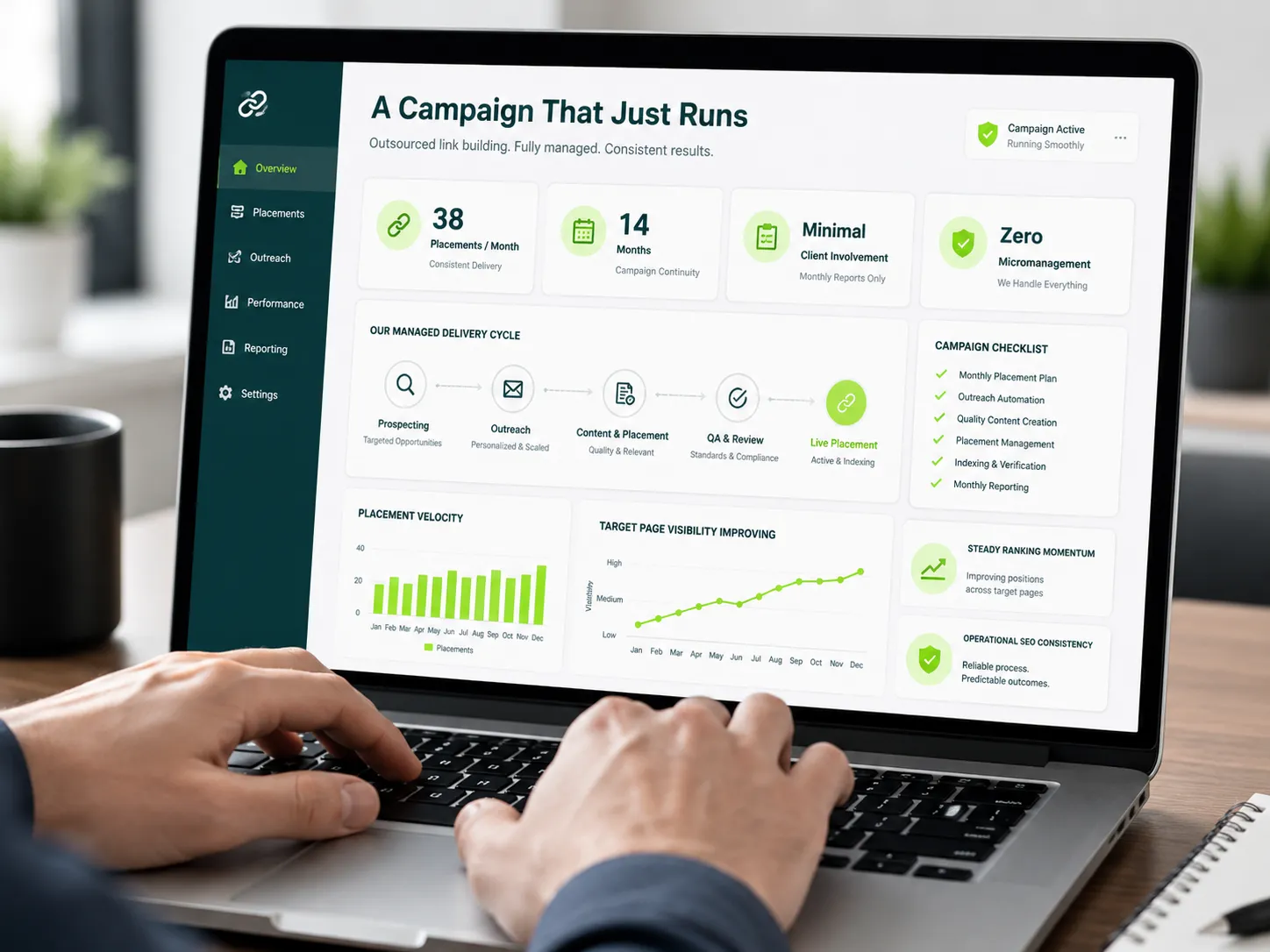
### A Campaign That Just Runs
Outsourced link building works because the agency owns the entire delivery cycle. Placements arrive on a consistent monthly schedule, eliminating the need for your team to micromanage prospecting, outreach, or production.
**The result:** You see steady monthly placement velocity, predictable ranking lift on target pages, and a campaign that produces results whether you’re in the office, on vacation, or focused on a major launch.
One mid-market B2B client received 38 placements per month for 14 consecutive months with effectively zero involvement beyond monthly report reviews.
This consistency is what separates outsourcing from project-based work. The campaign runs continuously, not in stops and starts.
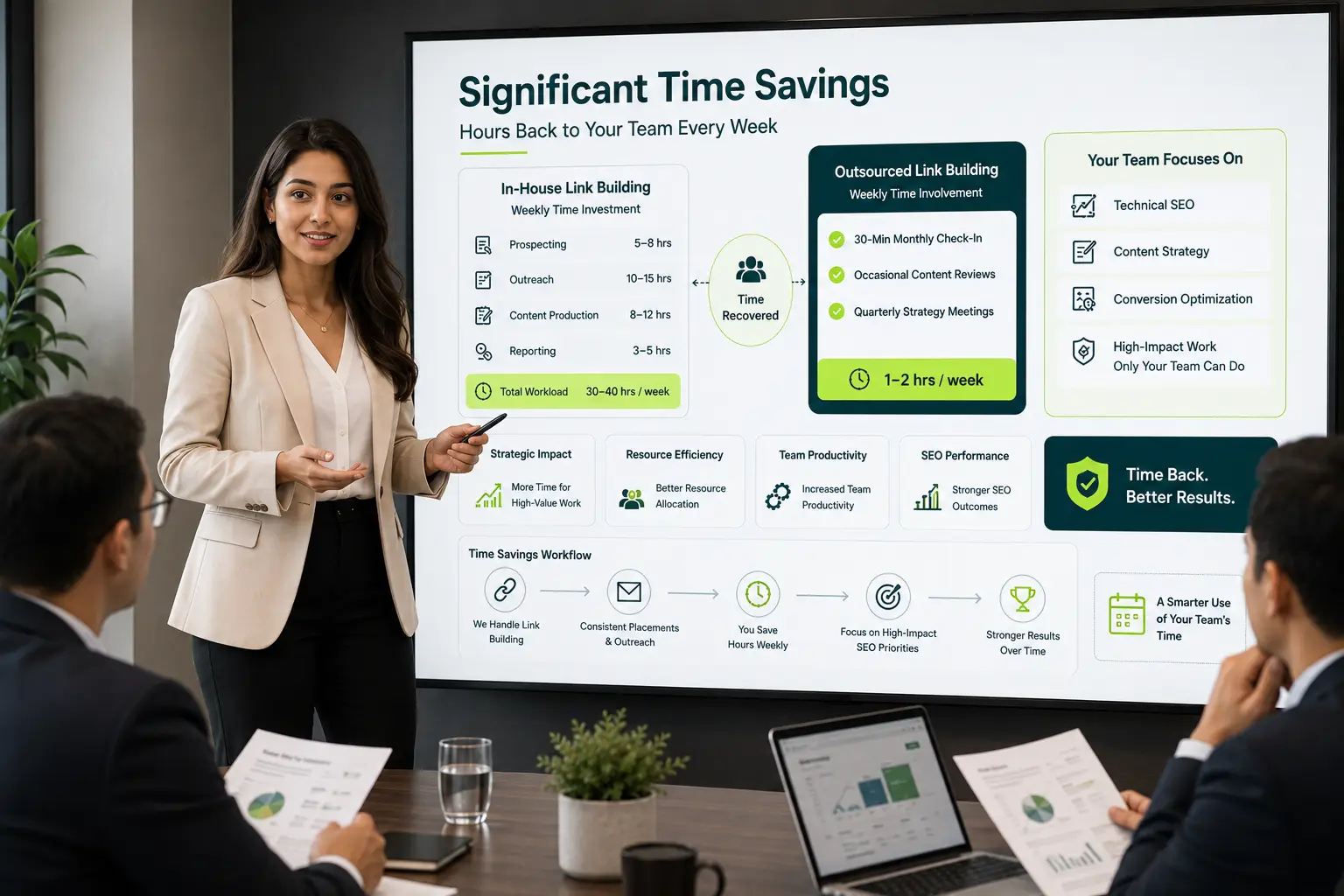
### Hours Back to Your Team Every Week
In-house link building consumes a considerable amount of team time, even at modest velocity. Prospecting takes 5-8 hours per week, outreach takes another 10-15 hours, content production requires 8-12 hours, and reporting consumes another 3-5 hours. The total workload often reaches 30-40 hours per week for one part-time link building effort.
Outsourcing reduces your team’s involvement to roughly 1-2 hours per week, including a 30-minute monthly check-in, occasional content reviews, and quarterly strategy meetings.
For most SEO leaders, this time recovery is what makes outsourcing strategic. Your team focuses on technical SEO, content strategy, conversion optimization, and other work that only your in-house team can execute effectively.
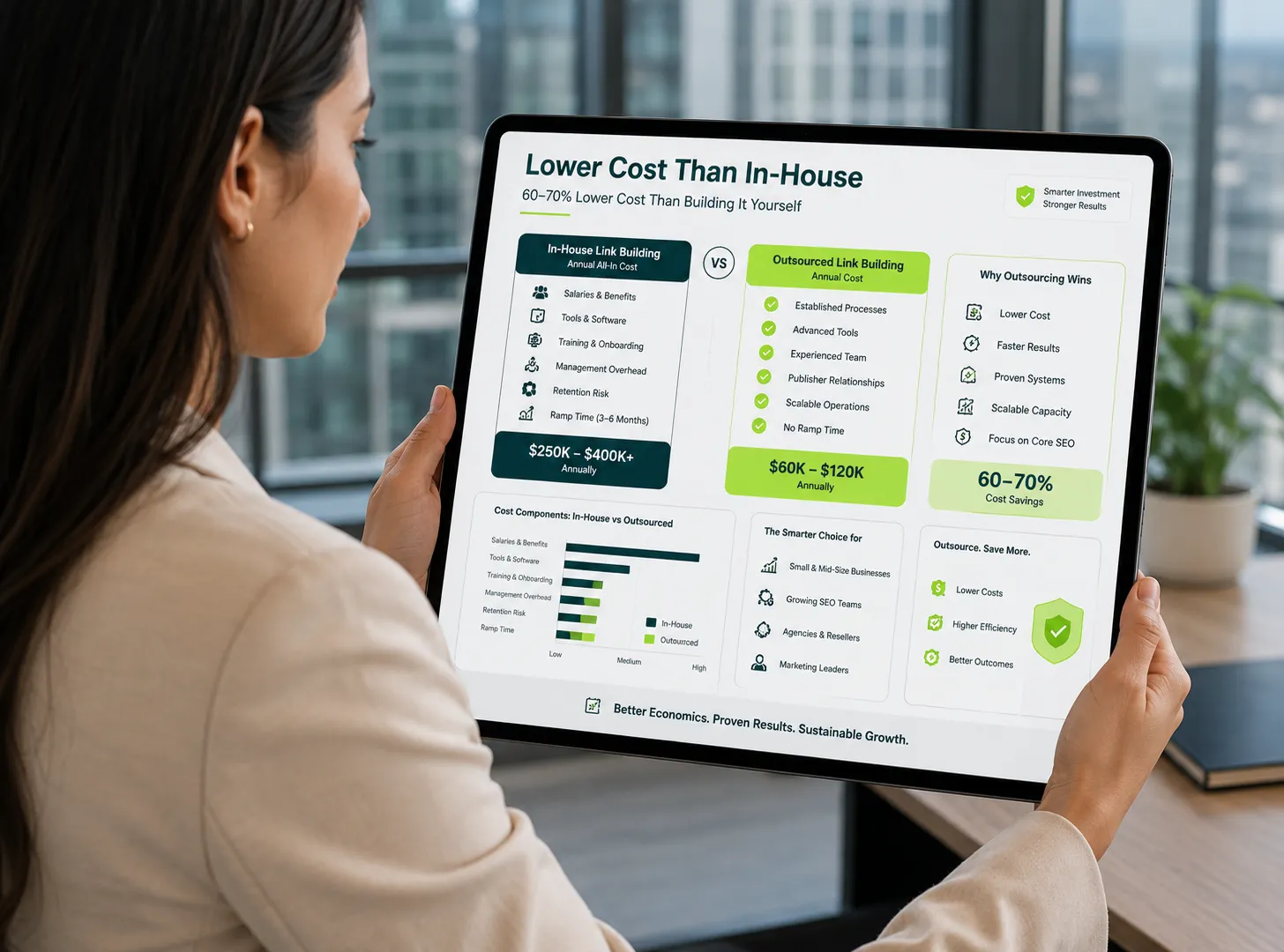
### 60-70% Lower Cost Than Building It Yourself
The full cost of an in-house link building team includes salaries, benefits, tools, training, management overhead, and retention risk. You also pay salaries during the 3-to-6-month ramp before the team delivers full output.
A credible in-house team costs $250–400K+ annually, all-in. An outsourced engagement covering equivalent capacity typically costs $60–120K annually. The gap is the agency’s operational leverage: shared tool costs, established processes, existing publisher relationships, and team utilization across multiple clients.
For most businesses operating below enterprise scale, outsourcing delivers better economics than in-house at every level of placement volume.
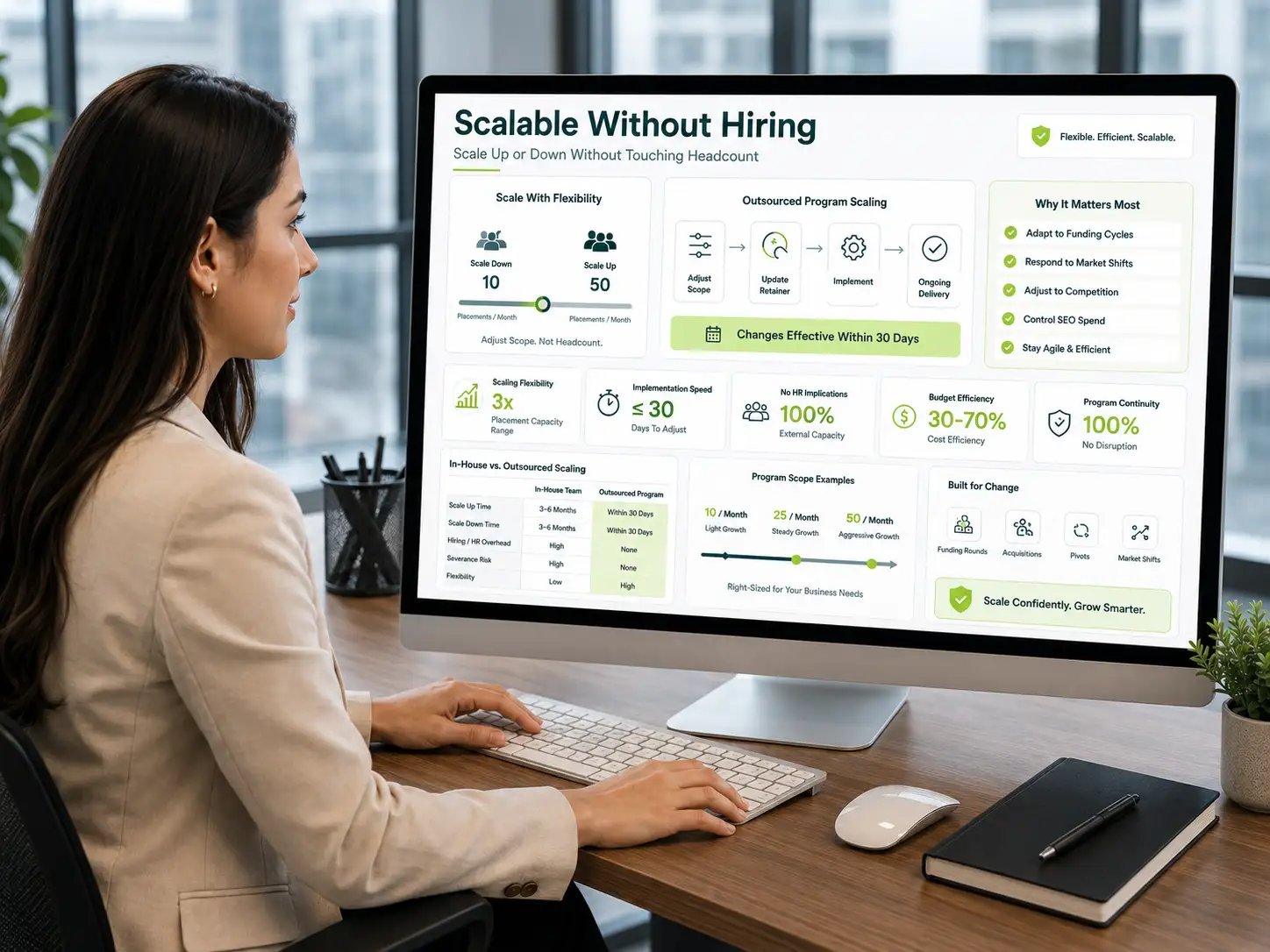
### Scale Up or Down Without Touching Headcount
In-house teams come with hiring overhead when you scale up and severance overhead when you scale down. Outsourced programs scale by adjusting monthly retainer scope, from 10 placements per month to 50, and reduce or expand scope as budgets change, without HR implications.
This flexibility matters most when business conditions change. Funding cycles, market shifts, and competitive dynamics impact SEO budgets unpredictably. Outsourced programs adjust within 30 days, while in-house teams take quarters to scale in either direction.
Clients running outsourced programs through funding rounds, acquisitions, and pivots adjust scope regularly without disrupting ongoing campaign work.
Client Success Stories
## What Clients Say About Outsourcing Link Building With Us
Verified reviews show that teams recover time, reduce costs compared to in-house setups, and achieve predictable monthly placement delivery without micromanagement.
[View All
](https://outreachdesk.com/testimonial/)

**4.8**/5 

## 5/5 
Rating on Google



We spent eight months trying to build link building in-house with two hires, one resignation, three Ahrefs licenses, and 40 link placements, but the ROI didn’t work at our scale. Outsourcing delivered more placements in the first quarter than we achieved in those eight months.

#### Head of Marketing
B2B SaaS


The time recovery was the unexpected benefit. I budgeted for cost savings versus in-house. What I didn’t expect was getting back 25 hours per week to focus on technical SEO and content strategy. That time has produced more impact than the placements themselves.

#### VP SEO
Ecommerce


What sold us was the consistency. Our previous freelance setup delivered 8-15 placements one month and 0-3 the next, depending on freelancer availability. Outsourcing brought us steady 30+ placements monthly from month two on. Predictability changed how we plan around link building entirely.

#### Senior Director SEO
Fintech
Service Framework
## Investment, Timeline, and Deliverables
The agency customizes every outsourced link building engagement based on your placement needs, team size, and tactics. The following factors determine your investment:

### Monthly Placement Velocity
Most outsourced programs deliver between 10 and 50 placements per month based on scope.

### Account Team Size
A standard team includes a strategist, 1-2 outreach specialists, and a dedicated content writer per program.

### Client Involvement Level
Most outsourced engagements require 1 to 2 hours of client time per week beyond the kickoff phase.

### Engagement Length
Most outsourced retainers run on rolling 12-month terms with quarterly review and adjustment cycles.
### Directional pricing
Pricing and scope are shared as requested, tailored to your placement volume, account team size, and growth goals. Custom proposals are available after an initial strategy call, outlining an approach built around your requirements, including monthly placement scope, anchor strategy, reporting cadence, and a month-by-month roadmap aligned to your goals.
Book a Strategy Call
What You Get
## Everything Included, Nothing Left for You to Manage
Your engagement includes the team, the tools, the reporting, and the strategic guidance, all under one retainer.

### Live Placement URLs
You can access direct links to every live placement anytime through your client portal, without waiting for a monthly report.

### Account Director Access
Your single senior point of contact handles every question, request, and strategic decision throughout the engagement.

### Monthly Strategic Reports
You receive a clean monthly report designed for a 15-minute review, not a 50-page deck.

### Tool-Included Reporting
You get all Ahrefs, Pitchbox, and outreach tool data included in your reporting, so you don’t need separate subscriptions to monitor performance.
Our Approach
## A Full-Service Approach That Actually Runs Without You
You get a dedicated team that handles strategy, execution, and reporting while requiring minimal client time to keep the campaign moving forward.
| Factor | In-House | |
| --- | --- | --- |
| Ramp Time | 3-6 months to hire, train, and stabilize
a team before output begins. | 14-day onboarding; full velocity
within 30-60 days from kickoff. |
| Annual Cost | $250-400K+ for strategist, outreach team,
content writer, tools, and overhead. | $42K-180K for equivalent capacity,
fully managed under one retainer. |
| Team Risk | Retention risk; turnover resets the program
every 12-18 months on average. | Continuous delivery; team changes happen
inside the agency without affecting output. |
| Client Time Required | 30-40 hours weekly to manage prospecting,
outreach, content, and reporting work. | 1-2 hours weekly for check-ins, content
reviews, and quarterly strategy sessions. |
| Scaling Flexibility | Hiring or layoffs are required to scale up or
down, with quarter-long lead times. | Scope adjustments within 30 days;
no HR implications in either direction. |
Who We Help
## Industries We Support With Outsourced Link Building
Whatever your industry, we run the workflow your team would otherwise have to build, manage, and maintain internally.
[

### SaaS &
Software
](/saas-link-building/)
[

### Ecommerce &
DTC
](/ecommerce-link-building/)
[

### B2B
](/b2b-link-building/)
[

### Enterprise
](/enterprise-link-building/)
[

### Emerging
Businesses
](/link-building-for-startups/)
[

### Real
Estate
](/real-estate-link-building/)
[

### Law Firms &
Legal
](/link-building-for-lawyers/)
[

### Dental
Practices
](/link-building-for-dentists/)
[

### Healthcare &
Fitness
](/health-fitness-link-building/)
[

### Financial &
Insurance
](/link-building-for-financial-websites/)

### Technology &
Innovation

### Consumer
Brands
Common Questions
## Frequently Asked Questions
You get clear answers on outsourced link building, including team structure, scope, costs versus in-house, time commitment, and how the engagement compares to white-label or freelance setups.
### What’s included when I outsource link building to your agency?
You get a complete link building program. It covers campaign strategy and target page planning, manual publisher prospecting and quality vetting, personalized outreach written by specialists, content production for guest posts and editorial contributions, placement integration with anchor text strategy, monthly reporting with ranking impact analysis, monthly account check-ins, and quarterly strategic reviews.
You get tool subscriptions for Ahrefs, Pitchbox, Hunter, and similar platforms included in your monthly retainer, so you don’t pay for separate access. Pricing and delivery scope vary based on placement volume, industries, and campaign complexity, which you can explore on our [link building pricing page.](https://outreachdesk.com/link-building-pricing/)
### How does outsourcing compare to building a link building team in-house?
A credible in-house team often requires a senior strategist, 1-2 outreach specialists, a content writer, tools, and three to six months of ramp time before producing output at full capacity.
The all-in annual cost ranges from $ 250K to $400K+. Outsourced equivalents often cost $42K to $180 K annually and reach full velocity in 30 to 60 days. The gap is the agency’s operational leverage: shared tools, existing processes, and established publisher relationships built through [consistent link building outreach ](https://outreachdesk.com/link-building-outreach/) that take in-house teams months or years to build.
### How much time will my team need to spend on this?
Most outsourced engagements need just 1-2 hours per week from you after kickoff. That breaks down to roughly 30 minutes for the monthly account check-in, 30-60 minutes when your team reviews content for subject-matter accuracy, and 60–90 minutes for quarterly strategy reviews.
Onboarding asks more of you upfront, plan for a 60-90 minute kickoff call plus one round of strategy review and approval. After that, your weekly time investment drops significantly.
### Is outsourcing different from your white-label link building service?
Yes. White-label link building serves marketing agencies that want to resell link building to their clients under their own brand. The agency receives the work and presents it to its end clients with their own reporting and branding.
Outsourcing is broader: any company, in-house SEO teams, founders, or marketing leaders, can outsource link building directly. Your team receives and reviews the work directly; no one rebrands it for downstream clients.
If you run an agency and want to resell link building, start with a [white-label link building service](https://outreachdesk.com/white-label-link-building-services/). If you run a business and want to outsource for your own SEO program, a [dedicated link building agency](https://outreachdesk.com/) is usually the better fit for a fully managed campaign.
### How quickly can we get started?
Most outsourced engagements move from initial inquiry to active campaign within 14 days. That breaks down to: initial strategy call (within 3-5 days of inquiry), proposal and contract review (3-5 days), kickoff call and onboarding (3-5 days).
Prospecting momentum and the first round of outreach connecting with responsive publishers typically drive full placement velocity within 30-60 days. For urgent programs, buyers who compress the proposal review window can achieve faster timelines.
### What’s the pricing structure for outsourcing link building?
Pricing is monthly retainer-based and scoped to placement volume, tactic mix, and account team size.
Entry-level programs cover focused engagements with a modest monthly placement target. Mid-tier programs handle broader tactic coverage and higher placement volumes.
All pricing includes the dedicated team, tool subscriptions, content production, and reporting. Enterprise scope covering multi-market or multi-brand programs is covered separately on the [enterprise link building](https://outreachdesk.com/enterprise-link-building-service/) page.
## Ready to hand off link building and focus on the rest of your SEO program?
Get a senior strategist to scope your program, propose the right team size, and outline a 14-day path from kickoff to active placements.
Book Your Strategy Call

**4.8**/5 _
Trusted by 500+ **agencies &
1,000+ businesses** worldwide.

---
---
title: "10 Link Building Myths That Waste Your Time and Budget"
url: "https://outreachdesk.com/link-building-myths/"
lang: "en-US"
type: "post"
description: "People tell you that you need backlinks. They also push you to chase sites with high domain ratings and claim that great content earns inbound links on its own, and warn you that paying for any link will get you"
last_modified: "2026-05-27T11:29:15+00:00"
categories: [Link Building]
---
# 10 Link Building Myths That Waste Your Time and Budget
People tell you that you need backlinks. They also push you to chase sites with high domain ratings and claim that great content earns inbound links on its own, and warn you that paying for any link will get you penalized. Some have even started saying that AI search has made link building pointless altogether.
Some of that is right. Most of it is a myth, and acting on it is quietly draining your budget. Link building has always rewarded the same thing: relevance, credibility, and placement. What’s changed is which links count, why they count, and how easily you can waste a budget chasing the wrong ones.
The ten link building myths below are the ones most likely to send you down the wrong path in year one of link building, and each one comes with a concrete fix.

**Key Takeaways
**
- Relevance and placement beat raw backlink volume every time.
- DR filters your prospect list; it does not determine link quality.
- Great content without outreach stays invisible, no matter how good it is.
- AI search raised the bar for credibility; it did not remove the need for links.
- Consistent monthly links build lasting authority; one-time sprints don’t hold.
## Quick Summary: Myth vs Reality
The ten myths below are the ones most likely to cost you budget and rankings.
| THE MYTH | THE REALITY |
| --- | --- |
| More backlinks always mean better rankings | Relevance and placement beat raw volume |
| Only high-DR sites are worth chasing | A low domain rating (DR) niche-relevant site often beats a high DR site in an unrelated category |
| Backlinks from low-traffic pages are worthless | Page traffic is a tiebreaker, not a deal-breaker |
| Low-DR backlinks will hurt your rankings | Low-DR links from credible sites pass real value |
| Great content earns links on its own | Most great content gets ignored without outreach |
| Paying for any link will trigger a Google penalty | Spammy delivery is the risk, not the transaction |
| AI search killed link building | AI assistants cite the same sites that already rank |
| You need more backlinks than your competitors | A smaller, sharper profile outranks bigger, weaker ones |
| No-follow links are useless | They drive traffic, earn mentions, and shape a natural backlink profile |
| Link building works as a one-time push | Rankings need consistent link velocity to hold |
## Myth 1: More Backlinks Always Mean Better Rankings
More backlinks **only help when the new links are at least as good as the ones you already have**. After a certain point, additional low-quality links create diminishing returns.
Stronger placements from relevant sites often move rankings more than raw volume alone.
The myth comes from a real correlation. Pages with more backlinks rank higher on average. But the relationship isn’t linear.
According to [AIOSEO SEO statistics](https://aioseo.com/seo-statistics/#:~:text=An%20astonishing%2095%25%20of%20pages%20have%20zero%20backlinks.), roughly 95% of all pages on the internet have zero backlinks, which means almost any genuine link puts your page ahead of the majority of the web. Once you clear that threshold, low-quality links from sites nobody reads add nothing useful, and at scale, they can actively dilute your link profile or draw a manual penalty.

Picture two shops on the same street.
The first gets 500 people to enter the shop a day, but none buy anything. The second has 50 customers a day, all locals who buy things.
Your backlink profile works the same way. A small number of relevant links from sites with real readers will outperform a large volume of low-quality links in most cases.
The exact number you actually need depends on your keyword and your competitors, and we break down the math on [how many backlinks you need to rank](https://outreachdesk.com/how-many-backlinks-do-i-need-to-rank/).
### What to Do Instead
Aim for links from three to five sites in your category that carry real organic traffic, where the editor places your link inside a real article. If you’re starting fresh, the [step-by-step guide to getting backlinks](https://outreachdesk.com/how-to-get-backlinks/) is a good place to start.
## Myth 2: Only High-DR Sites Are Worth Chasing
Chasing only high-DR sites costs you niche placements that actually move rankings. DR is a useful filter, but it’s not a verdict on link quality.
The myth also says a high-DR link is automatically better than a low-DR link. Sometimes that’s true. Often it isn’t.
A high-DR lifestyle blog linking to your SaaS pricing page sends a weaker signal than a low-DR niche SaaS publication doing the same.
**Note:
**
Domain Rating (DR) is a 0-100 metric created by [Ahrefs](https://ahrefs.com/website-authority-checker?utm_source=chatgpt.com) to estimate the strength of a website’s backlink profile. It is not a Google ranking factor and does not directly determine rankings in search results.
Google evaluates contextual signals around each link, including topical relevance, surrounding content, the relationship between the linking and destination pages and whether the link appears as part of a [natural in-content placement](https://outreachdesk.com/contextual-link-building/) between related pages.
Many expired domains retain inflated authority metrics even after ownership changes, which is why DR alone is not a reliable quality filter.
Sites can also inflate DR through a small number of high-authority placements, even with little real traffic or editorial activity. A DR 30 blog with consistent organic traffic and a real audience in your niche is worth more than a DR 70 site that inflated its score through a handful of high-authority placements.

### What to Do Instead
First filter for relevance, then sort by DR within the relevant pool. Before accepting the link, check two things:
- Does the site receive real organic traffic?
- Has Google indexed the linking article?
If either answer is no, treat it as a strong signal to move on. Links without traffic or indexation rarely justify the effort.
## Myth 3: Links From Low-Traffic Pages Are Worthless
A backlink from a low-traffic page can still pass real value when the page is indexed, contextually relevant, and lives on a credible site. Page-level traffic is a tiebreaker.
Most articles on the internet don’t rank for high-volume keywords, including posts on specialist industry blogs and mid-tier publications in your niche. Those articles still pass authority to the sites they link to.

The signal you should actually read is the domain’s overall health and the page’s indexing status. A low-traffic page on a strong, well-maintained site is fine.
A zero-traffic page on a site that has stopped publishing, lost crawl activity, and shows declining authority is a different matter. Those signals together suggest the link will pass little to no value.
### What to Do Instead
Before accepting a placement, run three quick checks on the linking page.
Search the exact article title in Google to confirm it’s indexed. Then, read the surrounding content to confirm it’s topically relevant to your page. Finally, scan the other outbound links on that page.
If the link neighborhood is thin, unrelated, or spammy, that context works against you.
All three check out? Accept the placement even if the page traffic is low.
## Myth 4: Low-DR Backlinks Will Hurt Your Rankings
Low DR doesn’t mean low quality. It usually means the site is new or small.

A new SaaS blog written by a real founder, with genuine posts about their product category, might earn DR 15 in its first year.
A link from that blog can send stronger topical relevance signals than a generic placement on an unrelated high-authority site. A six-month-old industry newsletter at DR 25 with a few thousand engaged subscribers can be one of the better link sources available, provided its issues are published as indexed web pages rather than sent exclusively by email.
Skipping these because of a low DR means passing up relevant, affordable placements that would move the needle early. New domains naturally start with low domain rating metrics. That does not make them risky.
Many legitimate industry blogs and startup publications spend years with a low DR.
The actual red flags to watch for are different: thin or AI-generated content, no author bylines, hundreds of outgoing links to unrelated sites, no contact information, or a domain someone parked and reused.
### What to Do Instead
DR is one gauge among several and is not the sole indicator of danger. A low DR site with red flags mentioned in the image can be skipped. Pursue the site with low DR and real signals.
If the site passes the red flag check above, begin a targeted[publisher outreach process](https://outreachdesk.com/link-building-outreach/). A short email confirming the article topic and asking for an in-content placement is all it takes to turn a low-DR site into a legitimate link.
## Myth 5: Great Content Earns Links on Its Own
Great content does not earn links on its own. It earns links when paired with active outreach to the right editors.
This is the most expensive myth on the list because it sounds reasonable. The myth is: write something useful, and the right people will find it and link to it.
They won’t. They don’t know it exists.

Some content does attract links without outreach. Journalists and bloggers link to some of the [link-worthy assets](https://outreachdesk.com/linkable-assets/), such as original research, free tools, data studies, and visual assets, because they need something concrete to cite.
But a how-to post, even a well-written one, almost never earns links without someone actively telling editors it’s there. That someone is you, or it’s the [SEO outreach process](https://outreachdesk.com/seo-outreach/) you’re running. Either way, someone has to do it, and it does not happen on its own.
Great content makes outreach work. Outreach makes great content visible. You need both.
If you’ve published 30 posts and earned three random links, you don’t have a content problem. You have a distribution problem.
### What to Do Instead
Pick your three strongest pages and run outreach to sites that link to similar content from competitors.
For most early-stage sites, pause new publishing and redirect that time toward outreach for those three pages. Ranking the content you have returns faster than adding more.
## Myth 6: Paying for Any Link Gets You Penalized
Google’s official position is that buying links violates their guidelines. That part is accurate. What the myth gets wrong is what “buying links” means in practice.
Google’s algorithm attempts to ignore or devalue low-quality paid links rather than penalize the site that acquired them, but this is not a guarantee.
The threshold for algorithmic versus manual action is not publicly documented. Manual penalties exist but are rare in practice.
Industry evidence suggests they tend to follow patterns like coordinated networks and mass exchanges, rather than isolated placements, though Google has not published a threshold for when individual links trigger manual review.

### What Google Flags in Practice
Private blog networks, [link farm schemes](https://outreachdesk.com/link-farming/), mass exchanges, comment spam, sponsored links that don’t carry the proper attribute, or any profile that looks coordinated and artificial.
### What Works
Paying a real publication or outreach team to secure an editorial placement on a relevant site, with the right attribute when required. The link itself is not the violation. The delivery method is. That distinction becomes important when deciding [whether to buy backlinks](https://outreachdesk.com/buy-backlinks/).
### What Google’s Guidelines Say
Any link in which payment influences placement violates policy, regardless of editorial quality or how polished the process appears. A professionally placed paid dofollow link without a sponsored attribute still breaks the rule, even if it never gets flagged.
In practice, many agencies operate in this space anyway, weighing the risk as a cost of doing business. That’s an industry reality. But it’s risk management, not a loophole.
### What to Do Instead
If you pay for placements, pay for the editorial vetting and outreach work. A suspiciously cheap placement that lands unsolicited in your inbox is the kind of link Google has been ignoring for years.
## Myth 7: AI Search Killed Link Building
AI search assistants draw from the same sources that already rank well in Google, so [high quality backlinks](https://outreachdesk.com/high-quality-backlinks/) still drive the visibility AI systems cite.

The myth says that people are asking ChatGPT and Perplexity instead of clicking blue links, so backlinks no longer matter. It sounds convincing if you stop there. But look at where AI answers come from. They come from pages that already rank well in regular search and from sources that AI systems cite. You used to build links to earn organic clicks. Now the same links support clicks and broader [AI-driven search visibility.](https://outreachdesk.com/ai-search-link-building/)
[BrightEdge studies found](https://www.brightedge.com/resources/weekly-ai-search-insights/ai-overviews-one-year-presence-size-citing?utm_source=chatgpt.com#:~:text=AI%20Overviews%20are%20growing%20fast%20%E2%80%94%20but%20organic%20still%20runs%20the%20majority%20of%20search.%20And%20what%20Google%20cites%20in%20AIOs%20is%20largely%20different%20from%20what%20ranks%20on%20page%201.) Google AI Overviews still cite many pages that rank organically, but the overlap is inconsistent, and AI Overviews increasingly surface sources beyond traditional page-one rankings.
To get [cited in an AI summary](https://outreachdesk.com/how-to-show-up-in-ai-overviews-seo/), you generally need visibility in regular search first. And visibility still runs on the same inputs: content quality, technical health, and backlinks.
The work hasn’t changed. The reward has. You used to build links to earn organic clicks. Now the same links earn organic clicks and increase the chance of being cited in AI-generated answers.
### What to Do Instead
Keep earning links and [editorial brand references](https://outreachdesk.com/brand-mentions/). Add specialist quotes and original data so that AI systems have something specific to cite from your site. Treat AI visibility as the compounding return on doing classic SEO well, not as a replacement for it.
## Myth 8: You Need More Backlinks Than Your Competitors
Beating a competitor’s raw link count is a tempting target because it’s measurable. It’s also the wrong target.
A competitor with 500 backlinks from forum posts, scraper sites, and abandoned blogs has a profile that Google’s spam detection has been discounting since link quality became a core algorithmic signal.
You don’t need 501 links to outrank them. You need a smaller number of strong, relevant placements from real publications with real editors and readers, and you stand a much stronger chance of outranking them on the keywords that matter.

[Google’s John Mueller](https://www.searchenginejournal.com/googles-john-mueller-total-number-of-backlinks-doesnt-matter/396638/) said in a 2021 Search Central hangout that total backlink count is ‘completely irrelevant’. What the algorithm weighs is relevance and quality. Twenty links from twenty different relevant sites does more than 200 links from the same five sites.
### What to Do Instead
Audit your [competitor’s backlink profile](https://outreachdesk.com/competitor-backlinks/) and referring domains. Filter for placements on sites with real organic traffic and topical relevance to your category. What remains is your actual prospect list, typically far shorter than the raw referring domain count suggests.
## Myth 9: Nofollow Links Are Useless
Nofollow links still drive referral traffic, brand mentions, and the natural-mix signal that real backlink profiles carry.
It includes a small piece of code telling Google not to follow it for ranking purposes. The myth says these links are a waste of effort.

### Three Reasons Why This Is a Myth
#### 1. Google Treats Nofollow As a Hint
[Google updated its treatment of nofollow links](https://developers.google.com/search/blog/2019/09/evolving-nofollow-new-ways-to-identify) in September 2019, reclassifying them as a hint rather than a strict instruction. That means some nofollow links still indirectly influence rankings.
#### 2. Nofollow Links Still Drive Traffic and Brand Signals
Nofollow links from major publications drive real referral traffic and brand awareness, both of which feed into search performance over time.
#### 3. A Follow-Only Profile Looks Engineered
A backlink profile in which each link passes authority looks engineered. Natural profiles include a healthy share of [dofollow links that pass authority](https://outreachdesk.com/dofollow-backlinks/) and nofollow links from news sites, social platforms, forums, and directories.
Refusing a Forbes nofollow because it won’t pass PageRank is one of the most expensive misreads a first-year team can make.
Don’t decline an editorial mention from a credible outlet just because it’s nofollow. The brand mention, the traffic, and the trust signal are worth it on their own.
### What to Do Instead
Accept nofollow links from credible publications without hesitation. Treat them as part of a natural, mixed profile rather than something to avoid.
## Myth 10: Link Building Works as a One-Time Push
Link building doesn’t work as a one-time push. Stop, and rankings slide back as link velocity drops and competitors keep building. Some earlier links decay in value, and some publishers might have removed them.
The signal of “this site is current and actively referenced” weakened. Rankings followed.

Link building works the way consistent training works. Stop, and the gains fade. The right pace isn’t aggressive; it’s consistent.
A handful of relevant, well-placed links every month sustained over a year builds more durable authority than a single sprint of 30 links in one month. And it won’t trigger the kind of unnatural velocity pattern that draws algorithmic scrutiny.
### What to Do Instead
Set a monthly link target you can hit for 12 months. Avoid setting an aggressive quarterly target; it might burn you out.
Now that you know what to avoid, our full guide to [strategies to earn links](https://outreachdesk.com/link-building-strategies/) covers how to build a program around what actually works.
## Start With Your Three Strongest Links
Open your backlink profile right now. Pick your three strongest links and run three checks on each: indexed in Google, real organic traffic, and topically relevant.
If two of three fail, you’ve probably been building links around SEO myths instead of signals that move rankings. Spend the next week securing one link that passes all three tests. That’s usually the link that changes something.
### Tired of burning budgets on backlinks that don’t move rankings?
Get a link building plan built on what Google actually rewards.
[Book a strategy call](/contact-us/)
### Are backlinks still important in 2026?
Backlinks remain a core ranking signal for Google in 2026, and they appear to influence which sources AI search systems cite.
Quality and relevance matter more than raw volume, but the basic relationship between authoritative links and higher rankings hasn’t gone away.
### How many backlinks do I need to rank?
There’s no fixed number. It depends on your keyword, your competitors, and the strength of your existing content.
For a low-competition local or niche keyword, a handful of relevant links from credible sites can move your search rankings. For a competitive keyword, you’re likely looking at dozens of high-quality referring domains before rankings shift meaningfully.
The fastest way to set a realistic target is to pull the referring domain count for the top three pages ranking for your keyword. Use that number as your benchmark.
### Is buying backlinks safe in 2026?
It depends entirely on how the link gets built. Mass-purchased links from spam networks get ignored or penalized.
Paying a reputable outreach team or publication for the editorial work of securing a contextual placement on a relevant, real-traffic site is a different category entirely. Many competitors operate in that space.
The risk lives in the delivery method, not the transaction. A placement that went through real editorial review, appears in a relevant article, and carries the correct attribute stands on solid ground. A bulk list of fifty links for a flat fee is not.
### Will Google penalize me for having too many backlinks?
No. Google has been clear that link volume alone isn’t a penalty trigger.
What triggers manual actions is the pattern behind the links. Unnatural anchor text, sudden spikes from spam networks, paid links missing the correct attribute, profiles that look coordinated and artificial, those get flagged.
A site with 10,000 quality backlinks earned over time is fine. A site with 200 obviously manipulated ones built in a single month is not. Volume isn’t the variable. Pattern is.
### What’s the difference between a high-DR link and a relevant link?
A high-DR link comes from a site with a strong overall backlink profile, regardless of what that site covers. A relevant link comes from a site whose content fits your category or is near it.
When the two overlap, you have the strongest possible placement. When they don’t, relevance usually wins.
A DR 30 link from a site in your exact niche often passes a more useful signal than a DR 80 link from an unrelated lifestyle blog. Google reads the context of the linking page, not just the strength of the linking domain.
### Do nofollow links help SEO?
Yes, indirectly. They drive referral traffic from real readers, build brand mentions across credible publications, and add to a profile that looks natural rather than engineered.
Google updated its treatment of nofollow links in September 2019, reclassifying them as a hint rather than a hard instruction. Some nofollow links still influence rankings indirectly.
And a backlink profile where every single link passes authority looks unnatural. Real profiles include a healthy mix of both.
### How long does it take to see results from link building?
For most sites, three to six months. Google needs time to crawl your new links, process the authority signals from the linking domains, and re-evaluate your page against competing results.
Competitive keywords take longer. Anyone promising page one results in thirty days is either using tactics that won’t hold or measuring something other than rankings. Consistent results come from working with an [established link building agency](https://outreachdesk.com/) that builds links the right way over time.
### How Much Should I Budget for Link Building in 2026?
The budget depends on your keyword competition and the authority gap between your site and the top-ranking competitors. More competitive keywords require more referring domains from stronger sources, which drives cost up.
Before committing to a number, the [link building pricing plans](https://outreachdesk.com/pricing-plan/) page breaks down what different budget levels typically deliver so you can match your spend to your actual competitive gap.
---
---
title: "Use ChatGPT for Link Building Without Sounding Robotic"
url: "https://outreachdesk.com/chatgpt-link-building/"
lang: "en-US"
type: "post"
description: "You've opened ChatGPT, typed \"write me a link building outreach email,\" and pasted the result into Gmail. The website owner you sent it to has seen that exact email dozens of times this month. They didn't reply. So, would you"
last_modified: "2026-05-26T07:42:46+00:00"
categories: [Link Building]
---
# Use ChatGPT for Link Building Without Sounding Robotic
You’ve opened ChatGPT, typed “write me a link building outreach email,” and pasted the result into Gmail. The website owner you sent it to has seen that exact email dozens of times this month. They didn’t reply.
So, would you stop using ChatGPT? No, you stop using it the way everyone else uses it.
ChatGPT for link building involves handling repetitive tasks, such as sorting prospect lists, drafting initial pitch drafts, and brainstorming linkable asset ideas.** Your time goes to what actually wins the link: being a real person who knows the prospect’s site.
**
### What This Article Covers
- The 4 tasks where ChatGPT genuinely saves time, and the 2 where it’ll burn your sender reputation.
- Copy-paste prompts for prospect-list cleanup, outreach personalization, anchor text variations, and broken-link replacement briefs.
- The reason ChatGPT invents websites and statistics and the 30-second verification step that catches it.
- A one-time custom GPT setup that remembers your niche, voice, and prospect type from that point forward.

## Can ChatGPT Actually Build Links for You?
No. ChatGPT can’t build backlinks for you. It can speed up parts of the process that aren’t the link itself, such as research, list-cleaning, draft pitches, anchor text variations, and content briefs.
A real person earns a [link through manual outreach](https://outreachdesk.com/link-building-outreach/) about content that the recipient wants to reference.
Think of it like this. A backlink is a link from one website to another. The site owner doing the vouching is a human. They’ve seen a thousand AI-generated pitches and don’t want to read another one.
Here, you need to write sentences that prove you read their article. ChatGPT can help you find that sentence faster and write it for you. But only if you use the right prompts.

**The split that determines your results:
**
| ChatGPT is good at | ChatGPT is bad at |
| --- | --- |
| Drafting first-version emails, you’ll edit | Writing send-ready emails |
| Brainstorming linkable asset ideas | Knowing what’s actually in your niche |
| Reformatting prospect data from CSVs | Finding real prospects on its own |
| Generating anchor text variations | Verifying that any specific URL exists |
| Summarizing long articles for pitch hooks | Citing live statistics or studies |
| Cleaning up your draft replacement content | Knowing if a “broken link” is actually broken |
If you stay on the left side of that table, ChatGPT becomes a junior assistant who never sleeps. Cross to the right side without checking the work, and you’ll send pitches referencing articles that don’t exist to email addresses the AI made up.
To stay on the right side of efficiency without sacrificing accuracy, you need a systemized setup that locks in your standards from day one.
## 1. Train a Custom GPT Once, Use It for Everything
A custom GPT gives you a **pre-loaded version of ChatGPT** that already knows your niche, brand voice, and prospect type, so every prompt you send starts from context rather than scratch.
Most people open a fresh chat every time. They paste the same context over and over: niche, brand voice, prospect type. The AI keeps forgetting, which results in generic output.
Build custom GPTs once. After that, every prompt already knows your niche, backlink profile, target audience, and brand voice and tone.
Here’s a starter brief you can paste into ChatGPT (the “Create a GPT” option, available on paid plans):
Use this prompt and add relevant details for your business.
You are my link building assistant for [your website].
Site & niche:
- URL: [yoursite.com]
- Niche: [e.g., women’s running shoes, B2B HR software, dental clinic in Austin]
- Target audience: [who buys from you]
Current link profile:
- DR (Domain Rating, a 0-100 score from Ahrefs that estimates how strong a website’s backlink profile is): [your DR]
- Roughly [X] referring domains
- Main link types so far: [guest posts/niche edits / unlinked mentions/none yet]
Outreach personas I send to:
- [e.g., running gear bloggers, HR Tech newsletter editors, local lifestyle journalists]
Brand voice:
- [3-5 adjectives, e.g., “friendly, direct, no jargon, occasionally funny, never salesy”]
- Sample of a real sentence I’d write: [paste one]
When I ask you a task, respond in line with everything above. If I ask for an email, write it the way I’d write it, not the way ChatGPT writes by default. Acknowledge this brief and wait for my first task.
Spend 20 minutes properly filling that in. Then every email, every anchor text suggestion, every prospect-list cleanup happens against that context.
The difference between “generic AI output” and “useful AI output” is almost always how much context you gave the model upfront.
## 2. Use ChatGPT to Clean Prospect Lists, Not Find Them
ChatGPT cannot reliably find link prospects from scratch. When you ask “give me 20 health blogs that accept guest posts,” it will invent domain names that look real, but in reality, they are different.
This is called hallucination. It happens because the model is predicting plausible text rather than looking anything up.

What ChatGPT does well is take a list of real prospects you’ve already exported from Ahrefs or another [link research tool](https://outreachdesk.com/link-building-tools/). Then it sorts, scores, and cleans it.
Use this prompt to evaluate websites from a CSV**:
**
I’m going to paste a CSV of websites I’m considering for outreach. For each one, do three things:
1. Score it 1-10 for relevance to [your niche], based on the domain name and any context you can infer.
2. Flag any obvious throwaway domains (PBN-style, low-quality, recently expired).
3. Group the survivors by likely outreach angle: guest post candidate, niche edit candidate, resource page candidate, or unclear.
Don’t add any URLs that aren’t in my paste. If you’re unsure about a domain, mark it “unclear” and ask questions rather than guessing.
Here’s the list:
[paste your CSV here]
The last sentence in that prompt matters. Telling the model not to add domains cuts the chance it invents extras. You’ll still want to spot-check the top 10 manually.
The cleanup takes 5 minutes instead of an hour. For the prospecting step itself, stick to real tools like Ahrefs, the [analysis of your competitor backlinks](https://outreachdesk.com/competitor-backlinks/), or manual SERP digging.
## 3. Write Outreach Emails the Way You Actually Talk
Feed ChatGPT a real example of how you write, and it stops producing corporate-LinkedIn voice.
Every prospect’s inbox is full of “I hope this email finds you well, I came across your fantastic article on…” and the prospect deletes it before reading line two. The move is to feed ChatGPT a real example of how you write.
The custom GPT in section 1 already does this. If you’re not using one yet, paste a short brief at the top of every email prompt:
Write a link building outreach email for [your site] to [prospect site].
Context they need to see:
- I read this specific article on their site: [paste URL and one specific detail you noticed]
- I have this related piece they could link to: [your URL]
- The natural place it’d fit in their article is: [section name or paragraph topic]
How I want it written:
- Subject line under 6 words, no clickbait
- 4 short paragraphs maximum
- No “I hope this email finds you well.”
- No “I came across your fantastic article.”
- Mention the specific detail in line 1, before anything else
- End with one direct question, not “let me know your thoughts.”
Tone reference, this is how I actually write:
[paste 2-3 sentences from a real email you’ve sent that landed well]
The “tone reference” line is the one that changes everything.
ChatGPT defaults to a corporate LinkedIn voice unless you give it something else to copy. A 3-sentence sample of your real writing forces it to drop the stock phrasing.
You still need to edit the result. Always treat the output as your first draft, not your final draft.
The version you send needs at least one sentence that ChatGPT couldn’t have written. It has to reference something only a human reader of that prospect’s site would notice.

## 4. Generate Anchor Text Variations Without Over-Optimizing
The fastest way to make your link profile look manipulated is to use the same exact-match keyword on every link pointing to your page.
If every link pointing to your money page uses the same exact-match keyword, Google sees that as manipulation, and your rankings drop instead of rising. You want a natural mix: some branded, some partial-match, some descriptive, a couple of naked URLs.

ChatGPT is genuinely good at this.
I’m building links to this page: [your URL]
The page is about: [one sentence]
The primary keyword is: [keyword]
Give me 15 anchor text variations across these 5 categories, 3 of each:
1. Branded (uses my brand name only)
2. Partial-match (includes 1-2 keyword words within a longer phrase)
3. Descriptive (describes what’s on the page in natural English, no exact keyword)
4. Generic (e.g., “this guide”, “their write-up”, “check this out”)
5. Naked URL (just the URL)
For each one, note which link type it fits best: guest post, niche edit, resource page, or homepage link.
Avoid:
- Repeating the exact keyword more than 2 times across all 15
- Phrases that sound stilted in a real sentence
- Anything ending in “click here.”
That gives you a working anchor plan for a campaign in 60 seconds. The reason this works while other tasks fail is that anchor text generation is a pure language task.
There’s no fact to look up, no URL to verify, no claim that could be wrong. The model is doing exactly what language models are good at.
## 5. Find the Pitch Hook in 30 Seconds Instead of 30 Minutes
The most consistently useful way to use ChatGPT for outreach is to have it read the prospect’s article.
You paste their article into the chat and ask it to find the specific thing you’d reference in a pitch.

Use this prompt to analyze an article:
Here’s an article I want to pitch to. Read it and tell me:
1. What’s the single most specific claim, statistic, or example in this piece? (the kind of thing a real reader would remember)
2. What’s a section where they cite or link out to other sources?
3. Is there anything they say they “couldn’t find data on” or “wish they had more info about”?
4. What angle would a related piece on my site need to take to fit naturally into their article?
My site is about [niche]. My related piece is about [topic + URL].
Here’s their article:
[paste the article text, or paste the URL if you’re on a plan with web browsing]
Question 1 gives you your opening sentence.
Question 2 tells you whether they’re the kind of writer who actually adds outbound links.
Question 3 is gold: if they explicitly say they couldn’t find something, and you have it, that’s an automatic pitch.
Question 4 keeps you from pitching a piece that doesn’t fit their angle.
This is the prompt I’d use first if I had to pick one. It turns a 30-minute manual read into a 30-second summary of what you actually need to write the email. You can pair it with the [SEO outreach process](https://outreachdesk.com/seo-outreach/) you’re already running, and your reply rate goes up without sending more emails.
## 6. Use ChatGPT to Draft Replacement Content for Broken Links
[Broken links acquisition](https://outreachdesk.com/broken-link-building/) converts well in 2026, because the prospect already has a problem, a dead link, and you’re offering to fix it.
ChatGPT can’t find broken links for you; use tools like Ahrefs, Check My Links, or a [broken link checker](https://outreachdesk.com/tools/broken-link-checker/). What it can do is draft the replacement content fast.

Skip your hours of manual research. Use this prompt to reverse-engineer a perfect replacement.
I found a broken link on [prospect URL]. The dead link used to point to an article called [original title], on the topic of [topic].
The context in the prospect’s article where the link sits is:
[paste the surrounding paragraph]
Write me a brief for a replacement piece on my site that:
1. Covers the same topic the broken link covered
2. Fits naturally where the prospect placed the original link
3. Adds at least one thing the original probably didn’t have, based on what’s current in [niche] in 2026
Give me a working title, an H2 outline, and 3 specific data points or examples I should include.
You then take that brief and either write the piece yourself or hand it to a writer. The pitch back to the prospect is much easier:
“Hey, your article links to [dead URL].
I noticed it’s broken, and I just published [your URL] covering the same topic.
Would you swap the link?”
That sentence is doing all the work, not the AI.
## 7. Where ChatGPT Will Lie to You
ChatGPT makes things up in four specific ways that can wreck a link building campaign: made-up URLs, invented statistics, fake author names, and outdated facts presented as current.
You may trust ChatGPT’s answers even if they are incorrect because they’re confident and well-formed sentences. That’s what makes it dangerous in link building, where accuracy on URLs, names, and statistics is non-negotiable.

Watch for these four failure modes:
### Made-Up URLs and Websites
Ask ChatGPT for a list of fitness blogs, and you’ll get domains that look real but return a 404 when you click them.
Never paste a domain name from ChatGPT into an outreach tool without first checking that it loads.
### Invented Statistics
Ask GPT for the average reply rate on cold outreach, and it gives you a plausible-sounding number, usually somewhere between 1% and 8%.
It’s not citing a study. It’s predicting how many words a paragraph like this typically contains. If you put that number in a blog post, you’re publishing fiction.
### Fake Author Names and Quotes
Ask for “5 SEO experts who’ve written about anchor text,” and you’ll get real names mixed with confident-sounding fakes. The same goes for quotes attributed to real people.
### Outdated Facts Presented as Current
Even with web browsing on, the model leans on its training data. If a tool changed its pricing in March, ChatGPT will quote the old number.
[A 2025 study in npj Digital Medicine](https://www.nature.com/articles/s41746-025-01670-7) found a 1.47% hallucination rate and a 3.45% omission rate, a signal that AI errors are systematic, not random, regardless of the task.
The rule is simple. For any URL, statistic, name, or quote going into something you send, open a new tab and verify it before it leaves the AI. If you can’t verify it in 30 seconds, don’t use it.
## 8. Set Up a Follow-Up That Doesn’t Sound Like a Robot
A follow-up that converts is short, adds one new piece of value, and ends with a question the prospect can answer in one word.
In most campaigns, a large share of replies come from the follow-up, not the first email. Most people skip the follow-up because writing them is boring.
ChatGPT is genuinely useful here. A follow-up is short, constrained, and doesn’t usually need fresh information.

Use this prompt to set up a follow-up.
Here’s an outreach email I sent 5 days ago and got no reply:
[paste original email]
Write a follow-up that:
- Is 3 sentences max
- References the original lightly, doesn’t quote it
- Adds one new piece of value or one new angle (e.g., a related stat, a clarification, an offer to send the draft directly)
- Ends with a single question, easy to answer with yes or no
- No “just bumping this” or “circling back.”
- No apologizing for following up
The “no apologizing” line matters. Default AI follow-ups open with “Sorry to bother you again,” which is the fastest way to signal you’d happily go away if asked.
The prospect missed it. Their inbox is noisy. Act like that’s the assumption.
## What’s Different in 2026
Four changes since 2023 affect how you use ChatGPT for link building. Web browsing is now on by default, and AI search surfaces are a new target for citations. Google is better at detecting pure AI writing. Custom GPTs are now the standard workflow.
### Web Browsing Is on by Default
ChatGPT can now read live articles you paste a URL for, instead of working from outdated training data. This makes the pitch-hook prompt in section 5 far more useful than it was in 2023.
### AI Search Citations Are Now a Link Goal
When ChatGPT, Perplexity, or Google’s AI Mode answer questions, they cite specific URLs. Earning citations from these surfaces is a new branch of link building.
[Optimizing for AI search](https://outreachdesk.com/ai-search-optimization/) overlaps with traditional link building, but isn’t identical. The assets you create for AI citation look different, more structured, more data-heavy, and more direct in their answers.
### Google’s Helpful Content Systems Are Better at Detecting AI-Only Writing
Pitching with pure ChatGPT output, sending pure ChatGPT guest posts, and publishing pure ChatGPT content all underperform what they did 2 years ago. The human edit pass is no longer optional.
### Custom GPTs Are Now the Default Workflow for Serious Link Builders
Using a fresh chat each time, with no project context, is the 2023 way. It still works, but you’re doing 3x the typing for the same output.
## Where to Start This Week
Pick one section from this article and run it on a real prospect this week. The custom GPT setup takes 20 minutes. The pitch hook prompt takes 30 seconds. Those two will change how much of your outreach time actually moves the needle.
If you’d rather have a team handle prospecting, writing, and outreach for you, that’s what [Outreach Desk’s link building strategies](https://outreachdesk.com/link-building-strategies/) are for. Either way, the goal is the same: more time on the part of link building only a human can do, less time on the parts that shouldn’t have taken you all afternoon.
### ChatGPT is creating generic pitches for your site?
Share your site and goals. You’ll get a workflow that uses AI for prep while you earn the links for your business.
[Get Your Link Workflow](/contact-us/)
### Can ChatGPT write a guest post that ranks?
ChatGPT can write guest posts, but the version that ranks (and the version that gets a [guest post placement](https://outreachdesk.com/guest-posts/) )needs human editing to meet the quality standards. You should add specific examples, real opinions, and at least one thing that ChatGPT couldn’t have known from training data. Use it for the outline and the first 70%, then rewrite the parts that matter most.
### Will using ChatGPT for link building get my site penalized?
What gets sites penalized is publishing pure AI content at scale with no human edit pass. The other risk: high-volume AI-generated outreach that gets you marked as spam. The problem is in how you use it, not in the tool itself.
### What’s the best ChatGPT model for link building work?
The most current paid model handles outreach drafting, prospect-list cleanup, and brief writing well. The free tier works for basic prompts but limits the number of custom GPTs and message volume.
For solo founders and small teams, a single paid seat pays for itself within the first few campaigns especially when the goal is [building links for AI search visibility](https://outreachdesk.com/ai-search-link-building/) rather than traditional rankings alone
### How long does it take to see results from ChatGPT link building?
Editorial links typically take 3 to 4 months to start moving rankings after they go live, regardless of whether you used AI to draft the pitch. If you want to compress that timeline, working with a [strategic link building agency](https://outreachdesk.com/) with existing publisher relationships can get placements live faster. You skip the cold-start phase entirely.
### Should I tell prospects I used ChatGPT to write the email?
No. You used ChatGPT the same way a copywriter uses a thesaurus: as a tool to speed up the work.
What matters to the prospect is whether the email is personal, accurate, and relevant. If those three things are true, how the draft started doesn’t matter. If they’re not true, disclosing them won’t help.
### Can I use ChatGPT to find guest post sites?
You cannot use ChatGPT directly to find guest post sites. ChatGPT will provide domain names or sites that no longer accept posts for guest posting. You can use tools for prospecting: Ahrefs, search operators like ‘write for us’ plus your niche, and competitor backlink analysis.
Then use ChatGPT to clean, score, and prioritize the results.Once placements go live, [tracking how ChatGPT surfaces your brand](https://outreachdesk.com/monitor-brand-mentions-chatgpt/) tells you whether your link building is translating into AI visibility.
---
---
title: "How to Get Cited in AI Search Without Outranking #1"
url: "https://outreachdesk.com/how-to-get-cited-in-ai-search/"
lang: "en-US"
type: "post"
description: "You've been told you need to rank #1 to show up in AI answers. That's half right. AI search platforms like ChatGPT, Perplexity, and Google's AI Overviews don't just pull from top-ranking pages. They pull clear, trustworthy passages they can"
last_modified: "2026-05-26T07:41:41+00:00"
categories: [Link Building]
---
# How to Get Cited in AI Search Without Outranking #1
You’ve been told you need to rank #1 to show up in AI answers. That’s half right.
AI search platforms like ChatGPT, Perplexity, and Google’s AI Overviews don’t just pull from top-ranking pages. They pull clear, trustworthy passages they can retrieve and verify. To get cited in AI search, **your content must be retrievable, extractable, and supported by trusted third-party signals.**

**Key Takeaways:**
- The 4-stage pipeline AI engines run before they cite anything, and where most pages fall out of it.
- Why a citation, a mention, and a recommendation each require a different optimization strategy.
- The 5 structural changes that make a paragraph extractable at the chunk level.
- How third-party signals on Reddit, G2, and industry media decide whether your claim gets backed.
- The platform-specific quirks that separate Claude citations from Perplexity citations.
## How AI Search Engines Actually Decide What to Cite
AI search engines don’t rank pages. They **retrieve passages, synthesize an answer, and attach citations to the passages they used**.
**The citation path usually has 4 filters:
**
- Eligibility
- Retrieval
- Extractability
- Attribution
Missing one stage removes your content from eligibility for citation.

### Stage 1: Eligibility
The AI engine has to fetch your URL before anything else. Make sure your pages return a 200 status code, have no login or paywalls, and don’t aggressively block bots.

In 2026, “accessible” means **multiple AI crawlers, including GPTBot, ClaudeBot, PerplexityBot, Google-Extended, and Applebot-Extended, can reach your content.
**
Each has its own user agent. Each can be blocked independently in your robots.txt. Audit your server logs. If the bot for a platform you care about isn’t getting through, nothing downstream matters.
### Stage 2: Retrieval
Retrieval is where the AI engine searches the web for passages relevant to the user’s query. This stage determines whether your content makes the shortlist.
AI engines use Retrieval-Augmented Generation (RAG), a core component of [modern AI search optimization](https://outreachdesk.com/ai-search-optimization/). RAG takes a user query, searches one or more sources, and pulls the most relevant passages before generating an answer.

For example, ChatGPT and Perplexity use their own indexes, along with live search. Claude uses Brave Search. Google AI Overviews lean heavily on Google’s own ranking signals.
Query fan-out controls how AI systems expand one search into multiple retrieval paths. One question like “best CRM for startups” can break into 5 to 15 smaller searches:
| Main Query | Possible Query Fan-Out |
| --- | --- |
| Best CRM for startups | Best CRM for SaaS startups 2026 |
| Best CRM for startups | CRM pricing under $50 per user |
| Best CRM for startups | HubSpot alternatives |
| Best CRM for startups | CRM with automation for small teams |
| Best CRM for startups | Simple CRM for founders |
You can earn citations without ranking for the primary query. You have to be retrievable for one of the fan-out queries.
### Stage 3: Extractability
Extractability decides whether the AI engine can lift your passage. The model already has a shortlist of passages. Now it chooses the ones it can extract and attribute without confusion.
A 200-word paragraph that answers a specific question beats a 600-word section that buries the answer halfway through.
This is where most pages lose. They have the right information, but it’s spread across three paragraphs, broken up by promotional language, or written as a continuous argument that the AI can’t slice. **Each section needs to read like a standalone unit.
**

### Stage 4: Attribution
Attribution decides whether the AI engine trusts your passage enough to cite it. The model has already found the passage. Now it checks whether your source deserves the citation.

Two main factors determine trust:
**1. Third-party Validation:
**
If a number of claims appear only on your domain, AI systems may skip it. When the same statistics appear across multiple trusted sources, such as Reddit discussions, G2 reviews, or industry media, the engine is more likely to recognize your content as reliable and cite it.
**2. Whether your content carries the signals the engine has learned to trust:
**
AI engines look for signals of credibility, including author bylines with credentials, date published metadata, proper schema markup, inline source citations, and consistent entity information across the web. These signals help the AI differentiate the authoritative passages from weak or unverified content.
## Mention vs. Citation vs. Recommendation: They’re Not the Same
A mention, a citation, and a recommendation are three different outcomes in AI search, and each one requires a different strategy to earn.
| Type | What It Looks Like | What Earns It |
| --- | --- | --- |
| Mention | “HubSpot is a popular CRM.” Your brand appears, but no source link appears. | Entity presence across Wikipedia, Crunchbase, G2, industry comparisons, and trusted third-party sites. |
| Citation | “According to [Source], the platform handles 60,000 events per second.” Your URL appears as the source. | Extractable claims, original data, or unique synthesis that the AI system can lift. |
| Recommendation | “For early-stage SaaS, HubSpot or Pipedrive are good starting points.” Your brand appears as the answer. | Comparison content, review platform presence, and prompt-specific authority. |
A mention helps brand recognition. A citation drives referral traffic and authority signals. A recommendation drives conversions.
To systematically track [brand mentions in large language models](https://outreachdesk.com/track-brand-mentions-in-large-language-models/) and understand which outcome you’re achieving, you need a consistent monitoring framework across all major AI platforms.

**Each outcome requires a different approach.
**
- Want more mentions? Tighten your entity profile across third-party sources.
- Want more citations? Make your data points extractable and original.
- Want more recommendations? Get reviewed on G2 and Capterra, and publish comparison content with clear, objective criteria.
## 5 Structural Changes That Make Content Extractable
Making your content extractable for AI citations requires five structural changes: lead each section with a direct answer, use specific scannable headings, keep paragraphs short, anchor every claim with a source or number, and format key information in tables or lists.

### Lead Every Section With a Direct Answer
The first sentence under any heading should answer the heading’s implicit question. “How long does an AI citation building take?” gets a first sentence that says “AI citation building shows initial results in 4 to 8 weeks.” Not a paragraph of context.
Don’t start with the background. Start with the answer.
### Use Specific, Scannable Headings
“Key considerations” are invisible to a retrieval system. “How Perplexity weighs Reddit citations” tells the engine exactly what passage sits below. Heading specificity is a citation lever. Treat it as one.
### Keep Paragraphs Under 4 Sentences
AI engines prefer self-contained chunks. A 12-sentence paragraph forces the model to either pull too much (which it won’t) or skip (which it does). Short paragraphs are extractable. Long ones aren’t.
### Anchor Every Claim in a Number, Source, or Example
Vague claims get filtered. “Most users prefer AI search” reads as an opinion. “Outbound referral traffic from ChatGPT grew 206% in 2025, based on Semrush’s analysis of 17 months of clickstream data,” reads as a fact the engine can lift. The structure is claim + source + specific number.
### Use Comparison Tables and Lists Where the Prose Would Repeat
Tables compress comparisons into rows that the engine can parse cleanly. Lists signal “here are N discrete items” in a way prose can’t.
Lists and tables are cited more often than equivalent prose, and they survive translation across surfaces (AI Overview, featured snippet, voice answer).
## The E-E-A-T Layer: Why Third-Party Signals Decide AI Citations
Third-party signals decide AI citations because AI engines verify claims by cross-referencing them against other trusted sources. A claim that exists only on your domain gives the engine nothing to verify against.

### Author Credentials at the Top of the Article
Byline, role, links to a LinkedIn profile or author page.
AI search algorithms scan the first 200 words for trust indicators, and an author name with verifiable credentials is one of the strongest.
A generic “Marketing Team” byline loses to a named person with a track record.
### Original Data, Marked as Your Data
If you have campaign benchmarks, customer-cohort numbers, or proprietary research, surface them with a clear attribution:
Example:
“Based on Outreach Desk’s outreach campaigns across the past 12 months, in-content placement requests earn a 14 to 18% reply rate when personalized at the article level.”
The AI engine has nowhere else to source that number. You’re the citation.
### Third-Party Validation
Most brands underinvest here. AI engines weigh content that’s referenced by other trusted sources.
[A Semrush analysis of 10 million keywords](https://www.semrush.com/blog/semrush-ai-overviews-study/) found that being cited in an AI Overview correlates with broader presence across third-party domains, not just with rank position. Your three biggest levers:
| Channel | Why It Matters |
| --- | --- |
| G2 and Capterra | AI engines often use review platforms to compare and answer recommendation queries. |
| Reddit | Reddit consistently shows up in roughly half of Perplexity citations, based on our own prompt-set audits across B2B SaaS keywords. |
| Industry media | Coverage in Search Engine Land, MarTech, TechCrunch, and similar sites strengthens source trust. |
Earned coverage on trusted third-party sites was already the foundation of [strong off-page SEO](https://outreachdesk.com/off-page-seo/). AI citation makes it non-negotiable.
## Schema and Technical Setup for AI Crawlers
Schema markup tells AI crawlers what your content means. It doesn’t rank you, but it makes your content easier to parse, classify, and attribute.
Three schema types matter most for AI citation:
| Schema Type | Why It Matters |
| --- | --- |
| Article schema | Shows author, datePublished, dateModified, and description. |
| FAQPage schema | Helps AI systems parse question-and-answer content to ground it. |
| Organization schema | Helps AI engines resolve your brand as a consistent entity. |
Validate every schema block with Google’s Rich Results Test before publishing. Schema errors silently kill citation eligibility.

## Platform-Specific Tactics
Each platform weighs different signals. Google prioritizes existing rank, Perplexity weights recency, and Claude requires trust in verified third-party sources.

### Google AI Overviews
Google AI Overviews still pull heavily from content that already ranks. Keep your top-10 pages fresh, structure your H2s as the questions readers ask, and answer in the first 60 words after the heading. [Around 99% of AI Overview triggers](https://ahrefs.com/blog/ai-overview-triggers/) have informational intent.
Therefore, [optimizing for AI Overview visibility](https://outreachdesk.com/how-to-show-up-in-ai-overviews-seo/) means prioritizing guides, definitions, and step-by-step content over commercial pages.
### ChatGPT
ChatGPT rewards pillar-style content with specific statistics, named sources, and full coverage of the topic. [Monitoring how ChatGPT cites your brand](https://outreachdesk.com/monitor-brand-mentions-chatgpt/) tells you which pillar pages are already earning citations and which ones need structural work. Pillar pages that cover a topic in depth, with specific statistics and named sources, outperform thin, focused posts.
In practice, we’ve seen client pillar pages earn AI citations within weeks after adding structured sub-sections and supporting data. Domain authority still matters here, so a strong backlink profile compounds the effect.
### Perplexity
Perplexity favors recency and community-validated content. Publish consistently, refresh older posts with current data, and treat Reddit participation as a citation channel.
Perplexity shows users exactly what it cited. When your content appears there, click-through rates are meaningfully higher than those for a standard organic result.
### Claude
Claude is conservative about what it cites. It cross-verifies sources heavily, so third-party mentions on G2, Wikipedia, and editorial coverage carry extra weight.
Claude uses Brave Search for retrieval, so ranking well in Google won’t automatically surface you here. Tone matters too: Claude tends to cite content that reads like expert analysis rather than marketing copy. Hedge less, name your sources, and let the data do the convincing.
## How to Measure Whether It’s Working
Measure AI citation performance by manually querying your target prompts across platforms every two weeks and tracking AI-referred traffic in GA4 by source.

### Manual Prompt Testing
Pick 15 to 25 prompts that your buyers actually ask. Query each one in ChatGPT, Perplexity, Google AI Overviews, and Claude every two weeks. Record whether you’re cited, mentioned, or absent. This is the GA4-equivalent for AI search until tooling matures.
### AI-Referred Traffic in GA4
Add chatgpt.com, perplexity.ai, claude.ai, and gemini.google.com as tracked source/medium filters. AI search visitors convert at roughly 4.4 times the rate of standard organic traffic, per [Semrush’s AI Search SEO Study (2025)](https://www.semrush.com/blog/ai-search-seo-traffic-study/), so even small volumes carry weight.
### Share of Voice Across Your Prompt Set
Track how often you appear versus your top three competitors. A rising share of voice is the leading indicator. AI-referred traffic is the lagging one.
### Citation Accuracy and Sentiment
When you do get cited, check whether the AI describes you correctly. Inaccurate descriptions, even with citations, can hurt more than no citation at all.
Set a monthly cadence. AI surfaces shift fast, and what gets cited in February isn’t always what gets cited in May.
## Run the Audit on One Page This Week
Pick one page that already ranks in your top 20 organic results and isn’t getting cited in AI answers. Open it in two tabs: one for the page, one for ChatGPT.
Query ChatGPT with the question that the page should answer. Note which sources it cited instead of you. Open each cited source and look for the structural differences: heading specificity, paragraph length, presence of a named author, schema in view-source, third-party domains the source is referenced by.
Then go back to your page and rewrite three sections. The first 60 words under each H2. The headings themselves. The author’s byline at the top. Add Article schema if it isn’t there.
Publish, give it two weeks, and re-run the query. You’ll skip this loop if it feels small. The people winning the AI citation in 2026 run it every week.
### Looking to strengthen visibility across AI search platforms?
Get a focused strategy built around the content and authority signals that matter.
[Book a strategy call](/contact-us/)
### How long does it take to get cited by AI search engines?
Most brands see an initial lift in citations within 4 to 8 weeks after restructuring content and adding schema. Perplexity tends to respond fastest because of its recency bias. ChatGPT and Google AI Overviews take longer because both rely on established authority signals that build over months. Third-party citation building (Reddit, G2, industry media) has the highest ceiling but the longest lead time, usually 3 to 6 months.
### Do I need to rank #1 to get cited?
No. In our editorial campaigns, the pages that gain the most AI citation visibility rank between positions 4 and 8, not position 1, while top-ranked pages saw little movement. Citation is about extractability, originality, and trust signals. These principles are core to AI search optimization and show how content can be surfaced without ranking #1
### What’s the difference between GEO and AEO?
[Generative Engine Optimization](https://outreachdesk.com/generative-engine-optimization/) (GEO) is the broader practice of optimizing for any AI-powered answer engine. Answer Engine Optimization (AEO) is the same concept, just with slightly different vocabulary, often emphasizing voice and conversational answers.
### Does optimizing for AI search hurt traditional Google rankings?
It doesn’t. Clear headings, factual density, schema markup, E-E-A-T signals, and third-party citations are the foundations of both. The structural changes that earn AI citations are the same changes that strengthen organic rankings, which is why working with a [dedicated link building agency](https://outreachdesk.com/) that understands both signals delivers compounding returns across traditional and AI search.
### Which AI platform sends the most referral traffic right now?
ChatGPT, by a wide margin, with outbound referral traffic growing 206% in 2025 according to Semrush’s clickstream data. Perplexity and Claude send smaller volumes but higher-quality visitors. Google AI Overviews don’t always send traffic, since users often get the answer without clicking, but being cited there still drives brand authority.
### My brand is being described inaccurately by AI. How do I fix it?
Fix it by tightening your about page, making your organization schema consistent across all pages, and earning recent third-party coverage that accurately describes your brand. When AI engines lack a clear, consistent description of your brand, they fill the gap with whatever they can find. The Search Citation Optimization workflow details the repair sequence.
---
---
title: "Multilingual Link Building Agency With Native-Speaker Outreach Teams"
url: "https://outreachdesk.com/multilingual-link-building-agency/"
lang: "en-US"
type: "page"
description: "Multilingual Link Building Multilingual Link Building Agency With Native-Speaker Outreach Teams Your brand earns editorial backlinks in every market you operate in through native-speaker outreach teams familiar with local publishers, editorial standards, and search engine ranking factors that drive international"
last_modified: "2026-05-25T13:11:33+00:00"
custom_fields:
header_style: "header-style-1"
footer_style: "footer-style-1"
---
# Multilingual Link Building Agency With Native-Speaker Outreach Teams
Multilingual Link Building
# Multilingual Link Building Agency With Native-Speaker Outreach Teams
Your brand earns editorial backlinks in every market you operate in through native-speaker outreach teams familiar with local publishers, editorial standards, and search engine ranking factors that drive international rankings.
_
12+ languages covered

Native -speaker teams

Local publisher networks
Book a Strategy Call

4.8/5 _
Trusted by 500+ **agencies &
1,000+ businesses** worldwide.
Avg DR
40 – 75
Campaign Dashboard
LIVE
LANGUAGES COVERED
0 → 12
+12 markets
LOCAL PLACEMENTS
0 → 147
11 countries
NATIVE OUTREACH
100%
All emails native-written
AVERAGE LOCAL DR
58
Per-market DR ranges
_
Native Writers
12+










Service Overview
## What Real Multilingual Link Building Actually Requires
Real multilingual link building requires native-speaker outreach teams in each market, local publisher relationships, and an anchor text strategy built from local keyword research. Multilingual link building is more than translation. The publishers that move rankings in the home market don’t exist or don’t matter in target markets. The pitches that earn placements in English fail completely when translated word-for-word into other languages.
Real multilingual link building requires native-language outreach written by writers who understand each market’s culture and local relationships, and link strategies tailored to how Google ranks content in each language and country.
For most international brands, the gap between English and non-English link building results comes down to the quality of outreach. English campaigns get the agency’s best resources. Non-English campaigns often have templated outreach translated via DeepL and sent to publishers, who can tell instantly.
Reply rates and placement quality drop, and the rankings don’t move.
The solution is dedication, native-speaker outreach teams per market. Same editorial standards. Same manual outreach methodology. Each team is led by writers who actually live or are native to the target market.
Three things that define real multilingual link building:

### Native-Speaker Outreach
Every campaign uses outreach writers who are native speakers of the target market’s language, not English writers using translation tools.

### Local Publisher Networks
Established relationships with publishers, editors, and creators in every target country, not generic international lists or translated outreach database.

### Market-specific strategy
Anchor text, target keywords, and editorial angles are adapted to how each market’s search engines and audience work.
How We Work
## How Your Multilingual Campaign Works
A centrally coordinated workflow built on native-speaker teams, local publisher relationships, and market-specific strategy in every language you target.
### Market Mapping and Language Prioritization
Your campaign starts with mapping which markets and languages matter most for your business. Your strategist reviews your current presence in the international market, target-market priorities, existing implementations, and the largest revenue opportunities across geographies.
The output is a market-by-market plan with prioritized languages, target-country domains, and search engine considerations (Google, Yandex, Baidu, and Naver), along with the publishers most likely to affect rankings in each market.
### Native-Speaker Team Assignment
Each target market gets a dedicated outreach team led by native speakers. German campaigns are led by German writers, French campaigns by French writers, and Japanese campaigns by Japanese writers.
Native speakers understand cultural nuances in pitching, editorial expectations specific to their market, and the publisher landscape your business needs to navigate. This staffing model is what separates real multilingual outreach from translated outreach.
### Local Publisher Prospecting and Vetting
Your team builds prospect lists market by market using SEO tools, regional databases, and direct knowledge of each country’s publisher landscape. Domain ranking is considered alongside local relevance metrics such as country TLD authority, local backlink profiles, and ranking position in target-country search engines.
A DR 50 German site that ranks on Google matters more than a DR 80 international site that doesn’t appear in German search results. The vetting criteria adapt to what actually moves rankings in each market.
### Localized Content Development
When publishers accept placements, your content team develops the assets in the target language using native-speaker writers. Guest posts, expert commentary, and editorial contributions are written natively, not translated from English originals.
Cultural fit matters as much as language accuracy. A guest post that works for a US audience falls flat in Germany or Japan because the rhetorical conventions, structural expectations, and tone refinement differ across markets. Native writers produce content that meets each market’s editorial standards from the first draft.
### Multi-Market Anchor Text Strategy
Anchor text is planned per market based on actual target-language keyword research. Direct translations of English anchors miss the keywords that native speakers actually search for. Your strategist runs local keyword research for each market to identify anchor opportunities that align with real search behavior.
Anchor distribution is tracked separately per market to prevent over-optimization in any single language. Branded, partial-match, and natural anchors get balanced based on each market’s local profile, health, and competitive context.
### Multi-Market Reporting and Strategic Coordination
You receive monthly reports covering placement activity, ranking movement, and competitive position market by market, plus a summary across all markets.
Each market report includes local publisher activity, native-language anchor distribution, and ranking impact in the target country’s search engines. The cross-market summary helps your central SEO team see which markets are performing well, where to invest more, and how to coordinate the program globally.

Expected Results
## Outcomes That Multilingual Link Building Delivers
When every market is served by native-speaking teams running real local outreach, your international SEO ceiling lifts in ways that translated campaigns can’t match.
- 1. Native-Language Growth
- 2. Local Publisher Authority
- 3. Market SEO Efficiency
- 4. International Recognition
### Rankings That Move in Every Target Market
Multilingual link building, when done correctly, moves rankings in each market’s local search engine, not just in Google’s international results. Native-language outreach produces native-language placements that pass the topical and linguistic authority signals each search engine needs to rank your content locally.
**The result:** Your target pages rank in Google.de, Google.fr, Yandex, Naver, and other market-specific search engines based on the language and country your buyers actually search from. One global SaaS client moved from invisible in 7 non-English markets to ranking in the top 10 for category keywords in 5 markets in nine months.
Without market-specific link building, your international SEO ceiling stays low regardless of how much you spend on English link building.
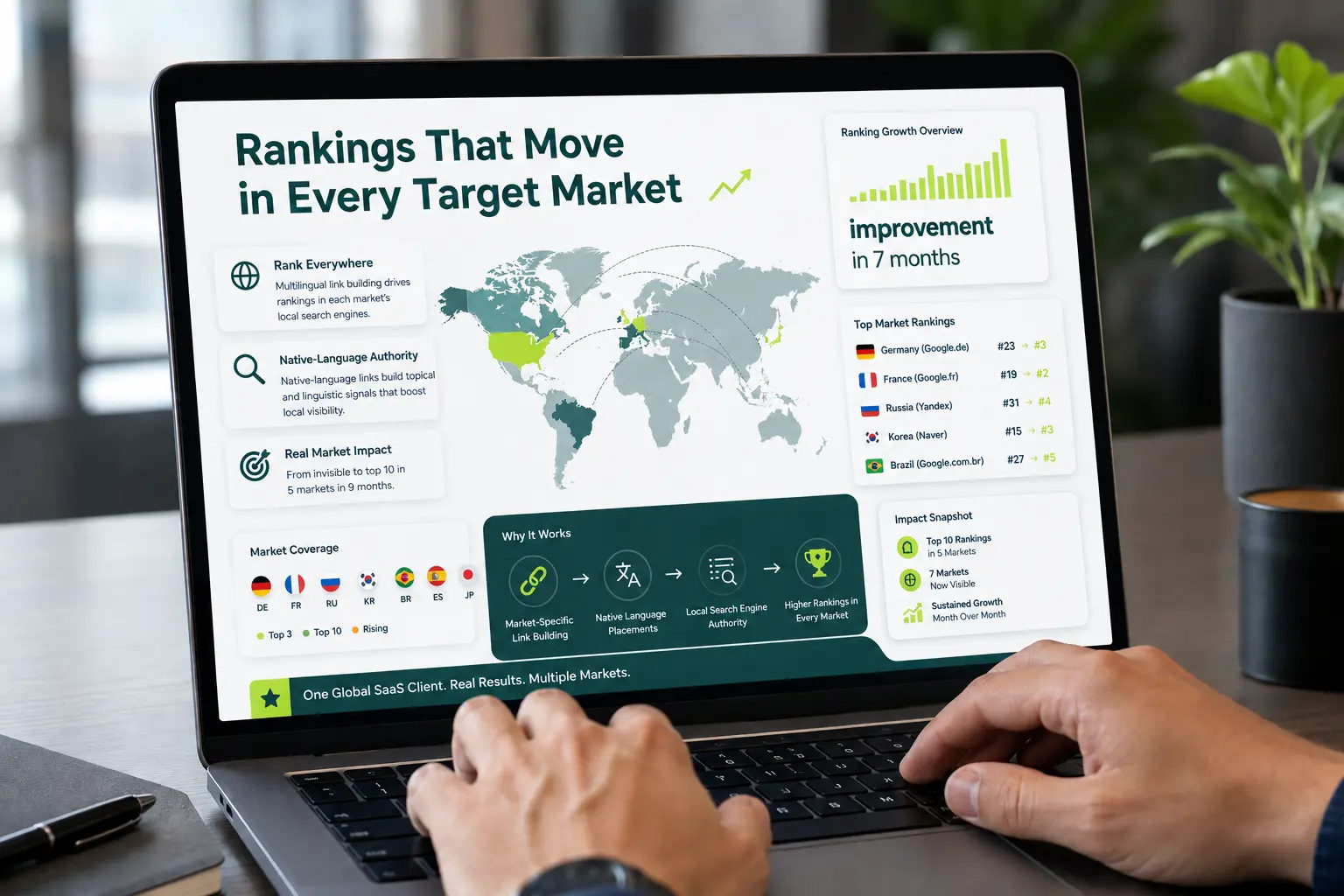
### Authority From Sources That Matter in Each Market
The publishers that influence rankings in Spain differ from those in Mexico, even though both countries speak Spanish. The publications that build authority in Switzerland differ from those in Germany or Austria. Generic international link lists don’t capture these distinctions.
Your campaign builds relationships with publishers who actually share SEO outcomes across each target market. These include local trade publications, regional news sites, niche industry blogs, and creator-led publications native to each country, all vetted for the editorial standards and audience relevance that move rankings.
This local authority is what separates international link building that works from international link building that just looks busy.
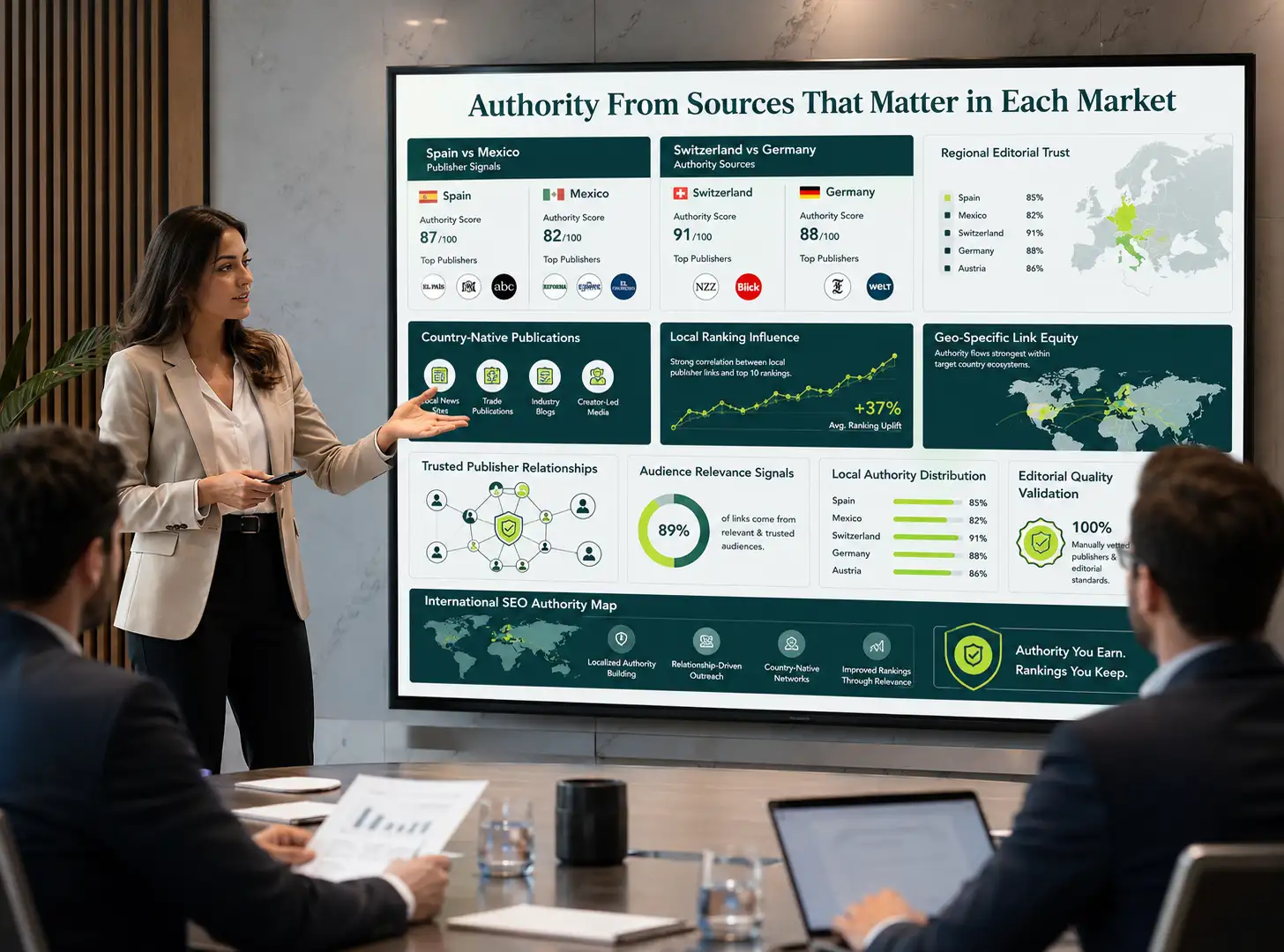
### One Coordinated Program Across Every Market
Running separate agencies per market produces fragmentation. Anchor text decisions don’t align across countries. Reporting comes in different formats. Strategic priorities drift between markets without central coordination.
Working with one multilingual agency consolidates the work. Your German team coordinates with your central SEO program. Anchor text strategies align. Brand positioning stays consistent. Reporting rolls up to one source of truth across every market.
The efficiency gain is significant for international programs operating in 4+ active markets that spend one to two days per week coordinating agencies and consolidating to one multilingual partner, which eliminates that overhead.
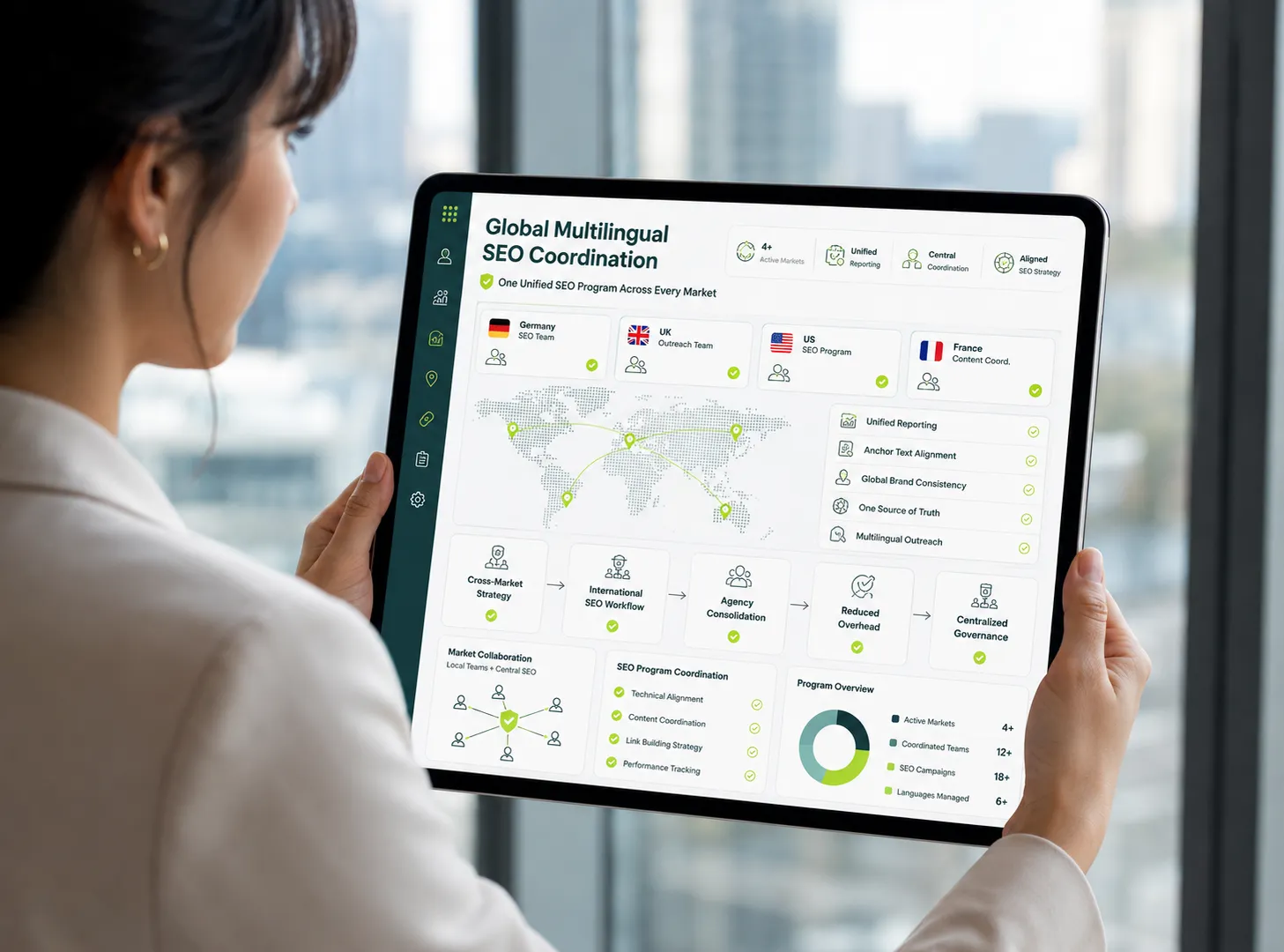
### Brand Visibility That Compounds Across Markets
Every native-language placement builds your brand inside that market’s editorial system. Readers in Germany encounter your brand in German publications. Readers in Brazil see your brand in Brazilian Portuguese content. The recognition signal compounds over time.
This is more than SEO. International expansion benefits from being known in the target market before paid acquisition starts. Native-language editorial mentions build brand familiarity, lowering paid CAC and improving organic conversion in every new market.
Clients running multilingual campaigns over 12+ months consistently report measurable brand recognition lifts in each market, tracked through brand search volume and direct traffic patterns.
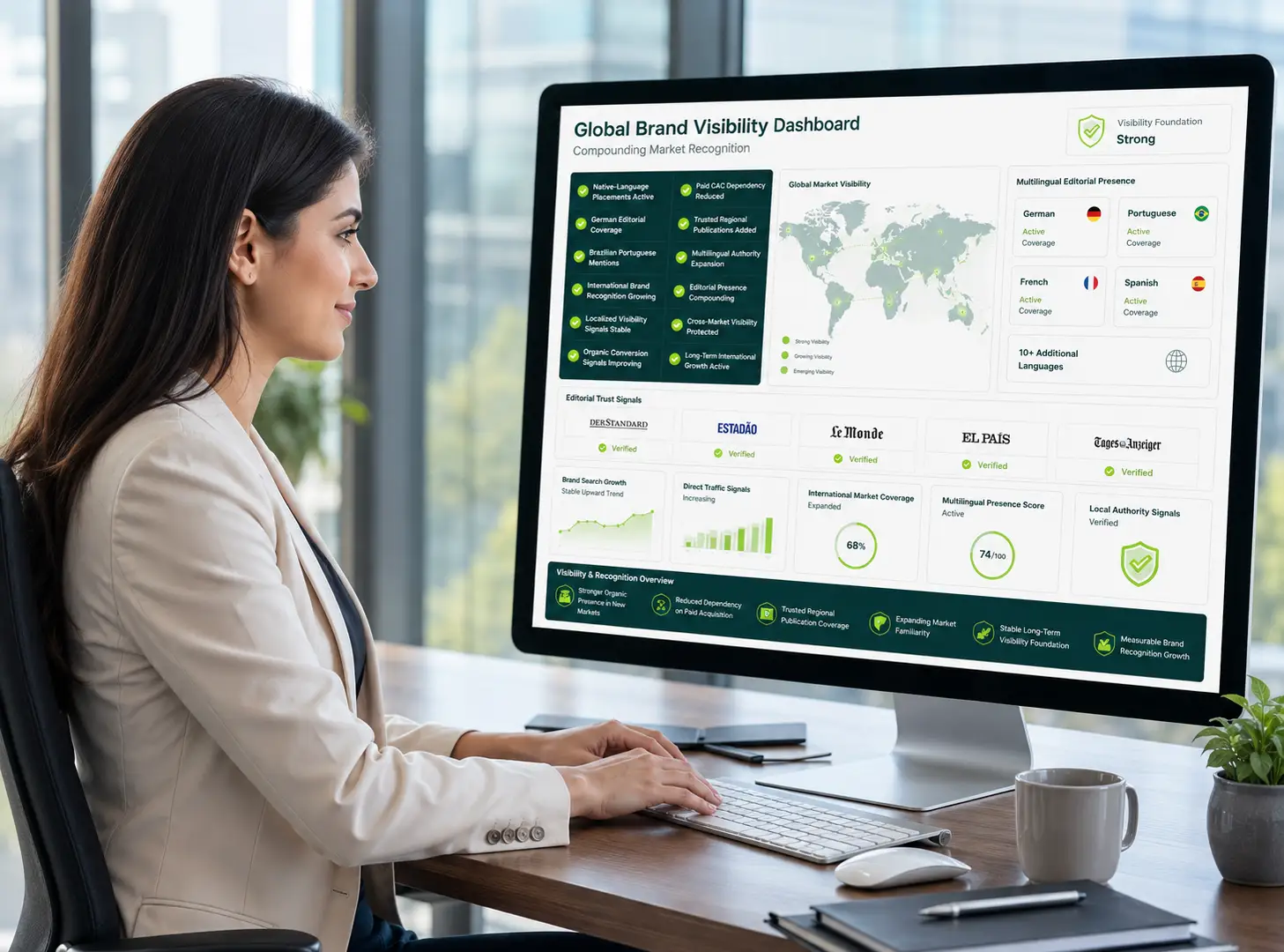
Client Success Stories
## What Clients Say About Our Multilingual Link Building
Verified reviews from international SEO leaders who scaled link building across languages and markets without sacrificing placement quality.
[View All
](https://outreachdesk.com/testimonial/)

**4.8**/5 

## 5/5 
Rating on Google



We tried running European markets through three local agencies, and our central SEO team was drawing in coordination overhead. Switching the one multilingual partner cut out admin time by 60%, and the rankings actually improved because anchor and content strategy finally aligned across markets.

#### Senior Director SEO
Global B2B


The native-speaker outreach quality was the differentiator. Our previous agency was running multilingual campaigns through English writers using translation tools. Reply rates in DE and FR were under 2%. Their native teams hit 14 to 16% in both markets from month one.

#### Head of International SEO
SaaS


Brazilian Portuguese is its own market with its own publisher network, separate from Portugal. Most agencies treat them as one. This team built distinct strategies for both, which is why our LatAm and EU Portuguese rankings both moved.

#### VP Growth
Ecommerce
Service Framework
## Investment, Timeline, and Deliverables
Every multilingual link building campaign is tailored to your active markets, language priorities, and growth goals. Here’s what shapes your investment:

### Number of Languages and Markets
Most campaigns cover 3 to 8 active languages and markets across your global footprint.

### Native-Speaker Team Requirements
Each market needs dedicated native-speaker outreach and content teams to refine to local standards.

### Local Publisher Network Depth
Highly competitive markets require deeper publisher vetting and longer relationship-building cycles.

### Campaign Duration
Most clients see ranking movements in target markets in 4 to 5 months, slightly longer than single-market campaigns.
### Directional pricing
Pricing and scope are shared as requested, tailored to your specific coverage needs, market mix, and growth goals. Custom proposals are available after an initial strategy call, outlining an approach tailored to your requirements, including market coverage, contribution approach, tracking, and a month-by-month roadmap aligned with your goals.
Book a Strategy Call
What You Get
## Every Market, Every Language, Every Placement Reported
Complete transparency on per-market placement activity, native-language outreach work, and cross-market coordination, keeping your program aligned.

### Per-Market Placement Reports
You see placement activity, publisher details, and ranking impact broken down by target market and language.

### Native-Language Outreach Visibility
You can verify the native-speaker outreach behind every placement, including the original-language pitch and publisher response.

### Cross-Market Anchor Distribution
You see anchor text distribution tracked separately per market to prevent over-optimization in any single language.

### Unified Multi-Market Dashboard
You see all active markets in a consolidated view, with drill-down detail by language and country available on demand.
Our Approach
## A Native-Speaker Approach Built for Real Multi-Market Growth
You get native-language outreach, market-specific strategy, and unified coordination, not translated outreach as multilingual.
| Factor | Translation-Based
Multilingual Services | |
| --- | --- | --- |
| Outreach Method | English outreach translated through tools,
sent to non-English publishers who immediately
recognize the templates. | Native-speaker writers in each market write
outreach in the local language from scratch. |
| Publisher Vetting | Single international publisher list filtered
by DR; local and market relevance
are often ignored. | Market-by-market publisher prospecting with
country-specific authority, audience,
and editorial criteria. |
| Content Quality | Translated content adapted from English originals,
often missing market-specific tone and structure. | Native-language content written by writers
who live in or are native to the target market. |
| Anchor Text Strategy | Direct translation of English anchors. It misses
actual native-language search behavior. | Local keyword research by market to identify
anchor opportunities that align with
actual search demand. |
| Coordination Model | Multiple agencies per market with fragmented
reporting and anchor strategies. | One agency coordinating all markets under a
unified strategy with per-market native execution. |
Who We Help
## Industries We Support With Multilingual Link Building
Whatever your industry, our native-speaking teams build relationships with local publishers and develop market-specific strategies to support your international expansion.
[

### SaaS & Software
](/saas-link-building/)
[

### Ecommerce & DTC
](/ecommerce-link-building/)
[

### B2B
](/b2b-link-building/)
[

### Enterprise
](/enterprise-link-building/)
[

### Startups
](/link-building-for-startups/)
[

### Real Estate
](/real-estate-link-building/)
[

### Law Firms & Legal
](/link-building-for-lawyers/)
[

### Dental Practices
](/link-building-for-dentists/)
[

### Healthcare & Fitness
](/health-fitness-link-building/)
[

### Financial & Insurance
](/link-building-for-financial-websites/)

### Technology & Innovation

### Consumer Brands
Common Questions
## Frequently Asked Questions
Get clear answers to the most common questions about native-speaker outreach, local publisher vetting, and multi-market reporting.
### What languages and markets do you cover?
Active coverage includes Spanish (with separate teams for Spain and LATAM markets), French (France and Quebec), German, Italian, Brazilian Portuguese (separate from European Portuguese), Dutch, Polish, Swedish, Japanese, Korean, Simplified Chinese (mainland), Hindi, and Arabic.
Additional languages are available on request for enterprise programs. Each language is handled by native-speaker teams who live in or are native to the target market, not by English writers using translation tools.
### Why does native-speaker outreach matter more than translation?
Translation handles language but misses culture. Publishers can recognize translated outreach instantly because the phrasing, the rhetorical conventions, and the pitching style don’t match how local writers actually communicate.
Reply rates drop from 12 to 18% to under 3% the moment translation tools enter the workflow. Beyond outreach, native speakers understand which publishers matter in their market, what topics resonate with local audiences, and how editorial expectations differ from English-language standards. These cultural insights produce placements that translation-based services can’t replicate.
### How is a multilingual link building agency different from hiring local freelancers in each market?
Local freelancers give you language coverage but rarely deliver the publisher relationships, outreach infrastructure, and strategic coordination that compound across markets over time.
A [specialist link building agency](https://outreachdesk.com/) with dedicated native teams already has those relationships in place, which is why first placements typically arrive faster and meet higher editorial standards than freelancer-led campaigns.
### How do you handle local search engines like Yandex, Baidu, or Naver?
Each market gets a strategy built for its primary search engine. Russian campaigns are designed for Yandex ranking factors alongside Google. Chinese mainland campaigns work with Baidu’s distinct algorithm and publisher system.
South Korean campaigns optimize for Naver’s preferred sources and link patterns. Japanese campaigns balance Google with Yahoo Japan considerations. Your strategist identifies which search engines drive traffic to your target market and builds the link strategy around their specific ranking factors, not generic Google guidance.
### How is multilingual link building priced?
Multilingual link building pricing depends on many factors, including the number of languages, the markets you want to reach, the link volume, and the level of outreach required in each region. Because every campaign is unique, you get packages tailored to fit your specific goals and budget.
For complete details on what’s included in each plan, visit our [pricing page](https://outreachdesk.com/pricing-plan/) or get in touch with our team to discuss a custom quote.
### Can you coordinate with our existing in-country SEO teams or agencies?
Yes, many enterprise clients have in-country marketing teams, local SEO agencies, or regional staff handling other channels.
Your multilingual link building campaign coordinates with these teams to align on anchor text strategy, target page priorities, content angles, and reporting cadence. Shared documentation, joint planning sessions, and consolidated reporting prevent the fragmentation that results from running multiple uncoordinated agencies in each market.
### What’s the typical timeline for results across multiple markets?
Initial placements in each market typically appear within 45 to 75 days, slightly longer than single-market campaigns because native team coordination and local publisher prospecting take time to build.
Ranking movement in target markets follows in months 4 to 5, with compounding gains across months 6 to 12 as native publisher relationships deepen and local authority builds. Markets with mature publisher ecosystems (Germany, France, Brazil) often move faster than markets with thinner publisher landscapes.
## Ready to Scale Link Building Across Every Market?
Get a senior strategist to map your international markets, identify native-speaker outreach needs, and design a coordinated multilingual program.
Book a Strategy Call

**4.8**/5 _
Trusted by 500+ **agencies &
1,000+ businesses** worldwide.

---
---
title: "Link Building Challenges: What’s Really Slowing You Down"
url: "https://outreachdesk.com/link-building-challenges/"
lang: "en-US"
type: "post"
description: "You've been doing outreach. Writing content. Checking Ahrefs every Monday morning. And yet the link count barely moves, or the links you do land aren't shifting rankings the way they used to. The real link building challenges in 2026 are"
last_modified: "2026-05-25T10:03:43+00:00"
categories: [Link Building]
---
# Link Building Challenges: What’s Really Slowing You Down
You’ve been doing outreach. Writing content. Checking Ahrefs every Monday morning. And yet the link count barely moves, or the links you do land aren’t shifting rankings the way they used to.
The real link building challenges in 2026 are specific and diagnosable and different from those of 3 years ago. The fix depends entirely on which one is slowing you down.

### What You’ll Learn
- How AI Overviews and ChatGPT changed what a good link actually means
- How to diagnose your real link building bottleneck
- Why outreach reply rate is 4.5%
- Why 52.3% of marketers now say link building is the hardest part of SEO
- What to stop doing in 2026 because Google now catches it
## What Shifted in Link Building Between 2022 and 2026
Link building got harder **because the bar for what counts as a good link shifted completely**. Google now devalues links that lack topical relevance and editorial context. AI search added a second layer of evaluation on top of that.
### Three Things Changed at the Same Time:
- Senders saturate outreach inboxes
- Google got sharper at detecting manipulation
- AI search layered a whole new evaluation system on top of traditional ranking
The tactics that worked in 2022 underperform now. Mass guest posting on low-quality sites, generic outreach templates, and over-optimized anchor text have all lost ground. Done at scale, they can pull rankings down.

This is the real shift. 52.3% of digital marketers now call link building the most challenging part of SEO, according to [DemandSage statistics 2026](https://www.demandsage.com/link-building-statistics/#:~:text=52.3%25%20of%20digital%20marketers%20regard%20link%20building%20as%20the%20most%20challenging%20aspect%20of%20SEO.).
Marketers often judged a good link in 2022 by metrics like DR and [dofollow status](https://outreachdesk.com/dofollow-backlinks/). A good link in 2026 is a contextually relevant editorial placement on a site that AI models already trust as a citation source.
#### Meaning
**Domain Rating (DR) **is an Ahrefs metric measured on a 0 to 100 scale that estimates a website’s overall authority based on the strength of its backlink profile. Google does not use DR as a ranking signal. It is a third-party proxy for evaluating backlink strength.
**A dofollow link **from a site with a stronger backlink profile generally carries more weight in search results than one from a weaker site.
The [team at Outreach Desk](https://outreachdesk.com/) has run over 500 campaigns across 25+ countries, working with everyone from early-stage SaaS companies to multi-vertical agencies managing regulated niches such as healthcare and finance.
The problems mentioned below come directly from patterns we see repeated across those campaigns, regardless of industry or budget.
## The Response Rate Problem
The response rate problem is simple: **most outreach emails look identical to the hundreds of pitches editors have already deleted this week**.
Publishers now receive **so many AI-generated, template-driven pitches that a personalized email is the exception** rather than the norm. That’s why reply rates have fallen across the industry.

The average cold-email reply rate across all outreach sequences is 4.5%, according to [Hunter’s State of Email Outreach 2026 report](https://hunter.io/the-state-of-cold-email#:~:text=a%20meeting%20upfront.-,Status%20quo,recipients%20that%20received%20a%20cold%20email%20in%202025%2C%20only%2045%20replied.,-Critically%20though%2C%20reply), based on 31 million emails sent in 2025.
For link building and digital PR specifically, well-targeted campaigns average closer to 13%. The gap comes down to relevance and personalization. Most outreach sits closer to the 4.5% floor.
For most teams, this means that 1 in 22 prospects responds to your email, and only a fraction of those convert into a placement.
The cause is publishers and editors receiving dozens of the same kind of pitches every day. AI-generated outreach made it worse. Editors spot ChatGPT-drafted pitches instantly and delete them faster than ever.
As a result, a growing number of link builders have added LinkedIn to their [outreach process](https://outreachdesk.com/link-building-outreach/), using it alongside email rather than replacing it.
### What To Do Instead
Generic pitches get ignored. These small shifts, like **personalizing the first 30 words, leading with value, and switching channels when emails stop working**, change how your outreach reads and how often it gets a reply.
#### Personalize the First 30 Words
Not “I loved your article on this topic”. Reference a specific argument or example from their content piece.

#### Lead With the Value, Ask Later
Send the resource, the data, or the “give before you ask” angle first. The link request comes in the follow-up, after they’ve engaged.

#### Switch Channels When the Email Stops Working
LinkedIn connection requests followed by a direct message to the actual author can improve reply rates in B2B niches, when the recipient is active on the platform.

#### Drop Templates That Have Floated Around for 2 Years
If you found a template from a YouTube tutorial that 5,000 other people are using too. The recipient has already seen yours.
Reply rates are the easiest challenge to diagnose. Track your reply rate. Under 5% means the pitch is broken. Above 12%, but with few placements, means the problem is your content or offer.
For deeper tactical detail, the [SEO outreach process](https://outreachdesk.com/seo-outreach/) breakdown covers prospect list construction, sequence design, and the personalization mechanics that move reply rates.
## The Quality Detection Problem
The quality detection problem is that **Google now catches manipulative link patterns faster and more accurately than it did three years ago**.
Bulk guest posting, [link farm placements](https://outreachdesk.com/link-farming/), paid link networks, and paid niche edits without editorial review, are the patterns Google’s [AI-based spam-prevention system](https://developers.google.com/search/docs/appearance/spam-updates), SpamBrain, targets most aggressively. The typical result is algorithmic devaluation.
[Manual penalties for link schemes](https://support.google.com/webmasters/answer/9044175?sjid=8883115744198125755-NC) are less common but are issued without warning when the pattern is clear enough.
The result: links that looked clean on paper quietly stopped passing authority.

The detection problem is that it’s hard to fake authority, which is good for honest practitioners, and it’s harder to know whether a link you’re paying for is genuinely earned or quietly toxic.
### The Four Signals Behind a High-Quality Backlink
The signals that make a backlink high-quality are** topical relevance, editorial context, source trust, and real traffic potential.
**
#### 1. Topical Relevance
The linking page covers a topic directly relevant to your page. Being in the same industry is not enough on its own.
#### 2. Editorial Context
A human editor reviewed and placed the link. It wasn’t injected into an old post for $80.
#### 3. Source Trust
The linking domain has a clean backlink profile, which is built through earned authority and credible editorial references.
#### 4. Real Traffic Potential
Someone might actually click the link. If the surrounding content has zero readers, the link carries little practical value.
Many guest posts sold on link marketplaces fall short on at least two of these signals on closer inspection. Picture a host site that publishes multiple sponsored pieces daily, where the topical relevance is a stretch, and your link is added in a paragraph nobody reads.
**Your immediate action:
**
Audit your last 20 to 30 acquired links against these four signals. If more than three fail, link quality is the problem. If you want a repeatable process for this, a [structured backlink analysis](https://outreachdesk.com/backlink-analysis/) walks you through the evaluation criteria step by step.
In our experience vetting links across 1,000+ businesses, the topical relevance and editorial context signals are the two that most purchased placements fail.
A SaaS client came to us with 80+ existing links that looked clean on paper. After running them through this test, fewer than half passed on all four signals.
Rebuilding around quality rather than volume contributed to a noticeable improvement in monthly traffic within the campaign period.
## The Budget vs. Outcomes Problem
The budget vs. outcomes problem **is a measurement gap**. You’re **measuring link building by output** (links acquired) when the thing that** justifies the budget is outcome** (rankings and traffic gained).
**Because those outcomes lag by 3 to 6 months, the spend appears unjustified before the results arrive.
**
Quality links from reputable agencies typically cost $150 to $1,500 per placement depending on site authority and niche, often bundled into four-figure monthly retainers. For smaller teams, the math gets uncomfortable fast, especially when ranking lift is difficult to predict with certainty.
**There are 2 distinct parts to this problem, and practitioners constantly confuse them:
**
- The actual spend
- Attribution
When a link doesn’t produce a clear ranking lift in 60 days, you start questioning whether the budget is justified.
But 60 days is premature. Most links take three to six months to influence rankings in any measurable way.
**A practical fix:
**
| IF YOUR SITUATION IS | THEN PRIORITIZE |
| --- | --- |
| Budget under $2,000/month, small team | Earned tactics first, such as original data, expert commentary, linkable worthy assets, before paid placements |
| $2,000–$8,000/month, growing team | Mix of editorial outreach and digital PR, track results against keyword-level ranking lift, not link count. |
| $8,000+/month, established team | Outsource execution, focus internally on linkable asset creation and AI-citation strategy |
| Any budget, leadership pressure | Set up monthly reporting that ties backlinks to specific target pages and tracks ranking movement on those pages |
If you’re trying to figure out what realistic spend looks like for your stage, the [link building cost](https://outreachdesk.com/link-building-pricing/) breakdown maps cost ranges to typical outcomes.
## The Time-to-Result Problem
Link building takes three to six months to produce visible ranking results. Anyone promising four weeks is selling you something that won’t survive the next core update.
The delay is the mechanism, not a flaw. Google needs to crawl your new links, evaluate the linking sites’ authority, and factor them into the algorithm. There is no version of that sequence that fits in 30 days.
**Your real challenge isn’t the timeline. It’s holding your nerve through three months of nothing visible on the surface.
**
Many campaigns stall at month 2. You land 8 links, nothing visible moves, the marketing director looks at paid ads, and leadership pulls the budget.
3 months later, your rankings would have started shifting. By then, the campaign has ended, and the team draws the wrong conclusion.

### What to Do Before Month One Starts
This is what you can do: **set expectations, track leading indicators, and do not increase the link velocity to compensate**.
#### Set Expectations in Writing Before Month 1
State in clear words: “We expect visible ranking movement in months 4 and 5. Here is why…”
#### Track Leading Indicators in the Meantime
Referring domains gained, target pages crawled, Search Console impressions, AI Overview citations. These move before rankings do. Report them weekly.
#### Don’t Increase Link Velocity to Compensate
A sudden and unexplained jump in links in month two looks unnatural and can trigger devaluation. Steady outperforms fast.
The patience problem is one of the most common reasons link acquisition campaigns fail. It’s also the most fixable, because the fix is administrative.
## The Internal Buy-In Problem
The internal buy-in problem **is that link building produces lagged results in a world that demands monthly attribution**.
Leadership can’t see a ranking lift in the month a link lands, so they cut the budget before the campaign works. The strategy isn’t failing. The reporting is.
### Three Reporting Changes that Protect Your Budget
These changes are: **tying every link to a target page and a target cluster, adding the AI search dimension, and showing competitor movements**.
#### Tie Every Link to a Target Page and a Target Keyword Cluster
Stop reporting “we got 12 links.” Start reporting: “We landed four links pointing to the pricing page. It moved from position 14 to position 9 for [target keyword]. Estimated incremental clicks: 340 per month.” That report survives any review.
#### Add the AI Search Dimension
If your brand started appearing in AI Overviews or ChatGPT responses for category queries, document it. That’s increasingly the visibility your leadership cares about, because they’re searching the same way your customers are.
#### Show Competitor Movement
“Competitor X gained 47 referring domains last quarter. We gained 31. Here is the gap and what closing it requires.” Comparative reporting often lands better than an absolute metric alone.
If you’re building a tracking system for this, the [link building campaigns](https://outreachdesk.com/link-building-campaigns/) framework covers the metrics worth reporting and the ones to stop reporting.
## A Diagnostic: Which Challenge Is Actually Yours?
To find your real challenge, match your current symptom to the table below. Each row maps one observable problem (pitches ignored, links landing but rankings flat, budget cut) to a single root cause and a first action.
Pick the row that fits your situation right now and work on that one thing.
| SYMPTOM | LIKELY BOTTLENECK | FIRST ACTION |
| --- | --- | --- |
| You’re sending pitches, and almost nobody replies | Response rate | Audit the first 30 words of your pitch. Rewrite for specificity. |
| People reply but say no | Offer quality | Your content isn’t link-worthy yet. Build a linkable asset before more outreach. |
| You’re landing links, but rankings don’t move | Link quality or topical relevance | Audit the last 10 links. How many pass the four-signal test in section 3? |
| The strategy works, but the budget keeps getting cut | Internal buy-in | Switch to outcome-based reporting tied to target pages. |
| You are past 6 months, and the rankings haven’t moved | Tactical fit | The tactic is wrong for your niche. Re-prospect with competitor backlink analysis. |
| Everything looks fine, but the AI search ignores you | AI visibility | You’re earning DR-based authority, not entity-based authority. See next section. |
**Pick one row**. That’s where to spend the next 30 days. Trying to fix all six at once is how teams burn out without moving any of them.
## What Changes for AI Search
AI search added a layer on top of every challenge above. ChatGPT, Perplexity, and Google AI Overviews each surface brands differently, but across all three, brands that appear consistently in trusted editorial sources get cited more often than those that don’t.
This means that an [editorial brand reference](https://outreachdesk.com/brand-mentions/) in a respected industry publication appears to count. A citation in a roundup appears to count.
Repeated appearances across independent sources are believed to build the co-citation pattern AI systems use to identify authoritative brands in a category.

### Two Shifts in How Authority Is Built
Those shifts are that **brand mentions without links now carry real weight, and a linking site’s role in AI citations now outweighs its DR**.
#### Brand Mentions Without Links Now Carry Real Weight
A reference to your company in a TechCrunch article, even as an [unlinked mention](https://outreachdesk.com/unlinked-mentions/), may contribute to the same kind of visibility signals that a backlink does.
The exact mechanism isn’t confirmed, but the pattern is consistent enough that practitioners are treating it as a real input.
Earning mentions is now a parallel discipline to [earning high quality backlinks](https://outreachdesk.com/high-quality-backlinks/). The prospecting overlap is significant, and you may already be doing half of this work without realizing it.
#### A Linking Site’s Role in AI Citations Now Outweighs Its DR
A link from a site that AI Overviews already cite for your topic might be worth more than a higher-DR link from a site AI ignores.
This inverts traditional prospecting logic. Instead of sorting your prospect list by Domain Rating, sort by whether the site shows up in AI answers for your category queries. Understanding [how AI Overviews select sources](https://outreachdesk.com/how-to-show-up-in-ai-overviews-seo/) changes how you build your entire prospect list.
This is why raw link counts have started decoupling from rankings.
You can have 200 perfectly clean DR 40+ links and still be invisible in AI search if none of those sites sit inside the citation network for your topic. In some cases, a small number of links from sites already cited in AI answers for your topic may do more for your AI visibility than a much larger volume of traditional link acquisition.
**Your diagnostic action:**
Search 5-10 of your category queries in ChatGPT, Perplexity, and Google AI Overviews. Note which sources get cited. Cross-reference that list against your current backlink profile. The gap that you see is your next 90-day prospect list.
If you want to go deeper on the mechanics of AI-era authority, the [AI search optimization](https://outreachdesk.com/ai-search-optimization/) guide covers how citations, mentions, and structured content feed into AI retrieval.
## What to Do Right Now
Open your last 90 days of link building data. Look at your reply rate, close rate, links landed, and what moved your rankings.
One of the six rows in the diagnostic table above will be obviously larger than the others. That’s where your next 30 days go.
Fix that one. Then run the diagnostic again. The answer will have changed, and that’s the point.
### Not sure what’s actually slowing down your link building results?
Get a structured approach to identify bottlenecks and focus on what moves visibility.
[Get a Free Audit](/contact-us/)
### Is link building still worth it in 2026?
Yes, but link quality now overwhelms link quantity. A few editorially earned, [contextually relevant links](https://outreachdesk.com/contextual-link-building/) outperform dozens of paid placements.
Backlinks remain a Google ranking signal and a major input to AI citation patterns. The teams getting outsized returns in 2026 are the ones that stopped counting links and started counting outcomes.
### Why are my outreach emails getting ignored?
Publishers receive dozens of nearly identical pitches every day, and yours likely looks like the others. The fix isn’t more volume. Its specificity is in the first 30 words.
Reference a real argument from their piece, name what’s missing that you’d add, and drop the “I loved your article” opener entirely. It reads as a template instantly.
### When does it make sense to outsource link building instead of handling it in house?
When your team is spending more time on outreach admin than strategy, or when publisher relationships are the bottleneck slowing placements down. A [specialist link building service agency](https://outreachdesk.com/) already has the publisher network, outreach infrastructure, and editorial relationships in place removing the biggest friction points most in-house teams hit in months two and three.
### How long does link building take to produce results?
Visible ranking movement often appears in months four through six.
Google needs to crawl your newly added links, evaluate the linking sites, factor them into the algorithm, and observe user engagement on the receiving page.
Anyone promising faster results is either using tactics that won’t last or measuring the wrong thing.
### What’s the difference between “good” and “bad” backlinks in 2026?
Four signals working together: topical relevance, editorial placement by a real human, a clean linking domain, and genuine traffic potential.
A bad backlink fails at least two, usually relevance and editorial review. Most bulk-purchased DR 50+ guest posts fail this test on close inspection.
### Why does Google penalize some link building tactics?
The algorithm uses pattern recognition to flag unnatural profiles.
Mass guest posting on irrelevant sites, paid links without sponsored attribution, coordinated link schemes, and over-optimized anchor text are the most common triggers.
Silent devaluation is the usual result. Manual penalties are rare but severe.
### Can AI tools help with link building?
For research and prospecting, yes. AI accelerates competitor backlink analysis and opportunity scoring significantly. For drafting personalized outreach, mostly no.
Recipients identify AI-written pitches quickly, and reply rates fall. The current best practice is AI-assisted prospecting paired with human-written outreach.
---
---
title: "Link Building ROI Calculator"
url: "https://outreachdesk.com/link-building-roi-calculator/"
lang: "en-US"
type: "page"
description: "Link Building ROI Calculator Plug in your numbers to see whether your backlink spend pays off, how much time it takes, and what you can expect to earn. Inputs the calculator asks for: Monthly link building budget Number of links"
last_modified: "2026-05-22T13:01:58+00:00"
custom_fields:
header_style: "header-style-1"
footer_style: "footer-style-1"
---
# Link Building ROI Calculator
# Link Building ROI Calculator
##
Your Inputs
Monthly Link Building Budget ($)
_
Links Per Month
Campaign Duration (Months)
Target Keyword Monthly Search Volume
Expected Ranking Position
Position 1
Position 2
Position 3
Position 4
Position 5
Position 6
Position 7
Position 8
Position 9
Position 10
Conversion Rate (%)
Revenue Per Conversion ($)
Calculate ROI
###
Estimated Results
Estimated Monthly Organic Traffic Gain
**
0
**
Estimated Monthly Revenue Lift
**
$0
**
Total 12-Month Revenue
**
$0
**
Payback Period
**
0 Months
**
ROI Percentage
**
0%
**
###
CTR Reference Table
| Position | Average CTR |
| --- | --- |
| 1 | 27.6% |
| 2 | 15.8% |
| 3 | 11% |
| 4 | 8.4% |
| 5 | 6.3% |
| 6 | 4.9% |
| 7 | 3.9% |
| 8 | 3.3% |
| 9 | 2.7% |
| 10 | 2.4% |
Content
-
[Quick Summary: Myth vs Reality](#quick-summary-myth-vs-reality)
-
[Myth 1: More Backlinks Always Mean Better Rankings](#myth-1-more-backlinks-always-mean-better-rankings)
-
[Myth 2: Only High-DR Sites Are Worth Chasing](#myth-2-only-high-dr-sites-are-worth-chasing)
-
[Myth 3: Links From Low-Traffic Pages Are Worthless](#myth-3-links-from-low-traffic-pages-are-worthless)
-
[Myth 4: Low-DR Backlinks Will Hurt Your Rankings](#myth-4-low-dr-backlinks-will-hurt-your-rankings)
-
[Myth 5: Great Content Earns Links on Its Own](#myth-5-great-content-earns-links-on-its-own)
-
[Myth 6: Paying for Any Link Gets You Penalized](#myth-6-paying-for-any-link-gets-you-penalized)
-
[Myth 7: AI Search Killed Link Building](#myth-7-ai-search-killed-link-building)
-
[Myth 8: You Need More Backlinks Than Your Competitors](#myth-8-you-need-more-backlinks-than-your-competitors)
-
[Myth 9: Nofollow Links Are Useless](#myth-9-nofollow-links-are-useless)
-
[Myth 10: Link Building Works as a One-Time Push](#myth-10-link-building-works-as-a-one-time-push)
-
[Start With Your Three Strongest Links ](#start-with-your-three-strongest-links)
Plug in your numbers to see whether your backlink spend pays off, how much time it takes, and what you can expect to earn.
**Inputs the calculator asks for:
**
- Monthly link building budget
- Number of links you plan to build per month
- Campaign duration in months
- Target keyword monthly search volume
- Expected ranking position after the campaign
- Your average conversion rate
- Average revenue per conversion
**Outputs the calculator returns:
**
- Estimated monthly organic traffic gain
- Estimated monthly revenue lift
- Total 12-month revenue from the campaign
- Payback period in months
- ROI as a percentage
**Note: **The calculator uses industry CTR averages and your conversion data. Actual results will vary depending on niche, content quality, link quality, and competition.
## What This Calculator Tells You
The Link Building ROI Calculator forecasts the return on a backlink investment by comparing campaign cost against projected revenue from organic traffic gains.
It uses your target keyword’s search volume, the click-through rate for your target ranking position, and your existing conversion data to estimate revenue lift over the campaign period.
You get a payback period and an ROI percentage. If the numbers don’t justify the spend, you’ll see that too.
## How Link Building ROI Is Calculated
You calculate link building ROI with this formula:
**ROI (%) = ((Revenue Gained − Campaign Cost) / Campaign Cost) × 100**

**Step 1: Project the Traffic Gain
**
Multiply the target keyword’s monthly search volume by the click-through rate for the expected ranking position. Position 1 receives an [average of 27.6% of clicks](https://backlinko.com/google-ctr-stats#:~:text=Here%20is%20a%20Summary%20of%20Our%20Key%20Findings%3A), with click share dropping at each lower ranking position, as per the Backlinko study.
**Step 2: Apply Your Conversion Rate
**
New monthly visitors x conversion rate = new monthly conversions.
**Step 3: Multiply by Revenue Per Conversion
**
New conversions x your average revenue per conversion = new monthly revenue.
**Step 4: Compare Against Campaign Cost Over The Campaign Duration
**
Total revenue gained across the campaign period, minus what you spent, divided by what you spent, times 100. That’s your ROI.
## Why a Tool Page Beats a Spreadsheet
You can build this in a spreadsheet. Teams often skip the spreadsheet because the inputs usually sit across sales, SEO, and finance.
Sales owns conversion rate and revenue per conversion. SEO owns the keyword and CTR estimate. Finance owns the budget. By the time you collect all three inputs, the budget meeting is usually over.
This calculator runs in 30 seconds with rough numbers. Refine the inputs once the campaign has started.
## What the ROI Calculator Doesn’t Account For
Most ROI calculators overpromise. This one deliberately underestimates compounding gains, so the number you see is the floor, not the ceiling. Forecasts are estimates, not promises. A few things the model deliberately holds constant or excludes:
| Factor | Why it’s excluded |
| --- | --- |
| Compounding domain authority gains | Hard to attribute. Links improve future page rankings too, so this model underestimates long-term ROI on purpose. |
| Referral traffic from the link itself | A link on a high-traffic page may send direct visitors. The calculator ignores this for conservative numbers. |
| Algorithm updates | No model predicts them. Build a strategy that survives them. |
| Brand search lift | Editorial mentions can increase brand search demand that converts at higher rates. Not captured here. |
| Content quality and CRO | If the landing page doesn’t convert, links won’t fix it. |
If the calculator shows a positive ROI under conservative assumptions, you have room to validate the campaign with real performance data.
## When Link Building ROI Pays Off
Link building takes time to show its full impact:
- **Months 1-3: **Links acquired and indexed, minimal traffic lift
- **Months 4-6: **Target pages enter top 20 positions, traffic rises
- **Months 7-12: **Pages reach top 10 positions, revenue accumulates
- **Year 2+: **Compounding authority makes future pages rank faster with fewer links.
Using a 12-month window provides a realistic picture of ROI. Shorter periods may undersell the investment.
## How to Use the Output
Three decisions the calculator makes easier:
**Decision 1: Is this page worth investing in?
**
If the projected revenue from ranking a page in the top 3 doesn’t beat the cost of getting it there, build links to a different page.
**Decision 2: How much should you spend per month?
**
The calculator runs on any budget. Try $2,000/month, $5,000/month, $10,000/month. The ROI percentage changes; the payback period changes. Pick the spend where ROI stays positive, and payback fits your runway.
**Decision 3: Which keyword to target?
**
Same campaign cost, different keywords, different ROI. A keyword with 500 monthly searches and $500 per conversion often beats a keyword with 50,000 monthly searches and $20 per conversion.
## Plan a Campaign Around Real Numbers
Once you see the expected ROI, match it with a partner who can hit your projected metrics.
Outreach Desk builds editorial backlinks for SaaS, eCommerce, B2B, and regulated industries. We target pages, keywords, traffic, and budgets that align with your forecast.
[Talk to our team](https://outreachdesk.com/contact-us/), and we’ll walk through the keywords, target pages, and editorial link plan that match your forecast.
## Frequently Asked Questions
### What is a good ROI for link building?
Above 100% means the campaign earns more than it costs. Strong B2B SaaS, legal and finance campaigns often reach 300-500% ROI over 12 months. Lower-margin niches, such as consumer ecommerce, typically see 150-200%. A score below 100% signals that a strategy review is needed.
### How long does it take to see ROI from link building?
Traffic lift appears between months 4 and 6. Positive ROI generally occurs between months 7 and 12, for brands running a consistent [link building campaign](https://outreachdesk.com/link-building-campaigns/) depending on competition and site strength. Periods shorter than six months show only partial results.
### Can you calculate link building ROI before starting a campaign?
Yes. You can estimate link building ROI before launch using keyword search volume, expected ranking position, conversion rate, and revenue per conversion. The output works best as a directional planning estimate.
### How do I Turn a Positive Roi Estimate Into an Actual Campaign?
A positive ROI estimate confirms the opportunity is worth pursuing. The next step is building a campaign around the right link types and target pages. Most brands work with an [editorial link building agency](https://outreachdesk.com/) to execute because the estimate only pays off if the links come from editorially credible sources.
### Is link building ROI different for SaaS vs ecommerce?
Yes, SaaS ROI considers lifetime customer value, inflating per-visitor value. eCommerce ROI is based on per-session value, which is smaller but easier to attribute. Both can deliver strong ROI.
### What’s the biggest mistake in calculating link building ROI?
The biggest mistake is underestimating the timeframe. Calculating ROI at month 3 misrepresents performance because rankings and revenue compound over 12-plus months.
### Does the calculator account for AI search and zero-click results?
CTR figures account for post-AI Overview behavior, so forecasts are conservative, with upside potential if AI traffic grows. Build to conservative numbers and treat gains above that as a bonus.
## Let’s Build Trust and Credibility the Right Way
If you want guest posting built for clarity, relevance, and long- term growth, this is your next step.
Book a Strategy Call
**4.8**/5 _
Trusted by 500+ **agencies &
1,000+ businesses** worldwide.

---
---
title: "AI Search Link Building: What Really Changes in 2026"
url: "https://outreachdesk.com/ai-search-link-building/"
lang: "en-US"
type: "post"
description: "AI search did not completely change link building. The biggest shifts are the prospecting filter, the pages you build authority toward, and the growing role of unlinked brand mentions and entity signals. The fundamentals still matter: backlinks continue to signal"
last_modified: "2026-05-22T13:03:07+00:00"
categories: [Link Building]
---
# AI Search Link Building: What Really Changes in 2026
AI search did not completely change link building. The biggest shifts are the prospecting filter, the pages you build authority toward, and the growing role of unlinked brand mentions and entity signals.
The fundamentals still matter: backlinks continue to signal authority, and authority still influences visibility across traditional search and AI-generated answers.
Get those three shifts right, and your editorial outreach becomes more effective across Google AI Overviews, ChatGPT, and Perplexity.

**Key Takeaways
**
- Backlinks still matter in SEO; what has changed is where they earn you visibility.
- Sites AI already cites for your topic are worth more than equally strong sites it ignores.
- Build links to the right page, or the placement won’t count.
- A brand mention on a trusted site raises your AI citation chances even without a link.
- Consistent execution of strong placement will move the needle.
## What AI Search Link Building Changes
AI search link building means **earning backlinks and brand mentions from sources that AI assistants and AI Overviews already cite when generating answers. The goal is not just ranking in search results, but earning visibility inside AI-generated answers.**
Editorial relevance still beats link volume. Niche-aligned anchor text still matters. A [backlink from relevant sites](https://outreachdesk.com/what-are-backlinks/) still passes more authority than from a topically irrelevant site with a high domain rating. If you cared about quality before, you’re already most of the way there.

The distribution surface changed. Before AI platforms, a Google [search results page (SERP)](https://outreachdesk.com/what-are-serps/) was the only place your link’s authority translated into visibility. Today, that translation also happens in AI Overviews on Google, ChatGPT’s answers, Perplexity’s source panel, Claude responses, and Bing Copilot. Each surface picks its sources differently, and your link strategy now has to account for that.
**Three concrete shifts matter:
**
**Prospecting filter:
**
Prioritize sites AI already cites for your topic. They are often more valuable than equally authoritative sites that AI rarely references.
**Page-level focus**:
AI cites specific pages, not domains. The page you build links to has to be structured for citation.
**Mentions count:
**
A [mention of your brand](https://outreachdesk.com/brand-mentions/) on a credible site can drive AI visibility even without a hyperlink . Editorial outreach now has two output formats: Linked and unlinked brand mentions.
Everything else is the same work you should already be doing: [personalized strategic outreach](https://outreachdesk.com/link-building-outreach/), anchor diversity, link velocity, and avoiding spammy placements.
## The New Prospecting Filter: From “High Dr” to “Sites AI Already Cites”
The new prospecting filter **adds one step to your standard domain-rating and topical-relevance checks: **confirm whether AI already cites that site for your topic.
Most outreach teams still prospect based on domain rating (a 0-100 score from Ahrefs that measures backlink strength), organic traffic, and topical relevance. Those filters are fine. They’re not enough anymore.
[Ahrefs studies published in 2025](https://ahrefs.com/blog/search-rankings-ai-citations/) found that about 76% of AI Overview citations came from pages ranking in Google’s top 10 for the same query. That made the playbook simple: rank well and get cited.
By early 2026, an [updated Ahrefs study](https://ahrefs.com/blog/ai-overview-citations-top-10/#:~:text=This%20time%20around,vs.%20~38%25%C2%A0today).) of 863,000 keyword SERPs showed a sharp drop in pages pulled straight from the original SERP. Citations from the same query SERP fell from roughly 76% in July 2025 to roughly 38% in March 2026.
The drop reflects Google’s heavier use of “**query fan-out**,” where the AI splits your search into related sub-queries and pulls sources from those SERPs too.

Translation for link builders: ranking in the top 10 for your target keyword doesn’t guarantee an AI Overviews citation. ChatGPT and Perplexity rely on those rankings even less.
The 2025 [Ahrefs AI search overlap study](https://ahrefs.com/blog/ai-search-overlap/#:~:text=In%20a%20dataset%20of%2015%2C000%20prompts%2C%20we%20found%20that%E2%80%94on%20average%E2%80%94only%2012%25%20of%20links%20cited%20by%20ChatGPT%2C%20Gemini%2C%20and%20Copilot%20appear%20in%20Google%E2%80%99s%20top%2010%20results%20for%20the%20same%20prompt.) found that, on average, just 12% of citations from AI assistants also rank in Google’s top 10 for the same query.
The publications’ AI surfaces aren’t always the same as the ones Google’s main results lean on. So the prospecting workflow changes. This is the version that works:
**1. List your top 20 commercial and informational keywords
**
These are the queries where AI visibility actually drives revenue.
**2. Trigger AI Overviews for each one
**
Search for the query in Google, logged in to a US account. Note every domain Google cites in the AI Overview, including domains that don’t appear in the blue-link results below.
**3. Run the same queries in ChatGPT, Perplexity, and Google AI Mode
**
Capture every cited source. You’ll find significant overlap on some queries and zero overlap on others.
**4. Build a “high-authority outreach list” from the union
**
A domain cited across two or more AI surfaces for your topic is a stronger target than a DR 80 site that gets cited by none.
**5. De-duplicate against your current backlink profile
**
Use [competitor backlinks analysis](https://outreachdesk.com/competitor-backlinks/) to identify which AI-cited sites already link to competitors but not to you. That’s your prospect list.
This is mechanical work. It takes a few hours per keyword cluster. But it produces a target list with a fundamentally different shape than a DR-sorted Ahrefs export.
The prospect list is also smaller. Most outreach teams overestimate the number of sites that qualify. In a typical B2B SaaS niche, you may find 15 to 30 domains that AI consistently cites. That’s the list.
Building links from those 15 to 30 domains is worth more than building 100 links from sites AI never references for your topic.
When we re-prospected one client’s link campaign using this filter, the majority of their existing targets dropped off, and a new tier of mid-DR but AI-cited industry publications took their place.
## Page-level Wins Matter More Now
Traditional SEO rewards domains. AI search rewards pages.
A strong domain with a moderately structured page used to rank because Google rolled domain authority forward into thinner content. AI Overviews don’t work that way. They quote specific passages from specific URLs. If a page doesn’t provide a clear, self-contained answer, AI picks another page, sometimes from a weaker domain.
The practical consequence for link campaigns: the page you point editorial links at has to be structured for citation. Spending outreach budget building authority into a URL that AI will never extract from is the single most common waste in modern link building.

**A citable page has four traits:
**
**1. A direct one-sentence answer immediately under each H2**
AI Overviews pull these first.
**2.Defined entities on first mention**
“Editorial backlinks are…” instead of “they are…”
**3. Self-contained sections**
No “as mentioned earlier” or paragraphs that depend on the section above to make sense.
**4. Specific numbers with sources**
A claim with a verifiable stat gets cited far more often than a vague one.
For outreach campaigns, target-page audits should happen before [strategic link acquisition](https://outreachdesk.com/link-acquisition/).
Many teams keep building links to pages that are difficult for AI systems to quote or summarize, then wonder why visibility does not improve even as referring domains grow. The fix is [optimizing pages for AI retrieval](https://outreachdesk.com/ai-search-optimization/) alongside your link building which will help you structure pages for better retrieval, citation, and visibility across AI-generated answers.
The same logic applies internally. Internal links help reinforce which pages your site treats as the primary source on a topic. A page with weak internal support is less likely to be interpreted as your strongest resource, regardless of how many external links it earns.
## 3 Tactics That Earn AI Citations When Done Right
Three tactics that earn AI citations when executed correctly: **original-data digital PR, editorial placements on AI-cited publications, and brand mention reclamation**.
### 1. Original-data Digital PR
Digital PR and AI surfaces both run on the same fuel: fresh, specific, proprietary data. Journalists need it to write stories. AI assistants need it to ground cited claims. One well-executed research piece feeds both.
The output you’re after isn’t just a backlink from a high-profile publication. It’s a backlink plus a quoted statistic that other publications pick up and repeat.

When five mid-tier publications all reference your “2026 survey of 412 SaaS marketers” with a line like “according to [Your company’s name] research, 64% of teams…”, AI assistants start treating your brand as the authoritative source for that data point.
That’s the citation flywheel, and it compounds the same way referring domains do.
The research has to be niche-specific. A recycled “state of SEO” survey that a dozen other agencies run every year gets ignored.
Data that only your audience produces, measures, or cares about has the highest chance of surviving in AI citations six months after you publish it.
### 2. Editorial Placements on AI-cited Publications
AI-cited publications are the sites AI assistants actively reference when generating answers in your category. An editorial placement on one of these sites does two jobs at once, it builds traditional link authority and puts your brand inside the source pool AI already trusts.
Here the target list comes from your prospecting workflow, not a generic outreach database. Pitch contributed articles, expert commentary, or [data-driven guest posts](https://outreachdesk.com/guest-posts/) to the 15 to 30 publications AI already cites for your topic.

**Two things to get right**:
**First**, the contributed article needs original analysis. AI Overviews increasingly skip syndicated or thin content, so a “5 tips for X” guest post on a strong site won’t get pulled into citations regardless of the domain’s authority.
**Second**, place the link inside a genuinely useful sentence of the article, not in the bio. Bio links are nofollow in most high-quality publications and don’t reinforce topical relevance the way an in-content placement does.
### 3. Brand Mention Reclamation and Expansion
A brand mention on a credible site that AI parses, even without a link, now contributes to citation probability. The reclamation workflow is covered in the [unlinked mentions guide](https://outreachdesk.com/unlinked-mentions/), but the AI-specific shift is which mentions to prioritize.
Mentions on domains your prospecting workflow already flagged as AI-cited carry the highest value. Mentions adjacent to your competitors’ names matter too.
These co-citation patterns help AI cluster you in the same category. Being named alongside the four established players in your space is worth more than being named alone on a stronger domain.
Prioritize mentions inside contextual paragraphs over directory listings or footer credits. [Contextual placement](https://outreachdesk.com/contextual-link-building/) is where both link and mention value is strongest.Convert these mentions to links where you can. Where the publication refuses, leave them. They’re still doing useful work for AI surfaces.
**Use this if-then table to decide which tactic fits your team:
**
| If your situation is… | Then start with… |
| --- | --- |
| Small team, no proprietary data yet, limited outreach bandwidth | Brand mention reclamation. Fastest wins from work you’ve already earned |
| Mid-size team with a budget but no data assets | Original data digital PR. One research piece feeds 6-12 months of placements |
| Established team with strong content but stagnant AI visibility | Editorial placements on AI-cited publications. Sharpen the prospecting filter |
| Brand with high name recognition but low AI citation share | Co-citation mention campaigns alongside category leaders |
**What’s not on this list:
**
Generic guest posting, directory submissions, link exchanges, and “AI Overview optimization tools” that promise automated citation. None of those moves the needle.
## What Changes by AI Surface
**Two things change depending on which AI surface you’re targeting **:
**First, **Google AI Overviews still favors traditional editorial links more than the other AI surfaces do. The SERP correlation hasn’t disappeared. It’s weakened, but it’s still there.
**Second, **ChatGPT, Perplexity, and Claude pull from a broader set of sources than what ranks on Google.
Their training data and retrieval pipelines aren’t built around the same signals Google uses. A publication that ranks poorly on Google can still influence what those models surface. This is why brand mentions in trusted publications are worth paying attention to across these surfaces.
| AI SURFACE | PRIMARY SOURCE SIGNAL | WHAT EARNS CITATION | WHERE LINK BUILDING HELPS MOST |
| --- | --- | --- | --- |
| Google AI Overviews | Heavy correlation with traditional search rankings, especially top 10+ fan-out query SERPs | Pages that rank for the query + fan-out queries, with a self-contained answer structure | Editorial links to ranking pages; new links to fan-out query targets |
| Google AI Mode | Wider source pool than AI Overviews; favors comprehensive content | Longer-form articles, Reddit, Wikipedia, YouTube transcripts | Brand mentions across high-trust platforms; content distribution |
| ChatGPT | Pulls from training data + live web; favors lower-ranking but high-authority sources for live queries | Brand mentions in trusted publications, Wikipedia, mainstream press | Digital PR; co-citation mentions in news media |
| Perplexity | Real-time web retrieval; highest citation accuracy of the four | Sources with strong topical match and verifiable claims | Niche-publication editorial links; original data |
| Claude and Copilot | Mix of training data and search APIs; conservative source selection | High-authority, fact-dense pages | Same as ChatGPT. Mainstream and niche-authoritative coverage |
Brand mentions aren’t a confirmed ranking factor on Google the way traditional links are. Visibility in authoritative sources builds the citation footprint these models draw from. The publication’s organic ranking matters less than its credibility.
A balanced campaign builds toward all five surfaces. Most teams over-index on Google AI Overviews and under-invest in the broader [generative engine optimization strategy](https://outreachdesk.com/generative-engine-optimization/) that influences visibility across AI platforms.
## Mistakes That Look Like AI Strategy but Aren’t
Teams keep adopting moves under the ‘AI link building’ label that produce no measurable results.
The common ones: **buying spots in AI-optimized listicles, mass Reddit posting, optimizing for one AI platform only, treating brand mentions as a substitute for links, and blocking AI crawlers while wondering why citations don’t grow.
**
### Buying Spots in “AI-optimized Listicles”
Some vendors are now pitching paid placements in AI-friendly listicle articles. If the article has no search rankings and no existing AI citations, the link placement in search articles won’t earn an AI citation either. Before paying, run the target domain through an AI-cited domain check to confirm it already appears in the AI Overview results.
### Mass Reddit Posting
Mass Reddit posting fails because moderators remove spammy posts with branded links within hours, before AI training passes can index them.
Reddit works when you participate authentically over the long term. Dropping links in 50 threads in a weekend rarely works in the long term.
### Optimizing Exclusively for One AI Platform
Campaigns built exclusively around ChatGPT citations often miss Google AI Overviews entirely, and campaigns built for AI Overviews often ignore Perplexity, Gemini, and Google AI Mode.
The authority signals, such as topical relevance, entity recognition, and source credibility that drive citations, overlap across all major AI surfaces. Optimizing for any one AI platform often forces a full strategy rebuild within 6 months as traffic shifts.
### Treating Brand Mentions as a Substitute for Links
Brand mentions count more than they used to, and they don’t replace links. The link signal still feeds AI authority through traditional rankings.
The link building teams that see ranking improvements often earn backlinks and brand mentions at the same time.
### Blocking AI Crawlers and Then Wondering Why Citations Don’t Grow
Sometimes your robots.txt files block GPTBot, ClaudeBot, or PerplexityBot. If AI can’t crawl your target page, the link pointing to it can’t earn you a citation. Worth a five-minute audit before you build anything.
## How do You Measure AI Search Link Building Results?
You measure AI search link building with four signals: **AI Overviews citation appearances, referral traffic from AI sources, brand mentions growth on AI-cited domains, and query-level citation audits.
**
Tracking whether your AI citation efforts are working remains difficult because the tools haven’t yet caught up with the strategy. Track them today:
### AI Overviews Citation Appearances
Use tools like Semrush Sensor or Ahrefs Brand Radar to track which queries cite your domain in Google AI Overviews.
### Referral Traffic From AI Sources
In Google Analytics, monitor referral traffic from sources like chat.openai.com, perplexity.ai, and Google search experiences that generate AI Overview clicks.
### Brand Mentions Growth on AI-cited Domains
Use Brand24, Mention, Google Alerts, or workflows for [tracking brand mentions in large language models](https://outreachdesk.com/track-brand-mentions-in-large-language-models/) to monitor how often your brand appears on the publications AI systems already reference in your niche.
### Run Query-level AI Citation Audits
Manually review your top target queries in ChatGPT, Perplexity, and Google AI Overviews each month, then log whether your brand or pages appear in cited sources.
Three things still can’t be measured accurately are how often your brand gets cited across all AI platforms, whether someone who saw your brand in an AI answer later became a customer and whether a specific new link caused more AI visibility for a specific search
These gaps exist because the tools aren’t built for it yet, but they should improve through 2026.
Since perfect measurement doesn’t exist, use directional signals instead.
**If these 3 things are trending up together, your strategy is working:
**
- referring domains from AI-cited sources
- brand mentions on those same sites
- and how often you appear in AI Overviews for your target queries
You don’t need perfect data to confirm that. Don’t wait for perfect attribution. Watch these three proxy signals move together and treat that as your proof of progress.
## Build the Gap List: AI-cited Sites You Haven’t Contacted Yet
Start today: **pull your top 10 commercial keywords and run each through Google’s AI Overview, ChatGPT, and Perplexity**. Track every domain they cite. Then stack that list against your current outreach prospect database and study the gap. Note the sites you’re chasing that AI never references, and the sites AI consistently cites that you’ve never contacted.
That mismatch is your actual starting point, and closing it is your first month’s priority. That’s the real foundation of AI search link building.
### Want to build authority for both search engines and AI platforms?
**Get a clear strategy focused on the trust signals that strengthen visibility across both.
**
[Book a strategy call](/contact-us/)
### Do backlinks still matter for AI search in 2026?
Backlinks remain a key driver of traditional search rankings, which AI Overviews continue to rely on heavily, and they still establish authority in the training and retrieval systems powering ChatGPT, Claude, and Perplexity.
What’s shifted is the weight given to relevance over volume: a handful of editorial links from sources AI already treats as authoritative in your niche will outperform a much larger collection of generic high-DR links.
### Are AI Overviews replacing traditional Google rankings?
No, they aren’t replacing traditional rankings. They are layering.
AI Overviews appear on [around 16% of queries, according to Semrush](https://www.semrush.com/blog/semrush-ai-overviews-study/#:~:text=And%20the%20data%20shows%20terms%20that%20trigger%20AI%20Overviews%20grew%20rapidly%20at%20the%20start%20of%202025%20before%20settling%20in%20at%20around%2016%25%20of%20all%20queries.%C2%A0). Traditional results still dominate commercial and transactional searches.
Your link strategy needs to serve both. Rankings win clicks on commercial searches. AI citations win visibility on informational searches.
### Should I handle AI search link building in house or work with an agency?
AI search link building requires identifying which publications AI already cites in your niche, building relationships with those publishers, and earning placements consistently over time.
Most in house teams lack the publisher relationships to execute this at the pace results require. A [dedicated link building agency](https://outreachdesk.com/) with editorial relationships already in place will typically outpace an in house team by several months on first placements.”
### How do I find sites that AI already cites for my topic?
Run your top 15 to 20 keywords in Google AI Overviews, ChatGPT, Perplexity, and Google AI Mode. Log every domain that gets cited. The domains appearing across two or more surfaces for your topic become your high-priority outreach targets.
Tools like Ahrefs Brand Radar, Semrush AI Visibility, and Otterly.ai automate this tracking. The initial audit takes a few hours per cluster to complete manually.
### Do unlinked brand mentions help AI visibility?
Unlinked brand mentions now do more than they used to. AI tools check your brand across multiple sources to decide if you’re credible and relevant to a topic.
Get mentioned on a trusted site AI has already indexed, and your chances of showing up in AI answers go up, even without a link back to you. Turn those mentions into links when the publisher lets you. When they don’t, the mention still counts.
### How long does AI search link building take to show results?
[Editorial link campaigns](https://outreachdesk.com/link-building-campaigns/) can take 3 to 4 months before you see movement, and 6 to 9 months for things to compound. Brand mention reclamation tends to move faster.
High-authority placements can show results in 4 to 6 weeks. Consistent execution matters more than chasing one big placement.
---
---
title: "Blogger Outreach Agency for Editorial Backlinks That Move Rankings"
url: "https://outreachdesk.com/blogger-outreach-agency/"
lang: "en-US"
type: "page"
description: "Blogger Outreach Blogger Outreach Agency for Editorial Backlinks That Move Rankings Your brand earns editorial backlinks, brand mentions, and product reviews through personalized outreach to bloggers, newsletter writers, and expert-led publications your buyers already read. Personalized blogger outreach Multi-format placements"
last_modified: "2026-05-22T12:34:33+00:00"
custom_fields:
header_style: "header-style-1"
footer_style: "footer-style-1"
---
# Blogger Outreach Agency for Editorial Backlinks That Move Rankings
Blogger Outreach
# Blogger Outreach Agency for Editorial Backlinks That Move Rankings
Your brand earns editorial backlinks, brand mentions, and product reviews through personalized outreach to bloggers, newsletter writers, and expert-led publications your buyers already read.
_
Personalized blogger outreach

Multi-format placements

Niche creator relationships
Book a Strategy Call

**4.8**/5 _
Trusted by 500+ **agencies &
1,000+ businesses** worldwide.
Average DR
40–70
Campaign Dashboard
LIVE
DOMAIN RATING
26 → 48
+22 points
ORGANIC TRAFFIC
+620%
3,400 → 24,500
PAGE 1 KEYWORDS
12 → 67
+55 keywords
REPLY RATE
14%
5x industry avg
_
Placements Secured
124










Service Overview
## What Blogger Outreach Really Looks Like
Blogger outreach today builds editorial relationships with bloggers, newsletter writers, and expert-led publications, resulting in backlinks, brand mentions, product reviews, and quote inclusions over months and years.
Beyond guest posts, real blogger relationships generate brand mentions in newsletter editions, product reviews, and an expert quote relationship with a niche blogger or newsletter writer often produces more value than many transactional guest post placements.
Your team grounds every campaign in editorial standards such as manual research, personalized outreach, real value exchange, and content bloggers genuinely want to publish.
For businesses, blogger outreach is the most flexible form of link building available. It produces backlinks that pass authority, brand mentions that build credibility, and relationships that compound into ongoing visibility. The investment goes into people, not platforms, which is why the best blogger outreach happens manually rather than through any software.
Three things define real blogger outreach campaign:

### Real Blogger Relationships
Through personalized outreach to bloggers, newsletter writers, and expert-led publications, your team can build long-term relationships.

### Multi-Format Placements
Guest posts, brand mentions, product reviews, expert quotes, and roundup features earned through one set of editorial relationships.

### Niche-Relevant Authority
Every blogger meets your industry, audience, and editorial standards before any outreach begins, with complete vetting of every prospect.
How We Work
## How Your Blogger Outreach Campaign Works
A managed workflow that earns editorial placements through personalized outreach and real blogger relationships.
### Niche Mapping and Blogger Prospecting
Your campaign starts with a deep niche mapping process. Your strategist identifies bloggers, newsletter writers, and expert-led publications operating within your industry, covering topics adjacent to yours, and reaching the audiences your buyers come from.
Tools like Ahrefs, Semrush, and BuzzSumo run alongside manual discovery in Substack, niche directories, and creator networks. The output is a curated prospect list with hundreds of vetted bloggers segmented by topic, audience size, and editorial style.
### Editorial Standards and Quality Vetting
Each prospect on the list passes manual quality checks before the outreach begins. Domain rating, organic traffic, editorial standards, publishing frequency, audience engagement, and link profile all get reviewed.
Your team removes any blog that fails a check from the list. No PBN networks. No link marketplaces. No abandoned blogs. One blogger running active, audience-driven publications makes it into the outreach phase of your campaign.
### Personalized Outreach and Relationship Building
Your outreach specialists contact every blogger directly. Every email is personalized, references specific recent content from the blogger’s site or newsletter, and proposes a placement angle aligned with what they already publish to their audience.
No mass automation and templated “love your blog” emails. The goal isn’t just to earn one placement, but to build the kind of relationship that delivers multiple values over months and years.
### Content Development and Editorial Approval
When a blogger expresses interest, your content team develops the asset they’ll publish. Guest posts, expert commentary, product reviews, or research contributions, all aligned with the blogger’s audience expectations and editorial standards.
Your content team writes every piece to add primary value to the blogger’s readers. Brand mentions and backlinks appear within content the blogger chose to publish on its own merits, not because of any deal.
### Placement Integration and Anchor Text Strategy
When the placement goes live, your team confirms that the link is in the body content, the anchor text fits your profile, the page indexes properly, and the placement matches the approved version sent to the blogger.
Your team makes anchor text decisions on the entire campaign to prevent over-optimization. Branded, partial-match, and natural anchors get balanced on your existing profile health and target keywords.
### Ongoing Relationship Reporting
You receive a detailed monthly report covering every placement, blogger relationship status, multi-format outputs, and the ranking impact on target pages.
Beyond placement reporting, your team tracks which relationships are producing multiple types of value, such as a guest post this month, a newsletter mention next month, and a roundup inclusion. This is what separates relationship-based outreach from transactional link building.

Expected Results
## Outcomes That Blogger Outreach Delivers
When the outreach is personalized, bloggers are vetted, and relationships are compounded, your campaign generates backlinks, mentions, and reach that no transactional service can match.
- 1. Backlinks at Scale
- 2. Brand Visibility
- 3. Niche Reach
- 4. Compounding Relationships
### Real Editorial Links From Real Bloggers
Editorial backlinks from active, audience-driven blogs pass the kind of authority Google rewards. When the placement is within the content, bloggers genuinely want to publish, and search engines treat it as a real endorsement of your brand.
**The result:** Your link profile builds editorial diversity, topical relevance, and a natural distribution of anchors. One B2B client earned 87 placements on 71 unique blogs in their first six months, with measurable ranking uplifts on every important page.
It’s about earning the kind of links that survive every algorithm update and contribute to long-term organic growth.

### One Relationship, Multiple Outputs
A single relationship with the right blogger produces more than one placement. The same writer who publishes your guest post this quarter might mention your brand in their newsletter next month, include your product in a roundup, or quote your founder in an industry article.
This multi-format output is what makes blogger outreach more valuable than transactional link building. Every relationship compounds. The cost per placement drops over time as relationships produce ongoing returns.
Clients running active campaigns observe their brand mentioned in newsletters, social posts, and content well beyond the original guest post placement.

### Visibility With the Audience That Matters
Editorial mentions on niche blogs reach the exact audience your buyers come from. Some major media coverage might feel impressive, but it reaches the wrong people; a placement in a niche industry blog or newsletter reaches readers researching solutions in your category.
That audience drives both referral traffic and indirect brand awareness. Readers who come across your brand in the context of useful content from a blogger they trust treat your subsequent marketing differently when it reaches them.
This is the dual return of relationship-driven blogger outreach: SEO authority and audience credibility, earned at the same time in the same placements.

### Relationships That Pay Returns for Years
Transactional link building requires constant outreach. Every placement requires a new pitch, a new conversation, a new pricing negotiation.
A blogger who knows your brand, has worked with your team, and has published quality content from you in the past will respond to future pitches faster, accept placements more easily, and refer your brand to other writers in their network.
Six months into a relationship-driven campaign, the outreach effort required to earn each new placement drops significantly. This is what makes blogger outreach a long-term investment.

Client Success Stories
## What Clients Say About Our Blogger Outreach Service
Verified reviews from leaders who built editorial authority and blogger relationships that kept returning long after the first placement.
[View All
](https://outreachdesk.com/testimonial/)

**4.8**/5 

## 5/5 
Rating on Google



While the other agencies just got us links, this team got us relationships. The same blogger we earned guest posts with started mentioning us in newsletters, including us in roundups, and inviting our founder to the podcasts. The compounding value was something that no other agency delivered.

#### Marketing Director
B2B SaaS


We’d been burned by blogger outreach services that turned out to be PBN networks. The transparency on every placement, including the blogger, their audience, and the editorial approach, made the difference. Every link came from a real blog with actual readers

#### Head of SEO
Ecommerce


The Substack and expert-led publication coverage were unexpected. We didn’t know niche newsletter mentions could drive that much traffic. Six months later, those creator relationships became one of our strongest brand awareness channels.

#### VP Marketing
Fintech
Service Framework
## Investment, Timeline, and Deliverables
Every blogger outreach campaign is tailored to your industry, niche-relevant needs, and growth goals. Here’s what shapes your investment:

### Number of Placements Per Month
Most campaigns deliver results between 8 and 30 blogger placements monthly across formats.

### Niche Depth Required
Highly specialized niches require more selective outreach and stronger editorial relationships.

### Content Production Scope
Guest posts and original commentary need content development; brand mentions and quotes don’t.

### Campaign Duration
Most clients see measurable results within 60 to 90 days, with compounding relationship value over 6 to 12 months.
### Directional pricing
Pricing and scope are shared as requested, tailored to your specific coverage needs, community mix, and growth goals. Custom proposals are available after an initial strategy call, outlining an approach built around your requirements, including community coverage, contribution approach, tracking, and a month-by-month roadmap aligned to your goals.
Book a Strategy Call
What You Get
## See Every Link Placement With Clear, Client-Ready Reports
Complete transparency on each blogger relationship, every placement earned, and the cumulative impact on your authority profile.

### Live Placement URLs
You get direct access to every live placement with blogger and audience context for each, plus engagement metrics where available.

### Blogger Relationship Records
You can see the relationship status with each blogger, including past placements and the multi-format outputs they’ve produced for your brand.

### Anchor & Target Mapping
You see anchor text decisions and destination page assignments for each placement to maintain profile health and avoid over-optimization.

### Compound Output Reports
You see the additional brand mentions, newsletter features, and creator outputs each relationship generates over time.
Our Approach
## A Relevance-First Approach Built for Your Growth
You earn placements through real outreach and content quality, not mass automation, marketplaces, or PBN networks as authority sites.
| Factor | In-House / DIY | |
| --- | --- | --- |
| Prospecting Method | Bulk lists filtered only by DR; bloggers vetted
on metrics, not editorial standards. | Manual prospecting with audience, editorial
standards, and content quality vetting on every blog. |
| Outreach Method | Templated emails sent at scale
produce reply rates below 2%. | Personalized outreach referencing specific
blogger content; reply rates around 14%. |
| Relationship Approach | One-and-done placements; no follow-up
after the link goes live. | Ongoing relationships that produce
multi-format outputs over months and years. |
| Content Standards | Generic guest posts that are often template-style
and have limited editorial value. | Original content developed for each
blogger’s audience expectations
and editorial style. |
| Placement Risk | Risk of placements on PBNs, link networks, or
low-quality blogs marketed as authority sites. | Strict editorial standards; only real,
audience-driven publications make
it into the campaign. |
Who We Help
## Industries We Support With Blogger Outreach
Whatever your industry, we have the blogger relationships and editorial standards to earn placements that move ranking and reach to the audience that matters.
[

### SaaS & Software
](/saas-link-building/)
[

### Ecommerce & DTC
](/ecommerce-link-building/)
[

### B2B
](/b2b-link-building/)
[

### Enterprise
](/enterprise-link-building/)
[

### Startups
](/link-building-for-startups/)
[

### Real Estate
](/real-estate-link-building/)
[

### Law Firms & Legal
](/link-building-for-lawyers/)
[

### Dental Practices
](/link-building-for-dentists/)
[

### Healthcare & Fitness
](/health-fitness-link-building/)
[

### Financial & Insurance
](/link-building-for-financial-websites/)

### Technology & Innovation

### Consumer Brands
Common Questions
## Frequently Asked Questions
Get clear answers on blogger outreach services, covering publisher quality, niche relevance, editorial standards, pricing models, reporting transparency, and campaign scalability.
### What’s the difference between blogger outreach and guest posting?
Guest posting is one specific output of blogger outreach. [Blogger outreach](https://outreachdesk.com/blogger-outreach/) is the broader practice of building relationships with bloggers and creator-led publications, which can result in placements such as [guest contributions](https://outreachdesk.com/guest-posts/) , brand mentions, product reviews, expert quote inclusions, newsletter features, roundup mentions, and ongoing content collaborations.
A [guest posting service](https://outreachdesk.com/guest-posting-service/) delivers one transaction per blog. A blogger outreach agency builds relationships that deliver multiple types of value over time, often lowering the per-placement cost as relationships mature.
### How do I know if blogger outreach is the right service for my brand?
Blogger outreach works best for brands that want more than a single link transaction, brands looking to build consistent visibility across creator-led content, newsletters, and editorial placements over time.
If your goal is building genuine authority and presence in your niche rather than just accumulating links, a [relationship driven link building agency](https://outreachdesk.com/) is the right fit. If you need a one-off placement, a single guest post service may be enough.
### How is your blogger outreach different from automated services?
Every contact is written manually, every blogger is vetted manually, and every relationship is built one conversation at a time. Automated services rely on tools that send templated emails to thousands of blogs at once, producing low reply rates and low-quality placements when they land.
Our reply rate of around 14% reflects the difference personalization makes. Manual outreach takes longer upfront, but you get real placements from real bloggers, and those relationships keep producing returns long after the first placement goes live.
### What kinds of placements do you earn through blogger outreach?
Guest posts on relevant blogs, [editorial brand mentions](https://outreachdesk.com/brand-mentions/) in newsletter editions, product reviews from creators in your industry, expert quote inclusions in research and roundup articles, mention features in resource lists, and curated content.
Podcast guest appearances on creator-hosted shows, and ongoing content collaborations with bloggers willing to feature your brand across multiple formats. The mix depends on your industry, target bloggers, and campaign goals.
### Do you work with Substack writers and newsletter creators?
Yes, Substack writers and independent newsletter creators matter for both SEO and brand visibility.
Newsletter features can drive significant referral traffic, and many Substack writers maintain blog companions or content on platforms that [pass link authority](https://outreachdesk.com/link-equity/). The campaign approach with newsletter creators is more relationship-driven than transactional. Producing brand mentions, expert quote inclusions, and content collaborations before any direct link placement takes place.
### How long does it take to see results from blogger outreach?
Initial placements appear within 30 to 60 days as outreach connects with the first responsive bloggers. Most clients see consistent placements and monthly velocity by month 3, and target pages observe ranking impact in months 4 to 6.
Relationship-driven outputs like newsletter mentions, podcast appearances, and roundup features emerge in months 4 to 9 as relationships strengthen. The compounding effect of multi-format outputs from established blogger relationships builds significantly over the 6 to 12 months.
## Ready to Build the Relationships That Compound into Long-Term Authority?
Get a senior strategist to map your niche, identify the right bloggers, and build the relationships that earn editorial placements for years.
Book a Strategy Call

**4.8**/5 _
Trusted by 500+ **agencies &
1,000+ businesses** worldwide.

---
---
title: "Link Building Pricing: What Links Actually Cost in 2026"
url: "https://outreachdesk.com/link-building-pricing/"
lang: "en-US"
type: "post"
description: "Two agencies can charge 10x different prices for links in the same niche, and both will say their links are “good.” One might charge $200, and another might ask for $2,000. Both sites promise quality, with decent Domain Authority (DR)"
last_modified: "2026-05-22T11:22:02+00:00"
categories: [Link Building]
---
# Link Building Pricing: What Links Actually Cost in 2026
Two agencies can charge 10x different prices for links in the same niche, and both will say their links are “good.” One might charge $200, and another might ask for $2,000. Both sites promise quality, with decent Domain Authority (DR) and high editorial standards. But what really sets them apart?
Google may devalue $50 links, and the one that costs $1500 may last 2 weeks. Not only that, but someone may find a perfect $350-$500 links and gain consistent traffic for 5+ years.
It’s not luck. It’s about understanding what drives price. When you understand how link building pricing works, you avoid overpaying. You skip cheap links that put your site at risk.
**What’s Inside:
**
- Why link pricing ranges from $150 to $1,500+
- The 3 factors that actually matter when evaluating cost vs. quality
- How to calculate whether link building makes financial sense for your business
- What hidden costs most providers don’t mention.
- Real case studies showing ROI.
## What Drives the Price Up (or Down)?
Not every $400 link delivers the same result. Some factors shape the true cost of link building. When you know what matters, you can spot whether a link placement is a good deal for you or just a waste of money.

### 1. Link Quality
High-quality links from trusted and relevant websites take real work to earn. That’s why they cost more.
**Factors that determine link quality:
**
**Domain Authority (DA) or Domain Rating (DR)
**
A site’s DR (Domain Rating) affects price, but a high DR number doesn’t mean the link is valuable. Run the site through the [backlink cost estimator](https://outreachdesk.com/backlink-cost-calculator/) if their quote is far above the estimated range, walk away.
For example, if a DR 60+ website lost 80% of its traffic after Google’s core update, it’s not worth $600.
**Organic Traffic of the Linking Site:
**
Organic traffic is equally important. Don’t just look at the DR; also check if the site’s real traffic is growing or shrinking over time. If most visitors come from the US, UK, Canada, or Australia, and the traffic keeps growing, it is worth paying for.
**Topical Relevance:
**
A link from an irrelevant site won’t move the needle, even if the site looks authoritative.
For example, if you run a health and fitness company, a link from a finance blog sends mixed signals to Google. It won’t help you achieve your desired outcomes.
**Editorial Standards of the Linking Site:
**
If a site accepts every guest post without any quality filter, then you should skip it, no matter how high its DR is. If a site has a higher editorial bar, getting a link there takes real effort, and that’s why it costs more. A site that vets contributors and doesn’t openly sell links is exactly the kind of placement worth paying for.
### 2. Industry and Niche
Some industries cost more for link building due to the risk and competition involved.
Here’s how Industries break down by difficulty:
| Difficulty Level | Industries |
| --- | --- |
| Hard (Highest Costs) | Casinos & Gambling, Loans, Insurance, CBD & Cannabis |
| Medium | SaaS, Healthcare, Lawyers & Legal Services, Real Estate |
| Easier (Lower Costs) | Charities, Education, Hobbyist sites, Online tools |
According to a [survey of 518 link building professionals](https://thebacklinkcompany.com/en/blog/research/link-building-survey), 61% identified gambling as the niche requiring the largest budgets.
The main reason is regulatory exposure and publisher risk mitigation. Publishers can charge 2-3x premiums because accepting gambling links carries reputational and legal risk.’

### 3. Volume and Timeline
How many links you need, and how fast you need them determines the link price. High-volume, high-speed [link acquisition campaigns](https://outreachdesk.com/link-building-campaigns/) often cost more.
### 4. Who Builds Links
Experience pays off here. Link builders with 5+ years of experience can deliver more value for your budget than junior link builders.
Why? Experienced pros win links with fewer emails. They already have publisher relationships that juniors need months to build. You might pay more per hour, but you get more links for every dollar you spend.
### 5. Geographic Market
| Market | Cost Level |
| --- | --- |
| United States | Highest |
| United Kingdom | Slightly lower but competitive |
| Southeast Asia, Latin America, Eastern Europe | Lower cost but inconsistent quality |
Publishers from lower-cost markets typically carry thin traffic from non-target countries. It means the links look good on paper but deliver little real SEO value.
### 6. Agency vs. In-House vs. Freelance
The choice between [outsourcing an agency](https://outreachdesk.com/outsource-link-building/), building an in-house team, or working with freelancers can greatly affect your link building budget.
Each model, agency, in-house, or freelance comes with its own cost structure and hidden expenses. These can make or break your link building budget.
**Remember:**
The price alone tells you almost nothing about a link’s actual value. The real question is: does this link come from a relevant, editorially credible site with real traffic, and was it built by someone who knows what they’re doing?
## How Much Does a Single Link Cost?
The cost of a single link depends on how you build it. Each method takes a different level of effort, relationships, and content.
### Guest Posts ($150 to $1500+)
A [guest post](https://outreachdesk.com/guest-posts/) is a high-value article you write for another website. You earn a contextual link back to your own site.
| Site Authority | Price Range |
| --- | --- |
| DR 20-30 | $150-$300 |
| DR 30-50 | $300-$600 |
| DR 50+ Industry publications | $600-$1,500+ |
The price gap comes down to editorial standards. Some publishers want expert-written, 2,000-word articles with custom graphics. Others move fast with a clear 800-word pitch.
### Niche Edits (Link Insertion – Average $361)
A [niche edit](https://outreachdesk.com/niche-edits/) means placing your link within an already-indexed and ranking article. You don’t need to create new content.
According to [Ahrefs’ backlink cost analysis](https://ahrefs.com/blog/how-much-do-backlinks-cost/), the average cost of a niche edit is $361, and placement on DR 50+ sites regularly exceeds $600. Publishers know their existing content has built-in value and they price accordingly.
### Digital PR ($5,000 to $15,000 per month)
Digital PR costs the most per link, but it also has the highest upside. You earn editorial mentions from journalists at top publications like Forbes or TechCrunch.
Per link costs vary. Here’s why:
- A strong campaign might land 30+ links, dropping your effective cost below $200 per link.
- A campaign that doesn’t land might cost $2,000 per link.
Digital PR earns [brand mentions across trusted sources](https://outreachdesk.com/brand-mentions/) that boost AI Overview visibility three times more than raw backlinks alone.
### HARO / Journalist Query Platforms ($350 to $700 per link)
HARO connects your experts with journalists who need sources. Outsourcing cost, $350 to $700 per link. Response rates are low, so you might pitch 50 queries to land 2 or 3 placements.
But those placements often come from high-authority news and industry sites that don’t sell links through any other channel.
No single method wins across every situation.
- Guest posts offer consistent volume.
- Niche edits offer quick wins.
- Digital PR builds brand authority at scale.
- HARO earns links from publications that money can’t directly buy.
The smartest budgets combine methods rather than betting everything on one.
## Monthly Budget Ranges: What to Expect
Your monthly link building budget isn’t just about how much you can spend. It’s how many quality links you need to close the gap with your competitors.
| Business Size | Monthly Budget | Typical Output | Best For |
| --- | --- | --- | --- |
| Small business/startup | $1,500–$3,000 | 3–8 links (DR 20–40) | Building early authority, targeting low-competition keywords |
| Mid-size company | $3,000–$10,000 | 8–20 links (DR 30–60) | Competing for medium-difficulty keywords, closing authority gaps |
| Enterprise / competitive niche | $10,000–$25,000+ | 15–40+ links (mixed DR) | Dominating high-difficulty keywords, digital PR + editorial campaigns |
**What the industry data confirms:
**
- According to [The Frank Agency’s survey](https://thefrankagency.com/blog/link-building-statistics/) of 500+ link professionals, about 38% of businesses allocate between $1,000 and $5,000 per month for link building.
- The average minimum monthly budget needed to stay competitive in high-difficulty niches is roughly $8,400, based on a [survey of 518 SEO professionals](https://thebacklinkcompany.com/en/blog/research/link-building-survey).
**The insights most budgets miss:
**
The best results rarely come from the biggest spenders. They come from building the right links, relevant, and editorial placements to the right pages.
**Remember:
**
A $5,000/month campaign with precise targeting will beat a $15,000/month approach every time.
Match your budget to your competition, not just your ambition. Start by understanding [your competitive backlink gap](https://outreachdesk.com/competitor-backlinks/), then build your budget to close that gap.
**Industry Benchmark Data:
**
**According to Ahrefs’ 2024 analysis of 10,000+ link purchases:
**
- Average cost per placement is $361
- Cost range (25th-75th percentile) between $200-$600
- Links above DR 60 cost an average of $850+
**Siege Media’s long-term link building study found:
**
- Sustainable campaigns maintain a $400-$500 cost per link
- Campaigns below $300/link show 35% higher failure rates
- Premium placements (editorial, news) average $1,200+
**Authority Hacker’s 2024 Field Test of 5 Services:
**
- Budget agencies: $150-400 per guest post
- Specialist agencies: $500-$800 per placement
- Premium white-label services: $800-$1,500+
## Agency vs. In-House vs. Freelance The Real Cost Comparison
Each model comes with its own cost structure. The hidden expenses are always bigger than the actual price.

### Agency Retainers ($2,000 to $20,000+/month)
You pay for the full package: strategy, prospecting, outreach, content, publisher relationships, and reporting all in one.
The cost per individual link ranges between $300 and $800.
**Best for: **Companies that need steady link output without managing a team.
**Trade off: **You have less control over day-to-day targeting decisions.
### In-House Teams ($150,000 to $200,000+/year)
An in-house team gives you full control. But fixed costs add up fast.
| Core Item | Annual Estimate |
| --- | --- |
| Link building manager (1) | $60,000 – $85,000 |
| Outreach assistant (2) | $30,000 – $50,000 |
| Content writer (1) | $50,000+ |
| Tools (Ahrefs, BuzzStream, etc) | $3,000 – $8,000 |
| Placement budget (minimum) | $24,000+ |
| Total before the first link built | $150,000-$200,000 |
**The In-House Break-Even Analysis
**
At $177,000/year for a full team, here’s what you need to hit:
- 15 links/month (180/year) = $984/link (Expensive; agency wins)
- 20 links/month (240/year) = $738/link (Still pricey; agency likely wins)
- 30 links/month (360/year) = $491/link (competitive; in-house becomes viable)
- 40 links/month (480/year) = $369/link (cost-effective; in-house now winning)
**For comparison:
**
- Agency cost at specialist rates: $400-$600/link average
- In-house at 30+ links/month: $491/link (within market range)
- In-house at 40+ links/month: $369/link (below market, higher margin)
In-house teams often need 3 to 4 months to build publisher relationships and earn first major placements. Many new teams underestimate this hidden cost.
At Outreach Desk, we have 7+ years of publisher relationships already built, which is why our first placement happens within 2 weeks.
This approach only makes sense if you need 30 or more links every month. Below that, agencies win on cost efficiency.
### Freelancers ($50 to $150/hour or $200 to $800/link)
**What this model gives you:
**
- Flexibility and lower overhead.
- Direct communication, no agency middleman.
**The risk:
**
- Smaller publisher network than most agencies.
- Scaling beyond 10-15 links per month is difficult without additional help.
- Quality varies widely. Always check recent placements before you commit.
**Tip:
**
Most mid-size businesses find the sweet spot in a hybrid model. Agency for link acquisition, in-house for strategy and quality control.
## How to Calculate Whether Link Building is Worth It for Your Site
Before you spend a dollar on link building, run three calculations. They’ll show if your investment will pay off or if your budget belongs elsewhere.

### Step 1: Find Your Lifetime Link Value
Lifetime link value shows what a single link is worth to your business over time.
- Find your top-ranking competitor in your niche.
- Look up their monthly traffic value in Ahrefs
- Divide that by their number of referring domains.
| Lifetime link value above $5,000 | Manual link building almost certainly pays for itself. |
| --- | --- |
| Lifetime link value below $3,000 | Content marketing and brand mentions may serve you better unless you’re targeting specific high-value pages. |
### Step 2: Calculate Your Link Gap
Compare your referring domain count to the top 3-5 competitors for your target keywords. The difference is your link gap.
**Formula:
**
Link Gap X Average Cost Per Link = Total Investment Estimate
This turns a vague budget guess into a clear, actionable number.
### Step 3: Project The Return
If closing your link gap moves you from position 8 to position 3 for a keyword driving $20,000/month in traffic value and your total link investment is $30,000, you have a 10-month payback period before compounding organic growth even kicks in.
## The Hidden Cost Most Pricing Guides Don’t Mention
### Content Creation:
Most providers bill content separately. Here’s what quality writing actually costs:
| Content Type | Cost Per Piece |
| --- | --- |
| Standard guest post (U.S. market) | $150 – $400 |
| Technical or Finance, Health, and Legal content (YMYL content) | $500 – $1,000 |
If you skip quality content, your acceptance rate drops. You spend more on outreach, but get fewer results. Content cost is an investment in your conversion rate, not an optional add-on.
### Tools and Software:
A full outreach stack includes Ahrefs, Semrush, Hunter.io, BuzzStream, and email verification services, which cost approximately between $3,000 to $8,000.
Agencies bake these costs into their pricing. If you go in-house, you see them up front.
### Link Decay:
Links don’t last forever. [Ahrefs research shows](https://ahrefs.com/blog/link-rot-study/):
- After one year, about 17% of links disappear
- After seven years, only about 57% survive
That is why [managing your backlinks](https://outreachdesk.com/backlink-management/) needs to be part of your ongoing strategy.
### Opportunity Cost of Bad Links:
A cheap $100 link from a site with fake metrics and no real traffic isn’t just worthless. It can hurt you if the site is part of a private blog network or flagged by Google’s Spam Brain.
Cleaning up a link profile after penalty recovery costs more than doing it right the first time. The cheapest link is your most expensive mistake.
Budget for content, tools, link decay, and the real cost of mistakes. The per-link price is the entry fee. The true cost of link building is always higher than the number on the invoice.
## What AI Search Means for Link Building Pricing in 2026
Links now do two jobs at once: They move traditional rankings and shape whether an AI platform cites your brand.

Google AI Overviews pull from pages already ranking in the top 10 organic results. Strong backlinks improve both traditional rankings and AI citations.
| What Digital PR Delivers | Why It Matters Now |
| --- | --- |
| Editorial backlinks | Traditional ranking signals |
| Brand mentions across news outlets | AI search visibility signals |
| Authority across multiple publications | Broad web presence AI models favor |
A single [digital PR campaign](https://outreachdesk.com/digital-pr-service/) doesn’t just earn links. It generates dozens of brand mentions across editorial sites, news outlets, and industry publications.
These are the exact signals AI models like ChatGPT and AI Overviews use to decide which brands to recommend.
The 2026 playbook: combine editorial links with earned media distribution. It costs more, but it builds authority across both traditional and AI search.
**Remember:**
If you’re only buying individual links without a broader brand mentions strategy, you’re optimizing for 2022 search.
## Pricing Red Flags: What to Avoid
Watch for these link building pricing red flags. If you spot them, walk away, no matter how tempting the offer.
### Guaranteed DR 80+ Links for $100
Real DR 80+ sites don’t sell $100 placements. What you’re actually getting is either:
- A private blog network with fake metrics
- A hacked site with temporarily inflated authority.
Both can trigger manual penalties that cost far more to recover from than the actual link price.
### No Traffic Verification
DR without traffic is a vanity metric. If a provider can’t show you Ahrefs-verified organic traffic for each placement site, walk away. A DR 60 site with 200 monthly visitors is worth less than a DR 40 site with 50,000 real monthly readers.
### Exact-Match Anchor Text Requirements
If a provider uses exact-match anchors for every link, they’re missing how Google evaluates link profiles in 2026. Natural anchor diversity matters more than keyword-stuffing.
### Bulk Link Packages Below $50 Per Link
At $50 per link, you’re getting:
- Forum profiles
- Blog comments
- Web 2.0 properties
These links offer zero ranking value and real risk. Editorial placements cost more because real publishers with real audiences don’t give away their platforms for $50.
**Important:**
The cheapest links are the most expensive mistakes. If you see an offer below market rate, don’t consider it. Protect your link profile the same way you’d protect any other business asset.
## Building a Smarter Link Budget
The right link building budget isn’t always the biggest.
It’s the budget built on clear calculations, the right mix of methods, and a 90-day tracking cycle that tells you what’s working.
**The framework to use:
**
- Calculate your lifetime link value first; if the math works, invest with confidence.
- Mix your methods: guest posting for consistent volume, digital PR for brand mentions, and high-authority placements, niche edits for quick wins on indexed content.
- Track your cost per link against ranking gains and traffic growth.
- Cut what doesn’t provide results. Double down on what works.
**The real question:**
The real question isn’t “how much does link building cost?” It’s about what the right links will do for your business. Answer that first, and your budget builds itself.
### Ready to stop overpaying for links and start building the right ones?
Outreach Desk combines specialist expertise with transparent pricing.
[Let’s talk about your link building strategy.](/contact-us/)
### How much does link building cost per month?
Most businesses spend between $3,000 and $10,000 per month on link building in 2026. Startups and small businesses can start with a $1,500-per-month budget for targeted campaigns. While enterprises in competitive industries such as finance, legal, and gambling exceed $15,000 per month. The right budget depends on your keyword competition and the authority gap between your site and the top-ranking competitors.
### What is the average cost of one backlink in 2026?
The average cost of a quality backlink is $370 to $500. Guest posts on mid-tier sites (DR 30-50) can cost $300-$600. On the other hand, niche edits cost around $361. Editorial placements from digital PR campaigns can exceed $1,000 per link. However, the average price of a backlink depends on domain authority, organic traffic, and the niche.
### Is link building still worth the investment in 2026?
Yes, link building is still worth the investment, but only if you target the right links. Links influence AI search visibility. AI models such as Google AI Overviews, ChatGPT, and Perplexity are more likely to mention pages with strong backlink profiles. Therefore, you should invest in quality editorial placements rather than bulk low-cost links that carry a penalty risk. You can calculate your lifetime link value before committing a budget.
### Should I hire an agency or build links in-house?
If you need fewer than 30 links per month, go with the outsourcing link building option. A [specialised link building agency](https://outreachdesk.com/) can be a cost-effective option for you. However, if your link volume requirement is high and you have the budget to cover it, hire an in-house team for link building, but expect to pay $150,000 to $200,000 annually in fixed costs for salaries, tools, and placement budgets before your first link.
### Why do link building prices vary so much?
Link building prices depend on factors such as publishers’ networks, editorial standards, and, most importantly, effort. A link from DR 30 with a blog website requires a simple email and decent article, while a DR 70+ industry publication requires expert content, multiple rounds of editorial review, and sometimes months of relationships. The industry’s competitiveness also plays an important role. For example, gambling and finance links cost 2-3X more than links in education or marketing niches, because publishers face a higher risk and charge accordingly.
---
---
title: "How to Show Up in AI Overviews: SEO Playbook That Works"
url: "https://outreachdesk.com/how-to-show-up-in-ai-overviews-seo/"
lang: "en-US"
type: "post"
description: "You’ve probably noticed a strong pattern happening in search traffic. Your rankings may stay stable, but clicks keep dropping. The reason sits above the organic results, an AI-generated section of text that answers the question before anyone scrolls to the"
last_modified: "2026-05-20T09:12:01+00:00"
categories: [Link Building]
---
# How to Show Up in AI Overviews: SEO Playbook That Works
You’ve probably noticed a strong pattern happening in search traffic. Your rankings may stay stable, but clicks keep dropping. The reason sits above the organic results, **an AI-generated section of text that answers the question before anyone scrolls to the blue links. **That box is called Google’s AI Overview.

Right now, showing up in AI Overviews matters more than ranking #1. Google AI Overviews trigger roughly half of all Google searches, with over 1.5 billion users per month. If your brand is inside those overviews, you’ll get clicks; if you rank below that, you won’t.
Showing up in AI Overviews is not a separate skill from SEO. It extends SEO with a few specific structural changes.
**Key Takeaways
**
- How Google picks 3-5 sources for AI Overviews.
- Why does a top-20 ranking matter more than a top 3 ranking.
- The 5 content changes that improve citation rates.
- Which type of queries trigger AI Overviews (and which don’t).
- Why topical authority matters more than raw rankings.
- A practical workflow you can apply to existing pages.
## How Google’s AI Actually Picks Sources
Google expands a search query into related sub-questions, then looks for pages that answer those questions completely. This process is called query fan-out.

If someone searches “**how to show up in AI Overviews**,” Google doesn’t evaluate only that phrase. It also checks related questions like:
- What is an AI Overview?
- What triggers an AI Overview?
- What signals does Google use to pick sources?
- Does schema help?
- Do backlinks still matter?
- How do I tell if my page got cited?
Google then pulls candidate pages that rank for any of those sub-queries. It looks for a clean, extractable answer and checks trust signals at the domain and entity level. Finally, it synthesizes a response from 3 to 5 most credible sources.
This is why a source can be cited even when it ranks on page 2 for the main query. [SEOClarity’s analysis of 432,000 keywords](https://www.seoclarity.net/research/ai-overviews-impact#:~:text=Top%2020%20Web%20Results%20Feature%20in%20AIO%20Sources%2097%25%20of%20the%20Time) found that 97% of AI Overviews cite at least one source from the top 20 organic results for the query. Top 20, not top 3.
### Why This Changes How You Write
Google’s AI systems mention pages that solve the entire search journey, not just the first question. If your article answers only the headline query and skips the follow-up questions, the system skips it.
If your content also addresses the next 4 to 6 questions that a reader would naturally ask, your page becomes easier to extract and cite. That’s why topical depth is considered a citation factor.
## What Triggers an AI Overview
AI Overviews appear most often on informational and multi-step searches.
**Common triggers are:
**
- **Long, question-shaped queries. **Phrases of 8+ words. “How do I get backlinks for a new website?” triggers one. The singular word “backlinks” usually doesn’t.
- **How-to and explainer queries. **Anyone searching to learn rather than buy.
- **Comparison queries. **“X vs Y,” “best ways to,” “alternatives to.”
- **Multi-part queries **that need a layered answer rather than a single fact.

**AI Overviews almost never trigger on:
**
- Single-word commercial queries (a brand name, a product type)
- Local intent searches (Google Business Profile takes over).
- Hard navigation queries (“ABC login”).
- Queries Google can answer with a knowledge panel.
**Action this week:
**
- Open Google Search Console
- Sort your top 30 queries by impressions, and run each one through Google.
- The ones that trigger an AI Overview are your priority list.
- Treat the non-triggering ones as traditional SEO plays.
## The Five Content Changes That Earn Citations
The five changes are: answer headings directly, cover sub-questions, build topic depth, add schema, and become a recognized entity.

### 1. Answer in the First Two Sentences Under Every Heading
The first 1 to 3 sentences below every H2 and H3 should directly answer the question raised by that heading. Google’s system looks for clean, extractable answers. If your section opens with filler or broad context, your page becomes harder to extract, and the model skips it and pulls from the next one.

Mirror the question in your H2, then answer it. “What is query fan-out?” next sentence: “Query fan-out is when Google expands one search into a cluster of related sub-questions to find sources that cover the topic completely.” Then explain. That’s the pattern.
### 2. Cover the Sub-Questions, Not Just the Main One
Pages covering only the main question struggle to earn citations. Google favors pages that address the broader context of the topic. The easiest way to find missing subtopics is through:
- People Also Ask results
- Related searches
- Reddit discussions
- Support forums
- Sales conversations with customers
Every repeated question is a signal. Build sections around those questions inside the article flow. Don’t isolate everything inside a giant FAQ block.

### 3. Build Topic Depth, Not Single Pages
A single article rarely builds enough authority on its own. Google evaluates topical authority at the domain level. A website with one article about AI Overviews usually loses to a site with connected coverage, like:
- AI Overview optimization
- Generative engine optimization
- AI citation tracking
- Topical authority
- Schema implementation
- AI search behavior
If you’ve written one article on a subject, write the next four that surround it. Link them together. A cluster of connected content builds stronger trust signals and outperforms isolated posts.

### 4. Use Schema Where It Actually Helps
Schema helps Google parse your content faster, and the five types matter most for the AI Overview citation.
| FAQPage | For sections with multiple Q&A pairs |
| --- | --- |
| HowTo | For step-by-step procedures |
| Article | Use for almost every blog post |
| Organization | For your site identity |
| SpeakableSpecification | To mark the parts of your page that work as spoken answers |
Remember, schema won’t help weak content. Strong content with a clear structure is easier for AI systems to parse.
Match the schema to the visible content on the page. Don’t mark up information that isn’t actually there.

### 5. Make Your Brand a Recognized Entity
Google evaluates who’s publishing a claim, not just what the claim says. A recognized brand entity gets cited; an anonymous site doesn’t.
If your brand lacks an entity profile, a consistent web presence, or a recognizable author identity, Google won’t cite your content, even if it outranks competing pages.

You strengthen that entity signal through [mentions of your brand](https://outreachdesk.com/brand-mentions/) on the web, consistent business profiles, and expert author bios. Add a LinkedIn presence, industry directory mentions, and high-quality backlinks from relevant publications. It’s the kind of presence that makes Google treat your brand as a known entity, not just a website.
## Do Backlinks Still Matter for AI Overviews?
Yes, backlinks matter, but relevance is more important than volume. Backlinks build domain authority, which gets your pages into Google’s top-20 candidate pool in the first place. Without that pool, you’re not eligible for citation regardless of how well you structure your content.
Topical authority is the measurable depth and breadth of a site’s coverage on a defined subject. It predicts AI citation better than Domain Authority scores or raw backlink counts.
A relevant editorial link from a respected industry publication strengthens topical authority far more effectively than unrelated links from generic websites. Scattered link building rarely improves AI visibility.
If you want to strengthen the topical signal Google uses to evaluate your site, start with [editorial link building](https://outreachdesk.com/link-building-strategies/) inside your topic cluster.
In the editorial campaigns we’ve run for B2B SaaS clients, the topical cluster approach consistently moves citation rates faster than isolated high-DR link drops. A single relevant link to a cluster hub outperforms three unrelated links to a standalone page.
## Rework Any Existing Page in Two Hours
You don’t need to rewrite your entire website to show up in AI overviews. Start with your highest-impact informational pages, as they already have traction with search engines and are more likely to be cited by AI systems. Use this process:
- Identify queries already triggering AI Overviews.
- Rewrite H2s as direct questions.
- Add concise answers below every heading.
- Expand missing sub-questions.
- Add appropriate schema.
- Improve internal links between related pages.
Restructuring strong pages typically takes 90 minutes to 2 hours. Thin pages may require a complete rewrite.
## How to Measure AI Overview Performance
Track four metrics: citation frequency, brand mention rare, Search Console impressions, and AI-referred traffic in Analytics.

**Track these:
**
### Citation Frequency
Track how often your domain appears inside AI Overviews for target queries. Many SEO tools now include AI Overview tracking.
### Brand Mention Rate
Being mentioned directly inside the AI-generated answer carries more visibility than appearing only as a linked source underneath. That distinction matters.
### Impressions in Search Console
When AI Overview cites you, impressions usually rise even if clicks don’t. Watch impressions and average position on AI-triggering queries.
### AI-referred Traffic in Analytics
Filter for sessions arriving from Google.com on queries where you’ve earned citations. These visitors tend to convert at higher rates because they’ve already seen your brand inside the answer.
A useful early sign that the rework is paying off: Impressions on your priority pages climb 30-60% within 4-8 weeks while click numbers stay flat or rise modestly. The gap is in the AI Overview presence.
The click recovery comes later, as your brand is named within the overview text rather than just linked beneath it.
## Where to Start This Week
Start this week by picking your top 5 high-impression pages and reworking each one, heading by heading. Open the first page and rewrite the H2s as questions and answer each question in the first paragraph below it. Add the People Also Ask coverage you’re missing.
The brands earning consistent AI Overview citations in 2026 don’t have secret tactics. They’re doing the same set of moves on repeat. They cover topics deeper than competitors. Add schema and build real topical clusters, not isolated pages.
### Want to know which sites Google trusts enough to cite for your topic?
Get a focused editorial link strategy that puts your brand inside AI Overviews, not below them.
[Let’s Schedule a Strategy Call](/contact-us/)
### How do I rank in AI Overviews?
You rank in AI Overviews by [structuring content for AI search](https://outreachdesk.com/ai-search-optimization/). That means question-shaped headings, a direct 1 to 3 sentence answer at the top of every section, deep coverage of related sub-questions, and trust signals like schema markup and topical authority.
### Do I need schema markup to appear in AI Overviews?
Schema isn’t required. Google’s official documentation says no special markup is needed. But citation pattern studies have found that pages with FAQPage, HowTo, and Article Schema get pulled into AI Overviews at noticeably higher rates than pages without them. Schema doesn’t replace good content; it makes good content easier for the AI to parse.
### Will AI Overviews kill my organic traffic?
For top-of-funnel informational queries, expect a meaningful drop in clicks on pages where an AI Overview appears. Across studies covering over 300,000 keywords, AI Overviews reduce clicks to websites by 34.5% for top-ranking pages. The offset is that brands cited inside the overview earn more brand recognition, more direct searches, and higher-converting clicks from the people who do click through. Citation positioning now determines whether a click follows.
### How long does it take to start showing up in AI Overviews?
For established sites with existing topical authority, reworked pages can earn citations within 2 to 4 weeks. For newer sites without much domain history, expect 3 to 6 months of consistent publishing, internal linking, and editorial coverage before citations start appearing regularly. The limiting factor is rarely content quality. It’s the entity authority signal that takes time to build.
### Do backlinks still matter for AI Overview visibility?
Yes, but topically relevant [editorial backlinks](https://outreachdesk.com/what-are-backlinks/) matter much more than raw link volume. Backlinks build the domain authority that gets your pages into Google’s candidate pool. Links from sites covering your exact topic compound the topical authority signal that AI Overviews place the most weight on. Scattered, low-relevance links don’t move the needle here.
### Can a small site appear in AI Overviews?
Yes, the shift to multi-source synthesis (most AI Overviews cite 3 to 5 sources, not just one) means smaller sites with deep, well-structured coverage of a specific topic can earn citations alongside larger competitors. A focused [link building strategy](https://outreachdesk.com/link-building-strategies/) around one core topic accelerates that process significantly. The advantage of big domains is the candidate pool. They show up more often. The advantage of a small, focused site is depth in its core topic.
### What actually builds the authority signals AI Overviews look for?
Consistent editorial placements, topically relevant backlinks, and brand mentions across trusted third party sources are what move the needle. These signals compound over months of consistent outreach and content work. Most brands that earn AI Overview citations regularly work with a [professional link building agency](https://outreachdesk.com/) because building publisher relationships and editorial presence in house takes far longer than most teams expect.”
### How is showing up in AI Overviews different from optimizing for ChatGPT or Perplexity?
Google AI Overviews pull primarily from pages already ranking in Google’s top 20 organic results. ChatGPT and Perplexity pull from a much wider source pool, with many citations coming from pages that don’t rank in Google’s top 100. Google AI Overview places more emphasis on traditional SEO foundations. ChatGPT and Perplexity reward brand mentions across the web, including on Reddit, YouTube transcripts, and industry forums. For a broader playbook on AI citation across all platforms, the [guide on generative engine optimization](https://outreachdesk.com/generative-engine-optimization/) at Outreach Desk covers the full picture.
---
---
title: "Benefits of Link Building: What Backlinks Really Do"
url: "https://outreachdesk.com/benefits-of-link-building/"
lang: "en-US"
type: "post"
description: "You've done everything the link building guides on the internet recommend. Published content, fixed metadata, optimized pages, but three months in, nothing moved. Then someone mentioned link building. You tried it. But nobody explained what it actually does for you."
last_modified: "2026-05-20T07:48:23+00:00"
categories: [Link Building]
---
# Benefits of Link Building: What Backlinks Really Do
You’ve done everything the link building guides on the internet recommend. Published content, fixed metadata, optimized pages, but three months in, nothing moved. Then someone mentioned link building. You tried it. But nobody explained what it actually does for you.
The 7 measurable benefits of link building include **improving your Google rankings, building domain authority, driving referral traffic, speeding up indexing, increasing brand recognition, earning AI citations, and building real industry relationships.
**
It’s important to note that not every link delivers all of those benefits, and the conditions for earning them have changed in ways most articles haven’t caught up to.

**Key Takeaways
**
- Google’s #1 ranking pages carry 3.8x more backlinks than pages in positions 2 through 10, per [Backlinko’s study of 11.8 million search results](https://backlinko.com/search-engine-ranking) (a finding that independent reanalyses in 2026 still place at roughly 3.5x).
- A 2025 Semrush study of 1,000 domains found that sites in the top authority tier averaged 79 or more AI citations. Low-authority sites averaged between 0 and 4 AI citations. Backlink strength drove the gap.
- Results start showing around month 3 or 4. Not week one.
- One relevant link from a real publication beats 50 directory links. And 50 junk links together will actively hurt your rankings.
## What Link Building Actually Means
Link building is the process** of getting other websites to add a clickable link(backlinks) pointing back to yours, so search engines see your site as more trusted and worth showing in results**.
A backlink is a hyperlink on someone else’s website that points to your domain. When a popular cooking blog links to your recipe page, you’ve [earned a backlink](https://outreachdesk.com/what-are-backlinks/). When a news site mentions your brand and links to your homepage, that’s a backlink too.
Search engines often treat relevant backlinks like votes of confidence, though some links carry far more weight than others.
Not every vote counts the same. A link from a major publication or respected industry blog carries far more weight than one from a random site nobody reads. The more good votes your pages collect, the more search engines treat you as someone worth ranking.
That’s the mechanism.
## What Benefits You Actually Get From Link Building
The seven benefits that show up when your link building is actually working are **higher rankings on Google, referral traffic that doesn’t need Google, brand recognition, domain trust that compounds, faster indexing, AI search citations, and real business relationships.**
Let’s see what each of these benefits means for your site:
### Benefit 1: Higher Rankings on Google
**Pages with more referring domains outrank pages without them.** It’s structural, not theoretical.

[Backlinko studied 11.8 million Google search results](https://backlinko.com/search-engine-ranking) and found that the #1 result has on an average 3.8 times more backlinks than results in positions 2 through 10. That’s a structural advantage.
But the gap doesn’t come from raw quantities. It comes from referring domains, the number of different websites linking to you.
Ten links from one website count as one referring domain. Ten links from ten different websites count as ten referring domains.
Search engines weigh diversity heavily, because a hundred links from one source look like a partnership. Links from a hundred different sources look like genuine reputation.
Most teams hear “build links” and immediately fixate on the number. The number isn’t the goal. The _spread _of websites is. One link from a respected industry blog moves you further than 50 links from generic directories.
### Benefit 2: Referral Traffic That Doesn’t Need Google
Every time someone clicks a link on another website and lands on yours, you get traffic Google had nothing to do with.
Say your accounting software gets featured in a [guest post](https://outreachdesk.com/guest-posts/) on a popular small business blog. People reading that blog click through. You get visitors. Those visitors didn’t search for you. They didn’t see your ad. They came for only one reason. Someone they trusted pointed at you and said, “This is worth looking at.”
This is what’s called referral traffic, and it has two qualities that paid traffic doesn’t have:
- It costs nothing per click after the link is earned.
- The people clicking are pre-warmed. They saw your brand in a context they already trusted, so they show up curious instead of skeptical.

A backlink on a high-traffic site can quietly send you new visitors for years. We have seen in one of our campaigns that a single editorial placement in a mid-size B2B publication continued to drive qualified visitors for 18 months after it went live. Zero additional spend.
### Benefit 3: Your Brand Becomes Recognizable
Link building builds brand recognition by putting your name in front of new audiences repeatedly.
A reader comes across your brand mentioned in a guide. Then again in a roundup. Then in a forum reply. By the fourth time, your brand name registers. Even if they never clicked through.

Link building is one of the most cost-efficient ways to build brand recognition for a young company. Every editorial placement puts your name in front of a new audience in a context they already trust.
The compounding effect is real. People don’t remember brands from a single exposure. They remember the ones that kept showing up in places they respect.
The practical signal: discovery calls start with “I’ve seen your name a few times.” That visibility (being recognized as a familiar, credible name in your space) doesn’t come from one link. It comes after multiple interactions with that publication through different social media platforms they are on.
Paid ads build recognition too. But the moment you stop paying, it stops compounding. [Brand mentions from editorial placements](https://outreachdesk.com/brand-mentions/) keep working long after they’re placed.
### Benefit 4: Trust That Compounds With Your Domain
Search engines evaluate individual pages and the domain as a whole. The more your domain accumulates good links from respected websites, the more search engines treat your site as a trusted source. This benefits the pages with links pointing directly at them and every page on your domain.

A site with a strong backlink history ranks new posts faster. Google already trusts the domain, so new pages inherit some of that trust from day one. A new site without that history waits longer for the same result.
This is the part where founders new to SEO often get frustrated. They write a great article, hit publish, and expect Google to notice. But Google doesn’t notice.
The website has no track record yet. Once you’ve built up a [high quality backlink profile](https://outreachdesk.com/high-quality-backlinks/), every future page launches with a head start.
### Benefit 5: Faster Indexing for New Pages
When you publish a new page, Google discovers it, reads it, and decides whether to keep it in its search library.
This process is called indexing. For a new website with few links, this can take days or weeks. Sometimes it doesn’t happen at all.
But Google keeps crawling pages constantly. When one of those sites adds a link pointing to your site’s new page, Google follows the link, finds your page, and indexes it much faster than it would have otherwise.

For ecommerce stores and SaaS companies launching new pages every month, this is real money. A product page that takes 4 weeks to get indexed is one nobody’s buying from during that month.
We have seen across our campaigns that when we build consistent editorial links for new product pages, they appear in Search Console coverage within days rather than weeks.
### Benefit 6: AI Search Engines Cite You
AI search engines pull answers from a handful of sources, and sites with stronger backlink profiles get cited far more often.
Most articles on this topic haven’t caught up to this benefit yet. It’s the one that matters most over the next 3 years.
When someone asks Perplexity or Google’s AI Overview a question, the AI searches the web and pulls its answer from a handful of sources. Being one of those cited websites is a brand-new traffic and authority channel in 2026.
Being absent from them means a growing chunk of your audience never sees you.

The data backs this up. Sites with stronger backlink profiles get cited dramatically more often in AI-generated answers.
As per the [2025 Semrush research](https://www.semrush.com/blog/backlinks-ai-search-study/) cited earlier, websites with stronger backlink profiles and broader referring-domain diversity were more likely to appear in AI-generated citations. Domains with weaker authority signals were cited far less often.
The mechanism makes sense when you look at how AI search engines select sources. They pull from pages that already rank well, carry strong topical authority, and earn citations from independent publications.
Backlinks function as reputation signals not just for Google, but for the next generation of search.
This is why link building isn’t optional anymore for serious brands. If you’re not building authority for [AI search visibility](https://outreachdesk.com/ai-search-optimization/), your competitors will be the ones cited when buyers ask AI a question about your category.
### Benefit 7: Networking and Real Business Relationships
Doing link building puts you in contact with editors, bloggers, and journalists in your industry.
This benefit rarely makes it to the list, but it should. The process of doing link building means [reaching out to other website](https://outreachdesk.com/link-building-outreach/) owners, editors, and journalists from your industry. Most of those conversations don’t end in a backlink.
Some of them end in something better such as a partnership, a podcast invite, or a referral that turns into a client.

We’ve watched founders land clients from a single editorial placement. One cold email to an editor.
3 years later, that same editor referred them to a portfolio company. The links are the visible output of the work. The relationships are the invisible compound interest.
## When Do These Benefits Actually Show Up?
Real benefits of a [well-planned link campaign](https://outreachdesk.com/link-building-campaigns/) show up following this timeline:

### Month 1
First few link placements go live, and some referral traffic comes in. No ranking movement will be seen yet.
### Month 2
More link placements are earned by month 2, and indexing speeds up. Still, you see no improvement in your ranking for your competitive keywords.
### Month 3
Long-tail keywords start moving. Authority score on tools like Ahrefs or Moz starts climbing. AI mentions occasionally appear.
### Months 4-6
Mild difficulty keywords reach page one or two. Referral traffic adds up to something noticeable. Brand mentions for your brand in your industry niche conversation pick up.
### Months 9-12
During these months, compounding kicks in. New pages rank within weeks. Domain feels “warmed up”. Competitive terms become reachable.
Most people who start link building quit around month 2 or 3, before their ranking curve bends. The ones who push past month 3 are the ones watching their rankings move.
If you’re going to start, commit to a 6-month minimum. Anything shorter is a coin flip.
## The Conditions That Decide Whether You Get These Benefits
Not every link delivers everything we just described. Some deliver nothing. Some actively hurt you. Four conditions determine whether a link delivers the benefits.

### The Link Has to Be Relevant
A backlink from a cooking blog to your accounting software is worth almost nothing. Google reads context. The link has to come from a website whose topic genuinely relates to your niche, or from an article that genuinely relates to the page being linked.
### The Website Has to Be a Real One
Genuine websites have genuine readers, real comments, real archives, real authors. A site with no traffic, no comments, and 12 posts published in one day is a [link farm scheme](https://outreachdesk.com/link-farming/). Google spots them. And once it does, those links stop helping. Enough of them can actively hurt your rankings.
### The Link Has to Live in the Article
Editorial links inside the body of an article carry the most weight because they look like a writer made a choice. Links added in footer, sidebar widgets, and in lists of partners, look transactional, and they pass much fewer trust signals.
### The Anchor Text Has to Look Natural
If every link pointing at your site’s content uses the same exact keywords as the clickable text, Google notices and discounts the links. Real backlinks have a mix of branded anchors, page titles, and descriptive phrases.
When these conditions are met, the benefits we listed above, compound. When they’re not met, you’re spending time and money on links that won’t move your site’s rankings.
## How the Benefits Stack Together
The reason link building works as a long-term growth lever is that the benefits don’t sit side by side. They feed each other.

A new backlink on a well-read page sends referral traffic. The visitor stays on your site, reads two articles, and remembers your brand.
Three weeks later, they search for your category on Google, recognize your name in the results, and click on it. That click reinforces your brand association with that query. Your ranking improves.
Better rankings bring more organic visitors. Some of those visitors are journalists or bloggers who link to you. The cycle restarts, but bigger.
Six months in, the channel everyone calls “SEO” is actually three or four distinct traffic sources reinforcing each other: organic, referral, brand search, and, increasingly, AI citations.
That’s why teams that commit to link building for a year stop calling it a tactic and start calling it infrastructure.
## Conclusion
Most websites that win their category over a decade win because they decided early to invest in authority and stuck with that decision when it got slow. The benefits of link building aren’t a single big payoff. They’re a thousand small ones that pile up into the kind of growth your competitors can’t catch.
Pick three sites in your industry that consistently outrank you. Open their backlink profiles. They didn’t outrank you because of a clever tactic. They outranked you because they started building real links 18 months before you did and didn’t stop.
If you want to be where they are, the work starts now. If you want help running a campaign that actually pays back, we put together a guide on [building a strong link strategy](https://outreachdesk.com/link-building-strategies/) . Start there.
### Not sure how link building fits into your growth strategy?
Share your site and goals. You’ll get a link strategy built around what your niche actually needs.
[Get a tailored plan](/contact-us/)
### Does link building still work in 2026?
Yes, link building still works in 2026 because backlinks remain one of the strongest correlated factors with high Google rankings, and 2025 research shows that they now also influence AI search citations too.
The mechanism has gotten more demanding. Which means that junk links don’t move the needle the way it used to, but real and relevant links earned through [ethical link building strategies](https://outreachdesk.com/white-hat-link-building-strategies/) still drive results.
### How long does it take to see results from link building?
Most sites notice early signs, such as faster indexing and some referral traffic, within the first month.
Ranking improvements for long-tail keywords often start in month 3, and measurable ranking improvements on competitive keywords show up between the 4th and 9th months.
Compounding benefits where new pages rank quickly, start to show around 9th to 12th month after running a consistent [link building campaign](https://outreachdesk.com/link-building-campaigns/).
### How many backlinks do I need to rank on page one?
There is no fixed number of backlinks. It depends entirely on what you’re competing for. For example, local services might rank with 30 strong links and a national Saas product might need 300+. Look at the top 3 sites currently ranking for your keyword, count their referring domains, and treat that as your benchmark. We cover the specifics in our guide to [how many backlinks you need to rank](https://outreachdesk.com/how-many-backlinks-do-i-need-to-rank/).
### Are paid backlinks worth buying?
The short answer is the low-quality paid links hurt your site’s SEO and can trigger Google penalties.
Editorial placements where you pay a publication for the editorial work behind the article sit in a gray area that many SEOs navigate carefully. The riskier you are with this, the harder recovery becomes when something goes wrong. We’ve written more about the [tradeoffs of buying backlinks](https://outreachdesk.com/buy-backlinks/).
### Do nofollow links have any value?
Yes, nofollow links are worth more than most people expect. Google has stated that nofollow links are now a “hint” rather than a hard signal, meaning they can still pass authority.
The [2025 Semrush AI search study](https://www.semrush.com/blog/backlinks-ai-search-study/#:~:text=3.%20NOFOLLOW%20LINKS,standard%20follow%20links.) even found nofollow and [dofollow links that pass authority](https://outreachdesk.com/dofollow-backlinks/) are correlated nearly equally with AI citation frequency. They also still drive referral traffic regardless of how Google processes them.
### Can I rank without backlinks?
Yes, for very low-competition or hyper-local keywords with weak existing results, strong on-page content can rank alone. For anything competitive, it’s difficult to rank without backlinks. Run a quick [backlink analysis](https://outreachdesk.com/backlink-analysis/) on the pages outranking you they didn’t get there without building real authority first”
The pages already outranking you didn’t get there without backlinks, and you won’t pass them without building your own authority.
### What’s the difference between link earning and link building?
Link earning happens when other sites choose to reference your content because they find it valuable, useful, or newsworthy.
Link building is the active process of earning backlinks through tactics like guest posting, outreach, broken link building, or digital PR. The strongest SEO strategies combine both. Link building helps create visibility and authority. Link earning grows naturally as your content becomes more trusted and widely referenced.
### Is link building something I should handle in house or outsource?
Both approaches work, but they come with different tradeoffs. In house link building gives you full control but requires dedicated outreach staff, publisher relationships, and content resources that take years to build.
An [experienced link building agency](https://outreachdesk.com/) already has those relationships and can typically deliver consistent placements faster than most internal teams can get up to speed. The right choice depends on your budget, timeline, and how competitive your target keywords are.
### How is link building different from SEO?
SEO covers the whole field such as on-page optimisation, technical fixes, content strategy, and link building all sit inside the [broader SEO strategy](https://outreachdesk.com/what-is-seo/).
Link building is a part of SEO that specifically addresses how your site appears to search engines from the outside. Both parts need to be working for either to deliver results for you.
---
---
title: "Enterprise Link Building Agency for Scaled SEO Programs"
url: "https://outreachdesk.com/enterprise-link-building-agency/"
lang: "en-US"
type: "page"
description: "Enterprise Link Building Enterprise Link Building Agency for Scaled SEO Programs Your in-house SEO team gets a link building partner with the scale, governance, and reporting depth enterprise programs require. You get brand-safe placements, a procurement-ready process, and reporting designed"
last_modified: "2026-05-19T11:59:05+00:00"
custom_fields:
header_style: "header-style-1"
footer_style: "footer-style-1"
---
# Enterprise Link Building Agency for Scaled SEO Programs
Enterprise Link Building
# Enterprise Link Building Agency for Scaled SEO Programs
Your in-house SEO team gets a link building partner with the scale, governance, and reporting depth enterprise programs require. You get brand-safe placements, a procurement-ready process, and reporting designed for executive review.
_
Dedicated account team

Multi-market scalability

Executive-grade reporting
Book a Strategy Call

**4.8**/5 _
Trusted by 500+ **agencies &
1,000+ businesses** worldwide.
Average DR
40 – 95
Campaign Dashboard
LIVE
MONTHLY PLACEMENTS
0 → 145
+145 Average
REFERRING DOMAINS
0 → 145
+145 Domains
MARKETS COVERED
0 → 12
+12 Regions
BRAND-SAFE RATE
100%
0 Violations
_
Revenue Pages Ranked
38+










Service Overview
## What Enterprise Link Building Actually Requires
Enterprise link building runs on a different operating model, one built around governance, multi-stakeholder coordination, and placement volumes that mid-market agencies can’t sustain.
That complexity demands a partner that operates at the same level. Scale matters: monthly placement volumes usually range from 50 to 300+ links across multiple business units, brands, and geographies. Process maturity matters more, which includes procurement reviews, security questionnaires, MSA negotiations, anchor text controls, and brand safety approvals, all of which happen before any link is built.
The work follows the same structure as mid-market link building. What changes is the governance around it. Anchor text decisions go through approval workflows. Your account team reviews every placement against brand safety lists. Reports roll up into executive dashboards that integrate with your existing BI stack.
The right enterprise link building partner has the operational maturity to handle scale without sacrificing placement quality, and the systems to make that work visible to every stakeholder who needs to see it.
Three things define an enterprise-grade engagement:

### Dedicated Account Leadership
You get a senior account director who owns your engagement, is aligned with your in-house team and reporting needs, and reports to you.

### Procurement-Ready Operations
MSA, NDA, security questionnaires, SOC 2 documentation, and vendor onboarding process built for enterprise procurement workflows.

### Multi-Stakeholder Reporting
Reports built for SEO leadership, brand teams, regional managers, and executive stakeholders, all from one source.
How We Work
## How Your Enterprise Link Building Engagement Works
A managed workflow built considering the governance, scale, and reporting depth that enterprise SEO programs demand.
### Enterprise Discovery and Stakeholder Alignment
Your engagement opens with a team discovery process. Your account director meets with your SEO leadership, brand team, regional managers, content team, and procurement. Together, you identify all requirements, including link volume needs, anchor text controls, brand safety standards, approval workflows, and reporting.
The output is a written engagement charter covering scope, governance, deliverables, SLAs, and escalation paths. Every stakeholder signs off on the first placement before the team builds it.
### Procurement, Security, and Contracting
Your team handles MSA negotiation, NDA execution, SOC 2 documentation, vendor security questionnaires, data processing agreements, and any GDPR or industry-specific compliance requirements. Procurement gets everything it needs to add Outreach Desk to your approved vendor list.
This phase usually runs 2-6 weeks, depending on your organization’s procurement velocity. Your account director coordinates directly with your procurement and legal teams to keep momentum.
### Brand Safety Framework and Anchor Text Controls
Before any outreach begins, your team builds the brand safety framework, such as approved publication types, restricted topics, anchor text distribution rules, target page priorities, and any market-specific content sensitivities.
Your account team maintains documented anchor text controls on a page-by-page basis. Your team maintains separate brand safety lists per market. Every placement goes through a standard review before going live, with approval workflows that align with your internal review processes.
### Scaled Outreach and Placement Execution
Your dedicated team executes outreach across the scale required, usually 50 to 300+ placements monthly, depending on your program. Editorial standards align with our white-hat practices, including manual outreach, real publications, and in-content placements.
Multiple specialists handle different segments of the campaign in parallel, including digital PR, contextual link building, niche edits, and brand mentions, all coordinated under one account director.
### Multi-Market and Multi-Brand Coordination
For programs covering multiple markets or business units, your team coordinates regional outreach, multilingual placements, and brand-specific campaigns under a unified governance structure. Each market has its own publication standards, anchor preferences, and reporting needs.
Brand teams stay informed without getting overwhelmed. Regional managers see what’s happening in their markets. The central SEO team receives the full roll-up. Every stakeholder sees what they need without losing the bigger picture.
### Executive-Grade Reporting and Strategic Review
You receive monthly executive reports built for the level of detail each stakeholder requires. SEO leadership gets placement details, anchor distribution, and ranking impact. Brand teams get brand-safe placement confirmation. Executives get summary dashboards tied to organic performance metrics.
Quarterly strategic reviews go deeper, covering program performance, competitive movements, market-by-market analysis, and strategic recommendations for the next quarter. Your account director presents directly to your team and stakeholders as needed.

Expected Results
## Outcomes That Enterprise Engagements Deliver
When link building operates with the scale, governance, and reporting depth enterprise SEO requires, the program becomes accountable, sustainable, and aligned with the rest of your marketing investment.
- 1. Authority Across Markets
- 2. Brand-Safe Link
- 3. Governed Execution
- 4. Integrated Visibility
### Link Volume That Matches Your Ambition
Enterprise SEO programs need link velocity that matches the scale of the other marketing investments. Mid-market agencies have a capacity limit of around 30-50 monthly placements. Enterprise programs often require 100-300+ links across multiple brands, geographies, and target pages.
**The result:** Your link building scales with your growth. One global B2B brand scaled from 0 to 220 monthly placements in 8 markets in their first six months, with no degradation in placement quality or anchor diversity.
Scaling isn’t about cutting corners. It’s about having the team structure, process discipline, and editorial standards that make scaled execution sustainable over time.

### Velocity Without Brand Risk
Enterprise brands can’t afford the placement risk that smaller agencies bear. A single placement on a low-quality site, an off-brand anchor, or a politically sensitive publication can trigger internal reviews that pause programs for weeks.
Your campaign operates under documented brand safety standards. Your team vets every placement against approved publication lists, restricted topics, anchor controls, and content sensitivities specific to your industry and brand. Quality control is the operating model.
Clients running our enterprise programs usually maintain 100% brand-safe placement rates across their entire campaign history.

### A Process Your Procurement and Brand Teams Approve
Enterprise SEO needs link execution that your internal teams trust. That means documented workflows, audit trails, approval gates, and reporting that proves the work happened the way the brief specified.
Your engagement includes formal SLAs for response times, placement quality standards, reporting, and escalation paths. Procurement gets the documentation it needs. Brand teams get visibility into placement decisions. Legal gets the contractual protections that the enterprise requires.
This is what separates an enterprise agency from a scaled-up mid-market shop. The operating model is built for the level of governance that enterprise programs actually require.

### Reporting Your Team and Your Executives Both Trust
Mid-market agencies report on placement lists. Enterprise reports need to roll up into executive dashboards, integrate with your BI stack, and provide the level of detail each stakeholder needs without overwhelming others.
Your reporting includes operational details. The SEO team, brand safety confirmation for the brand team, market-by-market breakdowns for regional managers, and executive summaries. For the leadership team, all from one source of truth. Custom integrations with Looker, Tableau, or in-house reporting tools are available where applicable.
What gets reported is what gets reviewed. The executives funding your program need to see the impact in terms they can act on, not just the placement counts.

Client Success Stories
## What Clients Say About Our Enterprise Engagements
Verified reviews from SEO leaders at large companies who scale link building under enterprise governance, brand safety, and reporting standards.
[View All
](https://outreachdesk.com/testimonial/)

**4.8**/5 

## 5/5 
Rating on Google



We’ve used three enterprise SEO agencies. None of them handled the governance, brand safety, and stakeholder coordination at this level. The procurement onboarding alone showed us we were working with a partner built for enterprise from the start.

#### VP SEO
B2B SaaS


Scaling from 0 to 180 monthly placements across 6 markets without a single brand safety issue is what kept us with them after the first contract. The reporting depth was the second reason. Our executive team finally understands what link building contributes to organic growth.

#### Senior Director of SEO
Global B2B


Their account team integrated with our in-house SEO team like an extension, not a vendor. Weekly syncs, shared documentation, anchor text approval workflows, all of it operated as one program rather than two separate teams.

#### Head of Organic Growth
Enterprise SaaS
Service Framework
## Investment, Timeline, and Deliverables
Every enterprise engagement is tailored to your scale, governance requirements, and growth goals. Here’s what shapes your investment:

### Monthly Placement Volume
Most enterprise programs run between 50 and 300+ placements per month across business units.

### Target Domain Rating Range
Multi-market and multi-brand programs require dedicated regional coordination and language capability.

### Governance and Reporting Depth
Custom integrations, executive dashboards, and approval workflows scale the investment.

### Engagement Length
Most enterprise contracts run 12 months or longer, with quarterly strategic reviews and renewal cycles.
### Directional pricing
Your account director shares complete program details after a strategic call, tailored to each client’s scope, scale, and strategic objectives.
Book a Strategy Call
What You Get
## Every Placement, Every Stakeholder Reported
Enterprise-grade reporting depth across operational, brand-safety, and executive levels, all from one source of truth:

### Operational Placement Dashboard
You get real-time visibility into every placement, anchor text decision, and target page assignment.

### Brand Safety Audit Trail
You can see brand safety approvals, execution list updates, and placement vetting decisions documented in a complete audit trail.

### Multi-Market Performance Reports
You see market-by-market and brand-by-brand performance breakdowns built directly for regional managers and brand owners.

### Executive Summary Reports
You get monthly executive summaries that tie link building activity to organic search performance, designed for VP and C-level review.
Our Approach
## An Enterprise-Grade Approach Built for Scale and Governance
You work with a partner built to operate inside enterprise procurement, brand, and SEO governance standards from day one.
| Factor | Mid-Market Link Building Agency | |
| --- | --- | --- |
| Account Structure | Single account manager handling multiple clients;
limited bandwidth for enterprise complexity. | Dedicated account director plus specialist
team aligned to your SEO program full-time. |
| Procurement &
Security | Limited compliance documentation; SOC 2 and
security questionnaires are often
missing or incomplete. | Full enterprise documentation like MSA, NDA,
SOC 2, security questionnaires, data processing
agreements, and GDPR. |
| Brand Safety
Controls | Mid-market agencies treat brand safety as a
checklist item, often after placement
issues surface. | Documented brand safety framework with approved
publication lists, anchor controls, and
per-placement vetting. |
| Reporting Depth | Standard monthly link report; limited integration
with internal BI or executive dashboards. | Multi-stakeholder reporting from operational
dashboards to executive summaries with
custom BI integrations. |
| Multi-Market
Coordination | Programs run as single-market campaigns;
regional brand and language requirements
are often skipped. | Dedicated regional coordination, market-specific
publication standards, and multi-language
placement capability. |
Who We Help
## Industries We Support With Enterprise Link Building
Whatever your industry, we operate inside the governance, brand safety, and reporting standards your enterprise program requires.
[

### SaaS & Software
](/saas-link-building/)
[

### Ecommerce & DTC
](/ecommerce-link-building/)
[

### B2B
](/b2b-link-building/)
[

### Enterprise
](/enterprise-link-building/)
[

### Startups
](/link-building-for-startups/)
[

### Real Estate
](/real-estate-link-building/)
[

### Law Firms & Legal
](/link-building-for-lawyers/)
[

### Dental Practices
](/link-building-for-dentists/)
[

### Healthcare & Fitness
](/health-fitness-link-building/)
[

### Financial & Insurance
](/link-building-for-financial-websites/)

### Technology & Innovation

### Consumer Brands
Common Questions
## Frequently Asked Questions
Get clear answers on enterprise link building, covering procurement readiness, brand safety, integrations, pricing, and contract length.
### What makes link building “enterprise” versus standard?
The work itself is structurally similar; the same editorial standards, manual outreach, and [white-hat tactics](https://outreachdesk.com/white-hat-link-building-strategies/) apply. What changes is the operating model around it.
Enterprise programs require dedicated account teams, formal procurement and security documentation, documented brand safety frameworks, multi-stakeholder approval workflows, multi-market coordination, and integrated reporting that rolls up to executive dashboards.
SLAs covering response times and quality standards. The placement work is the easier part.
### Are you procurement-ready for Fortune 1000 vendor onboarding?
Yes, our enterprise engagements include full procurement documentation: MSA, NDA, SOC 2 Type II compliance materials, vendor security questionnaires, data processing agreements, GDPR documentation, and any industry-specific compliance requirements.
Your procurement and legal teams work directly with our account director and operations team to complete vendor onboarding in parallel with proposal development. Most enterprise procurement teams complete their vendor review in 4–6 weeks.
### How do you handle brand safety at enterprise scale?
You document brand safety standards before any placement goes live. The framework includes approved publication lists, restricted topics and content categories, anchor text distribution rules, market-specific content sensitivities, and pre-placement vetting workflows.
Every placement goes through a brand safety review against your specific standards before going live. For programs operating in regulated industries or politically sensitive markets, additional controls are layered on top. Brand safety rates of 100% across the campaign lifetime are standard for our enterprise clients.
### How do we evaluate whether your agency is the right fit for an enterprise program?
Most enterprise teams start by reviewing track record, procurement documentation, and a sample campaign roadmap. The fastest way to assess fit is a scoping call where we walk through your market coverage, stakeholder structure, and reporting requirements. A [professional link building agency](https://outreachdesk.com/) should be able to answer all of those questions before a contract is signed.
### Can you integrate with our existing SEO and BI tools?
Yes, standard integrations include Ahrefs, Semrush, Google Search Console, and Google Analytics 4. Custom integrations with Looker, Tableau, Power BI, and in-house data warehouses are available for enterprise programs requiring rolled-up dashboards.
Where you operate centralized SEO reporting platforms, our reporting feeds into them directly. The goal is for link building activity to appear within your existing reporting infrastructure rather than as a separate vendor dashboard your team has to monitor.
### What’s the typical engagement length for enterprise programs?
Most enterprise engagements run 12-month contracts with quarterly strategic reviews and annual renewal discussions. Some programs operate on 24-month contracts to support multi-year [link campaigns](https://outreachdesk.com/link-building-campaigns/) and locked-in pricing. The first 60 days usually focus on procurement, governance setup, brand safety framework, and team integration. Placement execution scales over the first 90 days. By month 4, the program is operating at full velocity with a regular review cadence in place.
## Ready to Scale Link Building with Enterprise-Grade Governance?
Get a senior account director to walk through your program requirements, procurement process, and the scope of an enterprise engagement.
Book a Strategy Call

**4.8**/5 _
Trusted by 500+ **agencies &
1,000+ businesses** worldwide.

---
---
title: "How to Track Brand Mentions in Large Language Models"
url: "https://outreachdesk.com/track-brand-mentions-in-large-language-models/"
lang: "en-US"
type: "post"
description: "Right now, your potential customers are asking ChatGPT for the best product in your industry. The answer is shaping their buying decision. When tracking visibility, ask yourself: Does your brand appear in that answer, or does your competitor take the"
last_modified: "2026-05-19T07:04:33+00:00"
categories: [Link Building]
---
# How to Track Brand Mentions in Large Language Models
Right now, your potential customers are asking ChatGPT for the best product in your industry. The answer is shaping their buying decision. When tracking visibility, ask yourself: Does your brand appear in that answer, or does your competitor take the spot instead?
Tracking brand mentions in LLMs (Large Language Models)** means running real customer questions through ChatGPT, Claude, Gemini, and Perplexity. **This helps you to understand whether your brand appears, how it is described, and which sources influence those answers.
**What you’ll learn about LLM Brand Tracking
**
- What “tracking LLM brand mentions” means and why it matters.
- The 4 metrics that matter (and which ones to ignore).
- A step-by-step process you can run for the first time today, manually, with no tools.
- The tools that automate it once the manual gets too slow.
- How to use the data to improve your AI visibility and which content influences AI recommendations.

## What Does Tracking LLM Brand Mentions Mean?
A large language model (LLM) powers AI assistants such as ChatGPT, Claude, Gemini, Perplexity, and Microsoft Copilot. When someone asks these systems a question, the model generates an answer in plain language.

An AI assistant often recommends specific brands, products, or services in their answers. Tracking LLM brand mentions means asking AI assistants the same questions your real buyers ask. You need to record five things:
- Does your brand appear?
- How often does it show up across different questions?
- What does the AI say about you?
- Which competitors get named instead of you, or alongside you?
- Which websites does the AI read to form its opinion?
In some ways, this is similar to traditional rank tracking. But one major difference changes everything. Google gives you a list of links in the [search results page](https://outreachdesk.com/what-are-serps/) and lets you decide what to click.
AI assistants provide a direct recommendation instead. That raises the stakes for every query. If your brand never appears in the answer, many users will never discover you.

## Why LLM Tracking Differs From Google Alerts or Social Listening
You already track brand mentions somewhere. Maybe [Google Alerts notifies](https://www.google.com/alerts) you when a blog mentions your company. Maybe a social listening tool like Brand24 tracks conversations on Twitter or Reddit.
A blog post and a tweet are published once and stay online. Both can be crawled, indexed, and searched. But AI assistants work differently.
An AI model’s answer is generated fresh every time someone asks. There’s nothing to crawl. Ask the same question to an AI after 30 seconds, and you get different answers.
Here, your tracking shifts from “scan the internet for my name” to “ask the assistants the questions my customers ask, and write down what comes back.”
Also, traditional [brand mentions on the web](https://outreachdesk.com/brand-mentions/) live on websites you can reach. AI mentions live in conversation you’ll never see, unless you go and prompt for them yourself.
## The 4 Metrics That Matter
Most articles around AI visibility overload teams with too many tactics. That confuses those who are starting out. You need these four numbers to know what matters.
### Visibility Rate
Visibility rate measures how often your brand appears across your prompt set. For example, if your brand appears 9 out of 30 prompt responses, your visibility rate is 30%. You use this as your core benchmark. Track it monthly and compare trends over time.

### Position When Mentioned
Visibility alone doesn’t guarantee impact. You need to track where your brand appears in the answer. Is it first on the list? Buried in the middle, or at the bottom? Most people read the first two recommendations and skip the rest. A mention in position three or four is much closer to invisibility.

### Sentiment and Accuracy
Pay attention to what AI says about you. Some answers strengthen positioning, such as “Best for small businesses” or “Strong for enterprise workflows.” Some weaken it. “Mid-tier option” or “Expensive for the feature set.”
Also, accuracy matters just as much. AI systems sometimes reference outdated pricing and old positioning. Visibility becomes less valuable if the framing is wrong.

### Share of Voice vs Competitors
Measure how often your competitors appear in AI answers compared to your brand. If your brand receives 1 mention for every 8 mentions a competitor receives across the same prompt set, the visibility gap becomes very clear. This metric helps reveal who dominates AI-generated recommendations in your category.

In our experience auditing mid-market SaaS clients, brand visibility in category discovery prompts is the metric most predictive of pipeline impact. One client’s visibility on direct brand prompts was 95%, but their category prompt coverage was only 28%. Once we closed that gap, we tracked a measurable 12% lift in demo requests over the next quarter.
## How to Track Brand Mentions in LLMs Manually (Your First Day)
The fastest way to manually track brand mentions in LLMs is to select the AI assistants your customers actually use, craft 20-30 realistic prompts that reflect how they search, run each prompt across every assistant, and log the outputs for baseline visibility metrics.

### Step 1: Pick the AI Assistants Your Customers Use
Do not try tracking every platform immediately. Start with the AI your audience is most likely to use.

For most consumer brands and SaaS companies: ChatGPT and Perplexity. ChatGPT has the largest user base. Perplexity matters because users rely on it heavily for sourced answers.
For technical or developer-focused products, you can go with Claude. For Microsoft-heavy enterprise buyers, add Copilot. Gemini is well-suited to younger audiences because of its Google integration.
Free accounts are enough for baseline tracking. You don’t need an enterprise subscription to begin.
### Step 2: Write 20 to 30 Prompts Your Customers Would Type
Most teams underestimate how much this step matters. Weak prompts create weak tracking data.
The biggest mistake? Writing prompts the way you speak internally, instead of how customers actually search.
Real users write casually. They sometimes write in lowercase, use short phrases, use incomplete wording, and even make typos. That changes the answers AI systems generate.
For example, “_**best email tool for ecom store**_” often produces different outputs than “What are the best marketing platforms for e-commerce stores?”

**Mix four types of prompts:
**
**Direct brand prompts
**
Direct brand prompts reveal how AI assistants currently frame your company. Examples:
- “What is [your brand]?”
- “Is [your brand] good?”
- “[Your brand] vs [competitor]”
**Category prompts
**
These prompts test visibility before customers already know your brand name. That makes them much more valuable strategically.
Here are the three examples:
- “Best [category] tools for small businesses”
- “Top [category] software for beginners”
- “Cheapest [category] platform.”
**Problem prompts
**
These are often the highest-intent prompts because users are already close to choosing a solution.
Examples:
- “How do I solve [problem]?”
- “Best way to [desired outcome]”
**Comparison prompts
**
These prompts reveal whether you’re even in the conversation when buyers shortlist.
Examples:
- “[Competitor A] vs [Competitor B]”
- “Alternatives to [competitor]”
**Tip**
Write prompts exactly how customers type them.
Lowercase, casual, sometimes with typos, “best email tools for ecom stores” pulls a different answer than “What are the best email marketing platforms for e-commerce stores?”
### Step 3: Run Every Prompt on Every Assistant
Open a spreadsheet and create columns for:
- Prompt
- Assistant
- Whether your brand appeared
- Answer position
- Summary of what the AI said
- Competitors mentioned
- Sources cited

Then run every prompt across every assistant. Log the outputs carefully. Yes, it becomes repetitive.
This first run creates the baseline; you can’t measure improvement without it.
### Step 4: Calculate Your Four Metrics
Once you collect the data, calculate the visibility rate, average position, sentiment distribution, and competitor share of voice. Document the numbers clearly with the data.
Write these four numbers, assign a date, and put them somewhere you’ll see them in 30 days.
## When Manual Tracking Stops Scaling
Manual tracking works for the first month. After that, it becomes difficult to maintain. You hit the three walls: time, model variance, and alerts.

### Time
Running 30 prompts across 4 AI assistants each week means completing 120 manual checks. That quickly turns into hours of repetitive work. You can’t sustain that pace long term.
### Model Variance
AI outputs vary constantly.
Run the same prompt in ChatGPT three times in a row, and it will provide three different answers each time. That creates a major measurement problem.
One manual snapshot a week doesn’t tell you whether your visibility changed or whether you just caught a bad roll of the dice.
This is where automation becomes useful. Tools that run each prompt 5-10 times and average the outcomes produce far more stable visibility signals.
### Alerts
If your sentiment flips from neutral to negative on Tuesday, you want to know on Tuesday, not when you sit down for your monthly check on the 28th. That’s when an LLM brand monitoring tool earns its place. Here, you’re paying for the time and the consistency.
We usually see manual tracking hit its limits around week 3 or 4. By that point, running 12-25 prompts multiple times per day becomes unmanageable, errors creep in, and teams start missing mentions, a signal it’s time to move to automated AI visibility tools,
## What to Look for in an LLM Brand Monitoring Tool
This category is still new. And like most new software categories, many tools currently offer far less depth than they promise.
A few capabilities separate serious monitoring platforms from lightweight dashboards.

### Multi-Model Coverage
ChatGPT alone is not enough for tracking. A strong monitoring platform covers at least ChatGPT, Claude, Gemini, and Perplexity. Additional tools such as Copilot, Grok, and Meta AI are considered good options.
### Multi-Run Sampling
Each prompt runs multiple times during every reporting cycle. Single-run outputs are too unstable to trust. Repeated sampling helps reduce variance and produces cleaner trend data.
### Custom Prompt Libraries
You should be able to define your own prompts rather than pick from a fixed list. Your category questions are not the same as anyone else’s.
### Competitor Benchmarking
The tool should automatically compare your visibility, your competitors’ visibility, and your share-of-voice trends. This is where strategic insights are most useful.
### Cited Source Tracking
This is one of the most valuable features. When AI assistants cite specific websites repeatedly, those sources heavily influence how your category is described.
You target those sites for outreach, PR targets, and partnership opportunities. In many cases, this dataset drives the most actionable direction.
### Sentiment Classification
Good monitoring platforms classify mentions as positive, neutral, and negative. The important part is consistency at the mention level, not vague aggregate scoring.
### Trend Lines Over Time
A snapshot tells you where you stand today. Long-term trend lines show whether visibility is improving, weakening, or remaining stable.
Several platforms worth evaluating today include:
- **Profound **(designed for enterprise SaaS tracking and multi-location visibility monitoring)
- **Otterly.AI **(ideal for solo founders or small teams needing automated prompt tracking)
- **Peec AI **(focused on competitive-share tracking and benchmarking against top category players)
- **Meltwater GenAI Lens **(best for PR teams already using Meltwater for media and brand monitoring)
Pricing ranges from roughly $50 a month for a single-brand on the lighter tools to several thousand dollars a month for enterprise platforms. You can start with low-cost models. The data matters more than the dashboard.

## What the Data Tells You (And What to Do With it)
A list of mentions in a spreadsheet doesn’t help anyone. The data becomes useful when you turn it into three lists.

### The Gap List
These are prompts where competitors appear and you don’t. These gaps usually indicate missing positioning or external visibility.
For example, if your competitor repeatedly appears for “best CRM for solopreneurs,” while your brand never shows up, you see the issue clearly.
You need a piece of content on your site that clearly positions you for solopreneurs, and you need other websites to start talking about you in that frame.
### The Outdated List
These are prompts in which the AI inaccurately describes your brand. Common examples include old pricing, discontinued features, outdated positioning, and incomplete feature descriptions. You fix this by updating your content and earning new third-party mentions, so the AI updates its picture.
### The Source List
When a tool like Perplexity cites a website in its answer about your category, write down that website. Over time, you will begin to observe patterns. You start identifying the publications and websites shaping AI-generated recommendations.
Those sites are now your outreach targets. Consistent mentions of your brand in those publications directly influence how AI systems describe your category.
This is where AI visibility reconnects with traditional SEO, digital PR, and brand-building work. Not only that, but LLM responses also rely on earned media rather than a company’s owned content.
Third-party articles influence AI more than your own homepage copy. That’s why external brand presence holds more importance than most teams currently realize.
## 3 Mistakes to Avoid in Your First Month
The same mistakes appear repeatedly during early tracking efforts. Most are easy to fix once teams recognize them.
### Tracking Only Branded Prompts
“What is [my brand]?” tells you almost nothing useful. Of course, an AI knows your brand exists. The question that matters is whether it recommends you when no one asked for you by name. Spend at least two-thirds of your prompt list on the category, problem, and comparison queries.
### Reading Too Much Into One Bad Answer
AI responses are probabilistic. A single negative or inaccurate output does not automatically indicate a meaningful trend. Run 5 samples of every prompt multiple times before drawing conclusions. One ChatGPT run may call you “expensive and outdated.” But five runs in a row that say the same thing is a pattern.
### Confusing Visibility With Positioning
A mention alone does not guarantee visibility. Where you appear in the response matters: being listed third or fourth in a long list often has minimal impact. You need to track visibility rate, answer position, and framing quality. For example, a 50% visibility rate with consistent position 4 placements behaves more like a 5% real-world impact rate.
## What to Do This Week
Open ChatGPT, Claude, Perplexity, and Gemini in four browser tabs. Open a blank spreadsheet. Write 20 prompts the way your customer would type them; most of them are category and problem-focused prompts, not your brand name.
Now, run every prompt across every assistant and log, whether your brand appeared, where it appeared, what competitors showed up, and which sources the AI cited.
By the end of this exercise, you will know the visibility rate, which competitors dominate your category, and which websites AI systems rely on most heavily when forming recommendations.
That final list is usually the most valuable output. It reveals the publications and websites that can shape what AI assistants say about your industry. And that is where the real visibility work begins.
### Want to understand how your brand appears across AI platforms?
Get a clear approach to track visibility patterns and identify where you’re being surfaced.
[Book a strategy call](/contact-us/)
### What does it mean to track brand mentions in large language models?
You ask AI models the same questions your customers ask. Then you log five things: Whether your brand appears, where it ranks in the answer, what’s said about you, which websites the AI cites, and which competitors appear instead. The output data creates a visibility baseline you can compare month over month.
### Can I track brand mentions in ChatGPT for free?
Yes, the free version of ChatGPT is enough for manual baseline tracking. The main cost is time. Running 30 prompts across several assistants manually can take a few hours per session. It is usually worth it for early-stage tracking. Once monitoring becomes recurring and large-scale, paid platforms become much more practical.
### What separates brands that appear in AI answers from those that don’t?
Almost always it comes down to how consistently a brand is referenced across sources AI assistants trust ,third party articles, editorial mentions, and authority directories. Most brands that close that gap work with an [editorial link building agency](https://outreachdesk.com/) to build those placements systematically.
### How often should I check LLM brand mentions?
Monthly tracking is the right approach for most brands. Visibility patterns and AI source ecosystems usually change gradually, not daily. Weekly checks make more sense during active product launches, major PR campaigns, and fast-moving news cycles. Otherwise, monthly comparisons provide a cleaner signal quality.
### Why does my brand appear in ChatGPT but not Perplexity?
The system works differently. ChatGPT relies heavily on broader training data and selective retrieval systems. Perplexity leans much more heavily on live web sources and citations. That means, brands with strong historical presence often appear more consistently in ChatGPT, and brands with strong recent press coverage and cited articles often perform better in Perplexity. Each platform rewards different visibility signals. That is why tracking multiple assistants matters.
### Do I need a separate tool for each AI assistant?
Most modern LLM monitoring platforms track multiple assistants from one dashboard, so you don’t need separate tools. Single-model tools usually provide an incomplete visibility picture while costing nearly as much as broader platforms.
### How do I get an AI assistant to mention my brand more often?
Three things move the needle. First, your own content needs to clearly say what you do, who you serve, and what makes you different, in language that matches how customers describe the problem. Second, recent articles on third-party websites need to mention you in the same context. Third, the websites that AI assistants cite most often in your category are the ones to focus on for your PR and outreach work. We cover the third lever in our [editorial outreach guide for AI search visibility](https://outreachdesk.com/ai-search-optimization/).
### What’s the difference between tracking LLM mentions and Generative Engine Optimization?
Tracking is a measurement. [Generative Engine Optimization (GEO)](https://outreachdesk.com/generative-engine-optimization/) is the execution layer built on top of that measurement. Tracking shows what AI assistants currently say about your brand, where visibility gaps exist, and which competitors dominate certain prompts. GEO is the process of improving those outcomes through content strategy, PR, brand positioning, outreach, and authority building. One measures the problem, and the other works on solving it.
---
---
title: "30 Link Building Statistics That Cover SEO and AI Search"
url: "https://outreachdesk.com/link-building-statistics/"
lang: "en-US"
type: "post"
description: "Most link building statistics articles drop numbers without context. No analysis. Nothing useful when you actually need to make a case for link building. Teams that want full execution often work with Outreach Desk specialists on this kind of"
last_modified: "2026-05-18T11:50:44+00:00"
categories: [Link Building]
---
# 30 Link Building Statistics That Cover SEO and AI Search
Most link building statistics articles drop numbers without context. No analysis. Nothing useful when you actually need to make a case for link building. **
** Teams that want full execution often work with [Outreach Desk specialists](https://outreachdesk.com/) on this kind of campaign.
We’ve grouped them around six questions that in-house teams and link building agencies actually argue about: do links still move rankings, what’s the reality of link distribution, what’s the realistic outreach response rate, how much should a link cost, which tactic works right now, and how AI search is rewriting what a “good” link looks like
Every stat is sourced and connected to a decision you’ll need to make this quarter.

**Key takeaways
**
- Average cold outreach reply rate sits at 8.5%, and that includes “no thank you” responses. Actual link placement rates from those replies fall well below that.
- Only 11% of link builders have a repeatable process for earning AI citations, which means the teams building that workflow now are doing it with almost no competition.
- 94% of pages earn zero links. The bar for outperforming the average page is lower than most teams assume before they look at the data.
- Digital PR leads on two fronts at once: 85.8% of practitioners rate it most effective for building backlinks, and brand mentions it earns simultaneously show the strongest correlation with AI Overview visibility at 0.664.
- 68% of link building teams concentrate effort on blog content. Only 16% target commercial pages. That’s where most campaigns quietly lose their ROI before a single link is placed.
## Do Backlinks Still Move Rankings? the Correlation Data
Yes, backlinks still move rankings. The correlation has weakened. [Backlinko’s 2026 ranking factors analysis](https://backlinko.com/google-ranking-factors#:~:text=The%20number%20of%20referring%20domains%20is%20one%20of%20the%20most%20important%20ranking%20factors%20in%20Google%E2%80%99s%20algorithm%2C%20as%20you%20can%20see%20from%20our%20industry%20study%20of%2011.8%20million%20Google%20Search%20results.) states that the number of referring domains is one of the most important ranking factors in Google’s algorithm.

**1. Pages ranking #1 on Google have 3.8x more backlinks than pages ranking on #2 to #10
**
This stat is from [Backlinko’s analysis of 11.8 million](https://backlinko.com/search-engine-ranking#:~:text=2.%20Pages%20with%20lots%20of%20backlinks%20rank%20above%20pages%20that%20don%E2%80%99t%20have%20as%20many%20backlinks.%20In%20fact%2C%20the%20%231%20result%20in%20Google%20has%20an%20average%20of%203.8x%20more%20backlinks%20than%20positions%20%232%2D%2310.) Google search results. This analysis is one of the largest publicly available SERP studies. The headline figure has held up through 5 years of algorithm updates.
**2. Better backlink metrics still align with higher rankings
**
Backlinks are links from other websites pointing to your page. [Ahrefs’ analysis, “generally, better link metrics = higher rankings”](https://ahrefs.com/blog/links-matter-less-but-still-matter/#methodology:~:text=Generally%2C%20better%20link%20metrics%20%3D%20higher%20rankings.).
The study found that pages with stronger backlink metrics continued to align with higher Google rankings across the dataset, even as Google relies on many more ranking signals than it did in earlier years.
The competition for links is far less crowded than most people assume when they first look at a [competitor’s backlink profile](https://outreachdesk.com/competitor-backlinks/).
**3. For local queries, the correlation rises to 0.33
**
According to the same [Ahrefs study](https://ahrefs.com/blog/links-matter-less-but-still-matter/#links-local), local business websites often publish very similar content, which makes backlinks a stronger differentiator for Google. The study also found that internal links may carry more weight for local queries because these sites typically have fewer external link signals.
**4. Page-one sites gain an average of 48 new referring domains per month
**
[According to WebFX analysis](https://www.webfx.com/blog/seo/how-many-backlinks-do-i-need-to-rank-study/#:~:text=The%20average%20link%20velocity%20across%20all%20industries%20is%2048%20new%20referring%20domains%20per%20month.%20The%20fastest%2Dgrowing%20industry%20(Finance%20%26%20Insurance)%20averages%20101%20new%20referring%20domains%20per%20month.), top-ranking pages in its study gained an average of 48 new referring domains per month, though the pace varies widely by industry, from roughly 15 in Apparel to more than 100 in Finance & Insurance. The data suggests that maintaining strong rankings often depends on consistent link acquisition over time.
**5. Pages with backlinks are significantly more likely to receive organic traffic than pages with none.**
Pages with backlinks are significantly more likely to receive organic traffic than pages with none. [A Semrush study](https://www.semrush.com/blog/how-long-does-it-take-to-rank/#:~:text=The%20top%2010%25%20of%20websites%20saw%20a%20number%20of%20benefits%20from%20the%20work%20they%20put%20in%20to%20achieve%20and%20maintain%20rankings.%20As%20a%20result%2C%20they%20got%20over%204%2C000%20average%20monthly%20organic%20search%20visits%20after%20their%20first%20year%2C%20while%20those%20websites%20not%20ranking%20got%20almost%20zero.) found that the top 10% of ranking sites earned over 4,000 average monthly organic search visits after their first year, while sites that never ranked got almost zero. It’s not about building hundreds of links from the start. It’s about crossing the threshold from zero.
## The Reality of Link Distribution Across the Web
Understanding how links are distributed across the internet changes how you think about what you need to compete. Most teams overestimate the effort required to stay ahead of the average site. The web is dramatically underlinked.

**6. 94% of webpages get no traffic from Google
**
[AIOSEO’s stats](https://aioseo.com/seo-statistics/#:~:text=A%20significant%20portion%20of%20the%20web%20remains%20undiscovered%20by%20search%20engines%2C%20with%20around%2094%25%20of%20all%20webpages%20receiving%20no%20traffic%20from%20Google.) tell you what the top of the web actually looks like. Among the domains Google trusts most, having backlinks is close to universal. And it’s not correlation noise from low-traffic pages skewing the data.
**7. The Spearman correlation between referring domains and ranking sites is between 0.22 and 0.24 across all query types
**
[Ahrefs analyzed one million top-ranking keywords](https://ahrefs.com/blog/links-matter-less-but-still-matter/#links-rankings:~:text=historical%20comparison%20below.-,Links%20correlate%20to%20rankings%20slightly%20less%20than%20they%20used%C2%A0to,lower%20than%20that%20for%20non%2Dbranded%20terms%20as%20I%20mentioned%20before.,-This%20is%20in) to produce this figure. A correlation of 0.22 might sound small, but Google weighs hundreds of signals simultaneously. In that environment, any single factor sitting at 0.22 is a meaningful lever.
**8. Only 2.2% of all content earns links from multiple websites
**
According to the [widely accepted Backlinko analysis](https://backlinko.com/content-study#:~:text=In%20fact%2C%20only%202.2%25%20of%20content%20generates%20links%20from%20multiple%20websites.), most content earns few or no referring domains. Which means that the other 97.8% gets either 1 link or none. This is why the marginal return on building your first 10 links to a page is far higher than building 50-60 links.
**9. 96.55% of pages receive zero Google traffic
**
[Ahrefs search traffic study](https://ahrefs.com/blog/search-traffic-study/) found that the relationship between links and traffic is a threshold. One reason pages weren’t receiving traffic was that they had no backlinks. Cross the “has backlinks” line, and traffic becomes possible. Stay below it, and the page is invisible.
**10. Long-form content (3000+ words) earns 77.2% more backlinks than short-form articles
**
[Backlinko’s content analysis](https://backlinko.com/content-study#:~:text=1.%20Long%2Dform%20content%20gets%20an%20average%20of%2077.2%25%20more%20links%20than%20short%20articles.%20Therefore%2C%20long%2Dform%20content%20appears%20to%20be%20ideal%20for%20backlink%20acquisition.) shows that long-form pieces get linked because they’re useful as a one-stop reference.Therefore, long-form content appears to be ideal for [backlink acquisition](https://outreachdesk.com/link-acquisition/).
## What Outreach Actually Returns? the Response and Conversion Rates
Cold outreach converts at around 8.5% reply rate, and that includes ‘no thank you’ responses. Actual link placement rates from those replies fall well below that. Sales teams, founders, and leadership often assume [outreach campaigns at scale](https://outreachdesk.com/link-building-outreach/) work like email marketing, with conversion rates in double digits. The actual numbers are much lower, and knowing them in advance protects you from over-promising and from accepting agency proposals built on unrealistic outreach and link acquisition.

**11. The average cold outreach reply rate is 8.5%
**
That figure comes from [Backlinko’s email outreach study](https://backlinko.com/email-outreach-study#:~:text=Most%20Outreach%20Emails,receive%20a%20response.), and it includes every type of reply, including “no thank you” and “please remove me from your list”. The actual link conversion rate from those replies is below 8.5%. If someone is promising you consistent double-digit reply rates from cold outreach at scale, ask to see the methodology behind that number.
**12. A single digital PR link builder produces an average of 15.58 links per month
**
This is a [BuzzStream’s State of Digital PR figure](https://www.buzzstream.com/blog/state-of-digital-pr-2025/#:~:text=Based%20on%20this%20data%2C%20a%20single%20digital%20PR%E2%80%99s%20weighted%20average%20monthly%20link%20output%20is%2015.58%20links%20per%20month.). This number protects you in 2 directions: First, it stops you from over-promising results on a campaign, and secondly, it stops you from accepting agency proposals that imply far higher output without explaining how they get there.
**13. About 32.5% of digital PR teams report generating 31+ links per month
**
This value is found from the [BuzzStream survey published in 2026](https://www.buzzstream.com/blog/state-of-digital-pr-2026/#:~:text=In%202026%2C%2032.5%25%20of%20respondents%20reported%20that%20a%20single%20team%20member%20could%20generate%20an%20average%20of%2031%2B%20links.). These are the top performers, usually they are senior teams running data-led campaigns with established journalist relationships built over years. If you’re evaluating an agency claiming this output, ask how long their existing journalist relationships have been active.
**14. 75% of digital PRs believe that Digital PR is more challenging than it was 12 months ago
**
Pitch volumes across newsrooms have increased. Journalists are slower to respond, and the straightforward angles have largely been covered. Plan campaigns around fewer, better-researched pitches as per [BuzzStream’s State of Digital PR Report (2026)](https://www.buzzstream.com/blog/state-of-digital-pr-2026/#:~:text=Although%20we%20learned%20that%20digital%20PR%20is%20more%20effective%20in%20question%2020%2C%20digital%20PR%20is%20also%20more%20challenging%20this%20year%20for%2075%25%20of%20respondents%E2%80%94a%204%25%20increase%20since%20last%20year%E2%80%99s%20report.).
**15. 60% of teams have only 3-6 months to prove link building’s value to leadership
**
These [stats are from BuzzStream’s report](https://www.buzzstream.com/blog/link-building-trends/#:~:text=Of%20those%20with%20leadership%20support%2C%20over%20half%20of%20the%20respondents%20(60%25)%20get%20just%203%E2%80%936%20months%20to%20show%20the%20value%20of%20their%20link%20building%20efforts%3A). The gap between the timeline leadership sets and the timeline links actually need to be compounded is one of the most common reasons internal link building campaigns fail. Set realistic expectations before the campaign starts.
## What Real Campaigns Spend? Cost and Budget
[What links actually cost](https://outreachdesk.com/link-building-pricing/) varies widely by strategy. A high-quality editorial link placed via digital PR costs roughly $750 in 2026. [Guest posts placements](https://outreachdesk.com/guest-posts/) through a vendor marketplace often average $365 before markup and around $600–$1,000 after.

Survey data shows:**
**
**16. The average cost per link via digital PR is around $750
**
[BuzzStream’s 2026 figure shows](https://www.buzzstream.com/blog/state-of-digital-pr-2026/#:~:text=The%20most%20common,10.2%25%20in%202026.) that about 25% of teams report cost per link in the $300–$750 range, while pricing varies significantly by campaign type and publisher quality. If an agency is pitching you sub-$200 links at scale, the inventory is almost certainly low quality. Use the[backlink cost calculator](https://outreachdesk.com/backlink-cost-calculator/) to estimate what a campaign would cost at your scale.
**17. The average estimated guest post cost is $364.76, before vendor markup
**
That’s the raw publisher cost from BuzzStream’s[guest post pricing study](https://www.buzzstream.com/blog/guest-post-costs/#:~:text=The%20Average%20Cost%20of%20a%20Guest%20Post%20in,a%20vendor%20brings%20the%20average%20cost%20to%20%241%2C459.06.). Link building agencies often apply a 75% markup, which is why your inbox sees offers in the $600- $1,000 range for the same inventory.
**18. High-quality or top-tier guest posts run $692-$957
**
The [same BuzzStream study](https://www.buzzstream.com/blog/guest-post-costs/#:~:text=The%20average%20estimated%20cost%20of%20a%20quality%20guest%20post%20ranges%20from%20%24692%20%E2%80%93%20%24957%20(before%20an%20assumed%2075%25%20markup%20from%20vendors).%20Buying%20directly%20from%20a%20vendor%20is%20%241%2C211%E2%80%93%241%2C675.) mentioned above mentions that’s the range for sites with real organic traffic and DR 60+. Top-tier vendor-mediated placements often climb to $2,500 to $3,000.
**19. 85.3% of guest posting marketplace inventory is low-quality
**
Defined as DR under 40 and under 10,000 monthly traffic. According to [BuzzStream’s data on cost of guest posts](https://www.buzzstream.com/blog/guest-post-costs/#:~:text=Most%20Sites%20Have,%C2%A0no%20traffic.), about 19%, roughly one in five, get fewer than 100 monthly visits, which makes the link essentially worthless.
**20. About 60% of digital PR teams operate on monthly budgets under $10,000
**
As per the[stats from BuzzStream report](https://www.buzzstream.com/blog/state-of-digital-pr-2026/#:~:text=About%2060%25%20our%20respondents%20report%20that%20their%20monthly%20digital%20PR%20budget%20is%20less%20than%20%2410%2C000%2C%20with%2025.7%25%20reporting%20less%20than%20%245%2C000.) the realistic budget bracket for most in-house campaigns is under $10,000. Under that ceiling, 2 to 4 high-quality editorial placements per month is a sensible target.
**21. 80.9% of link builders expect link building costs to rise over the next 2-3 years
**
As per [Search Engine Land,](https://searchengineland.com/ai-search-links-still-matter-seo-survey-457692?utm_source=chatgpt.com#:~:text=Link%20building%20costs%20and%20budgets%20are%20rising.%2080.9%25%20of%20respondents%20expect%20link%20building%20costs%20to%20keep%20rising%20in%20the%20next%20two%20to%20three%20years.) link building prices are expected to rise. Lock in vendor relationships before pricing tightens further, especially in regulated verticals like finance, legal, and gambling.
## Which Tactics Practitioners Rate as Most Effective
The [strategies to earn links](https://outreachdesk.com/white-hat-link-building-strategies/) have shifted noticeably since 2023. Digital PR is now the consensus top performer, and guest posting alone is no longer the default strategy.

**22. 68.2% of digital PR practitioners say it is more effective than it was 12 months ago
**
As per [BuzzStream’s State of Digital PR report](https://www.buzzstream.com/blog/state-of-digital-pr-2026/#:~:text=In%202026%2C%20building,position%20right%20now.), teams continue investing in digital PR because practitioners rate it as one of the most effective ways to earn authoritative editorial links, brand visibility, and organic search impact
**23. Data-led content (94.8%) and expert commentary (92.5%) are the dominant digital PR formats
**
[BuzzStream’s State of Digital PR Report (2025)](https://www.buzzstream.com/blog/state-of-digital-pr-2025/#:~:text=The%20most%20commonly%20used%20tactics%20in%20the%20digital%20PR%20toolkit%20align%20with%20the%20definition%20in%20the%20first%20section%20of%20our%20report%3A%20pitching%20data%2Dled%20content%20(94.8%25)%2C%20expert%20commentary%20(92.5%25)%2C%20hero%20content%20(78.6%25)%2C%20and%20press%20releases%20(68.8%25).) found that data-led content and expert commentary are the two tactics digital PR teams rely on most, at 94.8% and 92.5%, respectively. Hero content and press releases follow at 78.6% and 68.8%.
**24. 85.8% of practitioners building backlinks remains the most effective use of digital PR
**
Above [stats were found from the BuzzStream report](https://www.buzzstream.com/blog/state-of-digital-pr-2026/#:~:text=In%202026%2C%20building%20backlinks%20remains%20the%20most%20effective%20use%20of%20digital%20PR%20(85.8%25)%2C%20followed%20by%20building%20brand%20awareness%20and%20organic%20traffic%2C%20all%20on%20par%20with%20last%20year.). Building backlinks remains the top outcome practitioners expect from digital PR, with 85.8% rating it their most effective use. Brand awareness and organic traffic follow closely behind.
**25. Only 32% of link builders follow a documented and repeatable process
**
The other 68% run unplanned, ad-hoc campaigns according to [link building trends report by BuzzStream](https://www.buzzstream.com/blog/link-building-trends/#:~:text=Only%20about%20a%20third%20(32,or%20unplanned%20link%20building%20approach.). Teams with documented processes consistently report better measurement and stronger renewal rates from leadership. A repeatable process doesn’t mean rigid. It means knowing what a successful link looks like before you start.
**26. 30% of organizations are fully confident in the results from external link partners
**
The same [BuzzStream report shows](https://www.buzzstream.com/blog/link-building-trends/#:~:text=Surprisingly%2C%20however%2C%20of%20those%20who%20work%20with%20external%20link%20builders%2C%20only%2030%25%20are%20fully%20confident%20in%20the%20results%3A) that most agency relationships underperform against initial expectations. The clients who report the highest confidence share 3 traits: _monthly reporting tied to pre-agreed link quality briefs, the right to veto placements that don’t meet those briefs, and visibility into ranking movement on the pages receiving links_.
## Link Building in AI Search: the New Signal Layer
AI Overviews on Google, ChatGPT search, and Perplexity citations all handle link signals differently from traditional search rankings, and the early data is clear enough to start making decisions from. This section is reshaping where your budgets can go in 2026.

**27. Brand mentions correlate more strongly with AI Overviews appearances than backlinks
**
This comes from [Ahrefs’ brand mention correlation study](https://ahrefs.com/blog/ai-overview-brand-correlation/). Branded web mentions, whether linked or unlinked, show the strongest correlation with AI Overview brand visibility at 0.664. Backlink count sits at 0.218 by comparison.
Referring domains still matter, but [unlinked brand mentions across the web](https://outreachdesk.com/unlinked-mentions/) show a stronger relationship with whether a brand gets featured in those summaries.
Digital PR earns both links and mentions simultaneously, which is part of why it’s pulling ahead of other tactics in practitioner rankings.
**28. 38% of AI Overviews citations pull from the top 10
**
As per [Ahrefs’ 2026 study](https://ahrefs.com/blog/ai-overview-citations-top-10/), traditional rankings still matter, but when it comes to AI-generated answers, AI Overviews increasingly pull from pages outside page one, SERP features, YouTube, and fan-out query results. The “AI vs SEO” framing common on social media is mostly wrong because now, they’re tightly linked.
**29. 73.2% of link builders believe backlinks still influence visibility in AI-driven results
**
As per[ ](https://searchengineland.com/ai-search-links-still-matter-seo-survey-457692#:~:text=Links%20still%20matter.%2073.2%25%20of%20respondents%20said%20links%20influence%20visibility%20in%20AI%20search%20results%20(e.g.%2C%20Google%E2%80%99s%20AI%20Overviews%20and%20ChatGPT).%20Other%20findings%20of%20note%3A)[Search Engine Land survey](https://searchengineland.com/ai-search-links-still-matter-seo-survey-457692#:~:text=Links%20still%20matter.%2073.2%25%20of%20respondents%20said%20links%20influence%20visibility%20in%20AI%20search%20results%20(e.g.%2C%20Google%E2%80%99s%20AI%20Overviews%20and%20ChatGPT).%20Other%20findings%20of%20note%3A), AI search hasn’t replaced links. It has added a parallel signal layer that rewards topically relevant and high-quality link pages while also giving separate weight to brand visibility. Practitioners aren’t debating whether links matter in AI search anymore. They’re figuring out how to earn both links and [brand mentions across the web](https://outreachdesk.com/brand-mentions/) from the same campaign.
**30. Only 11% of link builders have a repeatable process for getting cited in AI-generated results
**
This is [BuzzStream’s 2025 figure](https://www.buzzstream.com/blog/link-building-trends/#:~:text=Unsurprisingly%2C%20most%20organizations,curate%E2%80%9D%20their%20datasets.). The vast majority of teams haven’t built a workflow for AI citation yet, which means the early movers are building citation presence with relatively little competition. The window for asymmetric advantage here is narrowing as more teams catch on.**
**
## Why Quality Beats Quantity and Where Quantity Still Matters
Quality beats quantity. That shift is now reflected in practitioner data. More than 90% of surveyed SEOs rate link quality as the dominant factor. But the data also shows that quantity isn’t irrelevant when you’re building links to a single specific page.
**Build fewer, better links, and concentrate them on the pages where ranking actually helps build revenue**. That pattern connects most of the statistics above. Authority compounds on pages that already have some. Random link counts scattered across random pages don’t produce the same effect.**
**
A practical anchor from the[ ](https://www.buzzstream.com/blog/link-building-trends/#:~:text=When%20it%20comes%20to%20pages%20to%20prioritize%20in%20link%20building%20campaigns%2C%C2%A0blog%20posts%20are%20most%20common%20(68%25))[BuzzStream Link Building Trends report](https://www.buzzstream.com/blog/link-building-trends/#:~:text=When%20it%20comes%20to%20pages%20to%20prioritize%20in%20link%20building%20campaigns%2C%C2%A0blog%20posts%20are%20most%20common%20(68%25)) states that 68% of link building teams prioritize blog content in their campaigns, but only 16% specifically target commercial pages where purchases, signups, or conversions happen. That disconnect quietly limits the ROI on most campaigns.
Blog links are effective, but it’s the commercial page links that move your revenue. The teams reporting the strongest results allocate roughly 60% of their effort to commercial pages and 40% to top-of-funnel content, which is the opposite of the industry default.
The Outreach Desk guide to [high-quality backlinks for SEO](https://outreachdesk.com/high-quality-backlinks/) walks you through how to earn high-quality links.
## Where This Leaves Your 2026 Campaign
The data underneath link building tells a clearer story than most campaign planning reflects. Backlinks still correlate with rankings. The bar for “doing anything” is lower than most teams think. 94% of pages earn zero links. Outreach math is brutal but predictable. Digital PR is the consensus top tactic, both for traditional rankings and the new AI search layer.
The teams that will win in 2026 aren’t the ones building the most links. They’re the ones running fewer, better campaigns focused on commercial pages, earning brand mentions alongside links, and reporting on rank movement against the receiving page, not link counts in isolation. Stat 26 makes this concrete: the clients most confident in their agency relationships shared three traits, and visibility into ranking movement on the receiving page was one of them.
Most of these statistics will move 10-20% in either direction over the next year. The structural patterns underneath them won’t.
### Want to understand what these link building statistics mean for your site?
Get a clear strategy focused on the pages and signals that can improve visibility over time. **
**
[Book a strategy call](/contact-us/)
### How many backlinks do I need to rank on page one of Google?
There’s no fixed number of backlinks that can help your page improve rankings on Google’s SERP. Rankings depend on competition, content quality, search intent, and overall site authority.
Compare the referring domains pointing to the top-ranking pages for your target keyword, and work toward matching the middle-range domains. Focus on relevant, high-quality links over raw backlink volume. Our guide to[ ](https://outreachdesk.com/how-many-backlinks-do-i-need-to-rank/)[how many backlinks you need to rank](https://outreachdesk.com/how-many-backlinks-do-i-need-to-rank/) walks through the calculation.
### Are link building statistics from 2024 still relevant in 2026?
The ranking-correlation statistics (Spearman correlation of 0.22, 94% of content earns 0 links) are remarkably stable across years. The cost and tactic mix must come from 2025-2026 sources. When in doubt, prefer a stat with a publication date in the last 18 months.
### What’s a realistic response rate for cold link building outreach?
Across most large datasets, cold outreach reply rates are around 8.5%, and link conversion rates from those replies are often 10% to 25%. So from 1000 cold prospects, expect roughly 8-15 placed links. Personalized outreach to a smaller, vetted prospect list converts much better, often double-digit link rates on prospect lists under 200.
### Is digital PR really more effective than guest posting in 2026?
Practitioner surveys say yes, with 48.6% practitioners rating digital PR as the most effective tactic versus far lower scores for standalone guest posting. The bigger reason is that digital PR earns brand mentions alongside links, and brand mentions now correlate strongly with AI search visibility. Guest posting still works, but it’s increasingly a complement to digital PR rather than a replacement.
### What do link building statistics say about ROI?
Most studies show that organic search drives higher ROI than paid channels over a 12 month period. Businesses working with an[ ](https://outreachdesk.com/)[established backlink service provider](https://outreachdesk.com/) consistently report stronger long term returns compared to those relying on paid traffic alone.”
### How long until link building shows measurable results?
46.2% of practitioners report measurable results from a digital PR campaign within 3 to 6 months, and another 36% see results in 1 to 3 months. Plan for the three- to six-month window when setting expectations with leadership. Faster results usually come from concentrated campaigns to existing pages that already rank in positions 5-15; those tend to move rankings quickly with a few relevant and authoritative backlinks.
### Do unlinked brand mentions really count for SEO?
Yes, as the data increasingly show, they do. 80.9% of practitioners believe unlinked brand mentions affect organic rankings, and Ahrefs’ correlation studies show brand mentions correlate more strongly with AI Overview appearances than backlink count alone. Treat them as a parallel asset. The ideal is brand mentions and editorial links from the same campaign.
---
---
title: "Profile Backlink Service For Brand Entity Authority That Lasts"
url: "https://outreachdesk.com/profile-backlink-service/"
lang: "en-US"
type: "page"
description: "Profile Backlinks Profile Backlink Service For Brand Entity Authority That Lasts Your brand earns authoritative profiles on Crunchbase, G2, and Product Hunt, and builds credibility with Google and AI search engines that reward trust signals. Authority directory profiles Entity &"
last_modified: "2026-05-22T13:50:24+00:00"
custom_fields:
header_style: "header-style-1"
footer_style: "footer-style-1"
---
# Profile Backlink Service For Brand Entity Authority That Lasts
Profile Backlinks
# Profile Backlink Service For Brand Entity Authority That Lasts
Your brand earns authoritative profiles on Crunchbase, G2, and Product Hunt, and builds credibility with Google and AI search engines that reward trust signals.
_
Authority directory profiles

Entity & knowledge graph building

Brand citation consistency
Book a Strategy Call

4.8/5 _
Trusted by 500+ agencies &
1,000+ businesses worldwide.
Avg Platform DA
72
Campaign Dashboard
LIVE
AUTHORITY PROFILES
0 → 87
+87 verified
KNOWLEDGE GRAPH
Not Found → Verified
Entity Matched
CITATION CONSISTENCY
32% → 98%
+66 Points
AI ENTITY RECOGNITION
0 → 12
+12 Surfaces
_
Platforms Covered
18+










Service Overview
## What Profile Backlinks Really Mean
A profile backlink is a link to your website that you create by listing your business on another site’s profile page. The profile backlinks that matter today come from authoritative directories.
Crunchbase, G2, Capterra, Product Hunt, LinkedIn Company Pages, AngelList, Trustpilot, and the niche directories specific to your industry all serve as entity-establishing platforms. Consistent, verified profiles on these same sources, search engines build a clear picture of who you are. They see what you do and how trustworthy you are as a brand.
Google’s Knowledge Graph pulls data from these directories to confirm your brand exists and operates as you describe. ChatGPT, Perplexity, and Gemini reference these same sources when generating answers about your category. Consistent profiles across authoritative platforms control what AI engines say about your brand when buyers search.
For most businesses, profile backlinks are the foundation for other link building efforts. Without verified entity presence, authority directories, contextual links, and editorial mentions have less context to attach to.
Three things define a real profile backlink:

### Authority Directory Profiles
Verified brand presence on Crunchbase, G2, Product Hunt, LinkedIn, and the platforms search engines trust as a source.

### Entity & Knowledge Graph Signals
Consistent profile data feeds Google’s Knowledge Graph and also helps AI search engines recognize your brand as a verified entity.

### Citation Consistency
Identical name, address, and brand information across every profile reinforces trust and reduces entity confusion in search results.
How We Work
## How Your Profile Backlink Campaign Works
A clear and focused workflow designed around authority directories, verified profiles, and entity signal consistency.
### Brand Audit and Existing Profile Mapping
Your campaign starts with a complete audit of your brand’s existing profile footprint. Your strategist identifies every directory, platform, and authority site where your brand currently has a profile, including outdated, unclaimed, or inconsistent listings.
This audit demonstrates the gaps. You see exactly which authority directories your brand is missing from, where information is inconsistent, and which old photos need updating. The output is a prioritized list of where new profiles will have the most entity impact.
### Directory Selection and Authority Vetting
Your team builds the target list using strict criteria. Every directory is manually checked for domain authority, indexation status, traffic patterns, and whether Google and AI search engines pull data from it. Working with an experienced link building agency typically delivers links faster and with better placement quality.
Bulk submission sites are never on the list. Only platforms that meet the standard for entity signal value, including Crunchbase, G2, Capterra, Product Hunt, AngelList, Owler, BBB, and the directories that are specific to your industry.
### Profile Setup and Brand Consistency
Your team sets up each profile with consistent brand information across all platforms. Name, description, logo, website, social links, founders, location, and category data align exactly with your brand profile. This consistency is what builds entity authority.
When a platform requires verification, your team handles the application process, email verification, phone verification, and document submission. Verified status on platforms like G2, Crunchbase, and LinkedIn Company Pages signals trust to the search engines and buyers reviewing your brand.
### Knowledge Graph and Schema Alignment
Your team aligns your profile data with the structured information your site sends to Google through schema markup. Same business name, same description, same founders, same locations. This alignment helps Google match your profiles to your website and confirm your entity in the Knowledge Graph.
Where eligible, your strategist submits Knowledge Graph correlations, Wikidata properties, and entity claims to reinforce the brand identity signal. This gets Google to display your verified brand panel when someone searches your name.
### Review Profile Activation
Profiles on review platforms like G2, Capterra, TrustRadius, and Trustpilot only build authority when they have real reviews and engagement. Your team activates these profiles by setting up review collection workflows, integrating widgets where applicable, and helping you systematically request reviews from existing customers.
This doesn’t mean to game reviews. It’s about turning passive profiles into active trust signals that AI engines and prospective buyers reference when evaluating your brand.
### Reporting With Entity and Citation Tracking
Every month, your strategist sends a complete report on every profile they’ve claimed, verified, and updated, nothing left unaccounted for. The report includes entity authority signals, Knowledge Graph match status, citation consistency scores, and any new AI search visibility tied to the profile.
Your strategist reviews through structured prompts in ChatGPT, Perplexity, and Google AI Overviews to verify how AI engines describe your brand. The reporting goes beyond link counts. You see how each profile contributes to your overall entity authority on search and AI engines.

Expected Results
## Outcomes That Profile Backlinks Actually Deliver
When your brand has verified, consistent profiles on authoritative directories, entity recognition compounds across SEO and AI search.
- 1. Brand Entity Authority
- 2. Knowledge Graph Visibility
- 3. AI Search Recognition
- 4. Citation Foundation
### Verified Brand Presence Across Authority Platforms
Google and other AI search engines treat your brand as more authoritative when consistent, verified profile data exists across multiple trusted directories. This is the foundation layer of entity SEO.
**The result:** Your brand gets recognized as a legitimate, established entity in your industry. One B2B SaaS client moved from 18 inconsistent profile listings to 64 verified authority profiles in four months. Their branded search visibility, Knowledge Graph panel, and AI search description all improved measurably.
This isn’t just about getting more links. It’s about establishing the brand identity that everything else in your SEO program builds on.
### Brand Panels and Entity Recognition in Google
Google’s Knowledge Graph pulls structured information from authoritative directories to build the brand panel that appears for branded searches. When your profiles are consistent, verified, and complete, Google has the data it needs to recognize your brand as an entity worth showing.
A verified Knowledge Graph entity unlocks branded search panels, image carousels, social profile cards, and the structured data search engines show, along with your listings. These signals influence both rankings and click-through rates on branded queries.
Clients with complete profile coverage usually see Knowledge Graph panels appear in 2-4 months, dramatically improving brand search experience.

### How AI Engines Describe Your Brand
ChatGPT, Perplexity, Gemini, and Google AI Overviews pull data from authority directories to generate brand descriptions, category placements, and competitive comparisons. When your profiles are inconsistent or missing, AI engines describe your brand inaccurately or skip it entirely.
Complete profile coverage gives AI engines accurate, verified data to work with. AI engines describe your brand accurately, place it in the right category, and consider it alongside the right competitors when buyers research solutions in AI search.
AI search drives a measurable share of B2B research, and what these engines say about your brand shapes who buyers contact.

### The Trust Layer Every Other Link Builds On
Consistency, an identical name, and brand data on every profile strengthen Google’s trust in your business identity. For local SEO, this is foundational. For brand SEO, it’s the layer that gives editorial mentions.
Without a verified profile presence, search engines treat your content links as unanchored signals; they carry less weight because Google can’t confirm the entity behind them. With it, every guest post, niche edit, or PR mention carries more weight because Google already trusts your underlying brand entity.
This is the unglamorous work that makes everything else in link building work harder. The investment is small. The compounding effect on every other link is permanent.

Client Success Stories
## What Clients Say About Our Profile Backlink Service
Verified reviews from leaders who built brand entity authority, AI search recognition, and a highly authoritative directory presence.
[View All
](https://outreachdesk.com/testimonial/)

4.8/5 

## 5/5 
Rating on Google



We didn’t realize how much our inconsistent profile data was hurting our entity recognition until the audit. Within three months, our Knowledge Graph panel appeared, AI search engines started showing us correctly, and our branded search CTR improved by 40%.

#### Head SEO
B2B SaaS


The G2 and Capterra profile work alone was worth the engagement. Verified status, complete information, and integrated review collection turned passive profiles into active conversion drives. Our category page rankings followed within two months.

#### Marketing Director
Software


We’d been ignoring profile work for years because it felt like old SEO. The team showed us how entity signals from authority directories directly influence AI search visibility. Six months later, ChatGPT describes us accurately and lists us in category comparisons.

#### VP Growth
Fintech
Service Framework
## Investment, Timeline, and Deliverables
Every profile backlink campaign is tailored to your industry, current entity status, and brand goals. Here’s what shapes your investment:

### Number of Profiles Built
Most campaigns establish 40-120 authority profiles across general and niche-specific directories.

### Verification Depth Required
Some profiles require document verification or a paid premium tier to unlock authority.

### Industry Directory Scope
Niche directories may vary by industry; tech, finance, and healthcare each have distinct authority sets.

### Campaign Duration
Most clients see improvements in the Knowledge Graph and AI search within 2-4 months.
### Directional pricing
Based on your business scope, coverage depth, and timeline, it varies by site. Once we understand your goals, we map exactly what you can expect.
Book a Strategy Call
What You Get
## Every Profile, Every Verification, Every Update Reported
Complete transparency on which directories you’re listed on, what’s been verified, and the entity authority being built.

### Complete Profile Inventory
You get a master document listing every claimed profile, including login credentials, verification status, and a direct access URL.

### Citation Consistency Dashboard
You can see your brand’s information consistency score on all the profiles, with any inconsistencies flagged and corrected in detail.

### Knowledge Graph Status
You see your current Knowledge Graph status, panel appearance, and recommended actions for future entity reinforcement.

### Entity Authority Reports
You get monthly summaries of new profile activity, AI search recognition shifts, and authority signal growth across surfaces.
Our Approach
## A Foundation-First Approach Built on Real Entity Authority
You build brand entity recognition through authority directories, not bulk submissions to outdated Web 2.0 sites.
| Factor | Bulk Profile Submission Services | |
| --- | --- | --- |
| Site Selection | Mass submissions to hundreds of low-quality Web 2.0
sites, expired forums, and abandoned directories. | Curated authority directories such as Crunchbase, G2,
Capterra, Product Hunt, LinkedIn, AngelList,
and industry-specific platforms. |
| Profile Setup | Generic descriptions, copy-paste data, often with
inconsistent brand information across profiles. | Tailored descriptions, manually verified for
consistency with your master brand profile and schema. |
| Verification | No verification. Host platform flags
them as spam or leaves them unconfirmed. | Complete verification on each platform, including
document, phone, and email verification. |
| Entity Signal Impact | Negligible. Bulk profiles don’t feed Google’s
Knowledge Graph or AI search engines. | Direct entity signal value. Profiles feed the
Knowledge Graph, and AI engines reference
them for brand information. |
| Long-Term Value | Google deindexes them, deletes them, or spam
filters catch them, usually in weeks or months. | Permanent presence on authority platforms
that compound entity recognition over time. |
Who We Help
## Industries We Support With Profile Backlinks
No matter your industry, we identify the authoritative directories, search engines, and AI engines for brand data.
[

### SaaS & Software
](/saas-link-building/)
[

### Ecommerce & DTC
](/ecommerce-link-building/)
[

### B2B
](/b2b-link-building/)
[

### Enterprise
](/enterprise-link-building/)
[

### Startups
](/link-building-for-startups/)
[

### Real Estate
](/real-estate-link-building/)
[

### Law Firms & Legal
](/link-building-for-lawyers/)
[

### Dental Practices
](/link-building-for-dentists/)
[

### Healthcare & Fitness
](/health-fitness-link-building/)
[

### Financial & Insurance
](/link-building-for-financial-websites/)

### Technology & Innovation

### Consumer Brands
Common Questions
## Frequently Asked Questions
Get clear answers on profile backlinks, covering safety and reporting.
### Do profile backlinks still work in 2026?
The old version of profile backlinks, bulk submissions to Web 2.0 sites, and random directory submissions never worked and produced almost no ranking value. The modern version works because Google and AI search engines treat authority directories such as Crunchbase, G2, Product Hunt, LinkedIn, and industry-specific platforms as canonical sources for brand entity data.
Verified profiles on the platforms feed the Knowledge Graph, inform AI search engines about your brand, and establish citation consistency that other SEO work builds on. The tactic has nothing to do with the spam version search results that often surface.
### Are profile backlinks dofollow or nofollow?
Most authority directory profiles use nofollow links, and that’s fine. The SEO value of profile backlinks in 2026 isn’t [link equity](https://outreachdesk.com/link-equity/). It’s the entity signal value. Google and AI search engines use the structured data, brand information, and verified status across these profiles to build a clearer picture of your brand as an entity.
That entity authority influences rankings, Knowledge Graph visibility, and AI search descriptions far more than the dofollow or nofollow attribute. A few profiles like AngelList and Crunchbase do [pass dofollow link authority](https://outreachdesk.com/dofollow-backlinks/), but that’s secondary to the entity signal value.
### How is your profile backlink service different from bulk submission services?
Bulk submission services use automation to create hundreds of profiles on low-quantity Web 2.0 sites, expired directories, and abandoned forums. Google ignores most of them, host platforms flag the rest as spam, and none of them deliver entity signal value. Our service builds verified profiles on authority directories that Google and AI engines reference for brand data, including Crunchbase, G2, Capterra, Product Hunt, LinkedIn, AngelList, and industry-specific platforms.
Every profile is manually set up with consistent brand information, verified where required, and aligned with your overall entity SEO strategy.
### How long does it take to see results from profile backlinks?
Initial profile setup begins in 4-6 weeks and covers 40-60 authority directories. Verification on platforms requiring document or identity confirmation can take an additional 2-4 weeks. Search engines re-crawl the new structured data and update your Knowledge Graph panel and AI search recognition within 2-4 months.
For local SEO, [building citation consistency](https://outreachdesk.com/seo-local-citations/) across directories shows a measurable impact in 60-90 days. The work itself is one-time foundational; the entity authority benefits compound over the years.”
### Which directories do you build profiles on?
The directory list varies industry by industry, but the core authority platforms include Crunchbase, G2, Capterra, TrustRadius, Trustpilot, Product Hunt, LinkedIn company pages, AngelList, Owler, Bloomberg, and the BBB. For B2B SaaS, the list adds Slashdot, GetApp, SourceForge, and category-specific platforms. For ecommerce, it adds product directories and review platforms.
For local businesses, it covers Google Business Profile, Yelp, Apple Maps, Bing Places, and industry-specific local directories. The campaign roadmap names every target platform before any work begins.
### How is this different from your other link building services?
Profile backlinks build foundational entity authority by linking to verified brand profiles on authority directories. Other services build different types of authority.
[Contextual link](https://outreachdesk.com/contextual-link-building/) building earns links inside the editorial contingent. Niche edits add links to existing topic-relevance articles. [Brand mentions](https://outreachdesk.com/brand-mentions/) earn references in articles and podcasts. Forum link building earns mentions in Reddit and Quora discussions. Community mentions cover Slack, Discord, and LinkedIn engagement. Each layer strengthens a different aspect of your brand authority. Profile backlinks are the foundation that makes every layer work harder. Our [established link building agency](https://outreachdesk.com/) builds each layer in the right order, starting with entity authority and scaling into editorial and contextual placements.
## Ready to Build the Brand Entity Foundation That Powers Your SEO?
get a senior strategist to audit your existing profiles, claim missing authority directories, and strengthen your Knowledge Graph entity status.
Book a Strategy Call

4.8/5 _
Trusted by 500+ agencies &
1,000+ businesses worldwide.

---
---
title: "Monitoring Brand Mentions in ChatGPT: A Step-by-Step Guide"
url: "https://outreachdesk.com/monitor-brand-mentions-chatgpt/"
lang: "en-US"
type: "post"
description: "A buyer asks ChatGPT for the best tool in your category. The answer shows five brands. Yours might appear in the list. Run the same prompt again an hour later, and the answer changes. Try it from a different account,"
last_modified: "2026-05-18T11:50:47+00:00"
categories: [Link Building]
---
# Monitoring Brand Mentions in ChatGPT: A Step-by-Step Guide
A buyer asks ChatGPT for the best tool in your category. The answer shows five brands. Yours might appear in the list. Run the same prompt again an hour later, and the answer changes. Try it from a different account, and it changes again. That’s the core problem with ChatGPT monitoring.
**Monitoring brand mentions in ChatGPT means capturing changing responses at scale, filtering noise, and identifying the patterns that actually matter.
**
**Key Takeaways:
**
- ChatGPT answers jump around. Run the same prompt twice and you’ll almost never get the same result. Research shows you’ve less than a 1% chance of seeing the same brand twice.
- Mentions, citations, and source pulls are three different things. Track them separately, or you’ll mismeasure your visibility.
- A manual baseline audit gives you a reliable starting point before automation becomes necessary.
- The metric that matters most is the **visibility percentage **across many runs, not ‘ranking position’ within a single answer.
- What ChatGPT says about your brand usually reflects what the broader web says about your brand.
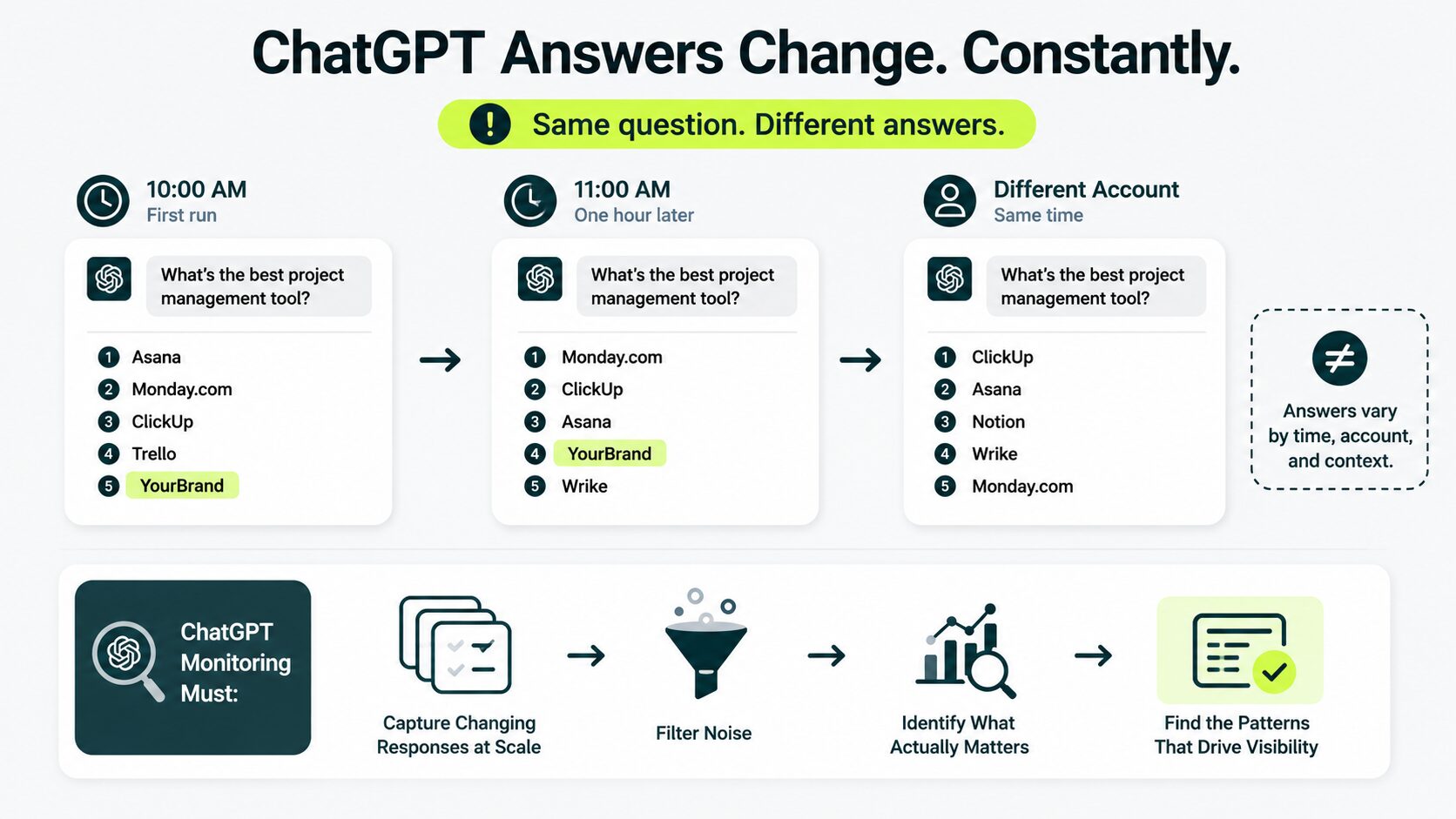
## Why ChatGPT Monitoring Doesn’t Work Like Google Tracking
ChatGPT answers are probabilistic, which means its answers depend on probability, so the same prompt produces a different brand list almost every time you run it.**
**
ChatGPT has no [traditional SERP layout](https://outreachdesk.com/what-are-serps/), no fixed positions, and no consistent answer. This changes everything. On Google, one search gives you one spot, and you can climb with effort. On ChatGPT, one search gives you one answer, and the next person might not see you at all.
[Research from SparkToro](https://sparktoro.com/blog/how-can-my-brand-appear-in-answers-from-chatgpt-perplexity-gemini-and-other-ai-llm-tools/) tested this directly. Participants repeatedly ran the same brand recommendation prompt through ChatGPT, Claude, and Google’s AI system. There’s a less than 1-in-100 chance that ChatGPT or Google’s AI returns the exact same brand list twice for the same prompt. Same wording. Same account. Different answers.
**That has three direct consequences for how you set up monitoring:
**
**1) A single prompt run is not data
**
It’s an anecdote. To say anything reliable, you need many runs of the same prompt over time.
**2) “Ranking” is the wrong frame **
There is no #1 spot. The metric that matters is the visibility percentage across many runs. What share of responses include your brand at all?
**3) Variance itself is information
**
If a brand appears in 80 of 100 runs, the market has structurally embedded it. A brand that appears in 8 of 100 runs is on the edge, and that edge moves week to week.
Most teams miss this. They check one prompt a month, see the answer change, and panic. That’s not real movement. That’s just noise.**
**
## Mentions, Citations, and Sources Are Three Different Things
A brand mention is when your company name appears within the ChatGPT response text. A citation link is a clickable reference attached to supporting content. A source page is the underlying webpage that informs the answer. These signals overlap, but each requires a different tracking and optimization approach.
Before measuring anything, separate the different signals inside a ChatGPT response. They often look similar on the surface, but they behave very differently in your strategy.
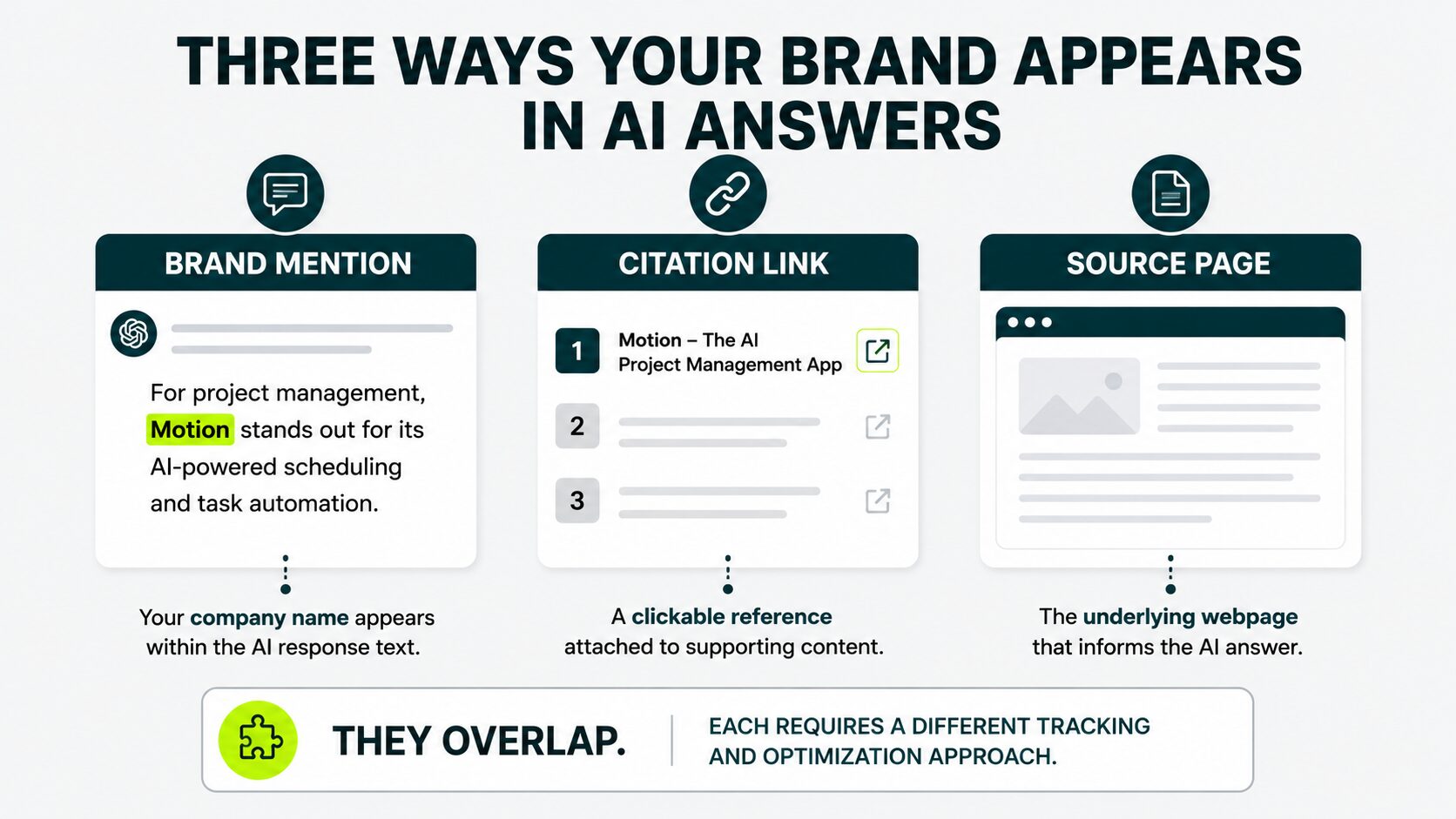
### Brand Mention
A brand mention happens when someone mentions your company name, which appears directly inside the response text.
For example:“
For B2B SaaS, tools like Acme and Beta are commonly recommended.”
In this case, Acme is being mentioned as part of the answer itself. This is what users actually read first.
### Citation Link
A citation is the linked reference ChatGPT sometimes attaches to supporting content. These usually appear as:
- Numbered links
- Sidebar references
- Source citations
Mentions and citations do not always overlap. ChatGPT may cite your website even when it never appears in the answer text.
### Source Page
A source page is the underlying webpage that ChatGPT used to generate the response. Sometimes those pages are visible to users. Sometimes they are not.
The source is the input. The generated answer is the output. That distinction matters.
**The strategic implication:
**
Each visibility problem points to a different underlying issue.
If your brand is missing from in-text mentions, the fix is usually your footprints in third-party sources, such as Industry comparisons, brand mentions in publications, and review content
If ChatGPT mentions your brand but skips citations, you should strengthen your [core SEO fundamentals](https://outreachdesk.com/what-is-seo/). Make your pages clearer, more authoritative, and easier to extract. Working with a [dedicated outreach team](https://outreachdesk.com/) can compress this process from months to weeks.
These are different problems, and they require different fixes. Teams that combine all three signals into one metric usually spend months optimizing the wrong thing.
## Designing a Prompt Set That’s Actually Worth Tracking
A useful prompt set usually includes four categories: direct brand prompts, category discovery prompts, competitor comparison prompts, and use case prompts.
Most teams’ tracking fails because their prompts are wrong. Teams often track prompts like:
“What does ChatGPT say about our brand?” That tells you very little.
Direct brand prompts often include the brand itself. The visibility that actually matters comes in the buyer journey before the customer already knows your company exists. That’s the visibility you need to measure.
Build your monitoring prompts across four categories. Each one answers a different strategic question.
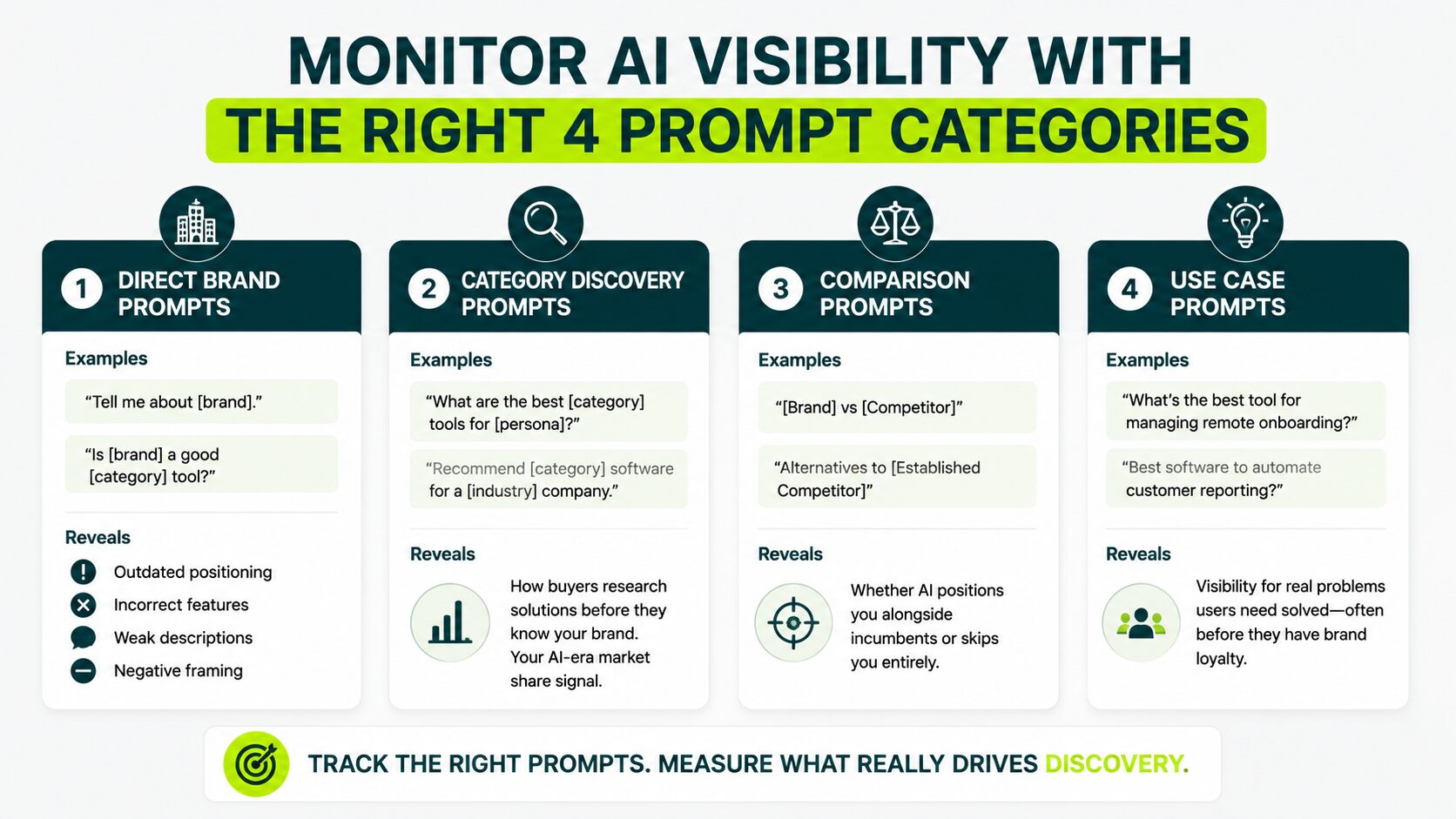
### Direct Brand Prompts
Examples:
- “Tell me about [brand].”
- “Is [brand] a good [category] tool?”
These prompts reveal how ChatGPT describes your company. Here you need to look for:
- Outdated positioning
- Incorrect features
- Weak descriptions
- Negative framing
Variance is usually lower here. The bigger risk is inaccurate representation, not invisibility.
### Category Discovery Prompts
Examples:
- “What are the best [category] tools for [persona]?”
- “Recommend [category] software for a [industry] company.”
These are the highest-value prompts in most categories. They reflect how buyers start researching solutions before they know specific brands.
Your visibility percentage here acts like an AI-era market share signal. If your brand is missing consistently, competitors are owning the discovery layer.
### Comparison Prompts
Examples:
- “[Brand] vs [Competitor]”
- “Alternatives to [Established Competitor]”
These reveal whether ChatGPT positions you alongside the incumbents or skips you entirely when listing options.
### Use Case Prompts
Examples:
- “What’s the best tool for managing remote onboarding?”
- “Best software to automate customer reporting?”
These prompts focus on problems instead of categories. That matters.
Users who ask use-case questions often have no loyalty to any existing brand. If your company appears consistently here, ChatGPT is more likely to surface you as a practical solution.
A working prompt set has 12-25 prompts total, weighted heavily toward category discovery and use cases. Direct brand prompts are diagnostic, not strategic. If you only track those, you’ll think you’re winning when you’re invisible to anyone who doesn’t already know your name.
In most client audits we’ve run, category discovery prompts expose the biggest visibility gaps. One cybersecurity SaaS client consistently appeared in branded searches. But disappeared entirely when prompted with “best endpoint security tools for remote teams.”
## The Manual Audit That Sets Your Baseline
Start by running a manual baseline audit before using any tracking tool.
Open ChatGPT, sign out and back in incognito mode, and test a fixed set of prompts multiple times.
Record whether your brand appeared and which sources were cited, then calculate visibility percentages per prompt category to create a reliable benchmark.
This will cost you nothing, takes a few hours, and gives you a reliable starting point for every future comparison. Most teams skip this step. That usually leads to poor measurement later.
**The audit has four steps:
**
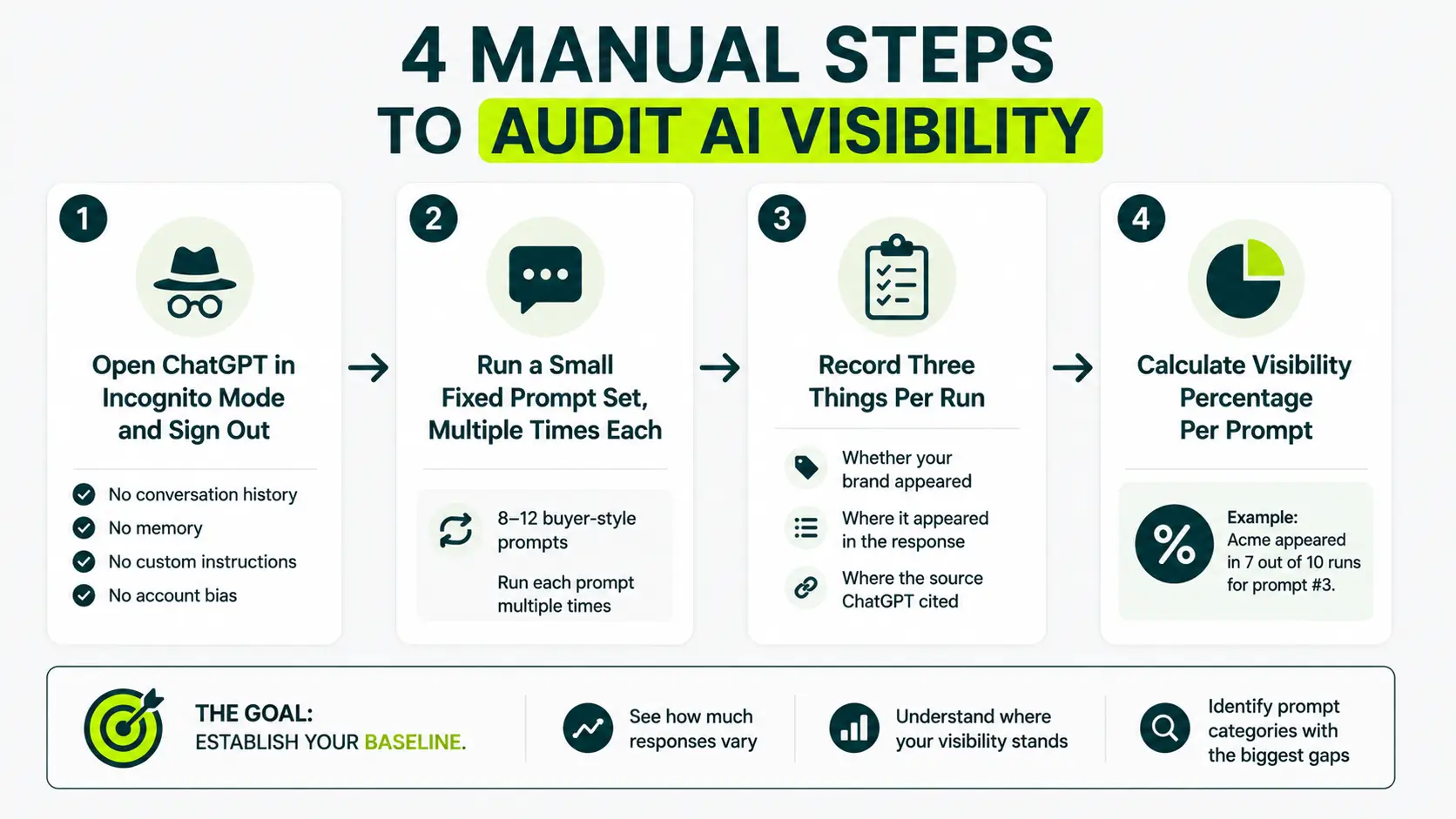
### 1) Open ChatGPT in Incognito Mode and Sign Out
ChatGPT personalizes responses based on your:
- Conversation history
- Memory
- Custom instructions
- Account behavior
If you test from your regular account, you may only be seeing how ChatGPT responds to you, not what it shows your prospects. A fresh, signed-out session removes that bias.
### 2) Run a Small Fixed Prompt Set, Multiple Times Each
Use 8-12 prompts that reflect how real buyers search in your category. Run each prompt multiple times. Yes, it’s repetitive. Do it anyway. Watching the variance yourself teaches you more than most dashboards will.
### 3) Record Three Things Per Run
For every response, track:
- Whether your brand appeared
- Where it appeared in the response
- Where the source ChatGPT cited
A spreadsheet is enough for the first audit. You do not need expensive tools to begin.
### 4) Calculate Visibility Percentage Per Prompt
This becomes your baseline metric. For example,
“Acme appeared in 7 out of 10 runs for prompt #3.”
That gives you a visibility percentage for the prompt. Once you aggregate all prompts together, you get a broader visibility score across the category.
In our experience with clients, when we ran 12 prompt baselines for a mid-market SaaS client last quarter, their visibility on direct brand prompts was 92%, but on category prompts (‘best [category] for [persona]’) it sat at 31%. The gap was the entire problem.
A manual audit is not a long-term system. It’s the calibration step. After one full pass, you understand:
- How many responses vary
- Where your visibility actually stands
- Which prompt categories expose the biggest gaps
Without that baseline, later trend data becomes much harder to interpret. **
**
## Choosing a Tool When Manual Stops Scaling
Manual audits establish the baseline. They do not scale well for ongoing monitoring. Once you start tracking dozens of prompts weekly, automation becomes necessary. That usually means selecting a dedicated tracking platform. The category has evolved quickly, and most tools now fall into three broad groups.
### Dedicated AI Visibility Platforms
Built specifically for tracking brand visibility across AI search platforms such as ChatGPT, Perplexity, Gemini, and Claude. They run scheduled prompts at scale, log mentions and citations, surface competitor share-of-voice, and chart trends over time. Examples include:
- Otterly.AI
- Profound
- GenRank
- Peec.ai
For teams focused heavily on AI visibility, this is usually the cleanest setup.
### SEO Suites With AI Visibility Modules
Platforms like [Ahrefs](https://ahrefs.com/brand-radar) (Brand Radar), Semrush, and SE Ranking have added ChatGPT tracking to their existing platforms.
The biggest advantage is operational simplicity. SEO and AI visibility tracking live in one place. The trade-off is depth. Some platforms handle AI tracking well. Others still feel early. **
**
### Brand Monitoring and PR Platforms With AI Lenses
PR and media monitoring platforms are also expanding into AI visibility tracking. Tools like Meltwater now layer AI monitoring on top of:
- Media listening
- Social tracking
- PR reporting
This works best for teams already operating inside larger monitoring systems. If AI tracking is your only goal, dedicated tools are usually more efficient.
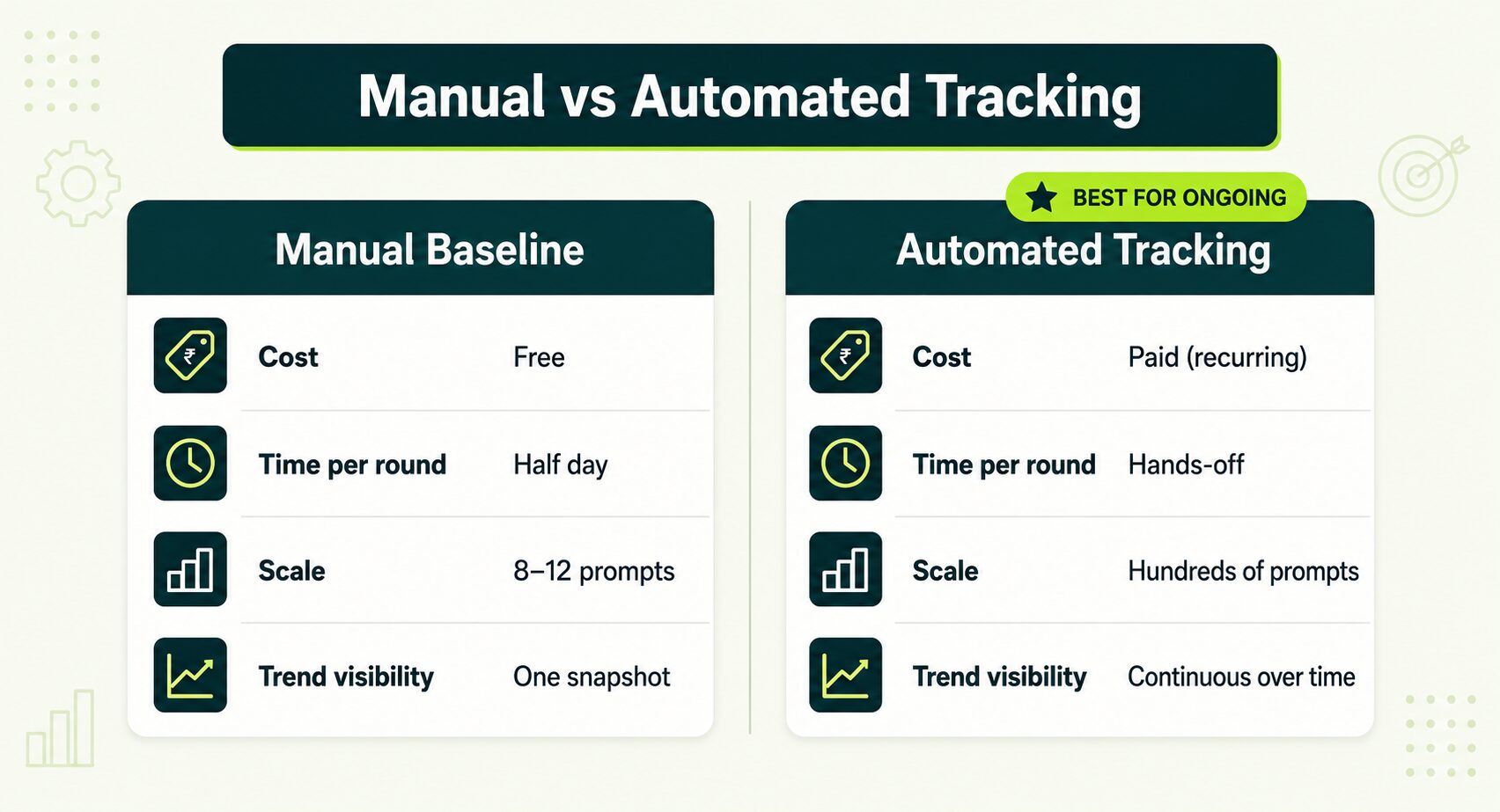
**Tip: Three questions to ask any AI tracking vendor before you sign.**
**1) How many prompt runs do they execute per tracked prompt?
**
Anything under 10 samples per reporting cycle is usually too small to overcome response variance. Twenty or more runs per prompt each week produces much more reliable trend data.
**2) Do they track mentions and citations separately?
**
If a tool only counts URL citations, it’s missing in-text mentions, and most ChatGPT references are mentions, not links.
**3) How transparent is the methodology?
**
Ask vendors:
- How do they sample prompts
- When they refresh prompts
- How they handle ChatGPT’s response variance
- How they measure the visibility percentage
The teams running rigorous tracking will explain it. The teams running thin tracking will dodge.
## How to Read the Numbers Without Fooling Yourself
ChatGPT outputs are noisy by design, and small week-over-week changes in your visibility numbers are usually noise, not signal. The pattern that matters is the four-to eight-week trend across many prompts, not the spike of any single one.
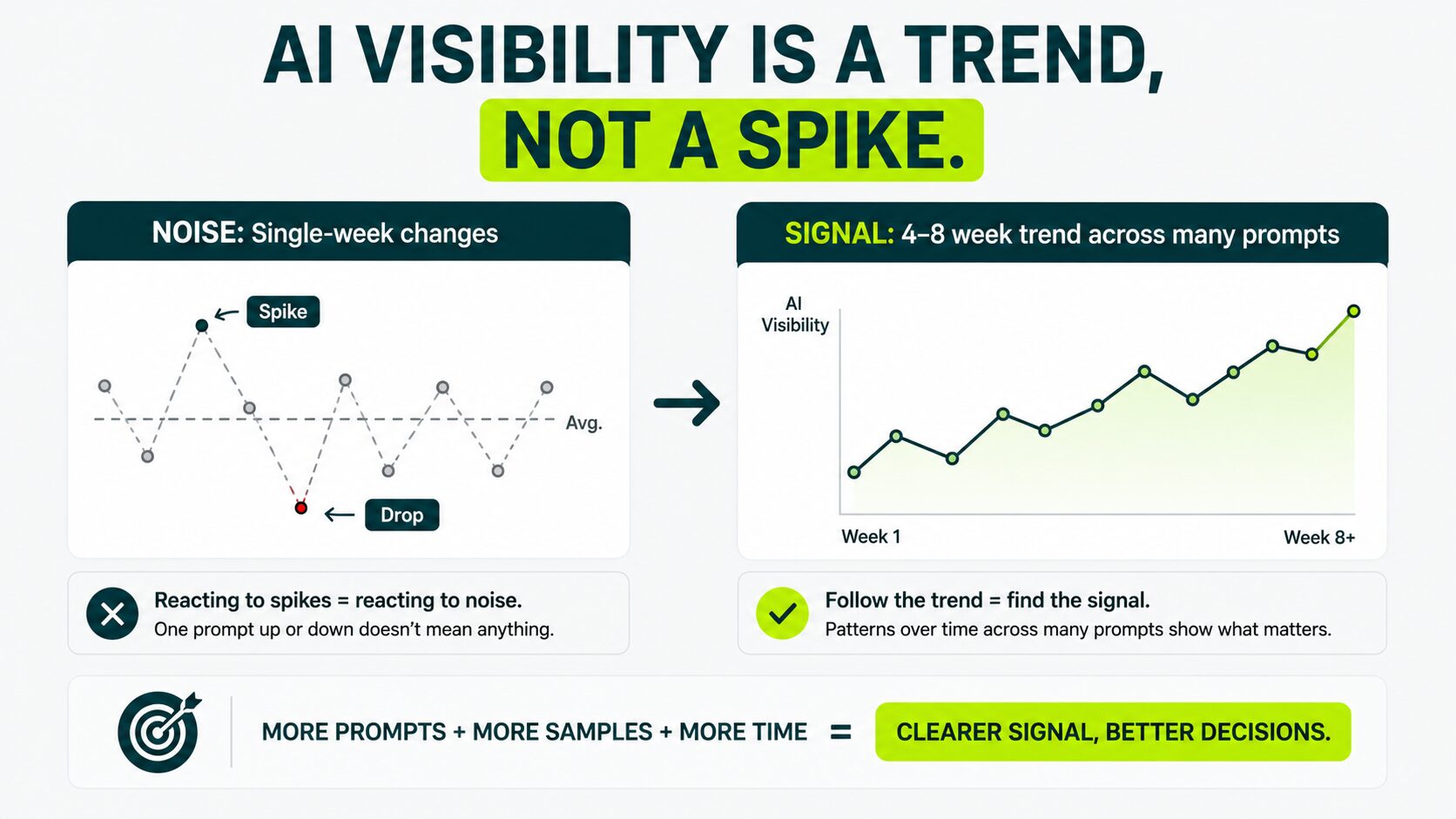
**A few rules for staying honest with the data:
**
### Aggregate Before You Diagnose
Don’t react to a single prompt’s number. Look at the average across:
- Your full prompt set
- Individual prompt categories
- Visibility trends over time
One prompt dropping is usually noise. Multiple category-discovery prompts dropping together is a stronger signal that something actually changed.
### Treat Sample Size Like a Research Question
Small sample sizes create weak conclusions. If a tool runs only five samples per prompt each week, the trend line remains unstable. Twenty samples per week produce far more reliable visibility data over time. More samples reduce randomness. That matters more here than most teams realize. **
**
### Check the Source List, Not Just the Answer
When visibility drops, look at what ChatGPT is citing instead. Sometimes the answer changes because:
- New comparison articles appeared
- Competitor reviews gained visibility
- Industry publications shifted
Those are actionable findings. If the sources are the same and only the answer changed, it’s just variance.**
**
### Beware “Ranking Position” Charts
Some tools show ‘you ranked 3rd in 60% of responses’ or something like that. Position numbers in ChatGPT aren’t stable enough to track. The order changes more than the brand list. Treat position as context, not as a KPI.
### Watch for Accuracy Drift, Not Just Visibility
High visibility alone is not enough. A brand appearing in 80% of responses with inaccurate positioning may be in worse shape than one appearing in 50% of responses with strong, accurate framing. Here, you need to pay attention to:
- Outdated descriptions
- Incorrect pricing references
- Missing features
- Misleading positioning
Accuracy influences trust just as much as visibility does.
We’ve also seen sudden visibility drops that initially appeared alarming but were traced to source changes rather than actual shifts in model preference.
In one audit, a publisher removed comparison pages that ChatGPT had been citing heavily, and the decline in visibility followed within weeks.
## What to Do With What You Find
Monitoring is a diagnostic. What you do next depends on what you find.
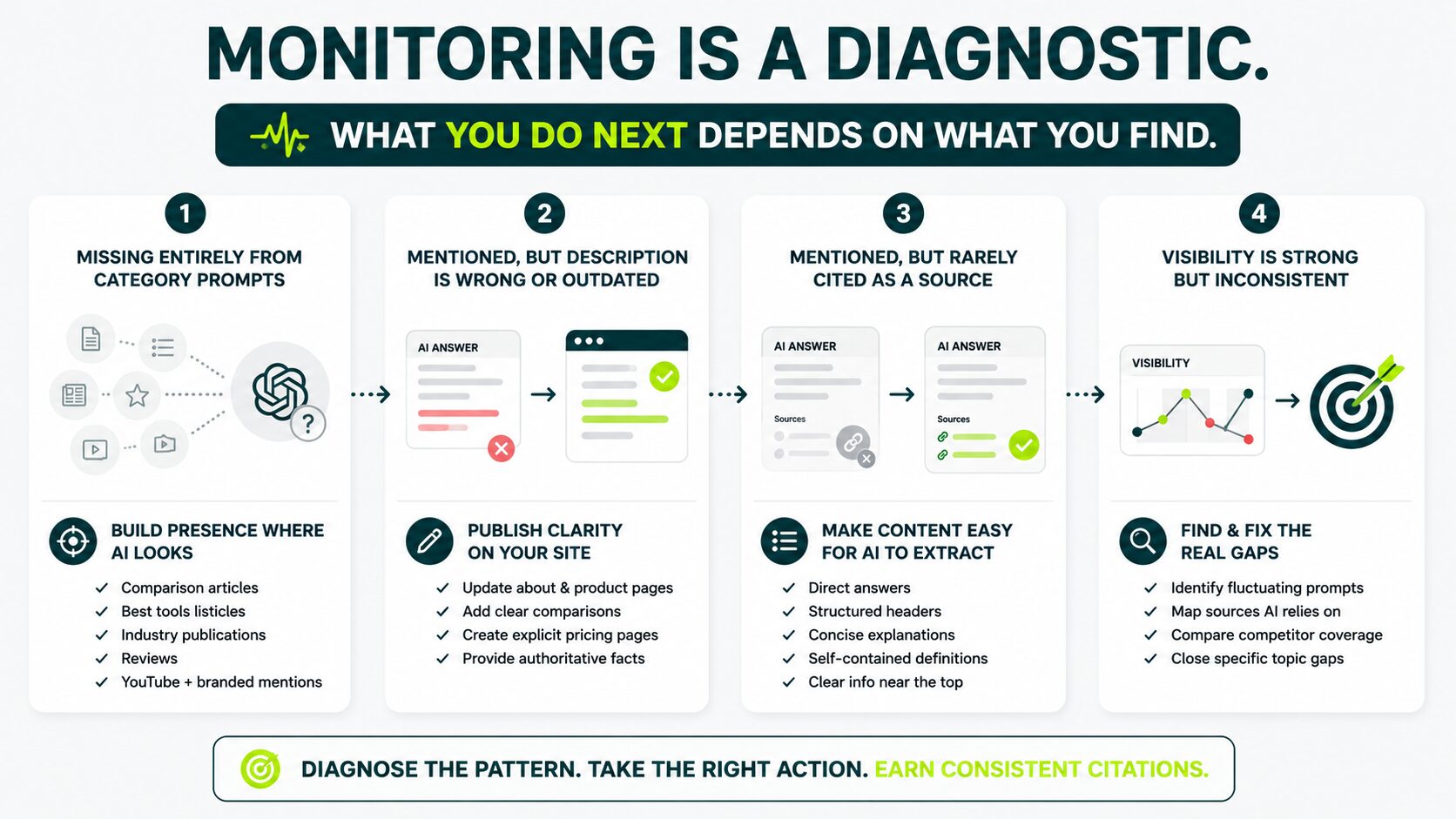
**
**
### If You’re Missing Entirely From Category Prompts
The issue is usually a weak presence across the third-party sources ChatGPT trusts. Improving this often requires [strategic brand mention campaigns](https://outreachdesk.com/brand-mention-service/) across industry publications, reviews, and comparison content
[Ahrefs analyzed 75,000 brands](https://ahrefs.com/blog/ai-brand-visibility-correlations/) and found that YouTube mentions and branded web mentions show the strongest correlation with AI brand visibility across ChatGPT, AI Mode, and AI Overviews.
If your brand is absent from trusted external discussions, AI systems struggle to consistently surface you.
### If You’re Mentioned, But The Description is Wrong or Outdated
Publish authoritative structured content on your own site that clarifies the fact that ChatGPT is getting wrong. Update your about page, refresh product pages, and publish an explicit comparison or pricing page if those are the points of confusion. ChatGPT updates its understanding as fresher, clearer sources accumulate.
### If You’re Mentioned But Rarely Cited as a Source Link
AI systems may struggle to extract information from your pages.
ChatGPT tends to favor pages with:
- Direct answers
- Structured headers
- Concise explanations
- Self-contained definitions
- Clear information near the top of the page
Audit important pages for extractability, not just SEO optimization.
### If Your Visibility is Strong But Inconsistent
This usually means the foundation is working, but visibility still depends too heavily on certain prompts or source clusters.
You need to identify which prompts fluctuate most, which external sources ChatGPT relies on for those prompts, and where competitor coverage is stronger than yours.
Fixing specific topic gaps is usually more effective than rebuilding your entire content strategy.
## Run the Baseline This Week
Open ChatGPT in an incognito window and run five category-discovery prompts. These are the prompts real buyers use early in their research process. Run each prompt three times and track whether your brand appeared, where it appeared, and which sources were cited. This will take around 30 minutes, and by the end of it, you’ll understand more about your actual AI visibility than most companies in your category currently do.
The teams that move ahead in 2026 set up a baseline, ran it consistently, and acted on the gaps the data exposed.
For a deeper breakdown of how broader brand mentions influence AI-generated answers, our full [guide on brand mentions in SEO](https://outreachdesk.com/brand-mentions/) walks through what to build once your monitoring system has shown you where you’re invisible.
### Want to understand where and how your brand is being mentioned online?
Get a clear approach to track visibility signals that influence search performance.
[Book a strategy call](/contact-us/)
### How often should I monitor brands mentioned in ChatGPT?
Weekly tracking is the sweet spot for most teams. ChatGPT’s underlying behavior and source pulls shift often enough that monthly is too slow to spot real movement, and daily creates too much noise to mask the trend. Run tracking weekly and evaluate trends over four to six weeks.
### Can I track ChatGPT mentions with Google Analytics?
Partially. GA4 can capture referral traffic from ChatGPT when users click links cited by the AI. That helps measure downstream traffic. What it does not show is how often your brand appears in answers, how frequently you are mentioned without clicks, and visibility trends across prompts.
### Can link building influence AI visibility?
Yes. In many industries, stronger editorial mentions and authoritative backlinks improve the external signals AI systems rely on. This is why many companies work with a [specialized link building agency](https://outreachdesk.com/) to improve both search and AI discovery signals.
### Why does ChatGPT give different answers when I run the same prompt twice?
ChatGPT responses are probabilistic. Each response is one possible output generated from training data, prompt context, retrieval systems, and model weighting. Variance is part of how large language models work. That is exactly why visibility percentage across many prompt runs matters more than any single response.
### Is monitoring ChatGPT different from monitoring AI Overviews or Perplexity?
Yes, each platform uses different systems, source weighting, and answer structures. For example, ChatGPT blends training data with selective web retrieval; Perplexity is heavily citation-focused; and Google AI Overviews rely heavily on the traditional Google ranking systems. A complete monitoring strategy tracks these systems separately.
### How do brands improve visibility across AI search platforms?
Improving visibility across ChatGPT, AI Overviews, Perplexity, and similar systems usually requires a broader [AI search optimization strategy](https://outreachdesk.com/ai-search-optimization/) focused on authoritative mentions, structured content, and trusted third-party sources.
### Do I need a paid tool to monitor ChatGPT mentions?
Not initially. A manual baseline audit is enough for most teams during the first few months. Paid platforms become useful when you need larger prompt sets, ongoing weekly monitoring, competitor visibility comparison, and long-term trend reporting.
### Will improving ChatGPT visibility take traffic from Google?
Usually no. Recent [clickstream research suggests](https://www.semrush.com/blog/chatgpt-search-insights/) that ChatGPT often serves as a discovery layer before users continue their research on Google. In practice, AI visibility and traditional search visibility increasingly support each other rather than compete. Improving one often strengthens the other.
### How is ChatGPT visibility connected to generative search?
ChatGPT visibility is becoming part of a broader [generative search strategy](https://outreachdesk.com/generative-engine-optimization/). As AI systems increasingly shape how users discover brands, improving visibility across AI-generated answers matters alongside traditional SEO.
---
---
title: "Community Mentions Service That Influences Buyer Decisions"
url: "https://outreachdesk.com/community-mentions-service/"
lang: "en-US"
type: "page"
description: "Community Mentions Community Mentions Service That Influences Buyer Decisions Your brand earns organic mentions across Slack, Discord, LinkedIn, X threads, and private communities where your B2B buyers actually research, compare, and recommend solutions. Slack & Discord mentions LinkedIn & X"
last_modified: "2026-05-22T13:50:29+00:00"
custom_fields:
header_style: "header-style-1"
footer_style: "footer-style-1"
---
# Community Mentions Service That Influences Buyer Decisions
Community Mentions
# Community Mentions Service That Influences Buyer Decisions
Your brand earns organic mentions across Slack, Discord, LinkedIn, X threads, and private communities where your B2B buyers actually research, compare, and recommend solutions.
_
Slack & Discord mentions

LinkedIn & X engagement

Pipeline influence tracking
Book a Strategy Call

4.8/5 _
Trusted by 500+ agencies &
1,000+ businesses worldwide.
AI Citations
28 Sources
Campaign Dashboard
LIVE
BRAND MENTIONS
2,400 → 21,800
+810%
COMMUNITIES ACTIVE
0 → 14
+14 channels
PEER RECOMMENDATIONS
0 → 47
+47 threads
SHARE OF VOICE
4% → 31%
+27 points
_
Response Time
11 Min










Service Overview
## What Community Mentions Actually Means
Community mentions are references seen in Slack groups, Discord servers, LinkedIn posts, X threads, Substack comment sections, and private community platforms where your buyers spend most of their time.
Your buyers make most purchase decisions, influenced by peer recommendations, long before they ever run a search. When a marketing leader asks her network for tool recommendations in the Pavilion Slack, a developer asks for advice in a niche Discord, or a founder polls their LinkedIn followers, the brand that gets recommended wins.
That recommendation often happens in private community channels that traditional SEO and link building can’t reach. Brands that show up in those discussions get influenced by those compounds, because every recommendation triggers more recommendations, and your name becomes the default answer in your industry.
For most B2B businesses, community mentions are the layer above editorial coverage and forum platform participation. Your brand needs to be present where buyers ask for advice, not where they read content.
Three things define real community mentions:

### Authentic Peer Presence
Actual participation in the communities your buyers turn to when they’re evaluating options.

### Pipeline-Influencing Visibility
Mentions that appear during buyer evaluation, often before any traditional search or scale touchpoint begins.

### Multi-Platform Coverage
Engagement on Slack, Discord, LinkedIn, X, Substrack newsletters, Product Hunt, and the niche networks specific to your industry.
How We Work
## How Your Community Mentions Campaign Works
A clear workflow built around actual participation in the communities where your buyers actually make decisions.
### Community Audit and Buyer Mapping
Your campaign starts with a complete audit of where your buyers spend their professional time. That includes the Slack groups they pay to join, the Discord servers they’re active in, the LinkedIn creators they follow, the X accounts they engage with, the Substack newsletters they subscribe to, and the Product Hunt threads they comment on.
Your strategist builds a buyer presence map that shows exactly which communities matter for your category, which conversations take place, and where your brand could earn relevance through real participation.
### Account Setup and Community Access
Many of the most valuable communities are gated. Slack groups like Pavilion, RevGenius, Demand Curve, MKT1, and Modern CMO require paid membership or a qualified application.
Once inside, accounts contribute genuinely useful answers and questions for weeks before any brand mention takes place. That relationship-building phase is what separates a mention that lands from one that reads like outreach. Brands looking to scale this approach typically work with Outreach Desk.
### Conversation Monitoring and Opportunity Capture
Your team monitors target communities for buyer questions, recommendation requests, and comparison threads where your product or expertise is genuinely the right answer. Tools like Common Room and direct community monitoring catch these moments as they happen.
Speed and authenticity equally matter. The most-trusted recommendations come from members who consistently contribute value, not from accounts that only show up when there’s an opportunity to mention a product.
### Value-First Contributions and Mention Integration
Your contribution leads with usefulness. Detailed advice, specific recommendations, helpful examples, all written by team members who understand your category. When the conversation naturally calls for a product mention, your brand surfaces as one of the recommendations, alongside other tools that are genuinely respected.
Real communities work this way: members trust contributors who recommend the right tool for the situation, not contributors who recommend their own product every time.
### LinkedIn and X Engagement Activation
On public platforms like LinkedIn and X, your campaign engages with relevant posts from creators, peers, and companies in your industry. Thoughtful comments, follow-up posts, and shared insights position your brand inside the discourse your buyers are already reading.
Every engagement adds context, asks better questions, or shares a specific experience. Generic “great post” comments don’t earn visibility. Substantive contributions to creator threads build the share of voice that compounds over time.
### Reporting With Pipeline Influence Tracking
You receive a detailed monthly report covering every contribution, every mention earned, every recommendation thread your brand showed up in, and the engagement those threads generated.
Your team tracks every contribution, every mention earned, and every recommendation thread your brand appeared in. Each month, that activity is correlated with pipeline metrics, prospect-cited mentions from sales calls, changes in deal velocity, and shifts in conversion rates for accounts that overlapped with community activity.

Expected Results
## Outcomes That Community Mentions Delivers
When your brand is genuinely present in the communities your buyers use, the visibility compounds into influence, peer recommendations, and category authority.
- 1. Pipeline Mentions
- 2. Recommendation Growth
- 3. Buyer Channel Visibility
- 4. Brand Authority Growth
### Visibility During Active Buyer Evaluation
Most B2B buyers gather peer information before they submit a demo request. Slack threads, Discord channels, LinkedIn polls, and X discussions are where these comparisons happen in real time.
**The result:** your brand appears during the evaluation moments that actually shape buying decisions. One B2B client tracked 38 sales conversations over five months in which prospects independently mentioned that community members had recommended the brand before they reached out.
This is an influence that doesn’t show up in Google Analytics. It shows up in shorter sales cycles, warmer calls, and prospects who already trust your brand before any direct outreach.
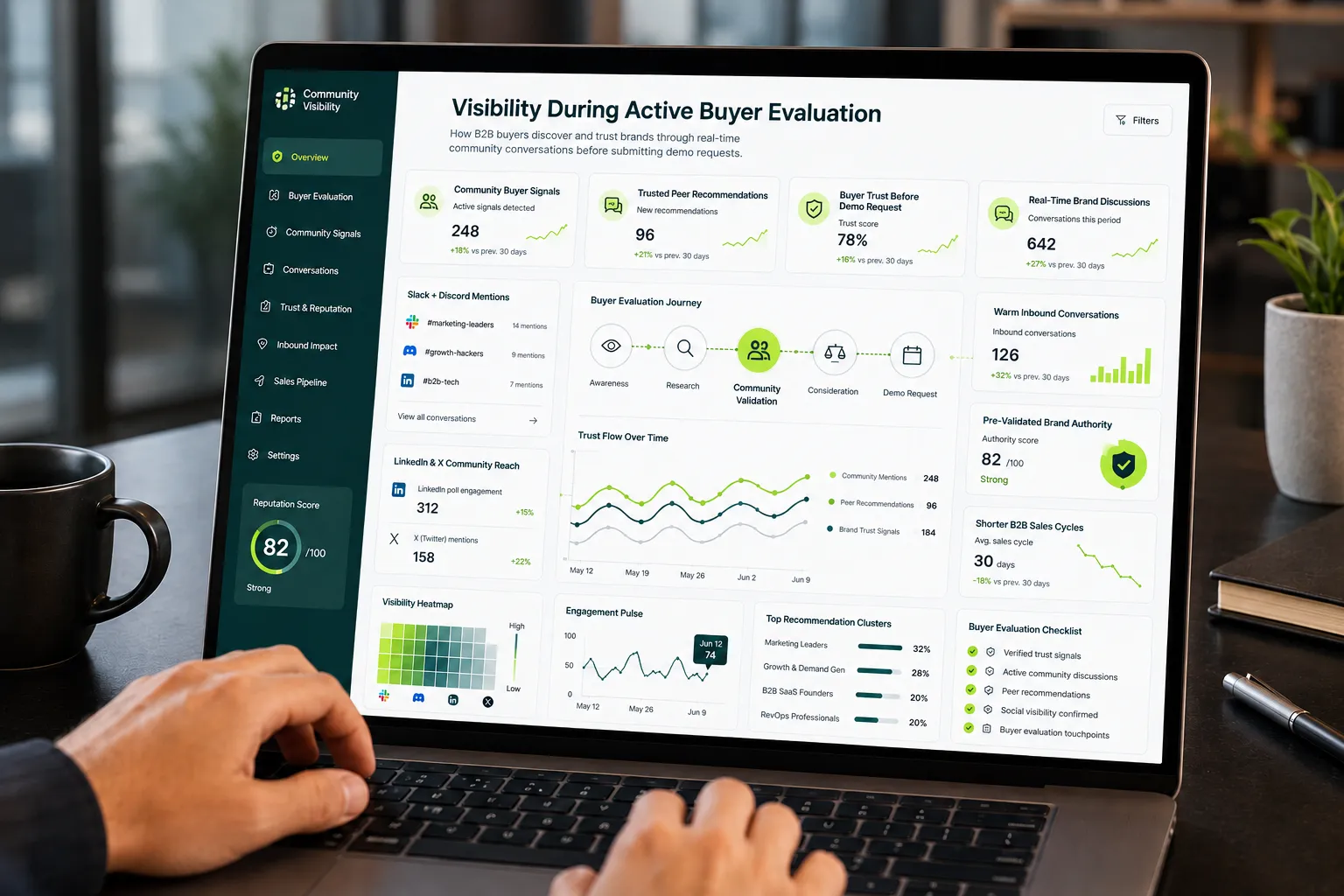
### Recommendations That Trigger More Recommendations
Community recommendations are built on themselves. Every time your brand is recommended in a thread, more community members see your name associated positively with a use case. The next time someone asks a similar question, those members are more likely to recommend you.
Recommendation velocity compounds. Six months into a consistent community campaign, your brand becomes the default suggestion in your category, and most of those recommendations come from members who weren’t part of your original outreach.
Paid acquisition stops the moment the budget pauses. Peer recommendations don’t. They accumulate, stay searchable in community threads, and keep appearing for your brand to new members months after the original contribution. No ad campaign compounds that way.
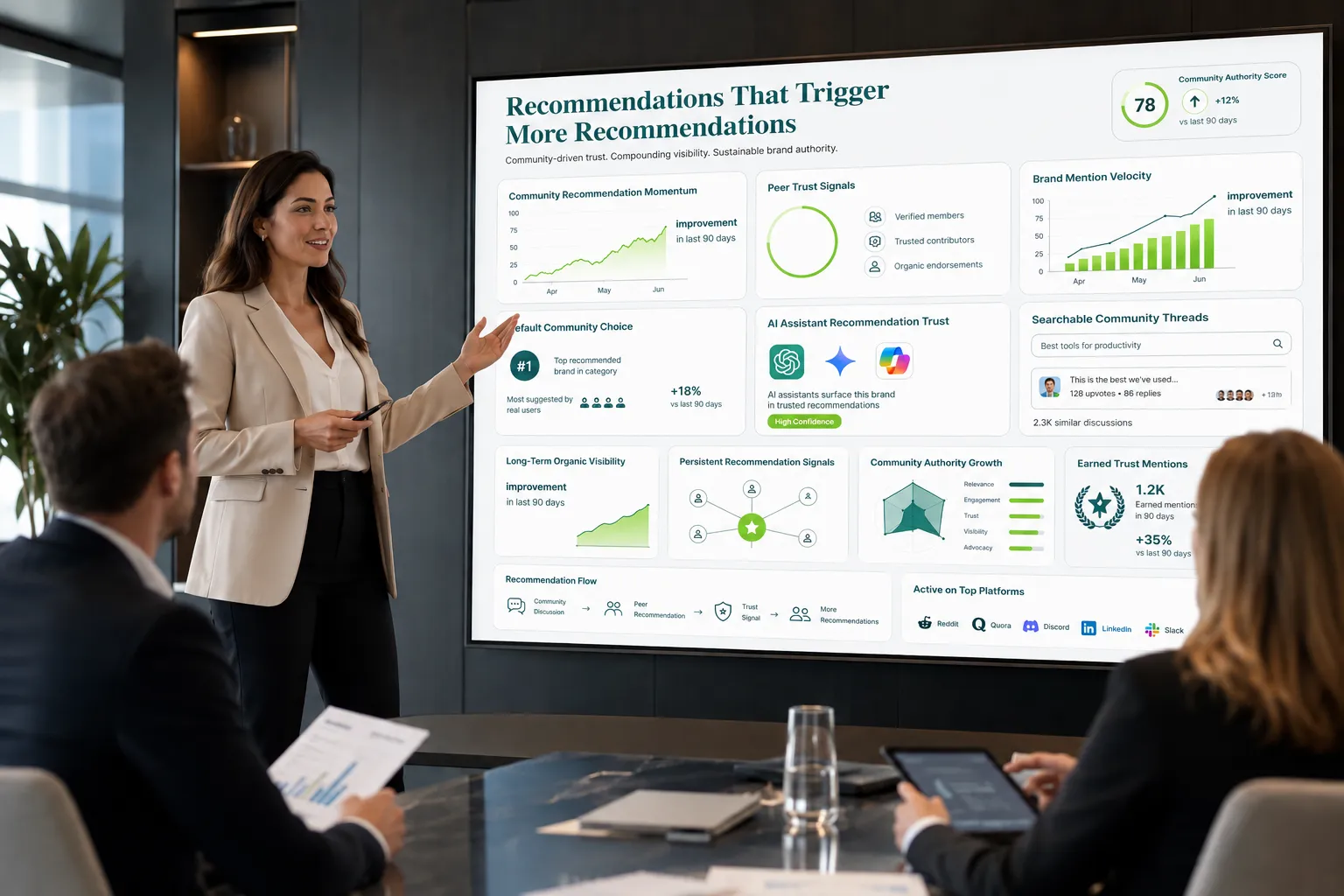
### Category Awareness Where It Matters Most
Share of voice on LinkedIn, X, and major creator newsletters shapes which brands show up in industry discourse. When your team contributes to discussions in your category and your founders engage with creator content, your brand becomes part of the conversation.
When a marketing leader sees your brand commenting thoughtfully on the LinkedIn posts they follow, buyers do notice, and it builds your category awareness without paid media. When your founder earns a quote in a Substack newsletter that buyers actually read, your brand stops being a vendor they’ve heard of and becomes one they already trust.
Brands with consistent share-of-voice presence in buyer communities convert pipeline at higher rates than competitors running larger paid budgets. The reason is simple: prospects who’ve seen your brand recommended by peers arrive already trusting you. Paid media doesn’t produce that.
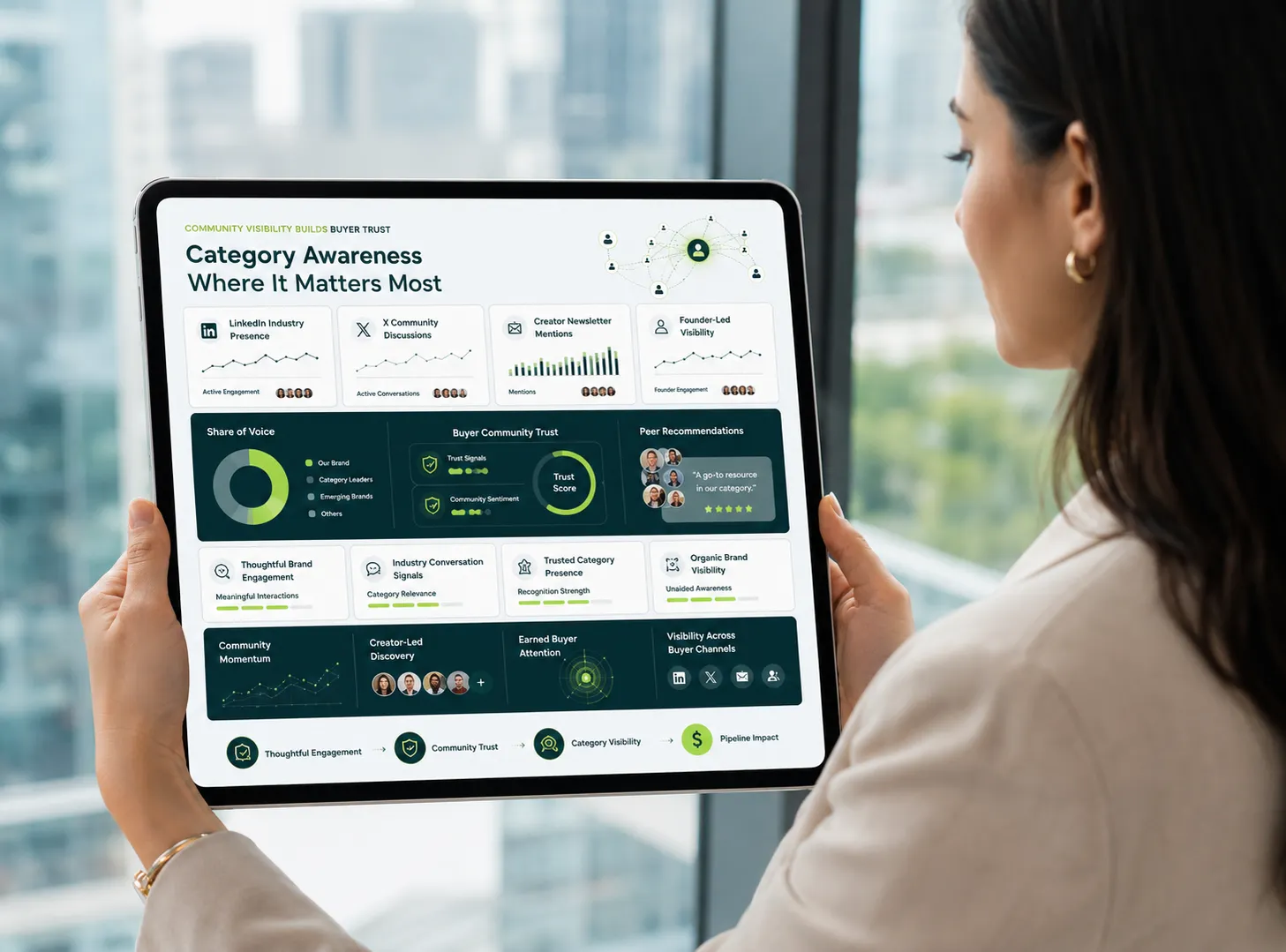
### Category Recognition That Doesn’t Require Repeat Investment
Every contribution your team makes lives in the community indefinitely. Slack threads stay searchable for members. LinkedIn posts and comments earn ongoing visibility. X threads continue to appear in algorithm feeds for weeks.
Your authority compounds on all of these. New community members joining six months from now will see your past contributions, your brand’s track record of helpfulness, and a growing stack of recommendations already waiting for them.
This is what separates community mentions from paid awareness channels. The investment doesn’t reset when the budget pauses. The reputation you build keeps working.
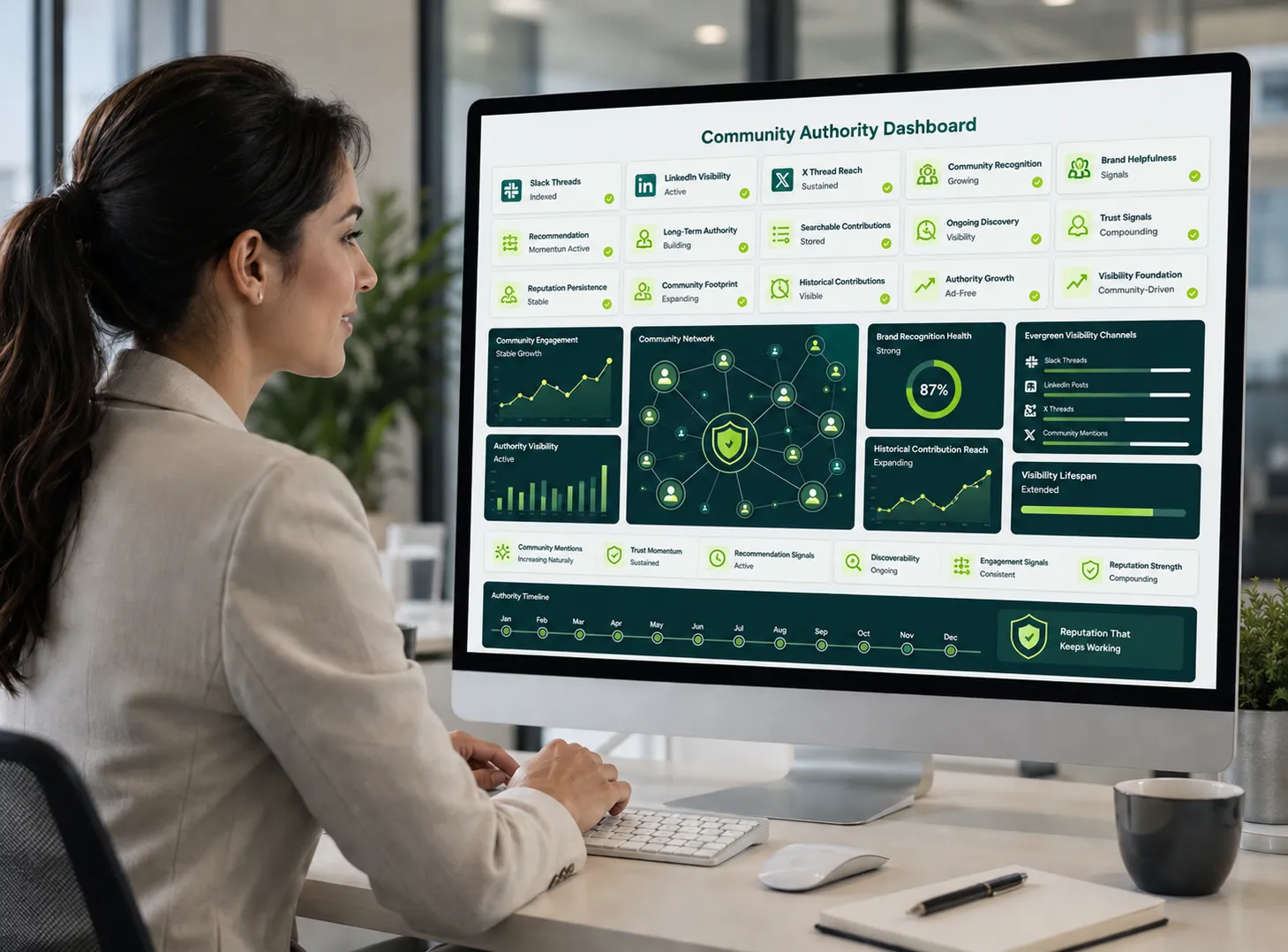
Client Success Stories
## What Clients Say About Our Community Mentions Service
Verified reviews from leaders who gained influence and peer recommendation velocity through authentic community engagement.
[View All
](https://outreachdesk.com/testimonial/)

4.8/5 

## 5/5 
Rating on Google



We had no presence in Slack communities that our buyers actually use. Within four months, community members we’d never met were recommending our brand in threads we’d never seen, because they’d watched our team contribute helpfully for months.

#### Head of Marketing
B2B SaaS


LinkedIn engagement at the community level changed how prospects experienced us before sales calls. They came in already familiar with our perspective, our team, and our opinions on our category. Sales cycle length dropped by 30%.

#### VP Growth
Software


The reporting on community mentions was different from anything we’d seen. We could trace specific deals back to recommendations in private Slack groups our team would never have accessed alone. That visibility was worth every dollar.

#### CMO
Fintech
Service Framework
## Investment, Timeline, and Deliverables
Every community mentions campaign is custom-scoped to your industry, target communities, and brand goals. Here’s what shapes your investment:

### Number of Communities Engaged
Most campaigns run between 8 and 20 communities, including paid and gated platforms.

### Membership and Access Fees
Paid Stack and Discord communities pass through at cost; budgets vary by industry.

### Contribution Velocity
Quality and frequency tailored to each community’s culture and engagement norms.

### Campaign Duration
Most clients see early traction in 60-90 days, with compounding influence over 6-12 months.
### Directional pricing
Pricing and scope are shared as requested, tailored to your specific coverage needs, community mix, and growth goals. Custom proposals are available after an initial strategy call, outlining an approach built around your requirements, including community coverage, contribution approach, tracking, and a month-by-month roadmap aligned to your goals.
Book a Strategy Call
What You Get
## Every Mention, Every Community, Every Engagement Reported
Complete transparency on which communities you’re active in, what’s being contributed, and the brand visibility being earned:

### Community Activity Logs
You get direct logs of every contribution across every community, including engagement metrics and member responses for each thread.

### Mention Tracking Dashboard
You can see every brand mention earned, with complete thread context, community source, and visibility impact summaries.

### Pipeline Influence Reports
You see a correlation between community activity and sales pipeline metrics, including prospect-cited mentions from sales calls.

### Share of Voice Analysis
You get monthly comparisons of your brand’s presence versus competitors across the communities that matter most.
Our Approach
## A Genuine Engagement Approach Built For Real Influence
You earn community visibility through value-led participation, not promotional posting, fake account networks, or bulk automation.
| Factor | In-House / DIY | |
| --- | --- | --- |
| Community Mapping | A private, gated platform limited to communities
the marketing team already knows is often missed entirely. | Complete buyer-presence map across paid Slack groups,
Discord servers, LinkedIn, X, Substack, and niche networks. |
| Membership &
Access | The internal team can’t credibly join multiple paid
communities; signup limits and verification processes create friction. | Coordinated access across gated communities through
credible accounts representing your brand authentically. |
| Contribution Quality | The internal team contributes when bandwidth allows;
tone and consistency vary across platforms over time. | A dedicated team writes platform-tailored contributions,
with everyone focused on adding value before any mention. |
| Mention Tracking | Brand monitoring tools miss mentions in private
communities; no visibility into what’s happening in gated channels. | Manual tracking inside every community, combined with
monitoring tools, so private channel mentions get reported. |
| Pipeline Attribution | Difficult to connect community activity to
pipeline outcomes without dedicated tracking efforts. | Monthly correlation analysis between community
contributions, mentions, and pipeline metrics, including
prospect-cited mentions. |
Who We Help
## Industries We Support With Community Mentions
Whatever your industry, we identify the active communities your buyers use and build brand presence that directly influences the pipeline.
[

### SaaS & Software
](/saas-link-building/)
[

### Ecommerce & DTC
](/ecommerce-link-building/)
[

### B2B
](/b2b-link-building/)
[

### Enterprise
](/enterprise-link-building/)
[

### Startups
](/link-building-for-startups/)
[

### Real Estate
](/real-estate-link-building/)
[

### Law Firms & Legal
](/link-building-for-lawyers/)
[

### Dental Practices
](/link-building-for-dentists/)
[

### Healthcare & Fitness
](/health-fitness-link-building/)
[

### Financial & Insurance
](/link-building-for-financial-websites/)

### Technology & Innovation

### Consumer Brands
Common Questions
## Frequently Asked Questions
Get clear answers on community mentions, covering strategy, reporting, and authentic engagement approaches.
### What’s the difference between community mentions and brand mentions?
[Brand mentions](https://outreachdesk.com/brand-mentions/) usually refer to the references in articles, podcasts, news coverage, and editorial content, where journalists, hosts, or writers reference your brand. Community mentions are references within live community platforms such as Slack groups, Discord servers, LinkedIn comment threads, X discussions, Substack comment sections, and Product Hunt conversations. Both are part of a complete [brand visibility strategy](https://outreachdesk.com/brand-mention-service/) that reaches different audiences in different ways. Editorial mentions reach readers; community mentions reach buyers in active research, often during moments that directly shape purchase decisions.
### How do you get into private Slack and Discord communities?
Many of the valuable B2B communities require paid membership or a qualified application. Pavilion, RevGenius, Demand Curve, MKT1, and Modern CMO are paid Slack groups for marketers and sales leaders. Many Discord servers require an invite or require members to go through a vetting process. Your campaign covers membership coordination through credible accounts representing your brand. Membership fees are passed through at cost, and your team handles the application process, identity verification, and the relationship-building phase before any brand mention.
### Why does LinkedIn engagement count as community mentions?
LinkedIn comment threads are community mentions, just on a public platform instead of a private one. The comments under posts from creators, peers, and category leaders are where industry discourse happens in real time. When your team contributes through comments, asks substantive questions, and shares specific experience on relevant posts, your brand becomes part of the conversation buyers are reading.
### How do you measure pipeline influence from community activity?
Pipeline influence shows up in three places: prospects mentioning where they first heard of your brand on discovery calls, sales reps tracking deals in which prospects referenced community recommendations, and survey data from closed-won deals on awareness sources. Your reporting includes a monthly correlation analysis between community contributions and pipeline metrics. While community mentions don’t fit traditional attribution models cleanly, the impact shows up in shorter sales cycles, higher conversion rates, and prospects who arrive already familiar with your brand.
### How long does it take to see pipeline impact from community mentions?
- Account establishment and community membership coordination take the first 30-60 days.
- Active contribution and value-led participation begin in months 1-2.
- Brand mentions earned through peer recommendations typically appear in months 2-3, once the account has built enough contribution history to recommend naturally.
- Pipeline influence becomes measurable in months 3-4 as community awareness reaches prospects in active evaluation.
- Compounding effects build over 6-12 months as recommendation velocity grows and your brand becomes a default suggestion in your category.
### How is this different from your forum link building service?
Forum link building focuses on public platforms like Reddit, Quora, Stack Exchange, and Hacker News, where the primary outcomes are SEO rankings, AI search citations, and organic traffic from forum threads ranking in Google. Community mentions focus on modern community platforms like Slack, Discord, LinkedIn, X, and Substack, where the primary outcomes are pipeline influence, peer recommendations, and share of voice in private buyer channels. Different surfaces, different mechanics, different metrics. Many B2B brands invest in both layers because they reach different stages of the buyer journey.Working with a single [strategic link building partner](https://outreachdesk.com/) that covers both simplifies execution and compounds results.
## Ready to Earn Community Mentions Where Your Buyers Actually Decide?
Get a senior strategist to map your communities, coordinate access, and build brand visibility that directly influences the pipeline.
Book a Strategy Call

4.8/5 _
Trusted by 500+ agencies &
1,000+ businesses worldwide.

---
---
title: "Forum Link Building Service for Community-Driven Authority"
url: "https://outreachdesk.com/forum-link-building-service/"
lang: "en-US"
type: "page"
description: "Forum Link Building Forum Link Building Service for Community-Driven Authority Your brand earns links and mentions through real participation in Reddit, Quora, and communities your buyers actually trust. Reddit & Quora engagement Industry forum participation AI citation visibility Book a"
last_modified: "2026-05-26T11:44:43+00:00"
custom_fields:
header_style: "header-style-1"
footer_style: "footer-style-1"
---
# Forum Link Building Service for Community-Driven Authority
Forum Link Building
# Forum Link Building Service for Community-Driven Authority
Your brand earns links and mentions through real participation in Reddit, Quora, and communities your buyers actually trust.
_
Reddit & Quora engagement

Industry forum participation

AI citation visibility
Book a Strategy Call

4.8/5 _
Trusted by 500+ agencies &
1,000+ businesses worldwide.
Active Forums
10+
Campaign Dashboard
LIVE
BRAND MENTIONS
1,800 → 15,100
+740%
COMMUNITY UPVOTES
0 → 4,200
+4,200
AI CITATIONS
0 → 28
+28 sources
RANKED DISCUSSIONS
12 of 18
67% on page 1
_
Threads Placed
18










Service Overview
## What Forum Link Building Actually Means
Forum link building is the practice of participating in forums like Reddit, Quora, and niche-specific communities and includes a link back to your site. The old version of these tactics, like profile drops or mass-posted comments, stopped working years ago and carries real penalty risk today.
Reddit is now the most-cited domain in ChatGPT. Even Perplexity, Google AI Overviews, and Gemini all reference Reddit threads, Quora answers, and niche forum discussions when generating answers. A brand mentioned naturally inside the right thread gets cited by AI systems for queries that no traditional SEO can reach.
For most businesses, forum link building is the new entry point to AI search visibility. The investment is in community participation, rather than in bulk link purchases. The return is brand presence in the discussions shaping buying decisions, and the AI answers that increasingly drive them.
Three things that define a strong forum link building campaign:

### Authentic Engagement
Actual participation in conversations your buyers are having, personalized, not bulk posted by automation or templated scripts.

### Community-Driven Authority
Mentions and links that are earned through usefulness, building credibility in the platforms that shape buyer research and recommendations.

### AI Citation Reach
The forum content is frequently cited by ChatGPT, Perplexity, and Google AI Overviews for buyer-research queries you want to rank.
How We Work
## How Your Forum Link Building Works
A managed workflow built on real community participation, not on spam tactics or comment automation.
### Community Discovery and Audience Mapping
Your campaign starts with mapping the communities your buyers genuinely use. Coverage includes Reddit, Quora topics, Stack Exchange tags, niche forums, Discord servers, and Slack communities, and is tailored specifically to your industry.
Your strategist identifies the threads, questions, and discussion patterns where your brand could add genuine value. The output is a curated community map that covers where your audience is, what they’re asking, and where visibility opportunities arise.
### Account Setup and Reputation Building
Forums and community participation require real, established accounts with a credible posting history. Your team uses brand-affiliated accounts that contribute genuinely useful answers for weeks or even months before any links are placed.
This is the work that most agencies skip. Reddit, Quora, and niche forums suppress new accounts that drop a link early. The reputation phase makes sure every later mention is inside a credible profile, not a flagged account.
### Topic Monitoring and Opportunity Capture
Your team monitors target communities daily for questions, threads, and discussions where your product or expertise is genuinely the right answer. Tools like F5Bot, Brand24, and direct subreddit monitoring catch opportunities the moment they go live.
Speed matters in community engagement. The most highly engaged answers on Reddit and Quora are often the earliest ones, so opportunity capture is timed to maximize visibility in the thread before later replies push it down.
### High-Value Comment and Answer Creation
Every comment, answer, or thread participation is written to genuinely help the asker, with the brand mentioned naturally only where it fits. Long-form Quora answers, detailed Reddit comments, and niche forum threads are written by writers who understand your product and the buyer’s actual problem.
No copy-paste templates and no “check out my site” drops. Each contribution is tailored to the community’s tone, expectations, and quality bar. This separates actual participation from forum spam.
### Brand Mention Integration and Link Placement
When the context is appropriate, your brand or website is mentioned naturally in the useful answer. Some mentions become clickable links. Others stay as brand mentions, which AI engines pick up the same way.
Anchor text and link integration follow each platform’s conventions. Reddit allows direct links inside detailed answers when they’re useful. Quora benefits from brand mentions within comprehensive answers. Niche forums may vary, and your team adapts to each community’s culture.
### Reporting and AI Citation Tracking
You receive a detailed monthly report covering every contribution, including thread URL, community, upvote count, engagement metrics, and any AI citations earned. Your strategist runs structured prompts in ChatGPT, Perplexity, and Google AI Overviews to verify that mentions now show up as cited sources.
You see brand-mention growth, community-engagement signals, and AI citation lift. The metrics that actually matter for community-driven authority.

Expected Results
## Outcomes That Forum Link Building Delivers
When a link is earned through genuine editorial standards, your authority compounds into rankings and traffic that holds through every update.
- 1.Community Mentions
- 2. AI Search Citations
- 3. High-Intent Traffic
- 4. Long-Term Authority
### Mentions in the Discussions Buyers Already Read
Most B2B buyers research solutions in industry forums, Reddit threads, and Quora answers before they ever visit your site. When your brand shows up naturally in those discussions, you get shortlisted by the buyers before they even start a Google search.
**The result:** your brand gets recognized in the communities that shape buying decisions in your industry. One B2B SaaS client moved from zero Reddit mentions to recognition in 38 threads on their target subreddits in five months.
This isn’t paid placement. It’s earned visibility through useful contributions to conversations your buyers were already having.
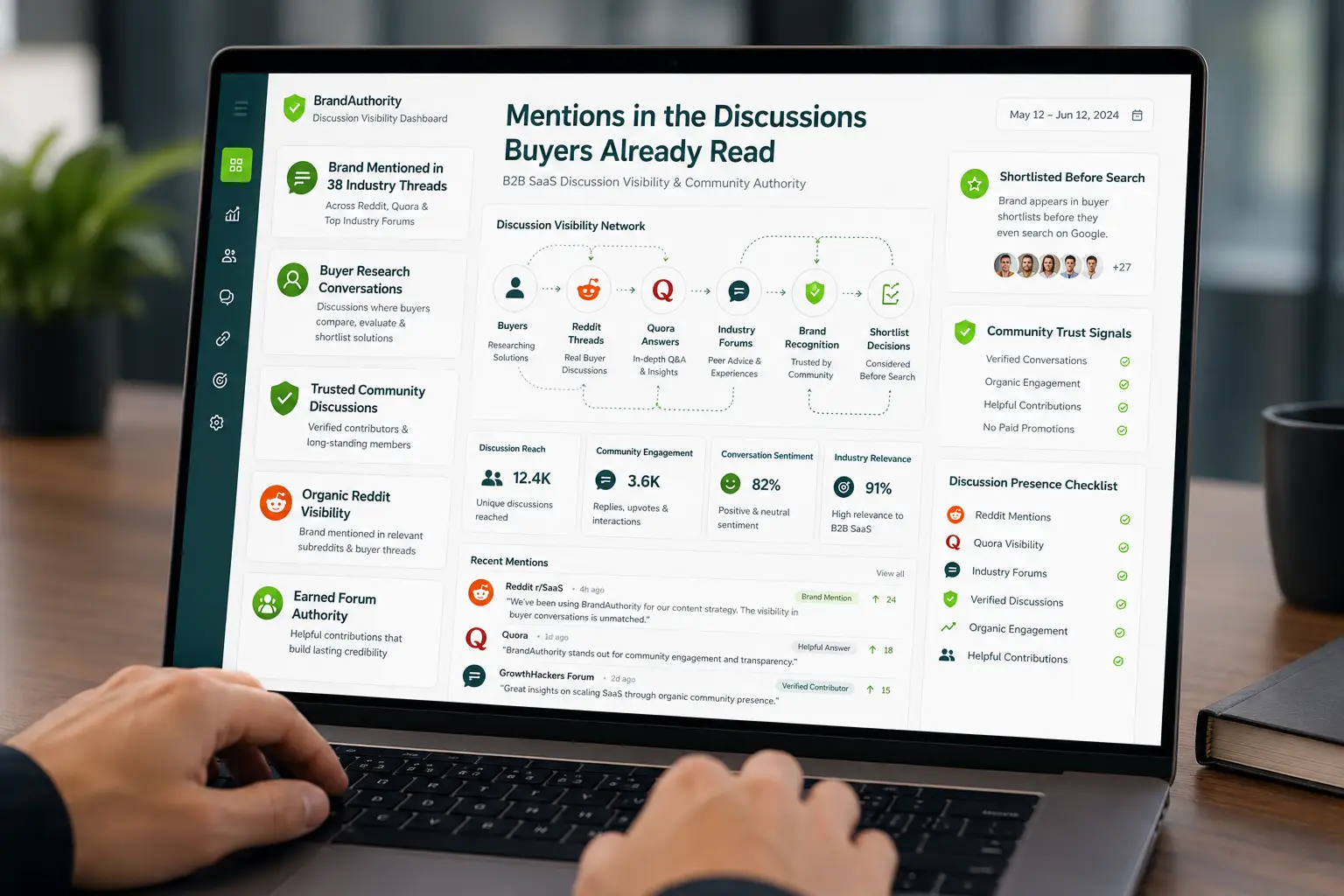
### Visibility in ChatGPT, Perplexity, and AI Overviews
AI search engines treat community discussions as primary source material. Reddit is the most-cited domain in ChatGPT’s responses, and Perplexity heavily references Quora and niche forums when generating answers.
When your brand is mentioned inside a trusted community thread, AI engines start following those mentions in answers to buyer-research queries. Your visibility extends to AI search surfaces that no traditional link building tactic reaches.
Clients with active community campaigns see brand mentions in ChatGPT and Perplexity answers within 60-90 days of consistent participation.
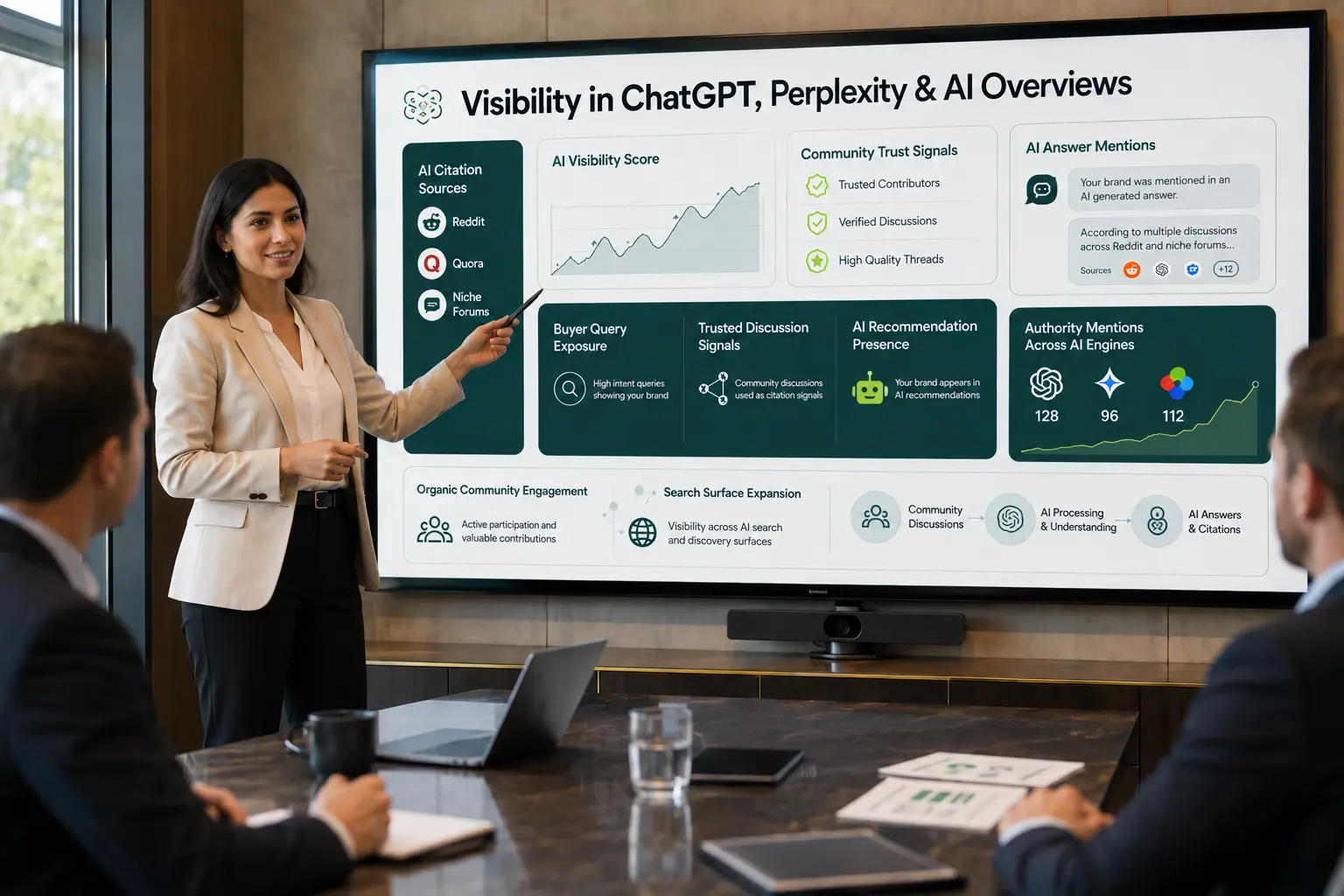
### Traffic From Buyers in Active Decision Mode
Forum traffic converts differently from search traffic. Someone asking “best [your category] for [specific use case]” on Reddit is deep in research mode, comparing options before a purchase decision.
When your brand is the answer that helps them solve the problem, the click that follows carries strong intent. These visitors arrive understanding what your product does and why it might fit their needs.
Clients earning consistent community mentions often see referral traffic from Reddit, Quora, and niche forums convert at rates closer to organic search than typical referral channels.
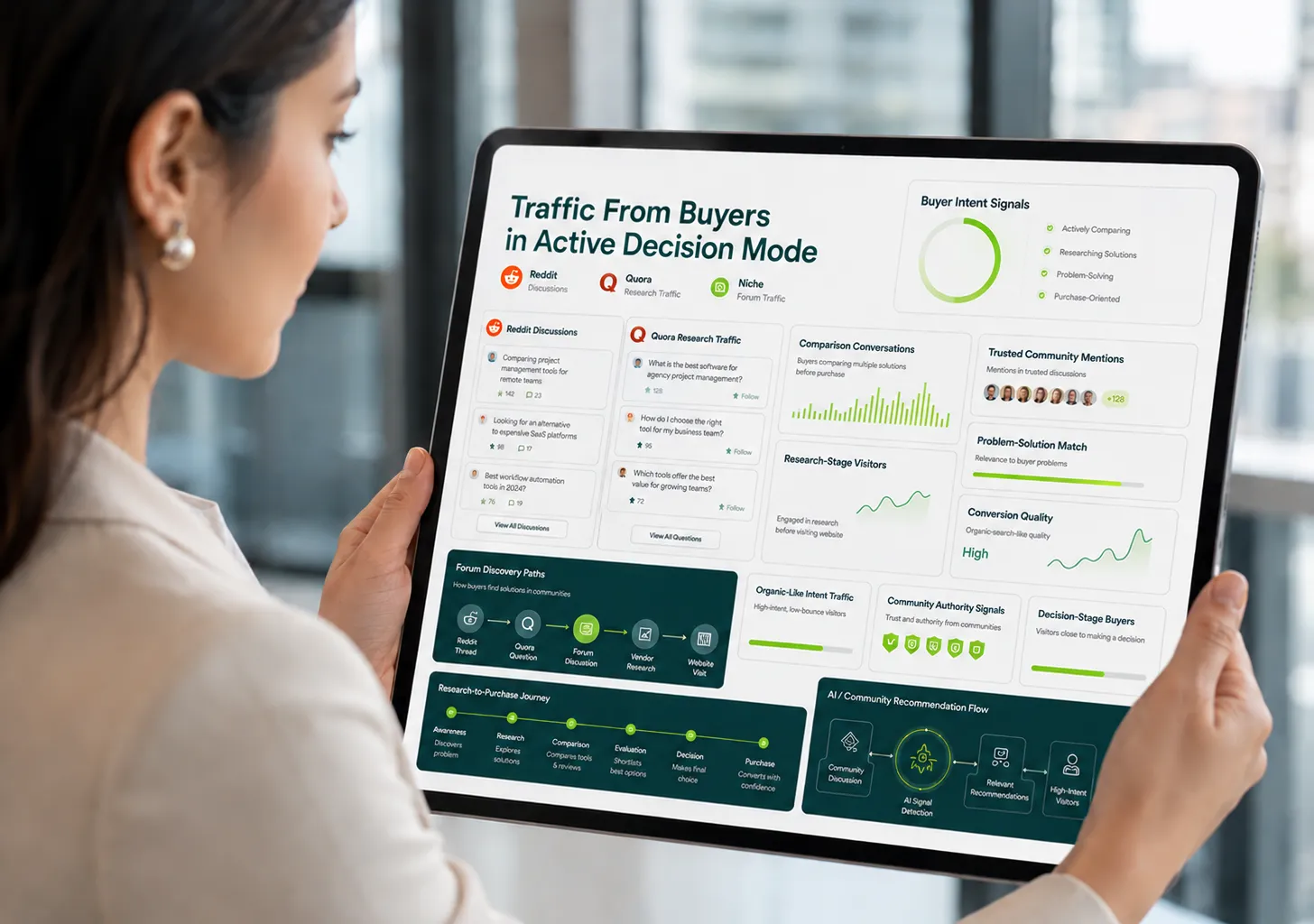
### Authority That Builds Across Every Discussion
Each helpful contribution adds to your account’s reputation, your brand’s recognition in the community, and the discoverability of past contributors. Reddit comments and Quora answers can rank in Google search and stay visible for years.
As more community members upvote, share, and reference your contributions, your brand becomes a default recommendation in your category. Future threads about your topic increasingly mention your product without any direct intervention.
That’s the long-term return that forum spam never produces. Real community presence builds a reputation that pays dividends across SEO, AI search, and direct referral channels.
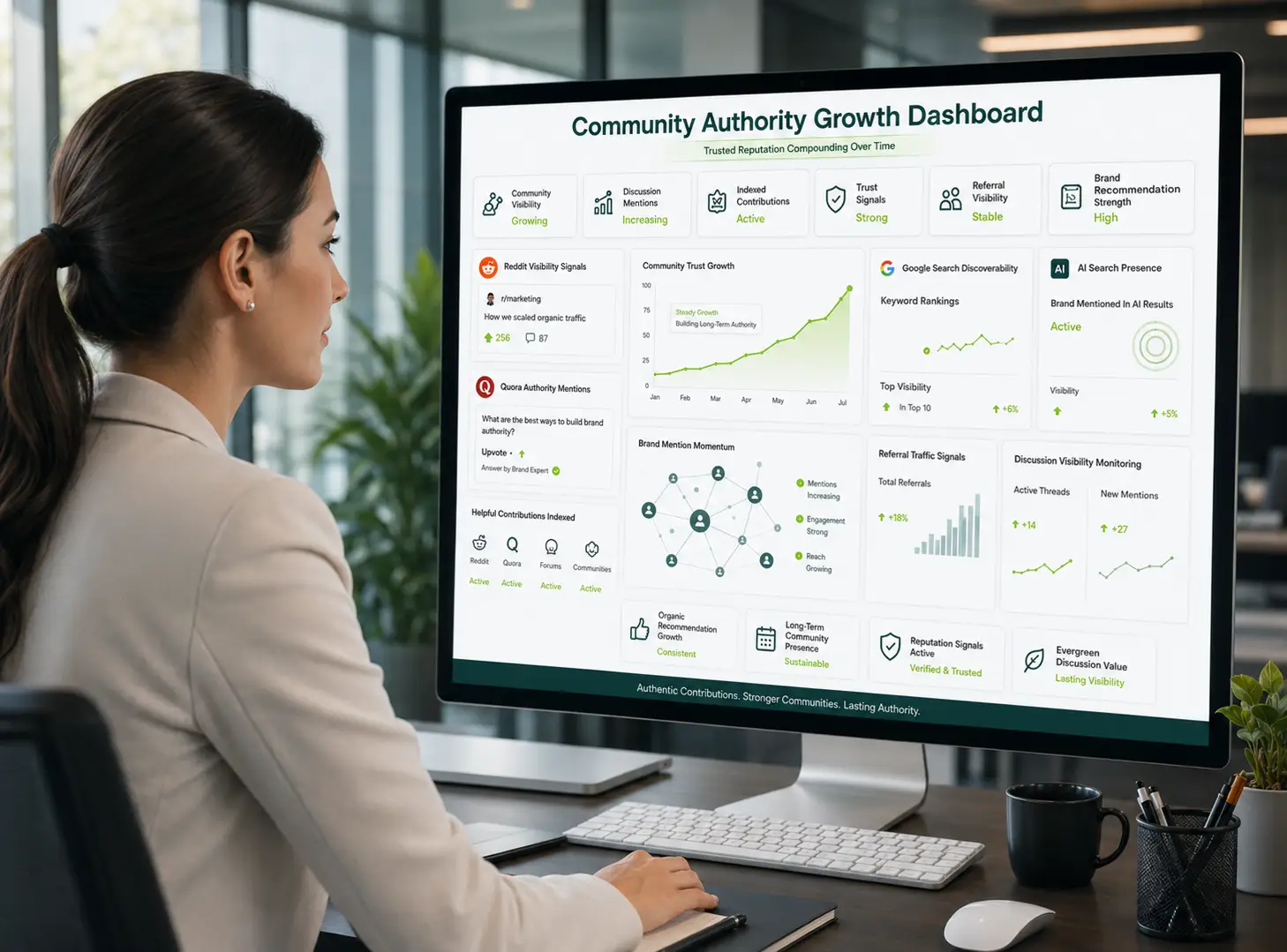
Client Success Stories
## What Clients Say About Our Forum Link Building Service
Verified reviews from leaders who gained community authority and AI citation visibility through authentic forum participation.
[View All
](https://outreachdesk.com/testimonial/)

4.8/5 

## 5/5 
Rating on Google



We’re cautious about forum link building given its history. The team showed us a completely different model. Real community participation, real brand mentions from credible accounts. The AI citation lift in 90 days was the proof we needed. For brands that want consistent execution, working with white-hat link building services removes the heavy lifting.

#### Head of Growth
B2B SaaS


Reddit visibility was the missing piece in one funnel. Buyers were researching us there before we’d ever heard of the threads. The team got us into the conversations naturally, and the referral traffic that followed converted better than our paid channels.

#### Marketing Director
Software


Quora and niche forum mentions began appearing in ChatGPT answers about our category within four months. We couldn’t have done this in-house. The discipline required to participate authentically across so many communities was what set this campaign apart from anything we’d tried before.

#### VP Marketing
Fintech
Service Framework
## Investment, Timeline, and Deliverables
Every forum link building campaign is custom-scoped to your industry, target communities, and brand goals. Here’s what shapes your investment:

### Number of Communities Covered
Most campaigns engage 5-15 subreddits, Quora topics, and niche industry forums.

### Posting and Contribution Velocity
Quality and frequency tailored to each community’s culture and quality bar.

### Account Establishment Phase
Some industries require longer reputation-building periods before brand mentions begin.

### Campaign Duration
Most clients observe early traction within 60-90 days, with compounding visibility over 6-12 months.
Directional pricing
Forum link building campaigns are clearly built around your niche, goals, and target communities. We build pricing after a strategic call because no two industries, audiences, or forum landscapes are the same.
You get a detailed proposal after your strategy call, with exact community coverage, projected mention velocity, AI citation goals, and a month-by-month roadmap. No fixed packages, no guesswork, just a plan tailored around what your brand actually needs.
Book a Strategy Call
What You Get
## Every Contribution Tracked, Every Mention Reported
Complete transparency on which communities you’re currently active in, what’s being contributed, and the visibility being earned.

### Live Thread URLs
You get direct links to every contribution with engagement metrics, including upvote counts and replies for each thread.

### Community Coverage Map
You see which subreddits, Quora topics, and niche forums are being engaged, with weekly contribution summaries by platform.

### Brand Mention Tracking
You see every brand mention, link placement, and how each contribution performs within its community over time.

### AI Citation Reporting
You get monthly verification of which forum contributions are now cited in ChatGPT, Perplexity, and the AI Overview answers.
Our Approach
## A Real Engagement Approach Built on Authentic Community Value
You earn visibility through useful contributions, not automated posting, fake account networks, or marketplace shortcuts.
| Factor | In-house/ DIY | |
| --- | --- | --- |
| Posting Method | Manual but stretched thin, one or two employees
juggling forums along with other responsibilities. | Dedicated team writing individually crafted
contributions across the right forums, full-time. |
| Account Quality | New accounts built from scratch,
with no existing or community trust. | Long-tenured accounts with genuine posting
history that communities already trust. |
| Content Approach | Generic or inconsistent quality, written by people
who are unfamiliar with each community’s tone and standards. | Detailed answers focused on solving the problem,
with brand mentions where they naturally fit. |
| Community Standing | Posts are often ignored or get minimal traction
because of low account credibility. | Posts get upvoted, replied to, and referenced
as helpful answers. |
| Outcome | Slow results, high internal time, cost, and hard
to scale without sacrificing quality. | Long-term brand authority across SEO,
AI searches, and community recognition. |
Who WeHelp
## Industries We Support With Forum Link Building
Whatever your industry, we identify the active communities your buyers use and earn the brand presence that drives rankings and recognition.
[

### SaaS & Software
](https://outreachdesk.com/saas-link-building/)
[

### Ecommerce & DTC
](https://outreachdesk.com/ecommerce-link-building/)
[

### B2B & Enterprise
](https://outreachdesk.com/b2b-link-building/)

### Startups

### Real Estate
[

### Law Firms & Legal
](https://outreachdesk.com/link-building-for-lawyers/)
[

### Dental Practices
](https://outreachdesk.com/link-building-for-dentists/)

### Healthcare & Fitness

### Financial & Insurance

### Technology & Innovation

### Consumer Brands
Common Questions
## Frequently Asked Questions
Get clear answers on forum link building, covering community selection, account credibility, and natural link placement strategies.
### Does forum link building still work in 2026?
The old versions of forum link building, signature drops, profile linking, and automated commenting never worked long-term and are completely ineffective today. The modern version works well: real participation on Reddit, Quora, Stack Exchange, and niche industry forums. It works best because AI search engines like ChatGPT and Perplexity now heavily cite community discussions, and buyers research solutions in these communities before any direct search.
### Are forum links good or bad for SEO?
It depends on how they’re earned. Spam-driven forum activity, mass-posted comments, and fake account networks all hurt SEO and risk Google penalties. Authentically [earned brand mentions](https://outreachdesk.com/brand-mentions/) and links inside helpful contributions do the opposite. Most forum links are nofollow, but the brand mention value remains, and Google weighs brand authority signals across community platforms. Reddit threads, Quora answers, and niche forum discussions also rank in Google directly, so contributors who get upvoted and engaged with deliver visibility on multiple fronts.
### How is your forum link building different from automated services?
Every contribution is manually written by writers who understand your product, your buyer’s problems, and the specific community’s tone and quality bar. Accounts are established over weeks or months of genuine participation before any brand mention happens. Comments are written to actually help the people who ask, with brand mentions or links integrated naturally where the context fits. Automated services rely on tools, templates, and fresh accounts that get flagged within weeks. The difference is significant in both quality and SEO impact. That’s the gap our [link building service agency](https://outreachdesk.com/) is built to close in both quality and SEO impact.
### Why is Reddit so important for AI search visibility?
Reddit is the most-cited domain in ChatGPT’s responses and a major source for Perplexity, Google AI Overviews, and Gemini. AI engines treat Reddit threads as primary source material because the platform’s voting system signals genuine community consensus. When your brand is mentioned naturally in upvoted Reddit answers about your category, AI engines follow those mentions in responses to buyer-research queries. Reddit visibility is impossible to replicate through any traditional SEO tactic, and it’s one of the strongest growth channels emerging in 2026.
### How long does it take to see results from forum link building?
Account establishment takes 30-60 days, since communities like Reddit and niche industry forums actively suppress new accounts that drop links early. Once accounts have credibility, brand mentions, and link placements begin in months 2-3. AI citation lift typically appears in 3-4 months as your contributions get indexed and referenced. Compounding visibility builds over 6-12 months as your account history grows and continues earning upvotes, replies, and rankings.
## Ready to earn authority in the communities your buyers trust?
Get a senior strategist to map your communities, build credible accounts, and earn the brand mentions AI search engines cite.
Book a Strategy Call

4.8/5 _
Trusted by 500+ agencies &
1,000+ businesses worldwide.

---
---
title: "SEO Local Citations: What They Are and Why They Matter"
url: "https://outreachdesk.com/seo-local-citations/"
lang: "en-US"
type: "post"
description: "Most business owners chase backlinks, but ignore the trust signals that decide whether local customers find them. A local citation is any online mention of your business name, address, and phone number. In SEO, that’s called NAP. For brands that"
last_modified: "2026-05-20T06:17:35+00:00"
categories: [Link Building]
---
# SEO Local Citations: What They Are and Why They Matter
Most business owners chase backlinks, but ignore the trust signals that decide whether local customers find them.** A local citation is any online mention of your business name, address, and phone number. In SEO, that’s called NAP.
** For brands that want consistent execution, working with [professional link building services](https://outreachdesk.com/) removes the heavy lifting.
Every Google Business Profile, Yelp Page, and Chamber of Commerce Directory with your matching NAP counts as a citation. Together, these listings tell Google that your business is real, at the right address, and trusted enough to show up in local search results. Many teams turn to [local citation services](https://outreachdesk.com/local-citation-services/) when manual outreach becomes too time-consuming to scale.
The more places your business shows up with matching details, the more likely AI is to name you when someone asks for the best dentist, plumber, or coffee shop nearby.
If your citations are missing or inconsistent, you lose visibility on Google and in AI answers. Most local business owners don’t notice until the phone stops ringing.

**Key Takeaways
**
- Local citations are listings with your business name, address, and phone number (NAP) shown the same way across directories, review sites, and local websites.
- They influence Google rankings and AI search results on ChatGPT, Gemini, and Perplexity.
- Yext analyzed 6.9 million AI citations and found that websites and listings dominate the sources AI tools actually pull from.
- 10 to 15 strong citations beat 200 weak ones every time.
- Even a small NAP mismatch like ‘Street’ versus ‘St.’ quietly drains your local visibility.
- Most local businesses already have citations. The real problem is they’re outdated, duplicated, or missing from key platforms.
## Why Local Citations Carry More Weight Today
Google still uses citations to verify that a local business is real, active, and prominent in a specific area. AI Platforms like ChatGPT, Gemini, and Perplexity now pull from the same listing ecosystem, which is why an [AI search optimization strategy](https://outreachdesk.com/ai-search-optimization/) for local businesses starts with the same citation signals.
There are mainly two reasons for that. Most owners know the first reason in a rough outline. The second one rarely shows up in local SEO advice, and it changes how citations work in practice. **
**
### Reason 1: Google Still Uses Citations to Verify You’re Real
Google’s local algorithm decides who shows up in the [search results page](https://outreachdesk.com/what-are-serps/) (those three map results at the top of the search) based on three things:
- How relevant you are to the search query
- How close you are to the searcher
- How prominent your business is online
Here, citations help build your online visibility. Google reads your business name, physical address, and phone number, and cross-checks your details against 30 trusted directories to confirm you’re real. If your citations are patchy or inconsistent, you lose ground before anything else can help.**
**
### Reason 2: AI Search Tools Pull From the Same Signals
This is the part that changed. [Yext analyzed 6.9 million citations](https://www.yext.com/research/article/ai-citations-user-locations-query-context) from ChatGPT, Gemini, and Perplexity to determine where AI tools actually pull information from when answering local queries.
**Two things stand out:
**
- AI tools use websites and listings as the main citation source.
- Reviews and social mentions carry less weight than verified listings

In simple terms, your business profiles on directories matter more for AI recommendations than what people say about you on Reddit.
That changes [how local visibility works](https://outreachdesk.com/local-link-building/). When ChatGPT decides whether to recommend “the best Italian restaurant in Brooklyn,” it looks for businesses that appear consistently across trusted websites with matching NAP details.
When your business only appears on Google with incomplete or inconsistent information, not only does visibility drop, but you’re invisible to the increasingly large share of customers asking AI instead of searching.
For example:
- Google Business Profile: “(555) 123-4567”
- Yelp: “555-123-4567”
- Website footer: “555.123.4567”
A human sees these as the same number. But an AI system trying to verify identity reads them as three different businesses. Small inconsistencies create uncertainty and weaken your trust signals.
## NAP Consistency: Where Most Businesses Quietly Lose Trust
NAP consistency **means your business name, address, and phone number appear exactly the same across every major listing. **Same spelling. Same formatting. Same abbreviations. Same suite number. Same phone format.**
**
Even a small mismatch across top directories can weaken trust signals because search engines and AI systems may treat those variations as separate entities.
In many local SEO audits, most citation issues come from conflicting business details rather than missing listings.
If you only fix one thing about your citations this month, fix the inconsistencies of names, addresses, and phone numbers.

In most local SEO audits, the problem isn’t missing citations. Most businesses already have 10-20 listings online. The real problem is inconsistency.
In many cases, 60-80% of existing citations contradict your website or Google Business Profile in at least one detail.
**Common examples:
**
- The business moved locations two years ago, but old listings still show the previous address.
- The phone number changed, but Yelp still displays the original.
- Google lists the business as “Joe’s Coffee,” while Facebook says “Joe’s Coffee Shop,” and another directory shows “Joe’s Coffee LLC.”
- The website uses “Suite 200” while directories alternate between “#200” and “Ste 200.”
Each mismatch is small. Together, they add up.
Google and AI search engines treat these as separate businesses, which weakens your trust signal. Either way, you lose ground.
**The fix isn’t dramatic:
**
- Do a one-time cleanup, then check every quarter.
- Pick one official version of your name, address, and phone.
- Audit your top 20 citations against it. Update the ones that don’t match.
- Check the process again after 90 days.
Some platforms, like Yelp and Apple Business Connect, pull data from third-party sources and quietly overwrite your fixes.
In most audits we run, suite numbers and phone formatting create more problems than business names. A single missing suite number across major directories is enough to create conflicting business records.
## Structured vs. Unstructured Citations: Two Different Plays
Not every citation works the same way, and treating them equally wastes your time.

**A structured citation** is a formal business listing on a directory or platform. For example:
- Google Business Profile
- Yelp
- Apple Business Connect
- Better Business Bureau
- Industry-specific directories
The format is predictable:
- Business name
- Address
- Phone number
- Website
- Hours
- Photos
- Category
These citations form the foundation of local visibility; without them, your business struggles to rank in local search.
**An unstructured citation** is a mention of your business inside regular content. These mentions show up in places like:
- Local news articles
- Blog posts
- Podcast descriptions
- Event pages
- Community websites
For example:
A local newspaper writes:
“Joe’s Coffee on Main Street, reachable at (555) 123-4567, is hosting a weekend event.”
That counts as an unstructured citation.
These mentions are harder to earn, but they carry strong trust signals because they come from [contextual placements](https://outreachdesk.com/contextual-link-building/) where the mention fits naturally within the surrounding topic.
Structured citations verify that your business exists, while unstructured citations strengthen its authority on top of the foundation.
Most local businesses focus only on structured listings. Very few actively pursue unstructured mentions. That creates opportunity.
**Tip:
**
Spend the first month fixing and strengthening structured citations across the top 15-20 trusted platforms for your city and industry.
Then shift toward earning unstructured mentions through:
- Local press coverage
- Partnerships
- [brand mentions from community blogs](https://outreachdesk.com/brand-mentions/)
- Podcasts
- Community websites
- Niche blogs
| | Structured Citation | Unstructured Citation |
| --- | --- | --- |
| Where it lives | Directory listing fields | Body of an article, blog post, or news piece |
| How do you get it | Submit your information manually or through a service | Earned through PR, partnerships, and community involvement |
| Time to build | Hours per listing | Weeks to months per mention |
| AI search weight | Foundational signal | Strong differentiator |
| Best for | Verifying your business exists | Building a local authority |
The structured layer builds trust, and the unstructured one separates local brands from average ones which is why businesses working with a [link building service agency](https://outreachdesk.com/) consistently outpace competitors who handle citations alone.
## The Citations Every Local Business Should Have
Skip the “Submit to 500 directories” advice. Most of those listings carry no weight, look low-quality to Google, and waste hours of your time. The goal is to build trust.

The list below covers the citation type that actually moves local visibility for nearly every small business. Get these right first; industry-specific directories come after.
**Universal citations (every local business needs these):
**
**1) Google Business Profile:
**
Non-negotiable. This is the most important local business listing for Google visibility.
**2) Apple Business Connect:
**
Apple Maps, Siri, and Spotlight all pull data from this platform. If you ignore it, you lose visibility across every Apple device.
**3) Bing Places:
**
Smaller search share, but still important. ChatGPT also relies on Bing’s index.
**4) Facebook Business Page:**
Supports brand trust, reviews, and citation consistency.
**5) Yelp:**
Still one of the strongest local trust signals in many industries.
**6) Yellow Pages (YP.com):
**
Yellow pages push your data into multiple secondary directories.**
**
**7) Better Business Bureau (BBB):
**
Strong credibility signal, especially for service businesses.
**8) Foursquare:
**
Feeds data downstream to dozens of platforms.
**9) MapQuest/Manta:
**
Additional structured citations.
**10) Your Local Chamber of Commerce:
**
Strong local authority signal.
**Industry Specific Examples (Pick the ones for your category)
**
| Restaurants | TripAdvisor, OpenTable, Zomato, Restaurant.com |
| --- | --- |
| Healthcare | Healthgrades, Zocdoc, Vitals, WebMD provider directory |
| Home services | Angi, HomeAdvisor, Houzz, Thumbtack |
| Legal | Avvo, Findlaw, Justia, your state bar association directory |
| Real estate | Zillow, Realtor.com, Trulia |
That’s roughly 12-18 high-quality citations for most businesses. Done well, these citations outperform 200 low-quality directory submissions for local visibility. Quality over volume, every time.
## The Anatomy of a Strong Citation
A strong citation includes eight core elements: business name, suite number, phone number, website URL, primary category, business hours, photos, and a clear business description. Complete citations create stronger trust signals and reduce the chances of conflicting business information across platforms.
Adding your business name, address, and phone number is only the starting point. A citation that actually strengthens local visibility includes much more than that.

A complete citation includes:
**1) Business name
**
Exactly matches your website and Google Business Profile
**2) Full physical address
**
Including suite number, formatted identically across listings
**3) Phone number
**
Same format everywhere
**4) Website URL
**
Direct link, not a tracking redirect
**5) Primary business category**
The most specific one that fits, not a broader catch-all
**6) Hours of operation
**
Accurate and updated when they change
**7) Photos
**
At least one exterior, one interior, one of your team, or a product
**8) Business description
**
Written for customers, not stuffed with keywords
Incomplete listings rarely build trust with Google, AI systems, or customers.
A citation with three completed fields doesn’t build much trust with customers, Google, or AI systems. One detail many businesses underestimate is the business category.
Your **primary business category** carries more weight than most owners realize. A plumbing company listed under “Contractor” loses local relevance against businesses correctly categorized as “Plumber.” Specific categories consistently outperform broad ones.
## How to Build Your First Round of Citations
A reliable citation-building process follows six steps: lock down your canonical NAP details, audit existing citations, fix incorrect listings before creating new ones, claim the major universal directories, add industry-specific citations, and review everything quarterly to catch inconsistencies before they spread.
A repeatable process works better than mass submissions. The order matters more than businesses realize. **
**

### Step 1: Lock Down Your Canonical NAP
Open a document. Write your business name, address, and phone number exactly as they appear on your website. This is your reference. Every citation must match it.
### Step 2: Audit What Already Exists
Search your business name and city in Google. The first few pages usually reveal most existing citations.
Create a list and look for:
- Incorrect addresses
- Outdated phone numbers
- Duplicate listings
- Spelling inconsistencies
- Missing information
Tools like BrightLocal’s citation checker, Whitespark’s Local Citation Finder, and Moz Local significantly speed up this process.
### Step 3: Fix Existing Listings Before Creating New Ones
Updating five wrong listings is more valuable than adding 20 new ones. Inconsistencies actively hurt; missing a listing just leaves growth on the table. Fix first, then expand.
### Step 4: Claim the Universal 10 (from the list above)
Work through them one at a time. Use your canonical NAP. Fill in every field:
- Business description
- Categories
- Operating hours
- Website URL
- Photos.
The extra details improve trust and visibility across platforms.
### Step 5: Add 5-8 Industry-specific Citations
Once the core listings are complete, move into industry-specific directories.
You can find them by:
- Using the category examples above
- Searching “[industry] directories [city]” in Google.
You should focus on trusted and active directories with real visibility.
### Step 6: Set a Quarterly Review
Set a calendar reminder every 90 days. Spend 15-20 minutes reviewing your top listings for:
- Overwritten information
- Duplicate entries
- Missing fields
- Outdated hours or phone numbers
Some directories automatically pull data from external providers and quietly restore outdated information. Quarterly maintenance prevents slow ranking decay.
## Common Mistakes That Quietly Tank Local Visibility
The most damaging citation mistakes include submitting to hundreds of low-quality directories, treating citations as a one-time task, ignoring duplicate listings, stuffing keywords into the business name, buying spam-heavy citation packages, and leaving photo or category fields incomplete. Most local visibility problems come from these patterns, not from a lack of citations.
These problems appear in almost every local SEO audit where businesses say, “We already tried citations and nothing changed.” But the real problem is in how they handle it.
### 1) Submitting to 200+ Low-Quality Directories
This is outdated advice. Low-quality directory networks look untrusted to Google and provide little value in AI search systems. Most AI tools don’t even pull data from these platforms. Focus on trusted directories that people actually recognize and use.
### 2) Treating Citations as a One-Time Project
Your business changes constantly:
- Addresses
- Phone numbers
- Seasonal hours
- Categories
- Ownership details
If your citations haven’t been reviewed in years, there’s a high chance several contain outdated information. Treat citation management as quarterly maintenance, not occasional cleanup.**
**
### 3) Ignoring Duplicate Listings
Many businesses have two or three Google Business Profile listings, usually because someone created a duplicate years ago, or a previous owner’s listing never got merged. Duplicates split your authority and confuse customers. Find them, request merges or removals.
### 4) Over-optimizing the Business Name
Your business name should stay natural. Listing like “Joe’s plumbing – Best emergency plumber in Boston 24/7” creates unnecessary risk.
Google’s guidelines prohibit keyword stuffing inside business names, and violations can trigger suspensions. Use the real registered business name consistently everywhere.
### 5) Buying Review-stuffed Citation Packages
Cheap “100 citations + 50 reviews for $99” packages often result in low-quality listings in weak directories with fake reviews. The short-term visibility bump rarely lasts. The long-term damage to trust usually lasts much longer.
### 6) Forgetting About Photo and Category Fields
Incomplete profiles perform worse across both search and conversions. Listing with accurate categories and real photos builds trust. Uploading a few strong images often produces better results than businesses expect.
The mistake we see most often is businesses submitting to hundreds of low-quality directories while ignoring duplicate listings on major platforms like Google, Yelp, or Apple Maps.**
**
## Tools That Help You Manage Citations
Different citation tools solve different problems. BrightLocal works well for agencies and multi-location businesses, Whitespark is strong for citation discovery and niche research, Moz Local simplifies aggregator distribution, and Yext is built for enterprise-scale listing control and compliance.**
**
Most small businesses don’t need expensive software to build their first round of citations. Tools matter when you’re auditing, monitoring, or managing citations across multiple locations.
### BrightLocal:
BrightLocal is a strong choice for small agencies and multi-location businesses. It helps build citations and works as an audit tool and a local rank tracker. BrightLocal also offers a free citation checker.
### Whitespark:
Whitespark was built specifically for local SEO. Its Local Citation Finder helps businesses discover:
- Citation gaps
- Competitor listings
- Niche directory opportunities
Businesses that focus heavily on local rankings will find Whitespark one of the most practical research tools available.
### Moz Local:
Moz Local automates submissions through a network of data aggregators. That saves time for businesses managing listings across multiple platforms at scale. If you run a single location and manage listings manually, Moz Local simplifies your citation workflow.
### Yext:
Yext is designed for larger organizations with multiple locations, strict compliance requirements, and centralized listing management needs. Healthcare and financial services often benefit most from platforms like this.
For most small and mid-sized businesses, our team usually defaults to BrightLocal because it balances citation tracking, auditing, and local rank monitoring at a lower cost than enterprise platforms.
## Do This One Thing This Week
Most local businesses already know they should “do something about their listings.” They just keep putting it off because the work feels tedious and the impact feels invisible.
It is tedious. The impact is not invisible. It just takes 6-12 weeks to show up, and by then, most owners forget they did the work and credit the rankings to someone else.
If you’re going to do one thing this week:
- Search your business name plus your city in Google.
- Scroll through the first three pages.
- Write down every directory you see.
- Audit for inconsistencies, fix what you find.
- Add the missing ones from the universal 10 above.
Set a 90-day reminder to check again. That’s the entire local citation strategy for most small businesses.
### Want to improve your local rankings with citations?
Get a clear plan to build an accurate, consistent listing that supports visibility.
[Book a strategy call](/contact-us/)
### What’s the difference between a local citation and a backlink?
A backlink is a clickable hyperlink from another website to your website, while a citation is a mention of your business name, address, and phone number. A citation doesn’t need to include a link to count. Many citations include a link, which makes them function as both. But Google and AI tools recognize the NAP mention even when no link is present.
### How many citations does a small business actually need?
Twelve to twenty high-quality citations cover most local businesses. Quality matters far more than volume. A business with 15 well-maintained listings on trusted directories will outperform one with 200 listings spread across low-quality directory networks.
### Do paid citation services work?
The good ones (BrightLocal, Whitespark, Yext) save time and produce real listings. The cheap package, with 100 citations for $50, creates listings on low-quality directories that don’t help and may hurt. If you’re considering a service, look at the actual directory list before paying. If you don’t recognize most of the names, skip it.
### How long until citations move my rankings?
Most local businesses see measurable changes within 6-12 weeks of fixing inconsistencies and adding the universal 10. Faster results aren’t realistic, since Google takes time to crawl and process your updated information. Slower results usually mean other factors (a thin website, no reviews, weak Google Business Profile) are limiting your visibility.
### What about NAP citations that don’t match because my business changed addresses?
Update every major listing as quickly as possible. Old addresses quietly kill your local visibility faster than most other issues. Start with the top directories that appear when you search your business name. Then use citation audit tools to find additional outdated listings across the web.
### Do citations matter if I don’t have a physical storefront?
Yes. Service-area businesses (plumbers, contractors, mobile services) still rely on citations to build local trust signals. Most major directories now support service-area listings, allowing businesses to hide their physical address while still showing the regions they serve. Google Business Profile supports this setup directly.
### Can citations help my business show up in ChatGPT answers?
Yes, and this is increasingly where citations earn their keep. AI models like ChatGPT, Perplexity, and Gemini look for businesses confirmed across multiple consistent sources when generating local recommendations. A business with strong, consistent citations across the universal 10 is far more likely to be named than one relying on Google Business Profile alone.
---
---
title: "Testimonial Link Building: Earn Links From Tools You Use"
url: "https://outreachdesk.com/testimonial-link-building/"
lang: "en-US"
type: "post"
description: "Pull up your billing dashboard and count the SEO tools, plugins, and services your business pays for every month. That billing history is your backlink prospect list the foundation of testimonial link building, and most founders never use it that"
last_modified: "2026-05-22T10:03:01+00:00"
categories: [Link Building]
---
# Testimonial Link Building: Earn Links From Tools You Use
Pull up your billing dashboard and count the SEO tools, plugins, and services your business pays for every month. That billing history is your backlink prospect list the foundation of testimonial link building, and most founders never use it that way. Many teams turn to [outreach-based link building services](https://outreachdesk.com/) when manual prospecting becomes too time-consuming.

Most of the SEO teams chasing backlinks spend weeks on cold outreach, guest post pitches, and broken link campaigns before getting a single yes. Meanwhile, the easiest link opportunities they’ll ever find are right there inside their software stack, completely untouched.
Every SEO tool you’re paying for currently is run by a brand that wants real customer testimonials. **When they publish your testimonial, they link back to your site, and that link is a direct signal to Google that your site is worth ranking.** No cold pitch, no long guest post, or waiting on a stranger to trust you. Just an honest paragraph about a product you already rely on, published on a page Google already trusts.
**What This Article Covers
**
- A brand can verify you’re a real customer in under 30 seconds; that’s why you skip the trust problem every cold pitch runs into
- The three placement types (homepage, testimonials page, feature page) deliver meaningfully different link authority
- Most testimonial links from large SaaS companies are nofollow, and why that’s not always a reason to skip them
- Steps 3 and 4 of the qualification process are the ones most founders skip, and the reason pitches disappear
- This tactic has a ceiling of roughly 5–8 links per software stack, what to build next once you’ve hit it
## What is Testimonial Link Building?
**Testimonial link building is the practice of writing a genuine positive review for a product you already use, which the company then publishes on their website alongside a link pointing back to your site.
**

**
**
This is a [white-hat link building strategy](https://outreachdesk.com/white-hat-link-building-strategies/), which means it follows Google’s rules completely, no tricks, no risk of your site being penalized because the endorsement is real. You’re a real paying customer, and that’s exactly what makes the link editorial rather than manufactured.
Both sides get something genuine out of it. The brand gets social proof from a verified customer, which converts new visitors better than any marketing copy they could write themselves. You get a backlink, which is a recommendation link from another website that tells Google your site is worth trusting. Just a short, specific paragraph about something you already trust.
## How Testimonial Link Building Actually Works
**Testimonial link building works because you’re already a verified customer. The brand can confirm your account in under 30 seconds, which bypasses the trust problem every cold pitch faces. You write a specific outcome-based quote; they publish it with a link to your site, no cold outreach, no content campaign, no waiting.
**
Three parties benefit when this tactic is executed well:** you**, **the brand itself, and its customers**.
- The brand collects an authentic customer quote that builds credibility with first-time visitors.
- You [earn a backlink](https://outreachdesk.com/what-are-backlinks/) from a domain Google already views as authoritative in your niche.
- The brand’s current customers see social proof that makes them feel that their decision to stay subscribed is the right one.
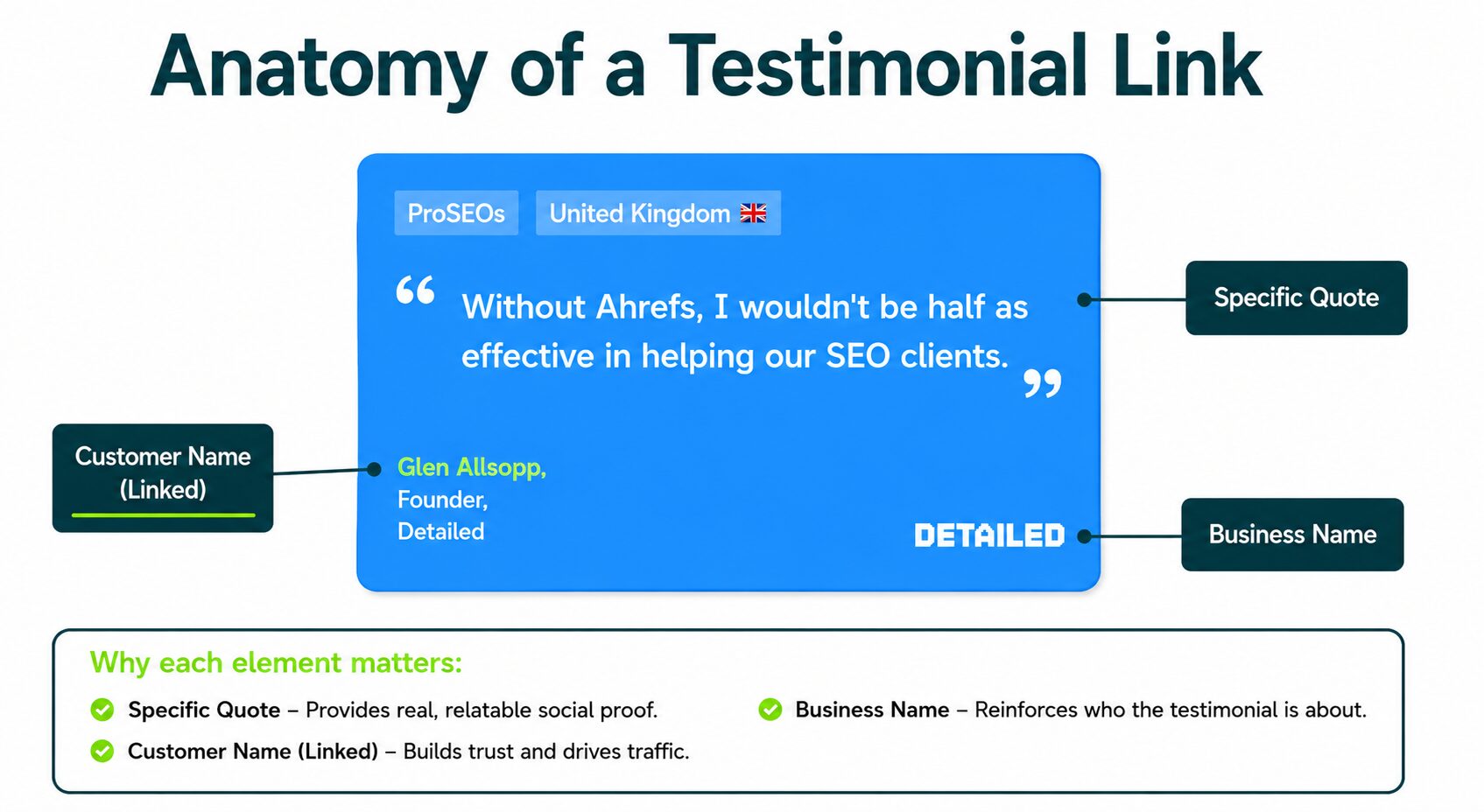
Picture a real situation. You run a small e-commerce store. You’ve been on the same email marketing platform for two years. Their homepage carries a “Loved by founders” section. You send their marketing team a quote explaining how the platform cut your campaign-building time in half. They publish it with your name, your store’s name, and a link back to your site.
That link now lives on a high-authority domain in your industry, visible to every founder who visits their homepage. And it stays there, often for years, without you doing any additional work.
That’s the full mechanism. No lengthy [guest post](https://outreachdesk.com/guest-posts/) to write. No broken link to track down. No editor to chase for weeks. Just a candid two or three sentences about a product you already pay for.
The reason it works is simple. Brands want fresh, genuine, and specific testimonials because generic ones don’t convert prospects. So if you write a genuine testimonial about them, they might include yours on their website.
## Why This Tactic Wins When Most Don’t
**The four reasons why testimonial link building wins: verified customer status bypasses the trust barrier, the time investment is one short paragraph, not a full article, the link is topically relevant by default because you operate in the same product ecosystem, and a published testimonial opens doors to co-marketing and referrals beyond the backlink itself.
**
You skip the cold-pitch problem entirely. Every other link building tactic requires you to earn trust from someone who has never heard of you. With testimonial link building, the brand can verify your account in under 30 seconds. You’re already a customer. That’s the trust. You start from credibility, not zero.
This tactic is less time-consuming. The entire deliverable consists of three focused sentences and one short follow-up email. Compare that to the [broken link campaign](https://outreachdesk.com/broken-link-building/), where you spend two days hunting 404 errors before sending your first pitch. Or a guest post campaign where you write 1,500 words before hearing back.
[The contextual link](https://outreachdesk.com/contextual-link-building/) you earn is naturally relevant to your industry. If your Shopify store gets a link from a Shopify app’s homepage, Google sees a clear connection between the two sites. Most outreach campaigns take months to build that kind of relevance. Here, it already exists because both businesses operate in the same ecosystem.
Most guides stop at those 3 points. But the real reason to start with testimonials is that a published testimonial is the beginning of a real business relationship.
That connection can open doors to co-marketing, case studies, referrals, and introductions to customers you couldn’t have reached cold. The backlink is what you can measure. What comes after it is often what actually moves your business forward.
## Where Testimonial Links Actually Live
**Testimonial links live in three places: the Homepage, a Dedicated Testimonial or Customer Page, or a Product/Feature Page. Each passes value differently. Homepage links carry the most domain authority. Feature page links offer the strongest topical relevance. Knowing which placement you’re targeting before you pitch changes how you prioritize outreach.
**

### 1. Homepage
The first one is the strongest placement possible. A brand’s homepage is typically the most-linked page across its entire domain, which means a link placed there [passes link equity](https://outreachdesk.com/link-equity/) more powerfully than almost anywhere else.
Companies put their strongest customer quotes here because homepage social proof converts first-time visitors.

If you land a placement on the homepage, it will pass genuine authority to your site. For example, Ahrefs has added testimonials on its homepage and linked back to its contributors.
### 2. Dedicated Testimonials or Customer Page
This is another link placement type, which is slightly less effective compared to link placements on homepage. These pages receive consistent internal links often at **/customers, /testimonials**, or **/reviews**, from product pages, about pages, and site footers.
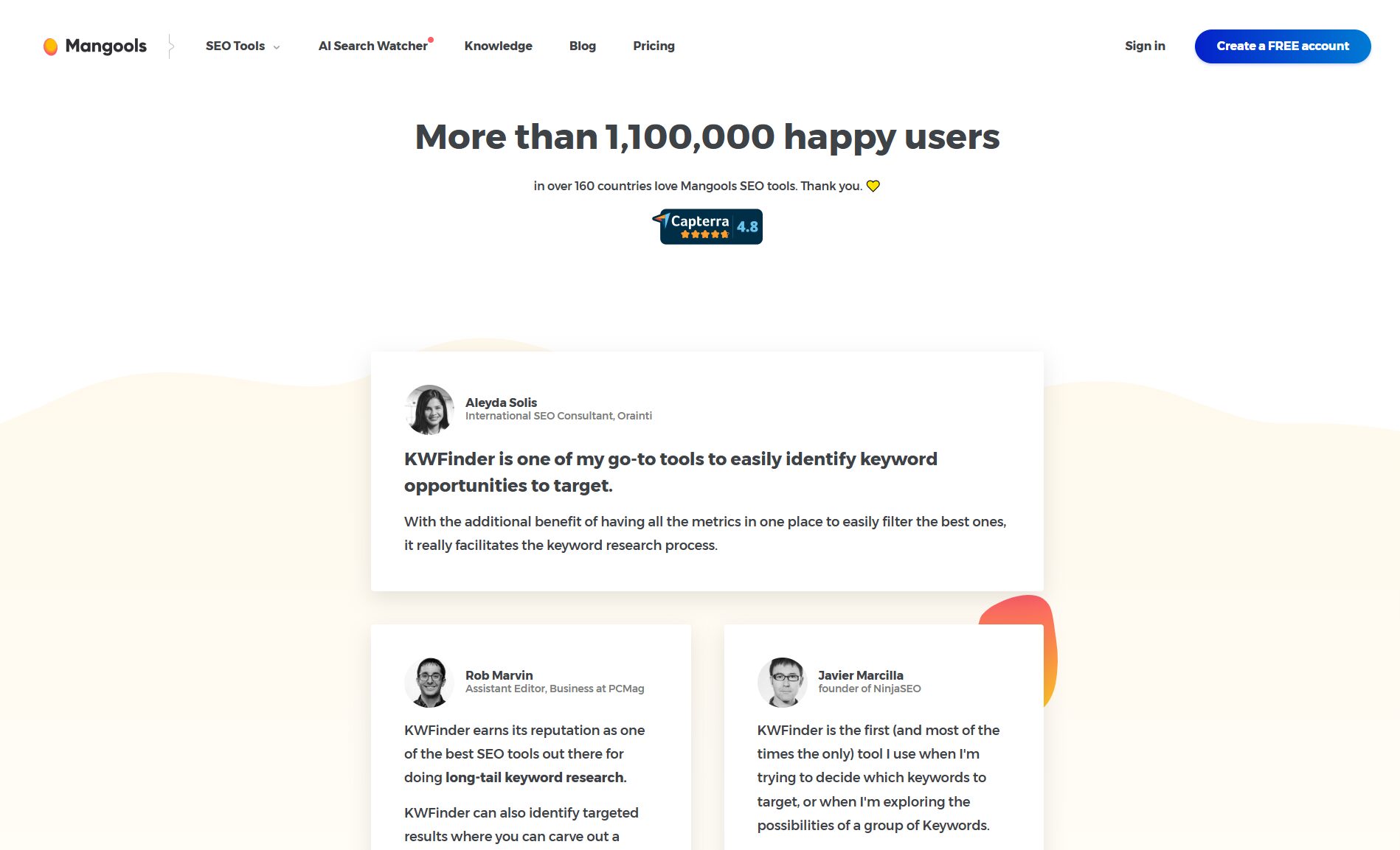
For example, Mangools has a dedicated testimonial page, linking back to its contributors.
** Watch out
**
Some brands publish 50+ testimonials on a single page, which spreads link equity thinly across all of them. A page with 4-5 featured quotes gives each link far more individual weight. Check testimonial volume before pitching.
### 3. Product or Feature Page
Useful in terms of topical relevance. A testimonial placed directly on a specific feature page tells search engines this is a focused endorsement of that exact use case. If the feature aligns closely with what your own site covers, the topical relevance can outweigh the smaller authority gain.
Always verify how that brand links to its contributors before writing a single word of your pitch. Some brands publish customer quotes with no outbound link at all. Others link your name to an internal case study page on their own domain rather than to your site.
A testimonial without an outbound link to your site is [a brand mention](https://outreachdesk.com/brand-mentions/), not a qualifying backlink. Brand mentions help build reputation, but they don’t move search rankings. Check what existing testimonials on their page look like before committing time to a pitch.
For example, CRM platforms like HubSpot place customer quotes directly on product and feature-focused pages, where the testimonial supports a specific use case rather than the brand in general.

## The Dofollow vs Nofollow Reality
**Most established SaaS companies nofollow everything external as a legal and SEO policy, smaller brands below DR 50 are far more likely to give dofollow, and nofollow links from high-authority homepages still deliver real referral traffic and indirect ranking benefits.
**
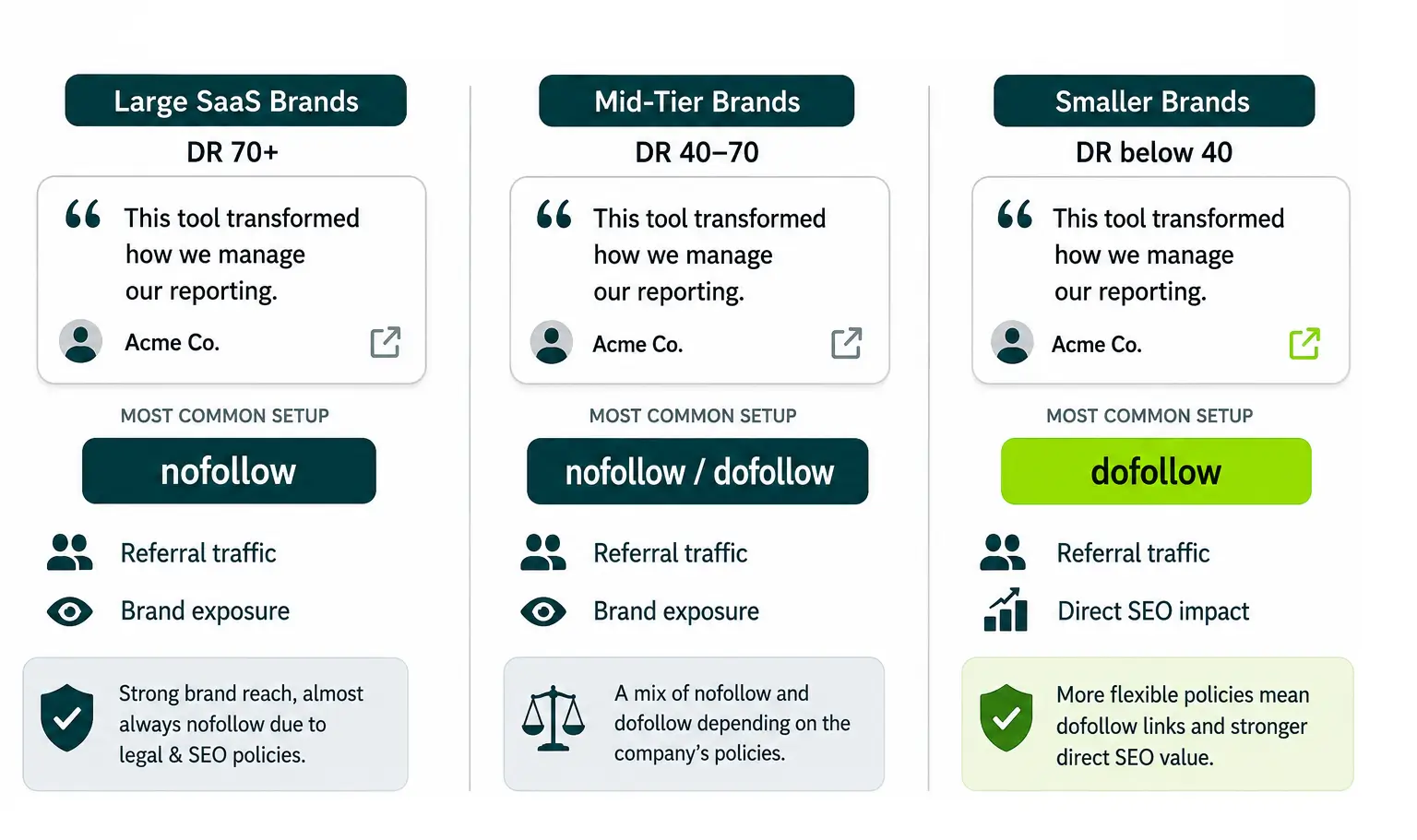
That’s not a flaw in the tactic; it’s just how large SaaS brands protect themselves legally. Knowing this upfront saves you from pitching a DR 80 homepage and expecting a ranking lift that won’t come the way you’d expect.
[A dofollow backlink](https://outreachdesk.com/dofollow-backlinks/) passes authority directly from the linking site to yours. Google treats it as one site vouching for another. A nofollow link carries a tag that says “don’t count this as an endorsement.” Both types still send real visitors to your site. Only dofollow directly moves your search rankings.
**Watch out**
Most testimonial links from established SaaS companies are **nofollow**. Mid to large size companies treat outbound links carefully to avoid paid-link penalties.If they have a legal or SEO team, expect nofollow almost every time.”
Smaller companies operate differently. Brands with a DR (Domain Rating, a 0-100 score that Ahrefs uses to estimate the strength of a site’s overall backlink profile) below 50, including regional service providers, niche tool makers, and early-stage SaaS products, are far more likely to give you a dofollow link. They don’t have a compliance team advising against it, and they’re simply more flexible.
Realistic expectations look like this:
| BRAND TIER | DESCRIPTION |
| --- | --- |
| Big brands with DR 70+ | Meaningful referral traffic and brand exposure, almost always nofollow |
| Mid-tier brands with DR 40-70 | A mix of dofollow and nofollow, reasonable traffic |
| Smaller brands with DR below 40 | A dofollow link, lower traffic volume, stronger direct SEO impact per link |
Don’t dismiss nofollow links. A nofollow placement on a high-authority homepage still puts your brand in front of every person who visits that page. Some of them will click through. A few will write content later and link to you naturally. That downstream gain is difficult to attribute but it’s real, and it accumulates over time.
## How to Find Testimonial Link Building Opportunities
Five steps are to list** every paid tool, plugin or service you use, then cut anything irrelevant to your niche, then check whether they actually link out, and lastly sort by domain rating and testimonial volume**.
Most founders skip steps 3 and 4 and then spend time wondering why brands never respond. These 2 steps are the ones that separate pitches that land from pitches that disappear.

### Step 1: List Every Paid Tool, Plugin, or Service You Use
Start with your billing dashboard. Check your password manager. Then mentally walk through your weekly workflow. Anything with a **recurring charge** belongs on the list. Free-tier products qualify, too. Brands often want testimonials from free users because they demonstrate value across their full pricing range, not just to paying customers.
### Step 2: Cut Anything Irrelevant to Your Niche
A link from a site in your industry is worth ten times more than one from an unrelated domain. If you run a B2B SaaS product, a link from a project management tool your team uses is valuable. A link from your office supply delivery service is not. Trim the list hard. Ten well-chosen candidates outperform fifty random ones every single time.
### Step 3: Check Whether They Currently Feature Testimonials
Visit each candidate’s homepage and their /customers page. Look for a quotes section, a logo wall, or a rotating carousel. If there’s no testimonial display anywhere on the site, the brand almost certainly has no process for publishing them. Pitching into that situation wastes your time and theirs.
### Step 4: Check Whether They Actually Link Out
Right-click an existing customer name on their testimonial page and inspect the element, or hover over it and check the URL in your browser’s status bar.
If the link goes to the customer’s own website, this brand links out. If it routes to an internal /case-study/ page hosted on the brand’s own domain, you’ll receive a mention in their system but no backlink to your site. This single check saves you from pitching companies that will never give you what you’re looking for.
### Step 5: Sort by Domain Rating and Testimonial Volume
A page publishing 80 quotes in its testimonials section reduces the link value of all 80 of them. A page featuring 4 or 5 makes each link count for significantly more. Use any free DR checker or Ahrefs if you have access. Prioritize high-DR sites that publish fewer total testimonials. That combination is where you get the best returns.
In practice, Step 4 eliminates more candidates than any other check. When we run qualifications for clients, many of the shortlisted brands route customer names to internal case-study pages rather than to outbound links. The list that looks promising at the start shrinks significantly after this single check. Do it before you write a single word of your pitch.
## How to Write a Testimonial That Gets Published
**Three rules separate published testimonials from ignored ones: lead with a specific result or number, describe exactly what you used the product for in plain language, and keep the whole thing under 60 words.
**
Testimonials that follow all three get published. Testimonials that skip even one usually get passed over.**
**
**A strong testimonial:
**
“We use your tool for our weekly customer reporting and for the dashboard of our CEO. Before this tool, our weekly reporting took six hours to complete. Now it takes 45 minutes. The dashboard our CEO reviews every Monday was built here last quarter.”
**A weak testimonial:
**
“Great product. Has really helped our business. I’d recommend it to anyone.”
The brand publishes the first one because it actively sells the product to every prospect who lands on that page. It gives a real number, names a real use case, and makes the outcome tangible.
The second one reads like filler and makes the brand look like they couldn’t find a genuine customer willing to say anything meaningful.
**Three rules that separate a published testimonial from a rejected one:
**

**
**
### 1. Lead with a Specific Result or Outcome
A number, a time saved, a specific problem that no longer exists. “Cut our reporting time by 85%” is publishable. “Really transformed our workflow” is not.
### 2. Mention What You Used the Product for
It can be “Weekly financial reporting,” “Onboarding new hires remotely,” or “Managing inventory across three warehouse locations.” Specific use cases make the testimonial useful to readers in the same situation, which is often what brands are actually looking for.
### 3. Keep It Under 60 Words
Most testimonial sections are designed with a fixed display height. Quotes over 60 words get truncated, edited down, or rejected outright. Tight is better.
If you can offer a 30-second video alongside the written version, your acceptance rate increases significantly. Video testimonials are the hardest format for brands to source on their own and the easiest for them to publish without any additional editing. From campaigns run for SaaS and e-commerce clients, video pitches consistently close at two to three times the rate of plain written submissions.
## How to Pitch: Find the Right Person, Send the Right Email
**Reach the Head of Customer Marketing, Head of Brand, or VP of Marketing at larger companies. At brands under 50 people, go directly to the founder or marketing lead. Skip support@ and contact forms entirely. They route to people whose only job is resolving issues, not approving testimonials. They cannot say yes.
**

For brands with fewer than 50 people, you can connect directly with the founder or marketing lead on LinkedIn. For larger companies, search for a Head of Customer Marketing, Head of Brand, or VP of Marketing. The brand’s “Team” or “About” page usually lists these by name. LinkedIn’s company directory filtered by job title gets you there faster than navigating their website.
Keep your [outreach email strategy](https://outreachdesk.com/link-building-outreach/) simple because short emails get read, long ones get often ignored.
**Outreach template you can use:
**
**Subject: Testimonial for [tool name]?
**
Hi [name],
I’ve used [tool name] at [your company] for [time period]. It cut our [specific outcome] by [number].
Would you like a written or video testimonial for your homepage or customer page? Happy to send a draft this week.
Best Regards,
[your name],
[your role at your company]
[link to your site]
That’s the entire email, without any backstory or flattery.
**Tip
**
Lead your pitch with value. A verified customer, a real measurable result, and a one-paragraph draft ready to send. Pitches written this way are close. Pitches that spend three paragraphs explaining love for the product get archived.
One follow-up after seven days. Keep it short, keep it polite. Two follow-ups are fine. Past two, you’re chasing. Brands don’t feature customers who had to be chased.
## Common Mistakes That Get Pitches Ignored
Most testimonial pitches get rejected due to small, avoidable errors that occur before the email is even sent. Common mistakes that get your pitches ignored include **pitching brands you don’t actually use, sending the testimonial before the pitch, going after only big brands, writing flattery instead of specifics, skipping the follow-up, and forgetting to ask for the link.
**

**
**
### Pitching Brands You Don’t Actually Use
Every brand can check your account status in under 30 seconds. If you’re not in their system as a real customer, the email goes to trash and your name gets flagged. There’s no recovery from this.
### Sending the Testimonial Before the Pitch
Pitch first. Wait for confirmation. Then write the testimonial, shaped specifically around the use case they want to highlight on their page. Sending an unsolicited draft puts the recipient in an uncomfortable position and almost always gets ignored.
### Going Only After Big Brands
Ahrefs, HubSpot, Salesforce. Every founder who reads an article like this pitches those three first. Your odds in that pool are around 1 in 100. Start with mid-tier brands. Build two or three published wins. Then approach bigger names from a position where you have something to show.
### Writing Flattery Instead of Specifics
“I love this tool” helps nobody who reads that testimonial. “This tool eliminated three manual processes we used to run separately” gives the next prospect something real to evaluate. One sells. The other decorates.
### Skipping the Follow-Up
First emails get buried. One follow-up after seven days is the single highest-leverage action in this entire tactic. Most responses come from the follow-up, not the original send.
### Forgetting to Ask for the Link
This is the most common mistake and the easiest to fix. Say it plainly: “Could the testimonial include a link back to my site?” Many brands publish quotes without adding an outbound link unless someone asks. The link is the whole point of doing this. Ask for it clearly every time without exception.
Across pitches we have reviewed and sent, the most common pattern is not bad writing. It is a generic positioning. The founder describes the tool in the same language the brand already uses on its own homepage. “Streamlined our workflow” and “improved team collaboration” appear in nearly every second pitch.
What brands actually publish are quotes that name a specific function, a specific before-and-after, or a specific outcome their marketing team could not have invented themselves. The more specific the details, the less editing the brand needs to do and the faster it gets approved.
## The Honest Limit of This Tactic
**Your typical software stack of 10-30 tools will yield 5-8 testimonial backlinks in total, not per month. Once you have pitched every linked brand, the tactic is exhausted until you adopt new products.
**
Testimonial link building has a hard ceiling, and most guides won’t name it clearly. Use it to earn your first relevant backlinks while you build towards harder systems that actually scale.

[Guest posts campaigns](https://outreachdesk.com/guest-posts/), original research, digital PR and [targeted niche edits](https://outreachdesk.com/niche-edits/), can continue producing opportunities consistently over time without quickly becoming ineffective or unsustainable.
The brands that rank consistently don’t depend on any single approach. They run [several link building strategies](https://outreachdesk.com/link-building-strategies/) in parallel, and testimonials are often where the first few real wins come from.
## Send the Email This Week
Open your billing dashboard right now and pick the three tools you’ve paid for the longest. For each one, visit their homepage and check whether existing testimonials link out to a real website. The first tool that does is your pitch target this week.
Write the testimonial before you close this tab, a specific outcome, under 60 words, sent to the marketing lead on LinkedIn. Most founders only read about [how to get backlinks](https://outreachdesk.com/how-to-get-backlinks/), for months, before sending a single email. The ones who actually rank are the ones who sent the first email. Once your first testimonial goes live, the path to harder tactics gets easier.
### Want to earn backlinks through testimonials?
Get a clear approach to turn real feedback into relevant link opportunities.
[Book a strategy call](/contact-us/)
### Are testimonial links against Google’s guidelines?
No, testimonial links are not against Google’s guidelines, as long as the testimonial is genuine and nothing was exchanged as payment for the link. A testimonial from a real paying customer is considered editorial, which is exactly what Google rewards.
### Do testimonial links work for new websites?
Yes, and they’re particularly well-suited for new sites. A homepage link from a relevant tool in your industry is one of the strongest first backlinks a new domain can earn. It tells Google your site is connected to a real business operating in a specific niche, before you’ve had time to build content authority on your own. For any new founder working out where to start with [effective link building approaches](https://outreachdesk.com/link-building-strategies/), this is the right first move.
### Should I write fake testimonials to get more links?
No. Every brand can verify whether you’re a real customer within seconds of receiving your email. A fabricated testimonial gets you blocked permanently at best and your reputation flagged across their network at worst. This tactic works precisely because the endorsement is genuine. Remove that and you have nothing.
### How long does a testimonial link stay live?
Testimonial links stay live for years, often until the brand undergoes a full site redesign or rotates its featured customers. Screenshot the page immediately after your testimonial goes live and check it once a quarter. If the link disappears, you have a natural reason to reach back out and pitch an updated version.
### What’s the difference between a testimonial link and a customer case study?
A testimonial is a short quote, usually one to three sentences, displayed alongside others on a customer page or homepage. A case study is a dedicated long-form piece about your specific company, usually on its own URL, often containing multiple links back to your site. Case studies take far more effort from the brand and are significantly harder to earn. Start with testimonials and treat case studies as a goal to pursue once the relationship is already established.
### Can I get testimonial links if I’m a freelancer or solo founder?
Yes, you can get testimonial links as a freelancer or a solo founder. Freelancers and small teams are often easier for brands to feature than large companies because a real individual with a specific story converts better than a faceless business name. List every tool you use in your work, including invoicing software, design tools, hosting platforms, and project trackers. Each one is a legitimate candidate.
### How many testimonial pitches should I send per week?
Sending 5-10 testimonial pitches per week is a productive pace. Beyond that, your pitches start to feel templated and your response rate drops. This is a quality-driven tactic, not a volume play. A pitch built around a specific result from a specific feature will always outperform a generic template sent to 50 brands at once.**
**
---
---
title: "Link Building Consultant Services for Real Authority Growth"
url: "https://outreachdesk.com/link-building-consultant/"
lang: "en-US"
type: "page"
description: "Link Building Consultant Link Building Consultant Services That Drive Authority Work directly with the senior consultant who audits your backlink profile, identifies gaps, and builds a link building roadmap that earns rankings, authority, and lasting traffic growth. Backlink audit and"
last_modified: "2026-05-26T07:36:12+00:00"
custom_fields:
header_style: "header-style-1"
footer_style: "footer-style-1"
---
# Link Building Consultant Services for Real Authority Growth
Link Building Consultant
# Link Building Consultant Services That Drive Authority
Work directly with the senior consultant who audits your backlink profile, identifies gaps, and builds a link building roadmap that earns rankings, authority, and lasting traffic growth.
_
Backlink audit and analysis

Custom strategy roadmap

Senior guidance
Book a Strategy Call

4.8/5 _
Trusted by 500+ agencies &
1,000+ businesses worldwide.
Average placement DR
40 – 95
Campaign Dashboard
LIVE
DOMAIN RATING
32 → 51
+19 points
ORGANIC TRAFFIC
+680%
2,100 → 16,400
LINK GAPS CLOSED
47 of 62
76% completion
REFERRING DOMAINS
89 → 246
+157 domains
_
Niches Served
10+










Service Overview
## What a Link Building Consultant Actually Does
A link building consultant is a senior SEO advisor who audits your backlink profile, plans your link strategy, and guides the execution that turns links into rankings, traffic, and authority.
Most agencies sell volume. A consultant works differently. Before any outreach begins, your backlink profile is fully audited. Toxic links, anchor text distribution, referring domain quality, link velocity, and the gaps between your profile and the sites already ranking.
The audit itself becomes the strategy. While some sites need to clean up toxic links before building new ones, others need to balance anchor text. Most need a focused list of pages and keywords where new links would actually move rankings, not a vague “build more backlinks” plan.
Three things define a strong consulting engagement:

### Audit-First Approach
Every recommendation begins with a complete backlink profile review, so the strategy grounds every recommendation in actual data rather than assumptions.

### Custom Strategy
You get a roadmap tailored to your industry, competitors, target pages, and current authority position.

### Senior-Level Expertise
You work directly with a senior strategist who owns your engagement, not a junior account manager passing tasks along.
How We Work
## How Your Consulting Engagement Works
A workflow that gives you a clear strategy before any outreach begins.
### Discovery and Goal Mapping
Your engagement begins with a discovery session that covers your business goals, target keywords, current rankings, and prior link building efforts. Your consultant shows which pages drive revenue, which need ranking lifts, and where the competitive gap is largest.
You end the call with a clear understanding of what the audit will examine and what the strategy needs to solve. No generic checklists. The scope is tied to your specific commercial outcomes.
### Backlink Profile Audit
Your consultant runs a complete audit of your existing backlink profile using Ahrefs, Semrush, and Google Search Console. The audit covers domain-referral quality, anchor text distribution, link velocity, lost links, and toxic patterns that may require disavowal.
You get a written audit report with quick-win identification and an overall health score. This becomes the basis for every strategic decision going forward.
### Competitor and Link Gap Analysis
Your consultant analyzes the backlink profiles of the top 5-10 sites ranking for your target keywords. The goal is to surface the link gap, the specific publications, niches, and link types your competitors have that you don’t.
You see exactly which sites link to multiple competitors but not to you. Those become priority outreach targets because they’re proven willing to publish about your industry.
### Strategy Development and Roadmap
Your consultant builds a written link building strategy covering target pages, anchor text plan, link types such as contextual, digital PR, niche edits, brand mentions, monthly link velocity, and a 6 to 12 month roadmap.
The strategy includes specific tactics tied to specific outcomes. If the goal is to move a service page from position 8 to the top 3, the strategy specifies the link count, target DR range, anchor mix, and timeline to achieve that.
### Execution Guidance or Done-For-You Delivery
You choose the strategy execution. Some clients opt for in-house outreach, with the consultant guiding the team monthly, while others hand over execution to the Outreach Desk’s specialists, who follow the consultant’s strategy directly.
In both cases, the consultant stays involved. Every placement is reviewed against the strategy, including anchor text decisions, target page priorities, and outreach angles, all of which stay aligned with the plan.
### Performance Review and Strategy Refinement
Every month, your consultant reviews ranking movement, growth in referring domains, anchor text balance, and the impact each placement has on the important pages. The review involves what’s working, what isn’t, and where to focus the next 30 days.
The strategy is adapted based on real results. If a target page is moving more slowly than expected, the consultant adjusts the link plan. SEO isn’t static, so the strategy doesn’t stay static either.

Expected Results
## Outcomes That Strategy-Led Link Building Delivers
When every link is tied to a written strategy, your investment compounds into rankings, authority, and traffic that hold over the long term.
- 1. Strategic Clarity
- 2. Targeted Authority Growth
- 3. Compounding Rankings
- 4. Long-Term ROI
### A Strategy You Can Actually Execute
Most teams know they need backlinks. The only thing they don’t know is which pages to target, what anchor mix to use, or which sites are worth pursuing. A consultant solves that.
**The result:** You get a strategy that names every priority page, every type of target site, every anchor text decision, and the link velocity needed each month. Your team doesn’t work on guesses. One client cut their monthly link spend by 40% within three months because the strategy eliminated placements that weren’t doing anything.
This isn’t just a theory. It’s a working document your team uses every week to decide what’s worth doing and what’s not.
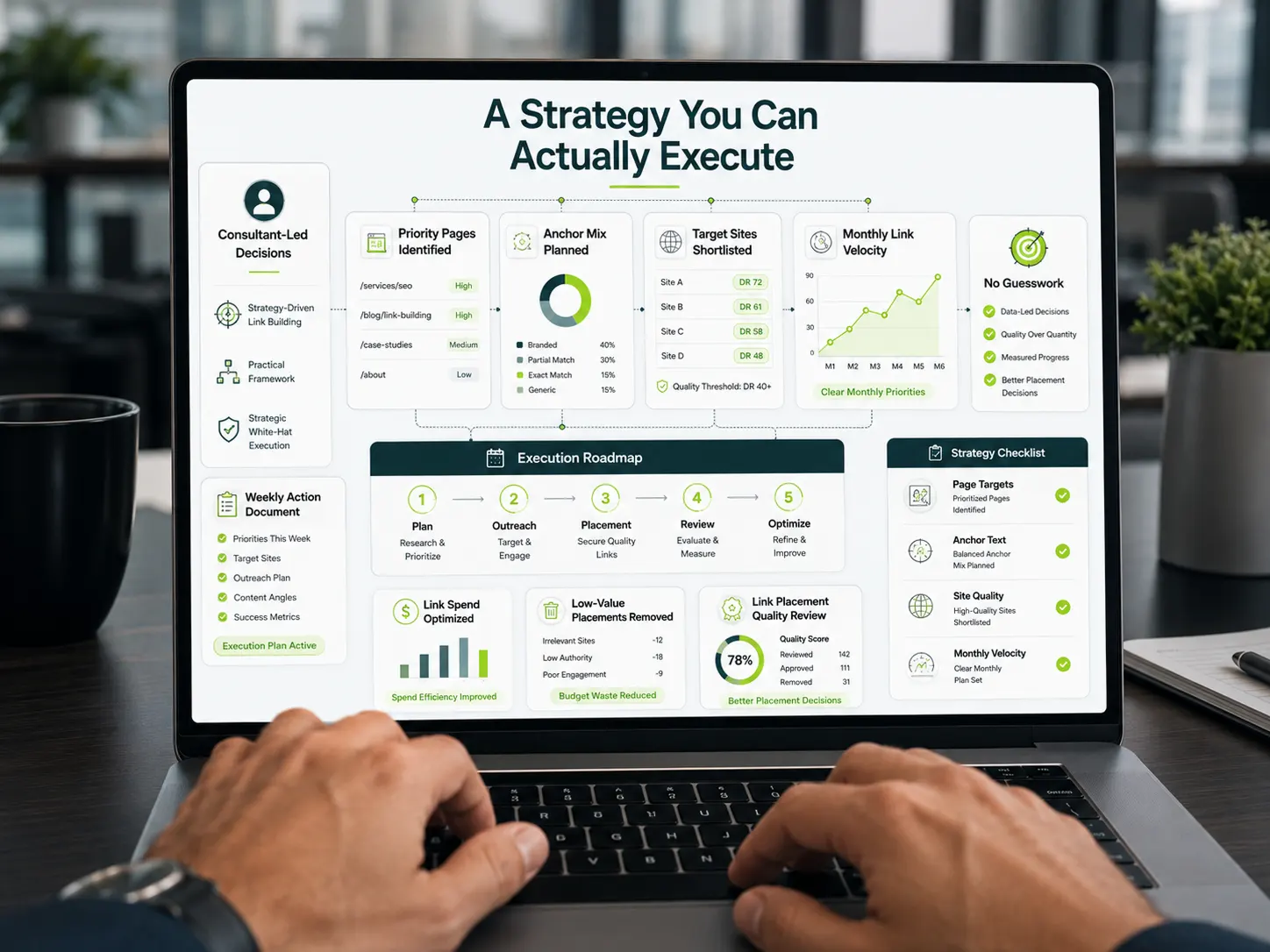
### Authority Built Where It Matters Most
Without a strategy, link building spreads the budget evenly for home pages, service pages, and blogs, but in reality, the pages that drive revenue should come first.
A consultant fixes that. Links point to pages that actually move rankings forward, such as your service pages, comparison pages, and high-intent landing pages.
One B2B client moved their service page from position 14 to 4 in six months, not by building more links overall, but by building the right ones.
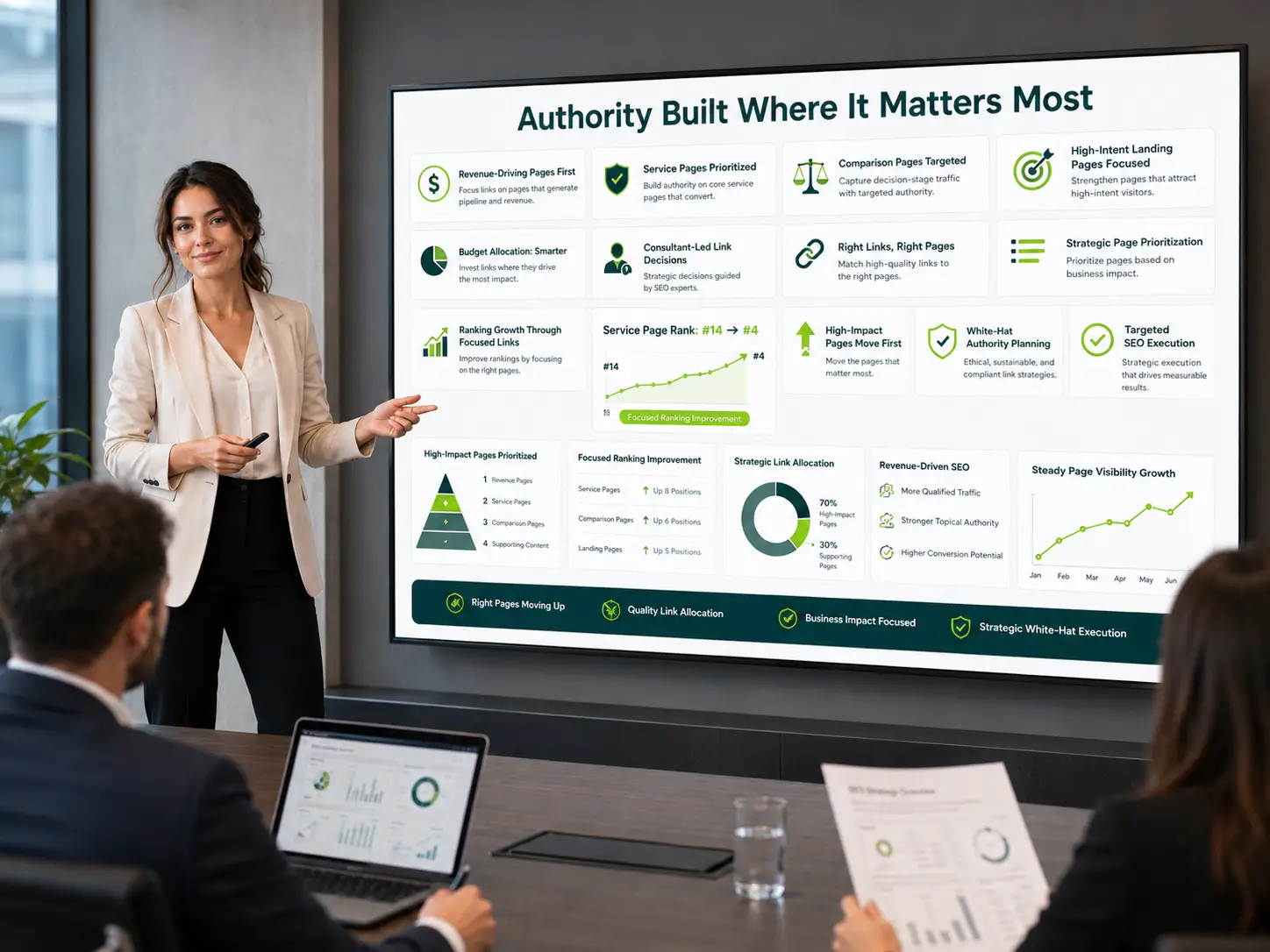
### Rankings That Build on Each Other
A strategy-led link campaign drives compound ranking gains. Each new placement reinforces the topical authority signals around the pages you’ve already ranked, which lifts the keywords without new link investment.
That’s the difference between buying links and building authority. Bought links move one keyword at a time. Strategic links lift the complete topical cluster, so that new content can rank, existing pages stay ranked, and your overall visibility grows.
Ahrefs data consistently shows that pages with strong topical authority can outrank pages with more total backlinks but weaker topical signals.
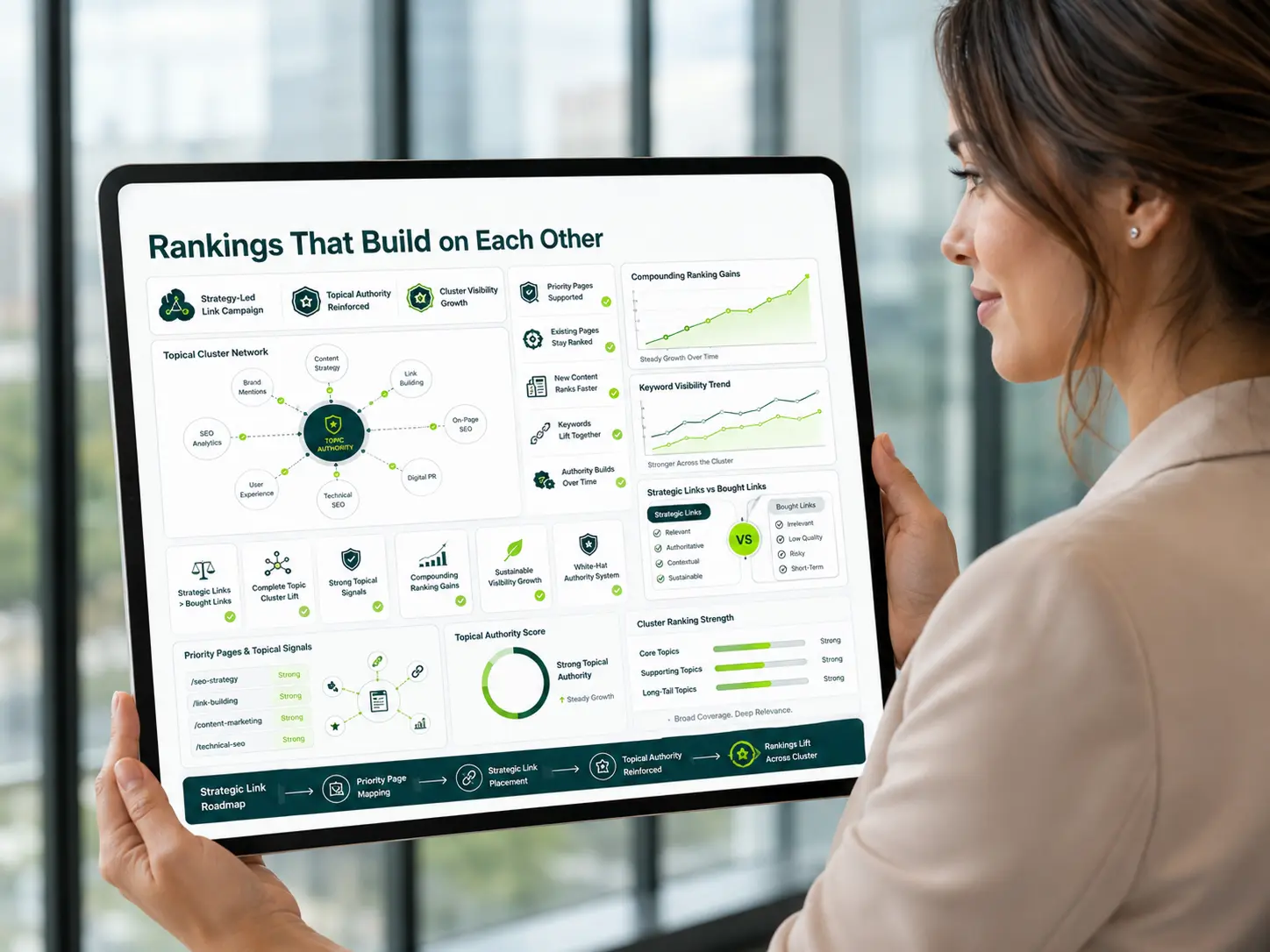
### Spend Less, Earn More Over Time
Most link building budgets are wasted on placements that don’t improve rankings. A consultant fixes that by trying every dollar to a measurable outcome.
Six months in, clients typically spend less than before the consultant got involved, but earn more from organic traffic and rankings. The reason is simple. Every placement has a target page, a target anchor, and a target outcome. Nothing is built just for the sake of activity.
This is what working with a senior consultant pays for: the discipline to spend smartly, not just spend more.
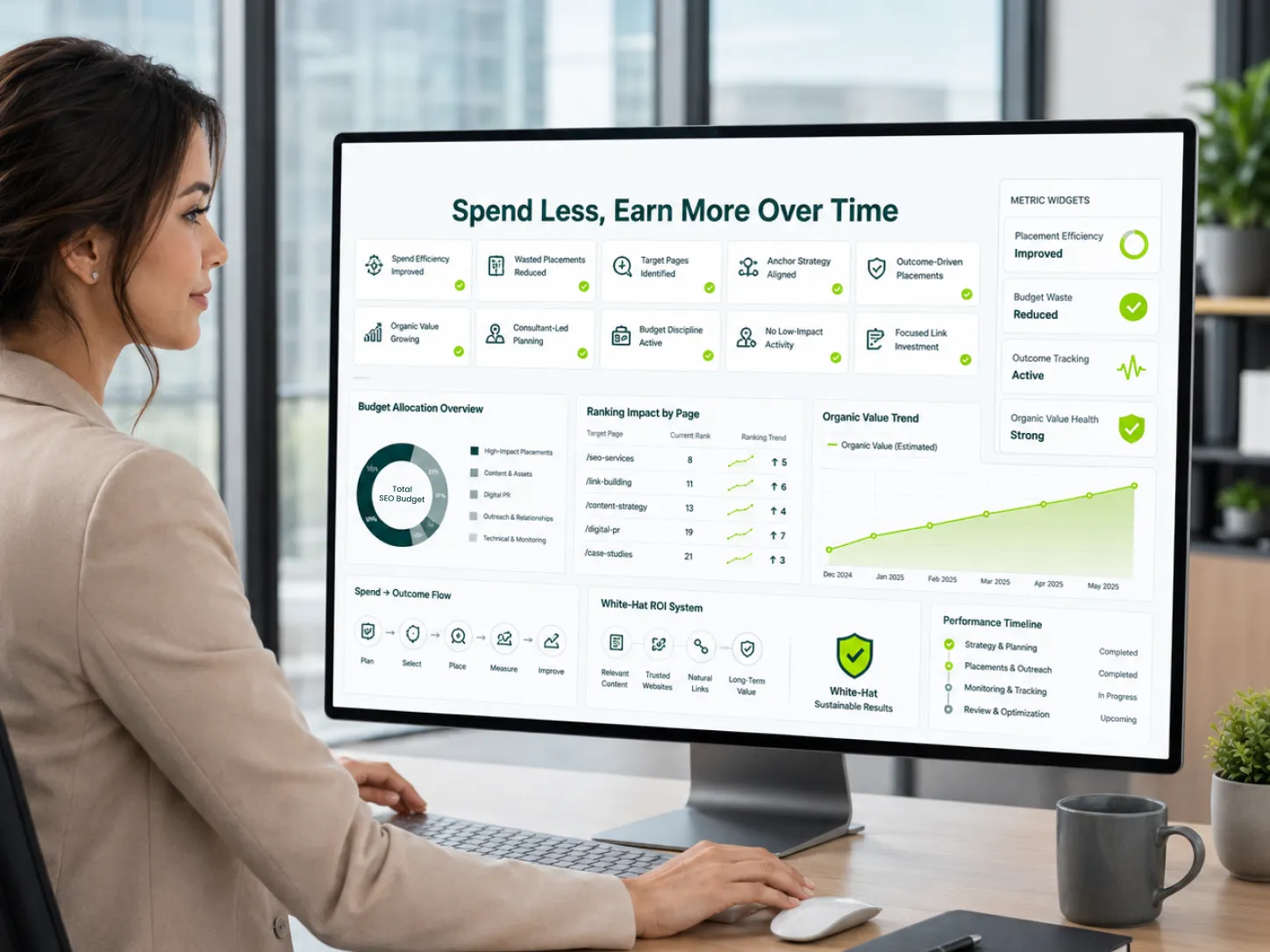
Client Success Stories
## What Clients Say About Our Link Building Consulting
Verified reviews from leaders who gained strategic clarity, authority, and rankings through our consulting.
[View All
](https://outreachdesk.com/testimonial/)

4.8/5 

## 5/5 
Rating on Google



The audit alone showed us why our links weren’t doing anything. Three months later, our service pages were ranking for keywords we’d been chasing for years. The strategy was specific, prioritized, and worth every dollar.

#### Marketing Director
B2B SaaS


We had no idea our anchor text was over-optimized until the audit. The consultant built a recovery plan and a 9-month roadmap that helped us overcome an algorithmic obstacle and strengthen our rankings.

#### Head of SEO
Ecommerce


Working with a senior strategist rather than an account manager changed the way we think about links entirely. We stopped buying placements and started building authority around the pages that drive real revenue.

#### Founder
B2B Agency
Service Framework
## Investment, Timeline, and Deliverables
Every consulting engagement is custom-scoped to your business goals, current authority, and competitive landscape. Here’s what shapes your investment:

### Audit Scope
Standard audits cover around 200 referring domains; deep audits go further on large profiles.

### Strategy Depth
A complete strategy includes anchor planning, target pages, link velocity, and monthly outreach priorities.

### Execution Model
Two models: Advisory-only or done-for-you. Pricing scales with the level of execution support you choose.

### Engagement Length
Most engagements last 3-12 months, with strategy reviews conducted every quarter.
### Directional pricing
Pricing and scope are shared as requested, tailored to your specific coverage needs, community mix, and growth goals. Custom proposals are available after an initial strategy call, outlining an approach tailored to your requirements, including community coverage, contribution approach, tracking, and a month-by-month roadmap aligned with your goals.
Book a Strategy Call
What You Get
## Every Strategy Decision Documented and Reported
Your engagement comes with clear written deliverables you can reference anytime, and direct access to your consultant:

### Backlink Audit Report
You get an audit report covering toxic links, anchor balance, profile quality, lost links, and a prioritized list of fixes.

### Strategy Roadmap
You get a 6-12-month link building plan covering target pages, anchors, link types, and monthly velocity.

### Monthly Review Reports
You see ranking movements, link impact, and strategy adjustments, all documented in detail each month.

### Direct Consultant Access
You can reach out to your consultant for questions, decisions, and strategy reviews between monthly calls.
Our Approach
## An Advisory-First Approach Built on Real Strategy
You get professional guidance, strategies, and outcome-driven link decisions, not generic execution.
| Factor | In-House/ DIY | |
| --- | --- | --- |
| Strategy & Audit | Audits on internal capacity; strategy is often
skipped or pieced together from blog posts. | You get a full backlink audit and a written
6-12-month strategy from a senior consultant
before any links are built. |
| Execution Model | Internal teams manage outreach without strategic
review; quality varies by team capacity. | You choose advisory-only or complete done-for-you.
Either way, the consultant guides every link decision. |
| Anchor Text Planning | Anchor decisions are made link-by-link; the
risk of over-optimization is high without distribution. | You get an anchor text distribution plan tied to
your existing profile and target keywords, reviewed every month. |
| Reporting & Adjustments | Monthly reports list links built; strategy adjustments
rarely happen because nobody owns the strategy. | You get monthly strategy reviews that adjust the plan
based on real ranking movement and competitors’ activity. |
| Tactics and Risk Standards | Risky tactics like PBNs or paid placements on weak
sites can slip in without strategic review. | Strict editorial standards. The consultant votes against
any placement that doesn’t align with the strategy or poses quality risk. |
Who We Help
## Industries We Support With Link Building Consulting
Whatever your industry, we have strategic expertise and an audit-first process to build authority on the keywords your buyers search for.
[

### SaaS &
Software
](/saas-link-building/)
[

### Ecommerce &
DTC
](/ecommerce-link-building/)
[

### B2B
](/b2b-link-building/)
[

### Enterprise
](/enterprise-link-building/)
[

### Emerging
Businesses
](/link-building-for-startups/)
[

### Real
Estate
](/real-estate-link-building/)
[

### Law Firms &
Legal
](/link-building-for-lawyers/)
[

### Dental
Practices
](/link-building-for-dentists/)
[

### Healthcare &
Fitness
](/health-fitness-link-building/)
[

### Financial &
Insurance
](/link-building-for-financial-websites/)

### Technology &
Innovation

### Consumer
Brands
Common Questions
## Frequently Asked Questions
Get an answer on hiring a link building consultant, covering cost, expectations, and how the engagement actually works.
### What does a link building consultant do?
A link building consultant audits your existing backlink profile, builds a written strategy tied to your business goals, and guides the execution that turns links into rankings. The work covers backlink audits, competitor link gap analysis, anchor planning, target page prioritization, monthly velocity recommendations, and ongoing strategy reviews. A consultant focuses on ensuring that every earned link drives a measurable outcome, not just adding to link volume.
### How is a consultant different from a link building agency?
An agency usually sells link volume, whereas a consultant sells strategy. With an agency, you pay per link or per placement. With a consultant, you pay for the audit, roadmap, and the senior expertise that decides which links are worth building. Some consulting engagements involve execution; others are advisory-only. The clearest difference is who owns the strategy. With a consultant, that responsibility stays with a senior strategist; it’s not split across an account manager and an outreach team.
### How long does it take to see results from consulting?
Most clients see ranking movements within 3 to 4 months as the strategy starts to redirect efforts to the right pages and anchor types. Compounding gains show up around the 6 to 12 month mark as topical authority builds across clusters. The audit itself often reveals quick wins, such as disavowing toxic links, reclaiming broken backlinks, or rebalancing anchors, that can improve rankings within the first 30-60 days.
### Do you provide strategy, or do you also execute the link building?
Both options are available. Advisory-only engagements provide audit, strategy, and monthly reviews while your internal team handles outreach. Done-for-you engagements include the consultant plus complete execution by Outreach Desk’s outreach specialists, who work directly under the consultant’s guidance. You pick the model that fits your team, budget, and capacity.
### Will I work with the same consultant throughout the engagement?
Yes, every engagement is led by a senior consultant who handles your audit, builds your strategy, and serves as your point of contact throughout the engagement. You’re not handed over to the junior staff. The consultant attends every monthly review, signs off on every strategy adjustment, and stays available between calls for queries.
## Ready to Build a Link Strategy that Actually Moves Rankings
Get a senior consultant to audit your backlinks, build your roadmap, and guide the work that compounds long-term authority.
Book a Strategy Call

4.8/5 _
Trusted by 500+ agencies &
1,000+ businesses worldwide.

---
---
title: "Link Building For Healthcare That Builds Real Authority"
url: "https://outreachdesk.com/link-building-for-healthcare/"
lang: "en-US"
type: "post"
description: "Most healthcare providers deliver excellent care. But patients can’t choose your practice if they can’t find you online. When your website doesn’t appear in their search results for symptoms, treatments, or providers, patients often end up choosing your competitor instead."
last_modified: "2026-05-18T11:50:58+00:00"
categories: [Link Building]
---
# Link Building For Healthcare That Builds Real Authority
Most healthcare providers deliver excellent care. But patients can’t choose your practice if they can’t find you online. When your website doesn’t appear in their search results for symptoms, treatments, or providers, patients often end up choosing your competitor instead.
That visibility gap often comes down to how much trust and authority your website has built online. Backlinks play an important role in how Google assesses credibility in search results, especially for competitive healthcare topics. Partnering with [managed link building services](https://outreachdesk.com/) typically shortens this process from months to weeks.
But link building for healthcare works differently from most industries because medical content comes under Google’s Your Money or Your Life (YMYL) category, where credibility, accuracy, and trust standards are significantly higher.
Healthcare brands that grow organic visibility consistently earn mentions and backlinks from trusted, relevant websites. These signals strengthen topical authority, improve visibility for high-intent patient searches, and support long-term search growth.
**Key Takeaways**
- Healthcare SEO runs on trust, not backlink volume.
- YMYL standards make healthcare link building stricter than most niches.
- .gov, .edu, journals, and medical publishers carry the most authority.
- Digital PR, expert insights, and original research earn the best links.
- AI search rewards trusted brand mentions alongside backlinks.
## Link Building for Healthcare: Definition and Core Principles
**Healthcare link building is the process of earning **[**trusted backlinks**](https://outreachdesk.com/what-are-backlinks/)** and brand mentions from trusted medical sources that strengthen your practice’s authority in search results.
**
The strongest healthcare backlinks typically come from .gov sites, .edu institutions, peer-reviewed journals, professional medical associations, and established health publishers.
Unlike standard link building, healthcare SEO requires higher credibility, topical accuracy, and trust because medical content falls under Google’s YMYL standards.
In a niche where trust and credibility influence how patients and search engines perceive you, the quality of linking sites has more impact than sheer volume. Regularly audit your backlinks to make sure they come from relevant, authoritative sources that meet healthcare-specific standards.
Healthcare is one of many competitive niches in SEO, competing against established hospital systems and national health platforms, which means your backlink profile can’t afford to be average. The right links do more than support rankings. They signal to both search engines and potential patients that authoritative sources consider you worthy of citation.
## Why Healthcare Link Building Plays by Different Rules
Healthcare content falls under [Your Money or Your Life](https://developers.google.com/search/docs/fundamentals/creating-helpful-content#:~:text=We%20call%20these%20%22Your%20Money,our%20changes%20are%20working%20well) (YMYL) so their site’s content is evaluated against stricter E-E-A-T standards than most niches. Only links from topically relevant, editorially credible sources move rankings. Sites with high domain rating but off-topic links are largely discounted, and authorship signals on destination pages determine how much authority any link transfers.
Topics under this category can directly affect your health, safety, financial stability, or well-being. A wrong answer about home decor wastes someone’s afternoon. A wrong answer about a medication interaction can cause real harm. Google knows this and evaluates medical content accordingly.
For YMYL topics, Google builds its systems to surface content that shows strong E-E-A-T. That means clear expertise, real experience, and a high level of trust. This applies to both the site and the content connected to it. Links from credible, topically relevant sources strengthen your authority. Links from weak or irrelevant sites do not move the needle.
**What is E-E-A-T?
**
E-E-A-T stands for Experience, Expertise, Authoritativeness, and Trustworthiness. Google uses these quality signals to evaluate whether content is reliable, written by knowledgeable sources, and trustworthy enough for users, especially in sensitive niches like healthcare. Content that demonstrates real expertise, credible sourcing, and clear authorship is generally viewed more favorably than anonymous or low-trust content.

In practice, this means 3 things change for healthcare link building:
**1. The bar for what counts as a “good” link is higher
**
Links from unrelated or low-quality sites provide limited value and are often ignored in sensitive niches. A backlink from a generic marketing blog might improve search rankings for a software company. The same link does almost nothing for a dental clinic.
**2. Authorship signals matter to backlink value
**
Backlinks carry more weight when the destination page meets high-quality standards. High-quality standards mean the page shows clear authorship, accurate information, credible sources, and overall trustworthiness. These strengthen credibility more than anonymous or generic bylines.
A health-related page authored by a board-certified physician often earns more weight from any inbound link than the same page authored by the “Editorial Team”.
**3. Link velocity is scrutinized
**
Sudden spikes in backlinks look unnatural when the new domains are low-quality or topically irrelevant. To support long-term performance, focus on consistent, [relevant link acquisition](https://outreachdesk.com/link-acquisition/) that aligns with your ongoing content and outreach efforts.YMYL sites that suddenly add 100s of new backlinks in a month often get downgraded.
Google’s helpful content guide and recent core updates consistently reward content that demonstrates credibility and usefulness. Google doesn’t require specific credentials like physician authorship, but its quality rater guidelines place more weight on demonstrated expertise for health and finance topics.
Medical pages perform better when they show who created the content, why they are qualified, and when it was last updated. Without this foundation, links have a limited effect.
## How to Evaluate Whether a Healthcare Backlink Is Worth Earning
For a medical site, you should evaluate every prospective link source against **topical relevance to medicine, editorial control, authorship transparency on the linking site, and link placement context**. Forget the generic “DR 70+ is good” advice for a moment.
This is what these healthcare-specific filters mean:
### Topical Relevance to Medicine
A link from a high-DR fashion blog won’t move a medical site’s ranking. A link from a smaller, lower-DR oncology non-profit might. Healthcare sites see measurable ranking improvements mainly from sources Google already classifies as medically relevant.
Off-topic links from strong domains do less than people expect. Stack enough of them and Google reads it as a manipulation signal.
### Editorial Control
Does the site actually have a real editor who reviews what gets published?
If anyone can buy a guest post for $80, that site’s links carry almost no weight for a YMYL page. Medical journals, professional associations, and reputable health publishers have visible editorial standards, and Google’s quality systems can tell the difference.
### Authorship Transparency on the Linking Site
A medical content site that publishes anonymous articles passes less trust signals and authority to your page than one that names its physician contributors. That’s because Google evaluates the linking page’s own E-E-A-T signals before deciding how much trust to transfer through the link.
### Link Placement Context
A link within a clinical reference section carries more authority than the same link placed elsewhere in the site like in footer or ad section. For YMYL content, the sentence around the link matters as much as the destination.
## The Link Sources That Move the Needle for Medical Sites
Some source categories, such as **government health domains, educational institutions, peer-reviewed journals and databases, professional medical associations, reputable health publishers, local press, and medical directories**, often appear more valuable for building authority and improving search visibility.
Let’s understand how all 7 of them helps move the needle for medical sites:

### Government Health Domains (.gov)
State health departments, the CDC, NIH, FDA, and equivalents. Google recognizes these websites as one of the many trusted sources of medical content. They’re also the hardest to earn a backlink from. You get listed on .gov resource pages by being a relevant non-profit organization, conducting recognized clinical work, or being cited in public health initiatives.
### Educational Institutions (.edu)
Medical school websites, university research blogs, teaching hospital pages, and continuing medical education resources. Government and educational sites are heavily moderated. Backlinks earned from such sites carry much more weight because they don’t host paid advertisements or accept [guest posts](https://outreachdesk.com/guest-posts/) from random or topically irrelevant contributors.
### Peer-Reviewed Medical Journals and Database
Citations and references from journal articles, PubMed-indexed publications, and specialty medical databases such as UpToDate, ClinicalKey, or adjacent resources are one of the most trusted signals in healthcare content. These mentions are often earned by publishing original research, clinical insights, or clinical case-based data that authoritative medical sources choose to reference.
### Professional Medical Associations
Professional medical associations include organizations like AMA, AAFP, ACS, AAP, ADA, APA, and specialty societies at the national, state, and local levels. These organizations often maintain member directories, resource pages, and contributed content. These opportunities are often overlooked by most marketers. You can earn a link from these organizations by creating valuable and relevant content.
### Reputable Health Publishers
Healthline, WebMD, Medscape, Verywell Health, Medical News Today, and similar publishers typically surface experts through earned visibility. This includes expert quotes, journalist citations, and selectively vetted contributions backed by credible research.
A practical way to build this presence is through digital PR and expert commentary. That means providing clear, evidence-based insights to health journalists and positioning yourself as a reliable source for recurring medical topics rather than relying on generic guest posting.
### Local Press and Regional Health Publications
For clinics, hospitals, and multi-location practices, local newspapers and regional health magazines can help drive both rankings and direct patient traffic. Often, the most accessible high-trust sources are for smaller medical organizations.
### Medical Directories
Healthgrades, Zocdoc, Vitals, RateMDs, Doximity, and US News& World Report’s Best Hospitals listings. These are baseline citations that every healthcare provider should have. Medical directories don’t move rankings dramatically on their own, but their absence creates a trust gap.
⚠️ **Watch Out For Sites
**
- General SEO blogs
- “Submit a guest post” sites
- [Link farm schemes](https://outreachdesk.com/link-farming/)
- Off-topic high DR sites
- Most paid placements on health-adjacent commercial sites
These show up in many healthcare backlink portfolios. Most of them do nothing, and a meaningful share actively hurts the site’s overall trust profile.
A quick summary of which healthcare link sources can be earned and which can be avoided:

## The Tactics That Work for Healthcare Sites in 2026
Link building strategies that consistently deliver results for healthcare clients are **original research and clinical data, digital PR and expert commentary, linkable assets, local partnerships, resource page outreach, broken link building, and contributed articles to tier-1 publishers**.
This is how these tactics work:
### Original Research and Clinical Data
Publishing original research data is one of the effective ways to earn backlinks in the healthcare niche. A clinic that publishes patient outcome data, a specialist group that surveys patients on a specific condition, or a telehealth platform that shares usage trends naturally attracts links.
Health journalists, medical associations, and other healthcare websites link to original data because it is new, citable, and verifiable. Nobody else has it, so they reference you.
### Digital PR and Expert Commentary
Medical journalists are constantly looking for clinician sources for their stories. A consistent presence on HARO, ResponseSource, and direct journalist outreach can earn placements in major mainstream outlets that cover health stories.
### Linkable Assets Built for Patient Decisions
[Link worthy assets](https://outreachdesk.com/linkable-assets/) , such as tools and calculators, tied to common patient decisions earn links naturally because other medical websites need a credible source.

A pediatric BMI calculator, a fertility tracker tied to ovulation timing, a medication interaction checker, and a procedure cost estimator. These become “the link everyone uses” once they’re trusted.
### Local Partnerships and Community Authority
For most clinics, multi-location practices, dental groups, and regional hospital systems, [local link building](https://outreachdesk.com/local-link-building/) delivers strong ROI.
Sponsoring a local 5K for a health cause often earns links from event pages and, where local press picks it up, from news coverage. Co-hosting a free screening with a YMCA or Boys & Girls Club earns non-profit and community links.
Speaking at a chamber of commerce health panel earns chamber links and, in some cases, member site coverage. None of these individually helps move rankings dramatically. Still, a consistent, steady program of local relationship building compounds over time and supports stronger local authority, which is one factor in local pack visibility.
### Resource Page Outreach to Medical Organizations
Many national medical associations and larger state chapters maintain resource pages: patient education libraries, ‘find a specialist’ directories, and condition-specific guidance pages.

Some larger associations have editorial processes or member contribution channels where relevant content from member practices can be considered. [Link building for resource pages](https://outreachdesk.com/resource-page-link-building/) is one of the most overlooked tactics in healthcare, as it requires patience and relationship-building. Yet, the links it earns are consistently among the highest-quality links a medical site can earn.**
**
### Broken Link Building on Health Resource Pages
A lot of .edu and .gov health pages still link to dead resources, and that’s your link earning opportunity. A [focused broken link campaign](https://outreachdesk.com/broken-link-building/) lets you step in where others haven’t. Find the 404s on health reference pages, build a current, high-quality replacement, and offer it as the fix.

The result? Links from .edu and .gov domains that are otherwise extremely difficult to land through standard outreach.
It takes patience. But the authority you build is disproportionately powerful.
### Contributed Articles to Tier-1 Health Publishers
Contributed articles to tier-1 health publishers aren’t guest posts. They’re earned placements.
When Healthline, Verywell Health, Medscape, or Health.com accepts a pitch from a credentialed clinician, the result is [one earned contextual link](https://outreachdesk.com/contextual-link-building/) back to the practice’s relevant condition page. No shortcuts. Pure editorial merit.
Yes, it’s slow. One piece can take 6–10 weeks from pitch to publish, but each placement carries the trust and authority of dozens of standard links, and that’s leverage.
### Vertical-Specific Awards, Rankings, and Inclusions
In healthcare, best-of-region “best dentist” lists, “top hospital” rankings in US News or Newsweek, specialty awards, accreditations, and certifications often come with a link-back-to-the-honoree page. Instead of standard [outreach link building](https://outreachdesk.com/link-building-outreach/) , they require eligibility, making them one of the most credible and hard-to-replicate placements a healthcare site can earn.
## The Mistakes That Get Healthcare Sites Penalized
Mistakes like **off-topic paid links, exact-match anchor stuffing, unnatural velocity spikes, linking from poor-E-E-A-T sites, NAP inconsistency across directories, and missing clinician authorship on destination pages** are the ones that we see most often.

Let’s see how each of these can get the sites penalized:
### Buying Links from Off-Topic High-DR Sites
Let’s suppose a clinic buys a “_guest post on a DR 70 site_,” which is a generic business blog, through a marketplace. The bought link does nothing measurable, and not only this, but Google’s SpamBrain system discounts the entire group of links from that publisher.
This means that for YMYL topics like healthcare, buying links is one of the fastest paths to a sustained ranking decline.
### Exact-Match Anchor Text on Commercial Pages
Pointing multiple backlinks at your “_knee replacement surgery_” service page, all with anchor “_knee replacement surgery [city]_“, is one of the manipulation patterns Google’s system catches.
Diversified anchor text, including branded mentions, partial-match variants, generic phrases like “_learn more about this procedure_“, and URLs, often outperforms stacked exact-match anchors.
### Velocity Spikes
In Google’s link evaluation system, going from 4 new referring domains per month to 40 per month looks unnatural, especially when there is no PR event to back the spike.
Such a velocity spike that might be overlooked on a low-stakes niche site is more likely to matter on a healthcare site because every trust signal carries more weight under YMYL evaluation. This is why a consistent eight to fifteen quality links per month compounds into stronger authority than a burst of sixty followed by silence.
### Linking from Sites That Lack E-E-A-T
A backlink from a health blog with no named author, no medical reviewer, and a clear pattern of selling placements transfers very little authority. It also signals to Google that your site is a part of a low-trust cluster. Always check the linking site’s own authorship signals before pursuing the link.
### Ignoring NAP Consistency on Directories
Mismatched name, address, and phone data across Healthgrades, Zocdoc, Google Business Profile, and other directories is a quiet ranking suppressor. This carries extra weight because Google’s quality evaluation verifies whether the publisher of health content is a real, traceable entity.
### Skipping Medical Authorship on Linked-to-Pages
You can earn a strong link from a Healthline article, but if the destination page has no named clinician, no displayed credentials, and no last-reviewed date, the trust transfer is weakened. The links pointing to a page that Google’s quality evaluation does not fully trust is one of the most overlooked gaps in healthcare link building.**
**
⚠️** Watch Out For This Issues
**
When a healthcare site sees no measurable improvement in rankings despite running a [link building campaign](https://outreachdesk.com/link-building-campaigns/), the issue is usually one of three things:
- **Off-topic paid links that Google’s systems have already neutralized.
**
- **Anchor text manipulation patterns that signal over-optimization.
**
- **No clinician authorship on the destination pages.
**
The fix starts with a [complete backlink auditing](https://outreachdesk.com/backlink-analysis/) of what is already there. If the audit shows a clear pattern of manipulative links, ones that have already drawn a manual action or are trending that way, disavow them and rebuild around source categories that carry real YMYL trust.
## How AI Search Is Reshaping Healthcare Link Building
The two key changes AI search brings to healthcare link building: **(1) AI Overview citations weight specialty publications, named-author content, and original research more heavily than classical SEO does, and (2) brand mention frequency now functions as an authority signal even without a backlink attached, so earned visibility in trusted health sources matters more than ever.
**
Patients are also turning to ChatGPT, Perplexity, and Gemini for health related answers at scale, with over [230 million people](https://openai.com/index/introducing-chatgpt-health/#:~:text=over%20230%20million%20people%20globally%20ask%20health%20and%20wellness%20related%20questions%20on%20ChatGPT%20every%20week.) asking health and wellness questions on ChatGPT every week, per OpenAI.
Let’s understand these 2 changes:
**1. The link sources that AI engines cite are slightly different from what classical SEO rewards
**
AI Overview citations favor sources with very strong topical authority, like specialty publications, named-author content, original research, and reputable health publishers. A practice that earns links from these sources tends to also earn citations in AI Overviews for related queries. The two systems pull from overlapping signal pools.
**2. Brand mention frequency now matters as a ranking signal in AI search
**
Brand visibility across trusted healthcare sites helps improve your authority. Multiple [relevant brand mentions](https://outreachdesk.com/brand-mentions/) earned by your site can strengthen how search systems evaluate your clinic. Backlinks still matter and they remain a core ranking factor. But it’s important to note that a few backlinks are rarely enough.
Growth is visible by combining both the points mentioned above. Earn strong links and build a consistent brand presence across credible sources.
**The practical implication for a healthcare marketing lead:
**
Invest more of your link building budget in tactics that produce both [high quality backlinks](https://outreachdesk.com/high-quality-backlinks/) and brand mentions in trusted health sources. Digital PR, contributed articles, expert quotes, and original research check both boxes. A pure “guest post on a healthcare blog” often checks neither in 2026.
## What To Expect From Your First 6 Months
This is what a focused 6-month healthcare link building campaign delivers: **foundation and audit in Month 1 (no ranking changes), first 3-5 links in Month 2, first authority placement in Month 3, rankings climbing in Months 4-5, and compounding organic traffic growth by Month 6
**

Let’s look at each month:
### Month 1:
First you need to set the foundation. Audit your entire existing backlink profile, disavow unnatural and low-quality links, fix authorship and credentials on top 30 pages, claim and update directory listing. Often no ranking changes will be seen in this month.
### Month 2:
First batch of digital pitches goes out. Broken-link prospects are identified. The first 3-5 high-quality links are often earned from directories and local partnerships. Low-competition long-tail queries may start showing early ranking improvements.
### Month 3:
A first expert quote or contributed article gets published in a high-authority health publisher. Local press begins covering related partnership or expertise stories. The backlink profile gains around 8–15 new high-quality referring domains. Long-tail keyword rankings start reaching the top 20 more consistently.
### Month 4-5:
Early authority begins to compound. Pages that earned links in the first phase start ranking for related and adjacent search queries through stronger internal linking and [link authority flow](https://outreachdesk.com/link-equity/). Mid-competition health queries begin entering the top 30. Some niche queries may also start appearing in AI-generated overviews.
### Month 6:
A consistent digital PR and authority-building program leads to steady month-over-month organic traffic growth. High-intent searches like “treatment near me” or “condition treatment in [city]” start moving into the top 10–15 positions. Link acquisition becomes more efficient due to existing authority and relationships, which makes it easier to earn additional mentions.
This timeline assumes a focused, consistently executed program. Scattered or ad-hoc link building might slow down your progress. If you are building this in-house, the link building outreach workflow we use applies directly to healthcare with YMYL filters layered on, and many of the same patterns carry over when [health and fitness brands](https://outreachdesk.com/health-fitness-link-building/) face similar trust challenges on the wellness side of the market.
If you’re wondering whether to handle this in-house or [outsource link building to a vetted partner](https://outreachdesk.com/outsource-link-building/), the deciding factors are the same as in any other vertical (team capacity, tool budget, and existing publisher relationships) but the YMYL filters add an extra layer of risk to getting healthcare wrong. A misstep that costs an e-commerce site three months can cost a healthcare site a year.
## What This Actually Looks Like When It Works
Most healthcare sites stuck on page two aren’t there because their content is bad. They’re there because their backlink profile doesn’t match the trust standard Google applies to YMYL pages: a mix of off-topic links, anchor text patterns that look manipulative, no clinician authorship on the destination pages, and no presence in the source categories that actually move medical rankings.
Fixing it isn’t fast. But it isn’t complicated either. Audit what you have, disavow what’s hurting you, fix authorship and authority signals on your most important pages, then start earning the right kind of links from the right kind of sources at a sustainable pace. Six to nine months in, you’ll see the curve start to bend.
### Struggling to grow your healthcare site’s visibility in search?
Get a clear link building approach focused on trust, relevance, and long-term authority.
[Book a strategy call](/contact-us/)
### How long does healthcare link building take to show results?
It takes around 60-90 days to show ranking improvements for long-tail patient queries. Around 4-6 months for mid-competition condition and procedure queries. Around 6-12 months for competitive commercial queries like “[procedure] near me” or “[condition] specialist [major city]”.
Healthcare ranking timelines run longer than most niches because Google accumulates trust signals more slowly for medical content.**
**
### How many backlinks does a healthcare site need per month?
It depends on the size of your site. A sustainable pace for most clinics, mid-size practices, and telehealth platforms is within 8-15 quality referring domains per month.
Larger hospital systems and major medical groups can often earn links at a faster pace without triggering the same level of scrutiny as compared to healthcare because they naturally attract more media coverage, partnerships and brand mentions.
The real risk is not the absolute count. It is a sudden spike above your normal baseline with no PR event to explain it.
### Is buying healthcare backlinks safe?
It carries a serious risk. Buying links through link marketplaces, paid guest post networks, or cheap link services can violate Google’s spam policies and, over time, this damages trust signals, especially in healthcare SEO.
Google’s spam detection systems are effective at detecting paid link patterns, and healthcare sites face heavier scrutiny than most.
Digital PR, expert commentary, contributed content, and legitimate media outreach are safer, long-term approaches because they focus on naturally earning relevant mentions and editorial links. In most cases, the downside risk of buying low-quality backlinks outweighs any short-term ranking gain.
### What’s the difference between link building for healthcare vs health and fitness?
Health and fitness content includes wellness brands, gyms, supplements, and consumer health information. It is also treated as YMYL, but often allows for a broader mix of content formats and link acquisition strategies depending on the brand and audience.
Healthcare content focuses on medical providers, hospitals, clinics, telehealth, MedTech, and pharma. It is evaluated with stricter expectations by Google’s system around trust, accuracy, and authority because it can directly impact a patient’s health decisions.
In both cases, the core principles of link building are the same. The difference lies in execution.
### Do .gov and .edu backlinks really matter for healthcare sites?
Yes. Google’s trust evaluation for medical content weights these domains heavily because they are rarely paid for, heavily moderated, and represent the highest-trust institutions in healthcare. Even one or two earned through original research, broken link outreach, or resource pages can meaningfully strengthen a healthcare site’s authority profile.
### How does AI search change link building for medical sites?
AI systems like Google AI Overviews, ChatGPT, and Perplexity treat brand mentions in trusted health publications as strong authority signals, even when there is no backlink attached.
When a clinician is cited in multiple Healthline articles, it still builds credibility. It signals expertise in a way AI systems can recognize and connect across sources, not just through links.
This changes how link building works. Digital PR, expert commentary, and editorial contributions become more valuable because they place you inside meaningful context. Low-context guest posts that only exist to generate a backlink add less value, since they do not strengthen how AI systems understand your authority or topic relevance.
---
---
title: "Niche Edit Service for Topical Authority in Your Industry"
url: "https://outreachdesk.com/niche-edit-service/"
lang: "en-US"
type: "page"
description: "Niche Edits Niche Edit Service for Topical Authority in Your Industry Your site earns backlinks placed inside niche-relevant articles, building the topical authority Google rewards on the keywords your buyers actually search. Niche-relevant sites Industry-aligned articles Topical authority focus Book"
last_modified: "2026-05-28T12:43:16+00:00"
custom_fields:
header_style: "header-style-1"
footer_style: "footer-style-1"
---
# Niche Edit Service for Topical Authority in Your Industry
Niche Edits
# Niche Edit Service for Topical Authority in Your Industry
Your site earns backlinks placed inside niche-relevant articles, building the topical authority Google rewards on the keywords your buyers actually search.
_
Niche-relevant sites

Industry-aligned articles

Topical authority focus
Book a Strategy Call

4.8/5 _
Trusted by 500+ agencies &
1,000+ businesses worldwide.
Average DR
40 – 95
Campaign Dashboard
LIVE
DOMAIN RATING
31 → 49
+18 points
ORGANIC TRAFFIC
+590%
5,400 → 37,300
NICHE-RELEVANT LINKS
84 of 84
100% match rate
TOPICAL AUTHORITY
38 → 71
+33 points
_
Contextual Edits
84










Service Overview
## What a Niche Edit Service Actually Delivers
A niche edit is a backlink placed within an already published article on a site in your industry. A niche edit gets your link to an article on a site that Google already trusts as an authority on your specific topic. That topical relevance signal is what moves rankings on the keywords your buyers search.
Tools like Ahrefs and Semrush confirm that links from topically relevant sites pass more ranking value than higher-DR links from irrelevant sites. Five niche edits inside SaaS publications will outperform fifty links from generic high-DR sites for a B2B software brand.
For most businesses, niche edits are the fastest way to build topical authority on the keywords that drive revenue. The hosting articles are already indexed and ranking, so your link benefits from that authority immediately, not after a new guest post is indexed.
Three things that define a strong niche edit:

### Industry alignment
The hosting site is in your exact niche, with content covering topics, products, and audiences that directly match your business.

### Article Relevance
The specific article that carries your link discusses a topic where your link adds genuine context for the reader, not a forced insertion.

### Established Authority
The hosting page already ranks and earns traffic, so your link gains immediate value from the page’s existing position.
How We Work
## How Your Niche Edit Campaign Works
A workflow built for niche relevance, topical fit, and industry-specific authority signals.
### Niche Mapping and Target Page Strategy
Every campaign starts with a mapping session. Your strategist studies your business, competitors, and the publications your buyers already read. The result is a curated list of niche authorities your target buyers already follow.
Next target pages are selected. Service pages, comparison pages, and pillar content get priority because building authority on these pages drives revenue, not just rankings. You get a clear roadmap before outreach begins.
### Niche Site Discovery and Vetting
Prospect lists are built using strict criteria for niche relevance. Sites are first filtered by niche alignment, then by quality. A DR 80 site outside your industry doesn’t qualify. A DR 50 site that publishes weekly content in your space does.
Every prospect is manually reviewed for organic traffic, content depth, audience fit, and link profile health using Ahrefs. You see only vetted, niche-matched sites, never generic high-DR directories that simply accept paid placements.
### Article-Level Relevance Check
Your strategist reviews specific placement opportunities and checks for topical alignment, content depth, existing outbound links, and editorial flow.
A product link inside a “best tools for [your category]” article carries far more weight than the same link inside a generic listicle. Article-level relevance turns a niche edit from a simple backlink into a topical authority signal that Google actually understands.
### Manual Outreach to Niche Publishers
Your outreach specialist contacts publishers and editors directly. Every email is personalized, references recent content that the publisher has written, and asks for a specific placement angle that adds genuine value to an existing article.
No mass automation, no marketplace listings. Niche publishers are smaller, more selective, and more relationship-driven than generic high-DR sites. Manual outreach is the only way to earn editorial placements on the sites that actually move rankings in your industry.
### Edit Integration and Anchor Text Strategy
Once a publisher approves the placement, your team works with the editor to integrate the link naturally into existing content. Anchor text is chosen to fit your overall link profile and avoid over-optimization on commercial keywords.
Each placement is reviewed for in-content positioning, dofollow attribution, indexation, and editorial fit. If anything fails to meet white hat standards, the team gets it corrected or replaces the placement at no additional cost and avoids over-optimizing for commercial keywords.
### Reporting With Niche Match Context
Every month, you receive a detailed report covering each placement, with a complete niche context, which industry the hosting site serves, what topic the site covers, why the placement matched your target page, and the topical signal it sends.
This is what separates a niche edit report from a generic link report. You don’t just see DR and traffic numbers. You see exactly why each link strengthens your authority on the topics your buyers actually care about.

Expected Results
## Outcomes That Niche Edits Deliver
When every link comes from a site in your industry, your topical authority compounds into rankings, traffic, and visibility on the keywords that matter the most.
- 1. Topical Authority Lift
- 2. Faster Ranking Gains
- 3. Niche-Audience Traffic
- 4. Industry Brand Recognition
### Authority on the Topics Buyers Search
Niche edits send a clear signal to Google. When sites Google already recognizes as an authority in your industry, your domain becomes a part of that topical association.
**The result:** your target pages start ranking for the same keywords that drive buyer queries in your industry, not just generic high-volume terms. One B2B SaaS client saw their main category page move from position 16 to 5 in just four months after earning 24 niche edits from publications covering their software category.
This isn’t about getting any links. Five niche-aligned edits will outperform fifty placements from generic sites for the keywords your business actually competes on.
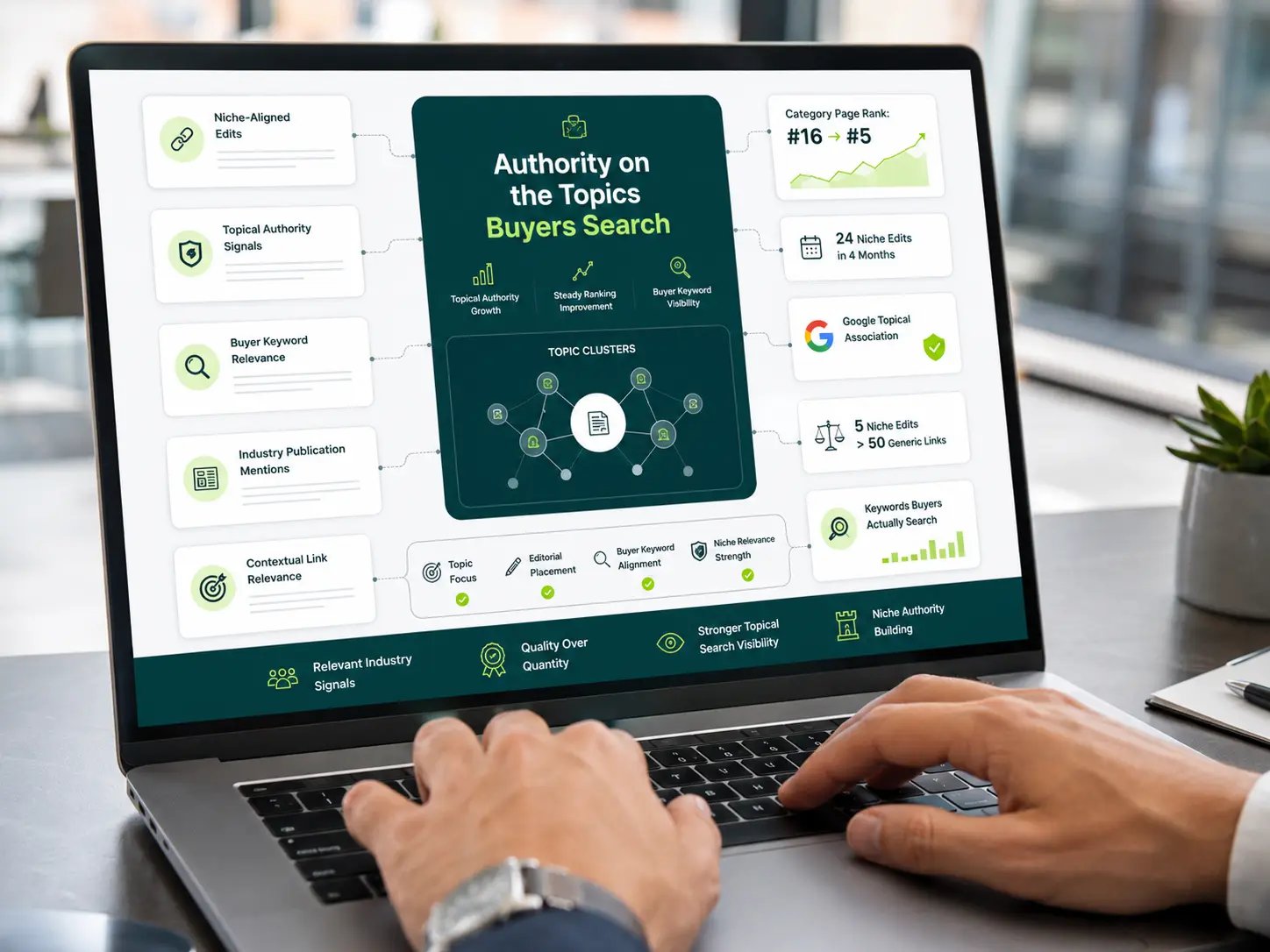
### Rankings That Move in Months, Not Years
Because hosting articles already rank and pull traffic, niche edits skip the indexation lag that comes with new guest posts. Google sees the link from trusted pages.
That speed compounds when the hosting page appears in your niche. Topical relevance, existing page authority, and immediate indexation make niche edits one of the effective white-hat paths to move rankings.
Clients who run niche edit campaigns regularly see rankings lift in 60-90 days, faster than guest posting timelines without the overhead of content production.
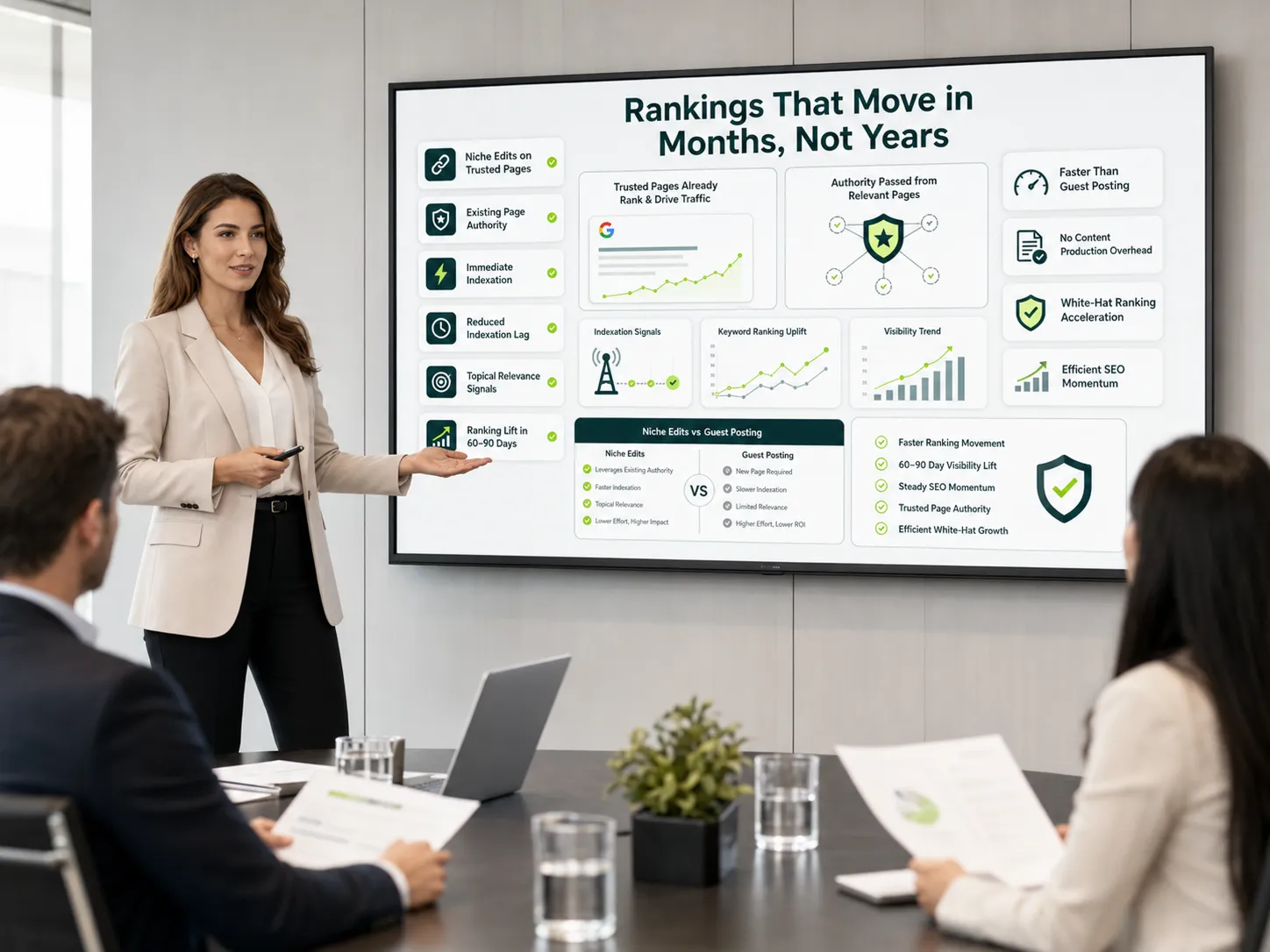
### Referral Traffic From Real Industry Readers
A niche edit isn’t just an SEO signal. The link appears before a reader already interested in your industry, often referencing the exact type of solution your business offers.
When someone is reading a niche publication’s deep dive into a topic where your product or service is the answer, the click-through rate is far higher than referral traffic from generic publications. The visitors arrive with context, intent, and category awareness.
Clients earning niche edits in high-readership industry publications often see referral traffic convert at rates closer to organic search than to typical referral channels.
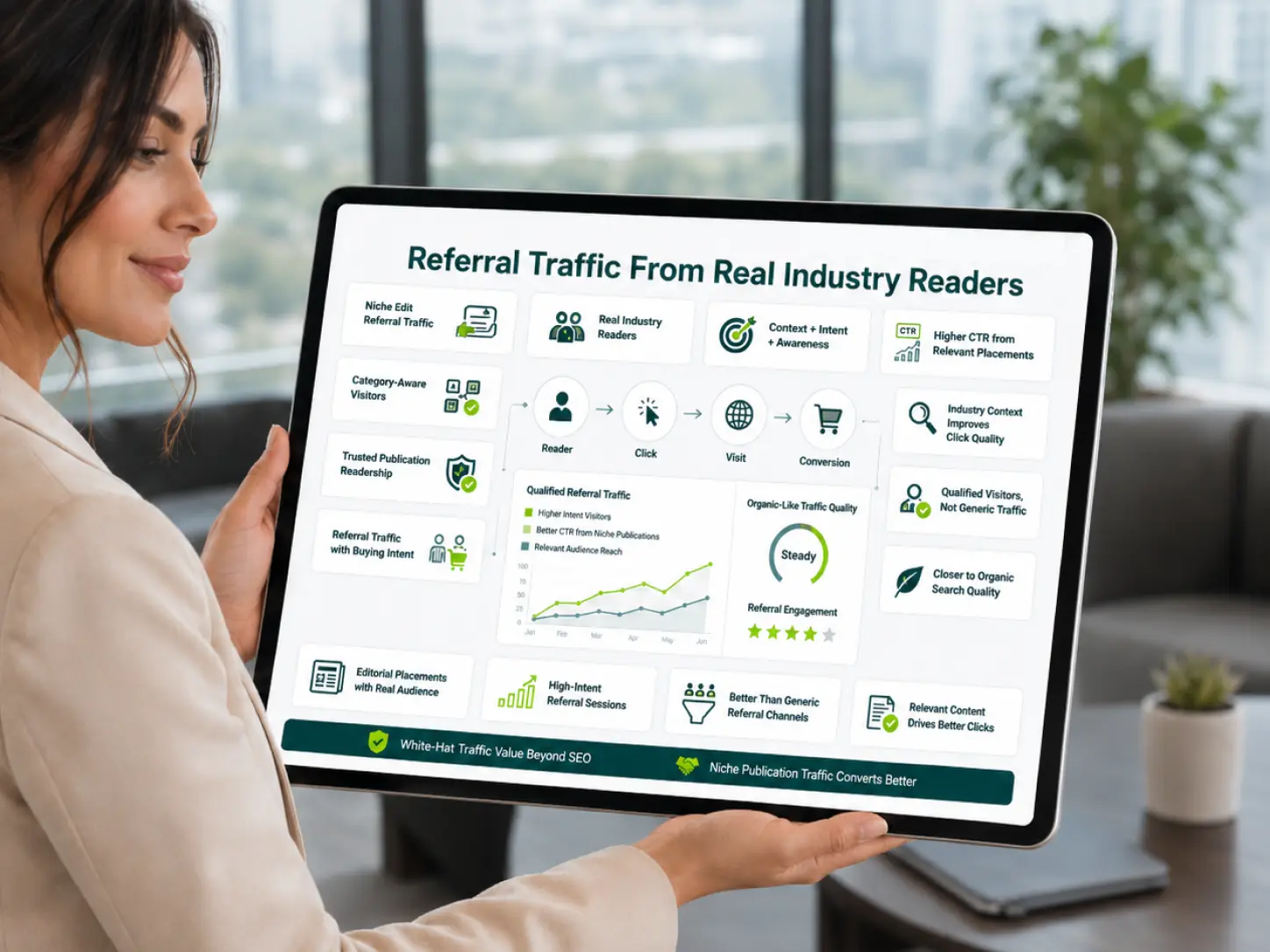
### Brand Visibility in Your Exact Category
Every niche edit serves as a brand mention in a publication your buyers, partners, and competitors read. Over the months, consistent mentions on niche authorities build category recognition, the kind that motivates buyers, shortlists before any direct search happens.
Search engines also track these signals. Google treats you as an established entity, which improves your visibility for branded and category-related queries when your business is mentioned consistently.
This is the dual return of niche edits: SEO authority and category awareness, earned at the same time in the same placements.
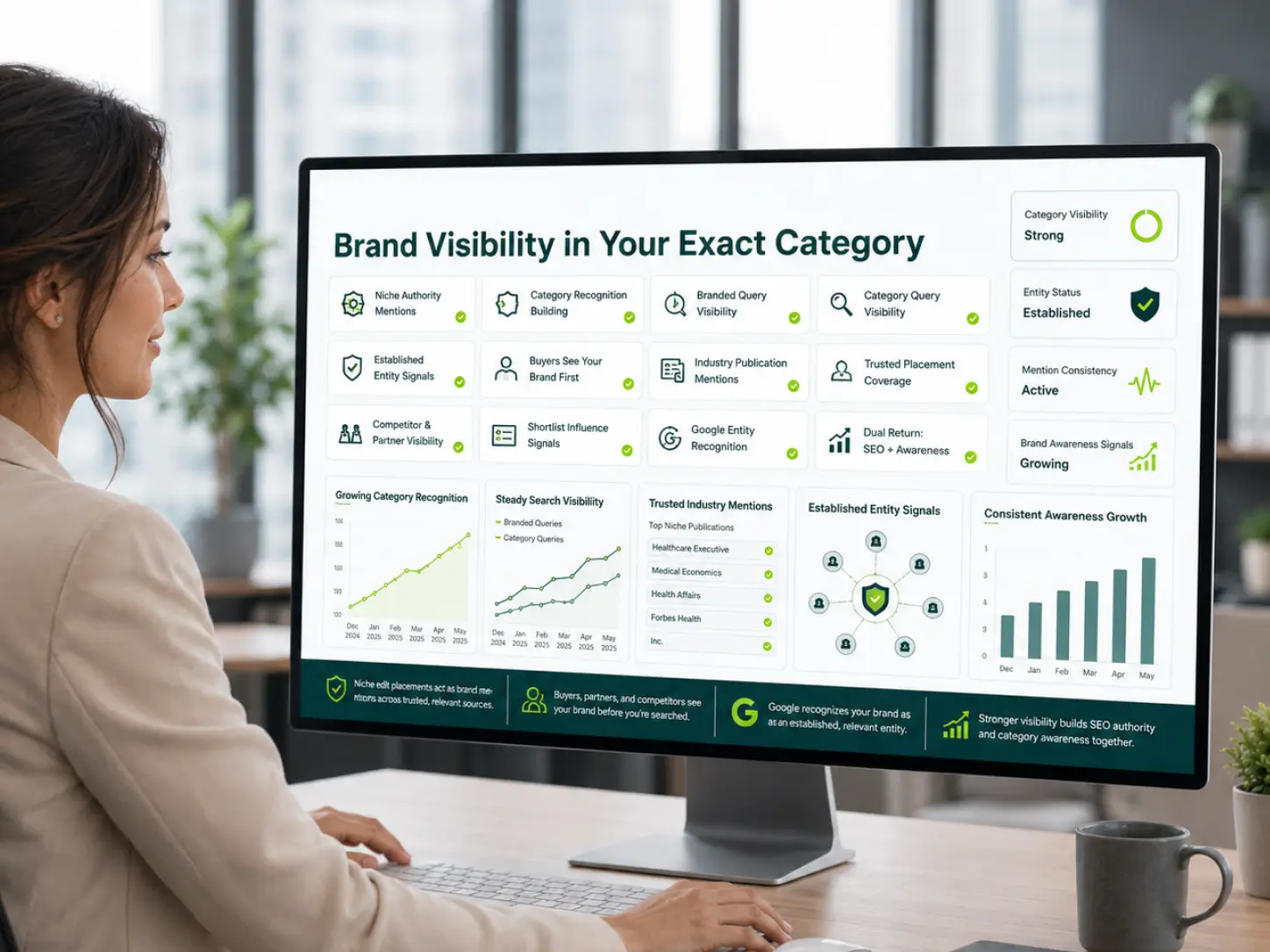
Client Success Stories
## What Clients Say About Our Niche Edit Service
Verified reviews from leaders who gained topical authority and rankings through industry-relevant link placements.
[View All
](https://outreachdesk.com/testimonial/)

4.8/5 

## 5/5 
Rating on Google



The level of relevance on every placement was unmatched. Every link came from a site we are familiar with in our industry, and the placements moved our category-specific keywords faster than any previous link campaign.

#### Head of SEO
B2B SaaS


We stopped paying for high-DR links that didn’t move anything. Switching to niche edits doubled our ranking gains in the same budget. The match between hosting articles and our targeted pages was strong every time.

#### Marketing Director
Ecommerce


The reporting showed us why niche relevance matters. Each placement came with context on why the site fit our industry and how the article connected to our target page. That transparency made every link feel earned.

#### VP Marketing
Fintech
Service Framework
## Investment, Timeline, and Deliverables
Every niche edit campaign is tailored to your industry, target keywords, and competitive landscape. Here’s what shapes your investment:

### Number of Edits Per Month
Most campaigns run between 8 and 25 niche-aligned placements monthly.

### Niche Depth and Competition
Highly competitive niches need deeper publisher vetting and more selective placement criteria.

### Target Domain Rating Range
Niche-relevant DR 40-60 sites usually outperform DR 70+ generic placements in terms of rankings.

### Campaign Duration
Most clients notice ranking movement in 2-3 months, with compounding gains over 6-9 months.
### Directional pricing:
Pricing and scope are shared as requested, tailored to your specific coverage needs, community mix, and growth goals. Custom proposals are available after an initial strategy call, outlining an approach tailored to your requirements, including community coverage, contribution approach, tracking, and a month-by-month roadmap aligned with your goals.
Book a Strategy Call
What You Get
## See Every Niche Match, Article Context, and Placement
You have complete transparency on why each placement fits your industry, where the link lives, and how it strengthens your topical authority.

### Live Link
URLs
You get direct access to every live published link placement, with the hosting article’s existing rankings and traffic context included.

### Niche Relevance Context
You see how each hosting site fits naturally within your industry and how the article connects to your target page on a topical level.

### Anchor & Target Mapping
You see the anchor text used and the destination page, with a complete distribution review to balance your overall profile.

### Topical Authority Summary
You get a clear monthly summary for each placement, which adds to your topical authority across the keywords that drive your business.
Our Approach
## A Niche-First Approach That Builds Topical Authority
You get placements selected for your industry and topical relevance, not just DR and traffic.
| Factor | Generic Link Insertion/ Marketplaces | |
| --- | --- | --- |
| Site Selection | Filtered by DR alone; sites span unrelated
industries with weak topical fit. | Filtered by industry alignment first, then DR and
traffic. Every site operates in your niche. |
| Article Vetting | Any article on the host site qualifies;
a topical match is rarely checked. | Each hosting article is reviewed for topical
alignment with your target page before outreach starts. |
| Outreach Method | Mass marketplace listings or automated emails
to generic publisher lists. | Manual one-to-one outreach to publishers
who cover your industry. |
| Anchor Strategy | Anchor decisions are made link-by-link
without distribution oversight. | Anchor text planned for the campaign to balance
your existing profile and avoid over-optimization risk. |
| Reporting Context | DR and traffic numbers reported
without industry context. | Each placement includes niche-specific reasoning,
article relevance, and the impact
on topical authority. |
Who We Help
## Industries We Support With Niche Edits
Whatever your industry, we have the niche-site relationships and editorial standards to earn placements that boost your rankings.
[

### SaaS &
Software
](/saas-link-building/)
[

### Ecommerce &
DTC
](/ecommerce-link-building/)
[

### B2B
](/b2b-link-building/)
[

### Enterprise
](/enterprise-link-building/)
[

### Emerging
Businesses
](/link-building-for-startups/)
[

### Real
Estate
](/real-estate-link-building/)
[

### Law Firms &
Legal
](/link-building-for-lawyers/)
[

### Dental
Practices
](/link-building-for-dentists/)
[

### Healthcare &
Fitness
](/health-fitness-link-building/)
[

### Financial &
Insurance
](/link-building-for-financial-websites/)

### Technology &
Innovation

### Consumer
Brands
Common Questions
## Frequently Asked Questions
Get clear answers on niche edits, covering safety, reporting, and editorial placement strategies.
### What is a niche edit?
A niche edit is a backlink placed within an existing and already published article on a site that operates in your industry. The hosting article is already indexed and ranking, so your link benefits immediately from that authority. The defining feature is the niche relevance. Every placement comes from a site that Google already recognizes as an authority on your topic. This sets niche edits different from generic link insertions, where industry fit isn’t the primary filter.
### What’s the difference between a niche edit and a link insertion?
[Niche edits](https://outreachdesk.com/niche-edits/) and link insertions use the same mechanic, adding a link to an existing article on someone else’s site. The difference is the selection criteria. Generic link insertions filter primarily on DR and accept placements across any industry. Niche edits filter first by industry relevance, considering only sites that operate in your exact niche. The result is stronger topical authority signals and faster ranking movement on category-specific keywords. Both approaches are white hat when executed correctly.
### Why are niche edits more effective than higher-DR generic links?
Google’s algorithms give weight to both topical relevance and raw authority. A DR 50 site that consistently publishes about your industry passes more ranking value to your specific pages than a DR 80 site that covers irrelevant topics. This is why five niche-aligned edits often outperform fifty generic placements for the keywords your business actually competes on. Topical authority is the signal that moves rankings on commercial-intent searches.
### How long does it take to see results from niche edits?
Most clients see early ranking movement within 60-90 days, faster than [guest posting](https://outreachdesk.com/guest-posts/), because the hosting articles are already indexed and ranking. Compounding gains show up at the 4 to 6 month mark as topical; authority builds through multiple niche-aligned placements. The speed comes from skipping the indexing lag for new content and the authority from pages that already perform.
### Are niche edits white hat or risky?
Niche edits are completely white hat, executed through [manual outreach](https://outreachdesk.com/manual-link-building/) to actual publishers, with editorially approved placements inside relevant existing content. The placements meet Google’s definition of natural editorial links. Real audience, real content, real reason to exist. The tactic only becomes risky when shortcuts are involved, such as marketplace purchases, paid placements without disclosure, or PBN insertions as niche edits. Every Outreach Desk placement is manually negotiated and editorially approved.
### How much do niche edits cost?
Niche edit campaigns usually start at $220 per placement for focused single-niche campaigns. Enterprise campaigns targeting competitive industries with deeper publisher vetting range from $280 to $350+ per edit. Pricing reflects the niche curation, manual outreach time, and editorial standards baked into each placement. You get a detailed proposal after your strategy call with exact placement quantities, target DR ranges, and a month-by-month roadmap.
## Ready to Earn Niche-Relevant Links That Move Rankings?
Get a senior strategist to map your niche, curate target sites, and build topical authority that fits your category-specific keywords.
Book a Strategy Call

4.8/5 _
Trusted by 500+ agencies &
1,000+ businesses worldwide.

---
---
title: "How to Run a Backlink Exchange Without Hurting Rankings"
url: "https://outreachdesk.com/backlink-exchange/"
lang: "en-US"
type: "post"
description: "Most SEO advice says backlink exchanges will tank your rankings. But Google rarely penalizes backlink exchanges when both sites are relevant, the content is useful, and the linking pattern doesn’t scream “we traded these.” Outreach Desk's experts handles prospecting, content,"
last_modified: "2026-05-18T11:51:01+00:00"
categories: [Link Building]
---
# How to Run a Backlink Exchange Without Hurting Rankings
Most SEO advice says backlink exchanges will tank your rankings. But Google rarely penalizes backlink exchanges when both sites are relevant, the content is useful, and the linking pattern doesn’t scream “we traded these.” [Outreach Desk’s experts](https://outreachdesk.com/) handles prospecting, content, and outreach so in-house teams can focus on strategy.
The exchanges that fail do so because one partner site delivers a worthless link buried in spam, or you waste weeks chasing a placement that never delivers.
A backlink exchange is **an SEO practice in which two sites agree to place links to each other to improve rankings, authority, and organic visibility.** It is considered safe when the partner’s site is relevant, the link is added in real content, and the trade looks natural and not a repeating pattern across your profile. If you miss any of these, you’re wasting effort.

**Key Takeaways
**
- Google bans excessive link exchanges, not all exchanges. A few relevant trades are safe; the risk comes from patterns, not single links.
- Two-way swaps (you link to them, they link to you) carry the most risk. Three-way and four-way exchanges spread the pattern but don’t remove it. Always check the structure before you agree.
- Most established sites have some reciprocal links. That’s normal. What matters is the pattern, not any single trade. Focus on keeping your link profile natural.
- Only swap if the link would be valuable even without a return. If you wouldn’t want the link on its own, skip the exchange.
- Disqualify partners quickly if you see low-quality outbound links, an irrelevant niche, and demands for identical anchor text on both sides.
## When a Backlink Exchange Still Works in 2026
A backlink exchange works when both sides get real editorial value, not just a link that technically exists.
**Three things have to align:
**
- The partner’s site is actually relevant to your topic, in the same niche, with an overlapping audience, or with directly complementary content.
- The link is placed inside content that justifies its existence on its own.
- The trade is one event in your link profile, not a pattern that repeats across dozens of sites.
When all three come together, the exchange looks like a normal editorial link between two sites that should already be connected. If even one is off, like a partner in a barely related niche or someone pushing for exact-match anchors, the trade looks fake to anyone checking your links.
## What Google Actually Considers a Link Scheme
The most important sentence in this article comes directly from [Google’s spam policies](https://developers.google.com/search/docs/essentials/spam-policies), which list “excessive link exchange” (‘link to me and I’ll link to you) or partner pages exclusively for the sake of cross-linking as link spam.
Google doesn’t ban link exchanges. It bans **excessive link exchanges** and partner pages that exist only for cross-linking.
The difference is intentional because Google understands that two relevant sites can link to each other as a normal feature of the web. But if someone builds the entire profile around that pattern, then Google can penalize the sites.
**Here’s how that plays out in practice:
**
- Three relevant exchanges across a year of link building
- A “Partners” page with 40 outbound links to sites that all link back to you.
- A coordinated swap network where the same 12 sites link to each other in rotation.
Most teams mistakenly read “Google penalizes link exchange” and think that exchanges are off-limits. They’re not. The mistake other teams make is reading “Google rarely catches link exchanges” and concluding it’s a free tactic. It isn’t.
The truth lives between those two, and it’s entirely controlled by how you run the trades.

## The Four Types of Backlink Exchange (And the Real Risk of Each)
There are more ways to swap links than most people realize. Each leaves its own footprint. That footprint determines your risk.**
**
### Two-Way (Direct Reciprocal) Exchange
Site A links to Site B. Site B links right back. That’s it.

This is the simplest yet riskiest type. Google’s systems spot two-way swaps fast, especially
- When both links go live at the same time
- Use similar anchor text
- Sit on pages with no real reason to mention each other
A few two-way swaps in your profile are normal. Every established site has them. But if 25 to 30 percent of your inbound links also point back out, that’s a pattern. That’s when Google starts devaluing your links, and manual reviews become more likely.
### Three-Way (ABC) Exchange
Site A links to Site B, Site B links to Site C, and Site C links back to A. The triangle hides the direct reciprocity.

This used to be the go-to move because it hid the obvious A-to-B swap.
Now, Google can still detect ABC patterns through network analysis, but the signal is weaker than that of direct swaps. Most of the time, Google devalues these links rather than penalizing them.
**Watch Out:**
A three-way trade is only worth it if at least one site has real editorial weight. Three weak sites trading links won’t help anyone.
### Four-Way (Cross-Network) Exchange
You own two sites. Your partner owns two sites. Their site C links to your site A. Your site B links to their site D; no two participating sites point to each other directly.

This setup leaves the smallest visible footprint, but you need to own two sites with real authority. Most teams don’t have that. Agencies and multi-brand operators use this, not single-site owners.
If you don’t already own two established, relevant sites, skip this tactic.
In our campaigns, selective three-way exchanges outperform direct swaps. They create fewer obvious patterns and allow tighter control over relevance.
### Multi-Site Editorial Trade (Listicle-Style)
This one isn’t always classified as an exchange, but in practice it’s exactly that. You write a listicle for Site X that features 5-6 brands as positive examples. Each featured brand links back to your site from its own content as a thank-you.

This one looks different. Your link sits inside real, useful content, a genuine listicle. The reciprocal links come from different sites and different contexts. Underneath, it’s still a coordinated trade.
It’s also the type of exchange that has the highest survival rate when scrutinized, because each individual link looks editorial in isolation. The aggregate pattern is the only giveaway, and it’s a faint one.
## How to Qualify a Partner Before You Reply Yes
Before agreeing to a backlink exchange, check eight things: topical relevance, real organic traffic, outbound link quality, indexing patterns, anchor text behavior, content standards, link placement history, and whether the site exists primarily to trade links.
In most audits, weak traffic quality, and obvious exchange footprints are the first reasons we reject a partner.
Most backlink exchange offers fail a five-minute audit. Skip the audit, and you’ll accept based on niche match alone, then spend months wondering why the link did nothing for your rankings.
**Run every offer through these eight checks:
**
### 1) Topical Relevance
If your site covers B2B SaaS link building and theirs covers generic blogging tips, the link is weak in both directions. The single best filter is to ask would you link to them even if they never linked back?
### 2) Real Organic Traffic, Not Just Metrics
Partners can fake their website’s DR (Domain Rating) and DA (Domain Authority) metrics. Open Ahrefs or Semrush and check their organic traffic over the last 12 months. Rising or stable traffic means the site is real. Flat or declining traffic with a high DR usually means borrowed authority, and Google’s gotten better at discounting it.
### 3) Their Outbound Link Patterns
Pull three of their recent posts. Are they linking to a normal mix of sources, or does every post drop links into a “useful resources” section at the bottom? If they’re selling links, your link will appear alongside casino sites and payday loan stores. That’s not the neighborhood you want.
### 4) A Dedicated Partner Page
Anyone running a “Partners,” “Resources,” or “Recommended Sites” page that exists to host outbound swap links is operating the exact pattern Google’s spam documentation calls out. Instant no.
### 5) Recent Content Quality
Read their last five articles. If the writing is clearly AI-generated filler, your link is sitting on content that adds no value to anyone. Google’s systems treat the [quality of the linking page](https://developers.google.com/search/docs/fundamentals/creating-helpful-content#content-and-quality-questions) as a part of signal. A great link on a weak page is a weak link.**
**
### 6) In-Content, Not Footer or Sidebar
Google easily spots footer and sidebar links, but generally ignores them. If the partner can’t or won’t place the link inside an editorial paragraph in a relevant article, it is not a [contextual placement](https://outreachdesk.com/contextual-link-building/) and the trade isn’t worth it.
### 7) Refuse Exact Match Anchor Demands
If the partner wants an exact commercial keyword as their anchor and offers you the same, you’re being invited into a coordinated anchor-text scheme. Say no. Ask for branded or descriptive anchors on both sides.
### 8) Their Turnaround Pressure
Real editorial trades take time. Both sides review, edit, and place. Anyone pushing “we can do this today, send the URL” is running a volume model. Google flags such volumes. A partner that fails on relevance fails outright.
In most audits we run, the biggest failure points aren’t DR or traffic. It’s the outbound link quality. Many exchange sites link out aggressively to unrelated industries, which quickly weakens trust signals.

## Where to Find Backlink Exchange Opportunities Worth Your Time
The best backlink exchange opportunities usually come from four places: existing industry relationships, conference and networking events, guest posting conversations, and competitor backlink research. These sources produce more relevant and natural exchanges because the relationship already exists before the link discussion starts.
Most places where backlink exchanges are advertised are places you don’t want links from. Public Slack groups, Facebook groups, and Reddit threads for “link swaps” are packed with low-relevance sites. The partners you find there are the ones nobody serious will trade with.
That doesn’t mean exchanges only happen by accident. The good ones often come from places where the partner isn’t asking for one.

Four sources that consistently produce real exchange opportunities:
### 1) Existing Client and Vendor Relationships
Think of the SaaS partners you integrate with, vendors whose tool you use in case studies, and customers whose results you cite. These are natural editorial reasons to link, and the return link is easy to ask for. The relationship justifies the trade on its own.
### 2) Conferences and Industry Events
A genuine conversation with another founder or marketer at an event creates the editorial weight that makes a trade defensible. Links from these relationships often sit in real content because the person is actually familiar with your work.
### 3) Targeted Guest Post Outreach
When you pitch a [targeted guest post](https://outreachdesk.com/guest-posts/) to a relevant publication, negotiate a contextual link back to your site within an existing article. They get a quality article, you get an in-content link to your existing content from a different post on their site over the next quarter. The trade is implicit, the timing is offset, and the anchor is editorial.
### 4) Mutual Mentions Inside Original Research
If you’ve published proprietary research, other sites in your niche will reference it. [Reach out](https://outreachdesk.com/link-building-outreach/) to those sites and offer a reciprocal mention inside a relevant piece you’re working on. The trade exists, but each link is genuinely useful in context.
If you get offers from an unrecognized sender and have these four sources, skip them.
- Public Facebook link-swap groups
- Generic SEO Slack communities
- Reddit link-exchange threads
- Cold InMail offers
These sources have one thing in common: The partners on those channels are operating in volume.
## Red Flags That Should Kill an Exchange Before You Send the Link
Reject backlink exchanges immediately if the site shows obvious link-selling behavior, thin content, irrelevant topics, excessive outbound links, traffic inconsistencies, spam-heavy anchor text, or poor indexing quality. Strong metrics alone do not offset these risks, especially when the site’s primary purpose appears to be exchanging or selling links.
Some signals are instant deal-breakers. If you spot any of these, the trade is dead, no matter how good the metrics look.
**1) A “Partners” or “Useful sites” page is used as the link destination **
This is the exact pattern Google’s policy describes. Don’t put your link on it.
**2) An offer to swap multiple links across “your network”
**
Anyone pitching a ‘site network’ runs the exact coordinated scheme that triggers Google’s spam detection.
**3) Pressure for matching anchor text on both sides
**
Real editorial links don’t share anchor text by design. This is coordinated manipulation.
**4) Identical outreach copy you’ve seen before
**
If the email template looks like one you’ve received from three other senders, you’re talking to a service, not a person. The link they offer is one of dozens placed that week.
**5) A request to remove the disclosure or nofollow attribute they have on outbound links
**
They know what they’re doing. Walk away.
**6) A site whose top-ranking pages are clearly thin or AI-generated
**
A link from a low-quality page is low-quality, regardless of the domain’s metrics.
**7) Anchor or topic combinations that don’t match the partner’s existing content
**
If they’re proposing to add a paragraph about your topic to a post that has nothing to do with it, the link insertion will look manufactured. Google recognizes off-topic insertions.
One of our clients was in an exchange arrangement with a “marketing resources” aggregator site. We pulled them out in Q2 2025. Within three weeks, the affected pages stabilized in rankings.
The inbound link wasn’t the problem; the outbound links to a low-quality cluster triggered a manual review.
**Tip:**
Read the offer out loud. If it sounds like the same pitch sent to ten other sites that day, pass.
## The Better Question: Should You Be Doing Exchanges at All
Most teams that ask about backlink exchanges are under pressure to hit a link quota, and exchanges feel faster than they are.
Over a year, the hours you spend qualifying exchange offers, negotiating placements, checking if the return link stays live, and fixing swaps that go wrong add up fast. You’ll spend more time than if you just ran a [broken link campaign](https://outreachdesk.com/broken-link-building/) or [unlinked brand mentions reclamation](https://outreachdesk.com/unlinked-mentions/). Both of those give you one-way editorial links and skip the entire risk profile.
Exchanges still have a place. When a relationship is genuinely there, a real partner, a real co-marketing arrangement, a real editorial fit, the trade is fast and useful. As a primary [link acquisition tactic](https://outreachdesk.com/link-acquisition/), the math doesn’t work for most teams. Exchanges only feel faster because the partner lands directly in your inbox.
Be honest about which situation you’re in.
## The 60-Second Test Before You Agree to Any Backlink Exchange
Three simple yes-or-no questions can eliminate most bad backlink exchange offers in under a minute. If any answer is no, the exchange usually isn’t worth pursuing, regardless of DR, traffic screenshots, or premises about future collaboration.
Open the partner’s site in a new tab. Answer these three questions:
- Would you link to this site if there were no return links on the table?
- Would you trust the editor on the page where your link will sit to write about your topic accurately?
- Would you be comfortable telling a client that this site appears in your link profile?
If the answer to all three is yes, the deal is probably worth running. If the answer to any one is no, decline. Everything above is just a longer version of these three questions.
## Conclusion
Most backlink exchanges fail because teams focus on metrics before relevance and trust. A high-DR site does not help much if the audience, content, and linking behavior feel artificial.
The exchanges that still work in 2026 are usually selective, relationship-driven and difficult to scale. Once a site starts treating link swaps like inventory management, the quality drops fast and the footprints become obvious.
Not every backlink exchange is a bad idea. Most problems come from poor partner selection and repetitive patterns.
### Want a safer approach to backlink exchanges?
Get a clear strategy focused on relevant partnerships and long-term SEO value.
[Book a strategy call](/contact-us/)
### 1) Is backlink exchange against Google’s guidelines?
Not by itself. [Google’s spam policies](https://developers.google.com/search/docs/essentials/spam-policies) specifically ban “excessive link exchanges” and “partner pages exclusively for the sake of cross-linking,” not normal reciprocal linking between relevant sites. The line is pattern density and intent, not the existence of any single trade.
### 2) How many backlink exchanges are too many?
There’s no published number, but the practical threshold is your ratio, not your count. If reciprocal links account for more than 25-30% of your inbound links, the pattern looks manufactured. A handful of trades over a year is invisible. A monthly cadence of 5 swaps is a pattern that Google’s systems notice.
### 3) What’s the difference between a 2-way and 3-way (ABC) link exchange?
A two-way exchange is direct: Site A and Site B link to each other. A three-way exchange routes through a third site: A links to B, B links to C, and C links back to A. The triangle removes the A-to-B footprint, which is why three-way trades are harder for Google to detect than direct swaps. Google’s network-level pattern detection can still surface them, but the signal is weaker.
### 4) Can I do a backlink exchange with a competitor?
You can, but most of the time you shouldn’t. The reason isn’t algorithmic; it’s that competitors usually want exact-match commercial anchors and equivalent content placements. That symmetry is exactly the pattern that triggers manual review. Exchange works better with an adjacent site than with direct competitors.
### 5) How do I know if a partner site is safe to exchange links with?
The fastest filters: do they have real organic search traffic over the last 12 months? Do they have a “Partners” or “Resources” page used as a link destination? Are their last few articles genuinely useful, or AI-generated filler? If they fail on these filters, the link won’t carry weight even if you structure the trade safely.
### 6) Will Google detect my backlink exchange?
In most individual cases, no. Google doesn’t analyze each exchange individually. What they do well is [network-level pattern detection](https://developers.google.com/search/docs/essentials/spam-policies?visit_id=639137287890222257-3087630809&rd=1#link-spam): nothing when reciprocal links concentrate, when the same domains keep appearing in each other’s profiles, when anchor text repeats across trades. The risk isn’t getting caught on one swap. The risk is the pattern adding up across many.
### 7) Is link exchange better than buying links?
For most cases, neither is the right answer. Buying links violates the direct policy. Exchanges carry a softer pattern risk. Both are weaker per-link than earned editorial coverage from [white hat link building strategies](https://outreachdesk.com/white-hat-link-building-strategies/). If you’re choosing between exchanges and paid placements as your primary tactic, you’re focused on the wrong problem. The better question is what content or research you can produce that other sites would link to without negotiation.
---
---
title: "White Hat Link Building Service That Protects Your Rankings"
url: "https://outreachdesk.com/white-hat-link-building-service/"
lang: "en-US"
type: "page"
description: "White Hat Link Building White Hat Link Building Service That Protects Rankings Your site earns 100% manual, Google-compliant backlinks through editorial outreach, building lasting authority that survives every update without putting your domain at risk. Manual editorial outreach Google-compliant tactics"
last_modified: "2026-05-29T12:21:29+00:00"
custom_fields:
header_style: "header-style-1"
footer_style: "footer-style-1"
---
# White Hat Link Building Service That Protects Your Rankings
White Hat Link Building
# White Hat Link Building Service That Protects Rankings
Your site earns 100% manual, Google-compliant backlinks through editorial outreach, building lasting authority that survives every update without putting your domain at risk.
_
Manual editorial outreach

Google-compliant tactics

No PBNs or link schemes
Book a Strategy Call

4.8/5 _
Trusted by 500+ agencies &
1,000+ businesses worldwide.
Manual Outreach
100%
Campaign Dashboard
LIVE
DOMAIN RATING
24 → 47
+23 points
ORGANIC TRAFFIC
+720%
3,200 → 26,200
CORE UPDATES PASSED
4 of 4
100% stability
EDITORIAL PLACEMENTS
188
156 unique domains
_
Average Placement DR
40 – 95










Service Overview
## What White Hat Link Building Actually Means
White hat link building is earning backlinks through manual outreach, editorial relationships, and content that publishers genuinely want to link to. For the broader picture of [what white hat work means in 2026](https://outreachdesk.com/white-hat-seo/), see our companion guide. The difference between white hat and black hat is clear. Black hat covers everything that Google flags, such as PBNs, link exchanges, paid placements as editorial, and low-quality networks.
Google’s SpamBrain detects manipulative link patterns, and core updates target unnatural link profiles. Sites built using shortcut link building often lose rankings with every update, but sites built on white-hat methods keep growing.
For most businesses, white hat is the sustainable path. Real outreach may take more time, but ranking gains stay. You’re investing in authority, not in the positions that vanish with the next update.
Three things that define a strong white hat link:

### Editorial Integrity
The link appears within the content publishers reviewed and approved based on content quality, not in a sponsored block, footer, or sidebar.

### Real Publication
The hosting site has genuine traffic, audience, and a clean backlink profile that signals credibility.

### Manual Outreach
Each placement comes from one-to-one outreach, not automated emails, link exchanges, or marketplaces.
How We Work
## How Your White Hat Campaign Works
A safe, transparent workflow built on manual outreach and editorial standards that Google rewards.
### Backlink Profile Health Check
Your campaign starts with a health check of your existing backlink profile before any new links are built. Your campaign runs the audit through Ahrefs, Semrush, and Google Search Console to identify any toxic links, suspicious patterns, or anchor text issues that could trigger penalties. Most teams partner with a dedicated link building agency to run these campaigns end-to-end.
Cleanup is done first, if needed. You’ll see which links are at risk, why they’re flagged, and whether to disavow them. New link building starts once your profile is in a safe space.
### Site Quality and Outreach Standards
Your team builds the prospect list using strictly white hat criteria. Every site is checked manually to determine organic traffic, real readership, content quality, link profile health, and editorial standards.
Removal of sites that fail the checks. No DR-only filtering, no PBNs, no marketplaces. You only see prospects that meet the same standards Google uses to define authoritative sources, with complete transparency into why each one made the list.
### Content that Earns Editorial Approval
Every placement requires content that the publisher genuinely wants to publish. Your writing team creates topics, angles, and assets that align with the publisher’s editorial standards, audience interests, and coverage.
The content should be a standalone. Editors approve it because it’s useful to readers, rather than being packaged with a payment for a link. This makes the placement white hat; the content earns its spot, not the deal behind it.
### Manual Outreach to Real Editors
Your outreach specialists contact editors and publishers directly. Every email is personalized and tailored to a specific, recent piece in that publication. Without mass automation, outreach templates to 500 sites.
Each conversation focuses on editorial fit, not link requests. Publishers respond because the pitch shows a genuine understanding of their site, not because it offers payment. This is a slower process than automated outreach, but it’s the only mode that holds up under Google’s scrutiny.
### Placement Review and Anchor Text Compliance
When a placement goes live, your team verifies it against the white hat standards, the link appears in the main content, the anchor text is placed naturally, the page is indexed, and the dofollow attribution is correct.
Anchor text is reviewed for risk of over-optimization. If a placement has the wrong anchor or appears in a sponsored block, your team corrects it or replaces it. You don’t have to pay for placements that don’t meet white-hat standards.
### Transparent Reporting and Long-Term Monitoring
You receive a detailed monthly report covering every live placement, anchor text used, domain rating, editorial context, and indexation status. The report shows exactly how each link was earned, including the history of outreach when relevant.
Every link is monitored after placement. If a publisher’s quality drops, an article gets removed, or a site shows signs of becoming unsafe, your team flags it and arranges replacements. White hat focuses on long-term link quality

Expected Results
## Outcomes that White Hat Link Building Delivers
When a link is earned through genuine editorial standards, your authority compounds into rankings and traffic that holds through every update.
- 1. Penalty-Free Growth
- 2. Algorithmic update stability
- 3. Compounding Authority
- 4. Long-Term Brand Trust
### Rankings That Don’t Carry Hidden Risks
Most rankings are tied to link building losses because they come from sites that grew through shortcut tactics, paid networks, or low-quality marketplaces. White hat campaigns avoid that risk entirely.
**The result:** Your rankings move up steadily without the penalty that comes with manipulative tactics. One ecommerce client recovered from a previous penalty and grew organic traffic by 220% within seven months by switching to a white hat link building model.
It’s not just about the fastest growth on paper, but it’s about the only growth that lasts. White hat clients are less likely to experience an overnight loss in rankings when Google introduces a spam update.
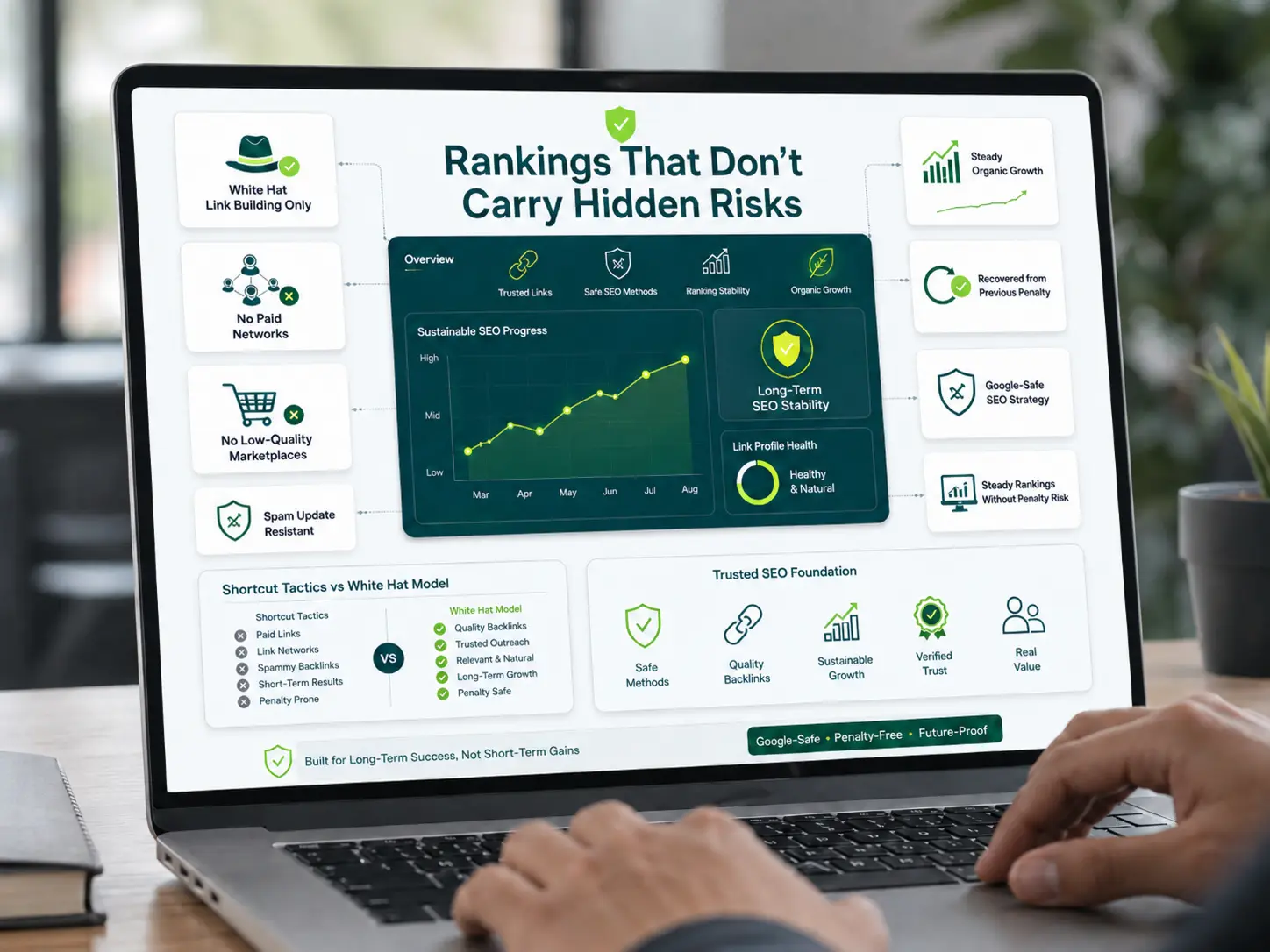
### Visibility that Holds Through Every Core Update
Google introduces updates several times a year. Each update targets sites with unnatural link patterns, low-quality content, or manipulative SEO tactics. Sites built with shortcuts lose visibility after every update.
White hat link building is designed to survive these updates. Every placement matches Google’s definition of an editorial link, including real content, an audience, and a reason to exist. SpamBrain and the border spam detection systems don’t flag links earned this way because there’s nothing to flag.
Clients with white hat campaigns often hold or improve rankings during every core update, while competitors lose visibility.
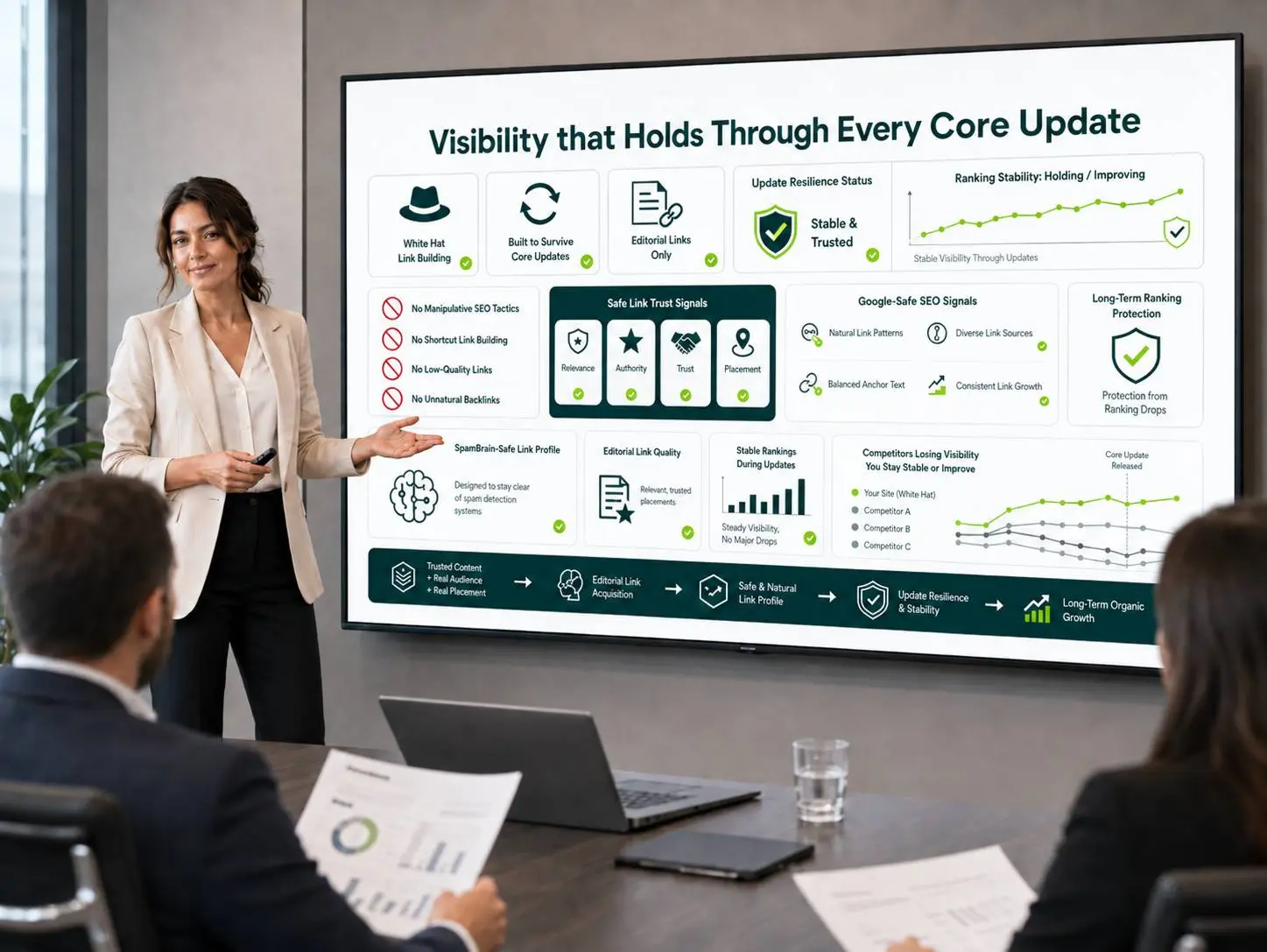
### Authority that Builds Over Time, Not Rents
Every white hat placement adds a real link to your profile. Unlike links from paid networks, these stay live and continue to work as long as the publisher’s site remains active.
That value is built over time. Your site’s authority grows steadily. New content ranks faster, and existing pages hold rankings, because the links pointing to them come from sources Google actually trusts.
Data from Ahrefs consistently show that pages with fewer, genuine links outrank pages with more links from low-quality sources.
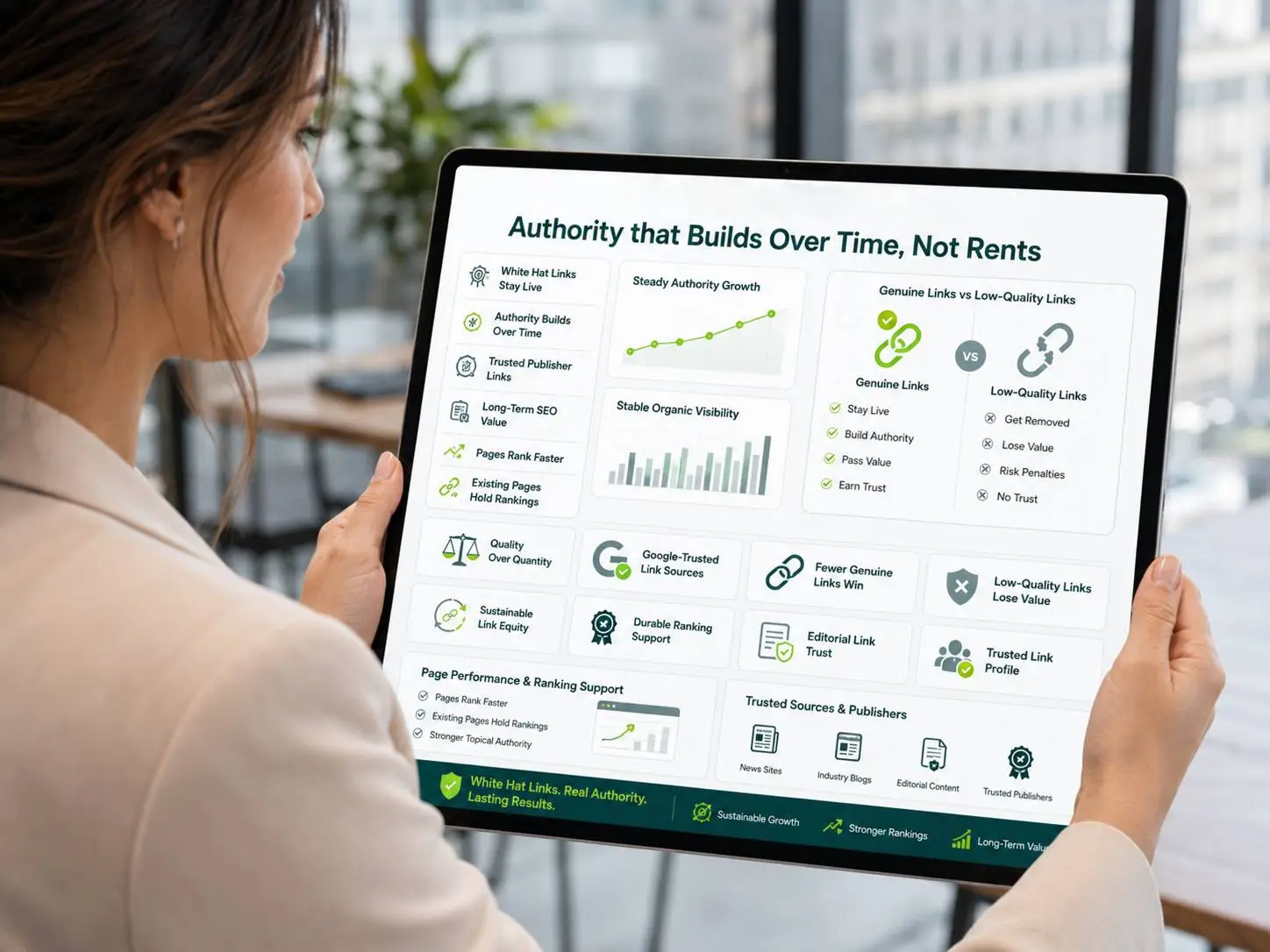
### Brand Reputation Search Reflects
White hat placement appears in publications your audience already reads. Every link doubles as a brand mention in front of actual readers, building recognition along with SEO value.
Search engines pick up signals. When your brand is consistently mentioned by trusted sources in your industry, Google starts recognizing it as an established entity. That entity status protects rankings during updates and boosts visibility for both branded and unbranded queries.
This is the return of white hat work. Real readers see your brand on real sites, and Google sees the same authority signals at the same time.
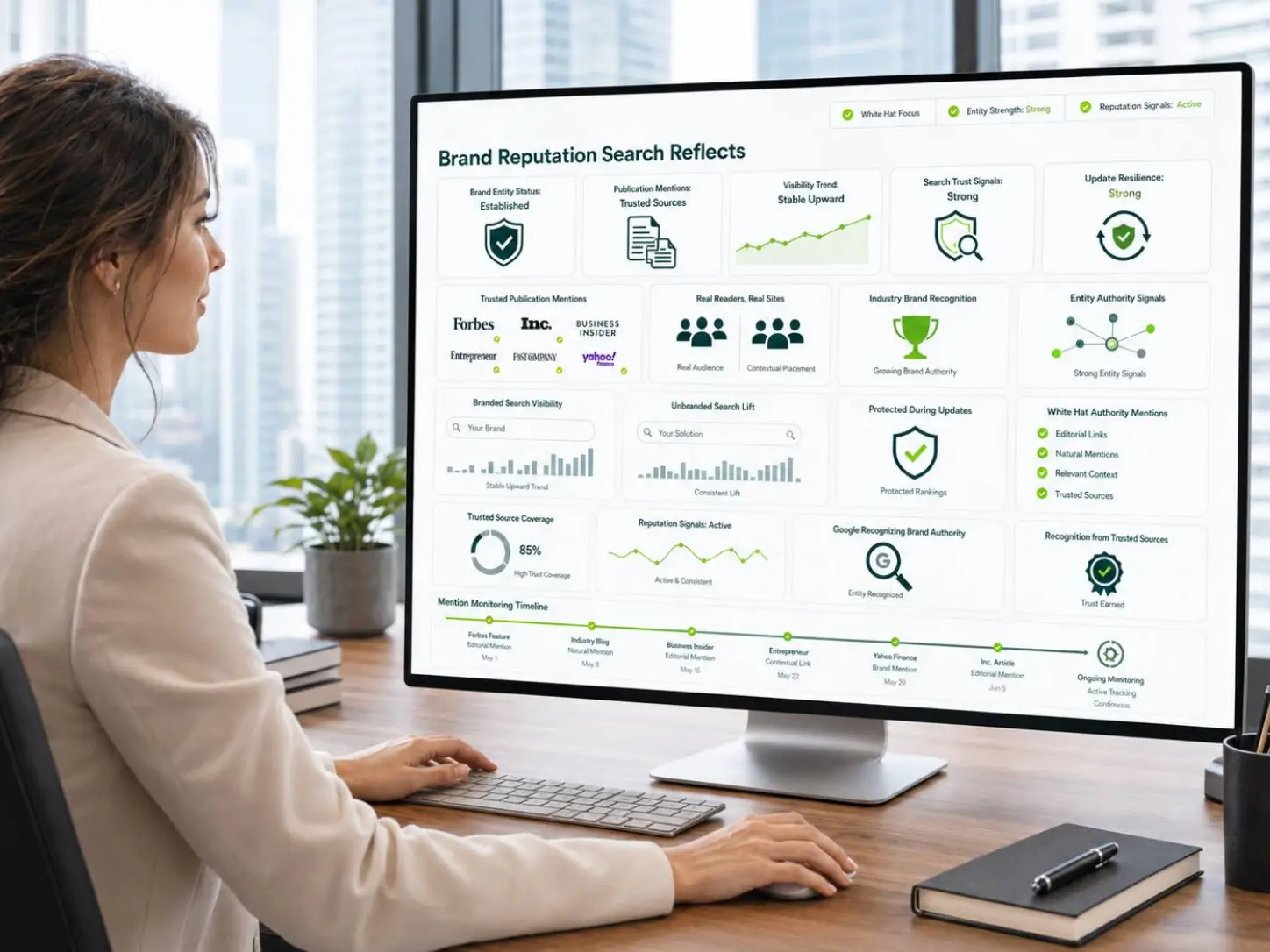
Client Success Stories
## What Clients Say About Our White Hat Link Building
Reviews from leaders who gained lasting authority through safe, editorial link building.
[View All
](https://outreachdesk.com/testimonial/)

4.8/5 

## 5/5 
Rating on Google



We gained a manual penalty from a previous agency. The audit was thorough, the cleanup was ethical, and the new white hat campaign brought our rankings back stronger than before the penalty.

#### VP Marketing
Healthcare


Every placement came with a complete editorial backstory. We could see the publication, the editors, the topic angle, and the placement negotiation. The transparency is what kept us with them through three contract renewals.

#### Head of SEO
B2B SaaS


We‘ve been through four core updates since starting with Outreach Desk. Every single update has either held our rankings steady or moved them up. That stability is what white hat actually delivers.

#### Marketing Director
Financial Services
Service Framework
## Investment, Timeline, and Deliverables
Every white hat link building campaign is tailored to your industry, competitive landscape, and growth goals. Here’s what shapes your investment:

### Number of links Per Month
Most campaigns run between 8 and 30 editorial placements monthly.

### Target Domain Rating Range
Placement on DR 40-60 sites costs less than placement on DR 70+ sites.

### Content Requirements
Most placements require original content development, and existing assets need work to support new opportunities.

### Campaign Duration
Most clients observe ranking movements in 3-4 months, with compounding gains over 6-12 months.
### Directional pricing
Pricing and scope are shared as requested, tailored to your specific coverage needs, community mix, and growth goals. Custom proposals are available after an initial strategy call, outlining an approach built around your requirements, including community coverage, contribution approach, tracking, and a month-by-month roadmap aligned to your goals.
Book a Strategy Call
What You Get
## See Every Placement, Every Editor, Every Decision
Complete transparency on how each link was earned, where it lives, and why it meets white hat standards.

### Live Link URLs
You get direct access to every live placement with complete editorial context, so you can verify each link at any time.

### Outreach Transparency
You can see how each placement was earned, including the publisher, editorial angle, and outreach approach.

### Anchor & Target Mapping
You see the anchor text used for each placement and the destination page, with a complete review to avoid over-optimization.

### Compliance Summary
You get a clear summary confirming that every placement meets white hat standards, with monthly health checks across the entire profile.
Our Approach
## A Safety-First Approach that Survives Every Update
You get links built on transparent editorial standards, rather than shortcuts that put your domain at risk.
| Factor | Automated Link Services | |
| --- | --- | --- |
| Outreach Method | Mass automation, marketplace listings,
or pre-paid networks. | 100% manual outreach to real editors with personalized
pitches tied to specific recent content. |
| Site Vetting | Filter by DR alone; sites often have purchased
traffic or thin content. | Manual quality check on traffic, audience, content, link
profile, and editorial standards. Strict pass/fail. |
| Placement Type | Sponsored sections, footer links, sidebar widgets,
or unrelated content blocks. | In-body editorial placements only, inside content the
publisher genuinely wanted to publish. |
| Risk Profile | Penalty risk on every update; rankings
can collapse overnight. | Zero exposure to known spam patterns. Built to
survive every core and spam update. |
| Transparency | Limited reporting; the outreach process is hidden behind
vague “we have relationships” language. | Complete transparency on each placement, including
publisher, editor, outreach angle, and approval process. |
Who We Help
## Industries We Support With White Hat Link Building
Regardless of your industry, including the most regulated and risk-sensitive industry, you get links that meet the strictest editorial standards.
[

### SaaS &
Software
](/saas-link-building/)
[

### Ecommerce &
DTC
](/ecommerce-link-building/)
[

### B2B
](/b2b-link-building/)
[

### Enterprise
](/enterprise-link-building/)
[

### Emerging
Businesses
](/link-building-for-startups/)
[

### Real
Estate
](/real-estate-link-building/)
[

### Law Firms
& Legal
](/link-building-for-lawyers/)
[

### Dental
Practices
](/link-building-for-dentists/)
[

### Healthcare &
Fitness
](/link-building-for-dentists/)
[

### Financial &
Insurance
](/link-building-for-financial-websites/)

### Technology &
Innovation

### Consumer
Brands
Common Questions
## Frequently Asked Questions
Clear answers on how local citations affect rankings,and what to expect from a managed campaign.
### What is white hat link building?
[White hat link building](https://outreachdesk.com/white-hat-link-building-strategies/) is the practice of earning backlinks through [manual outreach](https://outreachdesk.com/manual-link-building/), editorial placements, and content that publishers genuinely want to publish, without using tactics that violate Google’s spam policies.
### How is white hat different from black hat or grey hat link building?
Black hat tactics violate Google’s guidelines. PBNs, paid links without disclosure, link schemes, and automated outreach all fall in this category. Grey hat appears in the middle, using tactics Google discourages but doesn’t always penalize, such as guest posting on accept-all networks or buying sponsored content marked as editorial. White hat aligns most closely with Google’s guidelines, which is why the only model that holds up through algorithm updates and manual reviews.
### Will white hat link building actually move my rankings?
Yes, though the pace is steadier than black hat shortcuts that promise overnight results. Most clients start seeing ranking movement within 3-4 months, with compounding gains over 6-12 months as topical authority builds. The difference is durability. White hat ranking gains hold through algorithmic updates and don’t reverse during spam crackdowns. Sites that grew through shortcuts often lose those gains within a year.
### Why does white hat link building cost more than cheap link services?
Real outreach takes time. Each pitch is personalized, each placement requires editorial-quality content, and each publisher requires individual relationship-building. Marketplace links cost less because they sell pre-built placements, often on networks specifically built to sell links. The cost difference is real, but white hat links retain their value over time, while shortcut links are frequently devalued or can cause penalties.
### Can white hat link building recover a site that’s already been penalized?
Yes, when paired with proper cleanup. Recovery starts with a backlink audit to identify the toxic links that triggered the penalty, followed by a disavow submission and outreach to request link removals where required. Once harmful patterns are cleaned up, a white-hat campaign rebuilds authority through editorial placements that comply with Google’s guidelines. Most penalty recoveries take 6-12 months, depending on the severity of the original issues.
### How do I know the links I’m getting are actually white hat?
Every placement comes with complete transparency. You see the publication, the editor or contributor who approved the placement, the outreach approach used, the article context where the links appear, and the anchor text decision. You can verify any placement by visiting the live URL and reading the surrounding content. If a placement fails to meet white hat standards, the team replaces it at no additional cost.
## Build Links That Don’t PutYour Site at Risk
Your strategist will audit your profile, plan your campaigns, and earn links that survive every update.
Book a Strategy Call

4.8/5 _
Trusted by 500+ agencies &
1,000+ businesses worldwide.

---
---
title: "Local Citation Services That Strengthen Local Rankings"
url: "https://outreachdesk.com/local-citation-services/"
lang: "en-US"
type: "page"
description: "Local Link Building Local Citation Services That Strengthen Local Rankings Your business creates accurate NAP listings on directories, review platforms,and publications; it builds the citation foundation that AI platforms rely on to identify and recommend you in local search visibility."
last_modified: "2026-05-22T13:50:09+00:00"
custom_fields:
header_style: "header-style-1"
footer_style: "footer-style-1"
---
# Local Citation Services That Strengthen Local Rankings
Local Link Building
# Local Citation Services That Strengthen Local Rankings
Your business creates accurate NAP listings on directories, review platforms,and publications; it builds the citation foundation that AI platforms rely on to identify and recommend you in local search visibility.
_
Accurate NAP across platforms that matter

Directories driving local traffic

Complete citation visibility
Book a Strategy Call

4.8/5 _
Trusted by 500+ agencies &
1,000+ businesses worldwide.
Data Aggregators
4 Major
Campaign Dashboard
LIVE
MAP PACK
14 → 3
+11 points
GBP CALLS
+184%
47 → 134
CITATION ACCURACY
62% → 100%
+38%
LISTINGS BUILT
165
142 unique domains
_
NAP Inconsistencies Fixed
40+










Service Overview
## What Local Citation Services Actually Mean
Most local businesses have a citation problem they don’t even know about. Your name, address, and phone number (NAP) are live on dozens of platforms, some you submitted, most you didn’t. A citation service audits what’s live, fixes what’s wrong, and builds your presence on directories and data aggregators that feed Google, Apple Maps, Bing, and AI assistants like ChatGPT.
A citation is any external mention of your business’s NAP details. Structured citations are formal listings on Yelp, Google Business Profile, and BBB. Unstructured citations are informal listings on blog posts, news articles, or a local directory that reference your business without a standard listing format.
Outreach Desk builds citations manually, one verified source at a time. No bulk tools, no spam directories. For local businesses, citations are one of the cost-effective ways to improve local visibility. They help you strengthen your map pack rankings, build NAP consistency that is trusted by Google’s algorithm, and establish your presence where local customers are searching.
Three things that define strong local citations:

### NAP Accuracy
Keep the NAP details consistent across all platforms; repeated inconsistencies can weaken your chances of appearing in the 3-pack.

### Source Quality
Citations go on platforms that Google actually weights, such as data aggregators, established directories, and industry-specific sources that your competitors occupy.

### Manual Submission
A specialist builds and verifies every citation in real time. No scraping, no automation, no listings that vanish after a free tier expires.
How We Work
## How Your Local Citations Are Built and Maintained
Start by auditing, then build. Most agencies skip the first step, and they don’t see their citations rank.
### Citation Audit
First, we find out what’s already live. Our team scans 200+ primary and secondary sources, exports every listing we find, and flags anything that feels off, such as wrong phone numbers, outdated addresses, pre-rebrand business names, and incomplete profiles.
Inconsistency at this stage directly affects map pack visibility. Most clients enter the audit confident that their listings are accurate. They almost never are. The audit not only identifies a problem, but it also tells you what needs to be fixed before citation.
### NAP Standardization
Before any single citation goes live, your canonical NAP gets locked. Exact business name, formatted address, primary phone, category selections, URL. This document serves as your single source of truth for every submission. No variations, no assumptions.
Even a suite number formatted directly across platforms creates an inconsistency that Google flags. Skip this step, and you’re scaling the mess you already have.
### Primary Citation Setup
Google Business Profile comes first, then Bing Places, Apple Business Connect, Facebook, Yelp, and core data aggregators such as Data Axle, Neustar/Localeze, and Foursquare. These platforms feed hundreds of directories.
A corrected aggregator listing propagates accurate NAP details across the web without manual submission to every source. Get them right, and your digital footprint begins to self-correct. Get them wrong, and every new listing inherits the error.
### Industry and Local Directory Placement
Then comes the long tail, industry-specific directories first, such as BBB, Angi, HomeAdvisor for home services, Avvo, FindLaw, Justia for legal, Healthgrades, and Vitals for medical.
These platforms carry specific authority in a category that Google recognizes when identifying local relevance. Then, local chamber pages, city directories, and regional publications. We submit, verify, and tie every listing back to your NAP manual.
### Duplicate and Error Cleanup
This is where the biggest wins usually come from. Duplicate GBP listings split your review and often outrank your real profile. Old addresses are kept as they are on Apple Maps for years without connection.
Wrong phone numbers propagate across aggregators into hundreds of directories. We merge duplicates through each platform’s official verification process without shortcuts and suppress listings that shouldn’t exist.
### Ongoing Monitoring and Reporting
Citations aren’t a one-time thing. Platforms change their formats as per requirements. Old listicals resurface with stale details. A business rebrand or phone number change can unravel months of citation work overnight.
Mostly monitoring catches drift before it compounds into ranking loss. A live dashboard tracks every citation, its verification status, and any items that need attention.

Expected Results
## The Outcomes That Local Citations Deliver
Four outcomes compound over time. You’ll see them in your data before you see them in our reports.
- 1. Local Visibility
- 2. Trust Signals
- 3. AI Visibility
- 4. Long-term stability
### Stronger Map Pack Visibility
Citation consistency ranks among Google’s most weighted local ranking factors. Businesses with clear, consistent NAP across 50+ platforms regularly outrank competitors with strong backlink profiles, because Google’s local algorithm prioritizes data trustworthiness over raw domain authority.
When your NAP details match across tier-one directories and industry-specific platforms, the algorithm can verify your business and confidently show it in the 3-pack. When it can’t, it defaults to a competitor it can verify.
The 3-pack rewards trust. Accurate, consistent citations are how that trust gets maintained.
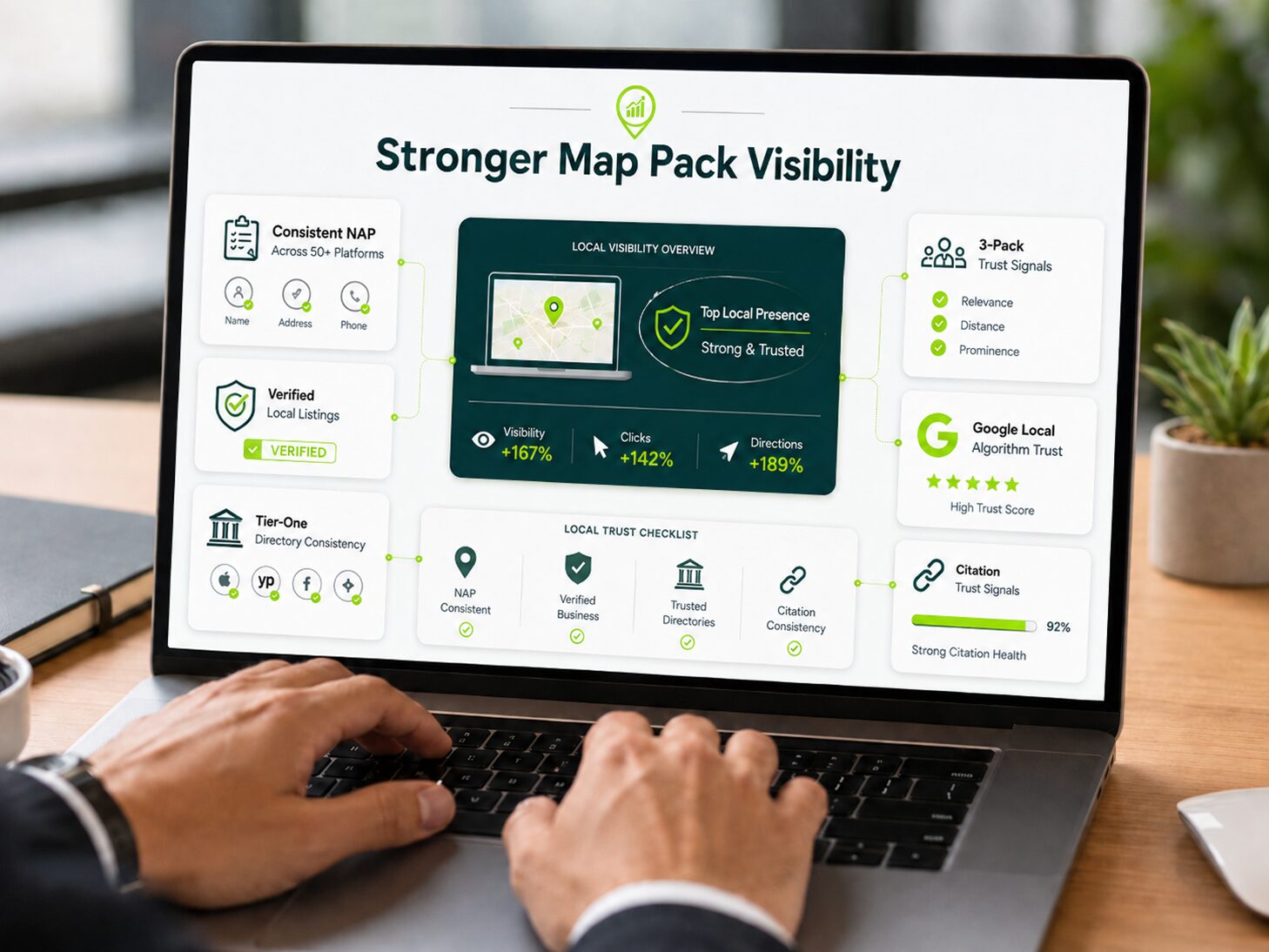
### Higher Local Trust Signals
When Yelp, BBB, Apple Maps, Bing, and other 40+ trusted sources show the same NAP details, your business becomes a confident answer to local queries.
The confidence shows up in better rankings, more “near me” searches, and improved click-through on your Google Business Profile.
AI assistants rely on a mix of web data, business listings, and third-party sources when generating local recommendations. Consistent citations mean your business gets shown there, too. This effect compounds across every platform, pulling from the same trusted data.
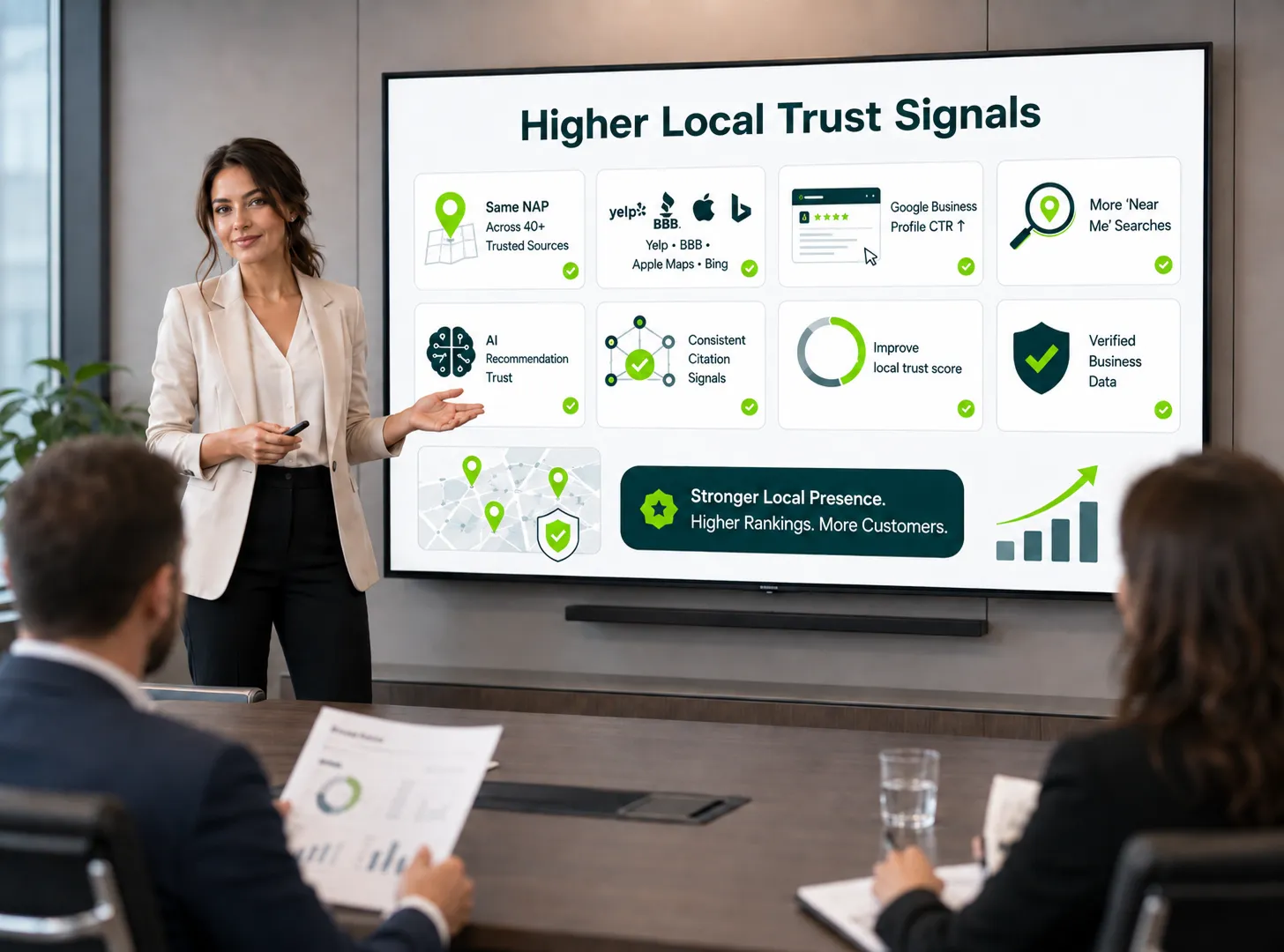
### AI Search and Voice Assistant Presence
ChatGPT, Perplexity, Google AI Overviews, and Siri pull local business data from the same aggregators and directories that Google’s local algorithms use.
If your NAP is inconsistent or incorrect at the source, AI assistants either skip you from results or show the wrong information to users who are ready to convert. Clean, Verified citations across Data Axle, Foursquare, Neustar/Localeze, and tier-one directories position your business in local recommendations when someone asks their AI for the best service nearby.
As AI-driven search grows, citation accuracy is becoming important, rather than a ranking advantage.
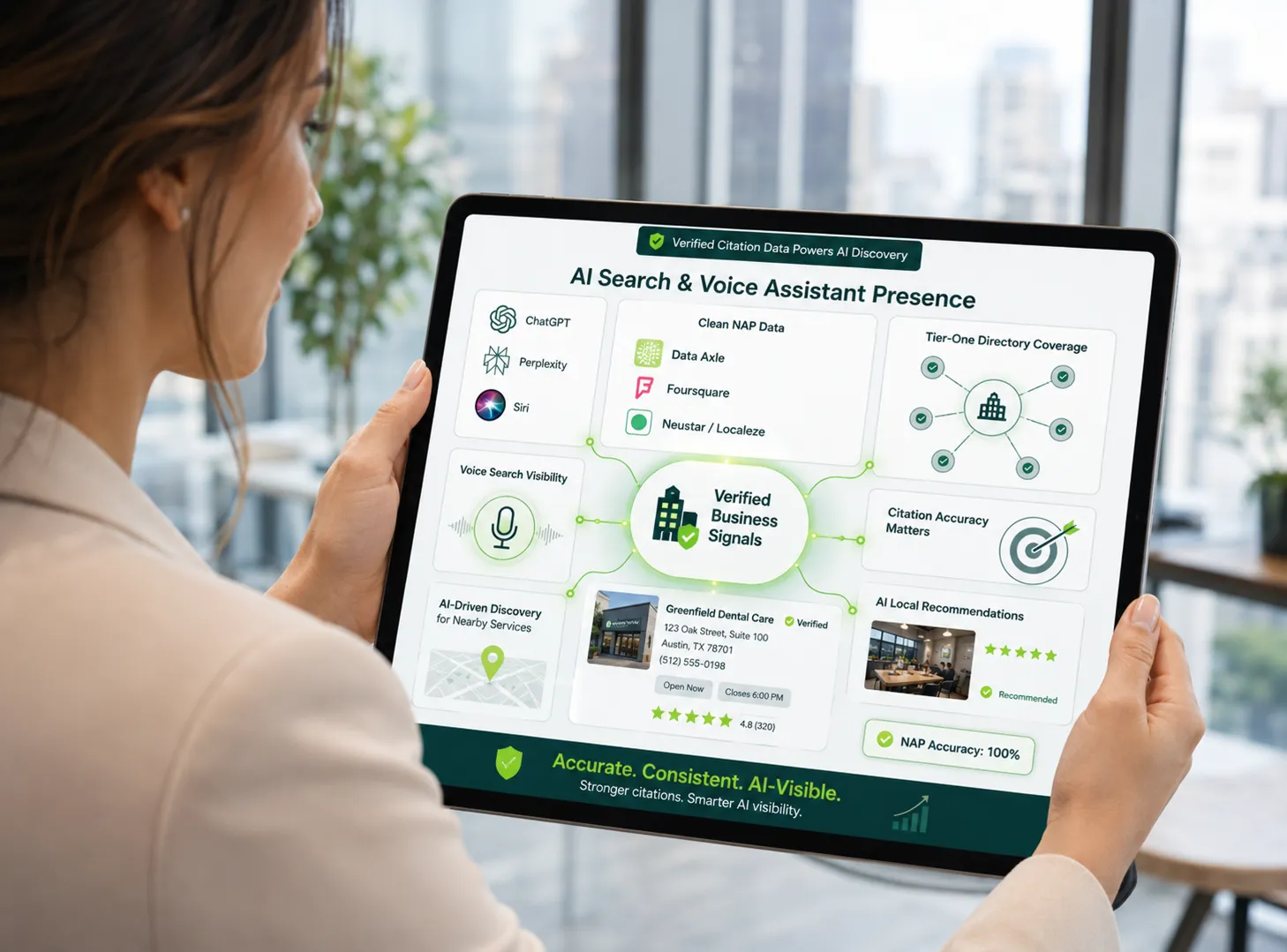
### A Cleaner, Defensible Local Footprint
The long-term payoff is a profile that doesn’t require content intervention. Duplicates should be removed, not left as they are. Aggregator data stays synced across directories. New platforms get added as they gain local authority, not when rankings drop.
Citation drift stops costing you map pack positions. What you’re left with is a stable, verified foundation that compounds visibility over time rather than degrading it.
Most local campaigns never reach this stage because audits get skipped, and monitoring is set back. The businesses that consistently maintain it are the ones that become difficult to displace.
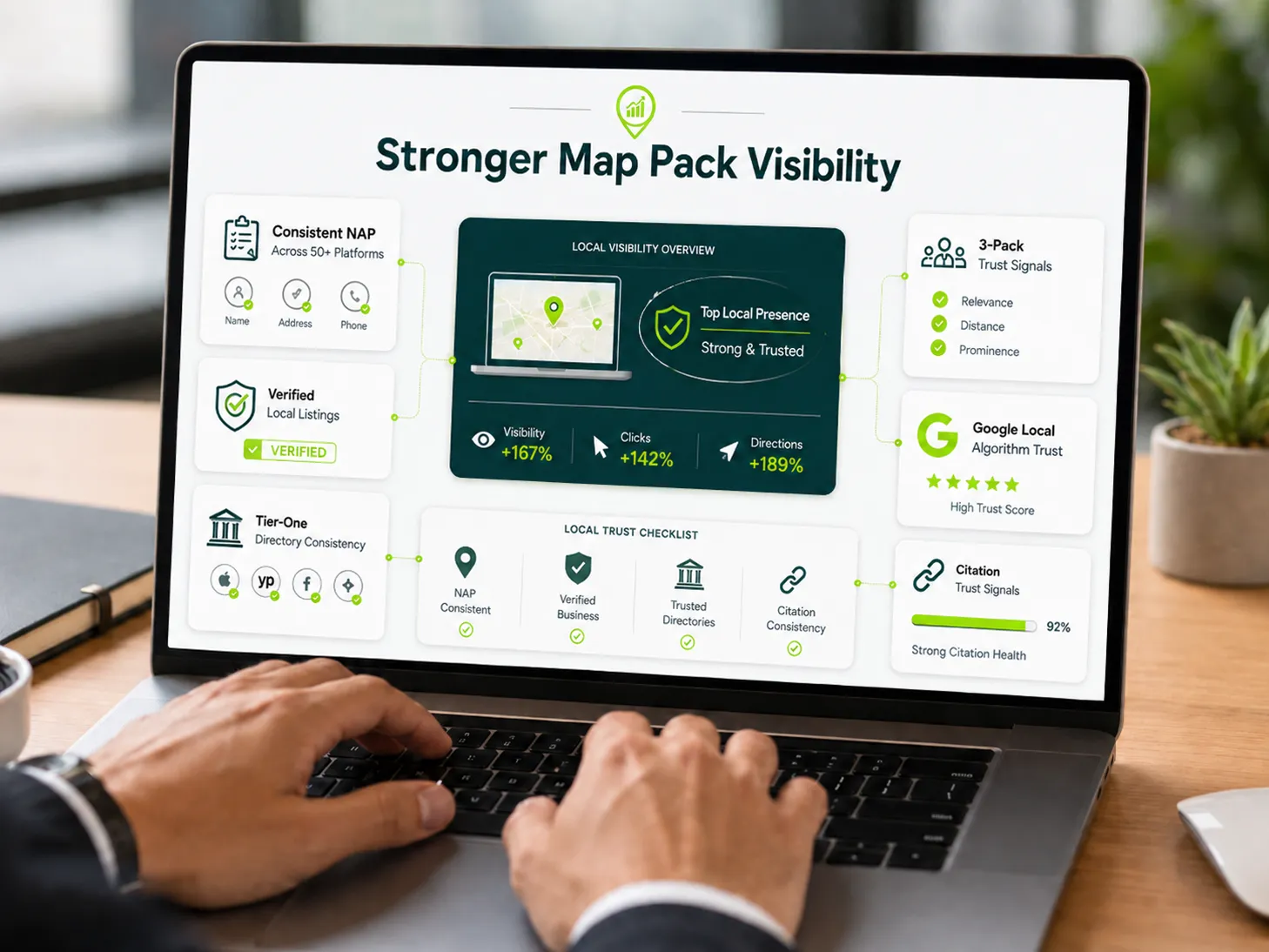
Client Success Stories
## What Clients Say About Our Local Citation Services
Verified reviews from leaders who gained authority, rankings, and revenue by fixing the citations their last agency missed.
[View All
](https://outreachdesk.com/testimonial/)

4.8/5 

## 5/5 
Rating on Google



We had 14 locations and no idea how inconsistent our listings were. After the audit, we found wrong phone numbers on almost 9 platforms. Three months later, every location is in the top 3 for its primary local query.

#### Operations Lead
Multi-Location Dental Group


Our map pack impressions improved without us touching a single backlink. Turns out our NAP was wrong on half the aggregators. Outreach Desk fixed what our last two agencies missed. For real-world examples of this in action, our case studies from similar clients.

#### Marketing Director
Regional HVAC Chain


Apple Maps was showing the address of the old office for the last 18 months. Nobody caught it. Clean citation work bought new consultations in the first month after it was fixed.

#### Owner
Family Law Firm
Service Framework
## Investment, Timeline, andDeliverables
Every listing we build, correct, or suppress is tracked, and you can see it in real time. Here’s what shapes your investment:

### Number of Locations
Each location needs its own audit, NAP, and verified citation set; it’s not a shared checklist.

### Market Competitiveness
Competitive markets in metro cities usually require 50-100 citations; small markets require 30-50 citations, but they must be accurate.

### Existing Footprint Health
Cleaner foundation scales faster; most of them are messy, and the first two months are important for audit and cleanup before new listings get built.

### Campaign Duration
Initial builds run 60-90 days. Monthly monitoring protects what’s earned.
Directional pricing
Pricing is available on request and varies by location, scope, and market conditions. Our quotes cover audit, NAP consistency, primary and secondary citation submission, duplicate cleanup, and monthly monitoring reports.
You get a detailed proposal after your strategic call, including exact citation targets, a breakdown of the platform, a projected timeline, and a month-by-month roadmap. Pricing covers audit, NAP consistency, primary and secondary citation submission, and monthly monitoring. No hidden fees, no vague answers.
Book a Strategy Call
What You Get
## Complete Report on Every Citation
You can see every listing we build and correct in real time.

### Live Citation Dashboard
Every citation logged, including platform, URL, category, status, and accuracy. Filter by location, source type, or accuracy check.

### Canonical NAP Document
Exact NAP details, working hours, and description are locked in a single document, and every further vendor follows without variations.

### Monthly Citation Report
New listing built, errors corrected, duplicates suppressed, and platforms monitored. Summary of the activity and anything that needed your attention.

### Audit Trail
Every submission is logged with date, platform, verification status, and screenshots. You get access to the complete history if any listings drop or change.
Our Approach
## Choosing the Right Way to Build Local Citations
You gain citations built with accuracy and platform relevance, rather than volume or automated placements.
| Factor | Bulk Submission Tools / DIY | |
| --- | --- | --- |
| NAP Accuracy | Scraped data, typos inherited across platforms | Canonical NAP locked down, verified character-by-character |
| Source Quality | 500+ low-trust directories, many deindexed | 80-120 vetted platforms Google actually uses |
| Duplicate Management | Duplicates ignored or created | Duplicates merged through proper verification |
| Industry Relevance | Generic directory blasts | Category-specific directories matched to your vertical |
| Verification | “submitted”= done | “Live and indexed.” = done |
| Data Aggregator Control | Downstream listicles left to drift | Primary aggregators updated to correct the whole system. |
| Reporting | CSV of URLs, no verification | Live dashboard with status, screenshots, and audit trail |
| Ongoing Defense | One-time push, permanent drift | Monthly monitoring catches errors before ranking slips. |
Who We Help
## Local Businesses and Multi-Location Brands That Benefit Most
No matter what your market is, your business gets citations on platforms that truly match your industry and location.
[

### Law Firms &
Attorneys
](https://outreachdesk.com/link-building-for-lawyers/)
[

### Dental
Practices
](https://outreachdesk.com/link-building-for-dentists/)

### Medical &
Healthcare

### Home
Services
[

### Real Estate
Agencies
](https://outreachdesk.com/real-estate-link-building/)

### Restaurants &
Hospitality

### Multi-Location
Retail
[

### Financial
Services
](https://outreachdesk.com/link-building-for-financial-websites/)

### Fitness &
Wellness

### Auto
Services

### Franchise
Operators

### Professional
Services
Common Questions
## Frequently Asked Questions
Clear answers on how local citations affect rankings,and what to expect from a managed campaign.
### What are local citations, and why do they matter?
A local citation is any online mention of your business name, address, and phone number (NAP). Google uses citation consistency as a trust signal for local rankings. The more accurate and consistent your NAP is on the trusted platforms, the higher you rank in map pack “near me” searches. Inconsistent citations are one of the many reasons local businesses get stuck below the 3-pack.
### How many citations does my business actually need?
It depends on your market and category. A small-town service business often needs 30-50 accurate citations to dominate. A law firm or medical practice in a top-50 metro typically needs 100+ listings, plus industry-specific directories. Quality matters more than volume. 50 vetted citations on platforms Google weights beat 500 on deindexed directories every time.
### Are local citations the same as backlinks?
No, a citation is a NAP mention; it may or may not include a link. A backlink is any clickable link from another page that points to your site. Both matter for local SEO, but they do different jobs. Citations build local trust and feed map pack rankings. Backlinks build domain authority and support organic rankings across your whole site. Most local businesses need both.
### What happens if my NAP is inconsistent across different platforms?
Google’s local algorithm treats inconsistencies as low-confidence signals. Three different phone numbers on your listings tell Google it can’t verify which is real, so it pulls you out of the map pack rather than showing wrong data. Fixing inconsistencies is often the single biggest ranking lift we see in the first 30 days of a campaign.
### Can’t I just use a bulk citation submission tool?
Yes, you can, but we don’t recommend it. Bulk tools scrape unreliable sources, inherit typos and old information, and submit to hundreds of low-trust directories that Google either ignores or doesn’t take it in consideration. They create the exact inconsistency problem the service is supposed to solve. Manual work is slower and produces citations that actually move rankings.
### Do local citations help with AI search results like ChatGPT or Perplexity?
Yes, AI assistants pull local business data from the same citation database Google uses, as well as primary aggregators like Data Axle, Neustar, and Foursquare. If your NAP is wrong or missing at the source, AI assistants may exclude your business or show incorrect details in local recommendations when someone asks an AI for local recommendations.
### How long does it take to see results from citation work?
Audit and NAP consistency show up in data in 30 days, often faster for single-location businesses. New submissions usually start affecting map pack rankings within 60-90 days, as Google re-crawls and re-weights the trust signals. Duplicate suppression can move rankings in weeks.
### What’s the difference between structured and unstructured citations?
Structured citations are formal directory listings like Yelp, Google Business Profile, BBB, news sites, chamber pages, and local publications where your NAP appears in running text, and both the NAP and the listing are considered. Structured citations carry more weight for 3-pack rankings. Unstructured citations often carry stranger local relevance signals.
### Do you handle the cleanup of duplicate and incorrect listings?
Yes, and honestly, this is where most businesses see their biggest wins. Duplicate GBP listings, ghost listings from closed locations, all of it pulls rankings down. Cleanup goes through each platform’s proper verification process without any shortcuts.
### Do you serve multi-location businesses and franchises?
Yes, multi-location and franchise work is a specialty. Each location gets its own audit, canonical NAP documents, and citation set, coordinated under a dashboard so regional managers and corporate teams see their own locations without digging through everyone else’s data.
### How is ongoing citation monitoring handled?
It is handled monthly. Aggregators push updates. Platforms change formats. Old listings resurface with stale data. Monitoring re-checks every live citation, flags drift, corrects errors at the source, and reports what changed. Campaigns without monitoring decay in 6-12 months; that’s why we include it.
### How do I get started?
Book a short strategy call. We’ll review your current citation footprint, flag the biggest issues we see, and scope a campaign that fits your locations, industry, and market.
## See How Local Citations Can Grow Your Visibility
Start by auditing what’s already out there. Fix what’s wrong.Build the foundation on which your rankings depend.
Book a Strategy Call

4.8/5 _
Trusted by 500+ agencies &
1,000+ businesses worldwide.

---
---
title: "How Many Backlinks Do I Need to Rank? (Real Data)"
url: "https://outreachdesk.com/how-many-backlinks-do-i-need-to-rank/"
lang: "en-US"
type: "post"
description: "You want a number. Everyone does. The honest answer is there isn’t one number that works for every keyword,niche or page. But you don’t have to guess. The backlinks you need depend on three things: the keyword you’re targeting, who"
last_modified: "2026-05-20T07:58:12+00:00"
categories: [Link Building]
---
# How Many Backlinks Do I Need to Rank? (Real Data)
You want a number. Everyone does. The honest answer is there isn’t one number that works for every keyword,niche or page.
But you don’t have to guess.
**The backlinks you need depend on three things: the keyword you’re targeting, who is already ranking, and the strength of their link profiles.
**
Suppose a local query like “emergency plumber Austin” might rank with 8-15 strong referring domains. A competitive term like “project management software” can require hundreds.
The way to find your number is simple. Compare your page against the current top results. Look at their referring domains, link quality, and relevance. That gives you a target based on real competition, not assumptions. Most teams should reference [link building statistics](https://outreachdesk.com/link-building-statistics/) for the latest baseline data.
**Key Takeaways**
- There’s no universal backlink number. Your target comes from analyzing the top 5 ranking pages for your specific keyword.
- Track referring domains at the page level, not total backlinks and not domain-level counts.
- In highly competitive keywords (KD 70+ in Ahrefs), top-ranking pages often have 150+ referring domains, though this varies by query.
- Link quality and topical relevance carry as much weight as volume. sometimes more.
- Strong internal linking, topical authority, and a clear intent match can reduce your reliance on external links in many cases.
- Backlinks alone cannot overcome issues like poor intent match, slow performance, or thin content.
## Why “It Depends” Isn’t a Useful Answer
You’ve probably heard this advice: “The number of [backlinks](https://outreachdesk.com/what-are-backlinks/) you need depends on your niche”. It’s true, but it doesn’t tell you what to do next. For end-to-end management of this process, [Outreach Desk’s link building services](https://outreachdesk.com/) runs campaigns for 500+ brands worldwide.
It’s like asking a contractor how much a house costs. ‘It depends on the house’ is technically true, but it doesn’t tell you where to start.
A page with fewer but high-quality, and valuable backlinks can outrank the one with just more low-quality backlinks if it better matches search intent and earns links from trusted sources. That’s why link quality and context matter more than link volume.
Instead of focusing on a number, focus on the gap between your page and what is already ranking. A [competitor backlink analysis](https://outreachdesk.com/competitor-backlinks/) shows you exactly what that gap looks like and what needs to be built to close it.

In practice, lower-competition pages gain traction faster with fewer referring domains. Competitive terms require more consistent link growth over time. The exact number varies, but relevance and link quality often carry as much weight as volume, sometimes more.
## What the Data Shows About Backlinks and Rankings
Before we get into the process, here’s what large-scale studies tell us about the relationship between backlinks and rankings.
Multiple analyses, including data compiled by [Backlinko](https://backlinko.com/seo-stats?utm_source=chatgpt.com#:~:text=A%20study%20published%20on%20Backlinko%20found%20that%20the%20number%20of%20domains%20linking%20to%20a%20page%20was%20the%20factor%20that%20had%20the%20highest%20correlation%20to%20rankings%20in%20Google), show that the number of domains linking to a page has the strongest correlation with Google rankings. This reflects correlation, not a guarantee.

**Two takeaways from this:
**
**1. Backlinks still correlate with higher rankings.**
[Google](https://developers.google.com/search/docs/crawling-indexing/links-crawlable#:~:text=Google%20uses%20links,of%20your%20content.) confirms that links help with discovery and remain one of the signals that ranking systems use.
**2. The number you need depends on your niche.**
Industry medians range from under 100 to over 3,000 referring domains. A universal benchmark is meaningless.
Start with your specific keyword and competitors.
## Referring Domains vs. Total Backlinks – What to Actually Count
A common mistake is tracking total backlinks instead of referring domains. These aren’t the same metrics.

If one website links to your page 47 times, that counts as 47 backlinks, but it’s still one referring domain.
Links from a wider range of unique, topically relevant sites carry more weight than many links from one source. Links from multiple relevant sites signal broader recognition.
Additional links from the same domain often provide diminishing returns compared to links from new domains.
Backlink audits of new clients at Outreach Desk often show high backlink counts driven by a small number of unique domains. This can limit the overall impact of those backlinks.
**The Practical Takeaway:
**
When estimating link needs, focus on referring domains at the page level. Google evaluates pages individually, but site-level signals like internal linking and overall domain strength still influence how pages perform.
Domain-level strength can help discovery and crawling, but it does not guarantee rankings for every page, as [Google Search Central](https://developers.google.com/search/docs/appearance/ranking-systems-guide) states.
## How to Calculate Your Backlink Target (Step by Step)

This is where you estimate your backlink target. Not with a universal number but with a process that gives you a specific number for any keyword you care about.
### Step 1: Pick the Keyword and Check the Difficulty
Open [Ahrefs Keyword Difficulty Checker tool](https://ahrefs.com/keyword-difficulty/) to check the keyword difficulty (KD) score for your target keyword.

The image above shows the keyword difficulty score for “bakery”. This gives you a rough sense of how competitive your keyword is:
- **KD 0–20 (Low Competition):
**
With a low KD score, you might rank with 0-10 referring domains, provided your content matches intent, and your site has some existing authority.
- **KD 21–50 (Moderate Competition):
**
With this score, plan for 10-30 referring domains. Your site’s current DR affects this range; a DR 40 site needs fewer than a DR 15 site.
- **KD 51–70 (Competitive):
**
For a competitive score, you’re looking at 50-150+ referring domains from relevant, authoritative sites.
- **KD 71+ (Highly Competitive):
**
For highly competitive keywords, you might require sustained link building over time, along with strong content and technical SEO.
These ranges come from campaign data at the Outreach Desk. Quality and relevance still matter at every level. The actual number comes from Step 2.
### Step 2: Analyze the Top 5 Ranking Pages
Search for your target keyword in [Ahrefs SERP Checker](https://ahrefs.com/serp-checker/). The image below shows the SERP overview for the “bakery” keyword.

**For each of the top 5 organic results, check:
**
- Number of referring domains pointing to that specific page (not the whole domain, not total backlinks)
- Domain Rating, or Domain Authority of the ranking site
- The quality of linking sites: relevance, traffic, and editorial placement
This comparison reveals the gap between your page and what is already ranking.
### Step 3: Find the Median and Set Your Target
Take the counts of referring domains for positions 1-5. Find the median. That’s your baseline target. If positions 1-5 have 12, 23, 45, 67, and 89 page-level referring domains, your median is 45.

But don’t stop at the number. Look at the types of links those pages have.
If the #1 result has only a few referring domains, but those links come from high-authority publications like Forbes or TechCrunch, you don’t need to match the count. You need to match the quality. And that usually means you’ll need more links at a slightly lower authority level to close the gap.**
**
### Step 4: Account for Your Starting Position
If your page already has 15 referring domains and your target is 45, your gap is 30. That’s your [link building campaign](https://outreachdesk.com/link-building-campaigns/) target.
If you’re starting from zero, the full 45 is your target. Factor in your domain authority, too. If your site’s DR is 55 and competitors’ average DR is 40, you might rank with fewer page-level links because your site carries more built-in trust. The reverse is also true. A newer site with DR 15 will need more page-level links to compete.
## Real Example Across Three Competition Levels
Numbers mean more with context. Here’s how backlink targets look across 3 real competition levels, based on patterns across Outreach Desk campaigns

### Low Competition: Local Service Keywords
**Example: “Roof repair Raleigh NC”(KD 8 approximately )
**
Top 5 results typically have 3-12 referring domains at the page level. Most links come from local directories, chamber of commerce sites, and a handful of local blogs. You can close this gap with 5-15 quality local and niche links over a few months.
This is where small businesses often waste money buying 50+ cheap links when 8-10 relevant ones would do the job.
### Medium Competition: Industry-Specific Terms
**Example: “B2B email marketing best practices” (KD 35 approximately)
**
The top 5 results have 20-60 referring domains at the page level, mostly from marketing blogs, Saas resource pages, and [guest posts](https://outreachdesk.com/guest-posts/) on industry publications. A genuinely useful guide with 25 strong referring domains can outrank a thin page with 50 weak ones.
### High Competition: Broad Commercial Keywords
**Example: “Project management software” (KD 78 approximately )
**
Top results have a large number of high-quality page-level referring domains from major publications, review sites, and industry authorities. These keywords demand sustained link building alongside exceptional content and strong technical SEO. Link volume alone won’t fix a page that doesn’t match search intent.**
**
## What a Quality Backlink Actually Looks Like
The image below shows the difference between a relevant, high-quality page and an irrelevant, low-quality page.

When you review your links or compare competitors, focus on these signals:**
**
### Topical Relevance
A link from a site that covers your topic is more useful than one from an unrelated site. When the content matches, the link reinforces your authority in that subject.A link from a marketing blog to your marketing article carries more weight than a link from a cooking site.
### Editorial Placement
[Contextual links](https://outreachdesk.com/contextual-link-building/) that appear naturally inside the main body content carry the most weight. Links in footers, sidebars, or author bios sit outside the editorial content Google evaluates, which is why they tend to move rankings less.
### Linking Site Traffic
Sites with real organic traffic tend to be more trustworthy in Google’s eyes. Links from relevant, high-traffic pages carry more weight with both search engines and AI systems. A link from a page that is not indexed or has no organic visibility passes little to no value regardless of the domain it sits on.
### Dofollow Status
Links that carry “nofollow,” “sponsored,” or “UGC” can still bring visibility and traffic. But [dofollow editorial links](https://outreachdesk.com/dofollow-backlinks/) without these tags are more likely to pass ranking signals.
Across thousands of [outreach campaigns](https://outreachdesk.com/link-building-outreach/), one pattern holds: a small number of relevant, well-placed links drives more ranking movement than a large number of low-quality ones.
This is why the answer to the “how many backlinks do I need?” The question depends on context. A competitor may show hundreds of links, but only a fraction of those actually push rankings. Your goal is not to match volume. It is to close the quality gap.
## When You Can Rank With Fewer Links
There are many factors that affect your site’s rankings in [SERPs](https://outreachdesk.com/what-are-serps/) beyond backlinks. Several conditions let you compete with a smaller link profile:

### Strong Topical Authority
When you consistently publish useful content around one clear topic, your site starts to build depth in that area.
If you connect those pages with internal links, it becomes easier for search engines to understand what your site focuses on and how your content fits together.
Over time, this can help your pages rank with fewer external links in less competitive searches. Backlinks still matter, especially for competitive queries, but strong topical coverage reduces how much you need to rely on them.
### Better Intent Match
Match your content format to what’s already ranking for that keyword. If the top 5 results for your keyword are all 5,000-word guides, but the searcher actually wants a quick comparison table, a concise, well-structured page can outrank link-heavy competitors by better serving the user.
### Brand Signals
Branded search volume, direct traffic, and entity recognition help search engines understand trust and authority. While Google does not confirm each as a direct ranking factor, these signals often align with stronger rankings. A known brand with fewer referring domains can sometimes outrank a lesser-known site with more links.
### Fresh, Updated Content
For queries where recent and updated data matters, such as “2026,” “best,” or rapidly changing topics, an updated page with fewer links can sometimes outperform a stale page with more links.
Across Outreach Desk campaigns, sites that paired [content-driven link building](https://outreachdesk.com/link-building-strategies/) with active outreach often needed fewer referring domains to reach similar ranking positions. The content attracted passive links over time, which strengthened the impact of the active campaign.
## When More Links Won’t Help
No matter how relevant and high-quality the backlinks are, if your page has deeper problems, they won’t fix it.

### Poor Content that Doesn’t Match Search Intent
If the top-ranking pages are comparison articles but your page is a single-product page, you have an **intent mismatch,** which means links alone won’t fix it. Check what’s ranking. Match the format.
### Technical SEO Problems
No matter how strong your backlink profile is, you won’t see ranking improvements if your website has technical SEO problems such as **slow page speed, broken indexing, or keyword cannibalization.
**
These are foundational issues. Fix them first before focusing heavily on links.
### Toxic or Spammy Link Profile
If a large portion of your current backlinks comes from **PBNs, **[**link farms**](https://outreachdesk.com/link-farming/)**, or irrelevant directories**, adding more new links won’t help much. It only adds noise to an already weak and risky backlink profile. Fix the bad links first, then focus on building new, quality links.
### Your Internal Linking is Weak
Internal linking is one of the most underrated factors. Your strongest, high-authority blog posts can pass [link value](https://outreachdesk.com/link-equity/) to your key pages when you link to them with clear intent.
If those links are missing, your important pages receive less internal authority and weaker context signals.
At Outreach Desk, we audit and fix internal links before starting external link building. In many cases, key revenue pages have few or no internal links pointing to them with clear intent. This limits their ability to rank, even when the site already has strong content and backlinks.
### Your Topical Authority is Thin
Google evaluates more than just individual pages. It also looks at how consistently your site covers a topic and whether it demonstrates real expertise.
If you have only one article about “project management,” but you’re trying to rank for “best project management software,” a few backlinks may have limited impact on competitive keywords.Building supporting content around the topic strengthens relevance and helps links drive better results.
## The Role of Link Velocity
How fast you build links provides context, but backlink quality, topical relevance, and referring domain authority have a stronger impact on search rankings.
**Link velocity refers to the rate at which new referring domains link to your page over time.**
Google does not define or publish a fixed benchmark for this, but its systems evaluate link patterns to detect potential manipulation.
Google evaluates whether the link patterns appear natural or manipulative. For example, a brand-new page that gains 50 referring domains in its first week looks suspicious. A page that gains 3-5 referring domains per month for a year looks organic.
**The exception** is that content that genuinely goes viral or that major publications feature can earn links quickly without triggering spam signals. Google understands this. The key difference is where the links come from. Links from low-quality or unrelated sites, especially those with repetitive anchor text, can indicate manipulation.
Aim for a steady pace, often around 5–15 new referring domains per month for competitive terms. Spread your outreach over time. Don’t batch everything into one week, then go silent for three months.
## Backlinks and AI Search: What Changes in 2026
| Platform | Citation Behavior | Ranking Correlation | Key Content Signal |
| --- | --- | --- | --- |
| Google AI Overviews | Pulls primarily from top-ranking search results | 38% from top-10 pages | Rankings + entity coverage |
| ChatGPT (web browsing) | Cites non-ranking pages | Low overlap with SERPs | Clear, direct answers |
| Perplexity AI | Pulls from multiple sources | Varies by query | Up-to-date, well-referenced content |
AI systems like Google AI Overviews, ChatGPT citations, and Perplexity AI’s answers are changing how content gains visibility. AI systems can cite your content even when no click happens through traditional search results.
They do not pull sources the same way.
Google AI Overviews still uses search results as a base, but the overlap is looser now. In an [Ahrefs study](https://ahrefs.com/blog/ai-overview-citations-top-10/) of 863,000 keywords, 38% of cited pages ranked in the top 10 for the same query. So rankings help, but they do not decide everything. You will see citations coming from deeper pages more often.
With ChatGPT and Perplexity AI, the mix looks different. Many cited pages do not rank in Google’s top results for that query. AI systems tend to select clear answers. So does content that covers the topic well and stays updated. AI systems are more likely to surface pages that multiple sources reference.
Backlinks still play a role. They support rankings and add to your site’s overall authority. That can influence whether AI systems cite your content. It is one signal among several.
If you want visibility, work both sides. Earn strong links. Write content that answers the query clearly and fully. Make it easy to extract.
## Conclusion
The data makes one thing clear: there is no fixed number of backlinks that guarantees a ranking. What matters is whether your link profile is stronger, more relevant, and more trustworthy than the pages already sitting above you.
Run the gap analysis, prioritize quality over volume, and build consistently. That is what the real data points to.
If the gap feels overwhelming, start with the highest-impact links first. One editorial placement from a relevant, high-authority site moves rankings more than a dozen generic directory links.
Build smart, build consistently, and measure progress every 90 days.
### Not sure how many backlinks you actually need to rank?
Get a clear benchmark based on your niche and competition.
[Book a strategy call](/contact-us/)
These are the questions most often asked about backlinks and rankings, answered directly.
### How many backlinks does a new website need?
A new website can start with 20–30 referring domains to its homepage within the first 6 months, then shift to page-level links based on competition.
### Are backlinks still a ranking factor in 2026?
Yes. Google confirms that links help with discovery and remain one of the signals used in ranking systems. Their relative weight has evolved over time. Content quality, user experience, and topical coverage now play a larger role, but backlinks remain important, especially for competitive queries.
### Should I focus on backlinks or content first?
Start by publishing high-quality, relevant, and valuable content that aligns with search intent and delivers clear value. Without that, links have limited impact. In practice, content and links develop together. Strong content gives you something worth promoting, and links help that content gain visibility.
### How long does it take for backlinks to impact rankings?
New backlinks typically take 4-12 weeks to show measurable ranking improvement. The timeline depends on how quickly Google crawls the linking page, your site’s existing authority, and how competitive the keyword is. Evaluate link building results on a 90-day cycle, not week by week.
### Does domain authority matter more than page-level links?
If your site has a DR of 55 and your competitors’ average DR is 35, you can likely rank with fewer page-level links, as your domain carries built-in trust. But the reverse is also true. A DR 15 site needs more page-level links to close that gap.
---
---
title: "How to Find Unlinked Mentions and Turn Them Into Links"
url: "https://outreachdesk.com/unlinked-mentions/"
lang: "en-US"
type: "post"
description: "A journalist cited your research last month. Another blog recommended your tool. A roundup mentioned your founder by name. But none of them linked to you, and every one of those is a backlink you can still claim. For brands"
last_modified: "2026-05-22T10:04:14+00:00"
categories: [Link Building]
---
# How to Find Unlinked Mentions and Turn Them Into Links
A journalist cited your research last month. Another blog recommended your tool. A roundup mentioned your founder by name. But none of them linked to you, and every one of those is a backlink you can still claim. For brands that want consistent execution, working with a [link building service provider](https://outreachdesk.com/) removes the heavy lifting.
**Unlinked mentions are pages that already mention your brand, product name, or content without a backlink pointing to your site.** They carry no ranking authority on their own, but converting them is faster than cold outreach because the writer already knows your brand.
They pass zero ranking authority, but they can convert into backlinks at a higher rate than cold outreach, because you’ve already done the hardest part: earning their attention.
**Key Takeaways
**
- Unlinked mentions convert more backlinks compared to cold outreach because the author already trusts your brand.
- Most teams track only their exact brand name and miss other, bigger opportunities hidden in product names, mentions of founders, misspellings, and stolen images.
- Not every mention is worth outreach. Focus on authority, traffic, freshness, and context.
- Tools like Google Alerts, Ahrefs Content Explorer, and Semrush Brand Monitoring each work best at a different scale.
- Outreach emails under 100 words that name the specific article section outperform generic link requests, as the writer knows you actually read their work.
## What Unlinked Mentions Actually Are (and Why They Exist)
An **unlinked mention** occurs when a website mentions your brand, product, or content without linking to you. The writer already knows who you are. They chose to include you. They just didn’t add the link.

Turning these mentions into [backlinks](https://outreachdesk.com/what-are-backlinks/) is one of the highest-conversion outreach tactics. You’re not reaching out cold. You’re following up on something that already exists. You’d be surprised at how often this happens.
Sometimes writers are busy and forget to add links. Sometimes editors remove links during review because they may see them as overly promotional, or because CMS migrations can break links. Sometimes writers add your brand name just to provide background, without intending to give credit with a link.
None of this is intentional. This is what makes the opportunity so strong. You’re not asking for a favour. You’re asking someone who already mentioned you to complete the reference.
A mention helps put your brand in front of a relevant audience and can lead to referral traffic, direct searches, or future editorial links. It may even influence how search engines and AI systems understand your brand. But it doesn’t pass authority the way a backlink does. Turning that [brand mention](https://outreachdesk.com/brand-mentions/) into a backlink closes that gap.
At the Outreach Desk, we track unlinked mentions across client campaigns as part of our [brand mention service](https://outreachdesk.com/brand-mention-service/). One pattern we’ve seen is that these mentions convert better than cold outreach.
Why? Because earning someone’s attention and trust is the hard part, which has already happened. They already trust you. You’re just completing the connection.
## Beyond Your Brand Name: Seven Types of Mentions Worth Tracking
Track these seven unlinked mention types, not just your brand name.
**1. Exact brand name
**
The obvious one. “Outreach Desk” appears without a link.
**2. Product or service names
**
If you sell a tool called “LinkTracker Pro,” people will reference it independently of your brand.
**3. Founder or spokesperson names
**
Publishers often mention executives in articles, podcast recaps, or event roundups without linking to them.
**4. Common misspellings
**
“OutreachDesk,” “Outreach-Desk,” “OutReach Desk.” Every variation represents a link you haven’t claimed yet.
**5. Slogans or taglines
**
These are high-priority opportunities because they show people are already familiar with your brand.
**6. Proprietary data or research
**
If you published an original study and someone cites the finding without linking to the source, that’s a strong conversion opportunity.
**7. Stolen or embedded images
**
Your infographics, charts, and branded visuals show up on other sites without attribution more often than you’d expect.
At the Outreach Desk, we build a monitoring list for every client that covers at least the first four categories. Image and data tracking takes more setup, but often produces higher-quality links. Sites using your research are usually more authoritative.

## Four Ways to Find Unlinked Mentions
There are mainly four methods to find unlinked mentions, and the right one depends on how many mentions your brand generates and how much you’re willing to spend on tools.

### Google Alerts + Search Operators (Free, Low Volume)
You can start by setting up [Google Alerts](https://www.google.com/alerts) for your brand name, product names, and common spelling variations. Use the “as-it-happens” setting if you want to catch mentions quickly and respond while the content is still fresh. Daily or weekly alerts work for lower-priority tracking.

**For manual discovery, use search operators:
**
“your brand name” -site:yourdomain.com -site:twitter.com -site:linkedin.com -site:facebook.com. This shows pages that mention your brand but exclude your own site and social platforms. Still check which mentions include links and which don’t.
It takes time but costs nothing, and works best when your brand generates a manageable number of mentions. For example: “Nike” -site:nike.com inurl:blog -inurl:news to focus on articles and blogs

**When manual monitoring works best:
**
If your brand gets fewer than 20 mentions per month. At that level, this can take around 30 minutes a week.
Google Alerts misses a significant chunk of mentions. It depends on crawling, so Google will not surface slow-indexed or paywalled pages. Treat it as a first pass, not a complete system.
### Ahrefs Content Explorer (Paid, High Volume)
[Ahrefs Content Explorer](https://ahrefs.com/content-explorer) is a tool that lets you search a massive database of web pages. Enter your brand name in the search bar and select “In content” or “Everywhere” as your search mode.
Then enter your domain in the “Highlight unlinked domains” field , this surfaces every page that mentions your brand without linking back to you. You can then sort and filter by Domain Rating, traffic, language, or publication date.

This method saves you time. Instead of manually checking each mention, you filter out low-quality sites and focus on pages that matter most. This turns a raw mention list into a qualified prospects list fast.
This method is ideal for established brands. If your brand gets more than 50 mentions a month, this is one of the few methods that scales efficiently at this volume without wasting your week.**
**
### Semrush Brand Monitoring (Paid, Ongoing)
[Semrush Brand Monitoring](https://www.semrush.com/apps/brand-monitoring/) tracks mentions continuously and alerts you when new ones appear. It also separates linked mentions automatically and shows sentiment. This helps you decide whether a mention is worth reaching out for.
The real advantage here isn’t discovery, it’s speed. Reaching out within 48 hours of publication can outperform reaching out weeks later. The writer still remembers the article. At large publications, editors are still making small updates.**
**
### Reverse Image Search (Free, Underused)
Upload your branded images, charts, or infographics into Google’s reverse image search. Any site using your visual without credit becomes a strong [image link building](https://outreachdesk.com/image-link-building/)** **opportunity. Here, you have a better ask than “please add a link.” You have “you’re using our proprietary image without credit.” This changes your outreach angle.

Instead of asking for a favor, you’re requesting proper credit for your work. We’ve used this approach at the Outreach Desk for clients publishing original research with branded charts.
Sites respond more often to image-attribution requests because most people know they should credit the image. They just forget.
## How to Qualify a Mention Before You Write a Single Email
Finding mentions is easy, but the hard part is deciding which ones actually justify the time and effort before you [reach out](https://outreachdesk.com/link-building-outreach/).
Not every mention earns an email. A link from a low-traffic page on a thin affiliate site passes very little value, and the time you spend on it is time you didn’t spend on the mention that was more likely to convert. Run each one through these five filters first. **
**
### 1. Authority of the Mentioning Site
A high authority site (DR 60+) with real editorial standards is worth your effort. A low-quality site filled with thin or affiliate content isn’t. Use metrics like Domain Rating (Ahrefs) or Authority Score (Semrush) as a first filter, but don’t rely on metrics alone.
Check the site itself:
- Does it publish consistently?
- Does it have a real editorial team?
- Does it rank in search results?
If you don’t find it trustworthy, it’s not worth the outreach.
### 2. Traffic to the Specific Page
A mention on a page that gets 5,000 monthly visits is more valuable than one on a page that gets little or no traffic at all. Even if the SEO metrics appear similar, the difference in visibility and referral traffic makes it a priority.
### 3. Context and Sentiment of the Mention
Check how the author mentions your brand. If the article recommends your product, cites your data, or compares you positively, that’s a strong opportunity.
If they mention you in passing with a neutral tone, it still works, but at a lower priority. And if the article criticizes your product, leave it alone. Do not request a link on negative coverage.
### 4. Content Freshness
A mention from last month is easier to act on. The writer still remembers the content and will more likely update if you reach out. A mention in a 2019 post is harder to convert. The site may no longer be actively publishing, and you may not be able to reach the author.
You should focus on mentions from the past 6 months.
### 5. Relationship Potential
Some mentions are more than just a [earning backlinks](https://outreachdesk.com/link-acquisition/) opportunity. If the author is a journalist, editor, or active content creator, there’s long-term value in building a relationship with them.
Even if the immediate link isn’t high-authority, it can still lead to future placements. An author you help today may quote you as a source in their next three articles.
Prioritize unlinked mentions by five criteria: site authority, page traffic, mention sentiment, content freshness, and the relationship potential with the author.

## Writing Outreach That Gets the Link Added
You find a great mention with link opportunities, qualify them correctly, and then send a templated email that sounds like a robot. This is where your outreach is more likely to fail, even if you have a strong opportunity.
Writers who mentioned your brand have already done you a favor. They open the email, read your unnatural message, and close it.

At the Outreach Desk, after running campaigns spanning thousands of outreach emails, one pattern that emerges is that the best emails get straight to the point and name something specific. **
**
### Keep it Under 100 Words
Long emails rarely work for cold or semi-cold outreach. Readers often skim long emails, and skimming kills your response rate. Your email needs three things:
- Acknowledge their content specifically
- Note the mention
- Make a clear, specific ask
That’s it.
### Reference the Specific Article, Not Just Their Site
“I noticed you mentioned our brand on your website” sounds lazy and obvious. Write like “Your comparison of outreach tools in your April piece on editorial link building mentioned [your site name].” This level of specificity signals that you actually read their work.
### Offer Value Beyond the Link
The best outreach isn’t one-sided. Give the writer a reason to say yes. You can offer:
- Updated data
- A quote they can add
- A resource that genuinely helps their readers.
This turns your link request into a value exchange.
**Framework that works:
**
**Subject: Quick note about your [topic] article
**
Hey [Name],
Loved your piece on [specific topic], especially the section on [specific detail]. You mentioned [Brand] in the context of [what they said].
Would you be open to linking the mention to [specific URL]? It’d give your readers a direct path to [the resource/data/tool you referenced].
Happy to [offer: share updated data / provide a quote / cross-promote the article].
Either way, great piece.
[Your name]**
**
### Follow Up Once. Then Stop
Send one follow-up after 5-7 business days. If there’s no response, move on. Two emails show persistence; anything beyond that is annoying. Here you’re reaching out to someone who already mentioned your brand. It’s not worth damaging that relationship.

## When Unlinked Mentions Aren’t Worth Chasing
Don’t invest time and effort in every mention.**
**
### Negative Coverage
If someone wrote a critical review or complained about your product or service, don’t ask for a link. The context is negative here, and adding your link doesn’t improve the situation; it amplifies it.
### Link Farms and PBNs
Private blog networks, [link scheme tactics](https://outreachdesk.com/link-farming/), and sites that openly sell links exist for SEO manipulation, not authority building. A link from these sites will hurt your profile. If the site looks like it exists only for SEO manipulation, avoid it.
### Sites Demanding Payment
Certain site owners respond to link requests with a price list. “We’d be happy to add your link for $200.” That’s a paid link. Decline it politely and remove the site from your prospect list. If you accidentally acquired such a link, use Google’s disavow tool.
### Ancient Abandoned Content
Old blog posts aren’t worth the effort. If you find a mention in a 2018 blog post on a site that hasn’t published anything since 2020, there’s almost certainly no one to email. Even if you find a contact, few writers will update a five-year-old post on request. Focus more on the recent and active publications.
### Irrelevant Sites
A mention on a completely irrelevant site passes weak topical relevance. For example, if you get a link from a cooking blog for your SaaS tool, then it won’t help much. It’s not worth the time for outreach. Prioritize mentions where the writer can naturally add a [contextual link](https://outreachdesk.com/contextual-link-building/) within existing content.
## Unlinked Mentions and AI Search: What’s Changed
AI platforms such as Google AI Overviews, ChatGPT, Perplexity, and Gemini don’t rank sites only based on links. They also use a mix of training data and selective retrieval to interpret content and surface information.
This changes how unlinked mentions matter. Even without a link, consistent brand mentions across relevant sources can contribute to visibility in these systems. If your brand is mentioned across trusted sources, these systems begin to associate your brand with specific topics.
A [Semrush analysis of ChatGPT citations](https://www.semrush.com/blog/chatgpt-search/) found that nearly 9 out of 10 webpages cited by ChatGPT rank outside the top 20 organic results. This shows that visibility now comes from a wider content pool, and mentions across that pool determine whether the AI system cites your brand in generated answers.
Unlinked mentions play a role in that visibility. But they don’t replace backlinks. It means the SEO value of being mentioned, even without a link, is higher in 2026 than in 2023. Converting those mentions into links gives you both the traditional ranking signal and the AI visibility signal.
## Conclusion
Open your Ahrefs Content Explorer or Google Alerts dashboard right now. Search your brand name filtered to “doesn’t link to” your domain. Find three results published in the last 90 days that mention you positively.
The brands that build real authority from unlinked mentions don’t do it in a sprint. They build the habit: check monthly, qualify ruthlessly, reach out fast. That’s the whole system.
### Not sure how to handle unlinked mentions at scale?
Get a structured approach to turn mentions into relevant backlinks
[Book a strategy call](/contact-us/)
### 1. Do unlinked mentions help SEO without converting them to links?
Unlinked mentions build brand awareness and help AI systems associate your brand with relevant topics, but they don’t pass link equity. Google’s John Mueller confirmed that unlinked mentions don’t function as links in search rankings. Converting them to backlinks offers the full SEO value, including topical association and the authority signal.
### 2. How many unlinked mentions can I realistically convert into backlinks?
You can expect a conversion rate of 25-50% for well-qualified, properly prioritized mentions. That’s 2-4x higher than cold outreach because the author already knows and trusts your brand. Here, qualification matters. You don’t need to pursue every mention; this will drop your rate. Go for only high-authority, recent, positive mentions.
### 3. What tools are best for finding unlinked mentions?
Google Alerts works for brands with low mention volume. It’s free and catches most exact-name mentions. Ahrefs Content Explorer is strongest for bulk discovery and filtering by authority. Semrush Brand Monitoring is best for always-on, real-time tracking. Most teams combine a free alert system with one paid tool for full coverage.
### 4. Should I convert negative mentions into backlinks?
No. If the mention is negative, requesting a link usually makes things worse. It looks desperate and can amplify a negative association. It’s better to leave it alone. Focus on outreach on mentions where the author spoke positively or neutrally about your brand. Those writers are likely to say yes, and the resulting links add genuine value.
### 5. How quickly should I reach out after a mention is published?
Ideally, within 1-2 weeks of publication. The writer still remembers the article; the content is fresh, and editors are more likely to make small updates to recently published content. Reaching out 6 months later feels disconnected, and the author may not even remember writing about you.
---
---
title: "How to Earn High Quality Backlinks That Move Rankings (2026)"
url: "https://outreachdesk.com/high-quality-backlinks/"
lang: "en-US"
type: "post"
description: "A high-quality backlink is an editorially placed, contextually relevant link from an authoritative, topically relevant website. It sends real trust signals to search engines and drives measurable ranking improvements. Most successful campaigns rely on a professional outreach team to handle"
last_modified: "2026-05-22T10:04:20+00:00"
categories: [Link Building]
---
# How to Earn High Quality Backlinks That Move Rankings (2026)
**A high-quality backlink is an editorially placed, contextually relevant link from an authoritative, topically relevant website.** It sends real trust signals to search engines and drives measurable ranking improvements. Most successful campaigns rely on a [professional outreach team](https://outreachdesk.com/) to handle vetting, outreach, and reporting. For a deeper walkthrough, [Outreach Desk’s link building statistics](https://outreachdesk.com/link-building-statistics/) covers the step-by-step process.
Not all backlinks you earn move rankings. One editorial placement from a relevant industry publication does more for your authority than 50 directory submissions or blog comment drops ever will.
Link quality depends on several signals: relevance, authority, placement, anchor text, and the traffic on the referring page.
**Quick Summary
**
- A high-quality backlink comes from a relevant, trusted site, appears naturally within the main content, and uses anchor text that fits the context. Links without these signals tend to have limited impact, even at higher volume.
- Topical relevance often carries more weight than raw domain authority, especially when the linking page closely matches your topic. The strongest links combine both.
- The 6 signals that separate quality from junk: authority, topical relevance, editorial placement, anchor text diversity, page traffic, and destination strategy.
- Seven practical acquisition methods, ranked by effort and return, from digital PR to unlinked mention reclamation.**
**
## What Makes a Backlink High Quality
Not all [backlinks](https://outreachdesk.com/what-are-backlinks/) are created equal. Google’s systems, including SpamBrain, evaluate links on multiple dimensions before deciding whether a link passes authority or gets ignored entirely.
Many backlinks get crawled. Few improve your rankings in the [SERPs](https://outreachdesk.com/what-are-serps/'). The difference is quality.
We’ve watched this play out in many of our campaigns at Outreach Desk. The sites that grow fastest are not the ones with the most links, they are the ones with the right ones.

If you want links that build authority and increase organic traffic, **6 signals need to align**:
### 1. Authority of the Linking Domain
Authority isn’t defined by metrics like Domain Rating or Domain Authority. These are third-party estimates of a site’s link profile strength. They help you compare sites quickly, but they don’t reflect how search engines evaluate trust.
What matters more is whether the site ranks, attracts consistent organic traffic, and earns links naturally within its niche.
For example, a DR 45 site with 15,000 monthly organic visitors in your niche passes more meaningful authority than a DR 75 general blog that charges a fee for publishing your content because editorial independence and topical fit change the equation entirely.
The stronger signal is whether the referring site earns consistent traffic and trust in its niche.
### 2. Topical Relevance Outweighs Everything Else
Relevance is what makes a link meaningful. A backlink from a site in your industry, even a small one, carries more weight than a link from an unrelated high-authority domain.
Google’s algorithm evaluates topical relationships between the referring page, the referring domain, and your content. If those topics align, the link reinforces your authority in that subject. If they don’t, the link carries significantly less weight.
Most teams chase the highest DR they can find instead of the most relevant site.
### 3. Editorial Placement
Placement helps search engines understand intent. Links within the main body content tend to carry more weight compared to the ones buried in a footer, sidebar, or author bio, because they’re a part of the editorial narrative.
When you earn [contextual links](https://outreachdesk.com/contextual-link-building/), where other sites naturally link to your content within their articles, Google treats it as genuine editorial trust. This boosts your rankings and attracts more qualified traffic.
Links placed higher up on the page tend to carry slightly more weight than links at the bottom, based on [Google’s reasonable surfer patent](https://patents.google.com/patent/US8117209B1/en#:~:text=Additionally%2C%20or%20alternatively%2C%20model%20generating%20unit%20410%20may%20generate%20a%20rule%20that%20indicates%20that%20links%20positioned%20closer%20to%20the%20top%20of%20a%20document%20have%20a%20higher%20probability%20of%20being%20selected%20than%20links%20positioned%20toward%20the%20bottom%20of%20the%20document.). What is more clearly confirmed is that the links surrounded by relevant text that relates to your content reinforce the topical signal.
### 4. Anchor Text Should Be Natural, Not Optimized
The clickable text and the sentence around it should both align contextually with the topic of the page you’re linking to. Relying on exact-match anchor text across every link pointing to your site is one of the oldest manipulation signals that Google’s system can identify.
Quality backlink profiles use a natural mix of branded anchor text (“Semrush”), partial-match (“Website traffic checker from Semrush”), generic (“this guide”), and naked URLs.
If you’re earning links editorially, the anchor text will diversify on its own. The moment you start prescribing exact anchors to every site linking to you, you’re creating an unnatural pattern.
### 5. Page Traffic
A link from a page with genuine organic traffic passes [PageRank flow](https://outreachdesk.com/link-equity/) and sends referral visitors your way. However, traffic itself is not a direct cause; it is a strong indicator that the page already has high authority, relevance, and quality signals that Google values.
Pages with no traffic usually carry thin or deindexed content, and links from them carry less weight.
### 6. Destination Strategy
Pages that offer clear value earn editorial backlinks that support rankings and organic traffic over time. These pages are typically linkable assets such as original research, in-depth guides, free tools, or data-driven resources. When they get used as sources, they get cited. That is how sustainable link acquisition works.
Even strong content needs visibility to consistently earn links. Active [outreach campaigns](https://outreachdesk.com/link-building-outreach/) get your content in front of relevant sites and build authority faster than waiting for it to happen organically.
Building links directly to product or service pages works in some cases, but most editors won’t link to a commercial page unless it genuinely serves their readers. The smarter approach is to build links to high-value content assets, then use internal linking to distribute that authority to your product or service pages.
## The 5-Point Quality Check You Can Run Today
To evaluate backlink quality, check them against these five criteria: domain authority above 40, topical alignment with your niche, placement within body content, natural anchor text variation, and real organic traffic on the referring page.
**Important Note
**
DR/DA 40+ can be a common starting benchmark, but it shouldn’t be treated as a requirement. Topical relevance and organic traffic matter more than hitting a specific number.
A link that scores 4 or 5 out of 5 strengthens your rankings. Below 3, it’s either neutral or a liability.
We use a version of this framework at Outreach Desk during client backlink profile audits. It takes about 30 minutes to evaluate your top 20 referring domains, and it consistently reveals which links are actually helping and which are dead weight.
**Here’s the scoring in practice:
**
| Signal | Strong (1 point) | Weak (0 points) |
| --- | --- | --- |
| Domain authority | DR/DA 40+ with real content | DR under 20, thin site, spammy link patterns, PBN indicators |
| Topical relevance | Linking page covers your topic or adjacent niche | No topical connection to your site |
| Placement | Contextual, in-body, within a relevant paragraph | Sidebar, footer, author bio, or widget |
| Anchor text | Descriptive, varied across your profile | Exact-match keyword repeated across many links |
| Page traffic | Linking page ranks for its own keywords | Zero organic traffic, no indexed rankings |
**Score 4 – 5:
**
This link is moving your rankings. Protect it and make sure the linking page stays live and the link stays in place.Use a [backlink monitoring tool](https://outreachdesk.com/backlink-monitoring-tool/) to catch any changes before they affect your rankings.
**Score 2 – 3:
**
Links with these scores are neutral to mildly helpful. Don’t chase more links like this. Focus your effort on 4-5 quality placements instead.
**Score 0 – 1:
**
This link isn’t helping. If you have a cluster of 0-1 links from the same source type, e.g., spammy directories or irrelevant foreign-language sites, consider creating a [disavow file](https://support.google.com/webmasters/answer/2648487) as a precaution.
## Why Chasing Volume Actively Hurts You
Chasing link volume instead of link quality hurts because a backlink profile full of low-quality links fails to help and creates risk.
Google’s spam detection system, [SpamBrain](https://developers.google.com/search/blog/2022/04/webspam-report-2021), identifies manipulative link patterns. In many cases, those links are simply ignored, meaning no ranking benefit. In more extreme cases involving clear manipulation, they can contribute to manual actions that impact search visibility, sometimes at the page or section level.
We’ve audited backlink profiles from clients who spent thousands on bulk link packages before reaching out to us. The pattern is consistent. Hundreds of links from irrelevant directories, foreign-language sites, and blogs that publish 30 guest posts a day. Zero ranking movement. Sometimes negative movement.
Sites that rank well tend to have backlinks from a wider range of unique referring domains, and those domains carry real authority and traffic. More domains from low-quality sources don’t replicate that effect.
## Seven Ways to Earn High-Quality Links That Google Rewards
Seven methods produce links that Google treats as genuine authority signals. These methods focus on earning links through relevance, value, and editorial placement, where the first three produce the strongest links, while the last four are efficient supplementary tactics.
### 1. Linkable Assets – Content Worth Citing
Most teams build links to whatever content they already have. That’s not a strategy.
Start with the asset. Create something specifically designed to attract links, such as a free tool, calculator, original dataset, template, or any other [linkable asset](https://outreachdesk.com/linkable-assets/). These assets earn backlinks because other creators reference them as sources. Once a linkable asset ranks and gains visibility, it can continue to attract backlinks over time, often with less ongoing outreach.
The asset needs to solve a specific problem better than anything else available. Something practical, such as a [backlink cost calculator](https://outreachdesk.com/backlink-cost-calculator/) that helps marketers estimate campaign budgets, or an industry benchmark report with data nobody else has published.
When you build something creators keep reaching for, the links follow.
### 2. Digital PR Campaigns That Journalists Actually Cover
Journalists and editors at major publications need expert sources. [HARO link building](https://outreachdesk.com/haro-link-building/) and platforms like [Featured.com](http://featured.com) and Qwoted connect you with those requests. But the quality bar is high, so generic responses get ignored.
Original data, surveys, and industry research earn the highest-authority backlinks because journalists and bloggers need credible sources to cite.
When you publish something genuinely new, such as a dataset nobody else has, a trend analysis with original numbers, or a contrarian finding that challenges industry assumptions, publications are more likely to link to you as the original source.
This is about creating stories that newsrooms want to tell.The effort is high. The payoff is the strongest links you’ll earn, which are editorially placed, contextually relevant, and from domains with genuine authority.
### 3. Guest Posting on Relevant, Editorially Strict Sites
Guest posting gets a bad reputation because most teams do it wrong. They pitch generic topics to sites that accept anything, then stuff exact-match anchor text into a paragraph that reads like an advertisement. That’s link building with extra steps and no editorial value.
[Strategic guest posting](https://outreachdesk.com/guest-posts/) means pitching a genuinely useful article to a publication in your niche that has editorial standards, a site where the editor will reject weak pitches and rewrite sloppy paragraphs. The link earns its value because the content earns its placement.

**What to look for in a guest post target:
**
- The site publishes content in your industry, not “we accept all topics”
- They have genuine organic traffic (check via Ahrefs or Semrush)
- Their existing content is well-written and editorially reviewed
- They don’t publish 10+ guest posts per week. Look for patterns of low editorial control, not just volume
### 4. Broken Link Reclamation
Websites link to resources that go offline all the time. [Broken link building](https://outreachdesk.com/broken-link-building/) works by finding those dead links, creating a replacement resource on your site, and reaching out to the linking site with a straightforward pitch: “This link on your page is broken. Here’s a working alternative that covers the same topic.”

The response rate can be higher than standard cold outreach when executed well. In broken-link campaigns we’ve run at Outreach Desk, response rates are 2-3x higher than for cold guest post pitches. The pitch is simple: the value exchange is clear: you fix a problem, and in return, your resource is considered a replacement.
### 5. Unlinked Brand Mention Reclamation
If someone mentions your brand, product, or original content without linking to you, that’s often one of the most straightforward opportunities.

Tools like [Ahrefs Content Explorer](https://ahrefs.com/content-explorer) and [Google Alerts](https://www.google.co.in/alerts) surface these mentions. A short, friendly email asking for the link converts well because the writer already thinks highly enough of you to mention you. Response rates here are higher than cold outreach.

This tactic scales with brand awareness. The more visible your brand becomes, the more unlinked brand mentions accumulate. Making it one of the more efficient link acquisition methods when consistent monitoring is in place.
### 6. Resource Page Outreach
Many websites maintain resource pages, curated lists of the best tools, guides, and references on a specific topic. Getting your content listed means earning a contextual link from a page often created to curate useful resources.

The pitch is simple. Find [resource pages](https://outreachdesk.com/resource-page-link-building/) in your niche, verify they’re still actively maintained, and reach out with the specific page on your site that fits their list. Don’t pitch your homepage. Pitch the asset that belongs there.
### 7. Niche Edits – Contextual Placements in Existing Content
A [niche edit](https://outreachdesk.com/niche-edits/) is the process of placing a contextual backlink into an existing, already-indexed article on a site in your vertical.
Unlike guest posting, you’re not creating new content. You’re adding a relevant link to content that already ranks in search results and earns organic traffic.
The advantage is speed. The content is already published, already indexed, and already has established signals like rankings, links, or traffic. When done through genuine editorial outreach rather than purchased placements on low-quality sites, niche edits can be an efficient way to earn contextual backlinks.
## How Many High-Quality Backlinks You Actually Need
There’s no universal number for how many backlinks a site needs. The number of backlinks required depends on your niche, keyword competition, and your domain’s current authority.
A site in a low-competition niche can reach page one with few high-quality and relevant referring domains. A SaaS company targeting high-volume keywords may need 100+ referring domains from relevant, authoritative sites.
The most reliable way to estimate your target is through [competitor backlink analysis](https://outreachdesk.com/competitor-backlinks/). Pull the backlink profiles of the top 3 sites ranking for your primary keywords, count their unique referring domains, and that number becomes your directional benchmark.
One pattern we’ve noticed in the campaigns we run is that the gap between positions 3-10 and position 1 is filled with topically relevant backlinks. In our analysis, higher-ranking pages often have a stronger concentration of backlinks from sites closely aligned with their topic.
Don’t set a monthly link building target disconnected from your competitive landscape. Analyze what’s ranking, identify the referring domain gap, and build a strategy around closing it.
## The Part Most Teams Get Wrong
High-quality link building builds momentum over time. It isn’t instant. Many teams either stop too early or rely on ineffective tactics.
Link acquisition tends to follow a pattern. Early months focus on earning placements. As those links get crawled and processed, their impact often becomes visible over time, typically across several months. Ranking movement shows up after two to four months, not immediately.
In the ongoing [link building campaigns](https://outreachdesk.com/link-building-campaigns/) we run at the Outreach Desk, one pattern shows up consistently. There is a gap between link acquisition and ranking movement. Early placements build the foundation. As more relevant links are earned and evaluated, pages begin to gain traction and move in search results pages.
The second issue is treating link building in isolation. Links work best when they support a strong foundation.
You see stronger outcomes when three elements work together:
- Content that earns references because it adds real value
- Internal linking that helps distribute signals across key pages
- Technical setup that allows pages to be crawled and indexed properly
Links strengthen what already exists. They don’t fix weak content or structural issues.
## How Quality Links Affect AI Search Visibility
This is the angle most teams are missing in 2026.
AI search engines, including ChatGPT, Perplexity, Gemini, and Google AI Overviews, pull answers from sources they treat as authoritative and demonstrate topical expertise, editorial trust, and that citation frequency matters. That’s familiar territory if you’ve been building links the right way.
When your site earns editorial high-quality backlinks from respected publications, you’re building the citation profile that AI systems use to determine which sources to reference in their generated answers.
Brands that get mentioned and linked to across authoritative editorial content are the ones showing up in AI-generated responses. [Generative engine optimization](https://outreachdesk.com/generative-engine-optimization/) is still developing, but the foundation is the same: earn trust from authoritative sources. The format of citations changes in an AI Overview compared to traditional ranking on a SERP, but the input itself doesn’t change.
.
## Takeaway
The sites that build real search authority in 2026 aren’t the ones with the most links. They’re the ones with the right links which are editorial, relevant, and placed where they actually influence rankings and AI citations.
Earning high-quality backlinks takes patience and precision and doesn’t happen overnight. But the compounding returns are worth every hour invested.
Focus on getting links from relevant, authoritative websites instead of chasing volume. Each link you earn strengthens your rankings and visibility. Stay consistent, start with what you have, and let your backlink profile grow naturally over time.
### Want to earn high-quality backlinks that improve your rankings?
Get a clear approach focused on relevant, trusted links.
[Book a strategy call](/contact-us/)
### How many backlinks do I need to rank on page one?
There’s no fixed number. It depends on your niche, your competition, and the difficulty of your target keyword. Pull the backlink profiles of the top three sites ranking for that keyword. Their referring domain count is your benchmark.
A low-competition local keyword might need 10 to 20 quality referring domains. A competitive SaaS term can require 100 or more. But the count is only part of the picture. Relevance and authority matter more than hitting a specific number.
### Are nofollow backlinks worthless?
No. Google treats nofollow as a hint, not a directive, which means those links may still pass some value. A nofollow link from a high-traffic, relevant publication still drives referral visitors and brand visibility.
Editorial quality and topical relevance matter more than the follow attribute. We don’t specifically target nofollow links, but we don’t avoid strong placements just because of how they’re tagged.
### How long does it take for backlinks to affect rankings?
Realistically, 2 to 4 months before you see ranking movement from a consistent effort. Google crawls the linking pages, evaluates each link for relevance and authority, and recalculates rankings across multiple index updates. None of that happens overnight.
In campaigns we’ve run at Outreach Desk, the first meaningful keyword movement usually shows up around month 3. By months 4 to 6, the compounding kicks in and pages that hadn’t moved start climbing.
### Can bad backlinks hurt my site?
Yes, though Google’s systems now ignore most low-quality links rather than penalizing for them.
The real risk comes from deliberate link schemes: buying links from private blog networks, participating in large-scale link exchanges, or using automated link building tools.
These patterns can trigger manual actions from Google’s spam team. If you’ve inherited a toxic backlink profile, submitting a disavow file and shifting to editorial link building is the path forward.
### What makes a backlink valuable for AI answers and Bing Copilot?
AI engines like Bing Copilot and Google AI Overviews pull cited sources from editorially trusted pages. A backlink earns value for AI citations when it comes from a page with topical authority in your niche, uses relevant anchor text, and sits in the body of a live, indexed article.
Backlinks from directories, forums, or low-authority aggregators rarely appear in AI-generated answers.
---
---
title: "Dofollow Backlinks: How to Earn Links That Move Rankings"
url: "https://outreachdesk.com/dofollow-backlinks/"
lang: "en-US"
type: "post"
description: "Most sites stuck on page two of Google tend to have one thing in common: their backlinks have fewer dofollow links compared to sites ranking on the first page Most agencies that scale this approach rely on an experienced SEO"
last_modified: "2026-05-28T07:00:12+00:00"
categories: [Link Building]
---
# Dofollow Backlinks: How to Earn Links That Move Rankings
Most sites stuck on page two of Google tend to have one thing in common: their backlinks have fewer dofollow links compared to sites ranking on the first page Most agencies that scale this approach rely on an [experienced SEO outreach team](https://outreachdesk.com/) for execution.
That gap matters because **dofollow links** can pass authority between pages. Every link on the internet is dofollow by default unless someone deliberately adds an attribute like nofollow, sponsored, or ugc.
These dofollow links shape your search rankings.
Most teams chase backlinks but do not check whether those links pass any authority. You get placements, spend the budget, and your rankings still don’t move.
The problem usually isn’t the site or link quality. It’s the link attribute.
**Key Takeaway
**
- A dofollow backlink has no restrictions. It passes link equity and authority to your site by default.
- [Pages ranking #1](https://backlinko.com/search-engine-ranking) on Google average 3.8x more backlinks than positions 2-10, and most of those links carry dofollow attributes.
- The difference between dofollow and nofollow comes down to one HTML attribute, but it significantly impacts rankings.
- Guest posting, digital PR, broken link building, and resource-page outreach remain the highest-converting dofollow tactics in 2026.
- Ten dofollow links from [topically relevant](https://outreachdesk.com/contextual-link-building/), high-traffic sites will outperform 500 directory links, so focus more on quality.
## What are Dofollow Backlinks?
A **dofollow backlink** is a hyperlink without [nofollow, UGC, or sponsored rel attributes](https://developers.google.com/search/docs/crawling-indexing/qualify-outbound-links). It signals that search engines can consider the link for ranking purposes and potentially pass [link authority transfer](https://outreachdesk.com/link-equity/) to the destination page.

**Every link is dofollow by default**. If you add a restricting attribute, it will change. This distinction matters because Google counts these dofollow links as genuine editorial endorsements.
They’re what build your site’s authority and influence how your pages rank. Their impact on indexing exists, but it depends on other factors, such as site structure and crawl signals. Nofollow links still play a supporting role, but if your backlink profile is mostly nofollow, your rankings will show it.
At the Outreach Desk, we audit backlink profiles before every campaign starts. The pattern we see is consistent: sites stuck on page two almost always have a dofollow ratio below 60%. Sites climbing to the top three sit at 75-85%.
**What the ratio says:**
Sites that earn mostly nofollow links from social media, forums, and comment sections get traffic but stay flat in rankings, but sites with strong dofollow editorial placements often rank higher.
## How Dofollow Links Actually Work (The Technical Version)
Before moving ahead, let’s clear up a common misconception.
There is no rel=”dofollow” tag in HTML. “Dofollow” is not a code attribute. It is the name that means a link carries no restricting tag.

### Crawling
Google’s crawler (called Googlebot) follows the link to your page. This helps Google discover your content and add it to its index faster.
### Equity Transfer
The linking page passes a portion of its own authority to your page. This is what SEOs call “link juice.” It’s been the foundation of how Google’s PageRank system has worked.The more authoritative the site linking to you, the more authority flows your way.
### Anchor Text Signal
Google uses the [anchor texts](https://ahrefs.com/blog/anchor-text/) (clickable words) of a link as a relevance clue. A dofollow link with anchor text “SaaS content strategy” tells Google that your page is relevant to that topic.
### Trust Chain
When a trusted site links to you with a dofollow attribute, that trust transfers. It’s an editorial vote that signals **“this content is worth reading.”
**
This is why the word “editorial” matters so much. Google wants dofollow links to be genuine endorsements. When a journalist cites your research, and an industry blog recommends your tool, that’s what Google rewards.
When someone drops your link in a comment section or pays for placement, Google treats it differently depending on how it’s implemented.
In practice, many of these links don’t use nofollow, ugc, or sponsored attributes at all, which is why link spam remains a persistent issue.**
**
## Dofollow vs. Nofollow: What Google Treats Differently
The HTML difference is tiny. The SEO difference is not.
Here’s what each link type looks like in code:
**A dofollow link looks like this in the source code:
**
anchor text
**A nofollow link adds one attribute:
**
anchor text

Since 2019, Google has also [introduced two additional attributes](https://developers.google.com/search/blog/2019/09/evolving-nofollow-new-ways-to-identify):
rel=”ugc” for user-generated content (comments, forum posts)

**rel=”sponsored” for paid placements
**

**Dofollow Links
**
Googlebot crawls dofollow links, passes authority, and directly influence where you rank. They’re what Google uses to decide how trustworthy and authoritative your site is.
**Nofollow / UGC / Sponsored Links
**
Nofollow, UGC, or Sponsored links don’t pass equity by default, though Google now treats nofollow as a hint, not a rule, but the default is no equity transfer. They still drive relevant traffic, build brand visibility, and help your profile look natural. But they won’t move your rankings the way a dofollow editorial placement will.
Nofollow links are **not worthless.** A nofollow link from Forbes still:
- Sends real referral traffic to your site
- Builds brand recognition and credibility
- Signals to Google that your authoritative sites mention you.
The mistake is treating dofollow and nofollow as simple “good” and “bad.” They serve different purposes. Dofollow builds ranking authority, while nofollow builds visibility and traffic.

**Real-world proof from Outreach Desk audits:
**
One profile had 90% nofollow links, all from social media, forums, and comment sections. Traffic was solid. Rankings were completely flat. Once the team shifted focus to earning dofollow editorial placements, those pages climbed an average of 12 positions over four months. Same content. Different link types.
## How to Check Whether a Backlink is Dofollow
You don’t need expensive paid [SEO link building toolkit](https://outreachdesk.com/link-building-tools/). These three methods will help you find out whether a link is dofollow.
### Method 1: Browser Inspect
Right-click the link on the page, select “Inspect,” and look at the tag. If there’s no rel=”nofollow”, rel=”ugc”, or rel=“sponsored”, it’s dofollow.

### Method 2: Chrome Extension
Install a free extension like NoFollow (by Sean Carlos) or Ahrefs SEO Toolbar. These highlight nofollow links on any page, so you can treat everything else as dofollow by eliminating everything.**
**
### Method 3: Backlink Audit Tool
Use [Ahrefs Site Explorer](https://ahrefs.com/site-explorer), [Semrush](https://www.semrush.com/), or [Moz](https://moz.com/) to pull your full backlink profile. Filter by dofollow to see which links are eligible to pass authority. This is the fastest way to audit your entire profile at scale.
**One important thing to watch:**
Some websites add a blanket nofollow tag to their page header, making every link on the page nofollow, even if individual links look clean in the code. This looks like:
Some Chrome extensions can automatically highlight link attributes. You can also inspect the page source manually to confirm whether a link includes attributes like nofollow, ugc, or sponsored.
## Why Your Dofollow-to-Nofollow Ratio Matters
A backlink profile is like a professional reputation. It’s about the overall pattern of who vouches for you and how.
A natural backlink profile typically ranges from 60% to 80% dofollow. Sites that earn links organically through content, PR, and industry recognition land in this range because most editorial links are dofollow by default.
**What the extremes signal:
**
| Ratio | What it tells Google |
| --- | --- |
| Below 50% dofollow | Links mostly from social media, forums, and directories. (Good for traffic but weak for authority) |
| 70-80% dofollow | Natural and healthy mix |
| Nearly 100% dofollow | Consider it a red flag. They’re engineered link patterns that can trigger Google’s SpamBrain and lead to penalties. |
**A 100% dofollow profile is suspicious:
**
In the normal backlink profile, some links will always be nofollow, stemming from social media shares, user-generated mentions, and sponsored content.
A profile that’s 100% dofollow signals to Google that every link was deliberately built, which raises manipulation flags.
Aim for 70-80% dofollow and focus more on the quality of dofollow links.
## Seven Tactics That Earn High-Quality Dofollow Links
Here are the seven tactics that we use for [link building campaigns](https://outreachdesk.com/link-building-campaigns/). This will also help you secure dofollow placements on sites that actually improve rankings.
### 1. Digital PR and Data-Driven Content
Create original research, surveys, or datasets the kind of [linkable assets](https://outreachdesk.com/linkable-assets/) that earn dofollow links without outreach. When journalists and bloggers cite your data in an article, the link is an editorial reference and editorial links are almost always dofollow.
The goal is to give them something worth citing. This could be:
- A survey of marketers on link building budgets
- An analysis of thousands of SERPs
- A dataset that doesn’t exist anywhere else
Journalists link to original sources. If your content becomes the source, you’ll get links naturally.
We ran a data study for a B2B client, analyzing response rates across 15,000 outreach emails. Within two weeks, three industry publications picked it up, each with a dofollow contextual link. The piece is still earning links months later.
### 2. Guest Posting on Relevant Publications
[Guest posting](https://outreachdesk.com/guest-posts/) still works, but only when you do it properly. It means you have to pitch useful, relevant content to publications your audience actually reads. Don’t send generic articles to dozens of sites.
Some credible publications allow a dofollow link either in the content or in the author bio, though policies vary significantly by site. The contextual link within the article carries more value because it sits within relevant content, which adds topical signals.
**What doesn’t work:**
Paying $50 for a guest post on a site that publishes 30 guest posts a day across unrelated topics. These links won’t carry real authority even if they’re technically dofollow.

### 3. Broken Link Building
Find pages in your niche that link to outdated or broken sources (404 pages). Then create a better replacement on your site and suggest it as an alternative.
[Broken link building](https://outreachdesk.com/broken-link-building/) works because you’re helping the site owner fix a problem. A broken link hurts user experience, and you’re offering a ready solution.
When the site owner replaces the dead link with your source, it is often a dofollow link, though this depends on the site’s linking policies. It adds to existing content, and Google treats it as an editorial update.
A large percentage of older pages lose backlinks over time because the original URLs stop working. According to [Ahrefs study on content decay](https://ahrefs.com/blog/content-decay/), roughly 66% of pages that once had backlinks eventually lose them. That creates a massive pool of opportunities in most niches.
This approach takes time. Outreach volume is higher, and response rates are lower than some other tactics. But the links you earn are stable, relevant, and long-lasting.
### 4. Resource Page Link Building
Resource pages are curated lists of tools, guides, or references on a specific topic. Getting listed on one means earning a dofollow link from a page built specifically to recommend valuable content.
You can find resource pages by searching:
- “Useful resources” + [your topic]
- inurl: resources + [your topic]
Here, the conversion rate for [resource page outreach](https://outreachdesk.com/resource-page-link-building/) tends to be higher than cold guest post pitches.
Reach out with a short, clear message explaining why your content fits their list. This works well because you’re not asking them to publish something new. You’re asking them to improve an existing page with a relevant resource.
### 5. Expert Sourcing Platforms (HARO Alternatives)
Platforms like HARO, Quoted, Featured, and Help a B2B writer connect journalists with expert sources. When a journalist quotes you in their article, you may receive a dofollow link as a source citation.
The key is how you respond. Journalists get a large number of replies daily. The ones journalists pick are:
- Fast
- Specific
- Directly answering the question
Adding a data point or a real example increases your chances.
We’ve used [HARO-style platforms](https://outreachdesk.com/haro-link-building/) across multiple client campaigns. The response rate is low (3-8% of pitches result in placement), but the quality of links is high because they come from real publications with editorial standards.
### 6. The Skyscraper Technique (Updated for 2026)
Start by finding content in your niche with strong backlinks. Then create something better. That could mean:
- Updated data
- Clearer structure
- Stronger examples
- A unique angle
Once you’re done with the valuable content, [reach out](https://outreachdesk.com/link-building-outreach/) to the sites linking to the original and show them why your version serves their readers better.
**Mistake to avoid:**
Most teams make small improvements. Add a few extra paragraphs, and that’s it. This is not enough. Adding 200 words to a 2,000-word article isn’t skyscraper content.
**Reality Check (2026)**
This approach is far less effective than it used to be. Many site owners receive a high volume of similar outreach and ignore most requests. It can still work in selective cases, but it’s no longer a reliable or scalable tactic.
### 7. Niche Edits (Link Insertions)
A [niche edit](https://outreachdesk.com/niche-edits/) is when you place your link into an existing article instead of creating a new one. The page is already published and indexed and may have some authority.
However, ranking alone doesn’t guarantee value. You still need to evaluate the page’s backlink profile, relevance, and traffic before treating it as a strong placement.
When the site owner adds your link within the content, Google recrawls, and it starts passing value. The approach is simple. Find relevant articles in your niche that could benefit from your content, then suggest a specific place where your link fits.
For example, “In your section about X, linking to our guide on Y would give the reader more depth.”
If the suggestion makes sense, the site owner adds it as an editorial update. Niche edits land as dofollow because the site owner is making an editorial update.**
**
## What Makes a Dofollow Link High-Quality (Beyond the Attribute)
Not all dofollow links are equal. A dofollow link from a spammy directory and a dofollow link from a niche-relevant publication with 50,000 monthly visitors are completely different signals.
### Topical Relevance
A link from a site in your industry or a closely related one helps your site more than a link from an unrelated domain. Google reads the surrounding content to assess how relevant the link is to your page.
For example, we’ve seen links placed from unrelated niches, like a cooking blog linking to an SEO tool. In these cases, the mismatch reduces the link’s contextual relevance.
Search engines don’t always treat these links as strong signals, even if they’re technically dofollow.
### Traffic and Engagement
A site with little to no real traffic can be a weaker signal than a page that consistently attracts relevant visitors, even if third-party metrics suggest otherwise.
High-authority metrics with low traffic often indicate that someone artificially inflated the site’s authority, or that the topic is niche or the content is outdated. If the linking page ranks for keywords and attracts genuine visitors, tend to be more reliable linking sources.
### Placement Within Content
Contextual links placed in body paragraphs carry more authority than footer links, sidebar links, or author bio links. The closer the link sits to relevant, on-topic content, the stronger the signal it sends.
### Anchor Text Diversity
Your dofollow backlink profile should include a natural mix of anchor text types:
- Branded: “Hubspot”
- Generic: “Click here,” “this guide,” “read more.”
- Partial match: “dofollow link strategies.”
- Exact match: “dofollow backlinks”
Over-optimizing with too many exact match anchors triggers Google’s spam filters.
## Three Dofollow Mistakes That Stall Rankings
These aren’t beginner mistakes. They’re errors that hold back teams who already understand dofollow link building but still aren’t seeing the ranking movement they expect.
### 1. Chasing Volume Over Relevance
A hundred dofollow links from random directories won’t outperform five from publications your audience reads. Google’s algorithm has moved far past counting links. It evaluates the quality signal behind each one.
### 2. Ignoring Anchor Text Patterns
If most of your dofollow backlinks share the same anchor text, that’s an over-optimization flag. Natural profiles are messy; you need to use different anchor text across branded, generic, partial, and exact-match terms. In the sites we’ve audited, many penalty cases showed anchor text distributions that were too concentrated around exact-match keywords.**
**
### 3. Treating Every Dofollow Link as Equal
The number of outbound links on the linking page directly affects the amount of authority your link receives.
A dofollow link from a page that already links out to 200 other sites dilutes the equity so much it’s barely worth having. A dofollow link from a page with only 5 outbound links concentrates authority directly toward you.
## Build the Links That Actually Build Authority
Your backlink profile reflects your site’s authority. Every dofollow link from a relevant, trusted source strengthens it, while low-quality shortcuts weaken it.
Focus on earning the right links from the right sources and your rankings will reflect it over time.
Review your backlink profile and look at your dofollow links. Are they coming from relevant sites? Are they placed naturally within content? If not, that’s where your [next link-earning move](https://outreachdesk.com/link-building-strategies/) should focus.
The teams that win don’t chase every opportunity. They focus on the right links, consistently. That’s how authority builds and rankings improve.
### Not sure how to get dofollow backlinks that actually help?
Get a clear approach focused on relevant, high-quality links that improve rankings.
[Book a strategy call](/contact-us/)
### 1. What is a dofollow backlink in simple terms?
A dofollow backlink is a regular link from one website to another that allows search engines to follow it and pass authority to the destination page. Every link is dofollow unless it includes a restricting attribute, such as nofollow, ugc, or sponsored.
### 2. Are dofollow backlinks better than nofollow links for SEO?
Yes, dofollow backlinks are better for ranking purposes. These links pass authority and directly influence how Google evaluates your site. Nofollow links don’t pass the same signal. But they still matter. They can bring traffic, build visibility, and make your backlink profile look natural. A strong profile usually includes both.
### 3. How many dofollow backlinks do I need to rank?
There’s no fixed number. It depends on your niche competition, current domain authority, and the quality of each link. A site in a low-competition niche might reach page one with 15-20 strong dofollow links. A site competing in SaaS or finance might need hundreds. Quality always outweighs quantity.
### 4. Can I buy dofollow backlinks?
Yes, you can, but it comes with risk. Google’s link spam policy guidelines treat paid links that influence rankings as a violation. These links should be marked with rel=”sponsored”. If paid links are detected without proper labeling, they can be ignored or lead to penalties. A safer approach is to earn links through content, outreach, and real placements.
### 5. How do I check if my backlinks are dofollow?
Right-click the link on the page, select “Inspect,” and look at the HTML. If there’s no rel=”nofollow”, rel=”ugc”, or rel=”sponsored” attribute, the link is dofollow. For a full profile audit, use Ahrefs Site Explorer or Semrush’s Backlink Analytics; both let you filter your entire backlink list by link attribute in seconds.
---
---
title: "Tiered Link Building: How to Structure Layers That Work"
url: "https://outreachdesk.com/tiered-link-building/"
lang: "en-US"
type: "post"
description: "Tiered link building is a strategy where you build backlinks to your existing links. It creates layers where secondary links (tier 2 links) strengthen your primary links (tier 1 links) rather than pointing directly to your main site. Brands looking"
last_modified: "2026-05-22T10:03:37+00:00"
categories: [Link Building]
---
# Tiered Link Building: How to Structure Layers That Work
Tiered link building is a **strategy where you build backlinks to your existing links**. It creates layers where secondary links (tier 2 links) strengthen your primary links (tier 1 links) rather than pointing directly to your main site. Brands looking to scale this approach typically work with [the Outreach Desk team](https://outreachdesk.com/).
Instead of chasing only new backlinks, tiered link building focuses on strengthening the links you already have. Tier 1 links point to your website. Tier 2 links point to the pages hosting your Tier 1 links.
This approach focuses on strengthening pages that link to you. Tier 2 links don’t pass authority directly to your website. Instead, they support the Tier 1 pages (the pages linking to you), helping maintain or slightly improve their strength.
**What you’ll learn:
**
- Why Tier 3 links rarely move rankings unless Tier 1 pages are already strong
- Which link types actually hold up at each tier (and which get ignored)
- When tiered link building helps vs when it’s a waste of budget
- How Google’s updates reduce the impact of scaled Tier 2 and Tier 3 links
- A practical framework to reinforce backlinks without increasing risk in 2026
## What is Tiered Link Building?
**Tiered link building** is a strategy where you build backlinks in layers, with each layer supporting the one above it. Tier 1 links point directly to your site, while Tier 2 and Tier 3 links point to those backlinks rather than your site itself.
Most backlinks lose strength over time. Pages get updated, links get buried, and some simply stop passing value.
Tiered link building is a way to deal with that problem. Instead of constantly chasing new links, you build support around the ones you already have to keep them effective.
In simple words, tiered link building organizes your [backlinks](https://outreachdesk.com/what-are-backlinks/) into layers based on how directly each link connects to your site. Think of a pyramid. The top is narrow and high-quality, while the base is wider and lower-effort.
- Tier 1 links point directly to your site
- Tier 2 links point to the pages with Tier 1 links
- Tier 3 links point to Tier 2 pages

**Remember
**
Tiered link building isn’t just about having backlinks at different quality levels. The ‘tiered’ part means building links to your existing backlinks to support them.
## How Tier 1, Tier 2, and Tier 3 Links Work Together
Google doesn’t just check whether a page links to you; it evaluates the strength and context of the linking page.
A backlink from a page with strong backlinks of its own passes more authority than the same links from a page with no inbound links of its own.
**Three tiers interact in practice:
**
### Tier 1 → Your Site
Tier 1 links are your direct backlinks and are highly authoritative. These links must come from relevant, authoritative sites in your niche.
You should earn Tier 1 backlinks from guest posts, editorial mentions, resource page links, niche edits, and HARO placements. Everything below Tier 1 exists solely to strengthen these.
### Tier 2 → Tier 1 Pages
Your guest post on Search Engine Journal starts to get shares, and smaller blogs begin referencing it. Tier 2 links point to the pages where your Tier 1 backlinks live.
Niche forum mentions, secondary guest posts, and social shares can support these pages. The goal is to reinforce the strength of the Tier 1 page, not artificially inflate it.
### Tier 3 → Tier 2 Pages
Tier 3 links point to Tier 2 pages and are typically the highest-volume, lowest-quality layer in a tiered structure. They’re often used for scale, but in many cases, search engines ignore them or pass no measurable value.
This layer helps Tier 2 pages get indexed and pass along marginal authority.
Common sources include blog comments, social bookmarks, wiki edits, and automated submissions.
The thinking is that these links are far enough removed from your site that any penalty risk is diluted. That assumption can be risky.
In campaigns we’ve worked on, Tier 3 links rarely move rankings unless the Tier 1 page is already strong.

## What Types of Links Belong at Each Tier?
Not [every backlink type](https://outreachdesk.com/types-of-backlinks/) is worth building. Using the wrong layer wastes your time and can trigger problems.

### Tier 1: High Quality, High Relevance
These are the most important backlinks. Every Tier 1 link should stand on its own merits, even without a tiered strategy.
**Strong Tier 1 Sources:
**
- [Guest posts](https://outreachdesk.com/guest-posts/) on niche-relevant publications, sites with a real audience, and with editorial standards
- Editorial mentions earned through digital PR or original research
- [Resource page placements](https://outreachdesk.com/resource-page-link-building/) on genuinely curated pages
- [Contextual link insertions](https://outreachdesk.com/contextual-link-building/) that are relevant, editorially justified, and naturally fit within the content.
- [HARO and journalist-sourced links](https://outreachdesk.com/haro-link-building/) from media outlets.
These links should be on a page with higher topical relevance to your content, that gets organic traffic, and that has its own backlink profile.
If a link wouldn’t hold up under a manual quality review or feel forced, irrelevant, or transactional, it doesn’t belong at Tier 1.
### Tier 2: Legitimate but Less Exclusive
Tier 2 links don’t point to your site; they point to the pages that host your Tier 1 links. That separation gives you more flexibility, but it doesn’t remove quality requirements.
**Tier 2 Sources:
**
- Social media shares and profile linking to the Tier 1 page
- Niche forum discussions that naturally reference the content
- Secondary guest posts on mid-authority blogs
- Web 2.0 content (Medium, LinkedIn articles) linking to the Tier 1 page
- Directory listings for the site hosting your Tier 1 link.
Here, the bar is lower than Tier 1, but the links should be contextually relevant.
If you’re building low-quality or irrelevant Tier 2 links, Google can easily detect them.
In fact, in most campaigns we’ve handled, Tier 2 links only made a difference when the Tier 1 page was already indexed, relevant, and getting some traction.
### Tier 3: Volume With Caution
Some SEO professionals say Tier 3 adds value, while others say it strips authority and damages the site’s reputation.
**Commonly Cited Tier 3 Sources Include:
**
- Blog comments
- Social bookmarks
- Wiki edits, profile links
- Automated submissions
Tier 3 links are built to help Tier 2 pages get indexed and pass a small amount of authority, nothing more.
**Here’s the honest take:**
For most businesses, Tier 3 isn’t worth the effort or the risk.
The authority gain is minimal compared to the detectable footprint it creates. If you use Tier 3 at all, keep sources varied and never automate at scale because [Google’s spam policy](https://developers.google.com/search/docs/essentials/spam-policies) has only gotten sharper since the 2024 spam update cycle, especially with systems like SpamBrain.
## Does Tiered Link Building Still Work in 2026?
Yes, tiered link building can still have an effect, but its impact is limited and far less reliable than it once was.
The core principle is the same. The strength and context of a linking page influence how much value it can pass. Modern ranking systems are far more complex than PageRank alone.
What changed is Google’s ability to detect manipulation. The algorithm in 2026 is much better at identifying artificial link structure than it was even three years ago.
Broad Core Updates, the spam update cycle starting March 2024, and improvements to SpamBrain have made low-quality tiered link building a losing bet.

**The nuance most guides miss:**
**Tiered link building** works when each tier is defensible on its own. If your genuine editorial Tier 1 links are supported by legitimate Tier 2 social shares and secondary content, you’re strengthening an already-natural structure.
If your Tier 1 links are genuine editorial placements on low-quality sites and your Tier 2 links are hundreds of automated blog comments, the tier structure actually increases your risk.
This creates detectable footprints connecting low-quality activity back to your domain.
A better way to evaluate tiered link building is to look at link quality at every level. If the links at each tier don’t hold up on their own, the structure doesn’t add much value.
**Pro Insight:**
The sites that see any benefit from tiered link building in 2026 aren’t using it as their primary strategy. In fact, they’re using strong [modern link building tactics](https://outreachdesk.com/link-building-strategies/) to earn Tier 1 links first, then selectively amplify the highest-potential ones with Tier 2 support. This is a targeted approach, not a pyramid scheme.
## The Real Risks of Tiered Link Building
Most sites just mention Google penalties as a risk in tiered link building practices and move on. Here are the real risks that you should know before moving ahead.**
**
### Pattern Detection Across Tiers
Google identifies relationships between sites, pages, and link patterns. If your Tier 2 and Tier 3 links share common footprints, such as network similarity, link velocity, and behavioral patterns, then the search system doesn’t need to trace every link back to your site to respond to these patterns.
In many cases, they simply ignore or devalue low-quality links. The bigger risk isn’t always a penalty, but the effort produces no meaningful impact.**
**
### Wasted Effort, Not Just Penalties
Google can choose to simply ignore manipulative and low-quality links rather than penalize the entire site. You could build hundreds of Tier 3 links and end up with little to no measurable impact. Your time and money are wasted. **
**
### Maintenance Overhead
Tiered structures need ongoing monitoring. Tier 1 pages lose links. Tier 2 pages go offline. If you’re not tracking each layer’s health, your carefully built structure erodes without you noticing. **
**
### Opportunity Cost
Every hour spent on Tier 2 and Tier 3 links is time not spent earning stronger Tier 1 links. For most sites, a single high-quality, relevant Tier 1 link will have a more consistent impact than investing the same effort into supporting layers.
## How to Build a Tiered Backlink Structure Safely
### Step 1: Audit Your Existing Tier 1 Links
Before building support layers, know what you’re supporting. Pull your full backlink profile using [outreach productivity tools](https://outreachdesk.com/link-building-tools/) such as Ahrefs or Semrush. Identify your strongest live, indexed Tier 1 backlinks. Focus on pages that have:
- Topical relevance to your site
- Receive organic traffic
- Have low-existing backlink counts
- Sit on domains with clean, editorial link profiles.
In most cases, selecting a small, high-potential subset of links is enough to test whether a tiered approach adds any value.**
**
### Step 2: Build Tier 2 Links to Your Best Tier 1 Pages
For each target Tier 1 page, you can build 3-7 Tier 2 links from varied, legitimate sources. Variety, relevance, and matters more than volume here.
**A practical Tier 2 mix might include:
**
- Sharing the Tier 1 content through social platforms where it can reach a relevant audience.
- Write a Medium or LinkedIn article that naturally references and links to the Tier 1 page’s content.
- Find a relevant forum discussion where mentioning the Tier 1 content adds more value.
- Secure a secondary guest post on a mid-authority blog that links to the Tier 1 page.
Each Tier 2 link should look like something a real person created because they found the Tier 1 content valuable. If it doesn’t pass that test, skip it.**
**
### Step 3: Decide Whether Tier 3 Is Worth It
Before moving on to the Tier 3 links, you should wait. Two well-executed tiers deliver the benefit, with some risk. For most sites, this is where you should stop.
If you still want to proceed with the third-tier link building, keep it as user-friendly or contextually justified.
Many commonly used Tier 3 tactics, such as social bookmarking, profile links, or large-scale submissions, are frequently ignored by search systems like Google, which can introduce unnecessary risk if scaled.
Also, don’t use tools that create hundreds of links simultaneously because the Google spam system can catch these signals easily.
**Do this instead:**
If you’re at the point of building Tier 3 links, you’d likely get better returns spending that same effort acquiring one more strong Tier 1 backlink.
### Step 4: Monitor and Maintain
Use a [backlink monitoring tool](https://outreachdesk.com/backlink-monitoring-tool/) to track link health across tiers monthly and focus on:
- Tier 1 links that have been removed or switched to nofollow.
- Tier 2 pages that have been deindexed
- Sudden changes in referring domain counts for key Tier 1 pages.
If a Tier 1 link goes offline, the entire support structure beneath it loses its purpose.
## Tiered Link Building vs. Flat Link Building
If you’re planning to build a tiered link-building strategy, then wait. Not every site needs layers of backlinks. For many businesses, a ‘flat’ strategy can work.
Flat link building means putting all your efforts into earning the best possible backlinks from authoritative, relevant sites. These help produce better results with less complexity.
| Factor | Tiered Approach | Flat Approach (Tier 1 Only) |
| --- | --- | --- |
| Site maturity | Established sites with 50+ existing Tier 1 links | Newer sites are still building an initial backlink foundation |
| Niche competitiveness | Highly competitive verticals where small edges matter | Moderate competition where strong Tier 1 links alone can rank |
| Budget | Enough to sustain quality across multiple layers | A limited budget is better concentrated on fewer, stronger links |
| Risk tolerance | Comfortable with gray-area tactics and ongoing monitoring | Prefers staying clearly within Google’s guidelines |
| Existing Tier 1 quality | High-quality Tier 1 links worth amplifying | Weak Tier 1 links that need replacing, not supporting |
| Team/time availability | Resources to monitor and maintain multiple tiers | Limited capacity is better spent on acquisition |
Sites with DR 40 or less almost always benefit more from flat strategies. This approach focuses on [manual link building](https://outreachdesk.com/manual-link-building/) and direct placements.
You can move to a tiered approach once you have a solid Tier 1 foundation with specific links worth amplifying. **
**
## Common Mistakes That Undermine Tiered Strategies
Understanding tiered link building is one thing, but executing it without making costly mistakes is another.
Here are the most common mistakes people make when building tiered backlinks for their sites.
### Using the Same Anchor Text Across Tiers
Anchor text is the clickable words in a hyperlink. For example: “best project management software.”
If every single link pointing to your site used that exact phrase or very close variations of it, Google interprets it as someone deliberately engineered those links rather than earning them naturally.
Real links from high-authority sites use a variety of anchor texts, including your brand name, your URL, and sometimes keywords.**
**
### Building All Tiers Simultaneously
You publish one well-written article today, and over the next few months, other websites discover it, find it valuable, and link to your blog as a reference. Natural link accumulation looks like this.
Now, imagine if the same article gets 15 backlinks in the same week from irrelevant sources, after it was published. This is a sign of artificial behavior because discovery doesn’t happen that fast from an irrelevant source.
The same logic applies to tier link building. If your Tier 1 link suddenly receives hundreds of Tier 2 links the moment it goes live, search engines notice the unnatural velocity. Maintain a time gap between Tier 2 and Tier 3 links for safety.
### Neglecting Tier 1 Quality to “make up for it” With More Tiers
A Tier 1 link from an irrelevant, low-quality website with no real authority does not meaningfully become valuable just because you point 50 Tier 2 links at it. Tier amplifies strength, but it cannot create strength where none exists.
**Important rule:**
Start with strong Tier 1 links or don’t start at all. No amount of support structure below compensates for a weak top layer.
### Over-Investing in Tier 3
Some older SEO guides recommend building 300 or 1,000 Tier 3 links per Tier 2 page. That advice is now outdated in 2026.
Even if Google doesn’t penalize you directly, the time and money spent on that volume of low-quality links generates little to no authority for your site. **
**
### Ignoring Link Equity Fundamentals
This is the most foundational mistake of all, and the one most people skip over. [ranking signal pass-through](https://outreachdesk.com/link-equity/) is SEO value that passes from one page to another through a link. But not all links pass equity equally.
If you don’t understand the difference between dofollow and nofollow, how redirects affect link value, or how internal linking distributes authority within your site, adding tiers on top of a weak foundation won’t help.
## Conclusion
Tiered link building is a precision tool. It can strengthen your backlink profile when the foundation is solid, and each layer meets a basic quality threshold.
This link building works only when your Tier 1 links are already strong and worth amplifying, you understand your competitive landscape clearly, and you have the patience to build each layer gradually and carefully.
For most businesses in 2026, the highest-impact move remains the same as it’s always been.
Earn better Tier 1 links through genuine editorial relationships and content worth linking to. Once those are in place, selective Tier 2 support can quietly compound its value over time.
### Not sure if a tiered approach fits your link strategy?
Start with a clear audit of your current backlinks.
[Book a strategy call](/contact-us/)
### 1) Will tiered link building get my site penalized?
Not automatically. It depends entirely on how you build each tier. Tier 2 links are built through guest posts and genuine social sharing, which is perfect for SEO practice. But, using automated tools or blasting thousands of Tier 3 links through blog comment spam and low-quality directories is considered manipulation.**
**
### 2) How many Tier 2 links should you build per Tier 1 link?
There’s no fixed number. Still, 3-7 Tier 2 links per Tier 1 link are realistic. The number of links matters far less than their quality and variety. Five diverse Tier 2 links will consistently outperform fifteen links from the same source type.
### 3) Can tiered link building hurt your rankings?
Yes, it can hurt your rankings if you’re careless while building layers or backlinks. Google can simply ignore your links entirely, which means all that effort you put in is wasted, or apply a manual penalty in the worst case.
The risk increases when you automate any tier or repeatedly use the same low-quality link sources. Patterns will catch you, and Google is very good at recognizing them.**
**
### 4) Should beginners use tiered link building?
Probably not. If you’re still building an initial backlink profile, tiered strategies add complexity that only pays off once you have a solid foundation. Your time is better spent first understanding what backlinks are and earning strong Tier 1 placements. Get the fundamentals right before adding layers on top.**
**
### 5) How long does it take for tiered link building to show results?
Expect 8-16 weeks for Tier 2 support to visibly impact the authority of your Tier 1 link. Search engines need time to discover, crawl, and evaluate every link at every layer. If you need quick ranking movement, this is not the right strategy for that goal.
---
---
title: "Backlink Analysis: How To Audit Any Link Profile in 2026"
url: "https://outreachdesk.com/backlink-analysis/"
lang: "en-US"
type: "post"
description: "Your rankings don’t improve just because you build links. They improve when relevant, high-quality links support the right pages. A backlink analysis shows how your current links are shaping your search visibility and where you’re falling behind competitors. Most teams"
last_modified: "2026-05-22T10:04:25+00:00"
categories: [Link Building]
---
# Backlink Analysis: How To Audit Any Link Profile in 2026
Your rankings don’t improve just because you build links. They improve when relevant, high-quality links support the right pages.
**A backlink analysis shows how your current links are shaping your search visibility and where you’re falling behind competitors.** Most teams run it once and move on. The ones that grow treat it as a regular part of their SEO process, not a one-time fix. For brands that need consistent execution, [link building services](https://outreachdesk.com/) from a specialised provider remove the manual workload.
Do it right, and you get a clear direction for what to fix and where to build next. Skip it, and you’re making decisions without seeing the full picture.
**Key Takeaways:
**
- Referring domain count is a stronger health signal than raw backlink volume.
- Exact match anchors should be limited and balanced within a natural distribution.
- The disavow tool is for confirmed spam, not routine low-DR cleanup.
- Competitor gap analysis turns your audit into an outreach target list.
- Sites in highly competitive niches should audit quarterly, not once a year.
## What Is Backlink Analysis and Why Does It Matter
**Backlink analysis** is the process of evaluating the backlinks (inbound links) pointing to your site, both individually and as a pattern, to check quality, relevance, link text distribution, and risk, so you understand how your link profile affects your search rankings.
Each inbound link acts as a signal that helps search engines understand relevance, credibility, and content value.
Think of it as a health check for your link profile and a core part of [backlink management](https://outreachdesk.com/backlink-management/). You built those links to grow your authority. An audit tells you whether they actually are delivering it.
**Here’s what a thorough analysis reveals:
**
- **Links that actually move your rankings**, as not all links carry the same weight. A [contextual link](https://outreachdesk.com/contextual-link-building/) from an industry publication site with high DR outperforms a few low-quality directory listings.
- **Toxic or spammy links **from [manipulative link schemes](https://outreachdesk.com/link-farming/) or low-quality sites that could trigger manual actions from Google.
- **Competitor link gaps **showing exactly where your competitors are earning links you haven’t targeted yet
- **Anchor text patterns **that look natural to Google versus patterns that signal manipulation.

## When Should You Run a Backlink Analysis?
These are key moments where a backlink audit directly affects your next move:
### Before Launching a Link Building Campaign
You need a baseline before you start your [link building campaign](https://outreachdesk.com/link-building-campaigns/), because without knowing what you already have, you can’t identify what’s missing. This will save you time from duplicating effort or building links to pages that already have enough authority.
### After a Noticeable Ranking Drop
If your ranking drops suddenly without you making any changes to your on-page content, the link profile is the first place to investigate. Lost or [broken links](https://outreachdesk.com/broken-link-building/), new toxic links, or a surge in competitor links could explain the drop in rankings.
### When Entering a New Competitive Market
If you’re targeting a new keyword or expanding to a new vertical, analyze what the current top-ranking site includes in its content that you haven’t included. Their link profiles are the map.
### Quarterly, for Established Sites
Most teams run one audit and move on. But your link profile keeps changing whether you’re watching it or not.
Referring domains drop links. New competitors build authority. Anchor text drift and new spam links from negative SEO can appear without warning. A quarterly check catches all of these early on, before they show up as a ranking drop you can’t explain.
Don’t wait for a drop to tell you.
**Referring domains
**
Referring domains are the unique websites linking to your site, regardless of how many links each one provides.
## The Tools That Actually Matter in 2026
You don’t need 5 tools. You just need one primary platform and one valid source.
### Ahrefs
[Ahrefs](https://ahrefs.com/) is widely considered one of the strongest options for raw backlink data. It maintains one of the largest backlink indexes in the industry, updated with fresh data every [15-30 minutes](https://ahrefs.com/big-data#:~:text=The%20world%27s%20largest%20index%20of%20live%20backlinks%2C%20updated%20with%20fresh%20data%20every%2015%E2%80%9330%20minutes.).
The Site Explorer, Referring Domains report, and Backlink Audit feature handle the vast majority of typical backlink-analysis workflows for most teams. If you’re picking one tool, this is the one.
### Semrush
[Semrush](https://www.semrush.com/) is a strong seo analytics tool for keyword research. It maintains a vast, regularly updated backlink database. Their [Backlink Gap](https://www.semrush.com/analytics/gap/backlinks/) tool helps you compare competitors and can find domains that Ahrefs may not show due to differences in data coverage.
### Google Search Console
Google Search Console is a free tool from Google that is often overlooked. It won’t show metrics like Domain Rating or Trust Flow, but it shows a sample of links Google has discovered and associated with your website.
This gives you a more direct view of how Google sees your backlinks, alongside third-party estimates.
**Domain Rating and Trust Flow
**
- **Domain rating** is Ahrefs’ 0–100 scale that measures a website’s backlink authority relative to other sites in its index.
- **Trust flow** is a metric that measures backlink quality based on the trustworthiness of the linking sites.
It’s important to note that both are third-party estimates, not Google signals.
### Moz Link Explorer
[Moz](https://moz.com/) includes a spam score to help identify potentially low-quality or risky backlinks for review.
Moz Spam Score is helpful for spotting potential spam, but don’t use it as your only reason to disavow links. Sometimes, you could remove good links that Google already ignores.
**Note
**
No tool has a complete picture of your backlink profile. Every backlink index has gaps.
Run your primary analysis through [tools for link prospecting](https://outreachdesk.com/link-building-tools/), then cross-check with Google Search Console to compare datasets and uncover links each source may miss.
## How to Run a Backlink Analysis: Seven Steps
This process applies whether you are auditing your own site or analyzing a competitor. The level of depth should match your objective. A pre-campaign audit requires a more detailed review than a quarterly check.**
**
### Step 1: Pull Your Full Backlink Profile
Start with your primary tool. Enter your root domain (not a specific page) and export the complete backlink report available within your tool.
**What you’ll see:
**
- **The total number of backlinks** pointing to your site. This shows overall volume, not quality.
- **The number of referring domains **linking to you. These are the unique websites pointing to your site, and this number matters more than your total link count.
- **Dofollow and nofollow ratios **vary naturally across sites, and there is no fixed or ideal percentage. Typically, profiles carry 60–70% dofollow links, though this varies by site and niche.
- **Link types** include text links, image links, redirects, and canonical links, depending on how the links are implemented.
**Pro Insight
**
Referring domain count is a better health indicator for a backlink profile than raw backlink count. One domain linking to you multiple times from a sitewide footer adds volume but almost no incremental authority.
Fifty unique, highly relevant, and authoritative domains, each linking once, signal genuine breadth.
### Step 2: Assess Link Quality, Not Just Quantity
This is where most analyses go wrong. In client link profiles we’ve audited, many of them had at least one sitewide footer link they hadn’t noticed. Teams sort by domain rating, discard everything with a low DR, and call it done. That’s too blunt.
Relevance matters more than the score.
**Quality has layers:
**
#### Relevance
Check if the site linked to you operates in your industry or any adjacent one. A link from a niche-relevant site with a domain rating of 45 is worth more than a link from a general lifestyle blog with a domain rating of 80 and no topical connection.
#### Editorial Context
Check if the link is contextually placed within the body content by an editor who chose to reference your page. Or is it buried in a sidebar, footer, or sponsored section? Contextual, in-content links carry more weight.
#### Traffic on the Linking Page
Pages with consistent organic traffic tend to send stronger signals than pages with little or no visibility. A link from a page that gets real organic traffic signals to Google that the page and its outbound links are valued by users.
A zero-traffic page on a trusted, relevant domain can still carry value. But zero traffic on an otherwise weak or penalized domain is a red flag.
#### Link Neighbourhood
Check which other sites the linking page links to. If it consistently links to irrelevant or low-quality sites, such as gambling or pharma sites, that context can weaken the overall trust signals of your backlink profile.
### Step 3: Map Your Anchor Text Distribution
Pull your anchor text report and group each link into clear categories. This helps you spot patterns that may look natural or forced.
| Anchor Type | What It Looks Like | Healthy Range |
| --- | --- | --- |
| Branded/ Other | “Ahrefs,” “ahrefs.com” | 30–50% |
| Naked URL | “https://ahrefs.com/page” | 10–20% |
| Exact-match keyword | “link building strategies” | 5–10% |
| Partial-match | “best strategies for link building” | 10–15% |
| Generic | “click here,” “read more,” “this article.” | 5–15% |
| Topical/natural | “according to this agency,” “as covered here.” | 10–20% |
Exact match anchors should be limited and balanced within a natural distribution. Over-optimized anchor text was one of the early Penguin signals, and Google’s link spam systems can still detect and flag unnatural anchor text patterns today.
### Step 4: Identify Toxic or Risky Links
Not every low-quality link is harmful. A link from a small blog with low authority is usually just weak, not risky. Toxic links are different. They come from sites built to manipulate rankings or from known spam networks.
**Red flags to look for:
**
- **Sitewide links **from unfamiliar, irrelevant, and low-quality domains, often placed in footers or blogrolls
- **Links from hacked or compromised sites **are another risk. Check whether the linking page’s content looks irrelevant.
- **Private Blog Networks (PBNs) **usually show clear patterns. Thin content, little to no organic traffic, and links pointing to unrelated industries are common signs.
- **Unusual spikes in link volume **can signal a problem, but not always.
If a large number of links appear quickly from unrelated or low-quality sites, it may indicate automated spam or manipulative link activity, though spikes can also come from legitimate campaigns or viral content.
The key is to evaluate relevance, source quality, and overall link patterns before treating it as a risk.
**Note
**
Do not rush to the [Google Disavow Tool](https://search.google.com/search-console/disavow-links). Google recommends using it only in specific cases, such as when a manual action is required or when there is clear evidence of manipulative or unnatural links.
Removing or disavowing legitimate links can remove valuable signals and may weaken your site’s authority and impact performance over time.**
**
Most teams use the Google disavow tool too aggressively. Google’s algorithm handles the majority of spam links without any action from you.
### Step 5: Analyze Backlink Velocity
Backlink velocity measures how quickly your site gains or loses referring domains over time. You can track this using the “new and lost referring domains” report using [backlink monitoring tool](https://outreachdesk.com/backlink-monitoring-tool/) and look for consistent patterns.
**Healthy velocity** looks steady. You might earn a few new referring domains each week or month, with occasional spikes around content launches or PR campaigns.
**Three Patterns Signal a Problem:
**
- Sharp spikes followed by inactivity (suggests one-off campaigns, not consistent link earning).
- Ongoing link loss without replacement (indicates link decay from removed or updated pages or offline sites.
- Flat growth despite active outreach (links aren’t getting indexed, crawled, or placed on relevant pages).
This matters because Google’s algorithm looks for natural patterns of [backlink building process](https://outreachdesk.com/link-acquisition/). Irregular link growth is not an issue by itself. It becomes a problem when the links look low-quality, irrelevant, or artificially created.

### Step 6: Run a Competitor Backlink Gap Analysis
[Competitor backlink analysis](https://outreachdesk.com/competitor-backlinks/) shifts your approach from chasing gaps to targeting link opportunities your rivals have already proved work. Our gap analysis reveals dozens of competitor link opportunities teams haven’t yet targeted.
This happens because most teams focus only on their own backlink profile, instead of looking at where competitors are already earning links that they are missing. These existing links show which publishers are actively willing to reference content in your space.
To start, identify the top 3-5 competitors within your primary keyword cluster. Then use tools like Ahrefs or Semrush to find referring domains that link to them but not to you.
Once you have this data, the next step is to refine it so you are only working with high-value opportunities. Focus on three filters:
- **Domains linking to two or more competitors**. These sites already link within your niche.
- Prioritize sites with a reasonable authority and consistent organic traffic.
- **Editorially controlled sites **such as blogs, publications, and resource pages. Avoid forums, directories, and comment sections.
With these filters applied, your list becomes a [focused outreach](https://outreachdesk.com/seo-outreach/) target set. At this stage, you’re no longer guessing who to contact. You’re reaching out directly to sites that already link to similar content and are more likely to consider your pitch.
### Step 7: Build Your Action Plan
Analysis without action doesn’t move rankings. Turn your findings into a clear priority plan.
#### Priority 1: Fix Problems
Focus on link patterns that look unnatural or low quality. These are the ones that can hold your site back over time.
If you see a clear pattern of manipulative links or receive a manual action, review those links carefully. Try to remove them where possible. Use a disavow file only when you cannot get them removed, and the risk is real.
If links point to broken pages (returning a 404 page), fix the destination first. Restore the correct URL or add a relevant redirect so link value is not lost.
If the linking page itself is broken, reach out with a useful replacement. Suggest a relevant page on your site that fits the original context.
#### Priority 2: Recover Lost Links
Review your “lost referring domains” report. Filter out high-quality domains. Reach out to ask why the link was removed. Sometimes it’s due to site redesigns, content updates, or an accidental deletion. Recovery outreach often has a higher success rate than cold outreach, because the link existed before.
#### Priority 3: Close Competitor Gaps
Use your filtered gap analysis list from step 6 to find sites linking to competitors but not you. Build[ ](https://outreachdesk.com/link-building-outreach/)[outreach campaigns](https://outreachdesk.com/link-building-outreach/) around these opportunities. Create a content or linkable asset that gives them a reason to link by offering original data, deeper guides, or useful tools that provide value to their audience.
#### Priority 4: Double Down on What Works
Look at which content types and page formats attract organic links. If certain content assets, e.g., original research pieces, attract more referring domains than your how-to guides, then produce more research content. This builds momentum instead of starting from scratch each time.
## Common Mistakes That Ruin a Backlink Analysis
Most backlink audits fail because teams misread what the data shows, not because the process is wrong.**
**
### Obsessing Over Domain Rating
Domain Rating is a third-party metric. It helps with quick comparisons, but it doesn’t represent how Google directly evaluates links.
A DR 40 site with strong topical relevance, real editorial standards, and steady organic traffic can pass more value than a DR 75 site that accepts links without editorial control.
### Mass-Disavowing Everything Below a Threshold
Some teams disavow any links below a certain DR or all links flagged as “potentially toxic.” This removes potential value signals, not just “links”.
According to[ ](https://developers.google.com/search/docs/essentials/spam-policies#link-spam)[Google’s link spam documentation](https://developers.google.com/search/docs/essentials/spam-policies#link-spam), their systems can automatically identify and neutralize spammy links. The disavow tool is meant for clear spam or manipulative links, not routine cleanup.
### Ignoring Lost Links
Links drop over time. Pages get updated, removed, or replaced.
If you’re not regularly tracking lost referring domains, you can lose valuable link signals without noticing. Monitoring link loss helps you identify which links are worth recovering or replacing. High-quality lost links can influence rankings over time, but not every lost link will have an impact.
### Analyzing in Isolation
A backlink profile only makes sense when compared to competitors. 500 referring domains may look strong on their own. It looks different when competitors have 2,000+. Context shows whether your link profile is helping you compete or holding you back.
## What a Strong Backlink Profile Looks Like in 2026
There’s no single benchmark for a “strong” backlink profile. A local dentist and an enterprise SaaS company compete in very different search environments. What stays consistent are the principles behind a healthy profile.
### Diverse Referring Domains
Your authority should come from a wide range of unique sites. If most of your [how link value flows](https://outreachdesk.com/link-equity/) comes from just a few domains, your profile becomes more dependent and less resilient.
### Topical Relevance
A significant portion of your links should come from topically relevant sites related to your industry, audience, or content focus.
Google’s systems now evaluate relevance more closely, so links from unrelated sites carry less weight. It often ignores low-quality links rather than penalizes them.
### Natural Anchor Distribution
A natural backlink profile includes a mix of anchor types, with branded and neutral anchors commonly making up a large share.
Exact-match or keyword-heavy anchors should be used sparingly and only where they fit naturally in context. Use your anchor text data as a reference point to spot overuse or patterns that look unnatural.
### Steady Growth Trajectory
A healthy profile grows steadily. Unusual or inconsistent patterns may warrant investigation, especially if they don’t align with your activities. Gradual growth shows your content continues to earn links.
### Minimal Manipulative Patterns
Avoid manipulative tactics like private blog networks, paid link schemes, or sitewide footer links.
A strong profile holds up under manual and algorithmic review.

## How Often Should You Repeat the Process
The right frequency depends on how actively you build links and how competitive your niche is.
### Active Link Building Campaigns
Review performance regularly to spot unusual patterns or shifts. Check whether new links are live, anchors look natural, and no low-quality links are appearing. Monthly reviews are common here, but the exact cadence can vary based on campaign intensity.
### Established Sites in Competitive Niches
A quarterly review is often enough to stay on track. Focus on lost links, competitor activity, and any noticeable changes in anchor patterns.
### Smaller Sites or Local Businesses
Twice a year is usually sufficient if link activity is low. If you notice a drop in rankings or traffic, it makes sense to review sooner.
Not every review needs to be deep. Lighter, more frequent checks can focus on new and lost referring domains and anchor trends. Save detailed analysis for periodic reviews when you need a broader view.
## Conclusion
Your backlink profile is never finished. New links are earned, old ones are lost, and competitors are building every month. A regular backlink analysis keeps you informed, in control, and always moving in the right direction. The sites that treat it as a routine rather than a reaction are the ones that compound their authority over time.
Start simple. Pick your three closest competitors, run a backlink gap analysis, and find ten prospects worth reaching out to this week. That is enough to build momentum and once you see the results, making it a monthly habit becomes an easy decision.
### Not sure if your backlinks are helping your rankings?
Get a clear breakdown of what’s working and what needs improvement.
[Book a strategy call](/contact-us/)
### What’s the difference between a backlink analysis and a backlink audit?
A backlink analysis is a broader term. It includes the audit but also covers competitive benchmarking, opportunity identification, and strategic planning. Think of an audit as a subset of a full analysis. They’re often used interchangeably, but an audit typically focuses on identifying and resolving issues such as toxic links, broken links, and potential penalties.
### Can I do backlink analysis with free tools only?
Yes, partially. Google Search Console shows your link data for free, and Ahrefs’ free backlink checker provides limited results for any domain. But free tools don’t show historical data, can’t run competitive gap reports, and show limited results.
Free tools work for a one-time check on smaller websites. For ongoing analysis or competitive research, you’ll need a paid subscription to SEO tools. Your strongest options are Ahrefs or Semrush.
### How many backlinks does my site need?
There is no fixed number. What matters is whether your referring domain count, link quality, and topical relevance are competitive for your target keywords.
For example, a site with 200 highly relevant referring domains can outrank a site with 5,000 low-quality ones. Run the competitor gap analysis from Step 6 to get data on where you stand relative to your actual competition.
### Should I disavow all the links from low-authority sites?
No, you should not. Low authority doesn’t mean those sites are harmful. A site with a domain rating of 8 in your niche that wrote a genuine review of your product is a perfectly good link.
Reserve the disavow tool for links from PBN sites, hacked sites, link farms, and automated link schemes. Google’s documentation explicitly mentions that its algorithm ignores most spammy links without any intervention from you.
### How long does a full backlink analysis take?
Based on our data from the campaigns we run, for small- to mid-sized B2B SaaS clients, a full link profile analysis, including competitor comparison, usually takes 2 to 4 business days, depending on domain size and the number of referring domains that need review.
Budget a full day or split across sections for larger sites with 5,000+ referring domains. The analysis gets faster with practice, and subsequent reviews are quicker because you already have a baseline.
---
---
title: "Image Link Building: How to Earn Backlinks With Visuals"
url: "https://outreachdesk.com/image-link-building/"
lang: "en-US"
type: "post"
description: "Image link building means creating images that other websites actually want to use, and in turn, you earn a backlink when they use your image. Partnering with a proven link building agency typically shortens this process from months to weeks."
last_modified: "2026-05-18T11:51:29+00:00"
categories: [Link Building]
---
# Image Link Building: How to Earn Backlinks With Visuals
Image link building means **creating images that other websites actually want to use, and in turn, you earn a backlink when they use your image.** Partnering with a [proven link building agency](https://outreachdesk.com/) typically shortens this process from months to weeks.
You’ve probably published dozens of blog posts with custom graphics, charts, or infographics, and never earned a single backlink from any of them. Most teams use images only to make their blog posts look better, not to earn backlinks.
Blog editors, journalists, and content teams pull charts, infographics, and original photos from other sites every day. If they credit you, you get a link pointing to you. But when they don’t, you can ask them to add one.
**What You’ll Learn:
**
- Understand how image link building earns backlinks through visual attribution.
- Identify which visual asset attracts the most links and why.
- Create embeddable images that publishers can reuse and add credit.
- Find incredible image usage and reclaim backlinks through outreach.
## What Is Image Link Building?
Image link building involves earning [high-quality backlinks](https://outreachdesk.com/what-are-backlinks/) by creating original images, such as images, charts, infographics, maps, photographs, screenshots, or data visualizations that other websites want to add to their own content.
When a publisher uses your image and credits you as the source, that credit counts as a backlink to your site.
There’s a clear difference between adding images to your content and creating others to reuse. The second approach is what earns backlinks. The first is just about making your content look good, and the second is to [acquire links](https://outreachdesk.com/link-acquisition/).

Google treats image attribution links as real backlinks, just like links in blog content. The alt text on an image link works like anchor text, helping search engines understand the linked page.
Since image links usually appear in the main body of a page (not in footers or sidebars), **they carry genuine value**.
At Outreach Desk, we’ve run image link campaigns across SaaS, ecommerce, and finance. The best images work because they explain something faster than text.
## Which Image Types Earn the Most Links?
Some image formats consistently attract backlinks, while others get ignored. Here’s what actually works.
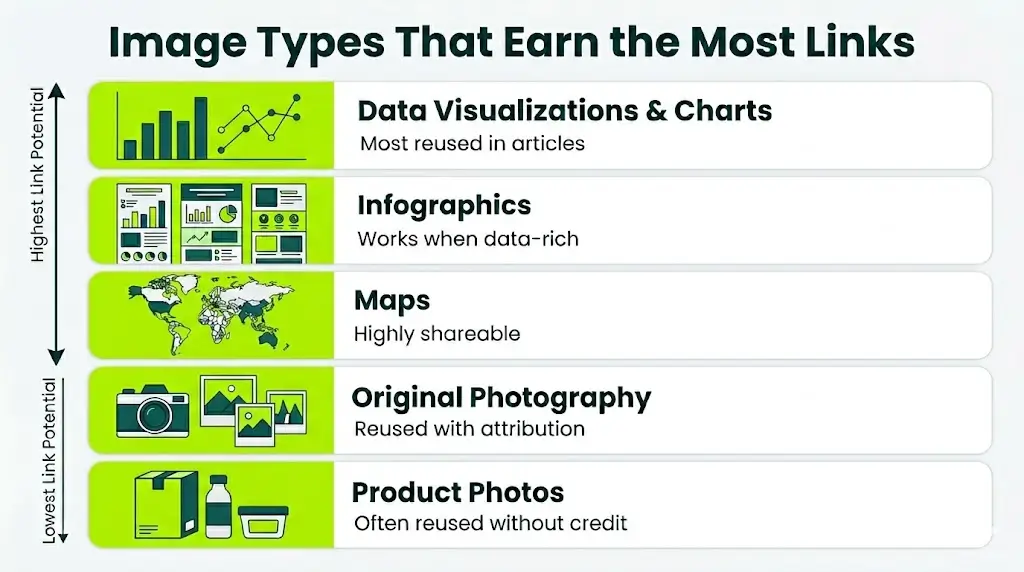
### Data Visualizations and Charts
Charts and graphs earn the most backlinks because they make complex data easier to understand.
It worked because its original data is presented clearly, updated annually, and genuinely useful to writers covering content marketing topics.
Whenever a blogger writes about how long it takes to write a blog post, they require a chart to back up the claim. Yours could be that chart.
### Infographics
Infographics still work, but the bar is higher. The older “10 tips for X” format doesn’t work anymore; it simply doesn’t earn links.
The ones that earn links are specific, data-rich, and visually engaging, so other websites willingly feature them.
The infographic in the right niche can earn hundreds of referring domains over time. At the Outreach Desk, we’ve seen this in competitive industries like healthcare and finance.
### Maps
Maps earn links because they’re shareable and difficult for others to recreate.
For example, a map like “most popular X by country” or “average Y by state” can attract links from news outlets, niche blogs, and social media.
Maps work best when they visualize data people are curious to know about but haven’t seen displayed geographically before.
### Original Photography
If you shoot original photos, product photography, event coverage, or location-specific images, those photos get reused consistently.
The [Unsplash model](https://kcseopro.com/unsplash-link-building/#:~:text=Unsplash%20is%20an%20online%20repository%20of%20free%2C%20high%2Dquality%20images%20that%20can%20be%20used%20for%20both%20commercial%20and%20non%2Dcommercial%20purposes.) proves this: high-quality photographs are uploaded, people use them everywhere, and a polite outreach email requesting attribution converts at a surprisingly high rate.
### Product Photos
Product images are frequently reused without credit. This creates an opportunity for ecommerce brands to track where their visuals appear and request credit through target outreach.
Most publishers won’t add a link manually, but give them an embed code and they’ll add attribution.
## How to Create Images That Publishers Want to Use
For image link building to work, the visuals have to pass a test that most teams never consider: would a blogger, journalist, or content manager want to embed this in their own articles?
### Start With the Data, Not the Design
Most teams make the mistake of hiring a designer first and then figuring out the data later.
Instead, do it the other way around. Start by identifying a data point, comparison, or process that your target audience searches for and argues about.
Here are some good sources for link-worthy data:
- **Your own priority data
**
Survey results, platform analytics, campaign benchmarks, anything only you can produce.
- **Public data is presented differently**
Government databases, industry reports, and academic studies contain data that haven’t been well visualized. That gap is your opportunity.
- **Updated data on outdated topics**
Find popular infographics in your space that are at least 3 years old. Recreate those with the current data.
### Design for Embeddability, Not Just Aesthetics
If your image looks good on your site but breaks or looks bad on other websites, people won’t use it.
Here are some practical rules:
- **Keep dimensions web-friendly**
1200px wide maximum, vertical infographics should be under 5000px tall.
- **Use readable fonts at small sizes
**
Your chart will be embedded at a width of 600-800px on many sites. If the labels disappear, then it won’t get used.
- **Include your brand and URL subtly**
Include a small source link in a button like “Source: xyz.com,” (give a link to your website), that gives credit even when someone forgets to link.
### Add an Embed Code
Embed codes turn a simple image into a backlink opportunity. By adding the embed code below your image, anyone can copy a single snippet and paste it into their website, automatically crediting you with a backlink.

Source: Your Site
Most publishers won’t bother to find your URL and add an attribute link manually. However, they’ll pass an embedded code.
## Finding Sites That Already Use Your Images (Without Credit)
You probably already have an image-like opportunity sitting right in front of you.
This is the fastest way to get backlinks because the image is already being used. You aren’t required to create any new [linkable asset](https://outreachdesk.com/linkable-assets/); you just need to identify unauthorized uses.
### The Manual Method: Reverse Image Search
Google’s reverse image search is the starting point. Start by downloading your original image, drag it into Google Images, and review the results.

You’ll see the sites that have embedded your image without linking back to your page.
For each result:
- Check whether the page links to your site. Check that your domain name appears on the page using Ctrl+F.
- If there’s no link, record the URL, the site’s contact info, and the page context.
- Then move to outreach.
The manual method works well for 5-10 images. If beyond that, then you need automation.
### The Automated Method: Image Monitoring Tools
Use tools like TinEye, Image Raider, and Pixsy to scan the web consistently for copies of your images.
At Outreach Desk, we’ve found that combining **Google reverse image search** for the initial audit with an automated monitoring tool for ongoing detection gives you depth and coverage.
### The Outreach: Turning Unauthorized Use Into Backlinks
The outreach email for image reclamation differs from standard [link building outreach](https://outreachdesk.com/link-building-outreach/). You’re not asking for a favor; you’re pointing out that someone is already using your work and requesting appropriate credit.
A strong reclamation email contains:
- **Opens with a compliment about their content** and not about your image.
- **States clearly that they’ve used your image** by including the URL of their page and the URL of your original source.
- **Asks for a simple attribution link**, don’t demand, don’t threaten, don’t mention copyright.
- **Make it easy** by providing the exact HTML they need to add.
In our experience, reclamation outreach converts at a much higher rate than cold link building outreach. Publishers have already chosen your image. They usually didn’t mean to skip attribution; they just forgot or didn’t know the source.
## Optimizing Images So Search Engines (and Publishers) Find Them
Creating a link-worthy image and burying it in a poorly optimized page is like printing a brilliant report and locking it in a drawer.
Image SEO puts your visuals in front of the people most likely to use and link to them.
### Alt Text That Actually Helps
Alt text serves mainly two purposes: accessibility, screen readers need it, and search engines like Google use alt text to understand what your image shows.
Write alt text that’s descriptive and specific. “Bar chart showing average blog post length by industry in 2026” beats “blog post chart” or “image1.png.”
Avoid stuffing keywords into alt text. One accurate description per image is enough. Google’s image algorithm has been smart enough to detect keyword stuffing for years.
### File Names, Compression, and Technical Basics
This is a technical setup that causes most teams to lose links they could have earned. The image exists; it’s good enough, but it’s named IMG_4892.jpg and is around 2MB.
Fix these four things before you publish anything:
- **File names:
**
It should be a mix of descriptive, hyphenated, lowercase
Average-blog-post-length-by-industry-2026.webp not IMG_4892.jpg.
- **Compression:**
Use the WebP format and compress to under 200KB for in-content images without visible loss of quality. Tools like Squoosh handle this in seconds.
- **Responsive images:**
Use srcset to serve appropriate sizes across devices. A 1200px image served to a 400px mobile screen wastes bandwidth and hurts page speed.
- **Image sitemaps:**
If you’re publishing a high volume of original visuals, submit an image sitemap to Google Search Console. It speeds up indexing.
### Structured Data for Images
Adding the ImageObject schema helps Google to understand your image’s subject, creator, and license. For the image link building, especially, the license and acquireLicensePage properties are useful, as they tell search engines and publishers browsing Google images to properly attribute your work.

## Promoting Images to Accelerate Link Acquisition
Optimizing your image helps people find you. Promotion helps your images reach people who might reuse them and link back to you. Promoting it regularly can cut the waiting time from months to just weeks.
### Targeted Email Outreach
The most reliable promotion method of link building is to identify publishers who’ve written about your topic and email them directly with your visual asset.
**Four-step pitch that converts:
**
- Reference their article by name, and prove to them that you’ve read it.
- Explain how your image improves their content; it can be either the data they’re missing, a visual their readers would find useful, or basically what you added in your image.
- Offer the image and embed code.
- Make the ask, “If you use the chart, a link to [source page] as attribution would be great.”
### Social Distribution and Community Sharing
Posting your visual on platforms where your target audience and publishers spend time creates organic pickup opportunities:
- **LinkedIn and X (Twitter)**
- **Reddit**
- **Pinterest**
Don’t try to be everywhere at once. Focus on 1 or 2 platforms where people are most likely to link to you and actually spend their time.
### Infographic Directories
Submitting your infographics to directory sites like [Visual.ly](http://Visual.ly), Infographic Journal, and Daily Infographics will get you a few low-quality backlinks, but more importantly, it helps the publishers to find your visuals when they’re searching for images on a specific topic.
The direct SEO value of directory links is minimal. The indirect value is worth 15 minutes.
Someone finds your infographic in a directory, uses it in their blog post, and links back to you.

## Building a Repeatable Image Link Building System
A reputable system can help you earn links consistently without the need to start from scratch every time.
### The Quarterly Cycle
**Month 1: Audit and Reclaim
**
Search for your existing images online. Find the sites using them without credit. Reach out and ask for a link.
This provides the fastest results because the images already exist, and the opportunities are already there.
**Month 2: Create and Optimize**
Create 2-3 new visuals based on the topics or data that are missing in your niche. Optimize the file names, alt text, and embed codes properly. Then publish it on your site.
**Month 3: Promote and Monitor
**
Reach out to relevant publishers and bloggers in your niche. Post it in the relevant communities and submit it to directories. Set up automated image monitoring for ongoing detection.
That should be repeated every quarter; you’re reclaiming old opportunities, creating new assets, and promoting strategically.
### What to Track
Most teams don’t treat image link building as separate from their overall link efforts. That’s a problem.
If you don’t measure it on its own, you’ll never know whether your images are actually earning links or whether those links came from other [link building campaigns](https://outreachdesk.com/link-building-campaigns/).
**You need to track these:
**
- **Referring domains per image asset
**
To see which visuals are actually earning links and which aren’t.
- **Reclamation conversion rate
**
Out of all the sites using your image without credit, how many gave you a link after you reached out?
- **Time to first link**
How long does it take for a newly published image to earn its first backlink?
- **Link quality distribution**
Are the links coming from trusted, relevant sites or just low-quality scrap sites?
If fewer than 1 in 4 sites are providing a link after you reach out, your outreach email needs improvement. If a new image isn’t earning its first link within 60 days, then either your promotion strategy or the image itself needs work.
## Where Most Image Link Building Campaigns Go Wrong
After running dozens of image-link campaigns, we’ve seen the same mistakes recurring. Avoiding those saves months of wasted time and effort.
### Creating Images Nobody Needs
This is the most common mistake. When teams focus on creating “beautiful” infographics for topics that don’t need visual explanation, they waste most of their time and effort on the wrong things.
If the content works perfectly well as a list or a paragraph, visualizing it adds zero link value.
The image has to solve a problem that texts can’t. It should simplify the complex topics, reveal patterns in the data, or show geographic distribution.
### Skipping Promotion Entirely
Just creating and publishing an image and hoping people will find it doesn’t work, the same way it doesn’t work for blog posts.
Original visuals need to be pushed in front of the right people. Most images that never earned a single link weren’t bad; they were simply never seen.
### Ignoring Reclamation
If you’ve been publishing original images for more than 6 months, there are almost certainly sites out there using them without crediting you. These are warm leads; the site has already chosen your image.
A quick 10-minute email could turn each one into a backlink. Ignoring this is leaving free links on the table.
### Optimizing for the Wrong Keywords
Image SEO matters, but some teams spend too much time trying to rank in Google Images and not enough time making their visuals actually useful to the publishers.
The goal isn’t just to get traffic from Google Images. The real goal is to create images that people reuse and link to.
### Not Updating Old Visuals
A chart with outdated data stops earning links. Sites that once linked to it may swap it out for a more current source.
Updating your best-performing visuals once a year keeps them relevant and protects the backlinks you’ve already built.
## Conclusion
Your competitors’ images are probably being used across dozens of websites right now, without credit or a link. Yours can be one of them.
Start by running a reverse image search on your five best visuals. Find the site using them without credits. Send the emails. That’s the backlink opportunity most brands don’t even know they’ve.
Once you’ve claimed what’s already yours, build a system that keeps working on link-worthy visuals, be it every quarter, every cycle, growing stronger over time.
### Want to build an image link strategy that fits your niche?
Get a clear approach to create visuals that earn backlinks.
[Book a strategy call](/contact-us/)
### Do image links help SEO as much as regular text backlinks?
Yes, **Google treats a linked image the same as the link**. The alt text on the image functions similarly to anchor text, passing topical relevance to the linked page. The reason is that the link appears within the main body content of a page and carries editorial context. which Google values more. The only scenario where image links are weaker is, however, when the linking page laces the image in a sidebar or footer, which carries less weight than in-body placement.
### How do I find out if someone is using my images without permission?
Start with Google reverse image search, then download your original image and search it. For ongoing monitoring, use tools like TinEye, Pixsy, and Image Raider to automatically scan the web for copies of your images. At the Outreach Desk, we run an initial manual audit first to catch the bigger opportunities, then set up automated monitoring for continuous detection. **Pixsy’s free plan supports up to 500 images**, which is enough for most campaigns.
### What’s the best image format for earning backlinks?
Data visualizations and original charts consistently outperform other formats. They’re hard to recreate, easy to cite, and useful across many types of content. Infographics hold second place, but only when they’re rich in data, specific, and visually strong enough for a publisher to be proud to embed. Listicle-style infographics earn very few links in 2026. Maps perform well when the topic has geographical relevance. Product photos are underrated for reclamation, review sites, and affiliate blogs use them constantly without attribution.
### How long does image link building take to produce results?
Reclamation outreach, finding sites that are already using your images without credit, can produce backlinks within **1-2 weeks** of sending emails. Whereas creating new image campaigns takes longer. You can expect **30-60 days** before a new visual earns its first organic backlink, assuming you’ve promoted it through outreach and social channels. But, the compounding effect is real: a library of 20+ original visuals, each are monitored for unauthorized use, generates a steady trickle of link opportunities without constant effort.
### Can AI-generated images earn backlinks?
They can, but they face a credibility gap. Publishers are more careful about embedding AI-generated visuals because they can’t verify the accuracy of AI-generated data visualizations or the originality of AI-generated artwork. **Original data charts, original photography, and carefully crafted infographics still outperform AI-generated images** in link acquisition. You can use AI as a design accelerator, but make sure the data and creativity directions are human-oriented.
---
---
title: "How To Get Backlinks That Actually Move Rankings"
url: "https://outreachdesk.com/how-to-get-backlinks/"
lang: "en-US"
type: "post"
description: "Backlinks are links from other websites pointing to your content or site. Think of them as recommendations. When a trusted site links to yours, search engines treat it as a signal that your page is worth ranking. When the workload"
last_modified: "2026-05-20T07:58:20+00:00"
categories: [Link Building]
---
# How To Get Backlinks That Actually Move Rankings
Backlinks are links from other websites pointing to your content or site. Think of them as recommendations. When a trusted site links to yours, search engines treat it as a signal that your page is worth ranking. When the workload outgrows in-house capacity, hiring a [link building agency](https://outreachdesk.com/) is usually the next step. Brands serious about scaling backlink campaigns turn to [link building statistics](https://outreachdesk.com/link-building-statistics/) for current benchmarks.
Earning more high-quality, relevant backlinks makes your authority stronger. That’s what pushes your site up the rankings and pulls in consistent organic traffic.
In practice, getting backlinks is a two-part process: create something worth referencing, then tell the right people it exists.
Websites that earn links consistently don’t chase volume. They build content that solves a specific problem, then reach out to editors and site owners who’d genuinely benefit from linking to it.
**Key Takeaways
**
- Backlinks still drive rankings and AI visibility, but only when they come from relevant and trusted sources.
- Start with 2-3 tactics that match your resources, not all 9 at once.
- Every method added here follows the same principle: offer real value to the linking site, not just a request.
- Outreach response rates depend on personalization; generic templates get ignored.
## What Makes a Backlink Worth Earning?
Not all [types of links](https://outreachdesk.com/types-of-backlinks/) carry the same weight.
One editorial mention from a relevant website or niche with organic traffic can support your website ranking more than 50 directory listings.
**These three factors decide whether a backlink moves the needle:
**
### Relevance:
The site that points to your website covers relevant topics.
For example, a SaaS company earning a [high-quality backlink](https://outreachdesk.com/what-are-backlinks/) from a marketing blog carries a stronger authority signal than one from a general lifestyle site. **
**
### Source Quality:
The quality of the source equally matters. The linking site domain has its own organic traffic, a clean backlink profile, and content that gets updated regularly.
It’s like borrowed credibility. If the source has little or none, it won’t help you much.
### Contextual Placement:
A natural link placement within relevant content usually passes more value than sidebar widgets, footer links, or author bios.
Google systems can distinguish between editorial and boilerplate placements.
**Remember:
**
A relevant, well-placed link from a mid-authority site often outperforms a random link from a high-authority site.
All three factors working together can produce a stronger ranking signal.

## How to Get Backlinks the Right Way
These 7 backlink-building tactics will help you build stronger backlinks. **
**
### 1) Create Content That Naturally Attracts Links
Create [linkable assets](https://outreachdesk.com/linkable-assets/) that other writers cannot easily replicate such as original data, useful tools, and frameworks they actually want to reference. These are the formats that earn links without outreach.
You can start with these 3 content formats to collect natural backlinks.

**Original research
**
This is the strongest magnet. Start with the aim of publishing a high-quality, flawless, and detailed guide.
Conduct a survey, analyze your campaign data, or publish benchmarks your industry doesn’t have yet.
This will start providing results when bloggers or writers need a reference to back up their arguments. They’ll link to your research because your competitor also lacks that level of depth.
**Free tools and calculators
**
These assets also work the same way. Creating free tools and calculators drives lots of backlinks that actually support higher rankings.
Here, you don’t need to build complex tools; a simple ROI calculator, audit template, or comparison worksheet can attract links for years.

BankRate’s mortgage calculator has earned over 35,000 links because it solves a real problem in under 30 seconds.
**Definitive Guide:
**
This content format still earns links, but only when you build them, covering depth and focusing on the audience’s requirements.
They need a complete guide that covers all possible aspects in your guide.
A guide with the same 10 points that thousands of sites have already covered won’t attract citations.
You need to research, write high-quality content, and build a page that covers everything.
### 2) Guest Posting on Relevant Industry Sites
[Guest posting](https://outreachdesk.com/guest-posts/) means you write quality content for another website in the same industry.

It helps you earn [contextual backlinks](https://outreachdesk.com/contextual-link-building/) by contributing useful content to someone else’s site.
You write a quality article, including a natural link within the body, and both sides win: the publisher gets content, and you get an editorial link.
Here’s how to do it without burning pitches:
**Find sites that accept contributions
**
Search your niche keyword plus “write for us,” “contribute,” or “guest post guidelines.”
You can further filter to exclude sites with thin content, no real traffic, or guest posts from unrelated industries. If a site publishes everything from anyone, that link won’t carry weight.
**Pitch a specific angle, not a vague topic
**
Do not write “I’d like to write about SEO,” as such a pitch gets deleted. Also, “here’s a 300-word outline on how SaaS companies cut churn through onboarding email sequences, with data from 3 campaigns,” gets a response. Show the editor you’ve read their content and your piece fills a real gap.
**Write the post as if it’s for your own site
**
Thin guest posts damage your reputation and lower the perceived value of your link.
Use real examples, real data, and real takeaways. Place your link where it genuinely adds context and not just shoehorned into the opening paragraph.
### 3) Turn Unlinked Brand Mentions Into Live Links
If a site has already mentioned your brand, product, or founder’s name without linking to you, it creates unlinked [brand mentions](https://outreachdesk.com/brand-mentions/). The hard part is already done. Because they already know who you are.
You just need to write a short, direct [outreach email](https://outreachdesk.com/link-building-outreach/) asking them to add a link to already published content.
**Here’s how to find them:
**
- Set up [Google Alerts](https://www.google.com/alerts) for your brand name and product names, and key people at your company.

- Use [Ahrefs Content Explore](https://ahrefs.com/content-explorer) and search your brand name, then filter for pages that don’t link to your domain.
The outreach is simple. A short, friendly email thanking them for the mention and asking if they’d add a link. No pitch, no sales language.
Most companies don’t even track their brand mentions. These brand mentions are half-earned and unclaimed. Don’t let that happen.
### 4) Use Broken Link Building to Replace Dead Resources
[Broken link building](https://outreachdesk.com/broken-link-building/) works because you’re helping the site owner solve the problem, not asking for a favor.

Here, you find a page linking to a dead resource (404 error).
Match it with a working alternative on your site and suggest adding a new link in its place.
**Step 1: Find broken links
**
Use the [broken link checker tool](https://outreachdesk.com/tools/broken-link-checker/) or Ahrefs’s Broken Backlinks report on your competitor domains.
Scan resource pages in your niche with a browser extension like [Check My Links](https://chromewebstore.google.com/detail/check-my-links/aajoalonednamcpodaeocebfgldhcpbe?hl=en-US).

**Step 2: Check the dead content
**
Use the [Wayback Machine](http://web.archive.org/) to see what the original resource covered. Your replacement needs to match the same topic and depth; otherwise, the site owner has no reason to swap.
**Step 3: Send a helpful email
**
Point out the broken link (include the exact URL), explain what it used to cover, and offer your resource as the replacement. Keep it short. The email should feel like you’re doing them a favor.
**Remember:
**
Conversion rates here are roughly 5-10%, lower than those for unlinked mentions. But the links tend to come from strong resource pages with real editorial value.
### 5) Building Relationships Through Digital Pr
Digital PR earns backlinks by getting your brand covered in news articles, industry publications, and expert roundups.
This is the closest thing to “earned media.”
Journalists and editors link to you because your data, expertise, or story is genuinely useful to their readers.
Three approaches that produce results:
**Respond to journalist queries:
**
Platforms like [HARO](https://www.helpareporter.com/), Qwoted, and Help a B2B writer connect journalists with expert sources.
Set up alerts for your niche, respond within 2 hours (quick response matters), and give quotable answers.
One placement in a high-authority publication is worth more than a month of guest posts.
**Pitch original data or insights:
**
Avoid outdated data and cliche pitch formats. Journalists need original research-based data to support their stories.
If you have campaign benchmarks, survey results, or industry trend analysis, package it into a short pitch and send it to relevant reporters.
**Offer expert commentary on trending topics:
**
When industry news breaks, editors scramble for fast, expert reactions. You need to be the source they can reach with a specific, clear take, and for that, you need to monitor industry news daily.
Digital PR demands more effort per link than most tactics on this list.
However, the links it produces are high-quality and tend to come from high-traffic, authoritative sites that pass more ranking value.
### 6) Get Listed on Resource Pages in Your Niche
[Resource pages](https://outreachdesk.com/resource-page-link-building/) are collections of helpful links on a specific topic. Universities, industry associations, and niche blogs maintain them as reference points for their readers.
**How to find them:
**
Search your topic plus “resources,” “useful links,” or “recommended tools.”
Try search operators like intitle: resources inurls: links [your niche] to surface relevant pages faster.

**Filter your results:
**
The best resource pages have clear editorial standards, get updated regularly, and link to a manageable number of quality sources.
If a page has 200+ outbound links and no real curation, skip it. The link won’t carry weight.
**The Pitch:
**
A short pitch explaining what your resource is, why it fits their page, and a direct link.
Resource page owners are actively looking for good additions. Your success rate depends on one thing: whether your content genuinely belongs there.
### 7) Niche Edits
[Niche edits](https://outreachdesk.com/niche-edits/) places your link inside an existing, already-published article on another site.

The page already ranks, already gets traffic, and already has Google’s trust. Your link automatically has that authority from the start.
**How to find niche edits opportunities:
**
- Search for content-relevant topics and target articles that are live for 1+ year.
- Look for broken links, outdated stats, content gaps, or unlinked brand mentions.
- Skip sites with thin content or dozens of unrelated outbound links.
**How to pitch:
**
Keep it short. Name the specific article, explain what you’re suggesting, and show why it helps their readers.
Also, follow up once in 5-7 days if you don’t get a response.**
**
## How Many Backlinks do You Actually Need?
There’s no universal number. The data provides useful benchmarks for backlinks.
The [WebFX 2026 industry study](https://www.webfx.com/blog/seo/how-many-backlinks-do-i-need-to-rank-study/) analyzed 1,462 domains across 15 industries and found that page-one sites have a median of 907 referring domains.
But that number swings hard by industry, from 76 in Apparel to 3,027 in finance and insurance.**
**
So, chasing a single fixed number is the wrong move. Your target depends entirely on your industry and who you’re competing against.
Watch actually matters more than link velocity.
It is the number of new referring domains you gain each month compared to your competitors.
If they’re adding 30 per month and you’re adding 5, you’re losing, even if your total count looks decent.
**Practical Way:**
Pull up your top 3-5 competitors for your target keywords.
Check how many referring domains they have and how fast they’re growing. Then set your campaign pace to match or beat that growth rate.
## Common Mistakes That Waste Your Link Building Budget
Most link building failures don’t come from bad strategy; they come from avoidable habits.
Here are the ones that quietly drain budgets without moving rankings.
### 1) Prioritizing Quantity Over Relevance
Fifty links from random directories won’t beat five links from sites in your niche.
A [BuzzStream outreach analysis](https://www.buzzstream.com/blog/link-building-survey/) found personalized outreach gets 3X more responses than generic templates, yet most teams still blast identical emails to hundreds of contacts.
### 2) Ignoring Link Placement
A link in the footer or the author bio is worth far less than a link inside the article body.
In-content links (contextual links) sit within a real editorial context, and Google places the most weight on them.
### 3) Building Links to the Wrong Pages
Most teams pile links onto blog posts and ignore their products or service pages, from where they can drive revenue.
These pages need link equity, too. Build some links directly to them, and use internal links from your blog to push [link authority ](https://outreachdesk.com/link-equity/)their way. **
**
### 4) Using Automated or Spammy Tools
Some tools promise hundreds of backlinks fast. What they actually deliver are links from [link farms](https://outreachdesk.com/link-farming/) and low-quality sites.
These don’t help rankings; they create unnatural patterns that put your site at risk of a Google penalty.
### 5) Stopping After One Campaign
Link building takes time to compound. Page-one sites didn’t get there with one [link building campaign](https://outreachdesk.com/link-building-campaigns/).
They built consistently, month after month. Quitting at month 3 because results feel slow means stopping right before the momentum builds.
**Reality:**
Most teams that push through to months 4 and 5 start seeing page-one results.
## What to do Next
Getting backlinks is not about chasing as many links as possible. It’s about earning the right links from relevant and trusted websites. When your focus is on value, your backlinks start working for you instead of just adding numbers.
The strategies that work are simple. Create useful content, reach out to the right sites, and stay consistent. Over time, these efforts build authority, improve your rankings, and bring steady organic traffic.
Start with what you can manage today. Focus on quality, keep your approach consistent, and let your backlink profile grow naturally.
### Want to earn backlinks that actually improve your rankings?
Get a clear approach focused on earning links from relevant, trusted websites.
[Book a strategy call](/contact-us/)
### 1) How long does it take for backlinks to affect rankings?
Most links show measurable results within 4-12 weeks. The timeline depends on three things: how often Google crawls the linking site, your domain’s existing authority, and how competitive your target keyword is. Links from high-traffic sites tend to register faster than links from smaller sites that Google visits less often.
### 2) Can you rank without backlinks?
Yes. You can rank without backlinks for every low-competition keyword with almost no existing results. The content quality alone can sometimes be enough. But for any keyword with real search volume and established competitors, you need backlinks. Pages with zero referring domains rarely break into the top 10.**
**
### 3) What’s the difference between dofollow and nofollow backlinks?
Dofollow links pass ranking value directly from the linking site to yours. While NoFollow links carry an HTML tag that prevents search engines from passing authority. Yet since 2019, Google has treated nofollow as a suggestion rather than a strict rule. Both types drive referral traffic, but dofollow links carry more direct SEO weight.
### 4) How many backlinks should I build per month?
The number of backlinks depends on the industry you’re working in and the level of competition. Here, you need to match or slightly exceed the monthly link velocity of competitors ranking above you. For most small-to-mid businesses in a moderately competitive niche, 5-15 quality referring domains per month is a good pace.
### 5) Is it safe to buy backlinks?
Google’s guidelines explicitly prohibit buying links to influence rankings. Paid links that pass PageRank violate their webmaster policies. Those links may be ignored, or a manual action will wipe out your site’s visibility. Editorial links earned through real outreach are the only approach that carries zero risk.
---
---
title: "SaaS Link Building: What Actually Moves Rankings in 2026"
url: "https://outreachdesk.com/saas-link-building/"
lang: "en-US"
type: "post"
description: "SaaS (software as a service) business models are among the most competitive niches. They require strong backlink profiles, beyond content, to rank higher on search engines like Google and AI platforms in 2026. Most successful campaigns rely on a SaaS"
last_modified: "2026-05-22T10:03:49+00:00"
categories: [Link Building]
---
# SaaS Link Building: What Actually Moves Rankings in 2026
SaaS (software as a service) business models are among the most competitive niches. They require strong backlink profiles, beyond content, to rank higher on search engines like Google and AI platforms in 2026. Most successful campaigns rely on a [SaaS link building agency](https://outreachdesk.com/) to handle vetting, outreach, and reporting. For brands that need ongoing execution, [SaaS link building solutions](https://outreachdesk.com/saas-link-building-solutions/) from a specialised provider can carry the load.
**Here comes SaaS link building.
**
It’s about earning backlinks from authoritative websites that your target audience, such as developers, marketers, finance teams, and operations leaders, already trusts.
This improves your software company’s organic rankings, domain authority, and qualified traffic.
**What you’ll learn:
**
- Why links matter more for SaaS than most other businesses.
- Nine link building strategies ranked by effort, scalability, and ROI.
- How to evaluate link quality beyond domain rating.
- The content formats that attract links passively and the ones that need outreach.
- Common mistakes that stall SaaS link campaigns.
## Why Links Matter More for SaaS Than Most Industries
SaaS companies fight for some of the most competitive keywords on the internet.
Terms like** “project management software,” “CRM for small business,”** or “best email marketing tool” have dozens of well-funded competitors publishing nearly identical content.
When content quality is comparable to your closest competitors’, [backlinks](https://outreachdesk.com/what-are-backlinks/) become the tiebreaker.
When two pages are equally good, Google uses backlinks to decide which one ranks.
When your product page earns a contextual mention on a respected industry blog, that’s a trust signal your buyer reads before they ever reach your site.
For SaaS companies, a strong backlink profile does two things simultaneously: ranking power and brand credibility in the same placement.
The numbers back this up.
SaaS companies building 15-25 high-relevance links per month to their core product and comparison pages see measurable ranking improvements within 60-90 days.
Companies spreading the same links across random blog posts? Almost no movement. The difference is more about precision than volume.

## What Makes SaaS Link Building Different
**SaaS link building differs from standard outreach in three specific ways.** Your buyers compare products across review sites, pricing pages, and competitor comparisons before they decide — meaning your product and comparison pages need backlinks, not just your blog. Your competitor set is narrow and specific. And your best content assets, like original data studies and free tools, can earn links for years rather than months.
You need to remember that SaaS link building is not like [ecommerce link building](https://outreachdesk.com/ecommerce-link-building/) or [local business link building](https://outreachdesk.com/local-link-building/).
This is one of the most common mistakes teams make.
Three things separate the SaaS link campaign from everything else.
### Your Buyers Research Before They Buy
SaaS decisions involve comparison, feature evaluation, and multiple stakeholders. That means your product, comparison, and pricing pages need authority. Not just blogs.
### Your Competitor Set is Specific
You’re competing against 10-30 specific SaaS companies targeting the same keywords. The links you need come from the exact same places your competitors already appear.
### Your Content Has a Longer Shelf Life
A well-built resource page or original research study can earn links for years. That makes link building an investment, not an expense, but only when you’re building links to the right pages.

## Nine SaaS Link Building Strategies That Work Right Now
Here are the nine strategies actually worth your time in 2026.
### 1) Competitor Backlink Gap Analysis
Always start with a [competitor backlink gap analysis](https://outreachdesk.com/competitor-backlinks/).
Pull your top 3-5 keyword competitors into [Ahrefs](https://ahrefs.com/) or [Semrush](https://www.semrush.com/) and run a backlink gap analysis.
This shows you every site linking to your competitors but not to you. These sites have already proven they’ll link to content in your space. You just need to give them a reason.
Sort results by domain relevance and traffic. Ignore sites linking to every competitor; those are likely paid placements or directories.
Focus on sites linking to just one or two competitors on specific topics. Those are editorial placements you can replicate with better content or a sharper angle.
### 2) Original Research and Data Studies
Proprietary data earns links at scale. If your product generates usage data, survey results, or benchmarks, publish them.
The title matters here.
**“We analyzed 10,000 SaaS free trials: Here’s what predicts conversion.” **can help you earn links.
Titles like **“Our Q1 data report”** earn nothing.
Lead with surprising or counterintuitive findings. Journalists and bloggers link to data that challenges assumptions, not data that confirms what everyone already knows.
💡
Publish your data study as a standalone page, not a blog post. Standalone pages are easier to reference and accumulate links over time. Blog posts get buried.
### 3) Linkable Tool and Calculator Pages
Free [linkable assets](https://outreachdesk.com/linkable-assets/) and tools built around your product’s core value attract links passively and generate leads simultaneously.
Think HubSpot’s Website Grader. It is a page earning thousands of referring domains because it provides a standalone utility.

You don’t need HubSpot’s budget. A well-built ROI calculator or benchmarking tool can earn steady links for years.
**Remember:**
The tool must work without a product signup. If it’s just a gated demo, nobody will link to it.
### 4) Guest Posting on Niche-Relevant Sites
[Guest posting](https://outreachdesk.com/guest-posts/) still works, but only on sites your actual buyers read.
If you sell project management software, post on operations blogs and engineering leadership publications, not generic marketing sites.
Write content that requires genuine product expertise. Technical tutorials, workflow breakdowns, and real case studies.
Surface-level advice that anyone could write won’t earn placements worth having.
### 5) Unlinked Brand Mention Reclamation
If your SaaS products have any market presence, people are already mentioning them without a link. These are the easiest links you’ll ever build.
Set up alerts in [Google Alerts](https://www.google.com/alerts), Mentions, or [Ahrefs Content Explorer](https://ahrefs.com/content-explorer) for your brand name, product name, and key executive names.
When a [brand mention](https://outreachdesk.com/brand-mentions/) appears without a hyperlink, send a short, friendly email asking if they’d add the link. No pitch.
No explanation, just “Thanks for the mention, would you mind linking our name to [URL], so that your readers can find us easily?”
Conversion rates on these emails typically run 30-50% because you’re not asking for a favor. You’re making their existing content more useful for their readers.
### 6) SaaS Directories and Review Platforms
Most directories deserve their low-value reputation. But a handful of SaaS-specific platforms carry real authority and send qualified traffic directly to your product.
G2, Capterra, TrustRadius, Product Hunt, and GetApp are worth maintaining active profiles on. Beyond backlinks, these platforms influence buyers’ decisions, and Google surfaces them prominently in SaaS-related searches.

Don’t spend weeks submitting to 200 generic directories. Pick the 8-12 profiles your buyers actually use and keep them up to date with screenshots, accurate information, and responses to reviews.
### 7) Expert Commentary and Journalist Requests
Journalists’ requests platforms still work even after HARO’s decline. In 2026, [Qwoted](https://www.qwoted.com/), [Featured](https://featured.com/), and direct outreach on LinkedIn and X emerged as the most productive channels.
**Here’s how you should approach:
**
Monitor requests across the verticals and respond within hours, because speed matters here.
Make sure to provide a genuine, specific answer with data or examples. Such an answer is more likely to be published than generic ones.
| Gets Ignored | Gets Published |
| --- | --- |
| “As an industry expert, I believe…” | “I run paid search campaigns for 40+ brands over 8 years…” |
This tactic works best for SaaS founders and executives with strong personal brands. If your CEO can credibly speak to industry trends, this channel can generate 3-5 high-authority links per month with minimal time investment.
### 8) Integration Partner Co-Marketing
This is one of the most underused SaaS link building strategies.
Every integration partner is a potential link source, and these links are among the most topically relevant you’ll ever earn.
[Reach out](https://outreachdesk.com/link-building-outreach/) to your integration partner and co-create content. You can create:
- Joint tutorials and webinars
- Shared case studies
- Best [category] tool that integrates with [partner]
This way, you can get [contextual links](https://outreachdesk.com/contextual-link-building/) to both products and can create useful content for both audiences.
### 9) Resource Page and Listicle Placements
You will find thousands of [resource pages](https://outreachdesk.com/resource-page-link-building/) on the internet. These pages are created to serve readers with almost all the details on relevant topics.
Industry resource pages and category tools are exactly where buyers look when they’re comparing the products.
Look for such pages and see where your competitors get links.
Simply reach out, send a pitch, and ask to include your link with a clear, brief explanation of why your product belongs on the list.
When your target buyer compares competitor A and competitor B, they might also want to know about your product. Here you can be a differentiator.
**Remember:**
Do not sound desperate by pitching “please add us.”
Give them a strong reason that you are genuinely serving their audience, not your marketing goals.

**
**
## How to Evaluate Link Quality Beyond Domain Rating
SaaS link building is not about gaining the most links. It is about gaining the right ones, because quality always matters more than quantity.
Most people look at the high DR (domain rating) and call it an achievement. What they overlook or underestimate is the site’s authority and relevance.
DR 70 sites with no referral traffic and no SaaS relevance offer limited value. A DR 35 niche blog can help improve rankings faster due to its relevance.
**Here’s what actually matters when evaluating a potential link:
**
### Topical Relevance
A DR 50 site that covers B2B software every day beats a DR 80 with a general news site that published one tech article last year. Google cares about context.
### Real Organic Traffic
A website can have impressive DR and barely any real visitors. Check actual search traffic in Ahrefs or Semrush.
A site with 10,000 monthly visitors on relevant keywords is genuinely valuable. On the other hand, a site with inflated DR but 200 monthly visitors is likely a [link farm](https://outreachdesk.com/link-farming/). Stay away from these sites.
Such link-farming sites are created for selling links, not to serve the audience.
### Editorial Standards
Read 3 recent articles and ask yourself:
- Are they well-written?
- Do they have named authors?
- Do they feel like real content or fillers?
If it reads like it was generated to sell links, then placement on such sites won’t help you rank higher.
### Link Neighborhood:
Check what other sites it links out to. If a “SaaS blog” is also linking to online casinos, payday loan sites, and pharma pages, that’s a serious red flag. Good editorial sites link to other good sites.
### Indexation Health:
This one gets overlooked constantly. A link on a page that Google doesn’t index transfers zero value. Use a [Google index checker](https://outreachdesk.com/google-index-checker/) to confirm the page actually exists in Google’s eyes before you pursue it.
**Here’s a quick reference table:
**
| Quality Signal | What to Check | Red Flag |
| --- | --- | --- |
| Topical relevance | Content archives in your niche | No SaaS/tech content in the last 6 months |
| Organic traffic | Ahrefs/Semrush traffic estimate | Under 500 monthly organic visits |
| Editorial standards | Author bylines, content depth | Thin posts, no named authors |
| Link neighborhood | Outbound link profile | Links to gambling, pharma, unrelated niches |
| Indexation | Google index status | Linking page not indexed |
## Content Formats That Attract SaaS Backlinks
Not all content earns a link equally. Some formats pull links in naturally. Others need active outreach just to earn one. Knowing the difference saves a month of wasted effort.
### High Passive Link Potential:
- Original research and industry benchmarks
- Free tools, calculators, and interactive resources
- Full glossaries and definition pages
- Statistics roundup pages with original analysis
### High Outreach Link Potential:
- Guest posts and contributed articles
- Expert commentary and interview placements
- Listicle and resource page inclusions
- Create co-content with Integration partners
### Low Link Potential (Skip These for Link Building)
- Product announcements and release notes
- Company culture posts
- Generic “thought leadership” with no data
- Repurposed content with nothing original added
**Here’s the winning combination:
**
Passive assets build your baseline authority steadily over time. Outreach campaigns accelerate growth on the specific pages that drive revenue. The strongest SaaS link profiles use both, not one or the other.
## Common SaaS Link Building Mistakes
These mistakes aren’t rare; they happen constantly, even at well-funded SaaS companies.
### 1) Building Links Only to Blog Posts
This is one of the most common mistakes the SaaS team makes. They treat the blog as their product page.
Remember, your blog page and product pages are different.
If all your backlinks point to articles and your product pages have zero external links, you’re building authority in the wrong place.
Distribute the [PageRank flow](https://outreachdesk.com/link-equity/) across product pages, comparison pages, features pages, and integration pages, not just the blog.
### 2) Chasing Domain Rating Instead of Relevance
Domain rating matters, but keeping relevance out of the door won’t help.
A backlink from a DR 80 cooking site won’t help your SaaS website. But a DR 40 link from a respected operations management blog tells Google that your website is a genuine source to reference.
This sends topical signals to the search engines.
### 3) Ignoring Internal Link Architecture
External and internal links both matter. Internal links help in distributing the authority that external links bring to your site.
If your blog posts don’t link to your own product pages, the authority you’ve worked hard to earn just sits there and won’t work in your favor.
You need to first fix internal links before building more external ones.
### 4) Treating Link Building as a One-Time Project
Link building is a continuous process. In fact, your competitors are building links every single month.
If you stop after a three-month [link building campaign](https://outreachdesk.com/link-building-campaigns/) and then do nothing, your rankings will slowly decline as competitors continue to accrue authority.
You need to treat link building as part of your business routine. If your team lacks the bandwidth to stay consistent month after month, a [SaaS link building agency](https://outreachdesk.com/saas-link-building-agency/) can help maintain momentum without gaps.
### 5) Using the Same Anchor Text Everywhere
If every backlink uses your exact target keywords as anchor text, you’re creating a problem, not solving it.
Google detects over-optimized anchor text easily.
The solution is simple: Vary your anchor naturally across branded terms, partial matches, URLs, and generic phrases. [Different types of backlinks](https://outreachdesk.com/types-of-backlinks/) will help you understand anchor types.
## How to Structure a Monthly SaaS Link Building Campaign
Understanding SaaS link building strategies and common mistakes that most teams make is easy. The challenging part is to build a strong structure that works month after month.
Here’s a simple four-week framework that keeps your campaign moving.
### Week 1: Research and Prospecting
Run a competitor gap analysis and identify 30-50 prospects. Sort them by link type. It could be guest post targets, resource page targets, unlinked mentions, and integration partners. You can prioritize them by relevance and how reachable the site actually is.
### Week 2: Content Creation
Draft guest post pitches, prepare outreach angles, and create any content assets needed for the month. If you’re building a data study or tool page, this phase may extend into week three.
### Week 3: Outreach Execution
Send personalized emails to your prospect list. Follow up once after 5-7 days. Keep outreach short and specific, mention their content, explain why your resource adds value for their audience, and make it easy to say yes.
### Week 4: Tracking and Refinement
Log every placement. Monitor new referring domains using the [backlink monitoring tool](https://outreachdesk.com/backlink-monitoring-tool/). Analyze which prospect categories converted best. Feed those insights back into next month’s research phase.
**Timeline**:
This cycle takes roughly 15-20 hours per month for a lean team. If that capacity doesn’t exist internally, [outsourcing link building](https://outreachdesk.com/outsource-link-building/) to a specialist agency is a valid option, but you should still understand the process well enough to evaluate what they deliver.
## Should You Build Links In-House or Hire an Agency?
Both can help you build quality links. The right decision depends on your business stage, budget, and your team’s skills.
### Build In-House When
- Your content team already has experience with outreach.
- Your monthly budget is under $3,000.
- You want direct control over every placement.
- Your niche is so specialized that only your team can credibly write about it.**
**
### Hire an Agency When
- You need to quickly scale beyond 10-15 links per month.
- Your team lacks outreach infrastructure or publisher relationships.
- You’re entering a competitive vertical and need authority fast.
- You want access to established publisher networks without having to build them from scratch.
-

Most SaaS companies consider cost as the biggest risk when working with agencies, but the actual risk is relevance.
Many generalist agencies build links from whatever sites they have relationships with, regardless of your niche. If those links aren’t relevant to your SaaS vertical, the money is wasted.
Before choosing a partner, it is worth knowing what separates a [good SaaS link building agency](https://outreachdesk.com/best-saas-link-building-agencies/) from a generic one.
**Tip:**
Before hiring, ask for examples of real placements for other SaaS clients. Check them manually, do the sites have real traffic? Would your buyers actually read them?
If the answer is no, keep looking.
## Measuring SaaS Link Building Success
You built strategies, avoided mistakes, and started running campaigns through an in-house team or with an agency; now it’s time to measure success in the SaaS link building process.
Traffic and rankings are the obvious metrics to measure success, but they’re lagging indicators. They move weeks or months after the links go live.
Track leading indicators as well, so you know your campaign is working before rankings confirm it.
### Leading Indicators (Track Weekly):
- New referring domains to target pages
- Link placement rates (outreach sent vs. link secured)
- Average domain relevance score of new links
- Anchor text distribution balance**
**
### Lagging Indicators (Track Monthly):
- Organic traffic to linked pages
- Keyword position changes for target terms
- Organic-attributed signups, demos, or trials
- Domain authority trend directional, not absolute
The metric that matters most depends on your business model:
| Product-led SaaS | Track organic signups per linked page |
| --- | --- |
| Sales-led SaaS | Track demo requests from organic traffic |
Link building that doesn’t eventually connect to revenue isn’t working even if your domain rating keeps climbing.
## Building a Link Profile That Compounds
The SaaS companies winning organic search in 2026 aren’t necessarily spending the most.
They’re building the right links to the right pages, month after month, and letting that authority compound over time.
Start simple. Run a competitor gap analysis this week. Find your ten most relevant link prospects. Reach out to five of them.
That’s enough to build momentum, and it will separate companies with flat organic traffic from the ones whose growth curve keeps climbing.
### Looking for a SaaS link building approach that fits your growth stage?
Get a clear strategy focused on relevant, high-quality links that support long-term growth.
[Book a strategy call](/contact-us/)
### 1) How long does SaaS link building take to show results?
Most companies see measurable ranking improvements within 60-90 days, with significant traffic gains appearing between months 3 and 6. Consistency matters more than volume; 15 relevant links per month for six months beats 90 links in month one, followed by nothing.
### 2) How much does SaaS link building cost?
In-house campaigns typically run $3,000 to $8,000 per month, including tools, content, and team time. Agencies charge $2,000 to $15,000+ per month, depending on volume, quality, and niche competitiveness. A detailed[ breakdown of link building pricing](https://outreachdesk.com/link-building-pricing/) can help you benchmark costs for your situation.
The real question isn’t what it costs, it’s what it returns. A campaign generating $50,000 in organic pipeline over 12 months is cheap at $5,000 per month. A campaign generating nothing at $2,000 per month is expensive.
### 3) What’s the difference between SaaS link building and regular link building?
SaaS link building targets the software industry, including tech publications, review platforms, integration partner blogs, and vertical industry sites. The strategies overlap, but the targeting criteria, content angles, and success metrics differ. SaaS link building ultimately measures success against product signups and pipeline, not just traffic.
### 4) Can I build links directly to my SaaS product pages?
Yes, you can build links to your SaaS product pages, and you should. Build links for product pages, comparison pages, and feature pages, because these are the highest-converting pages on SaaS. However, you need to remember that they’re also the hardest to earn links naturally, which is why most competitors neglect them.
### 5) Is link building still worth it with AI search changing everything?
Absolutely. AI search surfaces like Google’s AI Overview and Perplexity still rely on authoritative sources. Pages with strong backlink profiles get cited more often in AI-generated answers. The format of how links help is shifting, but the underlying mechanism hasn’t changed. Authority signals from trusted sites still matter.
---
---
title: "AI Search Optimization: Get Cited, Not Just Ranked in 2026"
url: "https://outreachdesk.com/ai-search-optimization/"
lang: "en-US"
type: "post"
description: "Ranking on page one still matters, but it is no longer enough. Traditional SEO helps you get ranked. AI search optimization helps you get cited. In 2026, an increasing number of searches are answered directly by AI, without users ever"
last_modified: "2026-05-22T10:02:35+00:00"
categories: [Link Building]
---
# AI Search Optimization: Get Cited, Not Just Ranked in 2026
Ranking on page one still matters, but it is no longer enough. Traditional SEO helps you get ranked. AI search optimization helps you get cited. In 2026, an increasing number of searches are answered directly by AI, without users ever clicking a link. Showing up in those answers is no longer optional. If you would rather hand this off, [Outreach Desk experts](https://outreachdesk.com/) offers full-service execution. For up-to-date numbers on this, our a [monitor brand mentions in ChatGPT](https://outreachdesk.com/monitor-brand-mentions-chatgpt/) breakdown walks through the current data. For brands that need ongoing execution, [AI SEO services](https://outreachdesk.com/ai-seo-services/) from a specialised provider can carry the load.
Traditional SEO and **AI search optimization** complement each other. The site winning right now does both. They optimize for traditional search and position their content to be cited by AI platforms. Getting your content cited in AI-generated answers means earning visibility even when users never click a single blue link.
**What You’ll Learn:
**
- What AI search optimization actually means and why it’s different from traditional SEO.
- How to audit and adapt your existing content for AI visibility.
- How AI engines evaluate, extract, and cite trusted content.
- How you can structure pages for definitions, claims, and sub-questions.
- The way freshness, authority, and links influence AI citation visibility.
## What AI Search Optimization Actually Means
**AI search optimization** is the practice of structuring your content so that AI systems like Google AI Overviews, ChatGPT, Perplexity, and Gimini cite it as a source in their generated responses.
Traditional [SEO](https://outreachdesk.com/what-is-seo/) shows you a list of links. You can click it and visit the site, and get your answer. It is all about appearing at the top of the search results.
AI search works differently. When you ask ChatGPT or Google a question, AI reads information from across the web and presents an answer in front of you. In many cases, it also cites the sources, which is where your visibility comes from.
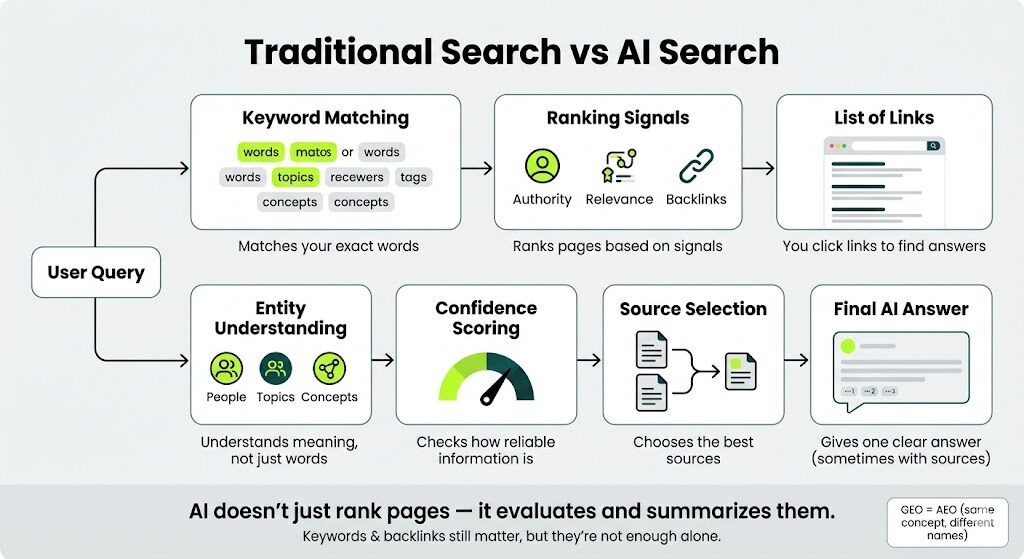
AI engines evaluate content based on entity recognition, claim confidence, source authority, and information density to decide which content to cite. Keywords and [backlinks](https://outreachdesk.com/what-are-backlinks/) still matter, but they’re no longer enough.
A website can rank at the top of the Google search results and still be ignored by the AI answers featured above it.
You may also have come across the terms [generative engine optimization (GEO)](https://outreachdesk.com/generative-engine-optimization/) and answer engine optimization (AEO), which target featured snippets and direct answers.
They might sound different, but they’re conceptually the same idea with different labels.
In reality, the steps for both are nearly identical; it’s valid to treat them as one discipline.
## Why This Matters Now, Not Later
Google AI Overviews now appear in roughly 30% of US search queries, and those numbers keep growing.
On top of that, millions of people are now skipping Google and turning to ChatGPT, Perplexity, or Gemini for their queries.
Here’s what it means for your traffic: a growing portion of your audience is getting their answers directly from AI, and never seeing your actual website.
It doesn’t matter if you rank well on [search results](https://outreachdesk.com/what-are-serps/). If your content isn’t structured for AI extraction, you’re invisible to those users.
The sites getting cited in AI answers tend to share three traits:
**1. Covers Topics deeply:**
Not just one or two articles, but through well-connected content across their subject area, backed by links from other respected sites in the same field.
**2. The content is easy for AI to extract:**
Write in clear, structured ways, with precise definitions, specific facts with evidence, and self-contained answer blocks.
**3. Strong E-E-A-T Signals:**
This means mentioning named authors with credentials, original data, research, and content freshness.
Most businesses already work on the first quality through regular SEO efforts. AI optimization is actually about adding the second and third, making your content not just rankable, but actually quotable.
## How AI Engines Choose What to Cite
Understanding how AI systems actually choose their sources is what gives you an edge, because once you observe the pattern, you can write specifically for it.

**Each platform works slightly differently, but their shared patterns look like:
**
- The AI identifies the user’s question.
- Then breaks it into smaller sub-questions and searches for content that confidently answers each one.
- Then combines everything into a single response, sometimes even mentioning its source.
The essential part is confidence. The AI is essentially evaluating how sure it is that this claim is accurate. Vague statements are usually scored low. Statements that are specific, measurable, and well-attested are scored high.
For example, a sentence like “Editorial links improve domain authority” is a vague sentence and gets a lower score than the statement with “Editorial links from DR 50+ sites increased organic traffic by an average of 34% across 112 campaigns in 2025,” because it has a specific number and a clear timeframe. Define source. This is what often gets cited.
**What improves citation probability:
**
- Named entities are defined clearly on the first mention
- Specific metrics with a timeframe. (“increased by X% over Y months”)
- Source attribution within the sentence (named study, named organization)
- Write paragraphs that are self-contained, without needing the surrounding context
**What decreases it:
**
- Vague claims without supporting evidence (“links are really important”)
- Promotional language (“our industry-leading service”)
- Content that requires reading the complete page to understand any single section
**Practical Takeaway:
**
Websites that restructured their content using these extraction patterns saw measurable improvement in the AI Overview in 60 days, without building a single new link.
## The Core Strategies for AI Search Optimization
AI search optimization strategies include six structural models: entity definition, extractable claims, sub-questions, structured data, topical authority, and content freshness.
Each of them directly increases the probability that AI engines select your content as a source for citation.
### 1. Define Every Entity on First Mention
AI systems don’t just read your content, but they build an internal knowledge graph as they proceed with your content.
When you introduce a new concept or idea, the AI looks for a clear, usable definition that it can reference later. If it finds one, it can cite you. If it doesn’t, it moves on to a source that explains it better.

### 2. Write Extractable Claim Sentences
Every piece of your content should contain at least one sentence that makes complete sense on its own, without needing the paragraphs around it for context.
This is important because when AI gains information from your content, it doesn’t copy the whole content; instead, it selects useful information and drops it into your answer.
Go through your existing high-value content and check: could any sentence from each section survive extraction? If it doesn’t, then strengthen the strongest claim in that section.
Every major section should contain at least one sentence that is based on this structure:
**[Entity] + [is/does] + [specific claim] + [evidence or qualifier].**
### 3. Structure for Sub-Question Answering
AI queries don’t just answer the main query; they divide it into sub-questions.
For AI queries like “how to optimize for AI search,” it breaks it down into sub-questions like:
- What is it?
- Why does it matter?
- What specific steps should I take?
- How is it different from regular SEO?
Each H2 section of your article should answer one of these questions independently. It means no section should start with “as mentioned above…” or should depend on the previous section for context.
It means that if someone reads your third H2, it should still make sense.
Question-format heading works best here. For example, “How Do AI Engines Choose What to Cite?” can directly map to how users ask AI assistants and how AI engines divide queries internally.
### 4. Use Structured Data Patterns
An AI overview usually extracts data from numbered lists and comparison tables rather than long-form paragraphs.
The reason for doing this is that it is a simple, easy way to extract answers and provides clarity for readers.
| Content Type | Best Structure for AI Extraction |
| --- | --- |
| Process/How-to | Numbered steps with clear action verbs. |
| Comparison | Table with labeled columns and rows. |
| Defination | “What/Why/How” block sequence. |
| Strategy breakdown | Anatomy diagram with component labels. |
Use list formats when it genuinely fits. Structure should serve the readers first. When it does well, even AI benefits from it.

### 5. Build Topical Authority Through Strategic Links
An AI system doesn’t just cite any pages that contain the correct information. They cite pages from the websites they recognize as genuinely authoritative on the given subject.
The way they measure authority isn’t all different from how traditional search engines do it, through the depth of your content, and how well your articles connect to each other.
A website with 40 well-connected articles, each one focused on SaaS marketing, backed by mentions and links from relevant industry publications, sends a stronger signal than a site with 3 blog posts and a handful of directory links.
This means that AI picks up on that signal when deciding which source to cite for a SaaS marketing query.
Link building is often treated as a traditional SEO tactic, but it carries equal weight in AI search as well because the trust signals that editorial links send are precisely what AI engines use to assess citation authority.
### 6. Optimize for Freshness
AI systems tend to prefer recently published content. Research from [Amsive](https://lilyray.nyc/tech-seo-connect-2025-summary-takeaways/#:~:text=Highlighted%20a%20strong%20recency%20bias%20in%20AI%20search%2C%20noting%20that%2050%25%20of%20top%2Dcited%20content%20is%20less%20than%2013%20weeks%20old.) on AI citation patterns found that roughly half of all the content cited by AI engines is less than 13 weeks old.
ChatGPT and Perplexity especially prefer recent sources when answering questions where the timeline matters. Google’s AI Overviews also considers the factor of freshness.
**Here are some practical steps for content freshness:
**
- Add ”Last updated: [Month] [Year]” to every article.
- Refresh important content every 90 days with current data and examples.
- Don’t accidentally block AI crawlers such as GPTBot, ClaudeBot, and PerplexityBot in your robots.txt file.
- If your content only appears after JavaScript runs, AI Crawlers may miss it entirely. Make sure your key content loads properly with the page and not after it. **
**
## AI Search Optimization vs. Traditional SEO: What Changes, What Doesn’t
There are two common reactions to AI search optimization.
Some teams treat it as a completely new discipline. Others wave it off as a new name of SEO and assume that they need to change, but both are wrong.
| Factor | Traditional SEO | AI Search Optimization |
| --- | --- | --- |
| Primary target | Ranked link position | Citation in the generated answer |
| Content structure | Keyword-optimized, scannable | Entity-defined, extractable, self-contained. |
| Links | Authority + ranking signal | Authority + topical trust signal for AI |
| Freshness | Helps rankings | Often required for citation |
| Keywords | Exact + semantic matching | Conversational query mapping |
| Success metric | Rankings, organic traffic, CTR | Citation frequency, brand mentions in AI answers, and referral traffic from AI. |
What doesn’t change here is content quality, domain authority, E-E-A-T signals, site architecture, and the value of relevant links.
A strong backlink profile built through authentic editorial placements can support both traditional rankings and AI citation probability.
The changes seen are in how you structure each page, how you write key sentences, and how you measure success.

## How to Audit Your Existing Content for AI Visibility
Before changing anything, you need to know what you’re actually working with. You don’t need to rewrite everything.
Most of the sites already have content that’s close to AI-ready. It just needs structural adjustments.

### Step 1: Identify Your Highest-Value Pages
Start with the pages that already rank in the top for their targeted keywords. They have the strongest possibility of citing AI because AI systems still favor top-ranking content as source material.
### Step 2: Check for Entity Definitions
Define every important term the first time you use it. A clear one-sentence explanation helps readers and AI systems understand and cite your content.
### Step 3: Find Your Extractable Claims
Check each H2 section for a single sentence that could stand alone as an answer. Does it contain a named entity, a specific claim, or evidence? If no, then write one.
### Step 4: Test Self-Containment
Each section should make sense on its own. If it references something earlier, rewrite it so a reader, or even AI, can understand it without reading the rest of the content. Any section should not open with “As we discussed above,” or it should not depend on context from an earlier section.
### Step 5: Add Structured Elements Where They Help
Look for the sections that can become comparison tables, process sections that can become bulleted or numbered lists, and definition sections that could follow a “What/Why/How” format. Don’t force the structure where paragraphs work better.
### Step 6: Verify Freshness Signals
Check if the page has a visible “last updated” date. Check if the content is current (fresh). Check if the crawlers are blocked in your robots.txt. If yes, fix those gaps.
Check the factors given in the image below. Continue your audit if it meets the criteria, and evaluate where it needs improvement.

Run the audit on your top 20 pages first. Improve what already works, delivers far more value than trying to fix content that was never performing well.
## Where Link Building Fits Into AI Search Strategy
Link building always matters for search rankings. However, in the AI search era, it’s doing something more important than just pulling up the list.
When an AI system decides which source to cite, they look at what your overall link network says about your expertise in a specific subject.
It’s not about how many links point to your site; it’s about what those links signal about your credibility in a particular field.
Suppose that a dozen editorial links from health publications pointing to your health content tells AI systems that this domain is a credible health source.
That signal indicates whether your content gets cited when someone asks an AI about a health-related question.
Generic links from irrelevant sites still pass some value for traditional rankings. However, they don’t send the topical trust signals that AI systems seek.
This is the reason why **relevance is more important than volume** in the AI search era. The relevance of the linking domain to your content’s topic directly affects your citation probability.
**Here are the three things you need to prioritize:
**
- **Topical linking cluster
**
Build links from publications in your industry, not just high-DR sites in any niche.
- **Content-link alignment
**
Make sure that the pages that are receiving links are the same pages you want AI engines to cite.
- **Authority stacking
**
Combine external editorial links with internal linking architecture so [link equity ](https://outreachdesk.com/link-equity/)flows to your most important content.
## Measuring AI Search Performance
You can’t improve what you can’t measure. However, measuring AI search visibility is still harder and less precise than tracking traditional search rankings.
### How You Can Measure Today:
- **AI Overview presence
**
Tools like [Semrush](https://www.semrush.com/) and [SE Ranking](https://seranking.com/) can now track whether your domain appears in Google AI Overview citations for your targeted keywords.
- **Referral traffic from AI sources
**
Filter analytics for traffic from [chat.openai.com](http://chat.openai.com), [perplexity.ai](http://perplexity.ai), and Google AI Overview clicks.
- **Brand mentions monitoring
**
Track how often your brand and content get mentioned in the AI-generated answers. Use tools such as [Google Alerts](https://www.google.co.in/alerts), [Brandwatch](https://www.brandwatch.com/), and manual spot checks.
Consistent [brand mentions](https://outreachdesk.com/brand-mentions/) on authoritative sources signal to AI engines that your content is worth citing.
- **Citation audits
**
Query your target keywords in ChatGPT, Perplexity, and Gemini to see if your content gets cited.
### What’s Still Hard to Measure:
- Exact citation frequency across all AI platforms.
- The casual relationship between specific changes and improvements in citation.
- Attributing a reader who saw your brand in perplexity and later searched for it directly is hard to trace.
Start with directional data. If your AI referral traffic is improving and your brand appears in more AI-generated responses for targeted queries, your strategy is working.
## Common Mistakes That Kill AI Visibility
Some content is well-written and well-researched, yet never gets cited by AI systems. A few patterns consistently prevent strong content from getting cited. Let’s look at those patterns/mistakes.
### Blocking AI Crawlers
Some sites block GPTBot and other AI crawlers in their robots.txt files without realizing it. If AI crawlers can’t find your content, then they can’t cite it. Therefore, check your robot.txt file.
### Burying the Answer in Long Introductions
AI systems look for direct answers at the beginning of the sections. If your answer is after four or three paragraphs, it’s more likely to get skipped in favor of a competitor who leads with the answer.
### Writing Content that Only Makes Sense When Read Sequentially
Each H2 section must function as a standalone answer. Frequent use of “as mentioned earlier” and “building on the previous section” signals to AI engines that individual sections can’t be extracted clearly.
### Ignoring Structured Data Opportunities
Ignoring the structure refers to the fact that, if a comparison table is buried under a paragraph of text, it is harder for the AI to extract information than in the table format.
It doesn’t mean that everything should be in a table, no, but it means that when the content is genuinely comparative, at that time, structured formats win.
### Chasing AI Optimization at the Expense of Quality
If you strip your content of personality, opinion, and depth to make it more “extractable,” you lose the E-E-A-T signals that earned you a citation in the first place. Write for expertise first, and then structure for extraction.
## What Comes Next
AI search and traditional SEO now operate as a component of visibility layers. Sites that optimize for both earn ranked positions in the blue-link results and citation slots in AI-generated answers, helping to compound their reach across both surfaces.
Audit your top 20 pages, fix the structural gaps, and build authority through relevant and editorial links in your field. Start tracking here, where you appear in AI answers, along with where you rank in traditional results.
The basics haven’t changed. It still consists of authority, quality, and trust. What’s changed is where those fundamentals get rewarded. The surface is bigger, and so is the opportunity.
### Struggling to appear in AI-powered search results?
Get a clear plan to optimize your content for AI search visibility.
[Book a strategy call](/contact-us/)
### Is AI search optimization the same as SEO?
No, but they overlap heavily. Traditional SEO targets ranked link positions in search results. AI search optimization targets citation in AI-generated answers from platforms like Google AI Overviews, ChatGPT, and Perplexity. Both rely on domain authority, content quality, and E-E-A-T signals. The difference is structural; AI search rewards self-contained, entity-defined, extractable content more than traditional SEO does.
### Do backlinks still matter for AI search?
Backlinks still matter, but differently. AI engines use backlink signals to assess authority, whether your domain is a credible source on a specific subject. A cluster of relevant editorial links from niche-relevant publications sends stronger trust signals than a larger number of links from irrelevant sites. So yes, links matter, but relevance has become more important than volume.
### How do I know if my content is being cited by AI?
Search your target keywords directly in ChatGPT, Perplexity, and Google to trigger AI Overviews and check whether your domain appears as a cited source. For ongoing tracking, use tools like Semrush’s AI Overview to monitor referral traffic from AI platforms in your analytics. It’s not as precise as rank tracking yet, but the tools are improving quickly.
### Can I optimize for all AI platforms at once?
Most of the time, yes, the structural requirements for Google AI Overviews, ChatGPT, Perplexity, and Gemini overlap significantly, with clear entity definitions, specific data-backed claims, self-contained sections, and strong signals of authority. The main difference is that Google AI Overviews favor numbered lists and tables, while ChatGPT and Perplexity prioritize recency and information density. Optimizing for the shared requirements covers about 80% of the work.
### How long does AI search optimization take to show results?
Structural changes to existing content, like adding entity definitions, rewriting key sentences for extractability, and improving section self-containment, can affect AI citation within 30 to 90 days, depending on how frequently AI systems crawl your site. Building the authority that makes your domain citation worthy in the first place is a long play. Typically, 6 to 12 months of consistent content development and strategic link building.
---
---
title: "Blogger Outreach: How to Earn Links That Move Rankings"
url: "https://outreachdesk.com/blogger-outreach/"
lang: "en-US"
type: "post"
description: "If your goal is to build backlinks that support rankings and improve organic visibility, blogger outreach is a reliable off-page SEO technique. It involves contacting relevant bloggers, editors, or site owners, building genuine relationships, and earning backlinks by offering content"
last_modified: "2026-05-22T10:04:06+00:00"
categories: [Link Building]
---
# Blogger Outreach: How to Earn Links That Move Rankings
If your goal is to build backlinks that support rankings and improve organic visibility, **blogger outreach is a reliable off-page SEO technique.
**
It involves contacting relevant bloggers, editors, or site owners, building genuine relationships, and earning backlinks by offering content or insights that improve their pages.
Results depend on execution.
Poor targeting leads to low-value placements. Strong execution earns contextual links on niche-relevant blogs that already reach your audience.
It scales when you build repeatable processes and strong linkable assets. You control who you target and what you pitch, while editors decide whether your content earns the link.
**What You’ll Learn
**
- How to find and qualify bloggers who can actually move your rankings
- How to earn contextual backlinks that support long-term search visibility
- How to write outreach emails that get replies and real placements
- How to choose the right outreach strategy based on your goal
- How to track outreach performance and improve results over time
## What Is Blogger Outreach
**Blogger outreach** is a link building approach where you connect with publishers in your niche to earn [high-quality backlinks](https://outreachdesk.com/what-are-backlinks/) and contextual mentions within their content through personalized communication and genuine value exchange. Teams that want full execution often work with [Outreach Desk’s link building team](https://outreachdesk.com/) on this kind of campaign.
It usually happens through email or direct contact via social channels, depending on the blogger’s preferred communication method.
These publishers already serve your audience. What matters isn’t how many you reach, it’s how well your content fits their editorial context.
That placement might be a guest post, a link insertion into an existing article, a product review, a brand mention, or a content collaboration. These placements are often contextual backlinks placed within relevant content sections.
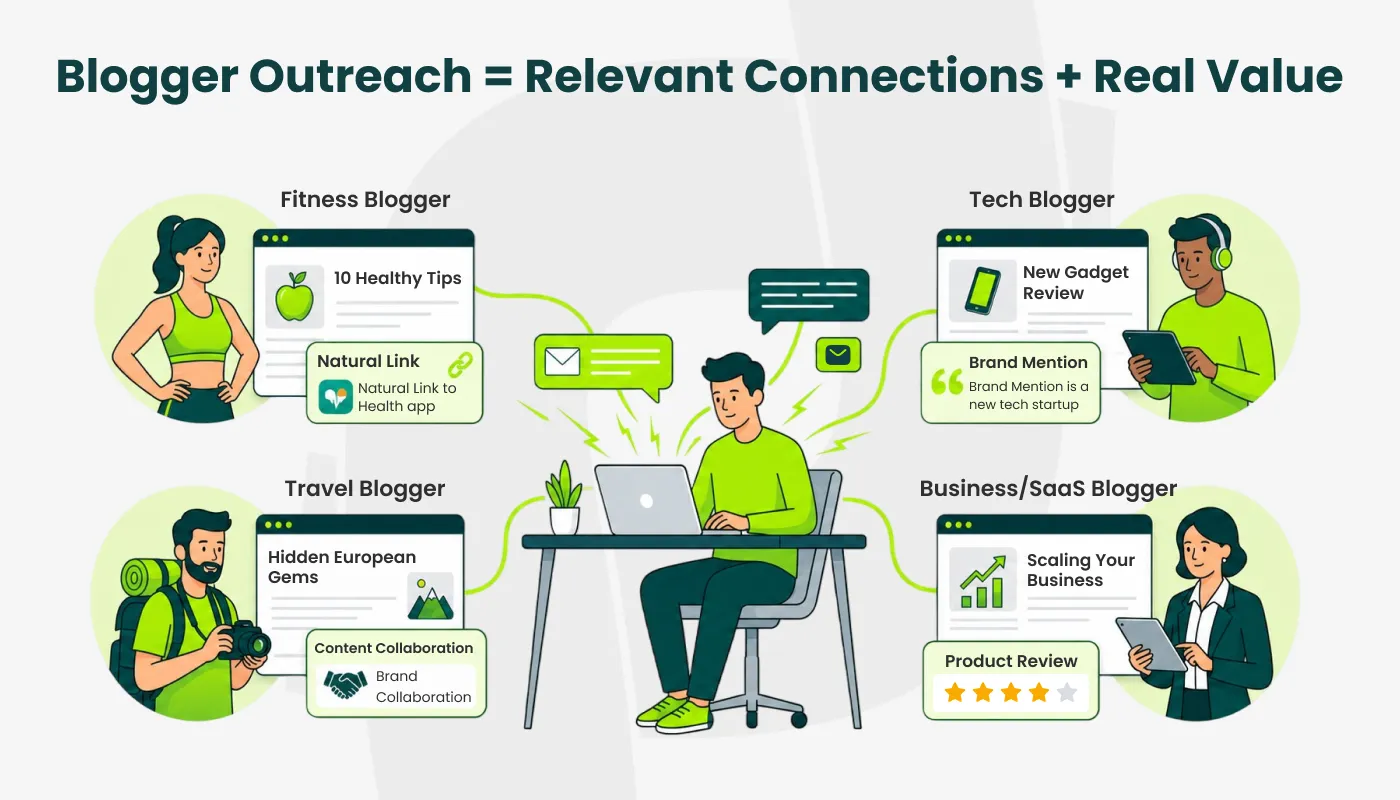
Unlike pitching editors at large publications, blogger outreach targets individuals who have built websites with engaged, niche audiences. They choose what to link to based on fit and relevance, not editorial calendars. That’s exactly what makes a placement from them worth earning.
Your goal is to earn [contextual backlinks](https://outreachdesk.com/contextual-link-building/) placed naturally within useful content on topically relevant sites that already attract engaged, interested readers.
## Why Does This Still Work in 2026
Because Google’s ranking system still treats editorial backlinks from trusted, topically relevant sites as one of the strongest authority signals.
**Bloggers** receive dozens of outreach emails every week. Most are templated, irrelevant, and easy to spot. The bar for earning a response, let alone a link, is higher than it was three years ago.
That’s good news if you’re willing to do the work. Most teams aren’t. They send volume. You send relevance.
Campaigns built around genuine fit and clear value consistently outperform spray-and-pray outreach. Not by a small margin. By multiples.

Through campaigns we run at Outreach Desk, we often see how low generic outreach performs. For context, typical sales outreach sequences average around a 3% response rate. [SEO outreach](https://outreachdesk.com/seo-outreach/) can perform better when relevance is strong, because the pitch is tied to the editor’s content and audience.
## The Six Types of Blogger Outreach That Actually Produce Results
Each outreach type aligns with a different [link earning campaigns](https://outreachdesk.com/link-acquisition/) strategy used in SEO. The type you choose depends on your goal, the assets you have, and the value you offer the blogger.

**Each type works differently. Here’s what to expect from each:
**
### Guest Posting Outreach
Guest posting outreach is when you pitch a blogger to publish your original article on their site, with a contextual link back to your page. This is one of the most widely used editorial [link building methods](https://outreachdesk.com/link-building-strategies/).
[Guest posting](https://outreachdesk.com/guest-posts/) stays effective when your content is genuinely useful to the blogger’s audience.
### Niche Edits Outreach
[Niche edit](https://outreachdesk.com/niche-edits/) outreach is when you ask a blogger to add your link to an article they’ve already published, instead of creating something new. These are also known as ‘curated links’ or ‘contextual link insertions’.
This is faster than guest posting because the page already has authority, traffic, and trust. But your link must fit naturally. If it feels forced, it gets ignored or adds little value.
### Brand Mention Outreach
If your brand is already mentioned on a blog but not linked, you’re sitting on one of the easiest wins in outreach. You’re not asking for something new. You’re asking them to turn an existing [brand mention](https://outreachdesk.com/brand-mentions/) into a clickable link.
Response rates are higher here than almost any other outreach type because the blogger has already acknowledged your brand. The hard part is done.
### Content Collaboration
Content collaboration is the creation of content by multiple parties. This could be a research piece, expert roundup, or resource. Both sides link and promote the shared [linkable asset](https://outreachdesk.com/linkable-assets/).
This relationship-first outreach builds partnerships and drives links, traffic, and visibility over time.
### Product or Service Reviews
You give a blogger access to your product and ask for an honest review. This works well in SaaS, ecommerce, and DTC (Direct-to-Consumer) when your product genuinely benefits their audience.
Stay transparent. Undisclosed paid reviews violate FTC guidelines and break trust from both sides.
### Resource Page Placements
[Resource page](https://outreachdesk.com/resource-page-link-building/) placements are when your content or tool gets listed on curated pages that collect the best resources on a given topic. These pages exist across every niche: roundups of tools, guides, templates, reading lists, and recommended sites that editors maintain for their audience.
These pages often attract steady traffic and strong links. You need to offer something better, more useful than what’s already listed.
## How to Run a Blogger Outreach Campaign (Step by Step)
A strong outreach campaign follows six steps. Skipping key steps typically reduces response rates. The steps below show how to move from goal-setting to tracking in the order that matters.

### Step 1: Define Your Goal Before You Write a Single Email
Start with getting answers for these 3 questions to define your goal before every outreach campaign:
- Which pages need more authority?
- Are you targeting to rank a specific keyword, build topical coverage, or earn brand visibility in a new niche?
- What type of link placement supports that goal?
The goal determines everything that shapes who you target, what you pitch, and how you measure results.
[Outreach Campaigns](https://outreachdesk.com/link-building-outreach/) tied to specific pages or topics can start contributing to measurable ranking movement within 8-12 weeks. Random link placement to “the homepage” or “wherever” rarely does.
### Step 2: Find Bloggers Worth Reaching Out To
Your results depend on who you target. You can check for the following 3 criteria when looking for outreach bloggers:
#### Relevance
The blog should cover topics that overlap with your niche. A high domain rating means nothing if the site has no topical connection to what you do. A fitness blog linking to your SaaS product won’t move your rankings.
#### Quality
Quality means the site gets real organic traffic, publishes original content, and isn’t a [link farm](https://outreachdesk.com/link-farming/) dressed up as a blog. Check whether it ranks for real queries, whether the content is editorially maintained, and whether its own backlink profile looks clean.
#### Engagement
The blogger should publish regularly, respond to outreach, and have an engaged audience. If a site has not been updated in a long time, response rates are usually lower, and placements are less likely to happen.
**Where to find them:
**
- **Search operators in Google:
**
These queries surface blogs that actively accept contributions. But don’t stop there, as many great blogs accept guest posts without advertising it.
For Example: [your niche] + “write for us” or [your niche] + “guest post”

- **Competitor backlink analysis
**
Use [Ahrefs](https://ahrefs.com/) or [Semrush](https://www.semrush.com/) to see which blogs link to your competitors but not you. List them for your outreach. If they linked to your competitors’ content, they might link to yours, especially if your content is more valuable.
- **Content discovery tools
**
Content discovery tools like [BuzzSumo ](https://buzzsumo.com/)and [SparkToro](https://sparktoro.com/) help you find bloggers and creators with active, engaged audiences in your niche.
- **“Best of” lists and roundup posts
**
Search for “_best [niche] blogs_” to find curated lists of bloggers already known for quality content.

### Step 3: Research Each Blogger Before You Reach Out
Have answers to these questions before you write your pitch:
- What has the blogger published recently, and what topics do they seem to care about most?
- Have they accepted guest posts or link placements before?
- What are their content gaps? Gaps like missing subtopics, outdated content, or expandable sections.
- What tone and style do they use? (formal? Conversational? data-driven?)
- Are they active on social media, and on which platforms?
**Read** their last five posts properly. **Not skimming**. Notice what they link to. Notice what they avoid. Notice what feels incomplete or underexplored. That’s where your value sits. A pitch is stronger when you can clearly show why it matters to that blogger’s audience.
### Step 4: Get on Their Radar First
Before you pitch, spend a few days creating genuine visibility around their work.
- Share one of their articles on LinkedIn or X and add a specific insight from it.
- Leave a real comment on a recent post. Not praise, but something you actually noticed or learned.
- Engage with what they’re saying on social media in a natural, relevant way. This can help you stand out, only if the interaction is relevant and meaningful.
- If they run a newsletter, subscribe and reply to an issue with a clear, thoughtful response.
Keep it simple. Nothing manufactured. If their content is actually useful to you, this is just basic professional behavior. By the time your email lands, your name already feels familiar, not random.
### Step 5: Write the Outreach Email
A strong outreach email works because the value is clear, not because the pitch is aggressive. It’s about personalization: relevant, tailored content that directly connects to a blog post the blogger has already published.
**What a strong outreach email includes:
**
- **A subject line that’s specific, not clever
**
Clear and direct subjects like “_Guest post idea: [topic missing on their site]_” tend to outperform “_Quick question_” or “_Collaboration opportunity_”.
- **A personalized opening that shows you read their work
**
Just keep it one sentence long. Reference a specific article, a specific point they made, or a specific gap you noticed.
- **A clear pitch
**
This improves message relevance and reduces ambiguity in outreach. A clear pitch changes how they pursue your email. Be clear on:**
**
- What are you proposing?
- A guest post on a specific topic?
- A link to your resource that fits a specific article?
- A content collaboration?
- **What’s in it for them?
**
They should benefit after adding your content. That should be the priority. Ask yourself:**
**
- Will this content fill a gap that their audience would appreciate?
- Will it complement something they’ve already published?
- Will it bring their readers something they can’t get elsewhere?**
**
- **A low-friction ask
**
Don’t complicate things. Make it very easy for them to say yes. Offer to send an outline, provide the full draft, or handle all the work. Reducing the effort required to review your pitch can improve your chances of getting a response.
**What kills outreach emails:
**
Vague pitches like “I’d love to collaborate” without context. Generic flattery such as “I’m a huge fan of your blog,” with no reference points.
Long emails that hide the actual request. Copy-paste templates that feel mass-sent.
Openers like “I hope this email finds you well” add no contextual value.
**Here’s a structural framework, not a copy-paste template. You’ll need to adapt the specifics every time:
**
**Subject:** **Guest post idea for [Blog Name]: [Specific Topic]
**
Hi [Name],
I read your piece on [specific article title] on [one specific observation about it]. I noticed you haven’t covered [specific angle/topic], and I think your audience would get a lot of value from it.
I’d love to write a guest post on [proposed topic] for [Blog Name].
Here’s a rough angle: [2-3 sentence description of what the piece would cover and why it matters to their readers].
I’ve written for [1-2 recognized publications, if applicable]. Happy to send a full outline if you’re interested.
[Your Name]
Short. Specific. Easy to respond to.
### Step 6: Follow up
Bloggers are busy. If you don’t get a response, it doesn’t always mean they’re not interested. Sometimes they just missed your email or haven’t gotten to it yet.
Send one follow-up email on the same thread, 5-7 days after your first email. Keep email content short.
Hi [Name],
Just circling back on this in case it got buried. I shared a guest post idea around [topic] that felt like a natural fit with your article on [specific article].
If it’s useful, I can send a quick outline. If not, no worries at all.
Thanks,
[Your Name]
Limit yourself to two follow-ups. If there’s still no response, move on. More than 2 follow-ups can start to feel intrusive and reduce future response rates.
### Step 7: Track everything
Track your outreach using a simple spreadsheet or CRM, whatever keeps your progress clear and easy to follow.
Keep track of these important details to stay on top of your progress:
- **Initial Outreach**:
The date you sent the first email.
- **Follow-Up Timeline**:
The date when you checked back in.
- **Response Status**:
Did they say yes, no, or later?
- **Placement Progress**:
Where the article stands in their queue.
- **Live Link**:
The URL of your new authority-building asset.
This isn’t just a list. It’s your campaign’s progress report. Use it to spot what’s working, so you can build on your momentum and grow your results next time.
## What Separates Good Blogger Outreach From Great Blogger Outreach
The six-step process delivers results. Adding tighter execution and more discipline further strengthens those results.

### Relevance Often Outperforms Authority
A link from a blog with a domain rating of 40 that covers your exact niche and has an engaged audience is worth more for rankings and for referral traffic than a link from a DR 80 site that has nothing to do with your topic.
Google looks at the topic of the linking page, the context around your link, and how closely the linking page’s content matches yours. Even a strong link may carry limited value or be ignored if it isn’t relevant.
Focus on relevance when building your prospect list. Use domain authority as a supporting metric, not as your primary filter.
### Offer Value Before You Ask for Anything
The outreach emails that get replies aren’t always the most polished. They’re the ones where you offer value first, before making your request.
Share their content before you reach out. Point out a [broken link](https://outreachdesk.com/broken-link-building/) before suggesting a fix.
Mention their article in your own work before asking for a mention in return, so that when you finally make your request, it feels natural rather than cold outreach.
That’s what separates an email that gets read from one that gets ignored.
### Treat Outreach as a Long-Term Channel, Not a One-Time Campaign
If you treat outreach like a sprint, chasing quick link goals and moving on, you miss out on long-term growth. Building authority takes time and steady effort.
Every editor who replies is someone you can reach out to again. Every placement is an opportunity that stays open.
The campaign is only the first conversation. What you do afterward decides how much value you create.
A network you build over time is more valuable than any single campaign that starts from scratch.
## How to Measure Whether Your Outreach Campaign Actually Worked
Earned links show what you’ve produced, not how your outreach is really performing. If you want compounding results, track what helps you execute better.

### Response Rate
Ask yourself: **What percentage of bloggers responded to your outreach?
**
Response rate** **benchmarks are simple. 4.5% is baseline, 8%+ is strong performance, and anything below 4% signals an issue with targeting or messaging.
Higher response rates usually indicate strong alignment between your outreach and the blogger’s content.
### Placement Rate
Placement rate measures how many placements you secured compared to the total outreach sent. To measure placement rate, ask yourself:
**Of all the bloggers who responded positively, how many actually published the content or added the link?
**
The answer will show whether the approval you received in an email actually turned into a live link.
If approvals don’t convert, execution breaks after the reply is sent. Most gaps happen when executions aren’t clear, or your content doesn’t match what publishers need. This is usually a follow-through problem. Fixing this strengthens your results, without sending more outreach.**
**
### Link Quality Signals
Check all the links you earned because not all of them provide equal value. For each placement, ask yourself:
- Is the linking page indexed?
- Does it receive organic traffic?
- Is the link placed within the main content (contextual) or buried in the sidebar or footer?
- Is the anchor text natural?
These signals indicate whether the link is likely to provide SEO value.
### Referral Traffic
Referral traffic helps you understand whether your placements are reaching real audiences. Consistent traffic can indicate stronger relevance and engagement, though not all valuable links generate traffic.
### Ranking Movement on Target Pages
The ultimate measure. If you built links to a specific page or content cluster, track its keyword positions over 8–12 weeks. Search systems need time to process new authority signals.
When your rankings keep moving up, it indicates that your outreach is contributing.
## Common Blogger Outreach Mistakes
There are certain common blogger outreach mistakes that are fixable with awareness and a little more effort during the campaign setup phase.

### Sending the Same Template to Everyone
Generic outreach gets ignored quickly. If your email could fit any blog in any niche without changes, it is not relevant. The real fix is not to merge fields. It’s writing one line that clearly reflects what that specific blogger has recently published or focused on.
### Targeting Blogs Based on DR Alone
Domain Rating, on its own, does not tell you whether a site is worth targeting. A high-DR blog with irrelevant content, declining traffic, or low publishing activity will rarely perform well for outreach. Relevance, organic traffic trends, and editorial consistency matter more than a single authority metric.
### Pitching Content the Blogger Has Already Covered
If your topic overlaps with a recent, detailed article they’ve already published, your pitch brings little to no value. It also signals weak research.
A quick site search before pitching helps you avoid duplication and improve relevance.
### Ignoring the Blogger’s Content Guidelines
Most established blogs share clear submission rules. Ignoring them reduces your chances of getting a reply or placement. Following those rules shows you understand how their site works and makes your pitch easier to review.
### Following Up Too Many Times
Following up once is professional; two is understandable; three or more is unprofessional. If a blogger does not respond after two attempts, move on and try again after a few months with a different pitch.
### Not Tracking Results
If you don’t track your results, you won’t know which outreach email led to placements, which bloggers responded, and which target pages saw ranking improvement. You’re running your next campaign blindly. Track everything from day one.
## Moving Forward With Blogger Outreach
Blogger outreach works when you send the right emails to the right people and stay focused on relevance and intent. That’s how it supports rankings and brings in the right traffic
Results build over time. Topically aligned backlinks can contribute to stronger visibility. Each campaign gives you data to improve the next.
This is not a one-time effort. It’s a process you refine and scale. Stay consistent, and outreach becomes a reliable way to grow rankings and traffic.
### Want to make your blogger outreach more effective?
Get a structured strategy focused on relevance and consistent results.
[Book a strategy call](/contact-us/)
### How long does it take to see results from blogger outreach?
Most outreach campaigns generally take 8-12 weeks to show measurable ranking improvement on target pages.
While links may be secured within a few weeks, changes in rankings depend on crawling, indexing, competition, and overall site signals.
If you’re expecting overnight results, blogger outreach will not deliver that. If you focus on long-term authority, traffic, and rankings, it becomes a reliable growth channel.
### Is blogger outreach the same as guest posting?
Guest posting is one part of blogger outreach, not the whole strategy.
Blogger outreach is the process of connecting with bloggers to secure placements. This can include guest posts, link insertions, mentions, reviews, collaborations, or resource links.
Guest posting is a single tactic within that process. You write and publish an article on another site to build authority and earn a backlink.
### How many outreach emails should I send per campaign?
There’s no fixed number. It depends on your goal, niche, and targeting. Start with **30–100 well-qualified prospects**. This keeps your outreach personalized.
If your list is small, expand your research. Don’t lower the quality. If your list is large, split it into smaller batches and test performance for each batch. Focus on responses and placements, not emails sent.
At the Outreach Desk, smaller, targeted lists have consistently driven higher response rates, better placements, and stronger links. A targeted campaign will drive better gains in rankings and traffic than high-volume outreach.
### Does blogger outreach still work for SEO in 2026?
Yes. Editorial backlinks from relevant, authoritative blogs remain an important part of how Google evaluates content. What has changed is the level of quality required in both the links you earn and how you earn them.
Low-quality, mass outreach doesn’t work anymore. Targeted, personalized, value-driven outreach tends to perform better because it aligns with how links are evaluated today.
### Should I pay bloggers for link placements?
Avoid paying for links intended to improve rankings. Use paid placements for reach, referral traffic, and visibility.
Paid links that aim to influence rankings violate Google’s link spam policies, even though many bloggers charge for placements.
If you choose to pay for a placement, use the rel=”sponsored” attribute to clearly disclose it. This helps search engines understand the link type.
Don’t present paid links as editorial. Undisclosed paid placements may be ignored or carry no ranking value, limiting their impact on search performance.
### What tools do I need for blogger outreach?
Use a tool like [Ahrefs](https://ahrefs.com/), [Semrush](https://www.semrush.com/), or [BuzzSumo](https://buzzsumo.com/) to find bloggers in your niche and evaluate their sites.
For contact details, tools like [Hunter.io](http://Hunter.io) or [Voila Norbert](https://www.voilanorbert.com/) help you find the right email.
To manage outreach, you can use platforms like [BuzzStream ](https://www.buzzstream.com/)or [Pitchbox](https://pitchbox.com/), or keep it simple with a well-structured spreadsheet.
Don’t overcomplicate your stack. For focused campaigns, a clean spreadsheet and strong research often deliver better results than complex tools used without a clear process.
---
---
title: "How to Find and Use Competitor Backlinks in 2026"
url: "https://outreachdesk.com/competitor-backlinks/"
lang: "en-US"
type: "post"
description: "Most teams prospect for months. But the answers are already sitting in your competitors' link profiles. Analyzing competitor backlinks reveals which publications, blogs, and resource pages in your niche are likely to link to relevant external sources. That gives you"
last_modified: "2026-05-22T10:02:56+00:00"
categories: [Link Building]
---
# How to Find and Use Competitor Backlinks in 2026
Most teams prospect for months. But the answers are already sitting in your competitors’ link profiles.
Analyzing **competitor backlinks** reveals which publications, blogs, and resource pages in your niche are likely to link to relevant external sources. That gives you a ready-made list of sites to target, rather than prospecting from scratch. Brands serious about scaling often hand this off to a [link building campaign agency](https://outreachdesk.com/) for predictable results.
And the real value isn’t copying a competitor’s link profile. It’s spotting patterns: the content formats earning them links, the industries linking to them, and the gaps where they’ve earned placements you haven’t.
Once you see that picture, you can build a smarter outreach strategy around proven sources rather than guesses. This works whether you’re a SaaS brand closing a rankings gap or an ecommerce team scaling authority across product categories.
**What you’ll learn
**
- How to find competitor backlinks using the right tools and data
- How to identify high-quality, relevant link opportunities in your niche
- How to run a backlink gap analysis to uncover missed domains
- How to analyze link patterns and create content that earns links
- How to turn competitor insights into targeted outreach that drives authority
## What Are Competitor Backlinks
**Competitor backlinks** are [inbound links](https://outreachdesk.com/what-are-backlinks/) pointing to your rivals’ websites that rank for the same keywords as you, and analyzing them shows which publications, blogs, and resource pages in your niche are open to link out to external sites.
Each of these backlinks signals trust. Search engines use those signals to decide which pages deserve visibility. When you study them, you start to see where authority is being built in your space.
This gives you direction. You see which sites are already linking to similar content. That becomes your starting point for [seo outreach](https://outreachdesk.com/seo-outreach/). You are not guessing anymore. You are building on patterns that already work.
**One thing to get right early:** search competitors aren’t always business competitors.
If you sell project management software, you are not just competing with other tools. You are also competing with content from platforms like Zapier, HubSpot, or Asana that rank for the same queries.
When analyzing backlinks, focus on who ranks on page one for your target keywords in [search results](https://outreachdesk.com/what-are-serps/). That is where your actual search competition sits.
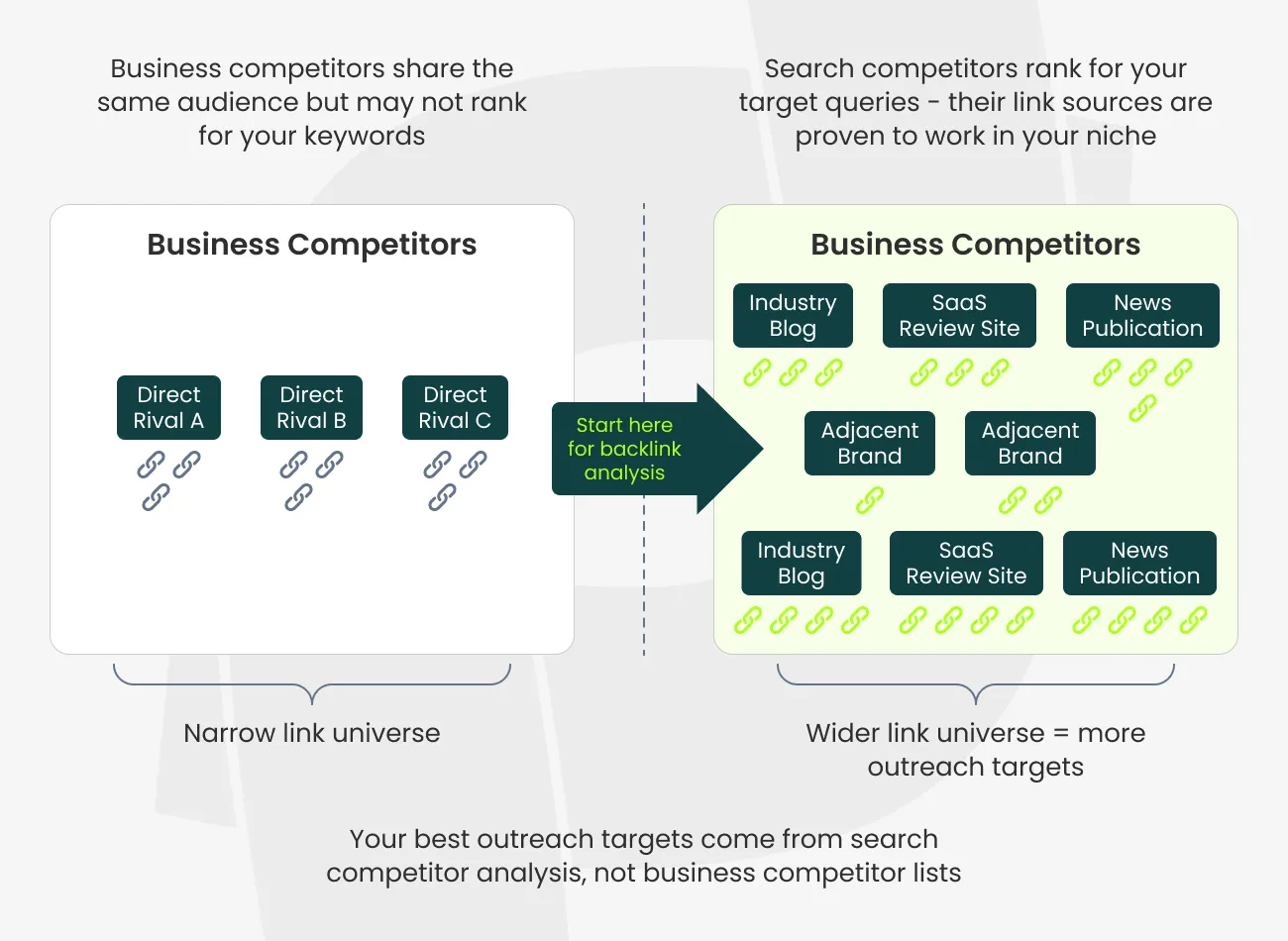
## Why Competitor Backlink Analysis Matters
When you start link building with no clear direction, it’s just a waste of time and leads to guesswork. Which sites accept guest posts? Which pages link out? Who actually replies? That uncertainty slows you down.
**Competitor backlinks analysis** removes that guesswork.
You focus on sites already linking in your niche. These sites have shown they’re open to relevant content, which makes your outreach list stronger from the start.
When you review a competitor’s backlinks, you see exactly which sites already link to content like yours. You see which domains are already trusted and actively linking. That gives you a stronger starting point than cold prospecting.
**Here’s how it plays out:
**
Focus on 40 sites that already link to similar content, rather than reaching out to 200 random sites. Your outreach becomes more targeted. Replies improve. Relevance improves.
And the links you earn carry more value because they fit naturally within the topic.
In practice, competitor-based outreach lists tend to outperform generic prospecting lists. You are working with real niche alignment from the start. These sites already cover your space, so the conversation begins with relevance instead of cold persuasion.
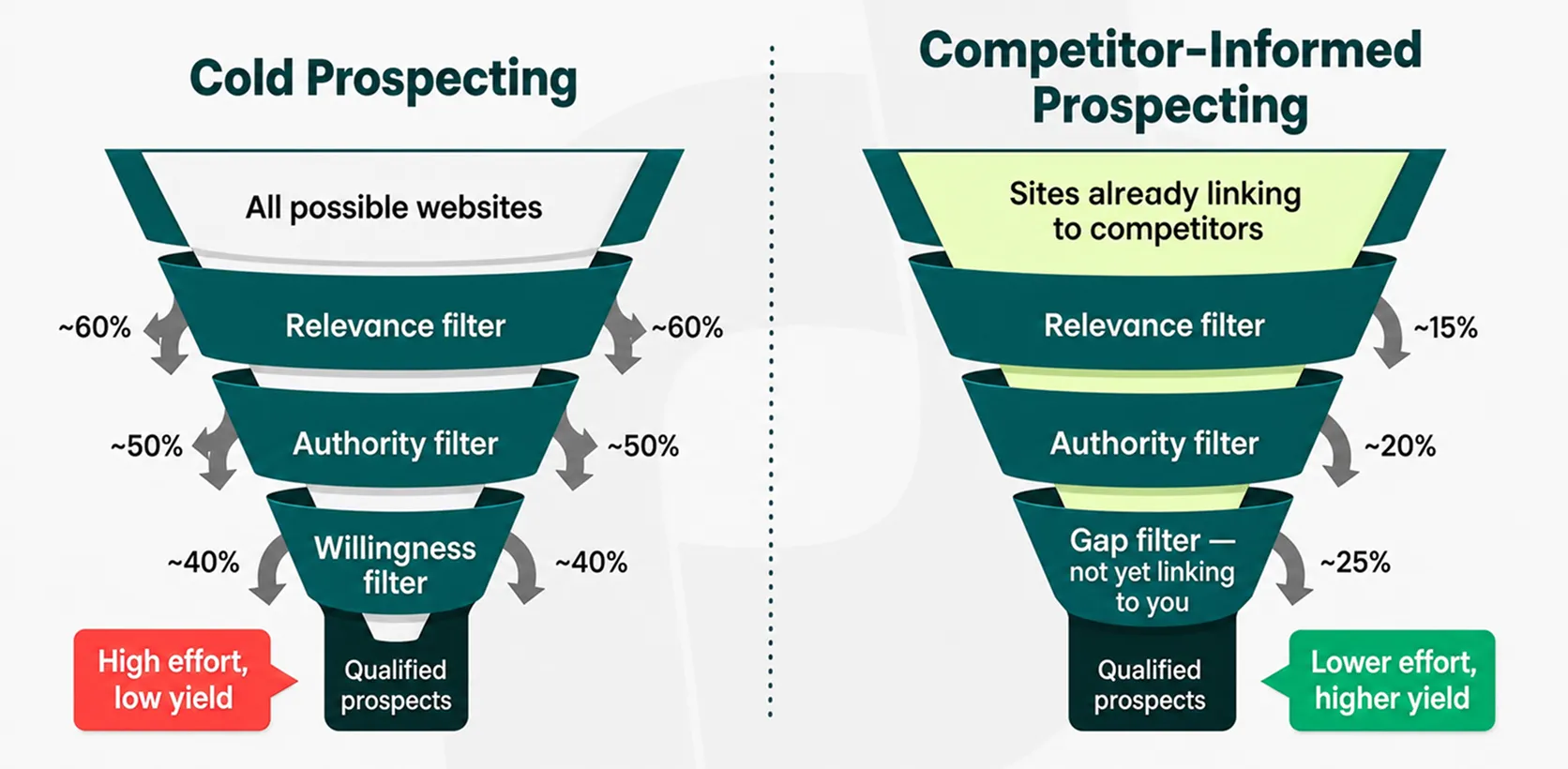
In campaigns we’ve run at Outreach Desk, competitor-informed outreach consistently delivers higher response rates than cold prospecting lists.
## How to Find Competitor Backlinks: Step by Step
This is the core workflow of competitor backlink analysis. The logic stays the same, no matter which [link building software stack](https://outreachdesk.com/link-building-tools/) you use.
You can use any major backlink analysis tool, such as [Ahrefs](https://ahrefs.com/), [Semrush](https://www.semrush.com/), or [Moz](https://moz.com/). Run a competitor backlink analysis to see how they built that profile.
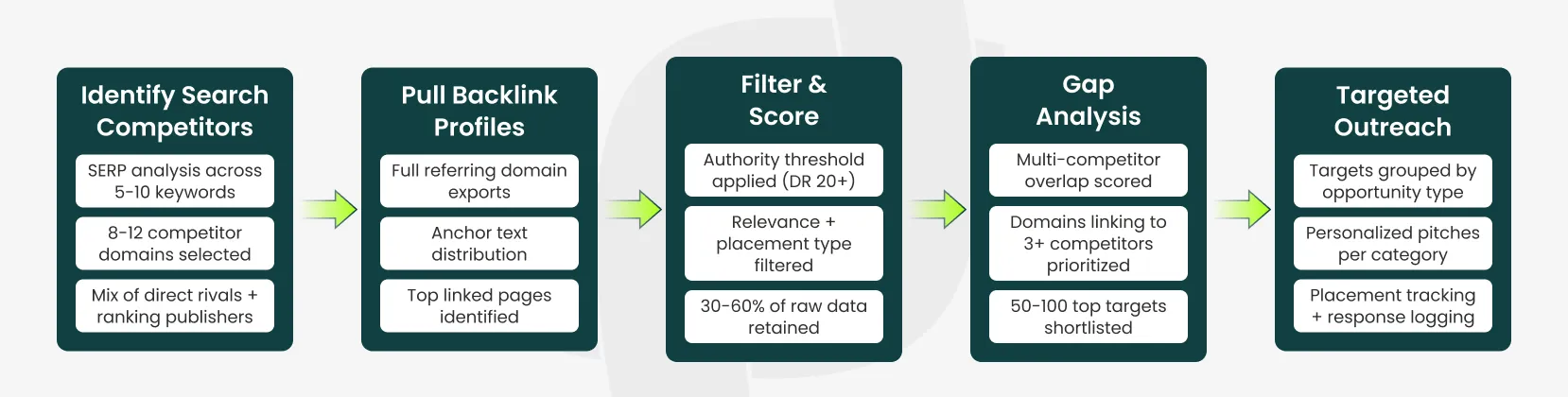
### Step 1: Identify Your Search Competitors
Open an incognito browser window. Search your primary keywords, the ones you’re actively trying to rank for. Remember, your real link competitors aren’t always your business competitors. They’re the domains ranking for the same keywords you want to rank for.
### Step 2: Pull Their Backlink Profiles
Use your backlink tool to analyze each competitor’s domain. Export their referring domains so you’re working with a clean dataset.
For each competitor, review:
- **Referring domains:
**
The number of unique websites linking to the competitors. This shows how broad their link profile is.
- **Total links:
**
The total number of backlinks, including multiple links from the same site. This shows volume, not diversity.
- **Domain rating or authority:**
A third-party metric that estimates how strong or trusted a website is based on its backlink profile.
- **Anchor text:
**
The clickable text is used in links. It shows how other sites describe or reference the competitor.
- **Link types:
**
The nature of the link, such as dofollow (passes ranking signals), nofollow (limited or no signal), or redirect (passes through another URL).
Start with referring domains. That’s where the real signal is for building lasting authority.
Two competitors can both have 2,000 links, but the distribution tells a different story. One might have those links coming from 150 sites. Another might have links from 1,800 sites.
The second profile is stronger because the authority is spread across more unique sources. That usually points to a broader outreach strategy and more consistent visibility across the web.
That’s the pattern you want to understand before you plan your own [link building campaign](https://outreachdesk.com/link-building-campaigns/).
### Step 3: Filter for Quality and Relevance
Not every [link type](https://outreachdesk.com/types-of-backlinks/) is worth your time. Most competitor backlink profiles are full of noise. You’ll see low-quality directories, comment spam, irrelevant sites, and broken domains.
Your job is to filter quickly and focus on what actually moves rankings.
**Sort and filter based on:
**
| Filter | What to Remove | Why |
| --- | --- | --- |
| Domain Rating below 20 | Low-authority sites | Links from these rarely move rankings |
| Irrelevant niches | Sites with zero topical connection | Contextual relevance matters more than raw authority |
| Sitewide/footer links | Links placed in templates, not content | These are often given less weight than in-content editorial links as per a Semrush study on link placement |
| Toxic indicators | Sites with spam patterns, thin content, link farms, or PBN-like characteristics | Associating your domain with these hurts rather than helps |
| Link type | Nofollow-only opportunities (low priority) | These have limited impact on rankings compared to editorial dofollow links |
| Freshness | Outdated content | Recently placed links signal active and relevant sources |
After filtering, you should be left with roughly 30-60% of your original list. That’s your working set.
### Step 4: Run a Backlink Gap Analysis
This is where you find real opportunities. A backlink gap analysis shows you where competitors are getting links that you’re missing.
The goal is simple. Identify domains that already link to multiple competitors but not to you.
You can do this with tools like the paid [Ahrefs (Link Intersect)](https://ahrefs.com/link-intersect) or the free [Semrush (Backlink Gap)](https://www.semrush.com/analytics/gap/backlinks/), with a limit of 10 searches/day. Add your domain and 3–5 competitors, and the tool will return a list of domains, grouped by the number of competitors they link to.
Focus on domains that link to at least three of your competitors. These are not cold prospects. They have already linked to similar content multiple times, which shows a clear interest in your topic.
When you build outreach from this list, you are not starting from zero. You are working with proven link sources that already support your niche. This helps you improve response rates and can earn links that strengthen your rankings over time.
We’ve seen that domains linking to multiple competitors are more likely to accept relevant pitches, especially when the content clearly improves on what they’ve already referenced.
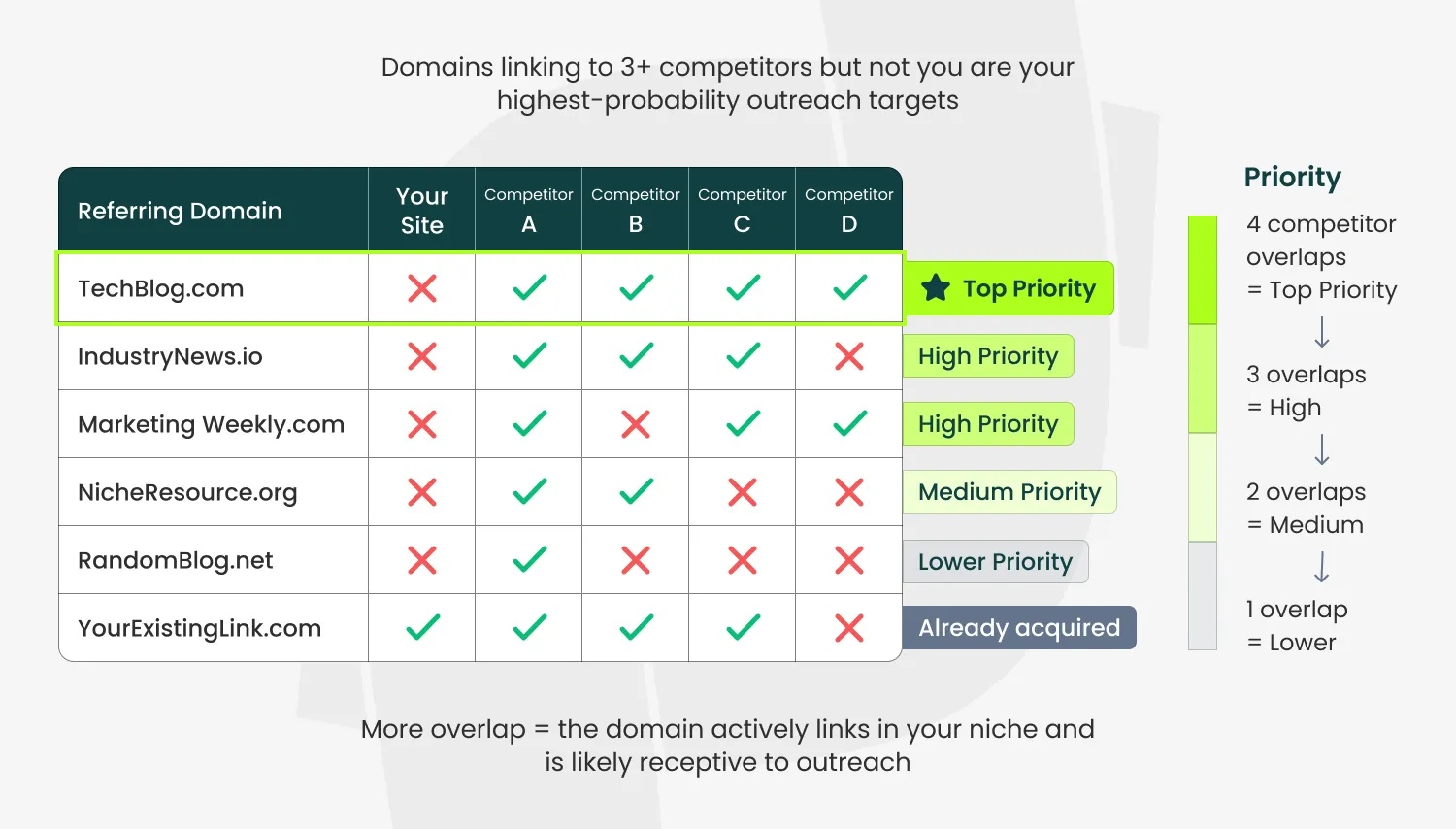
### Step 5: Analyze Content Patterns
Before you start an [outreach campaign](https://outreachdesk.com/link-building-outreach/), look at what type of content actually earned your competitors their links. List out the top 10–15 most-linked pages across competing sites and scan for patterns:
- **Data-driven posts**, such as original research, surveys, and benchmarks or other [linkable assets](https://outreachdesk.com/linkable-assets/).
- **Comprehensive guides** that people use as a reference.
- **Free tools or templates** that solve a specific problem.
- **Expert roundups, opinion pieces,** **or **[resource pages](https://outreachdesk.com/resource-page-link-building/) featuring multiple industry voices.
This tells you what publishers in your niche are already linking to.
If most top-linked pages are data studies, publishing another generic guide won’t move results, but publishing a new data study can.
Align your content with what’s already earning links. That’s how you increase your chances of getting placed.
## Turning Competitor Link Data Into Outreach Targets
Turning your filtered list into placements is where the actual authority gets built.
### Sort by Opportunity Type
Not every backlink opportunity works the same way. The way you approach it decides whether you get the link or get ignored.
Group your targets based on how the link was earned:
#### Resource Pages
These are curated lists of tools, guides, or references. Reach out with a clear reason why your resource improves that list.
#### Guest Post Hosts
Your competitor contributed a [guest post](https://outreachdesk.com/guest-posts/) to this site. Pitch a new angle that adds value to their audience, not a repeat of what already exists.
#### Editorial Mentions
A journalist or blogger naturally referenced your competitor. Offer something stronger for future coverage. This could be a better data point, a unique insight, or an expert quote.
#### Broken or Outdated Links
The existing link is no longer working, or the content is outdated. Step in with an updated replacement for the [broken link](https://outreachdesk.com/broken-link-building/) that solves the problem.
Each type needs a different approach. The message, the angle, and your expected response rate will vary. Treating every opportunity the same slows you down and lowers your success rate. Segment first. Then reach out with intent.
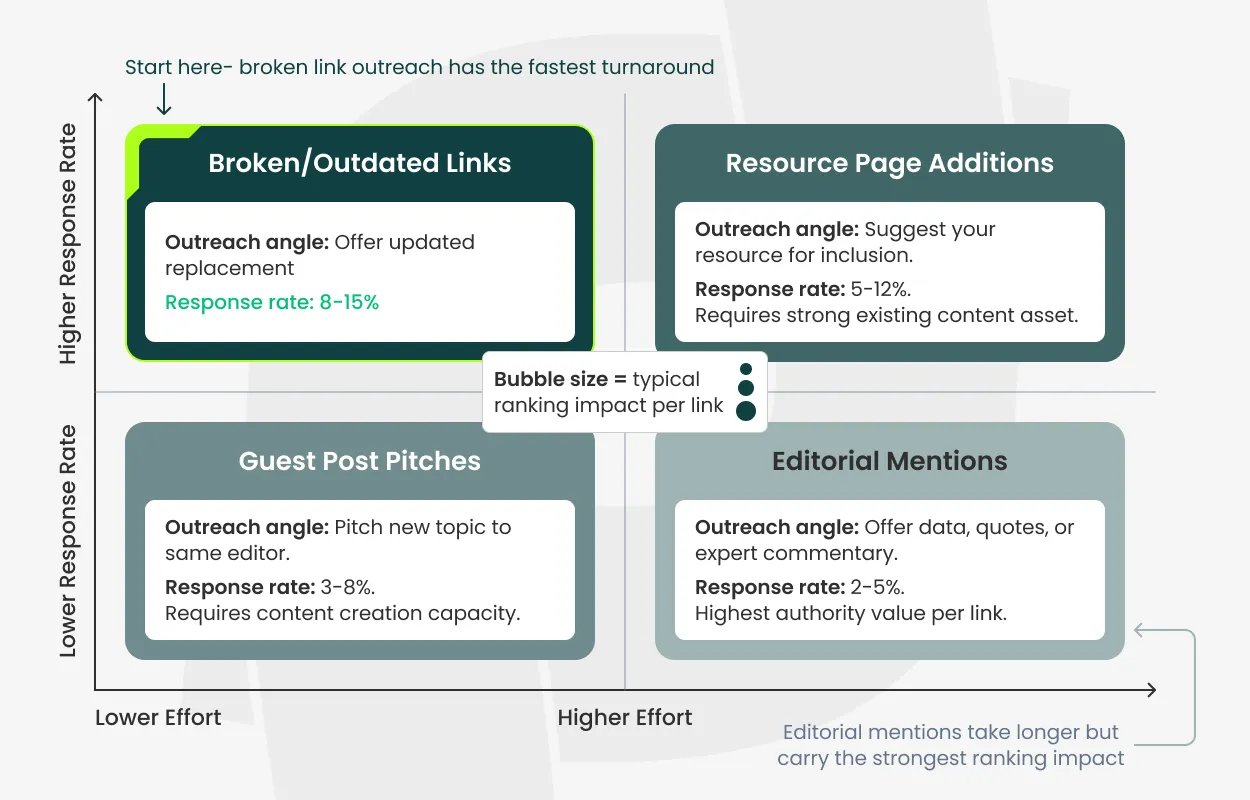
### Personalize Every Pitch
You already know which page links to your competitor and why it exists. Use that context.
Reference the exact article. Show how your content adds value to their readers. Make every line of your email relevant.
**Email Outreach Template
**
**Subject: Quick idea to extend your [specific article title]
**
Hi [Name],
I noticed your article on [exact article], and I think there is a simple way to add even more value for your readers.
You already covered [specific point] well. I wanted to share a guest post idea that brings a fresh angle to the topic.
I can cover [new angle] with practical examples and insights your audience can use right away. If it helps, I can send over a short outline.
Best,
[Your Name]
Generic templates sent to competitor-based lists don’t perform much better than random cold outreach. The difference comes from how well you connect your pitch to what they’ve already published.
### Track What You Earn and Compare
Set a monthly check to track whether you are closing the gap.
If a competitor has 150 referring domains from your target niche and you’re starting at 40, focus on how consistently you’re adding relevant domains over time.
Referring domain growth is one of the clearest signals tied to higher rankings. As your profile strengthens, you’ll start seeing movement in visibility and positions.
Across campaigns, steady growth in relevant referring domains has consistently aligned with improved visibility over time.
The key is consistency. Track the trend, not just the total.
In campaigns we’ve run at Outreach Desk, segmenting outreach targets by link type before sending the first email consistently improved placement rates. Resource page pitches and guest post pitches require completely different angles; treating them the same is one of the most common reasons outreach stalls.
## How Often Should You Run Competitor Backlink Analysis
Run a competitor link audit every quarter. That cadence works for most teams that want to keep building momentum.
Pull fresh data. Re-run your gap analysis. Look for new referring domains your competitors picked up in the last 90 days.
New links point to active opportunities. If a site just linked to a competitor, it is already publishing and open to relevant sources.
Between audits, set up alerts. Tools like Ahrefs and Semrush can notify you when competitors earn new backlinks. Track three to five key competitors.
This keeps opportunities flowing your way. It also helps you act quickly on time-sensitive placements, like when a journalist just covered a competitor and may be open to your story.
## Free vs. Paid Tools for Competitor Backlink Research
You can start without spending anything. But those limits show up quickly when you try to scale.
| Feature | Free Tools (Ahrefs Webmaster, Moz Free, Ubersuggest Free) | Paid Tools (Ahrefs, Semrush, Moz Pro) |
| --- | --- | --- |
| Referring domains visible | Limited (top 100 or partial data) | Full index |
| Backlink gap analysis | Not available or heavily restricted | Built-in with multi-competitor comparison |
| Historical data | None or 30-day only | 5–10+ years of link history |
| New link alerts | Not available | Real-time or daily email alerts |
| Export capability | Limited or no CSV export | Full export with all link metrics |
| Anchor text analysis | Basic or unavailable | Detailed distribution with filtering |
| Cost | $0 | $99–$249/month |
Free backlink tools give you a narrow view. You usually get only a partial list of referring domains and no real gap analysis or reliable historical tracking.
Paid tools like [Ahrefs](https://ahrefs.com/) or [Semrush](https://www.semrush.com/) can help you analyze multiple competitors at once, run a proper gap analysis, and track new backlinks as they are acquired.
Free tools are enough when you are testing the process or doing a one-time check.
For ongoing competitor research at scale, paid link gap analysis tools can make the process more precise. They highlight exactly which domains are linking to your competitors but not to you, removing the need for manual tracking or scattered checks.
This turns research into a structured workflow. That is where efficiency starts to compound.
## Common Mistakes in Competitor Backlink Analysis
Spotting common mistakes early helps you save time and effort while focusing on links that actually move rankings.
### Copying Instead of Learning
Your goal isn’t to rebuild your competitor’s backlink profile link by link. It’s about understanding what works in your space and building from there.
Look for patterns, not individual links. If you blindly chase every link a competitor has, you’ll waste time on sites that don’t move your rankings.
### Analyzing Only One Competitor
One backlink profile never tells the full story. It reflects unique factors like personal networks, one-off mentions, or a single high-performing piece.
You need four or five competitors to see what consistently works. That is how you separate repeatable opportunities from noise.
### Ignoring Anchor Text Data
Anchor text shows how other sites describe and position a page. If most anchors are branded or generic, those links may not drive strong topical relevance.
When anchors are descriptive and keyword-aligned, they often have a stronger impact on ranking. This helps you decide how to position your own pages.
### Skipping the Content Gap
Pulling backlink data is just the first step. You also need to look at the content that earned those links.
What format worked? What angle got picked up? If you move to outreach without that, you’re asking for links to content with no clear reason to be referenced.
## Conclusion
One round of competitor backlink analysis won’t transform your rankings.
But running it every quarter to update your gap list, act on new referring domains, and adjust anchor positioning compounds.
Start with the gap analysis this week. Pull 5 competitors, filter the data, group your targets by outreach type, and send your first 20 emails. The pattern will show you where to go next.
### Want to find backlink opportunities your competitors already have?
Get a clear approach to identify and use links that can improve your rankings.
[Book a strategy call](/contact-us/)
### How many competitor backlinks should I analyze?
Analyze 3-5 competitors’ backlinks. This gives you a balanced view of how links are distributed across your niche.
Below that range, you risk reacting to outliers instead of real patterns. Go too wide, and the data becomes scattered and harder to act on.
Once you consolidate the findings, build a focused prospect list of 50 to 100 domains. Prioritize sites that show up across multiple competitors and are clearly aligned with your topic. Repeated overlap is one of the strongest signals you can use for outreach priority.
### Can I just copy my competitor’s backlinks?
No. Replicating competitor backlinks is not a reliable strategy.
Those links often come from specific relationships, timing, or content angles that you can’t replicate. Chasing the same placements usually leads to low returns.
Focus on the pattern instead. Look at which types of sites are linking and what made them link. If a competitor earned coverage through a data study, your move is to create something more useful or more current and earn links on that basis.
### What’s the difference between a backlink gap and a backlink audit?
A backlink audit examines your existing link profile to assess quality, relevance, and potential risks. It helps you understand what you already have and what needs attention.
A backlink gap analysis compares your site with competitors to find linking domains they have, and you don’t.
They serve different purposes. An audit focuses on your current foundation. A gap analysis focuses on future opportunities for growth.
### How long before competitor backlink analysis leads to actual rankings?
Most teams begin to see early movement within three to six months when they act on competitor data and stay consistent with outreach. It depends on your domain authority, how consistently you build links, and how competitive your target keywords are.
There is no fixed timeline. Less competitive topics can move faster, while tougher keywords take longer. Progress comes from earning relevant, high-quality links and building momentum over time.
### Are nofollow competitor backlinks worth analyzing?
Yes, but they shouldn’t be your primary focus. No-follow links from strong websites can still bring referral traffic and improve brand visibility.
Google treats nofollow as a hint. These links may help with discovery and context but aren’t reliable ranking signals.
Use them to see how competitors are mentioned across the web, not as your main outreach targets.
---
---
title: "Should You Buy Backlinks? What the Data Says in 2026"
url: "https://outreachdesk.com/buy-backlinks/"
lang: "en-US"
type: "post"
description: "Buying backlinks is the fastest way to either rank a page or get it removed from Google's index. There's no in-between. In 2026, the line between \"calculated paid placement\" and \"site-killing mistake\" comes down to four variables: the source site's"
last_modified: "2026-05-29T12:21:13+00:00"
categories: [Link Building]
---
# Should You Buy Backlinks? What the Data Says in 2026
Buying backlinks is the fastest way to either rank a page or get it removed from Google’s index.
There’s no in-between.
In 2026, the line between “calculated paid placement” and “site-killing mistake” comes down to four variables: the source site’s actual editorial integrity, the topical relevance to your content, whether the link is properly marked as paid, and whether the pattern across all your inbound links looks earned or bought.
This article isn’t a list of “best places to buy backlinks.” Most of those guides exist because affiliate revenue pays well. **This is a candid answer to whether you should buy backlinks at all, when it’s a calculated risk worth taking, and what to do instead when it isn’t.**
**Key Takeaways**
- Google’s spam policies explicitly classify buying links to manipulate rankings as a violation.
- Properly marked sponsored placements (rel=”sponsored” or rel=”nofollow”) are NOT a violation.
- Most paid link offers under $200 are PBN placements that hurt your site.
- The Buyer’s Risk Matrix maps when buying might be a calculated bet vs. when it’s site-killing.
- Editorial outreach, digital PR, and content-driven links beat paid placements on both authority and cost over 12 months.
- AI search engines weight earned editorial links higher than paid placements, even technically compliant ones.
## Google’s Real Position on Buying Backlinks
Google’s [spam policies](https://developers.google.com/search/docs/essentials/spam-policies) define link spam directly: “the practice of creating links to or from a site primarily for the purpose of manipulating search rankings.”
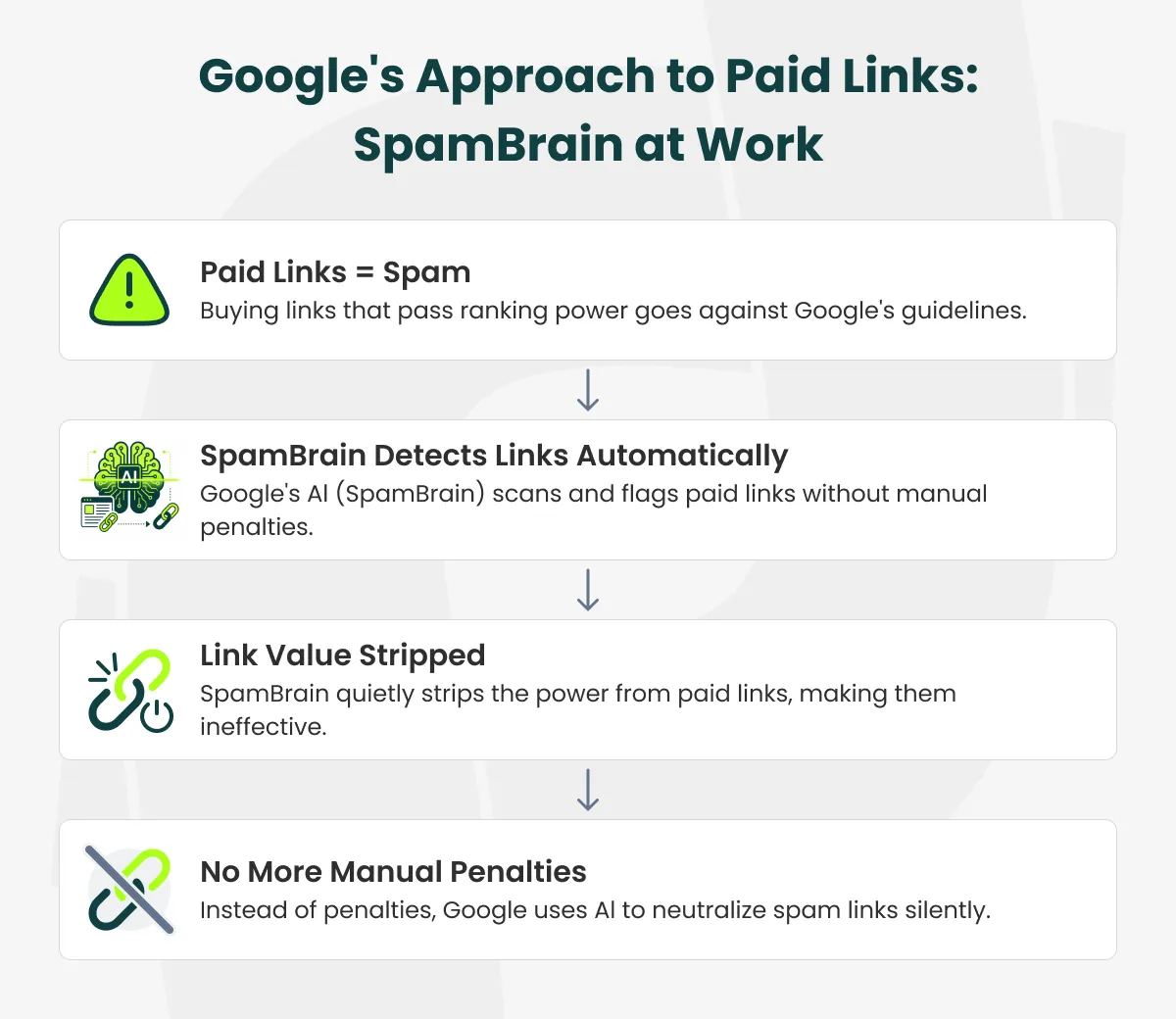
The policy explicitly names “exchanging money for links, or posts that contain links” as a violation.
So why does the question still come up? Because of the carve-out that follows. Google’s same documentation states: “It’s not a violation of our policies to have such links as long as they are qualified” using `rel=”nofollow”` or `rel=”sponsored”` attributes.
That single sentence is where the entire “buy backlinks” industry lives. The technically compliant version of paid placement is legal. The unmarked, manipulative version is not.
### What Counts as Manipulative
Google considers a link manipulative when: – Money or value was exchanged for it – The link is `dofollow` (passes ranking signal) – The link is not marked with `rel=”sponsored”` or `rel=”nofollow”` – The link is placed primarily to influence rankings rather than to inform readers
All four conditions need to be present. Properly marked sponsored placements that pass three of four are not spam. Editorial placements where no money changed hands aren’t paid links at all.
### What Google Actually Penalizes
Google issues manual actions for “unnatural links” when its review team identifies patterns: footers full of unrelated links, widget link networks, exact-match anchors across unrelated sites, sudden link velocity spikes from low-quality sources.
The penalty isn’t issued for a single paid link. It’s issued for the pattern that suggests systematic manipulation.
A single sponsored placement marked correctly: zero risk.
Fifty unmarked dofollow placements from sites running widget link networks: manual action, removed from index, or both.
## The Buyer’s Risk Matrix
Whether buying a link is a calculated bet or a site-killing mistake depends on two variables: the source site’s editorial integrity and the topical relevance of the placement.
Plot both on a 4-quadrant matrix and the answer becomes clear.
### Quadrant 1: High Relevance + High Editorial Integrity
This is the only quadrant where paying for placement is worth considering.
The site has real organic traffic, real editorial standards, real readers in your niche. It accepts sponsored content but reviews submissions for quality and clearly marks paid placements per disclosure rules. Examples: industry publications that sell sponsorships, premium newsletters with rate cards, vertical media that runs paid posts but vets them.
The placement is properly marked (`rel=”sponsored”`), drives real referral traffic, and the brand mention itself has marketing value beyond the SEO signal.
Verdict: defensible. The link doesn’t pass much ranking signal because of the `nofollow`/`sponsored` markup, but the brand exposure and referral traffic justify the cost.
### Quadrant 2: High Relevance + Low Editorial Integrity
This is where it gets dangerous.
The site is topically aligned with your niche, but has no editorial standards. It publishes anything if you pay enough. The publication exists primarily to sell links. Sponsored content isn’t disclosed properly.
Common examples: niche guest post farms that accept any contribution in your vertical, “industry news” sites running scaled paid placement programs, low-quality blog networks targeted at specific verticals.
Verdict: skip. The link looks contextually relevant to humans but the site’s pattern across all outbound links signals manipulation to Google. Manual actions tend to find these networks.
### Quadrant 3: Low Relevance + High Editorial Integrity
Sometimes a paid placement on a respected but off-topic site looks tempting because of the brand authority.
A Forbes sponsored post about your B2B SaaS company. A New York Times sponsored content placement. These are real and legal when marked correctly.
The problem: the link doesn’t pass much ranking signal because (a) it’s marked `sponsored` and (b) the topical relevance is low. You’re paying mostly for brand exposure.
Verdict: it’s a branding decision, not an SEO decision. Don’t expect ranking impact. Budget it against your brand awareness spend, not your link building spend.
### Quadrant 4: Low Relevance + Low Editorial Integrity
This is most “buy backlinks” offers on the internet.
The site has no real traffic. No editorial standards. No topical relevance. It exists to sell `dofollow` links at $30-150 a placement, often through reseller marketplaces. The placements are unmarked. The patterns are easy to spot.
Verdict: don’t. The links don’t pass ranking signal even when they look like they should. The pattern across your inbound links starts to look manipulative. Sites that lean on Quadrant 4 placements get manual actions or algorithmic suppression sooner or later.
## When Buying Backlinks Is Probably Unsafe
Most paid link offers fall into Quadrant 4 above. Specific patterns to avoid:
### Bulk Marketplace Listings Under $200
Marketplaces that list thousands of “dofollow placements” at $30, $80, $150 are aggregating placements from PBNs, expired domains, and low-quality blog networks.
The math doesn’t work. A genuinely useful editorial placement on a site with real traffic costs more than $200 because the publisher loses readers if they publish too much sponsored content. When the price is low, the placement is from a site that doesn’t have readers to lose.
### Anchor Text Specifications in the Offer
Legitimate publishers don’t let buyers dictate anchor text in body content.
When the link service lets you specify exact anchor text including commercial keywords, you’re working with a service that treats links as SEO products rather than editorial content. Those services get flagged by Google’s spam systems eventually.
### Networks That Promise “100% Approval Rate”
Real editorial outreach has a 10-25% acceptance rate even for strong content.
When a service promises “100% approval” or “guaranteed placements,” they’re operating their own network of sites where they control the publishing decision. That’s a PBN by definition, regardless of how the service is branded.
### Pre-Built “Tiered Link Building” Packages
Tiered link building (links pointing to links pointing to your site) has legitimate applications, but pre-built packages sold at scale are almost always built on PBN infrastructure.
The same site reseller selling Tier 1, Tier 2, and Tier 3 placements is operating a network. The footprint patterns get detected over time.
## When Buying Backlinks Might Be a Calculated Risk
Some paid placements are defensible. The framing matters: not “buying links to manipulate rankings” but “paying for editorial visibility on properly marked placements.”
### Industry Publication Sponsored Content
A trade publication that openly sells sponsored content, marks it `rel=”sponsored”`, and applies real editorial review is selling brand exposure, not SEO manipulation.

Cost varies by audience size. Tier 1 industry publications charge $5,000-$25,000 per sponsored article. The link is `nofollow` or `sponsored`. The ranking signal is minimal. The brand authority lift and referral traffic justify the cost for the right audience.
### Premium Newsletter Sponsorships
Some newsletters in your space sell paid placements that include a backlink to your site. When the newsletter has real subscribers and the placement is disclosed, this is brand spend with SEO side effects, not SEO spend.
Cost varies by subscriber count. Larger newsletters (50K+) typically charge $1,500-$5,000 per placement.
### Affiliate Programs You Pay Into
When you join an affiliate program and affiliates earn commission for linking to you, those links can be technically “bought” in that you’re paying for the relationship. But they’re not paid placements in the spam-policy sense as long as affiliates are disclosing their relationships.
### Branded Event Sponsorships
Conference sponsorships, industry award sponsorships, and event partnerships generate link clusters tied to your brand. The links are tied to the event coverage, the speaker bio pages, and the partnership announcements. The relationship is paid but the links are editorially earned.
## Why AI Search Changes the Math
The newer reason to skip paid placements for ranking purposes: AI search engines.
ChatGPT, Perplexity, Google AI Overviews, and Bing Copilot all build citation patterns from editorial signals. The brands they cite are the ones with editorial link profiles. Paid placements, even properly marked ones, contribute less to AI citation visibility than earned links.
This widens the gap between earned and paid backlink ROI. Pre-2024, a properly marked sponsored placement returned brand awareness plus minor ranking signal. In 2026, it returns brand awareness alone, while editorial outreach returns brand awareness plus ranking signal plus AI citation visibility.
The economics of paid placement have shifted. The bar for whether a paid placement makes sense has gone up.
## What to Do Instead
The link tactics that earn editorial placements outperform paid placements on cost-per-link over 6-12 months.
### Editorial Outreach to Real Publications
Pitching journalists, editors, and publishers with content worth publishing earns placements that pass real ranking signal.
Read [our guide on link building strategies](https://outreachdesk.com/link-building-strategies/) for the full tactic mix. Acceptance rates run 10-25% for strong content, which means you pitch 50 sites to land 5-12 placements. The links pass ranking signal, drive referral traffic, and contribute to AI citation visibility.
### Original Data Studies
Publishing original research that journalists cite generates link clusters that compound over years.
A well-executed survey or benchmark report earns 50-300 backlinks over 18-24 months. The cost ($15,000-$50,000 for a real survey with valid methodology) often beats the cost of building 50-300 paid placements that would never deliver the same ranking signal.
### Resource Page Outreach
Finding curated resource pages in your niche and pitching your content for inclusion earns evergreen editorial links.
Read [our resource page link building guide](https://outreachdesk.com/resource-page-link-building/) for the full workflow. Conversion rates run 10-20%. Costs scale with researcher hours, not link inventory.
### Reclaim Unlinked Brand Mentions
The fastest source of new editorial links for established brands.
When sites mention your brand without linking, a polite email asking for the link converts at 40-60%. No payment involved. The links are editorial because the mention itself was editorial. See [our unlinked mentions guide](https://outreachdesk.com/unlinked-mentions/) for the full workflow.
### Guest Posting on Sites That Have Real Editorial Standards
A guest post on a real publication that vets submissions is editorial, even though you wrote it.
Read [our guest posts guide](https://outreachdesk.com/guest-posts/) for the targeting workflow. The line between editorial guest posts and “buying links” is whether the host site (a) accepts based on quality not payment, (b) edits before publishing, and (c) the link in your author bio is contextual not over-optimized.
### Targeted PR Around Newsworthy Events
Product launches, partnership announcements, original data releases, and industry commentary pitched to journalists earn coverage that includes backlinks. The fundamentals overlap with [broken link building](https://outreachdesk.com/broken-link-building/) on outreach craft, just applied to editorial PR pitches.
The cost is internal time plus optional PR support. The output is editorial coverage, not paid placement. The link signal is the strongest available.
## Frequently Asked Questions
### Is Buying Backlinks Illegal?
Buying backlinks is not illegal in any country.
It is against Google’s spam policies when the links are unmarked and intended to manipulate rankings. Properly marked sponsored placements with `rel=”sponsored”` or `rel=”nofollow”` attributes are explicitly allowed by Google’s policy.
### How Much Do Backlinks Cost in 2026?
Low-quality paid placements sell for $30 to $200 and typically aren’t worth buying.
Quality editorial outreach campaigns cost roughly $200 to $800 per placement effectively (including outreach labor and content costs). Premium sponsored content on tier 1 publications runs $5,000 to $25,000 per article. Read [our link building pricing guide](https://outreachdesk.com/link-building-pricing/) for the full pricing breakdown.
### Can Google Really Detect Bought Backlinks?
Yes.
Google’s spam systems detect link networks through pattern recognition: shared hosting fingerprints, common ownership signals, identical site templates, anchor text distribution anomalies, and link velocity spikes. Individual paid links rarely trigger penalties. Systematic patterns from PBN networks do.
### What Happens If Google Catches You Buying Backlinks?
The page or site can lose the ranking signal from those links, receive a manual action requiring link disavowal, drop in algorithmic ranking, or be removed from the index.
Most cases involve algorithmic suppression rather than full deindexation. Recovery typically takes 3 to 6 months after the issue is identified and cleaned up.
### Are There Any Safe Ways to Buy Backlinks?
Yes, sponsored placements on real publications with proper markup are safe.
The shared trait: the publisher discloses the commercial relationship and the link is correctly marked with `rel=”sponsored”` or `rel=”nofollow”`. Premium newsletter sponsorships, event sponsorships, and affiliate program payments fall into the same category. These don’t pass much ranking signal but they’re not spam policy violations.
### How Long Does Recovery Take After a Manual Action for Paid Links?
Recovery typically takes 3 to 6 months after the manual action is lifted.
The process involves auditing your full backlink profile, disavowing the paid links through Google’s disavow tool, submitting a reconsideration request, and waiting for Google’s review team to verify cleanup. During recovery, expect ranking suppression even after the manual action is removed.
## The Honest Take
Most teams asking “should I buy backlinks?” want a shortcut.
The honest answer: the shortcut costs more than the long path over 12 months, returns less ranking signal, and exposes you to risk you don’t need to take. Before deciding, read up on [the consequences of bought links](https://outreachdesk.com/black-hat-link-building/) when Google catches them. Quality editorial outreach delivers better authority, better referral traffic, and better AI citation visibility for similar or lower total cost.
If you’re tempted by a $50 placement, run the Buyer’s Risk Matrix. If the source falls outside Quadrant 1, walk away. If you genuinely need fast brand exposure on tier 1 publications, budget for properly marked sponsored content and treat it as marketing spend, not SEO spend.
The teams ranking long-term are the ones earning links, not buying them.
---
---
title: "SEO Outreach: How To Build Links That Move Rankings in 2026"
url: "https://outreachdesk.com/seo-outreach/"
lang: "en-US"
type: "post"
description: "Most websites don’t struggle with content. They struggle with getting it seen. That’s where SEO outreach comes in. It’s how you connect with website owners, editors, and content creators to earn contextual backlinks that improve your search visibility. Most successful"
last_modified: "2026-05-22T10:03:11+00:00"
categories: [Link Building]
---
# SEO Outreach: How To Build Links That Move Rankings in 2026
Most websites don’t struggle with content. They struggle with getting it seen.
That’s where **SEO outreach **comes in. It’s how you connect with website owners, editors, and content creators to earn [contextual backlinks](https://outreachdesk.com/contextual-link-building/#:~:text=Contextual%20backlinks%20are%20placed%20within%20a%20page%E2%80%99s%20main%20content%2C%20where%20they%20naturally%20fit%20and%20meaningfully%20add%20value%20to%20readers%20and%20search%20engines.) that improve your search visibility.**
** Most successful campaigns rely on a [specialised link building agency](https://outreachdesk.com/) to handle vetting, outreach, and reporting.
It connects your content with relevant, authoritative sites through personalized communication, not automation, not spam, and not paid placements disguised as editorial endorsements.
Done well, outreach builds a link profile that survives algorithm updates and compounds over time.
A [Hunter.io cold email report](https://hunter.io/the-state-of-cold-email#:~:text=The%20average%20cold%20email%20sequence%20reply%20rate%20is%204.5%25) of 31 million emails found that the average cold email reply rate is just 4.5%, and[ 69%](https://hunter.io/the-state-of-cold-email#:~:text=69%25%20of%20US%2Dbased%20decision%20makers%20say%20it%20bothers%20them%20if%20AI%20was%20used%20to%20write%20the%20email%2C%20which%20suggests%20that%20while%20AI%20is%20now%20commonplace%20on%20the%20sender%20side%2C%20recipients%20are%20quick%20to%20disengage%20when%20messages%20feel%20templated%2C%20synthetic%2C%20or%20overly%20polished.) of U.S.-based decision makers say they’re bothered when an email feels AI-written.
**What You’ll Learn
**
- Why most outreach emails get ignored and what a reply-worthy pitch actually looks like
- The 7-step outreach process that builds links editors choose to place
- Which content types earn the most links per outreach touchpoint
- How to write subject lines that get opened without sounding like a template
- How outreach builds authority signals that influence visibility across AI-driven search experiences
## What is Seo Outreach
**SEO outreach** is the process of reaching out to relevant publishers and earning [high-quality backlinks](https://outreachdesk.com/what-are-backlinks/) by providing them with content worth referencing. The practice is also written as “outreach SEO” — same meaning, same workflow. Both phrasings describe the act of pitching publishers to earn editorial links.
That could be original data, a strong guest article, a broken link replacement, or content that fills a clear gap.
Most outreach emails get ignored because they feel generic, while personalized emails earn attention by showing clear, relevant value to the editor.
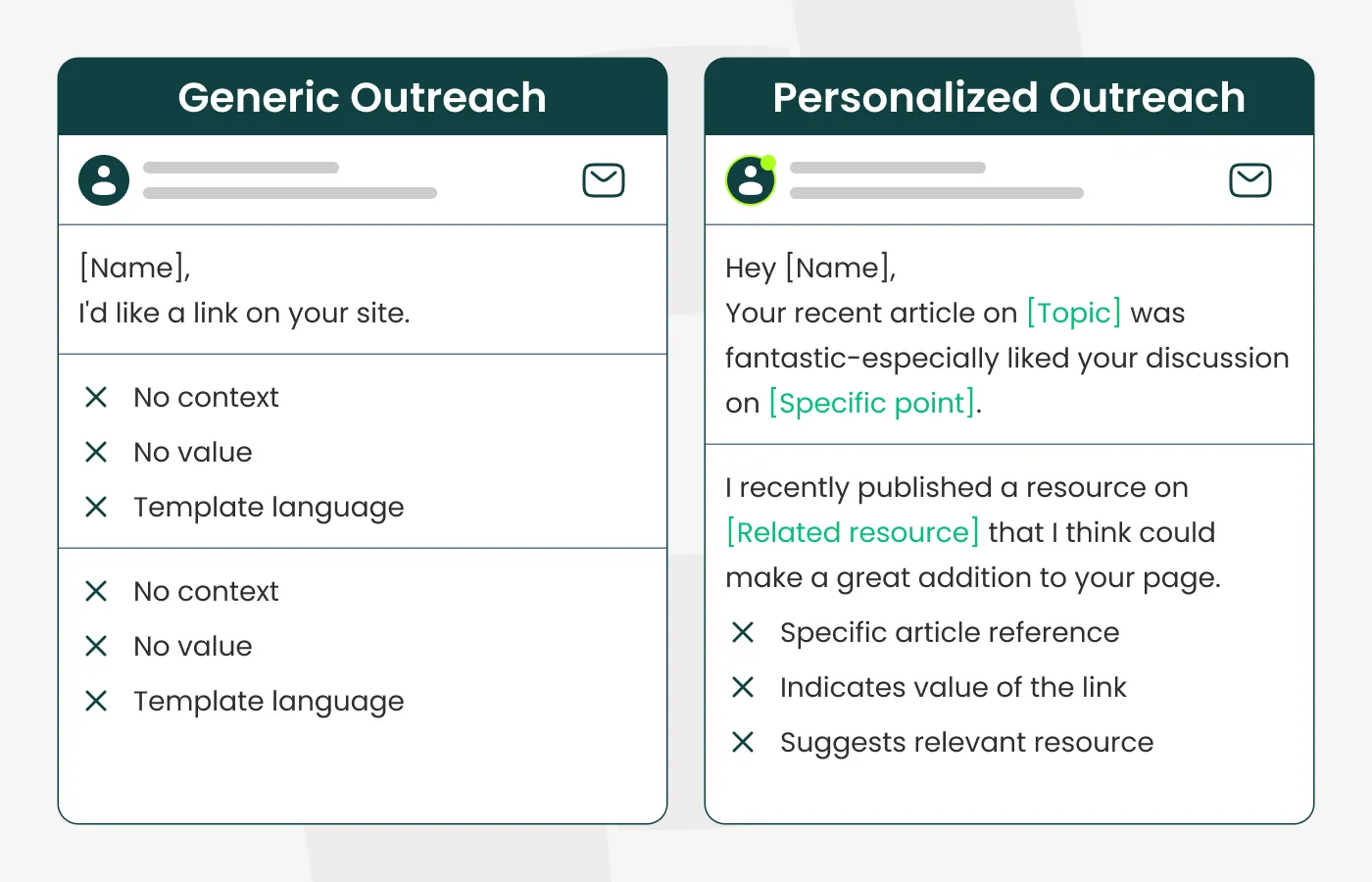
An editor reviews your pitch and chooses to link because it improves their content for readers. That choice is what makes the link valuable.
This is where outreach differs from paid placements or automated link building. If a link is added to influence rankings, it falls under Google’s [link spam guidelines](https://developers.google.com/search/docs/essentials/spam-policies). In many cases, those links are ignored or devalued by systems like SpamBrain.
Outreach works differently. It builds links through real editorial decisions, not transactions or automation.
**Here’s what separates outreach from tactics that don’t last:
**
| Outreach (Editorial) | Paid/Automated Links |
| --- | --- |
| Editor chooses to link based on content value | Link is often placed through payment or software |
| More resilient to algorithm updates when links are earned editorially | Devalued or penalized by SpamBrain |
| Builds real relationships for future links | One-off transaction with no lasting value |
| Grows brand authority across AI search surfaces | May generate mentions, but they are less reliable for sustained or trusted visibility signals |
## Why SEO Outreach Still Matters in 2026
**SEO outreach** still matters because search engines rely on links from trusted, relevant sites to understand authority.
To maintain quality in search results, [Google’s spam systems](https://developers.google.com/search/docs/appearance/spam-updates#:~:text=Sites%20that%20violate,cannot%20be%20regained.), including SpamBrain, reduce or ignore the impact of low-quality or manipulative links. When that happens, those links no longer contribute to rankings.
This is why high-quality, editorial links from relevant sites continue to matter. They signal trust and relevance in a way that algorithm systems can still rely on.
SEO outreach is what helps you earn those links. It gets your [brand mentioned](https://outreachdesk.com/brand-mentions/) in useful, topic-relevant content, increasing visibility in both [search results pages](https://outreachdesk.com/what-are-serps/) and AI-generated answers that draw on a broader web context.
## The SEO Outreach Process: 7 Steps That Work
The first email you send to any prospect should not be bad or sloppy. Prospect lists built on domain rating alone miss the point. The sites you contact should be places where your target audience already exists.
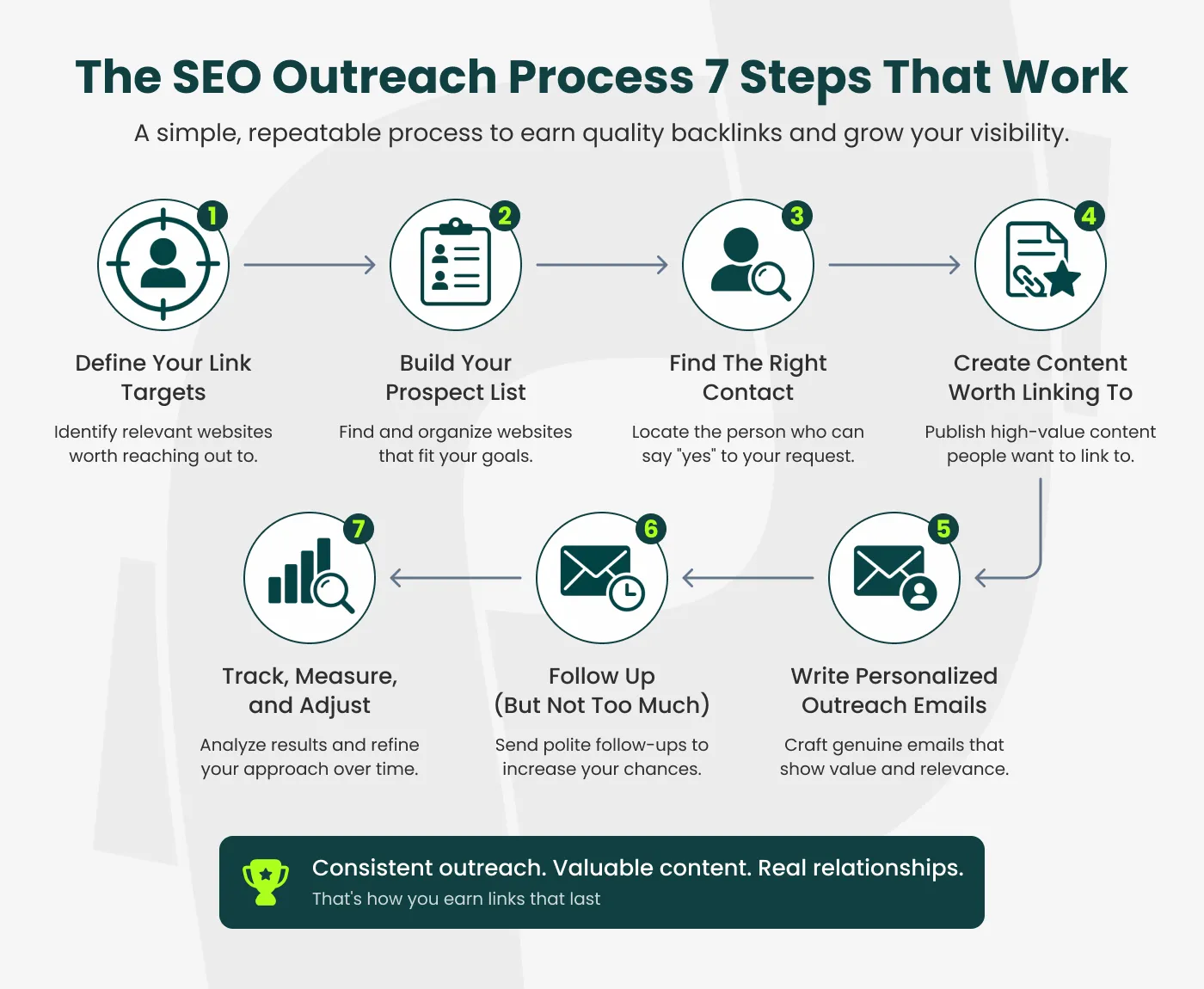
### Step 1: Define Your Link Targets
Start with pages that show ranking potential but may need stronger signals. Homepages often require fewer targeted links than service or revenue pages, though this can vary. A service page ranking just below the first page for a high-intent keyword may benefit more from focused outreach.
Map each target to the keywords you want it to rank for. This shapes everything downstream, like the types of sites you prospect, the content you pitch, and the anchor text you suggest. Without this step, you risk building links that don’t show measurable ranking improvement.
### Step 2: Build Your Prospect List
Most prospect lists are solely built on domain rating. That’s the wrong filter.
Aim for topical alignment first, and then look for authority signals.
In some cases, a link from a DR 45 site in your exact niche outperforms a DR 75 link from a site that covers everything from crypto to cat health.
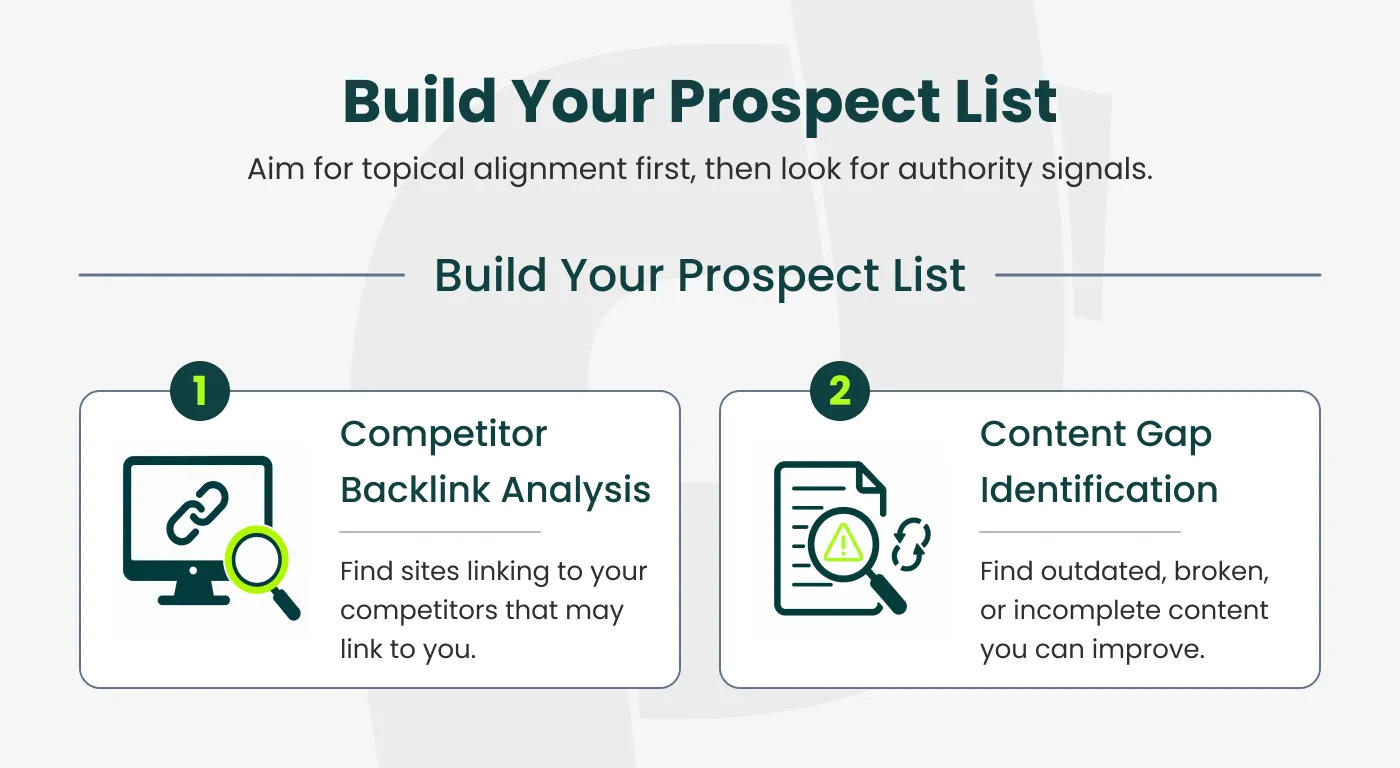
The prospecting methods that you can rely on are:
#### Competitor Backlink Analysis
Use tools like [Ahrefs](https://ahrefs.com/) or [Semrush](https://www.semrush.com/) to find sites linking to your competitors. If they linked to a similar piece of content, they might link to yours as well, especially if your content provides more value than the current one.
#### Content Gap Identification
Search for articles that are ranking for your target keywords that have outdated data, broken outbound links, or missing sections. These are natural outreach opportunities where your content fills a real gap and provides value to readers.
### Step 3: Find The Right Contact
Whenever possible, avoid sending a pitch to a generic email address like info@domain.com. Instead, send it to the one who makes editorial decisions. The ones who are content managers, editors, or blog authors.
Use tools like [Hunter.io](http://Hunter.io) to find verified email addresses. Cross-reference with LinkedIn to confirm whether the person still holds that role. A few minutes of research here saves you from dozens of emails you’ll ignore later.
### Step 4: Create Content Worth Linking To
Low-value or thin content is less likely to earn links, so before you [reach out](https://outreachdesk.com/link-building-outreach/) to your prospects, make sure you have something genuinely useful to offer. What works depends on your strategy.
-
#### Guest Posts:
Pitch original content that’s genuinely useful to their audience.
#### Data Studies Or Original Research:
Conduct original research and prepare data studies that are hard to replicate and easy to cite.
-
#### Resource Or Tool:
Develop interactive calculators, templates, or guides that are helpful to the audience.
-
#### Expert Quotes or Commentary:
Provide expert quotes or commentary in response to journalist queries on platforms like HARO to earn relevant media mentions and potential backlinks.
In Outreach Desk campaigns, pages with original data or a unique framework earn more links per outreach touchpoint than generic blog posts. Editors want something they can’t find on five other sites.
### Step 5: Write Personalized Outreach Emails
Most outreach fails before it starts. Average editors get lots of email in their inboxes every week. So to get your email recognized and opened, it has to be different, and different means specific.
Spend ten minutes on their site before you write a single word. Find an article they published recently. Notice something specific in it. Then write about that specific thing.
**A strong outreach email needs four things:
**
- A subject line that references their content, not yours
- One honest reason your piece fits their site
- A simple, low-pressure ask
- A real sign-off with your name, role, and social links

Keep emails concise and focused. Keep emails under 125 words. Relevance beats length.
In campaigns we’ve run at Outreach Desk, emails that reference a specific article or insight consistently outperform generic pitches.
### Step 6: Follow Up (But Not Too Much)
Sending follow-ups can increase total replies by +106%, according to [Hunter.io’s report](https://hunter.io/the-state-of-cold-email#:~:text=Follow%20up%E2%80%94but,6.8%25%20vs%203.3%25)). Most senders stop at one email, but following up twice nearly doubles your average reply rate.
Send the first follow-up email 4-5 business days after the initial email. A second after another 5-7 days, if you still have not heard anything. Then genuinely move on.
For most cold outreach campaigns, stopping after 2–3 follow-ups is a safe limit; anything beyond that damages the relationship for the next campaign.
**Follow-Up Email Template :**
**Subject: Quick follow-up on my previous email
**
Hi [First Name],
Just following up on my previous email in case it got buried.
I shared a quick idea that could be a good fit for your [article/page/topic]. Have you had a chance to review it?
If it’s not relevant right now, I completely understand. Happy to close the loop here.
Thanks,
[Your Name]
### Step 7: Track, Measure, and Adjust
Every campaign should be measured against the same benchmarks:
- **Response rate **benchmarks are simple. 4.5% is baseline, 8%+ is strong performance, and anything below 4% signals an issue with targeting or messaging.
- **Link placement rates **often fall in the 2–5% range for many outreach campaigns. Strong targeting and relevance can improve results over time.
- **The domain authority of the links placed **matters more than the raw link count. One backlink from a relevant site that people trust is worth more than ten from sites nobody reads
- **Anchor text distribution** should stay varied. Using the same phrase repeatedly across placements comes across as unnatural and draws the wrong kind of attention.
- **Referral traffic** is worth tracking, too. A placed link that sends no one to your site is a question worth asking
If performance drops below your baseline, the issue is usually targeting, value, or messaging. In most cases, it is one of these three things: wrong prospects, a weak value proposition, or emails that sound like templates.
## How To Write Outreach Email Editors Actually Open
Your subject line determines whether your email will be opened. If they do not open the email, none of the rest of it matters. The subject line is not a formality. It is the whole first impression.
Hunter.io’s report found that campaigns sent from custom domains get [108% higher reply rates ](https://hunter.io/the-state-of-cold-email#:~:text=Use%20a%20business,5.2%25%20vs%202.5%25).)than those sent from free email accounts.
Smaller, targeted campaigns consistently outperform large, bulk sends. The pattern is consistent: smaller, more personal, more targeted wins against volume in most cases.
**Subject line formula that performs:
**
- “[Their article title]” – a source you might want to add
- “Data for your [topic] piece”
- “Quick note about [specific thing on their site]”
Avoid subject lines like “Link exchange opportunity,” “Collaboration request,” or “Guest post inquiry.” These are the lines that tend to get deleted unread.
**In the email body, lead with value**
Open the email body with what you noticed about their work. Not your bio, not your company description, not your domain rating.
**Email Outreach Template:
**
**Subject: Data point for your [topic] article
**
Hi [First Name],
I was reading your article on [specific topic].
The section where you mentioned [specific detail] stood out.
We recently published something that expands on that angle: [one-line value summary].
It can serve as an additional reference for your readers.
If you think it fits, feel free to take a look.
Thanks,
[Your Name]
[Your Role / Website]
[Optional: LinkedIn]
Open with what you actually read and what made you reach out. Your credentials can live in the sign-off where they belong.
What they care about is whether you actually looked at their site, and whether you have something real to offer.
A quick note on AI-drafted outreach because it matters more than people admit. Hunter’s 2025 survey found that [69%](https://hunter.io/the-state-of-cold-email#:~:text=What%20decision%20makers%20say%20about,templated%2C%20synthetic%2C%20or%20overly%20polished) of decision-makers are genuinely bothered when an email feels like it was generated.
If you use AI to draft your pitches, that is fine, but rewrite them until they sound like a specific person with a specific reason to reach out on that specific day.
The outreach emails getting replies feel human because real people write slightly imperfect emails.
## SEO Outreach Strategies That Build Authority
Different [link building campaigns](https://outreachdesk.com/link-building-campaigns/) need different approaches. Your content, your niche, and the sites you’re targeting all shape which tactics actually work.
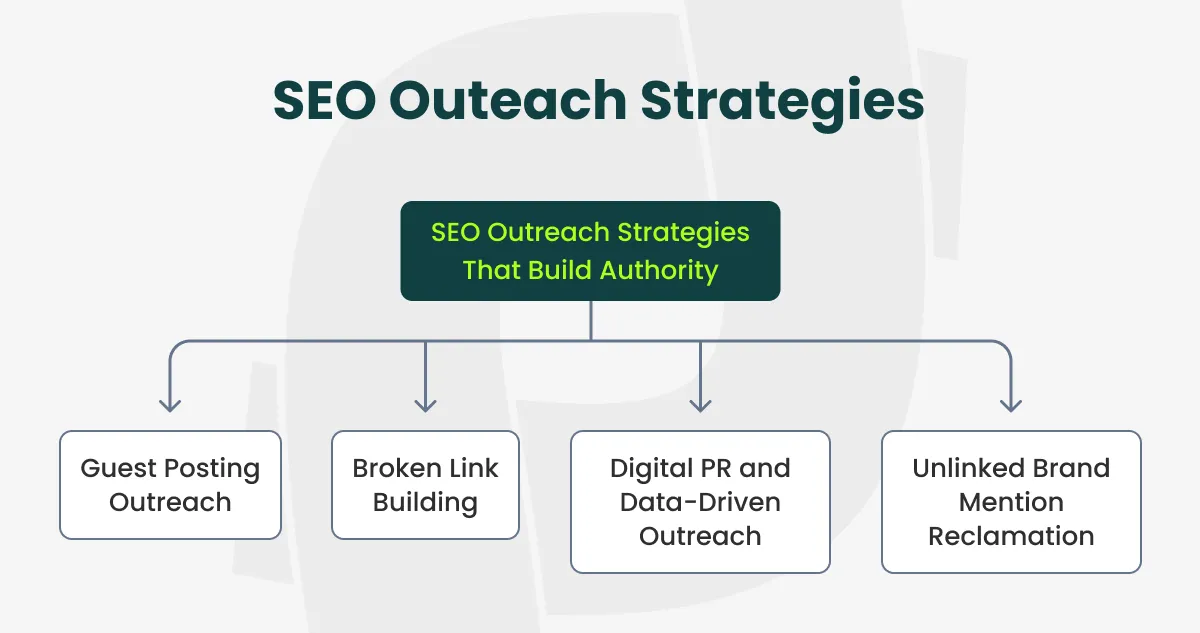
### Guest Posting Outreach
[Guest posting](https://outreachdesk.com/guest-posts/#:~:text=Here%E2%80%99s%20how%20your%20outreach%20mail%20should%20look%3A) often delivers strong response rates when pitches are relevant and well-targeted, though results vary by niche and execution.
The pitch that actually lands is the one proposing something their audience needs that the site has not covered yet. Not whatever happens to fit your keyword roadmap.
### Broken Link Building
**Broken link building** works well because it offers immediate value. Find pages in your niche with dead outbound links, and offer your content as the working replacement.
Across campaigns, [broken link outreach](https://outreachdesk.com/broken-link-building/#:~:text=The%20following%20broken%20link%20email%20template%20will%20save%20you%20time) tends to convert faster than cold guest post pitches because the value is immediate and clear.
You are fixing something for them before you ask for anything in return. That changes the whole dynamic of the conversation.
### Digital PR and Data-Driven Outreach
**Original research** is the highest-yield content type for link building. A real survey, a data analysis, an industry benchmark, something with numbers that did not exist before you published them.
Editors and journalists cite original data because readers trust it. One good study can steadily earn links over time, especially if it remains relevant and is supported by consistent promotion.
### Unlinked Brand Mention Reclamation
**Unlinked brand mentions** are the easiest wins that most brands completely overlook. Someone already wrote about you. They just did not add the link. One short, friendly email asking them to add it converts at a rate that often surprises people.
Tools like [Ahrefs Content Explorer](https://ahrefs.com/content-explorer) or [Google Alerts](https://www.google.com/alerts) will automatically find these for you.
Running a mix of these [proven link building playbooks](https://outreachdesk.com/link-building-strategies/) keeps your backlink profile looking resilient, balanced, builds authority across different types of sites, and means you are not dependent on any one approach.
## Common SEO Outreach Mistakes (and How To Avoid Them)
Most campaigns don’t fail because of bad outreach. They fail before a single pitch goes out, in small decisions that felt fine at the time.
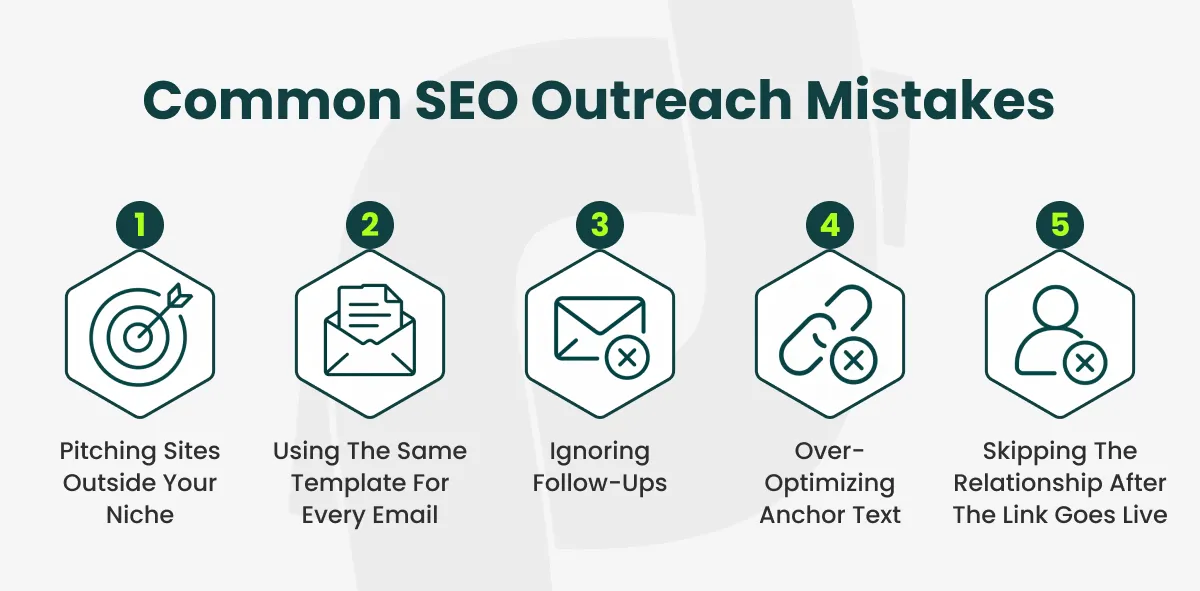
### Pitching Sites Outside Your Niche
A fintech startup doesn’t need a link from a cooking blog. Doesn’t matter what the numbers say or how clean the site looks. A link only builds your authority when it comes from a site that shares your niche.
If the topic doesn’t fit, the link won’t add any value to readers either. Build your prospect list around topic fit, not metrics alone.
### Using The Same Template For Every Email
Even well-written templates become invisible to editors when they see the same email template structure every week. Adapt different approaches.
Some pitches should be two sentences. Others should mention something specific you noticed on their site. Most of the time, personalization is what separates people who get replies from those who don’t.
### Ignoring Follow-Ups
Most replies don’t come from the first email, but they might come from the second. At least one follow-up is essential. If you’re skipping it, you’re not losing to better outreach. You’re losing to someone who just showed up one more time than you did.
### Over-Optimizing Anchor Text
Over-optimizing clickable text isn’t just an SEO mistake; it’s a flag. Google’s algorithm can spot a natural link profile, and one with heavy on exact-match phrases.
Keep the number of exact-match clickable texts to a minimum. Use branded phrases, partial matches, and things that sound like a real editor chose them. Because that’s what holds up long term.
### Skipping The Relationship After The Link Goes Live
Don’t stop maintaining a relationship with the editor after your link is placed. The editor who placed your link once can do it again, on a better page, for a stronger piece, six months from now.
Share their content, show up in their comments, and stay on their radar. Build a relationship, not a transaction log.
## How SEO Outreach Supports AI Search Visibility
The connection between outreach and AI search is becoming increasingly clear.
When ChatGPT or Perplexity generates an answer about your topic, the brands showing up in those answers are the ones mentioned most consistently across reputable sites.
Every guest post, every editorial mention, every expert quote is another signal that those systems are indexing.
Outreach used to be about building links for Google rankings.
Now it is doing that and simultaneously building the kind of distributed brand presence that AI search pulls from when forming answers.
If your link building strategy focuses only on one of those two things, it is already a little behind. It should focus on becoming a source that others consistently cite, not just a site that collects links.
## Build Links That Compound
SEO outreach is not about sending as many emails as possible. It is about building real relationships with the right sites and earning links that actually move the needle. It takes time, patience, and a willingness to get ignored more than once. But when it works, it works well.
Every link you earn through genuine outreach is a signal that a real website trusts your content enough to recommend it. Focus on relevance, keep your messaging human, and treat every outreach as the start of a relationship rather than a transaction.
Because each relationship makes the next pitch a little warmer. Each piece of original content continues to earn long after the outreach campaign that launched it has ended. That is what separates good SEO outreach from the rest — it compounds over time.
That is the kind of link building that holds up not just through algorithm updates, but through whatever comes next.
### Want to improve your SEO outreach results?
Get a clear strategy focused on relevant, personalized outreach.
[Book a strategy call](/contact-us/)
### What does “outreach SEO” mean?
“Outreach SEO” — also called “SEO outreach” — means the practice of contacting publishers, editors, and journalists to earn editorial backlinks. The two phrasings are interchangeable; both describe the same skill set: prospecting target sites, sending personalized email pitches, creating link-worthy content, and following up to convert pitches into placements. The goal is to earn links Google trusts because a human editor chose to add them.
### What Is SEO Outreach?
SEO outreach is the process of contacting website owners and editors to earn backlinks through personalized pitches that offer genuine value to their audience.
It’s not the same as buying links or blasting automated emails. Outreach earns editorial placements and links that an editor chooses to include because your content improves their page or fills a gap their readers actually need. Google trusts these links more because they reflect a real editorial decision rather than a transaction.**
**
### How long does SEO outreach take to show results?
Most campaigns land their first placements within 4–8 weeks. Ranking improvements from those links typically follow within 2–4 months, depending on keyword competitiveness and the authority of the sites linking to you.
How fast you build your prospect list, how quickly editors respond, and how strong your content is all affect that timeline. Expecting results in under 30 days isn’t realistic for most niches.**
**
### What’s a good response rate for outreach emails?
The industry average for cold outreach sits around 4.5%. Well-targeted, personalized campaigns often reach 8% or higher.
If you’re below baseline, review your targeting, value proposition, and messaging.**
**
### Is SEO outreach the same as link building?
Not exactly. Link building is the broader goal of acquiring backlinks to grow authority and rankings. Outreach is one method of achieving that goal, specifically the direct communication with site owners.
Other methods include creating linkable assets, 404 link building, and earning organic editorial links through content quality alone.**
**
### Does outreach still work with AI-generated content everywhere?
It works, but editors are pickier. With 74% of new web pages containing some AI-generated content, according to an [Ahrefs 2025 study](https://ahrefs.com/blog/what-percentage-of-new-content-is-ai-generated/#:~:text=We%20analyzed%20900%2C000%20newly%20created%20web%20pages%20in%20April%202025%20and%20found%20that%2074.2%25%20of%20them%20contained%20AI%2Dgenerated%20content.), editors increasingly favor pitches that offer original data, first-person expertise, or a perspective they can’t generate themselves.
Generic AI content won’t earn links. Original, experience-backed content will.
---
---
title: "Linkable Assets: How to Create Assets That Earn Backlinks"
url: "https://outreachdesk.com/linkable-assets/"
lang: "en-US"
type: "post"
description: "A linkable asset is content designed to earn backlinks by offering other sites something worth linking to. These content pieces can be original data studies, free tools, or in-depth guides designed to add value for the readers. Working with link"
last_modified: "2026-05-26T07:53:01+00:00"
categories: [Link Building]
---
# Linkable Assets: How to Create Assets That Earn Backlinks
A linkable asset is **content designed to earn backlinks by offering other sites something worth linking to.** These content pieces can be original data studies, free tools, or in-depth guides designed to add value for the readers. Working with [link building services](https://outreachdesk.com/) can compress the process from months to weeks.
Linkable assets are built to fill a gap or outperform existing sources with better data, usability, or structure that other content creators in your industry missed. While a blog post is written with your readers in mind, a linkable asset is primarily created to be useful to journalists, bloggers, and content creators who write for the same audience.
This is why linkable assets can be a long-term SEO investment; a single strong asset can continue to earn backlinks over time when it stays visible and relevant, helping build authority long after it’s published.
**What You’ll Learn:**
- The 8 types of linkable assets are ranked.
- You’ll learn how to find, build, and promote assets that consistently earn backlinks.
- How to measure performance, and what to do when an asset is underperforming.
## What Is a Linkable Asset?
A **Linkable asset** is created to earn [high-quality backlinks](https://outreachdesk.com/what-are-backlinks/) by providing something valuable that other websites want to reference
It consists of various assets. Below is the list of assets that can be included in the linkable asset types.
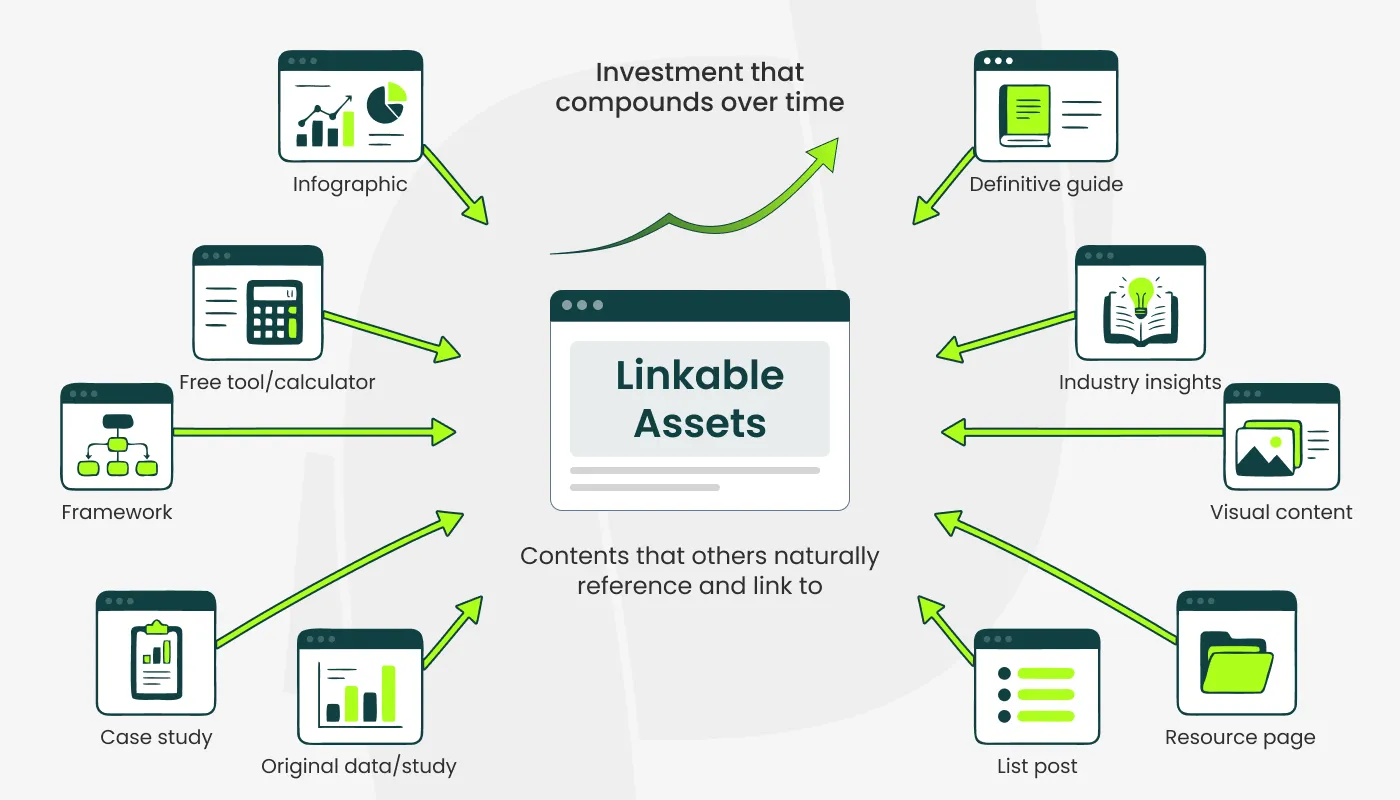
**These assets often take the form of:
**
- Infographics
- Online free tools and calculators
- Frameworks
- Definitive guides
- Original data and studies
- Interactive visual
- List posts
A **linkable asset** is an investment that compounds over time as more sites discover and reference it.
### Linkable Asset vs. Regular Content: The Key Difference
Now that you’re clear with the concept of linkable assets, here’s what makes the linkable asset different from the regular content.
| | Regular Blog Post | Linkable Asset |
| --- | --- | --- |
| Primary Audience | Your readers | Writers who serve your readers |
| Goal | Rank, inform, convert | Get referenced and linked to |
| Lifespan | Decays without updates | Accrues links over months/years |
| Typical Link Count | 0-5 referring domains | 30-500+ referring domains |
| Creation Effort | Hours | Days to weeks |
| Promotion Needed | Optional | Non-negotiable |
**Note: **The numbers may vary based on promotion, niche, and brand authority.
Where a regular post answers a question. A **linkable asset** acts as a source that other posts cite to answer the same question.
### Why Other Websites Link to Certain Content
People link to your content to serve their readers, not as a favor to you, and understanding that changes how you can build a linkable asset.
**The writers mostly link to the content for four reasons:
**
**1. Citation needed**
They’re making a claim and need a source to support their claim.
E.g., “According to [source]…. “
**2. Resource curation**
They’re compiling a list of tools, guides, or references for their audience.
**3. Data reference**
They require a specific number, benchmark, or visualization that they can’t create on their own.
**4.Social proof**
They’re referencing an industry authority to strengthen their own argument.
Your asset needs to be strong enough to be included by other writers; it won’t earn links, no matter how polished or well-written it looks.

## Why Linkable Assets Matter for SEO in 2026
As Google gets stricter on manipulative links, assets give you a safer, scalable way to earn authority.
Paid links, PBN schemes, [link farms](https://outreachdesk.com/link-farming/), and bulk directory submissions still exist, but the penalties are strict now. Linkable assets are the sustainable alternative.
**Here’s how they compare to other methods:
**
| Method | Sustainability | Cost | Scalability | Risk Level |
| --- | --- | --- | --- | --- |
| Linkable assets | High, links compound | Medium-high upfront | High once the asset is live | Very low |
| Guest posting | It is medium, it requires ongoing efforts | Medium | Medium | Medium |
| Digital PR | High, if newsworthy | High | Medium | Low |
| HARO | Low, because it depends on the platform | Low | Low | Low |
| Buying links | None, because it has a penalty risk | Varies | Appears high | Very high |
Linkable assets are the only method on the list where a single piece of content can earn links for years without ongoing investment.
A [link building campaign](https://outreachdesk.com/link-building-campaigns/) built around strong assets compounds returns, whereas one built around purchased placements compounds risk.
## 8 Types of Linkable Assets
Not every method is equal. Some can earn dozens of referring domains with minimal effort, but some need heavy outreach just to break through.
### 1. Original Research and Data Studies
When you publish original findings, such as surveys, trend analysis, and proprietary benchmarks. Every writer covering these topics needs to cite you.
It works because writers can’t replicate your data without citing your original source.
The image below shows the Panel Study of Income Dynamics (PSID) at the University of Michigan, which has been cited by thousands of academic papers, government reports, and news outlets for decades, because it’s the only dataset of its kind.

Effort is higher because you need to collect data or build a methodology.
However, even a 200-person industry survey can become a top-cited resource if the topic has no existing data.
### 2. Free Tools and Calculators
Interactive tools solve a specific and repeatable problem.
Tools like mortgage calculators, ROI estimators, and readability analyzers earn links from resource pages, blog posts, and roundups because they’re actually useful.
**CoSchedule’s Headline Analyzer** earned over thousands of referring domains. It solves the problem of writing better headlines in under 30 seconds.
Writers link to the asset from the blog posts, courses, and resource round-ups because it’s genuinely useful, not just because anyone asked them to.

The advantage here is that the tool provides ongoing value that a static article can’t match.
You spend more on development at the beginning, for example, on an interactive tool or specialized page, but maintaining it later is low effort. Over 12+ months.
### 3. Comprehensive Ultimate Guides
The “definitive guides” are useful. When done right, a guide becomes a go-to resource that everyone refers to and links to.
However, when done poorly, these are just long articles that no one reads.
A well-structured guide gives a writer a single authoritative source to point the readers to, saving them from having to explain a complex topic themselves.

The thing that separates a linkable guide from a forgettable one is the original frameworks, proprietary data, and a structure that make it a genuine reference.
### 4. Infographics and Data Visualizations
Infographics and data visualizations remain effective in 2026 when paired with original data.
If your article just collects stats and places them from other articles, no one will link to it; they’ll link to the original source instead.

💡
**Pro Tip:
**
Include an embed code below every infographic. It makes it easy for the bloggers to share, and adding an embed code will automatically link back to you.
### 5. Industry Benchmark Reports
Annual or quarterly reports that track metrics, trends, or standards in your industry. This becomes a reference source that writers cite year after year.

This is effective because benchmark data has a built-in refresh cycle.
Each new edition earns new links, and older editions often continue to earn links from the archival references.
### 6. Interactive Content and Templates
Templates and interactive assets earn links the same way the tools do. People often recommend what made their own work easier.
A well-designed Notion template or Figma kit gets shared in blog posts, YouTube descriptions, and community roundups because the person linking to it is genuinely recommending it, not just citing it as a source.

It works best in the niche where the practitioners share workflow resources, B2B SaaS, marketing, design, and productivity.
**Best for:**
It is best for B2B SaaS, marketing, design, and productivity niches where practitioners share workflow tools.
### 7. Expert Roundups and Curated Resource Pages
The format of roundups and curated resource pages is clear: you ask 10-12 experts one question, compile their answers into a single article, and publish it.

What makes it work is that every expert featured has a reason to share it.
However, quality remains an important factor; a roundup of vague, generic quotes won’t earn links from anyone worth having.
Keep the expert’s list with 8-12 genuine experts; those with specific insights beat 50 common responses every time.
### 8. Definitive Glossaries and Frameworks
A great glossary becomes the definition that everyone borrows. It attracts natural links because writers use your definitions to explain the term to their readers.
It matters because glossary links are often considered [contextual backlinks](https://outreachdesk.com/contextual-link-building/) that are embedded naturally within content, making them a valuable type of link for SEO.
**Here’s a linkable asset comparison matrix: **

## How to Find the Right Linkable Asset Idea for Your Niche
Most guides skip this part. They list asset types, telling you to “create something valuable” and move on. That doesn’t define a strategy.
You need a system to find ideas that your niche will actually link to. Here’s how you can find the right linkable asset ideas:
### Step 1: Reverse-Engineer Competitor Backlink Profiles
Open SEO analytics tools like [Ahrefs](https://ahrefs.com/) or [Semrush](https://www.semrush.com/). Look for your top 3-5 competitors and analyze which of their pages have earned the most links from other websites. Run the “best by links” report for each domain and sort by referring domain.
You’ll usually spot the patterns immediately. Maybe everyone in your niche links to calculators, data reports, or glossary pages. This pattern tells you what in your niche is worth citing.
Avoid copying the existing assets. Instead, look for content gaps, a topic, or a format where no strong version exists yet, and consider building that.
### Step 2: Identify Citation Needs in Your Industry
A citation need is a topic where writers often make claims but lack solid evidence to link to. That is your golden opportunity.
Here’s how to find them:
- Search for your topic in your niche + “according to” or “source” in Google. Look for what’s being cited. (If writers are linking to weak or outdated sources, that’s the gap you can fill.)
- Browse journalist query platforms such as HARO, Qwoted, or SourceBottle. The questions asked by the journalists can reveal what data and expert sources are missing.
- Check Reddit, niche forums, and Stack communities. When someone asks, “Does anyone have data on X?”, that’s your next asset idea.
### Step 3: Validate the Idea Before You Build
Before you spend days or weeks building it, run a short check:
**Search volume check
**
Do enough people search for this specific topic to make it worth building?
**Existing link distribution
**
How many sites link to the best resource out there? While it varies by niche, if it’s under 30, the opportunity is real. But if it’s over 500 from a major brand, then you need a sharper angle.
**Can you build something better?**
Not just different, but actually better, such as original data and more current information. If you can’t beat what exists, pick a different idea.
## How to Create a Linkable Asset: Step-by-Step Process
Before you start building, you need to follow the proper steps to create your linkable asset. Here’s how you can go from ideas to creating a finished asset.
### Phase 1: Research and Data Collection
Original data and research make a huge difference. Even small-scale research can outperform recycled statistics and data from someone else’s study.

**Here are some options for the teams without a massive research budget:
**
- **Run a simple survey** using tools like Typeform or Google Forms, and promote it within a niche community, such as a LinkedIn group, Slack channel, or email list.
- **Analyze public data**, such as government databases, like the [GSA occupancy data reports](https://www.gsa.gov/real-estate/use-it-act-and-occupancy-data/use-it-act-and-occupancy-data-annual-reports) contain raw numbers that nobody in your niche has collected into a reliable format.
- **Aggregate and synthesize** findings from multiple sources into one organized reference. The compilation itself becomes the asset, even if the data isn’t original.
### Phase 2: Content Creation and Design
The best practice is to write for the person who will link to you, not just for the person who will read you.

**What this actually means is:
**
- Use **quotable statements**. Specific, data-driven sentences that the writer can mention in their own article with a link to you.
- Use **embeddable elements** such as charts, infographics, and data visualizations with special embedded codes.
- Build a **clear structure **so that a journalist on a deadline can find key points faster in the entire article. It should be easy to scan, and the journalist can scan it in under 10 seconds.
Here’s when to hire a designer and when to use an in-house designer.
If data visualization is centered on the asset, such as an infographic benchmark report, then hire a professional. Use an in-house designer for guides, glossaries, and templates, where good formatting and clean structure help readers find what they need.
### Phase 3: On-Page Optimization for Discoverability
Your linkable asset still needs to rank organically. If people can’t find you, they won’t be able to link to you.

Start with the basics to strengthen visibility and clicks. Target your main keywords in the title tag and H1; write a clear meta description to drive clicks; ensure fast page load speed; use a mobile-responsive layout; and include proper open graph tags for social sharing.
Here’s one detail that most teams miss: Add schema markup.
| How-to Schema | For process-based assets |
| --- | --- |
| FAQ Page | For guide-style assets |
| Dataset Schema | If you’re publishing original data. |
Schema increases your visibility in results, which in turn increases discovery and links.
### Phase 4: Using AI to Speed Up Creation
AI tools won’t build a linkable asset for you, but they’ll reduce the work by half.

**Here’s where AI genuinely helps: **
- It helps with **research synthesis**; feed 10 source documents into any AI platform and ask for a structured summary of key findings and gaps.
- Helps in **data analysis**, uses ChatGPT or any similar tools to clean survey data, calculate significance, and generate initial chart drafts.
- First-draft generation for sections like methodology descriptions, glossary definitions, and FAQ answers.
**However, there are some areas where AI falls short:
**
- Original insights
- Editorial judgments
- Experience-based opinions
Ironically, the parts that make an asset genuinely link-worthy are the parts AI can’t generate.
## How to Promote Linkable Assets and Earn Links
Publishing a linkable asset without promoting it is like opening a restaurant on a street with no traffic; the food might be excellent, but nobody will know.

### Outreach Strategy: Who to Contact and How
Diversify your prospects into four groups, such as:
- **Resource page clusters:
**
Your asset is a natural fit for pages that feature “best tools,” “top guides,” or “recommended reading” in your niche.
This is where [resource page links](https://outreachdesk.com/resource-page-link-building/) become a direct channel for your asset.
- **Industry bloggers and content creators:
**
Writers and bloggers who regularly cover topics related to your assets.
Don’t just lead with the asset itself; instead, pitch the data points or specific insights they can use in their upcoming articles.
- **Journalists and newsletter writers:
**
Journalists and writers need sources; if your asset contains original data, then it eventually becomes a source.
Therefore, pitch findings, rather than format.
- **Contributors who link to competing resources: **
Use Ahrefs to find sites linking to your asset’s topic that are weaker or older versions.
These sites already care about your chosen topic, but they just need a better resource. This is where [outreach](https://outreachdesk.com/link-building-outreach/) makes the difference by increasing [link acquisition](https://outreachdesk.com/link-acquisition/) compared to publishing.
#### Email Framework (Not a Template, a Structure)
For **line 1**, reference something that talks about their content, show them that you’re actually reading.
In **line 2**, share the specific finding or any insight from your asset that’s relevant to what they write about.
Offer your asset in **line 3**, no pressure, don’t ask for a link. Just a helpful gesture. Add something like “Thought this might be useful for your readers.”
Keep everything under 100 words. People with busy schedules usually don’t read long pitches.
### Content Distribution Beyond Email
- In **Reddit and niche communities**, share your findings first, not direct links. Add value to the ongoing discussion and provide a link where it is genuinely helpful.
- **Use social media seeding** to share your assets. Take 3-5 standalone data points from your asset and post them as individual pieces of content on LinkedIn, X, or wherever your audience usually reads.
- Offer **newsletter partnerships** to the writers and provide exclusive stats from your research in exchange for a mention.
- Provide **paid amplification**. Even a paid promotion budget can put your asset in front of the right people. That’s not buying links, it’s buying visibility.
### The Broken Link Building Angle
Find [broken links](https://outreachdesk.com/broken-link-building/) that are pointing to content similar to yours. If a competitor’s data study from 2019 is now a 404, many sites still link to it. Your asset acts as a replacement.
You can use tools like a [broken link checker](https://outreachdesk.com/tools/broken-link-checker/) to make this easy. Find dead pages, identify sites still linking to them, and reach out to those sites with your updated resources.
You’re helping them replace outdated resources; that’s a genuine favor, not cold outreach.
## How to Measure Linkable Asset Performance
Building an asset is only half the work. Here’s how you can analyze how it’s performing.
### Key Metrics to Track
**Referring domains over time
**
Focus on referring domains, not total backlinks. It means 50 links from one site matter far less than 50 links from 50 different sites.
**Link velocity
**
How fast are new referring domains linking to you? A healthy asset continues to attract new referring domains consistently after the initial promotion phase.
** Authority of the linking site
**
10 links from well-established, high-traffic sites move the needle more than 100 links from small, low-traffic ones.
**Organic traffic to the asset page
**
If the asset ranks in search, it attracts links on its own; writers find it through Google and link to it naturally.
**Rankings influenced
**
Don’t just track how the asset itself ranks; also check how it lifts the rankings of other pages on your site that it links to internally, because link value flows through your entire site structure.
### Timeline: When to Expect Results
Set realistic expectations. With ongoing promotion, you can expect the asset to begin earning its first set of links within the first 1-3 months.
Links from organic search usually start coming in from the month 3-6, once the asset starts to show up in search results.
The complete compounding effect starts where your asset earns links without any extra effort. It usually takes 6-12 months.
That’s not slow; that’s an asset generating returns long after the creation cost is paid.
### What to Do When a Linkable Asset Fails
Not every asset is a hit. When one asset underperforms, analyze it before you abandon it.
**Is it a content problem?
**
Check if the content offers something unique. If three competitors have nearly identical resources, your asset won’t earn links just by existing.
**Is it a promotion problem?
**
Did you actually reach out to 50+ prospects, or did you tweet it once? Most of the failed assets weren’t promoted; they were just published and forgotten.
**Is it a niche problem?
**
Some niches simply don’t have a linking culture. If the top resource in your niche has only 8 websites linking to it, even after 3 years, consider that the ceiling is low. Adjust your expectations, or you can target a broader audience.
**Here’s how you can refresh and improve:
**
Update the data, improve the design, or add a new section. Then repromote to your original list with a “we’ve updated this” message. The reason to do this is that a refreshed asset often outperforms the original content.
## Common Mistakes That Kill Linkable Asset Performance
Here is the list of common mistakes that can kill the asset performance. Consider avoiding them at any cost.

### Making It Too Promotional
If your asset is similar to a product brochure, no one will link to it. Writers usually link to neutral, informative resources rather than to a sales page.
Modify it, and eliminate every sentence that exists to sell rather than to provide information.
### Choosing a Topic No One Needs to Cite
You build something impressive, but no writer in your niche has a reason to reference it.
Remember, a stunning infographic about your company’s history won’t earn links, but an ugly spreadsheet with original pricing data will.
### Publishing and Praying
A team spends three weeks building a research study, publishes it on a Tuesday, shares it on LinkedIn, and waits. Even after all this, nothing happens, and they assume that linkable assets don’t work.
Here, the actual problem is the absence of promotion. You can allocate as much time to promotion as you do to creation
### Neglecting Updates and Maintenance
A 2023 report is a citation magnet and a liability by 2025. The data is outdated; therefore, it loses links. Writers replace old sources with current, updated ones.
You can plan references for any asset you want to keep earning links. Update the year, refresh the data, and re-promote.
## What Comes Next
You don’t need to build every type of linkable asset. You just need to build the right one, the format that your niche values, covering a topic where no strong resources exist yet, and you need to promote your asset to the people who control the links.
Start simple, begin with research.
Then take a step forward toward ideating a framework and look at what’s already earning links in your industry. The gap is the difference between what exists and what should exist; that’s your opportunity.
### Ready to create linkable assets that attract backlinks naturally?
Get a clear approach to building content people want to reference and share.
[Book a strategy call](/contact-us/)
### What is a linkable asset?
A linkable asset is content designed to earn links by providing something valuable, such as original data, a free tool, or a definitive guide, that other websites want to reference naturally. Unlike regular blog posts, linkable assets serve the people who write for your audience, giving them a reason to cite your work.
### What are the best types of linkable assets?
The highest-performing type of linkable assets is:
- Original research and data studies
- Free tools and calculators
- Industry benchmark reports
- Comprehensive guides
- Data visualizations
- Interactive templates
### How do you earn links with linkable assets?
There are two steps. Build content that fills a genuine gap, something that the writers in your niche need but can’t find. Actively promote it through targeted [SEO outreach](https://outreachdesk.com/seo-outreach/) to resource page curators, industry bloggers, journalists, and sites that are linking to competing resources.
### How long does it take for a linkable asset to earn backlinks?
With promotion, you can expect 10-30 referring domains in 1-3 months, and organic link accrual usually begins at 3-6 months. Complete compounding, in which the asset earns links without ongoing effort, usually takes 6-12 months.
### Can small businesses create effective linkable assets?
Definitely, local data studies, niche calculators, and curated resource pages require a minimum budget. A regional cost-of-living study or industry-specific pricing tool can dominate a local niche where national brands aren’t competing. Focus on depth within your niche, not a broader appeal.
### Are linkable assets better than other link building strategies?
They’re the sustainable and lowest-risk approach, but they work well as part of a broader strategy. Pair linkable assets with digital PR, community engagement, and structured outreach. A linkable asset gives you something worth linking to, and a promotion strategy makes sure the right people can find it.
---
---
title: "Backlink Management: Audit, Monitor, and Grow Your Links"
url: "https://outreachdesk.com/backlink-management/"
lang: "en-US"
type: "post"
description: "Most teams treat backlink management as a quarterly audit and a Search Console glance. That's why their authority leaks faster than it builds. In 2026, the link profile that ranks isn't the one with the most backlinks. It's the one"
last_modified: "2026-05-26T10:16:45+00:00"
categories: [Link Building]
---
# Backlink Management: Audit, Monitor, and Grow Your Links
Most teams treat backlink management as a quarterly audit and a Search Console glance.
That’s why their authority leaks faster than it builds.
In 2026, the link profile that ranks isn’t the one with the most backlinks. It’s the one that’s actively managed across four stages: acquiring quality new links, monitoring what’s happening to your existing profile, defending against lost or toxic links, and recovering authority when something breaks.
This guide covers **the 4-stage Backlink Lifecycle, the KPIs that matter at each stage, the tools that work in 2026, and the AI search visibility angle most management workflows miss.**
**Key Takeaways**
- Backlink management is a 4-stage lifecycle: Acquire, Monitor, Defend, Recover.
- Track referring domain growth per priority page, not raw backlink count.
- Lost backlinks account for 20-40% of authority decay over 12 months if unmanaged.
- The disavow tool is for manual actions, not algorithmic suppression. Misuse hurts more than helps.
- AI search citation visibility is now part of a healthy management workflow, not a separate KPI.
- Weekly monitoring catches recoverable losses. Monthly audits catch the rest.
- Tool stack: Ahrefs or Semrush for monitoring, Google Search Console for ground truth, alerts for changes.
## What Backlink Management Is in 2026
Backlink management is the ongoing process of monitoring, evaluating, and defending the inbound links pointing to your site.
The job isn’t building links. That’s link building. The job is making sure the links you have continue to count, the bad ones get caught, the lost ones get recovered, and the program’s overall direction stays defensible.
Most teams confuse the two. Link building is the acquisition function. Backlink management is the operational function that runs alongside it.
### Why Management Matters More in 2026
Google’s link evaluation has gotten more sensitive to context and pattern over the last two years.
A link that was a positive signal in 2023 can become a neutral or negative signal in 2026 if the linking site lost editorial standards, started selling placements, or developed a toxic outbound link pattern. Your authority changes even when you don’t.
AI search engines compound the issue. ChatGPT, Perplexity, Google AI Overviews, and Bing Copilot all evaluate authority through current link patterns, not historical ones. A 2022 link from a high-DR site that’s since gone downhill counts for less now than it did then.
Management is how you stay ahead of these shifts.
## The 4-Stage Backlink Lifecycle
Every link your site has sits at one of four stages. The management workflow tracks each stage with different cadence, different tools, and different KPIs.
### Stage 1: Acquire
The acquisition stage is where new links enter your profile. This is [the work of getting backlinks](https://outreachdesk.com/how-to-get-backlinks/).
KPIs at this stage: new referring domains per month, new backlinks per priority page, average Domain Rating of new linking sites, anchor text distribution of new links, topical relevance of new sources.
Tools: Ahrefs Site Explorer, Semrush Backlink Analytics, Google Search Console Links report. All three update on roughly the same cadence (a few days behind live).
Healthy acquisition for an established site: 10-25 new referring domains per month from at least 70% topically relevant sources. Healthy for a growing site: 25-50 per month. Healthy for an active outreach program at enterprise scale: 50-200 per month.
The acquisition stage is covered in depth in [our link building strategies guide](https://outreachdesk.com/link-building-strategies/). The point here is that acquisition is one stage of management, not the whole job.
### Stage 2: Monitor
Once a link enters your profile, you monitor what happens to it.
KPIs at this stage: lost backlinks per month, new toxic links flagged, anchor text drift in existing links, sudden velocity changes, links from newly compromised sites.
Tools: Ahrefs Backlinks > Lost tab, Semrush Backlink Audit, Google Search Console’s Links report (for ground truth on what Google actually sees).
Cadence: weekly monitoring catches recoverable losses. Monthly audits catch the rest. Quarterly deep reviews catch slow-moving pattern changes.
The single biggest mistake teams make at this stage: relying on raw backlink count instead of referring domain count. 100 links from 5 sites is weaker than 25 links from 25 sites. The latter is what improves rankings.
### Stage 3: Defend
When monitoring catches a problem, the defense workflow kicks in.
The four common defense scenarios:
#### A linking page got removed or returns 404
The page that linked to you is gone. The link is lost. If the linking site is real and the editor is reachable, a polite email asking if the link can be reinstated converts at 30-50%. Set a weekly reminder. The same outreach mechanics power [broken link building](https://outreachdesk.com/broken-link-building/) on the offensive side.
#### A linking site changed ownership or quality
A site that was a strong editorial source got bought by a low-quality link network. The link is still live, but the site’s pattern has shifted. The link’s value has dropped. No action needed unless the new pattern attracts a manual action.
#### A linking page changed your anchor or removed the link
The editor updated their post and changed your branded anchor to a generic “click here.” Or removed the link entirely. Reach out and ask if the original placement can be restored. Conversion 30-40%.
#### Sudden spike in links from low-quality sources
This is the most concerning pattern. Sudden velocity spikes from PBN-style sources sometimes indicate competitor negative SEO (rare but real). Audit the new links and consider the disavow tool only if the pattern is severe.
### Stage 4: Recover
Recovery is the work you do when something has already gone wrong.
The four common recovery scenarios:
#### Manual action for unnatural links
The most severe case. Google has issued a manual action against your site. Recovery requires auditing every inbound link, disavowing the ones flagged as manipulative, submitting a reconsideration request, and waiting 4-8 weeks for review. Even after lifting, recovery takes 3-6 months for rankings to return.
#### Algorithmic suppression
The page or site dropped in rankings without a manual action. This is more common than manual actions. Recovery is content-driven, not link-driven. Audit the page against helpful content guidelines, refresh weak sections, and wait for re-evaluation.
#### Mass lost backlinks
A major linking site went offline, got acquired, or did a content cleanup that wiped out dozens of your links at once. Reach out to the new owner or editor if relationships exist. Otherwise, rebuild the lost authority through new outreach.
#### Toxic link pattern accumulated
Your site has attracted a meaningful amount of low-quality links over time (sometimes from competitor negative SEO, sometimes from old programs). The disavow tool exists for this, but use it conservatively. Disavowing real links by mistake hurts more than helps.
## Backlink Management KPIs That Matter
Most management dashboards measure the wrong things. Here’s what actually predicts ranking and authority impact.
### Referring Domain Growth Per Priority Page
The single most important KPI.
Aggregate referring domain count tells you what’s happening at the site level. Per-page referring domain count tells you whether your priority pages (the ones that matter for business) are getting the link signal they need.
Track monthly RD growth per priority URL. Set per-page targets. A page targeting a competitive commercial keyword needs more RDs than a supporting blog post.
### Link Quality Distribution
Not all referring domains are equal. Track the distribution.

A healthy profile has the bulk of new links from sites with Domain Rating 30-70 in your niche. Outliers above 80 are bonuses. Sub-DR-30 sites are fine in moderation. A profile heavy on sub-DR-20 sources signals scaled, low-quality outreach. The line between defensible quality and risk is the same one we cover in our analysis of [buying backlinks](https://outreachdesk.com/buy-backlinks/).
### Anchor Text Distribution Health
Anchor text patterns are the easiest signal Google reads.
Healthy distribution: 40-60% branded anchors (your company name), 15-25% naked URLs, 10-20% generic phrases (“learn more,” “this guide”), 5-15% partial-match anchors, less than 5-10% exact-match commercial keywords.
When exact-match commercial keyword anchors exceed 10% of your profile, the pattern starts to read manipulative to Google’s spam systems.
### Lost Link Recovery Rate
How many of your recoverable lost links do you actually recover?

Teams that don’t monitor at the weekly cadence recover maybe 5-10% of lost links. Teams with active monitoring recover 30-50%. This is one of the highest-ROI activities in backlink management because the work is low-effort outreach to publishers who already wanted to link to you. Pair recovery work with [finding unlinked mentions](https://outreachdesk.com/unlinked-mentions/) and you compound the effect.
### AI Citation Frequency
The newest KPI worth tracking.
Tools like Otterly, Profound, and HubSpot’s AI Search Grader provide approximations of how often your brand is cited in AI search responses for your category queries. The metric is imperfect but trending up if your link program is healthy.
Track quarterly, not weekly. The signal smooths over time.
## Backlink Monitoring Tools and Workflow
The right tool stack depends on your team size, but the core layers are consistent.
### Layer 1: Real-Time Monitoring
You need at least one tool that polls daily for new backlinks, lost backlinks, and anchor changes.
Ahrefs Site Explorer is the most accurate. Semrush Backlink Analytics is close. Both update within 1-3 days of new links appearing publicly. Both have alert features for major changes.
For solo SEOs, one of these is enough. For agencies and enterprise teams, both provide useful cross-validation when their data disagrees.
### Layer 2: Ground Truth from Google
Google Search Console’s Links report shows what Google actually sees, not what third-party tools see.
GSC tends to lag commercial tools by 2-4 weeks, but it’s the ground truth. When Ahrefs shows 1,500 referring domains and GSC shows 1,200, GSC is what Google is counting.
Use GSC as the validation layer. If a link doesn’t show up in GSC after 30-45 days, it’s not registered in Google’s index.
### Layer 3: Anchor Text and Pattern Analysis
For deeper pattern analysis: Ahrefs Anchor Text report, Semrush Backlink Audit’s toxicity scoring (use with skepticism), and manual review.
Toxicity scores from automated tools are guidelines, not gospel. Many tools flag links from small but legitimate sites as “toxic” because the site has low traffic. Human review of flagged links is essential before any disavow action.
### Layer 4: Alerts and Notifications
Set alerts for: sudden velocity changes (more than 50% above baseline), new toxic-flagged links above a threshold, lost backlinks from high-DR sources, anchor text drift on key pages.
Both Ahrefs and Semrush offer email alerts. Most agencies build a Slack integration that pipes the alerts into a monitoring channel.
## How to Conduct a Backlink Audit
The full audit runs quarterly for established sites. Monthly for sites in active growth or recovery.
### Step 1: Export Your Current Profile
Pull a complete export of referring domains and backlinks from Ahrefs or Semrush.
The export should include: source URL, target URL, anchor text, Domain Rating, first-seen date, last-seen date, link type (dofollow/nofollow/sponsored), and topical category.
### Step 2: Segment by Quality Tier
Split the export into three tiers.
Tier A: high-quality editorial links from real publishers (DR 50+, relevant niche, dofollow body content). These are your authority drivers.
Tier B: moderate-quality links from smaller sites (DR 20-50, varied relevance, mixed link placement). These are the baseline of your profile.
Tier C: low-quality or suspicious links (DR under 20, unrelated niche, suspicious link patterns, paid widgets, footer placements). These are the audit’s focus.
### Step 3: Review Tier C Manually
Don’t blindly disavow Tier C. Manual review reveals which are genuinely low-quality vs. small-but-legitimate.
Spot-check 20-50 Tier C links. Note patterns: are they from a single network? From a single hosting fingerprint? With identical templates? Pattern-based concerns warrant action. Individual low-DR links from small but real sites usually don’t.
### Step 4: Decide Disavow Only Under Specific Conditions
The disavow tool is a defensive tool, not a routine cleanup tool. Use it when: – You have a manual action and Google’s reviewer asks for disavow as part of resolution – You have clear evidence of negative SEO (competitor-driven low-quality link injection) – A specific network you trusted has gotten compromised and you want to disassociate

Don’t use it routinely. Disavowing legitimate links by mistake removes real authority signal.
### Step 5: Document the Audit
The deliverable is a one-page summary: total profile size, tier distribution, top 10 highest-impact gains, top 10 highest-impact losses since last audit, and 1-3 action items for the next quarter.
That document goes to leadership. The detailed export stays in your tracking system.
## Common Backlink Management Mistakes
These are the patterns that derail otherwise-good programs.
### Optimizing for Backlink Count
Aggregate backlink count is a vanity metric.
100 backlinks from 2 sites is weaker than 50 backlinks from 50 sites. Sites that report “we built 1,247 backlinks this quarter” are usually counting links from PBN-style networks that don’t pass real authority. Focus on referring domain growth instead.
### Disavowing Everything Flagged by Tools
Toxicity scores from automated tools are noisy.
Many legitimate small sites get flagged as “toxic” because their traffic is below an arbitrary threshold or their hosting is shared. Disavowing them removes real authority signal you should keep.
### Ignoring Lost Backlinks
Lost backlinks are 20-40% of authority decay over a year if unmanaged.
Weekly monitoring catches them while they’re still recoverable. The cost is 15-30 minutes per week. The ROI is some of the highest in backlink management.
### Treating Anchor Text as a Set-and-Forget Decision
Anchor distribution is dynamic.
As you build new links, the distribution shifts. As old links update (publishers refresh content, change anchors), it shifts again. Quarterly review of the live distribution catches drift before it becomes a problem.
### Confusing Link Building With Backlink Management
Link building is acquisition. Backlink management is the full lifecycle.
A team that runs strong outreach but never monitors what happens after the link lands is doing half the job. A team that audits everything but rarely builds new links is doing the other half. Both ends compound when they’re integrated.
## Frequently Asked Questions
### What Is Backlink Management?
Backlink management is the ongoing process of monitoring, evaluating, and defending the inbound links pointing to your site.
It includes tracking new backlinks, identifying lost links, evaluating toxicity, recovering recoverable losses, and managing the overall health of your link profile across the 4-stage lifecycle: Acquire, Monitor, Defend, Recover.
### How Often Should I Audit My Backlinks?
Weekly monitoring catches recoverable losses while they’re still actionable.
Monthly audits catch broader patterns. Full quarterly audits catch slow-moving trends and provide the documentation for leadership reporting. Sites in active growth or recovery should run monthly audits instead of quarterly.
### Should I Use the Google Disavow Tool?
Use the disavow tool only when you have a manual action requiring it, clear evidence of negative SEO, or a trusted network has been compromised.
Don’t use it routinely. Disavowing legitimate links by mistake removes real authority signal and is one of the most common self-inflicted backlink management mistakes.
### What’s the Best Backlink Management Tool in 2026?
Ahrefs Site Explorer is the most accurate commercial tool for monitoring.
Semrush Backlink Analytics is close. Google Search Console’s Links report is the ground truth on what Google actually sees. The strongest stack uses Ahrefs or Semrush for real-time monitoring plus GSC for validation. For solo SEOs, one commercial tool plus GSC is enough.
### How Do I Recover Lost Backlinks?
Set up weekly monitoring in Ahrefs Lost Backlinks tab or equivalent.
When a high-value link disappears, email the publisher politely asking if the link can be reinstated. Recovery rates run 30-50% when the original removal was unintentional. Set a recurring 30-minute monthly task for lost link outreach. This is one of the highest-ROI activities in backlink management.
### Does Backlink Management Affect AI Search Visibility?
Yes.
AI search engines like ChatGPT, Perplexity, and Google AI Overviews evaluate authority through current link patterns. A profile with strong editorial links earns more AI citations in your category. A profile with decaying or toxic links earns fewer. Backlink management directly affects AI search visibility, not just Google rankings.
## The Forward Look
The brands building durable rankings in 2026 are treating backlink management as a real discipline, not an afterthought.
They’ve stopped optimizing for backlink count and started managing referring domain growth per priority page. They’ve stopped relying on quarterly audits alone and built weekly monitoring into the workflow. They’ve stopped ignoring lost links and started recovering them systematically. They’ve added AI citation visibility to the KPI set instead of treating it as a separate concern.
Build the 4-stage lifecycle into your week. Pick the tools that fit your team. Pair it with active [link building strategies](https://outreachdesk.com/link-building-strategies/) on the acquisition side. The compounding effect over 12 months is what separates programs that rank from programs that stall.
That’s what backlink management looks like when it actually works.
---
---
title: "Local Link Building: Improve Your Local SEO Rankings in 2026"
url: "https://outreachdesk.com/local-link-building/"
lang: "en-US"
type: "post"
description: "Local link building is the process of earning backlinks from relevant websites to improve your local search visibility, including the Google Local Pack and AI-generated local answers. It strengthens your presence on platforms like Google Business Profile. Brands serious about"
last_modified: "2026-05-26T07:19:33+00:00"
categories: [Link Building]
---
# Local Link Building: Improve Your Local SEO Rankings in 2026
**Local link building** is the process of earning backlinks from relevant websites to improve your local search visibility, including the Google Local Pack and AI-generated local answers. It strengthens your presence on platforms like [Google Business Profile](https://business.google.com/en-all/business-profile/). Brands serious about scaling often hand this off to an [expert link building agency](https://outreachdesk.com/) for predictable results. Most teams should reference [SEO local citations](https://outreachdesk.com/seo-local-citations/) for the latest baseline data.
Unlike general link building, here the focus is on location-based relevance, helping search engines connect your business to a specific area.
In simple terms:
- When your business is consistently mentioned across trusted local sources, it helps search engines and AI systems to verify your business.
- Backlinks and citations not only support your rankings on Google but also in AI-generated results.
The playbook has changed. Directory submissions alone are no longer enough. The AI overview appears in [68% of local searches overall](https://whitespark.ca/blog/case-study-the-prevalence-of-ai-overviews-in-local-search/#:~:text=AI%20Overviews%20are%20currently%20appearing%20in%2068%25%20of%20local%20business%2Dtype%20queries.), and these AI-generated answers grab attention on a different set of trust signals than those in the traditional map pack.
**Key Takeaways:
**
- Local link signals local relevance and trust to the search engines and the customers.
- Citation and NAP consistency drive both local and AI visibility.
- Quality, relevant local links can outperform high-volume, low-relevance directories.
- Ongoing monthly link building can outperform one-time campaigns.
- AI and maps both rely on local signals.
## What Is Local Link Building?
**Local link building is the practice of earning backlinks from websites tied to a specific city, region, or local audience.** Local newspapers, community blogs, regional chambers of commerce, and neighborhood publications all signal to Google that your business has genuine local presence in a way national domain authority can’t replace. If you would rather hand this off, [Outreach Desk’s citation team](https://outreachdesk.com/local-citation-services/) runs campaigns for 500+ brands worldwide.
Local link building is the process of [earning backlinks](https://outreachdesk.com/what-are-backlinks/) from nearby websites that are geographically connected to your business, such as local news sites, community groups, directories, and business partners, to strengthen your authority and improve your rankings in local [search results](https://outreachdesk.com/what-are-serps/).
What separates a local backlink from a standard link? There are two things that separate each other.
- Geographic relevance
- Community connection
Here’s a clear difference.

A link from the chamber of commerce in your city carries more weight than a link from a national blog.
This is especially for local visibility. Google’s local algorithm treats those local signals as evidence that your business is a trusted part of a community.
Local links matter because they help to strengthen Google’s three core local ranking factors:
**Prominence** grows because reputable local sites recommend your business.
**Proximity **refers to the distance between the user’s search and the business. The closer the business is to the user’s location, the more likely it is to appear in the search.
**Relevance** of the links from related local pages acts as confirmation of what your business is about. It can move you in the Map Pack faster than the dozens of generic links.
## Why Local Links Matter in 2026
**Local links matter in 2026 because Google’s local algorithm weights geographic relevance signals heavily for map pack rankings and “near me” queries.** Without quality local links, even the best on-page local SEO leaves you out of the three results that capture most local search traffic.
The right local backlinks and citations help nearby people find you fast and trust you more, because both Google’s traditional algorithms and the newer AI discovery systems reward them.

### Boosting Local Search Visibility
Boosting your local search visibility simply means making your business more visible and easier to discover for people searching in your area. It also includes visibility in “near me” queries.
The local pack usually relies on Google Business Profile signals, reviews, and proximity. Links from city news, chambers, schools, and neighborhood blogs signal strong relevance.
### Driving Targeted Traffic and Conversions
Geo-specific links are the kind of links that send visitors who already want local solutions.
Driving the right traffic, the one that converts, is where local SEO and link building prove their real value.
A click from a nearby page or city guide is more likely to result in a store visit, a call, or a form fill-out.
### Building Trust and Authority
Being mentioned along with the trusted local experts and businesses strengthens your business’s credibility.
Keep your Name, Address, and Phone (NAP) details consistent across local citations and profiles to reduce confusion and build trust.
Over time, this builds trustworthy signals that compound E-E-A-T, proving that you operate locally and serve real customers.
## How Local Links Feed AI Search Visibility
**Local links feed AI search visibility because Google AI Overviews.** ChatGPT, and Perplexity all reference geographic relevance signals when deciding which local businesses to cite in generative answers. A site with strong local backlinks gets surfaced in AI responses to “best [service] near me” queries. A site without them stays invisible.
This is the part that most local link building guides skip entirely in 2026. And this is the part that matters the most.
Imagine this:
You run a coffee shop, and when someone searches for the query “best coffee shop near me” in Google or asks ChatGPT for a recommendation, at that point of time, how does AI decide who to suggest?
AI doesn’t just look for your website; instead, it scans your entire online presence, just like a detective searching for clues.

This is what the image shows.
- Your business site is at the center.
- Around it, chains connect to local news mentions, community map listings, business directories, and review platforms.
- All those signals strengthen your local authority and visibility in search results, which AI systems then draw on when generating answers.
As a result, AI recommends you to the users. It works the same as word of mouth, but it is online.
If 15 local websites mention your business with the same name, address, and phone number, AI systems start to trust that you’re a real, established business in your area.
The more consistent the mentions are, the more confident AI becomes in recommending you.
Now, what does it mean in reality:
### Unlinked mentions still matter
Even if a local blog just [mentions your business](https://outreachdesk.com/brand-mentions/) without a link, it still helps AI platforms to recognize you as a trusted local business.
Tools like Perplexity draw on “best of” lists, community forums, and local news when making recommendations.
#### Citation volume and accuracy feed the AI answer
Three of the top five AI visibility factors in the 2026 report are related to citations. AI tools are pulling data from smaller, lesser-known directories too, not just from [Yelp](https://www.yelp.com/) and Google.
So being listed consistently across more places matters more.
#### Your own website content gets cited more when you’re well-known externally
A November [2026 SE Ranking study](https://seranking.com/blog/how-to-optimize-for-chatgpt/#:~:text=To%20begin%20with%2C%20domain%20traffic%20ranks%20as%20the%20second%20most%20important%20factor%20for%20ChatGPT%20citation%2C%20but%20it%20remains%20less%20influential%20than%20backlinks.) found that the more traffic and authority your site contains, the more likely AI is to quote or reference it.
Local links help you build that authority, making your own content more trusted and cited in AI search results.
Let’s look at what stats say:
- [76% of “near me” mobile searches](https://backlinko.com/local-seo-stats#:~:text=76%25%20of%20consumers%20who%20search%20for%20%E2%80%9Cnear%20me%E2%80%9D%20visit%20a%20business%20within%20a%20day%20(Google)) result in in-store visits within 24 hours.
- Businesses with a complete, maintained Google Business Profile receive [7x more clicks](https://www.yadavbikash.com/blogs/google-business-profile-ranking-factors/#:~:text=businesses%20with%20a%20complete%20and%20accurate%20Google%20Business%20Profile%20are%202.7%20times%20more%20likely%20to%20be%20considered%20reputable%20and%20get%207%20times%20more%20clicks%20compared%20to%20those%20with%20missing%20information.%C2%A0) than those with incomplete profiles.
- AI overview appeared for [68% of local searches](https://whitespark.ca/blog/21-local-search-developments-you-need-to-know-about-from-q2-2025/#:~:text=AI%20Overview%20prominence%20for%20local%20searches) in Whitespark’s Q2 2026 study, though local packs only appeared for 39% of the same queries.

## What Makes a Local Link Valuable?
**A valuable local link comes from a site with genuine local audience engagement, topical relevance to your industry, and editorial standards that screen out spam.** Local doesn’t mean low-bar. The local sites worth getting links from are the ones your customers actually visit, not the ones that exist purely to sell directory listings.
Not all local links carry the same weight. A link from a well-known local chamber of commerce is far more valuable than one from an old, abandoned blog that hasn’t been updated in years.
Before you [reach out](https://outreachdesk.com/link-building-outreach/) to any website for a link, try to rate it on these three factors:
| Factor | What it Measures | Example |
| --- | --- | --- |
| Relevance | Does this site serve your audience or cover your category? | A regional business journal covering your industry. |
| Trust | Would your customers recognize and trust this source? | Your city’s chamber of commerce or a local university. |
| Effort | How realistic is a legitimate mention? | A supplier who already features client logos on their site. |
Focus on the websites that are highly relevant to your location and topic, even if the links take more effort.
Ignore the links with low relevance, such as a directory from another state, which won’t help your local rankings, no matter how authoritative it looks.
The links from nearby, community-connected sources often carry more relevance than the links from major national websites, even if the national site has higher overall authority.
They come from local sources like regional news sites, community college pages, and nearby business partners. Where the connection is genuine.
## How to Build Local Links: Strategies That Work
**The local link strategies that actually work combine community participation, local sponsorships, news-worthy events, and partnerships with other regional businesses.** Each tactic produces links that look editorial because they reflect real local activity, which is the signal Google is actually trying to verify.
The strategies mentioned below are grouped by how much effort they require, right from simple moves you can take action on this week, all the way up to bigger plays that build lasting authority over time.
### Claim and Complete Your Core Citations
Your [Google Business Profile](https://support.google.com/business/answer/7039811?hl=en), [Yelp listing](https://www.google.com/aclk?sa=L&pf=1&ai=DChsSEwi8q4uAn_KTAxWDPQgFHeJNI9gYACICCAEQAhoCbWQ&co=1&ase=2&gclid=Cj0KCQjwkYLPBhC3ARIsAIyHi3TqfiX96-4SFjg2NiIBM3PwE4uDTM9ZeD68vc7kq0WoCu4iU1zLLysaAmUTEALw_wcB&cid=CAAS0wHkaNYkIGWtPxNslpfHsJ3Roj0vU80KIIDRgn-6PenSHgZnN0Pk8FqAuBxQSCQpixBJfG4VX-p6vkjp7Mp4B6ptcKvctlMAO2WYoQq9zojwZUu5YqpO4Ey6DEEYa-CbQ6splLM64iqtqQtl3tf0gcxLIl3diqg8Nu4D3fLQm7_j-AMBfFw4_m3pRA0BPKPa7cT92EgtBNrU3_xLg4V-j9zBYWuiHXAPUOkoW45KtTc6k9fm6aVQ328dtValmktoguiUl3HhJ26WRg7-ssrqLtGAADsT&cce=2&category=acrcp_v1_32&sig=AOD64_3nTcl70qceezyeY-A1jtWi5n5rNQ&q&nis=4&adurl=https://biz.yelp.com/claim?%26utm_source%3Dtype:claim_ad_google%26utm_medium%3Dsearch%26utm_campaign%3DGoogle_Branded_Hyper-Branded%26utm_content%3DRSA_Jan_2022%26utm_term%3Dyelp%2520listing%26matchtype%3De%26sitelink%3D%26adgroup%3D%26gad_source%3D1%26gad_campaignid%3D14944081852%26gbraid%3D0AAAAAD4JBaT8f5Q_08n16qvWEJg0PsnR2%26gclid%3DCj0KCQjwkYLPBhC3ARIsAIyHi3TqfiX96-4SFjg2NiIBM3PwE4uDTM9ZeD68vc7kq0WoCu4iU1zLLysaAmUTEALw_wcB&ved=2ahUKEwiGuYaAn_KTAxX7j4kEHaLNKtEQ0Qx6BAgXEAE), [Better Business Bureau](https://www.google.com/aclk?sa=L&pf=1&ai=DChsSEwiSubaIn_KTAxWrRv8BHbQxJU0YACICCAEQABoCbWQ&co=1&ase=2&gclid=Cj0KCQjwkYLPBhC3ARIsAIyHi3RmmsafHSWGbTvO8bYfGmawHANRs37QDa5M7qsNrQz7Qu4k_wnb6a0aAuVfEALw_wcB&cid=CAAS0wHkaInHDsLTWvtUaAp32cqEMS4Lnzv2fMPYiwW8Ghci0e1NbDqPkg4bdZduR_df5bZm6wrT7fUi8T-IycPa2Ad3PkmBHvfQwBTERtK0fqlRt5q3HJdqePE7yHHwIwjfZZ0WdOWum72A2Th3K62PxJMAe4jAR6-qnMASkE_6XGltXHR24gUs9XLB2g99w_qwlY2-q2osFr2zP6wLh7x9aj_Ymw2a9N3pvHR7FUhjgmIz7pCn5ONKQK9CR8P2azRlpS2_QkqFV3RCUV8dHcyVbpSU9Qrp&cce=2&category=acrcp_v1_32&sig=AOD64_2Gsm9zgXLA7FfK7SvJVv35Ug1TZg&q&nis=4&adurl=https://www.bbb.org/article/news-releases/22776-government-impostors-press-release?gad_source%3D1%26gad_campaignid%3D10753152887%26gbraid%3D0AAAAADMG8JeIOUPfeIwH5M-sx4o3dIc1h%26gclid%3DCj0KCQjwkYLPBhC3ARIsAIyHi3RmmsafHSWGbTvO8bYfGmawHANRs37QDa5M7qsNrQz7Qu4k_wnb6a0aAuVfEALw_wcB&ved=2ahUKEwj5vbGIn_KTAxXhw_ACHeIrEcoQ0Qx6BAgWEAE) pages, and industry-specific directories form the base of your local link profile.
This still matters in 2026 because consistent NAP details can help search engines trust your business.
It also strengthens your visibility in AI search tools like ChatGPT and Perplexity, which rely on the same citation sources.
**Actionable Step:**
Review your top citation sources quarterly. Fix the NAP inconsistencies, even the small ones like “St” vs. “Street.”
### Write Testimonials for Your Vendors and Partners
Here’s a simple tactic that takes nearly 15 minutes and can earn you a link back to your site, often dofollow links, though this varies by site. Write a genuine testimonial for your suppliers, vendors, or service providers.
Most businesses feature testimonials on their site, and they often include your name and a link pointing to you.
It works because the relationship is real, the link is contextual, and the site is usually connected to your location or industry.
### Sponsor Local Events (or Lend Your Space)
Community events can earn you local backlinks from event pages, news sites, and community calendars. It doesn’t require a large sponsorship budget to get started.
If you’ve a space such as a conference room, meeting space, or outdoor area, offer it to local groups through platforms like Meetup.
Event organizers will list your business as the venue on the event listing, giving you a highly relevant local backlink without a cash outlay.
### Pitch Local Journalists with Data-Driven Stories
Local news sites are always short-staffed and need useful community-focused stories.
If you share a data point, trend, or expert insight, you can become a source, not just a business asking for coverage.
Here are some examples that work:
- “We surveyed 200 homeowners in [city] about the [topic]. Here’s what we found.”
- “As a [your profession] in [city], here’s what I’m seeing change in [trend relevant to local readers].”
- Expert commentary on a local issue already in the news.
When they feature you, you get a natural backlink from a trusted local site, which strengthens your authority.
### Build Location-Specific Resource Pages
Create a helpful [resource page](https://outreachdesk.com/resource-page-link-building/) on your website tied to your local area.
Imagine this: “Small Business Tax Resources for [city]” or “Home Inspection Checklist for [Region] properties” if you’re dealing in real estate.
If this content provides genuinely useful information, local businesses and organizations will start linking to it, turning your content into a natural linkable asset.
### Pursue .edu and .gov Opportunities
Local universities, community colleges, and city government websites often maintain resource pages, scholarship listings, and community directories.
These links carry trust signals because .edu and .gov domains naturally have high authority.
**Here’s how you can find them:
**
Use search operations like- site:.edu [your city] resources or site:.gov [your city] business directory.
In this, look for pages that list community resources, recommended services, or organizations.
If you can offer a scholarship, internship, or community resource that fits, you’ve a strong reason to be included.
### Contribute Expert Content to Local Publications
Write [guest articles](https://outreachdesk.com/guest-posts/) for local business journals, community blogs, or regional publications.
This positions your business as a local authority and earns [contextual link](https://outreachdesk.com/contextual-link-building/) that both Google and AI platforms treat as strong trust signals.
Focus on the sites with a real local audience rather than random blogs.
One article on a trusted local publication often delivers more relevant authority than multiple posts on national sites with no connection to your area.

## How Many Local Links Do You Actually Need?
**Most local businesses need 20-50 quality local backlinks to start competing for map pack visibility in a typical metro market.** The exact number depends on your competitors’ local link profiles. Use their referring domain count as a baseline, then aim for 20-30% more, focusing on quality.
There’s no fixed number of links you need; it entirely depends on how competitive your industry is.
A dentist in a small town might only need 15-20 quality local links to rank competitively. While a personal injury lawyer in Chicago could need 150+.
These are rough estimates; your actual target should come from analyzing what the top local competitors have earned.
Most local businesses ranking on the first page often don’t rely on a large number of backlinks, but this varies by city size and industry.
In most local markets, success comes from earning a focused set of quality links that are geographically and topically relevant, rather than chasing volume.
Rather than focusing on fixed numbers, you need to analyze your competitors. Identify whether your top competitors are getting links that you’re missing.
That gap isn’t a random number; you should shape your link building priorities accordingly.
**Here’s a simple monthly workflow:
**
- **Week 1:**
Publish or update a useful, linkable resource such as a local guide, data piece, or tool.
- **Week 2:
**
Identify a focused list of relevant local link opportunities.
- **Week 3:**
Reach out with short personalized messages. Keep the messages specific and respectful of the editor’s time.
- **Week 4:
**
Track replies, follow up once, and record the results to improve next month.
Consistency matters more than volume. A steady flow of quality local links over time will deliver stronger results than a one-time spike in low-value links followed by nothing.
## How to Measure What’s Working
**You measure local link building success by tracking map pack ranking movement.** Organic traffic to your local landing pages, and direct calls or form submissions tied to organic search. Referring domain counts only matter if those domains are local and relevant. The metrics below connect link work directly to local revenue.
To check whether your applied strategies are working, track these five signals. This will help you identify if your local link building is producing results.
### Growth of Referring Domain
Monitor the total number of sites linking to you, especially from the local sources. Use [link building tools](https://outreachdesk.com/link-building-tools/) like Ahrefs, Semrush, or Moz to monitor your domain growth.
### Local Pack Movement
Use a location-specific rank tracker like Whitespark’s or BrightLocal’s to see how your rankings look different from the points across service areas.
Local rankings shift on the basis of the searcher’s physical location.
### Organic Traffic from Local Queries
Use Google Search Console to track impressions and clicks for the queries with the local intent.
Filter by keyword that includes your city or area name to identify local-intent driving impressions and clicks.
### AI Search Presence
Search for your business in AI platforms like ChatGPT, Perplexity, and Google AI Mode. Check whether you’re being recommended.
AI visibility is hard to track with tools through dedicated platforms; for now, regular manual checks can reveal whether your entity has a strong presence.
### Referral Traffic and Conversions
The best local links not just boost rankings, but they bring in real visitors. Use Google Analytics to track referral traffic and identify which links can drive visitors and leads.
## Mistakes That Kill Local Link Campaigns
**The mistakes that kill local link campaigns are mass-submitting to irrelevant directories, paying for low-quality local citations, and ignoring NAP consistency across listings.** Each one wastes budget and produces signals Google now actively devalues. The patterns below are the ones to catch before they cost you map pack visibility.
Once you apply the strategies to your business and measure their impact, it’s important to identify common mistakes to avoid to achieve the desired results. Let’s look at those mistakes you need to avoid entirely.

### Chasing Volume Over Relevance
Avoid links from the areas you don’t serve because those won’t impact your local rankings much. A single link from a trusted publication is far more relevant.
### Paying for Low-Quality Directory Links
If a directory has no organic traffic, no editorial standards, and charges for listing, walk away. These are often [link farms](https://outreachdesk.com/link-farming/) disguised as directories.
Check the site’s traffic using the Ahrefs tool before paying anything. Pricing can vary widely, so it helps to know [what a backlink should actually cost](https://outreachdesk.com/backlink-cost-calculator/) before you commit.
### Ignoring NAP Consistency
Even small inconsistencies, such as a different phone number or address format, can weaken your signals. Review and update the details regularly, ideally at least once every quarter.
### Mass Outreach Templates
Generic outreach emails often get ignored or marked as spam. If you can’t clearly explain why a specific site should mention you, it’s better to remove them from the list than to waste an outreach.
### Stopping After the First Push
Local link building compounds over time. The businesses that win local search aren’t the ones that did a one-time push; they’re the ones following a consistent, ongoing process.
### Treating AI Search as Separate from Local SEO
In 2026, the same signals feed both traditional and AI search. A link strategy that ignores entity mentions, citation consistency, and structured data leaves a significant part of local visibility unaddressed.
## Build Your Local Authority Before Your Competitors Do
Local search is evolving into two major paths: map-based rankings and AI-driven discovery. However, both rely on the same core signals. Relevant local links, accurate citations, and consistent business information on the web.
Businesses that invest in these fundamentals don’t just improve rankings, but they’ll become the default recommendation across every search for the local services.
### Want more visibility in local search results?
Build local links that improve your rankings and drive nearby traffic.
[Book a strategy call](/contact-us/)
### Is local link building still worth it in 2026?
Yes, local link building directly supports visibility in the map packs, organic search results, and AI-generated local answers. The 2026 Whitespark survey says that link signals remain a top category for local organic rankings, and citation-based signals now rank among the top factors for AI search visibility.
#### How many local links does a small business need to rank?
It depends on your market’s level of competition, but most local businesses ranking on the first page have fewer than 150 referring domains. Focus on 20-50 links from geographically and topically relevant sources rather than chasing large numbers. Audit competitor’s link analysis to set realistic goals.
### What types of local links are most valuable?
Links from local outlets, the chamber of commerce, regional business associations, .edu resource pages, community organizations, and local business partners consistently produce results. The common thread is that the referring site has a genuine connection to your geographic area, and your audience already trusts it.
### Do AI search platforms use local links when recommending businesses?
They do, but indirectly. AI platforms evaluate the overall profile, which includes citations, mentions, reviews, and links from locally relevant sources. The 2026 Widespark report found that three of the top five AI search visibility factors are cited as entity-based. Local links strengthen the signals that AI platforms use to decide which businesses to recommend.
### What’s the difference between local link building and regular link building?
Local link building focuses especially on earning links from sources with location relevance to your area. Regular link building targets domain authority and topical relevance without filters. For businesses serving a specific area, local links send trust signals that general authority links don’t.
### How long does local link building take to show results?
Most businesses see measurable improvements in local rankings within 3-6 months of consistent efforts. Link signals compounds, so the earlier you start, the sooner results will appear.
---
---
title: "Link Building Campaigns That Boost Your Rankings (2026)"
url: "https://outreachdesk.com/link-building-campaigns/"
lang: "en-US"
type: "post"
description: "A link building campaign is a structured, time-bound effort to earn high-quality backlinks from relevant, authoritative sites through outreach, content creation, and relationship building, with a focus on building authority and improving rankings. Outreach Desk's specialists handles prospecting, content, and"
last_modified: "2026-05-22T10:03:17+00:00"
categories: [Link Building]
---
# Link Building Campaigns That Boost Your Rankings (2026)
A **link building campaign** is a structured, time-bound effort to earn high-quality backlinks from relevant, authoritative sites through outreach, content creation, and relationship building, with a focus on building authority and improving rankings. [Outreach Desk’s specialists](https://outreachdesk.com/) handles prospecting, content, and outreach so in-house teams can focus on strategy.
The campaigns that produce measurable results share 3 traits:
- A clear strategy
- Personalized outreach at scale
- A consistent system to track performance and prioritize what to scale or fix.
Most teams skip at least one, and it shows. But the gap isn’t about volume, it’s about acquiring the right links, pointed at the right pages, from genuinely relevant sources.
**What You’ll Learn
**
- How to set campaign goals tied to revenue pages, not vanity metrics
- Which 3-tactic mix drives the strongest results
- The measurement framework connecting links to business outcomes
- Why AI search now requires brand mentions alongside backlinks
## What Makes A Link Building Campaign Different From “Doing Link Building”
**Link building campaigns** are different from link building. Ongoing link building involves checking for broken links, responding to journalist queries, and publishing guest posts as opportunities arise.
**Whereas a link building campaign has:
**
- A clear scope
- List of target pages
- Timeline
- Mix of strategies
- Plan for measuring results
If you can’t name your target pages, tie them to revenue, and measure success in 90 days, you don’t have a campaign yet.
Teams with a structured campaign framework consistently outperform those who just build links without a plan. Structure helps you choose where to point links, which tactics to use, and when to stop.
## Phases of Link Building Campaign
Once you know what each phase should deliver, you can design your work around real business outcomes, such as traffic, visibility, and revenue, rather than chasing vague SEO metrics.
### Phase 1: Set Goals That Actually Matter
‘**Improve domain authority**’ isn’t a campaign goal. It’s an outcome of actions that actually drive business results.
Real campaign goals start with your business, not your backlink profile. Campaigns that produce business results start with questions like these:
- Which pages generate revenue but rank on page 2 or 3?
- Which product or service categories need more organic visibility?
- Are there specific competitors consistently outranking you on your most valuable terms?
**Tie every campaign to a page and an outcome. **“Build 20 links this month” is a task, and “Move /enterprise-seo from position 14 to the top 5 for ‘enterprise SEO services’ within 3 months” is a campaign goal.
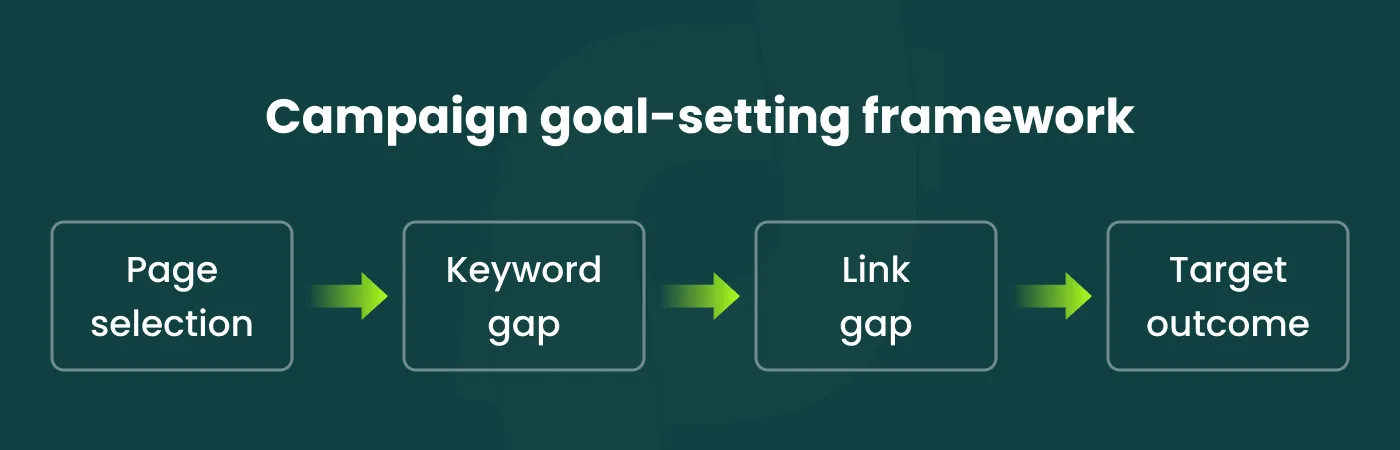
Most SEO professionals start noticing ranking improvements from links within a few months after starting their link building campaign, with the majority of them noticing the impact around 3 months. That’s your planning window.
💡
Don’t spread your links across your whole site. Pick 3–5 priority pages per campaign. Focusing your links on a few pages moves rankings faster than thin content distribution across dozens of URLs.
### Phase 2: Audit Before You Build
You can’t plan a campaign without knowing where to start. First, run a backlink analysis across 3 areas.
#### Your Current Link Profile
Use [Ahrefs](https://ahrefs.com/), [Semrush](https://www.semrush.com/), or [Moz](https://moz.com/) to check referring domains, your strongest linked pages, and the distribution of anchor text.
If 80% of your links point to your homepage and zero point to your money pages, then that’s your campaign priority right there.
#### Your Competitors’ Link Profile
Perform competitor backlink analysis using the [Ahrefs Backlinks](https://www.semrush.com/analytics/gap/backlinks/) tool. Create a prospect list of sites that link to competitors but not to you.
This is what a backlink profile looks like in the Ahrefs Backlinks Tool. This helps you recognize which sites are linking to your competitors.

If a site links to three of your competitors’ posts on the same topic, they’ll likely consider linking to you if your content offers something valuable.
#### Your Content Readiness
Make sure your target page has high-quality, valuable content. If your page is just 200 words of thin copy, no amount of outreach will convince anyone to link to it.
Sometimes, you need to upgrade your content before you send a single pitch. Strong content comes first.
### Phase 3: Choose Your Tactics (And Build a Mix)
The strongest campaigns use 2-3 complementary [link earning methods](https://outreachdesk.com/link-building-strategies/) simultaneously. No single tactic sustains a full campaign on its own.
#### Digital PR And Data-Led Content
Digital PR uses data-led content, like
- Original research,
- Surveys
- Proprietary datasets
For original research, take the Ahrefs analysis as an example. It analyzed 863K keyword SERPs and 4M AI Overview URLs, generating a highly valuable original study that publishers want to cite.

High-quality content gives journalists and publishers something credible and citable worth covering, which earns your brand press mentions and backlinks.
Editorial links from real publications carry more weight than casual guest posts. They also help you earn [brand mentions](https://outreachdesk.com/brand-mentions/) that matter for AI search visibility.
This works best when you have original data, a unique angle, a trending topic, or access to subject matter experts who can provide commentary that journalists actually want to quote.
#### Guest Posting
[Guest posting](https://outreachdesk.com/guest-posts/) is the process of writing valuable content on other relevant sites that genuinely benefits their readers.

This tactic still works, but the bar is high. Generic “10 tips” articles just for link placement get ignored. To earn links now, your guest posts must be deeply researched, share original insights, and deliver real value.
#### Niche Edits
[Niche edits](https://outreachdesk.com/niche-edits/) mean placing your link in already existing, indexed content. The advantage of niche edits is that you appear on pages that already rank and have established authority.
If your link feels forced or irrelevant, it won’t help and might even hurt your SEO. This means that relevance is non-negotiable.
#### Broken Link Building
[Broken link building](https://outreachdesk.com/broken-link-building/) means finding broken links on relevant pages. In this strategy, you create or identify your own content as a replacement and pitch it to the editors as a fix.

But campaigns with a direct content match earn placements at a higher rate than those without one. So here the secret is having the content match. A mediocre replacement gets ignored. A clearly better one gets linked.
**Here is a quick scan table for tactics with their typical timeline:
**
| Tactic | Best For | Typical Timeline | Effort Level |
| --- | --- | --- | --- |
| Digital PR | Authority sites, brand visibility, and AI citations | 2–4 weeks per campaign | High |
| Guest posting | Niche relevance, thought leadership | 3–6 weeks per placement | Medium |
| Niche edits | Fast results on indexed pages | 1–3 weeks | Medium |
| Broken link building | Resource pages, .edu/.gov domains | 2–4 weeks | Medium-High |
### Phase 4: Build Your Prospect List and Outreach System
This is where most campaigns fail, not from bad links, but poor execution. Focus on these essentials:
#### Prospect Quality Over Quantity
A list of 50 highly relevant, well-researched targets beats a list of 500 generic domains every time. For each prospect, ask yourself:
- Does this site publish content relevant to my target page?
- Does it have real organic traffic?
- Would my audience actually trust it as a source?
#### Personalize or Don’t Bother
Generic pitches with personalization have more chances of getting replies. Make sure your pitch is relevant to a journalist’s beat and mention them by name.
But referencing a specific article they’ve written takes it further. Keep it short and make the value to their readers obvious.
#### Follow Up Once
According to [BuzzStream’s report](https://www.buzzstream.com/blog/state-of-digital-pr-2026/#:~:text=55.4%25%20of%20users%20typically%20follow%20up%20with%20journalists%20only%20once.%20An%20additional%2033.1%25%20follow%20up%20twice.), 55.4% of practitioners follow up just once, and reply rates drop to 33.1% if follow-up is done twice. This means that one follow-up is the right move; anything more than that risks the relationship entirely.
#### Track Everything
Create a spreadsheet where you log all your outreach efforts. You can log every effort, like who you contacted, when, and what you pitched, and their responses.
This is how you improve your future campaigns and avoid pitching the same person twice with the same pitch.
During link building campaign, people who split their time strategically between prospect research and [link building outreach](https://outreachdesk.com/link-building-outreach/) consistently beat teams that spend 10% on research and 90% on sending emails.
The quality of your list shapes the quality of your results. A tight list of relevant, high-authority sites will always outperform a bloated one. Put real time into prospecting before you send a single pitch.
### Phase 5: Measure What Matters
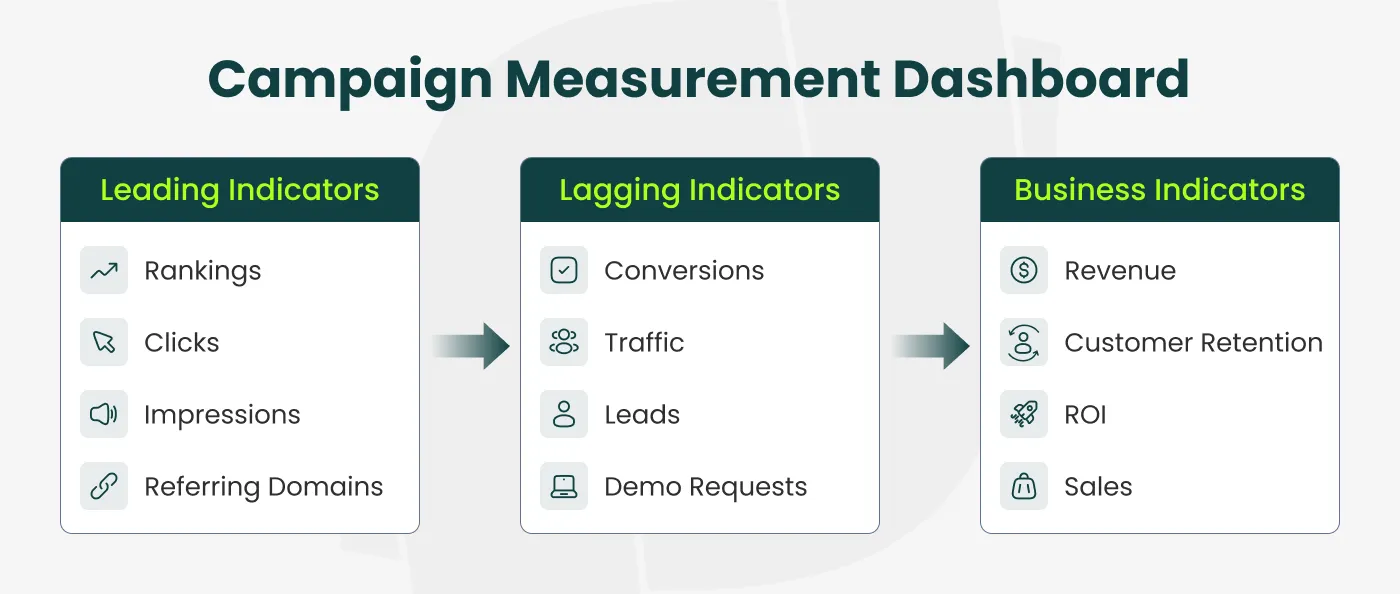
Counting links is easy, but measuring impact requires more effort. Go through this checklist of the measurement framework that connects campaign activity to business results:
#### Leading Indicators (Check Weekly)
Track these metrics weekly to see whether your link‑building and Digital PR efforts are actually working:
- New referring domains to target pages
- Prospect response and placement rates
- Brand mentions frequency across target publications
#### Lagging Indicators (Check Monthly)
Review these monthly to see if earlier outreach and content efforts are translating into measurable visibility and traffic gains.
- Keyword ranking changes for target terms.
- Organic traffic to target pages
- Referral traffic from earned placements
#### Business Indicators (Check Quarterly)
Measure these quarterly to connect your link‑building and Digital PR to revenue, leads, and overall business value.
- Revenue or leads attributed to organic traffic on target pages
- Cost per acquired link vs. traffic value generated
- AI search citation frequency (Google AI Overviews, ChatGPT mentions)
Do not mistake activity for progress. Building 30 links to a blog post that doesn’t connect to any revenue page through internal links is motion, not momentum. Make sure your [link equity flows](https://outreachdesk.com/link-equity/) from content pages to the pages that drive business.
Download our free [**Link Building Campaign Planner**](https://docs.google.com/spreadsheets/d/1NpBMCZChdnUznu5ZXFsjxznWeHzY3U2X2lpq3m3jj8Y/edit?gid=515172970#gid=515172970) to keep track of your campaign efforts
## Why Link Building Campaigns Now Need an AI Search Strategy
Link building campaigns now need an AI search strategy because they don’t just affect your search rankings on Google; they also shape whether your brand appears in AI-generated answers across ChatGPT, Perplexity, Google AI Overviews, or Gemini.
Brand mentions now drive AI search results, alongside links. An [Ahrefs analysis of 75,000 brands](https://ahrefs.com/blog/ai-overview-brand-correlation/#:~:text=we%E2%80%99ve%20analyzed%2075%2C000%20brands%20to%20see%20which%20search%20factors%20are%20most%20likely%20to%20influence%20brand%20mentions%20in%20AI%20Overviews.) found that branded web mentions correlated with AI Overview visibility at 0.664, compared to 0.218 for raw backlink counts.
**What this means for your campaign:
**
Every backlink you earn should come with a brand mention. And every piece of coverage, even without a hyperlink, has value.
The line between link building and brand building has blurred. Campaigns that combine brand mentions with link building perform better than those focused solely on link building.
**Tip:**
Track brand mentions alongside backlinks. Tools like [Ahrefs Brand Radar](https://ahrefs.com/brand-radar) or [Google Alerts](https://www.google.co.in/alerts) give you visibility into unlinked mentions. Convert the strongest ones into links through mention reclamation outreach.
## How a 90-Day Link Building Campaign Drives Results (Case Study)
A SaaS company ran a focused 90-day link building campaign on a high-intent page stuck on page two. The target page ranked at position 18, with fewer than 10 referring domains. The top competitors had 40 to 80.
**Here’s how the campaign played out:
**
| Phase | Timeline | Activity | Output |
| --- | --- | --- | --- |
| Audit & Content Upgrade | Weeks 1–3 | Backlink audit, competitor gap analysis via Semrush, content upgrade on the target page | Two thin sections expanded, one proprietary data point added |
| Guest Posting & Niche Edits | Weeks 4–8 | 60-prospect list built, outreach to 40 SaaS and agency blogs with real organic traffic | 4–6 guest post placements, 2–4 niche edits secured, depending on team size and niche competitiveness |
| Digital PR | Weeks 9–12 | One original survey piece on agency productivity benchmarks pitched to 18 publications | 2–4 links back to the target page |
By day 90, the page had gained 10–14 new referring domains and moved closer to page one, with clear improvements in rankings, visibility, and organic traffic.
## The Five Mistakes That Kill Link Building Campaigns
Most campaigns don’t fail because of bad outreach. They fail because of avoidable strategic errors made before a single pitch goes out.
### 1. No Target Page Strategy
If you create content for random pages, you waste effort. Focus on the pages that matter most to your business.
### 2. Ignoring Content Quality
A low-quality page won’t hold links for long. Before you run a campaign, make sure your page is actually providing value to others and is worth linking to.
### 3. Chasing Volume Over Relevance
20 backlinks from irrelevant sites won’t improve your rankings, but 2 backlinks from authoritative sites in your niche can improve your rankings. So always chase relevance over backlink volume.
### 4. Treating Every Campaign the Same
A SaaS product page and an ecommerce category page need different approaches. Match your tactics, prospect list, and timeline to the page you’re building.
### 5. No Measurements Beyond Link Counts
If you can’t connect your campaign to rankings, traffic, or revenue, you can’t prove it worked. And you can’t improve it.
## What Comes After Your First Campaign
Your first campaign gives you data. Your second campaign uses it.
Look at what worked:
- Which tactics got placements?
- Which prospects responded?
- Which link text patterns moved rankings?
Double down on what worked. Cut what didn’t.
From there, build a rolling campaign calendar. Run 90-day cycles, with each cycle focused on a different set of priority pages. Over 12 months, you’ll have strengthened your most important pages and built a link profile that keeps compounding.
Your next campaign isn’t just about rankings. Every editorial placement you earn also shapes whether your brand gets cited in AI Overviews. Build the link equity and the brand signal simultaneously.
### Ready to start a link building campaign that delivers results?
Get a strategy focused on high-quality backlinks and steady growth.
[Book a strategy call](/contact-us/)
### How long does a link building campaign take to show results?
Most sites start noticing ranking movement around three to six months. It depends on where your site stands today, which means your current authority, keyword competitiveness, and link quality. A good rule of thumb: run in a 90-day cycle because usually you can see the progress after that.
### How many links does a campaign need?
There is no universally fixed number. A site in a low competition niche can move from page two to page one with 5-10 quality links. A site in a competitive vertical like finance or Saas might need 20-30 referring domains over multiple campaign cycles. Focus on relevance and authority, not volume.
### How much should a link building campaign cost?
Budgets vary widely. About 38.4% of businesses spend between $1,000 and $5,000 per month on link building, as per [DemandSage](https://www.demandsage.com/link-building-statistics/#:~:text=38.4%25%20of%20businesses%20allocate%20%241%2C000%20to%20%245%2C000%20monthly%20for%20link%20building%2C%20making%20it%20the%20most%20common%20budget%20range.). Premium editorial placements from top publications can run $2000 or more per link.
The right number for you depends on your niche, your goals, and whether you’re building in-house or working with an agency. There’s no one-size answer, but there is a right answer for your situation.
### Should link building campaigns also target AI search?
Yes, your link building campaign should also target AI search. And if you’re not already thinking about this, now’s a good time to start. AI-powered answer engines like Google AI Overviews, ChatGPT, or Perplexity shape how people find brands, and that influence is only growing.
---
---
title: "Off-page SEO: What It Is and How To Build Authority (2026)"
url: "https://outreachdesk.com/off-page-seo/"
lang: "en-US"
type: "post"
description: "Off-page SEO refers to all the actions taken outside of your own website to build your site’s credibility across the web as well as improve your rankings within search engine results pages (SERPs). Many teams turn to a reliable link"
last_modified: "2026-05-18T11:52:08+00:00"
categories: [Link Building]
---
# Off-page SEO: What It Is and How To Build Authority (2026)
**Off-page SEO** refers to all the actions taken outside of your own website to build your site’s credibility across the web as well as improve your rankings within search engine results pages (SERPs). Many teams turn to a [reliable link building agency](https://outreachdesk.com/) when manual prospecting becomes too time-consuming.
It includes earning links from other sites, building brand mentions across the web, getting reviewed on third-party platforms, and growing your presence on channels like YouTube and social media.
While on-page SEO focuses on content, structure, and technical setup, stuff that you can control, off-page SEO shapes how search engines or AI systems see you.
**Key Takeaways**
- Off-page signals can strongly influence whether AI systems name your brand as a trusted expert.
- Persistence is mandatory, as a significant share of outreach responses comes from follow-ups.
- Some studies suggest branded mentions may correlate more strongly with AI visibility than backlinks, though results vary by dataset.
- Video platforms like YouTube can enhance discoverability across search and AI systems.
- Regular content updates help maintain relevance, especially in fast-changing topics.**
**
## What is Off-Page SEO
**Off-page SEO **(search engine optimization) refers to improving your site’s authority and trust through actions such as link building, brand mentions, digital PR, and third-party reviews, without making any changes to the website itself.
Google measures your site’s reputation using off-page SEO based on who links to you, who mentions you, and whether credible sources treat your content as worth referencing.
No matter how well you optimize your page, without strong off-page signals, your rankings will stop improving.
The rules have shifted. Google has indicated that no single ranking factor, including links, works in isolation. Your visibility now depends on how multiple signals stack together.
Different platforms pull from different sources. Ranking on Google does not guarantee visibility across AI-driven results.
## Off-Page SEO vs. On-Page SEO: What’s the Actual Difference

**On-page SEO **is what you control on your site:
- Title tags
- Content quality
- Internal links
- Page speed
- Mobile design
Whereas, **Off-page SEO **is what others say about you across the web:
- Customers reviewing you on Google Business Profile or G2.
- A journalist quoting your founder in a trade publication.
- Other websites linking to you.
- Your brand is showing up in a Reddit thread, a YouTube video, or a news piece.
You don’t control it directly, but you earn it.
Below is a quick-scan table
| Key Factor | On-Page SEO | Off-Page SEO |
| --- | --- | --- |
| Control | Direct control – you own the changes | Indirect control – you earn or influence it |
| Focus | Focuses on Content, structure, and UX | Focuses on Authority, reputation, trust |
| Key Tactics | Keywords, meta tags, internal links, page speed | Link building, brand mentions, PR, reviews |
| E-E-A-T Signal | Experience + Expertise through content | Authoritativeness + Trustworthiness through external endorsement |
| AI Visibility | Helps content get understood and selected for answers. | Increases the likelihood that your brand will be recognized and cited as a trusted source. |
On-page and off-page SEO work together to help you build lasting results. You need strong content that aligns with your audience’s intent.
Google’s ranking systems prioritize helpful, relevant content supported by strong link signals from authoritative and contextually relevant websites. While third-party metrics can help compare sites, Google does not use them to rank pages.
## Why Does Off-Page SEO Still Matter in 2026
Off-page SEO matters because search engines and AI platforms use external signals like [high-quality backlinks](https://outreachdesk.com/what-are-backlinks/), customer reviews, and brand mentions as votes of trust and relevance from the web to determine whether your site should rank higher or be cited as a reliable source.
**Three forces keep off-page SEO at the center of any growth strategy:
**
### 1. Search Rankings Still Depend on Authority Signals

According to a [BuzzStream report](https://www.buzzstream.com/blog/link-building-statistics/#:~:text=Higher%20ranking%20posts%20have%20more%20referring%20domains%20on%20average), they consistently pull in more referring domains than the pages sitting below them. Authority signals still drive rankings, and referring domains are among the strongest.
### 2. AI Search is Reshaping What “Authority” Means
Ranking in the top 10 no longer guarantees you get cited in AI-generated answer engines.
According to [updated Ahrefs research](https://ahrefs.com/blog/ai-overview-citations-top-10/#:~:text=Google%20is%20selecting%20far%20fewer%20pages%20straight%20from%20the%20original%20SERP%20(~76%25%20in%20July%202025%20vs.%20~38%25%C2%A0today).), 76% of AI Overview citations came from the top 10 pages. By early 2026, that number had dropped to 38%.
AI systems are pulling data from a wider pool, which means your presence on YouTube, news sites, forums, and review platforms now can influence whether your brand is surfaced or cited
### 3. Zero-Click Search Makes Off-Page Visibility Non-Negotiable
AI Overviews now reduce organic CTR for the [top-ranking page by 58%](https://ahrefs.com/blog/ai-overviews-reduce-clicks-update/#:~:text=As%20of%20December%202025%2C%20AI%20Overviews%20reduce%20the%20organic%20click%2Dthrough%20rate%20for%20position%20one%20content%20by%2058%25.). And organic clicks overall dropped from 44.2% to 40.3% of all U.S. searches in just one year, as per the [Search Engine Land report](https://searchengineland.com/zero-click-searches-up-organic-clicks-down-456660#:~:text=40.3%25%20of%20U.S.%20Google%20searchers%20clicked%20on%20an%20organic%20result%20in%20March%2C%20which%20was%20down%20from%2044.2%25%20the%20prior%20year.%2043.5%25%20of%20EU/UK%20Google%20searchers%20clicked%20on%20an%20organic%20result%20in%20March%202025%20versus%2047.10%25%20in%20March%202024.).
When users don’t reach your site, your brand lives wherever it gets mentioned. If someone asks ChatGPT or Google’s AI Mode about your category and you don’t show up, that user never knew you existed.
## The Off-Page SEO Strategies That Actually Work
Different off-page tactics build your authority in different ways. Some have been reliable for years. Others only became critical once AI search began deciding which brands to discover and recommend. The tactics that actually move the needle are:
### 1. Editorial Link Building
Editorial link building is the process of earning backlinks naturally when editors or website owners choose to link to your content because it provides value, relevance, or useful information to their audience.
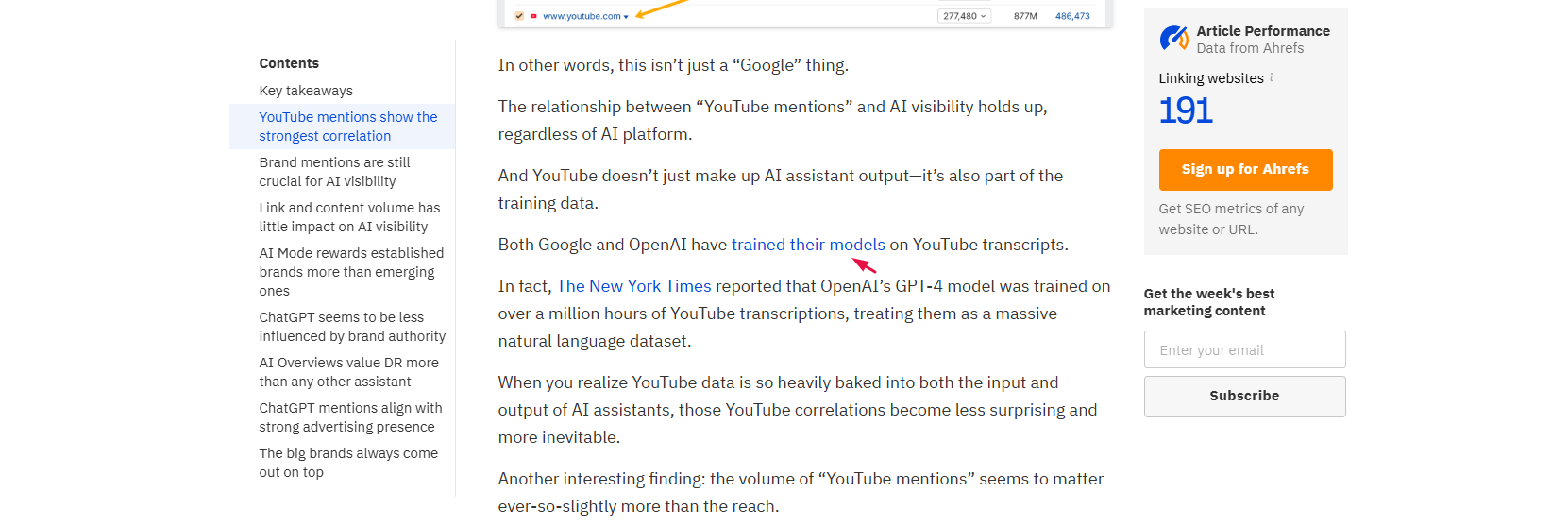
In the image above, an editorial link that sits naturally in the content, with no exact-match anchor text, is placed there because it adds real value for readers.
Link building remains the backbone of off-page SEO. But relevance, quality, and editorial context matter more than volume. One contextual link from a trusted site in your niche carries more weight than dozens of link placements on unrelated blogs and directories.
**What works:**
- **Creating content others want to reference:
**
Original research, data studies, practical frameworks, and tools naturally earn links. Combine all these with [targeted outreach](https://outreachdesk.com/link-building-outreach/) to place it in relevant publications, and you can build authority faster than any mass campaign.
- **Guest Posting:
**
[Guest posting](https://outreachdesk.com/guest-posts/) on niche-relevant blogs, industry publications, and authority sites in your vertical attracts referring domains your competitors haven’t yet tapped. That gap is where rankings shift.
- **Contextual links:
**
[Contextual links](https://outreachdesk.com/contextual-link-building/) on niche-relevant sites consistently outperform scattered, high-volume placements. A small number of high-quality editorial links each month can drive meaningful results.
**Pro Insight:
**
Referring domain diversity matters more than raw link count. The more unique, relevant sites that link to you, the stronger your rankings grow, as per [Backlinko’s analysis](https://backlinko.com/search-engine-ranking#:~:text=According%20to%20our%20analysis%2C%20this%20appears%20to%20be%20the%20case.%20We%20found%20that%20domain%20diversity%20has%20a%20substantial%20impact%20on%20rankings.).
### 2. Brand Mentions and Digital PR
A [brand mention](https://outreachdesk.com/brand-mentions/) is your company, product, or brand name appearing on another website, with or without linking back to you.
In the image below, the MediaPost article mentions CNN and includes a link pointing to the original source.
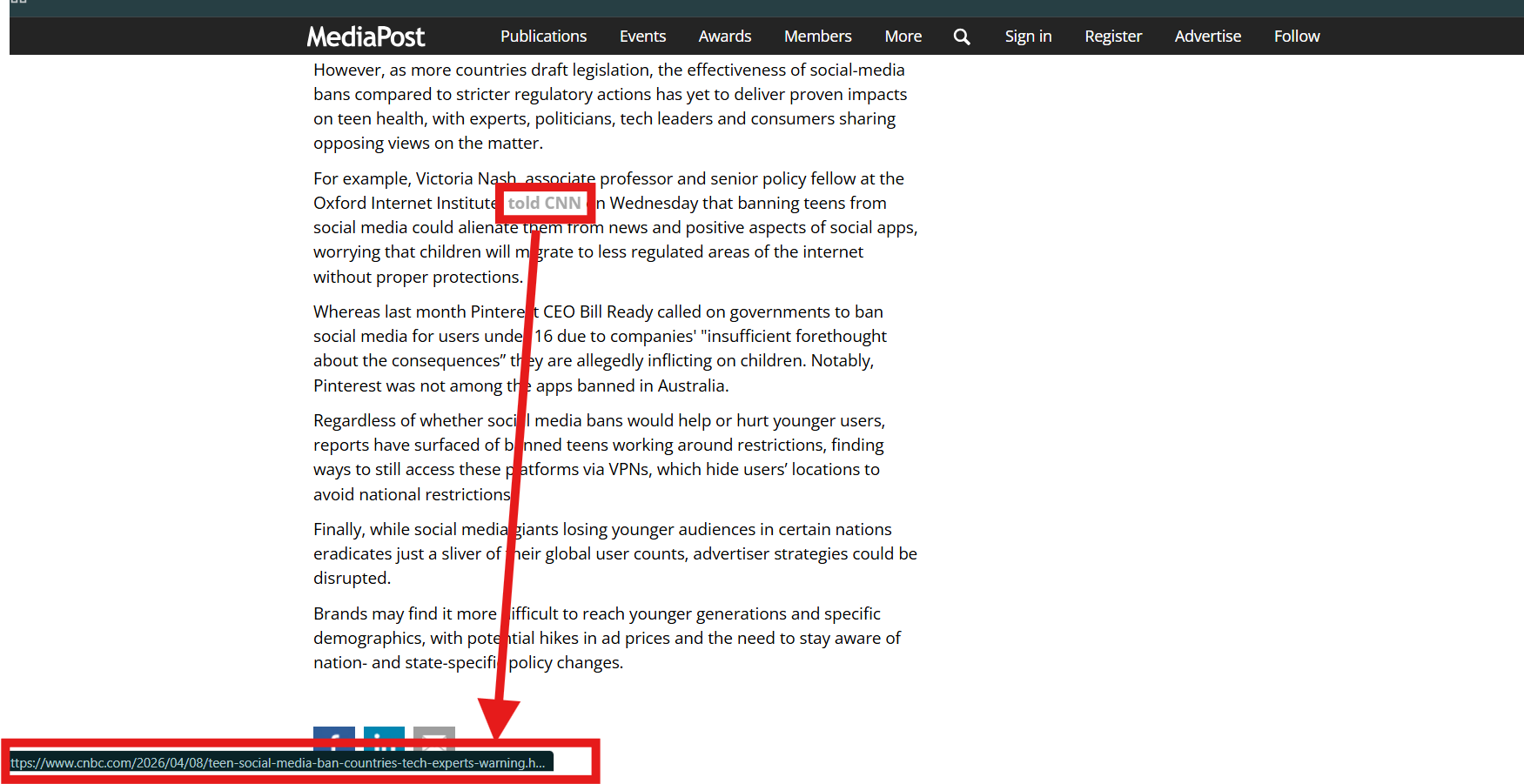
This link provides valuable information to MediaPost readers. This is what a brand mention with a backlink to the brand looks like.
The brand mention tactic is where the 2026 off-page strategy separates itself from what most teams did in 2023. ChatGPT, Perplexity, Gemini, and Google AI Mode build their understanding of your brand from how often you’re discussed across the web.
[Muck Rack analyzed](https://muckrack.com/blog/earned-media-ai-brand-visibility#:~:text=About%2094%25%20of%20all%20links%20cited%20by%20AI%20are%20non%2Dpaid%20media%2C%20and%2082%25%20come%20directly%20from%20earned%20sources%20such%20as%20news%20articles%2C%20third%2Dparty%20blogs%20and%20industry%20analysis.) over one million links cited by AI tools and found that 82% came from earned media. Overall, 94% came from non-paid sources.
Owned content alone is often not enough without broader recognition across trusted sources.
**What this means practically:**
Invest in digital PR. Digital PR is the practice of earning coverage, citations, and links from news outlets and industry publications by giving journalists a reason to mention your brand.
The image below is a HubSpot page that regularly updates marketing statistics. This data is what journalists and content creators keep coming back to.
Publish original research for journalists’ reference. Get your experts quoted in industry publications. Respond to media queries through platforms like HARO.
You’re not just after a link. You want your brand mentioned in the right places so AI systems connect you with your category.
### 3.YouTube Presence
A YouTube presence in off-page SEO means using the platform to build authority and trust for your website beyond your own pages. Using [YouTube for link building](https://outreachdesk.com/youtube-backlinks/) can strengthen your brand and support your overall SEO efforts.
The image shows a Google AI Overview result for a search related to Canva. Notice the sources panel on the right. It includes a YouTube video alongside blogs and articles.
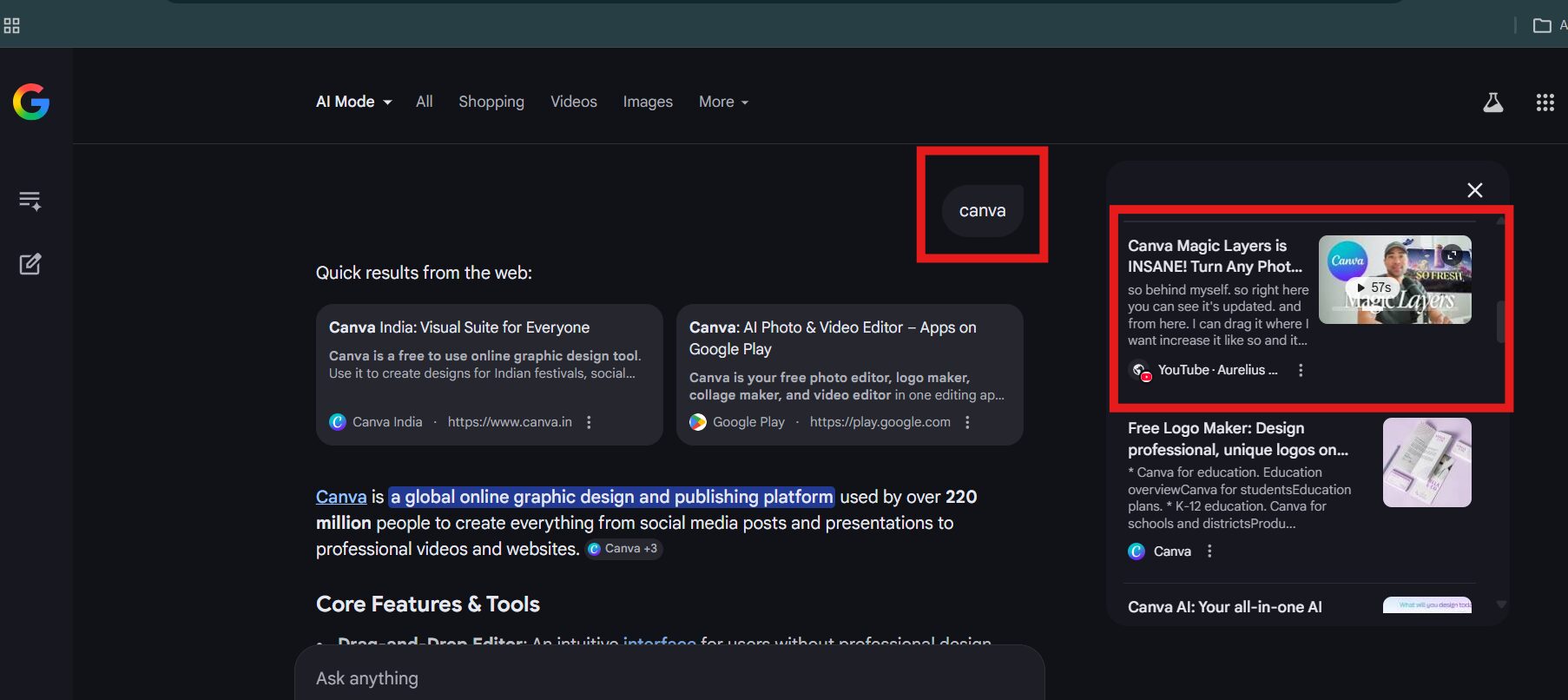
That’s Google’s AI pulling directly from video content to build its answer. This is exactly what happens when your brand has a YouTube presence. If your videos provide value to users, they become citable sources for Google and most AI-generated answer engines.
Most teams treat YouTube as a content channel. It’s actually one of the strongest off-page SEO signals you can build right now. It is the most-cited domain in Google AI Overviews and other AI-generated answer engines.
**But here’s the part most people miss:
**
You don’t need a big YouTube channel to get cited in AI or Google. Brands that are mentioned in other creators’ video titles, descriptions, and transcripts gain AI visibility even when their own YouTube presence is modest.
Getting mentioned or talked about on YouTube matters more than how many videos you publish.
Start by getting your brand mentioned on existing channels your audience already watches. That alone moves the needle.
### 4. Reviews and Third-Party Mentions
A review is a public record of someone else’s experience with your brand, posted on a platform you don’t own or control.
That’s what makes it valuable. Google and AI systems don’t just read your website. They read what others say about you across the web.
The more credible sources talking about your brand, the easier it is for both search and AI to treat you as the obvious answer in your category.
In B2B, you can focus on sites like [G2](https://www.g2.com/), [Capterra](https://www.capterra.com/), and [Clutch](https://clutch.co/). G2 is frequently cited in B2B software-related queries across search and AI platforms.
Getting reviewed where your buyers look strengthens your authority for both people and AI systems, making recommendations.
For local and service businesses, [Google reviews](https://customerreviews.google.com/), [Trustpilot](https://www.trustpilot.com/), and industry directories do the same job. Recency and sentiment matter more than volume.
**What this means practically**:
Don’t wait for reviews to come in on their own. Build a process. The brands that consistently appear in AI recommendations have one thing in common.
Enough people have talked about them in enough places that AI systems no longer second-guess whether to recommend them.
### 5. Local SEO and Citations
A local citation is any mention of your business name, address, and phone number (NAP) on a website outside your own.
That sounds simple. But consistency is the whole game. Your NAP citations, Google Business Profile, and community mentions all tell Google the same story. Or they don’t. And when they don’t match, Google starts questioning whether your business is actually legitimate.
One version of your address on Google. A slightly different one on Yelp. A third variation on a local directory. That’s enough to create doubt. Every citation needs to match exactly, down to whether you write “Street” or “St.”
Local links carry real weight too. A mention from a regional news site, a city-specific blog, or a local chamber of commerce tells Google you’re genuinely part of that community. Not just a website claiming to serve it.
Start by auditing every directory your business appears in. Fix the inconsistencies first. Then [build local links](https://outreachdesk.com/local-link-building/) from community organizations and regional publications.
### 6. Social Signals
A social signal is any engagement your content receives on social platforms, shares, comments, mentions, and reposts, that indirectly influences your off-page authority.
Social shares don’t directly affect Google rankings. But that framing misses what’s actually happening. Every share puts your content in front of someone who might write about it, link to it, or reference it in their next article.
In the image below, a LinkedIn post mentions Ahrefs and includes a link pointing to its website. This is how you can earn backlinks from social media platforms.
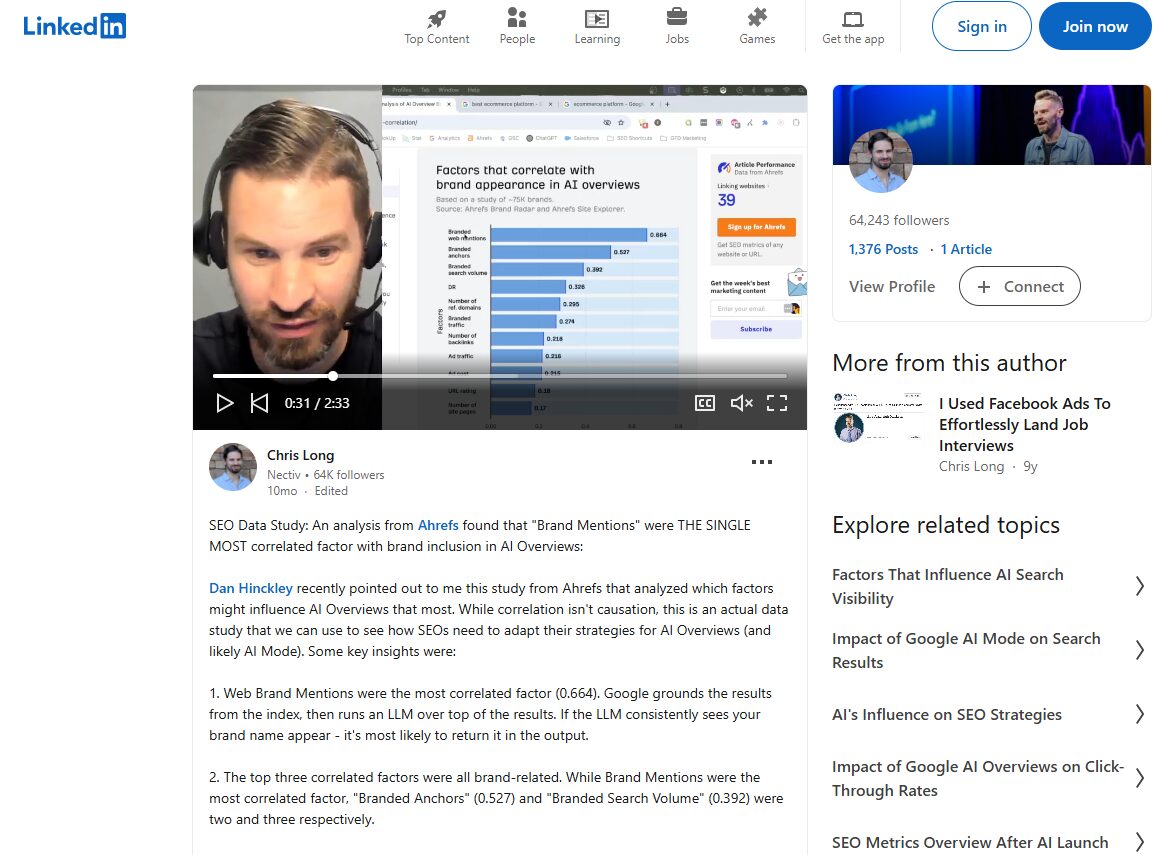
Social signals can help you earn more brand mentions and brand searches.
That’s the mechanism. The share starts the chain. The link or mention that follows is where the SEO value lands.
Reddit threads, LinkedIn posts, and X discussions referencing your content do something else too. They drive brand searches. And brand search volume is something Google quietly pays attention to.
The more people search for you by name, the more Google treats you as an authority worth surfacing. A community talking about you is worth more than a campaign targeting you.
Don’t chase likes and follower counts. Put your best content where your audience actually spends time and let the right people find it.
## How Off-Page SEO Works for AI Search
AI systems don’t cite everything they find. They prioritize sources that appear consistently across the web, such as backlinks, brand mentions, reviews, and media coverage.
Here’s what the data shows about AI-specific off-page priorities:
- **ChatGPT **cites only about 15% of the pages it retrieves, as per [Search Engine Land analysis](https://searchengineland.com/chatgpt-retrieved-vs-citations-study-471606#:~:text=Only%2015%25%20of%20retrieved%20pages%20were%20cited.).
- [SE Ranking study](https://seranking.com/blog/how-to-increase-visibility-in-ai-search-engines/#:~:text=For%20ChatGPT%20in,200%20referring%20domains.) shows that sites with over 32,000 referring domains are roughly 3.5 times more likely to be cited.
- **Google AI Overviews **prefer content from sites with strong brand signals
- **Perplexity** cites multiple sources per answer and favors unique data points not found elsewhere.
- [Semrush data](https://www.semrush.com/blog/google-ai-mode-seo-impact/#:~:text=Google%20AI%20Mode%3A%20~93%25%20zero%20click) shows that approximately 93% of searches within Google’s “AI Mode” result in zero clicks to external websites.
**The Takeaway:
**
Off-page SEO builds the signals that make your brand visible across platforms. The more consistently your brand appears on credible third-party sites, the more likely you are to be cited.
## Common Off-Page SEO Mistakes to Avoid
Avoid these common off-page SEO mistakes:
### Chasing Quantity Over Relevance
50 links from random, irrelevant sites won’t outperform five contextual placements in your niche. Both Google’s ranking system and AI tools reward topical relevance.
### Ignoring Brand Mentions
If you’re only building links and doing zero digital PR, you’re missing out on a huge chunk of AI visibility. In 2026, brand mentions are just as important as links. If your name is being dropped in expert circles, AI is far more likely to name you in its answers.
### Paying for Links on Networks that Google Already Knows About
Yes, buying links on public networks still works for some in the short term, but it’s a losing bet. These sites eventually get flagged, and any authority they gave you can disappear overnight. It’s a “ticking clock” strategy that isn’t worth the risk to your domain.
### Building Links to Your Homepage and Nowhere Else
Don’t send every link to your front door. Distribute them across your most helpful, specific pages. A strong internal linking structure will then move that authority to wherever it needs to go.
### Forgetting About Freshness
AI citation decay is real. Content that hasn’t been touched in months loses its spot in AI answers. Plan to refresh your most valuable pages every 90 days to stay at the top of the pile.
## How to Measure Off-Page SEO Results
Off-page seo results are not seen instantly. Most people see improvement in rankings within 1-6 months of consistent [link acquisition](https://outreachdesk.com/link-acquisition/). You can measure off-page SEO results by tracking the following metrics:
| Metric | What to Track |
| --- | --- |
| Referring domains | The total number of unique sites linking to you and the growth rate (track this in Ahrefs or Semrush) |
| Brand mention volume | How often people are actually talking about you (use Google Alerts, Ahrefs Brand Radar, or Mention) |
| AI citation rate | How often your brand is named in AI-generated answers for your target keywords( use Ahrefs Brand Radar and similar tools ) |
| Domain authority/rating | Not a Google metric, but directionally useful to check your overall profile strength. |
| Organic traffic and Keyword rankings | The ultimate proof that your off-page work is driving results. |
| Referral traffic from linked pages | Shows which placements actually send visitors. |
**
**
Is it worth it? Absolutely. Brands that invest in high-quality [link building strategies](https://outreachdesk.com/link-building-strategies/) tend to see stronger and more sustainable organic traffic than those that don’t.
## What Happens When You Get Off-Page SEO Right
The brands showing up consistently in competitive search results, getting cited in AI Overviews, and appearing when a potential buyer asks ChatGPT about their category didn’t get there by accident.
They treated off-page SEO as a long-term growth channel. Not a one-time campaign.
Build your link building strategy around earning authority across the channels that frequently get cited or surfaced by AI systems. Links, brand mentions, reviews, YouTube visibility, and earned media.
Do that consistently, and the results compound in ways that are hard for competitors to reverse-engineer. That’s the real advantage.
### Want to improve your off-page SEO?
We help you build authority with relevant, high-quality backlinks.
[Book a strategy call](/contact-us/)
### What is the difference between off-page SEO and link building?
Link building is one tactic within off-page SEO, and probably the most well-known. But off-page SEO also covers brand mentions, digital PR, social signals, customer reviews, local citations, and YouTube visibility.
Think of link building as the engine and off-page SEO as the full vehicle. The engine matters, but it won’t get you far on its own.
### Does off-page SEO still matter with AI search?
Yes. AI systems like ChatGPT, Google AI Overviews, and Perplexity rely on external signals to decide which brands to cite. If your off-page presence is weak, AI systems won’t know your brand well enough to recommend it.
### How long does it take for off-page SEO to show results?
To be honest, there is no fixed number of days or months. Your timeline depends on your current authority, the quality of the links you earn, and the strength of your on-page foundation.
But most seo teams see measurable off-page SEO impact within 3-6 months of consistent link acquisition, whereas competitive niches take longer.
Off-page SEO is a long-term investment. Treat it like one.
### What are the most effective off-page SEO techniques in 2026?
Most effective tactics include:
- Editorial link building from niche-relevant sites
- Digital PR that generates brand mentions in authoritative publications
- YouTube visibility through your own channel and mentions in other creators’ content
- Customer reviews on trusted platforms
- Consistent local citations.
Backlinko’s case studies show all 3 paths work:
- Being a data source
- Broken link building
- PR-driven surveys
The right mix depends on your business model and where your audience already spends time.
### Can you do off-page SEO without buying links?
Yes, you can do off-page SEO without buying links, and it’s a more sustainable path.
Backlinko’s own growth was built on original research, strategic guest posting, and brand partnerships, not paid link networks.
Earned links from strong content, digital PR, and community engagement carry less risk and compound more effectively over time.
The most durable off-page strategies focus on being worth linking to and worth mentioning, then making it easy for the right people to do both.
---
---
title: "Black Hat Link Building: What It Is and Why It Fails"
url: "https://outreachdesk.com/black-hat-link-building/"
lang: "en-US"
type: "post"
description: "Black hat link building is the practice of acquiring backlinks through methods that violate Google’s spam policies. These methods include buying links to rank, using private blog networks, or using automated link creation. Brands that need consistent placement quality often"
last_modified: "2026-05-29T12:21:42+00:00"
categories: [Link Building]
---
# Black Hat Link Building: What It Is and Why It Fails
**Black hat link building** is the practice of acquiring backlinks through methods that violate [Google’s spam policies](https://developers.google.com/search/docs/essentials/spam-policies). These methods include buying links to rank, using private blog networks, or using automated link creation. Brands that need consistent placement quality often partner with [backlink acquisition experts](https://outreachdesk.com/). For brands that need ongoing execution, [backlink exchange schemes](https://outreachdesk.com/backlink-exchange/) from a specialised provider can carry the load.
These methods can trigger manual penalties, algorithmic demotions, or complete removal from Google’s search results.
The risks have grown sharply, as Google’s SpamBrain AI, **a system used by Google to detect and filter low-quality and fake links from the search results.** This system can now detect [200 times more spam](https://www.xictron.com/en/blog/google-spam-update-march-2026-online-shops/#:~:text=Google%27s%20SpamBrain%20AI%20identifies%20200%20times%20more%20spam%20pages%20than%20manual%20reviews%20(Google%20Webspam%20Report%202024).) than it did at launch.
If you think manipulative links are worth the risk, then the answer is clear. They’re not.
#### Key Takeaways
- Black hat links manipulate rankings and violate Google’s spam policies.
- Google’s SpamBrain can now detect more link spam automatically.
- Black hat tactics like private blog networks and link farms carry high penalties and risks.
- Algorithmic devaluation is permanent. Your lost ranking’s value is difficult to reverse.
- Disowning can only clear manipulative links, especially after receiving manual actions.
## What Counts as Black Hat Link Building?
**Black hat link building is any tactic that manufactures backlinks through deception.** Automation, or payment rather than earning them through genuine content quality, Google’s Webmaster Guidelines classify all such methods as link spam, regardless of whether the links appear natural on the surface.
The distinction matters because Google evaluates intent, not just method: a single paid placement on a high-authority site is still a policy violation if the publisher didn’t disclose it as sponsored content.
The definition matters because Google treats intent, not just method: a single paid placement on a high-authority site is still a policy violation if the publisher didn’t disclose it as sponsored.
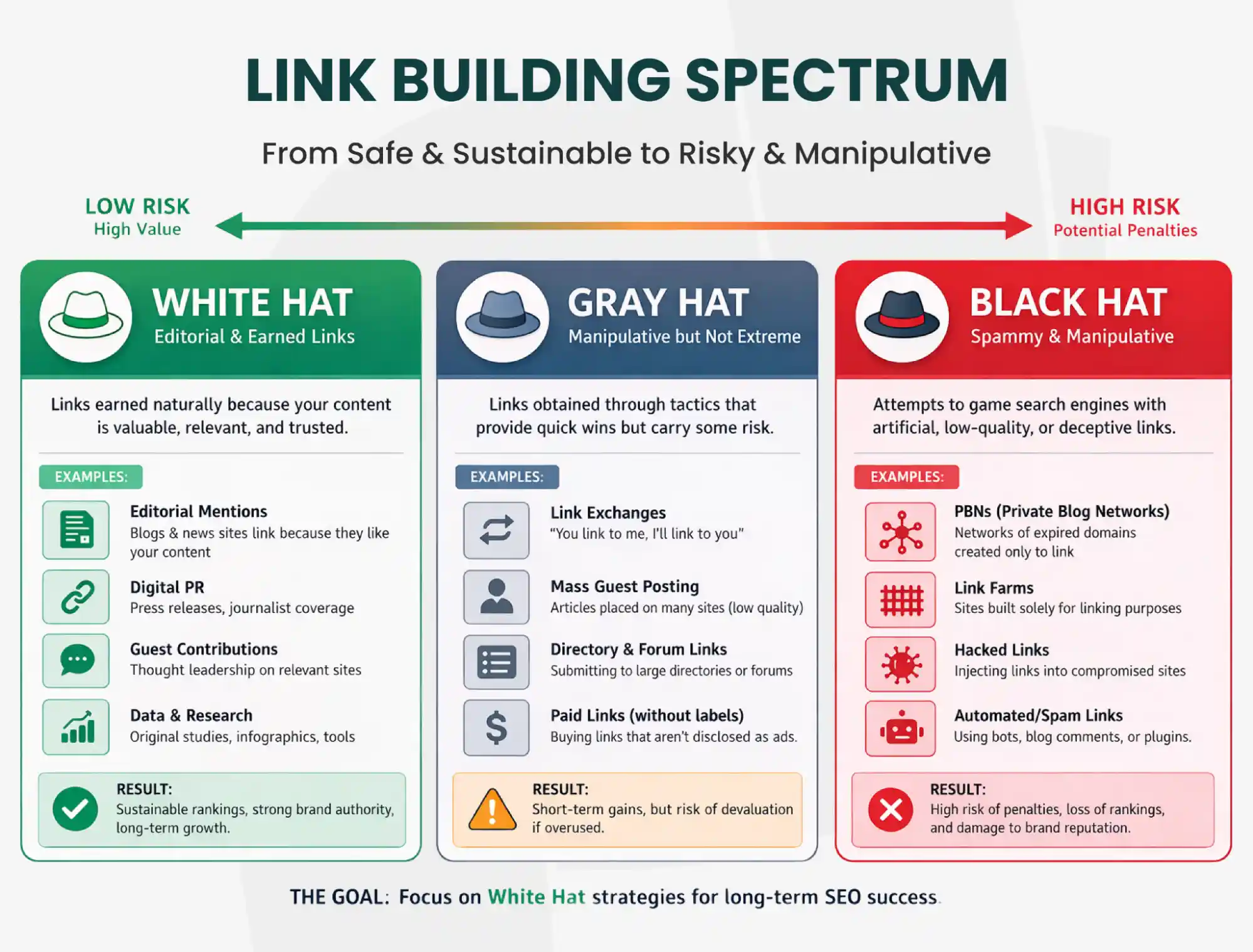Black hat link building includes buying and selling links for ranking purposes, using automated programs to generate backlinks, building private blog networks, and link exchanges, all of which violate Google’s search guidelines.
Not every low-quality backlink is a problem.
Random spam links appear on nearly every site. Google said it can usually ignore them. The real problem comes when you intentionally start building those links for yourself.
## Common Black Hat Link Building Tactics
**The common black hat tactics share one thing: they manufacture backlinks through deception rather than earning them through content.** Private blog networks, comment spam, paid link drops, link exchanges, and automated tools all try to trick Google’s algorithms into rewarding patterns that don’t exist in genuine editorial coverage.
SpamBrain is built to detect each of them.
Manipulative tactics aren’t always easy to spot. Some are obvious, and some are subtle enough that site owners don’t even recognize they’ve crossed a line.
### Private Blog Networks
A private blog network is a group of websites built for one specific purpose: sending backlinks to another site. These sites are not built for actual readers but purely to manipulate rankings.
Google has been targeting these networks since the Penguin update. With the evolution of Google SpamBrain, the ability to detect link spam has improved.
### Buying Links Without Disclosure
Buying a link placement isn’t automatically against Google’s rules. However, it becomes link spam when the link passes ranking credit without a rel=”sponsored” or rel=”nofollow” attribute.
Google’s own documentation says that buying and selling of links is a normal activity as long as they’re properly tagged. Ignoring the tags, and you’re violating the guidelines.
### Automated Link Building Software
Automated link generators can produce many backlinks in hours across forums, blog comments, and web directories.
However, those links come from low-quality domains, and the pattern is easy for the algorithms to spot. [SpamBrain’s update](https://www.brafton.com/blog/seo/googles-august-2025-spam-update-what-you-need-to-know/) enhanced real-time detection of link schemes.
### Comment and Forum Spam
Dropping links in blog comments and forums doesn’t work as it used to in 2008. It’s far less effective than it was in 2015.
Google treats these as spam and ignores them. In the worst-case scenario, it may flag your site.
### Link Farms and Reciprocal Link Schemes
[Link farms](https://outreachdesk.com/link-farming/) are groups of websites that are created solely to link to one another and manipulate search rankings, rather than providing real value. Similarly, for reciprocal link exchanges: “I’ll link to you, you link to me” can signal manipulation when done systemiotically rather than naturally.
Google’s algorithms can detect these patterns easily and ignore these links to neutralize them.
### Hacked Link Injections
Hackers break into legitimate sites and secretly add hidden links, often targeting older blog posts that site owners rarely update. It violates Google’s policies and can be illegal in many places.
Let’s see the table below to analyze the risk levels, detection speed, and reversibility of each tactic.
| Tactics | Risk Level | Detection Speed | Reversibility |
| --- | --- | --- | --- |
| Private blog networks | High | Weeks to months | It’s difficult because the devalued links can’t regain their ranking credit. |
| Buying links (undisclosed) | High | variable | Possible with disavow + reconsideration. |
| Automated link tools | Very high | Days to weeks | It’s low because the pattern is hard to undo. |
| Comment/forum spam | Moderate | Near instant devaluation | Low value, low recovery needed. |
| Link farms | High | Weeks | Requires complete disavowal. |
| Hacked links | Severe | Once reported or crawled | Requires site clean-up + legal action. |
## What Happens When Google Catches Black Hat Links?
**Google’s response to black hat links follows a two-track system.** algorithmic devaluation through the SpamBrain classifier (which silently ignores the links, costing you the equity without triggering a visible penalty) and manual actions issued by human reviewers, which suppress rankings directly and require a documented link cleanup to resolve.
Most sites hit by SpamBrain never know it happened, their links simply stop counting.
Manual actions appear in Google Search Console under Security & Manual Actions.
According to industry data, Google issues an estimated [750,000 manual penalties each month](https://www.esearchlogix.com/blog/guide-for-google-penalty-recovery/amp/#:~:text=Google%20imposes%20its%20own%20manual%20penalties%20of%20about%20750%2C000%20per%20month%20to%20fight%20web%20spam.) for webspam violations, though Google hasn’t officially confirmed this figure.
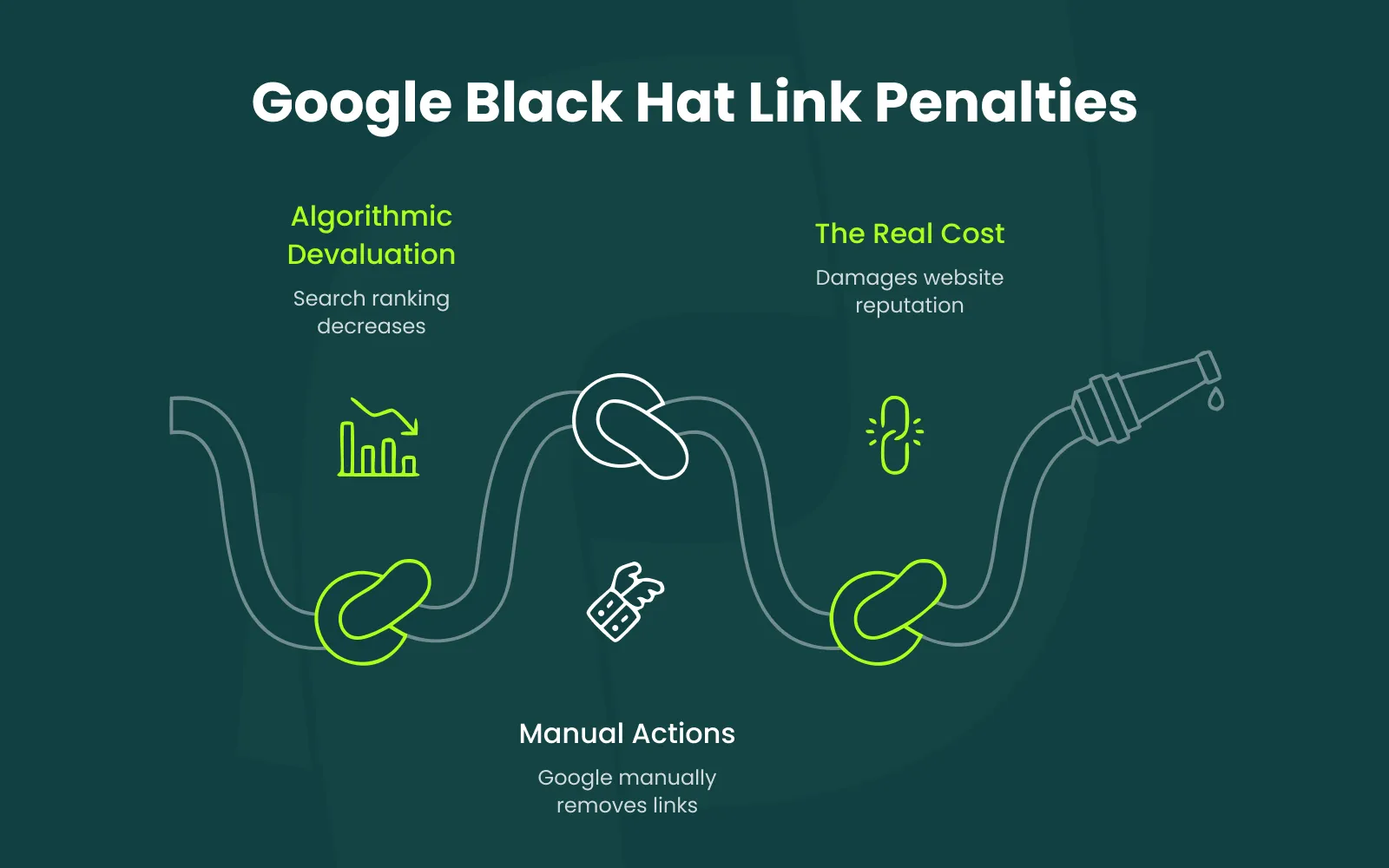When manipulative links are detected, Google either ignores them or penalizes your site. The penalties can range from a drop in ranking to complete removal from [search engine results](https://outreachdesk.com/what-are-serps/).
### Algorithmic Devaluation
Since the Penguin 4.0 update, Google’s response is to ignore spammy links rather than penalize them.
The links simply stop passing any value, without any notification. Your rankings simply drop or stall.
The worst part is, even if you clean up your link profile, the lost value is gone permanently. [Google’s documentation](https://developers.google.com/search/docs/appearance/spam-updates) states that ranking benefits from neutralized links “can’t be regained.”
That’s not a penalty you can fix; it’s damage that’s irreversible.
### Manual Actions
Manual actions are applied by Google’s human reviewers after they identify a common pattern of manipulation.
You’ll see the notification in Google Search Console under the “Security & Manual Actions.” Penalties can affect a single keyword or remove your entire domain from search results.
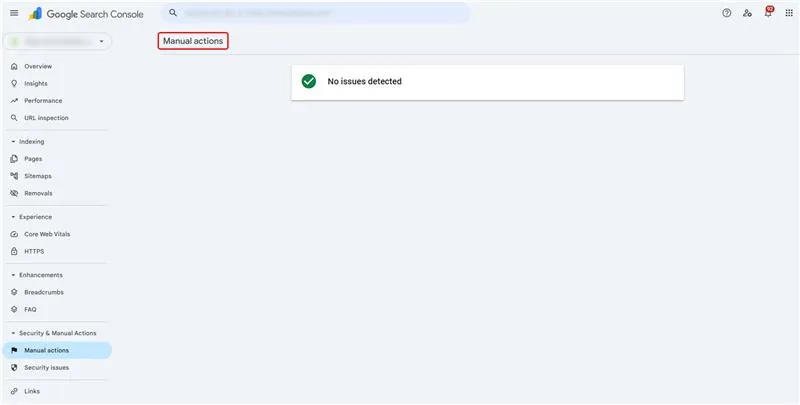Based on industry experience, manual penalty reviews take an [average of 10-30 days](https://www.aboutchromebooks.com/google-penalty-recovery/#:~:text=Manual%20penalty%20recovery%20timeline%20averages%2010%2D30%20days%20after%20implementing%20fixes) after all fixes are applied and after a reconsideration request is submitted.
But here’s the catch: only about 30% of penalized sites recover their previous rankings within a year, and less than 40% of businesses hit with a harsh penalty remain operational after six months.
### The Real Cost
Imagine a business-to-business software company spending $5,000 per month on purchased link placements from a private blog network vendor.
After six months, you have spent $30,000, and then a Google spam update hits. Rankings drop 40 positions overnight; organic leads vanish, and the money and rankings are gone.
Most businesses need 4-6 months of legitimate link building just to get back to where they started. On top of that, your money is already wasted.
## How to Check if Your Site Has Black Hat Backlinks
**You can spot black hat backlinks by auditing your referring domains for thin or templated content.** Irrelevant niches, exact-match anchor text spikes, and sudden link velocity that doesn’t match any campaign you ran. Search Console shows you what links Google sees.
Ahrefs, Semrush, or Majestic let you filter referring domains by quality signals to find the patterns SpamBrain is already watching.
You haven’t built black hat links for yourself. Maybe your previous agency did, maybe a competitor pointed spam links at you.
Either way, you need to know what’s in your backlink profile.
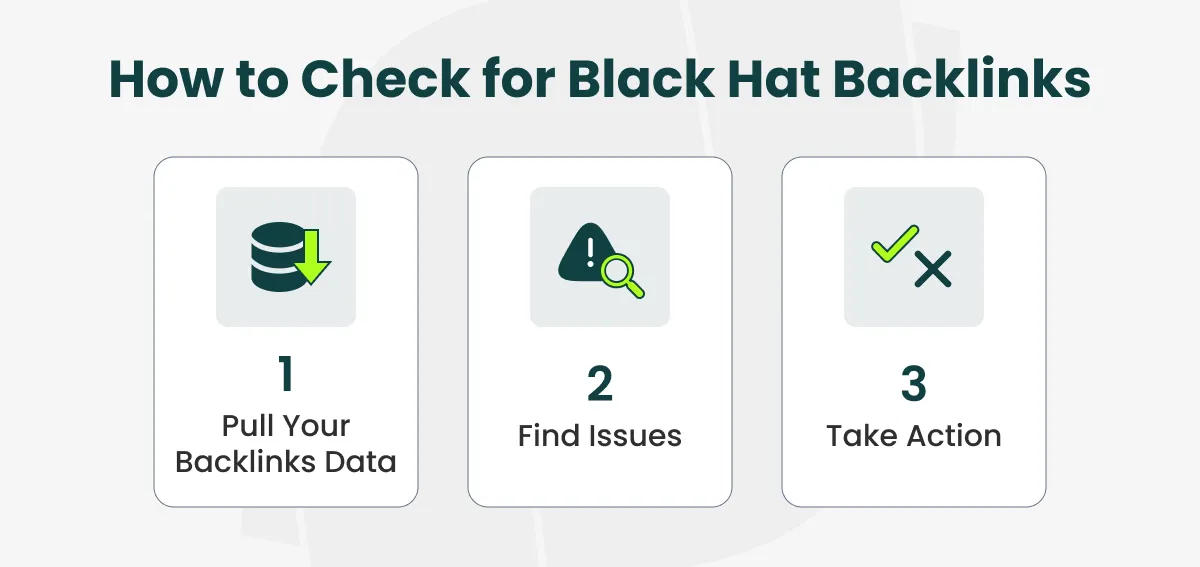
### Step 1: Pull Your Backlink Data
Start by analyzing your backlink data. Open Google Search Console, navigate to Links and then to Top Linking Sites, and export the full list.
To analyze your domain in depth, run it through [link building tools](https://outreachdesk.com/link-building-tools/) such as Ahrefs or Semrush to see referring domains, anchor text distribution, and link velocity.
### Step 2: Flag Suspicious Patterns
Look for the domains with no organic traffic, thin or auto-generated content, excessive outbound links, or irrelevant niches, such as a casino site.
Sudden spikes in hundreds of backlinks appearing over a few days are a red flag.
### Step 3: Decide What to Act on
Google states that most of the sites [don’t need to use the disavow tool](https://help.ahrefs.com/en/articles/752797-does-ahrefs-provide-an-accurate-way-to-detect-toxic-or-manipulative-backlinks).
Their algorithms ignore most low-quality spam. However, if you’ve received a manual action or you know links were built through manipulative methods, disavowing is the right decision.
## Why Do People Still Use Black Hat Link Building?
**People still use black hat link building because legitimate link earning is slow.** Expensive, and uncertain, while shortcut tactics still occasionally work long enough to pay off in short-term affiliate or churn-based business models. The math only works if you accept that the site is disposable.
Long-term brand businesses don’t take that trade because the penalty risk outlasts the upside.
It can’t be a fair question, because if the risks are clear, why does anyone still do it? There are three reasons that come up:
### Impatience
[White hat link building strategies](https://outreachdesk.com/white-hat-link-building-strategies/) take time, around 3-6 months before showing measurable results. Some businesses want results next week, and manipulative tactics promise that, but not ethical methods.
### Ignorance
Many people do not realize the risk. Plenty of vendors sell private-blog-network links without naming the practice or warning the buyer.
### Industry Pressure
In competitive niches like gambling, crypto, and payday lending, aggressive tactics are most common because per-click stakes are massive and risk tolerance is higher.
These reasons explain why black hat link building still exists, not why it’s a good idea.
## What to Do Instead: Build Links That Last
**The alternative to black hat is white hat link building.** It means earning editorial backlinks by publishing content publishers actually want to cite, building genuine relationships with journalists and bloggers, and contributing expertise that is worth referencing. Our guide on [the white hat alternative](https://outreachdesk.com/white-hat-seo/) covers the same principles at the broader SEO level. The work takes longer, but the links compound instead of disappearing at the next algorithm update.
The alternative to this isn’t slower because it’s worse, but it’s slower because it is real and ethical.
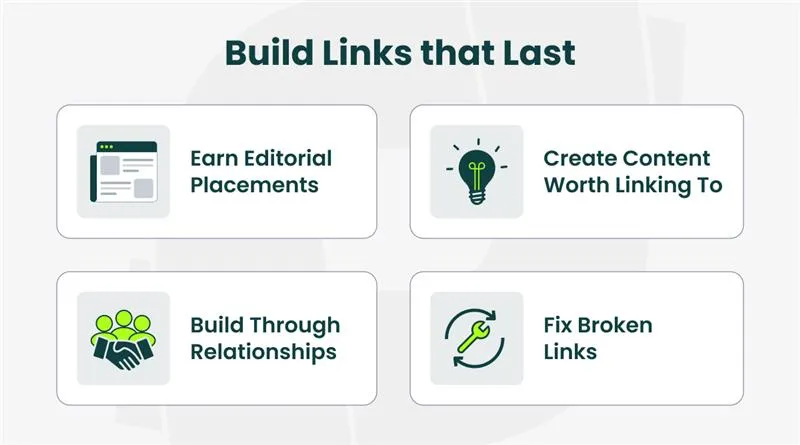
### Earn Editorial Placements
Editorial link building means earning a link placement in a relevant article on an authoritative website through [genuine outreach](https://outreachdesk.com/link-building-outreach/).
The links are contextually placed, surrounded by relevant content, and point to pages that add value for readers.
### Create Content Worth Linking To
Creating original content, such as research, data studies, interactive tools, and in-depth guides, that naturally and organically attracts links because other writers need sources.
A well-crafted industry survey can generate more quality links over its lifetime than a year of purchased placements. Those links won’t disappear with the next spam update.
### Build Through Relationships
Build relationships by being genuinely helpful to others.
[Guest posting](https://outreachdesk.com/guest-posts/) on relevant publications, participating in expert roundups, and contributing quotes to journalists through platforms like HARO build [brand mentions](https://outreachdesk.com/brand-mentions/) and backlinks.
###
### Fix Broken Links
[Broken link building](https://outreachdesk.com/broken-link-building/) identifies dead links on relevant sites and offers your content as a replacement. Link reclamation converts brand mentions into actual backlinks.
Neither of these tactics involves manipulation, but they produce lasting results.
**Pro Insight:**
A site ranking on page 1 on Google has an [average of 220 backlinks](https://www.incremys.com/en/resources/blog/google-penalty) from different domains, according to Backlinko’s 2026 data. The number matters far less than the quality and relevance of those links.
## Black Hat vs. White Hat Link Building: A Direct Comparison
**Black hat and white hat link building differ on every dimension that matters: source quality, durability, penalty risk, scalability, and the 12-month payoff.** The table below puts them side by side; one approach survives core updates, the other does not.
| Factor | Black Hat | White Hat |
| --- | --- | --- |
| Speed to results | Days to weeks | Months (3-6 typically) |
| Longivity | Temporary, because it is neutralized by the next spam update. | Compounds over time. |
| Penalty risk | Has a high risk of manual actions and deindexing. | Minimal to no risk. |
| cost | Appears cheap up front, but expensive when penalties kick in. | Higher initial investment, lower long-term cost. |
| Brand impact | Damages trust if discovered. | Builds authority and credibility. |
| Recovery difficulty | Months to years, if possible. | Not applicable because no recovery is needed. |
Every dollar spent on reliable ethical link building continues to produce value. Whereas every dollar spent on manipulative links becomes a liability since the moment Google catches up.
## The Honest Take
**Black hat link building gets harder every year.** Google’s SpamBrain classifier improves with every update, and AI search surfaces actively flag manipulative content patterns; the tactics that worked in 2019 trigger detection in 2026.
Build links that stand still. Editorial placements, original content, and real relationships are what move rankings and keep them moving.
### Is black hat link building illegal?
Most black hat link building tactics violate Google’s policies, not criminal law. The exception is hacking into a site to inject links, which can violate the Computer Fraud and Abuse Act. Not illegal does not mean safe; Google penalties can hurt a business faster than legal problems.
### Can Google actually detect purchased links?
Yes, SpamBrain was updated in December 2022 to detect buyers and sellers of links. The system detected the patterns humans might miss, such as unrelated content topics, expired domains, and unnatural outbound links. The single update costs 50 times more link spam than before.
### Should I disavow suspicious backlinks?
Only disavow if you have received a manual action or strong evidence of manipulative links pointing at your site. Google automatically ignores most low-quality links, so the disavow tool is rarely needed. An Ahrefs experiment found a 7% drop in traffic after disavowing links flagged as toxic by third-party tools.
### How long does it take to recover from a link spam penalty?
It depends on the penalty type. Manual action takes 10-30 days after a successful reconsideration request, while algorithmic penalties can run 6 months to 2 years because you have to wait for the next core update cycle. Even then, the ranking benefit those links once provided is gone for good.
### Is it possible to accidentally use black hat link building?
Yes, and it is more common than most site owners realize. Many SEO agencies and freelancers sell link building services that quietly rely on private blog networks, automated submissions, or mass link insertions.
The safest check is to request sample publisher sites and verify that each has real organic traffic using a tool like Ahrefs or SEMrush. An agency that can’t or won’t show its publisher list is a significant red flag.
---
---
title: "Generative Engine Optimization: Boost AI Visibility in 2026"
url: "https://outreachdesk.com/generative-engine-optimization/"
lang: "en-US"
type: "post"
description: "Generative engine optimization (GEO) is the practice of structuring your content to help AI tools like ChatGPT, Perplexity, Google AI Overviews, Gemini, and Copilot find and cite relevant content when answering users' questions. Teams looking to apply this should review"
last_modified: "2026-05-28T07:00:03+00:00"
categories: [Link Building]
---
# Generative Engine Optimization: Boost AI Visibility in 2026
**Generative engine optimization (GEO)** is the practice of structuring your content to help AI tools like ChatGPT, Perplexity, Google AI Overviews, Gemini, and Copilot find and cite relevant content when answering users’ questions. Teams looking to apply this should review our guide to [monitoring brand mentions in AI search engines](https://outreachdesk.com/monitor-brand-mentions-chatgpt/) for execution detail.
Unlike traditional SEO, which aims to rank in Google’s search results, GEO focuses on including your content as one of the few sources an AI pulls into its response. Many in-house teams that lack bandwidth turn to [link building services](https://outreachdesk.com/) to run prospecting and outreach at scale.
This doesn’t mean replacing SEO, but it’s all about adding value to it. The goal is simple: when millions of people ask AI a question, you want your brand to be the one it mentions.
**Key Takeaways:
**
- GEO and SEO are complementary. SEO is no longer enough alone.
- Statics and source citations can boost AI visibility by around 41%
- Brand mentions can show a stronger correlation between AI visibility than backlinks, especially for AI overviews.
- The content freshness should have a 13-week effective shelf life.
- Each AI content platform cites content differently.
## What is Generative Engine Optimization?
**Generative engine optimization** is the process of making your content likely to be cited as a source when AI platforms generate answers.
When someone asks ChatGPT, “What’s the best way to build authority for new SaaS websites?” or searches in Perplexity about link building strategies, GEO determines whether your content gets included in that answer or is entirely skipped.
The nine optimization methods were tested on 10,000 queries, introduced the GEO, and created a benchmark to measure how often content appears in AI-generated answers.
**Here’s what separates GEO from the traditional SEO:
**
Let’s look at the image first to understand how exactly the traditional SEO and GEO work. The image below shows that in traditional SEO, the user searches in a search engine, it shows the ranking pages, and then the user clicks on them.
Whereas, in GEO, the user searches on AI platforms, the AI platforms show the cited results and sources, and the user gets answers without even visiting multiple links.
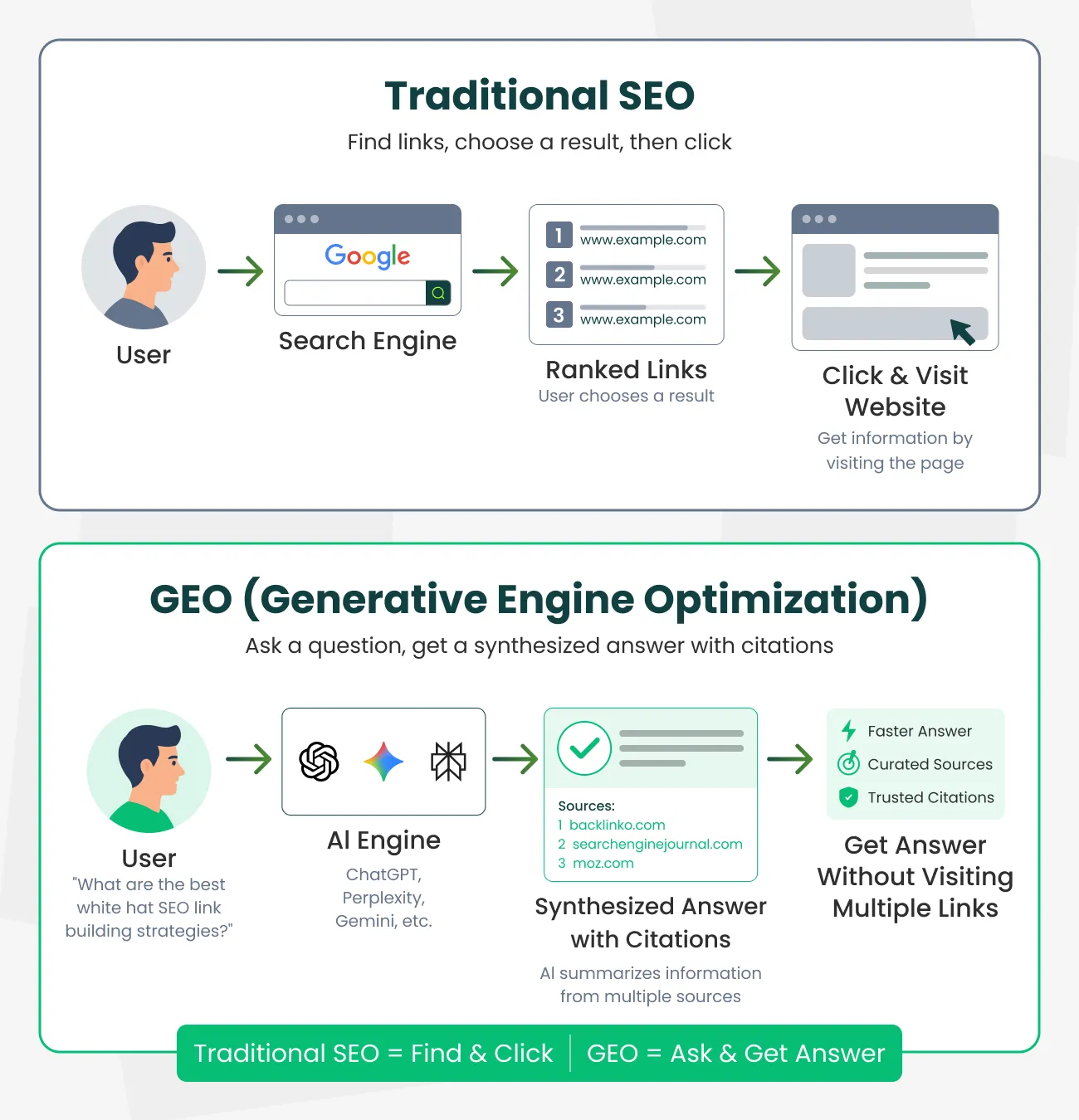
Search engines rank pages in [SERPs](https://outreachdesk.com/what-are-serps/). AI engines combine answers from different sources and blend them into a single answer. Your content doesn’t need to outrank your competitors. It just needs to be selected as a credible source from which the AI can extract and cite information.
In [SEO](https://outreachdesk.com/what-is-seo/), you’re competing for one of ten results, but in GEO, you’re competing for a few citation slots within a single AI-generated answer. It’s a tough competition, but the reward is different. When an AI like ChatGPT considers your brand as a source, it acts as an endorsement that a regular search ranking can’t offer.
## Why GEO Matters Now (Not Later)
The shift isn’t gradual; it’s accelerating fast. ChatGPT processes around 2.5 billion prompts every single day. Perplexity has crossed around 45 million active users and 780 million monthly queries. Google’s AI overviews are now appearing on roughly one in five desktop searches. These numbers are hard to ignore.
But here’s the part that should gain your attention. An [eMarketer report on GEO in 2026](https://www.emarketer.com/content/generative-engine-optimization-2026) found that fewer than 10% of the sources cited by ChatGPT, Gemini, and Copilot actually rank in Google’s top 10 for the same search query.
That means your page-one ranking doesn’t guarantee AI visibility. And your AI visibility doesn’t require a page-one ranking.
For businesses that depend on organic search, they now face a split reality. SEO still matters for Google rankings, but the users are getting answers through AI, and if your content isn’t structured to be cited, you wou won’t show up on AI platforms.
Clients with strong organic profiles but no GEO strategies are still missing from AI responses for their main keywords. It’s simple: they had authority, but the citations were missing.
## How AI Engines Select Content to Cite
To optimize for AI citations, you need a better understanding of how it actually works. Most of the AI search platforms run the process called Retrieval-Augmented Generation (RAG), and it works differently from the traditional search rankings.
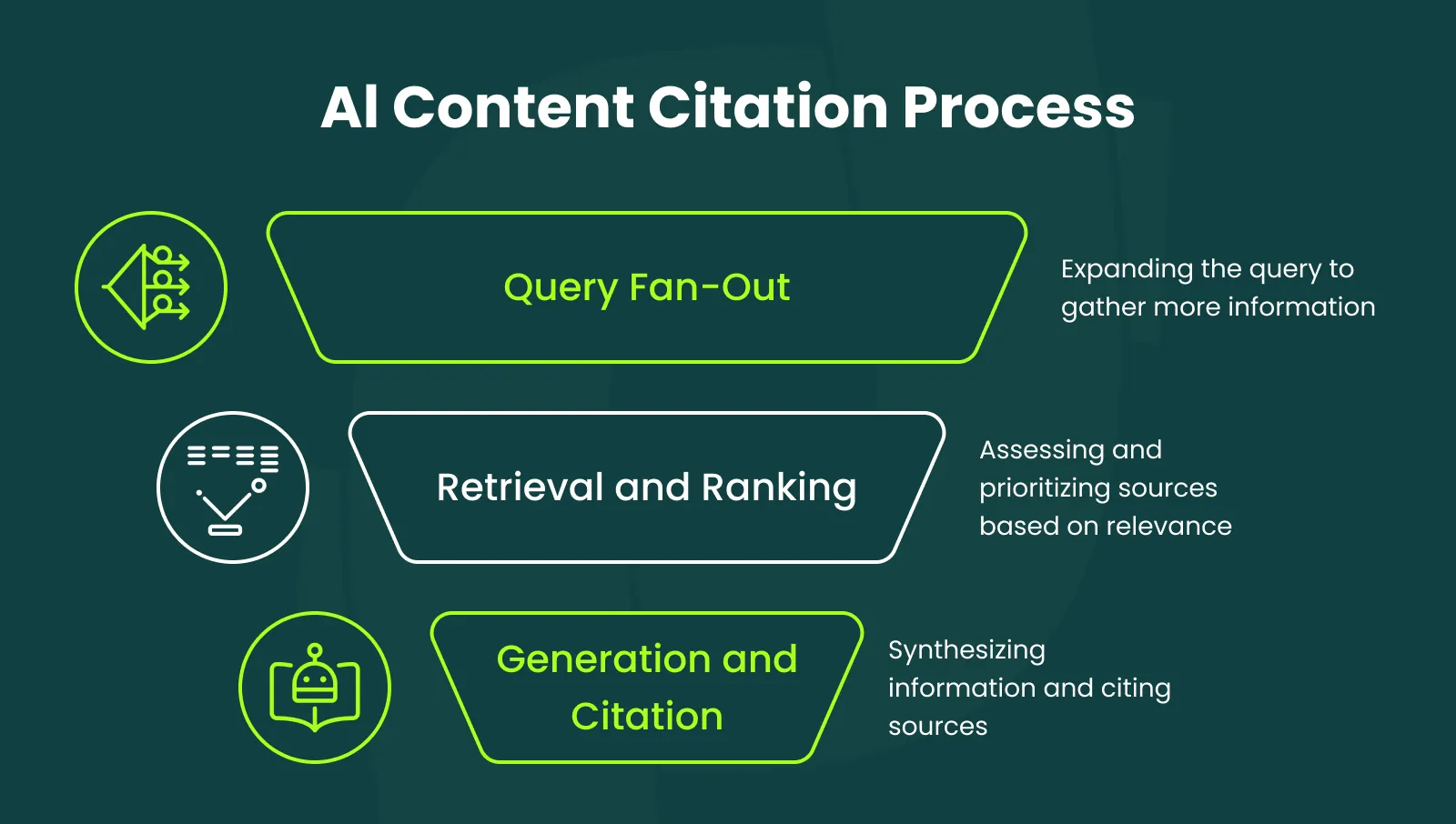
It consists of three main modules: query fan-out, retrieval and ranking, and generation and citation. Let’s look at them in detail.
### Query Fan-Out
When someone asks a complex question, the AI doesn’t search for it word-for-word. Instead, it breaks it down into smaller sub-queries and searches for each one separately.
Suppose a question is asked, “What ‘s the best link building strategy for a B2B SaaS company with a smaller marketing team?” This question might get split into “B2B link building strategies,” “link building small teams,” and “SaaS authority building 2026.”
This means that your content should separately answer these queries, not just the bigger questions. If your content only answers broader questions without covering small pieces, you’ll miss out on citation opportunities.
### Retrieval and Ranking
Once the AI has its sub-queries, it pulls the list of candidate pages and evaluates them. It evaluates each page for relevance, trust, and its structural clarity.
Pages that win tend to have clear, organized headings, specific data points, and statements that stand on their own without the requirement of extra context.
Pages that lose tend to be vague, overly promotional, or hard to scan don’t impress AI. AI is not impressed by marketing language; it’s looking for clarity and credibility.
### Generation and Citation
The AI takes its highest-scoring pages, builds an answer from them, and attaches citations. It results in either your content making it into the answer with your brand name mentioned, or it gets skipped, and your competitor is mentioned.
**Takeaway:
**
Write like an expert sharing valuable advice that is evidence of your expertise, rather than writing like a marketer trying to rank.
## GEO vs. SEO vs. AEO: What’s the Difference?
These three terms are often mixed up and connected, but each aims for a different outcome.
| | SEO | GEO | AEO |
| --- | --- | --- | --- |
| Goal | To rank in search results. | Get cited in AI-generated answers. | To be the direct extracted answer. |
| Target | Google and Bing organic results. | ChatGPT, Perplexity, Gemini, AI overviews. | Featured snippets, PAA, voice search. |
| Success Metrics | Rankings, clicks, traffic. | Citation frequency, brand mentions. | Position zero, snippet ownership. |
| Key Signals | Keywords, authority, and user signals. | Data density, entity definitions, and freshness. | Answer formatting, self-contained paragraphs. |
| Content Format | Long-form comprehensive pages. | Structured, extractable, data-backed. | Direct-answer paragraphs, concise lists. |
SEO helps search engines to find your content. GEO helps AI models choose your content as a source. And AEO (Answer Engine Optimization) goes a step further by getting your content pulled out as a direct answer itself.
Ultimately, you require all three working together. However, the way you write for each may differ.
A page built purely for SEO is often packed with keywords and [backlinks](https://outreachdesk.com/what-are-backlinks/), but one written in broad, generic terms will often fail at GEO because AI models aren’t looking for any popular pages. They’re looking for the most specific, clearly mentioned, and trustworthy pages.
## The 7 GEO Strategies That Actually Work
Not every “GEO” tactic produces results. The study at Princeton, combined with commercial data from [Ahrefs](https://ahrefs.com/), [Semrush](https://www.semrush.com/), and [BrightEdge](https://www.brightedge.com/), gives a clear picture of what works best and what doesn’t.
### 1. Add Statistics and Data to Every Key Section
This one tactic made a significant difference in testing. In one experiment, it led to around 41% improvement in AI visibility just by including quality data in your content.
The reason is simple. AI models treat precise data as reliable information. A statement like “domain authority dropped 15 points in 8 weeks” is something an AI can confidently cite. A statement like “ranking decreased over time” is too vague to be useful.
Here are the right and wrong ways to mention.
**Right way: **“Organic CTR drops 61% when an AI Overview appears for the same query, according to a Seer Interactive study of 25.1 million impressions.”
**Wrong way: **“AI overviews have a negative impact on click-through rates for organic results.”
Both roughly say the same thing. But only one gives an AI model a specific claim to confidently cite it.
### 2. Define Every Entity on First Mention
When you introduce a new concept or term, define it clearly in one sentence. Don’t assume your readers or the AI already know what it means.
It matters for GEO because AI models build knowledge graphs from entity definitions.
If that chunk contains a vague reference like “this approach works because…” without any explanation of “this”, the AI has nothing to cite. But if your definition is self-contained and clear, it can stand out even when pulled out of context.
Clearly avoid vague words like “it,” “this,” or “they” in your definition. Always use the actual names of the thing you’re describing.
For **example**, you are writing “Editorial link building is the process of earning contextual backlinks from authoritative websites through manual outreach as opposed to paid placements, directory listings, or automated link schemes.”
This definition doesn’t contain any words like “it”, “they”, or “this”. It means it is the perfect example of mentioning the entities while introducing them for the first time.
### 3. Structure for Extraction, Not Just Reading
The way you format your content matters just as much as what you write. AI engines favor specific structures depending on what’s being asked, and matching that structure gives your content a better chance of being extracted.
**Numbered processes**, such as H3 steps under H2 questions, achieve the highest extraction rates from Google AI overviews. When someone asks “how to build backlinks for a new site,” an AI overview almost always formats its response as a list. Your content should provide that structure.
**Comparison tables** with clear column headers are preferred by ChatGPT and Perplexity for evaluating queries like “guest posting vs. niche edits.” If your comparison is inside a paragraph rather than a table, you’re making the AI do extra work to phrase it, and it’ll choose a competitor’s table instead.
**Definition-first paragraphs.** If the question starts with “what is,” it leads with a clean, direct definition of 40 to 60 words right below the heading. No indirect starts and no bluff; start the answer directly.
### 4. Build Brand Mentions Across the Web
[Branded web mentions](https://outreachdesk.com/brand-mentions/), linked and unlinked, show the highest correlation with the AI overview visibility.
An [Ahrefs 2025 analysis of 75,000 brands](https://ahrefs.com/blog/ai-overview-brand-correlation/) found a Spearman correlation of 0.664 between web mentions and AI Overview visibility, compared with 0.218 for backlinks.
This is a fundamental shift. For two decades, link building meant earning clickable links. For AI visibility, earning mentions of your brand on third-party sites matters more than earning links from them.
YouTube mentions that it has a strong partnership with AI visibility across ChatGPT, AI Mode, and AI Overviews.
That means brands mentioned in video titles, descriptions, and transcripts were more likely to appear in AI-generated responses.
Here’s the practical implication: your off-site strategy needs to include digital PR, community participation on platforms like Reddit, Quora, and industry forums, review site presence, and YouTube visibility, not just traditional link acquisition.
### 5. Keep Content Fresh on a 90 Day Cycle
AI systems have a strong presence in recent content, and the data backs it up. Half of all AI-cited content is less than 13 weeks old, according to [Amsive’s research](https://lilyray.nyc/tech-seo-connect-2025-summary-takeaways/#:~:text=Highlighted%20a%20strong%20recency%20bias%20in%20AI%20search%2C%20noting%20that%2050%25%20of%20top%2Dcited%20content%20is%20less%20than%2013%20weeks%20old.) on AI citation patterns.
An [Ahrefs analysis](https://ahrefs.com/blog/ai-statistics/) of 17 million citations across seven AI platforms found that AI-cited pages average 1,064 days old, in comparison with 1,432 for traditionally ranked content, a 25.7% freshness advantage.
A 90-day refresh cycle works well for your most important pages. Update your statistics by adding recent examples and expanding any sections with new information. Don’t just change the date and call it updated. AI models can evaluate whether the content itself has actually been updated, not just the time stamp.
### 6. Make Your Content Technically Accessible to AI Crawlers
Any tactics don’t work if AI crawlers can’t access your content in the first place. There are three technical things worth checking.
**Robots.txt
**
It is a file that tells crawlers what they can and can’t access on your site. Make sure that you’re not accidentally blocking ChatGPT bots, ClaudeBot, or PerplexityBot. According to [Press Gazette research](https://pressgazette.co.uk/platforms/eight-in-ten-of-worlds-biggest-news-websites-now-block-ai-training-bots/#:~:text=Some%2079%25%20of%20almost%20100%20top%20news%20websites%20in%20the%20UK%20and%20US%20are%20blocking%20at%20least%20one%20crawler%20used%20for%20AI%20training%20out%20of%20OpenAI%E2%80%99s%20GPTBot%2C%20ClaudeBot%2C%20Anthropic%2Dai%2C%20CCBot%2C%20Applebot%2DExtended%20and%20Google%2DExtended.), nearly 79% of almost 100 top news publications block at least one AI crawler.
**How your pages load
**
AI crawlers don’t execute JavaScript the way a browser does. If your site relies mostly on client-side rendering to display content, there’s a good chance that AI crawlers are seeing a blank page. Make sure that your content is visible even without needing to run JavaScript.
**llms.txt
**
It is an emerging standard that provides AI crawlers with a simple, machine-readable guide to your site, what’s on it, what matters most, and how you’d prefer to be cited. However, it’s not universally adopted yet, but setting it up early signals that your site is built while considering AI accessibility.
### 7. Optimize Differently for Each AI Platform
Not every AI platform extracts content through the same lenses. Tailoring your content to each one can make a genuine difference in how often you get cited.
**Google AI Overviews
**
It provides results from the pages that are already ranking in Google’s top 10. They prioritize numbered lists for step-by-step questions, comparison tables showing “which is better” type queries, and short paragraph summaries of around 40 to 80 words. Brand mentions carry more weight here than on other platforms.
**ChatGPT
**
It prioritizes recent content and specific, self-contained preference claims attributed to a named source. It responds well to clear headings with proper H2 and H3 and high information density. Reddit and Wikipedia are among its frequently cited sources, a pattern that shifted after a major update in September 2025.
**Perplexity
**
It cites multiple sources per answer; typically, 3 to 5. What makes it different is that it favors unique data points that can’t be found elsewhere. If you have original research or data, this can be your strongest edge.
**Gemini
**
It is deeply connected to Google’s knowledge graph, which means clear entity definitions matter a lot here. Structured formats like tables, lists, and step-by-step processes perform well here.
## How to Measure GEO Performance
You can’t manage what you can’t measure. GEO measurement is different from SEO tracking. Traditional SEO metrics such as keyword rankings, organic traffic, and click-through rates don’t capture AI citation performance.
A page can lose 30% of its organic clicks to AI overviews while gaining brand visibility by being cited in those same overviews.
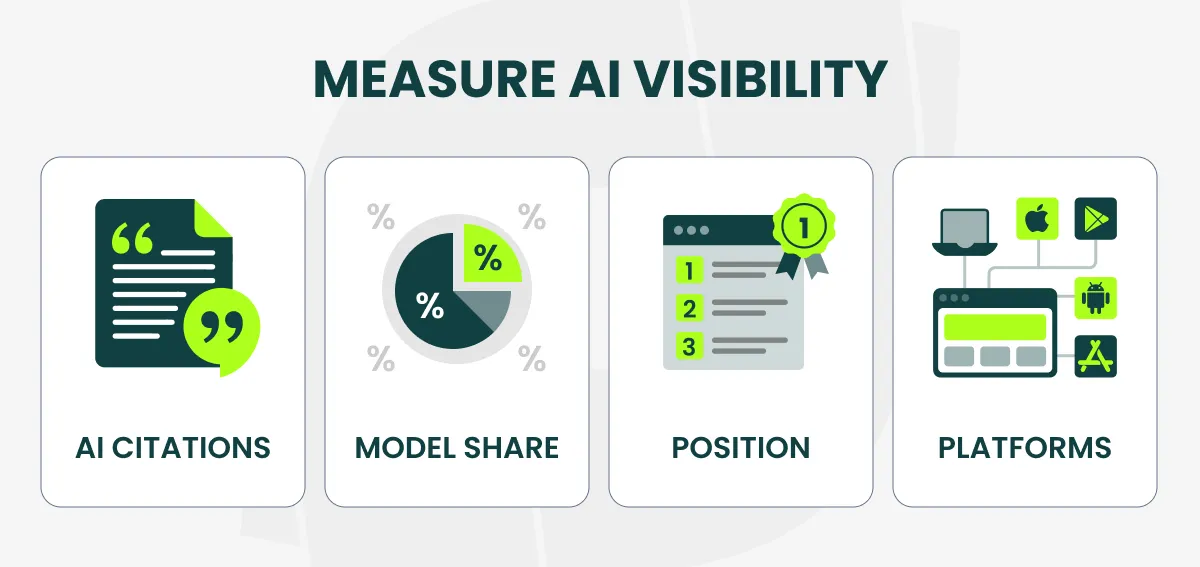
**Track these three metrics instead:
**
### AI Citation Frequency
Analyze how often your brand or content appears in AI-generated responses for your target queries. Use tools like [Ahrefs Brand Radar](https://ahrefs.com/brand-radar), [Semrush’s AI visibility Toolkit](https://www.semrush.com/kb/1493-ai-visibility-toolkit), and [Otterly.ai](http://Otterly.ai) to automate this tracking across platforms.
### Share of Model
Measure how often your brand and your competitors’ brands appear in AI responses for the same queries. This is the GEO equivalent share of voice in traditional marketing.
### Citation Position
The citation position matters the most because a citation placed earlier in an AI response can carry more weight. It’s simple, the first source cited gets more attention from the users than the fifth citation.
### Platform Specific Tracking
It is important because the same query may return different results across platforms. Only 13.7% of the citations overlap with Google’s AI overviews and AI Mode. Therefore, track each platform separately.
**One practical approach:
**
Run 10-15 of your priority queries through ChatGPT, Perplixity, and Google AI Overviews every quarter. Record which brands appear, in what position, and with what framing. This manual process may take around an hour, but it gives you a baseline before investing in any automated tools.
## GEO and Link Building: What Changes?
For the teams focused on authority building and [link acquisition](https://outreachdesk.com/link-acquisition/), GEO doesn’t make link building outdated, but it reshapes the priorities.
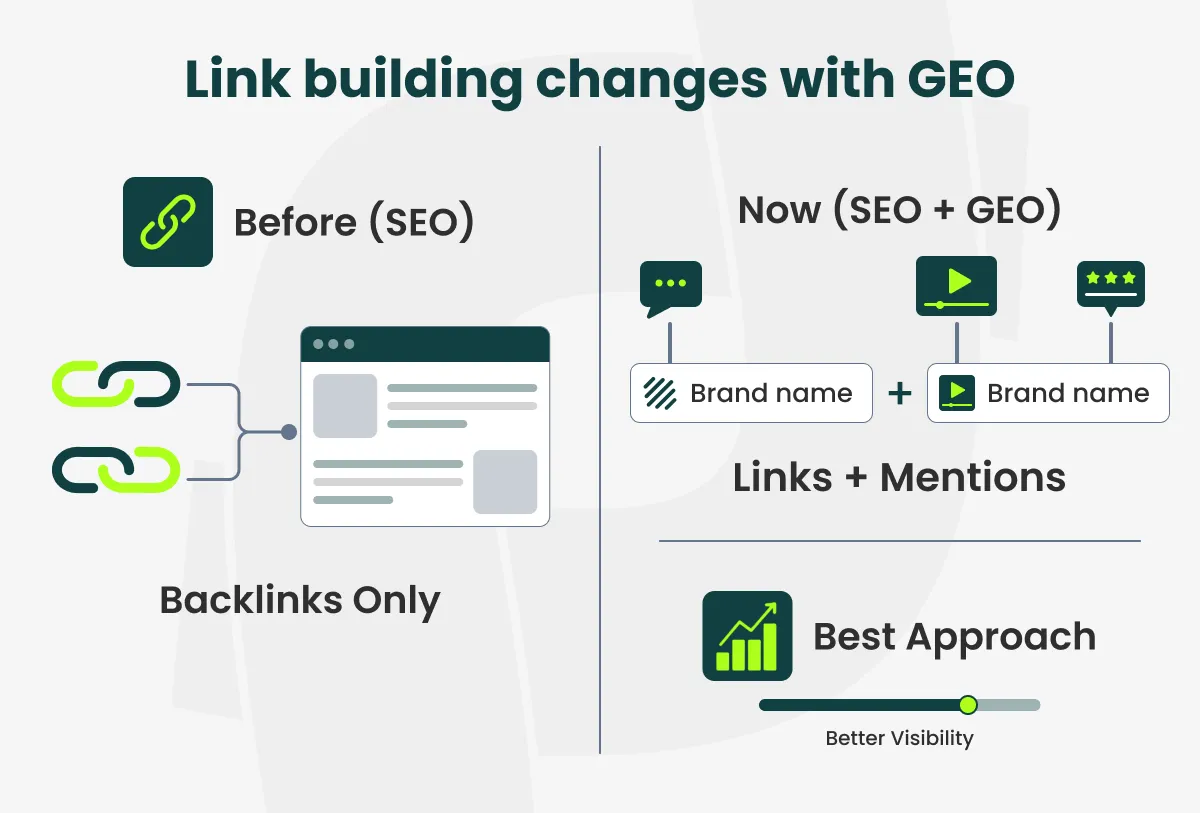
Where traditional link building mostly focused on earning dofollow clickable links from high-authority domains. GEO expands that focus to include brand mentions, linked or unlinked, across a wider range of platforms.
Web mentions matter three times more than the backlinks for AI Overview visibility. When your brand is being discussed on Reddit, mentioned in YouTube transcripts, cited on review platforms like G2, or even referenced in industry forums, all contribute to the entity signals that AI models use to identify the eligibility.
However, this doesn’t mean that links stopped working. Where 76.1% of cited URLs also rank in the top 10 organically. A backlink profile still builds the foundation that you need. However, links are not the only ones that determine your visibility.
Brands that paired traditional [outreach-driven tactics](https://outreachdesk.com/link-building-strategies/) with calculated [brand mention campaigns](https://outreachdesk.com/brand-mention-service/) saw measurable improvements in AI citation frequency compared to the brands that focused solely on links.
## Common GEO Mistakes to Avoid
Here is a list of common mistakes made when considering Generative engine optimization. Try to avoid them, and you can get the desired results.
### Writing for AI Instead of Humans
GEO tactics should improve it rather than interpret it. If a data or structural change makes the reading experience worse, then skip it. AI platforms prefer the same content qualities readers value, such as clarity, specificity, and credibility.
### Ignoring Traditional SEO
GEO is not a replacement for SEO; instead, it compounds it. Pages that don’t get ranked organically still have a harder time getting cited, especially in Google AI Overviews. Build the organic baseline first, then opt for GEO.
### Treating all AI Platforms the Same
All the AI platforms have different citation behavior, formats, and freshness criteria. A strategy built for one platform will underperform on other platforms.
### Publishing and Forgetting
AI platforms favor recent content, and that 13-week citation window closes faster than most content calendar accounts for. Build a regular refresh cycle directly into your workflow.
### Stuffing Keywords
Keyword stuffing actually hurts your chances. AI models aren’t counting how often a word appears; they’re evaluating whether your content is genuinely useful and credible.
### Using Promotional Language
AI models ignore sales copy; write to inform and provide value rather than to sell. [Semrush’s content optimization study](https://www.semrush.com/blog/content-optimization-ai-search-study/) found a negative correlation between promotional tone and the probability of AI citations.
## What Comes Next
GEO isn’t a one-time thing; it’s an ongoing discipline that requires the same commitment as SEO, including updated content, fresh data, platform-specific adjustments, and regular measurements.
The brands that are winning AI citations right now share three traits: they publish data-rich content that AI models can confidently cite, they maintain freshness through quarterly refresh cycles, and they build brand mentions across the platforms where AI models source information.
Start with an audit, run your top 10 queries through ChatGPT, Perplixity, and Google AI Overviews. Count how often your brand appears. Then also analyze who appears and study how their content differs from yours.
### Struggling to get your brand mentioned in AI-generated answers?
Get a strategy to help you show up where decisions are being made.
[Book a strategy call](/contact-us/)
### Does GEO replace SEO?
No, in fact, GEO is built on SEO; it doesn’t replace it. Organic rankings still feed AI citation pools. Google AI Overviews draw 76.1% of their cited URLs from the top 10 results. The right approach is to run both in parallel. SEO gets your pages discovered and ranked, GEO gets them cited in AI-generated responses.
### How long before GEO efforts produce results?
New content enters AI citation within 3 to 5 business days, based on the data from multiple practitioners. However, sustaining those citations requires freshness. Most brands see measurable citation improvements within 60-90 days of implementing structured GEO tactics across their main content.
### What tools track AI citations performance?
Many platforms now track brand visibility across AI search. Ahrefs Brand Radar mentions across AI Overviews, ChatGPT, and Perplexity. Semrush’s AI Visibility Toolkit tracks citation frequency and the model’s share. Otterly.ai, Rankscale, and similar point solutions offer GEO tracking. Choose based on which platforms matter most for your audience.
### Is GEO only relevant for informational content?
Not really, Semeruh’s research found that case studies and pricing pages are among the best content types for driving AI reference traffic. The how-to guides are still cited, but AI models answer those queries directly from training data without citing external sources. Bottom funnel content with original data or specific pricing actually earns more citations.
### How is GEO different from AEO (Answer Engine Optimization)?
GEO focuses on being cited as a source inside an AI-generated response. AEO focuses on being extracted as an answer in the featured snippets, PAA boxes, and even voice search results. GEO means your brand name appears along with the AI answer. SEO means your exact text becomes the answer. Both matters, but GEO addresses AI search platforms specifically.
---
---
title: "HARO Link Building: Is It Still Worth It in 2026?"
url: "https://outreachdesk.com/haro-link-building/"
lang: "en-US"
type: "post"
description: "HARO link building is the process of answering journalist queries on the Help a Reporter Out platform. This is one of the popular ways to earn quality backlinks. But the real question is: does HARO still work in 2026? For"
last_modified: "2026-05-18T11:52:19+00:00"
categories: [Link Building]
---
# HARO Link Building: Is It Still Worth It in 2026?
HARO link building is the process of answering journalist queries on the** Help a Reporter Out** platform. This is one of the popular ways to earn quality backlinks. But the real question is: does HARO still work in 2026? For end-to-end management of this process, [Outreach Desk SEO experts](https://outreachdesk.com/) runs campaigns for 500+ brands worldwide.
Yes, HARO link building still works in 2026. The classic three-times-daily digest is back, but the process has changed.
After Cision discontinued Connectively in late 2024, [Featured.com](http://Featured.com) acquired HARO in April 2025 and reopened it as a free, email-based platform.
Imagine 300 people applying for the same job. That’s what one journalist’s query looks like now. One journalist receives hundreds of pitches and deletes most of them within seconds.
So the question isn’t whether you can build links through HARO. It’s whether the time investment pays off compared to other methods.
**What you’ll learn:
**
- How HARO works under Featured.com.
- Realistic success rates & time investment for HARO pitching in 2026.
- A clear 6-step process for writing pitches that journalists actually use.
- When HARO works and when it doesn’t in link building strategy.
- A strong alternative, so you never depend on just one platform.
## What is Haro Link Building?
[Help a Reporter Out](https://www.helpareporter.com/) is like a matchmaking platform for journalists and experts.
Journalists need expert quotes; you provide them, and if the journalist likes your answer, they quote you in their articles.
In HARO link building, you answer queries to earn [quality backlinks](https://outreachdesk.com/what-are-backlinks/).
**Here’s the exact process: **
- A journalist at [Forbes](https://www.forbes.com/) or [Business Insider](https://www.businessinsider.com/) needs an expert opinion.
- They post their query on HARO.
- HARO emails queries to thousands of experts three times a day.
- You spot a relevant question and write a concise, helpful answer.
- The journalist picks the best response.
- Journalist, publish your answer with a link back to your website.
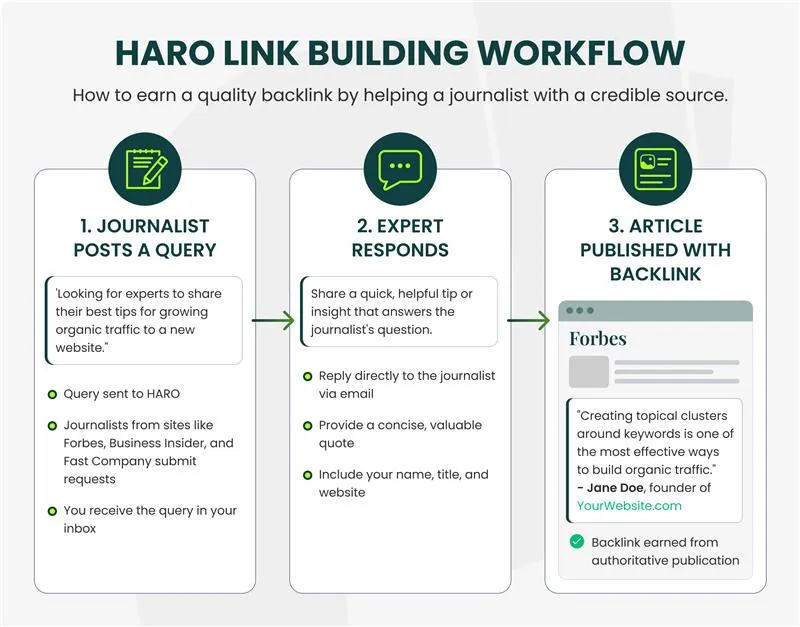
These links carry real value. **They come from editorial decisions, not paid placements.
**
Here, you earn authoritative backlinks, and Google also treats them as genuine signals because they come from recognizable publications.
These links drive** real referral traffic and brand credibility**, two of the most important things, even more so now, as [AI search systems favor brands with broad web mentions](https://ahrefs.com/blog/ai-overview-brand-correlation/).
However, HARO gives you **very little control**.
- You can’t choose which page on your site gets linked.
- You can’t control the anchor text (the clickable words).
- You can’t guarantee the article will even go live.
- You’re always reaching out and waiting for queries to appear.
It’s more like fishing. You don’t control the conditions. You just show up, write the best lines, and wait.
The process is passive and unpredictable, but the quality of the links you earn is worth the wait.
## How Does the New HARO Work Under Featured.com?
HARO, the one you remembered from 2022, was classic, and when the Connectively version replaced it, the platform lost its simplicity. Fortunately, HARO gets back to basics thanks to Brett Farmiloe, the CEO of Featured.com.
[A BuzzStream interview with Featured CEO Brett Farmiloe](https://www.buzzstream.com/blog/haro-is-back-podcast/) already confirmed the mission: bring back the simplicity of the original HARO, prioritize human expertise over volume, and give journalists a reason to trust the platform again.
In April 2025, Featured bought HARO from Cision and removed:
- The clunky Connectively dashboard.
- Paid tiers cost up to $149/month.
- Pitch limits are based on your subscription level.
Instead, Featured brought back the simplicity, the three times daily email digests. Just reply directly by mail. No login needed.
Also, you don’t need to pay subscription fees. It’s now free for both journalists and sources.
Then how does Featured make money? The answer is newsletter advertising and sponsorships.
**The platform also built a three-layer filter:
**
- **Verification layer** to filter out random people posing as experts.
- **AI detection to flag AI-generated answers** that don’t add real value and lack personal experience or original insights.
- **Bans for repeat offenders** who consistently send irrelevant or AI-generated content.**
**
## Is HARO Still Worth It For Link Building?
HARO still earns you valuable backlinks from publications with domain ratings above 80, without paying for placements. But the answer heavily depends on ‘how you use it and what you expect from it.’
It demands real-time investment, and success rates range from 5% to 15%. That means for every 20 pitches expect 1-3 links.
PR professionals report that [well-crafted HARO pitches earn responses 10% to 25% of the time](https://www.harolinkbuilding.com/blog/is-haro-still-worth-it-in-2026), which simply says, ‘Better bait, better catch.’
NewswireJet reported 14 placements from 114 pitches, a direct conversion rate of 12.3%.
Sounds good, right? Calculate the hours spent scanning queries, writing custom responses, and follow-ups.
Compare that to general PR outreach. [Propel’s analysis of over 555,000 media pitches](https://martech.zone/pitch-response-rates-media-barometer-report/) found the average journalist response rate sits around 3.4%.
HARO still beats the cold outreach at conversion. Why?
Because cold outreach is like knocking on the doors nobody asked you to knock on.
HARO is different. Here, journalists have already put up a signboard, “I need help.” You help, and you get rewards (backlinks). That’s why HARO offers higher conversion rates.
But the common question is: what does HARO deliver?
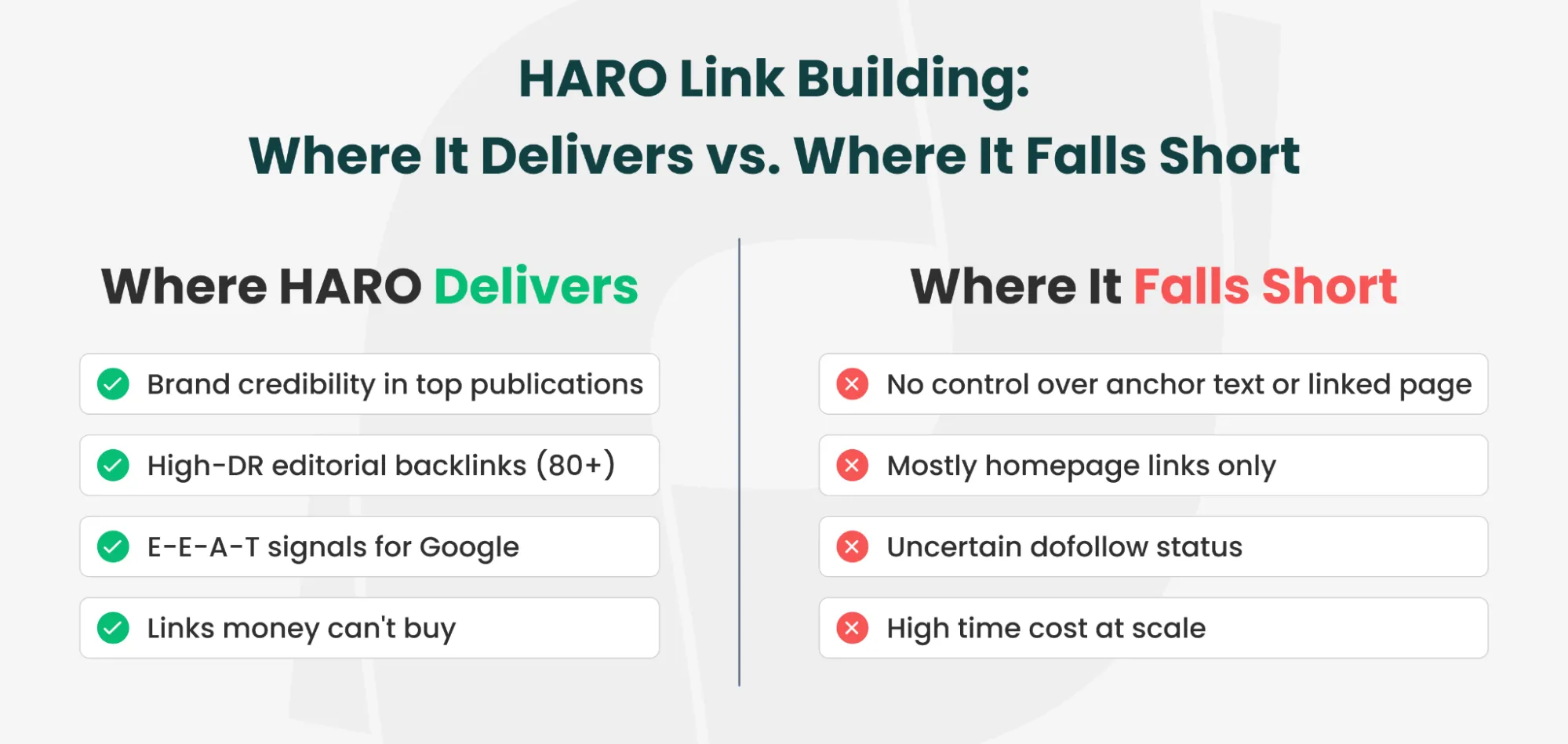
**The Biggest Mistake People Make: **
Many people treat HARO link building as the only strategy to build backlinks. It’s like watering one part of the garden and wondering why the rest is not growing.**
**
**HARO **works best when you treat it as one channel inside a multi-method strategy. Teams that rely only on HARO end up facing:
- Lots of homepage authority.
- Zero link support for the pages that actually need to rank.
- A lopsided backlink profile with little or no change.
The simple rule is to consider **HARO as one tool inside a bigger strategy.**
It’s best for building brand credibility and earning high-trust editorial links. You should use this method with realistic expectations; otherwise, you’ll burn out fast.
## How to Use HARO for Link Building (6 Steps)
Understanding where HARO fits into a link building strategy is one thing. But knowing how to execute it daily is important.
Here’s the step-by-step process to help you improve your success rate with the HARO link-building strategy.
### Step 1: Set Up Your Profile for Credibility
Think of your HARO profile like a first impression at a job interview. Before a journalist decides to quote you, they check who you are.
**What to do:**
- Sign up at [helpareporter.com](http://helpareporter.com)
- Choose categories that match your real expertise only.
- Add a professional headshot, your real title, and a clean one-line bio.
**What looks good vs. what gets ignored:
**
Here’s how you stand out from the others.
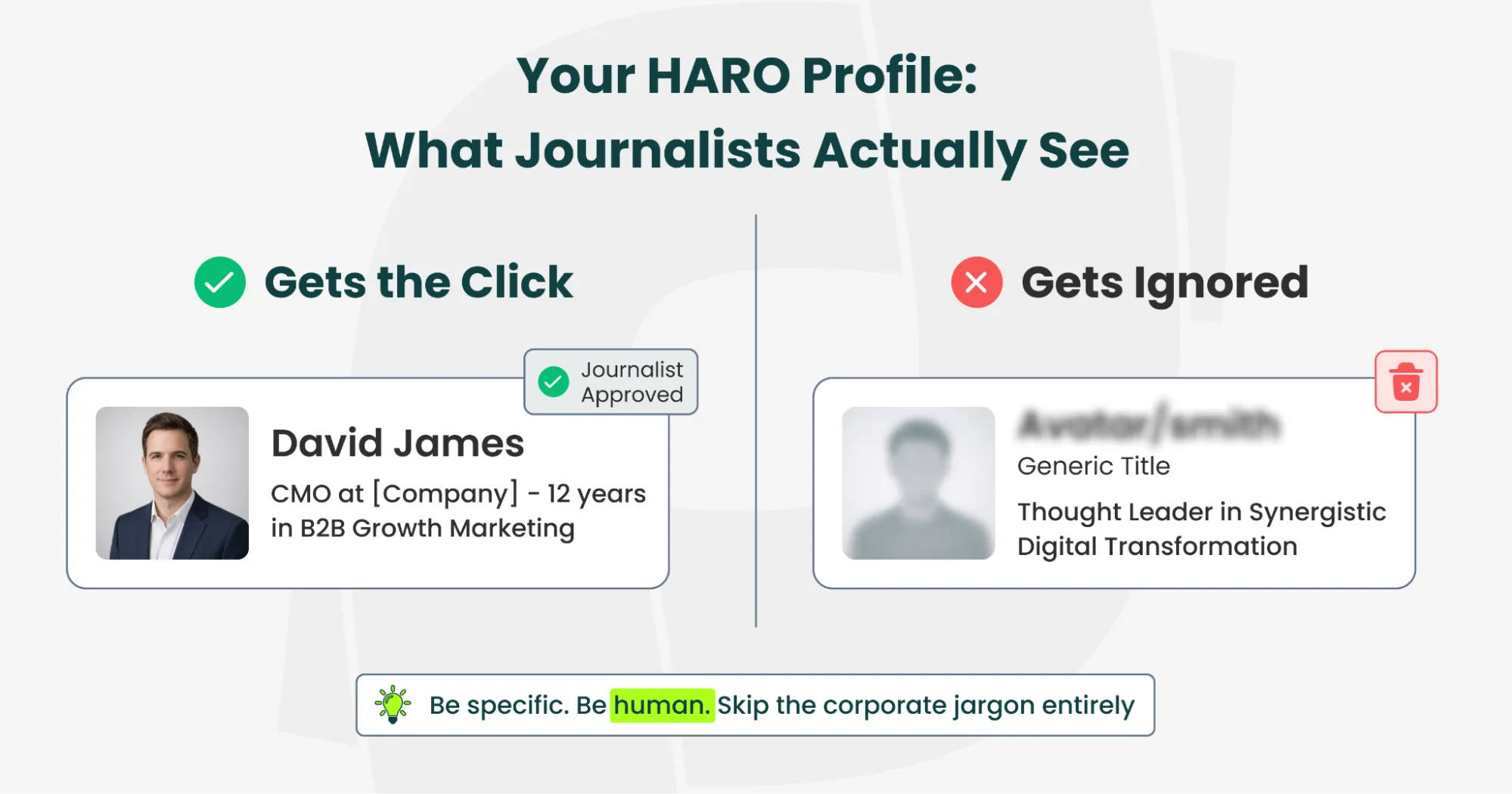
### Step 2: Scan Queries Within 60 Minutes of Each Digest
Speed is the single most impactful variable in HARO success. Here’s why:
- Pitches submitted within the first 6 hours after a query goes live achieve roughly a 20% higher conversion rate.
- Journalists start reading immediately after queries go live.
- Many close queries once they find just 3-4 usable responses.
**Here’s how to stay fast:
**
- Set email notifications so digests hit your phone immediately.
- Block 15 minutes three times daily (morning, afternoon, and evening).
- Scan subject lines first, then open only the queries where you have genuine expertise.
### Step 3: Write Pitches Under 200 Words
A HARO pitch is not a blog post or sales deck. Only a few seconds decide your credibility, whether you get a backlink or a rejection.
Your pitch should be quotable so that a journalist or blogger can use it in their articles with minimal editing.
**A pitch that works:**
“Hi [Name],
I’ve run paid search campaigns for 40+ ecommerce brands over 8 years. One mistake I see repeatedly: brands scaling ad spend before fixing landing page conversion rates. A client last quarter cut their cost per acquisition by 34% without increasing budget — they just rebuilt three landing pages with clearer CTAs and faster load times.
Happy to provide more details if helpful.
[Name],
[Title],
[Company URL]”**
**
**A pitch that gets ignored:**
**“**As a leading marketing agency, we specialize in comprehensive digital strategies that drive results for our clients. We believe in a data-driven approach…**”
**
The first pitch includes a specific result, real experience, and a quotable insight. Journalists will select the first pitch within 3 seconds.
While the second pitch is generic, it goes straight to the bin in 1 second.
### Step 4: Lead with a Data Point not a Personal Story
Journalists don’t need your biography. They need something meaningful, quotable, and credible.
[Research from Muck Rack and Cision’s surveys](https://www.buzzstream.com/blog/pr-trends/) found that journalists value access to credible sources and original data above story and pre-written quotes.
Open your response with a real number, a case study, or a specific experience rather than credentials.
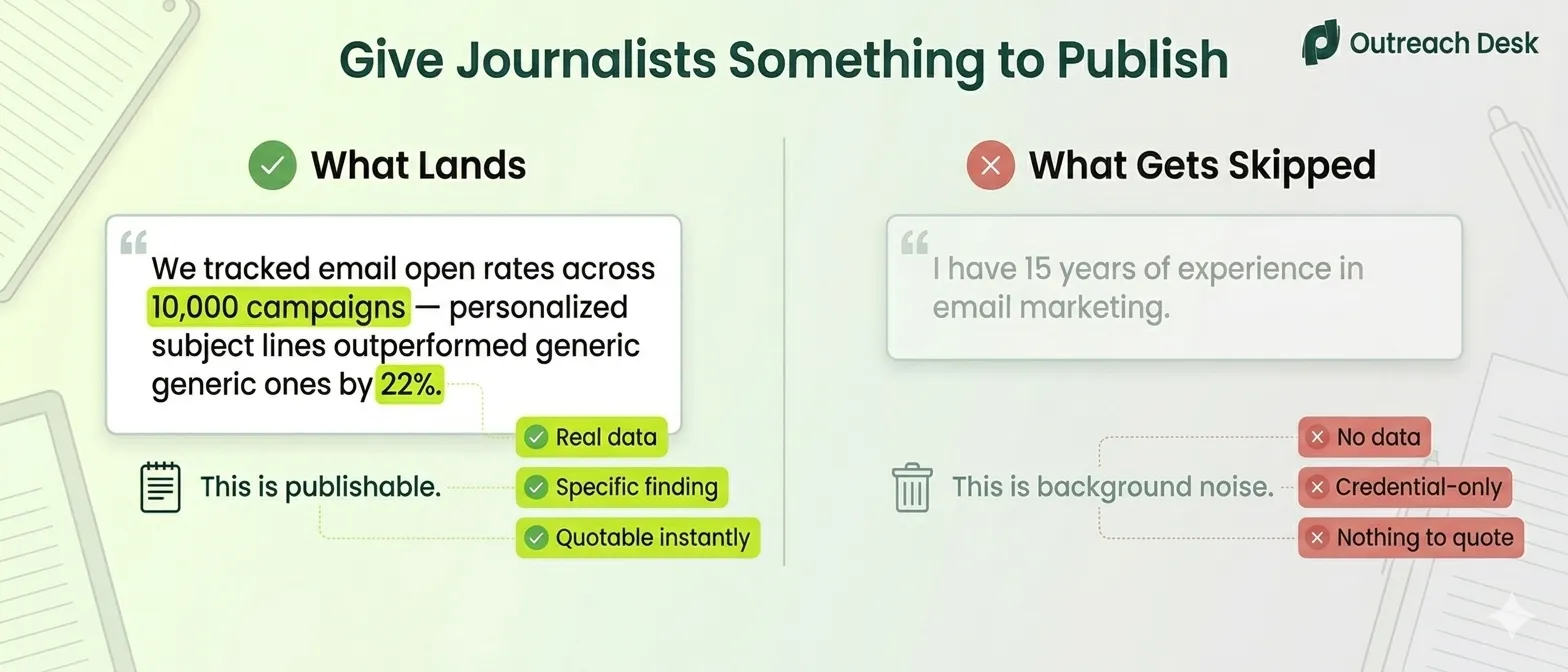
One gives a journalist something to publish. The other gives them just background, which they didn’t even ask for.
### Step 5: Follow the Query Instructions Exactly
Most HARO users overlook this step.
**If a journalist asks for:
**
- Three tips, give them three. Not five. Not two.
- If they ask for a response from agency owners, don’t pitch if you’re a freelancer.
- If they specify a word count, respect it.
You get filtered out if you miss these small details. Because it clearly shows you don’t read carefully.
**Reality:**
Journalists reviewing 100+ responses are actively looking for reasons to say no. Better not to hand them that reason.
### Step 6: Track Results and Build Relationships
Most people stop after hitting send. The best HARO users treat every pitch as data and every placement as a relationship.
Keep a spreadsheet of every pitch, including query topic, publication, date sent, whether you were placed, and the URL of the live article. This won’t help in 1-2 weeks, but over 2-3 months, you’ll start to notice patterns.
You will get insights on which topics convert for you, which publications use HARO heavily, and where your expertise resonates most.
**When you get placed, do this:
**
- Send a short thank-you message.
- Share the article on your social channels and tag them.
- Make their job easier, and they’ll remember you for a long time.
Now, once you do this and establish trust with journalists, they bypass the HARO queue and come to you directly for future stories.
## Common HARO Mistakes That Kill Your Placement Rate
Now you know the 6-step process for writing strong pitches. But knowing what not to do is equally important when you’re building backlinks using HARO.
Here are the common mistakes that kill your placement rate despite having well-written pitches.
### Using AI to Generate Every Response
One of the biggest and most common mistakes in HARO link building is that most people use AI to generate every response and pitch. It’s like sending a photocopied signature instead of a real one.
When everyone uses AI, every pitch and response sounds similar. Journalists can easily spot lifeless content. Even Featured.com is now automatically flagging it.
Here, you’re not just competing against humans anymore. You’re in a race against dozens of pitches that read exactly like yours.
**What’s the smarter approach?**
Use AI to brainstorm ideas and structure your thinking, then write the actual response yourself. Your genuine experience and voice make all the difference.
### Pitching Queries Outside Your Expertise
Imagine a real estate agent showing up to answer queries about cybersecurity. The journalists will notice, and they toss the pitch straight in the bin.
It’s simple: either you have credibility for that topic, or you don’t. Never fake it to earn a backlink. Remember, if you have to stretch to claim expertise on a topic, skip the query.
### Burying Your Insight Under Credentials
Journalists are scanning dozens of pitches in minutes. If you write three paragraphs before the actual answer, you’ll lose them. Nobody reads fluff.
Lead with your strongest point. Be specific. Put your credentials at the bottom in two lines.
### Treating Every Query as Equal
Not all queries are equal.
A query from a Forbes contributor on a trending topic will get 300 responses. A query from a niche trade publication in your exact industry might get 15.
This is your spot. Niche-based queries give you a much better shot. These links often carry more topical relevance.
## HARO Alternatives Worth Considering
HARO isn’t the only platform connecting sources with journalists. There are plenty of alternatives available.
Smart link builders spread their efforts across multiple channels, so one slow week on HARO doesn’t slow down their entire pipeline.
| Platform | Model | Best For | Cost |
| --- | --- | --- | --- |
| Qwoted | Dashboard + verified profiles | Finance, tech, and healthcare niches | Free (2 pitches/mo), Pro at $149/mo |
| Featured | Q&A expert platform (also powers HARO) | Thought leadership roundups | Free + paid tiers |
| Source of Sources | Email newsletter (by Peter Shankman, HARO’s original creator) | General PR and link building | Free |
| SourceBottle | Email-based call-outs | Australian/UK markets, lifestyle, health | Free + paid expert profiles |
| #JournoRequest on X | Hashtag monitoring | Real-time, breaking news queries | Free |
**Here’s the top pick to consider:**
- **Qwoted:** Best if you’re in finance, tech, or B2B.
- **Source of Sources: **HARO’s original founder created this platform. It has the same spirit. It’s a free and email-based platform.
- **#JournoRequest on X: **Real-time queries mean faster turnaround and less competition if you’re monitoring actively.
**Quick Tip:**
Combine multiple platforms. No single source provides enough query volume to build a consistent link pipeline on its own.
## Where HARO Fits in a Broader Link Building Strategy
HARO earns a very specific type of link: high-authority, editorial, homepage-focused, and unpredictable in timing.
That’s valuable. But it’s also limited.
Think of HARO as a strong foundation under a building. It’s essential, but not the whole structure.
A balanced link-building approach pairs HARO with editorial link building for targeted placements, [contextual link building](https://outreachdesk.com/contextual-link-building/) for page-level authority, and content-driven digital PR for scalable coverage.
Each method fills a gap. HARO builds domain authority, [editorial outreach](https://outreachdesk.com/link-building-outreach/) supports page-specific authority, and content assets attract passive links.
Together, they create a strong link profile that looks natural to both Google’s algorithms and AI search systems that evaluate source diversity.
[Stacker’s data shows AI systems cite brands with consistent earned distribution](https://stacker.com/blog/earned-reach-is-the-secret-to-compounding-brand-visibility-in-2026), because LLMs pull from the breadth of sources that mention your brand, not just your own site.
Every HARO placement adds another data point. Every time a journalist quotes you, your brand shows up in another trusted publication, thereby associating it with your topic area.
## Make HARO One Part of the Plan
HARO still works in 2026, but only for brands willing to show up consistently with real expertise, real speed, and realistic expectations.
Build HARO into your strategy alongside editorial link building and content-driven outreach. Let HARO handle unexpected placements on high-authority sites that don’t accept cold outreach.
Everything else handles the precision, targeted links to the pages that drive revenue.
Your link profile should work like a diversified portfolio, not a one-trick bet.
### Looking for backlinks that build real credibility?
Get featured on high-authority sites through smart HARO outreach.
[Book a Strategy Call](/contact-us/)
### Is HARO free in 2026?
Yes. HARO is free for journalists and sources. Featured.com funds the platform through newsletter sponsorships, not subscriptions. Also, there are no caps on the number of queries you can respond to.
### How many links can you realistically build through HARO per month?
HARO has an average success rate of 5% to 15%, which means with consistent 10-15 pitches per week, you can expect 1-3 placements per month on average. Some months you’ll land five. Some months are zero. Long-term consistency matters more than short-term, week-by-week expectations.
### Can HARO links hurt your SEO?
Not directly. These links come from legitimate editorial placements. But over-relying on HARO creates an imbalanced backlink profile. You’ll get lots of homepage links while other pages get zero support. That won’t trigger a penalty, but it can limit the impact on your overall ranking.
### What’s the difference between HARO and Qwoted?
HARO is free. You can use the email digest three times a day. Qwoted uses a dashboard system, has verified journalist profiles, and charges $149/month for full access. Qwoted attracts more targeted and niche-relevant queries, particularly in finance, tech, and B2B. Many teams use both for maximum coverage.
### Should I hire a HARO link building agency?
Your decision depends on bandwidth. HARO requires two things: Daily monitoring and fast, expert-level responses. If you don’t have time or someone who can scan three email digests per day and write tailored pitches within an hour, go with the outsourcing. Make sure the agency writes original, human responses. You can ask for samples and placement proof before signing.
---
---
title: "What Are Backlinks and Why Do They Matter for SEO?"
url: "https://outreachdesk.com/what-are-backlinks/"
lang: "en-US"
type: "post"
description: "Backlinks are links from one website to another. When a blog, news site, or industry publication links to your page, these links act as a vote of confidence, signaling search engines that your content is worth referencing. The more authoritative"
last_modified: "2026-05-28T07:00:07+00:00"
categories: [Link Building]
---
# What Are Backlinks and Why Do They Matter for SEO?
**Backlinks are links from one website to another. **When a blog, news site, or industry publication links to your page, these links act as a vote of confidence, signaling search engines that your content is worth referencing. The more authoritative sites that link to yours, the stronger your chances of ranking higher in search results. Most teams partner with a dedicated [link building agency](https://outreachdesk.com/) to run these campaigns end-to-end.
Backlinks are one of the strongest ranking signals in Google’s algorithm; sites with a strong backlink profile tend to get cited more frequently in AI search tools like ChatGPT, Perplexity, and Google AI Overviews.
Google’s PageRank algorithm, which ranks webpages in its search results, has a simple principle: not all backlinks are equal. A link from an authoritative site like Forbes or Wikipedia passes more ranking value than links from low-quality blogs.
**What You’ll Learn:
**
- What backlinks are and how they work in reality.
- Why link equity is more important than link volume.
- The difference between dofollow, nofollow, and other link types.
- How backlinks influence AI search visibility in 2026.
- Practical ways to earn high-quality links.
## What Are Backlinks
A **backlink**, also known as an inbound link, is a clickable link on someone else’s website that points to your page.
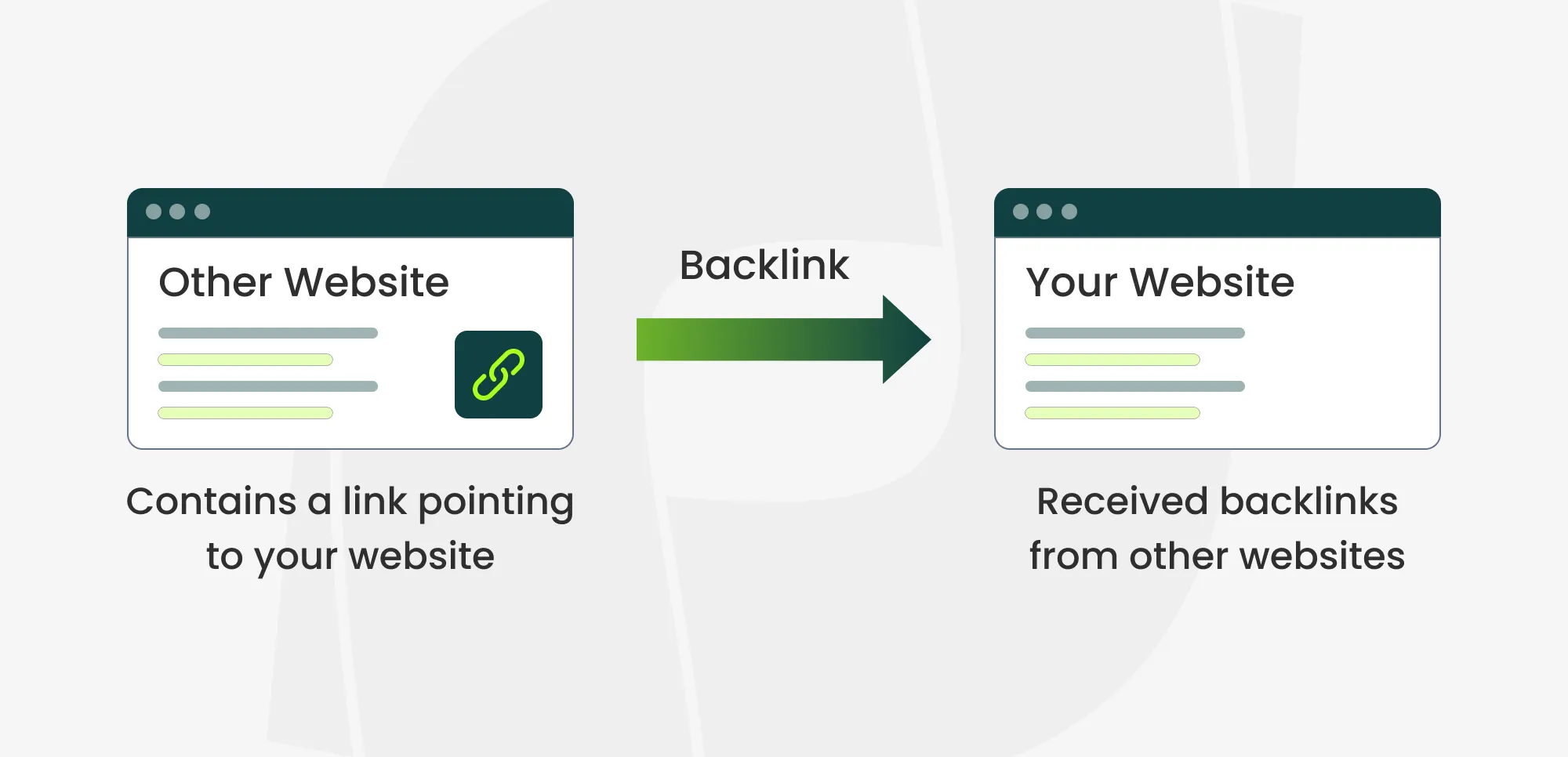
Search engines treat each backlink as a trust signal. The more quality links you earn, the more authority your site gets. A [Backlinko analysis of 11.8 million search results](https://backlinko.com/search-engine-ranking) found that the top result on Google has 3.8x more backlinks than the pages ranking in two through ten.
In the AI-driven era, backlinks have taken on a secondary role, signaling credibility to language models and helping determine which source to cite.
## How Backlinks Actually Work
The web works as a network of recommendations. Think of it this way, site A says, “This page has something worth referencing.” Search engine crawlers follow these links to discover new pages, understand the relationship between sites, and distribute authority across the web.
**Here’s what works behind the scenes when your page earns a backlink:
**
- A crawler discovers the link on the referring page.
- It follows the link to your page and indexes the connection.
- The search engine evaluates the referring site’s authority, relevance, and trust.
- A portion of that site’s authority flows to your page through the link, passing a value that helps to strengthen your page’s ability to rank in search results.
Every link doesn’t carry the same weight. A link from a respected industry publication can move your rankings better than dozens of links from unknown blogs.
Google’s John Mueller made a point directly that said one strong link from a major site’s homepage can be more valuable than hundreds of weaker ones.
That’s the reason why the conversation around backlinks shifted from “get as many as possible” to “earn the right ones.”
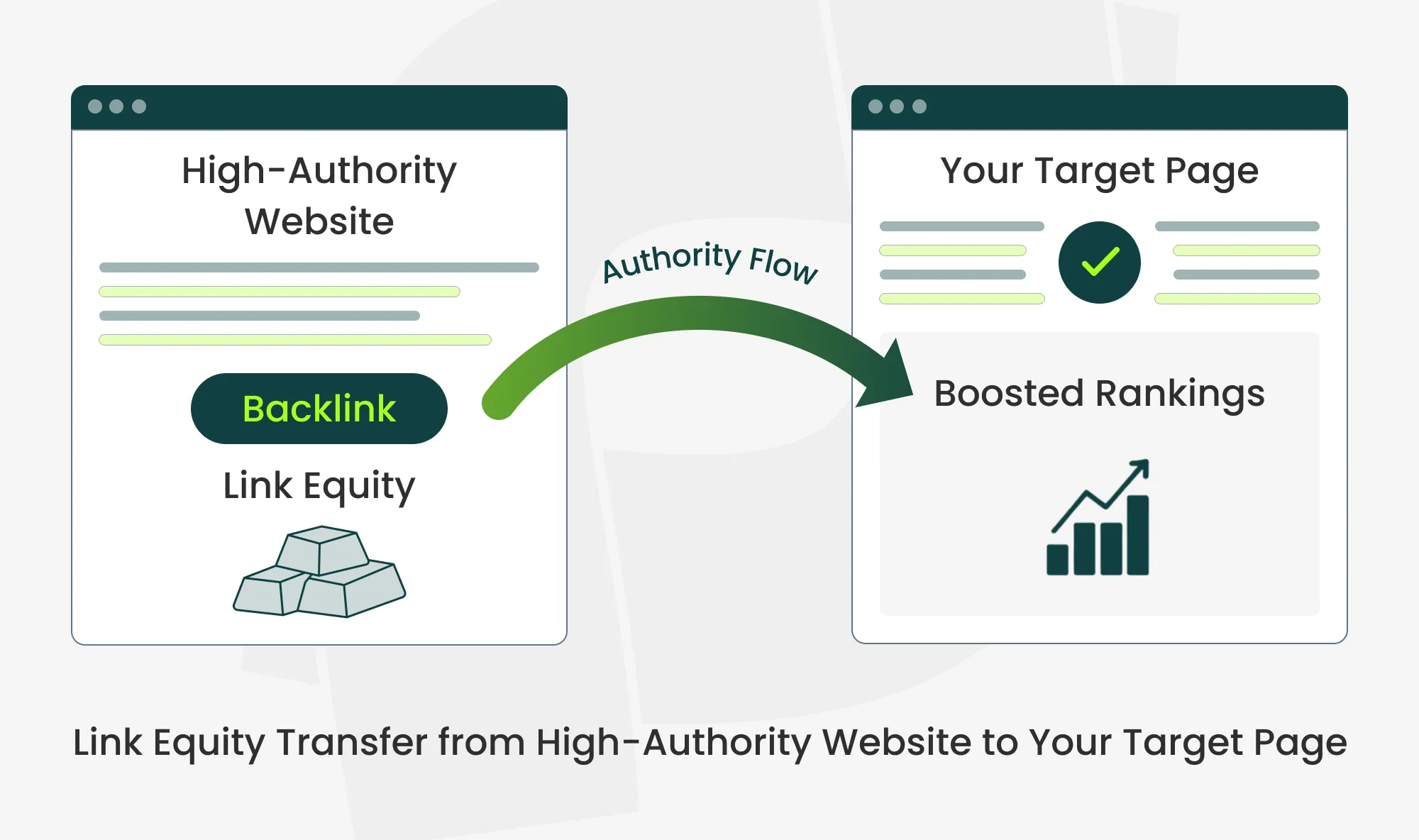
## Why do Backlinks Matter for SEO?
Backlinks are important because search engines use them to evaluate trust and authority. Pages with strong backlink profiles consistently outperform pages without them in organic [search results](https://outreachdesk.com/what-are-serps/).
**Here are three core reasons your site needs quality backlinks:
**
### They Improve Your Rankings
The relationship between backlinks and Google rankings has been well-documented. An [Ahrefs study of over a billion pages](https://ahrefs.com/blog/search-traffic-study/) shows that 66.31% of all web pages have zero referring domains, and most of those pages receive no organic traffic.
Pages that earn links from unique websites consistently can rank higher.
### They Drive Referral Traffic
When another site links to yours, it doesn’t just help your Google rankings, but it can also send people to your site. Imagine this: someone is reading an article they trust, and that article mentions your site with a link.
As visitors already know a little about you, they’re more likely to buy, sign up, or take action than someone who visits randomly.
### They Accelerate Indexing
Google doesn’t manually browse the intent; it uses automated bots called crawlers that follow links from page to page to discover content. So if other websites are linking to yours, Google’s bots are more likely to find your pages faster. If no one links to you, you’re invisible until Google finds you on its own, which can even take weeks.
For new websites, this matters a lot because even a few good links from established sites can get you results better than waiting around.
## Backlinks and AI Search: What Changed in 2026
AI search tools like Google AI Overviews, ChatGPT, Perplexity, and Gemini don’t just show a list of links. They generate answers and cite sources.
Whether your content is cited as a source depends on how trustworthy it appears online. Backlinks play a major role in this, along with factors such as relevance, topical understanding, and brand signals.
A [Semrush study of 1,000 domains](https://www.semrush.com/blog/backlinks-ai-search-study/) says that domains with higher backlink authority earn more mentions in these AI-generated answers.
Visibility gains only kick in once you cross a minimum authority point; small links don’t move a needle. You need to create a strong foundation first.
[Brand mentions](https://outreachdesk.com/brand-mentions/) are equally important. An [Ahrefs study of 75,000 brands](https://ahrefs.com/blog/ai-overview-brand-correlation/) found that branded web mentions were far more predictable for AI Overview visibility than backlinks alone.
Therefore, links still matter; however, they work best along with the brand recognition, and that combination is what AI systems reward.
Relevance beats volume. Links from relevant sites increase the chances of AI citation gains, whereas high volumes of links from unrelated sites can’t.
It’s never about how many links you’ve; it’s always about where they come from.
💡
**Pro Tip:
**
AI platforms don’t just search for your page; they break one question into sub-questions and pull answers from different sections independently. Therefore, each section needs to clarify one idea and clearly answer it, not just contribute to a page that ranks well.
## Types of Backlinks You Should Know
Links aren’t created equally. Understanding the [various types of backlinks](https://outreachdesk.com/types-of-backlinks/) helps you evaluate which ones you should prioritize and which to ignore.
| Attributes | What it Does | SEO Impact |
| --- | --- | --- |
| Dofollow | These links pass link equity to the targeted pages. | The impact is strong; this is the standard and most valuable link type. |
| Nofollow (rel=”nofollow”) | It tells search engines not to count this as an endorsement. | The impact is modern; Google treats nofollow as a “hint” since 2019. |
| Sponsored (rel= ”sponsored”) | It marks paid or sponsored placements. | It has low direct SEO value, but can drive traffic and brand awareness. |
| UGC (Rel= ”ugc”) | It helps tag user-generated content, such as comments and forum posts. | It has minimal SEO value, useful for community engagement. |
Beyond these categories, the context of the link matters more than most people realize.
**Editorial links** are placed naturally in an article because the writer found your content worth referring to, and it carries more weight. Suppose a journalist links to your research within a relevant paragraph, which sends a stronger signal than a link buried in a sidebar or footer.
**Guest post links** are considered gray area links. When you contribute genuine expertise to a reputable publication and earn a link, it’s valuable. When the guest post exists purely to plant a link on low-quality sites, search engines catch that fast.
**Directory and profile links** are the links that may not move your rankings in competitive markets, but still have a place for local businesses and brand consistency; they’re considered baseline rather than a strategy.
## What Makes a Backlink High Quality?
Here are five factors that separate a backlink that builds real authority from one that does nothing or worse, triggers spam.
### Relevance
A link from a site in your industry carries more weight than one from an irrelevant domain, even if that irrelevant site has a higher authority score.
Suppose a productivity blog linking to your project management software is more valuable than a food recipe site linking to you. Google evaluates how well aligned the linking site is with your content, not just its authority.
### Authority of the Referring Domain
Links from well-known and trusted publications carry more weight, such as major media outlets, university research papers, and respected industry platforms.
A [Semrush study on AI visibility](https://www.semrush.com/blog/backlinks-ai-search-study/) confirms that the domains with strong backlinks earned measurably more AI-generated citations than weaker ones.
### Placement on the Page
Links placed naturally within the main body content tend to get more weight than those in footers, sidebars, and author bios.
This is why [contextual links](https://outreachdesk.com/contextual-link-building/) earned with relevance, aligned with the subject being discussed, are considered the most valuable types of backlinks.
### Anchor Text
The clickable text of a link tells search engines what the linked page is about. This text should vary naturally; there should be a mix of brand names, partial keywords, and generic phrases like “learn more.”
Using the same keyword over and over makes the anchor text appear frequently across many links, which looks manipulative and can trigger penalties.
### Unique Referring Domain
Ten links from ten different websites can do more for your authority than fifty links from the same site. Each referring domain represents a unique endorsement.
The study by Backlinko referred earlier found that the number of unique domains correlated more strongly with the rankings than the raw backlink count.
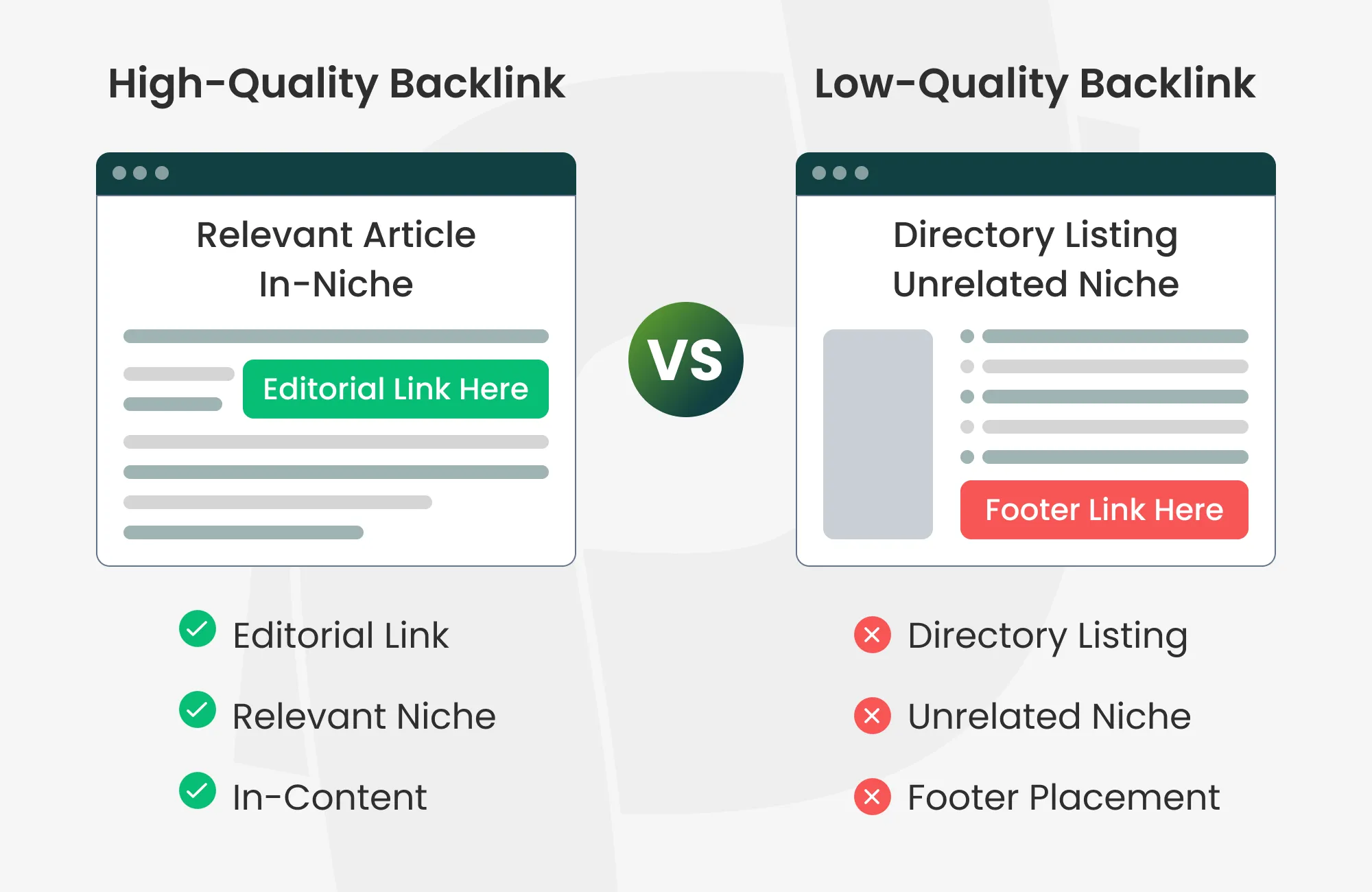
## How to Check Your Backlink Profile
You can’t improve what you don’t measure. Here’s a process for auditing your backlinks. You can use [link building tools](https://outreachdesk.com/link-building-tools/) like Ahrefs, SEMrush, or Moz and enter your domain. Look at these four things:
### Total Referring Domains
Check the total number of referring domains, not the total number of backlinks. It’s simple, one site linking to you 50 times is counted as one referring domain.
The number of referring domains shows you how broad your backlink profile is.
### Authority Distribution
What share of your links comes from quality sites versus low-authority sites? A health profile mostly has mid-authority links, with fewer top-tier editorial placements.
### Anchor Text Breakdown
If more than 10-15% of your anchors use the same keyword phrase, that’s a red flag. The natural link profile shows a wide variety of anchor text.
They use a mix of branded, generic, and natural anchors.
### Toxic or Spammy Links
Links from [link farms](https://outreachdesk.com/link-farming/), irrelevant foreign directories, or sites with no real content can hurt you. Most SEO tools identify potentially harmful links.
If you find them, you can use Google’s [disavow tool](https://search.google.com/search-console/disavow-links) as a resort, but focus on earning better links rather than obsessing over bad ones.
## How to Earn Backlinks That Actually Help
Knowing what makes a good backlink is one thing; earning them is another. Here are [the 12 strategies in our deep dive](https://outreachdesk.com/link-building-strategies/) that work in 2026, ranked by the quality links they usually produce.
### Create Content Worth Referencing
This might sound so obvious, but most skip it. Create content with original research, proprietary data, and well-designed tools. It attracts links without outreach because editors and publishers need something to cite. One data-backed study can generate more backlinks than 20 generic blog posts together can.
You can add something that no one has, such as survey results, industry benchmarks, calculators, templates, or original analysis. These are called “linkable assets”, the pages that gain links over months and years.
### Earn Editorial Mentions Through Outreach
Identify journalists, bloggers, and editors who cover your industry. Build genuine relationships before you ask something. When you publish new research or have a relevant perspective on a trending topic, [reach out](https://outreachdesk.com/link-building-outreach/) with a clear, precise pitch that explains why their audience would benefit.
The major thing is relevance. Bulk emailing hundreds of irrelevant sites with a template pitch doesn’t work. A targeted outreach to 20 well-matched publications will outperform a generic bulk email to 500 every time.
### Fix Broken Links on Relevant Sites
Find pages in your niche that link to resources that no longer exist (404 errors). Create or evaluate your own content that covers the same topic. Reach out to the site owner with a polite message about the broken link and suggest your page as an alternative.
This approach works because you’re solving a problem for the site owner, not just asking for a link. The success rate for [broken link building](https://outreachdesk.com/broken-link-building/) usually ranges from 5% to 15%; however, the links you earn tend to be relevant and editorial.
### Contribute Expert Commentary
Platforms like [HARO](https://www.helpareporter.com/), [Quoted](https://www.qwoted.com/), and [Help a B2B Writer](https://helpab2bwriter.com/support) connect journalists with expert sources. Respond to the queries in your area of expertise with clear, specific, and quotable answers. When your response is published, it usually includes a backlink to your site.
This method works best when you provide a genuine, useful insight rather than a generic response because journalists can spot fillers.
## Common Backlink Mistakes to Avoid
Here are some common mistakes people make when building backlinks.
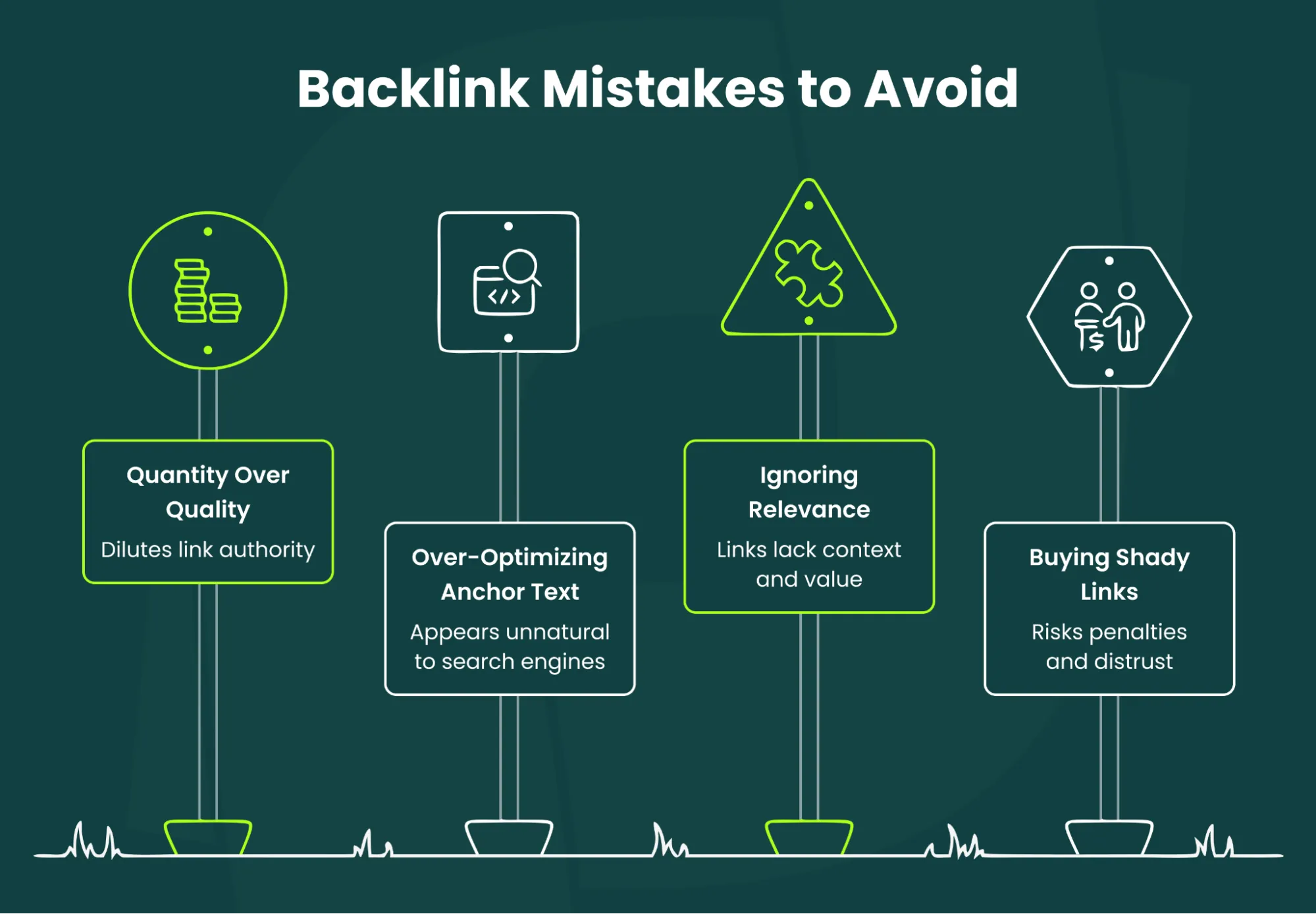
### Chasing Quantity Over Quality
Getting 50 links from random, irrelevant sites won’t help, but 5 links from respected industry publications that are relevant definitely will.
Google’s algorithm is smart enough to weigh link quality, and AI systems are even more selective about which sources they trust.
### Over-optimizing Anchor Text
If every backlink pointing to your pages uses the same keyword phrase as anchor text, search engines see it as manipulation.
A natural backlink profile uses a mix of anchors, such as branded names, partial-match keywords, and generic phrases like “read more” or “this resource”.
### Ignoring Relevance
A DR 80 link from a site that has no relevance to your industry sends a weaker signal than a DR 40 link from a relevant and niche-published site.
Context matters more than mere volume.
### Buying Links From Shady Sources
Google’s [link spam policies](https://developers.google.com/search/docs/essentials/spam-policies) target paid link schemes. The risk isn’t theoretical; manual penalties can hurt your traffic overnight.
Invest in earning links through content and relationships instead.
## Moving Forward: Build Links That Compound
Backlinks aren’t just a one-time project.
Sites that grow consistently treat link building as an investment, publishing content that earns natural links, nurturing relationships with editors and journalists, and targeting gaps where competitors have already built authority.
The most effective approach is to create something that’s genuinely useful, then get in front of the right people.
Over time, your backlink profile becomes a competitive advantage that’s hard to make.
### Want to understand how backlinks can actually grow your rankings?
Get a clear, simple strategy to start building high-quality links that drive real traffic.
[Book a strategy call](/contact-us/)
### How many backlinks do I need to rank on Google?
There are no fixed numbers; it depends on your industry’s competitiveness, the domain’s authority, and the quality of your existing content. In low-competition niches, even some strong editorial links can push you to page one.
For competitive terms like “project management software” or “best CRM”, you might need hundreds of referring domains from authoritative sites.
### Are nofollow backlinks worthless?
No, since 2019, Google has treated nofollow attributes as a hint. It means nofollow links can still influence rankings in some cases. They can also drive referral traffic and brand visibility. A nofollow link from a major publication like Forbes or The New York Times still puts your brand in front of a large, relevant audience.
### Do backlinks still matter in 2026?
Yes, backlinks remain a core ranking signal in Google’s algorithm, and they can now influence AI search visibility as well. What changes the emphasis is that quality, relevance, and editorial context matter far more than raw link count.
### What’s the difference between a backlink and an internal link?
A backlink is a link from an external website to your site. An internal link connects two pages on the same site. Both matters are equally important for SEO, but they serve different purposes. Backlinks build external authority and trust, whereas internal links help search engines understand your site structure and distribute authority across your own pages.
### Can bad backlinks hurt my site?
Yes, they can; links from spam sites, link farms, or completely irrelevant domains can trigger algorithmic or manual penalties. If you notice a sudden gain of suspicious links, say, hundreds of links from a gambling site or pharmaceutical sites you’ve no connection to, use Google Search Console to monitor the situation. In extreme cases, Google’s disvowl tool exists for this purpose.
### How long does it take for backlinks to affect rankings?
It usually takes between a few weeks and several months. Google needs to follow and index the linking page, evaluate the link’s context, and recalculate the page’s authority. High-authority links from the frequently crawled sites tend to make a greater impact. Low-authority links from rarely updated pages may take months to register.
---
---
title: "Link Building Outreach That Earns Real Replies in 2026"
url: "https://outreachdesk.com/link-building-outreach/"
lang: "en-US"
type: "post"
description: "Link building outreach is how you earn backlinks by reaching out to other websites and explaining why your content deserves a link. Most pitches fail not because the content is weak, but because the email looks identical to every other"
last_modified: "2026-05-18T11:52:30+00:00"
categories: [Link Building]
---
# Link Building Outreach That Earns Real Replies in 2026
**Link building outreach is how you earn backlinks by reaching out to other websites and explaining why your content deserves a link.** Most pitches fail not because the content is weak, but because the email looks identical to every other pitch in the editor’s inbox. Brands serious about scaling often hand this off to an [experienced link building team](https://outreachdesk.com/) for predictable results.
Most pitches fail, not because the content is weak, but because the email looks exactly like every other email in the editor’s inbox.
You don’t need to rely on volume. Better emails tend to perform better. The sites that consistently earn links follow a consistent process. They research well, personalize genuinely, and follow up without being annoying.
**Key Takeaways
**
- Most outreach fails because relevance and value are missing, not effort
- Small, targeted outreach lists consistently outperform high-volume campaigns
- Personalized emails with clear value get more replies and placements
- Follow-ups drive a large share of total responses when done right
- Strong content and clear value exchange decide whether you earn the link
## What is Link Building Outreach
Link building outreach is the process of contacting website owners, bloggers, editors, and content creators to earn [high-quality backlinks](https://outreachdesk.com/what-are-backlinks/) to your site.
These valuable backlinks help strengthen your site’s authority and visibility in [search results](https://outreachdesk.com/what-are-serps/), through personalized email campaigns.
You proactively reach out to them and provide a reason for them to add your content to their site or page. Outreach can lead to editorial links, guest posts, or resource placements depending on your angle.
In practice, this means you send a personalized email that explains who you are, what value your content will provide to their readers, and how linking to you will benefit them.
## Why Most Link Building Outreach Fails
Most link building outreach emails get ignored or get low response.
Most cold email sequences achieve reply rates around 3.43% according to [Instantly’s reports](https://instantly.ai/cold-email-benchmark-report-2026). Link building outreach works differently. You need a smarter, more personal approach to get results.
You’re not selling anything. You’re showing up with something worth linking to. But most campaigns still fall flat, and the reasons are pretty predictable.
_
### The Pitch is About You, Not Them
When your email template is all about what you want instead of what they gain from your content, editors are more likely to ignore your email. This happens because they receive dozens of these templates in their inbox regularly, and they can spot self-serving requests in seconds.
### The Targeting is Too Broad
Mass emails to random websites consistently underperform compared with outreach focused on a small, relevant group of sites.
[Hunter.io’s report](https://hunter.io/the-state-of-cold-email) found that campaigns with 21-50 recipients achieved a 6.2% reply rate, compared to just 2.4% for campaigns exceeding 500+ recipients. Relevance will become harder to maintain when you scale beyond what you can genuinely personalize.
### There’s no Value Exchange
Both sides need to win for outreach to work. So before you write anything, find the gap in their article, the data they haven’t cited, the resource their readers are missing. Make that the center of your pitch. Once you can clearly say what they gain, you’re ready to send.
## How to Build a Prospect List That’s Worth Emailing
Your outreach process decides whether your [link building campaign](https://outreachdesk.com/link-building-campaigns/) earns placements or gets ignored. Get the workflow right, and everything else follows.
### 1. Start with Relevance, Not Metrics
It’s tempting to sort your link targets by site authority and start from the top. But relevance matters more than raw numbers. A link from a niche-relevant blog with moderate traffic often does more for your rankings than one from a high-authority site that has nothing to do with your topic.
Start with sites that already cover your subject and link to similar content. Three ways to find them:
- **Analyzing competitor link profiles:
**
Look at who links to your competitors’ best-performing pages. Those sites have already shown they’re willing to link to content like yours.
- **Searching for resource pages:
**
Use search operators like “your topic” + “resources” or “useful links” + “your industry” to find [resource pages](https://outreachdesk.com/resource-page-link-building/) that actively curate links on your subject.
- **Checking who cites the data you cite:
**
If you reference a specific study, find other articles that cite it as well. Those authors are already interested in the topic and may find your content worth linking to.
### 2. Find the Right Person, Not Just the Right Site
Emailing a generic info@ or contact@ address** **is one of the most common outreach mistakes. You want the person who wrote the article, manages the content, or makes editorial decisions.
Check the author byline. Look for a bio page. Search LinkedIn for their name and the publication. Many writers also list their email on their personal site or in their social bio.
Reaching the actual author of a relevant article consistently beats a general inbox. The author already has context. They understand why your content fits. A general inbox creates a handoff problem, and most people won’t bother forwarding.
### 3. Qualify Before You Pitch
Not every relevant site deserves a spot on your list. Before you write a single email, check for a few signals that tell you the site is actually worth your time.
- **Is the site actively publishing?
**
If they are not regularly updating their site with the latest data, or if their last uploaded post was 6 months ago, there is a good chance your email will remain unread for quite some time.
- **Do they link out to external content?
**
Scan a few recent articles from the prospect site to check whether they reference or link to other sources, as some might have a strict policy against outbound links.
- **Is the traffic real?
**
Verify real organic traffic before adding to your send list. Check the site’s organic traffic using the [Ahrefs Website Traffic Checker](https://ahrefs.com/traffic-checker), a free tool, to filter out sites that primarily exist to sell links rather than provide value to readers.
## Crafting Outreach Emails That Actually Get Opened
Your email gets a few seconds to earn the attention of the recipient. If your subject line doesn’t earn you an “email open” or if the first sentence in your email does not earn you a read, nothing else matters.
### Subject Lines
Write short, specific subject lines that are free of anything that signals a mass email. Clear, tailored subject lines tend to perform better because they feel relevant and personal instead of generic or automated.
**What works:
**
- Specific and low-commitment lines such as _“Quick idea for your [article topic] post.”
_
- Subject lines that are instantly useful, such as _“Found a broken link on [their site name].”
_
- Lines that appeal to their editorial interest, like _“New data on [topic they’ve covered].”
_
**What doesn’t:
**
- Lines like _“Link exchange opportunity”_ scream spam.
- Too vague lines like _“Collaboration request.”
_
- Unbelievable lines like _“I love your content” _that nobody easily believes when it comes from a stranger.
### The Email Body
Structure your email keeping these three things in mind: **Context, Value, and Ask.
**
**Context
**
Show them that you know who they are and what they have written. Mention a specific article or data point. This doesn’t need any elaboration. Just one sentence is enough to prove that you’ve read their content.
**Value
**
Share exactly what you have to offer to their audience and why it matters. Ask yourself:
- Are you pointing to a resource that fills the gap in their article?
- Are you sharing data they haven’t seen?
- Are you offering a guest contribution on a topic they have not covered?
If you have a valuable answer or content, only then share.
**Ask
**
Make your request simple and low-friction. Do not ask them to read your whole article and decide where to link. Suggest a specific spot where your resource fits and explain why it fits.
**This structure works consistently:**
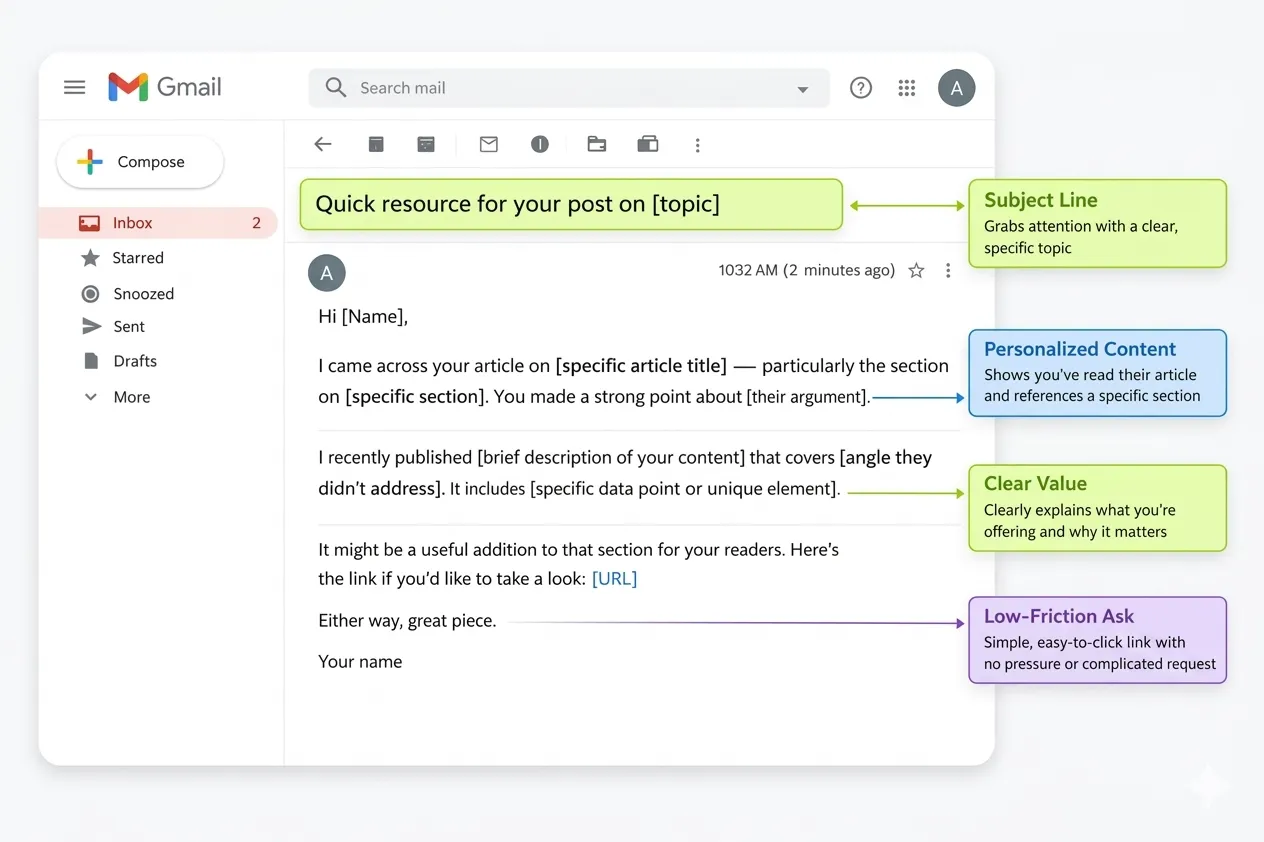
This email template works because it is short, specific, and provides a clear reason for them to consider your content. No begging. No fake flattery. No walls of text.
**Here is an outreach template you can adapt:
**
**Subject:** **Quick resource for your post on [topic]
**
Hi [Name],
I came across your article on [specific article title] — particularly the section on [specific section]. You made a strong point about [their argument].
I recently published [brief description of your content] that covers [angle they didn’t address]. It includes [specific data point or unique element].
It might be a useful addition to that section for your readers. Here’s the link if you’d like to take a look: [URL]
Either way, great piece.
[Your name]
### Personalization at Scale
Personalization is no longer optional. [Infraforge data](https://martal.ca/b2b-cold-email-statistics-lb/) shows that campaigns with real personalization achieve reply rates of up to 18%. Generic emails average around 9%. Same list, same number of sends, double the responses.
But “personalization” doesn’t mean writing every email from scratch. It means adding personal elements to your email, such as:
- The article you’re referencing.
- The specific gap you’re filling.
- The reason this person should actually care.
These parts need to be real, even if the surrounding structure follows a template.
The emails that feel templated? They’re the ones where personalization is a thin layer on top.
_“Hi [First Name], I love your blog!”_
This is worse than no personalization at all. It signals the recipient that you didn’t actually read their site. You just found their name and sent an email.
## Follow-up Strategy: Where Most Links Are Actually Won
Most people send one email and wait. But they are not aware that most of the responses do not come from the first email. The [Instantly 2026 Benchmark Report](https://instantly.ai/cold-email-benchmark-report-2026) adds more detail. 58% of replies come after the first email, but the remaining follow-ups generate another 42% of total responses.
This means that every time you stop at one email, you are walking away from nearly half of your potential responses.
So send a follow-up email without being annoying:
### Wait 3-5 Business Days
After sending the first email, wait for at least 3-5 business days. Send follow-up on the 4th or 5th day. Give them some time to check your email on their own schedule.
### Add New Value
Say something new in your 1st follow-up email, instead of just saying “bumping this up”. Share a new perspective, a recent update to your content, or just add one more genuine reason on how your content would benefit their readers.
### Stay in the Thread (or Pivot)
Send follow-ups in the same thread to keep the context. However, if they didn’t open your first two emails, start a new thread with a Pivot Subject Line like “New data for [Topic]” to test if a different angle grabs their attention.
### Keep it Shorter Than the Original
Send a 2nd follow-up message on the 10th or 12th day. Make sure your follow-up message is shorter in length than the previous email you sent. It should be 2-3 sentences long.
They already have context from your two emails. You’re just bringing that email back to the top of their inbox.
### Stop After 2-3 Attempts
If the recipient did not respond to your 2nd or 3rd follow-up email, then take that as a sign that they are not interested right now.
So instead of annoying them consistently with more follow-ups, just move on.
**You can use this Follow-Up Email Template:**
**Subject: Re: [Original Subject] (** or use your_ **Pivot subject** _if starting a new thread_ **)**
Hi [Name],
Just circling back on my note from last week about [specific resource]. Since then, I’ve updated it with [new data point or section], which might make it even more relevant for your [article section].
Happy to answer any questions if you’d like to take a look.
[Your name]
**Note:**
Response rates vary based on targeting, personalization, and relevance. Follow-ups improve results only when the initial outreach is well matched to the recipient.
## Tools That Make Outreach More Efficient
You just need a few right [link building tools](https://outreachdesk.com/link-building-tools/) that handle the parts of your manual outreach work.
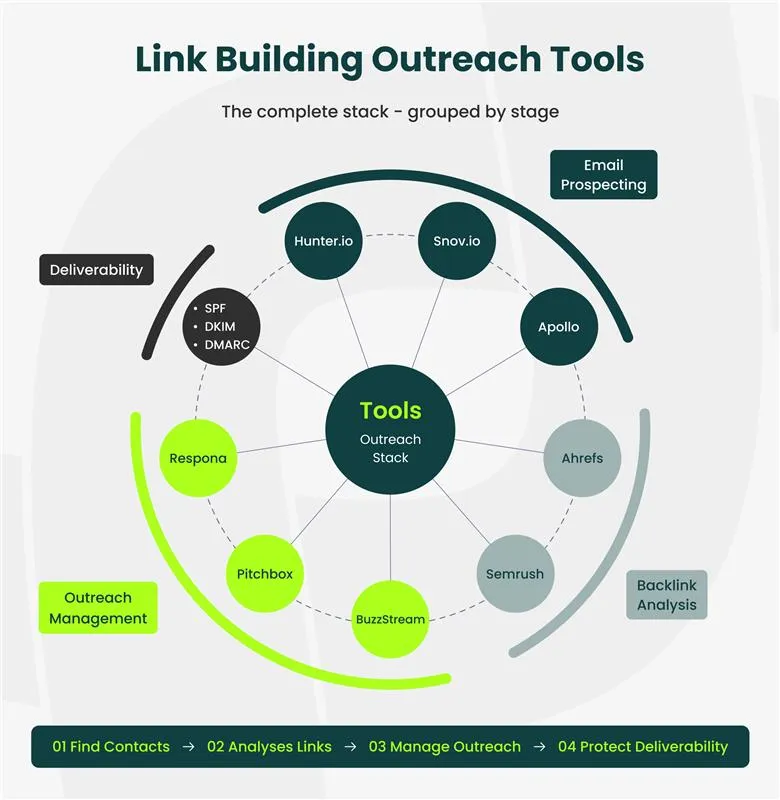
### Prospecting and Contact Finding
[Hunter.io](http://Hunter.io), [Snov.io](http://Snov.io), and [Apollo](https://www.apollo.io/) are the go-to options for finding email addresses at scale.
Hunter.io and Snov.io offer limited free credits. Whereas Apollo’s monthly billing free plan offers limited credits per user per month. These free credits are enough to run smaller campaigns before you hit the limit and need a paid plan.
### Backlink Analysis
Free tools like [Ahrefs backlink checker](https://ahrefs.com/backlink-checker) and [Semrush’s backlink checker](https://www.semrush.com/analytics/backlinks/) are where your prospect lists of competitors come from.
These tools let you reverse-engineer competitor link profiles, find [broken links](https://outreachdesk.com/broken-link-building/), and spot unlinked [brand mentions](https://outreachdesk.com/brand-mentions/). Start with these tools before you touch any other outreach tool.
### Outreach Management
[BuzzStream](https://www.buzzstream.com/), [Pitchbox](https://pitchbox.com/), and [Respona](https://respona.com/) handle the organizational side. You can manage contacts, send personalized emails, and track responses.
If you’re sending more than 20 outreach emails a week, managing all of them manually in a spreadsheet is a bit time-consuming, and there is always a chance of something falling through the cracks.
### Email Deliverability
This one gets skipped. It’s also the reason many well-written emails land in spam instead of in inboxes. Before anything else, make sure your emails actually arrive in their inbox.
Set up SPF, DKIM, and DMARC authentication for your domain before your first send. Start by sending a small number of emails and then increase that number gradually, not all at once.
**Insight **
SPF, DKIM, and DMARC are email authentication protocols that tell receiving servers your emails are coming from a legitimate domain, not a spammer.
[Hunter.io’s](https://hunter.io/the-state-of-cold-email) 2026 report found that sending from a custom domain drives 108% higher reply rates than free email addresses. That gap is too large to ignore.
## How to Measure Outreach Performance
Track these numbers to check whether your outreach is working and where to improve:
### Response Rate
If your email response rate is below 5%, something’s off. This means you need to check where the problem lies. Whether that’s your
- Targeting,
- Your personalization, or
- Your deliverability
A response rate above 10% on your emails indicates your relevance and messaging are strong.
### Link Placement Rate
Of all the people who reply positively, how many actually place the link? Keep a track of that.
A high response rate with low placements usually points to one of two things: weak follow-through or content that isn’t compelling enough once they look at it.
### Links Per Campaign
How many placements did you earn relative to the number of emails sent? This is your real efficiency metric.
A well-targeted list of 40 to 60 prospects produces 5 to 10 placed links. That’s a 10-20% conversion rate. It’s a useful benchmark when you’re setting expectations.
### Time to Placement
Track how long it takes from sending your first email to getting your link live. Most editorial links take 2 to 6 weeks from first contact to placement. Knowing this keeps your project timelines realistic and stops you from following up too early or too late.
### Link Quality
Track the relevance and authority of the sites linking to you, not just the count. 5 links from niche-relevant, actively trafficked sites will do more for your rankings than 50 links from generic directories. Understanding [link equity](https://outreachdesk.com/link-equity/) helps you prioritize which placements matter most.
**Check this out for a quick scan:
**
| Metric | Measurements |
| --- | --- |
| Response Rate | |
| Link Placement Rate | |
| Links per Campaign | |
| Time to Placement | 2–6 weeks (typical) |
| Link Quality | Relevance > Volume |
## Common Outreach Mistakes to Avoid
If your outreach is not getting replies, these are the common gaps to look at first:
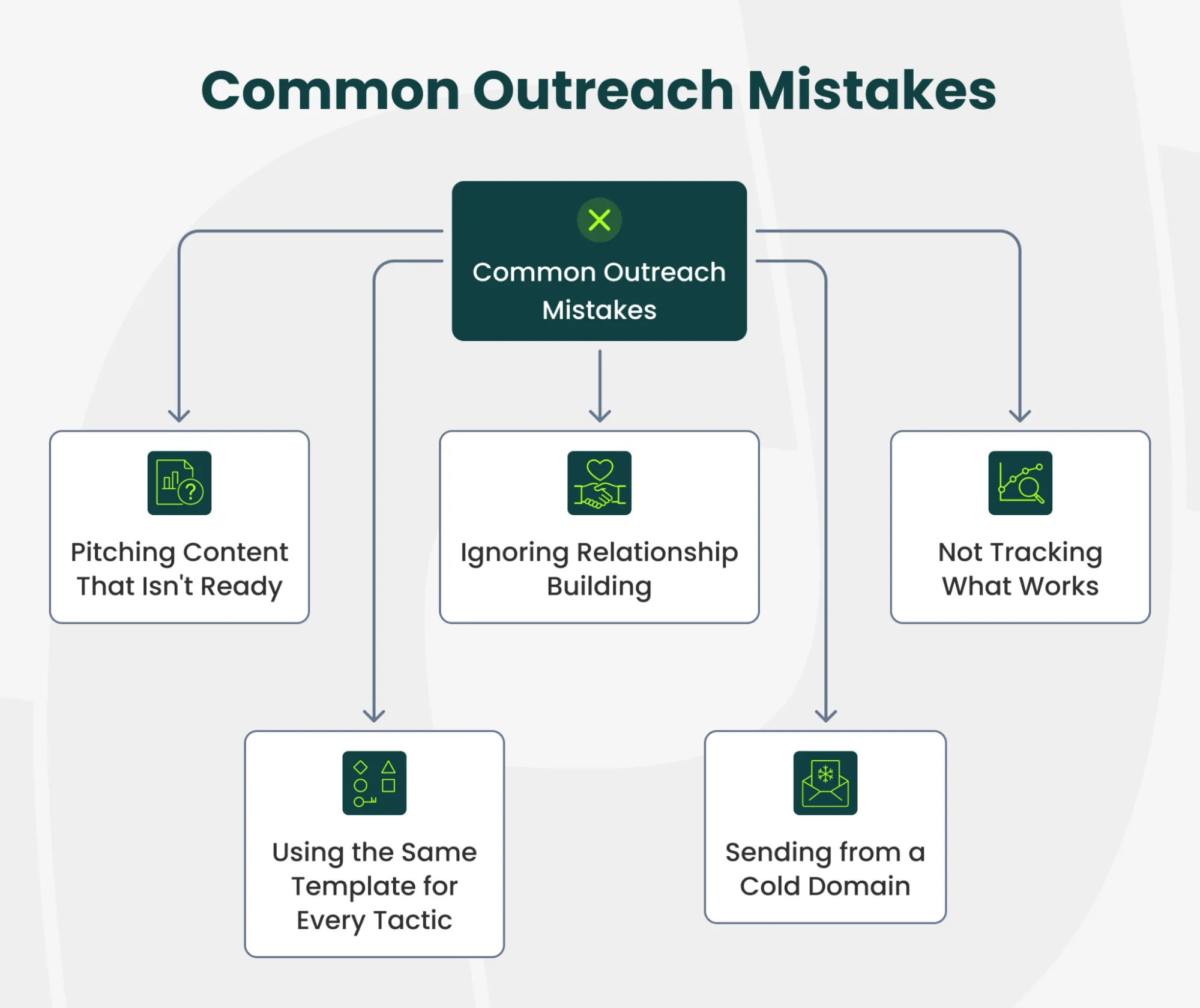
### Pitching Content That Isn’t Ready
Do not pitch the content to anyone until it’s fully ready. Imagine sharing half-finished content to the editor via email, asking for a backlink. He clicks your link and lands on a thin, half-finished page.
Do you think they would link to it? They won’t. And that editor won’t open your emails again. Your linkable asset needs to be fully built and genuinely strong before the first outreach email goes out, not after.
### Using the Same Template for Every Tactic
Do not use the same outreach email template for different [link building strategies](https://outreachdesk.com/link-building-strategies/).
A broken link outreach email and a guest post pitch are completely different strategies with different value propositions and require different email templates.
If your templates look the same, your reply rates will reflect that.
### Ignoring Relationship Building
The strongest link builders don’t treat outreach as a cold transaction. They engage with prospects on social media before sending an email.
They share the prospect’s content. They show up as a familiar name before they ask. This doesn’t have to take weeks. A few LinkedIn interactions before your first email can noticeably shift how it lands.
### Sending From a Cold Domain
If you start sending 50 emails a day from a new email address, you’ll likely land in spam. Start by sending fewer emails initially and then gradually increase the number of emails a day, over 2-3 weeks. Ignoring this step can hurt your results.
### Not Tracking What Works
If you don’t know which subject lines, which email structures, and which prospect types drive placements, you’re repeating the same experiment in every campaign. Log everything. Test one variable at a time. Double down on what works and cut what doesn’t.
## How to Scale Outreach Without Losing Quality
Most teams get it wrong when it comes to scaling outreach. They adopt the Volume-First approach instead of the Relevance-First approach.
The solution here is building repeatable systems that maintain personalization as you grow.**
**
### Create Prospect Segments
Group targets by outreach strategy (guest post, broken link, resource page) and topic cluster. Broken-link building prospects receive a different email from resource-page prospects. Each segment has its own template, its own personalization points, its own angle. Don’t adopt a one-size-fits-all approach.
### Batch Your Research
Dedicate specific blocks to finding and qualifying prospects. Doing both in the same session leads to shallow work on both.
Then dedicate separate blocks to writing and sending. Context switching between research mode and outreach mode costs you more time than it saves.
### Build Templates With Flexible Sections
Build email templates with a consistent email structure: context, value, ask. But the specific details inside each section should change for every recipient.
That’s the balance. A framework that saves time on structure while leaving room for real personalization is what will save you time.
### Set Weekly Volume Caps
30 to 50 well-researched emails per week will consistently outperform 200 poorly targeted ones. Don’t sprint through your prospect list in week one and leave nothing good for week three.
And honestly, if you’re running campaigns at scale, it’s worth asking whether [outsourcing link building](https://outreachdesk.com/outsource-link-building/) to a team with established relationships and proven systems is a better use of resources than building the whole operation in-house.
## Long-Tail Link Building Outreach: Methods That Work for Niche Targets
Long-tail link building — earning links for low-volume, highly specific keyword targets — needs a different outreach playbook than broad-keyword campaigns. The competitive landscape is smaller, the prospect pool is narrower, and the publishers you target care more about topical fit than authority metrics.
### Why long-tail outreach plays by different rules
Two practical differences:
- **Smaller, more relevance-sensitive prospect pool.** A campaign targeting “B2B SaaS link building” might have a few hundred high-quality prospects globally. A long-tail campaign for “PostgreSQL replication for ecommerce” might have 30. Each prospect’s quality matters more, and pitching the wrong site burns a meaningful percentage of the available pool.
- **Audience size matters less than audience match.** A 200-monthly-visitor blog where every reader is your target customer often delivers better referral traffic than a 50,000-visitor general business blog.
### Methods that work for long-tail outreach
- **Targeted vertical publications.** Small trade journals, industry newsletters, and niche community blogs publish exactly the kind of content long-tail keywords describe. Many accept guest contributions but don’t promote it broadly — finding them takes manual research, not a big-list approach.
- **Forum and community contributors.** Reddit moderators, Stack Exchange answer authors, and niche Discord/Slack community managers often run their own blogs in the same niche. They have small audiences but extremely high relevance, and they’re more likely to reply because they’re not flooded with pitches.
- **Conference speakers and podcast guests.** People who present at niche industry events have personal blogs that align tightly with long-tail keyword space. Their content is usually deeply specialized, and they often welcome contributors who can extend their thinking.
- **Newsletter writers in your vertical.** Substack, Beehiiv, and ConvertKit hosts in specialized niches frequently link out to deep technical resources. A targeted pitch with original data or an unexpected angle gets read.
### How outreach to long-tail prospects differs
The pitch itself changes. With broad-keyword campaigns, generic personalization (mention the recipient’s most recent post) often passes. With long-tail outreach, the recipient is in a small enough niche that they recognize template language immediately. Your pitch needs to engage with their specific arguments, contradict or extend their published thinking, or surface a piece of data that fits a gap in their own work. That’s the threshold that earns replies in niches with 50 total publishers worldwide.
Response rates run higher in long-tail outreach (often 25-40% versus the 5-10% of broad campaigns) but absolute placement counts run lower. A successful long-tail campaign might land 4-8 placements over 6 weeks instead of 30+ on a broad campaign — but each long-tail link tends to drive better ranking lift because of the relevance density.
## What Does a Link Building Outreach Service Do?
**A link building outreach service handles the full process of identifying relevant publishers, crafting personalised pitches, and securing editorial placements on your behalf.** You provide the content or the brief. The service manages prospect research, email sequences, follow-up, and negotiation so your team doesn’t carry the execution load.
### What’s Included in a Managed Outreach Service
- **Prospect research** — finding sites with topical relevance, real traffic, and editorial standards that match your target domain
- **Personalised outreach emails** — pitch copy written for the specific editor, referencing their recent content to avoid generic templates
- **Follow-up sequences** — 2 to 3 automated follow-ups spaced 5 to 7 days apart, which is where most placements are actually confirmed
- **Placement reporting** — live URLs, DR scores, anchor text, and traffic estimates for every secured link
### When to Use a Link Building Outreach Service vs. Doing It In-House
Use a service when your team doesn’t have the capacity to prospect 50 to 100 publishers per month, write personalised pitch copy, or manage follow-up threads consistently.
Build in-house when you have a dedicated SEO who can spend 10 to 15 hours per week on outreach alone and your brand already has enough name recognition to get replies without heavy personalisation.
## Build Authority Through Outreach That Respects Both Sides
The links you build compound into the authority that drives long-term rankings. This compounding only works if each link comes from a site whose audience actually overlaps with yours. Start with your 30 most relevant prospects. Write 30 emails that prove you read their content. See what comes back. Then scale what works.
### Struggling to get replies from your outreach emails?
If you want an outreach strategy aligned with your growth goals, get a personalized plan that helps you earn high-quality backlinks.
[Let’s plan your link strategy.](/contact-us/)
### What is the difference between link building outreach and email marketing?
Link building outreach targets specific webmasters or editors with a relevant content pitch — the goal is a single editorial decision from one recipient. Email marketing broadcasts to a list with the goal of engagement or conversion. Outreach is manual, relationship-based, and succeeds on the quality of a single pitch.
Marketing is volume-based and measured on aggregate open or click rates. Treating outreach like email marketing — high volume, low personalization — is one of the most common reasons outreach campaigns produce zero links.
### How do I write a link building outreach email that gets a reply?
A link building outreach email that gets replies does four things: references something specific about the recipient’s site (proving you read it), makes a clear and relevant pitch in the first three sentences, keeps the total email under 120 words, and asks one simple question rather than making demands.
Subject lines that reference the recipient’s content by name consistently outperform generic subject lines. Follow up exactly once, 5–7 days later, with a one-sentence nudge — not a copy-paste of the original.
### What are effective outreach methods for long-tail link building?
Four methods consistently work for long-tail link building outreach: targeted vertical publications and trade newsletters, forum and community contributors who run niche blogs (Reddit moderators, Stack Exchange answerers, Discord/Slack managers), conference speakers and podcast guests in the niche, and Substack/Beehiiv/ConvertKit newsletter writers.
Long-tail outreach typically earns 25-40% response rates versus 5-10% on broad campaigns, but produces fewer absolute placements. The pitch must engage with the recipient’s specific arguments — generic personalization gets recognized as template language inside small niches.
### What is a good response rate for link building outreach?
A response rate between 5% and 15% is solid. A value above 15% indicates that your targeting and messaging are working well.
A score below 5% usually signals a problem with relevance, personalization, or deliverability. But response rate is only part of the picture.
Your link placement rate, the share of positive replies that turn into live links, is the number that actually tells you whether the campaign worked.
### How many outreach emails should I send per day?
For most teams, 20-40 personalized emails per day from a domain properly conditioned for outreach is the right volume. Hunter.io’s data shows that range achieves 27% higher reply rates than campaigns sending fewer or more. Start at 10 to 15 per day from a new domain and scale up gradually over 2-3 weeks. Quality matters more than speed here.
### Should I use an outreach tool or send emails manually?
Under 20 emails per week, manual sending through Gmail or Outlook works fine. Beyond that, a tool like BuzzStream, Pitchbox, or Respona keeps things organized and stops contacts from slipping through. The risk with tools is over-automation. If your emails read like they were generated by software, reply rates will drop regardless of the platform you’re using.
### How long should I wait before following up?
Before your first follow-up email, wait for 3-5 business days. For a second follow-up, wait for 5-7 days. Most professionals stop following up after the 2nd or 3rd follow up email. Instead of repeating your original pitch in every follow-up email, add something new. You can add a data update, a fresh perspective or a simpler ask too.
### Does link building outreach still work in 2026?
Yes. Inboxes are more crowded and spam filters are tighter, but outreach is still one of the most reliable ways to earn high-quality links. What’s changed is the approach. Smaller, more targeted lists with stronger personalization consistently outperform volume-based campaigns. The fundamentals still work. The shortcuts don’t.
### What’s the difference between link building outreach and SEO outreach?
Link building outreach is a type of SEO outreach specifically focused on earning valuable backlinks to your site. Whereas SEO outreach is a broader category which includes any communication aimed at improving your search visibility, from link requests to content collaborations to digital PR pitches.
---
---
title: "Guest Posts: How to Earn Quality Backlinks in 2026"
url: "https://outreachdesk.com/guest-posts/"
lang: "en-US"
type: "post"
description: "If you want to rank your website in Google, you need quality backlinks from other trusted websites. Now, if you’re new to SEO or don’t know how to get quality backlinks, then it becomes confusing where to start and how"
last_modified: "2026-05-28T04:23:16+00:00"
categories: [Link Building]
---
# Guest Posts: How to Earn Quality Backlinks in 2026
If you want to rank your website in Google, you need quality backlinks from other trusted websites.
Now, if you’re new to SEO or don’t know how to get quality backlinks, then it becomes confusing where to start and how to earn backlinks. If you would rather hand this off, [partner with Outreach Desk](https://outreachdesk.com/) offers full-service execution.
This is where **Guest Posts** come in.
Guest posting (guest blogging) is a process of writing helpful content for other trusted websites, and in return, you get a link back to your site.
These links are called backlinks. Google sees these links as votes of trust. It’s like a popular website pointing to your site and saying, “This website is worth visiting.”
The more trustworthy the website linking to you, the more Google trusts your site and helps you rank higher in search results.
#### Key Takeaways
- Guest posting means you write valuable content for someone else’s website, and in return, they include a contextual link back to yours.
- Google allows guest posts that add genuine value to the audience.
- One well-placed guest post on a relevant site can outperform ten placements on low-quality blogs.
- [As of 2026, 73% of SEO professionals believe backlinks also influence visibility in AI-powered search results.](https://www.buzzstream.com/blog/link-building-statistics/) (ChatGPT, Perplexity, Google AI Overviews)**
**
## What’s a Guest Post?
**A guest post is a piece of content you write for another website in exchange for an author credit and one or more backlinks.** And when placed on a site with real editorial standards and genuine organic traffic, a guest post link transfers meaningful authority because it represents a deliberate editorial endorsement, not an automated or paid placement.
The key variable is publisher quality: a guest post on a site that publishes carefully vetted content from recognized authors in the niche delivers fundamentally different SEO value from one on a site that accepts any submission for a fee.
A guest post is a **piece of content that you write for someone else’s website**. In return, you receive an author credit and links back to your own site.
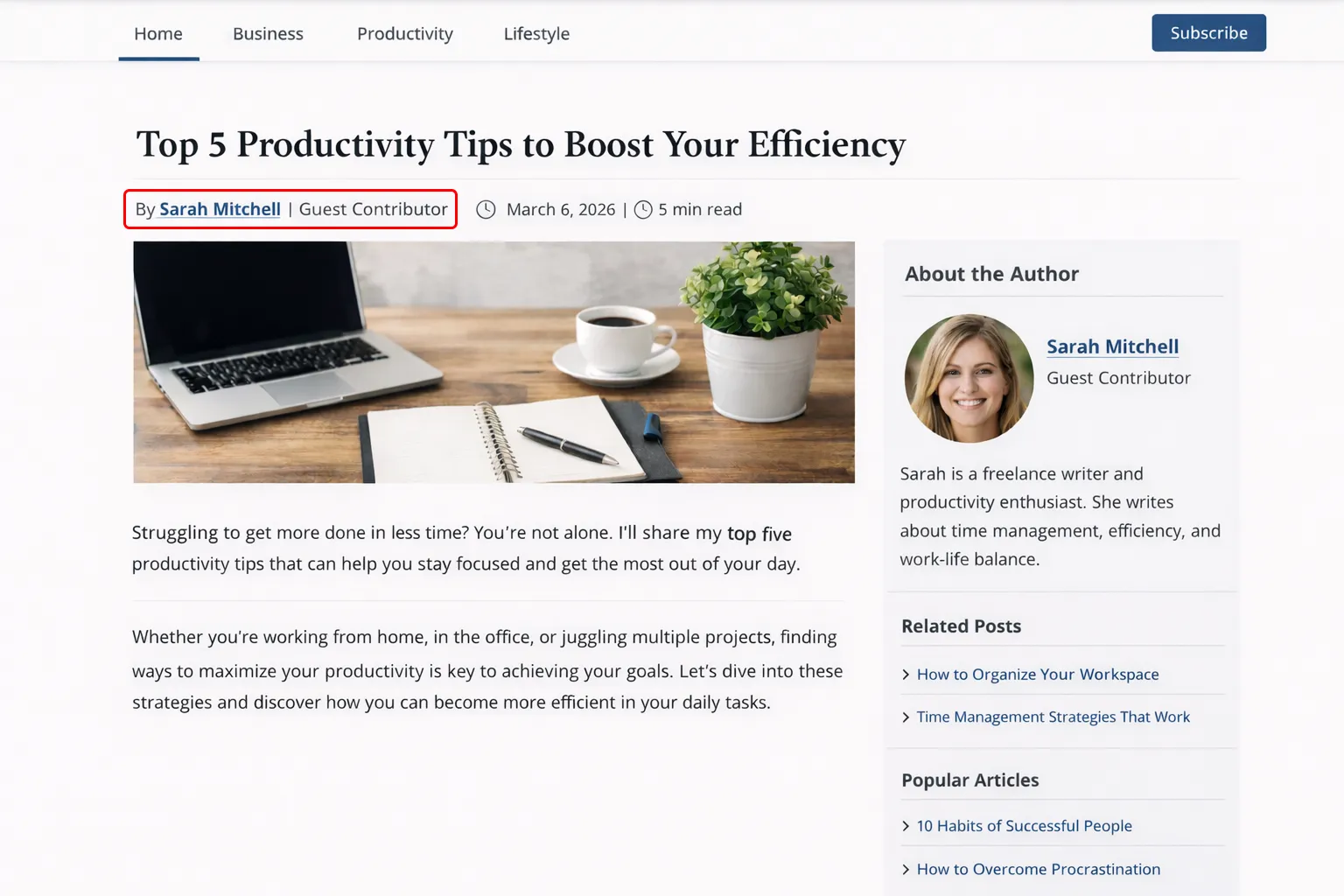
### Guest posting has been a core part of link building for years.
In 2026, it’s still one of the most widely used methods for [earning backlinks](https://outreachdesk.com/what-are-backlinks/). However, the gap between what works and what doesn’t is wider than ever.
Google hasn’t banned guest posts. But low-quality guest posts no longer work. In fact, they damage your rankings. The difference comes down to intent and quality.
Guest posts help you build visibility with new audiences. They position you as a trusted voice and drive referral traffic from readers already interested in what you do.**
**
## Guest Posts Vs. Sponsored Posts Vs. Niche Edits
**Guest posts, sponsored posts, and niche edits all earn backlinks, but they signal very different things to Google about how that link was acquired.** A guest post is an editorial contribution. A sponsored post is paid placement requiring disclosure. A niche edit inserts a link into existing content.
Each has different penalty risk and ranking value.
| Tactic | What It Is | Link Treatment |
| --- | --- | --- |
| Guest Post | Original content you write for another site | Typically dofollow (editorial) |
| Sponsored Post | Paid placement, often disclosed | Should use rel=”sponsored” per Google’s guidelines |
| Niche Edit | A link was inserted into an existing published article | Varies often paid, should be disclosed |
## Are Guest Posts Still Worth it in 2026?
**Guest posts are still worth the effort in 2026 when the host site has real organic traffic.** An editorial team that reviews submissions, and a readership relevant to your target audience, those conditions produce a link that Google’s quality systems treat as genuine editorial endorsement rather than manufactured authority.
The tactic stopped working reliably for sites that used it purely as a link exchange with no regard for content quality or audience relevance, which is exactly what Google’s 2023 link spam update targeted.
Yes, guest posts worth the time. But only if you treat them as content marketing, not as a shortcut for [link acquisition](https://outreachdesk.com/link-acquisition/).
Google’s official guidance on large-scale article campaigns states that guest posts that inform users, educate another site’s audience, or bring awareness to your cause or company are acceptable.
**The violations happen when:
**
- You stuff keyword-heavy anchor text links into articles across many sites.
- Guest posts fail to serve subject-matter expertise.
- The same or similar content is duplicated across multiple sites.
- The primary intent is link building and not reader value.
**What’s Link Spam?**
According to [Google’s spam policy](https://developers.google.com/search/docs/essentials/spam-policies), link spam is the practice of creating links solely to manipulate search rankings.
Guest posts become link spam only when the motive is to earn only links and avoid audience value.
### Where Guest Posts Still Deliver Value
Guest posting creates compounding benefits that many practitioners underestimate.
Publishing high-quality guest posts on relevant industry sites builds brand authority. Also, when readers associate your name with the host and publication, it further increases credibility.
You should focus on publishing high-quality guest posts on a site that provides value to your target audience. This will attract visitors already interested in your niche.
Consistency is also important in guest posting. It signals to search engines and AI systems that your brand has real depth in a given topic area.
## How to Find Guest Posting Opportunities
**You find guest posting opportunities by searching for sites your audience already reads, then qualifying them on traffic, editorial standards, and topical fit.** Google operators, competitor backlink analysis, and community recommendations all surface candidates. The qualification filter is where most prospect lists shrink to the sites actually worth pitching.
Finding guest posting opportunities is something most people get wrong. The easiest sites to find are usually the worst ones to pitch.
The sites worth writing for are harder to find, but the payoff is significantly better.
**Use these 3 approaches to find better guest posting opportunities:
**
### Google Search Operators
This is the easiest method to find guest posting opportunities. All you’ve to do is search with targeted queries and find sites that accept contributions in your niche.
- “Your niche” + “Write for us”
- “Your niche” + “Contribute” + “Guest”
- “Your niche” + “Submit an article”
- “Your niche” + inurl:guest-post
Suppose you’re in the B2B SaaS space, you’d search “B2B SaaS + Write for Us,” and Google will list out sites for contributors in your niche.
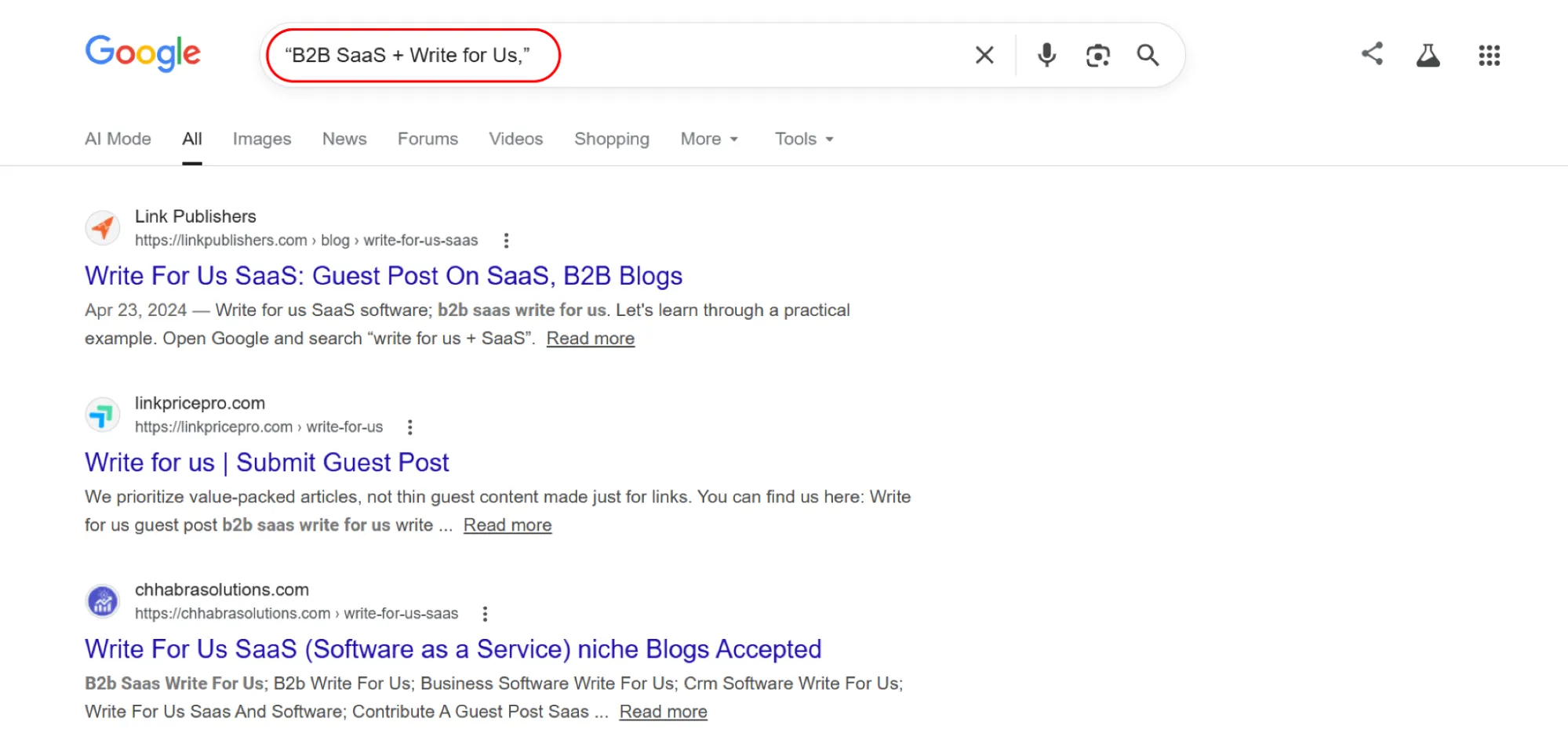Most won’t pass the scorecard below, yet if you filter hard, you’ll get a more precise list. You can start from there.**
**
### Competitor Backlink Analysis
This is one of the fastest methods. Use [Ahrefs](https://ahrefs.com/) or [Semrush](https://www.semrush.com/) to review the backlink profiles of competitors already ranking well for your target keywords.
Look for links that came from guest posts. They’re usually easy to spot (author bylines, “guest post” tags, or a contributor bio).
These sites already accept content in your niche, already have editorial standards, and pass link authority.
Here, your job is to pitch something better than what your competitor wrote.**
**
### Build Relationships Before You Pitch
Strong relationships with industry contributors and editors open the door for acquiring quality backlinks.
In fact, the best guest post placements come from real relationships. Not templates.
Start by genuinely engaging with the sites you want to write for. Comment on their articles. Share their content. Mention their work in your own writing. By the time you pitch, the editor already knows your name.
This takes time, but your acceptance rate climbs.
Research shows that [personalized outreach](https://outreachdesk.com/link-building-outreach/) that uses the recipient’s first name increases backlink acquisition by about 50%.**
**
## How to Evaluate a Guest Posting Site
**Evaluate a guest posting site by checking three things: real organic traffic, topical relevance to your niche, and editorial standards that screen out low-quality submissions.** Domain authority alone is misleading. A DR 60 site with no organic traffic and a sponsored content section is worth less than a DR 40 site with engaged readers and editorial review.
Not all guest post opportunities are equal. Most are poor.
[A BuzzStream 2025 study of over 26,000 guest post sites](https://www.buzzstream.com/blog/guest-post-costs/) found that approximately 86% of sites on guest post marketplaces have less than 10K monthly traffic and a DR below 40, making them low-value sites.
This means, if you’re not evaluating carefully, you’re likely wasting time and budget on placements that won’t move the needle.
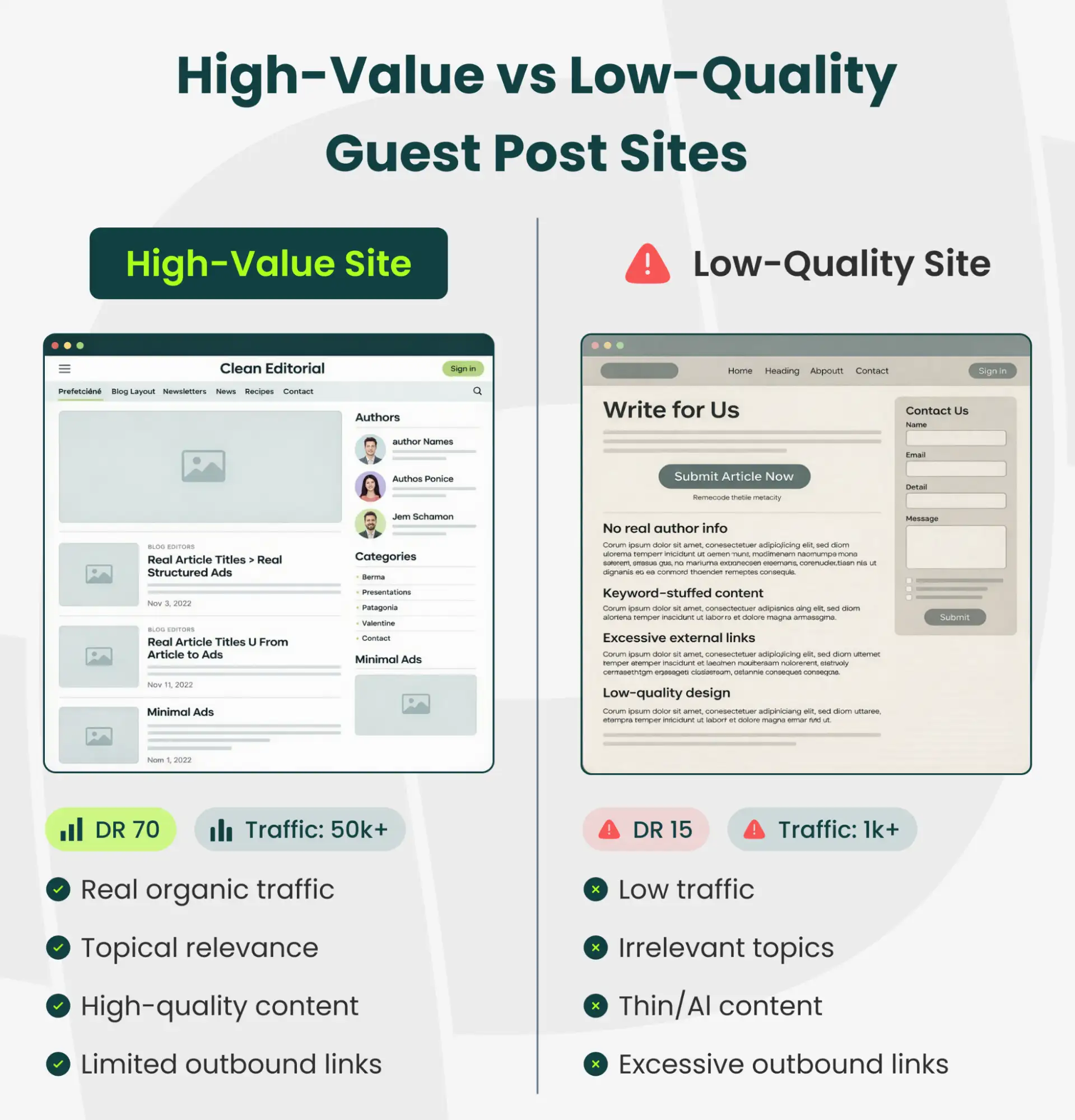
### Signs of High-Value Site
Evaluate each target site against these criteria before pitching it for guest posting.
#### 1. Real organic traffic
Use [link building tools](https://outreachdesk.com/link-building-tools/) like Ahrefs or Semrush to verify the actual search traffic. Most low-quality sites may have inflated pageviews due to bots or social shares.
#### 2. Topical relevance
The site should cover your niche or something closely related to it. A health and fitness brand publishing on a finance blog helps neither audience.
#### 3. Existing content quality
Read some recent articles. If they’re thin, generic, or clearly unreviewed AI content, then move on.
#### 4. Reasonable outbound link count
Pages with dozens of external links spread their value thin. Fewer links per page means each one carries more weight.**
**
### Red Flags That Signal a Low-Quality Site
- The primary business model is selling guest post placements.
- The ‘Write for Us’ page reads like a link sales pitch.
- It claims high domain authority but has almost no real traffic.
- It publishes content on completely unrelated topics with no focus.
- Its published articles are full of exact-match keyword links pointing to commercial pages.**
**
## Guest Post Quality Evaluation Scorecard
**The quality evaluation scorecard scores each guest posting opportunity across organic traffic, topical relevance, editorial standards, and link policy.** Use it before you write a single pitch. Filtering at this stage saves weeks of wasted outreach on sites that won’t move your rankings.
Use this framework to score targets before investing time in a pitch:
| Signal | High-Value (3 points) | Medium Value (2 points) | Low Value (1 point) |
| --- | --- | --- | --- |
| Monthly organic traffic | 10,000+ | 1,000-10,000 | Under 1,000 |
| Topical Relevance | Same niche | Adjacent Niche | Unrelated |
| Editorial Process | Named editors, guidelines review | Basic guidelines | No visible standards |
| Content Quality | Original, Well-researched | Decent but generic | Thin or AI-generated |
| Outbound Link Density | Under 5 per article | 5-15 | 15+ |
| Author Attribution | Name + credentials | Author names only | No attribution |
### Score interpretation
- 15-18 = Strong opportunity
- 10-14 = Acceptable, but check weak areas first
- Below 10 = Not worth the effort. Skip it
## How to Pitch and Write a Guest Post That Gets Published
**A guest post that gets published starts with a pitch matched to a real content gap on the site.** Paired with a draft that meets the publisher’s editorial standards before any link is mentioned. Editors approve pitches when they spot an angle their readers want.
The link is what makes it worth your time, not the editor’s.
Editors at popular sites receive dozens of generic emails every single day. The ones that get a response are specific, relevant, and short.**
**
### Write a Pitch That Editors Actually Read
Write a short and punchy pitch (200 words) that saves time, not a long thousand-word pitch. You can write a clear pitch with three simple steps.
#### 1. Show you know their site
Mention a specific article that they’ve published and explain how your topic builds on it or fills a gap.
#### 2. Pitch a real, specific topic
Your pitch should sound real. Not “I’d love to write about SEO.” Instead, write “I’d like to write about how SaaS founders can use product-led content to earn editorial backlinks with three real case studies.”
#### 3. Prove you’re credible
Write one sentence about your experience or a link to published content. That’s enough.
These three steps are all you need to write a clear pitch for your next guest post. However, don’t use cliche copy-paste templates; most pitches fail here.
Also, you should avoid generic opening lines, “noticed they accept guest posts.”
Your proposed topics should be fresh and avoid topics already covered on their site.
**Here’s how your outreach mail should look:
**
**Subject: Guest post for [Site Name]
**
Hi [Name],
I’ve been reading [Site Name] for a while and noticed you publish content on [topic]. I’d love to contribute a guest post.
Here are a few ideas:
- [Title idea 1]
- [Title idea 2]
- [Title idea 3]
I’ve written for [Site 1] and [Site 2] if you’d like to see examples of my work.
Happy to send the full draft if you’re interested.
[Your Name]
### Write Content That the Host Site Wants to Publish
Once you get a yes from the host, start brainstorming how to deliver a quality piece of content. This is only half the battle.
Study their recent posts before you write a single word. Match their tone, structure, and length. Don’t write the article you want; write what their readers need.
Bring something original. A data point from your own experience. A case study. An insight that their existing content doesn’t cover. That’s what makes editors want to publish you again.
Write for their audience level. An advanced SEO blog doesn’t need a backlinks explainer. A general business blog doesn’t need unexplained technical jargon. Match your depth to their readers. **
**
### Get Your Links Right
Where and how you place your links matters.
**Best Practices:
**
- Aim for 1-2 [contextual links](https://outreachdesk.com/contextual-link-building/) per guest post. (one link per 1000-1500 words).
- Link to genuinely useful resources on your site.
- Use natural anchor text that describes what readers will find when they click.
- Never use the same exact-match keyword phrase repeatedly for anchor text. Keep it as natural as possible.
## Guest Post Anchor Text Distribution Framework
**A safe guest post anchor text distribution mixes branded, naked URL, partial-match, and exact-match anchors so the link profile looks editorial, not optimized.** SpamBrain pattern-matches against unnatural anchor distributions. The framework below shows the percentages most sites use without triggering algorithmic devaluation.
You must aim for this approximate distribution in your guest posts for a healthy link profile.
| Anchor Type | Description | Target Distribution |
| --- | --- | --- |
| Branded | Your brand name | 30-40% |
| Partial Match | Keyword + Modifier | 25-35% |
| Natural / Generic | “This guide,” “learn more here.” | 15-20% |
| Exact Match | Target keyword only | 5-10% |
| URL/Naked | Full URL | 5-10% |
## Common Guest Posting Mistakes That Hurt Your Seo
**The common guest posting mistakes are pitching irrelevant sites, reusing the same template across publishers, and over-optimizing anchor text on every placement.** Each of these wastes outreach time or triggers spam signals. The patterns below cost teams the most ranking value over time.
Poor guest posting strategies don’t just waste time; they can actively damage your search performance.
Here are the common guest-posting mistakes that cause the most harm.
### 1. Mass Outreach With Generic Templates
Sending the same repetitive pitch to hundreds of sites is the fastest way to get ignored.
You end up publishing your content on low-quality sites that actually accept these pitches, but you don’t get any value or authority in return.
Practice personalized outreach each time. It takes time, but it provides better results.
### 2. Publishing on Irrelevant or Low-Quality Sites
Many beginners post their well-researched content on completely irrelevant or low-quality sites.
Your every placement should be on a site where your target audience genuinely visits.
Don’t publish on sites that are off-topic for your industry or business. If you’re publishing on a random website just for backlinks, you’re wasting your time.
### 3. Over-optimized Anchor Text
Using the exact match keyword phrase across multiple guest posts is a clear manipulation signal. Google’s link spam algorithms target this pattern.
### 4. Duplicating Content Across Multiple Sites
When you reuse or rewrite an article with light variation for different publications, it violates Google’s guidelines and provides no unique value to any audience.
### 5. Treating Guest Posting as Your Only Tactic
Relying only on guest posts creates an unnatural backlink profile. Combine link building approaches, such as digital PR, content marketing, [broken link building](https://outreachdesk.com/broken-link-building/), and guest posting, to build more effective [link building campaigns](https://outreachdesk.com/link-building-campaigns/). This builds a diverse profile.
### 6. Ignoring Link Attributes
If a guest post is paid or incentivized in any way, the links must use rel=“sponsored” or rel=“nofollow” attributes. If you fail to tag these properly, it puts both your site and the host site at risk.
## How Much do Guest Posts Cost?
**Guest posts cost anywhere from free to $2,000+ depending on the publisher’s traffic, authority, editorial standards, and whether the placement is fully editorial or paid.** True editorial guest posts cost only your time and content. Paid placements on tier-1 publications run $500-$2,000+ when the host site has real organic traffic and editorial review.
Guest posting costs vary significantly depending on the quality of placement.
Here’s the cost breakdown so you can allocate budget and avoid overpaying for links that don’t drive real value.
### Guest Post Cost Comparison by Quality Tier
| Quality Tier | Cost (Direct) | Cost (Via Vendor) | Site Characteristics |
| --- | --- | --- | --- |
| Low Quality | $20-$100 | $50-$200 | Under 1K traffic, no editorial standards |
| Mid Quality | $100-$400 | $300-$800 | 1K – 10K traffic, basic editorial review |
| High Quality | $400-$950 | $800-$2000 | 10K+ traffic, strong editorial process |
| Top Tier | $700-$2,000+ | $2500-$3,000+ | Major publications, real readership |
There are also free guest posting sites where you prospect, pitch, and write quality content, and they publish without asking for payment. But it’s inconsistent, and the acceptance rate on high-quality sites is low.
You can also [outsource link building](https://outreachdesk.com/outsource-link-building/) to an agency, and a premium package covers:
- Prospecting
- Relationship management
- Content creation
- Quality assurance
Here, the key question isn’t “How cheap can I get guest posts?”
It’s “What quality of placement does my budget support?”
## What a Realistic Guest Post Program Looks Like
**Guest posting still works in 2026 when you focus on publishers with real audiences and treat the content as the lead asset, not the link.** The tactics that worked in 2019 don’t survive SpamBrain now. The approach that survives any algorithm update is the one built around editorial quality.
Guest posting isn’t dead in 2026, it has become more practical and requires genuine efforts that provide real value to the other site and its audience. Google’s algorithms can detect manipulative patterns more effectively than ever.
So now what should you do to earn backlinks with guest posting?
The path forward is clear: treat every guest post as a piece of content marketing, not just another link acquisition channel. Write for the audience, build relationships with editors who value your expertise.
That’s how guest posting builds authority that compounds over time.
### Want backlinks from real websites, not random placements?
Get guest posts that bring traffic, authority, and long-term results.
[Book a short strategy call](/contact-us/)
### Is guest posting against Google’s guidelines?
No. Google allows guest posts that provide genuine value to readers. However, it penalizes large-scale guest posting done primarily for link manipulation. It includes keyword stuffing, publishing thin content, or distributing the same articles on multiple sites. If your article is well-written, topically relevant, and useful to the host site’s audience, it aligns with Google’s guidelines.
### How many guest posts should you publish per month?
Quality and consistency matter more than volume. For most businesses, 2-4 high-quality guest posts per month on relevant, authoritative websites will deliver better results.
### Should guest post links be nofollow or dofollow?
It depends on the arrangement. If the guest post is purely editorial, you pitched a topic, wrote valuable content, and the external site publishes the content, it means the content serves their audience, then a dofollow link is appropriate.
If any payment or incentive is involved, Google’s guidelines require the use of attributes. Many high-quality sites set their own link policies, and respecting those keeps your relationships intact long-term.
### Can guest posts hurt your rankings?
Yes. Publishing low-quality guest posts on irrelevant sites, using manipulative anchor text patterns, or participating in large-scale link schemes can trigger algorithmic devaluation or manual penalties. The risk comes from the implementation, not the tactic itself. Guest posts on relevant, authoritative sites with natural link placement are safe and deliver the desired results.
### How long does it take for a guest post to affect rankings?
Most guest posts start influencing rankings within 4 to 10 weeks after publication, depending on how quickly Google crawls the host site and processes the new link. Posts on high-traffic, regularly updated sites pass link equity faster. The anchor text’s relevance to your target keyword and the host page’s topical authority both determine how much ranking movement the link delivers.
---
---
title: "Ecommerce Link Building: Strategies That Work in 2026"
url: "https://outreachdesk.com/ecommerce-link-building/"
lang: "en-US"
type: "post"
description: "Ecommerce link building means getting other websites to link to your online store. It’s one of the most direct ways to improve your search rankings, grow traffic, and increase sales. Many teams turn to an ecommerce link building agency when"
last_modified: "2026-05-28T06:59:41+00:00"
categories: [Link Building]
---
# Ecommerce Link Building: Strategies That Work in 2026
**Ecommerce link building** means getting other websites to link to your online store. It’s one of the most direct ways to improve your search rankings, grow traffic, and increase sales. Many teams turn to an [ecommerce link building agency](https://outreachdesk.com/) when manual prospecting becomes too time-consuming. For brands that need ongoing execution, a [managed ecommerce link building service](https://outreachdesk.com/ecommerce-link-building-service/) from a specialised provider can carry the load.
According to a [2026 Charle Agency analysis](https://www.charle.co.uk/articles/ecommerce-seo-statistics/), organic search can drive roughly around 43% of all ecommerce traffic, making it the largest channel for most online retailers. Stores that focus on and invest in building authority through relevance and high-quality links consistently perform better than those that rely only on paid ads.
But the actual challenge is product and category pages. The pages that need to rank the most rarely attract any links on their own. No one voluntarily links to a product or service page, unlike the helpful guides and data studies.
This article will help you solve this problem, and you’ll learn the strategies that currently work for ecommerce stores.
**Key Takeaways:
**
- Product pages rarely earn direct links, build authority through content assets, and route it via internal links.
- Ecommerce SEO delivers [317% average ROI over three years](https://firstpagesage.com/seo-blog/e-commerce-seo-roi-report/) with a 9-month break-even.
- 86% of ecommerce sites lack optimized internal links, the most neglected step in this process.
- AI searches like ChatGPT are now helping people find products, get your brand mentioned online, and influence their recommendations.
- Digital PR and brand mentions can now drive traditional rankings and AI search visibility.
## What is Ecommerce Link Building?
**Ecommerce link building is the practice of earning backlinks that point to your online store’s product pages.** Category pages, and content hubs in a way that drives both organic traffic and direct conversions. It’s different from generic SEO link building because the target pages have commercial intent, which Google treats with stricter scrutiny.
Ecommerce link building is the process of earning [high-quality backlinks](https://outreachdesk.com/what-are-backlinks/) from other websites for your online store.
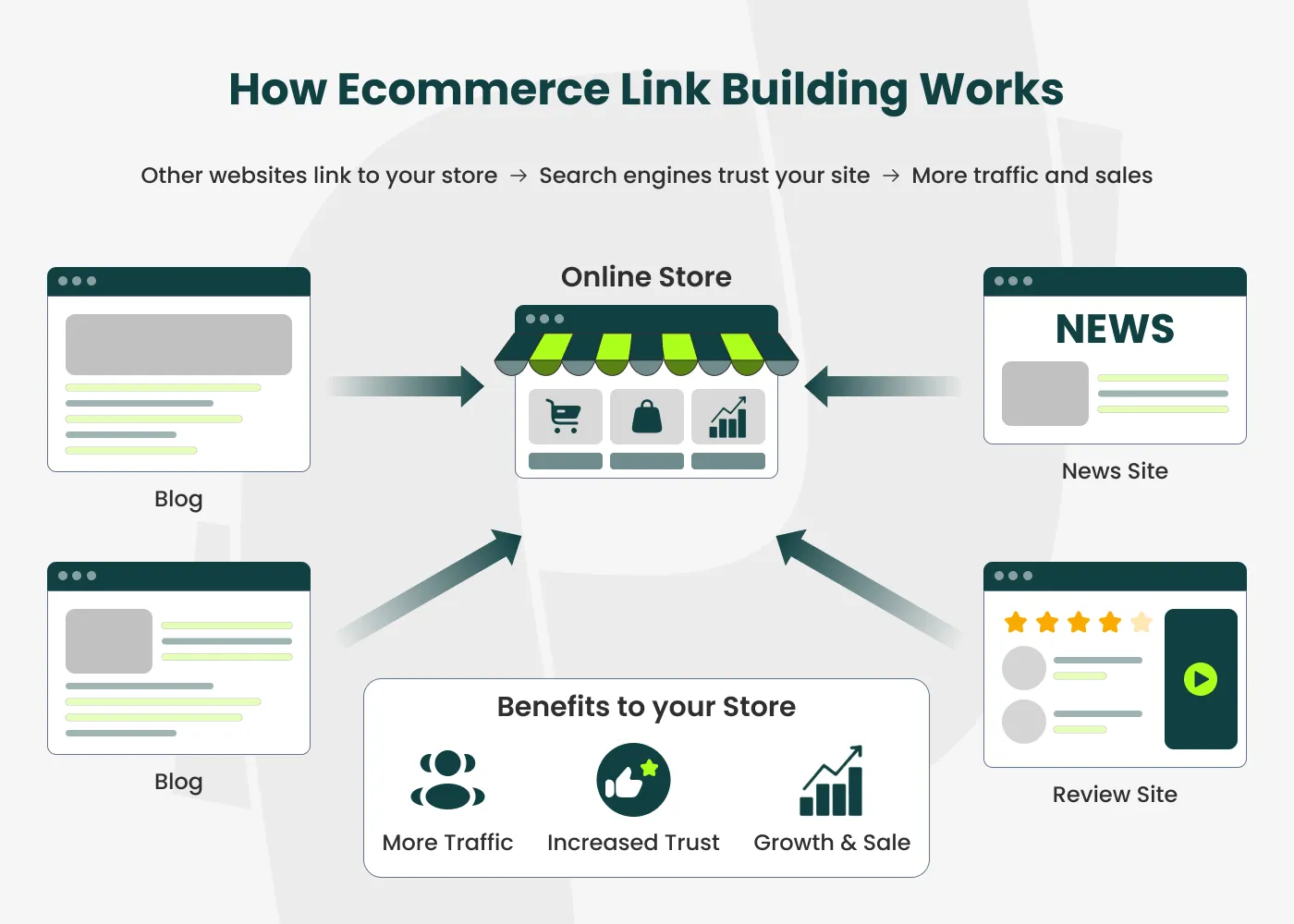
These links help your product and category pages rank higher on Google, can increase your site’s authority, and drive more traffic and sales. Backlinks work as trust signals; the more reputable sites link to you, the higher your pages rank.
## Why Ecommerce Link Building is Different From Other Niches
**Ecommerce link building is different from other niches because product and category pages have lower natural link-earning ability than informational content.** No one links to a checkout page or a category page on principle. You have to engineer linkable assets and route their authority where it actually drives revenue.
Most of the [general link building playbooks](https://outreachdesk.com/link-building-strategies/) are written for SaaS companies, publishers, or service businesses. Ecommerce sites face different problems.
### The Product Page Problem
Your product pages are commercial, and they exist to sell. Even though your products are great, bloggers, journalists, and editors don’t link to them if your product pages look like an advertisement.
Let’s say a tech reviewer might link to an informational guide about choosing the right laptop, but won’t link to your page if it looks like a free ad for your store. [BuzzStream Link Building Trends Report](https://www.buzzstream.com/blog/link-building-trends/) found that around 68% link builders prioritize links to blog posts, while only 14% prioritize links to product pages.
### Content Competition is Intense
Ecommerce is a competitive environment because your direct competitors are Amazon, Walmart, and category giants with massive authority. A [2026 ALM Corp analysis](https://almcorp.com/blog/paid-search-clicks-double-organic-clicks-fall-2026-data/) shows in their study that organic click share dropped by up to 23% in product categories like headphones over 1 year. Paid results can now capture 36% of clicks in some niches.
That means every link you earn matters more, and relevance matters more than just volume.
### Links Can’t Just Go Anywhere
For ecommerce stores, earning links isn’t an end goal; it’s just the starting point. You need a smart internal linking strategy that pushes the authority from your content pages to the product and category pages that can actually make you money.
## Ecommerce Link Building Strategies That Work in 2026
Now that you’re familiar with ecommerce link building and understand why links matter and where they need to go, let’s get into the strategies to earn them.
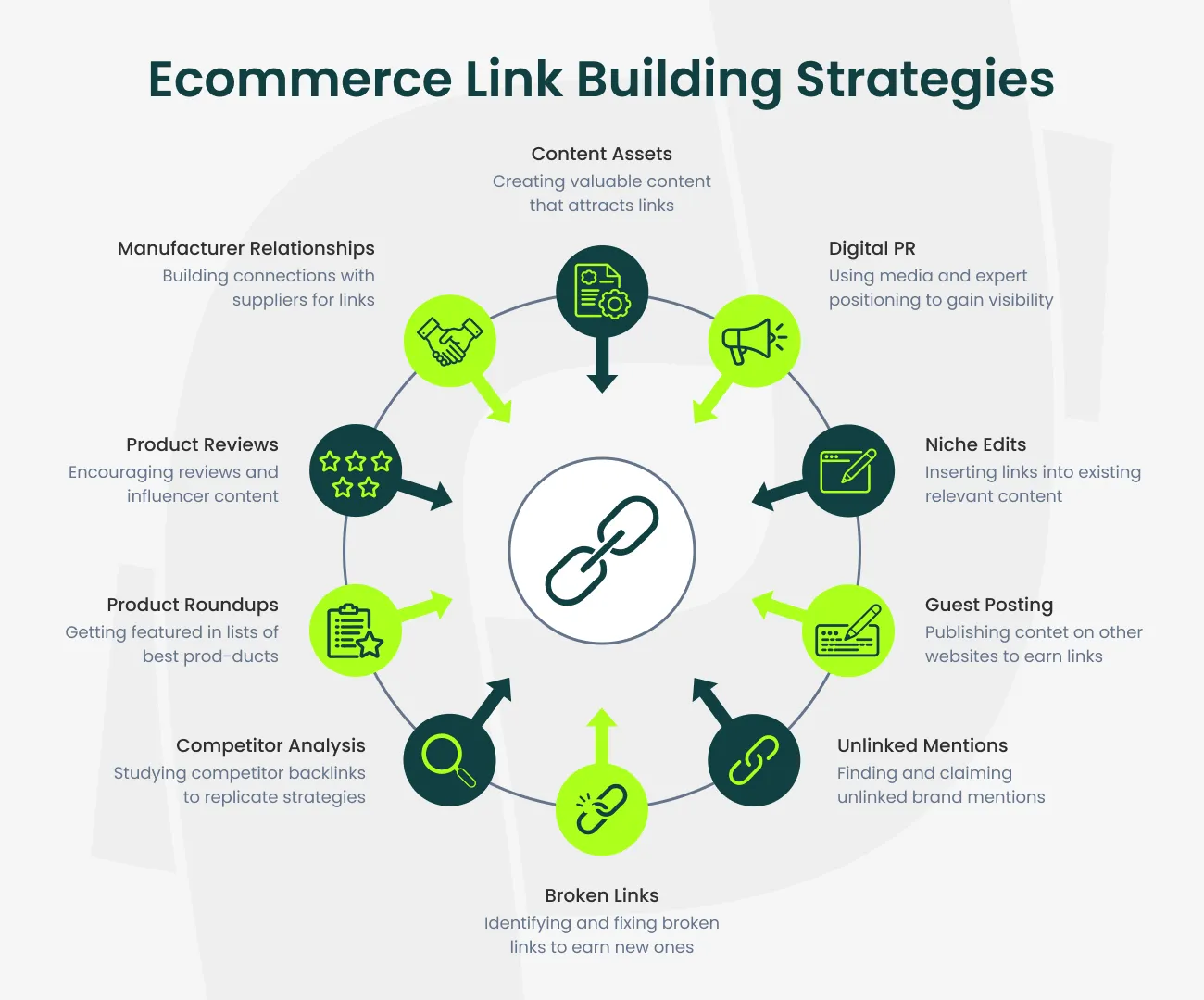
### 1. Build Content Assets Worth Linking To
Your content needs to solve problems, answer questions, or provide data people want to reference because product pages won’t earn links on their own.
Create content specifically designed to earn links, then connect it to your revenue pages via internal links.
**For ecommerce stores, here’s what works best:**
#### Buying guides
Guides that honestly compare products usually perform well. “How to Choose a Running Shoe for Your Foot Type” earns links because other types want to reference it, whereas “Buy Our Running Shoes” doesn’t.
#### Original data and surveys
Original data and surveys are important because journalists and bloggers need data to cite. Suppose you sell kitchenware, survey 500 home cooks about cooking habits, and publish the results. Blume, a wellness brand, surveyed women about their period experiences during puberty. The results earned links from Forbes and other high-authority publications.
#### Interactive tools and calculators
A mattress brand with a “sleep Quality Score” calculator or a paint company with a “Room Coverage Estimator” gives other sites a reason to link to it. Tools are underused in ecommerce that’s exactly why they work.
#### FAQ-style content targeting long-tail queries
These pages rank for question-based keywords and naturally attract links from forums and resource pages.
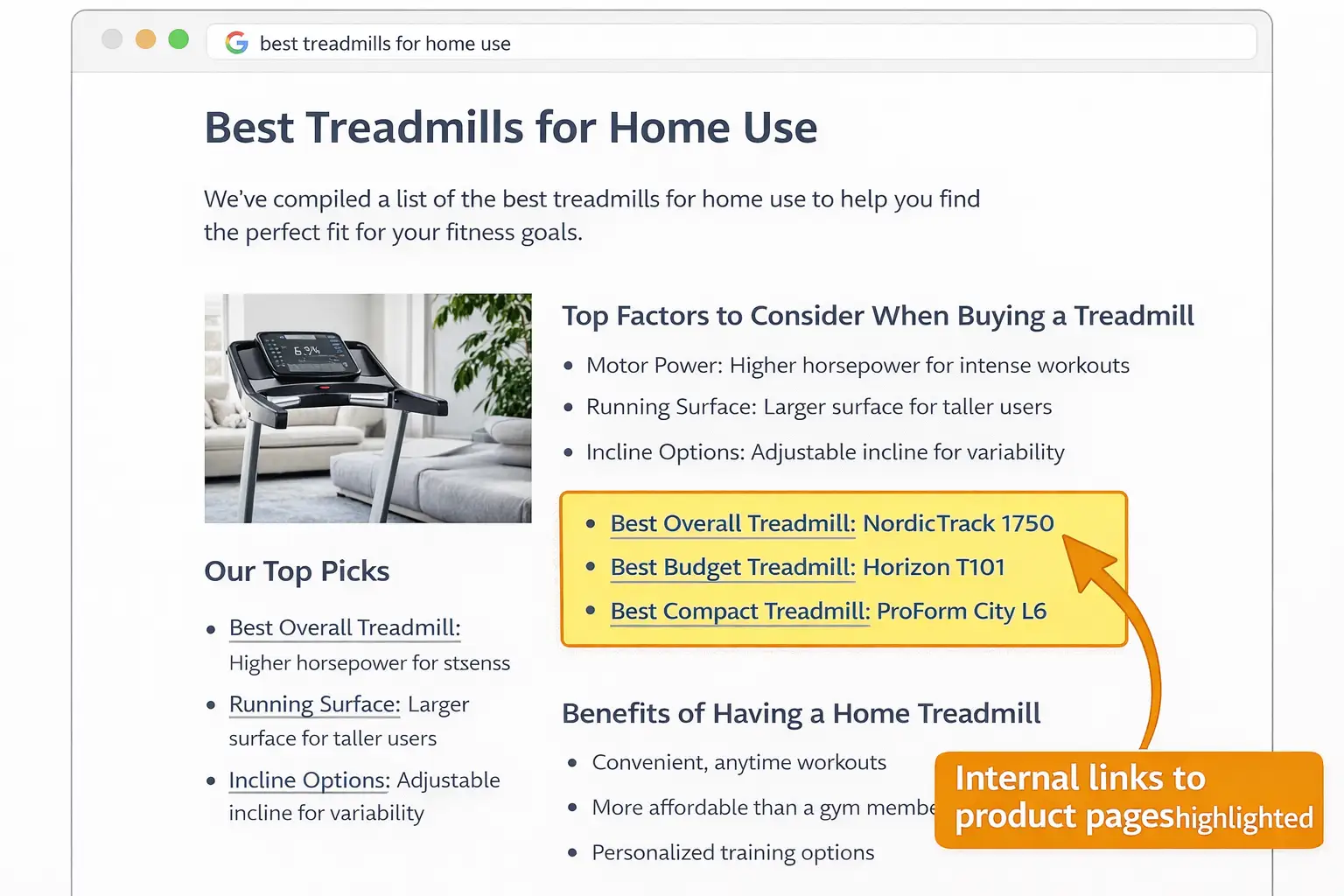
**Tip – Critical Step Most Ecommerce Stores Miss:
**
Internal linking from the content assets to product and category pages. A buying guide that earns 50 links is only valuable if it links to the product pages that you want to rank.
### 2. Use Digital PR and Expert Positioning
Digital PR is the highest-impact link building strategy for ecommerce brands in 2026. It means creating stories that journalists and editors actually want to cover.
When a major publication features your brand or cites you as an expert, you earn two things at once. First, a high-authority backlink, and second, a [brand mention](https://outreachdesk.com/brand-mentions/).
**Here’s how you can run digital PR for ecommerce:
**
Start by finding your news angle. A sustainable initiative, unique product design, or proprietary customer data.
Second, position your founder or product expert as a source. Respond to journalist queries on platforms like [HARO](https://www.helpareporter.com/), [Featured](https://featured.com/), and [Qwoted](https://www.qwoted.com/). A consistent 30 minutes per day builds a high-quality link over time.
Third, pitch niche publications. If your skincare brand has a dermatologist on staff, pitch them as an expert source for beauty editors covering ingredient trends.
**Leveraging subject matter experts (SMEs) **works the same. Suppose you sell fitness equipment. Collaborating with certified trainers on your content creates link-worthy assets, and those experts often share and link to content featuring their insights.
### 3. Niche Edits and Contextual Link Insertions
[Niche edits](https://outreachdesk.com/niche-edits/) are also known as link insertions, which place your link within existing, already-indexed content on other websites. Specifically for ecommerce, the most effective targets are blog posts and guides that already discuss your product category.
The image below is of a well-known website that naturally links to “Hurom juicer” in its article.
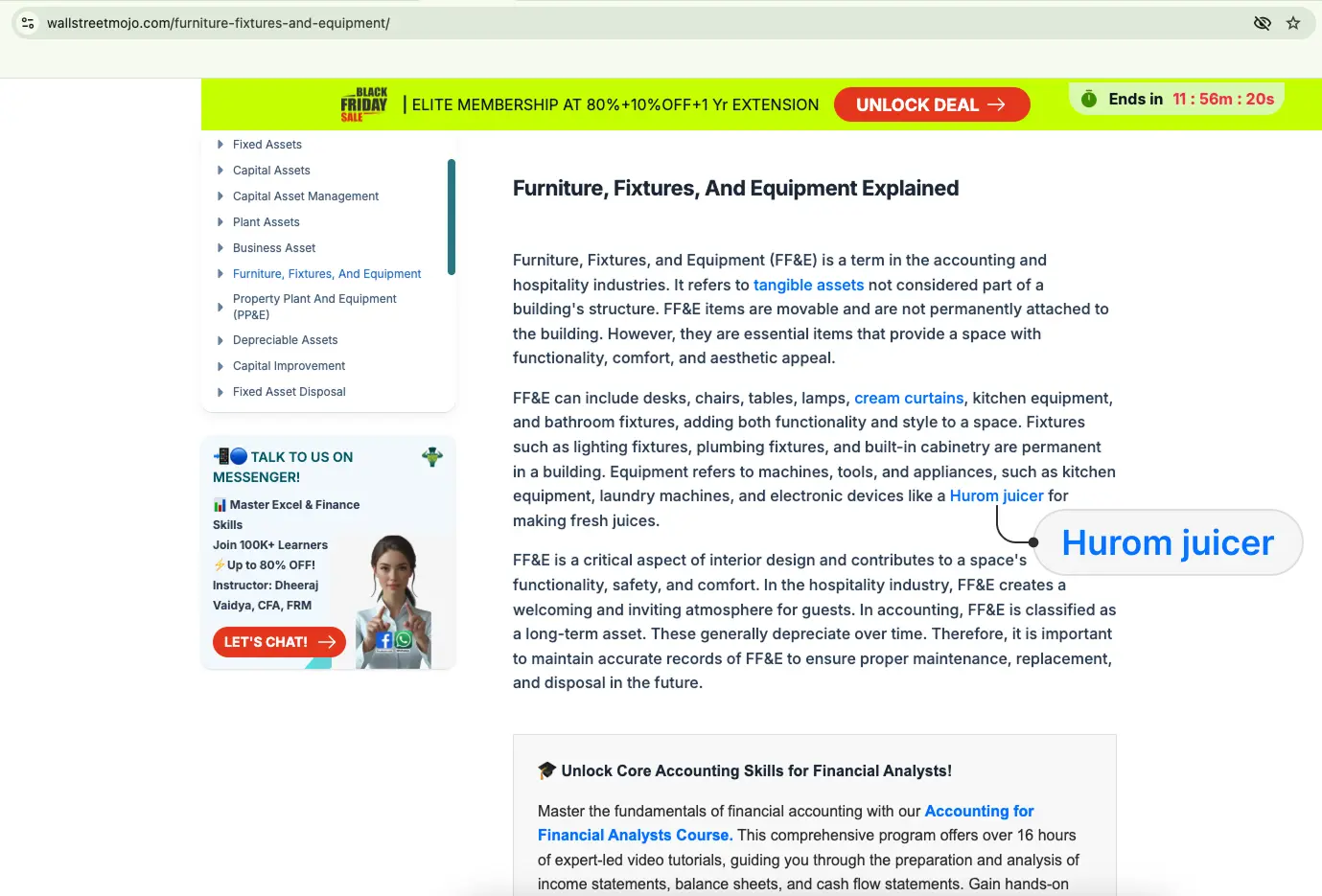
Because the content is already indexed and ranking, the link passes value easily. Best targets: articles titled as “best [product type],” “[product category] guide,” or “how to choose [product type]” articles with real organic traffic.
**Here’s how you can implement niche edits:
**
- Identify websites in your industry that cover topics that relate to your products.
- Find specific pages where your link genuinely adds value for the readers.
- [Reach out](https://outreachdesk.com/link-building-outreach/) with a clear and specific reason why your link improves their content.
- Focus on relevance because it can beat authority. A DR 35 niche link can outperform a DR 70 general site with no relevance to the topic.
### 4. Guest Posting on Relevant Publications
Guest posting works when you contribute genuinely useful content to the relevant publications where your target customers already read, rather than publishing thin, keyword-stuffed posts on any blog.
You should focus on publications where:
- The audience of that publication and your customers’ preferences are similar.
- The site has real organic traffic (check that in [Ahrefs](https://ahrefs.com/) or [SEMrush](https://www.semrush.com/)).
- Your content offers something that the publication doesn’t already cover.
Now, if your question is what you should write about, then you can share your expertise on a specific topic rather than offering them a sales pitch. Suppose that a kitchen equipment retailer could write about “How Professional Chefs Choose Their Knives” for a food blog. The link back to the store is contextual and adds value for the readers.
### 5. Reclaim Unlinked Brand Mentions
If your store already has a public presence and people are mentioning your brand online but not linking to you, then it can be one of the easiest wins available. Because you can convert these mentions into links. You just need to ask them to make the mention clickable.
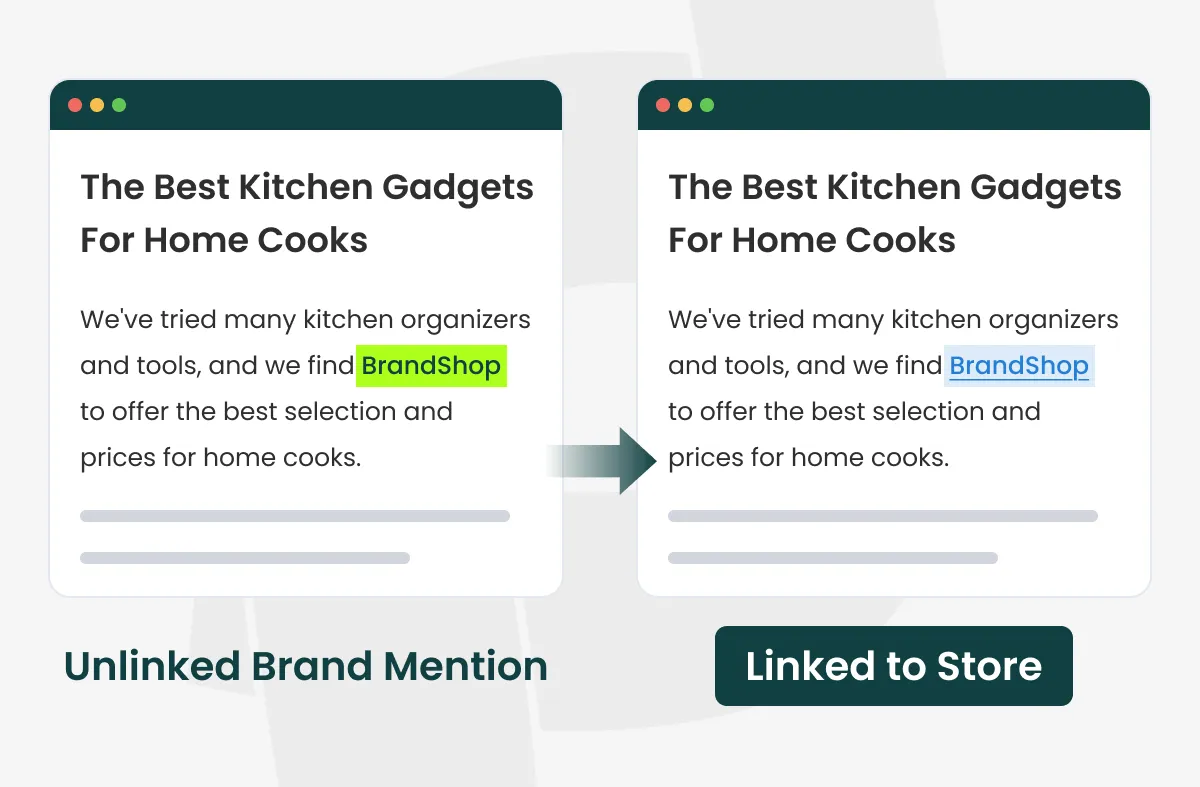
**To find unlinked brand mentions, follow these:
**
- Set up [Google Alerts](https://www.google.com/alerts) for your brand name, product names, and any unique terms that are associated with your store.
- Use [Ahrefs Content Explorer](https://ahrefs.com/content-explorer) or a similar tool to search for your brand name and filter out mentions without hyperlinks.
- Finally, reach out with a simple, polite, and personalized request. Most website owners will add the link because you’re not asking for a favor; you’re improving the user experience for their readers.
This might not get you hundreds of links, but the links you do earn tend to be highly relevant, editorially placed, and genuinely useful.
### 6. Broken Link Building
[Broken link building](https://outreachdesk.com/broken-link-building/) means identifying dead links on relevant sites, creating missing content to replace what the dead links pointed to, and suggesting your version as a replacement to the site owner.
Resources in your niches often contain numerous outbound links. Product guides go out of date; brands shut down. All of these create broken links that website owners don’t know about, and most will willingly swap in a working, relevant placement.
Here’s the process of broken link building:
- Use tools like [broken link checker](https://outreachdesk.com/broken-link-checker/), Ahrefs or Check My Links to identify broken links on resource pages in your industry.
- Check what dead pages used to contain with the help of the [Wayback Machine](http://web.archive.org/).
- If you’ve a relevant page or can create a better version on your site, reach out to the site owner and offer it as a replacement.
The response rate is higher than cold outreach because you’re solving a problem that the site owner already has.
### 7. Competitor Backlink Analysis and Replication
Studying your competitor’s link profile reveals the exact opportunities that exist. This isn’t guesswork; it’s real data.
- Start by picking 3-5 competitors ranking above you for your targeted keywords.
- Run their domain on [Ahrefs](https://ahrefs.com/) or [SEMrush](https://www.semrush.com/) to see their backlink profile.
- Look for common patterns, such as which content types attract the most links and which publications link to them.
- Make a list of targeted sites that are linking to your competitors but not to you.
- Create content or outreach pitches tailored to specific sites.
The goal isn’t to copy your competitors, but it’s about finding what’s working in your niche, finding the gaps, and filling them with something valuable.
If three of your competitors have links from the same niche blog, that means that blog is open to ecommerce content, and you should definitely be on their radar.
### 8. Get Featured in Product Roundups and “Best of” Lists
This is one of the high-impact strategies for ecommerce because it puts your products in front of ready-to-buy buyers while earning relevant links.
Roundups like “Best Running Shoes for Flat Feet” or “Top Kitchen Mixtures Under $300” rank well for the buying keywords. Getting featured earns you a [contextual link](https://outreachdesk.com/contextual-link-building/) from the content that attracts traffic.
**Here’s how you can do product roundups:
**
- Search for “[your product category] + best” or “[product type] + roundup” in Google to identify the articles ranking on page one in [search results](https://outreachdesk.com/what-are-serps/).
- Reach out to the editor or author, offer a product for review, and provide a summary of why your product fits their list.
- Follow up once, but don’t spam their inbox if you don’t hear back. A pitch with a clear product angle does the work.
### 9. Earning Links Through Product Reviews and Influencer Content
Product reviews on niche blogs and YouTube channels can earn you contextual and relevant links. Choose reviewers whose audience matches your customers.
**What you should look for in a review partner:
**
- They already have an engaged audience in your niche, not just a large following.
- Their site has real traffic and standards.
- They publish detailed, honest reviews rather than sponsored content dumps.
**How you can approach them:
**
Send them a free product with a personal note. Avoid asking for a link directly; ask them to share their honest experience.
**Note:**
Links from sponsored reviews should be tagged under **rel= “sponsored”** as per Google’s guidelines. These links carry less SEO weight directly, but still contribute to your overall link profile, help to drive referral traffic, and build awareness.
### 10. Build Relationships with Manufacturers and Suppliers
If you sell products from the known brands, then those brands often have websites with “where to buy” pages, dealer directories, or partner listings. Getting your page listed on these pages earns you quality, relevant links from trusted sites.
**Follow these steps to build relationships with manufacturers and suppliers:
**
- List every brand you’ve.
- Visit each brand’s sites and look for the partner pages, dealer listings, or “authorized retailers” section.
- Reach out to the brand’s marketing or sales contact and request inclusion.
This can be one of the simplest ecommerce link building strategies, but it’s often overlooked. These links are highly relevant. Google sees a link from a manufacturer to a reliable retailer as a strong trust signal.
## Advanced Ecommerce Link Building Tactics
**Advanced ecommerce link building tactics go beyond standard outreach.** Product data partnerships, original research from purchase data, supplier reciprocity, and influencer co-created content that earns links instead of paying for them. The tactics below produce links that competitors can’t easily copy with budget alone.
Advanced ecommerce link building goes beyond the basic outreach playbook, it uses your store’s data, partnerships, and structural advantages to earn links competitors can’t easily replicate. These tactics typically take 60-90 days to produce results and they need either an in-house team or an agency that understands ecommerce-specific signals.
### 1. Original product data as link bait
Most ecommerce stores sit on data their competitors don’t have: best-selling color/size combinations, return-rate patterns by category, seasonal demand curves, average cart abandonment by product type. Packaging that data as a quarterly trend report earns coverage from trade publications, niche industry blogs, and journalists writing about ecommerce trends.
Here’s a real example: a women’s apparel retailer running a “Spring 2026 Color Demand Report” with anonymized data from 50,000 orders gets cited by fashion trade publications, retail news sites, and design blogs. The cost is a Notion doc and a few hours of analyst time.
What you get back: 8-15 contextual links from DR 50+ sites with naturally varied anchor text.
### 2. Programmatic linkable assets at category-page level
Most category pages are templated product grids with weak content. The advanced version: build “Best [Category] for [Specific Use Case]” pages systematically, designed to earn citations from review sites and affiliate publishers.
Examples: “Best Running Shoes for Plantar Fasciitis,” “Best Office Chairs Under $500 for Tall People.” Each page targets a specific buyer intent that affiliate sites and review publications consistently link to.
### 3. Wikipedia and Wikidata entity-level work
Established brands earn Wikipedia and Wikidata presence, which feeds Google’s Knowledge Graph and AI search engines like ChatGPT and Perplexity. The work isn’t writing your own Wikipedia article, that’s almost always rejected and removed.
It’s making sure your brand is referenced naturally in articles where it belongs (industry pages, product category articles, founder mentions in business publications), and that Wikidata’s entry on your brand is accurate. AI search engines weight Wikidata entity status heavily.
### 4. Industry partnership programs (not affiliate)
Reciprocal cross-promotion with complementary, non-competing brands earns links that affiliate programs can’t. A premium coffee retailer partnering with a high-end mug maker on a co-branded gift guide each holiday season produces an annual link cycle that’s editorial-quality, not transactional. The trick is finding partners whose audience overlaps with yours but whose products don’t.
### 5. Linkable tools and calculators
Free utility tools earn editorial links at scale because they solve a real reader problem on third-party sites. Examples that have proven this for ecommerce: Casper’s mattress sleep calculator, Patagonia’s repair guide tool, Allbirds’ carbon footprint calculator. The tool needs to be useful enough that other publications, blog posts, and review sites cite it instead of building their own.
What makes a tool linkable: it solves a problem readers Google for (“how to find your ring size,” “what mattress size do I need”), produces a shareable result (PDF, image, social-friendly stat), and lives on a clean URL that publications can link to without sending traffic into a competitor’s checkout flow. Build the tool once; it earns links for years.
These tactics don’t replace the basic strategies above, they layer on top once you’ve established a baseline link-building cadence. They’re advanced because they require operational coordination across teams (analytics, partnerships, brand) that smaller stores often haven’t built yet.
## How to Direct Link Equity to Product and Category Pages
**You direct link equity to product and category pages through strategic internal linking from your highest-authority content pages, topic-cluster architecture, and contextual anchor text that signals commercial intent.** External link earning brings authority into the site. Internal linking is what gets that authority to the pages that drive revenue.
Earning links to your blog content is just half the work. The real value comes from channeling that authority to the pages that generate revenue.
**Internal linking architecture for ecommerce:**
Build a clear hierarchy of your linkable content assets, such as guides, tools, and research, that should naturally link to relevant pages, which in turn link to individual product pages.
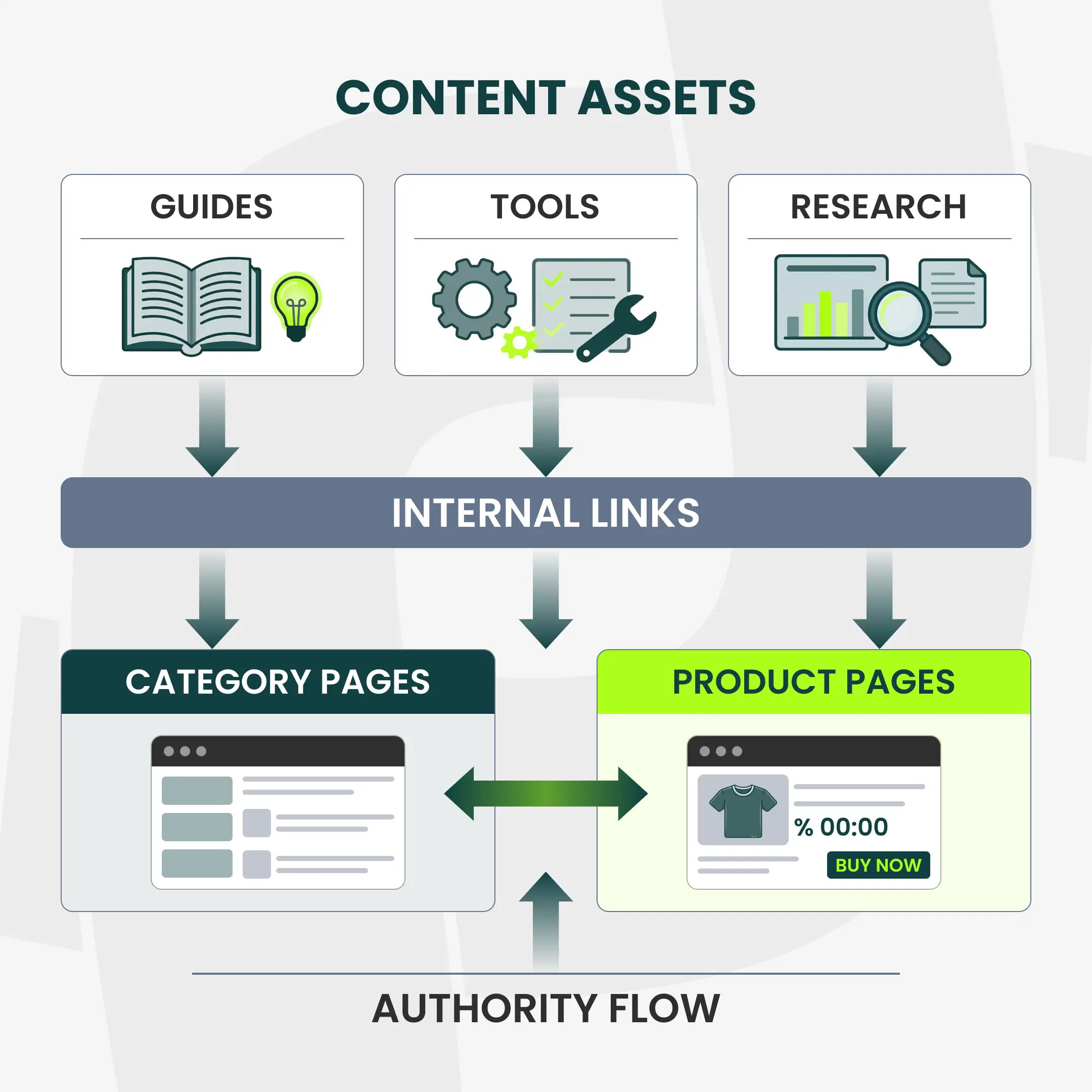
**There are some rules to follow for effective internal linking. Let’s understand them,**
- Every content asset should link to at least 2-3 relevant categories and product pages using descriptive anchor text, not with forced CTA like “check out our products”.
- Don’t overoptimize anchor text. Keep it a mix of exact-match, partial-match, and natural-language anchors.
- Review and update internal links quarterly; integrate new products and categories into the existing content.
### Prioritize where you want to send your authority.
Not every product page needs the same level of attention when building internal links. Focus your authority where it drives results.
- **Identify your valuable category and product pages**. The one that targets your most competitive, highest-converting keywords.
- **Analyze which content asset currently links to them**. Most of the stores find that this number is close to zero.
- **Add contextual internal links** from your most important blog posts, such as the one with the most referring domains, to those commercial pages. Contextual internal [links pass more equity](https://outreachdesk.com/link-equity/) and feel natural to the readers. Whereas forced CTAs are ignored by readers and search engines.
- Create new content specifically designed to support your undeserving product pages. If your best-selling category has no supporting content linking to it, then that’s your next content brief.
## Ecommerce Link Building and AI Search Visibility
**Ecommerce sites with strong link profiles get cited more often in Google AI Overviews.** ChatGPT product recommendations, and Perplexity shopping queries because AI engines weight domain authority signals when deciding which retailers to surface. Without sustained link building, you stay invisible in AI search even when your products are competitive on price.
To understand this concept clearly, let’s look at the image below.
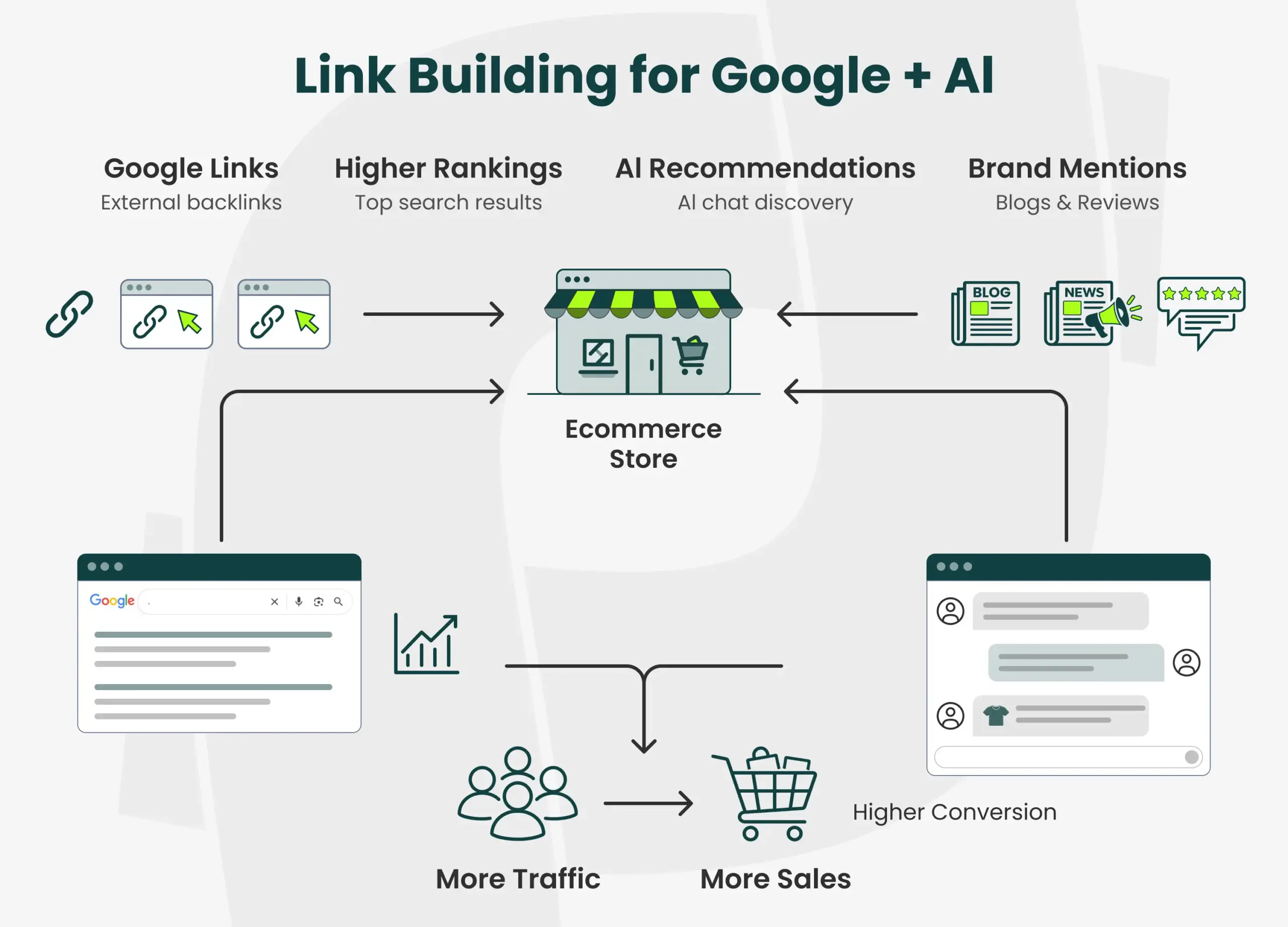
People now use AI platforms such as ChatGPT, Perplexity, Gemini, and others to discover and gather information about what they want to buy, which plays an important role in their buying decisions.
Suppose someone asks ChatGPT, “What’s the best espresso machine under $500?” Brands with a strong editorial footprint on the web get recommended.
A 2026 [Search Engine Land](https://searchengineland.com/chatgpt-vs-non-branded-organic-search-conversions-470321) analysis found that ChatGPT ecommerce traffic converted at a 31% higher rate than non-branded organic search across 94 ecommerce sites in 2026. The volume is still low; ChatGPT drove around 1.48% of organic revenue, but it’s growing, and the conversion-rate advantage is real.
This is the reason why digital PR and brand mentions matter more in ecommerce than ever. Where links build authority for Google rankings, brand mentions build the web presence that AI search engines use to decide which products and brands to recommend.
External editorial links + strong internal linking give you better Google rankings. Widespread brand mentions improve your AI search visibility.
## How to Measure Ecommerce Link Building Results
**Measure ecommerce link building results by tracking organic traffic to product and category pages.** Organic-attributed revenue, and ranking movement on commercial keywords tied to those pages. Referring domain counts alone tell you nothing about whether the links earned moved the business.
Link building without tracking or measurement is guesswork; you should know which parameters to check, why they matter, and which [link building tools](https://outreachdesk.com/link-building-tools/) to use to do it.
| What to Track | Why it Matters | Tool |
| --- | --- | --- |
| Referring domains to content assets | Shows link building mementum. | Ahrefs, SEMrush |
| Organic traffic to product/category pages | Proves authority is reaching commercial pages. | Google Analytics, Search Console |
| Keyword rankings for commercial terms | Links should move these; if they don’t, check your internal links. | Ahrefs, SEMrush |
| Revenue from organic search | The bottom-line metrics. | GA4 ecommerce reports |
| Brand mentions across the web | AI search visibility signal. | Ahrefs Brand Radar, Google Alerts |
A healthy ecommerce [link building campaign](https://outreachdesk.com/link-building-campaigns/) shows growth across all five parameters. If referring domains grow but product page rankings are steady or don’t move, then try fixing your internal linkings.
## Common Ecommerce Link Building Mistakes
**The common ecommerce link building mistakes are buying generic directory listings, paying for product-review placements on low-authority sites, and ignoring topical relevance when pursuing scale.** Each one wastes budget on placements that won’t move commercial rankings. The patterns below cost stores the most growth over a typical year.
Here are some ecommerce link building mistakes that are most common, and you should try to avoid them.
### Building Links Only to the Homepage
Your homepage already has the most authority on your site. Shift your focus to active link building efforts on category and product pages to drive equity deeper into your site.
### Ignoring Internal Link Structure
This mistake is the most common and can cost ecommerce brands more rankings than any other gap. Eternal links without internal paths to commercial pages can feel incomplete.
### Chasing High-DR Links With no Relevance
A link from a tech blog to your handmade candle store does almost nothing. Relevance is the multiplier that makes the link count.
### Expecting Overnight Results
Link building is a compounding investment. Consistent efforts of over 6-12 months can produce results that short-term efforts can’t match. The BuzzStream survey found that around [75% of link builders are given six months or fewer](https://www.buzzstream.com/blog/link-building-trends/) to prove value, but the real gains often show up after that window.
### Ignoring Content Entirely
If your site is 100% product listing without any blogs, guides, or tools, you’re missing the most effective link building strategy available. Even a small content library of 10-15 well-crafted guides gives outreach teams something that they can work with.
### Chasing Volume Over Relevance
Even fifty links from unrelated blogs deliver less impact than five links from publications your targeting customers actually read. Through relevance to the topic, Google determines whether a link should influence your category rankings.
### Not Tracking AI Search Visibility
AI search tools like ChatGPT and Google’s AI Overviews are becoming channels for product discovery. A [Visibility Labs study](https://searchengineland.com/chatgpt-vs-non-branded-organic-search-conversions-470321) analyzed 94 ecommerce sites and found that ChatGPT referral traffic converted at a 31% higher rate than non-branded searches. Strong brand authority built through quality links and mentions is what gets you recommended in these tools.
## Conclusion
Winning at organic search in 2026 isn’t about the number of links; it’s more about relevance and pointing to the right pages, earned through strategies that build real authority.
Start with the strategies that are closest to revenue, such as product roundups and unlinked brand mentions. Then build your content library to create a long-term link earning. Connect everything with smart internal linking.
In business, organic traffic is an asset, but links are the medium through which you grow it.
### Not sure how to build links that actually drive ecommerce sales?
Get a clear strategy to grow your rankings, traffic, and revenue with the right pages.
[Book a short strategy call](/contact-us/)
### What are advanced ecommerce link building tactics?
Five advanced tactics consistently outperform basic outreach for ecommerce: (1) packaging your store’s original data as quarterly trend reports for media coverage, (2) building programmatic “Best [Category] for [Use Case]” pages designed to earn affiliate citations, (3) Wikipedia and Wikidata entity-level work that feeds AI knowledge graphs, (4) reciprocal partnership programs with complementary non-competing brands, and (5) building free linkable tools or calculators that solve real reader problems. These tactics layer on top of standard strategies and typically take 60-90 days to produce results.
### How long does ecommerce link building take to show results?
Most campaigns show measurable improvements in rankings within 3-6 months; however, the real revenue impact is observed within 6-12 months. The actual timeline depends on your domain’s existing authority, the competition level for your target keywords, and the quality of your internal linking distribution.
### Can you build links directly to product pages?
Yes, but rarely, that’s the core challenge of ecommerce link building. Most site owners won’t link to commercial pages. Their expectations include truly unique or innovative products that earn press coverage, manufacturer pages that list retailers, and “best of” roundup posts where your product genuinely belongs.
### How many links does an ecommerce site need?
There are no universal numbers. A site earning 5-10 quality, relevant links per month will outperform a site buying 50 low-quality links. Focus on growing your referring domains rather than the raw backlink count.
Imagine there are two stores, one has 200 links from 15 websites, and the other has 80 links from 60 websites. The second store wins almost every time because the diversity of linking domains matters more than volume.
### Is link building still worth it now that AI search is growing?
Yes, because link building earns authority for Google rankings, which is still important for the majority of ecommerce traffic. The brand mention that comes with editorial link building can improve your visibility in AI search. An [Ahrefs 2026 study of 75,000 brands](https://ahrefs.com/blog/ai-overview-brand-correlation/) found that branded web mentions had the strongest correlation with AI Overview visibility.
---
---
title: "CBD Link Building: Strategies That Actually Work (2026)"
url: "https://outreachdesk.com/cbd-link-building/"
lang: "en-US"
type: "post"
description: "CBD link building is about building a healthy backlink profile for your CBD website while staying compliant with strict industry and platform guidelines. What actually earns CBD links is topically relevant editorial placements, educational content assets, digital PR, and outreach"
last_modified: "2026-05-22T10:01:49+00:00"
categories: [Link Building]
---
# CBD Link Building: Strategies That Actually Work (2026)
**CBD link building** is about building a healthy backlink profile for your CBD website while staying compliant with strict industry and platform guidelines.
What actually earns CBD links is topically relevant editorial placements, educational content assets, digital PR, and outreach in adjacent niches. Standard SEO strategies often fall short here because many websites ignore or flag CBD content during outreach. For brands that want consistent execution, working with a [specialised link building agency](https://outreachdesk.com/) removes the heavy lifting. For brands that need ongoing execution, [managed CBD link building services](https://outreachdesk.com/cbd-link-building-services/) from a specialised provider can carry the load.
This industry is expanding fast, which means if you want to stand out, you need a clear strategy. One effective strategy for the CBD (cannabidiol) niche is link building.
Link building strengthens your visibility and brings in consistent, search-driven traffic. Most brands skip this step, so when you do it right, you get an edge.
**Key Takeaways
**
- Backlinks are your most dependable growth channel when paid ads are closed.
- Relevance matters more than domain authority when choosing where to build links.
- Publishers reject product pitches, not CBD content, so lead with education.
- Build links to informational pages and push authority to products through internal links.
- Most brands stop after a few attempts. If you stay consistent, that’s where you start to pull ahead.**
**
## What is CBD Link Building
**CBD link building** means earning [high-quality backlinks](https://outreachdesk.com/what-are-backlinks/) from trusted sources in the cannabidiol industry. When you do it right, you strengthen your domain authority, improve organic visibility, and grow your rankings in one of the most regulated niches online.
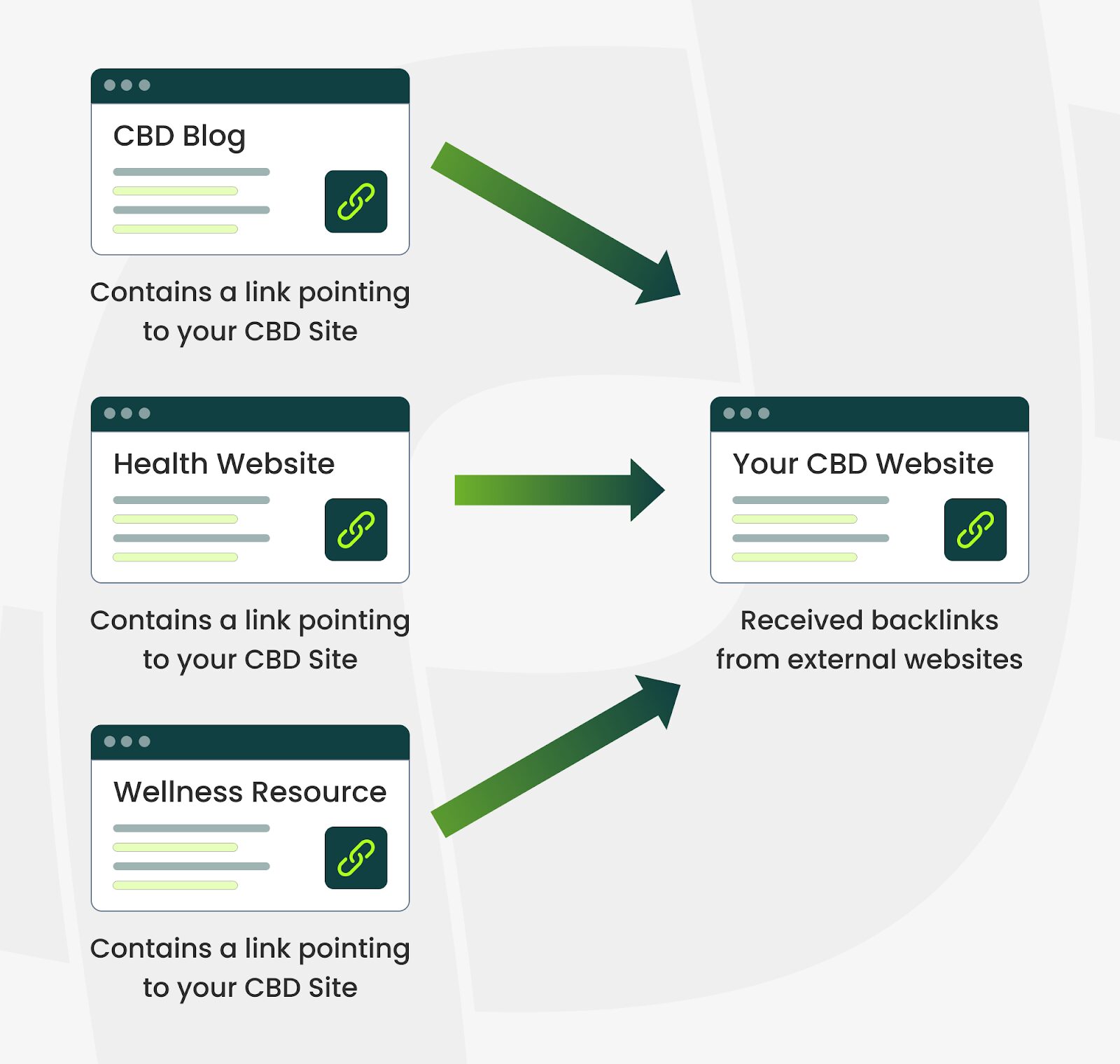
Standard link building is already competitive, and CBD adds another layer. Advertising restrictions, compliance requirements, and editorial gatekeeping mean the standard playbook doesn’t hold up here.
The backlinks that move your rankings need to come from carefully sourced, topically relevant placements, built through real relationships. In this niche, that distinction matters more.
The reality is:
- Google limits CBD ad placements to FDA-approved topics in 3 U.S. markets.
- Meta restricts ingestible CBD advertising.
- TikTok heavily restricts cannabis content entirely.
With paid channels blocked or heavily restricted, organic search is the most dependable growth channel available to you in 2026. A strong backlink profile is what gets you there and keeps you there.
## Importance of Link Building for CBD Websites
Link building remains essential for CBD sites despite challenges like stigma and regulations.
Google Ads allows CBD ads only in California, Colorado, and Puerto Rico, and even then, those ads are limited to FDA-approved or topical hemp products with strict certification requirements.
Meta requires LegitScript certification and prior written approval, and still won’t allow ads for CBD oils, gummies, or capsules, which are the biggest product categories.
These restrictions were confirmed by [Cannabis Business Times](https://www.cannabisbusinesstimes.com/business-issues-benchmarks/cannabis-advertising/news/15767791/cannabis-advertising-compliance-2026-strategies-that-scale). With paid ads limited, backlinks become important for driving your rankings and organic growth.
A CBD brand with more quality referring domains generally outranks competitors. For this industry, valuable backlinks are the foundation of success for many reasons:
### Improved Search Engine Rankings
Search engines like Google use backlinks to check your authority and relevance. When you earn high-quality backlinks from reputable domains, you signal to Google that your CBD website can be trusted and provides real value.
### Increased Organic Traffic
Higher rankings mean more people find you organically in [search results](https://outreachdesk.com/what-are-serps/). That’s qualified traffic of people actively searching for what you sell. No guesswork. Just intent.
### Brand Authority and Credibility
Quality backlinks from trusted health, wellness, and cannabis websites build your authority and credibility in the CBD space. That trust leads to long-term growth and stronger industry relationships.
### Referral Traffic
Valuable backlinks earned from high-traffic websites send real visitors to your site, which puts you in front of new audiences and potential customers.
### Long Term Growth
A strong backlink profile continues to benefit your [SEO](https://outreachdesk.com/what-is-seo/) health in the long term. You keep building momentum, even after paid ads stop delivering.
## Why CBD Sites Face a Unique Link Building Problem
CBD link building comes with obstacles you won’t find in most other niches. Knowing what you’re up against helps you build a strategy that actually works.
Google classifies CBD and cannabis content as [Your Money or Your Life (YMYL)](https://developers.google.com/search/docs/fundamentals/creating-helpful-content#:~:text=We%20call%20these%20%22Your%20Money,our%20changes%20are%20working%20well). In other words, Google holds CBD content to a higher standard. Fair or not, that’s the reality.
Google looks more closely at your expertise, your sources, and whether your site can be trusted to provide accurate health-related information. It demands a higher standard of expertise and trustworthiness.
**Key challenges you face:
**
### Trust Deficit
Startups face a trust deficit in CBD link building, so learning [how startups build backlinks](https://outreachdesk.com/link-building-for-startups/) through credible content and relevant placements becomes essential to earn initial authority.
###
### Content Filtering
Some sites filter out CBD content automatically by blocking submissions related to this niche.
### Industry Sigma
Some sites are hesitant to link to CBD-related content due to the stigma or concerns about legal implications, despite its growing acceptance. Editors worry about legality, even when CBD is legal in the U.S.
###
### Regulatory Restrictions
Creating link-worthy CBD content is harder because compliance concerns give publishers an easy reason to decline.
### Limited Pool of High-authority Sites
You’ll find it harder to source reputable, high-authority websites in the CBD niche than almost anywhere else.
### Content Saturation
Content saturation occurs as more CBD-related content becomes available, making it harder to create unique, link-worthy material.
### Rapid Industry Changes
With rapid changes in the CBD industry, your backlinks can lose value if your content gets outdated, so focus on building resources that stay relevant.
### Payment Processor Restrictions
Payment processors often block CBD deals. That makes sponsored posts rare and even more valuable when you find them.
## What’s Changed for Cannabis Link Building in 2026
Three shifts have reshaped how this works since 2024:
### 1. More Mainstream Publishers Accept CBD-adjacent Content
The blanket bans (total prohibition) that were standard two years ago have loosened.
Several major wellness and lifestyle publications updated their editorial policies in 2025–2026 to allow references to CBD brands with third-party lab testing and FDA-compliant labeling.
Those updated editorial policies open up more publishers, giving you more ways to build authority.
### 2. Google’s Helpful Content System Rewards Topical Depth
Google’s [helpful content updates](https://developers.google.com/search/docs/fundamentals/creating-helpful-content) hit the CBD space harder than most. Keyword-stuffed articles with no original perspective have lost ground steadily.
What earns visibility now is editorial depth backed by quality backlinks. That signals your site is a trusted source, not just another product page.
When your content is genuinely useful, your [link building campaigns](https://outreachdesk.com/link-building-campaigns/) compound faster and drive stronger growth.
### 3. AI-Generated Content Has Flooded the CBD Space
Most AI-generated CBD content has flooded the space between 2024 and 2026, and it looks identical, having the same structure, the same claims, and the same lack of original data.
The paradox: that uniformity makes it easier for your site to stand out. If you invest in original research, real expert quotes, and media coverage, you set your brand apart and make it easier to earn valuable backlinks.
You don’t need more content. You need content worth referencing.**
**
## What Makes a High-quality CBD Backlink
Not every link is equal in CBD. Relevance almost always beats domain rating, and most brands get this backward. A strong CBD backlink has:
### Topical Relevance
The linking site covers relevant topics like health, wellness, cannabis, and lifestyle. A pet nutrition site linking to your CBD pet product page will do more for you than a link from a general news site. Relevance beats raw numbers almost every time.
### Editorial Placement
The link sits naturally within the content, not in a footer, sidebar, or a resource list built solely to host outbound links. Google’s own documentation confirms that where a link lives on a page affects its value.
### Contextual Alignment
The content surrounding your link supports what your page is actually about. A mention inside a CBD sleep guide pointing to your tincture page is worth more than the same domain rating link dropped into an unrelated wellness roundup.
### A Clean Link Profile
The site isn’t part of a paid-post network, a [link farm](https://outreachdesk.com/link-farming/), or a manipulative linking pattern. A single low-quality link in an otherwise strong profile rarely causes problems. A consistent pattern of them does.
### Real Audience Traffic
The site drives real organic traffic, not just inflated metrics.
**Pro Insight
**
Context matters more than raw authority. A relevant DR 40 site with relevant content can outperform a generic DR 80 site with irrelevant content.
## How to Build CBD Backlinks Without Getting Rejected
Build a structured outreach process that makes life easier for publishers:
### 1. Target CBD-Friendly Publications
Start your [outreach strategy](https://outreachdesk.com/link-building-outreach/) with sites that already publish CBD or cannabis-related content.
**How to find them:
**
- Search for “CBD benefits blog” or “hemp wellness article”
- Use [Ahrefs](https://ahrefs.com/) or [Semrush](https://www.semrush.com/) to analyze competitor backlinks
- Look for lifestyle, health, and alternative medicine blogs
**Action:**
Build a list of 50-100 relevant sites before outreach.
### 2. Create Link-Worthy Content First
Create strong, high-quality content. Weak content leads to failed outreach.
**Focus on:**
- Education guides(such as “CBD for sleep”)
- Research-backed articles
- Expert-driven insights
- Data or survey content
Content-driven backlinks outperform cold outreach links in long-term ranking stability.
**Action:
**
Publish at least 3-5 strong content assets before starting outreach.
### 3. Use Compliance-Aware Outreach Messaging
Make sure your content doesn’t put publishers at risk and that your outreach emails demonstrate that you understand compliance concerns.
**Avoid this in your email:
**
- Aggressive anchor text requests
- Sales-heavy language
- Medical claims without an original source link
**Instead, present your content in this manner:
**
- Position your content as informational
- Highlight value for their readers
- Offer editorial collaboration, not just a link
**Example approach:**
“Your audience already reads about wellness topics. This content piece adds a research-backed view on CBD usage patterns.”
### 4. Focus on Contextual Placements
** **[Contextual links](https://outreachdesk.com/contextual-link-building/) carry the most weight when they’re placed inside relevant articles.
**Better placements:
**
- Guest posts
- Expert quotes
- [Resource mentions](https://outreachdesk.com/resource-page-link-building/)
**Weaker mentions:
**
- Directories
- Sidebar links
- Bulk submissions
**Tip**
One strong contextual link often outperforms 10 low-quality placements.
## Effective Link Building Strategies That Actually Work for CBD Brands
Building high-quality backlinks in the CBD space demands a different approach. The tactics that actually drive growth are:
### Guest Posting on Health and Wellness Publications
Guest posting in CBD link building involves creating useful content for relevant, CBD-friendly sites, where your link fits naturally within the content and adds value to their audience.
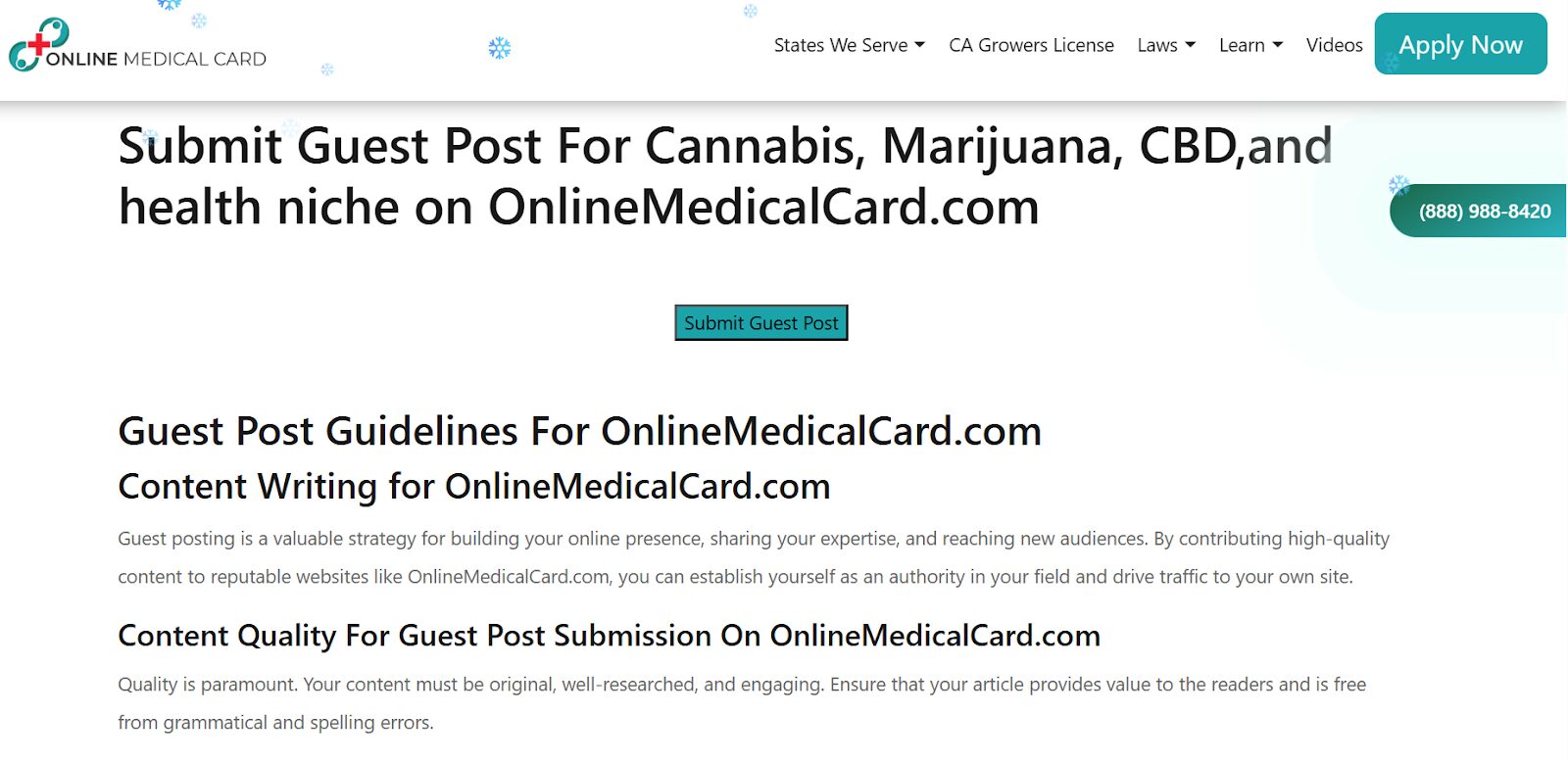
Health and wellness publishers are the most natural fit for CBD content. Many publishers now accept contributed articles and expert commentary on sleep, stress management, and recovery, making CBD a natural fit for the conversation.
**What works:
**
- Educational pitches about cannabinoid science, not product promotions
- Original survey data or summaries of clinical research
- Your founder or chief scientist positioned as a quoted expert, not a brand spokesperson
**What gets rejected: **product press releases dressed as editorial content, and pitches that lead with a commercial page instead of a useful one.
### Digital PR
In Digital PR, you’re pitching newsworthy stories, data, or expert insights directly to journalists and editors to earn media coverage and backlinks from online publications.
Cannabis is a legitimate news beat in 2026. Reporters at [MJBizDaily](https://mjbizdaily.com/), [Cannabis Wire](https://cannabiswire.com/), and business desks at general publications regularly cover regulatory shifts, market trends, and consumer behavior.
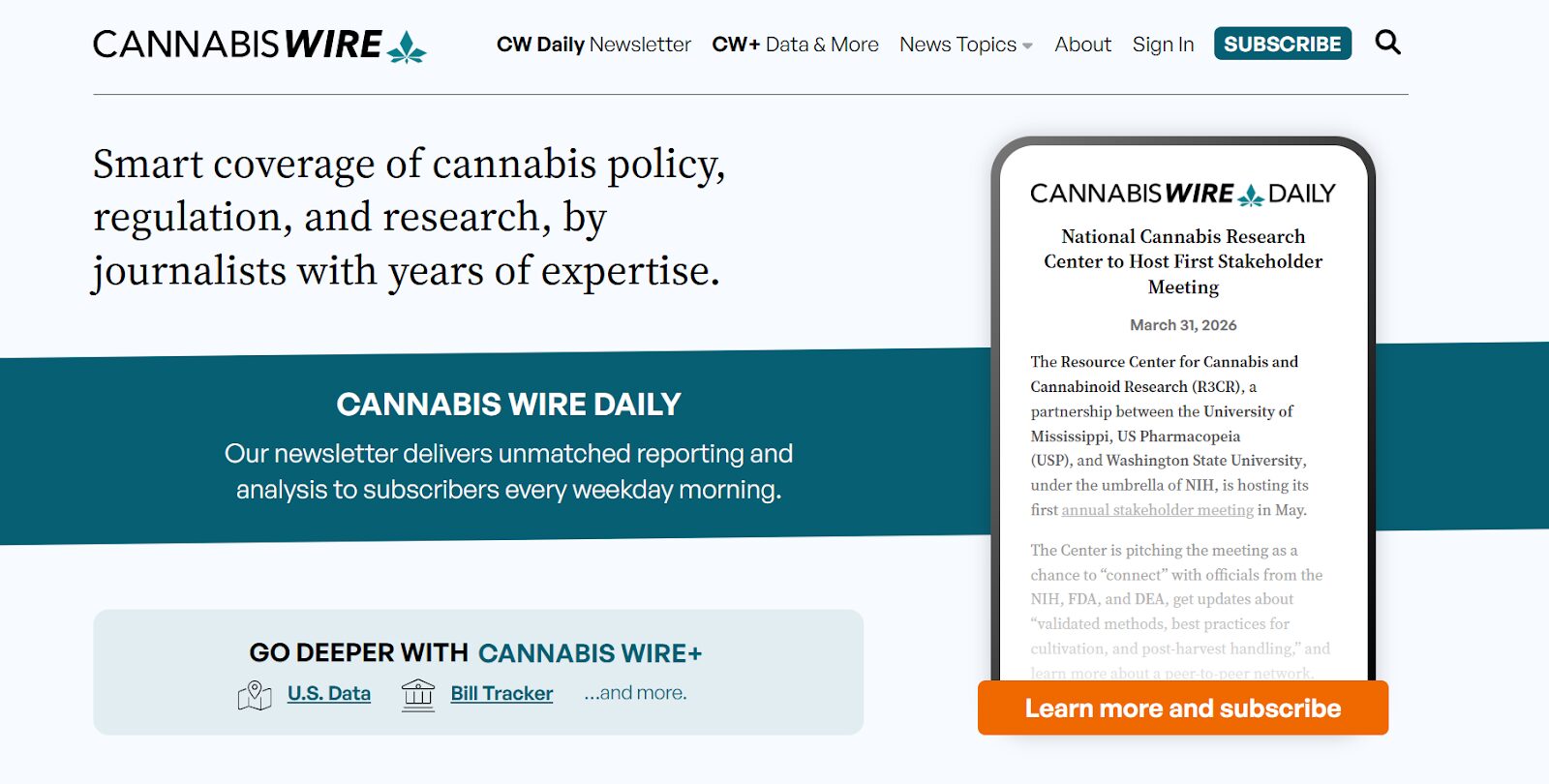
That gives you real opportunities to earn coverage if you bring them something worth writing about.
**What works:
**
- Data-driven press releases tied to industry trends you actually track
- Responding to journalist queries through [HARO](https://www.helpareporter.com/) and similar platforms
- Offering exclusive survey data or findings to reporters covering cannabis regulation
### Lead With Education, Not Products
Here’s the non-negotiable rule: pitch informational content, not product pages.
Publishers that reject CBD oil pitches will often accept genuinely educational content. A guide on how third-party lab testing works, an analysis of cannabinoid extraction methods and a breakdown of CBD dosage research. Build those assets on your site first and then pitch them.
The difference between a pitch that works and one that doesn’t usually comes down to this:
**What Works:**
_“_We published a data-backed guide on how third-party CBD lab testing works. It might be useful for your wellness audience.”
One CBD wellness brand tried exactly this. They published a detailed guide on reading CBD certificates of analysis, pitched it to a handful of sleep and recovery blogs, and earned four editorial placements in six weeks.
None of those publishers would have accepted a link to their product page.
**Doesn’t work:**
“We sell premium CBD oil and would love a backlink from your site.”
One offers value. The other asks for a favor. When a link points to your informational page, your internal links push that authority to your product and category pages. That’s how educational backlinks help you win commercial rankings.
### Target Adjacent Niches
Don’t limit prospecting to cannabis-only sites. Some of the strongest CBD [link acquistion opportunities](https://outreachdesk.com/link-acquisition/) sit in adjacent verticals your competitors probably aren’t working:
- **Wellness and self-care blogs**
CBD fits naturally into sleep, stress, and recovery content
- **Fitness and sports recovery publishers**
Topical CBD for athletic recovery is well-documented and less editorially sensitive than ingestibles
- **Pet health sites**
Pet CBD has grown into a significant market segment, and pet publishers tend to be more open to the topic than human health editors
- **Legal and regulatory outlets**
CBD regulation changes are genuinely newsworthy; legal publications link to well-sourced analysis
- **University research and science pages
**
Cannabinoid studies attract academic backlinks that carry strong authority signals
Each of these opens up publisher pools your competitors probably aren’t targeting. That’s where your best opportunities lie.
### Create Assets That Earn Backlinks Passively
Most CBD sites publish the same recycled content: “What is CBD,” “CBD benefits,” “how to choose CBD oil.” None of it earns backlinks because hundreds of identical articles already exist.
What actually earns authoritative backlinks is original data and practical tools that other writers need to cite.
Run a consumer survey on CBD buying habits. Publish annual pricing trend data. Build an interactive map of CBD legality by state. Create a dosage calculator that draws from published research.
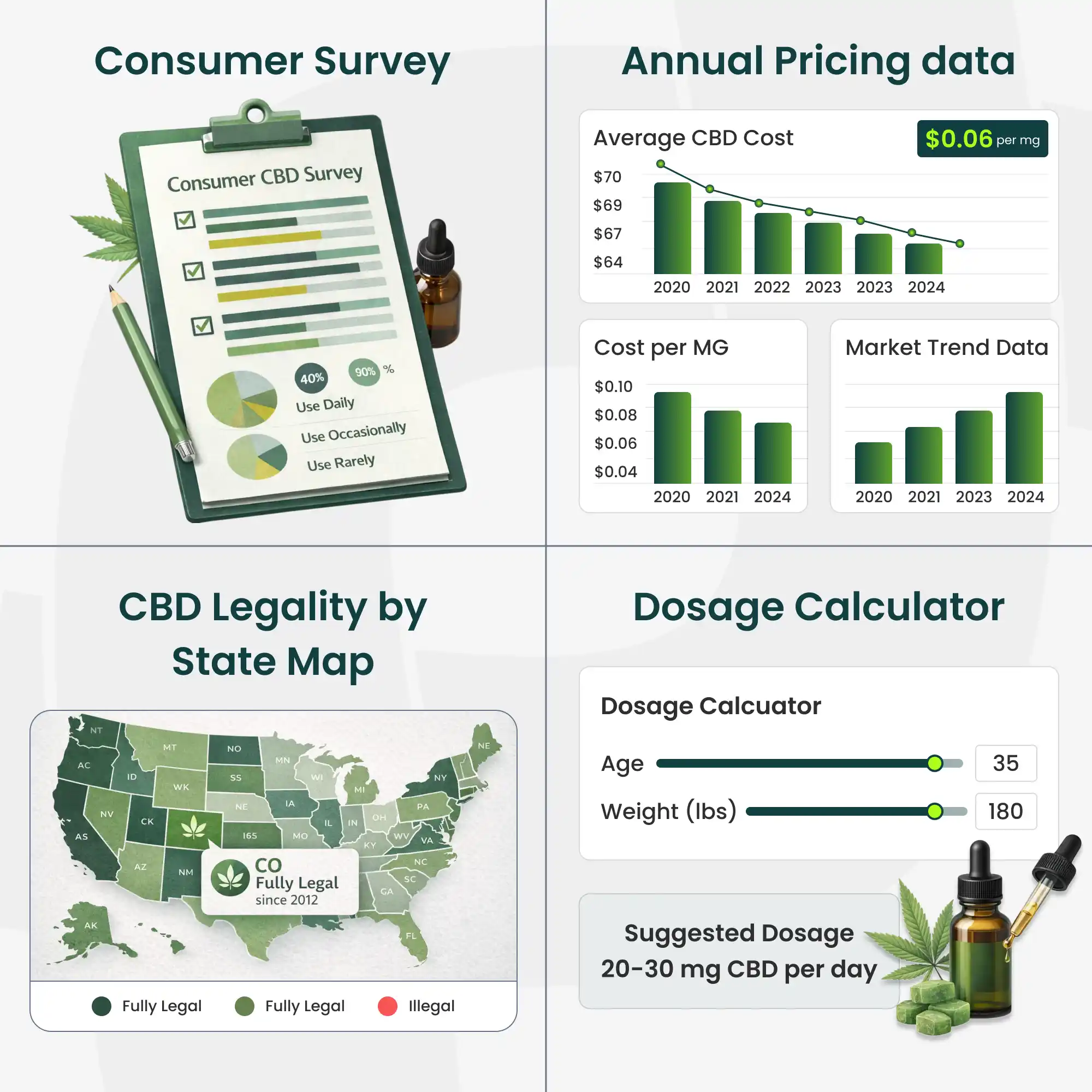
A journalist covering CBD market growth doesn’t need another blog post, they need a primary source to reference. If your site is the source, the backlinks follow.
### Industry and Trade Associations
State cannabis trade associations, hemp farming organizations, and industry coalitions often maintain member directories and resource pages.
These backlinks are niche-relevant, carry real authority within the space, and are straightforward to earn through membership or active contribution.
### University and Research Institutions
Academic backlinks are tough to get. But if you can earn them, they’re hard to beat.
University Research departments studying cannabinoids sometimes cite commercial data or studies. If your brand is actively involved in clinical research, those citation links carry more weight.
### Podcasts and Video Show Notes
Appearing as a guest on a cannabis-focused podcast earns you a contextual link from the show notes, typically on a domain with solid authority. These links also drive qualified referral traffic, which is a genuine bonus beyond the SEO value.
## Tactics That Will Hurt You
Some tactics that work in other niches will actively hurt you in CBD. Tactics like:
### Most Cannabis-specific Directories
Dozens exist primarily to sell listings. Most have no editorial standards, thin content, and high outbound link counts per page.
The exception: a small number of curated directories that verify lab results, require business licensing, and maintain real editorial standards. Evaluate each one on its own merits, don’t assume the category is worthless or safe.
### Paid Guest Post Networks
Paid CBD guest post networks are the fastest way to burn your link profile, so avoid them entirely. If a site’s primary revenue model is selling guest post placements and its content is almost entirely contributed by CBD articles, treat it as a link scheme.
Google’s [link spam](https://developers.google.com/search/docs/essentials/spam-policies#link-spam) policies explicitly flag this pattern. The short-term rankings aren’t worth the risk.
### Reciprocal Link Swaps at Scale
The occasional natural link exchange isn’t a problem. Systematic trading across dozens of cannabis sites creates a visible footprint. Keep it organic and rare.
### Exact-match Anchor Text, Repeated
Repeatedly using anchors like “best CBD oil” or “buy CBD gummies” draws algorithmic scrutiny faster in YMYL niches. Vary your anchors. [Brand mentions](https://outreachdesk.com/brand-mentions/) and plain URLs should make up most of your profile.
## In-house Vs. Outsourced CBD Link Building
Handling CBD link building in-house gives you control, but it only works if you have the right resources behind it; [outsourcing](https://outreachdesk.com/outsource-link-building/) offers speed and established relationships.
**In-house works well when**:
- You have a dedicated content marketer with media relations experience.
- Your brand already has original research or recognized experts.
- Your monthly link target is modest, somewhere in the range of 3-8 quality backlinks.
**Outsourcing works well when:**
- You need to scale beyond what one person can manage.
- You don’t have established publisher relationships in wellness or cannabis.
- Your team’s time is better spent on product and operations.
One thing to verify before outsourcing is that the agency understands CBD compliance specifically.
A general link building agency that treats this niche like any other will pitch restricted publishers, use aggressive anchors, and potentially earn backlinks from sites that damage your profile rather than build it.
## Measuring What Matters
Here’s what actually tells you your CBD link building is working or not and how often you should check these metrics:
| Metric | What It Tells You | How Often to Check |
| --- | --- | --- |
| New referring domains | Unique sites linking to you | Monthly |
| Domain authority/rating | Overall site strength | Quarterly |
| Organic keyword rankings | Whether links translate to visibility | Monthly |
| Organic traffic to target pages | Actual business impact | Monthly |
| Referring domain relevance | Quality of your link profile | Quarterly |
## Conclusion
CBD link building is more challenging than in most niches. Ad restrictions, publisher hesitation, and compliance complexity add friction at almost every step.
That friction is also what makes it worth doing. Most brands give up early. The ones that stay consistent with the right content, the right targets, and outreach that actually respects publishers build organic authority that no paid channel can replicate.
### Not sure which CBD link opportunities are worth your time?
Get clarity on where to focus so you build links that move rankings.
[Book a strategy call](/contact-us/)
### Is CBD link building legal?
Yes, CBD link building is legal as long as your content follows federal and state rules for hemp‑derived CBD.
As per [hemp and CBD regulations](https://lnkd.in/e-FPGfCb), Hemp must have 0.3% total THC or less, and finished products are limited to 0.4 mg of total THC per container.
But the real challenge you will face is the publisher’s willingness, not legality. Many sites decline CBD content due to editorial or liability concerns, even when it’s compliant.
### How long before CBD link building shows results?
You’ll usually see results in 3-6 months. Backlinks need to be crawled, indexed, and factored into Google’s authority calculations. CBD is competitive, so growth takes longer than in less crowded industries. If anyone promises page-one rankings in 30 days, that’s a red flag.
### Should you build links to CBD product pages?
It depends on the type of page and the publisher you’re targeting. Most high-authority publishers won’t link to commercial pages.
Earn backlinks from informational sites such as guides, original research, tools and use internal linking to push authority toward your product and category pages.
This approach is more effective and sustainable. For example: a wellness blog won’t link to your CBD gummies page, but they might link to your guide on “How to read a CBD certificate of analysis.” That guide then links internally to your products.
### What types of sites should CBD brands target for links?
Target health and wellness publishers, fitness and recovery blogs, pet health sites, legal analysis publications, university research pages, and CBD industry news outlets.
Focus on relevance. A link from a topically related site with moderate authority (DR 40-60) is usually more valuable than a link from a high-authority site with no CBD-related connection.
### How many links does a CBD brand need?
There’s no universal number. It depends on your keywords, competition, and current authority.
As a benchmark, ranking on page one for a moderately competitive CBD keyword in the US usually needs 30-50+ quality domains pointing to your supporting content.
Focus on building links consistently each month instead of chasing a fixed target.
---
---
title: "What Are Niche Edits & How Do They Work? (2026)"
url: "https://outreachdesk.com/niche-edits/"
lang: "en-US"
type: "post"
description: "There are articles that live on the search engine for years; not every page starts from zero. Niche edits give you a way to earn backlinks from those articles. Most agencies that scale this approach rely on outreach experts for"
last_modified: "2026-05-20T06:17:53+00:00"
categories: [Link Building]
---
# What Are Niche Edits & How Do They Work? (2026)
There are articles that live on the search engine for years; not every page starts from zero. Niche edits give you a way to earn backlinks from those articles. Most agencies that scale this approach rely on [outreach experts](https://outreachdesk.com/) for execution.
A **niche edit** is a backlink placed within an existing published article on another website. Your link benefits because the page is already indexed, trusted, and crawled by Google; your link gets discovered faster and carries more weight than a link on a new page. Many teams turn to a [niche edit service](https://outreachdesk.com/niche-edit-service/) when manual outreach becomes too time-consuming to scale.
Instead of building authority from scratch, you start from something that already works.
**Key Takeaways:
**
- Niche edits add contextual links to existing ranking pages to build authority.
- Combine niche edits and guest posts to build a natural, diversified backlink profile.
- High-quality niche edits require relevant topics, traffic, and editorial standards.
- Avoid cheap, bulk niche edits that show paid link schemes.
- Successful niche edits rely on prospecting, genuine value, and genuine outreach.
## What Are Niche Edits and How do They Work?
**A niche edit is a backlink placed inside an existing, already-published article rather than in a new piece of content.** The publisher adds your link into a relevant article that already has domain authority, backlinks, and search traffic, passing stronger equity than a link on a brand-new page.
**Niche edits** are also known as link insertions or curated links. These are [backlinks](https://outreachdesk.com/what-are-backlinks/) placed in an existing published article on another website. Either by inserting them directly into relevant content or earning them through resource pages and expert roundups.
If done well, niche edits can be the fastest way to build contextual, relevant links, rather than creating new content for every placement.
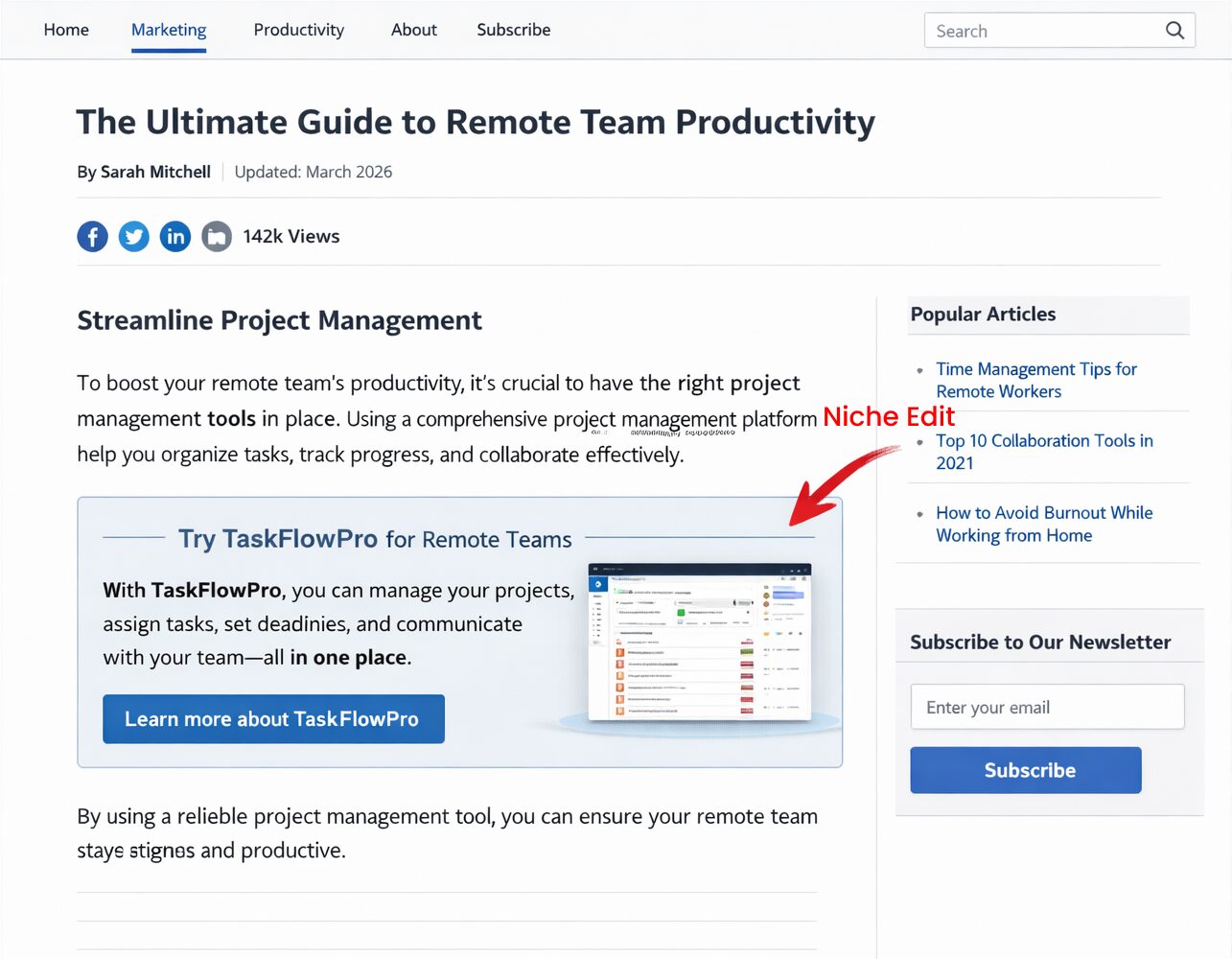
Here’s what it looks like in practice. Suppose you sell project management software called Task FlowPro. A marketing blog published a guide on remote team productivity two years ago. The guide ranks on page one, has backlinks, and gets traffic.
You [reach out](https://outreachdesk.com/link-building-outreach/) to the site owner and suggest adding a reference to your tool inside a relevant section of that existing guide.
Once updated, your link is placed on a page that’s already published, has authority, and visibility, unlike a guest post that starts at zero and has to earn it.
## Niche Edits Vs. Guest Posts: When to Use Each
**Niche edits and guest posts both earn editorial backlinks but in different ways.** Niche edits insert your link into existing content, while guest posts publish a brand new article. Niche edits work faster and cost less. Guest posts give you more control over context, anchor text, and topical signal.
Both help you build backlinks. However, they work differently; knowing which one to use can help you save time, and you get better results.
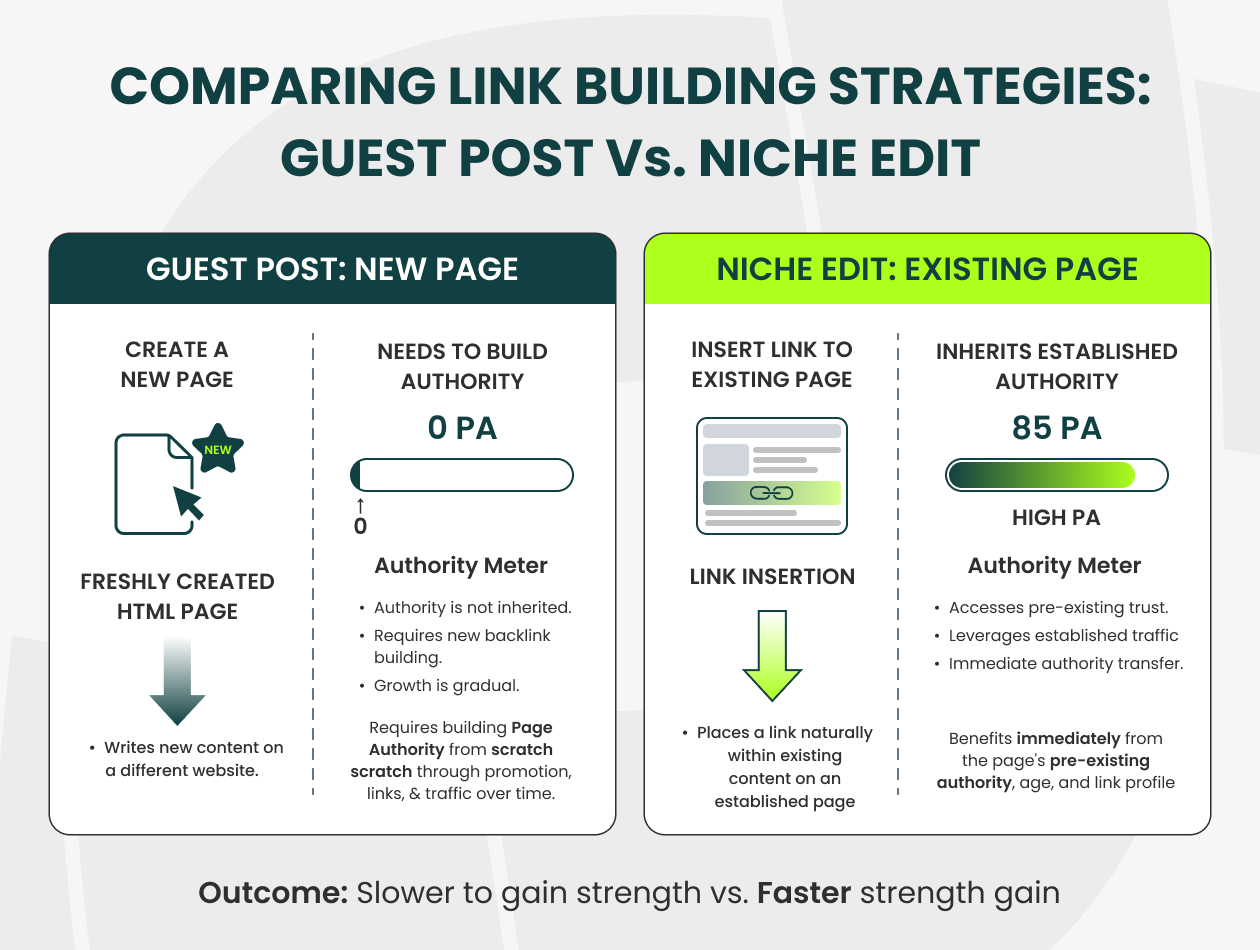
### Guest Posts
Guest posts mean writing new content for someone else’s website. Your link is placed inside that new content, but it takes more time because you need to write, edit, and wait for the site’s owner to publish it. Guest posts give you complete control.
#### Niche Edits
Niche edits places your link in the existing article. No new content required because the page is already live, trusted, and getting traffic.
The table below will help you identify the clear difference between niche edits and guest posts.
| Factor | Niche Edits | Guest Posts |
| --- | --- | --- |
| Speed to live link | A few days to a couple of weeks | Weeks to months |
| Content creation needed | Minimal (1-2 sentences) | Requires a complete article |
| Control over context | Moderate | High |
| Page authority at launch | Inherited from the existing page | Starts from zero |
| Best for | Quick wins, reinforcing relevance to the topic | Thought leadership, brand awareness |
Most teams that skip niche edits entirely are missing opportunities. The teams that rely only on niche edits miss the brand building value that guest posts bring. The strongest [link building strategies](https://outreachdesk.com/link-building-strategies/) combine both.
[Link building Campaigns](https://outreachdesk.com/link-building-campaigns/) that combine niche edits with guest posts make your backlink profile look more natural. The search engine’s rewards may vary. A profile built on only one link type may look unnatural, no matter how good that type is.
## What Makes a High-quality Niche Edit
**A high-quality niche edit sits in an article with real organic traffic.** Recent publication date, topical relevance to your target page, and natural anchor text matched to the surrounding sentence. Cheap niche edits skip these checks and land you on pages Google has already devalued.
Not every niche edit helps your rankings; some placements move the needle, but others do nothing.
Think of this like an advertisement: a billboard on a busy road works better than on an empty road; the same logic applies.
### The Host Page has Real Traffic and Age
A page published three years ago that gets steady traffic is more valuable than a post published last month.
Old pages with consistent traffic have survived almost every Google update so far, earn their own backlinks, and have proven their relevance over time. A page like that doesn’t need your link; it makes your link better.
### The Topic Matches your Website
If your site sells accounting software and your link shows up in a post about dog grooming, that mismatch is obvious to readers as well as to search engines.
The page your link lives on should cover a topic that genuinely connects to your content. [Contextual link building](https://outreachdesk.com/contextual-link-building/) works well because the more relevant the text is, the more value the link carries.
### The Site has Editorial Standards
Check whether the site publishes the original content and has a real team managing it. A site that accepts every link request isn’t building your authority.
An Authority Hacker survey of 755 link builders found that 93.8% say link quality matters more than quantity. That applies directly to niche edits.
### The Outbound Link Profile is Clean
Before accepting a placement, check who else the page is linked to. If it links to a gambling site, payday lenders, and dozens of unrelated commercial pages, then your link is placed in a bad company.
A page with 5-15 outbound links to relevant, trusted sources is a much stronger placement than a page linking to 60+ random websites.
## The Risks of Cheap Niche Edits
**Cheap niche edits carry penalty risk because they’re almost always placed on PBN sites or pages with thin content that Google’s spam systems already flag.** Price is a meaningful quality signal. Severely underpriced edits usually mean shared link networks, footer placements, or AI-spun host articles.
Niche edits work, but only when done right. Most niche edit services sell links at $50-$80 per placement. They’re selling you links on sites that will hurt you in the long term.
Because at that price, there’s no room for genuine outreach, editorial review, or quality vetting. The only way the number works is if the vendor owns the site (a private blog network) or has a bulk deal with the site owners, who accept links from anyone willing to pay.
Google’s [Search Essentials Documentation](https://developers.google.com/search/docs/essentials/spam-policies) is clear. Paying for links that pass ranking value violates their spam policies. That doesn’t mean that every paid placement triggers a penalty, but it means your risk increases when your placement has no real editorial value behind it.
**Here are some signs of a risky niche edit placement: **
- The site publishes content across dozens of unrelated topics.
- Every article links out to 10+ commercial pages.
- The site has no real audience, low traffic, no social presence, and no engagement.
- The same keyword-heavy text appears almost everywhere.
- The vendors guarantee placement on specific sites even before they have contacted the site owner.
If someone can guarantee you a link before outreach has even started, that relationship is purely transactional. That’s the kind of pattern Google’s [SpamBrain system](https://developers.google.com/search/docs/essentials/spam-policies) is built to detect.
## How to Find and Secure Niche Edit Opportunities
**You find niche edit opportunities through three channels.** Outreach to publishers on competitor backlink lists, broken link recovery, and direct relationships with editors of trusted sites in your niche. The highest-quality placements come from existing relationships. Cold outreach still works but converts at a lower rate.
Genuine niche edits take more effort than buying placements from a vendor list. The conversion rates are lower. [Page One Power reports](https://www.pageonepower.com/search/glossary/niche-edits) that their outreach to update existing content converts roughly 3-5% placements for every 100 sites they contact.
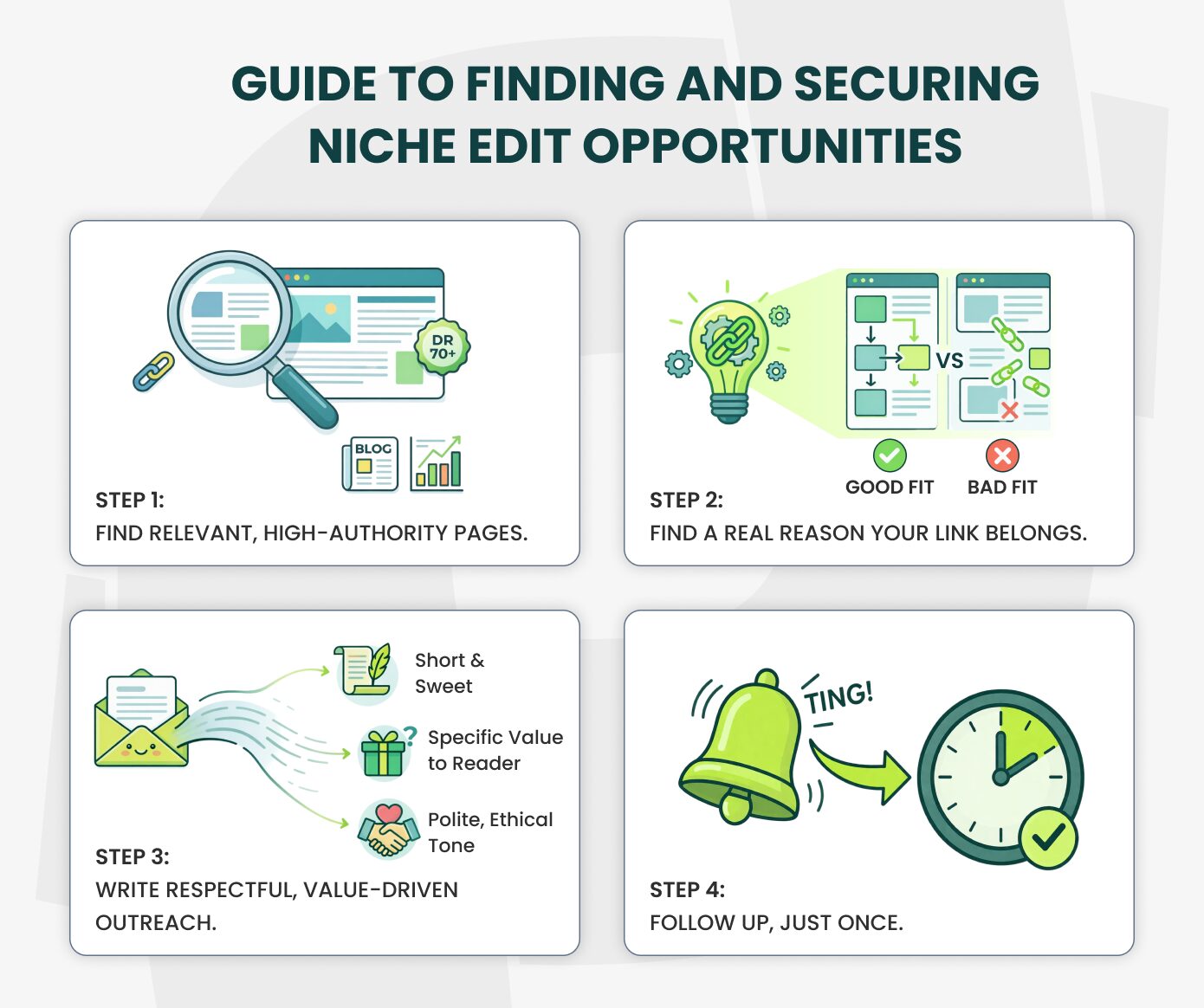
Is it worth the shot? Absolutely. Those links last.
### Step 1: Find Relevant, High-Authority Pages
Start with Google. Search for the topics related to your content in your industry, look for articles that rank well and have been live for at least a year.
Use [Ahrefs](https://ahrefs.com/) or [SEMrush](https://www.semrush.com/) to check two things: whether the page gets real organic traffic, and whether the site has genuine authority behind it. You’re looking for pages where your link would actually add value for the readers.
### Step 2: Find a Real Reason Your Link Belongs
This is where most outreach fails. A generic “your article could benefit from our link” often gets ignored because it gives the site owner no real reason to say yes.
You need a specific reason your link belongs there. Here are some better approaches.
- [Broken link building](https://outreachdesk.com/broken-link-building/) or broken link replacement lets you find a dead link on the page and offer your content as an alternative. The site owner fixes a problem for their readers, and you earn a link.
- Replace **outdated information **if the article refers to any old statistics or tools that no longer exist, and suggest your updated version that includes your research.
- Cover the **content gaps** in the article and add your valuable research to fill them. You’re making the content more useful, not just asking a favor.
- Look for **unlinked**[**brand mentions**](https://outreachdesk.com/brand-mentions/)**. **If the page already mentions your product or brand without linking to you, write a short, polite email pointing this out because it converts at a much higher rate.
### Step 3: Write Outreach that Respects the Site Owner’s Time
Keep the message personalized and short. Name the specific article and explain what you’re suggesting and why it helps their readers.
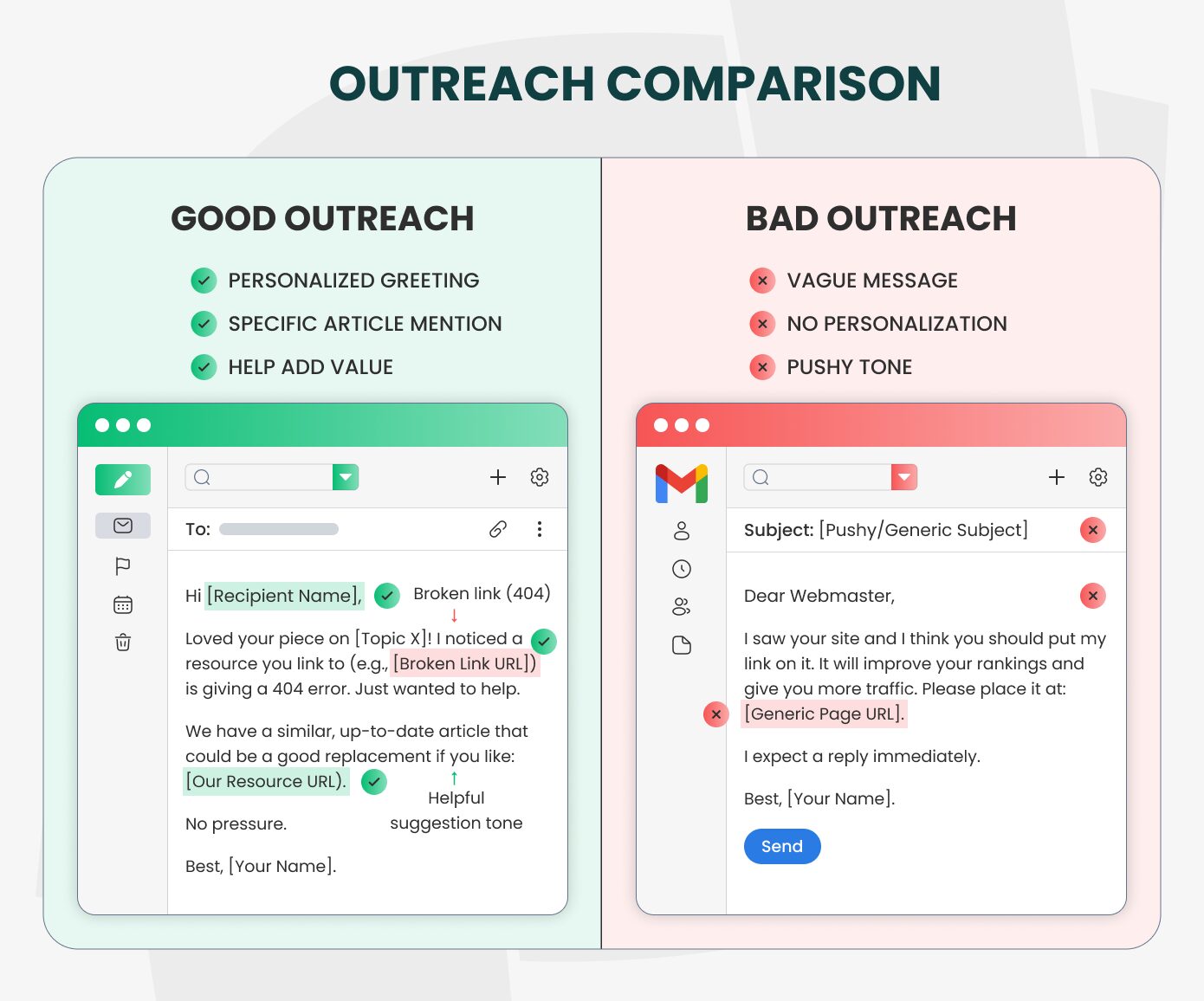
The first example is effective because it gives the site owner a specific reason to act. The second one is a poor example because it asks for a favor without any value in return.
#### Here’s a ready-to-use outreach template.
**Subject: Quick note about your [Topic] article
**
Hi [First Name],
I was reading your article on [Article Topic], and it’s a great piece, especially the part about [specific section or point you genuinely liked].
Just wanted to flag that the link to [Dead Resource Name] in [paragraph/section location] is returning a 404 error.
We published a [one-line description of your content] that covers the same ground. Happy to share the link if you’d like to swap it in.
Either way, thought you’d want to know.
[Your Name]
[Your Website]**
**
### Step 4: Follow up, Once
If you don’t hear back after your first email, then send one follow-up; that’s it. Wait for 5-7 days, then send a friendly reminder. Keep it up to two or three sentences, because this shows you’re checking in and not chasing.
If you get no response even after that, then move on. There are plenty of opportunities worth your time. Sending them three, four, or five follow-ups will hamper your reputation, and they will make sure not to reply to you again.
## How Niche Edits Fit into a Broader Authority Strategy
**Niche edits work best as one part of a mixed link profile that also includes guest posts, digital PR, and earned editorial mentions.** A profile that’s 100% niche edits stands out as unnatural to Google’s spam systems. The right mix depends on your competitive vertical and current authority level.
Niche edits aren’t a standalone strategy. They’re tools in a larger [link acquisition approach](https://outreachdesk.com/link-acquisition/) that should also include guest posting, digital PR, [resource page outreach](https://outreachdesk.com/resource-page-link-building/), and content-driven link earning.
**Niche edits** build authority by tapping into the already ranking pages. Use them to strengthen the relevance to the topic and give specific pages a ranking push.
**Guest Posts **build brand visibility and through leadership. Use these when you want to control the complete context around your link and reach a new audience.
**Digital PR **earns links from high-quality news and media sites. Use it for brand awareness and domain-level authority.
An [Ahrefs study of 1 million SERPs](https://ahrefs.com/blog/links-matter-less-but-still-matter/) confirmed that the link metrics still correlate with higher rankings, with the relationship being strongest for competitive, high-volume keywords (Ahrefs, 2025). For those competitive terms, you need links from multiple sources and methods.
The [Ahrefs research on backlink growth](https://ahrefs.com/blog/backlink-growth-study/) also found that top-ranking pages gain new referring domains at a rate of 5-14.5% per month. Diversify your approach and your results compound over time.
## Frequently Asked Questions About Niche Edits
**The questions below cover the niche edit topics that come up most often.** Pricing, safety, anchor text, and how to evaluate a placement before you pay for it. Each answer is built from real client questions, not speculation about edge cases.
### What are niche edits in SEO?
Niche edits (also called link insertions or curated links) are backlinks placed into existing, already-indexed content on third-party websites. Instead of publishing a new page to host your link, an editor inserts your link naturally into an article that already has domain authority, backlinks, and search traffic, passing stronger equity than a link on a brand-new page.
### Are niche edits safe for Google?
Niche edits from real publishers with genuine editorial standards are safe. The risk comes from private blog networks (PBNs) or link farms disguised as real sites. You can distinguish safe edits by checking that the host site has real organic traffic, authentic content history, and a real editorial contact.
Edits on genuine sites behave like earned links and rarely attract manual actions.
### How do niche edits differ from guest posts?
Guest posts create new content on a host site; niche edits insert your link into existing content. Both build backlinks, but niche edits transfer authority faster because the target page is already indexed and receiving regular crawl budget. Guest posts typically offer stronger topical control and brand visibility, while niche edits are quicker to scale.
### How long do niche edits take to impact rankings?
Most niche edits show measurable ranking movement within 4 to 12 weeks, depending on how often Google recrawls the host page. Pages that are updated frequently or have high traffic get recrawled faster. The impact depends on the host site’s authority, the anchor text relevance, and how competitive your target keyword is.
### How much do niche edits typically cost?
Quality niche edits from real publishers range from $100 to $500 per placement depending on the host site’s domain authority, organic traffic, and niche relevance. Placements priced below $50 almost always come from PBNs or link farms. Price is a meaningful quality signal, severely underpriced edits carry disproportionate penalty risk.
## Conclusion
Niche edits work because your links are placed within content that already has authority, rather than on a brand new page waiting to earn it. Focus on relevance, vet every opportunity. Most importantly, pitch with a genuine reason your link adds value.
### Looking for faster SEO results from link building?
Use niche edits to tap into existing authority and boost rankings.
[Book a free strategy call](/contact-us/)
### Are niche edits safe for SEO?
Safety depends entirely on execution. A niche edit placed on a relevant, high-quality site with real editorial oversight is safe and effective. A niche edit bought from a bulk vendor on a site that accepts links from buyers can carry real risk. The method of placement matters less than the quality of placement.
### How much do niche edits cost?
Pricing varies depending on quality. Bulk vendors charge $50-$150 per link. However, these placements usually come from low-quality sites that do more harm than good. Quality niche edits are acquired through manual outreach and careful vetting, which typically costs $200 to $500+ per placement. This price depends on the host site’s authority and relevance.
### How long does it take for a niche edit to impact rankings?
The host page is already indexed, so Google can find and evaluate your new link faster than it would link on a freshly published page. Most people start noticing ranking movement within 1-3 months.
### Should I use niche edits or guest posts?
You can use both. They work better together than either of them does alone. A niche edit gives you speed and authority from pages that already rank. Guest posts give you control over the content and exposure to new audiences.
A backlink profile built entirely on one link type may look unnatural, and Google notices. Mixing them both helps your profile grow in an organic-looking way.
### Can I do niche edits myself, or should I hire an agency?
You can absolutely do it yourself if you’ve time to prospect, vet, outreach, and follow up. The process isn’t complicated; it’s time-consuming. If your team is already working with an experienced link building partner, this can free up your time while maintaining quality standards. What matters is that whoever does it follows a genuine outreach process, not a vendor list.
---
---
title: "Resource Page Link Building: The Guide to Earning Quality Backlinks"
url: "https://outreachdesk.com/resource-page-link-building/"
lang: "en-US"
type: "post"
description: "Resource page link building is a practical way to earn backlinks from relevant resource pages in your niche. Unlike guest posts or link insertions, this tactic targets pages built specifically to link out to valuable resources, which means your outreach"
last_modified: "2026-05-18T11:52:52+00:00"
categories: [Link Building]
---
# Resource Page Link Building: The Guide to Earning Quality Backlinks
**Resource page link building is a practical way to earn backlinks from relevant resource pages in your niche.** Unlike guest posts or link insertions, this tactic targets pages built specifically to link out to valuable resources, which means your outreach lands with context already established. Many teams turn to a [top link building agency](https://outreachdesk.com/) when manual prospecting becomes too time-consuming.
Resource pages give you one of the most direct link opportunities. These pages are typically created by website owners, educators, and industry publications to recommend useful tools and guides to their audiences.
When your content aligns with what a resource page already recommends, you earn a relevant, trusted link that builds your site’s authority.
**Key Takeaways**
- Resource pages earn you editorial links placed in context, on topically relevant pages.
- Find prospects using search operators, backlink filters, and .edu or .gov searches.
- Qualify every page for indexing, relevance, and traffic before you pitch.
- Keep pitches short, be specific, and follow up once.
- Pair resource page outreach with guest posting, digital PR, or broken link building.**
**
## What is a Resource Page?
A **resource page** is a standalone, curated web page that lists external links to helpful tools, articles, or references on a specific topic.
Site owners, universities, non-profit organizations, government agencies, industry blogs, and niche communities all build resource pages to connect their audiences to the best external content in their niches.
Think of a local business association linking to a relevant accounting guide. Or a university health department listing mental health tools for students. Or an SEO blog curating a list of relevant SEO tools. The common pattern: Someone chose to build a page that points readers to the best stuff elsewhere.
Resource pages are not random link lists covering multiple unrelated topics or simple directory listings. They are topical, curated, and maintained by someone who cares about quality.
That is exactly why a [backlink](https://outreachdesk.com/what-are-backlinks/) from a high-quality resource page carries weight. It reflects an editorial choice rather than an automated listing.
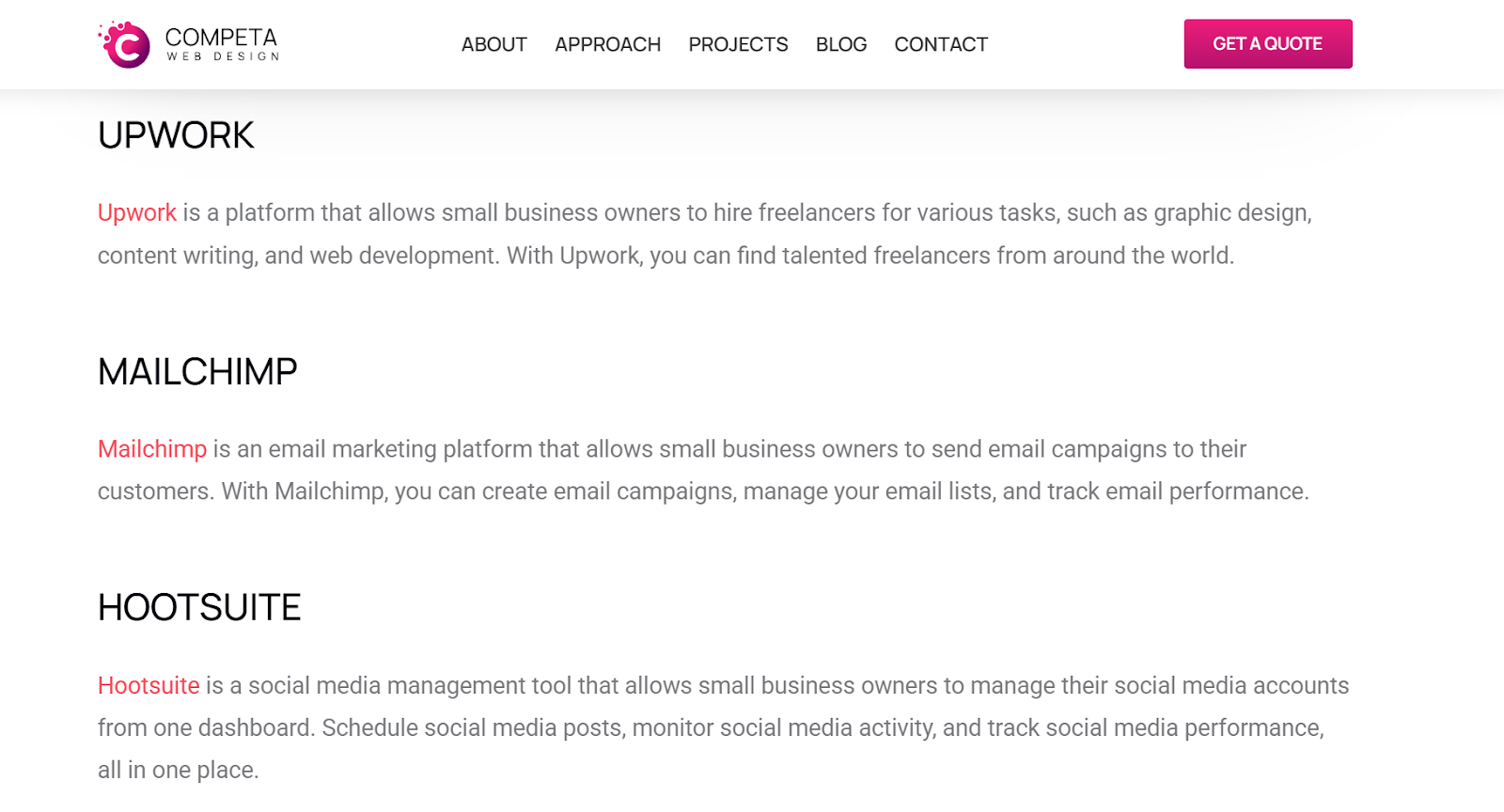
## What is Resource Page Link Building?
**Resource page link building** is the process of earning backlinks by getting your content listed on web pages that curate helpful links for their audience.
These pages are already trusted by Google. When your link is included, you earn a high-quality backlink that carries more weight than directory listings or paid placements.
The pitch is simple: you find pages that already link to content in your niche, and then you pitch your content to them as a worthy addition. There is no guest post to write, and no journalist to convince. Your content improves their page, and you get a [contextual backlink](https://outreachdesk.com/contextual-link-building/). It’s a clear value exchange.
But it’s not as simple as sending one email and waiting. Most site owners get flooded with requests, and webmasters are selective. So your pitch needs to be precise, relevant, and focused on what’s valuable for them and their readers.**
**
## Why Resource Page Links Still Matter in 2026?
Resource page links still matter because a real person reviewed your content and decided it was worth including. No automation, no exchange.
Your link sits in context, on a relevant page, next to other resources they chose to list. Google can tell the difference.
### What Makes Resource Page Links Valuable
Resource page links check every quality signal that matters:
| Signal | Why It Matters |
| --- | --- |
| Editorial placement | Someone reviewed your content and chose to link |
| Topical relevance | The link sits on a page dedicated to your subject |
| Contextual anchor | Your link appears alongside related resources |
| Evergreen durability | Resource pages tend to stay live for years |
| White-hat by nature | No exchange, no payment, just value for the Curator |
### 6 Reasons to Add Resource Pages to Your Link Strategy
- **Lower Competition**
Resource page opportunities remain largely untapped. While most websites focus on guest posting and digital PR, you face less competition for placements and are more likely to get a response from this [outreach](https://outreachdesk.com/link-building-outreach/) effort.
- **High Relevance**
Place your link on resource pages that focus on your topic. When your link sits alongside other trusted sources in your niche, it gains stronger value for both search engines and your audience.
- **Faster Outreach Process**
Keep the process simple. You don’t need to write a full article the way you would for guest posting. Just send a clear, focused email that shows why your content belongs on their list.
- **Long Term Link Value**
Earn links that last. Once your link is added, it can continue to drive referral traffic and pass authority to your site over the long term.
- **Builds Referral Traffic**
Bring in the right traffic. You attract visitors who are already looking for solutions in your niche. These clicks are more relevant and more likely to engage with your content.
- **Safe and White Hat**
You stay within Google’s guidelines and earn placements by offering real value and genuine growth, without paid links or manipulative tactics.
### Is it Worth the Effort?
Yes, if you care about link quality over volume.
Resource page outreach won’t drive the same volume as digital PR campaigns. If you need a high monthly link volume, this isn’t your main strategy.
But if you want to build a clean, diversified backlink profile, especially in competitive niches like SaaS, legal, or health, resource page link building should be part of your strategy.
## How to Find Resource Pages Worth Pitching?
Some resource pages aren’t worth your time. A dead page with a huge number of outbound links and no recent updates is generally not worth pitching.
Here’s how to build a list that is worth pitching:
### Start With Google Search Operators:
- [your topic] intitle:resources inurl:resources
- [your topic] “useful links”
- [your topic] “recommended sites”
- [your topic] inurl:links.html
- [your topic] “helpful resources” site:.edu
For hidden resources pages, try these:
- “[your topic] further reading”
- “[your topic] recommended tools”
- “[your topic] for beginners”
These surface blog post link lists, tool roundups, and starter guides.
For a fitness brand, you can type: **Strength training intitle:resources inurl:resources**.
And for a B2B SaaS company: **project management “useful links” site: .edu**.
Run 5-10 variations for search operators. You will uncover many potential pages before filtering.
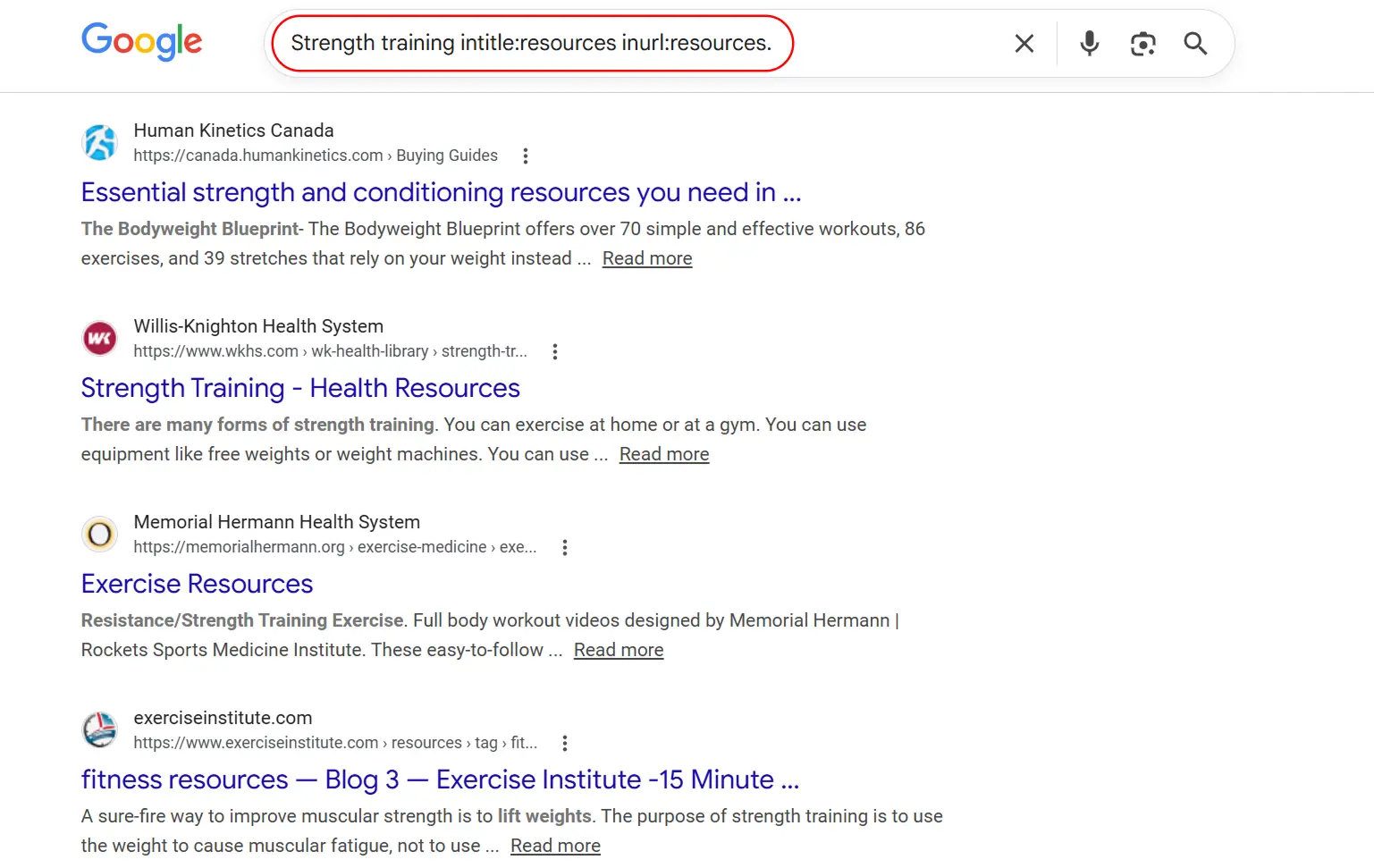
**
**
### Mine Competitor Backlinks
Open [Ahrefs](https://ahrefs.com/) or [Semrush](https://www.semrush.com/), then enter a competitor’s URL. Filter their link profile for referring URLs that contain “resources,” “links,” or “tools.” Those are resource pages already linking to someone in your space.
That’s your shortlist. If they linked to a competitor, they’re open to adding more. And if your content is as good or better, the opportunity is already validated.
This one step can significantly cut your prospecting time.
### Check .Edu and .Gov Domains
University and government resource pages carry real authority. And the people maintaining them care about helping their audience, not monetizing it.
- site:.edu [your topic] resources
- site:.gov [your topic] “useful links”
A dental practice might find university health pages listing oral hygiene guides. A cybersecurity firm might land on a .gov page curating privacy tools. Harder to land, yes. Worth the effort, absolutely.
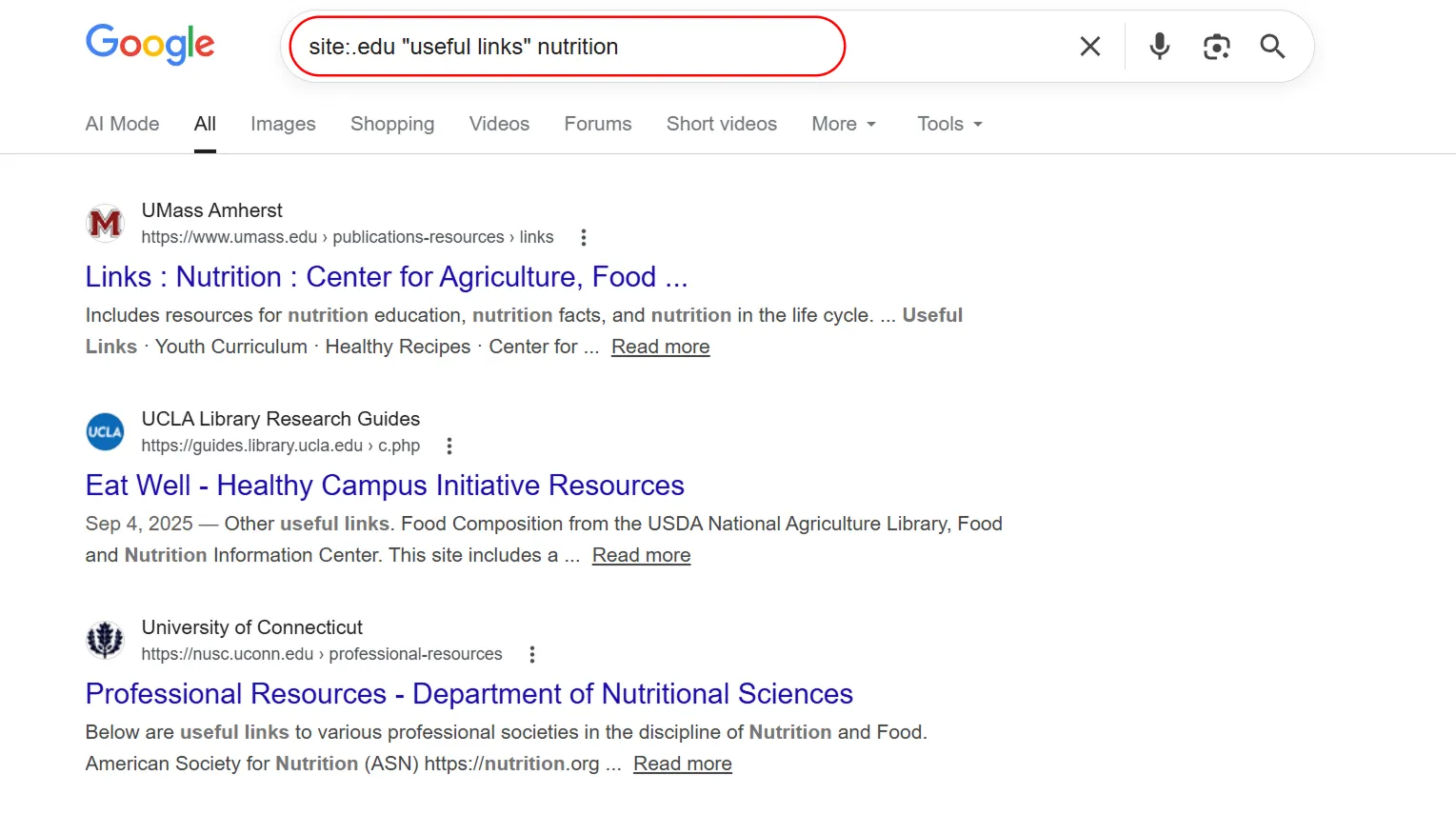
## How to Qualify Resource Pages Before Outreach?
Sending hundreds of emails to every resource page wastes not only your time but also your momentum. Careful selection of prospects is important for real results.
Run each prospect through these 5 checkpoints before it reaches your final list.
### 1. Is the Page Indexed?
Paste the URL into Google using **site:[URL]**. If the site doesn’t show up, skip it. No index means the site has no link value.
### 2. Is Your Content a Genuine Fit?
Relevance beats authority every time. A cloud computing resource page won’t link to your email marketing guide, no matter how strong your site rating is.
### 3. How Many Outbound Links Does It Have?
It’s ideal to have pages with 30 to 70 external links. If it exceeds 100, your link gets buried. If the number is below 10, it means the curator probably isn’t actively maintaining the page.
### 4. Is the Page Still Maintained?
Look for a “last updated” date or any recent additions. Check for [dead links](https://outreachdesk.com/broken-link-building/) using [Broken Link Checker Tool](https://outreachdesk.com/broken-link-checker/). A page full of broken links is either abandoned or run by someone who doesn’t check their inbox.
### 5. Does the Linking Site Have Real Traffic?
Prioritize resource pages that people actually visit. A link from a page with real organic traffic is worth far more than one sitting on a forgotten corner of the web.
Disqualify 60-70% of your initial list. That’s not aggressive. That’s the difference between a 2% conversion rate and a 10%+ rate.
## Writing Outreach Emails That Actually Get Replies
Pitches fail because they sound generic. The webmaster opens an email, sees a generic request, and deletes it.
This is what separates a good pitch from a generic one:
### Lead With Their Page, Not Your Ask
Reference something specific about their resource page at the start. Talk about a resource they have already listed on the site. Make a note of something you found helpful. This takes 30 seconds of research and immediately signals you’re not blasting a similar template to 500 people.
**Weak Opener:** “I found your resource page, and I think that my content would be a great fit.”
**Strong Opener:** “Your guide roundup on [topic] is solid. I especially like the [specific resource] link you included. I have been referencing it myself.”
### Be Specific About What You Are Offering
Explain what is included in your content, why it is relevant to their page, and where it might fit in their resource page ( reference a specific section if the page has many categories).
### Keep it Short
Keep your email short. Just write 5-7 sentences. Don’t try to sell. Make it a clear, helpful suggestion from one professional to another.
### Follow up Once, Not Five Times
Send one follow-up after 7-10 days. One reminder email is enough to show interest without damaging your reputation or the relationship.
**Here is a template you can adapt:
**
**Subject:** Quick suggestion for your [topic] resources page
Hi [Name],
I was looking through your [topic] resource list and noticed you’ve linked to [specific resource]. Great pick.
We recently published [brief description of your resource] , covering [specific angle or data point]. Might be a useful addition under your [section name] category.
Here’s the link if you’d like to take a look: [URL]
Either way, appreciate the work you’ve put into that page.
[Your name]
## Common Mistakes That Kill Resource Page Campaigns
Most of these mistakes happen before you even hit send.
### Pitching Content That Does Not Belong
Make sure the content you pitch fits naturally in the resource page and is relevant. If it doesn’t, then skip the pitch.
### Targeting Abandoned Pages
Check for content freshness signals before emailing. A resource page that hasn’t been updated with the latest content since years, probably has an unmonitored inbox.
### Sending Identical Emails to Every Prospect
Personalize every pitch. Reference the page title, a specific listed resource, or the curator’s name. Even minimal personalization can considerably boost response rates.
### Ignoring Broken Links on the Page
If you spot dead links while qualifying a page, mention them in your pitch. You help the webmaster improve their page, and adding your resource becomes a natural next step.
### Asking for Payment
If a webmaster asks you for a listing, walk away. Paid placements on resource pages defeat the purpose and risk a Google penalty.
## How to Scale Without Losing Quality?
Resource page link building is inherently manual. But you can move faster without cutting corners.
### Batch Your Prospecting
Dedicate time to find and export prospects using tools like [Ahrefs Content Explorer.](https://ahrefs.com/content-explorer) Qualify leads in a spreadsheet before you write a single email. This builds momentum and saves time.
### Create Templates With Personalization Slots
Write 3-4 email variations. For each prospect, personalize the opening line and explain exactly why your content is a good fit. That keeps your outreach personal, even if you scale.
### Track Everything
Use [link building tools](https://outreachdesk.com/link-building-tools/) such as BuzzStream, Pitchbox, or a spreadsheet to track every email, response, and link earned. Tracking helps you double down on what works and build long-term growth.
### Pair With Others
Resource page outreach works as part of a broader [link building campaign](https://outreachdesk.com/link-building-campaigns/). Combine it with other [link building strategies](https://outreachdesk.com/link-building-strategies/) such as guest posting, digital PR, and [contextual link building](https://outreachdesk.com/contextual-link-building/) to grow a strong, diversified backlink profile.
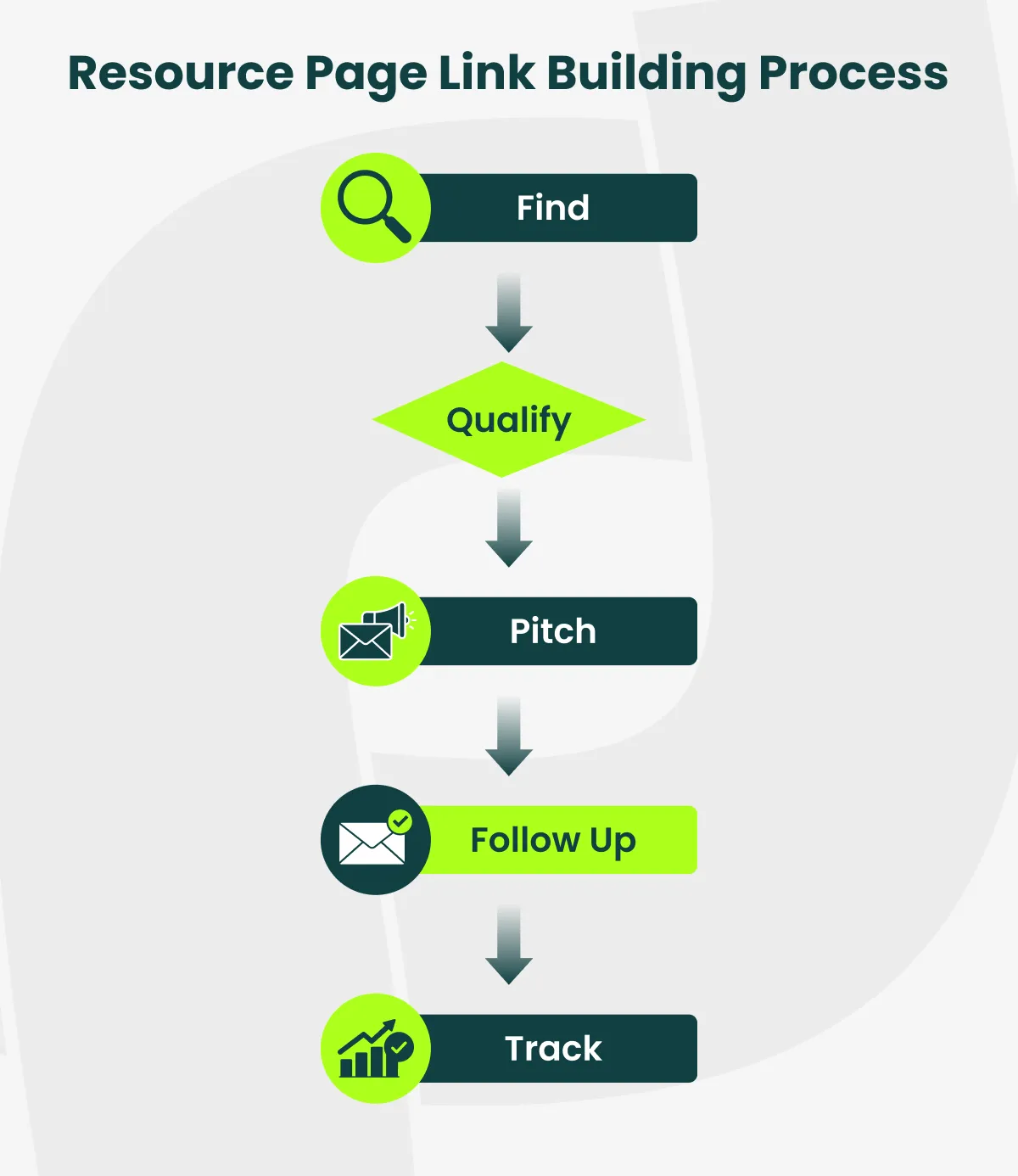
## Resource Page Link Building Vs. Other Tactics
| Tactic | Effort Level | Link Quality | Scalability | Best For |
| --- | --- | --- | --- | --- |
| Resource page outreach | Medium | High | Medium | Clean, relevant links from curated pages |
| Guest posting | High | Medium-High | High | Building thought leadership + links |
| Broken link building | Medium | High | Medium | Pages with dead links in your niche |
| Digital PR | Very High | Very High | Low-Medium | Brand authority + high-DR links |
| Niche edits | Low | Variable | High | Quick placements in existing content |
Resource page outreach won’t replace digital PR for building brand-level authority. But it fills a gap that other tactics miss, especially for newer sites that don’t yet have the brand recognition to land press coverage. If you’re [building links for a startup](https://outreachdesk.com/link-building-for-startups/), resource pages are one of the most accessible entry points.
## Conclusion
Resource page link building isn’t trendy, or it won’t go viral on LinkedIn, but it delivers clean, contextual, lasting links that strengthen your site’s authority month after month.
Start small. Find 20 qualified resource pages in your niche. Write 20 personalized emails. Track what happens. You’ll learn more from that first batch than from reading another five articles about link building theory.
### Want backlinks from high-authority resource pages?
Learn how to get your content listed where people actively look for trusted resources.
[Book a Strategy Call](/contact-us/)
### Is Resource Page Link Building Still Effective in 2026?
Yes. Resource page link building remains effective because it is considered one of the cleanest white-hat strategies available. Google consistently rewards editorial, contextual, and topically relevant content. This strategy has a compounding effect. Sites that build 10-15 resource pages per quarter often see measurable improvements in their rankings within 3-6 months.
### How Many Emails Should I Send to Get One Link?
Expect 20-100 emails per resource page link, based on 1-5% conversion rates. That’s the benchmark to aim for, not the average. Personalized pitches outperform templated emails, according to [PressWhizz’s](https://presswhizz.com/blog/link-building-statistics/) 2026 link building statistics.
### What Tools do I Need for Resource Page Link Building?
The list of minimum tools includes:
- Google for search operators
- Ahrefs or Semrush for backlink analysis of competitors and page qualification
- [Hunter.io](http://Hunter.io) for finding email IDs and contact info
- Spreadsheet or CRM for tracking
If you are running outreach campaigns at scale, platforms like BuzzStream or Pitchbox can save significant time.
### Should I Pitch My Homepage or a Specific Page?
You should almost always pitch a specific page from your site. Resource page curators link to resources such as detailed guides, free tools, calculators, and original research articles.
Treat your homepage as a business card rather than a resource page. Create genuinely helpful content and pitch that. The more specific and valuable your content asset, the higher the conversion rate.
### Can I Combine Resource Page Outreach With Broken Link Building?
Yes, you can combine resource page outreach with a broken link building strategy. When you find a resource page with broken link, you can mention the broken URLs in your pitch and suggest your content as a replacement or addition.
This gives the webmaster two reasons to edit the page, rather than just one. Outreach Desk frequently layers these tactics inside link building campaigns for better results per email sent.
---
---
title: "Outsource Link Building: When and How to Do It Right"
url: "https://outreachdesk.com/outsource-link-building/"
lang: "en-US"
type: "post"
description: "Outsource link building means hiring an external agency to handle everything, such as finding prospects, reaching out, creating content, and securing placements, so you don’t have to. Brands looking to scale this approach typically work with Outreach Desk's services. Working"
last_modified: "2026-05-26T09:55:35+00:00"
categories: [Link Building]
---
# Outsource Link Building: When and How to Do It Right
**Outsource link building** means hiring an external agency to handle everything, such as finding prospects, reaching out, creating content, and securing placements, so you don’t have to. Brands looking to scale this approach typically work with [Outreach Desk’s services](https://outreachdesk.com/). Working with [white-label outreach for agencies](https://outreachdesk.com/white-label-link-building/) can compress this process from months to weeks. For brands that need ongoing execution, a [managed link building outsourcing](https://outreachdesk.com/link-building-outsourcing/) from a specialised provider can carry the load.
Outsourcing link building involves more than just signing a contract and waiting for results. It requires many key decisions around when to start, whom to hire, what to pay, and how involved your team should stay throughout the campaign.
Link building outsourcing done well requires clear quality standards, the right partner, and enough involvement on your end to keep the campaign aligned with your goals. Get these decisions wrong, and you end up with a spreadsheet of placements that don’t move rankings.
#### Key Takeaways
- Outsource link building to focus on growth.
- Choose vetted white hat partners with clear quality standards.
- Invest in a few but high-quality links.
- Backlinks and brand mentions can boost rankings and visibility.
- Review reports, guide anchors, and align your agency’s work with your long-term SEO strategy.
## Common Challenges Without Expert Link Building
**Without expert link building, most in-house teams hit the same three walls.** Thin publisher relationships, low reply rates, and slow learning curves that stall campaigns at month two. Each wall costs months of stalled rankings. The challenges below are the ones that push teams toward outsourcing in the first place.
Here is the list of common challenges you might face without expert link building. Let’s look at them in detail.
### Risk of Spammy Links That Hurt Rankings
While building links, if you aren’t careful, then you might accidentally engage in practices that go against Google’s guidelines. Links from link schemes, [link farms](https://outreachdesk.com/link-farming/), or manipulative, low-quality sites can result in manual penalties.
This will result in a drop in rankings. [Google’s guidelines](https://developers.google.com/search/docs/essentials/spam-policies#link-spam) make it clear that manipulative linking tactics violate its policies. Outsourcing link building gives you the confidence that every [backlink](https://outreachdesk.com/what-are-backlinks/) earned is built the right way.
### Costly Learning Curve Without Tools & Tech
Effective link building requires expertise and experience, as well as tools such as Ahrefs, Pitchbox, and BuzzStream.
For small teams, the cost of [link building tools](https://outreachdesk.com/link-building-tools/) and training might exceed even before you can see any results.
### Low Response Rates and Inconsistent Results
Your emails end up in the trash when your pitches sound generic. This means even if you spend hours in outreach, you will still end up with a few links.
Without experienced outreach specialists, [link acquisition](https://outreachdesk.com/link-acquisition/) becomes unpredictable. One campaign might perform well, the next might deliver nothing. Outsourcing can improve consistency by using tested outreach processes and publisher relationships.
### Difficulty Managing Publisher Relationships
Maintaining hundreds of contacts among the publishers and the editors is nearly impossible for small teams. Without established relationships, outreach becomes cold, and every campaign usually takes longer to gain traction.
Partnering with an [established link building agency](https://outreachdesk.com/), you can tap into relationships with the authority sites and the industry publications that would take years to build on your own.
## When Should You Outsource Link Building?
**You should outsource link building when your in-house team lacks the publisher relationships.** Bandwidth, or specialist skills to earn placements at the volume your rankings require. The practical trigger is usually needing more than 10–15 placements per month, entering a competitive niche, or realizing your current pace won’t close the gap to competitors within a realistic timeframe.
Budget is rarely the deciding factor, opportunity cost is.
Not every business needs to outsource link building services. If your site has fewer than 50 pages of content and limited topical depth, then your priority should be content, rather than links.
Outsource link building for agency makes sense when:
### Your Technical SEO and Content Foundations Are Solid
You already rank for some keywords, but your growth has slowed down. Links may be the missing factor if your rankings are stable despite strong content and solid technical SEO.
### Your Team Lacks Outreach Experience
Prospecting, writing personalized pitches, and managing publisher relationships all require a specialized skill set. Most marketing teams don’t have the time, expertise, or tools to handle these tasks effectively.
### You Need to Scale Beyond 10–15 Links Per Month
SEO specialists can manage 5-20 quality links per month. Therefore, you require systems and publisher networks that most of the in-house teams don’t have.
### You Operate in a Competitive Vertical
In competitive industries such as SaaS, finance, legal, and iGaming, the right links can make a difference between ranking and visibility. A 2025 Aira industry report shows that around 61% of respondents see iGaming and gambling as the most expensive industry for link building; therefore, in this industry, quality matters more than volume.
### You Want Visibility in AI Search Results
An [Ahrefs study](https://ahrefs.com/blog/ai-overviews-study/) shows that around 76.1% of the pages cited in AI overviews also rank in Google’s top 10. Therefore, strong backlinks can support your site’s authority and rankings and help it show up in AI search tools like ChatGPT, Perplexity, and Google’s AI overview.
**Pro Insight:
**
If your outreach efforts are consuming 10-20 hours per week with little to no results, outsourcing is more cost-effective than hiring an in-house team.
## The Benefits of Outsourced Link Building
**The primary benefit of outsourced link building is immediate access to established publisher relationships your team would take 12–18 months to build independently.** Beyond speed, you get a dedicated team whose only job is outreach, meaning prospect research, personalization, follow-up, and placement quality control happen consistently instead of between your other responsibilities.
The compounding effect shows in months 3–6 as placement velocity exceeds what any part-time internal effort can sustain.
Outsource link building for your brand can save time, improve consistency, and give you the access to strong publisher networks. Here is what it offers so that you can make a confident decision.
### Faster Execution & Time Savings
Effective link building takes time because it involves prospecting, managing [outreach campaigns](https://outreachdesk.com/link-building-outreach/), follow-up, and reporting. However, the specialist agencies have the right systems and tools to handle the entire process quickly, in a few days, whereas it could take weeks to finish.
### Access to Established Publisher Networks
One of the most significant advantages of outsourcing is the access it provides. Agencies maintain long-term relationships with authority sites, journalists, and editors across industries. This helps your content secure editorial links faster, with higher acceptance rates and stronger referral traffic.
### Predictable Cost Per Link or Per Campaign
Reputable agencies offer transparent [pricing models](https://outreachdesk.com/link-building-pricing/), right from pay-per-link to managed monthly campaigns, giving you clear visibility into your ROI. Instead of hiring multiple specialists, you get a fixed cost tied directly to the deliverables. This makes your budgeting easier and more predictable, especially for the marketing channels that handle multiple channels.
### Reduced Risk: Avoid Penalties & Toxic Links
Outsourcing to the right and white-hat specialists keeps your site safe from link farming, spammy guest posts, and low-quality link exchanges that violate Google’s guidelines. Professional teams carefully check every backlink for relevance, authority, and editorial integrity before it goes live.
### Scale Demand up or Down Easily
SEO needs to change consistently, be it a product launch, a seasonal campaign, or a market expansion. An outsourced team lets you scale your link building efforts up or down without hiring or training new employees. You have complete control, paying only for what you need and when you need it.
Each model has its own strengths, so pick the model that fits your goals.
## What Activities Are Outsourced
**Most teams outsource the labor-intensive workflow steps: publisher prospecting, outreach email management, content creation, and link verification.** Strategy and approval usually stay in-house. The execution layer is where outsourcing delivers the largest time savings.
| Activity | What it Involves | Benefit to You |
| --- | --- | --- |
| Prospecting | It involves finding relevant, high-authority websites. | It saves research hours and keeps link relevance. |
| Outreach | Personalized email campaigns to the site editors. | Higher response and placement rate. |
| Negotiation | Managing placement teams, pricing, and coordination with publishers. | Transparent cost-per-link structure. |
| Content Placement | Writing or publishing guest posts or digital PR pieces. | Provides white-hat editorial links. |
| Reporting & Analysis | Tracking of DR/DA, link type, and placement quality. | You get clear visibility on ROI. |
## What to Prepare Before You Start Outsourcing
**Before outsourcing link building, prepare three things.** A clear target page list, brand and content guidelines, and a list of competitors you want to match or outrank. Without these inputs, even the best agency wastes budget on placements that don’t move your specific rankings. The checklist below covers everything to lock down first.
Before you outsource your link building campaign to an external partner, prepare an outsourcing brief. This reduces miscommunication and improves results from the first month.
### Target Pages and Priority URLs
Start by identifying which of your pages require link support. Either your homepages, service pages, or your high-value blog pages?
### Target Keywords and Competitors
You need to share your target keywords and ranking goals so the agency can analyze [competitor backlinks](https://outreachdesk.com/competitor-backlinks/) and align their outreach with the gaps in your link profile.
### Link Quality Standards
Define your minimum thresholds for domain authority, organic traffic, spam score, and relevance to the subject being discussed, and document them.
### Anchor Text Preferences
A healthy anchor profile usually leans towards branded and natural anchors, with the limited use of exact-match anchors.
### Content Guidelines
If your agency writes [guest posts](https://outreachdesk.com/guest-posts/) on your behalf, make sure that you provide them with your brand voice guidelines, topic preferences, and a clear list of topics you want to avoid.
### Reporting Schedule and Metrics
You should agree with your agency on what to track and how often to receive updates. Most agencies follow a monthly reporting schedule.
## How to Choose a Trusted Link Building Partner?
**You choose a trusted link building partner by checking three signals.** Sample publisher quality, transparent pricing and process, and case studies with verifiable metrics in your vertical. Agencies that resist sharing sample placement URLs or pricing structure are the ones to walk away from. The criteria below filter for editorial-quality providers.
Choosing the right partner matters because a poor provider can waste budget and months of momentum. Not in terms of fees, but months wasted, and links do nothing. Here’s how to identify credible agencies from the risky ones:
### Ask These Five Questions Before Hiring
#### How do you acquire links?
The answer should involve manual outreach, content-driven placements, or digital PR. If the agency can’t clearly explain the process, that’s a red flag.
#### Can I see live examples of the placements you’ve secured?
Any reputable agency can show you the real URLs; if they refuse to show or if they only share domain numbers without actual links, then walk away.
#### What is your process for vetting target sites?
Look for the answers that mention traffic analysis, relevance to the subject, spam score evaluation, and editorial standards, rather than just the domain authority numbers.
#### How do you handle anchor text distribution?
A good agency classifies anchors in branded (40-50%), exact match (5-10%), partial match (20-30%), and generic (10-15%) options. Over-optimization of anchor profiles can trigger penalties.
#### What does your reporting look like?
Expect monthly reports showing acquired links with live URLs, referring domain metrics, anchor text used, and the indexation status. If your agency can’t show you exactly what they built and where they point, don’t hire them.
### Red Flags That Signal Low-quality Providers
Low-quality providers sell links on irrelevant sites, use recycled domain networks, and deliver placements that look good in the reports but not for your rankings. Here are the key red flags to watch out for:
#### Guaranteed placements on high-authority sites
No ethical agency can ever guarantee any high-quality placement, such as Forbes or HubSpot. Publishers are free to make their own decisions.
#### Price is significantly below market rates
If someone offers DR 60+ links for $50 each, then those links mostly come from private blog networks or content farms.Use a [backlink cost calculator](https://outreachdesk.com/backlink-cost-calculator/) to understand what realistic pricing looks like before you commit to any provider.
#### No transparency before placement
A credible agency shows you past placement samples or target sites even before you commit.
#### Link packages sold by volume only
To simply understand this, suppose “50 links sold for $500” is a clear indication of automated and low-quality placements.
#### No discussion of your content or niche
The agency that doesn’t ask you anything about your business, audience, or competitors can’t build relevant links for you.
#### No case studies or client references
A reputable agency has success stories and can always share real results.
#### No contract or agreement
A professional agency will always provide a clear contract outlining its services, terms, and conditions.
## Outsourcing Models Compared
**There are four common outsourcing models: full-service agency, specialized agency, freelance manager, and marketplace platform.** Each has different trade-offs on cost, control, and quality. The table below shows where each model fits based on your budget, in-house capacity, and quality bar.
Not every business requires the same type of outsourcing partner. Here is a clear comparison of in-house and outsourced link building models:
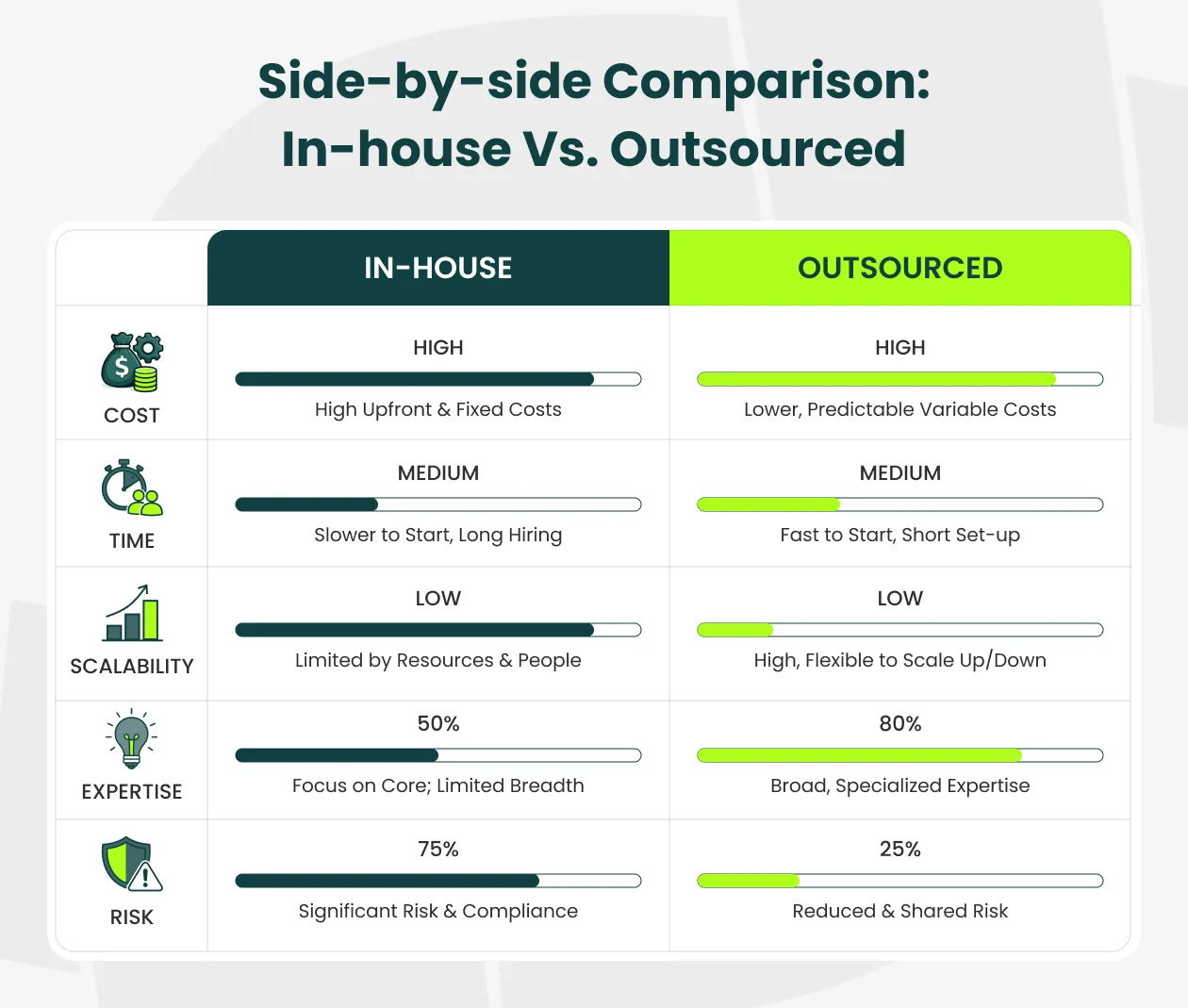In the image above, you can easily see the difference between in-house and outsourced efforts. The cost of in-house may be higher than outsourcing link building, as it requires most of your time to build in-house links, whereas outsourcing requires minimal effort. Similarly, the differences are also visible in scalability, expertise, and risk.
## How Much Does Outsourced Link Building Cost in 2026?
**Outsourced link building in 2026 typically costs between $200.** $1,500 per placement for editorial links, with monthly retainers running $3,000-$15,000 depending on volume and publisher quality. Below $200 per link usually means PBN or marketplace inventory. Pricing above $1,500 buys tier-1 publication placements with verified editorial review.
The average cost to outsource link building in 2026 varies significantly based on domain authority, service model, and niche competitiveness. Here’s what the market currently looks like:
| Domain Authority/Domain Rating | Average Cost Per Link | Best For |
| --- | --- | --- |
| DR 20-40 (Low Tier) | $130-$220 | It is best suited for the early authority growth and new sites |
| DR 40-60 (Mid Tier) | $220-$400 | Best for core campaigns and commercial pages |
| DR 60-80 (High Tier) | $400-$700 | Best for competitive niches, authority reinforcement |
| DR 80+ (Premium) | $700-$1,200+ | Perfect for enterprise and major media placements |
### Cost by Service Model
| Service Model | Typical Monthly Spend | What You Get |
| --- | --- | --- |
| Freelancer (per link) | $500-$2,000 | Individual link placements, you can manage strategies |
| Agency retainer | $3,000-$10,000 | Managed campaigns with strategy, reporting, and anchor text planning |
| White-label service | $1,500-$5,000 | Resellable link building for agencies. |
Here’s what the actual numbers look like. A [2025 Aira industry survey](https://aira.net/state-of-link-building/) found that most businesses, around 38.4%, spend $1,000-$5,000 per month on link building. Around 20% spend time between $5,000 and $10,000 monthly, while just over 7% exceeds $15,000 a month.
**Tip:
**
Only the process shouldn’t drive your decision. One quality link of $400 on a trusted, high-traffic site will deliver better results than five cheap links of $80 on low-quality blogs.
## How to Manage an Outsourced Link Building Campaign
**Manage an outsourced campaign with three controls: weekly reporting, advance approval of target pages and anchor text, and URL review before final sign-off.** The agencies that deliver real ROI welcome this level of oversight. The ones that resist it are usually hiding placement quality issues.
Outsourcing doesn’t mean losing control. The best results come when you stay involved, which usually requires just 5-10 hours of your time per month.
### Monthly Management Tasks
You can use tools like [Ahrefs](https://ahrefs.com/) or [SEMrush](https://www.semrush.com/) to look for unexpected patterns, such as sudden spikes in links from a single country, clusters of exact-match anchors, or the links from sites with zero organic traffic.
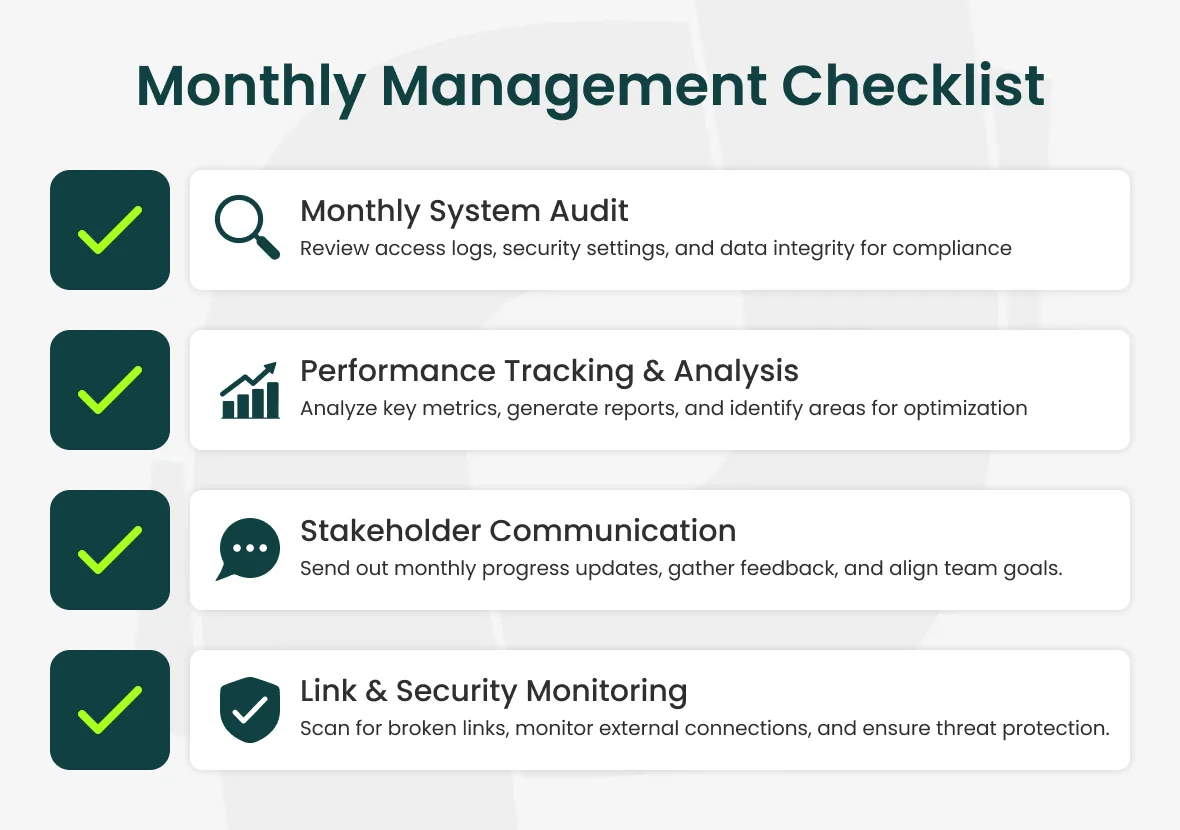
### Track Ranking and Traffic Impact
Links take time to impact your rankings. According to a [2025 survey](https://aira.net/state-of-link-building/), most specialists observe results within two weeks to six months. Therefore, set realistic expectations and review the performance quarterly, rather than weekly.
### Communicate Regularly
Stay in touch with your agency regularly. Share performance data, keyword-priority changes, and content updates so your agency always has the context to target the right opportunities.
### Audit for Link Drops
Publishers sometimes remove the links after placement. A reliable agency tracks this through regular [backlink analysis](https://outreachdesk.com/backlink-analysis/) and replaces any lost links. If your agency doesn’t offer monitoring, make sure you include it in your agreement.
**Tip:
**
Always stay involved and connected to your agency and send feedback. Campaigns that run without involvement tend to lose quality over time.
## Measuring ROI From Outsourced Link Building
**Measure outsourced link building ROI by tying it to revenue, not link counts.** Track referring domain growth on your target pages, organic traffic to those pages, and revenue or lead growth on the same pages over a 6-12 month window. Link counts alone don’t prove ROI. The metrics below connect agency work to revenue.
Return on investment in link building doesn’t happen overnight. Set a timeframe of at least 3 to 6 months before making any major budget decisions on your [link building campaign](https://outreachdesk.com/link-building-campaign/).
### Metrics to Track Monthly
- Acquire the total link count, along with live URLs and domain metrics for each.
- Check whether the quality meets your standards.
- Look at anchor text distribution, see if the anchors are diversified, and check that they look natural.
- Track new, unique domains that are pointing to your site over time.
### Metrics to Track Quarterly
- The keyword rankings change, especially for targeted pages.
- Track organic traffic growth on the linked pages and the site.
- Track referral traffic from the acquired links.
- Monitor if your pages start appearing in AI overviews, ChatGPT answers, or Perplexity summaries for the relevant queries.
Industry surveys suggest that [78% of marketers report](https://aira.net/state-of-link-building/) positive ROI from link building when campaigns are well managed.
**Pro Insight:
**
Track your cost per acquired link and your cost per rankings improvement. A $5,000 monthly campaign moves five keywords into the top 10, delivers a different ROI than one that builds the same number of links but improves no ranking movement.
## Common Mistakes When Outsourcing Link Building
**The common outsourcing mistakes share one root: treating link building as a one-time project instead of an ongoing program.** The patterns: choosing the cheapest provider, accepting placements without review, and skipping placement quality control. Each of these costs months of stalled momentum. The patterns below are the ones to catch in the contract phase.
Even experienced marketers can make avoidable errors. Here are the most common mistakes to avoid.
### Choosing Based on Price Alone
Sometimes the cheapest option is the one that weakens the results. Link building is directly correlated with the cost and quality. An [Ahrefs study](https://ahrefs.com/blog/buy-backlinks/) found that the average cost of quality backlinks is $ 361; if anyone offers the same for $30, the quality difference is easy to identify.
### Not Defining Quality Standards Upfront
If you don’t define the quality signal beforehand, the agency acquires the easiest placement possible. Always set criteria in writing for the minimum domain authority, traffic, and relevance requirements before you get started.
### Ignoring the Anchor Text Strategy
If your agency chooses all your anchor text without guidance, then it can lead to over-optimization. Google’s [spam policies](https://developers.google.com/search/docs/essentials/spam-policies) can detect unnatural anchor patterns, and the penalties can even erase your months of progress.
### Expecting Instant Results
Link building is a steady yet consistent process. Initial placements may show small improvements at first, but the impact grows steadily as your link volume builds up over time.
### Skipping the Contract
Always have a written agreement that covers deliverables, timelines, quality standards, replacement policies for [broken or lost links](https://outreachdesk.com/broken-link-building/), and cancellation terms.
## Why Outsourced Links Matter for AI Search Visibility in 2026
**Outsourced links matter for AI search visibility because Google AI Overviews, ChatGPT.** Perplexity weight domain authority and citation signals when deciding which sources to surface in generative answers. Without a sustained link program, you stay invisible in AI search even when you rank well in traditional results.
Link building has changed. In 2026, the backlinks not only influence traditional Google rankings, but they can also directly affect whether your brand appears in AI-generated answers.
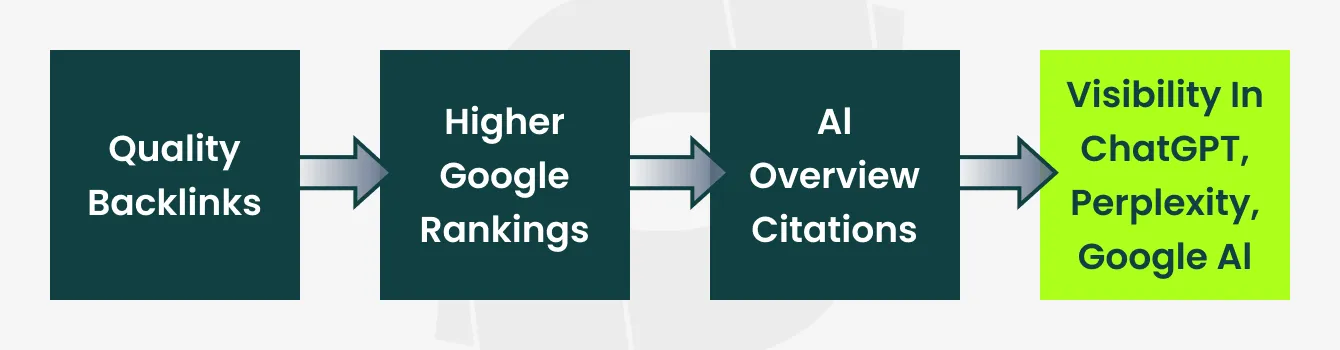**Here’s what the data shows:**
- 76.1% of the pages cited in Google AI overviews also rank in the top 10 organic results, according to an [Ahrefs study](https://ahrefs.com/blog/search-rankings-ai-citations/). Strong backlinks help you rank, and ranking helps you get cited by AI.
- 73.2% of SEO professionals believe that backlinks influence visibility in AI search results, according to a [2025 industry survey of 518 experts](https://aira.net/state-of-link-building/).
- Now, AI overview appears roughly 25% of Google searches, up from about 13% in March 2025, according to the [Conductor’s 2026 analysis of 21.9 million](https://www.conductor.com/academy/ai-overviews-serp-analysis/) queries. Your content either gets cited in those overviews or gets buried.
- [Brand mentions](https://outreachdesk.com/brand-mentions/) may play an important role in AI visibility. Research confirms that brand mentions are more likely to influence AI citation by 0.664 than backlinks and AI citations by 0.218 alone.
**Here’s what this means for outsourcing:
**
The agencies you hire should always understand that the link building in 2026 can go beyond just passing authority from one site to another. It is all about building the kind of authority signals that increase your chances of being cited.
You should look for agencies that not only build links but also work on [earning brand mentions](https://outreachdesk.com/brand-mention-service/) in the right places, through digital PR, expert quote placements, and original data distribution.This builds real authority that works all across Google, ChatGPT, Perplexity, and also other AI search platforms.
## Conclusion
Outsource link building to save time and improve consistency. When you choose a reputable partner, set clear quality standards, and stay involved in the process. Instead of struggling with outreach and placements, you can focus on growing your business while professionals handle everything.
The right agency brings the expertise, relationships, and consistency that are needed to earn quality backlinks that build your authority and also improve your rankings over time.
If you’re ready to scale your strategy and rankings with a clear strategy behind every link, partnering with the right specialist is the next logical step.
### Want experts to handle your link building the right way?
Get a clear strategy and placements that help you grow authority and rankings.
[Book a strategy call](/contact-us/)
### Is Outsourcing Link Building Safe?
Outsourcing link building is safe when you work with a provider who uses editorial, content-driven strategies, such as manual outreach, guest posting, digital PR, and contextual placements on real websites. The risk comes from the providers who use link farms, private blog networks, or automated link schemes. Vet your providers thoroughly before committing.
### How Long Does it Take to See Results From Outsourced Link Building?
Most of the campaigns produce measurable ranking improvements within 3 to 6 months. According to a 2025 industry survey, 83.2% of SEO specialists see initial rankings improvement and its impact within the time frame. High-authority links sometimes show faster effects, but sustainable growth requires consistent acquisition over the quarters, rather than weeks.
### How Many Links Per Month Should I Outsource?
The right number depends on your niche competition and the current backlink profile. Most mid-market businesses benefit from 10–20 quality links per month. In highly competitive niches like finance or legal, you may need more. You should focus on quality per placement rather than hitting a monthly count.
### Can Small Businesses Afford Outsourced Link Building?
Yes, entry-level agency packages start from around 1,000 to $2,000 per month for 5 to 10 links in the DR 20-40 range. For small businesses, even 5 relevant, quality links per month can meaningfully improve rankings and domain authority over time. Start small, measure results, and scale based on what works.
### Should I Outsource All My Link Building or Keep Some In-house?
A hybrid approach often works best. Outsource the high-volume prospecting and outreach to an agency while keeping the strategic partnerships, digital PR pitches, and relationship-based link building in-house. This gives you scale without losing a direct control over your most valuable placements.
---
---
title: "Link Building for Financial Websites: Build Trust in 2026"
url: "https://outreachdesk.com/link-building-for-financial-websites/"
lang: "en-US"
type: "post"
description: "Link building for financial websites means earning links from trusted, relevant sources to improve your rankings, authority, and credibility in a highly competitive niche. Unlike most niches, financial services link building operates under stricter editorial standards, tighter compliance rules, and"
last_modified: "2026-05-28T06:59:59+00:00"
categories: [Link Building]
---
# Link Building for Financial Websites: Build Trust in 2026
**Link building for financial websites means earning links from trusted, relevant sources to improve your rankings, authority, and credibility in a highly competitive niche.
**
Unlike most niches, financial services link building operates under stricter editorial standards, tighter compliance rules, and higher YMYL scrutiny. Google evaluates financial content more strictly than most because inaccurate or misleading information in this space can have real consequences for people’s financial decisions and wellbeing.
Every strong link you earn supports your visibility over time. Weak or irrelevant links can slow that progress.
**Key Takeaways**
- A few trusted, relevant links will do more for your rankings than dozens of weak ones. Quality wins every time.
- Financial websites face YMYL scrutiny, meaning low-quality or irrelevant backlinks carry more risk than in other industries
- Links are still one of the strongest signals Google uses to judge authority. In finance, that matters more than most niches.
- Create content worth citing. Original data, useful tools, and real expert insights are what earn links without you having to chase them.
- Compliance isn’t an afterthought. Build it into your strategy from day one and your links stay live longer.
- Slow and steady wins in finance. Consistent, planned outreach is what builds the kind of trust Google rewards over time.
## Why Financial Websites Need a Different Approach to Link Building
Search engines treat financial content with extra scrutiny, as your site falls under Google’s YMYL (Your Money or Your Life) classification, which means every backlink you earn or fail to earn directly affects whether Google trusts your content enough to show it to people making financial decisions.
Most standard [playbooks that work for other niches](https://outreachdesk.com/link-building-strategies/) fall short for a financial website. And because finance is YMYL territory, two factors make this niche fundamentally different:
### Google Holds Financial Content to the Highest Standard
Google’s [Quality Rater Guidelines](https://guidelines.raterhub.com/searchqualityevaluatorguidelines.pdf) confirms that Google’s systems give more weight to content that aligns with strong E-E-A-T (Experience, Expertise, Authoritativeness, Trustworthiness) for topics that could significantly impact the financial stability or safety of people.
**In practical terms, this means:
**
- Links from irrelevant or low-authority sites can hurt your rankings, not just fail to help.
- Your links need to come from sources that reinforce your financial expertise.
- The credibility of the linking site matters more than its raw metrics.
- A link from a respected financial publication signals to Google that your content is worth trusting.
- A link from an unrelated site showing inflated numbers tells Google the opposite.
### Regulatory Constraints Limit Your Tactics
Financial services companies operate under compliance requirements that restrict what you can publish, claim, and promote. Whether you’re governed by FINRA, the SEC, the FCA, or local regulations, your content has to meet advertising standards that most link building advice ignores entirely.
Guest posts can’t make promissory claims about investment returns. [Digital PR campaigns](https://outreachdesk.com/digital-pr-service/) need to avoid language that regulators would flag. Even the clickable text you use needs to accurately reflect your services, without exaggeration.
In finance, link building isn’t just an SEO exercise. It’s a compliance one too.
**Insight:**
Build your compliance team into the link building workflow from the start. Having legal review pitch templates and guest post drafts before they go live prevents costly takedowns and protects your brand reputation.
## Backlink Types That Improve Rankings in Finance
Not every link will carry equal weight in this niche. Understanding which [link types](https://outreachdesk.com/types-of-backlinks/) deliver the most authority helps you focus resources where they matter.
### Editorial Links From Financial Publications
Editorial links are links you earn when a publisher adds your page or website link inside their content because it helps their readers.
Placements in outlets like Investopedia, NerdWallet, Bankrate, Forbes Advisor, and industry-specific publications such as Financial Planning Magazine or InvestmentNews are highly trusted within the finance industry.
Earning these financial backlinks takes real value. Editors want data, original research, or expert commentary worth referencing.
**These links work because:
**
- The linking domains carry established trust in financial topics.
- Editorial context signals genuine endorsement rather than a paid placement.
- Google’s systems identify topical authority clusters, meaning a finance site linking to another finance site reinforces both.
### Links From Government and Educational (.Gov, .Edu) Sources
A .edu link from a business school resource page or a .gov link from a state financial literacy portal is one of the most powerful finance backlinks you can earn. These are difficult to earn, but once earned, they can be highly effective for your site.
The path almost always involves creating genuinely useful public resources such as calculators, financial literacy guides, or open datasets.
### Industry Association and Professional Body Links
Association and professional body links are especially valuable for link building for financial advisors , organizations like FPA, CFA Institute, and NAPFA already exist to recognize credible firms, and earning a listing from them signals verified industry standing to Google.
When you earn a link from an industry association, something more meaningful happens than a standard media mention. This shows that a recognized organization has reviewed your firm, determined that it meets their standards, and has publicly chosen to place its name next to yours.
Google treats these endorsements as stronger trust signals because they come from verified industry bodies.
### Contextual Links From Adjacent Niches
Getting links from related fields like real estate, legal, accounting, or small-business sites carries strong relevance signals for fintech link building. These sites reach the same people you want to reach, and Google notices that connection.
| Link type | Example Sources | Difficulty | Authority impact | Best-fit scenario |
| --- | --- | --- | --- | --- |
| Editorial Link | Investopedia, Forbes Advisor, Bankrate | High | ★★★★★ | Original research, data studies, or expert commentary that journalists and editors want to cite |
| .gov / .edu | State portals, business school resources | High | ★★★★★ | Financial literacy content, tools, or data that government or academic pages would reference |
| Listicle Mention | Finance review sites, niche blogs | Medium | ★★★★☆ | Service or product features that belong in curated finance comparisons |
| Association | Industry bodies, trade groups | Medium | ★★★★☆ | Fintech startups with membership, certifications, or partnerships with recognised finance organisations |
| Contextual Links | Legal, HR, accounting, business blogs | Lower | ★★★☆☆ | Topically relevant content that solves problems for overlapping audiences — payroll tools, compliance guides, expense management |
## How to Create Financial Content That Earns Links
Publishing the same generic tips article that everyone else has won’t earn you links in competitive finance [SERPs](https://outreachdesk.com/what-are-serps/). Link-worthy financial content needs a clear reason for someone to reference it, something that editors, journalists, and bloggers can’t find anywhere else.
### Original Data and Research
The financial content that earns the most links has one thing in common: original data. And you don’t need a big research budget to produce it.
**Practical approaches:
**
- **Aggregate and analyze public data
**
Pull raw data from public sources like the [Federal Reserve](https://www.federalreserve.gov/), [FDIC](https://www.fdic.gov/), Bureau of Labor Statistics, or SEC filings. Package it into a clear narrative with original charts and you’ve got something journalists and bloggers will cite. Data-driven content earns links at roughly twice the rate of opinion-based content.
- **Survey your audience or customer base
**
A financial advisor firm that surveys 500 clients about retirement confidence produces original, citable data. Journalists covering personal finance need fresh numbers. Give them yours.
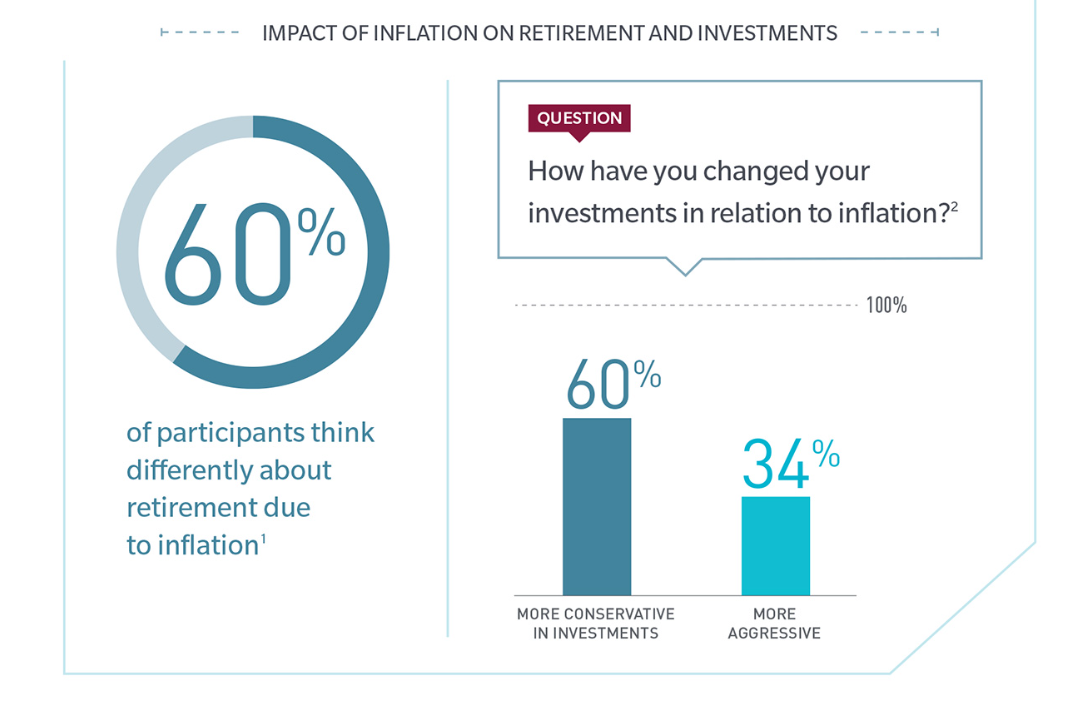
- **Publish annual benchmarks
**
If your firm sits on proprietary data, average loan amounts, insurance claim trends, and investment return patterns, turn it into an annual report. Done consistently, it becomes a resource people link to every year without you having to pitch it twice.
### Financial Tools and Calculators
[Link worthy assets](https://outreachdesk.com/linkable-assets/) such as interactive tools like Mortgage calculators, tax estimators, debt payoff planners, and investment return projectors consistently earn links by attracting links from bloggers, journalists, and resource pages.
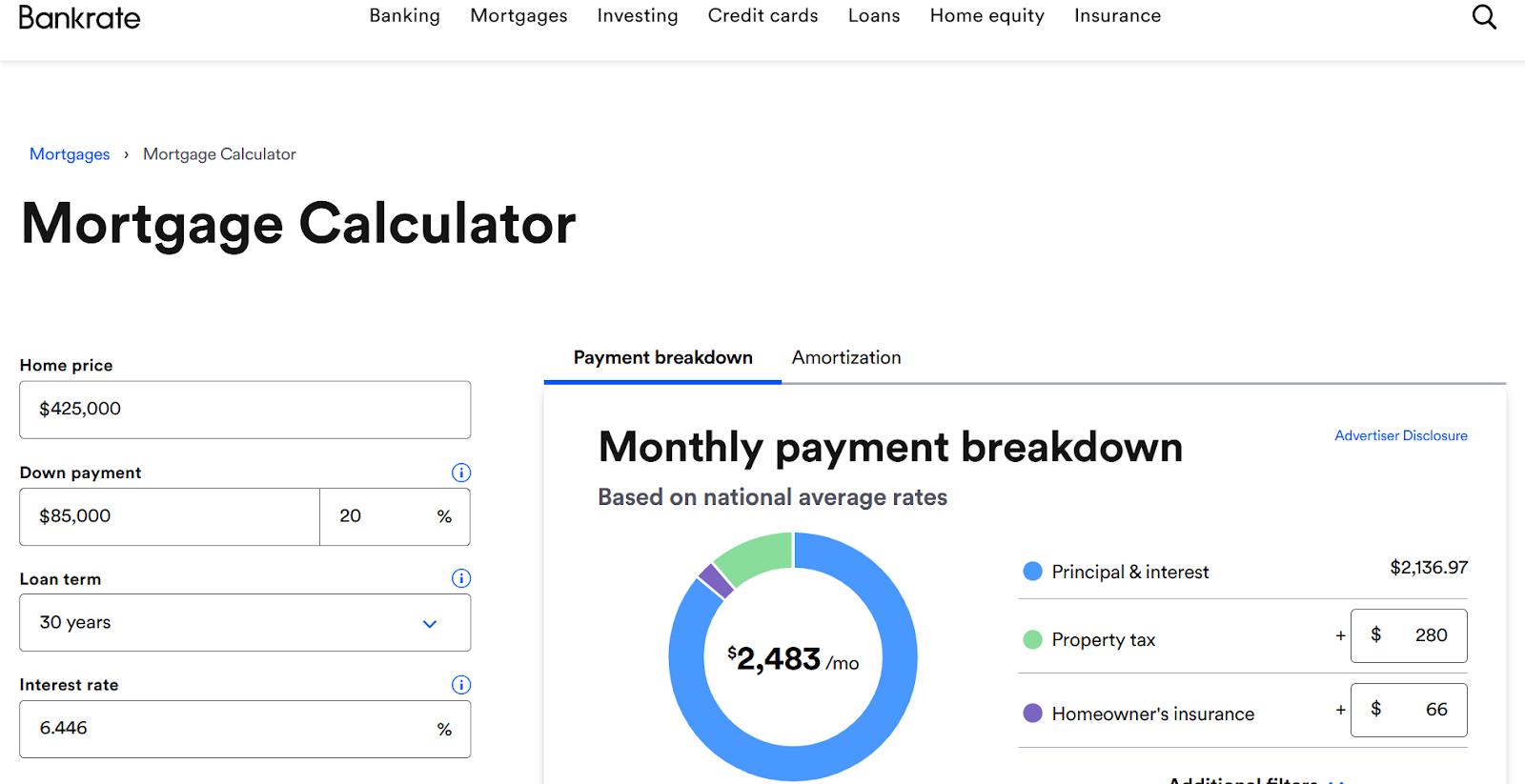
Specificity wins. A generic savings calculator won’t stand out. A freelancer quarterly tax estimator or a state-specific homebuyer affordability calculator fills a gap that existing tools miss.
### Expert-led Guides on Complex Topics
Google rewards expertise in this niche. And the content that earns the most links is usually a long-form guide that goes deeper than anything else on a narrow topic.
Estate planning for blended families. Backdoor Roth IRA mechanics. Small business retirement plan comparisons. Pick a specific subject and own it completely.
## Link Building Strategies for Financial Websites
Creating great content is half the equation. Getting it in front of the right editors, journalists, and webmasters requires [deliberate outreach strategy](https://outreachdesk.com/link-building-outreach/) tailored to how the financial media actually operates.
Based on current industry data and the demands of YMYL content, Each strategy here follows [white hat principles](https://outreachdesk.com/white-hat-link-building-strategies/) , no shortcuts, no paid placements, no tactics that put a regulated financial site at risk.
### Digital PR
Digital PR(public relations) is a strategy of earning media coverage and links from online publications by pitching newsworthy stories, data, or expert insights to journalists and editors.
Finance journalists constantly need expert sources. Platforms like HARO and Qwoted match reporters with experts across financial topics from mortgage rate analysis to cryptocurrency regulation.
**This works well for financial websites because:
**
- Placements land on outlets like Forbes, CNBC, and Bloomberg.
- The links come from editorial decisions, not paid placements, which means they carry strong E-E-A-T signals.
- Your expert’s name and credentials appear alongside the link, which strengthens your authorship signals with Google.
**Steps to earn backlinks through Digital PR: **
- Identify journalists covering your topic, specific to your niche, using [HARO](https://www.helpareporter.com/), [Muck Rack](https://muckrack.com), or [Cision](https://www.cision.com)
- Send [an outreach email](https://outreachdesk.com/seo-outreach/) that includes a data point, explains why it matters to their audience, and offers them the full dataset.
- Follow up once. If no response, move on.
To improve results, assign 2 to 3 spokespeople with verifiable credentials, such as CFPs, CPAs, or licensed financial analysts, who can respond quickly to journalists’ queries. Most HARO-style requests close within 24 to 48 hours, so faster responses increase your chances of getting featured.
### Guest Posting on Authoritative Finance Websites
[Guest posting](https://outreachdesk.com/guest-posts/) in link building for financial sites means you write an article for an established financial website or fintech blog. They publish it. You earn a link back to your site and get your name in front of an audience that already trusts the publication.
Target platforms where your actual audience reads and where real financial professionals contribute as not every site is worth your time.
The signals that tell you a site is worth pitching are named editors, clear editorial standards, and genuine readership. Many industry-specific publications accept contributed columns from credentialed professionals.
Generic articles that any writer could produce won’t land you a spot on the sites that matter. Write about what your organization knows firsthand. Direct experience, verifiable insights, real expertise.
That’s what gets you published on the sites that actually move rankings.**
**
⚠️
**Warning:**
Avoid mass guest posting services that promise placements on dozens of sites. In finance, even one low-quality placement on a site that sells links can put your rankings at risk. Focus on quality and relevance every time.
### Strategic Partnerships and Co-marketing
Strategic partnerships and co-marketing are all about teaming up with other financial brands or fintech companies to build something together, maybe it’s a new report, helpful guides, or a campaign.
The end goal? Both sides naturally [earn backlinks](https://outreachdesk.com/what-are-backlinks/), and everyone wins.
Financial firms already know people in related fields, such as attorneys, real estate agents, tax pros, insurance brokers, and business advisors. Those relationships exist. Most firms just never think to use them for link building. That’s the untapped opportunity.
#### Approaches Include:
**Co-authored research**
Co-produce an industry analysis with a complementary firm and have both sites link to the final piece.
**Referral resource pages**
Write valuable and genuinely helpful content guides for each other’s target audiences, with cross-linking naturally
**Joint webinars and events**
Co-hosted events earn you event listing links, promotional links from both partners, and post-event content linking back to both organizations.
And because the audience already trusts both brands, those links drive better referral traffic than any directory placement ever could.
### Resource Page Link Building
[Resource page link building](https://outreachdesk.com/resource-page-link-building/) is the process of getting your content listed on curated pages that already link to helpful financial tools and guides.
Financial resource pages are common across .edu sites (university financial aid offices, business school resource directories), nonprofit organizations (financial literacy groups), and government agencies (state consumer protection offices).
**How to earn links through resource page link building:
**
-
Use Google search operators to find relevant resource pages.
site:.edu “financial resources” + [your topic]
- “useful links” + “personal finance”
- “recommended resources” + “financial planning”
- “helpful tools” + “financial advisor”
- Make a list of pages that already link to similar content. Pitch your resource as an addition.
## How to Evaluate Link Quality for YMYL Sites
Financial backlinks carry different ranking weights depending on topical relevance, editorial standards, and source authority, each assessed differently than in non-YMYL niches. In YMYL niches, a poor-quality link profile creates more risk than having no links at all. Use these criteria to evaluate every link opportunity.
| Quality Factor | High Value | Low Value |
| --- | --- | --- |
| Relevance | Finance, business, or closely adjacent topics | Unrelated blogs, general directories |
| Authority | Established publications, .gov, .edu, industry associations | New sites, thin content from link farms |
| Editorial standards | Content reviewed before publication | Auto-approved guest posts |
| Context | Link appears within relevant, substantive content | Sidebar widget, footer link, or author bio only |
| Traffic | Site receives genuine organic traffic | No real traffic despite high DR |
| Link Neighborhood | Site links to other credible sources | Links to gambling, pharma, or payday loan content |
## Common Mistakes That Hurt Financial Websites
Avoid these common mistakes as they carry disproportionate risk in YMYL niches.
### Buying Links From General-purpose Vendors
Generic link vendors that sell placements on multi-niche blogs rarely provide value to financial websites. These links often come from sites with no topical authority in finance, low content volume, and obvious link-selling patterns.
### Ignoring Compliance in Guest Posts
A guest article that makes promissory claims about returns or performance can create regulatory exposure and E-E-A-T problems simultaneously.
### Prioritizing Volume Over Relevance
Fifty finance backlinks from unrelated blogs do less for a financial site than five placements on respected financial publications. In YMYL, irrelevant links can actively suppress your rankings.
In finance, relevance-weighted authority consistently outperforms raw link counts.
### Neglecting Link Profile Maintenance
Financial sites accumulate toxic backlinks from scraper sites and spam networks. Without regular backlink audits, these links erode the trust you’re building through quality placements.
For financial websites where every quality link is hard-won, monitor and reclaim lost link equity through a consistent [backlink management](https://outreachdesk.com/backlink-management/) process every quarter.
### Using Identical Anchor Text Across Placements
Using identical anchor text across multiple links can look unnatural. In finance, this is even riskier because search engines closely watch for manipulation.
Too many exact-match phrases can harm your rankings. Keep your anchors varied with a mix of branded, generic, and natural phrases
## Building an E-E-A-T-aligned Link Profile
Google’s algorithms look for E-E-A-T in YMYL content. Your link building should reinforce each part of your strategy.
### Experience
Earn links from content that shows your organization’s actual work, such as case studies, campaign outcomes, and real numbers.
### Expertise
Target placements on sites that require contributor credentials. Financial trade publications, CFA Institute resources, and professional association platforms all validate your expertise through their own editorial screening.
### Authoritativeness
Build relationships with financial journalists and industry analysts who can reference your brand as a go-to source. Each mention, with or without [a dofollow link,](https://outreachdesk.com/dofollow-backlinks/) strengthens your authority footprint.
According to [DemandSage’s analysis](https://www.demandsage.com/link-building-statistics/) of link building trends, approximately 73.2% of marketers believe backlinks influence the chance of appearing in AI search results.
Early evidence suggests authoritative sources are more likely to be cited in AI-generated answers, but Google has not confirmed links as a direct factor.
### Trustworthiness
Google has stated that trust is the most important component of E-E-A-T. For link building, trust means:
- Links from sites with their own established trust signals
- No association with sites flagged for misinformation, thin content, or link selling
- A clean link profile with no suspicious spikes in acquisition velocity
**Insights
**
Conduct a quarterly backlink audit using tools like [Ahrefs](https://ahrefs.com/) or [Semrush](https://www.semrush.com/). Disavow any links from toxic sources before they accumulate enough to trigger algorithmic flags. For financial sites, this is preventive maintenance, not optional.
## A Practical 90-day Link Building Plan for Financial Websites
Rather than attempting every strategy at once, phase your approach based on what your organization can execute with quality. 90 days is the starting point, not a finish line.
### Days 1–30: Foundation
- Start by [auditing your backlink profile](https://outreachdesk.com/backlink-analysis/) and disavowing risky links
- Choose 3-5 credible spokespeople with real financial credentials
- Set up monitoring on journalist platforms (HARO, Qwoted)
- Begin building one strong linkable asset (data analysis, survey, or benchmark report)
- Map 10 high-authority targets for your outreach in the future
### Days 31–60: Active Outreach
- Respond 10-15 journalist queries with expert commentary
- Pitch 3-5 guest contributions to targeted financial publications
- Launch your first linkable asset(calculator, interactive tool or data report)
- Identify 2-3 strategic partners in your space for co-marketing opportunities
### Days 61–90: Scale and Measure
- Review which outreach efforts generated placements and adjust resource allocation
- Publish a second research piece around a key date in the financial calendar
- Expand your outreach to related niches like real estate, legal, and insurance
- Track ranking movement for your target keywords and adjust where needed
- Write down your process so it stays repeatable and compliant
An average [link building campaign](https://outreachdesk.com/link-building-campaigns/) takes 3–6 months to show measurable ranking movement. Fintech link building usually take longer because the competition is steeper and Google takes more time to trust new signals in this niche. Plan accordingly.
## Conclusion
Finance link building websites requires a careful and strategic approach. It’s not about getting more links, but earning the right ones from relevant and trusted sources. When you focus on quality, relevance, and natural link building, you build authority that helps your rankings grow over time.
### Ready to build authority and long-term growth for your finance website?
Get a clear link building strategy that helps you earn trusted links, build authority, and grow your rankings without shortcuts or empty promises.
[Book a Strategy Call
](/contact-us/)
### Does Link Building Still Work for Financial Websites in 2026?
Yes. Links remain one of Google’s strongest ranking signals. The more competitive your target keyword, the more your link profile determines where you rank. This is especially true in YMYL niches, such as finance.
### How Many Backlinks Does a Financial Website Need?
There is no universal number. Focus on quality and relevance rather than hitting a specific count. A financial website with 50 high-quality links from relevant, authoritative sources will typically outrank one with 500 links from generic or low-quality sites. Monitor your competitors’ backlink profiles to benchmark your progress.
### What Types of Content Earn the Most Backlinks in Finance?
Original research, proprietary data reports, financial calculators, and expert-driven market analysis consistently earn the most backlinks. Content that provides unique data points that information journalists and other financial writers cannot find elsewhere, attracts links passively over time.
### How Much Does Link Building Cost for Financial Websites?
Costs vary widely. Quality editorial placements in the finance vertical command a significant cost premium over those in standard niches.
### Can Link Building Trigger a Google Penalty for a Financial Site?
Manipulative link building practices such as buying links from known sellers, participating in link schemes, or using automated link tools can result in manual actions or algorithmic demotions. This risk is heightened for YMYL sites because Google applies stricter scrutiny. Stick to editorial, earned links and conduct regular backlink audits to stay safe.
### Where can fintech sites get editorial backlinks that accept compliance-sensitive content?
Fintech sites need providers that understand regulated content. Look for outreach agencies with finance vertical experience, platforms like HARO and Qwoted for journalist placements, and financial trade publications that accept credentialed contributors. Avoid generic guest post vendors — most won’t accept fintech content, and those that do often lack the editorial standards that matter for YMYL rankings.
### Is Link Building Safe for Regulated Financial Companies?
Yes, link building stays safe for your regulated financial company when you do it right.
You earn natural links through real content, expert quotes, and data PR. Google loves these as trust signals for finance sites. Risk only hits if you buy links, use PBNs, hide sponsorships, or in any kind of [link farming](https://outreachdesk.com/link-farming/) practices.
Regulators or Google flag sketchy tactics that break link rules or disclosure laws. You stick to organic editorial wins instead.
### What Kind of Links Should Be Avoided?
Low-quality links can hurt more than help in finance. Avoid:
- Paid links without proper disclosure
- Irrelevant websites
- Sites built only to sell links
### How to Measure Link Building Results?
Track progress using referring domains, keyword rankings, organic traffic, and conversions from referral traffic. Focus on trends, not short-term spikes.
---
---
title: "Brand Mentions in SEO: When Mentions Matter More Than Links"
url: "https://outreachdesk.com/brand-mentions/"
lang: "en-US"
type: "post"
description: "Search has changed. Ranking today isn't just about who has the most links, it's about who gets talked about the most in the right places. A brand mention is when your company, product, or brand name appears on another website,"
last_modified: "2026-05-22T10:02:00+00:00"
categories: [Link Building]
---
# Brand Mentions in SEO: When Mentions Matter More Than Links
Search has changed. Ranking today isn’t just about who has the most links, it’s about who gets talked about the most in the right places.
A **brand mention** is when your company, product, or brand name appears on another website, with or without a clickable link. Platforms like Google AI Overviews, ChatGPT, and Perplexity increasingly surface brands based on how often and where they are mentioned not just who links to them.
Backlinks still matter, but brand mentions play a different yet equally important role in building your brand’s recognition and trust in AI-powered search results. Working with [outreach experts](https://outreachdesk.com/) can compress this process from months to weeks. Teams that want the full playbook can read [Outreach Desk’s ChatGPT mention monitoring guide](https://outreachdesk.com/monitor-brand-mentions-chatgpt/) for the complete approach. For brands that need ongoing execution, a [community mentions service](https://outreachdesk.com/community-mentions-service/) from a specialised provider can carry the load. For end-to-end management, [Outreach Desk’s brand mention service](https://outreachdesk.com/get-brand-mentions/) runs campaigns for 500+ brands worldwide.
Brand Mentions for SEO are essential because it’s not just about ranking with keywords or earning links. What really matters is being mentioned, because people trust what others say.
**Key Takeaways:
**
- Brand mentions, whether linked or unlinked, help build authority, trust, and brand recognition.
- Unlinked mentions may not be Google’s ranking factors, but they drive indirect gains.
- Brand mentions strongly correlate with visibility in the AI overviews and LLM (Large Language Models) answers.
- Brand mentions and backlinks serve different roles but work best together.
- Editorial placements that combine backlinks and mentions strengthen SEO and AI visibility.
## What Are Brand Mentions
**A brand mention is any time your brand is referenced on a third-party platform. **This can include any news articles, blog posts, forums like Reddit or Quora, or social media, even without a clickable link to your site.
In the image below, Apple is mentioned within a MediaPost article, but there is no clickable link directing users to Apple’s website.

The key difference is simple: Backlinks are clickable links that can pass [link equity](https://outreachdesk.com/link-equity/) from one page to another. whereas a brand mention is simply a reference that builds awareness and credibility.
## Types of Brand Mentions
Not all brand mentions carry the same value. Depending on how your brand is mentioned and referenced, it can impact your [SEO](https://outreachdesk.com/what-is-seo/) or contribute to your online presence.
Understanding its clear differences can guide you on what to track and how to respond to them.
Brand mentions are of two types:
- **Linked Mentions**
- **[Unlinked Brand Mentions](https://outreachdesk.com/unlinked-mentions/)
**

Both types of linked and unlinked mention are valuable, but serve different purposes.
**Linked vs. Unlinked Brand Mentions
**
| Factor | Linked Mentions | Unlinked Mentions |
| --- | --- | --- |
| What it is | Your brand name appears with a clickable link to your site. | Your brand name appears without any clickable links. |
| Direct SEO Impact | It passes link equity and referral traffic. | It does not pass direct link equity; it may influence entity recognition and branded search. |
| AI Visibility Impact | Contributes to both brand signals and link authority. | Contributes to brand recognition across AI training data and live searches. |
| Example | A news article linking your brand name to your homepage. | A Reddit thread discussing your product without linking to you. |
| Action Required | Monitor for link equity and anchor text. | Track and consider outreach to convert into a link mention. |
## Why Brand Mentions Are Important for SEO
Even without directly affecting your search engine rankings, brand mentions can still boost your SEO in several indirect ways.
- **Branded search volume increases
**
When more people see your brand name online, more of them search for you by your company’s name or brand name. Search engines track how often people search for your brand and also use it as a signal of your site’s authority assessment.
- **E-E-A-T reinforcement **
Google’s [quality rater guidelines](https://developers.google.com/search/docs/fundamentals/creating-helpful-content) value content from the sources that appear experienced, knowledgeable, and trustworthy. When your brand is mentioned on a credible website, it signals that you’re not only claiming expertise but you’re validating it.
- **Link reclamation opportunities
**
Every unlinked mention is an opportunity to earn a [high-quality backlink](https://outreachdesk.com/what-are-backlinks/). The writer knows your brand and chooses to reference it, linking to the mentions. Typically, it has a higher success rate than cold [link building outreach](https://outreachdesk.com/link-building-outreach/).
- **Referral traffic and discovery
**
When popular publications, forums, and communities mention your brand, potential readers click through to learn more, driving new readers or potential customers who might not have found you otherwise.
## Do Brand Mentions Actually Affect Rankings?
For over years, many SEO professionals have claimed that Google treats unlinked brand mention as a ranking signal, but Google has never officially confirmed it.
Here’s where most brand mentions SEO articles get this wrong, and why it matters when planning your strategy.
### The Google “Implied Links” Patent: What it Really Says
In 2012, Google filed a legal document called a [patent](https://patents.google.com/patent/US8577893B1/en) that described how its search system works. The patent was titled “Ranking Search Results,” and it also mentioned something called “**implied links**”, along with regular clickable links.
Implied links mean Google notices your brand being talked about, even without a link pointing to your site.
Many SEO professionals interpreted this as proof that Google counts unlinked web mentions as a ranking signal. However, SEO journalist Roger Montti’s detailed analysis, published in [Search Engine Journal](https://www.searchenginejournal.com/googles-branded-search-patent-for-ranking-search-results/524083/) in 2025, questions this idea.
His analysis shows that the patent’s “implied links” refer to the search for your brand name directly on Google. The patent describes these searches as a signal of popularity, which is notably a different concept.
This distinction is important because many articles misinterpret the patent as evidence that unlinked mentions can directly influence rankings, but the patent itself doesn’t clearly support that conclusion.
## How Google Understands Brand Mentions
Google evaluates both links and how and where your brand is mentioned across the web. When your brand name appears on other websites, Google takes note of the topic and the context around that mention.
**Over time, consistent brand mentions help Google identify:
**
- What topic and industry your brand is related to.
- How often your brand is being discussed.
- What type of websites mention it.
Mentions from trusted, relevant websites carry more weight; they help Google associate your brand with credibility in your industry. This broader understanding can influence when Google considers your content as a relevant result for a search query.
## How Mentions Feed Modern Search and LLMs
Each mention increases your chances of being discovered by new audiences.
The large language models use brand references to learn which companies to trust. Frequent appearance in high-quality content also increases your chances of being included in AI-generated answers.

Google sometimes shows an AI overview at the top of the [search results page](https://outreachdesk.com/what-are-serps/). This is nothing but the AI summary on a specific topic Google sourced from multiple websites.
Brand mentions increase the chances of appearing in ChatGPT, Perplexity, Google’s AI Overviews, or Bing Copilot.
## How to Build Brand Mentions That Move the Needle
Building brand mentions isn’t a separate discipline from link building. In many cases, your efforts can work for both mentions as well as links. The difference lies in how you approach visibility over links. Instead of chasing links, you value the reference itself.
If you’re starting from scratch, digital PR and content creation are the strongest places to begin, both help your brand earn visibility, mentions, and links at the same time
### Digital PR and Media Outreach
Digital PR is a reliable way to earn brand mentions on trusted, well-known websites. It involves creating content that is genuinely helpful and interesting at the same time, such as original research, data studies, expert commentary on the trending topics, or product launches, and pitching it to journalists and editors in your industry.
When [link building campaigns](https://outreachdesk.com/link-building-campaigns/) use this approach, they focus on securing placements in relevant articles. This placement often includes both a backlink and a natural mention of your brand.
Every PR pitch shares a few characteristics, such as leading with data or a unique idea, being relevant to the journalist’s usual coverage, and offering genuine value to the publication’s audience.
### Create Content Worth Referencing
The most sustainable ways to earn brand mentions are to create content or [linkable assets](https://outreachdesk.com/linkable-assets/) that others naturally want to refer to.
This includes original research, data studies, proprietary frameworks, free tools and calculators, comprehensive guides, and expert analysis of emerging trends.
The key is to add something new to the conversation. Content that reuses the existing information rarely earns organic brand citations.
On the other hand, organic data and useful resources tend to get referenced repeatedly across the industry.
### Build Presence on Community and Review Platforms
Building a genuine presence on platforms like Reddit, Quora, YouTube, and a review site is valuable, particularly as these platforms play a growing role in how AI systems discover and recommend brands.
This doesn’t mean to flood them with self-promotional content. What actually works is sharing real expertise, contributing meaningfully to discussions, and being helpful.
Over time, this builds recognition for your brand among the community and within AI-driven search results.
### Influencer and Expert Collaborations
Working with industry influencers and subject-matter experts can help your brand get mentioned across multiple channels at once.
A single podcast appearance can produce mentions in the episode transcript, show notes, social media promotion, and follow-up blog coverage.
When you co-create content such as joint research reports, expert roundups, or collaborative tools, you naturally give both sides a reason to share and promote the content, expanding your brand’s reach across each collaborator’s audience.
## How to Find Unlinked Brand Mentions and Convert Them Into Backlinks
Since the author already knows your brand and chooses to reference you. That’s half the work done. The conversion rate for this type of [SEO outreach](https://outreachdesk.com/seo-outreach/) is significantly higher than for cold link requests.
Mentions can be positive or negative; therefore, negative mentions require attention. This helps you focus on useful mentions and address negative ones to protect the trust and reputation of your firm.
When you track brand mentions, you can turn them into backlinks by sending a simple outreach email.
### Tools for Tracking Brand Mentions
| Tool | Best For | How it Works |
| --- | --- | --- |
| Ahrefs Content Explorer | For finding unlinked brand mentions at scale. | You can search your brand name, filter by DR, traffic, and highlight unlinked mentions. |
| Google Alerts | You get free and real-time monitoring. | You can get alerts for your brand name and product names, and receive email notifications. |
| Brand24 | Best for comprehensive social and web monitoring. | You can track mentions across news, blogs, social media, forums, and podcasts. |
| Brand Mentions | Competitor mention tracking. | You can monitor your brand and competitors across the web and social channels. |
| Ahrefs Brand Radar | AI visibility monitoring. | You can track brand mentions on AI overview, ChatGPT, and other AI platforms. |
### The Outreach Process for Link Reclamation
Converting brand mentions into a backlink usually follows a straightforward process. Below is the process you can use.

- **Identify unlinked mentions
**Find websites that mention your brand without linking to you. You can use Ahrefs Content Explorer or a similar [link building tools](https://outreachdesk.com/link-building-tools/) to filter quality pages.
- **Qualify each opportunity
**Check if the website is trustworthy and relevant, skip low-quality sites, and focus only on valuable opportunities.
- **Find the right contact
**Find the writer or editor responsible for the content by using the ” About Us ” pages or tools like [Hunter.io](http://Hunter.io) for emails.
- **Send a brief, friendly outreach mail
**Thank them for mentioning your brand in their article, and politely ask if they can add a link back to your site.**Here’s an outreach email you can use:**
**Subject:** **Your mention of [Brand Name] on [Publication Name]
**
Hi [First Name],
I came across your article on [specific topic] and noticed you mentioned [Brand Name] — thank you for including us.
I wanted to reach out and ask if you would be open to adding a link to that mention. It would make it easier for your readers to find us directly and learn more about what we do.
Here is the URL that would work best: [Your URL]
Happy to return the favour if there is ever anything I can help with on your end.
Thanks again for the mention.
[Your Name] [Your Title] [Website]
- **Follow up
**If you don’t get a reply within a week, send a polite follow-up once, but don’t send beyond that.
In editorial outreach, converting unlinked brand mentions into backlinks consistently delivers better response rates and higher placements than cold outreach. For brands that want a managed approach, a [brand mention service](https://outreachdesk.com/brand-mention-service/) can handle placement and outreach without the manual effort.
## How to Measure Brand Mention Impact
Brand mentions don’t produce instant, easy-to-measure results, unlike backlinks. Instead, track a mix of leading and lagging indicators.
| Metrics | Tool | What it Tells You | Frequency |
| --- | --- | --- | --- |
| Branded search volume | Use Google Search Console, Google Trends | Whether more people are searching for your brand by name | Monthly |
| Direct traffic trend | Google Analytics | Whether more people are navigating directly to your site | Monthly |
| Unlinked mention count | Ahrefs Content Explorer, Brand24 | Whether your brand is being referenced more frequently | Monthly |
| AI visibility | Ahrefs Brand Radar | Whether your brand appears in the AI Overview and ChatGPT | Monthly |
| Mention sentiment | Brand24, BrandMentions | Whether the mentions are positive, neutral, or negative | Quarterly |
| Link reclamation rate | Outreach tracking spreadsheet | Percentage of unlinked mentions converted into backlinks | Quarterly |
The most important trend to watch is how often people search for your brand name over time. A steady increase in people searching for your brand is the clear signal that your mention building efforts are building real awareness and recognition.
## Brand Mentions Vs. Backlinks, do You Need Both?
This isn’t a this or that choice. Brand mentions and backlinks may serve different purposes, but work better together than in isolation.
| Factor | Brand Mentions | Backlinks |
| --- | --- | --- |
| How they work | Build brand awareness, entity recognition, and third-party credibility. | Pass link equity directly from one page to another. |
| Traditional SEO impact | It is indirect, it drives branded search, E-E-A-T signals, and discovery. | It is direct; it can boost your search rankings by passing SEO authority from one site to another. |
| AI visibility impact | The AI impact is strong. Top correlating factor (0.664) for AI Overview visibility. | The impact is moderate, weakening the correlation (0.218) with AI visibility. |
| Difficulty to earn | The difficulty to earn factor varies. It is earned through digital PR, content marketing, and community engagement. | It varies and requires outreach, content quality, and relationship building. |
| Difficulty in faking | The difficulty in faking is hard, as genuine mentions across diverse, independent sources are difficult to manufacture. | Moderate, as the link schemes exist but carry the risk of search engine penalties. |
The most effective approach is to focus on both. Backlinks are essential for improving your rankings, while brand mentions help your brand get discovered in AI search results.
Combining link building with consistent brand visibility across the right platforms gives you the strongest long-term foundation.
## Conclusion
Brand mentions don’t replace backlinks, but they play an important supporting role. The truth is somewhere in the middle; they’re a meaningful part of a modern visibility strategy, especially as AI-powered search continues to grow.
The effective approach is to earn editorial placements that deliver both a contextual backlink and a brand mention from a trusted website. This combination helps improve your search rankings and your visibility in the AI-driven search.
If your brand isn’t appearing in AI Overviews, ChatGPT responses, or industry conversations, the issue may not just be a lack of links; it could be a lack of mentions.
### Ready to build authority that works for traditional and AI search results?
Let’s plan your brand mention and link building strategy.
[Book a short strategy call](/contact-us/)
### Are Unlinked Brand Mentions Confirmed as a Google Ranking Factor?
No, Google has not confirmed that unlinked web mentions are a direct ranking factor. In 2022, John Muller stated that he doesn’t think Google uses them for ranking. The widely cited 2012 “implied links” patent refers to branded search queries, not web-page mentions.
However, Bing has acknowledged using mentions as a signal, and the indirect SEO benefits, such as branded search growth, E-E-A-T reinforcement, and link reclamation opportunities, are well documented.
### How Many Brand Mentions do You Need for AI Visibility?
There are no fixed numbers, but the data shows a significant gap between leaders and everyone else. According to Ahrefs’ 2025 study of 75,000 brands, those in the top 25% for web mentions earn up to 10x more AI Overview mentions than the next quartile.
### Can Brand Mentions Replace Backlinks?
No, brand mentions, and backlinks serve different functions. Backlinks directly pass link equity and remain essential for traditional organic rankings. Brand mentions build visibility and are particularly important for AI search surfaces. The strongest SEO strategies in 2026 invest in both.
### What’s the Best Tool for Tracking Brand Mentions?
For most of the teams, Google Alerts provides free, real-time monitoring as a starting point. Ahrefs Content Explorer offers the deepest filtering and is also ideal for finding unlinked mention opportunities. Brand 24 is strong for social and web monitoring across multiple channels.
For AI-specific visibility tracking, Ahrefs Brand Radar monitors how your brand appears in AI Overviews, ChatGPT, and other platforms.
### How Long Before Brand Mentions Affect Search Performance?
Brand mentions compounds over time rather than producing immediate ranking changes. You can expect to see branded search volume shifts in 1-3 months of sustained mention-building activity.
AI visibility improvements may also take 3-6 months as a new content enters training data and live search indexes. The long-term compounding effect typically becomes visible after 6-12 months of consistent efforts.
---
---
title: "Enterprise Link Building: Scale Authority for Large Brands"
url: "https://outreachdesk.com/enterprise-link-building/"
lang: "en-US"
type: "post"
description: "Enterprise link building isn't regular link building with a bigger budget. It's a different discipline with different bottlenecks: cross-team coordination, legal review, brand risk thresholds, multi-stakeholder approval cycles, and the scaling math of hundreds of target pages instead of three."
last_modified: "2026-05-26T07:01:01+00:00"
categories: [Link Building]
---
# Enterprise Link Building: Scale Authority for Large Brands
Enterprise link building isn’t regular link building with a bigger budget.
It’s a different discipline with different bottlenecks: cross-team coordination, legal review, brand risk thresholds, multi-stakeholder approval cycles, and the scaling math of hundreds of target pages instead of three.
In 2026, the discipline matters more than ever. Google’s helpful content systems and AI search engines both treat links from authoritative editorial sources as primary signals for citation-worthiness. Big brands that built link programs around bulk guest posting in the 2010s are watching their authority compress while leaner competitors with sharper editorial strategies climb past them.
This guide covers what changes at enterprise scale: **how to structure a team, when to pick in-house vs agency vs hybrid, the 7 strategies that actually scale, and the decision matrix that maps your company size to your right approach.**
**Key Takeaways**
- Enterprise link building requires coordination across SEO, content, legal, and brand teams, not just bigger volume.
- The right team structure depends on company size: under 500 employees usually picks agency, 500-2000 picks hybrid, 2000+ builds in-house.
- Digital PR and original data studies generate the highest-quality enterprise links in 2026.
- Banned tactics that work for small sites get enterprise sites flagged faster because of brand risk exposure.
- Compliance review adds 7-14 days to every campaign. Plan for it.
- Track referring domain growth per priority page, not raw link count.
- AI search citation visibility is now a core enterprise SEO KPI, not a side project.
## What Makes Enterprise Link Building Different
Enterprise link building is link acquisition for organizations with hundreds or thousands of target pages, multi-stakeholder approval requirements, and brand-risk thresholds that small businesses don’t share.
The difference isn’t budget. It’s friction.
A solo founder can decide to pitch a guest post and ship the next day. An enterprise SEO needs to: clear topic angles with brand, route copy through legal, secure approval from comms on which publications to pitch, coordinate with PR on overlapping outreach, then execute. Same tactic. 14x the coordination cost.
### Volume Math at Enterprise Scale
A small site builds links to 5-10 priority pages.
An enterprise site needs links across product pages, category pages, location pages, vertical landing pages, and core informational hubs. The target set runs 100-500 pages, sometimes more.
That changes the strategy mix. Tactics that earn 1-2 links per month don’t scale to enterprise needs. You need approaches that produce link clusters, not single placements.
### Brand and Legal Exposure
A small site that accidentally builds links from a sketchy site loses some ranking signal.
An enterprise site with the same exposure can land in trade press coverage, attract competitor accusations, or trigger internal compliance investigations. The downside scaling is asymmetric.
That’s why enterprise programs require defensible link sourcing: every placement must pass review from someone who can articulate why this link is editorial, why this site is credible, and why pitching this publication doesn’t conflict with existing partnerships.
### AI Search Authority
The newest enterprise SEO concern is AI search citation visibility.
ChatGPT, Perplexity, Google’s AI Overviews, and Bing Copilot all build authority signals from who links to whom. When users ask an AI assistant about a category, the brand that’s cited is the one with the strongest editorial link profile in that space.
For enterprise brands, that’s now a board-level metric. The link program that doesn’t think about AI citation visibility is a 2024 link program.
## The Enterprise Decision Matrix
Most teams underestimate how much company size dictates the right approach.
The decision below maps three structural questions to a clear recommendation. It’s the framework we apply when scoping new enterprise programs.
### Question 1: How Many People Sit Inside Your SEO Function?
If your SEO team is 1-3 people, you don’t have the bandwidth to manage outreach in-house even if budget allows. Build with an agency.
If your team is 4-10 people, you can run hybrid: in-house owns strategy and editorial assets, agency runs outreach execution.
If your team is 10+ with at least 3 people dedicated to off-page SEO, you can run fully in-house if budget supports it.
### Question 2: How Often Does Legal or Brand Review Block Campaigns?
If legal review takes more than 7 days per asset, agency execution accelerates time-to-publish because the agency owns the schedule.
If review cycles are tight (under 5 days) and approval workflows are mature, in-house is viable and removes the agency markup.
### Question 3: What’s Your Target Velocity?
If you need 50+ new referring domains per month across the site, you need either a 3+ person dedicated outreach team or a partner with that capacity.
If your target is 10-25 new referring domains per month, a small in-house team or a single agency can deliver.
## 7 Enterprise Link Building Strategies That Actually Scale
These are the tactics that produce link clusters, not one-off placements. Each works at enterprise scale because the production cost per link drops as the campaign grows.
### 1. Original Data Studies and Industry Reports
Original research is the single highest-output enterprise link tactic, and a foundational play in any serious [link building strategy](https://outreachdesk.com/link-building-strategies/).
The pattern: your data team or research function publishes a 2026 industry survey, benchmark study, or proprietary data report. Your PR and SEO teams pitch journalists the findings. A successful study earns 50-300 backlinks from publications that quote your data over the following 12-24 months.
Examples that work: state-of-industry reports, salary surveys, consumer behavior studies, performance benchmark data. The shared trait: the data is yours alone, nobody else can publish it, and journalists need it to write their own articles.
### 2. Executive Thought Leadership in Tier 1 Publications
Bylined contributions from your executives in Forbes, Fast Company, Harvard Business Review, and trade publications generate authority links that bulk outreach cannot match. This is the editorial version of [guest posting](https://outreachdesk.com/guest-posts/) applied at scale.
The economics: one contributed article in a Tier 1 publication can be worth 50 mid-tier guest posts in topical relevance and brand authority. The challenge is bandwidth. Your executives need to actually write, not just rubber-stamp ghostwritten copy.
Internal coordination matters here. PR usually owns executive comms; SEO needs to align on which executives target which publications to maximize SEO impact alongside brand awareness.
### 3. Newsworthy Product Launches and Partnerships
Every product launch, partnership announcement, or platform integration is a link earning opportunity.
The discipline most enterprise teams miss: pitching the launch as a story (the implication for the industry) rather than as an announcement (the feature list). Journalists cover stories. They ignore press releases.
This requires PR-SEO coordination on launch days. The same announcement, pitched as a story, can earn 20-80 editorial mentions. Pitched as a press release, it gets picked up by 3 aggregators and dies.
### 4. Strategic Resource Hub Pages
Resource hubs are evergreen, comprehensive guides on a topic relevant to your industry that publications cite over years.
Examples: the definitive glossary for your category, a long-running data dashboard, a comprehensive how-to library that journalists reference repeatedly.
These take 6-12 months to mature, but mature hubs earn links passively for years. A well-positioned hub can compound to 1,000+ referring domains over 3-4 years. That kind of compounding doesn’t exist at smaller scale.
### 5. Conference Speaking, Sponsorship, and Event Coverage
Industry conferences generate link clusters around your brand: speaker bios linked to your site, sponsor pages, event coverage that mentions speakers, and recap articles that reference the sessions.
Enterprise brands that invest in conference presence (as speakers, not just attendees) generate 20-50 contextual links per major event over 6 months. The cost-per-link is higher than other tactics, but the link quality and brand authority lift compound.
### 6. Strategic Partnerships and Co-Marketing
Partnership-driven links scale through ecosystem effects.
When you partner with another enterprise on a webinar, a co-published research report, or a joint white paper, both companies earn links from their respective audiences linking to the joint asset. The reach scales with the partner’s audience, not yours alone.
This works especially well for B2B brands where partnership announcements get covered by trade publications that cover the broader ecosystem.
### 7. Digital PR Campaigns with Specific News Hooks
Digital PR specifically designed for link earning has a different shape than brand awareness PR. The pitch craft draws on the same principles as [broken link building](https://outreachdesk.com/broken-link-building/), just applied to journalists instead of webmasters.
You build a campaign around a specific data hook (often from strategy #1), pitch it to 50-100 journalists in target verticals, time it to align with news cycles (year-end summaries, industry events, regulatory changes), and amplify with paid social to make sure the story spreads.
A well-executed campaign earns 50-150 links over 8 weeks. The economics work at enterprise scale because the campaign cost ($30-80K typical) is reasonable per link relative to alternatives, and the brand authority lift is durable.
## Building Your Enterprise Link Building Team
Team structure depends on the decision matrix above, but the role responsibilities are consistent.
### Core In-House Roles
A mature enterprise link building function has these roles, regardless of whether they sit in-house or at an agency.
#### Director of Off-Page SEO
Owns the strategy. Reports into the head of SEO or marketing. Sets quarterly link velocity targets, prioritizes target pages, manages budget allocation across tactics, and presents to leadership.
#### Link Building Strategist
Translates strategy into campaigns. Picks the specific publications, partnerships, and tactics that match the quarterly plan. Manages vendor relationships if agencies are used.
#### Digital PR Manager
Owns the highest-value, lowest-volume campaigns. Pitches journalists, writes pitch angles, runs the editorial calendar for newsworthy content.
#### Outreach Specialists (2-5+)
The volume layer. Owns guest post outreach, broken link campaigns, niche edits, and resource page outreach. Each specialist typically owns 100-200 active relationships at a time.
#### SEO Content Manager
Bridges link building with the editorial team. Identifies which content assets need link support, briefs writers on link-worthy content, and coordinates with the outreach team on what’s available to pitch.
### When to Add an Agency Partner
Even fully in-house teams benefit from agency partnerships in specific situations.
#### High-velocity periods
Product launches, major announcements, or seasonal campaigns where you need to spike outreach volume for 6-12 weeks. Agencies have surge capacity in-house teams don’t.
#### Tier 1 publication access
Some agencies maintain direct relationships with Forbes, Inc., Entrepreneur, and trade press contributors that take years to build in-house. Renting that access for specific campaigns is often cheaper than building it. The same principle applies to [HARO link building](https://outreachdesk.com/haro-link-building/), where agency relationships with reporters compress the time it takes to land tier 1 coverage.
#### Specialized verticals
If you’re entering a new market or vertical, an agency with established relationships in that space can shortcut the relationship-building phase by 12-18 months.
### Compliance and Brand Review Workflow
The bottleneck at enterprise scale is rarely tactic execution. It’s getting approval to ship.
A working compliance workflow has these checkpoints: 1. Topic angle approved by brand (2-3 days) 2. Draft reviewed by legal for any product, regulatory, or competitive claims (3-5 days) 3. Final copy approved by comms for tone and positioning (1-2 days) 4. Publication coordination with PR to avoid overlap with active campaigns (same day)
Total: 7-12 days from idea to publish-ready. That’s the time enterprise SEO needs to plan around.
## In-House Vs. Agency Vs. Hybrid: Choosing the Right Model
Each model has clear strengths and weaknesses. The right choice depends on the decision matrix above plus your operational reality.
### In-House Model
Best when: You have 10+ SEO headcount, mature compliance workflows, and direct strategic ownership of the program.
Strengths: Full institutional knowledge, no agency markup, deep brand understanding, fast iteration on what’s working.
Weaknesses: Hiring is slow. Surge capacity is limited. Specialized vertical knowledge takes years to develop in-house.
Typical cost: $400K-$1.2M annual fully-loaded for a 3-5 person team.
### Agency Model
Best when: You have a small SEO team (1-3 people), need to scale quickly, or lack in-house outreach expertise.
Strengths: Immediate execution capacity, existing publisher relationships, surge capacity for campaigns.
Weaknesses: Agency markup adds 25-40%. Less institutional knowledge of your brand. Quality varies widely across agencies.
Typical cost: $15K-$60K per month depending on tactics and volume.
### Hybrid Model
Best when: You have a mid-size SEO team (4-10) and need to balance strategic ownership with execution capacity.
Strengths: In-house owns strategy and editorial assets. Agency owns outreach mechanics. Best of both.
Weaknesses: Coordination overhead. Ambiguity about who owns what can slow things down if responsibilities aren’t crystal clear.
Typical cost: $300-600K annual in-house plus $20-40K monthly agency retainer. See our [link building pricing guide](https://outreachdesk.com/link-building-pricing/) for benchmark ranges by tactic.
## How to Measure Enterprise Link Building Impact
The KPIs that matter at enterprise scale are different from the metrics smaller programs track.
### Referring Domain Growth Per Priority Page
Raw backlink count is vanity at enterprise scale.
What matters: the unique referring domains pointing to your priority pages. If 50 publications link to your platform page, that’s stronger signal than 200 links from 10 publications.
Track monthly RD growth per priority page in Ahrefs or Semrush. Set per-page targets aligned with the page’s strategic importance.
### Editorial Link Quality Distribution
Not all referring domains are equal. Track the distribution.
A healthy enterprise link profile has at least 30-40% of new monthly links from Domain Rating 60+ sites. Lower-DR sites are fine as long as they’re topically relevant and editorial. A profile dominated by sub-DR-30 sites signals scaled outreach without quality filter.
### Anchor Text Distribution Health
Enterprise programs are most exposed to anchor over-optimization because outreach happens at scale.
Track the percentage of inbound anchors that are exact-match commercial keywords. Above 5-10% indicates over-optimization. Healthy enterprise profiles run heavy on branded anchors (40-60%), with naked URLs and partial-match anchors filling out the rest.
### AI Search Citation Frequency
The newest KPI. Track how often your brand is cited in ChatGPT, Perplexity, and Google AI Overview responses for your category queries.
Tools like Otterly, Profound, and HubSpot’s AI Search Grader provide approximations. The metric is imperfect but trending up if your link program is healthy.
### Page-Level Ranking Movement Tied to New Links
Pair link tracking with rank tracking per priority page. When a new link lands on a page targeting Keyword X, check Keyword X’s position 14 and 30 days later.
Over a quarter, this builds the dataset that tells you which link types actually move enterprise rankings versus which generate citation signal without ranking lift.
## Common Enterprise Link Building Pitfalls
These are the patterns that derail enterprise programs even with strong budgets.
### Over-Indexing on Volume Metrics
The biggest enterprise pitfall is treating link count as the success metric.
Reporting “we built 500 links this quarter” sounds impressive until you check that 70% are from low-quality sites your competitors avoid. Quality-weighted reporting (DR-segmented, traffic-weighted, anchor-distribution-aware) gives leadership a real picture.
### Ignoring Brand-Adjacent Risk
Enterprise sites attract more competitor scrutiny than smaller sites.
A link program that uses tactics small sites can absorb without consequence (PBN-adjacent placements, paid links without proper marking, link exchanges) gets enterprise sites called out publicly by competitors, journalists, or trade press.
Stick to defensible tactics. The “is this story-worthy for our brand” filter doubles as a “would this embarrass us in trade press” filter.
### Misaligning SEO and PR Workflows
When PR and SEO don’t coordinate, both lose.
PR pitches the same publications SEO is targeting, splitting effort. SEO content for ranking conflicts with brand voice PR is curating. Press release optimization signals get applied to content that won’t earn coverage anyway.
Quarterly alignment sessions between PR and SEO leadership prevent most of this. Shared editorial calendars prevent the rest.
### Treating Agency as Vendor, Not Partner
Agencies treated as transactional vendors deliver transactional work.
The enterprise programs that get the most out of agency relationships treat them as embedded partners: weekly check-ins, shared OKRs, transparent reporting both directions, and earned trust on tactic selection.
This requires senior involvement on the enterprise side. If a director of SEO is sending agency briefs through a junior coordinator and only reviewing monthly reports, the agency relationship is a vendor relationship by definition.
### Underinvesting in Editorial Assets
Outreach without strong editorial assets is broken outreach.
The pitch is only as good as what you’re pitching. Enterprise programs that invest heavily in research, data, and original content earn 5-10x more links per outreach email than programs trying to pitch generic content. This is the same principle that makes [resource page link building](https://outreachdesk.com/resource-page-link-building/) work at smaller scale: better asset, higher conversion.
The investment ratio that works: at least 30% of link building budget allocated to creating link-worthy editorial assets, not just pitching existing content.
## Frequently Asked Questions
### How Is Enterprise Link Building Different From Regular Link Building?
Enterprise link building involves coordination across SEO, content, PR, legal, and brand teams, plus hundreds of target pages instead of a handful.
The discipline isn’t just bigger volume. It’s managing approval workflows, brand risk, and multi-stakeholder alignment while delivering at scale. A solo founder can decide to pitch a guest post and ship the next day. An enterprise SEO needs to clear topic angles with brand, route copy through legal, secure approval from comms, then execute. Same tactic. 14× the coordination cost.
### Should We Hire an In-House Team or Work With an Agency?
Use the decision matrix. Under 500 employees with a small SEO team should pick agency-led.
500-2,000 employees with 4-10 SEO staff should run hybrid: in-house owns strategy, agency owns execution. 2,000+ employees with mature SEO functions can run fully in-house with agency support for specific high-velocity campaigns or vertical access they don’t have internally.
### How Much Should Enterprise Link Building Cost?
Agency retainers typically run $15,000 to $60,000 per month depending on tactics and volume.
Fully in-house teams cost $400,000 to $1.2 million annually fully-loaded for a 3-5 person function. Hybrid models combine $300,000 to $600,000 in-house with $20,000 to $40,000 monthly agency retainers. The right spend depends on referring-domain growth targets and the strategic value of the priority pages you’re building links to.
### How Long Does Enterprise Link Building Take to Show Results?
Enterprise programs typically show first measurable ranking impact in 3 to 6 months.
Brand authority lift and AI search citation visibility take 6 to 12 months to compound. Digital PR campaigns can land coverage within 8 to 12 weeks, but the SEO impact follows 4 to 8 weeks behind that as Google evaluates the new links. Setting leadership expectations early avoids the “quarter 2 review where SEO doesn’t have rankings yet” disaster.
### What Enterprise Link Building Tactics Should We Avoid?
Bulk guest posting on low-quality sites, PBN placements, mass directory submissions, and any paid link program without proper rel=sponsored marking.
Enterprise brands face higher scrutiny and reputational exposure than smaller sites, so tactics that work for low-stakes domains create asymmetric risk at enterprise scale. The “is this story-worthy for our brand” filter doubles as a “would this embarrass us in trade press” filter.
### How Does AI Search Affect Enterprise Link Building?
AI search engines evaluate authority through the same editorial link signals Google uses for organic rankings.
Enterprise brands with strong editorial link profiles get cited more often in ChatGPT, Perplexity, and Google AI Overview responses for their category. This makes AI citation visibility a core enterprise SEO KPI, not a separate channel. The link program that doesn’t think about AI citation visibility is a 2024 link program.
## The Forward Look
Enterprise link building in 2026 looks less like a bulk acquisition channel and more like a coordinated content and PR motion.
The brands winning right now are the ones that invested in editorial asset creation 18-24 months ago and are now harvesting the link clusters those assets generate. The brands that treated link building as an outreach problem rather than a content + outreach + PR problem are watching their authority compress.
Pick the structural model that fits your company size. Invest in editorial assets before scaling outreach. Track referring domain growth per priority page rather than raw counts. Measure AI citation visibility alongside Google rankings. Build your team around the workflow your compliance cycles allow, not around an idealized agency template.
That’s what scaled authority looks like for big brands in 2026. Start with the decision matrix and build from there.
---
---
title: "Casino Link Building: Strategies to Rank in iGaming in 2026"
url: "https://outreachdesk.com/casino-link-building/"
lang: "en-US"
type: "post"
description: "If search engines don't see your casino website as trustworthy, players will never find it. Earning that trust starts with your backlink profile. Whether you call it gambling link building, iGaming link building, or simply casino link building, the goal"
last_modified: "2026-05-18T11:53:01+00:00"
categories: [Link Building]
---
# Casino Link Building: Strategies to Rank in iGaming in 2026
If search engines don’t see your casino website as trustworthy, players will never find it. Earning that trust starts with your backlink profile.
Whether you call it gambling link building, iGaming link building, or simply **casino link building**, the goal is the same: get credible, relevant websites to link to yours so Google has a reason to rank you above the competition. Brands serious about scaling often hand this off to a [specialised link building agency](https://outreachdesk.com/) for predictable results.
Gambling backlinks are harder to earn than links in most other industries. Publishers are cautious, regulators set strict limits on how gambling brands can promote themselves online, and Google scrutinizes iGaming link building more closely than almost any other niche. Link building for iGaming requires a strategy built around editorial quality, compliance, and long-term consistency not shortcuts.
#### What You’ll Learn?
- Why does casino link building cost more and feel harder than standard SEO.
- Which seven strategies actually earn strong casino backlinks.
- How much you realistically pay per link and per month in this niche.
- How to stay safe with compliance, YMYL, and anchor text to avoid penalties.
- How to judge link quality before you say yes to a placement.
- How to run a simple 90 day casino link building campaign from start to finish.
## What is Casino Link Building?
**Casino link building is the process of earning editorial backlinks from gambling-relevant publications and authority sites to iGaming pages.** Because most mainstream publishers refuse gambling content, every vetted placement you secure carries disproportionate weight. Google recognizes scarcity and treats these links as strong trust signals that generic niches simply can’t replicate.
Over time, a strong link profile builds your authority, improves your visibility in [search results](https://outreachdesk.com/what-are-serps/), and helps you compete against established gambling brands.
**You can follow the practice below:**
- Target sites that already attract real traffic in gambling, money, entertainment, or tech.
- Add links inside helpful content, not in random lists or footers.
- Respect local rules on gambling promotion and disclosure for every placement.
## Why is Casino Link Building Different From Standard Link Building?
**Casino link building is different because iGaming operates under publishing restrictions.** Every earned link is rarer and more valuable than in mainstream verticals. Ad networks, editorial guidelines, and compliance rules block most outreach channels, meaning you compete in a smaller pool of willing publishers, and the domains that do link carry outsized authority signals in Google’s eyes.
Casino link building isn’t like link building in other niches. You face more rules, higher costs, and greater resistance. That means you need to plan your [link building campaigns](https://outreachdesk.com/link-building-campaigns/) differently. Here’s what you should expect:
### Regulatory Restrictions Limit Your Outreach Opportunities
For casino backlinks in the competitive iGaming market, regulators in places such as the UK, Malta, and many US states limit how you can promote gambling online. This reduces the number of sites that feel safe accepting your links and content.
### Publisher Hesitation Creates Obstacles
Many site owners avoid gambling topics to protect their reputation. You can expect fewer positive replies than in less restrictive niches, even with strong content.
### Higher Budgets Are the Norm
Because the casino niche is regulated and publishers factor in risk, you usually need a higher budget to secure quality links.
### Google’s YMYL Scrutiny
Search engines treat gambling as a sensitive “[Your Money or Your Life](https://developers.google.com/search/docs/fundamentals/creating-helpful-content#:~:text=We%20call%20these%20%22Your%20Money,our%20changes%20are%20working%20well)” topic. They pay closer attention to who links to you, how trustworthy you look, and whether your link profile feels natural.
This means gambling sites face higher quality standards for [E-E-A-T](https://developers.google.com/search/docs/fundamentals/creating-helpful-content) signals – Experience, Expertise, Authoritativeness, and Trustworthiness. Low-quality or manipulative [types of backlinks](https://outreachdesk.com/blog/types-of-backlinks/) are more likely to be ignored or devalued, especially in sensitive niches like gambling.
Because of this, you can’t rely on volume or automation. You need a simple and consistent approach focused on relevant editorial links that hold up even under manual review.
**Here’s a quick comparison of what makes casino link building different from standard link building:
**
| Factor | Standard Link Building | Casino Link Building |
| --- | --- | --- |
| Average cost per link | $150–$500 | $400–$2,000+ |
| Monthly campaign budget | $10,000–$15,000 | $40,000–$50,000 |
| Outreach response rate | 8–12% | 2–5% |
| Publisher willingness | High | Low – Medium |
| YMYL penalty risk | Standard | Elevated |
| Regulatory complexity | Minimal | High (varies by market) |
**Note**:
Numbers vary by region and campaign. Use this table as a directional guide only, not an exact rule.
## 7 Proven Casino Link Building Strategies
**The most effective casino link building strategy in 2026 combines three link types.** Editorial placements on gambling review sites with genuine traffic, data-driven content that earns citations from betting industry publications, and strategic partnerships with iGaming affiliate networks that have existing domain authority above DR50.
Relying on generic link networks or purchased placements on unrelated sites produces short-term rank improvements followed by algorithm-driven reversals, the iGaming vertical is one of the most heavily policed by Google’s spam systems precisely because the commercial stakes are so high.
Link building works differently for a niche like casinos. Use these proven casino backlinks strategy to build authority, attract real traffic, and stay compliant with Google’s rules.
### 1. Digital PR and Data‑driven Campaigns
Digital PR(public relations) is an online strategy that combines ‘traditional public relations’ with SEO. It focuses on creating relevant newsworthy content that earns media coverage, [brand mentions](https://outreachdesk.com/brand-mentions/), and editorial backlinks from trusted media publications.
For casino sites, it is one of the most effective ways to build authority because the links come naturally from journalists and editors rather than [outreach](https://outreachdesk.com/seo-outreach/) requests. It is widely used because it can help in earning editorial links from trusted publications when executed well.
**Here is how to run a digital PR campaign for your casino site:**
- Create valuable, insightful content, such as gambling trend summaries, player behavior surveys, responsible gambling statistics, or regional market snapshots, supported by data from sources like [Statista](https://www.statista.com/).
- Publish your findings on your site in a short report with clear charts and key takeaways.
- Pitch your story to journalists by replying to media requests on platforms like [HARO](https://www.helpareporter.com/) or by sending a targeted outreach email that shares your data and insights.
If editors find your data useful and reliable, they may cover it and link to your source page, providing valuable contextual links from reputable domains.
A [DemandSage report](https://www.demandsage.com/digital-pr-statistics/) notes that the digital PR agency market is valued at $2.985 billion, underscoring the importance of digital PR as a central link building strategy across industries, including online gambling.
Suppose a casino brand surveys 1,000 players about their preferred payment methods and turns the findings into a short report. They send it to journalists covering fintech and gaming. Several niche publications reference the data in their own articles, earning the brand editorial links and a reputation as a credible industry source.
### 2. Editorial Guest Posting on Niche Relevant Sites
Editorial [guest posting](https://outreachdesk.com/guest-posts/) is your strategy to land contextual casino backlinks on niche sites. You pitch helpful topics like bonus guides to igaming or finance blogs. They publish if your content fits their readers.
If they publish, then you get a quality backlink and visibility in front of a new audience. To get your content published, write genuinely useful, relevant, and high-quality content.
Link building for iGaming sites through guest posts works best when you target publications where your audience already spends time.
**Here is how you will find guest posting opportunities as a casino brand:**
- Find guest posting opportunities in sites like sports betting, fintech, crypto, travel, and entertainment that already receive organic traffic.
- Shortlist sites where your target players or partners actually read guides, explainers, or analysis.
- Pitch topics that help their readers, such as “how welcome bonuses really work,” “simple ways to set limits,” or “what a new rule means for casual players.”

You then contribute useful content and include one or two [contextual backlinks](https://outreachdesk.com/blog/contextual-link-building/) in the body to relevant pages on your site.
Use attributes like rel=”sponsored” or rel=”nofollow” where required. This keeps your link profile compliant and reduces the risk of links being ignored.
A well-researched article on emerging betting markets, published on a high-authority finance blog, gives you far more value than a generic gambling list you find on a low-quality directory. Real audience, real impact.
Suppose a casino targeting UK players writes an educational guide on how betting odds work for a finance blog. The article focuses entirely on helping readers with no promotion involved. It includes one natural link to a more detailed guide on their site.
That single placement generates consistent referral traffic and helps the linked page climb the rankings for informational keywords.
### 3. Broken Link Building
[Broken link building](https://outreachdesk.com/broken-link-building/) means finding links on other websites that no longer work, usually because the page they pointed to was deleted or moved, and offering your own content as a working replacement. You help the site owner fix a problem, they improve their page, and you earn a link in the process.

The gambling industry changes quickly. Brands close, licenses move, and affiliate sites go offline, so older pages often contain broken links.
Here is how to find broken link opportunities in the casino space:
- Use [broken link checker tool](https://outreachdesk.com/broken-link-checker/) to find 404 errors on gambling or casino-related pages orsites.
- Figure out what the missing page used to be about by searching the page topic on Google, whether that was a regulation explainer, a statistics page, or a responsible gambling guide.
- Create a page, or just update an existing page that offers the same type of value with current, accurate information.
- Contact the site owner, point out the broken link, and offer your page as a replacement.
Most site owners want to fix dead links right away. When you offer a clear, valuable resource, they’re likely to accept it as a replacement. This approach works especially well for compliance pages, responsible gaming content, and data resources.
Suppose you spot a dead link on a popular industry blog pointing to a regulation resource that no longer exists. You reach out to suggest your up-to-date regulation guide as a replacement. The editor updates the link within two days and you gain a strong, relevant link that boosts your authority in the process.
### 4. Linkable Content Assets
A [linkable content asset](https://outreachdesk.com/linkable-assets/) means a piece of content so useful, detailed, or unique that other websites naturally want to reference.

Here are some content asset ideas for your casino site:
- Industry statistics compilations that bring together the latest numbers on revenue, RTP ranges, and bonus trends, citing sources such as Statista and official market studies.
- Interactive tools such as simple odds calculators, bonus comparison tools, or responsible gambling self‑assessment checklists.
- Full regulatory guides that explain licensing requirements and key rules in plain language, based on regulator websites.
- Infographics that visualize market growth, player demographics, or device usage over time.
Long-form, well-researched content often attracts more backlinks because it provides depth and reference value. In the casino industry, there are quite a few competitors that invest in deep, well-researched resources. You have a real opportunity to stand out by building detailed content.
Suppose a casino site publishes a data report on the most popular slot games by region, using search trends and gameplay data to back up the findings. Within a few weeks, gaming blogs and niche news sites begin referencing it in their articles.
The brand picks up natural links and consistent referral traffic that continue to grow well after the report was first published.
### 5. Industry Publication Outreach
Industry publication outreach means contributing expert articles or commentary to well-known gambling publications such as [iGaming Business](https://igamingbusiness.com/), [Gambling Insider](https://www.gamblinginsider.com/), and [SBC News](https://sbcnews.co.uk/). These publications have established audiences and strong domain authority.
A single placement here can earn you a [high-quality link](https://outreachdesk.com/high-quality-backlinks/) and put your brand in front of the right readers. Here is how to approach industry publications as a casino brand:
- Review recent content on these outlets to see how they cover regulation, technology, responsible gambling, and market trends.
- Pitch thought leadership topics on regulatory changes, technology adoption in iGaming, or practical responsible gambling frameworks. Only give pitches backed by original, valuable content or a real user experience.
- Share non-promotional, insight-driven articles. Add a contextual link to a relevant guide or case study on your site.
When a trusted publication links to your site, search engines take notice. It tells them your content is credible and worth ranking. For gambling sites, that kind of third-party endorsement matters more than most niches because search engines are far more cautious about which gambling pages they trust and promote.
Suppose a casino manager pitches an insightful article to iGaming Business. It covers how new UK rules will change bonus offers, with zero sales pitch and natural gambling backlinks to their site.
The piece goes live. It earns a link from a trusted industry source and draws in readers who care about the topic.
### 6. Resource Page Link Building
[Resource page link building](https://outreachdesk.com/resource-page-link-building/) means getting your content listed on pages that exist solely to point readers to relevant, helpful information. Universities, government bodies, and nonprofits often maintain these pages on topics like gambling awareness or addiction support.

A link from one of these pages is difficult to earn, but if you do, then the authority and trust it passes to your site makes it one of the most valuable backlinks in the casino niche. Here is how to earn resource page links for your casino site:
- Create relevant and valuable content, such as a responsible gambling toolkit, a region‑by‑region overview of regulations, or a neutral explainer on the economic impact of gambling, and link out to independent support services.
- Keep these pages clearly informational and free from bonus or offer promotions.
- Use advanced Google searches and [link building tools](https://outreachdesk.com/blog/link-building-tools/) to find existing resource pages that already list similar content.
- You then send a short, respectful outreach email explaining how your page helps their visitors and where it fits on their list
Even a small number of these high‑trust links can significantly strengthen your backlink profile.
Suppose a responsible gambling organization maintains a resource page that lists tools and educational content for players. A casino site submits its responsible gambling guide for consideration.
The curator adds it to the page. That one listing earns a high-trust link and sends a strong credibility signal to both Google and the player visiting the resource.
### 7. Strategic Sponsorships and Partnerships
This strategy is about building real relationships with organizations, events, and nonprofits in and around your industry. When you sponsor an event or partner with a responsible gambling organization, you earn mentions and links from their websites naturally.
These links come from genuine business relationships, making them among the most trusted signals you can build. Here is how to build sponsorships and partnerships that earn links for your casino brand:
- Look for industry events, iGaming conferences, esports tournaments, and gambling summits that accept sponsors. Most publish a sponsors page that links back to each brand.
- Identify responsible gambling organizations and industry associations that align with your brand values.
- Reach out with a clear proposal. Explain what you can offer and what you’re looking for in return. Keep it professional and focused on mutual benefit.
- Co-create content where possible. A jointly published guide or report gives both parties a reason to link to each other and promotes the partnership to both audiences.
- Track every mention and link that comes from each partnership. This helps you identify which relationships are delivering the most value and where to focus your efforts in the future.
Suppose a casino platform teams up with a responsible gambling nonprofit to create a player awareness guide together. Both organizations publish the content and link to each other. The casino earns a link from a high-trust domain, thereby strengthening its credibility and building a long-term relationship that continues to generate value beyond a single backlink.
## How Much Does Casino Link Building Cost?
**Casino link building costs $400-$2,000 per editorial placement, with monthly campaign budgets typically running $40,000-$50,000 for competitive iGaming markets.** The price reflects publisher scarcity and YMYL compliance requirements. Anything below $300 per link in this niche is almost always a PBN or low-quality placement that won’t survive Google’s spam systems.
Casino [link building costs](https://outreachdesk.com/link-building-pricing/) more than in most other niches. High competition and selective publishers drive up prices.
Before you invest in [casino link building services](https://outreachdesk.com/casino-link-building-services/) or start a monthly campaign, it’s important to understand what drives the pricing and what you’re actually paying for.
| Link Type | Estimated Cost Per Link | Best For |
| --- | --- | --- |
| Niche guest post (DR 30–50) | $300–$600 | Building a diverse backlink foundation |
| High-authority editorial (DR 60+) | $800–$2,000+ | Competitive keyword rankings |
| Digital PR placement | $500–$1,500 (per campaign) | Brand authority and newsworthy coverage |
| Resource page placement | $200–$500 | High-trust .edu and .gov links |
| Industry publication feature | $400–$1,000 | Niche relevance and topical authority |
**Note:
**
Prices vary depending on the publisher, their location, and your relationship with them.
Expect to invest $15,000 to $50,000 per month for a competitive casino link building campaign. If you’re targeting high-value keywords like “online casino” or “sports betting” in the US or UK, you’ll likely need to budget at the higher end of this range.
Not every link you place will be found or counted by Google. Focus on adding relevant links within real content on active pages that receive regular traffic.
**What is Domain Rating?
**
It is a metric developed by Ahrefs that measures a website’s backlink profile strength on a scale of 0 to 100. A higher DR indicates a stronger, more authoritative link profile. DR is widely used in the link building industry as a shorthand for link quality, though it should be evaluated alongside relevance and traffic metrics.
## Compliance and Regulatory Considerations
**Casino link building must comply with jurisdiction-specific gambling regulations, advertising standards in each market, and Google’s YMYL guidelines for sensitive verticals.** Non-compliance triggers both regulatory penalties and search-level devaluation. The framework below covers what to verify before any outreach goes out.
Casino link building comes with compliance risks that most other industries never have to think about. If you skip over these, you could end up with penalties from Google, your regulator, or both.
### Anchor Text and Disclosure Requirements
Anchor text is the clickable word or phrase that carries a link. If too many of your links use commercial phrases like “best online casino” or “play slots online,” Google starts to see it as manipulation. Gambling sites fall under YMYL sites.
These are sites that can directly affect someone’s finances or well-being. Google applies stricter standards to them and watches anchor patterns more closely.
The fix is simple. Keep your anchor text varied to make it look natural. Here is a rough guide to follow:
- 30 to 40%: Your brand name or site name
- 20 to 30%: Generic phrases like “click here” or “learn more”
- 20 to 30%: Topic-related phrases that describe your content
- Under 10%: Commercial keyword phrases
### Regulatory Jurisdiction Awareness
The rules around gambling promotion aren’t the same everywhere. In the UK, the Advertising Standards Authority and the Gambling Commission set strict limits on how gambling can be promoted online. In the US, the rules vary by state. Some states don’t allow online gambling advertising at all. Others permit it as long as you include the right disclosures.
This matters for link building because a placement that’s completely acceptable in one market may violate regulations in another jurisdiction. Before you pursue anyone through [link building outreach](https://outreachdesk.com/link-building-outreach/) in a new region, make sure you understand the local rules. If you aren’t sure, get advice from a legal professional who specializes in gambling advertising law.
### Avoiding Penalty-triggering Tactics
Some tactics that produce short-term results in other industries carry much higher risk in the gambling niche. Avoid these:
- **Private Blog Networks (PBNs):
**
These are groups of fake websites built purely to pass links to other sites, which is a form of [link farming](https://outreachdesk.com/link-farming/). Google actively works to identify and devalue PBN links. If your casino site is caught using them, you risk a manual penalty or getting removed from search results entirely.
- **Mass directory submissions:
**
Submitting your site to hundreds of low-quality directories doesn’t build authority. Google sees it as an attempt to manipulate rankings and treats your link profile with more suspicion as a result.
- **Link exchanges at scale:**
Reciprocal linking isn’t a problem in itself. But when you run a large, organized program of trading links with multiple sites purely to boost rankings, Google may detect the pattern and discount or penalise those links.
- **Footer and sidebar placements:**
Irrelevant links on the footer or sidebar usually carry limited SEO value. Google knows these placements aren’t there to help readers. They get ignored and do nothing for your rankings.
## How to Check Link Quality Before You Invest
**Check casino link quality on three criteria: real organic traffic (not just DA), editorial review (not pay-per-publish), and topical relevance to gambling or iGaming.** A high-DR placement on a thin-content site with no traffic delivers less value than a mid-DR placement on a publisher your players actually read.
The checklist below covers the signals worth verifying.
Chasing the wrong links not only wastes your time but also puts your site at risk. Evaluate every opportunity against these criteria before you pursue or accept it:
### Topical Relevance
Ask yourself if the site actually covers gambling, sports, finance, entertainment, or anything closely related. A link from a site with no connection to your niche carries less weight and can raise flags with Google.
### Site Authority and Traffic
Does the site show stable or growing organic traffic over time? Prioritize sites with real organic traffic over sites with strong metrics but no actual visitors. Use [Ahrefs](https://ahrefs.com/), [Semrush](https://www.semrush.com/), or [Moz](https://moz.com/) as directional indicators.
### Editorial Context
Is the link placed inside genuinely useful content? Links embedded in relevant articles pass more authority than links placed in author bios, footers, or sidebars.
### Link Neighborhood
Will your link appear inside readable content, not buried in a footer or widget? Review the other outbound links on the page. If a page links out to dozens of gambling sites with commercial link text, your link will be seen as part of a link scheme.
### Indexation and Freshness
Does the placement follow the rules for gambling promotion in your target regions? Check that the linking page is indexed by Google and has been updated recently. Links from deindexed or abandoned pages provide no value.
If most answers are no, move on and find a better fit.
**Note**:
Relevance often matters more than raw authority metrics. A link from a closely related site with moderate authority can deliver more value than a high-DR site with no topical connection.
If most answers are no, move on and find a better fit.
## iGaming Link Building: What Sets It Apart
**iGaming link building means earning backlinks for online casino, sports betting, poker, and fantasy sports sites from gambling-relevant publishers, review platforms, and compliance-aware media.** The iGaming category sits under the casino link building umbrella but covers a wider vertical set: sportsbooks require sports media placements, poker sites need poker-community links, and regulated operators need citations from jurisdiction-specific compliance resources.
### How iGaming Differs From Standard Casino Link Building
Standard casino link building targets gambling-specific publishers. iGaming link building layers on vertical-specific targeting: a sportsbook needs sport-category placements, a lottery operator needs finance and lifestyle placements, and a live casino needs entertainment and streaming media links. The publisher pool is wider, but the approach is the same: earn links from editorially relevant, niche-trusted sites.
### Link Types That Work for iGaming Sites
- **Gambling review platforms** — niche review sites and comparison directories link directly to operators with real traffic behind them
- **Responsible gambling resources** — GamCare, BeGambleAware, and national helpline pages accept outreach from licensed operators
- **Sports betting media** — sports picks, odds comparison, and affiliate sports sites accept guest content when the operator holds a valid license
- **Affiliate directories** — casino directories like AskGamblers link to operators directly; earning a listing counts as a quality backlink
- **Finance and fintech press** — iGaming revenue, funding, and regulation stories attract coverage from business publishers outside the gambling vertical
### Compliance Check Before Any iGaming Link Campaign
Regulated iGaming markets (UK, Malta, New Jersey, Ontario) impose strict affiliate and marketing rules. Before pitching any publisher, confirm the site doesn’t target an unregulated territory. A link from a site that violates UKGC rules can create compliance exposure for a licensed operator, not just an SEO risk. Always match the publisher’s jurisdictional audience to your operator’s license.
## Building a 90-day Casino Link Building Campaign
**A 90-day casino link building campaign breaks into three phases.** Foundation building (month 1), publisher outreach and content placements (month 2), and amplification with citation links (month 3). The phased approach lets you catch early signals before scaling spend. The plan below maps each phase to specific deliverables.
A structured approach gets better results than scattered outreach efforts. Here is a practical 90-day framework to get your casino link building campaign off the ground.
### Phase 1: Foundation (Days 1 to 30)
Auditing your current backlink profile with the free Ahrefs Backlink Checker. Find toxic links to disavow and check where competitors are outperforming you. Then run a [competitor backlink analysis](https://outreachdesk.com/competitor-backlinks/) on the top 5-10 sites ranking for your target keywords.
At the same time, write 2-3 content assets worth referencing. Focus on data-driven resources, in-depth guides, or interactive tools that deliver genuinely useful content to your audience.
### Phase 2: Outreach and Acquisition (Days 31 to 60)
Send outreach emails across multiple channels simultaneously. Send personalized pitches to niche publications, launch broken link building campaigns, and push digital PR efforts for your content assets.
Track every outreach touchpoint and response. Use a CRM or link building outreach tool to manage follow-ups and measure response rates by publication type and pitch angle.
### Phase 3: Scale and Optimize (Days 61 to 90)
Review your first 60 days of data. Find which strategies produced the highest-quality links at the lowest cost. Double down on what worked and cut what didn’t.
Keep your link growth steady. A sudden spike in backlinks over a short period of time can look unnatural. Gradual, consistent [link acquisition](https://outreachdesk.com/link-acquisition/) is more sustainable and better aligns with how search engines evaluate link patterns.
Start building long-term publisher relationships. Recurring placements with trusted editorial partners are more sustainable and cost-effective than one-off outreach.
**Tip :**
Track referral traffic, ranking movement, and brand-mention growth, in addition to link volume. A link that drives qualified traffic is worth more than one that only improves a metric.
## Conclusion
Casino link building isn’t just competitive, it is heavily regulated and unforgiving. One poor placement can undo months of progress, while the right backlinks from trusted, relevant sources can compound into lasting authority and rankings.
Focus on quality over volume, earn links the right way, and treat every placement as a long term investment. In a niche this restricted, that approach isn’t just the safest it is the only one that works.
### Not sure how to build links in a restricted niche like casino?
Get a clear strategy to help you grow your rankings, traffic, and authority safely.
[Book a Strategy Call](/contact-us/)
### Is Casino Link Building Legal?
Yes. Casino link building is a legal SEO practice. However, the methods you use must comply with gambling advertising regulations in your target markets. Work with legal counsel to make sure your outreach and content placements meet local requirements.
### How Long Does it Take to See Results From Casino Link Building?
Most casino link building campaigns take around 3 to 6 months before you start seeing real movement. Google processes new links fairly quickly, but climbing the rankings in a space this competitive takes time. Keep building consistently and the results will come.
### Can Small Casino Operators Compete With Large Brands on Link Building?
Yes. Target long-tail keywords, niche sites, and overlooked markets. Prioritize quality content over big budgets to stand out.
### What is the Difference Between Casino Link Building and General Link Building?
Casino work faces higher costs, tight rules, fewer publisher options, and bigger risks under YMYL guidelines. Core rules like relevance stay the same, but it demands specialized skills and more investment.
### Should I Outsource Casino Link Building to an Agency?
Outsourcing is common in the gambling niche. It takes specialized publisher relationships, compliance knowledge, and consistent, personalized outreach.
---
---
title: "Link Building for Startups: Build Authority From Scratch"
url: "https://outreachdesk.com/link-building-for-startups/"
lang: "en-US"
type: "post"
description: "Link building for startups means earning backlinks to a new website with very little or no existing authority. Search engines like Google use backlinks as one of the strongest signals to decide how much to trust your site and where"
last_modified: "2026-05-28T06:59:55+00:00"
categories: [Link Building]
---
# Link Building for Startups: Build Authority From Scratch
**Link building for startups** means earning backlinks to a new website with very little or no existing authority. Search engines like Google use backlinks as one of the strongest signals to decide how much to trust your site and where to rank it. Many teams turn to [scalable link building services](https://outreachdesk.com/) when manual prospecting becomes too time-consuming.
A startup with no link is invisible to Google. The right links help you build visibility and improve search rankings, even without a big budget. The goal is to build links slowly and steadily for long-term results rather than quick wins that fade.
If you’re a fresh starter and your site has no links yet, that’s completely normal. This is exactly the stage where the right approach matters. Getting it wrong early can make it expensive and hard for you to fix. Getting it right can build a strong foundation that grows and compounds over time.
#### Key Takeaways
- Backlinks are the trust signals that give you visibility.
- You don’t need many links; you just need the right ones.
- Link building builds credibility, not just rankings.
- Backlinks beat paid traffic for long-term investments.
- Create a link-worthy asset before doing outreach.
## Why do Startups Need Link Building
**Startups need link building because domain authority doesn’t build itself, and without it, your pages are invisible to anyone searching for what you offer.** A new domain has no PageRank, no trust signals, and no reason for Google to rank it above established competitors who’ve been earning backlinks for years.
Every link from a relevant, trusted site transfers a portion of that domain’s authority to yours, compounding over time into search visibility that drives consistent inbound traffic without the ongoing cost of paid ads.
Startups require link building because organic search authority doesn’t build itself, and without it, your site is invisible to people searching for what you offer.
Here are some reasons why the startups require link building. Let’s look at them in detail:
### Builds credibility for a New Website
When you create a new domain, Google knows nothing about your business. It doesn’t know whether your site is trustworthy. Backlinks from established, trustworthy sites act as third-party approvals.
Each one tells Google that your site is worth paying attention to. Without them, even quality, well-written content can struggle to rank, because trust comes before visibility.
### Brings Targeted Referral Traffic
[High-quality backlinks](https://outreachdesk.com/what-are-backlinks/) not only boost rankings but also bring visitors to your site who are already interested in what you offer. That makes them qualified visitors who are far more valuable than someone who stumbled across your page by chance.
A well-placed link on the right website can send a steady stream of visitors directly to your pages. With paid ads, traffic stops as soon as you stop paying. However, the backlinks work differently. Once it goes live, it continues to send visitors to your site at no cost or extra effort.
### Helps Compete With Established Brands
If your direct competitor has 200 high-quality backlinks and you’ve none, their page will outrank your page, even if your content is strong, helpful, and well-written. That is because backlinks are considered a vote of trust. More trust means more authority, and more authority means better rankings.
This gap is an authority that startups need to close because it is one of the biggest obstacles to ranking well in the early stage. The earlier you start building links, the faster you close those gaps. You aren’t just competing on content; you’re competing on trust, and trust needs time to build.
### Improves Search Rankings
Quality backlinks help your pages rank higher in the [search results](https://outreachdesk.com/what-are-serps/). The higher you rank, the easier it is for potential customers to find your business online. Backlinks do more than just improve rankings.
When your site gets mentioned or gets linked in an industry publication, it puts your name in front of an audience that may have never searched for you before. These readers are already interested in your industry, and that kind of exposure builds awareness and attracts visitors who may become customers.
### Faster Organic Growth
Backlinks can speed up your organic growth. When authoritative websites link to your site, Google starts to trust your site faster. That trust leads to better rankings and more visitors, which means more chances to convert leads to customers.
Without backlinks, even good content can go unnoticed for months. With the right links pointing to your site, your content gets discovered sooner, can rank faster, and reaches more people. Over time, this creates a compounding effect, where new links add to the momentum you’ve already built.
### More Visibility With Your Target Audience
For startups, every opportunity to get noticed matters. You aren’t just trying to rank higher on Google, but you’re trying to reach the right people who are more likely to become customers, invest in your business, or spread the word.
A backlink from the right website gets you directly in front of that audience. It isn’t only about traffic, but it is also about reaching people who are already interested in what you offer and are more likely to take action.
### Investor and Partner Credibility
When a well-known, trusted industry website features or cites your startup, it does more than just help your [SEO](https://outreachdesk.com/what-is-seo/). It builds your credibility in the real world. In fundraising, it shows the investors that credible sources recognize your work and validate your vision.
In partnership discussions, it signals that you’re serious in your field, making the potential partners more confident to trust and collaborate with you. People tend to work with businesses they trust, and being mentioned and recognized is one of the fastest ways to earn that trust from both investors and partners.
### Creates Long-term Seo Value
The biggest advantage of link building is that it can drive results for months or even years. A quality backlink earned today can continue to send visitors to your site and also support your rankings.
Unlike paid ads, which work until the budget runs out, backlinks have a lasting effect. Over time, as you earn more links, their impact increases. Each link adds to the ones that are already working for you, creating a foundation that continues to deliver results long into the future.
### Paid Marketing Has Limits
Most of the startups rely heavily on paid channels, such as Google Ads, Meta, and influencer marketing, in the early stages. These channels work and bring results. However, a significant drawback is observed. Every click costs money, and the moment you stop spending, the traffic disappears completely.
As a result, there is no return on what you’ve already spent. This makes the paid channels more expensive to maintain over time. On the other hand, backlinks continue to deliver traffic and ranking benefits long after the effort began, at no ongoing cost.
**The Link Volume Myth**
The most common misconceptions that startups carry into their first SEO strategy are that more links mean better rankings. A set of 10-20 high-quality, contextually relevant links can improve rankings for targeted keywords far more effectively than hundreds of low-quality links. Volume matters, but not as much as relevance and authority of the source.
## Why Standard Link Building Advice Fails Startups
**Standard link building advice fails startups because it assumes you already have authority you don’t have yet.** Cold outreach from a brand-new domain gets ignored. Guest post requests get filtered. Without traffic or social proof, you’re sending the same emails as everyone else with no edge.
Tactics that work for an established SaaS with 50,000 monthly visitors don’t translate to a site that Google has barely crawled, so startups need a different playbook built around owned assets, broken link opportunities, and collaborative content with adjacent brands.
When you’re starting from scratch, the math is different from that of an already established business. Editors ignore cold pitches from unknown domains. Quality sites will never link to thin content, and every hour spent on the wrong tactic is the time you could have spent on what actually works at this stage for your business.
The core startup link building problem is that you need links to build authority, but you need authority to earn links. Both are deeply connected.
Breaking this cycle requires a systematic approach, one that builds credibility in each step rather than just chasing tactics that are designed for sites already past that phase.
## Effective Link Building Strategies for Startups
**The link building strategies that actually work for startups skip volume tactics and focus on signals that compound.** Founder-led thought leadership, product-led content, expert quotes, and digital PR. Cold outreach from a brand-new domain gets ignored. The strategies below all build authority faster than traditional outreach because they earn links through original positioning.
Here are the strategies that actually work well for startups at the early stage, without requiring an established brand or huge expenses.
### 1. Build Something Worth Linking To First
The biggest, most common mistake early-stage companies make is starting with outreach before their site is ready to receive links. A link to a thin, low-quality page does almost nothing for your rankings; that’s the reason why the content behind the link matters just as much as the link itself.
Before starting an [outreach campaign](https://outreachdesk.com/link-building-outreach/), you require content that earns a link on its own. It’s not about volume, but it is about having at least one asset that’s worth referencing.
[Linkable assets](https://outreachdesk.com/linkable-assets/) that work for startups:
- Original data or survey results, including small-scale surveys of 100-200 respondents.
- A free tool or an asset, such as a calculator, relevant to your industry.
- A resource page that your target audience genuinely uses.
- A well-researched “state of the industry” piece that makes a clear, citable argument.
- Visual content assets like thorough charts, process diagrams, or original infographics are more likely to be used by writers.
One genuinely useful resource can earn more links over the six months than ten thin blog posts.
The only question you should ask before the outreach is, “Would a journalist or editor link to this if they’d never heard of us?
### 2. Establish Foundation Links Early
Before chasing authority links, you need a basic level of credibility. These are the foundational links that any new site can earn, regardless of its authority.
These aren’t the editorial placements you will go after, but they’re what make those better opportunities possible in the first place.
#### 1. Niche directories and industry listings
Skip the generic web directories that carry minimal value; instead, focus on:
- Vertical-specific directories that are relevant to your industry, like legal tech, health, and fintech.
- Review platforms in your product category, such as [G2](https://www.g2.com/), [Capterra,](https://www.capterra.com/) and [Product Hunt](https://www.producthunt.com/) for SaaS. Use [Clutch](https://clutch.co/) for service businesses.
- Startup platforms like [Crunchbase](https://www.crunchbase.com/) and AngelList carry genuine authority and generate referral traffic along with link equity.
Each of these placements requires low effort and creates a trusted base that makes editorial outreach more credible over time.
#### 2. Partner and ecosystem links
The organizations or individuals already connected to your startup, such as investors, partners, accelerator programs, and early customers, often have high authority websites.
A mention from their portfolio page, an integration listing, or a customer case study is one of the easiest and most valuable links you can earn as a startup.
Before spending much of your time on cold outreach, start mapping your existing relationships. Links from people who already know you’re much easier to get. These links are more likely to be contextual, appearing in the relevant content, making them valuable for SEO.
### 3. Build Relationships Before You Need Links
The most appropriate and lasting approach to link building isn’t any tactic, but a relationship. Editors, journalists, and bloggers who know you’re far more likely to respond when you reach out to them.
The image below shows how partnership links come from real connections, where websites naturally link to each other within content.
Don’t reach out to someone only when you need a link. Instead, build a relationship first. Maintain the relationship by commenting on their content, sharing their work, contributing unique quotes or data when invited to roundup posts, being active in the communities where your target editors spend their time, or even engaging with them on social media. When they already know you, your outreach feels familiar rather than random, and they’re more likely to say yes.
A relationship built over two to three months of genuine engagement can unlock consistent link opportunities that cold outreach can never.
### 4. Use Digital PR to Earn Editorial Backlinks
Digital PR is the process of pitching journalists and editors with newsworthy stories, original research, or expert commentary to earn backlinks from media and news sites.
For startups, it is one of the most effective strategies available because it relies on your unique perspective and original data rather than your existing authority.
When done well, it can earn you links from major publications like [Forbes](https://www.forbes.com/) and [TechCrunch](https://techcrunch.com/), and carry significant authority to your rankings.
**Journalists who cover your industry consistently look for:**
- New, original research and data that no one else has published.
- Founder insights and bold opinions that challenge the generalized thinking of the industry.
- Real startup stories that reflect bigger shifts in the market.
- Free tools or resources that genuinely help the journalist’s audience.
**When digital PR is worth pursuing:
**
- You have original data, such as a survey, a novel analysis, or other original data, that creates a genuine news angle.
- Your founder has a credible, specific point of view on a trend that journalists are covering.
- You’re responding to breaking news in your industry with an expert’s perspective; this is called newsjacking. **
**
The key is to match your pitch to what journalists are actually looking for and need. A pitch that says “we wrote a great article” fails. A pitch that says “we survived 200 early-stage founders on their first-year SEO spend and found X” has genuine news value.
### 5. Guest Posting, Done With Selectivity
[Guest posting](https://outreachdesk.com/guest-posts/) is the practice of writing an article and publishing it on another website. When your content genuinely adds value to their audience, they publish it with a link back to your site. It remains one of the most reliable [tactics for earning backlinks](https://outreachdesk.com/link-building-strategies/) for a startup.
Guest posting works well for startups when done selectively. Many startups pitch any site that accepts content and end up with low-authority links that contribute to results without moving rankings.
A more effective approach is to identify 10-15 publications your target customers actually read, then build familiarity with the editors by engaging with their content genuinely before pitching.
#### How to find guest posting opportunities
You can use Ahrefs’ Content Explorer or simply use Google Search Operators like “Write for us” + your industry/niche to shortlist the publications that genuinely accept guest posting in your industry.
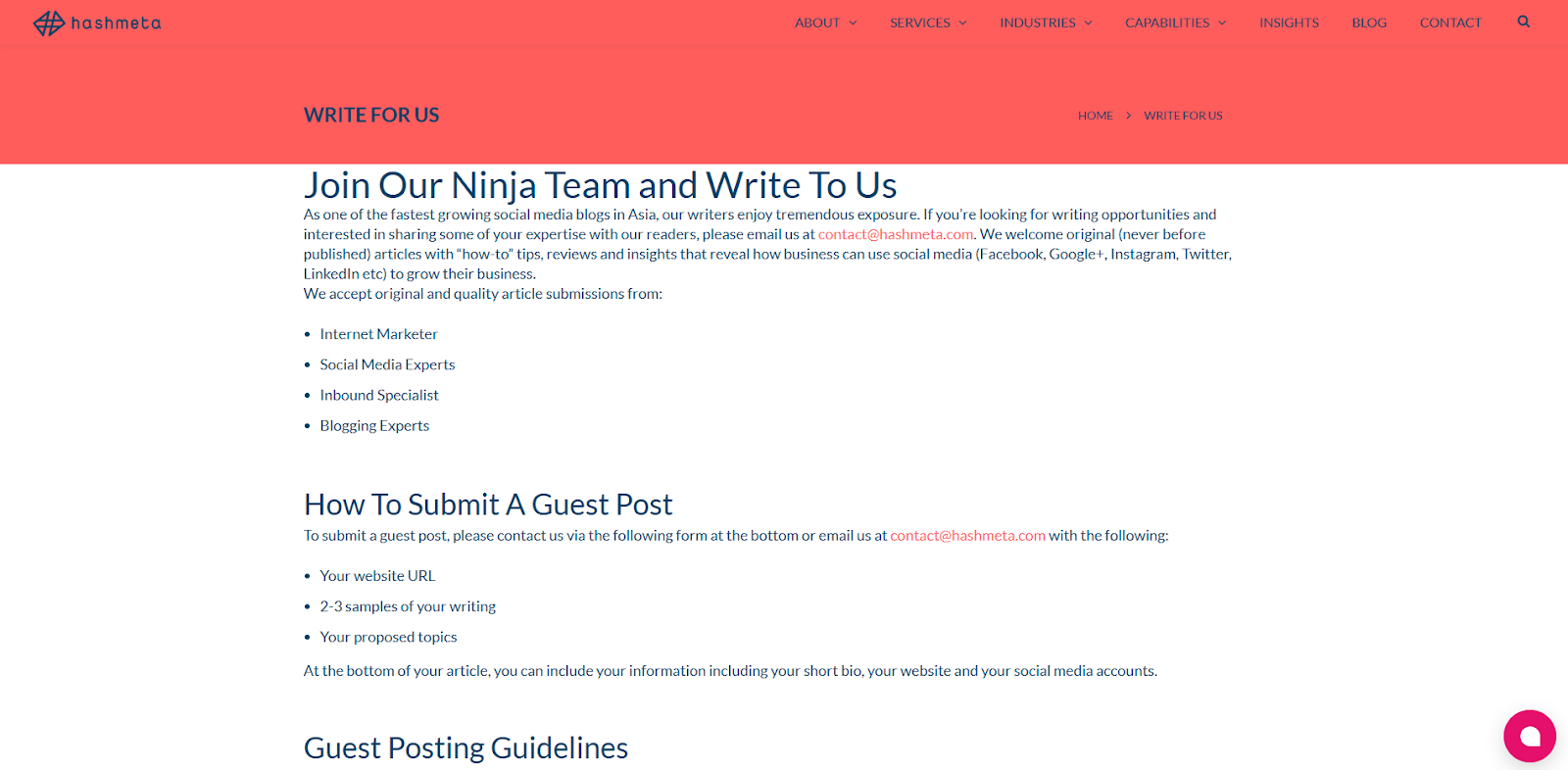
Prioritize those sites where you recognize the author’s names, because that’s a signal of real editorial standards.
However, avoid websites that publish anything and have no real audience. Links from these sites carry little to no value and can also signal to Google that you’re trying to manipulate your rankings, which can hurt your site rather than help it.
**What to pitch:
**
Editors accept guest posts when the topic genuinely serves their audience, not when it promotes your products. A strong pitch includes: **
**
- A specific angle that fits the publication’s editorial style, not just a repurposed blog post.
- A clear reason why their audience will benefit from this topic right now.
- A brief author bio establishes credibility on this specific subject.
- A link back to a resource page or tool, not just your home page.
### 6. Resource Page Link Building
[Resource pages](https://outreachdesk.com/resource-page-link-building/) are curated lists that mention useful tools, articles, and references. They exist in almost every industry/niche. They are built specifically to link to useful content, which makes it one of the most respected places to earn backlinks to relevant additions.
#### How to find resource pages
To find resource pages relevant to your industry, you can use Google Search Operators like ‘[your niche] + “useful resources”’, ‘[your niche] + inurl: resources’, or ‘[your niche] + “recommended tools”’.
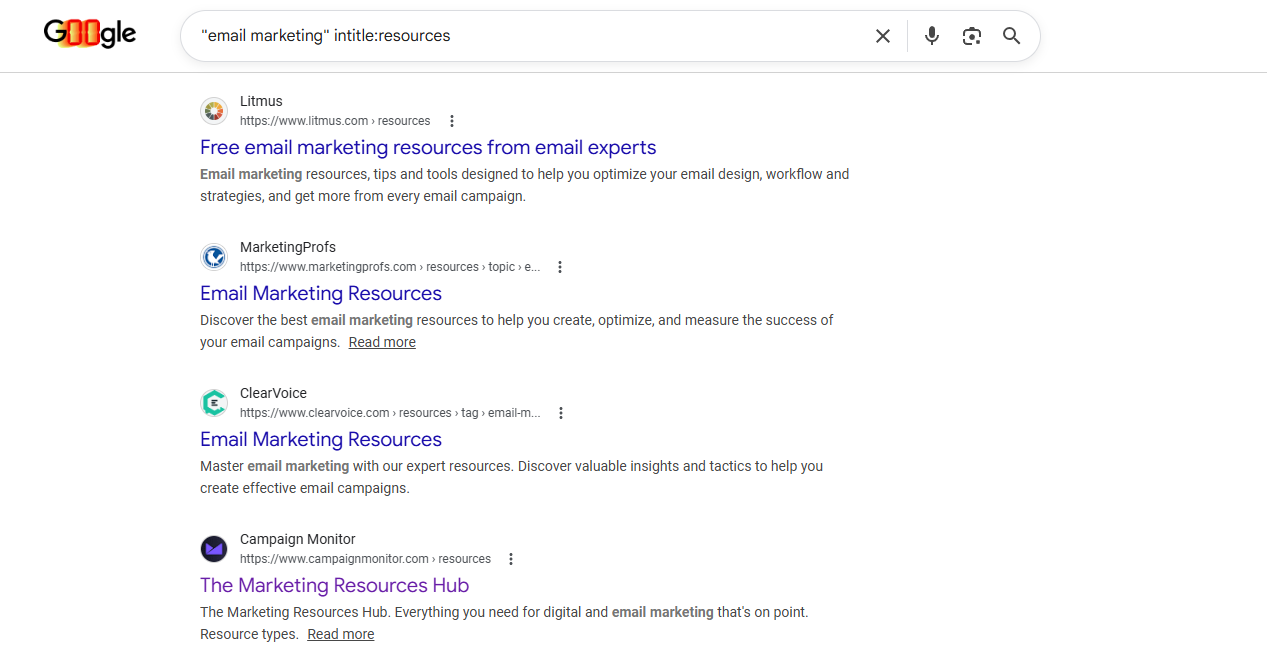
Before you reach out, carefully evaluate the resource pages. A page on a high authority site with genuine links is worth pursuing, while a low-quality page with hundreds of random links isn’t.
While reaching out, keep it short and simple. Explain to them what your resources cover, why it is a good fit for their existing list, how it provides value for their readers, and make it easy for them to add it.
### 7. Convert Unlinked Brand Mentions
As your startup grows, you will get mentioned in articles, podcasts, and online communities without always receiving a backlink. These mentions are endorsements that exist. You just need to reach out to the author and ask them to turn that [brand mention](https://outreachdesk.com/brand-mentions/) into a clickable link.
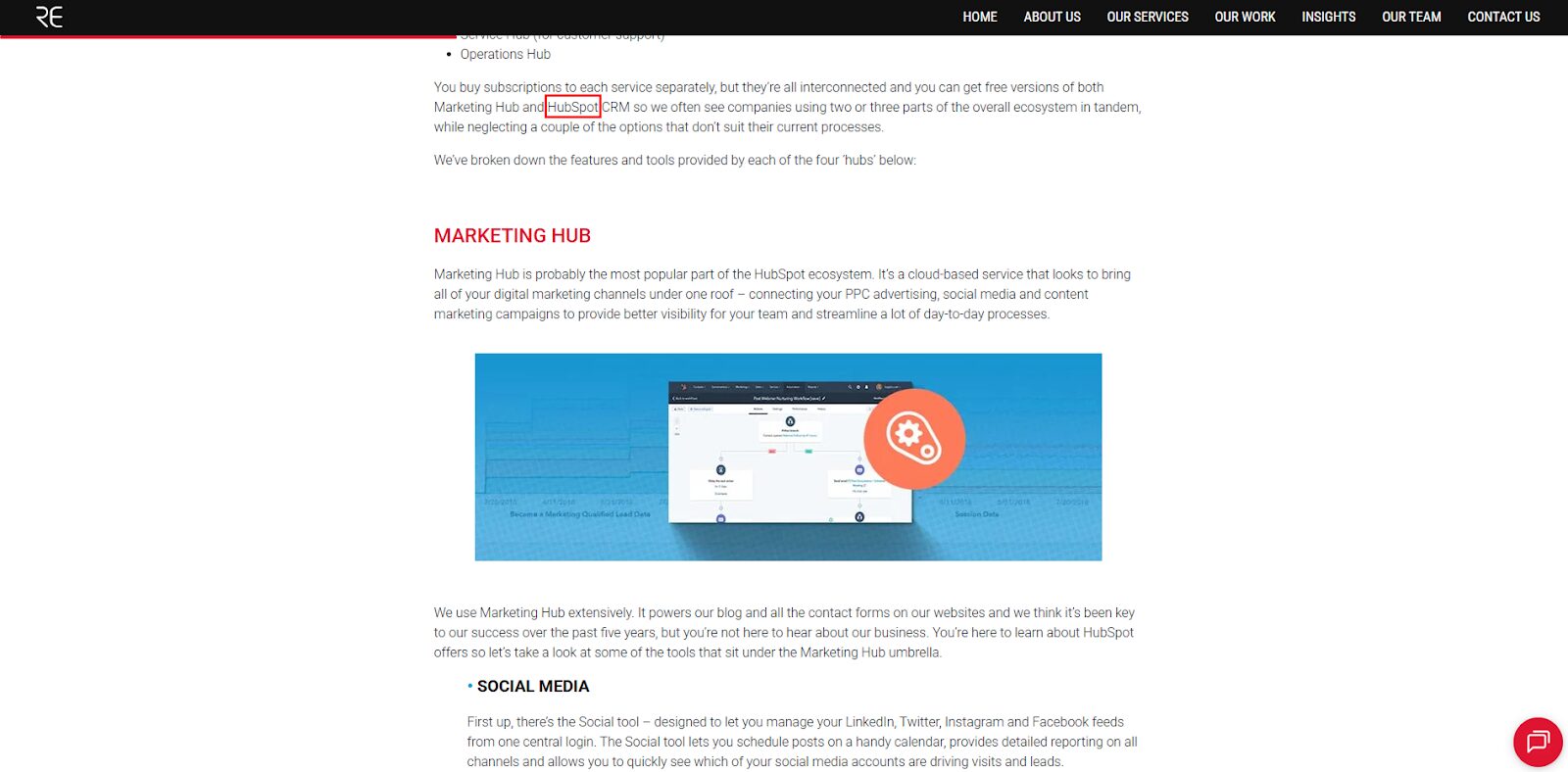
The image above shows HubSpot mentioned in content without a clickable backlink.
#### How can you find unlinked mentions?
You can find unlinked brand mentions by setting up [Google Alerts](https://alerts.google.com) for your brand name, founder names, and even product names. Use Ahrefs’ Content Explorer with your brand name as the query to filter for pages that aren’t already linking to you.
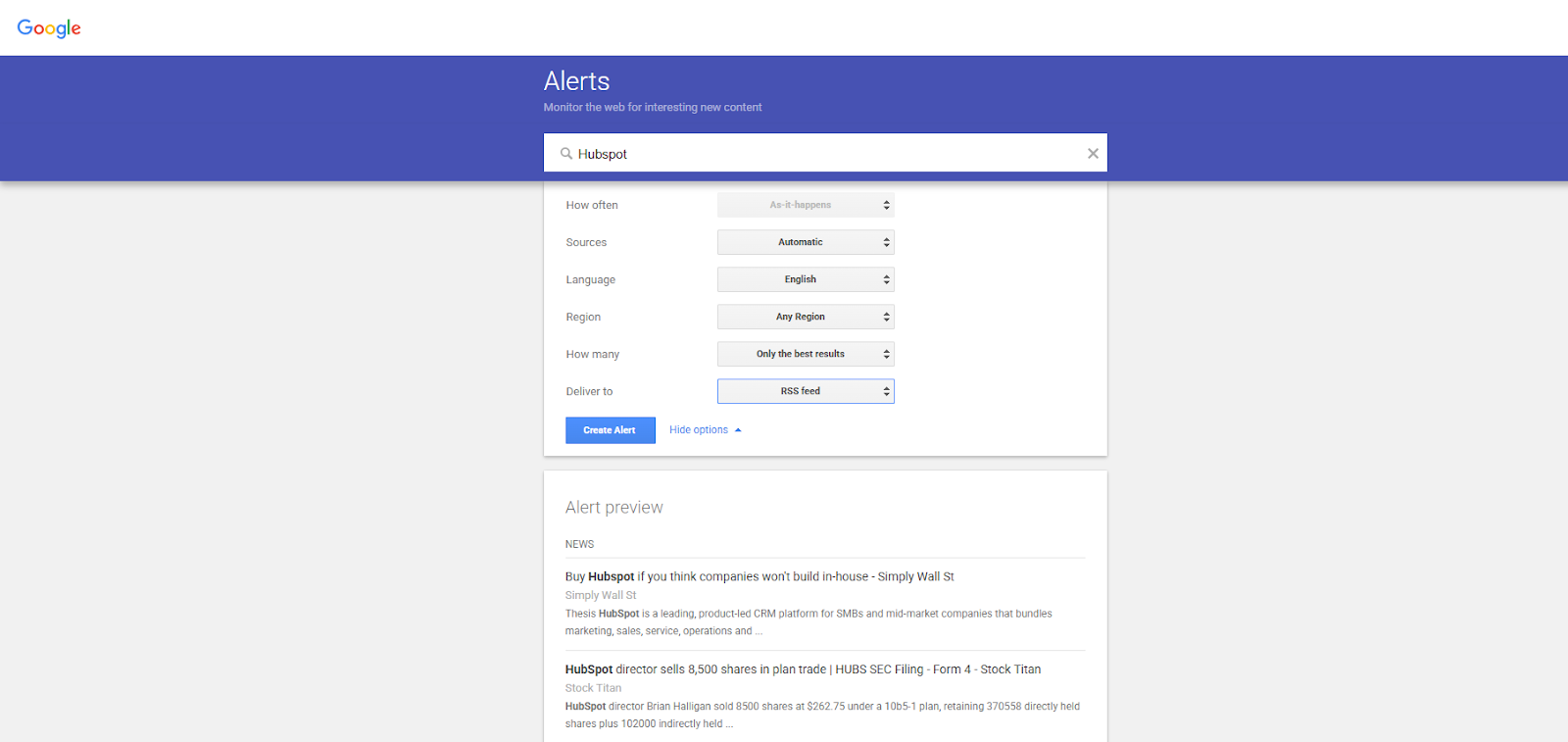
When you reach out to them, first thank them for the mention, and politely ask them if they would be willing to add a link. Here, the conversion rates are typically higher since they already referenced your brand positively, and they’re more likely to agree than a cold outreach target.
### 8. Niche Edits
A [niche edit](https://outreachdesk.com/niche-edits/) is when your link is placed inside an existing article on a relevant website. Unlike a guest post, you aren’t creating new content, instead, you’re earning a [contextual link placement](https://outreachdesk.com/contextual-link-building/) within the content that already ranks and has topical authority.
Niche edits also give you more control over placement. You can choose pages that closely match your topic, making your links more relevant and impactful.
Outreach for niche edits should be simple and focused. Instead of asking for a link directly, show how your content adds value to their article. This increases your chances of getting a positive response.
Because the article already ranks and holds authority, any link placed within it inherits that trust and passes it directly to your site.
### 9. Thought Leadership as a Link Channel
Leadership efforts, such as podcast appearances, conference speaking, and co-authored research, aren’t done primarily to get the links, but they can naturally attract over time.
For founders with genuine expertise, these channels build authority on multiple platforms and websites. That authority makes every link building effort easier and more effective over time.
**A single feature in a relevant industry podcast can generate:**
- A backlink from the show notes pages.
- Link from the listeners who reference the episode.
- Increased brand search volume, which Google treats as an authority signal.
## What Makes a Link Actually Valuable
**A startup link is valuable when it comes from a publisher your target users already trust.** Sits in editorial content, and points to a page that serves a real query. Domain authority alone is misleading. A high-DR link from an irrelevant site moves nothing.
A low-DR link from a publication your users actually read moves the dial.
All the links aren’t built equally. Understanding what makes a backlink worth pursuing helps you avoid spending your budget on links that provide minimal authority transfer. Google evaluates the links on several dimensions.
### Topical Relevance
Topical relevance, in simple terms, is a website that talks about the same topics as yours is more valuable than a link from a site that isn’t relevant to your industry at all. For example, a fintech startup benefits more from a link on a payment industry blog than from a link on a lifestyle blog
### Editorial Placement
Editorial placement is a link placed naturally in the body of an article because it genuinely helps readers and carries more weight than a link in a footer, sidebar, or author bio. Google values these links more because they’re placed in context, surrounded by relevant content, and intended to add value for readers.
### Domain Authority of the Linking Site
Domain authority is the score by [Moz](https://moz.com/) that helps to predict how well a site is likely to rank on Google, based on the strength of its backlinks.
Domain rating is a score created by [Ahrefs](https://ahrefs.com/) that measures the overall strength of a website’s backlinks on a scale of 0 to 100. However, the measures aren’t perfect, but both are useful signals when evaluating if a placement is worth pursuing.
### Anchor Text Diversity
Anchor text is a clickable word or phrase that contains a link. A profile with natural backlinks uses a variety of anchor texts, including your brand name, partial match keywords, URLs, and also generic phrases like “click here” or “read more.” According to Ahrefs analysis, sites where exact match anchor text exceeds 40% of the total profile are at risk of being flagged by Google’s algorithm. Therefore, vary your anchor text to keep your profile natural.
### Dofollow
Dofollow links are the default link type that pass [link equity](https://outreachdesk.com/link-equity/) from one website to another. When a reputable site links to you with a [dofollow link](https://outreachdesk.com/dofollow-backlinks/), it transfers a portion of its authority to your site, which Google counts as a trust signal when evaluating your rankings.
#### Here’s a comparison table showing high-value vs. low-value link signals.
| Factor | High-value link signals | Low-value link signals |
| --- | --- | --- |
| Topical Relevance | It comes from a website closely aligned with your industry. | Comes from irrelevant or generic websites without any relevance. |
| Editorial Placement | Naturally placed within the main content, where it adds value to readers. | Placed in headers, footers, author bios, and sidebars, and are clearly paid or forced placements. |
| Domain Authority/ Rating | Links from websites with strong authority (high DR/DA), including a trusted backlink profile. | Links from low-authority, spammy websites, link farms, or sites with a weak, unnatural backlink profile. |
| Anchor Text Diversity | Uses a natural mix of anchor types, including branded, partial-match, and generic URLs, to maintain a healthy profile. | Overuse of exact match anchors or repetitive anchors signals risk and manipulation. |
| Dofollow vs. Nofollow | Primarily, dofollow links that pass authority and contribute to rankings. | Only nofollow links profile with no authority transfer. |
## How Many Links Does a Startup Actually Need?
**Most startups need fewer links than they think: 30-50 high-quality editorial backlinks in the first year usually beat 300 low-quality placements.** The exact number depends on your competition. Use competitor backlink profiles as a baseline, not a target, since most of the noise in those profiles is doing them no good.
Link building for startups isn’t just about the quantity of links, but is also about relevance and quality.
Research on ranking factors consistently shows that top-ranking pages succeed with a relatively small number of high-quality referring domains, not thousands. A site that ranks aren’t necessarily with many links. They are the ones whose links come from the most relevant, trustworthy sources relative to their competitors for the specific keyword.
The starting point is to identify your three to five high-priority pages, the ones that drive conversions. Build the links to those pages first. Distributing efforts on your entire site.
While building, also track:
- The referring domains not total backlinks, a signal of link profile growth.
- Organic ranking movement on the targeted keywords.
- Referral traffic from the linked domains is a signal that your placements come from sites with genuine traffic and engagement.
## The Budget Question: Diy Vs. Outsourced Link Building
**DIY link building costs your time. Outsourced link building costs cash.** The right choice depends on whether founder time is more constrained than budget, and whether you’ve the publisher relationships in place. For most pre-Series A startups, DIY wins for the first 20-30 links.
Most early-stage startups have to choose between spending time and spending money on link building. Building links in-house is possible, but it requires consistent effort over several months before you start to notice meaningful results.
**DIY link building works when:
**
- Your founder or a team member can dedicate around 5-10 hours per week to consistent outreach.
- You’re in a niche where relationships can be built through the communities you’re already part of.
- Your content is strong enough to attract links without needing promotion.
**Outsourced link building makes sense when:
**
- You don’t have enough time internally to build links at the pace that matches your growth requirements.
- You need placements in the publications that your team doesn’t have existing relationships with.
- You want a steady flow of links every month without managing the complete process of prospecting, vetting, and outreach.
When evaluating any agency, ask for real case studies with measurable results, including domain referral growth, ranking improvements, and the timeframe for achieving them. Some agencies focus on manual editorial outreach rather than automated link networks, which matters because the quality of the link placement determines the long-term health of your backlink profile.
The cost of [outsourced link building](https://outreachdesk.com/outsource-link-building/) varies on the quality tier you choose. For contextual editorial placements in real publications, the expected budget is $1,500 to $3,000 per month, depending on the quality and volume of the links. Understanding where that budget goes starts with knowing how [link building pricing](https://outreachdesk.com/link-building-pricing/) is structured across different quality levels.
## Common Startup Link Building Mistakes to Avoid
**The common startup link building mistakes are chasing high-DR placements.** Over-investing in paid links before earning any, and treating outreach as a one-off campaign instead of an ongoing program. Each one wastes runway. The patterns below cost more in stalled growth than founders typically realize.
Here is the list of a few common mistakes the startups make. You should try to avoid them completely to see better results.
### Chasing High DR at the Expense of Relevance
A DR 80 link from an irrelevant site is less valuable compared to a DR 40 link from a publication that targets the same audience you target and is relevant to your industry.
### Building Links Before the Page is Ready
A link to thin or unhelpful content products weakens the transfer of authority. The page needs to be ready and valuable before you build links to it.
### Using the Same Anchor Text Repeatedly
Using the same anchor text repeatedly looks unnatural to Google and can raise flags. A healthy backlink profile uses a variety of anchor texts, including your brand name, partial keyword phrases, and URLs.
### Prioritizing Quantity Over Consistency
50 links acquired in a month, followed by nothing, signals manipulation more than organic growth. Steady, consistent [link acquisition](https://outreachdesk.com/link-acquisition/) is healthier for gaining long-term authority.
### Ignoring Internal Links
Every external link you earn passes authority to the page it lands on. That authority then flows to the other pages on your site through internal links. If your internal links are weak, much of that authority gets trapped on a single page instead of flowing through your site.
## Conclusion
**Link building for startups** isn’t a shortcut to instant rankings, but it is a long-term investment where each quality placement adds to the growth foundation that makes the next one easier to earn.
Sequence is the most important thing; start by building content, pursue link types that are realistic for your current authority level, build relationships before you need them, and work towards your targets as your profile grows.
The startups that build lasting organic visibility aren’t always the ones with the large budgets. They are the ones that stayed consistent, focused on relevance over quantity, and treated every link as a signal worth protecting.
### Not sure where to start with link building for your startup?
Get a clear plan that drives traffic, boosts rankings, and delivers steady growth.
[Book a Strategy Call](/contact-us/)
### How Long Does Link Building Take to Show Results for a New Site?
Link building for startups may take time; the new sites typically see improvements in 2-3 months, and the real growth is observed in 4-6 months. Consistency matters more than speed.
### Can a Startup do Link Building With no Budget?
Yes, with the right investment in time and effort, podcast guesting, unlinked brand-mention conversion, journalist queries, and guest posting on industry publications are all accessible at no direct cost. It takes months of consistent work, but the results grow over time.
### What’s a Realistic Dr Target for a Startup After 12 Months?
Your site’s authority grows based on your industry and how consistently you build links. Most niche shows progress in 12 months, but in competitive fields like finance or health, and in SaaS, it takes longer. Authority link building for startups can help you set realistic benchmarks for your specific niche.
### Should Startups Focus Only on Dofollow Links?
Links like dofollow can directly boost your site’s rankings, and it should be your main focus. Other links, like nofollow, may not boost ranking directly, but they can bring visitors to your site and make your link profile look natural. Having a mix of both is considered healthy.
Relying only on one type of link can look suspicious, so don’t ignore any.
### What’s the Difference Between Link Building and Link Earning?
There are two ways to get links. Building links means reaching out through partnerships, content promotion, or outreach, and earning links means creating good content or a content asset so that people want to link to you naturally.
---
---
title: "Health Fitness Link Building: Earn Authority and Rankings"
url: "https://outreachdesk.com/health-fitness-link-building/"
lang: "en-US"
type: "post"
description: "Health and fitness link building is the process of earning backlinks from authoritative health, wellness, and fitness websites to improve your site's search rankings and establish credibility in a niche where trust and expertise are critical ranking factors. For brands"
last_modified: "2026-05-22T10:01:05+00:00"
categories: [Link Building]
---
# Health Fitness Link Building: Earn Authority and Rankings
**Health and fitness link building** is the process of earning backlinks from authoritative health, wellness, and fitness websites to improve your site’s search rankings and establish credibility in a niche where trust and expertise are critical ranking factors. For brands that want consistent execution, working with a [dedicated link building team](https://outreachdesk.com/) removes the heavy lifting. Brands serious about scaling backlink campaigns turn to a [healthcare link building](https://outreachdesk.com/link-building-for-healthcare/) for current benchmarks. Working with a [CBD and cannabis link building](https://outreachdesk.com/cbd-link-building/) can compress this process from months to weeks.
Health and fitness sites compete in one of the most competitive search areas. Your brand may have solid content, but still struggle to gain visibility; in many cases, the issue might be the lack of authority. Link building helps address this by showing Google that trusted websites recommend your content, which improves your visibility in search results.
**Key Takeaways: **
- A health and fitness site falls under YMYL, making the source of link quality more important than link volume.
- Health is a competitive niche that requires backlinks to rank against massive competition.
- Original research, data-driven content assets, and expert guides attract the most backlinks in the health industry.
- Consistent link building is important for long-term visibility in the healthcare industry.
- A well-structured outreach campaign targeting niche-relevant publications can build 15-30 high-quality links per month without the risks of penalties.
## Why Health and Fitness Link Building Follows Different Rules
Google classifies and evaluates this entire niche more strictly under the [Your Money Your Life](https://developers.google.com/search/docs/fundamentals/creating-helpful-content#:~:text=We%20call%20these%20%22Your%20Money,our%20changes%20are%20working%20well) (YMYL) model because it can directly affect the person’s physical well-being, as the content is about nutrition, exercise, supplements, or wellness.
Google applies stricter standards when ranking health content. It means Google may only show health and fitness pages that show real trust, expertise, and credible signals from the relevant websites. Google also carefully checks the sites that link to you, as it checks your own content.
Your websites must demonstrate strong signals of **Expertise, Experience, Authoritativeness, and Trust (E-E-A-T) **to earn visibility in the search engine.
**E-E-A-T
**
E-E-A-T signals are a quality framework for identifying whether content is reliable, written by real experts, and from a trusted source. Content that shows genuine expertise and credibility is evaluated more favorably than content from random and anonymous sources.
According to an analysis by [SEO consultant Glenn Gabe](https://www.gsqi.com/marketing-blog/google-december-2025-broad-core-update-analysis-findings/#health:~:text=broad%20core%20update.-,More%20YMYL%20Impact%3A%20Health%20and%20Medical%20Follow%20Finance.,-And%20not%20far), health and finance sites were among the first to experience major ranking volatility. Therefore, the health and fitness industry must follow strict guidelines.
## What Makes a Backlink Valuable in the Health Niche?
In health and fitness, a backlink from an irrelevant website will not only fail to help you but can also work against you. Here’s what makes it different.
### Topical Relevance Over Raw Metrics
Topical relevance simply means that the website linking to you should cover the same niche and industry as yours.
In short, a backlink from a fitness blog holds more value to a fitness site than a link from any irrelevant tech news site, regardless of how popular the site is, because Google prioritizes relevance over reputation.
### Editorial Context Matters
A link placed in the content naturally, where your content is referred to as a source, carries far more weight than links that are placed in a footer, header, or sidebar. It signals Google that the real person reviewed it and that the content is relevant and trustworthy enough to recommend.
Securing [contextual links](https://outreachdesk.com/contextual-link-building/) through manual editorial outreach is more effective and can drive more referral traffic than automated link networks.
### Linking Page Quality Signals
Not every website is worth getting a link from; individual pages matter too. Look for pages that actually get visitors and check whether they are regularly updated; avoid pages that link to dozens of other sites.
Check if the page has a real author with verified credentials. Google places more trust in content written by credible, identifiable experts, so a backlink from that page carries significantly more value.
**Comparison table showing the differences between high- and low-value health industry backlinks**
| Signal | High Value Links | Low Value Links |
| --- | --- | --- |
| Source relevance | Health, wellness, or medical publication | Links from generic link directories or irrelevant blogs |
| Placement | Within the main content, an editorial mention | Placement in sidebar, footer, or author bios |
| Author attribution | Named experts with credentials | AI-generated or automated content. |
| Linking page traffic | Receives organic search and visitors | Zero to no traffic |
| Outbound link count | Moderate external links | Around 50+ outbound links on the page |
| Content freshness | Updated within the last 12 months | Published years ago, never updated |
## Content Assets That Consistently Earn Health and Fitness Links
Before you begin outreach, you require something that feels genuine and worth linking to. Editors and publishers will not risk their credibility by linking to thin or unoriginal content.
Here are some content formats that can help you attract backlinks in the health and fitness industry.
### Original Research and Data Studies
Original data and studies can help attract [backlinks](https://outreachdesk.com/what-are-backlinks/) in the health and fitness industry. Your own surveys, industry trend reports, or performance benchmarks give journalists and bloggers something that they cannot find elsewhere.
Suppose a supplement brand publishes an annual survey of 2,000 consumers on their supplement-buying habits, creating a citable resource that health journalists reference year after year. According to [Mordor Intelligence](https://www.mordorintelligence.com/industry-reports/health-and-fitness-club-market), the global health and fitness club market is valued at approximately $135.71 billion in 2026, yet very few brands in this industry publish original consumer research.
### Interactive Tools and Calculators
Calculators such as BMI calculators, macro trackers, calorie estimators, workout load calculators, earn links because they solve a specific problem instantly. They are practical, shareable, and frequently referenced in the resource roundups.
In one documented case study, a health brand’s keto calculator became the most-linked asset on its domain after a focused link building campaign.
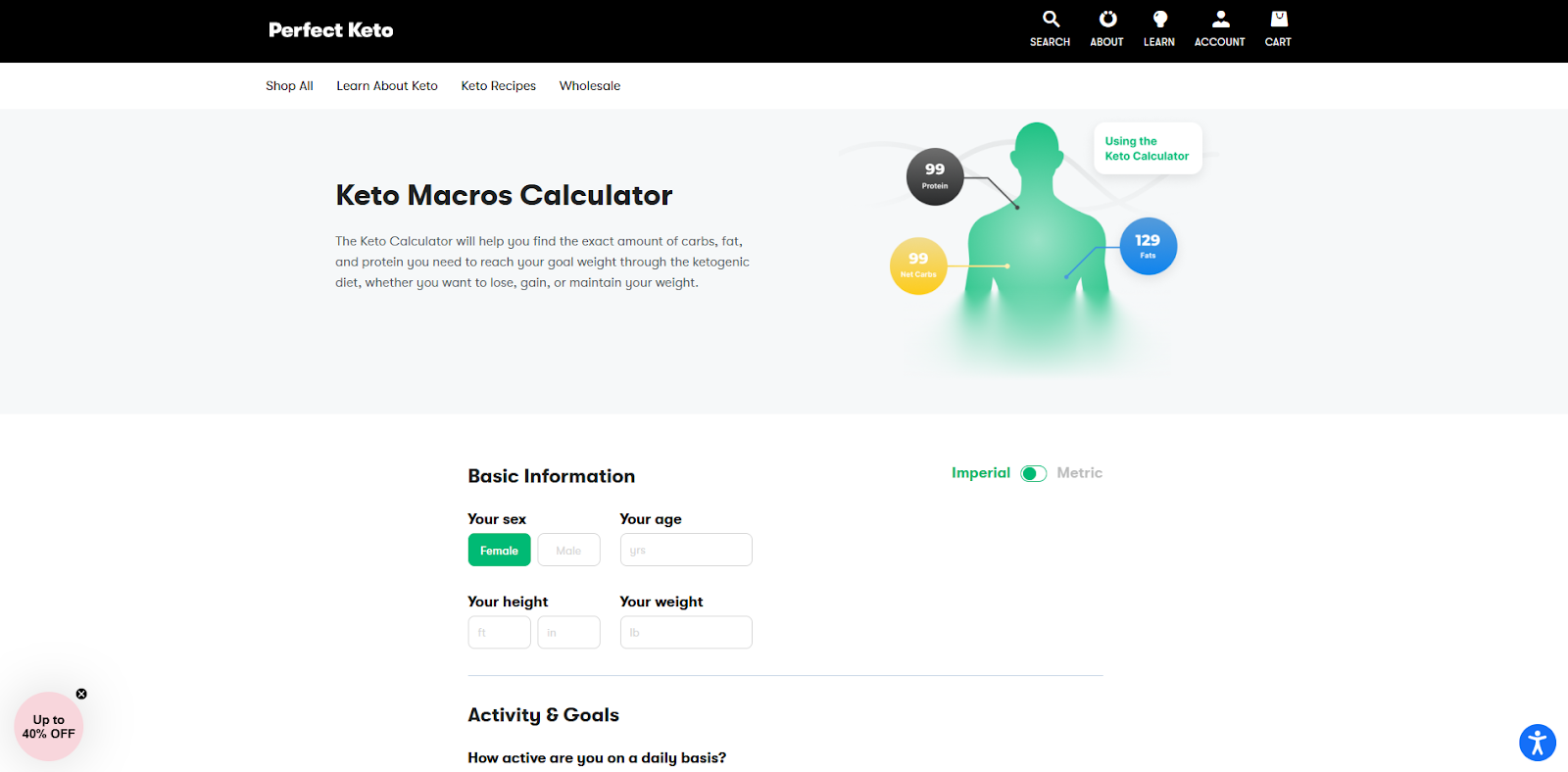
An increase in visitors was observed from 2,000 to over 30,000 monthly visits, and a focus on targeting resource pages to replace outdated competitors’ calculators.
### Expert-authored Guides With Credential Signals
In health content, Google’s search quality raters pay close attention to who actually wrote and reviewed it. A workout guide written by a certified personal trainer (CPT) or a nutrition article reviewed by a registered dietitian (RD) is more likely to earn backlinks than the content with no named author.
Make sure that every piece of content has an author bio, visible verified credentials, a link to your professional profile, and clear data showing when it was last reviewed.
### Visual Assets and Infographics
Health and fitness is a niche where visuals play an important role. Things like exercise diagrams, workout charts, meal-preparation infographics, and anatomy visuals naturally attract backlinks because other publishers include them in their content and credit you as the source.
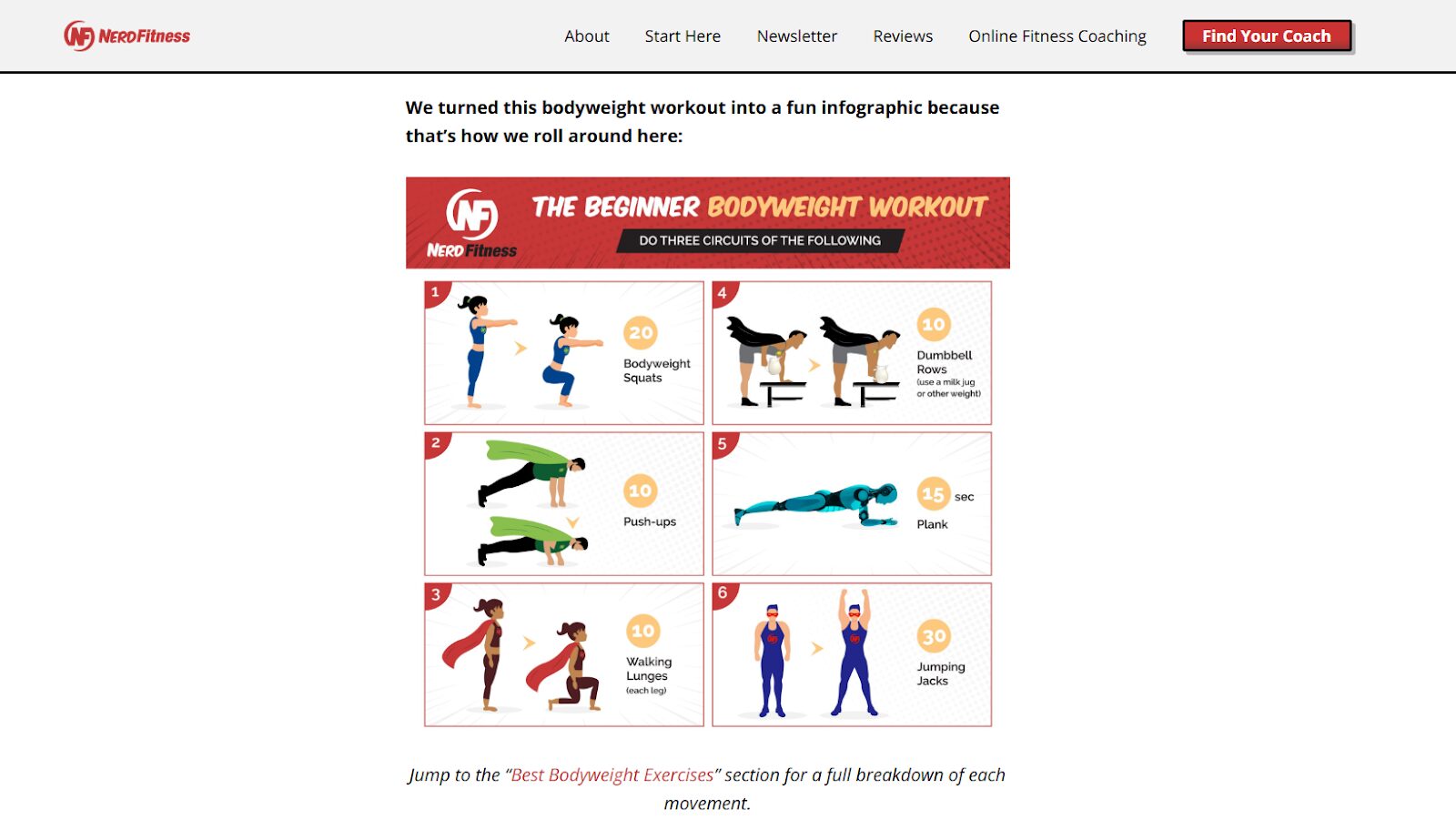
## Proven Outreach Strategies for Health and Fitness Backlinks
Creating linkable content is just half the work; the other half is reaching the right people with the right message. [Outreach](https://outreachdesk.com/link-building-outreach/) in the health industry requires a more careful, credibility-first approach.
### Editorial Guest Contributions
Guest posting is writing an article for another reputable health or fitness brand that may include a link back to your own site.
To find opportunities using Google search for terms like “write for us” or “contribute guest post” along with the keywords like “fitness”, nutrition”, or “wellness”. This will show you a list of websites that accept guest articles in your niche.
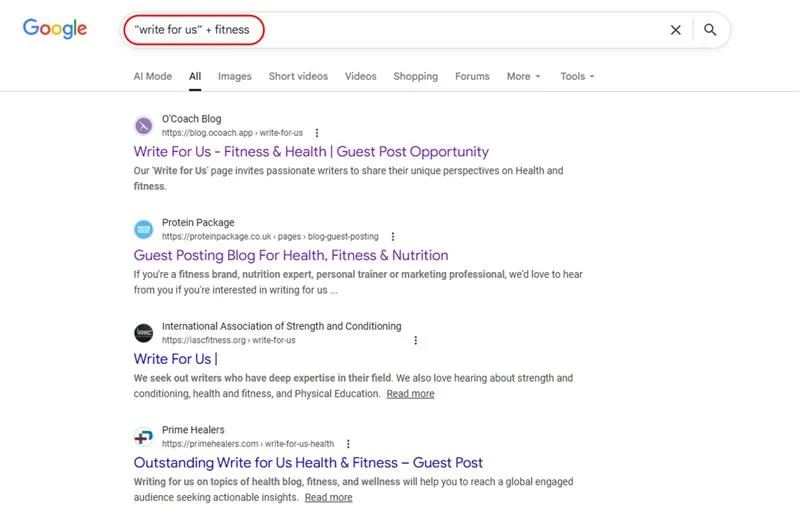
Write for websites with a real audience and genuine editorial standards. Avoid blogs that exist purely to sell guest post links.
When pitching health publications:
- highlights the author’s credentials because a pitch from a certified expert or nutritionist is more likely to be taken seriously and get a response.
- propose a specific topic because health editors prefer accurate, research-backed, and well-supported content over generic ideas.
- Mention your sources upfront because linking to studies or reputable references in your pitch shows that you take the accuracy seriously and establishes trust from the start.
### Broken Link Reclamation
The health industry is full of outdated resources, dead links to discontinued supplements, expired government health pages, or shuttered fitness blogs. [Broken link building](https://outreachdesk.com/broken-link-building/) is the strategy for identifying dead links on relevant sites and offering your content as a replacement.

This tactic works well for the health calculators, evergreen nutrition guides, and exercise database. Tools like [Outreach Desk’s Broken Link Checker](https://outreachdesk.com/broken-link-checker/), [Screaming Frog](https://www.screamingfrog.co.uk/seo-spider/), and Check My Links extension can also help you find broken link opportunities more easily.
### Digital PR and Data-driven Pitches
Journalists covering health and fitness stories require expert data. If your brand publishes original research, survey results, or industry benchmarks, pitch those directly to the health reporters and editors at publications like Healthline, Men’s Health, Well+Good, and Everyday Health.
Create a pitch around a newsworthy finding. That means instead of writing “our brand offers great fitness tools,” you can specify the details and give specifications. Show data that clearly explains your value, like: “our survey of 2,500 gym-goers found that 61% now use AI-based fitness apps for workout planning, up from 34% in 2024.”
### Resource Page Outreach
Many health organizations, universities, and nonprofits maintain dedicated resource pages where they list helpful tools, guides, and references. If your content genuinely helps their readers, a simple outreach email requesting inclusion can result in high-quality, relevant backlinks.
You can find these pages easily and quickly by using search operators like “health resources” inurl: resources or “fitness” inurl: “useful links”. This searches the pages specifically built to recommend external content.
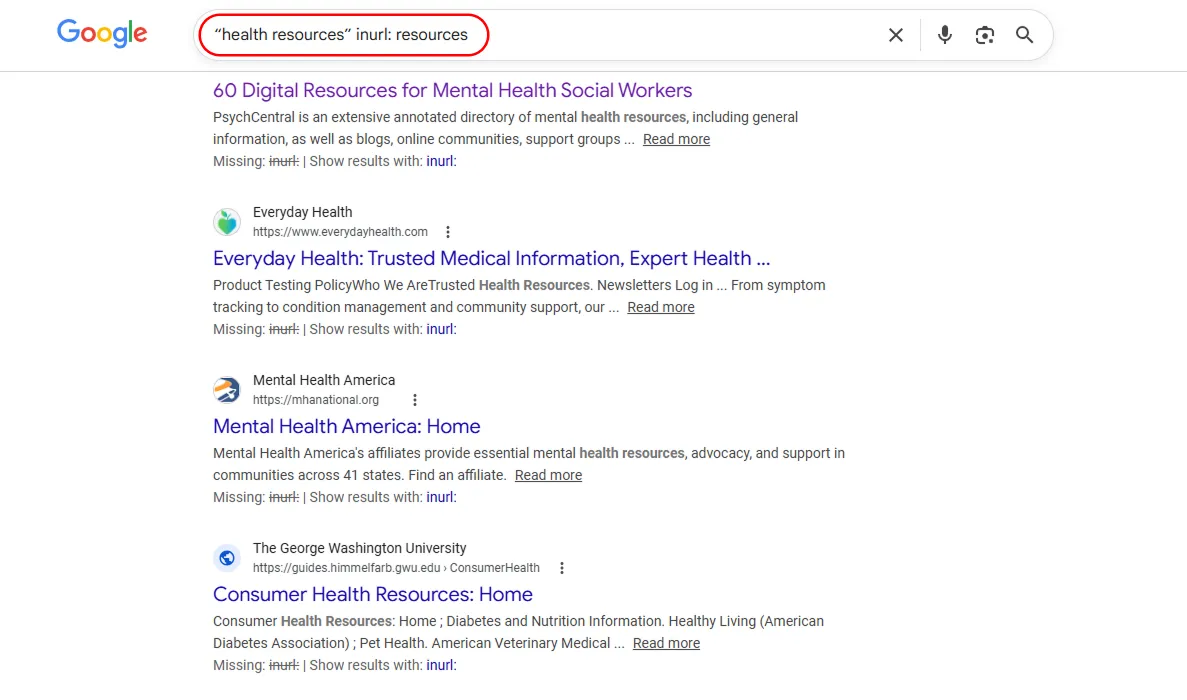
The editors in the health industry receive hundreds of outreach emails weekly, and generic pitches go ignored. The pitches that get a response are mostly personalized, offer something specific about their site, reflect the author’s qualifications, and lead with value instead of directly asking for a link.
## How to Keep Your Link Building Strategy Ymyl-compliant
Building links in health and fitness is not only about gaining volume, but it is also about building authority in a way that aligns with Google’s trust expectations. One link placed poorly from a questionable source can do more damage than ten good links can repair.
### Vet Every Linking Domain
Vet every linking domain before accepting or publishing a backlink. You can check the linking site for:
- Published editorial guidelines or content standards.
- Make sure the health content mentions the named authors and includes verifiable credentials.
- Absence of spammy link patterns, including excessive outbound links, and paid link disclosures is missing.
- A history of original content rather than AI-generated materials.
### Diversify Your Anchor Text Naturally
Repeated use of keyword-heavy, clickable text is a warning sign for Google; in the health industry, it raises more red flags than usual. Maintain a natural anchor text profile with a mix of your brand name, natural phrases such as ‘learn more’ and ‘this guide’, and sometimes descriptive terms.
Even though there is no official number from Google, most SEO professionals recommend keeping the exact-match keyword anchors to a small portion of your brand’s overall backlink profile.”
### Prioritize Editorially Earned Links
In the health industry, the safest and most effective links are those that are earned through genuine editorial value. It means that the real editor reviewed your content, found it valuable, and chose to link to it, without any payment, reciprocal agreement, or artificial incentives. Google’s link spam update targets links that violate this principle.
### Document Your Outreach Process
To document means simply maintaining the tracks and records of every outreach email, editorial relationship, and link placement. If Google ever manually reviews your link profile, this documented evidence of the legitimate outreach protects your site from being penalized and risks.
## How to Measure Health Fitness Link Building Results
Link building is a long-term investment. Especially in the health and fitness industry, you can expect 3-6 months before you can see notable improvements in rankings from the new campaign. Here are some of the metrics that matter:
| Metric | What Does It Tell You | Tools |
| --- | --- | --- |
| Referring Domains (growth) | It tells you how many sites from unique domains link to you over time | Use tools like Ahrefs, SEMrush, Moz |
| Domain Rating/Domain Authority | Overall, the backlink profile strength | For DR, use Ahrefs, and for DA, use Moz |
| Organic Keyword Rankings | Tells you if the target pages are climbing in SERPs | Use tools like Ahrefs, SEMrush, and Google Search Console |
| Referral Traffic | Direct visitors from the linking pages | Use Google Analytics 4 |
| Link Velocity | Tells you about the rate of new links acquired per month | Ahrefs, Majestic |
| Anchor Text Distribution | Tells you whether your profile looks natural or over-optimized | Ahrefs, SEMrush |
Check your progress monthly and look for steady growth rather than direct jumps. For health and fitness link building, a minimum commitment of 6 months is recommended because trust and authority are built slowly and gradually, not overnight. Quick wins are rarely seen in this industry; however, consistent efforts over time can build an advantage that is hard for competitors to match.
## Common Health Niche Link Building Mistakes to Avoid
The health and fitness industry has some common mistakes that even experienced SEO teams can make mistakes; you should completely avoid these:
### Chasing Volume Over Relevance
Chasing volume over relevance is the most common mistake. It is simple: 10 backlinks from reputed health-related publications are far more valuable than 100 backlinks from random directories. Google’s algorithms are smart enough to spot the unnatural link patterns, and it will either ignore those links or penalize your site for using them.
Specifically in the health and fitness industry, links from irrelevant sources don’t add value but also hurt your rankings.
### Ignoring Author Credentials on Guest Posts
Publishing a guest post under the term “Marketing Team” wastes the entire opportunity. Google’s quality raters specifically check the author’s credentials for health content. Use real, qualified individuals rather than generic names, and include verifiable credentials relevant to the topic. This applies to both whether you are publishing your own content or contributing a guest post.
### Using Outdated Tactics That Trigger Link Spam Filters
Tactics such as blog comment links, mass directory submissions, private blog networks, and link exchanges are all listed in Google’s [link spam documentation](https://developers.google.com/search/docs/essentials/spam-policies) as manipulative practices. In the health and fitness industry, where Google applies extra scrutiny, using any of these tactics can increase the risk of penalties.
### Neglecting Content Quality on Your Own Pages
No amount of link building can fix thin, outdated, or inaccurate content on your target pages. Before starting any [link building campaign](https://outreachdesk.com/link-building-campaigns/), take a close look at the pages you want to build links to. Make sure that each page is thorough, up-to-date, properly sourced, and authored by credentialed experts.
## Building a Scalable Health Fitness Link Strategy for 2026
A sustainable link building program in the health and fitness industry follows a predictable cycle. Here’s a practical quarterly framework:
### Month 1: Foundation
- Audit your existing profile for toxic or low-quality links.
- Identify 3-5 cornerstone content assets worth building links to.
- Set up the tracking dashboards in Ahrefs or SEMrush.
- Research competitors’ backlink profiles to identify replicable link sources.
### Month 2: Content and Outreach Launch
- Publish or update a linkable content asset such as an original study, interactive tool, or expert guide.
- Build the initial outreach lists targeting 50-100 niche-relevant publications.
- Launch guest post pitches with credentialed authors.
- Begin outreach for broken links and resource pages.
### Month 3: Scale and Iterate
- Analyze which outreach angles are generating the highest response rates.
- Double down on the tactics that work and cut off the tactics that aren’t converting.
- Pitch the original data findings to health journalists for digital PR coverage.
- Review the link placements for quality, and disavow anything that looks suspicious.
You can repeat this cycle quarterly. In each round, your backlink profile strengthens, making each link campaign more effective and efficient. The compounding effect is the biggest advantage of link building in a competitive YMYL industry.
## Conclusion
Health and fitness link building in 2026 is defined by one major principle that is trust. Google’s YMYL standards and the rise of AI Overviews all point in the same direction: the only reliable way to grow organic in this industry is to earn quality backlinks through editorial outreach.
Start with your content; make sure every page you want to rank is written by real experts, backed by sources, and genuinely useful to readers. Then earn your links the right way through editorial outreach, original research, and building real relationships with the publishers who serve your audience. The results compound over time, and the authority you establish today protects your rankings through every major update ahead.
If you are serious about growing your health or fitness brand through search, link building is not optional. It is the foundation on which everything else is built.
### Want to earn trusted backlinks in the health and fitness niche?
Get a strategy focused on quality links that improve your authority and rankings.
[Book a Strategy Call](/contact-us/)
### How Many Backlinks Does a Health Website Need to Rank?
Even though there is no definite number. A 2024 Ahrefs study has found that the average top 10 results for competitive health keywords had 150+ referring domains, whereas an industry-specific and long-tail health term can often rank with 20-50 quality referring domains.
### Is it Safe to Buy Backlinks for a Health Website?
Purchasing links violates Google’s policies and carries risk in the YMYL model. If Google detects any paid links in a health site, the consequence includes a manual penalty and severe rank drops. Instead, invest in editorially earned links through content and outreach.
### How Long Does it Take for Link Building to Improve a Health Site’s Rankings?
You can expect around 3-6 months to see measurable improvements, with the complete impact taking 6-12 months. YMYL sites usually require longer timelines because Google evaluates the authority signals more carefully in the health-related search results.
### Can Small Health Brands Compete With Webmd or Healthline Through Link Building?
Not on the general terms, but you don’t need to. Focus on industry-specific keywords where your expertise and knowledge are deepest. A specialized fitness recovery brand can outrank generalist health publishers on targeted queries by building a concentrated backlink profile from the relevant sources.
### What Types of Health Sites Should I Avoid Getting Links From?
Avoid sites with no editorial standards, anonymous authors, excessive outbound links, AI-generated or thin content without any expert review, and sites that sell links openly. In the health and fitness industry, links from low-trust sources can harm your rankings.
---
---
title: "12 Link Building Strategies to Earn Quality Links in 2026"
url: "https://outreachdesk.com/link-building-strategies/"
lang: "en-US"
type: "post"
description: "Most websites trying to earn backlinks burn months on tactics that don't move rankings. The strategies that actually work have shifted since 2024. In 2026, Google's helpful content systems and the AI search engines citing your brand both reward the"
last_modified: "2026-05-29T12:21:19+00:00"
categories: [Link Building]
---
# 12 Link Building Strategies to Earn Quality Links in 2026
Most websites trying to earn backlinks burn months on tactics that don’t move rankings.
The strategies that actually work have shifted since 2024.
In 2026, Google’s helpful content systems and the AI search engines citing your brand both reward the same thing: links from sites that genuinely cover your topic, not links scraped from directories or stuffed into bulk guest posts.
This article maps out the **12 link building strategies that still work in 2026**, plus a 3-question decision filter so you can pick the 2 or 3 that fit your actual situation. Whether you can spend 1 hour a week or 20, whether you have content worth linking to or need to build it first, there’s a path that won’t get your site de-indexed.
**Key Takeaways**
- Quality of referring domains matters more than raw backlink count.
- The right strategy depends on your time, your content, and your timeline.
- 3 quick-win tactics work in under 5 hours per week. Start there.
- Buying bulk links, private blog network placements, and over-optimized anchors get pages de-indexed in 2026.
- A realistic timeline for measurable results is 90 days, not 30.
- One contextual link from a trusted site beats 50 directory submissions.
## What Link Building Actually Does in 2026
Link building still earns rankings, but the bar is higher than it was two years ago.
A [backlink](https://outreachdesk.com/what-are-backlinks/) is one website vouching for another. When a relevant, trusted site links to you, search engines treat that as a signal your page is worth showing.
What changed: Google has gotten much better at ignoring low-quality links and punishing patterns that look manipulative. AI search engines have entered the picture too, and they care about the same trust signals.
### Why Links Still Matter for Google Rankings
Links remain one of Google’s strongest ranking signals.
Per [Google’s helpful content guidance](https://developers.google.com/search/docs/fundamentals/creating-helpful-content), the algorithms prioritize content “created to benefit people, and not content that’s created to manipulate search engine rankings.” Links earned because your content is genuinely useful pass that test. Links bought in bulk to game the algorithm don’t.
The mechanics are simple. Google crawls a high-quality page, sees a link to your page, follows it, and treats the destination as endorsed. The endorsement scales with the linking site’s own trust and topical relevance.
### Why Links Now Matter for AI Search Citations
ChatGPT, Perplexity, Google’s AI Overviews, and Bing Copilot all evaluate authority partly through who else cites your content.
When an AI system answers a question, it pulls from sources it trusts. The pages it trusts are the ones other trusted pages link to.
The pattern looks a lot like classic link building, with one twist: AI engines weight topical authority more heavily than raw domain authority. A small niche site linking to you from a relevant article often does more for AI visibility than a generic mention on a massive news site.
If you want your brand to show up when someone asks an AI assistant about your category, the strategies below are how you get there.
### What Changed in 2025 and 2026
Google rolled out updates in 2025 and 2026 that hit two specific patterns hard.
The first is what Google’s [spam policies page](https://developers.google.com/search/docs/essentials/spam-policies) defines as link spam: “the practice of creating links to or from a site primarily for the purpose of manipulating search rankings.” Buying links in bulk, exchanging links at scale, and stuffing keyword-rich anchors into low-quality widget placements all fall into this bucket.
The second is scaled content abuse. Pages that look templated, that recycle competitor content, or that exist mainly to host bulk outbound links get demoted or removed from the index. If you’ve ever seen a tool page or vertical landing page lose 90% of its impressions overnight, this is usually what caused it.
The rest of this article shows you what to do instead.
## How to Pick the Right Strategies for Your Situation
Most beginners try too many tactics at once.
The result is 12 half-finished campaigns and zero links. The fix is to pick 2 strategies, commit to them for 90 days, and only add a third once the first two are running on their own.
Use this 3-question filter to decide which 2 to start with.
### Question 1: How Many Hours Per Week Can You Commit?
Time is the single biggest constraint, and it should dictate your strategy choice before anything else.
If you have 1 to 5 hours per week, focus on reclaiming unlinked brand mentions and resource page outreach. Both run on small, repeatable cycles.
If you have 5 to 15 hours, add guest posting and broken link building. These need more research and outreach time, but they pay off in higher quality links.
If you have 15+ hours per week, you can run digital PR and full linkable asset campaigns. These are the highest-output tactics, but they need real bandwidth.
### Question 2: Do You Have Content Worth Linking To?
You can’t earn links to nothing.
If your site has fewer than 10 useful pages, build the asset first. A guide, a tool, a calculator, an original data report, or a deep how-to that doesn’t exist elsewhere. That asset becomes the destination every outreach email points at.
If you already have 10+ pages of strong content, you can start outreach today. Pick the 2 or 3 pages with the most potential and build links to those.
### Question 3: What’s Your Timeline?
A realistic link building timeline runs in 90-day cycles.
For 60-day timelines, stick to quick wins: unlinked mentions, resource pages, and any easy reclamations of lost links.
For 90-day timelines, add guest posting and broken link building. You’ll see your first placements around week 4 and momentum by week 8.
For 6-month timelines, layer in digital PR and pillar content. These take longer to land but compound over time.
### The Strategy Selection Table
Use this table to map your situation to a starting point.
| Strategy | Difficulty | Time Investment | Best For | Realistic Success Rate |
| --- | --- | --- | --- | --- |
| Build Linkable Assets | ⭐⭐⭐⭐ | 8-20 hours per piece | Passive editorial links | 10-20% |
| Reclaim Unlinked Mentions | ⭐⭐ | 15-30 minutes per week | Quick wins | 40-60% |
| Resource Page Outreach | ⭐⭐⭐ | 3-5 hours per week | Evergreen links | 10-20% |
| Guest Posting | ⭐⭐⭐ | 30-60 min per pitch + 4-6 hours per article | Authority building | 15-25% |
| Broken Link Building | ⭐⭐⭐⭐ | 3-4 hours per week | High-quality links | 8-15% |
| HARO and Expert Quotes | ⭐⭐ | 30-60 minutes per day | News site links | 5-10% |
| Digital PR | ⭐⭐⭐⭐⭐ | 40-80 hours research + 10-15 hours outreach | Major publications | 2-5% |
| Competitor Backlink Analysis | ⭐⭐⭐ | 4-6 hours initial + 2-3 hours per week | Targeted outreach | 12-18% |
| Niche Edits | ⭐⭐⭐⭐ | 3-4 hours per week | Contextual links | 8-12% |
| Partnerships and Relationships | ⭐⭐⭐ | 2-4 hours per week | Long-term authority | 40-80% |
| Reclaim Lost Backlinks | ⭐⭐ | 2-3 hours per month | Recover authority | 35-45% |
| Get Featured in Newsletters | ⭐⭐⭐ | 5-10 hours per pitch cycle | Niche reach + links | 10-20% |
Success rates vary based on your niche, content quality, outreach personalization, and existing site authority. Use the table as a planning baseline, not a guarantee.
## 12 Link Building Strategies That Work in 2026
Each strategy below earns links when done correctly. Read the difficulty and time investment first, then pick 2 that fit your filter answers.
### 1. Build Linkable Assets First
A linkable asset is a piece of content so genuinely useful that other websites want to reference it.
These are the foundation of every outreach campaign. You can’t ask a journalist to link to a thin blog post. You can ask them to link to a 2026 industry data report, a free calculator, or a comprehensive guide that solves a real problem.
Strong asset types include original research, free tools, in-depth tutorials with screenshots and step-by-step walkthroughs, embeddable infographics, and curated templates.
The mistake most teams make is creating content that’s slightly better than what already ranks. To earn links, your asset needs to be significantly better, or to take a different angle the current search results don’t yet cover.
### 2. Guest Posting (The Editorial Version)
Guest posting works when you target sites with real editorial standards, real audiences, and topical relevance to your niche.
Read [our guide on guest posts](https://outreachdesk.com/guest-posts/) for the full mechanics. The short version: pitch sites that publish other guest authors in your space, propose 2 to 3 topic ideas that match their existing coverage, and offer to write something genuinely useful for their readers.
Guest posting fails when sites accept anyone, when posts read like outbound link delivery vehicles, or when authors stuff exact-match anchors into bios. Avoid those sites entirely.
The signal Google rewards is one editorial guest post per month on a site that fits your niche. Not 30 posts per month on a guest-post farm.
### 3. Broken Link Building
Broken link building means finding a dead link on someone’s resource page or article, then offering your own working content as a replacement.
It works because you’re solving a problem for the site owner, not asking for a favor. Response rates tend to land between 25% and 35%, much higher than standard cold outreach.
Read [our broken link building guide](https://outreachdesk.com/broken-link-building/) for the full tactical depth. The setup: find broken links with Ahrefs Site Explorer (under Backlinks > Broken), or use the free Check My Links Chrome extension to scan resource pages in your niche. When you find a broken link that matches content you already have, send a short email pointing the broken URL out and offering your page as the replacement.
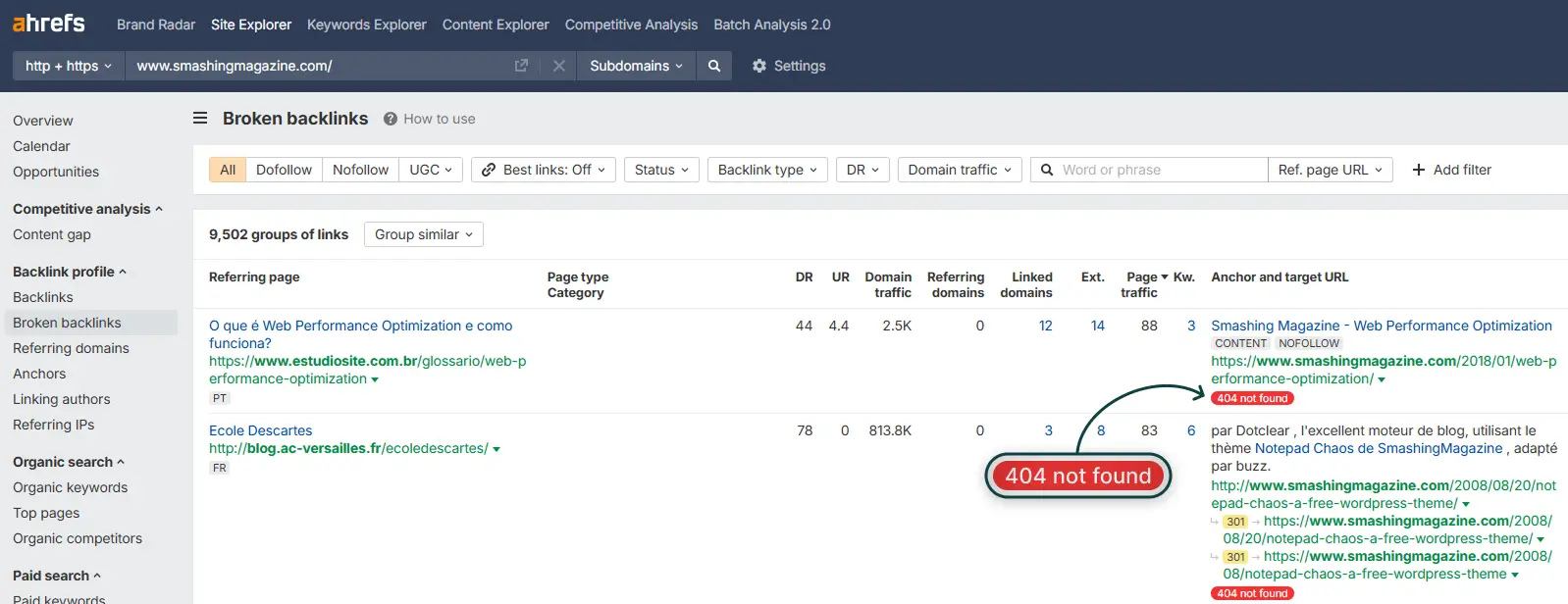
### 4. Reclaim Unlinked Brand Mentions
Unlinked mentions happen when another site references your brand without linking to you.
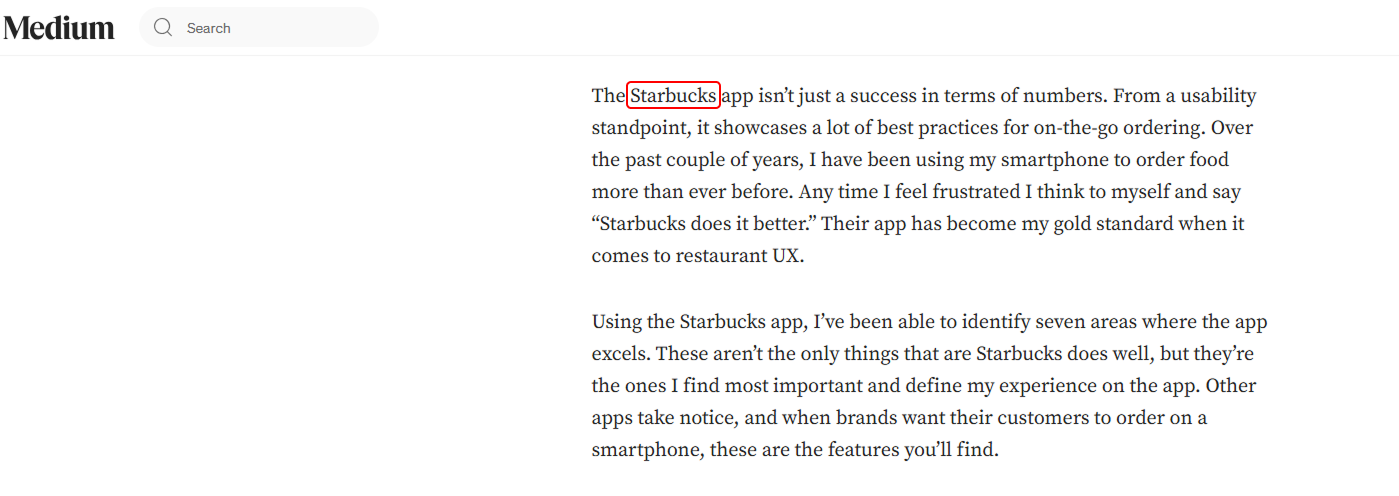
The pattern is common with quote roundups, “tools we use” posts, and journalistic mentions. The author wrote your name, but didn’t link to your homepage.
Set up Google Alerts for your brand name and product names. When you get an alert, check whether the mention includes a link.
If it doesn’t, send a short thank-you email and ask if they’d add the link so readers can find you. The response rate is high, often 40 to 60%.
This is the single best quick-win tactic for any brand that’s been around long enough to get mentioned.
### 5. Competitor Backlink Analysis
If a site has linked to your competitor, there’s a meaningful chance they’d link to you, given the right pitch.
Open Ahrefs Site Explorer, enter a competitor’s domain, click Backlinks, filter for Domain Rating 30+ and dofollow links, then sort by traffic. The top results are sites worth pitching.
Look for three patterns: sites that link to multiple competitors, sites that link to long-form content in your space, and sites that publish “best tools” or “best guides” roundups in your category. Each pattern suggests a different outreach angle.
This strategy isn’t about copying competitors. It’s about discovering link opportunities you didn’t know existed.
### 6. Resource Page Outreach
Resource pages are curated lists of useful content, typically maintained by universities, industry blogs, and topic-focused sites.
Find them with Google operators like `”your topic” + intitle:resources` or `”your topic” + inurl:links`. Skim each result for relevance. The strongest targets are pages that already link out to similar content and haven’t been updated in 6 to 12 months.
Read [our resource page link building guide](https://outreachdesk.com/resource-page-link-building/) for the pitch templates. The short version: introduce yourself in one sentence, point to the specific resource you’d want added, explain why their readers would benefit, and offer to share the page once they’ve added you.
### 7. HARO and Expert Quote Platforms
HARO stands for Help A Reporter Out. It’s a platform where journalists post requests for expert quotes, and you respond with insight tied to your domain expertise.
Read [our HARO link building guide](https://outreachdesk.com/haro-link-building/) for the full workflow. Other platforms in the same space, including Connectively, Qwoted, and Featured.com, work the same way.
The earning pattern is straightforward. You scan queries each morning, answer the ones where you have genuine expertise, and journalists who use your quote credit you with a link. Success rates run 5 to 10%, but the links land on real news sites with real editorial standards.
### 8. Digital PR
Digital PR means creating a newsworthy story tied to original data or commentary, then pitching it to journalists.

It’s the highest-ceiling link building tactic. A successful campaign can earn 50 to 200 links from major publications. It’s also the most labor-intensive, with research, data analysis, asset creation, and outreach combining into 60+ hours per campaign.
If you have the bandwidth, the format that works in 2026 is an original data study. Survey 200 to 500 people in your audience, publish the results with charts and a clear angle, then pitch it to 30 to 50 journalists who cover your space.
### 9. Niche Edits
A niche edit is a link added to an already-published article, placed contextually inside content that already ranks.
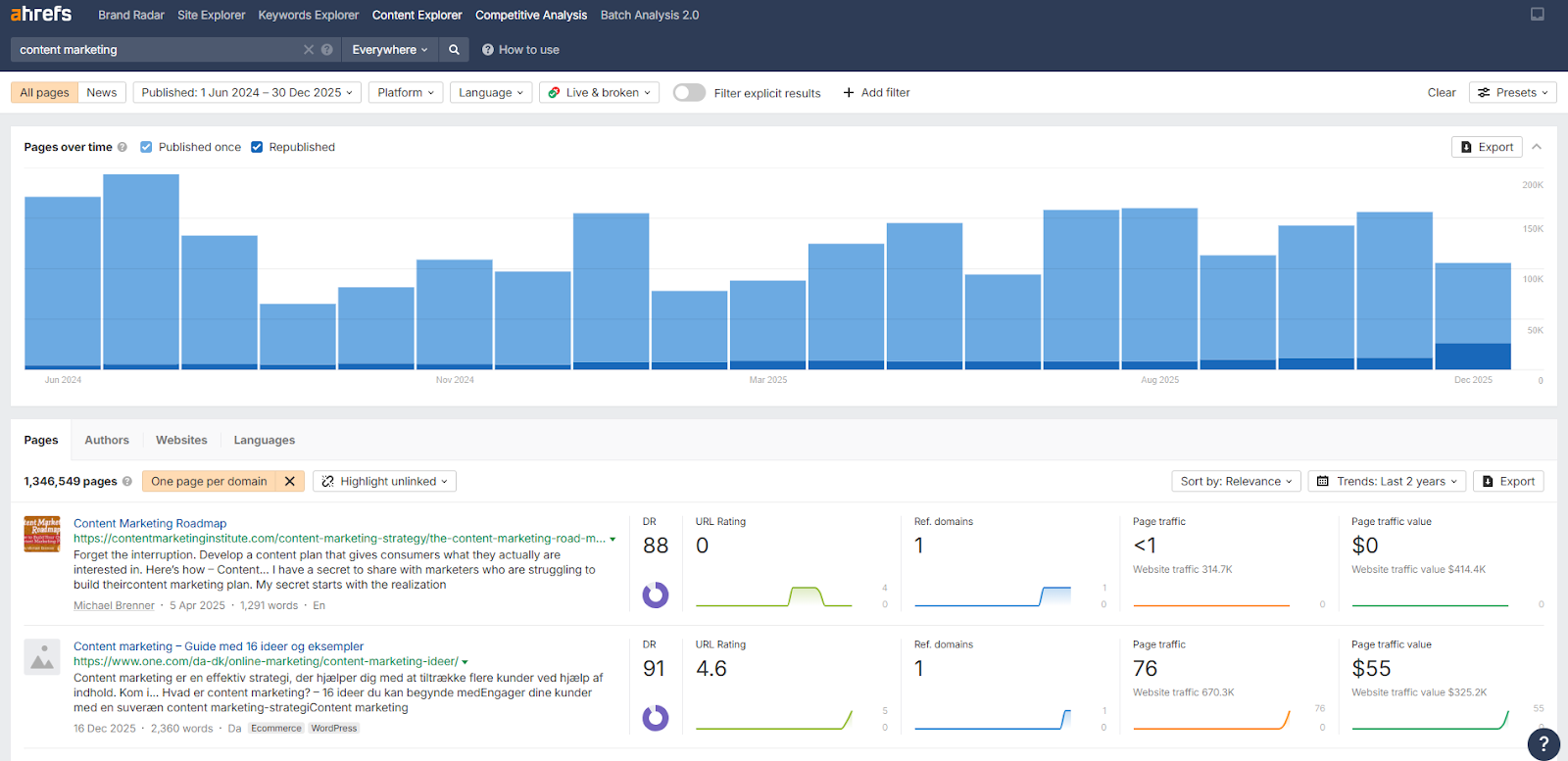
Read [our niche edits guide](https://outreachdesk.com/niche-edits/) for the careful version. The key is contextual relevance. A well-placed niche edit on a topically aligned article can outperform 10 low-quality new posts, but a poorly placed one looks manipulative and risks both pages.
Avoid bulk niche edit services that promise placements at scale. The signals they leave behind, including identical link patterns across unrelated sites, exact-match anchor stuffing, and abrupt link insertions in old posts, get pages flagged.
### 10. Partnerships and Relationship Links
The website owners most likely to link to you are the ones you’ve helped first.
That help can take many forms: sharing their content with your audience, commenting thoughtfully on their posts, mentioning them in your own articles, or inviting them to contribute to yours.
Six months of genuine relationship-building leads to natural link exchanges that no algorithm would flag.
This isn’t a fast tactic. It’s the foundation underneath every other tactic, and it’s why the same 50 people in any niche keep landing each other’s coverage.
### 11. Reclaim Lost Backlinks
A lost backlink is one you had, then lost.
Common causes: the linking page was updated and your link removed, the linking site went down, the page now returns a 404 error, or the author switched to linking a competitor.
Track lost backlinks in Ahrefs (Backlinks > Lost tab) or Search Console. When a meaningful link disappears, email the site owner and politely ask why it was removed. Half the time the removal was unintentional, and a quick reminder gets the link reinstated.
This is one of the highest-success-rate tactics in the table. Set a recurring 30-minute monthly task to scan losses and reach out.
### 12. Get Featured in Newsletters and Roundups
Newsletter mentions and “best of” roundups remain underused for link building.
The pattern: identify the 10 to 20 newsletters and blogs that publish weekly or monthly roundups in your niche. Build a relationship with each editor. When you publish something worth including, send them a short heads-up with one sentence on why their readers would benefit.
This tactic shines for content brands and SaaS companies with original perspectives. A single mention in a respected newsletter can drive both referral traffic and authority links from readers who quote your work in their own content.
## Choosing Strategies by Business Stage and Goal
The right strategy is almost never the most popular one. It is the one that matches your stage, your authority, and what is already working in your program.
The three questions below are the ones worth answering before doubling down on any of the 12 tactics above.
### Best Link Building Strategy by Business Stage
The “best” strategy depends on the stage you are in, not on what the search results claim. A pre-product startup and a $1M-revenue company should not be running the same tactics.
Pre-revenue or pre-product: build one strong linkable asset first. Without something worth linking to, every outreach motion fails. Spend 60 days on a data report, free tool, or deep guide that solves a real problem in your space.
$0 to $100K in annual revenue: unlinked brand mention reclamation paired with resource page outreach. Both compound, and both run in under 5 hours per week.
$100K to $1M in annual revenue: add broken link building and selective guest posting. You have enough content history to make the outreach credible.
$1M and above: layer in digital PR and competitor backlink analysis. The investment per link is higher; the placements come from publications that move both rankings and credibility.
The mistake is skipping stages. The team running digital PR at $50K in revenue usually fails not because the tactic is wrong, but because they have no foundational content to support the outreach.
### Authoritative Link-Building Strategies (Tier 1 Sites Only)
For earning links from sites with Domain Rating 70 or higher, the field narrows quickly. Three tactics actually work at that tier.
Digital PR with original research: Tier 1 sites cover stories that have data behind them. A 200-person survey or a proprietary dataset gives journalists at Forbes, Inc, or Search Engine Journal something to cite. Without the data, the pitch fails.
Expert quote platforms like HARO, Connectively, and Qwoted: Tier 1 publications use these because they need expert sourcing fast. Respond to relevant queries with substantive answers, not promotional pitches, and the placements land on publications that move both rankings and credibility.
Broken link building on Tier 1 niche-authoritative sites: big publications get broken outbound links faster than editors fix them. Finding a broken link on a Forbes or Inc article and offering a working replacement is one of the few outreach motions that lands on those sites without an existing relationship.
What does not work at this tier: cold guest post pitches, generic outreach templates, or any tactic that scales by automation. Tier 1 editors recognize template-driven outreach in two sentences.
### How to Improve an Existing Link Building Program
If you are already running outreach but rankings are not moving, the diagnosis usually sits in one of three places.
Link quality has plateaued. The first 50 links you earned moved the needle, but the next 100 did not because they came from the same tier of sites. Audit the Domain Rating distribution of your last 30 placements; if more than 60% are below DR 30, the issue is reach.
Anchor distribution is over-optimized. Pull a backlink report and check exact-match keyword usage in anchors. If more than 1 in 5 inbound links uses your target keyword as anchor, Google’s spam systems are throttling you.
Topical fit is missing. Some earned links come from sites with no topical relationship to yours; those links still count, but they do not compound. Audit which sites have sent traffic alongside the link, and the ones that have are your real authority builders.
The fix for any of the three is the same. Stop outreach for 30 days, audit what you have earned, then restart with sharper targeting.
## Common Link Building Mistakes That Get Pages De-Indexed
Some link patterns don’t just fail to help. They get pages removed from Google’s index entirely.
Watch for these five patterns and avoid them, no matter how cheap or fast they seem.
### Buying Links from Private Blog Networks
A private blog network is a set of websites built primarily to host outbound links to client sites.
Google detects these networks through shared hosting fingerprints, common ownership signals, identical site templates, and unnatural outbound link clusters. When one gets identified, every site linking from it loses the value of those links and often takes a manual penalty.
The cost looks low. The downside is total loss of search visibility for the pages those links pointed at.
For the full breakdown of [what black hat link building actually costs](https://outreachdesk.com/black-hat-link-building/) and how Google detects each tactic, see our dedicated guide.
### Over-Optimized Anchor Text
Exact-match anchors like “best link building services” or “buy backlinks cheap” stuffed into multiple inbound links signal manipulation.
Natural link profiles include a mix: branded anchors (your company name), naked URLs, generic phrases (“learn more,” “this guide”), and partial-match phrases. If 60% of your inbound anchors are exact-match commercial keywords, Google’s spam systems flag the pattern.
The fix is restraint. When you guest post, your author bio uses a branded anchor. When you build resource page links, the anchor reflects the destination page’s title naturally.
### Bulk Guest Post Farms
Guest post farms are sites that accept any contributor, publish anything, and exist mainly to sell outbound links.
The patterns are recognizable: hundreds of guest authors per month, content quality far below the niche standard, identical outbound link structures across posts, and frequent appearance on “buy guest posts” marketplaces. Links from these sites do not pass authority in 2026 and often hurt the destination site.
Per Google’s [link spam policies](https://developers.google.com/search/docs/essentials/spam-policies), “low-quality directory or bookmark site links” and “keyword-rich, hidden, or low-quality links embedded in widgets” violate the spam policies. Bulk guest post farms fall into the same category.
### Doorway-Style “City + Service” Page Spam
Doorway pages are mass-produced landing pages built to rank for variations of the same query, with the same content templated across hundreds of city or vertical combinations.
When these pages also serve as link destinations from low-quality directories, Google removes them in batches. The signal Google looks for: identical templated content, low engagement metrics, and links from spammy sources pointing at every variant.
If you’re considering this pattern, don’t. Consolidate into a single strong service page with real, locally relevant detail instead.
### Spammy Directory Submissions
Generic directory submissions stopped working around 2014.
The directories that still earn links in 2026 are vertical-specific (industry associations, professional bodies, niche review platforms) with real editorial review. The ones to avoid are pay-to-submit directories, link farms disguised as directories, and any directory that accepts every submitter without review.
A quick test: would you trust the directory’s recommendations if you were a buyer? If no, skip it.
## How to Measure if Your Link Building Is Working
Track the metrics that predict ranking impact, not the ones that look impressive.
### Track Referring Domains, Not Raw Backlinks
100 links from 5 sites is weaker than 25 links from 25 sites.
Referring domains, the number of unique sites linking to you, predicts ranking lift more reliably than raw link count. Use Search Console’s Links report or Ahrefs Referring Domains tab to track monthly growth.
Healthy growth for a small site is 5 to 15 new referring domains per month. For a growing site, 20 to 50. For a competitive site with active outreach, 50 to 200.
### Track Which Links Actually Moved Keyword Positions
Some links move rankings. Most don’t.
Pair link tracking with position tracking. When a new link lands on a page targeting “your-keyword,” check the keyword’s position 14 and 30 days later.
Links from sites that genuinely cover your topic move positions; links from sites with no topical fit usually don’t.
Over time you’ll learn which types of sites move your needle, and you can focus future outreach on those patterns.
### Track Referral Traffic, Not Just Link Count
A backlink should drive both ranking signal and direct visitors.
Check Google Analytics Referrals weekly. The sites sending real traffic alongside the link are the ones that built a genuine audience around content your reader cares about. Those sites are gold for relationship-based future outreach.
If a link sends zero referral traffic for three months, it’s a link to a page no one reads. Worth having for ranking signal, but not worth scaling up that placement type.
## A 90-Day Link Building Plan
Here’s what realistic execution looks like.
### Days 1 to 30: Foundation and Quick Wins
Set up Google Alerts for your brand name and product names.
Audit your existing pages and pick the 2 to 3 that deserve link building investment first. Run a backlink scan on your 3 closest competitors and export their top 50 referring domains. Set up your outreach tracking (a spreadsheet works; a dedicated outreach tool is better).
Run the unlinked brand mention reclamation cycle weekly. By end of month 1, expect 2 to 5 new links from this tactic alone.
### Days 31 to 60: Outreach Engine
Send your first guest post pitches. Send your first broken link building pitches. Identify 20 resource pages in your niche and pitch 5 per week.
By end of month 2, expect your first 1 to 3 guest post placements landing, 1 to 2 broken link replacements live, and your first resource page additions accepted. Total: 5 to 15 new links across the month.
### Days 61 to 90: Compounding
Layer in HARO responses. Pitch your strongest content to newsletter editors. Start one digital PR experiment if you have the bandwidth.
By end of month 3, the links from months 1 and 2 are showing up in your rankings, your outreach engine is producing 10 to 20 new placements per month, and your authority is starting to compound. This is the inflection point most teams quit before.
Push past it. The teams that ship for 90 straight days are the ones sending screenshots of page-one rankings in month 4 and beyond.
## Frequently Asked Questions
### What’s the Best Link Building Strategy for Beginners?
The best link building strategy for beginners is reclaiming unlinked brand mentions, paired with resource page outreach.
Both tactics need minimal tools, deliver visible results inside 30 days, and don’t risk site penalties. Once those two are running, layer in guest posting around month 2.
Most beginners try too many tactics at once and finish none. The fix is to pick 2 and run them for 90 straight days.
### How Long Does Link Building Take to Show Results?
A realistic timeline for measurable link building results runs 60 to 120 days.
You’ll start landing placements in week 4 of an active campaign. Rankings tend to move 30 to 45 days after links go live, as Google re-crawls and re-evaluates your pages. By day 90, you should see both link count growth and keyword position improvements on the pages you targeted.
If you’re seeing zero movement at day 120, the issue is usually link quality (sites without real topical fit) or anchor distribution (too many exact-match anchors). Audit before quitting.
### Is Buying Backlinks Ever Safe in 2026?
Buying backlinks at scale is not safe in 2026.
Google’s [spam policies](https://developers.google.com/search/docs/essentials/spam-policies) explicitly classify “exchanging money for links” as a link spam violation. The cost can include manual penalties, algorithmic suppression, or full removal from the index.
The exception is paid placements properly marked with `rel=”nofollow”` or `rel=”sponsored”` attributes, which Google treats as legitimate sponsored content. If you’re paying for visibility on a real publication, mark it correctly. Don’t pretend it’s an editorial link.
See [our link building pricing guide](https://outreachdesk.com/link-building-pricing/) for what fair editorial outreach actually costs.
### How Many Backlinks Do I Actually Need to Rank?
The number of backlinks needed to rank depends on the keyword’s competition, not on a universal target.
For low-competition keywords, you can rank with 5 to 20 strong referring domains. For mid-competition keywords, 30 to 100. For high-competition commercial keywords, 200+ from genuinely authoritative sites.
The faster path to ranking is targeting keywords where the current top-10 pages have fewer than 50 referring domains. Out-link the weakest result, ship better content, and you rank.
### What’s the Difference Between Link Building Strategies and Tactics?
A link building strategy is the overall approach. A tactic is the specific action.
“Build authority in the SaaS marketing niche” is a strategy. “Pitch one guest post per week to SaaS marketing publications” is a tactic.
Strategies set direction; tactics execute against that direction.
Most teams confuse the two and end up with 12 tactics and no strategy. Pick the 2 tactics that fit your situation, name the strategy they’re serving, and ship.
### What Counts as a High-Quality Backlink?
A high-quality backlink is a link from a topically relevant site with genuine traffic, real editorial standards, and a clean backlink profile of its own.
Three signals to check: the linking page covers a subject related to yours, the linking site has real organic traffic (check it in Ahrefs or SEMrush), and the link sits inside body content rather than in a footer or sidebar. When all three are present, the link passes meaningful authority.
Domain Rating alone doesn’t qualify a link. A Domain Rating 80 site with no topical fit often passes less authority than a Domain Rating 35 site that genuinely covers your niche.
## The Honest Take
Most teams that start link building see their first wins in month 1, lose momentum in month 2, and quit before month 3.
The ones that don’t quit have two things in common: they picked the 2 strategies that actually fit their situation, and they ran them for 90 straight days before evaluating.
If you’re starting this week, set up brand alerts, pick 3 resource pages to pitch, and find 5 broken links you can replace. Don’t add a third tactic until those three are routine.
Come back at day 90 and measure what changed.
---
---
title: "11 Best Link Building Tools to Scale Your SEO in 2026"
url: "https://outreachdesk.com/link-building-tools/"
lang: "en-US"
type: "post"
description: "You need backlinks to rank. But manually finding prospects, writing personalized emails, and tracking responses across spreadsheets drains time you should spend on strategy. The right link building tools help you build authority and remove guesswork. You get practical ways"
last_modified: "2026-05-22T10:01:43+00:00"
categories: [Link Building]
---
# 11 Best Link Building Tools to Scale Your SEO in 2026
You need backlinks to rank. But manually finding prospects, writing personalized emails, and tracking responses across spreadsheets drains time you should spend on strategy.
The right link building tools help you build authority and remove guesswork. You get practical ways to:
- Find backlink opportunities.
- Identify the right contacts.
- Manage outreach.
- Track your earned backlinks.
Link building tools reduce your manual work. They don’t build links for you, but they find opportunities to earn real editorial links and simplify your link building process. For brands that need consistent execution, [link building services](https://outreachdesk.com/) from a specialised provider remove the manual workload. For end-to-end management, [Outreach Desk’s free SEO tools](https://outreachdesk.com/tools/) runs campaigns for 500+ brands worldwide.
#### Key Takeaways
- Link building tools don’t build links for you. They make the work easier and more organized.
- Not every tool does everything. Each one supports a specific stage of link building.
- The best tool is the one that matches your workflow and saves you time.
- Tools support the process, but links should still be earned manually.
- Metrics guide decisions, but relevance still matters.
## What Are Link Building Tools?
**Link building tools are software platforms that handle the research.** Prospecting, outreach, and tracking stages of earning backlinks, and without them, a link building operation capable of moving competitive keywords is essentially unscalable for any team without a large dedicated department.
The difference between manual link building and a proper tool stack isn’t just speed; it’s the quality of targeting, the consistency of outreach follow-up, and the visibility into which placements are actually driving authority versus which ones Google ignores.
They range from backlink analysis platforms like Ahrefs and Semrush (which show who links to you and your competitors) to outreach platforms like Pitchbox and Mailshake (which manage the personalized email sequences that turn prospects into placements). Most teams need at least two: one for research, one for outreach.
Link building tools simplify research, prospecting, and outreach to help you earn backlinks, which can strengthen your website’s authority in search engines.
These tools handle repetitive work like finding prospects, verifying contacts, and tracking conversations, so you focus on building real relationships and creating content people want to reference.
Link building tools fall into 4 main categories:
### 1. Backlink Analysis Tools
Show you where competitors [earn backlinks](https://outreachdesk.com/what-are-backlinks/), what content attracts links, and which sites in your niche.
Examples: Ahrefs, Semrush, Moz
### 2. Prospect & Email Tools
Help you find relevant websites and verify professional email addresses, so that you always reach the right people.
Examples: HARO, Hunter, Apollo
### 3. Outreach Platforms
Keep your [outreach](https://outreachdesk.com/seo-outreach/) organized. Manage email campaigns, track replies, and automate follow-ups so you always stay on top of opportunities.
Examples: Pitchbox, BuzzStream, Respona
### 4. Link Monitoring Tools
Track new links, flag lost ones, and monitor anchor text to understand your backlink profile.
Examples: Ahrefs Alerts
Most teams use one tool from each category. Use analysis tools to spot opportunities, and outreach platforms to land placements that build your authority and drive growth.
## Why You Need Link Building Tools
**Manual link building stops working at scale because the research alone.** Finding relevant sites, locating contact emails, tracking which pitches were sent, following up, and logging placements, consumes more time than actually producing the content that earns links in the first place. At ten links a month, spreadsheets work.
At a hundred per month, you need automation handling prospecting, verification, and reporting, or you spend every working day on admin instead of strategy.
Manual link building might work for 10 links, but it doesn’t work for 10000.
You could spend hours searching for contacts, updating spreadsheets, and waiting for replies. Or you can use tools that automate the repetitive task so you can focus on strategy and real growth.
Here’s what the right tools actually do:
### Save Massive Time
Find 100 qualified prospects in 10 minutes instead of 10 hours. Use that time to build momentum and real results.
### Give You Competitive Intelligence
See which competitor pages earn the strongest links, what anchor text they use, and which domains have real authority. This data is tough to collect manually.
### Improve Targeting Precision
Filter prospects by domain rating, authority, traffic, relevance, and linking history so you only reach out to sites that actually help you move rankings.
### Boost Response Rates
Automated follow-ups help you reach busy prospects. Personalization makes your outreach feel one-to-one. Track what works so you can scale what drives growth.
### Create Accountability
Monitor your email performance. Aim for strong open, reply, and conversion rates so you know what actually drives results.
Modern search engines reward quality, relevance, and trust. One strong editorial link can make a bigger impact than dozens of weak ones.
The best tools focus on validation and relevance, not just finding more prospects.
Without tools, you’re guessing. With the right tools, you build a system for growth.
## Compare the Best Link Building Tools
**The best link building tools split into four categories by function.** Backlink research (Ahrefs, Semrush), outreach automation (Pitchbox, Mailshake, Hunter), link monitoring (Ahrefs Alerts, Monitor Backlinks), and content asset creation (BuzzSumo, Exploding Topics).
Most teams need one tool from each category, not a single platform that tries to do everything. The all-in-one tools compromise on depth across categories; the specialist tools go deep where your workflow actually bottlenecks.
| Tool | Best For | Key Features | Recommended For |
| --- | --- | --- | --- |
| Ahrefs | Competitor backlink research & link discovery | Site Explorer, Content Explorer, Link Intersect, broken link finder, competitor backlink analysis, new & lost link tracking | Agencies & in-house SEO teams |
| Semrush | Finding link gaps tied to rankings | Backlink Gap, competitor analysis, outreach tracking, bulk backlink analysis, anchor text reports | SEO & growth teams |
| Moz | Evaluating link quality & risk | DA/PA, Spam Score, link comparison, easy interface | Beginners & small businesses |
| Hunter | Finding verified outreach emails | Domain Search, Email Finder, bulk verification, confidence scoring | Outreach-focused link builders |
| Respona | Managing outreach & follow-ups in one workflow | Prospecting, personalization, automated follow-ups, campaign analytics, tracking | Content & small SEO teams |
| Majestic | Assessing backlink trust & relevance | Trust Flow, Citation Flow, topical relevance scoring, backlink history | Link quality focused SEOs |
| BuzzStream | Organizing outreach & relationships | Contact CRM, conversation history, template management, email tracking, reminders | Solo & team outreach |
| Pitchbox | Scaling structured outreach campaigns | Team workflows, advanced automation, CRM integration, performance reporting | Agencies & large teams |
| HARO | Earning editorial & PR links | 3x daily journalist query emails, Journalist Dashboard, Pitch Feedback Tool, Real-Time Visibility for Urgent Queries | Founders & brand experts |
| Apollo | B2B & SaaS contact discovery | Role-based search, Millions of contacts, sequence automation, email verification, LinkedIn integration | SaaS & B2B marketers |
| LinkMiner | Finding & replicating competitor’s backlinks at affordable prices | Broken link finder, backlink preview, Link Strength score, DoFollow/NoFollow filters, new & lost links | Solopreneurs & freelance SEOs |
The table above gave you a brief overview of each tool. Next, you will learn why these tools are best for you.
## Top 11 Link Building Tools For SEO Growth 2026
**The 11 link building tools below cover the full workflow from prospecting to placement monitoring, with use cases and pricing for each.** Start with one tool per category, then add specialized tools only when your volume justifies the cost. The order below is roughly the order most teams adopt them.
Building high-quality backlinks in 2026 isn’t about guesswork or manual tasks. It’s about using accurate data, finding the right contacts, managing outreach, and tracking results to fuel your growth.
The right tools support your entire process. Below are the 10 most effective link building tools that help you work more efficiently and make better decisions.
### 1. Ahrefs – Best Backlink Intelligence Tool
[Ahrefs](https://ahrefs.com/) is the industry standard for competitive backlink research.
Ahrefs shows you where competitors earn links, what content attracts attention, and which sites deserve your focus. If you want to start with one tool, Ahrefs helps you find link building opportunities that can gradually improve your authority.
#### Core Features That Matter:
**Site Explorer** – Enter any domain and see:
- Every backlink with DR, traffic, and anchor text.
- New and lost links over time.
- Referring domains sorted by authority.
- Top-linked pages and content.
**Content Explorer** – Searchable database of billions of pages:
- Find the most-linked content on any topic.
- See who links to competitor articles.
- Identify content formats that earn links.
**Link Intersect** – The secret weapon:
- Shows sites linking to 2-5 competitors but not you.
- Instant warm prospect list.
- Focus on proven linkers in your niche.
**Broken Backlinks Tool:**
- Find dead pages or [broken backlinks](https://outreachdesk.com/broken-link-building/) that no longer exist but still have active links.
- Recreate content and reclaim links.
- Easy opportunities to build authority.
#### Example:
Suppose you run a marketing SaaS blog. Link Intersect shows that three competitors have backlinks from the same “50 Best Marketing Tools” roundup. You contact the site owner or editor who published the roundup, share a clearer description of your tool, and earn a placement for your site.
#### Best For:
People who are serious about competitor analysis and data-driven prospecting.
#### Pricing:
$129–$1,499 per month. Annual billing saves up to 17%. Starter and Lite plans come with monthly credit caps.
#### Common Mistake:
Reviewing every backlink your competitor has, instead of focusing on relevant, authoritative links you can realistically earn. Filter the list to sites with a Domain Rating of 30+ and review those first.
#### Pros:
- It has a huge backlink database.
- Multiple competitor analysis features.
- Data is updated frequently.
#### Cons:
- Challenging learning curve.
- Expensive compared to similar tools.
#### Pro Tip:
Export Link Intersect results monthly. Track which prospects convert best and focus there.
### 2. Semrush – Best For Gap Analysis + AI-Powered One Upgrade
[Semrush](https://www.semrush.com/projects/?utm_source=backlinko.com&utm_medium=referral&utm_campaign=link-building-tools) helps you spot gaps where competitors have backlink advantages. Classic plans handle gap analysis. Semrush One adds AI (ChatGPT, Perplexity, Google AI) to uncover new growth opportunities.
#### Why It Stands Out:
**Backlink Analytics Dashboard:**
- Track referring domains from time to time.
- Monitor anchor text distribution.
- Monitor changes in backlink growth rate.
- Export data for reporting.
**Backlink Gap Tool:**
- Visual comparison of 5 competitors.
- Ability to filter by “best” backlink opportunities.
- Export with a single click.
**Link Building Tool (Integrated):**
- Find link building opportunities based on keywords + competitors.
- Built-in outreach tracking.
- Campaign performance metrics.
**Bulk Analysis:**
- Upload upto 200 domains simultaneously.
- Get backlink details for entire lists.
- Useful for agency and team workflows.
**Semrush One AI Upgrade:**
- See exactly where your brand shows up across ChatGPT, Gemini, Perplexity, and Google AI Overviews. No guessing where you stand in AI-driven search.
- Find the exact topics where competitors get mentioned in AI responses, but you don’t. Those gaps tell you exactly what to create next.
- Know which of your pages AI platforms are actually referencing and which topics are pulling your brand into the conversation.
- Bring traditional SEO performance and AI visibility into one dashboard. Stop switching between tools and start seeing the full picture.
#### Example:
Suppose Mailchimp is a competitor to your SaaS product. Backlink Gap shows they have 50 backlinks from marketing blogs you hadn’t discovered. Check those blogs, create content around that topic, and reach out to those 50 sites in a single campaign.
#### Best For:
Teams wanting visual gap analysis + AI workflows.
#### Pricing:
- For SEO Classic Plans: $139 – $499.95 per month.
- For Semrush One plans: $199-$549 per month.
- Annual billing saves upto 17% across all plans.
#### Common Mistake:
Focusing only on backlink count. Look at which specific pages earn links and why.
#### Pros:
- Extensive backlink database.
- User-friendly interface.
- Full SEO toolset beyond link building.
- AI-first evolution.
#### Cons:
- The cost may be high for small businesses.
- Beginners may find the range of features hard to understand at first.
### 3. Moz Link Explorer- Best For Beginners
[Moz](https://moz.com/) makes it easier to review and understand your backlinks data with simple metrics.
Domain Authority (DA) and Page Authority (PA) scores help you evaluate prospects quickly, without getting lost in data.
#### What Makes It Easy:
**Simple Dashboard:**
- Simple, user-friendly interface.
- Color-coded metrics.
- One-click reports.
**Spam Score:**
- Spam Score rates a website’s risk level based on how many signals it shares with sites Google has penalized.
- Moz analyzes [27 features](https://moz.com/help/link-explorer/link-building/spam-score) common in Google-penalized sites.
- Spot risky backlinks before they become a problem.
- Visual warnings make decisions obvious.
**Link Intersect:**
- Shows sites linking to competitors.
- Even easier to use than Ahrefs.
- Beginner-friendly.
**Anchor Text Analysis:**
- See keyword distribution in your backlinks
- Spot over-optimization early
- Balance branded vs. keyword anchors
#### Best For:
Teams new to link building, small businesses, and solopreneurs.
#### Pricing:
Pricing ranges from $49 to $299 per month. Annual billing saves 20% across all plans. A 7-day free trial is available.
#### Pros:
- Trusted in the SEO community.
- User-friendly interface.
- Includes other useful SEO tools.
#### Cons:
- Higher price point for full feature access.
#### Why It Matters:
DA/PA doesn’t guarantee rankings, but they help you avoid wasting time on weak sites. Use them as initial filters, then verify with Ahrefs.
### 4. Hunter – Fastest Email Verification
[Hunter](https://hunter.io/) finds and verifies professional email addresses, so your outreach lands with the right person every time.
#### Core Features:
**Domain Search:**
- Get all public email addresses by entering the domain name.
- Check the confidence score and filter by the marketing and editorial departments.
**Email Finder:**
- Find the email address using the name.
- Hunter will predict the format and verify it.
- Works for most contacts.
**Email Verifier:**
- Upload lists of hundreds of emails.
- Get verification status in minutes.
- Reduce bounce rates.
**Chrome Extension:**
Find email addresses from anywhere on the web with a single click, using the Hunter Chrome extension.
Hunter saves you time, reduces failed outreach, and provides accurate contact details so you can reach the right decision-makers with confidence.
#### Example:
You have a list of 100 target domains from Ahrefs. Upload to Hunter’s Domain Search, export verified emails in 5 minutes, import to Pitchbox, and start outreach the same day.
#### Best For:
Anyone doing email outreach who needs verified contacts fast.
#### Pricing:
It offers free 50 credits per month, and paid plans range start from $49 to $299 per month. Annual billing saves 30% across all plans.
#### Pros:
- Finds relevant email addresses.
- User-friendly interface and browser extension.
- Generous free plan.
#### Cons:
- Focused solely on email discovery and verification.
- Requires integration with other tools for a complete link building workflow.
#### Why It Matters:
A 10% bounce rate can land you in spam. Hunter keeps your sender reputation clean and inbox placement high.
### 5. Respona – Best AI-Powered Automation
[Respona](https://respona.com/) takes link building off your plate entirely. You place the order, and they handle prospecting, content, outreach, and publishing from start to finish.
#### How It Works
- Tell them your landing pages, anchor texts, and publisher preferences
- Respona finds sites already ranking for similar keywords to yours
- Their team writes content optimized for search, and AI answers
- Your placements go live, and you track every link in real time
#### Content Types Available
- Product review
- Listicle
- Contextual placement
- News
- Comparison guide
#### Best For
Brands, agencies, e-commerce stores, and B2B businesses that want guaranteed placements without doing the manual work themselves.
#### Pricing
Pay-per-placement starting from $100 to $500, depending on the domain rating and traffic tier. No subscription required.
#### Pros
- Guaranteed placements. Every link goes live within the agreed timeframe.
- Content written and published for you.
- Easiest to use in its category per G2 reviews.
#### Cons
- Higher price point per placement.
- Less control over the outreach process.
#### Why It Works
Respona guarantees your placements go live, unlike PR agencies, where coverage is never certain. You know exactly what you’re paying for and when it goes live.
**Note:** Already using Respona’s self-serve outreach tool? Your legacy platform is still accessible at [app.respona.com](http://app.respona.com)
### 6. Haro – Free Editorial Links
[HARO](https://www.helpareporter.com/) (Help a Reporter Out) puts you in front of journalists looking for expert quotes, so you earn high-authority links by sharing your expertise.
You skip cold pitches and reply directly to journalists who are already looking for expert input.
When your input gets used, you earn mentions and backlinks from top publications. The kind that are nearly impossible to land through regular outreach.
Over time, you build real authority and pick up PR-style links that strengthen your brand and grow your reputation.
Consistent HARO mentions put your site in front of trusted, well-known publications and make you a credible voice in your niche.
#### Best For:
Founders, executives, and subject matter experts with genuine expertise to share.
#### Pricing:
Free (relaunched under Featured.com, April 2026).
#### Pros:
- Potential for high-authority backlinks.
- Free basic plan available.
- Builds relationships with media professionals.
#### Cons:
- Requires quick responses to be effective.
- No guarantee of link placement.
- It can be time-consuming to filter out irrelevant queries.
#### Why It Matters:
One HARO link from Forbes can outweigh 10 guest posts, plus you get brand credibility and referral traffic.
### 7. Majestic – Trust Flow Authority
[Majestic](https://majestic.com/) measures link quality to the Trust Flow and Citation Flow metrics it created.
Take this into consideration:
High Trust Flow and balanced Citation Flow indicate a healthy backlink profile, whereas a low Trust Flow and high Citation Flow indicate spam.
#### Features:
**Trust Flow and Citation Flow Metric:**
- Trust Flow measures the quality of backlinks.
- Citation Flow measures the quantity of links.
- A healthy site keeps its Trust Flow close to its Citation Flow, meaning the links it earns are as good as they’re plentiful.
**Topical Trust Flow:**
- Sorts your backlinks into industry categories so you know exactly what topics they’re associated with
- Confirms whether the sites linking to you’re actually relevant to your niche
- Flag off-topic links that could be hurting your profile.
**Historical Index:**
- You can see exactly how a site’s link profile has changed over time, which tells you a lot about how it has been managed.
- If someone is quietly pointing bad links at your site to tank your rankings, this is where you catch it before it does real damage.
- And if you’ve already been hit with a penalty, you can track exactly how your recovery is progressing over time.
#### Bulk Backlink Checker
- Check up to 400 URLs at once instead of going through them one by one.
- If you’re running audits across multiple clients, this alone saves you hours every week.
- You get a clear, quality read on every URL fast, without digging through endless data.
#### Competitor Backlink Overlap
- Find the sites that are already linking to multiple competitors in your space.
- See how those link networks connect, so you know exactly where to focus your outreach.
- The more overlap you find, the more link opportunities you know are actually within reach.
#### Example:
The guest post opportunity shows a Citation Flow of 40 but a Trust Flow of 8. That gap signals manipulative links. Skip it.
#### Best for:
Anyone who cares about building a clean, authoritative link profile and wants to catch problems early. Especially useful if you’re managing penalty recovery or running audits at scale.
#### Pricing:
Plans range from $49.99 to $1,599 per month.
#### Pros:
- Vast historical link data.
- Unique metrics to judge link quality.
- More affordable than some competitors.
#### Cons:
- Less beginner-friendly.
- Limited features beyond link analysis.
### 8. BuzzStream – Relationship CRM
[BuzzStream](https://www.buzzstream.com/) treats link building like long-term relationship management.
Every email, reply, and note is saved in one place, so you always know exactly where you left off with each prospect.
#### Why It’s Different:
**Auto-Discover Contacts:**
- Pulls emails and social profiles from domains.
- Finds decision makers automatically.
- Saves hours of manual research.
**Project-Based Workflows:**
- Keep guest posts, broken links, and HARO pitches separately.
- Keep campaigns organized and separate from each other.
**Email Templates with Memory:**
- Dynamic fields pull prospect data.
- Remembers previous conversations.
- Never duplicate outreach.
**CRM-Style Timeline:**
- See every email, note, and interaction.
- Know exactly where each relationship stands.
- Pick up conversations months later.
**Team Collaboration:**
- Assign prospects to team members.
- Leave notes for each other.
- Avoid duplicate outreach.
#### Example:
You pitch a journalist for a backlink. They decline but suggest following up with a different angle in Q2. BuzzStream sets a reminder, you follow up 3 months later with the exact context, and convert the placement.
#### Best For:
Teams focused on long-term relationship building over quick wins.
#### Pricing:
Starts at $24 and goes up to $999 per month.
#### Pros:
- Excellent for managing relationships over time.
- User-friendly interface.
- Affordable entry-level plan.
#### Cons:
- Limited backlink analysis features compared to dedicated tools.
- This tool might need to be used alongside other tools for Thorough link building.
### 9. Pitchbox – Enterprise-Scale Automation
[Pitchbox](https://pitchbox.com/) is built for teams and agencies that run hundreds of outreach emails each week.
You can integrate Pitchbox with Ahrefs, Moz, and Majestic. Prospect, personalize, and pitch from one platform, so you spend less time switching between tools.
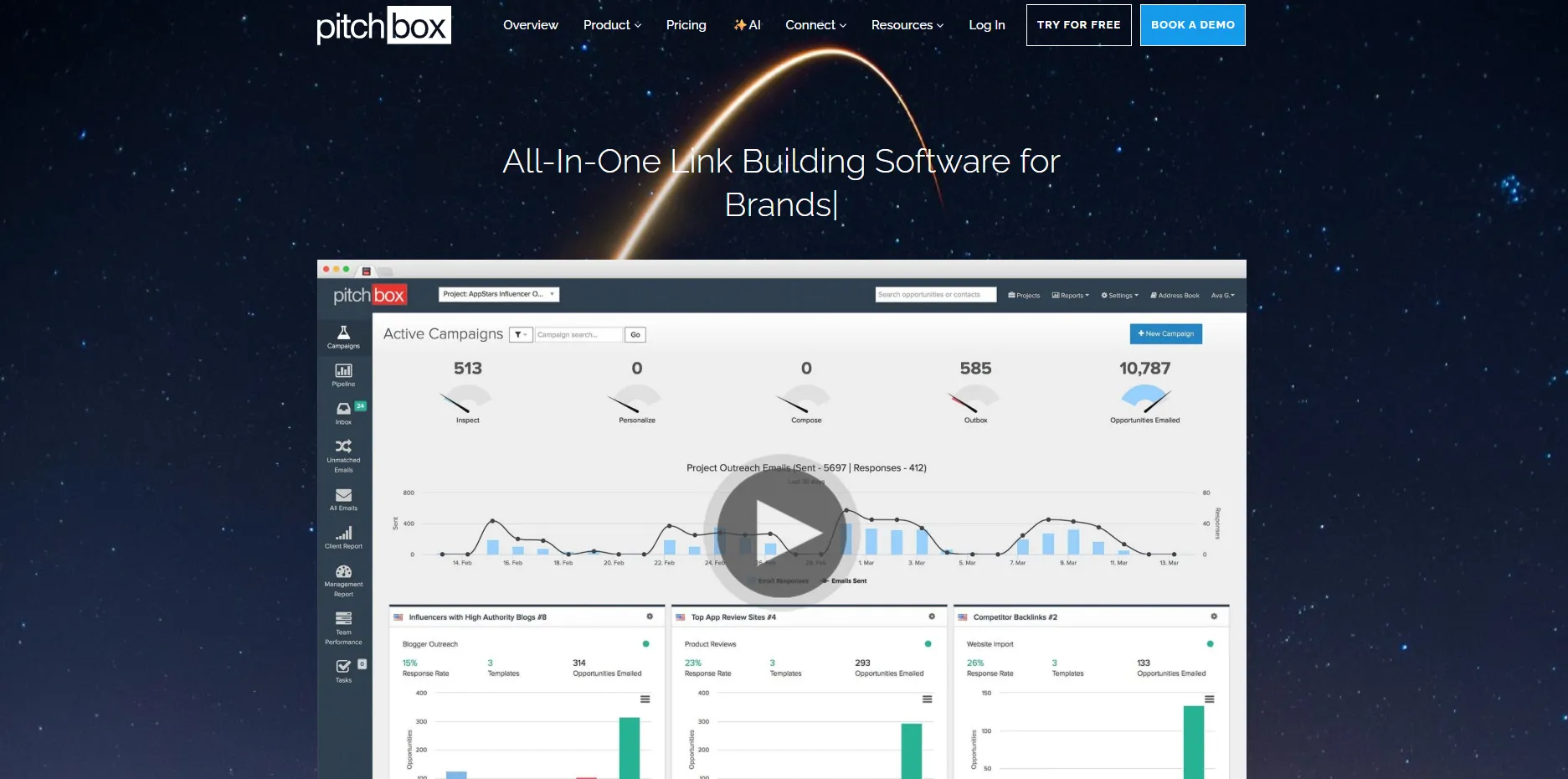
#### Power Features:
**Multi-Source Integration:**
- Import prospects from Ahrefs, SEMrush, and Moz.
- Automatically adds more data to your records.
- Decreases time spent on manual tasks.
**Advanced Personalization:**
- Before sending the email to the recipient, personalise it by using details like their article title, website, or job role, and not just their first name. These details are pulled from the prospect’s site by Pitchbox.
- Instead of sending the same email template to everyone, personalise the template for better outreach.
**Automated Follow-Up Sequences:**
- Pitchbox automatically sends up to 3 follow-up emails to each prospect on your list.
- You control how many days to wait between each attempt.
- If your prospect doesn’t reply after all three attempts, Pitchbox moves on to the next contact and repeats the process.
- If a prospect replies, follow-up emails stop automatically. No awkward double-sends, no manual cleanup.
- On advanced plans, you can set smarter pause triggers too. Like holding outreach when someone’s out of office, so you’re always reaching people at the right time.
**Workflow and Team Controls:**
- Adding a teammate to a campaign takes seconds. From there, everyone knows exactly what they own and what needs to get done.
- The Management Report keeps the whole team accountable without micromanaging. See emails sent, replies coming in, and wins closing across the whole team.
- Every client lives in their own project, so work stays clean, separate, and easy to hand off without anything getting lost or mixed up.
**Opportunity Finder:**
- Surfaces guest post, resource page, broken link prospects.
- Filters by quality metrics.
- Continuous discovery.
#### Best For:
Agencies and in-house teams manage 500+ outreach emails monthly.
#### Pricing:
Plans range from $195 to $795 per month.
#### Common Mistake:
Automating the entire email. Personalize the hook and highlight the benefit. Streamline all the follow-ups and workflow.
#### Pros
- Highly scalable for large campaigns.
- Integrates with other SEO tools.
- Powerful automation features.
#### Cons:
- Expensive for small business owners and individual users.
- Takes time to learn how to use all tools to their full potential.
### 10. Apollo – B2B Contact Database
[Apollo](https://www.apollo.io/) specializes in finding decision-makers at B2B companies.
Instead of general link building, Apollo focuses on reaching out to specific roles like content manager, vice president of marketing, or editor, with verified contact data.
#### Features:
**Massive B2B Database:**
- Millions of contacts.
- Millions of companies.
- Verified emails and phone numbers.
**Role-Based Filtering:**
- Search by job title, department, and seniority.
- Filter by company size, industry, and revenue.
- Find exactly who you need.
**Built-In Verification:**
- Email verification before export.
- Reduces bounce rates.
- Maintains sender reputation.
**Outreach Sequences:**
- Send follow-ups automatically.
- Track opens and replies.
- Integrate with CRM.
**Chrome Extension:**
- Find contacts on LinkedIn.
- Export to Apollo.
- Add to sequences instantly.
#### Example:
You’re building links for a project management tool. Apollo finds Content Managers at SaaS blogs, verifies emails, and adds them to your sequence, all in a few minutes.
#### Best For:
SaaS and B2B marketers who want verified contacts to support their [SaaS link building](https://outreachdesk.com/saas-link-building/) or business-focused outreach.
#### Pricing:
It offers a free plan with 75 credits on a monthly billing cycle, and paid plans start at $59 per month. Annual billing saves 20% on all plans.
#### Pros
- Large B2B contact database.
- Built-in email verification.
- Good fit for SaaS and B2B link building.
#### Cons:
- No link opportunity discovery.
- Less useful for non-B2B niches.
### 11. LinkMiner – Simple and Affordable Backlink Research Tool
[LinkMiner](https://mangools.com/linkminer/) helps you analyze competitor backlinks and uncover link opportunities using metrics like Citation Flow, Trust Flow, Referring IPs, Referring Domains, Total Backlinks, External Links, Facebook Shares, Anchor Text, Link Strength, and others.
It has a simple workflow, making it an easy, practical option for marketers who want backlink insights without the complexity or cost of larger SEO platforms.
#### Core Functionality
#### Quick Backlink Discovery
- Analyze competitor backlinks in seconds.
- Find pages linking to multiple competitors.
- Build prospect lists faster for outreach.
#### Faster Link Evaluation
- See authority signals for every backlink.
- Check referring domains before prioritizing outreach.
- Focus your effort on stronger link opportunities.
#### Live Backlink Preview
- Preview the linking page directly inside the tool.
- See where the backlink appears on the page.
- Decide quickly whether the opportunity is worth pursuing.
#### Simple Workflow
- Clean interface focused on backlink research.
- Easier to use than larger SEO platforms.
- Helps you evaluate links without unnecessary steps.
#### Affordable Backlink Research
- Lower cost than most full SEO platforms.
- Suitable for smaller teams and individual marketers.
- Provides essential backlink insights without a large investment.
#### Example:
You find a broken resource page on “Best SEO Tools” with 50 backlinks from DR 60+ sites. You recreate an updated version, pitch all 50 linking sites, and earn 12 new backlinks in 2 weeks.
#### Best For:
Marketers and smaller teams who want a simple and affordable way to analyze competitor backlinks and find link opportunities.
#### Pricing:
$61-$141 per month (part of the Mangools suite, including KWFinder, SERPChecker, and SiteProfiler).
#### Pros
- Instant backlink loading speed.
- One-click previews with link auto-scroll.
- Advanced filters by strength, anchor, and type.
- Color-coded Link Strength scoring.
#### Cons:
- Can’t buy LinkMiner separately (bundled in the Mangools suite).
- No backlink audit or gap analysis features.
## Quick-Reference: Which Tool for Which Problem
**Use this quick-reference table when you know what link building problem you need to solve but you’re not sure which tool category fits.** Each problem maps to one or two tools that handle it best. The table cuts evaluation time when you’re deciding what to add to your stack.
Before diving into detailed reviews, here’s how to choose based on your biggest bottleneck:
| Your Problem | Tool You Need | Why |
| --- | --- | --- |
| Can’t find enough prospects | Ahrefs or Semrush | Competitor analysis reveals sites already linking in your niche |
| Don’t know which sites to trust | Moz or Majestic | DA/PA and Trust Flow scores filter out spam |
| Wasting time finding emails | Hunter or Apollo | Verified emails in seconds, not hours |
| Outreach feels chaotic | BuzzStream or Respona | Organized CRM keeps every conversation visible |
| Need to scale volume | Pitchbox | Enterprise automation without losing personalization |
| Want editorial/PR links | HARO | Journalists come to you with link opportunities |
| Need backlinks to replicate | LinkMiner | Analyzes competitor profiles to find replicable links |
Most teams need 2-3 tools: One for analysis, one for outreach, and one for monitoring.
## How to Build a Complete Link Building System
**A complete link building system pairs the right tool stack with a documented process for prospecting, outreach, content creation, and tracking.** Tools without process produces inconsistent output. Process without tools doesn’t scale. The system below combines both.
Whether you’re running a focused [link building campaign](https://outreachdesk.com/link-building-campaigns/) or building a long-term system, these five stages cover the full process.
### The 5-Stage Link Building Workflow
#### Stage 1: Find Opportunities (Weekly)
**Tool: **
Ahrefs or Semrush
**Process:**
- Run competitor backlink analysis on 3-5 competitors.
- Use Link Intersect to find sites linking to them but not you.
- Export up to 100-200 domains with a domain rating of 40+.
- Filter by topical relevance (use Content Explorer to verify they publish in your niche).
**Time: **
30-60 minutes Output: List of 50-100 qualified prospects.
#### Stage 2: Validate Prospects (Bi-Weekly)
**Tools: **
Moz Link Explorer and Majestic.
**Process:**
- Analyze each domain in Moz Link Explorer.
- Check domain authority, page authority, and spam score. Spam scores below 30% are usually safe. Scores above 30% should be reviewed manually.
- Check Trust Flow analysis in Majestic.
- Review sites where Citation Flow is two to three times higher than Trust Flow.
- Verify sites publishing content in your niche.
**Time: **
30-45 minutes.
**Output: **
Clean list of 30-50 high-quality prospects.
#### Stage 3: Find Contacts (Weekly)
**Tools:**
Hunter or Apollo.
**Process:**
- Upload validated domains to Hunter Domain Search.
- Verify all email addresses (aim for >95% confidence).
- Cross-check missing contacts with Apollo.
- Export verified emails to CSV.
**Time: **
20-30 minutes
**Output: **
Verified contact list ready for outreach.
#### Stage 4: Launch Outreach (Daily)
**Tools: **
Pitchbox/ Respona/ BuzzStream.
**Process:**
- Import prospects with verified emails.
- Create personalized templates:
Subject line: Specific and straightforward (e.g., “Quick question about your [Article Title]”).
- Opening: Reference specific content they published.
- Benefit: Clear benefit (guest post, data, expert quote).
- CTA: One clear next step.
- Send first batch (20-30 emails to test)
- Schedule follow-ups:
Day 3: If no open, resend with a new subject.
- Day 7: If opened but no reply, add value.
- Day 14: Final follow-up if still silent.
- Track metrics: open rate, reply rate, and conversion.
**Time:**
1 hour setup, then 15 min/day monitoring.
**Output:**
Active outreach campaigns with a clear pipeline.
#### Stage 5: Track Results (Daily + Monthly)
**Tools: **
Ahrefs Alerts.
**Process:**
- Daily:
Check email alerts for new backlinks.
- Verify anchor text is correct.
- Screenshot and log-in spreadsheet.
- Weekly:
Review your backlinks using Ahrefs Site Explorer.
- Check for new and lost links.
- Reach out to reclaim lost links.
- Monthly:
Export full backlink report.
- Track growth: referring domains, domains, and anchor text distribution.
- Identify which campaigns converted best.
- Identify what’s driving real results and put more effort there.
**Time:**
15 min/day, 1 hour/month.
**Output:**
Protected backlink profile + performance data.
## Set of Tools You Need to Get Started
**To start link building in 2026, you need one tool from each of four categories: backlink research, prospect discovery, outreach, and monitoring.** The starter set below covers everything you need for the first 90 days without overspending on tools you won’t use until you’re at scale.
If you’re just starting out, you don’t need every tool at once.
Here’s the minimum to run the full workflow:
### 1. Ahrefs Lite for $129/month
Use this for prospecting, validation, and monitoring.
#### 2. Hunter Starter for $34/month (annual) / $49/month (monthly)
Use this for Email finding and verification.
#### 3. BuzzStream Starter for $29/month
You can use this for Outreach management.
#### 4. HARO for Free
Use this for bonus editorial opportunities.
These tools cover the entire workflow: finding prospects, validating them, getting emails, managing outreach, and tracking results.
### Add tools as you scale:
- Growing to 100+ emails/week? Add Pitchbox.
- Running broken link campaigns? Add LinkMiner.
- Targeting B2B? Add Apollo.
## How to Choose Your Stack
**Choose your link building stack by matching tool capability to your team’s actual workflow, not by chasing feature lists.** The right stack depends on whether you’re running one campaign or twenty, whether content creation is in-house, and how much you can spend on tools versus people.
Choose your stack wisely. Buy only when it saves you time and effort.
### 1. What is consuming most of your time right now?
- Use Ahrefs or Semrush if prospecting is consuming too much of your time.
- Depend on BuzzStream or Respona if you feel your outreach is disorganized.
- Go with Hunter or Apollo if your emails get bounced.
- Use Ahrefs Alerts if you’re losing track of new or lost links.
### 2. What is your monthly link building volume?
- Building **0-20** links a month? Ahrefs, Hunter, and BuzzStream cover everything you need at this stage.
- Scaling to **20-50** links a month? Ahrefs, Hunter, and Respona give you the right mix of prospecting and outreach.
- Working toward **50-100** links a month? Semrush, Apollo, and Pitchbox handle the volume without slowing you down.
- Going beyond **100 links** a month? You need a full enterprise stack with dedicated tools built for that scale.
### 3. What is your team size?
- **Just you**? BuzzStream at $29/month is practical, affordable, and easy to manage on your own.
- A small team of **2-5**? BuzzStream keeps everyone aligned without overcomplicating things.
- Team of **5-20**? Pitchbox handles the complexity that comes with a growing team.
- **20 or more**? A custom stack with API integrations keeps everything connected at that scale.
### 4. What is your experience level?
- **Just getting started**? Moz, Hunter, and BuzzStream are easy to learn and cover the basics well.
- **Have some experience**? Ahrefs, Hunter, and Respona give you more capability without overcomplicating your workflow.
- **Running advanced campaigns**? Ahrefs, Majestic, Pitchbox, and custom automations give you full control.
### 5. What strategies do you run?
- **Guest posting**: Ahrefs + Hunter + Pitchbox
- **Broken link building**: LinkMiner + Hunter + BuzzStream
- **PR and editorial**: HARO + Hunter + spreadsheet (HARO relaunched under Featured.com in April 2026, still free to use)
- [B2B outreach](https://outreachdesk.com/b2b-link-building/): Apollo + Respona + LinkedIn
- **Mixed campaigns**: Ahrefs + Hunter + Respona
## Common Mistakes and How to Avoid Them
**The common link building tool mistakes are stacking too many tools.** Relying on a single metric like Domain Authority, and using tools as a substitute for editorial judgment. Each of these hides the work that actually moves rankings. The patterns below are the ones to catch before they cost you a quarter.
### 1. Chasing Metrics Over Relevance
You find a site with a DR of 70, and it already feels like a win. But if their content has nothing to do with your niche, that link won’t move your rankings.
A DR 35 blog that genuinely covers your topic will do more for your growth than a high-DR directory that has no relevance to what you do. Relevance is what Google actually rewards.
Filter by niche first, authority second. Use Majestic’s Topical Trust Flow to confirm a site covers your space before you spend time chasing it.
### 2. Sending Generic Outreach at Scale
Your tool can send 500 emails in an hour. That doesn’t mean you should.
Personalized emails achieve up to a 15-30% higher reply rate. Generic pitches get under 5% reply rates because automated, irrelevant emails usually get ignored.
Use tools for scheduling, tracking, and follow-ups. Write the pitch yourself. Reference something specific, show you actually read their content, and give them a real reason to respond.
### 3. Giving Up After One Email
You send one email, hear nothing, and move on. Most people do this, leaving many links on the table.
Most replies come from the second or third email, not the first. One attempt isn’t a campaign.
Set up 2-3 follow-ups spaced 3-7 days apart. Each one should bring something new. Not just “did you see my last email?”
### 4. Not Tracking Lost Links
Links decay over time. Sites get redesigned, pages get deleted, editors move on. It happens more than most people realize.
When those links disappear, you also lose the [link equity](https://outreachdesk.com/link-equity/) they were passing to your page, which can slowly weaken your rankings.
Set up Ahrefs alerts, so you know the moment a link disappears. Reach out within 48 hours. The sooner you act, the better your chances of getting it back.
### 5. Skipping Email Verification
You skip verification to save a few minutes. It seems harmless until your bounce rate climbs past 10% and your emails start landing in spam.
A damaged sending reputation is hard to recover from, and it affects every campaign you run going forward.
Always verify with Hunter or Apollo before you hit send. Keep your bounce rate under 2%. It takes a few minutes and protects everything you’ve worked to build.
### 6. Hoarding Tools You Never Actually Use
You subscribe to eight tools, thinking more tools mean better results. A few months in, you’re paying for six you barely open.
More tools don’t necessarily lead to better results. The right two or three, used well, will outperform a bloated stack every time.
Start with 2-3 core tools. Get comfortable with them. Add something new only when you hit a clear gap in your workflow.
### 7. Automating the Wrong Parts
You automate everything, including the pitch itself. The emails go out, nothing comes back, and you wonder what went wrong.
People can tell when an email they just received wasn’t written by a human. Robotic outreach gets ignored or flagged as spam.
Automate discovery, verification, scheduling, follow-ups, and tracking. Keep the pitch human. That is the one part of the process no tool should ever handle for you.
### Final Thoughts
Link building tools give you speed, data, and scale. But they don’t replace judgment, creativity, or relationship skills. Use them to eliminate the manual work, so you can focus on what actually earns links: the right pitch, the right content, and the right relationships.
Not every tool on this list will suit your needs. The best choice depends on your budget, your goals, and the scale of your outreach. Start with one tool that solves your biggest gap, focus on quality over volume, and stay consistent.
### Why do different tools show different backlink counts?
Because each tool crawls the web independently. No tool discovers every backlink. Google doesn’t even share its complete index. Focus on trends (are you growing?) and quality (are links relevant?) rather than exact counts.
### How many tools do I actually need?
Most successful link builders use 3-4 core tools:
- One for analysis: Ahrefs or Semrush
- One for contacts: Hunter or Apollo
- One for outreach: BuzzStream, Respona, or Pitchbox
- One for monitoring: Ahrefs alerts
Start with 2 tools and keep adding more as you scale.
### Can I build links without any tools?
Yes, you can build links without any tools, but it takes a lot of time. In manual link building, you will need to manually analyze your competitors’ links, find email addresses, and track new and lost links. Tools can save your time. That time saved is what makes them worth it.
### Are free tools enough?
For learning: yes. For consistent results: no. Free versions of Ahrefs, Semrush, and Moz give you enough data to understand the process. But to actually build 20+ quality links per month, you need paid tools. The ROI is clear: one DR 60 placement can drive $500+/month in organic traffic value.
### How long before I see results?
- Tools give you data: Immediately
- First outreach replies: 2-7 days
- First backlink placements: 2-4 weeks
- Ranking improvements: 6-12 weeks after earning quality backlinks
Always set realistic expectations.
### What’s the best tool for beginners?
If you’re new to link building tools, Moz is often the easiest place to start. The metrics are straightforward, so you can quickly understand what you’re looking at. Most people get comfortable with the interface fairly quickly.
For outreach, BuzzStream is a good starting point. It helps you organize prospects and keep track of conversations. Simple setup. No complicated workflow.
Tools like Ahrefs and Pitchbox go deeper. They offer many features for prospecting, analysis, and outreach automation. Useful tools. But beginners sometimes need time to get used to how everything works.
Start simple. Run a few outreach campaigns first. You will quickly see how finding sites, sending emails, and following up all fit together. After doing this a few times, moving to bigger tools usually feels much easier.
### Can tools help with local link building?
Yes. Tools can support local link building by helping you discover opportunities and the right people to contact.
### Are there risks to using link building tools?
The tools themselves are safe. Risks come from misuse: Buying links from directories, mass spamming with generic templates, building links from irrelevant niches. Using tools for research, organization, and relationship management is completely safe and recommended. Use tools for efficiency, not manipulation.
---
---
title: "Real Estate Link Building: Earn Links That Drive Rankings"
url: "https://outreachdesk.com/real-estate-link-building/"
lang: "en-US"
type: "post"
description: "Real estate link building means earning quality links from other credible websites to your real estate website. When you earn backlinks from trusted, relevant sites, your business gains visibility in local and national search results. The competition in the real"
last_modified: "2026-05-19T12:28:02+00:00"
categories: [Link Building]
---
# Real Estate Link Building: Earn Links That Drive Rankings
**Real estate link building means earning quality links from other credible websites to your real estate website.**
When you earn backlinks from trusted, relevant sites, your business gains visibility in local and national search results. The competition in the real estate market is intense. You directly or indirectly compete against Zillow, Redfin, Realtor.com, national brokerages, and even hundreds of local agents.
Without the right real estate link building strategy, even the best real estate website struggles to get noticed, and potential clients will find your competitors instead.
#### What You’ll learn
- What real estate link building is, why it matters, and what makes it different.
- Some proven strategies you can use to earn quality links for your business.
- Importance of local visibility, specifically for the real estate business.
- Some common mistakes to avoid and an action plan for your business.
## Why Link Building Matters for Real Estate Websites
**Link building for real estate sites matters because local search rankings depend on whether Google sees your domain as a trusted authority in your specific market.** The top three organic results capture over 75% of clicks on real estate queries.
Without quality local backlinks, your listings stay invisible no matter how strong your on-page SEO is.
Without a deliberate link strategy, even a well-designed real estate site with strong on-page content will be outranked by competitors who’ve earned authoritative backlinks from local news outlets, neighborhood associations, and industry publications.
Search engines use [backlinks as ranking signals](https://outreachdesk.com/what-are-backlinks/). When a credible website links to your real estate content, it signals to Google that your site is trustworthy and relevant.
In real estate, you aren’t just competing with other agents or brokerages; the competition is with massive aggregators with many backlinks and years of trust, credibility, and visibility.
Real estate buyers search for neighborhoods, zip codes, and even specific street details. Rankings for these terms require local relevance, trust, and credibility, and backlinks can drive both.
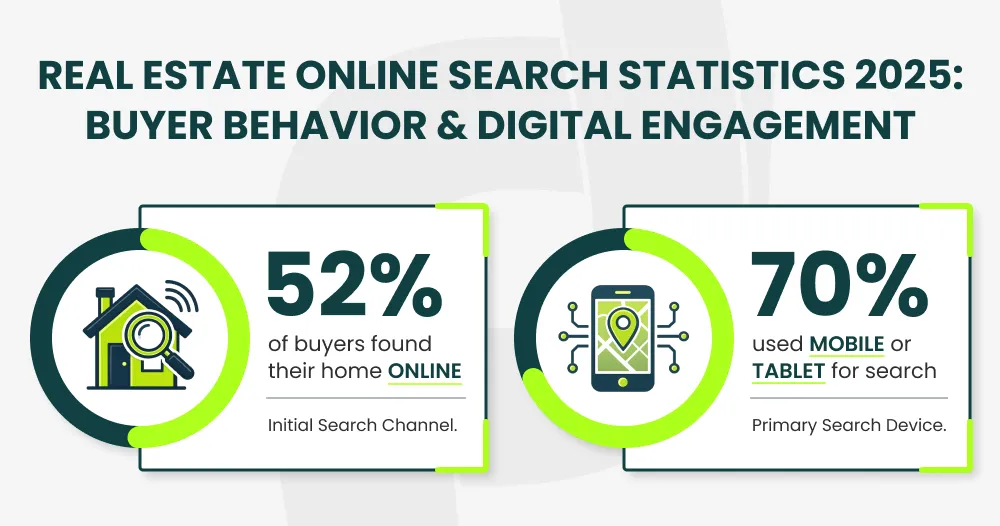
According to the National Association of Realtors’ 2025 profile of home buyers and sellers, about 52% of buyers found their home online, and about 70% used mobile or tablet devices for search. If your site doesn’t appear where the buyers search, you not only lose the leads, but also your competitors get the chance to rank above you.
## What Makes Real Estate Link Building Different
**Real estate link building differs from most industries because it combines hyper-local signals.** Neighbourhood pages, city-specific citations, regional news coverage, with national authority from real estate portals, and Google weighs both when ranking location-specific searches.
A generic guest post on a marketing blog may lift your domain authority slightly, but a backlink from a local newspaper’s neighbourhood guide or a community association website carries outsized weight for local pack rankings because it confirms geographic relevance, not just topical authority.
Not every link building works the same across industries. Real estate link building strategy has some unique characteristics that can shape your strategy.
### YMYL Consideration
Content about housing decisions, investment properties, mortgage advice, buying, selling, or renting a property falls under Google’s [Your Money Your Life](https://developers.google.com/search/docs/fundamentals/creating-helpful-content#:~:text=We%20call%20these%20%22Your%20Money,our%20changes%20are%20working%20well) (YMYL) model because it directly affects people’s finances and quality of life. It means Google evaluates the content more deeply in this industry and demands a higher standard of expertise and trustworthiness. Therefore, getting low-quality backlinks from irrelevant or spammy sites not only fails to help but also can hurt your rankings.
**Tip**
You should focus on earning real estate backlinks from credible, relevant sites; one single link from a local news outlet or a trusted publication can outperform many low-quality generic links.
### Local Relevance is Critical
Real estate is one of the most location-dependent industries online. A real estate business in Austin, Texas, competes in a very different search landscape than one in Portland, Oregon.
You should choose a [link building for local relevance](https://outreachdesk.com/local-link-building/) , as links from local community organizations and regional media can carry more weight for visibility in local search than links from irrelevant national sites.
17:2
### Content-Hungry Niche
Real estate is a content-rich industry. In this industry, the market trend shifts constantly, new housing data gets published regularly, and home buyers always have questions.
This creates natural opportunities to earn links through valuable content that people genuinely want to reference and share.
## Real Estate Link Building Strategies That Actually Work
**The real estate link strategies that actually work in 2026 share one thing: they build links from sites your local buyers and sellers already trust.** Local news sites, neighborhood blogs, community sponsorships, and real estate data publications all signal genuine local presence in a way Google rewards.
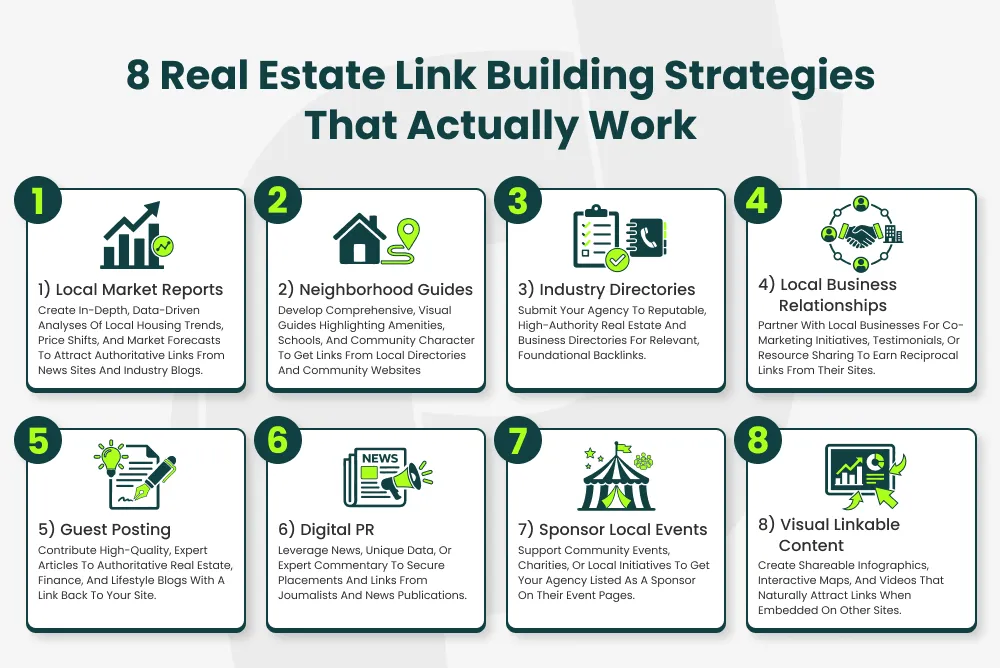
Here are some specific tactics you can use to earn high-quality links for your real estate website.
Start with the one that matches your current resources, then expand it as per your goals and momentum.
### 1. Create Local Market Reports and Data Assets
Creating local market reports and data assets is one of the highest-value link building tactic in real estate.
This includes creating original research or data analysis about your local real estate market that other websites want to reference and link to.
Journalists, bloggers, and real estate professionals consistently need data to cite. When you create an asset, you become their go-to source. Market data earns links naturally because it is useful, original, and hard to replicate.
**Here’s how you can create it:**
- Pull quarterly data from the multiple listing service (MLS) on home prices, days on market, inventory, and price-per-square-foot for your targeted neighborhoods.
- Turn that data into a clear, visual report with charts and simple takeaways.
- Publish it as a dedicated page on your website so it doesn’t get buried.
- [Reach out](https://outreachdesk.com/link-building-outreach/) to local journalists, bloggers, and real estate publishers with a short summary of the key findings.
- Update it every quarter to keep it fresh, useful, and relevant.
Let’s look at the example here for clarity. A real estate agency in Denevar publishes a monthly “Denevar Housing Market Report.” It covers median prices, inventory levels, and price-per-square-foot trends. Local journalists, bloggers, and other agents cite the report when covering the Denevar housing market and link to it as a data source.
### Create Neighborhood and Area Guides
In-depth neighborhood guides that cover amenities, lifestyle, commute times, safety, dining, and housing stock serve two purposes: they attract local search traffic and earn backlinks from relocation blogs, local websites, and community organizations, while ranking for long-tail searches that attract high-intent buyers.
**The neighborhood guides include:**
- Demographics and population data
- Average home prices and trends
- Local amenities like restaurants, parks, shopping, and healthcare
- Commute times to major employment centers
- Crime statistics and safety information
- Photos and video walkthrough
- School ratings and options
**Let’s see how to create neighborhood and area guides:**
- Start by choosing 10-20 neighborhood blogs in your market area.
- Create a 2,000+ word guide for each, that covers what it is like to live there, don’t just list houses.
- You can also include original photos, maps, school ratings, distance, and walkability scores, and links to all the local businesses.
- Reach out to the local businesses and organizations that are mentioned in your guide. Many will link back to it when they see they’re featured.
- Update each guide twice a year with current market trends and data.
Let’s see an example here: A guide titled “Living in Buckhead, Atlanta: The Complete Neighborhood Guide” earns links from local restaurants, school review sites, and relocation companies that recommend it as a resource.
### 3. Use Industry Associations and Directories
The real estate industry has its own set of professional associations, directories, and platforms that offer legitimate link building opportunities.
**Here are some of the high-value directories and associations mentioned:**
- [The National Association of Realtors (NAR)](https://www.nar.realtor/) has a member directory where licensed realtors can have a profile page. So, if you’re a member, your profile may include a link to your website.
- State and Local REALTOR Association features directory listings, market reports, and member spotlights.
- Claim and optimize your agent profiles on platforms like [Realtor.com](http://Realtor.com) and [Zillow](https://www.zillow.com/), and include your website link in the profile.
- [Better Business Bureau (BBB)](https://www.google.com/aclk?sa=L&pf=1&ai=DChsSEwiP5tntoZeTAxU4Z0cBHfiSGewYACICCAEQABoCcXU&co=1&ase=2&gclid=Cj0KCQjwgr_NBhDFARIsAHiUWr4uJabrgdPrwb-UBYOhCv-OXcdotcbs--XgFJnEzHyDWIoomup3f3UaAqcwEALw_wcB&cid=CAAS0wHkaH-XmGfZ_OllzQUWXkIo-I9UAWygs1rldftdpW6zHem-TdJWkLLb1KvhHPLMGTw_2yX9pWkZFMjYI9wqGrGM8aoLiqYEnir4fv4PAFSvV_tTLiGtc3lfQngafO04N-V3wGU7cVixc0jgvShlJQYIKEiElznJmv_MgxNczvtY6LCaZYdBMLZvA7uOpBoz-7ioDuljUlF9wPdy6_QmWKCfAuXev_xeFyolaDtvbQMUMzUMGMgzxynf-XQw6HT8OiRsKsuf4BmF53DifchTdDSiQPXX&cce=2&category=acrcp_v1_32&sig=AOD64_380uYLHm8RRn4WO1UefRFeSRU_Vg&q&nis=4&adurl=https://www.bbb.org/article/news-releases/22776-government-impostors-press-release?gad_source%3D1%26gad_campaignid%3D10753152887%26gbraid%3D0AAAAADMG8JcPi_pG2MU8SXJIk4iLMiV2V%26gclid%3DCj0KCQjwgr_NBhDFARIsAHiUWr4uJabrgdPrwb-UBYOhCv-OXcdotcbs--XgFJnEzHyDWIoomup3f3UaAqcwEALw_wcB&ved=2ahUKEwiNn9TtoZeTAxXOGFkFHUlgGIcQ0Qx6BAgnEAE) is a certified business listing that includes directory links, offering strong local credibility and trustworthiness.
- The Chamber of Commerce is a local chamber membership that provides directory links with local visibility.
- Specialized directories and platforms like AgentLocator, HomeLight, and UpNest offer additional link opportunities.
Keep your NAP (Name, Address, Phone number) details consistent across all the platforms. Inconsistent details can confuse the search engines and also weaken the [SEO value](https://outreachdesk.com/what-is-seo/) of these links.
### 4. Build Relationships with Local Businesses
Building relationships with local businesses is one of the easiest and most overlooked strategies in real estate. Build genuine relationships with complementary businesses in your area.
Since real estate touches many other industries, each partnership is a natural opportunity with built-in relevance for link building.
**Here’s how to build relationships with local businesses:**
- Start by making a list of every business you work with or refer clients to. This might include mortgage leaders, home inspectors, title companies, contractors, staging companies, movers, insurance agents, and even interior designers.
- You can offer to write a testimonial for their website. Many businesses feature client testimonials with a link back to the reviewer’s site.
- Create a “Recommended Vendors” or “Moving to [City] Resources” page on your site, and let those businesses know that they’re featured. They often reciprocate with a link.
- You can also co-create content, such as a “First-Time Buyer’s Checklist,” with partners, and both parties publish and link to each other.
- Sponsor local events together and get listed on the event page.
These links carry local relevance signals, which is exactly what you require for local SEO.
Here’s a quick example to understand it: you write a testimonial for your preferred home inspector’s website: I’ve referred over 50 clients to [inspector name], and every report has been thorough and timely.” They publish it on their website with a link back to your site.
### 5. Guest Post on Local Relevant Publications
One of the most reliable ways to earn quality real estate backlinks is using a [guest posts strategy](https://outreachdesk.com/guest-posts/).
This method is all about writing valuable content for another website and earning a link back to your site in return.
Unlike other strategies, you get complete control over the topic, anchor text, and target URL, and you position yourself in front of a new audience.
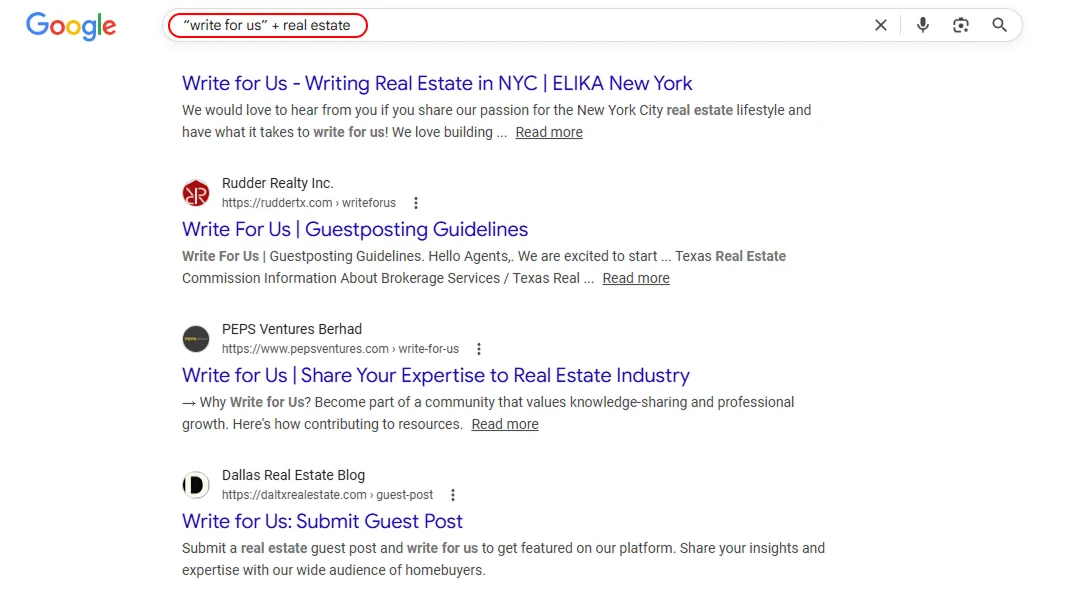
**Here’s how you can execute it:**
- Start by searching Google for** “write for us” + your keyword**, like real estate, home buying, or property.
- Use SEO analytics tools like Ahrefs or Semrush to check where your competitors have already published guest posts, then target those sites.
- Look for content gaps on the target sites and pitch the topics they haven’t covered yet.
- Target publications in niches like real estate, personal finance, home improvement, local business, interior design, investing, and moving/relocation.
- Pitch topics that fit both the publication’s audience and your expertise; don’t pitch a listing-focused article to a home improvement blog.
- Write content that genuinely helps the publication’s readers. A great guest post earns you an open invitation to contribute again.
- Include one contextual link to a high-value page on your site, such as a guide, report, or service page, rather than your home page.
**One Important YMYL note:**
Keep the guest posts informational, not advisory. A post about “what to look for when buying a rental property” is safer than one that gives specific financial advice. Stay within your expertise and avoid overstepping into regulated financial territory.
### 6. Earn Links Through Digital PR
**Digital PR** means earning links from news outlets, industry publications, and authoritative websites by providing expert commentary, original quotes, or newsworthy stories.
You create newsworthy content or data stories that journalists want to cover, resulting in links from trusted, credible media outlets.
A single mention in a major publication can earn you a link with more authority than dozens of low-quality links combined. Media links also drive referral traffic and brand recognition.
**Here’s how you can earn links through digital PR:**
- Start by identifying newsworthy local market trends and data that would make a good headline, such as rising prices, low inventory, or migration trends, and choose a topic where you can provide valuable, useful data or expert insights.
- Then monitor journalists’ requests on platforms like HARO, or look for reporters covering real estate topics.
- You can create a simple research project, a small study, or market data on your chosen topic.
- Present the key insights clearly so that journalists can find and easily reference them in their articles.
- Reach out to journalists who cover the real estate industry, or respond to their queries by providing your data or an expert quote for their story.
- When they use your insights, they may mention your brand and link back to your website as the source.
Here’s an example: A real estate agent in Phoenix analyzes 12 months of MLS data and finds that homes within a quarter-mile of new light rail stations sold 18% faster. They pitch this as a data story to locate newspapers and business journals. Several outlets run the story, including links to the original analysis.
### 7. Sponsor Local Events and Organizations
You can earn links by participating in local events, charities, organizations, and educational initiatives.
Community involvement creates natural link building opportunities. Local events, charities, nonprofits, and educational programs often list their sponsors with links on their sites.
**Here’s how sponsoring local events and organizations works:**
- Sponsor local charity events, school fund-raisers, or community festivals.
- Host educational workshops like “First-Time Homebuyer Seminar” or “Understanding the Home Inspection Process.” Local organizations and libraries will often promote these events on their sites.
- Create a scholarship for local students interested in business, urban planning, or real estate. Post the details on a dedicated landing page. Schools and scholarship directories will link to it.
- Join your local chamber of commerce and REALTOR association. Both provide a directory listing with links.
- Volunteer for neighborhood associations and get listed as a sponsor or community resource on their websites.
Suppose you sponsor a $1000 annual scholarship for students studying urban planning at a local university. The university’s financial aid page links to your scholarship landing page and earns a high-quality backlink.
**Bonus: **
Scholarship links often come from .org and .edu domains, which tend to be highly trusted by the search engines. They also signal local community involvement, which strengthens your local SEO profile.
### 8. Create Linkable Visual Content
Create infographics, interactive maps, and visual tools that other websites reference with a link.
Visual content gets shared far more than text-only content. Real estate is visual by nature because properties are sold and bought on the basis of how they look, giving you a natural advantage.
Infographics, interactive maps, and visual data presentations earn links because they’re easy to share and reference.
**Ideas for visual content:**
- Neighborhood comparison maps or interactive maps showing price ranges, school ratings, and walkability by neighborhood. (e.g., “Historical home prices by neighborhood in your city.”)
- Homebuying process infographics are step-by-step visual guides that finance and real estate blogs want to share. (e.g., “How the Home Buying Process Works”)
- Market trend visualizations are charts showing year-over-year price changes, inventory trends, or migration patterns.
- Cost-of-living comparisons are visual breakdowns that compare your market to nearby cities. (e.g., “Renting vs. buying in your local market with real numbers.”)
- The best time to buy/sell graphics shows seasonal trend data in a visual format. (e.g., “How your city’s real estate market has changed over the past decade.”)
**How to earn links with visual content:**
- Once you create a [link worthy asset](https://outreachdesk.com/linkable-assets/), share it with local bloggers and accounts covering the related topics.
- Include your visual assets in the guest posts and pitch them to journalists who cover housing stories.
- You can also submit infographics to visual content directories for additional exposure.
- Share on social media and tag the relevant account that might reshare.
## Building Links in 2026: What’s Changed
**Real estate link building in 2026 demands higher publisher quality, better topical relevance, and stronger E-E-A-T signals than ever before.** SpamBrain catches PBNs faster, AI Overviews favor sites with genuine local authority, and Google rewards links that come with real audience engagement signals.
Link building continues to evolve. Here’s what you should know about link building for real estate in the current environment.
### AI Search and Answer Engines
With AI tools like ChatGPT, Google AI Overviews, and Perplexity shaping how people look for information, your link building strategy now serves a dual purpose: it supports traditional SEO rankings while also influencing whether the AI system cites your brand as a trusted source.
To strengthen both, focus on earning links from sources AI models trust, such as established news outlets, industry publications, and educational institutions.
### Quality Signals Matter More Than Ever
Google’s algorithms have improved at identifying manipulative practices such as [link farm schemes](https://outreachdesk.com/link-farming/) and other low-quality link schemes.
Focus on links that pass a simple test. Would a real human click on this to learn more? If not, then it’s not worth pursuing.
### Entity-Based SEO and Brand Signals
Now, search engines evaluate your brand as an entity. A recognized real estate business with a consistent presence across the web. Your links, citations, structured data, social profiles, and [relevant brand mentions](https://outreachdesk.com/brand-mentions/) all work together to build that entity.
Strong link building reinforces your entity signals. Disconnected or irrelevant links can actually confuse them.
### Content Depth Wins
Research shows that longer and more thorough content drives significantly more traffic in real estate. However, the length alone isn’t the goal. Depth, originality, and practical value determine whether your content earns links and ranks well.
## How to Evaluate Link Quality for Real Estate
**You evaluate a real estate link by asking three questions.** Does the publisher serve your local market? Would your ideal buyer actually read this site? Is the link placed in editorial content rather than a sidebar or footer? Domain authority alone tells you almost nothing.
Local relevance and editorial placement matter more than any single metric.
All backlinks aren’t equal and don’t carry equal weight. Here’s how to assess whether a real estate links are worth pursuing.
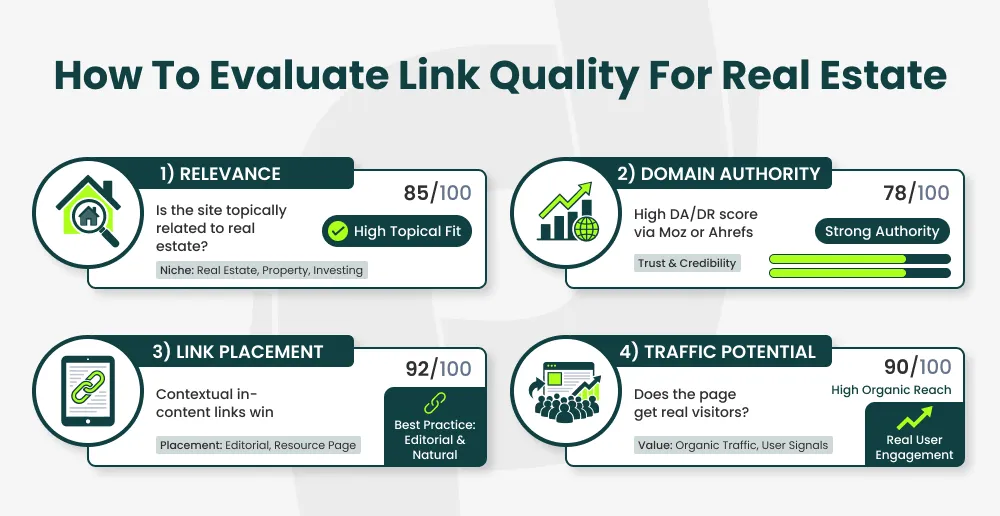
### Relevance
Any site linking to you should have relevance to the topic being discussed in real estate. Links from home improvement blogs, financial planning sites, local news outlets, and industry publications are all considered relevant.
### Domain Authority
Check the domain authority (DA) or domain rating (DR) of the linking site using tools like [Moz](https://moz.com/) or [Ahrefs](https://ahrefs.com/). A higher score often means that the link will have more impact. In short, a site with DA 30 and relevant content can often outperform a site with DA 70 from an irrelevant domain.
### Link Placement
The placement matters the most. Links placed naturally in the article content carry more weight than links in footers, sidebars, or author bios. You can aim for [contextual placements within the content](https://outreachdesk.com/contextual-link-building/) when relevant.
### Traffic Potential
A good backlink does more than just boost rankings. It sends referral traffic from people who click through. Prioritize links on the pages that actually get visitors.
## Common Real Estate Link Building Mistakes to Avoid
**The common real estate link building mistakes are chasing volume from unrelated directories, paying for irrelevant guest posts, and ignoring local relevance entirely.** Each of these wastes budget and produces backlinks that don’t move local rankings. The patterns below cost agents the most growth.
Here are some common mistakes you should avoid to gain the complete advantage of the real estate link building strategies.
### Buying a Low-Quality or Cheap Link
Buying low-quality or cheap link packages from bulk providers almost always hurts more than it helps, as Google’s algorithms are sophisticated enough to identify and penalize unnatural link patterns.
### Ignoring Local Link Relevance
Even though national links have value, the real estate business needs local trust and credibility. A link from your city’s newspaper will always outperform a link from a generic or irrelevant industry blog, regardless of where it’s based.
### Neglecting Content Quality
You can’t build links with thin and unhelpful content. Before launching any [link building campaign](https://outreachdesk.com/link-building-campaigns/), make sure that you’ve pages worth linking to, such as detailed guides, original data, and genuinely helpful resources.
### Chasing Quantity Over Quality
Even five links from trusted and relevant websites can move your rankings more than fifty links from irrelevant and low-quality sites.
### Relying on a Single Tactic
If you only do guest posting or only build directory links, your link profile will look unnatural. A stronger approach is to combine [multiple strategies to earn links](https://outreachdesk.com/link-building-strategies/) that complement each other and build authority the right way.
### Not Updating Old Content
The next common mistake isn’t updating old content. A 2023 market report won’t work in 2026. Keep your best content up to date with fresh data, as a recently updated page outperforms outdated ones in search results.
### Forgetting Internal Linking
Not all link value stays on the page it lands on. External links build trust and credibility, and internal links distribute that trust across your site through [link equity](https://outreachdesk.com/link-equity/). Every time you earn a new backlink, make sure the page it points to is also linking to your key pages
## How to Measure Real Estate Link Building Success
**Real estate link building success is measured by local pack ranking movement, organic traffic to property and neighborhood pages, and leads from organic search.** Track these alongside referring domain growth, not instead of it. The metrics that matter are the ones that connect to actual closed deals.
Here are some metrics to help you determine whether your strategy is working.
### Referring Domains
Referring domains are the number of unique sites linking to your website. Growth here indicates your link profile is expanding. It is more important than the total number of links. In short, ten links from different websites are more valuable than the ten links from one website.
### Domain Authority/Domain Rating
Domain authority and domain rating measure the strength of your site’s backlink profile; the more quality links you earn, the higher these scores tend to climb over time. You can track the overall strength using [Moz’s domain authority checker](https://moz.com/domain-analysis) and [Ahrefs website authority checker](https://ahrefs.com/website-authority-checker).
### Organic Traffic
More authority leads to better rankings, which in turn drive more traffic to your site. You can monitor this using Google Analytics. It helps you determine if your backlinks are driving traffic to your website.
### Keyword Rankings
Keyword ranking means how high your site appears in [the search engine results page (SERP)](https://outreachdesk.com/what-are-serps/) when someone searches for a specific phrase or word. You can track your keywords in Google Search Console. You should look for upward movement in the average position.
### Referral Traffic
Referral traffic is simply the visitors who come to your website by clicking a link on someone else’s site. This means your links are placed on pages people actually visit.
### Local Pack Rankings
Local pack rankings mean when your business appears on the search engine when someone searches for nearby results that are relevant to your industry or niche. For real estate, your position in Google’s local 3 pack is very important. You can track if the link building improves your local visibility.
Give your strategy a 3-6 month timeline to show results. Link building is a long-term investment. The trust and credibility built for your site compound over time, making it easier to rank in competitive terms.
## Your Real Estate Link Building Action Plan
**Your action plan starts with three things: a local authority audit, an outreach target list of community publishers, and a content calendar built around neighborhood and market data.** The first 30 days set the foundation. Months two and three turn that foundation into placements.
Here is a simple 90-day plan to start building links for your real estate website.
### Week 1-2: Foundation
- Start by auditing your current backlink profile with Ahrefs or SEMrush.
- Identify your best content assets, such as guides, data, and tools that are worth linking to.
- Then claim and optimize profiles on [NAR](https://www.nar.realtor/), [Zillow](https://www.zillow.com/), [Realtor.com](https://www.realtor.com/), and local directories.
- Audit your current link profile with SEO tools like Ahrefs or SEMRush to see where you stand.
- Identify 5 competitors and analyze their link profile; note the types of sites linking to them.
- Create or update your top 3 content assets, such as neighborhood guides, market reports, or homebuying resources.
- Claim all the directory listings, including NAR, State/local REALTOR associations, Zillow, Realtor.com, and Chamber of Commerce.
#### Week 3-4: Local Outreach
- You can list 20 local businesses you’ve worked with and also check their website for link opportunities.
- Write 3-5 testimonials for partners and request a link.
- Also, join the local Chamber of Commerce if you haven’t already.
#### Month 2: Content and Guest Posting
- Create or update a local market report with the current data.
- Pitch 5-10 guest post ideas to the relevant industry blogs.
- You can also sign up for [HARO](https://www.helpareporter.com/) or Qwoted and respond to the journalist’s queries.
- Reach out to 10 local business partners for testimonial swaps and [resource page links](https://outreachdesk.com/resource-page-link-building/).
- Pitch with 3-5 guest posts to the relevant publications.
- Set up a [Google Alert](https://www.google.com/alerts) for brand mentions.
- Send your latest market report to 10-15 local journalists and bloggers.
#### Month 3 and Beyond: Scale
- Start by building a neighborhood guide for each area you serve.
- Create a linkable visual asset per quarter.
- Continue to pursue digital PR and guest posting consistently.
- Launch a quarterly market report.
- Begin community initiatives such as scholarships, workshops, and sponsorships.
- Reclaim any unlinked brand mentions that are found through alerts.
- Review the metrics, including referring domains, domain authority, and organic traffic trends.
- Plan your next 90-day cycle on what’s working.
**Consistency Is The Key **
A single round of outreach won’t transform your rankings, but steady, strategic link building over the months builds lasting authority that your competitors can’t easily match.
## Final Thoughts
The real estate niche isn’t just about collecting as many links as possible; it is about earning the right links from the right sources. Your competitors who invest in strategic link building today will own the search results tomorrow.
The businesses that ignore this will keep paying more for ads, relying on portals, and wondering why their organic traffic stays at the bottom. You now have the strategies and action plan; it’s only about execution.
Start with the foundation and tactics that best suit your resources. Build your content assets and develop your local relationships, stay consistent, and the results will follow.
### Ready to grow your real estate website’s authority?
Get a clear link building strategy designed to help you earn high-quality backlinks and improve search visibility. [Book a Strategy Call](/contact-us/)
### How many backlinks does a real estate website need to rank?
There are no fixed numbers. It depends on your market, competition, and the quality of the links you build. In the local market, 30-50 high-quality, relevant backlinks can significantly improve your rankings. Focus on quality and relevance rather than following a specific count.
### How long does it take for link building to improve rankings?
Most of the real estate websites see measurable improvements within 3-6 months of consistent link building. However, highly competitive markets may take longer to develop. The trust and credibility you build continue to compound over time.
### Is it safe to buy backlinks for a real estate website?
Buying links from bulk providers or link farms violates Google’s guidelines and can attract risks and penalties. However, investing in professional link building through outreach, guest posting, and content creation is a standard and accepted practice. The difference is whether the links are earned through a genuine value or purchased as a shortcut.
### What types of content earn the most links in real estate?
Original market data and research earn the most links, followed by thorough guides, visual content like infographics and interactive tools, and expert commentary featured in news publications.
### Should I focus on local or national links?
Both the links matter, but prioritize local links for local search visibility. Links from your city’s newspaper, local business directories, community organizations, and regional industry groups carry the most weight for local SEO. Supplement these with national industry links for broader trust and credibility.
### Can I do real estate link building myself, or should I hire a partner?
You can handle foundational tactics yourself, directory submissions, local partnerships, testimonial exchanges, and basic outreach. For more advanced strategies, such as digital PR, scaled guest posting, and linkable asset creation, working with a [specialized link building agency](https://outreachdesk.com/) can accelerate your results and free up your time to focus on your core business.
---
---
title: "Thank You"
url: "https://outreachdesk.com/thank-you/"
lang: "en-US"
type: "page"
description: "✦ Submission Received You're All Set! Return Home Your Journey Ahead What happensnext? Here's a clear picture of what to expect after your submission. No surprises. Right Now Confirmation Email Sent Check your inbox — we just sent you a"
last_modified: "2026-05-06T05:33:28+00:00"
custom_fields:
header_style: "header-style-1"
footer_style: "footer-style-1"
---
# Thank You
__
✦ Submission Received
# You’re All Set!
[ __ Return Home
](/)
Your Journey Ahead
## What happens
next?
Here’s a clear picture of what to expect after your submission. No surprises.
Right Now
#### Confirmation Email Sent
Check your inbox — we just sent you a full confirmation with all the details of your submission.
Within 24 Hours
#### Our Team Reviews Your Request
A real human on our team will carefully review everything you’ve submitted and prepare your case.
1–3 Business Days
#### We’ll Reach Out to You
Expect a personalized follow-up from one of our team members via email or phone.
Ongoing
#### Enjoy Full Support
We stay by your side throughout. Our team is always available for any questions that come up.
Helpful Extras
## Make the most of your time
__
#### Your Data is Secure
All your information is encrypted and handled with the highest privacy standards. You’re in safe hands.
__
#### Enable Notifications
Make sure our emails don’t land in spam. Add us to your contacts so you never miss an update.
__
#### Explore Our Blog
While you wait, explore our latest articles with tips, guides, and insights on topics relevant to you.
## Drive AI Search Visibility with High-Authority Backlinks
We combine relevance, authority, and authenticity to secure links that strengthen your SEO footprint and maximize brand visibility across search and AI platforms.
Book a Strategy Call
_
**4.8**/5 _
Trusted by 500+ **agencies &
1,000+ businesses** worldwide.

---
---
title: "Link Acquisition: 9 Proven Strategies and Trusted Services"
url: "https://outreachdesk.com/link-acquisition/"
lang: "en-US"
type: "post"
description: "Link acquisition is about earning backlinks from other reputable websites to your site. Each backlink acts as a vote of confidence or a sign of trust for your website, which is why Google uses backlinks as a key ranking factor."
last_modified: "2026-05-18T11:53:27+00:00"
categories: [Link Building]
---
# Link Acquisition: 9 Proven Strategies and Trusted Services
Link acquisition is about earning backlinks from other reputable websites to your site.
Each backlink acts as a vote of confidence or a sign of trust for your website, which is why Google uses backlinks as a key ranking factor. When the workload outgrows in-house capacity, hiring a [link building agency](https://outreachdesk.com/) is usually the next step.
Without backlinks, even your best content can go unnoticed by Google, making it harder to show up in search results.
Most websites won’t naturally discover or link to your content, which is why you need a strategic approach to earn backlinks and build trust with Google.
**Key Takeaways**
- Link acquisition helps your website rank higher when trusted websites link to your content.
- Quality and relevance matter more than the number of links you build.
- Strategic link acquisition builds long-term authority and visibility.
- Poor link acquisition can harm rankings, so earning links the right way is essential.
## What is Link Acquisition?
**Link acquisition is the strategic process of earning backlinks from external websites through editorial outreach, content creation, digital PR, and partnership development.** And it differs from ‘link building’ in emphasis: acquisition focuses on systematic processes and repeatable workflows, while ‘link building’ is often used loosely to include low-quality tactics that Google’s guidelines prohibit.
A well-run link acquisition programme treats each placement as a long-term asset, targeting sites with real organic traffic and editorial standards rather than domain-rating metrics alone.
It’s distinguished from generic “link building” by scope: link acquisition treats the entire system identifying opportunities, qualifying targets, and converting them into placements as a repeatable, measurable operation rather than a one-off campaign.
These Links help search engines understand that your content is a trustworthy and relevant source of information. The more high-quality backlinks your site earns, the better its chances of ranking higher in search results.
It not only improves your rankings but also protects your site from risks posed by spammy or low-quality links.
**Google evaluates backlinks based on certain factors.**
**Relevance**
Links are more helpful when they come from pages that cover the same or closely related topics as your content. A link from a digital marketing blog makes more sense for an SEO article than one from an unrelated cooking website.
**Authority**
Links from trusted websites carry more value and help search engines recognize your site as an authority in its topic area.
**Placement**
The link should fit naturally within the content and match the surrounding text, so it makes sense to the reader.
**Credibility**
Links from trustworthy websites are more reliable because they show that your content can be trusted. When respected sites link to you, search engines are more likely to see your website as credible.
## Why Link Acquisition Matters?
**Link acquisition matters because Google treats backlinks as the primary external quality signal.** A page with strong editorial links from relevant, authoritative sites will rank above a technically perfect page with no external authority, regardless of content length or keyword optimization.
In competitive verticals, the gap between page one and page two is almost always an authority gap that only a sustained link acquisition programme can close.
Link acquisition is key to earning backlinks and improving your website’s performance in search results.
Earning links the right way can lead to several key benefits:
### Higher Search Engine Rankings
High-quality backlinks improve your chances of ranking for relevant keywords. When authoritative websites link to your content, search engines treat those links as signals of trust and credibility, which can increase your visibility in search results.
Higher rankings matter because top positions attract the most clicks. Backlinks help your content move up the results and stay competitive over time.
### Strengthens Website Authority
When you earn links from reputable websites, they pass [link equity](https://outreachdesk.com/link-equity/) that strengthens your website’s authority and signals to search engines that it is a trusted source within your niche.
### Builds Trust and Credibility
Links from reputable websites show that your content is trustworthy, helping build trust with both search engines and users.
Authority and credibility aren’t the same. A website may have high authority but still publish low-value content. Credibility comes from consistently providing accurate, helpful information that genuinely serves readers.
Over time, this trust encourages users to return, share your content, and reference it, creating a cycle of trust that continues to grow.
### Builds Brand Awareness
Your website gets noticed when it’s mentioned and linked on other trusted websites. Each backlink puts your brand in front of an audience that may never have heard of you before.
When your content appears on industry blogs, news sites, or any authoritative resource pages, it positions your brand as a credible voice in your field. Consistent mentions across trusted websites build familiarity and trust.
### Attract More Relevant Visitors
Link acquisition helps drive traffic to your website by earning links from other websites, increasing traffic through referrals, and attracting people already interested in your topic.
When someone clicks a link to your website from a relevant source or article, they’re already engaged with your topic and more likely to read it completely, explore other pages on your website, and take meaningful actions, such as signing up or making a purchase.
### Faster Content Discovery
Links from trusted websites help your content get discovered sooner. When reputable websites link to your pages, search engines can find and crawl them more efficiently.
This means your new content doesn’t sit unnoticed. Instead, it gets indexed faster, giving your pages a quicker opportunity to compete in search results.
## Effective Link Acquisition Strategies
**Every effective link acquisition strategy boils down to giving publishers a reason to link.** The reason can be original research, a free tool, an expert quote, a useful guide, or a relationship built before the ask. The five strategies below are the ones with the strongest signal-to-noise ratio in 2026.
Not all links deliver the same impact. To see real results, you need a focused approach that prioritizes quality, relevance, and natural placement.
Here are the most effective link acquisition strategies to grow your rankings the right way.
### Linkable Asset Creation
Linkable assets are pieces of content created on your website that are useful, original, and offer real value, which other websites naturally want to link to.
By creating high-quality, relevant content for your niche, you encourage other websites to reference and link to it often without direct outreach.
Here are some linkable assets:
- In-depth guide and Tutorials
- Infographics and Visual Content
- Original research and Case Studies
- Tools and Calculators
- Templates and Checklists
- Data reports and resource roundups
**How to create linkable assets: **
- Start by choosing a topic relevant to your niche that people frequently search for.
- Pick a suitable content asset for your topic, such as a guide, infographics, charts, or free tools.
- Research your topic and collect useful data, insights, or information that simplifies complex ideas or provides unique value.
- Prepare content that’s visually easy to understand and genuinely helpful to readers.
- Publish it with a clear description and share it on social media and relevant platforms.
- Reach out to journalists and bloggers to let them know about the asset you created and how it helps readers.
**Example of a linkable asset:**
The Website Speed Test tool works as a strong linkable asset.
The tool has earned backlinks from SEO bloggers and web performance guides because it provides reliable performance data, which is naturally referenced as a trusted source.

### Image Link Building
Image link building is a strategy for earning backlinks when other websites use your images and link back to you as the source.
Create high-quality, shareable assets such as charts, infographics, or original images, and publish them on your website or social media platforms like Pinterest or LinkedIn. Make sure your visuals are valuable, easy to understand, and simple to embed so others can reference them naturally.
Visual content often attracts links because it helps other websites explain ideas without creating their own visuals.
Suppose you create an original chart or visual to explain a topic in your niche. A relevant and trusted blog uses that image in their article and credits the source by linking back to your website.
**How it works:**
- Start by creating linkable visuals such as data charts, original graphics, templates, or diagrams.
- Upload the image to your website with proper attribution and a clear source credit, so the website can easily identify where the image comes from.
- Promote the visual and share it on social media and relevant communities to increase visibility. When other websites find it useful, they’re more likely to reference it and link back to your site.
💡
Tip: You can use Google Reverse Image Search to find websites that use your images without credit. Then reach out to the site owners and request a backlink to your site.
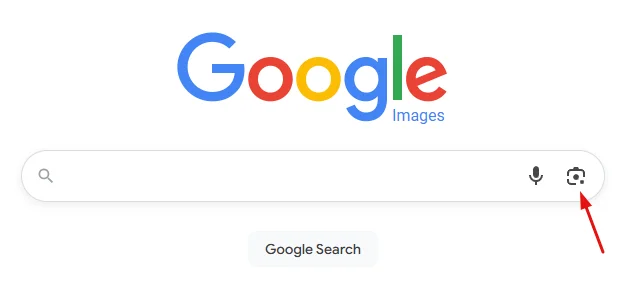
### Digital PR
Digital PR is a link building strategy that earns backlinks through newsworthy content such as press releases, original studies, or expert insights. By sharing valuable quotes with journalists, you can secure natural placements and high-quality links from trusted media outlets.
These backlinks usually come from high-authority, trusted publications, making them highly valuable. They also help build trust, attract long-term referral traffic, and position your brand as an industry expert.
While earning PR backlinks can be challenging due to the strict editorial standards and selectivity of these sites, even a single strong media mention can have a significant impact.
**Strategic Approach:**
- Identify a topic, original study, or expert insight that aligns with your niche and attracts journalists.
- Prepare a list of bloggers and journalists who cover the topics relevant to your niche.
- Use platforms like [HARO](https://www.helpareporter.com/) and [Featured](https://featured.com/) to respond to journalists’ queries and get featured as an expert source.
- Craft concise, value-focused pitches that clearly explain why your content benefits their audience.
- Monitor your mentions to track the placements and measure the impact of your efforts.
By responding to relevant media queries, you can get featured in articles on authoritative websites such as Forbes, CNN, and the New York Times.
### Resource Page Link Building
Resource page link building is a link acquisition method in which you earn backlinks from websites that curate helpful tools, guides, and references for their audiences. These resource pages are created to help users find valuable resources on a given topic.
The process involves finding relevant resource pages in your niche and suggesting your content as a valuable addition to them. If your page genuinely helps their audience, site owners may add your link as a recommended resource.
Some websites also offer options such as “Submit a Resource” or “Suggest a Link” forms. When available, these make link acquisition easier and improve your chances of earning a backlink.
**How it Works:**
- Find relevant resource pages using search operators such as keyword + ‘resource page’ or keyword + ‘useful resources’.
- make sure the page lists high-quality resources and that your article genuinely adds value.
- Once you find a relevant site, email them a polite, personalized message. Share your resource and explain why you deserve a spot on their page.Use this example message while reaching out.
Hi [Name],
I was reading your resource page and really appreciated the collection of tools and guides you’ve put together.
We recently published a practical guide that covers [brief topic/benefit]. It’s designed to help readers better understand and apply the concepts step by step. I thought it might be a helpful addition to your list.
Let me know what you think.
Best regards,
[Your Name]
- If they found it genuinely helpful, they may add a link to the resource page, which can earn you a high-quality backlink.
### Using Social Platforms and Forums
Social media and forums can support link acquisition by increasing the visibility of your content across various social media platforms where your audience already spends time.
Share your content on relevant communities and niche forums where your target audience is active. Focus on answering questions, adding value, and joining real conversations instead of just posting links.
Participate in industry groups on platforms like LinkedIn, Reddit, and Facebook to build visibility and credibility over time.
You can also collaborate with social media influencers in your niche to expand your reach and attract natural backlinks.
**Steps to Earn Links from Social Platforms:**
- Find platforms and forums where your target audience spends time, such as Reddit, LinkedIn, or Quora.
- Prepare a profile that represents who you’re and what your website is about.
- Engage by answering questions and joining discussions without rushing to drop links.
- Share your content only when it truly adds real value to the conversation.
- Build relationships consistently by sharing helpful content, earning trust, and increasing visibility.
For example, posting on social media and forums, answering a Quora question about “SEO tools,” and linking to your SEO checklist.
### Guest Posting
Guest Posting is a strategy in which you write content for another website in your niche and include a backlink to your site within the article to acquire relevant, high-quality backlinks.
Guest posting gives you complete control over content quality by letting you decide where your links come from, while strengthening trust and building your online reputation.
It also drives referral traffic and helps you connect with an already engaged audience in your niche.
**How it works:**
- You can check competitors’ backlinks or look for resource pages to find potential guest posting opportunities.
- Another effective method is to use specialized search operators such as: Keyword + “write for us”, Keyword + “guest post”, Keyword + “guest contributor”.
- Once you find a suitable guest post opportunity, use this outreach email to contact the website owner with a personalized message.
Hi [Name],
Your recent piece on [specific article] was a great read. I’d love to contribute a guest post that aligns with your content and adds value to your readers.
Let me know if you’re open to this, and I’d be happy to share a few topic ideas.
Let me know what you think.
Best regards,
[Your Name]
### Broken Link Building
[Broken link building](https://outreachdesk.com/broken-link-building/) is a technique in which you identify broken or dead links on other websites and suggest your relevant content as a replacement.
When a website links to a page that no longer works or points to outdated information, you can step in with your own relevant content as a better alternative.
With this approach, the site owner benefits from the link replacement, and you earn a valuable backlink by providing a useful, up-to-date resource.
Suppose a health blog links to an outdated exercise guide that returns a 404 error. You notify the blog owner about the broken link and suggest your exercise guide as a useful replacement. They update the link, and you earn a backlink from a relevant authority site.
**How to find broken links:**
- Check other relevant website pages for 404 or broken links using the SEO analytics tool [Ahrefs](https://ahrefs.com/) or using the [Check My Links](https://chromewebstore.google.com/detail/check-my-links/aajoalonednamcpodaeocebfgldhcpbe) extension.
- You can also browse industry resource pages and older content, which may contain outdated links.
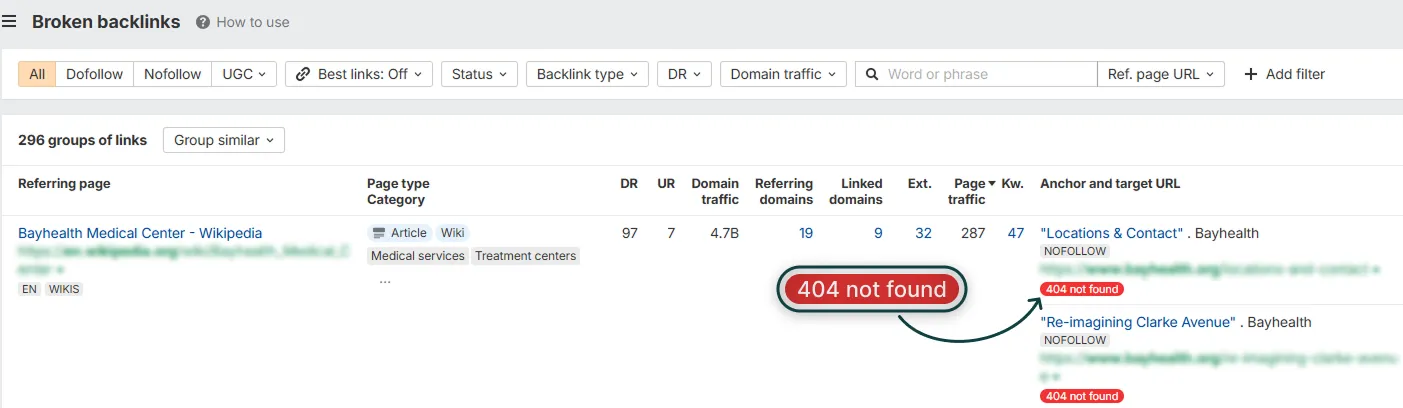
- Once you find a broken link, check if you already have content that matches the topic. If not, create new and updated content.
- Reach out to the editor or website owner to let them know about the broken link and suggest your content as a useful replacement.
Here’s a simple outreach example you can use:
Hi [Name],
I noticed one of your links appears to be broken: [Broken URL]. I actually have a similar resource that covers [topic] in detail: [Your URL]
It includes [specific value, examples, data, templates, etc.] that might help your readers find what they need.
Would you consider replacing the broken link? Happy to help either way.
Best regards,
[Your Name]
### Unlinked Brand Mentions
An unlinked brand mention is when another website mentions your brand, product, or content but doesn’t link back to your website.
This is actually a valuable opportunity because they have already noticed and mentioned you. You just need to reach out to the site owner and politely ask them to turn the mention into a clickable link.
**Steps to turn mentions into links:**
- Find unlinked mentions opportunities using search operators like intext:{brand name} – {own domain name}.com -twitter.com -facebook.com -pinterest.com -youtube.com -linkedin.com
- You can also use brand monitoring tools like Google Alerts to find unlinked mentions of your brand or content.
- Reach out politely to the site owner, thank them for the mention, explain how adding a link would help their readers, and ask if they can include a clickable link to your website.
Hi [Name],
I noticed that you mentioned our brand in your article. Thank you for the mention.
Would you consider adding a link to our website so readers can easily access the resource?
Best regards,
[Your Name]
Since the mention already exists, this approach often leads to quick, high-quality backlinks with minimal effort.
### Niche Edits
A niche edit is a link building strategy in which you identify existing content that discusses your topic or industry but doesn’t link to any relevant resource.
Instead of writing new content, you find existing relevant content that’s already ranking and trusted by Google.
When done correctly, niche edits feel useful, making the link valuable for both search engines and readers rather than forced.
**Simple steps to perform niche edits effectively:**
- Start by finding published articles in your niche where your link would naturally fit and add value.
- Look for pages that discuss similar topics and could benefit from an extra helpful resource.For example, if you’ve a home workout guide, look for articles about “daily fitness tips” or “beginner exercise routines” where your resource would fit naturally and help readers.
- Next, contact the site owner or editor, suggesting your link as a valuable addition and explaining how it enhances their readers’ experience.
Hi [Name],
I was reading your article and found it very helpful.
I noticed you mentioned [concept] but didn’t link to a resource that shows [specific example/data/tool].
I recently published a detailed guide that covers exactly this: [Your URL]
Would you consider adding it as a reference?
Best regards,
[Your Name]
## Top Best Link Acquisition Services
**The best link acquisition services don’t sell links. They earn them through editorial outreach and content placement on sites with real organic traffic.** When you’re comparing providers, the questions worth asking are about publisher sourcing, content quality control, and how they measure placement quality.
Here are some of the best link acquisition service providers that help you earn high-quality, trusted backlinks.
### 1. Outreach Desk – Best for High-Quality Link Acquisition
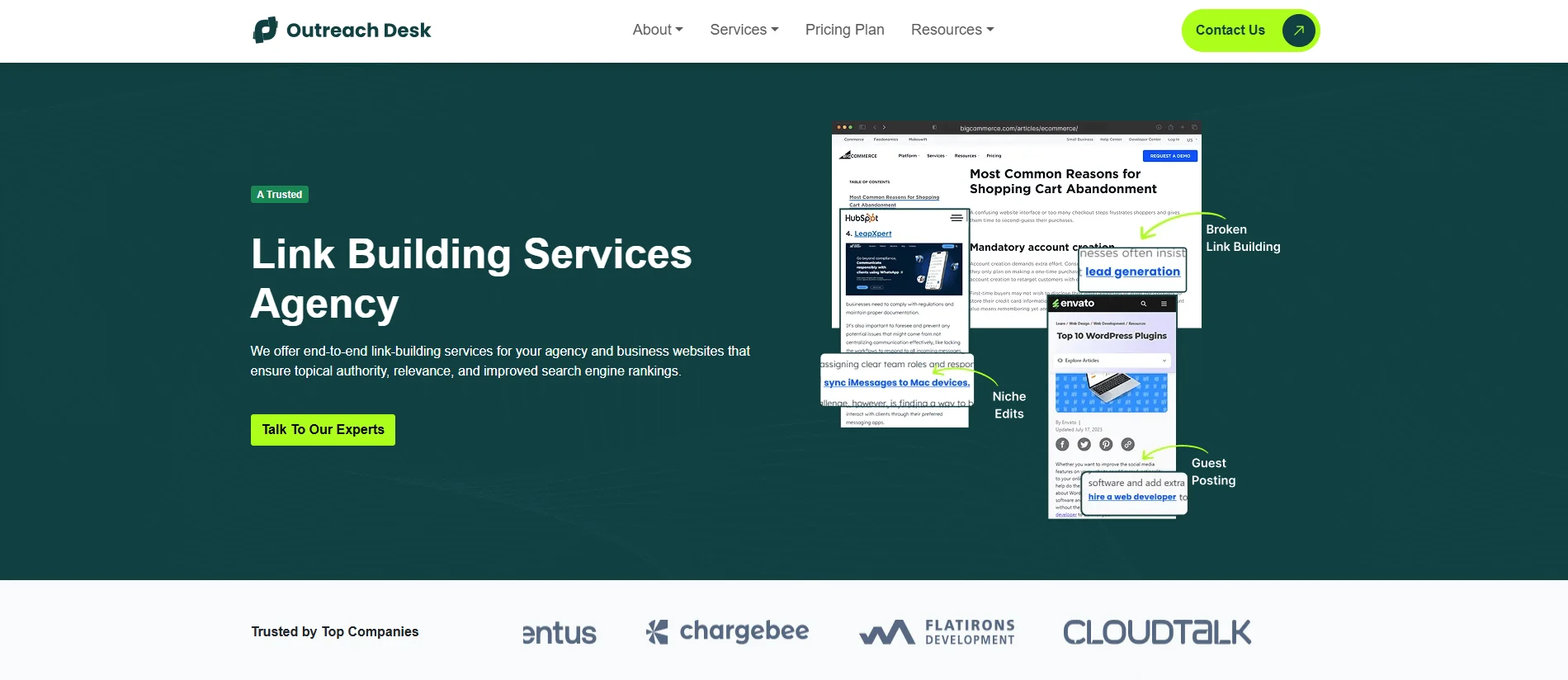[Outreach Desk](https://outreachdesk.com/) is the best result-driven link building partner, offering end-to-end services for businesses and agencies, ensuring topical authority, visibility, relevance, and improved search engine rankings.
Outreach Desk handles the entire link acquisition process, right from finding link opportunities to creating relevant content and earning backlinks from reputable websites.
The link acquisition is executed in accordance with ethical, white-hat practices. Each link is regularly examined for quality and compliance with search engine guidelines, boosting your visibility and long-term growth.
### 2. Siege Media – Best for Content-Driven Link Acquisition
[Siege Media](https://www.siegemedia.com/) is a content-focused agency that combines SEO, high-quality content creation, and link acquisition to drive organic growth.
Siege Media creates content designed to attract backlinks and strengthen organic search visibility, often through content marketing, digital PR, and scalable link acquisition processes.
By producing valuable, SEO-optimized content and strategically promoting it, Siege Media earns links that boost domain authority and search rankings at scale.
### 3. Editorial.link – Best for Editorial Links and AI Search Visibility
[Editorial.Link](https://editorial.link/) is a white-hat link building and digital PR agency that focuses on high-quality editorial backlinks and improving visibility in AI-driven search experiences.
They specialize in custom link acquisition strategies, earning backlinks from relevant, authoritative sites, listicles, and media placements.
Editorial.Link helps brands grow visibility and rankings by securing contextual, editorial links that are relevant and trusted by search engines.
### 4. Dofollow.com – Best for Scalable Backlink Acquisition
[dofollow.com](http://dofollow.com) is a link building company focused on relationship-based, high-quality backlink acquisition, especially for B2B and SaaS brands.
Their services include strategic outreach, backlink monitoring, link replacement guarantees, and traffic-focused link acquisition campaigns.
They secure backlinks from high-authority, long-term value sites, monitor links for health, and replace broken links at no extra cost, helping improve SEO and organic traffic.
### 5. Linkbuilder.io – Best for Performance-Driven link acquisition
[Linkbuilder.io](http://Linkbuilder.io) is a link building agency that secures high-quality backlinks from authoritative websites to improve your search engine rankings.
They use a mix of outreach strategies to acquire highly relevant links to key pages on your website.
LinkBuilder.io helps improve search engine rankings by consistently earning diverse, white-hat backlinks tailored to your niche and content goals.
### 6. uSERP – Best for Authority-Focused Link Acquisition
[uSERP](https://userp.io/) is a top-ranked link building agency known for earning high-authority backlinks that drive visibility and measurable outcomes.
uSERP offers link building, digital PR, content strategy, and outreach campaigns focused on high-impact, high-authority placements.
They focus on earning links that improve search rankings, organic traffic, and ROI by prioritizing quality over quantity and using custom, data-driven tactics.
### 7. Epic Slope Partners: Best for B2B SaaS Link Building and Organic Growth
[Epic Slope Partners](https://www.epicslope.partners/services/link-building) is a specialist growth agency focused on helping B2B SaaS brands build authority through high-quality, relevant backlinks.
Their approach is editorial-first, context-driven, and made to fit each client’s niche rather than relying on generic outreach.
They also support backlink audits, link gap analysis, and custom acquisition strategies to strengthen existing profiles while identifying new growth opportunities.
## Link Acquisition Best Practices
**The best practices for link acquisition all reinforce one principle: relevance and editorial standards beat volume every time.** Build for the long game. The links you earn through quality content and genuine outreach keep compounding while shortcut tactics lose their value at the next core update.
Below are the best practices that help strengthen your site over time.
### Prioritize Quality Over Quantity
The main goal should be to earn quality links rather than chase quantity; your links should come from trusted, relevant websites, where one strong link is more valuable than many weak ones.
### Diversify Your Link Sources
Use multiple link acquisition strategies to build a natural, healthy backlink profile. Use a mix of guest posts, resource links, brand mentions, and digital PR to make your backlink profile appear natural.
### Align Links With Your Content
Always make sure each backlink points to a page that truly matches the context and relevance of the placement. This alignment boosts trust, improves user experience, and supports better rankings.
### Follow White-Hat Link Building Practices
Focus on earning links through ethical, manual outreach and high-quality content to build long-term rankings without risking penalties. Avoid buying links, using automated tools, or engaging in link schemes that violate the search engine guidelines.
## Link Acquisition Common Mistakes to Avoid
**The most common link acquisition mistakes are chasing volume, ignoring topical relevance, and treating every link the same regardless of source quality.** Each of these patterns shows up in the backlink profile of sites that lose rankings after a core update. The mistakes below are the ones you can fix before they cost you traffic.
Before launching your link-building campaign, it’s important to understand what can go wrong. Here are the common link acquisition mistakes you should avoid:
### Ignoring Relevance
Links from unrelated websites add little to no value and may look unnatural to search engines. Relevance is one of the important factors Google considers when evaluating a backlink.
**Solution:** Prioritize earning links from websites that cover the same topic as yours. A single relevant link from a website in your niche is far more valuable than ten links from a site with no relevance.
### Using Automated or Spammy Tools
Automated link building often creates spammy or unnatural links that can trigger penalties. Some tools promise to build hundreds of backlinks for you in a short time. These tools often generate links from low-quality, irrelevant, untrusted, or fake websites.
**Solution:** Treat link building as a gradual and natural process. Focus on earning high-quality, relevant links using ethical hat link building strategies
### Over-Optimizing Anchor Text
Anchor text is the clickable word or phrase that contains your link. Repeating exact-match anchors too often can make your link profile look manipulative.
**Solution:** Aim for a natural mix of anchor text. Use a balanced combination of branded, partial-match, generic, and URL anchors to keep your link profile diverse and reduce the risk of penalties.
### Buying Backlinks
Purchasing links instead of earning them naturally violates search engine guidelines and can lead to penalties or a drop in rankings. While it may seem like a quick way to build links, it comes with high-risk.
**Solution:** The safe and sustainable way to build backlinks is to earn them through a genuine effort. By creating valuable content, building real relationships with other websites, and using link building strategies for long-term and safe growth.
## Conclusion
Link acquisition isn’t about getting as many links as possible. It’s about earning the right links from relevant and trusted websites.
Start with the strategies that fit your resources and goals. When you focus on quality over quantity, build real relationships, and create content worth linking to, your rankings improve naturally and sustainably.
With the right approach, each link becomes a long-term asset that supports stronger rankings and steady organic growth.
### Ready to build quality backlinks that actually boost rankings?
Let’s create a link acquisition strategy tailored to your niche using proven, ethical tactics that drive real results.
[Book a Free Strategy Call](/contact-us/)
### Why is link acquisition essential for seo success?
Link acquisition helps search engines trust your website. When reputable sites link to your content, it improves your rankings, increases visibility, and drives more organic traffic from competitive search results.
### How do I track the success of my link acquisition efforts?
Track key metrics using tools like Ahrefs, SEMrush, or Google Search Console. Monitor new and lost backlinks, referral traffic, changes in keyword rankings, and overall organic growth to measure the impact of your efforts.
### How many links do you need to rank?
There’s no fixed number; ranking depends on link quality, relevance, competition, and content strength. Quality matters over quantity. In most cases, a few high-quality links from relevant sites outperform dozens of weak ones.
### Is link acquisition safe?
Yes, when done ethically. Focus on earning links from relevant, high-quality websites through genuine outreach and valuable content. Avoid buying links or using automated tools, as these practices can lead to penalties.
### What is the difference between link building and link acquisition?
Link building is the broader term for all techniques used to get backlinks. Link acquisition is a more strategic approach focused on earning links through outreach, content creation, and relationship-building, rather than on passive or automated methods.
---
---
title: "Broken Link Checker"
url: "https://outreachdesk.com/broken-link-checker/"
lang: "en-US"
type: "page"
description: "Broken Link Checker Find broken links on any website in seconds. Scan a single page or your entire site and get a clear report of 404 and other 4xx errors. Free, with no signup required. What This Tool Does The"
last_modified: "2026-05-27T05:03:25+00:00"
custom_fields:
header_style: "header-style-1"
footer_style: "footer-style-1"
---
# Broken Link Checker
# Broken Link Checker
Website URL
_
Scan Type
Single Page Scan
Whole Website Scan
Check
Pause
Scanning in progress...
Scan 0/0
_
##### __Scan Results
| Status | Page | Broken URL | Result |
| --- | --- | --- | --- |
Content
-
[Quick Summary: Myth vs Reality](#quick-summary-myth-vs-reality)
-
[Myth 1: More Backlinks Always Mean Better Rankings](#myth-1-more-backlinks-always-mean-better-rankings)
-
[Myth 2: Only High-DR Sites Are Worth Chasing](#myth-2-only-high-dr-sites-are-worth-chasing)
-
[Myth 3: Links From Low-Traffic Pages Are Worthless](#myth-3-links-from-low-traffic-pages-are-worthless)
-
[Myth 4: Low-DR Backlinks Will Hurt Your Rankings](#myth-4-low-dr-backlinks-will-hurt-your-rankings)
-
[Myth 5: Great Content Earns Links on Its Own](#myth-5-great-content-earns-links-on-its-own)
-
[Myth 6: Paying for Any Link Gets You Penalized](#myth-6-paying-for-any-link-gets-you-penalized)
-
[Myth 7: AI Search Killed Link Building](#myth-7-ai-search-killed-link-building)
-
[Myth 8: You Need More Backlinks Than Your Competitors](#myth-8-you-need-more-backlinks-than-your-competitors)
-
[Myth 9: Nofollow Links Are Useless](#myth-9-nofollow-links-are-useless)
-
[Myth 10: Link Building Works as a One-Time Push](#myth-10-link-building-works-as-a-one-time-push)
-
[Start With Your Three Strongest Links ](#start-with-your-three-strongest-links)
Find broken links on any website in seconds. Scan a single page or your entire site and get a clear report of 404 and other 4xx errors. Free, with no signup required.
## What This Tool Does
The broken link checker scans all URLs on your page or across your entire website. It then shows a list of broken links and 4xx errors, including their HTTP status codes and the page where they were found.
You don’t have to scroll through hundreds of working links to find the broken ones. The tool filters out everything that’s working and surfaces only the URLs that need your attention.
### Two Scan Types
#### Single Page Scan
Checks all links from a single URL. You can use this for quick checks on individual pages before or after publishing.
#### Whole Website Scan
Scan your whole website and check internal links across every page. You can generally use this for checking 4xx errors.
### What You See in Your Scan Report
- **The error status code **for each broken link (404 and other 4xx errors)
- **The source page **where the broken link was found
- **The broken link URL **exact URL that returned an error
- **A broken status label **confirming the link is dead
- **A total count **of links scanned and broken links found
## How to Use the Broken Link Checker
### 1. Enter Page or Website URL
Paste your website’s domain or a specific page URL into the input field. You can scan any publicly accessible URL, your own site, or a competitor’s page.
### 2. Choose Your Scan Type
Select **Single Page Scan** to check all the links on a single page, or select **Whole Website Scan** to check your entire site for a full audit.
### 3. Click “Check”
The tool scans every link on the page or site. Once the scan is complete, it displays a summary of the total number of links scanned and the number of broken links found.
### 4. Review Your Broken Links
The results table shows only the broken links. For each one, you see the HTTP error code, the page it was found on, and the broken URL.
## Who Is This Tool For
This tool is for anyone who needs to maintain a healthy website. That includes:
- **Content creators & publishers **who want to catch broken links before publishing
- **Ecommerce sites **managing large product catalogs with hundreds of internal links
- **Agencies & SEO professionals **monitoring multiple client websites regularly
- **Site owners **who want search engines to crawl easily and visitors to trust their content
Whether you’re fixing a single page or auditing an entire site, this tool helps you maintain clean, functional links that support both SEO and user experience.
## Why Broken Links Hurt Your Website
Here’s why fixing broken links should be a priority:
### 1. Negative Impact on SEO
When Googlebot encounters a broken link, it cannot access the referenced page. While occasional broken links are normal, a large number of internal dead links can waste crawl resources and reduce crawl efficiency. Over time, this may slow the discovery and indexing of important content.
### 2. Poor User Experience
When a visitor clicks a link and lands on a 404 error page, it can be very frustrating. This creates a bad experience for the user. Visitors may lose trust and stop exploring your website.
### 3. Damaged Brand Reputation
A website with multiple broken links gives visitors the impression that it’s not regularly updated and is very unprofessional. Visitors and potential customers are less likely to trust a site that doesn’t maintain its own content.
### 4. Crawl Budget Waste
Search engines allocate a limited crawl budget to each website. Broken links consume part of that budget without adding any value, slowing the discovery and indexing of your important pages.
### 5. Link Equity Loss
Every internal link passes authority from one page to another. A broken internal link means that authority goes nowhere. If external sites link to a page that returns a 404, you may lose valuable [link equity](https://outreachdesk.com/link-equity/) from that link.
## What to Do After Your Scan
Finding broken links is the first step. Here’s how to handle the most common scenarios based on your scan results.
### For Deleted or Moved Pages
Set up a 301 redirect from the old URL to the correct destination. This preserves any link equity pointing to that URL and sends visitors to the right page.
### For Outdated Links
If you linked to a resource that no longer exists, find a current alternative and update the link. If there is no replacement, then remove the link entirely.
### For Misspelled URLs
Check if the broken link is simply a typo in your HTML. Correct the URL in your page’s source code, and the link will resolve.
### For Broken Links Pointed at Your Site
When external sites link to your 404 pages, you’re losing link equity. Restore the page, set up a redirect, or create new content to recover that authority.
## Best Practices for Broken Link Management
Broken links accumulate over time. Here are the best practices to prevent them from damaging your site:
### Run Monthly Scans
A monthly scan helps you catch broken links before they accumulate. If you update content often or run a large site, scan every week.
### Scan After Every Site Update
Any time you delete, move, rename a page, or make any updates to your site, run a quick scan to catch new broken links immediately.
### Keep A Redirect Log
Maintaining a record of every URL change and its redirect will help you avoid recurring link issues and make it easier for your team to track updates.
### Test Links Before Publishing
Scan every hyperlink in new content before it goes live. A quick single-page scan before publishing saves cleanup time later.
### Prioritize High-Traffic Pages
Start with pages that receive the most visitors or carry the most link equity. Fixing these first has the biggest impact.
## Scan Your Site for Broken Links Today
Broken links accumulate over time and silently damage your SEO. Regular monitoring ensures you catch 404 errors and dead links before they hurt your site’s performance and visitor trust.
## FAQs
### What is a 404 error?
A 404 status code means “Page Not Found.” It occurs when a URL points to a page that no longer exists. This is the most common type of broken link.
### Is this tool free?
Yes. It’s completely free, with no signup, login, or usage limits.
### Does fixing broken links improve SEO?
Fixing broken links improves crawlability, preserves link equity, improves the user experience, and signals to search engines that your website is well-maintained, all of which contribute positively to your search rankings.
### What HTTP status code indicates a broken link?
The most common status code for a broken link is **404 Not Found**. However, broken links may also return **410 Gone, 403 Forbidden (access blocked)**, or other 4xx errors depending on the issue.
### Can I scan an entire website to find broken links?
Yes, the tool can scan an entire website and find broken internal links.
### How long does a broken link scan take?
Scans are typically completed within a few minutes, depending on the website’s size and the number of links.
### Can broken links affect Google rankings?
Yes, broken links might affect Google rankings. It may reduce crawl efficiency and negatively affect the user experience, potentially impacting search performance over time.
### Why regular scans matter?
Websites change constantly. Pages move, resources disappear, and URLs update. Regular scans help you catch issues before they affect crawling or user experience.
### Can this tool check external outbound links?
The tool scans the internal links on your pages. It checks the hyperlinks within your site’s HTML and reports which ones return errors.
## Let’s Build Trust and Credibility the Right Way
If you want guest posting built for clarity, relevance, and long- term growth, this is your next step.
Book a Strategy Call
_
**4.8**/5 _
Trusted by 500+ **agencies &
1,000+ businesses** worldwide.

---
---
title: "Tools"
url: "https://outreachdesk.com/tools/"
lang: "en-US"
type: "page"
description: "Outreach Desk Tools Backlink Cost Calculator Google Index Checker Backlink Monitoring Tool Domain Age Checker Broken Link Checker Link Building ROI Calculator Let’s Build Trust and Credibility the Right Way If you want guest posting built for clarity, relevance, and"
last_modified: "2026-05-26T12:01:19+00:00"
custom_fields:
header_style: "header-style-1"
footer_style: "footer-style-1"
---
# Tools
# Outreach Desk Tools
[ _
### Backlink Cost Calculator
](/backlink-cost-calculator/)
[ 
### Google Index Checker
](/google-index-checker/)
[ 
### Backlink Monitoring Tool
](/backlink-monitoring-tool/)
[ 
### Domain Age Checker
](/domain-age-checker/)
[ 
### Broken Link Checker
](/broken-link-checker/)
[ 
### Link Building ROI Calculator
](/link-building-roi-calculator/)
## Let’s Build Trust and Credibility the Right Way
If you want guest posting built for clarity, relevance, and long- term growth, this is your next step.
Book a Strategy Call

**4.8**/5 _
Trusted by 500+ **agencies &
1,000+ businesses** worldwide.

---
---
title: "Backlink Cost Calculator"
url: "https://outreachdesk.com/backlink-cost-calculator/"
lang: "en-US"
type: "page"
description: "Backlink Cost Calculator Stop overpaying for a backlink. Estimate what a backlink should cost before you spend a dollar. Not every backlink costs the same. A link from a trusted, popular site costs more than one from a newer, smaller"
last_modified: "2026-05-26T12:48:45+00:00"
custom_fields:
header_style: "header-style-1"
footer_style: "footer-style-1"
---
# Backlink Cost Calculator
# Backlink Cost Calculator
Domain Rating (DR):
20
_
Monthly Organic Traffic
Domain Age (years)
_
DoFollow Link
_
_
In-Content Link
_
---
Estimated Link Price
$260 – $320
Prices may vary based on market conditions & niche
Content
-
[Quick Summary: Myth vs Reality](#quick-summary-myth-vs-reality)
-
[Myth 1: More Backlinks Always Mean Better Rankings](#myth-1-more-backlinks-always-mean-better-rankings)
-
[Myth 2: Only High-DR Sites Are Worth Chasing](#myth-2-only-high-dr-sites-are-worth-chasing)
-
[Myth 3: Links From Low-Traffic Pages Are Worthless](#myth-3-links-from-low-traffic-pages-are-worthless)
-
[Myth 4: Low-DR Backlinks Will Hurt Your Rankings](#myth-4-low-dr-backlinks-will-hurt-your-rankings)
-
[Myth 5: Great Content Earns Links on Its Own](#myth-5-great-content-earns-links-on-its-own)
-
[Myth 6: Paying for Any Link Gets You Penalized](#myth-6-paying-for-any-link-gets-you-penalized)
-
[Myth 7: AI Search Killed Link Building](#myth-7-ai-search-killed-link-building)
-
[Myth 8: You Need More Backlinks Than Your Competitors](#myth-8-you-need-more-backlinks-than-your-competitors)
-
[Myth 9: Nofollow Links Are Useless](#myth-9-nofollow-links-are-useless)
-
[Myth 10: Link Building Works as a One-Time Push](#myth-10-link-building-works-as-a-one-time-push)
-
[Start With Your Three Strongest Links ](#start-with-your-three-strongest-links)
Stop overpaying for a backlink. Estimate what a backlink should cost before you spend a dollar.
Not every backlink costs the same. A link from a trusted, popular site costs more than one from a newer, smaller domain. This calculator helps you estimate a fair price using four metrics, so you can negotiate with facts rather than guesswork.
## What is The Backlink Cost Calculator?
The Backlink Cost Calculator is a free tool that estimates a fair market price range for any backlink.
To check the price, you need to enter four metrics: Domain Rating, Monthly Organic Traffic, Domain Age, and Link Type, and the calculator returns a minimum-to-maximum price estimate.
Use this estimate as a reference point before making any backlink investment. Price may vary depending on market conditions and niche.
For example, you find a blog with a DR of 45 and 5,000 monthly visitors, and they quote you $400. You enter all four metrics into the calculator, and the estimated range comes back lower. Now you have data to negotiate with and not just a gut feeling.
## What Determines the Backlink Pricing
Not all links have the same prices. Here’s what actually moves the number and why it matters for your growth.
### Domain Rating (DR)
DR is a metric created by Ahrefs that measures a site’s link authority on a scale of 0 to 100. It’s not a Google ranking factor, but SEO professionals use it most widely.
You can check this metric under Ahrefs Free [Website Authority Checker](https://ahrefs.com/website-authority-checker).
**How it determines the prices:**
A link from a DR 55 site generally passes more authority than one from a DR 25 site. That’s why higher-DR placements command higher prices in the market.
### Monthly Organic Traffic
The number of real visitors a site gets from search engines each month. You can check this metric using Ahrefs [Website Traffic Checker](https://ahrefs.com/traffic-checker).
**How it determines the prices:**
Higher organic traffic means search engines trust the site, making its links more valuable. Just make sure the site is relevant to your niche before pursuing the link.
For example, a DR 40 niche blog with 80,000 monthly visitors may be more strategically valuable than a DR 50 general news site, even if the calculator shows higher prices for the news site.
Always make your own judgment based on how well the site’s audience, content, and topic align with yours.
### Domain Age
How long the domain has been active. You can check domain age using Outreach Desk’s [Domain Age Checker](/domain-age-checker/).
**How it determines the prices:**
Older domains have had more time to build trust signals through backlinks, content, and editorial credibility, which generally takes years to build, so it’s priced accordingly.
For example, a 7-year-old domain in your niche will typically price higher than a 1-year-old domain at the same DR. Whether that premium fits your budget is a judgment call based on your goals.
### Link Type & Placement
A **DoFollow** link passes SEO authority (link equity) to your site. This is what most people mean when they talk about “buying a backlink.” A DoFollow link is more valuable than a NoFollow link.
**In-Content** Link sits within the main article, surrounded by relevant text. These links are more valuable because they tend to carry more weight with search engines than sidebar or footer links.
Selecting both in the calculator gives you the estimated price for the highest-value placement type. Selecting only one will return a lower price range reflecting that placement type. If you’re unsure, ask the publisher directly whether the link will be DoFollow and placed inside the article body. Legitimate publishers will confirm this clearly.
## How to Use This Backlink Cost Calculator
Follow these four steps, and in less than a minute, get an estimated price range:
### 1. Set the Domain Rating (DR):
Drag the slider from 0 to 100 to match the target site’s Domain Rating score.
### 2. Enter Monthly Organic Traffic:
Type in the site’s estimated monthly organic visitors from search engines.
### 3. Enter Domain Age (Years):
Add the number of years the domain has been active.
### Select Link Type:
Check the boxes for ‘DoFollow Link’ and ‘In-Content Link’ based on the type of link you want. You can select one or both. Selecting both gives you the most valuable link placement, and the price will reflect that.
**Read Your Price Range:**
After completing all four steps, you will see the estimated price. The calculator shows a minimum and maximum price range. This range represents typical market pricing, not a fixed cost.
- If a quote falls inside the range, the price is generally fair.
- If it is far above the range, you may be overpaying.
- If it is far below, check the site’s quality carefully before proceeding.
**Note:**
The calculator gives an estimate, but prices can vary by niche. Competitive industries like finance, legal, and health usually cost more, even at the same DR and traffic levels.
## Who Should Use the Backlink Cost Calculator?
Whether you’re managing client budgets or spending your own money on links, this calculator gives you a real number to work from.
### SEO Agencies
A publisher quotes you $600. You enter their site’s DR, traffic, age, and link type into the calculator, and the estimated range comes back well below their quote. Now you have data to negotiate with.
### In-House SEO Teams
Your manager wants to know why a single link costs $400. You pull up the calculator, enter the site’s metrics, and walk them through the output. The price range speaks for itself.
### Startup Founders Doing SEO On Their Own
You’ve shortlisted 3 sites for your first link purchase. Check all three through the calculator before you pay. You’ll see estimated market pricing for each site, so you can compare before you commit.
### Link Marketplace Buyer
You are comparing five listings at similar prices but with very different metrics. Run each one through the calculator to see which ones are fairly priced and which ones you should skip entirely.
## FAQs
### Does Domain Rating alone determine the cost of backlinks?
No, Domain Rating is just one metric, not the only one, for determining the backlink cost.
Organic traffic, publisher niche, editorial standards, and outreach complexity all affect price. Two sites with the same domain rating of 40 can price very differently based on these other factors.
The calculator gives you a starting range. Always keep your niche and editorial standards in mind before finalising what you should pay.
### How often should I re-check link prices?
Check prices every quarter as you build links. Market shifts can change what you should pay. What you paid 6 months ago may be over- or under-market today, especially in competitive niches.
### How do I check if a backlink actually worked?
Check three results:
- Does your Domain Rating improve over subsequent months?
- Do you rank for new keywords or improve existing positions?
- Does your organic traffic grow?
No single backlink moves all three metrics at once. The calculator estimates what a link should cost, but the real value shows up over time. Track these three signals month by month. Consistent improvement means your investment is building the authority and visibility you paid for.
### Is one expensive link better than multiple cheaper links?
Not always. It depends on the publishers themselves. One high-quality link from a high-authority, relevant site can contribute more to your authority than several weaker links combined. Use the calculator to find the fair price for each, then choose.
### How many backlinks do you need to rank?
There is no fixed number of backlinks you need. You can search for competitors for your target keyword, analyze the top 5 ranking pages, check their referring domains, and aim to match or slightly exceed their link profile quality.
### Can I check the backlink cost by Domain Rating?
Yes, you can easily check backlink prices with varying domain ratings using our calculator. Set your traffic, domain age, and link type, and then move the DR slider to see how prices shift.
### When should you skip a backlink entirely?
Skip it if the site’s Domain Rating or traffic numbers look off or can’t be verified in Ahrefs or Semrush. If the site has nothing to do with your niche or is clearly selling links with no editorial standards, walk away. Links from low-quality or irrelevant sites are unlikely to help, and a consistent pattern of them can put your site at risk.
### How should I split my link-building budget?
A practical starting point: put 70% toward two or three high-authority, relevant sites. Use the remaining 30% for supporting links from solid but lower-DR domains. Quality first, volume second. Scale what’s working as your budget grows.
## Let’s Build Trust and Credibility the Right Way
If you want guest posting built for clarity, relevance, and long- term growth, this is your next step.
Book a Strategy Call

**4.8**/5 _
Trusted by 500+ **agencies &
1,000+ businesses** worldwide.

---
---
title: "Domain Age Checker"
url: "https://outreachdesk.com/domain-age-checker/"
lang: "en-US"
type: "page"
description: "Domain Age Checker Check the age of any domain in seconds. Enter a URL and get the exact domain age, creation date, last update date, and expiry date, all in one place. What Is Domain Age? A domain is a"
last_modified: "2026-05-27T04:58:39+00:00"
custom_fields:
header_style: "header-style-1"
footer_style: "footer-style-1"
---
# Domain Age Checker
# Domain Age Checker
### Check Domain Age
_
Check
Content
-
[Quick Summary: Myth vs Reality](#quick-summary-myth-vs-reality)
-
[Myth 1: More Backlinks Always Mean Better Rankings](#myth-1-more-backlinks-always-mean-better-rankings)
-
[Myth 2: Only High-DR Sites Are Worth Chasing](#myth-2-only-high-dr-sites-are-worth-chasing)
-
[Myth 3: Links From Low-Traffic Pages Are Worthless](#myth-3-links-from-low-traffic-pages-are-worthless)
-
[Myth 4: Low-DR Backlinks Will Hurt Your Rankings](#myth-4-low-dr-backlinks-will-hurt-your-rankings)
-
[Myth 5: Great Content Earns Links on Its Own](#myth-5-great-content-earns-links-on-its-own)
-
[Myth 6: Paying for Any Link Gets You Penalized](#myth-6-paying-for-any-link-gets-you-penalized)
-
[Myth 7: AI Search Killed Link Building](#myth-7-ai-search-killed-link-building)
-
[Myth 8: You Need More Backlinks Than Your Competitors](#myth-8-you-need-more-backlinks-than-your-competitors)
-
[Myth 9: Nofollow Links Are Useless](#myth-9-nofollow-links-are-useless)
-
[Myth 10: Link Building Works as a One-Time Push](#myth-10-link-building-works-as-a-one-time-push)
-
[Start With Your Three Strongest Links ](#start-with-your-three-strongest-links)
Check the age of any domain in seconds. Enter a URL and get the exact domain age, creation date, last update date, and expiry date, all in one place.
## What Is Domain Age?
A domain is a website’s web address, and domain age refers to the amount of time that has passed since the domain was first registered.
It is calculated from the original creation date recorded in the domain registry. Domain age does not reset when a domain is renewed, transferred, or redesigned.
Domain age reflects when the domain name was registered, not when the website was first published or when search engines first crawled it.
## What is the Domain Age Checker Tool?
A Domain Age Checker is a free tool that instantly checks a domain’s registration details. Rather than digging through technical registry data yourself, it does the heavy lifting and presents everything in a simple, easy-to-read format, giving you the domain’s registration data in seconds.
## How to Use This Domain Age Checker?
Our Domain Age checker has one input and one action. No setup required. Check a domain’s age in three simple steps:
### 1. Enter your Domain URL:
Enter the domain into the input box of our domain age checker
### 2. See the Results:
Click “Check” to retrieve the domain’s registration data.
## What Data Does This Tool Show?
Once you run a check, the tool instantly displays essential domain details:
### Domain Age:
The exact time since the domain was first registered, shown in years, months, and days. This gives you an at-a-glance sense of how established a domain is.
### Domain Created Date:
The original date when the domain was registered or created. This helps determine when the domain first went live in the registry, irrespective of website redesigns or changes in ownership.
### Domain Updated Date:
The date when the domain record was last modified or updated. This can reflect DNS changes, ownership transfers, or registrar updates. A recent update on an old domain may indicate a change in ownership.
### Domain Expiry Date:
The date when the domain will expire, which helps owners track renewals or evaluate registration timelines when looking for a domain.
## Does Domain Age Affect SEO?
According to Google, domain age is not a direct ranking factor.
Older domains may have accumulated backlinks or content footprint over time, which can contribute to credibility, but this is not guaranteed.
This means that domain age provides context, not ranking advantage. A well-optimized new website can outrank an older inactive domain.
For SEO decisions, domain age should be analyzed together with backlink quality, topical authority, and organic traffic trends.
## Domain Age vs Website Age
Domain age refers to how long a domain name has been registered. Website age refers to how long a site has been live and publishing content.
The two are not the same, and the gap between them can be significant. A domain can be registered long before any content is published on it.
This means the registration date alone does not tell you when the site was actually active. When a domain is rebuilt or changes occur, the website’s content history may be far shorter than the domain’s age suggests.
## Why Check Domain Age?
Here are common situations where checking domain age is useful:
### Evaluating Website Credibility
Check how long a website has been registered before partnering with it, publishing a guest post, or buying from it. Both very new and very old domains may need closer review.
New domains may lack trust signals, while older domains may have ownership changes or periods of inactivity. Domain age adds context to business legitimacy and the stability of online presence.
### Backlink & SEO Opportunity Evaluation
Check whether a backlink opportunity comes from an older or newly registered domain. This adds context before you check link quality, trust signals, and potential risk.
### Competitor Research
Check your competitors’ domain ages to see how established their websites are. Older domains may have more time to publish content and earn backlinks, helping you set growth expectations.
### Buying or Investing in Domains
Check the domain age and registration details before purchasing an existing domain. This helps you to know the domain’s background before investing.
### Ownership Change Signals
Check when a domain record was last modified. A recent update on an older domain can be a signal for further investigation. It may indicate a change in ownership or registrar, which is useful context before buying a domain or building links from a website.
### Client SEO Audits
Check domain age as supporting context when comparing a website with long-established competitors and planning realistic SEO growth strategies.
### Explore More Free SEO Tools
For a complete view of your SEO setup, pair domain age checks with our [free broken link checker](https://outreachdesk.com/broken-link-checker/) to find 404 issues, our [backlink monitoring tool](https://outreachdesk.com/backlink-monitoring-tool/) to track your placed links, and the [backlink cost calculator](https://outreachdesk.com/backlink-cost-calculator/) to benchmark fair pricing before any outreach campaign.
## FAQs
### How accurate is this domain age checker?
This domain age checker retrieves publicly available data. Accuracy depends on registrar availability and privacy protection settings.
### Can I check the domain age of any website?
Yes. Enter any domain and the tool will return its publicly available registration data. Some domains may show limited details if the owner has enabled privacy protection through their registrar.
### Does domain age affect a website’s credibility and trust?
Older domains have had more time to earn backlinks, but credibility depends on link quality and website practices, not age alone.
### Can domain age be faked or manipulated?
No. The original registration date recorded by registrars cannot be altered, although expired domains can be re-registered by new owners.
### How to purchase aged domains?
Search domain auction platforms and marketplaces that list expired and previously registered domains for purchase.
### Who should use a Domain Age Checker?
Built for SEO professionals, link builders, domain investors, website buyers, and agencies who need reliable domain data before making strategic decisions.
### What is the difference between domain age and domain authority?
Domain age measures how long a domain has been registered. Domain authority is a third-party metric created by Moz that estimates ranking potential and is not used directly by Google.
### Is an older domain always better?
No. Search performance depends on content quality, backlinks, and relevance, not on registration age alone.
## Let’s Build Trust and Credibility the Right Way
If you want guest posting built for clarity, relevance, and long- term growth, this is your next step.
Book a Strategy Call

**4.8**/5 _
Trusted by 500+ **agencies &
1,000+ businesses** worldwide.

---
---
title: "Google Index Checker"
url: "https://outreachdesk.com/google-index-checker/"
lang: "en-US"
type: "page"
description: "Google Index Checker Verify instantly whether your page is indexed by Google and is shown in search results. Paste your URL, click on ‘Check Index’, and get an instant result. What is Google Index Checker? A Google Index Checker tells"
last_modified: "2026-05-22T10:05:42+00:00"
custom_fields:
header_style: "header-style-1"
footer_style: "footer-style-1"
---
# Google Index Checker
# Google Index Checker
### Check Index Status
__
_
Check Index
Content
-
[Quick Summary: Myth vs Reality](#quick-summary-myth-vs-reality)
-
[Myth 1: More Backlinks Always Mean Better Rankings](#myth-1-more-backlinks-always-mean-better-rankings)
-
[Myth 2: Only High-DR Sites Are Worth Chasing](#myth-2-only-high-dr-sites-are-worth-chasing)
-
[Myth 3: Links From Low-Traffic Pages Are Worthless](#myth-3-links-from-low-traffic-pages-are-worthless)
-
[Myth 4: Low-DR Backlinks Will Hurt Your Rankings](#myth-4-low-dr-backlinks-will-hurt-your-rankings)
-
[Myth 5: Great Content Earns Links on Its Own](#myth-5-great-content-earns-links-on-its-own)
-
[Myth 6: Paying for Any Link Gets You Penalized](#myth-6-paying-for-any-link-gets-you-penalized)
-
[Myth 7: AI Search Killed Link Building](#myth-7-ai-search-killed-link-building)
-
[Myth 8: You Need More Backlinks Than Your Competitors](#myth-8-you-need-more-backlinks-than-your-competitors)
-
[Myth 9: Nofollow Links Are Useless](#myth-9-nofollow-links-are-useless)
-
[Myth 10: Link Building Works as a One-Time Push](#myth-10-link-building-works-as-a-one-time-push)
-
[Start With Your Three Strongest Links ](#start-with-your-three-strongest-links)
Verify instantly whether your page is indexed by Google and is shown in search results. Paste your URL, click on ‘Check Index’, and get an instant result.
## What is Google Index Checker?
A Google Index Checker tells you whether a specific URL exists in Google’s search index.
Enter any URL to instantly confirm whether Google has indexed your page. No manual searching or guesswork.
## Why Google Index Status Matters?
Google Index Status matters because if your page isn’t indexed, it cannot appear in search results. No matter how well you optimize your site, it still stays invisible to your audience.
This tool shows which pages appear in Google search results and which ones are not visible to anyone searching on Google.
Only indexed pages are eligible to appear and compete in Google search results. To understand why some pages appear in search while others don’t, let’s look at how Google indexing actually works behind the scenes.
## How Google Indexing Works?
Here’s what happens behind the scenes after Google discovers a page:
### 1. Crawling
Crawling is the first stage. Googlebot (Google’s web crawler) visits pages and reads content, and follows links to find other pages on the web.
**Note:** Crawling doesn’t guarantee indexing. Google crawls many pages but doesn’t add all of them to the index.
### 2. Indexing Analysis
After crawling, Google analyzes the indexed page’s content quality, checks for duplicate content, and looks at signals like canonical tags or noindex directives and page speed before deciding whether to store it in its search index.
### 3. Indexing
If your page meets Google’s quality standards, it is added to Google’s index, a searchable database of web pages. Only indexed pages are eligible to rank.
If a page fails at any step, it stays invisible in search results. This tool checks the final result: is the page in the index or not.
## How to Check Your Page Index Status
You can check your page’s index status with just 1 input and 1 click:
**Step 1:**
Enter the URL of the page you want to check into the provided field.
**Step 2:**
Click the **‘Check Index’** button. You’ll see your page’s status instantly: Indexed or Not Indexed.
**Read the Result**
- If the status shows **“Indexed”** in green, then your page is visible in Google search results.
- If the status shows **“Not Indexed”** in red, then your page isn’t visible in Google yet. It will not appear in search results until the issue is resolved.
## When to Use This Tool
Knowing when to check your index helps you catch visibility issues early and prevent lost traffic. Use our Google Index Checker tool at key moments:
### After Publishing New Pages or Content
New pages can take a few days to a few weeks to be discovered and indexed. Check within a few days to make sure Google has found your page.
### After a Site Migration
URL changes, redirects, or structural updates can affect indexing. Review your most important pages immediately after launch to ensure they remain visible.
### After CMS or Technical Updates
Theme changes, plugin updates, or edits to the robots.txt file might unintentionally block search engines. A quick index check helps confirm nothing important was affected.
### During a Monthly SEO Audit
Include index status checks of your pages in your monthly SEO audit to ensure important pages continue to appear in search results.
### When Organic Traffic Drops
If a page suddenly loses organic traffic, verify its index status first. De-indexing is a common issue that can be identified quickly.
### Before Building Backlinks
Confirm the page is indexed before investing in outreach or link building, so your efforts support a page eligible to appear in search results.
## What to Do if Your Page is Not Indexed
If your page is not indexed, try the following actions:
### 1. Check Google Search Console
- Make sure your domain is verified in Google Search Console.
- Use the URL Inspection tool to check indexing status and request indexing if needed.
### 2. Ensure Google Can Crawl the Page
- Check that the page is not blocked in robots.txt.
- Confirm the page returns a 200 OK status code.
- Fix redirect errors or broken pages.
### 3. Submit and Maintain an XML Sitemap
- Add important pages to your sitemap.
- Submit the sitemap via Search Console.
- Include only canonical indexable URLs.
### 4. Improve Internal Linking
- Link to the page from important pages on your site.
- Avoid pages with no internal links.
### 5. Check Indexing Directives
- Remove unintended noindex tags.
- Verify canonical tags point to the correct URL.
### 6. Improve Content Quality
- Publish original, useful content.
- Avoid duplicate or low-value pages.
- Ensure the page clearly satisfies search intent.
### 7. Optimize Technical Performance
- Make sure your site loads quickly.
- Ensure mobile usability and accessibility.
### 8. Allow Time for Indexing
- New pages and websites may take time to be indexed by Google.
## Why Use the Outreach Desk Google Index Checker
Here’s what you get when you check your page’s index status with our tool:
| Instant Results | You can see your index status with a single click. No waiting, no queues. |
| --- | --- |
| No Login Required | Paste your URL and check. No account, no email, no verification needed. |
| Current Index Status | The results reflect Google’s current index status at the time of checking. |
| Unlimited Checks | Check as many URLs as you need. No limits. No fees. |
| Publicly Accessible URL | Check your own pages or competitor pages. The tool works on any publicly accessible URL. |
| Works on Any Device | Fully responsive. Use it on desktops, tablets, or phones. |
### Explore More Free SEO Tools
After verifying indexing, use our [free broken link checker](https://outreachdesk.com/broken-link-checker/) to find crawl-blocking 404 errors, our [backlink monitoring tool](https://outreachdesk.com/backlink-monitoring-tool/) to confirm acquired links stay live, and the [domain age checker](https://outreachdesk.com/domain-age-checker/) when evaluating prospect sites for outreach campaigns.
## FAQs
### How long does indexing take?
For well-established sites, Google can index new pages in hours or a few days.
For newer ones, it may take days or weeks. Factors include your site’s authority, internal links, sitemaps, and content quality.
Requesting indexing doesn’t guarantee instant results. Google evaluates your page and decides whether to index it based on quality standards.
### What’s the difference between crawling and indexing?
Crawling means Googlebot visits and reads your pages. Indexing means Google adds that content to its search database. Sometimes, a page is crawled but not indexed if it doesn’t meet quality standards.
### Can a page be crawled but not indexed?
Yes, a page can be crawled but not indexed. Crawling and indexing are different steps. Google can crawl your page, but still decide not to index it. The Google Index Checker shows whether your page is in the index.
### Can Google Index PDF Files?
Yes, Google can index your PDFs if they aren’t password-protected or encrypted. Google extracts the text so people can find it in search results.
### How do I maintain my page’s Google indexing?
Keep your page fresh with new content and follow Google’s guidelines. Check your index status regularly with this tool to stay visible.
### Why are some sites removed from Google’s index?
Google may remove pages or sites that violate its spam policies. Keep your content up to date and follow best practices to stay indexed.
### Can I check competitor URLs?
Yes. This tool checks any public URL. It can be your own pages or competitor pages. No site verification or installation required.
### Does being indexed guarantee my page will rank?
No. Being indexed means Google knows your page exists. Ranking depends on content quality, relevance, and authority. But without indexing, ranking is impossible; it’s the first requirement, not the only one.
### How often should I check my index status?
Check after every major site change, after adding a new page to the site, after a migration, a CMS update, or a robots.txt edit. For high-priority pages, a monthly check as part of your SEO audit is a reliable practice.
## Let’s Build Trust and Credibility the Right Way
If you want guest posting built for clarity, relevance, and long- term growth, this is your next step.
Book a Strategy Call
**4.8**/5 _
Trusted by 500+ **agencies &
1,000+ businesses** worldwide.

---
---
title: "CBD Link Building Services"
url: "https://outreachdesk.com/cbd-link-building-services/"
lang: "en-US"
type: "page"
description: "CBD Link Building CBD Link Building Services for Sustainable Authority Growth You earn editorial, relevance-driven backlinks that strengthen your authority, improve visibility, and also support lasting SEO, without risking compliance in the CBD market. Appear naturally within the content Avoid"
last_modified: "2026-05-27T04:47:08+00:00"
custom_fields:
header_style: "header-style-1"
footer_style: "footer-style-1"
---
# CBD Link Building Services
CBD Link Building
# CBD Link Building Services for Sustainable Authority Growth
You earn editorial, relevance-driven backlinks that strengthen your authority, improve visibility, and also support lasting SEO, without risking compliance in the CBD market.
_
Appear naturally within the content

Avoid algorithmic risks

Editorially aligned CBD links
Book a Strategy Call

4.8/5 _
Trusted by 500+ agencies &
1,000+ businesses worldwide.
Average DR
40 – 95
Campaign Dashboard
LIVE
DOMAIN RATING
24 → 41
+17 points
ORGANIC TRAFFIC
+214%
3,200 → 10,050
PAGE 1 KEYWORDS
6 → 29
+23 points
PLACEMENTS
95
72 unique domains
_
Leads Acquired
165










Service Overview
## What CBD Link Building Really Means
CBD link building is the process of earning backlinks from real, editorially controlled websites in the hemp, wellness, and natural health space – and it works differently from standard link building because most mainstream publishers refuse CBD content outright, making niche editorial relationships the primary currency of authority in this regulated sector. The CBD brands that consistently rank on commercial searches share one characteristic: they’ve secured links from publications that actively cover cannabis, hemp, and wellness topics, rather than relying on generic networks that Google’s spam classifiers have learned to discount. Teams that want full execution often work with Outreach Desk team on this kind of campaign. For brands that need ongoing execution, CBD link building fundamentals from a specialised provider can carry the load.
CBD link building is the process of earning backlinks from real, relevant websites that publish content about CBD, hemp, wellness, and related health topics. Unlike general link building, every placement must consider strict regulations, publisher restrictions, and compliance standards that define the CBD industry.
Many agencies treat CBD like any other niche, which creates significant risk. Publishers that accept CBD content follow tighter editorial policies, and search engines apply higher scrutiny because CBD falls under YMYL (Your Money, Your Life) categories. Updates such as SpamBrain and recent core updates specifically target manipulative link patterns in sensitive sectors.
Industry tools consistently show that contextual, in-content links transfer far more authority than sidebars, directories, or author bios. For CBD brands, this matters even more, as irrelevant or low-quality links can trigger algorithmic risk more than in mainstream industries.
Three factors define effective CBD link building:

### Relevance-first placement
Each link appears in content genuinely covering CBD, hemp, wellness, or related topics. Prioritizing topical alignment, not just domain rating.

### Compliance-aware execution
Surrounding content avoids promotional claims, unverified health statements, and sensitive language, with each placement reviewed for regulatory compliance.

### Editorial integrity
Links are earned through real outreach to established publishers. No automated pitches, no bulk placements, no sites built solely to sell links.
How It Works
## How Your CBD Link Building Campaign Works
A structured workflow designed to maintain relevance, editorial integrity, and compliance awareness at every stage.
### Page Mapping
Your campaign begins with a detailed alignment call with your dedicated account manager to understand your priority CBD pages, keyword themes, growth goals, and specific requirements such as domain rating, traffic, or niche relevance.
Your strategist then maps each target page to identify where links will deliver the strongest ranking impact. High-value product pages receive priority, while well-optimized educational content with weak backlink profiles is elevated. You receive a focused, brand-specific roadmap, not a generic link-building approach.
### Opportunity Research
Your team researches publications, wellness blogs, health-adjacent sites, and CBD-friendly publishers that match your niche. Every prospect undergoes a manual quality review, assessing domain authority, organic traffic (typically 1,000+ monthly visits), topical relevance, editorial standards, and backlink health using tools like Ahrefs.
Sites with thin content, spam signals, inflated metrics, or irrelevant audiences are removed. Private blog networks, link farms, and link-selling sites are excluded, while CBD-specific checks confirm publishers openly accept cannabis and hemp content without reputational risk.
### Editorial Review
Before any placement moves forward, every opportunity is reviewed for topical fit, audience alignment, editorial credibility, and compliance safety. Content surrounding your link is checked for unverified health claims, promotional tone, or language that could flag regulatory concerns.
You review and approve the prospective websites before anything goes live. You see the domain rating, organic traffic data, niche category, and a sample of existing content.
### Content Development
Each placement includes content that earns its position editorially. Your writers develop relevant angles, insights, and contextual hooks so your CBD link fits naturally within the article, not as a forced addition.
Every piece follows the publisher’s standards and is written by experienced professionals, then reviewed internally before submission. Anchor text is integrated organically, avoiding keyword stuffing or over-optimized phrases that could trigger spam filters. In a YMYL niche like CBD, this careful approach significantly reduces risk while preserving long-term ranking stability.
### Link Placement
Your outreach specialists contact publishers directly. No automated mass emails. Every pitch is personalized to the publisher’s content style and recent topics. Outreach conversations cover placement expectations, anchor text strategy, content format, and timeline.
Once content is published, your team reviews every live link. Checks include: correct anchor text, proper dofollow attribution, in-content positioning, and page indexation status. If a placement doesn’t meet quality standards, your team either gets it corrected or replaces it with a new placement at no extra cost.
### Reporting
You receive structured reports with every live placement URL, anchor text used, target page mapping, domain rating, and organic traffic of each linking site, content context, and indexation status.
Your strategist adds context, not just data, so you understand what each link does for your CBD brand’s rankings and authority. Links are monitored post-placement. If a publisher removes content or a site’s quality drops, your team flags it and proactively works on replacements.

Expected Results
## Outcomes That CBD Link Building Delivers
When links fit with your store’s structure, they support both rankings and revenue growth.
- 1. Link Relevance
- 2. Ranking Stability
- 3. Content Authority
- 4. Natural Backlink Profile
### Contextual CBD Links
CBD backlinks work best when placed within content already covering CBD, hemp, wellness, or closely related topics. This topical relevance signals to search engines that the link is a genuine editorial endorsement rather than a paid or promotional placement.
As a result, your pages become more strongly associated with the specific CBD keywords you want to rank for. For example, one CBD ecommerce brand moved its main category page from position 18 to position 5 within five months after earning fewer than 20 contextual links from DR 45+ CBD-friendly publications.
In this space, a small number of highly relevant placements consistently outperform large volumes of generic, unrelated links.

### Steady Growth in a Regulated Niche
CBD websites are more vulnerable to ranking fluctuations caused by low-quality or non-compliant links. Google’s algorithms scrutinize YMYL content more closely, and manipulative link patterns in the CBD space carry a higher penalty risk than in mainstream niches.
By earning editorial, in-content placements on CBD-friendly publishers, you support stable, predictable ranking growth. These links are less likely to be discounted during algorithm updates because they exist for a genuine editorial reason.
High-quality editorial links reduce volatility and protect long-term rankings through every core update cycle

### Authority Built Where It Matters
When your CBD link appears inside relevant, high-quality content, it strengthens the authority of both the publisher’s page and your destination page. You create clear topical connections around CBD education, product benefits, compliance, and brand credibility, helping search engines better understand and trust your site.
Over time, these contextual signals make your content more competitive in organic search results. For CBD brands facing strict advertising limits, this authority becomes a primary growth engine.
While paid channels remain restricted or inconsistent, your visibility grows steadily through trusted editorial placements, delivering compounding traffic, stronger rankings, and long-term brand trust without relying on ads.

### Balanced, Organic Link Signals
Google’s spam detection is more advanced than ever. SpamBrain, Google’s AI-driven spam system, targets manipulative link patterns like PBNs, link exchanges, bulk Web 2.0 links, and paid placements on low-quality sites.
CBD brands face elevated scrutiny because they operate in a YMYL vertical. Contextual links earned through real editorial outreach match the type of links Google describes as natural.
They blend organically with your existing link profile, reducing over-optimization risk and maintaining the diverse, earned link footprint that keeps your site safe through every algorithm change
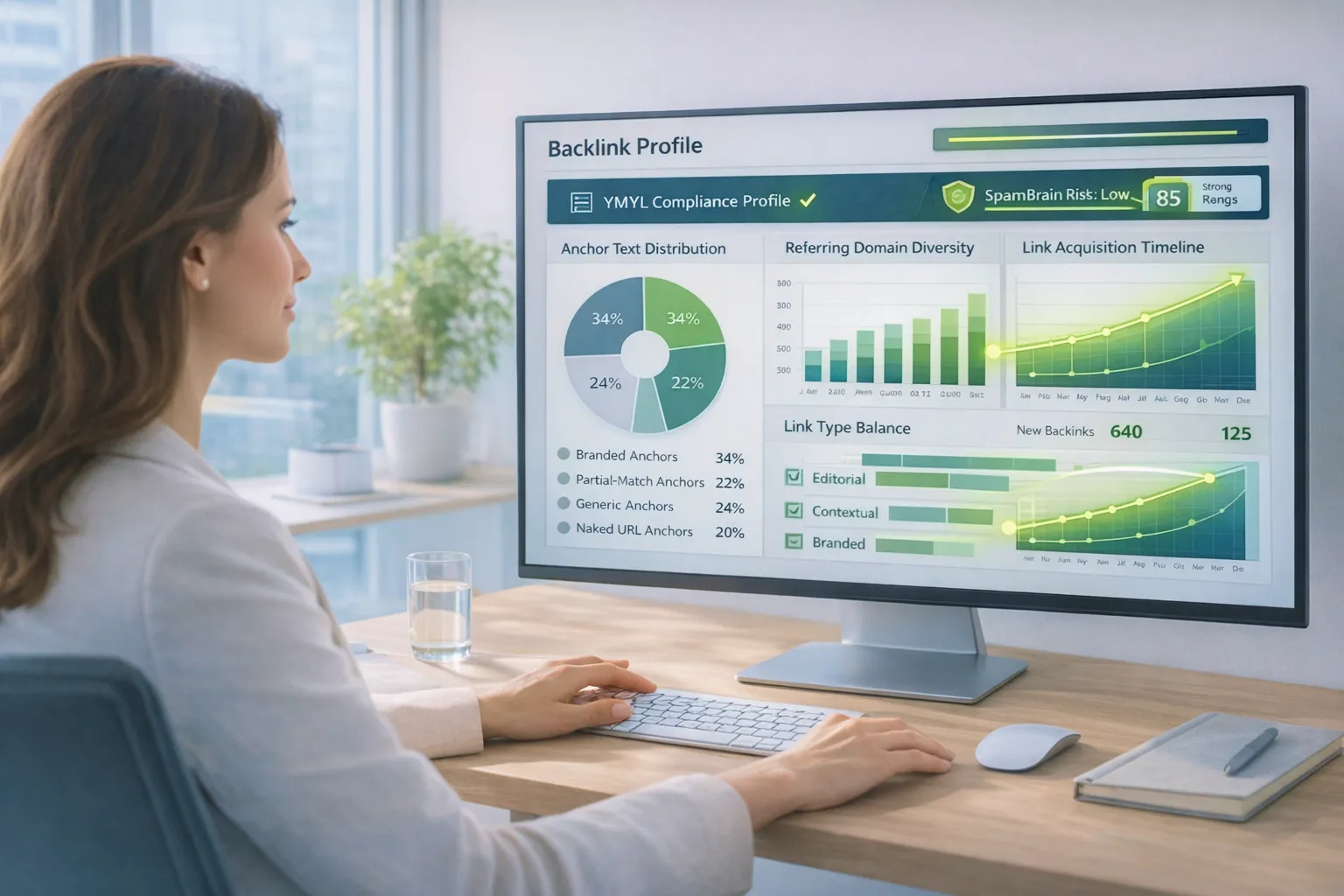
Client Success Stories
## What Clients Say About Our Link Building
Trusted by brands and agencies that value long-term SEO stability over risky shortcuts.
[View All
](https://outreachdesk.com/testimonial/)

4.8/5 

## 5/5 
Rating on Google



We struggled to find a partner that truly understood the CBD space. Many agencies refused or offered risky, low-quality placements. Outreach Desk secured consistent links from trusted wellness publishers, moving our key product pages into the top five within four months without compliance or reputational concerns.

#### CBD Brand Founder
US CBD Ecommerce Company


The compliance-aware approach is what sold us. In the CBD space, one bad placement can create real problems. Outreach Desk reviewed every publisher and every piece of content before our link went live. The quality was consistent across 40+ placements, and our organic traffic grew 85% in six months. We’ve renewed for a second year.

#### Marketing Director
CBD Wellness Brand


We manage link building for multiple CBD clients across education, retail, and product verticals. Outreach Desk handled niche sensitivity, topical alignment, editorial quality, and transparent reporting for every placement. Our clients saw measurable improvements in their rankings without any compliance concerns. We scaled from 10 to 35 links per month without adding any internal overhead.

#### SEO Director
Digital Marketing Agency
Service Framework
## Investment, Timeline, andDeliverables
Every CBD link building campaign is custom-scoped to your brand’s competitive landscape, compliance requirements, and growth goals. Here’s what shapes your investment:

### Number of links per month
Most CBD campaigns run between 10 and 50+ placements monthly, depending on competitive intensity and target keyword volume.

### Target domain rating range
Standard pricing includes DR 40-95 placements, while DR 70+ sites require premium pricing due to stricter editorial standards and CBD acceptance.

### Content requirements
Some placements require new guest post content; others use existing editorial opportunities, such as link insertions or niche edits.

### Campaign duration
Most CBD brands see measurable ranking movement within 3-4 months, with compounding results over 6-12 months.
Directional pricing
## $200 – $300+ per link
Plans range from $200 per link based on scale. Starter campaigns deliver 10 approved links monthly for testing, growth plans provide 20 links with faster turnaround and management, while custom programs support high-volume CBD campaigns with tailored parameters and priority support.
You get a detailed proposal after your strategy call, with exact link quantities, target DR ranges, projected timeline, and a month-by-month roadmap.
Book a Strategy Call
What You Get
## Client-Ready Reports for Every CBD Placement
Every placement is clearly documented, giving you complete visibility and confidence in every link earned for your CBD brand:

### Live Link URLs
You get direct access to every live published link placement, allowing you to verify each link is active and correctly positioned at any time.

### Content Context Overview
You see how each link fits naturally into the surrounding content, confirming topical relevance and editorial alignment with your CBD niche and compliance standards.

### Anchor & Target Mapping
You see which anchor text links to each destination page, providing clear visibility into distribution and optimization strategy across your CBD campaign.

### Campaign Summary
You get a clear summary of placements, domain metrics, delivery timeline, compliance status, and overall impact formatted for easy review and stakeholder sharing.
Our Approach
## Relevance-First CBD Link Approach
We prioritize contextual relevance over volume, manually reviewing each placement to strengthen authority while minimizing risk for CBD brands.
| Factor | In-House / DIY | |
| --- | --- | --- |
| CBD Publisher Access | Limited to publicly available sites. Many publishers
outright reject CBD content, restricting your
placement options. | Established relationships with CBD-friendly publishers
across wellness, health, and lifestyle verticals. Private
publisher network built for regulated niches. |
| Compliance Review | Self-managed. Risk of placing links in content with
unverified health claims or promotional language that
triggers compliance concerns. | Every placement is reviewed for regulatory sensitivity,
tone, claims, and editorial standards
before going live. |
| Publisher Vetting | Research quality varies by capacity. Often relies
on scraping tools or outdated databases with no
CBD-specific filters. | Every publisher is manually vetted for DR, organic
traffic, editorial standards, backlink health, and
acceptance of CBD content. 70% rejection rate. |
| Link Protection | Removed links must be tracked and replaced internally. | 6-month replacement guarantee. Links removed
by publishers are replaced at no extra cost. |
| Anchor Strategy | Anchor selection is often inconsistent, risking
over-optimization in a YMYL niche with elevated
penalty exposure. | Strategically planned anchor distribution designed around
your existing link profile to avoid
over-optimization risks. |
| Scalability | Limited by headcount, freelancer availability,
and CBD publisher access. | Scale from 10 to 100+ links/month without operational
disruption. No hiring, no training, no vendor management. |
| Tactics & Risk | Risk depends on internal process. Quality varies.
No CBD-specific compliance controls. | Strict editorial standards. No PBNs, no link exchanges,
no AI content. Only manual outreach and editorial
placements on CBD-vetted publishers. |
| Cost Efficiency | In-house: $400-$800 per link (salary, tools, overhead).
Freelancers: $150-$600 per link (variable quality,
limited CBD access). | Fixed pricing from $200-$300 per link with consistent
quality standards and compliance review on every placement. |
| Turnaround | In-house: 4-8 weeks. Freelancers: unpredictable,
especially in the CBD, where publisher acceptance is inconsistent. | First placements live within 2-4 weeks from kickoff. |
Who We Help
## CBD & Hemp Segments We Support
No matter your niche, you can secure links on websites that truly match your industry.
[

### SaaS & Software
](https://outreachdesk.com/saas-link-building/)
[

### Ecommerce & DTC
](https://outreachdesk.com/ecommerce-link-building/)
[

### B2B & Enterprise
](https://outreachdesk.com/b2b-link-building/)

### Startups

### Real Estate
[

### Law Firms & Legal
](https://outreachdesk.com/link-building-for-lawyers/)
[

### Dental Practices
](https://outreachdesk.com/link-building-for-dentists/)

### Healthcare & Fitness

### Financial & Insurance

### Technology & Innovation

### Consumer Brands
Real Results
## Results Achieved With CBD-Focused Link Building
You see how relevance-driven, editorial CBD links support improved authority, visibility, and long-term ranking growth in the competitive markets.
CBD link building
###
Premium CBD Oil Brand Grows Organic Revenue 540% After Google and Facebook Ad Bans Force a Channel Pivot
####
0 → 8
AI Overview
####
0 → 6
ChatGPT
####
0 → 12
Perplexity
####
0 → 5
Gemini
####
0 → 9
Copilot
####
24 → 41
Domain Rating
####
+214%
Organic Traffic
####
6 → 29
Page 1 Keywords
####
132
Links Built
A mid-size US CBD ecommerce brand selling tinctures, topicals, and edibles needed stronger authority in a crowded market. With fewer than 40 referring domains and strict ad restrictions limiting paid channels, organic search was critical. Outreach Desk launched a targeted campaign, securing vetted CBD-relevant editorial placements for product and educational pages. [Read More](https://outreachdesk.com/case-study/premium-cbd-oil-brand-grows-organic-revenue-540-after-google-and-facebook-ad-bans-force-a-channel-pivot/)
CBD link building
###
CBD Pet Wellness Brand Captures a Niche Market and Grows from $4K to $52K Monthly Organic Revenue in 9 Months
####
0 → 11
AI Overview
####
0 → 8
ChatGPT
####
0 → 14
Perplexity
####
0 → 6
Gemini
####
0 → 10
Copilot
####
29 → 39
Domain Rating
####
+81%
Organic Traffic
####
7 → 24
Page 1 Keywords
####
118
Links Built
A CBD wellness brand focused on education needed stronger rankings for competitive informational and commercial keywords, after inconsistent freelancer-built links and risky claims raised compliance concerns. Outreach Desk launched a compliance-first campaign with strict editorial review, ensuring every placement met regulatory tone, verified claims, and contextual relevance before publication to protect authority and growth. [Read More](https://outreachdesk.com/case-study/cbd-pet-wellness-brand-captures-a-niche-market-and-grows-from-4k-to-52k-monthly-organic-revenue-in-9-months/)
[View All
](/case-study/)
Common Questions
## Frequently Asked Questions
Answers about how CBD link building works including compliance, outreach, placements, and safe authority growth.
### What is CBD link building?
CBD link building focuses on earning backlinks for CBD and hemp-related websites through relevant, editorial placements.
### Is CBD link building safe for SEO?
Yes, when links are placed naturally within relevant content and follow white-hat practices.
### How long does it take to deliver CBD links?
Most placements go live within 1-3 weeks, depending on publisher response time.
### Do you provide reports?
Yes, reports include live URLs, content context, anchor text, and placement details.
### Do you work with all types of CBD businesses?
We work with compliant CBD brands, publishers, and informational sites, including products, brands, retailers, and other educational platforms.
### How do you handle CBD compliance when placing a link?
We review the content, claims, and placement tone to avoid any promotional signals or language that could raise compliance concerns.
### Will links be placed on existing or new content?
We place links in existing articles or newly created editorial content, depending on the context and publishers’ guidelines.
### Can you support product pages as well as informational content?
Yes, we define placements by product category, brand pages, and educational resources based on search intent.
### How do you choose anchor text for CBD links?
We use natural, intent-aligned anchors that fit editorial context and avoid over-optimization risks.
### Do you use private blog networks or paid link schemes?
No, we purely rely on editorial placements on real websites, avoiding PBNs and manipulative link tactics.
### Is this suitable for new e-commerce stores?
Yes, for newer stores, campaigns focus on building foundational authority at the category level before scaling to product-level targeting. This creates a strong base that supports rankings as your catalog grows. Newer stores typically start with 10-15 links per month focused on their 3-5 highest-priority categories.
### Is this suitable for YMYL and regulated niches beyond CBD?
Yes, our approach is relevance-first and is designed specifically for regulated, compliance-sensitive industries.
### What happens if a link is removed later?
We monitor placements and address removals when possible, maintaining transparency through reporting.
## Build Authority With CBD Links That Fit
If you want CBD backlinks that build your credibility and long-term growth, let’s help you move forward with confidence.
Book a Strategy Call

4.8/5 _
Trusted by 500+ agencies &
1,000+ businesses worldwide.

---
---
title: "Ecommerce Link Building Service"
url: "https://outreachdesk.com/ecommerce-link-building-service/"
lang: "en-US"
type: "page"
description: "Ecommerce Link Building Ecommerce Link Building Service for Product & Category Authority Your brand earns natural placement inside trusted editorial content, strengthening your authority across search engines, AI platforms, and your target audience. Featured on real, relevant sites Built for"
last_modified: "2026-05-27T04:44:40+00:00"
custom_fields:
header_style: "header-style-1"
footer_style: "footer-style-1"
---
# Ecommerce Link Building Service
Ecommerce Link Building
# Ecommerce Link Building Service for Product & Category Authority
Your brand earns natural placement inside trusted editorial content, strengthening your authority across search engines, AI platforms, and your target audience.
_
Featured on real, relevant sites

Built for search and AI visibility

Both linked and unlinked mentions
Book a Strategy Call

4.8/5 _
Trusted by 500+ agencies &
1,000+ businesses worldwide.
Average DR
40 – 95
Campaign Dashboard
LIVE
DOMAIN RATING
49 → 56
+7 points
ORGANIC TRAFFIC
+89%
18,600 → 35,200
PAGE 1 KEYWORDS
22→ 67
+45points
PLACEMENTS
120
95 unique domains
_
Sales Improved
130%










Service Overview
## What Ecommerce Link Building Really Means
Ecommerce link building is a fundamentally different discipline from standard link building. Generic services treat every website the same, pointing links to a homepage or a handful of blog posts. For ecommerce stores, this approach wastes budget and misses the pages that actually drive revenue.
Your store’s value lives in its product pages, category pages, and collection structures. These are the pages where buying decisions happen, where customers compare, evaluate, and convert. But they’re also the hardest pages to earn links to. Most publishers hesitate to link directly to commercial pages.
Ecommerce link building solves this by building a strategic authority architecture across your entire store. Instead of concentrating link equity on a single blog post, link value is distributed across your category hierarchy, key product pages, and supporting content, mirroring how search engines expect a healthy, authoritative ecommerce site to be structured.
Links are earned to the pages that matter most for your revenue, distributed strategically across your store architecture, and placed on sites where your customers are already researching and comparing.
This matters for three reasons:

### Search engines evaluate ecommerce sites differently
Links from relevant, trusted sources signal to Google that your products and categories hold genuine industry authority and expertise.

### Category authority compounds across products
A single well-placed category link lifts rankings across dozens of product pages through distributed internal link equity.

### AI and answer engine visibility depend on commercial authority
Stores with strong editorial mention footprints across trusted review and comparison sites appear frequently in AI shopping recommendations.
How It Works
## How your Links Grow
Your links align with your store’s structure, priorities, and growth goals through a simple, clear process.
### Store Architecture & Keyword Mapping
Your campaign starts with a deep analysis of your store’s structure with your dedicated account manager. Your strategist maps your category hierarchy, identifies priority product pages, evaluates internal linking patterns, and reviews your existing backlink distribution. Keyword research focuses specifically on commercial and transactional terms, the queries that drive purchases, not just traffic. Partnering with an expert link building agency typically shortens this process from months to weeks.
This produces a prioritized link target map: which categories need authority first, which product pages are closest to ranking, and which supporting content pages can serve as link magnets passing equity to commercial pages. You get a store-specific authority roadmap.
### Opportunity Research & Evaluation
Your team identifies placement opportunities across ecommerce-relevant content: product roundups, comparison articles, “best of” listicles, buyer’s guides, and niche editorial features. Every opportunity is evaluated for domain rating (DR 40-95), organic traffic (1,000+ monthly visits), topical relevance, editorial quality, and audience alignment.
Sites with thin content, spammy link profiles, inflated metrics, or irrelevant audiences are filtered out. Your strategist also identifies publications that appear as sources in Google AI Overviews and AI shopping recommendations for your target product categories, prioritizing placements that serve both traditional search and AI discovery.
### Contextual Fit & Page-Level Alignment
Each placement opportunity is evaluated for contextual fit with your target pages. Your strategist determines which specific page each link should point to, category, product, or supporting content based on the publisher’s content context, the search intent of the linking page, and your store’s authority distribution needs.
This is where ecommerce link building differs most from generic services. A link from a “best running shoes 2026” roundup should point to your running shoes category page or a specific product, not your blog. Your strategist ensures every link points to the page that generates the most commercial value.
### Personalized Publisher Outreach
Your outreach team contacts publishers directly with personalized pitches tailored to each site’s editorial standards and audience. No automated mass emails. No generic templates. Every outreach conversation focuses on how your product or brand adds genuine value to the publisher’s content.
All placement content is written by experienced professionals. Outreach Desk does not use AI-generated content for link placements. Every piece goes through internal editorial review before submission to ensure brand accuracy and editorial quality.
### Placement, Verification & Quality Review
Once content is published, your team checks every live link for quality. This includes verifying the target page, contextual relevance, anchor text, dofollow status, and page indexation. If a placement doesn’t meet standards or is on the wrong page, your team gets it corrected or secures a replacement at no extra cost.
### Reporting & Ongoing Monitoring
You receive structured reports documenting every live placement: link URL, target page, anchor text, domain metrics, content context, and indexation status. We provides strategic context alongside the data, explaining how each link supports your category authority goals and where the next-highest-impact opportunities lie.
Authority distribution is monitored across your store. If certain categories or products fall behind, your strategist adjusts targeting to rebalance authority flow, ensuring your entire catalog benefits, not just a few high-priority pages.

Expected Results
## Outcomes That Ecommerce Link Building Creates
When links fit with your store’s structure, they support both rankings and revenue growth.
- 1. Commercial Relevance
- 2. Link Growth
- 3. Rankings Stability
- 4. Authority
### High-Revenue Page Rankings
Ecommerce link building strengthens the relevance of your category and product pages for transactional and comparison searches that actually drive purchases.
When your links come from content aligned with buying intent, like product roundups, buyer’s guides, and comparison articles, search engines understand which of your pages deserve visibility for revenue-driving keywords.
One DTC apparel brand saw category page rankings improve from an average position of 18.4 to 6.2 across 23 target keywords after a focused 5-month link campaign distributing authority across their top 8 category pages. Organic revenue from those categories grew 89% year-over-year.

### Stable Despite Catalog Changes
Ecommerce stores face a unique challenge: products rotate, collections change with seasons, and catalog structures evolve. If all your link authority is concentrated on a few specific product URLs, you lose ranking power every time those pages are updated, redirected, or retired.
Strategic authority distribution across your category hierarchy creates ranking stability that survives catalog changes.
When category pages carry strong authority, new products added to those categories inherit link equity through internal linking, gaining a ranking advantage from day one without the need for dedicated link campaigns.

### More Products Ranking
Contextual links to category pages create a cascading authority effect across your entire product catalog. As category authority strengthens, individual products within those categories gain clearer relevance signals.
Search engines understand your catalog structure and recognize that your store is an authoritative source across your niche, not just for one or two popular products.
This catalog-wide authority effect is what separates stores that rank for hundreds of product-level queries from stores that only compete for a handful of head terms. It’s the difference between organic revenue from 5 products and organic revenue from 500.
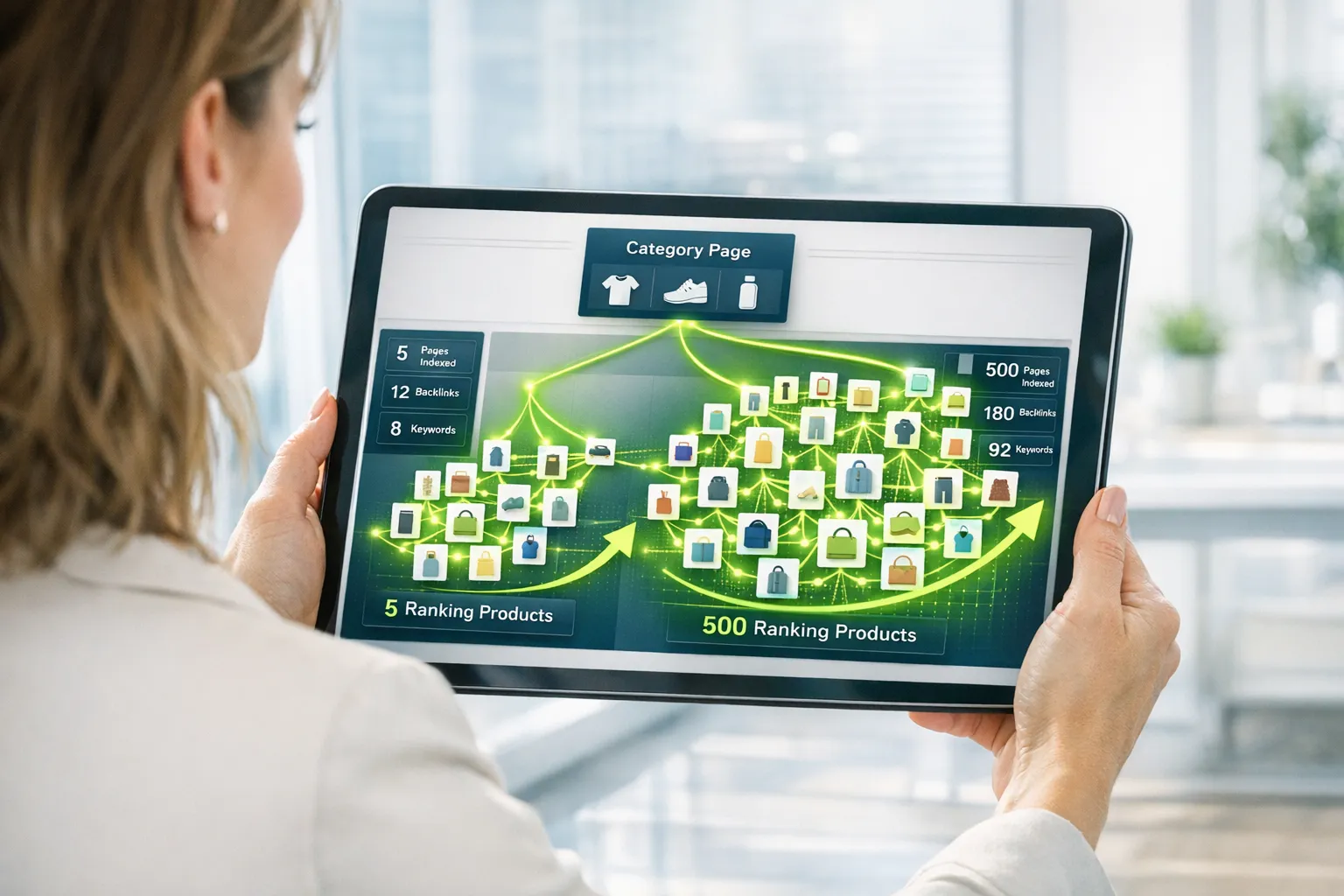
### Store-Wide Scalable Authority
Editorial placements across ecommerce-relevant content help your backlink profile grow naturally alongside your catalog expansion. As you add new product categories, your link-building strategy extends to support them, ensuring new sections of your store gain authority without aggressive, concentrated link acquisition that triggers algorithmic scrutiny.
This balanced approach follows Google’s guidelines, reduces the risk of over-optimization, and creates a sustainable link profile that supports long-term organic growth.
Brands that build link profiles this way typically see organic traffic growth accelerate in months 6-12 as authority compounds across your store.

Client Success Stories
## What Clients Say About Our Contextual Links
Verified reviews from the clients who gained authority, rankings, and revenue with our services
[View All
](https://outreachdesk.com/testimonial/)

4.8/5 

## 5/5 
Rating on Google



We’d been doing link building for two years with another agency, but every link went to our blog. Category pages, which account for 90% of our revenue, were stuck on page 2. Outreach Desk rebuilt our strategy around our top 12 categories. Within six months, organic revenue grew 67%.

#### Head of Growth
US DTC Brand


The biggest difference was how they mapped our links to our store structure. Most agencies don’t understand ecommerce architecture. Outreach Desk started by analyzing our category hierarchy and keyword gaps, then built a link plan that distributed authority exactly where we needed it. Our product pages now rank for commercial terms they never touched before.

#### Founder
B2B Services Company


We run SEO for 6 ecommerce clients and needed a link building partner who actually understands ecommerce store structures. Outreach Desk handles link campaigns across all six accounts with category-level targeting and transparent reporting. Four clients saw organic revenue increases of 40%+ within the first year. The white-label reporting makes it seamless for client delivery.

#### Director of SEO
Digital Agency
Service Framework
## Investment, Timeline, andDeliverables
Every ecommerce link building campaign is custom-scoped to your store’s architecture, competitive landscape, and revenue goals. Here’s what shapes your investment:

### Number of mentions per month
Most ecommerce campaigns run 10 and 40 placements monthly, depending on catalog size, competition, and target pages.

### Target domain rating range
DR 40-95 placements are priced at standard rates. DR 70+ placements carry a premium based on publisher requirements and competition.

### Mention format
Links are distributed across category pages, product pages, and supporting content based on your store’s authority architecture and revenue priorities.

### Campaign duration
Most stores see measurable improvements in category page rankings within 3-4 weeks. Compounding catalog-wide authority effects build over 6-12 months.
Directional pricing
## $200 – $300+ per link
Ecommerce link building campaigns start at $200 per link placement for targeted category or product page growth within a single niche. Enterprise ecommerce campaigns targeting multiple collections across competitive markets range from $250 to $300+ per link.
After your strategy call, you get a detailed proposal with exact mention quantities, target DR ranges, projected timeline, and a clear month-by-month roadmap.
Book a Strategy Call
What You Get
## Client-Ready Reports for Ecommerce Link Building
Every placement is clearly reported, so you know exactly where links are placed:

### Live Link URLs
You get direct access to every live-published placement, allowing you to verify that each link is active, correctly targeted, and positioned within relevant editorial content.

### Target Page Mapping
Every report shows which store page each link targets, giving you clear visibility into how authority is distributed across your architecture.

### Anchor & Context Overview
You see the exact anchor text used, the surrounding editorial context, and how each placement aligns with your commercial keyword and anchor strategy.

### Campaign Overview
Each summary covers total links delivered, page-level distribution, domain metrics, and authority flow across your store.
Our Approach
## An Approach to Link Building
Your links focus on relevance, commercial intent, and your store’s architecture, not just volume.
| Factor | In-House / DIY | |
| --- | --- | --- |
| Ecommerce Expertise | Requires hiring specialists with ecommerce SEO
knowledge. Most generalist link builders lack
an understanding of store structure. | You get built-in ecommerce expertise. Your
strategist understands category hierarchies, product
page authority, and how internal link equity flows. |
| Product page targeting | Most freelancers and DIY approaches default to
homepage or blog links. Acquiring direct product
page links requires specialized outreach. | You get strategic product and category page
targeting, with contextual placements in product roundups,
buyer’s guides, and comparison content. |
| Category authority | Difficult to scale. In-house teams rarely have the
publisher relationships needed for systematic
category-level link campaigns. | You benefit from systematic authority
distribution across your category hierarchy, with dedicated link target mapping and rebalancing. |
| Commercial intent
alignment | Hard to ensure link context matches buying intent.
Generalist approaches often produce informational
links that don’t support revenue keywords. | Every placement is evaluated for commercial intent.
Your links support transactional and comparison
keywords, not just informational queries. |
| Content Quality | Variable. In-house quality depends on the writers
available. Freelancers range from excellent to unusable. | All content is written by experienced writers.
No AI-generated copy. Every placement goes through
internal editorial review. |
| Scalability | Limited by headcount and freelancer availability.
Scaling from 10 to 40+ links/month requires
significant hiring. | You can scale from 10 to 40+ links per
month without operational disruption. Multi-store and
agency campaigns run seamlessly. |
| Cost Efficiency | In-house: $350-$700 per link (salary, tools,
overhead). Freelancers: $100-$400 per link
(variable quality, no store mapping). | You get fixed pricing from $200-$300 per
link with consistent quality, store-architecture
mapping, and editorial review included |
| Turnaround | In-house: 4-8 weeks for a consistent placement
pipeline. Freelancers: unpredictable. | Your first placements go live within
2-4 weeks. Delivery is consistent every month. |
Who We Help
## Ecommerce Businesses We Support
No matter your niche, you can secure links on websites that truly match your industry.
[

### SaaS & Software
](https://outreachdesk.com/saas-link-building/)
[

### Ecommerce & DTC
](https://outreachdesk.com/ecommerce-link-building/)
[

### B2B & Enterprise
](https://outreachdesk.com/b2b-link-building/)

### Startups

### Real Estate
[

### Law Firms & Legal
](https://outreachdesk.com/link-building-for-lawyers/)
[

### Dental Practices
](https://outreachdesk.com/link-building-for-dentists/)

### Healthcare & Fitness

### Financial & Insurance

### Technology & Innovation

### Consumer Brands
Real Results
## Real Results From Ecommerce Link Building
Examples of how strategic link building supports rankings and revenue growth.
E-commerce Link Building
###
Premium Skincare DTC Brand Grows Organic Revenue 320% and Reduces Paid Ad Dependency in 10 Months
####
0 → 15
AI Overview
####
0 → 11
ChatGPT
####
0 → 18
Perplexity
####
0 → 9
Gemini
####
0 → 13
Copilot
####
49 → 56
Domain Rating
####
+89%
Organic traffic
####
22 → 67
Page 1 Keywords
####
148
Links Built
A US-based apparel brand with 200+ products across 15 categories was stuck on page 2 for most of its commercial keywords. Outreach Desk mapped the site’s architecture, prioritized 8 revenue categories, and distributed authority across through product roundups, comparison articles, and buyer’s guide placements. [Read More](https://outreachdesk.com/case-study/premium-skincare-dtc-brand-grows-organic-revenue-320-and-reduces-paid-ad-dependency-in-10-months/)
E-commerce Link Building
###
Outdoor Gear Retailer Captures $1.8M in Organic Revenue by Dominating Buyer’s Guide Keywords in 8 Months
####
0 → 14
AI Overview
####
0 → 10
ChatGPT
####
0 → 16
Perplexity
####
0 → 8
Gemini
####
0 → 12
Copilot
####
47 → 56
Domain Rating
####
+18%
Organic Traffic
####
22 → 67
Page 1 Keywords
####
124
Links Built
A multi-category ecommerce platform selling home goods across 28 categories was losing market share to weak category authority. Outreach Desk built a phased link campaign targeting top categories first, then product-level pages, and finally emerging categories as the store expanded. [Read More](https://outreachdesk.com/case-study/outdoor-gear-retailer-captures-1-8m-in-organic-revenue-by-dominating-buyers-guide-keywords-in-8-months/)
E-commerce Link Building
###
Luxury Watch Reseller Builds Authority in a YMYL ECommerce Niche and Grows Organic Sales 410% in 12 Months
####
0 → 12
AI Overview
####
0 → 9
ChatGPT
####
0 → 14
Perplexity
####
0 → 7
Gemini
####
0 → 11
Copilot
####
43 → 54
Domain Rating
####
+60%
Organic Traffic
####
31 → 84
Page 1 Keywords
####
216
Links Built
A digital marketing agency managing SEO for 6 ecommerce clients needed a white-label link building partner with genuine ecommerce expertise. Clients ranged from niche DTC brands to multi-category retailers, each with different catalog structures and competitive landscapes. [Read More](https://outreachdesk.com/case-study/luxury-watch-reseller-builds-authority-in-a-ymyl-e-commerce-niche-and-grows-organic-sales-410-in-12-months/)
[View All
](/case-study/)
Common Questions
## Frequently Asked Questions
Understand how strategic brand mentions work and where and how they appear.
### What is ecommerce link building?
Ecommerce link building is the process of earning backlinks specifically designed to strengthen the authority of your store’s product pages, category pages, and supporting content. Unlike generic link building that targets homepages or blog posts, ecommerce link building distributes authority across your store architecture to improve rankings for the commercial keywords that drive revenue.
### Can you build links directly to product pages?
Yes, we earn links to both product and category pages through contextually relevant placements in product roundups, buyer’s guides, comparison articles, and editorial reviews. These are the content types where linking to specific products is natural and editorially justified. Your strategist determines the optimal product-to-category link ratio based on your store’s authority needs and competitive landscape.
### Is ecommerce link building safe for SEO?
Yes, all placements are contextual, editorial, and compliant with the guidelines. Links are earned through genuine publisher relationships and placed within relevant content. No PBNs, no paid link networks, no automated placements. The link types Google describes as natural and editorially earned in their own documentation.
### How long does it take to see results?
Most campaigns show ranking movement on category pages within 6-10 weeks. Product page improvements often follow as category authority cascades through internal linking. Compounding effects typically accelerate in months 4-8 as authority distribution strengthens across your store architecture. Revenue impact timelines depend on your average order value and conversion rate.
### How do you handle seasonal product changes?
Your strategist monitors your catalog for seasonal shifts, product rotations, and new category launches. Link targeting is adjusted proactively to support emerging categories and seasonal priorities. Authority built at the category level persists through product rotations, so seasonal changes don’t reset your link investment.
### Do you provide reports?
Yes, reports include live link URLs, target page mapping, anchor text details, domain metrics, content context, indexation status, and authority distribution across your store architecture. Reports are formatted for easy stakeholder review and are available as white-label documents for agency partners.
### Do you build links to category pages or just blog content?
Category pages are the primary focus of ecommerce link campaigns. Category-level authority has the greatest commercial impact because it boosts rankings for every product in that category via internal [link equity](https://outreachdesk.com/link-equity/). Blog content is used strategically as a secondary link target when it serves as an authority bridge to commercial pages, not as the default destination.
### How is ecommerce link building different from regular link building?
Regular link building treats every site the same, typically pointing links at a homepage or a few blog posts. Ecommerce link building is built around your store’s product and category architecture. It requires understanding internal link equity flow, category hierarchy, seasonal catalog changes, and commercial intent alignment. The link targets, content types, and outreach approach are fundamentally different.
### How do you ensure link relevance?
Every placement is reviewed for topical alignment, traffic quality, and contextual fit before outreach begins because relevance always comes before metrics.
### What anchor text strategy do you use?
Anchor text is planned around your existing backlink profile and commercial keyword targets. Distribution includes branded anchors, partial-match variations, generic anchors, and naked URLs. Your strategist monitors anchor text ratios to maintain a natural profile that avoids over-optimization risk while maximizing commercial relevance.
### Is this suitable for new ecommerce stores?
Yes, for newer stores, campaigns focus on building foundational authority at the category level before scaling to product-level targeting. This creates a strong base that supports rankings as your catalog grows. Newer stores typically start with 10-15 links per month focused on their 3-5 highest-priority categories.
### Do you coordinate with our internal SEO team?
Yes, we do collaborate directly with in-house SEO teams and agency partners to align anchor strategy, link targets, and content calendar. Your strategist participates in alignment calls and shares reporting that integrates with your existing SEO workflows.
### How many links does my ecommerce store need per month?
It depends on your catalog size, competitive landscape, and how many categories need authority. Smaller stores with 5-10 categories typically see strong results from 10-15 links per month. Multi-category stores competing for high-value commercial keywords usually need 20-40+ links per month. Your strategist analyzes competitor link profiles and your authority gaps to recommend the right velocity.
### Can you handle multi-store or international ecommerce campaigns?
Yes, we manage multi-store campaigns for brands operating across multiple Shopify stores, WooCommerce sites, or international domains. Link strategies are customized for each store and market, with consolidated reporting for operational clarity.
## Scale Your Ecommerce Visibility With Strategic Link Building
If you want ecommerce backlinks that strengthen your authority, drive growth, and deliver long-term results, move forward with confidence.
Book a Strategy Call

4.8/5 _
Trusted by 500+ agencies &
1,000+ businesses worldwide.

---
---
title: "Brand Mention Service Page"
url: "https://outreachdesk.com/brand-mention-service/"
lang: "en-US"
type: "page"
description: "Brand Mention Brand Mention Service That Builds Authority and Visibility Your brand naturally appears in trusted editorial content, strengthening your authority across search engines, AI platforms, and the sites your audience already reads. Featured on trusted, relevant websites. Built for"
last_modified: "2026-05-27T04:42:17+00:00"
custom_fields:
header_style: "header-style-1"
footer_style: "footer-style-1"
---
# Brand Mention Service Page
Brand Mention
# Brand Mention Service That Builds Authority and Visibility
Your brand naturally appears in trusted editorial content, strengthening your authority across search engines, AI platforms, and the sites your audience already reads.
_
Featured on trusted, relevant websites.

Built for search and AI visibility.

Both linked and unlinked mentions.
Book a Strategy Call

4.8/5 _
Trusted by 500+ agencies &
1,000+ businesses worldwide.
Average DR
40 – 95
Campaign Dashboard
LIVE
DOMAIN RATING
44 → 58
+14 points
ORGANIC TRAFFIC
+73%
9,200 → 15,800
PAGE 1 KEYWORDS
3 → 31
+28 points
PLACEMENTS
90
72 unique domains
_
Ai Visibility
+300%










Service Overview
## What Brand Mentions Actually Mean
You get your brand, products, or services inside the trusted editorial content across the web. It includes listicles, expert roundups, product reviews, comparison articles, and editorial features your audiences are already looking for.
Unlike traditional link building, which focuses only on backlinks, brand mentions strengthen your overall brand recognition. It helps the search engines and AI platforms understand your identity, expertise, and credibility.
This matters more than ever because of how AI search is changing discovery. Large language models like ChatGPT, Google’s AI Overviews, Perplexity, and Bing Copilot don’t rely solely on traditional link graphs. They read and interpret text across millions of pages, building associations between brands and topics. According to Ahrefs’ study of 75,000 brands, branded web mentions, including both linked and unlinked references, had the strongest correlation with brand appearance in AI Overviews.
For brands like your competing in markets where paid ads are restricted, trust-based, or costly, editorial brand mentions give you the highest leverage for building sustainable visibility across search and AI discovery.

### Editorial Placement, Not Promotional Insertion
You earn trust by appearing naturally inside real content that both readers and search engines already trust.

### Entity Signal Building
Consistent mentions across trusted sites help the search engines and AI models associate your brand with the right topics.

### Dual-Channel Visibility
Mentions drive traditional SEO authority signals and referral traffic, while building the citation footprint that AI platforms use to recommend your brand.
How It Works
## How Your Mentions Work
Your brand is placed through a controlled, editorial-first workflow that reduces risk and uncertainty.
### Brand Discovery & Strategy Alignment
Before any mention goes live, we start with a detailed alignment call. You share your brand positioning, target audience, competitive landscape, and growth objectives with your strategist. Working with manual citation building experts can compress this process from months to weeks.
Your strategist maps your brand’s current mention footprint, where competitors appear without you, and where the highest-impact placement opportunities exist, including listicles, comparison articles, and editorial roundups that rank for your target keywords. You get a clear placement roadmap, not a generic “let’s get mentions everywhere” approach.
### Opportunity Research & Evaluation
Your team identifies high-value placement opportunities across listicles, expert roundups, review articles, comparison pages, and editorial features relevant to your brand and industry. Every opportunity is evaluated for domain rating (typically DR 40-95), organic traffic (minimum 1,000+ monthly visits), content relevance, editorial standards, and audience alignment.
Sites with thin content, spammy link profiles, and inflated metrics are excluded. Your strategist also cross-references which publications appear as sources in Google AI Overviews and LLM responses, prioritizing placements that serve both traditional search and AI discovery.
### Placement Strategy & Content Planning
Each opportunity is studied for content quality, editorial tone, audience alignment, and brand sustainability before outreach begins. Your strategist determines the optimal mention format: brand name reference, product feature, use-case example, or expert positioning based on what fits naturally within each piece of content. For predictable results, a manual outreach team typically handle the prospecting and outreach end-to-end.
Anchor text strategy (for linked mentions) is planned around your existing backlink profile and brand signal distribution. The goal is a natural mix of linked and unlinked mentions that builds entity recognition without over-optimization risk.
### Personalized Publisher Outreach
Your outreach specialists contact editors and site owners directly. No automated mass emails. Every pitch is personalized to the publisher’s content style, editorial standards, and recent topics. Outreach conversations cover placement expectations, brand positioning requirements, mention format, and timeline.
Every placement is reviewed by experienced writers. Outreach Desk does not use AI-generated content for placement copy. Every mention is reviewed by internal editors before submission.
### Placement, Verification & Quality Review
Once content is published, your team verifies every live mention. Checks include correct brand representation, proper placement, link attribution (dofollow where it matters), and page indexation status. If a mention does not meet quality standards, is inaccurate, or ends up on a non-indexed page, your team fixes it or secures a replacement at no extra cost.
### Reporting & Ongoing Monitoring
You receive structured reports with every live mention URL, placement context, link status (linked/unlinked), domain metrics, content surrounding the mention, and indexation confirmation. Your strategist adds context, not just data, explaining how each mention supports your brand’s authority, entity recognition, and AI visibility goals.
Mentions are monitored post-placement. If a publisher removes content or a site’s quality drops, your team flags it and works on replacements proactively within the 12-month protection period.

Expected Results
## Real Visibility Gains
When your brand is mentioned consistently and naturally across relevant websites, the impact shows up in trust, visibility, and authority, not just links.
- 1. Referral Traffic
- 2. Brand Reputation
- 3. Ranking Support
- 4. AI Visibility
### High-Intent Visitors From Trusted Content
Referral traffic from brand mentions carries higher intent than most paid channels. Visitors discover your brand inside trusted listicles, reviews, and editorial recommendations where they’re actively evaluating solutions. Because your brand appears in a relevant, credible context, visitors arrive with built-in trust and clearer purchase intent.
One SaaS client saw a 34% increase in qualified demo requests after 28 brand mentions across industry-relevant listicles and comparison articles in four months. These visitors converted at 2.4x the rate of organic search traffic because they’d already found the brand in trusted recommendations.
### Credibility Built Through Association and Context
Your brand gains positive recognition when it appears alongside other trusted names in relevant editorial content. This association builds credibility before prospects ever visit your site. Clear context around your product or service, describing what you do, who you serve, and why you’re different, shapes perception at the earliest stage of the buyer journey.
Consistent editorial mentions build your reputation over time. Search engines factor sentiment and mention frequency into their authority assessments. When prospects see your brand across trusted sources, they become more familiar and convert faster.
### Authority Signals That Strengthen Search Performance
When your brand earns mentions on trusted websites, search engines interpret these references as credibility signals. Google’s algorithms use both linked and unlinked mentions to evaluate a brand’s authority and relevance within its industry. Over time, consistent mentions help your target pages compete more effectively for competitive keywords.
This is especially powerful if your brand is in a competitive niche where backlinks alone aren’t enough. Brand mentions create the broader authority context that helps Google see your brand as a recognized leader, not just a site with links.

### Search and LLM Recognition
This is the most significant shift in digital visibility since Google introduced PageRank. Unlike traditional search engines, large language models read and interpret text, building associations between brands and topics based on frequency, context, and source quality. When your brand consistently appears in trusted editorial content, LLMs start associating it with the topics and solutions your customers search for.
Brands in AI Overviews for transactional queries get 3.2x more clicks than those in traditional search results. LLM referral traffic is estimated to be 4.4x more valuable because AI users research with higher purchase intent. Building your mention footprint today positions you to capture this fast-growing discovery channel.

Client Success Stories
## What Our Clients Say About Brand Mention Service
Reviews from leaders who gained authority, rankings, and revenue with our services.
[View All
](https://outreachdesk.com/testimonial/)

4.8/5 

## 5/5 
Rating on Google



We’d been focused entirely on backlinks for years and couldn’t understand why our AI visibility was stalling. Outreach Desk secured 35+ relevant listicles and comparison articles. Within six months, branded search volume grew, and we started appearing in ChatGPT recommendations.

#### VP of Marketing
US SaaS Company


Every mention landed in real editorial content, relevant listicles, and industry roundups, not sponsored blocks or low-quality blogs. Within four months, our brand appeared in Google AI Overviews. The reporting was clear, and the process was transparent from day one.

#### Founder
B2B Services Company


We manage SEO for e-commerce clients and needed a scalable way to expand brand presence beyond links. Outreach Desk delivered consistent quality and transparent reporting. Three clients now appear in AI Overviews, and the efficiency compared to in-house execution is significant.

#### SEO Director
Digital Marketing Agency
Service Framework
## Investment, Timeline, andDeliverables
Every brand mention campaign is custom-scoped to your competitive landscape, industry, and visibility goals. Here’s what shapes your investment:

### Number Of Mentions Per Month
Most campaigns run between 5 and 30+ placements monthly, depending on competitive intensity and visibility objectives

### Target Domain Rating Range
Placements on DR 40-95 sites are included in standard pricing. DR 70+ placements carry a premium based on publisher editorial requirements.

### Mention Format
Listicle inclusions, review features, comparison articles, and expert roundups. Linked mentions and unlinked brand references are strategically balanced.

### Campaign Duration
Most brands see measurable improvements in branded search volume and AI visibility within 3-4 months, with compounding results over 6-12 months.
Directional pricing
## $200 – $300+ per link
Brand mention campaigns usually start at $200 per link for targeted visibility within a single niche. Enterprise campaigns spanning multiple keyword clusters and high-authority publications range from $250 to $300+ per mention.
After your strategy call, you get a detailed proposal with exact mention quantities, target DR ranges, projected timeline, and a month-by-month roadmap. No hidden fees. No vague answers.
Book a Strategy Call
What You Get
## Reports Built for You
Simple, clear reports designed for quick, easy understanding.

### Live URL Placement
You get direct access to every live-published mention, allowing you to verify that each placement is correctly positioned and accurately represents your brand.

### Content Context
Every placement includes the complete context, showing topical relevance, tone, and how your brand is positioned alongside others.

### Link and Mention Mapping
Every report shows linked and unlinked mentions, and how each placement connects to your pages and entity strategy.

### Campaign Summary
You get a clear summary of total mentions placed, linked vs. unlinked distribution, domain metrics, AI visibility indicators, and overall impact.
Our Approach
## Designed for Relevance
You earn mentions based on relevance, editorial alignment, and relationship-based outreach, not automation or volume-driven tactics.
| Factor | In-House / DIY | |
| --- | --- | --- |
| Mention discovery | Manual research is limited by team capacity and access
to tools. Often misses AI-sourced
placement opportunities. | Systematic discovery, including AI Overview source
mapping. Identifies placements that feed both
search and LLM visibility. |
| Relevance filtering | Time-consuming. Relevance assessment varies by
individual researchers’ judgment and experience. | Strategic filtering based on topical alignment, audience fit,
domain authority, organic traffic, and AI
source verification. |
| Publisher Outreach | Skill-dependent. Quality varies by who’s doing the
outreach. No established publisher relationships. | Personalized, editorial-first outreach through established
publisher relationships. No automated pitches. |
| Mention Quality | Uncertain. Placement context, brand accuracy, and
editorial tone are difficult to control. | Every mention is reviewed for brand accuracy, editorial
context, and strategic alignment before going live. |
| Link + Mention
Balance | Often focuses exclusively on links, missing the
entity-building value of unlinked mentions. | Strategic balance of linked backlinks and unlinked
brand references for natural entity signal distribution. |
| AI Visibility Strategy | Rarely considered. Most in-house and freelancer
approaches don’t account for LLM citation patterns. | Placements are prioritized on sites that appear as
sources in AI Overviews and LLM responses for target topics. |
| Scalability | Limited by headcount and freelancer availability. | Scale from 10 to 100+ mentions/month without
operational disruption. |
| Cost Efficiency | In-house: $300-$600 per mention (salary, tools, overhead).
Freelancers: $100-$400 per mention (variable quality). | Fixed pricing from $200-$300 per mention with consistent
quality standards and editorial review on
every placement. |
| Turnaround | In-house: 3-6 weeks. Freelancers:
unpredictable. | First placements live within 2-4 weeks
from kickoff. |
Who We Help
## Industries That Benefit from Brand Mentions
You get a tailored approach based on your industry’s standards and competitive landscape.
[

### SaaS & Software
](https://outreachdesk.com/saas-link-building/)
[

### Ecommerce & DTC
](https://outreachdesk.com/ecommerce-link-building/)
[

### B2B & Enterprise
](https://outreachdesk.com/b2b-link-building/)

### Startups

### Real Estate
[

### Law Firms & Legal
](https://outreachdesk.com/link-building-for-lawyers/)
[

### Dental Practices
](https://outreachdesk.com/link-building-for-dentists/)

### Healthcare & Fitness

### Financial & Insurance

### Technology & Innovation

### Consumer Brands
Real Results
## Real Results From Strategic Brand Mentions
Examples of how consistent brand mentions improve authority, trust, and long-term visibility.
Brand Mentions
###
Project Management Tool Builds Top-of-Mind Awareness Across 180+ Industry Mentions in 8 Months
####
0 → 16
AI Overview
####
0 → 22
ChatGPT
####
0 → 25
Perplexity
####
0 → 14
Gemini
####
0 → 18
Copilot
####
48 → 61
Domain Rating
####
+52%
Organic Traffic
####
0 → 28
Page 1 keyword
####
118
Links Built
A mid-market US SaaS company in the project management space had strong organic rankings but no AI visibility. Outreach Desk launched a targeted mention campaign across industry listicles, comparison articles, and expert roundups, prioritizing publications that had already been cited as sources for the AI Overview. [Read More](https://outreachdesk.com/case-study/project-management-tool-builds-top-of-mind-awareness-across-180-industry-mentions-in-8-months/)
Brand Mentions
###
Email Marketing Platform Breaks Into Enterprise Consideration Set with 210+ Strategic Brand Mentions
####
0 → 19
AI Overview
####
0 → 24
ChatGPT
####
0 → 28
Perplexity
####
0 → 16
Gemini
####
0 → 20
Copilot
####
44 → 58
Domain Rating
####
+73%
Organic traffic
####
3 → 31
Page 1 Keywords
####
146
Links Built
A B2B consulting firm had minimal brand presence beyond its own website and lacked visibility in industry listicles, comparison articles, or editorial roundups. Outreach Desk built a mention strategy targeting “best [service category]” listicles, expert roundups, and niche comparison articles. [Read More](https://outreachdesk.com/case-study/email-marketing-platform-breaks-into-enterprise-consideration-set-with-210-strategic-brand-mentions/)
Brand Mentions
###
Cybersecurity Training Platform Reaches 4,000+ Monthly Branded Searches Through Community-Driven Mentions
####
0 → 13
AI Overview
####
0 → 17
ChatGPT
####
0 → 20
Perplexity
####
0 → 11
Gemini
####
0 → 15
Copilot
####
38 → 54
Domain Rating
####
+68%
Organic Traffic
####
0 → 44
Page 1 Keywords
####
172
Links Built
A digital marketing agency managing 8 ecommerce clients needed to add brand mention campaigns to their service offering without building internal capacity. Clients needed visibility in product review articles, comparison listicles, and “Best [product category]” roundups. [Read More](https://outreachdesk.com/case-study/cybersecurity-training-platform-reaches-4000-monthly-branded-searches-through-community-driven-mentions/)
[View All
](/case-study/)
Common Questions
## Frequently Asked Questions
Understand how strategic brand mentions work and where and how they appear.
### What is a brand mention service?
A brand mention service places your brand name, products, or services inside relevant editorial content on trusted websites. This includes listicles, expert roundups, product reviews, comparison articles, and editorial features. Mentions can include contextual backlinks where editorially appropriate, or appear as unlinked brand references that build entity recognition.
### How are brand mentions different from guest posting or link building?
Guest posting creates new content on third-party sites. Traditional link building focuses primarily on earning backlinks. [Brand mentions](https://outreachdesk.com/brand-mentions/) work within existing or naturally relevant editorial content, placing your brand where readers and search engines already look for recommendations. The goal is broader than a backlink; it’s building entity recognition, brand association, and citation signals that support both SEO and AI visibility.
### Do brand mentions help with AI visibility (ChatGPT, AI Overviews, Perplexity)?
Yes, large language models build associations between brands and topics by reading text across millions of pages. When your brand consistently appears in trusted editorial content, AI platforms begin to recognize and recommend it for relevant queries. Research shows that branded web mentions have the strongest correlation with brand appearance in AI Overviews. Building your mention footprint now positions you for the fastest-growing discovery channel in digital marketing.
### Is this only for unlinked brand mentions?
No, we work with both linked and unlinked mentions. Linked mentions include contextual [dofollow backlinks](https://outreachdesk.com/dofollow-backlinks/) where editorially appropriate. Unlinked mentions build entity recognition and brand authority signals. The strategic balance between linked and unlinked mentions creates a natural brand footprint that serves both traditional SEO and AI visibility.
### How is this different from guest posting?
Guest posting creates new content. Brand mentions work within existing or naturally relevant editorial content.
### Are brand mention links safe for SEO?
Yes, all mentions and links are placed naturally within editorial content and follow white-hat standards. Placements are contextual, relevant, and editorially justified. No paid link schemes, no PBNs, no automated placements. Links earned through legitimate editorial processes are the type that Google’s documentation describes as natural
### Can I approve websites before outreach?
Yes, you review and approve prospective websites before any placement moves forward. You see domain rating, organic traffic data, niche category, AI source status, and sample content. If a site doesn’t meet your standards, the team finds an alternative.
### How long does it take?
Most placements go live within 2-4 weeks from campaign kickoff. Measurable improvements in branded search volume and AI visibility typically appear within 2-4 months. Compounding results in authority, rankings, and entity recognition build over 6-12 months of consistent mention activity.
### Do you provide reports?
Yes, Reports include live mention URLs, content context, link status (linked/unlinked), anchor text details, domain metrics, indexation status, and AI visibility indicators. Reports are structured for easy review and stakeholder sharing.
### Which industries work best?
SaaS, ecommerce, finance, healthcare, legal, real estate, and regulated niches.
### How do you decide where a brand mention fits naturally?
Your strategist evaluates topical relevance, existing content quality, editorial alignment, audience fit, and AI source status before recommending any placement. Mentions are only placed where your brand adds genuine value to the editorial context, never forced into irrelevant content.
### Is this suitable for early-stage brands?
Yes, we adapt placements, so newer brands can earn credibility without any forced placement.
### Can brand mentions support product launches or PR campaigns?
Yes, mentions campaigns can be aligned with product launches, feature announcements, funding milestones, or key events. Timed placements in relevant listicles and roundups amplify launch visibility across search, AI, and referral channels simultaneously.
### Will my brand be described accurately?
Yes, your strategist reviews your brand positioning, use cases, and messaging guidelines before any outreach begins. Every mention is checked for accuracy, tone, and strategic alignment before going live. You maintain control over how your brand is represented in every placement.
### Do you control the anchor text used?
For linked mentions, anchor text is planned strategically based on your existing backlink profile and keyword targets. You can review and guide anchor preferences. Anchors are selected contextually to fit editorial tone while supporting your SEO objectives without over-optimization risk.
### Do you share target publications before placement?
Yes, we provide shortlists or the live site approvals, depending on the campaign structure.
### Are the links always dofollow?
Dofollow links are prioritized for linked mentions. However, the primary value of brand mentions extends beyond link attributes. Editorial context, brand positioning, entity recognition, and AI visibility signals are all delivered regardless of link type. Placement quality and editorial integrity always come first.
### How many mentions do I need per month?
It depends on your competitive landscape. Brands in less competitive niches might see strong results from 5-10 quality mentions per month. Brands competing for high-value keywords or AI visibility in competitive markets typically need 15-30+ mentions per month. Your strategist analyzes your competitors’ mention footprint and recommends velocity based on your growth goals.
## Ready to Turn Brand Mentions Into Powerful Backlinks?
Your brand is already part of the conversation. Now it’s time to turn those mentions into stronger signals of authority. We help you identify unlinked mentions and secure contextual placements that build long-term growth.
Book a Strategy Call

4.8/5 _
Trusted by 500+ agencies &
1,000+ businesses worldwide.

---
---
title: "Digital PR Service"
url: "https://outreachdesk.com/digital-pr-service/"
lang: "en-US"
type: "page"
description: "Digital PR Digital PR Service for High-Authority Media Backlinks Your brand earns editorial mentions and backlinks that are placed within authoritative publications to strengthen credibility, improve rankings, and build long-term visibility. Real journalists, real publications No paid link schemes. No"
last_modified: "2026-05-27T04:40:14+00:00"
custom_fields:
header_style: "header-style-1"
footer_style: "footer-style-1"
---
# Digital PR Service
Digital PR
# Digital PR Service for High-Authority Media Backlinks
Your brand earns editorial mentions and backlinks that are placed within authoritative publications to strengthen credibility, improve rankings, and build long-term visibility.
_
Real journalists, real publications

No paid link schemes. No artificial placements

Editorial coverage with genuine authority
Book a Strategy Call

4.8/5 _
Trusted by 500+ agencies &
1,000+ businesses worldwide.
Average DR
40 – 95
Campaign Dashboard
LIVE
DOMAIN RATING
21 → 46
+25 points
ORGANIC TRAFFIC
+817%
1,800 → 16,500
PAGE 1 KEYWORDS
2→ 24
+22 points
PLACEMENTS
120
95 unique domains
_
Branded Traffic
+75%










Service Overview
## What Digital PR Really Delivers
Digital PR is the process of earning editorial mentions and backlinks through data-driven stories, research campaigns, and expert insights published on trusted websites. We identify newsworthy angles that are aligned with your industry, develop assets such as surveys, reports, and expert commentary, and pitch these stories directly to journalists and editors. Each placement strengthens your backlink profile.
Unlike traditional link placements or guest posting, digital PR secures coverage inside genuine news stories, industry reports, and editorial features that publications choose to publish.
As a result, you get consistent editorial coverage, high-authority backlinks, increased referral traffic, and stronger credibility that drives measurable long-term growth.
For brands, digital PR delivers the highest-authority backlinks that are available. It strengthens brand perception, improves domain trust, and builds visibility across search and media.
Three things define a strong digital PR placement:

### Strong relevance
The coverage focuses on the topics that genuinely matter to your industry, making your brand part of a meaningful conversation.

### Editorial integrity
The mention appears in the body of an article written or approved by journalists, not inside the sponsored advertorial blocks.

### Publication authority
The media site has organic traffic, a trusted readership, and high editorial standards.
How It Works
## Clear Campaign Process
You follow a clear workflow to secure meaningful editorial coverage and reduce uncertainty.
### Insight & Topic Research
Before pitching to a single journalist, your campaign begins with research into your industry, trending topics, and publisher interests.
Your strategies identify data gaps, trending conversions, and high-impact angles that journalists are already covering.
You get a roadmap for your campaign to work on, based on opportunities rather than a generic press release.
### Campaign Ideation
Your team develops effective reports supported by data, insights, surveys, expert commentary, or research.
Each campaign is designed to serve both the journalists and your lasting SEO goals.
The story must be genuinely publishable. If it does not pass editorial review, it does not move forward.
### Content & Asset Creation
High-authority coverage requires strong assets. Your campaign may include original reports, statistics, infographics, commentary, or data visualizations.
Everything is prepared for media usability, clear headlines, quotable insights, and publication-ready formats.
This practice dramatically increases pickup rates and the quality of link acquisition.
### Media Outreach
Your outreach specialists pitch directly to journalists, editors, and publication contributors. No mass automation. No bulk email lists.
Each pitch is personalized based on the journalist’s beat, recent articles, and editorial focus. Conversations focus on value, not link requests.
Every conversation prioritizes value and relevance, building genuine relationships that earn editorial placements.
### Editorial Coverage
When journalists publish your story, your brand earns natural mentions and backlinks in the trusted media content. These placements are editorial decisions, not paid inserts. When the workload outgrows in-house capacity, hiring a link building agency is usually the next step.
Your coverage appears where audiences already consume information and make decisions.
It strengthens credibility while focusing on long-term organic visibility.
### Reporting & Review
You receive a detailed report covering every publication, backlink, anchor usage, domain rating, and estimated traffic metrics.
We explains what each placement contributes to your authority and search visibility.
Coverage is monitored post publication. If a link changes or coverage is removed, your team tracks and addresses it.

Expected Results
## Outcomes That Digital PR Delivers
When your brand is featured in authoritative publications, it strengthens your credibility and long-term visibility.
- 1. Revenue-Driven Authority
- 2. Brand Authority
- 3. Visibility & Referral Traffic
- 4. Algorithm-Resilient Authority
### Visibility on Competitive Topics
Editorial backlinks send trust signals. When respected media sites mention your brand, search engines recognize it as a credible authority in your space.
Your key commercial and informational pages gain momentum in search rankings. One SaaS client saw their core landing page move from position 18 to 5 within five months after securing consistent national media coverage.
This is not just about volume. Three authoritative editorial links from trusted publications can outperform dozens of low-quality publications.

### Authority That Builds Over Time
Every media placement strengthens your backlinks profile with high-trust referring domains.
As your authority compounds, new content ranks fast. Existing pages are more stable than competitors’. pages. Your domain builds recognized industry trust.
Data from SEO platforms consistently shows that referring domains from authoritative media correlate with higher ranking stability.

### Referral Traffic From Trusted Sources
Digital PR placements don’t just support SEO, but it also directly sends visitors to your site.
When your brand is cited within a story that readers already trust, those clicks carry intent and credibility.
Brands featured in a publication with more monthly organic visitors often see measurable referral traffic increase within days.

### Update-Proof Link Profile
Google’s spam system targets manipulative link tactics such as PBNs, exchanges, and unnatural placements.
Editorial media links are earned through genuine journalism match Google’s definition of natural backlinks.
Your authority remains protected because the coverage exists for editorial reasons and not for SEO manipulation.

Client Success Stories
## What Clients Say About Our Digital PR Services
Reviews from leaders who trust our service and secured authority, rankings, and revenue.
[View All
](https://outreachdesk.com/testimonial/)

4.8/5 

## 5/5 
Rating on Google



Our digital PR campaign positioned us inside major industry publications. Within four months, our branded search volume increased, and our primary service page moved to the top 5. The coverage felt genuine and strategic.

#### VP Sales
SaaS


The approval process stood out. We reviewed the story angle and media targets before the outreach began. Every publication aligned with our industry positioning.

#### Lead SEO
Fintech


Credibility is a crucial part. The editorial mentions survived multiple core updates and strengthened our long-term positioning.

#### Marketing Head
Legal Tech
Service Framework
## Investment, Timeline, andDeliverables
Every digital PR campaign is custom-scoped to your industry, competitive landscape, and growth goals. Here’s what shapes your investment:

### Campaign Complexity
Data-driven research campaigns require deeper development than reactive pitching.

### Publication Targets
National media coverage requires a different level of outreach than niche industry placements.

### Asset Creation
Original reports, surveys, or data studies increase production requirements.

### Campaign duration
Most clients see measurable improvements in authority and ranking within 3-4 months, with compounding impact over 6-12 months.
Directional pricing
## $200 – $300+ per link
Digital PR campaigns typically start at $200 per link for focused industry campaigns. Every campaign targeting national media and multiple verticals ranges from $250-$350+ per link.
You get a detailed proposal after your strategy call, including publication, targets, campaign roadmaps, and projected timelines.
Book a Strategy Call
What You Get
## Client-Ready Reports for Digital PR Campaigns
Every placement is clearly reported, so you know what and where exactly links are placed:

### Live Coverage URLs
Direct access to published media mentions, so you can verify the placements anytime you want.

### Publication Overview
See why each publication is relevant and authoritative, and strategically aligned with your brand.

### Link & Mention Mapping
Understand how each media mention connects directly to your target pages and goals.

### Campaign Summary
Get a clear overview of placements, backlinks, and the impact on your visibility.
Our Approach
## A Growth-Driven Approach Link Placement
Your campaign stays relevant, story-driven, and editorially aligned-instead of generic promotion.
| Factor | In-House / DIY | |
| --- | --- | --- |
| Story approval
and control | Story ideas are often developed internally
without media validation | You get to approve the campaign angles, core
data themes, and target publication before
the outreach begins. |
| Journalist and
publication vetting | Media lists may rely on generic databases
or scraped contacts. | Every journalist and publication is manually
vetted for editorial credibility, relevance,
organic traffic, and authority. |
| Editorial standards
alignment | Content may resemble promotional press releases
rather than journalist-ready stories. | Campaigns are build aeround publishable narratives,
backlinks by data, expert commentary, and media-ready
assets aligned with editorial guidelines. |
| Link and mention
quality control | Brand mentions and backlinks may not be
tracked consistently. | Every placement is reviewed for correct brand
mention, backlink inclusion, contextual
placement, and publication. |
| Authority and
risk management | Results depend on internal experience. Poorly
targeted outreach can lead to ignored
pitches or low-tier placements. | Strict editorial outreach. No paid placements,
no networks, no unnatural syndications. |
| Campaign reliability | Media success rates can vary based on the experience,
topic section, and outreach consistency. | Structured campaign roadmap with the defined pitching
cycles, data-backed story hooks, and consistent
journalist follow-ups. |
| Transparency and
reporting | Tracking often relies on manual spreadsheets
and inconsistent follow-ups. | Structured monthly reporting including live URLs,
publication metrics, backlink status,
and authority impact. |
| Long-term SEO and
brand safety | Risk varies depending on the outreach tactics and
the publication quality control. | Editorial placements aligned with Google’s natural
link expectations and strengthen long-term
credibility without risk. |
Who We Help
## Industries That Benefit From Digital PR
Your link placements match the unique standards and competitiveness of your industry.
[

### SaaS & Software
](https://outreachdesk.com/saas-link-building/)
[

### Ecommerce & DTC
](https://outreachdesk.com/ecommerce-link-building/)
[

### B2B & Enterprise
](https://outreachdesk.com/b2b-link-building/)

### Startups

### Real Estate
[

### Law Firms & Legal
](https://outreachdesk.com/link-building-for-lawyers/)
[

### Dental Practices
](https://outreachdesk.com/link-building-for-dentists/)

### Healthcare & Fitness

### Financial & Insurance

### Technology & Innovation

### Consumer Brands
Real Results
## Results From Our Digital PR Campaigns
See how editorial coverage strengthens your authority and long-term positioning.
Digital PR
###
Fintech Startup Earns 94 Media Placements and Becomes a Cited Industry Source in 10 Months
####
0 → 24
AI Overview
####
0 → 18
ChatGPT
####
0 → 21
Perplexity
####
0 → 14
Gemini
####
0 → 16
Copilot
####
24 → 52
Domain Rating
####
+1,200%
Organic Traffic
####
3 → 11
Page 1 Keywords
####
94
Links Built
A series A B2B fintech platform partnered with Outreach Desk to build authority through data-driven digital PR. In just 10 months, the campaign secured 94 media placements, improved its domain rating from 24 to 52, improved organic traffic by 1,200%, and also positioned leadership as trusted industry sources, driving partnerships and shorter sales cycles. [Read More](https://outreachdesk.com/case-study/fintech-startup-earns-94-media-placements-and-becomes-a-cited-industry-source-in-10-months/)
Digital PR
###
HealthTech Company Earns Coverage in 12 National Publications and Doubles Inbound Demo Requests
####
0 → 19
AI Overview
####
0 → 12
ChatGPT
####
0 → 16
Perplexity
####
0 → 10
Gemini
####
0 → 8
Copilot
####
33 → 51
Domain Rating
####
+324%
Organic Traffic
####
5 → 34
Page 1 Keywords
####
58
Links Built
A series B healthcare analytics platform partnered with Outreach Desk to build authority in the HealthTech media. In 8 months, data-driven digital PR secured 58 placements, including 12 national publications, improved DR from 33 to 51, increased traffic 324%, and doubled the demo requests. [Read More](https://outreachdesk.com/case-study/healthtech-company-earns-coverage-in-12-national-publications-and-doubles-inbound-demo-requests/)
Digital PR
###
Climate Tech Startup Earns 73 Media Placements and Secures Series B Investor Interest Through PR-Driven Visibility
####
0 → 20
AI Overview
####
0 → 15
ChatGPT
####
0 → 19
Perplexity
####
0 → 12
Gemini
####
0 → 14
Copilot
####
21→ 46
Domain Rating
####
+817%
Organic Traffic
####
2 → 24
Page 1 Keywords
####
73
Links Built
A series A climate tech platform partnered with Outreach Desk to build authority before a series B rise. In 9 months, the campaign secured 73 media placements, increased DR from 21 to 46, increased traffic by 817%, and boosted branded search by 520%. [Read More](https://outreachdesk.com/case-study/climate-tech-startup-earns-73-media-placements-and-secures-series-b-investor-interest-through-pr-driven-visibility/)
[View All
](/case-study/)
Common Questions
## Frequently Asked Questions
See how digital PR campaigns earn media coverage, authority mentions, and links that enhance visibility.
### What is a digital PR service?
Digital PR focuses on earning editorial mentions and backlinks from authoritative publications through story-driven campaigns.
### How does digital PR work?
We create compelling narratives and pitch them to journalists and publishers to secure coverage for you.
### Does digital PR help SEO?
Yes, editorial mentions and backlinks help you build trust and authority over time.
### How long does a digital PR campaign take?
Most campaigns deliver coverage within 2-6 weeks, depending on story complexity and media response.
### Do you provide reports?
Yes, you get clear reports with live URLs, publication details, and campaign outcomes.
### Which industries benefit most from digital PR?
Industries that benefit most from digital PR include SaaS, ecommerce, finance, healthcare, legal, real estate, and technology-driven businesses.
## Ready to Earn Media Coverage That Builds Authority?
Turn your brand into a credible industry voice with data-driven campaigns, journalist outreach, and high-quality media placements. Our digital PR strategies secure powerful backlinks and reputation across trusted publications.
Book a Strategy Call

4.8/5 _
Trusted by 500+ agencies &
1,000+ businesses worldwide.

---
---
title: "Link Insertion Service"
url: "https://outreachdesk.com/link-insertion-service/"
lang: "en-US"
type: "page"
description: "Link Insertion Link Insertion Service Focused on Relevant Link Placements You get contextual links within high-quality existing content to strengthen relevance, authority, and rankings without creating new articles. Real traffic and editorial standards No PBNs. No bulk directories Placement that"
last_modified: "2026-05-27T04:38:51+00:00"
custom_fields:
header_style: "header-style-1"
footer_style: "footer-style-1"
---
# Link Insertion Service
Link Insertion
# Link Insertion Service Focused on Relevant Link Placements
You get contextual links within high-quality existing content to strengthen relevance, authority, and rankings without creating new articles.
_
Real traffic and editorial standards

No PBNs. No bulk directories

Placement that builds Authority
Book a Strategy Call

4.8/5 _
Trusted by 500+ agencies &
1,000+ businesses worldwide.
Average DR
40 – 95
Campaign Dashboard
LIVE
DOMAIN RATING
34 → 51
+17 points
ORGANIC TRAFFIC
+360%
11,800 → 54,200
PAGE 1 KEYWORDS
9 → 41
+32 points
PLACEMENTS
220
165 unique domains
_
Links Inserted
27










Service Overview
## Build Authority Through Existing Editorial Content
Link insertion, also called niche edits or curated links, is a link-building method in which your backlink is placed within an already-published article on a relevant website. Instead of creating new content from scratch, your link is added to a page that’s already indexed by Google, already earning traffic, and already carrying authority.
That placement context is what separates high-value niche edits from bulk link packages. Because the hosting page already has backlinks, organic traffic, and indexation history, your link benefits from established authority immediately. You don’t wait months for a new guest post to gain traction in Google’s index.
For businesses looking to strengthen rankings on competitive keywords without the timeline of guest posting, link insertions offer one of the highest-ROI link types available. You build authority on pages that already perform, and Google recognizes that signal.
Three things define a strong link insertion:

### Topical relevance
The hosting page covers a subject closely related to your target page’s topic

### Editorial placement
The link appears naturally within the body content, not in a sponsored section

### Site quality
The hosting domain has genuine organic traffic, a clean backlink profile, and a domain rating (DR) that signals real authority
How It Works
## Our Process for Every Link Insertion Campaign
Every placement follows a structured, manual process focused on relevance, quality, and lasting growth.
### Strategy & Target Pages
Before placing a single link, your campaign starts with a strategy session. Your strategist reviews your site’s existing backlink profile, keyword positioning, and page-level authority to identify which pages benefit most from niche edit placements. Want to see how this looks in practice? see real-world examples from our recent work.
Pages competing for high-commercial-intent keywords get priority. Pages with strong on-page SEO but weak referring domain counts move to the top. You get a clear link insertion roadmap, not a generic “build links to the homepage” approach. Working with contextual link insertion experts can compress this process from months to weeks.
### Site Discovery and Quality
Your team researches existing content on publications, blogs, and niche sites that match your industry. Every prospect goes through a manual quality check before outreach begins.
For domain rating, check if the DR is 40-95; verify it in Ahrefs. Organic traffic, minimum 1,000+ monthly organic visitors. For content relevance, the hosting article must be topically aligned with your target page. Sites with thin content, spammy link profiles, or irrelevant audiences get discarded. You see only vetted, quality-matched prospects in your campaign.
### Contextual Fit Assessment
Not every page on a quality site is the right placement. Your strategist evaluates the specific article where your link will be placed, checking topical alignment, existing outbound links, content depth, and natural integration within the editorial flow.
This step is what separates strategic link insertion from bulk niche edit packages. A link to your SaaS product page inside a generic “best tools” listicle is worth far less than a placement inside a detailed guide that directly relates to the problem your product solves.
### Outreach and Negotiation
Your outreach specialists contact publishers directly. There are no automated mass emails. Every pitch is personalized to the publisher’s content style, recent topics, and editorial standards.
Outreach conversations cover placement expectations, anchor text selection, and timeline. Your team negotiates for in-content placement within the body of the article but never in sidebars, author bios, or sponsored blocks. This manual outreach process is slower than marketplace-style bulk ordering, but it results in higher acceptance rates and more permanent placements.
### Link Integration and Quality Verification
Once the publisher approves, your link is integrated naturally into the existing content with surrounding paragraph context is checked to ensure the link reads as a natural editorial addition rather than a forced insertion.
After placement, your team verifies correct anchor text, proper dofollow attribution, in-content positioning, and page indexation status. If a placement doesn’t meet the agreed standards, your team either corrects it or arranges a replacement.
### Reporting, Monitoring, and Replacement
You receive clear, structured reports for every placement cycle. Each report includes: the live placement URL, the anchor text used, the domain rating of the linking site, the page’s organic traffic, and the surrounding content context, so you can see exactly where your link sits.
Links are monitored post-placement. If a publisher removes content or a site’s quality drops significantly, your team flags it in your next report and works on a replacement, at no additional cost within the guarantee period.

Expected Results
## What Link Insertions Deliver for Your Business
See how contextual placements improve your relevance, authority, and rankings without creating new content.
- 1. Ranking Improvement
- 2. Authority Gain
- 3. Natural Link Growth
- 4. Update Effects
### Keyword Improvements That Drive Revenue
When a topically relevant site links to your page from within existing editorial content, Google interprets that as a relevance signal for your specific topic, not just a generic vote for your domain.
As a result, your target pages rank for the exact keywords that bring in qualified leads and sales. One eCommerce client saw their primary category page move from position 11 to position 4 within three months after receiving 18 niche edit placements from DR 50+ sites in their vertical.
Success relies on accuracy, as a focused set of authoritative, relevant links inserted consistently outperforms larger quantities of links from unrelated domains
### Authority That Compounds
Every niche edit placement adds a referring domain with real link equity to your profile. Unlike directory listings or forum links, in-content link insertions transfer the maximum value Google assigns, because the link is placed inside editorial content that the hosting page’s own backlinks and traffic support.
That accumulation compounds. As your domain rating grows, your new pages start ranking faster. Existing pages become harder for competitors to displace.
Your site builds what SEOs call topical authority, and Google treats you as a credible source in your space. Ahrefs data consistently shows that pages with higher-quality referring domains outrank those with more low-quality backlinks.

### Referral Traffic from Real Audiences
A link insertion inside a high-traffic article doesn’t just improve your SEO. It sends readers directly to your site. When someone reads a guide to project management tools and your product is mentioned naturally, they click. That click is high-intent referral traffic, a visitor already educated on the topic, arriving through editorial endorsement rather than paid ads.
This can reduce the risk of unnatural backlink patterns and avoid over-optimization.
A balanced mix of editorial posts and link insertions helps you build a stronger, more diverse backlink profile. Keep your backlink growth secure and consistent to build long-term search momentum.
### Profile That is Resilient to Updates
Google’s spam detection has gotten significantly sharper. SpamBrain, Google’s AI-powered spam system, specifically targets manipulative link patterns: private blog networks (PBNs), link exchanges, bulk Web 2.0 links, and paid placements on low-quality sites.
Niche edits built through genuine editorial outreach are the exact link type Google’s own documentation describes as natural.
They survive core updates and link spam updates because they serve a legitimate editorial purpose. Your investment stays protected; links placed in real content on established sites don’t carry the deindexation risk that cheaper alternatives do.
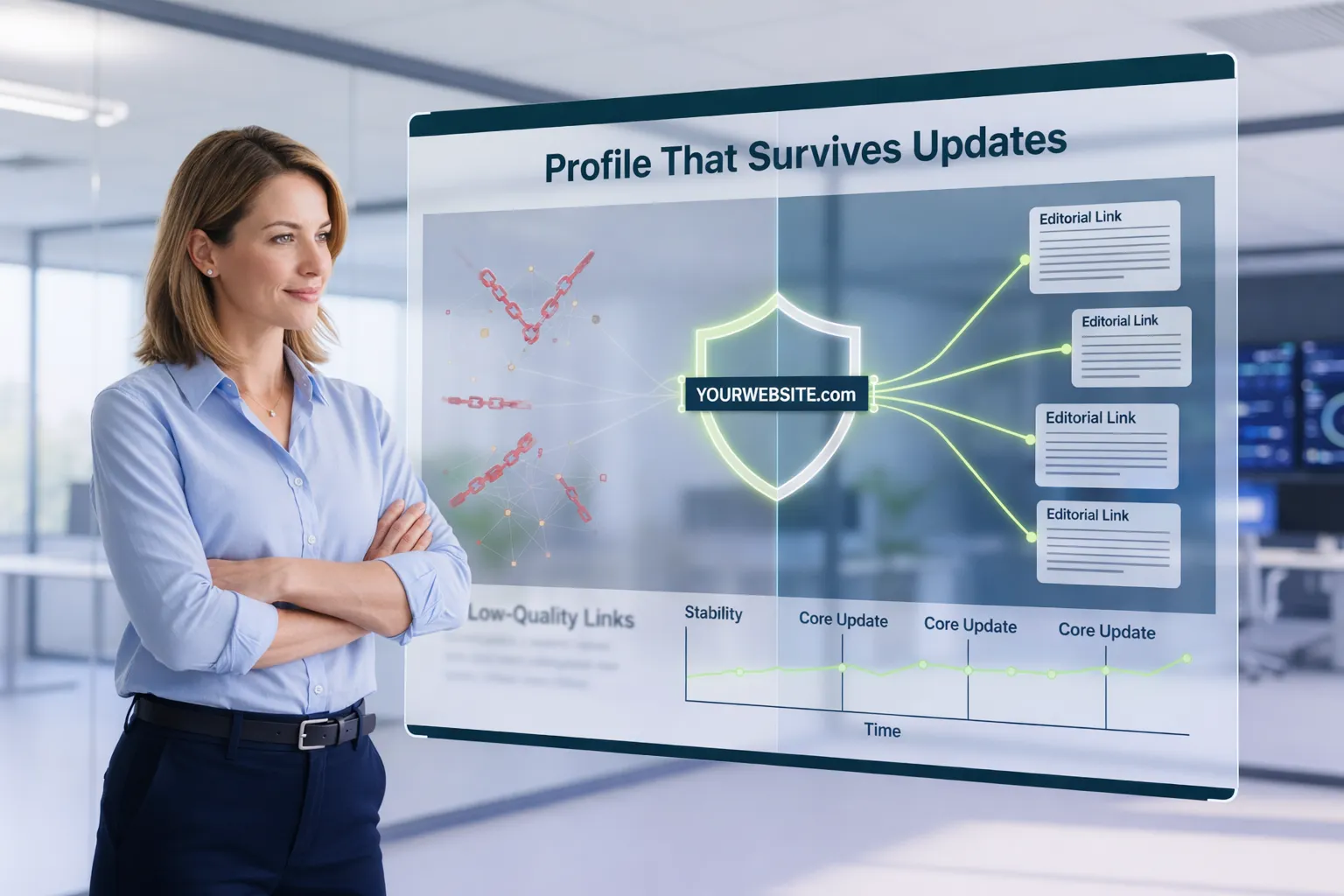
Client Success Stories
## What Clients Say About Our Link Insertion Service
Reviews from the leaders who gained authority, rankings, and revenue with link insertions.
[View All
](https://outreachdesk.com/testimonial/)

4.8/5 

## 5/5 
Rating on Google



The niche edit placements Outreach Desk secured moved our main service page from page 3 to the top 5 in under four months. Every link is placed inside relevant content on sites our audience actually reads. That’s the part most link building agencies can’t deliver.

#### B2B SaaS
Marketing Head


What stood out was the vetting quality. Every placement came with the site’s domain rating, traffic data, and content context before it went live. We approved every link. No surprises, no junk sites, no links we’d have to disavow later.

#### eCommerce
SEO Lead


We used Outreach Desk’s link insertion service for our agency clients. The approval workflow and white-label reporting save us hours every month. More importantly, the placement quality is consistent – we’ve never had a client question where a link came from.

#### SEO Agency
VP Marketing
Service Framework
## Investment, Timeline, andDeliverables
Every link insertion campaign is custom-scoped to your existing content assets, authority gaps, and target keywords. Here’s what shapes your investment:

### Number of links per month
Most campaigns run 10-50 contextual link insertions per month, depending on your growth.

### Target domain rating range
Insertions into DR 40-95 sites require fewer investments than placements in DR 70+ publications.

### Content requirements
Some placements need new content development, others use existing editorial opportunities.

### Campaign duration
Link insertions use existing content; links usually go live faster than the guest posts. Most clients see measurable ranking improvements within 6-10 weeks.
Directional pricing
## $200 – $300+ per link
Link insertion campaigns typically start at $200 per link for focused growth in a single niche. Most competitive campaigns targeting multiple pages, Higher DR ranges, or rankings timelines generally range from $250-$350+ per link.
You receive a detailed proposal after your strategy call outlining exact link qualities, target pages, anchor strategy, and a month-by -month roadmap with transparent pricing.
Book a Strategy Call
What You Get
## Client-Ready Reports Built for Contextual Clarity
Structured reporting that makes placement review simple and transparent.

### Live Placement URLs
You get direct access to every published page where your links are inserted and go live.

### Contextual Placement Details
You have complete visibility into the surrounding content, anchor usage, and exact link position in the article.

### Anchor & Target Mapping
You see a clear connection between anchors and the destination pages you prioritize.

### Campaign Overview
A summary of the delivered link insertions, authority metrics, and topical relevance.
Our Approach
## A Smarter Approach to Contextual Link Placement
You get relevant, editorially aligned, and natural integration instead of volume-based placements.
| Factor | In-House / DIY | |
| --- | --- | --- |
| Placement Approval | Links are often reviewed only after insertions, with
limited influence over the anchor usage or context. | You approve every domain, anchor text, and contextual
placement before the insertion. No surprises. |
| Publisher Vetting | Here, the prospecting may rely on scraping tools
or surface-level DR checks. | Every publisher is manually vetted for the organic
traffic, backlink health, editorial standards,
and relevance. |
| Context Quality | Insertions may be forced into irrelevant articles. | The links are placed only when contextual relevance
strengthens both the articles and your target pages. |
| Link protection | Tracking removed links requires internal monitoring
and follow-ups. | 6-month link protection is included. If a link is
removed, changed, or deleted, you’ll receive a
replacement at no additional cost. |
| Anchor Strategy | Anchors may be too keyword-heavy or inconsistent
across the placements. | You get a balanced anchor distribution aligned
with your existing backlink profile to
prevent over-optimization. |
| Risk Standards | The risks depend on internal experience and
quality control. | Strict editorial standards are followed. No PBNs. No link
exchanges. No artificial networks. Only
genuine placements. |
Who We Help
## Build for Your Industry
Your link placements match the unique standards and competitiveness of your industry.
[

### SaaS & Software
](https://outreachdesk.com/saas-link-building/)
[

### Ecommerce & DTC
](https://outreachdesk.com/ecommerce-link-building/)
[

### B2B & Enterprise
](https://outreachdesk.com/b2b-link-building/)

### Startups

### Real Estate
[

### Law Firms & Legal
](https://outreachdesk.com/link-building-for-lawyers/)
[

### Dental Practices
](https://outreachdesk.com/link-building-for-dentists/)

### Healthcare & Fitness

### Financial & Insurance

### Technology & Innovation

### Consumer Brands
Real Results
## Real Impact From Contextual Link Insertions
Examples of how strategic link insertions strengthen relevance and authority over time.
Link Insertions
###
DTC Fitness Brand Recovers from Penalty and Rebuilds Authority 3x Faster Than Guest Posting
####
0 → 12
AI Overview
####
0 → 9
ChatGPT
####
0 → 14
Perplexity
####
0 → 7
Gemini
####
0 → 11
Copilot
####
34 → 51
Domain Rating
####
+360%
Organic Traffic
####
9 → 41
Page 1 Keyword
####
96
Links Built
A DTC home fitness brand lost 62% of its organic traffic after a link spam penalty tied to 400+ toxic backlinks. Outreach Desk rebuilt authority using highly relevant link inserticons instead of slow guest posting. In just 6 months, they got results. [Read More](https://outreachdesk.com/case-study/dtc-fitness-brand-recovers-from-penalty-and-rebuilds-authority-3x-faster-than-guest-posting/)
Link Insertions
###
Travel Tech Platform Captures Seasonal Rankings with a 90-Day Link Insertion Sprint
####
0 → 8
AI Overview
####
0 → 6
ChatGPT
####
0 → 10
Perplexity
####
0 → 5
Gemini
####
0 → 7
Copilot
####
39 → 46
Domain Rating
####
+163%
Organic Traffic
####
8 → 26
Page 1 Keyword
####
94
Links Built
An adventure travel booking platform needed to improve its rankings before the peak season. In a 90-day link-insertion sprint, Outreach Desk placed 94 contextual links on priority destination pages. Rankings improved by 14 positions on average, 9 of 12 pages reached page 1, traffic improved 163%, and peak-season bookings increased 67%, generating $1.1M incremental revenue. [Read More](https://outreachdesk.com/case-study/travel-tech-platform-captures-seasonal-rankings-with-a-90-day-link-insertion-sprint/)
Link Insertions
###
HR Software Company Accelerates New Feature Page Rankings Using Targeted Link Insertions
####
0 → 16
AI Overview
####
0 → 11
ChatGPT
####
0 → 13
Perplexity
####
0 → 8
Gemini
####
0 → 10
Copilot
####
52 → 58
Domain Rating
####
14,700
Organic Traffic
####
0 → 19
Page 1 Keyword
####
87
Links Built
A series B HR software platform needed rankings for three new feature pages with zero backlinks. Outreach Desk executed a 5-month link insertion campaign, placing 87 contextual links. [Read More](https://outreachdesk.com/case-study/hr-software-company-accelerates-new-feature-page-rankings-using-targeted-link-insertions/)
[View All
](/case-study/)
Common Questions
## Frequently Asked Questions
Get clear answers to how link insertions secure contextual placements within the existing content to boost authority and rankings.
### What is link insertion?
Link insertion is the process of adding links to existing published content on relevant websites instead of creating new articles.
### How is link insertion different from guest posting?
[Guest posting](https://outreachdesk.com/guest-posts/) involves publishing new content, while link insertion adds links inside already published articles.
### Are link insertions safe for SEO?
Yes, when placements are contextual, editorial, and relevant. We follow strict quality standards for every placement.
### Can I approve sites before placements?
Yes, approval workflows are available depending on campaign setup.
### How long does it take to deliver link insertions?
Most placements go live within 1-3 weeks, depending on the niche and the publisher’s response.
### Do you provide reports for link insertions?
Yes, reports include live URLs, anchor text, target pages, and placement context.
### Can link insertions be combined with guest posting?
Yes, link insertions work best when combined with guest posting and other link-building methods.
### Which industries are suitable for link insertions?
We support SaaS, ecommerce, finance, healthcare, legal, real estate, and regulated industries.
## Boost Rankings With Contextual Link Insertions
Strengthen your authority with editorial backlinks naturally placed within existing, indexed content on real websites. Our link insertion strategy helps you earn powerful links.
Book a Strategy Call

4.8/5 _
Trusted by 500+ agencies &
1,000+ businesses worldwide.

---
---
title: "White Label Link Building Service Page"
url: "https://outreachdesk.com/white-label-link-building-services/"
lang: "en-US"
type: "page"
description: "White Label Link Building White Label Link Building Services for Agencies You get high-quality editorial links under your brand. Build results for your clients without hiring teams or managing outreach. 50-70% lower costs than in-house teams 100% white label with"
last_modified: "2026-05-27T04:48:02+00:00"
custom_fields:
header_style: "header-style-1"
footer_style: "footer-style-1"
---
# White Label Link Building Service Page
White Label Link Building
# White Label Link Building Services for Agencies
You get high-quality editorial links under your brand. Build results for your clients without hiring teams or managing outreach.
_
50-70% lower costs than in-house teams

100% white label with your branding

High-authority, niche-relevant backlinks
Book a Strategy Call

4.8/5 _
Trusted by 500+ agencies &
1,000+ businesses worldwide.
Average DR
40 – 95
Campaign Dashboard
LIVE
DOMAIN RATING
28 → 40
+12 points
ORGANIC TRAFFIC
+87%
7,900 → 14,800
PAGE 1 KEYWORDS
11 → 37
+26 points
PLACEMENTS
95
78 unique domains
_
Links Delivered
45










Service Overview
## Scale Link Building Confidently
White label link building is a model in which a specialized provider builds backlinks for your clients under your agency’s brand. You manage ownership ofthe client relationship, set strategy, and present the results as your own work.
Unlike hiring freelancers or building an internal outreach team, a white-label partner gives you immediate access to an established publisher network, a documented quality process, and scalable capacity.
Google’s algorithms, including SpamBrain and the March 2024 core update, reward editorially relevant links from authority websites. White-label link building delivers exactly that type of placement at a fraction of the cost and time required to build the capability in-house.
For agencies looking to grow revenue, white label link building is the highest investment in operational efficiency. You offer a premium service, deliver measurable results, and have complete control.
Three things define an effective white-label link building partnership:

### Invisible execution
Your prospecting, outreach, content creation, and placement are handled carefully, with no visibility to your end clients.

### Editorial quality
Every link is placed within the relevant body content on real sites with genuine traffic and editorial standards.

### Scalable delivery
You scale links based on the client demand without restructuring your team, hiring, or managing additional vendors.
How It Works
## How Your White Label Link Campaign Works
A structured workflow that keeps quality high and gives your agency visibility at every stage.
### Strategy & Goals
Your campaign starts with a detailed call with your dedicated account manager. Where you share SEO goals, target pages, keyword priorities, and any specific requirements for domain rating, traffic, or niche relevance. For end-to-end management of this process, Outreach Desk’s experts runs campaigns for 500+ brands worldwide. For brands that need ongoing execution, white label link building best practices from a specialised provider can carry the load.
Your strategist maps every target page and identifies where white-label links will have the greatest impact on ranking. Pages competing for high-value commercial keywords get priority. Pages with strong on-page SEO but weak referring domains move to the top of the list. You get a clear link-building roadmap.
### Site Research
Your team researches publications, blogs, and niche sites that match your client’s industry, and every prospect goes through a manual quality check. Your strategist evaluates domain rating, organic traffic levels, content relevance, editorial standards, and backlink profile health using tools like Ahrefs.
Sites with thin content, spammy link profiles, inflated metrics, or irrelevant audiences get removed. Private blog networks (PBNs), link farms, and sites built solely to sell links are automatically excluded. Approximately 70% of initially prospected sites do not pass this vetting process. You see only vetted, quality-matched prospects in your campaign reports.
### Approval & Alignment
Before any placement moves forward, you review and approve the prospective websites. You see the domain rating, organic traffic data, niche category, and a sample of existing content on each site. If a site doesn’t meet your standards, the team finds an alternative.
This approval step gives your agency complete control. You decide what’s good enough for your clients, and nothing goes live without your confirmation. For agencies managing multiple clients, approval workflows are structured per campaign to keep everything organized.
### Content Creation
Each placement needs content that earns its spot editorially. Your writing team develops article angles, talking points, and contextual hooks to make the client’s link appear natural and value-driven.
Content follows the publication’s editorial standards. If they run short opinion pieces, the approach adapts. All content is written by experienced writers. Anchor text is placed naturally within the content, no forced keyword stuffing, no over-optimized exact-match anchors that could trigger Google’s link spam algorithms.
### Outreach & Placement
Your outreach specialists contact publishers directly, avoiding automated mass emails. Every pitch is personalized to the publisher’s content style and recent topics. Including placement expectations, anchor text strategy, content format, and timeline.
Once content is published, your team reviews every live link. Checks include: correct anchor text, proper dofollow attribution, in-content positioning, and page indexation status. If a placement doesn’t meet quality standards, your team either gets it corrected or replaces it with a new placement at no extra cost.
### White Label Reporting
You receive structured, client-ready reports delivered under your agency branding. Each report includes a live placement URL, anchor text used, domain rating, organic traffic, indexation status, and delivery timeline.
Your strategist provides insights beyond just raw data, explaining each link’s impact on rankings and authority. Reports are formatted for direct sharing without rebranding. Links are monitored post-placement. If a publisher removes content or a site’s quality drops, your team flags it and works on replacements.

Expected Results
## Outcomes That White Label Link Delivers
Contextual links that are published in the relevant content under your agency’s brand drive client authority, lasting rankings, and scalable revenue.
- 1. Better Rankings
- 2. Scalable Growth
- 3. Complete Control
- 4. Safe Links
### Rankings on the Keywords That Drive Revenue
White label links send Google direct relevance signals on behalf of your clients. When a topically aligned site links to a client’s page from within editorial content, it acts as a vote of confidence for that specific topic, not just their domain in general.
As a result, your target pages start ranking for the exact keywords that bring in leads, demos, and revenue.
One agency partner saw their SaaS client’s main service page move from position 14 to 3 within four months after earning 22 contextual links from DR 50+ niche sites. Five relevant placements can outperform dozens of low-quality links.
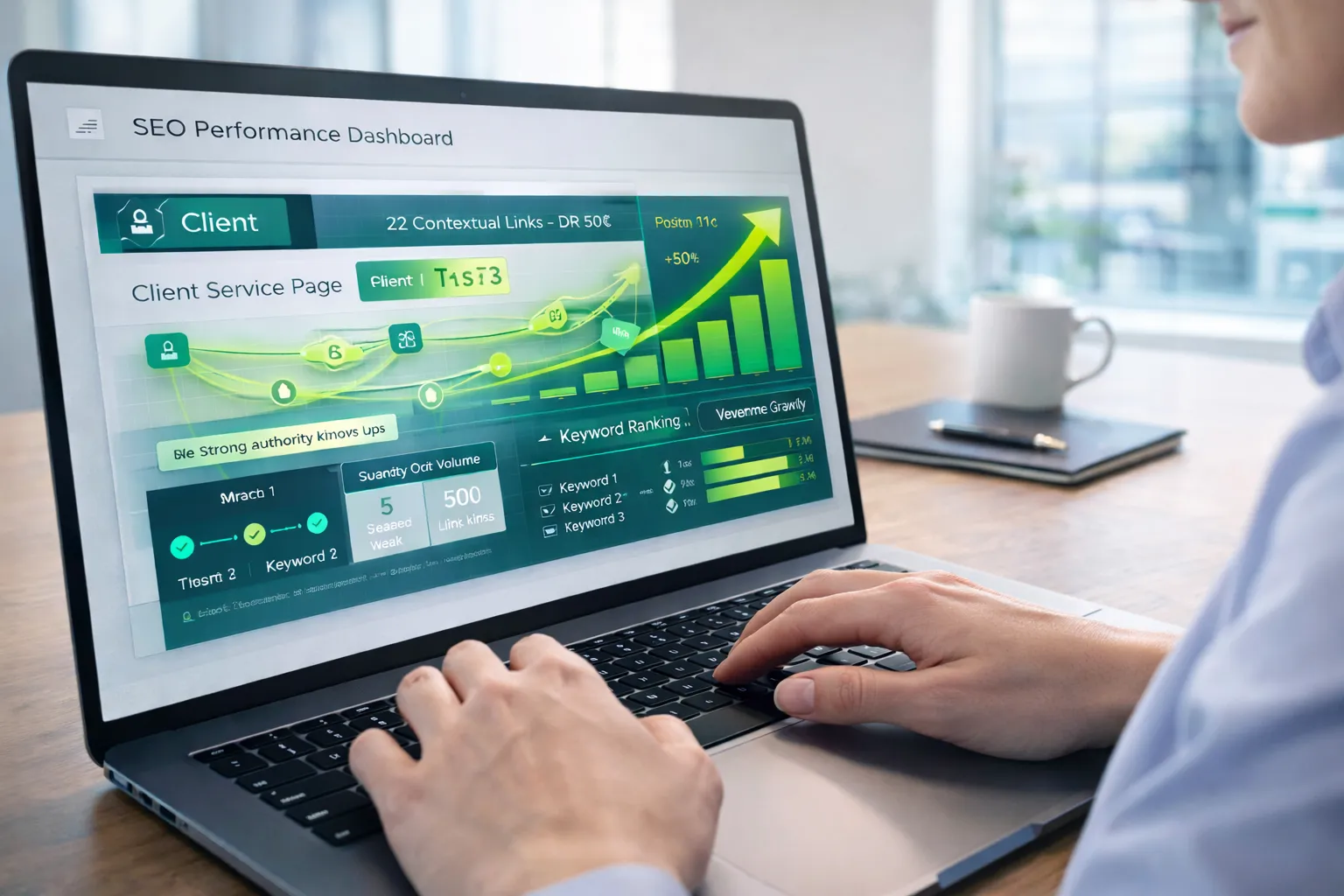
### Scale Without Hiring Team
Every white label placement expands your agency’s delivery capacity without adding payroll, management workload, or operational complexity. Most agencies spend 3-6 months building an internal link building function from scratch, while with Outreach Desk, you enable execution within the first week.
As you onboard more clients, your delivery scales with you. Agencies working with Outreach Desk typically reduce link acquisition costs by 50-70% compared to in-house teams, based on average in-house costs of $400-$800 per link versus Outreach Desk’s per-link pricing starting at $200.
The model lets your team focus on strategy, client management, and business development, not prospecting spreadsheets and publisher negotiations.
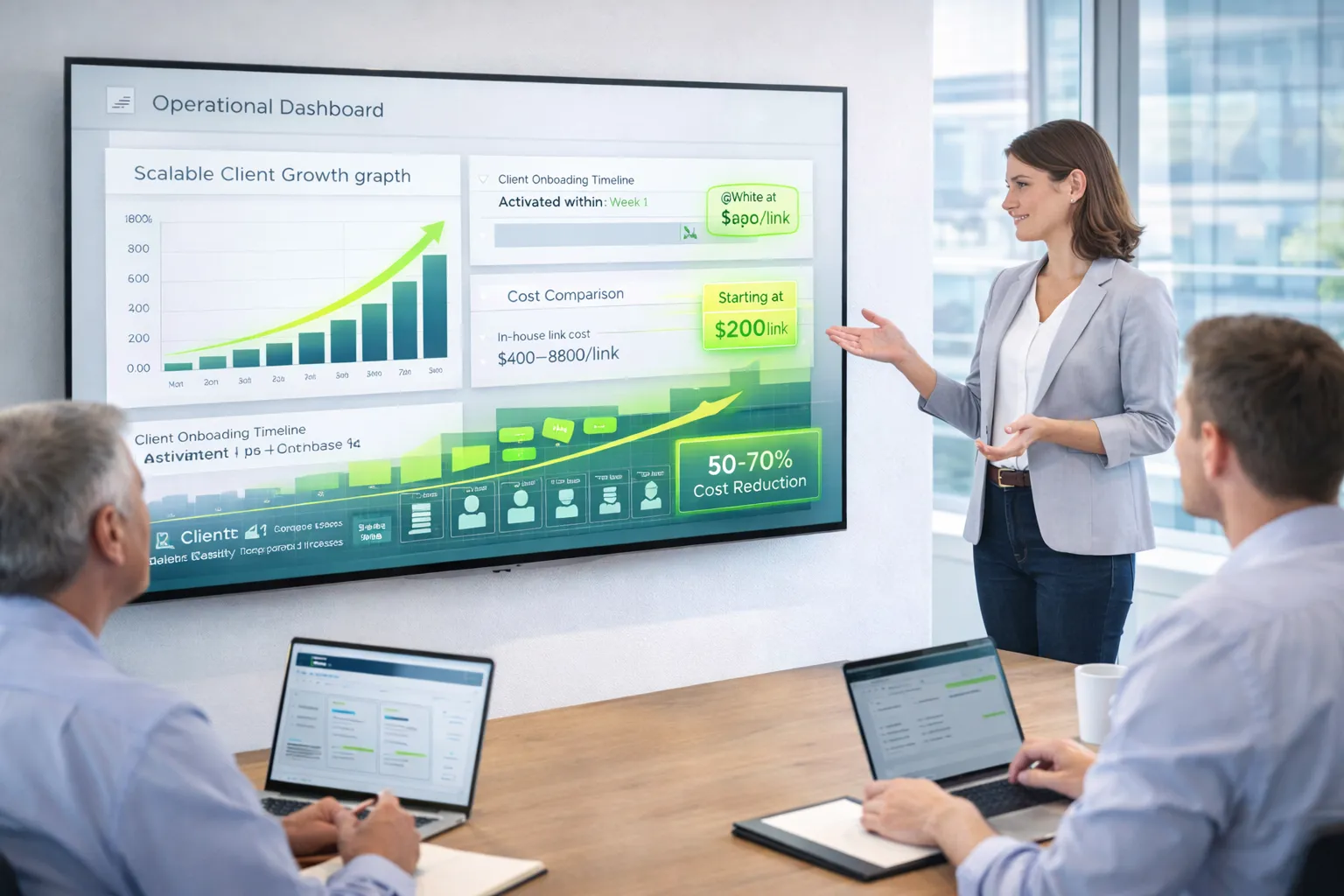
### Full Brand Control
A white-label link under your brand doesn’t just help SEO. It also strengthens your agency’s credibility with every client interaction. Consistent, high-quality link placements presented under your brand position your team as the driver of results.
You have full approval rights over website selection, content direction, anchor text strategy, and final placement. Outreach Desk never contacts your clients, never appears in reports, and never takes credit for results. Over 500 agencies in the US work with Outreach Desk without their clients knowing a third party is involved.
Over time, consistent performance builds deeper lenient trust, leads to longer contacts, stronger retention, and expanded service opportunities.
### Link Profile for Your Clients
Google’s spam detection is more advanced than ever. SpamBrain, Google’s AI-driven spam system, targets manipulative link patterns like PBNs, link swaps, bulk Web 2.0 links, and paid placements on low-quality sites.
White label links earned through real editorial outreach match the type of links Google describes as natural. They survive core updates because they exist for a genuine editorial reason, not because someone bought them in bulk.
Your clients’ investment stays protected. Links placed within authentic editorial content on established sites don’t carry the same deindexation risk as those in cheaper, mass-produced alternatives. Your agency’s reputation remains secure through every algorithm change.

Client Success Stories
## What Our Clients Say
verified reviews from leaders who gained authority, rankings, and revenue with our white label link-building services.
[View All
](https://outreachdesk.com/testimonial/)

4.8/5 

## 5/5 
Rating on Google



We needed a white label partner we could trust for our top SaaS clients. Outreach Desk delivered consistent quality across every campaign, our clients saw ranking improvements within 3 months, and they never knew a third party was involved.

#### Agency Head
US Digital Marketing Agency


What impressed us was the process. We saw the target site, anchor text, and content relevance before anything went live. Every publisher was manually checked for traffic and quality. The entire process felt controlled.

#### SEO Director
US SEO Agency


We manage clients across healthcare and finance, regulated industries where low-quality backlinks are not an option. The Outreach Desk built links that survived two core updates without any major impact.

#### Operations Directors
multi-Vertical Agency
Service Framework
## Investment, Timeline, andDeliverables
Every white label link building campaign is custom-scoped to your agency’s client mix, competitive landscape, and growth goals.
Here’s what shapes your investment:

### Number of links per month
Most campaigns run between 10 and 100+ white label placements monthly, depending on client volume

### Target domain rating range
Placements on DR 40-95 sites are included in standard pricing. DR 70+ placements carry a premium based on publisher editorial requirements

### Content requirements
Some placements need new guest post content development; others use existing editorial opportunities like link insertions or niche edits

### Campaign duration
Most agency clients see measurable ranking movement within 3-4 months, with compounding results over 6-12 months
Directional pricing
## $200 – $300+ per link
White label link building campaigns start at $200 per link placement for agencies managing focused client growth in a single niche. Enterprise agency campaigns supporting multiple clients across competitive industries range from $250 to $300+ per link.
After your strategy call, you get a detailed proposal with exact link quantities, target DR ranges, projected timeline, and a month-by-month roadmap. No hidden fees. No vague “it depends” answers.
Book a Strategy Call
What You Get
## Client-Ready Reports Built for Clarity
Every placement is clearly reported and white-labeled, so you know exactly where links are placed and can share reports directly with your clients:

### Live Link URLs
You get direct access to every live published link placement, allowing you and your clients to verify links at any time.

### Content Context Overview
You can see how each link fits naturally into the surrounding content, ensuring topical relevance and editorial alignment match your client’s niche.

### Anchor & Target Mapping
You see which anchor text links to each destination page, providing clear visibility into distribution and optimization strategy across all client campaigns.

### Campaign Summary
You get a clear summary of placements, domain metrics, delivery timeline, and impact, formatted under your agency branding for direct client sharing.
Our Approach
## The Right White-Label Link Building Approach for Your Needs
You get in-house quality with the flexibility to scale as your needs change.
| Factor | In-House / DIY | |
| --- | --- | --- |
| Placement Approval | Links are usually reviewed after publication, with
limited control over final placement quality and
site selection. | You approve every site, anchor text, and content
context before anything goes live. Complete
control, no surprises |
| Publisher Vetting | Research quality varies by team capacity and often
relies on scraping tools or outdated databases. | Every publisher is manually vetted for DR, organic
traffic, editorial standards, backlink
health, and audience relevance. 70% of
prospected sites are rejected |
| Link Protection | Removed links must be tracked and replaced internally,
adding ongoing management overhead. | 6-month replacement guarantee. If your link is removed,
changed, or deleted by the publisher, it
will be replaced at no extra cost. |
| Anchor Strategy | Anchor selection may be keyword-focused or inconsistent
across campaigns, risking over-optimization penalties. | Strategically planned anchor distribution designed around
your client’s existing link profile to avoid
over-optimization risks. |
| Branding & Client
Exposure | Your clients may discover your outsourced providers
through reports, emails, or publisher communications. | 100% white label. All reports, communications, and
deliverables carry your agency branding.
Zero exposure to the Outreach Desk. |
| Scalability | Limited by headcount, freelancer availability, and
management capacity. Adding clients means adding people. | Scale from 10 to 100+ links/month without operational
disruption. No hiring, no training, no
vendor management. |
| Tactics & Risk
Standards | Risk level depends on internal process and experience.
Quality varies by who’s doing the work. | Strict editorial standards. No PBNs, no link exchanges,
no AI content. Only manual outreach and
editorial placements. |
| Cost Efficiency | In-house: $400-$800 per link (salary, tools, overhead).
Freelancers: $150-$600 per link (variable quality). | Fixed pricing from $200-$300 per link with consistent
quality standards across every placement. |
| Turnaround | In-house: 4-8 weeks. Freelancers: unpredictable. | First placements live within 2-4 weeks from kickoff. |
Who We Help
## Industries We Support With White-Label Links
White-label link building is adapted to the standards and competition of each industry
[

### SaaS & Software
](https://outreachdesk.com/saas-link-building/)
[

### Ecommerce & DTC
](https://outreachdesk.com/ecommerce-link-building/)
[

### B2B & Enterprise
](https://outreachdesk.com/b2b-link-building/)

### Startups

### Real Estate
[

### Law Firms & Legal
](https://outreachdesk.com/link-building-for-lawyers/)
[

### Dental Practices
](https://outreachdesk.com/link-building-for-dentists/)

### Healthcare & Fitness

### Financial & Insurance

### Technology & Innovation

### Consumer Brands
Real Results
## Success Stories from Our Partners
You protect your reputation while delivering results that strengthen client relationships.
white Label Link Building
###
Boutique SEO Agency Scales from 8 to 31 Retainer Clients in 14 Months Without Hiring a Single Link Builder
####
0 → 9
AI Overview
####
0 → 6
ChatGPT
####
0 → 8
Perplexity
####
0 → 5
Gemini
####
0 → 7
Copilot
####
43 → 55
Domain Rating
####
+32%
Organic Traffic
####
11 → 37
Page 1 Keyword
####
468
Links Built
A US digital marketing agency managing 35+ SaaS clients needed to scale link building from 40 to 120 links per month. Their in-house outreach team was maxed out, and link quality was inconsistent as they pushed volume. Outreach Desk took over link execution across all SaaS client campaigns, ensuring per-client quality. DR 50+, minimum 2,000 organic traffic, strict SaaS-niche relevance. [Read More](https://outreachdesk.com/case-study/boutique-seo-agency-scales-from-8-to-31-retainer-clients-in-14-months-without-hiring-a-single-link-builder/)
white Label Link Building
###
Digital Marketing Agency Enters Link Building Market and Generates $67K Monthly Recurring Revenue in 10 Months
####
0 → 11
AI Overview
####
0 → 7
ChatGPT
####
0 → 9
Perplexity
####
0 → 6
Gemini
####
0 → 8
Copilot
####
34 → 46
Domain Rating
####
+156%
Organic Traffic
####
14 → 4
Page 1 Keyword
####
192
Links Built
A UK-based SEO agency with clients across the ecommerce, legal, and healthcare verticals needed a white label partner that could handle regulated niches while maintaining editorial standards. Previous freelancer-based approaches had resulted in inconsistent placement quality. [Read More](https://outreachdesk.com/case-study/digital-marketing-agency-enters-link-building-market-and-generates-67k-monthly-recurring-revenue-in-10-months/)
white Label Link Building
###
Enterprise SEO Consultancy Delivers Consistent Results Across 45 Client Accounts Using White Label Infrastructure
####
0 → 13
AI Overview
####
0 → 8
ChatGPT
####
0 → 11
Perplexity
####
0 → 7
Gemini
####
0 → 9
Copilot
####
61 → 71
Domain Rating
####
+1,200%
Organic Traffic
####
96 → 412
Page 1 keyword
####
611
Links Built
A growing SaaS platform needed to build domain authority from the ground up in a competitive HR tech market. Outreach Desk managed a sustained link-building campaign over 36 months, scaling from initial authority-building to competitive positioning against established market leaders. [Read More](https://outreachdesk.com/case-study/enterprise-seo-consultancy-delivers-consistent-results-across-45-client-accounts-using-white-label-infrastructure/)
[View All
](/case-study/)
Common Questions
## Frequently Asked Questions
Clear answers to help you understand how white-label link building works.
### What is white-label link building?
White label link building means we build backlinks for your clients under your brand name. Your agency manages the client relationship while we handle research, outreach, content, and placements behind the scenes.
### Will my clients know that link building is outsourced?
No, not all deliverables, reports, and communications are fully white-labeled. We never contact your clients or reveal our involvement.
### Are the links built using white-hat methods?
Yes, all the links are earned through [manual outreach](https://outreachdesk.com/manual-link-building/) and editorial placements on real, relevant websites. We avoid automated networks, PBNs, and spammy sites.
### Can I approve websites before links are placed?
Yes, you can review and approve websites or placement criteria before publishing, depending on your campaign setup.
### How long does it take to deliver links?
Most placements go live within 2-4 weeks. Timelines may vary based on niche, site availability, and editorial standards.
### What type of websites do you place links on?
We place links on real websites with genuine audiences, relevant content, and editorial standards. Site selection focuses on relevance, quality, and lasting stability.
### How is pricing determined?
Pricing is determined by factors such as industry competitiveness, site quality, content requirements, and campaign volume. We offer per-placement, monthly, and custom pricing models.
### Do you provide reports for every placement?
Yes, you receive structured, white-labeled reports with live URLs, anchor text, target pages, and placement details.
### Can you scale link building for multiple clients?
Yes, our process is designed to support agencies managing multiple campaigns and varying link volumes without operational complexity.
### What happens if a link is removed?
If a link is removed within the agreed period, we review and replace it in accordance with the campaign terms and quality standards.
### Do you work with competitive or regulated industries?
Yes, we have experience handling industries with higher editorial standards, including SaaS, finance, healthcare, legal, and regulated niches.
### How do I get started?
You can share your goals, target pages, and industry details. We’ll recommend a white-label link-building approach customized to your agency and clients.
## Ready to Scale Client Rankings with White Label Links?
Get High-authority, niche-relevant backlinks under your brand without hiring, training, or managing a team. We handle prospecting, outreach, content, and placement while you handle clients.
Book a Strategy Call

4.8/5 _
Trusted by 500+ agencies &
1,000+ businesses worldwide.

---
---
title: "Guest Posting Service"
url: "https://outreachdesk.com/guest-posting-service/"
lang: "en-US"
type: "page"
description: "Guest Posting Guest Posting Service That Builds Your Rankings Your rankings grow through high-quality guest posts published on trusted websites, earning relevant links that strengthen authority, improve search visibility, and support long-term organic growth. Most successful campaigns rely on authority"
last_modified: "2026-05-27T04:38:05+00:00"
custom_fields:
header_style: "header-style-1"
footer_style: "footer-style-1"
---
# Guest Posting Service
Guest Posting
# Guest Posting Service That Builds Your Rankings
Your rankings grow through high-quality guest posts published on trusted websites, earning relevant links that strengthen authority, improve search visibility, and support long-term organic growth. Most successful campaigns rely on authority link building services to handle vetting, outreach, and reporting.
_
Natural and relevant links

Links that build your visibility

Complete visibility into every live link
Book a Strategy Call

4.8/5 _
Trusted by 500+ agencies &
1,000+ businesses worldwide.
Average DR
40 – 95
Campaign Dashboard
LIVE
DOMAIN RATING
38 → 56
+18 points
ORGANIC TRAFFIC
+530%
14,200 → 89,400
PAGE 1 KEYWORDS
8 → 34
+26 points
PLACEMENTS
110
92 unique domains
_
Posts Published
30










Service Overview
## What Guest Posting Actually Means
Guest posting means earning a contextual backlink by publishing original, relevant content on a vetted authority site in your niche – with editorial review, real readership, and a link that passes genuine PageRank. That’s what separates a real guest post from a directory listing or paid ad. The editorial process is what makes Google treat the link as a trust signal rather than a paid placement to be discounted or penalized.
Guest posting means publishing original, relevant content on authoritative industry websites. Each article includes a contextual link to your site, passing authority that helps your pages rank higher and attract more organic traffic consistently.
Unlike directories, profiles, or forum links, guest post links are earned inside the real content on real websites, reaching real audiences. Google values links that are editorial, relevant, and placed on the sites with genuine authority.
Tools like Ahrefs and Moz confirm that links placed within the body of relevant editorial content pass significantly more link equity than sidebar links, footer placements, or author bio links. Guest posting focuses on earning these high-value, in-content placements at scale.
For businesses looking to build sustainable search visibility, guest posting is one of the most reliable and safest ways to earn the type of links Google values most.

### Editorial quality
Every article is original and written for the publisher’s audience. You get genuine content that adds value. No sponsored blocks or sidebars.

### Relevance-first placement
Your links go to sites that match your industry. SaaS brands get links from tech and business sites. Dental practices get links from healthcare and local authority sites.

### Manual outreach
Every placement is earned through direct conversations with editors and publishers. No automated link networks, bulk email tools, or paid placement databases.
How It Works
## How Your Guest Posts Are Secured Safely
From planning to placement, your guest posts follow a clear process that focuses on quality, relevance, and transparency.
### Goal Mapping
Before building your first link, your campaign starts with a strategy session. You share your SEO goals, target pages, keyword priorities, and specific requirements for domain rating, traffic, or niche relevance.
Your strategist reviews every target page where guest post links will drive the most impact. Pages with high-value keywords or strong SEO but weak links get the most priority. You receive a clear, focused roadmap for link building.
### Site Research
Your team researches publications, blogs, and niche sites that match your industry. Every prospect goes through a manual quality check. Your strategist evaluates domain rating, organic traffic levels, content relevance, editorial standards, and backlink profile health using tools like Ahrefs.
Sites with thin content, spammy links, excessive metrics, or irrelevant audiences are removed. Private blog networks, link farms, and sites built only to sell links are excluded by default. You only see sites that meet strict quality criteria and match your goals.
### Manual Outreach
Your outreach team contacts publishers directly. No automated emails. Every pitch is tailored to the publisher’s style and topics, covering placement details, content format, anchor text, and timeline.
This manual approach takes longer than automated alternatives. It also produces placements that are genuinely editorial, not bulk-purchased slots that carry risk. The difference shows in how these links perform through algorithm updates.
### Editorial Content
Each placement earns its spot with the original content. Your writing team crafts articles that make your link feel like a natural fit rather than a forced insertion. Content follows the publication’s editorial standards.
All content is written by experienced writers. Every article goes through internal editorial review before submission to the publisher. Anchor text is placed naturally within the content, no forced keyword stuffing or over-optimization that could trigger Google’s algorithm penalties.
### Natural Placement
Each placement is supported by content that earns its position editorially. Our writers develop article angles, talking points, and contextual hooks that make your product a natural fit within the content.
Once the content is published, your team reviews every live link. The checks include: correct anchor text, proper dofollow attribution, in-content positioning, and page indexation status. If a placement doesn’t meet quality standards, has a wrong anchor, a nofollow tag, or is buried in a non-indexed page, your team either gets it corrected or replaces it with a new placement at no extra cost.
### Final Review
You receive structured reports with every live placement URL, anchor text used, target page mapping, domain rating, and organic traffic of each linking site, indexation status, and delivery timeline.
Links are monitored after placement. If a publisher removes content or quality drops, your team flags it and works on a replacement. You always see where your links are placed and how they perform.

Expected Results
## The Real Outcomes Your Guest Posts Deliver
The real outcomes your guest posts deliver are higher domain authority, better rankings for target keywords, and referral traffic from niche audiences who already trust the publication. Guest post results compound differently from other link types: each placement reinforces the last because Google weighs the pattern of who links to you – not just whether you have links. Consistent editorial placements on relevant sites signal sustained topical authority, not a one-off event.
Your guest posts are placed with purpose on relevant, editorially reviewed websites, and you see clear results across four key areas.
- 1. Better Rankings
- 2. Topical Authority
- 3. Trust & Credibility
- 4. Organic Growth
### Keyword Rankings
Relevant guest posts send direct relevance signals to Google for your target pages. When a topically relevant site links to your page from within its editorial content, Google interprets that as a vote of confidence for your topic.
Your target pages start ranking for the keywords that bring you leads, demos, and revenue.
Five well-placed and niche-relevant guest post links from a trusted site can outperform many irrelevant or low-quality domains.
### Strong Topical Authority
Consistent guest posts on niche-relevant websites help the search engines identify what your site is about. Over time, your brand becomes closely connected to your core topics.
Here’s what topical authority growth looks like in practice: a SaaS company publishing 3-4 guest posts per month on tech and business sites saw their new blog content indexing and ranking within 7-10 days instead of the previous 4-6 week average.
When your site is consistently mentioned and linked through guest posts within the same topic area, search engines begin to trust your expertise and see your site as a reliable source.
### Trust Signals
Editorial links from real, credible websites signal quality and reliability to the search engines. These signals play a key role in the long-term ranking stability.
Because links from guest posts are earned rather than artificially placed, they strengthen trust rather than create risk. They survive core updates because they serve a genuine editorial purpose.
Links placed in authentic editorial content on established sites carry far less risk than those in mass-produced content. Your site’s reputation stays strong through every algorithm change.

### Steady Organic Growth
Strong guest posts keep delivering value long after they go live. Unlike paid ads, editorial links continue to build authority month after month.
For refreeing domains within 1-3 months, the initial placements are indexed; in 4-6 months, authority signals compound; and in 7-12 months, the domain profile strengthens.
Over time, this steady momentum builds. Your pages gain stronger rankings, attract more qualified visitors, and create reliable traffic you can build on for the long term.
Client Success Stories
## What Clients Say About Us
verified reviews from leaders who gained authority, rankings, and revenue with our guest post services.
[View All
](https://outreachdesk.com/testimonial/)

4.8/5 

## 5/5 
Rating on Google



We manage SEO for a fintech client in a competitive space. The guest posts were clean, contextual, and did not look forced. The rankings improved gradually, and most importantly, the link profile looks natural.

#### SEO Lead
Fintech


The difference was relevance. The article was not generic, they were placed where our audience actually reads. A few competitive keywords moved into the top positions, and we finally started to notice momentum.

#### Marketing Head
B2B SaaS


We didn’t only want blog links, we wanted support for our money pages. Over a few months, we saw steady growth in organic revenue. The team kept the process transparent and let us approve aites before anything went live.

#### Marketing Head
E-commerce Brand
Service Framework
## Investment, Timeline, andDeliverables
Every guest posting campaign is tailored to your industry, competitive landscape, and growth goals. Here’s what shapes your investment:

### Number of links per month
Most campaigns run between 10 and 50+ guest post placements monthly, depending on your competitive landscape and growth targets.

### Target domain rating range
Placements on DR 40-95 sites are included in standard pricing. DR 70+ placements carry a premium based on publisher editorial requirements and site authority.

### Content requirements
Every guest post includes original, editorial-quality content written by native English-speaking writers. Some campaigns also include link insertions or niche edits as complementary placements.

### Campaign duration
Most clients see early ranking movement within 3-4 months, with compounding results over 6-12 months of consistent placement.
Directional pricing
## $200 – $300+ per link
Guest posting campaigns usually start at $200 per link placement for a focused build in a single niche. Enterprise campaigns targeting multiple keywords across the competitive industry usually range from $250 – $300+ per link.
You get a detailed proposal after your strategy call, with exact link quantities, target DR ranges, projected timeline, and a month-by-month roadmap.
Book a Strategy Call
What You Get
## Complete Reporting and Visibility
Every placement is clearly reported, so you know exactly where your links are placed:

### Live URLs
You’ve direct access to all live published links, so you can verify placements anytime. Each URL is checked before delivery.

### Anchor text
You see which anchor text links to each destination page, with clear visibility into your link distribution. Anchors include variations to keep your profile natural.

### Site Metrics Dashboard
Domain rating, organic traffic, and relevance category for each publishing site, all verified and documented using tools like Ahrefs.

### Campaign Summary
You get a clear summary of placements, domain metrics, delivery timeline, and impact, formatted for direct sharing with your team or stakeholders.
Our Approach
## Choosing the Right Approach
Not all guest posting approaches deliver the same results. The approach you choose shapes your momentum and rankings.
| Factor | In-House / DIY | |
| --- | --- | --- |
| Site relevance | Research quality varies by team capacity and often
relies on scraping tools or outdated databases. | Every publisher is manually reviewed for DR, organic
traffic, editorial standards, backlink health,
and audience relevance. |
| Content Quality | Team dependent. Freelancer quality varies by
hire. AI-generated content risk. | Every article is written by original writers
and reviewed by an internal editorial team. No AI
content. No article spinners. |
| Placement consistency | Limited by headcount and freelancer availability.
Volume drops during busy periods. | Structured delivery. Scale from 10 to 100+
links/month without operational disruption. |
| Anchor Text Strategy | Often keyword-focused or inconsistent across
campaigns, risking over-optimization penalties. | Strategically planned anchor distribution. Branded,
partial match, and contextual anchors are balanced
to avoid over-optimization risks. |
| Link Protection | Removed links must be tracked and replaced internally,
adding ongoing management overhead. | 6-month replacement guarantee. If a link is removed
or changed by the publisher, at no extra cost. |
| Transparency | Internal tracking varies. Freelancers may not
provide detailed placement reports. | Full reporting: live URLs, anchor text, target
pages, site metrics, indexation status. |
| Algorithm Safety | Risk depends on internal processes and experience.
Quality varies by who’s doing the work. | Strict editorial standards. No PBNs, no link
exchanges, no AI content. Only manual outreach
and editorial placements. |
| Cost Efficiency | In-house: $400-$800 per link (salary, tools, overhead).
Freelancers: $150-$600 per link (variable quality). | Fixed pricing from $200-$300 per link with
consistent quality standards across every placement. |
| Turnaround | In-house: 4-8 weeks. Freelancers: unpredictable. | First placements live within 2-4 weeks from kickoff. |
Who We Help
## Industries That Benefit Most from Guest Posting
No matter your niche, you can earn guest posts on websites that match your industry.
[

### SaaS & Software
](https://outreachdesk.com/saas-link-building/)
[

### Ecommerce & DTC
](https://outreachdesk.com/ecommerce-link-building/)
[

### B2B & Enterprise
](https://outreachdesk.com/b2b-link-building/)

### Startups

### Real Estate
[

### Law Firms & Legal
](https://outreachdesk.com/link-building-for-lawyers/)
[

### Dental Practices
](https://outreachdesk.com/link-building-for-dentists/)

### Healthcare & Fitness

### Financial & Insurance

### Technology & Innovation

### Consumer Brands
Real Results
## Results From Our Guest Posting Campaigns
See how editorial coverage builds your authority and long-term growth.
Guest Posting
###
Multi-Location Dental Group Doubles New Patient Inquiries Through Authority-Driven Guest Posting
####
0 → 18
AI Overview
####
0 → 5
ChatGPT
####
0 → 8
Preplexity
####
0 → 11
Gemini
####
0 → 4
Copilot
####
34 → 47
Domain Rating
####
+221%
Organic Traffic
####
4 → 18
Page 1 Keywords
####
64
Links Built
A multi-location dental group struggled to rank for non-branded service keywords in a high-risk YMYL healthcare niche. Outreach Desk conducted a conservative, authority-driven guest posting strategy on medically vetted publications. In 7 months, non-branded traffic increased 700%, page 1 ranking improved to 18, and new patient inquiries rose 108%. [Read More](https://outreachdesk.com/case-study/multi-location-dental-group-doubles-new-patient-inquiries-through-authority-driven-guest-posting/)
Guest Posting
###
B2B Cybersecurity Firm Builds Page 1 Rankings for 34 Commercial Keywords in 9 Months
####
0 → 14
AI Overview
####
0 → 8
ChatGPT
####
0 → 11
Perplexity
####
0 → 6
Gemini
####
0 → 9
Copilot
####
38 → 56
Domain Rating
####
+530%
Organic Traffic
####
8 → 34
Page 1 Keywords
####
147
Links Built
A Series B cybersecurity SaaS company with a weak domain authority and prior link penalties struggled to rank for commercial keywords. Outreach Desk executed a relevance-first guest posting campaign across cybersecurity publications. In 9 months, the client increased page 1 commercial rankings from 8 to 34, grew traffic 530%, and generated $1.2M in organic pipeline. [Read More](https://outreachdesk.com/case-study/b2b-cybersecurity-firm-builds-page-1-rankings-for-34-commercial-keywords-in-9-months/)
Guest Posting
###
E-Learning Platform Scales from 0 to 22,000 Monthly Organic Visits in a Crowded EdTech Market
####
0 → 9
AI overview
####
0 → 12
ChatGPT
####
0 → 15
Perplexity
####
0 → 7
Gemini
####
0 → 10
Copilot
####
19 → 41
Domain Rating
####
+1,623%
Organic Traffic
####
0 → 19
Page 1 Keywords
####
162
Links Build
A B2C w-learning platform struggled to compete in a saturated EdTech market with a DR of 91 and minimal visibility. Outreach Desk executed a relevance-focused guest posting strategy across education and career publications. In 11 months, traffic increased from 1,300 to 22,400 monthly visits, generated 4,200+ enrollments, and $380K in organic gain. [Read More](https://outreachdesk.com/case-study/e-learning-platform-scales-from-0-to-22000-monthly-organic-visits-in-a-crowded-edtech-market/)
[View All
](/case-study/)
Common Questions
## Frequently Asked Questions
Get answers about guest posting, including outreach, content quality, approvals, and long-term value.
### Is guest posting still safe?
Yes, when links are properly editorial, relevant, and earned through [manual outreach](https://outreachdesk.com/manual-link-building/). We focus on placements that fit naturally within content, comply with Google’s guidelines, and reduce risk.
### When will results start showing?
Most websites see early movement within a few weeks, with stronger SEO gains over time. [Guest posting](https://outreachdesk.com/guest-posts/) promotes long-term authority rather than quick ranking jumps.
### Do links stay live?
Guest post placements are editorial and intended to remain long-term. While we don’t control any third-party sites, we give priority to stable publishers with consistent content standards.
### Can you review sites before publishing?
Yes, when approval is required, we share all the site details in advance so you can review relevance, quality of the content, and audience fit before it is published.
### Are the links do-follow?
Most placements are do-follow. It only changes if the publisher applies nofollow or sponsored attributes for editorial reasons, which is handled transparently.
### How to select a guest posting website?
Sites are chosen based on topical relevance, content quality, audience alignment, and visibility, and not just third-party metrics.
### Is your outreach manual or automated?
All outreach is 100% manual. We don’t use bulk email tools, link databases, or automated placements.
### Are guest posts written specifically for my brand?
Yes, every article is customized and written to match your brand, industry, and target pages. We don’t reuse or spin content.
### Can I check the content before it’s published?
Yes, content approval is included, so you can verify and review the tone, message, and link placement before publishing.
### Do you control anchor text?
The anchor text is planned strategically and is kept natural. We balance the branded, partial match, and contextual anchors to avoid over-optimization.
### Can guest posting links point to commercial pages?
Yes, guest posts can point to commercial pages when it’s editorially appropriate. We also recommend supporting commercial pages with the links to informational or comparison content where needed.
### Is guest posting suitable for new websites?
Yes, when done cautiously. The outreach volume, anchor usage, and site selection are adjusted based on domain age and authority.
### Do you work with regulated or YMYL industries?
Yes, we follow strict editorial standards for regulated industries, including finance, healthcare, and professional services.
### How is Outreach Desk different from generic guest posting services?
We focus on manual outreach and contextual relevance rather than selling links based solely on metrics or volume.
### Will guest posting drive traffic or just SEO value?
SEO value is the primary benefit; relevant guest posts can also drive qualified referral traffic and brand awareness.
### Is guest posting a one-time service?
Guest posting can be done as a one-time campaign, but many clients choose ongoing outreach for consistent growth of authority.
### How do you report placements?
You receive transparent reports with live URLs, anchor text, target pages, and placement details for every link placed.
### How do I get started?
You can share your website, targeted pages, industry, and goals. We’ll recommend the best guest posting approach that suits your needs.
## Ready to Build Rankings With Trusted Links?
Start earning links through guest posting on real, trusted websites that encourage long-term ranking growth. Take the next step today.
Book a Strategy Call

4.8/5 _
Trusted by 500+ agencies &
1,000+ businesses worldwide.

---
---
title: "SaaS Link Building Agency That Drives Revenue"
url: "https://outreachdesk.com/saas-link-building-agency/"
lang: "en-US"
type: "page"
description: "SaaS Link Building SaaS Link Building Agency That Drives Revenue You receive high-quality backlinks from relevant SaaS, tech, and product-led publications, built to strengthen your domain authority and scale organic growth. Relevant links from SaaS & tech websites 100% manual"
last_modified: "2026-05-27T04:43:41+00:00"
custom_fields:
header_style: "header-style-1"
footer_style: "footer-style-1"
---
# SaaS Link Building Agency That Drives Revenue
SaaS Link Building
# SaaS Link Building Agency That Drives Revenue
You receive high-quality backlinks from relevant SaaS, tech, and product-led publications, built to strengthen your domain authority and scale organic growth.
_
Relevant links from SaaS & tech websites

100% manual outreach for safe and natural links

Strategy-led link building tied to revenue pages
Book a Strategy Call

4.8/5 _
Trusted by 500+ agencies &
1,000+ businesses worldwide.
Average DR
40 – 95
Campaign Dashboard
LIVE
DOMAIN RATING
410
+10 points
ORGANIC TRAFFIC
+1200%
9,600 → 123,000
PAGE 1 KEYWORDS
38 → 212
+174 points
PLACEMENTS
320
240 unique domains
_
Trial Signups
+90%










Service Overview
## Links Built to Improve Rankings
SaaS link building is the process of earning backlinks from authoritative, niche-relevant websites to improve the organic rankings of SaaS companies. Unlike generic link building that targets any available placement, SaaS link building focuses on SaaS, technology, B2B, and product-focused publications where your target buyers already consume content.
The difference matters because SaaS buyers follow a different path than typical consumers. A SaaS purchase decision involves comparison searches, feature evaluations, and demo requests. Links from lifestyle blogs or general directories do not influence SaaS buyer behavior.
Google’s ranking algorithms, including the 2024 core update and SpamBrain, evaluate both authority and relevance of linking domains. A contextual link from a DR 65 SaaS publication in your product category carries more ranking weight than a higher-DR link from an unrelated site, making SaaS-specific link building fundamentally different from broad outreach.
For SaaS companies at any stage, from initial authority to enterprise platforms defending competitive SERP positions, link building is the scalable lever that compounds domain strength over time.
Three factors define effective SaaS link building:

### Niche relevance
Every link comes from SaaS, tech, and B2B publications your buyers actually read.

### Revenue-page targeting
Links target your product, feature, comparison, and demo landing pages, the pages that drive your recurring revenue and pipeline.

### Editorial quality
Every placement is earned through genuine editorial outreach, written by experienced writers and reviewed by publishers before going live.
How It Works
## A Manual Process Builtfor SaaS Authority
You always see how your authority is built and why each step matters.
### Defining Growth Goals
Before building a single link, your campaign starts with a strategy session led by your dedicated account manager. You share your product positioning, target keywords, competitive landscape, and revenue goals. Your strategist maps every target page and identifies where links will have the greatest impact on ranking and revenue.
Pages competing for high-value commercial keywords get priority. We target pages with strong on-page SEO but weak referring domain profiles to maximize growth.
### Map Keywords Gaps
The team analyzes your keyword landscape, backlink profile, and competitor link strategies to identify where exactly your competitors outrank you and which SaaS publications link to them but not you. For brands that need consistent execution, link building services from a specialised provider remove the manual workload.
This analysis creates a prioritized opportunity map that guides every outreach decision. You invest in the highest-impact link opportunities first to drive real results.
### Research Relevant Publications
You receive a shortlist of SaaS and tech publications that meet strict quality criteria: domain rating, organic traffic, content relevance, editorial standards, and backlink profile health.
Sites with thin content, spammy link profiles, inflated metrics, or irrelevant audiences are removed. Private blog networks (PBNs), link farms, and sites built solely to sell links are automatically excluded. Approximately 70% of initially prospected sites do not pass this vetting process. You see only vetted, quality-matched prospects.
### Manual Editorial Outreach
Every publisher relationship is built through personalized outreach, not automated emails. Your outreach specialists craft individual pitches tailored to each publisher’s content style, recent topics, and editorial guidelines. Each pitch presents a value-driven angle that serves the publication’s audience and supports your growth.
This relationship-first approach takes more time, but it earns placements on top sites and builds publisher relationships for ongoing growth.
### Creating Product-Aware Content
Each placement is supported by content that earns its position editorially. Our writers develop article angles, talking points, and contextual hooks that make your product a natural fit within the content.
Each placement is supported by content that earns its position editorially. Our writers develop article angles, talking points, and contextual hooks that make your product a natural fit within the content.
All content is written by experienced writers. Outreach Desk does not use AI-generated content or article spinners for any placement. Every article goes through an internal editorial review before submission to the publisher. Anchor text is always placed naturally in the content, never stuffed or over-optimized, so you build authority safely and sustainably.
### Contextual Placement, Quality & Reporting
Your links appear within the body of relevant editorial content, positioned where they add the most value to the readers. Every placement goes through a manual quality check. If a placement doesn’t meet the standards, we replace or correct it at no extra cost.
You receive transparent reports with live URLs, anchor mapping, target pages, publisher metrics, and timelines, so you have full visibility into campaign quality and performance.

Expected Results
## What SaaS Link Building ServiceHelps You Achieve
When your SaaS link-building works, every linksupports your business outcome.
- 1. Page Rankings
- 2. Topical Authority
- 3. Keywords Visibility
- 4. Support Growth
### Revenue-Driven Rankings
You earn contextual links for your product and feature pages from relevant SaaS content. This improves keyword relevance, crawl signals, and authority for the specific pages.
These links compound over time. As your authority builds, your high-value pages need less ongoing investment to maintain strong rankings and attract qualified demand. For example, one SaaS client moved from position 18 to 4 for a commercial keyword after earning 15 editorial links from DR 50+ SaaS publications in three months.
This is not about volume. Five well-placed, niche-relevant links from trusted SaaS sites can outperform fifty links from irrelevant or low-quality domains.
### Build Topical Authority
Your brand earns placements in authoritative SaaS publications aligned to your core topics. This builds the topical association that search engines use to determine category expertise. Over time, Google recognizes your domain as an authority in specific SaaS categories, which improves rankings across all related pages, not just those receiving direct links.
This topical authority effect separates strategic link building from one-off placements. It expands your keyword coverage, strengthens your content hub, and positions your brand as a long-term category leader.
This strengthens how search engines and buyers connect your brand with solutions in your industry space over time.

### Buyer-Intent Visibility
Links are earned from pages already ranking for buyer-intent keywords in your category. When a comparison article or “best tools” listicle links to your product page, it shares ranking authority and drives qualified visitors who are actively evaluating solutions.
This strategy reduces time-to-ranking for commercial terms and improves your visibility right when purchasing decisions happen.
Your product appears in the right content, at the right time, for the right audience.
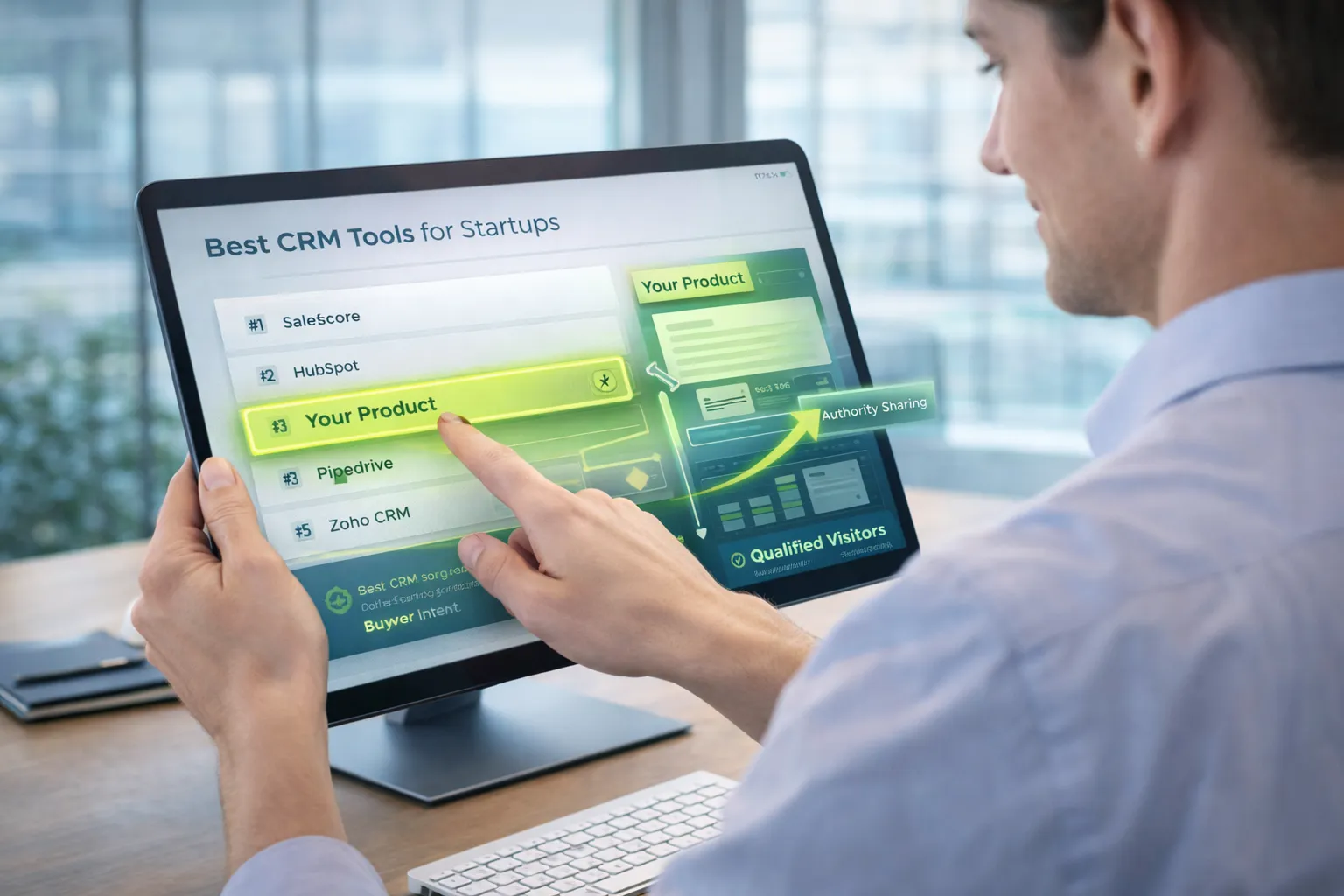
### Conversion-led Growth
Links are built to your conversion-focused pages, pricing, demo, trial, and feature pages, as well as to the supporting content your prospects actually visit during their evaluation. This strengthens the entire consideration funnel, not just top-of-funnel blog traffic.
The result is a reliable organic engine aligned with real SaaS buyer behavior: awareness through content discovery, consideration through comparison and feature evaluation, and conversion through product page authority.

Client Success Stories
## What SaaS Clients Say
verified reviews from SaaS leaders who gained authority,rankings, and revenue with our link-building services.
[View All
](https://outreachdesk.com/testimonial/)

4.8/5 

## 5/5 
Rating on Google



We needed a link building partner who understood SaaS. Previous agencies placed links on irrelevant sites without industry focus. The Outreach Desk targeted exclusively on SaaS and tech publications. Within 4 months, our primary product page moved, with quality and relevance of every placement.

#### Head of Growth
US B2B SaaS Platform


What impressed us most was the vetting process. We saw every target site before anything went live. DR, traffic data, editorial standards, everything was transparent. After 6 months, our domain rating increased, and organic demo requests grew.

#### VP Marketing
MarTech SaaS Company


We operate in cybersecurity, a regulated vertical where low-quality backlinks are not an option. The Outreach Desk built 72 links exclusively on cybersecurity and enterprise IT publications. Every placement survived two core updates without any ranking impact. The manual outreach approach gave us confidence in long-term safety.

#### SEO Director
Enterprise Cybersecurity SaaS
Service Framework
## Investment, Timeline, andDeliverables
Every SaaS link building campaign is custom-scoped to your industry, competitive landscape, and growth goals. Here’s what shapes your investment:

### Number of links per month
Most SaaS campaigns run 10-40 contextual placements per month, depending on keyword difficulty and authority gaps.

### Target domain rating range
Placements on DR 40-95 SaaS-relevant publications cost less than placements on DR 70+ publications.

### Content requirements
Some placements need new content development, others use existing product pages, comparison pages, or editorial opportunities.

### Campaign duration
Most clients see measurable ranking movement within 3-4 months, with compounding results over 6-12 months
Directional pricing
## $200 – $300+ per link
SaaS link building campaigns typically start at $200 per link for focused, single-market campaigns. Growth-stage and enterprise SaaS campaigns targeting multiple keyword clusters across competitive verticals range from $250-$300+ per link.
After your strategy call, you get a detailed proposal with exact link quantities, target page distribution, DR ranges, and a clear month-by-month roadmap. Without any hidden fees.
Book a Strategy Call
What You Get
## You See Exactly What Goes Live
You track every SaaS backlink placement with complete visibility and reporting across the campaign.
You see every link clearly and transparently:

### Live URLs
You can view each backlink that is published with direct access to placement quality and relevance.

### Linking domains
You see authoritative SaaS and industry domains driving trust, referral traffic, and ranking strength.

### Anchor text
You can review natural anchors aligned with your keywords and Google guideline-optimized practices.

### Target pages
Track exactly which product and content pages receive authority from editorial placement.
Our Approach
## The Right Links Placement for the Right Growth
You gain links built with contextual alignment and editorialquality, rather than volume or artificial placements.
| Factor | In-House / DIY | |
| --- | --- | --- |
| Time investment | 4-8 weeks per campaign cycle with in-house
hiring, training, and tool setup | The first placements go live within 2-4 weeks
without hiring overhead. |
| Publisher access | Limited to cold outreach and scraping tools.
No established publisher relationships. | Established editorial relationships with SaaS & tech publications
built over years of manual outreach. |
| Editorial standards | Varies by team skill. Quality
is inconsistent as volume scales. | Every placement manually vetted: DR 40-95, 1,000+
traffic, editorial review, backlink health check. |
| Risk control | PBN exposure, AI content risks, and
over-optimization depend on team experience. | Strict white-hat only. No PBNs, no link exchanges, no AI
content. Google-safe editorial placements. |
| Process reliability | Experimental. Results vary month to
month based on available resources. | Proven 7-step process with dedicated
account management and structured reporting. |
| Cost efficiency over time | In-house: $400-$800/link (salary, tools, overhead).
Freelancers: $150-$600/link (variable quality). | Fixed pricing from $200-$300/link with
consistent quality standards across every placement. |
| SaaS Expertise | Generalist teams rarely understand the SaaS buyer
journey, comparison page strategy, or product-led growth. | SaaS-specific site selection, product-aware content
strategy, and revenue-page link mapping. |
| Reporting | Manual tracking in spreadsheets.
Irregular updates. | Structured reports with live URLs, anchor mapping,
site metrics, and delivery timeline. |
Who We Help
## Build for High-CompetitionSaaS Categories
No matter your niche, you can secure links on websites that truly match your industry. We help you build authority and visibility in the spaces that matter most for your growth.
[

### SaaS & Software
](https://outreachdesk.com/saas-link-building/)
[

### Ecommerce & DTC
](https://outreachdesk.com/ecommerce-link-building/)
[

### B2B & Enterprise
](https://outreachdesk.com/b2b-link-building/)

### Startups

### Real Estate
[

### Law Firms & Legal
](https://outreachdesk.com/link-building-for-lawyers/)
[

### Dental Practices
](https://outreachdesk.com/link-building-for-dentists/)

### Healthcare & Fitness

### Financial & Insurance

### Technology & Innovation

### Consumer Brands
Real Results
## How Authority Turns into Results
Observe how consistent, high-quality placements can lead to measurable results.
SaaS
###
Workflow Automation Platform Breaks into Page 1 Against Zapier and Make in 11 Months
####
0 → 19
AI Overview
####
0 → 16
ChatGPT
####
0 → 21
Perplexity
####
0 → 11
Gemini
####
0 → 14
Copilot
####
61 → 71
Domain Rating
####
+1,200%
Organic Traffic
####
38 → 212
Page 1 Keyword
####
374
Links Built
A growing HR SaaS platform needed to build domain authority from the ground up in a competitive HR tech market. Outreach Desk managed a sustained link building campaign over 36 months, scaling from initial authority-building to competitive positioning against established market leaders. [Read More](https://outreachdesk.com/case-study/workflow-automation-platform-breaks-into-page-1-against-zapier-and-make-in-11-months/)
SaaS
###
Customer Data Platform Grows from 3,200 to 38,500 Monthly Organic Visits and Closes $2.8M in Organic Pipeline
####
0 → 17
AI Overview
####
0 → 14
ChatGPT
####
0 → 19
Perplexity
####
0 → 10
Gemini
####
0 → 12
Copilot
####
61 → 71
Domain Rating
####
+1,200%
Organic Traffic
####
17 → 96
Page 1 Keyword
####
286
Links Built
A mid-stage B2B marketing SaaS needed to rank for competitive commercial keywords against established players with 5x their domain authority. Outreach Desk focused on link building on product pages and comparison content, targeting SaaS and MarTech publications with DR 55+ and relevant editorial coverage. [Read More](https://outreachdesk.com/case-study/customer-data-platform-grows-from-3200-to-38500-monthly-organic-visits-and-closes-2-8m-in-organic-pipeline/)
SaaS
###
IT Service Management Platform Captures Enterprise Keywords and Reduces CAC by 38% in 12 Months
####
0 → 22
AI Overview
####
0 → 18
ChatGPT
####
0 → 23
Gemini
####
0 → 13
Gemini
####
0 → 19
Copilot
####
56 → 66
Domain Rating
####
+95%
Organic Traffic
####
14 → 39
Page 1 Keyword
####
168
Links Built
An enterprise cybersecurity SaaS operating in a YMYL vertical needed links from highly authoritative, niche-specific publications. General tech blogs and guest post farms were unacceptable due to compliance requirements and brand positioning. Outreach Desk built a targeted campaign focused exclusively on cybersecurity, enterprise IT, and compliance publications. [Read More](https://outreachdesk.com/case-study/it-service-management-platform-captures-enterprise-keywords-and-reduces-cac-by-38-in-12-months/)
[View All
](/case-study/)
Common Questions
## Frequently Asked Questions
Get answers on SaaS link building, covering safety, reporting, and growth-focused editorial placement strategies.
### Is SaaS link building safe?
Yes, we secure all links through [manual outreach](https://outreachdesk.com/manual-link-building/) on SaaS, tech, and business publications. We follow Google guidelines and white-hat practices only.
### When will rankings start improving?
Most SaaS teams see early movement in the first few weeks, with stronger rankings and traffic gains over 2-4 months.
### Do links stay live long-term?
Yes, all the placements are editorial and intended to remain live and permanent, providing long-term trust, credibility, and referral value.
### Can we approve sites before publishing?
Yes, you can review and approve the target websites before the placement when brand control is required.
### Are the links do-follow?
Most publications offer do-follow links, but we appreciate editorial guidelines when attributes are required. We prioritize those links that pass genuine trust, credibility, and ranking value.
### Do you link to product and feature pages?
Yes, we focus on revenue-driving, high-intent pages, including product, feature, and comparison pages, not just blog content.
### What type of sites do you build links from?
We build links on relevant SaaS, B2B, startups, marketing, and tech publications with real traffic, editorial standards, and topical authority.
### Do you guarantee specific rankings or traffic?
No ethical agency can guarantee rankings. However, we can guarantee high-quality placements, clear and transparent reporting, and a strategy that is built to improve visibility.
### How do you choose anchor text?
We focus on selecting natural anchors that align with your keyword strategy and Google guidelines to maximize the rankings without risking any penalties.
### Will this work for early-stage SaaS?
Yes, we customize campaigns for early-level, growth-level, and enterprise-level SaaS, focusing on building authority, product visibility, and decision-stage keywords.
### Do you provide reporting and visibility?
Yes, you receive the complete reporting with live URLs, target pages, and placement details for every link built.
### Is manual outreach really used for every link?
Yes, we secure every placement through personal outreach, without any networks, automation, or PBNs.
### How does SaaS link building differ from generic link building?
SaaS link building focuses on comparison pages, decision-stage content, and product-led keywords rather than just generic blog links to influence revenue.
### Do you work with regulated or technical SaaS industries?
Yes, we support fintech, cybersecurity, health tech, and enterprise SaaS through placements on authoritative and niche-relevant sites.
### How many links do you build per month?
The volume of links you build depends solely on your goals, competition, and budget. We prioritize quality and authority over a fixed link count.
### Will these links help with product-led SEO and demos?
Yes, we align placements with product pages, feature hubs, and demo-focused content to support trial signups and sales-qualified traffic.
## Build Links the Right Way
Manual outreach, real editorial placements, and SaaS link building designed for sustainable ranking growth and lasting authority.
Book a Strategy Call

4.8/5 _
Trusted by 500+ agencies &
1,000+ businesses worldwide.

---
---
title: "Backlink Monitoring Tool"
url: "https://outreachdesk.com/backlink-monitoring-tool/"
lang: "en-US"
type: "page"
description: "Backlink Monitoring Tool Protect Every Backlink You Build. Backlinks get removed more often than you’d expect, and most people don’t notice until their rankings and traffic have already dropped. With Outreach Desk’s free Backlink Monitoring Tool, you can verify whether"
last_modified: "2026-05-26T12:38:27+00:00"
custom_fields:
header_style: "header-style-1"
footer_style: "footer-style-1"
---
# Backlink Monitoring Tool
Backlink Monitoring Tool
# Protect Every Backlink You Build.
Backlinks get removed more often than you’d expect, and most people don’t notice until their rankings and traffic have already dropped. With Outreach Desk’s free Backlink Monitoring Tool, you can verify whether the links you’ve built are live on the referring pages. Paste the linking page URLs and your website URL to instantly check the status of each backlink. For brands that need consistent execution, [link building services](https://outreachdesk.com/) from a specialised provider remove the manual workload.
Enter Backlink URLs
Enter Target URL
_
Check Status
Tool Overview
## What is a Backlink Monitoring Tool?
A **Backlink Monitoring Tool** helps you check whether the links pointing to your website are still live or have been removed.
Our tool checks each backlink on the pages you provide and tells you whether your link is
Found means your link is live on the referring page.
Not Found means your link may have been removed, broken, or missing.
That’s it. Simple, accurate, and instant.
Why It Matters
## Why You Need a Backlink Monitoring Tool
Without regular monitoring, lost backlinks can go unnoticed and may harm your rankings. Our Free Backlink Monitoring Tool helps you instantly:

### Verify Link Placement
After a campaign or placement, confirm that your agreed link was actually added to the referring page.

### Spot Lost Link
Live links can disappear without notice. Regular checks help you catch lost links early, so you can keep your momentum and protect your rankings.

### Campaign Transparency
Whether you manage SEO yourself or work with a partner, you’ll get clear proof of which links are live and which need attention.

### Save Time on Manual Checks
Instead of opening each referring page and searching for your link, get the status for up to 100 URLs at once.
How It Works
## How to Check Your Backlinks
Our Backlink Monitoring Tool runs directly in your browser, so there’s no installation or technical setup required. Here’s how it works:
1
### Enter Backlink URLs
Paste the URLs of pages where your backlinks are placed or should appear. You can add multiple URLs at once for fast, bulk backlink analysis.
2
### Enter Your Target URL
Add the exact URL of the page on your website that the backlinks should point to. Use one consistent target URL per check.
3
### Click “Check Status”
The tool scans each referring page to check if your backlink is live.
4
### View Results Instantly
Each referring page is listed with its status. See whether your backlinks are Found or Not Found. You can see at a glance which links are live and which need attention.
Why Choose Us
## What Makes Our Tool Different
**With our Backlink Monitoring Tool, you can:**
Check up to 100 backlink URLs per batch
No limit on total checks. You can run as many batches as you need
Accurate backlink tracking
Everything runs in your browser. No installation needed
A clean and easy-to-use interface
Results are delivered instantly for the URL in a single check
## Who is This Tool For?
Use this tool if you need to confirm whether specific backlinks are live on specific pages.
It’s especially helpful if you run guest posting or outreach campaigns, need to verify link placements, work with agencies, or manage SEO for clients. You get quick confirmation without manual checking.
However, it does not discover new backlinks. It only checks the specific URLs of the referring pages you provide. For a comprehensive backlink analysis, use it alongside tools like Google Search Console, Ahrefs, or Semrush.

## Run a Free Backlink Check Now
Backlinks need regular monitoring to make sure important links remain active and correctly attributed.
Consistent checks help you spot lost, broken, or changed links early so you can maintain your site’s authority and long-term search visibility.
Try Now
Common Questions
## Frequently Asked Questions
Clear answers to help you understand how backlink monitoring tool works and why it’s safe
### What exactly does this tool check?
It checks whether your target URL appears as a hyperlink on each of the referring page URLs you enter. It does not crawl your entire domain or discover new backlinks.
### Does it show all backlinks pointing to my domain?
No. It only checks the specific backlink URLs you provide. It’s a verification tool, not a backlink discovery or crawling tool.
### What does “Not Found” mean?
It means your target URL does not appear on that referring page. This could mean the link was removed, the page may have changed, or the link may never have been added.
### Can I check multiple URLs at once?
Yes. You can paste upto 100 backlink URLs in the backlink URL field, one per line, for bulk backlink analysis and get clear reports in one click.
### Do I need to install any software?
No. This tool works directly in your browser, so there’s nothing to download or install.
### How often should I check my backlinks?
Check your backlinks regularly. Especially if you’re actively building links. A weekly review helps you keep your domain count accurate and your rankings strong. The tool keeps you updated, so you’re always in control.
### What’s the difference between a backlink audit and backlink monitoring?
A backlink audit is a one-time review of your entire link profile. It is used to assess organic backlinks and flag risky links. Backlink monitoring is the ongoing process of tracking whether individual links are currently live. Both serve different purposes and work well together.
## Let’s Build Trust and Credibility the Right Way
If you want guest posting built for clarity, relevance, and long- term growth, this is your next step.
Book a Strategy Call

**4.8**/5 _
Trusted by 500+ **agencies &
1,000+ businesses** worldwide.

---
---
title: "Casino Link Building Service"
url: "https://outreachdesk.com/casino-link-building-services/"
lang: "en-US"
type: "page"
description: "Casino Link Building Casino Link Building Built for Long- Term Authority You get strategic editorial casino backlinks placed within relevant gambling content, strengthening authority, boosting visibility, and supporting stable rankings in highly competitive search results. Contextual gambling placement Authority-building links"
last_modified: "2026-05-27T04:46:09+00:00"
custom_fields:
header_style: "header-style-1"
footer_style: "footer-style-1"
---
# Casino Link Building Service
Casino Link Building
# Casino Link Building Built for Long- Term Authority
You get strategic editorial casino backlinks placed within relevant gambling content, strengthening authority, boosting visibility, and supporting stable rankings in highly competitive search results.
_
Contextual gambling placement

Authority-building links

Stable ranking growth
Book a Strategy Call

4.8/5 _
Trusted by 500+ agencies &
1,000+ businesses worldwide.
Average DR
40 – 95
Campaign Dashboard
LIVE
DOMAIN RATING
38 → 47
+9 points
ORGANIC TRAFFIC
+77%
12,900 → 22,800
PAGE 1 KEYWORDS
4 → 18
+14 points
PLACEMENTS
95
72 unique domains
_
Referral Traffic
+60%










What We Do
## What Casino Link Building Really Means
Casino link building is the most demanding specialization in SEO. The iGaming vertical operates under Google’s strictest scrutiny. YMYL (Your Money or Your Life) classification means that every backlink pointing to a gambling site is evaluated to higher standards of relevance, editorial quality, and trustworthiness. Links that work in other industries can actively harm a casino site.
The competitive reality compounds the difficulty. The global online gambling market is projected to reach $164.5 billion by 2033. Over 5,000 online casinos compete for the same high-value keywords. Top operators and affiliates invest $40,000-50,000+ monthly in link building alone. In this environment, generic link building services are not just ineffective; they’re dangerous. Low-quality placements, irrelevant links, or automated mass outreach can trigger algorithmic devaluations that take months to recover from.
In fields like this, generic link building can carry risk. Low-quality placements, irrelevant niche links, or automated outreach campaigns can trigger algorithmic penalties and dilute topical authority. It may take time to recover from these penalties.
Three things define an effective casino link building strategy:

### Genuine iGaming publisher access
You get access to trusted iGaming publishers who accept gambling content, maintaining strict editorial standards.

### YMYL-grade editorial quality
Gambling links must be placed in expert, relevant content; low-quality placements can trigger negative YMYL quality signals.

### Compliance-aware placement strategy
Placements align with jurisdictional and licensing requirements, while cautious anchor strategies reduce penalties and manual reviews risks.
How We Work
## A Structured Process Behind Casino Link Building
Casino SEO requires precision. Every step is designed to give you controlled, relevant, editorial-quality content.
### Page Mapping
Your campaign starts with a strategy session led by a dedicated account manager. Together, you identify high-value pages such as casino reviews, bonus pages, game guides, informational content, and core money pages.
Your strategist audits your backlink profile, analyzes competitor link strategies for target keywords, and identifies authority gaps that are blocking rankings. You receive a prioritized link plan with anchor distribution, targets, and risk limits tailored to your site. Brands that need consistent placement quality often partner with managed backlink campaigns.
### Opportunity Research
Your team identifies high-quality placement opportunities across the iGaming publisher network, including gambling editorial sites, casino review platforms, comparison pages, sports portals, and relevant lifestyle publications that accept gambling content. Each publisher is vetted for strong authority, real organic traffic, topical relevance, editorial quality, indexation health, and low spam risk.
Sites linked to recycled lists, PBNs, or content farms are excluded. Your strategist also cross-checks publishers against Google’s quality signals, ensuring all placements meet strict YMYL standards.
### Editorial Review
Every placement is manually reviewed for editorial quality, topical relevance, and natural alignment with your target pages. Your strategist evaluates how the link fits within the content, ensuring the mention feels organic and justified.
Surrounding content is also assessed for accuracy, tone, and compliance with gambling advertising standards across your licensed markets. This rigorous review process distinguishes safe, sustainable casino link building from the risky link-farm tactics common among low-quality providers.
### Publisher Outreach
Your outreach team contacts publishers directly through established relationships. Casino link building relies on relationship-based access; most quality gambling publishers reject cold outreach from unknown agencies. Outreach Desk leverages existing publisher relationships built over years of iGaming-specific campaigns.
All placement content is written by experienced writers with iGaming content knowledge. Every piece undergoes internal editorial review for brand accuracy, correct use of gambling terminology, and regulatory compliance before submission.
### Link Placement
Once content is published, your team verifies every live link. Including correct target page destination, contextual relevance, anchor text accuracy, dofollow status, indexation, and publisher site health. Additional casino-specific checks verify that the placement doesn’t create problematic anchor text concentration, that the surrounding content meets YMYL editorial standards, and that the publisher’s site hasn’t degraded since initial qualification.
If a placement doesn’t meet quality standards, your team secures a correction or replacement at no extra cost.
### Reporting
You receive structured reports documenting every live placement, link URL, target page, anchor text, domain metrics, content context, indexation status, and risk assessment. Your strategist provides strategic context, not just data, explaining how each link supports your authority goals and where the next-highest-impact opportunities lie.
Ongoing monitoring tracks publisher site health and link status. If a publisher’s site degrades, gets penalized, or removes content, your team flags it and works on replacements proactively within the 6-month link protection period.

Expected Results
## Outcomes That Casino Link Building Delivers
Properly placed casino backlinks within relevant editorial content support stable rankings and build defensible authority, even in highly competitive markets.
- 1. Relevance
- 2. Improved Ranking Stability
- 3. Content Authority
- 4. Natural Backlink Profile
### Contextual Casino Links
Casino backlinks deliver value only when placed within genuinely relevant gambling content. Your links appear naturally in casino reviews, betting guides, comparison articles, and iGaming editorial features where a gambling reference is expected and justified.
This strong contextual alignment signals to Google’s YMYL systems that your site earns authority through real industry recognition rather than artificial promotion.
In one campaign, a casino affiliate improved average rankings from position 14 to 4 across 18 keywords after 6 months, with 34 contextual placements on DR 45-75 gambling sites. Their earlier generic link-building efforts yielded no measurable gains, underscoring that relevance, not volume, drives sustainable results.
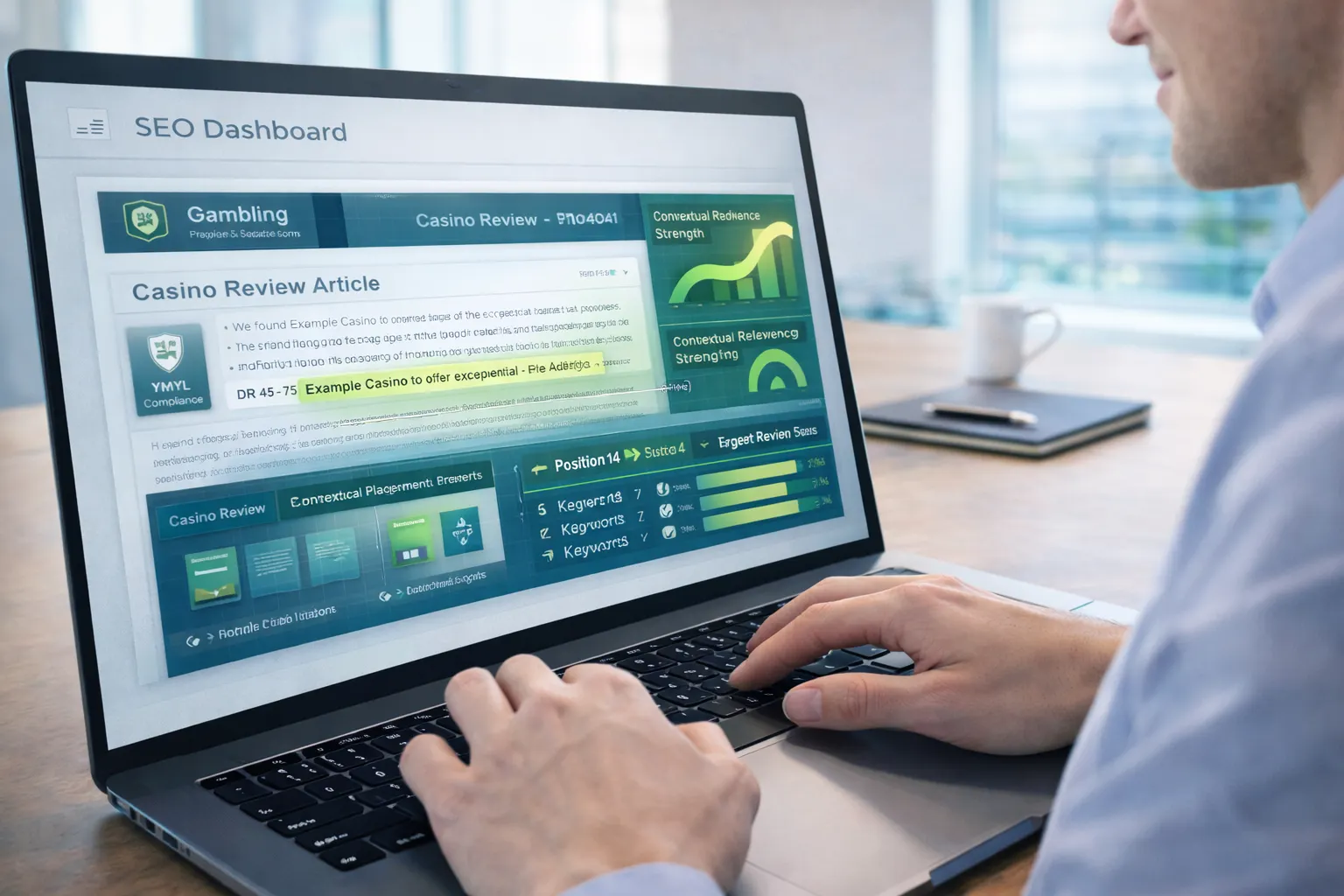
### Consistent Visibility Without Variability
Casino sites are disproportionately affected by Google’s core updates and spam updates. Sites relying on aggressive, low-quality link profiles routinely lose 30-60% of their organic traffic during major algorithm updates.
Editorially earned casino links from genuinely relevant publishers create the kind of authority profile that survives these updates, and often benefits from them as competitors with weaker profiles get penalized.
Ranking stability in the casino niche is not about avoiding risk entirely. It’s about building an authority profile that looks naturally earned, editorially justified, and contextually relevant, the exact signals Google’s YMYL evaluation systems are designed to reward.

### Authority Built at the Page Level
When your casino links appear in relevant editorial content, they strengthen the authority of both the linking page and your destination page. This creates clear topical connections around your casino reviews, bonus pages, game guides, and money pages.
Over time, search engines develop a stronger understanding of your site’s expertise within specific gambling topics.
This page-level authority is what separates casino sites that rank for 50+ high-value keywords from those stuck competing for 5-10. The difference isn’t domain authority alone; it’s whether individual money pages have earned enough contextual authority signals to compete in the most crowded keyword markets in SEO.
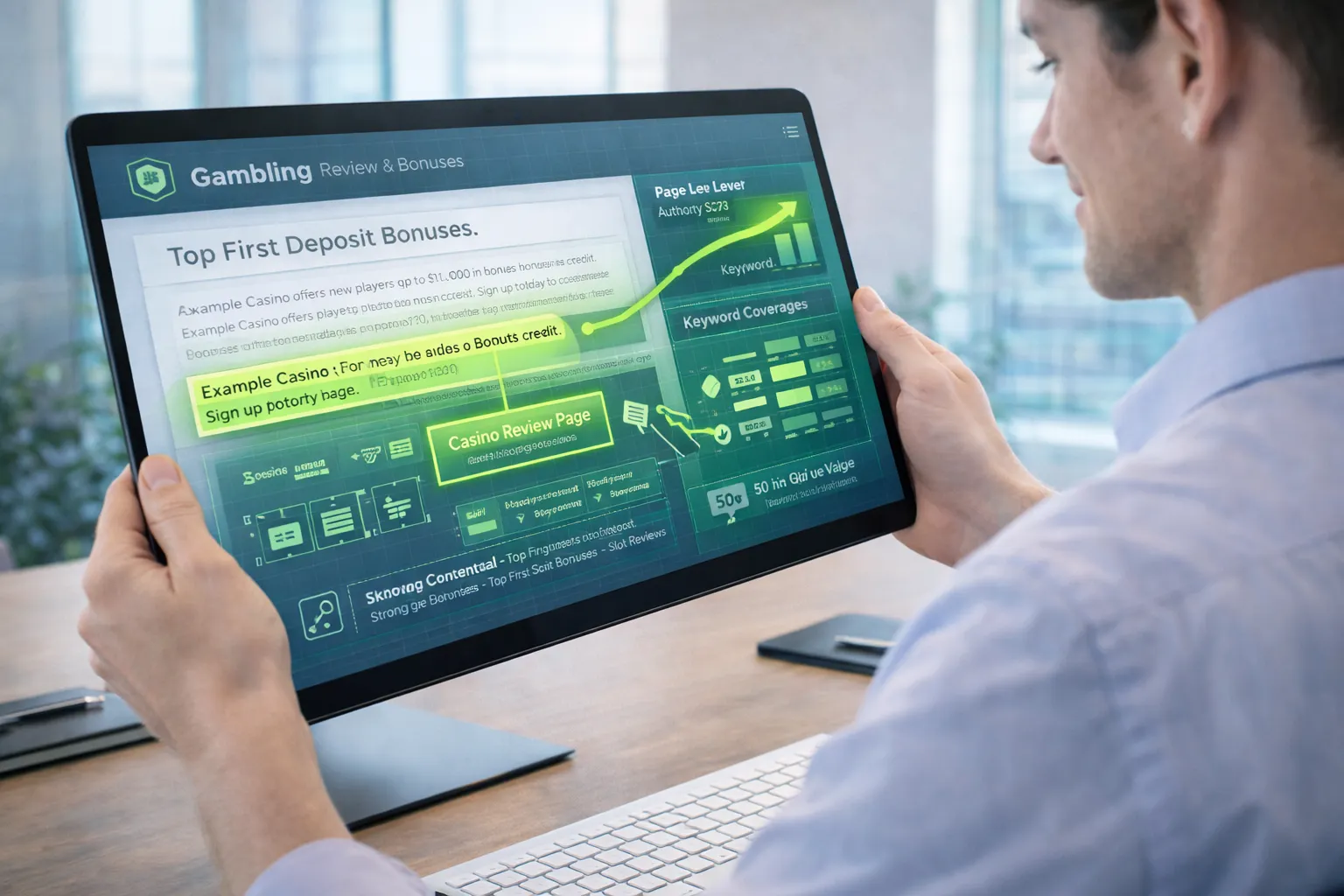
### Balanced, Organic Link Growth
A sustainable casino backlink profile needs to look naturally earned across multiple dimensions: anchor text diversity, referring domain variety, link type balance (editorial, contextual, branded), and temporal distribution (steady acquisition, not sudden spikes).
Google’s SpamBrain system and manual review teams scrutinize gambling link profiles more intensely than almost any other niche. Strategic casino link building creates a profile that withstands this scrutiny. Editorial placements blend naturally with other link types.
Anchor text is diversified across branded, partial-match, generic, and naked URL variations. Link acquisition velocity stays consistent and proportional to your site’s growth, avoiding the artificial patterns that trigger penalties.
Client Success Stories
## What Clients Say About Our Link Building
Trusted by agencies and brands that put long-term SEO stability above shortcuts.
[View All
](https://outreachdesk.com/testimonial/)

4.8/5 

## 5/5 
Rating on Google



We previously bought casino links from multiple providers, but recycled placements shared with competitors delivered fewer ranking gains. Outreach Desk secured unique publisher placements with relevant content, helping our key review pages rank within five months.

#### Head of SEO
Casino Affiliate Network


After the March 2024 core update cut our organic traffic by 40% due to low-quality PBN gambling links, Outreach Desk rebuilt our profile with editorial placements on real publishers. Within six months, we fully recovered and surpassed our previous traffic baseline by 23%.

#### Marketing Director
Online Casino Operator


We manage SEO for four iGaming clients across casino, sports betting, and poker. Outreach Desk handles link acquisition with consistent quality and compliance. Two clients now rank top five for key terms, and the white-label reporting integrates smoothly with our deliverables.

#### SEO Director
iGaming Marketing Agency
Service Framework
## Investment, Timeline, and Deliverables
Casino link building costs more than standard SEO due to specialized publisher access, stricter editorial standards, and higher risk management requirements.

### Number of links per month
Most casino campaigns build 10-30+ links monthly, while aggressive growth phases often scale to 40-50+ placements.

### Target domain rating range
Standard pricing includes DR 40-95 relevant sites, while DR 70+ premium iGaming placements require higher per-link costs.

### Geo targeting
Link campaigns target specific regions, such as the US, UK, EU, LATAM, and APAC, based on licensed markets.

### Campaign duration
Most casino sites see ranking gains in 3-4 weeks, with stronger authority growth compounding over 6-12 months.
Directional pricing
## $200 – $300+ per link
Plans range from $200 per link based on scale. Starter campaigns build initial authority with approved placements, growth plans expand visibility with faster delivery and support, while enterprise programs deliver high volumes, multi-geo targeting, and white-label reporting.
You get a detailed proposal after your strategy call, with exact link quantities, target page distribution, geo focus, risk assessment, and a month-by-month roadmap. No hidden fees.
Book a Strategy Call
What You Get
## Client-Ready Reports for Every Casino Placement
Every placement is clearly documented, so you always have full visibility.

### Live Link URLs
Direct access to every published placement. Verify each link is active, correctly targeted, and positioned within genuine gambling editorial content.

### Content Context Overview
Review surrounding editorial content for each placement to confirm topical relevance, tone alignment, content accuracy, and brand positioning.

### Anchor & Target Mapping
Track anchor text, target URLs, and placement context to maintain a balanced distribution and avoid over-optimization risks in gambling SEO.

### Campaign Summary
Clear reporting shows links delivered, anchor diversity, domain variety, link velocity, risk signals, and overall authority impact across your casino pages.
Our Approach
## Relevance-First Casino Link Approach
Your strategy prioritizes contextual relevance and editorial integrity, with each placement reviewed for logic, compliance, and risk.
| Factor | In-House / DIY | |
| --- | --- | --- |
| iGaming Publisher Access | Limited. Quality gambling publishers reject cold outreach
from unknown teams. Building relationships takes years. | Established iGaming publisher network built over the
years. Access to gambling editorial sites, review
platforms, and niche-relevant publications. |
| YMYL Compliance | Requires a deep understanding of Google’s quality
rater guidelines for gambling content. Most in-house
eams lack this specialization. | YMYL-aware placement strategy. Every link is
evaluated against quality rater criteria for relevance,
editorial quality, and trustworthiness signals. |
| Editorial Quality | Variable. Finding writers with genuine iGaming
content expertise is difficult. AI-generated
gambling content carries elevated YMYL risk. | Experienced writers with iGaming knowledge.
No AI-generated placement content. Internal
editorial review on every piece. |
| Anchor Text Risk
Management | High risk. Gambling anchor text requires precise
distribution to avoid manual actions. Most freelancers
lack the data to manage this correctly. | Data-driven anchor strategy with distribution
monitoring. Branded, partial-match, generic, and
naked URL anchors are balanced for safety. |
| Regulatory Awareness | Requires knowledge of gambling advertising regulations
across target jurisdictions. In-house teams
often miss compliance gaps. | Compliance-aware placements. Anchor text, content
claims, and publisher markets were reviewed against
applicable gambling advertising standards. |
| Publisher Quality Control | Self-managed. Hard to verify publisher quality
at scale. Risk of placements on PBNs, content
farms, or recycled sites. | Multi-point publisher qualification: DR, traffic,
spam score, indexation health, editorial standards,
and PBN/content farm blacklist screening. |
| Scalability | Limited by headcount and publisher access. Scaling from
10 to 30+ casino links/month requires
significant investment. | Scale from 10 to 100+ links/month across multiple
geos without quality degradation. |
| Cost Efficiency | In-house: $500-$1,200 per link (salary, tools, publisher
fees). Freelancers: $200-$600 per link (inconsistent
quality, no risk management). | Fixed pricing from $200-$300 per link with consistent
quality, risk management, and dedicated account
management included. |
| Algorithm Resilience | Unpredictable. Low-quality link profiles in gambling are
the first to lose rankings during core updates. | Editorial-first placements designed to withstand
YMYL scrutiny. Clients consistently maintain or
improve rankings through core updates. |
Who We Help
## Casino & Gambling Segments We Support
Casino and gambling brands with authority-driven link building tailored to competitive iGaming markets.
[

### SaaS & Software
](https://outreachdesk.com/saas-link-building/)
[

### Ecommerce & DTC
](https://outreachdesk.com/ecommerce-link-building/)
[

### B2B & Enterprise
](https://outreachdesk.com/b2b-link-building/)

### Startups

### Real Estate
[

### Law Firms & Legal
](https://outreachdesk.com/link-building-for-lawyers/)
[

### Dental Practices
](https://outreachdesk.com/link-building-for-dentists/)

### Healthcare & Fitness

### Financial & Insurance

### Technology & Innovation

### Consumer Brands
Real Results
## Results Achieved With Casino-Focused Link Building
See how relevance-driven, editorial casino links strengthen your visibility, authority, and competitive edge in tough search results.
Casino
###
Licensed Online Casino Operator Captures Page 1 for 28 High-Value Player Acquisition Keywords in 10 Months
####
0 → 4
AI Overview
####
0 → 7
ChatGPT
####
0 → 11
Perplexity
####
0 → 3
Gemini
####
0 → 9
Copilot
####
38 → 47
Domain Rating
####
+77%
Organic Traffic
####
4 → 18
Page 1 Keyword
####
124
Links Built
A mid-size US casino affiliate saw little ranking growth after a year of links from multiple freelancers. An audit found irrelevant sites, recycled publishers, and risky anchors. Outreach Desk conducted a toxic backlink audit, cleaned the profile, disavowed toxic links, and launched a focused editorial campaign targeting 25 high-value review and comparison pages. [Read More](https://outreachdesk.com/case-study/licensed-online-casino-operator-captures-page-1-for-28-high-value-player-acquisition-keywords-in-10-months/)
Casino
###
Sports Betting Platform Dominates State-Specific Keywords Across 6 US Markets in 12 Months
####
0 → 8
AI Overview
####
0 → 10
ChatGPT
####
0 → 15
Perplexity
####
0 → 5
Gemini
####
0 → 12
Copilot
####
41 → 49
Domain Rating
####
+40%
Organic Traffic
####
9 → 26
Page 1 Keywords
####
168
Links Built
After losing 40% of organic traffic in the March 2024 core update, a licensed casino was found to have risky links from low-quality PBN-style sites. Outreach Desk implemented a dual strategy: removing and disavowing toxic links while building a new foundation of high-quality editorial links from trusted gambling publishers to restore stability. [Read More](https://outreachdesk.com/case-study/sports-betting-platform-dominates-state-specific-keywords-across-6-us-markets-in-12-months/)
Casino
###
iGaming Affiliate Network Grows from 18,000 to 112,000 Monthly Organic Visits and Doubles Operator Partnerships
####
0 → 6
AI Overview
####
0 → 13
ChatGPT
####
0 → 18
Perplexity
####
0 → 5
Gemini
####
0 → 14
Copilot
####
36 → 46
Domain Rating
####
+70%
Organic Traffic
####
12 → 38
Page 1 Keywords
####
196
Links Built
An iGaming marketing agency managing SEO for 4 clients (2 casino affiliates, 1 sportsbook, 1 poker site) needed a white-label link-building partner with genuine gambling expertise and multi-vertical capabilities. [Read More](https://outreachdesk.com/case-study/igaming-affiliate-network-grows-from-18000-to-112000-monthly-organic-visits-and-doubles-operator-partnerships/)
[View All
](/case-study/)
Common Questions
## Frequently Asked Questions
Get clear answers on casino link building, safety, and reporting for sustainable iGaming growth.
### What is casino link building?
Casino link building focuses on earning backlinks for gambling-related websites through relevant, editorial placements.
### Is casino link building safe for SEO?
Yes, when links are placed naturally within relevant content and follow white-hat practices.
### How long does it take to deliver casino links?
Most placements go live within **1-3 weeks**, depending on publisher response time.
### Do you provide reports?
Yes, reports include live URLs, content context, anchor text, and placement details.
### Is casino link building different from regular SEO link building?
Yes, the casino niche is considered high-risk and highly competitive. It requires consistent, strict review, stronger relevance signals, and strategic anchor planning to avoid penalties.
### Can you help with new casino sites?
Yes, but we typically recommend building foundational authority first, such as [brand mentions](https://outreachdesk.com/brand-mentions/) and informational content links, before aggressively targeting high-volume money terms.
### Do you use PBNs or link farms?
No, we avoid private blog networks, [link farms](https://outreachdesk.com/link-farming/), or low-quality paid placements. Our focus is on sustainable, long-term growth.
## Build Authority With Casino Links That Actually Fit
If you want casino backlinks that fit your relevance, credibility, and long-term growth goals, we’ll help you build momentum with confidence.
Book a Strategy Call

4.8/5 _
Trusted by 500+ agencies &
1,000+ businesses worldwide.

---
---
title: "Link Farming: Risks and Penalties You Should Avoid in 2026"
url: "https://outreachdesk.com/link-farming/"
lang: "en-US"
type: "post"
description: "Link farming happens when a group of websites exchange or buy links to manipulate search rankings. This approach violates Google’s Spam Policy and hurts your site’s long-term authority. the team at Outreach Desk handles prospecting, content, and outreach so in-house"
last_modified: "2026-05-29T12:21:46+00:00"
categories: [Link Building]
---
# Link Farming: Risks and Penalties You Should Avoid in 2026
Link farming happens when a group of websites exchange or buy links to manipulate search rankings. This approach violates Google’s Spam Policy and hurts your site’s long-term authority. [the team at Outreach Desk](https://outreachdesk.com/) handles prospecting, content, and outreach so in-house teams can focus on strategy.
If you’re building links for your site, understanding link farming helps you avoid penalties and focus on strategies that genuinely strengthen your authority.
Our deep dive on [why these links fail and trigger penalties](https://outreachdesk.com/black-hat-link-building/) covers the broader pattern of tactics Google catches.
## Key Takeaways
- Buying or exchanging links to manipulate your site’s rankings can result in a Google penalty.
- Check for unrelated links, excessive reciprocal links, thin content, and repetitive anchor text.
- Use SEO tools such as Google Search Console, Ahrefs, SEMrush, and Moz to regularly review backlinks.
- You build trust by earning relevant links through high-quality content and real relationships. These links strengthen your authority and drive long-term growth.
- Manually remove toxic links and, if needed, disavow toxic ones, and submit reconsideration requests if you receive a penalty.
## What Is Link Farming
**Link farming is creating or joining networks of websites whose sole purpose is to exchange backlinks, not to publish useful content or serve real audiences.** Google’s SpamBrain classifier identifies these networks by detecting shared IP ranges, identical page templates, cross-linking without topical relevance, and link velocity spikes that no organic content campaign could produce.
Unlike legitimate editorial link building, link farms exist only to manipulate PageRank, which is why Google treats participation as a manual action trigger rather than just a ranking signal to ignore.
### How Link Farming Works
Understanding how link farms operate helps you spot them before they damage your site. Here’s the typical pattern:
- Multiple websites with thin or auto-generated content are created primarily to pass [link equity](https://outreachdesk.com/link-equity/).
- A massive number of irrelevant backlinks are added to footers, sidebars, and comments on these sites.
- These sites link to each other in a circular pattern to artificially boost authority.
- Exact-match keywords are repeatedly used as anchor text to manipulate rankings.
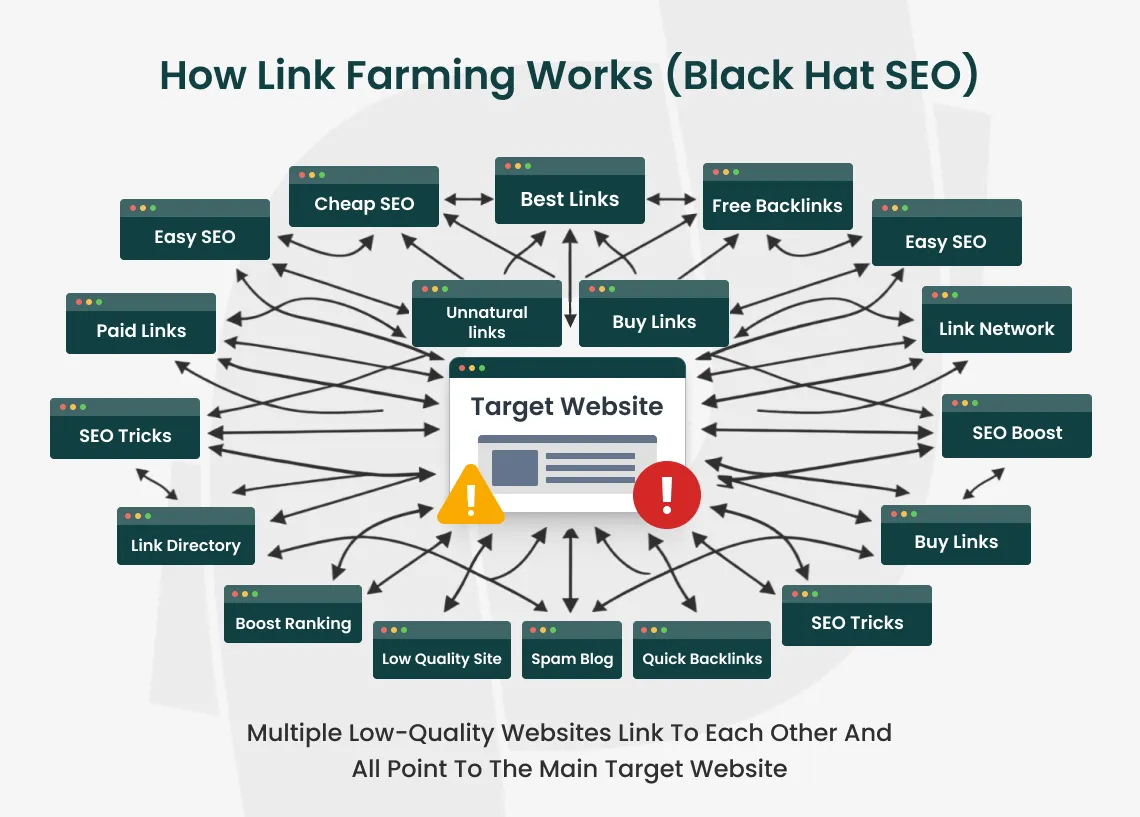You might see a short-term ranking boost from these tactics, but today’s search algorithms quickly spot and penalize manipulative link patterns.
If you spot these signs in your backlink profile, your site could be involved in link farming. Act early to protect your site’s authority.
### How Link Farming Evolved Over Time
Link farming gained attention in the early 2000s, when Google relied heavily on the number of backlinks.
Site owners realized they could manipulate search rankings by building a network of websites that linked to one another.
[Google’s Penguin update](https://developers.google.com/search/blog/2012/04/another-step-to-reward-high-quality) in 2012 changed everything. It began identifying and devaluing link schemes at scale.
By 2016, Penguin became part of Google’s core algorithm and began running in real time. This meant that penalties and recoveries occurred faster, and manipulative links were caught continuously rather than in periodic waves.
Today’s search engine algorithms use machine learning to detect unnatural link patterns instantly, making link farming far riskier than rewarding.
## Why Link Farming Harms Your Site
**Link farming triggers two Google responses: silent algorithmic devaluation through SpamBrain, and manual penalties that suppress your entire site.** SpamBrain strips the link equity quietly, so your rankings drop without any notification. A manual penalty stays in place until you file a successful reconsideration request with a documented link cleanup.
Most sites hit by the algorithmic track never realize it happened, their rankings simply stop improving or begin a slow decline with no clear cause visible in Search Console.
[Google’s spam systems](https://developers.google.com/search/docs/essentials/spam-policies) are trained on the exact patterns that define link farms: shared hosting clusters, identical link placements, unnatural anchor distributions, and zero organic traffic. When SpamBrain identifies your domain as a beneficiary, it either discounts the associated links or issues a manual action. Neither outcome reverses quickly, even after a full disavow and reconsideration request.
### Risks You Face Right Away
#### Ranking Penalties:
Your website may face a drop in search results rankings. Recovery from this drop may take months or even years, even after you remove unnatural links.
#### Drop in Organic Traffic:
When rankings fall, your organic traffic drops too. This slows your business growth and reduces your potential for lead generation.
#### Manual Actions:
Google’s webspam team can apply manual penalties, which appear in [Google Search Console](https://search.google.com/search-console) under “Manual Actions.” To recover, you must remove or disavow unnatural links and submit a reconsideration request.
#### Domain’s Trust is Lost Slowly:
When Google detects manipulative links, your website loses trust. Rebuilding trust can take months or years.
### Risks You Face in Long-Term
#### Loss of Growth
Relying on link farms can undo months of SEO progress. Your website loses trust, and your domain can develop a poor SEO reputation that’s difficult to recover from.
#### Penalties and Recovery Costs
If a penalty occurs, you lose more than your rankings. You spend valuable time and resources trying to restore your site’s trust. This time and money spent on fixing could have been invested in actually building an authoritative site.
#### Damage to Brand Reputation
Your brand reputation can suffer when it’s associated with link farming. If potential customers discover low-quality links during their research, it may reduce their trust in your brand.
## What Google Says About Link Farming
**Google’s spam policies classify link farming as a direct violation.** Participation is grounds for both algorithmic devaluation through SpamBrain and manual penalties that suppress your entire site’s rankings until you submit a successful reconsideration request with a documented link cleanup. You won’t get a warning before the action lands.
The first signal is usually a sharp ranking drop or a manual action notice in Search Console.
When links violate Google’s spam policies, they get ignored or treated as manipulative. Understanding Google’s guidelines helps you stay compliant and avoid unnecessary risks.
### Direct Policy Statements
According to Google, [link spam](https://developers.google.com/search/docs/essentials/spam-policies#link-spam) is created primarily to manipulate a site’s rankings in Google search results. It involves participating in link networks to manipulate rankings.
Google classifies link farms as link spam and may ignore or take action against such links under its spam policies.
### Quality Rater Guidelines
Google’s [Search Quality Rater Guidelines](https://static.googleusercontent.com/media/guidelines.raterhub.com/en//searchqualityevaluatorguidelines.pdf) instruct human reviewers to detect unnatural links. Raters check for:
- Links from irrelevant, low-quality sites
- Excessive irrelevant or commercial anchor text
- Widgets, badges, or embedded content are used mainly for linking
- Paid articles or ad content without any proper disclosure
These guidelines show how Google evaluates link quality.
## 7 Red Flags That Signal Link Farming
**Link farms share a recognizable fingerprint.** You’ll see backlinks from topically unrelated sites, heavy reciprocal linking, thin or templated content, exact-match anchor text repetition, footer or sidebar link blocks, and link velocity that no organic campaign could produce.
If three or more of these patterns appear in your backlink profile, you’re looking at a link farm, not an editorial link source.
It’s a signal you need to act on before Google does.
Understanding how link farms operate is only part of the picture. You need to recognize them early before they harm your site.
Here are the common signs that indicate link farming:
### 1. Links from Irrelevant Websites:
Sites linking to you’ve no connection to your topic, niche, or industry. In link-farming schemes, websites often exchange or sell links without regard to relevance. As a result, your site may receive backlinks from completely unrelated topics.
The image shows an SEO article naturally linking to a leading SEO agency within the related content. On the other hand, a global warming article includes an unrelated link to a New York SEO agency that appears out of context.
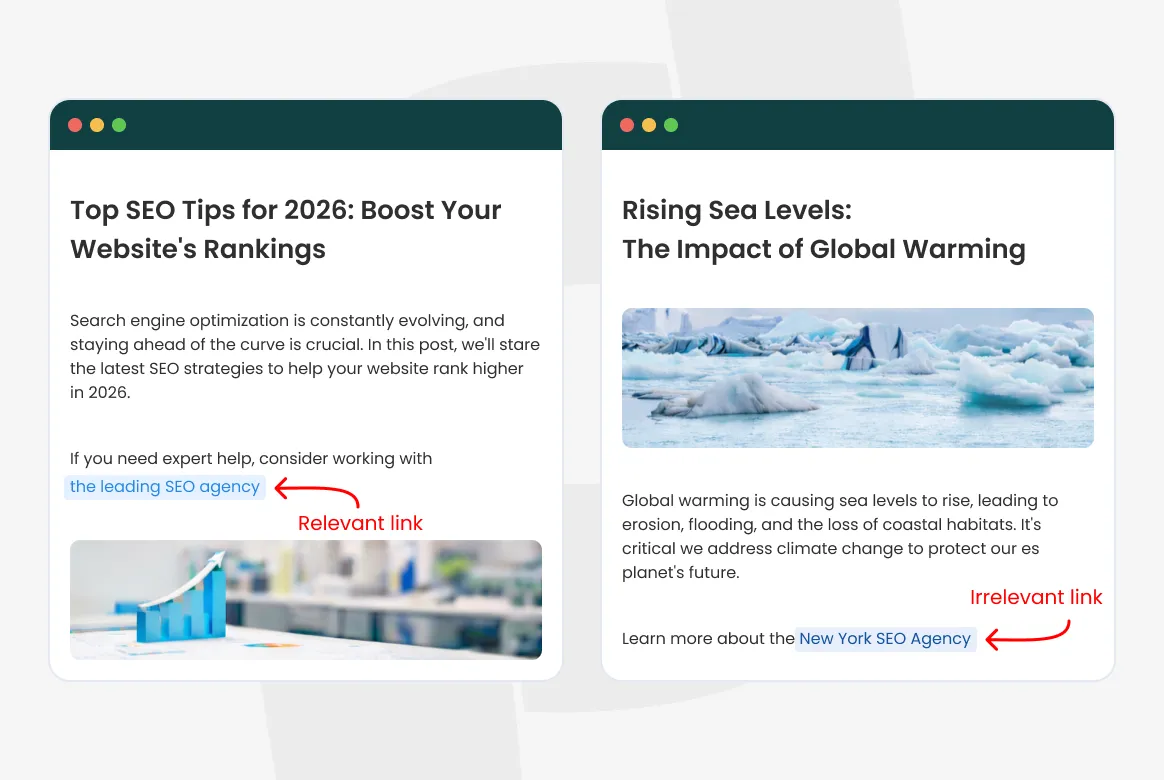
### 2. Reciprocal Linking:
“Let’s exchange links on our websites.” This is known as a reciprocal link exchange, in which two sites agree to link to each other.
When done excessively or between unrelated websites, it can appear manipulative. Genuine editorial links are rarely created through this back-and-forth arrangement.
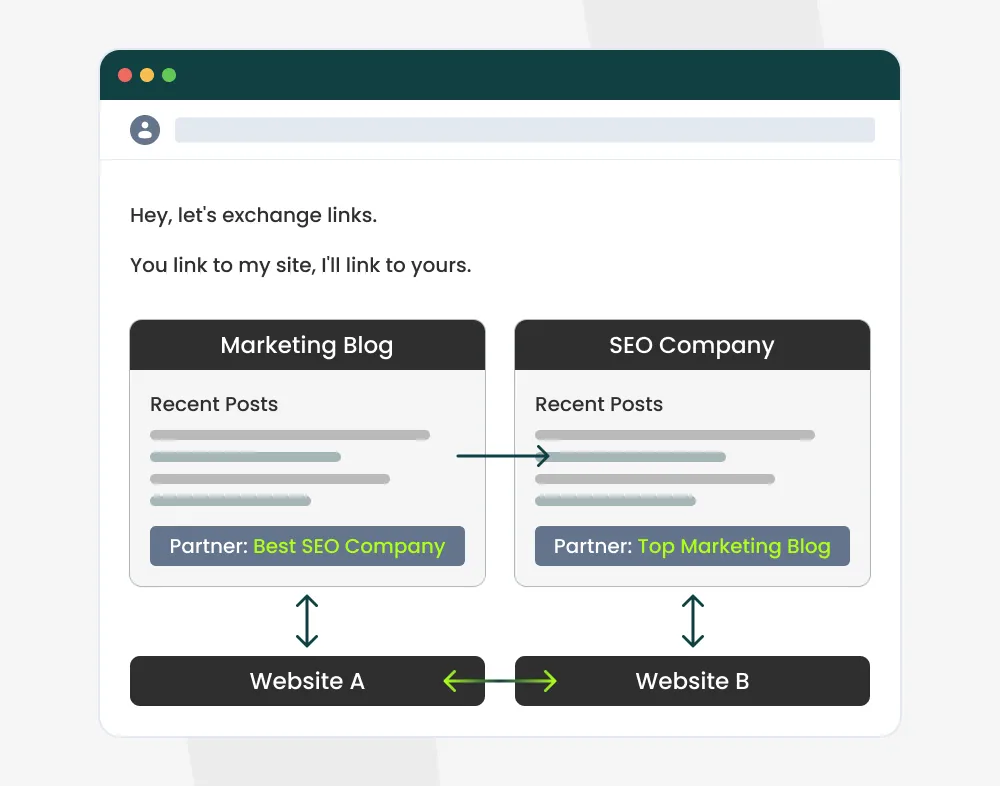
### 3. Links Added in the Footer and Sidebar:
Spammy or promotional links are often placed in sidebars or footers. Natural links, however, are usually included within the main content where they add value.
### 4. Thin, Low-Value Content:
Sites are created with very little or low-quality content with no editorial value. Content should be high-quality and provide value to readers.
### 5. Similar Anchor Text:
When most links use the exact same keywords or phrases, it creates an unnatural pattern that can reduce their value.
### 6. Missing Author and Contact Details:
If a website publishes content under generic names like Admin or shows no author at all and lacks contact details, a social media presence, or an About page, it’s a clear warning sign.
Genuine publishers proudly showcase their contributors. They provide real names, author bios, professional background, and ways to connect.
### 7. High Metrics With No Real Traffic
Some websites may look strong in SEO tools but attract very few real visitors. When strong metrics don’t match actual traffic, it can signal artificial link building.
Always verify traffic estimates using tools like [Ahrefs](https://ahrefs.com/traffic-checker) or [SEMrush](https://www.semrush.com/website/).
## How to Recover From a Link Farming Penalty
**Recovery starts with a full backlink audit, manual removal requests, a disavow file, and a reconsideration request.** You’ll need to document exactly what you cleaned up and what you couldn’t. The process takes weeks at minimum, often months. Most of that timeline is just waiting on Google to re-crawl and reassess your disavow file.
You’ve identified the problem, now here’s how you fix it. Recovery is possible with the right approach.
### Step 1: Review Your Entire Backlink Profile
Export your backlink data from Google Search Console and third-party tools into a single sheet for review. Then check for unnatural or suspicious links.
You can filter unnatural links manually or use SEO tools to make the process faster and more accurate.
#### Tools to Audit Your Backlink Profile
You can review your backlinks profile using these tools:
**Google Search Console:**
Shows the links pointing to your website directly from Google’s data.
**Ahrefs:**
Provides a thorough backlink profile analysis, including referring domains, anchor text, link strength metrics, and traffic estimates.
**SEMrush:**
Offers backlink auditing tools that identify potentially toxic links and help generate a disavow file.
**Moz Link Explorer:**
Tracks new and lost backlinks and provides a spam score to help evaluate link quality.
**Review each link one by one for:**
- Relevance to your site’s or industry’s topic
- Quality of the content and the value it provides to readers
- Natural editorial placements vs. unnatural link placements
- Ability to rank in SERPs and trustworthiness
Filter out unnatural links for further analysis.
### Step 2: Manually Remove the Unnatural Link
Contact the website owner or webmaster. Explain that you noticed their site links to yours and politely request removal.
**Subject:** Request to Remove Link to Our Website
Hi [Name],
We’re reviewing our backlink profile and noticed a link to our website on your page: [Their URL].
The specific link appears here: [Specific URL].
Could you please remove this link at your convenience? I’d appreciate confirmation once it’s removed.
Thank you for your help.
Best regards,
[Your Name]
Keep a record of your outreach efforts, including their replies and non-replies.
### Step 3: Disavow Remaining Unnatural Links
For links you were unable to remove manually, use [Google’s Disavow tool](https://search.google.com/search-console/disavow-links?hl=en&utm_source=wmx&utm_medium=deprecation-pane&utm_content=disavow-links-main). This tool tells Google to ignore certain backlinks when assessing your site.
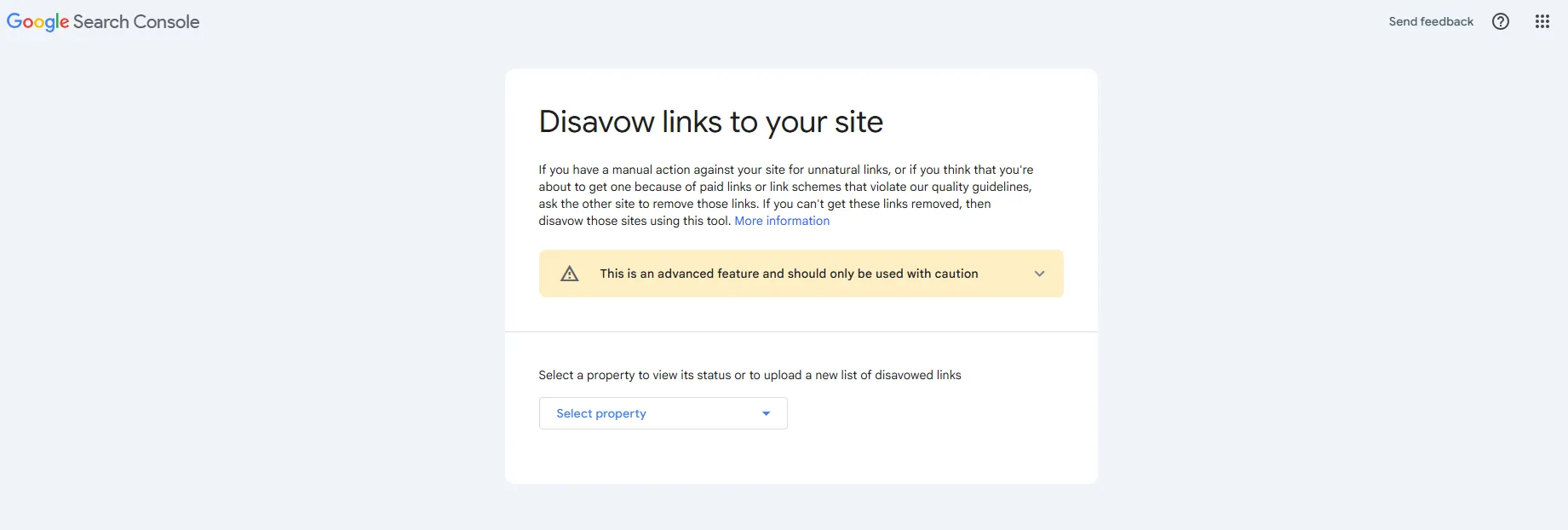Create a text file (.txt) including the list of all the domains or specific URLs you want to disavow:
**In the disavow file:**
# Links from known link farm
domain:example-linkfarm.com
This tells Google to ignore all links from that entire domain.
# Specific spam page
http://another-spam-site.com/spam-page.html
This tells Google to ignore only that specific page, not the whole domain.
Upload this file through the Google Disavow Tool (accessible via Google Search Console). Google will review these disavow files when the algorithm re-evaluates your website.
### Step 4: Submit a Reconsideration Request
If you’ve received a manual action report, submit a reconsideration request after removing all the unnatural links from your backlink profile. In the request, explain:
- All actions you took to remove unnatural links
- Proof of your outreach efforts and link removal efforts
- Changes in your link-building practices in the future
Google will review the requests manually. Approval from Google may take some time.
## Ethical Alternatives to Link Farming
**Every ethical alternative shares one thing: they earn links by giving publishers something genuinely worth citing.** That can be original research, a free tool, an expert quote, or a guest post that fits the publisher’s editorial standards. The work is slower than buying links. The links last.
Instead of relying on risky link farming tactics, focus on these [white hat link building](https://outreachdesk.com/white-hat-link-building-strategies/) strategies that help you earn links safely and build a natural backlink profile.
### Create Linkable Content:
**Authentic Research and Content: **
Create relevant articles, studies, and surveys that are related to your industry. When your content offers useful data or unique findings, other websites are more likely to naturally reference and link to it.
Suppose an SEO agency publishes an original survey with valuable industry data. Bloggers and marketers cite the survey in their articles and link back to it as the source.
**Complete Guides: **
Publish in-depth guides on specific topics within your industry. When people search for detailed information or data, they’re more likely to find your guide and link to it as a trusted resource.
**Useful Tools:**
Create free tools that solve real problems for your audience. Helpful tools are often bookmarked, shared, and linked to naturally because they provide ongoing value.
### Earn Editorial Mentions
**Thought Leadership Content:**
Publish opinion pieces, industry insights, or trend analysis on your own platform or reputable websites. When your content offers unique perspectives, others may naturally reference and link to it.
**Contribute Expert Insights:**
Respond to journalist queries through platforms like HARO (Help a Reporter Out). When your insights are quoted, media outlets may link back to your website.
**Guest Posting on High-Quality Sites:**
Post valuable articles for reputable publications in your industry. Editorial links from trusted sites help you build credibility.
### Invest in Building Relationships, Not Quick Trades
**Business Collaborations:**
Partner with businesses in your industry to co-create content, host webinars, or share valuable resources. Genuine collaborations often lead to natural and relevant backlinks.
**Community Engagement:**
Participate actively in industry forums, groups, and events. By contributing meaningful insights and support, you build recognition that can lead to organic link opportunities.
**Influencer and Expert Outreach:**
Connect with influencers and industry experts by offering value first. Share their content, provide thoughtful feedback, or collaborate on projects before requesting anything in return.
## White Hat Link Building vs Link Farm
**White hat link building earns backlinks. Link farming trades them.** One publishes content people genuinely want to cite. The other manipulates rankings through reciprocal placements and PBNs. One builds long-term authority. The other puts your domain on a spam classifier’s watchlist. The table below shows where these two approaches diverge.
For the broader picture of [the legitimate alternative](https://outreachdesk.com/white-hat-seo/) at the SEO level, see our white hat SEO guide.
Now you’ve an idea about why natural link building is a better option and why link farming is risky. Let’s quickly summarize:
| Feature | White Hat Link Building | Link Farming |
| --- | --- | --- |
| Technique | Earn links naturally through valuable content | Manipulate rankings for quick gains |
| Purpose | Build authority and trust | Artificial ranking boost |
| Risk Factor | Low and manageable | Extremely High |
| Google Compliant | Fully compliant | Violates Google policies |
| Long-term value | Stable, long-term growth | No lasting value |
Link farms chase short-term ranking. Ethical link building helps you to build lasting authority and real, long-term growth.
## Tracking Sustainable Link Growth
**Sustainable link growth has a clear pattern.** You’ll see diverse referring domains, topically relevant publishers, mixed natural anchor text, and a velocity that matches how editorial coverage actually compounds. If your backlinks don’t fit this profile, you’re building on a foundation Google can pull out from under you at any core update.
Ethical link building follows natural patterns. Here’s what to look for:
### Diverse Sources:
Your backlinks come from different, relevant domains, not repeated placements on the same few sites.
### Topical Relevance:
Links are earned from websites related to your industry or subject area.
### Natural Anchor Text:
Anchor text appears naturally within the content. Some links use your brand name, while others use descriptive phrases that fit the context.
### Real Traffic:
Links actually bring real visitors to your website, not just artificial ranking improvements.
### Placements Inside the Content:
Links are placed naturally within the main content, not hidden in footers, sidebars, or author bios.
## Final Thoughts
Link farming may promise quick ranking boosts, but the risks are much bigger than the short-term gains. Search engines are getting better at spotting artificial links, and penalties can undo months of hard work.
Strong SEO is built on trust, relevance, and real value. Instead of chasing shortcuts, focus on earning links through helpful content and genuine relationships. It may take more time, but the results last longer.
In the long-term, trust and consistency matter more than quick wins. Choose strategies that strengthen your website and not ones that put it at risk.
### Worried about penalties and unsafe link tactics?
Let’s fix your link strategy with a safe, ethical approach that builds authority and long-term rankings.
[Book a Free Strategy Call](/contact-us/)
### Can even a few links from link farms hurt my website?
Yes, even a few links might trigger a penalty and can hurt your site’s authority over time.
### Where are link farm links generally located?
You’ll find them embedded in content as excessive external links, in footers, within low-quality articles, and in sidebars.
### Can I hire a professional to clean link farms affecting my website?
Yes. You can hire an in-house team for yourself or work with a link-building partner experienced in identifying and removing toxic links.
### What are the risks of buying a paid link?
Buying links can weaken your site’s credibility and visibility in search results.
### How can a link building service agency help me with link farming penalties?
A link-building partner can identify toxic links, clean up your backlink profile, and develop a strategy to earn editorial links that restore your rankings.
### What is the difference between Public Blog Network, Guest Posting, and Link Farming?
PBNs are built on expired domains and are privately controlled. They focus on passing link equity to target websites.
Guest posting means writing articles for another company’s website. Done right, it provides value to your audience and builds your authority.
Link farming is a network of low-quality content sites created only to manipulate backlinks.
---
---
title: "B2B Link Building: Drive Rankings and Revenue in 2026"
url: "https://outreachdesk.com/b2b-link-building/"
lang: "en-US"
type: "post"
description: "Your product solves real problems. Your content answers real questions. But when decision-makers search for what you offer, your competitors show up first. The gap between you and them often comes down to one thing: trusted websites link to them,"
last_modified: "2026-05-18T11:53:37+00:00"
categories: [Link Building]
---
# B2B Link Building: Drive Rankings and Revenue in 2026
Your product solves real problems. Your content answers real questions. But when decision-makers search for what you offer, your competitors show up first.
The gap between you and them often comes down to one thing: trusted websites link to them, not to you.
**B2B link building **closes that gap. It helps you earn mentions and links from the industry websites your buyers already trust. Those links strengthen your authority, improve your search visibility, and put you in front of decision-makers at the exact moment they’re evaluating their options. Most successful campaigns rely on [B2B link building services](https://outreachdesk.com/) to handle vetting, outreach, and reporting.
### What You’ll Learn in This Guide
- What B2B link building means and how it differs from B2C
- How to choose your starting point based on your budget and time
- 12 proven tactics with step-by-step implementation instructions
- Copy-paste email templates that get 15%+ response rates
- A prioritization framework so you start with what works fastest
- Your detailed 30-day action plan to get started
- How to measure results that matter to your business
## What B2B Link Building Means
**B2B link building is the practice of earning backlinks from publishers that serve your professional buyer audience.** Those publishers include industry publications, trade directories, technology review sites, and business media. Each editorial link from one of these sources signals to Google that your domain is a trusted source on the topics your buyers research before they buy.
The goal isn’t just domain rating but topical authority within your specific industry vertical, which Google weighs heavily when ranking pages competing for high-intent B2B queries.
It differs from B2C link building in both targeting and timing. B2B links need to reach procurement-stage audiences, not impulse buyers, which changes which publishers and content formats earn the right placements at the right stage of the decision cycle.
Imagine a business blog writes an article on “Best Project Management Tools” and includes your site as a reference.
When trusted sites link to your content, Google sees it as a signal that your site is worth ranking. That improved visibility puts you in front of potential clients at the exact moment they’re comparing options and looking for a solution.
💡
**Tip:** Focus on earning links from websites your target customers already trust and read. These links not only improve search engine visibility but also influence buying decisions.
## Why B2B Link Building Matters for Your Business
**B2B link building matters because enterprise and mid-market buyers research vendors through exactly the publications and review platforms that link to your site.** So a backlink from a respected SaaS review site or an industry analyst report is simultaneously an SEO signal and a brand credibility signal that influences purchase decisions independently of search rankings.
Organic search drives a disproportionate share of B2B pipeline at the awareness and consideration stages, and strong link equity is the primary lever for capturing that traffic before competitors do.
Links from those sources boost your rankings and build brand familiarity at the exact decision stage where vendor credibility determines who gets shortlisted. That combination of SEO authority and buying-stage trust is what makes B2B link building different from any other acquisition channel.
Most B2B buyers don’t make fast decisions. They compare, research, and look for trusted brands for weeks or months. B2B backlinks help you become one of those trusted brands.
### You Rank for Keywords That Drive Leads
When you build strategic B2B links to your important pages, such as your pricing or product comparison pages, those pages are more likely to appear at the top of the [search results page](https://outreachdesk.com/what-are-serps/) when buyers search for solutions like yours.
Suppose you sell marketing automation software, and your competitor’s pricing page has 50 high-quality backlinks while yours has 10. When someone searches for “marketing automation software pricing”, they’re more likely to rank higher in search results.
Earning relevant backlinks to your key pages improves your ability to compete for high-intent searches, which often turn into real leads and sales.
💡
**Remember:** Links alone don’t determine rankings. You also need strong content, the right keywords, and a fast, user-friendly website.
### You Attract Decision-Makers, Not Just Traffic
Some visitors are just browsing. Others are comparing options and are ready to buy.
When someone discovers your business through an industry publication or SaaS review platform, they’re close to making a decision, and they convert at higher rates than cold traffic.
Imagine you’re searching for accounting software and see a company mentioned in a trusted industry article. You’re more likely to trust that company than one you find randomly. That is how quality backlinks build trust early.
### You Build Trust Before Sales Conversations
B2B buyers typically research for weeks or months before making a decision. When they see your company featured on trusted industry sites during that research phase, you’re no longer just an unfamiliar name. You’re an established business that they already recognize and trust.
Suppose A CFO is evaluating expense management software and, over weeks of research, they see your company mentioned in a [Forbes](https://www.forbes.com/) article (a leading US-based media brand), a G2 analyst report, and a finance blog comparison.
By the time they reach your website, your brand already feels familiar, which increases trust and improves conversion rates.
### You Get Cited in AI-Generated Results
More buyers are starting their research with AI assistants. When trusted industry websites link to you, you’re more likely to show up in AI search results.
AI tools like ChatGPT and Google’s AI Overviews don’t just rely on your website. They also consider what trusted sources say about your company.
Suppose someone asks, “What are the best CRM tools for real estate?” AI tools are likely to surface brands that are consistently discussed on real estate websites and industry blogs. If reputable real estate websites talk about your CRM software, AI tools are more likely to recognize and mention your brand.
💡
**The New Search Reality:** More buyers are starting their research with AI assistants instead of traditional search engines. Some industry experts estimate that up to 30% of searches begin with AI tools like ChatGPT and Gemini.
## How B2B Link Building Differs from B2C
**B2B link building differs from B2C in three ways: longer sales cycles, fewer but higher-value publishers, and a narrower pool of relevant link targets.** A B2C link from a major lifestyle blog can drive direct purchases. A B2B link from the same blog adds almost nothing.
The publisher quality bar is higher because the audience pool is smaller and more specific.
Both B2B (Business-to-Business) and B2C (Business-to-Consumer) use backlinks to improve visibility in the search engine results. But the way they influence buying decisions is very different.
| Factor | B2B Link Building | B2C Link Building |
| --- | --- | --- |
| Target Audience | Decision-makers, managers, and multiple stakeholders | Individual consumers |
| Buying Cycle | Long, research-heavy, risk-sensitive | Shorter, emotion-driven |
| Relevance vs Reach | Niche relevance matters more than mass traffic | Broad reach and visibility matter more |
| Authority Impact | High-trust industry mentions influence buying decisions | Social proof and popularity influence buying decisions |
| Page Priority | Focus on bottom-funnel and revenue-driving pages (pricing, case studies, product pages) | Often focus on blog and awareness content. |
| Outreach Approach | Personalized and relationship-focused | Scalable and volume-driven |
## What Makes a B2B Link Valuable
**A B2B link is valuable when it comes from a publisher your target buyers already read.** The link should sit in editorial content and use an anchor that signals relevance to your core service. Domain authority alone isn’t enough.
A DR 70 lifestyle blog is worth less than a DR 45 industry publication that your enterprise prospects actually trust as a buying-decision source.
Not every backlink helps your business drive growth. Here’s how to identify the right ones:
### Industry Relevance
The site linking to you should be related to your industry, business category, or buyer persona.
**Simple test:** Ask yourself, “Would my ideal customer read this website when researching solutions?” If yes, it’s relevant. If not, skip it.
**Mistake to avoid:** Accepting links from unrelated sites just because they have high traffic or authority scores.
### Trusted Authority
Quality links come from sites that publish useful content, maintain professional standards, and earn reader trust.
You can evaluate these sites by looking at the site’s content quality, how often they publish new content, whether their topics align with your industry, and whether professional writers engage with them.
You can also use free tools like [Moz’s Domain Authority checker](https://moz.com/domain-analysis) or [Ahrefs](https://ahrefs.com/) to see their authority score (aim for sites with a DA above 30 for meaningful impact).
#### What is Domain Authority (DA)?
Domain Authority is a metric developed by [Moz](https://moz.com/) that estimates how likely a website is to rank in search results based on its backlink profile.
Think of it like a credit score for websites, scored 0-100:
- DA 0-20 = New or low-quality sites
- DA 20-40 = Average sites
- DA 40-60 = Good authority
- DA 60-80 = Strong authority
- DA 80-100 = Industry leaders like Forbes or TechCrunch
### Contextual Placement
The most important thing is where your link appears on a page. The best [links appear naturally within ](https://outreachdesk.com/contextual-link-building/)[the main content,](https://outreachdesk.com/contextual-link-building/) where they add value to readers, not in footers or sidebars. The surrounding context should make it clear why the link exists and what the readers will gain by clicking it.
**Good contextual placement example:**
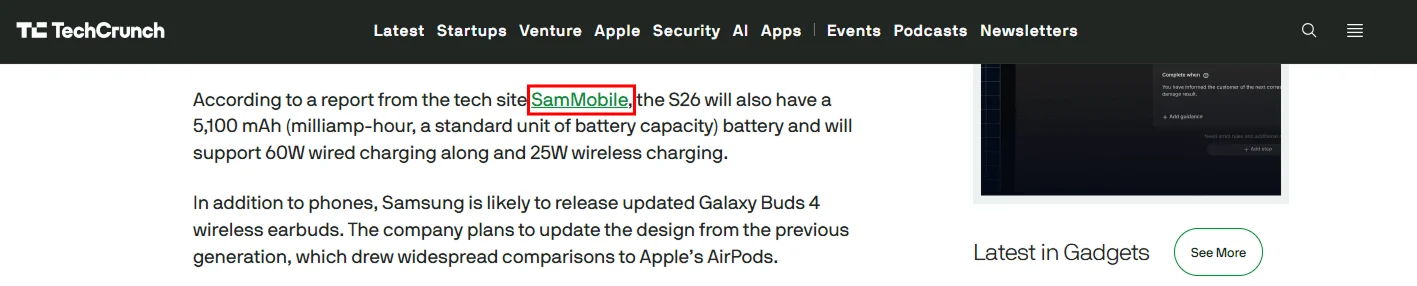
### Descriptive Anchor Text
Anchor text is the clickable text in a link. It describes what readers will find when they click it.
Anchor text should be natural, relevant to the content, and fit smoothly into the sentence without looking forced or overly optimized.
**Descriptive anchor text helps both:**
- Users (they know what to expect)
- Search engines (they understand what your page is about)
However, avoid over-optimizing. Vary your anchor text naturally to prevent it from looking spammy.
## Building Your Strategic B2B Link Building Framework
**A strategic B2B framework starts with your buyer’s research path.** Map which publishers, communities, and analysts your persona trusts at each stage. Outreach happens later. The first step is figuring out which 30-40 sites your ideal buyer actually reads, then designing content worth a link from those specific sites.
Strategic [link building campaign](https://outreachdesk.com/link-building-campaigns/) follows a clear process. Here’s your step-by-step framework:
### Step 1: Set Revenue-Focused Goals
Before earning B2B backlinks, be clear about the results you want to achieve:
- Which competitors are you trying to outrank?
- What’s your target for monthly qualified organic leads?
Set goals that link directly to revenue. The purpose of B2B link building is to support real business growth, not just backlink numbers.
### Step 2: Identify Your Priority Pages
Focus on pages that drive conversions:
- Pricing and comparison pages where buying decisions happen.
- Product or service pages that explain your solution.
- Case studies that show real results and ROI.
These money pages convert visitors into leads. They should be your priority over random blog content.
**How to find your priority pages:**
Look at your Google Analytics and analyze your top-performing pages. You look for two things:
**High traffic, low conversions**
These pages may need stronger messaging, clearer CTAs, or more trust signals.
**Strong conversions, low traffic**
These are strong candidates for link building because more visibility could directly increase qualified leads.
### Step 3: Analyze Competitor Link Gaps
If your competitors rank higher than you, then one common reason is that more trusted websites link to them. You can see exactly which sites those are by [analyzing your competitor’s backlinks](https://outreachdesk.com/competitor-backlinks/).
Use [Ahrefs](https://ahrefs.com/) or [SEMrush](https://www.semrush.com/) to find websites that link to your competitors but not to you:
- Enter your competitor’s domain into Ahrefs
- Click “Backlinks” from the left menu
- Apply filters:
Select Dofollow (these links typically pass value)
- Sort by Domain Rating (high to low)
- Review the list to see your competitor’s strongest backlinks
- Export the backlink list and repeat the same process for 2–3 competitors
- Compare the lists and identify websites that appear multiple times
- Shortlist these sites. They already link to businesses like yours; they may be more open to linking to you as well.
### Step 4: Create Linkable Assets
Create content that people genuinely find useful and want to reference or share naturally. Instead of asking for a link without offering any value, you create resources that people find helpful.
Here are some examples of [linkable assets](https://outreachdesk.com/linkable-assets/):
**Original research:**
Share unique data, surveys, or industry insights that others can cite.
**Thorough guides: **
Create in-depth resources that cover a topic completely.
**Case studies:**
Show real results with clear, measurable outcomes.
**Free tools:**
Offer practical tools that solve specific problems.
**Visual content:**
Use charts, infographics, or other visuals to make complex topics easier to understand.
### Step 5: Create Your Outreach List
Your [outreach](https://outreachdesk.com/link-building-outreach/) list should include the relevant industries your target audience trusts.
**Here’s how you can prepare the list:**
Use a simple spreadsheet to track: website name, contact person, email address, pitch angle, and status. Start with 15–20 strong prospects. Scale once you know what works.
## 12 Proven B2B Link Building Strategies
**The twelve B2B link building strategies below cover the full pipeline: research-driven outreach, expert positioning, content partnerships, and digital PR.** Pick three or four that fit your team size and content capacity. Running all twelve at once is how programs collapse in month four.
Below are 12 proven B2B link building strategies that companies use to strengthen their authority, attract prospects, and support steady business growth.
### 1. Business Partnership Links
Start with the companies you already work with, partners, vendors, clients, and integration companies.
The relationship already exists. Trust is established. Showcasing partners builds their credibility and earns you a relevant backlink.
The Image shows how Zapier integrates with Canto, highlighting a real business collaboration.
Integration pages like this often include brand mentions and links.
**Step-by-step process:**
-
List every business relationship: existing partners, vendors, clients, and integration companies.
- Visit their websites and check for pages like “Partners,” “Integrations,” “Customers,” or “Resources.”
- See if your company is mentioned or listed. If it isn’t, you’ve found a link opportunity.
- Reach out and request a mention or link.
**Subject: Quick question about [Partner/Member] page**
Hi [Name],
We’ve been [working together / a member] for [Time Period], and I wanted to check if we could be added to your [Partners/Members/Clients] page on your website.
Happy to provide our logo, description, and link. Would also be glad to reciprocate on our site if helpful.
Let me know what you need from us!
Best, [Your Name]
- Follow up with a polite message after 5-7 days if there is no response.
- Track the link once it’s live and maintain the relationship.
**Why this works:**
The relationship already exists, so trust is established. Showcasing partners builds their credibility and earns you a relevant backlink.
**Expected results:**
If you reach out to 10 partners or collaborators, several of them will likely agree, especially if the link benefits both businesses.
### 2. Reclaim Unlinked Brand Mentions
[Unlinked brand mentions](https://outreachdesk.com/unlinked-mentions/) occur when other websites mention your brand, product, or services, but don’t include a link to your website.
Reclaiming unlinked mentions means asking websites to turn brand mentions into clickable links.
**Steps to find unlinked brand mentions:**
- Use [Google Alerts](https://www.google.com/alerts) to track mentions of your brand online.
Enter your company name
- Set frequency to “As-it-happens.”
- Click “Create Alert.”
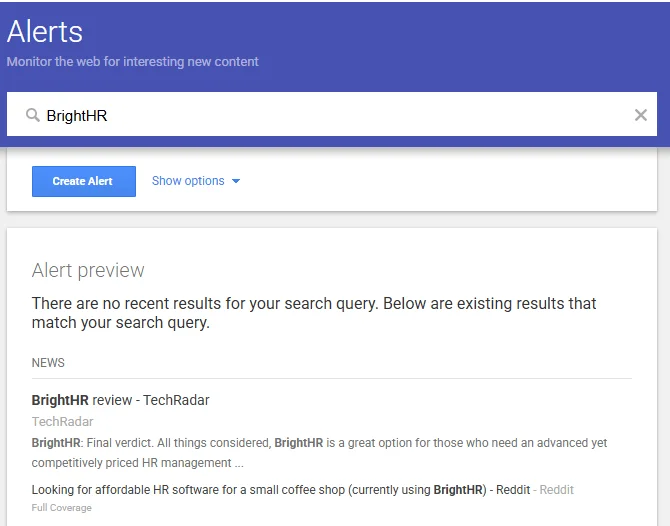
- Use search operators to find existing mentions:
Google: “YourCompanyName” -site:yourwebsite.com
- This finds pages that mention you, but not your own site
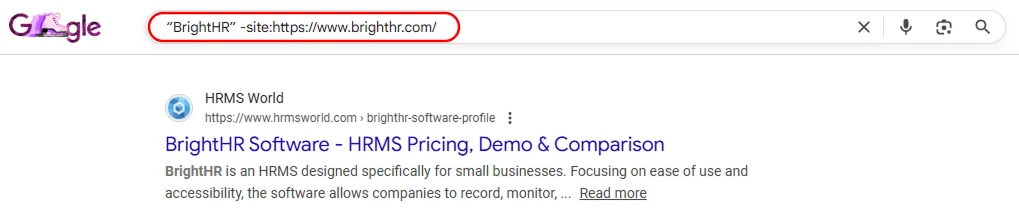
- Verify the mention. Make sure:
They mention is positive
- The context supports adding a link
- The site is credible and relevant
- Find contact info:
Look for the “Contact” page
- Use [Hunter.io](http://Hunter.io) to find email addresses
- LinkedIn search for the author
- Reach out using this template:
**Subject: Thanks for mentioning [YourCompany]!**
Hi [Name],
I came across your article “[Article Title]” and noticed you mentioned [YourCompany]. Thanks for the mention!
I wanted to reach out to see if you’d be open to adding a link to our website, [YourWebsite.com], so readers can learn more about what we do.
Happy to return the favor if you ever need a quote or contribution on [RelatedTopic].
Thanks! [Your Name]
**Why this works:**
They have already mentioned your company and are familiar with your brand. So, requesting a link is a logical next step as it makes their content more useful to readers.
**Expected results:**
In many cases, about 30-50% will agree to add the link. You can improve your success rate by offering value in return, such as a guest post, a quote, or a promotion.
### 3. HARO Responses
HARO (Help A Reporter Out), now known as Connectively, is a platform that helps journalists find expert sources for their stories.
When you respond with helpful insights, you can earn mentions and links from reputable publications.
**How to Get Results with HARO:**
- Create an account on the [HARO](https://www.helpareporter.com/) platform
- Complete your profile by adding your name, company, and areas of expertise.
- You’ll receive regular emails with journalist queries in your selected categories (usually up to three queries per day).
- Respond within 2–4 hours, as journalists receive many replies and often review the first few responses before moving on.
- Provide accurate, original, and valuable responses journalists can easily use.
**Subject: Re: [Their exact subject line]**
Hi [Journalist Name],
I’m [YourName], [YourTitle] at [YourCompany], where we [Relevant Credential].
On your question about [Topic]:
[Your main insight in 2-3 sentences – make it quotable]
Include [Specific example or data point that illustrates your point].
Feel free to reach out with any follow-up questions. Best, [Your Name]
**Measuring success:**
- Track pitches sent vs. published mentions and analyze how many of your responses actually turn into published quotes.
- Results may vary by industry, response quality, and speed. The typical success rate is 5-15%.
- When journalists include your quotes and links to your site, you earn one strong backlink from that publication.
### 4. SaaS Review Platforms
SaaS review platforms matter for product companies because buyers use them to compare options.
For product-based companies, especially SaaS businesses, these platforms are important because buyers often visit them before making a decision.
In simple terms, if your software isn’t present where buyers are comparing options, you may not even make it onto their shortlist.
**Priority platforms by category:**
**B2B Software (all industries):**
If you sell software to other businesses, these review platforms are important because buyers use them to compare options before making any decision.
- [G2](https://www.g2.com/)
- [Capterra](https://www.capterra.com/)
- [TrustRadius](https://www.trustradius.com/)
- [Software Advice](https://www.softwareadvice.com/)
**Specific categories:**
- Agencies/Services: [Clutch.co](http://Clutch.co)
- Enterprise software: [Gartner Peer Insights](https://www.gartner.com/peer-insights/home)
- Marketing tools: [Intercom](https://www.intercom.com/blog/the-ultimate-marketing-technology-stack/)
- Sales tools: [Crunchbase](https://www.crunchbase.com/)
**Step-by-step to maximize value:**
- **Identify the top review platforms in your industry**
You can search for something like “best [your software category] tools” and see which site consistently appears.
- **Create or claim your company profile**
Make sure that you officially create your profile so you can manage information and updates.
- **Complete your profile**
Add accurate details, features, pricing, and screenshots to build trust completely.
- **Encourage happy customers to leave honest reviews**
Ask recent customers for genuine feedback. Don’t try to force them or include a misleading review.
- **Respond professionally to all reviews, including negative ones**
Show your gratitude for the positive reviews, and address negative reviews calmly with polite feedback, as buyers notice how you respond.
- **Add a link to your website from your profile**
Make it easy for the interested buyers to visit your website and learn more.
**Email template to request reviews:**
**Subject: Quick favor – 2 minutes?**
Hi [Customer Name],
Hope you’re enjoying [YourProduct]! Quick question:
Would you mind leaving us a quick review on G2? Takes about 2 minutes and really helps other [Industry] professionals discover us.
Here’s the direct link: [DirectReviewLink]
As a thank-you, we’ll enter you into our monthly drawing for [Incentive] and send you our exclusive [Bonus Resource].
Thanks! [Your Name]
**Why this matters:**
When someone searches for the term “best CRM software,” the review platforms like G2 and Capterra often appear at the top of the results.
If your product isn’t listed with reviews, you may miss out on buyers at key decision-making moments. Even if your website ranks, many buyers rely on review platforms before they shortlist vendors.
**Expected impact:**
- In the 1st month, get listed and optimize profiles on 3-5 platforms to establish your presence.
- In the 3rd month, aim to collect 10-15 reviews across platforms to build credibility.
- In the 6th month, you may see improvements in rankings and receive more demo requests.
- Over time, review platforms can become a consistent source of qualified leads.
### 5. Broken Link Building
[Broken link building](https://outreachdesk.com/broken-link-building/) is a strategy that involves finding broken links on relevant industry sites. Create content that fills in what’s missing, then reach out to offer your resource as a helpful replacement.
This approach benefits both sides. The site improves its content by fixing a broken link, and you earn a relevant backlink.
**How it Works:**
#### Step 1: Find broken link opportunities
**Method 1 – Using the Check My Links extension:**
- Install “Check My Links” Chrome extension
- Look for resource pages, link roundups
- Click the extension icon
- It highlights broken links in red
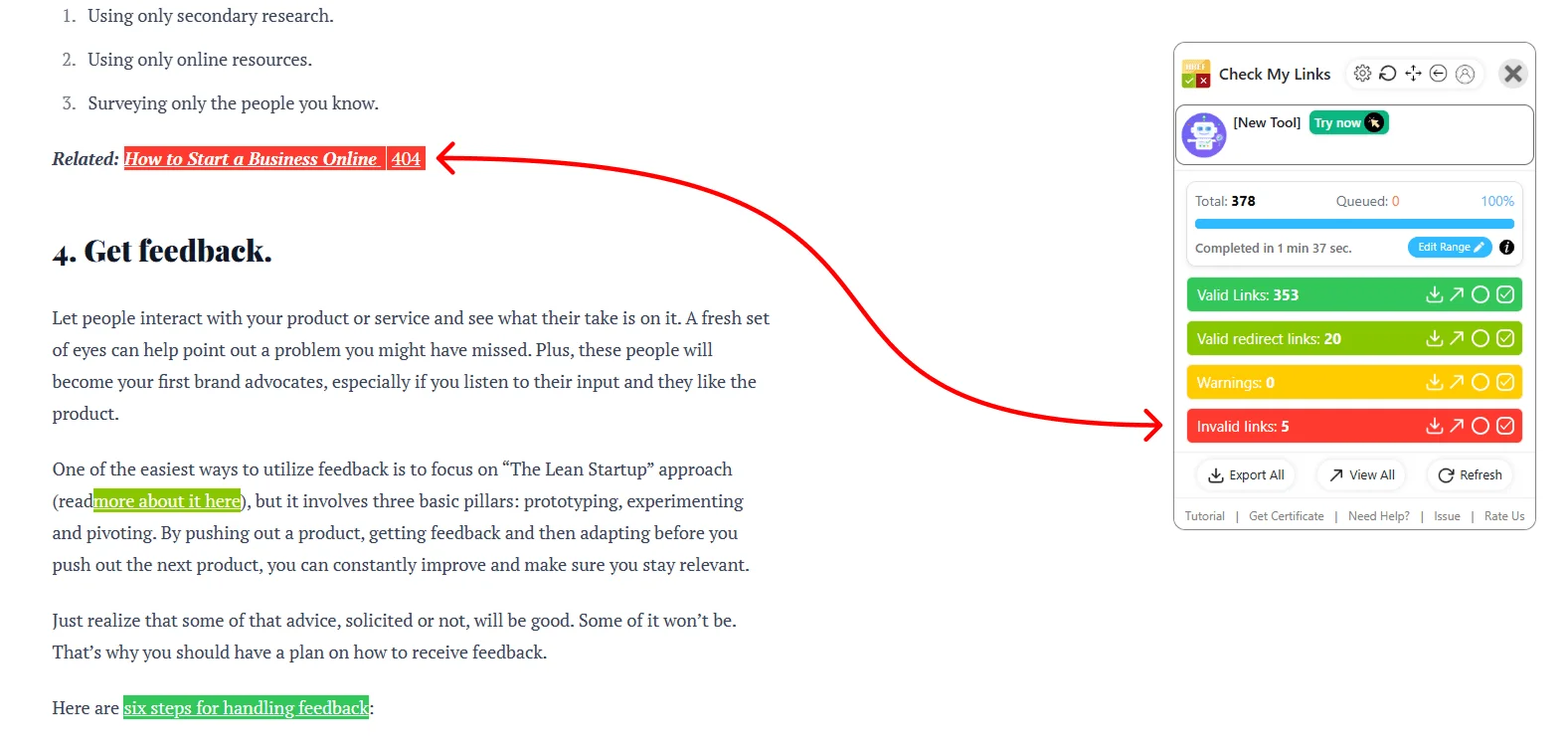**Method 2 – Using Ahrefs :**
- Go to the Site Explorer tab
- Enter competitor domain
- Under the backlink profile, open broken backlinks
- Find broken (404 not found ) links on their pages.
#### Step 2: Evaluate and Create
Check what the broken link was about and make sure it is relevant to your business. If it’s a good fit, use existing content; if not, create a better replacement.
#### Step 3: Send outreach
**Subject: Broken link on your [Article Title]**
Hi [Name],
I read your article “[Exact Article Title]” and found it very helpful for [Specific Value].
I noticed a broken link on line X that mentions [Topic]. The link goes to [BrokenURL], which returns a 404 error.
I actually have a Thorough resource that could serve as a great replacement: [Your URL]
It covers [Brief Description of What Your Content Includes].
Would you be open to updating the link? I’d be happy to suggest any improvements to make it even more useful for your readers.
Best, [Your Name]
**Why this works:**
You’re genuinely helping them improve their content. Broken links hurt their SEO and user experience. You’re solving a problem while earning a link.
**Expected results:**
For every 10 broken-link outreach emails, you can expect 1-3 added links. Most of your time goes into finding the right opportunities.
### 6. Strategic Guest Posting
[Guest posting](https://outreachdesk.com/guest-posts/) involves contributing valuable articles to respected industry publications. In return, you earn a relevant backlinks, they gain quality content, and their audience discovers your expertise.
In B2B, the goal isn’t quantity. The goal is trust, credibility, and relevance.
Focus on publishing on sites your target buyers actually read. One article on a respected industry blog is more valuable than multiple posts on random websites.
**Finding the right guest post opportunities:**
#### 1. Use Google search variations
You can use these Google search operators to find the best suitable opportunity:
- “[Your industry] + write for us”
- “[Your industry] + guest post guidelines”
- “[Your industry] + become a contributor”
#### 2. Check where competitors publish
Use Ahrefs to discover where your competitors are publishing guest posts.
- In Ahrefs, go to Content Explorer and search using operators like: {niche} “this is a guest post by.”
- Review the results to find websites that feature guest contributions or mention your competitors.
- Visit those sites and check if they accept guest posts or provide contact details.
#### 3. Reach out
Once you find a suitable guest post opportunity, send an outreach email to request permission to contribute your article.
**Subject: Article idea for [TheirSite]: [Specific Topic]**
Hi [FirstName],
I’ve been reading [TheirSite] for a while. Your recent piece on [specific article] was a great read.
I’d love to contribute a high-quality guest post [Publication 1] that aligns with your content and adds value to your readers.
Would this be a good fit for [TheirSite]? Happy to send a detailed outline if you’re interested.
Best, [Your Name]
**Expected results:**
- If you send 10 pitches in a month, there’s a chance 1 or 2 will be accepted.
- When you send 20 pitches in 3 months, you’ll get 3 or 4 acceptances.
- If you pitch consistently for six months, editors may start contacting you.
### 7. Original Research Publication
Publishing original research is one of the strongest B2B link building strategies. When you share unique data, insights, or survey results, it naturally attracts backlinks from journalists and industry analysts who cite your research.
Instead of promoting opinions, you’re providing facts others can use in their content and to their readers as well.
The image below shows the original survey data collected by HubSpot on brand POV. It includes statistics and research findings published to share industry insights.
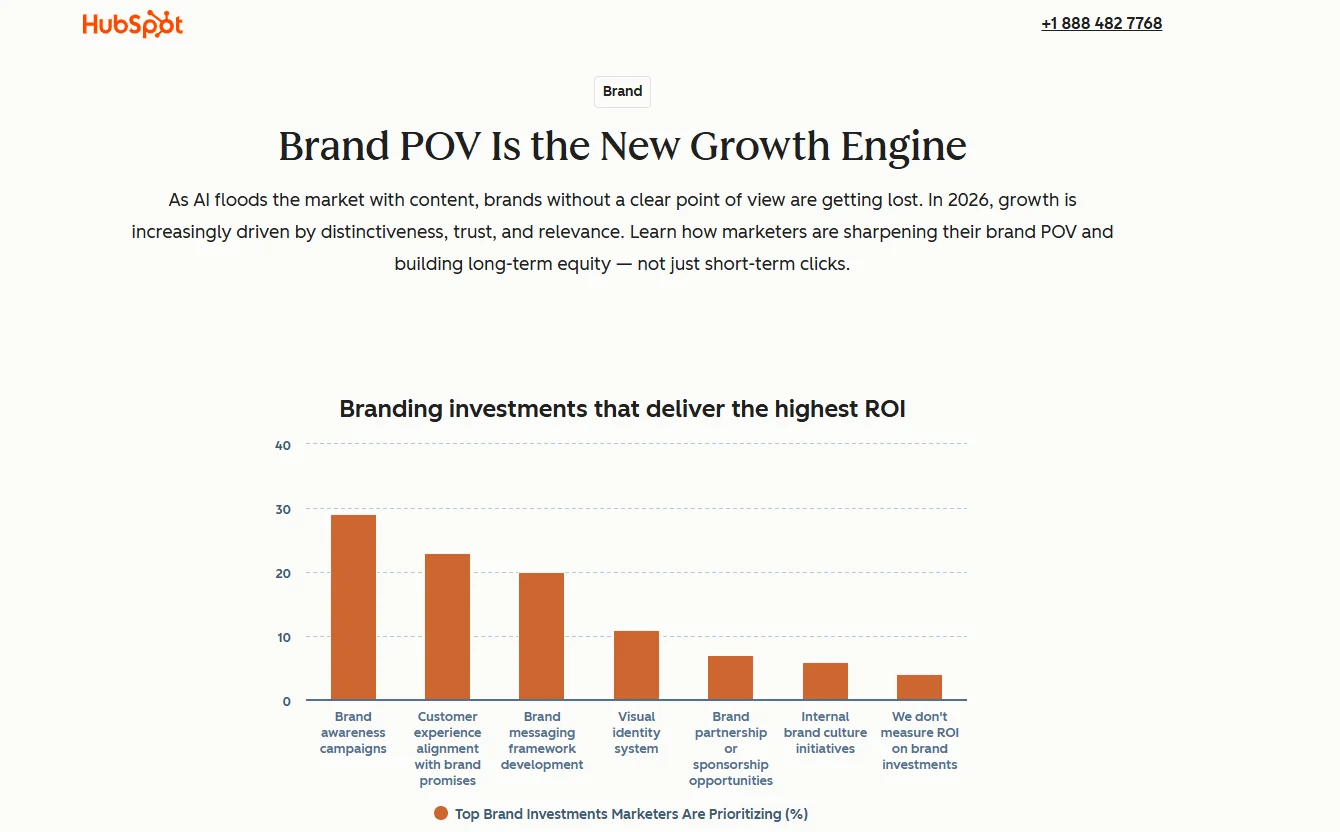**Here are some examples of original research:**
- Industry surveys
- Trend reports
- Data analysis from your product
- Benchmark studies
When bloggers and industry sites need statistics, they link to the original source. If that source is you, you earn high-quality backlinks, gaining trust and credibility for your business.
**Step-by-Step process:**
**Step 1: Choose a Relevant Topic**
Relevance matters most in research publications. Pick a topic that your target buyers care about and actively search for.
**Step 2: Collect Original Data**
Collect original data through surveys, by analyzing customer data (anonymously), and by studying industry trends.
**Step 3: Identify Key Insights**
Readers are attracted to insights that keep them hooked to the content; they’re more likely to read and convert. You can use surprising statistics, trends, or benchmarks that others would want to reference.
**Step 4: Publish a Detailed Report**
Create a well-structured report with clear data, charts, and explanations that help the readers understand complex topics easily.
**Step 5: Create Shareable Assets**
Convert your key findings into engaging sources such as visuals, charts, and short summaries.
**Step 6: Promote the Research**
Reach out to industry blogs, journalists, and newsletters with the most interesting data points.
**Step 7: Track Mentions and Links**
The last step is to monitor and analyze who cites your research and to follow up on all the unlinked mentions.
**Why this works:**
Original data is highly valuable. When you share unique statistics, others reference and link to you as the source.
**Expected results:**
- In the 1st month, you get 5-10 links from the initial promotion.
- For 2-6 months, you can get 10-20 additional links when people discover it.
- In about a year, you can expect 30-50 links from one research project.
- In the long run, you can consistently gain links year after year as the annual reports become reference resources.
### 8. Resource Page Link Building
[Resource pages](https://outreachdesk.com/resource-page-link-building/) are curated lists of useful tools, guides, and references on a specific topic.
Industry websites maintain pages such as “Best Marketing Tools,” “HR Resources,” or “Project Management Reading List” to help their audiences find valuable solutions to their problem.
You should focus on getting your page listed on such curated resource sections. When your content is genuinely useful, editors are more likely to add it to their lists.
**How to find resource pages:**
#### Step 1: Find resource pages in your niche
You can use these search operators to find resource pages relevant to your industry:
- “[your industry]” + “resources”
- “[your keyword]” + intitle:resources
- “[your industry]” + “recommended tools”
For Example: “marketing automation” + intitle: resources
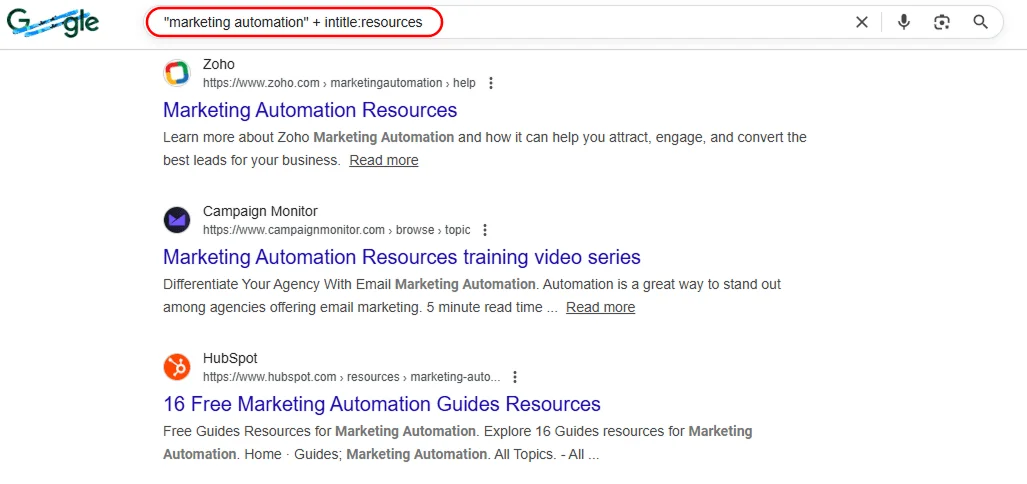
#### Step 2: Evaluate the page
You can further evaluate if:
- The page is maintained regularly (updated in the last 6 months)
- Your content genuinely fits their criteria
- They link to sites similar to yours
- The page has decent traffic
- Links are dofollow (use Check My Links extension)
#### Step 3: Verify your content fits
Then, after verifying your content, it should:
- Match the quality of other listed resources
- Serve their audiences in the best possible way by providing what they need
- Your content should fill a gap they currently have
- The page has decent traffic
- Serve something better than or different from the existing listings
#### Step 4: Send personalized outreach
Personalization plays an important role because editors get dozens of emails, and to stand out, you don’t need generic pitches but an actual message that shows your expertise.
You can share your resource and explain why it would be a helpful update for their readers.
Some websites have a “Submit a Resource” or “Suggest a Link” form. If your content fits, using these forms makes your outreach much easier.
**Subject: Suggestion for your [Topic] resource page**
Hi [Name],
I was researching [Topic] and came across your resource page at [URL]. Really helpful collection. I especially appreciated [Specific Resource They Listed].
I noticed you include resources on [Specific Subcategory]. I recently created a Thorough guide that your audience might find valuable: “[Your Content Title].”
It covers [specific value proposition] with [unique angle – original research, templates, case studies, etc.].
Would this be a good fit for your resource page? Happy to provide any additional information or make improvements if needed.
Best, [Your Name]
**Why this works:**
You’re helping them maintain a resource by providing content that adds value to their users. It’s mutually beneficial. They get a valuable resource, and you get a relevant backlink.
**Expected results:**
- For the resource pages, the success rate is 10-20% for quality outreach
- Time per successful link is 1-2 hours (including research)
- It is best for niche industries with active community resources
### 9. Testimonial Link Building
Testimonials usually serve as proof of your expertise; they show how you helped your clients.
You should provide genuine testimonials for tools and services you actually use. Most companies showcase testimonials on their websites and include a link to the customer’s site.
Businesses value authentic feedback. When you provide a testimonial, they often link back to your website to highlight your credibility.
**Step-by-step process:**
Step 1: Identify the tools or services your company genuinely uses and benefits from.
Step 2: Verify websites for opportunities to feature testimonials, case studies, or customer spotlights.
Step 3: Write a short, specific testimonial showing measurable results or clear benefits.
Step 4: Submit your testimonial and politely request a link back to your website.
**Here is an email template you can use:**
**Subject: Customer testimonial for [TheirProduct]**
Hi [Name/Team],
I’ve been using [TheirProduct] for [TimeFrame] and wanted to share how valuable it’s been for our team at [YourCompany].
Here’s a testimonial you’re welcome to use on your website or marketing materials:
“[Your Testimonial]”
, [Your Name], [Your Title] [Your Company Name]
Happy to provide: – Company logo – Professional headshot – Link to our website: [YourURL] – Any additional details you need
Feel free to edit for length or clarity. Thanks for building such a valuable product!
Best, [Your Name]
**Why this works:**
- It is a Win-win scenario because they get social proof, and you get a quality backlink
- It has a high success rate because you’re providing value
- It helps you build relationships for potential future collaborations
- The links are contextual and natural
#### Advanced variations:
Video testimonials offer greater value; you can record a 30-60-second video. Many companies prioritize video testimonials and give them better placement (often on the homepage).
**Expected results:**
- In the 1st month, you can identify 15 tools, send 10 testimonials, and get 4-6 links.
- The success rate is 40-60%, much higher than that of cold outreach.
- You can usually get a quality of DA 40-70.
- It also strengthens vendor relationships.
### 10. Podcast Guest Appearances
Appearing as a guest on industry podcasts helps you gain visibility and reach a new audience.
Most podcasts publish show notes on their website and include a link to the guest’s company.
When you share insights, experiences, or expertise, you build trust and credibility while earning a relevant backlink.
In the above image, the Masters of Scale podcast page features a guest episode with detailed show notes and a link.
**Step-by-step process:**
#### Step 1: Find relevant podcasts using a Google search
Start by finding relevant podcasts in your niche. Look for podcasts that:
- Interview experts in your field
- Target your ideal customer audience
- Have a consistent publishing schedule
- Include show notes with links
- Engaged audience with reviews and comments
#### Step 2: Pitch a clear topic idea that benefits their audience
You can use this pitch template to share your views and to provide them with something valuable.
**Subject: Guest idea: [Specific Topic] for [Podcast Name]**
Hi [Host Name],
I’ve been listening to [Podcast Name], your episode with [Recent Guest] on [Topic] was particularly insightful. The point about [Specific Insight] really resonated.
I’d love to discuss [Specific Topic That Fits Their Show] on your podcast.
Quick background: I’m [Your Title] at [Your Company], where I [Relevant Credential/Achievement]. I’ve also [Additional Credibility – spoken at X, published at Y, etc.].
Here’s a recent interview I did if you want to see my style: [Link to Previous Interview/Content]
Would this be a good fit for your audience? Happy to work around your schedule.
Best, [Your Name]
#### Step 3: Deliver valuable insights during the episode
When you’re invited as a guest, mention something specific, like “We actually created a free calculator that helps with this. I can send you the link for the show notes.”
This keeps you get links to your priority pages, not just to your homepage, while keeping the link placement natural and relevant.
**Why this works:**
- It builds credibility and thought leadership
- It helps to earn links from trusted industry sites
- It helps you reach your targeted audience
- Helps to strengthen brand visibility
- Show notes help to create permanent backlink pages
- It strengthens relations with hosts
### 11. Niche Edits
[Niche edits](https://outreachdesk.com/niche-edits/) is a link building strategy where you add your link to an existing, relevant article rather than creating a new guest post.
Instead of publishing fresh content, you identify articles that rank in your industry and request a contextual link addition. The link is placed naturally within the content where it adds value.
In the image below, you can see a digital marketing blog that mentions Slack, with the link naturally added to the relevant paragraph so it flows smoothly with the existing content.
**Step-by-step process:**
**1. Identify the relevant articles** in your industry that are already published and are ranking using search operators or using [link building tools.](https://outreachdesk.com/link-building-tools/)
**Let’s see how to use Ahrefs Content Explorer:**
- Search for a relevant topic or keyword
- Filter by “Referring domains 20+.”
- Look for articles that are published 1-3 years ago (old enough to be updated, recent enough to be maintained)
**2. Find the ideal placement** by reviewing the content, and choose a section where your link strengthens the information, adds proof, or gives readers something practical. In short, identify a place where your content adds value for the readers.
**3. Contact the site owner** or editor with a short, personalized message. Clearly explain where your link fits and how it improves the article for their readers.
**Subject: Quick suggestion for your [Topic] article**
Hi [Author Name],
I was reading your article on [topic] and found it incredibly helpful
I noticed you mentioned [concept] but didn’t link to a resource that shows [specific example/data/tool].
I recently published a detailed guide that covers exactly this: [Your URL]
Would you consider adding it as a reference?
Best, [Your Name]
**This strategy works because:**
- The page is already indexed and is trusted
- It has built trust and receives sufficient traffic
- It may already be ranking for the target keywords
- The link is placed within relevant content
- The [link can pass a value](https://outreachdesk.com/link-equity/) immediately
- It’s a faster way than creating new content
### 12. The Skyscraper Technique
The Skyscraper Technique is a link building strategy that involves finding popular content in your industry that has earned many backlinks.
You create a better version and reach out to everyone who linked to the original, offering your superior resource.
Instead of starting from scratch, you improve something that’s already proven to attract links.
**Step-by-step process:**
**Step 1: ****Find High-Performing Content in Ahrefs**
Use Ahrefs Content Explorer to find high-performing content in your niche with many [high-quality backlinks](https://outreachdesk.com/high-quality-backlinks/).
- In Ahrefs, go to the Content Explorer tab
- Search for broad topic keywords
- Filter out the results
- Sort by: “Referring domains” (high to low)
- Export top 20-30 results
**Step 2: ****Understand Why It Works**
Analyze why the content earns links, examine its structure and depth, review its data usage, and identify any missing or outdated information you can update.
#### Step 3: Create a Better Version
Create a more detailed, updated, clear, and well-structured version that provides insights, examples, and practical value.
#### Step 4: Identify Relevant Linking Websites
Identify websites that linked to the original content and review which sites are relevant and interested in improved resources.
#### Step 5: Reach Out
Reach out to those websites, explain your improved version, and highlight the added value. Politely suggest replacing or adding your link.
**Use this outreach email:**
**Subject: Quick suggestion for your [Topic] article**
Hi [First Name],
I was researching [Topic] and came across your article “[Article Title]”, in which you mentioned [Original Resource Title].
That’s a great resource, I’ve referenced it myself in the past.
I wanted to reach out because I recently published an updated guide on this topic that might be an even better fit for your article:
[Your URL]
It includes: – [Specific Improvement 1 – e.g., “2026 data and statistics”] – [Specific Improvement 2 – e.g., “Step-by-step templates”] – [Specific Improvement 4 – e.g., “Expert interviews”]
Would you consider linking to it in your article? I think your readers would find [Specific Benefit – e.g., “the updated templates particularly useful”].
Either way, thanks for putting together such a helpful resource. I’ll be sharing it with my network!
Best, [Your Name]
#### Step 6: Promote Your Content
Boost your chances of getting links by promoting the same content through your own channels to increase visibility and trust.
- Share it on your social media channels to reach your audience and increase engagement.
- Email your subscriber list to drive early traffic and shares.
- Submit your content to relevant industry sites where your audience spends more time.
- Share it in LinkedIn groups related to your niche and discussion topic.
- Post in relevant Reddit communities where the discussion aligns with your topic.
**Why this works:**
People linked to the original content because it was valuable. Your improved version gives them an even better resource to link to. You’re not asking for a favor; you’re helping them provide better value to their audience.
## Strategy Comparison: Quick Overview
**The table below compares the twelve B2B link building strategies on effort, time-to-result, and durability so you can pick the mix that fits your resources.** No single strategy is best for every company. The right mix depends on whether you’ve content production capacity, an established expert on the team, or budget for digital PR support.
| Strategy | Success Rate | Difficulty | Best For |
| --- | --- | --- | --- |
| Partner Links | 60-80% | Easy | Relationship-based opportunities |
| Unlinked Mentions | 30-50% | Easy | Easy link opportunities |
| HARO | 5-15% | Easy | High-authority links |
| Review Platforms | 90%+ | Easy | SaaS/Product companies |
| Broken Links | 15-25% | Medium | Niche relevance |
| Resource Pages | 10-20% | Medium | Industry visibility |
| Guest Posting | 10-20% | Medium | Authority and traffic |
| Testimonials | 40-60% | Medium | Relationship-based |
| Podcasts | 20-30% | Medium | Thought leadership |
| Niche Edits | 15-20% | Medium | Existing content |
| Digital PR | 5-10% | Hard | Brand authority |
| Skyscraper | 8-12% | Hard | Competitive keywords |
## Measuring Results That Actually Matter
**The B2B link metrics that actually matter are tied to revenue, not volume.** Track referring domain growth from in-niche publishers, organic traffic on your money pages, and pipeline influence from sites your sales team can name. Total backlinks is a vanity number. The metrics below are the ones that connect link work to revenue.
Not every metric delivers real business impact. Focus on the numbers that truly drive meaningful results, not the ones that simply look impressive.
### Input Metrics (What You Control)
These measures your efforts and consistency. However, they don’t guarantee results; they can only influence them.
**Outreach Activity to track weekly:**
- Emails sent per week
- Follow-ups sent
- HARO responses submitted
- Guest posts pitched
These numbers show whether your outreach is working smoothly and consistently.
### Output Metrics (Early Results)
These metrics show whether your efforts are delivering initial results.
**Links Earned:**
- Total new backlinks this month
- Unique linking domains (more important than total links)
- Average domain authority of linking sites
- Response rate (emails that got replies)
- Success rate (replies that became links)
These metrics indicate early signs of progress or movement in the right direction before rankings improve.
### Impact Metrics (Business Results)
These metrics show how your link building efforts are driving real business results.
**Rankings:**
- Priority keyword positions (track weekly)
- Number of keywords in positions 1-3
- Number of keywords in positions 4-10
**Traffic:**
- Organic traffic to priority pages
- Total organic sessions
- New vs. returning organic visitors
**Conversions:**
- Demo requests from organic
- Trial signups from organic
- Form submissions from organic
- Conversion rate of organic traffic
**Revenue:**
- Qualified leads from organic search
- Closed deals from organic
- ROI: (Organic revenue / Link building cost)
In simple terms, you can say that inputs show your efforts made, outputs show the progress, and impact shows the revenue.
## Common B2B Link Building Mistakes to Avoid
**The most common B2B link building mistakes share one root cause: treating link building as a volume game.** The patterns: chasing high-DR consumer sites, copying B2C tactics that don’t translate, and ignoring whether your buyers actually read the publishers you’re targeting. Each of these wastes budget and produces links that don’t move pipeline.
The patterns below are the ones to catch before they cost you a quarter.
Even strong strategies can fail when mistakes are made. Below are the 5 common mistakes you should completely avoid.
### 1. Buying Links
Avoid buying links, as it violates Google’s rules and can lead to penalties. Google can detect paid link schemes, and the risk of losing rankings for months isn’t worth the short-term benefit.
Buying links mostly involves paying directly for a backlink, exchanging money for link placements, publishing sponsored posts without disclosing sponsorship, or using the link market to acquire links.
**Solution:**
Earn links by creating valuable content, building relationships, and sharing your expertise in ways that genuinely help readers.
### 2. Chasing Volume Over Quality
Many teams try to collect as many backlinks as possible, even if they come from [link farms](https://outreachdesk.com/link-farming/), irrelevant and low-quality sites.
**Solution:**
A few trusted, industry-relevant links that are far more valuable than dozens of weak ones. Prioritize quality over quantity to achieve stronger rankings and better business results.
### 3. Generic Mass Emails
Using generic mass email templates can snatch your chances of being selected. Many people use the same template for each outreach just by swapping the name. Doing this lowers the response rate by 1-3%.
**Solution:**
Personalize every outreach email you send to stand out from the crowd. Reference the recipient’s recent work, an industry trend, or a mutual connection.
Here are the response rates while using generic and personalized emails.
**The numbers:**
- Generic mass emails get 1-3% response
- Personalized emails get 15-30% response
### 4. Ignoring Existing Relationships
Many businesses focus on cold outreach instead of making the most of their existing relationships.
**Solution:**
Start with the relationships you already have before moving to cold outreach.
List every business relationship (partners, vendors, customers, associations). Are you listed on their websites? If not, ask. The success rate is 50%+.
### 5. Expecting Instant Results
Link building is a steady and consistent process, so it takes time. Rankings don’t change overnight. Quitting after seeing no movement in Month 1 is a common mistake.
**Solution:**
Set realistic expectations. Build sustainable processes. Track your early wins, links earned, and response rates before expecting big shifts in rankings or traffic.
## Final Thoughts on B2B Link Building
B2B link building isn’t just about improving rankings. It’s about influencing buying decisions.
Business buyers research carefully. They look for trusted sources, expert opinions, and proof before making a decision. When respected industry websites mention and link to you, it strengthens your credibility long before a sales conversation begins.
Strategic links build authority, reduce doubt, and support revenue growth. Focus on relevance and value, and your link-building efforts will support real business outcomes, not just search visibility.
### Want to build authority in your industry and attract high-intent B2B buyers?
The right link-building strategy can position your company where decision-makers are already looking. If you’re ready to turn links into real growth opportunities, let’s map out your next steps.
[Schedule Your B2B Link Strategy Session](/contact-us/)
### What pages should I build links to?
You should prioritize revenue-driving pages, such as pricing, product, and comparison pages, along with strong educational content.
### Can I do this without expensive tools like Ahrefs?
Yes, you can start with free tools like Google Search Console and basic competitor research. Paid tools help you scale faster, but you don’t need them to get started.
### How long will this actually take me each week?
It all depends on your path:
- Bootstrap can take 2-3 hours/week
- Growth stage can take 5-8 hours/week
- For scaling your business, 10+ hours/week, or you can hire help
### Which tactic should I start with?
You can start with wins to build momentum:
- Partner/relationship links in Week 1
- Unlinked brand mentions in Week 1-2
- HARO responses are ongoing from Week 1
These require minimal tools and have the highest success rates.
### What if nobody responds to my emails?
You can check your:
- Open rate (use email tracking). If it is <30%, your subject lines need work.
- Response rate (if opens are good but no replies, your pitch needs work).
- Relevance (are you contacting actually relevant sites?).
Start with 10 emails, measure results, iterate based on data.
### How do I find email addresses?
You can try this sequence:
- Check the site’s “Contact” page
- Use [Hunter.io](https://hunter.io/), it has a free trial with $25/month
- LinkedIn search for the person
- Try common formats such as firstname@domain.com
---
---
title: "Contextual Link Building Service for Relevant Backlinks"
url: "https://outreachdesk.com/contextual-link-building-service/"
lang: "en-US"
type: "page"
description: "Contextual Link Building Contextual Link Building Service for Relevant Backlinks Your site earns contextual links naturally placed within relevant, published content tostrengthen authority, improve rankings, and maintain long-term search visibility. Real sites, with real traffic No PBNs. No Web 2.0"
last_modified: "2026-05-27T04:36:46+00:00"
custom_fields:
header_style: "header-style-1"
footer_style: "footer-style-1"
---
# Contextual Link Building Service for Relevant Backlinks
Contextual Link Building
# Contextual Link Building Service for Relevant Backlinks
Your site earns contextual links naturally placed within relevant, published content tostrengthen authority, improve rankings, and maintain long-term search visibility.
_
Real sites, with real traffic

No PBNs. No Web 2.0 spam

Natural placement
Book a Strategy Call

4.8/5 _
Trusted by 500+ agencies &
1,000+ businesses worldwide.
Average DR
40 – 95
Campaign Dashboard
LIVE
DOMAIN RATING
29 → 48
+19 points
ORGANIC TRAFFIC
+840%
4,800 → 45,100
PAGE 1 KEYWORDS
0 → 28
+28 points
PLACEMENTS
165
142 unique domains
_
Links Delivered
35










Service Overview
## What Contextual Link Building Really Means
Contextual link building is the practice of earning backlinks placed within the body of relevant, published content on real websites – where the surrounding text confirms the link is editorially appropriate. These in-content placements carry significantly more ranking weight than footer, sidebar, or directory links because Google’s SpamBrain evaluates the topical relationship between the linking page and your destination. The stronger that match, the more authority the placement transfers. Working with an experienced link building agency typically delivers links faster and with better placement quality.
Contextual link building is the process of earning backlinks placed within the body of relevant, published content on external websites.
Unlike directory submissions or footer links, a contextual link lives within a paragraph that directly relates to your topic. Google’s algorithms, including updates like Penguin and SpamBrain, give these in-content placements significantly more weight when calculating your domain authority and search rankings.
That editorial context is what separates high-value link building from bulk link packages. Tools like Ahrefs and Moz confirm that contextual links from topically relevant pages pass more link equity than links placed outside content areas.
For most businesses, contextual links are the highest-ROI link type you can invest in. They improve your rankings, strengthen your topical authority in Google’s eyes, and send referral traffic from audiences already interested.
Three things define a strong contextual link:

### Topical relevance
The linking page covers a subject closely related to your industry, ensuring the connection feels natural and meaningful.

### Editorial placement
The link appears naturally within the body content, not in a sponsored block or author bio.

### Domain quality
The linking site has genuine organic traffic, a clean backlink profile, and a domain rating (DR) that signals real authority.
How We Work
## How Your Contextual LinkCampaign Works
A clear workflow designed to make sure relevance, quality, andeditorial alignment.
### Site Audit and Page Mapping
Before building a single link, your campaign starts with a complete audit of your site’s page structure, existing backlink profile, and keyword positioning. Your strategist maps every page with potential to rank and identifies where contextual links will have the greatest impact.
Pages competing for high-value keywords get priority. Pages with strong on-page SEO but weak referring domains move to the top of the list. You get a clear link-building roadmap, not a generic “let’s build links everywhere” approach.
### Opportunity Research and Prospect Vetting
Your team researches publications, blogs, and niche sites that match your industry. Every prospect goes through a manual quality check. Your strategist evaluates domain rating (typically DR 40-80+), organic traffic levels, content relevance, and link profile health using tools like Ahrefs.
Sites with thin content, spammy link profiles, or irrelevant audiences get removed. You see only vetted, quality-matched prospects in your campaign reports.
### Content Development and Angle Planning
Each placement needs content that earns its spot editorially. Your writing team develops article angles, talking points, and contextual hooks that make your link a natural fit, not a forced insertion.
Content follows the publication’s editorial standards. If a site publishes long-form guides, your content matches that format. If they run short opinion pieces, the approach adapts. This editorial alignment is what keeps links permanent and publishers happy to work with your brand long-term.
### Publisher Outreach and Negotiation
Your outreach specialists contact publishers directly. No automated mass emails. Every pitch is personalized to the publisher’s content style and recent topics.
Outreach conversations cover placement expectations, anchor text strategy, content format, and timeline. Your team negotiates for in-content placement within the body of the article, never in sidebars, author bios, or sponsored blocks.
### Placement, Quality Review, and Live Verification
Once content is published, your team reviews every live link. Checks include: correct anchor text, proper dofollow attribution, in-content positioning, and page indexation status.
If a placement doesn’t meet quality standards, has a wrong anchor, a nofollow tag, or is buried in a non-indexed page, your team either gets it corrected or replaces it with a new placement. You don’t pay for links that don’t meet the brief.
### Reporting and Ongoing Monitoring
You receive a detailed monthly report covering: every live placement URL, anchor text used, domain rating of the linking site, indexation status, and the referring page’s organic traffic. Your strategist adds context, not just data, so you understand what each link does for your rankings and authority.
Links are monitored post-placement. If a publisher removes content or a site’s quality drops, your team flags it and works on replacements proactively

Expected Results
## Outcomes That Contextual LinkBuilding Delivers
When links are placed within meaningful content, they contribute tostronger authority and sustainable ranking growth.
- 1. Revenue-Driven Rankings
- 2. Compounding Authority
- 3. High-Intent Referral Traffic
- 4. Algorithm-Safe Links
### Strong Rankings on the Keywords That Matter
Contextual links send Google direct relevance signals. When a topically relevant site links to your page from within its editorial content, Google sees that as a vote of confidence for your specific topic, not just your domain in general.
**The result:** Your target pages start ranking for the exact keywords that brings in revenue. One B2B client saw their main service page move from position 14 to 3 within four months after earning 22 contextual links from DR 50+ sites in their niche.
This is not just about getting more links. Five well-placed contextual links from a relevant, trusted site can outperform fifty links from irrelevant or low-quality domains.

### Domain Authority That Compounds Over Time
Every contextual placement improves your referring domains with a link that passes real value. Unlike guest post links placed in author bios or directory listings, links inside the main content pass the highest PageRank value Google provides.
That value builds over time. As your domain rating improves, new pages you publish begin to rank faster. Existing pages become more resistant to competitor moments. Your site earns what SEO calls “topical authority.” Google starts seeing you as a trusted source in your industry.
Ahrefs data consistently shows that pages with strong, high-quality referring domains outrank pages that have more backlinks but from lower-quality websites.

### Referral Traffic From Real Audiences
A contextual link placed within a high-traffic article doesn’t just help your SEO. It brings real readers directly to your site.
When someone is reading a guide about project management tools and sees your product mentioned naturally, they’re more likely to click. That click is high-intent referral traffic, someone who already understands the topic and comes to your site through a trusted recommendation, rather than a paid ad.
Clients who earn contextual placements on websites with 10,000 + monthly organic visitors often see clear referral traffic growth within the first 60 days.

### Algorithm-Resilient Link Profile
Google’s spam detection is more advanced. SpamBrain, Google’s AI-driven spam system, targets manipulative link patterns like PBNs, link swaps, bulk web 2.0 links, and paid placements on low-quality sites.
Contextual links earned through real editorial outreach match the type of links Google describes as natural. They survive core updates because they exist for a genuine editorial reason, not because someone bought them in bulk.
Your investment stays protected. Links placed inside authentic editorial content on established sites don’t carry the same deindexation risk as cheaper, mass-produced alternatives.

Client Success Stories
## What Clients Say About OurContextual Links
verified reviews from leaders who gained authority, rankings,and revenue with our link-building services.
[View All
](https://outreachdesk.com/testimonial/)

4.8/5 

## 5/5 
Rating on Google



The contextual links not only improved our DR but also moved revenue-driving pages. Our comparison pages jumped from page 2 to the top 3 in 5 months, and demo requests followed. Every placement was aligned with our niche.

#### Head SEO
B2B SaaS


What impressed us the most was the approval process. We saw the target site, anchor text, and content relevance before anything went live. Every publisher was vetted for relevance and traffic quality. The complete process felt controlled and strategic.

#### Marketing Head
E-commerce


We operate in a regulated industry, so low-quality backlinks were not an option. The Outreach Desk built links that survived two core updates without any ranking impact. The placements were editorial, contextual, and clearly chosen for the long-term authority.

#### VP Marketing
Legal Firm
Service Framework
## Investment, Timeline, andDeliverables
Every contextual link building campaign is custom-scoped to your industry, competitive landscape, and growth goals. Here’s what shapes your investment:

### Number of links per month
Most campaigns run between 10 and 40 contextual placements monthly

### Target domain rating range
Placements on DR 40-95 sites cost less than DR 70+ placements

### Content requirements
Some placements need new content development, others use existing editorial opportunities

### Campaign duration
Most clients see measurable ranking movement within 3-4 months, with compounding results over 6-12 months
Directional pricing
## $200 – $300+ per link
Contextual link building campaigns typically start at $200 per link for focused, single-market campaigns. Enterprise-level campaigns targeting multiple keyword clusters across competitive verticals range from $250-$ 300+ per link.
You get a detailed proposal after your strategy call, with exact link quantities, target DR ranges, projected timeline, and a month-by-month roadmap. No hidden fees. No vague “it depends” answers.
Book a Strategy Call
What You Get
## See Every Link Placement WithClear, Client-Ready Reports
Every placement is clearly reported, so you know exactlywhere links are placed:

### Live Link URLs
You get direct access to every live published link placement, allowing you to verify links at any time.

### Content Context Overview
You can see how each link fits naturally into the surrounding content, ensuring topical relevance and editorial alignment.

### Anchor & Target Mapping
You see which anchor text links to each destination page, providing a clear visibility to distribution and optimization strategy.

### Campaign Summary
You get a clear summary of placements, domain metrics, and impact to understand the campaign’s overall performance.
Our Approach
## A Relevance-First ApproachBuilt for Your Growth
You gain links built with contextual alignment and editorialquality, rather than volume or artificial placements.
| Factor | In-House / DIY | |
| --- | --- | --- |
| Placement Approval | Links are usually reviewed after the publication, and have
limited control over the final placement | You get to approve every site, anchor text, and content
context. You get complete control, no surprises. |
| Publisher Vetting | Research quality may vary by the team capacity;
it may rely on scraping tools | Every publisher is manually vetted for traffic, backlink
health, editorial standards, and audience relevance. |
| Link Protection | The removed links must be tracked and should
be replaced internally. | Provides 6 months of replacement, if your link is removed,
gets changed, or publishers delete content, without any extra cost. |
| Anchor Strategy | The anchor selection may be keyword-focused or can
be inconsistent throughout the campaign. | You get a strategically planned anchor distribution created
for your existing link profile to avoid over-optimization risks. |
| Tactics and Risk Standards | The risk level depends on the internal
process and experience | Very strict in context, no PBN, no link exchange.
Only editorial link placements |
Who We Help
## Industries We Support WithContextual Link Building
No matter your niche, you can secure contextuallinks on websites that truly match your industry.
[

### SaaS & Software
](https://outreachdesk.com/saas-link-building/)
[

### Ecommerce & DTC
](https://outreachdesk.com/ecommerce-link-building/)
[

### B2B & Enterprise
](https://outreachdesk.com/b2b-link-building/)

### Startups

### Real Estate
[

### Law Firms & Legal
](https://outreachdesk.com/link-building-for-lawyers/)
[

### Dental Practices
](https://outreachdesk.com/link-building-for-dentists/)

### Healthcare & Fitness

### Financial & Insurance

### Technology & Innovation

### Consumer Brands
Real Results
## Results Achieved With Contextual Link Building
See how relevant, editorial links drive measurable ranking and visibility gains.
Contextual Link Building
###
Legal Tech Startup Grows Organic Traffic 840% in a Regulated YMYL Niche
####
0 → 22
AI Overview
####
0 → 14
ChatGPT
####
0 → 18
Perplexity
####
0 → 9
Gemini
####
0 → 12
Copilot
####
29 → 48
Domain Rating
####
+840
Organic Traffic
####
0 → 28
Page 1 Keywords
####
168
Links Built
A legal tech SaaS company competing in a regulated YMYL niche increased its organic traffic by 840% in just 12 months through a strategic, compliance-focused link building campaign. They noticed growth in commercial page rankings from 0 to 28, demo requests increased 340%, and rankings remained steady through multiple core updates. [Read More](https://outreachdesk.com/case-study/legal-tech-startup-grows-organic-traffic-840-in-a-regulated-ymyl-niche/)
Contextual Link Building
###
Cloud Accounting SaaS Overtakes 3 Established Competitors on Page 1 in 10 Months
####
0 → 16
AI Overview
####
0 → 19
ChatGPT
####
0 → 22
Perplexity
####
0 → 13
Gemini
####
0 → 15
Copilot
####
31 → 49
Domain Rating
####
+636
Organic Traffic
####
3 → 31
Page 1 Keywords
####
139
Links Built
An accounting SaaS company competing against QuickBooks increased its organic traffic by 636% in 10 months through a strategically planned, finance-relevant contextual link. Page 1 rankings grew from 3 to 31, domain ratings increased 1by 8 points, and free trial signups increased by 290%. [Read More](https://outreachdesk.com/case-study/cloud-accounting-saas-overtakes-3-established-competitors-on-page-1-in-10-months/)
Contextual Link Building
###
B2B Industrial Supplier Captures $2.4M in Organic Pipeline from a Niche with Zero Link Building History
####
0 → 7
AI Overview
####
0 → 3
ChatGPT
####
0 → 5
Perplexity
####
0 → 4
Gemini
####
0 → 6
Copilot
####
27→ 42
Domain Rating
####
+482
Organic Traffic
####
6 → 43
Page 1 Keywords
####
97
Links Built
A B2B industrial supplier with zero prior link-building history build $2.4M in qualified organic pipeline within 8 months. Their organic traffic increased by 483%, their domain ratings increased by 15 points, and their page 1 keyword count increased from 6 to 43. [Read More](https://outreachdesk.com/case-study/b2b-industrial-supplier-captures-2-4m-in-organic-pipeline-from-a-niche-with-zero-link-building-history/)
[View All
](/case-study/)
Common Questions
## Frequently Asked Questions
Clear answers to help you understand how guest postingworks and why it’s safe
### What is contextual link building?
The measurable outcomes of [contextual link](https://outreachdesk.com/contextual-link-building/) building are higher page authority scores, improved rankings for your target keywords, and a stronger topical authority signal across your entire domain. Most clients see initial position movement within 30-45 days of the first placements going live, with compounding momentum building through months 2-4 as each new link reinforces the domain-level trust pattern Google looks for before promoting a page into top-5 positions.
Contextual link building focuses on placing backlinks within relevant content where they naturally fit. Instead of placing links in the sidebars or author bios, the link appears within the meaningful content, where it supports the topic, strengthening both relevance and authority.
### How is contextual link building different from other link types?
Contextual links are embedded in meaningful content rather than placed in isolated sections or unrelated pages because they appear within the articles your audience actually reads, pass relevance signals, and typically deliver a better ranking impact than non-contextual placements.
### Are contextual links safe for SEO?
Yes, because they are naturally integrated into relevant content, they fit with white-hat practices. They are earned based on relevance and value, no manipulation. This reduces risk and makes them more resistant during the core updates.
### How long does it take to deliver contextual links?
Most of the placements go live within 1-3 weeks, depending on the publisher’s response. Large publications may require longer review cycles, but you receive updates throughout the process to maintain complete visibility.
### Do you provide reports?
Yes, every placement is documented in a clear report that includes live URLs, context, anchor text, target page, and domain metrics. This helps to make sure complete transparency and allows you to track link distribution and overall campaign progress.
### How much does contextual link building cost?
Pricing depends on your campaign scope, the number of monthly links, target domain rating range, and your industry’s competitiveness. Most campaigns start from $2,000/month. Your strategist provides a detailed proposal with exact quantities, DR targets, and a timeline after your strategy call. No hidden costs.
### Is contextual link building better than guest posting?
They serve different purposes. Contextual links focus on earning placements within existing or new editorial content on relevant sites. The link is placed inside the body content that directly relates to your topic. [Guest posting](https://outreachdesk.com/guest-posts/) involves publishing a full article on a host site, combining brand exposure with a backlink. Contextual links typically deliver stronger SEO value per link because the editorial context signals higher relevance to Google. Many campaigns combine both for a diversified strategy.
### How many contextual links do I need per month?
It depends on your competitive landscape. A local service business competing in a mid-size market might see strong results from 10-15 quality contextual links per month. A SaaS company targeting national or global keywords in a competitive space typically needs 25-40 links per month. Your strategist analyzes your competitors’ backlink profiles and recommends a link velocity that closes the gap without triggering unnatural patterns.
### What domain rating (DR) sites do you place links on?
Most placements land on sites with DR 40-80+, depending on your campaign. Every prospect site goes through manual vetting for domain rating, organic traffic, content relevance, and backlink profile health. You won’t find placements on PBNs, link farms, or sites with inflated metrics. Your monthly report shows the DR of every linking domain.
### Can contextual links hurt my site?
Contextual links built through legitimate editorial outreach are the link type that Google’s own documentation describes as natural. The risk comes from services that use PBNs, Web 2.0 networks, or bulk automation, none of which are part of this service. Every placement follows white-hat outreach practices, targets editorially relevant sites, and uses a natural distribution of anchor text to keep your link profile clean.
### What happens if a link gets removed?
Links placed in genuine editorial content rarely get removed because they add value to the publisher’s article. If a placement does get taken down, for example, if a publisher restructures their site, your team flags it in your monthly monitoring report and works on a replacement at no additional cost.
### Do you offer a minimum contract or commitment?
Most clients start with a 3-month engagement to allow enough time for placements to index, accumulate link equity, and produce measurable ranking improvements. There are no long-term lock-in contracts. After the initial period, campaigns continue month-to-month. You can adjust scope, pause, or stop at any time with 30 days’ notice.
## See How Contextual LinksCan Grow Your Authority
Your strategist will audit your current backlink profile, mapyour highest-impact pages, and build a link plan tailored to yourcompetitive landscape. No commitment required.
Book a Strategy Call

4.8/5 _
Trusted by 500+ agencies &
1,000+ businesses worldwide.

---
---
title: "Link Building for Lawyers: 10 Strategies to Rank in 2026"
url: "https://outreachdesk.com/link-building-for-lawyers/"
lang: "en-US"
type: "post"
description: "People usually search for lawyers in stressful situations, such as after an accident, during a divorce, when facing any criminal charges, or while facing hurdles in immigration. Because legal advice can have a significant impact on someone's life, Google treats"
last_modified: "2026-05-28T06:59:45+00:00"
categories: [Link Building]
---
# Link Building for Lawyers: 10 Strategies to Rank in 2026
People usually search for lawyers in stressful situations, such as after an accident, during a divorce, when facing any criminal charges, or while facing hurdles in immigration.
Because legal advice can have a significant impact on someone’s life, Google treats legal websites as part of the [YMYL](https://developers.google.com/search/docs/fundamentals/creating-helpful-content#:~:text=We%20call%20these%20%22Your%20Money,our%20changes%20are%20working%20well) (Your Money or Your Life) category.
It means Google may rank only legal pages that demonstrate real trust, expertise, and credible signals from the relevant websites.
To rank in legal search, you require high-quality backlinks from reputable, relevant websites.
Backlinks from trusted sources signal to Google that your firm is credible, recognized, and trusted.
Whether you run a solo practice or manage link building for law firms with multiple offices, the same core principles apply to attorneys across every specialty. For end-to-end management of this process, [Outreach Desk](https://outreachdesk.com/) runs campaigns for 500+ brands worldwide. For practitioners scaling this, [Outreach Desk’s local citations guide](https://outreachdesk.com/seo-local-citations/) explains the workflow end-to-end.
**What you’ll learn:**
- Understand what exactly link building is for lawyers and why it matters more for legal websites.
- You’ll get 10 safe, ethical strategies to implement and achieve the desired results.
- Some quick, ready-to-use outreach templates for pitching and doing outreach the right way.
- Some common mistakes that law firms make and how to avoid them.
## What is Link Building for Lawyers?
**Link building for lawyers is the practice of earning backlinks from legal directories, bar association pages, local publications, and trusted legal-industry sites.**
Each editorial link signals to Google that your firm is a legitimate authority worth showing in the local pack and on practice-area search queries.
Without it, your firm stays invisible to the prospects searching for the exact services you offer.
Link building for lawyers is the process of earning backlinks from legal directories, bar association pages, legal publications, and authoritative news sites that improve your firm’s rankings in competitive practice-area and location searches.
Each placement from a trusted legal source signals to Google that your firm is credible.
This is the primary lever separating page-1 firms from those buried on page 2 and beyond.
This matters because the legal industry falls under YMYL.
Google is cautious about ranking legal content because bad or false legal advice can seriously harm people.
So Google looks for strong credibility signals before it ranks a law firm highly.
A general e-commerce site can rank on thin authority.
A law firm’s link building strategy has to demonstrate real editorial credibility.
Relevant backlinks help to build credibility and improve rankings for local searches like “best divorce lawyer near me” or “injury attorney in [city].”
They can also reduce your reliance on paid ads.
### State Bar Advertising Compliance – Read This First
Most state bar associations treat your website, guest posts, and content as advertising.
That means link building must follow your state’s Rules of Professional Conduct.
**Common compliance mistakes to avoid:**
- Using terms like expert, specialist, or best without formal certification.
- Missing required disclaimers (for example, “Attorney Advertising” in some states).
- Sharing case results or testimonials without noting that results may vary.
- Not listing a responsible attorney for website content.
When in doubt, check your state bar rules before publishing.
## Understanding Link Fundamentals
**Three signals decide whether a backlink helps your law firm rank: the linking site’s authority, its topical relevance to legal content, and whether the link sits in editorial context.**
Get any one of these wrong and the link does nothing for your rankings.
Worse, it can trigger a spam flag in a YMYL vertical like legal services.
Before you start link building for attorneys, you need to understand how different [types of links](https://outreachdesk.com/types-of-backlinks/) work.
This knowledge directly changes how you prioritize your time and effort.
### Do-Follow vs. No-Follow Links
[Do-follow links](https://outreachdesk.com/dofollow-backlinks/) are the default type of link on the Internet.
When a website links to yours with a dofollow tag, Google counts it as a positive trust signal.
These links pass “[link equity](https://outreachdesk.com/link-equity/),” a portion of the linking site’s authority and trust to your site, and help improve your search rankings.
**No-follow** links include a tag in the code that tells Google: “Don’t count this link as an endorsement.”
Google doesn’t pass link equity through no-follow links.
But they can still drive real traffic to your site and build brand awareness.
Many high-value sources, such as the Better Business Bureau, Reddit, and some news sites, use nofollow links by default.
**Practical Takeaway**
Aim for do-follow links where you can, but don’t skip no-follow opportunities from trusted, relevant sources.
### Links vs. Referring Domains
A referring domain is a unique website that links to you.
You might have 500 links from Justia’s directory, but that’s still just one referring domain.
💡
Your primary goal should be to increase the number of unique, high-quality domains linking to your site and not just the raw number of links.
### Co-Citations and Implied Linking
Co-citation means your firm is mentioned alongside other authoritative brands, with or without links.
Google understands these associations and can use them as a ranking signal.
This concept is sometimes called “implied linking.”
For example, if a legal blog writes about top personal injury attorneys in Chicago and mentions your firm by name alongside two other firms, Google registers that association even if there is no clickable link.
💡
Brand mentions next to relevant legal topics help search engines better understand what your firm does and who it serves.
### Anchor Text
Anchor text is the clickable words in a link.
It tells Google and the reader what the linked page is about.
Using natural anchor text is essential for law firms because Google flags unnatural patterns, which can affect your credibility.
**Here’s an example of a good anchor text:**
**Bad anchor text:**
#### Anchor Text Mix – The 33/33/33 Rule
**33% Branded:** Your firm’s name.
Example: “Smith & Associates” or “contacted our legal team.”
**33% Keyword Variations:** Natural phrases related to your practice.
Example: “experienced personal injury attorneys” or “a car accident lawyer in Chicago.”
**33% Generic/Contextual:** Phrases like “read more here,” “according to legal experts,” or “this thorough guide.”
Don’t overload any single category.
If a high percentage of your backlinks use identical anchor text, Google will flag your link profile as manipulative.
### Why Internal Links Matter
When another website links to one of your pages, that page receives a boost in authority.
But here’s something most lawyers don’t know: you can spread that authority to other pages on your own site using internal links.
For example, say you earn a strong backlink to your “Car Accident Guide” page.
If that page internally links to your “Car Accident Lawyer” practice page and your “What to Expect” page, some of that earned authority flows through to all of them.
One well-placed backlink can benefit your entire site if your internal links are set up correctly.
Make sure every page that could earn a backlink includes clear, logical internal links to your most important practice-area pages.
## The 10 Most Effective Link Building Strategies for Lawyers
**The ten strategies below all target sources Google already trusts in the legal vertical, which is what pushes firm pages into top-5 positions for competitive practice-area queries.**
Pick three or four that fit your firm’s capacity.
Running all ten at once is how legal link building programs stall in month two.
The most effective link building strategies for law firms are legal directory placements (Avvo, FindLaw, Justia), local press coverage, bar association citations, guest articles in legal publications, and broken link reclamation on .gov and .edu legal resources.
Each targets sources Google already trusts in the legal vertical, which is what pushes firm pages into top-5 positions for competitive practice-area queries.
The following are 10 proven attorney SEO link building strategies to rank higher in competitive legal searches.
These methods are ideal for personal injury, criminal defense, immigration, family law, employment law, business law, real estate, and bankruptcy law.
### 1. Guest Posting on Relevant Industry Websites
[Guest posting](https://outreachdesk.com/guest-posts/) for law firms involves writing high-quality, expert content for reputable, field-relevant sites and earning a link back to your own site as part of that content.
Guest posting works across every practice area.
It’s especially effective for link building for family law firms, where building trust and demonstrating empathy matter as much as legal expertise.
A well-placed article on a parenting or divorce resource site signals both relevance and authority to Google.
Publishers in the legal space are looking for content that’s accurate, well-written, and genuinely useful to their readers.
They aren’t interested in promotional material.
When you contribute high-quality content, you earn an editorial backlink.
#### Here’s How Guest Posting Works:
**Step 1: Find relevant websites**
Start by identifying relevant websites in your niche.
You can use tools like Ahrefs and Google search operators.
[Ahrefs](https://ahrefs.com/) is an SEO tool that analyzes keywords, rankings, and competitors, and can help you find articles that already discuss topics related to your expertise.

Search in the content explorer tab for existing articles on topics like “what to do after a car accident” or “employee rights at work.”
Filter results by traffic and domain quality to find the best opportunities.
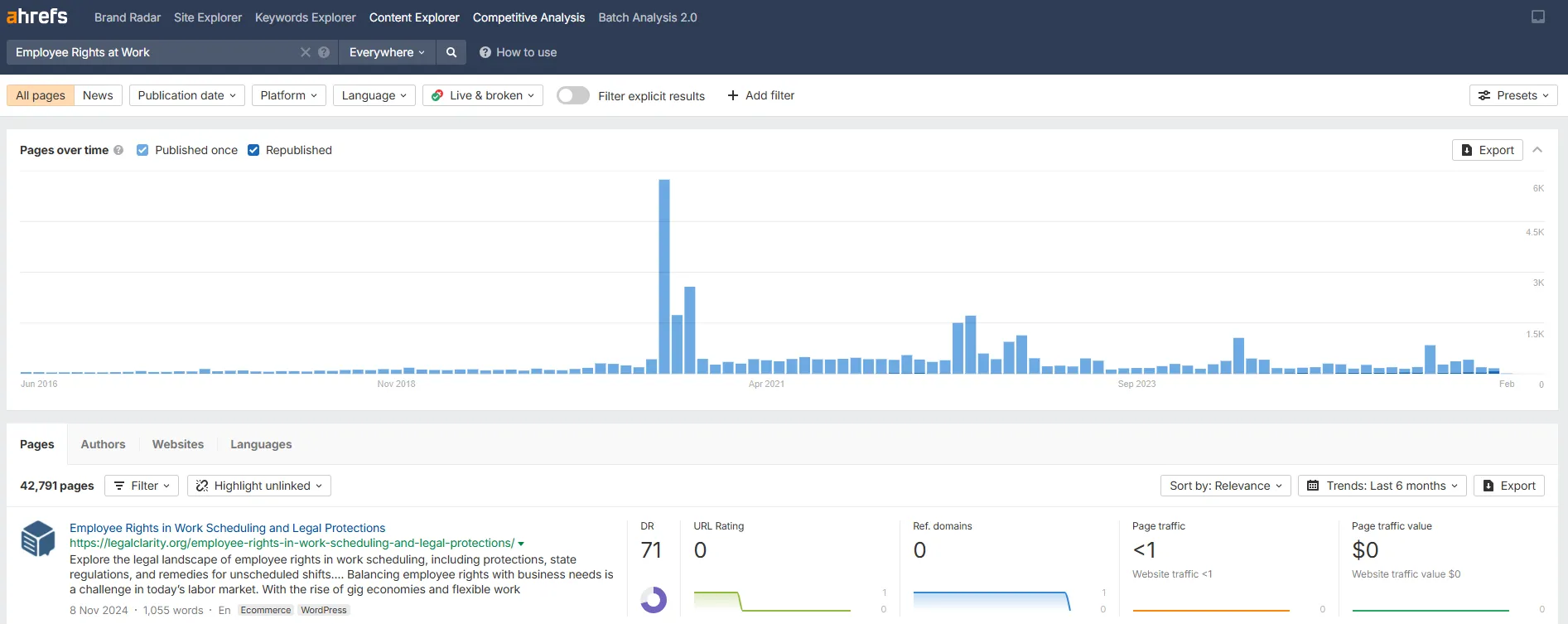
**Google Search Operators**
Use special search shortcuts to find guest posting opportunities directly.
- Family law + “write for us”
- law firm blog + “guest post”
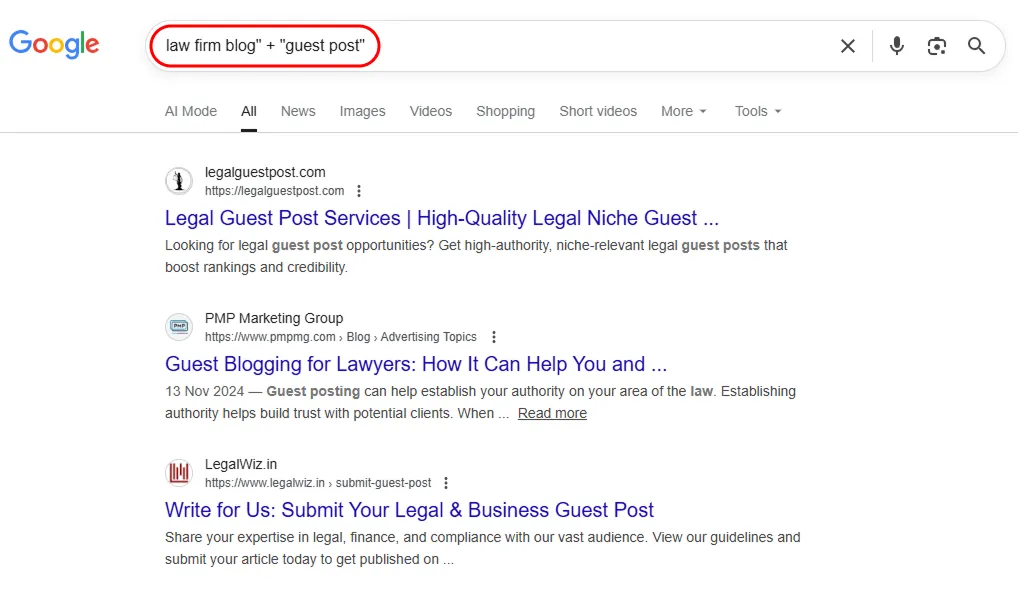
**Step 2: Audit the website**
Before you reach out, use Ahrefs to verify that it gets real organic traffic.
You must make sure the backlink profile is spam-free and avoid any casino, CBD, or gambling links.
A clean, trustworthy website will give you a valuable link.
A spammy one could actually hurt your rankings.
**Step 3: Reach out**
Once you find a suitable guest post opportunity, contact the website owner or editor and request permission to contribute your article.
Here is an outreach template you can use.
**Subject:** Guest Post Idea for [Site Name]
Hi [First Name],
I’d love to contribute a short, educational guest post for [Site Name].
I’m an attorney specializing in [area], and I think a piece on [topic] would be really valuable for your readers.
Happy to tailor the topic to what your readers need most.
Best,
[Your Name]
**Step 4: Write Helpful and Non-Promotional Content:**
Your article must be simple, and make the readers understand complex concepts:
- Use plain English language without any jargon.
- Offer actionable advice.
- It shouldn’t sound like a sales pitch.
**Step 5: Link Placement:**
A link placed naturally within the main content is more valuable than one in a bio or footer.
For law firms, it should appear in a relevant legal context.
### 2. Niche Edits (Contextual Link Insertions)
[Niche edits](https://outreachdesk.com/niche-edits/) involve placing your link inside an existing, relevant article, where it fits naturally within the surrounding content.
Instead of writing new content, you find relevant articles that have already been published and are ranking well on Google.
Next, identify a section where your resource fits naturally, and ask the publisher to include it as a helpful reference.
Suppose there is an article explaining what to do after a car accident, and you’ve a detailed guide on filing injury claims; your guide is a natural addition.
The article is already trusted by Google and already gets traffic, so a link from it carries real weight.
In the example below, an existing Bangkok travel guide includes a [contextual link](https://outreachdesk.com/contextual-link-building/) to cooking classes in Bangkok, naturally integrated into the content where it fits the topic.
#### How Niche Edits Works:
**Step 1: Find Relevant Articles**
Search for articles in your niche that cover topics related to your practice.
**Step 2: Identify Natural Link Opportunities**
Identify places where your resource naturally adds value to an existing article and helps readers understand the topic better.
**Step 3: Reach out**
Use [Hunter.io](http://Hunter.io) to find the editor or manager’s email address, then reach out with a brief message explaining how your content enhances their page.
Here is an outreach template you can use:
**Subject:** Helpful resource for your [Article Topic] piece
Hi [Name],
I noticed your article on [topic] and found it really helpful.
I recently published an updated, attorney-reviewed guide on [related topic] that clarifies [specific aspect].
It helps your readers in gaining accurate legal information: [URL]
Would you be open to adding it as a reference?
Thanks,
[Your Name]
#### Common Mistakes to Avoid With Niche Edits
- Don’t ask for exact keyword-match anchor text; it looks unnatural and spammy.
- Don’t link to your homepage; link to a specific, helpful resource.
- Don’t use the exact anchor text on multiple sites; vary it each time.
### 3. Resource Page Link Building
Resource page link building involves getting your guides or educational content listed on resource pages maintained by universities, nonprofits, and community organizations.
These pages are created to help the public find reliable information, not to promote business.
[Resource pages links](https://outreachdesk.com/resource-page-link-building/) provide long-term, stable links from trusted sources.
#### How to Work with Resource Page Link Building
**Step 1: Find Resource Pages**
Search for resource pages that list helpful content and link out to trusted external sources.
Use Google search operators to find pages that already link to helpful external guides.
- keyword inurl: “useful links”
- keyword intitle: “resource page”
**Step 2: Identify Gaps**
- **Outdated Checklists:** Many of the resource pages link to old legal guides that haven’t been updated in years. If your guide is recently published or updated and location-specific, it can be a strong replacement.
- **Missing Attorney-Verified Content:** Many resource pages link to general advice or government articles that don’t clearly explain legal rights. A guide reviewed by an attorney fills that gap.
- **Missing subtopics:** Some resource pages often omit important subtopics. Topics like the “tenant rights” page might not cover what to do when a landlord fails to maintain heat. If your guide addresses that, it is a natural addition.
**Step 3: Create High-Value Resources**
Make sure your content truly adds value and is relevant.
Keep it clear, accurate, educational, and natural, not promotional.
**Step 4: Outreach Template**
Here is an example template you can use.
**Subject:** Updated resource for your [topic] page
Hi [Name],
I manage the legal resources page at [Organization] and noticed your excellent collection on [topic].
I recently created an attorney-reviewed guide on [specific topic] that helps your audience: [URL].
It includes [a specific helpful element, such as a checklist or template].
Would it fit your resource list?
Best regards,
[Your Name]
### 4. Broken Link Building
[Broken link building](https://outreachdesk.com/broken-link-building/) is the process of identifying broken links on relevant websites and suggesting your updated content as a replacement.
Legal information frequently changes, as laws change and sites disappear.
As a result, many websites unknowingly link to the content that’s no longer accurate or accessible.
Instead of asking for a link, you help the site owner fix a problem by serving them a relevant and valuable alternative.
#### How You Can Find Broken Links
**Step 1: Find Broken Links**
You can use tools like Ahrefs, Check My Links, and Dead Link Checker to find broken links.
**Ahrefs**‘ “site explorer” feature shows all broken outbound links on a website.
You can scan an entire domain at once to see which pages return 404 errors.
[Check My Links](https://chromewebstore.google.com/detail/check-my-links/aajoalonednamcpodaeocebfgldhcpbe?hl=en-US) is a free Chrome extension.
Open a webpage, click the extension, and it highlights all links in green (working) or red (broken).
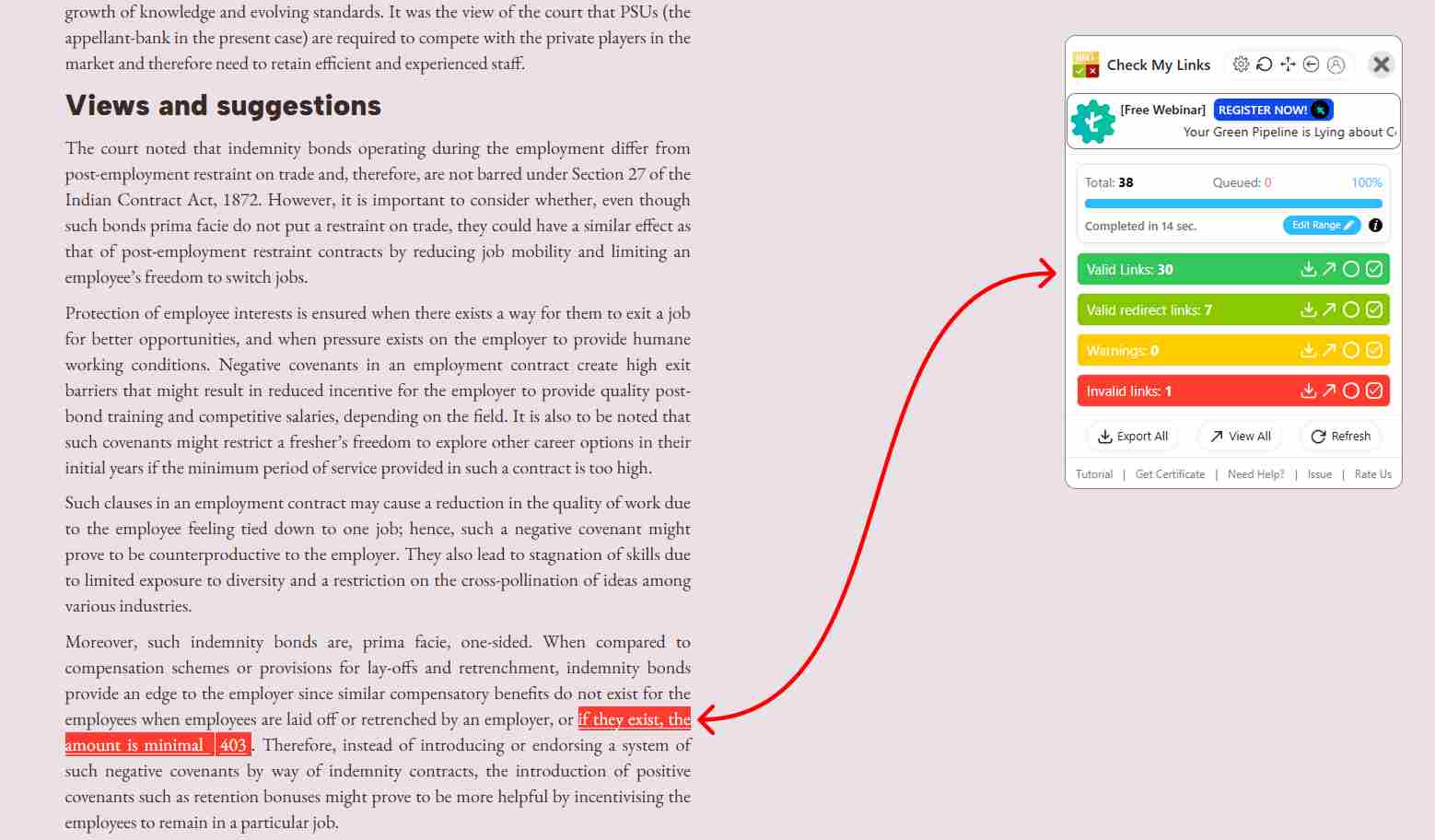
**Step 2: Create Relevant Content**
Check if you already have a relevant page that can replace the broken link.
If not, create new, helpful, and updated content.
**Step 3: Reach out**
Contact the website owner or editor.
Let them know about the broken link and politely suggest your content as a useful replacement.
**Subject:** Found a broken link on your [topic] page.
Hi [Name],
I was researching [topic] and found your resource page really helpful.
I noticed one of your links to [old resource] appears broken.
I recently created an updated guide on the same topic that might work as a replacement: [Your URL].
Either way, I thought you’d want to know about the broken link!
Best,
[Your Name]
### 5. Local Authority Outreach
Local authority outreach is the process of [building links from trusted local sources](https://outreachdesk.com/local-link-building/) such as local news sites, community organizations, and local business directories.
Local visibility is important because most clients search for lawyers in a specific city or area.
Local backlinks strengthen your firm’s connection to a specific region, helping validate that your firm is a reliable and active local business.
The image shows a New York State Courts (.gov) page linking to official lawyer referral resources.
Such government pages are strong local authority sources that help build trust and local relevance.
When Google notices that your law firm is mentioned consistently by respected local sources, it is more likely to show your firm in nearby searches.
#### Ways to Strengthen Local Authority
**Participate in Local Events**
Host or sponsor an immigration awareness workshop or event.
When local organizations mention your firm on their websites, that’s a valuable local backlink.
**Provide Value to Community Groups**
Offer free legal resources and guides to local business associations.
Many of these groups maintain websites and newsletters that list helpful resources.
**Respond to Local Journalists**
Local reporters constantly cover legal issues.
When legal rights or responsibilities aren’t clearly explained, reach out and offer your expertise.
**Get Listed in Local Business Directories**
Being listed in local directories confirms your firm’s location and credibility.
Consistent business details across directories strengthen local trust and improve visibility.
You can get your business listed on the following:
- Chamber of Commerce directories
- Better Business Bureau (BBB)
- City government professional directories
- Local business association websites
**Note About BBB Links**
BBB links are typically no-follow links, which means they don’t pass direct ranking power to your site.
However, they still add value by building trust, confirming your business is legitimate, and improving your local visibility.
Don’t skip them.
### 6. HARO & Expert Media Outreach
HARO is a platform that connects journalists looking for expert insights with professionals who can provide them.
And for lawyers, it means responding to the journalists’ questions with a clear, understandable, legally accurate quote.
When a reporter or journalist uses your quote, they often mention your name or your firm’s name and publish it on a news or media site.
This gives you a backlink from a news or media publication, one of the most authoritative link types.
#### How to Reach Out as an Expert
**Step 1: Sign Up for the Right Platform**
Here is a list of platforms you can use to find journalists’ queries.
You aren’t pitching a story; you’re just responding to what the reporter needs.
- [HARO](https://www.helpareporter.com/)
- [Qwoted](https://www.qwoted.com/)
- [Featured](https://featured.com/)

**Step 2: Set up the Filters**
Choose topics that match your expertise so you get relevant journalist requests by daily email.
**Step 3: Respond Quickly**
Journalists receive dozens of responses and often close requests within hours.
The best practice is to reply within 30 to 60 minutes of seeing the query.
**Step 4: Provide Clear, Quotable Responses**
Write your response so it can be pasted directly into an article.
Include your full name, your title, a one-sentence summary of your expertise, and a clear answer in plain language.
Avoid jargon, marketing language, and calls to action.
Here’s an example response you can use:
John Smith
Managing Partner, Smith & Associates Personal Injury Law
15+ years representing car accident victims in California
[Your answer to their question in 2-3 clear sentences]
**Step 5: Follow Up Once**
If you don’t hear back within 3 to 4 days, one polite follow-up is fine.
Multiple follow-ups can come across as pushy and may lower your chances of getting selected.
### 7. Trusted Legal Directory Placement
Legal directories like AVVO are specifically built to help people find and verify attorneys.
Google uses them to confirm that your firm is real, licensed, and operates where you say it does.
A well-filled profile on a reputable legal directory is one of the most straightforward ways to build trust.
For law firms, visibility isn’t about ranking; it is about how reliable your business is.
When your law firm is consistently listed on various legal platforms, it signals that your attorneys are real and licensed, that your firm is operated in a specific jurisdiction, and that your service matches your practice field.
Below is the list of the best directories.
**Top-Tier:**
- [Avvo](https://www.avvo.com/)
- [FindLaw](https://www.findlaw.com/)
- [Martindale-Hubbell](https://www.martindale.com/)
**Local/State:**
- Your state bar directory
- County bar associations
- Local chamber of commerce
#### How to Register in These Directories:
**Step 1: Complete Your Profile Fully**
These legal directories only work as trust signals when your profile is accurate and complete.
A partially complete profile can weaken the credibility and reduce its value.
You can include the following details in your directory profiles.
- Full legal name exactly as it appears on your bar registration.
- All the practice areas in which you work, not just a single service.
- Confirmed bar number and licensure, which validates your eligibility to practice.
- A high-quality professional photograph helps build trust and acceptance of the profile.
- A detailed bio explaining your background, focus areas, and years of experience in simple language.
- Education details and awards, certifications, recognitions, and honors.
**Maintain Consistency in NAP**
NAP stands for Name, Address, and Phone number.
These are the business details that must match across all the directories where you register your company.
Even small differences (like “Street” vs. “St.”) can confuse Google and weaken your local rankings.
**Step 2: Link to Specific Practice Pages**
Don’t just link to your homepage.
Link to the specific practice area page that matches the directory’s focus.
If you’re filling out your Avvo profile about car accidents, link to your “Car Accident Lawyer” page, not your main site.
This makes the link more relevant for both Google and the people reading your profile.
**Step 3: Encourage Reviews**
Reviews are the bonus points that add an extra layer of credibility to your directory profiles.
You can ask your clients to leave a review or provide feedback about your firm.
However, you should ask the clients only when:
- The client is satisfied to leave an honest review.
- Don’t request fake or misleading reviews.
### 8. University & Alumni Link Building
University and alumni link building involves earning backlinks from law schools, universities, or professional associations.
These links often come from alumni directories, career outcome or placement pages, speaker listing or guest lecturer pages.
Educational institutions (.edu domains) are among the most trusted sources in Google’s algorithm.
These links work well because they validate your academic background, confirm credentials, associate your firm with reputable institutions, and strengthen relevance.
#### How to Earn Links With Universities and Alumni Links
**Step 1: Start with Schools You Already Know**
Reach out to the universities or law schools you attended.
Schools regularly highlight what their alumni are doing.
Contact the school administration or the communications team.
Ask to be included in alumni directories, notable graduates pages, or success stories.
**Step 2: Offer Something Valuable**
Universities appreciate alumni who stay engaged.
When you contribute your knowledge, they may mention your name, bio, and a link.
Here are some ways you can contribute:
- Guest lectures for the students.
- Q&A interview for alumni magazines.
- Host webinars.
- Legal guides or educational resources.
- Career day or a mentoring session.
**Step 3: Be Visibly Active**
Links usually come from real involvement, not just direct requests.
You’re more likely to be mentioned when you:
- Speak at the local events or conferences
- Join the panel discussion
- Volunteer legal services
- Contribute to the published research or reports
**Step 4: Consider Offering a Scholarship**
Offering a scholarship is one way to earn .edu backlinks.
Law schools and university scholarship directories will list your firm on their websites with a link.
**Scholarship Link Building – Know the Risks**
Google has flagged scholarship links as a manipulative tactic, and many universities now screen or nofollow them.
If you offer a scholarship, make it relevant to law students, actually award it, and keep it a small part of your overall link strategy.
One legitimate scholarship from a respected university is far more valuable than many low-quality listings.
### 9. Converting Unlinked Mentions to Backlinks
An [unlinked brand mention](https://outreachdesk.com/unlinked-mentions/) occurs when a website mentions your firm or attorney in its content or on a page but doesn’t include a link to your website.
This law firm’s link building strategy is beneficial because the hardest part of getting mentioned is already done.
You just need to [reach out](https://outreachdesk.com/link-building-outreach/) politely and ask them to add a link so readers can easily find the original source.
#### Steps to turn mentions into backlinks
**Step 1: Track Brand Mentions**
Search for your firm name on Google or use monitoring tools to find [brand mentions](https://outreachdesk.com/brand-mentions/) without links.
Here are some tools you can use:
- [Google Alerts](https://www.google.com/alerts) – to set alerts for your firm’s name so you get an email whenever your firm’s name appears online.
- Use [Mentions](http://mention.com) to track brand mentions across blogs, news sites, and the web.
- Use [Ahrefs](https://ahrefs.com/) to get notifications when new pages mention your brand or names you track.
You can set alerts for your law firm name, attorney names (specifically if you’re a partner or a founder), different case names, or well-known matters you’ve worked on.
These often get mentioned without links.
**Step 2: Evaluate Each Mention**
Check whether the mention is natural and positive, whether the website is reputable, and whether it is relevant.
Skip spammy sites or scraped content.
**Step 3: Send a Simple Request**
Reach out to them politely.
Thank them for the mention, explain how a link would help their readers, and ask them to add a clickable link.
**Subject:** Quick question about your recent article
Hi [Name],
Thanks for mentioning [Your Firm] in your article about [topic].
We appreciate the reference!
Would you be open to linking to our website so readers can access more detailed legal information?
It helps make sure they get accurate, attorney-verified guidance.
Our site: [URL]
Thanks for considering!
Best,
[Your Name]
### 10. Strategic Content Marketing (Linkable Assets)
Strategic content marketing means creating resources that are so useful, clear, and trusted that other websites naturally want to link to and cite them.
These aren’t the regular blog posts that are written to publish content.
They’re [linkable assets](https://outreachdesk.com/linkable-assets/) such as checklists, templates, data reports, and infographics that are designed to make it a go-to reference.
#### How to Create Linkable Assets
**Step 1: Identify Content Gaps**
The simplest way to start is to find out what people are searching for and which types of content in your niche naturally attract citations and backlinks from other writers.
Look for questions clients repeatedly ask you, articles on confusing topics, guides with outdated or non-specific content, and information spread across multiple pages.
**Step 2: Create a 10 Times Better Version**
Build the version of that content that’s noticeably better than what already exists.
Make it more accurate and easier to read.
Include checklists, diagrams, tables, and images.
Tell readers exactly what to do by making it actionable.
**Step 3: Promote With Intent**
You should promote the content with intent because even the best content needs visibility once published.
[Reach out to bloggers](https://outreachdesk.com/blogger-outreach/) who write about the related topics, reach out to the journalists who cover similar issues, share on the relevant legal or industry blogs, submit to the resource pages, and share through your firm’s social profiles.
**Step 4: Update Regularly**
Legal content often loses its value when it becomes outdated.
To keep earning links, review your content periodically, update it for law changes or new rules, refresh old examples and statistics, and fix broken references.
Here are some examples of the linkable assets that work well for law firms:
**Research & Data**
- “Personal Injury Settlement Timeline: Analysis of 500 Cases”
- “Immigration Processing Times: 2026 Data Analysis”
**Thorough Guides**
- “Complete Guide to Divorce in [State]: 50-Page Attorney Manual”
- “Small Business Employment Law Compliance Checklist”
**Tools, Templates, and Visual Content**
- Infographic: “What to Do After a Car Accident”
- Flowchart: “Should You File a Workers’ Comp Claim?”
## Quick Reference: Strategy Comparison
**The table below compares the ten lawyer link building strategies on cost, effort, and time-to-rank so you can pick the mix that fits your firm.**
No single strategy works for every practice area.
The right mix depends on whether you’ve in-house content capacity and how competitive your local market is.
Use this table to compare [the strategies that earn editorial links](https://outreachdesk.com/link-building-strategies/) at a glance and decide where to focus your effort first.
| Strategy | Difficulty | Safety | Impact | Best For |
| --- | --- | --- | --- | --- |
| Guest Posts | Medium | High | ⭐⭐⭐⭐⭐ | Scalable authority building |
| Niche Edits | Medium | High | ⭐⭐⭐⭐⭐ | Fast ranking gains |
| Resource Pages | Medium | High | ⭐⭐⭐⭐⭐ | Long-term stable links |
| Broken Links | Medium | High | ⭐⭐⭐⭐ | Replacing outdated legal info |
| Local Outreach | High | Very High | ⭐⭐⭐⭐⭐ | Map Pack + local rankings |
| HARO/Media | Medium | Very High | ⭐⭐⭐⭐⭐ | E-E-A-T + trust signals |
| Legal Directories | Low | Very High | ⭐⭐⭐⭐ | Foundation trust |
| University Links | High | Very High | ⭐⭐⭐⭐⭐ | Premium authority |
| Unlinked Mentions | Low | Very High | ⭐⭐⭐⭐ | Easy quick wins |
| Linkable Assets | Medium | Very High | ⭐⭐⭐⭐⭐ | Long-term link magnet |
## What to Build First: Your Link-Building Roadmap
**Start with foundation links from legal directories and your bar association, then move into editorial outreach once you’ve ten to fifteen baseline citations in place.**
The order matters because directory placements verify your firm’s legitimacy, which makes editorial outreach replies much more likely.
Focus on the right foundation.
Start with pages that clearly explain your practice areas, location, and services.
Then build links in stages from local, trusted sources before expanding to industry and media sites.
This approach helps Google understand your firm, trust it, and rank the right pages faster.
Follow this roadmap to build links in the right order.
### Month 1-2: Foundation (Start Here)
**Goal:** Establish basic trust and verify your firm’s identity online.
**Actions:**
- Complete all major legal directory profiles (Avvo, Justia, FindLaw, Martindale)
- Verify the state bar listings
- Join the local chamber of commerce
- Claim the Better Business Bureau profile for your business
- Optimize your Google Business Profile
- Fix the NAP (Name, Address, Phone) inconsistencies across the web
**Why this matters:**
Without the foundation steps, Google can’t verify your firm, and your practice pages won’t rank regardless of content quality.
**Expected result:**
Improved brand recognition, more local and organic visibility, and consistent appearance for brand searchers.
### Months 3-5: Relevance & Early Growth
**Goal:** Build topical relevance and identify pages with ranking potential.
**Actions:**
- Guest posts on relevant legal and industry sites (2–3 per month)
- Niche edits from high-quality, relevant content (1–2 per month)
- Resource page placements from universities, nonprofits, and community sites (1 per month)
- HARO and journalist outreach (ongoing)
- Convert unlinked brand mentions into backlinks
- Promote one strong linkable asset (guide, checklist, or template)
**Why this matters:**
These links help Google understand your practice areas and strengthen topic relevance.
**Expected result:**
Early ranking movement and the idea of which pages have the chance to reach page 2 or 1.
### Months 6-8: Authority & Scaling
**Goal:** Strengthen authority and push high-potential pages higher in search results.
**Actions:**
- Guest posts on higher-authority legal and industry sites (2–4 per month)
- Niche edits from authoritative, traffic-driving pages (2–3 per month)
- More selective resource page links (1–2 per month)
- Local partnerships, sponsorships, and event-based links
- Continue HARO outreach and brand mention reclamation
- Create and promote additional linkable assets if needed
**Why this matters:**
These links connect your practice areas to real-world authority and help competitive keywords move from page 3 to page 1.
**Expected result:**
Steady ranking improvements, increased organic traffic, and stronger visibility for local and service-based searches.
**Target:** 5–10 high-quality links per month across all tactics.
### Month 9+: Expansion (Advanced)
**Goal:** Dominate competitive markets and outrank national competitors.
**Actions:**
- Secure university/alumni features
- Earn mentions from major publications
- Trusted, credible, and expert PR placements
- Industry magazine features
- Law school spotlights
- Expert legal commentary in major news
- Launch podcast or video content
**Why this matters:**
These links are the hardest to get, but they provide long-term trust and credibility that competitors can’t easily replicate.
**Expected result:**
Increase your chances of competing for the top spot on highly competitive terms and gain national-level visibility alongside your existing local presence.
## Measuring Your Link-Building Results
**Track three metrics that connect link building to real revenue: map pack ranking movement on practice-area queries, organic traffic to your service pages, and consultation requests attributed to organic search.**
Total backlink count is a vanity number.
The metrics below are the ones that prove link work moved the firm.
Link building for legal sites takes time, and it is important to know whether your efforts are actually paying off.
Here are the key metrics to track:
### Referring domains
The number of unique websites linking to you.
This is more important than raw link count.
Track it monthly using Ahrefs or SEMrush.
### Organic traffic
The number of visitors arriving at your site from Google.
Check this in [Google Search Console](https://search.google.com/search-console/about) or Google Analytics.
Look for upward trends over 3-month periods.
### Keyword rankings
Track how your target keywords (like “divorce lawyer in [City]”) are moving in Google.
Use SEMrush or Ahrefs Position Tracking.
### Referral traffic
Visitors who arrive at your site by clicking a link on another website.
If your backlinks are working, you should see this number grow.
Check in [Google Analytics](https://developers.google.com/analytics).
### Client inquiries
Ultimately, the goal is to get more clients.
Track how many new inquiries or consultations your site generates each month.
If organic traffic is rising but inquiries aren’t, your landing pages may need work.
### How to Calculate Your ROI
Once you’ve been building links for 3 to 6 months, you can start estimating the return on your investment.
#### ROI Formula
ROI = (Revenue from new clients − Cost of link building) ÷ Cost of link building × 100
Suppose your link building effort costs $2,000 per month (your time + any tools), and over the next 3 months it generates 2 new clients worth $5,000 each:
- **Total revenue:** $10,000
- **Total cost:** $6,000
- **ROI:** ($10,000 − $6,000) ÷ $6,000 × 100 = 67%
Even conservative numbers usually show a positive ROI within 6 months if your strategy is on track.
## Common Link-Building Mistakes to Avoid
**The common lawyer link building mistakes are paying for low-quality directory bundles, exact-match anchor text repetition, and skipping state bar compliance checks on guest content.**
Each one wastes budget or risks a compliance issue with your bar.
The patterns below cost firms the most growth over a typical year.
These are some common mistakes that cause law firms to either waste their efforts or get penalized by Google.
Avoid every single one.
### 1. Buying Cheap Links
Avoid [link farms](https://outreachdesk.com/link-farming/), PBN networks, AI-generated guest post services, casino/CBD/gambling site links, and spam directories, as legal sites face severe penalties for paid links.
### 2. Overusing Exact-Match Anchors
Avoid using exact match anchors such as “best car accident lawyer Phoenix” and “top divorce attorney Seattle.”
Instead, you can use the alternatives as guide titles, branded anchors, or natural phrases like “according to legal experts.”
### 3. AI-Generated Content Without Review
Every legal guest post must be factually correct, verified, and reviewed by an attorney because generic AI content can damage credibility.
### 4. Links From Irrelevant Sites
Avoid links from low-quality, foreign-language sites that aren’t relevant to your audience.
### 5. Spammy Directory Submissions
You should ignore bulk submission services, auto-approval sites, and foreign legal directories.
Stick to trusted, editorially reviewed directories only.
### 6. Assuming Popular Sites Are Trustworthy
A relevant and trusted site is more valuable than a site with a high score that’s filled with spam or unrelated content.
### 7. Relying Only on Directories
Directories can be a source of reliability, but the real ranking comes from trusted mentions, relevant websites, local sources, and expert content.
### 8. Low-Quality Guest Posts
You should avoid generic templates, reused topics, AI content without expertise, and overly promotional writing.
Guest post content should be original, helpful, and legally accurate.
### 9. Not Tracking Links
Most of the time, links get removed, nofollowed, or moved to footers.
You should make sure the links are visible and monitor them regularly.
Check regularly using Ahrefs or Semrush.
### 10. Ignoring Local Signals
Most lawyer searches are local (in the city).
Without local mentions and citations, your firm may not be visible in maps or in local search results.
### 11. Ignoring Toxic Backlinks
Spammy links pointing to your site can trigger penalties.
Audit your backlink profile and disavow any unnecessary links.
## Tools You’ll Need
**The lawyer link building tool stack falls into four categories: backlink research, prospecting, outreach management, and rank tracking.**
One tool per category is enough to start.
The list below covers the specific tools most firms use plus the use case each one solves.
Here is the list of tools you may require for a [link building campaign](https://outreachdesk.com/link-building-campaigns/).
Use these tools to make link building more efficient and organized.
Start with the free tools.
Add paid tools as your link building operation grows.
### Essential (Free or Low-Cost)
| Tool | What It Does |
| --- | --- |
| Google Alerts | To track brand mentions |
| HARO | To look for journalist requests |
| Google Search Console | To monitor search performance |
| Check My Links (Chrome) | Use this to find broken links |
| Hunter.io | Helps you find contact emails |
### Professional (Paid but Worth It)
| Tool | What It Does |
| --- | --- |
| Ahrefs | Use this tool for backlink analysis, content research, and competitor analysis |
| SEMrush | You can use this tool for keyword tracking and link monitoring |
| BuzzSumo | You can use this tool for keyword tracking and link monitoring |
| Whitespark | Use this tool for local citation building and management |
| Moz Link Explorer | Domain authority checking, spam score analysis, and link intersect. |
### Nice to Have
| Tool | What It Does |
| --- | --- |
| Screaming Frog | Use this for technical site audits |
| Canva | You can use this to create linkable visual assets |
| Quoted/Featured | For additional media opportunities |
## Conclusion
Link building for lawyers is about earning trust, not just links.
It is about building a strong foundation that supports trust, authority, and long-term growth.
By focusing on the right link building strategies and avoiding risky shortcuts, law firms can build stronger visibility without risking penalties.
When done right, link building supports rankings, local presence, and long-term credibility, helping your firm get found by the people who need your services most.
### Looking to improve your rankings and attract the right clients?
A focused link-building strategy can help.
If you’d like to see how it applies to your firm, we can outline a plan tailored to your practice.
[Book a Strategy Call](/contact-us/)
### How long does link building take to show results?
Most law firms see the initial improvements in the first 3-6 months and strong ranking growth in 6-12 months.
However, the competitive practice areas like personal injury require ongoing effort.
### How many backlinks does a law firm need?
Quality is more important than quantity.
For most firms, 5-10 high-quality, relevant links per month is enough for steady growth.
But one authoritative link from a university can outweigh 100 directory links.
### Are legal directories still useful?
Yes, top-tier legal directories such as Avvo, Justia, FindLaw, and Martindale are essential foundation links.
They verify an attorney’s identity, bar information, and practice areas, and stick to reputable, editorially reviewed directories.
### Do local links improve Map Pack rankings?
Yes, local links are among the strongest signals for Google Maps Pack visibility.
Links from local news, chambers of commerce, and community organizations create powerful geographic trust signals.
### Are HARO links valuable for legal SEO?
HARO links are extremely valuable because they come from editorial publications and news sites, strengthening E-E-A-T signals and organic trust.
### Can bad backlinks hurt my legal website?
Yes, especially in legal SEO.
Spammy or irrelevant links can cause ranking drops, manual penalties, and loss of local visibility.
Recovery times are longer for legal sites than for other niches.
### Should I mix different link-building strategies?
Yes, a balanced approach using Local + Authority + Practice-Relevant links can deliver the safest, strongest results.
Avoid relying solely on directories or guest posts.
### What’s the difference between a high-quality and a low-quality legal backlink?
**For High-quality:**
Check if it is relevant to your practice area, has an editorial placement, comes from a trusted source with real traffic, uses natural anchor text, and is contextual.
**For Low-quality:**
Check if they’re of an irrelevant niche, a footer/sidebar link, from a spam site, an exact-match commercial anchor, or auto-approved.
### How do I know if a website is good for guest posting?
You should check real traffic using tools like SimilarWeb/Ahrefs, audit quality content from real authors, make sure strong editorial standards, maintain a clean backlink profile, avoid casino/CBD, and implement a manual approval process.
### What anchor text should I use for legal links?
You can use natural, varied anchors, guide titles, branded terms (“Smith Law Firm”), partial matches (“personal injury guide”), and topical phrases (“according to legal experts”).
However, you should avoid exact-match commercial terms like “best car accident lawyer Phoenix.”
### Should law firms build links themselves or hire help?
It depends on resources.
DIY is possible for directories, HARO, and local outreach.
Guest posting and niche edits often require more time and expertise.
Many firms use white-label partners for scalability while handling local outreach internally.
---
---
title: "What Are SERPs? Search Engine Results Pages Explained"
url: "https://outreachdesk.com/what-are-serps/"
lang: "en-US"
type: "post"
description: "A search engine result page (SERP) is the page you see after you type a Keyword or query into a search engine like Google. It is the page designed to help you find the most relevant information as per your"
last_modified: "2026-05-18T11:53:45+00:00"
categories: [SEO]
---
# What Are SERPs? Search Engine Results Pages Explained
A search engine result page (SERP) is the page you see after you type a Keyword or query into a search engine like Google. It is the page designed to help you find the most relevant information as per your search. Teams that want full execution often work with [work with Outreach Desk](https://outreachdesk.com/) on this kind of campaign.
Today, SERP is more than a list of blue links. Depending on the search query, it can show ads, an AI overview, Featured Snippets, images, videos, maps, and shopping results, often appearing before regular website results.
The purpose of a SERP is simple: **to help you find the most helpful information quickly** from millions of available pages online. Whether you’re looking to learn something, compare options, find a location, or want to make a purchase.
**Here’s what SERP looks like:**
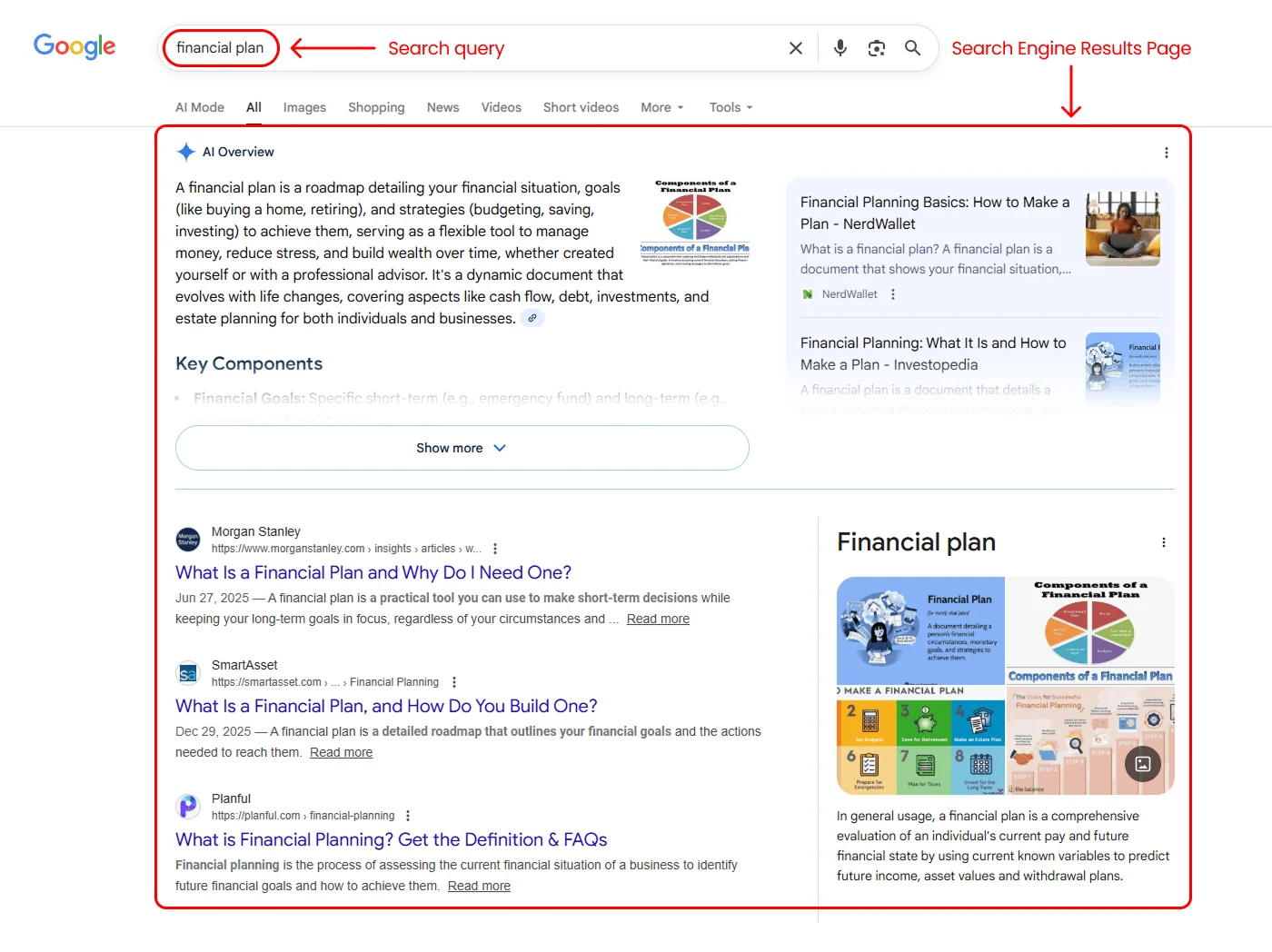The above image shows the SERP results for the “financial plan” query.
### Key Takeaways
- SERP can include organic results, ads, images, videos, and special features
- Search engines organize results based on relevance and search intent
- Visibility isn’t only about ranking #1; SERP features often get more attention.
- Different searches can trigger different SERP layouts
- Pages that clearly answer user intent tend to appear more consistently
- Improving SERP visibility starts with clarity, relevance, and trust.
## What Appears on a SERP?
**A SERP (Search Engine Results Page) is the page that appears after you submit a search query.** And in 2026 it contains far more than ten blue links, a single SERP can include AI Overviews, featured snippets, People Also Ask boxes, local map packs, image carousels, video results, and shopping ads, each designed to answer the query directly without requiring a click.
Understanding what appears on a SERP. And which features are triggered by which query types, is the foundation of any effective SEO strategy, because different features capture different shares of user attention even when your page sits at position one in the organic list.
A SERP isn’t just a list of links. It shows different result types and features that help users find their answers faster, and users can compare options before clicking a link.
Google SERPs hold the largest share of global search and shape how modern results pages are designed.
There are many SERP features that exist to match different search goals by presenting results in the most helpful format, such as quick answers, visuals, local listings, or products. So, users can find what they need faster.
Below are common types of SERP features found on Google search results pages.
### Sponsored Results
Paid results are advertisements that businesses pay for to appear in search results. These ads can appear at the top, middle, or bottom of the SERP, depending on the query and layout.
Advertisers choose specific keywords to target, and when someone searches those keywords, Google determines which ads to show based on:
- The advertisers with the highest bidder
- How relevant the ad is to the search
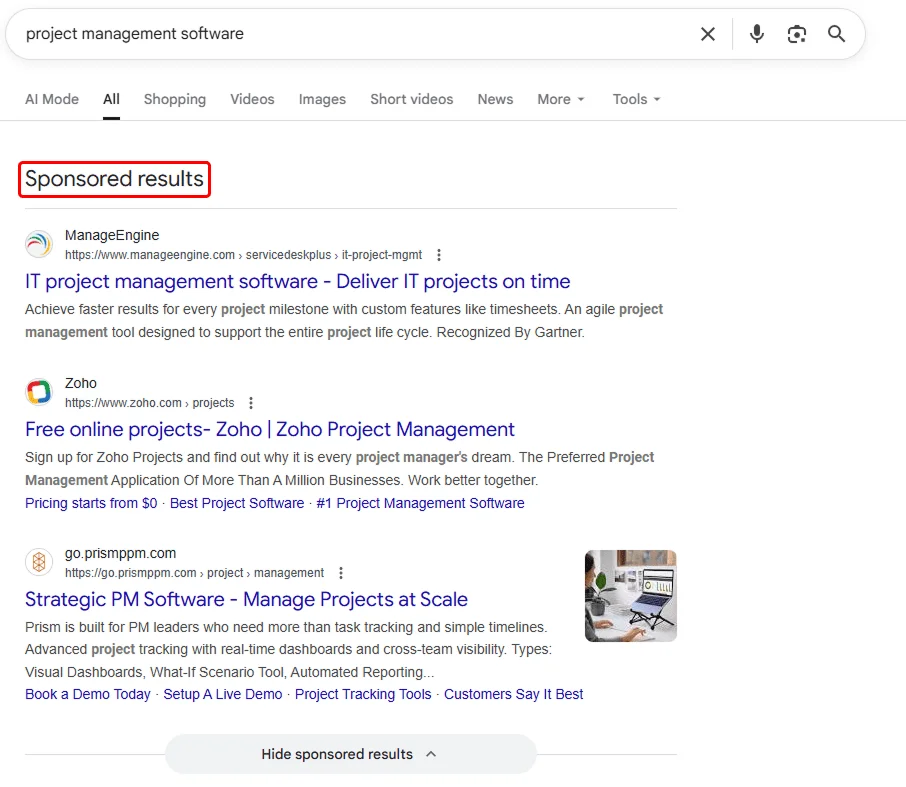As you can see in the image above, this is how sponsored results are displayed.
Advertisers commonly pay only when someone clicks the ad. This makes paid results useful for gaining **immediate visibility**, especially for competitive searches.
### Organic Search Results
Organic search results appear because the search engine believes they’re **relevant and helpful**, not because the website paid for placement.
Each organic result provides a quick preview of the page, which helps users choose the most relevant result. The preview usually includes:
- Page title – The main headline shown in search results.
- Page URL- The web address that takes you to the page.
- Description – A summary that explains what the page is about.
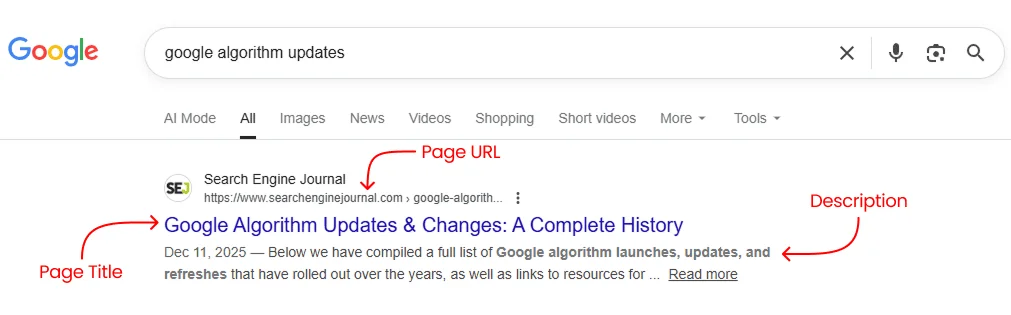These results are ranked by Google’s algorithm, which uses many signals and factors for each search, such as relevance and content quality.
#### Enhanced Features in Organic Results:
Sometimes, Google adds extra details to help users choose the right result. These enhanced listings may include:
**Published Dates:**
It shows when the content was published or updated. It helps users judge the freshness and relevance of content, especially for news, trends, or guides.
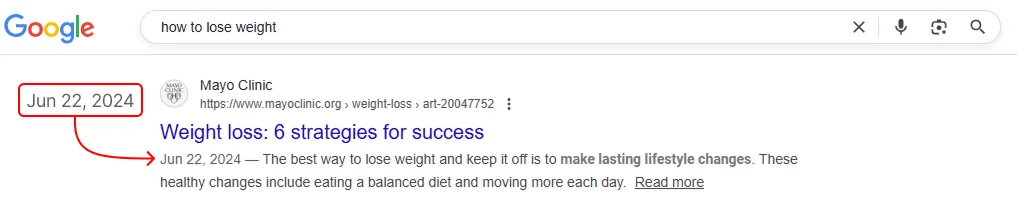**Rich snippets:**
It adds details like review stars, ratings, images, or event details. It helps the users judge the page before they click.
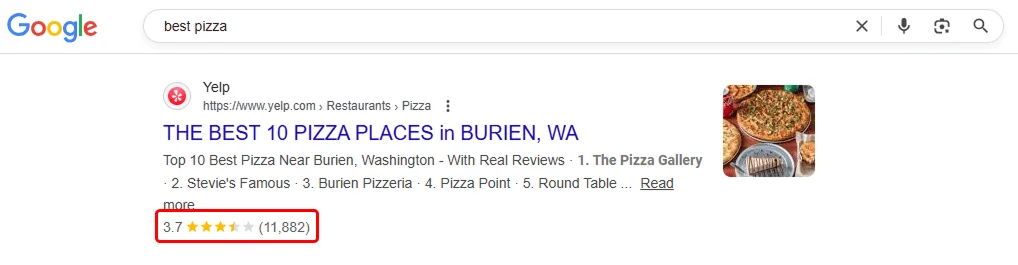**Sitelinks:**
[Sitelinks](https://developers.google.com/search/docs/appearance/sitelinks) display additional links to the important sections of the site. Helping users quickly locate pricing, blogs, contact information, or other important pages.
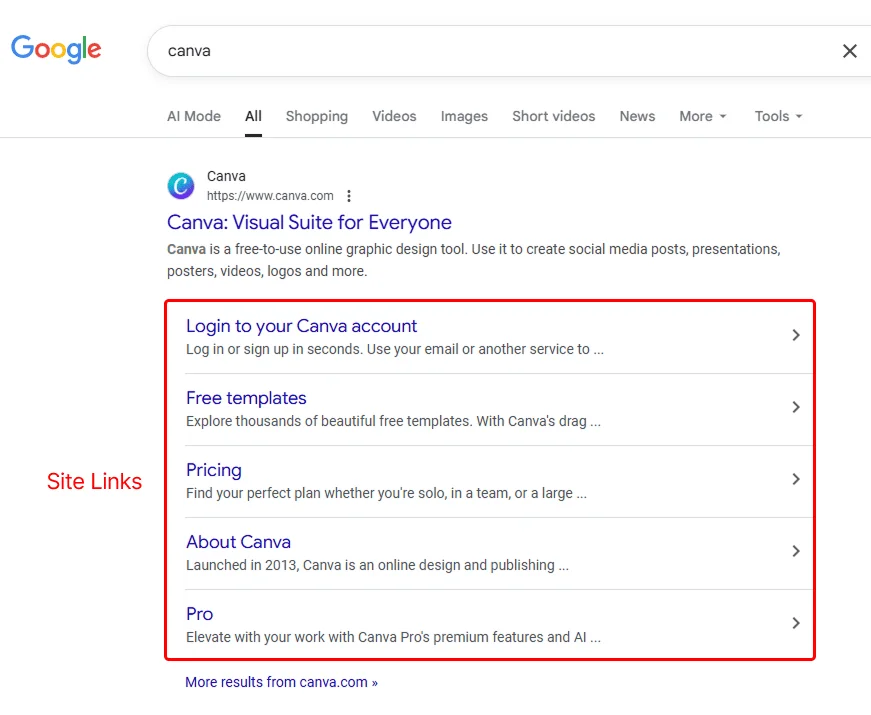In short, organic search results show which pages search engines consider the **best answers** to a query.
### AI Overviews
AI Overviews appear at the top of some searches and provide a summarized answer generated from multiple trusted sources. They help users understand a topic quickly and include links to explore the original content in more detail.
When you type a query, “What is email marketing?”, Google analyzes your search intent and provides a mix of results, including an AI overview and a featured source. These results are selected from many pages that are indexed using Google’s ranking system. The layout and the number of results differ depending on the query you made and its intent.
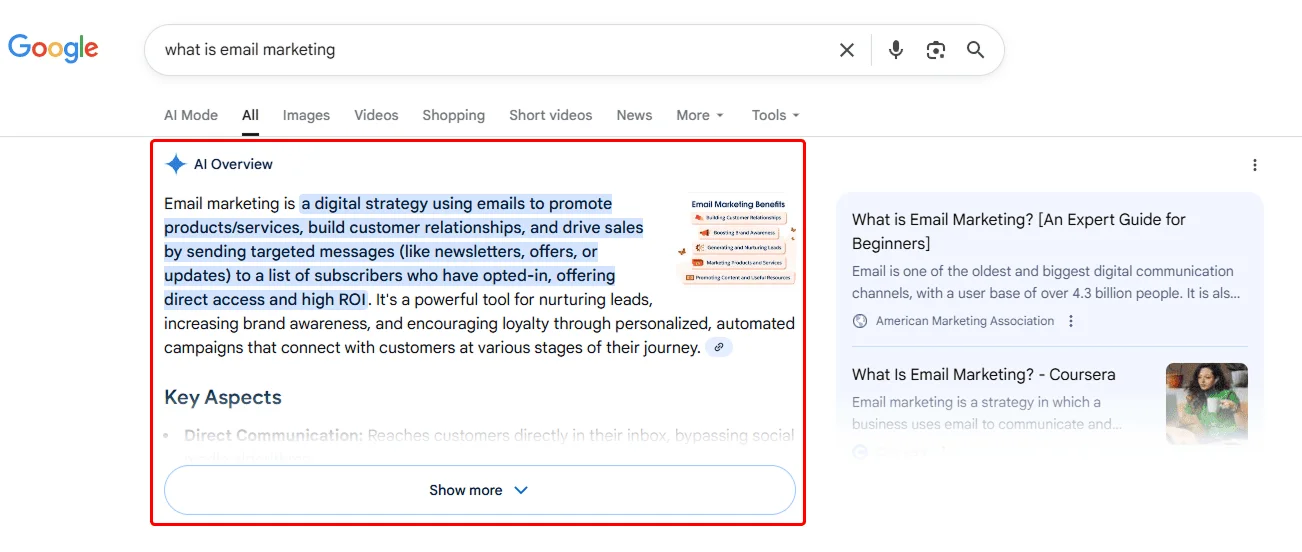
### Featured Snippets
Featured snippets display a direct answer taken from a webpage. They are shown when Google believes a short, quick answer will satisfy the search.
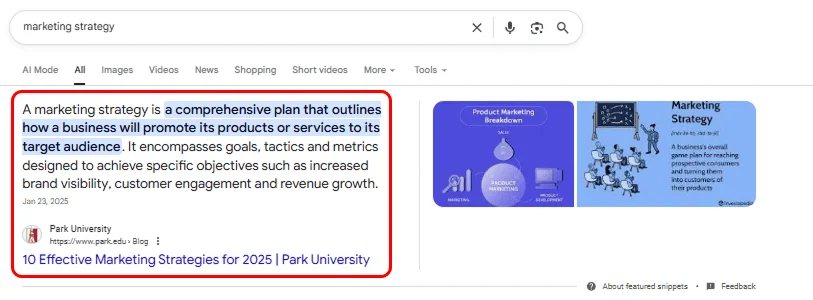
### People Also Ask
People Also Ask is the feature that shows related questions that users commonly search for. These questions are either displayed at the top or the bottom of the page. Clicking a question reveals a short answer and helps the users explore a topic further.
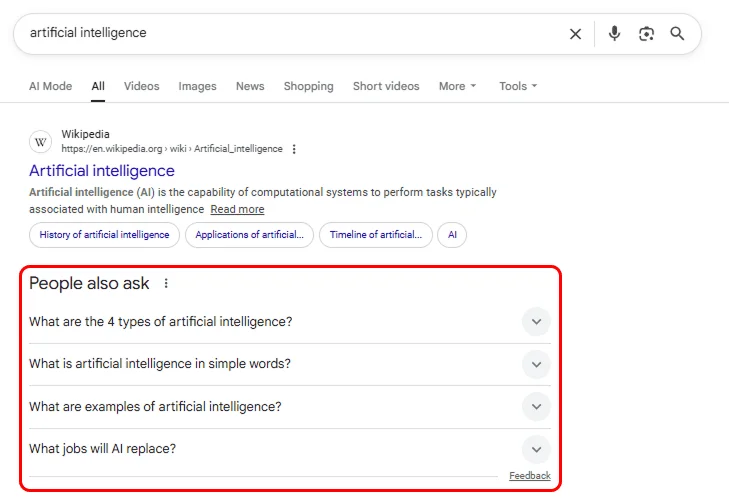The image above shows the “People also ask” questions that you can refer to. Here in the image, the questions are displayed at the top of the page.
### Knowledge Panel
Knowledge Panels appear on the right side of the page and display key facts about entities, such as businesses, people, or organizations, from trusted sources like Google’s Knowledge Graph and Wikipedia, as well as publicly available information.
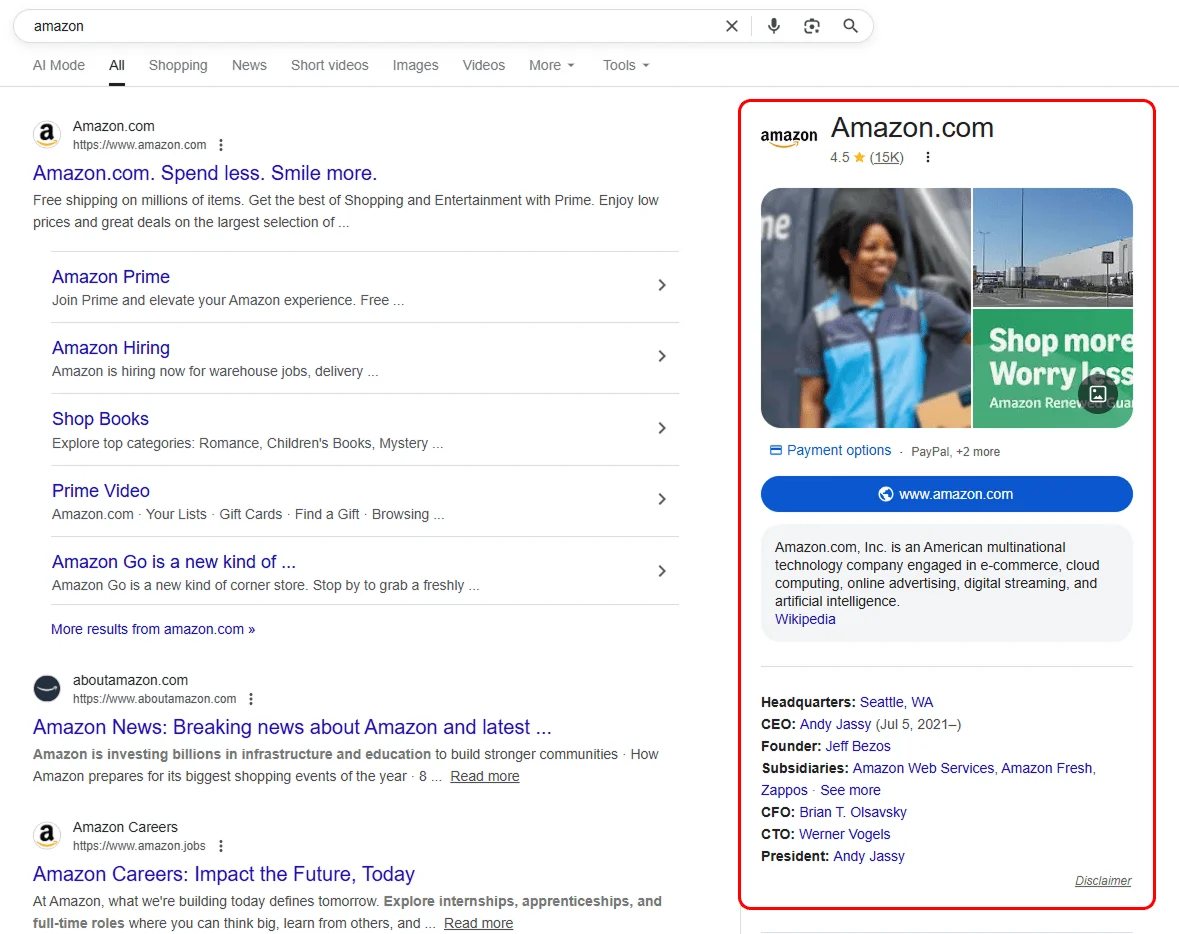The image above shows that the knowledge panel appears on the right side of the screen, displaying all available information about the keywords or terms you type in the search box.
### Image Results
Image results show visual content related to a search query and appear when images help users better understand a topic than text.
### Video Results
Video results highlight videos when visual explanations are more useful than text. They commonly appear for how-to, educational, or entertainment-focused searches.
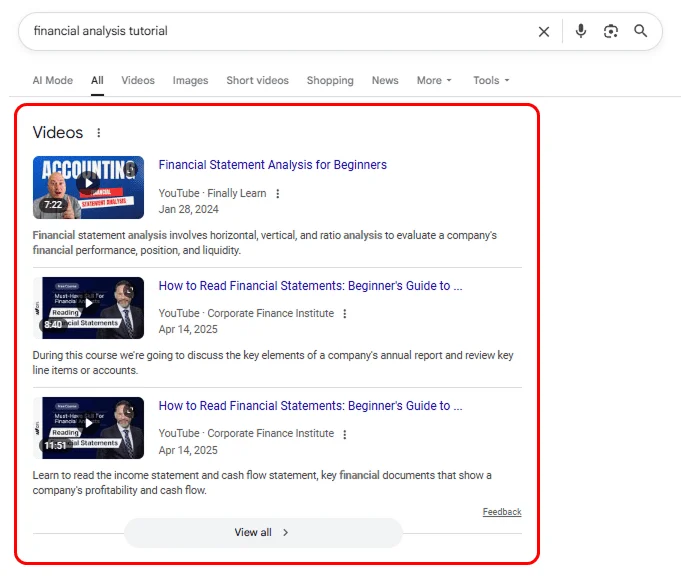
### Short Video Results
The short video results shown are often sourced from platforms like YouTube, TikTok, and Facebook. These often show up when you enter a query regarding “How-to” or entertainment purposes.
When you search for the query “Quick cleaning hacks reels”, Google often shows short video results at the top of the page. Each video card shows a preview image, the video’s length, a short title and caption, and the platform it comes from.
It helps users find quick tips in video form, saving time compared to reading lengthy blog posts.
### Local Packs
Local packs appear for location-based searches and highlight nearby businesses with maps, ratings, and contact details. They help users quickly find products or services near them.
### Google Shopping Results
These features show products, prices, and other important information in search results when users are comparing options or planning purchases.
When you search for the term “Running shoes,” Google displays various products from different brands and other details to keep you engaged and offer you the desired results.
### Direct Answer Box
The direct answer box provides a short factual answer at the top of search results when a question has a clear, specific answer.
### Top Stories
Top stories is a section in Google search that highlights recent news articles related to a topic when freshness and timely updates are important.
It can be breaking news, trends, or important events. It simply means that it helps you see what’s happening right now from trusted news sources.
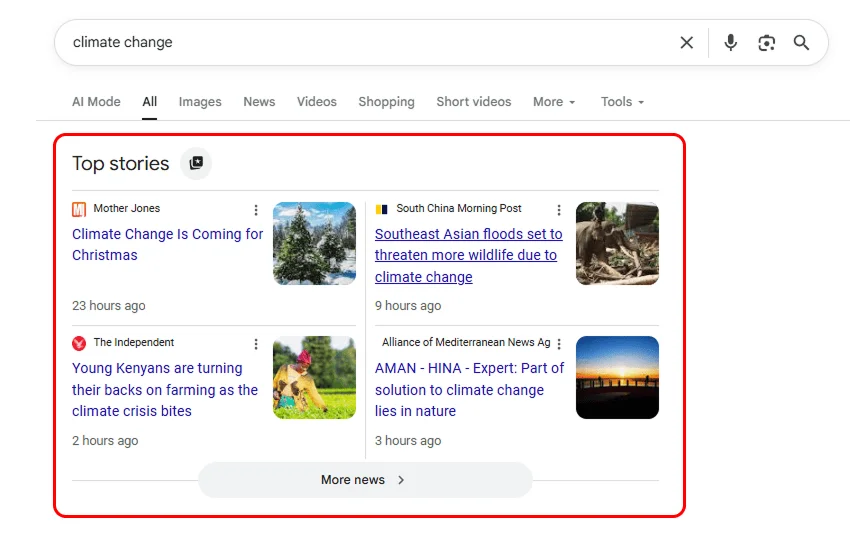
### Related Searches
Related Searches appear at the bottom of the SERP and suggest similar queries that people commonly search for. They help users refine or expand related topics or adjust their search.
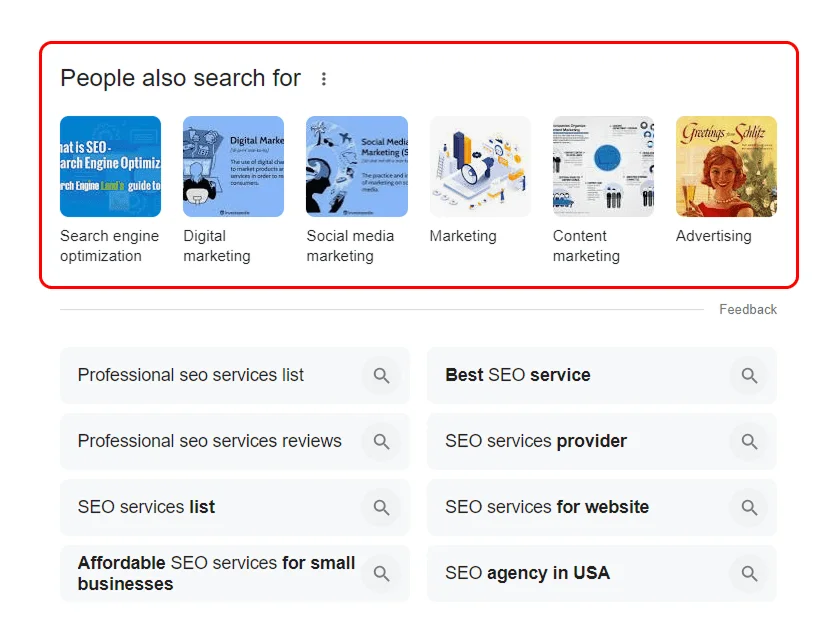
### Google Flights Results
For flight-related search queries, Google often displays the Google Flights SERP feature. It can provide detailed flight information or, more simply, list flights to a specific location.
When you search for a flight query like “flights to New York,” Google usually shows the flight section at the top of the page.
It shows a flight search box where you can enter details about the place you’re flying from, choose your destination, dates, number of passengers, and class.
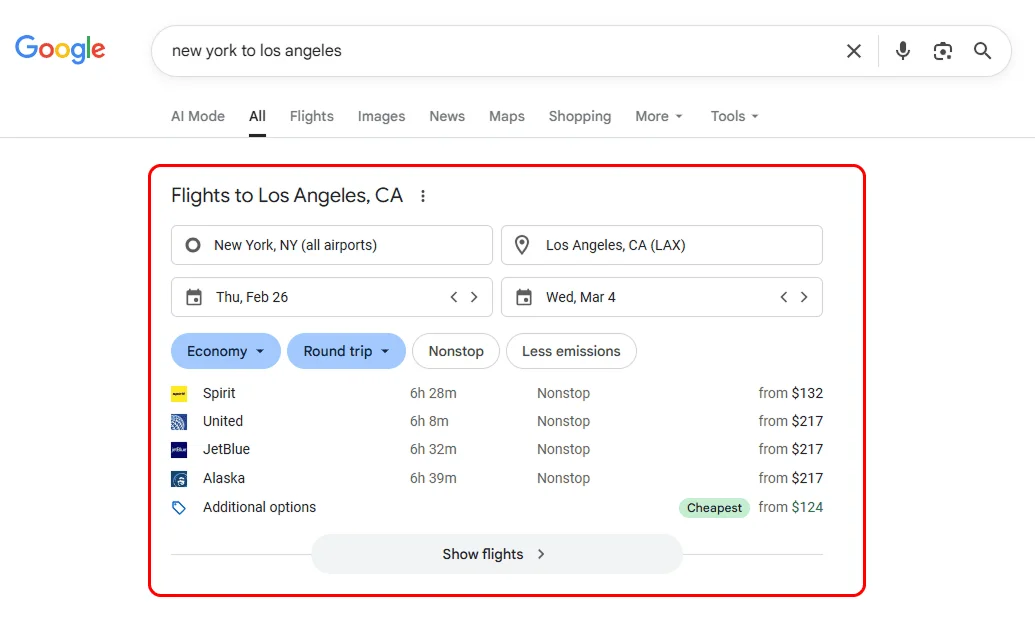Additionally, it shows a cheap flight option card that lists the flight name, location, date, and status (nonstop).
### Recipes Results
Recipe results appear when you search for recipes. It shows the results in three options with a button to show more.
When you give a query like “Homemade noodles recipe”. Google displays the recipes section at the top of the page. Each card shows the recipe title, the website name, ratings and reviews, the video duration, and key ingredients.
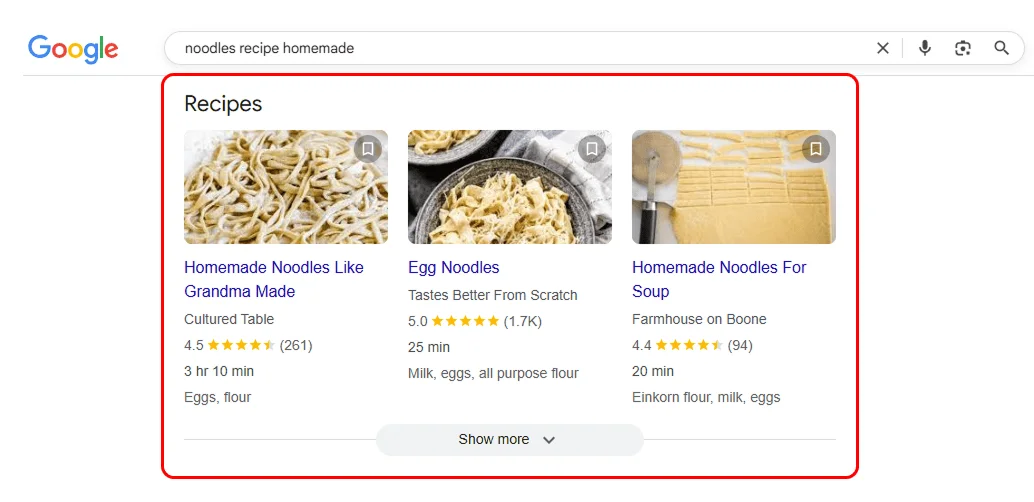It helps users compare recipe results faster, saves them time, and, importantly, highlights trusted and popular recipes.
### Job Results
Job results appear when you search job-related queries. It shows up to 3 results with a “show more” button.
When you search for a query like “Marketing jobs,” Google shows the job section at the top of the results. It lists real job openings from sites like LinkedIn, Indeed, and company career pages.
The details include the job title, company name, location, when the job was posted, job type (full-time/part-time), and salary information (if available).
It provides filters at the top to narrow down the results. The filter contains location, remote jobs, and types.
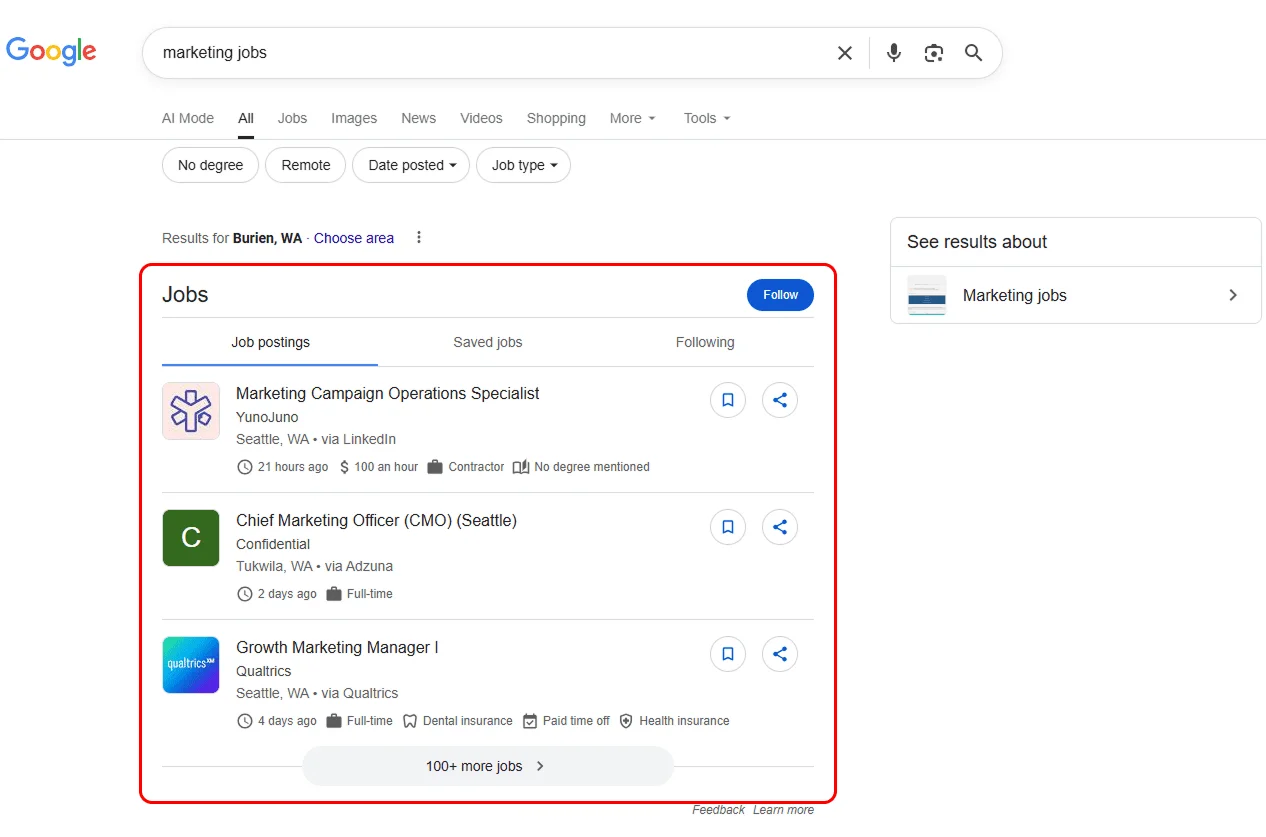
## Benefits of Ranking in SERPs
**Ranking in SERPs delivers compounding traffic benefits that paid advertising can’t replicate.** Every organic position earns clicks continuously without ongoing cost, builds brand recognition through repeated impressions even on zero-click queries, and signals to Google that your content satisfies intent well enough to keep showing it.
The highest-value SERP positions in 2026 aren’t just position one in the organic list but also featured snippets and AI Overview citations, which receive attention even when users never scroll past the answer box at the top of the page.
Search Engine Results Pages shape what appears in search and how people interact with results. They influence visibility, user decisions, competition, and real business outcomes, not just rankings.
### 1. Visibility Drives Attention
Most of the time, people don’t scroll far. If your page doesn’t appear where users are looking for it, your chances of being noticed drop, no matter how good your content is. SERPs influence key SEO metrics such as impressions, [click-through rate](https://support.google.com/google-ads/answer/2615875), and brand visibility, even when users don’t click.
### 2. Search Behavior Shapes Traffic
Users don’t just click the top link. They usually choose a result that looks helpful, clear, and relevant. Some SERP features, such as quick answers, images, or shopping panels, can divert their attention from standard results.
### 3. Search Intent Reflects Demand
Different searches can trigger different interfaces based on what users want: be it answers, products, maps, or visual content. Understanding this helps you create content that fits what users actually want.
### 4. Competition Happens On The Results Page
You’re not just competing with other websites; you’re competing with ads, maps, videos, and featured sections. Winning visibility means earning attention, not just ranking higher.
### 5. Business Outcomes Go Beyond Clicks
Even when users don’t visit your site, appearing in SERP features builds brand recognition and trust, especially for local or transactional searches.
## Why SERPs Don’t Look the Same Every Time
**SERPs don’t look the same every time because Google personalizes results based on location, search history, device, query intent, and ongoing algorithm updates.** Two users searching the same query from the same city can see different layouts, different snippets, even different rankings. That’s by design.
SERPs change because search engines adjust results to match **what users need at that moment.**
They vary based on:
### Search intent
Sometimes the same words can mean different things. Some people may use it to learn, compare options, buy a product, or find something nearby. Google can adjust its results to better match your intent.
#### Location & device
Search results may differ by country and city because local relevance matters. For any query, results may also differ between mobile and desktop because Google prioritizes different layouts or content types.
#### Personalization
Your past searches, browsing behavior, and account activity can influence what Google shows you, making results more convenient for you.
#### Freshness
For topics like news, trends, or updates, newer content can replace older pages to keep the results up to date.
#### Google updates
Google frequently changes its ranking systems, layouts, and rules that can shuffle the results.
This is why the same search can show **different layouts and results.**
## SERP vs SEO vs Ranking: What’s the Difference?
**SERP, SEO, and ranking describe three different things: the page itself, the discipline that influences it, and the position your page holds on that page.** A SERP is the search results page. SEO is the practice of optimizing for those pages. Ranking is where your specific URL appears.
Before going further, let’s clarify how these terms differ. They’re closely related but mean different things in search.
| Term | What It Means |
| --- | --- |
| SERP | The page Google shows after a search, including organic results, ads,and special features |
| SEO | The work done to improve a website’s visibility on SERPs |
| Ranking | Where a page appears within the organic (unpaid) search results |
SEO efforts influence rankings, rankings determine visibility, and SERPs are where visibility competes for attention.
## How Search Engines Build SERPs
**Search engines build SERPs in real time using a three-step process.** Understanding the query intent, retrieving relevant indexed pages, and ranking them with hundreds of signals. The whole process takes under a second. The signals that decide ranking are what most of SEO work tries to influence.
Search engines don’t show results randomly to users. It follows a structured process to provide relevant results.
Here’s how search engines build it:
### 1. Understanding Your Query
The first step search engines take is to understand what you’re looking for. Whether it’s a question, a product, or information, search engines analyze the words you type to determine your intent.
Search intent typically falls into four categories. You can see the intents that you pass by typing your keywords, and for better understanding, we’ve mentioned an example query as well.
**Navigational:**
This intent is used to reach a specific website or page. By typing this query **“Facebook login,”** you will be directed to your desired page. Google usually shows the official site or the exact page.
**Commercial:**
This intent shows that you’re researching or comparing options before making a purchase decision. By searching for **“best smartphones 2026,”** you’ll see results you can compare.
**Transactional:**
This intent shows that you’re ready to take action, such as buying or signing up. By entering the query **“buy iPhone online,”** you see the options you can select. The results often include product pages, pricing pages, or shopping ads.
**Informational:**
This intent usually indicates that you want to learn something or get a specific answer. By entering the query **“What is SEO?”,** results will mainly show you blog posts, guides, videos, and educational pages.
### 2. Finding Relevant Content
Once your intent is clear, the search engine looks for **pages, images, videos, and results** that best match what you’re searching for.
It focuses on:
- How closely does the content match your query
- Whether the information is valuable and easy to understand
- Whether the content fits the purpose of the search, like giving a quick answer, showing products, playing a video, or helping find something nearby
### 3. Ranking the Results
Search engines rank results using many signals, including:
- Relevance to the query
- Content quality and usefulness
- How experienced, knowledgeable, and trustworthy the source is
- Links from other relevant and trusted websites
- Page speed, mobile friendliness, and clear navigation improve user experience
### 4. Personalizing the Result
Search engines don’t show the same results to everyone. Results may be adjusted based on user context, such as:
#### Location
Search engines use your location to provide you with results that are business, services, or region-specific. For example, if you search for “best pizza place” in New York, it will show results relevant to your location.
#### Search History
Your past searches and browsing behavior can help search engines understand your ongoing interests. Suppose you often search for tech topics, you may see more tech-related results.
#### Search Settings
Preferred language and region settings can help make sure results better match your needs. For example, users in Canada may see different local brands, services, and news sources than users in Australia.
## Wrapping Up
SERPs connect searches with answers, and in 2026, visibility on SERP drives digital growth.
Even when users don’t click, appearing consistently across SERP builds visibility, trust, and recognition.
Pages with strong topical relevance and support from trusted links tend to maintain visibility more consistently, even as SERPs change. This is why authority-building remains essential for long-term search performance.
### Are SERPs the same on every search engine?
No, the SERPs aren’t the same across all search engines. While the concept of a SERP is the same, the layout, features, and result types can differ between search engines such as Google, Bing, Yahoo, DuckDuckGo, and others.
### Why do two people see different SERPs for the same search?
SERPs can differ based on factors such as location, device type, language settings, and personalization. These factors affect which results are displayed and in what order.
### Can a website appear more than once on a SERP?
Yes, a website can appear multiple times on a SERP in different formats, such as an organic listing, an image result, or a local listing.
### What is a zero-click search?
A zero-click search, also known as a no-click search, occurs when a user finds the answer directly on the SERP without clicking a result.
### Are SERPs the same on mobile and desktop?
No, they aren’t the same. Mobile and desktop SERPs can differ in what they show and feature placement due to screen size and device-specific design elements.
### Does ranking first guarantee the most clicks?
No, ranking first doesn’t guarantee the most clicks. SERP features, better intent match, and trusted brands can attract more clicks than ranking first. Whereas ranking first helps with visibility, relevance ultimately determines where users click.
---
---
title: "24 Types of Backlinks and How They Affect Your SEO"
url: "https://outreachdesk.com/types-of-backlinks/"
lang: "en-US"
type: "post"
description: "A backlink is any link from one website to another. If you want to rank higher, earn trust, and grow organic traffic, the right backlinks matter more than ever. Backlinks come from many different places, and since not all work"
last_modified: "2026-05-22T10:01:23+00:00"
categories: [Link Building]
---
# 24 Types of Backlinks and How They Affect Your SEO
A backlink is any link from one website to another.
If you want to rank higher, earn trust, and grow organic traffic, the right backlinks matter more than ever.
Backlinks come from many different places, and since not all work the same, understanding their types helps you focus on the links that support your rankings.
Backlinks are commonly classified into three major categories:
- **By link attribute,** which looks at how to identify the links, whether they’re follow, nofollow, dofollow, sponsored, or UGC.
- The other type is **how the link is earned,** which considers whether it’s editorial, outreach-based, or user-generated
- The last is **by quality and risk,** which evaluates whether the link supports rankings, adds value, or creates risks.
Backlinks come in various types, making it hard to know which to focus on and which to avoid. Choosing the wrong links can waste your efforts, bring in no real traffic or conversions, and risk penalties.
### Key Takeaways:
- Backlinks help search engines understand which websites are trustworthy and relevant.
- Not all backlinks improve rankings, because only relevant, high-quality links add real value.
- Quality and relevance are more important than the number of links you build.
- Some backlinks can harm your site if they come from spammy or unreliable sources.
- Different types of backlinks serve other purposes, so choosing the right ones matters.
## Types of Backlinks: Quick Overview
| Backlink Type | What It Is | SEO Value | Risk Level |
| --- | --- | --- | --- |
| Dofollow Links | Links that pass ranking signals | High | Low |
| Nofollow Links | Links that don’t pass link equity | Low | None |
| Sponsored Links | Paid or promotional links | None | Medium |
| UGC Links | User-generated links (comments, forums) | Low | Low |
| Editorial Backlinks | Naturally given links within content | High | Low |
| Guest Post Backlinks | Links earned by contributing articles | Medium–High | Low |
| Broken Backlinks | Replacing dead links with your content | Medium–High | Low |
| Resource Page Backlinks | Links from curated resource lists | High | Low |
| Niche Edit Backlinks | Links added to existing articles | Medium | Medium |
| PR Backlinks | Links from media & publications | High | Low |
| Business Directory & Citations | Listings on trusted directories | Low–Medium | Low |
| Social Media Backlinks | Links from social platforms | Low | None |
| Image & Video Backlinks | Links earned from reused visuals | Medium | Low |
| Testimonial Backlinks | Links from customer testimonials | Medium | Low |
| PBN / Link Farm Links | Artificial network-based links | None | High |
| Low-Quality Directory Links | Generic or spammy directories | None | High |
| Blog Comment Links | Links dropped in blog comments | None | High |
| Forum Profile / Signature Links | Profile or signature-based links | None | High |
| Social Bookmarking Links | Links from bookmarking sites | Low | Medium |
| Widget / Badge Links | Auto-embedded widget links | Low | High |
| Link Exchange | Reciprocal “you link to me” links | Low | High |
| Press Release Distribution Links | Syndicated press release links | Low | Medium |
| Over-Optimized Anchor Links | Keyword-stuffed anchor links | None | High |
| Sitewide Footer / Sidebar Links | Repeated links across all pages | Low | High |
## Backlinks Classified by Link Attribute
One way to better understand backlinks is to study the attributes associated with each link. Link attributes matter because they tell Google how to treat a link and whether it should pass value, based on the attributes attached to it
Here are a few link attributes that explain how search engines treat different backlinks.
### Dofollow Backlink (Follow)
A dofollow (or follow) link is a standard link that allows search engines to follow the link and pass equity to the linked page.
Dofollow links are the default type of link on the web. They don’t use any special rel attributes.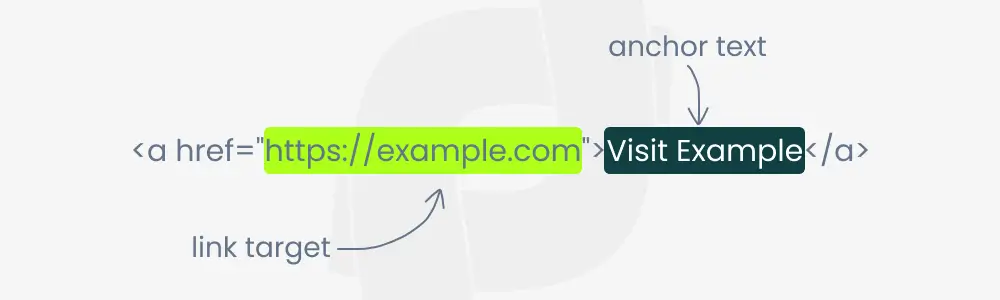
SEO values dofollow links because they can contribute to long-term ranking improvements. However, it’s not a good idea to have a profile filled with only dofollow links, as it can appear unnatural to search engines and may trigger spam signals.
You can earn dofollow links through editorial placements from guest posts and other methods.
### Backlinks with the rel=”nofollow” attribute
Backlinks with the rel=”nofollow” attribute tell search engines not to pass any link value to the page linking to it. These links don’t help with ranking, but people can still click and visit your site.
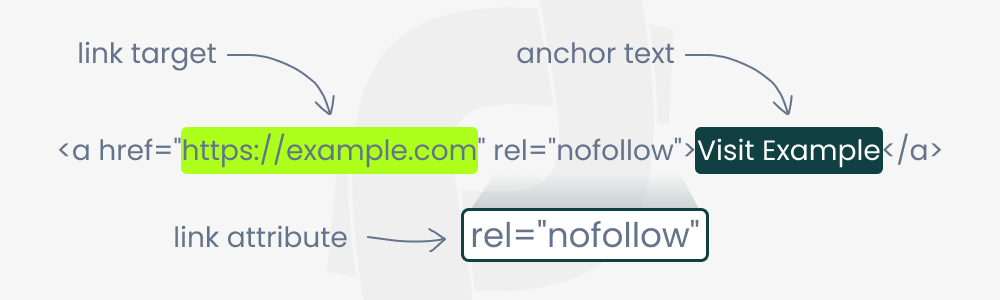
Even though nofollow links don’t pass link equity, they still add value by driving real traffic, supporting brand visibility, and contributing to a natural and trustworthy link profile.
Nofollow links commonly appear in blog comments, forums, and social media or discussion pages to prevent spam and unnatural linking.
### Backlinks with the rel=“sponsored” attribute
Backlinks with the rel=”sponsored” attribute are used for paid, promotional, or sponsored links that are part of advertising campaigns.
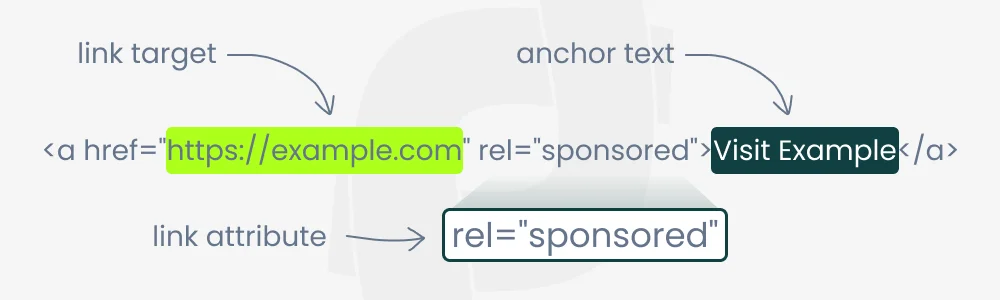
Google recommends using this attribute to clearly disclose paid links. This helps websites follow [search guidelines](https://developers.google.com/search/docs/crawling-indexing/qualify-outbound-links) and reduces the risk of penalties caused by [link scheme violations.](https://developers.google.com/search/docs/essentials/spam-policies#link-spam)
### Backlinks with the rel=“UGC” attribute
Backlinks with the rel=”UGC” attribute mark user-generated content, such as links in comments, forum posts, and community discussions on platforms like Reddit.
These links appear naturally as users reference your content in everyday online conversations.
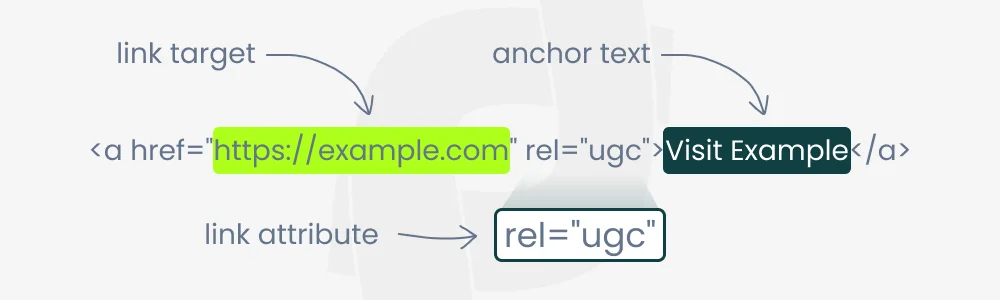
This attribute tells search engines that the link was added by users, not the website owner. It helps websites handle user-added links and prevent spam.
UGC links usually don’t pass SEO value; they’re added by users rather than chosen by website owners, and search engines treat them cautiously.
## Backlinks Classified based on How the Link is Earned
Each backlink type is earned differently and has a different impact on your overall [link building campaign](https://outreachdesk.com/link-building-campaigns/). Below are the key types explained.
### Editorial links
Editorial backlinks are those that other websites naturally add because your content genuinely improves their pages and helps their audience.
Search engines trust these links because they’re earned based on relevance and usefulness rather than random placement requests.
They are often links from authoritative sites that support long-term, stable ranking. You can earn these links when others discover your content, or by reaching out when your source fills a gap.
The important thing is to make sure the link enhances the reader’s experience rather than promoting your business.
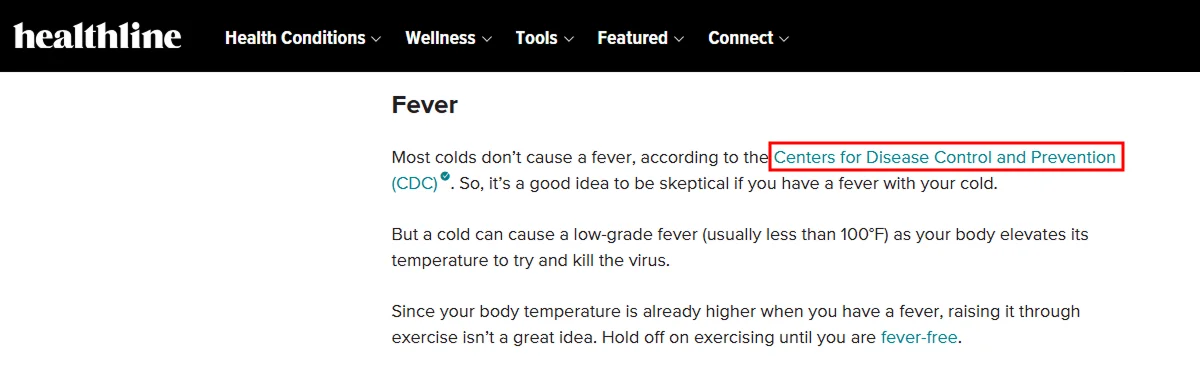
This image shows an ** editorial link ** placed naturally within the content to support a related point. The author links to the “CDC” as a helpful resource. The [link fits naturally into the text](https://outreachdesk.com/contextual-link-building/) and adds value for readers without feeling promotional or forced.
### Guest Post Backlinks
Guest post backlinks are links earned by writing articles for other websites in your niche. These articles are written for their readers and not just to place links.
These links matter because they come from relevant content and introduce your brand to an audience who is already interested in your topic. When these links are placed naturally within the article or author bio, they reflect trust.
Guest posting also helps in building trust and credibility consistently through publishing on trusted platforms. To earn these links, you should pitch original, audience-first ideas and respect the editor’s decision on where a link fits best.
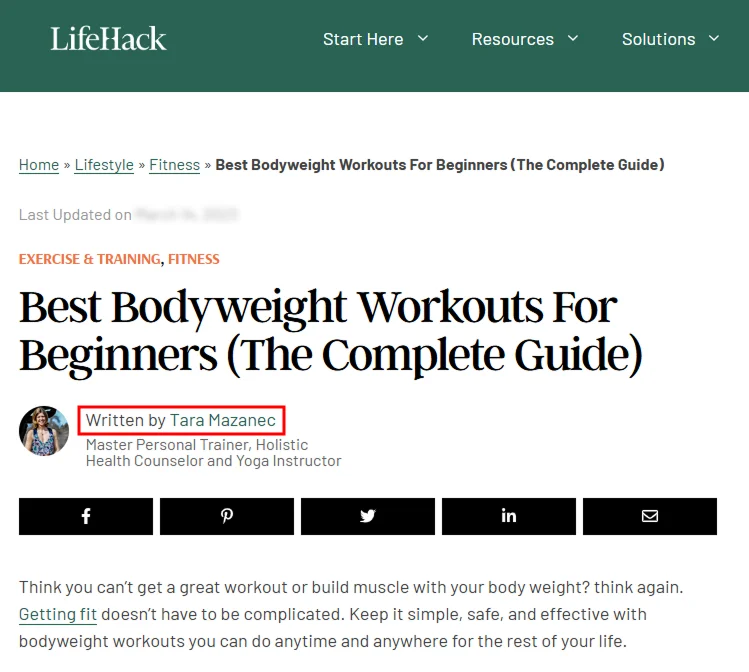
This image shows **a guest post** published on a blog, written by an external author for the website’s audience. The content is created for the site’s readers and includes a relevant backlink.
### Broken Backlinks
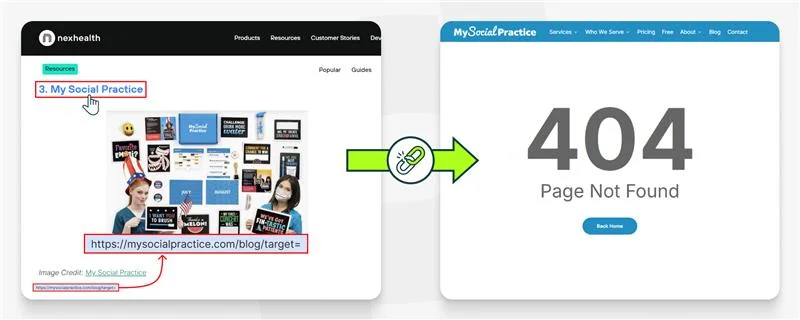
Broken backlinks occur when a website links to a page that either no longer exists or returns an error. [Broken backlinks](/broken-link-building/) matter because it helps site owners fix broken links and improve the user experience.
At the same time, it helps you recover lost link equity from trusted, high-quality sites. The process simply involves finding broken links, creating relevant and suitable replacement content, and suggesting itto the site owner.
As you help them fix an issue, the outreach feels practical rather than promotional.
### Resource Page Backlinks
A Resource page backlink is a link you earn from pages that list recommended tools, guides, or references on a specific topic.
Websites often have pages with resources created to share valuable information with readers.
This approach involves finding relevant resource pages in your niche and recommending your content as a helpful addition.
Website owners may include your content or tool as a suggested resource on their resource page because it adds value for their audience, and this can also help you get a [valuable backlink](https://outreachdesk.com/what-are-backlinks/).
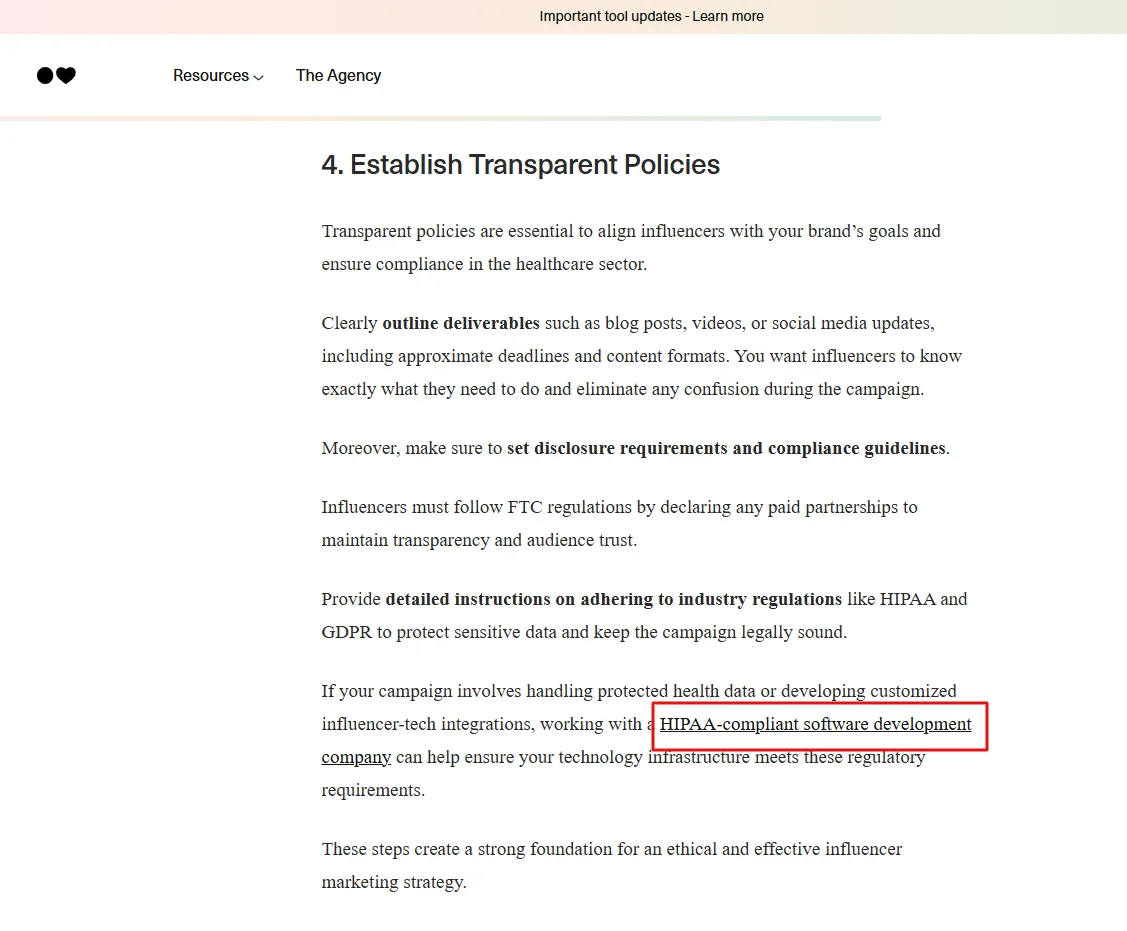
Here’s an example from inBeat that explains the concept perfectly:
The inBeat blog has a resource section listing helpful tools and services for healthcare marketing. Swovo’s HIPAA-compliant software page was added as a recommended resource, earning a relevant backlink from a trusted site.
### Niche Edit Backlinks
**Niche edit backlinks** are added to existing articles on relevant websites, where they naturally fit within the content and add value.
These links matter because the content is already indexed, ranks well, and is contextually aligned with your topic. When these links are added naturally, they support the existing information in the content.
These links can pass strong relevance signals because they’re already indexed, trusted, and aligned with your topic.
You can earn these links by identifying suitable published articles and suggesting your helpful resources where they fit naturally and logically.
This image above shows a ** niche edit backlink** added to an existing article in Campaign Monitor website. The link points to the CandyBar website and is included to support the discussion around the customer lifecycle.
The link is placed naturally within a relevant section to provide extra value, without changing the original topic or structure of the article.
### PR backlinks
PR backlinks are earned when news websites, media outlets, or online publications mention your brand and choose to link to your website.
PR backlinks are usually editorial and placed naturally. These links are effective because they come from trusted sources and often result in high-quality backlinks from news sites, blogs, and industry publications.
You can earn them by sharing newsworthy insights or original data. The focus is on contributions, not just link placement.
### Business Directory & Local Citation Backlinks
Business directory backlinks come from listing your business on trusted online directories such as Clutch, Yelp, or local chamber of commerce websites.
These links matter because they help the search engines confirm that your business is trusted and reliable. They can also improve visibility in local and location-based results.
You can earn these links by submitting accurate, consistent details of your business to reputable directories.
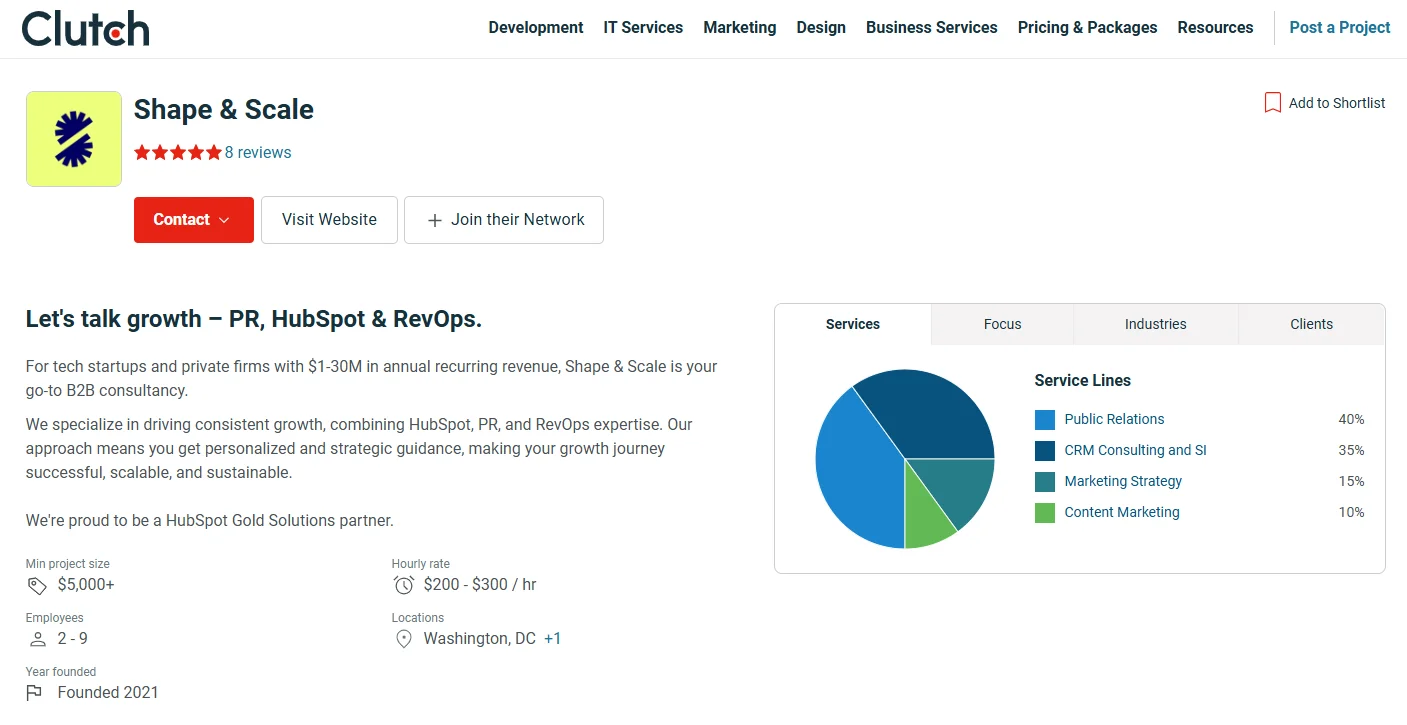
Here’s an example of a ** business directory and local citation.** Clutch lists the business profile with verified company details, which helps improve trust and local visibility.
### Social Media Backlinks
Social media backlinks are links to your website that come from social media platforms such as LinkedIn or Medium.
These links are usually nofollow, but they matter because they increase visibility. They can also drive referral traffic from the users who are already interested in your industry and niche.
You can earn social media backlinks by sharing valuable, educational, or insightful content across social media platforms that encourages users to share it with their followers.
Also, keep your social profiles updated with clear links in key areas like bios, descriptions, and posts.
By combining high-quality content with properly optimized profiles, you increase the chances of your links being shared and noticed across social platforms.
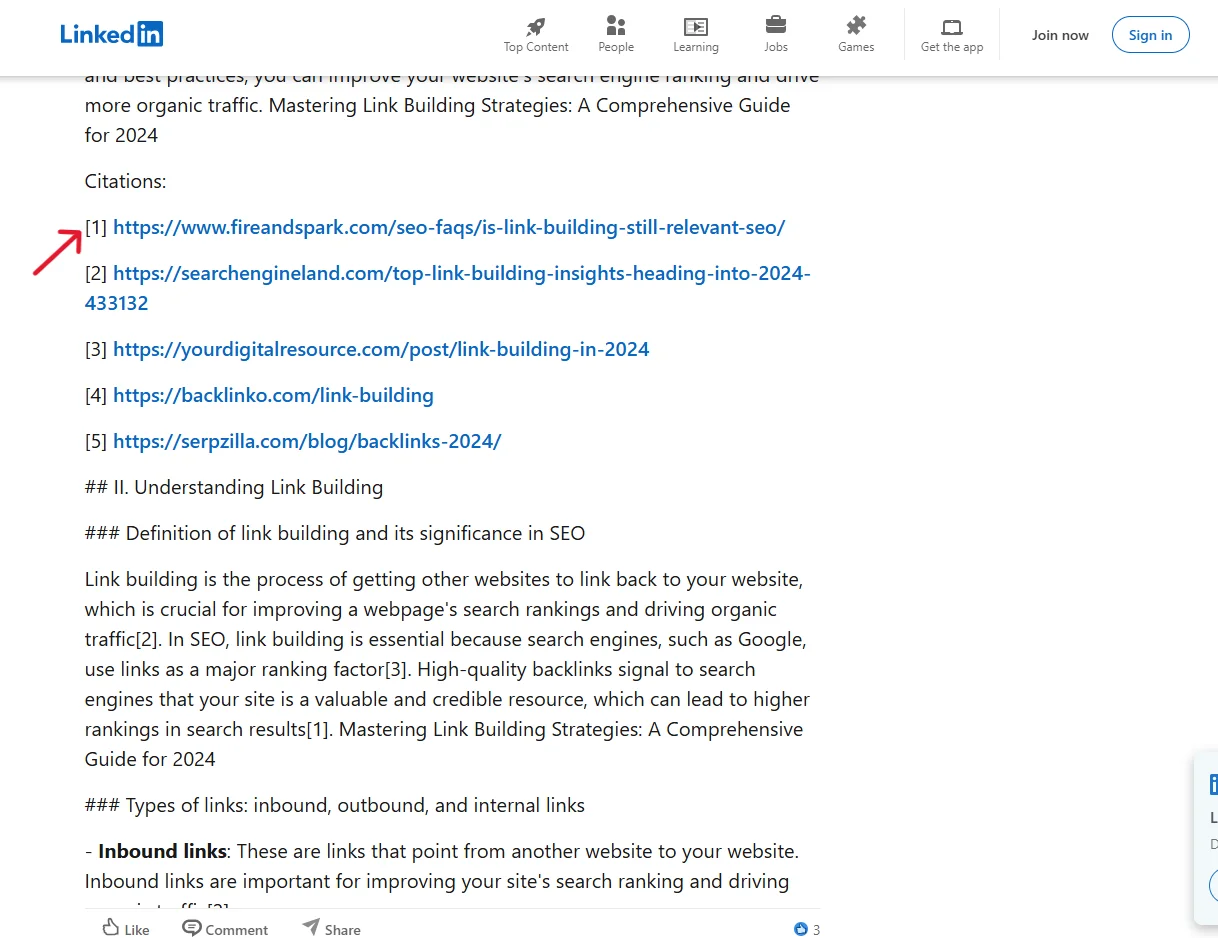
The image above shows FireandSpark mentioned in a LinkedIn post, where the brand receives a backlink from a social media platform. This is an example of how **social media** can also contribute to your backlink profile and visibility.
### Image & Video Backlinks
Image and video backlinks are links earned when other websites use your images or videos and link back to your website as the source.
These links matter because they provide natural links without direct promotion. These links can increase brand exposure as your visuals are shared across platforms.
They also support trust and credibility by positioning your site as the original creator. You can earn these links by publishing original charts, infographics, screenshots, or videos that others want to reference.
This image shows ScoopWhoop using a Pexels photo and crediting the source by linking back to it.
The clickable link under the image sends users from ScoopWhoop to the Pexels website, creating an **image backlink.**
### Testimonial Backlinks
Testimonial backlinks are links you earn when you provide genuine feedback, a review, or a testimonial for a product or service you’ve used.
These links matter because they come from real, trusted websites that appear authentic. These links help to build credibility by connecting your brand with well-known products or platforms.
You can earn these links by providing honest testimonials that companies choose to feature on their websites with a link back to your site.
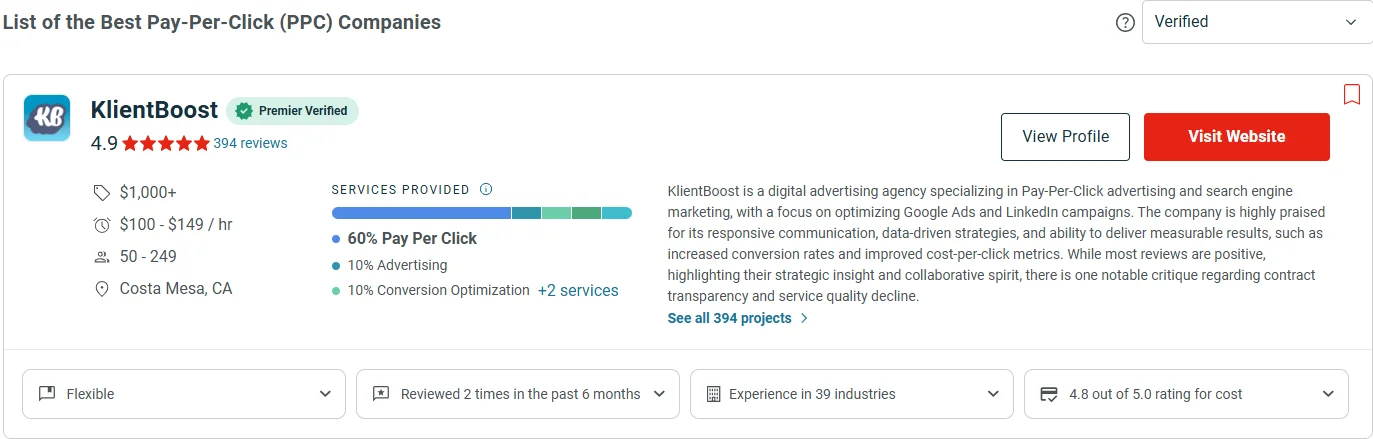
For example, here Clutch features a KlientBoost review on its website and includes a backlink to KlientBoost’s site, giving both visibility and a trusted **testimonial backlink.**
## Backlinks Classified by Quality and Risk
Not all backlinks are the same; some links can harm your rankings, waste your efforts, and lead to Google penalties.
It’s essential to know which types of backlinks to avoid and how to spot and replace them with safer alternatives.
Here are a few types of backlinks to avoid:
### Private Blog Network (PBN) Links
PBN links or [link farm backlinks](https://outreachdesk.com/link-farming/) come from a network of websites created specifically to generate unnatural links.
These sites are often built on expired domains or set up as networks of fake blogs, with no real content or audience.
Search engines can easily spot these links because they don’t come from trusted websites. Using them can lead to ranking drops, removal from search results, or even complete deindexing of your site.
Instead of relying on fake sites, focus on earning links from real, relevant websites through [white hat link building strategies](https://outreachdesk.com/white-hat-link-building-strategies/) like guest posts, resource pages, or helpful content that genuinely adds value.
### Low-Quality Directory or Spammy Site Links
These links come from low-quality or generic directories or websites that list thousands of unrelated sites with no real review or standards.
Such directories usually exist only to host links and don’t provide value to users.
Links from these sites don’t add any real relevance or authority to your website. Over time, they can weaken your backlink profile and make it harder for search engines to trust your site.
Instead of using spammy directories, list your business only on curated, niche-specific, or local directories that are relevant to your industry and genuinely helpful to users.
### Blog Comment Links
Blog comment links are added in the comment sections of blog posts, often by linking to the name, URL, or profile.
These links are low-quality because they’re marked as nofollow or UGC; they can be easily automated and abused, and they’re rarely relevant to the article’s main topic.
Because of spam, search engines usually ignore these links for ranking purposes. Genuine discussion can still drive visibility or referral traffic, but blog comment links shouldn’t be relied on as part of an SEO backlink strategy.
### Forum Profile or Signature Links
Forum links are placed within the user profiles or post signatures on discussion boards.
These links are often unrelated to the actual discussion, appear repeatedly across many pages, and are usually nofollow or are ignored by the search engines.
They are used to create accounts solely for posting profile links, low-effort replies to expose signature links, and for repeating the same anchor text across multiple forums.
### Social Bookmarking Links
Social bookmarking links come from platforms designed to save, tag, or share webpages publicly.
These links are of low quality because many bookmarking sites are now outdated or spammy, and links are easy to submit in bulk and manipulate. Search engines rarely treat these links as meaningful placements.
These links are used to submit the same URL to dozens of bookmarking sites and to create an account only for link placement. These links may provide short-term visibility, but they provide little SEO benefit.
### Widget or Badge Links
Widget links are embedded within widgets, plugins, or tools that appear automatically when installed on a website.
These links are risky because they appear on many pages, anchors may be overly optimized, and the links exist by default rather than by the choice of editors. Search engines may see them as manipulation if these links are included mainly for SEO purposes.
These links are commonly used to offer free widgets in exchange for link placements and to place them in footers or sidebars.
### Link Exchanges
Link exchanges are agreements between two websites to link to each other.
This practice is risky because it can look unnatural; these links are often placed for gaining SEO value rather than user value, and search engines can detect these exchange patterns.
Link exchanges are commonly used to benefit both parties (you link to me, I’ll link to you). They are exchanged through exchange networks or link swap groups and involve repeated reciprocal linking across unrelated pages.
### Press Release Distribution Links
These are the links included in press releases that are connected across many distribution platforms.
These links are of low value because content is often duplicated on many sites, links are published automatically without editorial review, and most platforms mark these links as nofollow.
These links are used for bulk distribution of promotional press releases and for publishing announcements with little or no news value.
### Over-Optimized or Irrelevant Anchor Text Links
These backlinks use the exact keyword-rich anchor text repeatedly or come from pages that aren’t related to your topic.
Instead of sounding natural, the links look forced and are placed only to push rankings.
Search engines can see this as an attempt to manipulate rankings. When links don’t align with the content or are overly optimized, they may trigger algorithmic penalty risks and lead to ranking drops.
Use anchor text that sounds natural and fits the content’s context. Let links be placed within relevant pages where the wording makes sense to readers.
### Sitewide Footer or Sidebar Links
These are links added to a website’s footer or sidebar and appear on every page. They are often used for promotions or partnerships and are repeated sitewide rather than placed within the main content.
When overused, these links can look unnatural to search engines because they create the same link repeatedly across many pages. This pattern may be an attempt to manipulate rankings rather than provide real value.
Instead of sitewide links, aim for a single link placed naturally within the main content of a relevant page, where it fits the topic and helps readers.
## Real-World Examples of Backlinks: 7 Patterns You’ll Recognize
The fastest way to make backlink categories click is to see them in the wild. Here’s what each type actually looks like when it shows up in real publications and articles.
### 1. Editorial backlink (the highest-value type)
A TechCrunch journalist writing about no-code tools mentions Webflow inside an article paragraph: _“Webflow’s new AI feature joins a growing list of no-code platforms reshaping how startups build websites.”_ The link wraps the word “Webflow.” Editorial, contextual, dofollow, on a DR 92 site — this is the platonic ideal of a backlink.
### 2. Guest post backlink
A founder publishes a guest article on Search Engine Journal titled “How We Built a Programmatic SEO Pipeline Using GPT-4.” The byline reads “Contributed by [Name], CEO of [Company]” and the bio at the bottom links back to the company’s site. Two contextual links inside the article body point to specific case-study pages. Real publication, real author, dofollow byline link — clean white-hat pattern.
### 3. Resource page backlink
The Backlinko blog post “The Best SEO Tools for 2026” lists 30 tools. Each tool entry reads: _“Ahrefs — best for backlink analysis. Visit Ahrefs”_ with the brand name and the “Visit X” text both linking to the tool’s homepage. The reader scans, picks one, clicks. Resource page links are how thousands of niche SaaS tools get their first DR 50+ backlinks.
### 4. Broken link replacement (the recovery pattern)
A blogger reviewing data sources links to a Forrester report. Six months later Forrester rearchitects their site and the URL 404s. You publish a similar data report and email the blogger: “I noticed your link to [Forrester URL] is broken — here’s an updated piece on the same topic if you’d like to swap it.” The blogger updates the link. Same target page, same anchor text — now pointing to your URL.
### 5. Niche edit (link insertion)
A 2-year-old blog post on a SaaS company’s site lists “10 Project Management Tools.” You launch a new project management tool. You email the editor: “Your post on PM tools is great — would you consider adding [our tool] to the list? Here’s why our users find it valuable for [specific use case].” If the editor agrees, your tool gets added with a descriptive paragraph and a contextual link inside an existing article that already ranks. Faster authority pickup than a brand-new guest post.
### 6. Brand mention (unlinked → linked)
A finance blogger writes about “the recent rise of AI-driven SEO platforms” and mentions your brand by name without linking. You email: “Thanks for the mention — here’s the URL if you’d like to link it for your readers.” A polite request converts a brand mention into a backlink. Editorial credibility is already established.
### 7. PR / digital PR backlink (newsworthy data)
Your team publishes original research: “Analysis of 50,000 SaaS Companies’ Backlink Velocity in 2026.” Forbes, TechCrunch, and three industry trade publications cover the report and link to your study URL. Each link is editorial, contextual, on a DR 80+ site. One data project earns 12 high-authority backlinks across 6 weeks — the highest-yield pattern in modern link building.
## Which Backlink Types Should You Prioritize
The right backlinks depend on your stage, goal, and industry. Here’s how to prioritize backlinks based on everyday situations:
**New or early-stage website**
Start with the types of backlinks that are easier to earn and help establish trust, such as:
- Guest post backlinks
- Directory and location citation backlinks
- Social media backlinks
These links help search engines recognize your site and build credibility initially.
**For long-term value and rankings**
Focus on links that are earned editorially, such as:
- Editorial backlinks
- PR backlinks
- Resource page backlinks
These links can maximize overtime and support stable rankings.
**For a local or service-based business**
If your business is local or service-based, then prioritize:
- Business directory and local citation backlinks
- Testimonial backlinks
These strengthen local relevance and trust signals.
**For scaling content-driven SEO**
If you need backlinks for scaling your business, then:
- Broken link building
- Niche edit backlinks
- Image and video backlinks
These backlinks work best once you already have strong content assets.
## Final Thoughts
Backlinks come in many forms, and not all work the same way. That’s why choosing the right types matters.
Instead of chasing every option available, focus on links that are relevant, natural, and earned the right way.
By prioritizing quality over shortcuts, you build a backlinks profile that supports long-term rankings and trust.
### Want to know which backlink types are right for your website?
A quick review can help you focus on the links that actually support your SEO growth.
[Request a Free Consultation](/contact-us/)
### What are some real-world examples of backlinks?
Real-world backlink examples include: an editorial mention in a TechCrunch article (highest-value), a guest post byline on Search Engine Journal, a tool listing on Backlinko’s resource page, a broken-link recovery from a Forrester URL replacement, a niche edit added to a 2-year-old PM tools roundup, an unlinked brand mention converted to a backlink via polite outreach, and a PR backlink earned by original research covered by Forbes. Each pattern shows a different way websites earn links — from passive coverage to proactive outreach. Partnering with a [SaaS link building agency](https://outreachdesk.com/) typically shortens this process from months to weeks. For brands that need ongoing execution, a [profile backlink building service](https://outreachdesk.com/profile-backlink-service/) from a specialised provider can carry the load.
### Which backlinks should I avoid to prevent Google penalties?
You should avoid backlinks that look unnatural or forced. This includes PBN links, links from low-quality directories, sitewide footer links, and links with over-optimised anchor text. These links don’t add real value and can harm your rankings rather than improve them.
### How can I identify low-quality or toxic backlinks?
You can spot low-quality backlinks by checking their sources. Links from unrelated websites, spammy directories, or pages with no real content are usually risky.
SEO tools like Ahrefs or Google Search Console can help you review your backlink profile and flag harmful links.
### How many backlinks does a new website need to rank?
Quality matters more than quantity, so there’s no fixed number of backlinks needed to rank. A new website can rank with fewer links if those links are relevant, trusted, and earned naturally.
### What is the safest way to build backlinks in 2026?
The safest way to build backlinks is through methods that follow search engine guidelines. This includes guest posting on relevant sites, earning editorial links, fixing broken links, and getting listed on trusted directories.
These methods follow search engine guidelines and support long-term growth.
### Are business directory links still effective?
Yes, business directory links are still effective when used correctly.
They help improve trust, brand visibility, and local SEO when listed on reputable platforms like Clutch or niche directories.
Avoid low-quality directories and focus only on trusted, relevant listings.
### Which type of backlink is best for long-term rankings?
Editorial backlinks are one of the strongest for long-term rankings. They are earned naturally when other websites link to your content because it’s helpful.
These links build trust, authority, and steady organic growth over time.
---
---
title: "8 Safe White Hat Link Building Strategies You Can Trust"
url: "https://outreachdesk.com/white-hat-link-building-strategies/"
lang: "en-US"
type: "post"
description: "White-hat link building means earning backlinks using honest methods that follow search engine rules and align with how search engines evaluate links. Links help your website gain trust and rank higher. That’s why it’s important to earn high-quality links and"
last_modified: "2026-05-22T10:00:50+00:00"
categories: [Link Building]
---
# 8 Safe White Hat Link Building Strategies You Can Trust
White-hat link building means earning backlinks using honest methods that follow search engine rules and align with how search engines evaluate links.
Links help your website gain trust and rank higher. That’s why it’s important to earn high-quality links and follow white-hat link building methods.
When you follow white-hat strategies, your links look natural and are built correctly. This also helps protect your website from search engine penalties.
### Key Takeaways:
- White hat link building follows Google’s guidelines and avoids shortcuts.
- These links look natural and come from relevant, trusted websites.
- White-hat strategies help your website rank higher without causing penalty risk.
- Results grow steadily and last longer compared to risky link methods.
- It focuses on earning links through helpful content and ethical outreach.
## What is White Hat Link Building
White-hat link building **is the process of earning [backlinks](https://outreachdesk.com/what-are-backlinks/) through ethical methods that follow [Google guidelines](https://developers.google.com/search/docs/essentials).**
You can build white-hat links by creating valuable content and sharing it with relevant websites through [genuine outreach](https://outreachdesk.com/seo-outreach/). These links act as trust signals, helping search engines understand that your website is relevant and trustworthy.
[White-hat](https://outreachdesk.com/white-hat-seo/) links are never forced, purchased, or spammed. Website owners choose to link to your content because it’s relevant and adds value for their readers.
**To know white hat link building better, let’s understand it with an example:**
Imagine you publish a helpful travel guide on planning a weekend trip to Paris and share it with relevant travel websites. A popular Europe-focused travel blog finds it useful and links to it as a reference in their Paris itinerary article because it helps their readers plan their trip.
**This approach aligns with white-hat link building practices:**
- The link is earned because the content is valuable, not paid or forced.
- The content provides real value for readers, which is what Google expects from linked pages.
- The link is relevant and fits naturally within the related content.
- There is no manipulation involved, such as paid links or link exchanges.
## Why White Hat Link Building Is a Safer Choice
Using ethical white-hat link building methods is the most effective way to earn links without risking penalties or a drop in ranking.
Because these methods follow Google’s guidelines, they help your website rank higher in search results while staying safe from Google Penalties.
### Google Penalty
A Google penalty occurs when a website violates Google’s quality guidelines, such as [link spam policies](https://developers.google.com/search/docs/essentials/spam-policies#link-spam), by creating links mainly to manipulate search rankings, which can lead to a drop in rankings or visibility.
## 8 Proven White Hat Link Building Strategies
Here are proven white-hat link building strategies you can use to earn links safely that follow Google’s guidelines and work long-term.
### Guest posting
Guest posting **is a method in which you write content for other websites in your niche, and in return, they may include a link to your content within their article.**
It is a white-hat strategy because the content is original, relevant, and written for readers. Links are added naturally where they fit the context. It gives priority to readers’ value over random link placement, and when done correctly, guest posting aligns with white-hat SEO practices.
Let’s suppose you write a beginner-friendly workout guide for a popular fitness blog. While writing the article, you naturally include a relevant link to a simple workout routine on your own website.
The editor reviews the content and identifies that the guest post adds value by providing clear, step-by-step guidance to readers. The editor approves and publishes it on a relevant contributor’s website.

#### **How Guest Posting Works:**
1. You can find websites that accept guest posts by checking competitor backlinks, exploring industry directories and forums, or looking for resource pages to find potential guest posting opportunities.
**Another effective method is to use specialized search operators such as:**
- Keyword + “write for us”
- Keyword + “guest post”
- Keyword + “guest contributor”

2. Once you find a suitable guest post opportunity, use a guest post [outreach email](https://outreachdesk.com/link-building-outreach/) to contact the website owner and send a message politely explaining your idea and how it adds value to their readers, then ask if you can contribute an article.
Hi [Name],
I read your post on beginner’s fitness and enjoyed it. I can write a helpful guest post that fits your blog and adds value for your audience.
If you’re interested, I can suggest a few topic ideas.
Thank you for your time,
[Your Name]
3. Write high-quality, original content and make sure the article is informative, and not copied from anywhere, and include a link to your content only if it genuinely helps the readers.
#### 💡 Tips for guest posting:
**Choose niche-relevant sites**
Publish on sites that align closely with your industry or audience to make sure that the links and content are meaningful.
**Avoid promotional content**
Focus on educating or helping the readers, rather than promoting or selling your product.
**Prioritize content quality**
Keep your content clear and well-crafted. Use accurate information and engaging language.
**Write with purpose**
Every guest post should add value, not just earn links. Content driven by value builds trust, improves relations with publishers, and drives long-term benefits.
### Broken link building
[Broken link building](https://outreachdesk.com/broken-link-building/) **is a strategy in which you find broken or dead links on other websites that point to missing pages or pages that no longer work, and suggest a replacement with your own relevant content.**
This method is white hat because you help the website fix an issue and suggest relevant content that improves their page. The site owner chooses to add the link because it adds value, not because it was paid for or forced.
**Here’s an example for better understanding:**
A travel blog lists a packing checklist, but one of the links leads to a broken(404) page. You contact the site owner, share your updated checklist, and suggest they replace the broken link and improve their page. In return, you can also earn a backlink.
#### **How Broken Link Building Works:**
**1. Find broken links**
Check other relevant website pages for dead or broken links. You can use SEO analysis tools like [Ahrefs](https://ahrefs.com/) to spot pages that no longer work. You can also browse industry resource pages and old content, as these often contain outdated or broken links.
- Go to Site Explorer
- Enter a competitor’s website
- Under the backlink profile, open broken backlinks
- Find broken (404 not found ) links on their pages.

In Ahrefs, open the Broken Backlinks report to find websites linking to broken or dead pages on your competitor’s site.
From the list, identify websites with high DR and relevant traffic, and choose the best opportunity
**2. Identify a replacement**
Check if you already have a relevant page that can replace the broken link. If not, create new, helpful, and updated content.
**3. Reach out to the site owner**
Reach out to the editor or website owner and let them know about the broken link, and suggest your content as a valuable replacement.
Hi [Name],
I was reading your article on beginner workout tips and noticed one of the links isn’t working anymore.
I recently published an updated workout guide on the same topic that could be a valuable replacement.
Thank you for your time,
[Your Name]
### Resource page link building
Resource page link building **is a technique in which you find websites that list helpful links on a specific topic.** Then you reach out to the website owner and suggest your content as a valuable replacement.
Resource pages are created to help readers find useful tools, guides, and articles in one place.
If your content genuinely helps readers, website owners may add your link to their resource page. This makes the link natural, relevant, and aligned with Google’s guidelines.
Suppose that you find a marketing blog that has a resource page for SEO tools, then you reach out to the blog owner and suggest your SEO analyzer tool as an addition to the resource page.
The tool helps readers check their website’s performance and identify SEO issues. Because it adds value to the page, the blog owner includes it as a recommended resource and links back to your site.
#### How Resource Page Link Building Works:
**1. Find niche-relevant resource pages:**
Look for websites in your industry that list all the helpful links and recommended resources. These pages are often titled as “Useful Resources,” “Helpful Links,” or “Recommended Tools.”
**You can also use search operators to find resource pages:**
- keyword + “resource page”
- keyword + “useful resources”

**2. Check if your content is a good fit**
Once you have the list of resource pages, analyze each page and determine where your content can fit and add extra value. While checking, ensure that the page lists high-quality resources and that your article is genuinely helpful there.
**3. Reach out to the site owner**
Reach out to them through an email with a polite message, share your resource, and explain why it deserves a spot on their page.
Hi [Name],
I came across your SEO resources page and found it very helpful. We recently created a free SEO analyzer tool that helps users evaluate their website performance and identify key SEO issues.
It could be a valuable addition to your SEO resource page, providing value to your readers.
Thank you for your time,
[Your Name]
**4. Get your content listed**
Once you send the message, and if they find it helpful, they’ll add your link to the resource page, which will help you earn a high-quality backlink.
### Niche Edit
Niche edits **are a strategy in which website owners add your link to existing, relevant content that is already published, indexed, and ranking in search results.**
Instead of writing new content, a link is naturally placed within an article that adds value and supports the topic.
The placement should be relevant, follow Google’s guidelines, and not forced or paid. The website owner chooses to add your link because it helps their readers with extra information or a helpful resource.
Let’s suppose you find a marketing blog that already has an article about email outreach tips. You notice a section that mentions tracking email responses, but doesn’t link to any tools or guides.
You reach out to the blog owner and suggest your email outreach tracking tool as a helpful reference. Since the guide fits naturally into the existing content and adds value for readers, the website updates the article and includes your link.
#### How Niche Edits Works:
**1. Find relevant existing content**
Start by finding published articles in your niche where your link would naturally fit and add extra value. Look for pages that talk about similar topics and could benefit from a helpful resource.
**2. Reach out and suggest your link**
Next, contact the site owner or editor to suggest adding your link and explain how it improves the experience for their readers.
Hi [Name],
I came across your article on email outreach tips and found it really helpful. I noticed a section where you mention tracking email responses, but there isn’t a guide or tool linked there yet.
We’ve recently created an email outreach tracking guide that explains this step simply. I thought it could be a helpful reference for your readers.
If you think it’s a good fit, would you consider adding it as a reference?
Thank you for your time,
[Your Name]
### Digital PR
Digital PR **is a link building strategy that uses press releases, original studies, or expert insights to earn links from media websites.**
These links are earned by sharing useful stories, original data, or expert insights that publishers feature in online publications, blogs, and news websites.
Instead of asking for links directly, it focuses on providing real value. Journalists and website owners link to your content because it supports their articles and helps their readers better understand a topic.
This strategy follows Google’s guidelines because links are earned naturally. There are no paid placements, link exchanges, or manipulative tactics involved. The links come from trusted media websites and are given naturally by editors.
**For Example,** HARO is a platform that connects journalists with people who can share expert information.
By responding to relevant media queries, you can get featured in articles on authoritative websites such as Forbes, CNN, and the New York Times.

### Linkable Assets
Asset-based link building **is a strategy in which you create high-quality, linkable assets that provide real value, originality, and helpful information, encouraging other websites to reference, cite, and link to your website naturally.**
Rather than asking for a link, you share assets with related websites so the right people can discover them. If the asset adds value, they choose to link to it.
This approach keeps the process white hat and earns high-authority links without automation or spammy tactics.
**Here are some linkable asset types:**
- In-depth Guide and Tutorials
- Infographics and Visual Content
- Original Research and Case Studies
- Tools and Calculators
- Templates and Checklists
- Data Reports and Resource Roundups

Suppose you can see a rent affordability calculator that helps users analyze how much rent they can afford and attracts many organic visitors each month. This makes it a strong linkable asset that naturally earns backlinks.
### Unlinked Brand Mentions
Unlinked brand mentions **are when a website mentions your brand, product, or content but does not include a link to your website.** In short, the mention exists, but the link is missing.
Since the mention is genuine and relevant, adding a link improves the content for users. There is no payment, pressure, or manipulation involved, which keeps it fully aligned with Google’s best practices.
This strategy is white hat because the website has already chosen to mention you naturally. You may politely ask them to add a link to help readers find the source.
#### How Unlinked Brand Mentions Work:
**1. Find unlinked mentions**
Find unlinked mentions opportunities by using search operators as intext:{brand name} – {own domain name}.com -twitter.com -facebook.com -pinterest.com -youtube.com -linkedin.com
Using this operator will help you find all unlinked mentions across platforms.
You can also use brand monitoring tools like [Google Alerts](https://www.google.com/alerts) or [Brand24](https://brand24.com/) to find unlinked mentions of your brand or content.
Here in the image, you can see that Google Alerts notifies HubSpot when their brand, competitors, or selected keywords are mentioned online.

**2. Reach Out**
Reach out politely to the site owner, thank them for the mention, and explain how adding a link would make the reference more helpful to readers.
Hi [Name],
I came across your article and noticed you mentioned our brand. Thank you for mentioning us.
I wanted to check if you’d consider adding a link to our website so readers can easily find more details about the resource you mentioned. I think it would help them get more value from the article.
Thank you for your time,
[Your Name]
### Skyscraper Technique
The Skyscraper Technique **is a strategy in which you identify popular content that has earned many backlinks and create a more complete or updated version of it.**
After publishing a better, more up-to-date version, you reach out to websites that link to the original content and suggest your improved resource.
Backlinks are earned ethically by offering more value, clearer information, and updated insights, and by sharing that content through genuine outreach, so relevant websites choose to link to it.
#### How the Skyscraper Technique Works:
**1. Find popular content in your niche**
Look for articles that already rank well and have many backlinks.
**2. Create a better version**
Improve the content by adding more details, making it visually appealing and unique, and turning it into the ultimate resource.
**3. Reach out to relevant websites**
Contact the websites that linked to the original content, show them your updated version, and explain why your content is a better fit for their readers.
**4. Earn links naturally**
If your content provides more value, they may link to it instead.
## White Hat Vs. Black Hat Vs. Grey Hat: Key Difference
Here are some key differences between all three link building techniques.
| White Hat Links | Black Hat Links | Grey Hat Links |
| --- | --- | --- |
| Links are earned through ethical methods. | Links are created through manipulative tactics. | Links are built using methods ranging from safe to risky, or that are not entirely white hat. |
| Sharing original content and ethical outreach. | PBNs, link farming, or paid links. | Paid niche edits and link exchanges. |
| Safe to use as it complies with Google’s guidelines. | Risk of penalties, deindexing, and ranking drops. | Can be risky when overused, as it slightly bends the rules. |
| Delivers sustainable, long-term results. | Short-term results with long-term uncertainty. | Provides quick results, but long-term stability is not guaranteed. |
| Links are relevant, authoritative, and naturally placed. | Links are irrelevant, auto-generated, and low quality. | Links may appear relevant but can involve black-hat techniques. |
## Benefits of White Hat Link Building
White hat link building is the safest and smartest approach because it protects your website from the risk of penalties, helps to build trust, provides long-term results, and helps you avoid shortcuts.
### Keep Safe from Search Engine Penalties
White hat link building follows Google’s rules, which means you earn links naturally rather than trying to manipulate search engines.
When you create helpful content and reach out to relevant websites, Google sees your site as trustworthy. This protects your website from penalties that can cause a sudden rank drop or decrease in traffic.
### Improve Rankings Consistently
White-hat links help your website grow gradually and provide long-term ranking growth, instead of quick spikes that disappear.
Because the links come from relevant websites, Google rewards them with greater trust and visibility.
### Strengthen Authority and Credibility
When reputable websites link to your content, Google sees it as a reliable source of information. As each links act like a recommendation.
The more high-quality sites mention you, the more credible your site appears to both search engines and users.
### Build Better Relationships
Building links is not just about links; it is more about making genuine connections with the website owners and publishers in your industry.
When you focus on building links ethically, you don’t chase quick links but real-time relations.
## Common Mistakes to Avoid in White-Hat Link Building
Effective white-hat link building primarily focuses on relevance and value. However, some common mistakes, such as promotional content, irrelevant outreach, auto-generated emails, and chasing link quantity, often result in reduced success.
Avoiding these mistakes by creating valuable content, matching search intent, and using personalized and relevant outreach that leads to stronger, more sustainable links.
### Avoid Writing Promotional/Sales-Driven Content
One of the biggest mistakes is to turn linkable content into a sales pitch. Publishers and editors are more likely to link to content that educates, explains, and solves a real problem, rather than content that promotes a product or service.
**Solution:** Create content that offers value, such as guides, data, frameworks, comparison tables, charts, or insights.
### Requesting Unnatural Link Placements
Avoid asking for links that don’t fit the surrounding context. When you force a link into an irrelevant sentence or page, it breaks the flow for readers and appears manipulative to search engines and site owners.
**Solution:** Request links that add depth, clarity, and support to the existing page. [Contextual relevance](https://outreachdesk.com/contextual-link-building/) makes link placement safe and effective.
### Not Following Up on Outreach
Many marketers assume “no reply” as a rejection. But in reality, website owners have tight schedules, and many owners reply after one or two polite follow-ups.
**Solution:** Take a follow-up that adds value, such as clarifying relevance or highlighting how your content helps their audience.
### Reaching Out to Unrelated Websites
Links from irrelevant sites look unnatural. Even if the site is strong, poor relevance indicates manipulation.
**Solution:** You should prioritize relevance. Even a few highly relevant sites can provide more value than many irrelevant ones.
### Using Generic Outreach Emails
Mass or copied outreach emails are easy to identify and often get ignored. Editors and publishers receive dozens of emails daily.
**Solution:** To stand out, focus on sending personalized emails. Reference the specific article, explain to them why your content adds value, and show familiarity with their site. Most editorial links are earned through relevance and respect.
### Creating Content With No Real Value
If your content doesn’t help readers, editors will not link to it. Low-value content often lacks depth and originality.
**Solution:** Focus on creating link-worthy assets such as original insights, frameworks, statistics, and complex explanations.
### Chasing Quantity Over Quality
Building many low-quality links won’t help. It rarely improves rankings and can harm long-term growth.
**Solution:** Focus on earning fewer, but relevant links. Google values trust and context rather than link volume.
### Ignoring the Search Intent of the Linking Page
Even when topics match, intent sometimes mismatches, and it can kill the link opportunity.
A page written for beginners won’t link to an advanced technical guide.
**Solution:** Match the search intent, content depth, and audience level. A link should be the next logical resource for the readers.
## Conclusion
While shortcuts may seem easy and faster, white-hat link building is the safest way to earn high-quality backlinks.
By focusing on ethical practices and real value, you build authority, improve rankings, and support long-term growth for your website.
### Not Sure Which Link-Building Strategy Is Right for You?
Every website needs a different approach. Our team reviews your niche, competition, and goals to recommend safe, white-hat link-building methods that fit your site – without putting your rankings at risk. Most agencies that scale this approach rely on an [editorial outreach team](https://outreachdesk.com/) for execution. Working with [risky black hat tactics](https://outreachdesk.com/black-hat-link-building/) can compress this process from months to weeks.
[Request a Free Consultation](/contact-us/)
### Are white hat links safe for my website?
Yes. White hat links follow Google’s guidelines, so they help your site rank higher without the risk of penalties.
### How long does white hat link building take to show results?
It takes time, but the results are steady and long-lasting. Unlike risky methods, white hat links continue to help your rankings over time.
### Can white hat link building improve rankings?
Yes. Search engines trust these links more, which helps improve rankings, authority, and visibility.
---
---
title: "Link Building for Dentists: A Step-by-Step Guide for 2026"
url: "https://outreachdesk.com/link-building-for-dentists/"
lang: "en-US"
type: "post"
description: "Most dental clinics provide excellent care. But patients can’t choose your clinic if they never find you online. When someone searches for “dentist near me,” Google decides which clinic appears first. Most people don’t scroll far; they usually contact one"
last_modified: "2026-05-20T07:58:38+00:00"
categories: [Link Building]
---
# Link Building for Dentists: A Step-by-Step Guide for 2026
Most dental clinics provide excellent care. But patients can’t choose your clinic if they never find you online.
When someone searches for “dentist near me,” Google decides which clinic appears first. Most people don’t scroll far; they usually contact one of the first few clinics they see. If your practice isn’t visible there, potential patients often choose a competitor, even if you offer better care. For brands operating in this space, our breakdown of [local citation best practices](https://outreachdesk.com/seo-local-citations/) maps out the operational specifics.
One of the strongest reasons Google chooses one clinic over another is link building, i.e., Other websites linking to your site.
#### In this blog, you’ll know
- What link building means for a dental clinic
- Why dentist link building matters
- What your website needs before earning links
- 10 easy dentist link-building strategies
- Mistakes to avoid in dentist link building
- How to track results like a professional
- What timeline to expect
## What is link building for Dentists?
**Link building for dentists is the practice of earning backlinks from sources Google trusts in the dental and local-business space.** Those sources include health directories, dental association pages, local business publications, and healthcare bloggers. Brands serious about scaling often hand this off to [niche-relevant link building services](https://outreachdesk.com/) for predictable results.
Each link signals to Google that your clinic is a legitimate authority worth showing in the local pack when nearby patients search for a dentist.
A placement on a state dental association’s resource page or a mention in a local health publication transfers significantly more authority than dozens of generic business directory listings.
You can earn backlinks naturally when people find your content helpful, or you can build them through ethical, value-driven methods such as creating helpful resources and building genuine relationships.
For a dental clinic, strong link building is important for local ranking, attracting consistent patient inquiries, and staying visible in AI-powered search results.
### Here’s an example of how dentist link building works
Imagine there is a patient named Sarah. She has a toothache and searches on Google for **“Dentist near me”**
**Google doesn’t randomly show clinics. It looks for clues, such as:**
- Is the clinic close to Sarah’s location?
- Does the website clearly mention the city and services?
- Do other trusted websites mention or link to this clinic?
**Now let’s compare these two clinics:**
#### Clinic A
- Has service pages for “Emergency Dentist in Austin.”
- Is listed on local directories
- It is mentioned on a local health blog
- Has links from a school health program and a news site
#### Clinic B
- Has only a basic website
- No local mentions
- No backlinks from trusted sites
For the given search, Google is more likely to trust **Clinic A**, and it appears higher when Sarah searches **“dentist near me”**
Sarah clicks on one of the top results and books an appointment. That’s how link building directly helps your clinic show up for “dentist near me” searches.
## Why Dentists Need Link Building
**Dentists need link building because local search rankings depend on the authority your domain earns from other trusted sites.** The map pack results that drive most new patient inquiries are weighted by how many relevant, trustworthy sites link to your clinic.
Without those signals, Google has no reason to rank your clinic above the dozen competitors in the same zip code.
For a dental practice competing in a metro area with ten or more competitors targeting the same ‘dentist near me’ and ’emergency dentist [city]’ queries, link building is often the deciding factor between page-one visibility and permanent obscurity.
With [over 200,000 dentists in the U.S.](https://www.ada.org/resources/research/health-policy-institute/dentist-workforce), most clinics compete for the same local search results, the same directories, and the same “dentist near me” clicks.
To stand out, Google must trust your website more than others, and backlinks serve as recommendations.
The more trusted sites mention your clinic, the more Google assumes it to be reliable.
Links act as digital votes of confidence. In the healthcare field, Google treats your website as YMYL, that’s, Your Money or Your Life. Because dental care affects people’s health, Google is extra careful, requiring stronger proof that your information is accurate, safe, and reliable before ranking it.
### What is YMYL (Your Money, Your Life):
YMYL refers to topics that can affect a person’s health, safety, or finances. Dental websites fall into this category, so Google expects clear, trustworthy information before showing your clinic to patients.
Backlinks help your clinic gain visibility by making sure your name, services, city, and educational content are consistent across the web.
## Benefits of Link Building for Dentists
**The benefits of link building for a dental clinic compound over time.** You’ll see higher local rankings, more direct booking traffic, and stronger trust signals for both Google and patients. Each editorial link from a healthcare directory, local publication, or dental association acts as a vouching signal.
Over six to twelve months, this is what separates clinics that show up in the map pack from clinics that don’t.
Link building gives dental clinics stronger local search visibility, helps Google see if your clinic is a trusted source, and drives a consistent flow of new patients from search and referrals.
### Higher Google Ranking
Backlinks help Google understand that your clinic is credible and relevant to local dental searches. This makes it easier for your website to appear higher in organic results and on “dentist near me” queries.
### Strengthen Medical Expertise Signals
Medical expertise signals tell Google that professionals have reviewed your dental website and that it can be trusted for health-related information.
Since dentistry is a YMYL topic, Google looks for E-E-A-T signals to make sure your content is trustworthy.
Backlinks from reputable sites support:
- **Experience** – it shows that content is created from practical, firsthand knowledge of the topic.
- **Expertise** – it usually reflects strong knowledge of a subject, skills, and accuracy in a specific field.
- **Authoritativeness** – it shows that the content or creator is recognized and cited by others in their industry as a reliable source.
- **Trustworthiness** – it indicates how safe, honest, transparent, and reliable the content and website are for users.
In simple terms, these signals help your clinic maintain stable and safe search visibility.
### Increase Patient Trust Before First Contact
When patients see your clinic mentioned on recognized local or health-related websites, they feel more comfortable choosing you before even visiting your website.
### Drive Referral Traffic From Local & Health Sites
Links from local blogs, community organizations, schools, or health websites can send real visitors to your site who are already interested in dental services.
### Support Business Growth Through Better Visibility
Stronger visibility in Google Maps and organic results (the free listings on Google) means more people see your clinic. It helps in creating more opportunities for calls, website visits, and appointment requests from patients actively seeking a dentist.
### Build Long-Term Value That Compounds Over Time
Quality backlinks continue to help your website even years after they’re earned. This long-lasting value can reduce your reliance on paid ads and other short-term marketing methods.
## Key Things to Prepare Before You Build Links
**Before building any links, your dental website needs a clean technical foundation, accurate NAP (Name, Address, Phone) data, and dedicated service pages worth linking to.** If you start outreach before this groundwork is done, you’ll waste link equity on a site Google doesn’t fully trust yet.
The checklist below covers the items that have to be in place before your first outreach email goes out.
Backlinks can only help when your website is strong enough to support them. If your site is slow, hard to understand, or missing any important information, even high-quality backlinks won’t improve your rankings.
Before you start link building, make sure your website has a strong foundation that supports local SEO and patient trust.
**Make sure the following elements are in place before you start building links:**
### Fix Technical Issues
Your website must load quickly, work well on mobile devices, and be easy for Google to understand.
If pages are broken, slow, or hard to use, Google struggles to understand your content, and backlink value can’t flow properly.
**Therefore, focus on:**
- Fast loading speed
- Mobile-friendly layout
- Secure HTTPS
- Clean URLs
- No broken links
A technically healthy website lets backlinks make a real impact.
### Strengthen Your Treatment Pages
Backlinks work best when your site has clear and well-written service pages. Each treatment should have its own page with simple explanations, benefits, FAQs, and local relevance.
**Here we listed some example pages that your website should have:**
- Dental implants
- Invisalign
- Whitening
- Pediatric dentistry
- Emergency care
When Google clearly understands the service you provide, backlinks can help these pages rank faster.
### Optimize Your Google My Business Profile
Your [Google Business Profile](https://business.google.com/en-all/business-profile/) can be one of the strongest local ranking factors for your dental clinic. It’s mainly the first thing a patient sees when they search for a dentist in your area.
If this profile is incomplete or inaccurate, Google may not show your clinic to nearby searchers, even if your website is reliable.
**Therefore, make sure your:**
- Categories are correct
- Hours are accurate
- Photos are updated
- Services are listed properly
These signals help Google connect your clinic to people searching in your city.
### Make sure Accurate Business Information Everywhere (NAP)
In simple terms, **NAP is Name, Address, and Phone Number.** These must match exactly across all online channels, including directories, listings, and social platforms.
#### Even minor errors (like “St.” vs. “Street”) can weaken the trust signals.
You can audit your information by collecting your existing listings, correcting mistakes, and updating outdated information.
Backlinks work best when Google sees accurate information about your clinic across the web.
### Improve Content Quality (YMYL Safe)
Dental websites fall under YMYL because they influence people’s health decisions.
So Google expects accurate, trustworthy content before rewarding a site with better rankings.
If your content is weak, unclear, or promotional, even good backlinks won’t help move rankings.
**Make sure your content:**
- Is medically accurate
- Explains all the treatments in simple language
- Includes dentists’ bios and qualifications
- Answers common questions of the patient
- Avoids claims
It helps Google trust your site, which makes backlinks more effective.
### Strengthen Internal Linking
Internal linking is the practice of connecting related pages on your website using clickable links.
For example, linking your “teeth whitening” page from your homepage.
Internal linking helps Google understand your site’s structure, identify your most important pages, and pass value through backlinks across your site.
### Strengthen Your Social Presence
Your social presence includes active social media profiles, such as Facebook, Instagram, and LinkedIn, that help your content reach more people and educate them.
Social media links may not directly boost rankings. Still, they increase content visibility, help journalists, bloggers, and local sites discover your clinic, and build trust that increases the chances of earning natural backlinks.
- Maintain active and up-to-date social profiles to build visibility and trust.
- Share helpful blog content that educates patients and mentions your clinic as an expert.
- Keep your clinic’s name and website link consistent across platforms for credibility.
- Engagement shows your clinic is genuine, trusted, and worth selecting.
### Add Strong Conversion Elements
Conversion elements can guide visitors to take action on your website, such as booking an appointment, filling out a form, or calling your clinic.
Backlinks bring visitors to your site. But conversion can provide actual results. Therefore, your website must help them book appointments with clear CTAs, click-to-call options, testimonials, and insurance information.
This practice keeps every earned backlink offers measurable growth.
## 10 Proven Link Building Strategies for Dentists
**The ten proven dental link building strategies below mix local authority signals, healthcare directory placements, editorial PR, and community-driven content.** Pick three or four that fit your clinic’s capacity. Running all ten at once is how dental link building programs stall in month two.
Link building can help your clinic earn trust online and rank when local patients search for a dentist.
These strategies are ethical and designed for dental clinics seeking long-term visibility.
### 1. Trusted Local Business Listings
Local directories can help Google confirm your clinic’s information. These listings often include a link to your website.
Make sure your Name, Address, and Phone Number (NAP) are identical across all online listings. You can list your business on:
#### **Industry Specific Healthcare Directories**
Industry-specific healthcare directories are online platforms that list verified healthcare providers, clinics, hospitals, wellness centers, and medical professionals in your area.
These directories differ from general business directories because they’re more relevant to medical and healthcare providers.
**Here’s a list of 5 healthcare directories:**
- [Healthgrades](https://www.healthgrades.com/)
- [Vitals](https://www.vitals.com/)
- [Zocdoc](https://www.zocdoc.com/)
- [Doximity](https://www.doximity.com/)
- [DocSpot](https://www.docspot.com/)
#### Geo Specific Directories
Geo-specific directories are online business listing platforms focused on a specific country, state, city, or region. Their primary focus is to help users find local businesses near them.
From an SEO perspective, these directories strengthen local SEO signals, improve visibility in “near me” searches, and support NAP consistency.
**If you’re working in a US location, you can use the list below:**
- [Yelp](http://yelp.com)
- [Apple map](https://businessconnect.apple.com/)
- [here.com](http://here.com)
- [Yellowpages](http://yellowpages.com)
- [Foursquare](http://foursquare.com)
**For Example,** a dental clinic in New Jersey, **Aesthetic Smiles of New Jersey**, is listed on [Birdeye](https://birdeye.com/), a trusted local business platform. The listing includes the clinic’s name, address, contact details, and a website link to the official site.
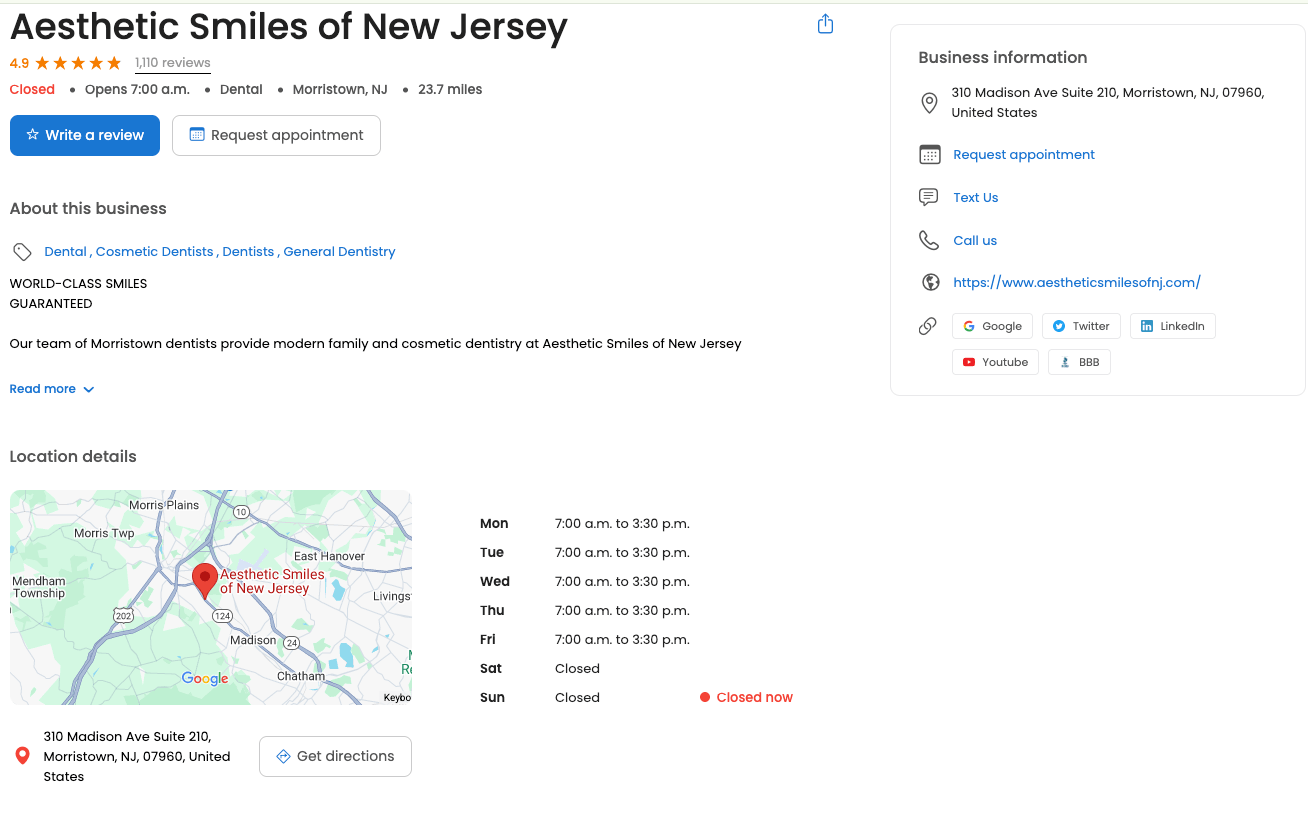The local citations here help Google verify the clinic’s information and build trust with both search engines and potential patients. Because Birdeye is a reputable platform, the citation strengthens local authority and supports better local search visibility.
### 2. Earn Editorial Backlinks from Helpful Articles
Editorial backlinks are earned when other websites naturally mention your clinic and include a clickable link to your website. These are some of the strongest links that you can earn.
Let’s understand this. Here, you can see that [Ahrefs](https://ahrefs.com/) published a detailed guide on Google Advanced Search Operators that genuinely helps marketers and SEO professionals. Because the article is practical, easy to follow, and solves a real problem, other websites naturally reference it.
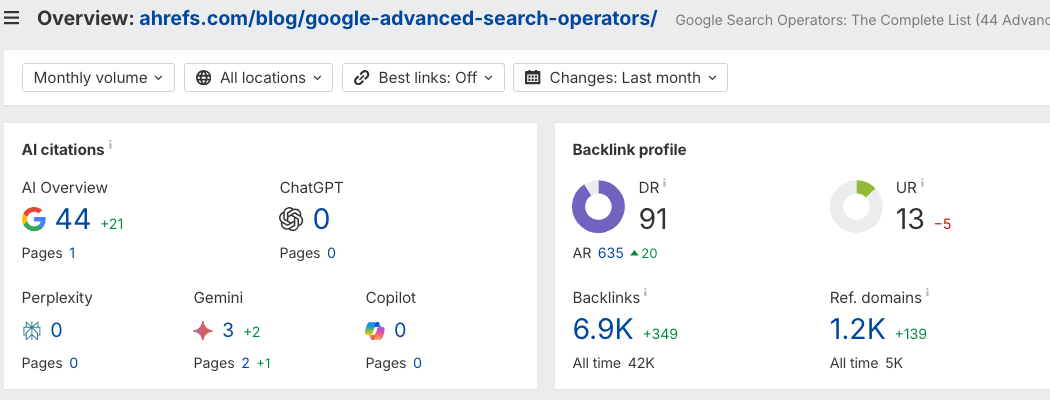As a result, the blog has earned 6,900 backlinks from over 1,200 unique domains. These links weren’t paid for or requested in bulk. Website owners and writers linked to the article on their own because it adds value to their content.
To understand this concept more clearly, let’s look at a real case study with proven results.
A publisher is writing an article on **the difference between a tooth infection and a cavity** on their website. To help the readers better understand, they included a link to a detailed guide on **cavities** from Dental Associates.
Here, the source website is the publisher’s article where the word “cavity” is linked. When readers click the word, it takes them to the destination website, which is the Dental Associates clinic page, where they explain cavities in detail.
The clinic is mentioned as a trusted source, and the link is naturally added in the content. The editor chose to add this link on their own, not as part of a promotion or payment, but to provide readers with clear, valuable information.
**Best practices for editorial backlinks:**
- Place the links inside the main body text
- Choose websites that are trusted and relevant
- Keep anchor text simple and natural
- Earn links based on value, not paid placements
### 3. Secure PR Mentions by Sharing Dental Expertise
Journalists often seek expert opinions for articles on oral health, dentistry, or health and well-being. When you answer their questions, they may feature you and link to your clinic.
**Get started with HARO (Help a Reporter Out):**
#### Register on HARO
You can sign up as a source and choose relevant categories such as health, fitness, and wellbeing. You’ll start receiving questions from journalists.
#### Monitor queries
When you receive questions from journalists, focus only on those related to oral health, dental care, and common dental problems. If the question matches your expertise, you can respond.
#### Respond quickly
Practice quick response, because journalists work on tight deadlines; the faster you reply with a helpful, clear answer, the higher your chances of being featured.
#### Craft a clear and professional response.
Once you decide to respond to the journalist, keep your messages short and simple, stay to the point, focus on your expertise, and, most importantly, educate the readers.
#### Be helpful, not salesy
Don’t try to promote your clinic, services, or pricing because journalists are looking for expert knowledge, not advertisements.
It has a simple rule: Helpful answers get published, and sales pitches get ignored.
**How it helps your dental clinic:**
- It helps in building trust, because a news or health website shows the patients that your clinic is reliable
- It can get featured on news, lifestyle, and health websites.
- Search engines and patients both trust clinics cited by major publications.
- These mentions are natural because you earn them based on your expertise, not through payments or promotions.
This image shows **Aspen Dental** earning a natural PR backlink by sharing expert dental insights. It appears in a PR publication.
### 4. Build Local Authority through Community Events
When you’re consistently active in your local community, it helps your clinic earn trust, rather than just online visibility.
Participate in local events and organizations, mention your clinic when they do, and regional media may also cover your efforts. This often links back to your site. And it can strengthen patients’ confidence and local rankings.
**Like:**
- You can organize free dental checkup camps in your area to show that you genuinely care about community health.
- Also, partner with schools to organize oral health awareness events, which help strengthen trust with patients and educators.
- Participate in charity events, health awareness drives, and community initiatives to connect your clinic with respected local organizations.
Local coverage often includes a link to your clinic; search engines view it as natural, editorial content rather than a paid promotion, which can help boost trust and regional rankings.
**For example,** a local **“Women’s Health Article”** on tongue scraping mentions **“Tend”** in its discussion of oral health habits. Tend regularly hosts dental education and wellness events in New York City, which helps position the brand as a trusted local authority.
### 5. Create Simple Digital Resources That Earn Natural Links
Helpful resources make it easy for other websites to link back to your site naturally. That could be visual guides, checklists, or explanations that help people understand dental care. You can create resources with:
#### Infographics
It helps to understand complex topics easily. People prefer sharing these visuals over long texts, making infographics highly linkable.
Blogs, health portals, schools, and local news sites often use infographics in their articles and credit the link source.
#### Oral care checklists
The checklist provides patients with guidance they can follow. These checklists are often shared and used by people.
Many parenting blogs, school websites, and community health pages link to these checklists because they’re easy to follow and helpful to their audiences.
#### Cost comparison charts
Cost comparisons can be confusing for patients; therefore, simple comparison charts help people understand price ranges and options clearly.
You can get links from local forums, blogs, and healthcare websites. It helps to provide transparent explanations of pricing so users can make better decisions.
#### Step-by-step treatment explainers
Treatment planners help break down the complex dental process into easy steps and reduce fear and confusion for patients.
Medical blogs and local directories link to these planners because they answer patients’ common questions.
You don’t require technical skills or designers to create quality resources; you can use tools like Canva or Figma to easily create digital resources that attract organic backlinks, as people love sharing them.
**For example,** a [Colgate article](https://www.colgate.com/en-us/oral-health/bridges-and-crowns/is-a-molar-implant-right-for-you) on molar implants cites the Mayo Clinic as a trusted source for dental implant surgery. The link is added naturally to help readers, earning a backlink based on value rather than outreach.
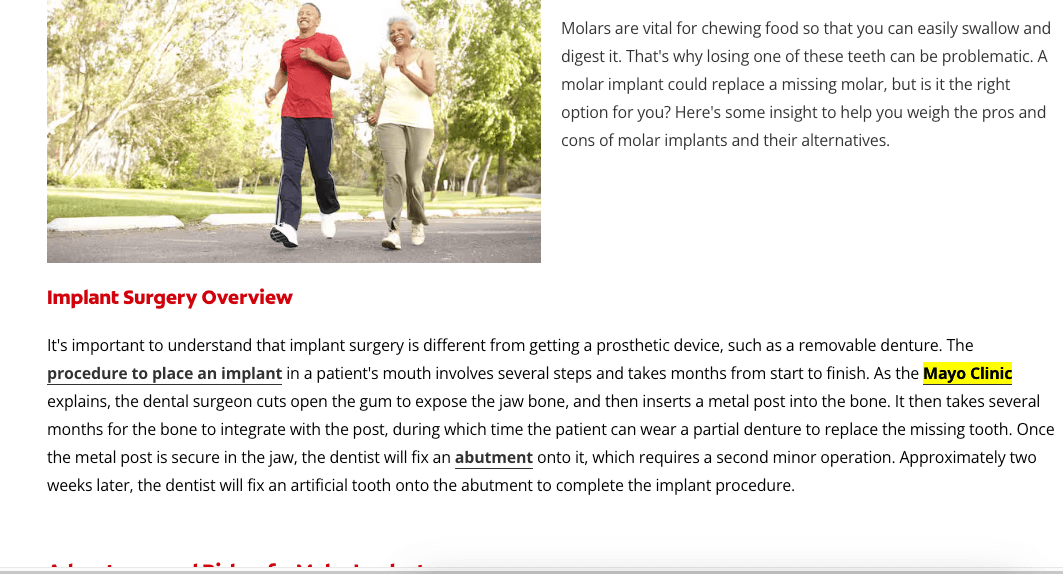
### 6. Adding Your Clinic’s Site to Existing Dental Articles
With this method, you add your clinic as a helpful reference in already published dental or health-related articles by offering content that improves readers’ understanding.
Editors update the content to improve the quality and accuracy. When your page adds value, the links appear naturally, Google sees it as editorial placement rather than a promotion, and readers benefit from trusted medical information.
**You can use these Google search operators to find relevant health and dental articles.**
- “dental implants” + “resource list”
- “oral hygiene tips” + “useful links”
- “best dentists” in New York+ blog
- site:*.org “gum disease” guide
**Example of natural anchor text that you should use to link to your website page.**
- “Benefits of teeth whitening”
- “How to choose a dentist.”
- “Dental care for kids”
These links help Google to understand what service you offer and where you’re located.
For Example, an **SF Oral Surgery blog** updates its implant recovery guide and adds a link to the **bone grafting** page to provide trusted medical context for readers. The link fits naturally within the content, making it a value-driven niche edit.
### 7. Replace dead links with superior dental resources
Many websites have old or broken dental links. You can [find broken links](https://outreachdesk.com/broken-link-building/) and offer your updated resources as replacements. This helps your readers and gives your clinic a strong chance of earning a relevant link.
**How it works in simple terms:**
#### Find a website with a broken dental link.
Look for dental blogs, health-related articles, or local health websites that link to outdated pages. These links may point to outdated research, removed blog posts, or pages that no longer exist.
#### Create Relevant and Updated Content
To replace the outdated pages, create your updated resources. This could be a clear explanation of a dental process, an oral care guide, an FAQ page for a treatment, or a blog post that describes patients’ needs and the careful measures to take.
#### Reach out politely to the website owner.
After you create a replacement, send a short and polite message to the site owner. Let them know where the link is broken, explain how it affects their readers, and suggest your relevant, up-to-date resource as a replacement.
This is a value-first strategy that improves the reader’s experience and works well in the dental space.
### 8. Build Partnership with Local Professionals
Building partnerships with other local health professionals is an excellent strategy for earning natural, relevant backlinks.
Links from local organizations indicate geographical relevance, strengthen local trust, and appear genuine to search engines.
**Facilitate partnerships with:**
- Gym
- Nutritionists
- Family doctors
- Pediatricians
- Daycare centers
- Schools
- Wellness centers
Each partner can list your clinic as their recommended dental provider, often with a link to your site.
**For example**, A Sunny Skies Pediatric Dentistry blog publishes an article on dental care providers and mentions a local dental clinic as a trusted clinic for regular checkups. The clinic is naturally referenced throughout the content to guide parents to reliable dental care.
This mention may include a link to the dental clinic’s website, earned through a genuine local partnership.
### 9. Publish Guest Content on Reputable Health Websites
When your clinic contributes genuinely helpful articles to trusted health or wellness websites, the link you earn comes from expertise and not promotion.
**How to find relevant websites for publishing guest content:**
#### Find websites that your ideal patients read
Start by finding health blogs, dental education sites, local wellness platforms, or parenting and lifestyle websites that discuss oral health.
Make sure the site is active, regularly updated, and focused on patient education and not link selling.
Publish your content where your audience already spends time, and make sure that the backlink also brings relevant referral traffic.
#### Share useful topics (not sales content)
Guest posts work best when they solve patients’ real questions.
Some topics perform well, like: “How gum disease affects overall health,” “When should children see a dentist,” or “Dental implants vs bridges explained simply.”
Avoid using promotional language or service pitches because editors accept content that educates first, and search engines trust links that appear naturally within the content.
#### Provide clear and helpful explanations.
Write in simple language that a non-medical reader can also understand.
Try to break complex dental topics down into simple examples, short paragraphs, and practical advice.
This will mention your clinic as a trusted source rather than a business chasing visibility.
#### Add your clinic link naturally in your author bio.
Most reputable health websites allow a short author bio. You can use this space to introduce your clinic and include a natural link to your website. Avoid keyword-heavy anchors; your clinic name or a simple “learn more” link is enough to maintain the placement’s trustworthiness.
Guest content builds trust and introduces your clinic to a new audience. Over time, this strengthens your website, supports local SEO, and helps patients feel more confident in their choice.
### 10. Turn Unlinked Mentions Into Backlinks
Sometimes other websites mention your clinic or dentist’s name without linking to your website. These are very easy wins.
Here’s how you can turn those mentions into strong backlinks:
#### 1. Identify Unlinked mentions
When other websites mention your clinic, your dentist’s name, or one of your services, but they don’t add a clickable link. These act as opportunities because the website already knows who you’re.
You can find these unlinked mentions using:
**Google Alerts (Free):**
You can set up alerts for your clinic name and dentist name. Google will email you whenever someone mentions you online.
**SEO Tools (Paid):**
Ahrefs Content Explorer and SEMrush Brand Monitoring scan the web and list pages where you’re mentioned without a link.
**Google Search Operators (Manual):**
Search for your clinic name like this:
“ACP Dental Care” -site:acpdentalcare.com -site:facebook.com
This shows mentions on other websites where you might request a link.
#### 2. Qualify and Prioritize Opportunities
Not every mention is worth turning into backlinks. Some mentions can improve your online visibility and trust. Your only focus should be on the efforts that actually help people and search engines understand and trust your practice.
**Authority:**
Start by assessing how trustworthy the website appears.
A good opportunity comes from websites that look professional and well-maintained, publish helpful, original content, and appear in Google search results when people search for relevant queries.
**Relevance:**
Next, check whether the website aligns with what you do and who you serve. Most valuable mentions come from health, wellness, or local community websites that are relevant to your practice area.
**Context:**
Finally, read how your clinic is mentioned in the article. It should sound positive and natural. Avoid negative mentions, reviews, complaints, or irrelevant discussions, as they aren’t good opportunities for a link request.
#### 3. Craft and Send the Outreach Email
Your message should be polite, simple, and focused on helping the website’s readers.
**Keep these in mind:**
- Personalize the email (mention their article/page).
- Politely point out the mention.
- Request a clickable link so readers can find the right clinic page.
- Explain that it improves the user experience.
**Example Email Template:**
Hi [Name],
I came across your article on entrepreneurship, and it’s very well crafted.
Thank you for mentioning our founder, Jane Doe, in your article. Could you please make her name a clickable link to our homepage so your readers can find us easily?
Thank you for your time,
[Your Name]
#### 4. Track and Follow Up
Use a clear and simple system to track:
- The pages that you contacted
- Check whether they updated the link
- If not, follow-up reminders
If there’s no response, send a gentle follow-up after 5-7 days. Keep it friendly and short.
## Mistakes to Avoid in Dental Link Building
**The most common dental link-building mistakes are paying for low-quality directory placements, repetitive exact-match anchor text, and chasing volume over relevance.** Each of these triggers Google’s spam systems faster on a YMYL site like a dental clinic than on a generic blog.
The cost of a manual action here isn’t a ranking dip; it’s months of stalled patient acquisition.
Even good backlinks won’t help if your clinic makes specific mistakes. These errors can degrade your rankings, damage trust, or slow down your growth. Here are some of the problems you should avoid.
### Avoid Spammy or Low-Quality Backlinks
Avoid links from random blogs, fake websites, or “link selling” pages because they do more harm than good.
Google sees these links as suspicious and may lower your visibility.
High-quality, trustworthy sources are always better than numerous bad links.
### Avoid PBNs and Automated Link Packages
Private Blog Networks (PBNs) and automated link services promise quick results, but they’re unsafe.
These links violate Google’s guidelines and can lead to ranking drops or penalties, which are difficult to recover from.
### Avoid Over-Optimized Anchor Text
Anchor text is the clickable text of a link. Using the exact keywords over and over (like “best dentist in New York”) looks unnatural to Google.
Natural anchors such as your clinic name, your dentist’s name, or a simple phrase are much safer.
### Don’t Ignore Technical or Local SEO Issues
Backlinks work only when your website is healthy.
If your site loads slowly, has broken pages, weak service descriptions, or an incomplete Google Business Profile, backlinks can’t deliver their full value.
A strong foundation must come first.
## Tracking, Measurement & Link Building ROI
**Track link-building ROI for your dental clinic by tying each new referring domain to map-pack ranking movement, organic appointment requests, and direct calls from search.** Vanity metrics like total backlinks don’t tell you whether the links moved the business. The metrics below are the ones that connect link work to revenue.
Link building works best when you track the results it creates over time. You don’t need advanced tools, just a simple way to see whether your visibility and patient inquiries are improving.
These are the key areas every dental practice should monitor.
### New Backlinks
Keep track of the new website linked to your clinic. Check your backlinks once a month using a tool like Ahrefs Free Backlink Checker.
**You don’t need to monitor everything; make sure the links are:**
- Relevant to the websites of healthcare, dentistry, or the local community.
- From real, trustworthy websites and not from spam or random blogs.
- Links are placed inside helpful content and articles that genuinely help the readers.
A steady flow of quality backlinks shows your visibility is growing.
### Ranking Improvements
As you earn better links, your clinic should start showing up higher for important searches like:
- “Dentist near me”
- “Emergency dentist”
- And other specific treatment you offer
Search for your keywords on Google once a month, whether your clinic is moving up in the results or not.
An improved ranking means Google trusts your clinic more and shows it to more local patients.
### New Patients (Conversions)
At the end of each month, ask this simple question: Are more people contacting your clinic through Google?
The real return on investment is measured in more patients, which leads to more revenue.
**Track things like:**
- Phone calls
- Appointment requests
- Contact form submissions
- Messages or inquiries from your website
You can create a list, “How many patient inquiries came from Google this month?” and compare this number every month.
When link building supports your local visibility, inquiries naturally increase.
## Conclusion
Your community might be looking for a dentist they can trust, and when your clinic appears at the top of local search results, it signals credibility, and patients feel confident choosing you.
Link building plays an important role in making that happen. It isn’t a shortcut or a one-time tactic, but it’s a consistent approach to build credibility, earn trust, and stay visible when people in your area need dental care.
At the Outreach Desk, we focus on safe, strategic link building designed specially for dental clinics, with quality, relevance, and long-term stability.
When you’re ready, we can create a simple dental visibility plan tailored to your city, local competitors, and growth goals, rather than risky tactics or guesswork.
### Want More Patients to Find Your Dental Clinic Online?
See how a steady, safe link-building approach can improve your local visibility and patient inquiries over time.
[Let’s Connect](/contact-us/)
### Is link building for dentists worth it?
Yes, link building for dentists is worth it when done correctly. High-quality links from local and relevant websites help to improve search visibility, build trust, and attract more patients to your dental practice.
### Is link building for dentists safe?
Yes, link building is safe for dentists if you focus on ethical, white-hat methods. This includes earning links from trusted local sites, healthcare blogs, and directories, and avoiding spammy or low-quality links.
### How can a dentist increase their rankings on Google?
Dentists can improve rankings by optimizing their Google Business Profile, earning local backlinks, and collecting patient reviews.
### What types of links work best for dentists?
The best links for dentists are those from local businesses, healthcare sites, dental blogs, and community directories.
### How many backlinks does a dentist need?
There is no fixed amount or number, but a small number of trusted and relevant local links often works better than many low-quality ones.
---
---
title: "Best SaaS Link Building Agencies: 2026 Buyer’s Guide"
url: "https://outreachdesk.com/best-saas-link-building-agencies/"
lang: "en-US"
type: "post"
description: "Choosing a SaaS link building agency isn't only about getting more links, but also about being mentioned in the right place, at the right time, and in front of the right audience. Many in-house teams that lack bandwidth turn to"
last_modified: "2026-05-29T12:56:28+00:00"
categories: [Link Building]
---
# Best SaaS Link Building Agencies: 2026 Buyer’s Guide
Choosing a SaaS link building agency isn’t only about getting more links, but also about being mentioned in the right place, at the right time, and in front of the right audience. Many in-house teams that lack bandwidth turn to [link building services](https://outreachdesk.com/) to run prospecting and outreach at scale.
Most SaaS companies fail to meet link building criteria not because the links don’t work, but because they invest in agencies that prioritize quantity over relevance.
This guide helps you avoid wasting budget on low-impact links.
### What we’re going to look at:
- You’ll know which SaaS link building agencies are well-known, trusted, and worth considering.
- How SaaS link building is different from regular link-building.
- Where high-impact SaaS links usually come from.
- How long do the results realistically take?
- How to evaluate agencies without SEO jargon.
## What is SaaS Link Building Agency
**A SaaS link building agency specializes in earning editorial backlinks for software-as-a-service (SaaS) companies.** These agencies target the review sites, directories, integration pages, and tech publications that actually influence SaaS buyers — focusing on DR-60+ placements that move both rankings and product trust signals.
SaaS link building agencies understands product-led content, longer B2B sales cycles, and which DR-60+ publishers your ICP reads before making a purchase decision. That niche knowledge is why placement relevance and ranking impact are measurably higher.
A SaaS link building agency **helps your software companies [earn contextual links](https://outreachdesk.com/contextual-link-building/) from trusted websites.** These links help search engines see your product as reliable and show it to more people.
**These links usually appear inside:**
- Software comparison articles
- Product reviews
- Industry guides
- Business and technology blogs
Unlike generic link building, [SaaS link building](https://outreachdesk.com/saas-link-building/) is designed for long buying journeys, during which customers compare tools, read in-depth reviews, and build confidence before deciding to sign up.
## Why SaaS Link Building Is Different From Regular Link Building
**SaaS link building is different because buyers evaluate products on comparison pages.** Review sites, and integration directories before they ever reach your website, so your product and pricing pages need [relevant backlinks](https://outreachdesk.com/what-are-backlinks/) , not just your blog. Your competitor set is narrow and specific.
Your best link assets, like original data studies and free tools, earn links for years.
None of this matches how generalist link agencies think about target selection or outreach.
SaaS link building isn’t just about collecting links it’s about earning visibility where software buyers actually make decisions.Most SaaS companies burn budget on agencies that never understood that distinction. That’s what separates the best SaaS link building agencies from the rest.
### SaaS Buyers Take Time to Decide
SaaS companies sell software, not just one-time products. Because of this, people don’t usually buy right away. They compare the tools, read reviews, and look for proof that a product is trustworthy before actually signing up.
Because of this, SaaS links need to appear where people are already researching, not just anywhere online.
### Links Need to Support Buying Decisions
For many businesses, links are built just to improve rankings. For SaaS, links need to do more than that. They need to appear in places **where potential customers are already researching and comparing options.**
SaaS links work best when they support evaluation, not just discovery.
**A good SaaS link building agency focuses on getting your product mentioned in:**
- Comparison articles
- Industry guides
- Software reviews
- Business or technology blogs
There are places where real buying decisions happen.
### Relevance Matters More Than Volume
Regular link building often focuses on getting as many links as possible, but it doesn’t work well for SaaS link building.
SaaS link building focuses on fewer but more relevant links from websites related to your product or audience. These links build trust and bring the right visitors.
### Long-Term Impact Is the Goal
SaaS link building takes more time because it is done carefully and manually. But the results last longer.
Instead of traffic gains, you get steady visibility and users who are more likely to sign up.
## Top 12 SaaS Link Building Agencies
**The top SaaS link building agencies below are the ones with verifiable client work in the software space, transparent pricing, and editorial publisher relationships.** Each profile below covers their specialty, pricing model, and the SaaS stage they’re best suited for.
Not every SaaS link building agency is the same. Some focus on fast growth, while other focuses on long-term trust, and some work better for early-stage products or established brands.
You don’t need to choose all the top agencies for saas link building. **The right choice depends on your needs and growth stage.** Use this list to compare the options and pick the one that best suits your goals.
### 1. Outreach Desk – Best for Growth-Focused SaaS Brands
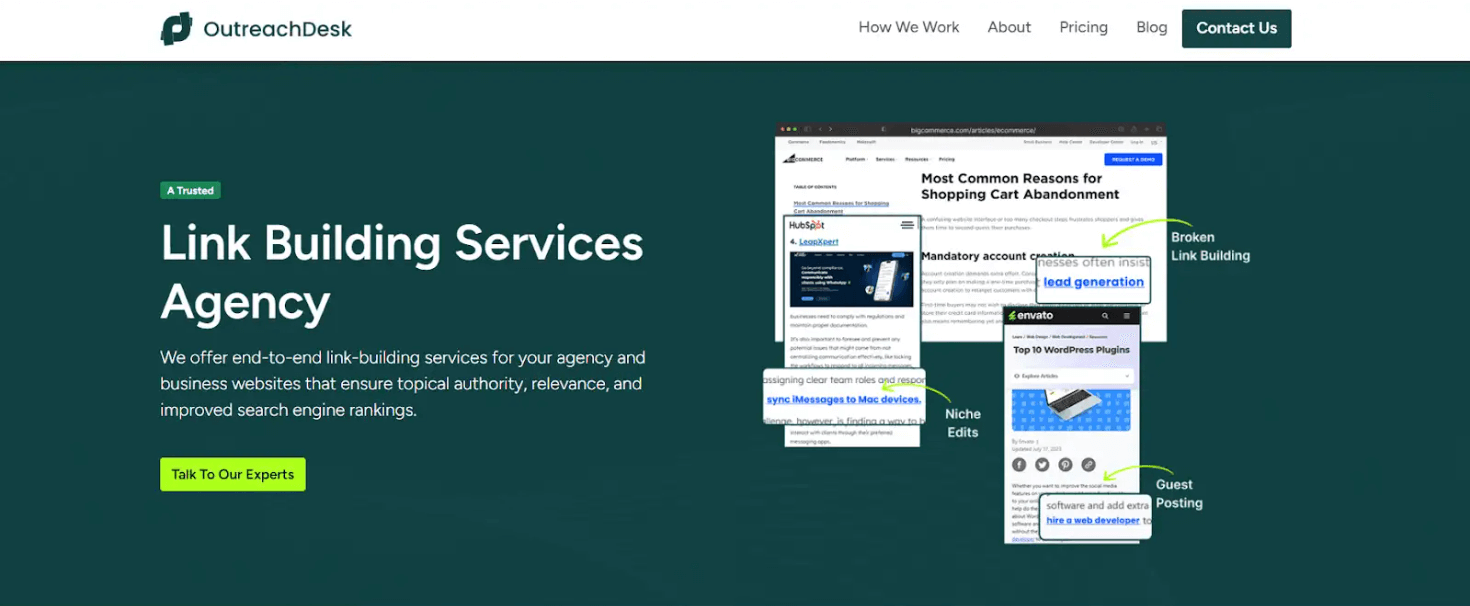
| Website | https://outreachdesk.com/ |
| --- | --- |
| Notable Clients | Centus, Chargebee, Flatirons Development, CloudTalk, Snov.io |
| Headquarters | Brooklyn, New York |
| Industry Focus | SaaS Companies, eCommerce Brands, SEO Agencies, Startups, Enterprise |
You benefit most from [Outreach Desk](https://outreachdesk.com/) if your SaaS is focused on long-term visibility and wants to appear where buyers compare tools, including comparison pages and guides.
This approach works best when you value relevance and clear editorial placement over quick link volume.
You earn links through [manual outreach](https://outreachdesk.com/link-building-outreach/) to the relevant SaaS, technology, and industry websites. Your product naturally fits within guides, blogs, articles, and comparison content.
Each website is reviewed for relevance so your links fit the surrounding content and make sense to readers.
It helps your SaaS appear during real decision-making moments, not just for information.
#### Transparency and quality standards
You’ll always know what is happening and why
You get:
- Live links for every placement.
- A clear difference between editorial and sponsored mentions.
- Natural and relevant anchor text.
- Context explained for each placement.
**Pricing range:**
Our [link building campaigns](https://outreachdesk.com/link-building-campaigns/) are priced between $3,000 – $7,000 per month. Pricing may vary based on SaaS competition, placement, and link relevance requirements. For a specific need, a link option may be available for around $250.
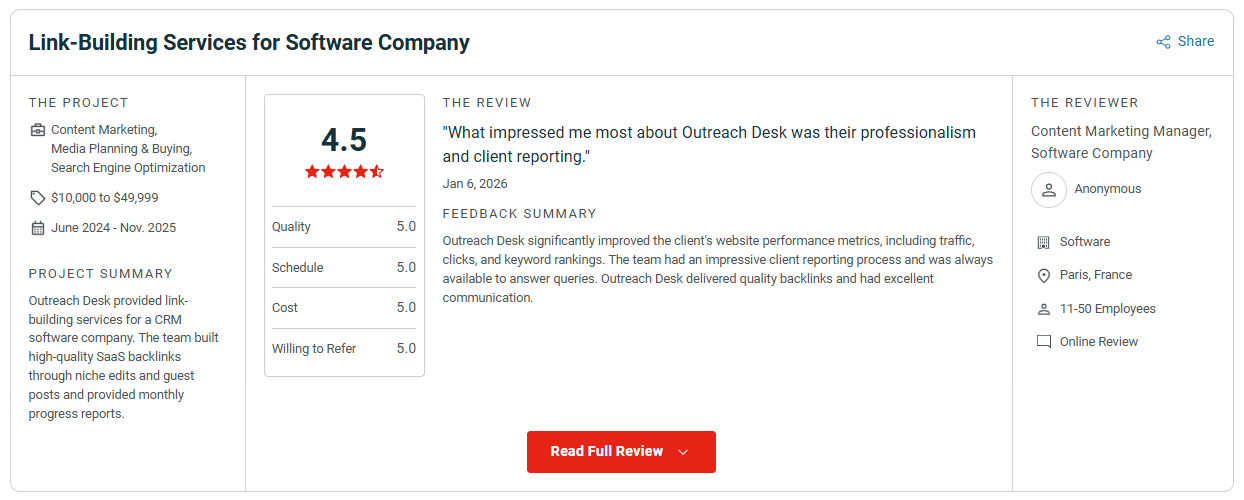
**Pros:**
- Provides a strong focus on the buyer’s intent and relevance.
- Offers editorial first, low-risk approach.
- Offers clear communication and realistic expectations.
**Cons:**
- Not suitable if you’re looking for quick traffic spikes.
- Requires patience to see improving results.
### 2. saaslinkbuilder: Best for Google rankings & AI Visibility
| Website | https://www.saaslinkbuilder.com/ |
| --- | --- |
| Notable Clients | Webshare, Oxylabs, Hostinger, Banuba, iDenfy |
| Headquarters | Vilnius, Lithuania |
| Industry Focus | B2B SaaS, AI, Cybersecurity, Fintech |
saaslinkbuilder is the best SaaS link building companies for brands that want to build authority across both Google and AI search.
Instead of focusing only on traditional SEO, their strategy helps your brand get mentioned on relevant SaaS, AI, cybersecurity, and B2B tech websites that buyers and AI systems may rely on when comparing tools.
Their campaigns combine SaaS-to-SaaS backlinks, listicle placements, and brand mentions, all selected through a 15-step link quality checklist. Each opportunity is reviewed for topical relevance, market fit, ranking potential, and editorial context.
What makes them different is that their link building strategy is built for modern search behavior. The goal isn’t just to improve rankings, but to increase the chances that your brand appears in recommendation-style content and AI-generated answers.
Their process is fully white-hat and based on manual outreach, with real-time reporting, transparent strategy, no upfront payments, and a one-year guarantee on links.
**Transparency and quality standards:**
- Live reporting for every placement
- Manual outreach based on relevance and topical overlap
- SaaS-to-SaaS placements from relevant websites
- A one-year guarantee on links
- No upfront payments
**Price Range:**
Pricing is flexible based on your growth stage and campaign needs. Individual link placements start at €300, while full monthly campaigns typically range from €1,500 to €10,000, depending on the target markets and specific requirements.
**Pros:**
- Built specifically for SaaS companies.
- Strong focus on AI visibility and Google rankings.
- Very high quality standards.
**Cons:**
- Not ideal for companies looking for very cheap backlinks.
### 3. Click Intelligence – Best for Data-driven, scalable results
| Website | https://www.clickintelligence.co.uk/ |
| --- | --- |
| Headquarters | Cheltenham, UK |
| Industry Focus | Technology & SAAS, B2B, Ecommerce, Healthcare, Travel & Hospitality
Click Intelligence is a UK-based link building and digital marketing agency with the goal of helping as many businesses within the technology and SAAS industries not only survive online but thrive. |
With their backlink services, including blogger outreach, digital PR link building, and brand mentions, they can help build sustainable campaigns that deliver top-tier results.
**Transparency and quality standards:**
- Clear and regular reporting that details campaign progress.
- Easy-to-understand performance metrics included.
- Strict quality standards for website selection.
- Sources relevant, authoritative links that align with industry and client.
**Price Range:**
Individual links start from $95 with bulk discounts available. They also offer custom pricing for services such as expert quote link building, brand mentions, and digital PR.
**Pros:**
- Bespoke campaigns tailored to the client’s goals, budget, industry, and existing authority.
- Strong international link building capabilities.
- Transparent reporting and regular campaign updates.
- Sustainable and scalable strategies built for long-term organic growth.
**Cons:**
- Not ideal for companies wanting quick results
### 4. Rock The Rankings: Best for Decision-Stage Content
| Website | https://www.rocktherankings.com/ |
| --- | --- |
| Notable Clients | MoonPay, Bizzabo, CV Maker, Pinecone, Atto |
| Headquarters | Charlotte, North Carolina, United States |
| Industry Focus | B2B SaaS, Technology, Fintech |
You benefit most from Rock The Rankings if your SaaS company already has strong content and wants better visibility on the page that influences buying decisions.
This approach works well when targeting comparison pages, best-of-tool lists, and solution guides, as well as for brands focused on converting interested users.
Your SaaS is mentioned in content meant to guide decisions, not just as information, and they also check relevance so the mention feels natural.
Their primary focus is improving the visibility of your content that directly affects buying decisions, not just awareness content.
#### Transparency and quality standards
You will get:
- Links that appear within the main, relevant content.
- The placement context is clearly explained.
- The anchor that remains readable and natural.
**Pricing Range:**
Their link-building campaigns are often priced between $3,500 and $8,000 per month, depending on the quality of existing content and the competition for comparison keywords.
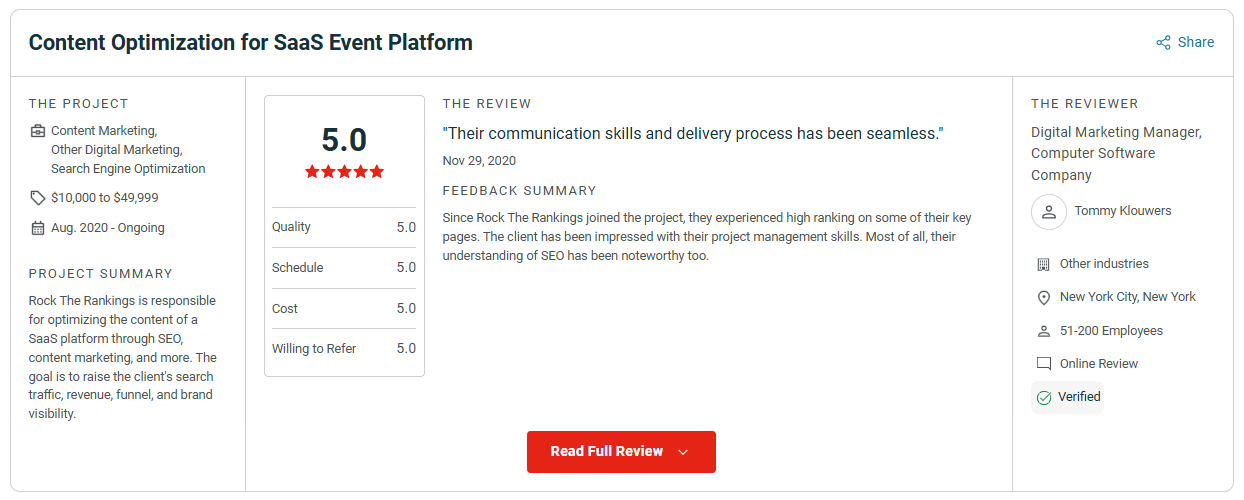
**Pros:**
- It works well for late buyers.
- Gives a clear focus on comparisons.
**Cons:**
- It isn’t ideal if you don’t already have the content.
### 5. Editorial.Link: Best for Consistent Link Growth
| Website | https://editorial.link/ |
| --- | --- |
| Notable Clients | Intellias, Belkins, PeopleForce, Intellectsoft, Skylum |
| Headquarters | St. Petersburg, USA |
| Industry Focus | SaaS, Legal, Finance, Insurance, Enterprise Business |
You can benefit most from Editorial.Link if you’re already an established SaaS brand seeking clean, natural mentions and avoiding risky tactics.
Your product is referenced in the articles, where it avoids promotional placements and uses links that look like genuine recommendations. The major difference is that it helps build trust over the years.
**Transparency and quality standards:**
- The primary focus is on editorial context.
- They don’t provide forced placements.
- Offers clear communication about the sources.
**Price range:**
Their link placements are most commonly priced between $5,000 and $10,000 per month, reflecting the greater effort required in securing genuine editorial mentions.
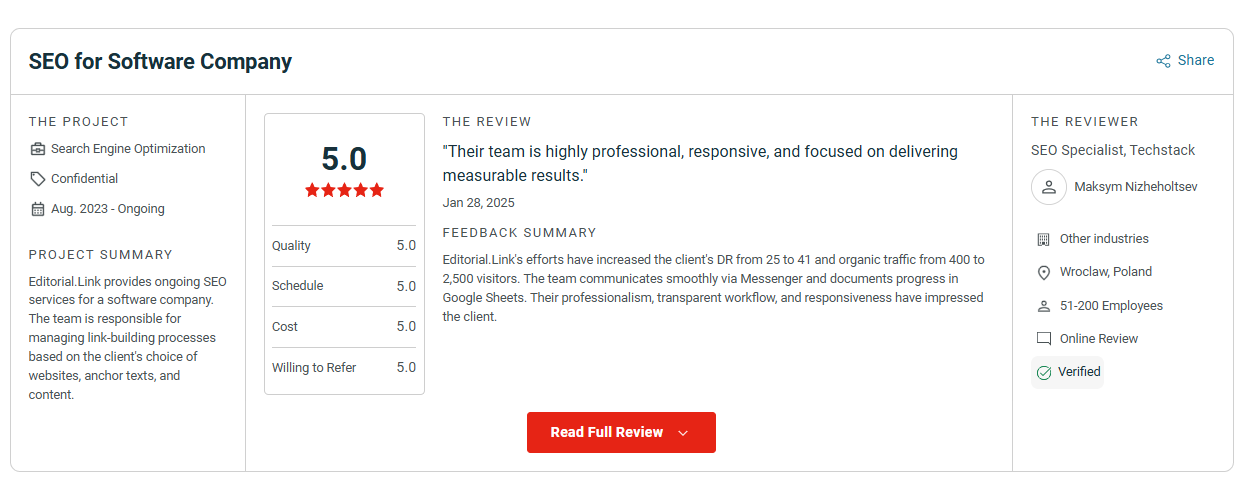
**Pros:**
- You get a low-risk approach.
- Focus on providing strong credibility.
**Cons:**
- Not ideal if you need fast wins.
### 6. OneLittleWeb: Best for Consistent Link Growth
| Website | https://onelittleweb.com/ |
| --- | --- |
| Notable Clients | WebTYDE, Grow & Convert, WriterBuddy, Hennessey Digital, Lineout |
| Headquarters | North America: Queens, New York; Asia: Dhaka, Bangladesh |
| Industry Focus | SaaS, B2B, Startups, Enterprise, Agencies |
OneLittleWeb works best for SaaS companies that want regular link building, want consistent progress, and don’t value shortcuts.
Their link-building work includes ongoing outreach to relevant websites, placement of links within related content, and running regular quality checks.
The thing that makes them different is their ability to maintain a continuous link-building process without sacrificing quality.
**Transparency and quality standards:**
- They provide context-based placements.
- Focus on providing a clear explanation of the link’s sources.
**Price range:**
Their link-building services are usually priced between $3,000 and $6,000 per month, depending on the level of consistency and campaign scale.
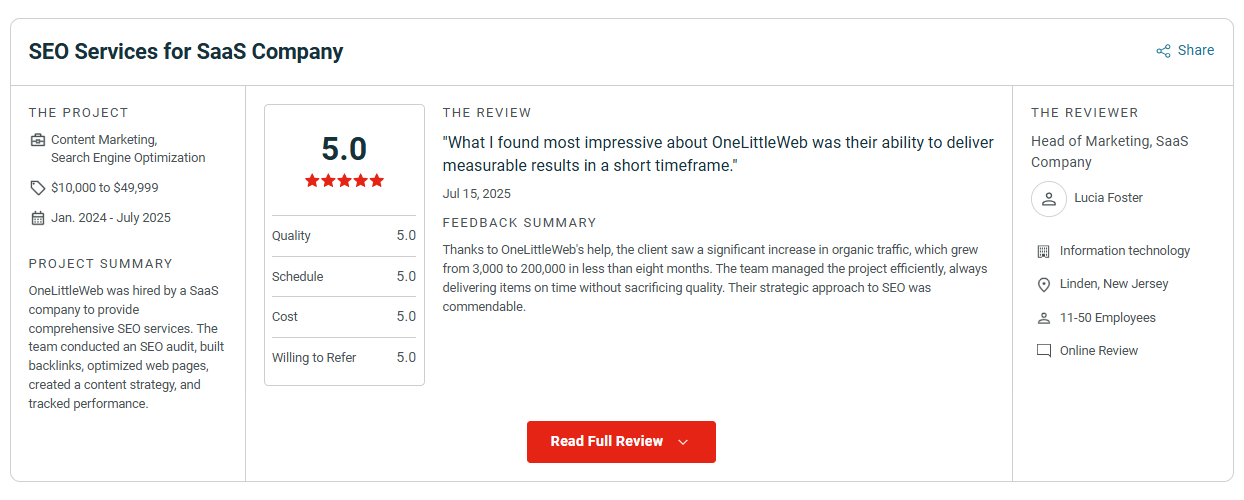
**Pros:**
- They provide a predictable progress.
- Offers a balanced approach.
**Cons:**
- Less selective than premium editorial-only services.
### 7. GoPeak: Best for Steady SaaS Brand Awareness
| Website | https://www.gopeak.io/ |
| --- | --- |
| Notable Clients | Picsart, Sortlist, Riverside, HeySurvey,IndexBox… |
| Headquarters | Yerevan, Armenia |
| Industry Focus | SaaS, B2B, Fintech, Education, Technology |
GoPeak works best for your SaaS project if you want to have a steady link building and your focus is on your brand awareness.
GoPeak’s link building strategy is based on contextual backlink placements, relevant website outreach and regular backlink audits.
The advantage that differentiates them from other SaaS backlink builders is their ability to create over 60 contextual links per project and to make them naturally relevant. So, in case you want to act aggressively, there is no need to find another agency.
**Transparency and quality standards:**
- The primary focus on contextual backlinks.
- They don’t add spammy anchors.
- Transparency in the backlink-building process.
**Pricing range:**
GoPeak’s link building package starts from $1000 to $10000 regarding the volume of backlinks and additional services provided by their team.

**Pros:**
- Risk-Free link building. Link recovery if it is deleted.
- Custom outreach campaigns for each new project.
- Link Building strategies to be mentioned in AI.
**Cons:**
- Not the best fit for low budget and small companies.
### 8. Siege Media: Best for Content-Led Link Building
| Website | https://www.siegemedia.com/ |
| --- | --- |
| Notable Clients | Casper, Asana, Chime, Airbnb, Audible |
| Headquarters | Austin, Texas |
| Industry Focus | SaaS, Fintech, E-commerce, Health |
Siege Media works best for you if your SaaS companies invest in content, with long-term goals, and focus on education.
Their link-building strategy uses content to attract links naturally; links come when people reference helpful resources and topics that provide long-term value.
What differentiates them is that they help you build links through valuable content rather than through direct outreach.
**Transparency & quality standards:**
- They offer a clear content strategy.
- They provide a natural linking pattern.
**Pricing range:**
Their link-building campaigns are priced between $8,000 and $20,000 per month, showing content creation, promotion, and long-term value.
**Pros:**
- It is a Sustainable approach.
- It provides a strong educational value.
**Cons:**
- It requires time and content investment.
### 9. Digital Olympus: Best for Ethical, Relationship-Based Links
| Website | https://digitalolympus.net/ |
| --- | --- |
| Notable Clients | Ramp, CREDO, Discover Car Hire |
| Headquarters | Wilmington, Delaware, USA |
| Industry Focus | SaaS, B2B, eCommerce |
Digital Olympus focuses on building relationships with website owners and editors, as well as with companies that prefer an ethical approach.
This helps you directly contact the editors, build relationships that drive links, and prioritize relevance and trust over one-time placements.
**Transparency and quality standards:**
- They offer honest communication.
- They provide editorial-first placements.
**Pricing range:**
Their campaigns are priced between $4,000 and $9,000 per month, depending on the depth of outreach and editorial standards.
**Pros:**
- They use ethical and safe ways.
- They provide long-term trust.
**Cons:**
- Requires longer commitment before the ROI appears.
### 10. HigherVisibility: Best for Full SEO Support Along With Link Building
| Website | https://www.highervisibility.com/ |
| --- | --- |
| Notable Clients | Allied, Hotworx, Brilliant Earth, Ziebart, Evolve |
| Headquarters | Memphis, Tennessee, USA |
| Industry Focus | E-commerce, Legal, Healthcare, B2B, SaaS, Financial Services |
HigherVisibility offers link building as part of a complete SEO service. Instead of focusing only on links, you also get full focus on content and overall website visibility.
It can be a good choice if you want a single agency to handle both the tasks, link building, and SEO, rather than working with multiple agencies.
Their link building is part of a thorough SEO plan; you will get link support for overall site growth and the strategy that aligns with site improvements.
What makes them different is that they handle SEO and links together, reducing effort.
**Transparency & quality standards:**
- They provide regular reporting.
- They offer clear strategy explanations.
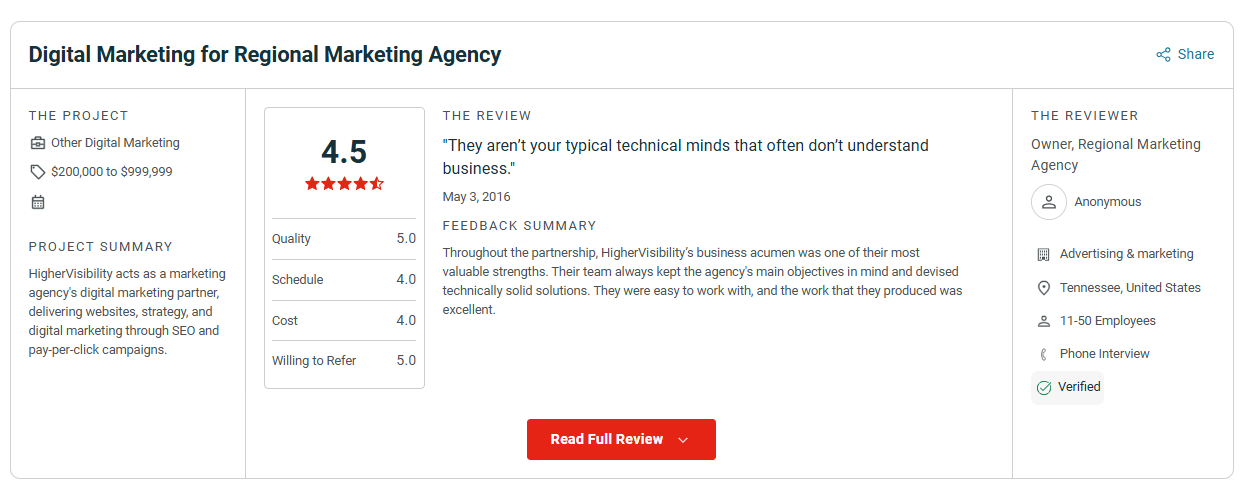
**Pricing range:**
Their link-building services are priced between $3,000 and $8,000 per month, depending on the scope and depth.
**Pros:**
- They provide an all-in-one solution.
- They simplify management.
**Cons:**
- They are less focused if you only need links.
### 11. Sure Oak: Best for Steady Authority Growth
| Website | https://sureoak.com/ |
| --- | --- |
| Notable Clients | SoFi, Mayflower, Recsolar, United Van Lines, Guidepoint |
| Headquarters | Brooklyn, New York, USA |
| Industry Focus | B2B SaaS, Fintech, Healthcare, E-commerce |
Sure Oak focuses mainly on building credibility through steady efforts rather than chasing quick results. It works best for SaaS brands that prioritize stability, avoid risky tactics, and focus on long-term results.
Their link building includes research-based outreach, careful placement selection, and a focus on credibility.
What makes them different is that they avoid shortcuts and focus on steady progress.
**Transparency & quality standards:**
- They provide transparent reporting.
- They offer a conservative approach.
**Pricing range:**
Their link-building campaigns are usually priced between $4,000 and $7,000 per month, based on research depth and placement selectivity.
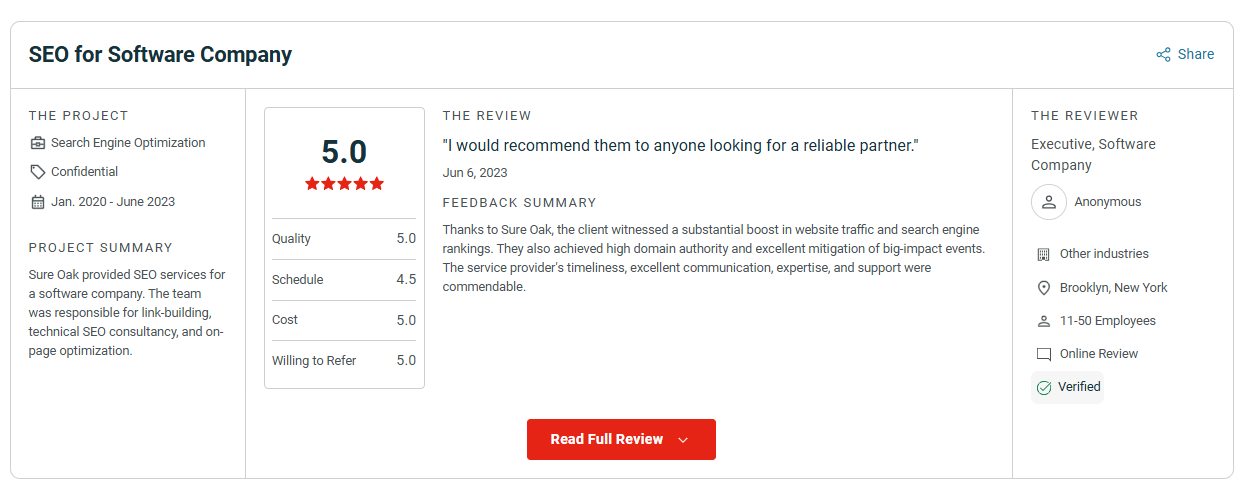
**Pros:**
- They offer reliable and safe results.
- The level of risk is low.
**Cons:**
- Offers slower results.
### 12. SaaSBoost: Best for SaaS-Only Campaigns
| Website | https://www.saasboost.io/ |
| --- | --- |
| Notable Clients | Apollo, HeyReach, PB2B, Zapmail |
| Headquarters | California, USA |
| Industry Focus | B2B SaaS, Technology |
SaaSBoost works best for SaaS companies that focus on SaaS buyers and need niche understanding.
Their link building includes outreach to SaaS-related websites, providing links that appear where SaaS buyers research tools, and offers a strategy that aligns with SaaS buying behavior.
What makes them different from other agencies is that they work only with SaaS companies, so their approach aligns with SaaS decision journeys.
**Transparency & quality standards:**
- They offer a clear explanation of placements.
- Focus is on SaaS relevance.
**Pricing range:**
Their SaaS-only link-building campaigns are custom plans, depending on niche focus and campaign scope.
**Pros:**
- They provide a strong SaaS focus.
- They offer an audience-aligned approach.
**Cons:**
- It isn’t suitable for non-SaaS businesses.
## Top SaaS Link Building Agencies Compared
**The comparison table below shows each SaaS agency’s pricing, publisher quality, content production, and minimum commitment side by side.** Use it to narrow your shortlist before booking discovery calls. The differences that matter most for SaaS aren’t the same as for e-commerce or local SEO.
| Rank | Agency | Best For | Pricing | SaaS Specialized? |
| --- | --- | --- | --- | --- |
| 1 | Outreach Desk | Growth-focused SaaS brands | $3k–$10k / month | Yes |
| 2 | saaslinkbuilder | Google rankings AI visibility | $1.5k–$10k / month | Yes |
| 3 | Click Intelligence | Award-winning SEO & link building with AI search | Custom / On request | No |
| 4 | Rock The Rankings | Decision-stage content | $3.5k+ / month | Yes |
| 5 | Editorial.Link | Consistent link growth | $5k–$10k / month | Yes |
| 6 | OneLittleWeb | Balanced scale and quality | $3k–$10k / month | No |
| 7 | GoPeak | Steady SaaS Brand Awareness | $1k-$10k / month | Yes |
| 8 | Siege Media | Content-led link building | $8k–$20k / month | No |
| 9 | Digital Olympus | Relationship-based links | $4k–$9k / month | No |
| 10 | HigherVisibility | Complete SEO and link building | $3k–$8k+ / month | No |
| 11 | Sure Oak | Steady authority growth | $4k–$7k / month | No |
| 12 | SaaSBoost | SaaS-only campaigns | Custom | Yes |
This table helps you quickly evaluate agencies based on SaaS focus, budget comfort, and growth stage.
## How to Choose the Right SaaS Link-Building Agency Based on Your SaaS Stage
**The right SaaS link building agency depends on your stage.** Pre-seed needs cost-efficient prospecting, Series A needs scalable content production, and post-Series B needs digital PR and brand-level publication placements. The framework below maps each stage to the agency types that match best.
Choosing the [best link building agency](https://outreachdesk.com/saas-link-building-agency/) for SaaS goes beyond the number of links they can get. The goal isn’t more links, it’s better links that help your software get noticed by the right people.
Instead of focusing only on numbers, look at where the links come from, how they’re placed, and how transparent the agency is about its work.
### What Makes a Good SaaS Link
Good link building is about quality, not quantity. Top agencies for SaaS link building focuses on links that come from:
- Websites related to your industry or audience
- Trusted websites with real readers
- Pages that your potential customers actually visit
These links help your product appear in places where real buying decisions happen.
### Simple Framework to Evaluate an Agency
You don’t need much SEO knowledge to judge whether an agency is worth your trust. You can check it through a few practical tests; they reveal whether they focus on real business value.
This simple framework helps you to evaluate clarity, transparency, and relevance so you can confidently choose an agency that prioritizes long-term results.
#### **Relevance:**
Check whether links from websites are related to SaaS, technology, or your niche. It matters because search engines value links from websites that cover a similar topic. The simple rule is that if the website doesn’t naturally mention your product, the link isn’t helpful, and if relevance is missing, the link won’t influence buyers.
#### Website Quality:
Check, are these real websites with content, or are they empty blogs made only for links? It is important to know the quality of the website, as some agencies use websites created solely to place links. These sites often have thin content, many random links, and mainly exist to sell links.
#### Page Quality:
Evaluate if the pages where links appear get real visitors and make sense for your product? It matters because even a good website can have low-value pages. A link can work best when a page is already getting visitors, your product fits the topic naturally, and the link helps visitors understand the product.
If an agency can’t explain these clearly, that’s a warning sign.
### Which Type of Agency Is Right for You?
Different SaaS link building companies need different approaches based on their stage and priorities:
#### Early-stage or bootstrapped SaaS:
If you’re an early-stage SaaS, work with agencies that focus on:
Faster, [niche-relevant link acquisition](https://outreachdesk.com/link-acquisition/), such as blogs, startup sites, early reviews, and guides.
You need visibility to get discovered by early users and build trust in search results.
You should look for agencies that work manually, target your exact/actual niche, explain where the links come from, and set realistic expectations.
#### Established or enterprise SaaS:
If you’re an established SaaS business, work with SaaS link building experts who focus on securing editorial links from the trusted publications, comparison pages, and respected industry websites rather than from random blogs or bulk placements.
Since your brand is already established, you don’t need many links. Even a few links can protect your reputation and help you compete for high-value keywords.
Choose an agency that can explain where the links come from, why each site matters, follows strict quality standards, and reports everything to you clearly.
There’s no “best” agency; the right choice depends on your business stage and goals.
### Proof and Transparency to Ask For:
Before choosing an SaaS link building agency, make sure they’re open about their work. A trustworthy agency should provide:
- The regular reports show what was done.
- Live links where your product was mentioned.
- Clear explanation of how links were earned.
- Honest communication about sponsored vs natural mentions.
If an agency avoids sharing details, it’s better to walk away.
### Red Flags to Avoid
Be careful if an agency promises things that sound too good to be true.
**Avoid agencies that:**
- Promise guaranteed rankings or fixed authority scores.
- Sell cheap bulk guest post packages.
- Use websites with no real traffic or readers.
- Refuse to show live links or explain their process
- These shortcuts often do more harm than good.
## Where SaaS Links Are Usually Placed
**SaaS links are usually placed in four publisher types: SaaS-focused industry blogs, “best of” comparison roundups, tech publications, and developer or marketing community sites.** Each placement type signals something different to Google, and the right mix depends on your product category and buyer persona.
SaaS links work best when they appear on pages people already trust and read when choosing software. These aren’t random links. They are placed where users are consistently learning, comparing, and deciding.
### Software Comparison Articles
These are pages where different tools are compared side-by-side. People reading these pages are usually close to making a decision.
When your SaaS is mentioned and linked here, it gains visibility at a critical stage of the buying process.
### Product Reviews
Review articles explain what a tool does, its strengths, and who it’s best for. These pages help users understand whether your software fits their needs.
Links from reviews build trust because readers expect honest information.
### Industry Guides and Educational Content
There are helpful articles that explain problems and solutions related to your industry.
Your product is mentioned as one of the tools that can help. This works well for reaching users early in their research journey.
### Business and Technology Blogs
Well-known business and tech blogs already have audiences that trust their content.
Links from these sites help your SaaS reach a wider audience and improve overall credibility.
### Why Placement Matters
Not all links bring the same value. Links placed within helpful, relevant content help users and search engines better understand your product.
This is why best SaaS link building agencies focuses on where the link appears, not just number of links.
## How Long Does It Take to See Results From SaaS Link Building
**SaaS link building typically shows first ranking movement at month 3-4 and meaningful traffic growth between months 6-9, depending on competitor density and content quality.** Pre-Series A SaaS sees results faster because the target queries have less competition. Enterprise SaaS competing with established players needs 9-12 months for clear ROI.
SaaS link building doesn’t work instantly. It’s a gradual process because links need time to be discovered, trusted, and valued. Knowing what to expect helps you stay calm and make better decisions.
### The First Few Weeks
In the initial stage, the agency focuses on research and outreach; the websites are connected, content preparation begins, and links are approved.
At this stage, you won’t usually see any visible changes, and that’s normal.
### After One to Two Months
Links start going live on trusted websites. Search engines begin noticing these new mentions, but major changes are still gradual.
You may start seeing minor improvements in visibility or traffic.
### After a Few Months
After a few months, link building starts showing much clearer results. Your important pages begin to attract more visitors, and your product often appears in search results and on comparison pages.
Growth becomes more stable, especially in competitive SaaS markets.
### Why It Takes Time
Search engines don’t trust new links instantly. They look for growth and consistent mentions naturally over time.
The process might be slow, but it protects your site from spam and keeps long-term results.
### Long-Term Benefit
Once links are placed, they continue to bring visitors at no extra cost. Over time, this reduces the reliance on paid ads and builds lasting visibility.
## What ROI Looks Like From SaaS Link Building
**SaaS link building ROI shows up in three measurable ways.** Organic signups attributed to ranking pages, demo requests from organic search, and lower CAC compared to paid acquisition channels. Track these alongside referring domain growth. The metrics that prove ROI are the ones that connect directly to pipeline.
The return on SaaS link building doesn’t show up right away. It improves gradually as your product becomes more visible and trusted throughout the buying journey.
You don’t measure success by counting links. You measure it by what changes for your business over time.
### Better Visibility in Search
Over time, your software becomes more visible when people search for solutions like yours. You may notice your product showing up in guides, comparisons, or search results more consistently.
### More Relevant Visitors
You start to attract visitors who are genuinely interested in your product, rather than random traffic. Visitors will spend more time on your site because they’re already comparing similar tools.
Quality visitors matter more than quantity.
### Growth in Demo Requests or Sign-Ups
As visibility and trust increase, more users take action. This means more demo requests, free trials, or sign-ups.
Link building supports these actions by helping users discover your products at the right time.
### Reduced Dependence on Paid Ads
As organic visibility grows, you don’t need to depend on paid advertising to get traffic. This can be one of the most significant long-term benefits of SaaS link building.
### Consistent Improvement Over Time
Good link building creates steady progress, not quick gains. Results build gradually and continue even if you pause the active campaigns.
## Conclusion
Choosing a SaaS link building agency isn’t just about getting as many links as possible. But it’s about finding a partner who helps the right people discover your product when they’re already looking for a solution.
A good SaaS link building agency focuses on providing quality over shortcuts. They place your SaaS on trusted websites where buyers are actually comparing tools and making decisions.
Use this guide to compare agencies, understand what realistic results look like, and set clear expectations before you start investing. When link building is done the right way, it becomes a steady growth medium that supports your SaaS long after the work is done.
### Considering SaaS-Focused Link Building?
See how editorial, buyer-intent links are earned and whether this approach fits your SaaS stage.
[Let’s Connect](/contact-us/)
### Do I really need a SaaS-specific link-building agency?
Yes, SaaS buyers behave differently from regular buyers. SaaS buyers usually compare tools, read reviews, and take their time before deciding.
### Why are SaaS link-building agencies expensive?
Good SaaS links are earned through manual research, outreach, and editorial placements on trusted websites.
It takes time and needs expertise.
### How do I know if link building is actually working?
Instead of counting mere links, you should look for real business impact, such as:
- Your product appears more often in comparisons and guides.
- More relevant visitors than the random traffic.
- Increase in demo requests, trials, and signups.
- Reduction in dependency on paid ads.
These signs matter more than the number of links.
### **What are the prices like for SaaS link building services?**
>
Pricing for SaaS link building services varies widely depending on the agency’s specialization, the quality of publisher relationships, and campaign scale. Most agencies charge between $1,500 and $10,000 per month for ongoing campaigns. Individual link placements typically start around $250–$400.
Highly editorial or enterprise-focused agencies like Siege Media can run $8,000–$20,000/month. The key is matching the budget to your growth stage early-stage SaaS brands often see strong ROI starting at the $3,000/month tier.
### Can SaaS link building work if my product is new or unknown?
Yes, link building is often more important for new SaaS products and businesses because it helps you get discovered. A good agency starts with smaller, relevant sites and builds trust consistently before targeting bigger publications.
### **How do I choose the right link building agency for my SaaS business?**
>
Start by matching the agency’s specialization to your SaaS stage. Early-stage companies should look for niche-relevant outreach at a manageable budget. Established brands should prioritize editorial placements on high-authority publications.
Always ask for live link examples, check whether placements are clearly editorial or sponsored, and verify that the agency works with websites your actual buyers visit. Avoid agencies that promise guaranteed rankings or sell bulk guest post packages these are red flags, not features.
### What kind of websites will my SaaS get links from?
A good SaaS link usually comes from-
- Software comparison sites.
- SaaS and tech blogs.
- Business and startups publications.
- Industry guides and review pages.
These are the sites your potential customers already trust.
### **What are the key benefits of using a link building agency specifically for SaaS companies?**
>
A SaaS-specific link building agency understands the long buying cycles, comparison-driven research behavior, and niche publisher landscape that generalist agencies often miss.
The key benefits include links placed where your ICP is actively evaluating tools (comparison pages, review sites, integration directories), higher placement relevance that supports both rankings and conversions, and outreach strategies aligned with B2B SaaS sales cycles. This focus tends to produce better organic signup and demo request rates than generic link building.
### Should I choose an agency or build links in-house?
If you’ve hands-on experience, time, and relationships, then in-house can work. However, most SaaS teams typically choose agencies because outreach, research, and placement require specialized skills and sustained effort.
### **What should a SaaS company look for when choosing a link building agency?**
>
Look for four things: relevance (do they target sites your buyers actually read?), transparency (can they show live link placements and explain editorial vs.
sponsored?), SaaS experience (do they understand product-led growth, comparison content, and B2B buying cycles?), and realistic expectations (do they set honest timelines rather than promising overnight results?). The best SaaS link building agencies will always be willing to walk you through their process and show you real examples.
### What are the biggest red flags when choosing an agency?
Some red flags are mentioned; you should be cautious if an agency:
- Promises you guaranteed rankings.
- Sells bulk or cheap manipulative links.
- Can’t show live examples of the link placement.
- Refuses to explain how they earned the links.
A trustworthy agency is often transparent, realistic, and mainly focuses on long-term value.
### ** Who are the best SaaS link building agencies?**
>
The right agency depends on your growth stage, budget, and whether you need volume, editorial quality, or content-led link acquisition.
### **What is the average turnaround time for link building with a SaaS agency?**
>
Most SaaS link building agencies begin outreach in the first two weeks. Live links typically start appearing between weeks 3–6, depending on publisher response times and editorial review processes. Meaningful ranking and traffic improvements usually become visible between months 3–6.
Full ROI, particularly for competitive SaaS categories, is most clearly measurable at the 6–9 month mark. Agencies that promise faster timelines are typically relying on lower-quality, non-editorial placements.
---
---
title: "Contextual Link Building: A Practical Playbook for 2026"
url: "https://outreachdesk.com/contextual-link-building/"
lang: "en-US"
type: "post"
description: "Links are one of the main ways the search engines decide which page to trust and rank. When other websites link to your page, Google sees it as a signal. But not all links are equal. For predictable results, a"
last_modified: "2026-05-20T06:17:56+00:00"
categories: [Link Building]
---
# Contextual Link Building: A Practical Playbook for 2026
Links are one of the main ways the search engines decide which page to trust and rank. When other websites link to your page, Google sees it as a signal. But not all links are equal. For predictable results, a [manual outreach team](https://outreachdesk.com/) typically handle the prospecting and outreach end-to-end.
Some feel forced or promotional, while others feel natural, genuine, and helpful to readers. The links that feel natural are called **Contextual Links.** To understand it, let’s look at a simple example. If you would rather hand this off, [Outreach Desk’s niche edit team](https://outreachdesk.com/niche-edit-service/) runs campaigns for 500+ brands worldwide.
Imagine you’re writing a blog post about **“making healthy breakfast smoothies.”**. Another food blogger writes an article on quick morning meals and adds, “If you’re looking for easy smoothie ideas, this **smoothie recipe guide** is helpful.”
Now, the words **“smoothie recipe guide”** are clickable and take the readers to your blog.
**This link is considered a contextual backlink because:**
- It is inside the paragraph.
- And it helps the readers learn more.
A contextual backlink is like someone recommending your business in a conversation: it feels natural and beneficial, search engines trust it more, and readers are likely to click it.
#### What you will receive
- Examples, templates, checklists, SOPs.
- A reliable system to gain real and contextual backlinks.
- Link opportunities that move the ranking.
- Advance tactics to scale contextual links.
## What is a Contextual Backlink?
**Contextual link building is the practice of earning backlinks embedded inside the body text of a relevant article.** The surrounding content shares topical authority with your linked page, and these links carry more ranking weight than sidebar, footer, or navigation links.
Google’s algorithms weight anchor text and surrounding context heavily when evaluating what a link means for the linked page.
A contextual link from a paragraph explaining a concept related to your target keyword delivers a precise relevance signal that directory listings and profile links simply can’t replicate.
Placing a contextual link gives readers a clear idea of what they’re reading. It can also boost the rankings and offer a great user experience. It means that, for the given search query, your site will appear in their search results.
### Contextual Links vs. Non-Contextual Links
Contextual links are preferred because they’re within paragraphs, match the topic, help readers, and are usually placed by editors or writers. These links are less likely to trigger search engine penalties.
Whereas non-contextual links are found in headers, footers, and sidebars, they’re often repeated across many pages and are less connected to the topic; therefore, they have a lower impact.
### Types of Contextual Links
There are mainly three types of contextual links. They are grouped based on how one website links to another.
**The three types are:**
**External:**
The links in your content point to another website. These links are used to cite or reference a resource.
**Internal:**
The links in your content point to other relevant content within your website. It helps the users to find their required content and distributes [link equity](https://outreachdesk.com/link-equity/) across your site.
**Inbound:**
These are the links from other websites pointing to your content. They can improve your site’s authority and referral traffic.
## Why Contextual Links Matter
**Contextual links matter more than other link types because they carry dual signals.** The authority of the linking domain (which determines how much PageRank the link passes) and the topical relevance of the surrounding text (which determines how precisely that authority applies to your target keywords).
A contextual link from a high-authority site in your niche is worth significantly more than the same site linking to you from a footer or resource list, because the surrounding content tells Google exactly what the link is endorsing.
Contextual links matter because they help Google understand the topic, let the readers get a clear idea about the subject, and help gain visitors to your site.
Let’s understand it in detail.
**They help Google understand your topic:**
Contextual link building works because search engines rank the pages based on how well your content matches what people are searching for. When another website links to your page from the relevant content, it helps Google understand what page is about and why it is useful.
For example, if your content is talking about **“Benefits of a healthy diet,”** and the other website is talking about **“Benefits of a healthy routine,”** and it links to you. Your content will act as supporting content for that website.
**They make sense to the readers:**
When someone follows the link and it matches what they’re reading, the destination page feels relevant and helpful rather than random, and they know why they clicked your link.
**They send better visitors:**
Contextual links bring readers to your website who already care about your content, leading to better engagement and a higher conversion rate.
**Age well:**
Age well means the link stays useful and relevant over time, not just for a short period. Because the link is placed inside related content, it continues to make sense months or even years later, even as search engines update.
Suppose you write an article on “How to start jogging for beginners”, in that content, you add a link to “5 simple warm-up exercises”, the link ages well because new beginners will always need warm-up exercises. Even after years, if someone searches “how to start jogging,” they will still benefit from that warm-up guide.
### Contextual Link Building impact on HR search visibility
The client is an HRMS software provider offering tools for HR teams to manage hiring, payroll, attendance, and keep employee records. Challenge: The challenge was low visibility on HR-related search pages, even though the product solved HR related problems.
Our objective was to increase visibility and referral traffic by earning links from relevant HR blogs, not through generic or irrelevant websites.
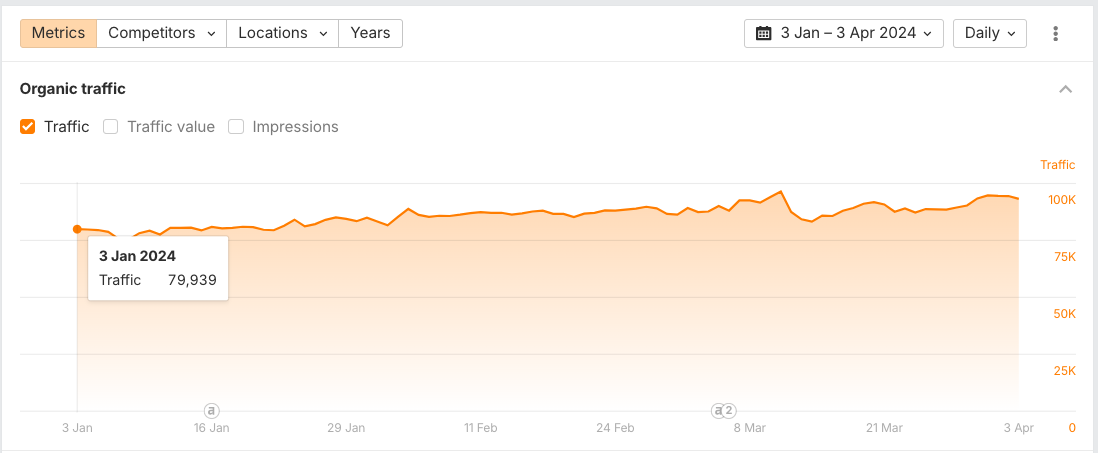**The focus was on:**
- Appearing in places where HR professionals already read and research.
- Driving relevant visitors, not just traffic.
- And supporting long-term organic growth.
**Strategy used:** Contextual Niche Edits
The campaign used eight contextual niche edits placed on existing HR related articles. Instead of publishing new guest posts, the links were added naturally inside the already published HR articles.
Each link was placed in the relevant paragraph where the HRMS product genuinely helped explain or support the topic.
**Results:** Based on 90 days of traffic data:
- Growth in referral visitors from HR-related websites.
- Pages moved to the top 5 pages.
- 2 pages position at #1.
- Increase in organic traffic by up to 32%.
## How Contextual Backlinks Are Earned
**Contextual backlinks are earned, not bought, by publishing content worth citing and putting it in front of writers, editors, and journalists who naturally reference it in their own work.** The placement happens through editorial choice. The acquisition path is what separates a contextual link from a sponsored or paid placement.
### How to Get Contextual Backlinks (Step by Step)
**Getting contextual backlinks means earning placements inside the body of relevant, published content on other sites, not in footers, sidebars, or author bios.** Here’s how to build them consistently.
- **Identify publishers in your niche with active editorial calendars.** Use Ahrefs Content Explorer or Google search operators (`site:[niche keyword] + "write for us"`) to find sites that publish regularly and accept guest contributions.
- **Create a linkable asset first.** You need something worth linking to: an original study, a free tool, a definitive guide, or a data visualization. Generic pages don’t earn contextual links; resource-worthy content does.
- **Pitch a specific angle, not a topic.** Editors reject topic pitches because they’re too broad. Pitch a precise angle: ‘I want to cover how B2B SaaS companies earn contextual backlinks from analyst reports, with three case examples.’ That specificity shows editorial value.
- **Place your link naturally in the body.** The link should appear in a sentence where your source page is the logical reference for a claim, statistic, or deeper explanation. Editors remove links that feel inserted rather than cited.
- **Follow up once, professionally.** Send one follow-up email 5 to 7 business days after the initial pitch. Publishers who don’t reply after two contacts aren’t a fit this cycle. Move to the next target rather than pushing harder.
All links are different by nature. Some carry immense ranking power, whereas some barely even work. There are various ways to earn contextual links. Let’s understand them.
**Common ways to earn contextual backlinks:**
- Create in-depth, link-worthy content (guides, studies, resource pages).
- Guest posting on the relevant websites.
- Link insertions into existing and relevant articles.
- Broken link replacement with better resources.
- Unlinked brand mentions.
- Digital PR.
- Resource pages inclusion.
### Homepage vs Inner Page Contextual Links
A common question: Should your contextual backlinks point to your homepage or to inner pages? The honest answer depends on what you’re trying to rank.
**When inner-page contextual links win:** Most commercial pages, service pages, product pages, category pages, and location pages should receive the majority of your contextual backlinks.
Google evaluates page-level relevance, so a contextual link from a SaaS publication to your specific service page passes more relevance signal than the same link to your homepage. Inner-page links also let you control anchor text precisely without over-optimizing your homepage’s anchor profile.
**When homepage contextual links matter:**
- **Brand authority building**: coverage on tier-1 publications (Forbes, TechCrunch, industry trade press) typically links to the homepage, and that’s correct. The placement is about your brand, not a specific page.
- **New domains with thin internal architecture**: if you only have 4-5 ranking pages, homepage links spread equity to all of them through internal linking.
- **Consolidation queries**: if your brand name or category-defining query needs to point at a brand hub, the homepage is the right target.
**Recommended distribution:** For an established site with multiple ranking pages, a healthy contextual backlink profile is roughly **70% inner-page, 30% homepage**. That mirrors how editorial coverage actually distributes when it’s earned naturally, and avoids the “all links to homepage” pattern that signals manipulation.
## The Contextual Link Building System
**The contextual link building system works in three steps.** Identify topically relevant, high-authority pages where your content fills a real gap; create or locate content on your site that editors on those pages would naturally cite; and pitch through editorial outreach rather than paid-link requests.
Each step filters out low-quality opportunities; only sites with real traffic, editorial standards, and topical overlap make it through to your outreach list.
Contextual links aren’t placed randomly; they’re earned through relevance and usefulness.
Contextual links are built in real life using clear, practical steps. Each method mentioned below follows a structured SOP and a sample outreach message.
### Natural Backlinks:
Natural link building means that a high-quality site links to you because your content adds value for their users. It supports the content and drive traffic to the linked site. These links have less risk, and Google values them.
#### Natural Backlinks SOP
#### Step 1: Plan your topic
The very first step is to plan your topic based on the subjects already being discussed. Find the topics people are already searching in blogs, guides, and other resources.
You can improve the explanation, update the content, and add clear examples to increase the chances that writers will discover and refer to your page.
#### Step 2: Add value
The second step is all about adding value to your content. You can add original examples, real-world explanations, simply explain the concept, and provide fresh angles and insights. If your content looks like every other article, it won’t naturally earn links.
#### Step 3: Structure your content for easy referencing
In the third step, you can organize your pages to make linking easier. To create a proper structure, use clear subheadings, break your content into paragraphs, and highlight key takeaways.
#### Step 4: Use Natural Link Wordings
Use the wording carefully, because contextual links always find wordings that match the surrounding content and can link to the relevant content reference. You should avoid keyword stuffing and promotional wording/anchors. Because the link should feel helpful and not forced. Good links always feel like a part of the explanation.
#### Step 5: Keep your content updated
Natural backlinks last as long as the content stays accurate, so keep your content up to date.
You can update outdated facts and refresh the examples used to improve the reader’s clarity.
### Niche Edits:
A [niche edit](https://outreachdesk.com/niche-edits/) is when you ask a website owner to add your link to the existing article and update the content. The articles should be highly relevant to your niche, and your anchor content should fit the topic, which helps readers and improves the article.
#### Niche Edit SOP
#### Step 1: Find the Right Article
The first step is to find the correct article. You should look for articles already ranking on Google and evaluate their content quality. If it fits these criteria, consider these pages trustworthy and more likely to pass value.
#### Step 2: Identify the Content Gap
The second step is to identify the content gaps by reading the article from the reader’s perspective. You should look for outdated information, missing explanations, or missing resources that genuinely improve the understanding.
A niche edit should solve a specific problem or meaningfully explain the topic; it shouldn’t exist purely for SEO. If the added link doesn’t strengthen the content or improve the user’s value, it isn’t the best option for niche editing.
#### Step 3: Validate Your Content
Before pitching a niche edit, evaluate your content to make sure it genuinely deserves placement. The linked page must directly support the surrounding context, provide deeper knowledge, or resolve the unanswered question in the article.
Make sure that your content is topically aligned, easy to understand, accurate, and up to date. Most importantly, it should improve the reader’s experience and not repeat what is already covered.
If your link doesn’t clearly strengthen the paragraph it’s in, don’t pitch it.
#### Step 4: Choose the Correct Placement
The placement of the links is important to consider. Make sure the link is placed in the main content, fits naturally within the content, and improves the reader’s understanding.
You should avoid forcing links into irrelevant sections or adding links just for keywords.
#### Step 5: Keep the Anchor Text Natural
The words you use for a link should sound natural and fit smoothly into the sentence. They should clearly tell the reader what the linked page is about.
Avoid using too many keywords or sales-focused words, and avoid repeating the same link text. If the sentence feels awkward because of the link, the anchor text isn’t right.
#### Step 6: Outreach the Right Way
When reaching out, your pitch should be precise, polite, and personal. Clearly explain why the link fits the content and how it helps readers better understand the topic, not just its SEO benefits.
After sending the message, follow up only once with a polite reminder. Avoid sounding urgent or pushy, as pressure reduces the chances of approval.
**Here’s an example outreach message:**
Hi [Name],
I really enjoyed your article on SEO Trends. The section on the future outlook was especially helpful.
We recently published a short, updated guide on how AI is changing keyword research. It could add extra clarity for readers in that section. Would you be open to taking a look?
Thanks for your time, [Your Name]
#### **Safety & Risk Checks**
**Avoid this at all costs:**
- Websites that openly sell manipulative or spammy links.
- Avoid pages that aren’t related to your niche.
- Forced inserts that don’t add any value.
- Avoid over-optimized anchor text.
**Green Signals:**
- It shows editorial context.
- The topic aligns with the content.
- It has natural placement.
- It should have reader-first intent.
### Guest Posts:
[Guest posting](https://outreachdesk.com/guest-posts/) means writing an article for another website in your niche. In return, you usually get a link back to your website. This helps the website gain visibility and a relevant contextual backlink, benefiting both parties.
#### Guest Posting SOP
#### Step 1: Identify The Right Website
When writing a guest post, choose websites that are closely related to your niche or industry. Focus on writing helpful, original content that fits the website naturally.
Avoid websites that publish any kind of content without quality checks, have a “write for us” page filled with paid or low-quality posts, or clearly exist only to sell guest posts.
#### Step 2: Selection of the Topic
You should choose topics that the website’s audience already cares about and that naturally fit with the website’s existing content. Your links make sense in the article and feel like a helpful reference, not something added by forced placement.
#### Step 3: Content Creation
Focus on creating fresh, up-to-date, and easy-to-follow content. Use clear examples and practice tips that readers can apply. Avoid using confusing terms and jargon.
#### Step 4: Placement of the Link
The placement of the links should make sense to readers and clarify the terms used in the content more clearly.
#### Step 5: Outreach Message
When reaching out, explain how your concept will be helpful to their readers and discuss the idea and topic; don’t just ask for the link. Make your message personal instead of using the same template for everyone, focus on the content quality, relevance, and reader value.
**Here’s an example outreach message you can use in your pitch**
Hi [Name],
I’d love to write a helpful article for your audience on The Future of Link Building in the AI Era. The idea focuses on practical changes and what marketers should prepare for next.
If it fits, I can also reference our content planning guide, which adds value to the topic. Let me know what you think.
Thank you for your time, [Your Name]
#### Step 6: Editorial Approval and Final Checks
After the editor approves and publishes the article, check that it appears on the agreed page. Make sure the link fits naturally and that the content quality hasn’t been reduced or negatively altered.
#### Quality and Risk Prevention
#### What to check before outreach
- Does the site publish real, helpful articles regularly?
- Is the content written for readers, and not just for search engines?
- Are the outgoing links relevant?
#### What to avoid
- Low-quality guest posts or link farm websites
- Paid link disguised as guest posts.
- Websites that accept content from unrelated niches.
### Resource Page Link Building:
[Resource page link building](https://outreachdesk.com/resource-page-link-building/) means getting your content added to a webpage that shares useful resources for a specific topic or industry. These Resource pages link to high-quality content like articles, tools, guides, blogs, videos, and podcasts.
When your content is included on the relevant resource pages, it helps readers discover it, drives referral traffic, and signals to search engines that your content is trustworthy.
#### Qualification Criteria
- Make sure the page is active and updated regularly.
- Check that the page’s links are carefully selected and relevant.
- Confirm that your content fits the resource list and adds value.
#### Resource Pages SOP
#### Step 1: Find Relevant Resource Pages
You can find your industry-specific resource pages using phrases like:
- Helpful resources for [topic].
- [Industry] resources.
- Useful tools for [problem]
Only choose pages where your content clearly matches the topic and fits naturally with the existing list.
#### Step 2: Review the Resource Pages Carefully
Before reaching out, check the types of content the page usually links to, such as guides, tools, and studies. Examine the quality of those resources and identify any gaps where your content adds value.
If your content doesn’t clearly improve the list, don’t pitch it.
#### Step 3: Validate Your Content’s Value
Check your content by asking these simple questions:
- Does it answer the reader’s questions?
- Is it up to date, correct, and easy to understand?
- Does it add something missing from the current resource list?
If the answer to these questions is yes, you can move forward.
#### Step 4: Outreach with Reader Value First
When you reach out, mention the specific resource pages and explain how your content fits there and help their readers. Present your content as a helpful option, not a demand for a link, and let the editor decide if it fits.
**Here’s an example outreach you can use.**
Hi [Name],
I came across your resource page listing Top Digital Marketing Tools and found it very useful.
We’ve built a free Headline Analyzer to help marketers write clearer, more engaging headlines. It could be a helpful addition for your readers if you think it fits.
Thanks for your time, [Your Name]
#### Step 5: Follow up
If you don’t get a reply, send a polite follow-up after 5-7 days. Keep the message short and respectful. Don’t push or pressure. If there is still no response, move on.
### Digital PR:
This is the method of creating genuine newsworthy content, such as studies or surveys, and sharing it with journalists or media websites. If they find it useful, they mention it and link to it in their article.
When done correctly, [digital PR](https://outreachdesk.com/digital-pr-service/) helps you earn real editorial links based on value, not requests.
#### Digital PR SOP
#### Step 1: Create a PR-worthy Asset
Create content that’s unique, such as original research, data studies, surveys with clear insights, industry reports, expert opinions, or content linked to current events.
Use simple visuals, like charts or explainer videos, to make the information easy to understand and share.
#### Step 2: Define the Right Pitch Angle
Your pitch should explain “why” a journalist would care about your content.
Here are the effective pitching angles that include:
- New or surprising findings,
- Current trends, updates, business topics,
- Industry impact, and
- A simple explanation of the complex topics.
#### Step 3: Identify Relevant Journalists and Publications
Your focus should be on quality, not quantity. Look for journalists and publications that regularly cover your industry or topic and publish expert editorial content. Choose outlets where it truly fits and adds value.
#### Step 4: Outreach Execution
When pitching, reference their article to show relevance. Share your key insights, data, or findings instead of just asking for a link. Clearly explain how your content helps their readers and keep your message short and helpful.
Here is the simple message you can use:
Hi [Name],
We recently ran a study and found that 75% of remote workers say they miss office coffee.
We have the complete data and expert commentary available if it’s useful for your coverage on remote work trends.
Thank you for your time, [Your Name]
#### Step 5: Follow up
Send only one polite follow-up after 5–7 days. Keep it friendly and relaxed so it doesn’t feel forced. If there is no reply after that, stop following up and respect the editor’s decision.
#### Step 6: Editorial Confirmation and Link Validation
After approval, make sure the link is added naturally as a reference. Check that it aligns with the surrounding content and reads like a genuine editorial mention, not a promotion.
#### Editorial Quality Signals
A digital PR link is considered editorial when:
- The journalist adds the link voluntarily.
- A link supports any claim, statistic, or explanation.
- It is placed inside the main content.
- A link isn’t framed as an advertisement or promotion.
**Things to Avoid:**
- The links are labeled as sponsored or paid.
- The anchor text is forced, keyword-stuffed, or over-optimized.
- Links that are placed outside the editorial context, such as author bios, footers, and sidebars.
### Broken Link Replacement:
Broken link replacement is the process of finding a relevant website that links to a page that no longer exists, and asking the web owner to replace the broken link with your replacement content. This is one of the great methods for gaining contextual links.
Your replacement content should cover the same topic, be more up to date, offer better information, and be easy for readers to understand.
#### Broken Link SOP
#### Step 1: Find Broken Links on the Relevant Pages
Identify the pages in your niche linked to the resources that no longer exist (404 errors).
Check resource pages, guides, blogs, or articles in your industry, and use link-checking tools like Ahrefs or SEMrush to [identify broken outbound links](https://outreachdesk.com/broken-link-building/).
Focus on pages that are relevant to your topic, are indexed by search engines, attract traffic, and are actively maintained.
#### Step 2: Analyze the Original Link’s Intent
Try to understand why the broken link was added in the first place. Look at the topic it covered, the problem it helped solve, and where it appeared in the content, such as an example or reference.
Broken link replacement works best when your content aligns with the broken link’s intent, not just the keyword.
#### Step 3: Prepare or Match Replacement Content
Create or use the content that genuinely replaces the broken resource. The replacement content should be on the same topic, include updated information, be more accurate and easier to understand, and help readers in the same context as the previous link.
#### Step 4: Outreach
The very first thing to do is to contact the site owner or the editor and point out the broken link. Mention where the broken link appears, explain how it affects the readers, and suggest your content as a possible replacement without sounding pushy.
**Here’s a simple outreach message:**
Hi [Name],
I noticed that the link to the 2020 Social Media Trends report on your resource page is no longer working.
We recently published an updated 2026 Social Media Trends report that could be a useful replacement if you’d like to review it.
Thanks for your time, [Your Name]
#### Step 5: Editorial Confirmation and Link Review
Once you receive the editor’s approval, verify the final placement. Check that the link is live, if it points to the correct page, if it fits naturally within the sentence, and check that the surrounding content is still relevant.
A live link alone isn’t enough; the relevance and context determine its real long-term value.
Podcast and Interview Pipeline:
A podcast is a show where a host talks about a topic and invites guests to share their ideas and experiences. An interview is when a host or editor asks you questions to highlight your knowledge and opinions.
When you appear on a podcast or in an interview, you’re introduced to a new audience. Hosts usually add a link to your website or profile in the show notes or description. These links are natural and editorial, which makes them trustworthy.
It matters because it shows you as an expert, drives referral traffic, and builds brand trust and discoverability.
#### Podcast Outreach SOP
#### Step 1: Identify Relevant Podcast and Interview Platforms
Find platforms that genuinely fit your expertise and experience. You can search on Google, Spotify, Apple Podcast, and even on YouTube.
You can use:
- “[Your niche] podcast”
- “[Your industry] expert interview”
Choose platforms that are relevant to your topic, publish episodes regularly, and feature real experts, not random promotions.
#### Step 2: Prepare Your Value Proposition (Not a pitch)
Be clear about what listeners will learn from you. Before reaching out, define 2-3 unique insights, a real experience, a case study, or a lesson, and the topic that complements previous episodes.
This is essential because the podcast host chooses guests based on their value to listeners, not on the backlink opportunity.
#### Step 3: Outreach with Insight-first Message
Reach out by showing relevance and your expertise, and not by selling yourself. The best practice is to keep the message personalized, lead with the listener’s value, and keep it short and respectful.
Focus on the value you can share, and avoid asking for backlinks, promoting services, or sending the same message to everyone.
**Here’s a simple reach-out message:**
Hi [Name],
I really enjoyed your episode on off-page SEO trends.
I work closely with brands on link building and digital PR, and I’d love to share some real-world insights on how off-page SEO is changing and what’s actually working today. I think it could be valuable for your listeners.
Let me know if this sounds interesting.
Thank you for your time, [Your Name]
#### Step 4: Deliver Real Value During the Podcast or Interview
Earn the link naturally by sharing your expertise. During your appearance, answer all the questions clearly and honestly, share real and practical examples, and refer to your work only when it supports the topic.
This matters because hosts are more likely to link to guests who educate their listeners and don’t promote themselves.
#### Step 5: Link Placements and Show Notes Verification
After your podcast or interview, verify that the placement of the link appears natural and correct. It should appear in the show notes or description.
Confirm that your name and brand are mentioned, that the link points to the correct page, and that the content explains who you’re rather than just a raw link.
The best link types can be: about pages, resource pages, and author profiles.
#### Step 6: Track and Repurpose
Turn your interview or podcast into long-term visibility by sharing the episode on social media, adding clips or quotes for future outreach, and building a relationship with the host for repeat invites.
### Linkable Assets:
Linkable assets are helpful pieces of content that people/website editors want to link to. These include templates, tools, checklists, and guides. They are high-quality, original, and help users solve real problems. Interactive tools often earn links or are shared by business people as helpful tools.
#### Asset Promotion SOP
#### Step 1: Identify a Link-Friendly Topic
Choose topics that people often refer to and share, not just read. Good topics include how-to problems, comparisons, and step-by-step processes.
#### Step 2: Choose the Right Asset Problem
Match the content format to the problem.
- Repetitive tasks – Checklists or templates
- Calculation or validation – Tools
- Learning a topic – Guides
- Finding or comparing options – Lists.
#### Step 3: Create High-Quality Original Content
Write in clear and simple language that non-technical readers can understand. Add examples, steps, or visuals to explain better. Make sure the content is more helpful or updated than what already exists, and avoids fluff and self-promotion.
#### Step 4: Optimize for Easy Linking
Make your content easy for others to link to. Use Clear headings, simple sections, and clean URLs that explain what the page is about. Avoid pushy sales messages in the main content. Make sure the page loads fast and works smoothly, especially if it’s a tool.
#### Step 5: Share Where Your Audience Already Is
Share your assets where your audience already spends time, such as blogs, communities, newsletters, social media, and industry discussions. The goal is to get people to notice and use your content, not to force them to link to it.
#### Step 6: Monitor and Improve
Keep an eye on how your asset is performing. If the information becomes outdated or can be improved, update it to keep it valuable and relevant to the topic.
## Contextual Link Quality & Safety Standards
**A high-quality contextual link sits in editorial content on a site with real organic traffic.** Topical relevance to the target page, and editorial standards that screen out sponsored or AI-generated submissions. The safety standards below are the ones Google’s spam systems already evaluate when assessing whether your backlink profile looks editorial or manipulated.
When it comes to securing contextual links, small details make a huge difference. In this section, you can learn how to judge whether a contextual link is safe and valuable.
### Natural Anchor Placement
The placement of the anchor text should be in a way that it doesn’t look forced. It should naturally convey the content’s meaning.
**Here is an example of good anchor text:**
**And this one is a bad anchor text example:**
It is related to Facebook Ads, but the anchor text provides no context and looks spammy to both users and search engines.
### Contextual Surrounding Sentences
The content flows when the surrounding texts are relevant. Therefore, you should use descriptive anchors instead of generic text and make sure that the link is placed where it adds genuine value.
### Page Indexing & Traffic Validation
A healthy linking page appears in search results (because it is indexed), attracts real visitors and engagement, and looks like it was written for the reader, not for the search engine. It checks whether the page linked to you is visible and in use. Links from hidden or inactive pages offer little trust or value.
### Author & Domain Credibility
Author and domain credibility evaluate who published the content. Links from trusted authors and focused websites carry more credibility.
You can determine this by checking whether the page provides strong credibility signals, such as a real author name or brand, a clear topic, and other high-quality content on the website.
A link is considered credible when it comes from a website and an author who actually understands the topic. For example, a healthcare blog that regularly shares wellness tips and links to your article on basic preventive care.
The site focuses on patient education, the topics match, and it feels trustworthy because it intends to help readers better understand their health.
## Quality Checklist
**Use this quality checklist on every contextual link before you consider the placement a success.** Each item maps to a signal Google’s spam systems already weight when evaluating link profiles. Missing two or more items means the link is worth less than the placement effort.
A quality checklist focuses on relevance and placement in high-quality and valuable content that matches your niche and provides value to the visitor. You can use this table to evaluate prospects. If two or more box checks fail, you should reject that site.
| Checklist Notes | What to Check | Passing Criteria | Failing Criteria |
| --- | --- | --- | --- |
| Real traffic | Check the traffic using tools like Ahrefs or SEMrush | 500+ monthly organic traffic | 0 traffic or fake spikes (indicates black-hat tactics) |
| Domain Rating quality | Evaluate the DR along with the link profile | DR supported by clean, natural backlinks | Spammy DR or unnatural link patterns |
| Surrounding text relevance | Read 1–2 paragraphs around the link | Content is relevant to your topic | Irrelevant content or forced placement |
| Natural anchor text | Check whether the anchor text reads naturally | Descriptive and readable anchor text | Keyword stuffing or irrelevant anchor text |
| Page indexing | Search Google using: site:URL | The page appears in search results (indexed) | The page doesn’t appear (not indexed) |
| Real author | Check for an author bio or About page | Author is identifiable with a real history | No author, fake profile, or empty bio (note: not all sites show authors) |
| Organic content quality | Review content quality and uniqueness | Authentic, original, and well-structured content | Thin or low-quality AI-generated content |
| Spam score | Check spam score using Moz | Below 10% | Above 10% |
If one fails, you can proceed with caution. Whereas, if two fail, you should reject the link placement.
## Common Risks & Penalty Triggers
**The common contextual link risks are over-optimized anchor text.** Unnatural placement patterns, links from sites with thin or AI-generated content, and rapid link velocity that doesn’t match any campaign you ran. Each of these triggers SpamBrain pattern detection. The list below is what to audit against your current backlink profile.
Most link penalties are assigned when the links look paid, forced, or irrelevant. However, if the link helps readers and makes sense, it is usually safe.
Here are some of the risks that you need to avoid:
### Over-Optimized Anchor Text
Over-optimized anchor text can be a significant risk because using the same keyword often can make your link profile look spammy or manipulative. Here are some safe rules you can use.
**Safe Rules:**
- Use descriptive, natural, and human-readable anchor text.
- Surrounding text should strengthen the keyword.
- Use a mix of branded and perfect-match.
#### Here’s an example of a normal anchor and an over-optimized anchor.
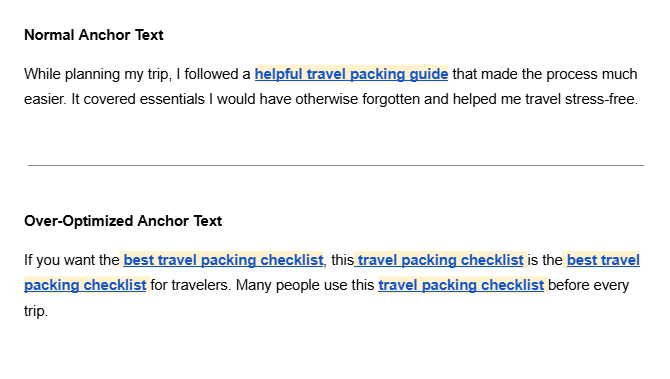As you can see in the image above, the over-optimized anchors are stuffed in the article, and it looks spammy. In comparison, a normal anchor gives a clear idea.
### Sponsored Insertions
Sponsored insertions are the practice of paying a site owner to place a link to your website within their existing content as a contextual backlink. You can use the rel=”nofollow” or rel=” sponsored” tag and disclose it to the search engine to avoid high-risk activity.
These tags might not pass the value, but they benefit in terms of referral traffic.
**Here are some warning signals that you should be careful about:**
- There are unrelated outbound links.
- You’re offered pricing pages for the links.
- Agencies openly provide placements for links.
### Bad Neighborhood Risks
Bad neighborhood link building means associating with low-quality, spammy sites that risk Google penalties and harm your SEO. Search engines don’t trust these sites. Being linked from them can harm your site’s credibility and affect your rankings rather than help, and therefore, it is considered risky.
**You should avoid the sites that are linking to:**
- Casinos
- PBNs
- Hacked domains
- Link farms
- Spun content blogs
- Adult sites
### Link stuffing inside the Article
Link stuffing is adding too many links in a single piece of content, even if they don’t add any value to readers.
Too many links can make the content feel forced or spammy. Search engines may see it as manipulation, and readers can lose trust because the content becomes hard to read and less valuable.
Here is an example for better understanding link stuffing.
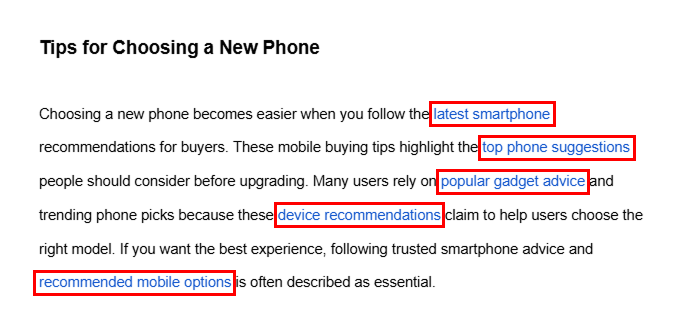
### Velocity Risks
Velocity risk usually means building backlinks in an unnatural pattern. There are some characteristics of velocity risk such as a low-quality site suddenly gets hundreds of links, link growth doesn’t match content publishing, PR activity or brand mentions.
Search engines expects natural growth. But when a site acquires links too quickly, it can lead to penalties.
## Should You Buy Contextual Links? The Honest Risk Analysis
**Buying contextual links carries a real penalty risk because Google classifies link exchanges and paid placements without proper disclosure as a direct violation of its spam policies.** The risk-reward math depends on whether the placement looks editorial enough to survive SpamBrain and whether the publisher actually has the traffic to justify the price.
“Buy contextual links” is one of the most-searched questions in this space. And the answer matters because the difference between a paid contextual link that ranks and one that triggers a manual action comes down to a few specific signals Google watches.
### What “buying” actually means
Three different transactions all get called “buying contextual links,” and they carry different risk profiles:
- **Marketplace links**, paying a platform for placement on a list of sites with pre-sold link slots. Most marketplace sites are PBNs or low-traffic sites that have monetized link sales. **Highest risk.**
- **Direct payment to a publisher**, paying a real publication for editorial coverage, framed as “sponsored content” or “advertorial” with proper disclosure. **Medium risk** when it’s disclosed correctly; high risk when sponsored content is hidden as editorial.
- **Agency-mediated outreach where you compensate labor, not the link slot**, paying for the work of identifying prospects, developing content, and running the placement through normal editorial review. **Lowest risk**, this is what most professional link building agencies do.
### What Google’s spam team actually flags
SpamBrain doesn’t have a single “is this paid?” signal. Here’s what its filters watch:
- **Clusters of links from a small set of sellers**, when 200 sites all feature the same 50 advertisers’ links in the same positions, that’s a marketplace fingerprint Google’s seen many times before.
- **Anchor text patterns inconsistent with editorial writing**, exact-match commercial keywords on news-style sites trip filters.
- **Velocity outside what natural editorial produces**, 10 placements in a week from one buyer, all on similar-DR sites.
Individual paid placements that read like genuine editorial rarely get flagged. The fingerprint comes from scale and pattern, not single transactions.
### Outreach Desk’s position
We don’t run paid-placement campaigns. Every link we secure goes through real editorial review at the publishing site, meaning the publisher decides whether to accept the content, sometimes asks for revisions, and would publish similar content from any qualified contributor.
The economic exchange covers our outreach time and content development, not the link slot itself. That’s the line that keeps placements algorithm-safe.
If you’re considering buying contextual links from marketplaces, our deeper guide on [buying backlinks safely](https://outreachdesk.com/buy-backlinks/) walks through the specific signals to check before paying for any placement.
## Understand Google Policies
**Google’s policies on contextual links treat them the same as any other backlink.** They’re evaluated on whether they were earned through editorial choice or acquired through payment, exchange, or manipulation. Editorial links pass full equity. Paid links without proper disclosure trigger either silent devaluation or a manual penalty.
Now, let’s understand some [Google policies](https://developers.google.com/search/docs/essentials/spam-policies). It will help you identify what Google accepts and what it doesn’t. Google policies are simple: links must be natural, relevant, and provide value to users. If a link is helpful, it is usually safe.
**What Google considers good:**
- Editorial links inside the content.
- Natural mentions from the relevant websites.
- Links added because your content solved a problem.
**What Google doesn’t accept:**
- Link placement is done to manipulate the rankings.
- Unnatural anchor text patterns.
- Paid link placement without editorial judgment.
- Link schemes.
## How to Audit Your Backlinks Profile
**You audit your backlink profile by exporting every referring domain from Search Console plus a third-party tool.** Then sorting by relevance, editorial quality, and anchor text patterns. Search Console shows what Google sees. Third-party tools fill in the historical context that reveals where your link profile is at risk.
To avoid risks such as over-optimized anchors, link-stuffed in the article, and bad neighbourhoods, it is important to conduct a backlink audit.
It is simply a health check of all the websites that link to you. You can know which links are helping your business and which links can hurt your trust.
### Step 1: Exporting Backlinks Data
Exporting backlinks data means downloading a list of all the websites that link to your site. It matters because you can’t judge the quality of your links unless you see them all in one place.
To do this, you can use tools like Google Search Console (free) and paid tools such as Ahrefs and SEMrush. These tools help you identify the websites linking to you, the pages where the links appear, and the text used for the links.
### Step 2: Identifying Risky Patterns
Every link is different. Some links may look unnatural or manipulative, and Google may ignore them or trust them less. A risk signal doesn’t automatically mean a penalty. It simply means the link doesn’t look genuine.
Google says links should be earned and not forced. If a link exists solely because of an agreement or payment and isn’t clearly disclosed, Google may treat it as unnatural.
### Step 3: Disavow Links only when:
Disavow links that are spammy, fake, or low-quality because they can harm your website and may lead to penalties from Google.
- Notice spam patterns.
- Injection of hacked links.
- Attracts negative SEO.
#### Don’t Disavow when:
Most websites don’t need to disavow links. Google has already ignored many low-quality and spammy links in its own way.
- Links with a low Domain Rating.
- Link is a scap and harmless.
- Generated using automation.
## KPIs, Tracking and ROI (What to Measure)
**Track contextual link building ROI through referring domain growth from in-niche publishers.** Organic traffic to your target pages, and movement in keyword positions specifically tied to those pages. The metrics below filter out the vanity numbers that look good in reports but don’t tell you whether the links moved the business.
A KPI (Key Performance Indicator) is the metric you track to see whether your link-building work is successful. These usually include new websites linking to you. Traffic coming from those links, and changes in keyword rankings.
Tracking means using tools like Google Search Console and Ahrefs/SEMrush to check these numbers regularly. ROI (Return on Investment) Shows Whether the results you get in terms of Traffic, Leads, or Sales are worth more than the Money and efforts you spent.
### Primary Performance Metrics
- Contextual links build
- Referral visits from those links
- Target keyword ranking
- Domain traffic growth
- Conversion rate for referral visitors
### How to Measure ROI
To measure ROI, you need these simple logics
- Did my keyword rankings improve?
- Did my website traffic improve?
- Did visitors coming from referral links convert into leads or sales?
- Was the cost worth it?
### Reporting Template
The Weekly Tracking Table is for the execution team. It mostly tracks the follow-ups and links earned.
| KPIs | This Week | Last Week | Change % | Notes |
| --- | --- | --- | --- | --- |
| Contextual Links Built | | | | |
| Referral Visitors | | | | |
| Keyword Ranking | | | | |
| Conversion Rate | | | | |
| Follow-up (Sent) | | | | |
| Avg. DR | | | | |
To evaluate the change in %, use the given formula:
Change% = (this week – last week)/ last week x 100
Let’s look at the example:
**Example 1:** contextual links earned (increase)
- Last week = 4 links
- This week = 6 links
**According to the formula:**
- Change% = This week – Last week / Last week X 100
- = 6-4/4 X 100 = 0.5 X100
- Result = 50% increase
**Example 2:** Referral Visitors (decreased)
- Last week = 500 visitors
- This week = 400 visitors
**According to the formula:**
- Change% = This week – Last week / Last week X 100
- = 400-500/500 X 100 = -0.2 X 100
- Result = -20% decrease
The Monthly Tracking Table should be for the management/clients. It tracks whether the investments made are actually making business money.
| Metrics | Monthly Total | Cost | ROI Signals | Action |
| --- | --- | --- | --- | --- |
| Contextual Links Earned | | | | |
| Referral Visitors | | | | |
| Keywords Ranks | | | | |
| Growth in Organic Traffic | | | | |
| Conversions from referral traffic | | | | |
| Cost Per Link | | | | |
## Tools and Resources Used in this Playbook
**The tools that make contextual link building scalable in 2026 fall into four categories: prospecting, outreach, content production, and link monitoring.** The list below covers the specific tools used in this playbook plus the use case each one solves.
As a practitioner and an author, here are the tools I personally use to execute contextual link building effectively.
[Ahrefs:](http://ahrefs.com) For Competitors’ backlink gaps.
[SEMrush:](http://semrush.com/) For backlink analysis and traffic Check. [AnswerThePublic](https://answerthepublic.com/): To discover topics and questions users search for. [Google Sheets:](https://workspace.google.com/products/sheets/) For tracking links and the outreach process. [Canva:](https://www.canva.com/) To create charts and simple visuals.
[Buzzsumo:](https://buzzsumo.com/) For finding journalists and popular content. [Grammarly:](https://app.grammarly.com/) To improve content clarity and grammar. [Internet Archive (Wayback Machine):](https://archive.org/) To check old pages and broken link history.
## Conclusion
By following this guide, you can now understand how contextual backlinks work, why some links are more trusted than others, and how to build them safely and practically.
This playbook showed you how to build links that fit naturally in the relevant content and what the risks are to avoid. You don’t need to apply everything at once; even using a few principles can help lead to steady improvement.
### Get Clear Direction Before You Build Links
If you’re unsure which link-building efforts are worth your time, a short strategy call can help. We’ll review what you’re doing now and explain what realistically fits your goals.
[Request a Strategy Call](/contact-us/)
### Should I buy contextual links?
A short version: it depends on what “buying” means. Marketplace links and PBN-sold placements are high-risk and frequently devalued by Google’s spam systems.
Paying a real publication for editorial-reviewed placements with proper disclosure (often called “sponsored content”) is safe in practice but should stay a small minority of your link profile. Paying an agency for outreach labor while the publisher decides editorially whether to accept the placement, the most common professional model, is algorithm-safe when placements pass real editorial review.
### Are homepage contextual links better than inner page links?
Inner page contextual links usually win for ranking specific commercial pages because Google evaluates page-level relevance. Homepage contextual links matter most for brand authority (tier-1 publication coverage), new domains with limited ranking pages, or queries where the homepage is the correct target.
A healthy contextual backlink profile typically distributes ~70% to inner pages, ~30% to homepage, mirroring how natural editorial coverage spreads.
### Are contextual links better than directory links?
Yes, Contextual links usually carry stronger relevance signals than directory links; as a result, they often drive better results.
Contextual links are placed within the article/content and are supported by related text. This makes them more meaningful; search engines trust contextual links more because they look like natural editorial references.
### Does a nofollow contextual link help?
Yes, even though they don’t pass link equity directly, they help build trust, improve brand visibility, send referral traffic, and keep the content natural and relevant to the topic.
The profile with only dofollow links may look manipulative; so maintaining a healthy mix of link types is important.
### How many contextual links do I need?
There are no fixed numbers; it depends on factors such as whether the anchor text sounds natural, the strength of competitors, your current backlink profile, content quality, and the relevance and depth of the topic.
### Is link insertion safe?
Yes, Link insertions are safe when done correctly. The anchor text should sound natural; the links should be placed within the relevant content; the page should have real traffic; and the site shouldn’t openly sell links.
### Are contextual backlinks considered white hat?
Yes, Contextual backlinks are considered white hat when they add real value to the content, help the reader better understand the topic, are placed naturally, follow Google’s guidelines, and aren’t manipulated or forced.
---
---
title: "YouTube Backlinks: How They Work and When They Matter"
url: "https://outreachdesk.com/youtube-backlinks/"
lang: "en-US"
type: "post"
description: "The term “YouTube backlinks” is often misunderstood because it refers to two different types of links. One talks about websites linking to YouTube videos. While the other talks about the links placed inside YouTube videos or channels that point to"
last_modified: "2026-05-18T11:54:19+00:00"
categories: [Link Building]
---
# YouTube Backlinks: How They Work and When They Matter
The term “YouTube backlinks” is often misunderstood because it refers to two different types of links. One talks about **websites linking to YouTube videos**. While the other talks about the **links placed inside YouTube videos or channels that point to a website**.
Both are correct, but they do not work the same way or produce the same results. Confusing them often leads to false expectations about rankings or missed opportunities for traffic and visibility.
### Key Takeaways:
- YouTube links do not directly boost website rankings, but they can help improve relevant traffic.
- Links from YouTube to the website are nofollow; therefore, they do not directly improve search engine ranking.
- Backlinks from websites to YouTube videos help in discovery and visibility, but they are not guaranteed to rank.
- Website links don’t directly boost ranking, but help the right people find your videos.
- Relevant websites linked to YouTube say that the video is valuable and trustworthy.
- YouTube links attract high-intent referral traffic, which supports engagement, trust, and brand awareness.
## What Are YouTube Backlinks
A YouTube backlink **is a link that takes people from one page to another.** If a website links to your YouTube video, that’s one kind, and if you link from YouTube to your website, that’s another kind.
A [backlink](https://outreachdesk.com/what-are-backlinks/) does not guarantee trust, rankings, or value. It simply means one platform references content on another platform. What matters is how search engines treat that link and what users do after clicking it.
To understand the value of YouTube backlinks, you first need to know how Google sees links.
### How Google Treats Links
#### Dofollow Link
A dofollow link is a normal link that can pass [link equity](https://outreachdesk.com/link-equity/). Search engines can crawl it (follow it) and consider it as a ranking signal. Most links you see on blogs, articles, and websites are dofollow by default.
#### Nofollow Link
A nofollow link signals to search engines that the link should not be used as a ranking signal.
Google now officially treats nofollow links as hints, rather than strong ranking signals. This means Google may notice them, but they do not reliably pass authority.
This is important to know because YouTube uses nofollow on external links.
## Backlinks From Website To Your YouTube Videos
When a website links to your YouTube video, it is using the video as a reference for its content. The link points directly to the video, so the benefit applies to it.
Website links to YouTube videos mainly help with discovery. It helps search engines to find and understand your video more easily while supporting your broader [SCO marketing](https://outreachdesk.com/sco-marketing/) efforts across multiple platforms. They also bring viewers from other platforms who are already interested in the topic.
When these viewers watch for longer and interact with the video, YouTube gets stronger signals that the video aligns with the user’s search query. This can improve visibility on YouTube over time.
These links do not guarantee rankings, but they help in understanding, rather than control.
**Now, let’s look at the simple example to understand it more clearly.**
Imagine you created a YouTube video titled **“Tour of Paris Streets”** A travel blog publishes an article on **“10 Things You Must Do on Your First Visit to Paris”.**
While writing an article, they decided to add a real video to make the page more helpful and engaging. So they embedded your video and wrote,” If you want to see what these streets actually look like, here is a short tour of Paris.
This will help your video because people who like travel content will watch and engage with the video, and it also tells YouTube that the video is genuinely helpful for the topic.
### Video Links vs Channel Links
Links pointing to individual videos work better than links pointing to a channel homepage.
A video focuses on a single, clear topic, making it easier for websites and search engines to understand why the link exists and improve topical relevance.
Channel links are primarily useful for brand or creator mentions. They help with credibility but are less useful for topic-based discovery.
## Links From YouTube to Your Website
YouTube allows creators to place external links in video descriptions, channels’ “About” sections, pinned comments, and, for eligible channels, cards and end screens.
These placements are designed to help viewers find related resources.
**To better understand this concept, let’s look at a simple example.**
Suppose you created a guide called **“How to Manifest Your Dreams”**. A YouTube creator comes across your guide and decides to make a video on the same topic to help their viewers better understand the concept.
In the video description, the creator adds, “**For a detailed step-by-step guide, check this resource”** That link points to your website. Viewers who want detailed information will click your guide and read it.
This helps in two ways: you get traffic from YouTube who are already interested in your topic, and more people become aware of your brand and content.
### How Google Treats YouTube Links
All external links placed inside YouTube are nofollow. This means they do not pass traditional ranking authority.
Because of this, YouTube links should not be treated as shortcuts to improving SEO rankings.
### Why Nofollow YouTube Links Still Matter
Even though YouTube links are nofollow, they still provide real value.
With over [2.7 billion monthly users](https://www.forbes.com/sites/petersuciu/2025/02/11/youtube-at-20--billions-of-hours-of-content-viewed-are-now-daily/), YouTube is more than a video platform. People use it for various purposes, such as searching for information, tutorials, and solutions when viewers click a link from a video. They arrive with interest and context, not by accident.
This makes YouTube links effective for referral traffic. Viewers already trust your content, so they are more likely to explore your website and engage with it.
Over time, this can also support brand recognition, because when users repeatedly see your website linked from helpful videos, they begin to connect your brand with that topic.
While these links do not directly affect ranking, they can still lead to indirect benefits. People who find value on your site may later reference or link to it from their own websites.
## Why YouTube Backlinks Matter
YouTube backlinks play an important role in how videos are discovered and recognized across the web, not just on YouTube. They support steady growth when used naturally.
This impact can show up in three clear ways, which we’ll break down below.
### Visibility
When other websites link to your videos, the content shows up in more places beyond YouTube. Search engines can also find and understand your videos more easily, and users can find and watch them through blogs and articles they already follow.
This increases visibility without relying only on YouTube’s internal search or recommendations.
### Trust
When other websites reference your video, it shows that the content is valuable and can be cited. Repeated references help users see the content as more reliable and trustworthy.
This trust does not drive rankings, but it helps people feel confident clicking, watching, and sharing your videos.
### Long-Term Growth
Website links can send viewers who are already interested in your topic. These viewers often watch longer and are likely to engage because they come with context.
When more people share your videos, others are more likely to find and refer them. This helps in brand recognition and maintaining traffic beyond YouTube alone.
## How to Earn Backlinks for Your YouTube Videos
Uploading a video is only the starting point. If you want more visibility and consistent growth, other websites need a reason to reference or share your video. That usually happens when your content is helpful, easy to understand, and clearly relevant to a specific topic.
Here’s how you can earn backlinks to your YouTube videos step by step
### Step 1: Create Videos That Are Worth Referencing
Backlinks are earned through quality content and not by chance. Websites only link to videos that help their audience. When your video solves a problem or explains a topic better than text alone, people naturally want to reference it.
You should focus on one topic per video. Keep the explanation clear and practical. Try to avoid covering too many ideas in a single video.
**Videos that earn backlinks often:**
- Answer the common questions clearly
- Explain a process step by step
- Offer practical tips or examples
- Have clear audio and visuals
When people find your video helpful, sharing becomes natural.
### Step 2: Build a Trustworthy Channel Profile
Many website owners check the YouTube channel before linking to a video. They want to know who created the content and whether the source looks reliable and professional.
**A strong channel profile:**
- It indicates a clear niche, so people understand your focus
- It uses consistent branding, which signals authenticity
- Explains what your videos offer and who they help
**To improve your channel profile:**
- Choose a channel name related to your topic
- Use the same logo and style across your channel, website, and social profiles
- Write a simple description that explains what your channel covers
A well-organized channel builds confidence, and confident sources are more likely to be a reference.
### Step 3: Create Videos That Websites Can Embed
Some websites embed videos directly into their articles to make them more engaging and help readers understand the content faster through visuals.
**To make your videos embed-friendly:**
- Choose the topics people are searching for
- Keep the explanations simple and focused
- Avoid unnecessary length
When your video explains any topic more clearly than written text does, websites naturally choose to link it instead of rewriting the explanation.
### Step 4: Turn Each Video Into a Blog Post
Don’t limit your content to YouTube. Instead, turn each video into a blog post on your blog. This allows people to read and watch the same content in one place.
**Embedding the video in your blog post:**
- Improves user engagement
- Increases time spent on the page
- Gives your video extra exposure
It also creates a natural internal backlink from your blog to YouTube video, helping connect the two platforms.
### Step 5: Share Videos in the Right Places
Sharing your video in the right place helps people find it. You can give more focus on platforms and communities where users already care about your topic.
**Good places to share include:**
- Relevant blogs or newsletters
- Niche communities and forums
- Social media groups related to the topic
**For example,** if you publish a video about speeding up websites, you share it in web development communities where performance is already discussed. This increases the likelihood that your video will be watched, shared, or referenced.
### Step 6: Collaborate With Other Content Creators
Collaborations help your content reach new audiences that are already interested in the topic. When creators appear in each other’s videos or mention each other’s content, discovery increases naturally.
**Collaborate with creators who:**
- Serve to a similar audience
- Cover related topics
- Share a similar content style
These collaborations often lead to mentions, embeds, and backlinks because the content feels relevant and useful.
### Step 7: Use Outreach Carefully and Selectively
Outreach is more effective when your video genuinely improves someone else’s content. Instead of just asking for links, focus on explaining how your video adds value.
A simple outreach message could look like this:
Hi,
I created a short video explaining [topic name] and thought it might be helpful to your audience. If it adds value to your content, feel free to embed it as a valuable reference.
Here’s the link: [YouTube Link]
Thank you for your time.
Best regards,
[Your Name]
Only reach out to people where the video truly fits. Targeted, respectful, and [relevant outreach](https://outreachdesk.com/seo-outreach/) leads to better results than bulk messaging.
## Where and How to Add Website Links on YouTube
You can add links to YouTube videos in several locations. Each link placement works differently and serves a specific purpose. When you use them correctly, viewers can easily move from your video to your website without being forced to.
Below are the most effective places to add links inside YouTube and how to use each one correctly.
### Video description links
The video description is the text box below your YouTube video. It is the easiest and most noticeable place to add external links. Viewers often look here to find resources mentioned in the video.
**You can add links to:**
- Your website
- Blog posts
- Services or product pages
- Free resources or downloads
Always explain clearly what the viewer will get when they click. Avoid placing mere links without context.
**Example:** Get the complete checklist here → yoursite.com/checklist
**How to add a link in the video description:**
- Open YouTube Studio
- Click Content and select the video
- Click Details
- Paste your main link at the top
- Write a short video summary
- Add any extra helpful links
- Click Save
Place your most important link near the top so viewers see it without scrolling.
### Channel “About” Section Links
The About section of your channel lets you add links that remain visible at all times. These links are best for permanent pages, rather than campaign-specific offers.
**You can add links to:**
- Your main website
- Services page
- Contact page
- Key resources
YouTube [allows up to 14 links](https://support.google.com/youtube/answer/13748639) in this section.
**How to add links to the About section:**
- Log in to your YouTube channel
- Click your profile picture
- Select YouTube Studio
- Click Customization in the left menu
- Under the Profile tab, click + Add Link
- Enter the link name and paste the URL
### Pinned comment
A pinned comment stays at the top of the comment section. This placement works well because many viewers scroll down to the comments section after watching a video.
**Pinned comments work especially well because:**
- They are easy to notice
- They perform well on mobile
- They keep one clear action visible
**How to add a link in a pinned comment:**
- Add a comment with your key link
- Click the three dots (⋮) next to the comment
- Select Pin so it stays at the top
Use pinned comments for a single clear action, such as a related article or free resource.
### Card links
YouTube cards are small clickable pop-ups that appear during a video. They are useful when viewers reach a point at which taking action makes sense.
You can use up to 5 cards per video.
#### Important note:
Only channels in the YouTube Partner Program with a verified website can add cards that link to external websites.
**How to add a card link in YouTube:**
- Sign in and go to YouTube Studio.
- Select “Content” from the left menu.
- Click the video you want to edit.
- Select “Editor” from the left menu.
- Select “Info cards.”
- Add the card
- Click Save.
Use cards only when they match the video moment. Consider the timing because poor timing reduces clicks.
### End Screen Links
End screen shows up in the final 5-20 seconds of your video. They help guide viewers to the next step after watching.
**You can use end screens to:**
- Promote another video
- Ask viewers to subscribe
- Link to your website
End screens are only available in videos that are 25 seconds or longer.
**How to add an end screen:**
- Select “Content” from the left menu.
- Click the video you want to edit.
- Select “Editor” from the left menu.
- Select “End screen”
- Choose from an element (video, Subscribe, Link)
- Enter the required details and click on “Save” button.

End screens work best when you clearly explain the next step before the video ends.
## Common Mistakes to Avoid
When people expect fast SEO results, they often misuse YouTube links.
These mistakes usually don’t work, and they can reduce trust and visibility. Knowing why they are harmful makes it easier to avoid them.
### Expecting Direct Ranking Boosts
Many people expect YouTube links to improve Google rankings directly, but that is not how they work. Most YouTube links are nofollow, so they don’t pass any ranking power as normal backlinks do.
When you expect rankings instead of traffic and visibility, it’s easy to feel disappointed and give up on strategies that actually work long term.
### Using Automated Backlink Tools
Some tools promise to automatically generate hundreds of YouTube backlinks. These links usually come from low-quality or unrelated websites.
Search engines and platforms like YouTube don’t allow the creation of artificial links. Automated links rarely bring real viewers and can make your content look spammy and untrustworthy.
### Linking to Irrelevant Pages
Another common mistake is linking to pages that don’t align with the video topic. When viewers click a link and encounter unrelated content, they quickly leave the site.
It ultimately breaks trust and reduces engagement. Links should always support the video, rather than distracting.
### Adding Too Many Links in One Place
Stuffing video descriptions or comments with many links can distract viewers. Instead of helping, it creates confusion and reduces clicks.
Using one or two clear links with a simple explanation performs much better than a list of links.
### Treating YouTube Links as SEO Shortcuts
YouTube links can not be a shortcut for rankings. They are tools for guiding the interested viewers to a helpful resource.
When you focus on helping viewer instead of manipulating the search engines, results become more consistent.
### Ignoring Viewer Experience
If you place links without any proper explanation, viewers may ignore them. But when you clearly state the reasons why the links exist and what users will receive, they are more likely to trust them and engage with them.
## How to Check YouTube Video Backlinks
**Checking YouTube video backlinks means finding which external websites link to a specific YouTube video URL or to your YouTube channel page.** Standard link checkers treat YouTube URLs the same as any other URL, so the process takes about two minutes once you have access to a backlink tool. For brands that want consistent execution, working with a [link building company](https://outreachdesk.com/) removes the heavy lifting.
### Check Backlinks for a YouTube Video Using Ahrefs
- Open Ahrefs Site Explorer and paste the full YouTube video URL (for example, `https://www.youtube.com/watch?v=VIDEOID`) into the search bar.
- Set the mode to **URL** (not Domain or Subdomain) so results focus on that specific video, not all of YouTube.
- Click **Backlinks** in the left menu. You see every external site linking to that video, with anchor text, DR score, and traffic estimates.
- Filter by **Dofollow** to isolate links that pass ranking signals.
### Check YouTube Video Backlinks Using Semrush
- Go to Semrush Backlink Analytics and enter the YouTube video URL.
- Click **Analyze**. Semrush shows referring domains, total backlinks, and authority scores for linking pages.
- Use the **Export** button to download a CSV if you want to track link growth over time.
### What to Look for When Checking YouTube Backlinks
- **Referring domain count**, how many unique sites link to the video
- **Anchor text variety**, branded versus keyword anchors
- **DR/DA of linking pages**, links from high-authority pages pass more value to your channel’s trust score
- **Traffic on linking pages**, editorial links from pages with real traffic drive referral views, not just SEO signals
## Final Summary
YouTube backlinks work best when they come from helpful content and are placed where they make sense.
Videos help people discover your content, links guide them to learn more, and your website provides detailed information.
When these work together naturally, growth becomes consistent over time.
### Do YouTube backlinks help with SEO?
Yes, it helps indirectly, while YouTube links are nofollow and they don’t pass direct link equity. Still, YouTube can support SEO by driving referral traffic, increasing brand visibility, and helping your videos earn natural backlinks when embedded on other websites.
### Are YouTube backlinks safe and white hat?
Yes. YouTube backlinks are completely white hat and safe when used naturally.
### Do YouTube backlinks help with branded search results?
Yes. When your website and videos link to each other, Google understands they belong to the same brand. So your videos and pages may appear together in branded search results.
### Can embedded videos help with SEO or drive traffic?
Yes. Embedded videos keep people on your page longer, which is good for engagement. And when other websites embed your video, you get more referral traffic and natural backlinks, both of which support your SEO.
### Can YouTube backlinks replace traditional SEO backlinks?
No. YouTube backlinks are nofollow, so they don’t pass link equity the way editorial dofollow backlinks do. They’re useful for referral traffic, brand visibility, and indirect SEO benefits — but they can’t replace high-authority editorial links from relevant websites. Use them as a complement to your link building strategy, not a substitute.
### Need backlinks for your YouTube video?
We help YouTube videos earn relevant, manual backlinks through ethical outreach and real placements.
[Let’s Plan Your Link Strategy](/contact-us/)
---
---
title: "Manual Link Building: Why It Still Works and How to Do It"
url: "https://outreachdesk.com/manual-link-building/"
lang: "en-US"
type: "post"
description: "Manual link building starts with personally reaching out to relevant websites to earn backlinks. Backlinks remain a key factor in improving your Google search engine rankings. However, earning them is not as easy as it once was. As Google’s algorithms"
last_modified: "2026-05-28T06:59:50+00:00"
categories: [Link Building]
---
# Manual Link Building: Why It Still Works and How to Do It
**Manual link building** starts with personally reaching out to relevant websites to earn backlinks.
Backlinks remain a key factor in improving your Google search engine rankings. However, earning them is not as easy as it once was.
As Google’s algorithms have changed over time, links generated by automated methods have become riskier and less valuable. Google now puts more trust in manual backlinks.
Manual link building remains the safest and most effective way to build backlinks and improve your rankings.Manual outreach link building gives you that control you choose the sites, vet the relevance, write the pitch, and decide which placements align with your brand before a single link goes live.
### Key Takeaways:
- Manual link building is the most reliable way to earn backlinks.
- You can get backlinks from relevant websites through personal outreach.
- Quality links built through real outreach make your website more trustworthy.
- Creating manual links lets you choose exactly where your backlinks come from.
- Manual methods keep you safe from risky automated links.
## What is Manual Link Building?
**Manual link building is the process of earning [valuable backlinks](https://outreachdesk.com/what-are-backlinks/) through manual effort.**
You reach out to website owners directly and share your content, so they can choose to link to your site.
You don’t use automated tools or software that create backlinks automatically or send automated emails without a personal touch.
Instead you contact relevant sites yourself and earn [contextual backlinks](https://outreachdesk.com/contextual-link-building/). These links can drive more traffic, strengthen your brand, and improve your rankings. It takes time and effort, but the results are worth it.
**Here’s an example to help explain manual link building.**
Imagine you created an email marketing tools guide and shared it with the digital marketing website’s editor.
If they find it valuable and relevant for their readers, they publish it and link back to your site. This gives you [high-quality backlinks](https://outreachdesk.com/high-quality-backlinks/) built through manual outreach.
Focus on quality over quantity; one strong link beats dozens of weak ones.
## What is Automated Link Building
Automated link building is the technique of using automated tools or software to create backlinks at scale without human review or personal outreach.
These tools often send bulk emails or place links in blog posts, forums, and comment sections without checking whether the websites are relevant or trustworthy.
### The Risks of Automated Link Building
While this approach may look fast, it usually ignores relevance and quality, which can harm your website’s reputation and rankings.
Suppose some businesses use automated tools to create hundreds of backlinks on blogs and comment sections without manual review. These tools publish links at scale, often on low-quality or irrelevant websites, which can lead to spammy backlinks and Google penalties.
You can use a tool called [Website Penalty Indicator](https://www.feinternational.com/website-penalty-indicator) to check if your site has been affected by a Google penalty.
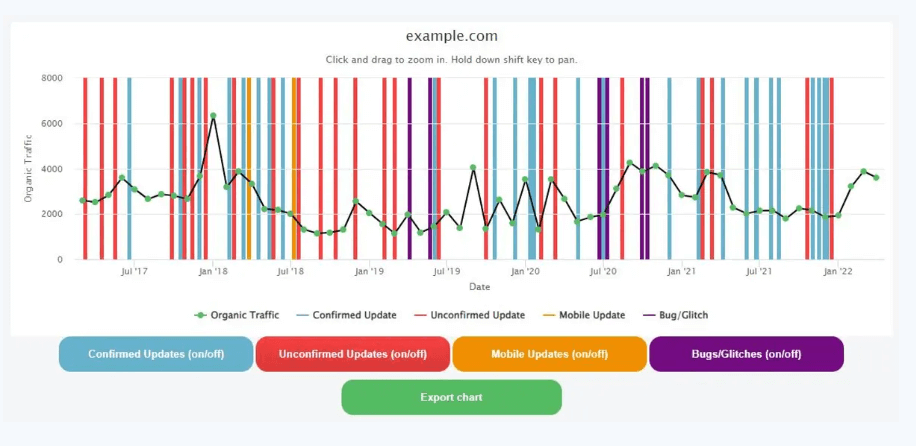
Before you choose a link building approach, it’s important to understand the differences between manual and automated methods.
### Automated vs. Manual Link Building
| Factor | Automated Link Building | Manual Link Building |
| --- | --- | --- |
| Method | Uses software or tools to create backlinks automatically | Involves human effort to build backlinks manually |
| Quality Control | Limited control over link quality and placement | Complete control over link quality and placement |
| Time | Quick to implement | Time-consuming due to research and outreach |
| Link Quality | Often contains low-quality or spammy links | Produces higher-quality, relevant backlinks |
| Risk Level | Higher risk of penalties | Lower risk when done ethically |
| Cost | Lower cost due to automation | Higher cost due to manual outreach and effort |
| Effectiveness | May provide short-term gains | Delivers long-term, sustainable SEO benefits |
For businesses that don’t have the time or resources to run outreach in-house, a manual link building service replicates this process at scale with the same editorial standards and quality controls you’d apply yourself.
## Why Manual Link Building Matters More in 2026
**Manual link building matters more in 2026 because Google’s algorithm increasingly distinguishes earned links from manufactured ones.** Algorithm updates penalize automated link patterns while editorial placements from genuine outreach compound in value over time. Every manually vetted placement signals trust that automated tools simply can’t replicate — and that gap is getting wider, not smaller. Brands looking to scale this approach typically work with [Outreach Desk’s outreach team](https://outreachdesk.com/). For end-to-end management, [Outreach Desk’s tiered link building guide](https://outreachdesk.com/tiered-link-building/) runs campaigns for 500+ brands worldwide.
Manual link building matters more because Google values manual links that are earned naturally from relevant, trustworthy websites.
Unlike automated methods that often create risky links, manual outreach focuses on real value and long-term trust, making it a safer and more sustainable strategy.
Here are a few benefits of manual link building:
### Full Control Over Quality
With manual link building, you control the quality of your links. You choose which websites to contact, where your links come from, how they’re placed, and if they fit your brand and goals.
This helps you avoid low-quality sources and build a healthier backlink profile over time.
#### 💡Key Factors of Link Quality
- **Relevance** means the website linking to you should be related to your industry or topic.
- **Authority** indicates that the links from well-known or reputable websites carry more weight.
- **Credibility** is that the links from a trustworthy site are more reliable.
- **Link Placement** means that links appear naturally within meaningful content.
- **Real Traffic** means the website receives actual visitors who engage with your content.
- **Natural Anchor** text is the clickable text that is relevant to the linked page and fits naturally in the sentence.
### Higher Response Rates
[Personalized outreach](https://outreachdesk.com/seo-outreach/) feels human and respectful. Whereas automated emails are easy to spot and often ignored.
When you take the time to understand a website and explain why your content is genuinely helpful for their audience, you increase your chances of getting replies and earning high-quality backlinks.
### Reach The Right Audience
Manual link building helps your content reach people who are genuinely interested in what you offer. These visitors come from relevant websites and are more likely to engage, trust your brand, and take action.
Instead of chasing traffic numbers, manual backlinks attract the right audience, people who stay longer, interact more, and convert better.
### Keeps Your Site Safe From Penalties
Manual link building reduces risk because each backlink is build through genuine efforts.
You are not relying on automated tools, link packages, or shortcuts that can create unnatural patterns.
Google’s system now automatically ignores many low-quality links, but sites that consistently use manipulative or paid link tactics can still face a **manual penalty**.
#### What is a Google Manual Penalty?
A [Google manual penalty](https://support.google.com/webmasters/answer/9044175?hl=en) happens when a human reviewer finds clear evidence of manipulative or spammy practices.
By choosing relevant websites and using honest outreach, manual link building keeps your site aligned with Google’s guidelines and protects your rankings.
## Effective Manual Link Building Techniques
**The most effective manual link building techniques are guest posting, broken link reclamation, brand mention outreach, digital PR, and resource page placement.** Each requires you to vet target sites for relevance and real authority, craft a pitch the editor actually wants, and follow up exactly once. Shortcuts here produce placements that don’t move rankings — or worse, invite a Google penalty. Working with [ethical outreach specialists](https://outreachdesk.com/white-hat-link-building-service/) can compress this process from months to weeks.
Manual link building can be done in many practical ways, each offering unique benefits for your website’s authority and rankings.
Here are some key manual link building strategies you can use to start earning manual links through genuine, manual efforts that pay off over time.
### Guest Posting
[Guest Posting](https://outreachdesk.com/guest-posts/) means **writing a helpful article for another website in your industry.** In return, the website may include a link back to your site within the content.
This works because you are contributing valuable information rather than promoting yourself. It takes time and effort, but the results are long-lasting.
You can find websites that accept guest posts by using tools like [Pitchbox](https://pitchbox.com/) or the [Moz toolbar](https://moz.com/products/pro/seo-toolbar).
You can also check competitor backlinks, explore industry directories and forums, or look for resource pages to find potential guest blogging opportunities.
Another effective method is to manually search on Google using specialized search operators such as:
- Keyword + “write for us”
- Keyword + “guest post”
- Keyword + “guest contributor”
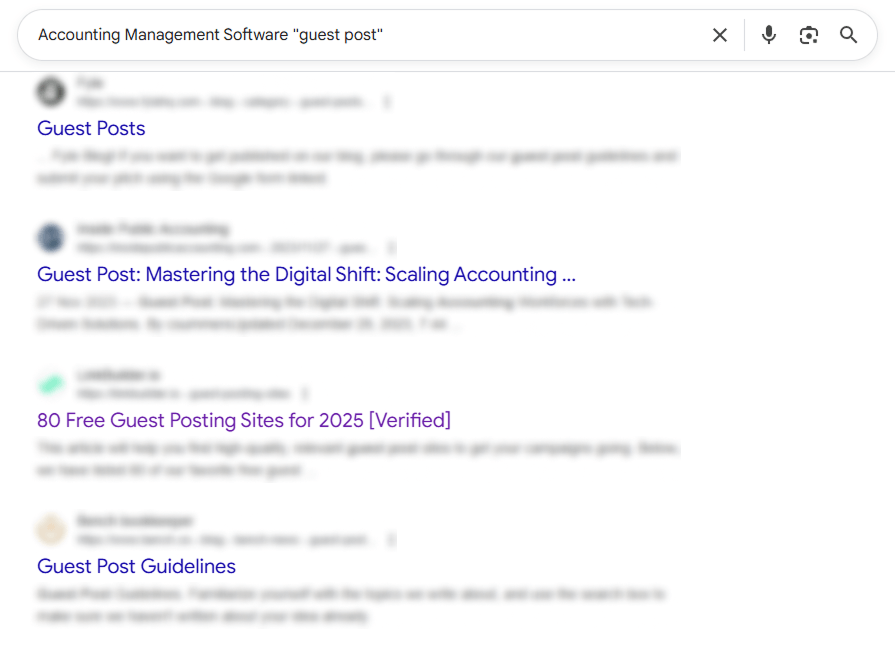
Once you find a suitable guest post opportunity, use a guest post outreach email to contact the website owner and request permission to contribute your article.
**For Example,** you can start by saying “I’ve been reading your posts on account management and noticed you share complex accounting tasks. I’d love to contribute a helpful guest post that offers practical accounting tips for your readers.”
You can convert this example into pitch and send it to the website owners.
#### Guest Blogging Best Practices
**Pick niche-relevant sites**
Focus on websites that align closely with your industry or audience to make sure links and content are meaningful.
**Avoid salesy content**
Your article should provide genuine value and not be an advertisement for your business.
**Prioritize quality writing**
Keep your content clear and well-crafted. Consider collaborating with a skilled writer if needed.
**Write with purpose**
Don’t just create content to fill space; always make sure every post educates, informs, or adds value to readers.
### Relationship-Based Link Building
To earn backlinks, first, you have to start by building a meaningful relationship.
Relationship-based link building **is an organic strategy that focuses on creating genuine connections with website owners and industry experts.**
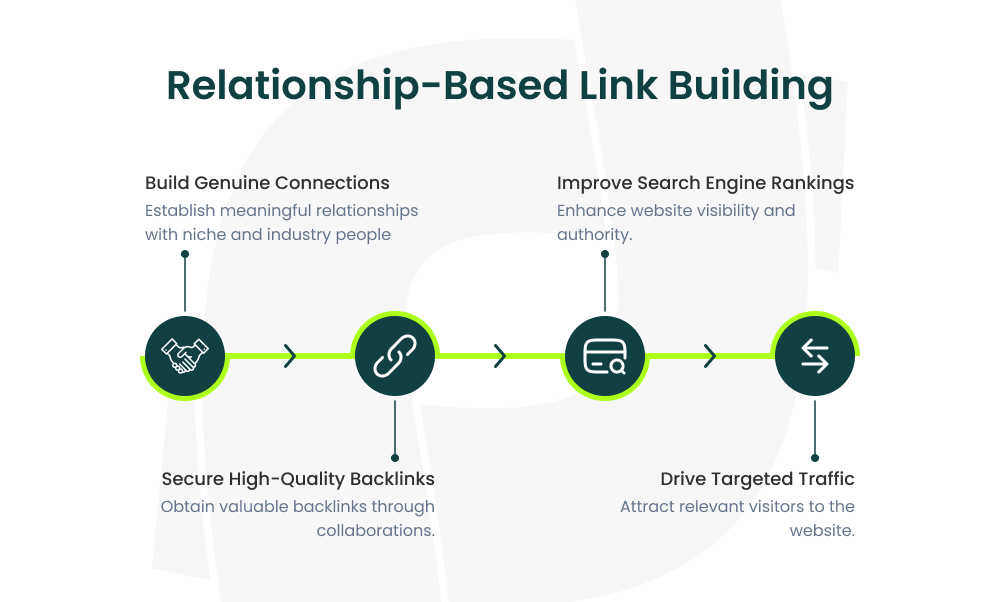
Instead of directly asking for a link, you engage with their content, share helpful insights, or collaborate on valuable resources.
When you consistently offer value, people naturally begin to trust you, making them more likely to link to your content.
Suppose that you run a marketing blog and regularly share insights from other industry blogs, leave thoughtful comments, and mention their content in your posts. In that case, those creators eventually notice your support.
Over time, they may naturally link back to your articles and recommend your content to their audience.
### Broken Link Building
[Broken link building](https://outreachdesk.com/broken-link-building/) is a strategy where you identify broken or dead links on other relevant websites and offer your own content as a replacement.
Broken link building is a **win-win strategy**: you build a high-quality backlink for your site while helping website owners **fix broken links on their pages**. Since no site wants dead links, offering a relevant replacement makes it easy for them to add your link naturally.
For example, A digital marketing blog links to a “free SEO audit tool” page that no longer exists (404). You offer your working SEO audit tool as the replacement, helping them fix their content, and you get a high quality backlink for your site.
#### How to Do Broken Link Building
**1. Find broken links**
Check other relevant website pages for dead or broken links, using tools like Ahrefs. You can also browse industry resource pages and old content that may have outdated links.
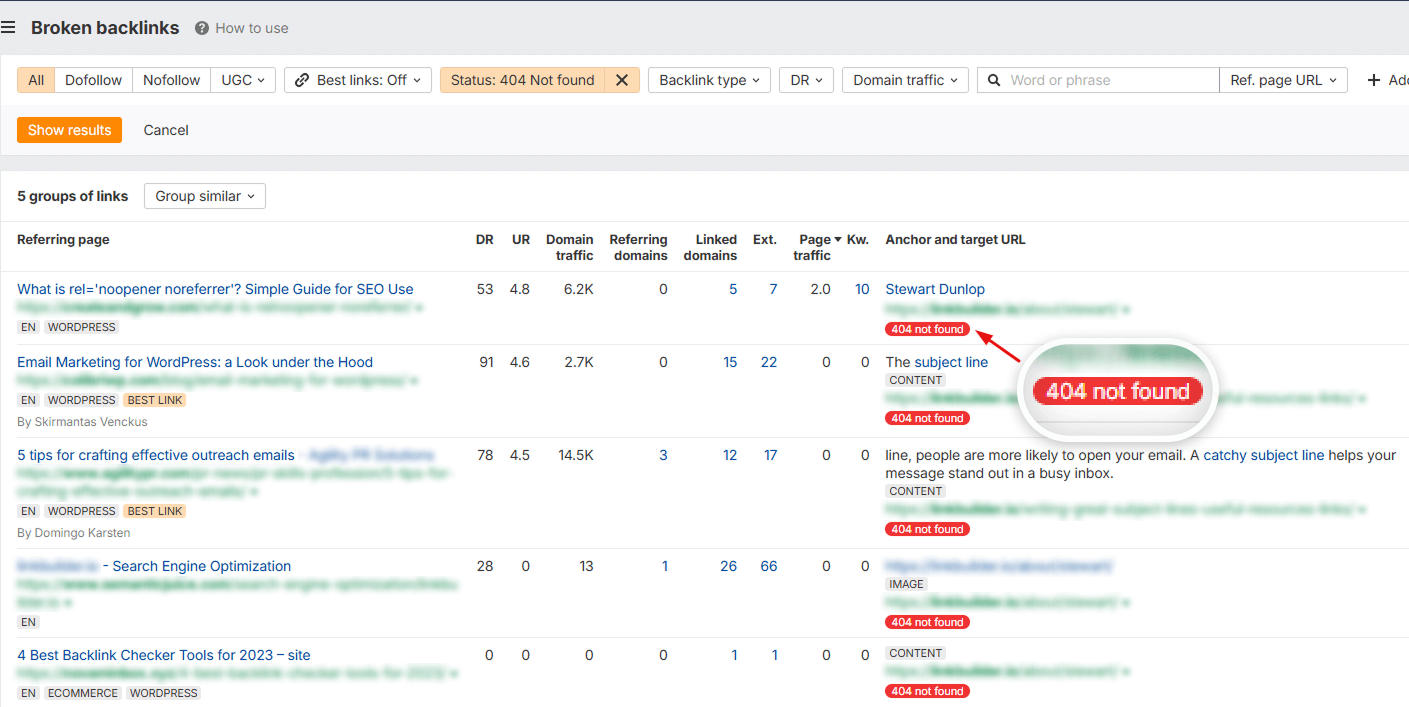
**2. Identify a replacement**
Check if you already have a relevant page that can replace the broken link. If not, create new, helpful, and updated content.
**3. Reach out to the site owner**
Manually reach out to the editor or website owner and let them know about the broken link, and **suggest your content as a valuable replacement**.
For Example, start with “I noticed a broken link in your article on SEO Audit Tools.” The “free SEO audit tool” page leads to a 404.
If you’re updating the post, we have a working SEO audit tool you can use as a replacement:
[Your Tool Link]
Hope this keeps the page useful for your readers.
**4. Earn the backlink**
When you’re helping them fix a problem, site owners are more likely to add your link naturally.
### Resource Page Link Building
Many sites maintain dedicated pages listing useful tools, guides, and references for their audience. These are known as resource pages.
[Resource page link building](https://outreachdesk.com/resource-page-link-building/) is the process of finding web pages that list helpful links on a specific topic and asking the site owner to include your valuable content as a recommended resource.
Some websites even include a **“Submit a Resource”** or **“Suggest a Link”** form. If your content matches their needs, submitting it through those forms makes your outreach much easier and increases your chances of getting added.
#### Resource Page Link Building (Step-by-Step)
**1. Find niche-relevant resource pages**
Use search operators like:
- keyword + “resource page”
- keyword + “useful resources”
**2. Check if your content is a good fit**
Make sure the page lists high-quality resources and that your article genuinely adds value.
**3. Reach out to the site owner**
Email them with a polite message, share your resource, and explain why it deserves a spot on their page.
Ex: “I saw your list of ‘Top Digital Marketing Tools.’ I think our free Headline Analyzer Tool would be a fantastic addition for your readers.”
**4. Get your content listed**
If they find it helpful, they’ll add your link to the resource page, helping you to get a high-quality manual backlink.
Here’s an example for finding a resource page using search operators

#### Asset-Based Link Building
Asset-based link building is a strategy where you create high-value [linkable assets](https://outreachdesk.com/linkable-assets/) that other websites naturally want to refer to, cite, or link to because they find them genuinely useful.
**Here are some linkable assets:**
- In-depth guide and Tutorials
- Infographics and Visual Content
- Original research and Case Studies
- Tools and Calculators
- Templates and Checklists
- Data reports and resource roundups
Instead of directly asking for a link, you manually share assets with websites that cover related topics. If your asset adds value, they will naturally link to it.
This approach keeps the process human-driven and get high-authority links without automation or spammy tactics.
While this technique requires time and creativity, it pays off for years because high-quality assets continue to earn links naturally without constant outreach, making it one of the most long-lasting manual link building techniques.
**To manually identify websites that might link to your asset, check:**
- Competitor pages that already attract many backlinks
- “Best tools/resources” lists in your niche
- Blog posts covering related topics
You can also use tools like [Ahrefs](https://ahrefs.com/), [Semrush](https://www.semrush.com/), or [Moz](https://moz.com/) to find websites linking to similar assets and reach out to them manually.
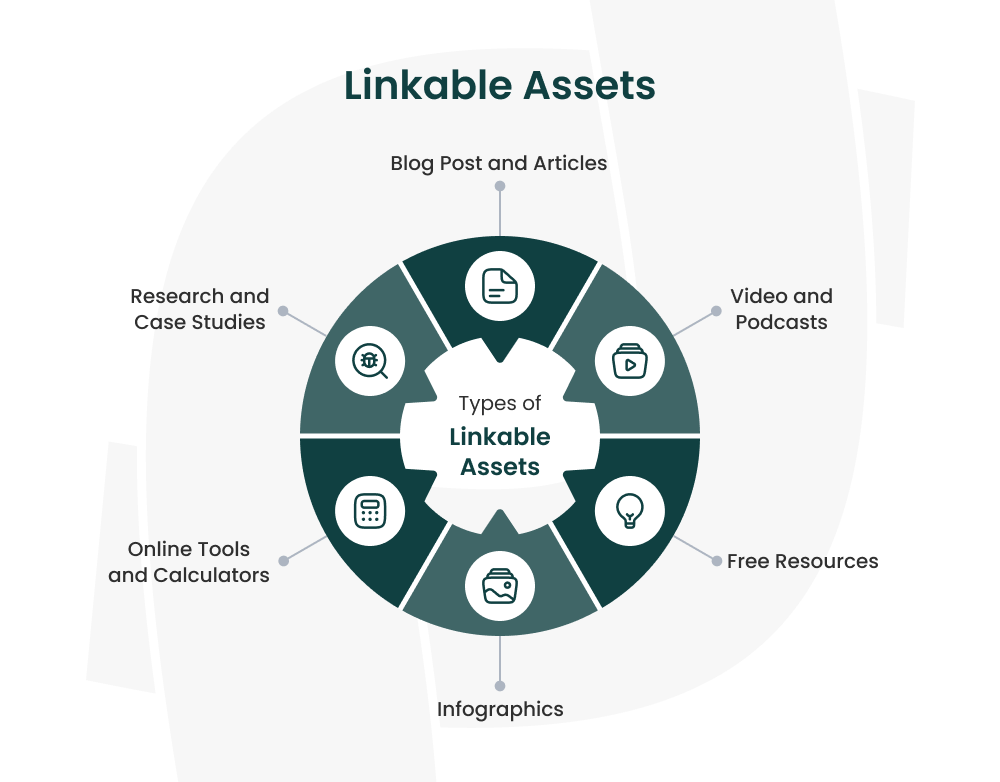
### HARO Link Building
[HARO link building](https://outreachdesk.com/haro-link-building/) **is a PR-based method in which you respond to journalists’ queries to get high-authority backlinks from major publications.**
#### HARO ( Help a Reporter Out)
[HARO](https://www.helpareporter.com/) is a platform that connects journalists with people who can share expert information.
When your name or brand is featured, it strengthens your website’s credibility. Even a single HARO link can improve how users and Google view your business.
HARO link building requires genuine manual effort: reading journalist queries, crafting personalized responses, and pitching your insights. Unlike automated methods, HARO requires you to respond actively.
These links aren’t easy to secure, but that’s exactly what makes them powerful, as they’re build through expertise and relevance, not through paid placements or automated tactics.
**Here’s an example of the [HARO dashboard](https://www.helpareporter.com/)**, where you can sign up to receive daily media queries, and where journalists can submit their questions and find experts.
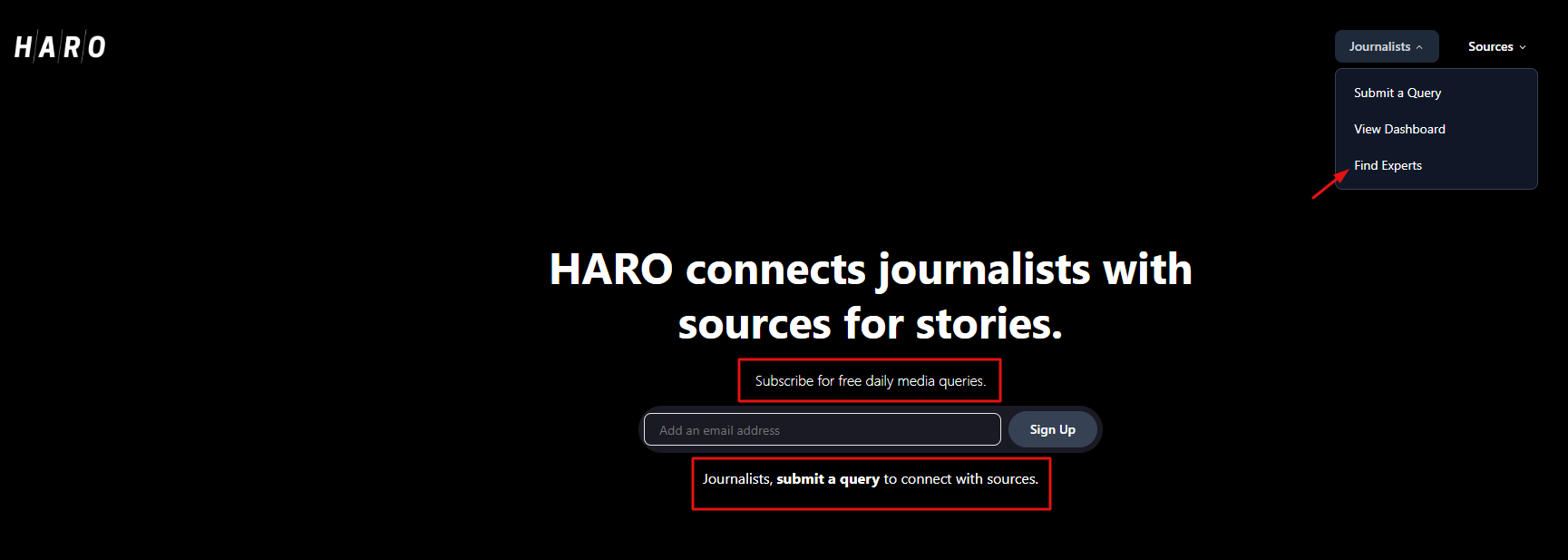
### Networking with Industry Influencers
Influencer and Industry Networking **involves collaborating with trusted influencers or well-known professionals in your niche and providing them with something valuable**.
Brands are building huge audiences by networking with relevant influencers, which increases their online presence and creates potential backlink opportunities.
Such collaborations encourage influencers to feature your content and link back to your site. This helps you earn mentions, shares, and high-quality referrals, allowing your content to reach a larger, more targeted audience.
Some influencers may prefer collaborations or perks, such as a free product, social shares, or a service from your brand. In contrast, others feature your content simply because it adds value to their audience.
Strategically networking with influencers not only helps secure high-quality backlinks but also increases your brand’s credibility and exposure across trusted platforms.
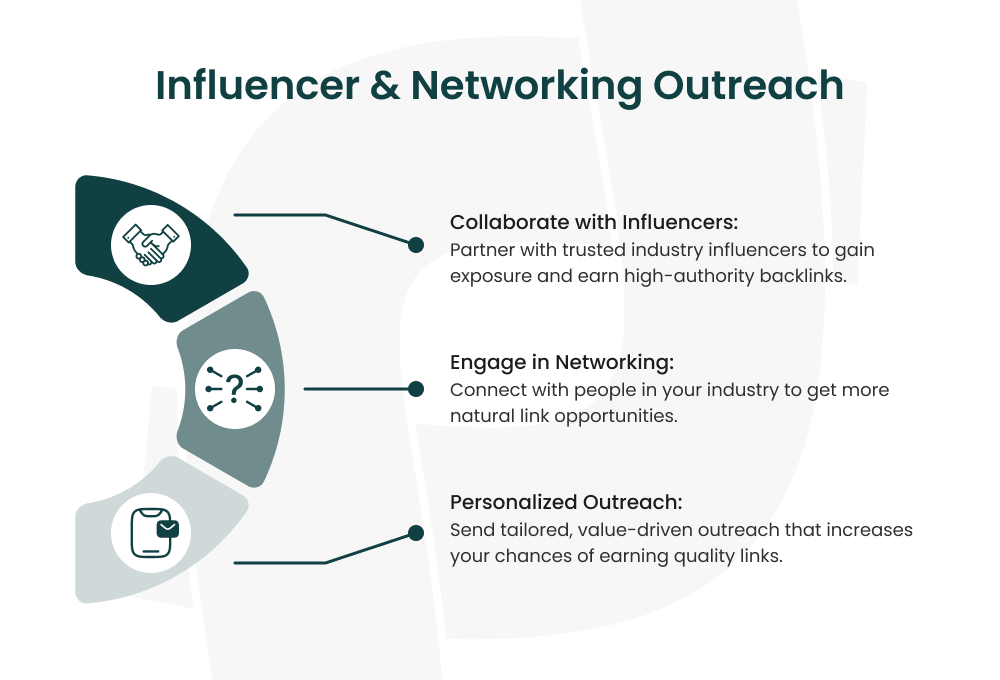
### Testimonial Link Building
[Testimonial Link Building](https://outreachdesk.com/testimonial-link-building/) is **a technique in which you provide genuine feedback about a product or service you’ve used.**
Many companies showcase customer reviews on their websites and often include a link back to the site.
By sharing thoughtful testimonials, you can request that the company feature your review on their website along with a backlink to your site.
When these reviews appear on reputable sites, they boost your credibility and strengthen your brand reputation, which can improve your rankings.
For Example, PressWhiz wrote a testimonial for Ahrefs, and Ahrefs included a backlink to PressWhiz’s website, building a high-authority link while showcasing credibility.
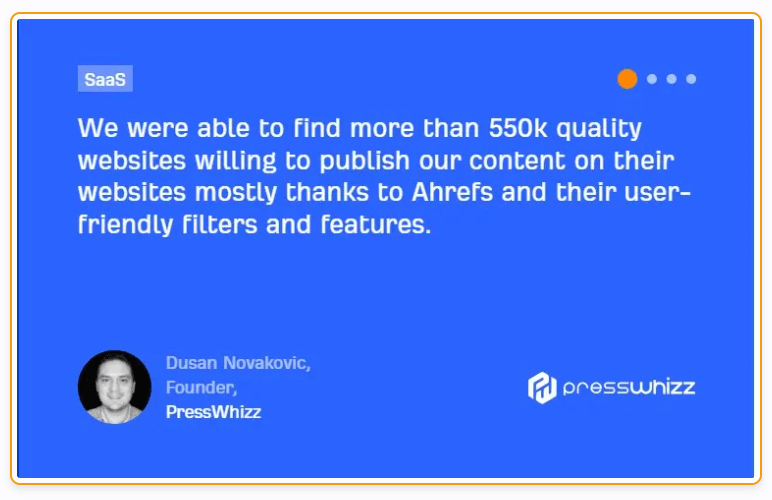
## Common Manual Link Building Mistakes to Avoid
Even small link building mistakes can harm your website’s rankings. Avoiding these common drawbacks helps you build high-quality, effective, and safe backlinks.
### Buying Cheap or Paid Links
Buying links is a quick way to increase backlinks. But it often does more harm than good. These links are usually placed on low-quality or unrelated websites or come from [link farms](https://outreachdesk.com/link-farming/) created solely to manipulate rankings.
This is risky because Google expects links to be earned naturally. Paid links rarely reflect genuine recommendations and can damage your site’s credibility.
Instead of buying links, focus on earning them through valuable content, outreach, and genuine relationships. Links build through value last longer and support steady growth.
### Building Links Too Fast
Creating a large number of backlinks in a short time can look unnatural, even if the links are not paid. Sudden spikes often signal manipulation rather than genuine popularity.
Search engines expect link growth to happen gradually as content get attention. When links appear too quickly, many of them may be ignored, and patterns can raise red flags.
A better approach is to build links consistently. Focus on quality and relevance, and allow your backlink profile to grow naturally over time.
### Targeting Irrelevant Websites
Getting links from websites that have nothing to do with your topic may increase link count, but it weakens relevance. These links do not help search engines understand what your site is about.
Relevance matters because links signal trust within a topic area. When links come from unrelated sites, those signals become confusing and less effective.
To avoid this mistake, prioritize websites that serve a similar audience or cover related subjects. One relevant link is more valuable than many unrelated ones.
### Failing To Diversify Strategies
Using only one link building method, such as guest posting, limits growth and increases risk. If that single method stops working or becomes less effective, your progress stalls.
Natural backlink profiles are built from multiple sources. This shows search engines that your site get attention in different ways.
To stay balanced, combine different [outreach methods](https://outreachdesk.com/link-building-strategies/) such as guest blogging, relationship-based links, resource mentions, and asset-driven links. This creates a healthier and more resilient backlink profile.
## Cost of Manual Link Building
Manual link building focuses on building genuine, high-quality backlinks rather than relying on automated or spammy methods. It may take time, skills, and expertise, but it improves search rankings and conversion.
The link building cost can vary depending on the scale, niche, and resources you use.
Here are the key factors affecting the cost:
### Time Investment
It involves researching websites, finding prospects, and sending personalized outreach emails. Each step takes time and attention to detail, especially when you are aiming for editorial or contextual links from reputable websites.
### Content Creation
Content is the foundation of successful manual link building. It includes content like guest posts, testimonials, or linkable assets that may require experienced writers, designers, editors, or video creators.
### Tools & Software
Professional link builders rely on [SEO and outreach tools](https://outreachdesk.com/link-building-tools/) to identify opportunities, analyze competitors, track backlinks, and manage campaigns. However, the tools like Ahrefs or SEMrush often have subscription costs.
### Outreach & PR
Some link opportunities may require additional investment, such as products, samples, exclusive insights, or sponsorships. Digital PR campaigns, including HARO, also demand consistent efforts and strategic positioning to secure high-authority links.
**Typical Costs:**
- **Outreach tools:** $19–$99 per month
- **Content creation:** $15–$50 per piece
- **Human Resource Cost:** $15 – $20 per hour
- **Manual guest posting:** $200–$500 per link
- **PR & HARO campaigns:** costs vary depending on scope
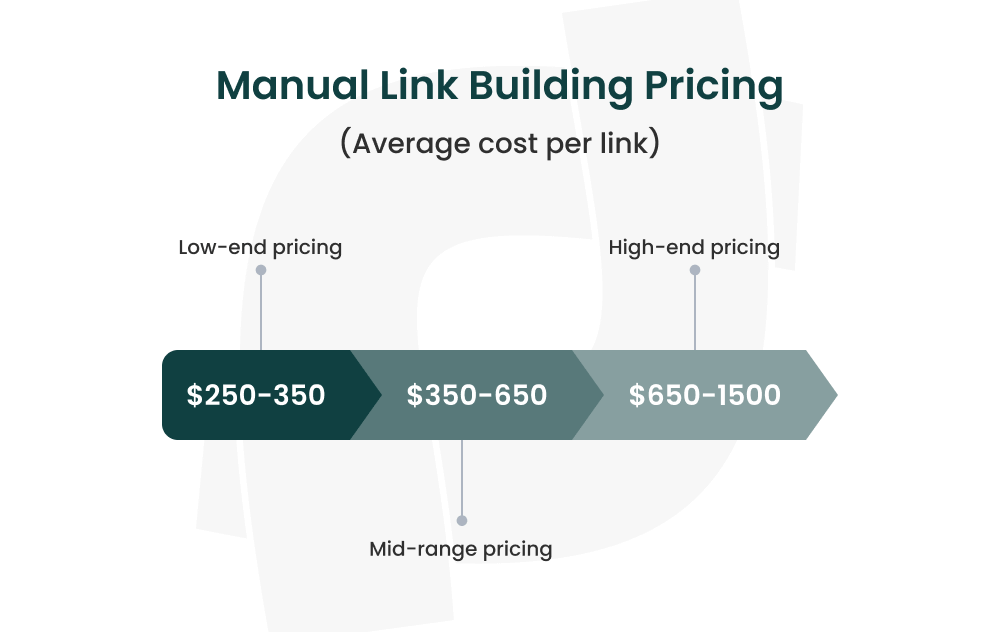
Manual backlinks don’t have to be expensive. While the average cost ranges from $300 to $1,000, we can help you get safe, high-quality manual links at a much lower price.
## SaaS Client Growth Story: From 49K to 70K Monthly Users
We worked with this client to improve their organic visibility and search rankings through a targeted, manual [link building campaign](https://outreachdesk.com/link-building-campaigns/).
The challenge was that, despite having strong content and a solid website, the client struggled to move up in search results. Their page wasn’t have enough trusted backlinks, limiting how much search engines could rely on it.
Instead of using automated, mass-link tactics, we focused on manual, [white hat link building](https://outreachdesk.com/white-hat-link-building-strategies/) strategies.
**Our strategy included:**
- Identifying authority websites related to the client’s industry
- Placing backlinks within relevant content
- Prioritizing the links that offer real value to the users
- Avoided low-quality or spammy link placements
Each backlink was build through outreach, helping send trust and relevance signals to search engines.
As a result, this effort made a significant uplift in organic performance, helping the client climb key [search result pages](https://outreachdesk.com/what-are-serps/) (SERPs). It had a remarkable result, a **43% increase in organic traffic**, jumping from **49,000 to 70,000 monthly visitors in just 9 months.**
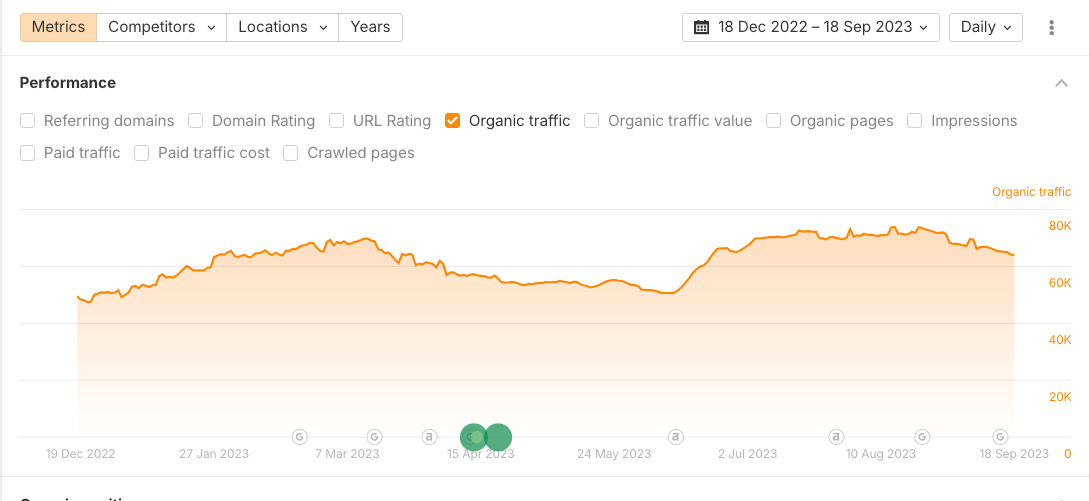
It worked because search engines value links that are earned naturally from trusted sources. By focusing on relevance, quality, and manual implementation, we helped the client build long-term credibility.
The image clearly shows the gradual upward trend in organic traffic, highlighting how consistent link building drives performance gains.
## Conclusion
While automated tools may seem faster and easier, manual link building remains the most reliable way to build high-quality backlinks.
These links help grow your authority and improve your search rankings. By practicing ethical link building, you build long-term, sustainable growth for your website.
### Struggling to earn safe, high-quality backlinks?
Outreach Desk offers manual link building that improves rankings safely.
[Get a Custom Quote](/contact-us/)
### Is manual link building better than automated link building?
Yes, manual link building prioritizes quality, relevance, and long-term SEO growth over short-term, risky automation.
### How long does it take to build links manually?
It depends on outreach volume, content quality, and relationship building. Expect results in weeks to months.
### What tools should I use for manual link building?
Tools for prospecting, outreach, and tracking include Ahrefs and Apollo.io.
### Is manual link building still effective?
Absolutely. In 2026, Manual, relationship-driven link building is safer and more effective because Google views automated tactics as unnatural.
### How do I measure the success of manual link building?
Track metrics such as referral traffic, search rankings, and the overall link profile.
---
---
title: "SCO Marketing vs SEO: What It Means for Your Link Building"
url: "https://outreachdesk.com/sco-marketing/"
lang: "en-US"
type: "post"
description: "Your audience is discovering brands across Google, YouTube, TikTok, LinkedIn, and more, not just search engines. This is where SCO becomes important. Search channel Optimization helps you reach where your audience is already searching, rather than just in traditional search"
last_modified: "2026-05-18T11:54:29+00:00"
categories: [Marketing]
---
# SCO Marketing vs SEO: What It Means for Your Link Building
Your audience is discovering brands across Google, YouTube, TikTok, LinkedIn, and more, not just search engines.
This is where SCO becomes important. Search channel Optimization helps you reach where your audience is already searching, rather than just in traditional search results.
SEO helps you rank on Google, while SCO strengthens your visibility across every major search-driven platform.
Read on to learn how SCO works and how it amplifies SEO.
## What is SCO in Marketing?
**SCO stands for Search Channel Optimization.** It’s a marketing strategy that grows your visibility across every place people search for answers — Google, YouTube, TikTok, LinkedIn, Amazon, Reddit, ChatGPT, Perplexity — not just organic search results. Where SEO optimizes for one channel, SCO optimizes for the full discovery surface your audience actually uses.
SCO helps in **increasing your brand’s visibility across multiple platforms.** Instead of focusing solely on search engines, it enables you to optimize your entire presence, including videos, profiles, posts, and even market listings.
SCO positions your content where your audience actively consumes information.
Here’s a quick example of what SCO looks like in real searches:
When you search “forbes”, the [SERPs](https://outreachdesk.com/what-are-serps/) will provide every detail regarding the query. It will give you results from YouTube, social media profiles, and marketplaces, not just the website.
_
This is SCO in action.
SCO expands your visibility, while SEO and link building turn that visibility into long-term authority. Your site may gain reach, but it lacks the authority signals that come from credible [backlinks](https://outreachdesk.com/what-are-backlinks/) from reputable domains.
Social platforms use engagement-based algorithms, so backlinks don’t drive social reach directly; they mainly support your authority in Google.
However, they do strengthen search authority in the long term.
SCO connects traditional SEO with the growing need for multi-platform visibility.
## The Three Pillars of SCO Marketing
SCO has three pillars that improve how people find and engage with your brand.
Search Channel Optimization directly contributes to SEO, whereas Social Channel Optimization and Sales Cycle Optimization are indirect contributors.
### Search Channel Optimization
- This strategy extends SEO by optimizing your brand’s presence across multiple platforms.
- To make your brand visible and reachable to your audience.
### Social Channel Optimization
- This is a specific SCO type that solely focuses on optimizing your content and profile for social media platforms.
- To enhance visibility, engagement, and audience connections on social media.
### Sales Cycle Optimization
- This strategy mainly focuses on the customer’s journey through a sales funnel.
- To deliver the right content to the potential customer and convert them into a conversion.
We’ll focus on search channel optimization because it directly strengthens your SEO results.
## SCO vs SEO: The Key Differences Explained
**The core difference between SCO and SEO is scope: SEO is one channel inside SCO.** SEO focuses on ranking pages in Google’s organic results. SCO covers Google plus every other search-driven platform — YouTube, social search, AI answer engines, and marketplaces. You can run strong SEO with weak SCO and still miss most of the places your audience is actively searching right now. Working with [link building services](https://outreachdesk.com/) can compress the process from months to weeks.
SCO Marketing and SEO share the same goal: visibility and conversion. However, they approach it from different angles. Understanding the overlaps and their differences helps you craft a strategy that builds both exposure and authority.
SEO focuses on organic ranking.
SCO focuses on discovery across platforms where people search, scroll, or consume content.
Here’s the precise comparison of the SCO and SEO side-by-side.
| Factors | SEO | SCO |
| --- | --- | --- |
| Focus | Search Engine Ranking | Multi-platform Discovery |
| Core Metrics | Referring domains, organic rankings, and CTR | Engagement, Shares, and Reach |
| Longevity | Majorly long-term authority and sustainable traffic. | Often short-term and trend-oriented. |
| Integration Point | Link Building | Brand visibility and social proof. |
## How SCO Supports Link Building
The more visibility your content gains, the greater the chance that journalists, bloggers, or creators will refer to it. That ultimately leads to earned link building.
**For example,**
- A trending YouTube video
- A shared LinkedIn post
- A trending X infographic can trigger journalists and bloggers to cite and link to you.
These outcomes increase the chances of earning citations and backlinks that grow your authority.
Every piece of content creates visibility and a chance for someone to link to you.
## Why Link Building Remains The Core of SCO Success
SCO expands your brand’s reach across multiple platforms, whereas link building enhances that visibility into long-term authority.
Visibility helps you get discovered, but backlinks are what strengthen your authority in the long term.
Even if your content is performing well on TikTok, LinkedIn, or YouTube, only high-quality backlinks can effectively reinforce your domain authority and improve organic search rankings.
This is why we focus on [white-hat link-building strategies](https://outreachdesk.com/white-hat-link-building-strategies/) that earn links through ethical editorial placements, collaborations, and digital PR.
💡
**Valuable Insight:** The websites that earn a high number of unique, qualitative, and relevant referring domains have strong organic search visibility.
### The Authority Multiplier Effect
SCO widens your reach by putting your brand in front of people across multiple search-driven platforms. Link building drives credibility, indicating that your brand is worthy of trust and a high ranking.
Together, SCO and link building create opportunities to earn mentions that ultimately lead to backlinks, and those backlinks improve long-term visibility.
### Why SCO without Backlinks Fails Long Term
Social algorithms prioritize trends, valuing speed over consistency. As the engagement drops, so does the visibility. But if your content is linked to credible domains, it earns long-term value in search engines and in referral traffic.
A viral social post may get thousands of views, but without backlinks, the lift disappears quickly.
Links extend the value of your SCO campaign; they help you turn short-term engagement into long-term visibility.
### How to Align SCO with Link Building Strategy
You need a clear system that turns visibility into long-term authority. SCO helps people discover your content, but [link building strategies](https://outreachdesk.com/link-building-strategies/) make sure that discovery translates into ranking, trust, and long-term authority.
**Here is the 5-step process that integrates SCO and link building.**
#### Step 1: Audit your Visibility Channels
Before you scale your SCO efforts, analyze your brand’s current visibility.
**For Search:** Use Google Search Console, Ahrefs, or SEMrush to find the top-ranking page.
**For Videos:** Look for YouTube analytics to assess engagement.
**For Social:** Analyze the high-performing content on LinkedIn, Instagram, or TikTok.
This shows where your visibility is coming from.
#### Step 2: Create High-value Content Worth Linking To
Once the gaps in your content are identified, it’s time to focus on creating valuable content that works for both SCO and generates backlinks.
Some formats consistently work well across platforms and earn links.
- Content with data and original studies, including graphs and insights.
- Sites with case studies, testimonials, and success stories (with your brand).
Create assets people want to share and publishers want to cite.
#### Step 3: Use SCO to Distribute and Amplify the Content
To earn links, your content needs visibility first, and that’s where SCO helps.
- Influencers’ mentions and social media mentions.
- Video summaries for discovery channels.
- Newsletters and articles on LinkedIn.
- Real-world engagement (Reddit and Quora)
The chances of visibility increase as content is discovered, shared, and ultimately linked by publishers or bloggers across multiple platforms.
#### Step 4: Use Outreach to Secure Backlinks from Engagement
Once your content gains visibility through SCO, [link building outreach](https://outreachdesk.com/link-building-outreach/) helps convert high engagement into potential backlinks by connecting with creators who are genuinely interested in your content.
- Reach out to the creators and publishers who have already engaged with your content.
- Personalize your outreach to showcase the value of linking to your site’s resources.
- Focus on offering content that provides value, such as expert quotes, supporting data, and studies.
#### Step 5: Measure Referral Traffic & Link Metrics Together
The final step is integrating visibility and authority so they work together.
By tracking SCO engagement and SEO authority, you can identify which campaign builds lasting equity.
### Content That Attracts Both Click and Links
Not all content earns authority and attention. The key is to create assets that engage both publishers and users alike.
**The top-performing content includes**
- Original data and studies.
- Educational evergreen content.
- Case studies.
- Tools, calculators, and templates.
These methods not only drive visibility but also attract natural backlinks from journalists, bloggers, and creators.
## Best Practices for SCO-Driven Link Acquisition
To establish long-lasting authority, you need a strategy that converts engagement, mentions, and trends into high-quality backlinks.
### Use Trending Topics for Natural Link Gain
Stay alert to the industry discussions and trends that align with your niche. Posts on platforms like LinkedIn or Reddit attract bloggers and journalists seeking insights or expert citations.
💡
**Quick Tip:** Use tools like BuzzSumo or Google Trends to spot the top-performing topics.
### Repurpose Viral SEO Content into Linkable Assets
Not every high-engagement post earns backlinks. You need to turn it into something worth clicking. Restructure your best-performing content that publishers love to link to.
### Use Mentions and Tags to Find Natural Linking Opportunities
Social tags can be a benefit for you and provide a backlink opportunity, especially when mentions come from creators, journalists, bloggers, or websites in your niche.
**Use tools such as:**
#### Brand24: For Monitoring
[Brand24](https://brand24.com/) is a social listening and monitoring tool. It gathers mentions of your brand or keywords across a wide range of public sources, including social platforms, blogs, news sites, forums, podcasts, and reviews.
It supports real-time tracking and provides metrics such as reach, sentiment, and volume of mentions.
You can generate reports, create alerts when things are mentioned, and track hashtags, backlinks, and competitive mentions.
#### Google Alerts: For unlinked brand mentions
[Google Alerts](https://www.google.co.in/alerts) is a free, simple tool for tracking when your brand or keyword is mentioned on the web. By default, Google Alerts only notifies you of mentions; it doesn’t tell you whether those mentions link to your website.

#### Aherfs Content Explorer: For Citation Tracking
[Ahrefs Content Explorer](https://ahrefs.com/content-explorer) is a huge searchable database of billions of web pages. It lets you find places where your brand, content, or name has been mentioned, even if they did not link back to you.
**This makes it a powerful tool for:**
- Citation tracking
- Finding unlinked mentions
- Discovering content using your ideas, quotes, and statistics
- Monitoring competitor mentions
- Identifying link-building opportunities
### Convert SCO Driven Mentions into Backlinks
Your SCO campaigns often generate indirect mentions through YouTube videos, podcasts, guest posts, and other channels. The key is to systematically convert mentions into links.
**At the Outreach Desk, we follow this process:**
- Identify SCO-driven mentions by monitoring tools.
- Identify high-authority sites by filtering DA and DR metrics.
- Craft a personalized outreach for high engagement.
- Request a [contextual link](https://outreachdesk.com/contextual-link-building/) to the relevant page or assets
### Building Digital PR Around the SCO Campaign
Combine digital PR with SCO engagement to acquire links when your campaign highlights original research, expert quotes, or innovative pitches to journalists and bloggers. This maximizes editorial backlinks.
## Case Study: SCO and Link Building Synergy
Let’s look at how a B2B SaaS brand partnered with Outreach Desk to turn its visibility into measurable SEO growth.
**Background and Challenge:**
Before optimizing their SCO strategy, the brand used traditional SEO techniques. Their rankings were flat, and referral traffic barely moved.
However, the brand’s social engagement was strong, their content was performing well on LinkedIn and YouTube, yet their visibility was not converting into backlinks.
**Their pain point:** Achieving great content reach with low authority.
**Our Goal:** Integrate SCO with a strong link-building strategy to enhance long-term SEO performance.
**Strategy And Implementation:**
We designed a hybrid campaign that combines SCO exposure with targeted [link outreach](https://outreachdesk.com/seo-outreach/).
- Multi-platform SCO promotion
Restructured top-performing blogs into LinkedIn, YouTube, and Twitter Threads to amplify their reach and performance.
- Use trending topics to boost engagement.
- Authority content creation
Developed data-packed articles and infographics to boost engagement.
- Created a central linkable asset “marketing trends 2026”
- SCO to link conversation via Outreach Desk
Tracked mentions and social shares across various platforms.
- Performed outreach to journalists and bloggers who work in a similar niche.
- Requested backlinks to the original reports.
**Research and Key Takeaways:**
| Metrics | Referring Domains | Organic Traffic | Domain Authority | Branded Search by Volume |
| --- | --- | --- | --- | --- |
| Before | 120 | 22,000 per month | 38 | – |
| After 6 Months | 192 | 29,000 per month | 44 | +33% |
## Start Building Authoritative Links That Amplify Your SCO
SCO helps your brand to get recognition, but it’s link building that turns visibility into authority. Every top-performing post becomes even more valuable when it’s supported by credible, authoritative backlinks.
If you want lasting visibility, shift your focus to backlinks that strengthen your SEO performance, while your SCO efforts expand your reach across multiple platforms.
Outreach Desk specializes in ethical white hat link-building strategies that complement your SCO efforts. Our approach ensures that we provide not only visibility but also lasting trust for your site.
If you want your SCO visibility to turn into long-lasting authority, you need links that actually contribute to your site’s growth.
So, let’s plan your link strategy and the authority that your site deserves.
## Drive AI Search Visibility with High-Authority Backlinks
We combine relevance, authority, and authenticity to secure links that strengthen your SEO footprint and maximize brand visibility across search and AI platforms.
[Enquire Now _](/contact-us/)
## FAQs – SCO Marketing & Link Building
### What does SCO stand for?
SCO stands for Search Channel Optimization. It’s the practice of growing your brand’s visibility across every search-driven channel — Google, YouTube, TikTok, LinkedIn, Amazon, Reddit, ChatGPT, Perplexity — instead of optimizing only for traditional Google organic results.
### What does SCO mean in marketing?
In marketing, SCO means Search Channel Optimization — a strategy framework that recognizes your audience searches across many platforms, not just Google. SCO covers the techniques and content patterns that win visibility everywhere search happens, with Google SEO as one of several pillars rather than the only goal.
### Is SCO the same as SEO?
No. SEO is one channel inside SCO. SEO focuses on ranking pages in Google’s organic results. SCO covers Google plus every other place users search — YouTube, social platforms, AI answer engines, marketplaces. You can do strong SEO with weak SCO (and miss most of where your audience actually searches), but you can’t do strong SCO without good SEO.
### What channels does SCO cover?
SCO covers every platform where users actively search for content, not just where they passively scroll. The core list: Google search, Google AI Overviews, YouTube, TikTok search, LinkedIn search, Reddit, Amazon, App Store, ChatGPT, Perplexity, Claude. Different channels need different content formats, but the underlying authority signals — links, brand mentions, citations — flow across all of them.
### Can SCO replace link building?
SCO can’t replace link building; instead, it amplifies it. It helps your site gain visibility, but the real game is
link building, where linking to authoritative sites demonstrates relevance and trust.
### How soon can I expect to see results from SCO and link building?
The success of SCO depends on several factors within your business, including your starting point, competitors, and consistency.
### Is the Outreach Desk’s approach compliant with Google guidelines?
The Outreach Desk adheres to Google-approved guidelines for sustainable and transparent link building, ensuring long-term SEO success.
---
---
title: "Pricing Plan"
url: "https://outreachdesk.com/pricing-plan/"
lang: "en-US"
type: "page"
description: "Pricing Plans Foundation $300 / Per Link 10 Dofollow Link Per Month Choose Your Plan Choose Your Plan Ideal for Startups Growth Popular $250 / Per Link 20 Dofollow Link Per Month Choose Your Plan Ideal for Businesses Custom Plan"
last_modified: "2026-05-26T06:56:06+00:00"
custom_fields:
header_style: "header-style-1"
footer_style: "footer-style-1"
---
# Pricing Plan
# Pricing Plans
## Foundation
### $300 / Per Link
- 10 Dofollow Link Per Month
[Choose Your Plan](#)
##### Choose Your Plan
_
First Name*
Last Name*
Email*
Website URL
Phone Number*
Subject*
Message
Ideal for Startups
## Growth
Popular
### $250 / Per Link
- 20 Dofollow Link Per Month
[Choose Your Plan](#)
Ideal for Businesses
## Custom Plan
### $200 / Per Link
- Custom Dofollow Link Per Month
[Choose Your Plan](#)
Ideal for Market Leaders
### Included with Every Plan:

Average DR 40-95

Traffic 1k+

Dedicated Account Manager

Boost Visibility in AI

Listicles for LLM boost

Toxic Backlinks Audit & Analysis

Content & Internal Link Consulting
## Your Growth Partner in Link Building
We help SEO agencies and SaaS businesses grow faster with scalable link – building, exclusive pricing, and full campaign control.
Exclusive Pricing That Meets Your Budget
100% White-Label Link Building
Strategic & Transparent Reporting
[Get Custom Pricing
](#)
## Drive AI Search Visibility with High-Authority Backlinks
We combine relevance, authority, and authenticity to secure links that strengthen your SEO footprint and maximize brand visibility across search and AI platforms. When the workload outgrows in-house capacity, hiring a link building agency is usually the next step.
Book a Strategy Call

**4.8**/5 _
Trusted by 500+ **agencies &
1,000+ businesses** worldwide.

---
---
title: "About Us"
url: "https://outreachdesk.com/about-us/"
lang: "en-US"
type: "page"
description: "About Us 100% High Authority, Topical Relevance & Niche Alignment Assured. We believe branding and visibility go hand in hand. Ensuring your brand has visibility across authoritative sites and publications is our team’s work towards one goal – topical authority"
last_modified: "2026-05-18T11:58:01+00:00"
custom_fields:
header_style: "header-style-1"
footer_style: "footer-style-1"
---
# About Us
# About Us
_
## 100% High Authority, Topical Relevance & Niche Alignment Assured.
We believe branding and visibility go hand in hand. Ensuring your brand has visibility across authoritative sites and publications is our team’s work towards one goal – topical authority for your site!
[Get Best Links
](/contact-us/)










## What Makes Outreach Desk Your Trusted Link Building Partner?
Search Engine Optimization, or SEO, is not just about link placements. It needs a link–building strategy that offers topical authority, and we aim to achieve it for each of our clients. [Outreach Desk dedicated team](https://outreachdesk.com/) handles prospecting, content, and outreach so in-house teams can focus on strategy.

### Pre-Vetted Domains
We offer 100% vetted domains and partner websites that provide enhanced visibility for your brand through authoritative link placement.

### Niche Relevance Guaranteed
Every link is carefully selected to align with your industry and target audience, ensuring maximum relevance and impact for your website’s rankings.

### Personalized Manual Outreach
Approaching prospect domains for link placements and content collaborations requires personalized manual outreach, and that is where we make it count.

### Customized Solutions
Each campaign is designed to serve your organizational goals, targeting pages, audience, domains, and outcomes you expect.

### Quality over Quantity
Our focus is on providing high-value, authoritative links that drive real results, rather than simply increasing the number of backlinks.

### Full Transparency
You receive regular, comprehensive updates on your campaigns so you are always informed about where your links are placed and how they are performing.

### Pre-Vetted Domains
Your growth goals and target pages are clearly defined before outreach begins.

### Niche Relevance
Your growth goals and target pages are clearly defined before outreach begins.

### Personalized Outreach
Your growth goals and target pages are clearly defined before outreach begins.

### Customized Solutions
Your growth goals and target pages are clearly defined before outreach begins.

### Quality over Quantity
Your growth goals and target pages are clearly defined before outreach begins.

### Full Transparency
Your growth goals and target pages are clearly defined before outreach begins.
## The Numbers Behind Our Link Building Success
Every link placement is data-driven, scalable, and for your site’s long-term authority,
## 2023
Founded
## 35+
Companies we’ve helped
## 15
Team member
## 9K+
Links Built
## Drive AI Search Visibility with High Authority Backlinks
We combine relevance, authority, and authenticity to secure links that strengthen your SEO footprint and maximize brand visibility across search and AI platforms.
Enquire Now

**4.8**/5 _
Trusted by 500+ **agencies &
1,000+ businesses** worldwide.

---
---
title: "How We Work"
url: "https://outreachdesk.com/how-we-work/"
lang: "en-US"
type: "page"
description: "How We Work How does the Outreach Desk team work? We offer a unique approach … aligning with your niche. Discovery & Strategic Alignment Stakeholder interviews to align on business objectives End-to-end site backlinks audit Competitor backlink profiling and analysis"
last_modified: "2026-05-19T07:27:52+00:00"
custom_fields:
header_style: "header-style-1"
footer_style: "footer-style-1"
---
# How We Work
# How We Work
## How does the Outreach Desk team work?
We offer a unique approach … aligning with your niche.
## Discovery & Strategic Alignment
_Stakeholder interviews to align on business objectives
End-to-end site backlinks audit
Competitor backlink profiling and analysis
Target page identification and anchor analysis
Audience research and data collection
## Opportunity & Strategy Roadmap
List building of prospective websites
Relevance analysis for industry alignment
Quality scoring (DR, traffic, trust signals)
Manual vetting to eliminate low-value sites
Shortlisting of outreach-ready prospects
## Personalized Outreach & Relationship Building
Hyper personalized outreach emails & pitches
Outreach campaign management & tracking
Building long-term relationships with webmasters
Response handling and follow-ups
## Link Placement & Verification
Optimized link placements across domains
Anchor text & do-follow/nofollow checks
Documentation of acquired links
Ongoing quality assurance & compliance
Issue resolution for removed or altered links
## Performance Reporting & Strategic Evolution
Customized campaign reporting
KPI tracking in real time
Advanced campaign analytics
Regular campaign reviews
Strategy refinement & niche realignment

## Drive AI Search Visibility with High Authority Backlinks
We combine relevance, authority, and authenticity to secure links that strengthen your SEO footprint and maximize brand visibility across search and AI platforms. If you would rather hand this off, [Outreach Desk team](https://outreachdesk.com/) runs end-to-end campaigns.
Book a Strategy Call

**4.8**/5 _
Trusted by 500+ **agencies &
1,000+ businesses** worldwide.

---
---
title: "Contact Us"
url: "https://outreachdesk.com/contact-us/"
lang: "en-US"
type: "page"
description: "Let’s Connect ! Don’t hesitate to reach out – we’re eager to discover more about your project. Take a moment to complete the form, and we’ll promptly share innovative ideas and coordinate a call to discuss them. Exclusive Pricing That"
last_modified: "2026-05-22T05:42:46+00:00"
custom_fields:
header_style: "header-style-1"
footer_style: "footer-style-1"
---
# Contact Us
# Let’s Connect !
Don’t hesitate to reach out – we’re eager to discover more about your project. Take a moment to complete the form, and we’ll promptly share innovative ideas and coordinate a call to discuss them.
- Exclusive Pricing That Meets Your Budget
- 100% White-Label Link Building
- Strategic & Transparent Reporting
## Get In Touch
We’re here to help! If you have any questions or would like to discuss.
_
First Name*
Last Name*
Email*
Website URL
Phone Number*
Subject*
Message

### Phone Number
+1 (917) 695-3109

### Email
sales@outreachdesk.com

### Location
464 Van Brunt St, Brooklyn, NY 11231, United States.
## Let’s Build Trust and Credibility the Right Way
If you want guest posting built for clarity, relevance, and long- term growth, this is your next step.
Book a Strategy Call

**4.8**/5 _
Trusted by 500+ **agencies &
1,000+ businesses** worldwide.

---