Ecommerce Link Building Service for Product & Category Authority
Your brand earns natural placement inside trusted editorial content,
strengthening your authority across search engines, AI platforms, and your target audience.

Featured on real, relevant sites
Built for search and AI visibility
Both linked and unlinked mentions

4.8/5

Trusted by 500+ agencies &
1,000+ businesses worldwide.
Average DR
40 – 95
Campaign Dashboard
DOMAIN RATING
49 → 56
+7 points
ORGANIC TRAFFIC
+89%
18,600 → 35,200
PAGE 1 KEYWORDS
22→ 67
+45points
PLACEMENTS
120
95 unique domains

Sales Improved
130%





Service Overview
What Ecommerce Link Building
Really Means
Ecommerce link building is a fundamentally different discipline from standard link building. Generic services treat every website the same, pointing links to a homepage or a handful of blog posts. For ecommerce stores, this approach wastes budget and misses the pages that actually drive revenue.
Your store’s value lives in its product pages, category pages, and collection structures. These are the pages where buying decisions happen, where customers compare, evaluate, and convert. But they’re also the hardest pages to earn links to. Most publishers hesitate to link directly to commercial pages.
Ecommerce link building solves this by building a strategic authority architecture across your entire store. Instead of concentrating link equity on a single blog post, link value is distributed across your category hierarchy, key product pages, and supporting content, mirroring how search engines expect a healthy, authoritative ecommerce site to be structured.
Links are earned to the pages that matter most for your revenue, distributed strategically across your store architecture, and placed on sites where your customers are already researching and comparing.
This matters for three reasons:

Search engines evaluate ecommerce sites differently
Links from relevant, trusted sources signal to Google that your products and categories hold genuine industry authority and expertise.

Category authority compounds across products
A single well-placed category link lifts rankings across dozens of product pages through distributed internal link equity.

AI and answer engine visibility depend on commercial authority
Stores with strong editorial mention footprints across trusted review and comparison sites appear frequently in AI shopping recommendations.
How It Works
How your Links Grow
Your links align with your store’s structure, priorities, and
growth goals through a simple, clear process.
Your campaign starts with a deep analysis of your store’s structure with your dedicated account manager. Your strategist maps your category hierarchy, identifies priority product pages, evaluates internal linking patterns, and reviews your existing backlink distribution. Keyword research focuses specifically on commercial and transactional terms, the queries that drive purchases, not just traffic.
This produces a prioritized link target map: which categories need authority first, which product pages are closest to ranking, and which supporting content pages can serve as link magnets passing equity to commercial pages. You get a store-specific authority roadmap.
Your team identifies placement opportunities across ecommerce-relevant content: product roundups, comparison articles, “best of” listicles, buyer’s guides, and niche editorial features. Every opportunity is evaluated for domain rating (DR 40–95), organic traffic (1,000+ monthly visits), topical relevance, editorial quality, and audience alignment.
Sites with thin content, spammy link profiles, inflated metrics, or irrelevant audiences are filtered out. Your strategist also identifies publications that appear as sources in Google AI Overviews and AI shopping recommendations for your target product categories, prioritizing placements that serve both traditional search and AI discovery.
Each placement opportunity is evaluated for contextual fit with your target pages. Your strategist determines which specific page each link should point to, category, product, or supporting content based on the publisher’s content context, the search intent of the linking page, and your store’s authority distribution needs.
This is where ecommerce link building differs most from generic services. A link from a “best running shoes 2026” roundup should point to your running shoes category page or a specific product, not your blog. Your strategist ensures every link points to the page that generates the most commercial value.
Your outreach team contacts publishers directly with personalized pitches tailored to each site’s editorial standards and audience. No automated mass emails. No generic templates. Every outreach conversation focuses on how your product or brand adds genuine value to the publisher’s content.
All placement content is written by experienced professionals. Outreach Desk does not use AI-generated content for link placements. Every piece goes through internal editorial review before submission to ensure brand accuracy and editorial quality.
Once content is published, your team checks every live link for quality. This includes verifying the target page, contextual relevance, anchor text, dofollow status, and page indexation. If a placement doesn’t meet standards or is on the wrong page, your team gets it corrected or secures a replacement at no extra cost.
You receive structured reports documenting every live placement: link URL, target page, anchor text, domain metrics, content context, and indexation status. We provides strategic context alongside the data, explaining how each link supports your category authority goals and where the next-highest-impact opportunities lie.
Authority distribution is monitored across your store. If certain categories or products fall behind, your strategist adjusts targeting to rebalance authority flow, ensuring your entire catalog benefits, not just a few high-priority pages.

Expected Results
Outcomes That Ecommerce
Link Building Creates
When links fit with your store’s structure, they support both rankings and revenue growth.
High-Revenue Page Rankings
Ecommerce link building strengthens the relevance of your category and product pages for transactional and comparison searches that actually drive purchases.
When your links come from content aligned with buying intent, like product roundups, buyer’s guides, and comparison articles, search engines understand which of your pages deserve visibility for revenue-driving keywords.
One DTC apparel brand saw category page rankings improve from an average position of 18.4 to 6.2 across 23 target keywords after a focused 5-month link campaign distributing authority across their top 8 category pages. Organic revenue from those categories grew 89% year-over-year.

Stable Despite Catalog Changes
Ecommerce stores face a unique challenge: products rotate, collections change with seasons, and catalog structures evolve. If all your link authority is concentrated on a few specific product URLs, you lose ranking power every time those pages are updated, redirected, or retired.
Strategic authority distribution across your category hierarchy creates ranking stability that survives catalog changes.
When category pages carry strong authority, new products added to those categories inherit link equity through internal linking, gaining a ranking advantage from day one without the need for dedicated link campaigns.

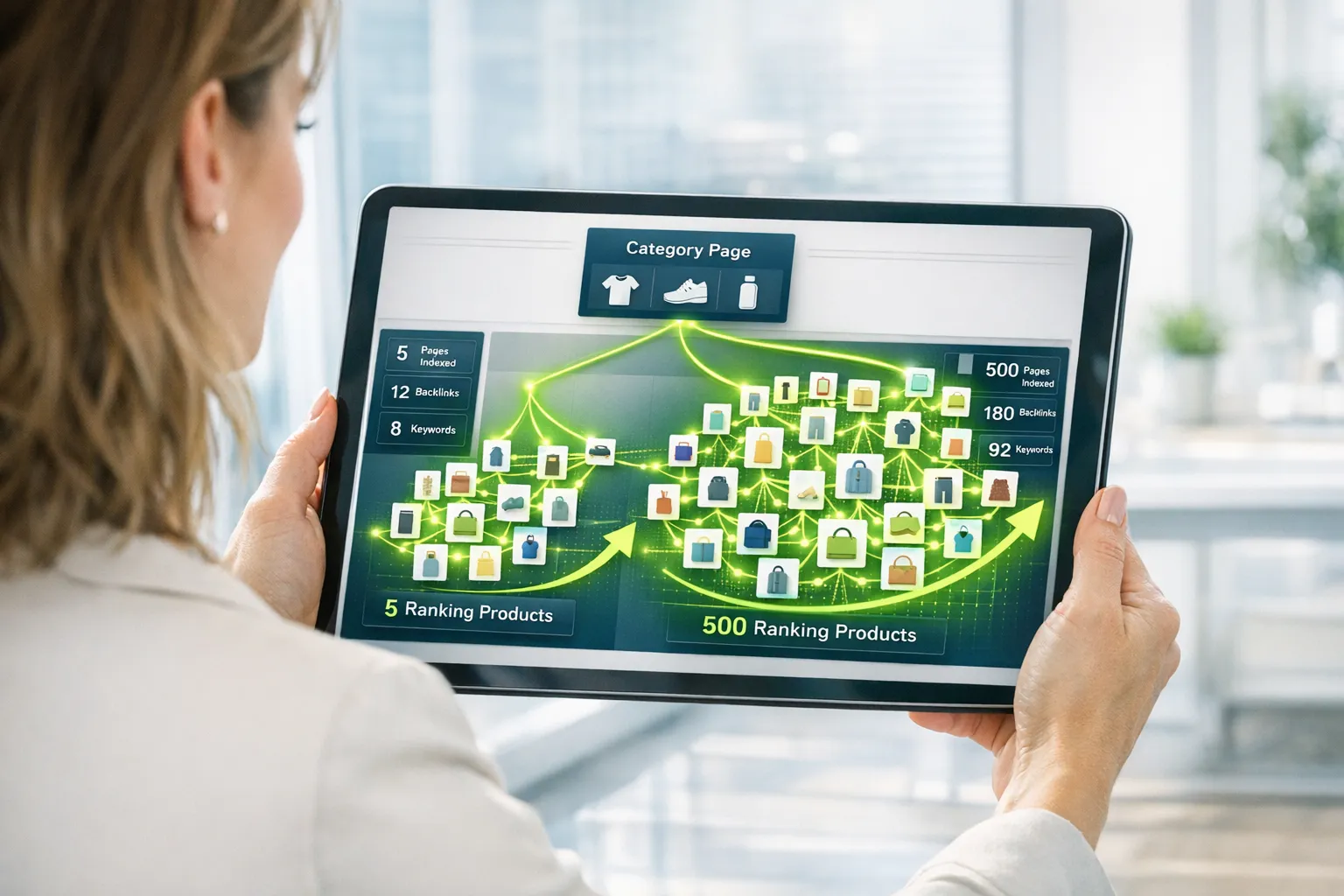
More Products Ranking
Contextual links to category pages create a cascading authority effect across your entire product catalog. As category authority strengthens, individual products within those categories gain clearer relevance signals.
Search engines understand your catalog structure and recognize that your store is an authoritative source across your niche, not just for one or two popular products.
This catalog-wide authority effect is what separates stores that rank for hundreds of product-level queries from stores that only compete for a handful of head terms. It’s the difference between organic revenue from 5 products and organic revenue from 500.
Store-Wide Scalable Authority
Editorial placements across ecommerce-relevant content help your backlink profile grow naturally alongside your catalog expansion. As you add new product categories, your link-building strategy extends to support them, ensuring new sections of your store gain authority without aggressive, concentrated link acquisition that triggers algorithmic scrutiny.
This balanced approach follows Google’s guidelines, reduces the risk of over-optimization, and creates a sustainable link profile that supports long-term organic growth.
Brands that build link profiles this way typically see organic traffic growth accelerate in months 6–12 as authority compounds across your store.

Client Success Stories
What Clients Say About Our
Contextual Links
Verified reviews from the clients who gained authority,
rankings, and revenue with our services

4.8/5 

5/5 

Rating on Google



We’d been doing link building for two years with another agency, but every link went to our blog. Category pages, which account for 90% of our revenue, were stuck on page 2. Outreach Desk rebuilt our strategy around our top 12 categories. Within six months, organic revenue grew 67%.

Head of Growth
US DTC Brand
The biggest difference was how they mapped our links to our store structure. Most agencies don’t understand ecommerce architecture. Outreach Desk started by analyzing our category hierarchy and keyword gaps, then built a link plan that distributed authority exactly where we needed it. Our product pages now rank for commercial terms they never touched before.
Founder
B2B Services Company
We run SEO for 6 ecommerce clients and needed a link building partner who actually understands ecommerce store structures. Outreach Desk handles link campaigns across all six accounts with category-level targeting and transparent reporting. Four clients saw organic revenue increases of 40%+ within the first year. The white-label reporting makes it seamless for client delivery.
Director of SEO
Digital Agency
Service Framework
Investment, Timeline, and
Deliverables
Every ecommerce link building campaign is custom-scoped to your store’s architecture, competitive landscape, and revenue goals. Here’s what shapes your investment:

Number of mentions per month
Most ecommerce campaigns run 10 and 40 placements monthly, depending on catalog size, competition, and target pages.

Target domain rating range
DR 40-95 placements are priced at standard rates. DR 70+ placements carry a premium based on publisher requirements and competition.

Mention format
Links are distributed across category pages, product pages, and supporting content based on your store’s authority architecture and revenue priorities.

Campaign duration
Most stores see measurable improvements in category page rankings within 3–4 weeks. Compounding catalog-wide authority effects build over 6–12 months.
Directional pricing
$200 – $300+ per link
Ecommerce link building campaigns start at $200 per link placement for targeted category or product page growth within a single niche. Enterprise ecommerce campaigns targeting multiple collections across competitive markets range from $250 to $300+ per link.
After your strategy call, you get a detailed proposal with exact mention quantities, target DR ranges, projected timeline, and a clear month-by-month roadmap.
What You Get
Client-Ready Reports for Ecommerce
Link Building
Every placement is clearly reported, so you know exactly where links are placed:

Live Link URLs
You get direct access to every live-published placement, allowing you to verify that each link is active, correctly targeted, and positioned within relevant editorial content.

Target Page Mapping
Every report shows which store page each link targets, giving you clear visibility into how authority is distributed across your architecture.

Anchor & Context Overview
You see the exact anchor text used, the surrounding editorial context, and how each placement aligns with your commercial keyword and anchor strategy.

Campaign Overview
Each summary covers total links delivered, page-level distribution, domain metrics, and authority flow across your store.
Our Approach
An Approach to Link Building
Your links focus on relevance, commercial intent, and your store’s architecture, not just volume.
| Factor | In-House / DIY |
 |
|---|---|---|
| Ecommerce Expertise | Requires hiring specialists with ecommerce SEO knowledge. Most generalist link builders lack an understanding of store structure. |
You get built-in ecommerce expertise. Your strategist understands category hierarchies, product page authority, and how internal link equity flows. |
| Product page targeting | Most freelancers and DIY approaches default to homepage or blog links. Acquiring direct product page links requires specialized outreach. |
You get strategic product and category page targeting, with contextual placements in product roundups, buyer’s guides, and comparison content. |
| Category authority | Difficult to scale. In-house teams rarely have the publisher relationships needed for systematic category-level link campaigns. |
You benefit from systematic authority distribution across your category hierarchy, with dedicated link target mapping and rebalancing. |
| Commercial intent alignment |
Hard to ensure link context matches buying intent. Generalist approaches often produce informational links that don’t support revenue keywords. |
Every placement is evaluated for commercial intent. Your links support transactional and comparison keywords, not just informational queries. |
| Content Quality | Variable. In-house quality depends on the writers available. Freelancers range from excellent to unusable. |
All content is written by experienced writers. No AI-generated copy. Every placement goes through internal editorial review. |
| Scalability | Limited by headcount and freelancer availability. Scaling from 10 to 40+ links/month requires significant hiring. |
You can scale from 10 to 40+ links per month without operational disruption. Multi-store and agency campaigns run seamlessly. |
| Cost Efficiency | In-house: $350–$700 per link (salary, tools, overhead). Freelancers: $100–$400 per link (variable quality, no store mapping). |
You get fixed pricing from $200–$300 per link with consistent quality, store-architecture mapping, and editorial review included |
| Turnaround | In-house: 4–8 weeks for a consistent placement pipeline. Freelancers: unpredictable. |
Your first placements go live within 2–4 weeks. Delivery is consistent every month. |
Who We Help
Ecommerce Businesses We Support
No matter your niche, you can secure links on
websites that truly match your industry.



Startups

Real Estate



Healthcare & Fitness

Financial & Insurance

Technology & Innovation

Consumer Brands
Real Results
Real Results From Ecommerce Link Building
Examples of how strategic link building supports rankings and revenue growth.
Common Questions
Frequently Asked Questions
Understand how strategic brand mentions work and where and how they appear.
Scale Your Ecommerce Visibility
With Strategic Link Building
If you want ecommerce backlinks that strengthen your authority,
drive growth, and deliver long-term results, move forward with confidence.
4.8/5
Trusted by 500+ agencies &
1,000+ businesses worldwide.