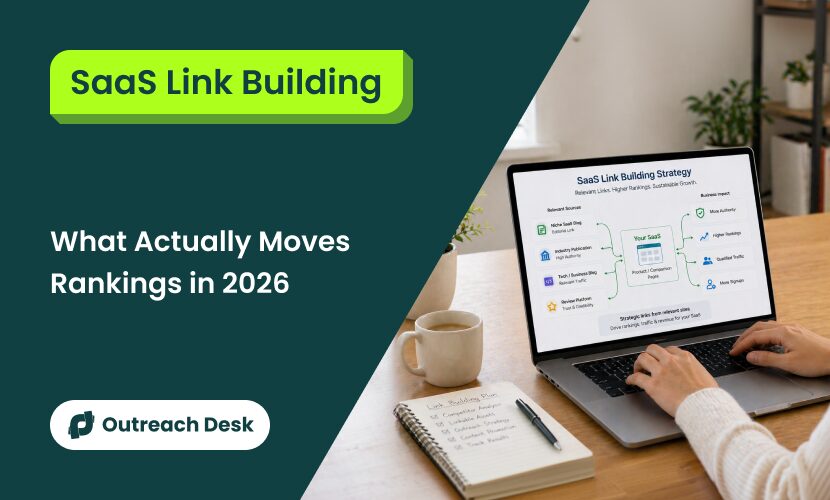
SaaS link building works when your links land on the pages where buyers decide.
That means product and comparison pages on sites your buyers already read, not only your blog.
We’ve published results from three SaaS campaigns built that way.
Organic traffic grew between 47% and 140%.
What You’ll Learn
- Why links matter more for SaaS than most other businesses.
- Nine link building strategies ranked by effort, scalability, and ROI.
- How to evaluate link quality beyond domain rating.
- The content formats that attract links passively and the ones that need outreach.
- Common mistakes that stall SaaS link campaigns.
- What three published SaaS campaigns showed about pace and targeting.
Why Links Matter More for SaaS Than Most Industries
SaaS companies fight for some of the most competitive keywords on the internet.
Terms like “project management software,” “CRM for small business,” or “best email marketing tool” have dozens of well-funded competitors publishing nearly identical content.
When content quality is comparable to your closest competitors’, backlinks become the tiebreaker.
When two pages are equally good, Google uses backlinks to decide which one ranks.
When your product page earns a contextual mention on a respected industry blog, that’s a trust signal your buyer reads before they ever reach your site.
For SaaS companies, a strong backlink profile does two things simultaneously: ranking power and brand credibility in the same placement.
None of our three published SaaS campaigns averaged more than 16 links a month.
Each one aimed its links at product and comparison pages.
The targeting was precise, and the volume was modest.

What Makes SaaS Link Building Different
SaaS link building differs from standard outreach in three specific ways. Your buyers compare products across review sites, pricing pages, and competitor comparisons before they decide, which means your product and comparison pages need backlinks, not just your blog. Your competitor set is narrow and specific. And your best content assets, like original data studies and free tools, can earn links for years rather than months.
You need to remember that SaaS link building is not like ecommerce link building service or local business link building.
This is one of the most common mistakes teams make.
Three things separate the SaaS link campaign from everything else.
Your Buyers Research Before They Buy
SaaS decisions involve comparison, feature evaluation, and multiple stakeholders. That means your product, comparison, and pricing pages need authority. Not just blogs.
Your Competitor Set is Specific
You’re competing against 10-30 specific SaaS companies targeting the same keywords. The links you need come from the exact same places your competitors already appear.
Your Content Has a Longer Shelf Life
A well-built resource page or original research study can earn links for years. That makes link building an investment, not an expense, but only when you’re building links to the right pages.
To judge that investment against your other channels, use SaaS marketing benchmarks by growth stage.

Nine SaaS Link Building Strategies That Work Right Now
Here are the nine strategies actually worth your time in 2026.
1) Competitor Backlink Gap Analysis
Always start with a competitor backlink gap analysis.
Pull your top 3-5 keyword competitors into Ahrefs or Semrush and run a backlink gap analysis.
This shows you every site linking to your competitors but not to you. These sites have already proven they’ll link to content in your space. You just need to give them a reason.
Sort results by domain relevance and traffic. Ignore sites linking to every competitor; those are likely paid placements or directories.
Focus on sites linking to just one or two competitors on specific topics. Those are editorial placements you can replicate with better content or a sharper angle.
2) Original Research and Data Studies
Proprietary data earns links at scale. If your product generates usage data, survey results, or benchmarks, publish them.
The title matters here.
“We analyzed 10,000 SaaS free trials: Here’s what predicts conversion.” can help you earn links.
Titles like “Our Q1 data report” earn nothing.
Lead with surprising or counterintuitive findings. Journalists and bloggers link to data that challenges assumptions, not data that confirms what everyone already knows.
Publish your data study as a standalone page, not a blog post. Standalone pages are easier to reference and accumulate links over time. Blog posts get buried.
3) Linkable Tool and Calculator Pages
Free linkable assets and tools built around your product’s core value attract links passively and generate leads simultaneously.
Think HubSpot’s Website Grader. It is a page earning thousands of referring domains because it provides a standalone utility.

You don’t need HubSpot’s budget. A well-built ROI calculator or benchmarking tool can earn steady links for years.
Remember
The tool must work without a product signup. If it’s just a gated demo, nobody will link to it.
4) Guest Posting on Niche-Relevant Sites
Guest posting still works, but only on sites your actual buyers read.
If you would rather not pitch and write these yourself, our done-for-you guest posting books the placements for you.
If you sell project management software, post on operations blogs and engineering leadership publications, not generic marketing sites.
Write content that requires genuine product expertise. Technical tutorials, workflow breakdowns, and real case studies.
Surface-level advice that anyone could write won’t earn placements worth having.
5) Unlinked Brand Mention Reclamation
If your SaaS products have any market presence, people are already mentioning them without a link. These are the easiest links you’ll ever build.
Set up alerts in Google Alerts, Mentions, or Ahrefs Content Explorer for your brand name, product name, and key executive names.
When a brand mention appears without a hyperlink, send a short, friendly email asking if they’d add the link. No pitch.
No explanation, just “Thanks for the mention, would you mind linking our name to [URL], so that your readers can find us easily?”
Conversion rates on these emails typically run 30-50% because you’re not asking for a favor. You’re making their existing content more useful for their readers.
6) SaaS Directories and Review Platforms
Most directories deserve their low-value reputation. But a handful of SaaS-specific platforms carry real authority and send qualified traffic directly to your product.
G2, Capterra, TrustRadius, Product Hunt, and GetApp are worth maintaining active profiles on. Beyond backlinks, these platforms influence buyers’ decisions, and Google surfaces them prominently in SaaS-related searches.

Don’t spend weeks submitting to 200 generic directories. Pick the 8-12 profiles your buyers actually use and keep them up to date with screenshots, accurate information, and responses to reviews.
Before you invest time in any directory, check whether its outbound link actually passes ranking signals. Google documents three values that qualify a link: sponsored, ugc, and nofollow. We checked several SaaS directories directly and the results were not uniform. See our low-competition SaaS link sources.
7) Expert Commentary and Journalist Requests
Journalists’ requests platforms still work even after HARO (Help A Reporter Out) declined. In 2026, Qwoted, Featured, and direct outreach on LinkedIn and X emerged as the most productive channels.
Here’s how you should approach:
Monitor requests across the verticals and respond within hours, because speed matters here.
Make sure to provide a genuine, specific answer with data or examples. Such an answer is more likely to be published than generic ones.
| Gets Ignored |
Gets Published |
|---|---|
| “As an industry expert, I believe…” | “I run paid search campaigns for 40+ brands over 8 years…” |
This tactic works best for SaaS founders and executives with strong personal brands. If your CEO can credibly speak to industry trends, this channel can generate 3-5 high-authority links per month with minimal time investment.
8) Integration Partner Co-Marketing
This is one of the most underused SaaS link building strategies.
Every integration partner is a potential link source, and these links are among the most topically relevant you’ll ever earn.
Reach out to your integration partner and co-create content. You can create:
- Joint tutorials and webinars
- Shared case studies
- Best [category] tool that integrates with [partner]
This way, you can get contextual links to both products and can create useful content for both audiences.
9) Resource Page and Listicle Placements
You will find thousands of resource pages on the internet. These pages are created to serve readers with almost all the details on relevant topics.
Industry resource pages and category tools are exactly where buyers look when they’re comparing the products.
Look for such pages and see where your competitors get links.
Simply reach out, send a pitch, and ask to include your link with a clear, brief explanation of why your product belongs on the list.
When your target buyer compares competitor A and competitor B, they might also want to know about your product. Here you can be a differentiator.
Remember
Do not sound desperate by pitching “please add us.”
Give them a strong reason that you are genuinely serving their audience, not your marketing goals.

How to Evaluate Link Quality Beyond Domain Rating
SaaS link building is not about gaining the most links. It is about gaining the right ones, because quality always matters more than quantity.
Most people look at the high DR (domain rating) and call it an achievement. What they overlook or underestimate is the site’s authority and relevance.
DR 70 sites with no referral traffic and no SaaS relevance offer limited value. A DR 35 niche blog can help improve rankings faster due to its relevance.
Here’s what actually matters when evaluating a potential link:
Topical Relevance
A DR 50 site that covers B2B software every day beats a DR 80 with a general news site that published one tech article last year. Google cares about context.
Real Organic Traffic
A website can have impressive DR and barely any real visitors. Check actual search traffic in Ahrefs or Semrush.
A site with 10,000 monthly visitors on relevant keywords is genuinely valuable. On the other hand, a site with inflated DR but 200 monthly visitors is likely a link farm. Stay away from these sites.
Such link-farming sites are created for selling links, not to serve the audience.
Editorial Standards
Read 3 recent articles and ask yourself:
- Are they well-written?
- Do they have named authors?
- Do they feel like real content or fillers?
If it reads like it was generated to sell links, then placement on such sites won’t help you rank higher.
Link Neighborhood:
Check what other sites it links out to. If a “SaaS blog” is also linking to online casinos, payday loan sites, and pharma pages, that’s a serious red flag. Good editorial sites link to other good sites.
Indexation Health:
This one gets overlooked constantly. A link on a page that Google doesn’t index transfers zero value. Use a free Google index checker to confirm the page actually exists in Google’s eyes before you pursue it.
Here’s a quick reference table:
| Quality Signal | What to Check | Red Flag |
|---|---|---|
| Topical relevance | Content archives in your niche | No SaaS/tech content in the last 6 months |
| Organic traffic | Ahrefs/Semrush traffic estimate | Under 500 monthly organic visits |
| Editorial standards | Author bylines, content depth | Thin posts, no named authors |
| Link neighborhood | Outbound link profile | Links to gambling, pharma, unrelated niches |
| Indexation | Google index status | Linking page not indexed |
Content Formats That Attract SaaS Backlinks
Not all content earns a link equally. Some formats pull links in naturally. Others need active outreach just to earn one. Knowing the difference saves a month of wasted effort.
High Passive Link Potential:
- Original research and industry benchmarks
- Free tools, calculators, and interactive resources
- Full glossaries and definition pages
- Statistics roundup pages with original analysis
High Outreach Link Potential:
- Guest posts and contributed articles
- Expert commentary and interview placements
- Listicle and resource page inclusions
- Create co-content with Integration partners
Low Link Potential (Skip These for Link Building)
- Product announcements and release notes
- Company culture posts
- Generic “thought leadership” with no data
- Repurposed content with nothing original added
The winning combination
Passive assets build your baseline authority steadily over time. Outreach campaigns accelerate growth on the specific pages that drive revenue. The strongest SaaS link profiles use both, not one or the other.
Best Low-Competition Backlink Sites for SaaS in 2026
Low-competition backlink sites are sources where a young SaaS company can earn a link without outranking a hundred established competitors first. They will not carry the authority of a major news feature, but they compound faster because you can actually win them in your first few months.
Five categories work well for SaaS in 2026:
- Niche SaaS review platforms beyond the obvious directories, especially category-specific sites your buyers already read.
- Founder and indie-hacker communities where a genuine product story earns a contextual mention.
- Integration and partner pages of the tools your product connects with, which often list partners with a link.
- Niche newsletters and roundups in your category that publish tool mentions to a focused audience.
- Podcast and interview show notes, which carry a link from a relevant, lightly contested page.
The test for a low-competition source is simple. Check whether the linking page ranks for a keyword with fewer than 50 referring domains across its current top results. If it does, your link has a real chance of moving a ranking rather than disappearing into a crowded profile.
The Security Software Exception
One SaaS category does not follow the rules above. VPN and cybersecurity link building runs into a higher trust bar than ordinary software, and it splits into two playbooks that are easy to confuse, VPN affiliate sites and cybersecurity software brands are not doing the same job, and what earns links for one rarely works for the other.
Common SaaS Link Building Mistakes
These mistakes aren’t rare; they happen constantly, even at well-funded SaaS companies.
1) Building Links Only to Blog Posts
This is one of the most common mistakes the SaaS team makes. They treat the blog as their product page.
Remember, your blog page and product pages are different.
If all your backlinks point to articles and your product pages have zero external links, you’re building authority in the wrong place.
Distribute the PageRank flow across product pages, comparison pages, features pages, and integration pages, not just the blog.
2) Chasing Domain Rating Instead of Relevance
Domain rating matters, but keeping relevance out of the door won’t help.
A backlink from a DR 80 cooking site won’t help your SaaS website. But a DR 40 link from a respected operations management blog tells Google that your website is a genuine source to reference.
This sends topical signals to the search engines.
3) Ignoring Internal Link Architecture
External and internal links both matter. Internal links help in distributing the authority that external links bring to your site.
If your blog posts don’t link to your own product pages, the authority you’ve worked hard to earn just sits there and won’t work in your favor.
You need to first fix internal links before building more external ones.
4) Treating Link Building as a One-Time Project
Link building is a continuous process. In fact, your competitors are building links every single month.
If you stop after a three-month link building campaign and then do nothing, your rankings will slowly decline as competitors continue to accrue authority.
You need to treat link building as part of your business routine. If your team lacks the bandwidth to stay consistent month after month, a SaaS link building agency can help maintain momentum without gaps.
5) Using the Same Anchor Text Everywhere
If every backlink uses your exact target keywords as anchor text, you’re creating a problem, not solving it.
Google detects over-optimized anchor text easily.
The solution is simple: Vary your anchor naturally across branded terms, partial matches, URLs, and generic phrases. Different types of backlinks will help you understand anchor types.
What Three SaaS Link Building Campaigns Showed
Three published SaaS campaigns showed the same thing: steady, relevant links to commercial pages grew traffic 47% to 140%.
The clients were an email and SMS platform, a marketing automation platform, and a lead generation platform.
| Campaign | Length | Links Built | Average DR | Traffic Growth |
|---|---|---|---|---|
| Email and SMS platform | 28 months | 175 | 65 | +140% at peak |
| Marketing automation platform | 9 months | 110 | 62 | +83% at peak |
| Lead generation platform | 6 months | 95 | 60 | +47% |
Links Per Month Stayed Modest
None of the three campaigns averaged more than 16 links a month.
The pace works out to about 6, 12, and 16 links a month.
The slowest pace ran the longest and grew the most.
Plan a pace you can hold for a year, not a burst you drop after a quarter.
The Linking Sites Averaged DR 60 to 65
The sites that linked to these clients averaged DR 60 to 65, not DR 80 or 90.
Every placement sat inside content that already covered the client’s subject.
Pick the site your buyer reads over the site with the bigger score.
Links Went to Commercial Pages
All three campaigns pointed links at product and comparison pages, not only the blog.
Those are the pages where a buyer picks a tool.
In the marketing automation campaign, top 3 keyword rankings rose from 9,782 to 14,726.
Growth Came in Steps
Traffic didn’t climb evenly in any of the three campaigns.
The lead generation platform stayed flat for its first three months, then stepped up in mid December.
It fell from roughly 120,000 to 90,000 monthly visits in early February and still closed at its high.
The email and SMS platform pulled back mid-campaign too, then recovered above 200K.
Expect a flat first quarter before you judge the work.
AI Answers Started Citing the Brands
All three brands ended with 3.8K to 5.3K citations across five AI engines, including ChatGPT and Perplexity.
A citation means the engine named the brand’s page as a source in its answer.
Two of the brands started at zero on four of those engines.
Google AI Overview counts fell from their peak in two campaigns, so treat that number as the least stable.
How to Structure a Monthly SaaS Link Building Campaign
Understanding SaaS link building strategies and common mistakes that most teams make is easy. The challenging part is to build a strong structure that works month after month.
Here’s a simple four-week framework that keeps your campaign moving.
Week 1: Research and Prospecting
Run a competitor gap analysis and identify 30-50 prospects. Sort them by link type. It could be guest post targets, resource page targets, unlinked mentions, and integration partners. You can prioritize them by relevance and how reachable the site actually is.
Week 2: Content Creation
Draft guest post pitches, prepare outreach angles, and create any content assets needed for the month. If you’re building a data study or tool page, this phase may extend into week three.
Week 3: Outreach Execution
Send personalized emails to your prospect list. Follow up once after 5-7 days. Keep outreach short and specific, mention their content, explain why your resource adds value for their audience, and make it easy to say yes.
Week 4: Tracking and Refinement
Log every placement. Monitor new referring domains using the backlink tracking tool. Analyze which prospect categories converted best. Feed those insights back into next month’s research phase.
Timeline
This cycle takes roughly 15-20 hours per month for a lean team. If that capacity doesn’t exist internally, outsourcing link building to a specialist agency is a valid option, but you should still understand the process well enough to evaluate what they deliver.
Should You Build Links In-House or Hire an Agency?
Both can help you build quality links. The right decision depends on your business stage, budget, and your team’s skills.
Build In-House When
- Your content team already has experience with outreach.
- Your monthly budget is under $3,000.
- You want direct control over every placement.
- Your niche is so specialized that only your team can credibly write about it.
Hire an Agency When
- You need to quickly scale beyond 10-15 links per month.
- Your team lacks outreach infrastructure or publisher relationships.
- You’re entering a competitive vertical and need authority fast.
- You want access to established publisher networks without having to build them from scratch.
-

Most SaaS companies consider cost as the biggest risk when working with agencies, but the actual risk is relevance.
Many generalist agencies build links from whatever sites they have relationships with, regardless of your niche. If those links aren’t relevant to your SaaS vertical, the money is wasted.
A specialist agency avoids that problem.
Our link building agency for SaaS earns editorial links on software, marketing, and tech sites, and you approve each site first.
Tip
Before hiring, ask for examples of real placements for other SaaS clients. Check them manually, do the sites have real traffic? Would your buyers actually read them?
If the answer is no, keep looking.
Measuring SaaS Link Building Success
You built strategies, avoided mistakes, and started running campaigns through an in-house team or with an agency; now it’s time to measure success in the SaaS link building process.
Traffic and rankings are the obvious metrics to measure success, but they’re lagging indicators. They move weeks or months after the links go live.
Track leading indicators as well, so you know your campaign is working before rankings confirm it.
Leading Indicators (Track Weekly):
- New referring domains to target pages
- Link placement rates (outreach sent vs. link secured)
- Average domain relevance score of new links
- Anchor text distribution balance
Lagging Indicators (Track Monthly):
- Organic traffic to linked pages
- Keyword position changes for target terms
- Organic-attributed signups, demos, or trials
- Domain authority trend directional, not absolute
The metric that matters most depends on your business model:
| Product-led SaaS |
Track organic signups per linked page |
|---|---|
| Sales-led SaaS |
Track demo requests from organic traffic |
Link building that doesn’t eventually connect to revenue isn’t working even if your domain rating keeps climbing.
Building a Link Profile That Compounds
The SaaS companies winning organic search in 2026 aren’t necessarily spending the most.
They’re building the right links to the right pages, month after month, and letting that authority compound over time.
Start simple. Run a competitor gap analysis this week. Find your ten most relevant link prospects. Reach out to five of them.
That’s enough to build momentum, and it will separate companies with flat organic traffic from the ones whose growth curve keeps climbing.
Looking for a SaaS link building approach that fits your growth stage?
Get a clear strategy focused on relevant, high-quality links that support long-term growth.
Frequently Asked Questions
1) How long does SaaS link building take to show results?
Plan for three to six months before organic traffic moves.
In our lead generation platform campaign, traffic stayed flat for three months, then finished 47% higher at month six.
Our marketing automation campaign made its sharpest gains in the final ten weeks of nine months.
Consistency matters more than volume.
2) How much does SaaS link building cost?
In-house campaigns typically run $3,000 to $8,000 per month, including tools, content, and team time. Agencies charge $2,000 to $15,000+ per month, depending on volume, quality, and niche competitiveness. A detailed breakdown of link building pricing can help you benchmark costs for your situation.
The real question isn’t what it costs, it’s what it returns. A campaign generating $50,000 in organic pipeline over 12 months is cheap at $5,000 per month. A campaign generating nothing at $2,000 per month is expensive.
3) What’s the difference between SaaS link building and regular link building?
SaaS link building targets the software industry, including tech publications, review platforms, integration partner blogs, and vertical industry sites. The strategies overlap, but the targeting criteria, content angles, and success metrics differ. SaaS link building ultimately measures success against product signups and pipeline, not just traffic.
4) Can I build links directly to my SaaS product pages?
Yes, you can build links to your SaaS product pages, and you should. Build links for product pages, comparison pages, and feature pages, because these are the highest-converting pages on SaaS. However, you need to remember that they’re also the hardest to earn links naturally, which is why most competitors neglect them.
5) Is link building still worth it with AI search changing everything?
Absolutely. AI search surfaces like Google’s AI Overview and Perplexity still rely on authoritative sources. Pages with strong backlink profiles get cited more often in AI-generated answers. The format of how links help is shifting, but the underlying mechanism hasn’t changed. Authority signals from trusted sites still matter.