SERP insight link insertion is a niche edit with a layer of SERP analysis on top. Vendors sell it as if it were a separate discipline, but it isn’t.
A niche edit is a link added inside an existing article, not inside a new one you wrote for the link. The SERP, or search engine results page, is just the list Google shows after a search. The “SERP Insight” part means that whoever runs the campaign picks the target page from among those currently ranking on Google, rather than guessing.
If a vendor pitched you this term, you probably want to know whether it’s worth paying for.
What This Article Covers:
- SERP insight link insertion is a niche edit chosen by SERP analysis, not a separate tactic.
- The time-to-result depends on how often Google revisits the target page, not on a fixed timeline.
- Paid link insertions violate Google’s guidelines unless they are tagged with rel=”sponsored” or rel=”nofollow”.
- Run the BS Detector before paying a vendor. Five questions separate real services from risky ones.
What SERP Insight Link Insertion Actually Means
SERP insight link insertion is an SEO practice in which a backlink is placed within an existing, already-ranking article on another website, using search results data to select that page.
Instead of writing a new article and waiting for Google to find it, you link to a page Google already trusts.
This is the same tactic that the industry has used to recognize links added to ranked pages for years. The “SERP insight” label describes the page-selection step, not a new mechanism.
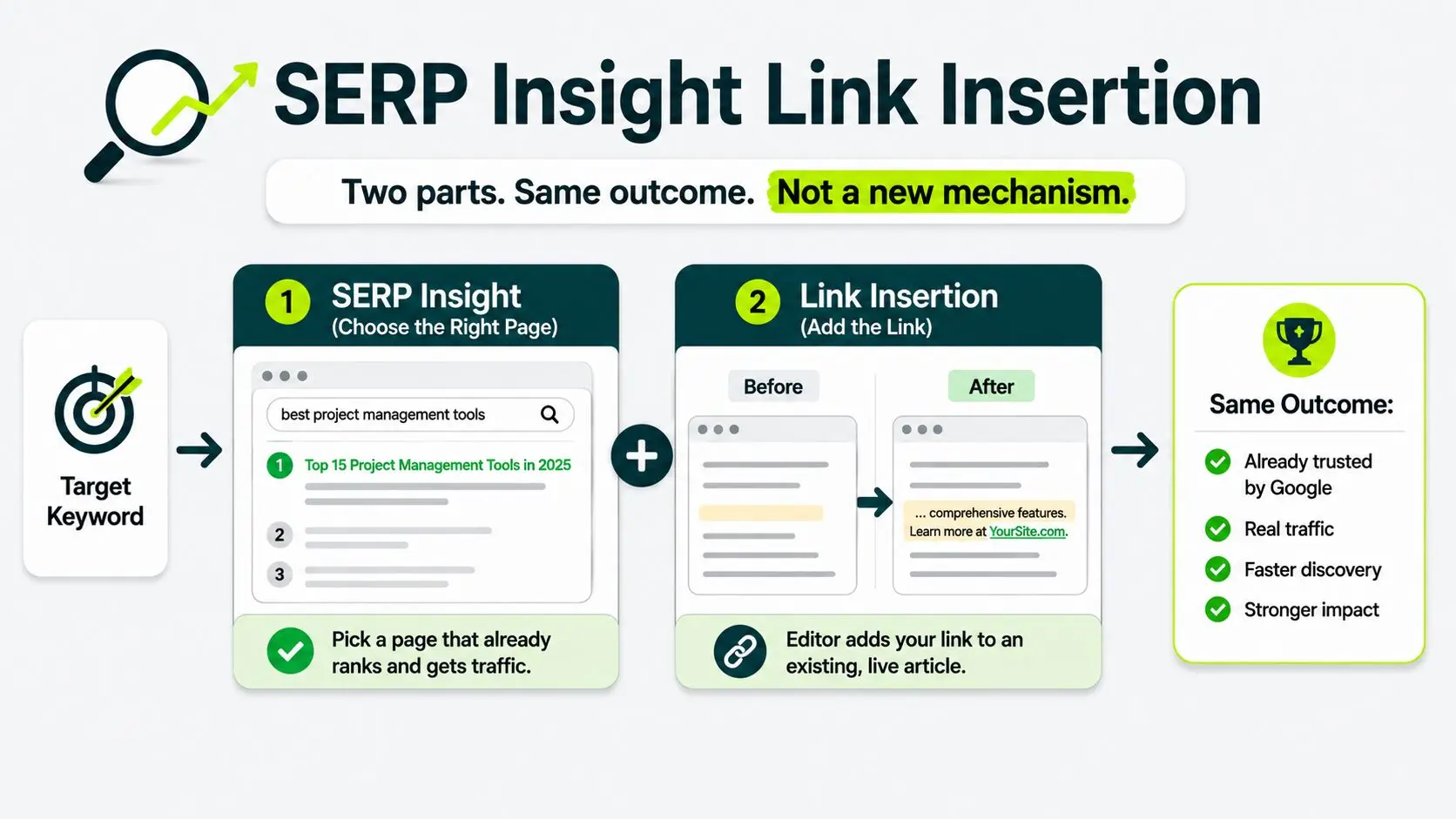
You can do it yourself or outsource to a specialist. Either way, the work breaks into two pieces:
The “SERP Insight” Part
“SERP insight” means you choose the page by looking at what already ranks for your target keyword, rather than picking any page on a high-authority domain. You search for your keywords, see which pages Google rewards, and target one of those.
A page ranking on page one has demonstrated relevance and authority signals that Google has rewarded, and is typically revisited more frequently as a result. A link there is likely to be discovered sooner, since Google revisits high-performing pages more frequently than pages that nobody visits.
Vetting the page before you place a link is not an advanced technique. Any link builder placing a link without checking whether the host page ranks or gets traffic is doing it wrong, with or without a fancy label.
The “Link Insertion” Part
A link insertion adds your backlink to the content that’s already published and live. An editor opens an existing post, places your link within a relevant sentence, and re-publishes it. Though the quality of placement varies depending on the vendor or editor involved.
This is different from a strategic guest post, where someone writes and publishes a new article to include your link.
Is “SERP Insight Link Insertion” Actually Different From a Niche Edit?
SERP insight link insertion is the same tactic as a niche edit. With one extra step: SERP analysis that picks which page receives your link.
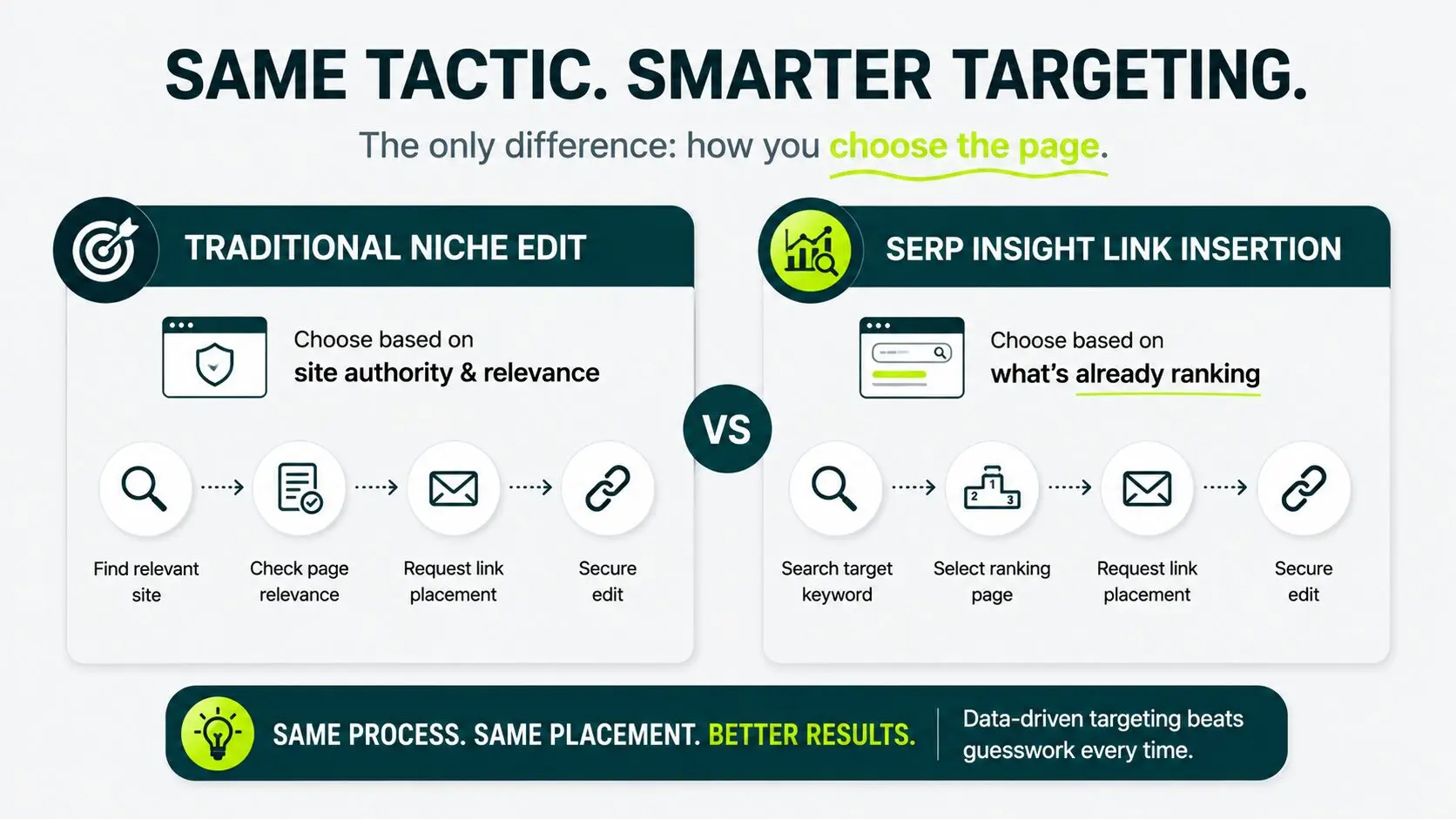
To compare the two:
A traditional niche edit chooses a target page based on the site’s authority and relevance. The vendor (or you) finds a relevant site, checks that the page fits your topic, and then requests a link placement.
A SERP insight link insertion chooses the target page based on what’s already ranking on Google for your target keyword. The vendor (or you) searches for the keyword, selects a ranking page, reaches out to the site owner to negotiate a link placement within the existing content, and secures the edit.
The process, placement, and link stay the same. The key difference is that the second step uses data instead of guesswork.
How a SERP Insight Link Insertion Works in 5 Stages
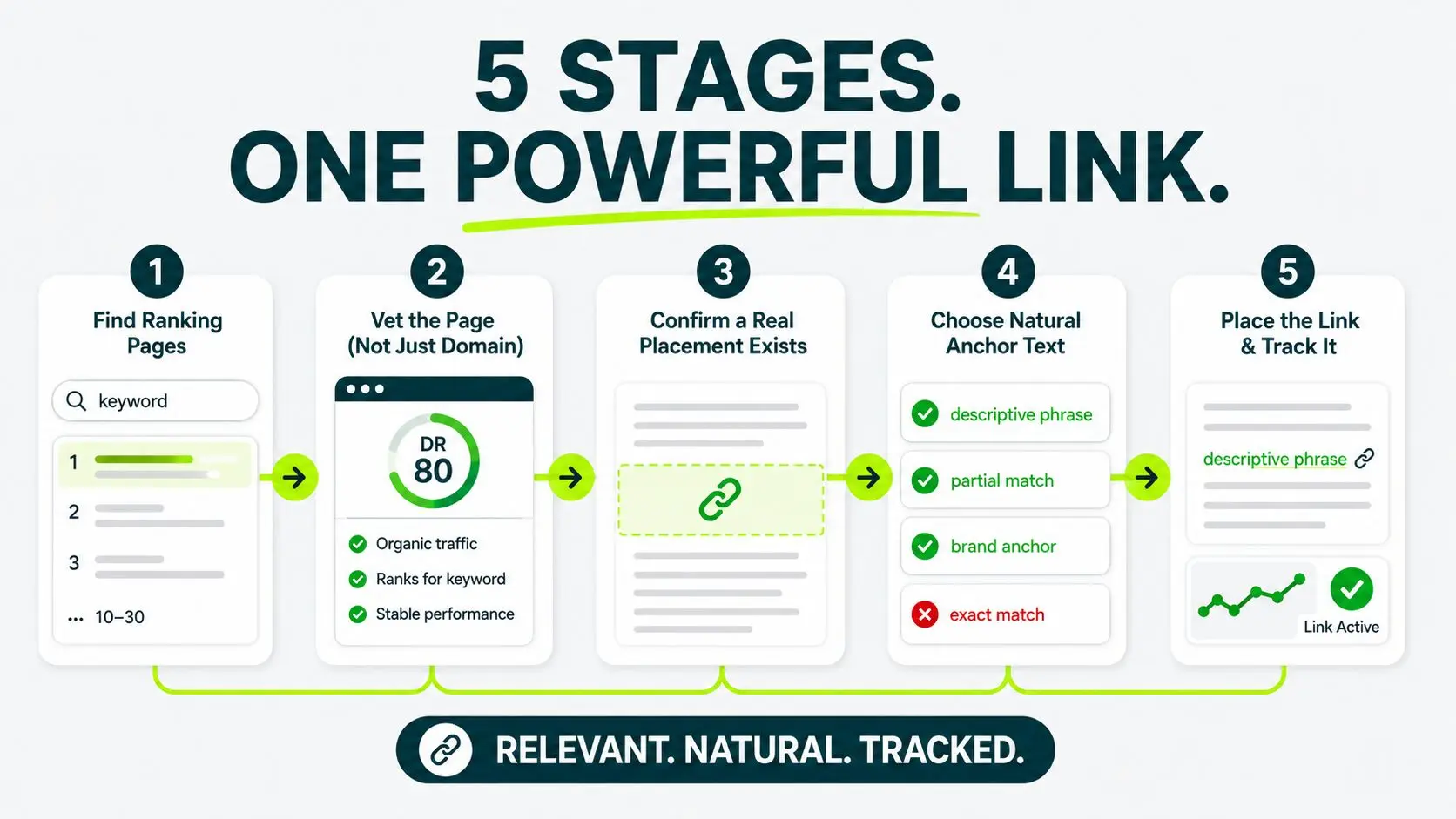
A SERP insight link insertion runs through five stages: finding ranking pages for your keywords, vetting each page, confirming there’s a natural spot for the link, choosing the best-fit anchor text, and placing the link within the relevant body text.
1. Find Pages that Already Rank for Your Keyword
Start with the google search results for the keyword you want to influence, and list the pages ranking in the top 10 to 30. These are the pages Google has already shortlisted. You’re looking for a specific page that earns its position and covers a topic close enough to yours that a link to you would help the reader.
2. Vet the Page, Not Just the Domain
A high domain rating means nothing if the specific page is dead. Domain rating is an Ahrefs estimate, in the 0 to 100 range, of a site’s overall backlink strength; it applies to the whole domain.
You can find a DR 80 site with a page that hasn’t been touched in so long that it gets no traffic and ranks for nothing. Such a link offers limited value. The page-level signals that make a placement worthwhile simply aren’t there.
Check the page itself:
- Does it pull organic traffic?
- Does it rank for the actual keyword?
- Have its positions been stable rather than sliding?
A page with stable traffic and a healthy keyword footprint is the real asset. The domain number is a secondary thing.
3. Confirm a Real Placement Exists
Some pages don’t fit your link naturally, and forcing it in can make the placement look manipulative. Prioritize pages where your link genuinely helps the reader. If the target site or vendor won’t accommodate natural placement, walk away from that opportunity.
4. Choose Anchor Text That Reads Naturally
Anchor text is the clickable text that carries the link, and it’s one of the ways to make the paid placement look paid. Exact-match commercial anchors repeated across placements are the classic footprint of a link scheme. Use descriptive phrases that fit the sentence, partial-match variations, and brand anchors.
The ideal anchor should read as the writer chose it. Natural anchor text has always been a quality signal, and with Google’s continued improvements to spam detection, unnatural patterns are easier to identify than ever.
5. Place The Link and Track It
Place the link inside the body content, in the paragraph you identified, never in an author bio or footer. Then track it; paid placements get removed when sites change hands or clean up outbound links.
A link you don’t monitor is a link you might lose. Ongoing backlink monitoring tells you the moment a placement disappears.
What It Costs (And What the 60% to 80% Cheaper Claim Leaves Out)
Two pricing tiers exist in this market: Real manual outreach and bulk-and-risky.
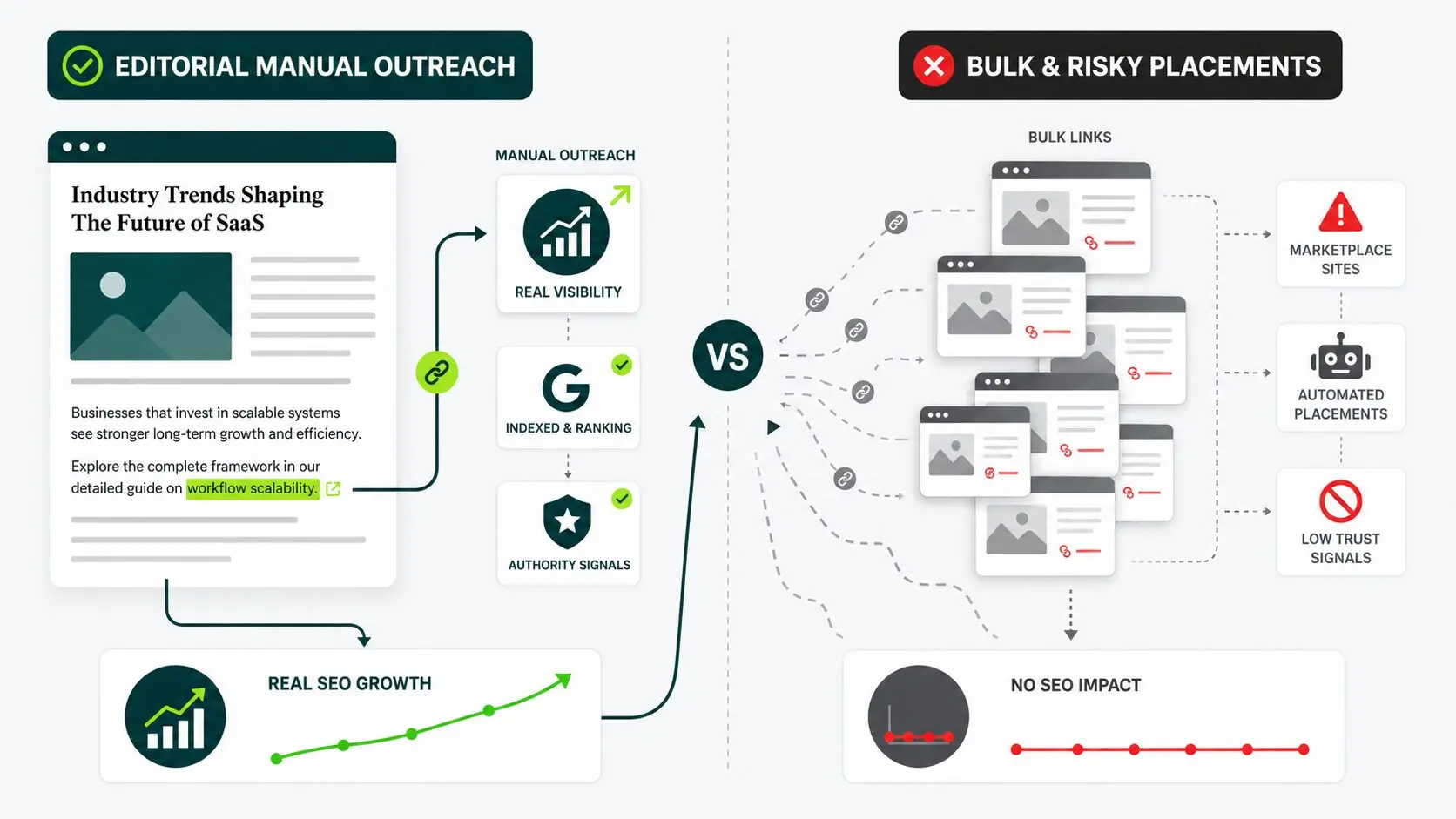
Genuine manual placements typically range from $200 to $500 per link in 2026. The price depends on the target site’s domain rating, traffic, and editorial standards.
That price covers a person handling the publisher outreach process with an actual site owner. Most vendors offer limited rounds if the site owner pushes back on placement details. Confirm this before committing.
Bulk placements range from $50 to $150 per link. At that price, the placements come from a marketplace of low-traffic blogs that accept links for a fee. Some are Private Blog Networks, which are groups of sites that operate, build, or acquire specifically to sell links.
Some are expired domains that someone bought purely for the existing links. Some are real sites that have decided to monetize this way. They all share one trait. The link appears on a page that Google doesn’t care about.
You’re paying for the sole purpose of the link to exist, rather than to move anything. The case against buying backlinks the cheap way is mostly the case against this entire tier.
You might come across the claims that SERP insight link insertion is “60 to 80 percent cheaper than a guest post”. A guest post is an article you write for another site in exchange for a link back to your site. An editorial link is one that an editor decided to include because the content was useful.
That 60 to 80 percent figure is not from a study. It’s a marketing comparison that picks the cheapest link insertion against the most expensive guest post.
An editorial link insertion can be cheaper than a real editorial guest post. The target page already exists, so the production cost is lower.
In practice, the realistic cost difference is likely closer to 20 to 40 percent, though this varies by vendor, niche, and editorial standards, and no formal study has definitively benchmarked the gap.
How Long Until You See Results
It depends on how often Google revisits the target page. In our experience, results appear within a few days to a few weeks.
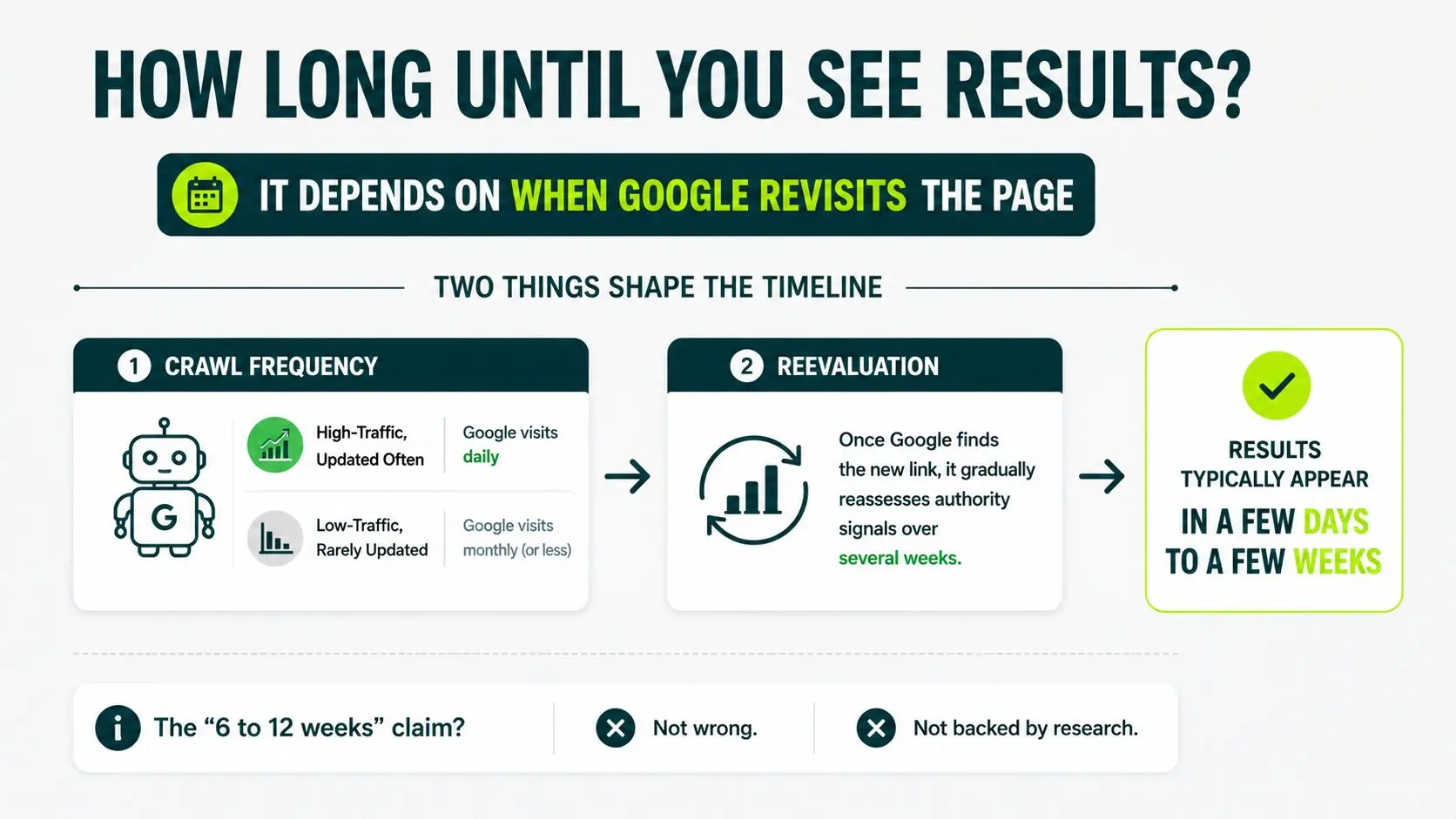
There are two things that shape the timeline.
The first is how often Google’s crawlers (the automated bots sent by Google to scan your pages and decide how to rank them) come back to the target site. Google visits a high-traffic page that updates regularly more often, sometimes daily. On the other hand, a low-traffic, rarely updated page might go a month without visits.
The second is reevaluation. Once Google visits the new link, its ranking systems begin reassessing the authority signals flowing to your page, a process that typically plays out gradually over several weeks.
A “six to twelve weeks” figure claim floats around this topic. It isn’t wrong, but it isn’t from research either.
What Google Actually Says About SERP Insights
Google’s official rule is in Google’s spam policies. This short version: paid links cannot influence rankings unless the site owner tags them as paid.
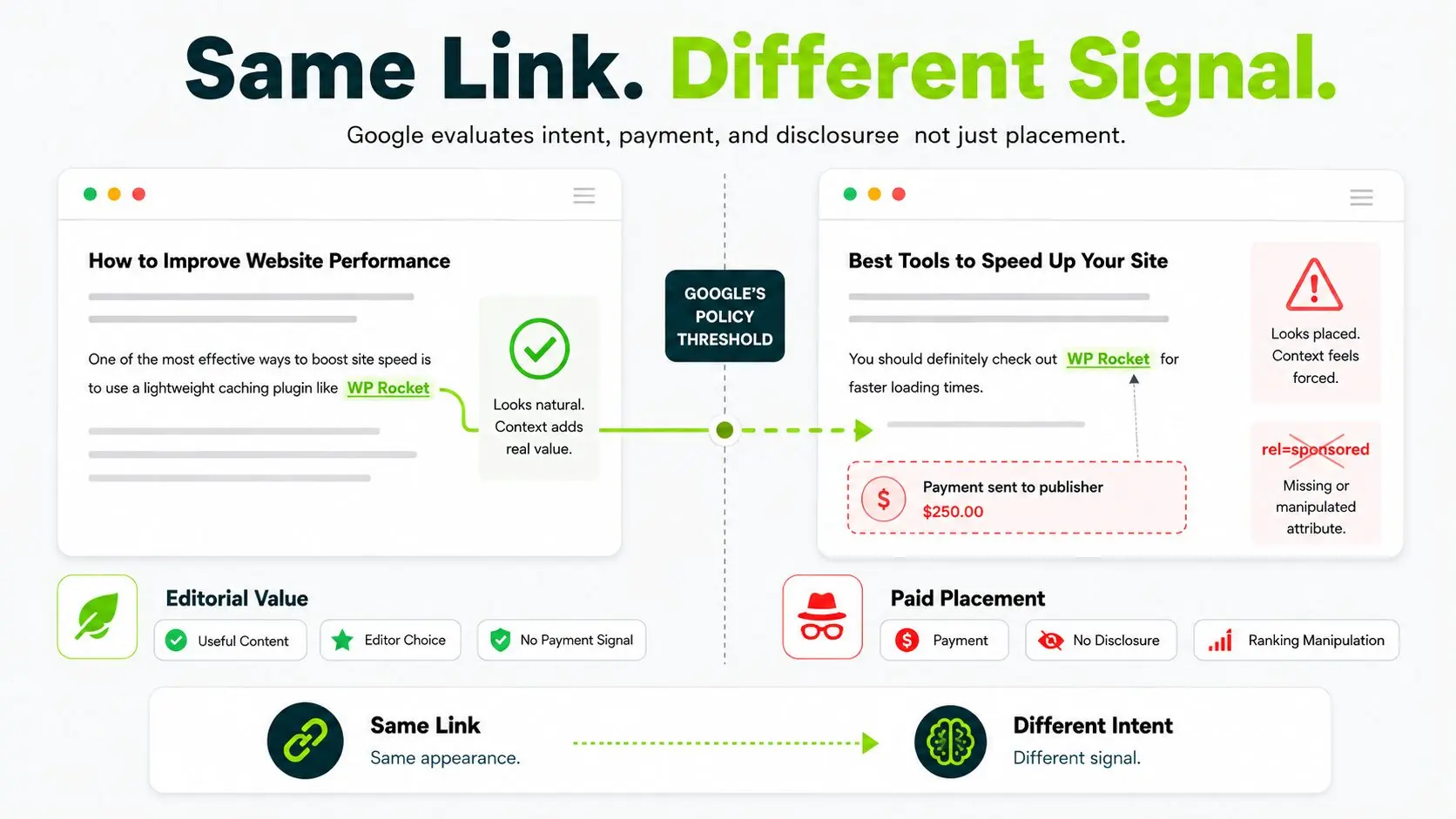
Google’s spam policies state the result explicitly. Buying and selling links for ranking purposes is a violation. Google permits paid links for advertising and sponsorship only when the site owner qualifies them with rel=”sponsored” or rel=”nofollow”. These tags appear in the link’s code and tell Google not to pass ranking credit through it.
A SERP insight link insertion can land on either side of that line.
On the safe side, the target site’s editor judged your page useful for their readers. They added the link based on editorial merit, without any monetary exchange for the placement itself.
On the violation side, the target site accepted payment specifically for the link. They didn’t add the rel=”sponsored” tag, and treated the link as if it were editorial. That’s the practice Google has been getting better at detecting.
In practice, the gray zone is wide. Some site owners accept what they call “editorial fees” for the review and additional work. They argue the link itself is still editorial because they would have rejected the page if it weren’t useful. Google’s policy text is ambiguous here, but paying for a link without a rel=”sponsored” tag violates the letter of the rule.
If your vendor handles paid placements, ask them directly in writing: how do they tag links, and do they request rel=”sponsored” from the target site?
The SERP Insight Link Insertion BS Detector: 5 Questions to Ask Any Vendor
A BS detector in this context is a structured set of questions designed to separate vendors who deliver real, verifiable link placements from those selling low-quality or deceptive placements.
Before you pay any vendor selling SERP insight link insertion, ask these five questions. In practice, many vendors struggle to answer all five with specifics, which tells you something about the state of this market. The ones who can’t answer are the ones to walk from.
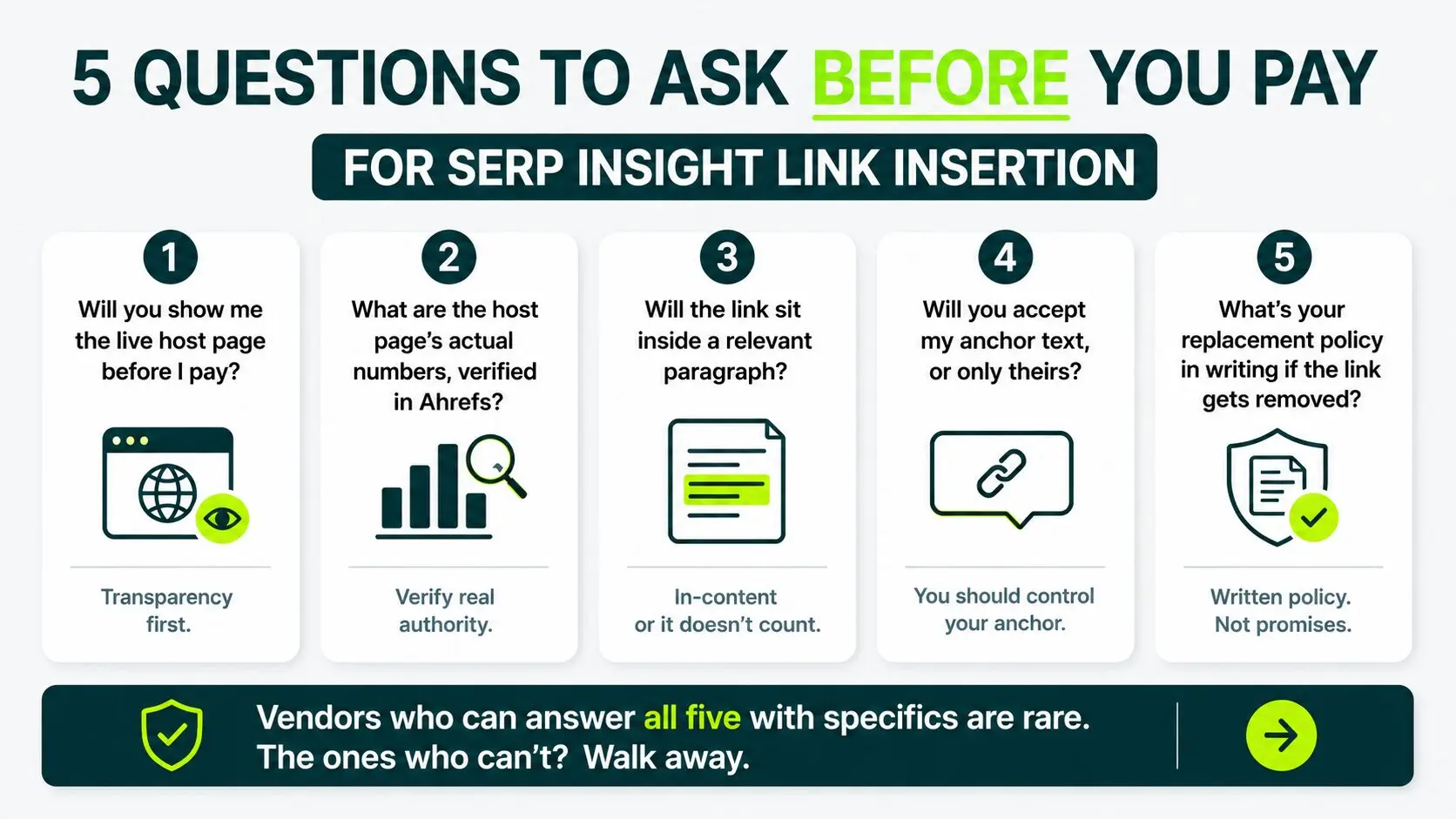
Question 1: Will You Show Me the Live Host Page Before I Pay?
A vendor who refuses to name the target page until after payment clears is hiding something. The page is the entire product. Refusing to disclose it is refusing to let you check the page.
- Does it rank?
- Does it get traffic?
- Does the topic fit yours?
A genuine vendor names the page and links to it. You verify it in Ahrefs or any other prospecting tools you’re using before any money moves. The reason some vendors hide the page is that it wouldn’t pass verification.
Question 2: What are the Host Page’s Actual Numbers, Verified in Ahrefs, not Your Dashboard?
Vendors often quote domain ranking and traffic from a custom dashboard. That’s not a check, that’s a presentation. Ask for the page’s number in Ahrefs, an industry-standard link-analysis tool with a free trial, and verify yourself.
Look for three specific signals:
- Domain rating above 40.
- Monthly organic traffic above 1,000 visitors.
- The page itself (not just the site) is ranking for at least one keyword with real search volume.
Anything below those floors is a placement that won’t move your rankings.
Question 3: Will the Link Appear Inside a Relevant Paragraph, or in an Author Bio, Footer, or Sidebar?
Only links inside the body of a relevant article carry the ranking weight you’re paying for. A link in an author bio, footer, comments section, or sidebar shows up on every page of the site. Google has learned to discount those which is exactly why contextual link placement inside editorial content is worth paying a premium for.
If the vendor offers those placements, the price should be a fraction of the in-content rate. Frankly, the placement is rarely worth the cost. Ask for a screenshot of the exact paragraph your link will appear in.
Question 4: Will You Accept My Anchor Text, or Only Theirs?
The anchor text is the clickable phrase that the link is wrapped around. Vendors who insist on choosing the anchor are usually optimizing for their own backlink profile rather than yours.
A genuine placement gives you input on the anchor. They accept your preferred phrase if it fits the sentence. They won’t push you towards a keyword anchor that looks unnatural.
If the link text feels forced instead of naturally fitting into the sentence, that’s a warning sign.
Question 5: What’s Your Replacement Policy in Writing if the Link Gets Removed Within 90 Days?
Some target sites remove inserted links a few weeks after the deal is done, betting most buyers won’t notice. Only an actual vendor offers a written replacement policy. If the host site removes the link within 60 to 90 days, the vendor replaces it with a comparable placement at no extra charge.
If the vendor’s policy is verbal, vague, or “we’ll work something out,” treat it as no policy at all.
A vendor who runs link insertions as a real service handles all five in their standard pre-sale conversation. These questions tend to expose the quality of weak vendors because a business model built on vague promises only holds up when customers don’t push for specifics.
When SERP Insight Link Insertion Is the Right Move (and When It Isn’t)
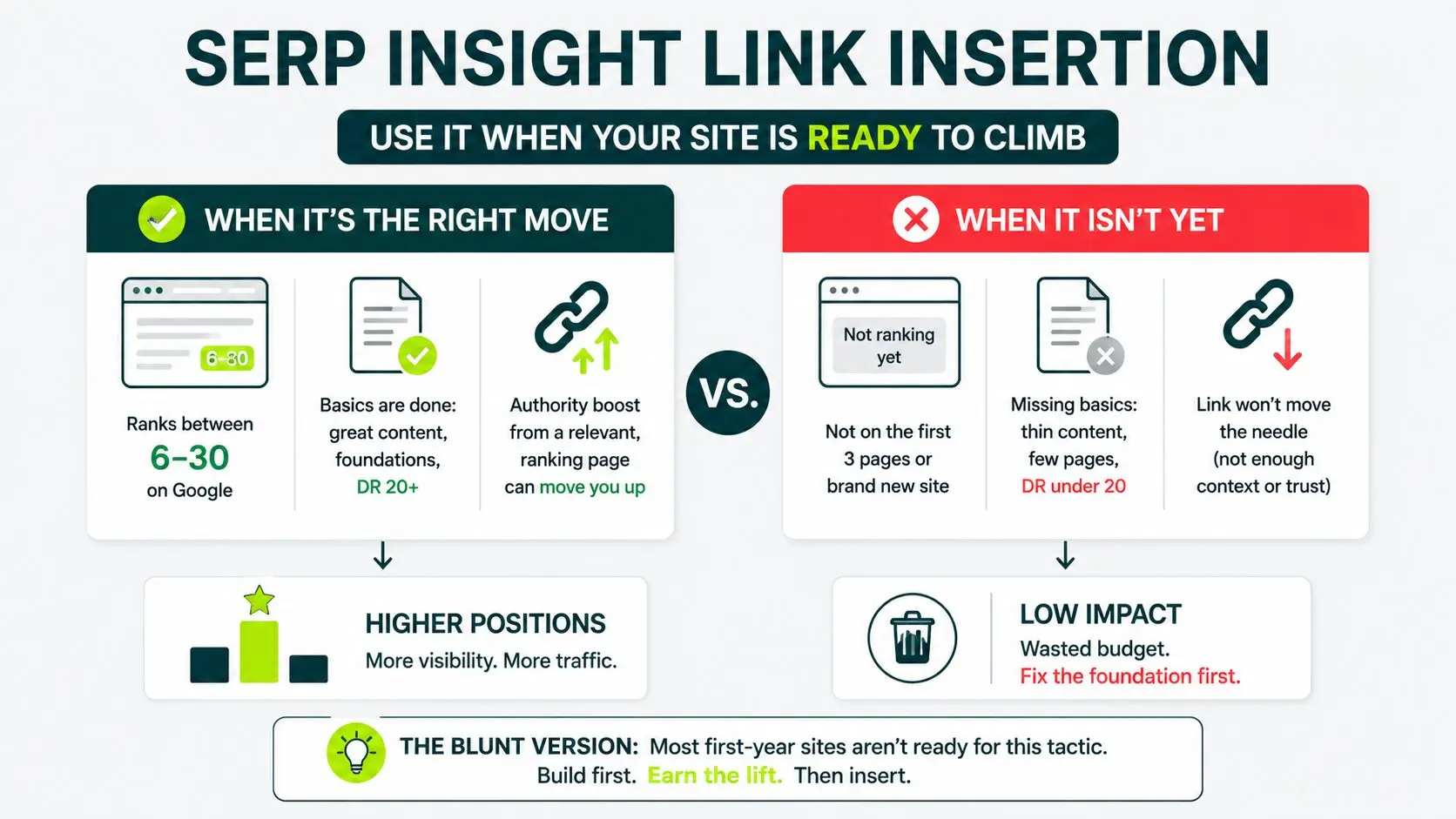
SERP insight link insertion makes sense when three things align. You have a page already trying to rank for a specific keyword. Your site is established enough that an authority lift would actually move it. And you’ve done the cheaper work first.
When It’s The Right Move
Your site has a page targeting a specific, commercially valuable keyword. That page ranks somewhere between positions 6 and 30 on Google.
You’ve already covered the basics. The page itself is written well. Your site has foundational pieces of content. Your overall domain rating is above 20.
At this point, an editorial link from a higher-authority page can push your page to the top of the results.
When It Isn’t the Right Move
Here’s the profile of the site that isn’t ready: a new brand, fewer than five published pages, no target pages in Google’s first 30 results, and a domain rating under 20.
In this situation, inserting a SERP insight link is the wrong move. The link lands on a page Google trusts. But your page lacks the content depth, internal linking, and keyword alignment that allow an inbound link to translate into a ranking lift.
The best move in this situation is to spend the budget on building link worthy assets that other sites would actually want to link to. You can start inserting links later, when you have something worth linking to.
The Blunt Version
Many sites that have been live for years still aren’t ready for this tactic, not because of their age, but because they never built the content foundation that makes a link worth inserting.
The vendors selling SERP insight link insertion to first-month sites are betting that the customer doesn’t know this.
If your own site doesn’t meet the three conditions, like ranking position, content depth, and a baseline DR, then build those first. The link insertion budget will work hand in hand once they’re in place.
SERP Insight Link Insertion vs. Guest Posts vs. Other Tactics
To compare the major link tactics on cost, time-to-result, control, and effort:
| Tactic |
Avg Cost Per Link |
Time to Ranking Lift |
Control Over Placement |
Outreach Effort |
|---|---|---|---|---|
| SERP Insight Link Insertion | $200 to $500 (manual) | 2 to 8 weeks | Medium (host accepts or rejects your anchor) | Medium (1 pitch per page) |
| Classic Niche Edit (No SERP Analysis) | $150 to $400 | 2 to 8 weeks | Medium | Medium |
| Guest Post | $300 to $800 | 4 to 10 weeks | High (You write the article) | High (Pitch, write, edit) |
| HARO and Digital PR | $0 to $300 per pitch | Variable can be days | Low (The reporter decides) | High (Write pitches at speed) |
The table is a rough map, not a promise. Real costs and timelines shift with niche, season, and the quality of the target site. Two patterns hold across most projects.
First, the cost-per-result gap between a SERP insight link insertion and a classic niche edit is smaller than vendors imply. The “SERP analysis” layer is real work, but it’s an hour or two, not hundreds of dollars’ worth. Most of the price spent between the two tactics reflects vendor positioning, rather than underlying difficulty.
Second, the right choice for any single project isn’t a single tactic. It’s a sequence; most sites benefit from a mix. Two or three editorial niche edits or SERP insight link insertions per quarter is a sensible base. Add some HARO outreach. HARO is Help A Reporter Out, where journalists request expert quotes you respond to. The occasional response lands you in a news piece.
Write one or two thoughtful guest posts per year for sites you want a relationship with.
Conclusion
Link insertion is a precision tactic, not a rescue operation. It can’t fix a weak page, and anyone selling it as a universal solution is skipping a step. A link from a high DR article pointing to thin content on a new domain rarely moves ranking, and when it does, the effect doesn’t stay.
The insertion only works when your destination pages have already done the on-page work, such as content that covers the topic in depth, internal links from related pages, and a topic that Google understands. If your page isn’t ready, spend the budget on the on-page foundations first; the link will work once they’re in place.
Want to turn SERP insights into link opportunities?
Get a focused strategy built around pages that already have authority and visibility
Can I run SERP insight link insertion myself instead of paying a vendor?
Yes, the mechanics aren’t hard. The workflow is clear:
- Google your target keywords.
- List the top 20 results that aren’t your direct competitors.
- Check each in Ahrefs to confirm they fit the quality floor.
- Write a personalized outreach email to each site owner.
- Follow up twice.
The only bottleneck is time, not skill. Most founders find that sending 10 to 20 outreach emails a week, while running a business, is unrealistic. That’s why vendor pricing exists .
When does it make sense to hand SERP insight link insertion to an agency?
When the time cost of prospecting, outreach, and follow-up outweighs the placement value you’re getting back. Most in-house teams hit that ceiling at around 10 to 15 placements per month. Beyond that, the volume and consistency required to move competitive keywords makes a dedicated link building agency the more practical choice.
What tools do I actually need to do this?
At a minimum, you need a backlink tool to check the domain rating and traffic on candidate target pages. Ahrefs works, and so do Semrush, Moz, and Majestic.
This is optional but useful, an outreach tool like Pitchbox or Respona to track emails and follow-ups. A simple spreadsheet to log placements works alongside it. Hunter.io or a similar lookup service helps find site owner email addresses. Free trials exist for most of these. You can start with Ahrefs’s free trial and a spreadsheet.
Does SERP insight link insertion work for brand-new websites?
The honest answer is not really because the link from a high-authority page can only lift a page that has enough content and on-page work to deserve the lift.
A new site with three blog posts has nowhere to send the link’s authority. Without pages set up to convert traffic into customers, the destination doesn’t have enough quality to capitalize on the link.
What anchor text should I ask for in a SERP insight link insertion?
Use a phrase that names the topic your destination page covers. You can aim for 2 to 5 words. The phrase should read naturally inside the target paragraph even without a link. Avoid exact-match keyword stuffing. Prefer descriptive phrases such as “how blue widgets work,” “guide to blue widgets” over commercial phrases such as “buy blue widgets”.
Use mixed anchor styles across your link insertions. The goal is your backlink profile, the total picture of who links to you that reads naturally to Google.