Buying backlinks is the fastest way to either rank a page or get it removed from Google’s index.
There’s no in-between.
In 2026, the line between “calculated paid placement” and “site-killing mistake” comes down to four variables: the source site’s actual editorial integrity, the topical relevance to your content, whether the link is properly marked as paid, and whether the pattern across all your inbound links looks earned or bought.
This article isn’t a list of “best places to buy backlinks.” Most of those guides exist because affiliate revenue pays well. This is a candid answer to whether you should buy backlinks at all, when it’s a calculated risk worth taking, and what to do instead when it isn’t.
Key Takeaways
- Google’s spam policies explicitly classify buying links to manipulate rankings as a violation.
- Properly marked sponsored placements (rel=”sponsored” or rel=”nofollow”) are NOT a violation.
- Most paid link offers under $200 are PBN placements that hurt your site.
- The Buyer’s Risk Matrix maps when buying might be a calculated bet vs. when it’s site-killing.
- Editorial outreach, digital PR, and content-driven links beat paid placements on both authority and cost over 12 months.
- AI search engines weight earned editorial links higher than paid placements, even technically compliant ones.
Google’s Real Position on Buying Backlinks
Google’s spam policies define link spam directly: “the practice of creating links to or from a site primarily for the purpose of manipulating search rankings.”
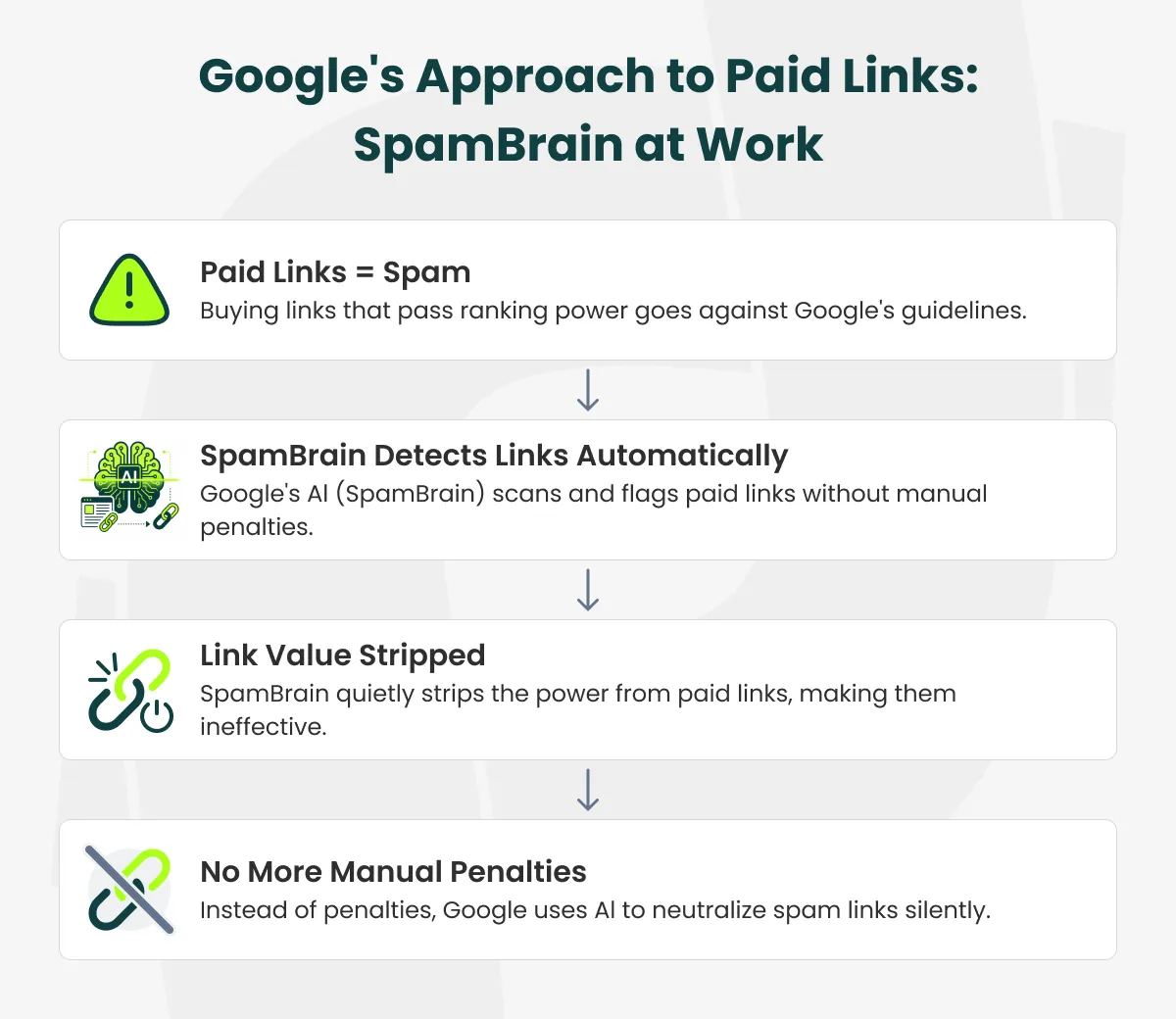
The policy explicitly names “exchanging money for links, or posts that contain links” as a violation.
So why does the question still come up? Because of the carve-out that follows. Google’s same documentation states: “It’s not a violation of our policies to have such links as long as they are qualified” using `rel=”nofollow”` or `rel=”sponsored”` attributes.
That single sentence is where the entire “buy backlinks” industry lives. The technically compliant version of paid placement is legal. The unmarked, manipulative version is not.
What Counts as Manipulative
Google considers a link manipulative when money or value was exchanged for it, it isn’t marked with rel="sponsored" or rel="nofollow" and therefore still passes ranking signal, and it’s placed primarily to influence rankings rather than to inform the reader.
All four conditions need to be present. Properly marked sponsored placements that pass three of four are not spam. Editorial placements where no money changed hands aren’t paid links at all.
What Google Actually Penalizes
Google issues manual actions for “unnatural links” when its review team identifies patterns: footers full of unrelated links, widget link networks, exact-match anchors across unrelated sites, sudden link velocity spikes from low-quality sources.
The penalty isn’t issued for a single paid link. It’s issued for the pattern that suggests systematic manipulation.
A single sponsored placement marked correctly: zero risk.
Fifty unmarked dofollow placements from sites running widget link networks: manual action, removed from index, or both.
The Buyer’s Risk Matrix
Whether buying a link is a calculated bet or a site-killing mistake depends on two variables: the source site’s editorial integrity and the topical relevance of the placement.
Plot both on a 4-quadrant matrix and the answer becomes clear.
Quadrant 1: High Relevance + High Editorial Integrity
This is the only quadrant where paying for placement is worth considering.
The site has real organic traffic, real editorial standards, real readers in your niche. It accepts sponsored content but reviews submissions for quality and clearly marks paid placements per disclosure rules. Examples: industry publications that sell sponsorships, premium newsletters with rate cards, vertical media that runs paid posts but vets them.
The placement is properly marked (`rel=”sponsored”`), drives real referral traffic, and the brand mention itself has marketing value beyond the SEO signal.
Verdict: defensible. The link doesn’t pass much ranking signal because of the `nofollow`/`sponsored` markup, but the brand exposure and referral traffic justify the cost.
Quadrant 2: High Relevance + Low Editorial Integrity
This is where it gets dangerous.
The site is topically aligned with your niche, but has no editorial standards. It publishes anything if you pay enough. The publication exists primarily to sell links. Sponsored content isn’t disclosed properly.
Common examples: niche guest post farms that accept any contribution in your vertical, “industry news” sites running scaled paid placement programs, low-quality blog networks targeted at specific verticals.
Verdict: skip. The link looks contextually relevant to humans but the site’s pattern across all outbound links signals manipulation to Google. Manual actions tend to find these networks.
Quadrant 3: Low Relevance + High Editorial Integrity
Sometimes a paid placement on a respected but off-topic site looks tempting because of the brand authority.
A Forbes sponsored post about your B2B SaaS company. A New York Times sponsored content placement. These are real and legal when marked correctly.
The problem: the link doesn’t pass much ranking signal because (a) it’s marked `sponsored` and (b) the topical relevance is low. You’re paying mostly for brand exposure.
Verdict: it’s a branding decision, not an SEO decision. Don’t expect ranking impact. Budget it against your brand awareness spend, not your link building spend.
Quadrant 4: Low Relevance + Low Editorial Integrity
This is most “buy backlinks” offers on the internet.
The site has no real traffic. No editorial standards. No topical relevance. It exists to sell `dofollow` links at $30-150 a placement, often through reseller marketplaces. The placements are unmarked. The patterns are easy to spot.
Verdict: don’t. The links don’t pass ranking signal even when they look like they should. The pattern across your inbound links starts to look manipulative. Sites that lean on Quadrant 4 placements get manual actions or algorithmic suppression sooner or later.
When Buying Backlinks Is Probably Unsafe
Most paid link offers fall into Quadrant 4 above. Specific patterns to avoid:
Bulk Marketplace Listings Under $200
Marketplaces that list thousands of “dofollow placements” at $30, $80, $150 are aggregating placements from PBNs, expired domains, and low-quality blog networks.
The math doesn’t work. A genuinely useful editorial placement on a site with real traffic costs more than $200 because the publisher loses readers if they publish too much sponsored content. When the price is low, the placement is from a site that doesn’t have readers to lose.
Anchor Text Specifications in the Offer
Legitimate publishers don’t let buyers dictate anchor text in body content.
When the link service lets you specify exact anchor text including commercial keywords, you’re working with a service that treats links as SEO products rather than editorial content. Those services get flagged by Google’s spam systems eventually.
Networks That Promise “100% Approval Rate”
Real editorial outreach has a 10-25% acceptance rate even for strong content.
When a service promises “100% approval” or “guaranteed placements,” they’re operating their own network of sites where they control the publishing decision. That’s a PBN by definition, regardless of how the service is branded.
Pre-Built “Tiered Link Building” Packages
Tiered link building (links pointing to links pointing to your site) has legitimate applications, but pre-built packages sold at scale are almost always built on PBN infrastructure.
The same site reseller selling Tier 1, Tier 2, and Tier 3 placements is operating a network. The footprint patterns get detected over time.
When Buying Backlinks Might Be a Calculated Risk
Some paid placements are defensible. The framing matters: not “buying links to manipulate rankings” but “paying for editorial visibility on properly marked placements.”
Industry Publication Sponsored Content
A trade publication that openly sells sponsored content, marks it `rel=”sponsored”`, and applies real editorial review is selling brand exposure, not SEO manipulation.

Cost varies by audience size. Tier 1 industry publications charge $5,000-$25,000 per sponsored article. The link is `nofollow` or `sponsored`. The ranking signal is minimal. The brand authority lift and referral traffic justify the cost for the right audience.
Premium Newsletter Sponsorships
Some newsletters in your space sell paid placements that include a backlink to your site. When the newsletter has real subscribers and the placement is disclosed, this is brand spend with SEO side effects, not SEO spend.
Cost varies by subscriber count. Larger newsletters (50K+) typically charge $1,500-$5,000 per placement.
Affiliate Programs You Pay Into
When you join an affiliate program and affiliates earn commission for linking to you, those links can be technically “bought” in that you’re paying for the relationship. But they’re not paid placements in the spam-policy sense as long as affiliates are disclosing their relationships.
Branded Event Sponsorships
Conference sponsorships, industry award sponsorships, and event partnerships generate link clusters tied to your brand. The links are tied to the event coverage, the speaker bio pages, and the partnership announcements. The relationship is paid but the links are editorially earned.
Why AI Search Changes the Math
The newer reason to skip paid placements for ranking purposes: AI search engines.
ChatGPT, Perplexity, Google AI Overviews, and Bing Copilot all build citation patterns from editorial signals. The brands they cite are the ones with editorial link profiles. Paid placements, even properly marked ones, contribute less to AI citation visibility than earned links.
This widens the gap between earned and paid backlink ROI. Pre-2024, a properly marked sponsored placement returned brand awareness plus minor ranking signal. In 2026, it returns brand awareness alone, while editorial outreach returns brand awareness plus ranking signal plus AI citation visibility.
The economics of paid placement have shifted. The bar for whether a paid placement makes sense has gone up.
What to Do Instead
The link tactics that earn editorial placements outperform paid placements on cost-per-link over 6-12 months.
Editorial Outreach to Real Publications
Pitching journalists, editors, and publishers with content worth publishing earns placements that pass real ranking signal.
Read our guide on link building strategies for the full tactic mix. Acceptance rates run 10-25% for strong content, which means you pitch 50 sites to land 5-12 placements. The links pass ranking signal, drive referral traffic, and contribute to AI citation visibility.
Original Data Studies
Publishing original research that journalists cite generates link clusters that compound over years.
A well-executed survey or benchmark report earns 50-300 backlinks over 18-24 months. The cost ($15,000-$50,000 for a real survey with valid methodology) often beats the cost of building 50-300 paid placements that would never deliver the same ranking signal.
Resource Page Outreach
Finding curated resource pages in your niche and pitching your content for inclusion earns evergreen editorial links.
Read our resource page link building guide for the full workflow. Conversion rates run 10-20%. Costs scale with researcher hours, not link inventory.
Reclaim Unlinked Brand Mentions
The fastest source of new editorial links for established brands.
When sites mention your brand without linking, a polite email asking for the link converts at 40-60%. No payment involved. The links are editorial because the mention itself was editorial. See our unlinked mentions guide for the full workflow.
Guest Posting on Sites That Have Real Editorial Standards
A guest post on a real publication that vets submissions is editorial, even though you wrote it.
Read our guest posts guide for the targeting workflow. The line between editorial guest posts and “buying links” is whether the host site (a) accepts based on quality not payment, (b) edits before publishing, and (c) the link in your author bio is contextual not over-optimized.
For a done-for-you option, our managed guest posting service only pursues editorial placements that meet those standards.
Targeted PR Around Newsworthy Events
Product launches, partnership announcements, original data releases, and industry commentary pitched to journalists earn coverage that includes backlinks. The fundamentals overlap with broken link building on outreach craft, just applied to editorial PR pitches.
The cost is internal time plus optional PR support. The output is editorial coverage, not paid placement. The link signal is the strongest available.
Frequently Asked Questions
Is Buying Backlinks Illegal?
Buying backlinks is not illegal in any country.
It is against Google’s spam policies when the links are unmarked and intended to manipulate rankings. Properly marked sponsored placements with `rel=”sponsored”` or `rel=”nofollow”` attributes are explicitly allowed by Google’s policy.
How Much Do Backlinks Cost in 2026?
Low-quality paid placements sell for $30 to $200 and typically aren’t worth buying.
Quality editorial outreach campaigns cost roughly $200 to $800 per placement effectively (including outreach labor and content costs). Premium sponsored content on tier 1 publications runs $5,000 to $25,000 per article. Read our link building pricing guide for the full pricing breakdown.
Can Google Really Detect Bought Backlinks?
Yes.
Google’s spam systems detect link networks through pattern recognition: shared hosting fingerprints, common ownership signals, identical site templates, anchor text distribution anomalies, and link velocity spikes. Individual paid links rarely trigger penalties. Systematic patterns from PBN networks do.
What Happens If Google Catches You Buying Backlinks?
The page or site can lose the ranking signal from those links, receive a manual action requiring link disavowal, drop in algorithmic ranking, or be removed from the index.
Most cases involve algorithmic suppression rather than full deindexation. Recovery typically takes 3 to 6 months after the issue is identified and cleaned up.
Are There Any Safe Ways to Buy Backlinks?
Yes, sponsored placements on real publications with proper markup are safe.
The shared trait: the publisher discloses the commercial relationship and the link is correctly marked with `rel=”sponsored”` or `rel=”nofollow”`. Premium newsletter sponsorships, event sponsorships, and affiliate program payments fall into the same category. These don’t pass much ranking signal but they’re not spam policy violations.
How Long Does Recovery Take After a Manual Action for Paid Links?
Recovery typically takes 3 to 6 months after the manual action is lifted.
The process involves auditing your full backlink profile, disavowing the paid links through Google’s disavow tool, submitting a reconsideration request, and waiting for Google’s review team to verify cleanup. During recovery, expect ranking suppression even after the manual action is removed.
The Honest Take
Most teams asking “should I buy backlinks?” want a shortcut.
The honest answer: the shortcut costs more than the long path over 12 months, returns less ranking signal, and exposes you to risk you don’t need to take. Before deciding, read up on the consequences of bought links when Google catches them. Quality editorial outreach delivers better authority, better referral traffic, and better AI citation visibility for similar or lower total cost.
If you’re tempted by a $50 placement, run the Buyer’s Risk Matrix. If the source falls outside Quadrant 1, walk away. If you genuinely need fast brand exposure on tier 1 publications, budget for properly marked sponsored content and treat it as marketing spend, not SEO spend.
The teams ranking long-term are the ones earning links, not buying them.