You’ve probably heard that guest posting is dead.
It isn’t, but the version built only for links is.
To earn quality backlinks from guest posts, pitch sites your audience already reads and write for their readers first.
Guest posting, also called guest blogging, means publishing an article under your name on another website.
The editor decides whether and how to link back to you.
Key Takeaways
- Guest posts earn links when they serve the host’s readers first.
- Google allows guest posts that inform or educate another site’s audience.
- Paid placements are ads, and their links need rel=“sponsored” or rel=“nofollow”.
- Keyword-rich anchor text in guest posts is link spam under Google’s policies.
- One placement on a relevant site with real readers is worth more than ten on low-quality blogs.
- In a survey of 518 SEO professionals, 73.2% said backlinks affect the chance of appearing in AI Overviews, per Search Engine Land.
What’s a Guest Post?
A guest post is an article you write for another website, published under your byline.
The host gets content its readers want.
You get an author credit, a new audience, and often a link back to your site.
These links are called backlinks.
Google sees them as votes of trust. It’s like a popular website pointing to your site and saying, “This website is worth visiting.”
The more trustworthy the site linking to you, the more that vote counts.
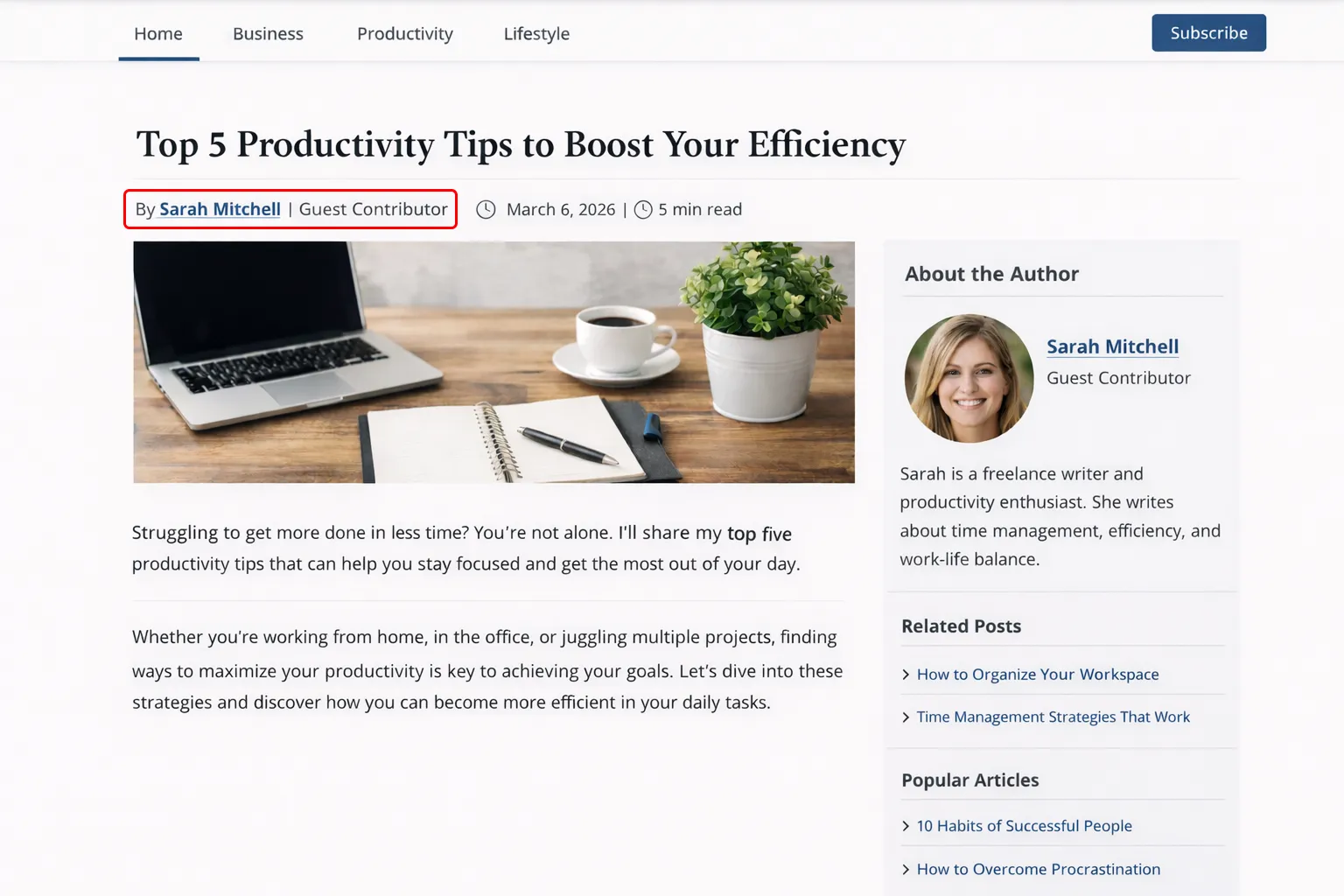
Guest posting has been part of link building for years.
It’s still one of the most common ways to earn backlinks from other sites.
Google hasn’t banned guest posts.
Low-quality guest posts no longer work, and they can hurt your rankings.
A post on a site with real editors and real readers carries weight. A post on a site that accepts any submission for a fee carries little.
Done well, guest posts build visibility with new audiences. They position you as a trusted voice and drive referral traffic from readers already interested in what you do.
Guest Posts Vs. Sponsored Posts Vs. Niche Edits
Guest posts, sponsored posts, and niche edits all produce backlinks, but Google treats them differently depending on whether money changed hands.
A guest post is an editorial contribution. A sponsored post is a paid placement.
A niche edit adds a link to an article that’s already live. Our guide explains how niche edits work.
If you paid for a link or offered anything in return, Google’s spam policies require rel=“sponsored” or rel=“nofollow” on it.
| Tactic | What It Is | Link Treatment |
|---|---|---|
| Guest Post | An original article you write for another site’s readers | The host decides. An editorial link can be followed. |
| Sponsored Post | A placement you pay for | Must use rel=“sponsored” or rel=“nofollow” |
| Niche Edit | A link added to an article that’s already published | If paid, must use rel=“sponsored” or rel=“nofollow” |
Are Guest Posts Still Worth It in 2026?
Yes, when the host site has real organic traffic.
The best hosts also have editors who review submissions and readers who match your audience.
Links from those sites read as genuine editorial endorsement.
The tactic stopped working for sites that used it as a pure link exchange. Google’s link spam updates target exactly that pattern.
So guest posts are worth the time, but only as content marketing, not as a quick link acquisition tactic.
Google’s guidance on article campaigns says guest posts are fine when they inform or educate another site’s audience.
The same goes for posts that bring awareness to your cause or company.
Guest posting turns into link spam in these cases:
- You stuff keyword-rich anchor text links into articles across many sites.
- The articles don’t reflect real subject-matter expertise.
- The same or similar content appears on multiple sites.
- Links, not reader value, are the main goal.
- You pay for placements whose links lack rel=“sponsored” or rel=“nofollow”.
What’s Link Spam?
Google’s spam policies define link spam as links intended to manipulate rankings in Google Search results.
The policies name optimized anchor text in guest posts and paid links without rel=“sponsored” or rel=“nofollow”.
Where Guest Posts Still Deliver Value
Guest posting builds benefits that compound over time.
Publishing on relevant industry sites builds brand authority.
When readers connect your name with a respected publication, your credibility grows.
Focus on sites whose readers match your audience. Those visitors already care about your niche.
Consistency matters too. It signals to search engines and AI systems that your brand has real depth in a topic.
How to Find Guest Posting Opportunities
Search for sites your audience already reads, then check their traffic, editorial standards, and topical fit.
Google operators, competitor backlink analysis, and relationships with editors all surface candidates.
The qualification step is where most prospect lists shrink to the few sites worth pitching.
The easiest sites to find are usually the worst ones to pitch.
The sites worth writing for take longer to find, and the payoff is far better.
Three approaches surface better candidates.
Google Search Operators
Google search operators are the easiest way to find guest posting opportunities.
Search with targeted queries to find sites that accept contributions in your niche.
- “Your niche” + “Write for us”
- “Your niche” + “Contribute” + “Guest”
- “Your niche” + “Submit an article”
- “Your niche” + inurl:guest-post
In B2B SaaS, you’d search “B2B SaaS + Write for Us.” Google then lists sites that take contributors in your niche.
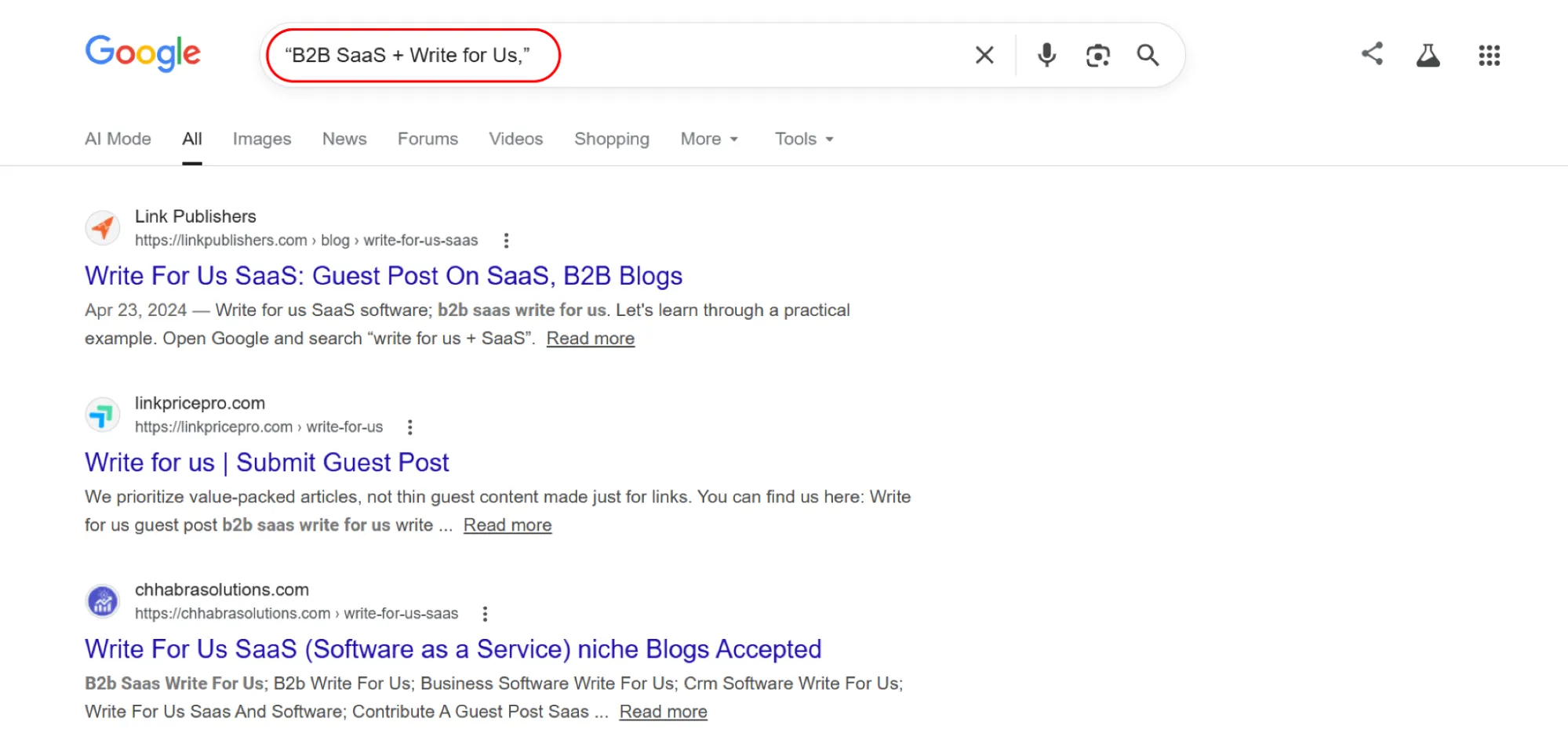
Most won’t pass the scorecard below. Filter hard, and you’ll have a short, precise list to start from.
Competitor Backlink Analysis
Competitor backlink analysis is one of the fastest methods.
Use Ahrefs or Semrush to review the backlink profiles of competitors already ranking for your target keywords.
Look for links that came from guest posts. They’re usually easy to spot (author bylines, “guest post” tags, or a contributor bio).
These sites already accept content in your niche, already have editorial standards, and pass link authority.
Your job is to pitch something better than what your competitor wrote.
Build Relationships Before You Pitch
The best guest post placements come from real relationships, not templates.
Start by engaging with the sites you want to write for.
Comment on their articles. Share their content. Mention their work in your own writing.
By the time you pitch, the editor already knows your name.
This takes time, but your acceptance rate climbs.
Personalized outreach to editors gets more replies than templated pitches.
How to Evaluate a Guest Posting Site
Check three things: real organic traffic, topical relevance, and editorial standards.
Domain authority alone is misleading.
A DR 60 site with no organic traffic and a sponsored content section is worth little. A DR 40 site with engaged readers and editorial review is worth more.
Not all guest post opportunities are equal. Most are poor.
BuzzStream’s 2026 guest post study checked more than 257,000 sites listed by link vendors.
It rated 96.2% of them low quality, and 78% get under 1,000 organic visits a month.
If you don’t vet carefully, you’ll spend budget on placements that won’t move your rankings.
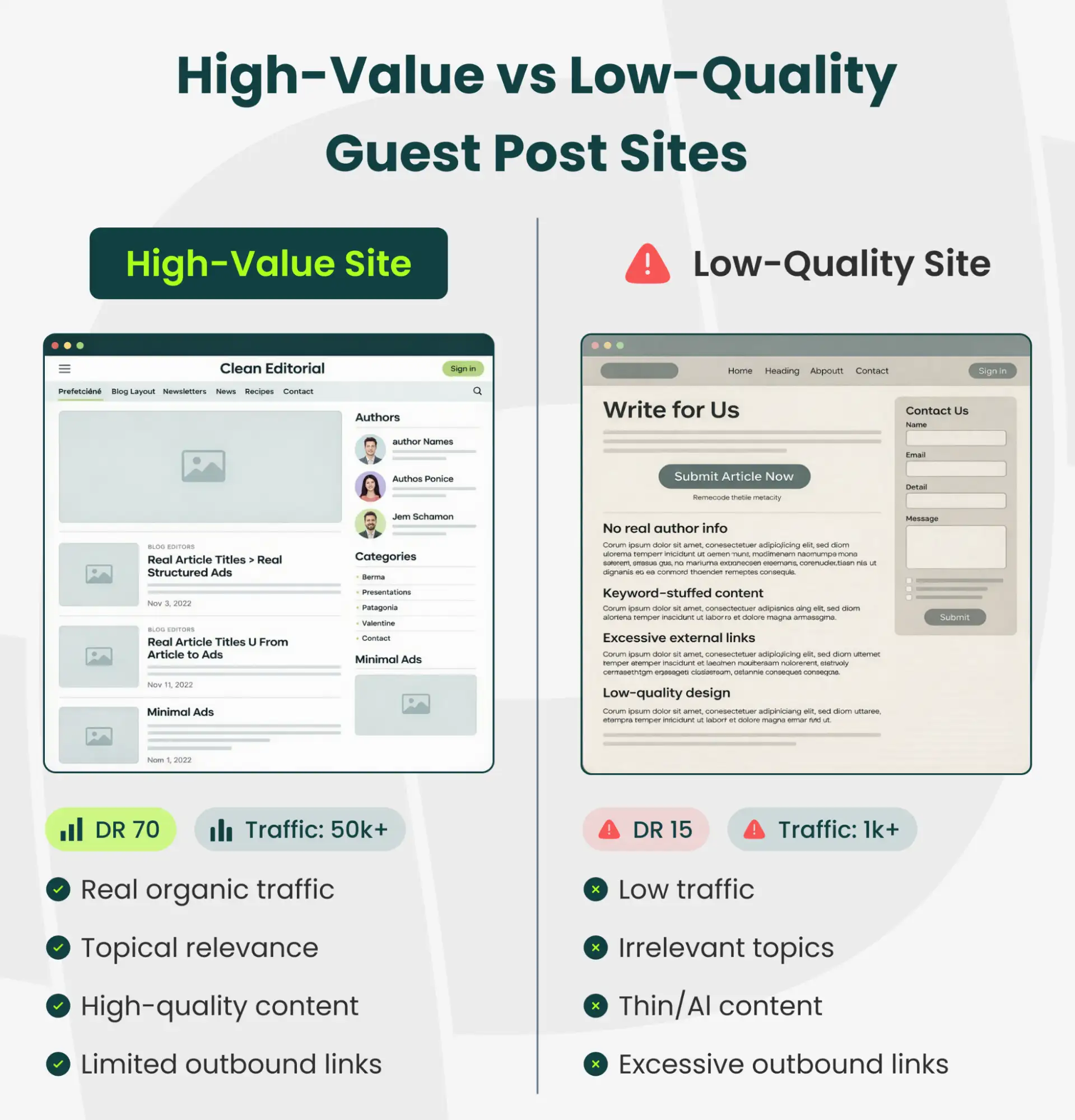
Signs of a High-Value Site
Check each target site against these criteria before you pitch it.
1. Real organic traffic
Use link campaign software like Ahrefs or Semrush to verify real search traffic. Low-quality sites often show pageviews inflated by bots or social shares.
2. Topical relevance
The site should cover your niche or something close to it. A fitness brand publishing on a finance blog helps neither audience.
3. Existing content quality
Read some recent articles. If they’re thin, generic, or clearly unreviewed AI content, move on.
4. Reasonable outbound link count
Pages with dozens of external links spread their value thin. Fewer links per page means each one carries more weight.
Red Flags That Signal a Low-Quality Site
Walk away from any site that shows these red flags.
- The primary business model is selling guest post placements.
- The ‘Write for Us’ page reads like a link sales pitch.
- It claims high domain authority but has almost no real traffic.
- It publishes content on unrelated topics with no focus.
- Its articles are full of exact-match keyword links to commercial pages.
Guest Post Quality Evaluation Scorecard
The scorecard rates each opportunity on six signals, from organic traffic to author attribution.
Use it before you write a single pitch.
Filtering here saves weeks of outreach on sites that won’t move your rankings.
Score each target on every signal, then add up the points.
| Signal | High-Value (3 points) | Medium Value (2 points) | Low Value (1 point) |
|---|---|---|---|
| Monthly organic traffic | 10,000+ | 1,000–10,000 | Under 1,000 |
| Topical Relevance | Same niche | Adjacent Niche | Unrelated |
| Editorial Process | Named editors, guidelines review | Basic guidelines | No visible standards |
| Content Quality | Original, Well-researched | Decent but generic | Thin or AI-generated |
| Outbound Link Density | Under 5 per article | 5–15 | 15+ |
| Author Attribution | Name + credentials | Author names only | No attribution |
Score interpretation
Interpret the total score with these bands.
- 15 to 18 points: strong opportunity
- 10 to 14 points: acceptable, but check weak areas first
- Below 10 points: not worth the effort, so skip it
How to Pitch and Write a Guest Post That Gets Published
A guest post gets published when your pitch fills a real gap on the site and your draft meets its editorial standards.
Editors approve pitches when they spot an angle their readers want.
Mention links last, if at all.
Editors at popular sites get dozens of generic emails every day. The ones that get a response are specific, relevant, and short.
Write a Pitch That Editors Actually Read
Keep the pitch short, around 200 words, not a thousand-word essay. Three steps are enough.
1. Show you know their site
Mention a specific article they’ve published and explain how your topic builds on it or fills a gap.
2. Pitch a real, specific topic
Your pitch should sound real. Not “I’d love to write about SEO.”
Instead, write “How SaaS founders use product-led content to earn editorial backlinks, with three real case studies.”
3. Prove you’re credible
Write one sentence about your experience or a link to published content. That’s enough.
Those three steps are all a clear pitch needs.
Skip copy-paste templates. Most pitches fail there.
Avoid generic openers like “I noticed you accept guest posts.”
Propose fresh topics the site hasn’t already covered.
Sample Pitch Email
Subject: Guest post for [Site Name]
Hi [Name],
I’ve been reading [Site Name] for a while and noticed you publish content on [topic]. I’d love to contribute a guest post.
Here are a few ideas:
- [Title idea 1]
- [Title idea 2]
- [Title idea 3]
I’ve written for [Site 1] and [Site 2] if you’d like to see examples of my work.
Happy to send the full draft if you’re interested.
[Your Name]
Write Content That the Host Site Wants to Publish
Once the host says yes, plan how to deliver a quality piece. This is only half the battle.
Study their recent posts before you write a single word. Match their tone, structure, and length.
Don’t write the article you want. Write what their readers need.
Bring something original. A data point from your own experience. A case study. An insight their existing content doesn’t cover.
That’s what makes editors want to publish you again.
Write for their audience level. An advanced SEO blog doesn’t need a backlinks explainer. A general business blog doesn’t need unexplained jargon.
Get Your Links Right
Where and how you place your links matters, so follow these rules.
- Aim for one or two contextual links in the body of each guest post.
- Link to resources on your site that genuinely help the reader.
- Use anchor text that tells readers what they’ll find.
- Let the editor make the final call on anchors and link attributes.
Anchor Text in Guest Posts
Use your brand name, the page title, or a plain description of what the reader will find.
Don’t ask the host for a keyword-rich anchor.
Google’s spam policies list optimized anchor text in guest posts as link spam. A quota of keyword anchors is a risk, not a safeguard.
| Anchor Type | Example | Use It When |
|---|---|---|
| Branded | “Acme’s pricing study” | Your brand is the natural subject of the sentence |
| Descriptive | “a checklist for vetting publishers” | The reader needs to know what the link opens |
| Naked URL | “acme.com/guide” | You’re citing a source directly |
If you paid for the placement, the link needs rel=“sponsored” or rel=“nofollow”, whatever anchor it uses.
Common Guest Posting Mistakes That Hurt Your SEO
The costliest mistakes are pitching irrelevant sites, reusing one template, and over-optimizing anchor text.
Each one wastes outreach time or triggers spam signals.
1. Mass Outreach With Generic Templates
Sending the same pitch to hundreds of sites is the fastest way to get ignored.
The only sites that accept those pitches are low-quality ones. You publish there and get no value or authority in return.
Personalize every pitch. It takes time, but it works better.
2. Publishing on Irrelevant or Low-Quality Sites
Many beginners post well-researched content on irrelevant or low-quality sites.
Every placement should sit on a site your audience visits.
If you’re publishing on a random website just for backlinks, you’re wasting your time.
3. Over-optimized Anchor Text
Using the same exact-match keyword across multiple guest posts is a clear manipulation signal. Google’s link spam systems target this pattern.
4. Duplicating Content Across Multiple Sites
Reusing an article with light rewrites for different publications violates Google’s guidelines. It also gives no audience anything new.
5. Treating Guest Posting as Your Only Tactic
Relying only on guest posts creates an unnatural backlink profile.
Mix guest posting with digital PR, content marketing, and the broken-link method.
Varied link building campaigns build a more natural profile.
6. Ignoring Link Attributes
If a guest post is paid or incentivized in any way, the links must use rel=“sponsored” or rel=“nofollow”. Skipping that puts both your site and the host site at risk.
How Much Do Guest Posts Cost?
An earned guest post costs your time and writing, not money.
Paid placements average $461 through a vendor and $295 direct from the site, per the same BuzzStream study.
Paid placements are advertising, so Google requires their links to carry rel=“sponsored” or rel=“nofollow”.
What Paid Placements Cost
Average prices run from $229 to over $7,000, climbing with a site’s traffic and authority.
| Site Type | Average via Vendor | Average Direct |
|---|---|---|
| All vendor-listed sites | $461 | $295 |
| Under 100 organic visits a month | $229 | Not reported |
| High quality (DR 71–80, 50,000+ visits) | $3,130 | Not reported |
| Top tier (DR 81+, 100,000+ visits) | $6,018 | Not reported |
| Top-tier news sites | $7,209 | $3,836 |
The figures come from BuzzStream’s 2026 study of 257,267 vendor-listed sites. Only 1.37% of them qualified as high quality or top tier.
Free guest posting sites exist too. You prospect, pitch, and write, and they publish without payment.
That route is slow, and high-quality sites accept few pitches.
You can also outsource link building to an agency. A good package covers these jobs:
- Prospecting
- Relationship management
- Content creation
- Quality assurance
The key question isn’t “How cheap can I get guest posts?”
It’s “What quality of placement does my budget support?”
Running a program on a small budget works differently. Our guide to link building for small business sets realistic volumes and costs.
What a Realistic Guest Post Program Looks Like
A realistic program targets publishers with real audiences and treats the article as the asset, not the link.
The tactics that worked in 2019 don’t survive SpamBrain now.
What lasts through every update is editorial quality.
If you’d rather have specialists run this for you, see our done-for-you guest posting service.
Guest posting isn’t dead in 2026.
It takes real effort, and it has to give the host site and its readers something of value.
Google’s algorithms spot manipulative patterns better than ever.
So treat every guest post as content marketing, not as a link acquisition channel.
Write for the audience, and build relationships with editors who value your expertise.
That’s how guest posting builds authority that compounds over time.
Want a guest post program built on real publishers?
Get placements on sites with real readers, real editors, and clear link policies. Book a short strategy callFrequently Asked Questions
Is guest posting against Google’s guidelines?
No. Google allows guest posts that give readers genuine value. It treats guest posting as link spam when links are the main goal. That includes keyword-rich anchor text, the same article spread across many sites, and paid links without rel=“sponsored” or rel=“nofollow”. A well-written, relevant article for the host’s audience fits Google’s guidelines.
How many guest posts should you publish per month?
For most businesses, 2 to 4 strong guest posts a month on relevant sites beat a higher volume of weak ones. Quality and consistency matter more than volume.
Should guest post links be nofollow or dofollow?
It depends on whether you paid. If money, a product, or any other incentive was involved, Google requires rel=“sponsored” or rel=“nofollow”. If an editor published your article on its merits, the host decides how to tag the link. A followed link is fine in that case. Many good sites set their own link policies, so respect them.
Can guest posts hurt your rankings?
Yes. Low-quality guest posts on irrelevant sites, manipulative anchor text, and large-scale link schemes can all hurt you. They can lead to algorithmic devaluation or a manual penalty. The risk comes from how you do it, not from guest posting itself. Guest posts on relevant, authoritative sites with natural links are safe.
How long does it take for a guest post to affect rankings?
Most guest posts start influencing rankings within 4 to 10 weeks of publication. The timing depends on how quickly Google crawls the host site and processes the new link. Links on high-traffic, regularly updated sites count sooner. The host page’s topical authority and its relevance to your page shape how much the link can do.