You built a website and wrote blog posts that provide insights and depth of topic coverage that are better than your competitors. Then you waited, hoping that your ranking would improve, and your page would get a mention or a citation.
Six weeks pass, and crickets. You get zero backlinks, no citations, and not even a single mention.
Your problem lies in the ‘missing high-value content part’. You need strategic content marketing for link building. It means you need to create valuable content on topics with search demand that address readers’ pain points.
TL;DR
- High-value content earns links when editors, journalists, and other sites want to cite it
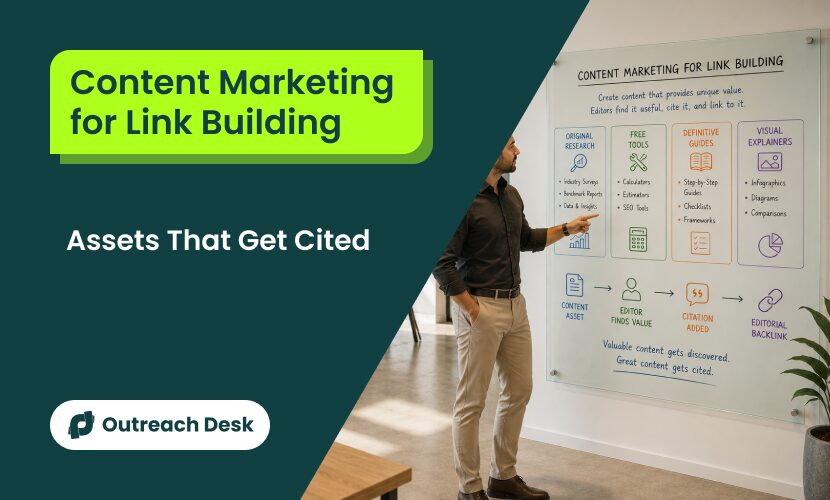
- 4 content formats that earn editorial backlinks: original data, free tools, definitive guides, and visual explainers.
- Small or new sites face a “Site Reality Gap” where standard link-building advice doesn’t work.
- Building assets comes first, outreach is second.
- Outreach must be personalized and targeted to editors who will actually value and cite your asset.
- Real editorial backlinks need 1 to 6 months, depending on your site size.
What “Content Marketing for Link Building” Actually Means
Content marketing for link building means creating content so valuable that other websites mention it in their content. Then you’ll ask those websites to add the link. This way, you earn a backlink for your website through content marketing.
The work has two parts: asset creation and outreach.

The asset is a non-negotiable page on your site built for one primary reason: to give other site owners a reason to mention your website. These assets can be anything: original research, data, explainers, or how-to guides.
Now, when Google notices that other websites in your space are linking to your site (especially the asset page), it will build the trust signals. As more searchers discover your site, you get more visitors who may become customers.
Read more about content types that earn links. And learn how to build them.
Once the asset is live, the next step is to conduct outreach. This will tell editors, journalists, and site owners that your asset exists.
You send a personalized email to one specific person, name their work, and explain why your asset helps their readers.
When both parts work together, you earn an editorial backlink.
Think of it like a colleague recommending you for a job opening. Their reputation is on the line, so the recommendation carries real weight.
These two parts succeed or fail together. Strong outreach with a weak asset gets ignored. A strong asset but without outreach earns one or two accidental links a year, if you are lucky.
Outreach Alone Won’t Get You the Link (If Your Content Is Weak)
Sending more emails doesn’t make a weak asset earn more links. Instead, it makes more editors say no faster. Understanding how outreach actually works starts with fixing the asset, not increasing the volume.

Understand this with an example:
Imagine you’re a tech blogger. You get 40 pitches a week.
Each one says the same thing: “I wrote a guide about your topic, please link to it.” You open the first pitch and read the linked article. It’s a 1,200-word post that says what every other article on the topic says. Feeling bored, right?
But now, you open the 41st pitch. It says, “I’ve noticed your article from last month on X mentioned data on Y. We ran our own survey on Y last week with 200 founders.”
The pitch continues: “Here are three findings that contradict what most people assume.”
You open it, read it, and add the link in your next piece.
What happened here:
41st pitch grabs your attention, you feel the sender has done his work the right way. Data and accuracy build trust, and the pitch stands out from the rest.
The same thing happens with other editors and journalists to whom you’re reaching out.
In campaigns where we tested both formats, assets with original data or a named framework generated reply rates 2 to 3x higher than generic guides.
Most beginners make mistakes here and wonder why they’re not getting a response. They jump straight into outreach for link building without creating strong assets worth pitching. Don’t make that mistake.
Build the asset first, provide value, and then earn a link. For many of our campaigns, backlinks have become the byproduct of quality assets.
Why the Same Advice Doesn’t Work for a New Site and an Established One
The advice doesn’t work because most guides are written for a different (maybe bigger) site than your brand-new site.
But that doesn’t mean the advice is wrong. Understand the difference.
Link building works differently at a brand-new site than at one that already has traffic and a known name. But if you are brand new, none of these conditions have applied yet.
At Outreach Desk, we call it the Site Reality Gap, the difference between what the standard advice promises and what the work actually produces at each stage of a site’s growth.
The Site Reality Gap: What to Expect at Each Stage
| Your site stage |
Links you can earn (months 1 to 6) |
Best content type to start with |
What outreach feels like |
When the first 5 links typically arrive |
|---|---|---|---|---|
| Brand new with DR 0 to 15(just launched, maybe a few months old) | 1 to 3 editorial links | Definitive how-to guides and visual explainers | Every pitch needs custom personalization. 1 to 3% of pitches get replies | 3 to 5 months |
| Growing with DR 15 to 35 (a year or two old, ranking for a few things) | 3 to 8 editorial links | Original research and free tools | Most pitches still need personalization, but reply rates rise to 4 to 8% | 2 to 4 months |
| Established with DR 35+ (well-known in your niche) | 8 to 20 editorial links | Original research and industry reports | Pitches land more easily. Reply rates run 8 to 15% | 4 to 8 weeks |
Domain Rating
Domain Rating (DR) is a 0 to 100 score from the SEO tool Ahrefs that measures the strength of a site’s existing backlink profile.
You don’t need to track DR closely right now. Just identify the row in the table that matches your site and start there.
The content formats that earn the most links change at each stage.
In our experience, brand new sites earn links easily through definitive guides and visual explainers. Because those formats carry their own credibility. (Make sure to create an original one. Do not copy-paste them.)
As your site grows, editors start noticing and citing your original data and tools because your domain name begins carrying trust.
The outreach dynamic shifts too.
A pitch from an established site lands with built-in recognition. A pitch from a brand-new site must earn trust within the email itself through deeper personalization and relevance to the editor’s recent work.
The emotional reality changes as well.
At a brand-new site, the work feels like earning every link from scratch. At an established site, the work feels like managing volume and maintaining quality.
Both are real work. They are just different kinds of work.
The table above decides which row fits your situation right now. The formats, the timeline, and the outreach approach all follow from that single answer.
Start With 4 Content Types to Earn Links
The core four types of content that earn backlinks are original data, free tools and calculators, how-to guides, and visual explainers.
Many content types and methods can earn a link. But start with these four types of content for your small or new website.
Original Research (Data Other Sites Want to Cite)
Original research means you’ve run your own survey, pulled your own dataset, or analyzed a trend or topic nobody else has.
This is what editors and journalists quote when they need a number.
It is the format with the highest link ceiling and the hardest to fake. Editors trust this format because they can read the methodology and decide whether to use the numbers.

A single focused study takes about 30 to 40 hours. It covers the survey or data pull, analysis, write-up, charts, and methodology.
The lifetime payoff is long because the data does not go stale. A 2026 industry benchmark still gets cited in 2027. When clients want the highest-ceiling asset in their niche, Outreach Desk runs it through its Digital PR work.
Remember, original research assets take time to earn quality links. Because editors are a little slower to trust a site they haven’t heard of.
Free Tools and Calculators
A free tool earns links because editors point readers at things they can actually use. It could be any useful tool, such as:
- Cost calculator
- Readability checker
- Keyword generator
We’ve also created a dedicated page for free SEO tools that you can use to calculate backlink costs, ROI on link building, and more.
Each tool creates a citation reason that does not go stale and does not need frequent updating.
This is the longest-lasting format in the core four types of content assets. A useful tool keeps earning links for years without you producing more content around it.
The catch is the build cost. This format requires developer time, which can price many brand-new sites out unless the founder codes or has access to someone who does. Production runs for 60 to 100 hours to produce a working first version.
The format works at any site size if you can build it. A tool’s credibility comes from the tool itself rather than how recognized your domain name is.
Definitive How-To Guides (The Version People Bookmark)
A definitive how-to guide earns links when it becomes the version editors point to instead of writing their own. That is a high bar. Most guides published as “ultimate” or “complete” never make it clear.
Two things together clear the bar.
A clear opinion that the competition does not take. And a structural element that makes the piece easy to cite: a named framework, a checklist with concrete thresholds, or a decision tree readers can follow.
The piece runs 3,000 to 5,000 words and takes 20 to 30 production hours. This format works best for brand-new sites because the content carries its own credibility. The asset does not need your domain’s existing authority to earn the link.
Visual Explainers and Industry Maps
A visual explainer earns links when it makes a hard concept clear in one image. Editors embed it directly on their pages and credit the source. The asset spreads across blogs and social posts simultaneously, which makes its early link velocity higher than that of the other three formats.
The format runs 12 to 16 hours plus design time, making it the fastest to produce in the content types for link building.
Remember, the link ceiling is lower than the original research because the format is easier for a competitor to copy. Most of the link earning happens in the first three months, while the visual is still the only version of its kind.

How to Tell If a Topic You Select Will Earn Links (Before You Write It)
Run these four quick checks: search demand, saturation, citation gap, and reader pain alignment before you spend hours writing about a topic. The work takes 60 to 90 minutes. But if you skip these checks, then it costs you 20 to 40 hours when the asset earns no links.
Check 1: Search Demand
- Open Ahrefs Content Explorer or Semrush Topic Research.
- Search for your topic.
- Sort results by referring domains, the count of separate websites linking to each page.
At least one result in the top 10 has 30 or more referring domains. That number confirms that other sites have found this topic worth linking to.
Fewer than 30 referring domains across the entire top 10 means the topic is unproven for link earning, regardless of search volume.

Check 2: Saturation
Look at the publisher’s ranking on page one for your topic. Count how many of the top 10 results come from major industry blogs or sites with domain ratings above 60.
At least 3 to 4 of the top 10 results come from sites closer to your size. If 8 of the top 10 are major publications, your version will struggle for shelf space even if it is better.
A topic dominated by large sites at every position is a topic to avoid until your site grows.

Check 3: Citation Gap
Read the top 3 ranking pieces and ask one question for each: what would a journalist or editor actually cite from this piece?
If the answer for most pieces is “nothing specific, it reads like an overview,” there is room to do better. If the answer is “the original data,” you need a sharper angle or a different dataset to stand out.
The citation gap is the space your asset needs to occupy. If no gap exists, the topic does not need another piece.
Check 4: Reader Pain Alignment
The topic has to answer a question your audience actually has, not one you wish they had. Keyword tools show search volume. But they do not show urgency or frustration.
Find the topic appearing in plain language across at least two of these three sources: Reddit threads, niche Slack or Discord communities, and recent newsletter subject lines.

These are where real pain surfaces days or weeks before keyword tools register it. If you cannot find the topic discussed organically in at least one of these places, the audience’s need is not strong enough yet.
This is the step most teams skip.
Pre-publication validation is not the same as post-publication analysis. One prevents wasted hours. The other just explains them.
Run all four checks before writing. A topic that passes all four has a proven audience, reachable competition, a clear citation gap, and a confirmed reader need. That combination is what makes an asset earn links rather than sit unread.
Building Content Editors Actually Want to Link To
An asset that earns citations is one that gives editors a specific reason to point to it rather than a competing version.
Three craft choices separate the citable assets from the skippable ones.
Find Data Real Editors Will Quote
Editors cite data they can verify, attribute, and quote in one paragraph. That rules out a few common shortcuts.
These versions get skipped:
- A statistic without a methodology section
- A “data” point that’s actually someone else’s number re-interpreted
- A finding that contradicts industry consensus without supporting evidence
What gets cited:
- Original methodology and survey
- A clear sample size with clean numbers, and a one-paragraph summary that an editor can lift and credit.
Don’t treat the methodology as a footnote; it’s a feature.
Make the Quotable Bits Easy to Find
The structural craft is the on-page work that makes the asset easy to cite. Three elements do most of the lifting.
- A named framework or thesis the editor can refer to (“the small-vs-growing-vs-established site reality”).
- A numbered list of specific findings.
- A quotable single-sentence summary placed near the top of the piece.
Editors scan for these. The piece that doesn’t have them earns the same link as the piece that does.
But the editor has to read twice as much to figure out what to quote. Most editors don’t have time. They just skim the content and move on.
Strong structural craft also makes contextual placements more likely. Editors place the link near the exact element that drove their decision to cite.
Most Teams Fail at Telling Readers What Their Data Means
A piece can have great data and a clean structure and still earn fewer citations than it should. The reason is that it leaves interpretation up to the editor. Editors cite assets that pre-interpret.
Compare this framing: “Our 2026 outreach data shows reply rates fell 18%, suggesting buyers got better at filtering personalized cold pitches.”
Data with that interpretation earns more citations than the same numbers presented in raw form. Editorial publications cite assets that match their reader’s intent, not assets that match a keyword target.
Reaching Out: How to Pitch the Right Way
Once the asset is published, reaching out is what turns it into placed links. Five steps make up the loop, and each one builds on the previous.
Step 1: Build a Tight Prospect List
You’re pitching the smaller group whose recent articles cover the angle your asset addresses. So make the list accordingly.
Step 2: Run the 3-article Fit Check
Before any pitch goes out, read the editor’s three most recent articles and look for:
- What topics they cover
- What their readers need next
- Where your asset could add value
- Whether a natural placement exists
If you cannot find a clear fit, skip the prospect.
Step 3: Map the Pitch Before Writing
Use this simple path:
- Recent article
- Editor’s angle
- Reader gap
- Your asset
- Suggested placement
Step 4: Write Three Short Paragraphs
The pitch runs three short paragraphs.
Hi [Name],
I read your article on [article title]. The section on [specific point] stood out, especially where you explained [reader problem or angle].
We recently published [asset type] on [asset topic]. It may be useful for your readers because it gives them [specific value: data, visual, tool, calculator, checklist, or methodology].
A natural fit could be the part where you discuss [specific section]. It could support that point with [a specific reason the asset deserves to be cited].
Best,
[Your Name]
- Paragraph one names the specific recent article you read and what you noted in it.
- Paragraph two offers your asset in one sentence, with the specific reason why it’ll help their readers.
- Paragraph three suggests one or two specific placements.
Step 5: Follow Up Once
Send a single follow-up seven business days after the original pitch.
Two follow-ups start hurting more than they help.
When the editor replies, respond on the same business day with whatever they need: a specific quote, a source URL, a chart, a different framing, or additional data.
Editors who’ve placed one asset for you will place a second more easily.
In one SaaS content asset campaign, the best-performing subject lines did not lead with “link request” or “guest contribution.” They led with the asset’s usefulness.
The strongest pattern was:
“Useful data for your article on [topic]”
For example, when pitching a SaaS benchmark asset, the angle that worked best was not “we published new research.” It was:
“We found a current benchmark that supports your section on user onboarding drop-off.”

That wording converted better because it gave the editor a clear reason to care. It connected the asset to a specific article section, a reader’s need, and a citation-worthy data point in one sentence.
The loop’s weakest point is almost always the list or the pre-research.
Teams with weak list-building or no pre-research send the same volume of emails as teams with strong fundamentals and earn 5x fewer placements.
Why Most People Quit Around Month 4 (and What You Can Do Instead)
Most people running content marketing for link building quit early because they underestimate the work and overestimate the speed. The first 10 backlinks take 3 to 6 months at most sites, and that’s exactly where people give up.
Those who pushed past month 4 chose the right content type for their site’s size and validated the topic before writing. The ones who quit either picked a type that needed a larger site or didn’t validate at all.
Struggling to Earn Backlinks for Your New Site?
Get a strategic content marketing plan designed for a small or new website.
How long does content marketing for link building actually take to work?
For most sites, the first editorial backlinks arrive within 4 to 12 weeks after the asset is published. The site’s overall rankings usually start moving 2 to 3 months later.
A full link campaign cycle takes 3 to 6 months for most sites. That’s creating the asset, running outreach, placing links, and measuring results. Both growing and established sites land on the lower end.
Brand-new sites land on the upper end. The first 10 links are the moment things click. That’s when the asset starts earning more on its own, without continued outreach from you.
Is content marketing for link building better than buying backlinks?
For long-term ranking, yes. Editorial backlinks earned through content marketing and white hat strategies carry the trust signals Google rewards. Paid links risk getting filtered out by Google or being hit with a manual penalty (a direct action Google takes against your site).
The honest tradeoff: content marketing is slower in months 1 to 3, but it builds on itself. Paid links move faster at the start, but flatten out or get devalued.
Most teams that try both pull back on paid links as their content asset library grows.We cover the full tradeoffs of buying backlinks in detail.
How do I justify this to leadership when paid links look faster?
Frame it as something that keeps earning over time versus a recurring expense. A paid link costs the same every month or stops working when the placement gets removed. A linkable asset earns links for 12 to 24 months after publication and lifts your rankings on related search terms while it does.
Most teams find the breakeven point around months 5 to 7, after which the content approach is cheaper per link and stays cheaper.
Can I outsource content marketing for link building?
Yes. Some teams handle asset creation in-house and outsource the outreach. Others hand off the full process. Either way, the asset quality stays non-negotiable. What a link building service adds is the prospecting, personalization, and follow-up loop that most in-house teams underestimate.