Multilingual Link Building Agency With Native Outreach
Your brand earns editorial backlinks globally through native outreach teams familiar with local publishers, editorial standards, and ranking factors.

12+ languages covered
Native -speaker teams
Local publisher networks

4.9/5
Trusted by agencies
and brands worldwide.
Avg DR
40 – 75
Campaign Dashboard
LANGUAGES COVERED
+12 markets
LOCAL PLACEMENTS
11 countries
NATIVE OUTREACH
All emails native-written
AVERAGE LOCAL DR
Per-market DR ranges

Native Writers
12+





Service Overview
What Real Multilingual Link Building Actually Requires
Real multilingual link building requires native-speaker outreach teams in each market, local publisher relationships, and an anchor text strategy built from local keyword research. Multilingual link building is more than translation. The publishers that move rankings in the home market don’t exist or don’t matter in target markets.
Real multilingual link building requires native-language outreach written by writers who understand each market’s culture and local relationships, and link strategies tailored to how Google ranks content in each language and country.
For most international brands, the gap between English and non-English link building results comes down to the quality of outreach. English campaigns get the agency’s best resources. Non-English campaigns often have templated outreach translated via DeepL and sent to publishers, who can tell instantly.
The solution is dedication, native-speaker outreach teams per market. Same editorial standards. Same manual outreach methodology. Each team is led by writers who actually live or are native to the target market.
Three things that define real multilingual link building:

Native-Speaker Outreach
Every campaign uses outreach writers who are native speakers of the target market’s language, not English writers using translation tools.

Local Publisher Networks
Established relationships with publishers, editors, and creators in every target country, not generic international lists or translated outreach database.

Market-specific strategy
Anchor text, target keywords, and editorial angles are adapted to how each market’s search engines and audience work.
How We Work
How Your Multilingual Campaign Works
A centrally coordinated workflow built on native-speaker teams, local publisher relationships, and market-specific strategy in every language you target.
Your campaign starts with mapping which markets and languages matter most for your business. Your strategist reviews your current presence in the international market, target-market priorities, existing implementations, and the largest revenue opportunities across geographies.
The output is a market-by-market plan with prioritized languages, target-country domains, and search engine considerations (Google, Yandex, Baidu, and Naver), along with the publishers most likely to affect rankings in each market.
Each target market gets a dedicated outreach team led by native speakers. German campaigns are led by German writers, French campaigns by French writers, and Japanese campaigns by Japanese writers.
Native speakers understand cultural nuances in pitching, editorial expectations specific to their market, and the publisher landscape your business needs to navigate. This staffing model is what separates real multilingual outreach from translated outreach.
Your team builds prospect lists market by market using SEO tools, regional databases, and direct knowledge of each country’s publisher landscape. Domain ranking is considered alongside local relevance metrics such as country TLD authority, local backlink profiles, and ranking position in target-country search engines.
A DR 50 German site that ranks on Google matters more than a DR 80 international site that doesn’t appear in German search results. The vetting criteria adapt to what actually moves rankings in each market.
When publishers accept placements, your content team develops the assets in the target language using native-speaker writers. Guest posts, expert commentary, and editorial contributions are written natively, not translated from English originals.
Cultural fit matters as much as language accuracy. A guest post that works for a US audience falls flat in Germany or Japan because the rhetorical conventions, structural expectations, and tone refinement differ across markets. Native writers produce content that meets each market’s editorial standards from the first draft.
Anchor text is planned per market based on actual target-language keyword research. Direct translations of English anchors miss the keywords that native speakers actually search for. Your strategist runs local keyword research for each market to identify anchor opportunities that align with real search behavior.
Anchor distribution is tracked separately per market to prevent over-optimization in any single language. Branded, partial-match, and natural anchors get balanced based on each market’s local profile, health, and competitive context.
You receive monthly reports covering placement activity, ranking movement, and competitive position market by market, plus a summary across all markets.
Each market report includes local publisher activity, native-language anchor distribution, and ranking impact in the target country’s search engines. The cross-market summary helps your central SEO team see which markets are performing well, where to invest more, and how to coordinate the program globally.

Expected Results
Outcomes That Multilingual Link Building Delivers
When every market is served by native-speaking teams running real local outreach, your international SEO ceiling lifts in ways that translated campaigns can’t match.
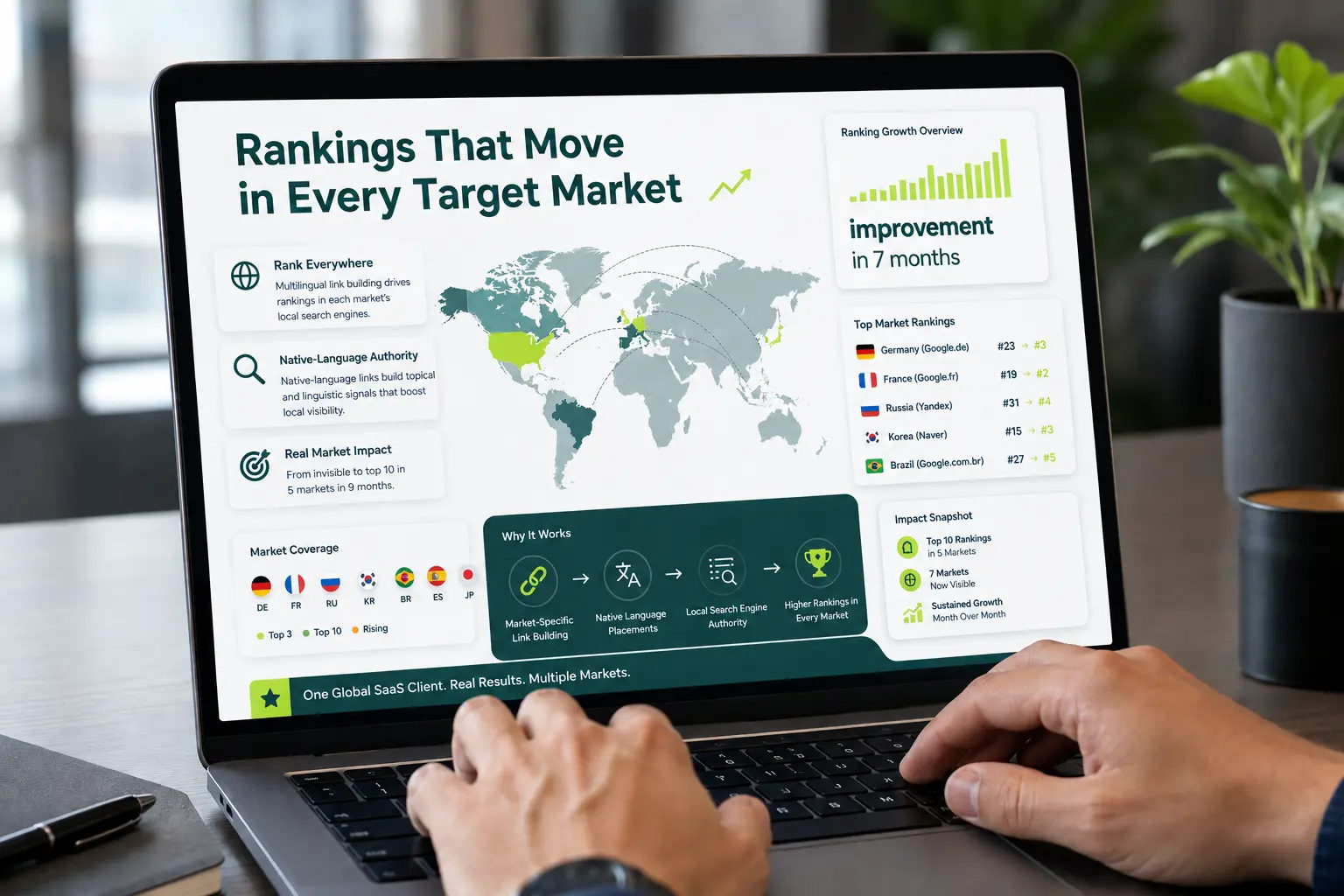
Rankings That Move in Every Target Market
Multilingual link building, when done correctly, moves rankings in each market’s local search engine, not just in Google’s international results. Native-language outreach produces native-language placements that pass the topical and linguistic authority signals each search engine needs to rank your content locally.
The result: Your target pages rank in Google.de, Google.fr, Yandex, Naver, and other market-specific search engines based on the language and country your buyers actually search from. One global SaaS client moved from invisible in 7 non-English markets to ranking in the top 10 for category keywords in 5 markets in nine months.
Without market-specific link building, your international SEO ceiling stays low regardless of how much you spend on English link building.
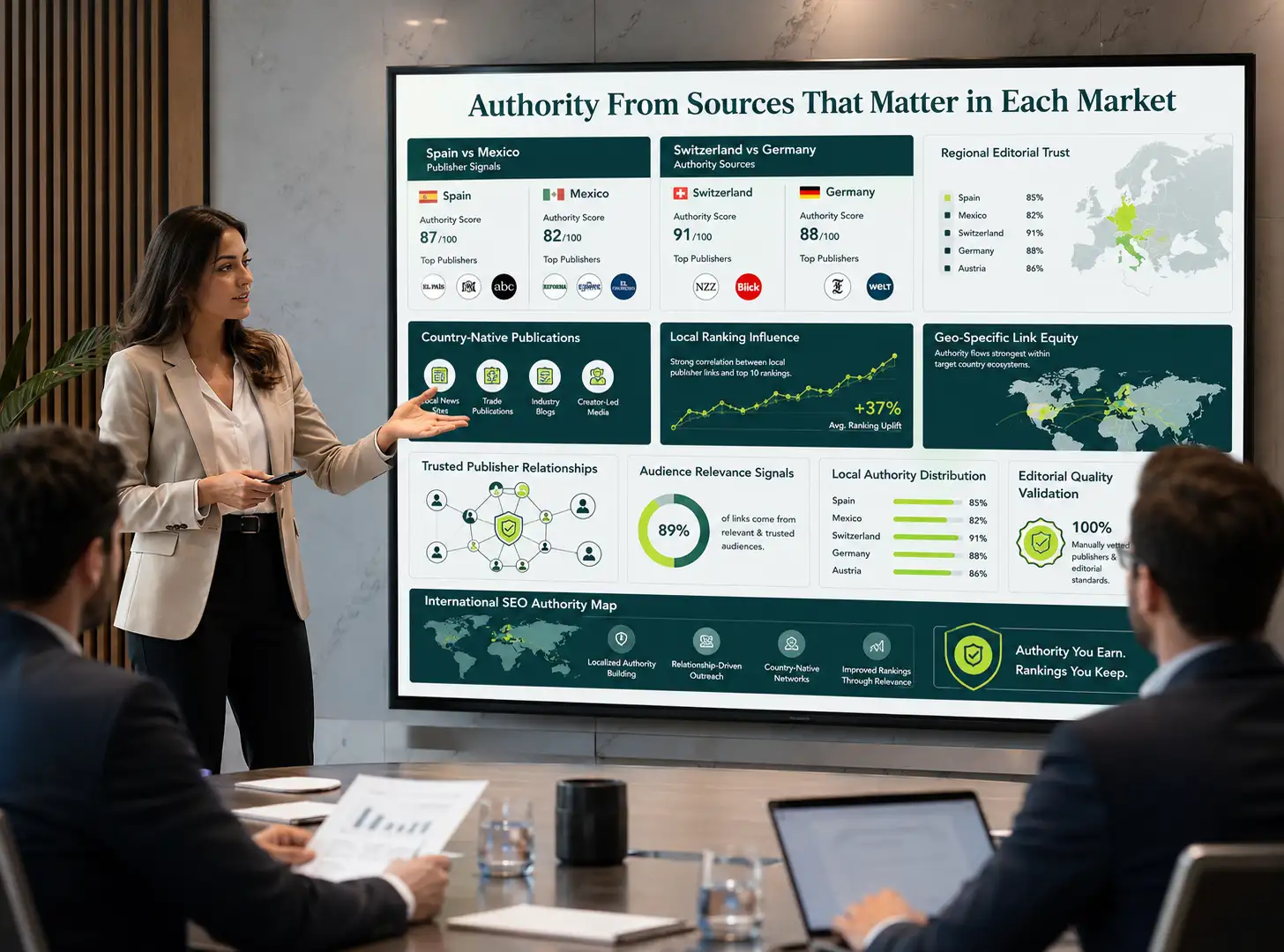
Authority From Sources That Matter in Each Market
The publishers that influence rankings in Spain differ from those in Mexico, even though both countries speak Spanish. The publications that build authority in Switzerland differ from those in Germany or Austria. Generic international link lists don’t capture these distinctions.
Your campaign builds relationships with publishers who actually share SEO outcomes across each target market. These include local trade publications, regional news sites, niche industry blogs, and creator-led publications native to each country, all vetted for the editorial standards and audience relevance that move rankings.
This local authority is what separates international link building that works from the kind that just looks busy.
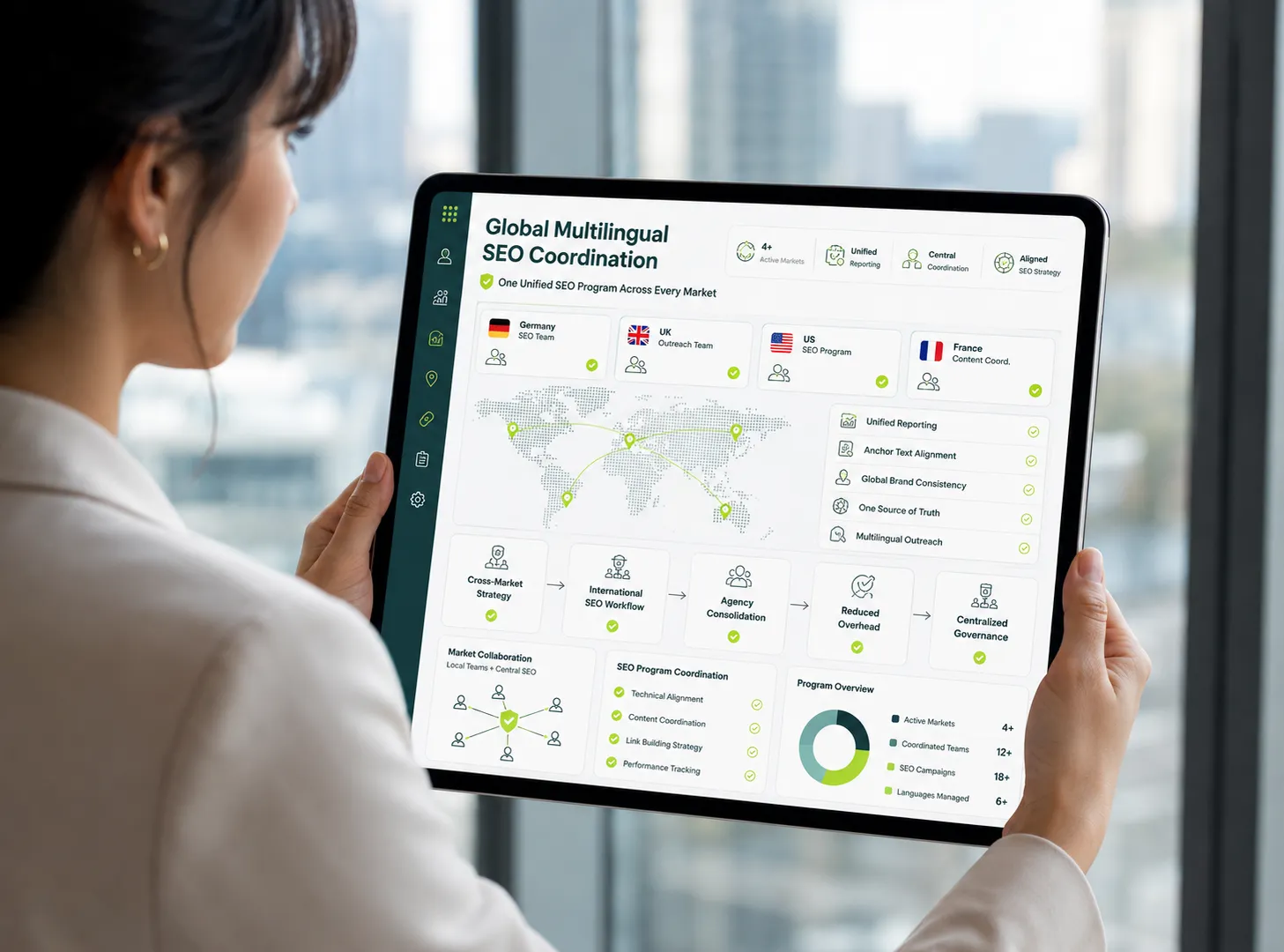
One Coordinated Program Across Every Market
Running separate agencies per market produces fragmentation. Anchor text decisions don’t align across countries. Reporting comes in different formats. Strategic priorities drift between markets without central coordination.
Working with one multilingual agency consolidates the work. Your German team coordinates with your central SEO program. Anchor text strategies align. Brand positioning stays consistent. Reporting rolls up to one source of truth across every market.
The efficiency gain is significant for international programs operating in 4+ active markets that spend one to two days per week coordinating agencies and consolidating to one multilingual partner, which eliminates that overhead.
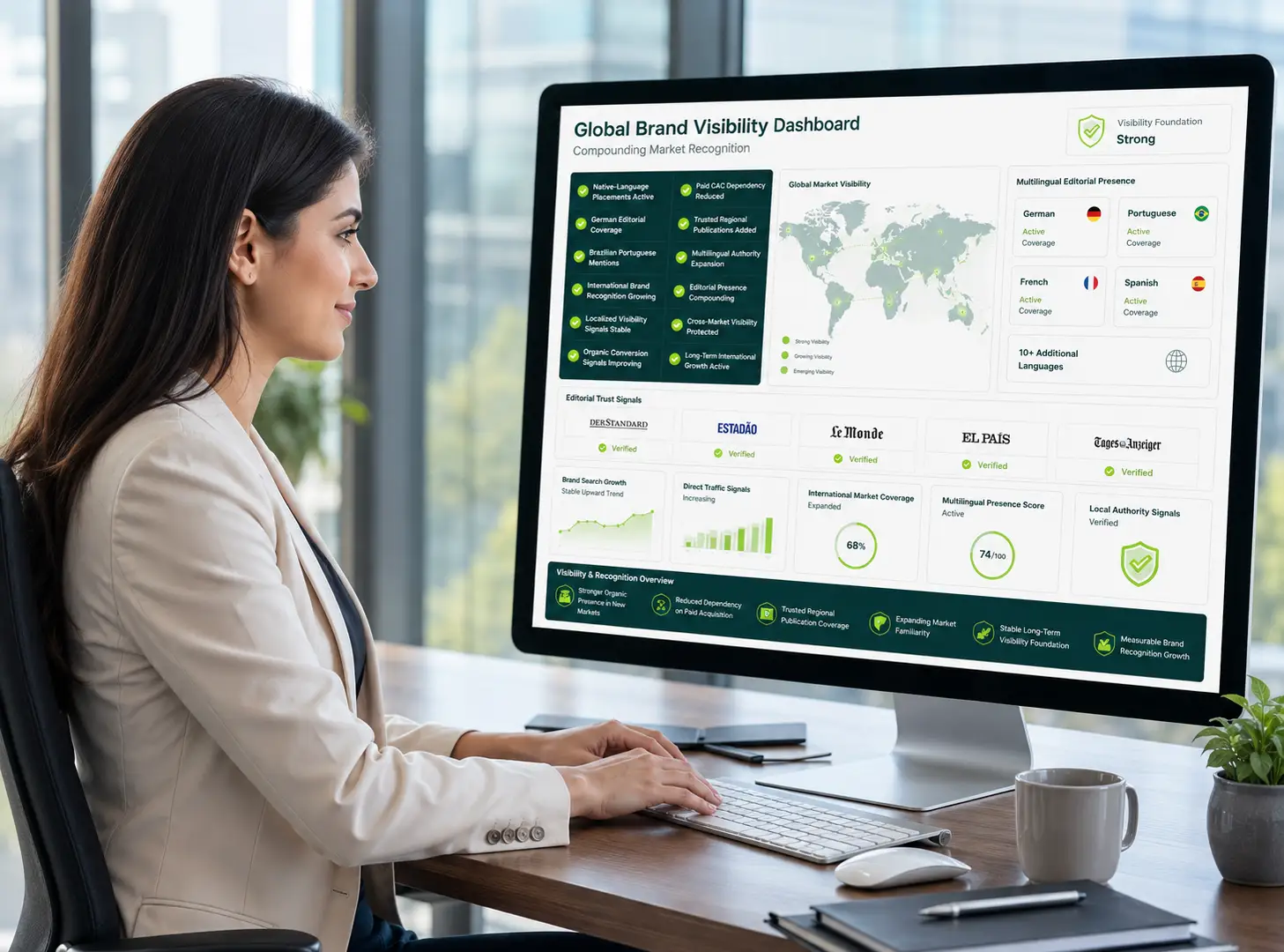
Brand Visibility That Compounds Across Markets
Every native-language placement builds your brand inside that market’s editorial system. Readers in Germany encounter your brand in German publications. Readers in Brazil see your brand in Brazilian Portuguese content. The recognition signal compounds over time.
This is more than SEO. International expansion benefits from being known in the target market before paid acquisition starts. Native-language editorial mentions build brand familiarity, lowering paid CAC and improving organic conversion in every new market.
Clients running multilingual campaigns over 12+ months consistently report measurable brand recognition lifts in each market, tracked through brand search volume and direct traffic patterns.
Client Success Stories
What Clients Say About Our Multilingual Link Building
Verified reviews from international SEO leaders who scaled link building across languages and markets without sacrificing placement quality.

4.9/5 

5/5 
Rating on Google



We tried running European markets through three local agencies, and our central SEO team was drawing in coordination overhead. Switching the one multilingual partner cut out admin time by 60%, and the rankings actually improved because anchor and content strategy finally aligned across markets.

Senior Director SEO
Global B2B

The native-speaker outreach quality was the differentiator. Our previous agency was running multilingual campaigns through English writers using translation tools. Reply rates in DE and FR were under 2%. Their native teams hit 14 to 16% in both markets from month one.
Head of International SEO
SaaS

Brazilian Portuguese is its own market with its own publisher network, separate from Portugal. Most agencies treat them as one. This team built distinct strategies for both, which is why our LatAm and EU Portuguese rankings both moved.
VP Growth
Ecommerce
Service Framework
Investment, Timeline, and Deliverables
Every multilingual link building campaign is tailored to your active markets, language priorities, and growth goals. Here’s what shapes your investment:

Number of Languages and Markets
Most campaigns cover 3 to 8 active languages and markets across your global footprint.

Native-Speaker Team Requirements
Each market needs dedicated native-speaker outreach and content teams to refine to local standards.

Local Publisher Network Depth
Highly competitive markets require deeper publisher vetting and longer relationship-building cycles.

Campaign Duration
Most clients see ranking movements in target markets in 4 to 5 months, slightly longer than single-market campaigns.
Directional pricing
Pricing and scope are shared as requested, tailored to your specific coverage needs, market mix, and growth goals. Custom proposals are available after an initial strategy call, outlining an approach tailored to your requirements, including market coverage, contribution approach, tracking, and a month-by-month roadmap aligned with your goals.
What You Get
Every Market, Every Language, Every Placement Reported
Complete transparency on per-market placement activity, native-language outreach work, and cross-market coordination, keeping your program aligned.

Per-Market Placement Reports
You see placement activity, publisher details, and ranking impact broken down by target market and language.

Native-Language Outreach Visibility
You can verify the native-speaker outreach behind every placement, including the original-language pitch and publisher response.

Cross-Market Anchor Distribution
You see anchor text distribution tracked separately per market to prevent over-optimization in any single language.

Unified Multi-Market Dashboard
You see all active markets in a consolidated view, with drill-down detail by language and country available on demand.
Our Approach
A Native-Speaker Approach Built for Real Multi-Market Growth
You get native-language outreach, market-specific strategy, and unified coordination, not translated outreach as multilingual.
| Factor | Translation-Based Multilingual Services |
 |
|---|---|---|
| Outreach Method | English outreach translated through tools, sent to non-English publishers who immediately recognize the templates. |
Native-speaker writers in each market write outreach in the local language from scratch. |
| Publisher Vetting | Single international publisher list filtered by DR; local and market relevance are often ignored. |
Market-by-market publisher prospecting with country-specific authority, audience, and editorial criteria. |
| Content Quality | Translated content adapted from English originals, often missing market-specific tone and structure. |
Native-language content written by writers who live in or are native to the target market. |
| Anchor Text Strategy | Direct translation of English anchors. It misses actual native-language search behavior. |
Local keyword research by market to identify anchor opportunities that align with actual search demand. |
| Coordination Model | Multiple agencies per market with fragmented reporting and anchor strategies. |
One agency coordinating all markets under a unified strategy with per-market native execution. |
Who We Help
Industries We Support With Multilingual Link Building
Whatever your industry, our native-speaking teams build relationships with local publishers and develop market-specific strategies to support your international expansion.











Technology &
Innovation

Consumer
Brands
Real Results
Results From Our Multilingual Link Building Campaigns
See the traffic, ranking and authority gains from recent campaigns.
Common Questions
Frequently Asked Questions
Get clear answers to the most common questions about native-speaker outreach, local publisher vetting, and multi-market reporting.
Active coverage includes Spanish (with separate teams for Spain and LATAM markets), French (France and Quebec), German, Italian, Brazilian Portuguese (separate from European Portuguese), Dutch, Polish, Swedish, Japanese, Korean, Simplified Chinese (mainland), Hindi, and Arabic.
Additional languages are available on request for enterprise programs. Each language is handled by native-speaker teams who live in or are native to the target market, not by English writers using translation tools.
Translation handles language but misses culture. Publishers can recognize translated outreach instantly because the phrasing, the rhetorical conventions, and the pitching style don’t match how local writers actually communicate.
Reply rates drop from 12 to 18% to under 3% the moment translation tools enter the workflow. Beyond outreach, native speakers understand which publishers matter in their market, what topics resonate with local audiences, and how editorial expectations differ from English-language standards. These cultural insights produce placements that translation-based services can’t replicate.
Local freelancers give you language coverage but rarely deliver the publisher relationships, outreach infrastructure, and strategic coordination that compound across markets over time.
A specialist link building agency with dedicated native teams already has those relationships in place, which is why first placements typically arrive faster and meet higher editorial standards than freelancer-led campaigns.
Each market gets a strategy built for its primary search engine. Russian campaigns are designed for Yandex ranking factors alongside Google. Chinese mainland campaigns work with Baidu’s distinct algorithm and publisher system.
South Korean campaigns optimize for Naver’s preferred sources and link patterns. Japanese campaigns balance Google with Yahoo Japan considerations. Your strategist identifies which search engines drive traffic to your target market and builds the link strategy around their specific ranking factors, not generic Google guidance.
Multilingual link building pricing depends on many factors, including the number of languages, the markets you want to reach, the link volume, and the level of outreach required in each region. Because every campaign is unique, you get packages tailored to fit your specific goals and budget.
For complete details on what’s included in each plan, visit our pricing page or get in touch with our team to discuss a custom quote.
Yes, many enterprise clients have in-country marketing teams, local SEO agencies, or regional staff handling other channels.
Your multilingual link building campaign coordinates with these teams to align on anchor text strategy, target page priorities, content angles, and reporting cadence. Shared documentation, joint planning sessions, and consolidated reporting prevent the fragmentation that results from running multiple uncoordinated agencies in each market.
Initial placements in each market typically appear within 45 to 75 days, slightly longer than single-market campaigns because native team coordination and local publisher prospecting take time to build.
Ranking movement in target markets follows in months 4 to 5, with compounding gains across months 6 to 12 as native publisher relationships deepen and local authority builds. Markets with mature publisher ecosystems (Germany, France, Brazil) often move faster than markets with thinner publisher landscapes.
Ready to Scale Link Building Across Every Market?
Get a senior strategist to map your international markets, identify native-speaker outreach needs, and design a coordinated multilingual program.
4.9/5
Trusted by agencies
and brands worldwide.