Local Citation Services That Strengthen Local Rankings
Your business creates accurate NAP listings on directories, review platforms,
and publications; it builds the citation foundation that AI platforms rely
on to identify and recommend you in local search visibility.

Accurate NAP across platforms that matter
Directories driving local traffic
Complete citation visibility

4.9/5
Trusted by agencies
and brands worldwide.
Data Aggregators
4 Major
Campaign Dashboard
MAP PACK
+11 points
GBP CALLS
47 → 134
CITATION ACCURACY
+38%
LISTINGS BUILT
142 unique domains

NAP Inconsistencies Fixed
40+





Service Overview
What Local Citation Services Actually Mean
Most local businesses have a citation problem they don’t even know about. Your name, address, and phone number (NAP) are live on dozens of platforms, some you submitted, most you didn’t. A citation service audits what’s live, fixes what’s wrong, and builds your presence on directories and data aggregators that feed Google, Apple Maps, Bing, and AI assistants like ChatGPT.
A citation is any external mention of your business’s NAP details. Structured citations are formal listings on Yelp, Google Business Profile, and BBB. Unstructured citations are informal listings on blog posts, news articles, or a local directory that reference your business without a standard listing format.
Outreach Desk builds citations manually, one verified source at a time. No bulk tools, no spam directories. For local businesses, citations are one of the cost-effective ways to improve local visibility. They help you strengthen your map pack rankings, build NAP consistency that is trusted by Google’s algorithm, and establish your presence where local customers are searching.
Three things that define strong local citations:

NAP Accuracy
Keep the NAP details consistent across all platforms; repeated inconsistencies can weaken your chances of appearing in the 3-pack.

Source Quality
Citations go on platforms that Google actually weights, such as data aggregators, established directories, and industry-specific sources that your competitors occupy.

Manual Submission
A specialist builds and verifies every citation in real time. No scraping, no automation, no listings that vanish after a free tier expires.
How We Work
How Your Local Citations Are
Built and Maintained
Start by auditing, then build. Most agencies skip the first step,
and they don’t see their citations rank.
First, we find out what’s already live. Our team scans 200+ primary and secondary sources, exports every listing we find, and flags anything that feels off, such as wrong phone numbers, outdated addresses, pre-rebrand business names, and incomplete profiles.
Inconsistency at this stage directly affects map pack visibility. Most clients enter the audit confident that their listings are accurate. They almost never are. The audit not only identifies a problem, but it also tells you what needs to be fixed before citation.
Before any single citation goes live, your canonical NAP gets locked. Exact business name, formatted address, primary phone, category selections, URL. This document serves as your single source of truth for every submission. No variations, no assumptions.
Even a suite number formatted directly across platforms creates an inconsistency that Google flags. Skip this step, and you’re scaling the mess you already have.
Google Business Profile comes first, then Bing Places, Apple Business Connect, Facebook, Yelp, and core data aggregators such as Data Axle, Neustar/Localeze, and Foursquare. These platforms feed hundreds of directories.
A corrected aggregator listing propagates accurate NAP details across the web without manual submission to every source. Get them right, and your digital footprint begins to self-correct. Get them wrong, and every new listing inherits the error.
Then comes the long tail, industry-specific directories first, such as BBB, Angi, HomeAdvisor for home services, Avvo, FindLaw, Justia for legal, Healthgrades, and Vitals for medical.
These platforms carry specific authority in a category that Google recognizes when identifying local relevance. Then, local chamber pages, city directories, and regional publications. We submit, verify, and tie every listing back to your NAP manual.
This is where the biggest wins usually come from. Duplicate GBP listings split your review and often outrank your real profile. Old addresses are kept as they are on Apple Maps for years without connection.
Wrong phone numbers propagate across aggregators into hundreds of directories. We merge duplicates through each platform’s official verification process without shortcuts and suppress listings that shouldn’t exist.
Citations aren’t a one-time thing. Platforms change their formats as per requirements. Old listicals resurface with stale details. A business rebrand or phone number change can unravel months of citation work overnight.
Mostly monitoring catches drift before it compounds into ranking loss. A live dashboard tracks every citation, its verification status, and any items that need attention.

Expected Results
The Outcomes That Local
Citations Deliver
Four outcomes compound over time. You’ll see them in
your data before you see them in our reports.
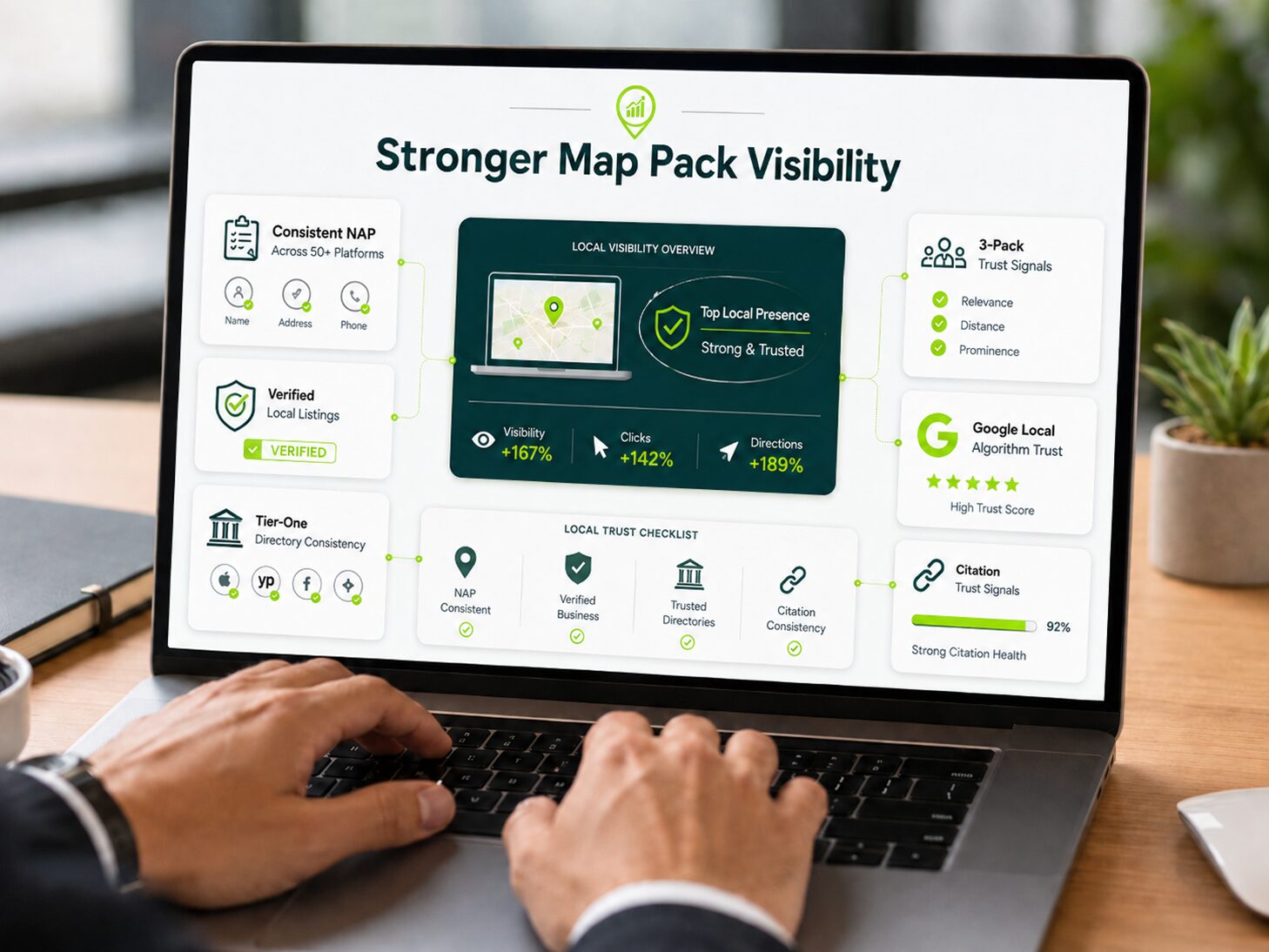
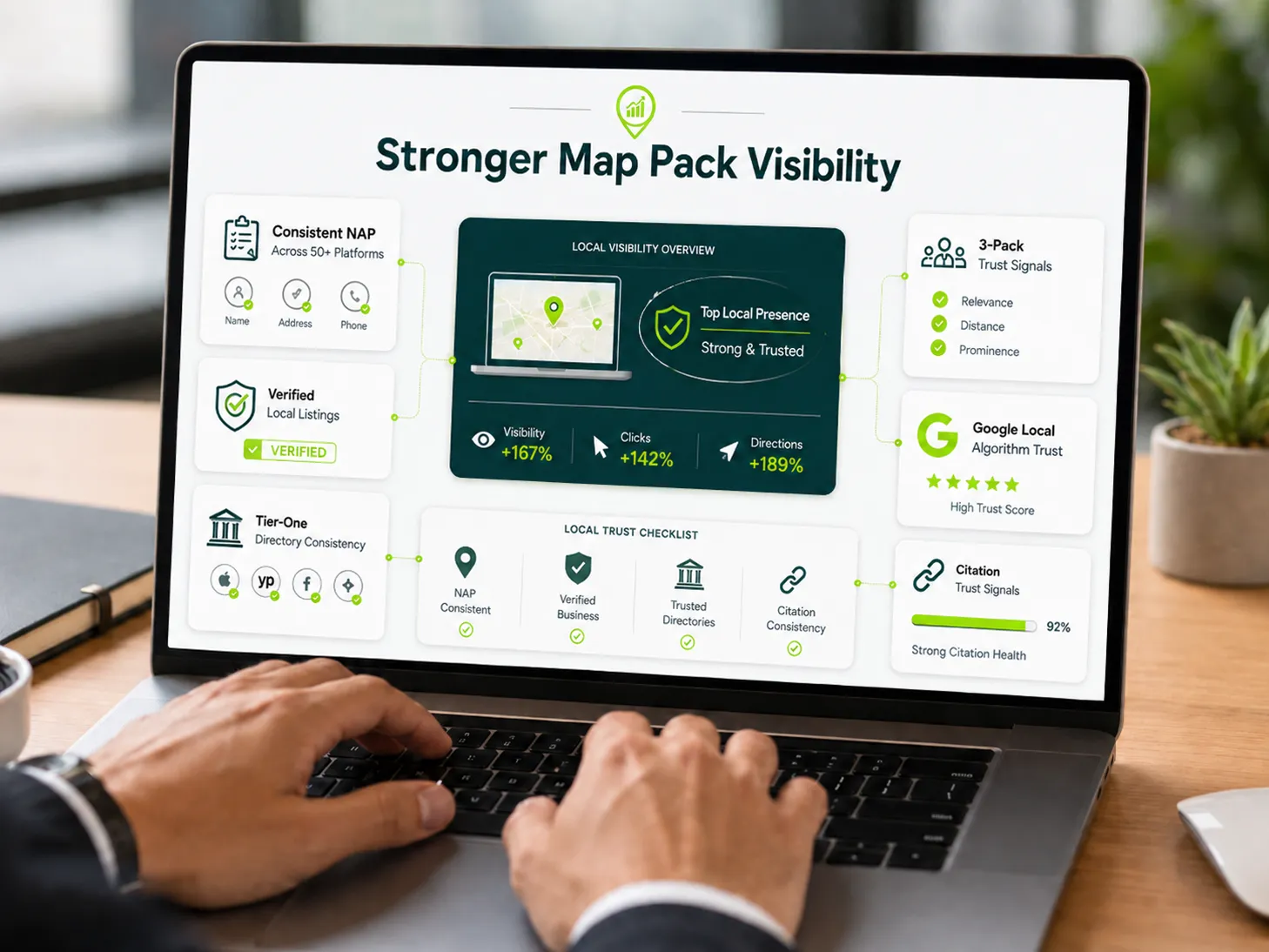
Stronger Map Pack Visibility
Citation consistency ranks among Google’s most weighted local ranking factors. Businesses with clear, consistent NAP across 50+ platforms regularly outrank competitors with strong backlink profiles, because Google’s local algorithm prioritizes data trustworthiness over raw domain authority.
When your NAP details match across tier-one directories and industry-specific platforms, the algorithm can verify your business and confidently show it in the 3-pack. When it can’t, it defaults to a competitor it can verify.
The 3-pack rewards trust. Accurate, consistent citations are how that trust gets maintained.
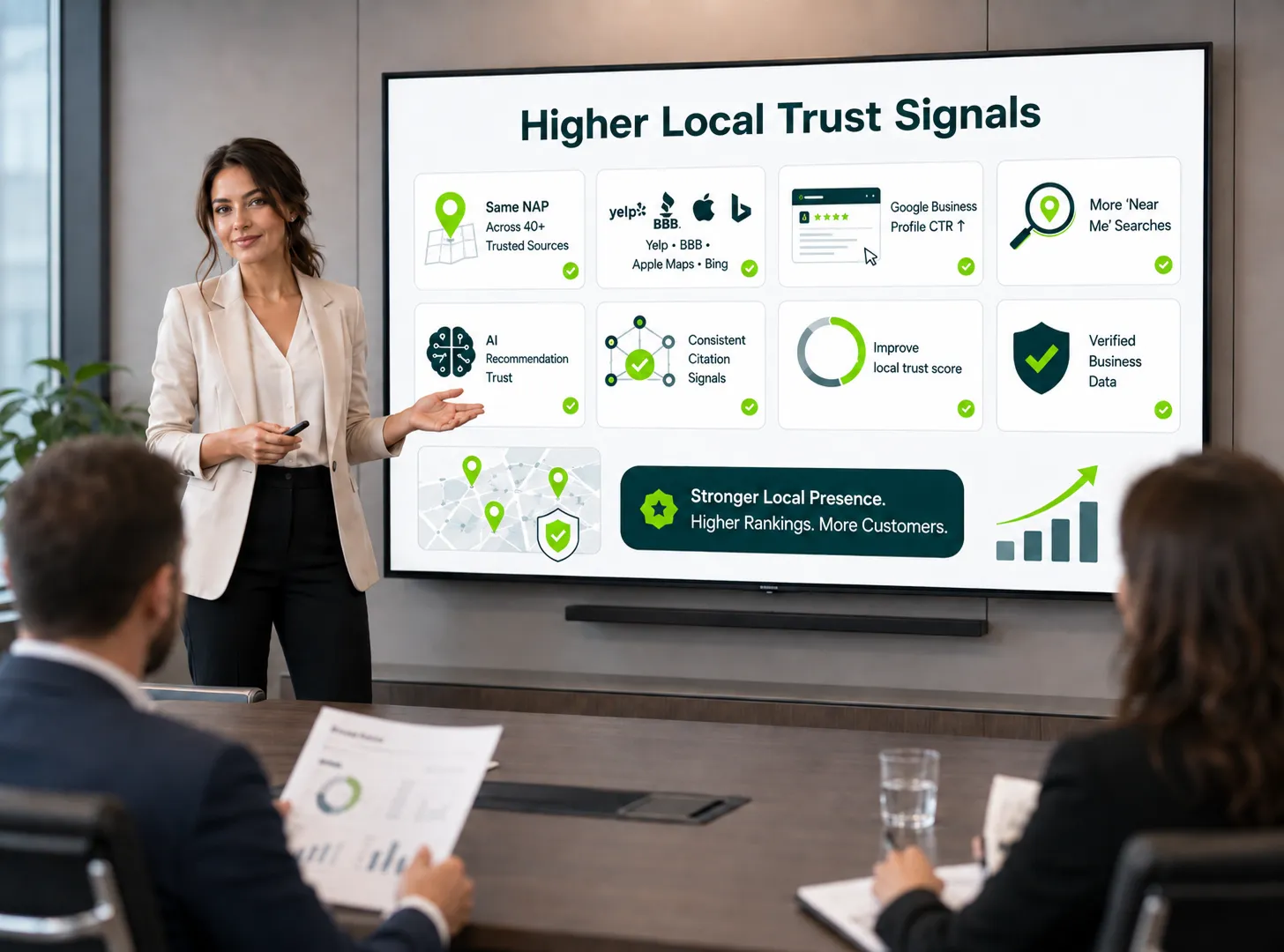
Higher Local Trust Signals
When Yelp, BBB, Apple Maps, Bing, and other 40+ trusted sources show the same NAP details, your business becomes a confident answer to local queries.
The confidence shows up in better rankings, more “near me” searches, and improved click-through on your Google Business Profile.
AI assistants rely on a mix of web data, business listings, and third-party sources when generating local recommendations. Consistent citations mean your business gets shown there, too. This effect compounds across every platform, pulling from the same trusted data.
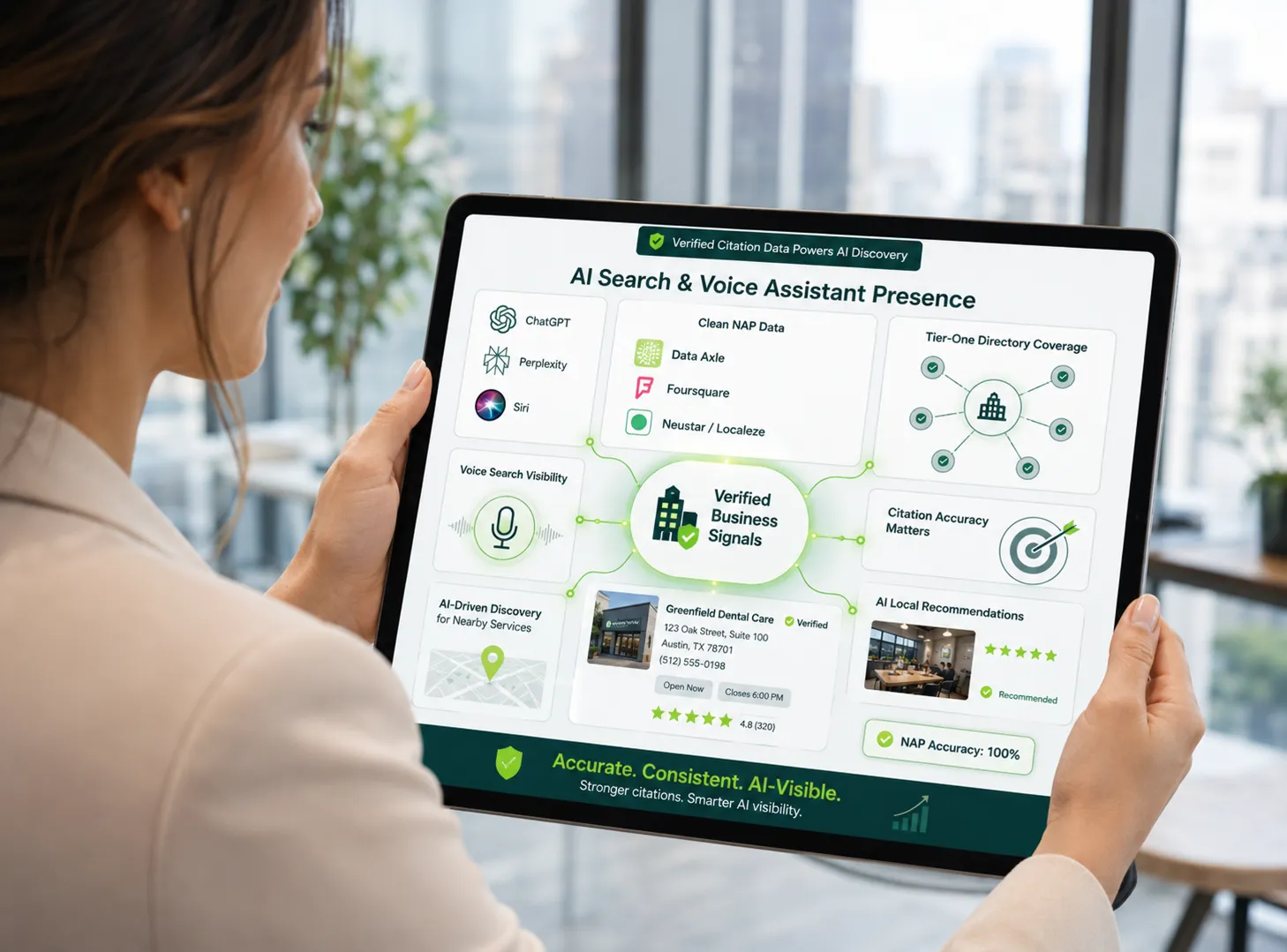
AI Search and Voice Assistant Presence
ChatGPT, Perplexity, Google AI Overviews, and Siri pull local business data from the same aggregators and directories that Google’s local algorithms use.
If your NAP is inconsistent or incorrect at the source, AI assistants either skip you from results or show the wrong information to users who are ready to convert. Clean, Verified citations across Data Axle, Foursquare, Neustar/Localeze, and tier-one directories position your business in local recommendations when someone asks their AI for the best service nearby.
As AI-driven search grows, citation accuracy is becoming important, rather than a ranking advantage.
A Cleaner, Defensible Local Footprint
The long-term payoff is a profile that doesn’t require content intervention. Duplicates should be removed, not left as they are. Aggregator data stays synced across directories. New platforms get added as they gain local authority, not when rankings drop.
Citation drift stops costing you map pack positions. What you’re left with is a stable, verified foundation that compounds visibility over time rather than degrading it.
Most local campaigns never reach this stage because audits get skipped, and monitoring is set back. The businesses that consistently maintain it are the ones that become difficult to displace.
Client Success Stories
What Clients Say About Our
Local Citation Services
Verified reviews from leaders who gained authority, rankings,
and revenue by fixing the citations their last agency missed.

4.9/5 

5/5 
Rating on Google



We had 14 locations and no idea how inconsistent our listings were. After the audit, we found wrong phone numbers on almost 9 platforms. Three months later, every location is in the top 3 for its primary local query.

Operations Lead
Multi-Location Dental Group

Our map pack impressions improved without us touching a single backlink. Turns out our NAP was wrong on half the aggregators. Outreach Desk fixed what our last two agencies missed. For real-world examples of this in action, our case studies from similar clients.
Marketing Director
Regional HVAC Chain

Apple Maps was showing the address of the old office for the last 18 months. Nobody caught it. Clean citation work bought new consultations in the first month after it was fixed.
Owner
Family Law Firm
Service Framework
Investment, Timeline, and
Deliverables
Every listing we build, correct, or suppress is tracked, and you can see it in real time. Here’s what shapes your investment:

Number of Locations
Each location needs its own audit, NAP, and verified citation set; it’s not a shared checklist.

Market Competitiveness
Competitive markets in metro cities usually require 50-100 citations; small markets require 30-50 citations, but they must be accurate.

Existing Footprint Health
Cleaner foundation scales faster; most of them are messy, and the first two months are important for audit and cleanup before new listings get built.

Campaign Duration
Initial builds run 60-90 days. Monthly monitoring protects what’s earned.
Directional pricing
Pricing is available on request and varies by location, scope, and market conditions. Our quotes cover audit, NAP consistency, primary and secondary citation submission, duplicate cleanup, and monthly monitoring reports.
You get a detailed proposal after your strategic call, including exact citation targets, a breakdown of the platform, a projected timeline, and a month-by-month roadmap. Pricing covers audit, NAP consistency, primary and secondary citation submission, and monthly monitoring. No hidden fees, no vague answers.
What You Get
Complete Report on Every Citation
You can see every listing we build and correct in real time.

Live Citation Dashboard
Every citation logged, including platform, URL, category, status, and accuracy. Filter by location, source type, or accuracy check.

Canonical NAP Document
Exact NAP details, working hours, and description are locked in a single document, and every further vendor follows without variations.

Monthly Citation Report
New listing built, errors corrected, duplicates suppressed, and platforms monitored. Summary of the activity and anything that needed your attention.

Audit Trail
Every submission is logged with date, platform, verification status, and screenshots. You get access to the complete history if any listings drop or change.
Our Approach
Choosing the Right Way to
Build Local Citations
You gain citations built with accuracy and platform relevance,
rather than volume or automated placements.
| Factor | Bulk Submission Tools / DIY |
 |
|---|---|---|
| NAP Accuracy | Scraped data, typos inherited across platforms | Canonical NAP locked down, verified character-by-character |
| Source Quality | 500+ low-trust directories, many deindexed | 80-120 vetted platforms Google actually uses |
| Duplicate Management | Duplicates ignored or created | Duplicates merged through proper verification |
| Industry Relevance | Generic directory blasts | Category-specific directories matched to your vertical |
| Verification | “submitted”= done | “Live and indexed.” = done |
| Data Aggregator Control | Downstream listicles left to drift | Primary aggregators updated to correct the whole system. |
| Reporting | CSV of URLs, no verification | Live dashboard with status, screenshots, and audit trail |
| Ongoing Defense | One-time push, permanent drift | Monthly monitoring catches errors before ranking slips. |
Who We Help
Local Businesses and Multi-Location
Brands That Benefit Most
No matter what your market is, your business gets citations on platforms
that truly match your industry and location.



Medical &
Healthcare

Home
Services


Restaurants &
Hospitality

Multi-Location
Retail


Fitness &
Wellness

Auto
Services
Franchise
Operators

Professional
Services
Common Questions
Frequently Asked Questions
Clear answers on how local citations affect rankings,
and what to expect from a managed campaign.
See How Local Citations
Can Grow Your Visibility
Start by auditing what’s already out there. Fix what’s wrong.
Build the foundation on which your rankings depend.
4.9/5
Trusted by agencies
and brands worldwide.