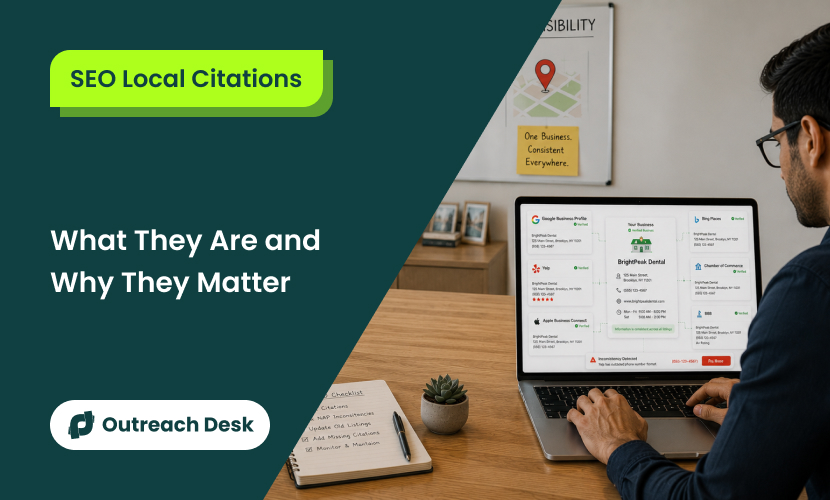
Most business owners chase backlinks, but ignore the trust signals that decide whether local customers find them. A local citation is any online mention of your business name, address, and phone number. In SEO, that’s called NAP.
For brands that want consistent execution, working with professional link building services removes the heavy lifting.
Every Google Business Profile, Yelp Page, and Chamber of Commerce Directory with your matching NAP counts as a citation. Together, these listings tell Google that your business is real, at the right address, and trusted enough to show up in local search results. Many teams turn to local citation services when manual outreach becomes too time-consuming to scale.
The more places your business shows up with matching details, the more likely AI is to name you when someone asks for the best dentist, plumber, or coffee shop nearby.
If your citations are missing or inconsistent, you lose visibility on Google and in AI answers. Most local business owners don’t notice until the phone stops ringing.
Citations are the first layer, not the whole job. Our guide to link building for small business covers what comes after them.

Key Takeaways
- Local citations are listings with your business name, address, and phone number (NAP) shown the same way across directories, review sites, and local websites.
- They influence Google rankings and AI search results on ChatGPT, Gemini, and Perplexity.
- Yext analyzed 6.9 million AI citations and found that websites and listings dominate the sources AI tools actually pull from.
- 10 to 15 strong citations beat 200 weak ones every time.
- Even a small NAP mismatch like ‘Street’ versus ‘St.’ quietly drains your local visibility.
- Most local businesses already have citations. The real problem is they’re outdated, duplicated, or missing from key platforms.
Why Local Citations Carry More Weight Today
Google still uses citations to verify that a local business is real, active, and prominent in a specific area. AI Platforms like ChatGPT, Gemini, and Perplexity now pull from the same listing ecosystem, which is why an AI search optimization strategy for local businesses starts with the same citation signals.
There are mainly two reasons for that. Most owners know the first reason in a rough outline. The second one rarely shows up in local SEO advice, and it changes how citations work in practice.
Reason 1: Google Still Uses Citations to Verify You’re Real
Google’s local algorithm decides who shows up in the search results page (those three map results at the top of the search) based on three things:
- How relevant you are to the search query
- How close you are to the searcher
- How prominent your business is online
Here, citations help build your online visibility. Google reads your business name, physical address, and phone number, and cross-checks your details against 30 trusted directories to confirm you’re real. If your citations are patchy or inconsistent, you lose ground before anything else can help.
Reason 2: AI Search Tools Pull From the Same Signals
This is the part that changed. Yext analyzed 6.9 million citations from ChatGPT, Gemini, and Perplexity to determine where AI tools actually pull information from when answering local queries.
Two things stand out:
- AI tools use websites and listings as the main citation source.
- Reviews and social mentions carry less weight than verified listings

In simple terms, your business profiles on directories matter more for AI recommendations than what people say about you on Reddit.
That changes how local visibility works. When ChatGPT decides whether to recommend “the best Italian restaurant in Brooklyn,” it looks for businesses that appear consistently across trusted websites with matching NAP details.
When your business only appears on Google with incomplete or inconsistent information, not only does visibility drop, but you’re invisible to the increasingly large share of customers asking AI instead of searching.
For example:
- Google Business Profile: “(555) 123-4567”
- Yelp: “555-123-4567”
- Website footer: “555.123.4567”
A human sees these as the same number. But an AI system trying to verify identity reads them as three different businesses. Small inconsistencies create uncertainty and weaken your trust signals.
NAP Consistency: Where Most Businesses Quietly Lose Trust
NAP consistency means your business name, address, and phone number appear exactly the same across every major listing. Same spelling. Same formatting. Same abbreviations. Same suite number. Same phone format.
Even a small mismatch across top directories can weaken trust signals because search engines and AI systems may treat those variations as separate entities.
In many local SEO audits, most citation issues come from conflicting business details rather than missing listings.
If you only fix one thing about your citations this month, fix the inconsistencies of names, addresses, and phone numbers.

In most local SEO audits, the problem isn’t missing citations. Most businesses already have 10-20 listings online. The real problem is inconsistency.
In many cases, 60-80% of existing citations contradict your website or Google Business Profile in at least one detail.
Common examples:
- The business moved locations two years ago, but old listings still show the previous address.
- The phone number changed, but Yelp still displays the original.
- Google lists the business as “Joe’s Coffee,” while Facebook says “Joe’s Coffee Shop,” and another directory shows “Joe’s Coffee LLC.”
- The website uses “Suite 200” while directories alternate between “#200” and “Ste 200.”
Each mismatch is small. Together, they add up.
Google and AI search engines treat these as separate businesses, which weakens your trust signal. Either way, you lose ground.
The fix isn’t dramatic:
- Do a one-time cleanup, then check every quarter.
- Pick one official version of your name, address, and phone.
- Audit your top 20 citations against it. Update the ones that don’t match.
- Check the process again after 90 days.
Some platforms, like Yelp and Apple Business Connect, pull data from third-party sources and quietly overwrite your fixes.
In most audits we run, suite numbers and phone formatting create more problems than business names. A single missing suite number across major directories is enough to create conflicting business records.
Structured vs. Unstructured Citations: Two Different Plays
Not every citation works the same way, and treating them equally wastes your time.

A structured citation is a formal business listing on a directory or platform. For example:
- Google Business Profile
- Yelp
- Apple Business Connect
- Better Business Bureau
- Industry-specific directories
The format is predictable:
- Business name
- Address
- Phone number
- Website
- Hours
- Photos
- Category
These citations form the foundation of local visibility; without them, your business struggles to rank in local search.
An unstructured citation is a mention of your business inside regular content. These mentions show up in places like:
- Local news articles
- Blog posts
- Podcast descriptions
- Event pages
- Community websites
For example:
A local newspaper writes:
“Joe’s Coffee on Main Street, reachable at (555) 123-4567, is hosting a weekend event.”
That counts as an unstructured citation.
These mentions are harder to earn, but they carry strong trust signals because they come from contextual placements where the mention fits naturally within the surrounding topic.
Structured citations verify that your business exists, while unstructured citations strengthen its authority on top of the foundation.
Most local businesses focus only on structured listings. Very few actively pursue unstructured mentions. That creates opportunity.
Tip:
Spend the first month fixing and strengthening structured citations across the top 15-20 trusted platforms for your city and industry.
Then shift toward earning unstructured mentions through:
- Local press coverage
- Partnerships
- brand mentions from community blogs
- Podcasts
- Community websites
- Niche blogs
| Structured Citation | Unstructured Citation | |
|---|---|---|
| Where it lives | Directory listing fields | Body of an article, blog post, or news piece |
| How do you get it | Submit your information manually or through a service | Earned through PR, partnerships, and community involvement |
| Time to build | Hours per listing | Weeks to months per mention |
| AI search weight | Foundational signal | Strong differentiator |
| Best for | Verifying your business exists | Building a local authority |
The structured layer builds trust, and the unstructured one separates local brands from average ones which is why businesses working with a link building service agency consistently outpace competitors who handle citations alone.
The Citations Every Local Business Should Have
Skip the “Submit to 500 directories” advice. Most of those listings carry no weight, look low-quality to Google, and waste hours of your time. The goal is to build trust.

The list below covers the citation type that actually moves local visibility for nearly every small business. Get these right first; industry-specific directories come after.
Universal citations (every local business needs these):
1) Google Business Profile:
Non-negotiable. This is the most important local business listing for Google visibility.
2) Apple Business Connect:
Apple Maps, Siri, and Spotlight all pull data from this platform. If you ignore it, you lose visibility across every Apple device.
3) Bing Places:
Smaller search share, but still important. ChatGPT also relies on Bing’s index.
4) Facebook Business Page:
Supports brand trust, reviews, and citation consistency.
5) Yelp:
Still one of the strongest local trust signals in many industries.
6) Yellow Pages (YP.com):
Yellow pages push your data into multiple secondary directories.
7) Better Business Bureau (BBB):
Strong credibility signal, especially for service businesses.
8) Foursquare:
Feeds data downstream to dozens of platforms.
9) MapQuest/Manta:
Additional structured citations.
10) Your Local Chamber of Commerce:
Strong local authority signal.
Industry Specific Examples (Pick the ones for your category)
| Restaurants |
TripAdvisor, OpenTable, Zomato, Restaurant.com |
|---|---|
| Healthcare |
Healthgrades, Zocdoc, Vitals, WebMD provider directory |
| Home services |
Angi, HomeAdvisor, Houzz, Thumbtack |
| Legal |
Avvo, Findlaw, Justia, your state bar association directory |
| Real estate |
Zillow, Realtor.com, Trulia |
Licensed trades can add their state licensing lookup to this list, one of the sources pest control link building draws on.
That’s roughly 12-18 high-quality citations for most businesses. Done well, these citations outperform 200 low-quality directory submissions for local visibility. Quality over volume, every time.
The Anatomy of a Strong Citation
A strong citation includes eight core elements: business name, suite number, phone number, website URL, primary category, business hours, photos, and a clear business description. Complete citations create stronger trust signals and reduce the chances of conflicting business information across platforms.
Adding your business name, address, and phone number is only the starting point. A citation that actually strengthens local visibility includes much more than that.

A complete citation includes:
1) Business name
Exactly matches your website and Google Business Profile
2) Full physical address
Including suite number, formatted identically across listings
3) Phone number
Same format everywhere
4) Website URL
Direct link, not a tracking redirect
5) Primary business category
The most specific one that fits, not a broader catch-all
6) Hours of operation
Accurate and updated when they change
7) Photos
At least one exterior, one interior, one of your team, or a product
8) Business description
Written for customers, not stuffed with keywords
Incomplete listings rarely build trust with Google, AI systems, or customers.
A citation with three completed fields doesn’t build much trust with customers, Google, or AI systems. One detail many businesses underestimate is the business category.
Your primary business category carries more weight than most owners realize. A plumbing company listed under “Contractor” loses local relevance against businesses correctly categorized as “Plumber.” Specific categories consistently outperform broad ones.
How to Build Your First Round of Citations
A reliable citation-building process follows six steps: lock down your canonical NAP details, audit existing citations, fix incorrect listings before creating new ones, claim the major universal directories, add industry-specific citations, and review everything quarterly to catch inconsistencies before they spread.
A repeatable process works better than mass submissions. The order matters more than businesses realize.

Step 1: Lock Down Your Canonical NAP
Open a document. Write your business name, address, and phone number exactly as they appear on your website. This is your reference. Every citation must match it.
Step 2: Audit What Already Exists
Search your business name and city in Google. The first few pages usually reveal most existing citations.
Create a list and look for:
- Incorrect addresses
- Outdated phone numbers
- Duplicate listings
- Spelling inconsistencies
- Missing information
Tools like BrightLocal’s citation checker, Whitespark’s Local Citation Finder, and Moz Local significantly speed up this process.
Step 3: Fix Existing Listings Before Creating New Ones
Updating five wrong listings is more valuable than adding 20 new ones. Inconsistencies actively hurt; missing a listing just leaves growth on the table. Fix first, then expand.
Step 4: Claim the Universal 10 (from the list above)
Work through them one at a time. Use your canonical NAP. Fill in every field:
- Business description
- Categories
- Operating hours
- Website URL
- Photos.
The extra details improve trust and visibility across platforms.
Step 5: Add 5-8 Industry-specific Citations
Once the core listings are complete, move into industry-specific directories.
You can find them by:
- Using the category examples above
- Searching “[industry] directories [city]” in Google.
You should focus on trusted and active directories with real visibility.
Step 6: Set a Quarterly Review
Set a calendar reminder every 90 days. Spend 15-20 minutes reviewing your top listings for:
- Overwritten information
- Duplicate entries
- Missing fields
- Outdated hours or phone numbers
Some directories automatically pull data from external providers and quietly restore outdated information. Quarterly maintenance prevents slow ranking decay.
Common Mistakes That Quietly Tank Local Visibility
The most damaging citation mistakes include submitting to hundreds of low-quality directories, treating citations as a one-time task, ignoring duplicate listings, stuffing keywords into the business name, buying spam-heavy citation packages, and leaving photo or category fields incomplete. Most local visibility problems come from these patterns, not from a lack of citations.
These problems appear in almost every local SEO audit where businesses say, “We already tried citations and nothing changed.” But the real problem is in how they handle it.
1) Submitting to 200+ Low-Quality Directories
This is outdated advice. Low-quality directory networks look untrusted to Google and provide little value in AI search systems. Most AI tools don’t even pull data from these platforms. Focus on trusted directories that people actually recognize and use.
2) Treating Citations as a One-Time Project
Your business changes constantly:
- Addresses
- Phone numbers
- Seasonal hours
- Categories
- Ownership details
If your citations haven’t been reviewed in years, there’s a high chance several contain outdated information. Treat citation management as quarterly maintenance, not occasional cleanup.
3) Ignoring Duplicate Listings
Many businesses have two or three Google Business Profile listings, usually because someone created a duplicate years ago, or a previous owner’s listing never got merged. Duplicates split your authority and confuse customers. Find them, request merges or removals.
4) Over-optimizing the Business Name
Your business name should stay natural. Listing like “Joe’s plumbing – Best emergency plumber in Boston 24/7” creates unnecessary risk.
Google’s guidelines prohibit keyword stuffing inside business names, and violations can trigger suspensions. Use the real registered business name consistently everywhere.
5) Buying Review-stuffed Citation Packages
Cheap “100 citations + 50 reviews for $99” packages often result in low-quality listings in weak directories with fake reviews. The short-term visibility bump rarely lasts. The long-term damage to trust usually lasts much longer.
6) Forgetting About Photo and Category Fields
Incomplete profiles perform worse across both search and conversions. Listing with accurate categories and real photos builds trust. Uploading a few strong images often produces better results than businesses expect.
The mistake we see most often is businesses submitting to hundreds of low-quality directories while ignoring duplicate listings on major platforms like Google, Yelp, or Apple Maps.
Tools That Help You Manage Citations
Different citation tools solve different problems. BrightLocal works well for agencies and multi-location businesses, Whitespark is strong for citation discovery and niche research, Moz Local simplifies aggregator distribution, and Yext is built for enterprise-scale listing control and compliance.
Most small businesses don’t need expensive software to build their first round of citations. Tools matter when you’re auditing, monitoring, or managing citations across multiple locations.
BrightLocal:
BrightLocal is a strong choice for small agencies and multi-location businesses. It helps build citations and works as an audit tool and a local rank tracker. BrightLocal also offers a free citation checker.
Whitespark:
Whitespark was built specifically for local SEO. Its Local Citation Finder helps businesses discover:
- Citation gaps
- Competitor listings
- Niche directory opportunities
Businesses that focus heavily on local rankings will find Whitespark one of the most practical research tools available.
Moz Local:
Moz Local automates submissions through a network of data aggregators. That saves time for businesses managing listings across multiple platforms at scale. If you run a single location and manage listings manually, Moz Local simplifies your citation workflow.
Yext:
Yext is designed for larger organizations with multiple locations, strict compliance requirements, and centralized listing management needs. Healthcare and financial services often benefit most from platforms like this.
For most small and mid-sized businesses, our team usually defaults to BrightLocal because it balances citation tracking, auditing, and local rank monitoring at a lower cost than enterprise platforms.
Do This One Thing This Week
Most local businesses already know they should “do something about their listings.” They just keep putting it off because the work feels tedious and the impact feels invisible.
It is tedious. The impact is not invisible. It just takes 6-12 weeks to show up, and by then, most owners forget they did the work and credit the rankings to someone else.
If you’re going to do one thing this week:
- Search your business name plus your city in Google.
- Scroll through the first three pages.
- Write down every directory you see.
- Audit for inconsistencies, fix what you find.
- Add the missing ones from the universal 10 above.
Set a 90-day reminder to check again. That’s the entire local citation strategy for most small businesses.
Want to improve your local rankings with citations?
Get a clear plan to build an accurate, consistent listing that supports visibility.
What’s the difference between a local citation and a backlink?
A backlink is a clickable hyperlink from another website to your website, while a citation is a mention of your business name, address, and phone number. A citation doesn’t need to include a link to count. Many citations include a link, which makes them function as both. But Google and AI tools recognize the NAP mention even when no link is present.
How many citations does a small business actually need?
Twelve to twenty high-quality citations cover most local businesses. Quality matters far more than volume. A business with 15 well-maintained listings on trusted directories will outperform one with 200 listings spread across low-quality directory networks.
Do paid citation services work?
The good ones (BrightLocal, Whitespark, Yext) save time and produce real listings. The cheap package, with 100 citations for $50, creates listings on low-quality directories that don’t help and may hurt. If you’re considering a service, look at the actual directory list before paying. If you don’t recognize most of the names, skip it.
How long until citations move my rankings?
Most local businesses see measurable changes within 6-12 weeks of fixing inconsistencies and adding the universal 10. Faster results aren’t realistic, since Google takes time to crawl and process your updated information. Slower results usually mean other factors (a thin website, no reviews, weak Google Business Profile) are limiting your visibility.
What about NAP citations that don’t match because my business changed addresses?
Update every major listing as quickly as possible. Old addresses quietly kill your local visibility faster than most other issues. Start with the top directories that appear when you search your business name. Then use citation audit tools to find additional outdated listings across the web.
Do citations matter if I don’t have a physical storefront?
Yes. Service-area businesses (plumbers, contractors, mobile services) still rely on citations to build local trust signals. Most major directories now support service-area listings, allowing businesses to hide their physical address while still showing the regions they serve. Google Business Profile supports this setup directly.
Can citations help my business show up in ChatGPT answers?
Yes, and this is increasingly where citations earn their keep. AI models like ChatGPT, Perplexity, and Gemini look for businesses confirmed across multiple consistent sources when generating local recommendations. A business with strong, consistent citations across the universal 10 is far more likely to be named than one relying on Google Business Profile alone.