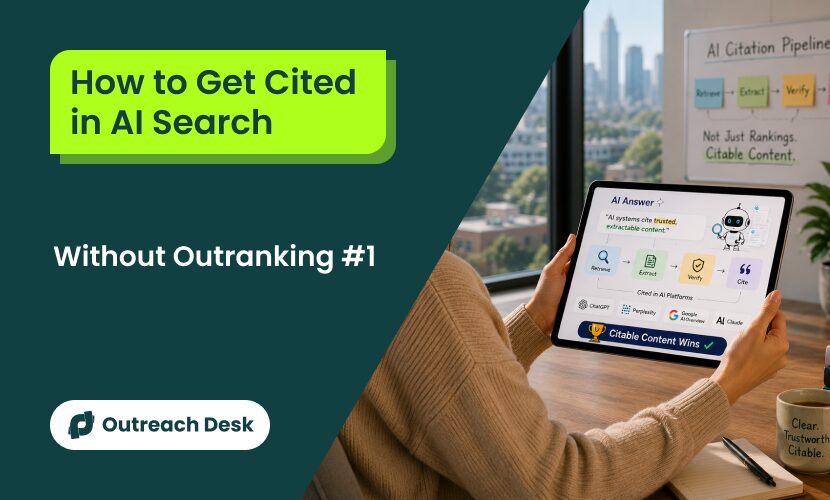
You’ve been told you need to rank #1 to show up in AI answers. That’s half right.
AI search platforms like ChatGPT, Perplexity, and Google’s AI Overviews don’t just pull from top-ranking pages. They pull clear, trustworthy passages they can retrieve and verify. To get cited in AI search, your content must be retrievable, extractable, and supported by trusted third-party signals.

Key Takeaways:
- The 4-stage pipeline AI engines run before they cite anything, and where most pages fall out of it.
- Why a citation, a mention, and a recommendation each require a different optimization strategy.
- The 5 structural changes that make a paragraph extractable at the chunk level.
- How third-party signals on Reddit, G2, and industry media decide whether your claim gets backed.
- The platform-specific quirks that separate Claude citations from Perplexity citations.
How AI Search Engines Actually Decide What to Cite
AI search engines don’t rank pages. They retrieve passages, synthesize an answer, and attach citations to the passages they used.
The citation path usually has 4 filters:
- Eligibility
- Retrieval
- Extractability
- Attribution
Missing one stage removes your content from eligibility for citation.

Stage 1: Eligibility
The AI engine has to fetch your URL before anything else. Make sure your pages return a 200 status code, have no login or paywalls, and don’t aggressively block bots.

In 2026, “accessible” means multiple AI crawlers, including GPTBot, ClaudeBot, PerplexityBot, Google-Extended, and Applebot-Extended, can reach your content.
Each has its own user agent. Each can be blocked independently in your robots.txt. Audit your server logs. If the bot for a platform you care about isn’t getting through, nothing downstream matters.
Stage 2: Retrieval
Retrieval is where the AI engine searches the web for passages relevant to the user’s query. This stage determines whether your content makes the shortlist.
AI engines use Retrieval-Augmented Generation (RAG), a core component of modern AI search optimization. RAG takes a user query, searches one or more sources, and pulls the most relevant passages before generating an answer.

For example, ChatGPT and Perplexity use their own indexes, along with live search. Claude uses Brave Search. Google AI Overviews lean heavily on Google’s own ranking signals.
Query fan-out controls how AI systems expand one search into multiple retrieval paths. One question like “best CRM for startups” can break into 5 to 15 smaller searches:
| Main Query | Possible Query Fan-Out |
|---|---|
| Best CRM for startups | Best CRM for SaaS startups 2026 |
| Best CRM for startups | CRM pricing under $50 per user |
| Best CRM for startups | HubSpot alternatives |
| Best CRM for startups | CRM with automation for small teams |
| Best CRM for startups | Simple CRM for founders |
You can earn citations without ranking for the primary query. You have to be retrievable for one of the fan-out queries.
Stage 3: Extractability
Extractability decides whether the AI engine can lift your passage. The model already has a shortlist of passages. Now it chooses the ones it can extract and attribute without confusion.
A 200-word paragraph that answers a specific question beats a 600-word section that buries the answer halfway through.
This is where most pages lose. They have the right information, but it’s spread across three paragraphs, broken up by promotional language, or written as a continuous argument that the AI can’t slice. Each section needs to read like a standalone unit.

Stage 4: Attribution
Attribution decides whether the AI engine trusts your passage enough to cite it. The model has already found the passage. Now it checks whether your source deserves the citation.

Two main factors determine trust:
1. Third-party Validation:
If a number of claims appear only on your domain, AI systems may skip it. When the same statistics appear across multiple trusted sources, such as Reddit discussions, G2 reviews, or industry media, the engine is more likely to recognize your content as reliable and cite it.
2. Whether your content carries the signals the engine has learned to trust:
AI engines look for signals of credibility, including author bylines with credentials, date published metadata, proper schema markup, inline source citations, and consistent entity information across the web. These signals help the AI differentiate the authoritative passages from weak or unverified content.
Mention vs. Citation vs. Recommendation: They’re Not the Same
A mention, a citation, and a recommendation are three different outcomes in AI search, and each one requires a different strategy to earn.
| Type | What It Looks Like | What Earns It |
|---|---|---|
| Mention | “HubSpot is a popular CRM.” Your brand appears, but no source link appears. | Entity presence across Wikipedia, Crunchbase, G2, industry comparisons, and trusted third-party sites. |
| Citation | “According to [Source], the platform handles 60,000 events per second.” Your URL appears as the source. | Extractable claims, original data, or unique synthesis that the AI system can lift. |
| Recommendation | “For early-stage SaaS, HubSpot or Pipedrive are good starting points.” Your brand appears as the answer. | Comparison content, review platform presence, and prompt-specific authority. |
A mention helps brand recognition. A citation drives referral traffic and authority signals. A recommendation drives conversions.
To systematically track brand mentions in large language models and understand which outcome you’re achieving, you need a consistent monitoring framework across all major AI platforms.

Each outcome requires a different approach.
- Want more mentions? Tighten your entity profile across third-party sources.
- Want more citations? Make your data points extractable and original.
- Want more recommendations? Get reviewed on G2 and Capterra, and publish comparison content with clear, objective criteria.
5 Structural Changes That Make Content Extractable
Making your content extractable for AI citations requires five structural changes: lead each section with a direct answer, use specific scannable headings, keep paragraphs short, anchor every claim with a source or number, and format key information in tables or lists.

Lead Every Section With a Direct Answer
The first sentence under any heading should answer the heading’s implicit question. “How long does an AI citation building take?” gets a first sentence that says “AI citation building shows initial results in 4 to 8 weeks.” Not a paragraph of context.
Don’t start with the background. Start with the answer.
Use Specific, Scannable Headings
“Key considerations” are invisible to a retrieval system. “How Perplexity weighs Reddit citations” tells the engine exactly what passage sits below. Heading specificity is a citation lever. Treat it as one.
Keep Paragraphs Under 4 Sentences
AI engines prefer self-contained chunks. A 12-sentence paragraph forces the model to either pull too much (which it won’t) or skip (which it does). Short paragraphs are extractable. Long ones aren’t.
Anchor Every Claim in a Number, Source, or Example
Vague claims get filtered. “Most users prefer AI search” reads as an opinion. “Outbound referral traffic from ChatGPT grew 206% in 2025, based on Semrush’s analysis of 17 months of clickstream data,” reads as a fact the engine can lift. The structure is claim + source + specific number.
Use Comparison Tables and Lists Where the Prose Would Repeat
Tables compress comparisons into rows that the engine can parse cleanly. Lists signal “here are N discrete items” in a way prose can’t.
Lists and tables are cited more often than equivalent prose, and they survive translation across surfaces (AI Overview, featured snippet, voice answer).
The E-E-A-T Layer: Why Third-Party Signals Decide AI Citations
Third-party signals decide AI citations because AI engines verify claims by cross-referencing them against other trusted sources. A claim that exists only on your domain gives the engine nothing to verify against.

Author Credentials at the Top of the Article
Byline, role, links to a LinkedIn profile or author page.
AI search algorithms scan the first 200 words for trust indicators, and an author name with verifiable credentials is one of the strongest.
A generic “Marketing Team” byline loses to a named person with a track record.
Original Data, Marked as Your Data
If you have campaign benchmarks, customer-cohort numbers, or proprietary research, surface them with a clear attribution:
Example:
“Based on Outreach Desk’s outreach campaigns across the past 12 months, in-content placement requests earn a 14 to 18% reply rate when personalized at the article level.”
The AI engine has nowhere else to source that number. You’re the citation.
Third-Party Validation
Most brands underinvest here. AI engines weigh content that’s referenced by other trusted sources.
A Semrush analysis of 10 million keywords found that being cited in an AI Overview correlates with broader presence across third-party domains, not just with rank position. Your three biggest levers:
| Channel | Why It Matters |
|---|---|
| G2 and Capterra | AI engines often use review platforms to compare and answer recommendation queries. |
| Reddit consistently shows up in roughly half of Perplexity citations, based on our own prompt-set audits across B2B SaaS keywords. | |
| Industry media | Coverage in Search Engine Land, MarTech, TechCrunch, and similar sites strengthens source trust. |
Earned coverage on trusted third-party sites was already the foundation of strong off-page SEO. AI citation makes it non-negotiable.
Schema and Technical Setup for AI Crawlers
Schema markup tells AI crawlers what your content means. It doesn’t rank you, but it makes your content easier to parse, classify, and attribute.
Three schema types matter most for AI citation:
| Schema Type | Why It Matters |
|---|---|
| Article schema | Shows author, datePublished, dateModified, and description. |
| FAQPage schema | Helps AI systems parse question-and-answer content to ground it. |
| Organization schema | Helps AI engines resolve your brand as a consistent entity. |
Validate every schema block with Google’s Rich Results Test before publishing. Schema errors silently kill citation eligibility.

Platform-Specific Tactics
Each platform weighs different signals. Google prioritizes existing rank, Perplexity weights recency, and Claude requires trust in verified third-party sources.

Google AI Overviews
Google AI Overviews still pull heavily from content that already ranks. Keep your top-10 pages fresh, structure your H2s as the questions readers ask, and answer in the first 60 words after the heading. Around 99% of AI Overview triggers have informational intent.
Therefore, optimizing for AI Overview visibility means prioritizing guides, definitions, and step-by-step content over commercial pages.
ChatGPT
ChatGPT rewards pillar-style content with specific statistics, named sources, and full coverage of the topic. Monitoring how ChatGPT cites your brand tells you which pillar pages are already earning citations and which ones need structural work. Pillar pages that cover a topic in depth, with specific statistics and named sources, outperform thin, focused posts.
In practice, we’ve seen client pillar pages earn AI citations within weeks after adding structured sub-sections and supporting data. Domain authority still matters here, so a strong backlink profile compounds the effect.
Perplexity
Perplexity favors recency and community-validated content. Publish consistently, refresh older posts with current data, and treat Reddit participation as a citation channel.
Perplexity shows users exactly what it cited. When your content appears there, click-through rates are meaningfully higher than those for a standard organic result.
Claude
Claude is conservative about what it cites. It cross-verifies sources heavily, so third-party mentions on G2, Wikipedia, and editorial coverage carry extra weight.
Claude uses Brave Search for retrieval, so ranking well in Google won’t automatically surface you here. Tone matters too: Claude tends to cite content that reads like expert analysis rather than marketing copy. Hedge less, name your sources, and let the data do the convincing.
Measuring and Auditing What You’ve Built
Once the pipeline, structural changes, and third-party signals above are in place, the next step is checking whether they are actually working, and fixing the pages that are not.
Our guide to auditing existing content for AI search walks through that process page by page, including how to track citation rate in GA4 and run the manual prompt tests that catch what tooling still misses.
Looking to strengthen visibility across AI search platforms?
Get a focused strategy built around the content and authority signals that matter.
How long does it take to get cited by AI search engines?
Most brands see an initial lift in citations within 4 to 8 weeks after restructuring content and adding schema. Perplexity tends to respond fastest because of its recency bias. ChatGPT and Google AI Overviews take longer because both rely on established authority signals that build over months. Third-party citation building (Reddit, G2, industry media) has the highest ceiling but the longest lead time, usually 3 to 6 months.
Do I need to rank #1 to get cited?
No. In our editorial campaigns, the pages that gain the most AI citation visibility rank between positions 4 and 8, not position 1, while top-ranked pages saw little movement. Citation is about extractability, originality, and trust signals. These principles are core to AI search optimization and show how content can be surfaced without ranking #1
What’s the difference between GEO and AEO?
Generative Engine Optimization (GEO) is the broader practice of optimizing content so AI engines cite it as a source. Answer Engine Optimization (AEO) is narrower: it specifically targets featured snippets, voice answers, and direct-answer boxes, where your content becomes the answer itself rather than a cited source alongside others.
Does optimizing for AI search hurt traditional Google rankings?
It doesn’t. Clear headings, factual density, schema markup, E-E-A-T signals, and third-party citations are the foundations of both. The structural changes that earn AI citations are the same changes that strengthen organic rankings, which is why working with a dedicated link building agency that understands both signals delivers compounding returns across traditional and AI search.
Which AI platform sends the most referral traffic right now?
ChatGPT, by a wide margin, with outbound referral traffic growing 206% in 2025 according to Semrush’s clickstream data. Perplexity and Claude send smaller volumes but higher-quality visitors. Google AI Overviews don’t always send traffic, since users often get the answer without clicking, but being cited there still drives brand authority.
My brand is being described inaccurately by AI. How do I fix it?
Fix it by tightening your about page, making your organization schema consistent across all pages, and earning recent third-party coverage that accurately describes your brand. When AI engines lack a clear, consistent description of your brand, they fill the gap with whatever they can find.