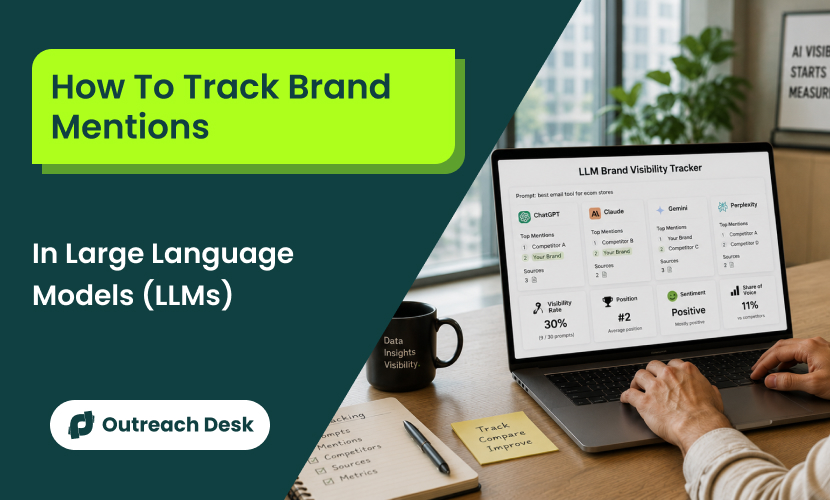
Right now, your potential customers are asking ChatGPT for the best product in your industry. The answer is shaping their buying decision. When tracking visibility, ask yourself: Does your brand appear in that answer, or does your competitor take the spot instead?
Tracking brand mentions in LLMs (Large Language Models) means running real customer questions through ChatGPT, Claude, Gemini, and Perplexity.You record whether your brand appears, how it is described, and which sources shaped the answer.
What You’ll Learn
- What “tracking LLM brand mentions” means and why it matters.
- The 4 metrics that matter (and which ones to ignore).
- A step-by-step process you can run for the first time today, manually, with no tools.
- The tools that automate it once the manual gets too slow.
- How to use the data to improve your AI visibility and which content influences AI recommendations.

What Does Tracking LLM Brand Mentions Mean?
A large language model (LLM) powers AI assistants such as ChatGPT, Claude, Gemini, Perplexity, and Microsoft Copilot. When someone asks these systems a question, the model generates an answer in plain language.

AI assistant often recommends specific brands, products, or services in their answers. Tracking LLM brand mentions means asking AI assistants the same questions your real buyers ask. You need to record five things:
- Does your brand appear?
- How often does it show up across different questions?
- What does the AI say about you?
- Which competitors get named instead of you, or alongside you?
- Which websites does the AI read to form its opinion?
In some ways, this is similar to traditional rank tracking. But one major difference changes everything. Google gives you a list of links in the search results page and lets you decide what to click.
AI assistants provide a direct recommendation instead. That raises the stakes for every query. If your brand never appears in the answer, many users will never discover you.

Why LLM Tracking Differs From Google Alerts or Social Listening
You already track brand mentions somewhere. Maybe Google Alerts notifies you when a blog mentions your company. Maybe a social listening tool like Brand24 tracks conversations on Twitter or Reddit.
A blog post and a tweet are published once and stay online. Both can be crawled, indexed, and searched. But AI assistants work differently.
An AI model’s answer is generated fresh every time someone asks. There’s nothing to crawl. Ask the same question to an AI after 30 seconds, and you get different answers.
Here, your tracking shifts from “scan the internet for my name” to “ask the assistants the questions my customers ask, and write down what comes back.”
Also, traditional brand mentions on the web live on websites you can reach. AI mentions live in conversation you’ll never see, unless you go and prompt for them yourself.
The 4 Metrics That Matter
Four numbers tell you almost everything: visibility rate, position when mentioned, sentiment and accuracy, and share of voice. Most articles on AI visibility bury these under a pile of tactics.
Visibility Rate
Visibility rate measures how often your brand appears across your prompt set. For example, if your brand appears 9 out of 30 prompt responses, your visibility rate is 30%. You use this as your core benchmark. Track it monthly and compare trends over time.

Position When Mentioned
Visibility alone doesn’t guarantee impact. You need to track where your brand appears in the answer. Is it first on the list? Buried in the middle, or at the bottom? Most people read the first two recommendations and skip the rest. A mention in position three or four is much closer to invisibility.

Sentiment and Accuracy
Pay attention to what AI says about you. Some answers strengthen positioning, such as “Best for small businesses” or “Strong for enterprise workflows.” Some weaken it. “Mid-tier option” or “Expensive for the feature set.”
Also, accuracy matters just as much. AI systems sometimes reference outdated pricing and old positioning. Visibility becomes less valuable if the framing is wrong.

Share of Voice vs Competitors
Measure how often your competitors appear in AI answers compared to your brand. If your brand receives 1 mention for every 8 mentions a competitor receives across the same prompt set, the visibility gap becomes very clear. This metric helps reveal who dominates AI-generated recommendations in your category.

In our experience auditing mid-market SaaS clients, brand visibility in category discovery prompts is the metric most predictive of pipeline impact. One client’s visibility on direct brand prompts was 95%, but their category prompt coverage was only 28%. Once we closed that gap, we tracked a measurable 12% lift in demo requests over the next quarter.
Our SaaS link building campaigns report AI citations beside organic traffic for the same reason.
How to Track Brand Mentions in LLMs Manually (Your First Day)
The fastest way to manually track brand mentions in LLMs is to select the AI assistants your customers actually use, craft 20-30 realistic prompts that reflect how they search, run each prompt across every assistant, and log the outputs for baseline visibility metrics.

Step 1: Pick the AI Assistants Your Customers Use
Do not try tracking every platform immediately. Start with the AI your audience is most likely to use.

For most consumer brands and SaaS companies: ChatGPT and Perplexity. ChatGPT has the largest user base. Perplexity matters because users rely on it heavily for sourced answers.
For technical or developer-focused products, you can go with Claude. For Microsoft-heavy enterprise buyers, add Copilot. Gemini is well-suited to younger audiences because of its Google integration.
Free accounts are enough for baseline tracking. You don’t need an enterprise subscription to begin.
Step 2: Write 20 to 30 Prompts Your Customers Would Type
Most teams underestimate how much this step matters. Weak prompts create weak tracking data.
The biggest mistake? Writing prompts the way you speak internally, instead of how customers actually search.
Real users write casually. They sometimes write in lowercase, use short phrases, use incomplete wording, and even make typos. That changes the answers AI systems generate.
For example, “best email tool for ecom store” often produces different outputs than “What are the best marketing platforms for e-commerce stores?”

Mix four types of prompts:
Direct brand prompts
Direct brand prompts reveal how AI assistants currently frame your company. Examples:
- “What is [your brand]?”
- “Is [your brand] good?”
- “[Your brand] vs [competitor]”
Category prompts
These prompts test visibility before customers already know your brand name. That makes them much more valuable strategically.
Here are the three examples:
- “Best [category] tools for small businesses”
- “Top [category] software for beginners”
- “Cheapest [category] platform.”
Problem prompts
These are often the highest-intent prompts because users are already close to choosing a solution.
Examples:
- “How do I solve [problem]?”
- “Best way to [desired outcome]”
Comparison prompts
These prompts reveal whether you’re even in the conversation when buyers shortlist.
Examples:
- “[Competitor A] vs [Competitor B]”
- “Alternatives to [competitor]”
Tip
Write prompts exactly how customers type them.
Lowercase, casual, sometimes with typos, “best email tools for ecom stores” pulls a different answer than “What are the best email marketing platforms for e-commerce stores?”
Step 3: Run Every Prompt on Every Assistant
Open a spreadsheet and create columns for:
- Prompt
- Assistant
- Whether your brand appeared
- Answer position
- Summary of what the AI said
- Competitors mentioned
- Sources cited

Then run every prompt across every assistant. Log the outputs carefully. Yes, it becomes repetitive.
This first run creates the baseline; you can’t measure improvement without it.
Step 4: Calculate Your Four Metrics
Once you collect the data, calculate the visibility rate, average position, sentiment distribution, and competitor share of voice. Document the numbers clearly with the data.
Write these four numbers, assign a date, and put them somewhere you’ll see them in 30 days.
When Manual Tracking Stops Scaling
Manual tracking works for the first month. After that, it becomes difficult to maintain. You hit the three walls: time, model variance, and alerts.

Time
Running 30 prompts across 4 AI assistants each week means completing 120 manual checks. That quickly turns into hours of repetitive work. You can’t sustain that pace long term.
Model Variance
AI outputs vary constantly.
Run the same prompt in ChatGPT three times in a row, and it will provide three different answers each time. That creates a major measurement problem.
One manual snapshot a week doesn’t tell you whether your visibility changed or whether you just caught a bad roll of the dice.
This is where automation becomes useful. Tools that run each prompt 5-10 times and average the outcomes produce far more stable visibility signals.
Alerts
If your sentiment flips from neutral to negative on Tuesday, you want to know on Tuesday, not when you sit down for your monthly check on the 28th. That’s when an LLM brand monitoring tool earns its place. Here, you’re paying for the time and the consistency.
We usually see manual tracking hit its limits around week 3 or 4. By that point, running 12-25 prompts multiple times per day becomes unmanageable, errors creep in, and teams start missing mentions, a signal it’s time to move to automated AI visibility tools,
What to Look for in an LLM Brand Monitoring Tool
This category is still new. And like most new software categories, many tools currently offer far less depth than they promise.
A few capabilities separate serious monitoring platforms from lightweight dashboards.

Multi-Model Coverage
ChatGPT alone is not enough for tracking. A strong monitoring platform covers at least ChatGPT, Claude, Gemini, and Perplexity. Additional tools such as Copilot, Grok, and Meta AI are considered good options.
Multi-Run Sampling
Each prompt runs multiple times during every reporting cycle. Single-run outputs are too unstable to trust. Repeated sampling helps reduce variance and produces cleaner trend data.
Custom Prompt Libraries
You should be able to define your own prompts rather than pick from a fixed list. Your category questions are not the same as anyone else’s.
Competitor Benchmarking
The tool should automatically compare your visibility, your competitors’ visibility, and your share-of-voice trends. This is where strategic insights are most useful.
Cited Source Tracking
This is one of the most valuable features. When AI assistants cite specific websites repeatedly, those sources heavily influence how your category is described.
You target those sites for outreach, PR targets, and partnership opportunities. In many cases, this dataset drives the most actionable direction.
Sentiment Classification
Good monitoring platforms classify mentions as positive, neutral, and negative. The important part is consistency at the mention level, not vague aggregate scoring.
Trend Lines Over Time
A snapshot tells you where you stand today. Long-term trend lines show whether visibility is improving, weakening, or remaining stable.
Several platforms worth evaluating today include:
- Profound (designed for enterprise SaaS tracking and multi-location visibility monitoring)
- Otterly.AI (ideal for solo founders or small teams needing automated prompt tracking)
- Peec AI (focused on competitive-share tracking and benchmarking against top category players)
- Meltwater GenAI Lens (best for PR teams already using Meltwater for media and brand monitoring)
Pricing ranges from roughly $50 a month for a single-brand on the lighter tools to several thousand dollars a month for enterprise platforms. You can start with low-cost models. The data matters more than the dashboard.

What the Data Tells You (And What to Do With it)
A list of mentions in a spreadsheet doesn’t help anyone. The data becomes useful when you turn it into three lists.

The Gap List
These are prompts where competitors appear and you don’t. These gaps usually indicate missing positioning or external visibility.
For example, if your competitor repeatedly appears for “best CRM for solopreneurs,” while your brand never shows up, you see the issue clearly.
You need a piece of content on your site that clearly positions you for solopreneurs, and you need other websites to start talking about you in that frame.
The Outdated List
These are prompts in which the AI inaccurately describes your brand. Common examples include old pricing, discontinued features, outdated positioning, and incomplete feature descriptions. You fix this by updating your content and earning new third-party mentions, so the AI updates its picture.
The Source List
When a tool like Perplexity cites a website in its answer about your category, write down that website. Over time, you will begin to observe patterns. You start identifying the publications and websites shaping AI-generated recommendations.
Those sites are now your outreach targets. Consistent mentions of your brand in those publications directly influence how AI systems describe your category.
This is where AI visibility reconnects with traditional SEO, digital PR, and brand-building work. Not only that, but LLM responses also rely on earned media rather than a company’s owned content.
Third-party articles influence AI more than your own homepage copy. That’s why external brand presence holds more importance than most teams currently realize.
3 Mistakes to Avoid in Your First Month
The same mistakes appear repeatedly during early tracking efforts. Most are easy to fix once teams recognize them.
Tracking Only Branded Prompts
“What is [my brand]?” tells you almost nothing useful. Of course, an AI knows your brand exists. The question that matters is whether it recommends you when no one asked for you by name. Spend at least two-thirds of your prompt list on the category, problem, and comparison queries.
Reading Too Much Into One Bad Answer
AI responses are probabilistic. A single negative or inaccurate output does not automatically indicate a meaningful trend. Run 5 samples of every prompt multiple times before drawing conclusions. One ChatGPT run may call you “expensive and outdated.” But five runs in a row that say the same thing is a pattern.
Confusing Visibility With Positioning
A mention alone does not guarantee visibility. Where you appear in the response matters: being listed third or fourth in a long list often has minimal impact. You need to track visibility rate, answer position, and framing quality. For example, a 50% visibility rate with consistent position 4 placements behaves more like a 5% real-world impact rate.
What to Do This Week
Open ChatGPT, Claude, Perplexity, and Gemini in four browser tabs. Open a blank spreadsheet. Write 20 to 30 prompts the way your customers would type them, weighted towards category and problem prompts rather than your brand name.
Now, run every prompt across every assistant and log, whether your brand appeared, where it appeared, what competitors showed up, and which sources the AI cited.
By the end of this exercise, you will know the visibility rate, which competitors dominate your category, and which websites AI systems rely on most heavily when forming recommendations.
That final list is usually the most valuable output. It reveals the publications and websites that can shape what AI assistants say about your industry. And that is where the real visibility work begins.
Want to understand how your brand appears across AI platforms?
Get a clear approach to track visibility patterns and identify where you’re being surfaced.
What does it mean to track brand mentions in large language models?
You ask AI models the same questions your customers ask. Then you log five things: Whether your brand appears, where it ranks in the answer, what’s said about you, which websites the AI cites, and which competitors appear instead. The output data creates a visibility baseline you can compare month over month.
Can I track brand mentions in ChatGPT for free?
Yes, the free version of ChatGPT is enough for manual baseline tracking. The main cost is time. Running 30 prompts across several assistants manually can take a few hours per session. It is usually worth it for early-stage tracking. Once monitoring becomes recurring and large-scale, paid platforms become much more practical.
What separates brands that appear in AI answers from those that don’t?
Almost always it comes down to how consistently a brand is referenced across sources AI assistants trust ,third party articles, editorial mentions, and authority directories. Most brands that close that gap work with an editorial link building agency to build those placements systematically.
How often should I check LLM brand mentions?
Monthly tracking is the right approach for most brands. Visibility patterns and AI source ecosystems usually change gradually, not daily. Weekly checks make more sense during active product launches, major PR campaigns, and fast-moving news cycles. Otherwise, monthly comparisons provide a cleaner signal quality.
Why does my brand appear in ChatGPT but not Perplexity?
The system works differently. ChatGPT relies heavily on broader training data and selective retrieval systems. Perplexity leans much more heavily on live web sources and citations. That means, brands with strong historical presence often appear more consistently in ChatGPT, and brands with strong recent press coverage and cited articles often perform better in Perplexity. Each platform rewards different visibility signals. That is why tracking multiple assistants matters.
Do I need a separate tool for each AI assistant?
Most modern LLM monitoring platforms track multiple assistants from one dashboard, so you don’t need separate tools. Single-model tools usually provide an incomplete visibility picture while costing nearly as much as broader platforms.
How do I get an AI assistant to mention my brand more often?
Three things move the needle. First, your own content needs to clearly say what you do, who you serve, and what makes you different, in language that matches how customers describe the problem. Second, recent articles on third-party websites need to mention you in the same context. Third, the websites that AI assistants cite most often in your category are the ones to focus on for your PR and outreach work. We cover the third lever in our editorial outreach guide for AI search visibility.
What’s the difference between tracking LLM mentions and Generative Engine Optimization?
Tracking is a measurement. Generative Engine Optimization (GEO) is the execution layer built on top of that measurement. Tracking shows what AI assistants currently say about your brand, where visibility gaps exist, and which competitors dominate certain prompts. GEO is the process of improving those outcomes through content strategy, PR, brand positioning, outreach, and authority building. One measures the problem, and the other works on solving it.