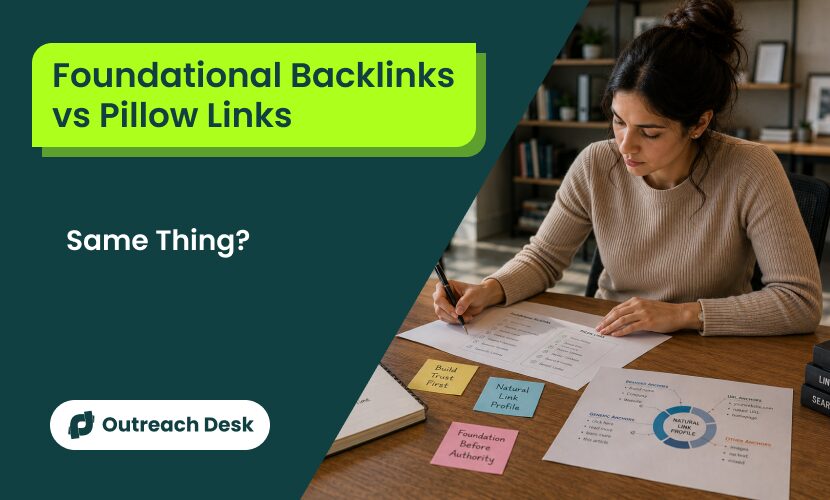
Foundational backlinks and pillow links get treated as two separate strategies. They’re the same category of links, just used at different moments for different reasons.
However, both terms usually refer to links that help diversify a backlink profile and contribute to a more natural-looking link pattern. Foundational backlinks are the broad category of safe and easy-to-get links often built early to establish a site’s online presence and diversify its backlink profile.
Pillow links are within that category, mainly focused on one thing: keeping your link profile looking natural so your high-authority backlinks don’t appear unnatural.
Understanding that overlap helps you avoid confusion and build a stronger link building strategy from the start.

What You’ll Learn
- Pillow links are a subset of foundational links, not a separate strategy.
- Definitions of each, with examples that a beginner can understand.
- New sites need 15 to 25 foundational links before shifting to higher-value placement.
- The pillow test filters opportunities with three yes-or-no questions; two yes answers mean build it.
- How to recognize when your foundational link building layer is complete.
What Foundational Backlinks Actually Are
Foundational backlinks are the first links you build on a new site. They come from safe, low-risk placements from trusted platforms such as business directories, social media profiles, citation sites, review platforms, and industry listings. They signal to Google that your business is real.
Think of these links as the slab you build before building a house. Without the slab, nothing you build on top stays standing.
The trusted sources fall into a few groups you’ll recognize:
- Business directories like Yelp, the Yellow Pages, or your local Chamber of Commerce listings.
- Citation listings that publish your name, address, and phone number (NAP) on trusted local sites.
- Social profiles for your brand on LinkedIn, Facebook, Instagram, YouTube, and TikTok.
- Web 2.0 properties, which are free blog accounts on platforms like WordPress.com, Medium, or Blogger.
- Forum profiles in your niche, where your account page links back to your site.

None of these links is flashy. Most won’t pass much SEO weight on their own. Google’s ranking systems use links as one of many signals when evaluating the authority and relevance of a page. For a deeper look at every link type, including the stronger placements you’ll build later, see our guide on the main backlink types.
What Pillow Links Actually Are
Pillow links are a specific kind of foundational link, with one major job: keeping your overall link profile looking natural by balancing higher-value editorial and authority links. So your stronger links don’t trigger penalties.
Pillow links rarely pass significant authority.
The name is the explanation. They cushion your backlink profile. They sit around your powerful links like a safeguard.

Your link profile is the set of all links pointing at your site. Stronger links include placements such as guest posts on industry blogs (articles you write and publish on someone else’s blog).
Suppose you launch a site and immediately start attracting strong, keyword-rich links pointing to your important pages. On paper, it may sound great, but to Google, it appears wrong. Real websites don’t get a tidy stack of identical and keyword-optimized links.
Real websites collect a messy mix of some branded links, some plain-URL links, and some “click here” links, a few strong ones, and lots of weak ones.
Pillow links create the natural mess varied link mix that real sites accumulate over time. They are usually built with plain anchors like your brand name, your bare URL, or generic phrases, not keyword-stuffed text.
The link sources are identical whether you’re building a foundation or adding pillow coverage. A Yelp listing claimed in month one for foundation purposes is the same Yelp listing claimed in month seven for pillow purposes. The link is the same, just a different reason in the campaign log.
Outsourcing the manual hours spent on claiming profiles and submitting them to directories is also an option. A managed profile backlink service handles it end-to-end if you have a budget but no time.
Are They the Same Thing or Not?
No, foundational backlinks are the parent category, and pillow links appear inside it.
Every pillow link is a foundation link, but not every foundational link is a pillow link. A guest post you write at launch is a foundational link because it is a part of building your early base.
It is not a pillow link because it carries real ranking weight and a strong contextual placement.
There’s a small framing difference: they’re the same category of link, claimed from the same kinds of sources. The difference is just what people emphasize when they use each term.

When someone says “foundational backlinks,” they usually point to the first batch of trusted source links you build on a new site. The goal is to give Google a credible starting profile.
The phrase “pillow links” usually means the same set of links, just framed differently. The only job is to keep the overall link profile natural next to the stronger placements you’ll build later.
Here are some common questions that might arise while learning about these links.
| Questions |
Foundational Backlinks |
Pillow Links |
|---|---|---|
| What is it? | The broad set of safe links you build early | A narrow subset built to balance the profile |
| Main job | Establish that your site is real and trusted | Make the profile look natural, not manipulated |
| Typical anchors | Mix type, including some branded and keyword anchors | Mostly branded, plain URLs, and generic |
| Ranking power | Low to moderate | Very low by design |
| When to use | At launch and early growth | Anytime the profile leans too aggressively |
Remember
Foundational is about being seen as real, and Pillow is about not being seen as fake.
The Foundation Stack: 20 Links Every New Site Needs
Most new sites only need about 15 to 25 foundational links before moving on to higher-value link building. The foundation stack is the order our team uses when setting up a brand-new site. Each step covers one type of link.
Add them up, and you’ve built about 20 links, give or take, based on whether your business is local or online-only.
- Claim your brand-name profiles on Google Business Profile and the major social platforms before anyone else does.
- Submit to 5 core general directories every genuine business should appear on, such as Yelp and the Better Business Bureau.
- Build 10 to 15 local citation listings if you have a physical address, keeping the name, address, and phone number identical across all listings.
- Set up 3 to 5 Web 2.0 properties on Medium, WordPress.com, or Blogger, each with a link back to your site.
- Create profile pages on 2 to 4 forums or communities in your niche that allow a website link in the profile field.
The whole layer takes 4 to 6 hours of work, or 30 to 60 days if you spread it out.
The Pillow Test: A Three-Question Filter for Any Single Opportunity
The pillow test consists of three yes-or-no questions you ask about a single link opportunity. Two yes answers mean build it. Fewer means skip it.

Here are those three questions:
- Would anyone other than you ever visit this property?
- Does the property have any editorial or moderation gate, however small?
- If you removed your link tomorrow, would the listing still make sense?
These three questions filter out three different kinds of junk.
The first question filters out junk directories that no one uses. A directory that exists only to host backlinks fails this test. So does a forum where every post is a link drop.
The second question filters out properties that may offer little value due to a lack of editorial oversight. A directory that auto-approves every submission without human review gives you almost nothing.
The third question filters out links that exist only to exist. If the page exists primarily to host your link, it may not be worth pursuing.
If an opportunity passes all three questions, you likely have a foundational link worth building. Run the same text on a guest post pitch to an industry blog, and you’re approaching what counts as high-quality territory.
How Many You Need, and What a Healthy Mix Looks Like in 2026
For a brand-new site, the foundation stack covers it. Build roughly around 15 to 25 foundational links during the first few months before shifting your focus to higher-value placements.
Many link builders prefer a backlink profile where foundational links support a larger set of editorial and authority-focused placements. Beginners get this backward. A backlink profile dominated by directories and social profiles may lack the editorial signals that stronger placements can provide.
Anchor text is the clickable words that you turn into a link. Keep exact-match anchors to a small share of the profile.
Exact-match means the clickable text contains your main keyword word-for-word. For the foundation layer, almost all your anchors will be your brand name, your domain, or a generic phrase like “click here.”
Follow vs nofollow barely affects the foundation layer. The foundation layer is one component of a broader link building strategy. Building a well-rounded backlink profile often takes 6 to 12 months and is typically an ongoing process.
When to Stop Building Foundational and Pillow Links
For most sites, the focus can shift away from foundational links once the core foundation stack is in place. There are three signals that indicate that this layer is done.
Once it is, editorial outreach is the next step. Our 12-month small business plan covers the sequence.
- Every category in the stack has hit its minimum count of 3 to 5 web 2.0s, 10 to 15 citations if local.
- Your monthly link building time is now going toward outreach, content, or guest writing rather than directory submissions.
- New foundation-layer additions are not moving anything you can measure, such as visits, brand searches, or rankings.
When all three are true, most teams would shift their effort toward higher-value link acquisition. Adding the 80th directory listing rarely changes anything. Our team sees new clients still submitting to directories 60 days after the foundation layer is complete. Long past the point where it moves anything. The marginal return drops to near zero.
If you keep building foundation links anyway, the layer eventually starts to look like the thing it was supposed to prevent. A profile with hundreds of directory submissions but very few editorial or earned links can look unbalanced.
Excessive reliance on directory links can reduce the overall quality and diversity of a backlink profile. The natural next move is to read up on white hat link building strategies and start building stronger placements that point to the pages on your site where customers buy or sign up.
Common Mistakes That Turn Safe Links Into a Risk
Three patterns consistently turn safe links into a risk, and all three are easy to avoid once you know what to look for.
Identical Anchor Text Across Every Listing
One common pattern we see during link audits is the repeated use of the same anchor text across directories, web 2.0 properties, and social profiles. Usually, the brand name is glued onto a keyword.
“Acme Plumbing Phoenix” is the kind of phrase that screams template. Mix in brand-only (“Acme Plumbing”), domain-only (“acmeplumbing.com”), and generic (“visit our website”) anchors.
Quick Tip:
Keep exact-match anchors low for your profile. Branded, plain URL, and generic anchors should make up the rest.
Buying a 200-Link Pack From a Marketplace
Marketplaces that promise “200 high-quality backlinks for $50” are selling links from sites that already failed the pillow test.
Many of these links come from sites created primarily to sell or exchange backlinks. Google’s algorithm was trained on exactly this pattern. In most cases, a smaller number of genuine foundational links provides more long-term value than a large volume of low-quality links.
Skipping the “Real Person” Test
Some niches have hundreds of directories. Many provide little measurable value. Skipping the “real person” test wastes a Saturday on 50 forms for sites that no real human has visited in months. None of them is counted as a foundation.
Start the Foundation Stack This Week
Audit your backlink profile before you add another authority link; if the foundation isn’t there, those links won’t perform the way you’re expecting. Its real job is to make your backlink profile look natural, trustworthy, and built for long-term growth.
The links that move rankings are rarely effective in isolation; they work best when supported by a credible foundation. If you’re building links today, start by auditing your existing profile and identifying whether that foundation is actually strong enough to support the links you’re investing in.
Want to build a backlink profile that looks natural and supports rankings?
Get a clear plan for balancing authority-building links with foundational trust signals.
Are pillow links white hat?
Yes, when built from real properties. Claiming a Yelp listing or setting up a LinkedIn company page is white hat by any definition. Buying a pack of 500 links from a marketplace is grey hat at best, regardless of what the seller calls them.
Can pillow links be automated?
Typically, yes, but the results are almost always junk. Automated tools exist that submit your site to 500 directories in minutes. The links you get from those tools are almost always from the directories that failed the pillow test. Build the foundation layer by hand or skip it.
How long does it take for foundational backlinks to work?
The links themselves get indexed (added to Google’s database) within days to a few weeks. The compound effect on rankings shows up over 3 to 6 months as the rest of your link building catches up. Foundation links alone almost never move rankings.
Teams that want to accelerate that compounding effect work with experienced link building specialists to layer editorial links on top of the foundation correctly.
When should I start building pillow links?
The week you launch the site. Claim brand-name profiles before your first marketing campaign goes live. If you don’t claim those handles first, someone else can.
Can pillow links directly improve rankings?
Not in any measurable way. Pillow links work indirectly by making your overall profile look natural enough that Google trusts the stronger links you build later. Treat them as life insurance for your rankings, not the engine.
Do foundational backlinks help ecommerce sites?
Yes, especially product-category pages that need to look like the real business they’re part of. An ecommerce site with no social site, no social profiles, no Google Business listing, and no directories looks like a dropshipping front to Google’s algorithm. Foundation links solve that signal problem.