You’ve read that backlinks help you rank, so you go looking for them.
Every service you find promises fast results, and the fast ones are what get sites penalized.
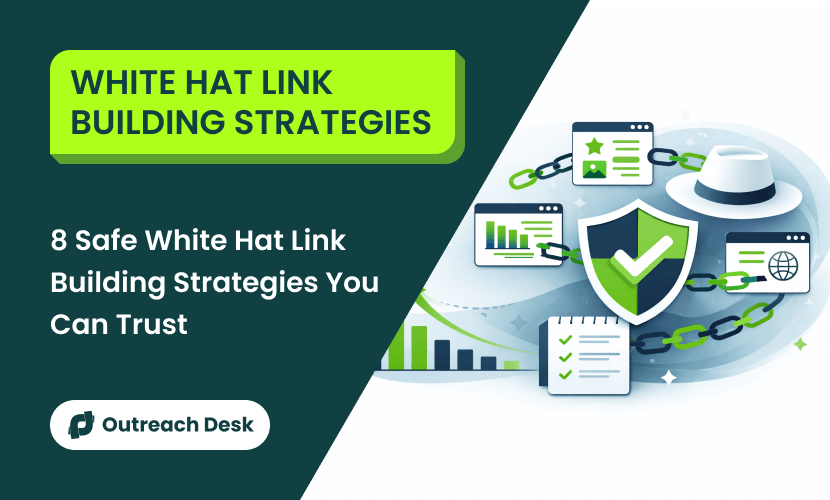
White hat link building strategies earn a link with the publisher’s permission, never by buying or faking it.
Eight of them do most of the work, and this guide walks through each one.
You’ll also get a simple way to choose where to start.
The Short Version
- Eight strategies carry most white hat link building, from guest posting to the skyscraper technique.
- A link is white hat when the publisher chose to add it, unpaid.
- Google’s spam policies list paid links and link exchanges as violations.
- Unlinked brand mentions are the fastest first win for a new site.
- Broken link building needs no relationship, only a working replacement page.
- Guest posting is the slowest, and the one that compounds.
How to Choose Your First Strategy
Start with the strategy that fits what you already have: a brand people mention, a page worth citing, or time to write.
Running all eight at once is how beginners burn a month and earn nothing.
| If this sounds like you | Start with | Why it works first |
|---|---|---|
| People already mention your brand without linking | Unlinked brand mentions | The publisher already wrote about you, so you are asking for an edit |
| You have one page genuinely worth citing | Resource page link building | Curated lists exist to collect pages like yours |
| You have nothing worth linking to yet | Broken link building | The value you offer is the fix, not your page |
| You can write one solid article a month | Guest posting | Writing buys you the relationship that makes later links easier |
| You have data or a survey nobody else has | Digital PR | Journalists link to numbers they cannot get elsewhere |
| Your competitors rank on pages you could sit inside | Niche edits | The page already ranks, so your link inherits its position |
Pick one row and give it four weeks before judging it.
Link building compounds slowly, so a tactic that looks dead at week two often lands at week six.
8 Proven White Hat Link Building Strategies
Here are proven white-hat link building strategies you can use to earn links safely that follow Google’s guidelines and work long-term.
Guest posting
Guest posting means you write content for other websites in your niche.
In return, the site publishes a link back to your page.
It is a white-hat strategy because the content is original, relevant, and written for readers. Links are added naturally where they fit the context. It gives priority to readers’ value over random link placement, and when done correctly, guest posting aligns with white-hat SEO practices.
Let’s suppose you write a beginner-friendly workout guide for a popular fitness blog. While writing the article, you naturally include a relevant link to a simple workout routine on your own website.
The editor reviews the content and identifies that the guest post adds value by providing clear, step-by-step guidance to readers. The editor approves and publishes it on a relevant contributor’s website.

How Guest Posting Works
1. You can find websites that accept guest posts by checking competitor backlinks.
Industry directories, forums, and resource pages surface the rest.
Another effective method is to use specialized search operators such as:
- Keyword + “write for us”
- Keyword + “guest post”
- Keyword + “guest contributor”

2. Once you find a suitable opportunity, contact the owner with a guest post outreach email.
Explain your idea and what their readers get from it.
Then ask if you can contribute an article.
Hi [Name],
I read your post on beginner’s fitness and enjoyed it. I can write a helpful guest post that fits your blog and adds value for your audience.
If you’re interested, I can suggest a few topic ideas.
Thank you for your time,
[Your Name]
3. Write original content, and keep it informative rather than copied.
Include a link to your own page only where it genuinely helps the reader.
💡 Tips for Guest Posting
Choose niche-relevant sites
Publish on sites that align closely with your industry or audience to make sure that the links and content are meaningful.
Avoid promotional content
Focus on educating or helping the readers, rather than promoting or selling your product.
Prioritize content quality
Keep your content clear and well-crafted. Use accurate information and engaging language.
Write with purpose
Every guest post should add value, not just earn links. Content driven by value builds trust, improves relations with publishers, and drives long-term benefits.
Broken link building
Broken link building finds links that point to pages which no longer load.
You then offer your own page as the replacement.
This method is white hat because you help the website fix an issue and suggest relevant content that improves their page. The site owner chooses to add the link because it adds value, not because it was paid for or forced.
Here’s an example for better understanding:
A travel blog lists a packing checklist, but one of the links leads to a broken(404) page. You contact the site owner, share your updated checklist, and suggest they replace the broken link and improve their page. In return, you can also earn a backlink.
How Broken Link Building Works
1. Find broken links
Check other relevant website pages for dead or broken links. Run pages through a broken link checker or you can use SEO analysis tools like Ahrefs to spot pages that no longer work. You can also browse industry resource pages and old content, as these often contain outdated or broken links.
- Go to Site Explorer
- Enter a competitor’s website
- Under the backlink profile, open broken backlinks
- Find broken (404 not found ) links on their pages.

In Ahrefs, open the Broken Backlinks report to find websites linking to broken or dead pages on your competitor’s site.
From the list, identify websites with high DR and relevant traffic, and choose the best opportunity
2. Identify a replacement
Check if you already have a relevant page that can replace the broken link. If not, create new, helpful, and updated content.
3. Reach out to the site owner
Tell the editor or site owner about the broken link.
Suggest your content as the replacement.
Hi [Name],
I was reading your article on beginner workout tips and noticed one of the links isn’t working anymore.
I recently published an updated workout guide on the same topic that could be a valuable replacement.
Thank you for your time,
[Your Name]
Resource page link building
Resource page link building finds websites that list helpful links on one topic.
You ask to be added, because your page belongs on that list.
Resource pages are created to help readers find useful tools, guides, and articles in one place.
If your content genuinely helps readers, website owners may add your link to their resource page. This makes the link natural, relevant, and aligned with Google’s guidelines.
Suppose you find a marketing blog with a resource page for SEO tools.
You contact the owner and suggest your SEO analyzer as an addition.
The tool helps readers check their website’s performance and identify SEO issues. Because it adds value to the page, the blog owner includes it as a recommended resource and links back to your site.
How Resource Page Link Building Works
1. Find niche-relevant resource pages
Look for websites in your industry that list all the helpful links and recommended resources. These pages are often titled as “Useful Resources,” “Helpful Links,” or “Recommended Tools.”
You can also use search operators to find resource pages:
- keyword + “resource page”
- keyword + “useful resources”

2. Check if your content is a good fit
Once you have the list of resource pages, analyze each page and determine where your content can fit and add extra value. While checking, ensure that the page lists high-quality resources and that your article is genuinely helpful there.
3. Reach out to the site owner
Email them politely and share your resource.
Explain why it earns a spot on their page.
Hi [Name],
I came across your SEO resources page and found it very helpful. We recently created a free SEO analyzer tool that helps users evaluate their website performance and identify key SEO issues.
It could be a valuable addition to your SEO resource page, providing value to your readers.
Thank you for your time,
[Your Name]
4. Get your content listed
If they find it helpful, they add your link to the resource page.
That placement is the high-quality backlink you were after.
Niche Edit
Niche edits place your link inside content that is already published, indexed, and ranking.
The page already ranks, so your link inherits its position.
Instead of writing new content, a link is naturally placed within an article that adds value and supports the topic.
The placement should be relevant, follow Google’s guidelines, and not forced or paid. The website owner chooses to add your link because it helps their readers with extra information or a helpful resource.
Let’s suppose you find a marketing blog that already has an article about email outreach tips. You notice a section that mentions tracking email responses, but doesn’t link to any tools or guides.
You reach out to the blog owner and suggest your email outreach tracking tool as a helpful reference. The guide fits the existing content and adds something for readers.
So the website updates the article and includes your link.
How Niche Edits Works
1. Find relevant existing content
Start by finding published articles in your niche where your link would naturally fit and add extra value. Look for pages that talk about similar topics and could benefit from a helpful resource.
2. Reach out and suggest your link
Next, contact the site owner or editor to suggest adding your link and explain how it improves the experience for their readers.
Hi [Name],
I came across your article on email outreach tips and found it really helpful. I noticed a section where you mention tracking email responses, but there isn’t a guide or tool linked there yet.
We’ve recently created an email outreach tracking guide that explains this step simply. I thought it could be a helpful reference for your readers.
If you think it’s a good fit, would you consider adding it as a reference?
Thank you for your time,
[Your Name]
Digital PR
Digital PR earns links from media sites using press releases, original studies, or expert insight.
Journalists link to numbers they cannot get elsewhere.
You earn these links by sharing useful stories, original data, or expert insight.
Publishers then feature them in publications, blogs, and news sites.
Instead of asking for links directly, it focuses on providing real value. Journalists and website owners link to your content because it supports their articles and helps their readers better understand a topic.
This strategy follows Google’s guidelines because links are earned naturally. There are no paid placements, link exchanges, or manipulative tactics involved. The links come from trusted media websites and are given naturally by editors.
For Example, HARO is a platform that connects journalists with people who can share expert information.
Responding to relevant media queries can get you featured on authoritative sites.
Forbes, CNN, and the New York Times all source quotes this way.

Linkable Assets
Asset-based link building means you create high-quality, linkable assets other sites want to cite.
The asset earns the link, so you attract instead of asking.
Rather than asking for a link, you share assets with related websites so the right people can discover them. If the asset adds value, they choose to link to it.
This approach keeps the process white hat and earns high-authority links without automation or spammy tactics.
Here are some linkable asset types:
- In-depth Guide and Tutorials
- Infographics and Visual Content
- Original Research and Case Studies
- Tools and Calculators
- Templates and Checklists
- Data Reports and Resource Roundups

Suppose you build a rent affordability calculator.
It shows users what they can afford, and it pulls organic visitors every month. This makes it a strong linkable asset that naturally earns backlinks.
Unlinked Brand Mentions
Unlinked brand mentions happen when a site names your brand, product, or content without linking.
The mention already exists, so you only need the publisher to add a link.
Since the mention is genuine and relevant, adding a link improves the content for users. There is no payment, pressure, or manipulation involved, which keeps it fully aligned with Google’s best practices.
This strategy is white hat because the website has already chosen to mention you naturally. You may politely ask them to add a link to help readers find the source.
How Unlinked Brand Mentions Work
1. Find unlinked mentions
Find unlinked mentions opportunities by using search operators as intext:{brand name} -{own domain name}.com -twitter.com -facebook.com -pinterest.com
Using this operator will help you find all unlinked mentions across platforms.
You can also use brand monitoring tools like Google Alerts or Brand24 to find unlinked mentions of your brand or content.
Here in the image, you can see that Google Alerts notifies HubSpot when their brand, competitors, or selected keywords are mentioned online.

2. Reach Out
Contact the site owner and thank them for the mention.
Explain how a link would make the reference more useful to readers.
Hi [Name],
I came across your article and noticed you mentioned our brand. Thank you for mentioning us.
I wanted to check if you’d consider adding a link to our website.
It would let readers find the resource you mentioned. I think it would help them get more value from the article.
Thank you for your time,
[Your Name]
Skyscraper Technique
The Skyscraper Technique finds content that has earned many backlinks and improves on it.
You then ask those same sites to link to the better version.
After publishing a better, more current version, you contact the sites linking to the original.
You suggest your improved resource instead.
You earn these backlinks by offering more value, clearer information, and current insight.
Genuine outreach does the rest, so relevant websites choose to link.
How the Skyscraper Technique Works
1. Find popular content in your niche
Look for articles that already rank well and have many backlinks.
2. Create a better version
Improve the content by adding more details, making it visually appealing and unique, and turning it into the ultimate resource.
3. Reach out to relevant websites
Contact the websites that linked to the original and show them your version.
Explain why it fits their readers better.
4. Earn links naturally
If your content provides more value, they may link to it instead.
More White Hat Tactics Worth Knowing
The eight above cover most situations, and a dozen smaller tactics fill the gaps when they do not.
Tactics That Use a Relationship You Already Have
These earn links from people who already know your business.
Reviewing a tool you genuinely pay for can earn a link back, which is how testimonial links work.
Appearing as a guest on an industry podcast does the same.
So does sponsoring a charity or a local event, where the organizer credits you on their page.
Tactics That Depend on Something You Publish
These earn links because the asset itself is worth citing.
A funded scholarship page attracts university links, which is a rare route to .edu links.
Original charts, diagrams and infographics get reused with credit.
A yearly statistics page becomes the source everyone else quotes.
Tactics That Recover Links You Nearly Had
These find links that already exist, or once did.
Weekly curated posts in your niche accept submissions, and getting featured in them takes one good pitch.
Pages that linked to you and later broke can be won back.
Content syndication works the same way, because republishing on a larger platform passes credit back.
Tactics for Specific Situations
These matter only when your business fits the case.
A local business needs its name and address consistent across directories before chasing anything else.
A crowdfunding campaign earns coverage links while it runs.
Free web 2.0 platform profiles still get indexed when the content on them is real.
What is White Hat Link Building
White-hat link building earns backlinks that Google trusts through methods its own search guidelines allow.
The test is simple: the publisher chose to add it.
You can build white-hat links by creating valuable content and sharing it with relevant websites through genuine outreach to publishers. These links act as trust signals, helping search engines understand that your website is relevant and trustworthy.
White-hat links are never forced, purchased, or spammed. Website owners choose to link to your content because it’s relevant and adds value for their readers.
Here is what that looks like in practice:
Imagine you publish a helpful travel guide on planning a weekend trip to Paris and share it with relevant travel websites. A popular Europe-focused travel blog finds it useful.
They link to it in their Paris itinerary article, because it helps readers plan.
This approach aligns with white-hat link building practices:
- The link is earned because the content is valuable, not paid or forced.
- The content provides real value for readers, which is what Google expects from linked pages.
- The link is relevant and fits naturally within the related content.
- There is no manipulation involved, such as paid links or link exchanges.
Why White Hat Link Building Is a Safer Choice
Using ethical white-hat link building methods is the most effective way to earn links without risking penalties or a drop in ranking.
Because these methods follow Google’s guidelines, they help your website rank higher in search results while staying safe from Google Penalties.
Google Penalty
A Google penalty follows when a site breaks Google’s quality guidelines, such as its published link spam policies.
Building links mainly to manipulate rankings is the usual cause.
The result is a drop in rankings or visibility.
White Hat Vs. Black Hat Vs. Grey Hat: Key Difference
Here are some key differences between all three link building techniques.
| White Hat Links | Black Hat Links | Grey Hat Links |
|---|---|---|
| Links are earned through ethical methods. | Links are created through manipulative tactics. | Links are built using methods ranging from safe to risky, or that are not entirely white hat. |
| Sharing original content and ethical outreach. | PBNs, link farming and schemes, or paid links. | Paid niche edits and link exchanges. |
| Safe to use as it complies with Google’s guidelines. | Risk of penalties, deindexing, and ranking drops. | Can be risky when overused, as it slightly bends the rules. |
| Delivers sustainable, long-term results. | Short-term results with long-term uncertainty. | Provides quick results, but long-term stability is not guaranteed. |
| Links are relevant, authoritative, and naturally placed. | Links are irrelevant, auto-generated, and low quality. | Links may appear relevant but can involve black-hat techniques. |
Benefits of White Hat Link Building
White hat link building is the safest approach available.
It protects you from penalties, builds trust, and lasts.
Keep Safe from Search Engine Penalties
White hat link building follows Google’s rules, which means you earn links naturally rather than trying to manipulate search engines.
When you create helpful content and reach out to relevant websites, Google sees your site as trustworthy. This protects your website from penalties that can cause a sudden rank drop or decrease in traffic.
Improve Rankings Consistently
White-hat links help your website grow gradually and provide long-term ranking growth, instead of quick spikes that disappear.
Because the links come from relevant websites, Google rewards them with greater trust and visibility.
Strengthen Authority and Credibility
When reputable websites link to your content, Google sees it as a reliable source of information. As each links act like a recommendation.
The more high-quality sites mention you, the more credible your site appears to both search engines and users.
Build Better Relationships
Building links is not really about links.
It is about genuine connections with owners and publishers in your industry.
When you focus on building links ethically, you don’t chase quick links but real-time relations.
Common Mistakes to Avoid in White-Hat Link Building
Effective white-hat link building primarily focuses on relevance and value. However, some common mistakes, such as promotional content, irrelevant outreach, auto-generated emails, and chasing link quantity, often result in reduced success.
Avoid these mistakes by creating valuable content and matching search intent.
Personalized, relevant outreach is what turns into sustainable links.
Avoid Writing Promotional/Sales-Driven Content
One of the biggest mistakes is to turn linkable content into a sales pitch. Publishers link to content that educates, explains, and solves a real problem.
They skip content that promotes a product.
Solution: Create content that offers value, such as guides, data, frameworks, comparison tables, charts, or insights.
Requesting Unnatural Link Placements
Avoid asking for links that don’t fit the surrounding context. Forcing a link into an irrelevant sentence breaks the flow for readers.
It also looks manipulative to search engines and site owners.
Solution: Request links that add depth, clarity, and support to the existing page. Contextual relevance between pages makes link placement safe and effective.
Not Following Up on Outreach
Many marketers assume “no reply” as a rejection. But in reality, website owners have tight schedules, and many owners reply after one or two polite follow-ups.
Solution: Take a follow-up that adds value, such as clarifying relevance or highlighting how your content helps their audience.
Reaching Out to Unrelated Websites
Links from irrelevant sites look unnatural. Even if the site is strong, poor relevance indicates manipulation.
Solution: You should prioritize relevance. Even a few highly relevant sites can provide more value than many irrelevant ones.
Using Generic Outreach Emails
Mass or copied outreach emails are easy to identify and often get ignored. Editors and publishers receive dozens of emails daily.
Solution: To stand out, focus on sending personalized emails. Reference the specific article, explain to them why your content adds value, and show familiarity with their site. Most editorial links are earned through relevance and respect.
Creating Content With No Real Value
If your content doesn’t help readers, editors will not link to it. Low-value content often lacks depth and originality.
Solution: Focus on creating link-worthy assets such as original insights, frameworks, statistics, and complex explanations.
Chasing Quantity Over Quality
Building many low-quality links won’t help. It rarely improves rankings and can harm long-term growth.
Solution: Focus on earning fewer, but relevant links. Google values trust and context rather than link volume.
Ignoring the Search Intent of the Linking Page
Even when topics match, intent sometimes mismatches, and it can kill the link opportunity.
A page written for beginners won’t link to an advanced technical guide.
Solution: Match the search intent, content depth, and audience level. A link should be the next logical resource for the readers.
Conclusion
While shortcuts may seem easy and faster, white-hat link building is the safest way to earn high-quality backlinks.
By focusing on ethical practices and real value, you build authority, improve rankings, and support long-term growth for your website.
Not Sure Which Link-Building Strategy Is Right for You?
Every website needs a different approach. Our team reviews your niche, competition, and goals, then recommends a white hat link building service that fits, without risking your rankings.
Are white hat links safe for my website?
Yes. White hat links follow Google’s guidelines, so they help your site rank higher without the risk of penalties.
How long does white hat link building take to show results?
It takes time, but the results are steady and long-lasting. Unlike risky methods, white hat links continue to help your rankings over time.
Can white hat link building improve rankings?
Yes. Search engines trust these links more, which helps improve rankings, authority, and visibility.