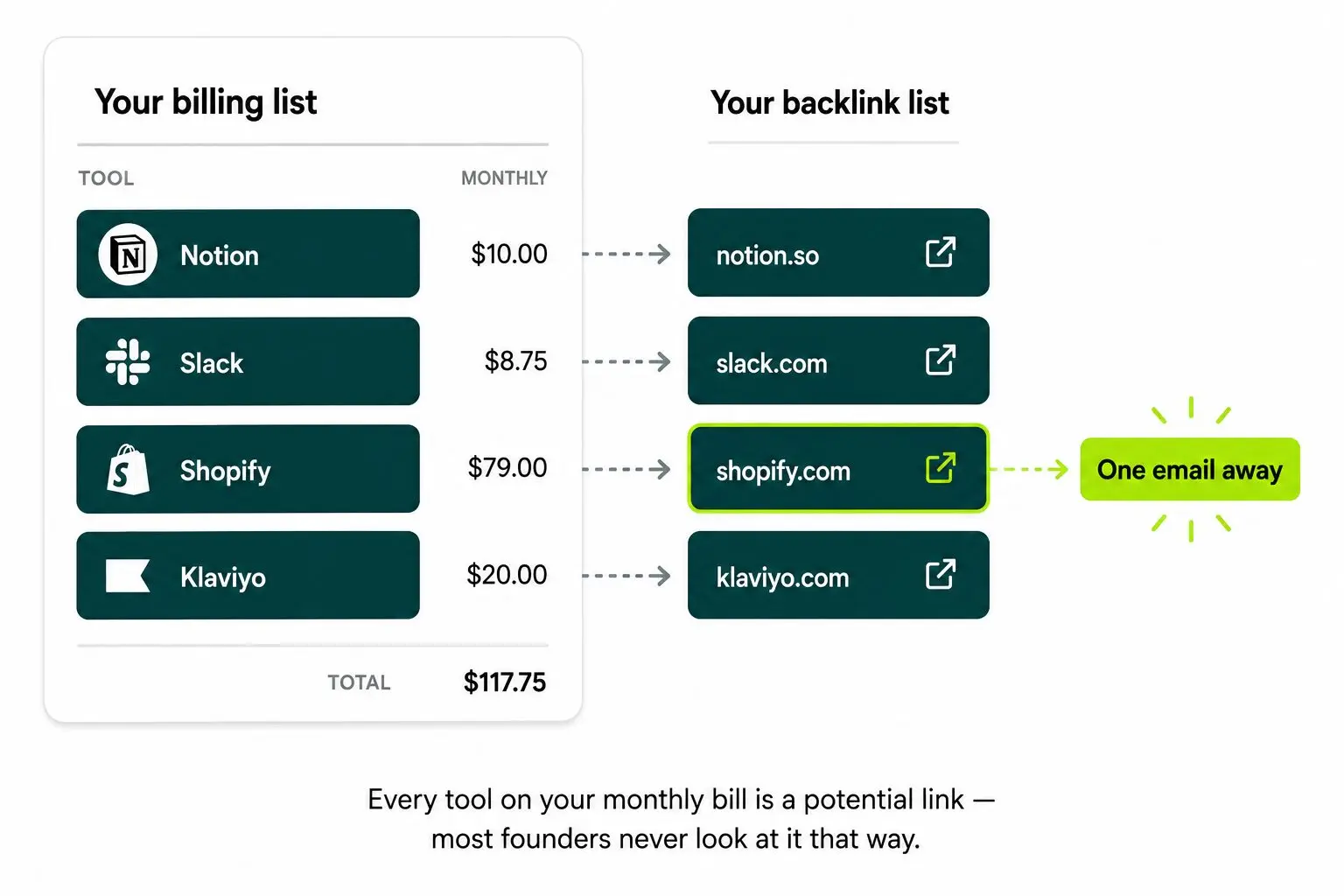
Pull up your billing dashboard and count the SEO tools, plugins, and services you pay for every month.
That billing history is your backlink prospect list, and most founders never use it that way.
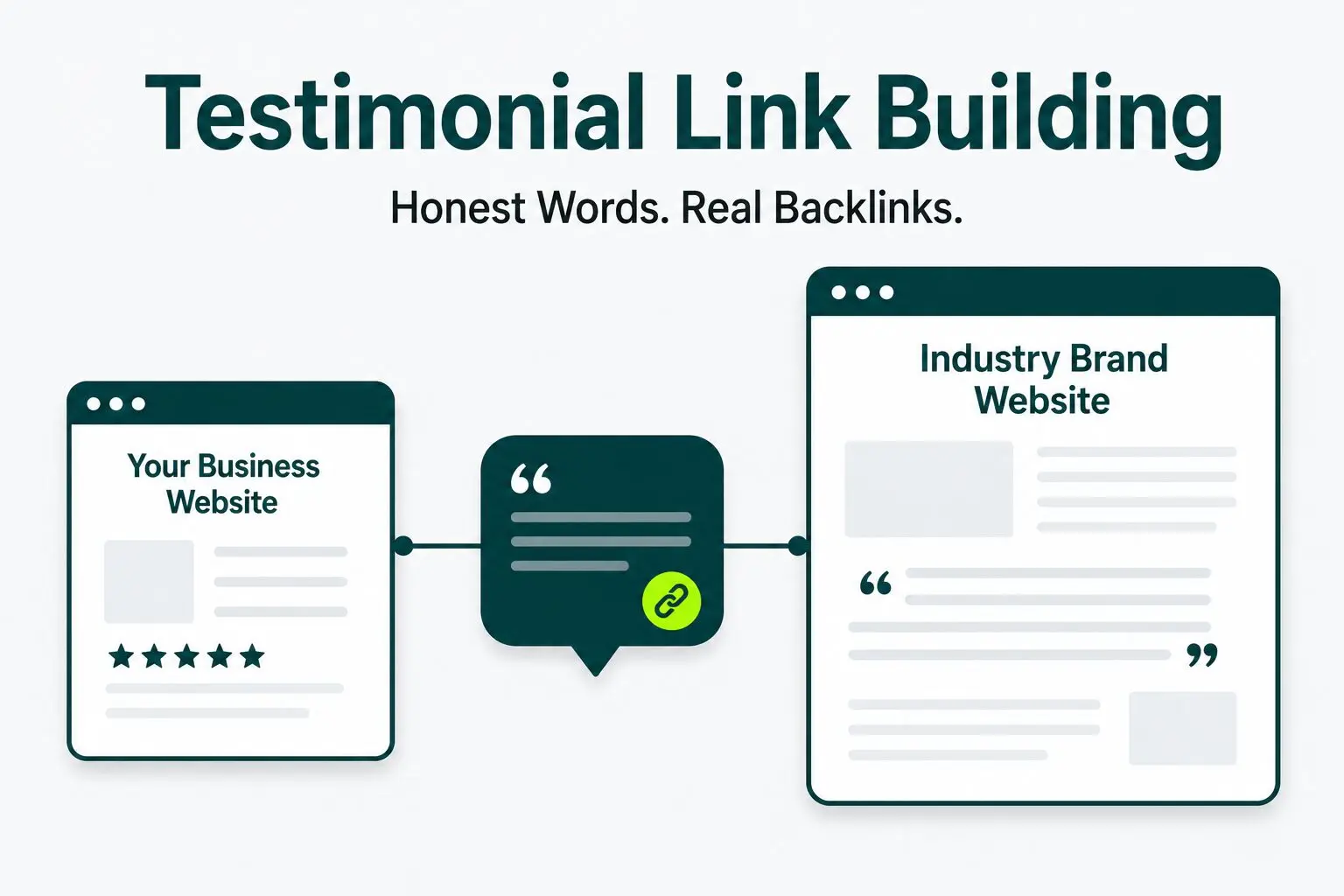
Testimonial link building is the practice of writing an honest review of a product you already pay for.
The brand publishes that review on its own site with a link pointing back to yours.
You’re already a verified customer, so the brand can confirm your account in seconds.
That one fact removes the trust problem every cold pitch has to solve first.
Teams chasing backlinks spend weeks on cold outreach and guest post pitches before a single yes.
The easiest link opportunities they’ll ever find sit inside their own software stack, untouched.
Every tool you pay for is run by a brand that wants real customer testimonials.
No cold pitch. No 1,500-word guest post. Just an honest paragraph about a product you already rely on.
What This Article Covers
- A brand verifies you’re a real customer in under 30 seconds, so you skip the trust barrier entirely
- Homepage, customer page, and feature page placements pass meaningfully different link value
- Most testimonial links from large SaaS brands are nofollow, and that alone isn’t a reason to skip them
- Steps 3 and 4 of qualification are the checks founders skip, and the reason pitches disappear
- The tactic tops out near 5 to 8 links per software stack, so plan what comes after it
What is Testimonial Link Building?
Testimonial link building is a tactic where you give a brand a genuine customer review in exchange for a credited link.
The brand gets social proof it can verify. You get an editorial backlink from a domain Google already trusts.
This is a white-hat link building strategy, which means it follows Google’s rules completely.
There’s no trick and no penalty risk, because the endorsement is real.
You’re a paying customer, and that’s what makes the link editorial rather than manufactured.
Both sides get something genuine out of it.
The brand gets social proof from a verified customer, which converts new visitors better than its own marketing copy.
You get a backlink, which is a recommendation from another website telling Google your site is worth trusting.
How Testimonial Link Building Actually Works
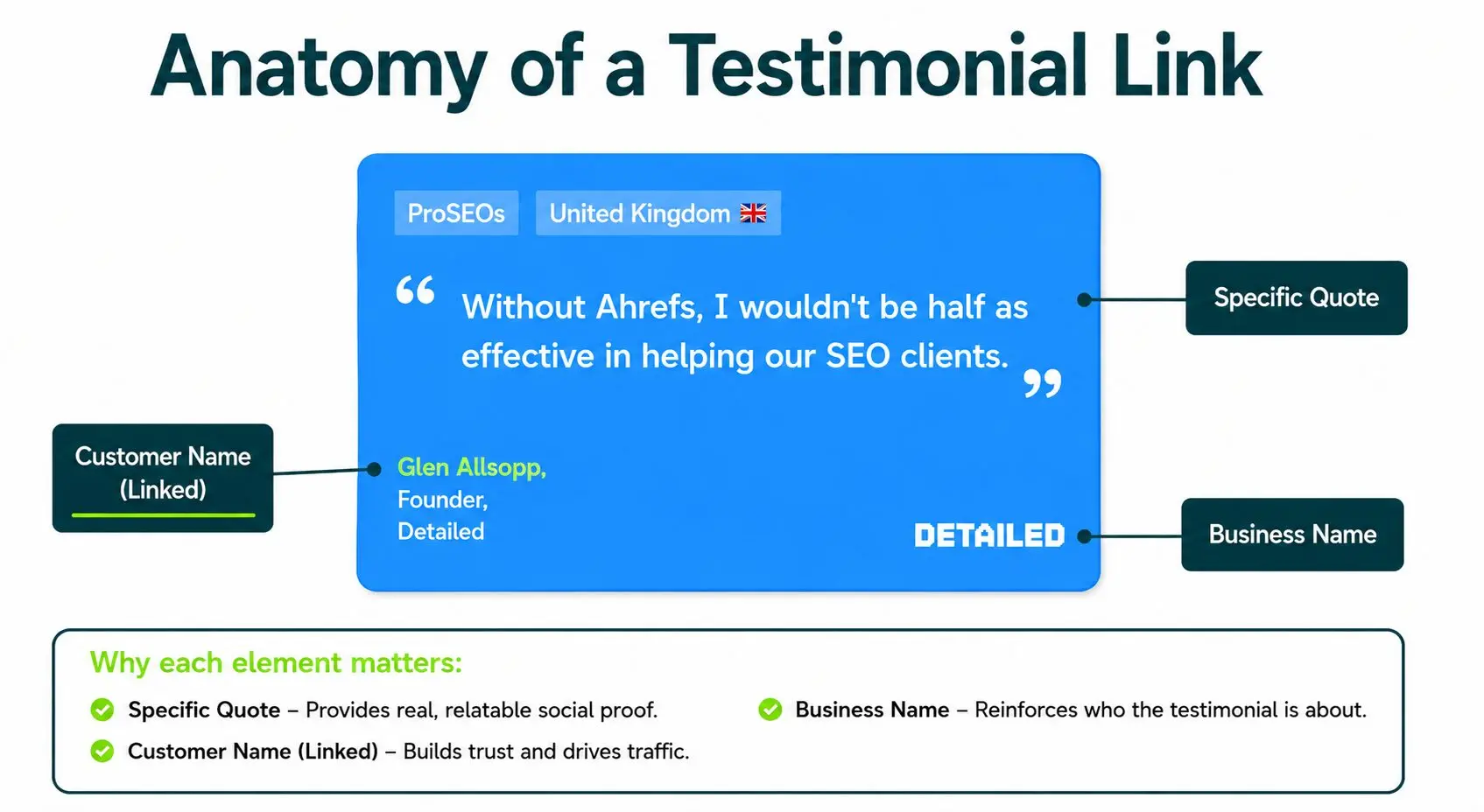
The mechanism is short: you write a specific, outcome-based quote, and the brand publishes it with a credited link.
There’s no cold outreach, no content campaign, and no waiting on a stranger to trust you first.
Three parties benefit when this tactic is executed well: you, the brand, and the brand’s existing customers.
- The brand collects an authentic customer quote that builds credibility with first-time visitors.
- You earn a backlink from a domain Google already views as authoritative in your niche.
- The brand’s current customers see social proof that confirms their decision to stay subscribed.
Picture a real situation.
You run a small e-commerce store and you’ve used the same email marketing platform for two years.
Their homepage carries a “Loved by founders” section.
You send their marketing team a quote explaining how the platform cut your campaign-building time in half.
They publish it with your name, your store’s name, and a link back to your site.
That link now sits on a high-authority domain in your industry, visible to every founder who visits.
It stays there, often for years, without any additional work from you.
That’s the full mechanism. No lengthy guest post campaign to write. No broken link to track down.
The reason it works is simple: generic testimonials don’t convert prospects, so brands want fresh and specific ones.
Why This Tactic Wins When Others Stall
Four things separate testimonial links from every other outreach tactic.
Verified customer status bypasses the trust barrier. The deliverable is one paragraph, not a full article.
The link is topically relevant by default, because you and the brand operate in the same product ecosystem.
And a published testimonial opens doors to co-marketing and referrals well beyond the backlink itself.
You skip the cold-pitch problem entirely.
Every other link building tactic asks you to earn trust from someone who has never heard of you.
Here the brand verifies your account in under 30 seconds. You start from credibility, not from zero.
The tactic is also far less time-consuming.
The entire deliverable is three focused sentences and one short follow-up email.
Compare that to a broken link campaign, where you spend two days hunting 404 errors before your first pitch.
Or a guest post campaign where you write 1,500 words before hearing back at all.
The contextual link you earn is naturally relevant to your industry.
If your Shopify store earns a link from a Shopify app’s homepage, Google sees a clear connection.
Most outreach campaigns take months to build that kind of relevance. Here it already exists.
There’s a fourth benefit that rarely gets counted, and it outlasts the link.
A published testimonial is the start of a real business relationship.
That connection opens doors to co-marketing, case studies, referrals, and introductions you couldn’t have reached cold.
The backlink is what you can measure. What comes after it often moves the business further.
Where Testimonial Links Actually Live
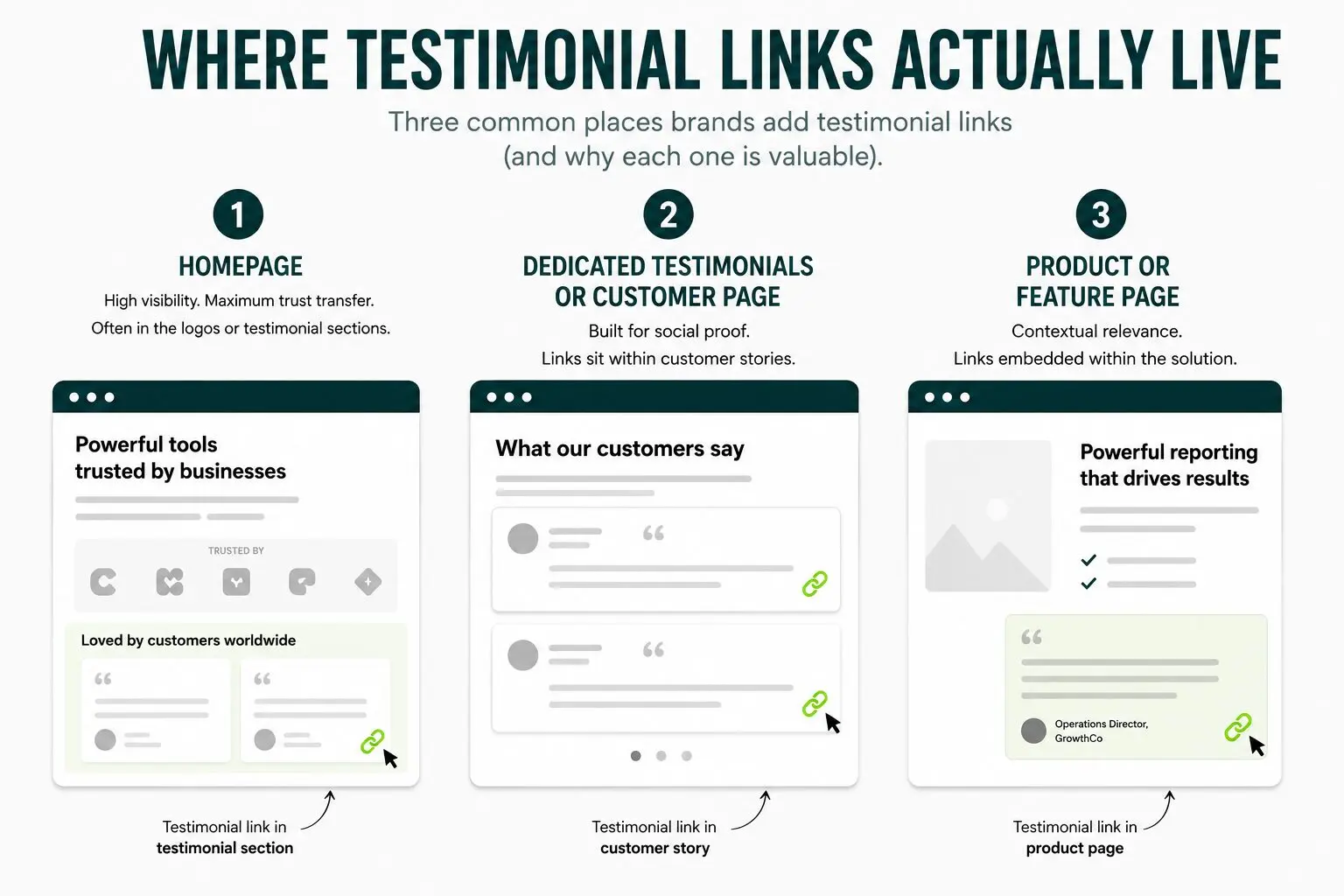
Testimonial links live in three places: the homepage, a dedicated customer page, or a product and feature page.
Each passes value differently. Homepage links carry the most authority, feature page links carry the most topical relevance.
Knowing which placement you’re targeting before you pitch changes how you prioritize outreach.
1. Homepage
A homepage placement is the strongest one available.
A brand’s homepage is usually the most-linked page on its entire domain.
A link placed there passes link equity more powerfully than almost anywhere else on the site.
Companies put their strongest customer quotes here because homepage social proof converts first-time visitors.
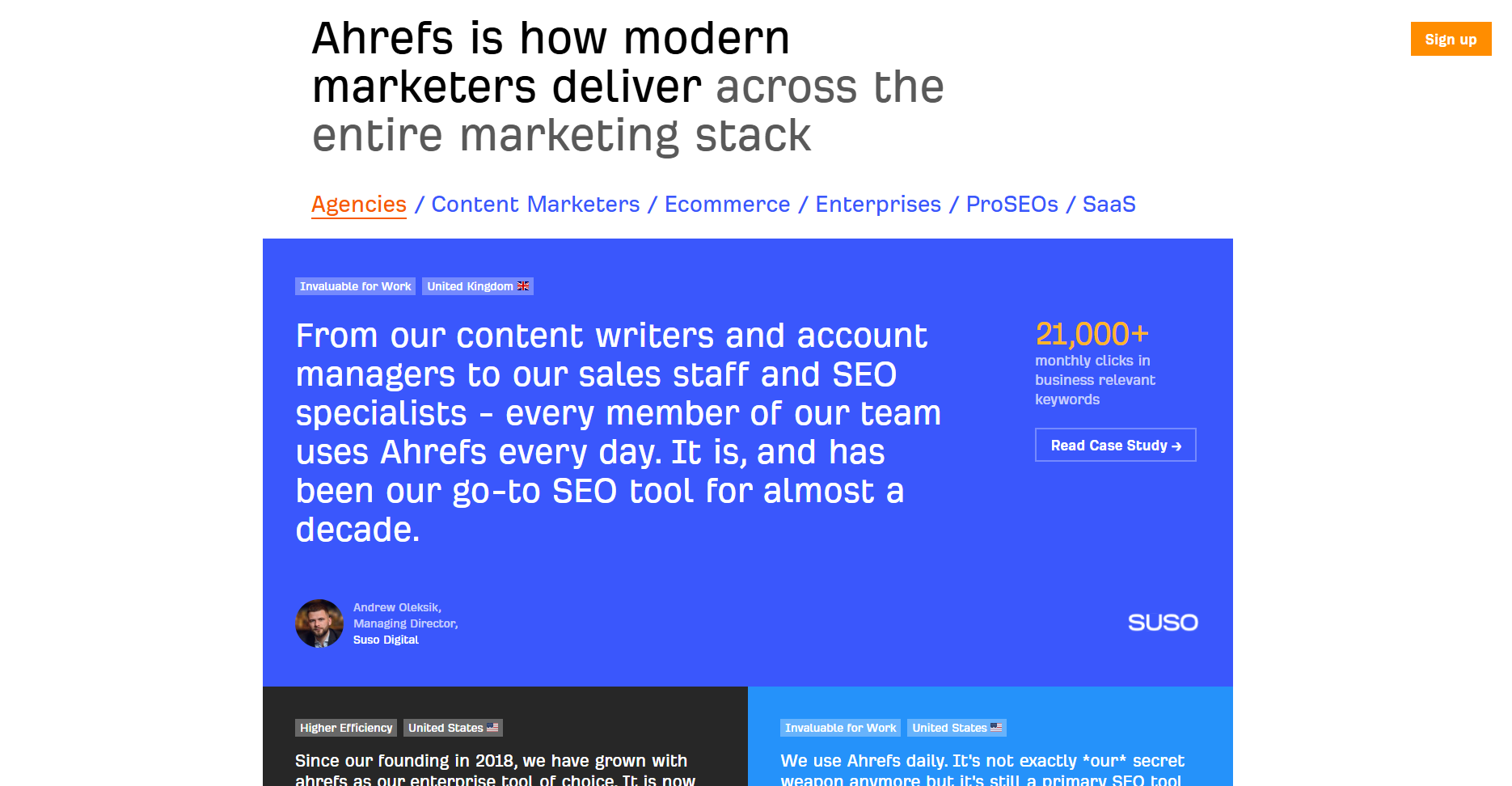
Ahrefs, for example, publishes customer testimonials on its homepage and credits the contributors.
2. Dedicated Testimonials or Customer Page
A customer page placement is slightly weaker than a homepage one, but it is far easier to earn.
These pages sit at /customers, /testimonials, or /reviews and collect internal links from product pages and footers.
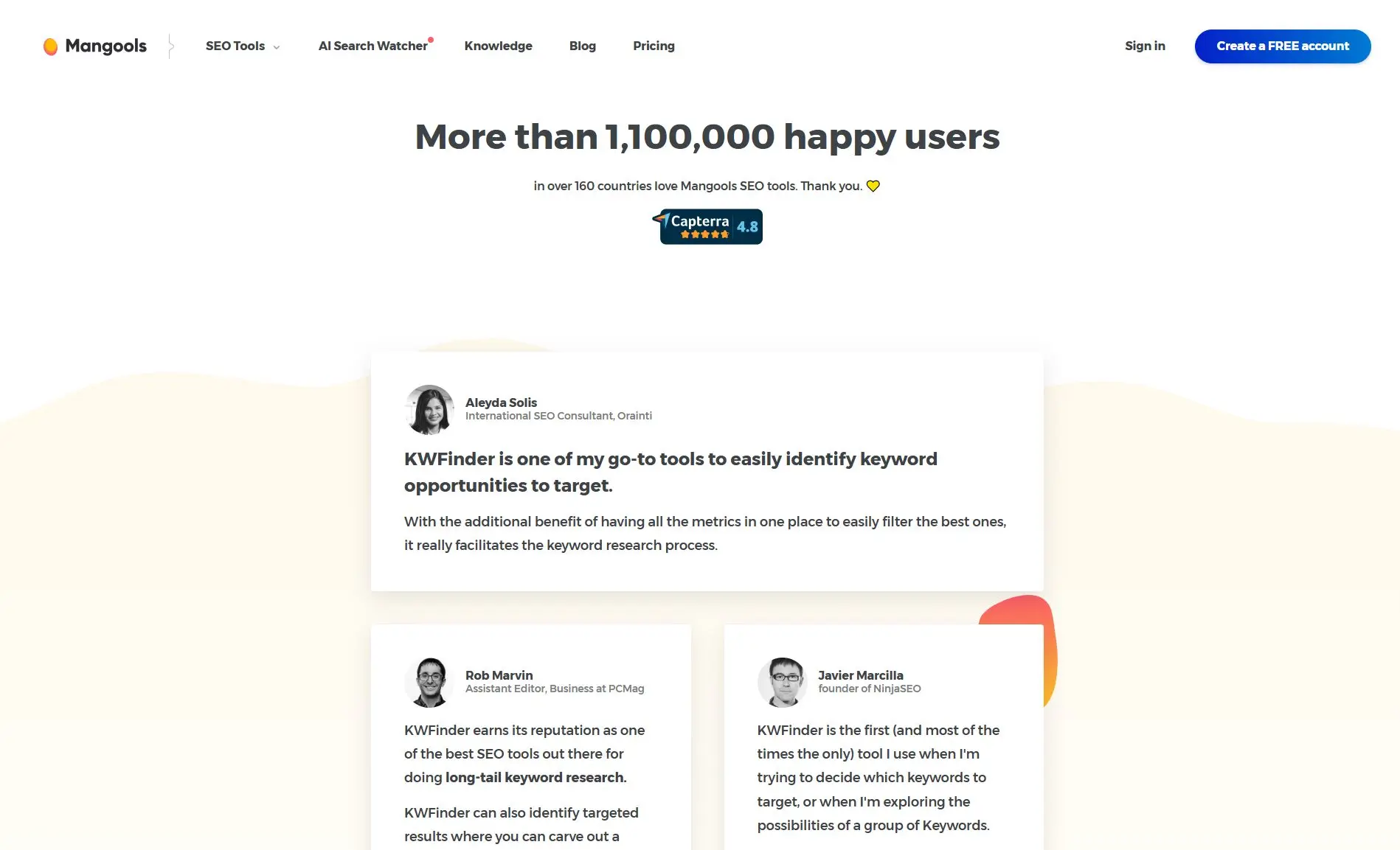
Mangools, for example, runs a dedicated testimonial page that links back to its contributors.
Watch Out
Some brands publish 50 or more testimonials on one page, which spreads link equity thinly across all of them.
A page with 4 or 5 featured quotes gives each link far more individual weight.
Check testimonial volume before you pitch.
3. Product or Feature Page
A feature page placement wins on topical relevance rather than raw authority.
A testimonial on a specific feature page tells search engines this endorses that exact use case.
When the feature aligns closely with what your own site covers, that relevance can outweigh the smaller authority gain.
Always verify how a brand credits its contributors before writing a single word of your pitch.
Some brands publish customer quotes with no outbound link at all.
Others link your name to an internal case study page on their own domain rather than to your site.
A testimonial with no outbound link is a brand mention, not a qualifying backlink.
Brand mentions help build reputation, but they don’t move search rankings on their own.
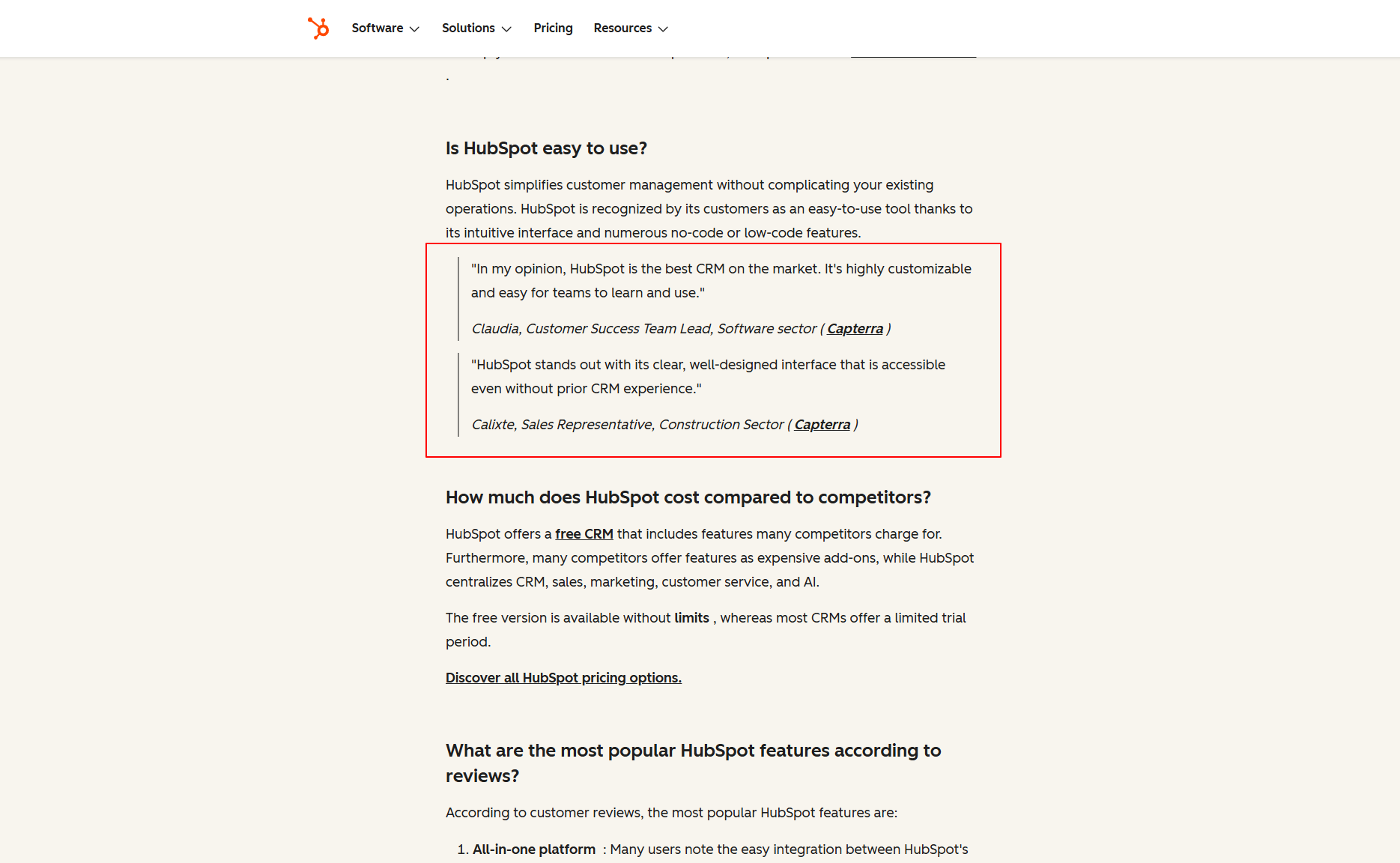
HubSpot and similar CRM platforms place customer quotes directly on product and feature pages.
There the testimonial supports one specific use case rather than the brand in general.
The Dofollow vs Nofollow Reality
Most established SaaS companies apply nofollow to every external link as legal and SEO policy.
Smaller brands below DR 50 are far more likely to give you a dofollow link.
A nofollow link from a high-authority homepage still delivers real referral traffic and indirect ranking benefit.
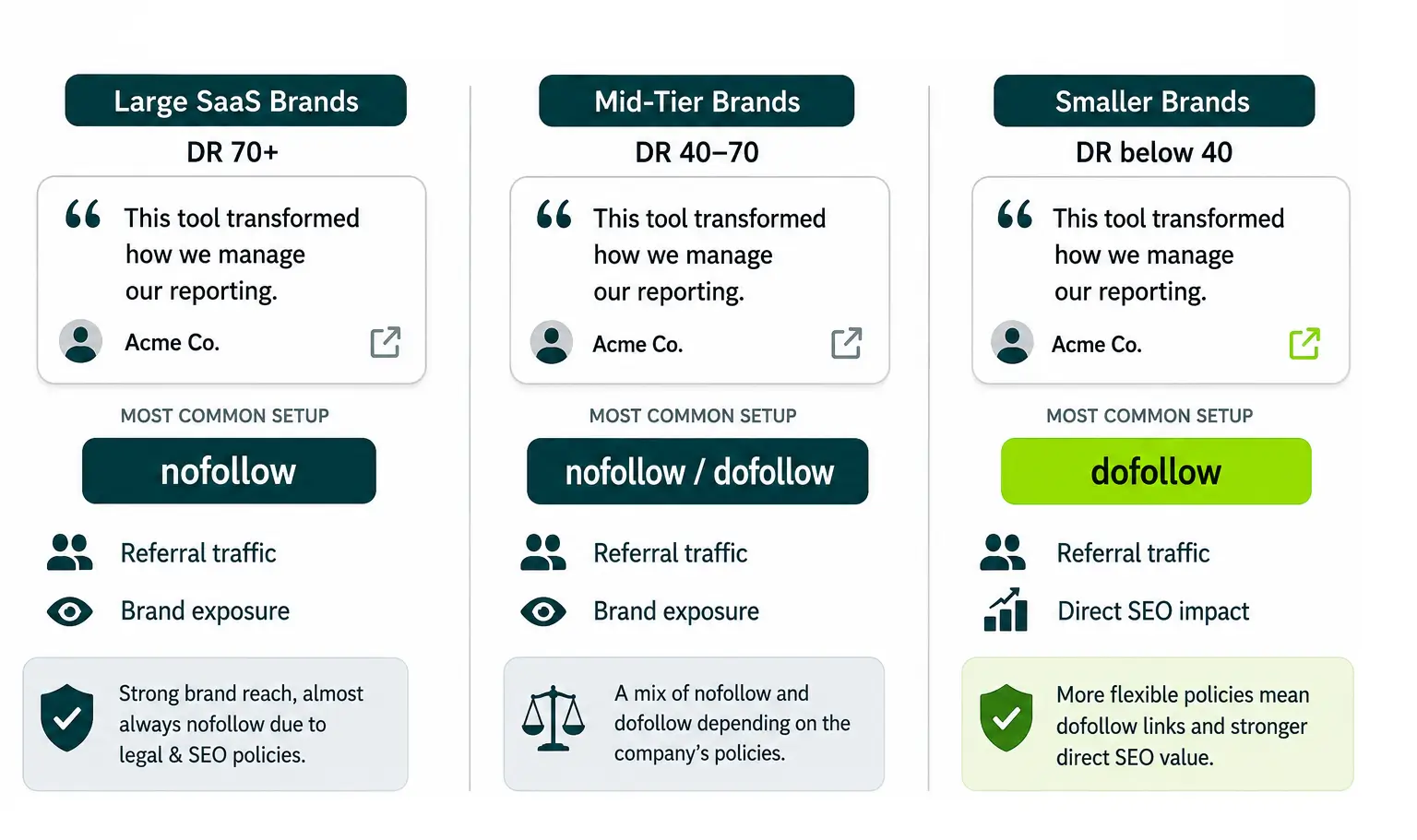
That isn’t a flaw in the tactic. It’s how large SaaS brands protect themselves legally.
Knowing it upfront saves you from pitching a DR 80 homepage and expecting a ranking lift that won’t come.
A dofollow backlink passes authority directly from the linking site to yours.
Google treats it as one site vouching for another.
A nofollow link carries a tag telling Google not to count the link as an endorsement.
Both types still send real visitors. Only dofollow directly moves your search rankings.
Watch Out
Most testimonial links from established SaaS companies are nofollow.
Mid-size and large companies treat outbound links carefully to avoid paid-link penalties.
If a brand has a legal or SEO team, expect nofollow almost every time.
Smaller companies operate differently.
Domain Rating is a 0 to 100 score from Ahrefs that estimates the strength of a site’s backlink profile.
Semrush calls its version Authority Score, and Moz calls its version Domain Authority.
Brands under DR 50 are far more flexible, including regional service providers, niche tool makers, and early-stage SaaS products.
They have no compliance team advising against outbound links.
Realistic expectations look like this.
| Brand Tier | What To Expect |
|---|---|
| Big brands, DR 70+ | Meaningful referral traffic and brand exposure, almost always nofollow |
| Mid-tier brands, DR 40–70 | A mix of dofollow and nofollow, reasonable referral traffic |
| Smaller brands, DR below 40 | Usually dofollow, lower traffic, strongest direct SEO impact per link |
Don’t dismiss nofollow links.
A nofollow placement on a high-authority homepage still puts your brand in front of everyone who visits.
Some of them click through. A few write content later and link to you naturally.
That downstream gain is hard to attribute, but it’s real and it accumulates.
How to Find Testimonial Link Building Opportunities
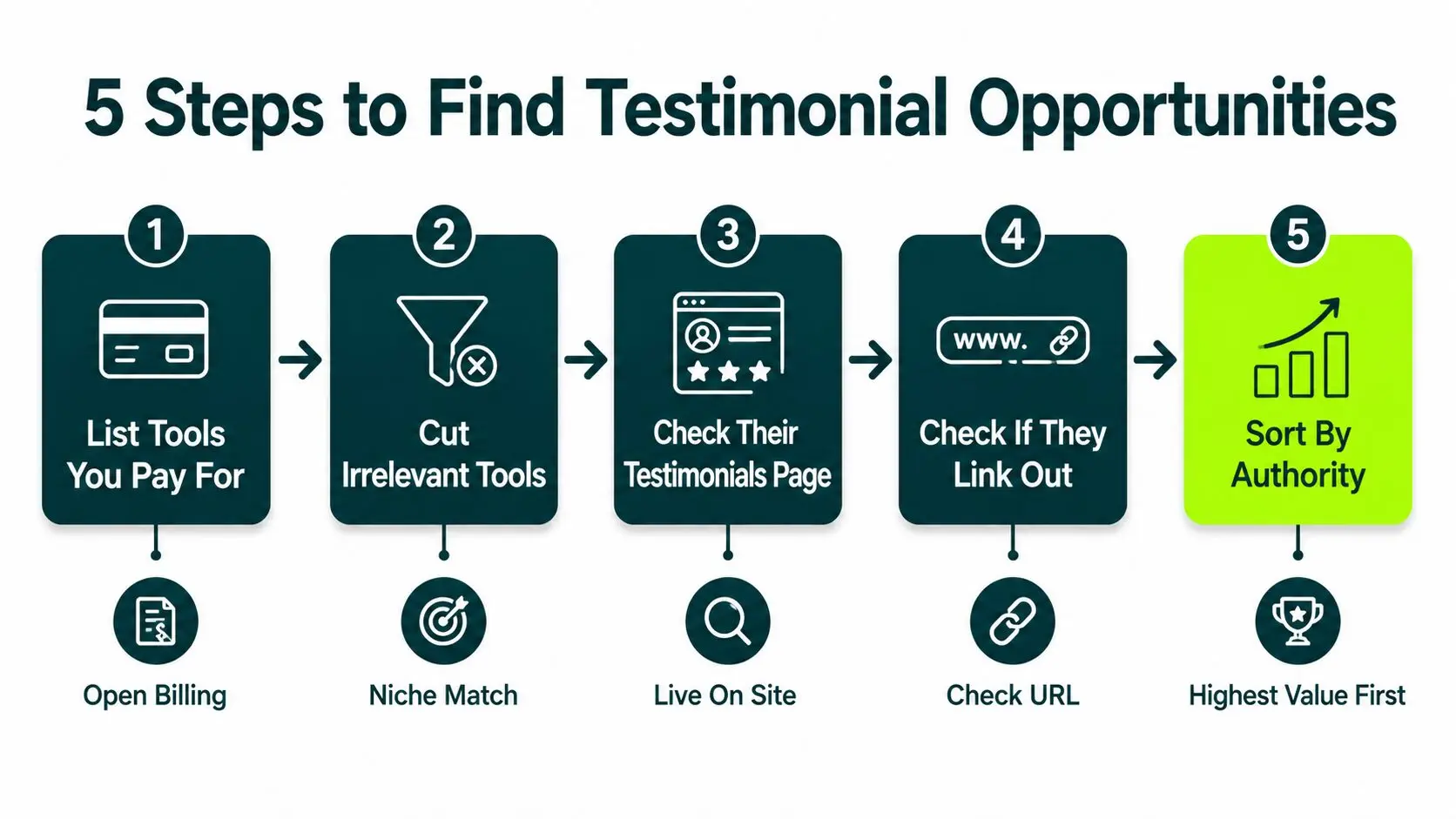
Find testimonial link building opportunities by qualifying your own billing list in five steps.
Each step removes candidates that would waste a pitch.
List every paid tool you use, cut anything irrelevant, then check whether the brand features testimonials at all.
Then check whether it actually links out to contributors, and sort what survives by Domain Rating and testimonial volume.
Founders skip steps 3 and 4, then wonder why brands never respond.
Step 1: List Every Paid Tool, Plugin, or Service You Use
Start with your billing dashboard, then check your password manager.
Walk through your weekly workflow and add anything you touch regularly.
Anything with a recurring charge belongs on the list.
Free-tier products qualify too.
Brands often want testimonials from free users, because those quotes prove value across the whole pricing range.
Step 2: Cut Anything Irrelevant to Your Niche
A link from a site in your industry is worth many times more than one from an unrelated domain.
If you run a B2B SaaS product, a link from a project management tool your team uses is valuable.
A link from your office supply delivery service is not.
Trim the list hard. Ten well-chosen candidates outperform fifty random ones every time.
Step 3: Check Whether They Currently Feature Testimonials
Visit each candidate’s homepage and its /customers page.
Look for a quotes section, a logo wall, or a rotating carousel.
If no testimonial display exists anywhere on the site, the brand has no process for publishing them.
Pitching into that situation wastes your time and theirs.
Review platforms give you a second signal worth checking.
A brand with an active G2, Capterra, or Trustpilot profile already collects and curates customer feedback.
Those profiles also tell you which customers are vocal and what outcomes the brand likes to highlight.
Read three or four reviews before you write, and shape your quote around the outcomes the brand keeps repeating.
Step 4: Check Whether They Actually Link Out
Right-click a customer name on their testimonial page and inspect the element.
Or hover over it and read the destination in your browser’s status bar.
If the link goes to the customer’s own website, this brand links out.
If it routes to an internal /case-study/ page on the brand’s domain, you get a mention and no backlink.
This single check saves you from pitching companies that will never give you what you want.
Step 5: Sort by Domain Rating and Testimonial Volume
Sort the survivors by Domain Rating first, then by how many testimonials the page already displays.
A page publishing 80 quotes reduces the link value of all 80.
A page featuring 4 or 5 makes each link count for significantly more.
Use a free DR checker, or Ahrefs, Semrush, or Moz if you have access.
Check referring domains as well as the authority score, since a site with few referring domains passes less.
Prioritize higher-authority sites that publish fewer total testimonials. That combination gives the best return.
In practice, Step 4 eliminates more candidates than any other check.
When we run qualifications for clients, many shortlisted brands route customer names to internal case-study pages.
A list that looks promising at the start shrinks sharply after this one check.
The Qualification Tracker
Track candidates in one sheet so you never pitch the same brand twice or lose a warm reply.
Six columns are enough. The “links out” column is the one that decides whether you write the pitch.
| Column | What Goes In It |
|---|---|
| Brand | Tool name, plus how long you’ve paid for it |
| Testimonial page URL | The homepage or /customers URL where quotes are displayed |
| Links out? | Yes, no, or internal case study. Anything but “yes” is a reject |
| Dofollow? | Checked in the page source on an existing contributor link |
| DR and quote count | Authority score, then how many testimonials that page already shows |
| Contact and status | Name, role, date pitched, date of the single follow-up |
Sort by the “links out” column first, then by quote count ascending.
The brands at the top of that sort are the ones worth a personalized pitch this week.
How to Write a Testimonial That Gets Published
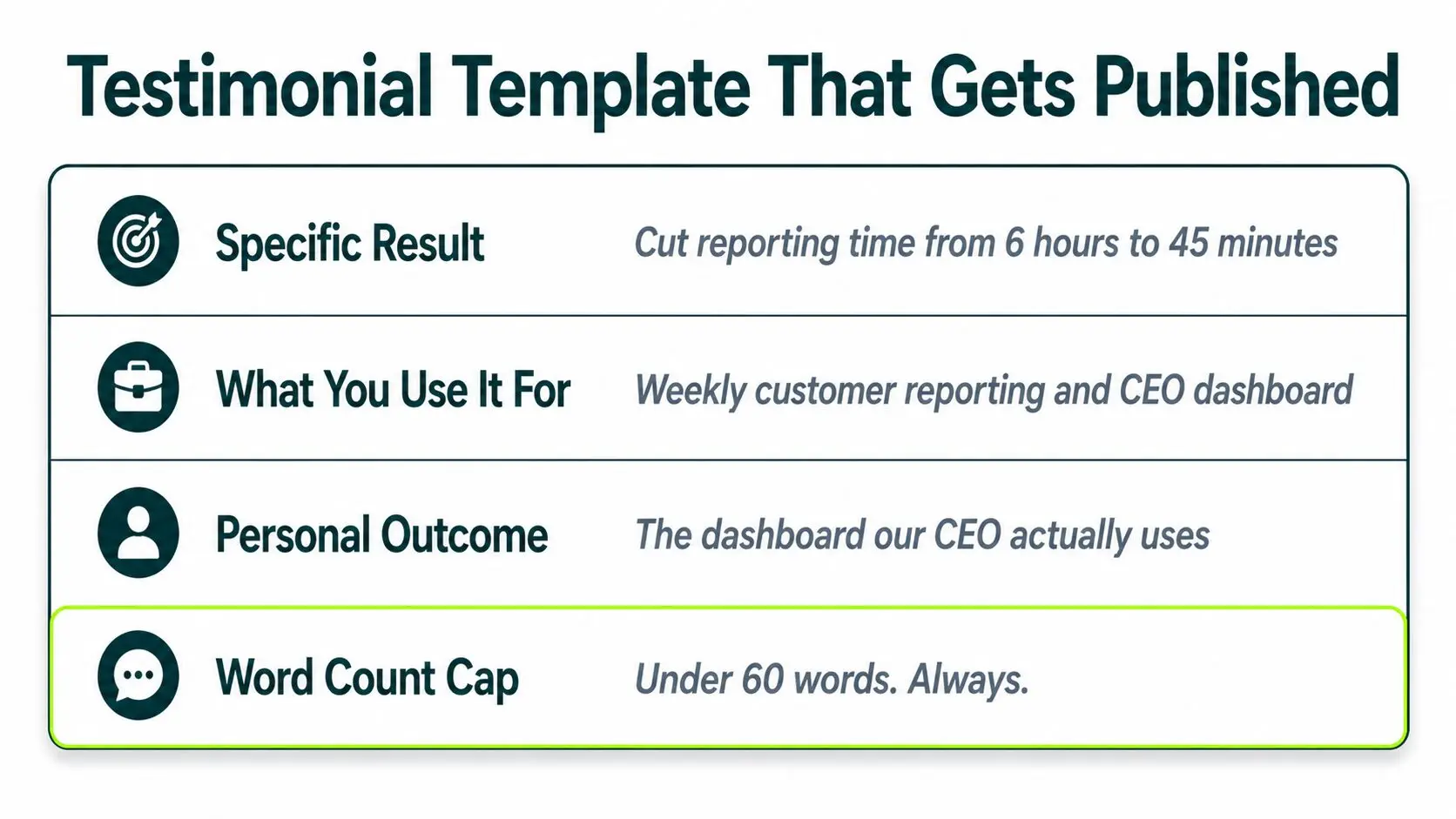
Three rules separate published testimonials from ignored ones.
Lead with a specific result or number. Name exactly what you used the product for.
Then keep the whole thing under 60 words.
Testimonials that follow all three get published. Testimonials that skip even one usually get passed over.
A strong testimonial reads like this.
“We use your tool for our weekly customer reporting and for our CEO’s dashboard. Before this tool, weekly reporting took six hours. Now it takes 45 minutes. The dashboard our CEO reviews every Monday was built here last quarter.”
A weak testimonial reads like this.
“Great product. Has really helped our business. I’d recommend it to anyone.”
The brand publishes the first one because it sells the product to every prospect who lands on that page.
It gives a real number, names a real use case, and makes the outcome tangible.
The second reads like filler and makes the brand look like no genuine customer would say anything meaningful.
1. Lead with a Specific Result or Outcome
Give a number, a time saved, or a specific problem that no longer exists.
“Cut our reporting time by 85%” is publishable. “Really transformed our workflow” is not.
2. Mention What You Used the Product For
Name the job: weekly financial reporting, onboarding new hires remotely, managing inventory across three warehouses.
Specific use cases make the testimonial useful to readers in the same situation.
That usefulness is what brands are actually shopping for.
3. Keep It Under 60 Words
Most testimonial sections are built with a fixed display height.
Quotes over 60 words get truncated, edited down, or rejected outright. Tight is better.
4. Decide What the Link Points To and How It Reads
Anchor text is the visible, clickable words that carry a link.
Testimonial links almost always anchor on your name or your company name, and that’s the right outcome here.
A branded anchor pointing at your homepage looks natural to Google because it matches how real customers get credited.
Asking a brand to anchor a commercial keyword instead makes the link look manufactured and often gets the pitch declined.
Point the link at your homepage unless a specific service page matches the use case you described.
Then give the brand your name, role, company, and the exact URL, so nobody has to guess.
5. Offer a Video Version
A 30-second video alongside the written quote raises your acceptance rate sharply.
Video testimonials are the hardest format for brands to source and the easiest to publish unedited.
Across campaigns run for SaaS and e-commerce clients, video pitches close at two to three times the written rate.
How to Pitch: Find the Right Person, Send the Right Email
At larger companies, reach the Head of Customer Marketing, Head of Brand, or VP of Marketing.
At brands under 50 people, go straight to the founder or the marketing lead.
Skip support@ and contact forms entirely. They route to people whose job is resolving issues, not approving testimonials.
For brands under 50 people, connect with the founder or marketing lead directly on LinkedIn.
For larger companies, search for a Head of Customer Marketing, Head of Brand, or VP of Marketing.
The brand’s Team or About page usually lists these people by name.
LinkedIn’s company directory filtered by job title gets you there faster than browsing their website.
Once you have a name, find the email address with Hunter.io or Voila Norbert.
Both verify deliverability before you send, which keeps your domain out of spam folders.
A LinkedIn message works just as well at smaller brands, and it often gets read faster.
Keep your outreach email strategy simple, because short emails get read and long ones get ignored.
The Pitch Email
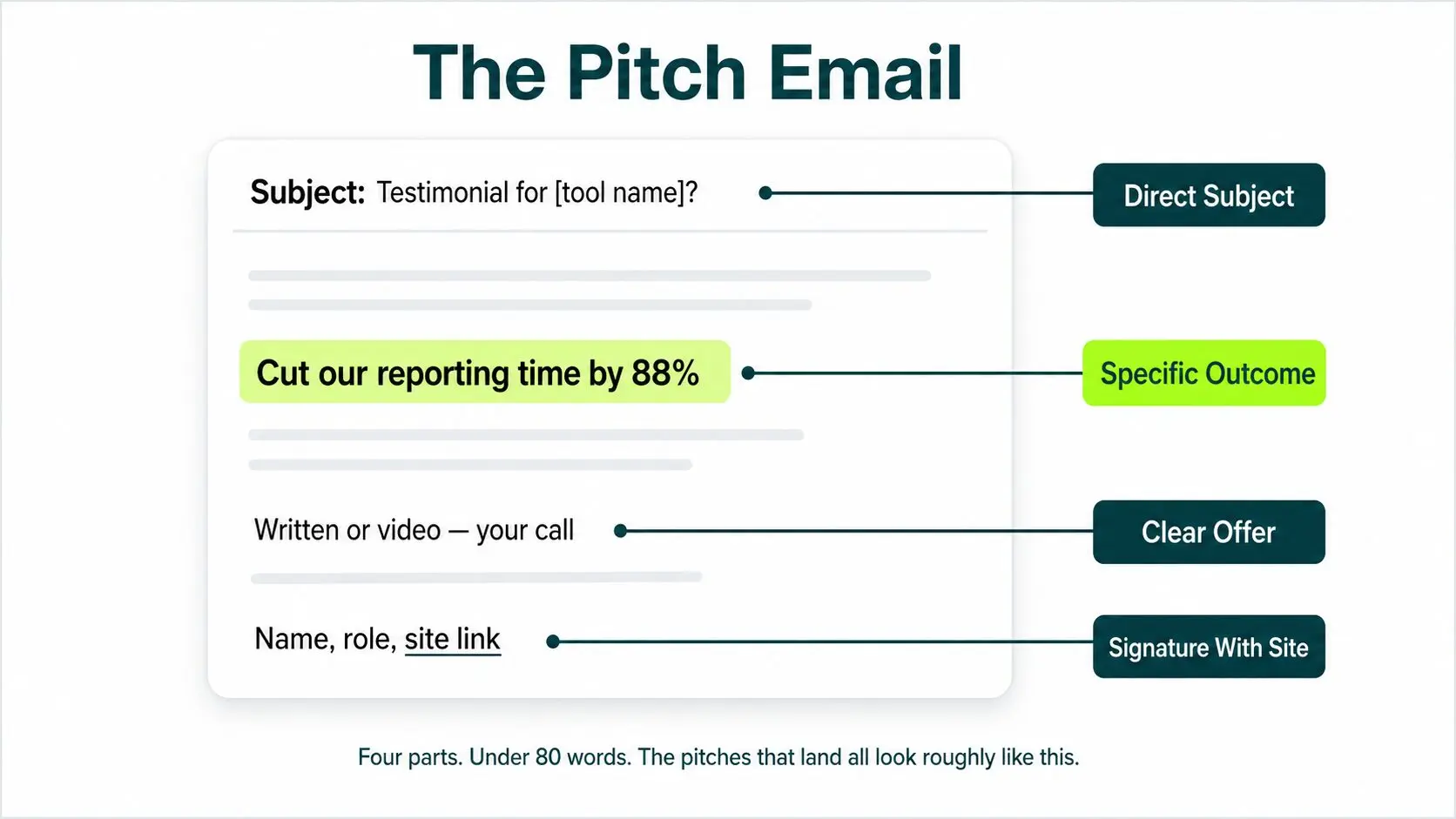
Keep the pitch to four lines: who you are, the result you got, the offer, and your link.
Subject: Testimonial for [tool name]?
Hi [name],
I’ve used [tool name] at [your company] for [time period]. It cut our [specific outcome] by [number].
Would you like a written or video testimonial for your homepage or customer page? Happy to send a draft this week.
Best regards,
[your name]
[your role at your company]
[link to your site]
That’s the entire email, with no backstory and no flattery.
The Follow-Up Email
Send one follow-up seven days later, on the same thread, and keep it to three lines.
Subject: Re: Testimonial for [tool name]?
Hi [name],
Following up on the testimonial offer. I’ve drafted it below so there’s nothing for you to write.
“[your 40-word testimonial, with the specific number in the first sentence]”
Happy for you to edit it. Could the credit link to [your URL]?
Best regards,
[your name]
The draft is what converts this email.
You’ve removed the only real work the brand had left, and you’ve asked for the link in plain words.
Tip
Lead your pitch with value: a verified account, a real measurable result, and a draft ready to send.
Pitches written that way close.
Pitches that spend three paragraphs explaining love for the product get archived.
Two follow-ups are fine. Past two, you’re chasing.
Brands don’t feature customers who had to be chased.
Common Mistakes That Get Pitches Ignored
Most testimonial pitches fail on small, avoidable errors made before the email is even sent.
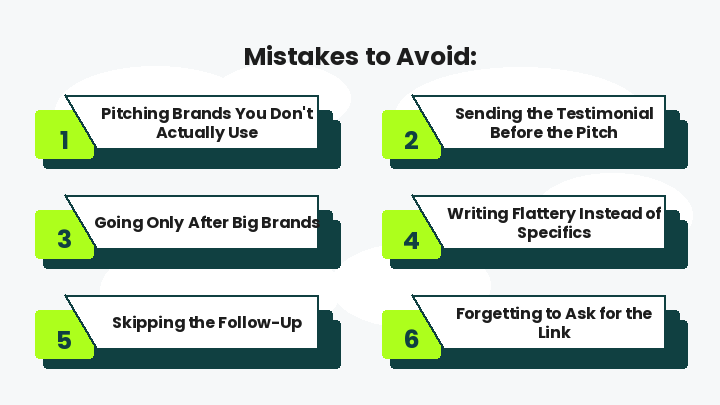
Three come up constantly: pitching brands you don’t use, sending the testimonial before the pitch, chasing only big names.
The other three are writing flattery instead of specifics, skipping the follow-up, and forgetting to ask for the link.
Pitching Brands You Don’t Actually Use
Every brand can check your account status in under 30 seconds.
If you’re not in their system as a real customer, the email goes to trash and your name gets flagged.
There’s no recovery from that.
Sending the Testimonial Before the Pitch
Pitch first, then wait for confirmation.
Write the testimonial afterwards, shaped around the use case they want to highlight.
An unsolicited draft puts the recipient in an awkward position and almost always gets ignored.
Going Only After Big Brands
Ahrefs, HubSpot, Salesforce.
Every founder who reads an article like this pitches those three first, and the odds there are roughly 1 in 100.
Start with mid-tier brands and build two or three published wins.
Then approach bigger names from a position where you have something to show.
Writing Flattery Instead of Specifics
“I love this tool” helps nobody who reads that testimonial.
“This tool eliminated three manual processes we used to run separately” gives the next prospect something real.
One sells. The other decorates.
Skipping the Follow-Up
First emails get buried.
One follow-up after seven days is the highest-leverage action in this entire tactic.
Most replies come from the follow-up, not the original send.
Forgetting to Ask for the Link
This is the most common mistake and the easiest to fix.
Say it plainly: “Could the testimonial include a link back to my site?”
Many brands publish quotes without adding an outbound link unless someone asks.
The link is the whole point. Ask for it clearly every time.
Across the pitches we’ve reviewed and sent, the most common failure isn’t bad writing.
It’s generic positioning.
The founder describes the tool in the same language the brand already uses on its own homepage.
“Streamlined our workflow” and “improved team collaboration” show up in nearly every second pitch.
What brands actually publish are quotes naming a specific function, a specific before-and-after, or a specific outcome.
The more specific the detail, the less editing the brand has to do and the faster it gets approved.
The Honest Limit of This Tactic
A typical software stack of 10 to 30 tools yields 5 to 8 testimonial backlinks in total, not per month.
Once you’ve pitched every brand that links out, the tactic is exhausted until you adopt new products.
Testimonial link building has a hard ceiling, and it’s worth naming plainly.
Use it to earn your first relevant backlinks while you build toward systems that scale.
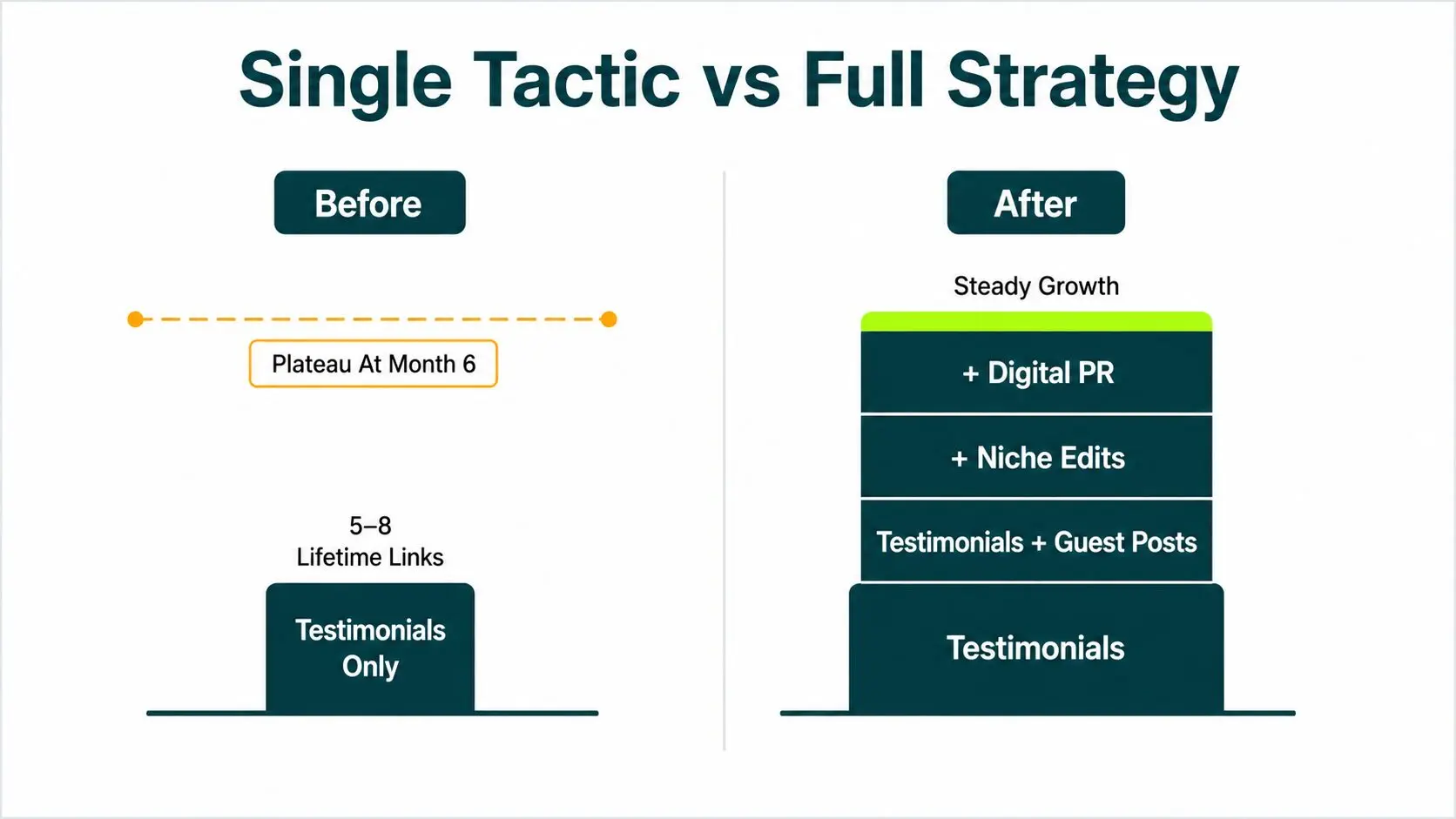
Guest post campaigns, original research, digital PR, and targeted niche edits keep producing opportunities over time.
Those tactics don’t run out the way this one does.
Brands that rank consistently never depend on a single approach.
They run several link building strategies in parallel, and testimonials are often where the first real wins come from.
Send the Email This Week
Open your billing dashboard now and pick the three tools you’ve paid for the longest.
For each, visit the homepage and check whether existing testimonials link out to a real website.
The first one that does is your pitch target this week.
Write the testimonial before you close this tab: a specific outcome, under 60 words.
Send it to the marketing lead on LinkedIn.
Most founders read about how to get backlinks for months before sending a single email.
The ones who rank are the ones who sent the first email.
Once your first testimonial goes live, the path to harder tactics gets easier.
Want to earn backlinks through testimonials?
Get a clear approach to turn real feedback into relevant link opportunities.
Frequently Asked Questions
Are testimonial links against Google’s guidelines?
No, testimonial links are not against Google’s guidelines when the testimonial is genuine and nothing was exchanged for the link. Google’s link spam policy targets link schemes, which means links bought, traded, or given in return for goods or services. A quote from a real paying customer is editorial, which is exactly what Google rewards. It only becomes a link scheme if you pay for the placement or accept a discount for writing it.
Do testimonial links work for new websites?
Yes, and they suit new sites particularly well. A homepage link from a relevant tool in your industry is one of the strongest first backlinks a new domain can earn. It tells Google your site is connected to a real business in a specific niche. That signal lands before you’ve built content authority of your own. For a new founder deciding where to start with effective link building approaches, this is the right first move.
Should I write fake testimonials to get more links?
No. Every brand can verify whether you’re a real customer within seconds of receiving your email. A fabricated testimonial gets you blocked at best and your reputation flagged across their network at worst. This tactic works precisely because the endorsement is genuine. Remove that and you have nothing.
How long does a testimonial link stay live?
Testimonial links usually stay live for years, until the brand redesigns its site or rotates its featured customers. Screenshot the page as soon as your testimonial goes live, then check it once a quarter. If the link disappears, you have a natural reason to reach back out and pitch an updated version.
What’s the difference between a testimonial link and a customer case study?
A testimonial is a short quote, usually one to three sentences, shown alongside others on a customer page or homepage. A case study is a dedicated long-form piece about your company, usually on its own URL. It often carries several links back to your site. Case studies take far more effort from the brand and are much harder to earn. Start with testimonials and treat case studies as a goal once the relationship already exists.
Can I get testimonial links if I’m a freelancer or solo founder?
Yes, freelancers and solo founders can earn testimonial links, and brands often prefer them. A real individual with a specific story converts better than a faceless company name. List every tool you use in your work, including invoicing software, design tools, hosting platforms, and project trackers. Each one is a legitimate candidate.
How many testimonial pitches should I send per week?
Sending 5 to 10 testimonial pitches per week is a productive pace. Beyond that, pitches start to feel templated and your response rate drops. This is a quality-driven tactic, not a volume play. A pitch built around a specific result from a specific feature always outperforms a generic template sent to 50 brands at once.