Most sites stuck on page two have one thing in common: their backlinks have fewer dofollow links compared to sites ranking on the first page.
That gap matters because dofollow links can pass authority between pages. Every link on the internet is dofollow by default unless someone deliberately adds an attribute like nofollow, sponsored, or ugc.
These dofollow links shape your search rankings.
Most teams chase backlinks but do not check whether those links pass any authority. You get placements, spend the budget, and your rankings still don’t move.
The problem usually isn’t the site or link quality. It’s the link attribute.
Key Takeaway
- A dofollow backlink has no restrictions. It passes link equity and authority to your site by default.
- Pages ranking #1 on Google average 3.8x more backlinks than positions 2-10, and most of those links carry dofollow attributes.
- The difference between dofollow and nofollow is one HTML attribute, and it decides whether a link can move your rankings at all.
- Guest posting, digital PR, broken link building, and resource-page outreach remain the highest-converting dofollow tactics in 2026.
- Ten dofollow links from topically relevant, high-traffic sites will outperform 500 directory links, so focus more on quality.
What Is a Dofollow Link?
A dofollow backlink is a hyperlink without nofollow, UGC, or sponsored rel attributes. It signals that search engines can consider the link for ranking purposes and potentially pass link authority transfer to the destination page.
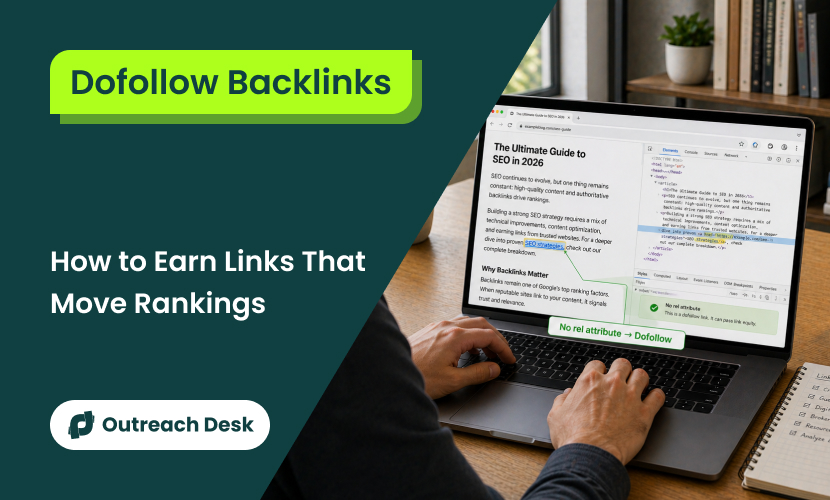
There’s no actual “dofollow” attribute in HTML. Google’s link documentation lists only three qualifying values (nofollow, sponsored and ugc), and any link that carries none of them already counts as dofollow, so adding rel="dofollow" to a tag changes nothing.
Dofollow link: <a href="https://example.com/">anchor text</a>
Nofollow link: <a href="https://example.com/" rel="nofollow">anchor text</a>

Every link is dofollow by default. If you add a restricting attribute, it will change. This distinction matters because Google counts these dofollow links as genuine editorial endorsements.
They’re what build your site’s authority and influence how your pages rank. Their impact on indexing exists, but it depends on other factors, such as site structure and crawl signals. Nofollow links still play a supporting role, but if your backlink profile is mostly nofollow, your rankings will show it.
At Outreach Desk we audit backlink profiles before every campaign starts, and the pattern is consistent. Sites stuck on page two usually sit below 60% dofollow. Sites climbing into the top three usually sit between 70% and 80%.
What The Ratio Says
Sites that earn mostly nofollow links from social media, forums, and comment sections get traffic but stay flat in rankings, but sites with strong dofollow editorial placements often rank higher.
How Dofollow Links Actually Work (The Technical Version)
Before moving ahead, let’s clear up a common misconception.
There is no rel=”dofollow” tag in HTML. “Dofollow” is not a code attribute. It is the name that means a link carries no restricting tag.

Crawling
Google’s crawler (called Googlebot) follows the link to your page. This helps Google discover your content and add it to its index faster.
Equity Transfer
The linking page passes a portion of its own authority to your page. This is what SEOs call “link juice.” It’s been the foundation of how Google’s PageRank system works. The more authoritative the linking site, the more authority flows your way.
Anchor Text Signal
Google uses the anchor texts (clickable words) of a link as a relevance clue. A dofollow link with anchor text “SaaS content strategy” tells Google that your page is relevant to that topic. Understanding how anchor text shapes relevance can help you choose more natural link text.
Trust Chain
When a trusted site links to you with a dofollow attribute, that trust transfers. It’s an editorial vote that signals “this content is worth reading”.
This is why the word “editorial” matters so much. Google wants dofollow links to be genuine endorsements. When a journalist cites your research, and an industry blog recommends your tool, that’s what Google rewards.
When someone drops your link in a comment section or pays for placement, Google treats it differently depending on how it’s implemented.
In practice, many of these links don’t use nofollow, ugc, or sponsored attributes at all, which is why link spam remains a persistent issue.
Dofollow vs. Nofollow: What Google Treats Differently
The HTML difference is tiny. The SEO difference is not.
Here’s what each link type looks like in code:
A dofollow link looks like this in the source code:
<a href=”https://yoursite.com”>anchor text</a>
A nofollow link adds one attribute:
<a href=”https://yoursite.com” rel=”nofollow”>anchor text</a>

Since 2019, Google has also introduced two additional attributes:
rel=”ugc” for user-generated content such as comments and forum posts

rel=”sponsored” for paid placements

Dofollow Links
Googlebot crawls dofollow links, passes authority through them, and lets them influence where you rank. They’re what Google uses to decide how trustworthy and authoritative your site is.
Nofollow / UGC / Sponsored Links
Nofollow, UGC, or Sponsored links don’t pass equity by default, though Google now treats nofollow as a hint, not a rule, but the default is no equity transfer. They still drive relevant traffic, build brand visibility, and help your profile look natural. But they won’t move your rankings the way a dofollow editorial placement will.
Links from YouTube video descriptions and channels fall in this group: nofollow, yet a steady source of viewers.
Nofollow links are not worthless. A nofollow link from Forbes still:
- Sends real referral traffic to your site
- Builds brand recognition and credibility
- Signals to Google that authoritative sites mention you.
The mistake is treating dofollow and nofollow as simple “good” and “bad.” They serve different purposes. Dofollow builds ranking authority, while nofollow builds visibility and traffic.

Real-world proof from Outreach Desk audits:
One profile had 90% nofollow links, all from social media, forums, and comment sections. Traffic was solid. Rankings were completely flat. Once the team shifted focus to earning dofollow editorial placements, those pages climbed an average of 12 positions over four months. Same content. Different link types.
How to Check Whether a Backlink is Dofollow
You don’t need expensive paid SEO link building toolkit. These three methods will help you find out whether a link is dofollow.
Method 1: Browser Inspect
Right-click the link on the page, select “Inspect,” and look at the <a> tag. If there’s no rel=”nofollow”, rel=”ugc”, or rel=“sponsored”, it’s dofollow.

Method 2: Chrome Extension
Install a free extension like NoFollow (by Sean Carlos) or Ahrefs SEO Toolbar. These highlight nofollow links on any page, so you can treat everything else as dofollow by eliminating everything.
If you’d rather not install anything, paste the page’s URL into our free link analyzer. It reads the HTML a crawler gets and counts that page’s dofollow, nofollow, sponsored and UGC links.
Method 3: Backlink Audit Tool
Use Ahrefs Site Explorer, Semrush, or Moz to pull your full backlink profile. Filter by dofollow to see which links are eligible to pass authority. These tools provide a useful starting point for reviewing your backlink profile at scale. For a more detailed review of link quality, context, and potential risks, an expert backlink audit can take the analysis further.
One important thing to watch:
Some websites add a blanket nofollow tag to their page header, making every link on the page nofollow, even if individual links look clean in the code. This looks like:
<meta name=”robots” content=”nofollow”>
Some Chrome extensions can automatically highlight link attributes. You can also inspect the page source manually to confirm whether a link includes attributes like nofollow, ugc, or sponsored.
Why Your Dofollow-to-Nofollow Ratio Matters
A backlink profile is like a professional reputation. It’s about the overall pattern of who vouches for you and how.
A natural backlink profile typically ranges from 60% to 80% dofollow. Sites that earn links organically through content, PR, and industry recognition land in this range because most editorial links are dofollow by default.
What the extremes signal:
| Ratio |
What it tells Google |
|---|---|
| Below 50% dofollow | Links mostly from social media, forums, and directories. (Good for traffic but weak for authority) |
| 70-80% dofollow | Natural and healthy mix |
| Nearly 100% dofollow | Consider it a red flag. They’re engineered link patterns that can trigger Google’s SpamBrain and lead to penalties. |
A 100% dofollow profile is suspicious:
In the normal backlink profile, some links will always be nofollow, stemming from social media shares, user-generated mentions, and sponsored content.
A profile that’s 100% dofollow signals to Google that every link was deliberately built, which raises manipulation flags.
Aim for 70-80% dofollow and focus more on the quality of dofollow links.
How to Get Dofollow Backlinks: Seven Tactics That Work
Here are the seven tactics that we use for link building campaigns. This will also help you secure dofollow placements on sites that actually improve rankings.
1. Digital PR and Data-Driven Content
Create original research, surveys, or datasets the kind of linkable assets that earn dofollow links without outreach. When journalists and bloggers cite your data in an article, the link is an editorial reference and editorial links are almost always dofollow.
The goal is to give them something worth citing. This could be:
- A survey of marketers on link building budgets
- An analysis of thousands of SERPs
- A dataset that doesn’t exist anywhere else
Journalists link to original sources. If your content becomes the source, you’ll get links naturally.
We ran a data study for a B2B client, analyzing response rates across 15,000 outreach emails. Within two weeks, three industry publications picked it up, each with a dofollow contextual link. The piece is still earning links months later.
2. Guest Posting on Relevant Publications
Publishing guest posts on relevant publications still works, but only when you do it properly. It means you have to pitch useful, relevant content to publications your audience actually reads. Don’t send generic articles to dozens of sites.
Some credible publications allow a dofollow link either in the content or in the author bio, though policies vary significantly by site. The contextual link within the article carries more value because it sits within relevant content, which adds topical signals.
What doesn’t work:
Paying $50 for a guest post on a site that publishes 30 guest posts a day across unrelated topics. These links won’t carry real authority even if they’re technically dofollow.

3. Broken Link Building
Find pages in your niche that link to outdated or broken sources (404 pages). Then create a better replacement on your site and suggest it as an alternative.
Broken link outreach works because you’re helping the site owner fix a problem. A broken link hurts user experience, and you’re offering a ready solution.
When the site owner replaces the dead link with your source, it is often a dofollow link, though this depends on the site’s linking policies. It adds to existing content, and Google treats it as an editorial update.
A large percentage of older pages lose backlinks over time because the original URLs stop working. According to Ahrefs study on content decay, roughly 66% of pages that once had backlinks eventually lose them. That creates a massive pool of opportunities in most niches.
This approach takes time. Outreach volume is higher, and response rates are lower than some other tactics. But the links you earn are stable, relevant, and long-lasting.
4. Resource Page Link Building
Resource pages are curated lists of tools, guides, or references on a specific topic. Getting listed on one means earning a dofollow link from a page built specifically to recommend valuable content.
You can find resource pages by searching:
- “Useful resources” + [your topic]
- inurl: resources + [your topic]
Here, the conversion rate for resource page outreach tends to be higher than cold guest post pitches.
Reach out with a short, clear message explaining why your content fits their list. This works well because you’re not asking them to publish something new. You’re asking them to improve an existing page with a relevant resource.
5. Expert Sourcing Platforms (HARO Alternatives)
Platforms like HARO, Quoted, Featured, and Help a B2B writer connect journalists with expert sources. When a journalist quotes you in their article, you may receive a dofollow link as a source citation.
The key is how you respond. Journalists get a large number of replies daily. The ones journalists pick are:
- Fast
- Specific
- Directly answering the question
Adding a data point or a real example increases your chances.
We’ve used HARO-style platforms across multiple client campaigns. The response rate is low (3-8% of pitches result in placement), but the quality of links is high because they come from real publications with editorial standards.
6. The Skyscraper Technique (Updated for 2026)
Start by finding content in your niche with strong backlinks. Then create something better. That could mean:
- Updated data
- Clearer structure
- Stronger examples
- A unique angle
Once you’re done with the valuable content, reach out to the sites linking to the original and show them why your version serves their readers better. A well-planned skyscraper link building approach can help structure this process from content research through targeted outreach.
Mistake to avoid:
Most teams make small improvements. Add a few extra paragraphs, and that’s it. This is not enough. Adding 200 words to a 2,000-word article isn’t skyscraper content.
Reality Check (2026)
This approach is far less effective than it used to be. Many site owners receive a high volume of similar outreach and ignore most requests. It can still work in selective cases, but it’s no longer a reliable or scalable tactic.
7. Niche Edits (Link Insertions)
A niche edit is when you place your link into an existing article instead of creating a new one. The page is already published and indexed and may have some authority.
However, ranking alone doesn’t guarantee value. You still need to evaluate the page’s backlink profile, relevance, and traffic before treating it as a strong placement.
When the site owner adds your link within the content, Google recrawls, and it starts passing value. The approach is simple. Find relevant articles in your niche that could benefit from your content, then suggest a specific place where your link fits.
For example, “In your section about X, linking to our guide on Y would give the reader more depth.”
If the suggestion makes sense, the site owner adds it as an editorial update. Niche edits land as dofollow because the site owner is making an editorial update.
What Makes a Dofollow Link High-Quality (Beyond the Attribute)
Not all dofollow links are equal. A dofollow link from a spammy directory and a dofollow link from a niche-relevant publication with 50,000 monthly visitors are completely different signals.
Topical Relevance
A link from a site in your industry or a closely related one helps your site more than a link from an unrelated domain. Google reads the surrounding content to assess how relevant the link is to your page.
For example, we’ve seen links placed from unrelated niches, like a cooking blog linking to an SEO tool. In these cases, the mismatch reduces the link’s contextual relevance. Understanding what makes a link relevant can help when evaluating potential backlink opportunities.
Search engines don’t always treat these links as strong signals, even if they’re technically dofollow.
Traffic and Engagement
A site with little to no real traffic can be a weaker signal than a page that consistently attracts relevant visitors, even if third-party metrics suggest otherwise.
High-authority metrics with low traffic often indicate that someone artificially inflated the site’s authority, or that the topic is niche or the content is outdated. If the linking page ranks for keywords and attracts genuine visitors, tend to be more reliable linking sources.
Placement Within Content
Contextual links placed in body paragraphs carry more authority than footer links, sidebar links, or author bio links. The closer the link sits to relevant, on-topic content, the stronger the signal it sends.
Anchor Text Diversity
Your dofollow backlink profile should include a natural mix of anchor text types:
- Branded: “Hubspot”
- Generic: “Click here,” “this guide,” “read more.”
- Partial match: “dofollow link strategies.”
- Exact match: “dofollow backlinks”
Over-optimizing with too many exact match anchors triggers Google’s spam filters.
Three Dofollow Mistakes That Stall Rankings
These aren’t beginner mistakes. They’re errors that hold back teams who already understand dofollow link building but still aren’t seeing the ranking movement they expect.
1. Chasing Volume Over Relevance
A hundred dofollow links from random directories won’t outperform five from publications your audience reads. Google’s algorithm has moved far past counting links. It evaluates the quality signal behind each one.
2. Ignoring Anchor Text Patterns
If most of your dofollow backlinks share the same anchor text, that’s an over-optimization flag. Natural profiles are messy; you need to use different anchor text across branded, generic, partial, and exact-match terms. In the sites we’ve audited, many penalty cases showed anchor text distributions that were too concentrated around exact-match keywords.
3. Treating Every Dofollow Link as Equal
The number of outbound links on the linking page directly affects the amount of authority your link receives.
A dofollow link from a page that already links out to 200 other sites dilutes the equity so much it’s barely worth having. A dofollow link from a page with only 5 outbound links concentrates authority directly toward you.
Build the Links That Actually Build Authority
Your backlink profile reflects your site’s authority. Every dofollow link from a relevant, trusted source strengthens it, while low-quality shortcuts weaken it.
Focus on earning the right links from the right sources and your rankings will reflect it over time.
Review your backlink profile and look at your dofollow links. Are they coming from relevant sites? Are they placed naturally within content? If not, that’s where your next link-earning move should focus.
The teams that win don’t chase every opportunity. They focus on the right links, consistently. That’s how authority builds and rankings improve.
Not sure how to get dofollow backlinks that actually help?
Get a clear approach focused on relevant, high-quality links that improve rankings.
1. What is a dofollow backlink in simple terms?
A dofollow backlink is a regular link from one website to another that allows search engines to follow it and pass authority to the destination page. Every link is dofollow unless it includes a restricting attribute, such as nofollow, ugc, or sponsored.
2. Are dofollow backlinks better than nofollow links for SEO?
Yes, dofollow backlinks are better for ranking purposes. These links pass authority and directly influence how Google evaluates your site. Nofollow links don’t pass the same signal. But they still matter. They can bring traffic, build visibility, and make your backlink profile look natural. A strong profile usually includes both.
3. How many dofollow backlinks do I need to rank?
There’s no fixed number. It depends on your niche competition, current domain authority, and the quality of each link. A site in a low-competition niche might reach page one with 15-20 strong dofollow links. A site competing in SaaS or finance might need hundreds. Quality always outweighs quantity.
4. Can I buy dofollow backlinks?
Yes, you can, but it comes with risk. Google’s link spam policy guidelines treat paid links that influence rankings as a violation. These links should be marked with rel=”sponsored”. If paid links are detected without proper labeling, they can be ignored or lead to penalties. A safer approach is to earn links through content, outreach, and real placements.
5. How do I check if my backlinks are dofollow?
Right-click the link on the page, select “Inspect,” and look at the HTML. If there’s no rel=”nofollow”, rel=”ugc”, or rel=”sponsored” attribute, the link is dofollow. For a full profile audit, use Ahrefs Site Explorer or Semrush’s Backlink Analytics; both let you filter your entire backlink list by link attribute in seconds.