Two agencies can charge 10x different prices for links in the same niche, and both will say their links are “good.” One might charge $200, and another might ask for $2,000. Both sites promise quality, with decent Domain Authority (DR) and high editorial standards. But what really sets them apart?
Google may devalue $50 links, and the one that costs $1500 may last 2 weeks. Not only that, but someone may find a perfect $350-$500 links and gain consistent traffic for 5+ years.
It’s not luck. It’s about understanding what drives price. When you understand how link building pricing works, you avoid overpaying. You skip cheap links that put your site at risk.
What’s Inside
- Why link pricing ranges from $150 to $1,500+
- The 3 factors that actually matter when evaluating cost vs. quality
- How to calculate whether link building makes financial sense for your business
- What hidden costs most providers don’t mention.
- Real case studies showing ROI.
What Drives the Price Up (or Down)?
Not every $400 link delivers the same result. Some factors shape the true cost of link building. When you know what matters, you can spot whether a link placement is a good deal for you or just a waste of money.

1. Link Quality
High-quality links from trusted and relevant websites take real work to earn. That’s why they cost more.
Factors that determine link quality
Domain Authority (DA) or Domain Rating (DR):
A site’s DR (Domain Rating) affects price, but a high DR number doesn’t mean the link is valuable. Run the site through the backlink cost estimator if their quote is far above the estimated range, walk away.
For example, if a DR 60+ website lost 80% of its traffic after Google’s core update, it’s not worth $600.
Organic Traffic of the Linking Site:
Organic traffic is equally important. Don’t just look at the DR; also check if the site’s real traffic is growing or shrinking over time. If most visitors come from the US, UK, Canada, or Australia, and the traffic keeps growing, it is worth paying for.
Topical Relevance:
A link from an irrelevant site won’t move the needle, even if the site looks authoritative.
For example, if you run a health and fitness company, a link from a finance blog sends mixed signals to Google. It won’t help you achieve your desired outcomes.
Editorial Standards of the Linking Site:
If a site accepts every guest post without any quality filter, then you should skip it, no matter how high its DR is. If a site has a higher editorial bar, getting a link there takes real effort, and that’s why it costs more. A site that vets contributors and doesn’t openly sell links is exactly the kind of placement worth paying for.
2. Industry and Niche
Some industries cost more for link building due to the risk and competition involved.
Here’s how Industries break down by difficulty:
| Difficulty Level |
Industries |
|---|---|
| Hard (Highest Costs) | Casinos & Gambling, Loans, Insurance, CBD & Cannabis |
| Medium | SaaS, Healthcare, Lawyers & Legal Services, Real Estate |
| Easier (Lower Costs) | Charities, Education, Hobbyist sites, Online tools |
According to a survey of 518 link building professionals, 61% identified gambling as the niche requiring the largest budgets.
The main reason is regulatory exposure and publisher risk mitigation. Publishers can charge 2-3x premiums because accepting gambling links carries reputational and legal risk.’

3. Volume and Timeline
How many links you need, and how fast you need them determines the link price. High-volume, high-speed link acquisition campaigns often cost more.
4. Who Builds Links
Experience pays off here. Link builders with 5+ years of experience can deliver more value for your budget than junior link builders.
Why? Experienced pros win links with fewer emails. They already have publisher relationships that juniors need months to build. You might pay more per hour, but you get more links for every dollar you spend.
5. Geographic Market
| Market |
Cost Level |
|---|---|
| United States | Highest |
| United Kingdom | Slightly lower but competitive |
| Southeast Asia, Latin America, Eastern Europe | Lower cost but inconsistent quality |
Publishers from lower-cost markets typically carry thin traffic from non-target countries. It means the links look good on paper but deliver little real SEO value.
6. Agency vs. In-House vs. Freelance
The choice between outsourcing an agency, building an in-house team, or working with freelancers can greatly affect your link building budget.
Each model, agency, in-house, or freelance comes with its own cost structure and hidden expenses. These can make or break your link building budget.
Remember
The price alone tells you almost nothing about a link’s actual value. The real question is: does this link come from a relevant, editorially credible site with real traffic, and was it built by someone who knows what they’re doing?
How Much Does a Single Link Cost?
The cost of a single link depends on how you build it. Each method takes a different level of effort, relationships, and content.
Our contextual link building packages are scoped by links per month and target DR range.
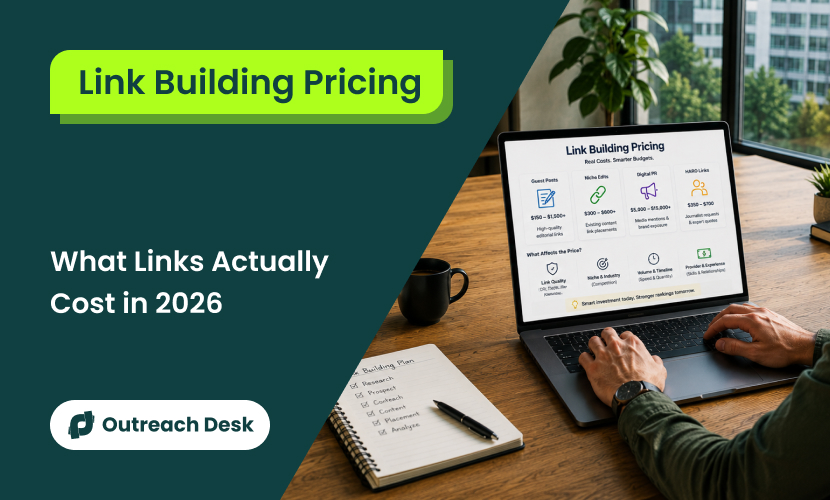
Guest Posts ($150 to $1500+)
A guest post is a high-value article you write for another website. You earn a contextual link back to your own site.
| Site Authority |
Price Range |
|---|---|
| DR 20-30 | $150-$300 |
| DR 30-50 | $300-$600 |
| DR 50+ Industry publications | $600-$1,500+ |
The price gap comes down to editorial standards. Some publishers want expert-written, 2,000-word articles with custom graphics. Others move fast with a clear 800-word pitch.
Niche Edits (Link Insertion – Average $361)
A niche edit means placing your link within an already-indexed and ranking article. You don’t need to create new content.
According to Ahrefs’ small pricing study, niche edits and sponsored guest posts cost $361.44 on average. Our niche edit placements sit on DR 40-90 sites and are topic-matched to the page being linked. Publishers know their existing content has built-in value and they price accordingly.
Digital PR ($5,000 to $15,000 per month)
Digital PR costs the most per link, but it also has the highest upside. You earn editorial mentions from journalists at top publications like Forbes or TechCrunch.
Per link costs vary. Here’s why:
- A strong campaign might land 30+ links, dropping your effective cost below $200 per link.
- A campaign that doesn’t land might cost $2,000 per link.
Digital PR earns brand mentions across trusted sources that boost AI Overview visibility three times more than raw backlinks alone.
HARO / Journalist Query Platforms ($350 to $700 per link)
HARO connects your experts with journalists who need sources. Outsourcing cost, $350 to $700 per link. Response rates are low, so you might pitch 50 queries to land 2 or 3 placements.
But those placements often come from high-authority news and industry sites that don’t sell links through any other channel.
No single method wins across every situation
- Guest posts offer consistent volume.
- Niche edits offer quick wins.
- Digital PR builds brand authority at scale.
- HARO earns links from publications that money can’t directly buy.
The smartest budgets combine methods rather than betting everything on one.
Monthly Budget Ranges: What to Expect
Your monthly link building budget isn’t just about how much you can spend. It’s how many quality links you need to close the gap with your competitors.
| Business Size | Monthly Budget | Typical Output | Best For |
|---|---|---|---|
| Small business/startup | $1,500–$3,000 | 3–8 links (DR 20–40) | Building early authority, targeting low-competition keywords |
| Mid-size company | $3,000–$10,000 | 8–20 links (DR 30–60) | Competing for medium-difficulty keywords, closing authority gaps |
| Enterprise / competitive niche | $10,000–$25,000+ | 15–40+ links (mixed DR) | Dominating high-difficulty keywords, digital PR + editorial campaigns |
What the industry data confirms:
- According to The Frank Agency’s survey of 500+ link professionals, about 38% of businesses allocate between $1,000 and $5,000 per month for link building.
- The average minimum monthly budget needed to stay competitive in high-difficulty niches is roughly $8,400, based on a survey of 518 SEO professionals.
- Wider benchmarks across cost, outreach response and tactic effectiveness sit in our link building statistics roundup.
The insights most budgets miss:
The best results rarely come from the biggest spenders. They come from building the right links, relevant, and editorial placements to the right pages.
Remember:
A $5,000/month campaign with precise targeting will beat a $15,000/month approach every time.
Match your budget to your competition, not just your ambition. Start by understanding your competitive backlink gap, then build your budget to close that gap.
Industry Benchmark Data:
Ahrefs’ small study of paid links found:
- Niche edits and sponsored guest posts cost $361.44 on average
- The sample came from outreach to 450 sites across nine competitive niches
- Prices rose with the linking site’s Domain Rating
Siege Media’s 2026 link building cost guide says:
- Most links cost around $500-$1,250, depending on the site’s authority and relevance
- The full range runs from about $100 to over $1,500 per link
- Links in competitive niches can reach about $2,000
What has moved since those studies:
- Publisher placement fees have risen roughly 20-40% over the past two years
- Most businesses now budget $3,000-$10,000 per month for link building
- Treat the per-link figures above as a floor, not a current quote
Those are market ranges. If you would rather see fixed numbers, our link building pricing plans list per-link rates by monthly volume.
Agency vs. In-House vs. Freelance: The Real Cost Comparison
Each model comes with its own cost structure. The hidden expenses are always bigger than the actual price.

Agency Retainers ($2,000 to $20,000+/month)
You pay for the full package: strategy, prospecting, outreach, content, publisher relationships, and reporting all in one.
The cost per individual link ranges between $300 and $800.
Best for: Companies that need steady link output without managing a team.
Trade off: You have less control over day-to-day targeting decisions.
In-House Teams ($150,000 to $200,000+/year)
An in-house team gives you full control. But fixed costs add up fast.
| Core Item |
Annual Estimate |
|---|---|
| Link building manager (1) | $60,000 – $85,000 |
| Outreach assistant (2) | $30,000 – $50,000 |
| Content writer (1) | $50,000+ |
| Tools (Ahrefs, BuzzStream, etc) | $3,000 – $8,000 |
| Placement budget (minimum) | $24,000+ |
| Total before the first link built |
$150,000-$200,000 |
The In-House Break-Even Analysis
At $177,000/year for a full team, here’s what you need to hit:
- 15 links/month (180/year) = $984/link (Expensive; agency wins)
- 20 links/month (240/year) = $738/link (Still pricey; agency likely wins)
- 30 links/month (360/year) = $491/link (competitive; in-house becomes viable)
- 40 links/month (480/year) = $369/link (cost-effective; in-house now winning)
For comparison:
- Agency cost at specialist rates: $400-$600/link average
- In-house at 30+ links/month: $491/link (within market range)
- In-house at 40+ links/month: $369/link (below market, higher margin)
In-house teams often need 3 to 4 months to build publisher relationships and earn first major placements. Many new teams underestimate this hidden cost.
At Outreach Desk, we have 7+ years of publisher relationships already built, which is why our first placement happens within 2 weeks.
This approach only makes sense if you need 30 or more links every month. Below that, agencies win on cost efficiency.
Freelancers ($50 to $150/hour or $200 to $800/link)
What this model gives you:
- Flexibility and lower overhead.
- Direct communication, no agency middleman.
The risk:
- Smaller publisher network than most agencies.
- Scaling beyond 10-15 links per month is difficult without additional help.
- Quality varies widely. Always check recent placements before you commit.
Tip:
Most mid-size businesses find the sweet spot in a hybrid model. Agency for link acquisition, in-house for strategy and quality control.
How to Calculate Whether Link Building is Worth It for Your Site
Before you spend a dollar on link building, run three calculations. They’ll show if your investment will pay off or if your budget belongs elsewhere.

Step 1: Find Your Lifetime Link Value
Lifetime link value shows what a single link is worth to your business over time.
- Find your top-ranking competitor in your niche.
- Look up their monthly traffic value in Ahrefs
- Divide that by their number of referring domains.
| Lifetime link value above $5,000 | Manual link building almost certainly pays for itself. |
|---|---|
| Lifetime link value below $3,000 | Content marketing and brand mentions may serve you better unless you’re targeting specific high-value pages. |
Step 2: Calculate Your Link Gap
Compare your referring domain count to the top 3-5 competitors for your target keywords. The difference is your link gap.
Formula:
Link Gap X Average Cost Per Link = Total Investment Estimate
This turns a vague budget guess into a clear, actionable number.
Step 3: Project The Return
If closing your link gap moves you from position 8 to position 3 for a keyword driving $20,000/month in traffic value and your total link investment is $30,000, you have a 10-month payback period before compounding organic growth even kicks in.
The Hidden Cost Most Pricing Guides Don’t Mention
Content Creation
Most providers bill content separately. Here’s what quality writing actually costs:
| Content Type |
Cost Per Piece |
|---|---|
| Standard guest post (U.S. market) | $150 – $400 |
| Technical or Finance, Health, and Legal content (YMYL content) | $500 – $1,000 |
If you skip quality content, your acceptance rate drops. You spend more on outreach, but get fewer results. Content cost is an investment in your conversion rate, not an optional add-on.
Tools and Software
A full outreach stack includes Ahrefs, Semrush, Hunter.io, BuzzStream, and email verification services, which cost approximately between $3,000 to $8,000.
Agencies bake these costs into their pricing. If you go in-house, you see them up front.
Link Decay
Links don’t last forever. Ahrefs research shows:
- After one year, about 17% of links disappear
- After seven years, only about 57% survive
That is why managing your backlinks needs to be part of your ongoing strategy.
Opportunity Cost of Bad Links
A cheap $100 link from a site with fake metrics and no real traffic isn’t just worthless. It can hurt you if the site is part of a private blog network or flagged by Google’s Spam Brain.
Cleaning up a link profile after penalty recovery costs more than doing it right the first time. The cheapest link is your most expensive mistake.
Budget for content, tools, link decay, and the real cost of mistakes. The per-link price is the entry fee. The true cost of link building is always higher than the number on the invoice.
What AI Search Means for Link Building Pricing in 2026
Links now do two jobs at once: They move traditional rankings and shape whether an AI platform cites your brand.

Google AI Overviews pull from pages already ranking in the top 10 organic results. Strong backlinks improve both traditional rankings and AI citations.
| What Digital PR Delivers |
Why It Matters Now |
|---|---|
| Editorial backlinks | Traditional ranking signals |
| Brand mentions across news outlets | AI search visibility signals |
| Authority across multiple publications | Broad web presence AI models favor |
A single digital PR campaign doesn’t just earn links. It generates dozens of brand mentions across editorial sites, news outlets, and industry publications.
These are the exact signals AI models like ChatGPT and AI Overviews use to decide which brands to recommend.
The 2026 playbook: combine editorial links with earned media distribution. It costs more, but it builds authority across both traditional and AI search.
Remember:
If you’re only buying individual links without a broader brand mentions strategy, you’re optimizing for 2022 search.
Pricing Red Flags: What to Avoid
Watch for these link building pricing red flags. If you spot them, walk away, no matter how tempting the offer.
Guaranteed DR 80+ Links for $100
Real DR 80+ sites don’t sell $100 placements. What you’re actually getting is either:
- A private blog network with fake metrics
- A hacked site with temporarily inflated authority.
Both can trigger manual penalties that cost far more to recover from than the actual link price.
No Traffic Verification
DR without traffic is a vanity metric. If a provider can’t show you Ahrefs-verified organic traffic for each placement site, walk away. A DR 60 site with 200 monthly visitors is worth less than a DR 40 site with 50,000 real monthly readers.
Exact-Match Anchor Text Requirements
If a provider uses exact-match anchors for every link, they’re missing how Google evaluates link profiles in 2026. Natural anchor diversity matters more than keyword-stuffing.
Bulk Link Packages Below $50 Per Link
At $50 per link, you’re getting:
- Forum profiles
- Blog comments
- Web 2.0 properties
These links offer zero ranking value and real risk. Editorial placements cost more because real publishers with real audiences don’t give away their platforms for $50.
Important:
The cheapest links are the most expensive mistakes. If you see an offer below market rate, don’t consider it. Protect your link profile the same way you’d protect any other business asset.
Building a Smarter Link Budget
The right link building budget isn’t always the biggest.
It’s the budget built on clear calculations, the right mix of methods, and a 90-day tracking cycle that tells you what’s working.
The framework to use:
- Calculate your lifetime link value first; if the math works, invest with confidence.
- Mix your methods: guest posting for consistent volume, digital PR for brand mentions, and high-authority placements, niche edits for quick wins on indexed content.
- Track your cost per link against ranking gains and traffic growth.
- Cut what doesn’t provide results. Double down on what works.
The real question:
The real question isn’t “how much does link building cost?” It’s about what the right links will do for your business. Answer that first, and your budget builds itself.
Ready to stop overpaying for links and start building the right ones?
Outreach Desk combines specialist expertise with transparent pricing.
How much does link building cost per month?
Most businesses spend between $3,000 and $10,000 per month on link building in 2026. Startups and small businesses can start with a $1,500-per-month budget for targeted campaigns. While enterprises in competitive industries such as finance, legal, and gambling exceed $15,000 per month. The right budget depends on your keyword competition and the authority gap between your site and the top-ranking competitors.
What is the average cost of one backlink in 2026?
The average cost of a quality backlink is $370 to $500. Guest posts on mid-tier sites (DR 30-50) can cost $300-$600. Ahrefs’ small study put niche edits and sponsored guest posts at $361.44 on average. Editorial placements from digital PR campaigns can exceed $1,000 per link. However, the average price of a backlink depends on domain authority, organic traffic, and the niche.
Is link building still worth the investment in 2026?
Yes, link building is still worth the investment, but only if you target the right links. Links influence AI search visibility. AI models such as Google AI Overviews, ChatGPT, and Perplexity are more likely to mention pages with strong backlink profiles. Therefore, you should invest in quality editorial placements rather than bulk low-cost links that carry a penalty risk. You can calculate your lifetime link value before committing a budget.
Should I hire an agency or build links in-house?
If you need fewer than 30 links per month, go with the outsourcing link building option. A specialized link building agency can be a cost-effective option for you. However, if your link volume requirement is high and you have the budget to cover it, hire an in-house team for link building, but expect to pay $150,000 to $200,000 annually in fixed costs for salaries, tools, and placement budgets before your first link.
Why do link building prices vary so much?
Link building prices depend on factors such as publishers’ networks, editorial standards, and, most importantly, effort. A link from DR 30 with a blog website requires a simple email and decent article, while a DR 70+ industry publication requires expert content, multiple rounds of editorial review, and sometimes months of relationships. The industry’s competitiveness also plays an important role. For example, gambling and finance links cost 2-3X more than links in education or marketing niches, because publishers face a higher risk and charge accordingly.