The phrase “one-way link building” gets sold like it’s a category. It isn’t. It’s a description of how a link is structured.
One-way link building means one site points to another, but nothing points back. And a service is what you pay a company to earn links on your behalf. That gap between the label and the reality is exactly where most buyers lose money.
What You’ll Learn
- What “one-way” actually means and what the work looks like
- The five types of one-way links a service can deliver
- How to tell a real editorial provider from a packaged-placement broker
- What one-way links cost in 2026, and when to walk away from a quote
- The 30-minute buyer-side check that any beginner can run before signing
What One-Way Link Building Actually Means
One-way link building means Site A links to Site B. But site B does not link to A in return.
What makes it valuable is the signal the structure creates.
When a site links to yours without getting a link back, the only plausible explanation is that someone decided your page was worth pointing readers to. This is called a recommendation.
Search engines are built to reward exactly that signal.
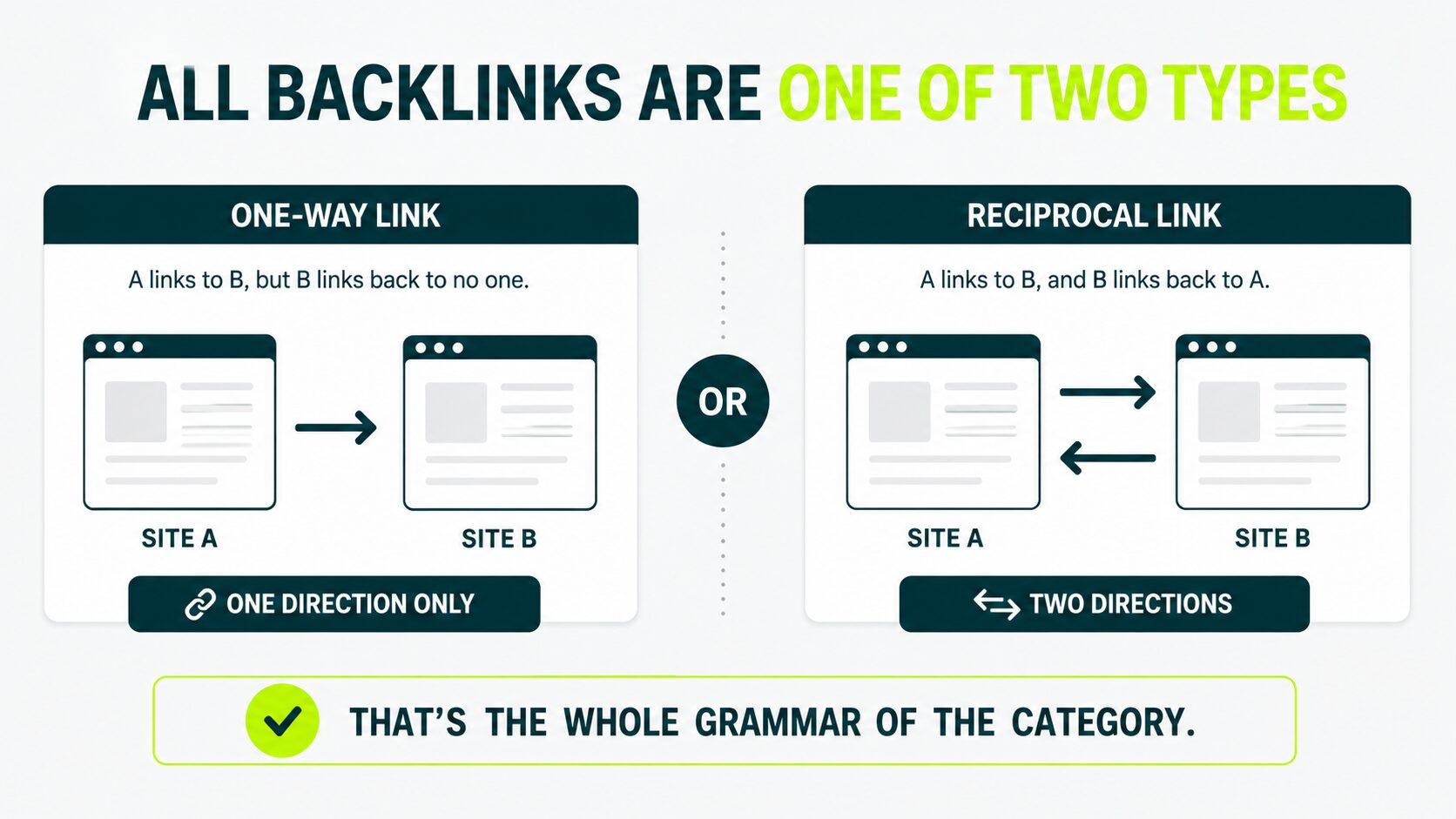
Backlinks fall into one of two camps.
Either both sides link to each other, which is called a reciprocal link, or only one side links to the other, which is a one-way link.
One-way links built through genuine editorial outreach don’t have an expiry date. That’s the practical difference.
Reciprocal links lost their value more than a decade ago, when Google started treating link-for-link swaps as a manipulation pattern. The case against link exchange today is even stronger because AI search has added another layer of scrutiny on unnatural link patterns.
What a One Way Link Building Service Actually Does
A one way link building service earns backlinks that point to your website from third-party sites, with no obligation for you to link back.
The provider handles the full chain:
- Finding relevant sites
- Pitching editors
- Creating the content or asset that justifies the link
- Securing the placement
- Reporting
Here, you’re buying the labor and relationships that produce a link a real publisher chose to keep live.
Think of a one-way link as a letter of recommendation.
Someone vouches for you to their audience, on their own letterhead, without asking you to write one back. The value comes precisely because it’s unprompted.
The Five Things a Real Service Owns
A credible provider takes responsibility for the entire link acquisition process, not a slice of it. Each stage below is work you would otherwise do in-house.
Stage 1: Finding the right sites
Before a single outreach email goes out , the service needs to identify which websites are actually worth linking to. Not every website with a high score in an SEO tool is worth targeting.
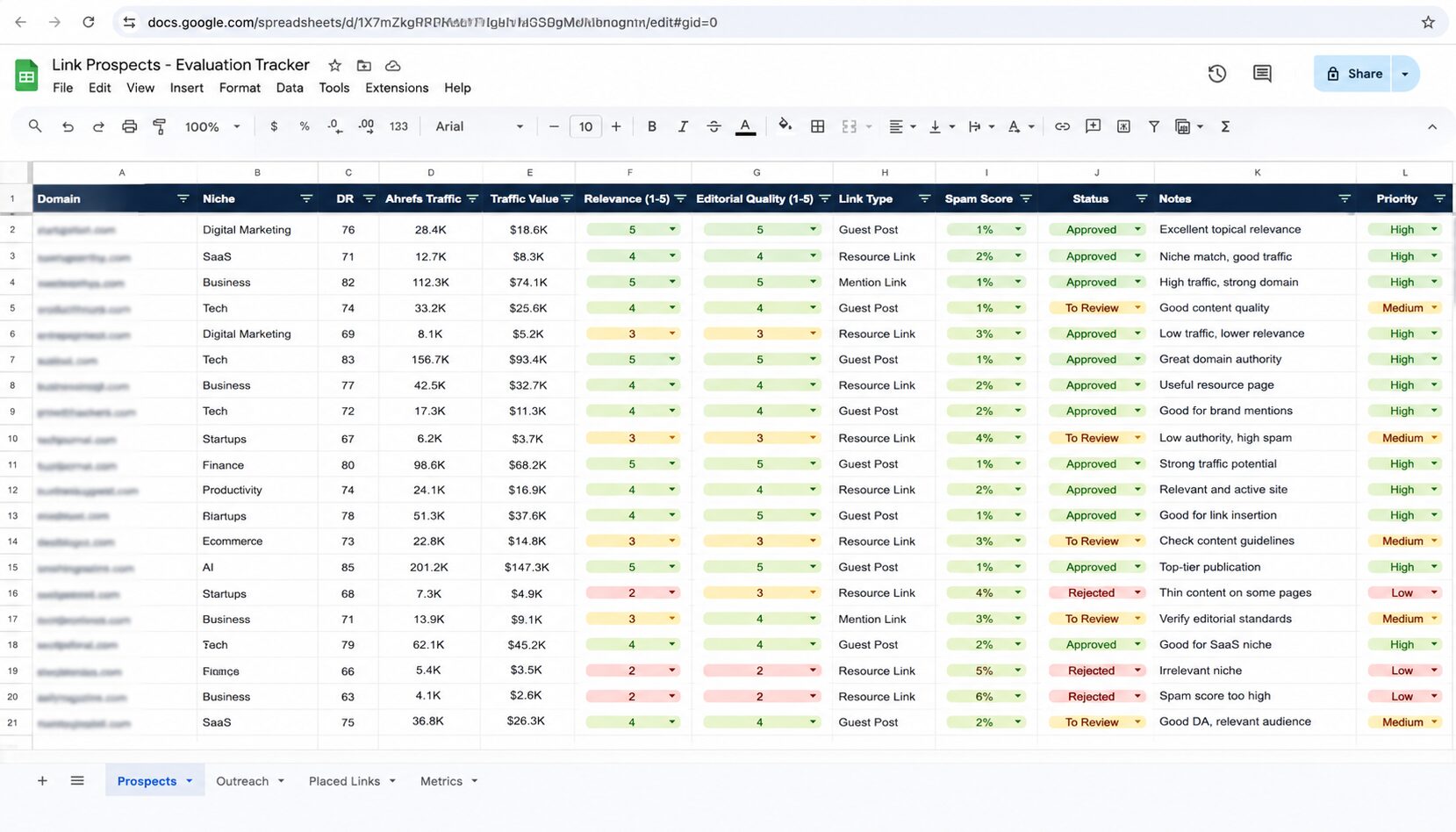
Download the free link prospect evaluation tracker.
(This is the publisher qualification sheet we use before outreach begins. Every site is screened for relevance, traffic quality, editorial standards, and spam risk. We spend outreach efforts only on websites that can realistically move rankings.)
A site that looks authoritative in tools but has no real readership passes almost no value to yours. The best services filter by real traffic, genuine editorial standards, and relevance to your topic.
Stage 2: Pitching the editor
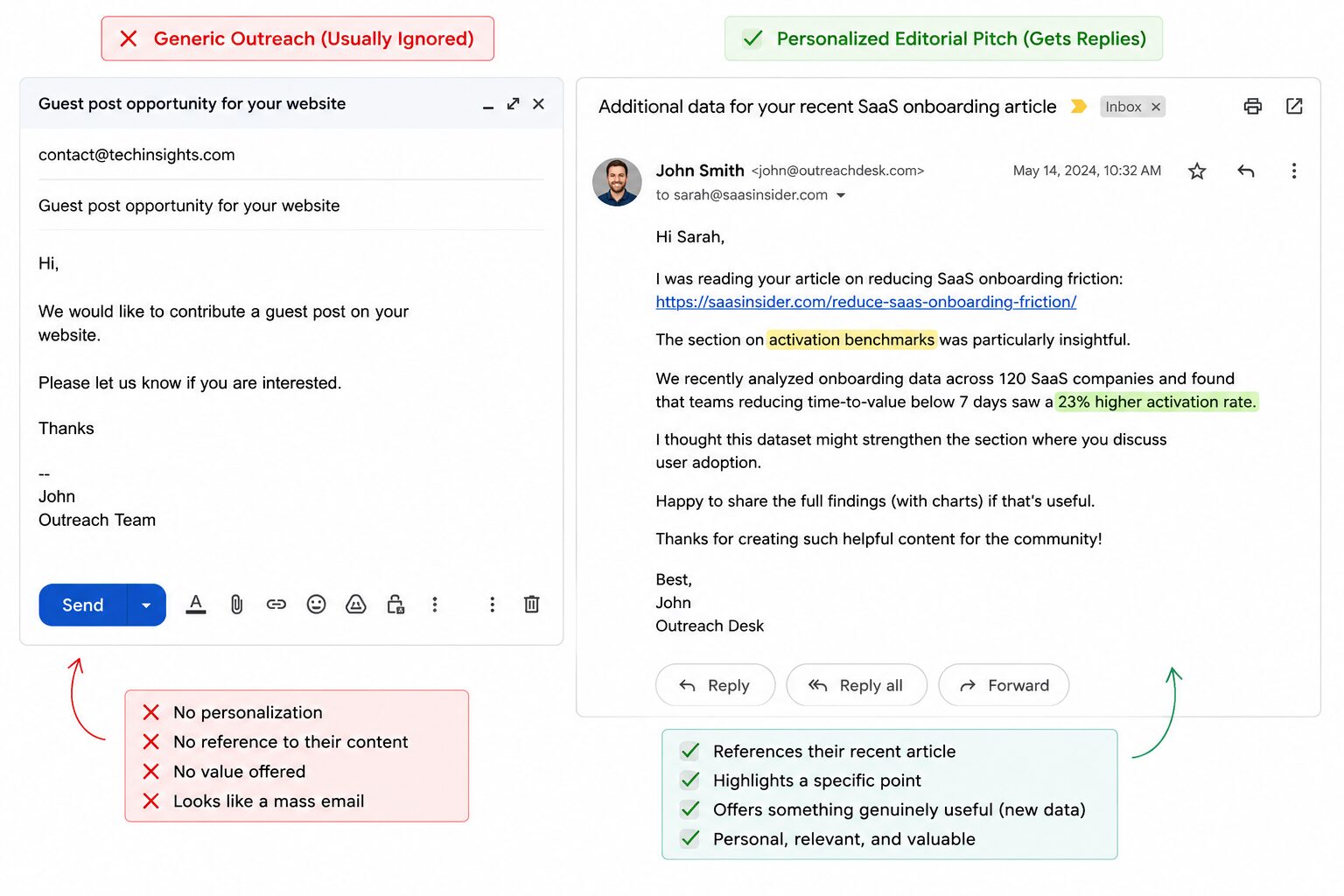
Getting a real publisher to link to your page requires a pitch that gives them a specific reason to say yes: a personalized email that references something genuinely useful.
Generic blasts get ignored.
The reply rate climbs when the pitch references a specific article on the target site. And when it offers something the editor actually wants. It could be a better resource, fresh data, or a fixed broken link.
Stage 3: Creating content worth publishing
Content creation is the article, guest post, or link worthy asset that carries your link and gives the host site a reason to publish.
A one-way link almost always rides inside content. If the provider doesn’t write to the publisher’s standard, the placement stalls or is later stripped.
Stage 4: Placing and verifying the link
Placement is the moment the link goes live, and verification confirms it’s a real, followed, indexed link on the page you were promised.
A link that isn’t indexed passes close to nothing, so verification is the proof you paid for.
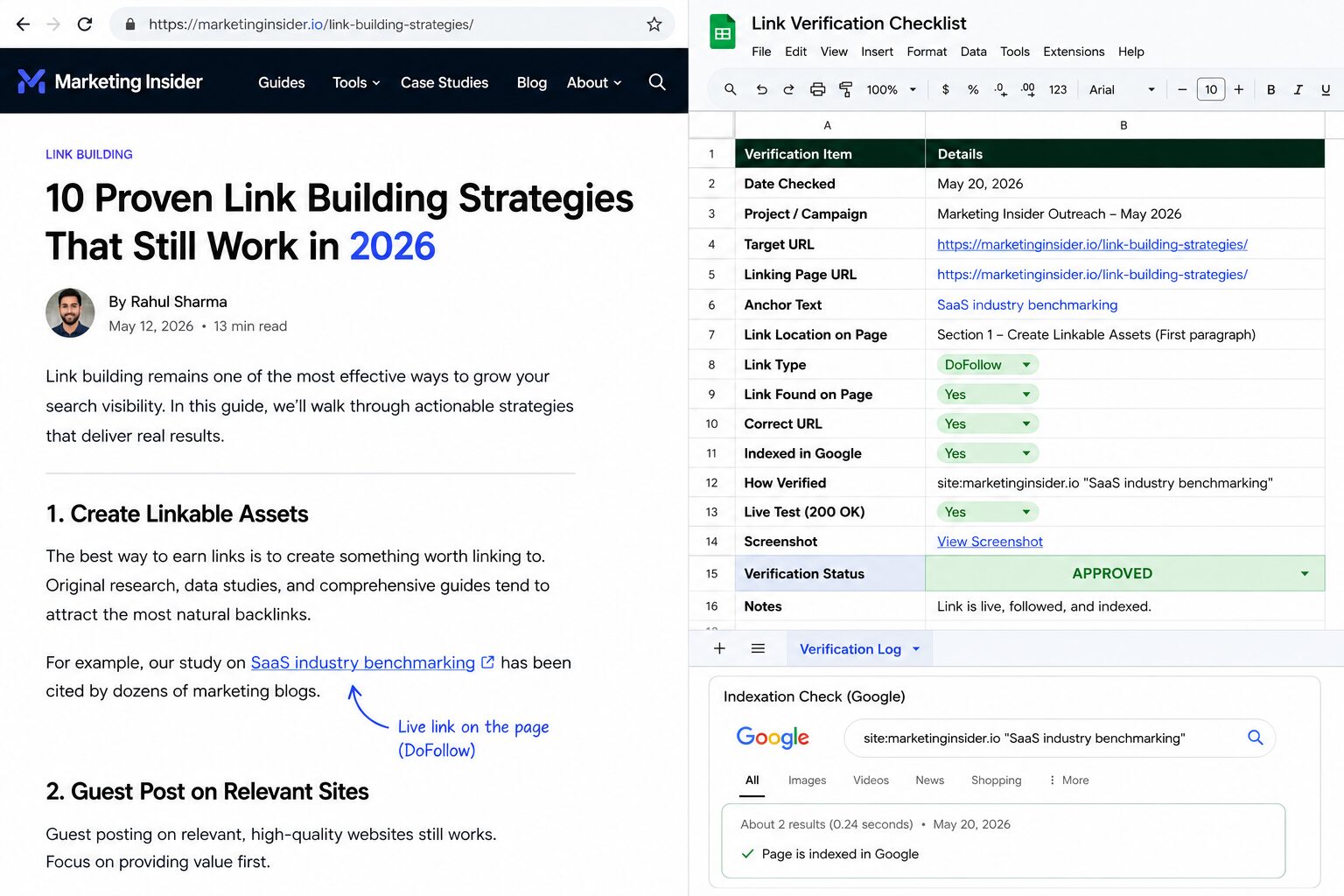
(This image shows how we verify a placed link after it goes live, checking the URL, anchor text, follow status, and indexation. It helps readers see that placement alone is not enough; the link has to be confirmed before it counts.)
We’ve also created a free backlink monitoring tool, to help you monitor backlinks and verify live placements on referring pages.
Stage 5: Reporting
Reporting is the record of what was placed, where, with what anchor text, and what it’s doing. Without it, you can’t tell a $400 editorial placement from a $4 directory drop. Transparent reporting is the difference between a partner and a black box.
Why One-way Links Beat the Reciprocal Swap You Keep Getting Offered
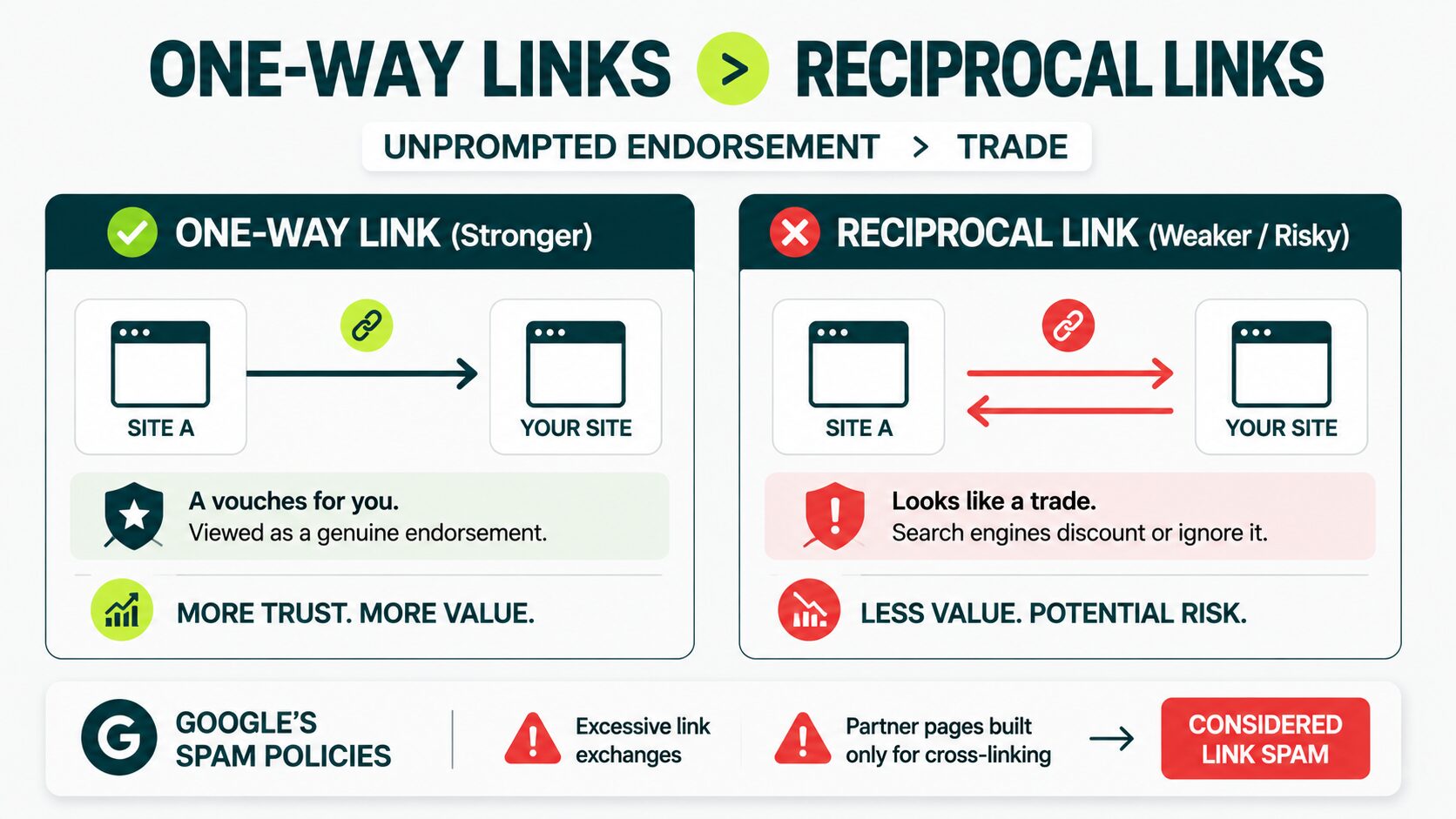
One-way links carry more ranking weight than reciprocal links. Search engines treat an unprompted endorsement as more credible than a link trade.
When Site A links to you and you don’t link back, the only reason for that link is that A found your page worth referencing. When you swap, the link could exist purely to manipulate rankings, and Google knows it.
This is not a gray area. Google’s own spam policies list excessive link exchanges and partner pages built only for cross-linking as examples of link spam. The systems are built to spot two sites that link to each other and discount the value accordingly.
So the reciprocal pitch in your inbox isn’t just lower-value. At volume, it’s a liability.
One-way Versus Reciprocal at a Glance
The two approaches look similar on the surface. They behave very differently once an algorithm evaluates them.
| Factor | One-way link | Reciprocal link |
|---|---|---|
| Direction | Site links to you, no link back | Both sites link to each other |
| How search engines read it | Independent endorsement | Possible manipulation, discounted |
| Effort to earn | Higher, requires real value | Low, just an agreement |
| Durability | Survives algorithm updates | Devalued as patterns are detected |
| Risk at volume | Low | Rises sharply past a natural ratio |
A small number of reciprocal links between genuinely related sites is normal and harmless. But the danger starts when swapping becomes your strategy, because that’s the footprint Google’s pattern detection is designed to catch.
The Disguised Version to Watch For
The trap most buyers miss is the reciprocal scheme dressed up as a one-way service.
Three-way and four-way “exchange networks” route links through intermediary sites so the trade isn’t obvious.
You link to B, B links to C, C links to you. It’s still an exchange. The extra hop doesn’t fool the network analysis; it just adds sites to the pattern.
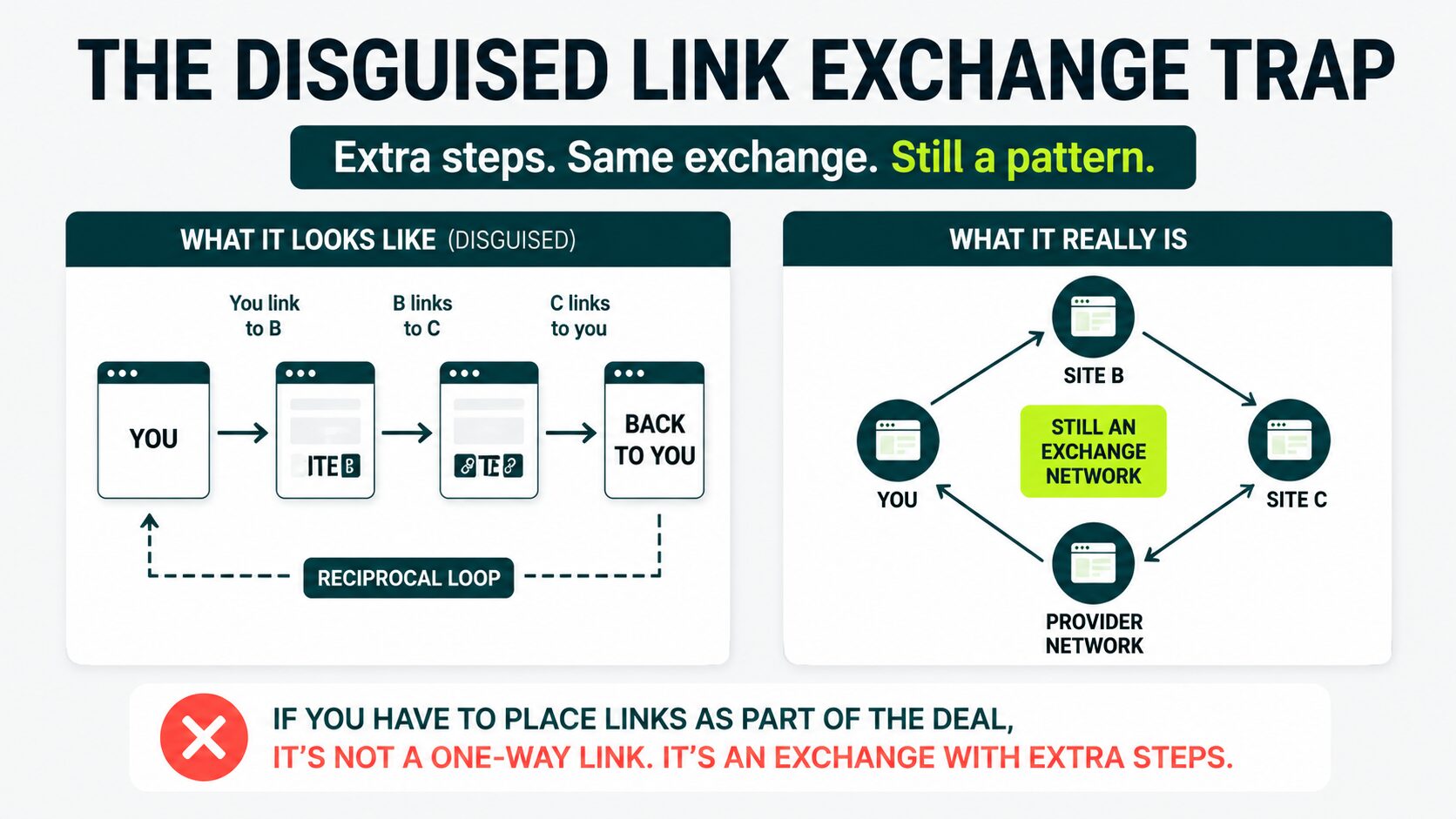
If a provider’s model depends on you placing links from your own site as part of the deal, you’re buying an exchange with extra steps, rather than buying one-way links.
Why Search Engines Treat One-Way Links as the Real Currency
One-way links earn more ranking weight because no algorithm can manufacture an unprompted endorsement.
A reciprocal link is easy to spot in a database.
Site A links to Site B, and Site B links back. Run a query, and you’ll see
thousands of those pairs in seconds. That pattern looks like two webmasters trading favors, which is exactly what it is.
A one-way link is different. Someone, somewhere, decided your page was worth pointing readers to without expecting anything in return. That’s a recommendation a database can’t manufacture, which is why search engines treat it as a foundation of trust.
If you’re new to how backlinks count as votes of confidence in the first place, the mechanics behind backlinks cover the basics.
Why This Gap Has Widened in 2026
In 2026, the gap has widened because AI Overviews (the AI-generated answer boxes Google shows) now show at the top of many searches. They look at the same kinds of links search engines have always trusted.
The sites cited in those AI answers are the ones with credible editorial links pointing to them. Your competitors aren’t appearing there by accident. They’ve been accumulating those endorsements while you’ve been invisible.
A BuzzStream survey of digital PR practitioners in 2026 found that 85.8 percent named link building as the most effective use of their efforts. If you’re doing this work, you’ve noticed the same shift.
AI tools made content production cheaper and faster than ever. The reason is simple: when everyone can produce content, the link pointing to that content becomes the differentiator Google still can’t ignore.
The Five Categories of One-Way Link a Service Can Deliver
One-way link services produce links in five common shapes. Each one is technically “one-way,” but they vary widely in editorial value, durability, and price.
Guest Posts
A guest post is an article you write, or your service writes for you, that gets published on someone else’s website. The link back to your page sits inside the article. The link is one-way because the host site never needs to link back.
The editorial value depends on the host. A strategic guest post on a respected industry publication is one of the strongest types of one-way link a service can produce. A guest post on a low-traffic blog that accepts almost any submission is barely worth the time it took to write.
Most paid services lean on guest posts because they’re predictable to deliver contextual link placements in real publications.
Niche Edits (Link Insertions)
A niche edit is a link added inside an article that’s already published, without any new writing. The service reaches out to the site owner and finds an existing post that is a good fit. It then asks for a link to be inserted into that post.
Niche edits are faster to land than guest posts because no new article has to be written. They also carry the most risk. A real niche edit on a real publication is excellent. A “niche edit” on a private-network site dressed up to look like a publication is exactly the pattern that Google penalizes.
Resource Page Links
A resource page is a curated list on someone else’s site that points to useful pages elsewhere. A one-way link from a resource page is a recommendation embedded inside a list of recommendations.
These work best for content that’s genuinely a reference asset, like a tool, a free template, or a long-form guide. They don’t work well for product pages or pure commercial landing pages.
Digital PR Mentions
Digital PR, or digital public relations, is the practice of pitching journalists with a story, a data point, or expert commentary. The goal is to be quoted with a link inside the resulting article. It’s the closest thing to “earning” a link, because the writer chose to include you.
Digital PR placements on real publications carry the most weight per link. That weight increases when the surrounding article is widely read or later cited. They are also the slowest and most expensive type of one-way link to produce at scale.
Citation and Directory Links
A citation link is a listing in a directory, local business listing, or industry roundup that links to your site. Most are free, and most are also low value.
A handful are worth chasing. The chamber of commerce site for your city. A respected industry association directory. Your accreditation body. The rest, the generic “free SEO directories” you’ll see promoted on YouTube, are not worth the time it takes to fill out the forms.
What Separates a Real One-Way Link Service From a Packaged-Placement Broker
A real one-way link service earns the link editorially. A broker sells you a placement that was bought, traded, or pre-built on a network the broker controls.
Both technically deliver a “one-way” link. Only one of them is worth your money.
Run these five signals in any sales conversation to separate the two.
| Signal | Real editorial service | Packaged-placement broker |
|---|---|---|
| How the publisher was found | Outreach to a real journalist or editor who runs the site | Pulled from a list of sites that already accept paid placements |
| Why is the link going up | The content earned its slot in a story or article | A fee was paid for a slot that exists for paid links |
| What the surrounding article looks like | Written by a real writer with a name, byline, and recent work | Generic 600-word filler with thin context and no author |
| Whether the site has real traffic | Visible in Ahrefs or Semrush organic traffic estimates | The site has thin or fluctuating traffic, often inflated by tactics |
| What the agency will show you upfront | Three live samples on real publications, with names | Promises samples after payment, with vague references to a private network |
The “high authority” shorthand you’ll hear is a score called Domain Rating, or DR. Ahrefs publishes a score from 0 to 100 to estimate a site’s overall link strength.
Higher is better in theory. In practice, a DR 65 site with no real readers is worth less than a DR 35 site read by 50,000 people in your industry every month.
Outreach Desk’s view is plain.
The category sold as “one-way link building service” is honest only when the underlying work is editorial outreach.
Walk away from any agency that promises a private network, guaranteed placements on named sites, or an impossibly fast turnaround.
That’s the difference between white-hat link building strategies and the kind of placements Google has been penalizing for years. The first builds value over time. The second can erase it.
If you’re hiring a service that does its work manually rather than through a network, you’re hiring an operation built on link-earning. Not pre-built placements. The visible signal is placements that take weeks per link, not days.
Pricing Reality: What One-Way Links Cost in 2026 (And What Should Make You Walk Away)
Most real one-way links cost between $200 and $800 each, depending on the publication’s quality and the type of placement.
Typical Price Bands and What They Buy
| Price band | What it usually buys | Reality check |
|---|---|---|
| Under $100 per link | A private network placement, a free directory listing, or an auto-generated profile link | The link exists, but Google won’t treat it like a real recommendation. Most won’t survive a Google update. |
| $100 to $200 per link | A guest post on a low-traffic blog or a niche edit on a small site | The link is real and indexed, but the site isn’t a strong match for your topic. |
| $200 to $500 per link | A guest post or niche edit on a real publication with traffic and an editorial process | Most legitimate agency work lives here. Quality varies. |
| $500 to $1,500 per link | A digital PR placement on a recognized publication, or a guest post on a top-tier industry site | Each link is genuinely earned. Slower to deliver but harder for Google to discount. |
| Over $1,500 per link | A placement inside a major publication’s editorial article through a relationship-based pitch | Worth the price only for brands competing on high-stakes commercial keywords. |
For the full picture across all link types, our link building pricing breakdown walks through what services charge at each stage of a campaign.
Three Pricing Signals That Should Make You Walk Away
The first is sub-$100 per link with promises of high authority. The math doesn’t work.
A single editorial outreach pitch takes 30 to 60 minutes of skilled, manual labor. The placement needs follow-up after that.
No legitimate service delivers a real editorial link for $100.
The second is a flat monthly rate that includes a fixed number of “high-DR” links with no upfront sample placements. That structure is the signature of a service running on a private network.
The third is any guarantee of placement on a specific publication. Real editorial outreach has a hit rate. The pitch can get rejected. A service that guarantees a specific outcome has almost always pre-bought the slot.
Should You Hire a One-Way Link Service, or Do This First?
Whether to hire a one-way link service depends on whether your site has something worth linking to yet.
Hire a Service If All Three Apply
- Your site has 3 to 5 published pages that genuinely answer the questions real customers ask you.
- You can name the specific goal the links should hit, such as ranking for two keywords or pulling 200 monthly organic sessions.
- You have a budget of $1,500 to $3,000 per month and the patience to wait 3 to 6 months for results.
Wait If Any of These Applies
- Your homepage is the only real page on the site, or your blog has fewer than 3 posts of any depth.
- You can’t name the specific page the links should point to, or the keyword that page should rank for.
- Your available budget is under $1,000 a month, below the price floor of any legitimate one-way service.
If you’re in the “wait” camp, here’s the order that pays off before you spend a dollar on links.
- Publish three pages that genuinely answer the questions your customers ask, because real content is what a link points to.
- Set up Google Search Console, free, to track which keywords your pages start ranking for and build your measurement baseline.
- Find two competitors who outrank you, then study which of their pages attract the most links to learn the page shapes worth copying.
For the broader hire-or-DIY decision across all kinds of link work, when to outsource link building is discussed in detail.
The Buyer’s Five-Check Verification Framework
Five checks are enough to pressure-test any one way link building service in about 30 minutes.
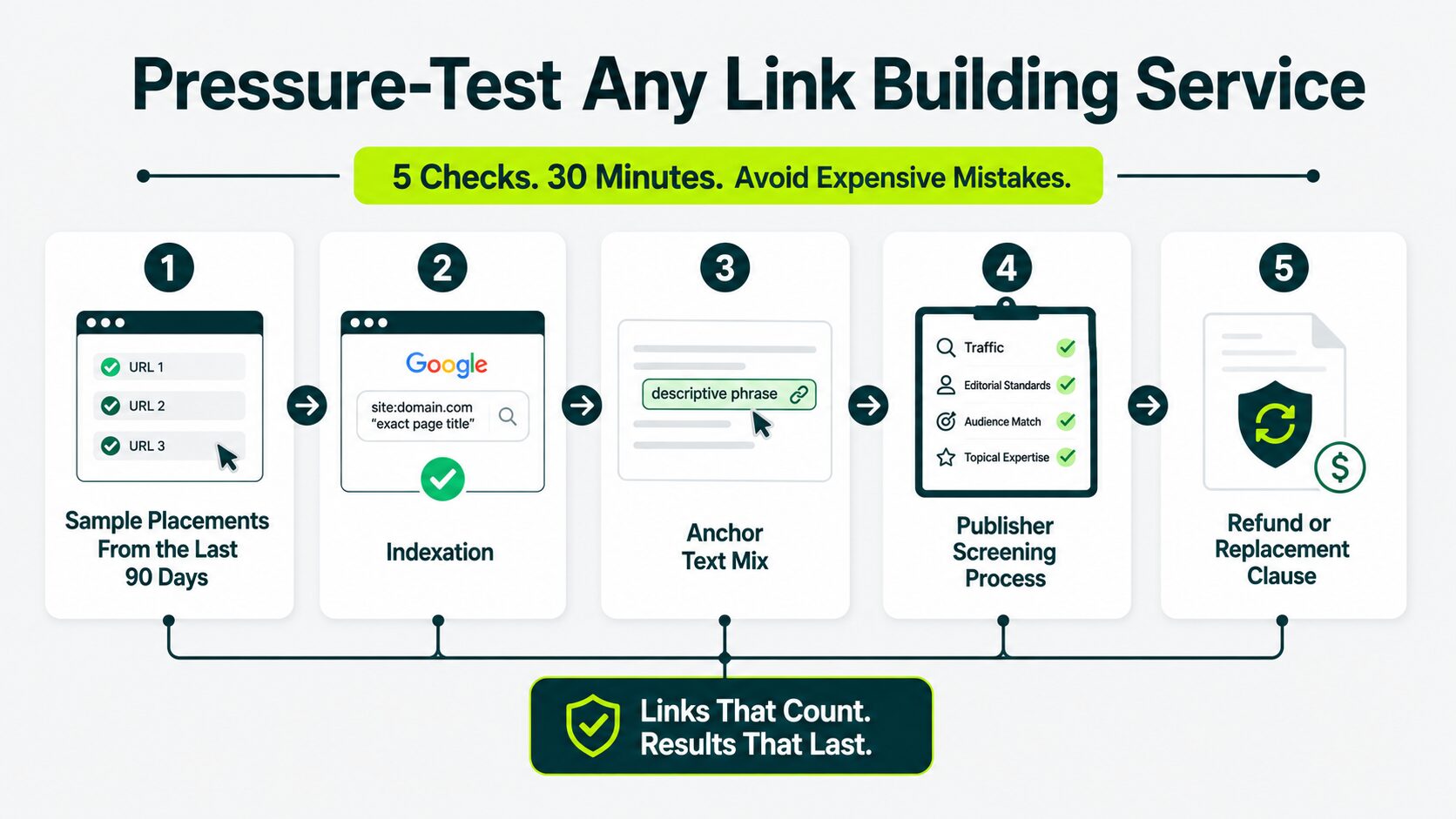
1. Sample Placements From the Last 90 Days
Ask the agency for three live samples of links they delivered in the past 90 days, with the live URLs.
If the answer is anything other than “here are three URLs,” walk away. Real agencies have a portfolio. A service that asks you to pay first and see results later is asking you to take all the risk.
When you have the URLs, click each one.
The link should still be live. The surrounding content should be a real article with a real author. The publication should not be a generic blog where every post looks the same.
2. Indexation
Copy each sample URL into Google Search or run them through a page index checker to confirm they appear in results.
If a page doesn’t show up, Google has either dropped it from the index or never indexed it in the first place. A link on an unindexed page passes no value, no matter what the agency promises about DR.
Run this check on all three samples. If one of them fails, that’s a flag, not a deal-breaker. If two or three fail, the agency is selling links that mostly don’t count.
3. Anchor Text Mix
Anchor text is the clickable phrase the link sits on. Look at the anchor text on each of the three samples.
A real editorial link almost never uses exact-match commercial anchors like “best running shoes for women” or “buy crypto wallet now.” Real editors use brand mentions, partial matches, or descriptive phrases that fit the sentence they wrote.
If every sample anchor is a commercial keyword, the placements are not editorial. They’re paid slots dressed up as articles, and they look like a paid link scheme to anyone reviewing the site’s backlinks, including Google.
4. Publisher Screening Process
Ask the agency what their criteria are for adding a publisher to their network or outreach list. The answer should mention real signals like organic traffic, editorial standards, audience match, or genuine expertise in your industry.
If the answer is a list of vague positives (“we work with high-quality sites” or “we only target authoritative publishers”), the agency doesn’t have a real screen.
Real screens have specific thresholds and specific disqualifiers.
The best agencies will name disqualifiers without prompting. Sites with thin author bios. Sites with sudden recent traffic growth from unexplained sources. Sites running multiple paid posts a week.
5. Refund or Replacement Clause
Read the contract or proposal for what happens if a link gets removed within 90 days of placement.
A real editorial link is durable. Editors don’t pull a link they chose to add. But links on weaker publishers do get pulled, sometimes during cleanup audits or when the publisher changes hands.
A real service replaces removed links inside a defined window, or refunds the link. A service with no replacement clause is selling a placement they expect not to survive.
If a service fails two or more times, the work isn’t editorial. Walk away.
One-Way Link Building Is a Strategy. Use it the Right Way
A one way link building service helps you earn backlinks from relevant websites without linking back in return.
The strongest campaigns focus on relevance, editorial quality, and trusted websites rather than volume alone. When links come from sources that are closely aligned with your industry and audience, they contribute more to authority, visibility, and sustainable organic growth.
Whether you’re building authority in a competitive niche or strengthening an existing backlink profile, a one way link building service provides a structured way to earn the kinds of backlinks that continue delivering value long after they’re acquired.
Looking to build authority through genuine one-way backlinks?
Get a strategy focused on securing relevant editorial backlinks that support long-term rankings and visibility.
Are one-way links better than reciprocal links for SEO?
Yes. Reciprocal links have been discounted by search engines as a manipulation pattern for more than a decade. One-way editorial links remain the strongest backlink signal Google uses.
A reciprocal link can still appear naturally on your site without causing any harm. No one should plan link building around link swaps in 2026.
Is one-way link building safe for SEO?
Editorial one-way link building is safe and is what search engines actively reward. The risk lies in the difference between editorial outreach and paid placements on private networks.
Editorial outreach means a real publisher chose to link to your page. A paid placement means the agency bought a slot on a site they control. The first kind is durable. The second is the pattern Google has been penalizing for years.
Can I build one-way links myself instead of hiring a service?
Yes, and many year-one businesses should. The honest tradeoff is that high-quality manual outreach takes 5 to 10 hours per published link. That is most of a workweek if you want one link every seven days.
If your time is worth $200 to $500 an hour or more, working with a professional link building team usually makes sense . If it isn’t yet, do the work yourself for 6 to 12 months while you build the rest of the business.
How long does it take to see results from a one-way link service?
Most campaigns show measurable ranking movement in 3 to 6 months of steady placements. If a service promises a significant ranking change within 30 days, the placements are almost always low-quality, indexed temporarily, or both. Editorial outreach has a long arc by design.