
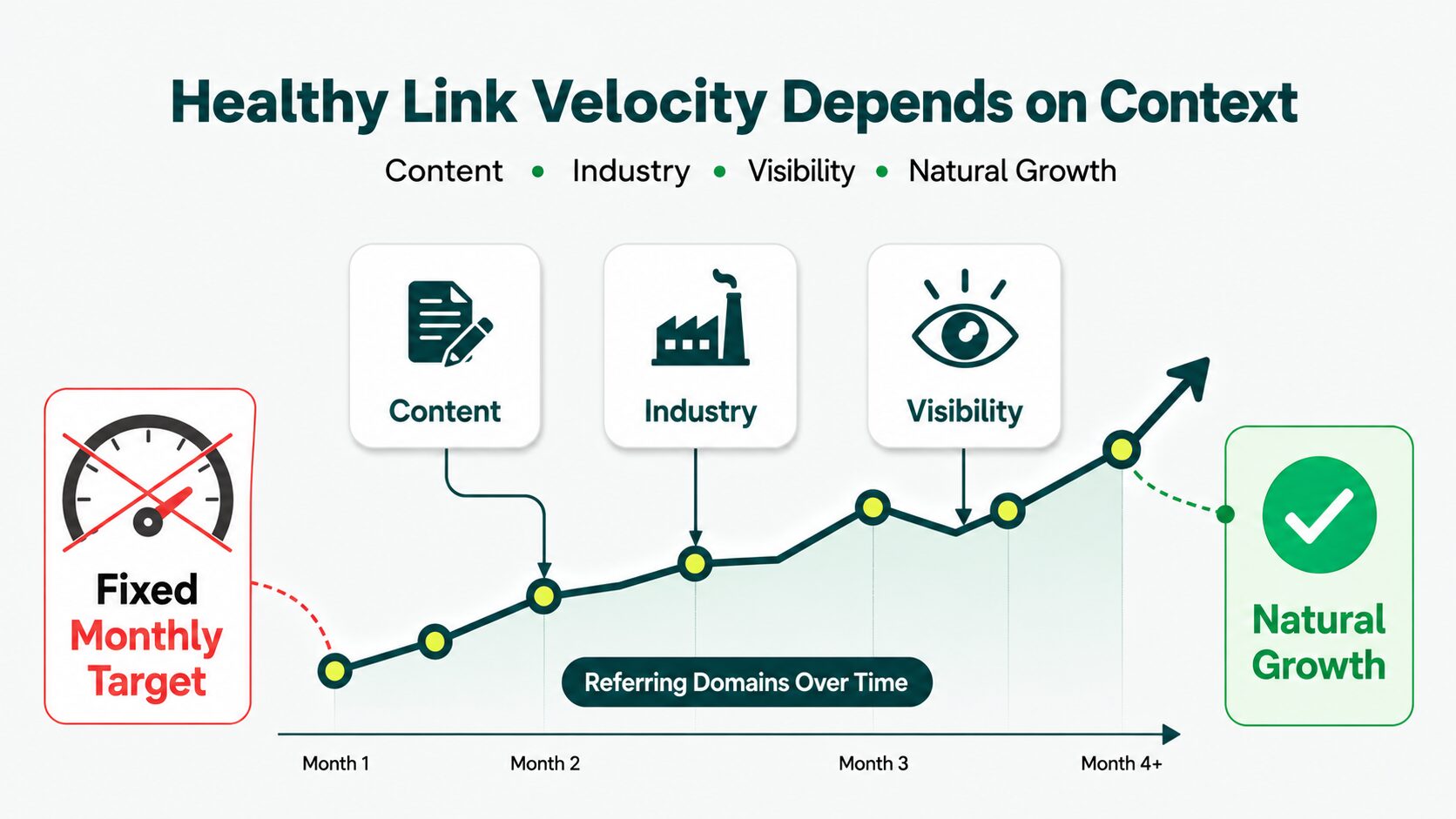
There is no universal “safe” link velocity because Google expects backlink growth to reflect genuine popularity rather than a fixed monthly target.
Link velocity is the rate at which your site gains or loses referring domains over time. A healthy pace depends on your content, industry, and visibility. It’s not a signal Google publishes a threshold for, but the pace of your backlink growth is something Google’s system reads.
Understanding the context helps you build links naturally without chasing just numbers or fearing every sudden spike.
What You’ll Learn
- Why link velocity matters more as a pattern than fixed quota.
- How positive and negative link velocity shape long-term SEO health.
- How backlink growth patterns can appear artificial or manipulative to Google.
- How to measure and monitor link velocity using free SEO tools.
- How to determine the right link building pace for new, growing, and established sites.
Backlinks Tell a Story: Link Velocity Is the Pacing
Every backlink your site earns is a data point in a pattern. Google’s systems don’t just count those points. They read the pattern’s shape over time.
Imagine a heartbeat monitor; it doesn’t just count your heartbeats, but it reads the rhythm.
Your backlink growth pattern works the same way. A steady rhythm makes sense, but a sudden spike after a long flatline raises concerns.
Before we move ahead, here’s the exact formula for calculating link velocity. It’s a simple ratio, but the number only means something once you see it against your site’s usual pace:
How to Calculate Link Velocity
Link Velocity = Number of New Backlinks ÷ Time Period
Imagine that your website usually earns 5 to 10 backlinks each month. Then one of your guides goes viral and naturally earns 80 backlinks from relevant blogs and new sites within a week.
That spike can look normal because people had a real reason to link to your content. If the same 80 links came from unrelated websites with no clear trigger, the growth would look much less natural.
This is the reason why link velocity matters. It’s not a number you optimize in isolation. It’s the pace at which your backlink count grows or shrinks, read against the context of your site’s history.
Understanding the story your profile tells starts with looking at your backlink profile as a whole.
Is Link Velocity a Ranking Factor?
No, Google has never officially confirmed link velocity as a direct ranking factor or published a “safe” number of backlinks a site should gain each month.
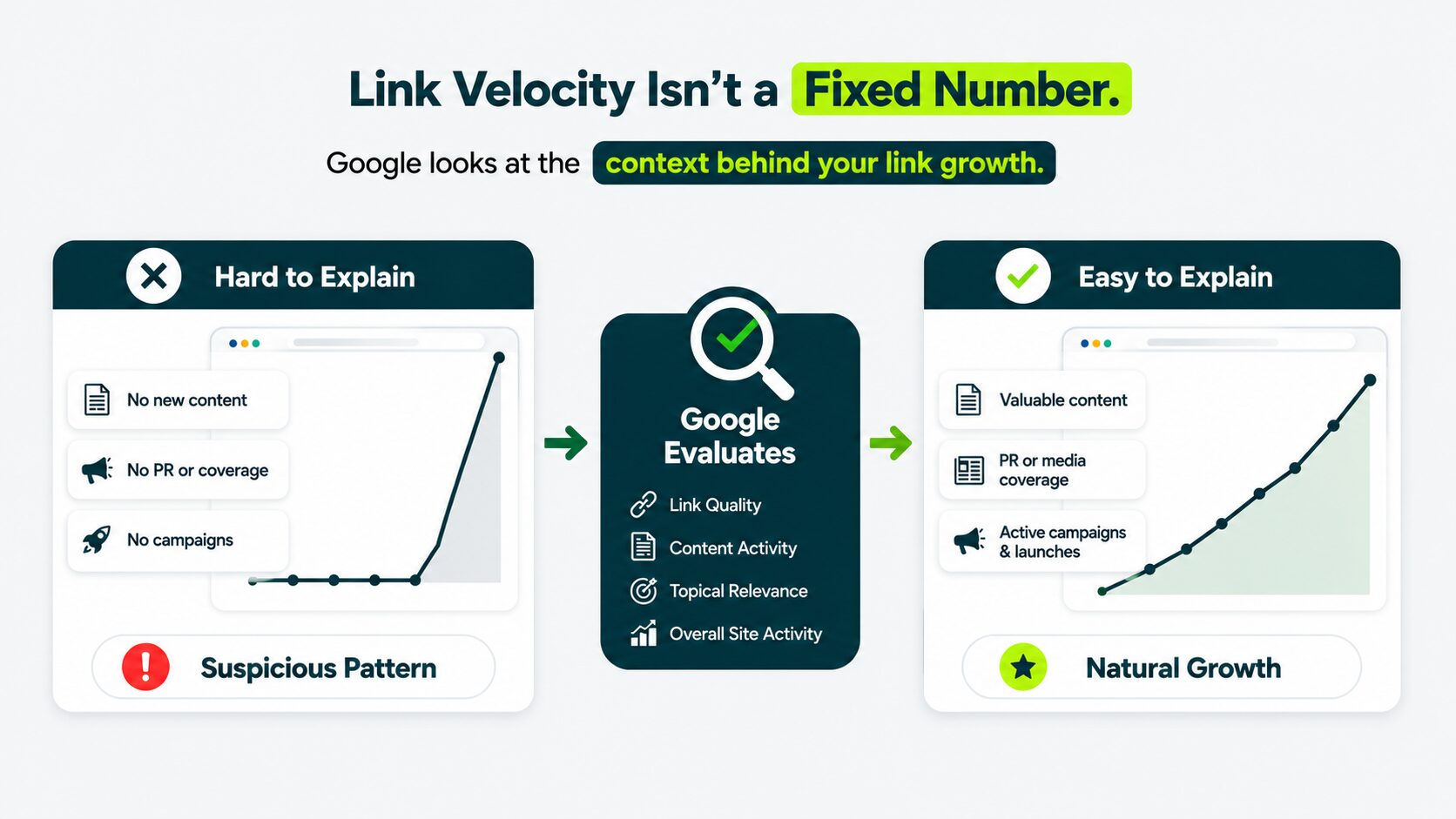
Google’s system evaluates whether your backlink profile appears to be a natural result of your marketing, content, and brand activity. A sudden increase in referring domains isn’t automatically a problem.
If your company launches a widely shared study, earns media coverage, or publishes content that attracts attention, you can expect rapid backlink growth.
Unexplained spikes can also raise concerns. A site that gains hundreds of links overnight without publishing new content, product launches, press coverage, or any other obvious reason creates a pattern that’s hard to explain.
The context behind the growth provides the clearest measure of long-term success.
Link velocity works as supporting evidence for a healthy link acquisition strategy, rather than a ranking signal itself. Google doesn’t reward or penalize a specific acquisition rate.
Instead, it evaluates backlink growth along with other signals, including content freshness, topical relevance, link quality, and overall site activity.
That’s why there isn’t a universal “good” link velocity. A local business publishing one article a month and a well-known SaaS company launching multiple campaigns each quarter will naturally earn backlinks at different rates.
The goal isn’t to hit a specific number; it’s to build links at a pace your site’s activity can realistically support.
What Natural Backlink Growth Actually Looks Like
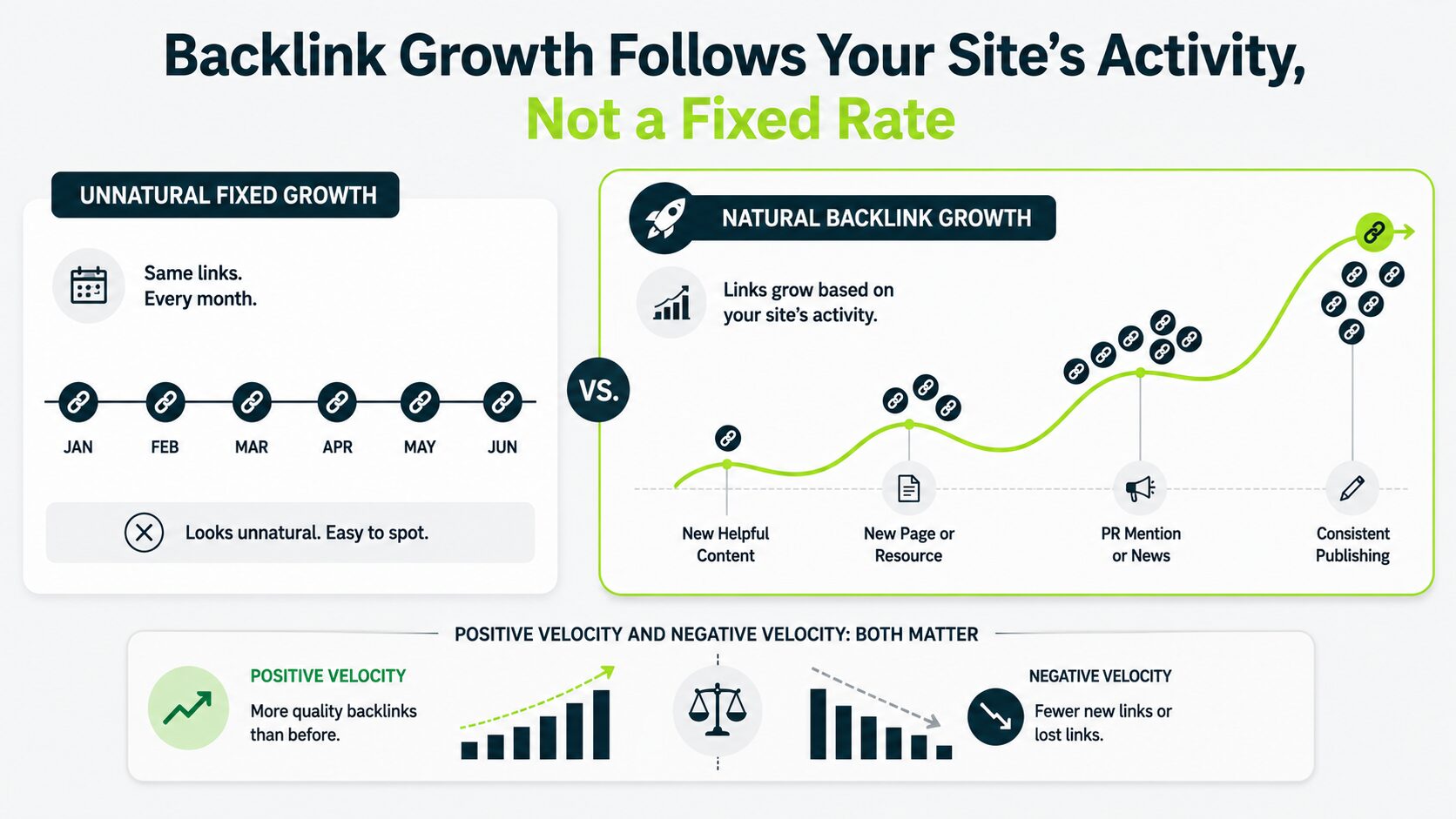
Natural backlink growth means other sites link to your site on their own without any payment, tricks, or begging. Natural backlink growth doesn’t follow a single fixed rate. It follows your site’s activity.
Positive Velocity and Negative Velocity: Both Matter
Gaining referring domains is only half the velocity picture. Losing them matters just as much as gaining them.
Positive velocity means your site is gaining referring domains over time. More sites point to you now than before. This steady growth shows that your content remains valuable to other websites and continues to earn editorial backlinks over time.
Suppose last month you had links from 50 websites and this month you have links from 60; your velocity is positive.
Negative velocity means you’re losing backlinks over time. Links disappear as Sites remove them, pages are deleted, domains expire, or website owners update their content.
Some natural loss is expected for any established site.
| LINK VELOCITY PATTERN | WHAT IT USUALLY INDICATES |
|---|---|
| Only positive growth | Continuous growth with no link loss can appear unusual. Most websites naturally lose some links over time as pages are removed, sites are redesigned, or domains expire. |
| Some negative velocity | A small amount of link loss is normal. Websites update content, remove older pages, and naturally create backlink churn. |
| Heavy negative velocity without replacement | A sustained decline in referring domains suggests your content is losing visibility, relevance, or citations while competitors continue earning links. |
| Sharp negative spike | A sudden drop deserves investigation. Check for major link removals, expired referring domains, site-wide changes on linking websites, or other technical and SEO issues affecting your backlink profile. |
What you’re watching for is the ratio. A site gaining 10 new referring domains a month while losing 2 is in healthy positive territory. A site losing 15 a month while gaining just 5 sounds like a problem.
Lost backlinks also drain link juice from your domain. Link juice is the ranking authority each backlink passes to your website.
A high link decay rate can counterbalance the value of new links you’re earning.
What is link decay?
Link decay is the gradual loss of backlinks that happens when site owners update or remove old content.
Keeping an eye on both sides of the equation is part of long-term link building discipline.
What Organic-Looking Growth Means If You Have No History Yet
If your site is less than six months old, you don’t have a history yet. That’s not a problem. It just means your natural pace looks different.
A new site with an active content program can earn 3 to 8 new referring domains in a month. That rate doesn’t look manufactured if your content gives people something to link to.
Industry benchmark data shows that referring domain growth varies by site type and niche. Judge early-stage sites against a realistic baseline rather than a fixed monthly target.
Your content sets the ceiling for what looks believable, so a site publishing two pieces a month will usually support a different outreach rhythm than one publishing weekly. When content and outreach move together, the pattern makes sense.
Patterns That Put Your Link Profile Under Scrutiny
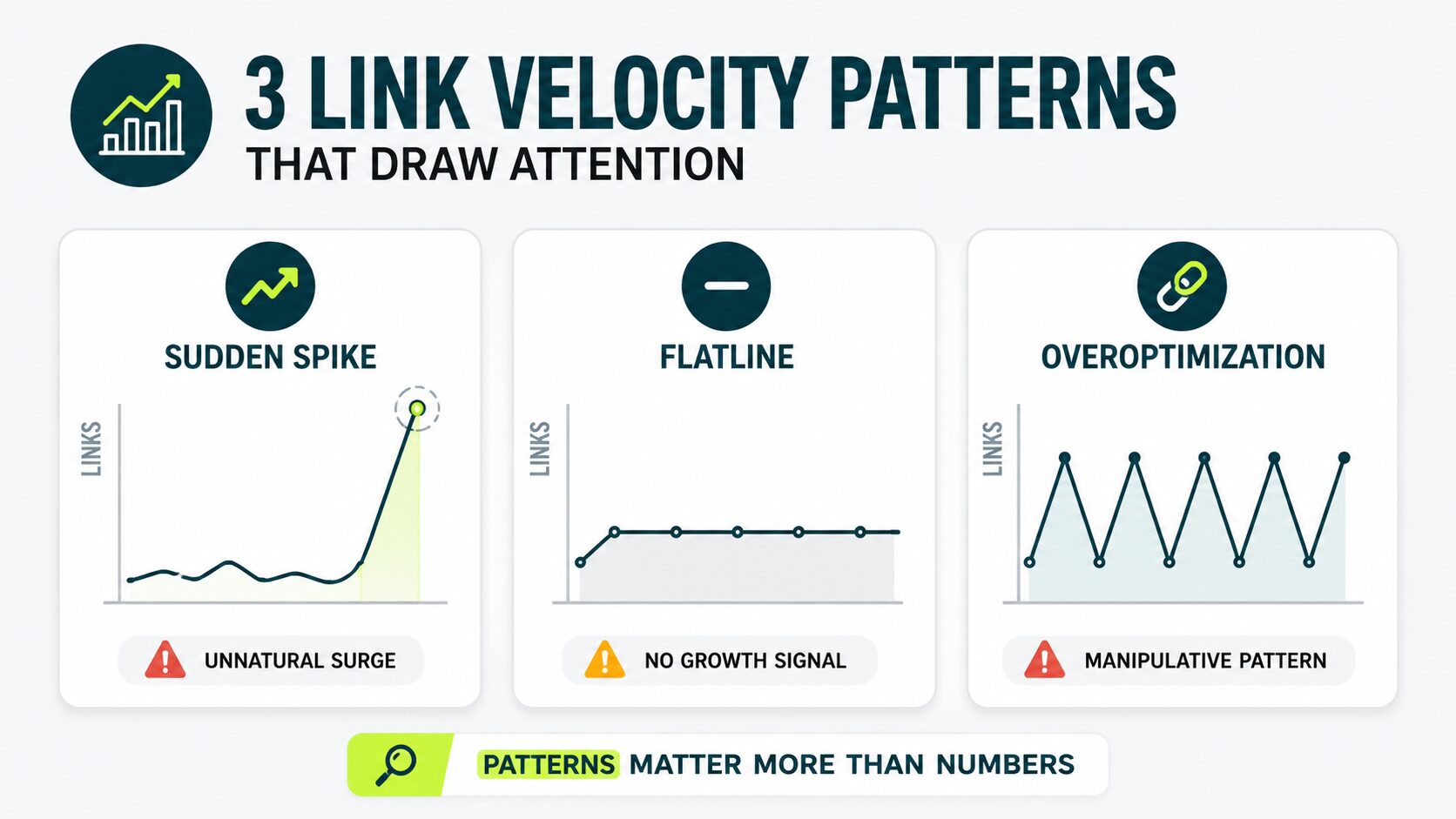
Some link velocity patterns draw attention regardless of your overall numbers. These three patterns like a sudden spike, flatline, and overoptimization are worth knowing.
A Sudden Spike With No Trigger
A spike occurs when your site gains many new backlinks in a short time without any clear reason.
Suppose a site has zero backlinks and then gains 500 links in a week with no viral post or news mention. An unexplained surge of that size can raise questions about how the links were acquired.
Google’s systems can cross-reference a spike against real-world events. A product launch, a viral tweet, a news mention, or a widely shared resource can all create spikes that have clear explanations.
A link spike caused by a paid package from a link seller has no explanation. There’s no event, no content, no editorial reason a stranger would link to your site 30 times in a week. That mismatch is what draws attention.
Anchor text, meaning the clickable words of a hyperlink (link), also tells part of the story. Organic link spikes tend to produce varied anchor text because different sites describe the same content in different ways.
Spikes in bulk purchases often show unusually uniform anchor text. That pattern makes a spike even more visible.
If you’re seeing a sudden spike you didn’t cause through legitimate work, that’s worth investigating. You may be looking at link farming activity targeting your site.
Another possibility is a negative SEO attack, in which a competitor deliberately directs spammy links to your domain to drag down your rankings.
Machine-Like Consistency
Perfect consistency is another pattern that raises questions.
A manual link building campaign doesn’t produce exactly 10 new backlinks every single week for 20 straight weeks.
Real campaigns have busy stretches and quiet ones. PR mentions spike and then fade. Outreach response rates vary month to month.
When a site gains links in a perfectly flat drip across months, it can suggest automation. Paid subscription link packages often create exactly that pattern. Neither is something you want on your record.
Link acquisition should follow real business activity instead of an arbitrary schedule.
Your backlink growth should reflect the pace of your actual marketing efforts. When you publish content, run campaigns, or do outreach, your link growth will naturally rise and fall. A perfectly steady stream of links does not always represent genuine activity.
The Sprint Followed by Silence
A sudden burst of backlinks followed by a complete stop in link acquisition can create an unusual growth pattern. Google notices a burst of links with no natural continuation or follow-on organic pickup and begins to question their authenticity.
It asks: if the content is really this good, why hasn’t anyone linked to it since the initial push? This pattern looks manufactured, like a one-off event rather than genuine, ongoing interest.
If your velocity drops to zero for an extended period, your link profile starts to look static. Static profiles can lose ranking ground even without losing actual links. Consistent activity is part of the signal.
In one of our campaigns, a client completed an aggressive three-month outreach push that earned around 45 new referring domains, then paused all link acquisition for the next five months.
Rankings initially improved, but organic visibility gradually plateaued, and several competitive keywords lost positions as competing sites continued earning new editorial links.
Once the client resumed consistent monthly outreach and content promotion, backlink growth stabilized, and rankings began to recover over the following few months.
The pattern looks somewhat like a site running a link building push, gaining 40 to 50 new domains in a few months, then stopping. Link acquisition drops to near zero. The graph peaks and then flatlines.
This is one of the common misconceptions about link building that holds many sites back. Many site owners treat getting links once and then stopping as a campaign completion.
It creates a pattern that looks like paid activity. Organic sites don’t sprint and stop. They build steadily, with faster and slower periods, but without full halts.
Google is suspicious of this because real, organic link growth doesn’t work that way. Genuine content keeps earning links over time.
How to Check Your Site’s Link Velocity
Checking link velocity means tracking how fast you gain or lose backlinks over time, and spotting patterns.
For this, you don’t need any paid software. There are two free tools: Ahrefs Free and Google Search Console (GSC), which give you enough to work with.
Ahrefs Webmaster Tools has a free version that shows your referring domain count over time. Analyze the graph for the past 12 months. You’ll see spikes, sudden drops, and the overall trend.
Quick Steps to Set Up Ahrefs Free
- ahrefs.com/webmaster-tools and create a free account
- Enter your domain
- Verify it through GSC: either it is a text record, an uploaded file, or a tag
- It takes some time to crawl
- In Site Explorer, search your domain in the top bar
- Go to the backlinks tab and in that New or Lost sub-tab track velocity
- Set the range to 7 days, 30 days, or custom and compare periods
- In the referring domain tab, check your unique domain growth
- Review the anchor tab for repetitive anchor text patterns
- Turn on alerts to auto-email for new or lost links
Google Search Console shows you the links Google has actually found and indexed.
- Go to the Links section in the left-hand menu.
- You’ll see your top linked pages and your top linking sites.
GSC doesn’t show a historical chart, but you can export the data monthly and track changes in a spreadsheet.
Run this three-item check every month:
| METRICS |
WHAT TO CHECK |
|---|---|
| Referring domain count |
Check whether it went up, down, or stayed flat compared to the last month. |
| Link decay check |
Are any previously active referring domains now showing zero links to you? |
| Anchor text scan | Does your new anchor text look varied, or are the same phrases repeating? |
During a link velocity audit, we first review the Referring Domains trend in Ahrefs Free. This helps us determine whether growth has been steady or whether there have been unusual spikes or long periods of inactivity.
From there, the team performs a link profile audit by reviewing recently acquired referring domains and anchor text patterns. The biggest red flags are abrupt backlink surges from low-quality sites, long stretches with no new referring domains, and clusters of identical exact-match anchor text.
Running this check monthly is the bare minimum for ongoing link profile monitoring.
Start Tracking Your Link Velocity With a Beginner-Friendly Tracker
Understanding link velocity is only the first step; tracking it consistently is what helps you identify trends and make informed SEO decisions over time.
To make that easier, we’ve created a beginner-friendly tracker you can download and use each month.
It includes automatic calculations, example entries, a simple health status indicator, and space to record your SEO activities, making it easy to monitor your backlink growth and put the concepts from this guide into practice.
Download the complete spreadsheet to start tracking your link velocity.
Matching Your Link Building Pace to Where Your Site Actually Is
Link building speed should match your site’s real age, size, and authority. Check whether your website falls under Brand-New Domains, Growing Sites, or Established Sites; the correct link velocity depends on where your site is in its lifecycle. There’s no rigid universal number.
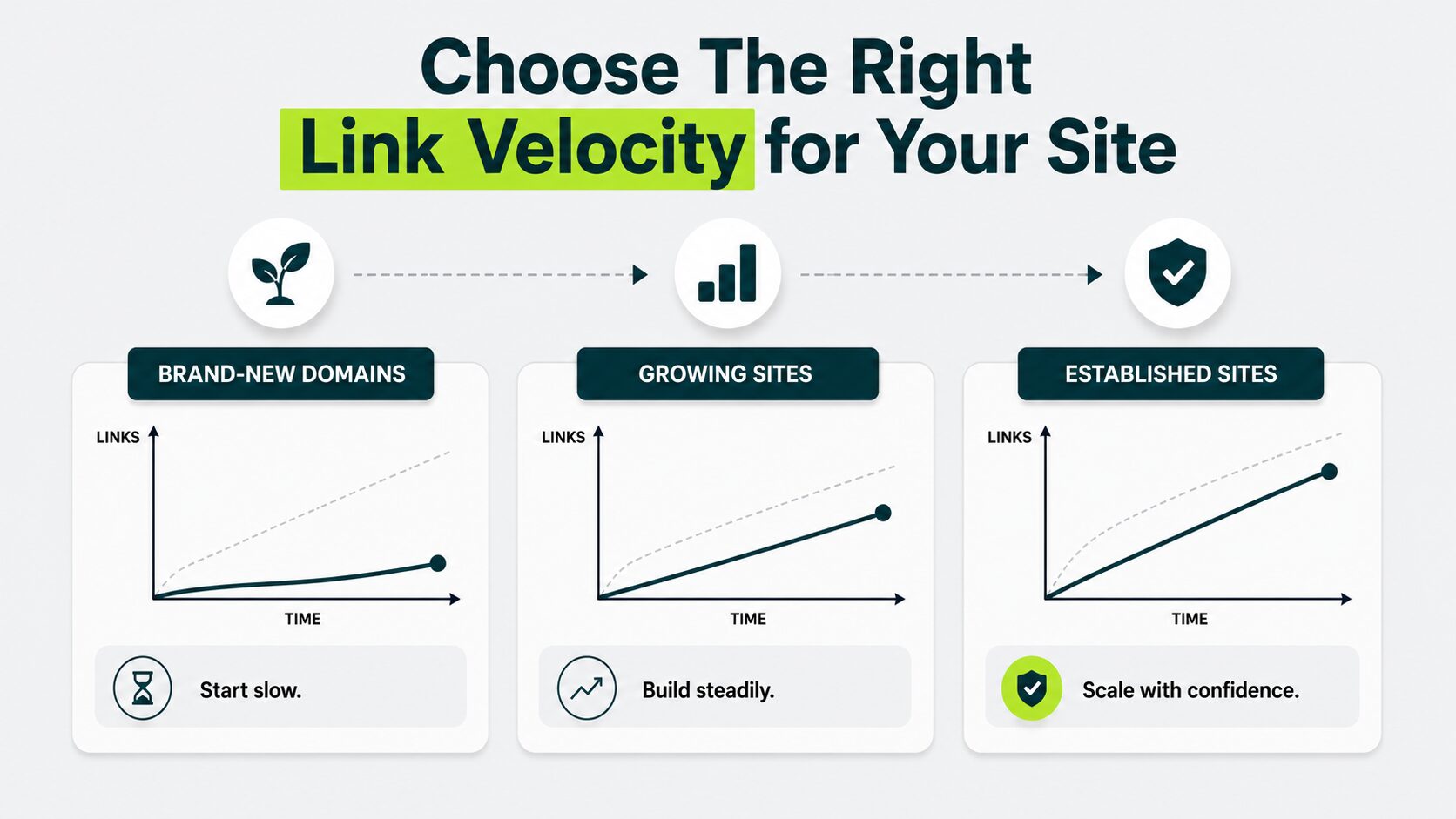
New sites, small sites, and low-quality sites don’t suddenly get hundreds of links. It looks fake and Google flags it immediately. Big, established, and high-quality sites can handle fast growth, because it is natural for them.
Brand-New Domains: Targeted, Not Rushed
Brand-new domains are sites less than 12 months old that focus on quality over volume. A handful of strong, relevant backlinks tells a better story than 50 low-quality placements from a week-long push.
A realistic target for a new site with an active content program is a few referring domains each month. That’s enough to establish steady growth without looking artificially inflated.
The biggest mistake isn’t building links fast. It’s delaying link building because you’re worried about velocity. Waiting six months means losing valuable momentum.
Keep your link building approach simple:
- Start small
- Stay consistent
- Match link growth to your publishing schedule
During an Outreach Desk campaign, a newly launched website published two high-quality articles each month while running a targeted editorial link building program.
The campaign earned 4 to 7 new referring domains each month through:
- Guest posting
- Link insertions
- Digital PR
The results: rankings improved gradually rather than all at once. Several priority keywords reached the first page between months eight and twelve as both content and backlink growth remained consistent.
Growing Sites: Balance Steady Climb With Earned Spikes
Growing sites are around 6 months to 2 years old. These sites have some traffic, some indexed pages, maybe a few hundred backlinks already, and a small-to-medium domain rating.
At this stage, Google has more confidence in the site but still evaluates whether backlink growth looks natural.
A moderate pace means avoiding both extremes:
- Too few links each month, creating a stagnant profile.
- Large, unexpected bursts that look manipulated.
A temporary spike is normal when exceptional content supports it, such as:
- A deep guide
- Original data study
- A useful tool or resource
These are natural spikes because they come with the original content and data.
Here are some specifications to consider when evaluating link velocity for growing sites:
- If one post earns 50 links in one week, it should be genuinely link-worthy, rich with data, research, and unique angles.
- Maintain link acquisition after the spike instead of stopping completely.
- Earn links from a wide range of relevant, independent domains.
- Aim for an overall upward trend with occasional content-driven spikes.
Based on these factors, a healthy link velocity pattern shows the following trend:
The referring domains graph should show a steady upward trend. Occasional spikes after successful publishing are expected, while the overall baseline continues to rise over time.
You should avoid a dead-flat month after month, stagnant with no output, or a wild spike-crash pattern that looks manipulated or manufactured.
Practical Actions That Fit This Stage
- Use guest posts for steady link acquisition
- Run occasional digital PR campaigns
- Publish link-worthy content consistently
- Combine manual outreach with organic mentions
Established Sites: Let Content Output Set the Pace
Established sites with a strong content history and consistent publishing activity generally have more flexibility with link growth.
An active content program combined with consistent outreach can help a website earn new referring domains over time. The right growth rate depends on the website’s authority, industry, content strategy, and the quality of earned links rather than a fixed monthly target.
This key is matching outreach to publishing.
- One article a month + 50 new links = an obvious mismatch
- A consistent publishing schedule + meaningful promotion = a credible link growth pattern.
High-quality backlinks come from a pace your content can sustain. Use industry benchmarks as a reference, but let your publishing schedule determine your actual target.
Building links too quickly doesn’t cause most link velocity issues. They happen when the site’s content and outreach activity can’t explain backlink growth.
If valuable content and consistent outreach drive your links, your link velocity is far more likely to look natural and sustainable.
When you’re ready to build that outreach program, a contextual link building approach is where most sites find a sustainable pace.
Build a Pattern That Makes Sense
Link velocity isn’t about staying under an imaginary monthly limit. It’s about building a backlink profile that reflects your site’s real content, outreach, and visibility.
When your link growth has a clear explanation, such as a successful campaign, consistent publishing, or a genuinely useful resource, temporary spikes and slower periods are expected. They become a part of a believable pattern rather than something to hide.
Instead of chasing a target number, focus on earning links your content can realistically support. A steady, activity-driven approach creates the kind of backlink profile Google expects to see, and that’s far more valuable than trying to engineer a “perfect” acquisition rate.
Looking to grow your backlinks without raising red flags?
Get a strategy for building links at a natural pace that supports sustainable rankings and long-term SEO growth.
What is a good link velocity?
There isn’t a universal “good” link velocity. A healthy backlink growth rate depends on your site’s age, content output, industry, and existing authority. The best pace is one that aligns with your actual marketing and publishing activity, rather than a monthly target.
An experienced link building team can help you develop a strategy that matches your site’s growth stage and long-term SEO goals.
Can too many backlinks hurt SEO?
Too many backlinks can’t hurt by themselves. A large number of backlinks isn’t a problem if you earn them naturally. Issues arise when rapid link growth has no clear explanation or comes from low-quality, manipulative sources that create an unnatural backlink pattern.
Does Google penalize sudden backlink spikes?
No, Google doesn’t automatically penalize sudden backlink spikes. A spike caused by a product launch, original research, media coverage, or viral content is completely natural. Google is more concerned with whether the spike has a believable explanation than with the speed of growth itself.
Is losing backlinks normal?
Yes, losing backlinks is normal; every established website loses some backlinks over time as site owners remove pages, websites shut down, or update content. Occasional link loss is normal, but sustained negative link velocity without new links replacing them can weaken your backlink profile.
Which tools can I use to monitor link velocity?
You can track link velocity using tools like Ahrefs Free, Ahrefs paid plans, Semrush, and Google Search Console. These tools help you analyze referring domain growth, lost backlinks, and anchor text trends, although the depth of data and features varies by platform.
Does anchor text affect link velocity analysis?
Yes, it can indirectly affect link velocity. Natural backlink growth usually results in a diverse mix of anchor text. If a sudden spike contains many identical exact-match anchors, it can make the growth pattern appear more artificial.