Link Building Service for Physical Therapists to Attract More Patients
Three listing types matter in your profession, and they let people in three different ways. This turns the ones you qualify for into search visibility that patients actually see.

Authority split per clinic
Rules checked before outreach
Only earned placements

4.9/5
Trusted by agencies
and brands worldwide.
Editorial Authority Score
88/100
Campaign Dashboard
DIRECTORY LISTING
association + chapter placements
TRADE PRESS PLACEMENTS
health publication features
LOCAL RANKING WINS
“city + physical therapy” keyword wins
ORGANIC TRAFFIC
monthly search visitors

Editorial Links Only
100% Human Outreach





Service Overview
The Three Places a Physical Therapist Can Get Listed
As a physical therapist, you can get listed in three places, each with its own entry rule.
The specialist directory tops the list. It’s certification-only: no payment or membership is required. Only you can place yourself there. Referrals, insurers, and patients often check this tier first.
Association and state chapter directories come next. Membership unlocks them. Rules shift by state, though. Some restrict use; some ban outreach scraping entirely. A profile approved in one state can sit blocked in another, so check local rules before you pursue it.
No national license lookup exists as it does for accountants or brokers. Verification runs through your own state board. The licensure compact helps, though. 38 states now honor cross-state privileges. That shapes which markets and chapters you can enter.
Real link building means knowing which tier you qualify for, then earning placements there. Skip ones that don’t match your profession. Chase the wrong tier, and the work builds nothing.
Three things define physical therapy link building done right:

Certification-Gated Listings
Directory spots screened by board certification. No agency places you here; no competitor buys in either.

Chapter and Association Standing
Membership directories that shift by state. Rules and public access change at every border.

Earned, Individual Placements
Each placement reported on its own, live, on a site a patient could actually land on.
How We Work
How Your Physical Therapy Link Building Campaign Works
A physical therapy link building campaign runs through six steps. It starts with listing and credential mapping and ends with placement reported back. We pitch nothing until the first two steps are done.
Your campaign starts with what you already hold.
Your license, association membership, specialist certification, and the states you practice in decide which listings you can enter. Two therapists running identical clinics get different maps. That’s why we map first.
If you’ve bought links before, your strategist also reviews what’s already pointing to your site. A quick link audit catches anything that needs cleaning up before new work starts.
Strategist picks which pages need links most. Usually location and condition pages, not the homepage.
Big opening most clinics miss: patients everywhere can now start therapy without a doctor’s note. Called direct access. All 50 states plus DC allow it now, confirmed 1 July 2025.
Problem: most clinic sites still act like a referral is needed. And pages that could earn links, like condition explainers or return-to-sport guides, don’t exist yet. Build them; other sites have a reason to link.
Prospecting means finding the sites worth asking, and it runs on three separate layers. Each layer behaves differently. Directory listings are the slowest to earn and the hardest for a rival to copy. Trade press takes real writing. Local and referral sources are the fastest to land.
Referring providers deserve a mention. Physicians, surgeons, sports clubs, and employers already talk about practices like yours. A mention on their site is a link most clinics never ask for.
Most physical therapy placements fall over right here. Trade press publishes what it wants, not what you want, and both of the main ones say so on their submission pages.
Impact magazine takes roughly 1,500-word features from members, bans self-promotion, requires a medical citation format, and does not accept AI-generated articles.
APTA (American Physical Therapy Association) Magazine cares more about your membership status than your submission’s academic polish. Members only: success stories around 1,000 words, perspective pieces of 750 to 1,000, and Defining Moment features around 2,000. So a brochure doesn’t get in. A piece explaining something you actually know does.
Before adding it to your report, the team confirms the link sits in the page body and points to the correct destination. Then, the team checks whether Google can index the page.
A link on a page Google never indexes has little value, which is why this check happens before reporting.
You see what landed, where it landed, and which layer produced it. Results come split by location when you run more than one clinic, because a sponsorship in one town does nothing for a market ninety minutes away.
Declined pitches are reported too. The trade press turns down most submissions, and a report that shows only wins tells you nothing about where you spent your effort.

Expected Results
Outcomes Physical Therapy Link Building Service Delivers
When your credentials and your referral network turn into listings and coverage, the authority compounds into rankings, calls, and booked evaluations.
Ranking for the Searches That End in a Booked Evaluation
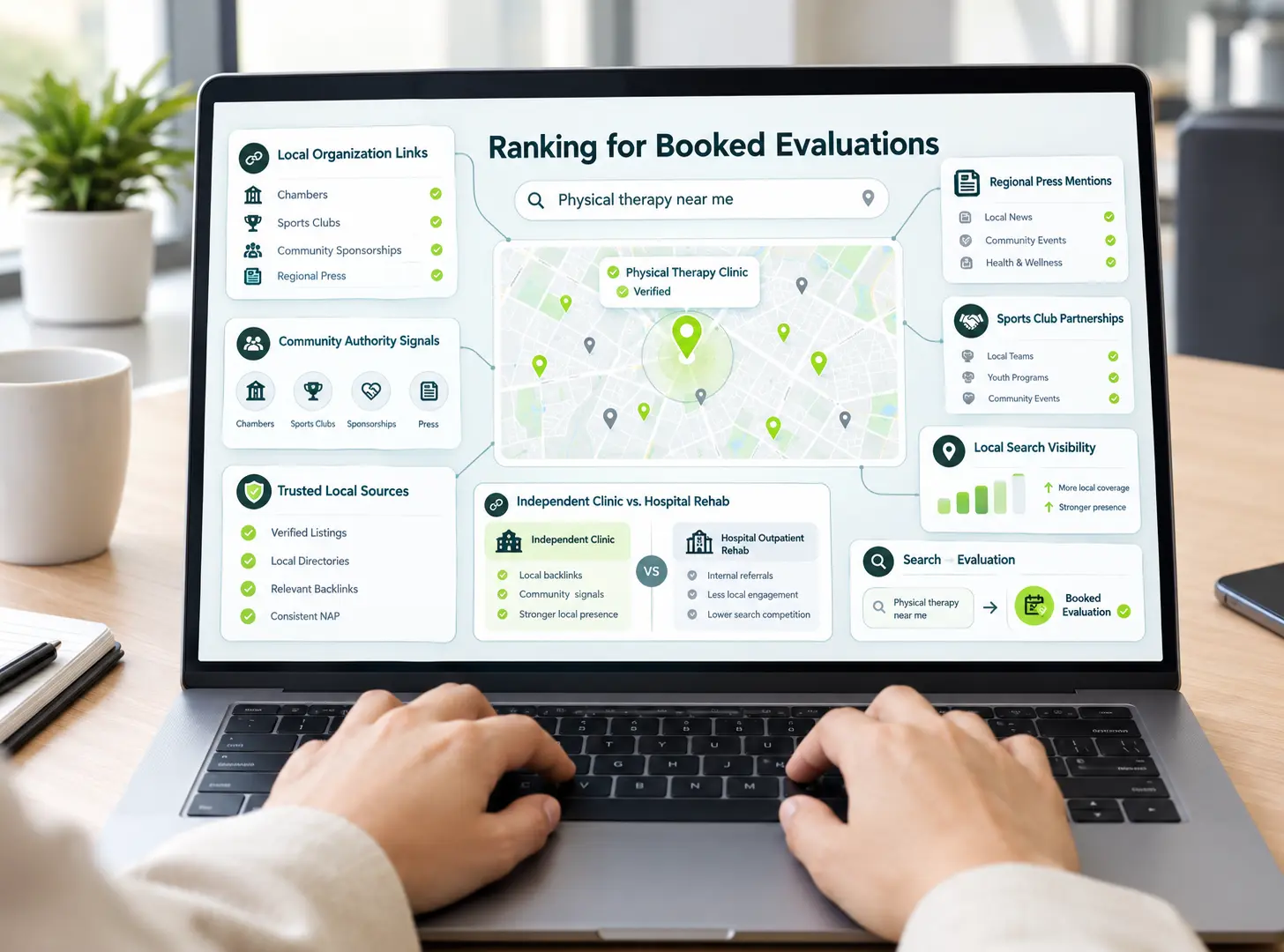
“Physical therapy near me” is decided largely on local signals, and links from real local organizations are one of them.
Chambers, sports clubs, community sponsorships, and regional press all count here. An independent practice can take ground from hospital outpatient rehab, because those departments get patients handed to them internally and rarely compete for the person searching alone.
The result: independent clinics compete on the searches that fill the schedule, against departments that were never really fighting for them.
A Short List Instead of a Long One
A general listing puts you in a long list. A specialty puts you in a short one.
Pelvic health, sports, neurology, and pediatrics di. Campaigns built around one service line move faster than campaigns built around the words physical therapy.
The result: the service line you most want to grow gets its own authority, instead of being averaged into a general practice profile.

Links From the Providers Who Already Send You Patients
Physicians and surgeons send you patients, and their sites already mention practices like yours.
Once you’re the therapist with published commentary and a credentialed listing, those mentions get easier to ask for and easier to earn. The relationship already exists, so the placement is usually a conversation rather than a pitch.
The result: a base of provider and community links that keeps working after a campaign ends, because none of it was rented.

Each Clinic Earns Its Own Authority
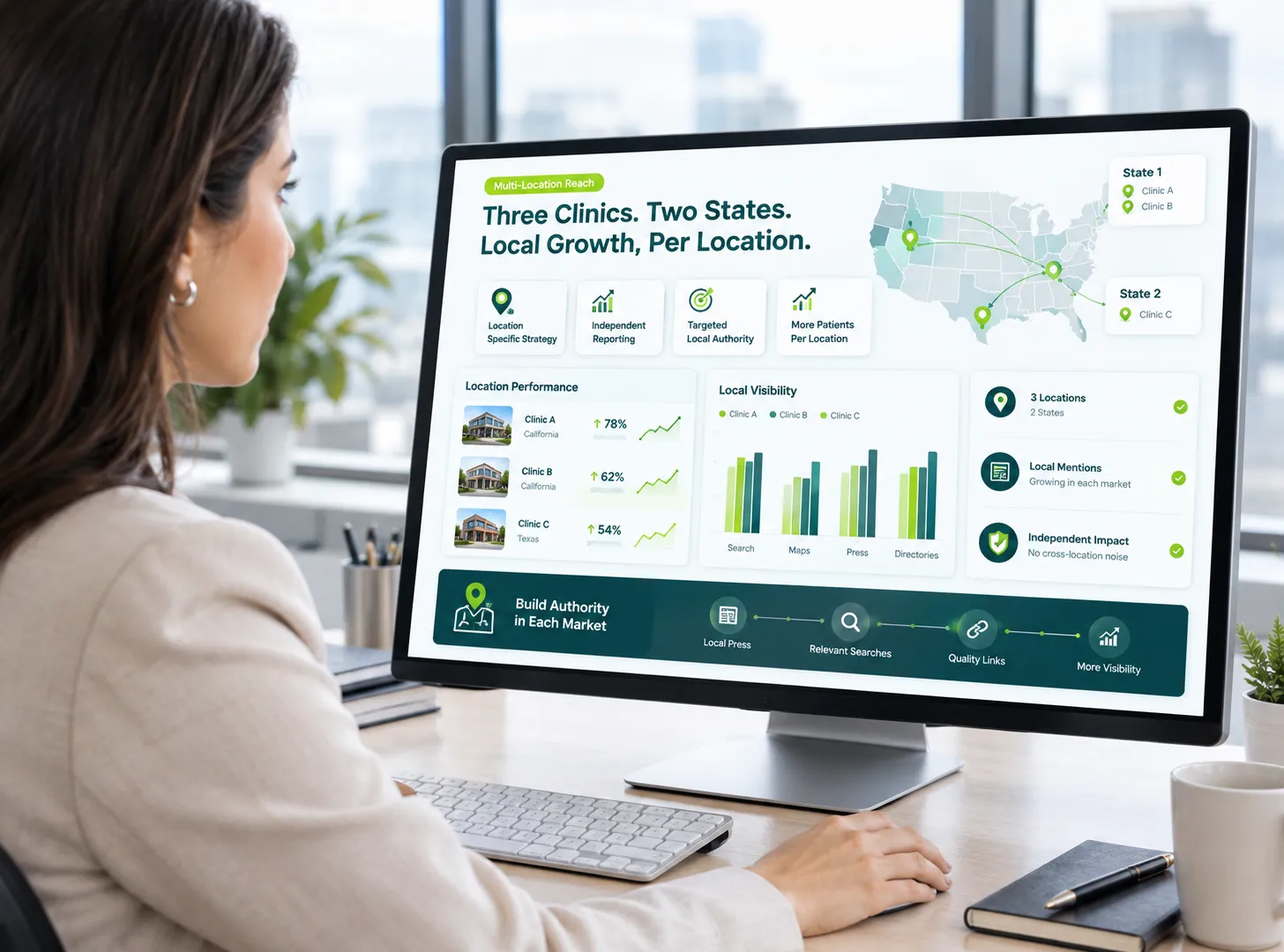
Running three clinics across two states? Each market has its own chapter, local press, and set of searches. Per-location work means each clinic competes on its own terms and gets its own reporting line. A sponsorship in one town does nothing for a clinic ninety minutes away.
The result: you see which location the authority is building in, so you can put the budget behind the market you actually want to grow.
Client Success Stories
What Clients Say About Our Physical Therapy Link Building Service
Don’t take our word for it. Hear what physical therapist clients say after working with us.

4.9/5 

5/5 
Rating on Google



We’ve had a great experience working with this team. They found relevant sites for our physical therapy business, handled outreach, and kept everything simple. We’re seeing more visibility online, and it’s been nice having a team we can trust to handle our link building.

Clinic Owner
Physical Therapy Practice

Every other agency pitched us backlinks with no plan. This team mapped our chapter membership first, then went after placements we could actually earn. Reporting showed exactly which publication picked us up and why.
Clinic Director
Sports Rehab Clinic

Running clinics across two states, we needed authority built per location, not lumped together. Outreach Desk split everything by clinic. Now we know which market is pulling its weight and which needs more push.
Founder
Multi-Location Practice
Service Framework
Investment, Timeline, and Deliverables
You’re buying individual placements, each a link a real editor agreed to publish, earned through your credentials and referral network.

Locations and Service Area
One clinic needs a different scope than a practice running four across two states.

Service Mix
Sports, post-surgical, pelvic health, and pediatrics each pull on different sources and different publications.

Existing Standing
Therapists already holding association membership or specialist certification start from further ahead.

Campaign Duration
Most practices see ranking movement within 3 to 4 months, with placements compounding well past 12.
Directional pricing
Cost per link drops as monthly volume goes up. Higher volume, lower rate per link. No placement lands on a weak site: every one scores 40 to 95 Domain Rating (Ahrefs strength scale) and pulls 1,000+ monthly search visitors. Your final number depends on the locations you run and the service mix you’re building. Book a strategy call, get a full proposal with real numbers scoped to your practice.
What You Get
Every Placement, Every Source, Every Location Reported
You see which of the three layers is producing, and which clinic it’s producing for. Results are split by location when you run more than one.

Live Placement Reporting
Every placement arrives as a link you can open, with the source and the page it points to.

Source Tier Tracking
You see whether directory, trade press, or local work is landing, so you can shift effort toward what’s producing.

Per-Location Reporting
Results come split by clinic, because a sponsorship in one town does nothing for a location two states away.

Specialty Split
When you run several service lines, you see which one the authority is building under.
Our Approach
A Listing-First Approach Built for How Patients Choose a Physical Therapist
You get placements earned against your credentials and referral network, checked for eligibility, and reported by location.
| Factor | GENERIC LOCAL SEO AGENCIES |
 |
|---|---|---|
| Source Selection | The same directory list used for every industry, with no credential filter. |
Listings checked for whether your credentials actually let you in. |
| Credentials | Licensure treated as paperwork, never as a marketing asset. |
Map membership, certification, and state standing before outreach starts. |
| Trade Press | No awareness that physical therapy has its own publications and their own rules. |
Pitches written to each publication’s stated word count and content policy. |
| Link Types | Free blog pages, profile links, and bulk directories sold as diversification. |
None of those. They carry real risk on a health site. |
| Directory Ethics | Chapter directories scraped for outreach targets. | Chapter directories entered, never harvested. Several forbid it in writing. |
Who We Help
Physical Therapy Practices We Support
No matter how you’re credentialed or how many clinics you run, we build the authority that matches how patients actually choose.

Solo and Independent Practices

Multi-Location Practices

Sports and Orthopedic Clinics

Pediatric
Practices

Pelvic Health Practices
Real Results
Results From Our Physical Therapy Link Building Campaigns
See the traffic, ranking and authority gains from recent campaigns.
Common Questions
Frequently Asked Questions
Straight answers on credentials, pricing, and timelines: the questions Practitioners ask most before signing.
Yes, link building can support a broader SEO strategy by helping physical therapy practices earn relevant backlinks and strengthen their online presence.
A dedicated link building agency can identify suitable publishing opportunities and manage the outreach process.
There’s no fixed number, and anyone quoting you one hasn’t looked at your market. What matters is how many links your page-one competitors already have.
Then how many locations you run, and how many condition pages need authority. A single clinic competing in one town needs a fraction of what a four-location practice needs.
Most practices see movement within 3 to 4 months. Local terms usually move first because they face the least competition, and condition terms take longer.
Placements keep compounding well past twelve months, which is why practices that quit at month two never see the return. If you want the general version, when rankings usually move covers the timeline.
For a Find a PT profile, yes. Association membership unlocks it, and the profile itself is free for members once you’re in. State chapter directories generally work the same way, through chapter membership.
The specialist directory is the exception, because it runs on certification rather than membership.
Yes, when the placement is genuinely editorial, and the publication has real standards. What’s risky isn’t the practice of publishing content on other sites. It’s the link types some agencies bundle alongside it, like pages on free blog platforms and bulk profile links.
Those carry real risk on a health site, where Google’s quality expectations are higher than they are for most local businesses. None of them are sold here.
That’s a different service, and bundling it here would blur what you’re buying. Local citation services cover listing consistency, and earning links in your city covers the local side of link building.
Both matter for how a patient chooses you, and neither is what this page sells. This page is about earned placements on sites that decided to publish you.
Price scales with volume. The more links you buy per month, the lower the cost per link. Every placement sits on a site with 1,000+ monthly search visitors and a Domain Rating of 40 to 95.
What moves your number: how many locations you run, which service lines you build toward, whether you already hold chapter membership or specialty certification. You’ll get a detailed proposal with real numbers after a strategy call.
Ready to Find Out Which Listings
You Can Actually Enter?
Get a tailored roadmap built around your goals, competitors, and industry.
4.9/5
Trusted by agencies
and brands worldwide.