Link Building Service for Pediatricians to Build Search Visibility
Strengthen your pediatric practice’s search visibility with relevant placements and strategic link building that build authority and help more parents find your practice.

Listings your credentials reach
Pediatric trade press placements
Reporting split by location and source

4.9/5
Trusted by agencies
and brands worldwide.
Average Domain Rating Range
40 to 95
Campaign Dashboard
DIRECTORY LISTINGS
association and chapter listings earned
TRADE PRESS PLACEMENTS
pediatric and parenting publications
LOCAL AND COMMUNITY PLACEMENTS
schools, sponsorships, and local press earned
VERIFIED REFERRING DOMAINS
relevant Industry Sites

Organic Traffic Increase
+50%





Service Overview
The Four Public Records Every Pediatrician Is Already In
You appear in four public records, but control only one. Three exist without your involvement. A government registry lists your National Provider Identifier and state. The American Board of Pediatrics (ABP) database allows you to verify your ABP certification without logging in, and it updates each business day. Your state medical board issues your license.
A Find a Pediatrician listing needs American Academy of Pediatrics membership, and Fellow status requires board certification plus $675 a year. Your member profile on HealthyChildren.org powers this listing.
That membership is the one lever you control. That matters more than it sounds, because your credential is public before any marketing starts. Parents can verify your board certification by name in seconds, for free. You don’t have a credibility gap; showing up where parents search is the real challenge. Colleagues vouch for you when families ask, and websites do the same through backlinks.
Three things define pediatric link building done right:

Records Nobody Can Sell You
Three of your four public listings appear automatically, so no agency can place you in any of them.

The Listing You Can Complete
Academy membership opens a Find a Pediatrician profile, and a complete profile reads very differently from an empty profile.

Placements Instead of Link Counts
Your team reports each earned placement individually on a site that a parent can read.
How We Work
How Your Pediatric Link Building Campaign Works
A pediatric campaign runs six steps, from credential and listing mapping through placement, with every placement reported back.
Your campaign starts with what you already hold.
Your certification, American Academy of Pediatrics (AAP) membership, and licensed states determine which listings are available. Two pediatricians with identical practices get different maps. That’s why this comes first.
If you’ve bought links before, this is also where your strategist looks at what’s already pointing at your site. A quick link audit catches anything that needs cleaning up before new work starts.
Next, your strategist decides which pages need the authority.
For most practices, that’s the location and visit-type pages, rather than the homepage. One fact changes this vertical: the person searching isn’t the patient. A parent is choosing for their child, so they research harder than almost any other kind of patient. They read parenting sites, local news, and school newsletters before they read yours.
That’s why the source list looks different here, and why a newborn-care page and a sick-visit page need different sources to feed them. Some pages worth linking to don’t exist yet, which is often where the work starts.
Prospecting means finding the sites worth asking, and it runs on three separate layers. Each layer behaves differently.
Association and chapter listings take the longest to earn. Trade press takes real writing. Parenting, school, and community sources land fastest.
Referring providers deserve a mention on their own. Obstetricians, family physicians, and pediatric subspecialists already talk about practices like yours. A mention on their site is a link most practices never ask for.
Most pediatric placements fall over right here, and one distinction explains why.
Pediatrics and Hospital Pediatrics are peer-reviewed journals the academy publishes, and getting into one counts as a research contribution rather than a marketing outcome. If an agency promises journal placements, ask which journal and what the review process is.
The trade press is a different thing entirely. Contemporary Pediatrics takes case reports and column articles by request, and academy chapter newsletters publish their own submission guidelines. So a brochure doesn’t get in anywhere. A piece explaining something your team actually knows does.
Your team checks every placement live before it appears in your report.
Your team confirms the link sits in the body of the page and points where it should, then checks that Google can include the page in its results.
A link on a page Google never indexes does nothing at all, which is why that check happens before reporting rather than after.
Your report shows what landed, where it landed, and which layer produced it.
Results are split by location for practices running more than one office, because a school sponsorship in one district does nothing for a practice across town.
Your report includes declined pitches too. The trade press turns down most submissions, and a report showing only wins reveals nothing about where the effort went.

Expected Results
Outcomes Pediatric Link Building Service Delivers
When your credentials and local standing turn into listings and coverage, the authority compounds into rankings, calls, and booked visits.
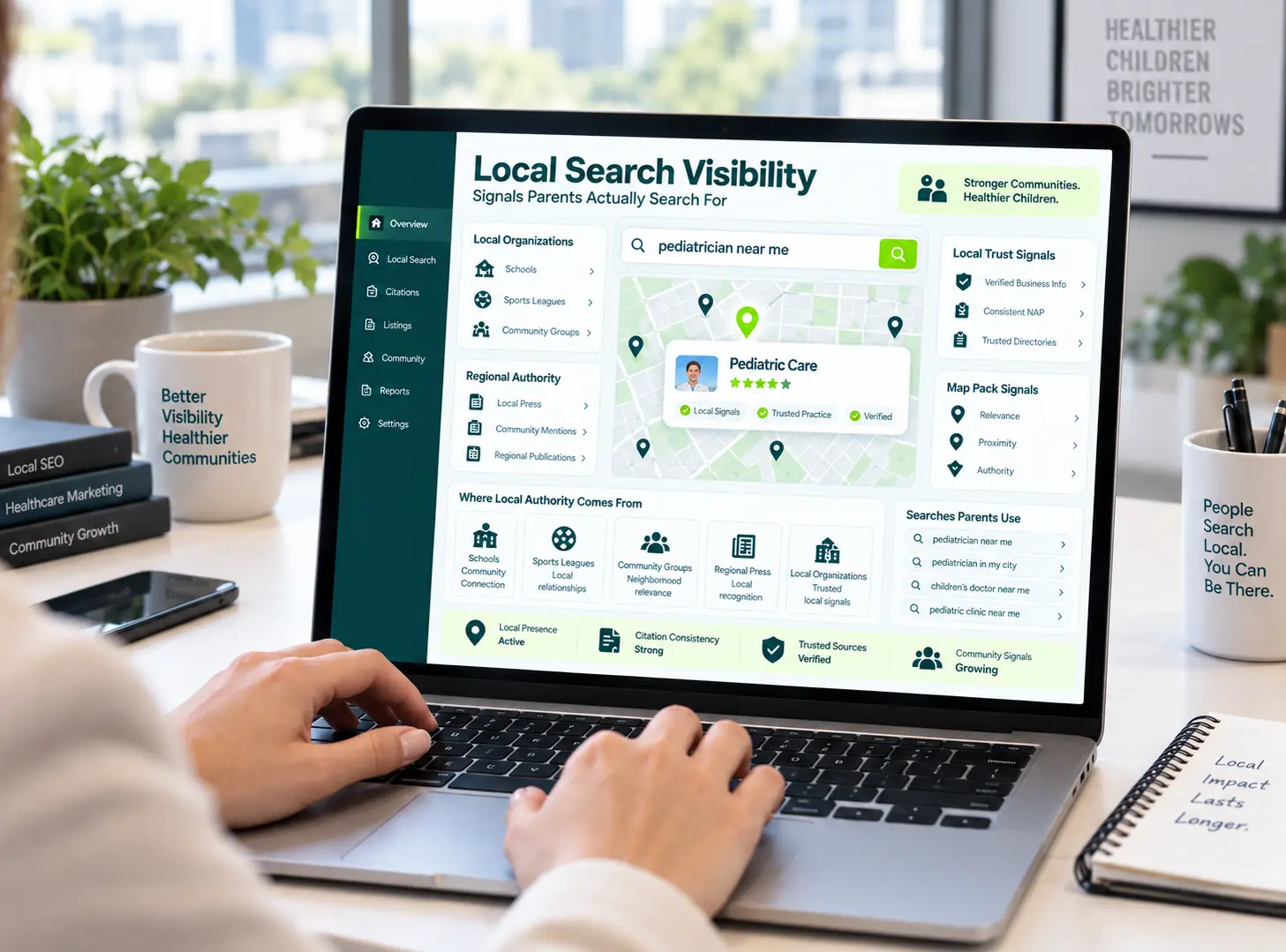
Ranking for the Searches That End in a Booked Visit
Local signals decide most “pediatrician near me” searches, and links from real local organizations count as one of them.
Schools, sports leagues, community sponsorships, and regional press all count here. City terms usually move first, since those searches face the least competition.
The result: the practice competes on the searches parents actually run rather than on terms that were never going to fill the schedule.
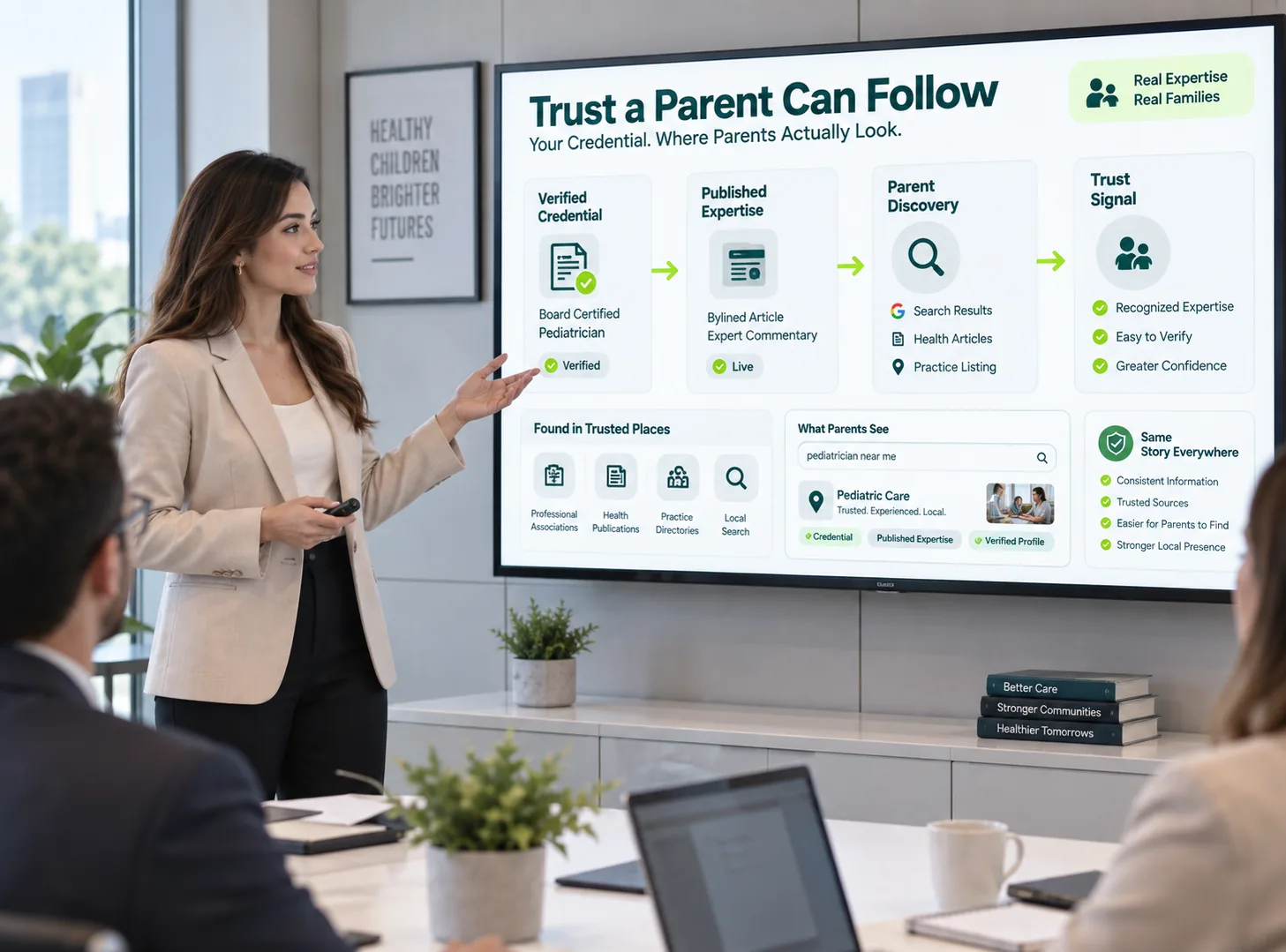
A Credential Attached to Something a Parent Finds
The certification is already checkable. Nothing yet connects it to something a parent finds on their own.
A chapter listing and a bylined article put the name where a parent is already reading. National databases skip that part, since nobody browses them.
The result: the credential you already earned starts working during the searches. Not only after someone thinks to verify it.
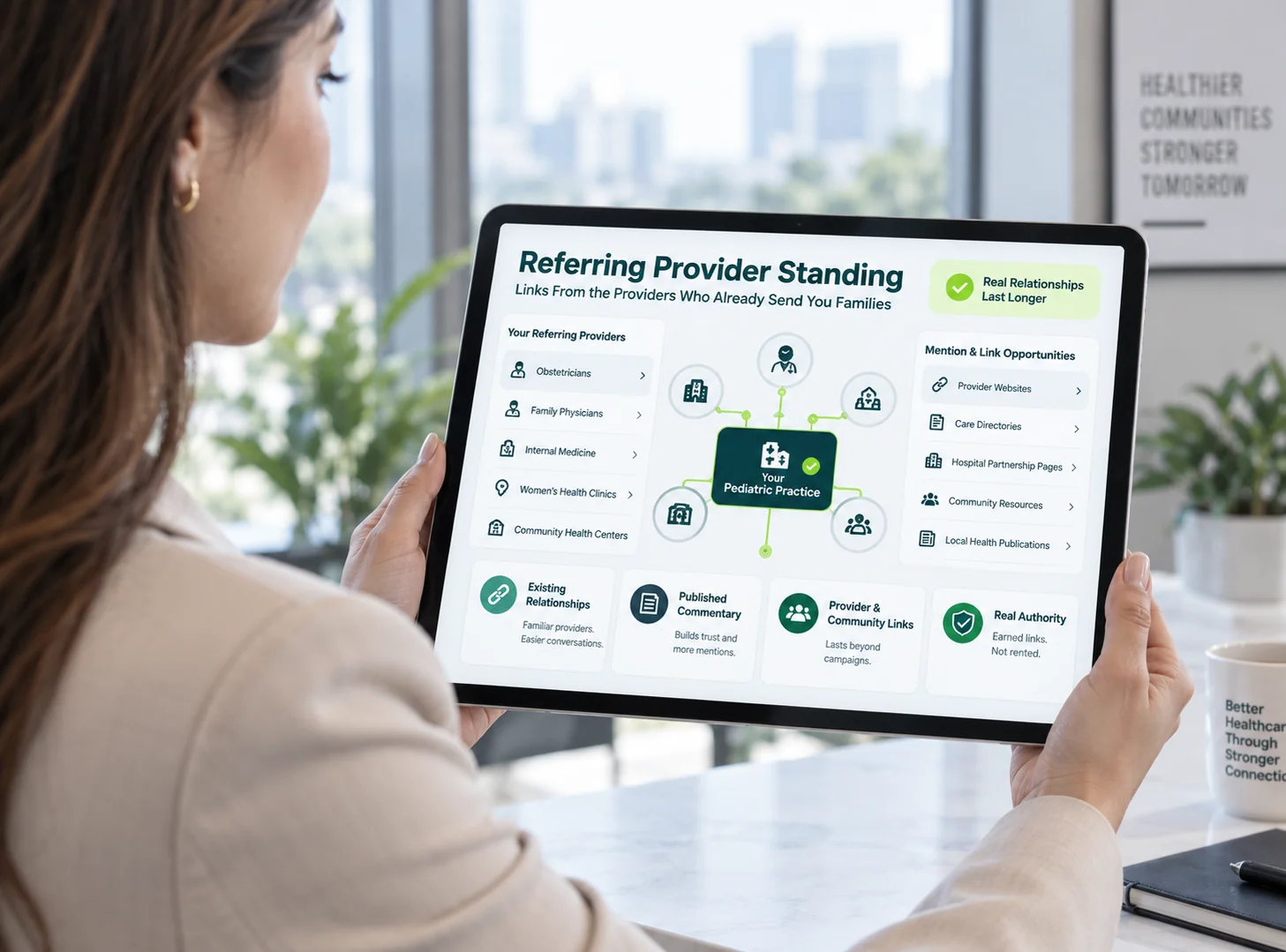
Links From the Providers Who Already Send You Families
Obstetricians and family physicians already send patients this way, and their sites already mention practices like this one.
Published commentary and a complete listing make those mentions easier to ask for and easier to earn.
The relationship already exists, so it’s usually a conversation rather than a pitch.
The result: a base of provider and community links keeps working after a campaign ends, because no one rented any of it.
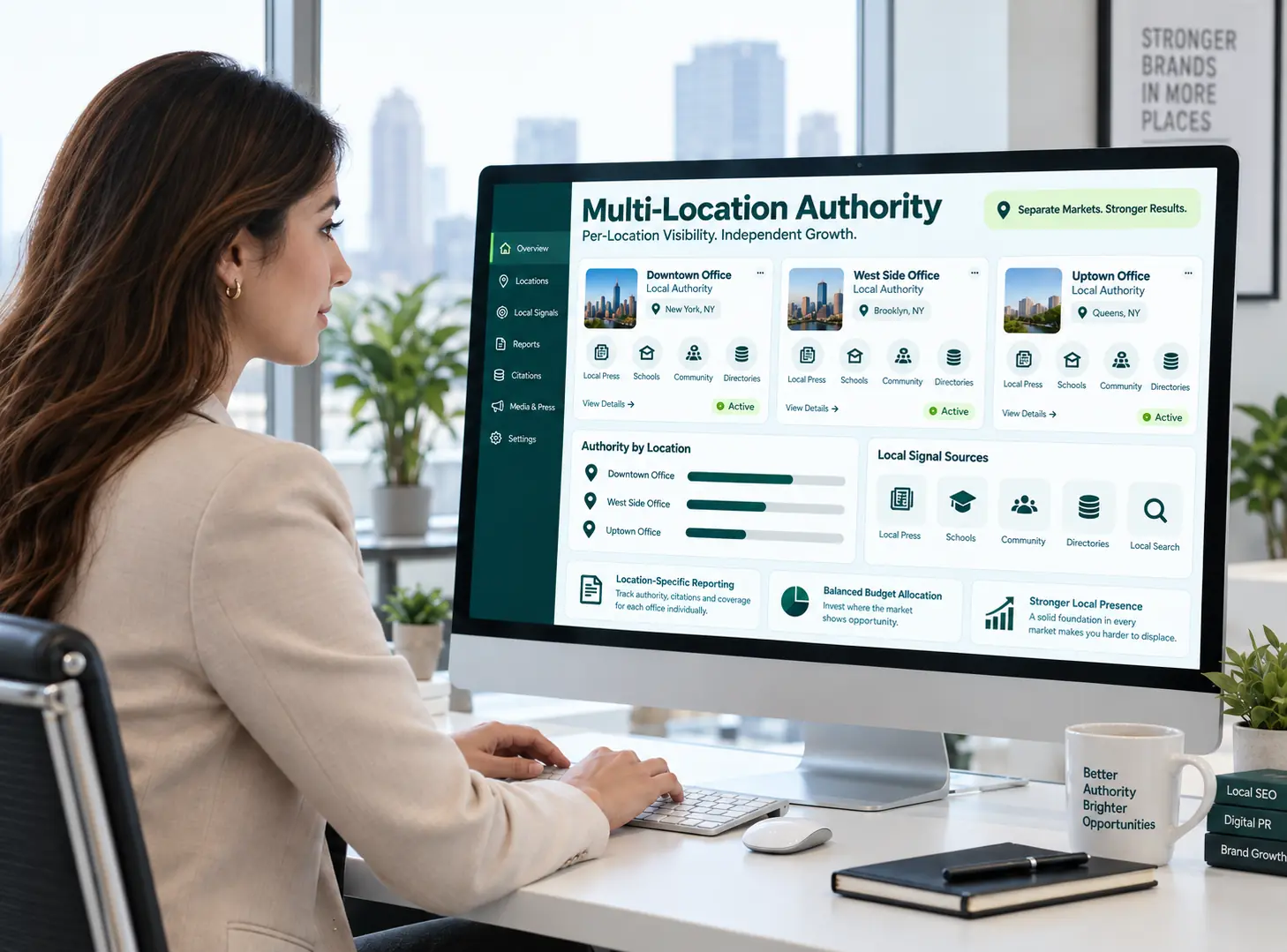
Authority Built Per Office Rather Than Averaged Across Three
Running three offices across a metro means each one has its own schools, its own local press, and its own set of searches.
Per-location work means each office competes on its own terms and earns its own reporting line. A school sponsorship in one district does nothing for an office across town.
The result: the reporting shows exactly where authority is building, so budget follows the market worth growing.
Client Success Stories
What Clients Say About Our Pediatric Link Building Service
Reviews from practices that turned credentials and local standing into search visibility.

4.9/5 

5/5 
Rating on Google



Getting listed on parenting publications changed how new patients found us. Outreach Desk connected us with local parenting blogs, school health resources, and community wellness sites where the families we want to reach actually go. That visibility brought in direct inquiries from parents searching for a pediatrician who takes their concerns seriously.

Founder
Independent Pediatric Practice

We stopped blending in with every other pediatrician in town. Before this, generic health directories scattered us in with every other listing, saying nothing about who we are. Now these placements position us as specialists new parents can trust. The placements Outreach Desk secured gave us real standing with referring OB practices and local hospitals.
Practice Administrator
Multi-Physician Pediatric Group

The difference is parents now find us before they even call. These placements put our practice in front of school nurses, childcare centers, and family resource networks, the people who actually refer patients to us. Fewer cold leads and more families who already trust us by the time they walk in.
Managing Physician
Community Pediatric Clinic
Service Framework
Investment, Timeline, and Deliverables
You’re buying individual placements, each link a real person agreed to publish, earned against work of your referral network or the credentials you already hold.

Locations and Service Area
You need a different scope depending on whether you run one office or four across a metro.

Visit Mix
You draw on different sources and publications for newborn care, well-child, sick visits, and subspecialty work.

Existing Standing
You start further ahead when you already hold AAP membership.

Campaign Duration
Most practices often see ranking movement within 3 to 4 months, while your placements can keep supporting growth beyond 12 months.
Directional pricing
Pricing scales with your service area, your visit mix, and your existing standing. A single office needs a narrower scope than a multi-location group running newborn care, well-child, sick visits, and subspecialty lines side by side. Practices already holding AAP membership start from further ahead. You’ll get a proposal scoped to your locations and visit mix after your strategy call.
What You Get
Every Placement, Every Source, Every Location Reported
See which of the three layers is producing, and for which office. Results split by location when you run more than one.

Live Placements Reporting
Every placement lands as a link you can open, showing the source it came from and the page it points to.

Source Layer Tracking
See whether listings, trade press, or local work is landing, so you shift effort toward what’s producing.

Per-Location Reporting
Reporting splits by office: a school win in one neighborhood won’t affect another.

Visit-Type Split
Running several service lines? You see which one is building your authority.
Our Approach
A Records-First Approach Built for How Parents Choose
You get placements earned against the records you’re already in and the referral network you already have, reported per location.
| Factor | GENERIC HEALTHCARE AGENCIES |
 |
|---|---|---|
| Starting Point | A pitch to build credibility you already have on public record. |
A map of the four records you’re in and the one you can act on. |
| Source Selection | The same directory list used for every specialty. | Listings checked against what your credentials actually reach. |
| Trade Press | "Medical publications" promised without naming one. |
A strategist tells journals and trade press apart, and pitches only one. |
| Link Types | Free blog pages, profile links, and bulk directories sold as diversification. |
None of those. They carry real risk on a children’s health site. |
| Who’s Searching | Patient-focused copy written for the person being treated. |
Parent-focused sources, because the parent is doing the choosing. |
Who We Help
Pediatric Practices We Support
Whatever credentials you hold, and however many offices you run, we build the authority that matches how parents actually choose.

Solo and Independent Practices

Group
Practices

Multi-Location Practices

Newborn and Family Care Practices

Pediatric Subspecialty Practices

Concierge and Direct Primary Care Practices
Common Questions
Frequently Asked Questions
Straight answers to the questions pediatricians ask most often before a campaign starts.
No, and be careful with anyone who says they can. Pediatrics and Hospital Pediatrics are peer-reviewed, which means a research contribution reviewed by other physicians rather than a marketing placement. Getting into one takes months and is not something an agency can arrange. The pediatric trade press is a different thing and genuinely reachable, and that’s what the campaign actually pitches.
No, and be cautious if anyone claims otherwise. You can’t arrange this through an agency. You submit research contributions to Pediatrics and Hospital Pediatrics, then peer physicians review your work over months. You’ll reach the pediatric trade press instead, which you can actually access, and that’s what we pitch in your campaign.
There’s no fixed number, and anyone quoting you one hasn’t looked at your market. What decides it is how many links your page-one competitors already hold. Then how many offices you run, and how many visit-type pages need authority. A single office in one town needs a fraction of what a four-location group needs.
Yes. Outreach Desk manages publisher research, outreach, content coordination, and placement tracking throughout the campaign. Our experienced outreach agency handles the process from prospecting through placement.
You typically see movement within 3 to 4 months. You’ll notice local terms move first because you face less competition there, while condition terms take longer. You’ll continue compounding results well after 12 months. Practices that quit at month two never capture the full return. Learn when rankings usually move.
You can guest post safely on children’s health sites when you secure genuinely editorial placements on publications with real standards. You avoid the risk by steering clear of the link types some agencies bundle in: pages on free blog platforms and bulk profile links. We don’t sell those on health sites at all, and Google’s link spam policy explains why.
Both are different services. Local citation services cover listing consistency across the directories a parent might check.
Both matter for how a family chooses you, and neither is what this sells.
This page is about earned placements on sites that decided to publish you.
Pricing scales with your link volume, how many service pages need authority, and your existing site strength. A single office needs a narrower placement scope than a multi-location operation running several service lines side by side. Practices already holding academy membership start from further ahead. You’ll get a proposal scoped to your volume and priorities after your strategy call. Pricing scales with your locations and visit mix.
Ready to See Which Listings Your Credentials Reach?
Get a senior strategist to map which listings and publications your practice can actually reach, before we pitch anything.
4.9/5
Trusted by agencies
and brands worldwide.