Link Building Service for Moving Companies That Book More Moves
Your moving company earns authority that turns search visibility into booked jobs, timed to your season.

Local and association authority
Partner and referral placements
Campaigns timed to your season

4.9/5
Trusted by agencies
and brands worldwide.
Local Authority Score
88/100
Campaign Dashboard
LOCAL PLACEMENTS
community + local press
ASSOCIATION & DIRECTORY LISTINGS
licensed-mover verified
LOCAL RANKING WINS
“city + movers” terms
ORGANIC TRAFFIC
3,400 to 9,000

First Ranking Boost
47 Days





Service Overview
Why Moving Companies Win or Lose a Season on Timing
Moving is a seasonal business, and you need to market it that way.
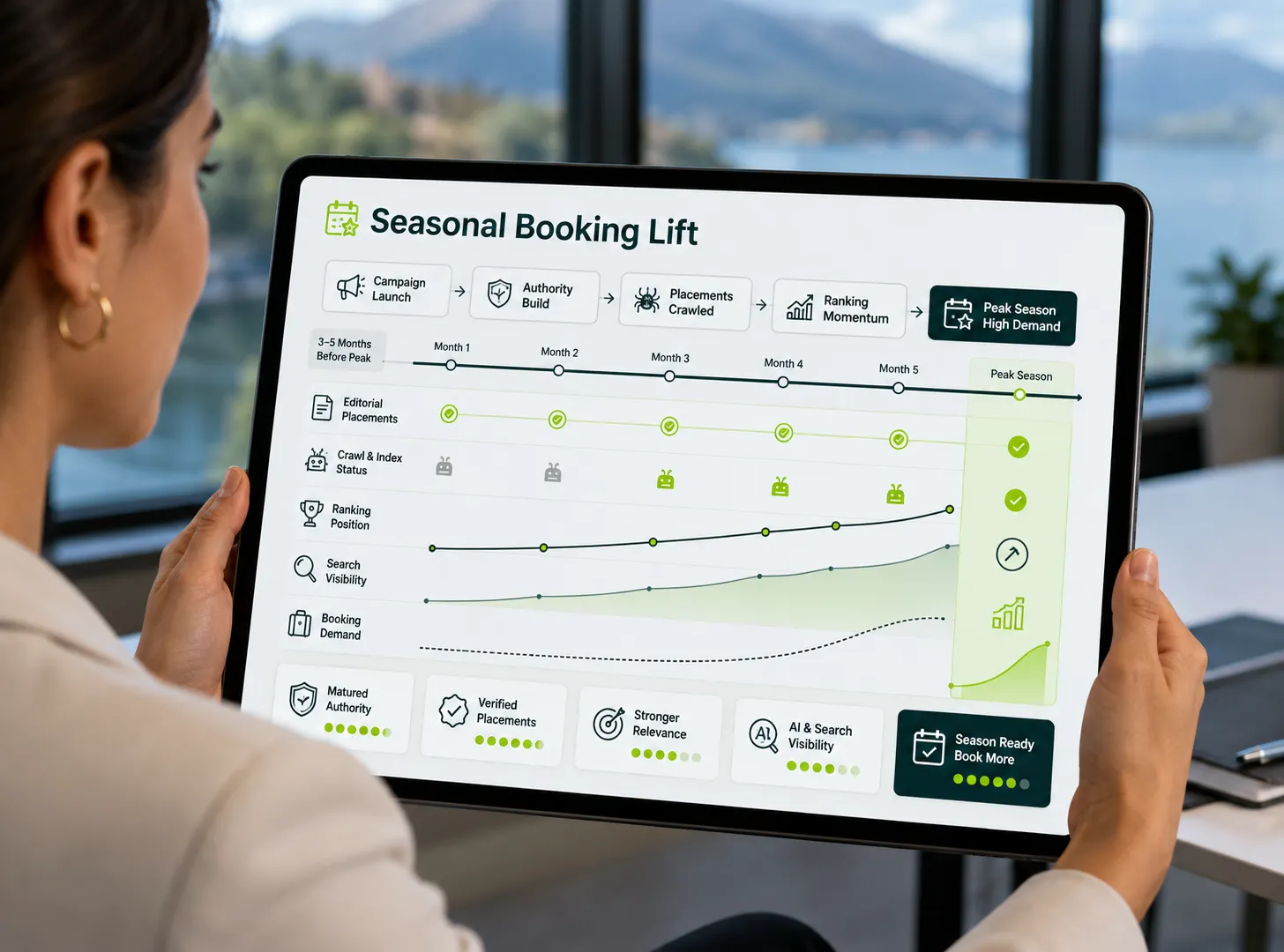
Demand piles up in summer, so visibility spending must land before that window opens. Miss it, and you lose the window. Links don’t work the day they go live. Google crawls the placement first, then counts it toward your site’s score. Start in February, and authority compounds by the time the phone rings. Miss that, and June work builds for next summer instead.
11.8% of Americans moved in 2024, down from 12.1% the year before, according to Census data. Each booked move is worth more, and a timing mistake costs more too. Movers sit downstream of someone’s transaction: a house sale, a lease ending, a student enrolling, a relocation order. Realtors, property managers, apartment complexes, universities, and relocation offices all publish resource pages, real placements. Association standing helps too, since membership requires proof of licensing and insurance competitors can’t copy overnight.
Three things define moving company link building done right:

Season-Timed Campaigns
Placements are sequenced against your booking calendar so that authority compounds before peak demand arrives, not after it has passed.

Partner and Referral Authority
Links from the realtors, property managers, and apartment communities already standing between a move and your phone.

Association and Licensed-Directory Standing
Credential-backed placements a competitor cannot buy, built from the licensing and insurance you already carry.
How We Work
How Your Moving Company Link Building Campaign Works
A season-first workflow built around local authority, partner placements, and the association standing your licensing already qualifies you for.
Your campaign starts by mapping every city you serve against the month demand actually starts in that city.
Your strategist first reviews whether your operation is primarily local residential, long-distance and interstate, commercial, or a mix. Then they audit your current placements, association standing, and local search position accordingly.
A single-metro mover and a five-state carrier need different campaigns. The audit also pulls your existing links to separate what is working from what is dead weight.
Your team builds the placements your licensing and insurance already qualify you for, since these are the hardest links in the category for a competitor to copy.
Your team pursues state moving association member listings, trade-body-certified mover directories, and the small number of directories that verify licensing before listing.”
The filter is simple: if anyone can buy a listing without proving they’re licensed, we skip it. That test is what separates a directory worth pursuing from a listing farm, and these placements perform better when your local business listings already match across the web.
Your team works the businesses standing upstream of every move you book.
Realtor resource pages, property management preferred-vendor lists, and apartment community move-in guides are all standard placements that double as referral channels.
Larger management companies run one site across dozens of properties, so a single relationship can produce a link carrying real weight. The mechanics mirror those of real estate link building, where the same partner relationships drive placements.
Your team turns the community work you’re already doing into coverage and links.
Local news covers movers twice a year without being asked, during peak season and after a storm, and your team pitches into both windows. Sponsoring a youth team, a food drive, or a neighborhood festival puts your name on an organizer’s site.
Donating truck time to a charity move earns coverage a paid placement never matches. This is digital PR work scoped down to the local tier that actually matters for a mover.
For operators near campuses or bases, your team pursues the resource pages that move people on a fixed calendar.
Universities publish off-campus housing pages that list local movers for students. Bases and relocation offices maintain resource pages for families arriving on new orders. Both update on schedules set well in advance, which makes this the most plannable slice of the campaign.
Commercial work adds another layer: property owners and facility partners often publish vendor pages, and your existing relationships can provide those placements.
You receive a monthly report covering live placements, source mix, local ranking movement, and per-branch results where you run more than one location.
The report reflects your actual footprint rather than a generic national view, and progress is read against your booking calendar rather than a flat twelve-month curve.

Expected Results
Outcomes Moving Company Link Building Service Delivers
When your authority is built before the season turns, the demand that was always coming finds you instead of the operator who started earlier.
Ranking Where People Actually Book a Mover
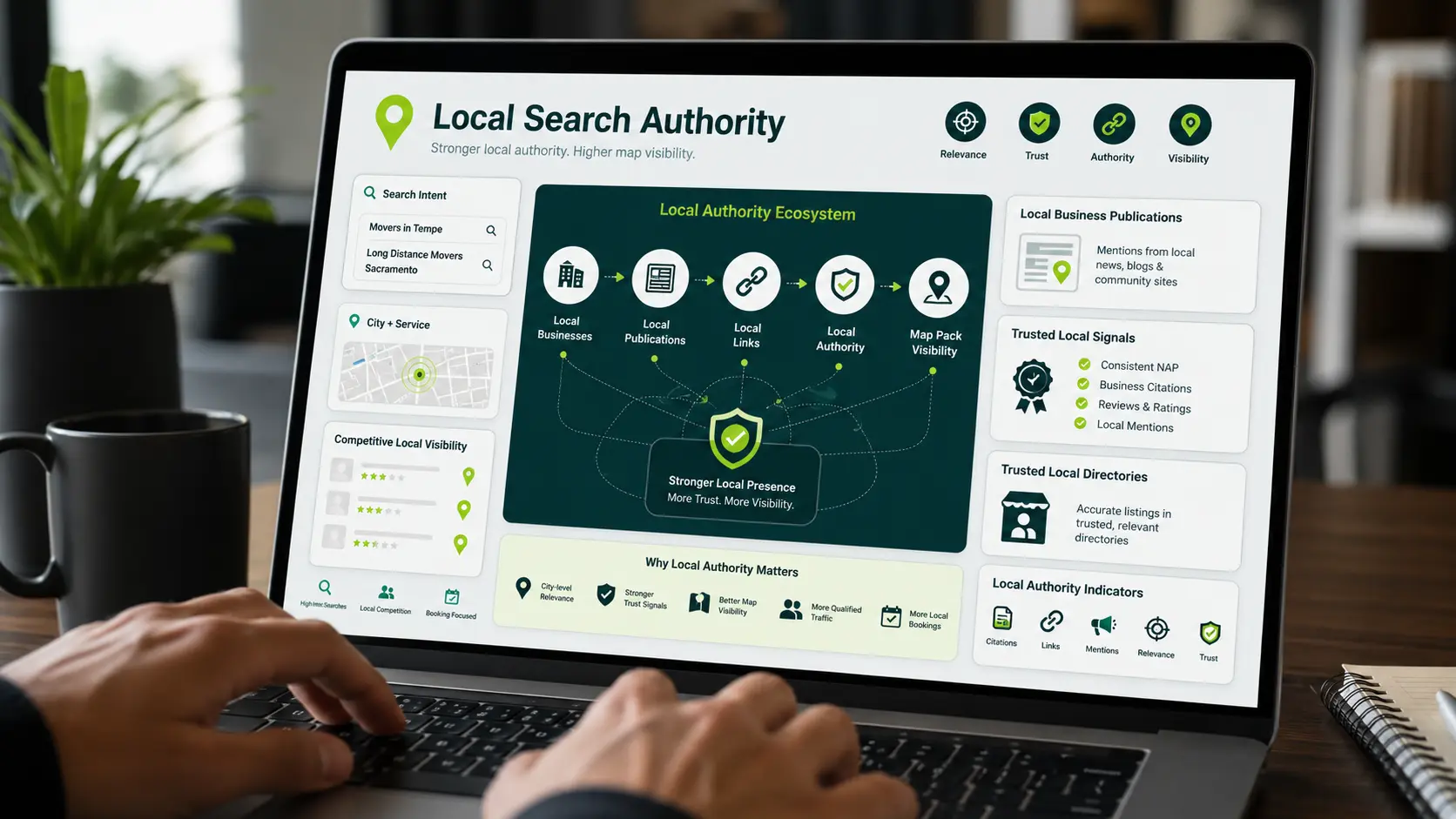
Searches like “movers in Tempe” or “long distance movers Sacramento” are where booking intent lives, and they’re won largely on local authority.
Google treats links from your city’s businesses and publications as evidence that you’re a real, established operator in that market, which is the same signal that sits behind the map results your competitors already hold.
The result: Operators building genuine local authority compete on the city-plus-service terms that convert, rather than on broad national keywords that never produced a booking.
Placements That Keep Sending Work After the Link Lands
A preferred-vendor listing keeps producing referrals whether or not Google ever counts the link.
The realtor, property manager, and apartment relationships behind your placements are the same ones that produce direct bookings, making this a rare link source with a second payoff.
The result: Partner placements build a referral pipeline alongside search authority, so the campaign keeps delivering value even in months when rankings are still maturing.

Authority That Is Compounding Before the Phones Ring
When you sequence the campaign against your booking calendar, Google can crawl and evaluate your placements before demand peaks.
That is the difference between authority working for you during the season and authority arriving after the window closed.
The result: Operators who start three to five months ahead of peak enter their busiest window already ranking, instead of watching the season pass while placements mature.
Authority for Buyers Who Weigh Licensing Differently
Commercial clients and interstate customers evaluate a mover differently than a homeowner booking a two-bedroom across town.
Facilities managers, office relocation coordinators, and interstate customers weigh licensing, insurance, and association standing far more heavily, and association and certified-directory placements speak directly to that.
The result: Operators with visible credential authority are better positioned when a commercial buyer is researching and shortlisting movers for a contract.

Client Success Stories
What Clients Say About Our Moving Company Link Building Service
Reviews from moving operators who built local and partner authority ahead of their season instead of chasing it during one.

4.9/5 

5/5 
Rating on Google



We started with them in February, way before we’d normally think about marketing. By June, our phones were already ringing off local searches we never ranked for before. Wish we’d started this three years ago instead of scrambling every May.

Owner
Residential Moving Company

The property manager relationships they built for us still send move-in referrals every month, with or without a link. That’s the part nobody else pitched us: links that also just brought business straight in the door.
Operations Manager
Moving & storage company

Every branch got its own report, its own source list. Our Tucson numbers stopped getting buried under Phoenix’s. First agency that treated us like four markets instead of one company with extra trucks.
VP of Operations
Interstate Carrier
Service Framework
Investment, Timeline, and Deliverables
Every moving company campaign is tailored to your service area, operation type, and position in the seasonal calendar.

Markets and Branches
A single-metro operator needs a different scope from a carrier operating across several states and multiple branches.

Operation Type
Residential local work, commercial contracts, and interstate authority each pull on different link sources.

Season Position
How far ahead of your peak you’re starting changes how much has to happen at once.

Campaign Duration
Most operators see ranking movement within 3 to 4 months, with authority compounding across a full season.
Directional pricing
Solo-metro movers spend less than carriers running branches across states. A bigger footprint means chasing authority in more markets, plus building commercial trust signals. Check for flat pricing with no quality floor attached: no minimum authority, no relevance check, and the same rate for a weak directory as for a strong editorial placement. That’s usually directory listings dressed up as real link work. Your real number comes after a strategy call, built around your service areas and how far out you’re booking from peak season. You get a detailed proposal after your strategy call, scoped to your service areas and your season.
What You Get
Every Market, Every Branch, Every Placement Reported
Full transparency on live placements, source mix, and local ranking movement, split by branch when you run more than one location.

Live Placement Reporting
You see every placement as a URL you can open, with the source it came from and the page it points to.

Source Mix Tracking
You see which sources are producing in your market, so the mix shifts toward what works instead of staying fixed all year.

Per-Branch Reporting
You see results split by location, because a link that helps your Phoenix branch does little for your Tucson branch.

Season-Relative Progress
You see progress read against your booking calendar rather than a flat twelve-month curve that ignores your demand shape.
Our Approach
A Season-First Approach Built for How Movers Get Booked
You get placements sequenced against your booking calendar and split by market, not a generic local package that ignores when your demand actually arrives.
| Factor | GENERIC LOCAL SEO AGENCIES |
 |
|---|---|---|
| Campaign Timing | Work starts upon signing the contract, with no reference to demand. |
Placements are sequenced against your peak, so authority compounds before it. |
| Source Selection | The same directory and guest post list used for every industry. |
Sources drawn from how movers actually operate: partners, associations, local press, relocation resources. |
| Multi-Market Handling | One national campaign and one national report. | Per-market source lists and per-branch reporting for every location you run. |
| Licensing Use | Licensing treated as paperwork, never as a marketing asset. |
Licensing and insurance standing worked into association and verified-directory placements. |
| Success Metric | Volume of links delivered as the headline number. | Placement quality, source mix, and ranking movement in the markets you serve. |
Who We Help
Moving Company Types We Support
Wherever or whatever you move, we build local, partner, and association authority matched to how your customers find and choose an operator.

Local & Residential Moving

Long-Distance & Interstate

Commercial & Office Relocation

Storage & Portable Containers

Specialty
Moving

Corporate Relocation Management
Real Results
Results From Our Moving Company Link Building Campaigns
See the traffic, ranking and authority gains from recent campaigns.
Common Questions
Frequently Asked Questions
Answers to what movers ask before they sign, from timing to per-branch reporting.
Three to five months before your peak, and that lead time is not padding. Links don’t work the day they go live. Google must crawl and evaluate a placement before it contributes to your site’s authority.
An operator starting in February enters the summer already ranking. An operator starting in June is buying authority for the following year. If you’re already inside your season, we build toward next year while capturing what we can now.
The licensing you already hold unlocks the strongest links in this category, so it matters more than most operators expect.
Association membership and certified-mover directories typically require proof of licensing and insurance before they’ll list you, which is exactly why those placements are hard for a competitor to copy.
Requirements vary by state, and by whether you run intrastate or interstate, so your strategist confirms what applies to your operation rather than assuming a single national rule.
Six sources all connected to how moving actually works:
- Relocation and real estate partners
- Property managers and apartment communities
- State and trade moving associations
- Local press and community sponsorships
- University and military relocation resource pages
- Directories that verify licensing before listing
What you won’t get is a hundred unvetted directory listings. Most moving directories are lead-resale sites. A link from one does nothing for you.
Yes. Any seasonal business needs the same lead-time approach: links placed months ahead so Google can crawl and evaluate them before demand peaks. The sources differ by industry, but the timing logic stays the same.
Our dedicated outreach team builds a source list specific to each industry’s calendar rather than applying one generic template to every business type.
Each market gets its own source list and its own reporting line. A link from a Phoenix apartment community does little for your Tucson branch, so per-branch work is scoped and reported separately rather than averaged into one national number. Markets also open on different schedules, since peak season and the local partner calendar shift by region, and the sequencing accounts for that.
Yes, on two points that change the whole campaign. The sources here exist because movers sit downstream of real estate, property management, and relocation, which is not true of most local trades. And the season deadline reorders everything, since a campaign that starts late misses the demand it was built for.
The closest comparison on our site is our car dealership link building service. It is also local-first and multi-location, but a dealership’s buying cycle runs year-round rather than collapsing into a single summer window.
Cost depends on how many markets you serve, how competitive those markets are, and how much lead time you buy before busy season.
A single-metro mover needs a different investment than a multi-branch interstate carrier chasing authority across every market it serves. Small operators pay for local directory and association links. Big carriers pay for a broader per-market push and for commercial trust-building.
No flat number fits all. Pricing is based on your footprint and goals. Book a strategy call, get a proposal matched to your markets.
Ready to build your authority before the season turns?
Get a senior strategist to map your service areas, find placements you already qualify for, and land the campaign before your phones ring.
4.9/5
Trusted by agencies
and brands worldwide.