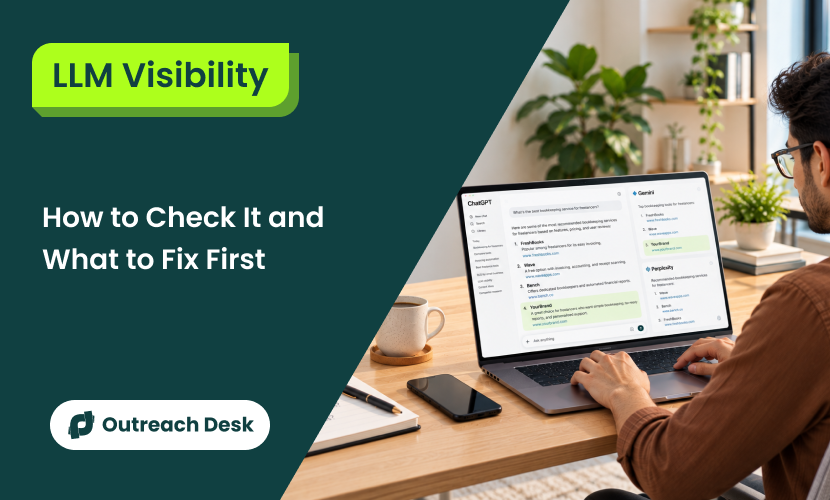
LLM visibility measures how often and how favorably AI assistants like ChatGPT surface your business when buyers ask about your category.
An LLM, or large language model, powers those assistants. It isn’t one number but four separate checks: whether assistants name you, link to you, describe you correctly, and can reach your site.
Each check points to a different fix, so a weak result in one area doesn’t mean the others are failing. Start by testing a few buyer-style questions in each assistant and note which of the four checks you fail.
What You’ll Learn
- Score every AI answer on 4 checks: names you, links to you, describes you correctly, and crawler access.
- Test five to ten buyer questions across three AI answer engines.
- Match each failed check to its most likely cause.
- Check OpenAI crawler access in 5 steps.
- Repeat the same tests every month.
What LLM Visibility Means
LLM visibility describes how your brand and website appear in answers that large language models and AI-powered search experiences generate.
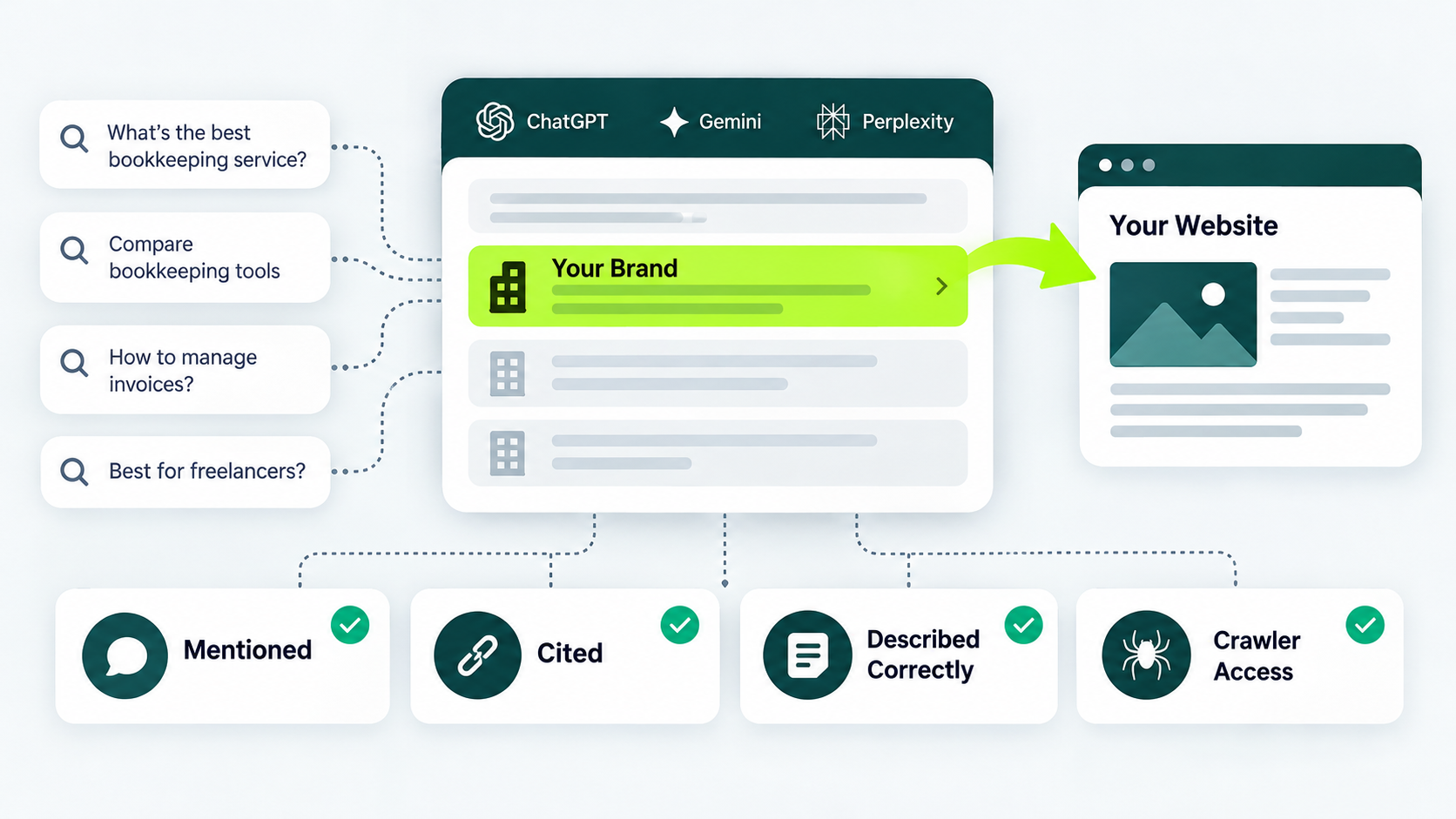
You can measure it by checking whether an assistant mentions your business, cites your website, and accurately describes your products or services.
LLM visibility is like whether a knowledgeable friend mentions your business when someone asks for a recommendation. AI assistants create similar shortlists by processing information from their training data, web searches, and other context.
Use these four practical checks to assess your visibility.
| CHECK |
THE QUESTION IT ANSWERS |
WHAT TO RECORD |
|---|---|---|
| Names you (Mentioned) |
Does the assistant mention your business? | Yes or no |
| Links to you (Cited) |
Does the assistant cite a page on your website? | Page link or no citation |
| Describes you correctly |
Does the assistant explain your business accurately? | Yes, partly, or no |
| Crawler can reach you (Crawler access) |
Can the relevant AI crawler access your website? | The crawler can access, can’t access, or remains unverified. |
Imagine that you run a bookkeeping service for freelancers. ChatGPT recommends your business but cites two competitor websites instead of yours. It also describes your services as those of a full accounting firm, although you only offer bookkeeping and invoicing support.
Your scorecard would record a brand mention, no website citation, and an inaccurate description. Those results give you three separate areas to investigate.
A mention and a citation measure different outcomes. An assistant can name your business without linking to your website. It can also cite your content without recommending your product.
Track each outcome separately to understand where your brand gains visibility and where it needs improvement.
How LLM Visibility Differs From Google Rankings
Google rankings (traditional search engine optimization) show where your page appears in the search results. LLM visibility shows whether your brand or content appears in AI-generated answers.
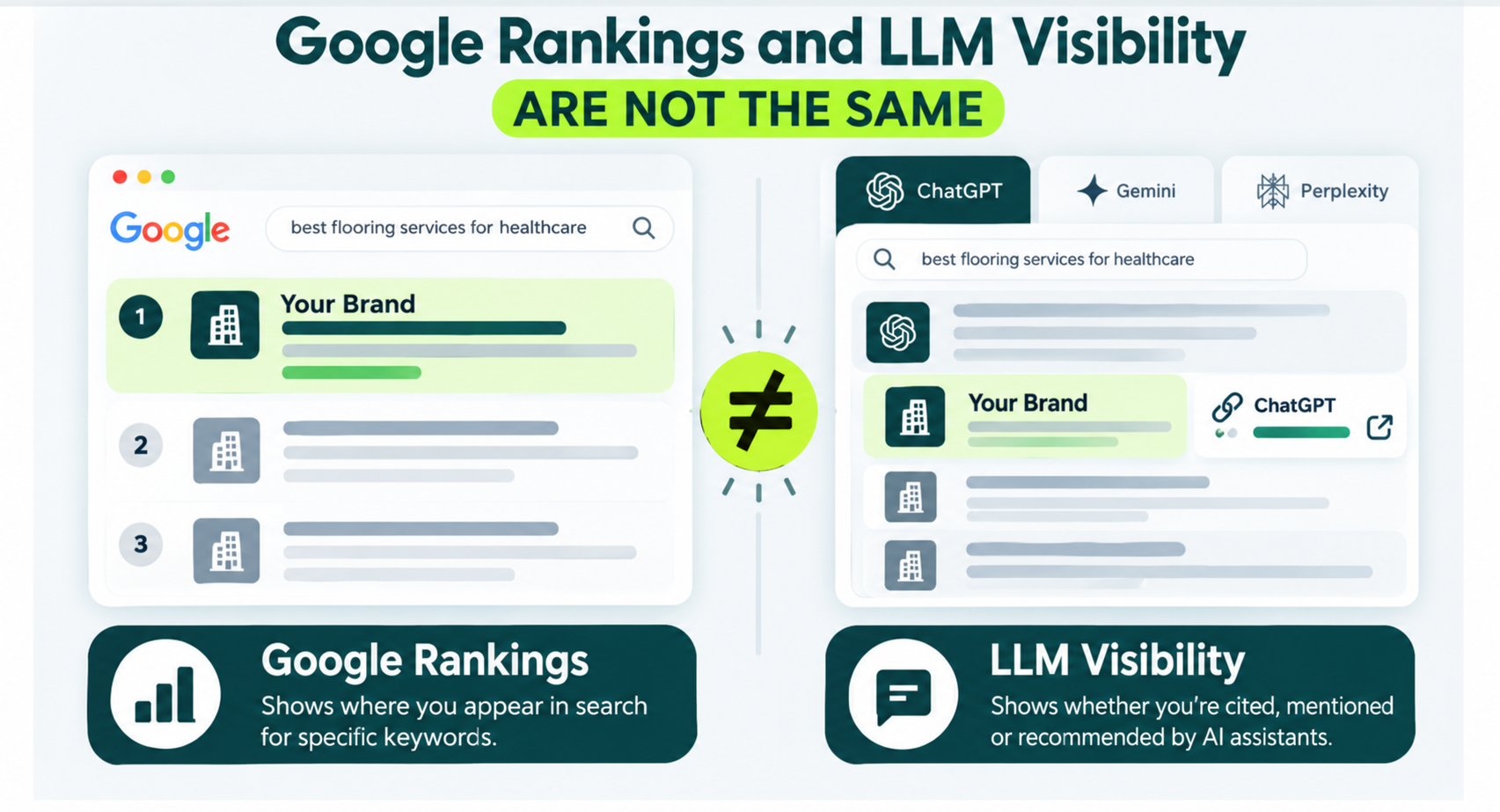
You can do well at one and poorly at the other.
An AI answer comes from two places: what the model learned in training and what it looks up while answering.
Training Memory
Training memory is the patterns that the model absorbed from text during training. It works like a person recalling something they studied years ago.
Live Web Search
Live web search is the pages the assistant retrieves while it answers. It works like that same person checking a few websites before replying.
Different assistants rely on these two sources in different ways. The same assistant can also switch between them depending on your question and mode. That’s why you should note whether search was on when you test.
Google’s AI answers, called AI Overviews, are one place this plays out. ChatGPT search, Gemini, and Perplexity are others, and each can name different businesses when you ask them the same question. Each platform uses its own processes to retrieve and present information.
The practical takeaway is to keep doing good SEO and measure AI visibility separately so you can see gaps that rankings hide.
People often call optimizing for AI search generative engine optimization.
How to Check Your LLM Visibility
To check your LLM visibility, you need to test five to ten buyer questions in ChatGPT, Gemini, and Perplexity. Record brand mentions, website citations, factual accuracy, and sources that the assistant displays for every response.
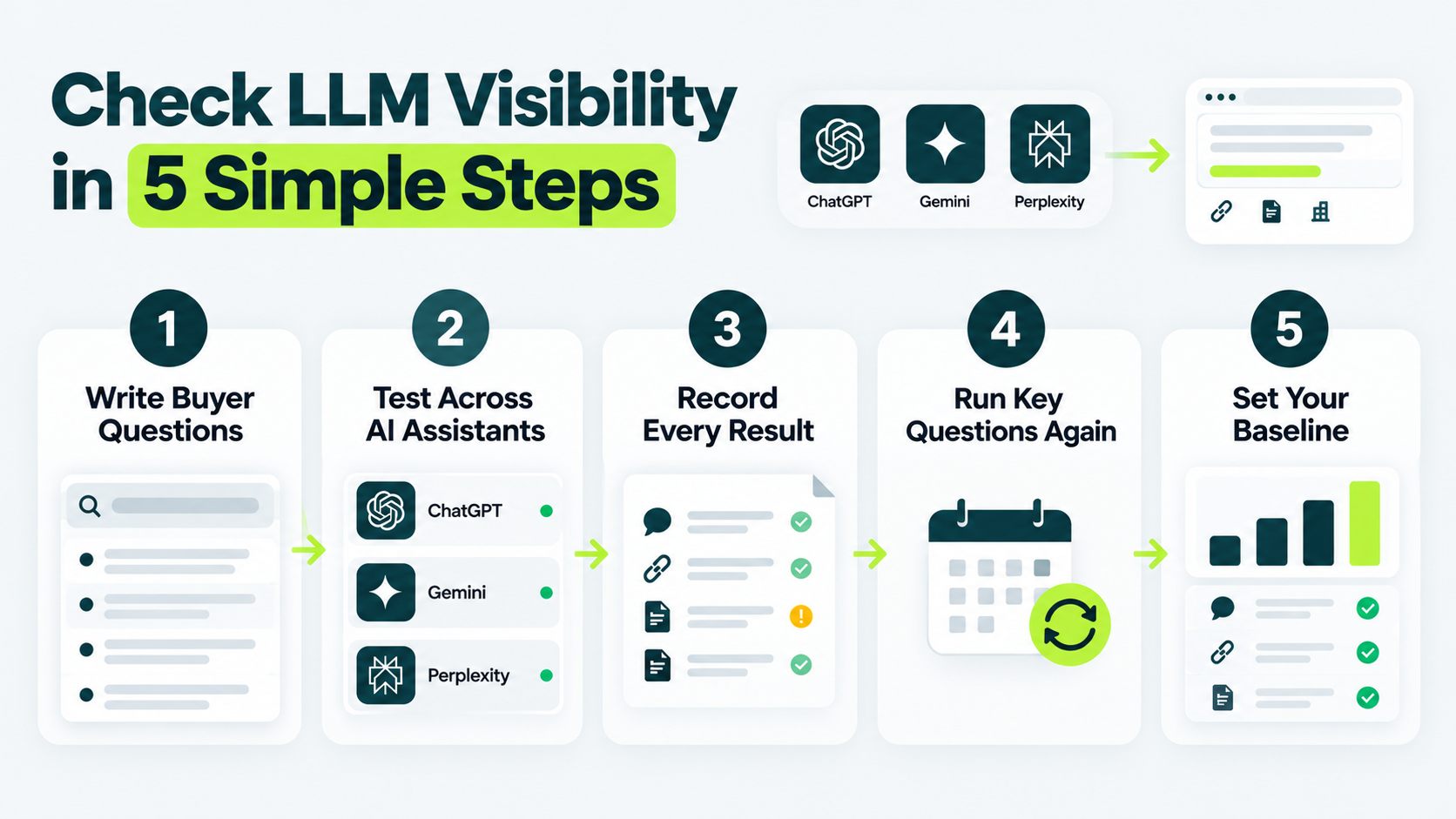
The five steps below give you a baseline you can repeat every month:
Step 1: Write Five to Ten Buyer Questions
List the questions your potential customers ask before choosing a business in your category.
For example, a bookkeeping service for freelancers could test these questions:
- What’s the best bookkeeping service for freelancers?
- Which bookkeeping services help self-employed professionals?
- What should freelancers look for when choosing a bookkeeper?
- How can a freelancer manage invoices and expenses?
- Which bookkeeping services support small online businesses?
- What should a freelancer ask before hiring a bookkeeper?
Include discovery questions, comparisons, and questions about specific customer needs. Avoid prompts that force an assistant to recommend your business.
Step 2: Test Each Question Across AI Assistants
Submit the same questions to ChatGPT, Gemini, and Perplexity.
Two habits will keep your results honest:
- Note whether web search or a search mode was on. An answer from memory and an answer the AI assistant builds from live pages are different things. Write down whether web search or a search mode was on for each test.
- Some assistants use your chat history or saved memory. Open a fresh or temporary chat, ideally while logged out or in a private window, so your own past conversations don’t affect the results.
Asking three assistants is like asking three shopkeepers for directions. They may all point you the same way, or each may send you somewhere different. Either result tells you something.
Step 3: Record Every Result
Do this for every response from all three assistants: Save the full text of the answer. Record the date, the assistant’s name, and every source it displays. Mark whether the assistant names you, links to you, and describes you correctly.
Write down the assistant’s exact wrong sentence, word for word. ‘Says we’re a tax advisory firm’ tells you which source to fix. ‘Wrong info’ tells you nothing.
Step 4: Run the Important Questions Again
AI answers can change from one run to the next, much like how two people use slightly different words when they retell a story.
Run your most important questions again on another day with the same wording and settings.
AI answers change from one run to the next. Two people retelling a story use slightly different words too.
Look for repeating patterns rather than a single lucky or unlucky answer.
Never judge visibility from a single answer. Don’t screenshot the one answer that flatters you and share it.
A lucky run sets a target you can’t repeat, and an unlucky one starts a panic you don’t need.
One instance of your brand appearing in an AI answer isn’t a win, and one instance of it missing is not a crisis.
Treat it like the weather. Weather changes daily. Climate shows up in repeated reading.
Step 5: Establish Your Baseline
The scorecard you first complete becomes the starting line. A small bookkeeping firm might fill in its first scorecard like this.
| QUESTION |
ASSISTANT WITH SEARCH ON |
NAMES YOU? |
LINKS TO YOU |
DESCRIBES CORRECTLY? |
|---|---|---|---|---|
| What’s the best bookkeeping service for freelancers? | ChatGPT | Yes | No | Partly. Says a “full accounting firm” |
| Which bookkeeping service helps self-employed professionals? | Gemini | No | No | Not applicable |
| What should freelancers look for when choosing a bookkeeper? | Perplexity | Yes | Yes | Yes |
These results show where to look. They don’t prove why an assistant picked a source, and they don’t guarantee that any change will move the needle.
Add City Questions If You Serve One Area
If you serve one city, add neighborhood and city versions of your buyer questions. Your customers’ questions are often local, even when a broad phrase like “llm visibility” isn’t:
- “Best bookkeeper for freelancers in Brooklyn”
- “Accountant for small restaurants in Manhattan”
- “Affordable tax help in Queens for self-employed people”
Run these in the same way and score them with the same four checks. Note the neighborhood you used, because results can differ by location and how an assistant uses local data.
Keep your Google Business Profile, the free listing that appears on Google Maps, complete and matching your website.
A mismatched phone number or old address is the AI-era version of a wrong listing in the phone book.
To go deeper into ChatGPT, learn how to monitor brand mentions using a reusable prompt set.
What Your Scorecard Is Telling You
Use each AI response to choose one thing to investigate. A single failed check doesn’t provide a single cause.
| YOUR RESULT |
LIKELY CAUSE |
FIRST FIX |
|---|---|---|
| The assistant doesn’t name you at all |
Too few independent pages mention your business | Earn mentions on the sites the assistants already show as sources |
| The assistant names you but doesn’t link to your site |
No page of yours answers the question clearly enough to be the source | Make the page that assistants should cite answer the question in its first sentence |
| The assistant names you but describes you wrongly |
The sources it draws on carry old or conflicting facts | Correct the facts on those sources and on your own pages, then re-check |
| Your site never appears in ChatGPT answers |
Your site may be turning away OpenAI’s search crawler | Check the crawler setting in the next section |
If ChatGPT never shows your site, fix your crawlers first. Then correct wrong facts, add a clear source page, and add brand mentions last.
Check That OpenAI’s Crawlers Can Reach Your Site
OpenAI says ChatGPT search answers won’t show sites that block OAI-SearchBot. That’s from OpenAI’s crawler documentation.
A crawler is a program that automatically visits web pages. OpenAI runs several, and OAI-SearchBot is the one that matters for ChatGPT search.
Your robots.txt is a plain-text file at the root of your site that tells search engine crawlers which pages they may access. Training is how OpenAI teaches its models from text it collects.
| CRAWLER |
WHAT IT DOES |
WHAT BLOCKING IT DOES |
|---|---|---|
| OAI-SearchBot |
Surfaces websites in ChatGPT’s search features | Your site won’t appear in ChatGPT answers, though it can still appear as a plain link |
| GPTBot |
Collects content OpenAI may use to train its models | Tells OpenAI not to use your content for training |
| ChatGPT-User |
Visits a page when a person asks ChatGPT a question | A person triggers each visit, so robots.txt rules may not apply to it |
OpenAI treats these as separate settings, so a rule for one doesn’t change the other. You can opt out of training and stay in ChatGPT search.
If ChatGPT never shows or links your site, rule out a crawler block before you rewrite a single page. It’s the cheapest problem on the list to check. A block means no rewrite will get you shown in ChatGPT search.
The fix is to check your robots.txt first, since a rule there can prevent your site from appearing in ChatGPT search results. Then check your firewall, because it can block the crawler even when robots.txt allows it.
Five Steps to Check OpenAI Crawler Access
To check OpenAI crawler access, open your robots.txt file, confirm your pages load, check your server logs, review your firewall, and retest thechanges.
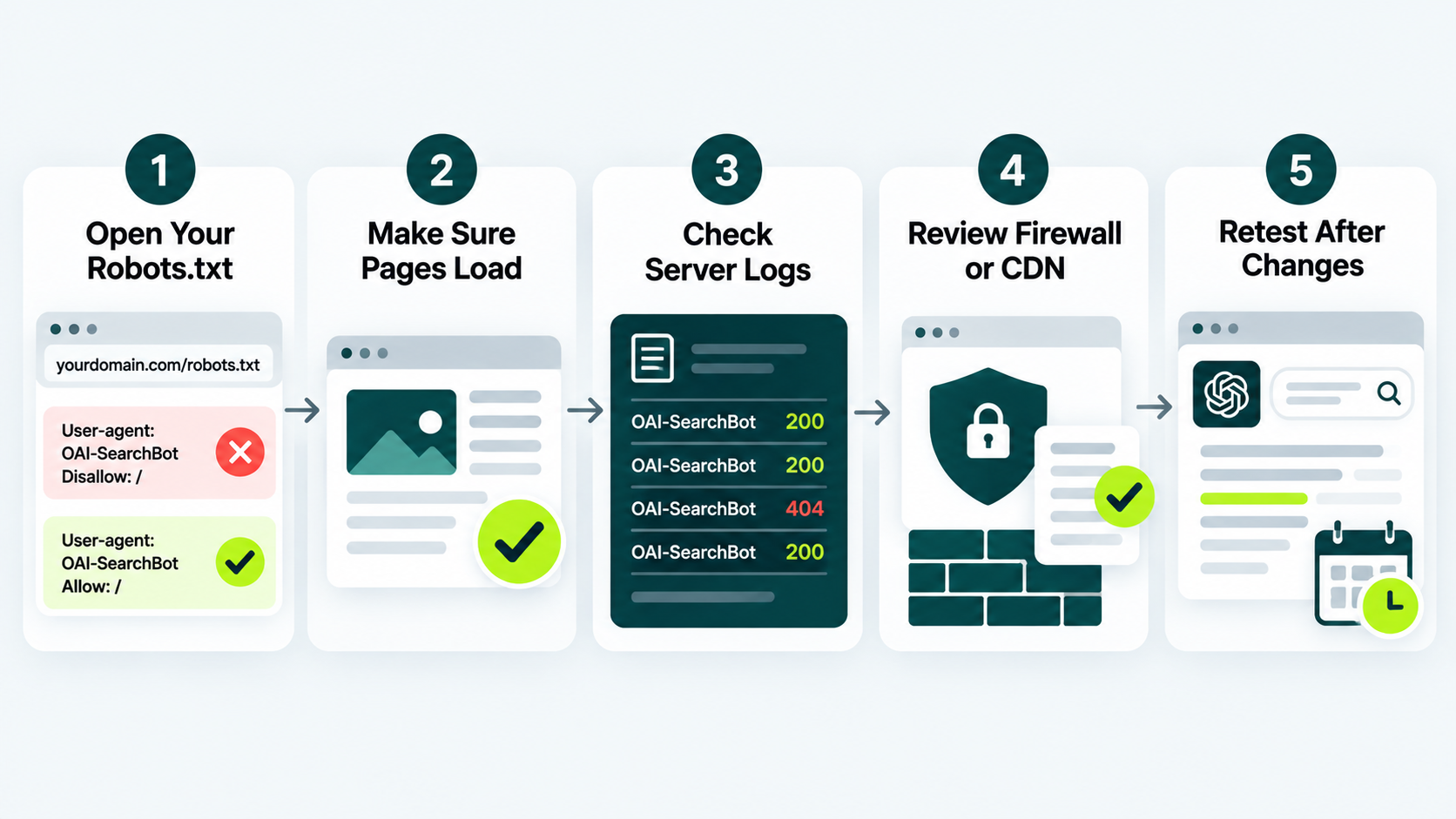
1. Open Your robots.txt
Open yourdomain.com/robots.txt in a browser, replacing yourdomain with your domain. Look for any rule that names OAI-SearchBot or blocks all crawlers.
This rule blocks it from everything:
User-agent: OAI-SearchBot
Disallow: /
This one allows it to see your public pages:
User-agent: OAI-SearchBot
Allow: /
Read the whole file before editing. Other groups and rules can also affect access.
2. Make Sure the Pages Load
Open your homepage and key pages in a browser. This only proves a human can see them. A server or security service can still turn away automated visitors.
3. Ask for the Server Logs
Ask your developer or hosting company to search your server logs for OAI-SearchBot. A server log is a record of every visit to your site.
Each visit has a status code:
200: the page loaded.
403: the visit was refused.
404: the page wasn’t found.
Ask them to match the visits against the list of server addresses OpenAI publishes for OAI-SearchBot. Anyone can pretend to be that crawler, so the address is what proves a visit is real.
4. Check Your Firewall or Security Service
If you use Cloudflare or a similar service, review its security events. A firewall can act like a security guard who never read the sign on the door. Your robots.txt can say “come in” while the guard still blocks the visitor.
5. Retest After Changes
OpenAI says its search system can take about 24 hours to reflect a robots.txt update. That’s not a promise of a citation within 24 hours.
Wait, then re-run your original question.
When robots.txt looks fine, but crawlers still can’t reach your site, bot protection is usually the culprit.
Teams often tighten security settings after a spam wave and never revisit them.
Ask whoever manages your hosting to check, and send them OpenAI’s IP list so they know who to let in.
What to Skip in Your First Audit for LLM Visibility
You can run your first audit without paid software, special files, or custom code: skip the llms.txt until you identify a reason to use it, treat structured data as optional. Start with a spreadsheet. Don’t treat ads as a shortcut to earn AI mentions.
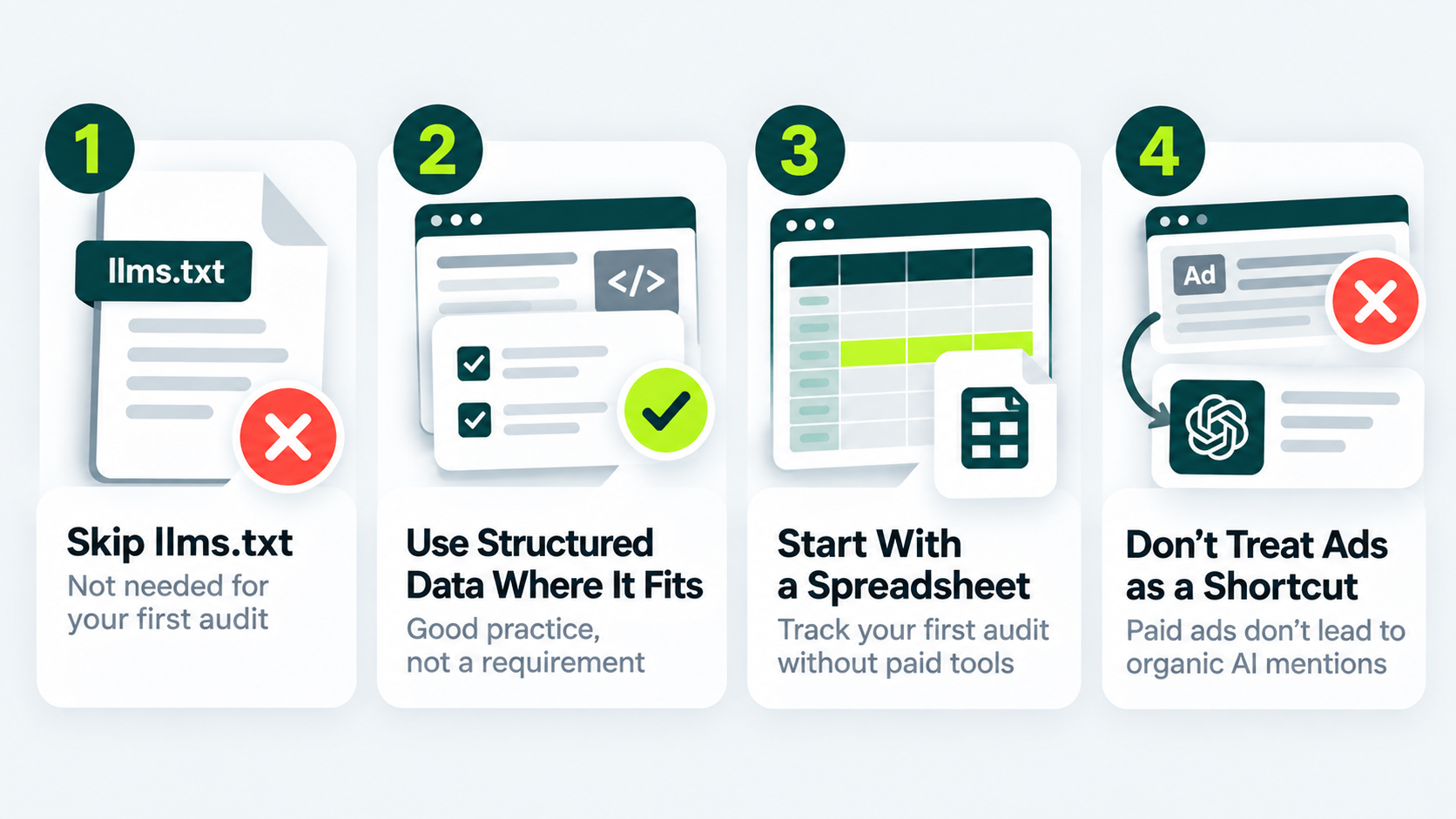
Skip llms.txt Until You Identify a Reason to Use It
llms.txtis a file that people have proposed to guide AI systems to key pages.
Google’s AI optimization guide says you don’t need llms.txt for Google Search, and Google Search ignores it. Creating one won’t change your visibility there.
The same guide says no third-party tool has access to Google’s internal ranking over AI systems. It’s fine to add one for other services that use it, but don’t make it step one.
Use Structured Data Where It Fits
Structured data is code that labels a page’s details for search engines, the way a nutrition label lists what’s inside a package. A clear, accurate label helps search engines understand the page.
But no label makes anyone buy the product. Google’s guide says generative AI search requires no special schema markup.
Use structured data where it accurately describes your page. Don’t add it because you hope it will earn AI mentions.
Start With a Spreadsheet
A spreadsheet works well for a small audit. Consider a tool when you track more than 10 questions or more than 1 brand or market. Score your first 30 answers by hand before you pay for a monitoring tool. Once you’ve scored every answer yourself, you can tell what a tool actually measures and what it skips.
Before paying, ask what the tool measures and how it collects results. Google also cautions that no third-party tool has access to its internal ranking or AI systems.
Don’t Treat Ads as a Shortcut to Organic AI Mentions
OpenAI says ads don’t influence ChatGPT’s answers. Ads appear below a response with a sponsored label, and OpenAI currently shows them to Free and Go plan users.
Paying for an ad is won’t earn you an organic recommendation. Read OpenAI’s ads help page for further details.
How to Recheck LLM Visibility for Your Site
Run the same questions monthly to build a comparable record of your brand’s visibility. Test sooner when you need to verify a technical fix or investigate a specific issue.
Keep these details consistent from test to test:
- Prompt wording and order.
- AI platforms and search settings.
- Scoring criteria for mentions, citations, and factual accuracy.
- The way you count repeated responses.
- The format for logging dates and sources.
There is no fixed timeline for improving LLM visibility. You may resolve a crawler-access issue relatively quickly, while changes in brand mentions, source selection, and citation frequency may take longer and vary across platforms.
Focus on measurable changes rather than arbitrary targets. Record the action you took, the date you took it, and the result of the later tests.
Open One Buyer Question Tonight
Open a private browser window. Ask ChatGPT the one question your best customer asks.
Copy the first wrong or missing answer into your spreadsheet, word for word. That sentence is your first fix.
Want Your Brand to Appear in More AI Answers?
Earn relevant mentions and strengthen your brand’s visibility across the sources AI assistants rely on.
What is LLM monitoring?
LLM monitoring means testing AI assistants with a consistent set of questions and recording how they describe your business. Depending on your goals, you can track brand mentions, website citations, factual accuracy, and changes in the sources the AI assistant displays.
Is ChatGPT an LLM or generative AI?
ChatGPT is an AI product that uses large language models. LLMs fall under the broader category of generative AI, which includes systems that produce text and other content.
Does link building help improve LLM visibility?
Link building may support LLM visibility by helping establish website authority and increasing your brand’s presence across relevant online sources. However, backlinks alone do not guarantee that an LLM will mention or recommend your brand. An established link building agency can help you earn relevant, credible backlinks that contribute to a stronger online presence.
Do I need a tool to check LLM visibility?
No, a spreadsheet and ten questions are enough for your first check. Say you sell accounting software to freelancers. Ten questions across three assistants gives you thirty answers, which one person can read in an afternoon.
How is LLM visibility different from AI visibility?
In everyday use, they mean the same thing. LLM visibility names the technology behind the assistants, while AI visibility is the looser phrase. There is no universally accepted measurement standard.
Can I pay to improve LLM visibility?
No advertising product guarantees an organic mention in AI answers. OpenAI states that its ChatGPT ads don’t influence the answers ChatGPT provides. Use advertising to pursue appropriate marketing goals, but don’t treat it as a guaranteed way to earn organic AI citations.
Does blocking GPTBot stop my website from appearing in ChatGPT answers?
No, not by itself. GPTBot and OAI-SearchBot serve different purposes. Blocking GPTBot opts your content out of that crawler’s potential training use, while OAI-SearchBot supports discovery for ChatGPT search. Check each crawler’s rules separately.
Does allowing OAI-SearchBot guarantee that ChatGPT will mention my business?
No. Allowing OAI-SearchBot only lets the crawler read your pages. ChatGPT still decides which sources to retrieve, cite, or mention in each answer.