Generative engine optimization (GEO) is the practice of structuring your content to help AI tools like ChatGPT, Perplexity, Google AI Overviews, Gemini, and Copilot find and cite relevant content when answering users’ questions. Teams looking to apply this should review our step-by-step guide to monitoring brand mentions in ChatGPT for execution detail.
Unlike traditional SEO, which aims to rank in Google’s search results, GEO focuses on including your content as one of the few sources an AI pulls into its response. Many in-house teams that lack bandwidth turn to link building services to run prospecting and outreach at scale.
This doesn’t mean replacing SEO, but it’s all about adding value to it. The goal is simple: when millions of people ask AI a question, you want your brand to be the one it mentions.
Key Takeaways:
- GEO and SEO are complementary. SEO is no longer enough alone.
- Statics and source citations can boost AI visibility by around 41%
- Brand mentions can show a stronger correlation between AI visibility than backlinks, especially for AI overviews.
- The content freshness should have a 13-week effective shelf life.
- Each AI content platform cites content differently.
What is Generative Engine Optimization?
Generative engine optimization is the process of making your content likely to be cited as a source when AI platforms generate answers.
When someone asks ChatGPT, “What’s the best way to build authority for new SaaS websites?” or searches in Perplexity about link building strategies, GEO determines whether your content gets included in that answer or is entirely skipped.
The nine optimization methods were tested on 10,000 queries, introduced the GEO, and created a benchmark to measure how often content appears in AI-generated answers.
Let’s look at the image first to understand how exactly the traditional SEO and GEO work. The image below shows that in traditional SEO, the user searches in a search engine, it shows the ranking pages, and then the user clicks on them.
Whereas, in GEO, the user searches on AI platforms, the AI platforms show the cited results and sources, and the user gets answers without even visiting multiple links.
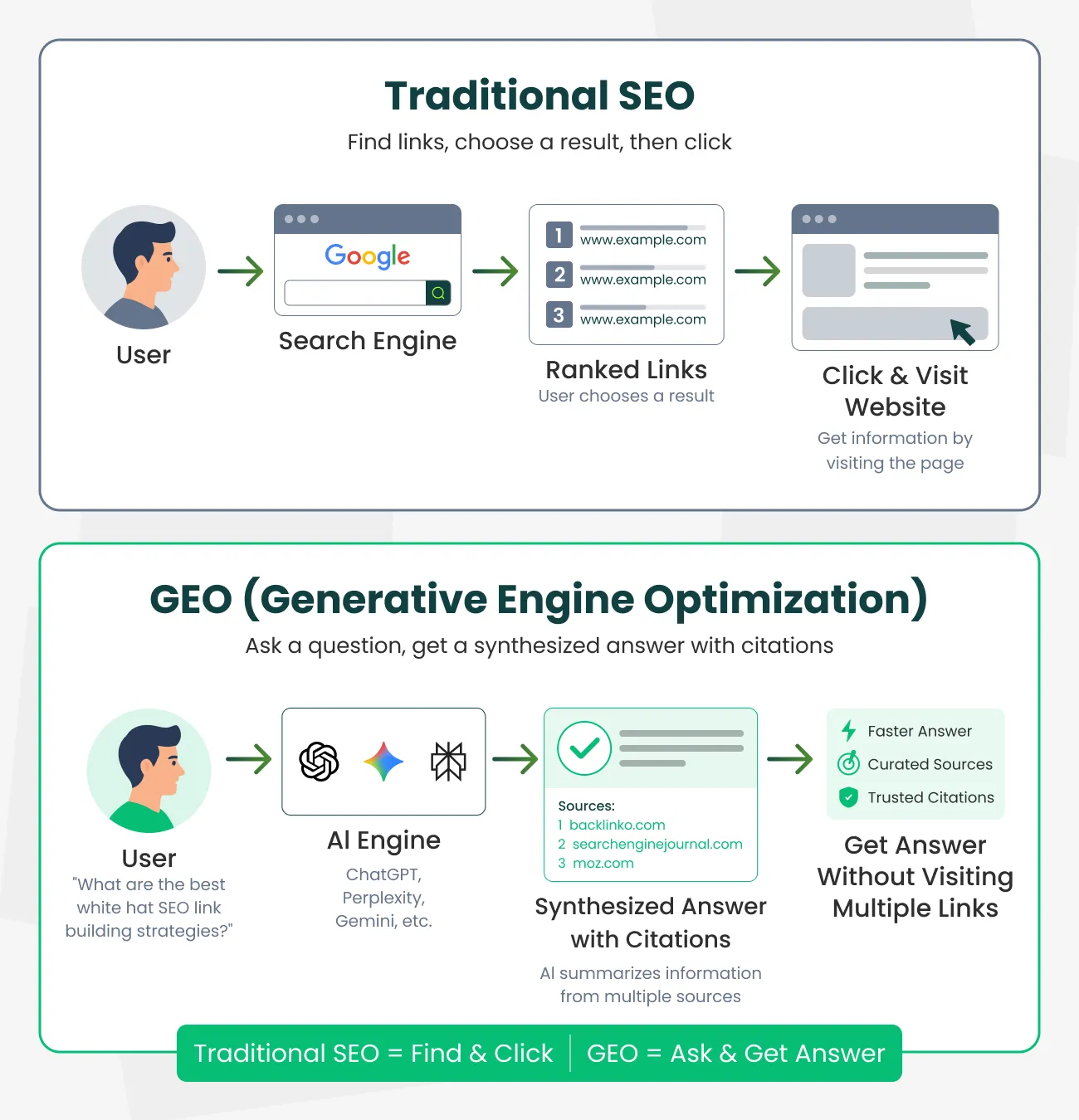
Search engines rank pages in SERPs. AI engines combine answers from different sources and blend them into a single answer. Your content doesn’t need to outrank your competitors. It just needs to be selected as a credible source from which the AI can extract and cite information.
In SEO, you’re competing for one of ten results, but in GEO, you’re competing for a few citation slots within a single AI-generated answer. It’s a tough competition, but the reward is different. When an AI like ChatGPT considers your brand as a source, it acts as an endorsement that a regular search ranking can’t offer.
Why GEO Matters Now (Not Later)
The shift isn’t gradual; it’s accelerating fast. ChatGPT now processes billions of prompts every day. Perplexity has grown to tens of millions of active users. Google’s AI Overviews are appearing on a growing share of desktop searches. These numbers are hard to ignore.
But here’s the part that should gain your attention. An eMarketer report on GEO in 2026 found that fewer than 10% of the sources cited by ChatGPT, Gemini, and Copilot actually rank in Google’s top 10 for the same search query.
That means your page-one ranking doesn’t guarantee AI visibility. And your AI visibility doesn’t require a page-one ranking.
For businesses that depend on organic search, they now face a split reality (see our playbook for showing up in AI Overviews). SEO still matters for Google rankings, but the users are getting answers through AI, and if your content isn’t structured to be cited, you wou won’t show up on AI platforms.
Sites with strong organic profiles but no GEO strategy are still missing from AI responses for their main keywords. They have the authority. The citations are what is missing.
How AI Engines Select Content to Cite
To optimize for AI citations, you need a better understanding of how it actually works. Most of the AI search platforms run the process called Retrieval-Augmented Generation (RAG), and it works differently from the traditional search rankings.
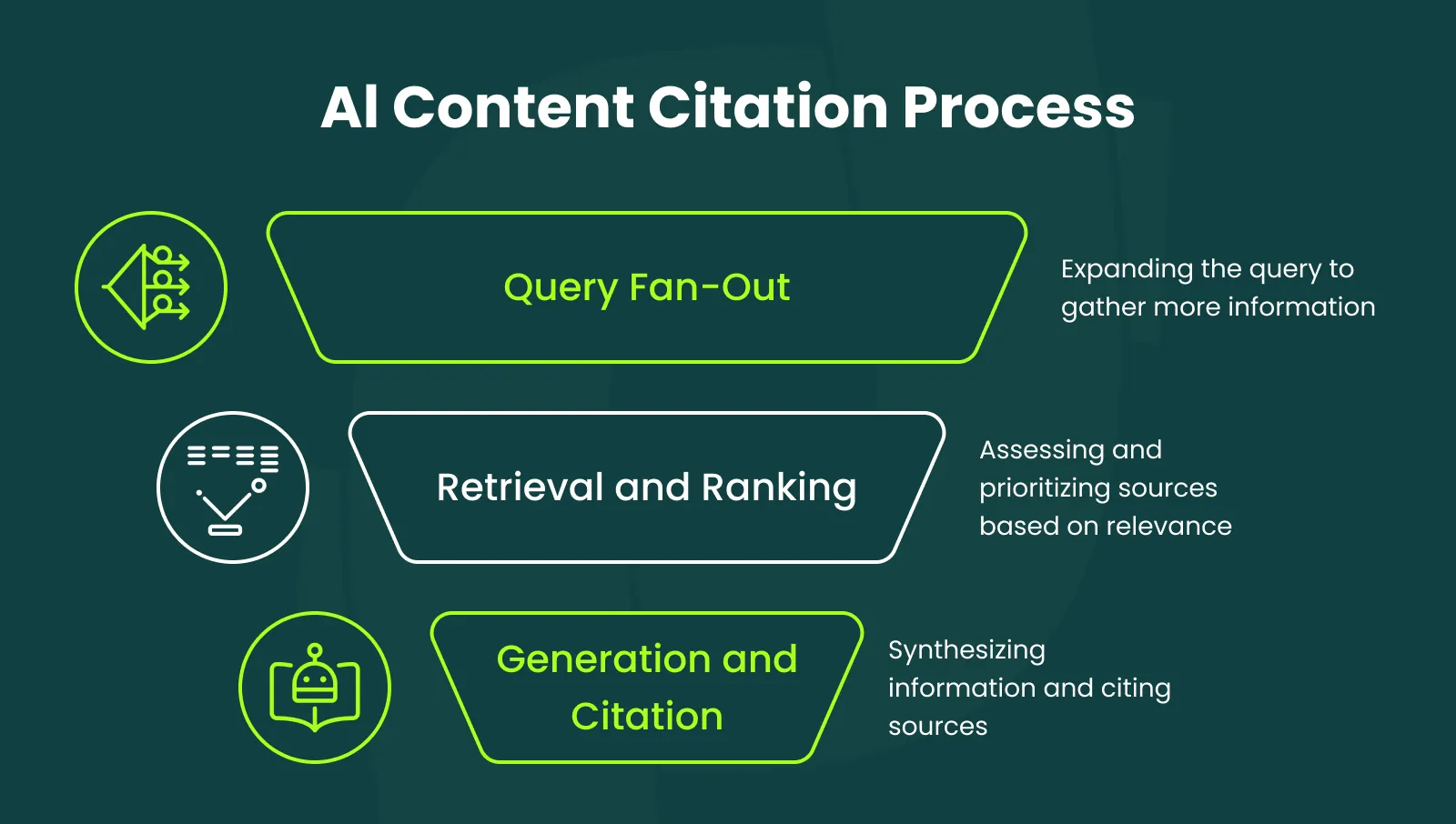
It consists of three main modules: query fan-out, retrieval and ranking, and generation and citation. Let’s look at them in detail.
Query Fan-Out
When someone asks a complex question, the AI doesn’t search for it word-for-word. Instead, it breaks it down into smaller sub-queries and searches for each one separately.
Suppose a question is asked, “What ‘s the best link building strategy for a B2B SaaS company with a smaller marketing team?” This question might get split into “B2B link building strategies,” “link building small teams,” and “SaaS authority building 2026.”
This means that your content should separately answer these queries, not just the bigger questions. If your content only answers broader questions without covering small pieces, you’ll miss out on citation opportunities.
Retrieval and Ranking
Once the AI has its sub-queries, it pulls the list of candidate pages and evaluates them. It evaluates each page for relevance, trust, and its structural clarity.
Pages that win tend to have clear, organized headings, specific data points, and statements that stand on their own without the requirement of extra context.
Pages that lose tend to be vague, overly promotional, or hard to scan don’t impress AI. AI is not impressed by marketing language; it’s looking for clarity and credibility.
Generation and Citation
The AI takes its highest-scoring pages, builds an answer from them, and attaches citations. It results in either your content making it into the answer with your brand name mentioned, or it gets skipped, and your competitor is mentioned.
Takeaway:
Write like an expert sharing valuable advice that is evidence of your expertise, rather than writing like a marketer trying to rank.
GEO vs. SEO vs. AEO: What’s the Difference?
These three terms are often mixed up and connected, but each aims for a different outcome.
| SEO |
GEO |
AEO |
|
|---|---|---|---|
| Goal |
To rank in search results. | Get cited in AI-generated answers. | To be the direct extracted answer. |
| Target |
Google and Bing organic results. | ChatGPT, Perplexity, Gemini, AI overviews. | Featured snippets, PAA, voice search. |
| Success Metrics |
Rankings, clicks, traffic. | Citation frequency, brand mentions. | Position zero, snippet ownership. |
| Key Signals |
Keywords, authority, and user signals. | Data density, entity definitions, and freshness. | Answer formatting, self-contained paragraphs. |
| Content Format |
Long-form comprehensive pages. | Structured, extractable, data-backed. | Direct-answer paragraphs, concise lists. |
SEO helps search engines to find your content. GEO helps AI models choose your content as a source. And AEO (Answer Engine Optimization) goes a step further by getting your content pulled out as a direct answer itself.
Ultimately, you require all three working together. However, the way you write for each may differ.
A page built purely for SEO is often packed with keywords and backlinks, but one written in broad, generic terms will often fail at GEO because AI models aren’t looking for any popular pages. They’re looking for the most specific, clearly mentioned, and trustworthy pages.
The 7 GEO Strategies That Actually Work
Not every “GEO” tactic produces results. A 2024 Princeton-affiliated study on generative engine optimization, combined with commercial data from Ahrefs, Semrush, and BrightEdge, gives a clear picture of what works best and what doesn’t.
1. Add Statistics and Data to Every Key Section
This one tactic made a significant difference in testing. In one experiment, it led to up to 40% improvement in AI visibility, per that same study, just by including quality data in your content.
The reason is simple. AI models treat precise data as reliable information. A statement like “domain authority dropped 15 points in 8 weeks” is something an AI can confidently cite. A statement like “ranking decreased over time” is too vague to be useful.
Here are the right and wrong ways to mention.
Right way: “Organic click-through rate (CTR) drops 61% when an AI Overview appears for the same query, according to a Seer Interactive study of 25.1 million impressions.”
Wrong way: “AI overviews have a negative impact on click-through rates for organic results.”
Both roughly say the same thing. But only one gives an AI model a specific claim to confidently cite it.
2. Define Every Entity on First Mention
When you introduce a new concept or term, define it clearly in one sentence. Don’t assume your readers or the AI already know what it means.
It matters for GEO because AI models build knowledge graphs from entity definitions.
If that chunk contains a vague reference like “this approach works because…” without any explanation of “this”, the AI has nothing to cite. But if your definition is self-contained and clear, it can stand out even when pulled out of context.
Clearly avoid vague words like “it,” “this,” or “they” in your definition. Always use the actual names of the thing you’re describing.
For example, you are writing “Editorial link building is the process of earning contextual backlinks from authoritative websites through manual outreach as opposed to paid placements, directory listings, or automated link schemes.”
This definition doesn’t contain any words like “it”, “they”, or “this”. It means it is the perfect example of mentioning the entities while introducing them for the first time.
3. Structure for Extraction, Not Just Reading
The way you format your content matters just as much as what you write. AI engines favor specific structures depending on what’s being asked, and matching that structure gives your content a better chance of being extracted.
Numbered Processes
Such as H3 steps under H2 questions, achieve the highest extraction rates from Google AI overviews. When someone asks “how to build backlinks for a new site,” an AI overview almost always formats its response as a list. Your content should provide that structure.
Comparison Tables
With clear column headers, are preferred by ChatGPT and Perplexity for evaluating queries like “guest posting vs. niche edits.” If your comparison is inside a paragraph rather than a table, you’re making the AI do extra work to phrase it, and it’ll choose a competitor’s table instead.
Definition-First Paragraphs
If the question starts with “what is,” it leads with a clean, direct definition of 40 to 60 words right below the heading. No indirect starts and no bluff; start the answer directly.
4. Build Brand Mentions Across the Web
Branded web mentions, linked and unlinked, show the highest correlation with the AI overview visibility.
An Ahrefs 2025 analysis of 75,000 brands found a Spearman correlation of 0.664 between web mentions and AI Overview visibility, compared with 0.218 for backlinks.
This is a fundamental shift. For two decades, link building meant earning clickable links. For AI visibility, earning mentions of your brand on third-party sites matters more than earning links from them.
YouTube mentions that it has a strong partnership with AI visibility across ChatGPT, AI Mode, and AI Overviews.
That means brands mentioned in video titles, descriptions, and transcripts were more likely to appear in AI-generated responses.
Your off-site strategy needs to include digital PR, community participation on platforms like Reddit, Quora, and industry forums, review site presence, and YouTube visibility, not just traditional link acquisition.
5. Keep Content Fresh on a 90 Day Cycle
AI systems have a strong presence in recent content, and the data backs it up. Half of all AI-cited content is less than 13 weeks old, according to a summary of Amsive’s research published on Lily Ray’s Tech SEO Connect 2025 recap.
An Ahrefs analysis of 17 million citations across seven AI platforms found that AI-cited pages average 1,064 days old overall, even though the freshest half of citations skew far younger than that average, in comparison with 1,432 for traditionally ranked content, a 25.7% freshness advantage.
A 90-day refresh cycle works well for your most important pages. Update your statistics by adding recent examples and expanding any sections with new information. Don’t just change the date and call it updated. AI models can evaluate whether the content itself has actually been updated, not just the time stamp.
6. Make Your Content Technically Accessible to AI Crawlers
Any tactics don’t work if AI crawlers can’t access your content in the first place. There are three technical things worth checking.
Robots.txt
It is a file that tells crawlers what they can and can’t access on your site. Make sure that you’re not accidentally blocking ChatGPT bots, ClaudeBot, or PerplexityBot. According to Press Gazette research, nearly 79% of almost 100 top news publications block at least one AI crawler.
How your pages load
AI crawlers don’t execute JavaScript the way a browser does. If your site relies mostly on client-side rendering to display content, there’s a good chance that AI crawlers are seeing a blank page. Make sure that your content is visible even without needing to run JavaScript.
llms.txt
It is an emerging standard that provides AI crawlers with a simple, machine-readable guide to your site, what’s on it, what matters most, and how you’d prefer to be cited. However, it’s not universally adopted yet, but setting it up early signals that your site is built while considering AI accessibility.
7. Optimize Differently for Each AI Platform
Not every AI platform extracts content through the same lenses. Tailoring your content to each one can make a genuine difference in how often you get cited.
Google AI Overviews
It provides results from the pages that are already ranking in Google’s top 10. They prioritize numbered lists for step-by-step questions, comparison tables showing “which is better” type queries, and short paragraph summaries of around 40 to 80 words. Brand mentions carry more weight here than on other platforms.
ChatGPT
It prioritizes recent content and specific, self-contained preference claims attributed to a named source. It responds well to clear headings with proper H2 and H3 and high information density. Reddit and Wikipedia are among its frequently cited sources, a pattern that shifted after a major update in September 2025.
Perplexity
It cites multiple sources per answer; typically, 3 to 5. What makes it different is that it favors unique data points that can’t be found elsewhere. If you have original research or data, this can be your strongest edge.
Gemini
It is deeply connected to Google’s knowledge graph, which means clear entity definitions matter a lot here. Structured formats like tables, lists, and step-by-step processes perform well here.
How to Measure GEO Performance
For a full page-by-page audit workflow, see our guide to auditing existing content for AI search.
Getting cited does not always require the top organic ranking; see how to get cited without the top spot for the full breakdown.
You can’t manage what you can’t measure. GEO measurement is different from SEO tracking. Traditional SEO metrics such as keyword rankings, organic traffic, and click-through rates don’t capture AI citation performance.
A page can lose a significant share of its organic clicks to AI overviews while gaining brand visibility by being cited in those same overviews.
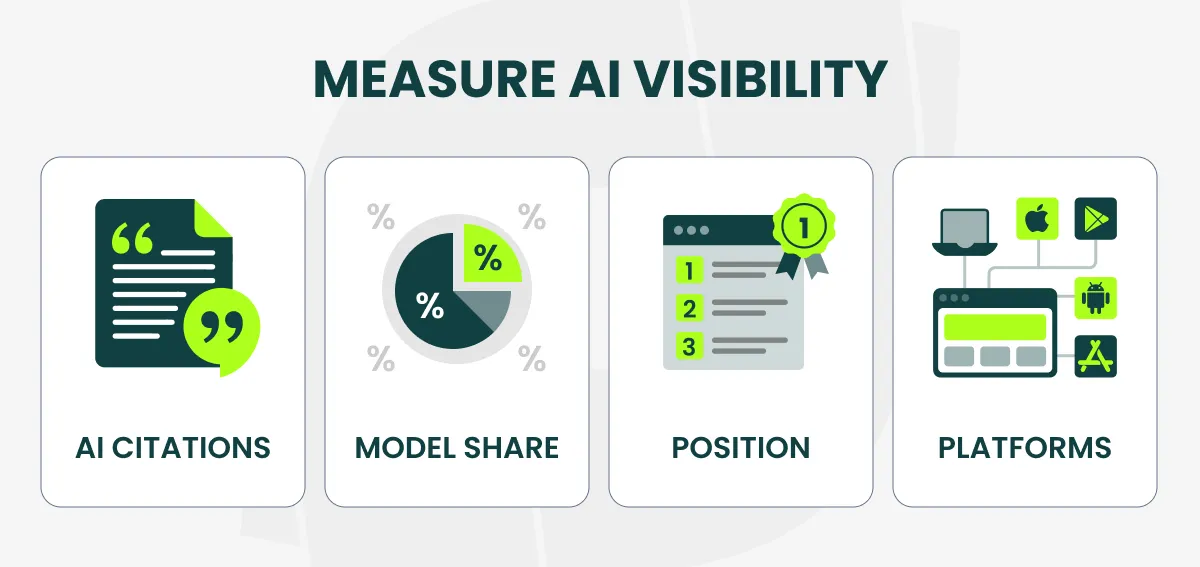
Track these four metrics instead:
AI Citation Frequency
Analyze how often your brand or content appears in AI-generated responses for your target queries. Use tools like Ahrefs Brand Radar, Semrush’s AI visibility Toolkit, and Otterly.ai to automate this tracking across platforms.
Share of Model
Measure how often your brand and your competitors’ brands appear in AI responses for the same queries. This is the GEO equivalent share of voice in traditional marketing.
Citation Position
The citation position matters the most because a citation placed earlier in an AI response can carry more weight. It’s simple, the first source cited gets more attention from the users than the fifth citation.
Platform Specific Tracking
It is important because the same query may return different results across platforms. Only a small share of citations overlap between Google’s AI Overviews and AI Mode. Therefore, track each platform separately.
One practical approach:
Run 10-15 of your priority queries through ChatGPT, Perplixity, and Google AI Overviews every quarter. Record which brands appear, in what position, and with what framing. This manual process may take around an hour, but it gives you a baseline before investing in any automated tools.
GEO and Link Building: What Changes?
For the teams focused on authority building and link acquisition, GEO doesn’t make link building outdated, but it reshapes the priorities.
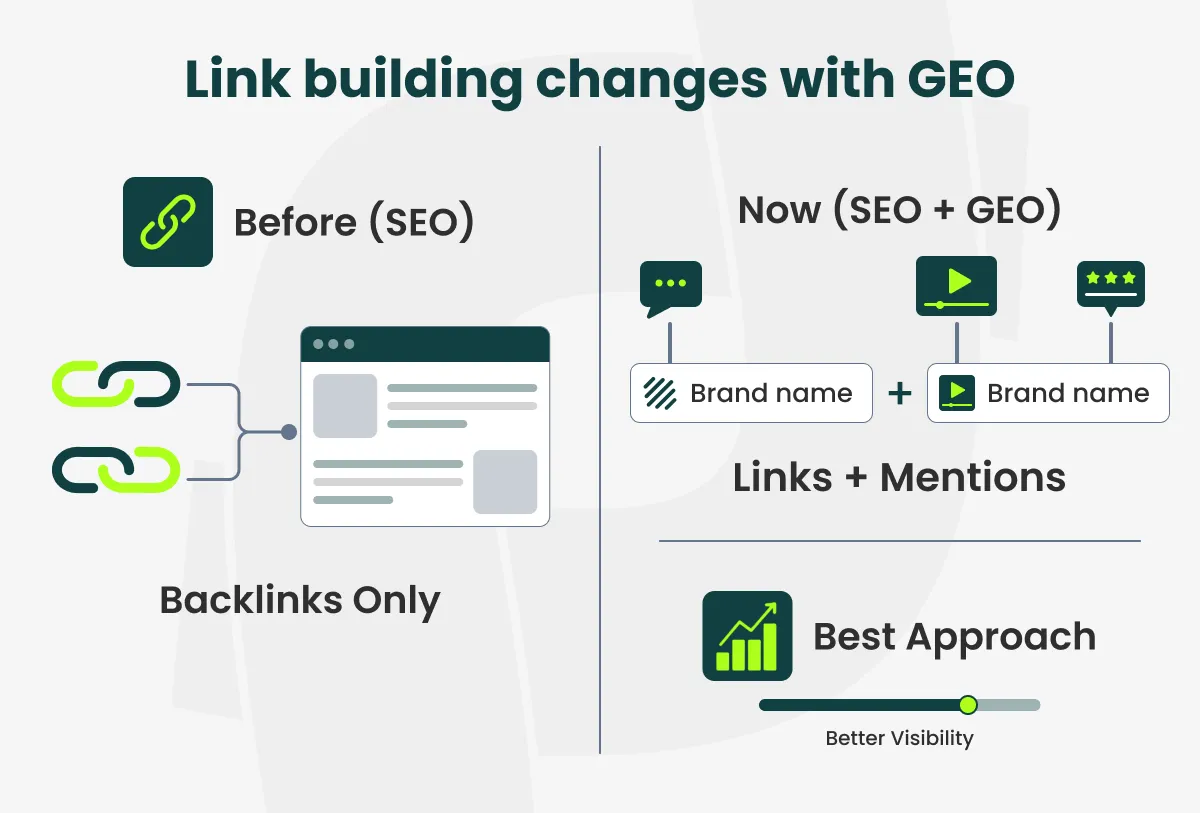
Where traditional link building mostly focused on earning dofollow clickable links from high-authority domains. GEO expands that focus to include brand mentions, linked or unlinked, across a wider range of platforms.
Web mentions matter three times more than the backlinks for AI Overview visibility. When your brand is being discussed on Reddit, mentioned in YouTube transcripts, cited on review platforms like G2, or even referenced in industry forums, all contribute to the entity signals that AI models use to identify the eligibility.
However, this doesn’t mean that links stopped working. Where 76.1% of cited URLs also rank in the top 10 organically. A backlink profile still builds the foundation that you need. However, links are not the only ones that determine your visibility.
Brands that pair traditional outreach-driven tactics with calculated brand mention campaigns tend to see stronger AI citation frequency than brands that focus solely on links.
Common GEO Mistakes to Avoid
Here is a list of common mistakes made when considering Generative engine optimization. Try to avoid them, and you can get the desired results.
Writing for AI Instead of Humans
GEO tactics should improve it rather than interpret it. If a data or structural change makes the reading experience worse, then skip it. AI platforms prefer the same content qualities readers value, such as clarity, specificity, and credibility.
Ignoring Traditional SEO
GEO is not a replacement for SEO; instead, it compounds it. Pages that don’t get ranked organically still have a harder time getting cited, especially in Google AI Overviews. Build the organic baseline first, then opt for GEO.
Treating all AI Platforms the Same
All the AI platforms have different citation behavior, formats, and freshness criteria. A strategy built for one platform will underperform on other platforms.
Publishing and Forgetting
AI platforms favor recent content, and that 13-week citation window closes faster than most content calendar accounts for. Build a regular refresh cycle directly into your workflow.
Stuffing Keywords
Keyword stuffing actually hurts your chances. AI models aren’t counting how often a word appears; they’re evaluating whether your content is genuinely useful and credible.
Using Promotional Language
AI models ignore sales copy; write to inform and provide value rather than to sell. Semrush’s content optimization study found a negative correlation between promotional tone and the probability of AI citations.
Does GEO replace SEO?
No, in fact, GEO is built on SEO; it doesn’t replace it. Organic rankings still feed AI citation pools. Google AI Overviews draw 76.1% of their cited URLs from the top 10 results. The right approach is to run both in parallel. SEO gets your pages discovered and ranked, GEO gets them cited in AI-generated responses.
How long before GEO efforts produce results?
New content enters AI citation within 3 to 5 business days, based on the data from multiple practitioners. However, sustaining those citations requires freshness. Most brands see measurable citation improvements within 60-90 days of implementing structured GEO tactics across their main content.
What tools track AI citations performance?
Many platforms now track brand visibility across AI search. Ahrefs Brand Radar mentions across AI Overviews, ChatGPT, and Perplexity. Semrush’s AI Visibility Toolkit tracks citation frequency and the model’s share. Otterly.ai, Rankscale, and similar point solutions offer GEO tracking. Choose based on which platforms matter most for your audience.
Is GEO only relevant for informational content?
Not really, Semeruh’s research found that case studies and pricing pages are among the best content types for driving AI reference traffic. The how-to guides are still cited, but AI models answer those queries directly from training data without citing external sources. Bottom funnel content with original data or specific pricing actually earns more citations.
How is GEO different from AEO (Answer Engine Optimization)?
GEO focuses on being cited as a source inside an AI-generated response. AEO focuses on being extracted as an answer in the featured snippets, PAA boxes, and even voice search results. GEO means your brand name appears along with the AI answer. AEO means your exact text becomes the answer. Both matter, but GEO addresses AI search platforms specifically.
Start With a Citation Audit This Week
Open ChatGPT right now and ask it your top buyer question.
Note whether your brand shows up, and who does instead.
That gap is your GEO starting point for this quarter.
Struggling to get your brand mentioned in AI-generated answers?
Get a strategy to help you show up where decisions are being made.