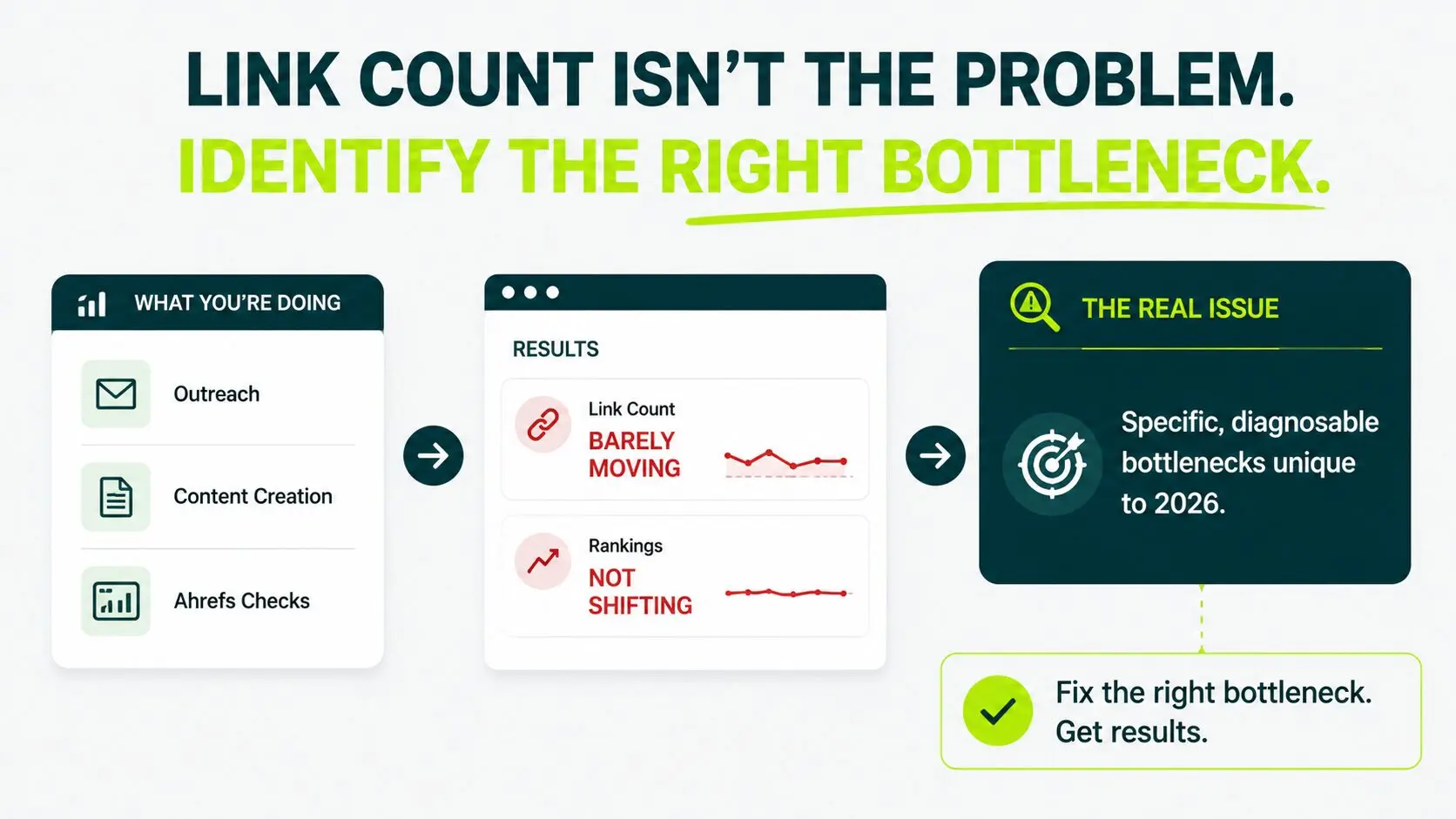
You’ve been doing outreach. Writing content. Checking Ahrefs every Monday morning. And yet the link count barely moves, or the links you do land aren’t shifting rankings the way they used to.
The real link building challenges in 2026 are specific and diagnosable and different from those of 3 years ago. The fix depends entirely on which one is slowing you down.
What You’ll Learn
- How AI Overviews and ChatGPT changed what a good link actually means
- How to diagnose your real link building bottleneck
- Why outreach reply rate is 4.5%
- Why 52.3% of marketers now say link building is the hardest part of SEO
- What to stop doing in 2026 because Google now catches it
What Shifted in Link Building Between 2022 and 2026
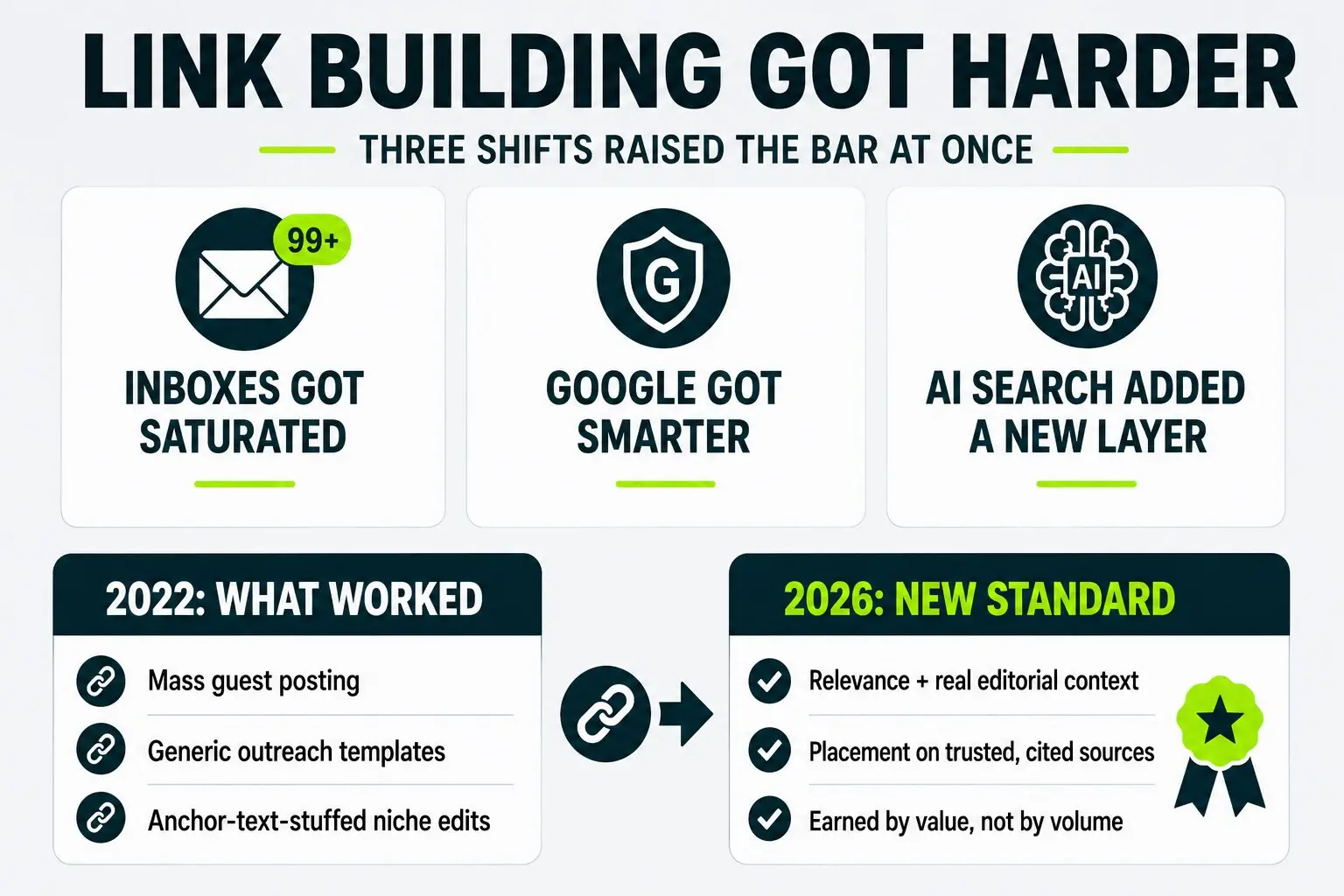
Link building got harder because the bar for what counts as a good link shifted completely. Google now devalues links that lack topical relevance and editorial context. AI search added a second layer of evaluation on top of that.
Three Things Changed at the Same Time:
- Senders saturate outreach inboxes
- Google got sharper at detecting manipulation
- AI search layered a whole new evaluation system on top of traditional ranking
The tactics that worked in 2022 underperform now. Mass guest posting on low-quality sites, generic outreach templates, and over-optimized anchor text have all lost ground. Done at scale, they can pull rankings down.
This is the real shift. 52.3% of digital marketers now call link building the most challenging part of SEO, according to DemandSage statistics 2026. More link building statistics put that number in context.
Marketers often judged a good link in 2022 by metrics like DR and dofollow status. A good link in 2026 is a contextually relevant editorial placement on a site that AI models already trust as a citation source.
Meaning
Domain Rating (DR) is an Ahrefs metric measured on a 0 to 100 scale that estimates a website’s overall authority based on the strength of its backlink profile. Google does not use DR as a ranking signal. It is a third-party proxy for evaluating backlink strength.
A dofollow link from a site with a stronger backlink profile generally carries more weight in search results than one from a weaker site.
The team at Outreach Desk has run over 500 campaigns across 25+ countries, working with everyone from early-stage SaaS companies to multi-vertical agencies managing regulated niches such as healthcare and finance.
The problems mentioned below come directly from patterns we see repeated across those campaigns, regardless of industry or budget.
The Response Rate Problem
The response rate problem is simple: most outreach emails look identical to the hundreds of pitches editors have already deleted this week.
Publishers now receive so many AI-generated, template-driven pitches that a personalized email is the exception rather than the norm. That’s why reply rates have fallen across the industry.
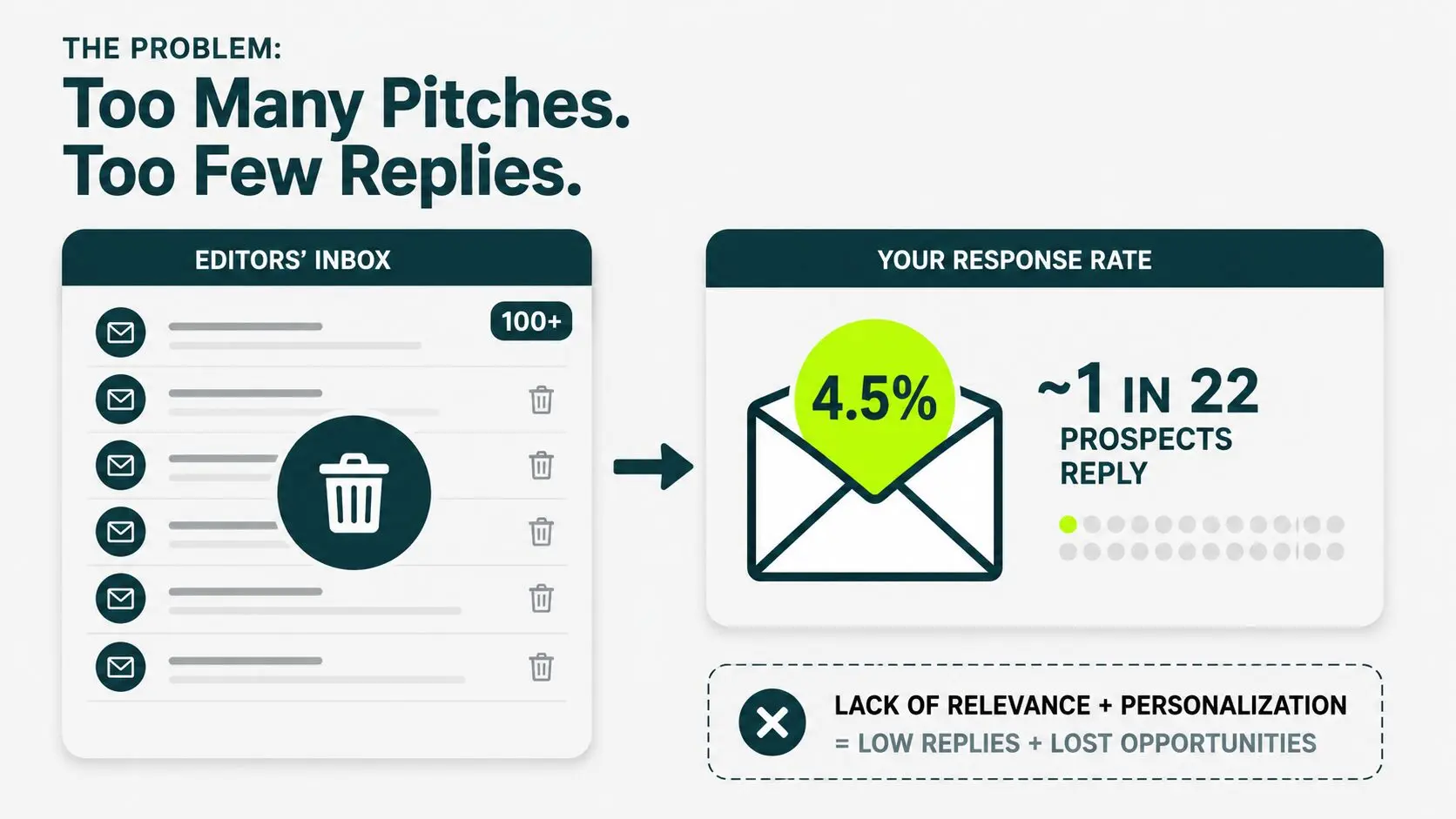
The average cold-email reply rate across all outreach sequences is 4.5%, according to Hunter’s State of Email Outreach 2026 report, based on 31 million emails sent in 2025.
For link building and digital PR specifically, well-targeted campaigns average closer to 13%. The gap comes down to relevance and personalization. Most outreach sits closer to the 4.5% floor.
For most teams, this means that 1 in 22 prospects responds to your email, and only a fraction of those convert into a placement.
The cause is publishers and editors receiving dozens of the same kind of pitches every day. AI-generated outreach made it worse. Editors spot ChatGPT-drafted pitches instantly and delete them faster than ever.
As a result, a growing number of link builders have added LinkedIn to their outreach process, using it alongside email rather than replacing it.
What To Do Instead
Generic pitches get ignored. These small shifts, like personalizing the first 30 words, leading with value, and switching channels when emails stop working, change how your outreach reads and how often it gets a reply.
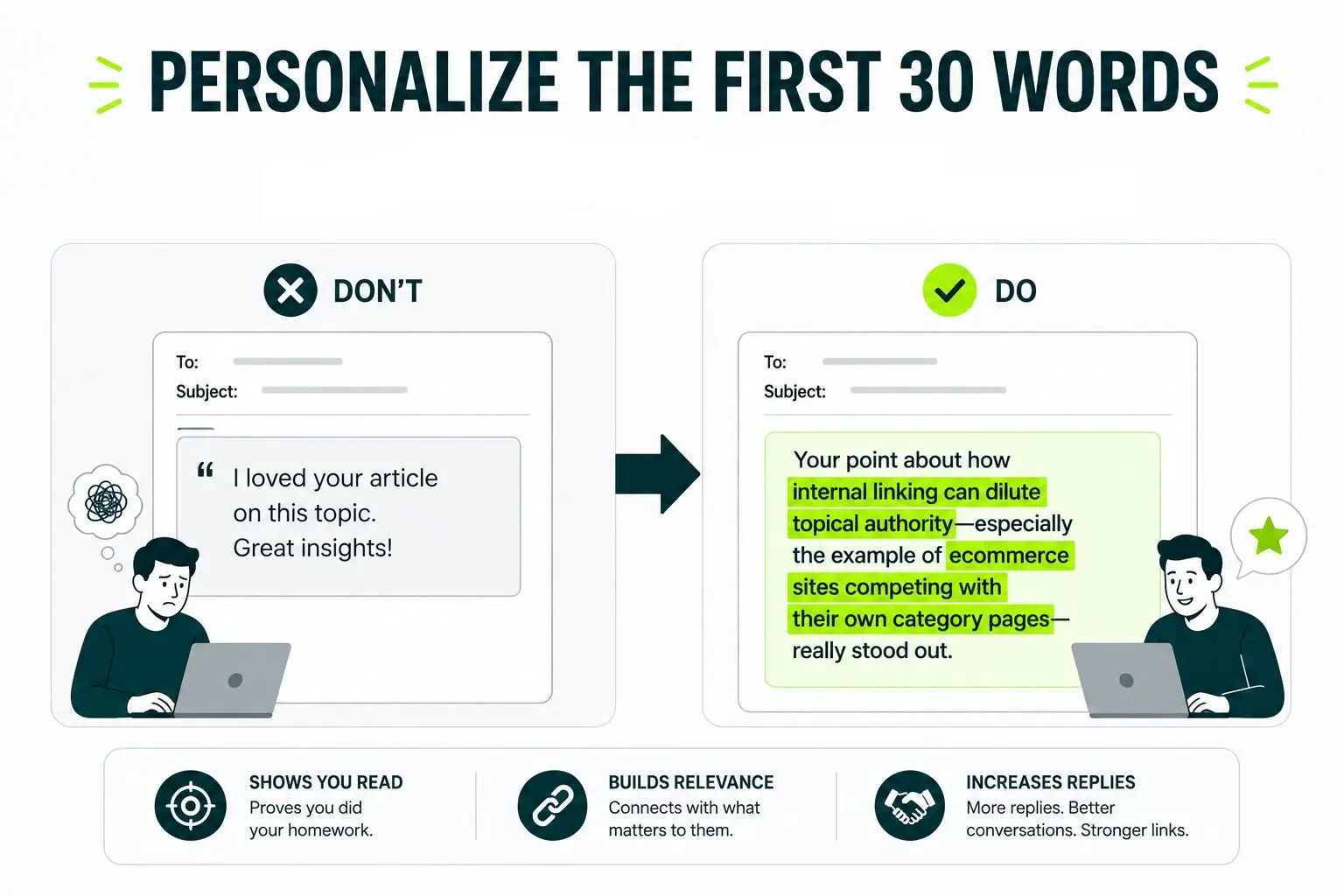
Personalize the First 30 Words
Not “I loved your article on this topic”. Reference a specific argument or example from their content piece.
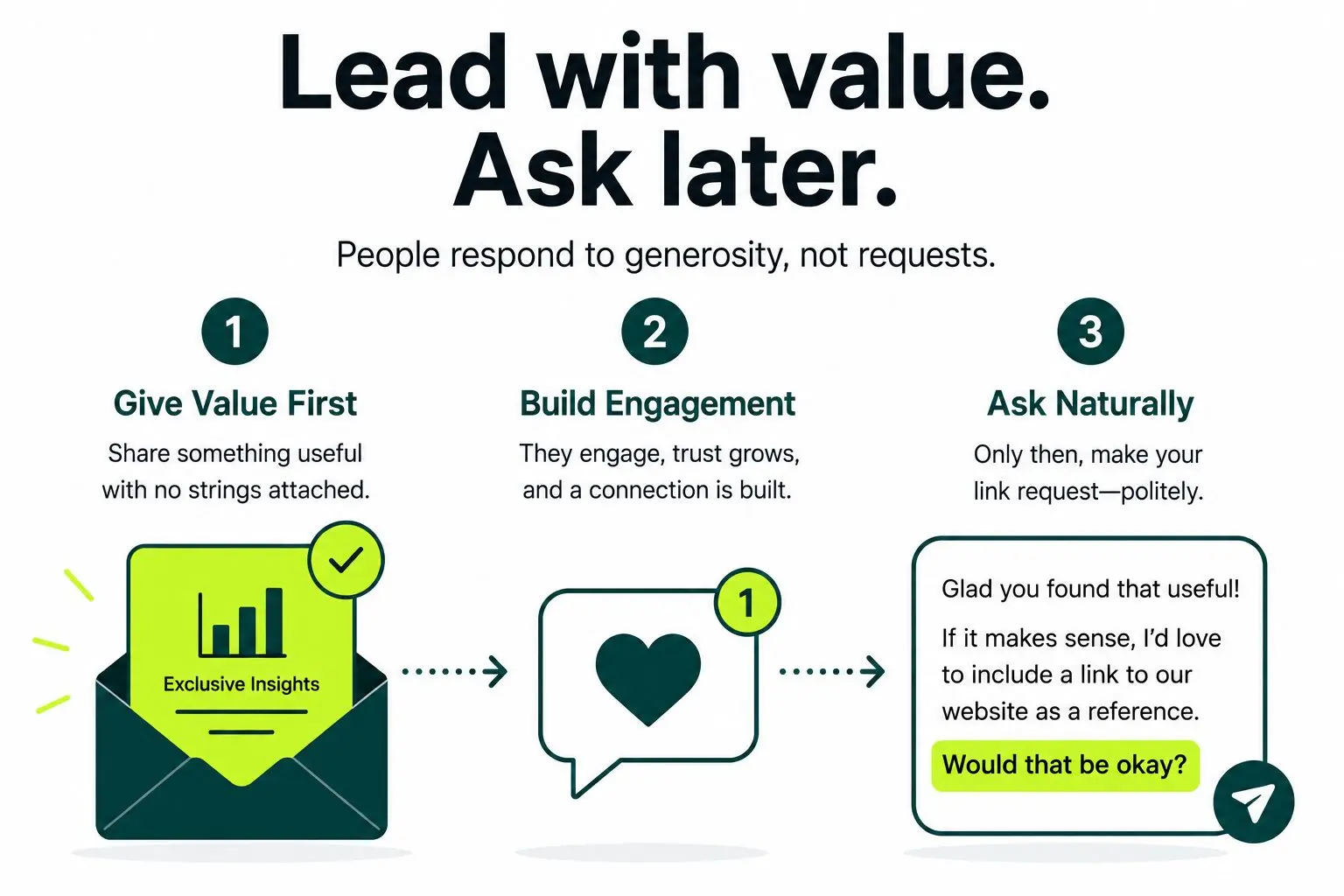
Lead With the Value, Ask Later
Send the resource, the data, or the “give before you ask” angle first. The link request comes in the follow-up, after they’ve engaged.
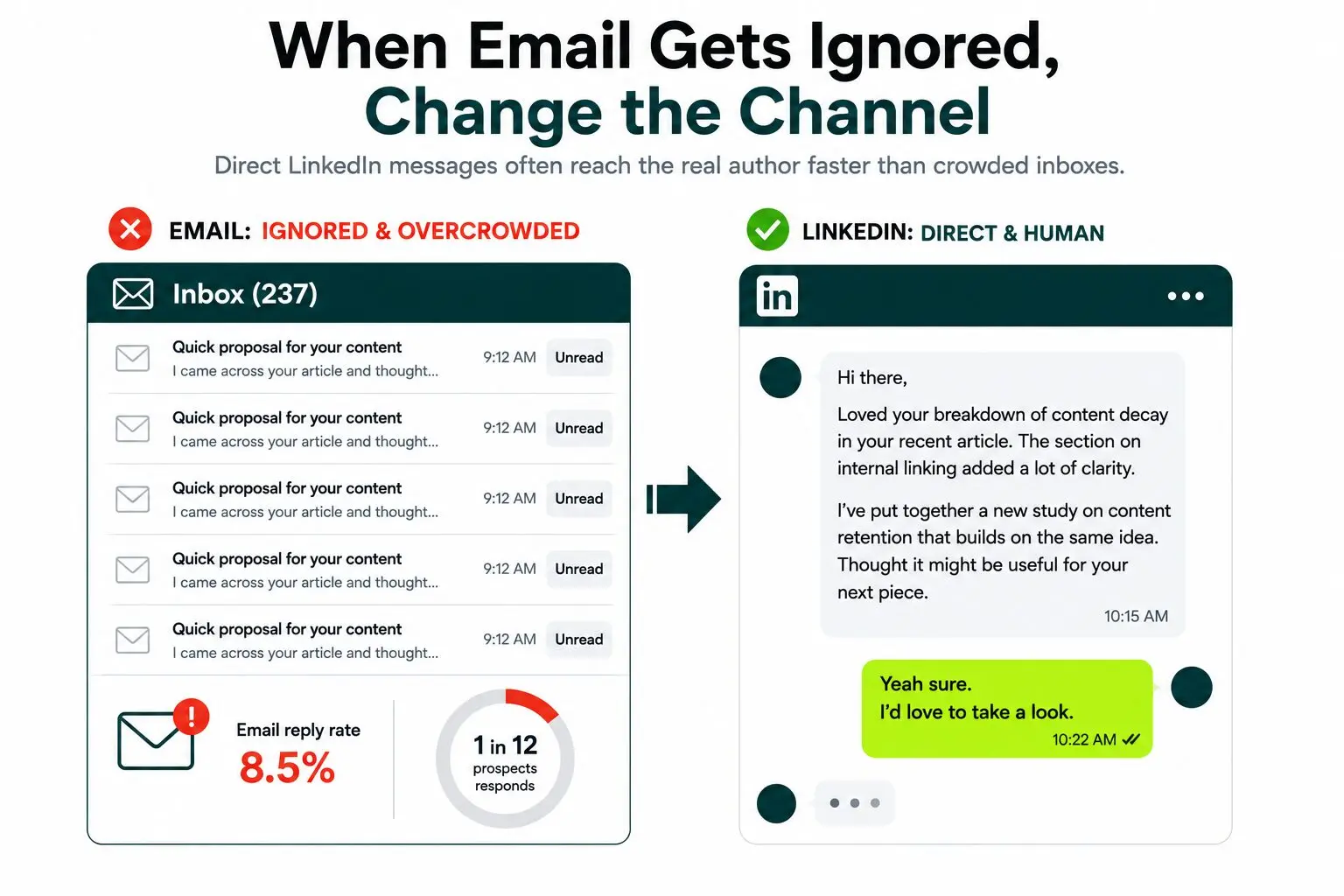
Switch Channels When the Email Stops Working
LinkedIn connection requests followed by a direct message to the actual author can improve reply rates in B2B niches, when the recipient is active on the platform.
Drop Templates That Have Floated Around for 2 Years
If you found a template from a YouTube tutorial that 5,000 other people are using too. The recipient has already seen yours.
Reply rates are the easiest challenge to diagnose. Track your reply rate. Under 5% means the pitch is broken. Above 12%, but with few placements, means the problem is your content or offer.
For deeper tactical detail, the SEO outreach process breakdown covers prospect list construction, sequence design, and the personalization mechanics that move reply rates.
The Quality Detection Problem
The quality detection problem is that Google now catches manipulative link patterns faster and more accurately than it did three years ago.
Bulk guest posting, link farm placements, paid link networks, and paid niche edits without editorial review, are the patterns Google’s AI-based spam-prevention system, SpamBrain, targets most aggressively. The typical result is algorithmic devaluation.
Manual penalties for link schemes are less common but are issued without warning when the pattern is clear enough.
The result: links that looked clean on paper quietly stopped passing authority.
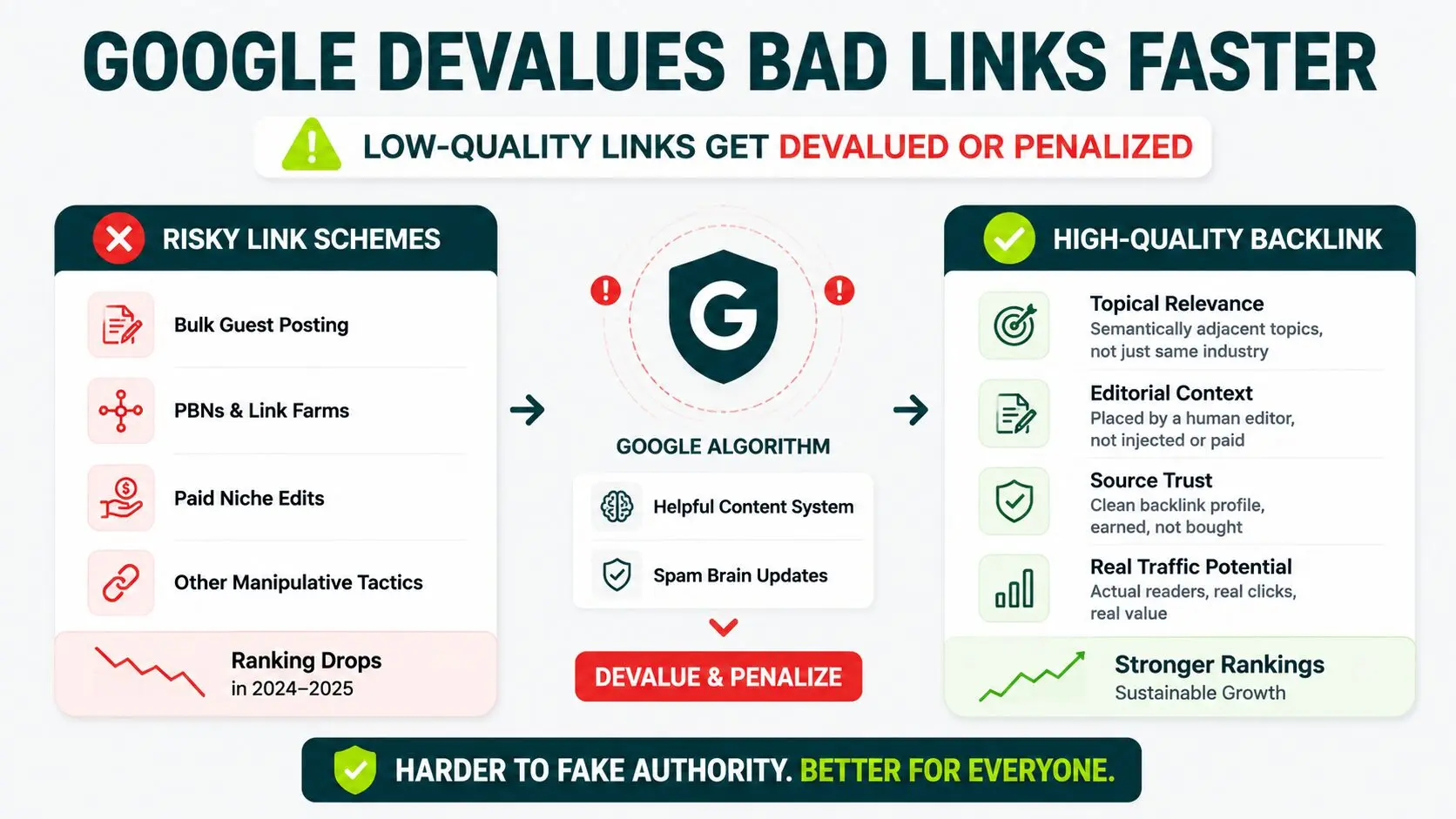
The detection problem is that it’s hard to fake authority, which is good for honest practitioners, and it’s harder to know whether a link you’re paying for is genuinely earned or quietly toxic.
The Four Signals Behind a High-Quality Backlink
The signals that make a backlink high-quality are topical relevance, editorial context, source trust, and real traffic potential.
1. Topical Relevance
The linking page covers a topic directly relevant to your page. Being in the same industry is not enough on its own.
2. Editorial Context
A human editor reviewed and placed the link. It wasn’t injected into an old post for $80.
3. Source Trust
The linking domain has a clean backlink profile, which is built through earned authority and credible editorial references.
4. Real Traffic Potential
Someone might actually click the link. If the surrounding content has zero readers, the link carries little practical value.
Many guest posts sold on link marketplaces fall short on at least two of these signals on closer inspection. Picture a host site that publishes multiple sponsored pieces daily, where the topical relevance is a stretch, and your link is added in a paragraph nobody reads.
Your immediate action:
Audit your last 20 to 30 acquired links against these four signals. If more than three fail, link quality is the problem. If you want a repeatable process for this, a structured backlink analysis walks you through the evaluation criteria step by step.
In our experience vetting links across 1,000+ businesses, the topical relevance and editorial context signals are the two that most purchased placements fail.
A SaaS client came to us with 80+ existing links that looked clean on paper. After running them through this test, fewer than half passed on all four signals.
Rebuilding around quality rather than volume contributed to a noticeable improvement in monthly traffic within the campaign period.
The Budget vs. Outcomes Problem
The budget vs. outcomes problem is a measurement gap. You’re measuring link building by output (links acquired) when the thing that justifies the budget is outcome (rankings and traffic gained).
Before you set that number, a calculator for backlink costs gives you a realistic per-link baseline.
Because those outcomes lag by 3 to 6 months, the spend appears unjustified before the results arrive.
Quality links from reputable agencies typically cost $150 to $1,500 per placement depending on site authority and niche, often bundled into four-figure monthly retainers. For smaller teams, the math gets uncomfortable fast, especially when ranking lift is difficult to predict with certainty.
There are 2 distinct parts to this problem, and practitioners constantly confuse them:
- The actual spend
- Attribution
When a link doesn’t produce a clear ranking lift in 60 days, you start questioning whether the budget is justified.
But 60 days is premature. Most links take three to six months to influence rankings in any measurable way.
A practical fix:
| IF YOUR SITUATION IS | THEN PRIORITIZE |
|---|---|
| Budget under $2,000/month, small team |
Earned tactics first, such as original data, expert commentary, linkable worthy assets, before paid placements |
| $2,000–$8,000/month, growing team |
Mix of editorial outreach and digital PR, track results against keyword-level ranking lift, not link count. |
| $8,000+/month, established team |
Outsource execution, focus internally on linkable asset creation and AI-citation strategy |
| Any budget, leadership pressure |
Set up monthly reporting that ties backlinks to specific target pages and tracks ranking movement on those pages |
If you’re trying to figure out what realistic spend looks like for your stage, the link building cost breakdown maps cost ranges to typical outcomes.
The Time-to-Result Problem
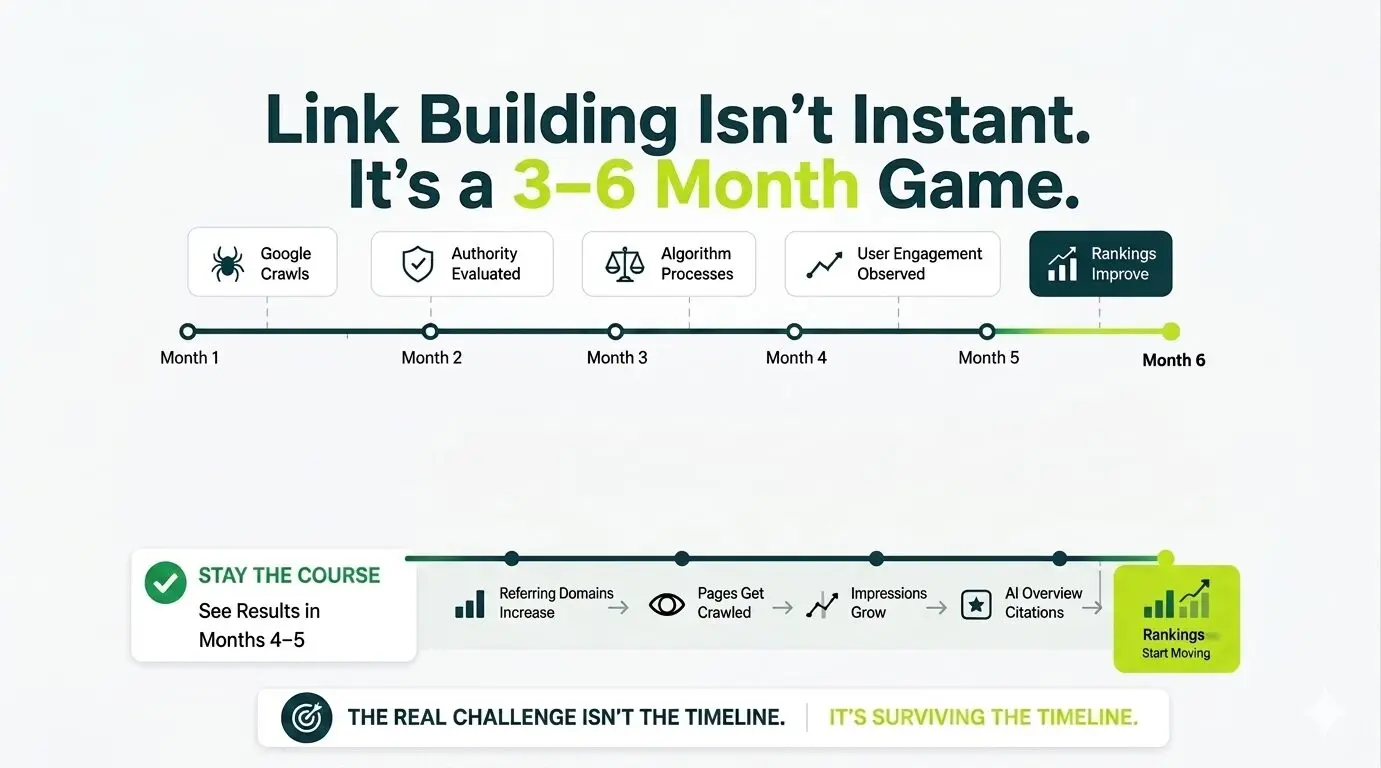
Link building takes three to six months to produce visible ranking results. Anyone promising four weeks is selling you something that won’t survive the next core update.
The delay is the mechanism, not a flaw. Google needs to crawl your new links, evaluate the linking sites’ authority, and factor them into the algorithm. There is no version of that sequence that fits in 30 days.
Seasonal businesses feel this most, which is why moving company link building has to be timed to the season.
Your real challenge isn’t the timeline. It’s holding your nerve through three months of nothing visible on the surface.
Many campaigns stall at month 2. You land 8 links, nothing visible moves, the marketing director looks at paid ads, and leadership pulls the budget.
3 months later, your rankings would have started shifting. By then, the campaign has ended, and the team draws the wrong conclusion.
What to Do Before Month One Starts
This is what you can do: set expectations, track leading indicators, and do not increase the link velocity to compensate.
Set Expectations in Writing Before Month 1
State in clear words: “We expect visible ranking movement in months 4 and 5. Here is why…”
Track Leading Indicators in the Meantime
Referring domains gained, target pages crawled, Search Console impressions, AI Overview citations. These move before rankings do. Report them weekly.
Don’t Increase Link Velocity to Compensate
A sudden and unexplained jump in links in month two looks unnatural and can trigger devaluation. Steady outperforms fast.
The patience problem is one of the most common reasons link acquisition campaigns fail. It’s also the most fixable, because the fix is administrative.
The Internal Buy-In Problem
The internal buy-in problem is that link building produces lagged results in a world that demands monthly attribution.
Leadership can’t see a ranking lift in the month a link lands, so they cut the budget before the campaign works. The strategy isn’t failing. The reporting is.
Three Reporting Changes that Protect Your Budget
These changes are: tying every link to a target page and a target cluster, adding the AI search dimension, and showing competitor movements.
Tie Every Link to a Target Page and a Target Keyword Cluster
Stop reporting “we got 12 links.” Start reporting: “We landed four links pointing to the pricing page. It moved from position 14 to position 9 for [target keyword]. Estimated incremental clicks: 340 per month.” That report survives any review.
Add the AI Search Dimension
If your brand started appearing in AI Overviews or ChatGPT responses for category queries, document it. That’s increasingly the visibility your leadership cares about, because they’re searching the same way your customers are.
Show Competitor Movement
“Competitor X gained 47 referring domains last quarter. We gained 31. Here is the gap and what closing it requires.” Comparative reporting often lands better than an absolute metric alone.
If you’re building a tracking system for this, the link building campaigns framework covers the metrics worth reporting and the ones to stop reporting.
A Diagnostic: Which Challenge Is Actually Yours?
To find your real challenge, match your current symptom to the table below. Each row maps one observable problem (pitches ignored, links landing but rankings flat, budget cut) to a single root cause and a first action.
Pick the row that fits your situation right now and work on that one thing.
| SYMPTOM | LIKELY BOTTLENECK | FIRST ACTION |
|---|---|---|
| You’re sending pitches, and almost nobody replies |
Response rate | Audit the first 30 words of your pitch. Rewrite for specificity. |
| People reply but say no |
Offer quality | Your content isn’t link-worthy yet. Build a linkable asset before more outreach. |
| You’re landing links, but rankings don’t move |
Link quality or topical relevance | Audit the last 10 links. How many pass the four-signal test in section 3? |
| The strategy works, but the budget keeps getting cut |
Internal buy-in | Switch to outcome-based reporting tied to target pages. |
| You are past 6 months, and the rankings haven’t moved |
Tactical fit | The tactic is wrong for your niche. Re-prospect with competitor backlink analysis. |
| Everything looks fine, but the AI search ignores you |
AI visibility | You’re earning DR-based authority, not entity-based authority. See next section. |
Pick one row. That’s where to spend the next 30 days. Trying to fix all six at once is how teams burn out without moving any of them.
What Changes for AI Search
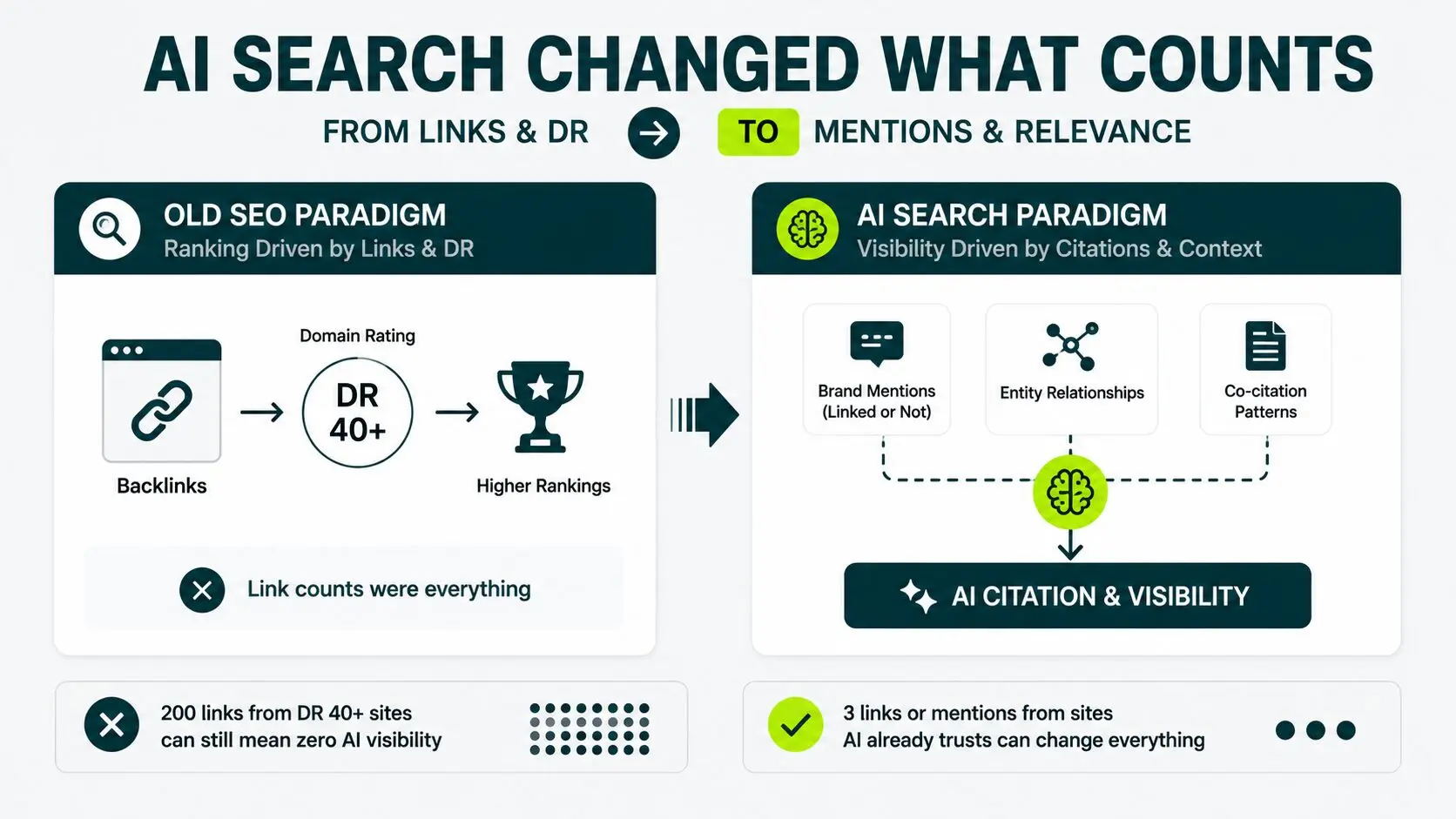
AI search added a layer on top of every challenge above. ChatGPT, Perplexity, and Google AI Overviews each surface brands differently, but across all three, brands that appear consistently in trusted editorial sources get cited more often than those that don’t.
This means that an editorial brand reference in a respected industry publication appears to count. A citation in a roundup appears to count.
Repeated appearances across independent sources are believed to build the co-citation pattern AI systems use to identify authoritative brands in a category.
Two Shifts in How Authority Is Built
Those shifts are that brand mentions without links now carry real weight, and a linking site’s role in AI citations now outweighs its DR.
Brand Mentions Without Links Now Carry Real Weight
A reference to your company in a TechCrunch article, even as an unlinked mention, may contribute to the same kind of visibility signals that a backlink does.
The exact mechanism isn’t confirmed, but the pattern is consistent enough that practitioners are treating it as a real input.
Earning mentions is now a parallel discipline to earning high quality backlinks. The prospecting overlap is significant, and you may already be doing half of this work without realizing it.
A Linking Site’s Role in AI Citations Now Outweighs Its DR
A link from a site that AI Overviews already cite for your topic might be worth more than a higher-DR link from a site AI ignores.
This inverts traditional prospecting logic. Instead of sorting your prospect list by Domain Rating, sort by whether the site shows up in AI answers for your category queries. Understanding how AI Overviews select sources changes how you build your entire prospect list.
This is why raw link counts have started decoupling from rankings.
You can have 200 perfectly clean DR 40+ links and still be invisible in AI search if none of those sites sit inside the citation network for your topic. In some cases, a small number of links from sites already cited in AI answers for your topic may do more for your AI visibility than a much larger volume of traditional link acquisition.
Your diagnostic action:
Search 5-10 of your category queries in ChatGPT, Perplexity, and Google AI Overviews. Note which sources get cited. Cross-reference that list against your current backlink profile. The gap that you see is your next 90-day prospect list.
If you want to go deeper on the mechanics of AI-era authority, the AI search optimization guide covers how citations, mentions, and structured content feed into AI retrieval.
What to Do Right Now
Open your last 90 days of link building data. Look at your reply rate, close rate, links landed, and what moved your rankings.
One of the six rows in the diagnostic table above will be obviously larger than the others. That’s where your next 30 days go.
Fix that one. Then run the diagnostic again. The answer will have changed, and that’s the point.
Not sure what’s actually slowing down your link building results?
Get a structured approach to identify bottlenecks and focus on what moves visibility.
Is link building still worth it in 2026?
Yes, but link quality now overwhelms link quantity. A few editorially earned, contextually relevant links outperform dozens of paid placements.
Backlinks remain a Google ranking signal and a major input to AI citation patterns. The teams getting outsized returns in 2026 are the ones that stopped counting links and started counting outcomes.
Why are my outreach emails getting ignored?
Publishers receive dozens of nearly identical pitches every day, and yours likely looks like the others. The fix isn’t more volume. Its specificity is in the first 30 words.
Reference a real argument from their piece, name what’s missing that you’d add, and drop the “I loved your article” opener entirely. It reads as a template instantly.
When does it make sense to outsource link building instead of handling it in house?
When your team is spending more time on outreach admin than strategy, or when publisher relationships are the bottleneck slowing placements down. A specialist link building service agency already has the publisher network, outreach infrastructure, and editorial relationships in place removing the biggest friction points most in-house teams hit in months two and three.
How long does link building take to produce results?
Visible ranking movement often appears in months four through six.
Google needs to crawl your newly added links, evaluate the linking sites, factor them into the algorithm, and observe user engagement on the receiving page.
Anyone promising faster results is either using tactics that won’t last or measuring the wrong thing.
What’s the difference between “good” and “bad” backlinks in 2026?
Four signals working together: topical relevance, editorial placement by a real human, a clean linking domain, and genuine traffic potential.
A bad backlink fails at least two, usually relevance and editorial review. Most bulk-purchased DR 50+ guest posts fail this test on close inspection.
Why does Google penalize some link building tactics?
The algorithm uses pattern recognition to flag unnatural profiles.
Mass guest posting on irrelevant sites, paid links without sponsored attribution, coordinated link schemes, and over-optimized anchor text are the most common triggers.
Silent devaluation is the usual result. Manual penalties are rare but severe.
Can AI tools help with link building?
For research and prospecting, yes. AI accelerates competitor backlink analysis and opportunity scoring significantly. For drafting personalized outreach, mostly no.
Recipients identify AI-written pitches quickly, and reply rates fall. The current best practice is AI-assisted prospecting paired with human-written outreach.