Most websites don’t struggle with content. They struggle with getting it seen.
That’s where SEO outreach comes in. It’s how you connect with website owners, editors, and content creators to earn contextual backlinks that improve your search visibility.
Most successful campaigns rely on a specialized link building agency to handle vetting, outreach, and reporting.
It connects your content with relevant, authoritative sites through personalized communication, not automation, not spam, and not paid placements disguised as editorial endorsements.
Done well, outreach builds a link profile that survives algorithm updates and compounds over time.
A Hunter.io cold email report of 31 million emails found that the average cold email reply rate is just 4.5%, and 69% of U.S.-based decision makers say they’re bothered when an email feels AI-written.
What You’ll Learn
- Why most outreach emails get ignored and what a reply-worthy pitch actually looks like
- The 7-step outreach process that builds links editors choose to place
- Which content types earn the most links per outreach touchpoint
- How to write subject lines that get opened without sounding like a template
- How outreach builds authority signals that influence visibility across AI-driven search experiences
What is Seo Outreach
SEO outreach is the process of reaching out to relevant publishers and earning high-quality backlinks by providing them with content worth referencing. The practice is also written as “outreach SEO”, same meaning, same workflow. Both phrasings describe the act of pitching publishers to earn editorial links.
That could be original data, a strong guest article, a broken link replacement, or content that fills a clear gap.
Most outreach emails get ignored because they feel generic, while personalized emails earn attention by showing clear, relevant value to the editor.
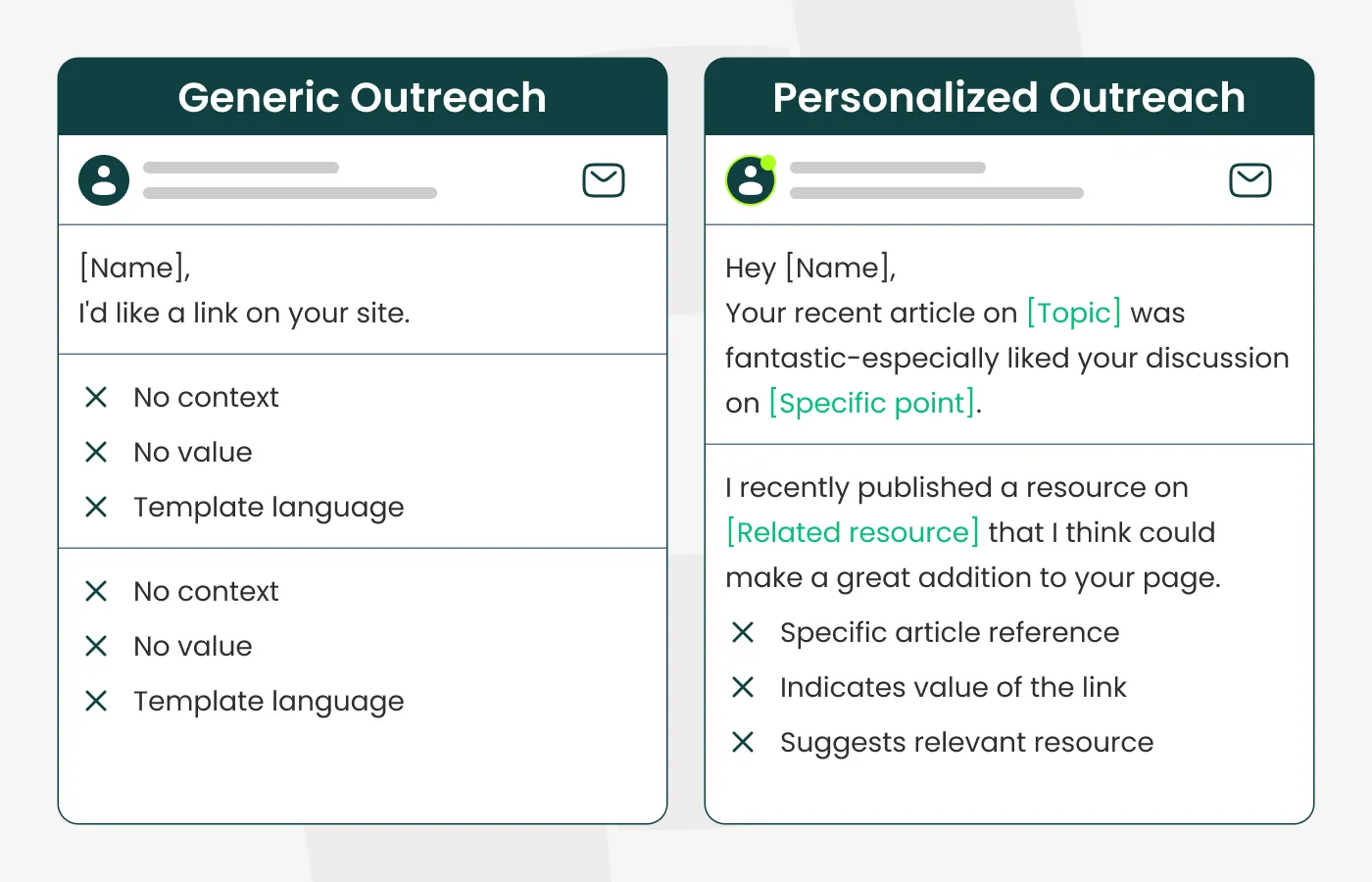
An editor reviews your pitch and chooses to link because it improves their content for readers. That choice is what makes the link valuable.
This is where outreach differs from paid placements or automated link building. If a link is added to influence rankings, it falls under Google’s link spam guidelines. In many cases, those links are ignored or devalued by systems like SpamBrain.
Outreach works differently. It builds links through real editorial decisions, not transactions or automation.
Here’s what separates outreach from tactics that don’t last:
| Outreach (Editorial) | Paid/Automated Links |
|---|---|
| Editor chooses to link based on content value | Link is often placed through payment or software |
| More resilient to algorithm updates when links are earned editorially | Devalued or penalized by SpamBrain |
| Builds real relationships for future links | One-off transaction with no lasting value |
| Grows brand authority across AI search surfaces | May generate mentions, but they are less reliable for sustained or trusted visibility signals |
Why SEO Outreach Still Matters in 2026
SEO outreach still matters because search engines rely on links from trusted, relevant sites to understand authority.
To maintain quality in search results, Google’s spam systems, including SpamBrain, reduce or ignore the impact of low-quality or manipulative links. When that happens, those links no longer contribute to rankings.
This is why high-quality, editorial links from relevant sites continue to matter. They signal trust and relevance in a way that algorithm systems can still rely on.
SEO outreach is what helps you earn those links. It gets your brand mentioned in useful, topic-relevant content, increasing visibility in both search results pages and AI-generated answers that draw on a broader web context.
The SEO Outreach Process: 7 Steps That Work
The first email you send to any prospect should not be bad or sloppy. Prospect lists built on domain rating alone miss the point. The sites you contact should be places where your target audience already exists.
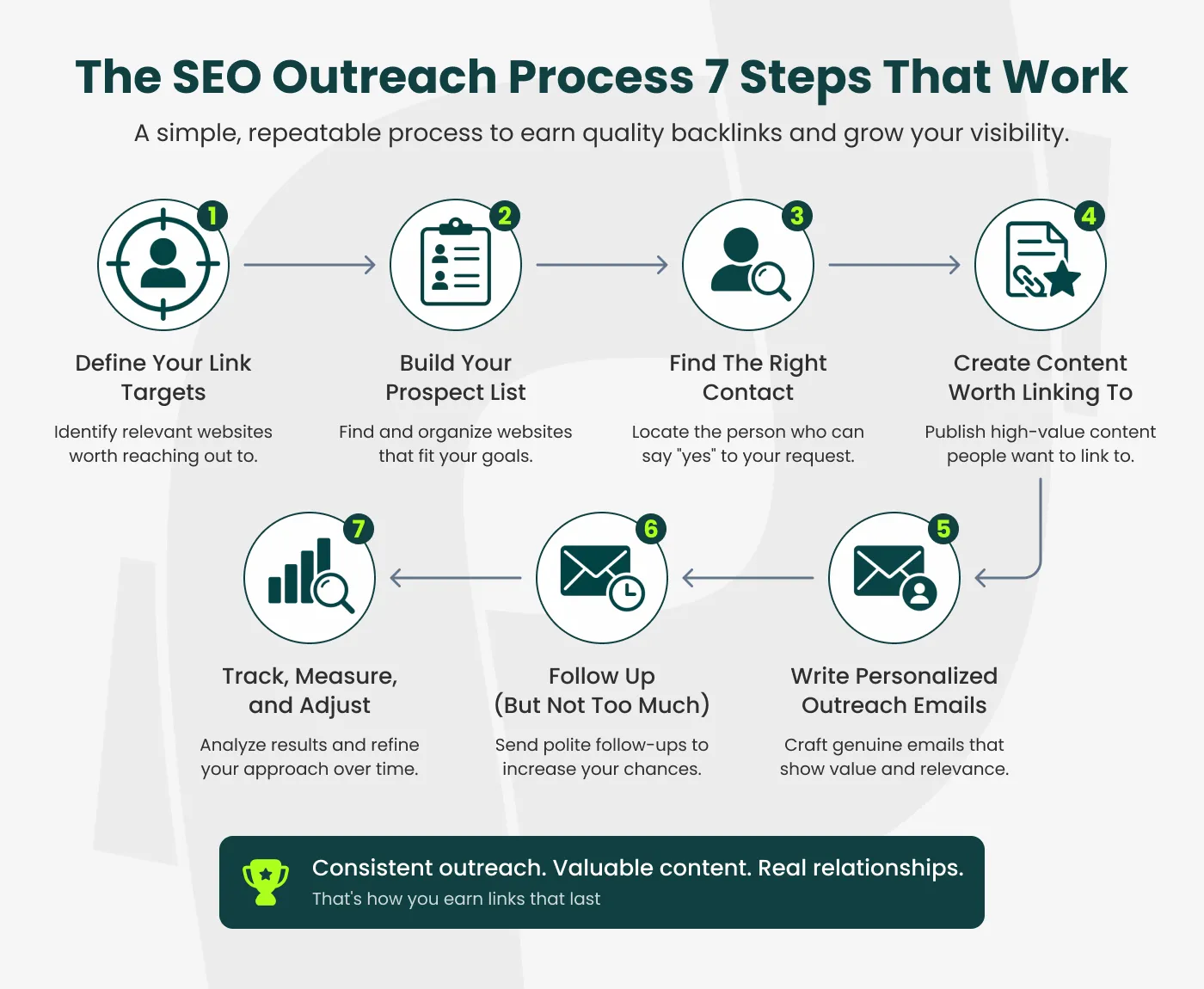
Step 1: Define Your Link Targets
Start with pages that show ranking potential but may need stronger signals. Homepages often require fewer targeted links than service or revenue pages, though this can vary. A service page ranking just below the first page for a high-intent keyword may benefit more from focused outreach.
Map each target to the keywords you want it to rank for. This shapes everything downstream, like the types of sites you prospect, the content you pitch, and the anchor text you suggest. Without this step, you risk building links that don’t show measurable ranking improvement.
Step 2: Build Your Prospect List
Most prospect lists are solely built on domain rating. That’s the wrong filter.
Aim for topical alignment first, and then look for authority signals.
In some cases, a link from a DR 45 site in your exact niche outperforms a DR 75 link from a site that covers everything from crypto to cat health.
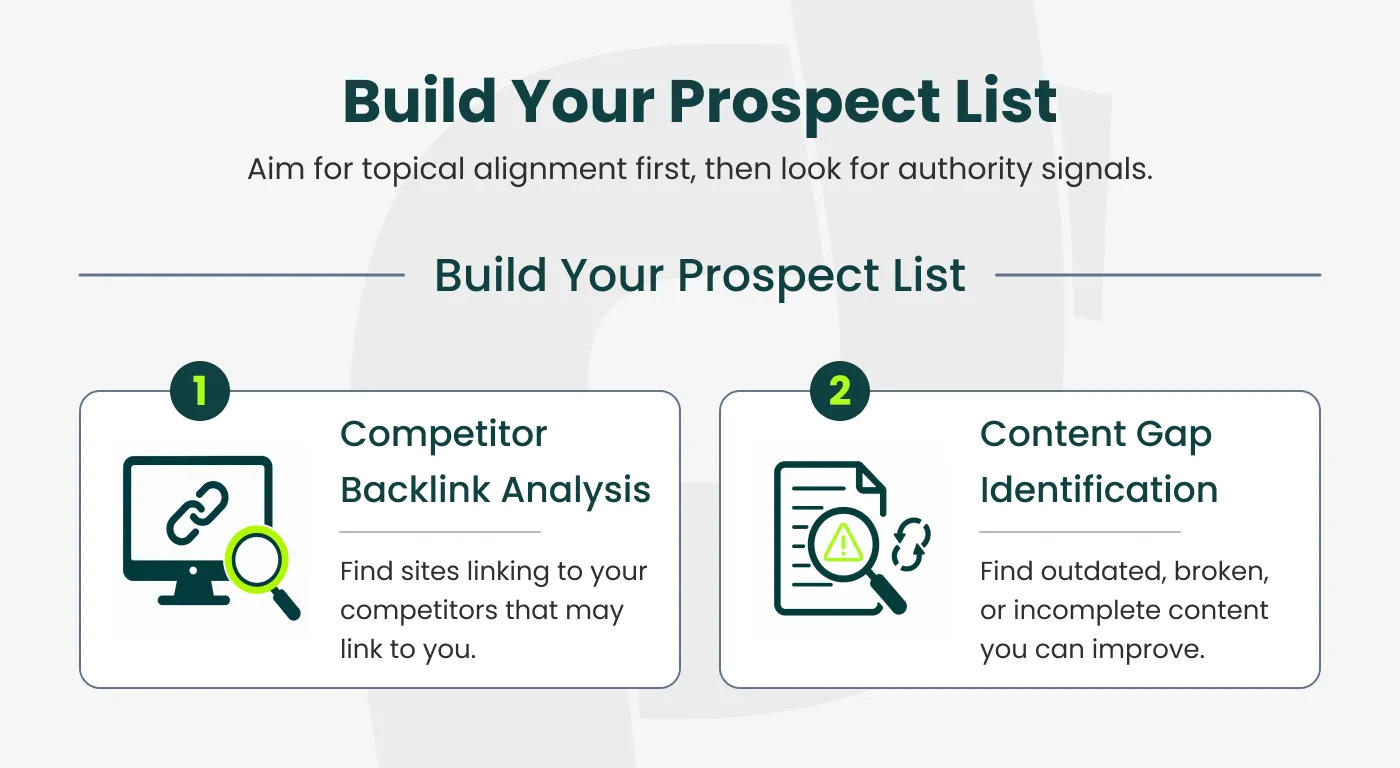
The prospecting methods that you can rely on are:
Competitor Backlink Analysis
Use tools like Ahrefs or Semrush for competitor backlink analysis and find sites linking to your competitors. If they linked to a similar piece of content, they might link to yours as well, especially if your content provides more value than the current one.
Content Gap Identification
Search for articles that are ranking for your target keywords that have outdated data, broken outbound links, or missing sections. These are natural outreach opportunities where your content fills a real gap and provides value to readers.
Step 3: Find The Right Contact
Whenever possible, avoid sending a pitch to a generic email address like info@domain.com. Instead, send it to the one who makes editorial decisions. The ones who are content managers, editors, or blog authors.
Use tools like Hunter.io to find verified email addresses. Cross-reference with LinkedIn to confirm whether the person still holds that role. A few minutes of research here saves you from dozens of emails you’ll ignore later.
Step 4: Create Content Worth Linking To
Low-value or thin content is less likely to earn links, so before you reach out to your prospects, make sure you have something genuinely useful to offer. What works depends on your strategy.
-
Guest Posts:
Pitch original content that’s genuinely useful to their audience.
-
Data Studies Or Original Research:
Conduct original research and prepare data studies that are hard to replicate and easy to cite.
-
Resource Or Tool:
Develop interactive calculators, templates, or guides that are helpful to the audience.
-
Expert Quotes or Commentary:
Provide expert quotes or commentary in response to journalist queries on platforms like HARO to earn relevant media mentions and potential backlinks.
In Outreach Desk campaigns, pages with original data or a unique framework earn more links per outreach touchpoint than generic blog posts. Editors want something they can’t find on five other sites.
Step 5: Write Personalized Outreach Emails
Most outreach fails before it starts. Average editors get lots of email in their inboxes every week. So to get your email recognized and opened, it has to be different, and different means specific.
Spend ten minutes on their site before you write a single word. Find an article they published recently. Notice something specific in it. Then write about that specific thing.
A strong outreach email needs four things:
- A subject line that references their content, not yours
- One honest reason your piece fits their site
- A simple, low-pressure ask
- A real sign-off with your name, role, and social links
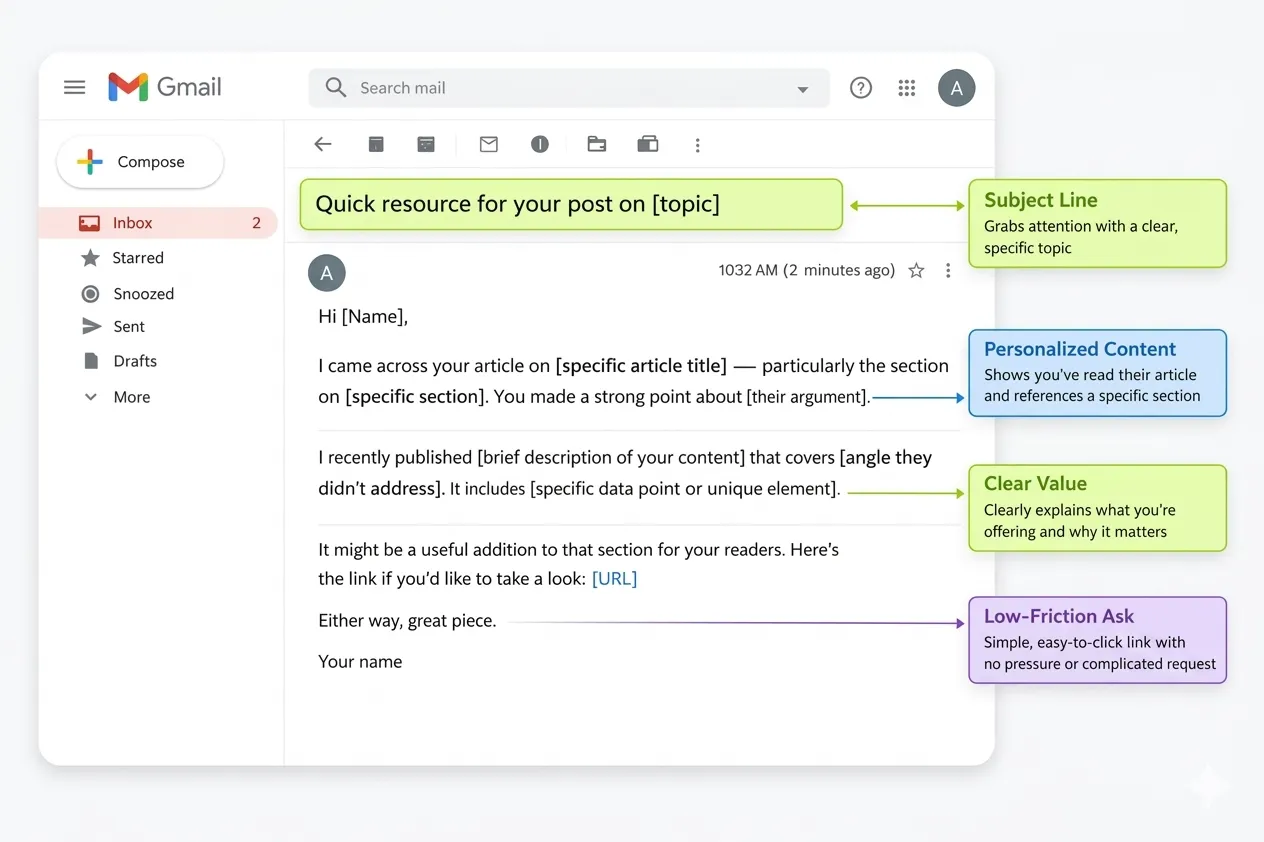
Keep emails concise and focused. Keep emails under 125 words. Relevance beats length.
In campaigns we’ve run at Outreach Desk, emails that reference a specific article or insight consistently outperform generic pitches.
Step 6: Follow Up (But Not Too Much)
Sending follow-ups can increase total replies by +106%, according to Hunter.io’s report. Most senders stop at one email, but following up twice nearly doubles your average reply rate.
Send the first follow-up email 4-5 business days after the initial email. A second after another 5-7 days, if you still have not heard anything. Then genuinely move on.
For most cold outreach campaigns, stopping after 2–3 follow-ups is a safe limit; anything beyond that damages the relationship for the next campaign.
Follow-Up Email Template :
Subject: Quick follow-up on my previous email
Hi [First Name],
Just following up on my previous email in case it got buried.
I shared a quick idea that could be a good fit for your [article/page/topic]. Have you had a chance to review it?
If it’s not relevant right now, I completely understand. Happy to close the loop here.
Thanks,
[Your Name]
Step 7: Track, Measure, and Adjust
Every campaign should be measured against the same benchmarks:
- Response rate benchmarks are simple. 4.5% is baseline, 8%+ is strong performance, and anything below 4% signals an issue with targeting or messaging.
- Link placement rates often fall in the 2–5% range for many outreach campaigns. Strong targeting and relevance can improve results over time.
- The domain authority of the links placed matters more than the raw link count. One backlink from a relevant site that people trust is worth more than ten from sites nobody reads
- Anchor text distribution should stay varied. Using the same phrase repeatedly across placements comes across as unnatural and draws the wrong kind of attention.
- Referral traffic is worth tracking, too. A placed link that sends no one to your site is a question worth asking
If performance drops below your baseline, the issue is usually targeting, value, or messaging. In most cases, it is one of these three things: wrong prospects, a weak value proposition, or emails that sound like templates.
How To Write Outreach Email Editors Actually Open
Your subject line determines whether your email will be opened. If they do not open the email, none of the rest of it matters. The subject line is not a formality. It is the whole first impression.
Hunter.io’s report found that campaigns sent from custom domains get 108% higher reply rates than those sent from free email accounts.
Smaller, targeted campaigns consistently outperform large, bulk sends. The pattern is consistent: smaller, more personal, more targeted wins against volume in most cases.
Subject line formula that performs:
- “[Their article title]” – a source you might want to add
- “Data for your [topic] piece”
- “Quick note about [specific thing on their site]”
Avoid subject lines like “Link exchange opportunity,” “Collaboration request,” or “Guest post inquiry.” These are the lines that tend to get deleted unread.
In the email body, lead with value
Open the email body with what you noticed about their work. Not your bio, not your company description, not your domain rating.
Email Outreach Template:
Subject: Data point for your [topic] article
Hi [First Name],
I was reading your article on [specific topic].
The section where you mentioned [specific detail] stood out.
We recently published something that expands on that angle: [one-line value summary].
It can serve as an additional reference for your readers.
If you think it fits, feel free to take a look.
Thanks,
[Your Name]
[Your Role / Website]
[Optional: LinkedIn]
Open with what you actually read and what made you reach out. Your credentials can live in the sign-off where they belong.
What they care about is whether you actually looked at their site, and whether you have something real to offer.
A quick note on AI-drafted outreach because it matters more than people admit. Hunter’s 2025 survey found that 69% of decision-makers are genuinely bothered when an email feels like it was generated.
If you use AI to draft your pitches, that is fine, but rewrite them until they sound like a specific person with a specific reason to reach out on that specific day.
The outreach emails getting replies feel human because real people write slightly imperfect emails.
SEO Outreach Strategies That Build Authority
Different link building campaigns need different approaches. Your content, your niche, and the sites you’re targeting all shape which tactics actually work.
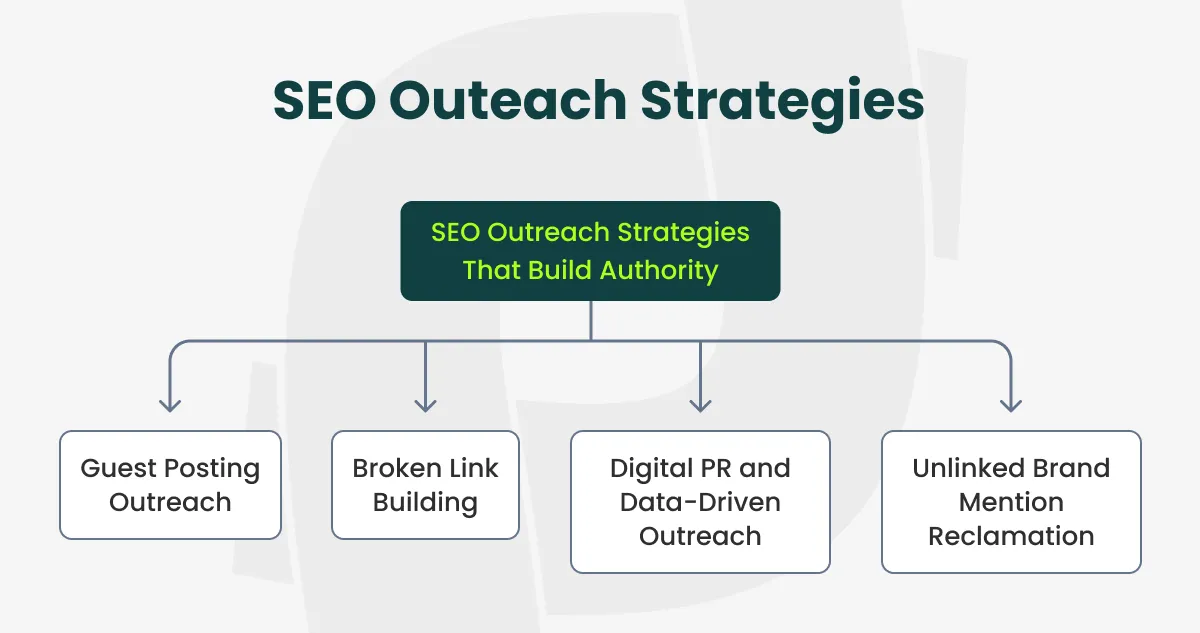
Guest Posting Outreach
Guest posting often delivers strong response rates when pitches are relevant and well-targeted, though results vary by niche and execution.
The pitch that actually lands is the one proposing something their audience needs that the site has not covered yet. Not whatever happens to fit your keyword roadmap.
Broken Link Building
Broken link building works well because it offers immediate value. Find pages in your niche with dead outbound links, and offer your content as the working replacement.
Across campaigns, broken link outreach tends to convert faster than cold guest post pitches because the value is immediate and clear.
You are fixing something for them before you ask for anything in return. That changes the whole dynamic of the conversation.
Digital PR and Data-Driven Outreach
Original research is the highest-yield content type for link building. A real survey, a data analysis, an industry benchmark, something with numbers that did not exist before you published them.
Editors and journalists cite original data because readers trust it. One good study can steadily earn links over time, especially if it remains relevant and is supported by consistent promotion.
Unlinked Brand Mention Reclamation
Unlinked brand mentions are the easiest wins that most brands completely overlook. Someone already wrote about you. They just did not add the link. One short, friendly email asking them to add it converts at a rate that often surprises people.
Tools like Ahrefs Content Explorer or Google Alerts will automatically find these for you.
Running a mix of these proven strategies to earn links keeps your backlink profile looking resilient, balanced, builds authority across different types of sites, and means you are not dependent on any one approach.
Common SEO Outreach Mistakes (and How To Avoid Them)
Most campaigns don’t fail because of bad outreach. They fail before a single pitch goes out, in small decisions that felt fine at the time.
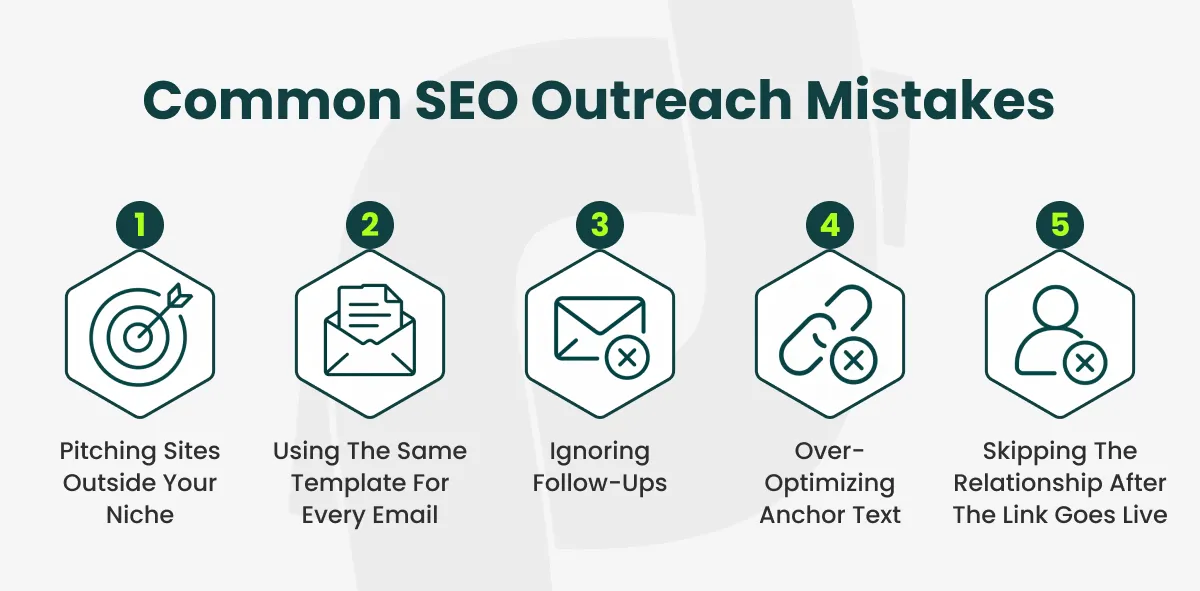
Pitching Sites Outside Your Niche
A fintech startup doesn’t need a link from a cooking blog. Doesn’t matter what the numbers say or how clean the site looks. A link only builds your authority when it comes from a site that shares your niche.
If the topic doesn’t fit, the link won’t add any value to readers either. Build your prospect list around topic fit, not metrics alone.
Using The Same Template For Every Email
Even well-written templates become invisible to editors when they see the same email template structure every week. Adapt different outreach templates to earn links.
Some pitches should be two sentences. Others should mention something specific you noticed on their site. Most of the time, personalization is what separates people who get replies from those who don’t.
Ignoring Follow-Ups
Most replies don’t come from the first email, but they might come from the second. At least one follow-up is essential. If you’re skipping it, you’re not losing to better outreach. You’re losing to someone who just showed up one more time than you did.
Over-Optimizing Anchor Text
Over-optimizing clickable text isn’t just an SEO mistake; it’s a flag. Google’s algorithm can spot a natural link profile, and one with heavy on exact-match phrases.
Keep the number of exact-match clickable texts to a minimum. Use branded phrases, partial matches, and things that sound like a real editor chose them. Because that’s what holds up long term.
Skipping The Relationship After The Link Goes Live
Don’t stop maintaining a relationship with the editor after your link is placed. The editor who placed your link once can do it again, on a better page, for a stronger piece, six months from now.
Share their content, show up in their comments, and stay on their radar. Build a relationship, not a transaction log.
How SEO Outreach Supports AI Search Visibility
The connection between outreach and AI search is becoming increasingly clear.
When ChatGPT or Perplexity generates an answer about your topic, the brands showing up in those answers are the ones mentioned most consistently across reputable sites.
Every guest post, every editorial mention, every expert quote is another signal that those systems are indexing.
Outreach used to be about building links for Google rankings.
Now it is doing that and simultaneously building the kind of distributed brand presence that AI search pulls from when forming answers.
If your link building strategy focuses only on one of those two things, it is already a little behind. It should focus on becoming a source that others consistently cite, not just a site that collects links.
Build Links That Compound
SEO outreach is not about sending as many emails as possible. It is about building real relationships with the right sites and earning links that actually move the needle. It takes time, patience, and a willingness to get ignored more than once. But when it works, it works well.
Every link you earn through genuine outreach is a signal that a real website trusts your content enough to recommend it. Focus on relevance, keep your messaging human, and treat every outreach as the start of a relationship rather than a transaction.
Because each relationship makes the next pitch a little warmer. Each piece of original content continues to earn long after the outreach campaign that launched it has ended. That is what separates good SEO outreach from the rest. It compounds over time.
That is the kind of link building that holds up not just through algorithm updates, but through whatever comes next.
Want to improve your SEO outreach results?
Get a clear strategy focused on relevant, personalized outreach.
What does “outreach SEO” mean?
“Outreach SEO”, also called “SEO outreach”, means the practice of contacting publishers, editors, and journalists to earn editorial backlinks. The two phrasings are interchangeable; both describe the same skill set: prospecting target sites, sending personalized email pitches, creating link-worthy content, and following up to convert pitches into placements. The goal is to earn links Google trusts because a human editor chose to add them.
What Is SEO Outreach?
SEO outreach is the process of contacting website owners and editors to earn backlinks through personalized pitches that offer genuine value to their audience.
It’s not the same as buying links or blasting automated emails. Outreach earns editorial placements and links that an editor chooses to include because your content improves their page or fills a gap their readers actually need. Google trusts these links more because they reflect a real editorial decision rather than a transaction.
How long does SEO outreach take to show results?
Most campaigns land their first placements within 4–8 weeks. Ranking improvements from those links typically follow within 2–4 months, depending on keyword competitiveness and the authority of the sites linking to you.
How fast you build your prospect list, how quickly editors respond, and how strong your content is all affect that timeline. Expecting results in under 30 days isn’t realistic for most niches.
What’s a good response rate for outreach emails?
The industry average for cold outreach sits around 4.5%. Well-targeted, personalized campaigns often reach 8% or higher.
If you’re below baseline, review your targeting, value proposition, and messaging.
Is SEO outreach the same as link building?
Not exactly. Link building is the broader goal of acquiring backlinks to grow authority and rankings. Outreach is one method of achieving that goal, specifically the direct communication with site owners.
Other methods include creating linkable assets, 404 link building, and earning organic editorial links through content quality alone.
Does outreach still work with AI-generated content everywhere?
It works, but editors are pickier. With 74% of new web pages containing some AI-generated content, according to an Ahrefs 2025 study, editors increasingly favor pitches that offer original data, first-person expertise, or a perspective they can’t generate themselves.
Generic AI content won’t earn links. Original, experience-backed content will.