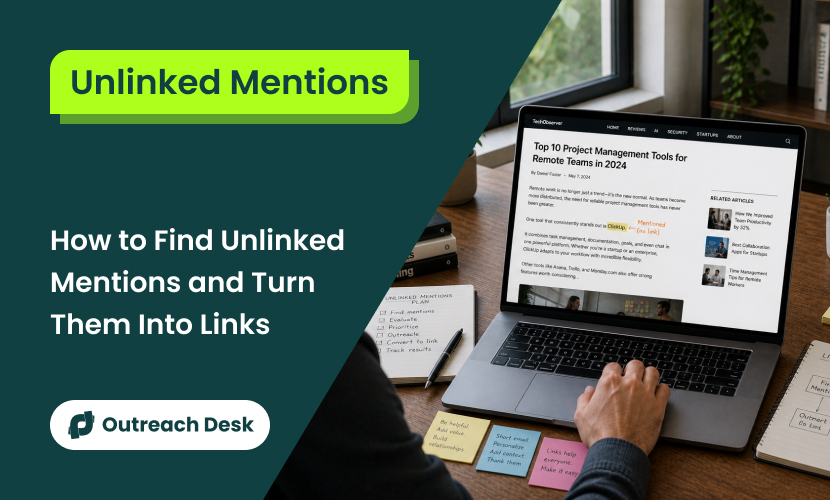
A journalist cited your research last month. Another blog recommended your tool. A roundup mentioned your founder by name. But none of them linked to you, and every one of those is a backlink you can still claim.
Unlinked mentions are pages that already mention your brand, product name, or content without a backlink pointing to your site. They carry no ranking authority on their own, but converting them is faster than cold outreach because the writer already knows your brand.
They pass zero ranking authority, but they can convert into backlinks at a higher rate than cold outreach, because you’ve already done the hardest part: earning their attention.
Key Takeaways
- Unlinked mentions convert more backlinks compared to cold outreach because the author already trusts your brand.
- Most teams track only their exact brand name and miss other, bigger opportunities hidden in product names, mentions of founders, misspellings, and stolen images.
- Not every mention is worth outreach. Focus on authority, traffic, freshness, and context.
- Tools like Google Alerts, Ahrefs Content Explorer, and Semrush Brand Monitoring each work best at a different scale.
- Outreach emails under 100 words that name the specific article section outperform generic link requests, as the writer knows you actually read their work.
What Unlinked Mentions Actually Are (and Why They Exist)
An unlinked mention occurs when a website mentions your brand, product, or content without linking to you. The writer already knows who you are. They chose to include you. They just didn’t add the link.

Turning these mentions into backlinks is one of the highest-conversion outreach tactics. You’re not reaching out cold. You’re following up on something that already exists. You’d be surprised at how often this happens.
Sometimes writers are busy and forget to add links. Sometimes editors remove links during review because they may see them as overly promotional, or because CMS migrations can break links. Sometimes writers add your brand name just to provide background, without intending to give credit with a link.
None of this is intentional. This is what makes the opportunity so strong. You’re not asking for a favor. You’re asking someone who already mentioned you to complete the reference.
A mention helps put your brand in front of a relevant audience and can lead to referral traffic, direct searches, or future editorial links. It may even influence how search engines and AI systems understand your brand. But it doesn’t pass authority the way a backlink does. Turning that mentions of your brand on the web into a high quality backlink closes that gap.
At the Outreach Desk, we track unlinked mentions across client campaigns as part of our brand mention service. One pattern we’ve seen is that these mentions convert better than cold outreach.
Why? Because earning someone’s attention and trust is the hard part, which has already happened. They already trust you. You’re just completing the connection.
Beyond Your Brand Name: Seven Types of Mentions Worth Tracking
Track these seven unlinked mention types, not just your brand name.
1. Exact brand name
The obvious one. “Outreach Desk” appears without a link.
2. Product or service names
If you sell a tool called “LinkTracker Pro,” people will reference it independently of your brand.
3. Founder or spokesperson names
Publishers often mention executives in articles, podcast recaps, or event roundups without linking to them.
4. Common misspellings
“OutreachDesk,” “Outreach-Desk,” “OutReach Desk.” Every variation represents a link you haven’t claimed yet.
5. Slogans or taglines
These are high-priority opportunities because they show people are already familiar with your brand.
6. Proprietary data or research
If you published an original study and someone cites the finding without linking to the source, that’s a strong conversion opportunity.
7. Stolen or embedded images
Your infographics, charts, and branded visuals show up on other sites without attribution more often than you’d expect.
At the Outreach Desk, we build a monitoring list for every client that covers at least the first four categories. Image and data tracking takes more setup, but often produces higher-quality links. Sites using your research are usually more authoritative.

Six Ways to Find Unlinked Mentions
There are six reliable methods to find unlinked mentions, and the right one depends on how many mentions your brand generates and how much you’re willing to spend on tools.

Google Alerts + Search Operators (Free, Low Volume)
You can start by setting up Google Alerts for your brand name, product names, and common spelling variations. Use the “as-it-happens” setting if you want to catch mentions quickly and respond while the content is still fresh. Daily or weekly alerts work for lower-priority tracking.

For manual discovery, use search operators:
“your brand name” -site:yourdomain.com -site:twitter.com -site:linkedin.com -site:facebook.com. This shows pages that mention your brand but exclude your own site and social platforms. Still check which mentions include links and which don’t.
It takes time but costs nothing, and works best when your brand generates a manageable number of mentions. For example: “Nike” -site:nike.com inurl:blog -inurl:news to focus on articles and blogs

When manual monitoring works best:
If your brand gets fewer than 20 mentions per month. At that level, this can take around 30 minutes a week.
Google Alerts misses a significant chunk of mentions. It depends on crawling, so Google will not surface slow-indexed or paywalled pages. Treat it as a first pass, not a complete system.
Ahrefs Content Explorer (Paid, High Volume)
Ahrefs Content Explorer is a tool that lets you search a massive database of web pages. Enter your brand name in the search bar and select “In content” or “Everywhere” as your search mode.
Then enter your domain in the “Highlight unlinked domains” field , this surfaces every page that mentions your brand without linking back to you. You can then sort and filter by Domain Rating, traffic, language, or publication date.

This method saves you time. Instead of manually checking each mention, you filter out low-quality sites and focus on pages that matter most. This turns a raw mention list into a qualified prospects list fast.
This method is ideal for established brands. If your brand gets more than 50 mentions a month, this is one of the few methods that scales efficiently at this volume without wasting your week.
Semrush Brand Monitoring (Paid, Ongoing)
Semrush Brand Monitoring tracks mentions continuously and alerts you when new ones appear. It also separates linked mentions automatically and shows sentiment. This helps you decide whether a mention is worth reaching out for.
The real advantage here isn’t discovery, it’s speed. Reaching out within 48 hours of publication can outperform reaching out weeks later. The writer still remembers the article. At large publications, editors are still making small updates.
Reverse Image Search (Free, Underused)
Upload your branded images, charts, or infographics into Google’s reverse image search. Any site using your visual without credit becomes a strong image link building opportunity. Here, you have a better ask than “please add a link.” You have “you’re using our proprietary image without credit.” This changes your outreach angle.

Instead of asking for a favor, you’re requesting proper credit for your work. We’ve used this approach at the Outreach Desk for clients publishing original research with branded charts.
Sites respond more often to image-attribution requests because most people know they should credit the image. They just forget.
Reverse-Engineer Your Social Profiles (Free, Clever)
Writers sometimes link to your Twitter or LinkedIn profile instead of your website. Pull the backlinks to your social profiles in Ahrefs Site Explorer, then check which of those pages also name your brand without linking your actual site.
Those are unlinked mentions hiding behind a social link. The author clearly knows you, so they convert at a high rate once you point them to the right page.
Find Misspellings and Brand Variations (Free, High-Yield)
People rarely spell a brand name the way you do. Run your brand through a typo generator to list common variations, then search each one with the same operator method above.
Misspelled mentions are among the easiest to claim, because almost no one else is chasing them. The writer is usually happy to fix the spelling and add the link in the same edit.
Scaling tip
When your list runs into the hundreds, checking each page by hand is too slow. Export the URLs and crawl them with a tool like Screaming Frog using a custom search for your domain. It flags which pages already link to you and which do not, turning a raw list into a clean prospect list in minutes.
How to Qualify a Mention Before You Write a Single Email
Finding mentions is easy, but the hard part is deciding which ones actually justify the time and effort before you reach out.
Not every mention earns an email. A link from a low-traffic page on a thin affiliate site passes very little value, and the time you spend on it is time you didn’t spend on the mention that was more likely to convert. Run each one through these five filters first.
1. Authority of the Mentioning Site
A high authority site (DR 60+) with real editorial standards is worth your effort. A low-quality site filled with thin or affiliate content isn’t. Use metrics like Domain Rating (Ahrefs) or Authority Score (Semrush) as a first filter, but don’t rely on metrics alone.
Check the site itself:
- Does it publish consistently?
- Does it have a real editorial team?
- Does it rank in search results?
If you don’t find it trustworthy, it’s not worth the outreach.
2. Traffic to the Specific Page
A mention on a page that gets 5,000 monthly visits is more valuable than one on a page that gets little or no traffic at all. Even if the SEO metrics appear similar, the difference in visibility and referral traffic makes it a priority.
3. Context and Sentiment of the Mention
Check how the author mentions your brand. If the article recommends your product, cites your data, or compares you positively, that’s a strong opportunity.
If they mention you in passing with a neutral tone, it still works, but at a lower priority. And if the article criticizes your product, leave it alone. Do not request a link on negative coverage.
4. Content Freshness
A mention from last month is easier to act on. The writer still remembers the content and will more likely update if you reach out. A mention in a 2019 post is harder to convert. The site may no longer be actively publishing, and you may not be able to reach the author.
You should focus on mentions from the past 6 months.
5. Relationship Potential
Some mentions are more than just a link acquisition opportunity. If the author is a journalist, editor, or active content creator, there’s long-term value in building a relationship with them.
Even if the immediate link isn’t high-authority, it can still lead to future placements. An author you help today may quote you as a source in their next three articles.
Prioritize unlinked mentions by five criteria: site authority, page traffic, mention sentiment, content freshness, and the relationship potential with the author.

Use this quick scorecard to decide in seconds:
| Criteria | Pursue if | Skip if |
|---|---|---|
| Site authority | DR 40+ with a real editorial team | Thin or affiliate site, DR under 20 |
| Page traffic | The page earns real organic visits | Orphaned page with near-zero traffic |
| Sentiment | Positive or neutral mention | Critical or negative coverage |
| Freshness | Published in the last 6 months | Older than 2 years or site inactive |
| Relevance | Same niche or a closely related topic | Unrelated industry |
Writing Outreach That Gets the Link Added
You find a great mention with link opportunities, qualify them correctly, and then send a templated email that sounds like a robot. This is where your outreach is more likely to fail, even if you have a strong opportunity.
Writers who mentioned your brand have already done you a favor. They open the email, read your unnatural message, and close it.

At the Outreach Desk, after running campaigns spanning thousands of outreach emails, one pattern that emerges is that the best emails get straight to the point and name something specific.
Keep it Under 100 Words
Long emails rarely work for cold or semi-cold outreach. Readers often skim long emails, and skimming kills your response rate. Your email needs three things:
- Acknowledge their content specifically
- Note the mention
- Make a clear, specific ask
That’s it.
Reference the Specific Article, Not Just Their Site
“I noticed you mentioned our brand on your website” sounds lazy and obvious. Write like “Your comparison of outreach tools in your April piece on editorial link building mentioned [your site name].” This level of specificity signals that you actually read their work.
Offer Value Beyond the Link
The best outreach isn’t one-sided. Give the writer a reason to say yes. You can offer:
- Updated data
- A quote they can add
- A resource that genuinely helps their readers.
This turns your link request into a value exchange.
Framework that works:
Subject: Quick note about your [topic] article
Hey [Name],
Loved your piece on [specific topic], especially the section on [specific detail]. You mentioned [Brand] in the context of [what they said].
Would you be open to linking the mention to [specific URL]? It’d give your readers a direct path to [the resource/data/tool you referenced].
Happy to [offer: share updated data / provide a quote / cross-promote the article].
Either way, great piece.
[Your name]
Follow Up Once. Then Stop
Send one follow-up after 5-7 business days. If there’s no response, move on. Two emails show persistence; anything beyond that is annoying. Here you’re reaching out to someone who already mentioned your brand. It’s not worth damaging that relationship.

When Unlinked Mentions Aren’t Worth Chasing
Don’t invest time and effort in every mention.
Negative Coverage
If someone wrote a critical review or complained about your product or service, don’t ask for a link. The context is negative here, and adding your link doesn’t improve the situation; it amplifies it.
Link Farms and PBNs
Private blog networks, link scheme tactics, and sites that openly sell links exist for SEO manipulation, not authority building. A link from these sites will hurt your profile. If the site looks like it exists only for SEO manipulation, avoid it.
Sites Demanding Payment
Certain site owners respond to link requests with a price list. “We’d be happy to add your link for $200.” That’s a paid link. Decline it politely and remove the site from your prospect list. If you accidentally acquired such a link, use Google’s disavow tool.
Ancient Abandoned Content
Old blog posts aren’t worth the effort. If you find a mention in a 2018 blog post on a site that hasn’t published anything since 2020, there’s almost certainly no one to email. Even if you find a contact, few writers will update a five-year-old post on request. Focus more on the recent and active publications.
Irrelevant Sites
A mention on a completely irrelevant site passes weak topical relevance. For example, if you get a link from a cooking blog for your SaaS tool, then it won’t help much. It’s not worth the time for outreach. Prioritize mentions where the writer can naturally add a contextual link within existing content.
Unlinked Mentions and AI Search: What’s Changed
AI platforms such as Google AI Overviews, ChatGPT, Perplexity, and Gemini don’t rank sites only based on links. They also use a mix of training data and selective retrieval to interpret content and surface information.
This changes how unlinked mentions matter. Even without a link, consistent brand mentions across relevant sources can contribute to visibility in these systems. If your brand is mentioned across trusted sources, these systems begin to associate your brand with specific topics.
A Semrush analysis of ChatGPT citations found that nearly 9 out of 10 webpages cited by ChatGPT rank outside the top 20 organic results. This shows that visibility now comes from a wider content pool, and mentions across that pool determine whether the AI system cites your brand in generated answers.
Unlinked mentions play a role in that visibility. But they don’t replace backlinks. It means the SEO value of being mentioned, even without a link, is higher in 2026 than in 2023. Converting those mentions into links gives you both the traditional ranking signal and the AI visibility signal.
Conclusion
Open your Ahrefs Content Explorer or Google Alerts dashboard right now. Search your brand name filtered to “doesn’t link to” your domain. Find three results published in the last 90 days that mention you positively.
The brands that build real authority from unlinked mentions don’t do it in a sprint. They build the habit: check monthly, qualify ruthlessly, reach out fast. That’s the whole system.
Not sure how to handle unlinked mentions at scale?
Get a structured approach to turn mentions into relevant backlinks
1. Do unlinked mentions help SEO without converting them to links?
Unlinked mentions build brand awareness and help AI systems associate your brand with relevant topics, but they don’t pass link equity. Google’s John Mueller confirmed that unlinked mentions don’t function as links in search rankings. Converting them to backlinks offers the full SEO value, including topical association and the authority signal.
2. How many unlinked mentions can I realistically convert into backlinks?
You can expect a conversion rate of 25-50% for well-qualified, properly prioritized mentions. That’s 2-4x higher than cold outreach because the author already knows and trusts your brand. Here, qualification matters. You don’t need to pursue every mention; this will drop your rate. Go for only high-authority, recent, positive mentions.
3. What tools are best for finding unlinked mentions?
Google Alerts works for brands with low mention volume. It’s free and catches most exact-name mentions. Ahrefs Content Explorer is strongest for bulk discovery and filtering by authority. Semrush Brand Monitoring is best for always-on, real-time tracking. Most teams combine a free alert system with one paid tool for full coverage.
4. Should I convert negative mentions into backlinks?
No. If the mention is negative, requesting a link usually makes things worse. It looks desperate and can amplify a negative association. It’s better to leave it alone. Focus on outreach on mentions where the author spoke positively or neutrally about your brand. Those writers are likely to say yes, and the resulting links add genuine value.
5. How quickly should I reach out after a mention is published?
Ideally, within 1-2 weeks of publication. The writer still remembers the article; the content is fresh, and editors are more likely to make small updates to recently published content. Reaching out 6 months later feels disconnected, and the author may not even remember writing about you.