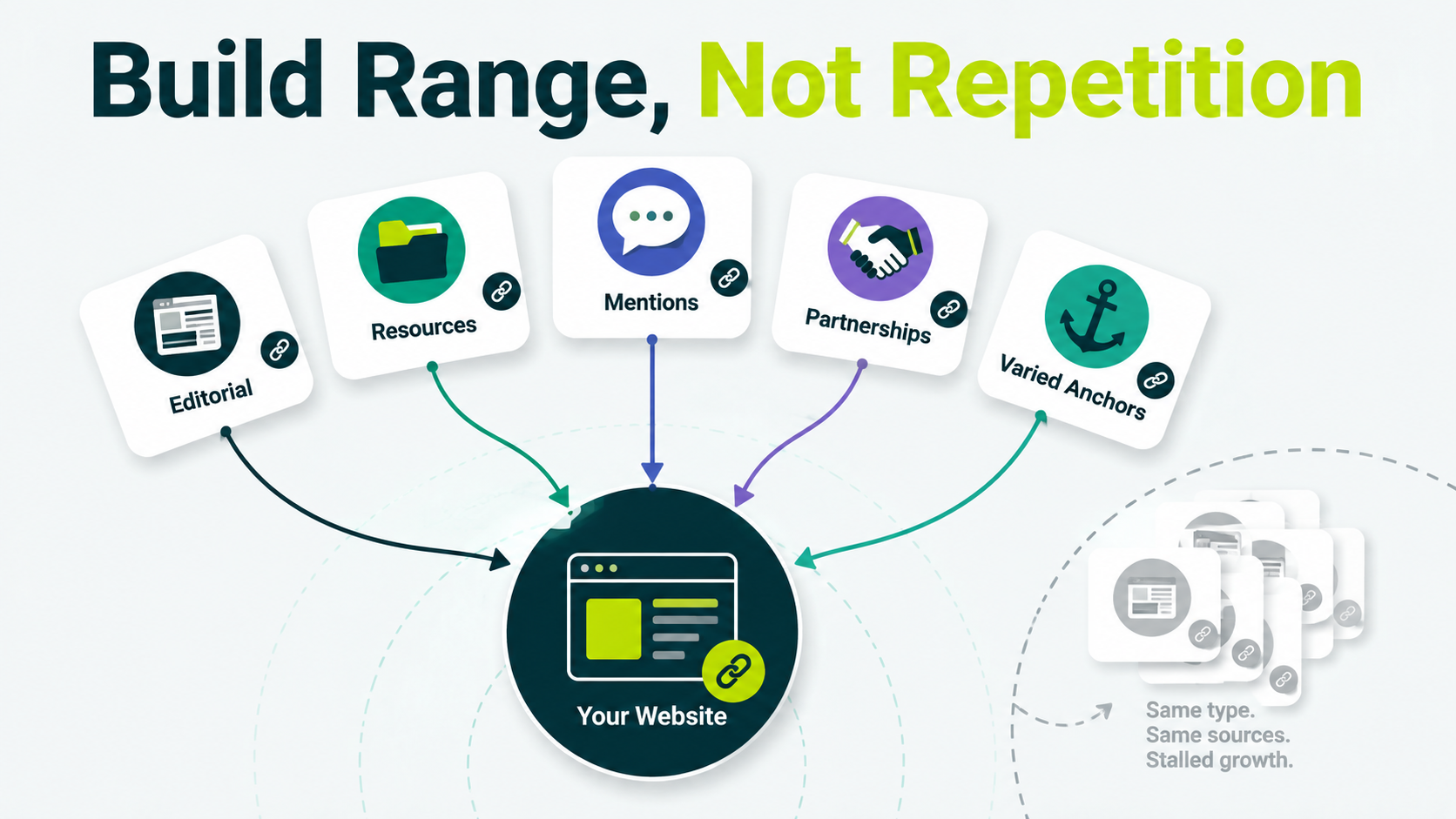
One pattern appears repeatedly when a backlink campaign stalls: the site keeps the same type of link from the same kind of source. The profile grows, but its range barely changes.
The stronger approach combines different link types, including editorial mentions, industry resources, guest contributions, and partnerships, along with varied anchor text and referring domains that span more than one niche or authority tier.
Quick Summary
- Diverse backlinks come from independent, relevant sources across different sites and publishers.
- Healthy profiles mix link types, authority levels, anchors, and follow attributes.
- Unique referring domains matter more than total link volume alone.
- Natural growth happens gradually; sudden coordinated batches appear manufactured and risky.
- Quarterly audits and rebalanced outreach close genuine source gaps.
What Link Diversity Actually Means
Link diversity means links from a wide range of independent sources. These are a mix of independent websites linking to you. Your backlink profile gives you a broader view of these links.
Each referring domain is a separate website with at least one link pointing to your site; it counts as one independent vote. So, 10 links from 10 different websites show more diversity than 100 links from just 3 websites.
Getting links from different websites is a good start, but it does not tell you everything. Quality and relevance of those websites matter just as much.
| GENUINE DIVERSITY |
MANUFACTURED DIVERSITY |
|---|---|
| Links come from sites that don’t know each other | Links come from one vendor’s network wearing different link type costumes |
| Sources vary in authority, topic, and format because real editorial decisions vary | Sources vary in format only, the underlying owner repeats |
| Builds at the pace real outreach can support | Arrives in a single batch to satisfy a checklist |
Diversity isn’t something you check off after the fact. It’s the natural result of running outreach across genuinely different channels, editors, and communities.
Why a One-Note Backlink Profile Puts Your Rankings at Risk
A backlink profile that leans on a single source or a single tactic reads to Google as manufactured, even when every individual link is real. Google’s automated spam systems look for exactly this pattern.
A backlink profile with these characteristics is the opposite of diversity. The links use similar anchor text, come from the same source types and a small group of domains, and follow the same pattern.
That pattern is a bigger red flag than a slow, quiet profile ever is.
There’s a clear difference between genuine growth and a manufactured spike. Ahrefs’ data on natural referring-domain pace found that pages ranking number one gain new referring domains at a pace of roughly 5% to 14.5% per month.

Those domains arrive from new sources over time, not in one coordinated burst. That’s the shape a healthy, diversifying profile actually takes.
Stacking a profile on 3 vendors makes it read as manufactured, no matter how many links pile up. Spread the same effort across 15 genuinely different sites, and it reads as earned. Rankings follow the second pattern.
The Dimensions of a Genuinely Diverse Link Profile
A backlink profile can look diverse at first glance and still rely on the same few patterns.
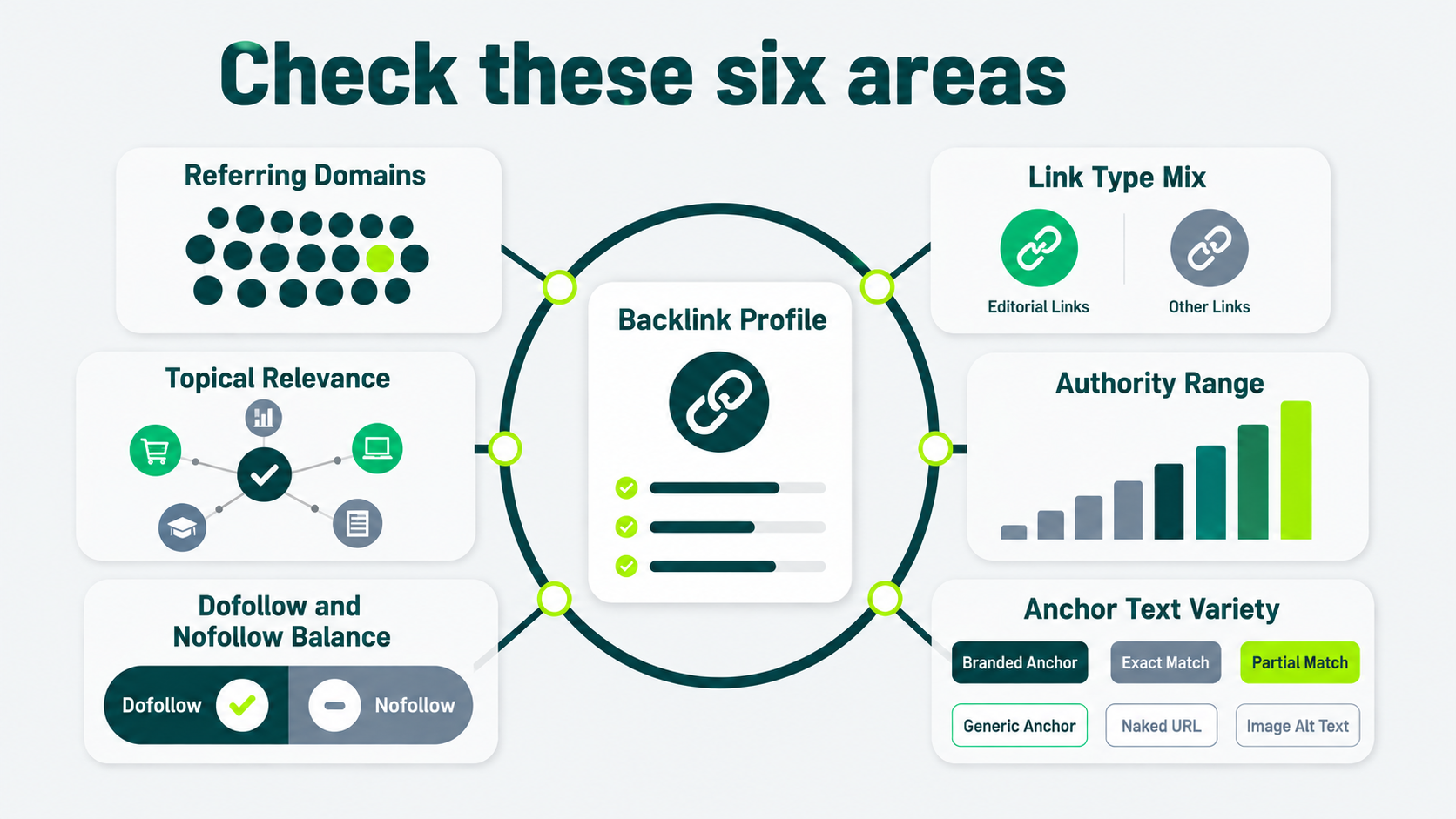
Check these six areas: Referring Domains, Link Type Mix, Topical Relevance, Authority Range, Dofollow and Nofollow Balance, and Anchor Text Variety.
Referring Domains
The number of websites linking to you matters more than your total link count. 10 links from 10 different domains show more diversity than 100 links from just 3 domains, because each new domain represents an independent editorial decision in your favor.
Link Type Mix
Vary the format your link takes. Guest posts, niche edits (a link someone adds into an already-published, relevant article), resource page mentions, and directory listings all count as different formats. No single format should make up the bulk of your profile.
These are just four of the 24 backlink types worth knowing.
Topical Relevance
A link from a site that covers your industry carries more weight than one from an irrelevant site, but building a profile entirely from same-niche sites can look coordinated, too.
A healthy mix includes some tightly relevant sources and some broader, reputable sources that mention you in passing. If you’re unsure how to judge relevance itself, what makes a link relevant breaks it down.
Authority Range
Mix high-authority and mid-authority sources instead of chasing only the biggest names. DR (Domain Rating, Ahrefs’ 0 to 100 score for how strong a site’s backlink profile is) spans a wide range across real editorial coverage.
Real editorial coverage spans the whole DR range, which is why a profile built entirely from sites above DR 80 looks purchased.
Dofollow and Nofollow Balance
A natural profile carries both dofollow links (links that pass ranking credit to your site) and nofollow links (a tag that tells Google not to pass that credit).
A profile that’s 100% dofollow looks engineered, since real mentions in the wild always pick up some nofollow links along the way.
Anchor Text Variety
The words readers click on matter. A profile where every link uses your exact target keyword as anchor text is one of the oldest manipulation signals search engines watch for.
Anchor text variety is a symptom of source diversity, rather than a substitute. Vary your sources first, and the anchor text takes care of itself.
Run Your Own 15-Minute Diversity Audit
Check your own diversity level with two free tools: Google Search Console (Google’s free tool that shows you who links to your site) and any free backlink checker.
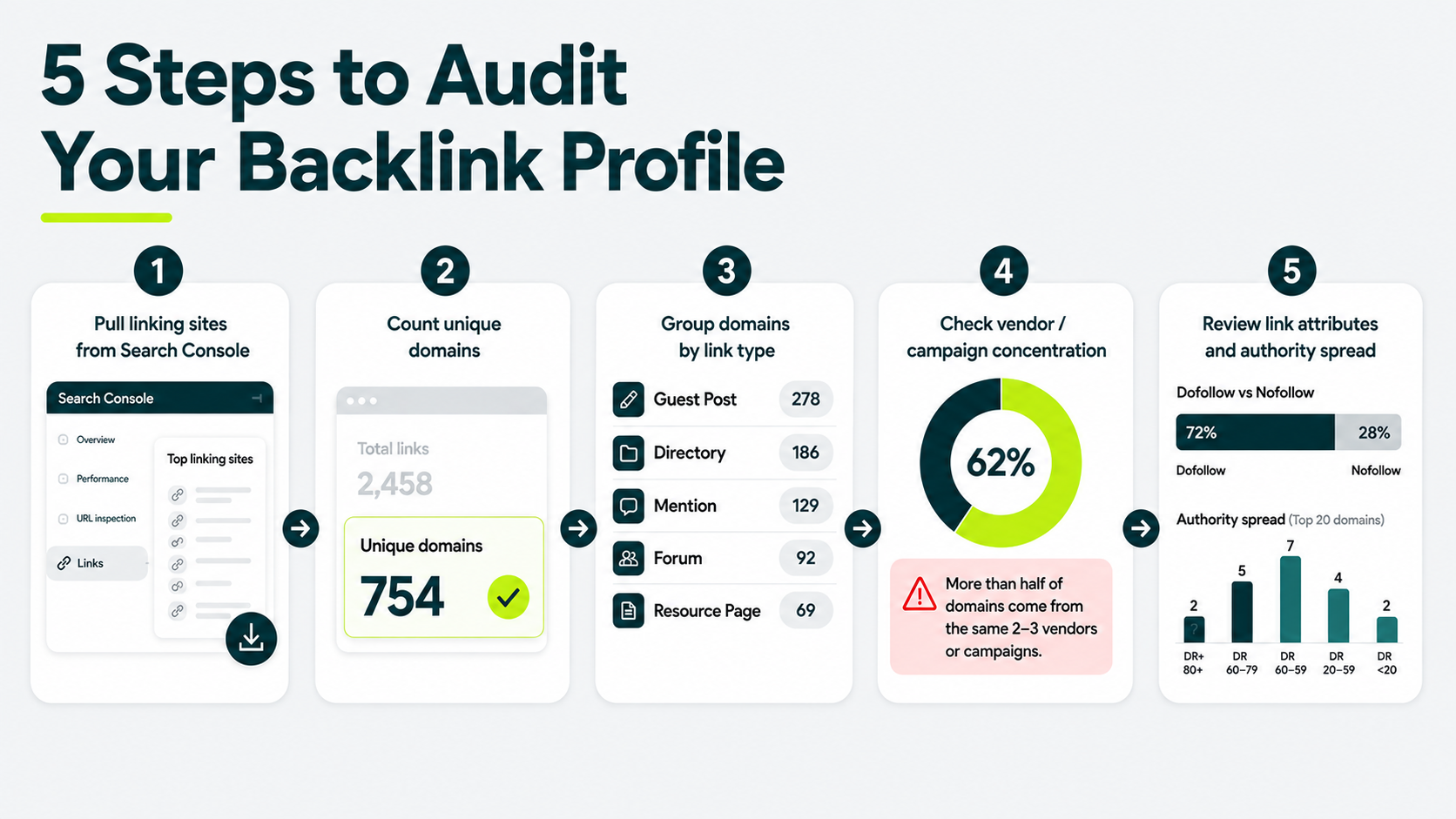
Follow these five steps:
- Open Search Console, go to Links, and pull your full list of linking sites.
- Count the unique domains, rather than total links. This is your real diversity base.
- Group the domains by link type: guest post, directory, mention, forum, or resource page.
- Check whether more than half of your domains trace back to the same 2 or 3 vendors or campaigns. (If they do, your profile is likely manufactured-diverse rather than genuinely diverse.)
- Note the dofollow-to-nofollow split and the rough authority spread across your top 20 domains.
When auditing a new client’s referring-domain spread, we look for concentrations large enough to distort the profile, rather than relying on a fixed percentage. A small group of domains that supply most of the links is worth investigating, especially when those domains are closely related or are used repeatedly.
We also look at whether new referring domains are being added over time. A profile that keeps growing through the same small group of sites needs a different approach from one that steadily attracts links from new, relevant sources.
If the count feels low or the sources feel repetitive, that’s useful information, not a crisis. It tells you where to point your next few outreach campaigns.
The Mistakes That Fake Diversity Instead of Building It
Most diversity problems come from a repeatable set of mistakes: Renting Diversity From One Network, Diversifying Anchor Text Without Diversifying Sources, Building Every Link Type in the Same Week, and Treating All Referring Domains as Equal.
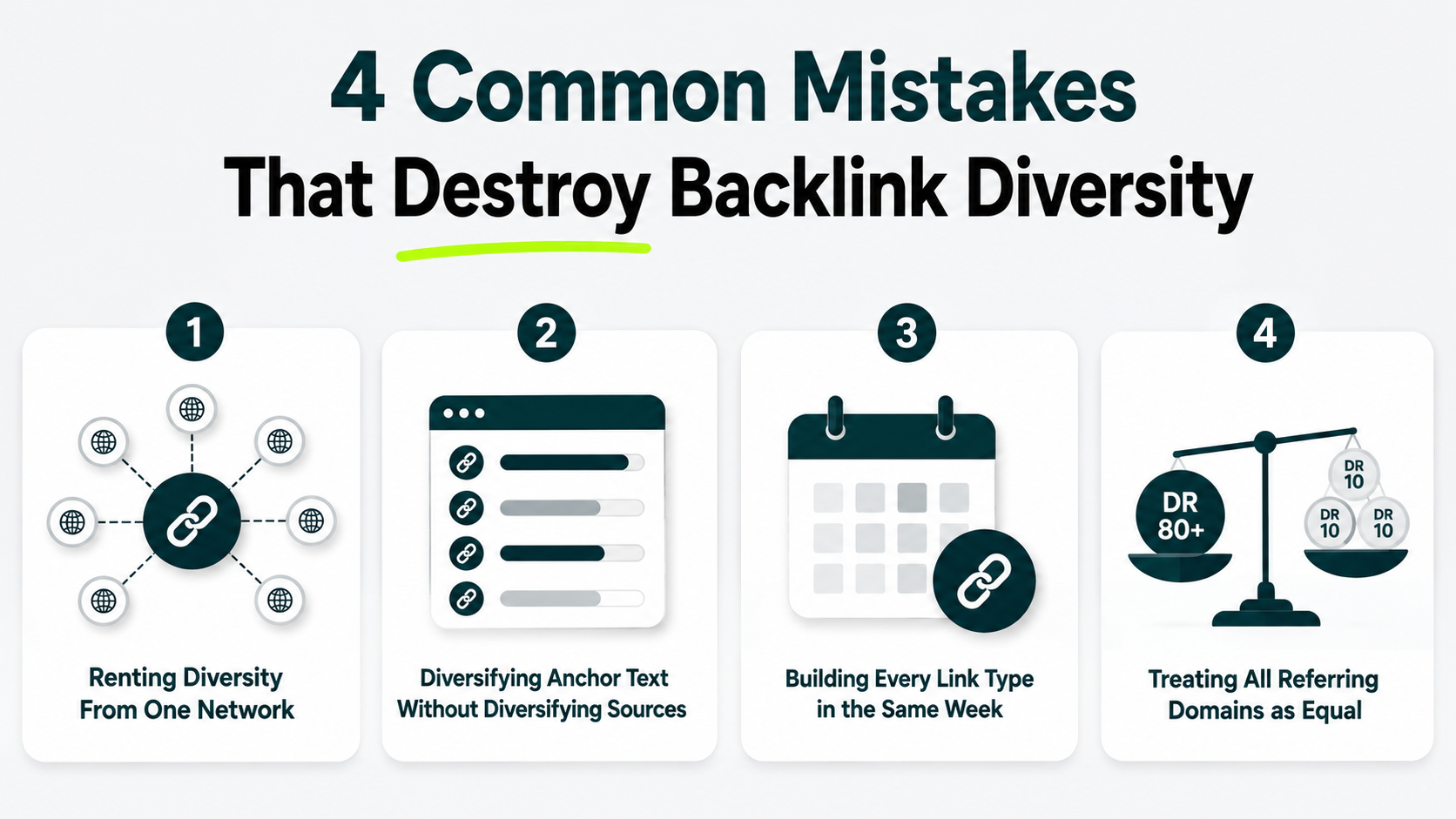
Renting Diversity From One Network
Buying access to a network of sites you or one vendor secretly controls can produce ten different link formats and one real source. Every format looks different: guest post, directory, resource page, but the underlying owner is the same person clicking publish each time.
Google’s systems can identify patterns connecting sites under the same ownership, even when the links themselves look different. Changing the link format does not hide the underlying ownership pattern.
Diversifying Anchor Text Without Diversifying Sources
Rotating through branded, partial-match, and generic anchor text means nothing if every one of those anchors appears on the same three sites.
Anchor variety is easy to fake. Source variety is not. Fix the sources first, and the anchor rotation stops being a task you manage separately.
Building Every Link Type in the Same Week
Launching guest posts, directory submissions, and a resource page pitch all in the same 7-day sprint creates a visible cluster instead of a natural spread.
Real diversity accumulates over months. Space out the tactics, even if it means moving slower than you’d like.
Treating All Referring Domains as Equal
A mention on a small, relevant blog and a mention on a massive, irrelevant news site both count as one more referring domain, but they don’t carry the same weight.
Chasing raw domain count without checking relevance produces a profile that’s technically diverse and practically weak. Relevance and independence both matter. Neither alone is enough.
Rebalancing an Already One-Note Backlink Profile
A one-note profile is a pacing problem, rather than an emergency. The fix is to change what you build next, rather than to touch what you already have.
Resist the urge to fix this by disavowing your links. Disavowing the links you earned, even repetitive ones, removes real value without fixing the underlying pattern.
| IF YOUR AUDIT SHOWS… | DO THIS NEXT |
|---|---|
| Most domains trace to 1 or 2 vendors | Pause that vendor. Fold new outreach into ongoing backlink management through a different channel instead of a single campaign. |
| Almost no nofollow links at all | Target a few communities, forums, or resource pages where nofollow is normal. Don’t force it. Stop avoiding it. |
| Everything sits in the same authority band | Pitch a mix of smaller, highly relevant sites and a few bigger, broader ones in the same outreach round. |
| Every link landed in the same 30-day window | Slow down. Spread the next batch of outreach across 3 to 4 months instead of 1. |
Across client rebalancing engagements, the most common pattern is that profiles don’t need a dramatic cleanup. They need a gradual shift toward more relevant, unique referring domains.
We typically focus new outreach on gaps in the existing profile while allowing the overall mix to rebalance naturally as new placements accumulate.
None of this happens in a week. A profile you build over a year can take months to rebalance, and that timeline is normal rather than a sign that you did something wrong at the start.
How Diversity and Link Velocity Work Together
Diversity and link velocity (the pace at which new links arrive) are two readings of the same underlying signal. Velocity asks how fast your links are arriving.

Diversity asks how varied they are upon arrival. A profile that grows at a natural pace diversifies almost on its own, because outreach across different channels rarely lands all its results on the same day.
If you want the full picture of pacing, what a natural backlink pace looks like, walks you through it in detail.
The two signals can drift apart, though. A site can grow slowly and still stay narrow if every month’s links come from the same single source.
A site can also diversify its sources while still growing too fast for any of them to look earned. Treat velocity and diversity as a pair to check together.
Keep the Mix Natural as You Keep Building
Open your own Search Console report right now and count the unique domains linking to you. If more than half trace back to one vendor or one campaign, that’s this week’s outreach priority.
Diversity isn’t a box you check once. It’s a pattern that either keeps forming naturally as you build or quietly stalls while your link count climbs.
Not Sure If Your Backlink Profile Is Diverse Enough?
Identify opportunities to grow your referring domains and build a healthier mix of relevant backlinks.
How often should you check your link profile’s diversity?
Check every 2 to 3 months, not every week. Diversity shifts slowly enough that weekly checks show you the same numbers with more noise. A quarterly check aligns naturally with a standard outreach campaign cycle. A professional link audit service can go deeper than the self-check above and assess these changes more systematically.
Does link diversity affect local SEO?
Yes, in the same way it affects any other site, plus one extra layer. Local sites benefit from links that tie back to a real place, such as local news mentions, chamber of commerce listings, and community sponsorships, in addition to the same industry and format variety every other site needs.
A local business with 20 links from 20 different local and industry sources beats one with 100 links from a single national directory network.
Do social media links count toward link diversity?
They contribute a small amount, but they’re not a substitute for the sources above. Most social platforms add nofollow links, which is fine as part of a natural dofollow-to-nofollow split, but a profile that’s mostly social mentions and little else still reads as narrow.
Treat social links as a supporting signal, not a primary diversity strategy and if you want help building out the dofollow side more deliberately, a dedicated link building agency can round out that mix with sources that actually carry ranking weight.
Does the country of your referring domains matter?
For a site targeting a single country or language, a small amount of international linking is normal and not a concern.
It only becomes worth managing on purpose once you’re actively targeting multiple countries or languages, and at that point it’s a strategy in its own right rather than a detail in a diversity audit.