A linkable asset is content designed to earn backlinks by offering other sites something worth linking to. These content pieces can be original data studies, free tools, or in-depth guides designed to add value for the readers.
Linkable assets are built to fill a gap or outperform existing sources with better data, usability, or structure that other content creators in your industry missed. While a blog post is written with your readers in mind, a linkable asset is primarily created to be useful to journalists, bloggers, and content creators who write for the same audience.
This is why linkable assets can be a long-term SEO investment; a single strong asset can continue to earn backlinks over time when it stays visible and relevant, helping build authority long after it’s published.
What You’ll Learn:
- The 8 types of linkable assets are ranked.
- You’ll learn how to find, build, and promote assets that consistently earn backlinks.
- How to measure performance, and what to do when an asset is underperforming.
What Is a Linkable Asset?
A Linkable asset is created to earn high-quality backlinks by providing something valuable that other websites want to reference.
It consists of various assets. Below is the list of assets that can be included in the linkable asset types.
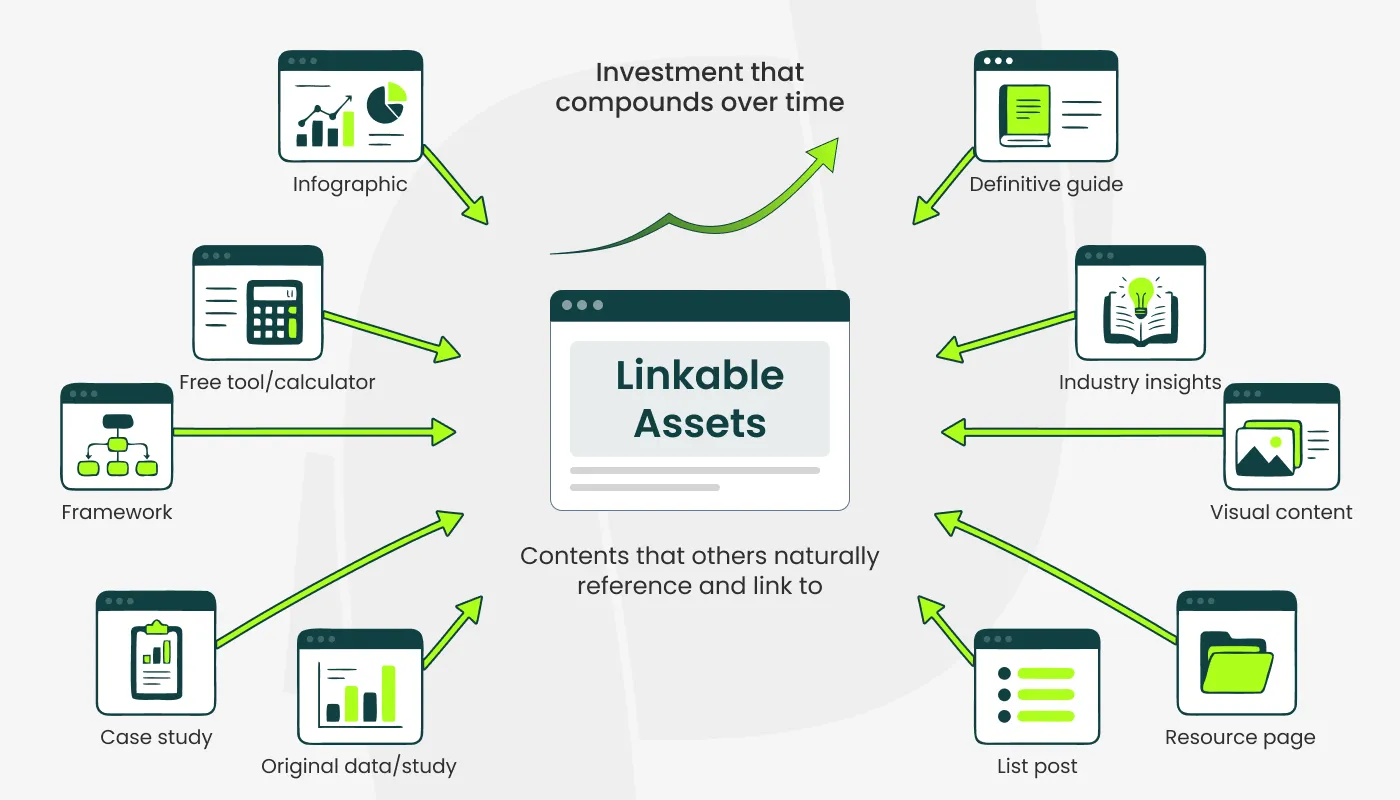
These assets often take the form of:
- Infographics
- Online free tools and calculators
- Frameworks
- Definitive guides
- Original data and studies
- Interactive visual
- List posts
A linkable asset is an investment that compounds over time as more sites discover and reference it.
Linkable Asset vs. Regular Content: The Key Difference
Now that you’re clear with the concept of linkable assets, here’s what makes the linkable asset different from the regular content.
| Regular Blog Post |
Linkable Asset |
|
|---|---|---|
| Primary Audience | Your readers | Writers who serve your readers |
| Goal | Rank, inform, convert | Get referenced and linked to |
| Lifespan | Decays without updates | Accrues links over months/years |
| Typical Link Count | 0-5 referring domains | 30-500+ referring domains |
| Creation Effort | Hours | Days to weeks |
| Promotion Needed | Optional | Non-negotiable |
Note: The numbers may vary based on promotion, niche, and brand authority.
Where a regular post answers a question. A linkable asset acts as a source that other posts cite to answer the same question.
A piece built purely to attract those citations is called link bait, and here is how link bait earns links.
Why Other Websites Link to Certain Content
People link to your content to serve their readers, not as a favor to you, and understanding that changes how you can build a linkable asset.
The writers mostly link to the content for four reasons:
1. Citation needed
They’re making a claim and need a source to support their claim.
E.g., “According to [source]…. “
2. Resource curation
They’re compiling a list of tools, guides, or references for their audience.
3. Data reference
They require a specific number, benchmark, or visualization that they can’t create on their own.
4.Social proof
They’re referencing an industry authority to strengthen their own argument.
Your asset needs to be strong enough to be included by other writers; it won’t earn links, no matter how polished or well-written it looks.

Why Linkable Assets Matter for SEO in 2026
As Google gets stricter on manipulative links, assets give you a safer, scalable way to earn authority.
Paid links, PBN schemes, link farms, and bulk directory submissions still exist, but the penalties are strict now. Linkable assets are the sustainable alternative.
Here’s how they compare to other methods:
| Method |
Sustainability |
Cost |
Scalability |
Risk Level |
|---|---|---|---|---|
| Linkable assets |
High, links compound | Medium-high upfront | High once the asset is live | Very low |
| Guest posting |
It is medium, it requires ongoing efforts | Medium | Medium | Medium |
| Digital PR |
High, if newsworthy | High | Medium | Low |
| HARO |
Low, because it depends on the platform | Low | Low | Low |
| Buying links |
None, because it has a penalty risk | Varies | Appears high | Very high |
Linkable assets are the only method on the list where a single piece of content can earn links for years without ongoing investment.
A link building campaign built around strong assets compounds returns, whereas one built around purchased placements compounds risk.
8 Types of Linkable Assets
Not every method is equal. Some can earn dozens of referring domains with minimal effort, but some need heavy outreach just to break through.
1. Original Research and Data Studies
When you publish original findings, such as surveys, trend analysis, and proprietary benchmarks. Every writer covering these topics needs to cite you.
It works because writers can’t replicate your data without citing your original source.
The image below shows the Panel Study of Income Dynamics (PSID) at the University of Michigan, which has been cited by thousands of academic papers, government reports, and news outlets for decades, because it’s the only dataset of its kind.

Effort is higher because you need to collect data or build a methodology.
However, even a 200-person industry survey can become a top-cited resource if the topic has no existing data.
2. Free Tools and Calculators
Interactive tools solve a specific and repeatable problem.
Tools like mortgage calculators, ROI estimators, and readability analyzers earn links from resource pages, blog posts, and roundups because they’re actually useful.
CoSchedule’s Headline Analyzer earned over thousands of referring domains. It solves the problem of writing better headlines in under 30 seconds.
Writers link to the asset from the blog posts, courses, and resource round-ups because it’s genuinely useful, not just because anyone asked them to.

The advantage here is that the tool provides ongoing value that a static article can’t match.
You spend more on development at the beginning, for example, on an interactive tool or specialized page, but maintaining it later is low effort. Over 12+ months.
3. Comprehensive Ultimate Guides
The “definitive guides” are useful. When done right, a guide becomes a go-to resource that everyone refers to and links to.
However, when done poorly, these are just long articles that no one reads.
A well-structured guide gives a writer a single authoritative source to point the readers to, saving them from having to explain a complex topic themselves.

The thing that separates a linkable guide from a forgettable one is the original frameworks, proprietary data, and a structure that make it a genuine reference.
4. Infographics and Data Visualizations
Infographics and data visualizations remain effective in 2026 when paired with original data.
If your article just collects stats and places them from other articles, no one will link to it; they’ll link to the original source instead.

Pro Tip:
Include an embed code below every infographic. It makes it easy for the bloggers to share, and adding an embed code will automatically link back to you.
5. Industry Benchmark Reports
Annual or quarterly reports that track metrics, trends, or standards in your industry. This becomes a reference source that writers cite year after year.

This is effective because benchmark data has a built-in refresh cycle.
Each new edition earns new links, and older editions often continue to earn links from the archival references.
6. Interactive Content and Templates
Templates and interactive assets earn links the same way the tools do. People often recommend what made their own work easier.
A well-designed Notion template or Figma kit gets shared in blog posts, YouTube descriptions, and community roundups because the person linking to it is genuinely recommending it, not just citing it as a source.

It works best in the niche where the practitioners share workflow resources, B2B SaaS, marketing, design, and productivity.
Best for:
It is best for B2B SaaS, marketing, design, and productivity niches where practitioners share workflow tools.
7. Expert Roundups and Curated Resource Pages
The format of roundups and curated resource pages is clear: you ask 10-12 experts one question, compile their answers into a single article, and publish it.

What makes it work is that every expert featured has a reason to share it.
However, quality remains an important factor; a roundup of vague, generic quotes won’t earn links from anyone worth having.
Keep the expert’s list with 8-12 genuine experts; those with specific insights beat 50 common responses every time.
8. Definitive Glossaries and Frameworks
A great glossary becomes the definition that everyone borrows. It attracts natural links because writers use your definitions to explain the term to their readers.
It matters because glossary links are often considered contextual backlinks that are embedded naturally within content, making them a valuable type of link for SEO.
Here’s a linkable asset comparison matrix:

How to Find the Right Linkable Asset Idea for Your Niche
Most guides skip this part. They list asset types, telling you to “create something valuable” and move on. That doesn’t define a strategy.
You need a system to find ideas that your niche will actually link to. Here’s how you can find the right linkable asset ideas:
Step 1: Reverse-Engineer Competitor Backlink Profiles
Open SEO analytics tools like Ahrefs or Semrush. Look for your top 3-5 competitors backlink profile and analyze which of their pages have earned the most links from other websites. Run the “best by links” report for each domain and sort by referring domain.
You’ll usually spot the patterns immediately. Maybe everyone in your niche links to calculators, data reports, or glossary pages. This pattern tells you what in your niche is worth citing.
Avoid copying the existing assets. Instead, look for content gaps, a topic, or a format where no strong version exists yet, and consider building that.
Step 2: Identify Citation Needs in Your Industry
A citation need is a topic where writers often make claims but lack solid evidence to link to. That is your golden opportunity.
Here’s how to find them:
- Search for your topic in your niche + “according to” or “source” in Google. Look for what’s being cited. (If writers are linking to weak or outdated sources, that’s the gap you can fill.)
- Browse journalist query platforms such as HARO, Qwoted, or SourceBottle. The questions asked by the journalists can reveal what data and expert sources are missing.
- Check Reddit, niche forums, and Stack communities. When someone asks, “Does anyone have data on X?”, that’s your next asset idea.
Step 3: Validate the Idea Before You Build
Before you spend days or weeks building it, run a short check:
Search volume check
Do enough people search for this specific topic to make it worth building?
Existing link distribution
How many sites link to the best resource out there? While it varies by niche, if it’s under 30, the opportunity is real. But if it’s over 500 from a major brand, then you need a sharper angle.
Can you build something better?
Not just different, but actually better, such as original data and more current information. If you can’t beat what exists, pick a different idea.
How to Create a Linkable Asset: Step-by-Step Process
Before you start building, you need to follow the proper steps to create your linkable asset. Here’s how you can go from ideas to creating a finished asset.
Phase 1: Research and Data Collection
Original data and research make a huge difference. Even small-scale research can outperform recycled statistics and data from someone else’s study.

Here are some options for the teams without a massive research budget:
- Run a simple survey using tools like Typeform or Google Forms, and promote it within a niche community, such as a LinkedIn group, Slack channel, or email list.
- Analyze public data, such as government databases, like the GSA occupancy data reports contain raw numbers that nobody in your niche has collected into a reliable format.
- Aggregate and synthesize findings from multiple sources into one organized reference. The compilation itself becomes the asset, even if the data isn’t original.
Phase 2: Content Creation and Design
The best practice is to write for the person who will link to you, not just for the person who will read you.

What this actually means is:
- Use quotable statements. Specific, data-driven sentences that the writer can mention in their own article with a link to you.
- Use embeddable elements such as charts, infographics, and data visualizations with special embedded codes.
- Build a clear structure so that a journalist on a deadline can find key points faster in the entire article. It should be easy to scan, and the journalist can scan it in under 10 seconds.
Here’s when to hire a designer and when to use an in-house designer.
If data visualization is centered on the asset, such as an infographic benchmark report, then hire a professional. Use an in-house designer for guides, glossaries, and templates, where good formatting and clean structure help readers find what they need.
Phase 3: On-Page Optimization for Discoverability
Your linkable asset still needs to rank organically. If people can’t find you, they won’t be able to link to you.

Start with the basics to strengthen visibility and clicks. Target your main keywords in the title tag and H1; write a clear meta description to drive clicks; ensure fast page load speed; use a mobile-responsive layout; and include proper open graph tags for social sharing.
Here’s one detail that most teams miss: Add schema markup.
| How-to Schema |
For process-based assets |
| FAQ Page |
For guide-style assets |
| Dataset Schema |
If you’re publishing original data. |
Schema increases your visibility in results, which in turn increases discovery and links.
Phase 4: Using AI to Speed Up Creation
AI tools won’t build a linkable asset for you, but they’ll reduce the work by half.

Here’s where AI genuinely helps:
- It helps with research synthesis; feed 10 source documents into any AI platform and ask for a structured summary of key findings and gaps.
- Helps in data analysis, uses ChatGPT or any similar tools to clean survey data, calculate significance, and generate initial chart drafts.
- First-draft generation for sections like methodology descriptions, glossary definitions, and FAQ answers.
However, there are some areas where AI falls short:
- Original insights
- Editorial judgments
- Experience-based opinions
Ironically, the parts that make an asset genuinely link-worthy are the parts AI can’t generate.
How to Promote Linkable Assets and Earn Links
Publishing a linkable asset without promoting it is like opening a restaurant on a street with no traffic; the food might be excellent, but nobody will know.

Outreach Strategy: Who to Contact and How
Diversify your prospects into four groups, such as:
- Resource page clusters:
Your asset is a natural fit for pages that feature “best tools,” “top guides,” or “recommended reading” in your niche.
This is where resource page links become a direct channel for your asset.
- Industry bloggers and content creators:
Writers and bloggers who regularly cover topics related to your assets.
Don’t just lead with the asset itself; instead, pitch the data points or specific insights they can use in their upcoming articles.
- Journalists and newsletter writers:
Journalists and writers need sources; if your asset contains original data, then it eventually becomes a source.
Therefore, pitch findings, rather than format.
- Contributors who link to competing resources:
Use Ahrefs to find sites linking to your asset’s topic that are weaker or older versions.
These sites already care about your chosen topic, but they just need a better resource. This is where outreach makes the difference by increasing link acquisition compared to publishing.
Email Framework (Not a Template, a Structure)
For line 1, reference something that talks about their content, show them that you’re actually reading.
In line 2, share the specific finding or any insight from your asset that’s relevant to what they write about.
Offer your asset in line 3, no pressure, don’t ask for a link. Just a helpful gesture. Add something like “Thought this might be useful for your readers.”
Keep everything under 100 words. People with busy schedules usually don’t read long pitches.
Content Distribution Beyond Email
- In Reddit and niche communities, share your findings first, not direct links. Add value to the ongoing discussion and provide a link where it is genuinely helpful.
- Use social media seeding to share your assets. Take 3-5 standalone data points from your asset and post them as individual pieces of content on LinkedIn, X, or wherever your audience usually reads.
- Offer newsletter partnerships to the writers and provide exclusive stats from your research in exchange for a mention of your brand.
- Provide paid amplification. Even a paid promotion budget can put your asset in front of the right people. That’s not buying links, it’s buying visibility.
The Broken Link Building Angle
Find broken links that are pointing to content similar to yours. If a competitor’s data study from 2019 is now a 404, many sites still link to it. Your asset acts as a replacement.
You can use tools like a broken link checker to make this easy. Find dead pages, identify sites still linking to them, and reach out to those sites with your updated resources.
You’re helping them replace outdated resources; that’s a genuine favor, not cold outreach.
How to Measure Linkable Asset Performance
Building an asset is only half the work. Here’s how you can analyze how it’s performing.
Key Metrics to Track
Referring domains over time
Focus on referring domains, not total backlinks. It means 50 links from one site matter far less than 50 links from 50 different sites.
Link velocity
How fast are new referring domains linking to you? A healthy asset continues to attract new referring domains consistently after the initial promotion phase.
Authority of the linking site
10 links from well-established, high-traffic sites move the needle more than 100 links from small, low-traffic ones.
Organic traffic to the asset page
If the asset ranks in search, it attracts links on its own; writers find it through Google and link to it naturally.
Rankings influenced
Don’t just track how the asset itself ranks; also check how it lifts the rankings of other pages on your site that it links to internally, because link value flows through your entire site structure.
Timeline: When to Expect Results
Set realistic expectations. With ongoing promotion, you can expect the asset to begin earning its first set of links within the first 1-3 months.
Links from organic search usually start coming in from the month 3-6, once the asset starts to show up in search results.
The complete compounding effect starts where your asset earns links without any extra effort. It usually takes 6-12 months.
That’s not slow; that’s an asset generating returns long after the creation cost is paid.
What to Do When a Linkable Asset Fails
Not every asset is a hit. When one asset underperforms, analyze it before you abandon it.
Is it a content problem?
Check if the content offers something unique. If three competitors have nearly identical resources, your asset won’t earn links just by existing.
Is it a promotion problem?
Did you actually reach out to 50+ prospects, or did you tweet it once? Most of the failed assets weren’t promoted; they were just published and forgotten.
Is it a niche problem?
Some niches simply don’t have a linking culture. If the top resource in your niche has only 8 websites linking to it, even after 3 years, consider that the ceiling is low. Adjust your expectations, or you can target a broader audience.
Here’s how you can refresh and improve:
Update the data, improve the design, or add a new section. Then repromote to your original list with a “we’ve updated this” message. The reason to do this is that a refreshed asset often outperforms the original content.
Common Mistakes That Kill Linkable Asset Performance
Here is the list of common mistakes that can kill the asset performance. Consider avoiding them at any cost.

Making It Too Promotional
If your asset is similar to a product brochure, no one will link to it. Writers usually link to neutral, informative resources rather than to a sales page.
Modify it, and eliminate every sentence that exists to sell rather than to provide information.
Choosing a Topic No One Needs to Cite
You build something impressive, but no writer in your niche has a reason to reference it.
Remember, a stunning infographic about your company’s history won’t earn links, but an ugly spreadsheet with original pricing data will.
Publishing and Praying
A team spends three weeks building a research study, publishes it on a Tuesday, shares it on LinkedIn, and waits. Even after all this, nothing happens, and they assume that linkable assets don’t work.
Here, the actual problem is the absence of promotion. You can allocate as much time to promotion as you do to creation
Neglecting Updates and Maintenance
A 2023 report is a citation magnet and a liability by 2025. The data is outdated; therefore, it loses links. Writers replace old sources with current, updated ones.
You can plan references for any asset you want to keep earning links. Update the year, refresh the data, and re-promote.
What Comes Next
You don’t need to build every type of linkable asset. You just need to build the right one, the format that your niche values, covering a topic where no strong resources exist yet, and you need to promote your asset to the people who control the links.
Start simple, begin with research.
Then take a step forward toward ideating a framework and look at what’s already earning links in your industry. The gap is the difference between what exists and what should exist; that’s your opportunity.
Ready to create linkable assets that attract backlinks naturally?
Get a clear approach to building content people want to reference and share.
What is a linkable asset?
A linkable asset is content designed to earn links by providing something valuable, such as original data, a free tool, or a definitive guide, that other websites want to reference naturally. Unlike regular blog posts, linkable assets serve the people who write for your audience, giving them a reason to cite your work.
What are the best types of linkable assets?
The highest-performing type of linkable assets is:
- Original research and data studies
- Free tools and calculators
- Industry benchmark reports
- Comprehensive guides
- Data visualizations
- Interactive templates
How do you earn links with linkable assets?
There are two steps. Build content that fills a genuine gap, something that the writers in your niche need but can’t find. Actively promote it through targeted SEO outreach to resource page curators, industry bloggers, journalists, and sites that are linking to competing resources.
How long does it take for a linkable asset to earn backlinks?
With promotion, you can expect 10-30 referring domains in 1-3 months, and organic link accrual usually begins at 3-6 months. Complete compounding, in which the asset earns links without ongoing effort, usually takes 6-12 months.
Can small businesses create effective linkable assets?
Definitely, local data studies, niche calculators, and curated resource pages require a minimum budget. A regional cost-of-living study or industry-specific pricing tool can dominate a local niche where national brands aren’t competing. Focus on depth within your niche, not a broader appeal.
Are linkable assets better than other link building strategies?
They’re the sustainable and lowest-risk approach, but they work well as part of a broader strategy. Pair linkable assets with digital PR, community engagement, and structured outreach. A linkable asset gives you something worth linking to, and a promotion strategy makes sure the right people can find it.