A high-quality backlink is an editorially placed, contextually relevant link from an authoritative, topically relevant website. It sends real trust signals to search engines and drives measurable ranking improvements.
Not all backlinks you earn move rankings. One editorial placement from a relevant industry publication does more for your authority than 50 directory submissions or blog comment drops ever will.
Link quality depends on several signals: relevance, authority, placement, anchor text, and the traffic on the referring page.
Quick Summary
- A high-quality backlink comes from a relevant, trusted site, appears naturally within the main content, and uses anchor text that fits the context. Links without these signals tend to have limited impact, even at higher volume.
- Topical relevance often carries more weight than raw domain authority, especially when the linking page closely matches your topic. The strongest links combine both.
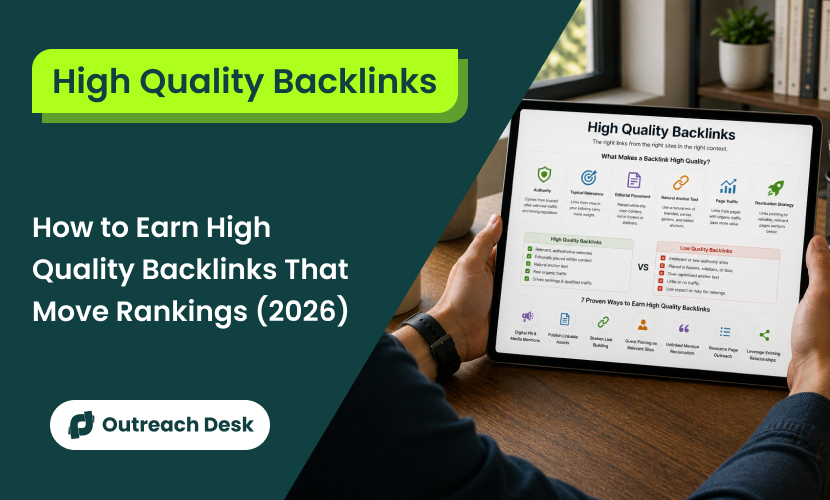
- The 6 signals that separate quality from junk: authority, topical relevance, editorial placement, anchor text diversity, page traffic, and destination strategy.
- Seven practical acquisition methods, ranked by effort and return, from digital PR to unlinked mention reclamation.
What Makes a Backlink High Quality
A backlink is simply a link from another website pointing to yours. But not all backlinks are created equal. Google’s systems, including SpamBrain, evaluate links on multiple dimensions before deciding whether a link passes authority or gets ignored entirely.
Many backlinks get crawled. Few improve your rankings in the search engine results page (SERPs). The difference is quality backlinks.
We’ve watched this play out in many of our campaigns at Outreach Desk. The sites that grow fastest are not the ones with the most links, they are the ones with the high-quality backlinks.

If you want links that build authority and increase organic traffic, 6 signals need to align:
1. Authority of the Linking Domain
Authority isn’t defined by metrics like Domain Rating or Domain Authority. These are third-party estimates of a site’s link profile strength. They help you compare sites quickly, but they don’t reflect how search engines evaluate trust.
What matters more is whether the site ranks, attracts consistent organic traffic, and earns links naturally within its niche.
For example, a DR 45 site with 15,000 monthly organic visitors in your niche passes more meaningful authority than a DR 75 general blog that charges a fee for publishing your content because editorial independence and topical fit change the equation entirely.
The stronger signal is whether the referring site earns consistent traffic and trust in its niche.
2. Topical Relevance Outweighs Everything Else
Relevance is what makes a link meaningful. A backlink from a site in your industry, even a small one, carries more weight than a link from an unrelated high-authority domain.
Google’s algorithm evaluates topical relationships between the referring page, the referring domain, and your content. If those topics align, the link reinforces your authority in that subject. If they don’t, the link carries significantly less weight.
Most teams chase the highest DR they can find instead of the most relevant site.
For a closer look at how these relationships are judged, what makes a link relevant breaks it down in more detail.
3. Editorial Placement
Placement helps search engines understand intent. Links within the main body content tend to carry more weight compared to the ones buried in a footer, sidebar, or author bio, because they’re a part of the editorial narrative.
When you earn contextual links, where other sites naturally link to your content within their articles, Google treats it as genuine editorial trust. This boosts your rankings and attracts more qualified traffic.
Links placed higher up on the page tend to carry slightly more weight than links at the bottom, based on Google’s reasonable surfer patent. What is more clearly confirmed is that the links surrounded by relevant text that relates to your content reinforce the topical signal.
4. Anchor Text Should Be Natural, Not Optimized
The clickable text and the sentence around it should both align contextually with the topic of the page you’re linking to. Relying on exact-match anchor text across every link pointing to your site is one of the oldest manipulation signals that Google’s system can identify.
Quality backlink profiles use a natural mix of branded anchor text (“Semrush”), partial-match (“Website traffic checker from Semrush”), generic (“this guide”), and naked URLs.
If you’re earning links editorially, the anchor text will diversify on its own. The moment you start prescribing exact anchors to every site linking to you, you’re creating an unnatural pattern.
For the full breakdown of each type and when to use them, see anchor text best practices.
5. Page Traffic
A link from a page with genuine organic traffic passes PageRank flow and sends referral visitors your way. However, traffic itself is not a direct cause; it is a strong indicator that the page already has high authority, relevance, and quality signals that Google values.
Pages with no traffic usually carry thin or deindexed content, and links from them carry less weight.
6. Destination Strategy
Pages that offer clear value earn editorial backlinks that support rankings and organic traffic over time. These pages are typically linkable assets such as original research, in-depth guides, free tools, or data-driven resources. When they get used as sources, they get cited. That is how sustainable link acquisition works.
Even strong content needs visibility to consistently earn links. Active outreach campaigns get your content in front of relevant sites and build authority faster than waiting for it to happen organically.
Building links directly to product or service pages works in some cases, but most editors won’t link to a commercial page unless it genuinely serves their readers. The smarter approach is to build links to high-value content assets, then use internal linking to distribute that authority to your product or service pages.
The 5-Point Quality Check You Can Run Today
To evaluate backlink quality, check them against these five criteria: domain authority above 40, topical alignment with your niche, placement within body content, natural anchor text variation, and real organic traffic on the referring page.
Important Note
DR/DA 40+ can be a common starting benchmark, but it shouldn’t be treated as a requirement. Topical relevance and organic traffic matter more than hitting a specific number.
A link that scores 4 or 5 strengthens rankings. Score 2 or 3 is neutral. Score 0 or 1 is dead weight.
We use a version of this framework at Outreach Desk during client backlink profile audits. It takes about 30 minutes to evaluate your top 20 referring domains, and it consistently reveals which links are actually helping and which are dead weight.
Here’s the scoring in practice:
| Signal | Strong (1 point) | Weak (0 points) |
|---|---|---|
| Domain authority | DR/DA 40+ with real content | DR under 20, thin site, spammy link patterns, PBN indicators |
| Topical relevance | Linking page covers your topic or adjacent niche | No topical connection to your site |
| Placement | Contextual, in-body, within a relevant paragraph | Sidebar, footer, author bio, or widget |
| Anchor text | Descriptive, varied across your profile | Exact-match keyword repeated across many links |
| Page traffic | Linking page ranks for its own keywords | Zero organic traffic, no indexed rankings |
Score 4 – 5:
This link is moving your rankings. Protect it and make sure the linking page stays live and the link stays in place.Use a link-monitoring tool to catch any changes before they affect your rankings.
Score 2 – 3:
Links with these scores are neutral to mildly helpful. Don’t chase more links like this. Focus your effort on 4-5 quality placements instead.
Score 0 – 1:
This link isn’t helping. If you have a cluster of 0-1 links from the same source type, e.g., spammy directories or irrelevant foreign-language sites, consider creating a disavow file as a precaution.
Why Chasing Volume Actively Hurts You
Chasing link volume instead of link quality hurts because a backlink profile full of low-quality links fails to help and creates risk.
Google’s spam detection system, SpamBrain, identifies manipulative link patterns. In many cases, those links are simply ignored, meaning no ranking benefit. In more extreme cases involving clear manipulation, they can contribute to manual actions that impact search visibility, sometimes at the page or section level.
We’ve audited backlink profiles from clients who spent thousands on bulk link packages before reaching out to us. The pattern is consistent. Hundreds of links from irrelevant directories, foreign-language sites, and blogs that publish 30 guest posts a day. Zero ranking movement. Sometimes negative movement.
Sites that rank well tend to have backlinks from a wider range of unique referring domains, and those domains carry real authority and traffic. More domains from low-quality sources don’t replicate that effect.
Seven Ways to Earn High-Quality Links That Google Rewards
Seven methods produce links that Google treats as genuine authority signals. These methods focus on earning links through relevance, value, and editorial placement, where the first three produce the strongest links, while the last four are efficient supplementary tactics.
1. Linkable Assets:Content Worth Citing
Most teams build links to whatever content they already have. That’s not a strategy.
Start with the asset. Create something specifically designed to attract links, such as a free tool, calculator, original dataset, template, or any other linkable asset. These assets earn backlinks because other creators reference them as sources. Once a linkable asset ranks and gains visibility, it can continue to attract backlinks over time, often with less ongoing outreach.
The asset needs to solve a specific problem better than anything else available. Something practical, such as a backlink cost estimator that helps marketers estimate campaign budgets, or an industry benchmark report with data nobody else has published.
When you build something creators keep reaching for, the links follow.
2. Digital PR Campaigns That Journalists Actually Cover
Journalists and editors at major publications need expert sources. HARO link building and platforms like Featured.com and Qwoted connect you with those requests. But the quality bar is high, so generic responses get ignored.
Original data, surveys, and industry research earn the highest-authority backlinks because journalists and bloggers need credible sources to cite.
When you publish something genuinely new, such as a dataset nobody else has, a trend analysis with original numbers, or a contrarian finding that challenges industry assumptions, publications are more likely to link to you as the original source.
This is about creating stories that newsrooms want to tell.The effort is high. The payoff is the strongest links you’ll earn, which are editorially placed, contextually relevant, and from domains with genuine authority.
3. Guest Posting on Relevant, Editorially Strict Sites
Guest posting gets a bad reputation because most teams do it wrong. They pitch generic topics to sites that accept anything, then stuff exact-match anchor text into a paragraph that reads like an advertisement. That’s link building with extra steps and no editorial value.
Strategic guest posting means pitching a genuinely useful article to a publication in your niche that has editorial standards, a site where the editor will reject weak pitches and rewrite sloppy paragraphs. The link earns its value because the content earns its placement.

What to look for in a guest post target:
- The site publishes content in your industry, not “we accept all topics”
- They have genuine organic traffic (check via Ahrefs or Semrush)
- Their existing content is well-written and editorially reviewed
- They don’t publish 10+ guest posts per week. Look for patterns of low editorial control, not just volume
4. Broken Link Reclamation
Websites link to resources that go offline all the time. Broken-link outreach works by finding those dead links, creating a replacement resource on your site, and reaching out to the linking site with a straightforward pitch: “This link on your page is broken. Here’s a working alternative that covers the same topic.”

The response rate can be higher than standard cold outreach when executed well. In broken-link campaigns we’ve run at Outreach Desk, response rates are 2-3x higher than for cold guest post pitches. The pitch is simple: the value exchange is clear: you fix a problem, and in return, your resource is considered a replacement.
5. Unlinked Brand Mention Reclamation
If someone mentions your brand, product, or original content without linking to you, that’s often one of the most straightforward opportunities.

Tools like Ahrefs Content Explorer and Google Alerts surface these unlinked mentions. A short, friendly email asking for the link converts well because the writer already thinks highly enough of you to mention you. Response rates here are higher than cold outreach.

This tactic scales with brand awareness. The more visible your brand becomes, the more unlinked brand mentions accumulate. Making it one of the more efficient link acquisition methods when consistent monitoring is in place.
6. Resource Page Outreach
Many websites maintain resource pages, curated lists of the best tools, guides, and references on a specific topic. Getting your content listed means earning a contextual link from a page often created to curate useful resources.

The pitch is simple. Find resource pages in your niche, verify they’re still actively maintained, and reach out with the specific page on your site that fits their list. Don’t pitch your homepage. Pitch the asset that belongs there.
7. Niche Edits: Contextual Placements in Existing Content
A niche edit is the process of placing a contextual backlink into an existing, already-indexed article on a site in your vertical.
Unlike guest posting, you’re not creating new content. You’re adding a relevant link to content that already ranks in search results and earns organic traffic.
The advantage is speed. The content is already published, already indexed, and already has established signals like rankings, links, or traffic. When done through genuine editorial outreach rather than purchased placements on low-quality sites, niche edits can be an efficient way to earn contextual backlinks.
How Many High-Quality Backlinks You Actually Need
There’s no universal number for how many backlinks a site needs. The number of backlinks required depends on your niche, keyword competition, and your domain’s current authority.
A site in a low-competition niche can reach page one with few high-quality and relevant referring domains. A SaaS company targeting high-volume keywords may need 100+ referring domains from relevant, authoritative sites.
The most reliable way to estimate your target is through competitor backlink analysis. Pull the backlink profiles of the top 3 sites ranking for your primary keywords, count their unique referring domains, and that number becomes your directional benchmark.
One pattern we’ve noticed in the campaigns we run is that the gap between positions 3-10 and position 1 is filled with topically relevant backlinks. In our analysis, higher-ranking pages often have a stronger concentration of backlinks from sites closely aligned with their topic.
Don’t set a monthly link building target disconnected from your competitive landscape. Analyze what’s ranking, identify the referring domain gap, and build a strategy around closing it.
The Part Most Teams Get Wrong
High-quality link building builds momentum over time. It isn’t instant. Many teams either stop too early or rely on ineffective tactics.
Link acquisition tends to follow a pattern. Early months focus on earning placements. As those links get crawled and processed, their impact often becomes visible over time, typically across several months. Ranking movement shows up after two to four months, not immediately.
In the ongoing link building campaigns we run at the Outreach Desk, one pattern shows up consistently. There is a gap between link acquisition and ranking movement. Early placements build the foundation. As more relevant links are earned and evaluated, pages begin to gain traction and move in search results pages.
The second issue is treating link building in isolation. Links work best when they support a strong foundation.
You see stronger outcomes when three elements work together:
- Content that earns references because it adds real value
- Internal linking that helps distribute signals across key pages
- Technical setup that allows pages to be crawled and indexed properly
Links strengthen what already exists. They don’t fix weak content or structural issues.

How Quality Links Affect AI Search Visibility
This is the angle most teams are missing in 2026.
AI search engines, including ChatGPT, Perplexity, Gemini, and Google AI Overviews, pull answers from sources they treat as authoritative and demonstrate topical expertise, editorial trust, and that citation frequency matters. That’s familiar territory if you’ve been building links the right way.
When your site earns editorial high-quality backlinks from respected publications, you’re building the citation profile that AI systems use to determine which sources to reference in their generated answers.
Brands that get mentioned and linked to across authoritative editorial content are the ones showing up in AI-generated responses. Generative engine optimization is still developing, but the foundation is the same: earn trust from authoritative sources. The format of citations changes in an AI Overview compared to traditional ranking on a SERP, but the input itself doesn’t change.
Takeaway
The sites that build real search authority in 2026 aren’t the ones with the most links. They’re the ones with the right links which are editorial, relevant, and placed where they actually influence rankings and AI citations.
Earning high-quality backlinks takes patience and precision and doesn’t happen overnight. But the compounding returns are worth every hour invested.
Focus on getting links from relevant, authoritative websites instead of chasing volume. Each link you earn strengthens your rankings and visibility. Stay consistent, start with what you have, and let your backlink profile grow naturally over time.
Want to earn high-quality backlinks that improve your rankings?
Get a clear approach focused on relevant, trusted links.
How many backlinks do I need to rank on page one?
There’s no fixed number. It depends on your niche, your competition, and the difficulty of your target keyword. Pull the backlink profiles of the top three sites ranking for that keyword. Their referring domain count is your benchmark.
A low-competition local keyword might need 10 to 20 quality referring domains. A competitive SaaS term can require 100 or more. But the count is only part of the picture. Relevance and authority matter more than hitting a specific number.
Are nofollow backlinks worthless?
No. Google treats nofollow as a hint, not a directive, which means those links may still pass some value. A nofollow link from a high-traffic, relevant publication still drives referral visitors and brand visibility.
Editorial quality and topical relevance matter more than the follow attribute. We don’t specifically target nofollow links, but we don’t avoid strong placements just because of how they’re tagged.
How long does it take for backlinks to affect rankings?
Realistically, 2 to 4 months before you see ranking movement from a consistent effort. Google crawls the linking pages, evaluates each link for relevance and authority, and recalculates rankings across multiple index updates. None of that happens overnight.
In campaigns we’ve run at Outreach Desk, the first meaningful keyword movement usually shows up around month 3. By months 4 to 6, the compounding kicks in and pages that hadn’t moved start climbing.
Can bad backlinks hurt my site?
Yes, though Google’s systems now ignore most low-quality links rather than penalizing for them.
The real risk comes from deliberate link schemes: buying links from private blog networks, participating in large-scale link exchanges, or using automated link building tools.
These patterns can trigger manual actions from Google’s spam team. If you’ve inherited a toxic backlink profile, submitting a disavow file and shifting to editorial link building is the path forward.
What makes a backlink valuable for AI answers and Bing Copilot?
AI engines like Bing Copilot and Google AI Overviews pull cited sources from editorially trusted pages. A backlink earns value for AI citations when it comes from a page with topical authority in your niche, uses relevant anchor text, and sits in the body of a live, indexed article.
Backlinks from directories, forums, or low-authority aggregators rarely appear in AI-generated answers.