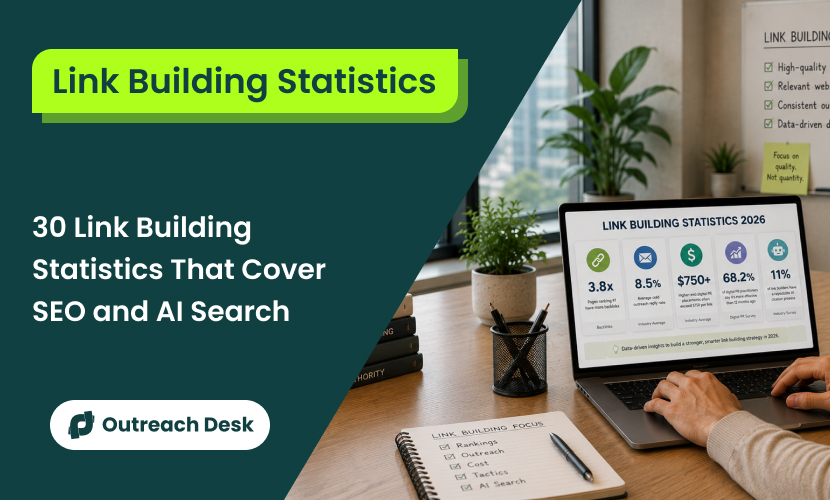
Link building statistics in 2026 say the same thing: links still move rankings, but linkable pages are scarcer than most teams assume. Roughly 94% of the world’s content earns no external links at all, and only 2.2% earns links from more than one site. Cold outreach replies average 8.5%. A digital PR link costs around $750, a high-quality guest post $3,130. And 73.2% of SEO professionals now say links influence visibility in AI search.
The 50 statistics below are grouped around the questions in-house teams and agencies actually argue about. Do links still move rankings? What does link distribution really look like? What response rate is realistic? What should a link cost? Which tactic works right now? How is AI search rewriting a good link? And what are your competitors actually spending, using and worrying about?
Every number is sourced to the original study and tied to a decision you will need to make this quarter.

Key takeaways
- Average cold outreach reply rate sits at 8.5%, and that includes “no thank you” responses. Actual link placement rates from those replies fall well below that.
- Only 11% of link builders have a repeatable process for earning AI citations, which means the teams building that workflow now are doing it with almost no competition.
- 94% of pages earn zero links. The bar for outperforming the average page is lower than most teams assume before they look at the data.
- Building backlinks is the most effective use of digital PR for 85.8% of practitioners. The brand mentions it earns alongside them correlate with AI Overview visibility at 0.664.
- 68% of link building teams concentrate effort on blog content. Only 16% target commercial pages. That’s where most your link building campaigns quietly lose their ROI before a single link is placed.
Do Backlinks Still Move Rankings? The Correlation Data
Yes, backlinks still move rankings. The correlation has weakened. Backlinko’s 2026 ranking factors analysis names referring domains as one of Google’s most important ranking factors. The finding rests on 11.8 million search results.

1. Pages ranking #1 on Google have 3.8x more backlinks than pages ranking on #2 to #10
This stat is from Backlinko’s analysis of 11.8 million Google search results. This analysis is one of the largest publicly available SERP studies. The headline figure has held up through 5 years of algorithm updates. Backlinko, 2025
2. Better backlink metrics still align with higher rankings
Backlinks are links from other websites pointing to your page. Ahrefs’ link metrics analysis. Ahrefs, 2025
Pages with stronger backlink metrics kept aligning with higher Google rankings across the dataset. That held even as Google leaned on many more signals than in earlier years.
The competition for links is far less crowded than most people assume when they first look at a competitor’s backlink profile.
3. For local queries, the correlation rises to 0.33
According to the same the same Ahrefs study, local business websites tend to publish very similar content. That makes backlinks a stronger differentiator. Internal links may also carry more weight locally, because these sites have fewer external link signals. Ahrefs, 2025
4. Page-one service sites gain 48 new referring domains per month, and finance sites gain 101
According to WebFX analysis, first-page domains across 15 service industries gained 48 new referring domains per month. The pace varies widely, from roughly 15 in Apparel to 101 in Finance & Insurance. Holding a ranking usually depends on acquiring links consistently, not once. WebFX, 2026
5. Pages with backlinks are significantly more likely to receive organic traffic than pages with none
Crossing zero is the whole game here. A Semrush study found the top 10% of ranking sites earned over 4,000 monthly organic visits after year one. Sites that never ranked got almost none. It’s not about building hundreds of links from the start. It’s about crossing the threshold from zero. Semrush, 2023
The Reality of Link Distribution Across the Web
Understanding how links are distributed across the internet changes how you think about what you need to compete. Most teams overestimate the effort required to stay ahead of the average site. The web is dramatically underlinked.

6. 94% of the world’s content gets zero external links
Backlinko’s study of 912 million posts found that almost nothing on the web earns a link. That is the bar you are clearing. Among the domains Google trusts most, having backlinks is close to universal. Backlinko, 2019
7. The Spearman correlation between referring domains and rankings is 0.255 across the top million keywords
Ahrefs analyzed one million top-ranking keywords to produce this figure. A correlation of 0.255 might sound small, but Google weighs hundreds of signals simultaneously. In that environment, any single factor sitting at 0.255 is a meaningful lever. Ahrefs, 2025
8. Only 2.2% of all content earns links from multiple websites
According to the widely accepted Backlinko analysis, most content earns few or no referring domains. Which means that the other 97.8% gets either 1 link or none. This is why the marginal return on building your first 10 links to a page is far higher than building 50-60 links. Backlinko, 2019
9. 96.55% of pages receive zero Google traffic
Ahrefs search traffic study found that the relationship between links and traffic is a threshold. One reason pages weren’t receiving traffic was that they had no backlinks. Cross the “has backlinks” line, and traffic becomes possible. Stay below it, and the page is invisible. Ahrefs, 2023
10. Long-form content (3000+ words) earns 77.2% more backlinks than short-form articles
Backlinko’s content analysis shows long-form pieces get linked because they work as a one-stop reference. That makes length a practical lever for earning quality backlinks. Backlinko, 2019
What Outreach Actually Returns? The Response and Conversion Rates
Cold outreach converts at around 8.5% reply rate, and that includes ‘no thank you’ responses. Actual link placement rates from those replies fall well below that. Sales teams, founders, and leadership often assume outreach campaigns at scale work like email marketing, with conversion rates in double digits. The actual numbers are much lower. Knowing them in advance stops you over-promising, and stops you accepting proposals built on unrealistic outreach maths.

11. The average cold outreach reply rate is 8.5%
That figure comes from Backlinko’s email outreach study. It counts every reply, including “no thank you” and “please remove me from your list”. The actual link conversion rate from those replies is below 8.5%. If someone is promising you consistent double-digit reply rates from cold outreach at scale, ask to see the methodology behind that number. Backlinko, 2019
12. A single digital PR link builder produces an average of 15.58 links per month
This is a BuzzStream’s State of Digital PR figure. This number protects you in two directions. It stops you over-promising on a campaign. It also stops you accepting proposals that imply far higher output without explaining the method. BuzzStream, 2025
13. About 32.5% of digital PR teams report generating 31+ links per month
This value is found from the BuzzStream survey published in 2026. These are the top performers, usually they are senior teams running data-led campaigns with established journalist relationships built over years. If you’re evaluating an agency claiming this output, ask how long their existing journalist relationships have been active. BuzzStream, 2026
14. 75% of digital PRs believe that Digital PR is more challenging than it was 12 months ago
Pitch volumes across newsrooms have increased. Journalists are slower to respond, and the straightforward angles have largely been covered. Plan campaigns around fewer, better-researched pitches as per BuzzStream’s 2026 digital PR report. BuzzStream, 2026
15. 60% of teams have only 3-6 months to prove link building’s value to leadership
These stats are from BuzzStream’s report. Leadership sets one timeline. Links need another to compound. That gap is among the most common reasons internal campaigns fail. Set realistic expectations before the campaign starts. BuzzStream, 2025
What Real Campaigns Spend? Cost and Budget
What links actually cost varies widely by strategy. A high-quality editorial link placed via digital PR costs roughly $750 in 2026. Guest posts placements average $295 bought direct and $461 through a vendor marketplace.

Survey data shows:
16. The average cost per link via digital PR is around $750
BuzzStream’s 2026 figure shows that about 25% of teams report cost per link in the $300–$750 range. Pricing swings widely by campaign type and publisher quality. If an agency is pitching you sub-$200 links at scale, the inventory is almost certainly low quality. Use thebacklink pricing tool to estimate what a campaign would cost at your scale. BuzzStream, 2026
17. A guest post averages $295 direct and $461 through a vendor
BuzzStream’s study of 257,267 marketplace sites priced both routes directly. Earlier editions estimated the direct cost by subtracting an assumed 75% markup. The real gap is narrower, so treat any quote far above $461 as a quality claim the vendor should evidence. BuzzStream, 2026
18. High-quality guest posts run $3,130 and top-tier ones $6,018
Those are vendor prices from the same BuzzStream study. High quality means DR 71 to 80 with 50,000+ monthly visits; top tier means DR 81+ with 100,000+. News sites run higher again, averaging $7,209. BuzzStream, 2026
19. 96.2% of guest posting marketplace inventory is low quality
Low quality means below DR 40 with under 10,000 monthly visits. BuzzStream’s marketplace data shows 39.6% of listed sites pull no organic traffic at all. Only 1.37% reach high quality or top tier, down from 4.6% a year ago. BuzzStream, 2026
| Channel | Typical cost per link | Source |
|---|---|---|
| Digital PR, editorial placement | ~$750 | BuzzStream, 2026 |
| Guest post, bought direct from the site | $295 | BuzzStream, 2026 |
| Guest post, bought through a vendor | $461 | BuzzStream, 2026 |
| High-quality guest post (DR 71-80) | $3,130 | BuzzStream, 2026 |
| Top-tier guest post (DR 81+) | $6,018 | BuzzStream, 2026 |
| Top-tier news site | $7,209 | BuzzStream, 2026 |
| Tier | Domain Rating | Monthly organic traffic | Share of inventory |
|---|---|---|---|
| Top tier | 81 and above | 100,000+ | 1.37% combined |
| High quality | 71 to 80 | 50,000+ | |
| Mid quality | 40 to 70 | 10,000 to 49,999 | 2.43% (balance) |
| Low quality | Below 40 | Under 10,000 | 96.2% |
20. About 60% of digital PR teams operate on monthly budgets under $10,000
As per the stats from BuzzStream report the realistic budget bracket for most in-house campaigns is under $10,000. Under that ceiling, 2 to 4 high-quality editorial placements per month is a sensible target. BuzzStream, 2026
21. 80.9% of link builders expect link building costs to rise over the next 2-3 years
As per Search Engine Land, link building prices are expected to rise. Lock in vendor relationships before pricing tightens further, especially in regulated verticals like finance, legal, and gambling. Search Engine Land, 2026
Which Tactics Practitioners Rate as Most Effective
The strategies to earn links have shifted noticeably since 2023. Digital PR is now the consensus top performer, and guest posting alone is no longer the default strategy.

22. 68.2% of digital PR practitioners say it is more effective than it was 12 months ago
As per BuzzStream’s State of Digital PR report, teams keep investing in digital PR. Practitioners rate it among the most effective ways to earn authoritative editorial links, brand visibility and organic impact. BuzzStream, 2026
23. Data-led content (94.8%) and expert commentary (92.5%) are the dominant digital PR formats
BuzzStream’s 2025 digital PR report found data-led content and expert commentary are the two tactics teams rely on most. Hero content and press releases follow. BuzzStream, 2025
| Tactic | Teams using it |
|---|---|
| Data-led content | 94.8% |
| Expert commentary | 92.5% |
| Hero content | 78.6% |
| Press releases | 68.8% |
24. Building backlinks is the most effective use of digital PR for 85.8% of practitioners
BuzzStream’s 2026 digital PR survey reports the split. Building backlinks remains the top outcome practitioners expect from digital PR, with 85.8% rating it their most effective use. Brand awareness and organic traffic follow closely behind. BuzzStream, 2026
25. Only 32% of link builders follow a documented and repeatable process
The other 68% run unplanned, ad-hoc campaigns according to link building trends report by BuzzStream. Teams with documented processes consistently report better measurement and stronger renewal rates from leadership. A repeatable process doesn’t mean rigid. It means knowing what a successful link looks like before you start. BuzzStream, 2025
26. 30% of organizations are fully confident in the results from external link partners
The same BuzzStream report shows that most agency relationships underperform against initial expectations. The clients reporting the highest confidence share three traits.
- Monthly reporting tied to pre-agreed link quality briefs.
- The right to veto placements that miss those briefs.
- Visibility into ranking movement on the receiving pages.
BuzzStream, 2025
Link Building in AI Search: The New Signal Layer
AI Overviews, ChatGPT search and Perplexity all handle link signals differently from traditional rankings. The early data is already clear enough to act on. This section is reshaping where your budgets can go in 2026.

27. Brand mentions correlate more strongly with AI Overviews appearances than backlinks
This comes from Ahrefs’ brand mention correlation study. Branded web mentions, whether linked or unlinked, show the strongest correlation with AI Overview brand visibility at 0.664. Backlink count sits at 0.218 by comparison. Ahrefs, 2025
Referring domains still matter. But unlinked brand mentions across the web show a stronger relationship with whether a brand gets featured.
Digital PR earns both links and mentions simultaneously, which is part of why it’s pulling ahead of other tactics in practitioner rankings.
28. 97% of AI Overviews cite at least one top-20 result
As per seoClarity’s analysis of 432,000 keywords, traditional rankings still matter for AI Overviews. Nearly every overview cites at least one page from the top 20 organic results. The “AI vs SEO” framing common on social media is mostly wrong because now, they’re tightly linked. seoClarity, 2025
29. 73.2% of link builders believe backlinks still influence visibility in AI-driven results
As per Search Engine Land survey, AI search hasn’t replaced links. It has added a parallel signal layer. That layer rewards topically relevant, high-quality link pages, and gives brand visibility separate weight. Practitioners aren’t debating whether links matter in AI search anymore. They’re figuring out how to earn both links and brand mentions across the web from the same campaign. Search Engine Land, 2026
30. Only 11% of link builders have a repeatable process for getting cited in AI-generated results
This is BuzzStream’s 2025 figure. Most teams have not built an AI citation workflow yet. Early movers are building citation presence against very little competition. The window for asymmetric advantage here is narrowing as more teams catch on. BuzzStream, 2025
What Teams Budget and Who Does the Work
Cost per link is only half the budget question. The other half is how much of the SEO budget link building takes, and whether anyone in-house is doing it.
31. The average acceptable price for one high-quality backlink is $508.95
That is the mean across a survey of 518 SEO experts. It sits between the $461 vendor guest post and the $750 digital PR placement. Treat it as the number your buyer already has in mind. Editorial.Link, 2026
32. Competing in a hard niche needs $8,406 a month
That is the average minimum monthly budget respondents named for highly competitive niches. Below it, you are not running a campaign so much as sampling one. Editorial.Link, 2026
33. Agencies put 32.1% of the SEO budget into links, in-house teams 36.03%
In-house teams commit the larger share, which cuts against the assumption that agencies push links hardest. Use this to sanity-check your own split. Editorial.Link, 2026
34. 61.0% say gambling demands the highest link building budgets
Regulated and adversarial niches carry a premium. If you sell into gambling, finance or legal, benchmark against those verticals rather than a general average. Editorial.Link, 2026
35. 56% outsource at least part of link building
The remaining 44% keep everything in-house. A near-even split, so neither model is the industry default you can point at in a pitch. Editorial.Link, 2026
36. 75.1% name the cost of premium backlinks as their biggest challenge
Cost outranks every other complaint, including scale and relevance. It is also the constraint most agency proposals quietly assume away. Editorial.Link, 2026
37. 52.9% find link building ROI hard to measure
Just over half cannot confidently attribute revenue to links. That is the single strongest argument for reporting on rank movement of the receiving page. Editorial.Link, 2026
The Tools, Anchors and Targets Practitioners Choose
These are the operational defaults of the industry. Knowing them tells you what a vendor is likely doing before you ask.
38. Ahrefs is the top all-in-one tool for 59.1% of practitioners
Semrush follows at 28.2%, and no other tool clears 6%. Per the same 518-expert survey, 68.1% also rate Ahrefs the most accurate backlink data source. Editorial.Link, 2026
39. Partial-match anchors lead at 41.7%
Exact-match follows at 25.1% and branded anchors at 20.5%. A profile that is overwhelmingly exact-match is out of step with what most practitioners build. Editorial.Link, 2026
40. 52.7% say service and product pages matter most for link acquisition
Practitioners know commercial pages are the target. Statistic 25 shows only 16% actually prioritise them. The gap between belief and behaviour is the opportunity. Editorial.Link, 2026
41. 78.8% think nofollow links affect rankings, but only 46.9% build them
Belief runs well ahead of practice here. If you dismiss nofollow placements outright, most of the industry disagrees with you. Editorial.Link, 2026
42. Only 39.0% still use Google’s Disavow tool
Nearly two-thirds have abandoned it. Reflexive disavowing is no longer standard practice, and a vendor selling it as routine hygiene is behind the field. Editorial.Link, 2026
43. 80.9% believe unlinked brand mentions affect organic rankings
This lines up with the AI Overview correlation in statistic 27. Editorial.Link’s 518 respondents treat mentions as a real signal, not a consolation prize. Editorial.Link, 2026
What Your Competitors Actually Have
Benchmarks beat averages. The number of referring domains you need depends far more on your industry than on any general rule.
44. Page-one sites hold a median of 907 referring domains
That is the cross-industry median from 1,462 first-page domains. Median, not mean, so half of page one sits below it. WebFX, 2026
45. Finance sites on page one carry 3,027 referring domains, apparel sites 76
A 40x spread between the hardest and easiest verticals in the same study. Any benchmark that ignores industry is close to meaningless. WebFX, 2026
| Industry | Median referring domains | New domains per month |
|---|---|---|
| Finance & Insurance | 3,027 | 101 |
| Real Estate | 2,032 | 59 |
| Health | 1,915 | 71 |
| Vehicles | 1,551 | 37 |
| Family & Community | 1,471 | 40 |
| Computers & Electronics | 1,117 | 23 |
| Business & Industrial | 936 | 57 |
| Jobs & Education | 907 | 66 |
| Sports & Fitness | 564 | 39 |
| Home & Garden | 461 | 48 |
| Beauty & Personal Care | 361 | 49 |
| Food & Drink | 284 | 39 |
| Dining & Nightlife | 235 | 38 |
| Arts & Entertainment | 173 | 41 |
| Apparel | 76 | 15 |
46. 91.9% are convinced their competitors buy backlinks
Almost nobody believes their rivals are playing clean. Whether or not that is accurate, it is the assumption your market operates under. Editorial.Link, 2026
47. 56.0% doubt Google can effectively discount paid links
A majority of practitioners think detection does not work as advertised. That belief is what keeps the marketplace in statistic 19 alive. Editorial.Link, 2026
48. 64.9% say a site can rank well without backlinks
Practitioners hold both ideas at once: links move rankings, and they are not strictly required. Both are supported by the correlation data above. Editorial.Link, 2026
49. 86.3% call low-quality content the biggest red flag when vetting a site
Content quality beats domain metrics as a screening signal. 72.2% flag weak authority scores and 63.9% avoid sites with declining traffic. Editorial.Link, 2026
50. 55.2% consider link building the hardest part of SEO
More than half of specialists rank it above technical work and content. Budget and timeline expectations should reflect that. Editorial.Link, 2026
Why Quality Beats Quantity and Where Quantity Still Matters
Quality beats quantity. That shift is now reflected in practitioner data. More than 90% of surveyed SEOs rate link quality as the dominant factor. But the data also shows that quantity isn’t irrelevant when you’re building links to a single specific page.
Build fewer, better links, and concentrate them on the pages where ranking actually helps build revenue. That pattern connects most of the statistics above. Authority compounds on pages that already have some. Random link counts scattered across random pages don’t produce the same effect.
The BuzzStream link building trends report found that 68% of teams prioritise blog content. Only 16% target commercial pages, where purchases, signups and conversions actually happen. That disconnect quietly limits the ROI on most campaigns.
Blog links are effective, but it’s the commercial page links that move your revenue. Teams reporting the strongest results put roughly 60% of effort into commercial pages and 40% into top-of-funnel content. That is the opposite of the industry default.
The Outreach Desk guide to high-quality backlinks for SEO walks you through how to earn high-quality links.
Where This Leaves Your 2026 Campaign
The data underneath link building tells a clearer story than most campaign planning reflects. Backlinks still correlate with rankings. The bar for “doing anything” is lower than most teams think. 94% of pages earn zero links. Outreach math is brutal but predictable. Digital PR is the consensus top tactic, both for traditional rankings and the new AI search layer.
The teams that will win in 2026 aren’t the ones building the most links. They run fewer, better campaigns aimed at commercial pages. They earn brand mentions alongside links. They report rank movement on the receiving page, not link counts in isolation. Statistic 26 makes this concrete. The most confident clients shared three traits, and visibility into ranking movement on the receiving page was one of them.
Most of these statistics will move 10-20% in either direction over the next year. The structural patterns underneath them won’t.
Want to understand what these link building statistics mean for your site?
Get a clear strategy focused on the pages and signals that can improve visibility over time.
How many backlinks do I need to rank on page one of Google?
There’s no fixed number of backlinks that can help your page improve rankings on Google’s SERP. Rankings depend on competition, content quality, search intent, and overall site authority.
Compare the referring domains pointing to the top-ranking pages for your target keyword, and work toward matching the middle-range domains. Focus on relevant, high-quality links over raw backlink volume. Our guide to how many backlinks to rank walks through the calculation.
Are link building statistics from 2024 still relevant in 2026?
The ranking-correlation statistics (Spearman correlation of 0.255, 94% of content earns zero links) are remarkably stable across years. The cost and tactic mix must come from 2025-2026 sources. When in doubt, prefer a stat with a publication date in the last 18 months.
What’s a realistic response rate for cold link building outreach?
Across most large datasets, cold outreach reply rates sit near 8.5%. Link conversion from those replies often runs 10% to 25%. So from 1000 cold prospects, expect roughly 8-15 placed links. Personalized outreach to a smaller, vetted prospect list converts much better, often double-digit link rates on prospect lists under 200.
Is digital PR really more effective than guest posting in 2026?
Practitioner surveys say yes. BuzzStream found that building backlinks is the most effective use of digital PR for 85.8% of respondents. The bigger reason is that digital PR earns brand mentions alongside links, and brand mentions now correlate strongly with AI search visibility. Guest posting still works, but it’s increasingly a complement to digital PR rather than a replacement.
What do link building statistics say about ROI?
Most studies show that organic search drives higher ROI than paid channels over a 12 month period. Businesses working with an established backlink service provider consistently report stronger long term returns compared to those relying on paid traffic alone.
How long until link building shows measurable results?
46.2% of practitioners see measurable results from a digital PR campaign within 3 to 6 months. Another 36% see them within 1 to 3 months. Plan for the three- to six-month window when setting expectations with leadership. Faster results usually come from concentrated campaigns to pages already ranking in positions 5-15. Those move quickly on a few relevant, authoritative links.
Do unlinked brand mentions really count for SEO?
Yes, as the data increasingly show, they do. Ahrefs measured brand mentions at 0.664 correlation with AI Overview visibility, against 0.218 for backlink count. Treat them as a parallel asset. The ideal is brand mentions and editorial links from the same campaign.