Most SEO advice says backlink exchanges will tank your rankings. But Google rarely penalizes backlink exchanges when both sites are relevant, the content is useful, and the linking pattern doesn’t scream “we traded these.”
The exchanges that fail do so because one partner site delivers a worthless link buried in spam, or you waste weeks chasing a placement that never delivers.
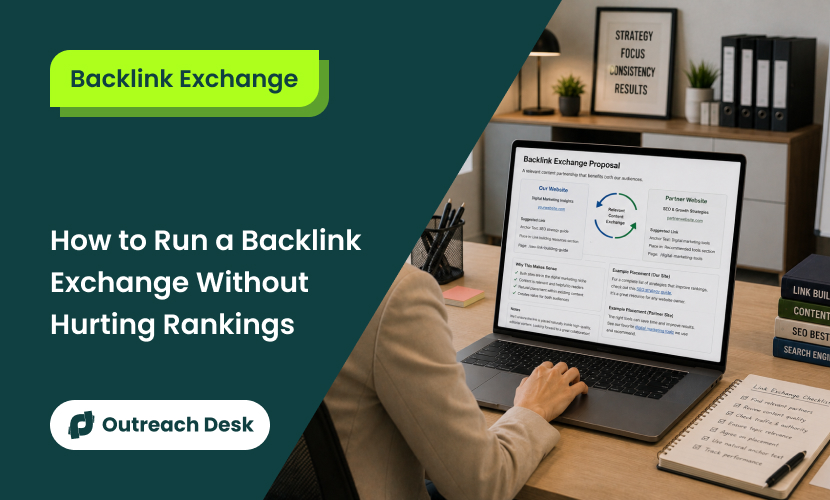
A backlink exchange is an SEO practice in which two sites agree to place links to each other to improve rankings, authority, and organic visibility. It is considered safe when the partner’s site is relevant, the link is added in real content, and the trade looks natural and not a repeating pattern across your profile. If you miss any of these, you’re wasting effort.

Key Takeaways
- Google bans excessive link exchanges, not all exchanges. A few relevant trades are safe; the risk comes from patterns, not single links.
- Two-way swaps (you link to them, they link to you) carry the most risk. Three-way and four-way exchanges spread the pattern but don’t remove it. Always check the structure before you agree.
- Most established sites have some reciprocal links. That’s normal. What matters is the pattern, not any single trade. Focus on keeping your link profile natural.
- Only swap if the link would be valuable even without a return. If you wouldn’t want the link on its own, skip the exchange.
- Disqualify partners quickly if you see low-quality outbound links, an irrelevant niche, and demands for identical anchor text on both sides.
When a Backlink Exchange Still Works in 2026
A backlink exchange works when both sides get real editorial value, not just a link that technically exists.
Three things have to align:
- The partner’s site is actually relevant to your topic, in the same niche, with an overlapping audience, or with directly complementary content.
- The link is placed inside content that justifies its existence on its own.
- The trade is one event in your link profile, not a pattern that repeats across dozens of sites.
When all three come together, the exchange looks like a normal editorial link between two sites that should already be connected. If even one is off, like a partner in a barely related niche or someone pushing for exact-match anchors, the trade looks fake to anyone checking your links.
What Google Actually Considers a Link Scheme
The most important sentence in this article comes directly from Google’s spam policies, which list “excessive link exchange” (‘link to me and I’ll link to you) or partner pages exclusively for the sake of cross-linking as link spam.
Google doesn’t ban link exchanges. It bans excessive link exchanges and partner pages that exist only for cross-linking.
The difference is intentional because Google understands that two relevant sites can link to each other as a normal feature of the web. But if someone builds the entire profile around that pattern, then Google can penalize the sites.
Here’s how that plays out in practice:
- Three relevant exchanges across a year of link building
- A “Partners” page with 40 outbound links to sites that all link back to you.
- A coordinated swap network where the same 12 sites link to each other in rotation.
Most teams mistakenly read “Google penalizes link exchange” and think that exchanges are off-limits. They’re not. The mistake other teams make is reading “Google rarely catches link exchanges” and concluding it’s a free tactic. It isn’t.
The truth lives between those two, and it’s entirely controlled by how you run the trades.

The Four Types of Backlink Exchange (And the Real Risk of Each)
There are more ways to swap links than most people realize. Each leaves its own footprint. That footprint determines your risk.
Two-Way (Direct Reciprocal) Exchange
Site A links to Site B. Site B links right back. That’s it.

This is the simplest yet riskiest type. Google’s systems spot two-way swaps fast, especially
- When both links go live at the same time
- Use similar anchor text
- Sit on pages with no real reason to mention each other
A few two-way swaps in your profile are normal. Every established site has them. But if 25 to 30 percent of your inbound links also point back out, that’s a pattern. That’s when Google starts devaluing your links, and manual reviews become more likely.
Three-Way (ABC) Exchange
Site A links to Site B, Site B links to Site C, and Site C links back to A. The triangle hides the direct reciprocity.

This used to be the go-to move because it hid the obvious A-to-B swap.
Now, Google can still detect ABC patterns through network analysis, but the signal is weaker than that of direct swaps. Most of the time, Google devalues these links rather than penalizing them.
Watch Out
A three-way trade is only worth it if at least one site has real editorial weight. Three weak sites trading links won’t help anyone.
Four-Way (Cross-Network) Exchange
You own two sites. Your partner owns two sites. Their site C links to your site A. Your site B links to their site D; no two participating sites point to each other directly.

This setup leaves the smallest visible footprint, but you need to own two sites with real authority. Most teams don’t have that. Agencies and multi-brand operators use this, not single-site owners.
If you don’t already own two established, relevant sites, skip this tactic.
In our campaigns, selective three-way exchanges outperform direct swaps. They create fewer obvious patterns and allow tighter control over relevance.
Multi-Site Editorial Trade (Listicle-Style)
This one isn’t always classified as an exchange, but in practice it’s exactly that. You write a listicle for Site X that features 5-6 brands as positive examples. Each featured brand links back to your site from its own content as a thank-you.

This one looks different. Your link sits inside real, useful content, a genuine listicle. The reciprocal links come from different sites and different contexts. Underneath, it’s still a coordinated trade.
It’s also the type of exchange that has the highest survival rate when scrutinized, because each individual link looks editorial in isolation. The aggregate pattern is the only giveaway, and it’s a faint one.
How to Qualify a Partner Before You Reply Yes
Before agreeing to a backlink exchange, check eight things: topical relevance, real organic traffic, outbound link quality, indexing patterns, anchor text behavior, content standards, link placement history, and whether the site exists primarily to trade links.
In most audits, weak traffic quality, and obvious exchange footprints are the first reasons we reject a partner.
Most backlink exchange offers fail a five-minute audit. Skip the audit, and you’ll accept based on niche match alone, then spend months wondering why the link did nothing for your rankings.
Run every offer through these eight checks:
1) Topical Relevance
Topical relevance means how closely the linking site’s content relates to the topic of your own website or page. If your site covers B2B SaaS link building and theirs covers generic blogging tips, the link is weak in both directions.
The single best filter is to ask would you link to them even if they never linked back?
2) Real Organic Traffic, Not Just Metrics
Partners can fake their website’s DR (Domain Rating) and DA (Domain Authority) metrics. Open Ahrefs or Semrush and check their organic traffic over the last 12 months. Rising or stable traffic means the site is real. Flat or declining traffic with a high DR usually means borrowed authority, and Google’s gotten better at discounting it.
3) Their Outbound Link Patterns
Pull three of their recent posts. Are they linking to a normal mix of sources, or does every post drop links into a “useful resources” section at the bottom? If they’re selling links, your link will appear alongside casino sites and payday loan stores. That’s not the neighborhood you want.
4) A Dedicated Partner Page
Anyone running a “Partners,” “Resources,” or “Recommended Sites” page that exists to host outbound swap links is operating the exact pattern Google’s spam documentation calls out. Instant no.
5) Recent Content Quality
Read their last five articles. If the writing is clearly AI-generated filler, your link is sitting on content that adds no value to anyone. Google’s systems treat the quality of the linking page as a part of signal. A great link on a weak page is a weak link.
6) In-Content, Not Footer or Sidebar
Google easily spots footer and sidebar links, but generally ignores them. If the partner can’t or won’t place the link inside an editorial paragraph in a relevant article, it is not a contextual placement and the trade isn’t worth it.
7) Refuse Exact Match Anchor Demands
If the partner wants an exact commercial keyword as their anchor and offers you the same, you’re being invited into a coordinated anchor-text scheme. Say no. Ask for branded or descriptive anchors on both sides.
8) Their Turnaround Pressure
Real editorial trades take time. Both sides review, edit, and place. Anyone pushing “we can do this today, send the URL” is running a volume model. Google flags such volumes. A partner that fails on relevance fails outright.
In most audits we run, the biggest failure points aren’t DR or traffic. It’s the outbound link quality. Many exchange sites link out aggressively to unrelated industries, which quickly weakens trust signals.

Where to Find Backlink Exchange Opportunities Worth Your Time
The best backlink exchange opportunities usually come from four places: existing industry relationships, conference and networking events, guest posting conversations, and competitor backlink research. These sources produce more relevant and natural exchanges because the relationship already exists before the link discussion starts.
Most places where backlink exchanges are advertised are places you don’t want links from. Public Slack groups, Facebook groups, and Reddit threads for “link swaps” are packed with low-relevance sites. The partners you find there are the ones nobody serious will trade with.
That doesn’t mean exchanges only happen by accident. The good ones often come from places where the partner isn’t asking for one.

Four sources that consistently produce real exchange opportunities:
1) Existing Client and Vendor Relationships
Think of the SaaS partners you integrate with, vendors whose tool you use in case studies, and customers whose results you cite. These are natural editorial reasons to link, and the return link is easy to ask for. The relationship justifies the trade on its own.
2) Conferences and Industry Events
A genuine conversation with another founder or marketer at an event creates the editorial weight that makes a trade defensible. Links from these relationships often sit in real content because the person is actually familiar with your work.
3) Targeted Guest Post Outreach
When you pitch a targeted guest post to a relevant publication, negotiate a contextual link back to your site within an existing article. They get a quality article, you get an in-content link to your existing content from a different post on their site over the next quarter. The trade is implicit, the timing is offset, and the anchor is editorial.
4) Mutual Mentions Inside Original Research
If you’ve published proprietary research, other sites in your niche will reference it. Reach out to those sites and offer a reciprocal mention inside a relevant piece you’re working on. The trade exists, but each link is genuinely useful in context.
If you get offers from an unrecognized sender and have these four sources, skip them.
- Public Facebook link-swap groups
- Generic SEO Slack communities
- Reddit link-exchange threads
- Cold InMail offers
These sources have one thing in common: The partners on those channels are operating in volume.
Red Flags That Should Kill an Exchange Before You Send the Link
Reject backlink exchanges immediately if the site shows obvious link-selling behavior, thin content, irrelevant topics, excessive outbound links, traffic inconsistencies, spam-heavy anchor text, or poor indexing quality. Strong metrics alone do not offset these risks, especially when the site’s primary purpose appears to be exchanging or selling links.
Some signals are instant deal-breakers. If you spot any of these, the trade is dead, no matter how good the metrics look.
1) A “Partners” or “Useful sites” Page Is Used as the Link Destination
This is a common reciprocal-link pattern. If the page exists primarily to exchange links, don’t use it as your placement. A page built mainly to accommodate reciprocal links offers little editorial value and can make the exchange obvious.
2) An Offer to Swap Multiple Links Across “Your Network”
A pitch involving multiple sites or a private network is a strong warning sign. The more sites involved in a coordinated exchange, the harder it is to justify the links as genuine editorial recommendations.
3) Pressure for Matching Anchor Text on Both Sides
Real editorial links are not normally coordinated around identical anchor text. If both parties are expected to use predetermined anchors, the placement starts looking deliberately engineered rather than naturally earned.
4) Identical Outreach Copy You’ve Seen Before
If the email template looks like one you’ve received from several other senders, you may be dealing with a scaled link placement operation rather than a genuine editorial relationship. Repeated templates often indicate that the same exchange model is being offered across a large number of sites.
5) A Request to Remove a Disclosure or Nofollow Attribute
If a publisher asks you to remove a disclosure or change a link attribute specifically so the link passes ranking signals, treat that as a serious warning. The request matters because it suggests the link is being optimized for search signals rather than presented as a genuine editorial reference.
6) A Site Whose Top-Ranking Pages Are Thin or Low-Value
A strong domain metric does not automatically make every page valuable. Review the actual content, search visibility, and quality of the pages where your link would appear before relying on the site’s headline metrics.
7) Anchor or Topic Combinations That Don’t Match the Existing Content
If someone proposes adding a paragraph about your topic to an unrelated article simply to create a link, the placement can look manufactured. A natural placement should make sense within the article without requiring an unrelated topic to be inserted solely for the backlink.
One of our clients was in an exchange arrangement with a “marketing resources” aggregator site. We pulled them out in Q2 2025. Within three weeks, the affected pages stabilized in rankings.
The inbound link wasn’t the problem; the outbound links to a low-quality cluster triggered a manual review.
Tip
Read the offer out loud. If it sounds like the same pitch sent to ten other sites that day, pass.
The Better Question: Should You Be Doing Exchanges at All
Most teams that ask about backlink exchanges are under pressure to hit a link quota, and exchanges feel faster than they are.
Over a year, the hours you spend qualifying exchange offers, negotiating placements, checking if the return link stays live, and fixing swaps that go wrong add up fast. You’ll spend more time than if you just ran a broken link campaign or unlinked brand mentions reclamation. Both of those give you one-way editorial links and skip the entire risk profile.
Exchanges still have a place. When a relationship is genuinely there, a real partner, a real co-marketing arrangement, a real editorial fit, the trade is fast and useful. As a primary link acquisition tactic, the math doesn’t work for most teams. Exchanges only feel faster because the partner lands directly in your inbox.
Be honest about which situation you’re in.
The 60-Second Test Before You Agree to Any Backlink Exchange
Three simple yes-or-no questions can eliminate most bad backlink exchange offers in under a minute. If any answer is no, the exchange usually isn’t worth pursuing, regardless of DR, traffic screenshots, or premises about future collaboration.
Open the partner’s site in a new tab. Answer these three questions:
- Would you link to this site if there were no return links on the table?
- Would you trust the editor on the page where your link will sit to write about your topic accurately?
- Would you be comfortable telling a client that this site appears in your link profile?
If the answer to all three is yes, the deal is probably worth running. If the answer to any one is no, decline. Everything above is just a longer version of these three questions.
Conclusion
Most backlink exchanges fail because teams focus on metrics before relevance and trust. A high-DR site does not help much if the audience, content, and linking behavior feel artificial.
The exchanges that still work in 2026 are usually selective, relationship-driven and difficult to scale. Once a site starts treating link swaps like inventory management, the quality drops fast and the footprints become obvious.
Not every backlink exchange is a bad idea. Most problems come from poor partner selection and repetitive patterns.
Want a safer approach to backlink exchanges?
Get a clear strategy focused on relevant partnerships and long-term SEO value.
1) Is backlink exchange against Google’s guidelines?
Not by itself. Google’s spam policies specifically ban “excessive link exchanges” and “partner pages exclusively for the sake of cross-linking,” not normal reciprocal linking between relevant sites. The line is pattern density and intent, not the existence of any single trade.
2) How many backlink exchanges are too many?
There’s no published number, but the practical threshold is your ratio, not your count. If reciprocal links account for more than 25-30% of your inbound links, the pattern looks manufactured. A handful of trades over a year is invisible. A monthly cadence of 5 swaps is a pattern that Google’s systems notice.
3) What’s the difference between a 2-way and 3-way (ABC) link exchange?
A two-way exchange is direct: Site A and Site B link to each other. A three-way exchange routes through a third site: A links to B, B links to C, and C links back to A. The triangle removes the A-to-B footprint, which is why three-way trades are harder for Google to detect than direct swaps. Google’s network-level pattern detection can still surface them, but the signal is weaker.
4) Can I do a backlink exchange with a competitor?
You can, but most of the time you shouldn’t. The reason isn’t algorithmic; it’s that competitors usually want exact-match commercial anchors and equivalent content placements. That symmetry is exactly the pattern that triggers manual review. Exchange works better with an adjacent site than with direct competitors.
5) How do I know if a partner site is safe to exchange links with?
The fastest filters: do they have real organic search traffic over the last 12 months? Do they have a “Partners” or “Resources” page used as a link destination? Are their last few articles genuinely useful, or AI-generated filler? If they fail on these filters, the link won’t carry weight even if you structure the trade safely.
6) Will Google detect my backlink exchange?
In most individual cases, no. Google doesn’t analyze each exchange individually. What they do well is network-level pattern detection: nothing when reciprocal links concentrate, when the same domains keep appearing in each other’s profiles, when anchor text repeats across trades. The risk isn’t getting caught on one swap. The risk is the pattern adding up across many.
7) Is link exchange better than buying links?
For most cases, neither is the right answer. Buying links violates the direct policy. Exchanges carry a softer pattern risk. Both are weaker per-link than earned editorial coverage from white hat link building strategies. If you’re choosing between exchanges and paid placements as your primary tactic, you’re focused on the wrong problem. The better question is what content or research you can produce that other sites would link to without negotiation.