Most teams prospect for months. But the answers are already sitting in your competitors’ link profiles.
Analyzing competitor backlinks reveals which publications, blogs, and resource pages in your niche are likely to link to relevant external sources. That gives you a ready-made list of sites to target, rather than prospecting from scratch.
And the real value isn’t copying a competitor’s link profile. It’s spotting patterns: the content formats earning them links, the industries linking to them, and the gaps where they’ve earned placements you haven’t.
Once you see that picture, you can build a smarter outreach strategy around proven sources rather than guesses. It works the same way for a SaaS brand closing a rankings gap and for an ecommerce team scaling authority across product categories.
What You’ll Learn
- How to find competitor backlinks using the right tools and data
- How to identify high-quality, relevant link opportunities in your niche
- How to run a backlink gap analysis to uncover missed domains
- How to analyze link patterns and create content that earns links
- How to turn competitor insights into targeted outreach that drives authority
What Are Competitor Backlinks
Competitor backlinks are inbound links pointing to your rivals’ websites that rank for the same keywords as you, and analyzing them shows which publications, blogs, and resource pages in your niche are open to link out to external sites.
Each of these backlinks signals trust. Search engines use those signals to decide which pages deserve visibility. When you study them, you start to see where authority is being built in your space.
This gives you direction. You see which sites are already linking to similar content. That becomes your starting point for seo outreach. You are not guessing anymore. You are building on patterns that already work.
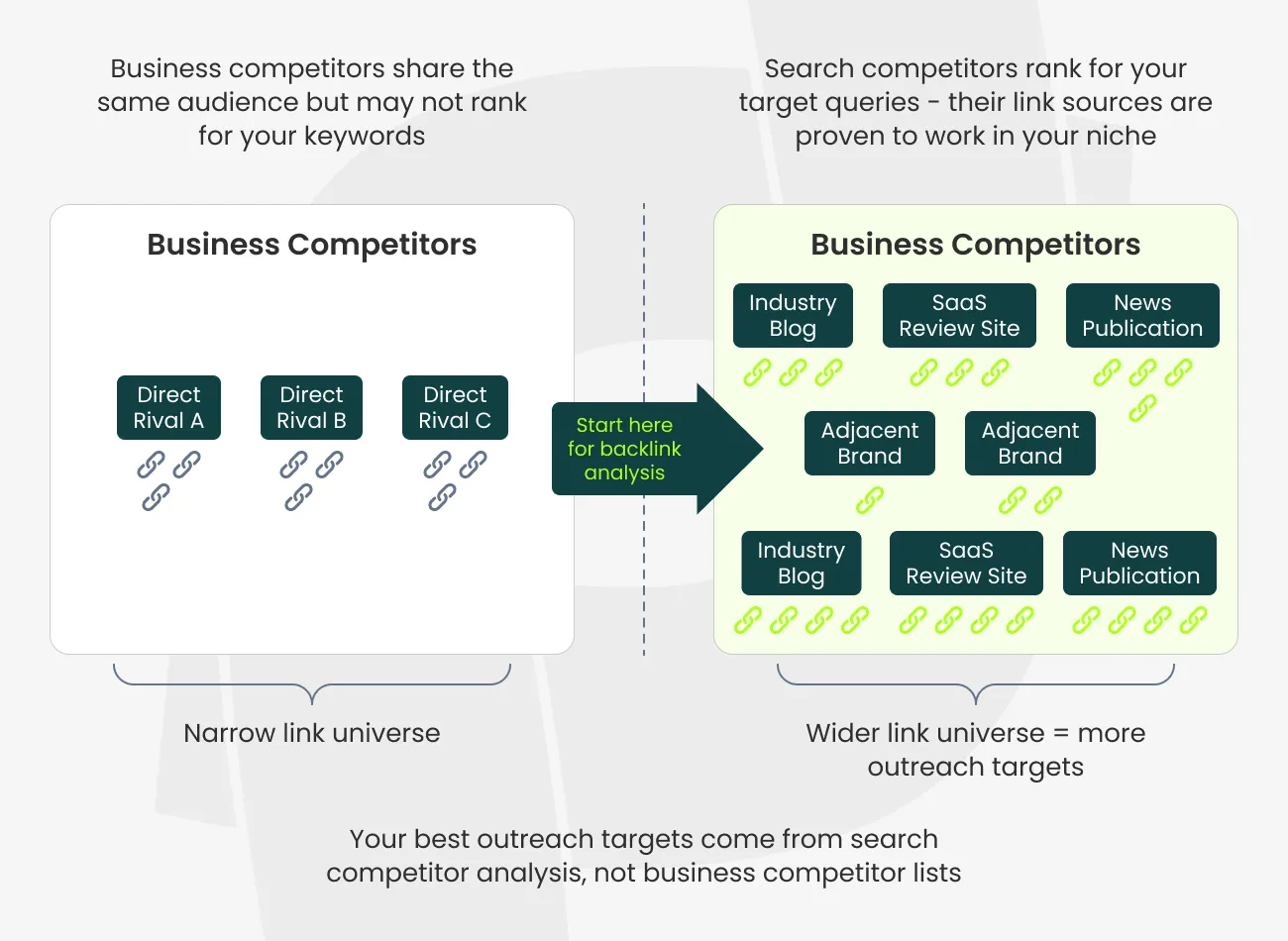
One thing to get right early: search competitors aren’t always business competitors.
If you sell project management software, you are not just competing with other tools. You are also competing with content from platforms like Zapier, HubSpot, or Asana that rank for the same queries.
When analyzing backlinks, focus on who ranks on page one for your target keywords in search results. That is where your actual search competition sits.
Why Competitor Backlink Analysis Matters
When you start link building with no clear direction, it’s just a waste of time and leads to guesswork. Which sites accept guest posts? Which pages link out? Who actually replies? That uncertainty slows you down.
Competitor backlinks analysis removes that guesswork.
You focus on sites already linking in your niche. These sites have shown they’re open to relevant content, which makes your outreach list stronger from the start.
When you review a competitor’s backlinks, you see exactly which sites already link to content like yours. You see which domains are already trusted and actively linking. That gives you a stronger starting point than cold prospecting.
Here’s how it plays out:
Focus on 40 sites that already link to similar content, rather than reaching out to 200 random sites. Your outreach becomes more targeted. Replies improve. Relevance improves.
And the links you earn carry more value because they fit naturally within the topic.
In practice, competitor-based outreach lists tend to outperform generic prospecting lists. You are working with real niche alignment from the start. These sites already cover your space, so the conversation begins with relevance instead of cold persuasion.
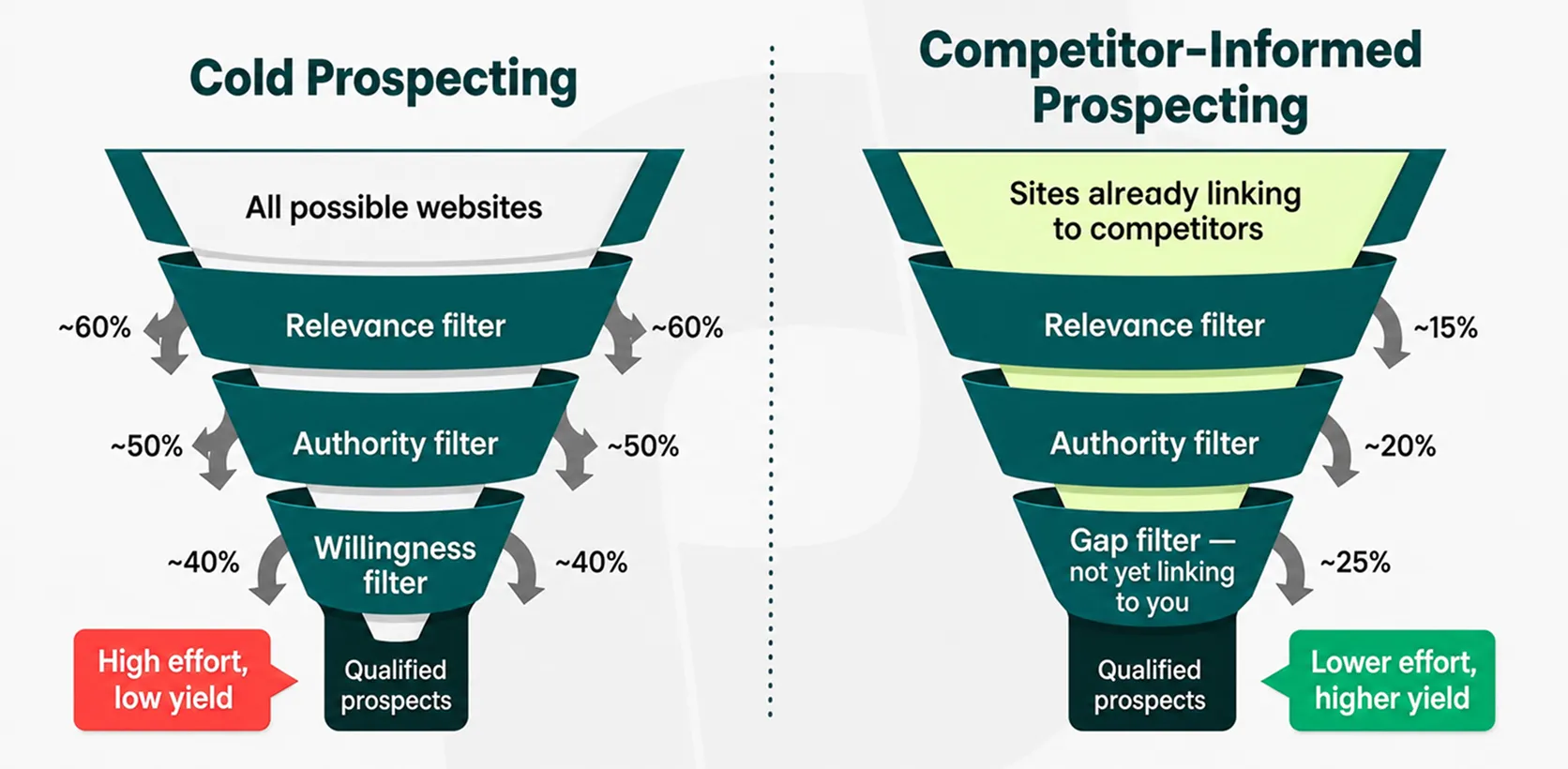
In campaigns we’ve run at Outreach Desk, competitor-informed outreach consistently delivers higher response rates than cold prospecting lists.
How to Find Competitor Backlinks: Step by Step
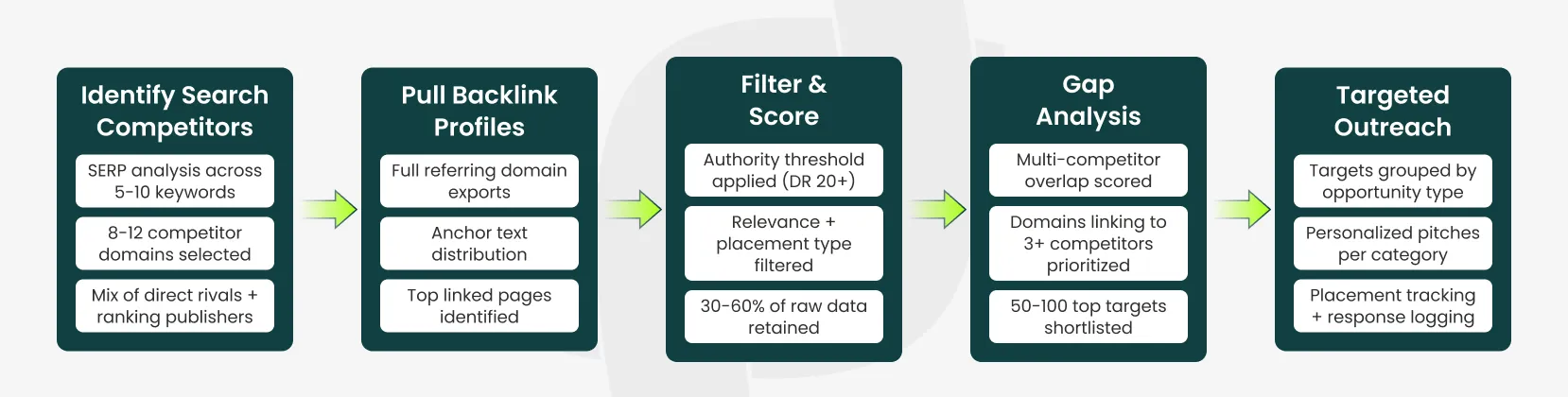
This is the core workflow of competitor backlink analysis. The logic stays the same, no matter which link building software stack you use.
You can use any major backlink analysis tool, such as Ahrefs, Semrush, or Moz. Run a competitor backlink analysis to see how they built that profile.
Step 1: Identify Your Search Competitors
Open an incognito browser window. Search your primary keywords, the ones you’re actively trying to rank for. Remember, your real link competitors aren’t always your business competitors. They’re the domains ranking for the same keywords you want to rank for.
Step 2: Pull Their Backlink Profiles
Use your backlink tool to analyze each competitor’s domain. Export their referring domains so you’re working with a clean dataset.
For each competitor, review:
- Referring domains:
The number of unique websites linking to the competitors. This shows how broad their link profile is.
- Total links:
The total number of backlinks, including multiple links from the same site. This shows volume, not diversity.
- Domain rating or authority:
A third-party metric that estimates how strong or trusted a website is based on its backlink profile.
- Anchor text:
The clickable text is used in links. It shows how other sites describe or reference the competitor.
- Link types:
The nature of the link, such as dofollow (passes ranking signals), nofollow (limited or no signal), or redirect (passes through another URL).
Start with referring domains. That’s where the real signal is for building lasting authority.
Two competitors can both have 2,000 links, but the distribution tells a different story. One might have those links coming from 150 sites. Another might have links from 1,800 sites.
The second profile is stronger because the authority is spread across more unique sources. That usually points to a broader outreach strategy and more consistent visibility across the web.
That’s the pattern you want to understand before you plan your own link building campaign.
Step 3: Filter for Quality and Relevance
Not every link type is worth your time. Most competitor backlink profiles are full of noise. You’ll see low-quality directories, comment spam, irrelevant sites, and broken domains.
Your job is to filter quickly and focus on what actually moves rankings.
Sort and filter based on:
| Filter |
What to Remove |
Why |
|---|---|---|
| Domain Rating below 20 | Low-authority sites | Links from these rarely move rankings |
| Irrelevant niches | Sites with zero topical connection | Contextual relevance matters more than raw authority |
| Sitewide/footer links | Links placed in templates, not content | These are often given less weight than in-content editorial links as per a Semrush study on link placement |
| Toxic indicators | Sites with spam patterns, thin content, link farms, or PBN-like characteristics | Associating your domain with these hurts rather than helps |
| Link type | Nofollow-only opportunities (low priority) | These have limited impact on rankings compared to editorial dofollow links |
| Freshness | Outdated content | Recently placed links signal active and relevant sources |
After filtering, you should be left with roughly 30-60% of your original list. Match each opportunity to one of our link building strategies. That’s your working set.
Step 4: Run a Backlink Gap Analysis
This is where you find real opportunities. A backlink gap analysis shows you where competitors are getting links that you’re missing.
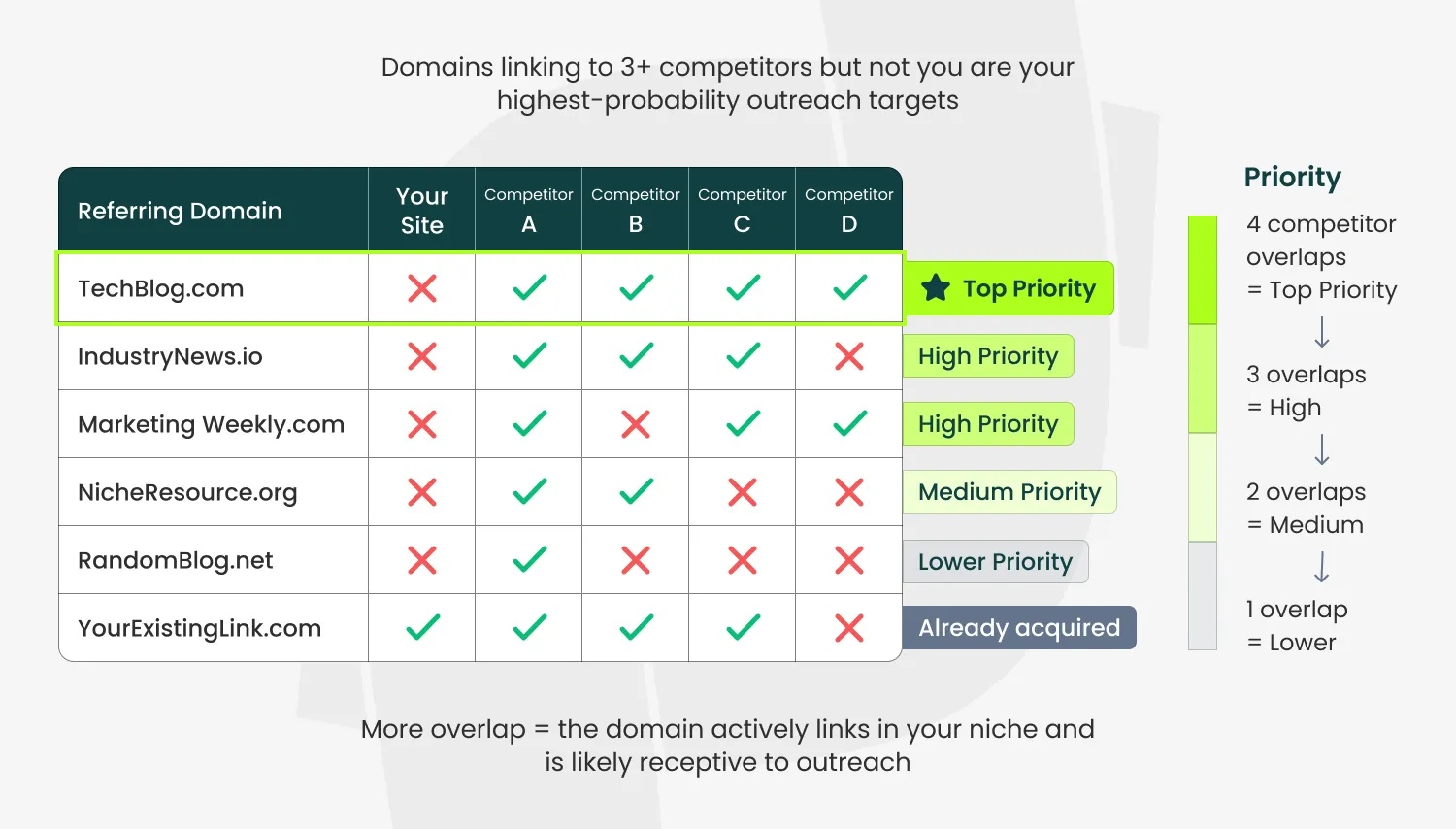
The goal is simple. Identify domains that already link to multiple competitors but not to you.
You can do this with tools like the paid Ahrefs (Link Intersect) or the free Semrush (Backlink Gap), with a limit of 10 searches/day. Add your domain and 3–5 competitors, and the tool will return a list of domains, grouped by the number of competitors they link to.
Focus on domains that link to at least three of your competitors. These are not cold prospects. They have already linked to similar content multiple times, which shows a clear interest in your topic.
When you build outreach from this list, you are not starting from zero. You are working with proven link sources that already support your niche. This helps you improve response rates and can earn links that strengthen your rankings over time.
We’ve seen that domains linking to multiple competitors are more likely to accept relevant pitches, especially when the content clearly improves on what they’ve already referenced.
Step 5: Analyze Content Patterns
Before you start an outreach campaign, look at what type of content actually earned your competitors their links. List out the top 10–15 most-linked pages across competing sites and scan for patterns:
- Data-driven posts, such as original research, surveys, and benchmarks or other linkable assets.
- Comprehensive guides that people use as a reference.
- Free tools or templates that solve a specific problem.
- Expert roundups, opinion pieces, or resource pages featuring multiple industry voices.
This tells you what publishers in your niche are already linking to.
If most top-linked pages are data studies, publishing another generic guide won’t move results, but publishing a new data study can.
Align your content with what’s already earning links. That’s how you increase your chances of getting placed.
Turning Competitor Link Data Into Outreach Targets
Turning your filtered list into placements is where the actual authority gets built.
Sort by Opportunity Type
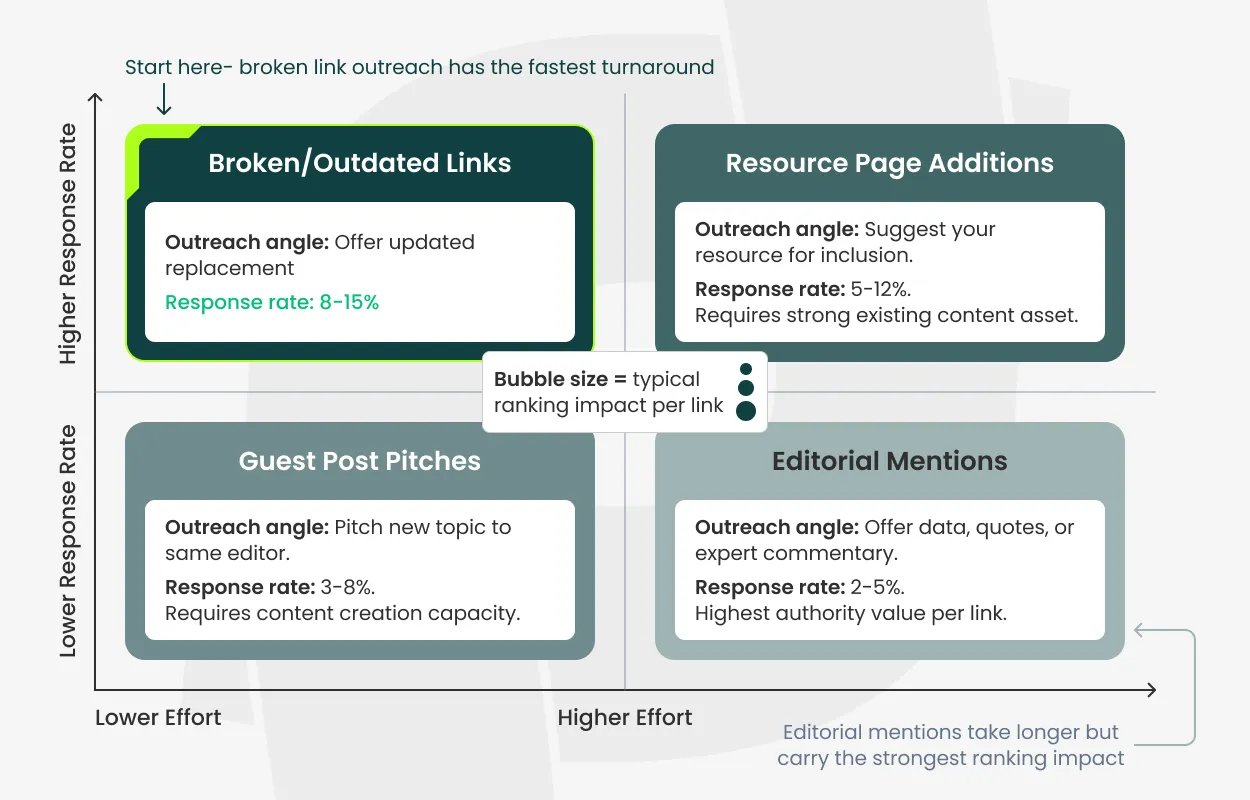
Not every backlink opportunity works the same way. The way you approach it decides whether you get the link or get ignored.
Group your targets based on how the link was earned:
Resource Pages
These are curated lists of tools, guides, or references. Reach out with a clear reason why your resource improves that list.
Guest Post Hosts
Your competitor contributed a guest post to this site. Pitch a new angle that adds value to their audience, not a repeat of what already exists.
Editorial Mentions
A journalist or blogger naturally referenced your competitor. Offer something stronger for future coverage. This could be a better data point, a unique insight, or an expert quote.
Broken or Outdated Links
The existing link is no longer working, or the content is outdated. Step in with an updated replacement for the broken link that solves the problem.
Each type needs a different approach. The message, the angle, and your expected response rate will vary. Treating every opportunity the same slows you down and lowers your success rate. Segment first. Then reach out with intent.
Personalize Every Pitch
You already know which page links to your competitor and why it exists. Use that context.
Reference the exact article. Show how your content adds value to their readers. Make every line of your email relevant.
Email Outreach Template
Subject: Quick idea to extend your [specific article title]
Hi [Name],
I noticed your article on [exact article], and I think there is a simple way to add even more value for your readers.
You already covered [specific point] well. I wanted to share a guest post idea that brings a fresh angle to the topic.
I can cover [new angle] with practical examples and insights your audience can use right away. If it helps, I can send over a short outline.
Best,
[Your Name]
Generic templates sent to competitor-based lists don’t perform much better than random cold outreach. The difference comes from how well you connect your pitch to what they’ve already published.
Track What You Earn and Compare
Set a monthly check to track whether you are closing the gap.
If a competitor has 150 referring domains from your target niche and you’re starting at 40, focus on how consistently you’re adding relevant domains over time.
Referring domain growth is one of the clearest signals tied to higher rankings. As your profile strengthens, you’ll start seeing movement in visibility and positions. For the difference between this metric and raw link count, see referring domains vs backlinks.
Across campaigns, steady growth in relevant referring domains has consistently aligned with improved visibility over time.
The key is consistency. Track the trend, not just the total.
In campaigns we’ve run at Outreach Desk, segmenting outreach targets by link type before sending the first email consistently improved placement rates. Resource page pitches and guest post pitches require completely different angles; treating them the same is one of the most common reasons outreach stalls.
How Often Should You Run Competitor Backlink Analysis
Run a competitor link audit every quarter. That cadence works for most teams that want to keep building momentum.
Pull fresh data. Re-run your gap analysis. Look for new referring domains your competitors picked up in the last 90 days.
New links point to active opportunities. If a site just linked to a competitor, it is already publishing and open to relevant sources.
Between audits, set up alerts. Tools like Ahrefs and Semrush can notify you when competitors earn new backlinks. Track three to five key competitors.
This keeps opportunities flowing your way. It also helps you act quickly on time-sensitive placements, like when a journalist just covered a competitor and may be open to your story.
Free vs. Paid Tools for Competitor Backlink Research
You can start without spending anything. But those limits show up quickly when you try to scale.
| Feature |
Free Tools (Ahrefs Webmaster, Moz Free, Ubersuggest Free) |
Paid Tools (Ahrefs, Semrush, Moz Pro) |
|---|---|---|
| Referring domains visible | Limited (top 100 or partial data) | Full index |
| Backlink gap analysis | Not available or heavily restricted | Built-in with multi-competitor comparison |
| Historical data | None or 30-day only | 5–10+ years of link history |
| New link alerts | Not available | Real-time or daily email alerts |
| Export capability | Limited or no CSV export | Full export with all link metrics |
| Anchor text analysis | Basic or unavailable | Detailed distribution with filtering |
| Cost | $0 | $99–$249/month |
Free backlink tools give you a narrow view. You usually get only a partial list of referring domains and no real gap analysis or reliable historical tracking.
Paid tools like Ahrefs or Semrush can help you analyze multiple competitors at once, run a proper gap analysis, and track new backlinks as they are acquired.
Free tools are enough when you are testing the process or doing a one-time check.
For ongoing competitor research at scale, paid link gap analysis tools can make the process more precise. They highlight exactly which domains are linking to your competitors but not to you, removing the need for manual tracking or scattered checks.
This turns research into a structured workflow. That is where efficiency starts to compound.
Common Mistakes in Competitor Backlink Analysis
Spotting common mistakes early helps you save time and effort while focusing on links that actually move rankings.
Copying Instead of Learning
Your goal isn’t to rebuild your competitor’s backlink profile link by link. It’s about understanding what works in your space and building from there.
Look for patterns, not individual links. If you blindly chase every link a competitor has, you’ll waste time on sites that don’t move your rankings.
Some links can’t be copied at all: certification listings, the backbone of link building for cleaning companies, require the credential.
Analyzing Only One Competitor
One backlink profile never tells the full story. It reflects unique factors like personal networks, one-off mentions, or a single high-performing piece.
You need four or five competitors to see what consistently works. That is how you separate repeatable opportunities from noise.
Ignoring Anchor Text Data
Anchor text shows how other sites describe and position a page. If most anchors are branded or generic, those links may not drive strong topical relevance.
When anchors are descriptive and keyword-aligned, they often have a stronger impact on ranking. This helps you decide how to position your own pages.or a full breakdown of how that mix should look, see anchor text distribution.
Skipping the Content Gap
Pulling backlink data is just the first step. You also need to look at the content that earned those links.
What format worked? What angle got picked up? If you move to outreach without that, you’re asking for links to content with no clear reason to be referenced.
Conclusion
One round of competitor backlink analysis won’t transform your rankings.
But running it every quarter to update your gap list, act on new referring domains, and adjust anchor positioning compounds.
Start with the gap analysis this week. Pull 5 competitors, filter the data, group your targets by outreach type, and send your first 20 emails. The pattern will show you where to go next.
Want to find backlink opportunities your competitors already have?
Get a clear approach to identify and use links that can improve your rankings.
How many competitor backlinks should I analyze?
Analyze 3-5 competitors’ backlinks. This gives you a balanced view of how links are distributed across your niche.
Below that range, you risk reacting to outliers instead of real patterns. Go too wide, and the data becomes scattered and harder to act on.
Once you consolidate the findings, build a focused prospect list of 50 to 100 domains. Prioritize sites that show up across multiple competitors and are clearly aligned with your topic. Repeated overlap is one of the strongest signals you can use for outreach priority.
Can I just copy my competitor’s backlinks?
No. Replicating competitor backlinks is not a reliable strategy.
Those links often come from specific relationships, timing, or content angles that you can’t replicate. Chasing the same placements usually leads to low returns.
Focus on the pattern instead. Look at which types of sites are linking and what made them link. If a competitor earned coverage through a data study, your move is to create something more useful or more current and earn links on that basis.
What’s the difference between a backlink gap and a backlink audit?
A backlink audit examines your existing link profile to assess quality, relevance, and potential risks. It helps you understand what you already have and what needs attention.
A backlink gap analysis compares your site with competitors to find linking domains they have, and you don’t.
They serve different purposes. An audit focuses on your current foundation. A gap analysis focuses on future opportunities for growth.
How long before competitor backlink analysis leads to actual rankings?
Most teams begin to see early movement within three to six months when they act on competitor data and stay consistent with outreach. It depends on your domain authority, how consistently you build links, and how competitive your target keywords are.
There is no fixed timeline. Less competitive topics can move faster, while tougher keywords take longer. Progress comes from earning high-quality and relevant links and building momentum over time.
Are nofollow competitor backlinks worth analyzing?
Yes, but they shouldn’t be your primary focus. No-follow links from strong websites can still bring referral traffic and improve brand visibility.
Google treats nofollow as a hint. These links may help with discovery and context but aren’t reliable ranking signals.
Use them to see how competitors are mentioned across the web, not as your main outreach targets.