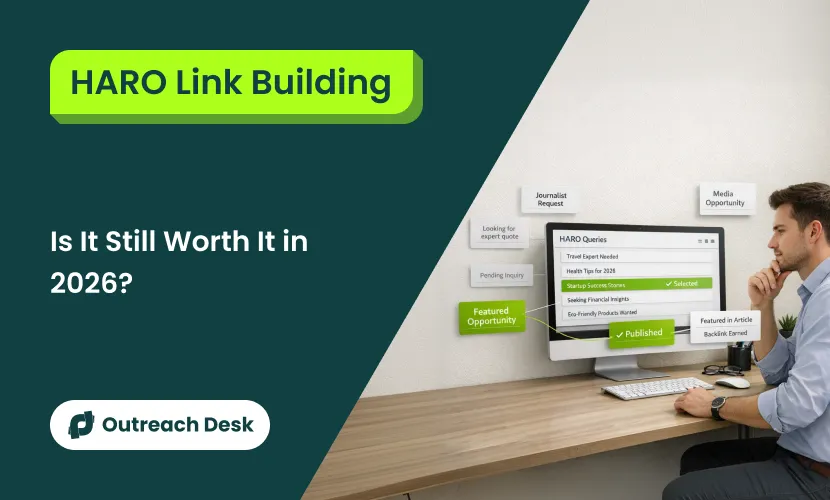
HARO link building is the process of answering journalist queries on the Help a Reporter Out platform. This is one of the popular ways to earn quality backlinks. But the real question is: does HARO still work in 2026?
Yes, HARO link building still works in 2026. The classic three-times-daily digest is back, but the process has changed.
After Cision discontinued Connectively in late 2024, Featured.com acquired HARO in April 2025 and reopened it as a free, email-based platform.
Imagine 300 people applying for the same job. That’s what one journalist’s query looks like now. One journalist receives hundreds of pitches and deletes most of them within seconds.
So the question isn’t whether you can build links through HARO. It’s whether the time investment pays off compared to other methods.
What you’ll learn:
- How HARO works under Featured.com.
- Realistic success rates & time investment for HARO pitching in 2026.
- A clear 6-step process for writing pitches that journalists actually use.
- When HARO works and when it doesn’t in link building strategy.
- A strong alternative, so you never depend on just one platform.
What is HARO Link Building?
Help a Reporter Out is like a matchmaking platform for journalists and experts.
Journalists need expert quotes; you provide them, and if the journalist likes your answer, they quote you in their articles.
In HARO link building, you answer queries to earn quality backlinks.
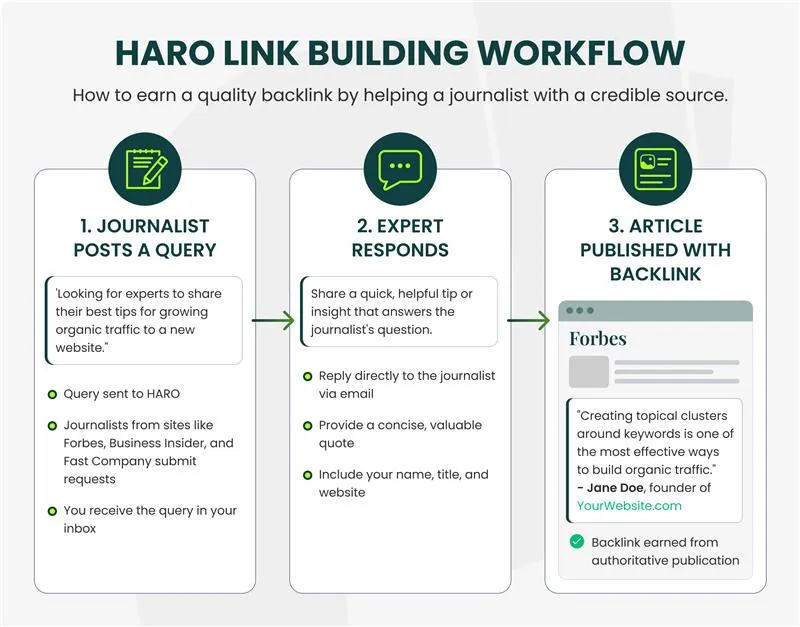
The process runs like this.
- A journalist at Forbes or Business Insider needs an expert opinion.
- They post their query on HARO.
- HARO emails queries to thousands of experts three times a day.
- You spot a relevant question and write a concise, helpful answer.
- The journalist picks the best response.
- Journalist, publish your answer with a link back to your website.
These links carry real value. They come from editorial decisions, not paid placements.
Here, you earn authoritative backlinks, and Google also treats them as genuine signals because they come from recognizable publications.
These links drive real referral traffic and brand credibility. That matters more now, because AI search systems favor brands with broad web mentions.
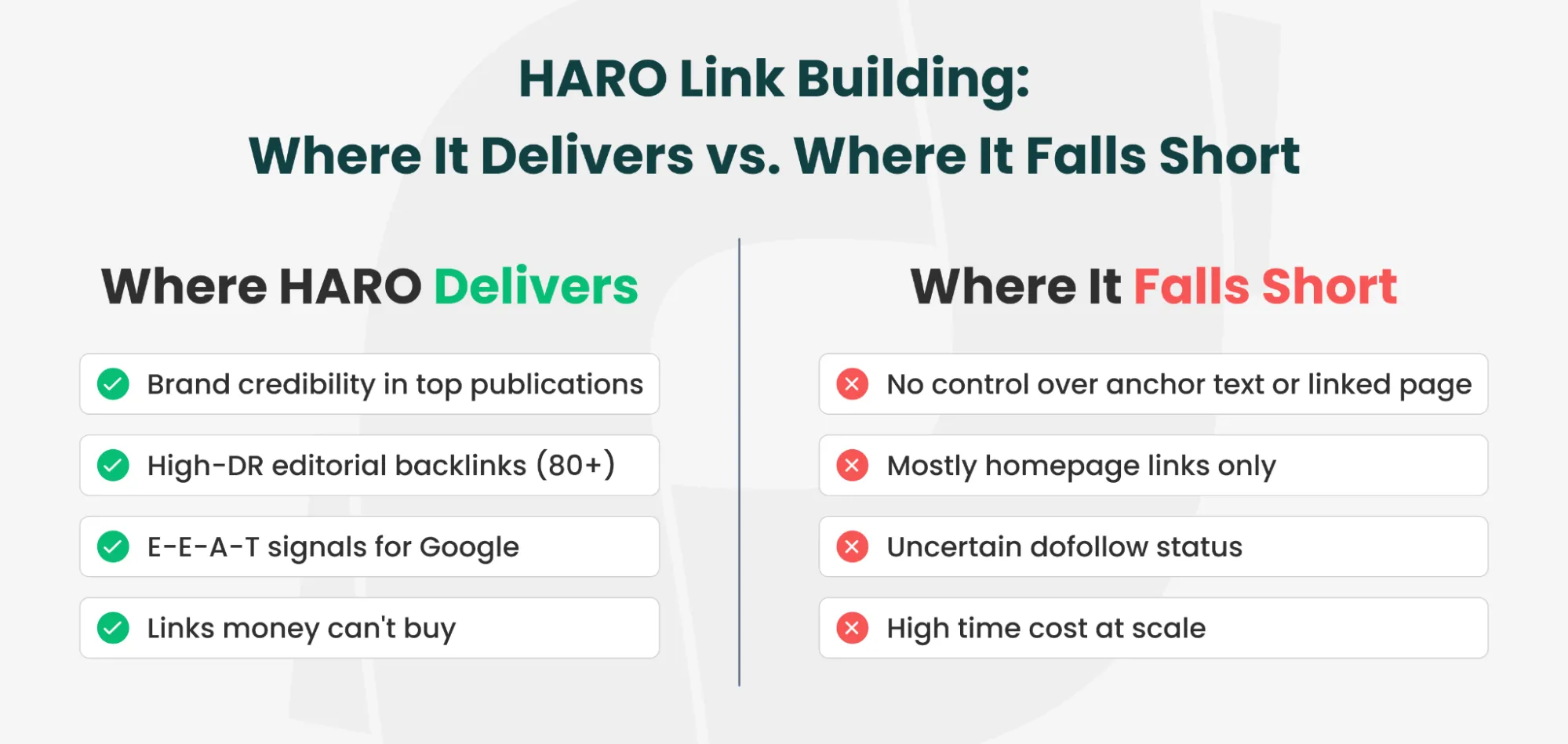
However, HARO gives you very little control.
- You can’t choose which page on your site gets linked.
- You can’t control the anchor text (the clickable words), and not every placement returns a dofollow editorial backlink.
- You can’t guarantee the article will even go live.
- You’re always reaching out and waiting for queries to appear.
It’s more like fishing. You don’t control the conditions. You just show up, write the best lines, and wait.
The process is passive and unpredictable, but the quality of the links you earn is worth the wait.
What Happened to HARO and Connectively?
The HARO you remember from 2022 was simple. Cision rebranded it to Connectively, and the platform lost that simplicity.
Cision then shut Connectively down on 9 December 2024 and moved its PR tooling into CisionOne.
HARO went dark for four months. Brett Farmiloe, CEO of Featured.com, brought it back.

A BuzzStream interview with Farmiloe set out the mission in three parts.
Bring back the simplicity of the original HARO. Prioritise human expertise over volume. Give journalists a reason to trust the platform again.
How the New HARO Works Under Featured.com
In April 2025, Featured bought HARO from Cision and removed:
- The clunky Connectively dashboard.
- Paid tiers cost up to $149/month.
- Pitch limits are based on your subscription level.
Instead, Featured brought back the simplicity, the three times daily email digests. Just reply directly by mail. No login needed.
Also, you don’t need to pay subscription fees. It’s now free for both journalists and sources.
Then how does Featured make money? The answer is newsletter advertising and sponsorships.
The Three-Layer Filter Featured Added
Featured screens sources before journalists ever see them:
- Verification layer to filter out random people posing as experts.
- AI detection to flag AI-generated answers that don’t add real value and lack personal experience or original insights.
- Bans for repeat offenders who consistently send irrelevant or AI-generated content.
Is HARO Still Worth It For Link Building?
HARO still earns you valuable backlinks from publications with domain ratings above 80, without paying for placements. But the answer heavily depends on ‘how you use it and what you expect from it.’
It demands real-time investment. Cision data collected by SEO Sandwitch puts the journalist response rate below 5% across all pitches received.
Moz places well-crafted pitches at 10% to 20%. The gap between those two numbers is pitch quality, and it is the only variable you control.
PR professionals report that well-crafted pitches earn responses 10% to 25% of the time. Better bait, better catch.
NewswireJet reported 14 placements from 114 pitches, a conversion rate of 12.3%.
Sounds good, right? Calculate the hours spent scanning queries, writing custom responses, and follow-ups.
Compare that to general PR outreach. Propel’s analysis of over 555,000 media pitches found the average journalist response rate sits around 3.4%.
HARO still beats the cold outreach at conversion. Why?
Because cold outreach is like knocking on the doors nobody asked you to knock on.
HARO is different. Here, journalists have already put up a signboard, “I need help.” You help, and you get rewards (backlinks). That’s why HARO offers higher conversion rates.
But the common question is: what does HARO deliver?
The Biggest Mistake People Make:
Many people treat HARO link building as the only strategy to build backlinks. It’s like watering one part of the garden and wondering why the rest is not growing.
HARO works best when you treat it as one channel inside a multi-method strategy. Teams that rely only on HARO end up facing:
- Lots of homepage authority.
- Zero link support for the pages that actually need to rank.
- A lopsided backlink profile with little or no change.
The simple rule is to consider HARO as one tool inside a bigger strategy.
It’s best for building brand credibility and earning high-trust editorial links. You should use this method with realistic expectations; otherwise, you’ll burn out fast.
How to Use HARO for Link Building (6 Steps)
Understanding where HARO fits into a link building strategy is one thing. But knowing how to execute it daily is important.
Here’s the step-by-step process to help you improve your success rate with the HARO link-building strategy.
Step 1: Set Up Your Profile for Credibility
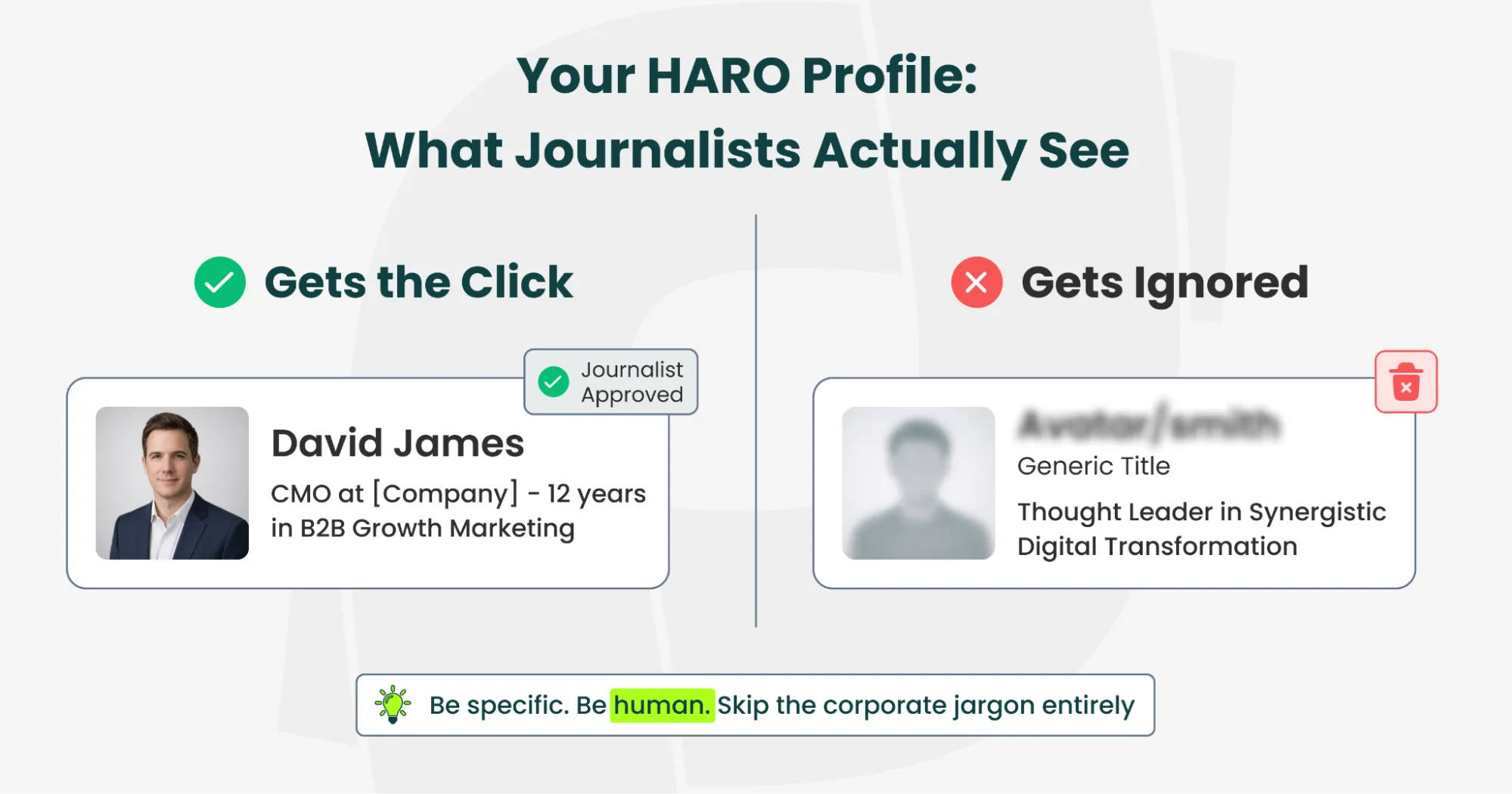
Think of your HARO profile like a first impression at a job interview. Before a journalist decides to quote you, they check who you are.
Three things to get right before you pitch anything.
- Sign up at helpareporter.com
- Choose categories that match your real expertise only.
- Add a professional headshot, your real title, and a clean one-line bio.
What looks good vs. what gets ignored:
Here’s how you stand out from the others.
Step 2: Scan Queries Within 60 Minutes of Each Digest
Speed is the single most impactful variable in HARO success. Here’s why:
- Sources who reply within the first hour have a 50% higher chance of being chosen, per Cision.
- Journalists start reading immediately after queries go live.
- Many close queries once they find just 3-4 usable responses.
Three habits keep you inside that window.
- Set email notifications so digests hit your phone immediately.
- Block 15 minutes three times daily (morning, afternoon, and evening).
- Scan subject lines first, then open only the queries where you have genuine expertise.
Step 3: Write Pitches Under 200 Words
A HARO pitch is not a blog post or sales deck. Only a few seconds decide your credibility, whether you get a backlink or a rejection.
Your pitch should be quotable, so a journalist can use it with minimal editing.
Cision found that responses under 200 words are 25% more likely to get picked. The word limit in this heading is not arbitrary.
A pitch that works:
“Hi [Name],
I’ve run paid search campaigns for 40+ ecommerce brands over 8 years. One mistake I see repeatedly: brands scaling ad spend before fixing landing page conversion rates. A client last quarter cut their cost per acquisition by 34% without increasing budget. They just rebuilt three landing pages with clearer CTAs and faster load times.
Happy to provide more details if helpful.
[Name],
[Title],
[Company URL]”
A pitch that gets ignored:
“As a leading marketing agency, we specialize in comprehensive digital strategies that drive results for our clients. We believe in a data-driven approach…”
The first pitch includes a specific result, real experience, and a quotable insight. Journalists will select the first pitch within 3 seconds.
While the second pitch is generic, it goes straight to the bin in 1 second.
Step 4: Lead with a Data Point not a Personal Story
Journalists don’t need your biography. They need something meaningful, quotable, and credible.
Research from Muck Rack and Cision found journalists value credible sources and original data above pre-written quotes.
Open your response with a real number, a case study, or a specific experience rather than credentials.
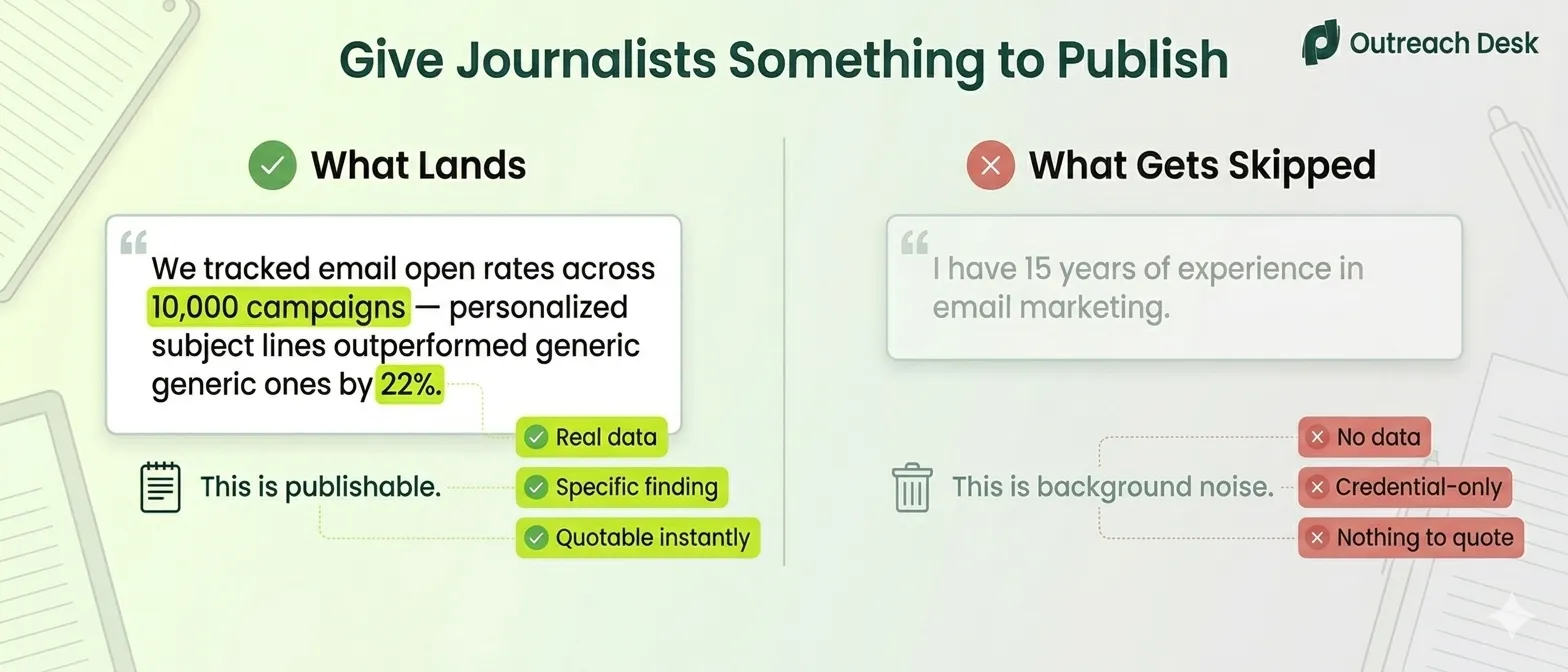
One gives a journalist something to publish. The other gives them just background, which they didn’t even ask for.
Step 5: Follow the Query Instructions Exactly
Most HARO users overlook this step.
Read the request literally.
- Three tips, give them three. Not five. Not two.
- If they ask for a response from agency owners, don’t pitch if you’re a freelancer.
- If they specify a word count, respect it.
You get filtered out if you miss these small details. Because it clearly shows you don’t read carefully.
Reality:
Journalists reviewing 100+ responses are actively looking for reasons to say no. Better not to hand them that reason.
Step 6: Track Results and Build Relationships
Most people stop after hitting send. The best HARO users treat every pitch as data and every placement as a relationship.
Keep a spreadsheet of every pitch: query topic, publication, date sent, placement outcome, live URL. A backlink monitoring tool catches the placements that go live without an email. This won’t help in 1-2 weeks, but over 2-3 months, you’ll start to notice patterns.
You will get insights on which topics convert for you, which publications use HARO heavily, and where your expertise resonates most.
After a placement goes live, do three things.
- Send a short thank-you message.
- Share the article on your social channels and tag them.
- Make their job easier, and they’ll remember you for a long time.
Once a journalist trusts you, they skip the HARO queue entirely and come to you directly.
Common HARO Mistakes That Kill Your Placement Rate
Now you know the 6-step process for writing strong pitches. But knowing what not to do is equally important when you’re building backlinks using HARO.
Here are the common mistakes that kill your placement rate despite having well-written pitches.
Using AI to Generate Every Response
The biggest mistake in HARO link building is using AI to generate every response. It’s like sending a photocopied signature instead of a real one.
When everyone uses AI, every pitch and response sounds similar. Journalists can easily spot lifeless content. Even Featured.com is now automatically flagging it.
Here, you’re not just competing against humans anymore. You’re in a race against dozens of pitches that read exactly like yours.
What’s the smarter approach?
Use AI to brainstorm ideas and structure your thinking, then write the actual response yourself. Your genuine experience and voice make all the difference.
Pitching Queries Outside Your Expertise
Imagine a real estate agent showing up to answer queries about cybersecurity. The journalists will notice, and they toss the pitch straight in the bin.
It’s simple: either you have credibility for that topic, or you don’t. Never fake it to earn a backlink. Remember, if you have to stretch to claim expertise on a topic, skip the query.
Burying Your Insight Under Credentials
Journalists are scanning dozens of pitches in minutes. If you write three paragraphs before the actual answer, you’ll lose them. Nobody reads fluff.
Lead with your strongest point. Be specific. Put your credentials at the bottom in two lines.
Treating Every Query as Equal
Not all queries are equal.
A query from a Forbes contributor on a trending topic will get 300 responses. A query from a niche trade publication in your exact industry might get 15.
This is your spot. Niche-based queries give you a much better shot. These links often carry more topical relevance.
What HARO Link Building Costs
HARO itself is free. Doing it well is not.
Budget three 15-minute scanning blocks a day, plus 20-30 minutes writing each pitch you decide to send.
At 10 pitches a week that is roughly five hours, every week, from someone senior enough to have real expertise.
That time cost is why most teams outsource. Agency rates cluster into three bands:
- $500 to $1,000 a month: standard query selection, light customisation, basic reporting.
- $1,000 to $2,500 a month: tighter query selection, custom pitches, real analytics.
- $5,000 a month and up: expert query selection, dedicated account management, ROI reporting.
Those bands come from Bink Media’s breakdown of HARO service pricing. Some agencies bill per placement instead of monthly.
Either model is worth checking against what backlinks actually cost before you sign.
HARO Alternatives Worth Considering
HARO isn’t the only platform connecting sources with journalists. We reviewed the 8 best HARO alternatives in a separate guide.
Smart link builders spread their efforts across multiple channels, so one slow week on HARO doesn’t slow down their entire pipeline.
| Platform | Model | Best For | Cost |
|---|---|---|---|
| Qwoted | Dashboard + verified profiles | Finance, tech, and healthcare niches | Free (2 pitches/mo, 2-hour delay), Pro at $99/mo |
| Featured | Q&A expert platform (also powers HARO) | Thought leadership roundups | Free + paid tiers |
| Source of Sources | Email newsletter (by Peter Shankman, HARO’s original creator) | General PR and link building | Free |
| SourceBottle | Email-based call-outs | Australian/UK markets, lifestyle, health | Free + paid expert profiles |
| MentionMatch | Email queries (formerly Help a B2B Writer) | B2B and SaaS | Free |
| ResponseSource | Category-targeted journalist requests | UK press outreach | Paid |
| #JournoRequest on X | Hashtag monitoring | Real-time, breaking news queries | Free |
Top Three Picks From That List
If you only add one platform, add one of these.
- Qwoted: Best if you’re in finance, tech, or B2B.
- Source of Sources: HARO’s original founder created this platform. It has the same spirit. It’s a free and email-based platform.
- #JournoRequest on X: Real-time queries mean faster turnaround and less competition if you’re monitoring actively.
Quick Tip:
Combine multiple platforms. No single source provides enough query volume to build a consistent link pipeline on its own.
Where HARO Fits in a Broader Link Building Strategy
HARO earns a very specific type of link: high-authority, editorial, homepage-focused, and unpredictable in timing.
That’s valuable. But it’s also limited.
Think of HARO as a strong foundation under a building. It’s essential, but not the whole structure.
A balanced approach pairs HARO with three other methods. Editorial link building wins targeted placements. Contextual link building feeds page-level authority. Content-driven digital PR scales coverage.
Each method fills a gap in your wider link acquisition strategy. HARO builds domain authority, editorial outreach supports page-specific authority, and content assets attract passive links.
Together, they create a strong link profile that looks natural to both Google’s algorithms and AI search systems that evaluate source diversity.
Stacker’s data shows AI systems cite brands with consistent earned distribution. LLMs pull from the breadth of sources mentioning your brand, not just your own site.
Every HARO placement adds another data point. Every time a journalist quotes you, your brand shows up in another trusted publication, thereby associating it with your topic area.
Make HARO One Part of the Plan
HARO still works in 2026, but only for brands willing to show up consistently with real expertise, real speed, and realistic expectations.
Build HARO into your strategy alongside editorial link building and content-driven outreach. Let HARO handle unexpected placements on high-authority sites that don’t accept cold outreach.
Everything else handles the precision, targeted links to the pages that drive revenue.
Your link profile should work like a diversified portfolio, not a one-trick bet.
Looking for backlinks that build real credibility?
Get featured on high-authority sites through smart HARO outreach.
Frequently Asked Questions
Is HARO free in 2026?
Yes. HARO is free for journalists and sources. Featured.com funds the platform through newsletter sponsorships, not subscriptions. Also, there are no caps on the number of queries you can respond to.
How many links can you realistically build through HARO per month?
Journalists reply to under 5% of all pitches, and to 10-20% of well-crafted ones. At 10-15 pitches per week, expect 1-3 placements per month. Some months you’ll land five. Some months are zero. Long-term consistency matters more than short-term, week-by-week expectations.
Are HARO links dofollow?
Often, but not always. The publication decides, and you have no say in it.
Large outlets increasingly mark contributor links as nofollow. Those placements still earn brand mentions and referral traffic, they just pass no ranking signal. If you need guaranteed dofollow placements, HARO is the wrong channel.
Can HARO links hurt your SEO?
Not directly. These links come from legitimate editorial placements. But over-relying on HARO creates an imbalanced backlink profile. You’ll get lots of homepage links while other pages get zero support. That won’t trigger a penalty, but it can limit the impact on your overall ranking.
What’s the difference between HARO and Qwoted?
HARO is free. You can use the email digest three times a day. Qwoted uses a dashboard, verifies journalist profiles, and charges $99/month for full access. Qwoted attracts more targeted and niche-relevant queries, particularly in finance, tech, and B2B. Many teams use both for maximum coverage.
Should I hire a HARO link building agency?
Your decision depends on bandwidth. HARO requires daily monitoring and fast, expert-level responses. Outsource it if nobody on your team can scan three digests a day and reply within the hour. Make sure the agency writes original, human responses. You can ask for samples and placement proof before signing. Compare quotes against real link building prices so you know what a fair rate looks like.