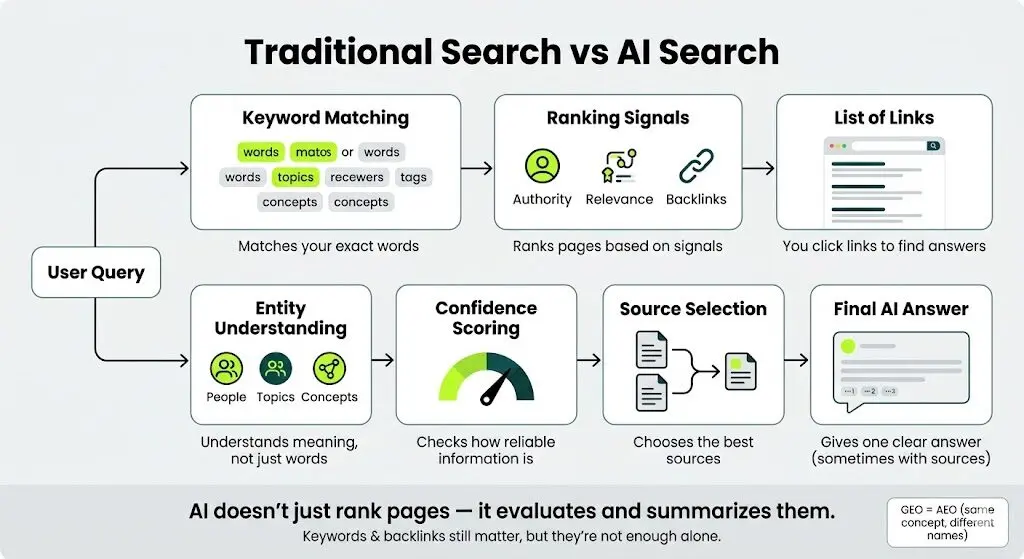
Ranking on page one still matters, but it is no longer enough. Traditional SEO helps you get ranked. AI search optimization helps you get cited. In 2026, an increasing number of searches are answered directly by AI, without users ever clicking a link. Showing up in those answers is no longer optional.
Traditional SEO and AI search optimization complement each other. The site winning right now does both. They optimize for traditional search and position their content to be cited by AI platforms. Getting your content cited in AI-generated answers means earning visibility even when users never click a single blue link.
What You’ll Learn
- What AI search optimization actually means and why it’s different from traditional SEO.
- How to audit and adapt your existing content for AI visibility.
- How AI engines evaluate, extract, and cite trusted content.
- How you can structure pages for definitions, claims, and sub-questions.
- The way freshness, authority, and links influence AI citation visibility.
How AI Search Optimization Differs From GEO and Traditional SEO
AI search optimization means structuring your content so that AI systems like Google AI Overviews, ChatGPT, Perplexity, and Gemini cite it as a source in their generated answers, instead of only ranking it in a list of blue links.
You have probably seen this same idea called generative engine optimization (GEO). That guide covers the discipline end to end: what it is, why it matters, and the core strategies behind it.
This guide picks up from there. It focuses on the part most GEO content skips: how to audit content you have already published, measure whether it is actually getting cited, and fix the specific pages that are not.
Everything here is about earned citations. Ads inside ChatGPT are a different channel, bought through OpenAI Ads Manager, and we cover that under ChatGPT ads management.
Wikipedia’s Role in AI Citations (And When It Doesn’t Matter)
ChatGPT cites Wikipedia in 7.8% of its total citations, more than any other single source, based on an analysis of 680 million citations collected between August 2024 and June 2025 by Profound.
Perplexity barely touches it, under 0.5% of its citations, since it leans on Reddit and real-time web search instead.
That split matters for where you spend effort. A real Wikipedia page is hard to earn and unrealistic for most brands, but being mentioned or cited within a relevant Wikipedia article, or keeping a clean Wikidata entry, still feeds the same entity-recognition signal ChatGPT relies on most. If Perplexity drives more of your traffic, that same effort does far less, since it barely touches Wikipedia at all.
Check where your citations actually come from before deciding which one to prioritize.
How to Audit Your Existing Content for AI Visibility
Before changing anything, you need to know what you’re actually working with. You don’t need to rewrite everything.
Most of the sites already have content that’s close to AI-ready. It just needs structural adjustments.
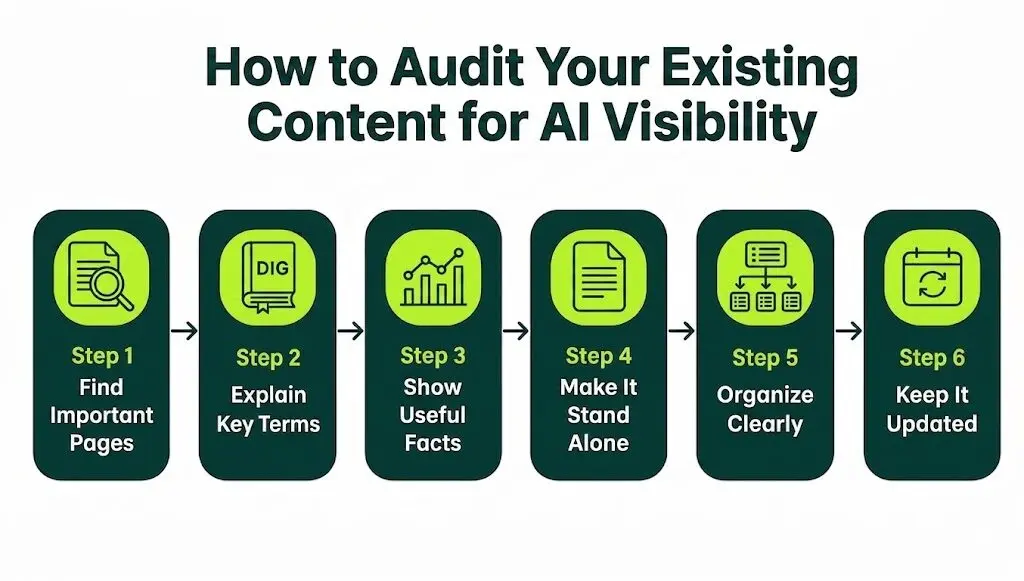
Step 1: Identify Your Highest-Value Pages
Start with the pages that already rank in the top for their targeted keywords. They have the strongest possibility of citing AI because AI systems still favor top-ranking content as source material.
Step 2: Check for Entity Definitions
Define every important term the first time you use it. A clear one-sentence explanation helps readers and AI systems understand and cite your content.
Step 3: Find Your Extractable Claims
Check each H2 section for a single sentence that could stand alone as an answer. Does it contain a named entity, a specific claim, or evidence? If no, then write one.
Step 4: Test Self-Containment
Each section should make sense on its own. If it references something earlier, rewrite it so a reader, or even AI, can understand it without reading the rest of the content. Any section should not open with “As we discussed above,” or it should not depend on context from an earlier section.
Step 5: Add Structured Elements Where They Help
Look for the sections that can become comparison tables, process sections that can become bulleted or numbered lists, and definition sections that could follow a “What/Why/How” format. Don’t force the structure where paragraphs work better.
Step 6: Verify Freshness Signals
Check if the page has a visible “last updated” date. Check if the content is current (fresh). Check if the crawlers are blocked in your robots.txt. If yes, fix those gaps.
Check the factors given in the image below. Continue your audit if it meets the criteria, and evaluate where it needs improvement.
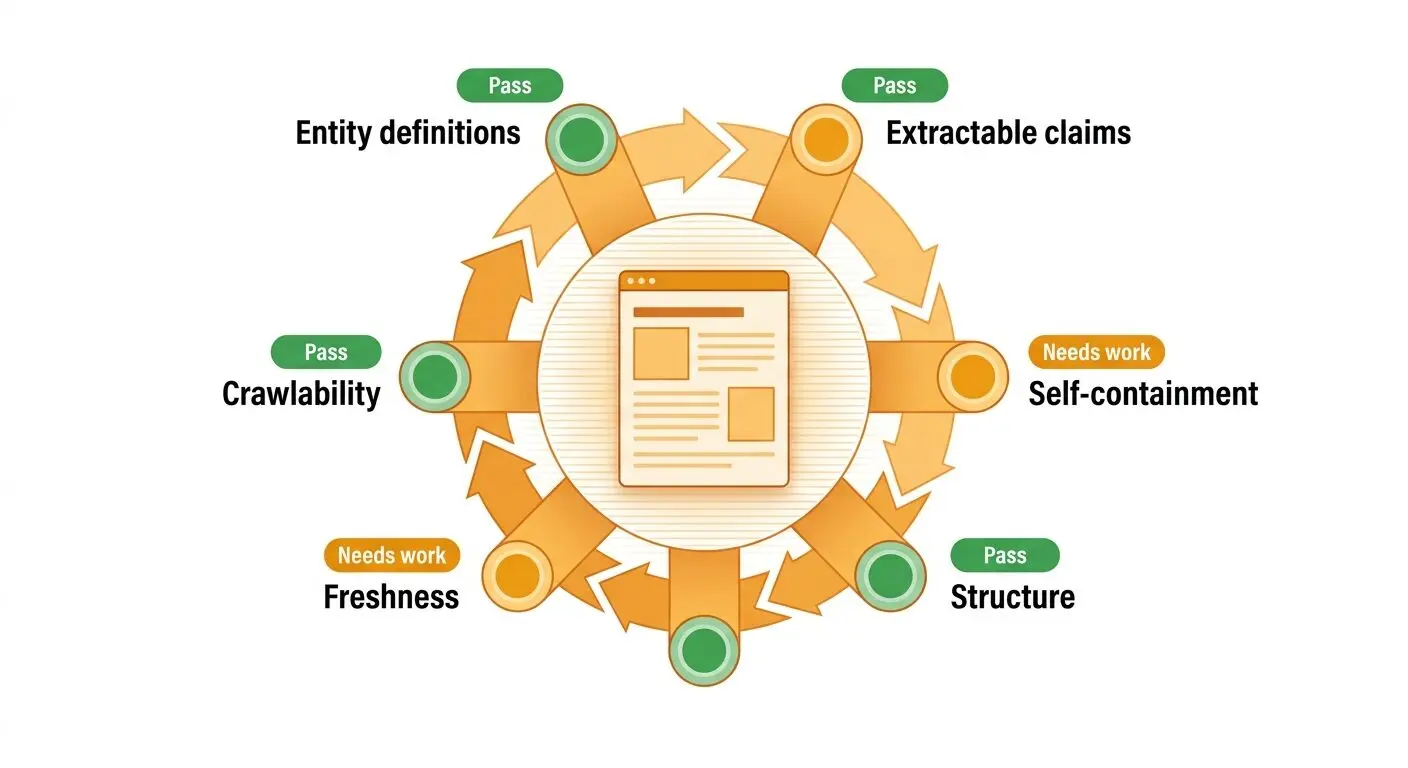
Run the audit on your top 20 pages first. Improve what already works, delivers far more value than trying to fix content that was never performing well.
Where Link Building Fits Into AI Search Strategy
Link building always matters for search rankings, but link building for AI search does something more important than just pulling up the list.
When an AI system decides which source to cite, they look at what your overall link network says about your expertise in a specific subject.
It’s not about how many links point to your site; it’s about what those links signal about your credibility in a particular field.
Suppose that a dozen editorial links from health publications pointing to your health content tells AI systems that this domain is a credible health source.
That signal indicates whether your content gets cited when someone asks an AI about a health-related question.
Generic links from irrelevant sites still pass some value for traditional rankings. However, they don’t send the topical trust signals that AI systems seek.
This is the reason why relevance is more important than volume in the AI search era. The relevance of the linking domain to your content’s topic directly affects your citation probability.
Here are the three things you need to prioritize:
- Topical linking cluster
Build links from publications in your industry, not just high-DR sites in any niche.
- Content-link alignment
Make sure that the pages that are receiving links are the same pages you want AI engines to cite.
- Authority stacking
Combine external editorial links with internal linking architecture so link equity flows to your most important content.
Measuring AI Search Performance
You can’t improve what you can’t measure. However, measuring AI search visibility is still harder and less precise than tracking traditional search rankings.
How You Can Measure Today
- AI Overview presence
Tools like Semrush and SE Ranking can now track whether your domain appears in Google AI Overview citations for your targeted keywords.
- Referral traffic from AI sources
Filter analytics for traffic from chat.openai.com, perplexity.ai, and Google AI Overview clicks.
- Brand mentions monitoring
Track how often your brand and content get mentioned in the AI-generated answers. Use tools such as Google Alerts, Brandwatch, and manual spot checks or for a deeper breakdown, see tracking brand mentions in large language models.
Consistent brand mentions on authoritative sources signal to AI engines that your content is worth citing.
- Citation audits
Query your target keywords in ChatGPT, Perplexity, and Gemini to see if your content gets cited, and if it isn’t, this breakdown on how to get cited in AI search covers what to fix first.
What’s Still Hard to Measure
- Exact citation frequency across all AI platforms.
- The casual relationship between specific changes and improvements in citation.
- Attributing a reader who saw your brand in perplexity and later searched for it directly is hard to trace.
Start with directional data. If your AI referral traffic is improving and your brand appears in more AI-generated responses for targeted queries, your strategy is working.
Common Mistakes That Kill AI Visibility
Some content is well-written and well-researched, yet never gets cited by AI systems. A few patterns consistently prevent strong content from getting cited. Let’s look at those patterns/mistakes.
Blocking AI Crawlers
Some sites block GPTBot and other AI crawlers in their robots.txt files without realizing it. If AI crawlers can’t find your content, then they can’t cite it. Therefore, check your robot.txt file.
Burying the Answer in Long Introductions
AI systems look for direct answers at the beginning of the sections. If your answer is after four or three paragraphs, it’s more likely to get skipped in favor of a competitor who leads with the answer.
Writing Content that Only Makes Sense When Read Sequentially
Each H2 section must function as a standalone answer. Frequent use of “as mentioned earlier” and “building on the previous section” signals to AI engines that individual sections can’t be extracted clearly.
Ignoring Structured Data Opportunities
Ignoring the structure refers to the fact that, if a comparison table is buried under a paragraph of text, it is harder for the AI to extract information than in the table format.
It doesn’t mean that everything should be in a table, no, but it means that when the content is genuinely comparative, at that time, structured formats win.
Chasing AI Optimization at the Expense of Quality
If you strip your content of personality, opinion, and depth to make it more “extractable,” you lose the E-E-A-T signals that earned you a citation in the first place. Write for expertise first, and then structure for extraction.
What Comes Next
AI search and traditional SEO now operate as a component of visibility layers. Sites that optimize for both earn ranked positions in the blue-link results and citation slots in AI-generated answers, helping to compound their reach across both surfaces.
Audit your top 20 pages, fix the structural gaps, and build authority through relevant and editorial links in your field. Start tracking here, where you appear in AI answers, along with where you rank in traditional results.
The basics haven’t changed. It still consists of authority, quality, and trust. What’s changed is where those fundamentals get rewarded. The surface is bigger, and so is the opportunity.
Struggling to appear in AI-powered search results?
Get a clear plan to optimize your content for AI search visibility.
Is AI search optimization the same as SEO?
No, but they overlap heavily. Traditional SEO targets ranked link positions in search results. AI search optimization targets citation in AI-generated answers from platforms like Google AI Overviews, ChatGPT, and Perplexity. Both rely on domain authority, content quality, and E-E-A-T signals. The difference is structural; AI search rewards self-contained, entity-defined, extractable content more than traditional SEO does.
Do backlinks still matter for AI search?
Backlinks still matter, but differently. AI engines use backlink signals to assess authority, whether your domain is a credible source on a specific subject. A cluster of relevant editorial links from niche-relevant publications sends stronger trust signals than a larger number of links from irrelevant sites. So yes, links matter, but relevance has become more important than volume.
How do I know if my content is being cited by AI?
Search your target keywords directly in ChatGPT, Perplexity, and Google to trigger AI Overviews and check whether your domain appears as a cited source. For ongoing tracking, use tools like Semrush’s AI Overview to monitor referral traffic from AI platforms in your analytics. It’s not as precise as rank tracking yet, but the tools are improving quickly.
Can I optimize for all AI platforms at once?
Most of the time, yes, the structural requirements for Google AI Overviews, ChatGPT, Perplexity, and Gemini overlap significantly, with clear entity definitions, specific data-backed claims, self-contained sections, and strong signals of authority. The main difference is that Google AI Overviews favor numbered lists and tables, while ChatGPT and Perplexity prioritize recency and information density. Optimizing for the shared requirements covers about 80% of the work.
How long does AI search optimization take to show results?
Structural changes to existing content, like adding entity definitions, rewriting key sentences for extractability, and improving section self-containment, can affect AI citation within 30 to 90 days, depending on how frequently AI systems crawl your site. Building the authority that makes your domain citation worthy in the first place is a long play. Typically, 6 to 12 months of consistent content development and strategic link building.