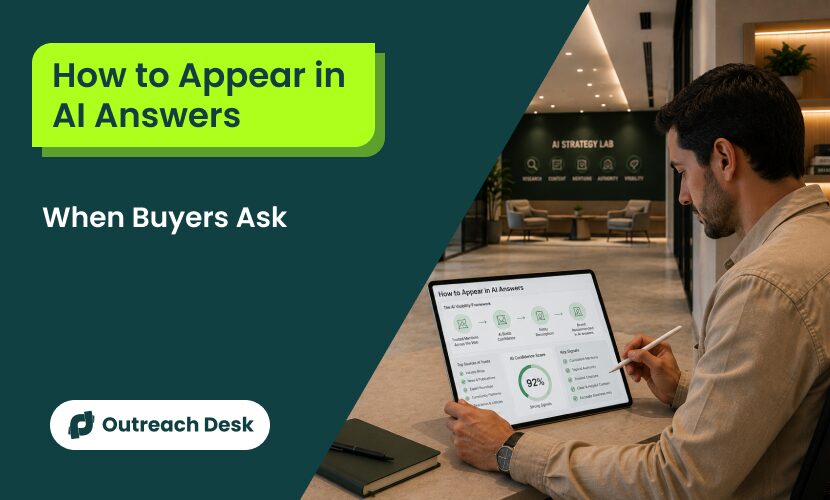
You ask LLMs for the best companies in your industry, but your competitors get recommended instead of you.
That’s when you start thinking about SEO and how to appear in AI answers.
AI doesn’t choose brands because they rank first; it chooses brands that the web repeatedly trusts and mentions.
That’s why visibility across credible websites matters as much as visibility in search results. Build enough trusted mentions, and AI has more reasons to recommend your business.
The Short Version
- AI answers pull from 3+ sources 88% of the time.
- A brand mentioned on trusted sites can outrank the number-one Google result for AI answers.
- Pages with a direct first-sentence answer get quoted more often.
- One inconsistent address or phone number weakens AI’s trust in your business.
- AI assistants rely on trusted citations and entity relationships.
Why AI Names Your Competitors and Not You
AI tools name your competitors because other trusted websites mention those brands more often than they mention your business.

And every AI answer is stitched together from those trusted sources.
There’s good news hiding in that fact. You can get named without ranking number one.
A 2025 Pew Research analysis of AI summaries found that 88% of AI answers cited three or more sources.
Only 1% leaned on a single source.
There’s rarely one winner. There are several open slots, and they go to the businesses that keep appearing on trusted pages.
What Appearing in an AI Answer Means
Appearing in an AI answer means your business is mentioned directly in the response buyers read.
That’s similar to a friend casually naming your business when someone asks for a recommendation.
That’s helpful, but it’s not the same as earning a clickable source link in the article.
AI assistants like ChatGPT, Google Gemini, Perplexity, and Microsoft Copilot may recommend brands with or without linking directly to their websites.
Being mentioned in the text is different from securing an actual citation or hyperlink, and getting cited in AI search has its own playbook.
How AI Decides Which Brands to Use
AI tools recommend the brands that multiple trusted websites across the web independently cite, helping establish topical authority and trust.
What is Topical Authority?
Topical authority is how thoroughly a site covers a subject through connected content, consistent publishing, relevant backlinks, and strong entity coverage overall.
Picture moving to a new town and needing a plumber. You ask around, and after a few conversations, one name keeps coming up. That’s who you call.
AI tools work the same way. They’ve read a huge amount online, so they repeat what reliable pages say about a topic.

Earning brand mentions is one part of generative engine optimization (GEO). GEO is the practice of increasing your brand’s visibility in AI-generated answers.
You don’t have to know that term to do the underlying work. But you’ll keep running into it, so now you’ll recognize it when you do.
How to See Where You Stand Right Now
The fastest way to measure your AI visibilityis to ask the same questions your buyers ask.
This simple audit reveals whether AI already recommends your business and shows which websites influence those recommendations.

Start with questions buyers actually search for:
- Write down 5 to 10 questions a buyer would actually type, like “best accounting software for freelancers.“
- Ask each question in ChatGPT, Google Gemini, and Perplexity. Add Microsoft Copilot if your customers work in Windows.
- Note which businesses get named in each answer, and whether yours is one of them.
- Save the sources each answer links to, because those pages are doing the talking.
Those websites become your outreach list because AI already trusts them.
Most businesses discover they only appear when searching for their own brand name. That’s normal. Your baseline simply tells you where to improve next.
The biggest improvement usually comes from earning mentions on the websites AI already relies on.
Google also shows its own answer at the top of search results, called Google AI Overviews.
To actively earn those placements, our AI SEO services optimize your content and entities to get cited in ChatGPT, Perplexity, and Google AI Overviews.
Earning a spot in AI Overviews follows the same logic, with a few Google-specific quirks.
Run this check once now to set your baseline. If you want to watch it move over time, keeping an eye on your AI mentions is a routine of its own.
Earned Mentions Are What Get You Named in AI Answers
The biggest driver of AI visibility is earning brand mentions on trusted websites outside your own domain.

AI repeats what the web says. If your website is the only place mentioning your business, AI has little independent evidence supporting your brand.
Independent brand mentions and backlinks from trusted websites strengthen your brand’s entity recognition and topical authority.
What is Entity Recognition?
Entity recognition means search engines identify people, places, organizations, and concepts in your content and connect them to their real-world meaning.
For example, you launched a new SaaS product. You publish ten blog posts. Nobody talks about it.
Now imagine earning mentions from Search Engine Journal, Reddit, two industry blogs, and a comparison article.
AI suddenly has independent sources confirming your brand exists. That’s the kind of evidence AI uses when building recommendations.
That idea, and why mentions can matter more than links, is worth understanding early.
Where Those Mentions Count Most
The mentions that improve AI visibility come from trusted websites AI already relies on when generating answers.
The table below shows the website types that contribute the strongest AI visibility signals and why they deserve your outreach efforts.
| WEBSITE TYPE | WHY IT MATTERS | EXAMPLE |
|---|---|---|
| Industry blogs & roundups |
Frequently cited for niche expertise | “Best CRM Tools” articles |
| News & trade publications |
Add editorial authority and trust | Search Engine Journal |
| Community platforms |
Reflect real user experiences and discussions | Reddit, Quora |
| Podcasts & expert roundups |
Feature expert opinions AI can reference | Industry podcasts, expert interviews |
| Directories & listicles |
Reinforce consistent business recognition | G2, Capterra |
For example, Gemini answers “Best email outreach tools.”
It cites G2, Reddit, Search Engine Journal, and an industry roundup.
Those websites become your highest-value opportunities because AI already trusts them.

Not every website deserves your outreach efforts. One genuine mention in a respected publication beats mentions on pages nobody trusts.
How to Start Earning Them
Start with the websites AI already cites because they’re the easiest places to earn your brand’s place in future AI answers.

Instead of building a random prospect list, use your AI visibility audit as your roadmap. The sources already appearing in AI answers should become your first outreach targets.
Open the sources you saved during your audit. Ask one simple question.
Why did AI trust this website?
Then create something that genuinely helps the publisher. Options include:
- Original research
- Expert commentary
- Customer data
- Guest contribution
- Useful case study
Suppose AI repeatedly cites an industry blog covering email outreach.
Instead of asking for a backlink, offer exclusive outreach benchmarks the editor can reference in a future article.
Helpful contributions earn far more editorial mentions than promotional pitches.
Once you earn those mentions, your own website becomes much more valuable. Learning how to pitch sites for coverage pays off here.
We’ve seen this pattern across client campaigns. Earned placements in trusted publications are the single biggest lever for early AI visibility in new brands.
Make Your Pages Easy for AI to Quote
AI is more likely to quote pages that answer questions clearly, directly, and in easy to understand language.
Even strong brand mentions need supporting pages. When AI visits your website, it finds concise answers immediately rather than long introductions.
The easier your page is to read, the easier it is to quote. A few moves cover most of it:
- Start every section by directly answering the heading.
- Use words in headings your buyers actually search for.
- Keep important facts in text instead of images.
- Highlight statistics, prices, and key numbers.
- Update pages whenever information changes.
Suppose someone asks, “How much does email outreach cost?”
A page that answers the question immediately is much easier for AI to quote than one hiding the answer halfway down.

You’ll also hear advice about schema markup and “llms.txt”. Schema markup is a bit of code that labels the parts of your page for machines.
It helps a bit. But Optimizing for AI search takes more than content.
AI doesn’t just read what you’ve written, it also looks for proof that your business is real and can be trusted, like mentions from credible sources or consistent details about you across the web.
Building that kind of trust is a core piece of getting noticed by AI search.
The Background Signals That Tell AI You Exist
AI uses consistent business information, trusted profiles, and credibility signals across the web to verify your brand beyond your own website.
These signals show you are a real, established business. Together, they build your E-E-A-T.
E-E-A-T Meaning
E-E-A-T means Experience, Expertise, Authoritativeness, and Trust, used by Google to evaluate content credibility and quality.
You use these signals to strengthen search engines’ understanding of your brand.
The outcome is simple. Your business looks real, credible, and trustworthy in how it is evaluated online.

These signals don’t replace earned mentions. They strengthen them by giving AI greater confidence in your business identity.
Things to Do to Give AI Consistent Background Signals
- Keep your business name consistent everywhere.
- Use the same address, phone number, and website.
- Complete your Google Business Profile if you serve local customers.
- Build author profiles that demonstrate expertise.
- Publish accurate company information across all the trusted platforms online.
Suppose your website lists one office address, while business directories list another. This conflicting information weakens AI’s confidence.
Consistent details make it easier for AI to recognize one legitimate business.
Where to Start With No Budget or Team
You need consistent execution on the activities that influence AI recommendations most. Expensive SEO software isn’t required to appear in AI answers.
Start small and build momentum. Improving three important signals is more valuable than making small changes across dozens of channels.

Run the AI visibility audit first:
- Choose the three buyer questions most likely to generate sales.
- Improve the pages by answering those questions.
- Then earn three quality brand mentions.
- Aim for one community discussion.
- Earn one journalist mention.
- Earn one industry roundup feature.
Suppose you run a small accounting software company.
Instead of publishing twenty new blog posts, improve your pricing page, create one original study, and earn mentions on three accounting websites.
Those activities create stronger AI signals than spreading your effort everywhere.
Consistency beats volume. The same principle applies to timelines.
How Long This Actually Takes
Appearing in AI answers takes months because AI needs time to discover, trust, and repeat new information.
Publishing one article or earning one mention rarely changes AI recommendations overnight. Visibility grows as trusted websites continue referencing your business.
AI refreshes information on its own schedule. Editors also publish at different times.
Those delays naturally slow progress.
Suppose you earn five editorial mentions this month. ChatGPT may not immediately reflect those signals.

Over the following months, repeated mentions become part of AI’s understanding of your brand.
In our experience, AI mentions start appearing after consistent citations, content depth, and authority signals build across trusted sources over time.
Most businesses quit too early. The brands appearing in AI answers usually keep building visibility long after the first outreach campaign. Now it’s time to create your own starting point.
The Forward Look
Ask the same question your customers ask, then study the brands and sources AI recommends.
That single exercise reveals your competitors, your benchmark, and the websites most likely to move your AI visibility.
Choose one source where your brand genuinely belongs, then work toward earning a mention there.
Repeat the process every month. Appearing in AI answers isn’t the result of one optimization.
It’s the result of becoming a business the web repeatedly trusts and talks about.
Want to improve your visibility in AI-generated answers?
Get a strategy for increasing your brand’s authority across trusted sources.
Do I need backlinks to appear in AI answers?
No. Brand mentions help you appear in AI answers even without a backlink.
Backlinks still matter because many trusted websites naturally include them. Focus on earning genuine editorial mentions first. Links often follow naturally.
Can I pay to appear in AI answers?
No. You can’t pay to appear inside the organic AI answer itself.
Some AI assistants are beginning to display sponsored placements. Those advertisements are separate from the organic recommendations AI generates. Organic visibility must be earned.
How is appearing in AI answers different from regular SEO?
Traditional SEO ranks webpages, while AI answers recommend brands.
Both rely on authoritative content. AI also looks for repeated brand mentions across trusted websites before recommending a business.
Strong SEO supports stronger AI visibility. Neither replaces the other. A dedicated link building agency builds both the editorial links and brand mentions that feed into each signal simultaneously.
Which AI assistant should I focus on first?
Focus on the AI assistant your buyers actually use.
For many businesses, ChatGPT is the best starting point because of its broad adoption. Then expand your audit to Google Gemini, Perplexity, Microsoft Copilot, and AI Overviews.
If buyers ask the question there, your brand should aim to appear there too.