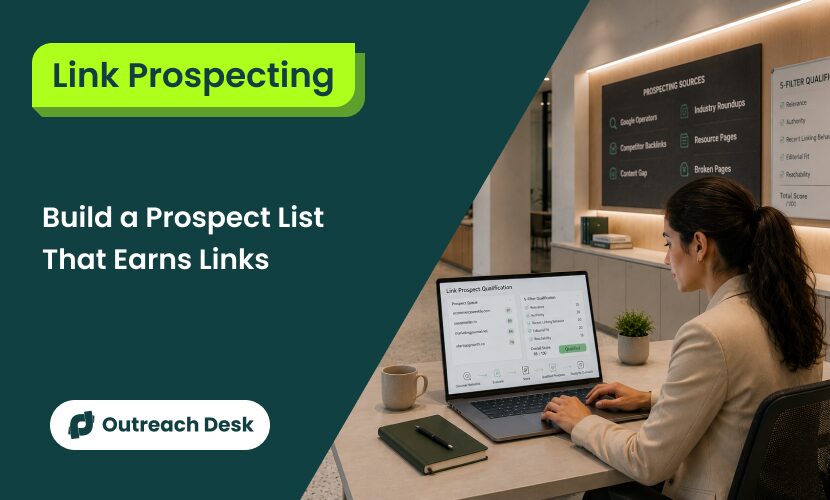
Your outreach list decides whether your campaign earns links or wastes weeks. Before you write a single email, you need websites that are actually worth pitching. That’s link prospecting: finding and qualifying the right targets before you hit send.
When you prospect well, your outreach becomes more targeted, response rates improve, and you spend your time pitching websites that can actually move your SEO forward.
The challenge is knowing which sites deserve your attention, and that starts with a prospecting process that filters out poor-fit websites before you ever hit send.

What This Article Covers
- What link prospecting actually is
- Where to find prospects (six sources that still work)
- The 5-Filter Qualification scorecard for deciding which sites to pitch
- How to find the right contact at any prospect site
- Where AI fits into your prospecting workflow
- Realistic math: what 100 prospects actually become
What Link Prospecting Actually Is
Link prospecting is the work of finding and choosing the websites you want to pitch for backlinks. A backlink is just a link from another site pointing to yours, just like a friend recommending you for a job.

Think of prospecting as the research half of link building.
It’s similar to creating a guest list for a dinner party; you decide who’s worth inviting before you spend time planning the menu.
In a real link building campaign, prospecting comes first.
The process typically looks like this:
- Choose a campaign type, a guest post pitch, or a broken link replacement.
- Find websites that fit your campaign.
- Qualify each site against your selection criteria.
- Send personalized outreach emails requesting a backlink.
The complete campaign planning guide explains the remaining stages.
What matters here is that prospecting is the step that determines whether the rest of the campaign can succeed.
Why the Whole Campaign Rises or Falls on This Stage
The website you choose matters more than the email you write. A perfectly written pitch sent to the wrong website still gets ignored. An average pitch sent to the right website earns a backlink.

The order of operations matters. The website you choose influences three things:
- The editor’s reaction to your pitch
- How well your content fits the site’s audience
- The reputational risk the site takes by linking to you
The email itself is only a thin layer on top.
Quality beats quantity. You’ll see this in your own results. A list of 30 well-qualified websites usually earns more backlinks than a list of 100 random websites, even when both use the same outreach email template.
When you’re starting out, prospecting deserves more time than writing the outreach email itself.
The email can always be improved later. A poor prospecting list cannot be rescued by clever writing. After your list is ready, the next challenge is contacting those prospects in a way that earns replies and links.
Where to Find Prospects: The Sources That Still Work in 2026
Six sources that produce real link prospects in 2026 are: Google operators, competitor backlinks, content gap analysis, roundups, resource pages, and broken pages.
Each source maps to a campaign type, so pick the source that matches what you plan to pitch.
Google Search With Operators
Google is one of the most underused prospecting tools. Plain searches with operators like “write for us”, “your topic”, intitle:”resources” “your topic”, or inurl:guest post “your topic” surface sites that publicly accept the kind of link you want.

The trick is to vary the operators. A single search line gets you maybe 20 prospects. Ten different operator combinations get you 200.
Competitor Backlink Profiles
Pull a competitor’s backlinks in a tool like Ahrefs or Semrush, and you get a pre-validated list of sites that already link to content like yours.
If three of your competitors have a link from the same site, that site is likely to link to you, too.

This is the maximum return source for most beginners. Start by analyzing competitor backlinks from your top three direct competitors, then identify the domains they share.
Content Gap Analysis
A content gap report shows you keywords your competitors rank for that you do not.
Each of those competitors’ URLs is a prospect for one of two things: a guest post pitch, because the topic is in your range, or a broken link replacement target, if their version goes stale.
This source overlaps with competitor backlinks but surfaces a different angle: topics, not domains.
Industry Roundups and Curated Lists
Roundups, “best of” posts, and curated resource lists are prospect goldmines because the editor has already committed to publishing curated picks.
The pattern to search for is “best [your topic]”, “top tools for [your topic]”, or “resources for [your topic]”.

Sites that publish one roundup publish more. Bookmark the one with annual or quarterly updates.
Resource Pages
Resource pages are pages built specifically to link out to useful sites. If your content fits the page’s category, you have a strong claim to be added.

The resource page tactic is a slower source, but the placements tend to be high-quality and long-lived.
Broken Pages on Relevant Sites
Broken link building finds dead links on relevant pages and offers your content as the replacement.
The source quality is high because the page already had a link to this kind of content. The pitch is easier, too, because you’re solving a problem for the editor.

The guideto finding and replacing broken links walks through the full method.
The 5-Filter Qualification Scorecard
Score every prospect across five filters, weight them, and use the total to decide whether to pursue, hold, or skip.
| Filter | Weight | Pass (full points) | Borderline (half) | Fail (zero) |
|---|---|---|---|---|
| Relevance | 25 | Site covers your exact topic regularly | Covers a parent or sibling topic | Off-topic for your niche |
| Authority | 20 | DR 30 or higher with real organic traffic | DR 20 to 29, or DR 30+ with no traffic | DR under 20 or low-quality signals |
| Recent Linking Behavior | 20 | Linked to a comparable source in the last 90 days | Linked to a comparable source in the last year | No external links in over a year |
| Editorial Fit | 20 | Publishes guest content or curated lists | Original only, but updates posts | No history of external contributions |
| Reachability | 15 | Public editor or author contact found | Generic contact form only | No discoverable contact. |
Score interpretation:
- 70 to 100: Pursue this prospect this week.
- 50 to 69: Hold for a revisit; might be worth a different angle later.
- Under 50: Skip
Now look at each filter in turn.
Filter 1: Relevance (25 Points)
Relevance is whether the site covers what you cover. A site that publishes weekly on your exact topic is a 25.
A site that covers a parent topic is a 12 or 13. If your topic’s Shopify SEO covers ecommerce broadly, that’s the parent topic. A site that has nothing to do with your niche is a zero, even if it has high authority.
Relevance carries the heaviest weight because a backlink from a topically matched source is worth several times that of one from an off-topic site, both for ranking and for the real human traffic the link might drive. This is why earning links from relevant websites should always take priority over chasing authority alone.
Filter 2: Authority (20 Points)
Authority is how strong the site’s backlink profile looks. Domain Rating or DR is the most common shorthand.
Domain Rating (DR)
A 0 to 100 score from the SEO tool Ahrefs that estimates the strength of a website’s backlink profile based primarily on the quantity and quality of its referring domains.
DR alone is misleading. A site can have a DR of 60 because it ran a paid link scheme years ago and now has no real readers.
A small, growing site with a DR of 28 and 12,000 monthly organic visitors is a better prospect than the DR 60 ghost town.
If you want to go deeper into signal evaluation, the guide to auditing a site’s link profile covers the complete process.
Filter 3: Recent Linking Behavior (20 Points)
Recent linking behavior looks at whether a website has recently linked out to external sources similar to yours.
If a site hasn’t included an external link since 2021, it likely doesn’t regularly link to other websites.
On the other hand, a site that has linked to two of your competitors in the past 90 days clearly does.
This filter matters, but is skipped by many beginners. It is one of the most reliable indicators of whether your outreach is likely to get a response.
A site’s past behavior is often a strong predictor of how it will behave in the future.
Check whether the site has appeared in Google AI Overviews (the AI-generated answer panels that appear for certain search queries). Sites picked up there are actively managed and worth more as prospects.
Websites that are picked up for AI search are usually:
- Publishing up-to-date content
- Actively managed from an editorial standpoint
- More likely to be valuable link prospects
Filter 4: Editorial Fit (20 Points)
Editorial fit measures whether a website’s publishing style can naturally accommodate the type of links you’re trying to earn.
For example, consider how different types of websites handle content and contributions:
- A website that regularly publishes guest posts is a good fit for a guest post pitch.
- A website that frequently updates older articles is a good fit for a niche edit (a backlink added to an existing published article).
- A website that usually publishes only weekly news and has no outside contributors isn’t a good fit for either approach.
To evaluate editorial fit, review the website’s last 10 published posts. Then check:
- How many posts name a guest author at the top? That’s your signal the site accepts outside contributions.
- How many posts link to external, non-news sources or show signs of being updated after publication?
If you find three or more examples across those checks, the site passes the editorial test.
Filter 5: Reachability (15 Points)
Reachability measures whether you can actually get in touch with a real person at the website.
A site that lists an editor by name along with a public email address scores 15 points. A site that only provides a generic contact form scores around 7 to 8 points.
A site with no visible contact method at all scores 0, no matter how strong it looks in every other area.
Reachability carries the lowest weight in the scorecard because the other four filters have a greater impact on link quality. Even so, a perfect prospect you can’t contact is practically unusable since there’s no reliable way to pitch your content.
Imagine you’re evaluating a Shopify-focused blog for a guest post opportunity.
The site is highly relevant to your niche, receives approximately 18,000 monthly organic visitors, has accepted two guest posts in the last month, links to ecommerce resources regularly, and lists a named editor on its about page.
However, its Domain Rating (DR) is 13, so it scores 0 for authority. Despite that weakness, the site still earns 80 out of 100 because it performs exceptionally well across the other four filters.
Here’s a prospect score:
| Filter | Score |
|---|---|
| Relevance | 25 |
| Authority | 0 |
| Recent Linking Behavior | 20 |
| Editor Fit | 20 |
| Reachability | 15 |
| Total | 80 on 100 |
It means that an 80 out of 100 is a strong prospect. The low authority score is the only major drawback, but the site is highly relevant, actively links to external content, has a clear editorial contact, and is open to contributions.
Depending on your campaign goals, this prospect is worth contacting, especially if you’re prioritizing topical relevance and realistic outreach opportunities over domain rating alone.
Finding the Right Person to Email
The right person to contact is the one who can actually publish your link. In most cases, that’s:
- An editor
- The author of the article you want to update
- The person responsible for the resource page
Three discovery methods cover most of the work, listed here in order of success rate.
Method 1: LinkedIn First
LinkedIn is the highest-hit-rate tool for finding a real contact at a prospect website. Search for the company, then filter for roles such as:
- Editor
- Writer
- Content Manager
- Head of Content
This usually leads you to the right person.

LinkedIn works better with email-finding tools for one simple reason: it shows who currently works there, not who used to.
An email finder might return the address of someone who left the company 18 months ago. LinkedIn helps you identify the person who currently holds the role.
Method 2: About, Team, and Author Pages
If LinkedIn doesn’t give a useful contact in return, the website itself often will. Look for pages such as:
- About
- Team
- Contributors
You can also click the author’s name on a recent article. Many websites publicly list editor names and, in some cases, email addresses.

This approach is slower than LinkedIn, but it often gives you the clearest answer because the website is identifying the right contact for you.
Method 3: Email Finders as the Backstop
Email finding tools such as Hunter.io, Snov.io, and Apollo.io take a person’s name and company domain and suggest likely email addresses.
Use them after you’ve identified a real person, not as your first step. Starting with a verified name produces cleaner results and helps you avoid bounced emails from guessing at address formats.

Both tools offer free plans that are worth trying before paying for either service.
The practical reality is that most contact discovery comes down to a simple two-step process:
- Find the right person on LinkedIn or the website itself.
- Confirm their email address using an email finder tool, such as Snov.io.
The more advanced tactics rarely outperform that combination. If you want to compare these and other prospecting tools in more detail, the guide to the best link building tools covers the strengths of each option.
One Unpopular Truth
Most contact discovery is LinkedIn plus a quick email pattern check. The fancier tactics rarely beat that combination.
How to Organize a Prospect List You Can Actually Work
A useful prospecting list lives in a single spreadsheet or database. Keep one row per prospect and track only the information you need to know what to do next.
Use these fields in every prospect list.
| Column |
What Goes in it |
|---|---|
| Prospect URL | The page where you’d like to earn the backlink, or the homepage if you haven’t identified a specific page yet |
| Contact Name and Email | The contact information gathered during your research |
| Scorecard Total | The prospect’s 0-100 qualification score |
| Status | Sourced, Qualified, Pitched, Replied, Won, or Lost |
| Last Touch Date | The date you most recently sent or received an email |
| Notes | One line of context, such as your outreach angle, a personal hook, or a referral |
Start simple: a Google Sheet or Notion table is enough for most campaigns. Both are free and work well for prospect lists with fewer than 200 prospects.
Once you’re managing more than 200 active prospects or running multiple outreach campaigns at the same time, a spreadsheet starts becoming harder to maintain.
That’s when dedicated outreach tools such as Pitchbox or Respona begin to justify their monthly cost.
A Rule of Thumb
If you’re spending more than 30 minutes a week updating prospect status, an outreach platform will likely save enough time to pay for itself.
Where AI Fits Into Link Prospecting in 2026
AI tools like ChatGPT and Claude are now part of seasoned link builders’ prospecting workflows. AI speeds up three specific tasks. It reliably fails at three others. Use it for the right one.

A 2025 survey of 105 link builders by Omniscient Digital found that 36.2% use AI specifically for prospecting tasks.
Where AI Helps
AI genuinely speeds up several parts of the prospecting process.
-
Generating Google Search Operators
Ask an AI assistant to generate 20 advanced Google search operators for your topic. (Doing this manually can take 20 minutes)
-
Summarizing a prospect page
Summarizing pages into an AI tool to quickly understand: whether the topic matches your campaign, how recently the site has been publishing, and whether it accepts outside contributions in seconds.
-
Drafting personalized angles
By pasting one of the prospect’s recent articles into an AI tool and asking for two specific points you could complement in your outreach email without sounding generic.
Where AI Hurts
AI can speed up prospecting, but it consistently performs poorly in three areas.
-
Inventing URLs:
Ask an AI assistant for “20 high-DR sites in my niche,” and a meaningful number of the URLs may be invented, outdated, or no longer exist. Always verify every URL manually.
-
Inventing email addresses:
AI often generates email addresses that look realistic, but they actually don’t exist. Instead, you rely on guesses and use a dedicated email-finding tool to verify contact information.
-
Scoring authority:
AI doesn’t have access to live Domain Rating (DR) data. Anything it says about a site’s authority score is either out of date or made up.
A Rule to Follow:
Use AI for the writing and summarizing parts of prospecting. Don’t use it for the verification parts.
The best use we’ve found for AI in prospecting: paste a project’s recent article and ask for two specific angles your pitch could complement.
That takes 90 seconds and produces a far sharper email than reading the article yourself under time pressure. The DR scoring and URL verification still happen manually; AI gets those wrong consistently.
For a deeper look at using AI throughout the link building process, the ChatGPT for link building guide covers prompts, workflows, and practical use cases.
Realistic Yield Math: What 100 Prospects Actually Become
Each outreach campaign starts with a raw prospect list. This is simply a collection of websites that appear to match your niche before you’ve checked their quality.
From the raw list, you apply the five qualification filters to remove poor-fit websites. Based on our benchmark, 100 sourced (raw) prospects produce 4 to 7 placed links by the end of a campaign.
This conversion ratio is one of the most important numbers for beginners to understand.
A typical prospecting funnel process looks like:
| Stage |
Typical Result |
|---|---|
| Sourced prospects | 100 |
| Qualified prospects (score of 70+) | 30 |
| Prospects actually pitched | 25 |
| Replies received | 6 |
| Placed links | 4-7 |
Our benchmark: Across recent campaigns, 100 sourced prospects typically produce around 30 qualified prospects, 25 outreach emails, and 4 to 7 placed backlinks.
The Honest Truth:
Many beginners build a list of 20 prospects, get no backlinks, and conclude that prospecting doesn’t work.
A 20-prospect list produces zero links at normal conversion rates. That isn’t a prospecting problem. It’s a funnel-size problem.
The real fix is rarely to write a longer email or come up with a cleverer pitch. The solution is putting more qualified prospects at the top of the funnel. If your goal is to earn five backlinks in a quarter, start with 100 to 150 qualified prospects, not 25.
Common Prospecting Mistakes That Kill Outreach Before It Starts
Five mistakes appear repeatedly in beginner prospect lists. Any one of them can reduce conversion rates. The most common mistake among the new clients is the first one.

Mistake 1: Sourcing Only From the Top 10 Google Results
Many beginners search for their target keyword on Google and add the top 10-ranked websites directly to their prospect list.
Those websites are often:
- The most heavily pitched
- The most accustomed to ignoring cold outreach
- The least likely to respond
The better approach is to focus only on the first page of search results, and look at websites ranking between positions 11 and 50. These sites are often still growing, actively looking for exposure, and generally more receptive to a well-targeted outreach pitch.
Mistake 2: Treating Domain Rating as the Whole Picture
A website with a DR 60 and no real audience is not the same as a website with a DR 28 and 12,000 monthly visitors. Domain Rating (DR) is only a signal.
The better approach is to use the complete 5-filter scorecard rather than relying on DR alone.
Remember:
- Authority accounts for 20 points out of 100.
- The remaining 80 points come from factors such as relevance, recent linking behavior, editorial fit, and reachability.
A strong prospect is one that performs well on the entire scorecard, not just on a single metric.
Mistake 3: Skipping the Editorial Fit Check
A website can score well on every other filter and still be the wrong prospect. The reason is simple: it doesn’t publish the type of content your outreach depends on.
For example, a quick scan of recent content often reveals clear patterns in how a site operates:
- A news-only website usually doesn’t accept guest posts.
- A website that publishes only staff-written content usually can’t accommodate a niche edit.
A simple check is to spend 60 seconds reviewing the site’s last 10 published posts. That quick review will usually tell you whether the website can realistically accommodate your pitch before you spend time writing it.
Our niche edits on topic-matched sites go through this editorial fit check before any pitch.
Mistake 4: Over-Personalizing 5 Emails Instead of Solid-Personalizing 30
Spending an hour writing an email for just five prospects might seem productive, but it focuses efforts in the wrong place. Link acquisition requires maintaining sufficient volume at the top of the funnel.
A better approach is to spend 8 to 10 minutes personalizing each email across a list of 30 to 50 qualified prospects.
Focus on meaningful personalization, such as:
- Mentioning a recent article you actually read.
- Refreshing a specific insight or takeaway.
- Explaining the value your content brings to their audience.
That level of personalization consistently outperforms a 1,000-word email written for only a handful of prospects.
Mistake 5: Deleting Prospects Who Say No Instead of Nurturing Them
A “no” today often becomes a “yes” six months later. Many websites regularly refresh roundup articles, update resource pages, or launch new content series, creating fresh linking opportunities.
Instead of deleting prospects who say no, try this:
- Keep them on a dedicated revisit list.
- Review that list before sourcing new prospects for your next campaign.
- Reach out again when the timing or content is a better fit.
Think Long Term
This is where prospecting starts to overlap with long-term outreach relationship building. Your prospect list isn’t just a collection of websites. It’s the place where your relationship history begins, making future outreach more informed and more effective.
Build Your First Prospect List This Week
Open a Google Sheet and pull 30 prospects from a single source. Score them in the 5-filter scorecard and pitch the ones that hit 70 or higher.
That’s your first batch; the second read of this article lands differently once you’ve worked one real round.
Looking to build a prospect list that earns real links?
Get a prospecting strategy focused on relevance, authority, and real link opportunities.
How is link prospecting different from link building?
The difference between link prospecting and link building is that prospecting is the research stage, while building is the complete process.
Prospecting builds the sites worth pitching. Link building includes prospecting, including outreach, follow-up, content creation, and placement work that earns the actual links.
How long does link building prospecting take per prospect?
A well-qualified prospect takes roughly 5 to 10 minutes from sourcing to the moment it lands in your sheet with contact name and a scorecard total.
The first batch always takes longer because you’re still building the operator searches and tools. By the third batch, the per-prospect time drops by half.
What’s the Fastest Way to Build a Reliable Prospect List Without Starting From Zero?
Borrowing an existing publisher network beats building one from scratch. A specialist link building agency already has vetted relationships across most niches, so the prospect list comes pre-qualified instead of requiring weeks of cold research before the first pitch goes out.”
Can I prospect without paying for Ahrefs?
Yes, with effort. Google search with operators covers free sourcing. Hunter.io’s free tier limits lookups to a set number per month.
The trade-off is time. Paid tools shrink a one-hour task to ten minutes. For your first 100 prospects, free is fine. Past that, the tools start paying for themselves.
Should I prospect first or write the linkable asset first?
Build the link worthy asset first. Prospecting is shaped by what you have to pitch.
The same prospect list looks completely different depending on whether you have a guest post draft ready, a data study, a free tool, or a finished comparison piece. Build the asset, then prospect for the right ones.
Is HARO still worth using for prospecting?
HARO (Help A Reporter Out, which connected journalists with expert sources) shut down in December 2024 with its Connectively rebrand. Featured.com relaunched it in April 2025.
HARO Replacement services like Featured.com and Qwoted serve a similar function, but their volume is lower, and their quality is mixed. Treat journalist-query services as one of many sources, not as a primary prospecting channel.