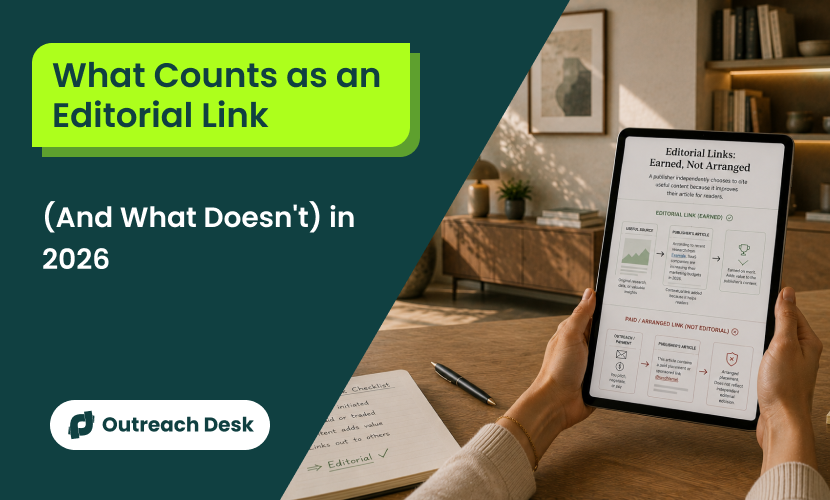
There’s a difference between ‘You trade a link’ and ‘You earn a link.’ Editorial links fall into the second category.
You earn editorial links when other websites add a link to your site organically without asking for money in return. A publisher adds a link here on its own because your high-value content earned it.
Simple, right? But proving one is harder, especially when a report labels some backlinks as editorial, and you have no way to check.
Key Takeaways
- Learn the exact difference between an editorial link and a paid, guest-posted, or negotiated one.
- Use a 3-question test to verify any link before you call it editorial.
- See why Google and AI search tools still treat editorial links as the strongest signal you can earn.
- Find out whether a nofollow editorial link is still worth pursuing in 2026.
- Get real 2026 data on how often outreach pitches earn a response.
- Compare editorial links, guest posts, and niche edits so you stop mixing them up.
Editorial Link vs. Everything Else You Paid For
The difference between an editorial link and other links is about who moves first. You earn editorial links when a third-party website naturally links to your website. Here, you don’t reach out to publishers and ask for a link.
Publishers consider your content valuable to their audience and position your site as a trusted source. This content is also known as link-worthy content or linkable content assets.
Every other link type (guest posts or niche edits) in your outreach spreadsheet requires you or your agency to make the first move. You usually pay for it too, in time, content, or cash.
| LINK TYPE | WHO STARTS THE CONTACT | DO YOU PAY OR TRADE FOR IT |
|---|---|---|
| Editorial link |
The publisher, unprompted | No payment is required |
| Guest post |
You, pitching an article to run on their site | Sometimes, your writing time or a fee |
| Niche edit |
You, asking to be added to existing content | Usually, a placement fee |
| Paid or negotiated link |
You or your agency | Yes, you pay for it |
Whoever moves first, the publisher or you, decides whether the link is editorial or a paid placement.
Paid placements sit at the far end of that spectrum, including links agencies buy through networks of low-quality sites that exist only to sell links.
But does that mean guest posts and niche edits are bad tactics? No. Both are important in acquiring backlinks.
Read about earning links through guest posts or how niche edits actually work elsewhere in this guide.
Neither one is an editorial link, even when it works well. The problem starts when someone calls a guest post or a paid placement “editorial,” making it sound earned rather than arranged.
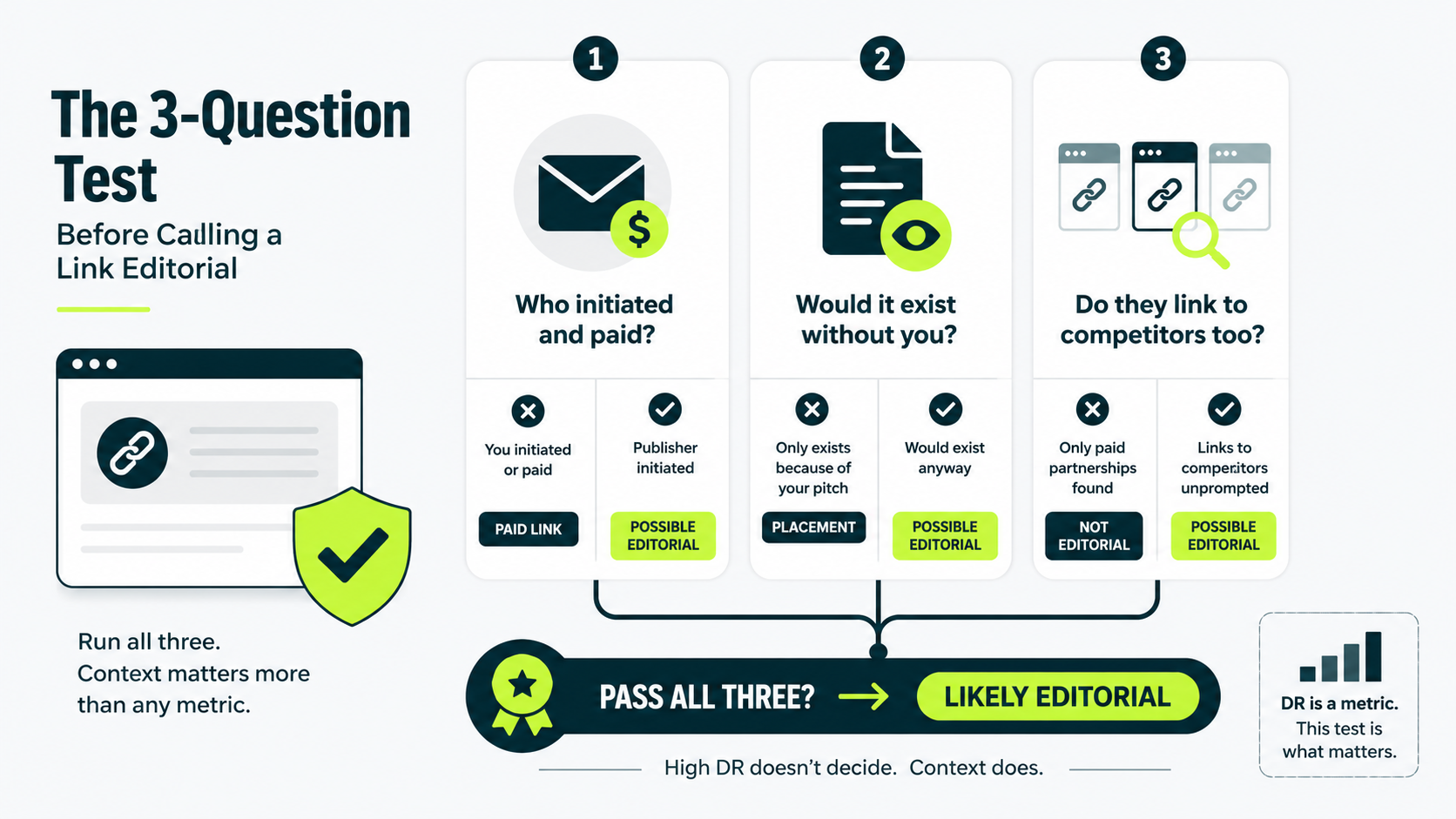
Ask 3 Questions Before Calling a Link Editorial
Ask who initiates contact or pays for the placement, whether the content can exist without outreach, and whether the same publication links to your competitors in the same way.
Run three questions on any link before you call it editorial, whether you’re checking an agency’s report or your own outreach results.
1.Did your team start the contact, or pay for the placement?
The first mover determines whether the link is editorial. If you or your team member initiates the contact and exchanges fees, you have acquired a paid link, not an editorial one.
2.Would the piece exist without your outreach?
If the piece only exists because you pitched it, it is not an editorial link. High-value content, pages, or tools are the source of earning editorial links.
This indicates that the publisher has considered your page the best available source to help their readers. If the article only exists because you pitched it, that’s a placement rather than an editorial pickup.
3.Does the same publication link out to competitors the same way, unprompted?
This is the important one. Before you get excited, check a few of their other recent articles.
If the publisher has also linked to your competitors as a part of routine work, your link fits the same pattern. If every outbound link on their site traces back to a paid partnership, then it’s not an editorial link.
A high Domain Rating (DR, Ahrefs’ 0 to 100 score for how strong a site’s backlink profile is) doesn’t answer any of these three questions. Why?
Because a DR 80 site can still sell you a placement.
A DR 20 blog can still hand you a genuine editorial mention. Run the test regardless of the number.
We run this test on every placement before it goes into a client report. It takes two minutes, but it saves us from reporting a placement as a success.
Red Flags in an “Editorial” Link Report
Before running the 3-question test row by row, scan the report for these patterns. Any one of them means the label is doing more work than the link earned.
- Every “editorial” link lands within days of an outreach campaign starting.
- The publisher’s domain has no other unprompted outbound links to competitors or peers.
- Your team chose the anchor text, not the publisher.
- The placement fee line item disappeared, but a “content fee” or “writing fee” showed up instead.
- The same handful of sites appear as “editorial” wins across multiple unrelated clients.
Why Google (and AI Search) Still Treat These as Your Best Links
Google trusts an editorial link more than almost any other type because no one paid to influence the recommendation.
That taps directly into E-E-A-T (Experience, Expertise, Authoritativeness, and Trustworthiness), Google’s own framework for deciding who to trust.
That’s the same reason you trust a friend’s restaurant tip over a paid ad: the friend had nothing to gain by pointing you there.
Editorial links carry extra weight in AI search too.
Tools like AI Overviews, the AI-written summary Google shows above normal search results, pull answers from pages other sites already treat as trustworthy.
An unprompted mention from a real publication is exactly that kind of signal.
When a real publication cites your page without you having to ask, that’s a stronger trust signal than a link you arranged yourself.
For the deeper playbook, see getting cited in AI search results without needing the top organic ranking.
None of this means paid or negotiated links are worthless. It means an editorial link does something the others can’t fake. It tells Google someone with nothing to gain still chose you. That’s the strong point your website earns.
Does a nofollow editorial link still count?
Yes, it still counts, even though it won’t pass the same direct ranking credit as a dofollow link.
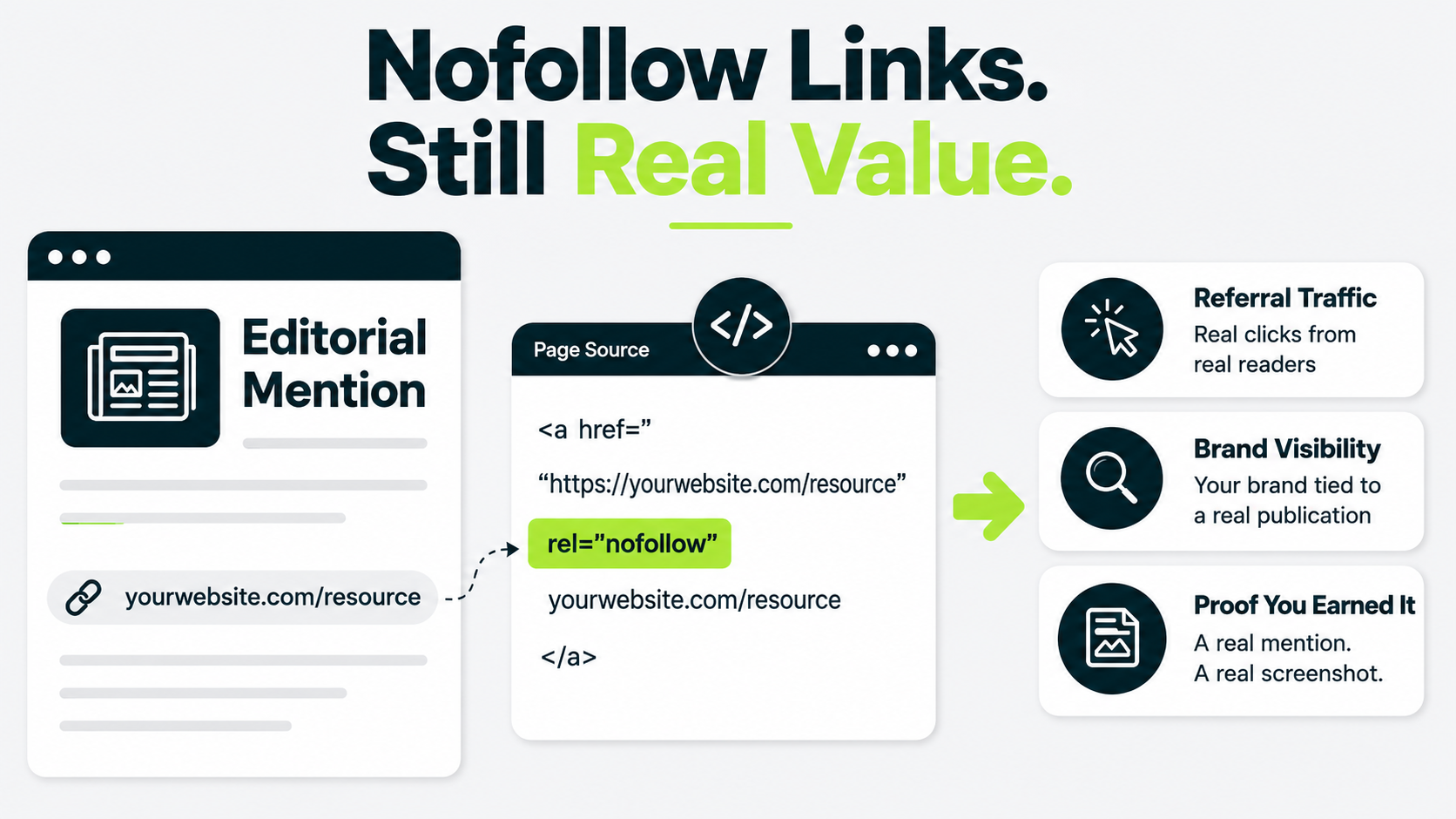
Nofollow is an HTML attribute, rel=”nofollow”, that tells Google not to pass ranking weight through that one link.
Some publishers add it to every outbound link on their site as a blanket policy, rather than as a judgment on your page.
That blanket policy is exactly what trips people up.
What is Blanket Policy?
Blanket policy means the site nofollows all outbound links by default, and that rule applies without exceptions.
It’s more about how you built the site. A news site, for instance, might nofollow every external link in its articles to keep editorial and paid content separate.
You earn a real mention from a real publication, check the link attribute, and feel like you wasted the effort.
Read the full dofollow versus nofollow breakdown before you write off any nofollow placement.
A nofollow editorial mention is not a wasted placement. The advice that nofollow links are worthless is outdated. You still get three real things from a nofollow editorial mention:
- Referral traffic from people who click through and read.
- A brand mention search engines can tie to your business as an entity.
- A real publication cites your page.
How Editorial Links Get Earned
Three things actually produce editorial links: content worth citing, enough visibility that someone finds it, and existing coverage that makes a new mention feel safe to add.
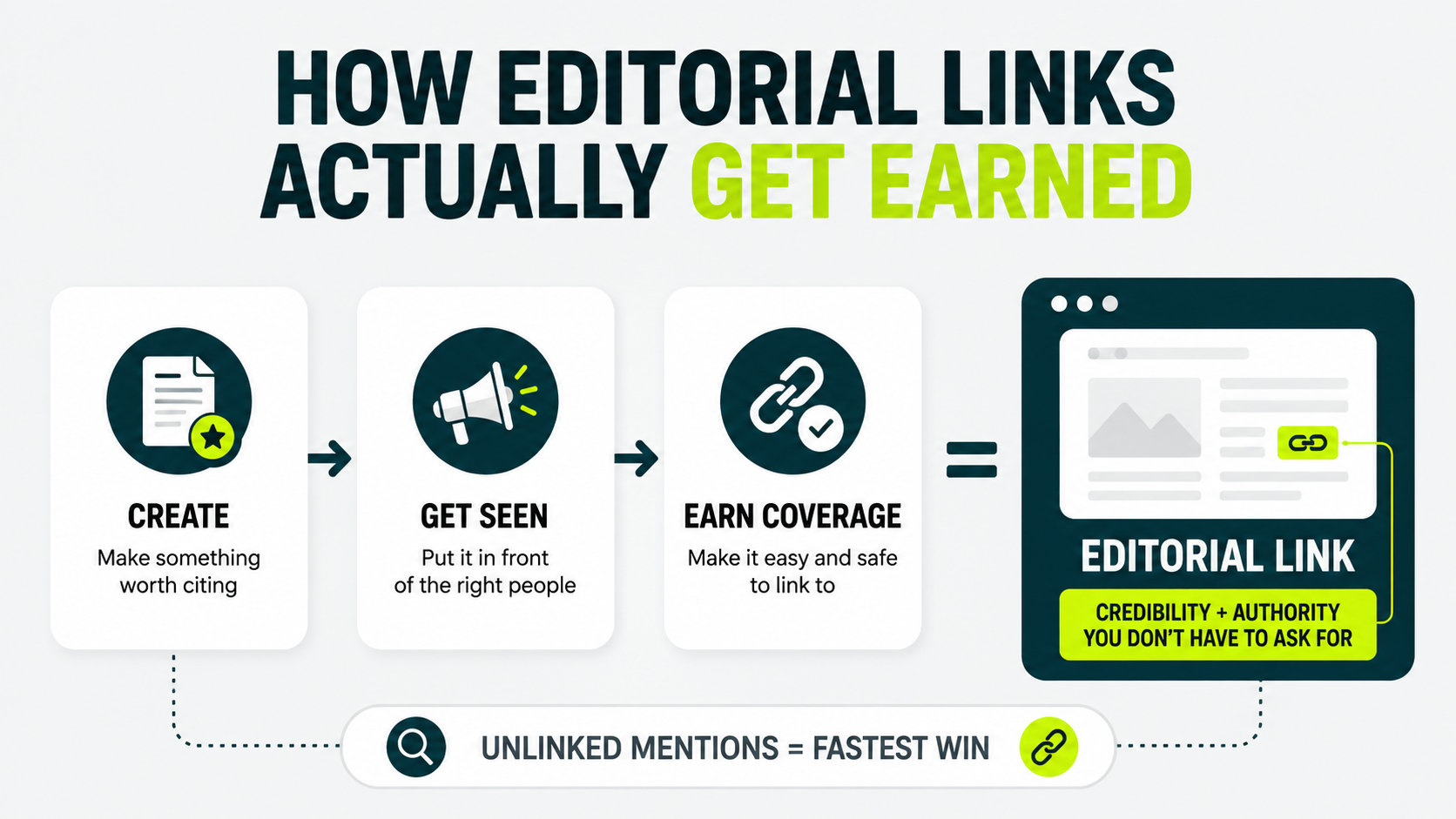
You don’t control the third one directly, but the first two are in your hands.
Licensed professionals have an edge on that third one, since accounting firm link building turns the license into listings.
Publishing something worth citing comes first. It includes original data, a free tool, or the clearest explanation of a topic that other sites cover badly or haven’t covered in depth.
Journalists and bloggers link to sources that make their own article better, not to companies they feel sorry for.
Visibility is where most of the real work happens. HARO (Help A Reporter Out) connects journalists who need sources with people who can answer.
It’s one place to start. Whether HARO is still worth it in 2026 is genuinely debatable, so read that before you build a process around it alone.
A digital PR campaign you build around original data or a useful tool tends to earn more coverage than cold pitching. Journalists come to you instead of the other way around.
Unlinked mention recovery, finding places that already named your brand without a link, is the fastest win on this list. You’re not earning something new. You’re just asking for credit you already deserve.
What Realistic Response Rates and Timelines Look Like
Real editorial coverage takes months because publications work on their own timelines.
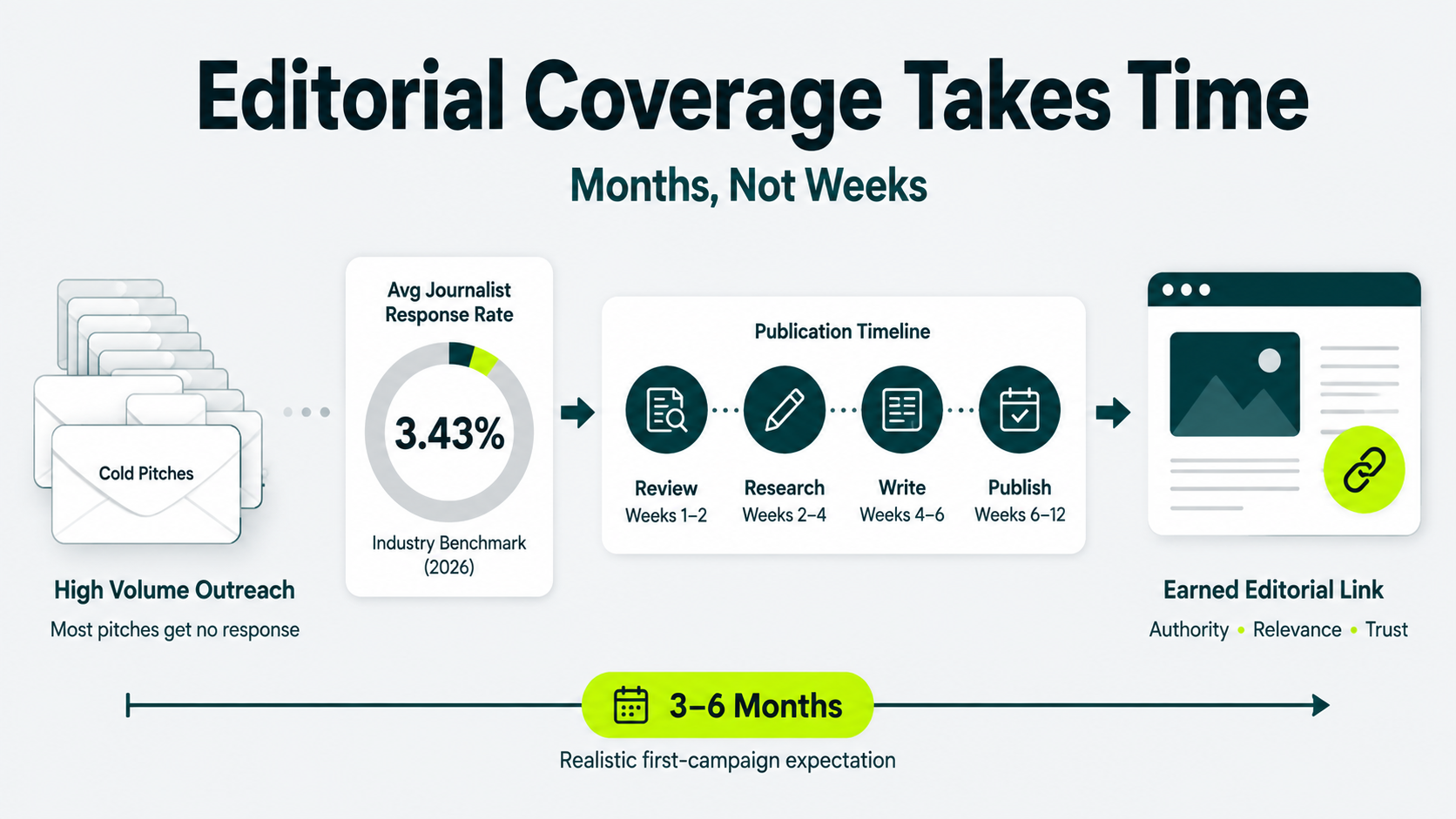
If you were quoted a faster turnaround, that promise was not realistic.
Reporter Outreach’s State of Link Building survey polled 500 SEO professionals in 2026.
Digital PR, earned coverage built around original research or a genuinely useful asset, came out as the single best-performing tactic. 34% of respondents picked it as their top performer, almost double the 18% who picked guest posts.
That gap tells you where to spend your time if editorial coverage is the actual goal.
Cold pitch response rates are low. The average journalist response rate is just 3.43%, per 2026 PR industry benchmark data.
Expect most individual pitches to go nowhere.
Plan your outreach volume around that reality instead of treating one quiet inbox as proof you’re doing it wrong.
Outreach Desk’s own campaigns see reply rates of 5 to 10% on personalized editorial pitches, well above that industry baseline, with first placements landing within 4 to 8 weeks.
For the wider data set behind link building performance, more link building statistics for 2026 cover it beyond editorial coverage alone.
Budget 3 to 6 months before editorial links become a reliable part of your link profile.
That’s a realistic first-campaign expectation, not a disappointing one.
Editorial Links, Guest Posts, and Niche Edits Aren’t the Same Thing
Agencies use these three terms interchangeably in reports, which is exactly how they mislabel a paid link as earned.
| FACTOR | EDITORIAL LINK | GUEST POST | NICHE EDITS |
|---|---|---|---|
| Who writes the content | The publisher, already | You, as a new article | Nobody, it’s already published |
| Who starts the contact | The publisher | You | You |
| Typical cost | None | Your writing time, sometimes a fee | Usually a placement fee |
| Where it lives | Inside existing or planned coverage | A brand-new article | An edit to an old article |
Guest posts and niche edits both have a real place in a link building plan.
They’re just not editorial links, and a report that blurs the three is either careless or hoping you won’t check.
For the full picture of where these fit among the other backlink types, that’s the pillar guide for this whole topic.
Where Editorial Links Fit in Your Link Building Plan
Editorial links sit at the top of a pyramid that other tactics feed.
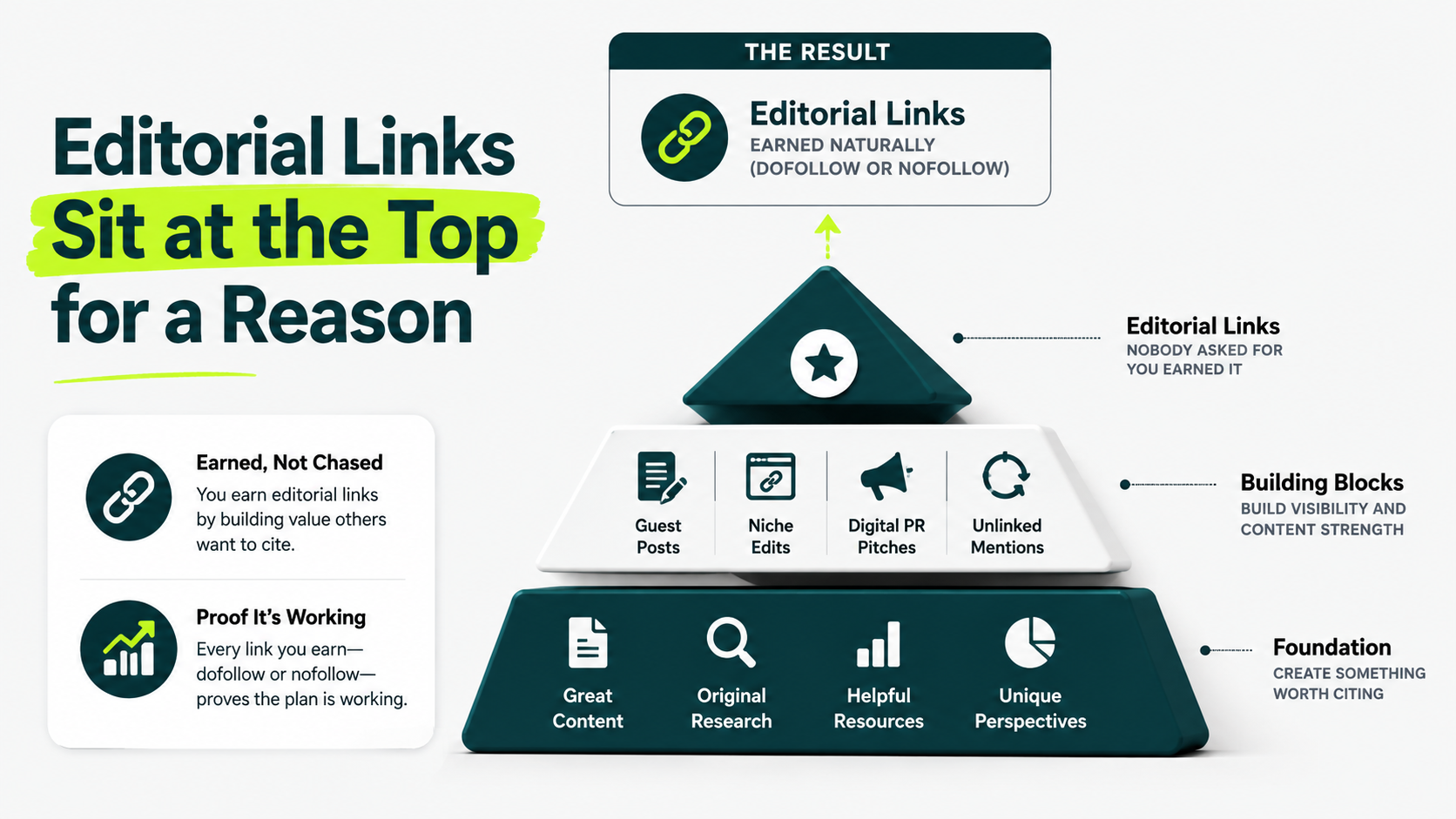
Guest posts, niche edits, digital PR pitches, and unlinked mention recovery all build visibility and content strength.
That’s what eventually earns you a link nobody asked for. Chasing editorial links before you’ve built anything worth citing usually ends in frustration.
There’s nothing yet for a publisher to find. Run the 3-question test on everything a report labels as editorial.
Keep building the content and coverage that make earning them realistic. Then treat every dofollow or nofollow mention you earn as proof the plan is working.
Run the Test on Your Next Editorial Link Report
Open your last “editorial” link report and run the 3-question test on the first placement listed. You’ll find at least one that doesn’t pass.
That’s useful information, not a bad outcome. Now you know what you’re paying for.
Want Your Content to Earn More Links Naturally?
Build visibility with relevant publishers and create more opportunities for genuine editorial mentions.
What is an editorial link?
An editorial link is one a publisher adds on their own because your content earned it through its value. Here, you are not asking for paid placements. It’s the opposite of a link you pitched, negotiated, or bought: a genuine organic citation instead.
Are editorial links better than guest posts?
For pure ranking trust, yes, because nobody arranged the placement. Guest posts still earn real value: referral traffic, brand exposure, and sometimes a dofollow link too.
They carry a different kind of trust signal, since you wrote and pitched the piece yourself. Use both. Don’t treat one as a replacement for the other.
What should I avoid when seeking editorial links?
Avoid any agency or service that guarantees editorial links on a fixed timeline. By definition, nobody controls when a publisher decides to link to you unprompted.
A guarantee usually means the “editorial” link is a paid placement wearing a nicer label. Run the 3-question test from earlier in this guide on anything you’re handed.
Do editorial links from blogs count as much as links from news sites, or is there a real gap?
There’s a real gap, but it runs on relevance more than format. A well-matched blog covering your exact topic often carries more weight than a news site that only mentioned you in passing, since search engines and readers both value context over prestige.
News sites bring wider exposure and often more referral traffic, but that doesn’t make blog links a lesser tier on their own. A dedicated outreach team typically pursues both, weighing each opportunity on how closely it matches your niche rather than sorting sites into “blog” versus “news” from the start.
How long does it take to earn an editorial link?
Editorial links take months to earn. Outreach Desk’s own campaigns typically land first placements within 1 to 2 months, with editorial pitch reply rates running 5 to 10% for personalized outreach.
Budget 3 to 6 months of consistent content and outreach before editorial links become a reliable, repeatable part of your results.
Do editorial links help with AI search visibility?
Yes. AI tools tend to cite pages other sites already treat as trustworthy. An unprompted editorial mention is one of the clearest trust signals a page can earn. It’s not a guarantee of a citation, but it puts you in the right pool.
Is a nofollow editorial mention worth pursuing?
Yes. You lose the direct ranking credit, but you keep the referral traffic, the brand mention, and the proof that a real publication chose to cite you. Treat it as a win, not a consolation prize.