Someone just emailed you asking to swap links. Or you’ve heard the term “reciprocal link building,” but you’re not sure if it’s a real SEO strategy or something that penalizes your site.
Reciprocal links are hyperlinks where two websites point to each other.
Whether that arrangement helps, hurts, or does nothing for your rankings depends on three factors: the relevance of the sites, how often you do it, and whether the pattern looks coordinated to Google.
What You’ll Learn
- What reciprocal links are and how they differ from an arranged link exchange scheme.
- What Google’s spam policy actually says about link exchanges, in specific terms.
- The difference between a link that’s algorithmically discounted and one that triggers a manual penalty.
- Three signs that a link exchange has become risky.
- A 3-question filter for evaluating any swap offer that lands in your inbox.
Reciprocal Links, Explained From Scratch
A reciprocal link forms when two websites link back to each other. Site A links to Site B, and Site B links back to Site A.
Understand this with a simple example:
Site A publishes an article about hiking gear and links to Site B’s review of trail running shoes. Site B links back from that review to Site A’s training guide. Each site now has a link pointing to the other’s content.
There’s nothing automatically wrong with that arrangement.
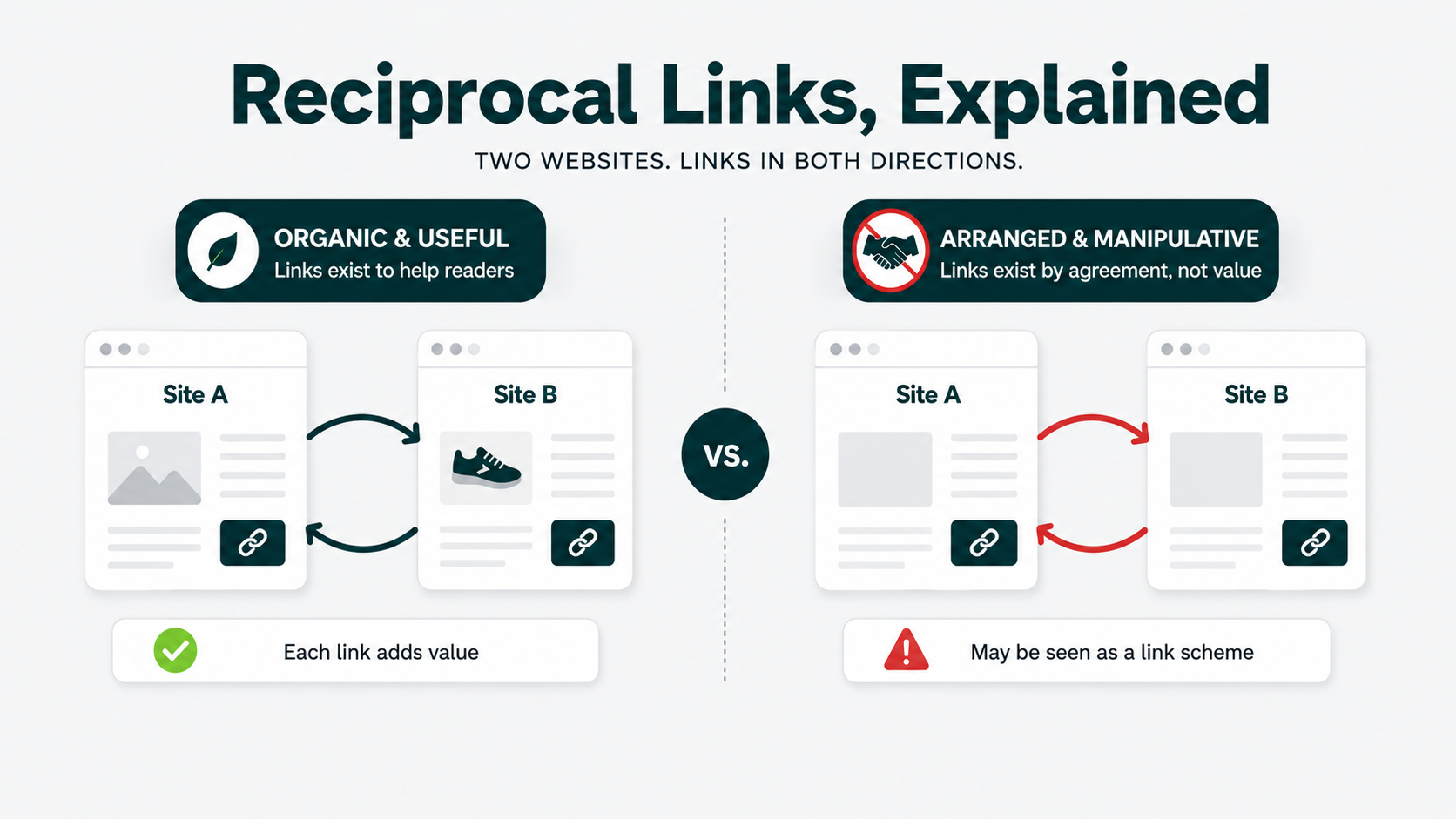
Websites covering overlapping topics often link to each other because their content is useful to the same readers.
The term “reciprocal link building” usually refers to the more deliberate version. Two site owners agree to link to each other in advance, not because either link serves their readers.
That distinction between organic and arranged matters to Google, and it’s the core of what this article covers.
Reciprocal links are one type within a broader category.
The guide to backlink types explains how reciprocal links compare with editorial, directory, and other common backlinks.
What Google Prohibits, and What It Actually Allows
Google’s link spam policy identifies two specific patterns as violations: “excessive link exchanges” and creating “partner pages exclusively for the sake of cross-linking.”
Both descriptions hinge on the words “excessive” and “exclusively.”
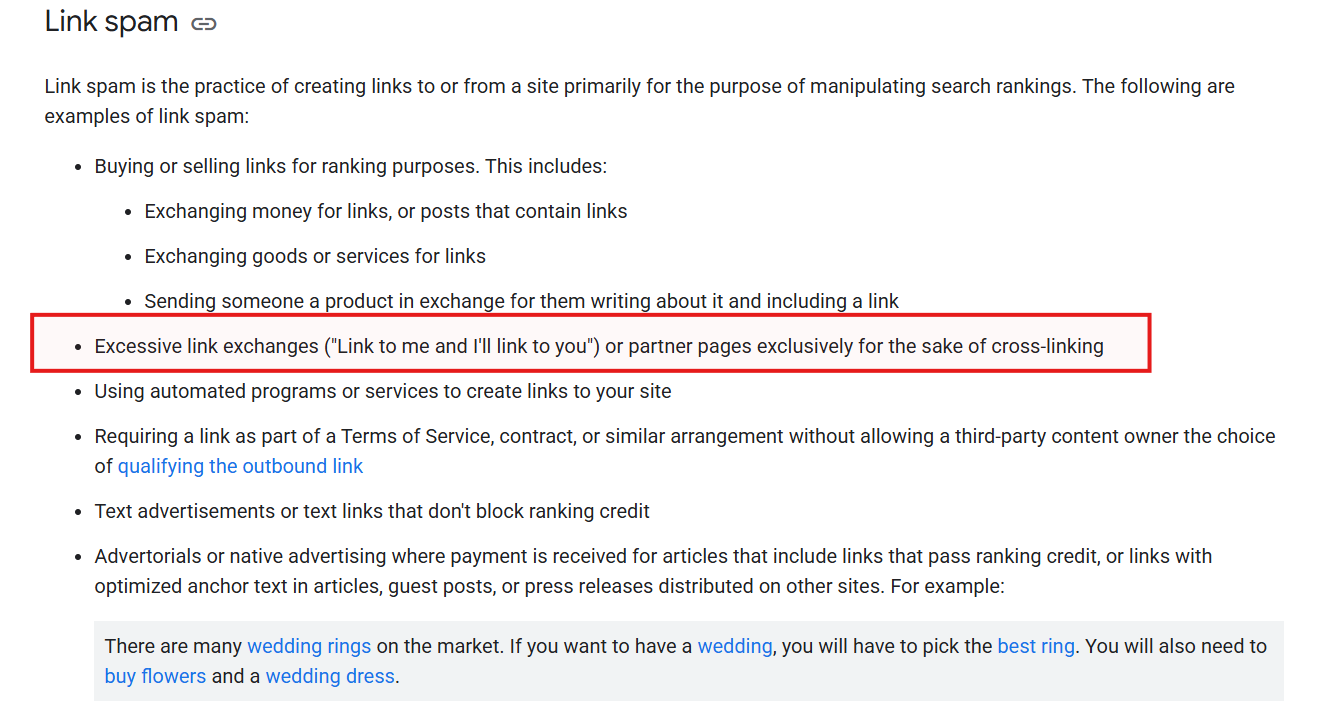
A single link exchange between two relevant sites doesn’t fall into either category. What Google targets is scale-based manipulation: building networks of mutual links specifically to inflate authority signals across multiple domains.
The more important distinction for most site owners is the one between an algorithmic discount and a manual penalty.
An algorithmic discount means Google’s systems detect that a link looks reciprocal or arranged and simply don’t count it. The link exists in your backlink profile (the full collection of inbound links pointing to your site). It just doesn’t pass any ranking credit.
You won’t receive a warning in Google Search Console. There’s no notification, and no site-level consequence. Google simply ignores the link.
A manual penalty works differently. A Google reviewer examines your link profile and determines that you’re running a deliberate link manipulation scheme. That triggers an action in Google Search Console and can suppress the site’s rankings until you address the issue.
For a small site with a handful of reciprocal links, the realistic outcome of a borderline exchange is an algorithmic discount, not a manual penalty. The common link building myths guide covers how people often mistakenly combine these two outcomes.
The risk of a manual penalty rises with scale and intent: dozens of arranged exchanges, partner pages site owners build specifically for cross-linking, or coordinated anchor text across multiple sites. That kind of behavior is what crosses into systematic link scheme violations.
Three Signs a Reciprocal Link Exchange Turned Risky
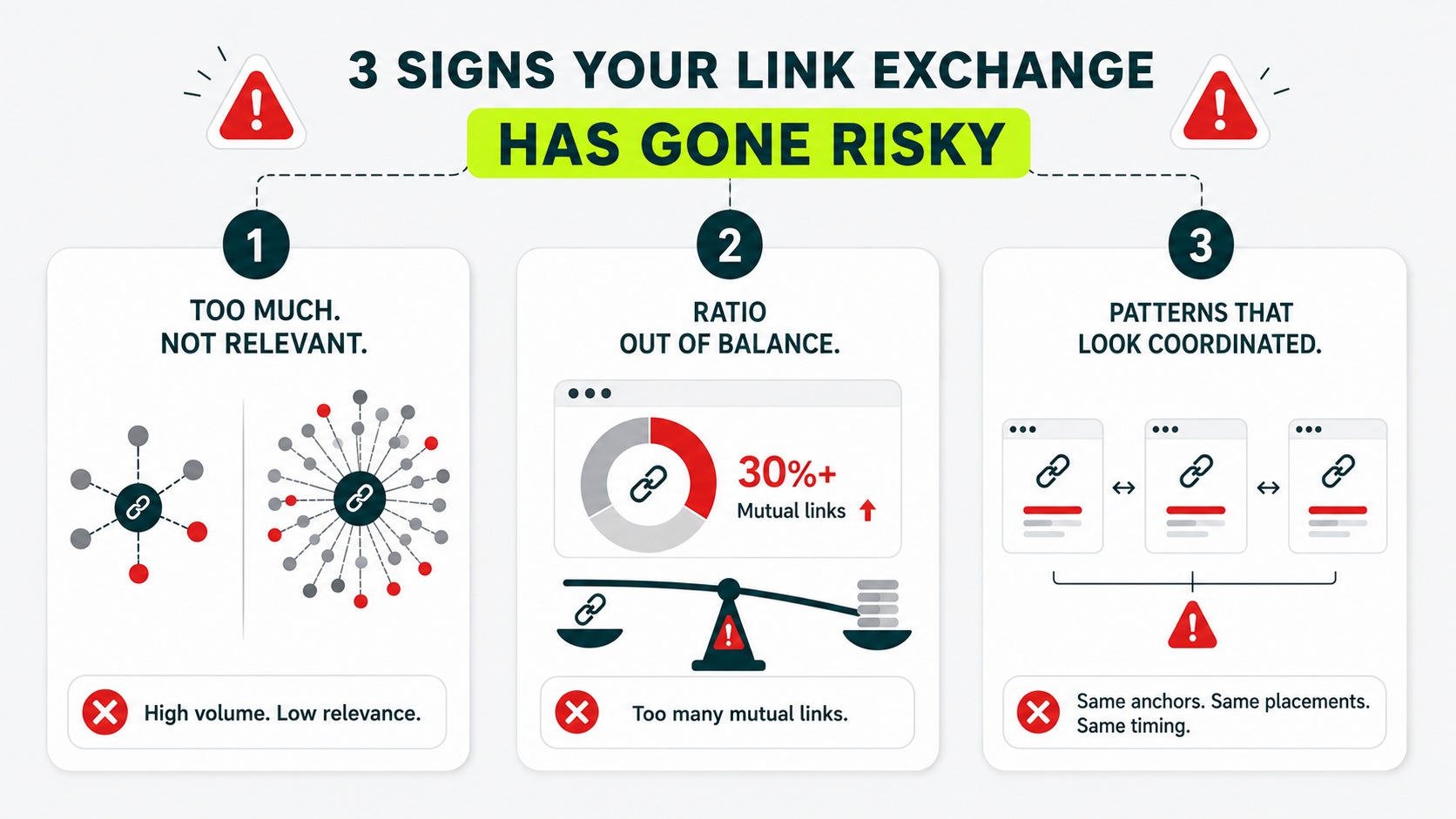
The problematic reciprocal link exchanges share three recognizable patterns: scale without topical relevance, a reciprocal ratio that’s grown too high, and coordinated anchor text or timing across exchanges.
1. Scale Without Topical Relevance
Exchanging links with three relevant sites in your niche looks like a natural co-linking relationship. Exchanging links with thirty sites across unrelated industries looks like a coordinated scheme. Topical relevance doesn’t become optional as volume increases. It becomes more important.
2. A Ratio That’s Grown Too High
When reciprocal links make up a disproportionate share of a backlink profile, the pattern becomes visible to Google’s automated systems.
Mutual links, sites that link back to you because you link to them, start dominating the inbound mix. That’s when the ratio warrants review.
No published Google threshold exists. Just a signal worth tracking in your backlink audit tool.
Anchor repetition trips clients up before the ratio ever becomes a problem. Reciprocal links pointing back with the same exact-match anchor raise more flags than a high ratio alone. Pattern matters more than volume.
3. Coordinated Patterns Across Exchanges
Using the same anchor text (the clickable words in a hyperlink) across multiple exchanges signals a link scheme. So does adding a batch of mutual links in a short window, or placing exchanged links in the same section of each page.
These patterns make the exchanges look like a coordinated strategy rather than independent editorial decisions. These are the patterns Google treats as manipulative link building.
When Co-Linking Happens Naturally, and Why That Is Different
Two websites can end up linking to each other without any arrangement. That’s organic co-linking, and Google treats it differently from a pre-arranged exchange.
A Common Scenario
A food blogger links to a nutrition research site because one of their articles is the best source for a claim. Months later, the research site links back to the food blogger’s recipe guide because it helps illustrate a point for their readers.
Neither side asked for a link. Each site linked because the content served its readers.
Google’s automated systems look at signals including timing, anchor text variation, site relevance, and whether the links sit inside real editorial content.
Organic co-links between relevant sites tend to pass those checks. Pre-arranged exchanges that look coordinated tend not to. The difference isn’t just intent. It’s what the pattern looks like in the data.
AI search experiences increasingly rely on authoritative sources and citations.
Sites that earn consistent editorial brand mentions across trusted publications are more likely to appear in these ecosystems.
When two relevant, trusted sites link to each other in editorial contexts, both benefit from the association in how AI systems evaluate topical credibility. This is a reason to be intentional about who you exchange with.
Understanding what makes a backlink high quality helps you evaluate whether a reciprocal link is likely to pass meaningful authority.
The 3-Question Filter for Evaluating Any Exchange Offer You Receive
Ask three things before accepting any exchange:
- Would I link to this site?
- Does my reader benefit?
- Would it look like an outlier?
That’s a different starting point than instinct usually offers.
When an exchange offer arrives in your inbox, the natural reaction is to evaluate it as an SEO transaction.
- Does this site have good authority scores?
- Will a link from them help my rankings?
Those aren’t the wrong checks. They’re just not where you start.
The Outreach Desk team uses a 3-question filter when evaluating exchange proposals. If an exchange passes all three questions, you can consider it.
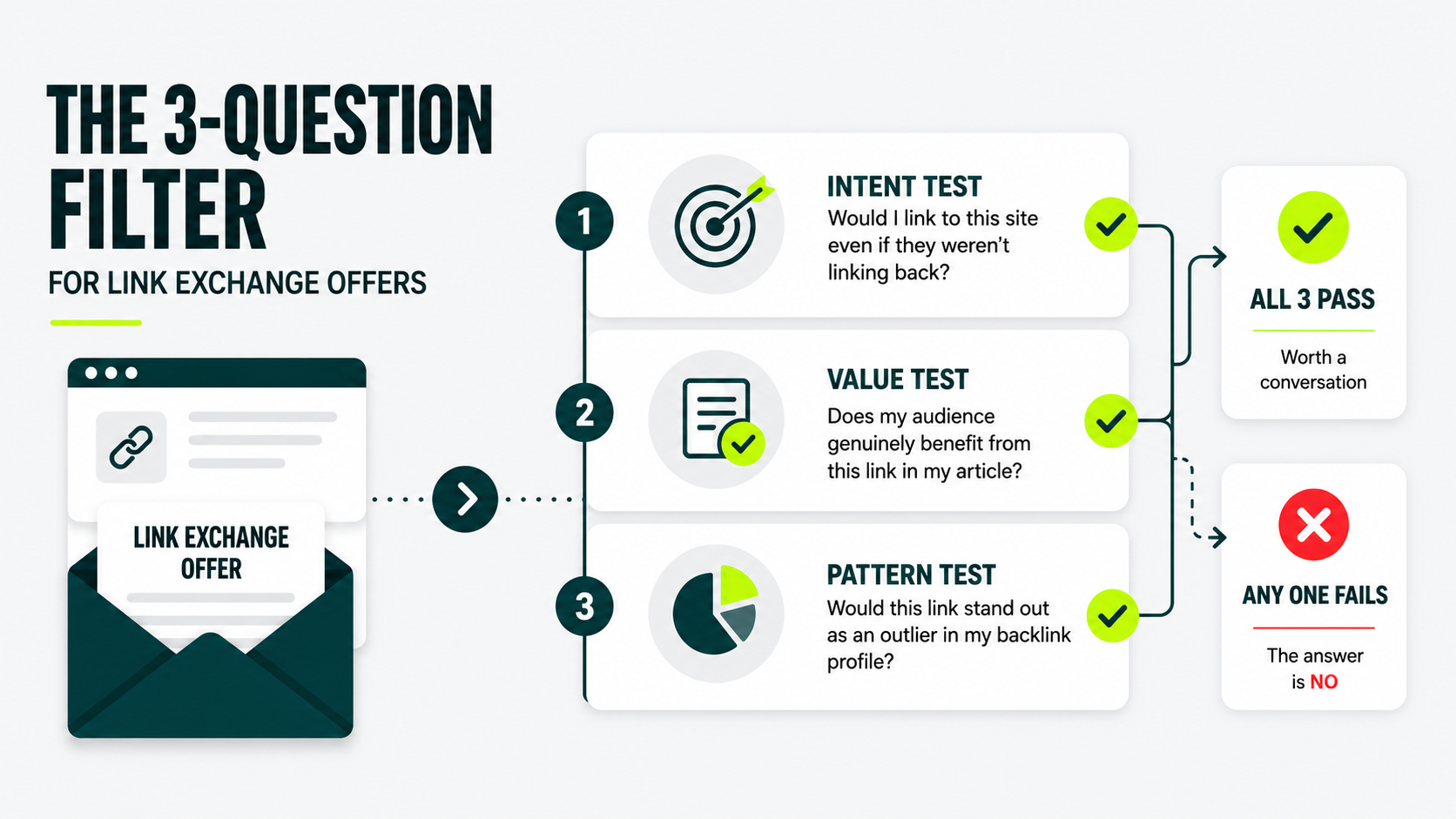
Question 1: Would I link to this site even if they were not linking back?
This is the intent test. A “no” means the link is driving the exchange instead of the content. A link that you receive merely for the exchange is exactly what Google’s spam policy targets.
If the answer is yes, you have a site worth linking to on its own merits, and a reciprocal arrangement adds a mutual link to an already editorially sound relationship.
A SaaS client got an offer last quarter from a project management blog they’d already cited twice. Easy yes; they accepted.
But the same month, a “digital marketing tips” site with zero topical relevance pitched a swap. The client had never referenced them. And never would have on their own, and they said no.
Question 2: Does my audience genuinely benefit from this link appearing in my article?
This is the value test. The goal of any link decision is to serve the reader rather than to manage your backlink profile.
If you can’t point to a specific sentence in your content where this link would help the reader understand something better, the link doesn’t belong there.
Readers and Google can easily spot a link you force into your content just to fulfill an exchange.
Question 3: Would this link stand out as an outlier in my backlink profile?
This is the pattern test. It checks two things at once: whether the site is relevant enough to belong in your link mix, and whether adding it would push your reciprocal ratio above a level worth monitoring.
A single link to a well-aligned partner site with editorial content won’t register as an outlier.
A link to an unrelated site in an industry you’ve never covered, coming through an arranged exchange, shifts your profile’s signals in the wrong direction.
If you have exchange offers in your inbox, Outreach Desk can evaluate which ones are worth accepting. To build links without the reciprocal tradeoffs, see how our white hat link building service works.
Building Co-Linking Relationships That Grow Over Time
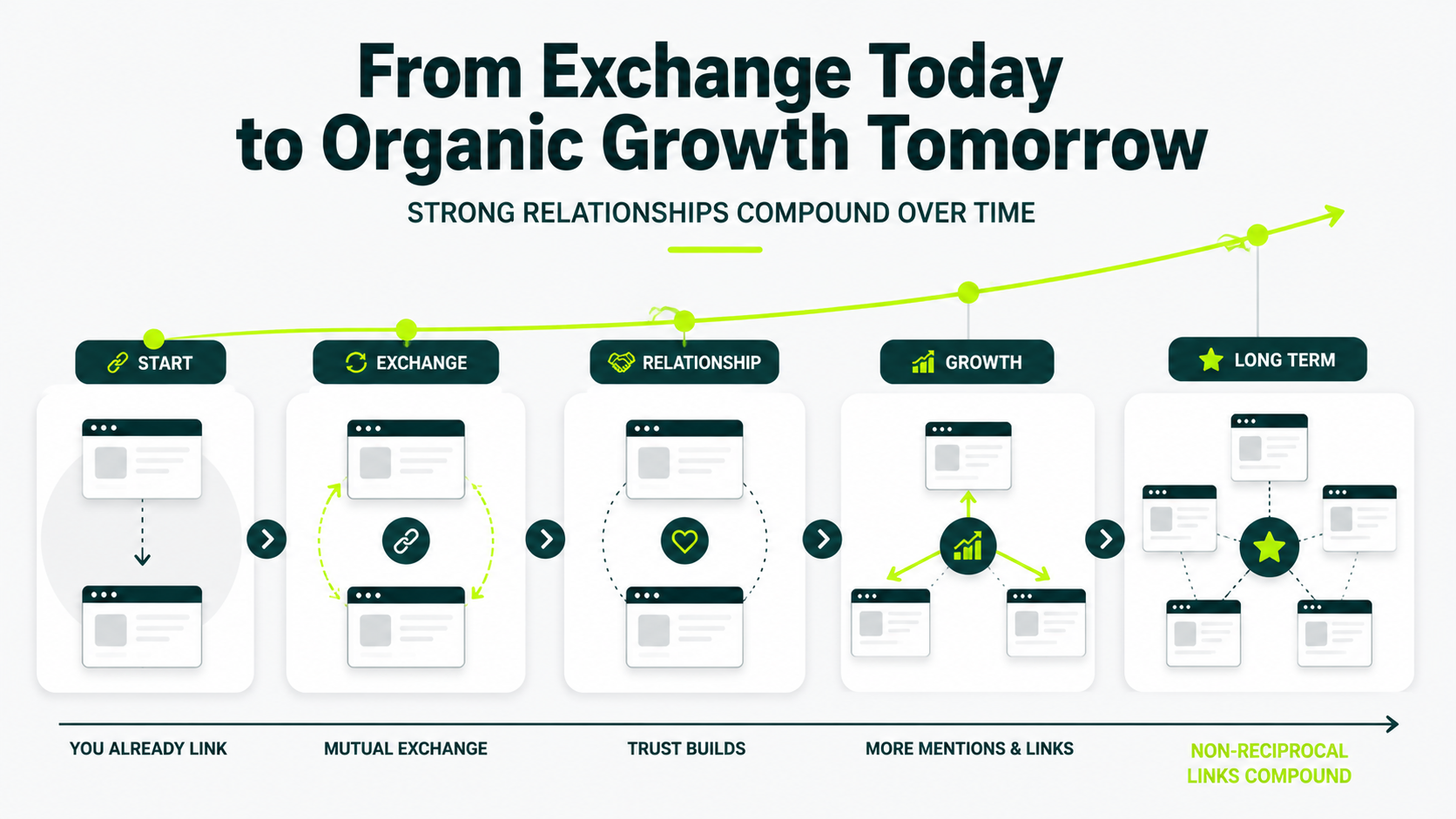
The best starting point for a link exchange partner isn’t a stranger cold-pitching you. It’s a site you’re already referencing in your content.
If your articles consistently cite a particular source or recommend a specific resource, you’ve already passed the first question in the filter.
Starting the relationship there means it begins from editorial alignment.
Start With Sites Already in Your Content
Before approaching anyone new, audit your existing articles. Which external sites do you cite most often because they’re useful to your readers? Those site owners are the natural first candidates for a partnership conversation.
Lead With the Content, Not the Exchange
When you reach out, mention the specific article of theirs you’ve already linked to and explain why it served your readers. Ask whether any of your content would be useful to their audience. Open with the editorial relationship first, then bring up the exchange.
Vary the Anchor Text and Article Placement on Each Side
If Site A uses “trail running shoe reviews” as the anchor and Site B uses “hiking gear recommendations,” the two links look independent. If both sides use the same phrase and both link from the same type of page, the coordination becomes visible. Variation is the natural state of organic linking.
Review Your Reciprocal Ratio Quarterly
Add a check to your regular backlink audit: what share of your inbound links are also from sites you link back to?
If that share starts climbing and dominating your profile, slow the pace of new exchanges. Focus on earning links that do not require reciprocity until the ratio returns to a healthier balance.
In Outreach Desk client accounts, roughly 4 in 10 exchange partnerships stop needing reciprocity within a year. The partner starts linking on their own, no swap required.
The strongest outcome isn’t the link itself. Choosing the right exchange creates long-term relationships.
Sites that link to each other because the content serves their readers tend to generate unrequested links, co-mentions, and features over time. The exchange starts a relationship. What comes after is what compounds.
For readers looking to build a full outreach operation, the guide to how to pitch and secure backlinks covers prospecting, email, and follow-up in detail.
The Real Cost of a Bad Exchange
Link exchanges burn most site owners, but Google doesn’t hit them with a penalty. They spend months chasing arrangements that Google algorithmically discounts and that never pass ranking credit.
The safest approach isn’t to avoid reciprocal links altogether. It’s to evaluate every opportunity with the same standards Google uses. The 3-question filter helps you identify exchanges that support your site instead of wasting your time.
Want a More Sustainable Link Building Strategy?
Build authority with editorial links that continue delivering value over time.
What is the difference between a link exchange and a reciprocal link?
A reciprocal link is the technical result: two sites pointing to each other. A link exchange is the deliberate process of arranging that outcome.
Every link exchange produces reciprocal links. But not every pair of reciprocal links comes from a link exchange. Two sites can end up pointing to each other independently, through separate editorial decisions, without any arrangement between them.
Do reciprocal links carry less SEO value than one-way links?
Generally, yes. A one-way link is a pure editorial vote, something a site chose to link to with nothing expected in return. A reciprocal link carries an implicit “I’ll link to you if you link to me” quality, even when there’s no formal arrangement behind it, and search engines weigh that difference.
That doesn’t make reciprocal links worthless. A relevant, editorially justified mutual link between two related sites still passes real value. It just doesn’t carry the same weight as a link that exists purely because a publisher found the content worth citing on its own.
The practical implication is that a backlink profile built mostly on one-way links from an established link building agency will typically outperform one leaning heavily on reciprocal arrangements, even if the total link count looks similar on paper.
Does Google penalize sites for having reciprocal links?
Not automatically. Google’s spam policy targets excessive exchanges and partner pages that site owners build specifically for cross-linking, not individual mutual links between relevant sites.
The more common outcome for a borderline exchange is that Google discounts the link rather than issuing a manual penalty. A manual penalty requires scale, pattern, and evidence of deliberate manipulation.
How many reciprocal links is too many?
There’s no published number from Google. The real signal isn’t a percentage. It’s whether reciprocal links form a small, natural part of your backlink profile or start dominating it. If mutual links make up a noticeably large share of your total inbound links, that ratio warrants a review. The concern isn’t absolute count. It’s whether the pattern looks like a deliberate acquisition scheme rather than organic editorial linking.
The concern isn’t absolute count. It’s whether the pattern looks like a deliberate acquisition scheme rather than organic editorial linking.For a closer look at how to keep that ratio in check, the guide to vetting and executing link swaps covers partner selection, outreach, and ratio monitoring in detail.
Can reciprocal links help my site rank higher?
A site that places a reciprocal link in a relevant editorial context can pass ranking credit the same way any backlink does, provided Google doesn’t algorithmically discount it. Links that tend to have the most impact are from sites that reference your content in an editorial context, whether or not the link is mutual. If you’re looking for links that aren’t subject to the reciprocal discount risk, one-way link building is worth prioritizing alongside any exchange strategy.
What is a three-way link exchange?
A three-way exchange involves three sites instead of two. Site A links to Site B. Site B links to Site C. Site C links back to Site A. Each site receives a link without directly linking back to the site that linked to them, which obscures the reciprocal pattern. These structures carry the same risks as standard exchanges.