Skyscraper link building is a way to earn backlinks by improving the most-linked content for a topic. You find the page everyone links to, build a clearly better version, then ask the same sites to link to yours instead.
Brian Dean coined the term skyscraper in 2013. Publishers have raised the bar since then; fewer sites respond to cold outreach than a decade ago, and AI search has reduced the organic click value of even a top-three ranking.
This playbook gives you the modern version: what works, what doesn’t, and when to skip it entirely.
The Short Version
- Skyscraper link building earns links by targeting sites that have already linked to your topic.
- In 2026, content-led outreach accounts for just 9 percent of best-performing tactics. Skyscrapers still work, but only in the right conditions.
- Every modern campaign needs four things: the Asset, the Angle, the Audience, and the Ask.
- Target pages need 30 to 50 referring domains minimum; fewer signals low authority, more signals a crowded race.
- Three simpler tactics outperform a skyscraper when your site lacks depth, a real angle, or the capacity for outreach.
What Skyscraper Link Building Actually Is
Skyscraper link building is a method for earning backlinks by improving existing high-link content.
The process has three steps:
- Find a page that already attracts strong backlinks.
- Build a resource on the same topic that outperforms it in depth, data, or design.
- Reach out to the sites linking to the original and show them your version.
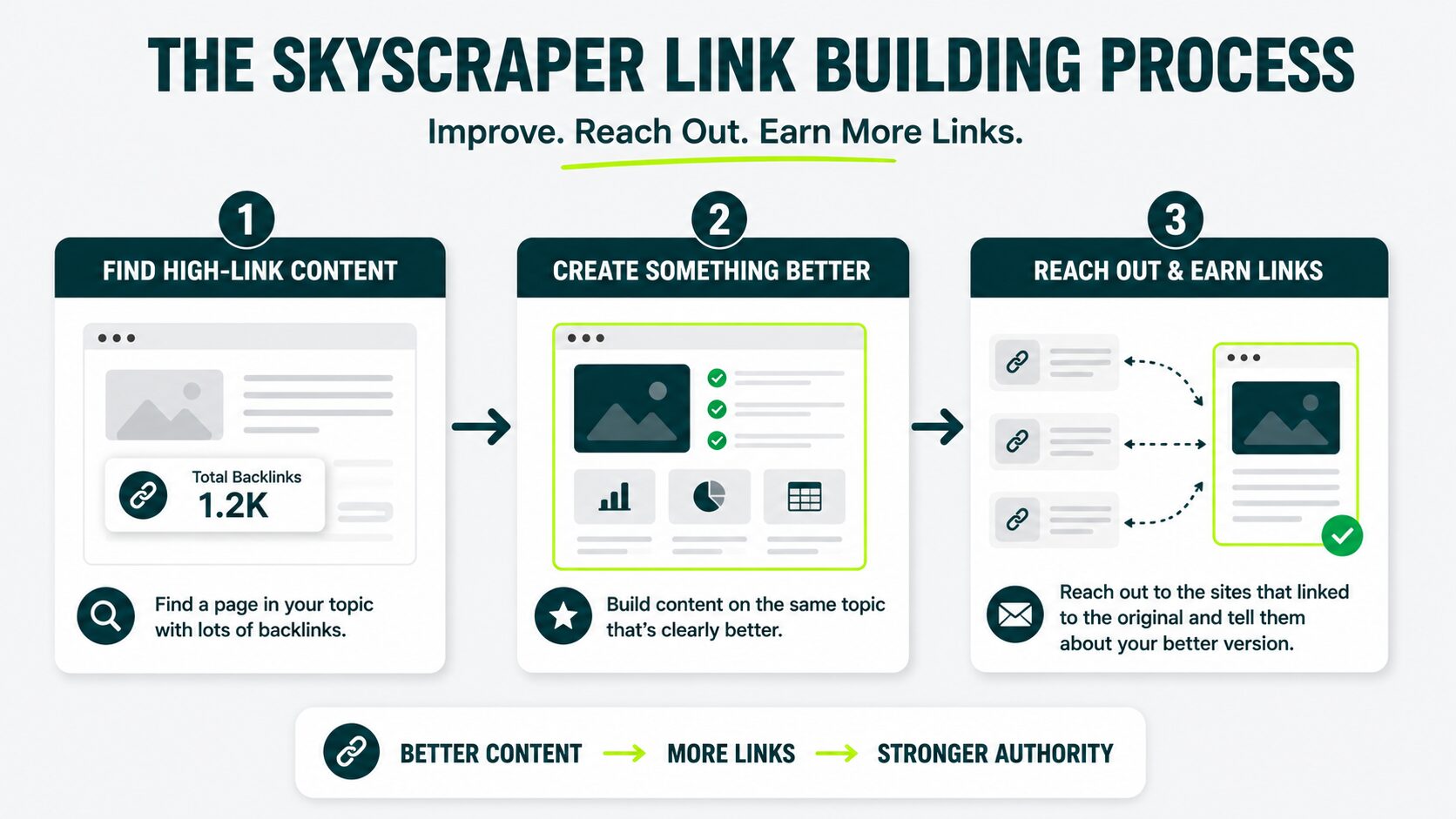
Brian Dean named this technique after the logic of competitive construction: to build the tallest skyscraper, you first need to know what you are trying to beat.
Sites that have already linked to content on a topic have shown they will link to that topic again. That makes them warmer prospects than random sites in your niche.
Pitching them a stronger version feels more like refreshing a relationship than starting one cold.
Does Skyscraper Link Building Still Work in 2026?
Yes. The conditions are narrower than they were a decade ago, and the technique rewards sharper execution.
The technique still earns links when you run it well, yet it no longer earns links by default.
In Reporter Outreach’s 2026 state of link building report, content-led outreach, where skyscrapers live, ranked at just 9 percent of best-performing tactics.
That same report ranked PR-style approaches at 55 percent and guest posts at 18 percent.
That spread tells you something clear: the skyscraper technique has moved from the center of the link building stack to a specialist tool that is effective in the right hands, but is no longer the default starting point.
A second shift changes the math in your favor.
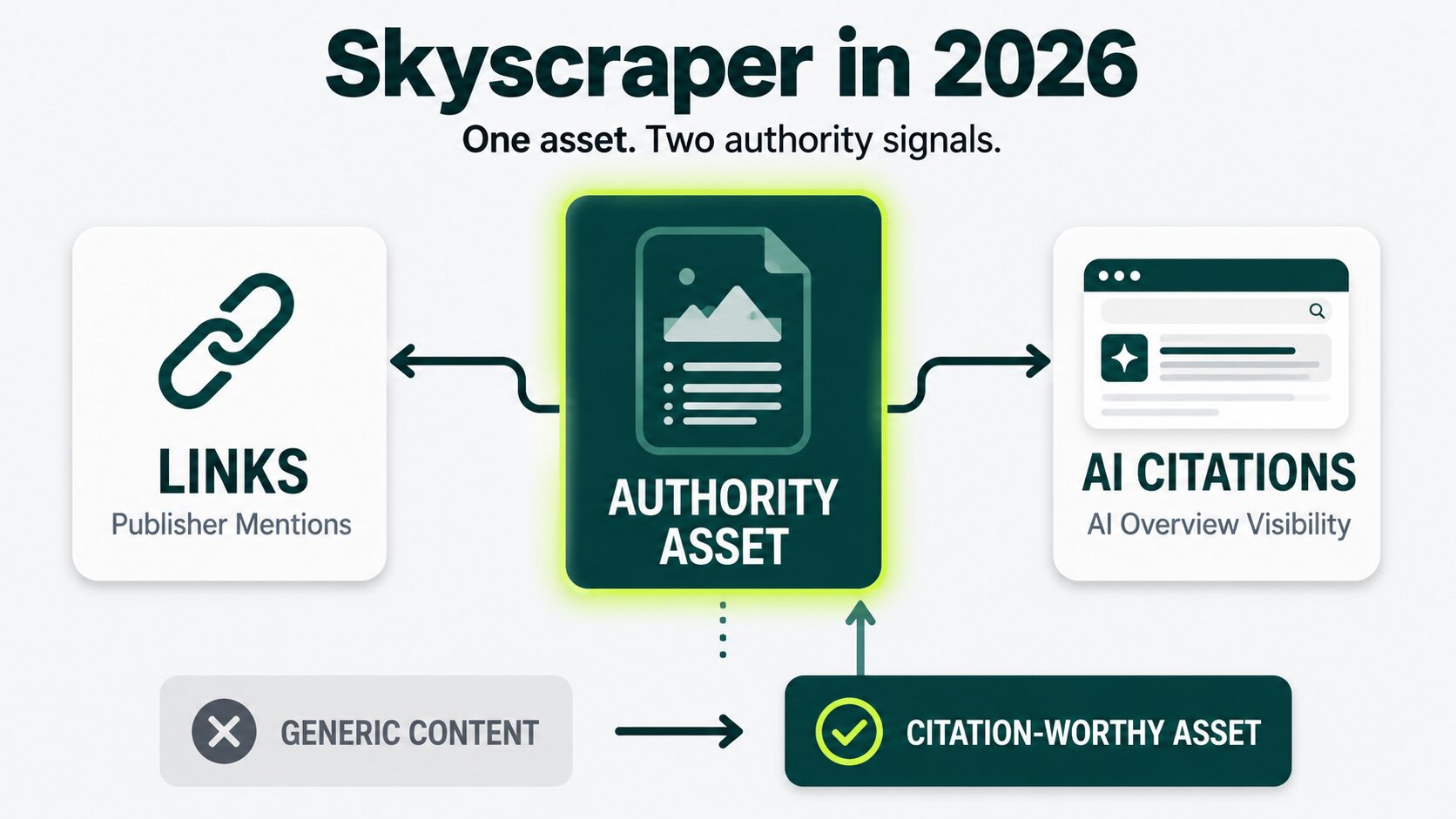
A well-executed skyscraper with original data, clear visual presentation, and depth that outperforms every competing page now earns two outcomes from the same work.
- You earn a link from a real publisher.
- You earn brand citations inside Google’s AI Overviews, the answer boxes Google now shows at the top of many searches.
Build it well, and the same asset earns links and attracts citations in AI-generated answers. Build it lazily, and you lose the link, the citation, and the time you spent.
Skyscrapers still earn their place across proven link building strategies. You just run them sharper now.
In our experience, publishers rarely respond to generic pitches, but a specific, well-placed ask still converts far better than most teams expect.
The Four Components of a Modern Skyscraper Campaign
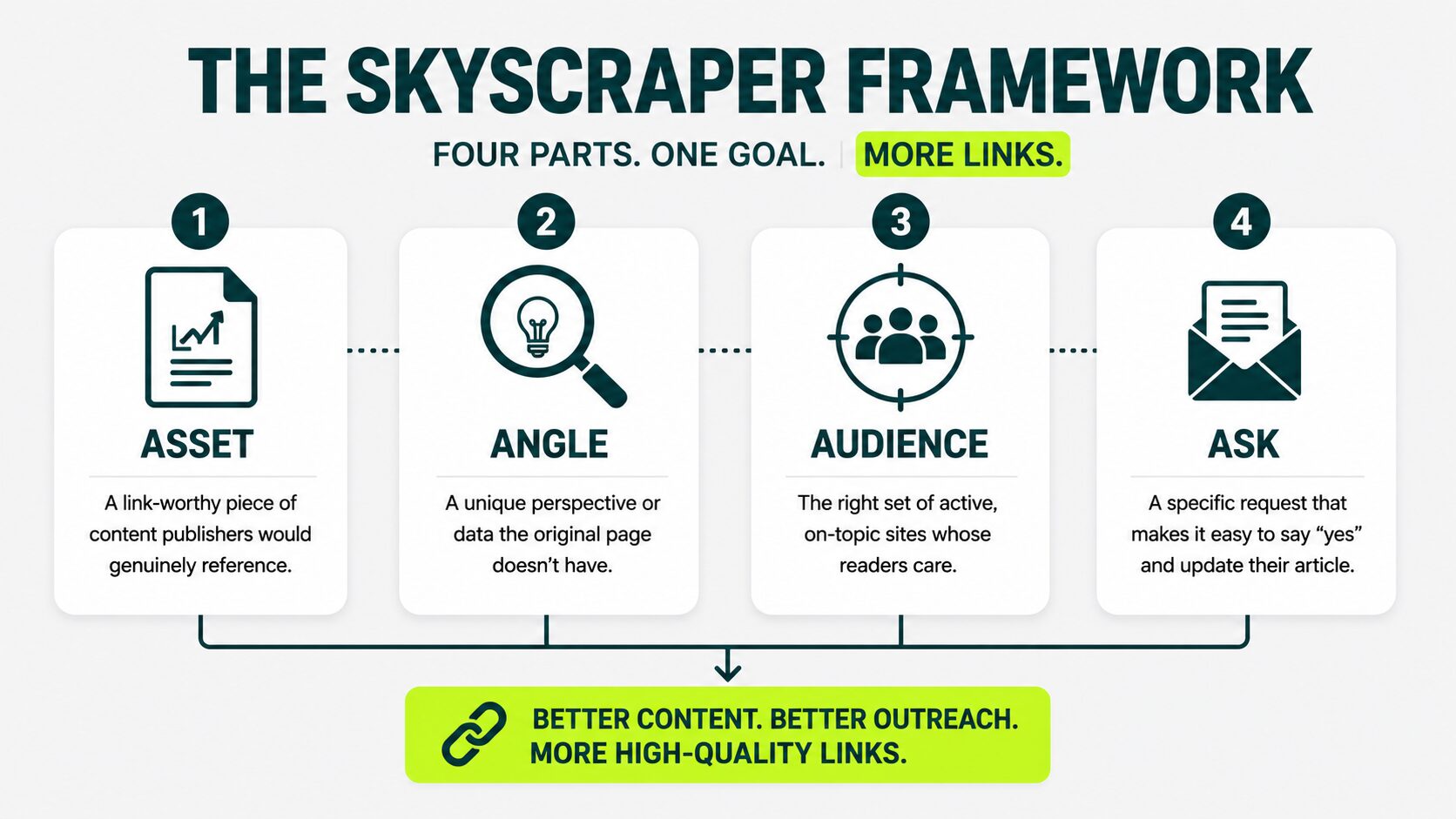
A modern skyscraper campaign moves on four parts: the Asset, the Angle, the Audience, and the Ask.
Together, they go beyond the standard “make it longer, prettier, fresher, deeper” checklist, which outlines what to improve but not what to say, whom to tell, or how to ask.
Asset
Your Asset is the link-worthy resource, a tool, template, data study, or definitive guide that gives publishers a specific reason to send their readers to your page.
You build a real reference, something a publisher would genuinely point readers to this week. A 5,000-word listicle of generic tips won’t earn that link, but a free template, a deep guide, a tool, or original research will.
Ask yourself: would a journalist or editor want to send readers here? If the answer isn’t a clear yes, your Asset isn’t ready.
Angle
Your Angle is the specific thing your version says that the original page doesn’t.
Write that in one sentence right now. If you can’t write it, you haven’t found the angle.
“More examples” fails the test. “The only guide built on data from 200 SaaS campaigns under $50K annual recurring revenue” passes it.
Audience
Your Audience is the specific set of sites you’ll pitch to those still publishing on the topic, still sending readers to content like yours, and run by editors who would actually find your version useful.
A list of 50 active, relevant prospects earns more links. Scroll your list. For each name, ask: Would you send this person a personal email if you met them at a conference? Cut everyone you wouldn’t.
Ask
Your Ask is the specific request inside the outreach email.
Weak Ask: “I came across your article and noticed we’ve covered a similar topic. Would you consider adding it as a resource for your readers?”
Strong Ask: “In your January post on SaaS churn, paragraph four cites the 2019 Mixpanel benchmark. I’ve got 2026 data from 200 campaigns that updates it directly. Here’s the sentence swap. It takes about two minutes.”
The strong Ask gives the publisher a specific value they can add to their existing article in two minutes. The weak Ask puts the work on the publisher to read the piece, evaluate the fit, and decide whether a change is worth making.
Quick Overview of the four components:
| COMPONENT |
WHAT IT IS |
WEAK VERSION |
STRONG VERSION |
|---|---|---|---|
| Asset | The link-worthy resource publishers send readers to | A 5,000-word listicle of generic tips | Original data study, free template, or interactive tool |
| Angle | The one thing your version says that the original doesn’t | “More examples and better design” | “The only guide built on data from 200 SaaS campaigns under $50K ARR” |
| Audience | The specific sites you pitch, active, relevant, and editor-accessible | A scraped list of 500 sites in your niche | 50 sites that published on this topic in the last 6 months and still link out |
| Ask | The specific request inside your outreach email | “Would you consider adding this as a resource for your readers?” | “Paragraph four of your January post cites 2019 data. Here’s the 2026 equivalent, a two-minute swap.” |
How to Find the Right Content for a Skyscraper Campaign
Four criteria to find the right content for a skyscraper campaign are meaningful backlink profile, steady search demand, topic relevance, and a plausible upgrade.
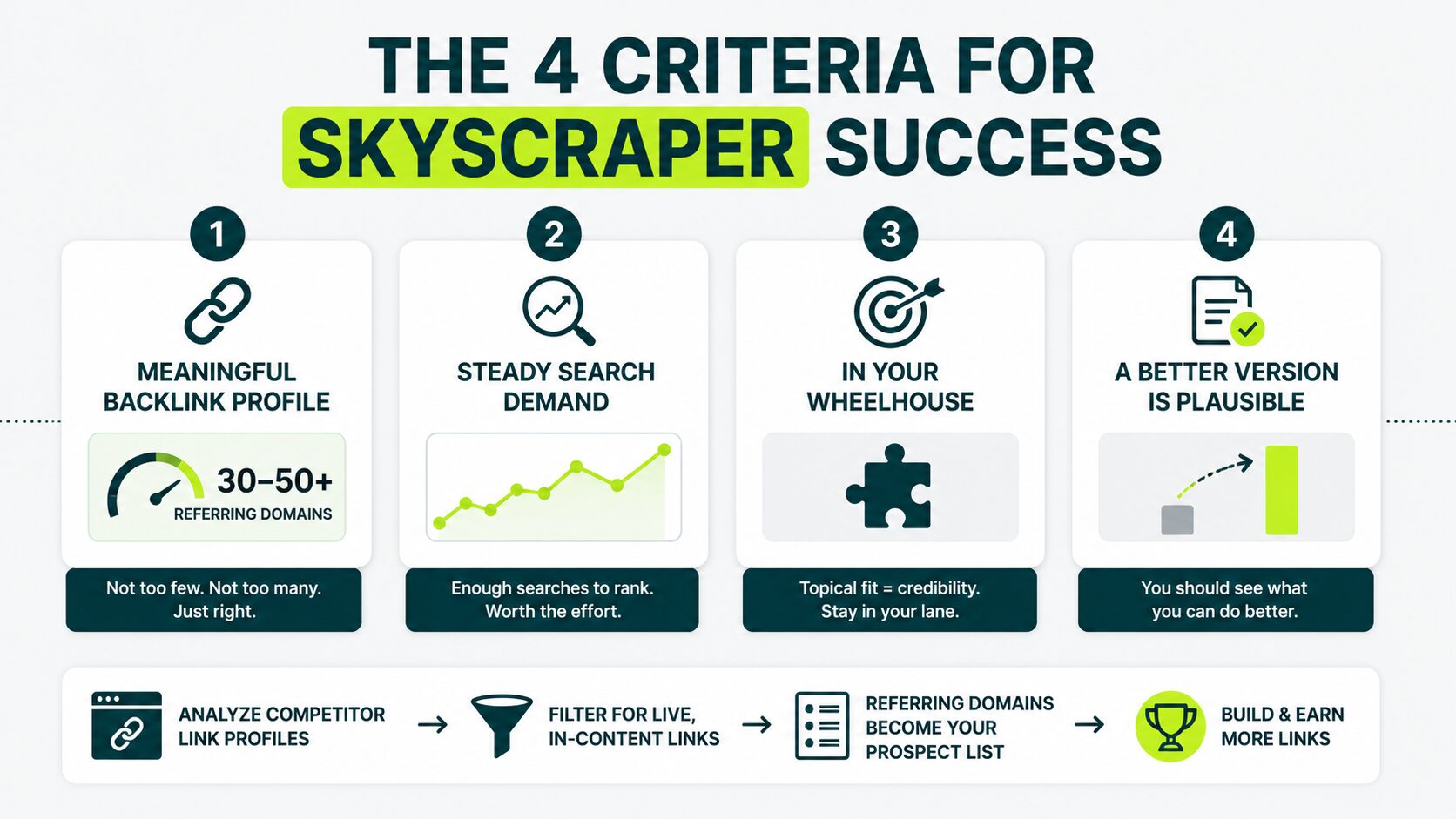
Check all four criteria before you commit. Skipping even one will cost you weeks of wasted effort.
1. The Target Page Already Earns Meaningful Backlinks
Target pages with at least 30 to 50 referring domains. Pages with only 8 referring domains often lack authority, while pages with 6,000 or more referring domains are usually too competitive and crowded to stand out.
Referring Domains
It is the number of separate websites linking to the page.
2. The Target Keyword Holds Steady Search Demand
Your asset needs its own organic search potential, not just the links it earns, but actual search traffic once it ranks. A topic that pulls one search a month won’t repay your effort.
3. The Topic Sits in Your Wheelhouse
If you sell pet supplies and the target page covers real estate finance, you break the angle before you start.
4. A Better Version Looks Plausible
Read the existing page. If you honestly can’t picture what you’d add, skip it and move to the next candidate.
You can pull the referring-domain count for any URL by analyzing competitor link profiles.
Filter for live, in-content links to a single competitor page, and that filtered set becomes your outreach prospect list.
How to Build the Better Version (Without Just Making It Longer)
Five ways to build a better version: original data, a sharper angle, a missing example category, a format upgrade, and recency.
A better version means a different version, not a longer copy of the existing one. The top-ranking page is probably already long. If you publish another 4,000-word listicle, you have produced a parallel page instead of a better one.
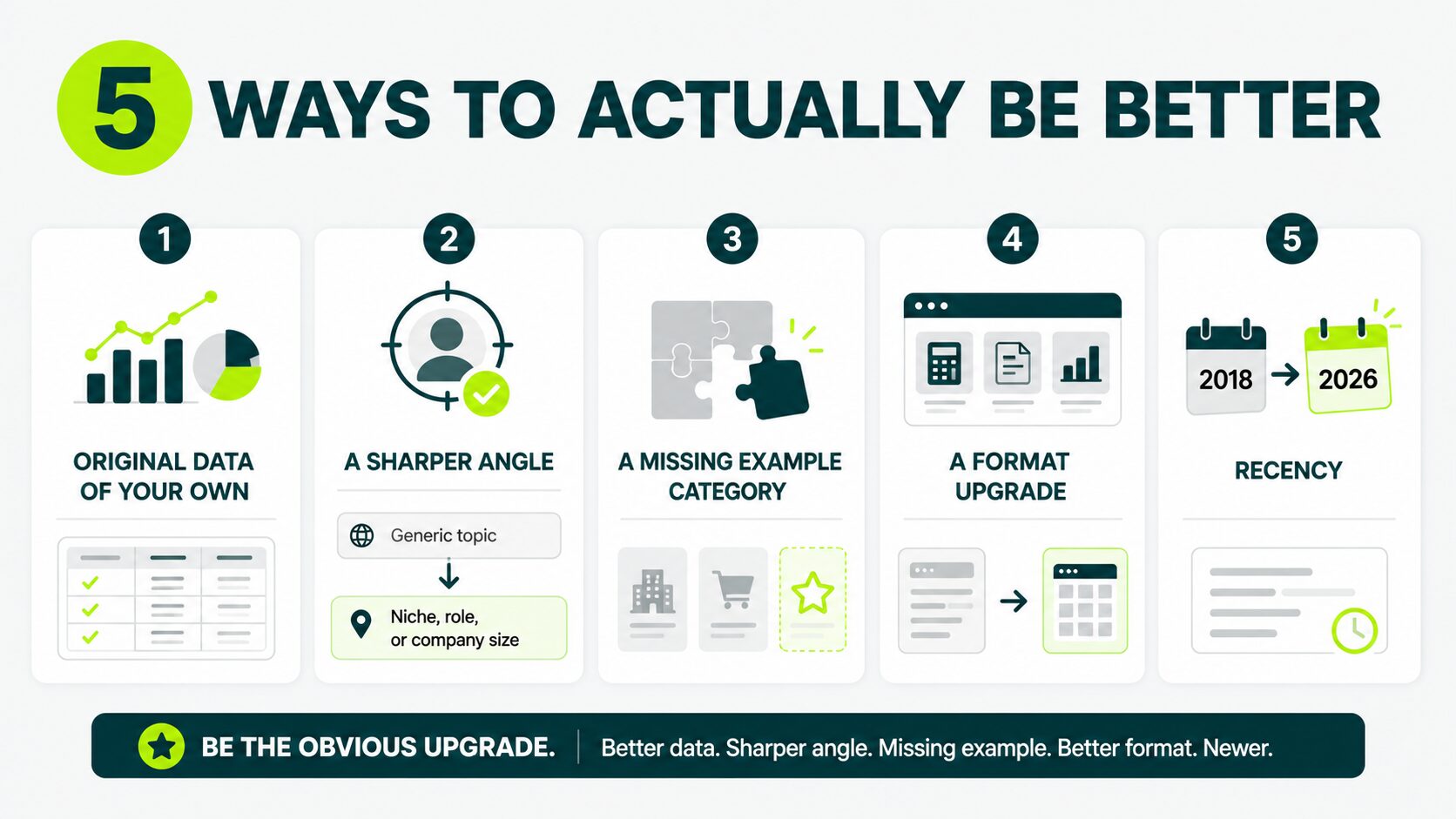
Upgrade with these five concrete ways:
1. Original Data of Your Own
Pull numbers of your own: from your link building campaigns, your customers, or your industry. Those numbers give you a competitive edge over any page that recycles the same statistics everyone else cites.
Your original data is the most powerful upgrade you can make. It gives publishers a direct reason to swap your version into their article because you have a citation they can’t find anywhere else.
2. A Sharper Angle
When the original page covers a topic broadly, you can write a version of that page for a specific niche, role, or business size.
A specific niche page like “Local link building for dental practices in cities under 50,000” beats a generic “local link building” page.
A narrower angle gives publishers a clean reason to link to you. Their reader runs a dental practice, and the generic page never spoke to them.
3. A Missing Example Category
Most top-ranking pages in competitive niches reuse the same examples, case studies, screenshots, and brand names.
Bring what’s missing. Add a new industry vertical. Show a small-business case where the SERP surfaces only enterprise examples. Cover a recent campaign nobody has written up yet. That gap is your opportunity.
4. A Format Upgrade
When a topic has been written as a 3,000-word post 50 times over, a calculator, a template, or an interactive comparison often does the job better.
Format upgrades pay off most when your reader is making a decision.
If the original page answers “what is X,” a format change won’t move much. If it answers “which X is right for me,” a calculator can attract high-authority links across the niche straight to your page and accelerate your authority.
5. Recency
Pages built on 2018 data are easy to beat with 2026 data.
Find the most-linked page on your topic.
If its core stats, screenshots, or examples are more than 18 months old, you don’t redesign anything; you simply update what’s already stale.
That’s one of the fastest ways to build authority without starting from scratch.
Pick one upgrade type per campaign, the one that creates the clearest gap between your version and the original. Once you build the asset, that gap becomes the single sentence you lead with in every pitch.
How to Run Outreach That Lands Links
Run the outreach this way: Build the prospect list, always personalize the opening line, and make the ask easy to say yes to.
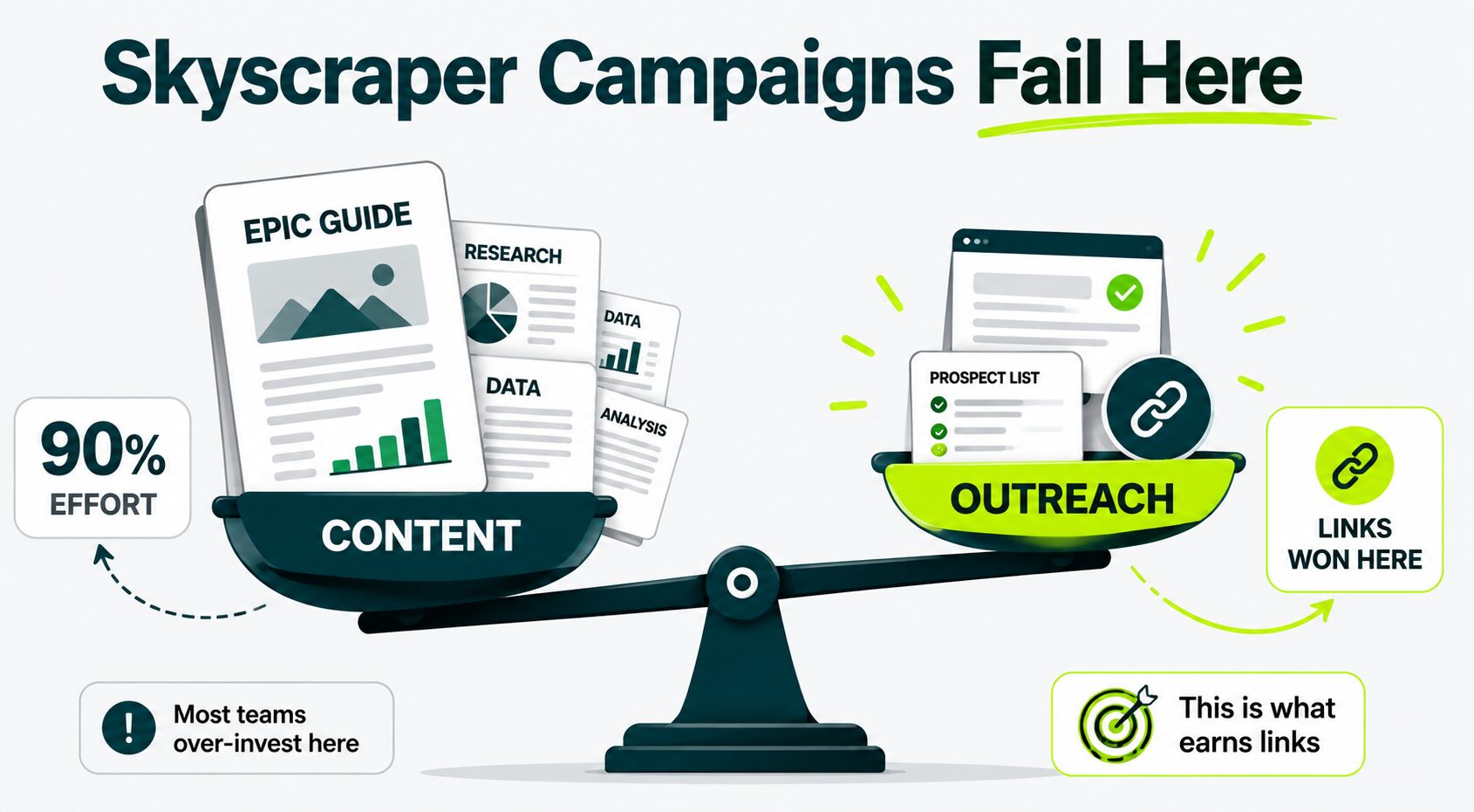
Most teams pour weeks into the content and minutes into the outreach, then wonder why no publisher responds.
Publishers receive more pitches now and respond to fewer of them. Skyscraper campaigns that earn links in 2026 put the same hours and care into outreach as they do into content.
Build the Prospect List the Slow Way
Start from the sites already linking to your target page those are the most topically relevant prospects you’ll find.
Pull the live, in-content links to the original page. Filter for sites that have published on your topic within the last 6 months and only keep them.
Your list will shrink sharply. That’s exactly what you want.
Personalize the Opening Line, Always
Your opening line decides whether the publisher reads the second sentence.
You personalize by naming something specific from the publisher’s recent work. Not “I love your blog,” or “I noticed you write about X.” Something the publisher would recognize as proof you actually read the article.
One specific sentence clears that bar. After that, keep the rest of the email short.
Make the Ask Easy to Say Yes To
The highest-impact line in your skyscraper pitch names the exact swap.
Name the specific paragraph in the publisher’s article that cites the older source. Offer your version’s direct equivalent. Make it a sentence-for-sentence swap the publisher can make in two minutes.
Strong outreach creates a frictionless yes. Weak outreach gets a polite “I’ll think about it,” which usually means no. You want the first outcome every time.
Across campaigns we’ve run at Outreach Desk, the prospect list size rarely predicts results, but how recently those sites published does.
When Skyscraper Link Building Works
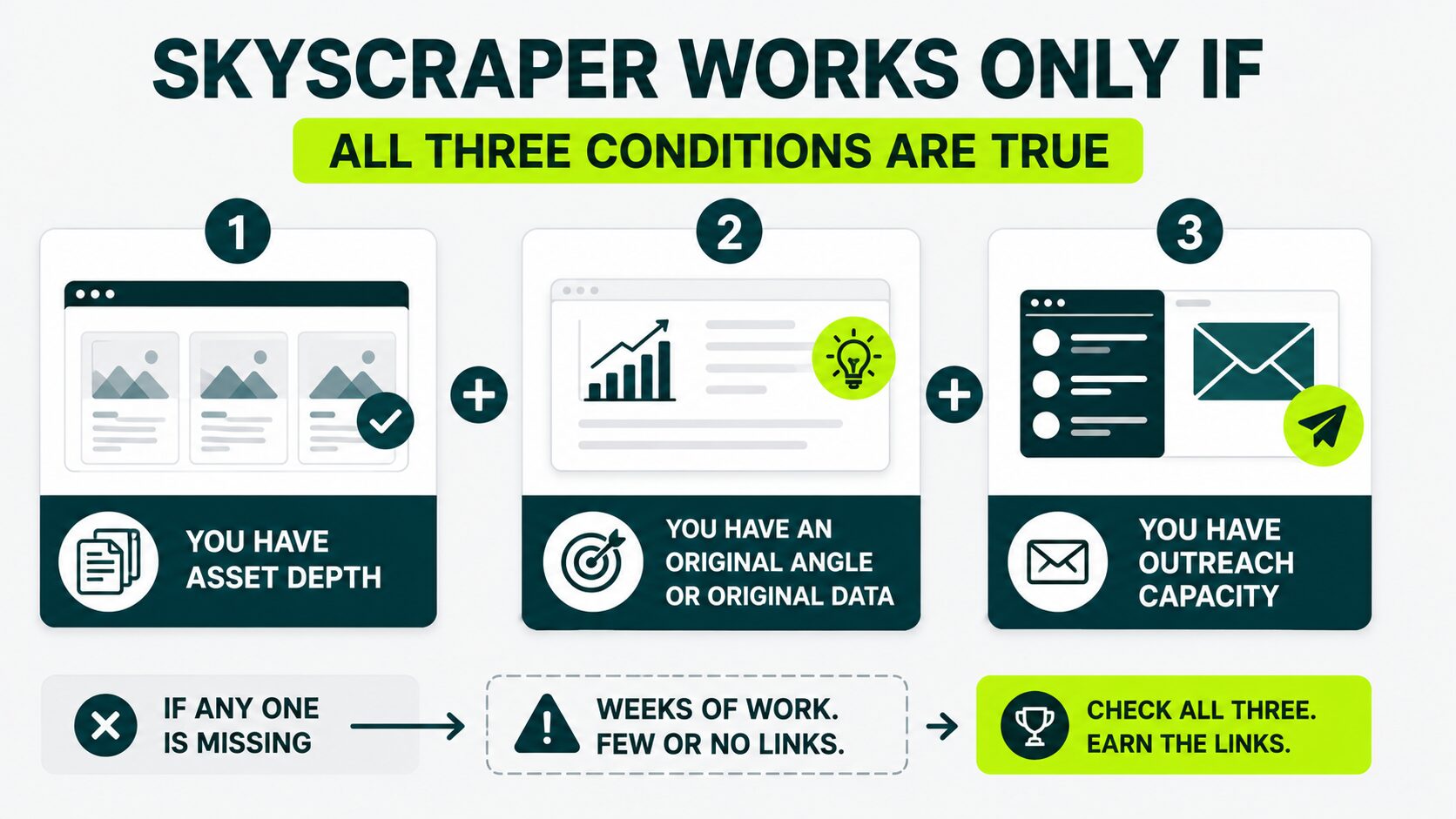
It works only when you can meet all three of these conditions: you have asset depth, an original angle or data, and outreach capacity.
If any of the three is missing, you will spend weeks on the campaign and come away with nothing to show in your backlink profile.
Condition 1: You Have Asset Depth
Your site already proves you can produce the kind of content the skyscraper asset represents.
If your blog holds five thin posts, a publisher who visits your site won’t trust the asset you’re pitching. It doesn’t fit your track record.
A publisher who checks your site and finds five thin posts has no reason to trust that your skyscraper asset is any different. Build depth first. Then pitch.
Condition 2: You Have an Original Angle or Original Data
You can mention in one sentence, in your outreach email, what your version says that the original page doesn’t.
If your plan is “make it longer” or “add more examples,” stop. You haven’t found your angle yet.
A skyscraper without a real angle is expensive paraphrasing. It won’t earn the links you’re hoping for. Find the angle before you build the asset.
Condition 3: You Have Outreach Capacity
You or your team can send 50 to 150 personalized outreach emails per campaign and follow up on each.
You can have a great asset and still earn fewer links than someone with a solid asset and relentless follow-through.
In our experience, consistent follow-up is what separates campaigns that land links from ones that stall after the first send.
If you can’t commit to the outreach hours, redirect that asset budget toward a smaller, cheaper campaign you can execute from start to finish or you can work with an editorial outreach team to handle it while you focus on the asset.
What to Do Instead
If one or more conditions fail, three simpler tactics will produce more wins in your business’s first year:
1. Broken Link Replacement Tactic
The broken-link replacement tactic is the lowest-effort option. You find dead links on other sites, build a replacement for that content piece, and pitch the swap.
2. Guest Posting on Smaller Industry Sites
Guest posting on smaller industry sites is a faster path to earning first links than the broken-link tactic. Our guest post playbook walks through how to pitch publishers without an existing relationship.
3. Earning a Slot on Resource Pages in Your Niche
Earning a slot on resource pages is another low-effort path. You pitch site owners who already curate a resource list in your space, with a single useful page they can add.
Skyscraper or Not: Decide in 30 Seconds:
| CONDITION | WHAT IT MEANS | IF IT’S MISSING | USE THIS INSTEAD |
|---|---|---|---|
| Asset Depth | Your site already has content that proves you can produce something worth linking to | Publishers check your site, find thin posts, and pass on your pitch | Guest posting on smaller industry sites to build credibility first |
| Original Angle or Data | You can name in one sentence what your version says that the original doesn’t | You produce expensive paraphrasing; no publisher has a reason to swap for it | Broken link replacement, no original angle required |
| Outreach Capacity | You or your team can send 50–150 personalized emails per campaign and follow up on each | Your asset sits live with no links because a follow-up never happened | Resource page outreach. smaller list, lower follow-up volume, faster wins |
Build the Right Building, Not a Taller One
The skyscraper technique works because it starts with something that has already proven its ability to attract links. Instead of guessing what publishers might reference, you improve on existing content and give people a stronger resource to link to.
Success, however, depends on more than creating a longer article. The content needs to be more useful, more current, easier to understand, or offer something the original resource does not. Once that’s in place, targeted outreach helps put that content in front of the websites most likely to reference it.
When combined with quality content and consistent promotion, skyscraper link building remains one of the most effective ways to earn relevant backlinks, strengthen authority, and improve organic visibility over time.
Not sure if a skyscraper is the right move for your site right now?
Get a free backlink audit and a custom 90-day growth roadmap, built around your goals, your niche, and your competitors.
How long does skyscraper link building take to see results?
You can expect measurable ranking movement within 3 to 6 months of publishing your skyscraper asset.
Your first links typically start coming in within 4 to 8 weeks of launching outreach. Ranking gains usually follow 2 to 3 months after those links land, because indexing takes time to catch up.
Plan for the full cycle.
What is a realistic outreach response rate for skyscraper pitches?
A personalized pitch with a sharp, specific ask typically earns a reply in the low single digits.
Cold outreach has dropped significantly since 2013 and continues to fall. Getting a reply doesn’t guarantee a link, so your actual link conversion rate sits even lower.
Warm prospects are the people who already know you or have linked to your work. They convert at a far higher rate than cold contacts. Build relationships early. They multiply your results later.
Should I Run a Skyscraper Campaign in House or Work With an Agency?
Run it in house when you have proprietary data, a strong writer, and enough time to manage outreach consistently for 8 to 12 weeks.
Bring in a results driven link building agency when outreach volume, publisher relationships, or content quality are the bottleneck, those are the three points where most in house skyscraper campaigns stall.
Can AI write the skyscraper asset for me?
AI helps you draft sections, maps out content structure, and speeds up your research.
But the original angle, the proprietary data, the personalized opening line, those come from you. That’s what makes a skyscraper campaign earn real links.
Write the parts that matter to you, yourself. Those are the parts that build your authority.
Is skyscraper link building safe for SEO?
Yes, and here’s why.
Skyscraper outreach is editorial. You ask a real publisher to choose to link to a better, more useful resource. That’s exactly the pattern search engines reward.
The only risk comes when your skyscraper asset is thin or duplicative. In that case, it earns no links, and your campaign produces no results. Build something genuinely better, and you grow safely.