Someone told you to submit your website to a bunch of directories to build backlinks. Before spending hours on submissions, it’s worth understanding which listings can actually help your SEO.
Directory link building involves listing your business in relevant online directories, with some listings providing a link back to your website. These listings can help people discover your business, but not every directory is worth your time. Google specifically identifies links from low-quality directory and bookmark sites as a potential link spam practice.
The key is knowing which directories are relevant to your business, how to evaluate their quality, and when directory submissions are worth pursuing.
Key Takeaways
- Directory link building helps with local visibility and trust signals
- Citation signals carry about 8% of local pack weight in 2026, per Whitespark’s ranking factors report
- Four directory types matter: general business, local, niche by industry, and a small set of high-authority sites
- The 60-second sniff test screens any directory before you submit
- The most common beginner mistake is pasting the same description into every listing
- A starter set of 10 to 12 directories covers most first-year founders
- After 10 to 12 directory submissions, your next hour is spent on broken link building or journalist queries
What Directory Link Building Actually Means
Directory link building is getting your business listed on websites that catalog other sites, primarily to earn a backlink.
This backlink improves local search visibility and reinforces consistent NAP signals. While the listing itself can drive customer traffic, the main SEO value comes from the link.
Think of a phone book (a phone directory), but online and organized by category. A directory has one job. It collects a list of businesses or sites, then shows them to people searching for that category.
When your business appears in a directory, that directory’s page about you usually links back to your website. That link is the backlink you came for.
The link is the technical reward. There’s a second reward most beginners miss.
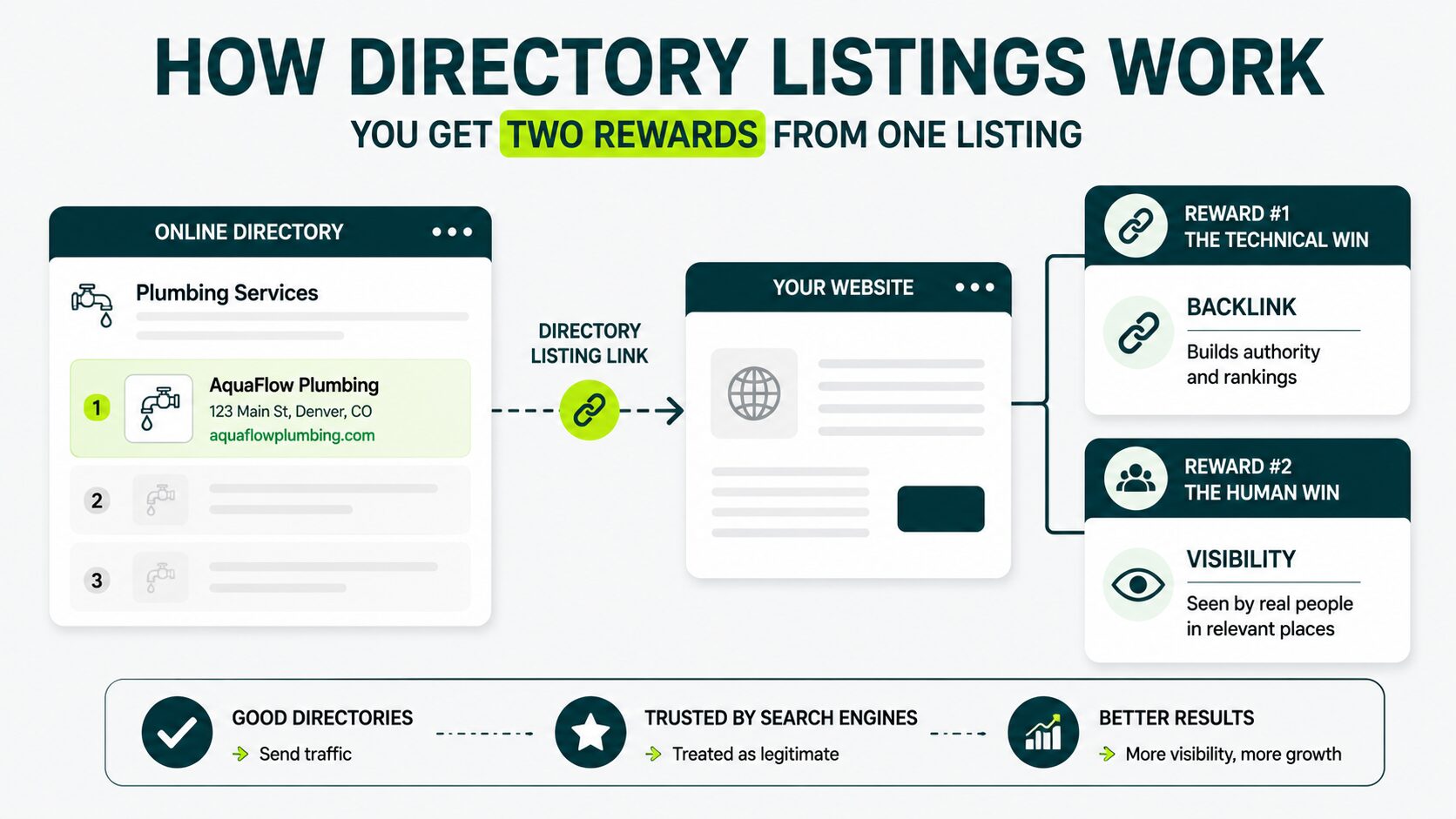
A directory listing puts your name, address, and website where humans actually look. About ten directories in any given niche drive real referral traffic, and those are usually the same ones search engines treat as legitimate. The rest are citation-only.
Directory links are one of several types of backlinks you’ll run into, and they’re not the most powerful kind. The rest of this guide says exactly when they’re worth your time.
Do Directory Links Still Work in 2026?
Directory links work, but for narrower reasons than most founders expect.
Citation signals are what your directory listings count as inside Google’s local algorithm. They sit alongside any other place that consistently publishes your name, address, and phone (NAP) details, helping establish local credibility and visibility in map results.
Citations are one input among many in local pack rankings, and they matter less than your Google Business Profile and reviews.
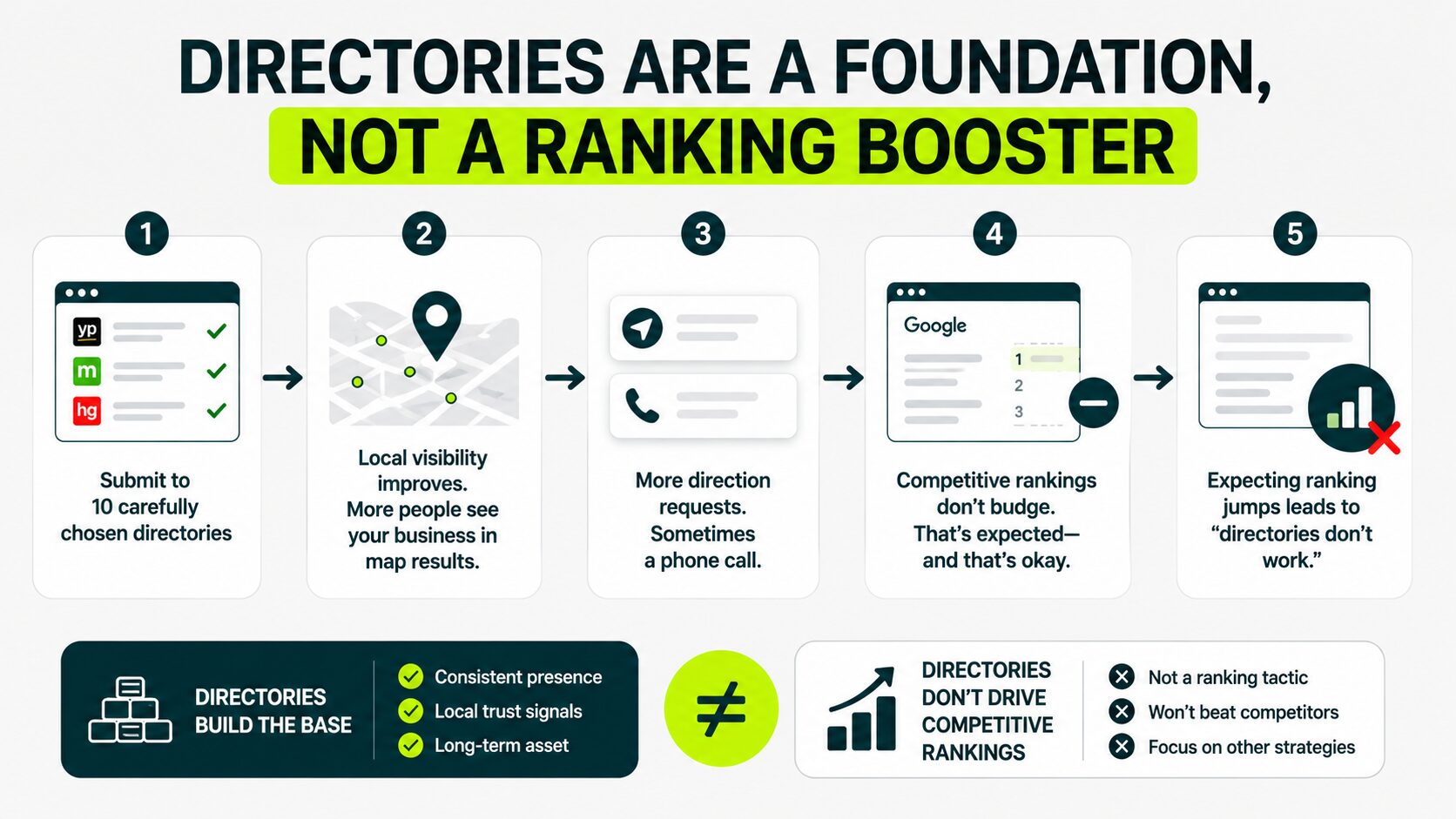
Directories are a foundation layer. You set them up once, keep your details consistent, and move on to the work that actually moves rankings.
The pattern plays out the same way for most first-year founders.
A first-year founder submits to ten carefully chosen directories.
Over a few weeks, local visibility improves. More people see the business in map results.
More direction requests. Sometimes a phone call.
Search rankings on competitive terms don’t budge. That’s the expected outcome, and it’s fine because directories were never meant to move competitive rankings.
People expect submitting to directories to lift their rankings on competitive terms, and when it doesn’t, they decide directories “don’t work.”
Directories work at the job they have. They don’t do the job they were never meant to do.
For rankings on harder search terms, you need broader link building strategies like outreach, guest posts, and resource page placements. (Those tactics are covered later in this guide.)
Across the new sites we’ve onboarded, local map visibility typically improved within three weeks, and directories alone never moved a competitive ranking.
Local map visibility improves first. Search rankings respond only when directory work runs alongside heavier tactics, not instead of them.
Four Directory Types, and Which Ones Deserve Your Time
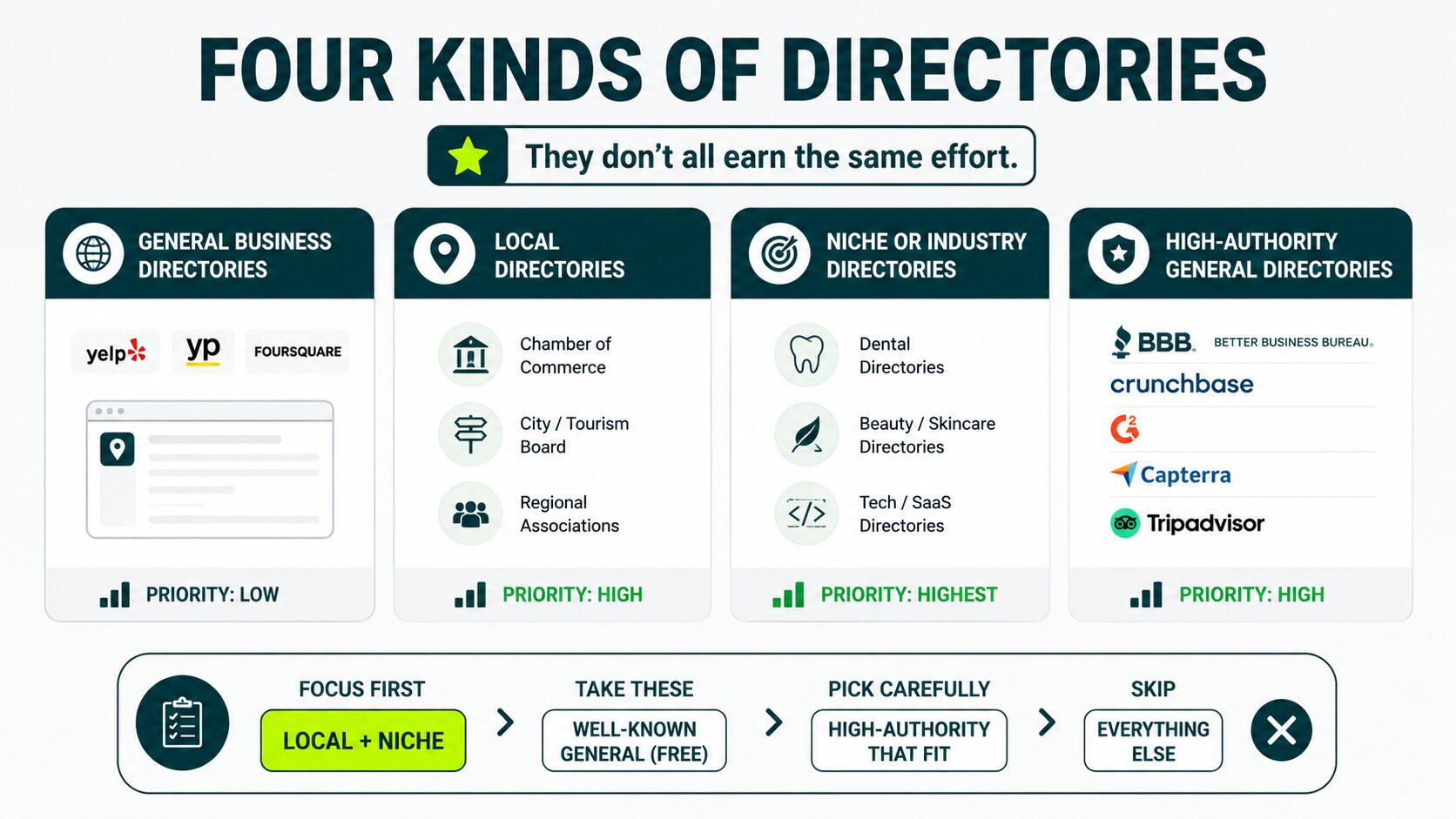
Four directory types show up when you start looking: general business, local, niche or industry, and high-authority. They don’t all earn the same effort.
General Business Directories
General business directories don’t filter by industry. Any business can get listed.
Yelp, Yellow Pages, and Foursquare are the names you’ve heard. They take submissions from a hardware store, a yoga studio, and a software company without much fuss.
For a first-year founder, the well-known general directories are worth setting up because they’re also where customers sometimes look. The traffic is small but real. The backlink is mostly a foundation signal.
Skip any general business directory you’ve never heard of, especially if Googling its listings turns up nothing.
Local Directories
Local directories list businesses inside a specific city, region, or country.
These are where most of your directory effort should go if you serve a local area. Your local chamber of commerce. Your city’s tourism board. Your regional business association.
These directories carry weight because the people who run them live and work in your area. Their listings reach the actual humans who might walk into your shop. A founder who treats local link building tactics seriously will start here.
Niche or Industry Directories
Niche directories don’t try to list everyone. They cover one industry only.
If you run a dental practice, a directory of dentists matters more than a generic business directory. If you sell vegan skincare, a beauty-niche directory beats Yelp. The relevance signal is sharper because the directory’s audience is the audience you want.
These are usually the best directory links a founder can earn. The hard part is finding the real ones, and the sniff test below handles that.
High-Authority General Directories
A small group of directories pull weight because of trust, age, or scale. The Better Business Bureau is one. Crunchbase for tech and startups is another.
G2 and Capterra for software products. TripAdvisor for travel and hospitality.
These are different from the random “free directory” lists because they have human editors, real users, and real categorization. A listing on one of these is a foundation backlink and a trust signal in one move.
The beginner verdict: start with local and niche directories. Take the well-known general ones for free. Add the high-authority directories that match your industry. Skip everything else.
The 60-Second Sniff Test for Spotting a Junk Directory
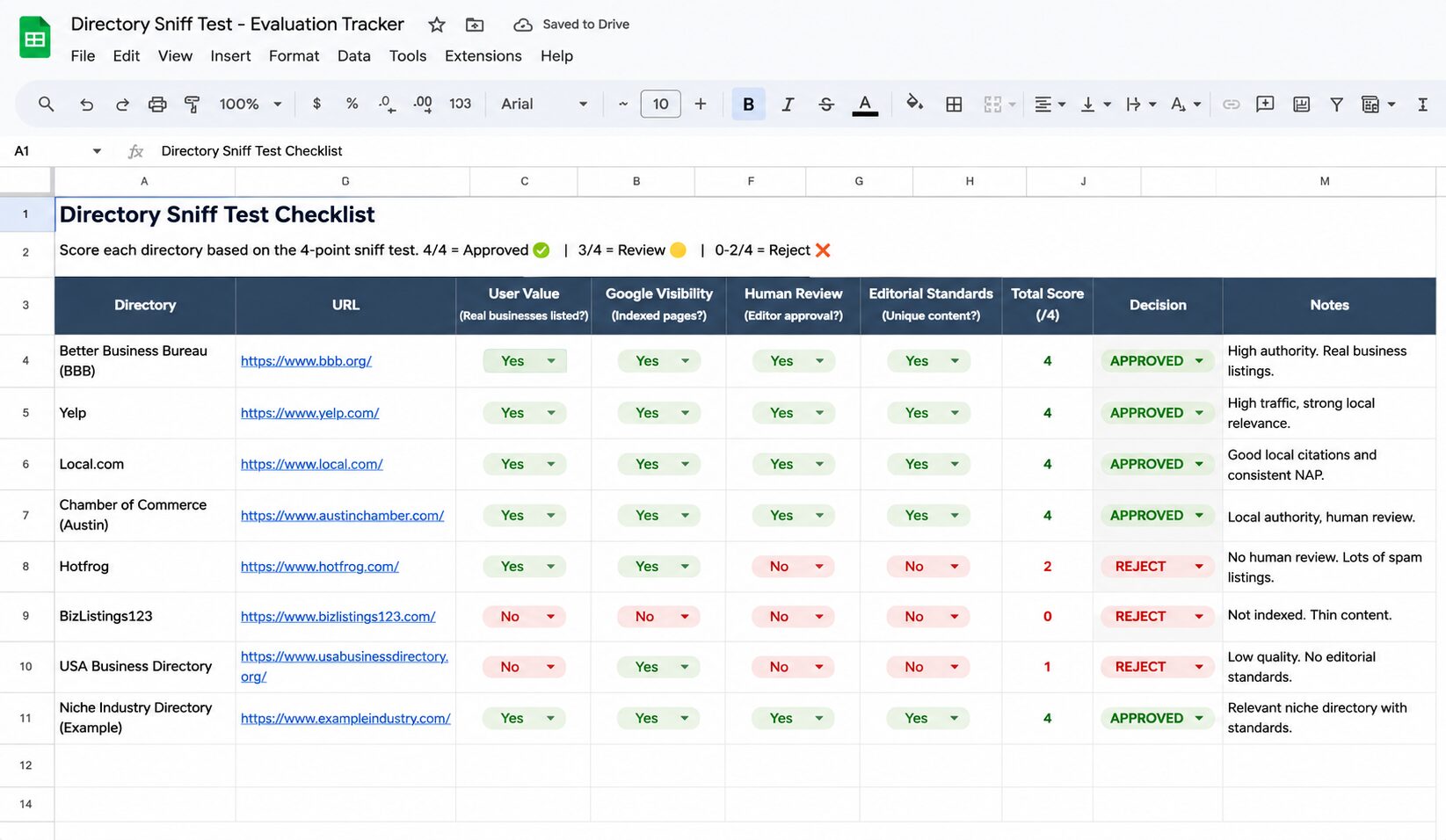
The sniff test is four questions, each a few seconds. Most directories on the top 100 free directories list fail it.
Telling a junk directory from a useful one isn’t always obvious. The domain might look fine. The submission form might look professional. The harm shows up later.
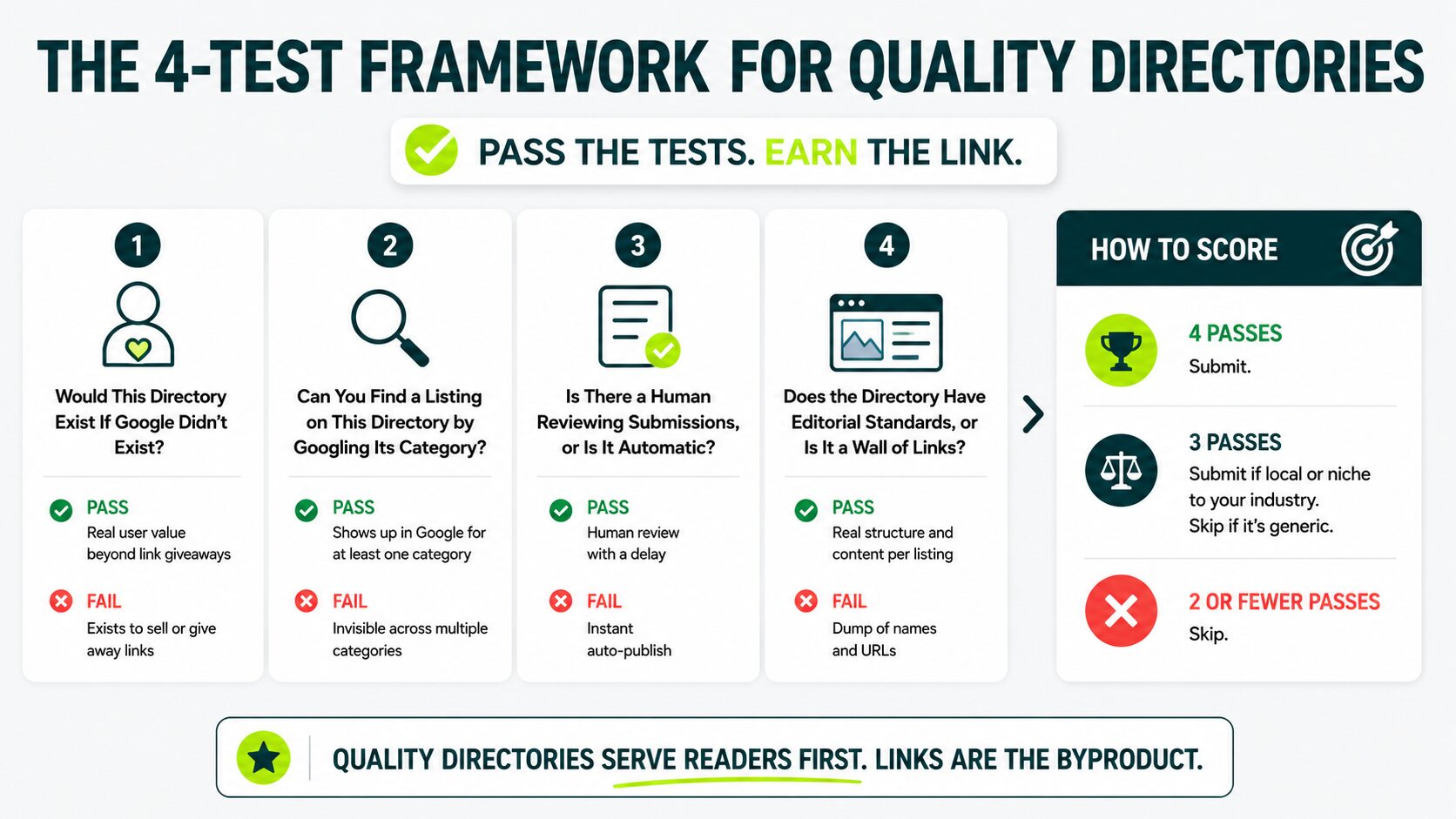
1. Would This Directory Exist If Google Didn’t Exist?
The intent test is the first filter.
Look at the homepage. Read the about page. Ask yourself: would a human actually visit this directory if Google search didn’t exist? Would they bookmark it, browse it, or share it with a friend?
If the only reason the directory exists is to give away backlinks, that’s a signal. Real directories serve readers first and search engines second. Fake directories serve search engines first and readers never.
Pass: the directory has clear user value beyond link giveaways.
Fail: the directory exists to sell or hand out links and has nothing else going on.
2. Can You Find a Listing on This Directory by Googling Its Category?
Run the visibility test next.
Pick a category in the directory: plumbers, florists, or software analytics tools. Google that category plus a city or qualifier. If the directory doesn’t appear on the first few pages of search results, real users aren’t finding it on Google either.
A directory nobody finds through search has zero downstream traffic to send you. The backlink might still count for local citation purposes, but only if the directory passes the other three tests.
Pass: the directory shows up in Google for at least one of its categories.
Fail: invisible across multiple categories.
3. Is There a Human Reviewing Submissions, or Is It Automatic?
The curation test separates real directories from spam traps.
Submit-and-publish-immediately is the strongest signal of a spam directory. If you can click “submit” and your listing appears five seconds later with no review, the directory has no quality control.
Google notices. Most of these directories carry no link value at all.
Real directories have a review queue. You submit, wait a few days or weeks, and sometimes you get a follow-up question from an editor. That delay is a good sign, not a bad one.
Pass: human review with a delay.
Fail: instant auto-publish.
4. Does the Directory Have Its Own Editorial Standards, or Is It a Wall of Links?
The structure test is the final check.
Open three or four random listings in the directory. Are they consistently formatted?
Do they include real descriptions of the business, photos, hours, and contact details? Do they have categorization and tags that make sense?
Or are they a list of business names and URLs with nothing else? A wall of bare links with no editorial structure is the textbook definition of a link farm scheme. Calling itself a directory doesn’t change what it is.
Pass: real structure, real content per listing.
Fail: dump of names and URLs.
How to Score the Test
Four passes: submit.
Three passes with one borderline fail: submit if the directory is local or niche to your industry. Skip if it’s generic.
Two or fewer passes: skip. The risk isn’t the time you spend submitting. The risk is that Google penalizes the low-quality directory, and your listing goes down with it.
How to Submit a Listing in Under 10 Minutes
Once your templates are ready, a clean submission takes about 10 minutes per directory. Your first few submissions will take longer as you get familiar with the process.
This is how you set up submission. Run the sniff test first. If the directory fails, close the tab.
Open your business details document:
- Legal business name
- Exact street address
- Phone number
- Hours
- Website URL
- One-line description
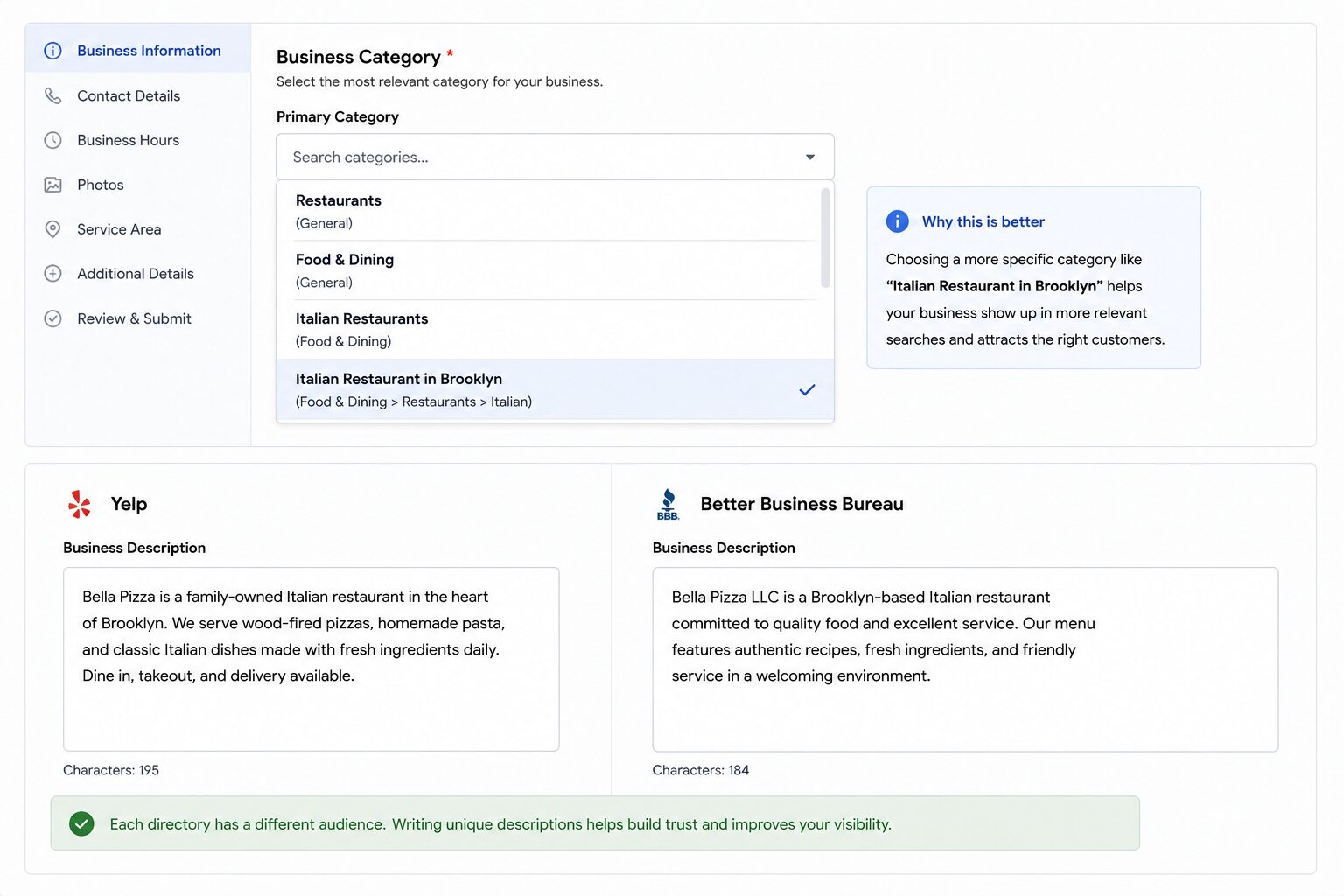
Pick the closest category, not the most general one.
“Italian restaurant in Brooklyn” beats “Restaurants” every time.
After that, write a short description specific to this directory. Two to four sentences that read naturally and mention what you do.
Don’t paste the same description into every listing.
Upload one or two images, usually your logo plus a shopfront or product photo if the directory allows it.
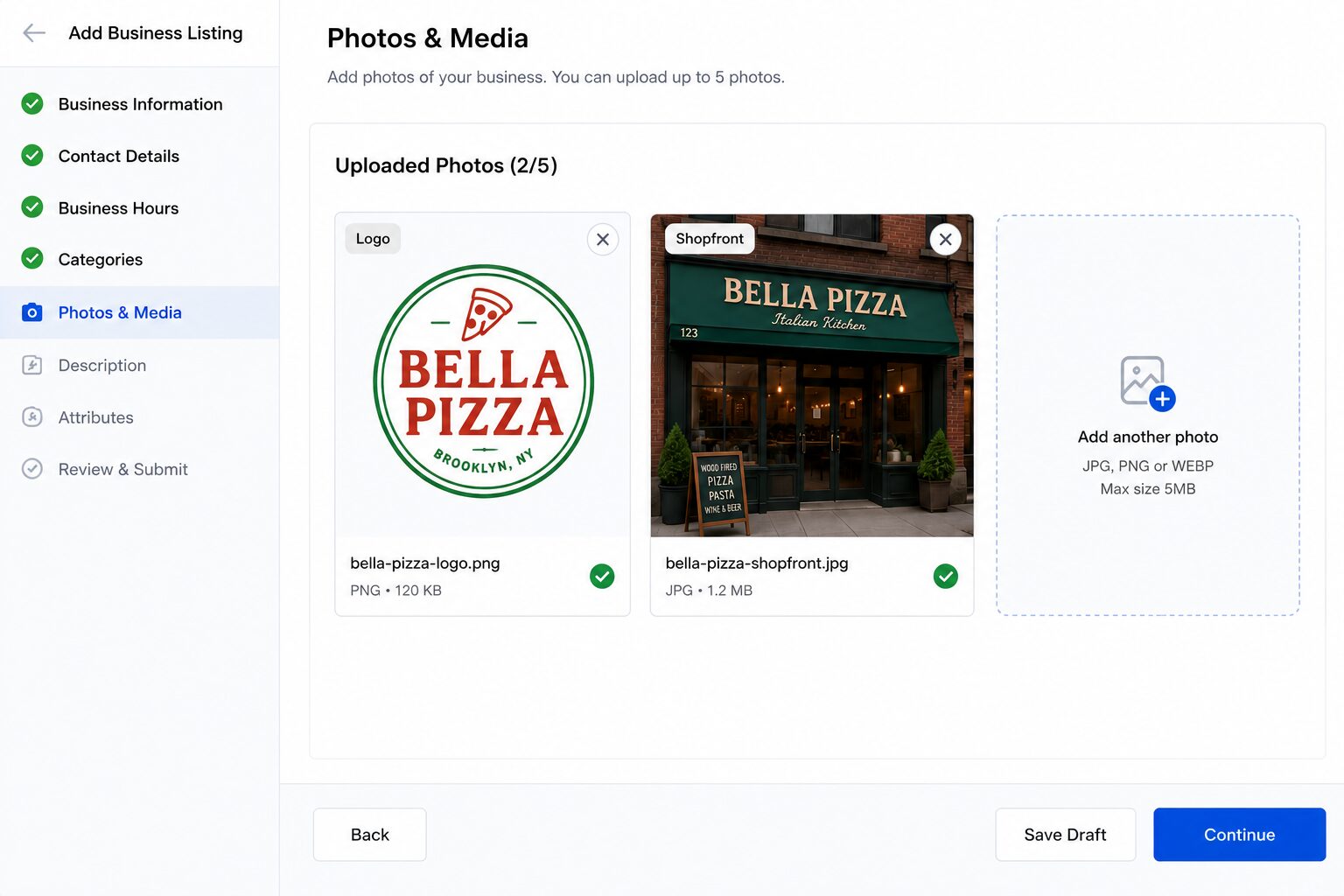
Photo Tips
- Use your logo as the primary image when possible.
- Add a clear photo of your storefront, product, or workspace.
- Avoid stock photos. Real photos build more trust.
Submit and save the listing URL inside a spreadsheet. You’ll want it later when the listing needs an update.
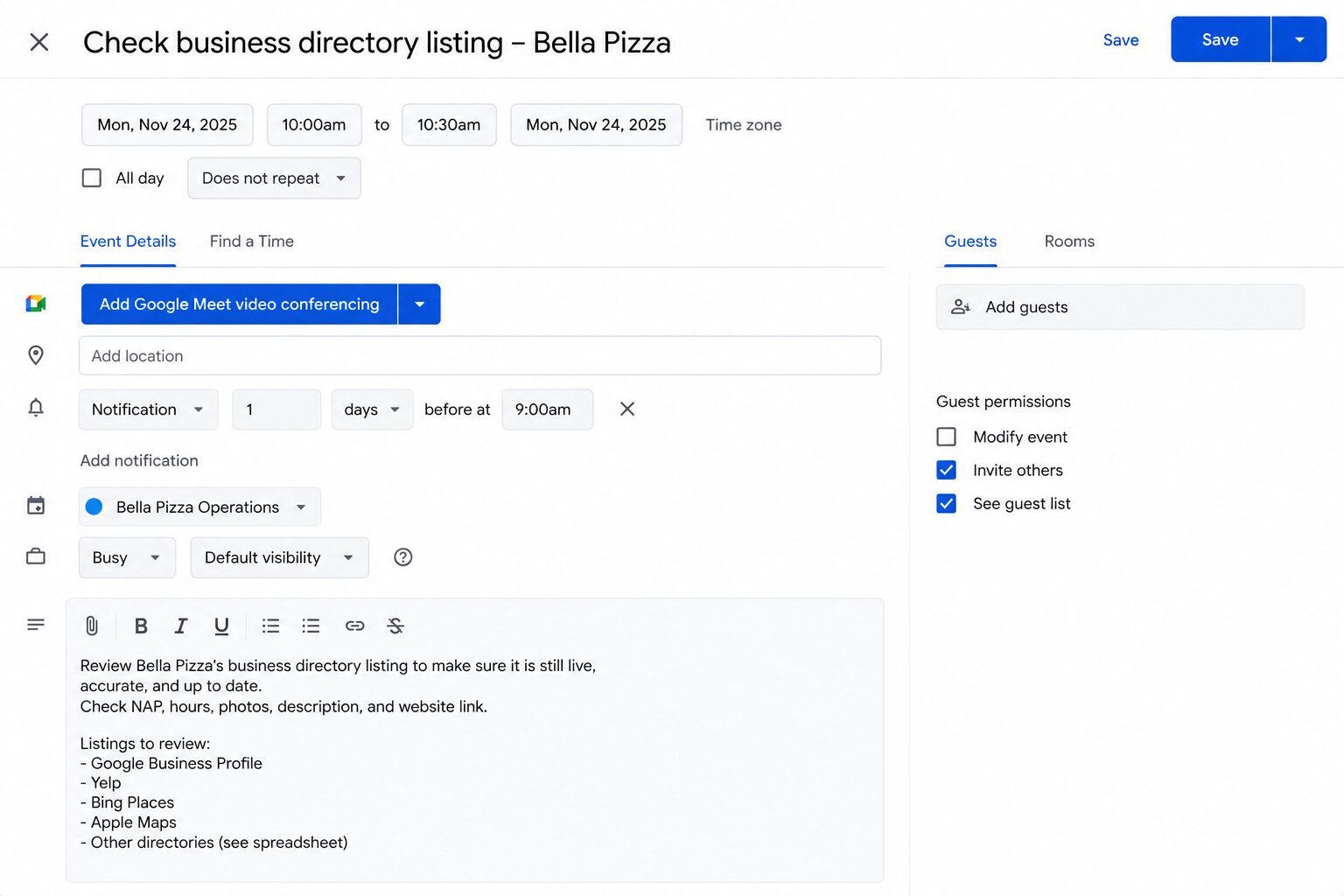
Add a calendar reminder six months out to check that the listing is still live and accurate.
Many beginners try to optimize this for speed.
They paste the same description into every listing, slap on the same image, and call it done in two hours.
That’s where the duplicate description problem starts, and it’s covered in the common mistakes section below.
How Much Time Per Submission Is Reasonable
Submitting to a directory you’ve never used before takes 15 to 20 minutes. Once you have your description templates and image library ready, later submissions drop to ten minutes.
Most first-year founders can complete fifteen to twenty-five high-quality submissions per month, working in short batches.
When Doing It Yourself Stops Making Sense
A founder making $25 an hour, spending 10 hours a month on directory submissions, is spending $250 of their own time on the work. A reasonable agency rate for the same work is $5 to $30 per listing.
If you charge $100 an hour for your services, paying someone $200 to submit to 20 directories is the trade most people would make. If you’re pre-revenue, your own time is the cheapest resource on the table.
Do the work yourself for the first thirty directories so you learn what good looks like. After that, a local citation building service handles the rest based on what your time is actually worth.
Where Directories Pay Off, and Where They Quietly Don’t
Directory links do specific jobs well but not others at all.
| Where directories help | Where directories don’t help |
|---|---|
| Local pack visibility on Google Maps | Rankings on competitive keywords |
| Helping Google find a brand-new website | Anchor text variety (most directories use the same words) |
| Trust signals for local businesses | Fresh editorial signals (no editor decides your link belongs) |
| NAP consistency for local SEO | Topical relevance (a generic directory says little about your expertise) |
| AI search citations in some categories | Strong link authority (most directory pages don’t have much) |
A note on NAP consistency. Your business name, address, and phone number must be consistent across every directory listing.
A small variation, such as “123 Main St” versus “123 Main Street,” can confuse local search algorithms. Consistent business listings across the web build the citation foundation on which local pack rankings stand.
A note on the dofollow versus nofollow question. A dofollow link tells search engines to pass authority to the linked page. A nofollow link tells them not to.
Most directories use nofollow attributes today, especially the free ones. That’s fine if you’re submitting for visibility and citations. It’s also why directories alone can’t boost your search rankings, no matter how many listings you stack up.
There’s a newer reason to care about a small subset of directories. Local search research now scores AI search visibility as its own category, and citation signals count toward it.
Some categories get surfaced in AI assistant answers. Service industries and software verticals are most common.
The right directory listings can become references that AI tools may cite. Focus on directories with real users and editorial oversight to maximize visibility.
Common Mistakes That Hurt Your SEO Without You Realizing It
The most damaging mistakes in directory link building share one trait: they’re invisible until your backlink profile is already damaged.
Paying $5 to Submit to 1,000 Directories
This is the single most damaging move a new founder can make.
The cheap submission services dump your business into thousands of directories Google has already flagged or deindexed.
Your backlink profile picks up dozens of low-quality sites linking to you overnight, which is a much louder signal than a single bad link.
Cleaning this up takes months or years. The fix is simple. Don’t buy bulk submissions. The longer explanation lies in why bulk-bought links rarely help.
Using the Same Description on Every Directory
This is the most common mistake appearing in new site audits.
When you paste the same description into every directory, those directories become dozens of pages saying the same paragraph about your business. Search engines see the duplication and discount the value of each listing.
Worse, the listings stop attracting clicks because every listing reads the same way.
The fix takes ninety seconds per submission. Keep two or three description templates of different lengths and emphases. Tweak one before each submission so it reads naturally for that specific directory.
Stuffing Exact-Match Anchor Text
Some directories let you choose the anchor text for the link back to your site. Anchor text is the clickable words inside a link, like the part that reads as a hyperlink in this sentence.
Beginners often choose their exact target keyword every time. A plumber listed in twenty directories with “plumber in Austin” as the anchor every time. Search engines have known about this pattern for fifteen years.
Exact-match anchor text from low-authority sources is one of the clearest manipulation signals search engines know. Use your business name as the anchor, your branded variant, or a topical description instead.
Ignoring the Nofollow Attribute
A nofollow link is still a real listing and still useful for local visibility and trust. It just doesn’t pass ranking authority.
Beginners sometimes refuse to submit to nofollow directories on principle, missing the visibility and citation consistency that nofollow links still deliver. The opposite mistake is to assume every directory passes authority and over-invest based on that assumption.
Submit to any directory that passes the sniff test, dofollow or nofollow. Adjust your expectations of what each kind brings.
Submitting Once and Never Updating
Directory listings go stale. Your address changes. Your phone number changes. Your business description evolves.
The listing you submitted three years ago still says you offer services you stopped offering last year.
Every six to twelve months, walk back through your saved spreadsheet of listings and confirm each one is still accurate. Most directories let you log back in and edit. The ones that don’t are usually the ones to drop from your effort going forward.
A Starter Set of Directories Worth Bookmarking
This is the curated list to work through before moving to anything more advanced.
General Foundation (Submit to All Four)
These four directories form the foundation for any new site.
- Google Business Profile. Free, dominant in local visibility, and foundational for any local business.
- Bing Places. Free mirrors Google Business Profile data for Bing and some AI search results.
- Apple Maps Connect. Free, surfaces your business in Apple device searches and Siri.
- Better Business Bureau. Free basic listing, paid accreditation optional, useful trust signal.
Local (Pick Based on Your City)
- Your local chamber of commerce directory. Usually $100 to $400 per year, with a strong local signal.
- Your city’s official tourism or visitor board listing, if you serve travelers.
- One or two well-known regional directories (city magazines, “Best of [City]” type sites).
Niche by Industry (Pick One or Two Relevant)
- G2 or Capterra if you sell software.
- Houzz, if you serve the home or interior space.
- Realtor.com, if you’re in real estate.
- Zocdoc, if you run a medical or dental practice.
- TripAdvisor, if you’re in hospitality.
Authority General (Optional, Pick If Relevant)
- Crunchbase. Free, useful for tech and startup-adjacent businesses.
- LinkedIn Company Page. Free, anchors your social and citation presence.
That’s the foundation. Ten to twelve listings cover most first-year founders for the next year of local SEO work. Skip the “top 100 free directories” lists. They aren’t what your business needs.
Where to Spend Your Link Building Hours After Directories
Once your foundation listings are submitted and consistent, directory work is largely done.
The next set of hours focuses on tactics that earn editorial links rather than catalog entries.
Our guide to nine small business link tactics puts those hours in order.
- Resource page link building involves finding curated lists of links in your industry and getting your page added.
- Broken link building involves finding dead links on other sites and offering your page as a replacement.
- Earning links through journalist queries gets you cited as an expert in articles being written right now.
- Publishing on relevant blogs places a byline and link inside an article you write yourself.
Any of those four does more for your rankings than any directory will.
They take longer, require outreach skills, and produce results in months rather than weeks.
The directory work you’ve already done is the foundation on which those tactics build.
Start With Ten Directories
Start by submitting your business to the top 10 to 12 high-quality directories, ensure your listings are accurate, and then move on to strategies that earn editorial links.
Track your submissions, refresh them regularly, and watch your local visibility grow. Don’t wait, turn your directory listings into a measurable, lasting advantage.
Looking to build local SEO visibility without wasted effort?
Get a step-by-step strategy for selecting the right directories and maintaining consistent, high-quality listings that drive real results.
Is directory link building still effective in 2026?
Yes, for Narrow Uses. it Helps With Local Visibility, Helps Google Find Your New Site, and Establishes Basic Trust Signals. it Isn’t Effective for Moving Rankings on Competitive Keywords, Where Editorial Links Matter Far More.
Do directories pass link equity the same way editorial links do?
No. Most directory links are nofollow or carry minimal weight compared to an editorial link from a real publisher in your niche. They serve a different purpose: trust signals, citations, local visibility and not ranking authority.
For ranking authority, you need editorial placements from topically relevant sites. That’s a different process entirely, and one most founders find worth handing off to a specialist team once the directory foundation is in place.
How many directories should I submit per month?
A first-year founder can complete fifteen to twenty-five high-quality submissions per month. Quality matters more than volume, so cap your time at what fits comfortably and stop chasing quantity.
Are nofollow directory links worth the effort?
Yes, when the directory passes the sniff test. Nofollow listings still build NAP consistency, support local visibility, and contribute citation signals. They don’t pass ranking authority to your site, and that’s fine.
Are paid directory submissions worth the money?
Paid listings on legitimate directories, such as chambers of commerce and industry associations, are worth it when the directory has real users and real reach. Paying for “1,000 backlinks for $5” services is never worth it and usually causes harm.
What’s the difference between a directory link and a local citation?
A directory link is a backlink from a directory site. A local citation is any online mention of your business name, address, and phone, with or without a link. Most directory listings count as both. The directory’s link is the SEO part. The NAP consistency is the citation part.
Do directory backlinks help with AI search visibility?
A small set of authoritative directories can serve as reference points that AI assistants cite in their answers. Citation signals count toward AI search visibility, so a listing on the right directory can help. The starter set above flags which ones tend to surface in AI answers. For more on showing up in AI answers specifically, see getting cited inside AI search results.