Enterprise link building isn’t regular link building with a bigger budget.
It’s a different discipline with different bottlenecks: cross-team coordination, legal review, brand risk thresholds, multi-stakeholder approval cycles, and the scaling math of hundreds of target pages instead of three.
In 2026, the discipline matters more than ever. Google’s helpful content systems and AI search engines both treat links from authoritative editorial sources as primary signals for citation-worthiness. Big brands that built link programs around bulk guest posting in the 2010s are watching their authority compress while leaner competitors with sharper editorial strategies climb past them.
This guide covers what changes at enterprise scale: how to structure a team, when to pick in-house vs agency vs hybrid, the 7 strategies that actually scale, and the decision matrix that maps your company size to your right approach.
Key Takeaways
- Enterprise link building requires coordination across SEO, content, legal, and brand teams, not just bigger volume.
- The right team structure depends on company size: under 500 employees usually picks agency, 500-2000 picks hybrid, 2000+ builds in-house.
- Digital PR and original data studies generate the highest-quality enterprise links in 2026.
- Banned tactics that work for small sites get enterprise sites flagged faster because of brand risk exposure.
- Compliance review adds 7-14 days to every campaign. Plan for it.
- Track referring domain growth per priority page, not raw link count.
- AI search citation visibility is now a core enterprise SEO KPI, not a side project.
What Makes Enterprise Link Building Different
Enterprise link building is link acquisition strategy for organizations with hundreds or thousands of target pages, multi-stakeholder approval requirements, and brand-risk thresholds that small businesses don’t share.
The difference isn’t budget. It’s friction.
A solo founder can decide to pitch a guest post and ship the next day. An enterprise SEO needs to: clear topic angles with brand, route copy through legal, secure approval from comms on which publications to pitch, coordinate with PR on overlapping outreach, then execute. Same tactic. 14x the coordination cost.
Volume Math at Enterprise Scale
A small site builds links to 5-10 priority pages.
An enterprise site needs links across product pages, category pages, location pages, vertical landing pages, and core informational hubs. The target set runs 100-500 pages, sometimes more.
That changes the strategy mix. Tactics that earn 1-2 links per month don’t scale to enterprise needs. You need approaches that produce link clusters, not single placements.
Brand and Legal Exposure
A small site that accidentally builds links from a sketchy site loses some ranking signal.
An enterprise site with the same exposure can land in trade press coverage, attract competitor accusations, or trigger internal compliance investigations. The downside scaling is asymmetric.
That’s why enterprise programs require defensible link sourcing: every placement must pass review from someone who can articulate why this link is editorial, why this site is credible, and why pitching this publication doesn’t conflict with existing partnerships.
AI Search Authority
The newest enterprise SEO concern is AI search citation visibility.
ChatGPT, Perplexity, Google’s AI Overviews, and Bing Copilot all build authority signals from who links to whom. When users ask an AI assistant about a category, the brand that’s cited is the one with the strongest editorial link profile in that space.
For enterprise brands, that’s now a board-level metric. The link program that doesn’t think about AI citation visibility is a 2024 link program.
The Enterprise Decision Matrix
Company size dictates the right model more than budget does.
The three questions below map your structure to a clear recommendation. It’s the framework we apply when scoping new enterprise programs.
Question 1: How Many People Sit Inside Your SEO Function?
If your SEO team is 1-3 people, you don’t have the bandwidth to manage outreach in-house even if budget allows. Build with an agency.
If your team is 4-10 people, you can run hybrid: in-house owns strategy and editorial assets, agency runs outreach execution.
If your team is 10+ with at least 3 people dedicated to off-page SEO, you can run fully in-house if budget supports it.
Question 2: How Often Does Legal or Brand Review Block Campaigns?
If legal review takes more than 7 days per asset, agency execution accelerates time-to-publish because the agency owns the schedule.
If review cycles are tight (under 5 days) and approval workflows are mature, in-house is viable and removes the agency markup.
Question 3: What’s Your Target Velocity?
If you need 50+ new referring domains per month across the site, you need either a 3+ person dedicated outreach team or a partner with that capacity.
If your target is 10-25 new referring domains per month, a small in-house team or a single agency can deliver.
7 Enterprise Link Building Strategies That Actually Scale
These are the tactics that produce link clusters, not one-off placements. Each works at enterprise scale because the production cost per link drops as the campaign grows.
1. Original Data Studies and Industry Reports
Original research is the single highest-output enterprise link tactic, and a foundational play in any serious link building strategy.
The pattern: your data team or research function publishes a 2026 industry survey, benchmark study, or proprietary data report. Your PR and SEO teams pitch journalists the findings. A successful study earns 50-300 backlinks from publications that quote your data over the following 12-24 months.
Examples that work: state-of-industry reports, salary surveys, consumer behavior studies, performance benchmark data. The shared trait: the data is yours alone, nobody else can publish it, and journalists need it to write their own articles.
2. Executive Thought Leadership in Tier 1 Publications
Bylined contributions from your executives in Forbes, Fast Company, Harvard Business Review, and trade publications generate authority links that bulk outreach cannot match. This is the editorial version of the classic guest post, applied at scale.
The economics: one contributed article in a Tier 1 publication can be worth 50 mid-tier guest posts in topical relevance and brand authority. The challenge is bandwidth. Your executives need to actually write, not just rubber-stamp ghostwritten copy.
Internal coordination matters here. PR usually owns executive comms; SEO needs to align on which executives target which publications to maximize SEO impact alongside brand awareness.
3. Newsworthy Product Launches and Partnerships
Every product launch, partnership announcement, or platform integration is a link earning opportunity.
The discipline most enterprise teams miss: pitching the launch as a story (the implication for the industry) rather than as an announcement (the feature list). Journalists cover stories. They ignore press releases.
This requires PR-SEO coordination on launch days. The same announcement, pitched as a story, can earn 20-80 editorial mentions. Pitched as a press release, it gets picked up by 3 aggregators and dies.
4. Strategic Resource Hub Pages
Resource hubs are evergreen, comprehensive guides on a topic relevant to your industry that publications cite over years.
Examples: the definitive glossary for your category, a long-running data dashboard, a comprehensive how-to library that journalists reference repeatedly.
These take 6-12 months to mature, but mature hubs earn links passively for years. A well-positioned hub can compound to 1,000+ referring domains over 3-4 years. That kind of compounding doesn’t exist at smaller scale.
5. Conference Speaking, Sponsorship, and Event Coverage
Industry conferences generate link clusters around your brand: speaker bios linked to your site, sponsor pages, event coverage that mentions speakers, and recap articles that reference the sessions.
Enterprise brands that invest in conference presence (as speakers, not just attendees) generate 20-50 contextual links per major event over 6 months. The cost-per-link is higher than other tactics, but the link quality and brand authority lift compound.
6. Strategic Partnerships and Co-Marketing
Partnership-driven links scale through ecosystem effects.
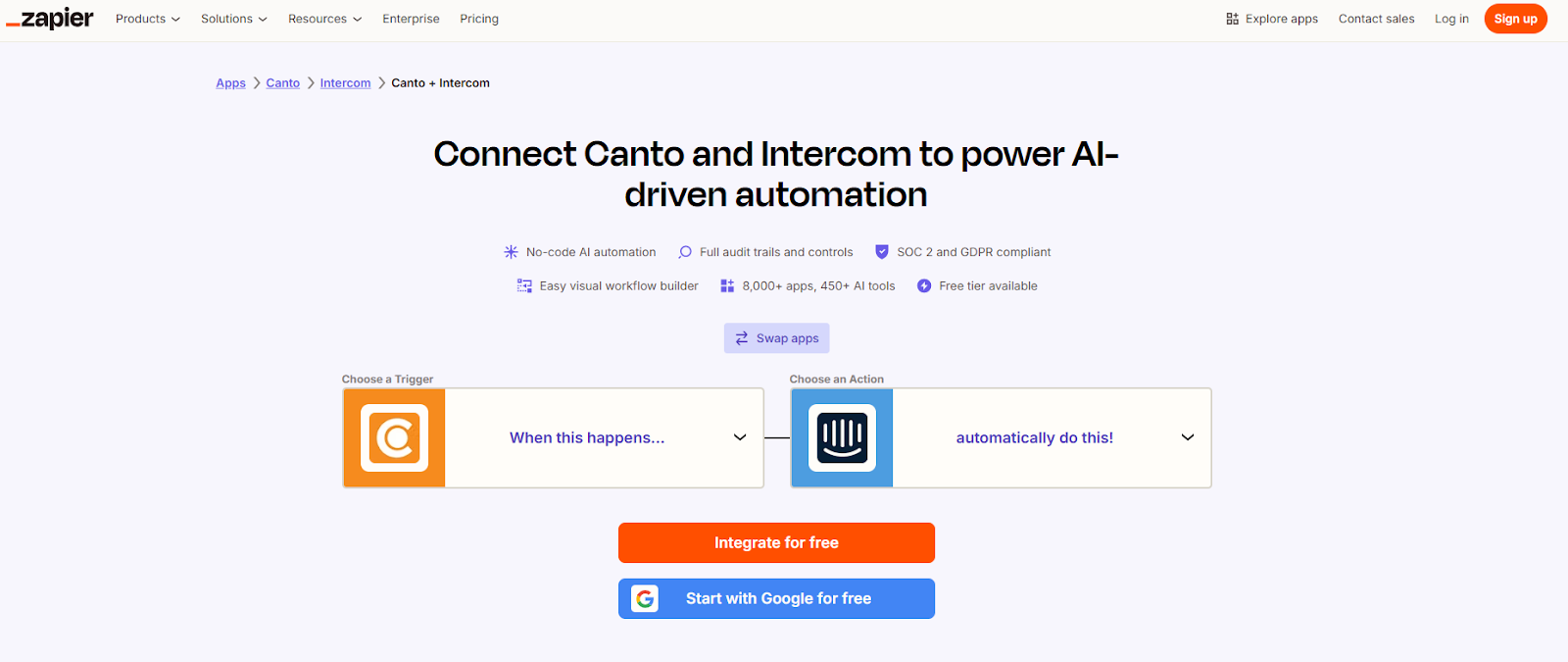
When you partner with another enterprise on a webinar, a co-published research report, or a joint white paper, both companies earn links from their respective audiences linking to the joint asset. The reach scales with the partner’s audience, not yours alone.
This works especially well for B2B brands where partnership announcements get covered by trade publications that cover the broader ecosystem.
The Zapier example above shows the software version: integration pages, a staple of SaaS link building strategies.
7. Digital PR Campaigns with Specific News Hooks
Digital PR specifically designed for link earning has a different shape than brand awareness PR. The pitch craft draws on the same principles as dead-link reclamation, just applied to journalists instead of webmasters.
You build a campaign around a specific data hook (often from strategy #1), pitch it to 50-100 journalists in target verticals, time it to align with news cycles (year-end summaries, industry events, regulatory changes), and amplify with paid social to make sure the story spreads.
A well-executed campaign earns 50-150 links over 8 weeks. The economics work at enterprise scale because the campaign cost ($30-80K typical) is reasonable per link relative to alternatives, and the brand authority lift is durable.
Building Your Enterprise Link Building Team
Team structure depends on the decision matrix above, but the role responsibilities are consistent.
Core In-House Roles
A mature enterprise link building function has these roles, regardless of whether they sit in-house or at an agency.
Director of Off-Page SEO
Owns the strategy. Reports into the head of SEO or marketing. Sets quarterly link velocity targets, prioritizes target pages, manages budget allocation across tactics, and presents to leadership.
Link Building Strategist
Translates strategy into campaigns. Picks the specific publications, partnerships, and tactics that match the quarterly plan. Manages vendor relationships if agencies are used.
Digital PR Manager
Owns the highest-value, lowest-volume campaigns. Pitches journalists, writes pitch angles, runs the editorial calendar for newsworthy content.
Outreach Specialists (2-5+)
The volume layer. Owns guest post outreach, broken link campaigns, niche edits, and resource page outreach. Each specialist typically owns 100-200 active relationships at a time.
SEO Content Manager
Bridges link building with the editorial team. Identifies which content assets need link support, briefs writers on link-worthy content, and coordinates with the outreach team on what’s available to pitch.
When to Add an Agency Partner
Even fully in-house teams benefit from agency partnerships in specific situations.
High-velocity Periods
Product launches, major announcements, or seasonal campaigns where you need to spike outreach volume for 6-12 weeks. Agencies have surge capacity in-house teams don’t.
Tier 1 Publication Access
Some agencies maintain direct relationships with Forbes, Inc., Entrepreneur, and trade press contributors that take years to build in-house. Renting that access for specific campaigns is often cheaper than building it. The same principle applies to HARO link building, where agency relationships with reporters compress the time it takes to land tier 1 coverage.
Specialized Verticals
If you’re entering a new market or vertical, an agency with established relationships in that space can shortcut the relationship-building phase by 12-18 months.
Compliance and Brand Review Workflow
The bottleneck at enterprise scale is rarely tactic execution. It’s getting approval to ship.
A working compliance workflow has these checkpoints: 1. Topic angle approved by brand (2-3 days) 2. Draft reviewed by legal for any product, regulatory, or competitive claims (3-5 days) 3. Final copy approved by comms for tone and positioning (1-2 days) 4. Publication coordination with PR to avoid overlap with active campaigns (same day)
Total: 7-12 days from idea to publish-ready. That’s the time enterprise SEO needs to plan around.
In-House Vs. Agency Vs. Hybrid: Choosing the Right Model
Each model has clear strengths and weaknesses. For companies that pick the agency route, our enterprise link building agency handles execution at scale. The right choice depends on the decision matrix above plus your operational reality.
In-House Model
Best when: You have 10+ SEO headcount, mature compliance workflows, and direct strategic ownership of the program.
Strengths: Full institutional knowledge, no agency markup, deep brand understanding, fast iteration on what’s working.
Weaknesses: Hiring is slow. Surge capacity is limited. Specialized vertical knowledge takes years to develop in-house.
Typical cost: $400K-$1.2M annual fully-loaded for a 3-5 person team.
Agency Model
Best when: You have a small SEO team (1-3 people), need to scale quickly, or lack in-house outreach expertise.
Strengths: Immediate execution capacity, existing publisher relationships, surge capacity for campaigns.
Weaknesses: Agency markup adds 25-40%. Less institutional knowledge of your brand. Quality varies widely across agencies.
Typical cost: $15K-$60K per month depending on tactics and volume.
Hybrid Model
Best when: You have a mid-size SEO team (4-10) and need to balance strategic ownership with execution capacity.
Strengths: In-house owns strategy and editorial assets. Agency owns outreach mechanics. Best of both.
Weaknesses: Coordination overhead. Ambiguity about who owns what can slow things down if responsibilities aren’t crystal clear.
Typical cost: $300-600K annual in-house plus $20-40K monthly agency retainer. See our link building pricing guide for benchmark ranges by tactic.
How to Measure Enterprise Link Building Impact
The KPIs that matter at enterprise scale are different from the metrics smaller programs track.
Referring Domain Growth Per Priority Page
Raw backlink count is vanity at enterprise scale.
What matters: the unique referring domains pointing to your priority pages. If 50 publications link to your platform page, that’s stronger signal than 200 links from 10 publications. The distinction between referring domains and backlinks becomes especially important when evaluating link diversity at scale.
Track monthly RD growth per priority page in Ahrefs or Semrush. Set per-page targets aligned with the page’s strategic importance.
Editorial Link Quality Distribution
Not all referring domains are equal. Track the distribution.
A healthy link profile has at least 30-40% of new monthly links from Domain Rating 60+ sites. Lower-DR sites are fine as long as they’re topically relevant and editorial. A profile dominated by sub-DR-30 sites signals scaled outreach without quality filter.
Anchor Text Distribution Health
Enterprise programs are most exposed to anchor over-optimization because outreach happens at scale.
Track the percentage of inbound anchors that are exact-match commercial keywords. Above 5-10% indicates over-optimization. Healthy enterprise profiles run heavy on branded anchors (40-60%), with naked URLs and partial-match anchors filling out the rest.
AI Search Citation Frequency
The newest KPI. Track how often your brand is cited in ChatGPT, Perplexity, and Google AI Overview responses for your category queries.
Tools like Otterly, Profound, and HubSpot’s AI Search Grader provide approximations. The metric is imperfect but trending up if your link program is healthy.
Page-Level Ranking Movement Tied to New Links
Pair link tracking with rank tracking per priority page. When a new link lands on a page targeting Keyword X, check Keyword X’s position 14 and 30 days later.
Over a quarter, this builds the dataset that tells you which link types actually move enterprise rankings versus which generate citation signal without ranking lift.
Common Enterprise Link Building Pitfalls
These are the patterns that derail enterprise programs even with strong budgets.
Over-Indexing on Volume Metrics
The biggest enterprise pitfall is treating link count as the success metric.
Reporting “we built 500 links this quarter” sounds impressive until you check that 70% are from low-quality sites your competitors avoid. Quality-weighted reporting (DR-segmented, traffic-weighted, anchor-distribution-aware) gives leadership a real picture.
Ignoring Brand-Adjacent Risk
Enterprise sites attract more competitor scrutiny than smaller sites.
A link program that uses tactics small sites can absorb without consequence (PBN-adjacent placements, paid links without proper marking, link exchanges) gets enterprise sites called out publicly by competitors, journalists, or trade press.
Stick to defensible tactics. The “is this story-worthy for our brand” filter doubles as a “would this embarrass us in trade press” filter.
Misaligning SEO and PR Workflows
When PR and SEO don’t coordinate, both lose.
PR pitches the same publications SEO is targeting, splitting effort. SEO content for ranking conflicts with brand voice PR is curating. Press release optimization signals get applied to content that won’t earn coverage anyway.
Quarterly alignment sessions between PR and SEO leadership prevent most of this. Shared editorial calendars prevent the rest.
Treating Agency as Vendor, Not Partner
Agencies treated as transactional vendors deliver transactional work.
The enterprise programs that get the most out of agency relationships treat them as embedded partners: weekly check-ins, shared OKRs, transparent reporting both directions, and earned trust on tactic selection.
This requires senior involvement on the enterprise side. If a director of SEO is sending agency briefs through a junior coordinator and only reviewing monthly reports, the agency relationship is a vendor relationship by definition.
Underinvesting in Editorial Assets
Outreach without strong editorial assets is broken outreach.
The pitch is only as good as what you’re pitching. Enterprise programs that invest heavily in research, data, and original content earn 5-10x more links per outreach email than programs trying to pitch generic content. This is the same principle that makes resource page link building work at smaller scale: better asset, higher conversion.
The investment ratio that works: at least 30% of link building budget allocated to creating link-worthy editorial assets, not just pitching existing content.
Frequently Asked Questions
How Is Enterprise Link Building Different From Regular Link Building?
Enterprise link building involves coordination across SEO, content, PR, legal, and brand teams, plus hundreds of target pages instead of a handful.
The discipline isn’t just bigger volume. It’s managing approval workflows, brand risk, and multi-stakeholder alignment while delivering at scale. A solo founder can decide to pitch a guest post and ship the next day. An enterprise SEO needs to clear topic angles with brand, route copy through legal, secure approval from comms, then execute. Same tactic. 14× the coordination cost.
Should We Hire an In-House Team or Work With an Agency?
Use the decision matrix. Under 500 employees with a small SEO team should pick agency-led.
500-2,000 employees with 4-10 SEO staff should run hybrid: in-house owns strategy, agency owns execution. 2,000+ employees with mature SEO functions can run fully in-house with agency support for specific high-velocity campaigns or vertical access they don’t have internally. A specialist link building agency built for enterprise coordination fits naturally into any of these three models, not just the agency-led one
How Much Should Enterprise Link Building Cost?
Agency retainers typically run $15,000 to $60,000 per month depending on tactics and volume.
Fully in-house teams cost $400,000 to $1.2 million annually fully-loaded for a 3-5 person function. Hybrid models combine $300,000 to $600,000 in-house with $20,000 to $40,000 monthly agency retainers. The right spend depends on referring-domain growth targets and the strategic value of the priority pages you’re building links to.
How Long Does Enterprise Link Building Take to Show Results?
Enterprise programs typically show first measurable ranking impact in 3 to 6 months.
Brand authority lift and AI search citation visibility take 6 to 12 months to compound. Digital PR campaigns can land coverage within 8 to 12 weeks, but the SEO impact follows 4 to 8 weeks behind that as Google evaluates the new links. Setting leadership expectations early avoids the “quarter 2 review where SEO doesn’t have rankings yet” disaster.
What Enterprise Link Building Tactics Should We Avoid?
Bulk guest posting on low-quality sites, PBN placements, link farm schemes, mass directory submissions, and any paid link program without proper rel=sponsored marking.
Enterprise brands face higher scrutiny and reputational exposure than smaller sites, so tactics that work for low-stakes domains create asymmetric risk at enterprise scale. The “is this story-worthy for our brand” filter doubles as a “would this embarrass us in trade press” filter.
How Does AI Search Affect Enterprise Link Building?
AI search engines evaluate authority through the same editorial link signals Google uses for organic rankings.
Enterprise brands with strong editorial link profiles get cited more often in ChatGPT, Perplexity, and Google AI Overview responses for their category. This makes AI citation visibility a core enterprise SEO KPI, not a separate channel.
The Forward Look
Enterprise link building in 2026 looks less like a bulk acquisition channel and more like a coordinated content and PR motion.
The brands winning right now are the ones that invested in editorial asset creation 18-24 months ago and are now harvesting the link clusters those assets generate. The brands that treated link building as an outreach problem rather than a content + outreach + PR problem are watching their authority compress.
Pick the structural model that fits your company size. Invest in editorial assets before scaling outreach. Track referring domain growth per priority page rather than raw counts. Measure AI citation visibility alongside Google rankings. Build your team around the workflow your compliance cycles allow, not around an idealized agency template.
That’s what scaled authority looks like for big brands in 2026. Start with the decision matrix and build from there.