Most small businesses don’t struggle because they offer a poor product. They struggle because nobody links to their website.
Link building for a small business means earning links from sites your customers and your industry already trust. The budget assumes you’re the one doing the work. Ahrefs studied roughly 14 billion pages and found that 96.55% get zero search traffic. Pages with more referring domains tend to get more of it. That’s a correlation, not a promise. But it does explain why a good site with no links stays invisible.
You don’t need a hundred links. You need the right dozen, in the right order.
Key Takeaways
- Earn 12 to 30 quality backlinks in your first year, not 100 in a week.
- Build in three phases: foundational (months 1 to 3), editorial (4 to 6), compounding (7 to 12).
- Nine tactics fit a small budget. Four are free and take an afternoon each.
- Outsource when a $200 link costs less than the hours it takes you to earn it.
- Five link types actively hurt you. Bulk directory packages lead the list.
Why Link Building Looks Different When You’re Small
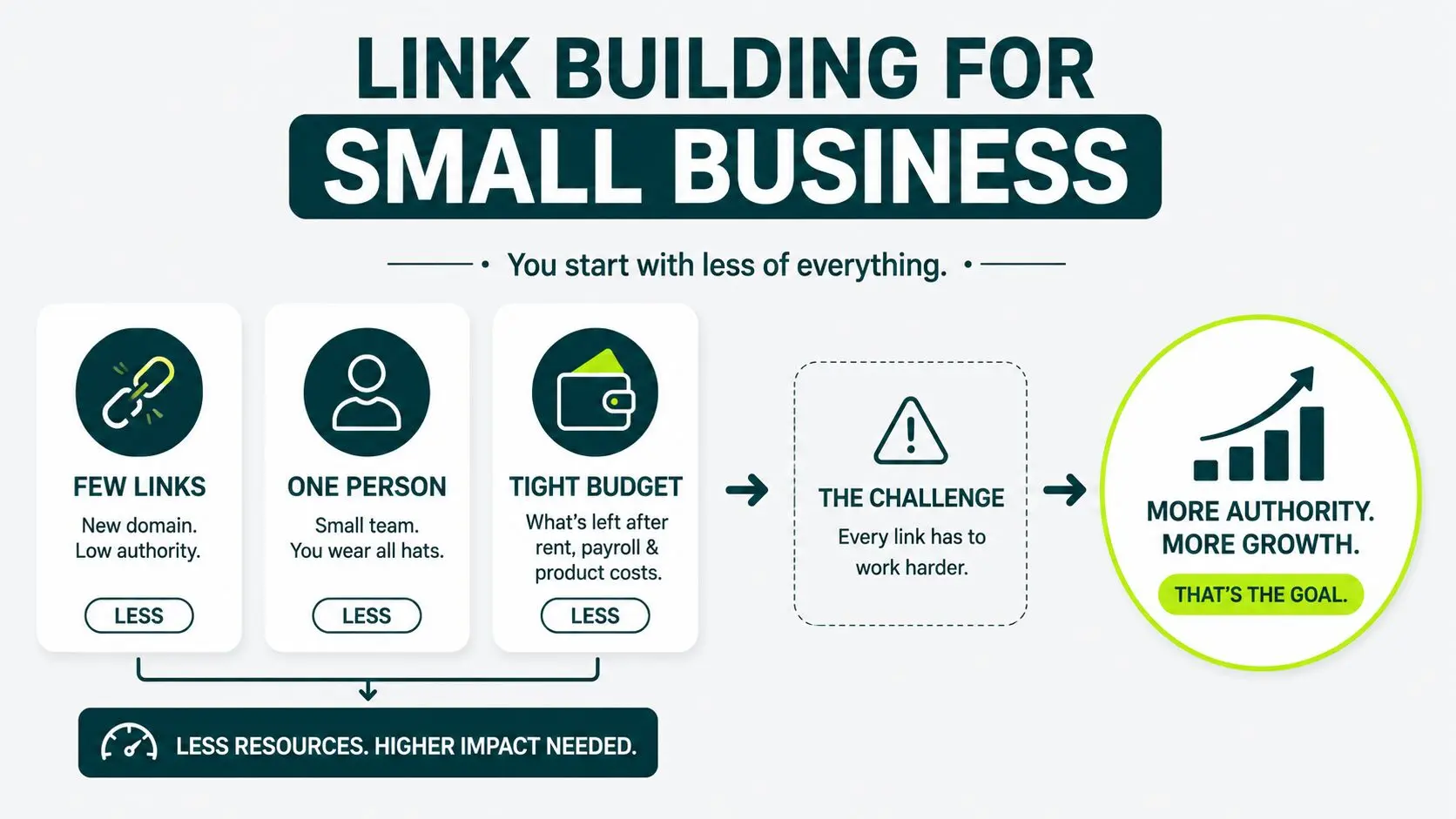
Being small changes which links you can realistically get, not which links count. Your domain has few links. Your team is one person, and that person is you.
A national brand earns links by publishing research nobody else can afford. You can’t match that, and copying it wastes the little time you have.
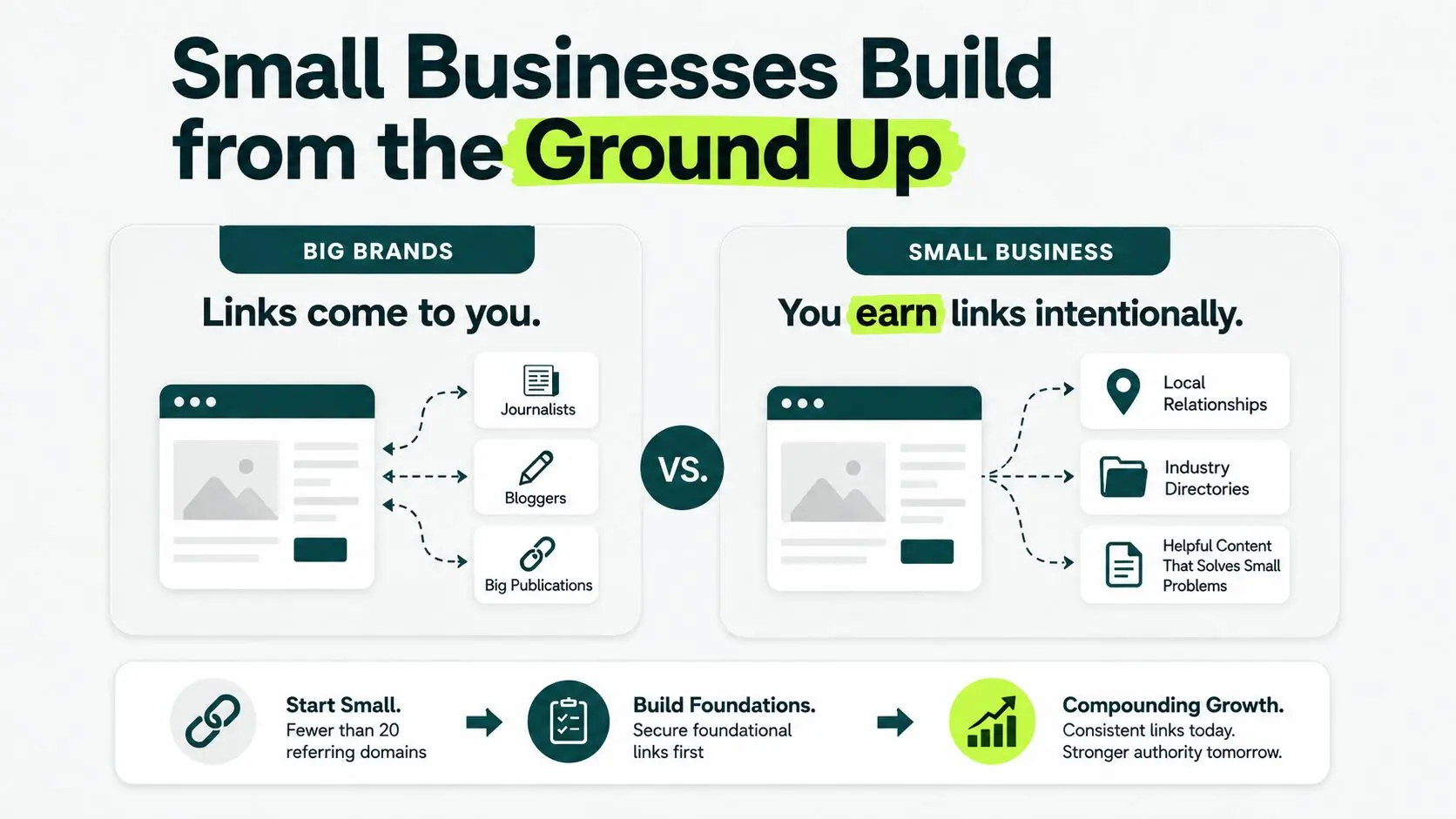
What you have instead is proximity to real people who already know your business. Your suppliers have websites. Your chamber of commerce has a member page. The local paper covers the event you sponsor.
Those links are unglamorous. They’re also the ones a small business can actually land.
The other constraint is time. A brand has a team assigned to outreach, while you have the hours left after the actual work.
That’s why the order matters more than the list. Tactics that need a published asset fail if you run them in month one.
Relevance beats authority at your size. For a plumbing company, a regional trade association link beats a general news mention. It sits closer to what you sell. If you’re new to the mechanics, our guide to what backlinks are covers the fundamentals before you start pitching.
9 Link Building Tactics for a Small Business
These nine tactics cover everything a small business needs in year one. The first four are foundational, cost nothing but time, and belong in your first 90 days. The rest earn editorial links once that base exists.
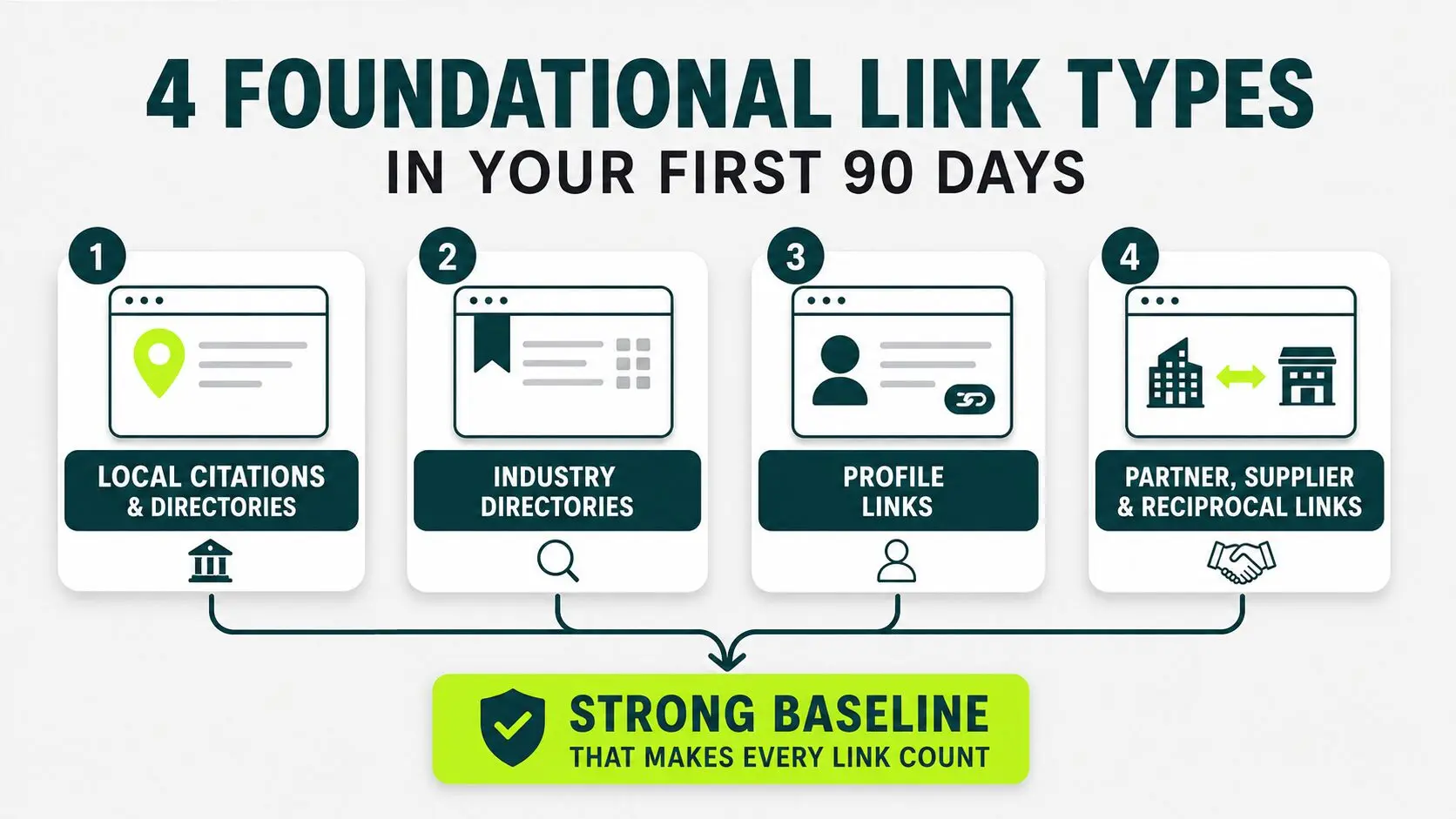
1. Local Citations and Directory Listings
A local citation is any online listing of your business name, address, and phone number. Google uses them to confirm your business is real and operating where you say it is.
Claim Google Business Profile first, then Bing Places, Apple Business Connect, and Yelp. Make the details match exactly across all four, down to whether you write “Street” or “St.”
Inconsistent listings are the most common problem we find on a new local audit. Our breakdown of SEO local citations explained covers which directories matter by industry.
2. Industry and Trade Directories
Industry directories are listings your customers actually browse when choosing a supplier. A contractor belongs on licensing-body directories. A designer belongs on Houzz.
Pick three to five where a real buyer would look. Skip anything that lists every business in every category, because those pass almost no value.
The test is simple. Would a customer use this directory to find you? If not, neither will Google. Our post on directory link building that works separates the useful ones from the filler.
3. Profile Links on Services You Already Use
A profile link is the website field on an account you already own. LinkedIn, your podcast host, your software vendors, your professional association.
Most of these take an afternoon to fill in. They won’t move rankings on their own.
What they do is establish a consistent baseline, which matters because foundational links come first before editorial outreach makes sense.
4. Partner, Supplier, and Reciprocal Links
A partner link is one you request from a business you already work with. Your accountant, your supplier, the firm you refer clients to.
The ask works because the relationship already exists. Keep it short and specific:
“We already work together, so it’d make sense to mention each other on our sites. I’d be glad to add you to our partners page. Would you be open to listing us on yours?”
Three to five of these in your first month is a realistic target. Ask again each quarter as you add partners. Just keep it genuine, because an unsafe backlink exchange at scale is a pattern Google recognizes.
5. Guest Posting on Industry Sites
Guest posting means writing an article for a site your customers already read. You get a link, they get content they didn’t have to produce.
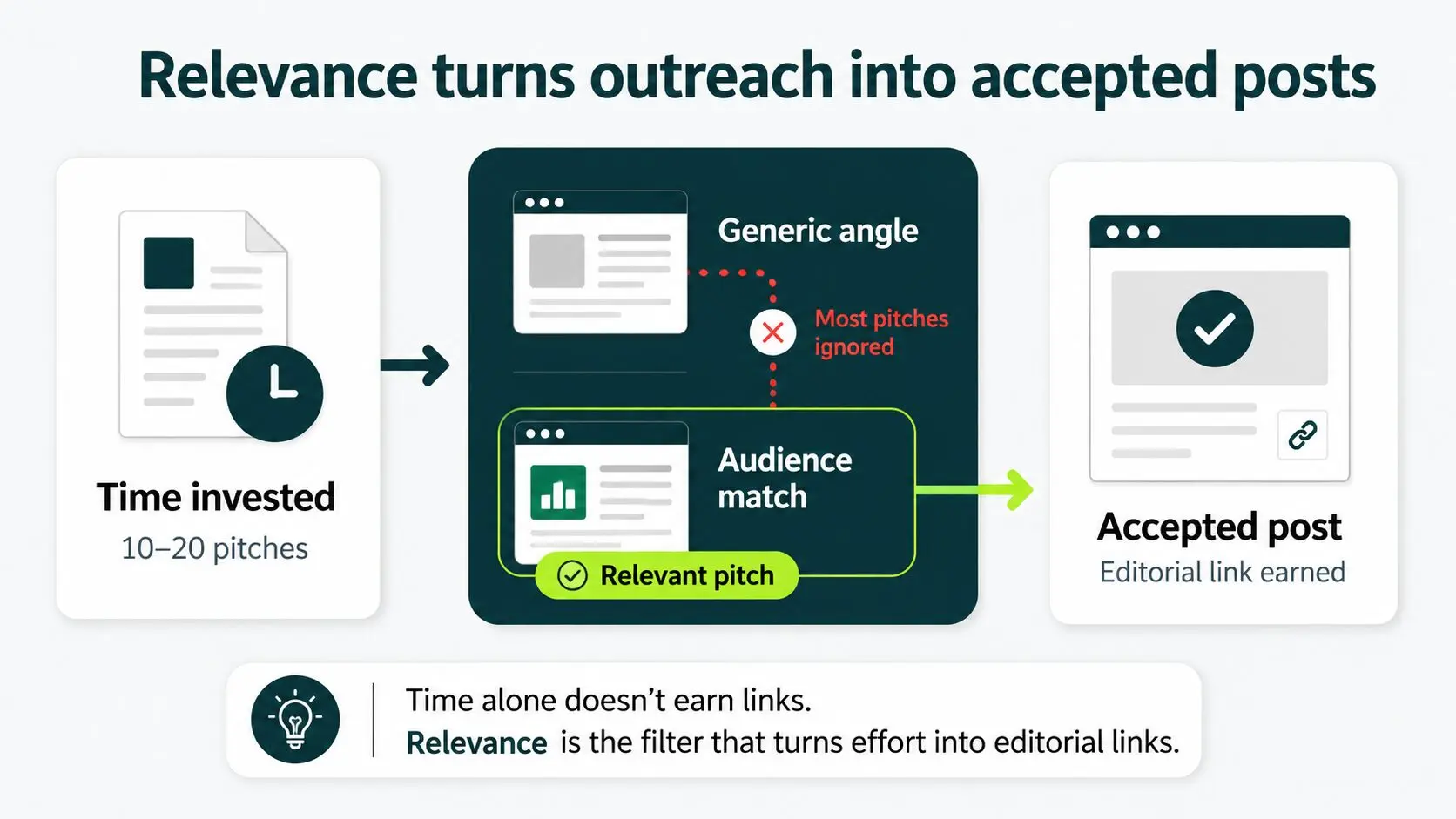
Editors accept pitches that fit their audience and their gaps. They reject anything that reads as a generic round-up.
Pitch a specific title, not a topic. “Five load-calculation mistakes that void an HVAC warranty” gets read. “An article about HVAC” doesn’t.
Read two of their recent posts first. Reference one in the pitch, and your reply rate roughly doubles.
Cold pitches see a 5% to 15% response rate. That’s one accepted post per 10 to 20 targeted emails, so send them in batches. Our guest post outreach playbook covers pitching and structure in depth.
6. Journalist Queries on HARO Replacements
Journalist query platforms let reporters request expert sources, and you answer with a quote. A successful reply earns a link from a real publication.
The landscape changed, and a lot of advice hasn’t caught up. Cision shut down Help a Reporter Out and its successor Connectively in December 2024. Featured.com relaunched HARO in April 2025 and runs it now.
The live options in 2026 are Featured, Qwoted, Source of Sources, and Help a B2B Writer. Source of Sources comes from Peter Shankman, who built the original HARO. We compare them in our guide to the best HARO alternatives.
The workflow is four steps. Sign up and filter to your industry. Check the queue once a day for 15 minutes. Answer only where you have a specific, quotable point.
Each response takes 10 to 20 minutes. Expect roughly one placement per 10 to 20 replies, depending on how sharp your answers are.
Journalists quote specifics. A number from your own operations beats a general opinion every time.
7. Broken Link Replacement on Resource Pages
Broken link building means finding a dead link on a page and offering yours as the replacement. Local resource pages and association member lists go stale constantly.
Run a resource page through a checker, find the dead links, then email the page owner. You’re doing them a favor, which is why the reply rate beats cold pitching.
Our free broken link checker tool finds them, and the full broken link building method covers the outreach.
8. Sponsorships, Events, and Community Links
Community links come from sponsoring, hosting, or joining something local. Youth sports teams, charity runs, and community college events list their sponsors with a link.
A $200 sponsorship buys a permanent link plus the goodwill of being known locally. Hosting a free workshop with a library or co-working space earns a listing on their events page.
Trade association membership works the same way, and the member directory link usually outranks anything you’d buy.
Three formats are worth your time. Sponsor a local event, co-host a workshop with a venue that has a website, or join the trade body for your industry.
These compound in a way paid links don’t. The organizer who linked you this year invites you back next year. That’s why local link building for your city keeps producing after the first placement.
9. One Linkable Asset You Build Once
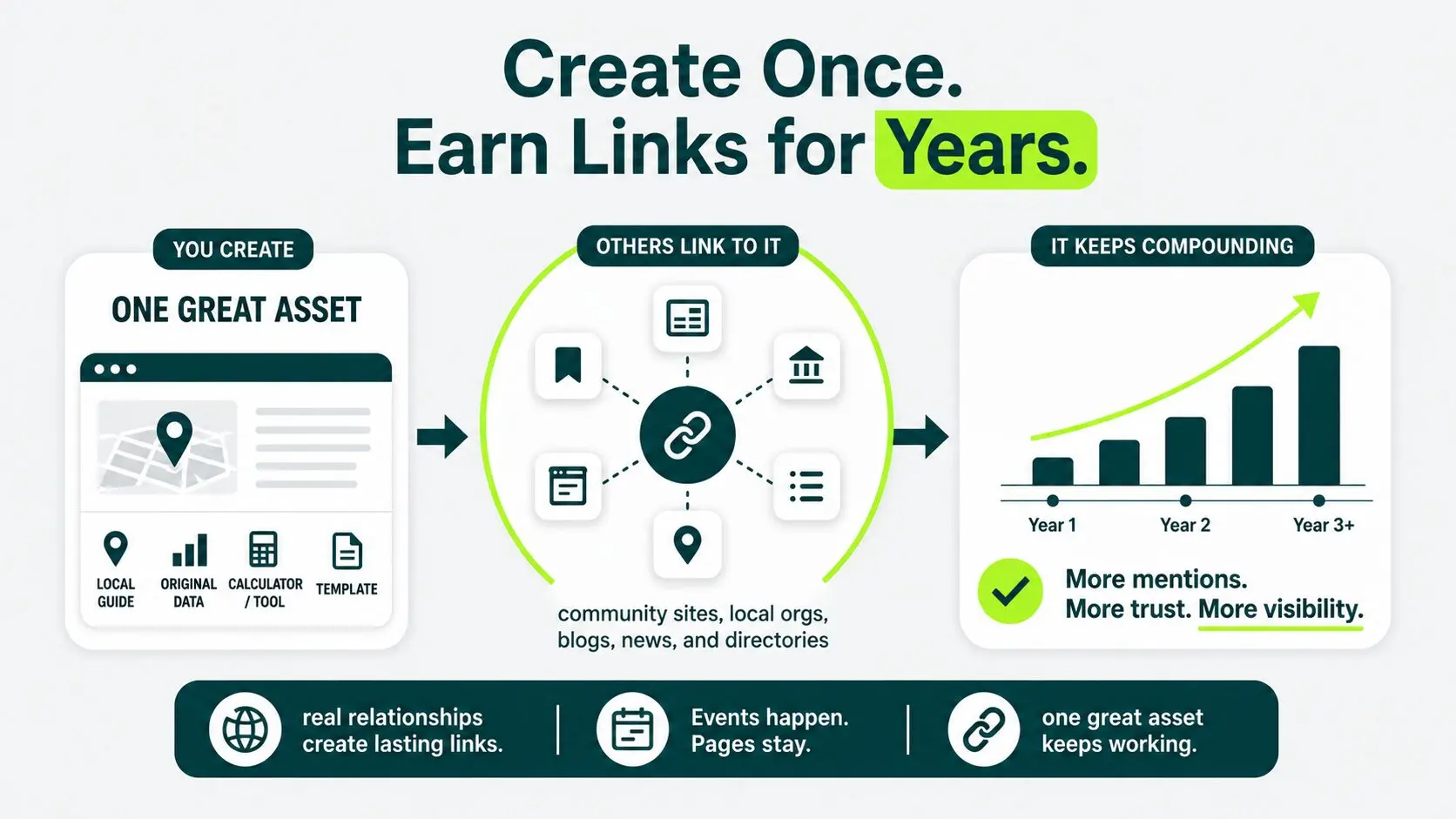
A linkable asset is something useful enough that people link to it without being asked. You need one, not a content calendar.
Three formats work for small businesses. A local guide to something specific, like commercial lease negotiation in your city. A small dataset from your own operations, like average repair costs across 200 jobs. Or a calculator tied to a real customer decision.
Your own data is the strongest of the three, because nobody else has it. Publishing it is the step most owners skip.
Building it isn’t enough, and promotion is the step most owners skip. An asset nobody knows about earns nothing.
Email the ten people who’d genuinely use it. Mention it whenever a journalist query touches the topic. Link it from your own pages so crawlers find it.
One good asset keeps earning links for years with no further work. Our guide to creating linkable assets covers the formats that hold up.
Three Fast Wins Most Owners Overlook
These three take under an hour each and use links that already half-exist. Run them before you start any cold outreach.

Unlinked Mention Reclamation
An unlinked mention is a page that names your business without linking to it. Local press, supplier case studies, and event recaps produce them constantly.
Search your business name in quotes and check which results link back. Email the ones that don’t, thank them for the mention, and ask for the link.
This converts better than any cold pitch, because the writer already chose to mention you. Our post on finding unlinked mentions covers how to track them automatically.
Backlink Gap Analysis
A backlink gap analysis lists sites linking to your competitors but not to you. Those sites already link to businesses like yours, so they’re pre-qualified.
Free tiers of Ahrefs Webmaster Tools and Semrush show enough to start. Pull the referring domains for two competitors, then find the overlap.
Work the list by relevance, not by domain rating. A backlink gap analysis service does this at scale if the manual version stalls.
Listicle and Roundup Placement
Listicles are “best of” posts that already rank for your service and city. Getting added to one puts you in front of buyers at the moment they’re comparing.
Search “best [your service] in [your city]” and note which posts rank. Email each author with your specifics: what you do, who you serve, why you belong there.
Regular link roundups work the same way when you have something new to share. Our guide to getting featured in roundups covers the pitch, and listicle link building placements covers the done-for-you version.
Anchor Text and Consistency Basics
Two details decide whether the links you earn actually help. Both are easy to get wrong and cheap to fix.
What Anchor Text Should Look Like
Anchor text is the visible words someone clicks to reach your site. It tells Google what your page is about.
A natural profile is mostly your brand name, your bare URL, and descriptive phrases. Exact-match commercial anchors like “emergency plumber Chicago” should be rare.
You mostly don’t control this, and that’s fine. When a partner asks what to link, give them your business name. A profile that’s 60% exact-match keywords looks bought, because it usually is. Our post on what makes links relevant explains why context beats keyword matching.
NAP Consistency and Local SEO
NAP stands for name, address, and phone number, written identically everywhere. Local SEO treats mismatches as evidence that two listings are different businesses.
Suite numbers, abbreviations, and old phone numbers cause most of the damage. Fix them before chasing new citations, or you’re adding to the confusion.
This costs an afternoon and makes every local link you earn afterward count for more.
How the Right Links Change by Trade
The nine tactics hold for any small business. Which links actually move rankings depends on what you do.
Licensed trades start with an advantage. State licensing bodies and trade associations publish member directories, and those carry weight because someone verified you to get listed. That is why electricians and licensing directories pair so well. The same pattern drives contractor link building, where the licensing board is the anchor tenant.
Home services turn on season and on local programs. Utility companies list approved installers, and that placement is worth chasing before the season starts, not during it. Timing matters as much as the link itself. HVAC rebate placements show this most clearly. Landscaper link building follows the same seasonal curve.
Visual trades earn links by being seen rather than listed. Their work photographs well, so publications want the images and will credit the source. For interior designers on Houzz, a portfolio converts into enquiries. Architect link building depends on project-led coverage instead.
Multi-location businesses fight a problem single-location ones never face, which is their own brand. You compete with the same name in other cities and with the manufacturer’s own store locator. Dealership link building runs into this on every campaign. Franchise link building needs corporate authority plus a real local signal in each city.
Narrow industrial niches have fewer places to earn a link, which makes each one worth more. Trade press and supplier networks do most of the work. Forklift dealer links come almost entirely from those two sources.
Link Types to Avoid in 2026
Five link types actively hurt a small business. Google’s link systems have gotten much better at devaluing them since the helpful content guidance rolled into core ranking.
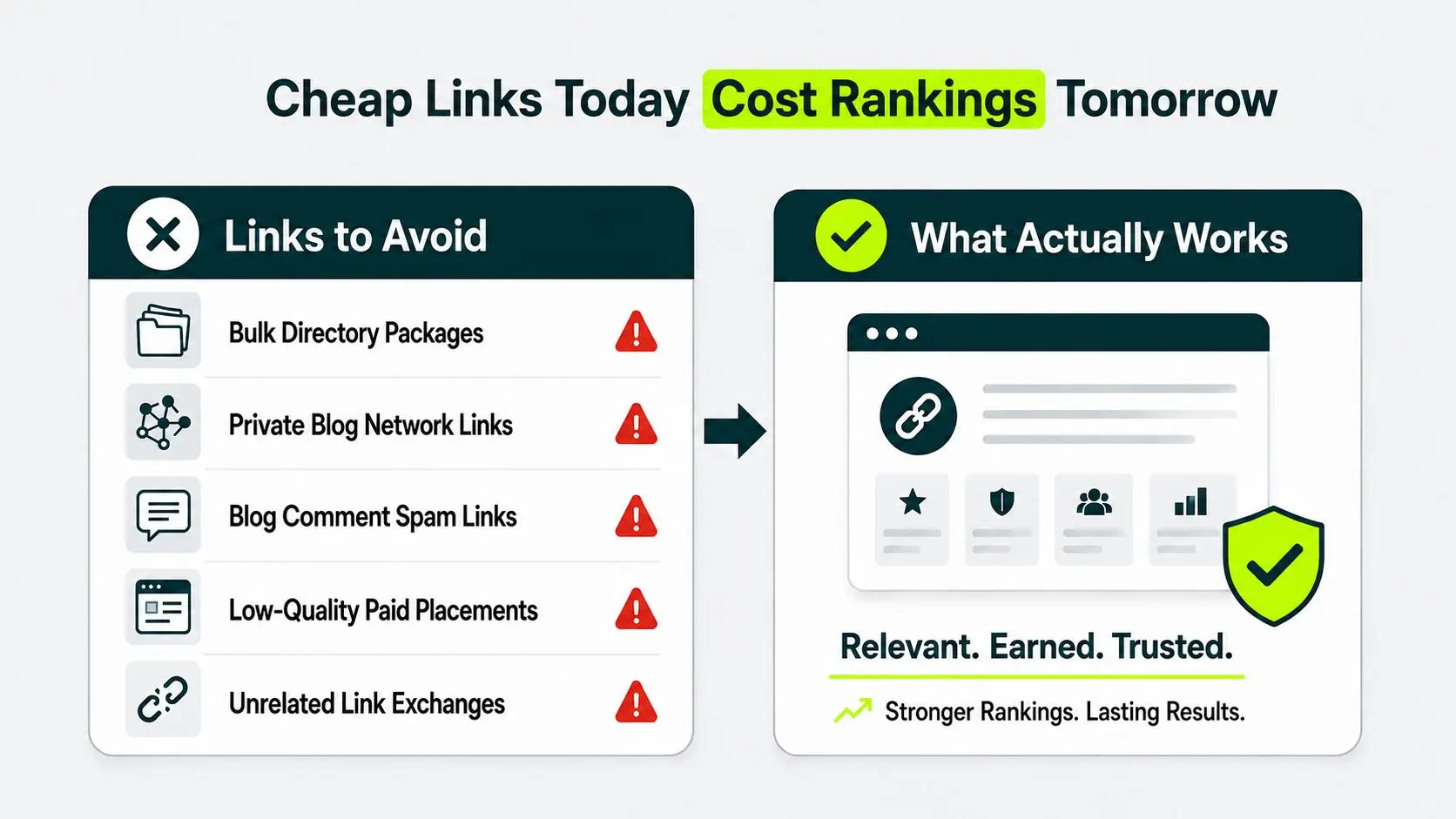
Bulk Directory Packages
These promise 50 or 100 directory submissions for $20 to $100. The directories are low-quality, irrelevant, and often built only to sell listings.
No customer browses them. That’s the tell.
Private Blog Network Links
A private blog network is a group of sites built to look independent while one owner controls them all. When a network gets detected, every link in it can be devalued at once.
You lose the whole investment, not part of it. Our post on link farming risks covers how they get caught.
Blog Comment Spam
These are links dropped in the website field of a blog comment. Almost every platform marks them nofollow by default.
They pass no value and signal desperation to anyone reviewing your profile.
Low-Quality Paid Placements
Some sites exist only to sell links, with no real readers. Thin content, unrelated topics, and a public price list are the warning signs.
Our analysis of the risks of paid links covers what the data actually shows.
Unrelated Link Exchanges
Trading links with businesses that have nothing to do with yours creates a pattern with no editorial logic behind it. A bakery linking to a software firm makes sense to neither reader nor algorithm.
A useful rule: if you’d be uncomfortable showing the link to a customer, don’t build it.
That single test catches all five types above. Every one of them fails it.
If a link would only ever be seen by a crawler, it isn’t doing the job a link is supposed to do. Our post on safe white hat strategies covers what to run instead.
How Many Backlinks Does a Small Business Need?
Most small businesses see their first measurable ranking lift between 12 and 30 quality referring domains. A referring domain is one unique site linking to you, however many times it does it.
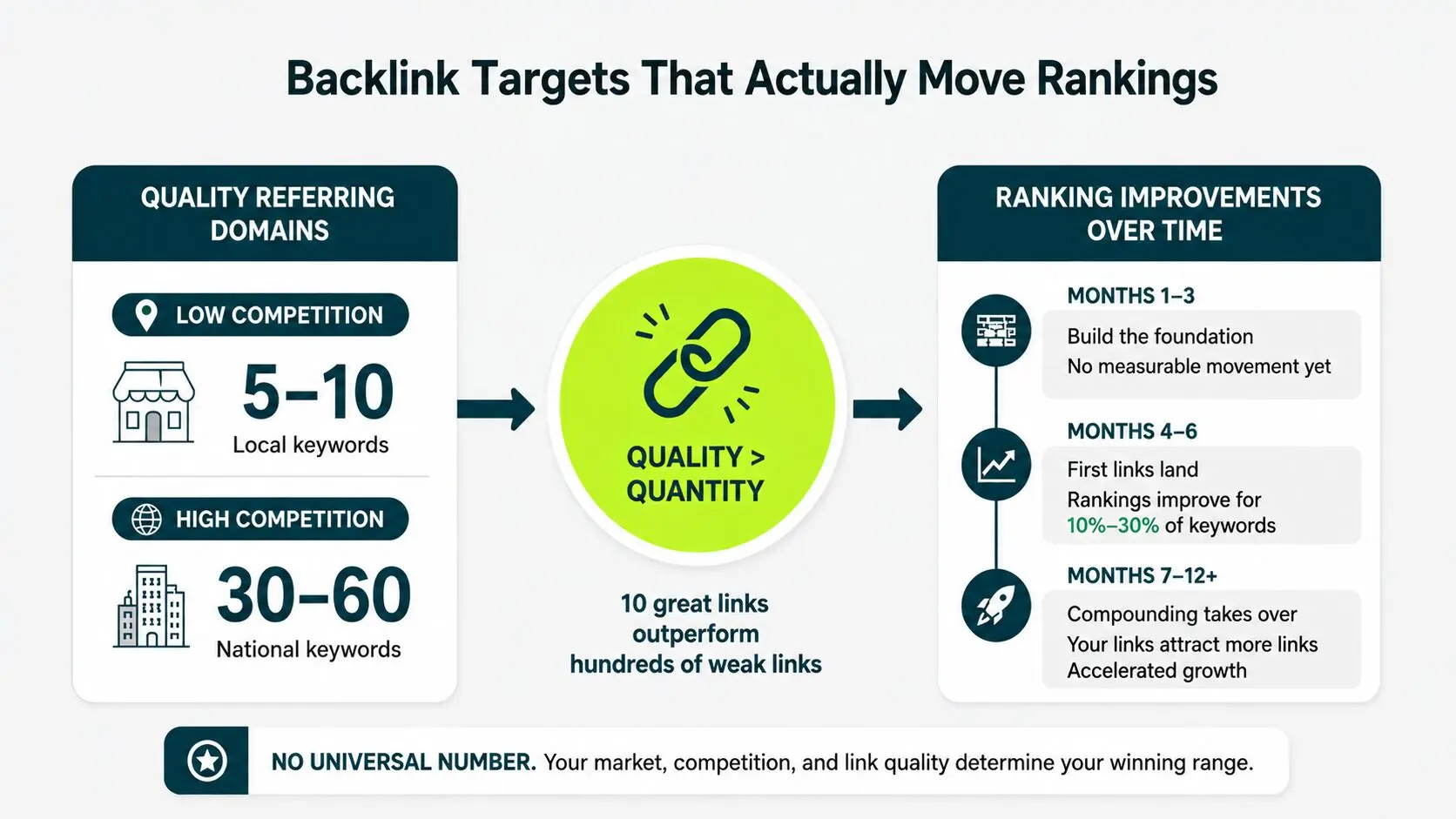
Competition sets the real number. A low-competition local keyword can rank with 5 to 10. A competitive national term needs considerably more.
Quality separates the two more than volume does. One link from a real publication outperforms a hundred directory listings.
Spread matters too. Thirty links from thirty sites beat thirty links from three, because each new domain is a fresh vote.
Our breakdown of how many backlinks you need goes deeper by competition level. And a diverse backlink profile explains why the spread counts.
The Timeline Follows a Predictable Pattern
Results arrive in three stages, and the first one looks like nothing is happening.
Months 1 to 3 build the foundational baseline with little visible ranking movement. Months 4 to 6 bring the first editorial links, and rankings improve for roughly 10% to 30% of target keywords. Months 7 to 12 compound, reaching 24 to 38 referring domains and gains across about 30% of targets.
Owners who quit do it at month 2, right before the curve turns. Tracking matters here, and our guide to link building metrics that matter covers what to watch.
What Link Building Costs and When to Outsource
Doing it yourself costs time, so the real question is your opportunity cost. If you bill $75 to $200 per hour, five hours of link building costs you $375 to $1,000 in billable work.
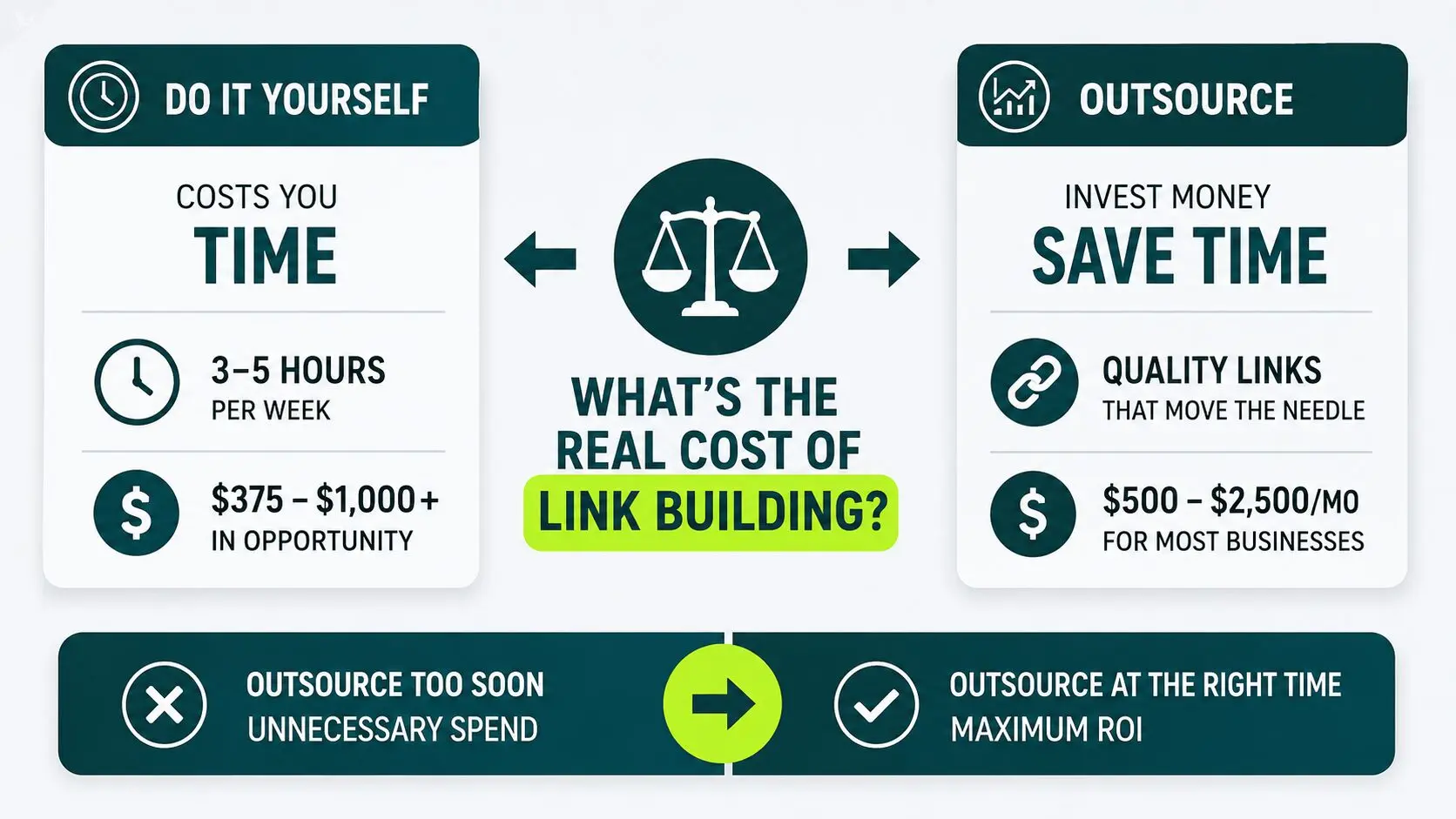
Hiring in-house runs $4,000 to $8,000 per month before tools. That’s beyond most small businesses.
The comparison that matters is the cost of a placement against the value of your own hour. If a link costs $200 and five hours of your time is worth $1,000, buying it is cheaper.
That math flips for a solo owner billing $40 an hour. Run the numbers for your own rate before assuming either answer.
Editorial placements generally cost $150 to $600 each, depending on the publication and the link. Most small businesses acquire 2 to 5 links per month, putting a realistic budget at $500 to $2,500. These ranges reflect the market as of August 2026. Our link building pricing breakdown details them by tactic.
The Four-Question Outsourcing Test
Outsource when four things are true at once.
- You’ve run the foundational tactics yourself and know they’re done.
- Outreach has stalled for two months despite consistent effort.
- Your billable hour is worth more than the cost of a placement.
- You can fund three to six months, since shorter runs don’t compound.
Fewer than four means keep doing it yourself. When all four hold, outsourcing your link building buys back the hours without losing momentum.
Your 12-Month Link Building Plan
This plan assumes three to five hours a week. Each phase depends on the one before it.
Months 1 to 3: Foundational Phase
Set the baseline that makes later outreach work.
| Weeks | Actions to take |
|---|---|
| Week 1 | Claim Google Business Profile, Bing Places, Apple Business Connect, and Yelp. Verify that your business information matches everywhere. |
| Week 2 | Identify three to five industry directories where your customers actually look for businesses like yours. Submit your listings to each. |
| Week 3 | Fill in the website address field in every professional account you use. |
| Week 4 | Ask three to five partners, suppliers, or vendors for reciprocal listings on their partner pages. |
Set up Google Search Console and Ahrefs Webmaster Tools, both free, to monitor your profile. Our free backlink monitoring tool alerts you when new links appear. Repeat the partner ask each quarter.
Months 4 to 6: Editorial Phase
Pick two editorial tactics and run them on a fixed weekly rhythm.
| Weekly Rhythm | |
|---|---|
| Monday (1 hour) | Build a list of 5 to 10 target sites or active journalists’ queries. |
| Wednesday (1 to 2 hours) | Send 5 to 10 specific pitches or query responses. |
| Friday (30 minutes) | Send one follow-up to anyone who hasn’t replied in 5 to 7 days. |
Consistency beats volume here. Ten thoughtful pitches a week outperform fifty templated ones.
Months 7 to 12: Compounding Phase
Publish your linkable asset, then promote it deliberately.
Keep the weekly outreach rhythm running underneath. Add community sponsorships as they come up locally.
This is also when earlier work starts paying twice. A guest post from month 4 gets cited, and the citing site links you without any pitch.
In months 11 and 12, audit which links are still live and reclaim any mentions that lost their link. Our post on how passive link building works covers what keeps producing after you stop.
| Check point | What Success Looks Like |
|---|---|
| Day 90 | 8–12 foundational links and a backlink-monitoring setup that alerts you to new links. |
| Day 180 | 4–8 editorial links and clear data on which outreach tactic performs best. |
| Day 365 | 24–38 cumulative quality referring domains and measurable ranking improvements across roughly 30% of your target keywords. |
By year one’s end, your editorial links and your asset also make you easier to cite in AI answers. Those systems pull from the same trusted sources Google does.
Start With the Four You Can Do This Week
Owners don’t lose at link building because they picked wrong tactics. They lose by trying all nine at once, then quitting in month 2.
Claim your four core listings this week. Ask three partners next week. That’s your foundation, and it costs nothing but a few hours.
The editorial work only pays off once that base exists. Build it in order and month 6 looks very different from month 2.
Want to build authority without a large SEO budget?
Get a practical link building strategy designed for small businesses with limited resources.
How many backlinks does a small business need to rank?
Most small businesses see their first measurable ranking lift between 12 and 30 quality referring domains. The exact number depends on competition. A low-competition local keyword needs 5 to 10, while a competitive national term needs considerably more. One link from a real publication outperforms a hundred directory listings.
How long does link building take to show results?
Foundational setup takes about three months for a small business starting with few links. The first ranking movement happens in months 4 to 6, as editorial links land. Measurable ranking gains on 10% to 30% of target keywords usually appear around month 6. Compounding growth runs through year one and beyond.
Can a small business do link building without an agency?
Yes. An owner with three to five hours a week can run the full 12-month plan without outside help. Outsource only when a $200 to $500 link costs less than the hours it would take you to earn the same one. Until that threshold tips, do it yourself.
Is HARO still available for link building in 2026?
HARO exists again, but not under its original owner. Cision shut down Help a Reporter Out and its successor Connectively in December 2024, then Featured.com relaunched HARO in April 2025. The working platforms in 2026 are Featured, Qwoted, Source of Sources, and Help a B2B Writer. Any guide still telling you to sign up for Connectively is out of date.
What link building tactics should small businesses avoid in 2026?
Five link types backfire. Bulk directory packages, private blog networks, and blog comment spam are the first three. The other two are low-quality paid placements on link-selling sites, and unrelated link exchanges. Google’s systems have gotten much better at devaluing all five.