You’ve done everything the SEO guides on the internet recommend. Published content, fixed metadata, optimized pages, but three months in, nothing moved. Then someone mentioned link building. You tried it. But nobody explained what it actually does for you.
The 7 measurable benefits of link building include improving your Google rankings, building domain authority, driving referral traffic, speeding up indexing, increasing brand recognition, earning AI citations, and building real industry relationships.
It’s important to note that not every link delivers all of those benefits, and the conditions for earning them have changed in ways most articles haven’t caught up to.

Key Takeaways
- Google’s #1 ranking pages carry 3.8x more backlinks than pages in positions 2 through 10, per Backlinko’s study of 11.8 million search results (a finding that independent reanalyses in 2026 still place at roughly 3.5x).
- A 2025 Semrush study of 1,000 domains found that sites in the top authority tier averaged 79 or more AI citations. Low-authority sites averaged between 0 and 4 AI citations. Backlink strength drove the gap.
- Results start showing around month 3 or 4. Not week one.
- One relevant link from a real publication beats 50 directory links. And 50 junk links together will actively hurt your rankings.
What Link Building Actually Means
Link building is the process of getting other websites to add a clickable link(backlinks) pointing back to yours, so search engines see your site as more trusted and worth showing in results.
A backlink is a hyperlink on someone else’s website that points to your domain. When a popular cooking blog links to your recipe page, you’ve earned a backlink. When a news site mentions your brand and links to your homepage, that’s a backlink too.
Search engines often treat relevant backlinks like votes of confidence, though some links carry far more weight than others.
Not every vote counts the same. A link from a major publication or respected industry blog carries far more weight than one from a random site nobody reads. The more good votes your pages collect, the more search engines treat you as someone worth ranking.
That’s the mechanism.
What Benefits You Actually Get From Link Building
The seven benefits that show up when your link building is actually working are higher rankings on Google, referral traffic that doesn’t need Google, brand recognition, domain trust that compounds, faster indexing, AI search citations, and real business relationships.
Let’s see what each of these benefits means for your site:
Benefit 1: Higher Rankings on Google
Pages with more referring domains outrank pages without them. It’s structural, not theoretical.
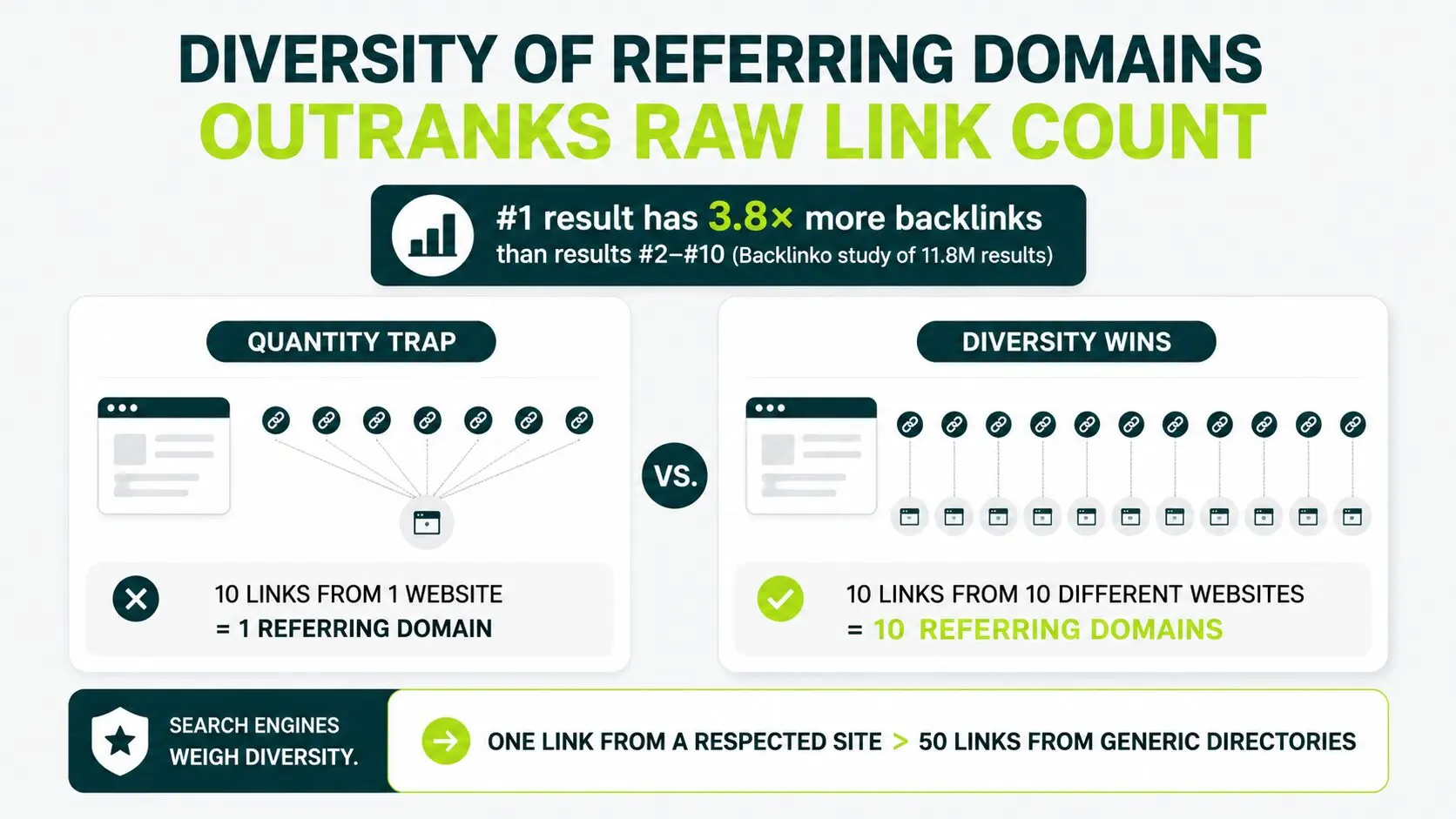
Backlinko studied 11.8 million Google search results and found that the #1 result has on an average 3.8 times more backlinks than results in positions 2 through 10. That’s a structural advantage.
But the gap doesn’t come from raw quantities. It comes from referring domains, the number of different websites linking to you. Understanding referring domains and backlinks helps put link volume into the right context.
Ten links from one website count as one referring domain. Ten links from ten different websites count as ten referring domains.
Search engines weigh diversity heavily, because a hundred links from one source look like a partnership. Links from a hundred different sources look like genuine reputation.
Most teams hear “build links” and immediately fixate on the number. The number isn’t the goal. The spread of websites is. One link from a respected industry blog moves you further than 50 links from generic directories.
Benefit 2: Referral Traffic That Doesn’t Need Google
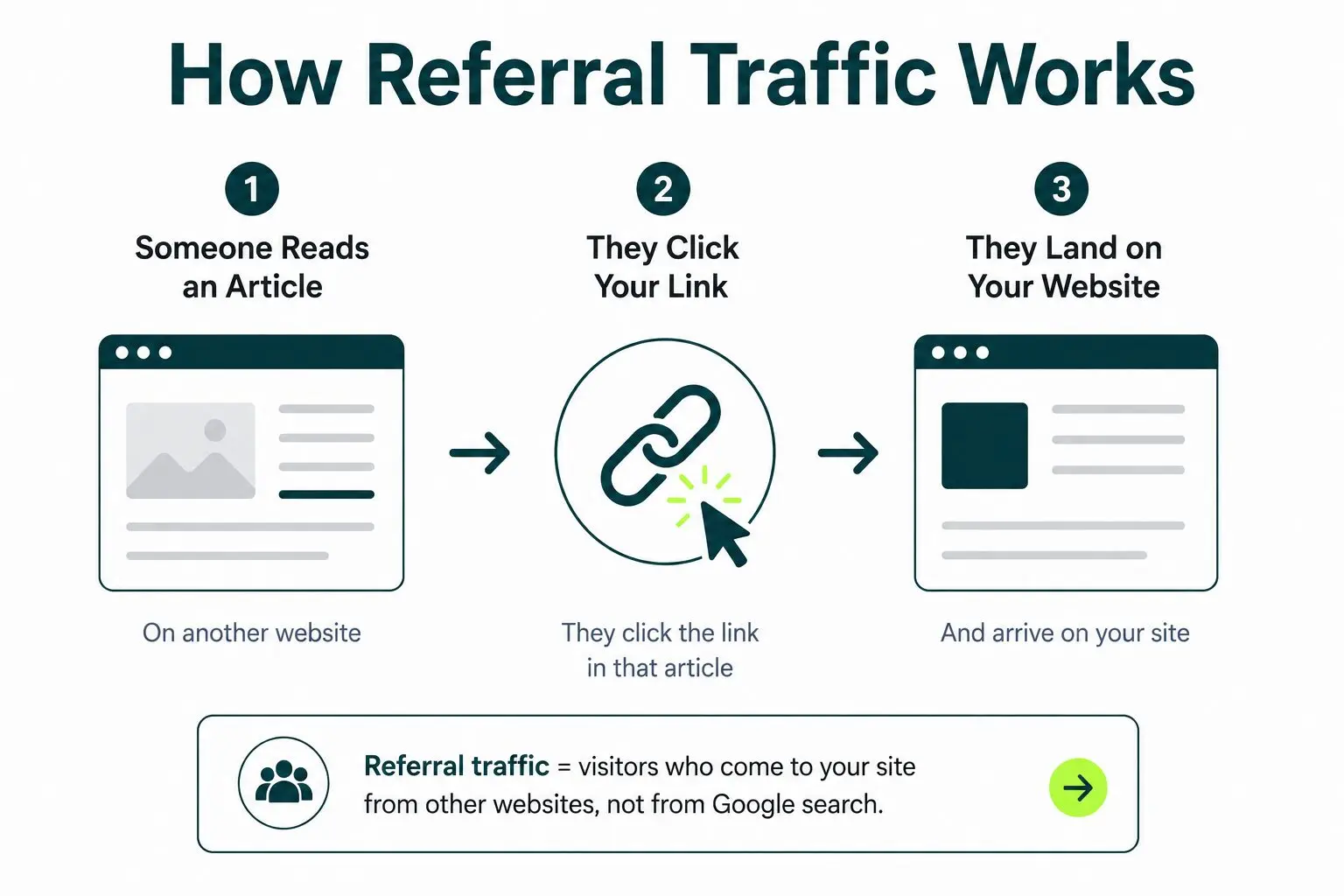
Every time someone clicks a link on another website and lands on yours, you get traffic Google had nothing to do with.
Say your accounting software gets featured in a guest contribution on a popular small business blog. People reading that blog click through. You get visitors. Those visitors didn’t search for you. They didn’t see your ad. They came for only one reason. Someone they trusted pointed at you and said, “This is worth looking at.”
This is what’s called referral traffic, and it has two qualities that paid traffic doesn’t have:
- It costs nothing per click after the link is earned.
- The people clicking are pre-warmed. They saw your brand in a context they already trusted, so they show up curious instead of skeptical.
A backlink on a high-traffic site can quietly send you new visitors for years. We have seen in one of our campaigns that a single editorial placement in a mid-size B2B publication continued to drive qualified visitors for 18 months after it went live. Zero additional spend.
Benefit 3: Your Brand Becomes Recognizable
Link building builds brand recognition by putting your name in front of new audiences repeatedly.
A reader comes across your brand mentioned in a guide. Then again in a roundup. Then in a forum reply. By the fourth time, your brand name registers. Even if they never clicked through.
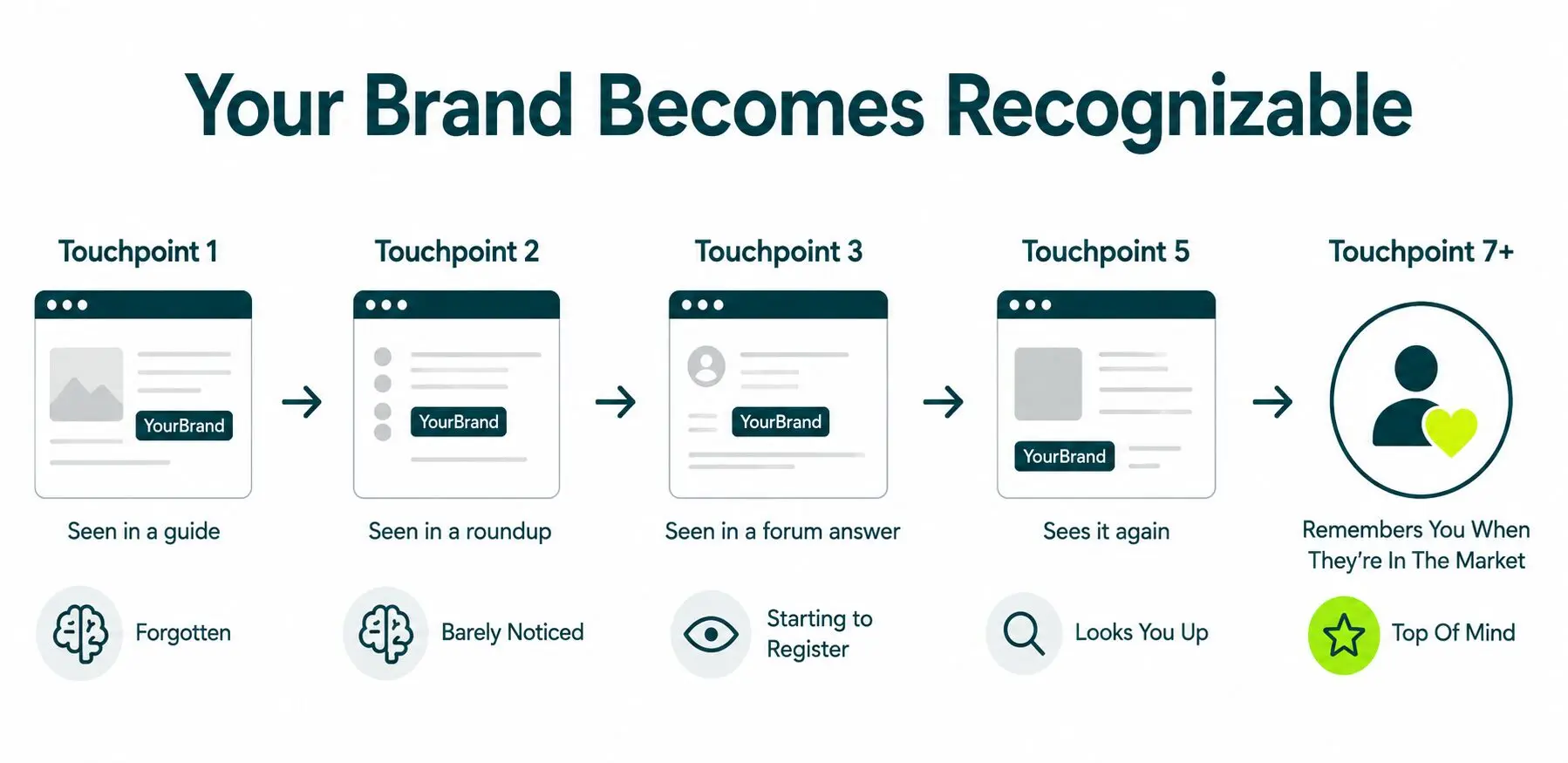
Link building is one of the most cost-efficient ways to build brand recognition for a young company. Every editorial placement puts your name in front of a new audience in a context they already trust.
The compounding effect is real. People don’t remember brands from a single exposure. They remember the ones that kept showing up in places they respect.
The practical signal: discovery calls start with “I’ve seen your name a few times.” That visibility (being recognized as a familiar, credible name in your space) doesn’t come from one link. It comes after multiple interactions with that publication through different social media platforms they are on.
Paid ads build recognition too. But the moment you stop paying, it stops compounding. Brand mentions from editorial placements keep working long after they’re placed.
Benefit 4: Trust That Compounds With Your Domain
Search engines evaluate individual pages and the domain as a whole. The more your domain accumulates good links from respected websites, the more search engines treat your site as a trusted source. This benefits the pages with links pointing directly at them and every page on your domain.
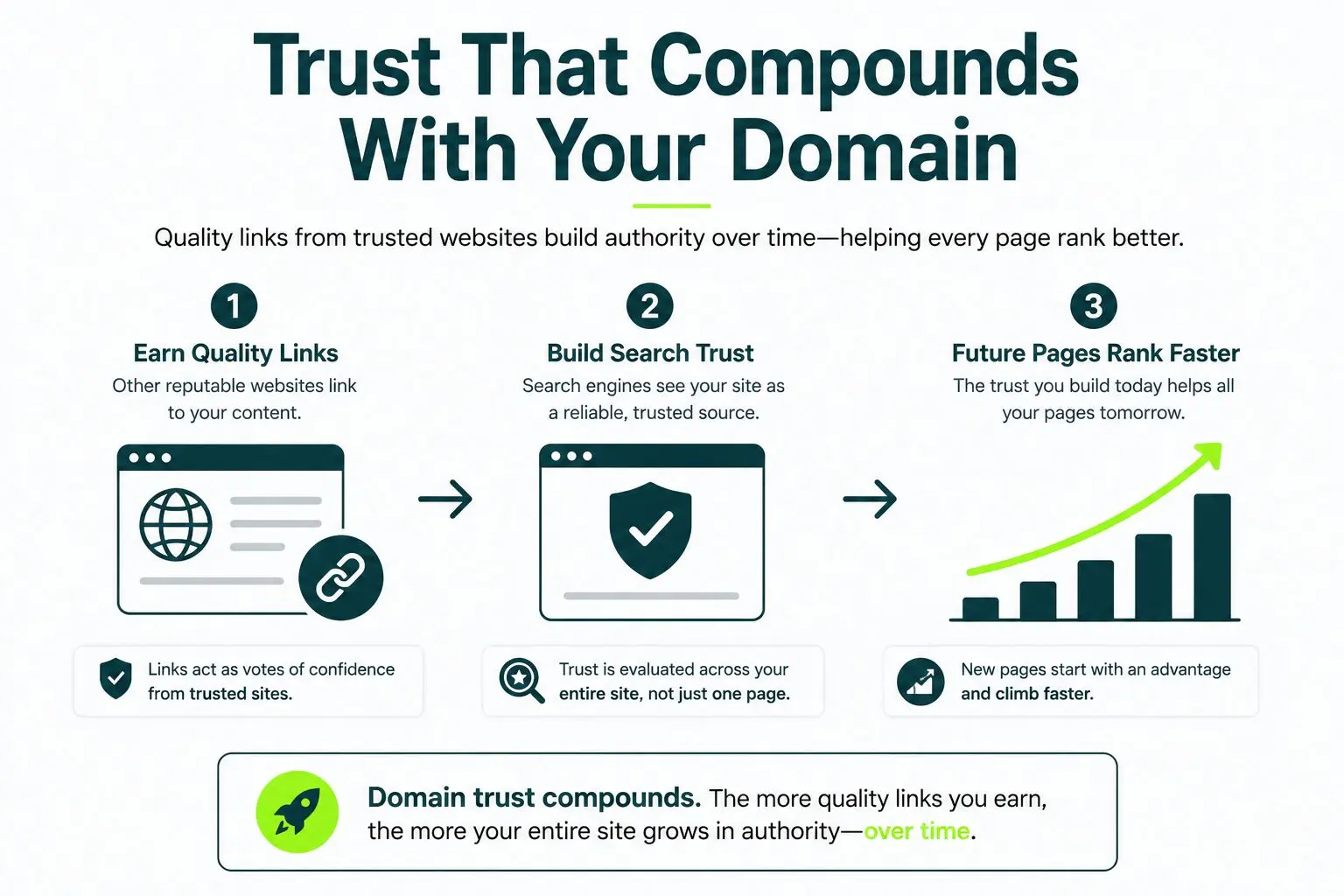
A site with a strong backlink history ranks new posts faster. Google already trusts the domain, so new pages inherit some of that trust from day one. A new site without that history waits longer for the same result.
This is the part where founders new to SEO often get frustrated. They write a great article, hit publish, and expect Google to notice. But Google doesn’t notice.
The website has no track record yet. Once you’ve built up a high quality backlink profile, every future page launches with a head start.
Benefit 5: Faster Indexing for New Pages
When you publish a new page, Google discovers it, reads it, and decides whether to keep it in its search library.
This process is called indexing. For a new website with few links, this can take days or weeks. Sometimes it doesn’t happen at all.
But Google keeps crawling pages constantly. When one of those sites adds a link pointing to your site’s new page, Google follows the link, finds your page, and indexes it much faster than it would have otherwise.
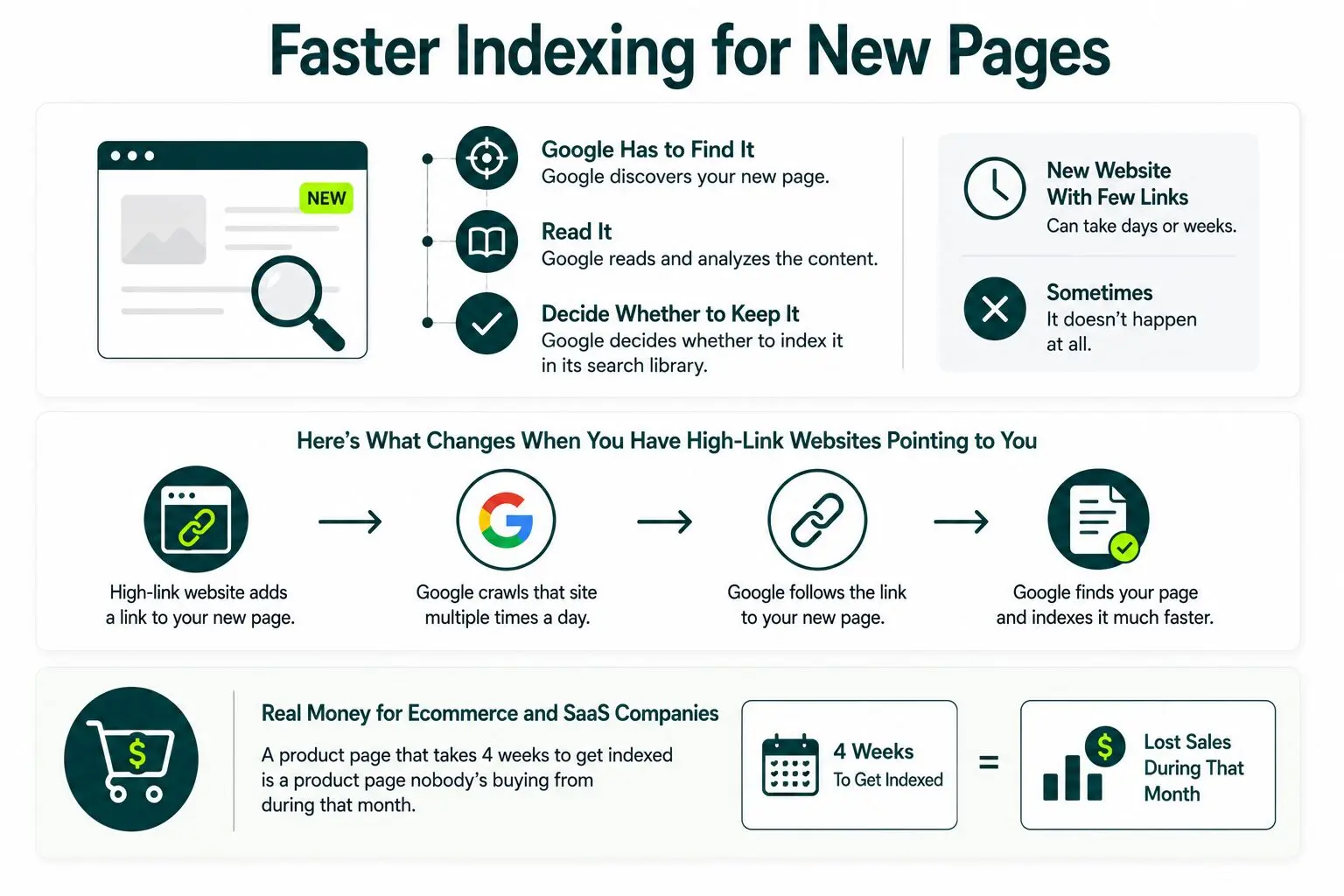
For ecommerce stores and SaaS companies launching new pages every month, this is real money. A product page that takes 4 weeks to get indexed is one nobody’s buying from during that month.
We have seen across our campaigns that when we build consistent editorial links for new product pages, they appear in Search Console coverage within days rather than weeks.
Benefit 6: AI Search Engines Cite You
AI search engines pull answers from a handful of sources, and sites with stronger backlink profiles get cited far more often.
Most articles on this topic haven’t caught up to this benefit yet. It’s the one that matters most over the next 3 years.
When someone asks Perplexity or Google’s AI Overview a question, the AI searches the web and pulls its answer from a handful of sources. Being one of those cited websites is a brand-new traffic and authority channel in 2026.
Being absent from them means a growing chunk of your audience never sees you.
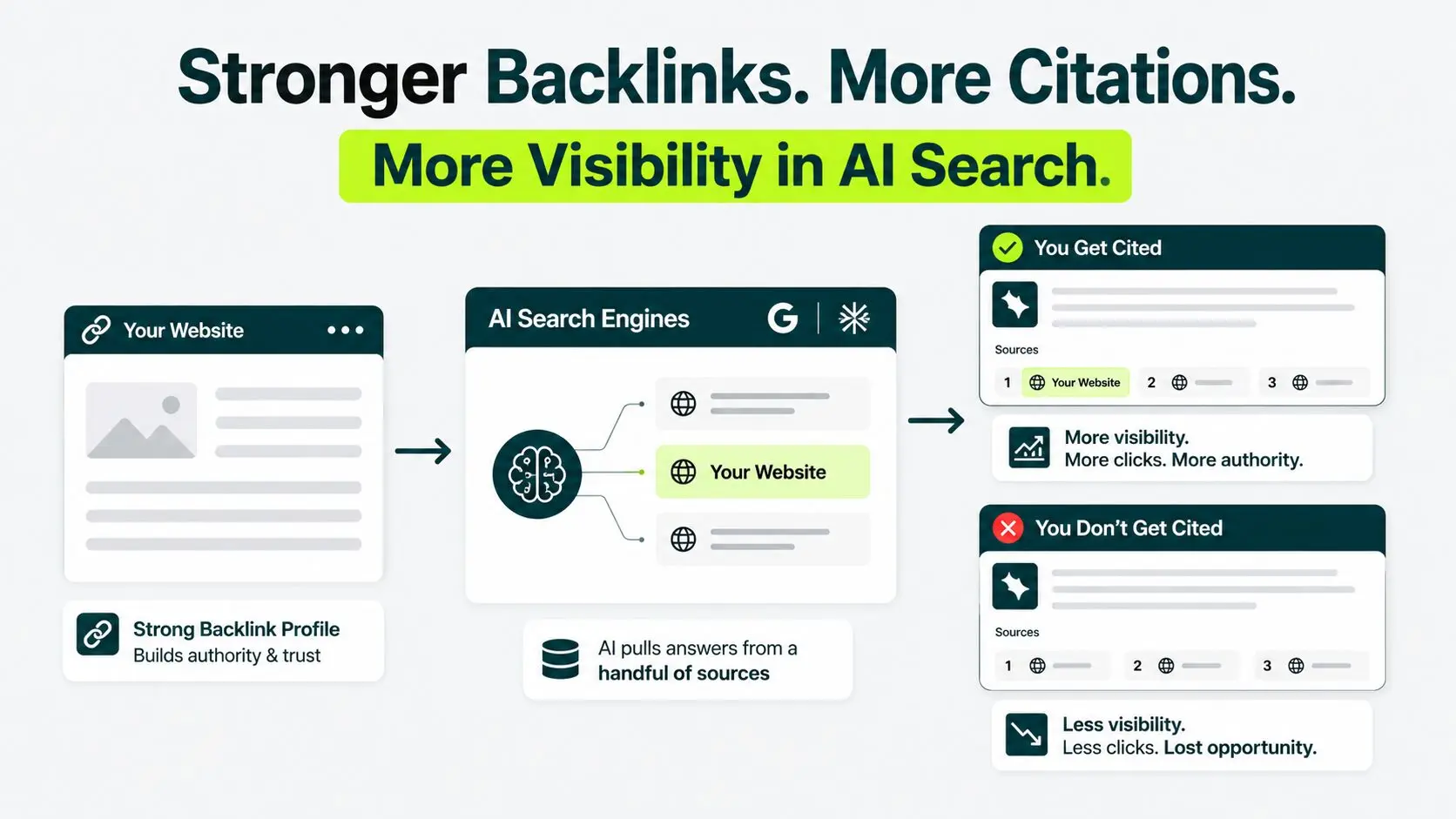
The data backs this up. Sites with stronger backlink profiles get cited dramatically more often in AI-generated answers.
As per the 2025 Semrush research cited earlier, websites with stronger backlink profiles and broader referring-domain diversity were more likely to appear in AI-generated citations. Domains with weaker authority signals were cited far less often.
The mechanism makes sense when you look at how AI search engines select sources. They pull from pages that already rank well, carry strong topical authority, and earn citations from independent publications.
Backlinks function as reputation signals not just for Google, but for the next generation of search.
This is why link building isn’t optional anymore for serious brands. If you’re not building authority for AI search visibility, your competitors will be the ones cited when buyers ask AI a question about your category.
Benefit 7: Networking and Real Business Relationships
Doing link building puts you in contact with editors, bloggers, and journalists in your industry.
This benefit rarely makes it to the list, but it should. The process of doing link building means reaching out to other website owners, editors, and journalists from your industry. Most of those conversations don’t end in a backlink.
Some of them end in something better such as a partnership, a podcast invite, or a referral that turns into a client.
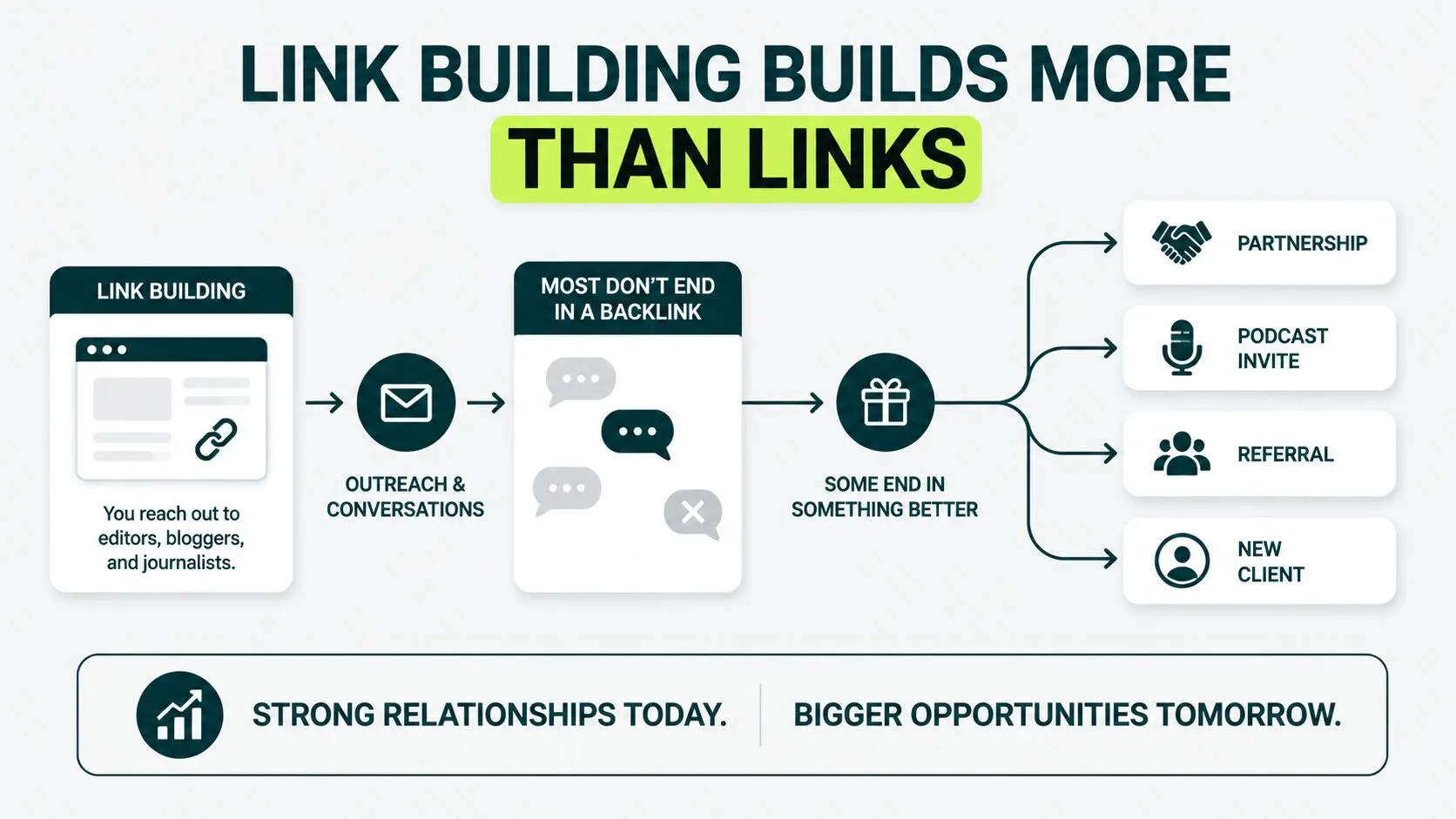
We’ve watched founders land clients from a single editorial placement. One cold email to an editor.
3 years later, that same editor referred them to a portfolio company. The links are the visible output of the work. The relationships are the invisible compound interest. That’s why relationship-based link building can create value beyond the initial placement.
When Do These Benefits Actually Show Up?
Real benefits of a well-planned link campaign show up following this timeline:
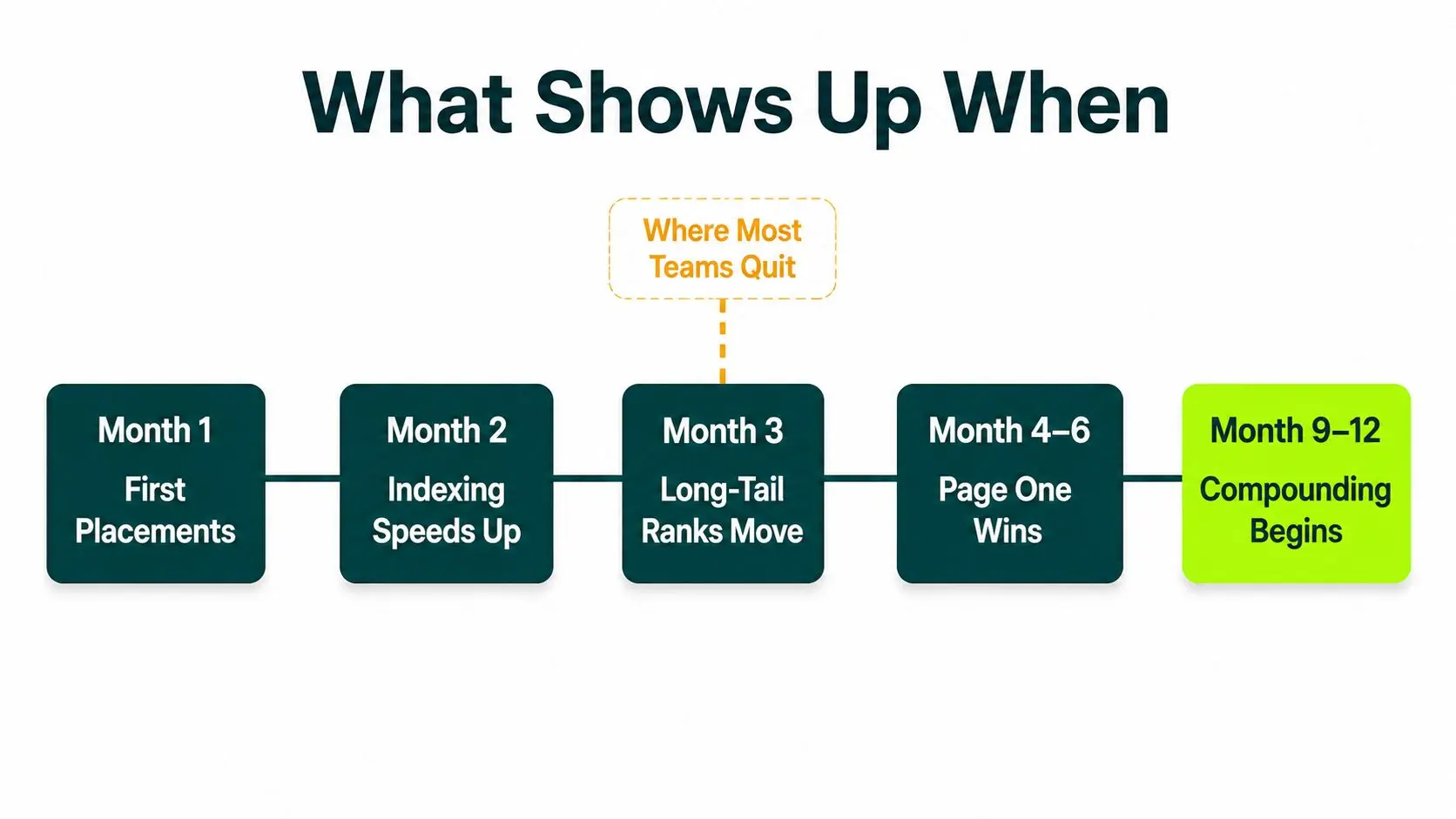
Month 1
First few link placements go live, and some referral traffic comes in. No ranking movement will be seen yet.
Month 2
More link placements are earned by month 2, and indexing speeds up. Still, you see no improvement in your ranking for your competitive keywords.
Month 3
Long-tail keywords start moving. Authority score on tools like Ahrefs or Moz starts climbing. AI mentions occasionally appear.
Months 4-6
Mild difficulty keywords reach page one or two. Referral traffic adds up to something noticeable. Brand mentions for your brand in your industry niche conversation pick up.
Months 9-12
During these months, compounding kicks in. New pages rank within weeks. Domain feels “warmed up”. Competitive terms become reachable.
Most people who start link building quit around month 2 or 3, before their ranking curve bends. The ones who push past month 3 are the ones watching their rankings move.
If you’re going to start, commit to a 6-month minimum. Anything shorter is a coin flip.
The Conditions That Decide Whether You Get These Benefits
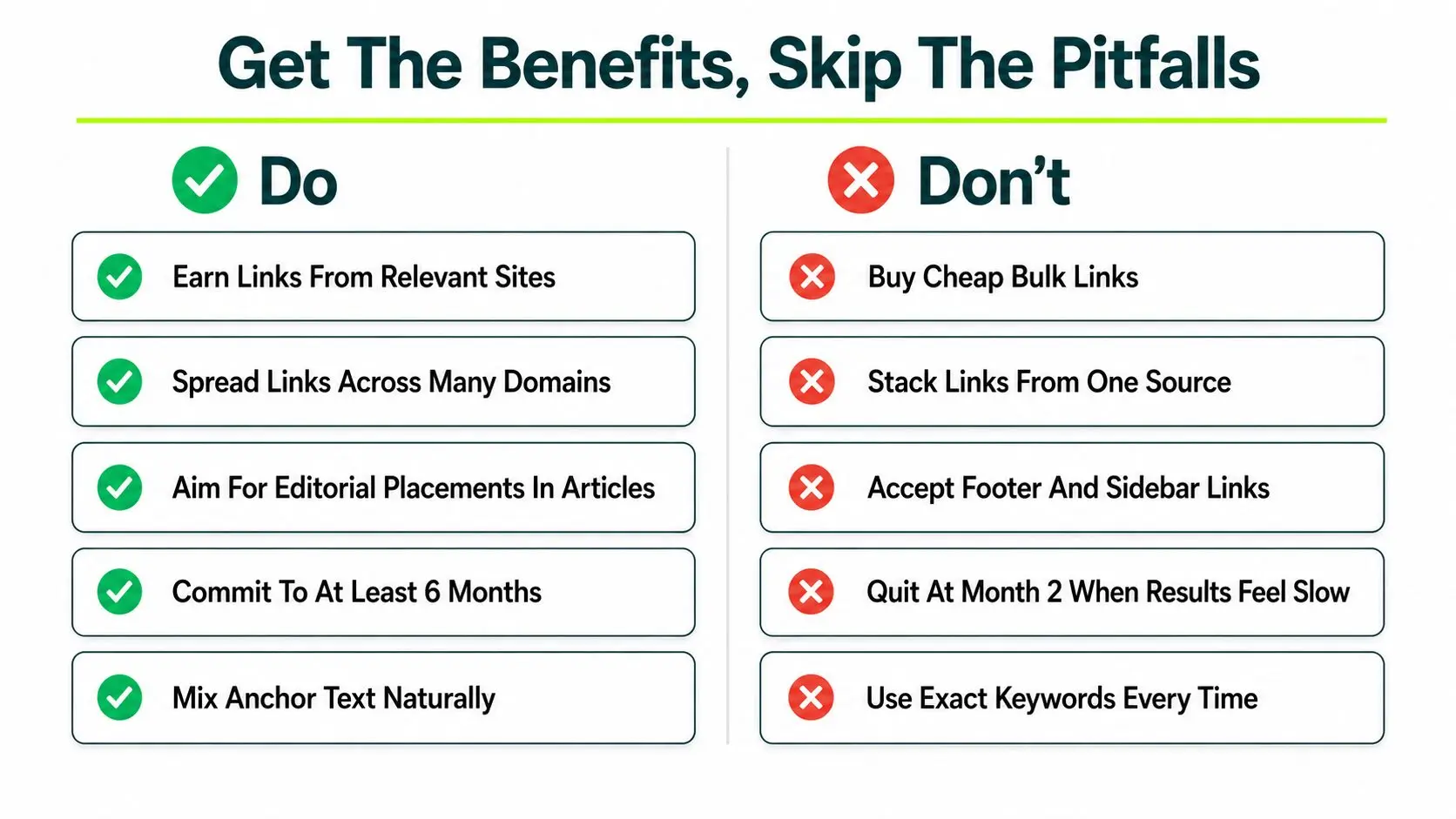
Not every link delivers everything we just described. Some deliver nothing. Some actively hurt you. Four conditions determine whether a link delivers the benefits.
The Link Has to Be Relevant
Relevance is one of the first things to check when evaluating a backlink. A backlink from a cooking blog to your accounting software is worth almost nothing. Google reads context. The link has to come from a website whose topic genuinely relates to your niche, or from an article that genuinely relates to the page being linked. Understanding what makes a link relevant can help you evaluate whether a backlink fits naturally within its surrounding content.
The Website Has to Be a Real One
Genuine websites have genuine readers, real comments, real archives, real authors. A site with no traffic, no comments, and 12 posts published in one day is a link farm scheme. Google spots them. And once it does, those links stop helping. Enough of them can actively hurt your rankings.
The Link Has to Live in the Article
Editorial links inside the body of an article carry the most weight because they look like a writer made a choice. Links added in footer, sidebar widgets, and in lists of partners, look transactional, and they pass much fewer trust signals. This is the principle behind contextual placements, where the link sits naturally within the article itself.
The Anchor Text Has to Look Natural
If every link pointing at your site’s content uses the same exact keywords as the clickable text, Google notices and discounts the links. Real backlinks have a mix of branded anchors, page titles, and descriptive phrases.
When these conditions are met, the benefits we listed above, compound. When they’re not met, you’re spending time and money on links that won’t move your site’s rankings.
How the Benefits Stack Together
The reason link building works as a long-term growth lever is that the benefits don’t sit side by side. They feed each other.
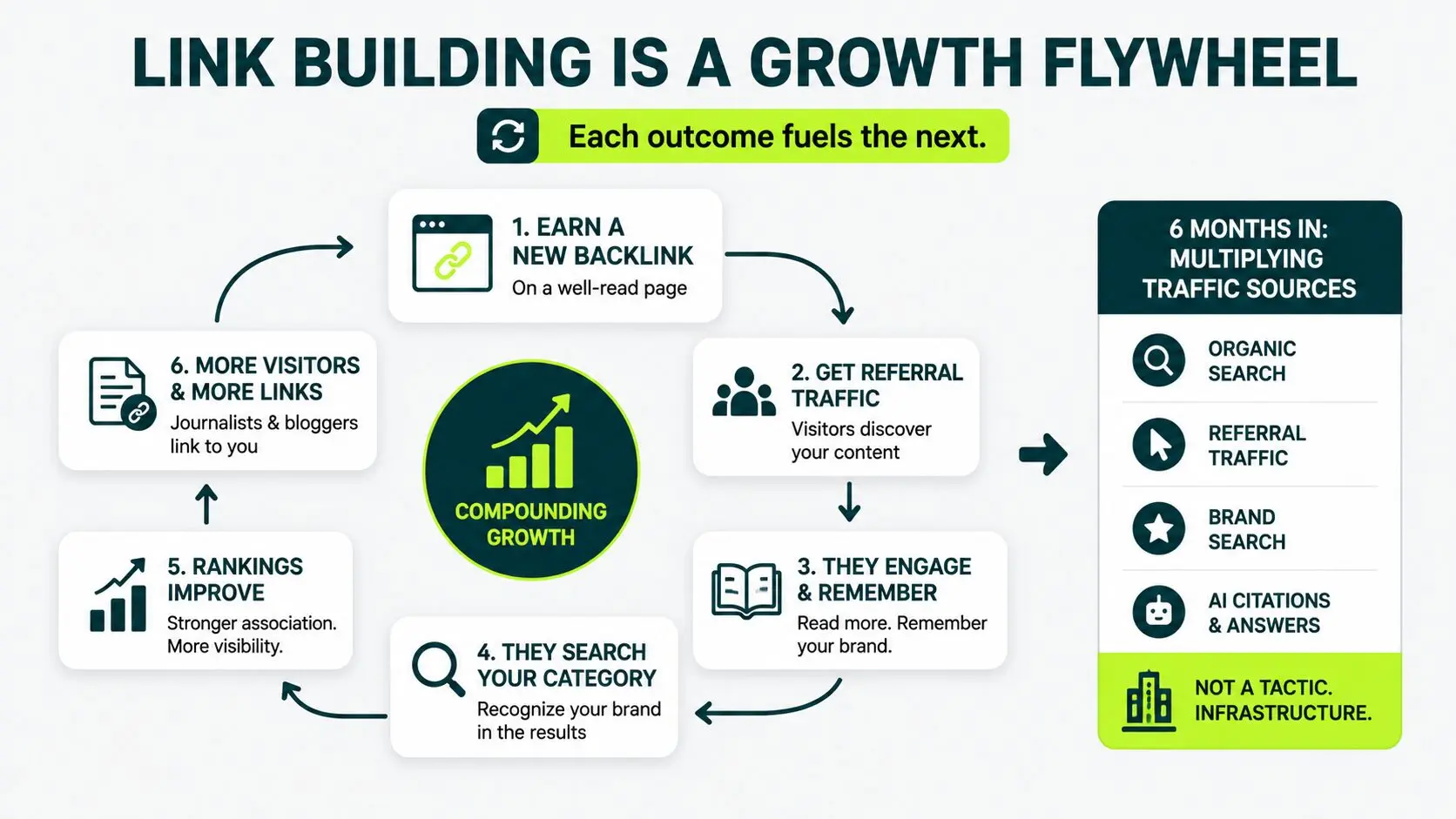
A new backlink on a well-read page sends referral traffic. The visitor stays on your site, reads two articles, and remembers your brand.
Three weeks later, they search for your category on Google, recognize your name in the results, and click on it. That click reinforces your brand association with that query. Your ranking improves.
Better rankings bring more organic visitors. Some of those visitors are journalists or bloggers who link to you. The cycle restarts, but bigger.
Six months in, the channel everyone calls “SEO” is actually three or four distinct traffic sources reinforcing each other: organic, referral, brand search, and, increasingly, AI citations.
That’s why teams that commit to link building for a year stop calling it a tactic and start calling it infrastructure.
Conclusion
Most websites that win their category over a decade win because they decided early to invest in authority and stuck with that decision when it got slow. The benefits of link building aren’t a single big payoff. They’re a thousand small ones that pile up into the kind of growth your competitors can’t catch.
Pick three sites in your industry that consistently outrank you. Open their backlink profiles. They didn’t outrank you because of a clever tactic. They outranked you because they started building real links 18 months before you did and didn’t stop.
Not sure how link building fits into your growth strategy?
Share your site and goals. You’ll get a link strategy built around what your niche actually needs.
Does link building still work in 2026?
Yes, link building still works in 2026 because backlinks remain one of the strongest correlated factors with high Google rankings, and 2025 research shows that they now also influence AI search citations too.
The mechanism has gotten more demanding. Which means that junk links don’t move the needle the way it used to, but real and relevant links earned through ethical link building strategies still drive results.
How long does it take to see results from link building?
Most sites notice early signs, such as faster indexing and some referral traffic, within the first month.
Ranking improvements for long-tail keywords often start in month 3, and measurable ranking improvements on competitive keywords show up between the 4th and 9th months.
Compounding benefits where new pages rank quickly, start to show around 9th to 12th month after running a consistent link building campaign.
How many backlinks do I need to rank on page one?
There is no fixed number of backlinks. It depends entirely on what you’re competing for. For example, local services might rank with 30 strong links and a national Saas product might need 300+. Look at the top 3 sites currently ranking for your keyword, count their referring domains, and treat that as your benchmark. We cover the specifics in our guide to how many backlinks you need to rank.
Are paid backlinks worth buying?
The short answer is the low-quality paid links hurt your site’s SEO and can trigger Google penalties.
Editorial placements where you pay a publication for the editorial work behind the article sit in a gray area that many SEOs navigate carefully. The riskier you are with this, the harder recovery becomes when something goes wrong. We’ve written more about the tradeoffs of buying backlinks.
Do nofollow links have any value?
Yes, nofollow links are worth more than most people expect. Google has stated that nofollow links are now a “hint” rather than a hard signal, meaning they can still pass authority.
The 2025 Semrush AI search study even found nofollow and dofollow links that pass authority are correlated nearly equally with AI citation frequency. They also still drive referral traffic regardless of how Google processes them.
Can I rank without backlinks?
Yes, for very low-competition or hyper-local keywords with weak existing results, strong on-page content can rank alone. For anything competitive, it’s difficult to rank without backlinks. Run a quick backlink analysis on the pages outranking you they didn’t get there without building real authority first”
The pages already outranking you didn’t get there without backlinks, and you won’t pass them without building your own authority.
What’s the difference between link earning and link building?
Link earning happens when other sites choose to reference your content because they find it valuable, useful, or newsworthy.
Link building is the active process of earning backlinks through tactics like guest posting, outreach, broken link building, or digital PR. The strongest SEO strategies combine both. Link building helps create visibility and authority. Link earning grows naturally as your content becomes more trusted and widely referenced.
Is link building something I should handle in house or outsource?
Both approaches work, but they come with different tradeoffs. In house link building gives you full control but requires dedicated outreach staff, publisher relationships, and content resources that take years to build.
An experienced link building agency already has those relationships and can typically deliver consistent placements faster than most internal teams can get up to speed. The right choice depends on your budget, timeline, and how competitive your target keywords are.
How is link building different from SEO?
SEO covers the whole field such as on-page optimization, technical fixes, content strategy, with link building forming a key part of off-page SEO.
Link building is a part of SEO that specifically addresses how your site appears to search engines from the outside. Both parts need to be working for either to deliver results for you.