Link Insertion Service Focused on Relevant Link Placements
You get contextual links within high-quality existing content to strengthen
relevance, authority, and rankings without creating new articles.

Real traffic and editorial standards
No PBNs. No bulk directories
Placement that builds Authority

4.8/5
Trusted by 500+ agencies &
1,000+ businesses worldwide.
Average DR
40 – 95
Campaign Dashboard
DOMAIN RATING
+17 points
ORGANIC TRAFFIC
11,800 → 54,200
PAGE 1 KEYWORDS
+32 points
PLACEMENTS
165 unique domains

Links Inserted
27





Service Overview
Build Authority Through Existing
Editorial Content
Link insertion, also called niche edits or curated links, is a link-building method in which your backlink is placed within an already-published article on a relevant website. Instead of creating new content from scratch, your link is added to a page that’s already indexed by Google, already earning traffic, and already carrying authority.
That placement context is what separates high-value niche edits from bulk link packages. Because the hosting page already has backlinks, organic traffic, and indexation history, your link benefits from established authority immediately. You don’t wait months for a new guest post to gain traction in Google’s index.
For businesses looking to strengthen rankings on competitive keywords without the timeline of guest posting, link insertions offer one of the highest-ROI link types available. You build authority on pages that already perform, and Google recognizes that signal.
Three things define a strong link insertion:

Topical relevance
The hosting page covers a subject closely related to your target page’s topic

Editorial placement
The link appears naturally within the body content, not in a sponsored section

Site quality
The hosting domain has genuine organic traffic, a clean backlink profile, and a domain rating (DR) that signals real authority
How It Works
Our Process for Every Link
Insertion Campaign
Every placement follows a structured, manual process
focused on relevance, quality, and lasting growth.
Before placing a single link, your campaign starts with a strategy session. Your strategist reviews your site’s existing backlink profile, keyword positioning, and page-level authority to identify which pages benefit most from niche edit placements.
Pages competing for high-commercial-intent keywords get priority. Pages with strong on-page SEO but weak referring domain counts move to the top. You get a clear link insertion roadmap, not a generic “build links to the homepage” approach.
Your team researches existing content on publications, blogs, and niche sites that match your industry. Every prospect goes through a manual quality check before outreach begins.
For domain rating, check if the DR is 40–95; verify it in Ahrefs. Organic traffic, minimum 1,000+ monthly organic visitors. For content relevance, the hosting article must be topically aligned with your target page. Sites with thin content, spammy link profiles, or irrelevant audiences get discarded. You see only vetted, quality-matched prospects in your campaign.
Not every page on a quality site is the right placement. Your strategist evaluates the specific article where your link will be placed, checking topical alignment, existing outbound links, content depth, and natural integration within the editorial flow.
This step is what separates strategic link insertion from bulk niche edit packages. A link to your SaaS product page inside a generic “best tools” listicle is worth far less than a placement inside a detailed guide that directly relates to the problem your product solves.
Your outreach specialists contact publishers directly. There are no automated mass emails. Every pitch is personalized to the publisher’s content style, recent topics, and editorial standards.
Outreach conversations cover placement expectations, anchor text selection, and timeline. Your team negotiates for in-content placement within the body of the article but never in sidebars, author bios, or sponsored blocks. This manual outreach process is slower than marketplace-style bulk ordering, but it results in higher acceptance rates and more permanent placements.
Once the publisher approves, your link is integrated naturally into the existing content with surrounding paragraph context is checked to ensure the link reads as a natural editorial addition rather than a forced insertion.
After placement, your team verifies correct anchor text, proper dofollow attribution, in-content positioning, and page indexation status. If a placement doesn’t meet the agreed standards, your team either corrects it or arranges a replacement.
You receive clear, structured reports for every placement cycle. Each report includes: the live placement URL, the anchor text used, the domain rating of the linking site, the page’s organic traffic, and the surrounding content context, so you can see exactly where your link sits.
Links are monitored post-placement. If a publisher removes content or a site’s quality drops significantly, your team flags it in your next report and works on a replacement, at no additional cost within the guarantee period.

Expected Results
What Link Insertions Deliver
for Your Business
See how contextual placements improve your relevance,
authority, and rankings without creating new content.
Keyword Improvements That Drive Revenue
When a topically relevant site links to your page from within existing editorial content, Google interprets that as a relevance signal for your specific topic, not just a generic vote for your domain.
As a result, your target pages rank for the exact keywords that bring in qualified leads and sales. One eCommerce client saw their primary category page move from position 11 to position 4 within three months after receiving 18 niche edit placements from DR 50+ sites in their vertical.
Success relies on accuracy, as a focused set of authoritative, relevant links inserted consistently outperforms larger quantities of links from unrelated domains

Authority That Compounds
Every niche edit placement adds a referring domain with real link equity to your profile. Unlike directory listings or forum links, in-content link insertions transfer the maximum value Google assigns, because the link is placed inside editorial content that the hosting page’s own backlinks and traffic support.
That accumulation compounds. As your domain rating grows, your new pages start ranking faster. Existing pages become harder for competitors to displace.
Your site builds what SEOs call topical authority, and Google treats you as a credible source in your space. Ahrefs data consistently shows that pages with higher-quality referring domains outrank those with more low-quality backlinks.

Referral Traffic from Real Audiences
A link insertion inside a high-traffic article doesn’t just improve your SEO. It sends readers directly to your site. When someone reads a guide to project management tools and your product is mentioned naturally, they click. That click is high-intent referral traffic, a visitor already educated on the topic, arriving through editorial endorsement rather than paid ads.
This can reduce the risk of unnatural backlink patterns and avoid over-optimization.
A balanced mix of editorial posts and link insertions helps you build a stronger, more diverse backlink profile. Keep your backlink growth secure and consistent to build long-term search momentum.
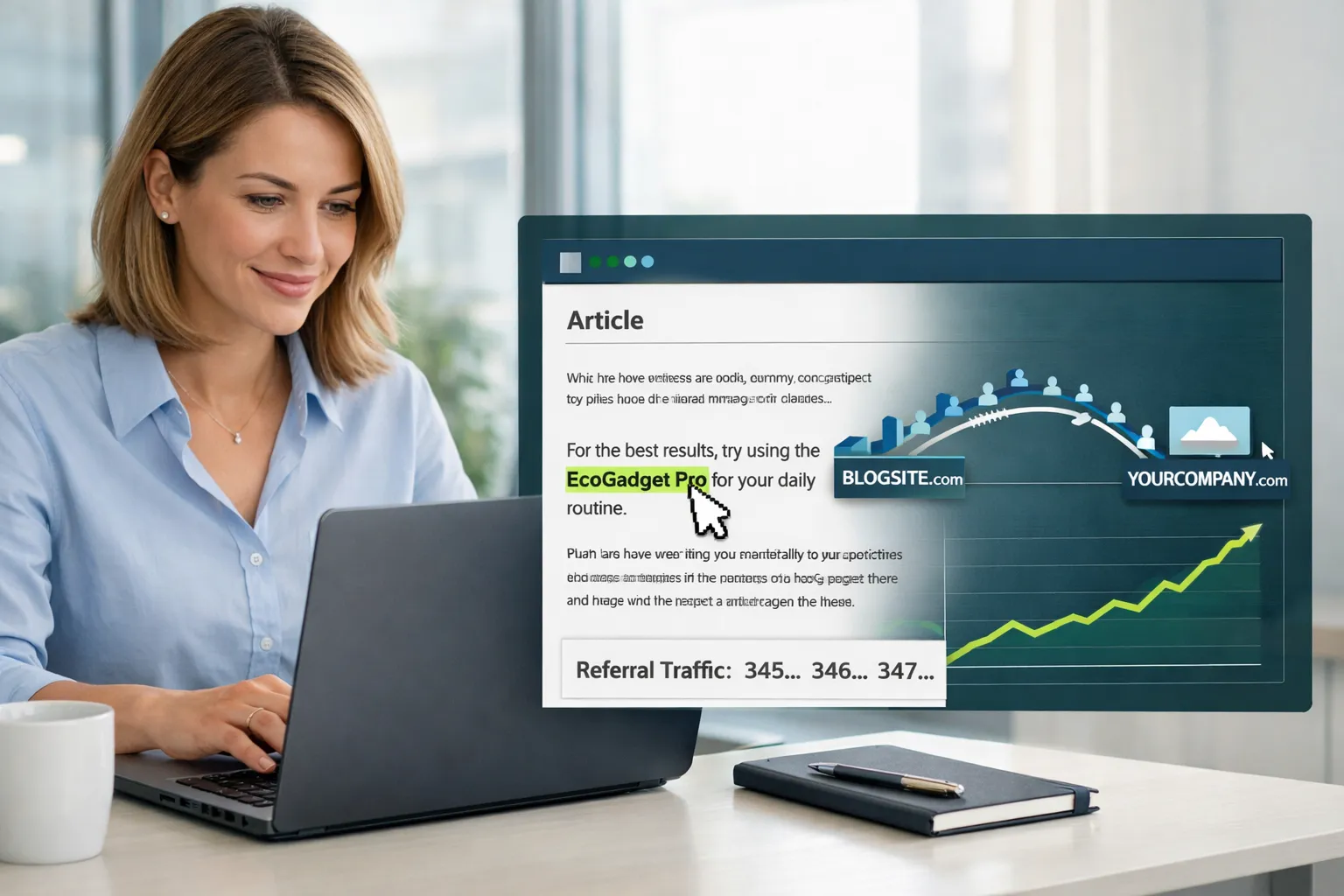
Profile That is Resilient to Updates
Google’s spam detection has gotten significantly sharper. SpamBrain, Google’s AI-powered spam system, specifically targets manipulative link patterns: private blog networks (PBNs), link exchanges, bulk Web 2.0 links, and paid placements on low-quality sites.
Niche edits built through genuine editorial outreach are the exact link type Google’s own documentation describes as natural.
They survive core updates and link spam updates because they serve a legitimate editorial purpose. Your investment stays protected; links placed in real content on established sites don’t carry the deindexation risk that cheaper alternatives do.

Client Success Stories
What Clients Say About Our Link
Insertion Service
Reviews from the leaders who gained authority,
rankings, and revenue with link insertions.

4.8/5 

5/5 

Rating on Google



The niche edit placements Outreach Desk secured moved our main service page from page 3 to the top 5 in under four months. Every link is placed inside relevant content on sites our audience actually reads. That’s the part most link building agencies can’t deliver.

B2B SaaS
Marketing Head
What stood out was the vetting quality. Every placement came with the site’s domain rating, traffic data, and content context before it went live. We approved every link. No surprises, no junk sites, no links we’d have to disavow later.
eCommerce
SEO Lead
We used Outreach Desk’s link insertion service for our agency clients. The approval workflow and white-label reporting save us hours every month. More importantly, the placement quality is consistent — we’ve never had a client question where a link came from.
SEO Agency
VP Marketing
Service Framework
Investment, Timeline, and
Deliverables
Every link insertion campaign is custom-scoped to your existing content assets, authority gaps, and target keywords. Here’s what shapes your investment:

Number of links per month
Most campaigns run 10-50 contextual link insertions per month, depending on your growth.

Target domain rating range
Insertions into DR 40-95 sites require fewer investments than placements in DR 70+ publications.

Content requirements
Some placements need new content development, others use existing editorial opportunities.

Campaign duration
Link insertions use existing content; links usually go live faster than the guest posts. Most clients see measurable ranking improvements within 6-10 weeks.
Directional pricing
$200 – $300+ per link
Link insertion campaigns typically start at $200 per link for focused growth in a single niche. Most competitive campaigns targeting multiple pages, Higher DR ranges, or rankings timelines generally range from $250-$350+ per link.
You receive a detailed proposal after your strategy call outlining exact link qualities, target pages, anchor strategy, and a month-by -month roadmap with transparent pricing.
What You Get
Client-Ready Reports Built
for Contextual Clarity
Structured reporting that makes placement review simple and transparent.

Live Placement URLs
You get direct access to every published page where your links are inserted and go live.

Contextual Placement Details
You have complete visibility into the surrounding content, anchor usage, and exact link position in the article.

Anchor & Target Mapping
You see a clear connection between anchors and the destination pages you prioritize.

Campaign Overview
A summary of the delivered link insertions, authority metrics, and topical relevance.
Our Approach
A Smarter Approach to Contextual
Link Placement
You get relevant, editorially aligned, and natural integration
instead of volume-based placements.
| Factor | In-House / DIY |
 |
|---|---|---|
| Placement Approval | Links are often reviewed only after insertions, with limited influence over the anchor usage or context. |
You approve every domain, anchor text, and contextual placement before the insertion. No surprises. |
| Publisher Vetting | Here, the prospecting may rely on scraping tools or surface-level DR checks. |
Every publisher is manually vetted for the organic traffic, backlink health, editorial standards, and relevance. |
| Context Quality | Insertions may be forced into irrelevant articles. | The links are placed only when contextual relevance strengthens both the articles and your target pages. |
| Link protection | Tracking removed links requires internal monitoring and follow-ups. |
6-month link protection is included. If a link is removed, changed, or deleted, you’ll receive a replacement at no additional cost. |
| Anchor Strategy | Anchors may be too keyword-heavy or inconsistent across the placements. |
You get a balanced anchor distribution aligned with your existing backlink profile to prevent over-optimization. |
| Risk Standards | The risks depend on internal experience and quality control. |
Strict editorial standards are followed. No PBNs. No link exchanges. No artificial networks. Only genuine placements. |
Who We Help
Build for Your Industry
Your link placements match the unique standards
and competitiveness of your industry.




Startups

Real Estate



Healthcare & Fitness

Financial & Insurance

Technology & Innovation

Consumer Brands
Real Results
Real Impact From Contextual Link Insertions
Examples of how strategic link insertions strengthen relevance and authority over time.
Common Questions
Frequently Asked Questions
Get clear answers to how link insertions secure contextual placements within
the existing content to boost authority and rankings.
Boost Rankings With Contextual
Link Insertions
Strengthen your authority with editorial backlinks naturally placed
within existing, indexed content on real websites. Our link
insertion strategy helps you earn powerful links.
4.8/5
Trusted by 500+ agencies &
1,000+ businesses worldwide.