Real estate link building means earning quality links from other credible websites to your real estate website.
When you earn backlinks from trusted, relevant sites, your business gains visibility in local and national search results. The competition in the real estate market is intense. You directly or indirectly compete against Zillow, Redfin, Realtor.com, national brokerages, and even hundreds of local agents.
Without the right links, even the best real estate website struggles to get noticed, and potential clients will find your competitors instead.
What You’ll learn:
- What real estate link building is, why it matters, and what makes it different.
- Some proven strategies you can use to earn quality links for your business.
- Importance of local visibility, specifically for the real estate business.
- Some common mistakes to avoid and an action plan for your business.
Why Link Building Matters for Real Estate Websites
Search engines use backlinks as one of the strongest ranking signals. When a credible website links to your real estate content, it signals to Google that your site is trustworthy and relevant.
In real estate, you are not just competing with other agents or brokerages; the competition is with massive aggregators with many backlinks and years of trust, credibility, and visibility.
Real estate buyers search for neighbourhoods, zip codes, and even specific street details. Rankings for these terms require local relevance, trust, and credibility, and backlinks can drive both.
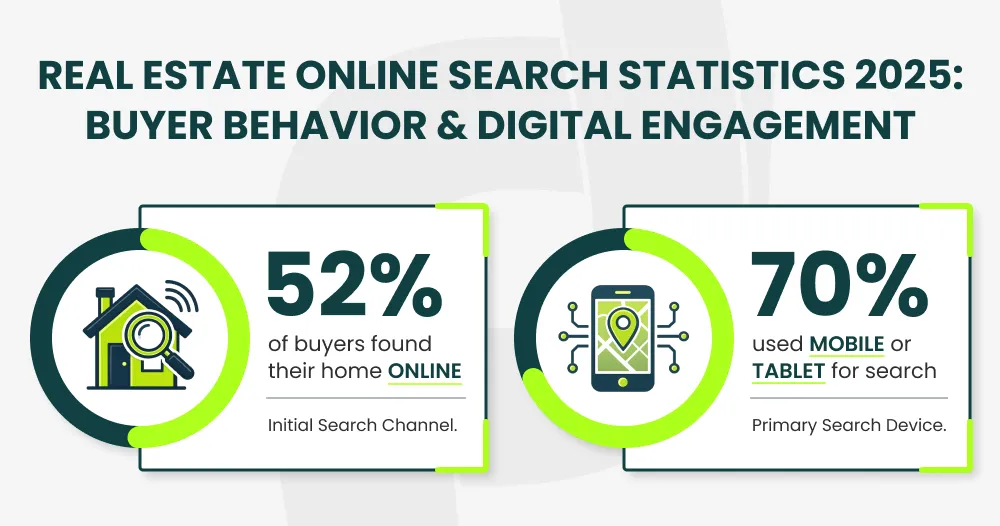
According to the National Association of Realtors’ 2025 profile of home buyers and sellers, about 52% of buyers found their home online, and about 70% used mobile or tablet devices for search. If your site doesn’t appear where the buyers search, you not only lose the leads, but also your competitors get the chance to rank above you.
What Makes Real Estate Link Building Different
Not every link building works the same across industries. Real estate has some unique characteristics that can shape your strategy.
YMYL Consideration
Content about housing decisions, investment properties, mortgage advice, buying, selling, or renting a property falls under Google’s Your Money Your Life (YMYL) model because it directly affects people’s finances and quality of life. It means Google evaluates the content more deeply in this industry and demands a higher standard of expertise and trustworthiness. Therefore, getting low-quality backlinks from irrelevant or spammy sites not only fails to help but also can hurt your rankings.
What it means for you:
You should focus on earning links from credible, relevant sites; one single link from a local news outlet or a trusted publication can outperform many low-quality generic links.
Local Relevance is Critical
Real estate is one of the most location-dependent industries online. A real estate business in Austin, Texas, competes in a very different search landscape than one in Portland, Oregon.
You should choose a link building strategy that focuses on local relevance, as links from local community organizations and regional media can carry more weight for visibility in local search than links from irrelevant national sites.
Content-Hungry Niche
Real estate is a content-rich industry. In this industry, the market trend shifts constantly, new housing data gets published regularly, and home buyers always have questions.
This creates natural opportunities to earn links through valuable content that people genuinely want to reference and share.
Real Estate Link Building Strategies That Actually Work
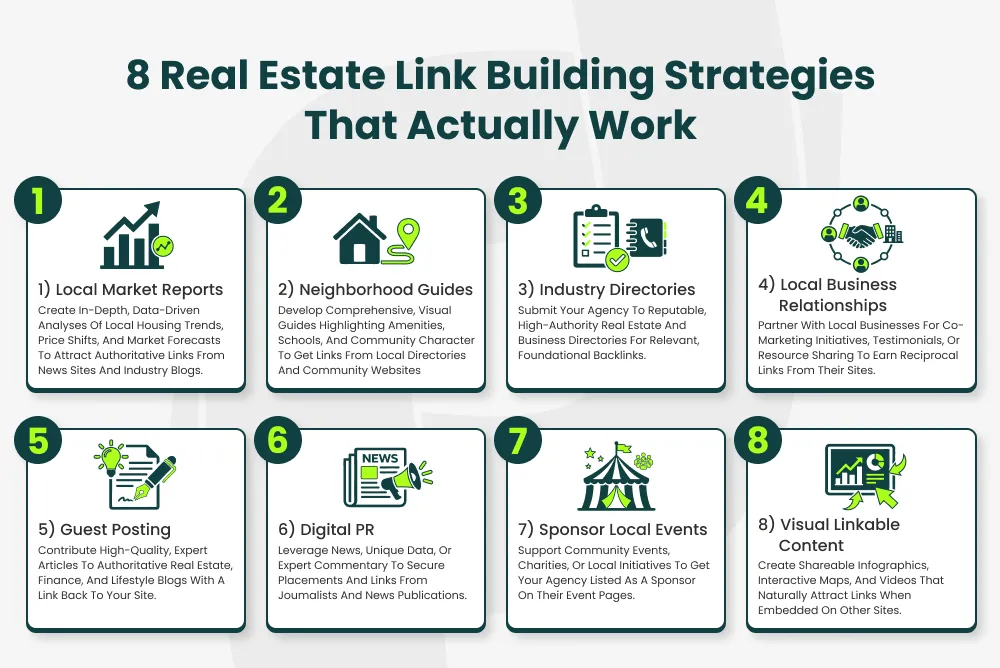
Here are some specific tactics you can use to earn high-quality links for your real estate website.
Start with the one that matches your current resources, then expand it as per your goals and momentum.
1. Create Local Market Reports and Data Assets
Creating local market reports and data assets is one of the highest-value link building tactic in real estate.
This includes creating original research or data analysis about your local real estate market that other websites want to reference and link to.
Journalists, bloggers, and real estate professionals consistently need data to cite. When you create an asset, you become their go-to source. Market data earns links naturally because it is useful, original, and hard to replicate.
Here’s how you can create it:
- Pull quarterly data from the multiple listing service (MLS) on home prices, days on market, inventory, and price-per-square-foot for your targeted neighbourhoods.
- Turn that data into a clear, visual report with charts and simple takeaways.
- Publish it as a dedicated page on your website so it doesn’t get buried.
- Reach out to local journalists, bloggers, and real estate publishers with a short summary of the key findings.
- Update it every quarter to keep it fresh, useful, and relevant.
Let’s look at the example here for clarity. A real estate agency in Denevar publishes a monthly “Denevar Housing Market Report.” It covers median prices, inventory levels, and price-per-square-foot trends. Local journalists, bloggers, and other agents cite the report when covering the Denevar housing market and link to it as a data source.
Create Neighborhood and Area Guides
In-depth neighborhood guides that cover amenities, lifestyle, commute times, safety, dining, and housing stock serve two purposes: they attract local search traffic and earn backlinks from relocation blogs, local websites, and community organizations, while ranking for long-tail searches that attract high-intent buyers.
The neighborhood guides include,
- Demographics and population data
- Average home prices and trends
- Local amenities like restaurants, parks, shopping, and healthcare
- Commute times to major employment centers
- Crime statistics and safety information
- Photos and video walkthrough
- School ratings and options
Let’s see how to create neighborhood and area guides:
- Start by choosing 10-20 neighborhood blogs in your market area.
- Create a 2,000+ word guide for each, that covers what it is like to live there, don’t just list houses.
- You can also include original photos, maps, school ratings, distance, and walkability scores, and links to all the local businesses.
- Reach out to the local businesses and organizations that are mentioned in your guide. Many will link back to it when they see they are featured.
- Update each guide twice a year with current market trends and data.
Let’s see an example here: A guide titled “Living in Buckhead, Atlanta: The Complete Neighborhood Guide” earns links from local restaurants, school review sites, and relocation companies that recommend it as a resource.
3. Leverage Industry Associations and Directories
The real estate industry has its own set of professional associations, directories, and platforms that offer legitimate link building opportunities.
Here are some of the high-value directories and associations mentioned:
- The National Association of Realtors (NAR) has a member directory where licensed realtors can have a profile page. So, if you’re a member, your profile may include a link to your website.
- State and Local REALTOR Association features directory listings, market reports, and member spotlights.
- Claim and optimize your agent profiles on platforms like Realtor.com and Zillow, and include your website link in the profile.
- Better Business Bureau (BBB) is a certified business listings that include directory links with strong local credibility and trustworthiness.
- The Chamber of Commerce is a local chamber membership that provides directory links with local visibility.
- Specialized directories and platforms like AgentLocator, HomeLight, and UpNest offer additional link opportunities.
Keep your NAP (Name, Address, Phone number) details consistent across all the platforms. Inconsistent details can confuse the search engines and also weaken the SEO value of these links.
4. Build Relationships with Local Businesses
Building relationships with local businesses is one of the easiest and most overlooked strategies in real estate. Build genuine relationships with complementary businesses in your area.
Since real estate touches many other industries, each partnership is a natural opportunity with built-in relevance for link building.
Here’s how to build relationships with local businesses:
- Start by making a list of every business you work with or refer clients to. This might include mortgage leaders, home inspectors, title companies, contractors, staging companies, movers, insurance agents, and even interior designers.
- You can offer to write a testimonial for their website. Many businesses feature client testimonials with a link back to the reviewer’s site.
- Create a “Recommended Vendors” or “Moving to [City] Resources” page on your site, and let those businesses know that they’re featured. They often reciprocate with a link.
- You can also co-create content, such as a “First-Time Buyer’s Checklist,” with partners, and both parties publish and link to each other.
- Sponsor local events together and get listed on the event page.
These links carry local relevance signals, which is exactly what you require for local SEO.
Here’s a quick example to understand it: you write a testimonial for your preferred home inspector’s website: I’ve referred over 50 clients to [inspector name], and every report has been thorough and timely.” They publish it on their website with a link back to your site.
5. Guest Post on Local Relevant Publications
Guest posting remains one of the most reliable ways to build quality links in real estate.
This method is all about writing valuable content for another website and earning a link back to your site in return.
Unlike other strategies, you get complete control over the topic, anchor text, and target URL, and you position yourself in front of a new audience.
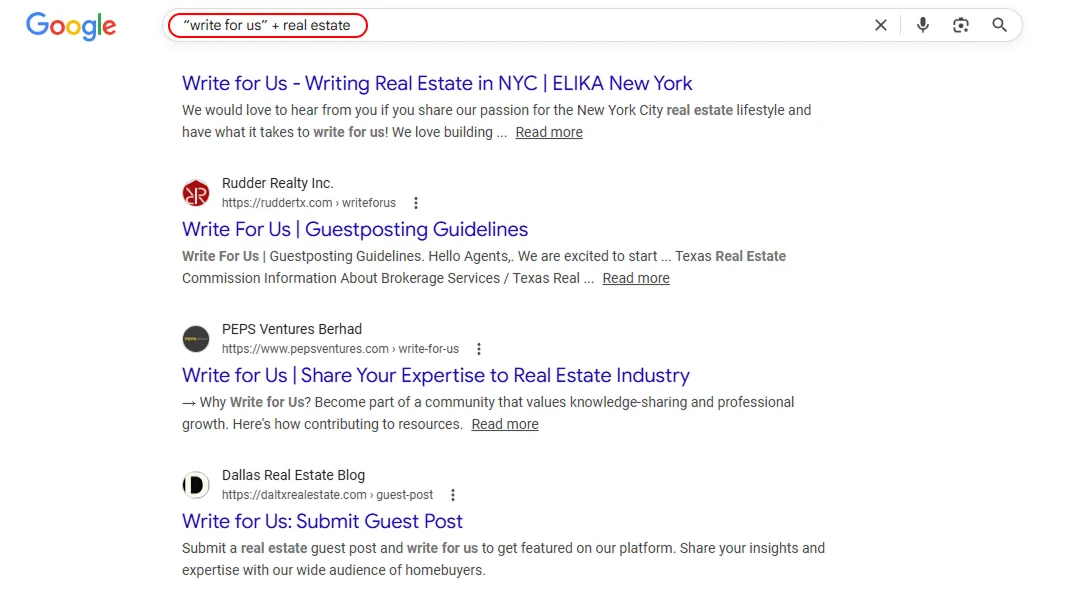
Here’s how you can execute it:
- Start by searching Google for “write for us” + your keyword, like real estate, home buying, or property.
- Use SEO analytics tools like Ahrefs or SEMrush to check where your competitors have already published guest posts, then target those sites.
- Look for content gaps on the target sites and pitch the topics they haven’t covered yet.
- Target publications in niches like real estate, personal finance, home improvement, local business, interior design, investing, and moving/relocation.
- Pitch topics that fit both the publication’s audience and your expertise; don’t pitch a listing-focused article to a home improvement blog.
- Write content that genuinely helps the publication’s readers. A great guest post earns you an open invitation to contribute again.
- Include one contextual link to a high-value page on your site, such as a guide, report, or service page, rather than your home page.
One important YMYL note:
Keep the guest posts informational, not advisory. A post about “what to look for when buying a rental property” is safer than one that gives specific financial advice. Stay within your expertise and avoid overstepping into regulated financial territory.
6. Earn Links Through Digital PR
Digital PR means earning links from news outlets, industry publications, and authoritative websites by providing expert commentary, original quotes, or newsworthy stories.
You create newsworthy content or data stories that journalists want to cover, resulting in links from trusted, credible media outlets.
A single mention in a major publication can earn you a link with more authority than dozens of low-quality links combined. Media links also drive referral traffic and brand recognition.
Here’s how you can earn links through digital PR:
- Start by identifying newsworthy local market trends and data that would make a good headline, such as rising prices, low inventory, or migration trends, and choose a topic where you can provide valuable, useful data or expert insights.
- Then monitor journalists’ requests on platforms like HARO, or look for reporterscovering real estate topics.
- You can create a simple research project, a small study, or market data on your chosen topic.
- Present the key insights clearly so that journalists can find and easily reference them in their articles.
- Reach out to journalists who cover the real estate industry, or respond to their queries by providing your data or an expert quote for their story.
- When they use your insights, they may mention your brand and link back to your website as the source.
Here’s an example: A real estate agent in Phoenix analyzes 12 months of MLS data and finds that homes within a quarter-mile of new light rail stations sold 18% faster. They pitch this as a data story to locate newspapers and business journals. Several outlets run the story, including links to the original analysis.
7. Sponsor Local Events and Organizations
You can earn links by participating in local events, charities, organizations, and educational initiatives.
Community involvement creates natural link building opportunities. Local events, charities, nonprofits, and educational programs often list their sponsors with links on their sites.
Here’s how sponsoring local events and organizations works:
- Sponsor local charity events, school fund-raisers, or community festivals.
- Host educational workshops like “First-Time Homebuyer Seminar” or “Understanding the Home Inspection Process.” Local organizations and libraries will often promote these events on their sites.
- Create a scholarship for local students interested in business, urban planning, or real estate. Post the details on a dedicated landing page. Schools and scholarship directories will link to it.
- Join your local chamber of commerce and REALTOR association. Both provide a directory listing with links.
- Volunteer for neighborhood associations and get listed as a sponsor or community resource on their websites.
Suppose you sponsor a $1000 annual scholarship for students studying urban planning at a local university. The university’s financial aid page links to your scholarship landing page and earns a high-quality backlink.
Bonus:
Scholarship links often come from .org and .edu domains, which tend to be highly trusted by the search engines. They also signal local community involvement, which strengthens your local SEO profile.
8. Create Linkable Visual Content
Create infographics, interactive maps, and visual tools that other websites reference with a link.
Visual content gets shared far more than text-only content. Real estate is visual by nature because properties are sold and bought on the basis of how they look, giving you a natural advantage.
Infographics, interactive maps, and visual data presentations earn links because they’re easy to share and reference.
Ideas for visual content:
- Neighborhood comparison maps or interactive maps showing price ranges, school ratings, and walkability by neighborhood. (e.g., “Historical home prices by neighborhood in your city.”)
- Homebuying process infographics are step-by-step visual guides that finance and real estate blogs want to share. (e.g., “How the Home Buying Process Works”)
- Market trend visualizations are charts showing year-over-year price changes, inventory trends, or migration patterns.
- Cost-of-living comparisons are visual breakdowns that compare your market to nearby cities. (e.g., “Renting vs. buying in your local market with real numbers.”)
- The best time to buy/sell graphics shows seasonal trend data in a visual format. (e.g., “How your city’s real estate market has changed over the past decade.”)
How to earn links with visual content:
- Once you create a visual asset, share it with local bloggers and accounts covering the related topics.
- Include your visual assets in the guest posts and pitch them to journalists who cover housing stories.
- You can also submit infographics to visual content directories for additional exposure.
- Share on social media and tag the relevant account that might reshare.
Building Links in 2026: What’s Changed
Link building continues to evolve. Here’s what you should know about building links for real estate in the current environment.
AI Search and Answer Engines
With AI tools like ChatGPT, Google AI Overviews, and Perplexity shaping how people look for information, your link building strategy now serves a dual purpose: it supports traditional SEO rankings while also influencing whether the AI system cites your brand as a trusted source.
To strengthen both, focus on earning links from sources AI models trust, such as established news outlets, industry publications, and educational institutions.
Quality Signals Matter More Than Ever
Google’s algorithms have improved at identifying manipulative practices such as link farming and other low-quality link schemes
Focus on links that pass a simple test. Would a real human click on this to learn more? If not, then it’s not worth pursuing.
Entity-Based SEO and Brand Signals
Now, search engines evaluate your brand as an entity. A recognized real estate business with a consistent presence across the web. Your links, citations, structured data, social profiles, and brand mentions all work together to build that entity.
Strong link building reinforces your entity signals. Disconnected or irrelevant links can actually confuse them.
Content Depth Wins
Research shows that longer and more comprehensive content drives significantly more traffic in real estate. However, the length alone is not the goal. Depth, originality, and practical value determine whether your content earns links and ranks well.
How to Evaluate Link Quality for Real Estate
All backlinks are not equal and don’t carry equal weight. Here’s how to assess whether a potential link is worth pursuing.
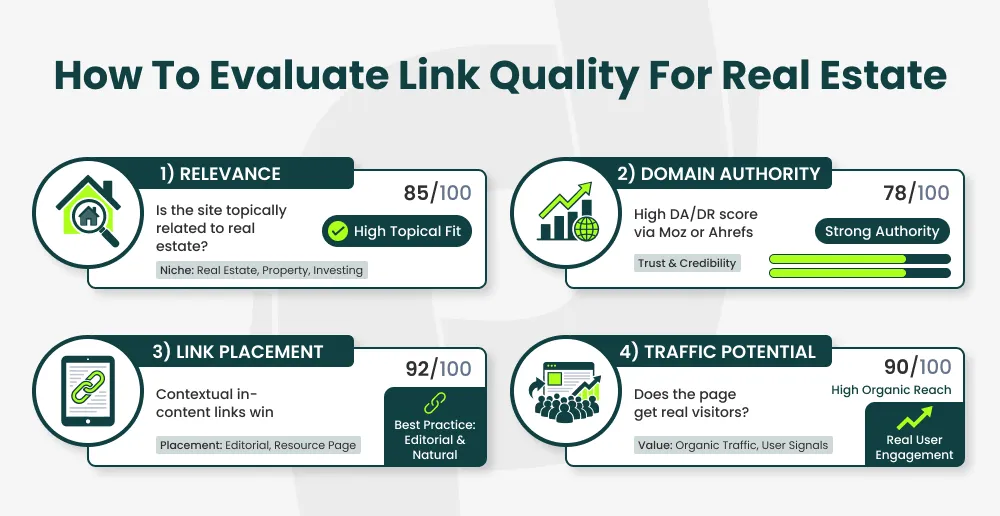
Relevance
Any site linking to you should have relevance to the topic being discussed in real estate. Links from home improvement blogs, financial planning sites, local news outlets, and industry publications are all considered relevant.
Domain Authority
Check the domain authority (DA) or domain rating (DR) of the linking site using tools like Moz or Ahrefs. A higher score often means that the link will have more impact. In short, a site with DA 30 and relevant content can often outperform a site with DA 70 from an irrelevant domain.
Link Placement
The placement matters the most. Links placed naturally in the article content carry more weight than links in footers, sidebars, or author bios. You can aim for contextual placements within the content when relevant.
Traffic Potential
A good backlink does more than just boost rankings. It sends referral traffic from people who click through. Prioritize links on the pages that actually get visitors.
Common Real Estate Link Building Mistakes to Avoid
Here are some common mistakes you should avoid to gain the complete advantage of the real estate link building strategies.
Buying a Low-Quality or Cheap Link
Buying low-quality or cheap link packages from bulk providers almost always hurts more than it helps, as Google’s algorithms are sophisticated enough to identify and penalize unnatural link patterns.
Ignoring Local Link Relevance
Even though national links have value, the real estate business needs local trust and credibility. A link from your city’s newspaper will always outperform a link from a generic or irrelevant industry blog, regardless of where it’s based.
Neglecting Content Quality
You can’t build links with thin and unhelpful content. Before launching any link building campaign, make sure that you have pages worth linking to, such as detailed guides, original data, and genuinely helpful resources.
Chasing Quantity Over Quality
Even five links from trusted and relevant websites can move your rankings more than fifty links from irrelevant and low-quality sites.
Relying on a Single Tactic
If you only do guest posting or only build directory links, your link profile will look unnatural. Instead, you can diversify your links that actually matter.
Not Updating Old Content
The next common mistake is not updating old content. A 2023 market report will not work in 2026. Keep your best content up to date with fresh data, as a recently updated page outperforms outdated ones in search results.
Forgetting Internal Linking
External links build trust and credibility, whereas internal links distribute that trust and credibility to the important pages. Every time you earn a link, make sure that the page links to your key pages.
How to Measure Real Estate Link Building Success
Here are some metrics to help you determine whether your strategy is working.
Referring Domains
Referring domains are the number of unique sites linking to your website. Growth here indicates your link profile is expanding. It is more important than the total number of links. In short, ten links from different websites are more valuable than the ten links from one website.
Domain Authority/Domain Rating
Domain authority and domain rating measure the strength of your site’s backlink profile; the more quality links you earn, the higher these scores tend to climb over time. You can track the overall strength using Moz’s domain authority checker and Ahrefs website authority checker.
Organic Traffic
More authority leads to better rankings, which in turn drive more traffic to your site. You can monitor this using Google Analytics. It helps you determine if your backlinks are driving traffic to your website.
Keyword Rankings
Keyword ranking means how high your site appears in the search engine results page (SERP) when someone searches for a specific phrase or word. You can track your keywords in Google Search Console. You should look for upward movement in the average position.
Referral Traffic
Referral traffic is simply the visitors who come to your website by clicking a link on someone else’s site. This means your links are placed on pages people actually visit.
Local Pack Rankings
Local pack rankings mean when your business appears on the search engine when someone searches for nearby results that are relevant to your industry or niche. For real estate, your position in Google’s local 3 pack is very important. You can track if the link building improves your local visibility.
Give your strategy a 3-6 month timeline to show results. Link building is a long-term investment. The trust and credibility built for your site compound over time, making it easier to rank in competitive terms.
Your Real Estate Link Building Action Plan
Here is a simple 90-day plan to start building links for your real estate website.
Week 1-2: Foundation
- Start by auditing your current backlink profile with Ahrefs or SEMrush.
- Identify your best content assets, such as guides, data, and tools that are worth linking to.
- Then claim and optimize profiles on NAR, Zillow, Realtor.com, and local directories.
- Audit your current link profile with SEO tools like Ahrefs or SEMRush to see where you stand.
- Identify 5 competitors and analyze their link profile; note the types of sites linking to them.
- Create or update your top 3 content assets, such as neighborhood guides, market reports, or homebuying resources.
- Claim all the directory listings, including NAR, State/local REALTOR associations, Zillow, Realtor.com, and Chamber of Commerce.
Week 3-4: Local Outreach
- You can list 20 local businesses you’ve worked with and also check their website for link opportunities.
- Write 3-5 testimonials for partners and request a link.
- Also, join the local Chamber of Commerce if you have not already.
Month 2: Content and Guest Posting
- Create or update a local market report with the current data.
- Pitch 5-10 guest post ideas to the relevant industry blogs.
- You can also sign up for HARO or Qwoted and respond to the journalist’s queries.
- Reach out to 10 local business partners for testimonial swaps and resource page links.
- Pitch with 3-5 guest posts to the relevant publications.
- Set up a Google Alert for brand mentions.
- Send your latest market report to 10-15 local journalists and bloggers.
Month 3 and Beyond: Scale
- Start by building a neighborhood guide for each area you serve.
- Create a linkable visual asset per quarter.
- Continue to consistently pursue digital PR and guest posting.
- Launch a quarterly market report.
- Begin community initiatives such as scholarships, workshops, and sponsorships.
- Reclaim any unlinked brand mentions that are found through alerts.
- Review the metrics, including referring domains, domain authority, and organic traffic trends.
- Plan your next 90-day cycle on what’s working.
Consistency is the key
A single round of outreach won’t transform your rankings, but steady, strategic link building over the months builds lasting authority that your competitors can’t easily match.
Final Thoughts
The real estate niche is not just about collecting as many links as possible; it is about earning the right links from the right sources. Your competitors who invest in strategic link building today will own the search results tomorrow.
The businesses that ignore this will keep paying more for ads, relying on portals, and wondering why their organic traffic stays at the bottom. You now have the strategies and action plan; it’s only about execution.
Start with the foundation and tactics that best suit your resources. Build your content assets and develop your local relationships, stay consistent, and the results will follow.
Ready to grow your real estate website’s authority?
Get a clear link building strategy designed to help you earn high-quality backlinks and improve search visibility.
How many backlinks does a real estate website need to rank?
There are no fixed numbers. It depends on your market, competition, and the quality of the links you build. In the local market, 30-50 high-quality, relevant backlinks can significantly improve your rankings. Focus on quality and relevance rather than following a specific count.
How long does it take for link building to improve rankings?
Most of the real estate websites see measurable improvements within 3-6 months of consistent link building. However, highly competitive markets may take longer to develop. The trust and credibility you build continue to compound over time.
Is it safe to buy backlinks for a real estate website?
Buying links from bulk providers or link farms violates Google’s guidelines and can attract risks and penalties. However, investing in professional link building through outreach, guest posting, and content creation is a standard and accepted practice. The difference is whether the links are earned through a genuine value or purchased as a shortcut.
What types of content earn the most links in real estate?
Original market data and research earn the most links, followed by comprehensive guides, visual content like infographics and interactive tools, and expert commentary featured in news publications.
Should I focus on local or national links?
Both the links matter, but prioritize local links for local search visibility. Links from your city’s newspaper, local business directories, community organizations, and regional industry groups carry the most weight for local SEO. Supplement these with national industry links for broader trust and credibility.
Can I do real estate link building myself, or should I hire a partner?
You can handle foundational tactics yourself, directory submissions, local partnerships, testimonial exchanges, and basic outreach. For more advanced strategies, such as digital PR, scaled guest posting, and linkable asset creation, working with a specialized link building partner can accelerate your results and free up your time to focus on your core business.