If you want to rank your website in Google, you need quality backlinks from other trusted websites.
Now, if you’re new to SEO or don’t know how to get quality backlinks, then it becomes confusing where to start and how to earn backlinks.
This is where Guest Posts come in.
Guest posting (guest blogging) is a process of writing helpful content for other trusted websites, and in return, you get a link back to your site.
These links are called backlinks. Google sees these links as votes of trust. It’s like a popular website pointing to your site and saying, “This website is worth visiting.”
The more trustworthy the website linking to you, the more Google trusts your site and helps you rank higher in search results.
Key Takeaways
- Guest posting means you write valuable content for someone else’s website, and in return, they include a contextual link back to yours.
- Google allows guest posts that add genuine value to the audience.
- One well-placed guest post on a relevant site can outperform ten placements on low-quality blogs.
- As of 2026, 73% of SEO professionals believe backlinks also influence visibility in AI-powered search results. (ChatGPT, Perplexity, Google AI Overviews)
What is a Guest Post?
A guest post is a piece of content that you write for someone else’s website. In return, you receive an author credit and links back to your own site.
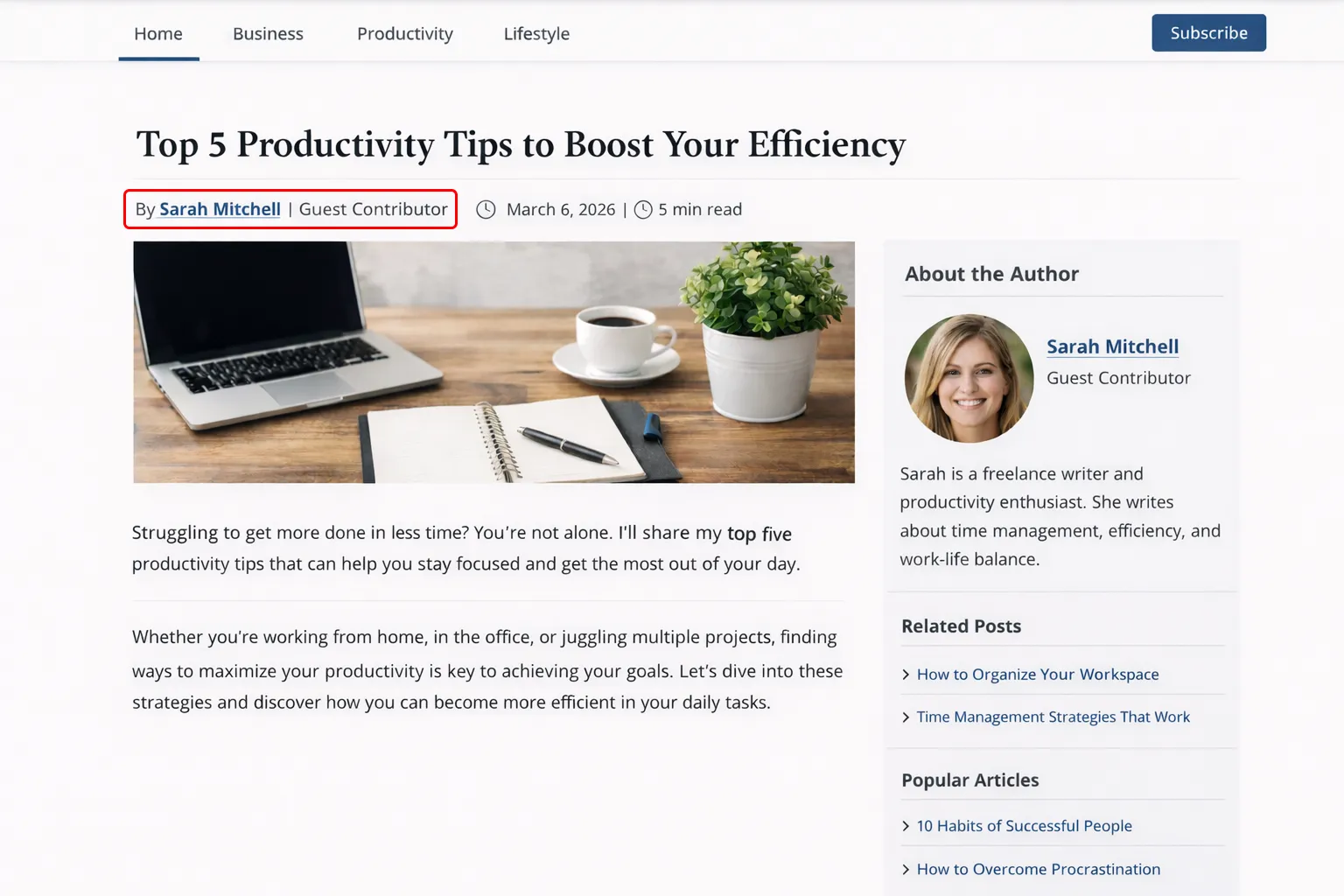
Guest posting has been a core part of link building for years.
In 2026, it’s still one of the most widely used methods for earning backlinks. However, the gap between what works and what doesn’t is wider than ever.
Google hasn’t banned guest posts. But low-quality guest posts no longer work. In fact, they damage your rankings. The difference comes down to intent and quality.
Guest posts help you build visibility with new audiences. They position you as a trusted voice and drive referral traffic from readers already interested in what you do.
Guest Posts Vs. Sponsored Posts Vs. Niche Edits
| Tactic |
What It Is |
Link Treatment |
|---|---|---|
| Guest Post | Original content you write for another site | Typically dofollow (editorial) |
| Sponsored Post | Paid placement, often disclosed | Should use rel=”sponsored” per Google’s guidelines |
| Niche Edit | A link inserted into an existing published article | Varies often paid, should be disclosed |
Are Guest Posts Still Worth it in 2026?
Yes, guest posts worth the time. But only if you treat them as content marketing, not as a shortcut for link acquisition.
Google’s official guidance on large-scale article campaigns states that guest posts that inform users, educate another site’s audience, or bring awareness to your cause or company are acceptable.
The violations happen when:
- You stuff keyword-heavy anchor text links into articles across many sites.
- Guest posts fail to serve subject-matter expertise.
- The same or similar content is duplicated across multiple sites.
- The primary intent is link building and not reader value.
What is Link Spam?
According to Google’s spam policy, link spam is the practice of creating links only to manipulate search rankings according to Google’s spam policies.
Guest posts become link spam only when the motive is to earn only links and avoid audience value.
Where Guest Posts Still Deliver Value
Guest posting creates compounding benefits that many practitioners underestimate.
Publishing high-quality guest posts on relevant industry sites builds brand authority. Also, when readers associate your name with the host and publication, it further increases credibility.
You should focus on publishing high-quality guest posts on a site that provides value to your target audience. This will attract visitors already interested in your niche.
Consistency is also important in guest posting. It signals to search engines and AI systems that your brand has real depth in a given topic area.
How to Find Guest Posting Opportunities
Finding guest posting opportunities is something most people get wrong. The easiest sites to find are usually the worst ones to pitch.
The sites worth writing for are harder to find, but the payoff is significantly better.
Use these 3 approaches to find better guest posting opportunities:
Google Search Operators
This is the easiest method to find guest posting opportunities. All you have to do is search with targeted queries and find sites that accept contributions in your niche.
- “Your niche” + “Write for us”
- “Your niche” + “Contribute” + “Guest”
- “Your niche” + “Submit an article”
- “Your niche” + inurl:guest-post
Suppose you’re in the B2B SaaS space, you’d search “B2B SaaS + Write for Us,” and Google will list out sites for contributors in your niche.
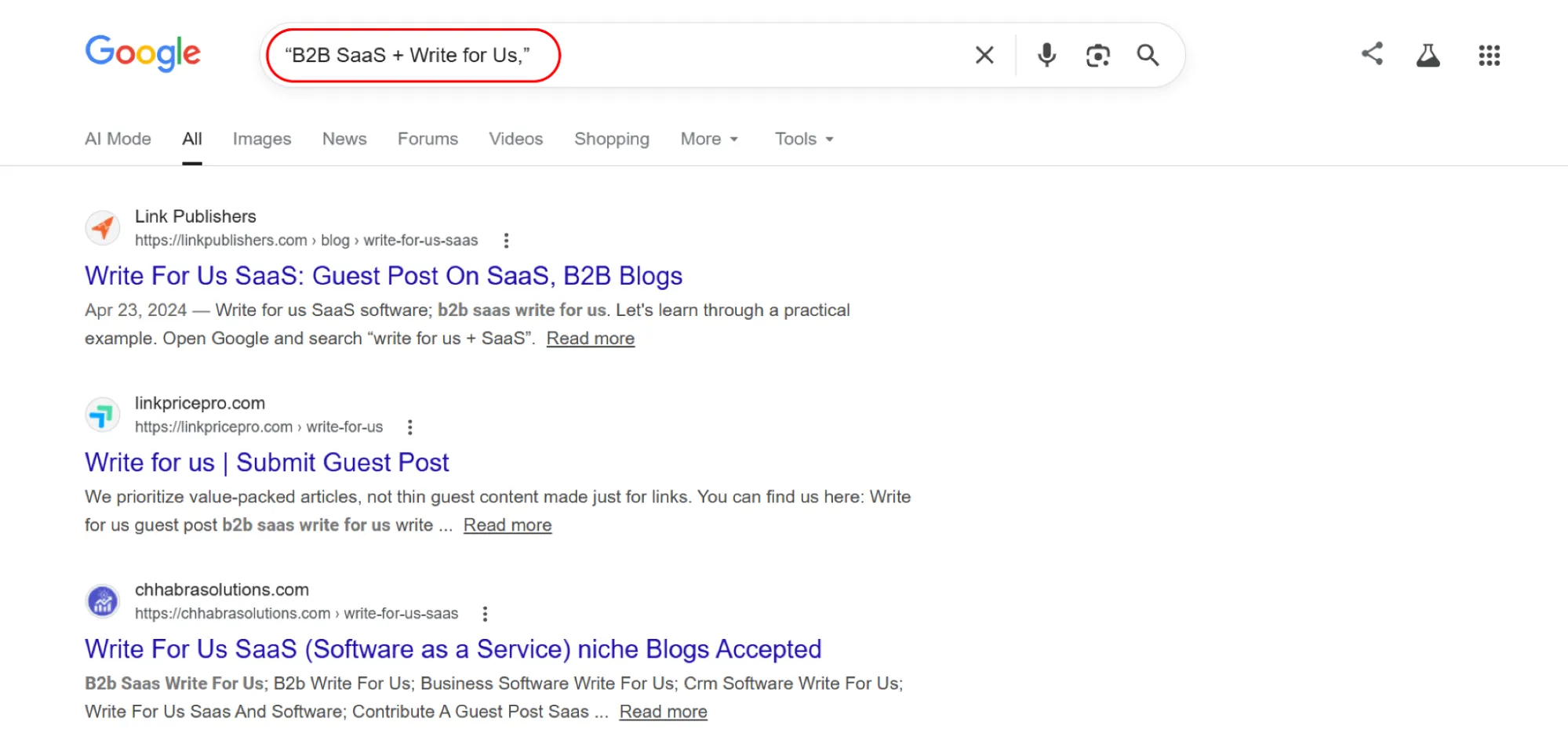
Most won’t pass the scorecard below, yet if you filter hard, you’ll get a more precise list. You can start from there.
Competitor Backlink Analysis
This is one of the fastest methods. Use Ahrefs or Semrush to review the backlink profiles of competitors already ranking well for your target keywords.
Look for links that came from guest posts. They’re usually easy to spot (author bylines, “guest post” tags, or a contributor bio).
These sites already accept content in your niche, already have editorial standards, and pass link authority.
Here, your job is to pitch something better than what your competitor wrote.
Build Relationships Before You Pitch
Strong relationships with industry contributors and editors open the door for acquiring quality backlinks.
In fact, the best guest post placements come from real relationships. Not templates.
Start by genuinely engaging with the sites you want to write for. Comment on their articles. Share their content. Mention their work in your own writing. By the time you pitch, the editor already knows your name.
This takes time, but your acceptance rate climbs.
Research shows that personalized outreach that uses the recipient’s first name increases backlink acquisition by about 50%.
How to Evaluate a Guest Posting Site
Not all guest post opportunities are equal. Most are poor.
A BuzzStream 2025 study of over 26,000 guest post sites found that approximately 86% of sites on guest post marketplaces have less than 10K monthly traffic and a DR below 40, making them low-value sites.
This means, if you’re not evaluating carefully, you’re likely wasting time and budget on placements that won’t move the needle.
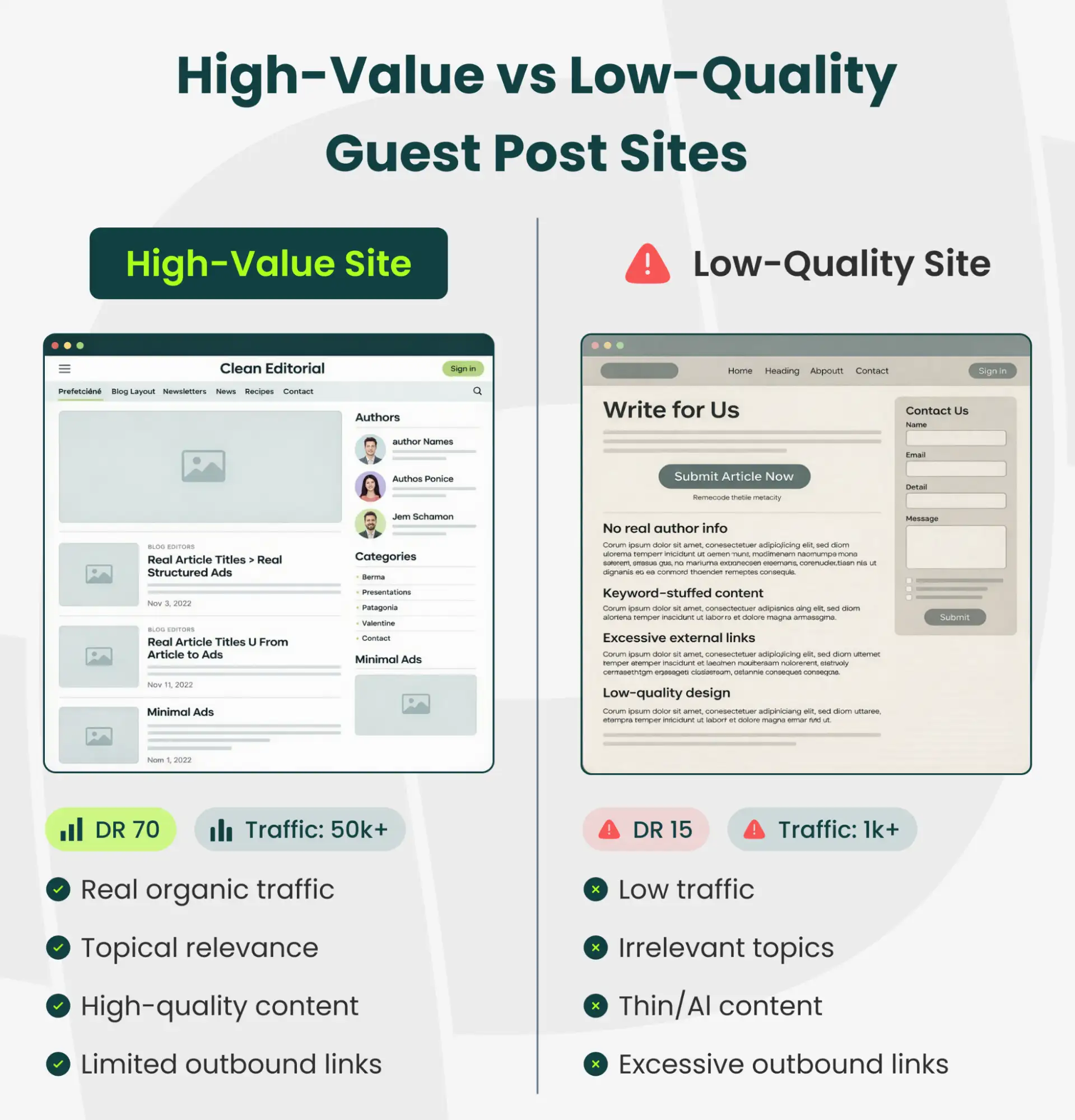
Signs of High-Value Site
Evaluate each target site against these criteria before pitching it for guest posting.
1. Real organic traffic
Use link building tools like Ahrefs or Semrush to verify the actual search traffic. Most low-quality sites may have inflated pageviews due to bots or social shares.
2. Topical relevance
The site should cover your niche or something closely related to it. A health and fitness brand publishing on a finance blog helps neither audience.
3. Existing content quality
Read some recent articles. If they’re thin, generic, or clearly unreviewed AI content, then move on.
4. Reasonable outbound link count
Pages with dozens of external links spread their value thin. Fewer links per page means each one carries more weight.
Red Flags That Signal a Low-Quality Site
- The primary business model is selling guest post placements.
- The ‘Write for Us’ page reads like a link sales pitch.
- It claims high domain authority but has almost no real traffic.
- It publishes content on completely unrelated topics with no focus.
- Its published articles are full of exact-match keyword links pointing to commercial pages.
Guest Post Quality Evaluation Scorecard
Use this framework to score targets before investing time in a pitch:
| Signal |
High-Value (3 points) |
Medium Value (2 points) |
Low Value (1 point) |
|---|---|---|---|
| Monthly organic traffic | 10,000+ | 1,000-10,000 | Under 1,000 |
| Topical Relevance | Same niche | Adjacent Niche | Unrelated |
| Editorial Process | Named editors, guidelines review | Basic guidelines | No visible standards |
| Content Quality | Original, Well-researched | Decent but generic | Thin or AI-generated |
| Outbound Link Density | Under 5 per article | 5-15 | 15+ |
| Author Attribution | Name + credentials | Author names only | No attribution |
Score interpretation
- 15-18 = Strong opportunity
- 10-14 = Acceptable, but check weak areas first
- Below 10 = Not worth the effort. Skip it
How to Pitch and Write a Guest Post That Gets Published
Editors at popular sites receive dozens of generic emails every single day. The ones that get a response are specific, relevant, and short.
Write a Pitch That Editors Actually Read
Write a short and punchy pitch (200 words) that saves time, not a long thousand-word pitch. You can write a clear pitch with three simple steps.
1. Show you know their site
Mention a specific article that they’ve published and explain how your topic builds on it or fills a gap.
2. Pitch a real, specific topic
Your pitch should sound real. Not “I’d love to write about SEO.” Instead, write “I’d like to write about how SaaS founders can use product-led content to earn editorial backlinks with three real case studies.”
3. Prove you’re credible
Write one sentence about your experience or a link to published content. That’s enough.
These three steps are all you need to write a clear pitch for your next guest post. However, do not use cliche copy-paste templates; most pitches fail here.
Also, you should avoid generic opening lines, “noticed they accept guest posts.”
Your proposed topics should be fresh and avoid topics already covered on their site.
Here’s how your outreach mail should look:
Subject: Guest post for [Site Name]
Hi [Name],
I’ve been reading [Site Name] for a while and noticed you publish content on [topic]. I’d love to contribute a guest post.
Here are a few ideas:
- [Title idea 1]
- [Title idea 2]
- [Title idea 3]
I’ve written for [Site 1] and [Site 2] if you’d like to see examples of my work.
Happy to send the full draft if you’re interested.
[Your Name]
Write Content That the Host Site Wants to Publish
Once you get a yes from the host, start brainstorming how to deliver a quality piece of content. This is only half the battle.
Study their recent posts before you write a single word. Match their tone, structure, and length. Don’t write the article you want; write what their readers need.
Bring something original. A data point from your own experience. A case study. An insight that their existing content doesn’t cover. That’s what makes editors want to publish you again.
Write for their audience level. An advanced SEO blog doesn’t need a backlinks explainer. A general business blog doesn’t need unexplained technical jargon. Match your depth to their readers.
Get Your Links Right
Where and how you place your links matters.
Best Practices:
- Aim for 1-2 contextual links per guest post. (one link per 1000-1500 words).
- Link to genuinely useful resources on your site.
- Use natural anchor text that describes what readers will find when they click.
- Never use the same exact-match keyword phrase repeatedly for anchor text. Keep it as natural as possible.
Guest Post Anchor Text Distribution Framework
You must aim for this approximate distribution in your guest posts for a healthy link profile.
| Anchor Type |
Description |
Target Distribution |
|---|---|---|
| Branded | Your brand name | 30-40% |
| Partial Match | Keyword + Modifier | 25-35% |
| Natural / Generic | “This guide,” “learn more here.” | 15-20% |
| Exact Match | Target keyword only | 5-10% |
| URL/Naked | Full URL | 5-10% |
Common Guest Posting Mistakes That Hurt Your Seo
Poor guest posting strategies don’t just waste time; they can actively damage your search performance.
Here are the common guest-posting mistakes that cause the most harm.
1. Mass Outreach With Generic Templates
Sending the same repetitive pitch to hundreds of sites is the fastest way to get ignored.
You end up publishing your content on low-quality sites that actually accept these pitches, but you don’t get any value or authority in return.
Practice personalized outreach each time. It takes time, but it provides better results.
2. Publishing on Irrelevant or Low-Quality Sites
Many beginners post their well-researched content on completely irrelevant or low-quality sites.
Your every placement should be on a site where your target audience genuinely visits.
Do not publish on sites that are off-topic for your industry or business. If you’re publishing on a random website just for backlinks, you’re wasting your time.
3. Over-optimized Anchor Text
Using the exact match keyword phrase across multiple guest posts is a clear manipulation signal. Google’s link spam algorithms target this pattern.
4. Duplicating Content Across Multiple Sites
When you reuse or rewrite an article with light variation for different publications, it violates Google’s guidelines and provides no unique value to any audience.
5. Treating Guest Posting as Your Only Tactic
Relying only on guest posts creates an unnatural backlink profile. Combine link building approaches, such as digital PR, content marketing, broken link building, and guest posting, to build more effective link building campaigns. This builds a diverse profile.
6. Ignoring Link Attributes
If a guest post is paid or incentivized in any way, the links must use rel=“sponsored” or rel=“nofollow” attributes. If you fail to tag these properly, it puts both your site and the host site at risk.
How Much do Guest Posts Cost?
Guest posting costs vary significantly depending on placement quality.
Here’s the cost breakdown so you can allocate budget and avoid overpaying for links that don’t drive real value.
Guest Post Cost Comparison by Quality Tier
| Quality Tier |
Cost (Direct) |
Cost (Via Vendor) |
Site Characteristics |
|---|---|---|---|
| Low Quality | $20-$100 | $50-$200 | Under 1K traffic, no editorial standards |
| Mid Quality | $100-$400 | $300-$800 | 1K – 10K traffic, basic editorial review |
| High Quality | $400-$950 | $800-$2000 | 10K+ traffic, strong editorial process |
| Top Tier | $700-$2,000+ | $2500-$3,000+ | Major publications, real readership |
There are also free guest posting sites where you prospect, pitch, and write quality content, and they publish without asking for payment. But it’s inconsistent, and the acceptance rate on high-quality sites is low.
You can also outsource link building to an agency, and a premium package covers:
- Prospecting
- Relationship management
- Content creation
- Quality assurance
Here, the key question isn’t “How cheap can I get guest posts?”
It’s “What quality of placement does my budget support?”
Moving Forward With Guest Posts
Guest posting isn’t dead in 2026, it has become more practical and requires genuine efforts that provide real value to the other site and its audience. Google’s algorithms can detect manipulative patterns more effectively than ever.
So now what should you do to earn backlinks with guest posting?
The path forward is clear: treat every guest post as a piece of content marketing, not just another link acquisition channel. Write for the audience, build relationships with editors who value your expertise.
That’s how guest posting builds authority that compounds over time.
Want backlinks from real websites, not random placements?
Get guest posts that bring traffic, authority, and long-term results.
1. Is guest posting against Google’s guidelines?
No. Google allows guest posts that provide genuine value to readers. However, it penalizes large-scale guest posting done primarily for link manipulation. It includes keyword stuffing, publishing thin content, or distributing the same articles on multiple sites. If your article is well-written, topically relevant, and useful to the host site’s audience, it aligns with Google’s guidelines.
2. How many guest posts should you publish per month?
Quality and consistency matter more than volume. For most businesses, 2-4 high-quality guest posts per month on relevant and authoritative websites will provide better results.
3. Should guest post links be nofollow or dofollow?
It depends on the arrangement. If the guest post is purely editorial, you pitched a topic, wrote valuable content, and the external site publishes the content, it means the content serves their audience, then a dofollow link is appropriate. If any payment or incentive is involved, Google’s guidelines require the use of attributes. Many high-quality sites set their own link policies, and respecting those keeps your relationships intact long-term.
4. Can guest posts hurt your rankings?
Yes. Publishing low-quality guest posts on irrelevant sites, using manipulative anchor text patterns, or participating in large-scale link schemes can trigger algorithmic devaluation or manual penalties. The risk comes from the implementation, not the tactic itself. Guest posts on relevant, authoritative sites with natural link placement are safe and deliver the desired results.