There are articles that live on the search engine for years; not every page starts from zero. Niche edits give you a way to earn backlinks from those articles.
A niche edit is a backlink placed within an existing published article on another website. Your link benefits because the page is already indexed, trusted, and crawled by Google; your link gets discovered faster and carries more weight than a link on a new page.
Instead of building authority from scratch, you start from something that already works.
Key Takeaways:
- Niche edits add contextual links to existing ranking pages to build authority.
- Combine niche edits and guest posts to build a natural, diversified backlink profile.
- High-quality niche edits require relevant topics, traffic, and editorial standards.
- Avoid cheap, bulk niche edits that show paid link schemes.
- Successful niche edits rely on prospecting, genuine value, and genuine outreach.
What Are Niche Edits and How do They Work?
Niche edits are also known as link insertions or curated links. These are backlinks placed in an existing published article on another website. Either by inserting them directly into relevant content or earning them through resource pages and expert roundups.
If done well, niche edits can be the fastest way to build contextual, relevant links, rather than creating new content for every placement.
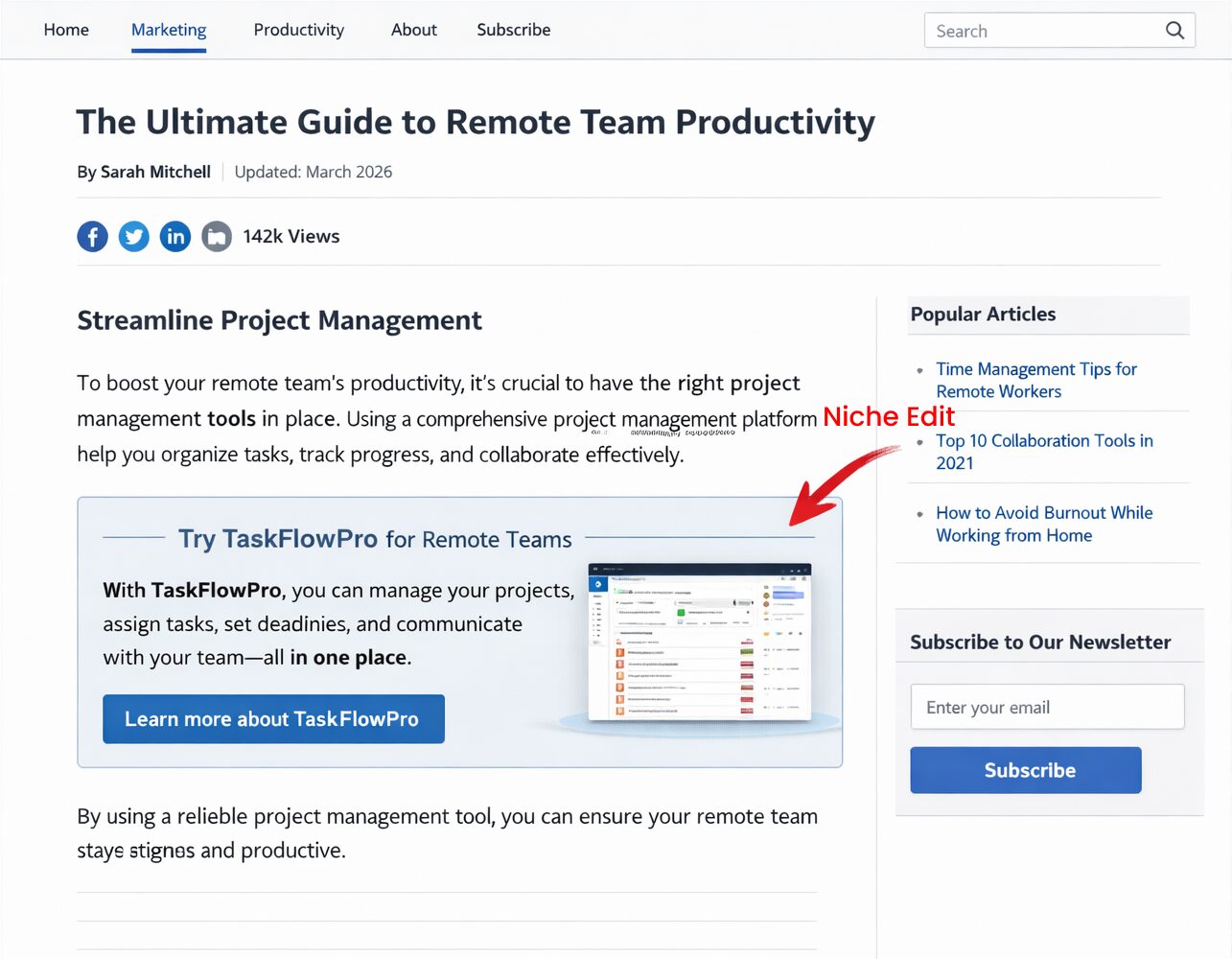
Here’s what it looks like in practice. Suppose you sell project management software called Task FlowPro. A marketing blog published a guide on remote team productivity two years ago. The guide ranks on page one, has backlinks, and gets traffic.
You reach out to the site owner and suggest adding a reference to your tool inside a relevant section of that existing guide.
Once updated, your link is placed on a page that is already published, has authority, and visibility, unlike a guest post that starts at zero and has to earn it.
Niche Edits Vs. Guest Posts: When to Use Each
Both help you build backlinks. However, they work differently; knowing which one to use can help you save time, and you get better results.
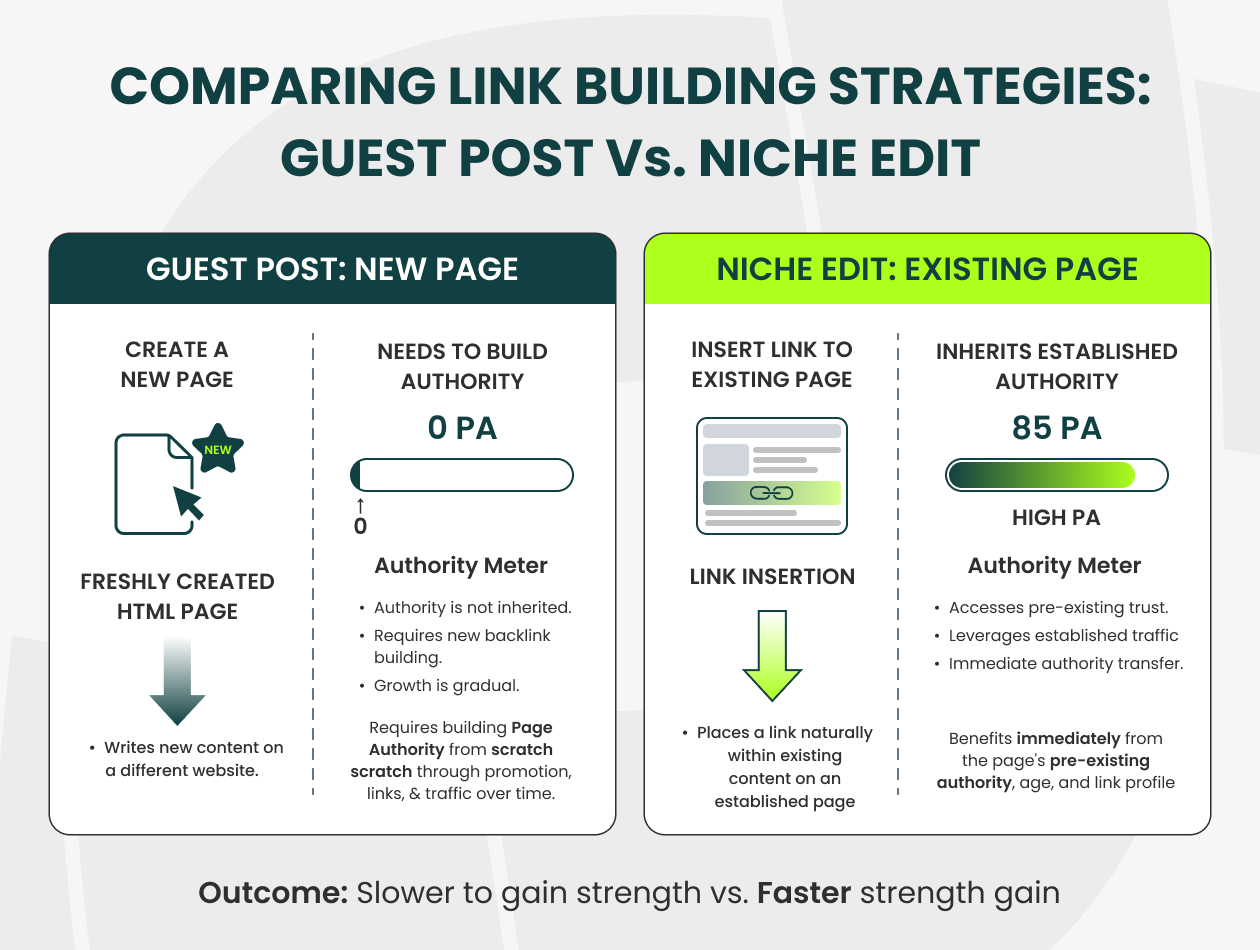
Guest Posts
Guest posts mean writing new content for someone else’s website. Your link is placed inside that new content, but it takes more time because you need to write, edit, and wait for the site’s owner to publish it. Guest posts give you complete control.
Niche Edits
Niche edits places your link in the existing article. No new content required because the page is already live, trusted, and getting traffic.
The table below will help you identify the clear difference between niche edits and guest posts.
| Factor |
Niche Edits |
Guest Posts |
|---|---|---|
| Speed to live link |
A few days to a couple of weeks | Weeks to months |
| Content creation needed |
Minimal (1-2 sentences) | Requires a complete article |
| Control over context |
Moderate | High |
| Page authority at launch |
Inherited from the existing page | Starts from zero |
| Best for |
Quick wins, reinforcing relevance to the topic | Thought leadership, brand awareness |
Most teams that skip niche edits entirely are missing opportunities. The teams that rely only on niche edits miss the brand building value that guest posts bring. The strongest link building strategies combine both.
Link building Campaigns that combine niche edits with guest posts make your backlink profile look more natural. The search engine’s rewards may vary. A profile built on only one link type may look unnatural, no matter how good that type is.
What Makes a High-quality Niche Edit
Not every niche edit helps your rankings; some placements move the needle, but others do nothing.
Think of this like an advertisement: a billboard on a busy road works better than on an empty road; the same logic applies.
The Host Page has Real Traffic and Age
A page published three years ago that gets steady traffic is more valuable than a post published last month.
Old pages with consistent traffic have survived almost every Google update so far, earn their own backlinks, and have proven their relevance over time. A page like that doesn’t need your link; it makes your link better.
The Topic Matches your Website
If your site sells accounting software and your link shows up in a post about dog grooming, that mismatch is obvious to readers as well as to search engines.
The page your link lives on should cover a topic that genuinely connects to your content. Contextual link building works well because the more relevant the text is, the more value the link carries.
The Site has Editorial Standards
Check whether the site publishes the original content and has a real team managing it. A site that accepts every link request isn’t building your authority.
An Authority Hacker survey of 755 link builders found that 93.8% say link quality matters more than quantity. That applies directly to niche edits.
The Outbound Link Profile is Clean
Before accepting a placement, check who else the page is linked to. If it links to a gambling site, payday lenders, and dozens of unrelated commercial pages, then your link is placed in a bad company.
A page with 5-15 outbound links to relevant, trusted sources is a much stronger placement than a page linking to 60+ random websites.
The Risks of Cheap Niche Edits
Niche edits work, but only when done right. Most niche edit services sell links at $50-$80 per placement. They’re selling you links on sites that will hurt you in the long term.
Because at that price, there’s no room for genuine outreach, editorial review, or quality vetting. The only way the number works is if the vendor owns the site (a private blog network) or has a bulk deal with the site owners, who accept links from anyone willing to pay.
Google’s Search Essentials Documentation is clear. Paying for links that pass ranking value violates their spam policies. That doesn’t mean that every paid placement triggers a penalty, but it means your risk increases when your placement has no real editorial value behind it.
Here are some signs of a risky niche edit placement:
- The site publishes content across dozens of unrelated topics.
- Every article links out to 10+ commercial pages.
- The site has no real audience, low traffic, no social presence, and no engagement.
- The same keyword-heavy text appears almost everywhere.
- The vendors guarantee placement on specific sites even before they have contacted the site owner.
If someone can guarantee you a link before outreach has even started, that relationship is purely transactional. That’s the kind of pattern Google’s SpamBrain system is built to detect.
How to Find and Secure Niche Edit Opportunities
Genuine niche edits take more effort than buying placements from a vendor list. The conversion rates are lower. Page One Power reports that their outreach to update existing content converts roughly 3-5% placements for every 100 sites they contact.
Is it worth the shot? Absolutely. Those links last.
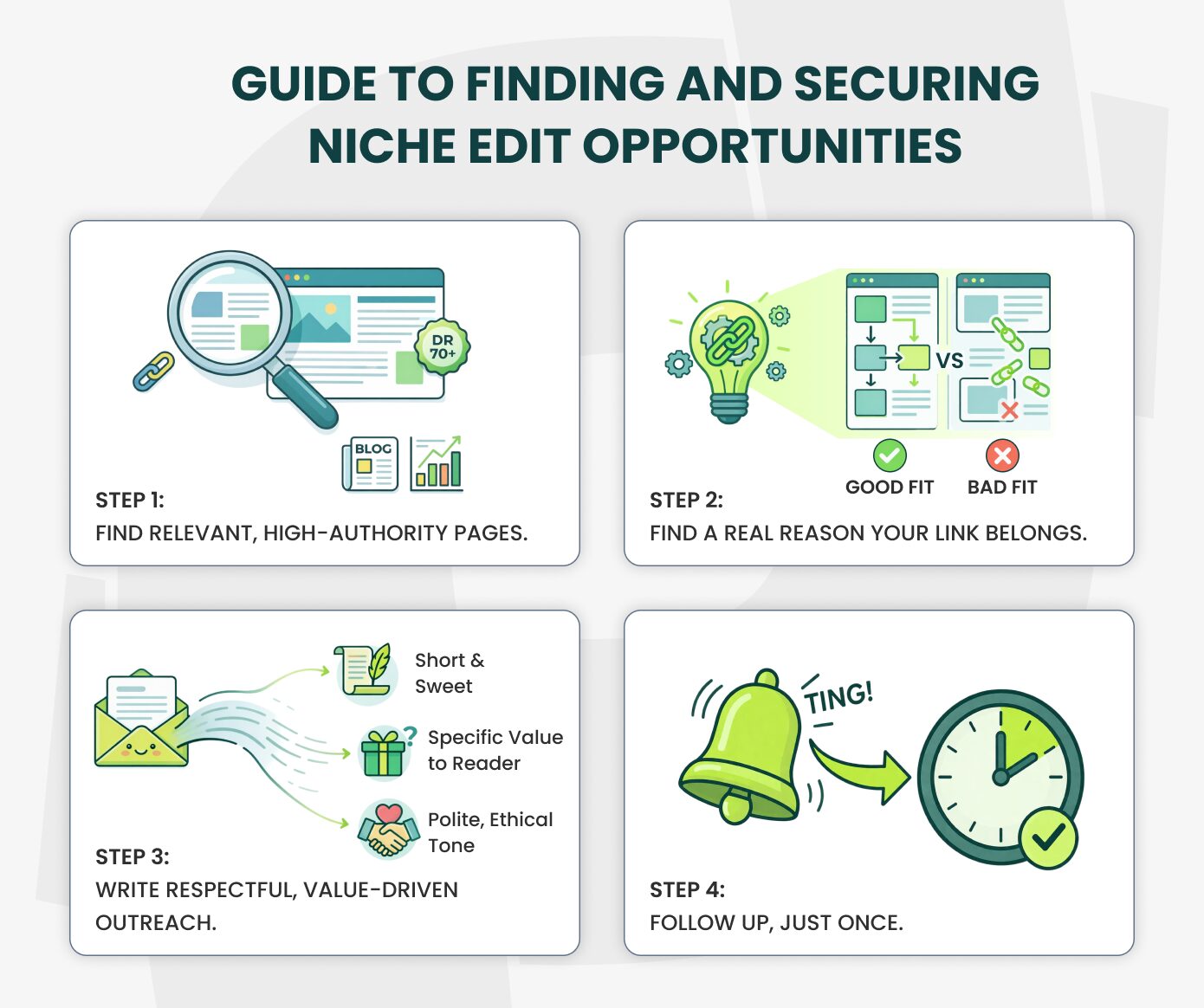
Step 1: Find Relevant, High-Authority Pages
Start with Google. Search for the topics related to your content in your industry, look for articles that rank well and have been live for at least a year.
Use Ahrefs or SEMrush to check two things: whether the page gets real organic traffic, and whether the site has genuine authority behind it. You’re looking for pages where your link would actually add value for the readers.
Step 2: Find a Real Reason Your Link Belongs
This is where most outreach fails. A generic “your article could benefit from our link” often gets ignored because it gives the site owner no real reason to say yes.
You need a specific reason your link belongs there. Here are some better approaches.
- Broken link building or broken link replacement lets you find a dead link on the page and offer your content as an alternative. The site owner fixes a problem for their readers, and you earn a link.
- Replace outdated information if the article refers to any old statistics or tools that no longer exist, and suggest your updated version that includes your research.
- Cover the content gaps in the article and add your valuable research to fill them. You are making the content more useful, not just asking a favor.
- Look for unlinked brand mentions. If the page already mentions your product or brand without linking to you, write a short, polite email pointing this out because it converts at a much higher rate.
Step 3: Write Outreach that Respects the Site Owner’s Time
Keep the message personalized and short. Name the specific article and explain what you’re suggesting and why it helps their readers.
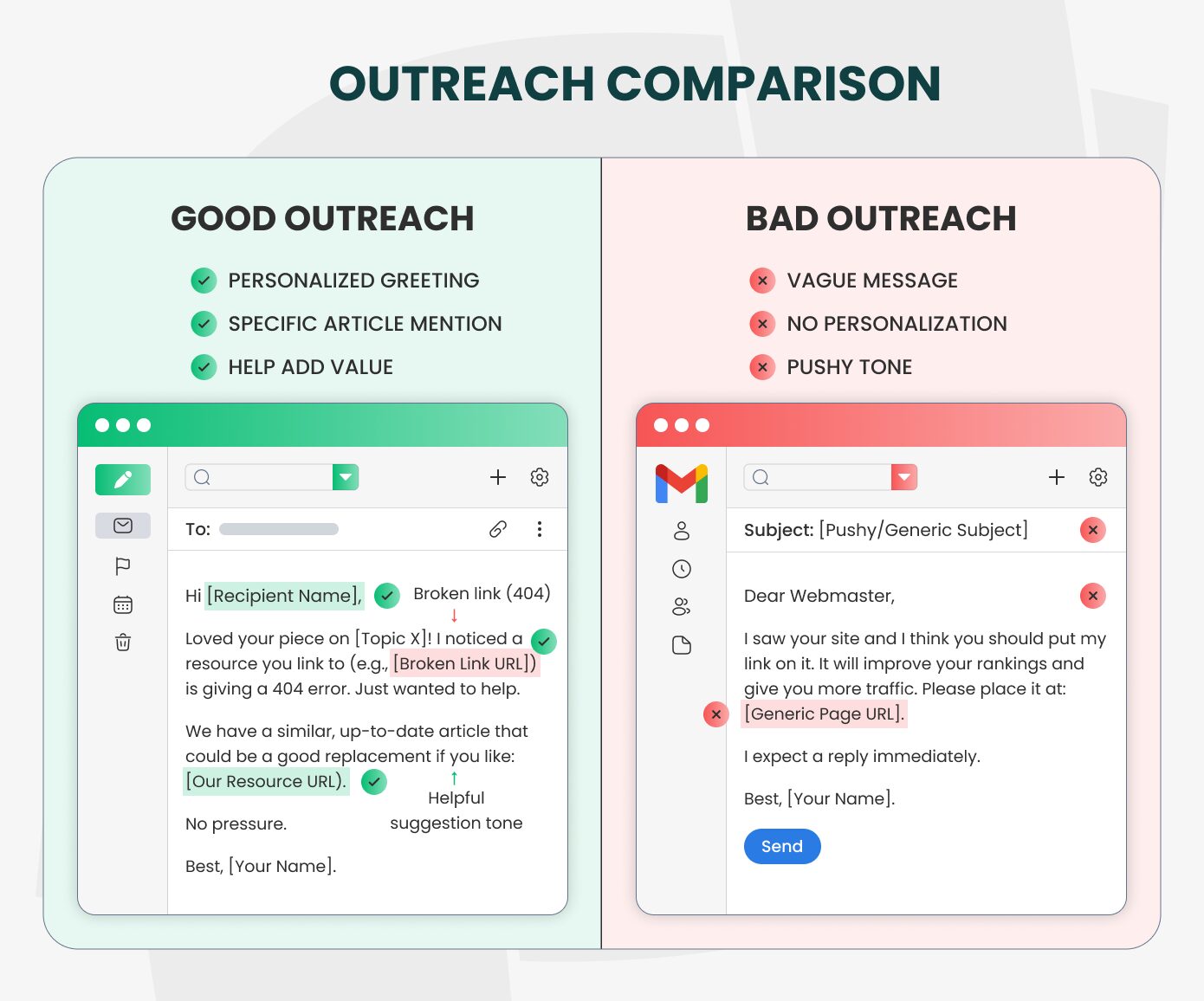
The first example is effective because it gives the site owner a specific reason to act. The second one is a poor example because it asks for a favor without any value in return.
Here’s a ready-to-use outreach template.
Subject: Quick note about your [Topic] article
Hi [First Name],
I was reading your article on [Article Topic], and it’s a great piece, especially the part about [specific section or point you genuinely liked].
Just wanted to flag that the link to [Dead Resource Name] in [paragraph/section location] is returning a 404 error.
We published a [one-line description of your content] that covers the same ground. Happy to share the link if you’d like to swap it in.
Either way, thought you’d want to know.
[Your Name]
[Your Website]
Step 4: Follow up, Once
If you don’t hear back after your first email, then send one follow-up; that’s it. Wait for 5-7 days, then send a friendly reminder. Keep it up to two or three sentences, because this shows you’re checking in and not chasing.
If you get no response even after that, then move on. There are plenty of opportunities worth your time. Sending them three, four, or five follow-ups will hamper your reputation, and they will make sure not to reply to you again.
How Niche Edits Fit into a Broader Authority Strategy
Niche edits aren’t a standalone strategy. They’re tools in a larger link acquisition approach that should also include guest posting, digital PR, resource page outreach, and content-driven link earning.
Niche edits build authority by tapping into the already ranking pages. Use them to strengthen the relevance to the topic and give specific pages a ranking push.
Guest Posts build brand visibility and through leadership. Use these when you want to control the complete context around your link and reach a new audience.
Digital PR earns links from high-quality news and media sites. Use it for brand awareness and domain-level authority.
An Ahrefs study of 1 million SERPs confirmed that the link metrics still correlate with higher rankings, with the relationship being strongest for competitive, high-volume keywords (Ahrefs, 2025). For those competitive terms, you need links from multiple sources and methods.
The Ahrefs research on backlink growth also found that top-ranking pages gain new referring domains at a rate of 5-14.5% per month. Diversify your approach and your results compound over time.
Conclusion
Niche edits work because your links are placed within content that already has authority, rather than on a brand new page waiting to earn it. Focus on relevance, vet every opportunity. Most importantly, pitch with a genuine reason your link adds value.
Looking for faster SEO results from link building?
Use niche edits to tap into existing authority and boost rankings.
Are niche edits safe for SEO?
Safety depends entirely on execution. A niche edit placed on a relevant, high-quality site with real editorial oversight is safe and effective. A niche edit bought from a bulk vendor on a site that accepts links from buyers can carry real risk. The method of placement matters less than the quality of placement.
How much do niche edits cost?
Pricing varies depending on quality. Bulk vendors charge $50-$150 per link. However, these placements usually come from low-quality sites that do more harm than good. Quality niche edits are acquired through manual outreach and careful vetting, which typically costs $200 to $500+ per placement. This price depends on the host site’s authority and relevance.
How long does it take for a niche edit to impact rankings?
The host page is already indexed, so Google can find and evaluate your new link faster than it would link on a freshly published page. Most people start noticing ranking movement within 1-3 months.
Should I use niche edits or guest posts?
You can use both. They work better together than either of them does alone. A niche edit gives you speed and authority from pages that already rank. Guest posts give you control over the content and exposure to new audiences. A backlink profile built entirely on one link type may look unnatural, and Google notices. Mixing them both helps your profile grow in an organic-looking way.
Can I do niche edits myself, or should I hire an agency?
You can absolutely do it yourself if you have time to prospect, vet, outreach, and follow up. The process isn’t complicated; it’s time-consuming. If your team is already working with an experienced link building partner, this can free up your time while maintaining quality standards. What matters is that whoever does it follows a genuine outreach process, not a vendor list.