Local link building is the process of earning backlinks from relevant websites to improve your local search visibility, including the Google Local Pack and AI-generated local answers. It strengthens your presence on platforms like Google Business Profile. Brands serious about scaling often hand this off to an expert link building agency for predictable results. Most teams should reference SEO local citations for the latest baseline data.
Unlike general link building, here the focus is on location-based relevance, helping search engines connect your business to a specific area.
In simple terms:
- When your business is consistently mentioned across trusted local sources, it helps search engines and AI systems to verify your business.
- Backlinks and citations not only support your rankings on Google but also in AI-generated results.
The playbook has changed. Directory submissions alone are no longer enough. The AI overview appears in 68% of local searches overall, and these AI-generated answers grab attention on a different set of trust signals than those in the traditional map pack.
Key Takeaways:
- Local link signals local relevance and trust to the search engines and the customers.
- Citation and NAP consistency drive both local and AI visibility.
- Quality, relevant local links can outperform high-volume, low-relevance directories.
- Ongoing monthly link building can outperform one-time campaigns.
- AI and maps both rely on local signals.
What Is Local Link Building?
Local link building is the practice of earning backlinks from websites tied to a specific city, region, or local audience. Local newspapers, community blogs, regional chambers of commerce, and neighborhood publications all signal to Google that your business has genuine local presence in a way national domain authority can’t replace.
Local link building is the process of earning backlinks from nearby websites that are geographically connected to your business, such as local news sites, community groups, directories, and business partners, to strengthen your authority and improve your rankings in local search results.
What separates a local backlink from a standard link? There are two things that separate each other.
- Geographic relevance
- Community connection
Here’s a clear difference.

A link from the chamber of commerce in your city carries more weight than a link from a national blog.
This is especially for local visibility. Google’s local algorithm treats those local signals as evidence that your business is a trusted part of a community.
Local links matter because they help to strengthen Google’s three core local ranking factors:
Prominence grows because reputable local sites recommend your business.
Proximity refers to the distance between the user’s search and the business. The closer the business is to the user’s location, the more likely it is to appear in the search.
Relevance of the links from related local pages acts as confirmation of what your business is about. It can move you in the Map Pack faster than the dozens of generic links.
Why Local Links Matter in 2026
Local links matter in 2026 because Google’s local algorithm weights geographic relevance signals heavily for map pack rankings and “near me” queries. Without quality local links, even the best on-page local SEO leaves you out of the three results that capture most local search traffic.
The right local backlinks and citations help nearby people find you fast and trust you more, because both Google’s traditional algorithms and the newer AI discovery systems reward them.

Boosting Local Search Visibility
Boosting your local search visibility simply means making your business more visible and easier to discover for people searching in your area. It also includes visibility in “near me” queries.
The local pack usually relies on Google Business Profile signals, reviews, and proximity. Links from city news, chambers, schools, and neighborhood blogs signal strong relevance.
Driving Targeted Traffic and Conversions
Geo-specific links are the kind of links that send visitors who already want local solutions.
Driving the right traffic, the one that converts, is where local SEO and link building prove their real value.
A click from a nearby page or city guide is more likely to result in a store visit, a call, or a form fill-out.
Building Trust and Authority
Being mentioned along with the trusted local experts and businesses strengthens your business’s credibility.
Keep your Name, Address, and Phone (NAP) details consistent across local citations and profiles to reduce confusion and build trust.
Over time, this builds trustworthy signals that compound E-E-A-T, proving that you operate locally and serve real customers.
How Local Links Feed AI Search Visibility
Local links feed AI search visibility because Google AI Overviews. ChatGPT, and Perplexity all reference geographic relevance signals when deciding which local businesses to cite in generative answers. A site with strong local backlinks gets surfaced in AI responses to “best [service] near me” queries. A site without them stays invisible.
This is the part that most local link building guides skip entirely in 2026. And this is the part that matters the most.
Imagine this:
You run a coffee shop, and when someone searches for the query “best coffee shop near me” in Google or asks ChatGPT for a recommendation, at that point of time, how does AI decide who to suggest?
AI doesn’t just look for your website; instead, it scans your entire online presence, just like a detective searching for clues.

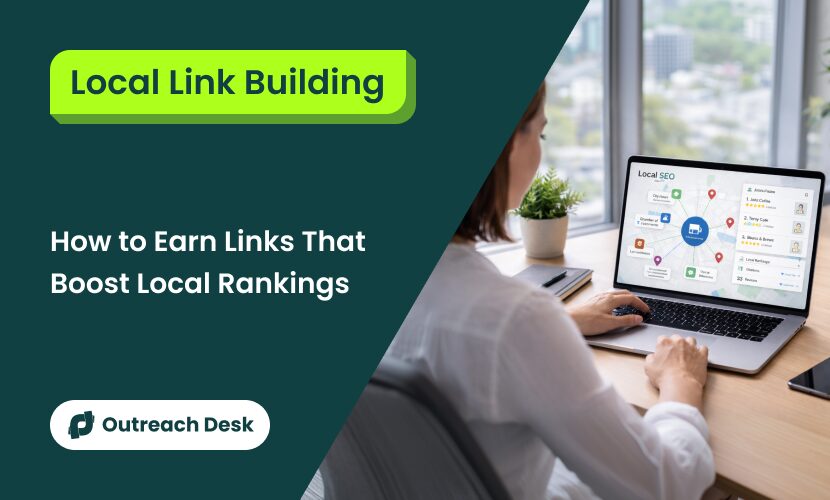
This is what the image shows.
- Your business site is at the center.
- Around it, chains connect to local news mentions, community map listings, business directories, and review platforms.
- All those signals strengthen your local authority and visibility in search results, which AI systems then draw on when generating answers.
As a result, AI recommends you to the users. It works the same as word of mouth, but it is online.
If 15 local websites mention your business with the same name, address, and phone number, AI systems start to trust that you’re a real, established business in your area.
The more consistent the mentions are, the more confident AI becomes in recommending you.
Now, what does it mean in reality:
Unlinked mentions still matter
Even if a local blog just mentions your business without a link, it still helps AI platforms to recognize you as a trusted local business.
Tools like Perplexity draw on “best of” lists, community forums, and local news when making recommendations.
Citation volume and accuracy feed the AI answer
Three of the top five AI visibility factors in the 2026 report are related to citations. AI tools are pulling data from smaller, lesser-known directories too, not just from Yelp and Google.
So being listed consistently across more places matters more.
Your own website content gets cited more when you’re well-known externally
A November 2026 SE Ranking study found that the more traffic and authority your site contains, the more likely AI is to quote or reference it.
Local links help you build that authority, making your own content more trusted and cited in AI search results.
Let’s look at what stats say:
- 76% of “near me” mobile searches result in in-store visits within 24 hours.
- Businesses with a complete, maintained Google Business Profile receive 7x more clicks than those with incomplete profiles.
- AI overview appeared for 68% of local searches in Whitespark’s Q2 2026 study, though local packs only appeared for 39% of the same queries.

What Makes a Local Link Valuable?
A valuable local link comes from a site with genuine local audience engagement, topical relevance to your industry, and editorial standards that screen out spam. Local doesn’t mean low-bar. The local sites worth getting links from are the ones your customers actually visit, not the ones that exist purely to sell directory listings.
Not all local links carry the same weight. A link from a well-known local chamber of commerce is far more valuable than one from an old, abandoned blog that hasn’t been updated in years.
Before you reach out to any website for a link, try to rate it on these three factors:
| Factor | What it Measures | Example |
|---|---|---|
| Relevance | Does this site serve your audience or cover your category? | A regional business journal covering your industry. |
| Trust | Would your customers recognize and trust this source? | Your city’s chamber of commerce or a local university. |
| Effort | How realistic is a legitimate mention? | A supplier who already features client logos on their site. |
Focus on the websites that are highly relevant to your location and topic, even if the links take more effort.
Ignore the links with low relevance, such as a directory from another state, which won’t help your local rankings, no matter how authoritative it looks.
The links from nearby, community-connected sources often carry more relevance than the links from major national websites, even if the national site has higher overall authority.
They come from local sources like regional news sites, community college pages, and nearby business partners. Where the connection is genuine.
How to Build Local Links: Strategies That Work
The local link strategies that actually work combine community participation, local sponsorships, news-worthy events, and partnerships with other regional businesses. Each tactic produces links that look editorial because they reflect real local activity, which is the signal Google is actually trying to verify.
The strategies mentioned below are grouped by how much effort they require, right from simple moves you can take action on this week, all the way up to bigger plays that build lasting authority over time.
Claim and Complete Your Core Citations
Your Google Business Profile, Yelp listing, Better Business Bureau pages, and industry-specific directories form the base of your local link profile.
This still matters in 2026 because consistent NAP details can help search engines trust your business.
It also strengthens your visibility in AI search tools like ChatGPT and Perplexity, which rely on the same citation sources.
Actionable Step:
Review your top citation sources quarterly. Fix the NAP inconsistencies, even the small ones like “St” vs. “Street.”
Write Testimonials for Your Vendors and Partners
Here’s a simple tactic that takes nearly 15 minutes and can earn you a link back to your site, often dofollow links, though this varies by site. Write a genuine testimonial for your suppliers, vendors, or service providers.
Most businesses feature testimonials on their site, and they often include your name and a link pointing to you.
It works because the relationship is real, the link is contextual, and the site is usually connected to your location or industry.
Sponsor Local Events (or Lend Your Space)
Community events can earn you local backlinks from event pages, news sites, and community calendars. It doesn’t require a large sponsorship budget to get started.
If you’ve a space such as a conference room, meeting space, or outdoor area, offer it to local groups through platforms like Meetup.
Event organizers will list your business as the venue on the event listing, giving you a highly relevant local backlink without a cash outlay.
Pitch Local Journalists with Data-Driven Stories
Local news sites are always short-staffed and need useful community-focused stories.
If you share a data point, trend, or expert insight, you can become a source, not just a business asking for coverage.
Here are some examples that work:
- “We surveyed 200 homeowners in [city] about the [topic]. Here’s what we found.”
- “As a [your profession] in [city], here’s what I’m seeing change in [trend relevant to local readers].”
- Expert commentary on a local issue already in the news.
When they feature you, you get a natural backlink from a trusted local site, which strengthens your authority.
Build Location-Specific Resource Pages
Create a helpful resource page on your website tied to your local area.
Imagine this: “Small Business Tax Resources for [city]” or “Home Inspection Checklist for [Region] properties” if you’re dealing in real estate.
If this content provides genuinely useful information, local businesses and organizations will start linking to it, turning your content into a natural linkable asset.
If you’re doing this yourself around the day job, our small business link building plan sequences these tactics across twelve months.
Pursue .edu and .gov Opportunities
Local universities, community colleges, and city government websites often maintain resource pages, scholarship listings, and community directories.
These links carry trust signals because .edu and .gov domains naturally have high authority.
Here’s how you can find them:
Use search operations like- site:.edu [your city] resources or site:.gov [your city] business directory.
In this, look for pages that list community resources, recommended services, or organizations.
If you can offer a scholarship, internship, or community resource that fits, you’ve a strong reason to be included.
Certified solar installers can also appear on state and utility program pages, a core solar link building source.
Contribute Expert Content to Local Publications
Write guest articles for local business journals, community blogs, or regional publications.
This positions your business as a local authority and earns contextual link that both Google and AI platforms treat as strong trust signals.
Focus on the sites with a real local audience rather than random blogs.
One article on a trusted local publication often delivers more relevant authority than multiple posts on national sites with no connection to your area.

How Many Local Links Do You Actually Need?
Most local businesses need 20-50 quality local backlinks to start competing for map pack visibility in a typical metro market. The exact number depends on your competitors’ local link profiles. Use their referring domain count as a baseline, then aim for 20-30% more, focusing on quality.
There’s no fixed number of links you need; it entirely depends on how competitive your industry is.
A dentist in a small town might only need 15-20 quality local links to rank competitively. While a personal injury lawyer in Chicago could need 150+.
These are rough estimates; your actual target should come from analyzing what the top local competitors have earned.
Most local businesses ranking on the first page often don’t rely on a large number of backlinks, but this varies by city size and industry.
In most local markets, success comes from earning a focused set of quality links that are geographically and topically relevant, rather than chasing volume.
Rather than focusing on fixed numbers, you need to analyze your competitors. Identify whether your top competitors are getting links that you’re missing.
That gap isn’t a random number; you should shape your link building priorities accordingly.
Here’s a simple monthly workflow:
- Week 1:
Publish or update a useful, linkable resource such as a local guide, data piece, or tool.
- Week 2:
Identify a focused list of relevant local link opportunities.
- Week 3:
Reach out with short personalized messages. Keep the messages specific and respectful of the editor’s time.
- Week 4:
Track replies, follow up once, and record the results to improve next month.
Consistency matters more than volume. A steady flow of quality local links over time will deliver stronger results than a one-time spike in low-value links followed by nothing.
How to Measure What’s Working
You measure local link building success by tracking map pack ranking movement. Organic traffic to your local landing pages, and direct calls or form submissions tied to organic search. Referring domain counts only matter if those domains are local and relevant. The metrics below connect link work directly to local revenue.
To check whether your applied strategies are working, track these five signals. This will help you identify if your local link building is producing results.
Growth of Referring Domain
Monitor the total number of sites linking to you, especially from the local sources. Use outreach software like Ahrefs, Semrush, or Moz to monitor your domain growth.
Local Pack Movement
Use a location-specific rank tracker like Whitespark’s or BrightLocal’s to see how your rankings look different from the points across service areas.
Local rankings shift on the basis of the searcher’s physical location.
Organic Traffic from Local Queries
Use Google Search Console to track impressions and clicks for the queries with the local intent.
Filter by keyword that includes your city or area name to identify local-intent driving impressions and clicks.
AI Search Presence
Search for your business in AI platforms like ChatGPT, Perplexity, and Google AI Mode. Check whether you’re being recommended.
AI visibility is hard to track with tools through dedicated platforms; for now, regular manual checks can reveal whether your entity has a strong presence.
Referral Traffic and Conversions
The best local links not just boost rankings, but they bring in real visitors. Use Google Analytics to track referral traffic and identify which links can drive visitors and leads.
Mistakes That Kill Local Link Campaigns
The mistakes that kill local link campaigns are mass-submitting to irrelevant directories, paying for low-quality local citations, and ignoring NAP consistency across listings. Each one wastes budget and produces signals Google now actively devalues. The patterns below are the ones to catch before they cost you map pack visibility.
Once you apply the strategies to your business and measure their impact, it’s important to identify common mistakes to avoid to achieve the desired results. Let’s look at those mistakes you need to avoid entirely.

Chasing Volume Over Relevance
Avoid links from the areas you don’t serve because those won’t impact your local rankings much. A single link from a trusted publication is far more relevant.
Paying for Low-Quality Directory Links
If a directory has no organic traffic, no editorial standards, and charges for listing, walk away. These are often link farms disguised as directories.
Check the site’s traffic using the Ahrefs tool before paying anything. Pricing can vary widely, so it helps to know what a backlink should actually cost before you commit.
Ignoring NAP Consistency
Even small inconsistencies, such as a different phone number or address format, can weaken your signals. Review and update the details regularly, ideally at least once every quarter.
Mass Outreach Templates
Generic outreach emails often get ignored or marked as spam. If you can’t clearly explain why a specific site should mention you, it’s better to remove them from the list than to waste an outreach.
Stopping After the First Push
Local link building compounds over time. The businesses that win local search aren’t the ones that did a one-time push; they’re the ones following a consistent, ongoing process.
Treating AI Search as Separate from Local SEO
In 2026, the same signals feed both traditional and AI search. A link strategy that ignores entity mentions, citation consistency, and structured data leaves a significant part of local visibility unaddressed.
Build Your Local Authority Before Your Competitors Do
Local search is evolving into two major paths: map-based rankings and AI-driven discovery. However, both rely on the same core signals. Relevant local links, accurate citations, and consistent business information on the web.
Businesses that invest in these fundamentals don’t just improve rankings, but they’ll become the default recommendation across every search for the local services.
Want more visibility in local search results?
Build local links that improve your rankings and drive nearby traffic.
Is local link building still worth it in 2026?
Yes, local link building directly supports visibility in the map packs, organic search results, and AI-generated local answers. The 2026 Whitespark survey says that link signals remain a top category for local organic rankings, and citation-based signals now rank among the top factors for AI search visibility.
How many local links does a small business need to rank?
It depends on your market’s level of competition, but most local businesses ranking on the first page have fewer than 150 referring domains. Focus on 20-50 links from geographically and topically relevant sources rather than chasing large numbers. Audit competitor’s link analysis to set realistic goals.
What types of local links are most valuable?
Links from local outlets, the chamber of commerce, regional business associations, .edu resource pages, community organizations, and local business partners consistently produce results. The common thread is that the referring site has a genuine connection to your geographic area, and your audience already trusts it.
Do AI search platforms use local links when recommending businesses?
They do, but indirectly. AI platforms evaluate the overall profile, which includes citations, mentions, reviews, and links from locally relevant sources. The 2026 Widespark report found that three of the top five AI search visibility factors are cited as entity-based. Local links strengthen the signals that AI platforms use to decide which businesses to recommend.
What’s the difference between local link building and regular link building?
Local link building focuses especially on earning links from sources with location relevance to your area. Regular link building targets domain authority and topical relevance without filters. For businesses serving a specific area, local links send trust signals that general authority links don’t.
How long does local link building take to show results?
Most businesses see measurable improvements in local rankings within 3-6 months of consistent efforts. Link signals compounds, so the earlier you start, the sooner results will appear.