If your goal is to build backlinks that support rankings and improve organic visibility, blogger outreach is a reliable off-page SEO technique.
It involves contacting relevant bloggers, editors, or site owners, building genuine relationships, and earning backlinks by offering content or insights that improve their pages.
Results depend on execution.
Poor targeting leads to low-value placements. Strong execution earns contextual links on niche-relevant blogs that already reach your audience.
It scales when you build repeatable processes and strong linkable assets. You control who you target and what you pitch, while editors decide whether your content earns the link.
What You’ll Learn
- How to find and qualify bloggers who can actually move your rankings
- How to earn contextual backlinks that support long-term search visibility
- How to write outreach emails that get replies and real placements
- How to choose the right outreach strategy based on your goal
- How to track outreach performance and improve results over time
What Is Blogger Outreach
Blogger outreach is a link building approach where you connect with publishers in your niche to earn high-quality backlinks and contextual mentions within their content through personalized communication and genuine value exchange.
It usually happens through email or direct contact via social channels, depending on the blogger’s preferred communication method.
These publishers already serve your audience. What matters isn’t how many you reach, it’s how well your content fits their editorial context.
That placement might be a guest post, a link insertion into an existing article, a product review, a brand mention, or a content collaboration. These placements are almost always in-content links rather than sidebar or footer links.
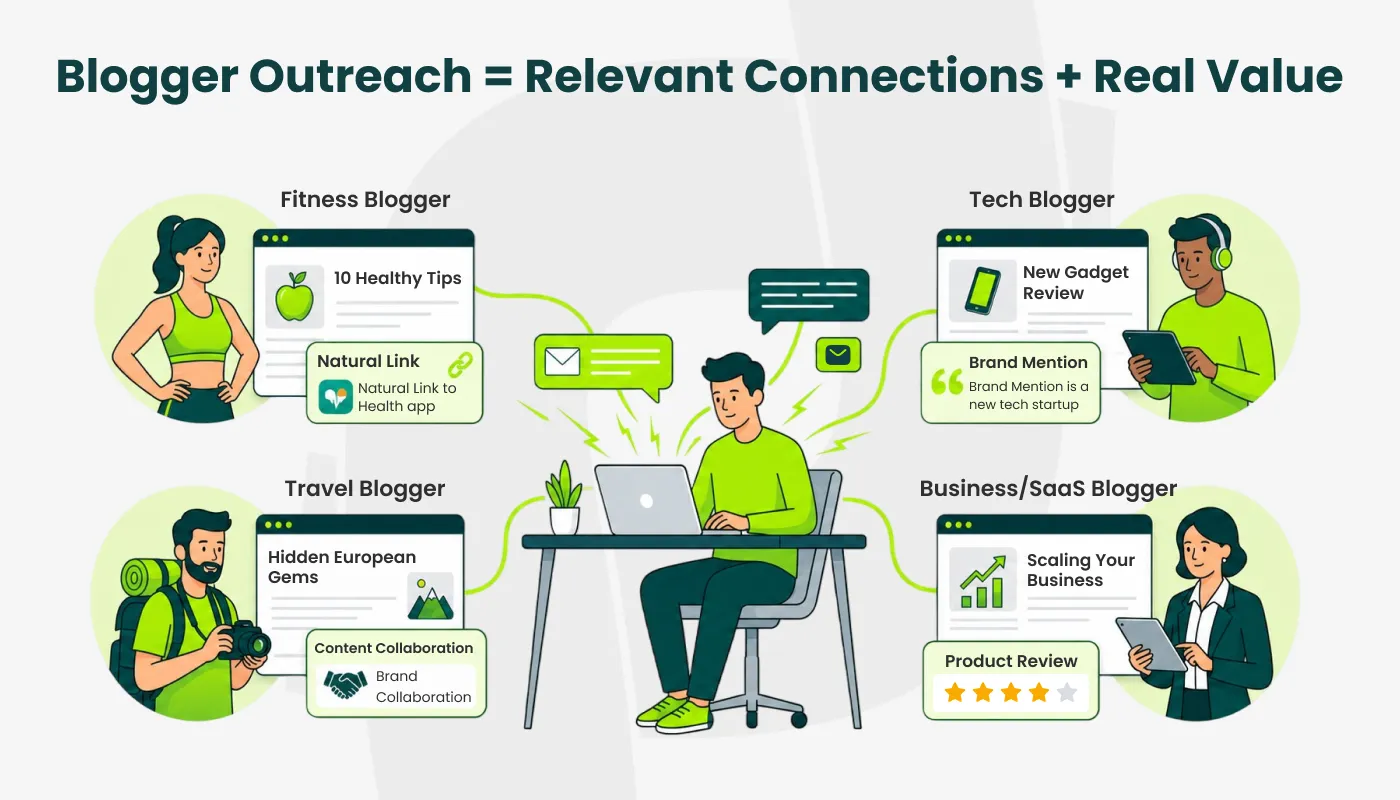
Unlike pitching editors at large publications, blogger outreach targets individuals who have built websites with engaged, niche audiences. They choose what to link to based on fit and relevance, not editorial calendars. That’s exactly what makes a placement from them worth earning.
Your goal is to earn contextual backlinks placed naturally within useful content on topically relevant sites that already attract engaged, interested readers.
Why Does This Still Work in 2026
Blogger outreach still works because because Google’s ranking system still treats editorial backlinks from trusted, topically relevant sites as one of the strongest authority signals.
Bloggers receive dozens of outreach emails every week. Most are templated, irrelevant, and easy to spot. The bar for earning a response, let alone a link, is higher than it was three years ago.
That’s good news if you’re willing to do the work. Most teams aren’t. They send volume. You send relevance.
Campaigns built around genuine fit and clear value consistently outperform spray-and-pray outreach. Not by a small margin. By multiples.

Through campaigns we run at Outreach Desk, we often see how low generic outreach performs. For context, typical sales outreach sequences average around a 3% response rate. SEO outreach can perform better when relevance is strong, because the pitch is tied to the editor’s content and audience.
The Six Types of Blogger Outreach That Actually Produce Results
Each outreach type aligns with a different link earning campaigns strategy used in SEO. The type you choose depends on your goal, the assets you have, and the value you offer the blogger.

Each type works differently. Here’s what to expect from each:
Guest Posting Outreach
Guest posting outreach is when you pitch a blogger to publish your original article on their site, with a contextual link back to your page. This is one of the most widely used editorial link building methods.
Guest posting stays effective when your content is genuinely useful to the blogger’s audience.
You can also outsource the pitching and writing to our professional guest posting service.
Niche Edits Outreach
Niche edit outreach is when you ask a blogger to add your link to an article they’ve already published, instead of creating something new. These are also known as ‘curated links’ or ‘contextual link insertions’.
This is faster than guest posting because the page already has authority, traffic, and trust. But your link must fit naturally. If it feels forced, it gets ignored or adds little value.
Brand Mention Outreach
If your brand is already mentioned on a blog but not linked, you’re sitting on one of the easiest wins in outreach. You’re not asking for something new. You’re asking them to turn an existing brand mention into a clickable link.
Response rates are higher here than almost any other outreach type because the blogger has already acknowledged your brand. The hard part is done.
Content Collaboration
Content collaboration is the creation of content by multiple parties. This could be a research piece, expert roundup, or resource. Both sides link and promote the shared linkable asset.
This relationship-first outreach builds partnerships and drives links, traffic, and visibility over time.
Product or Service Reviews
You give a blogger access to your product and ask for an honest review. This works well in SaaS, ecommerce, and DTC (Direct-to-Consumer) when your product genuinely benefits their audience.
Stay transparent. Undisclosed paid reviews violate FTC guidelines and break trust from both sides.
Resource Page Placements
Resource page placements are when your content or tool gets listed on curated pages that collect the best resources on a given topic. These pages exist across every niche: roundups of tools, guides, templates, reading lists, and recommended sites that editors maintain for their audience.
These pages often attract steady traffic and strong links. You need to offer something better, more useful than what’s already listed.
How to Run a Blogger Outreach Campaign (Step by Step)
A strong outreach campaign follows six steps. Skipping key steps typically reduces response rates. The steps below show how to move from goal-setting to tracking in the order that matters.

Step 1: Define Your Goal Before You Write a Single Email
Answer three questions before you write anything:
- Which pages need more authority?
- Are you targeting to rank a specific keyword, build topical coverage, or earn brand visibility in a new niche?
- What type of link placement supports that goal?
The goal determines everything that shapes who you target, what you pitch, and how you measure results.
Outreach Campaigns tied to specific pages or topics can start contributing to measurable ranking movement within 8-12 weeks. Random link placement to “the homepage” or “wherever” rarely does.
Step 2: Find Bloggers Worth Reaching Out To
Your results depend on who you target. You can check for the following 3 criteria when looking for outreach bloggers:
Relevance
The blog should cover topics that overlap with your niche. A high domain rating means nothing if the site has no topical connection to what you do. A fitness blog linking to your SaaS product won’t move your rankings.For more on why this matters more than authority alone, see what makes a link relevant.
Quality
Quality means the site gets real organic traffic, publishes original content, and isn’t a link farm dressed up as a blog. Check whether it ranks for real queries, whether the content is editorially maintained, and whether its own backlink profile looks healthy.
Engagement
The blogger should publish regularly, respond to outreach, and have an engaged audience. If a site has not been updated in a long time, response rates are usually lower, and placements are less likely to happen.
Once you know what you are looking for, there are four reliable places to find it:
- Search operators in Google:
These queries surface blogs that actively accept contributions. But don’t stop there, as many great blogs accept guest posts without advertising it.
For Example: [your niche] + “write for us” or [your niche] + “guest post”

- Competitor backlink analysis
Use Ahrefs or Semrush to see which blogs link to your competitors but not you. List them for your outreach. If they linked to your competitors’ content, they might link to yours, especially if your content is more valuable. For a deeper look at how to identify and use these opportunities, see competitor backlink analysis.
- Content discovery tools
Content discovery tools like BuzzSumo and SparkToro help you find bloggers and creators with active, engaged audiences in your niche.
- “Best of” lists and roundup posts
Search for “best [niche] blogs” to find curated lists of bloggers already known for quality content.

Step 3: Research Each Blogger Before You Reach Out
Have answers to these questions before you write your pitch:
- What has the blogger published recently, and what topics do they seem to care about most?
- Have they accepted guest posts or link placements before?
- What are their content gaps? Gaps like missing subtopics, outdated content, or expandable sections.
- What tone and style do they use? (formal? Conversational? data-driven?)
- Are they active on social media, and on which platforms?
Read their last five posts properly. Not skimming. Notice what they link to. Notice what they avoid. Notice what feels incomplete or underexplored. That’s where your value sits. A pitch is stronger when you can clearly show why it matters to that blogger’s audience.
Step 4: Get on Their Radar First
Before you pitch, spend a few days creating genuine visibility around their work.
- Share one of their articles on LinkedIn or X and add a specific insight from it.
- Leave a real comment on a recent post. Not praise, but something you actually noticed or learned.
- Engage with what they’re saying on social media in a natural, relevant way. This can help you stand out, only if the interaction is relevant and meaningful.
- If they run a newsletter, subscribe and reply to an issue with a clear, thoughtful response.
Keep it simple. Nothing manufactured. If their content is actually useful to you, this is just basic professional behavior. By the time your email lands, your name already feels familiar, not random.
Step 5: Write the Outreach Email
A strong outreach email works because the value is clear, not because the pitch is aggressive. It’s about personalization: relevant, tailored content that directly connects to a blog post the blogger has already published.
What a strong outreach email includes:
- A subject line that’s specific, not clever
Clear and direct subjects like “Guest post idea: [topic missing on their site]” tend to outperform “Quick question” or “Collaboration opportunity”.
- A personalized opening that shows you read their work
Just keep it one sentence long. Reference a specific article, a specific point they made, or a specific gap you noticed.
- A clear pitch
This improves message relevance and reduces ambiguity in outreach. A clear pitch changes how they pursue your email. Be clear on:
- What are you proposing?
- A guest post on a specific topic?
- A link to your resource that fits a specific article?
- A content collaboration?
- What’s in it for them?
They should benefit after adding your content. That should be the priority. Ask yourself:
- Will this content fill a gap that their audience would appreciate?
- Will it complement something they’ve already published?
- Will it bring their readers something they can’t get elsewhere?
- A low-friction ask
Don’t complicate things. Make it very easy for them to say yes. Offer to send an outline, provide the full draft, or handle all the work. Reducing the effort required to review your pitch can improve your chances of getting a response.
What kills outreach emails:
Vague pitches like “I’d love to collaborate” without context. Generic flattery such as “I’m a huge fan of your blog,” with no reference points.
Long emails that hide the actual request. Copy-paste templates that feel mass-sent.
Openers like “I hope this email finds you well” add no contextual value.
Here’s a structural framework, not a copy-paste template. You’ll need to adapt the specifics every time:
Subject: Guest post idea for [Blog Name]: [Specific Topic]
Hi [Name],
I read your piece on [specific article title] on [one specific observation about it]. I noticed you haven’t covered [specific angle/topic], and I think your audience would get a lot of value from it.
I’d love to write a guest post on [proposed topic] for [Blog Name].
Here’s a rough angle: [2-3 sentence description of what the piece would cover and why it matters to their readers].
I’ve written for [1-2 recognized publications, if applicable]. Happy to send a full outline if you’re interested.
[Your Name]
Short. Specific. Easy to respond to.
Step 6: Follow up
Bloggers are busy. If you don’t get a response, it doesn’t always mean they’re not interested. Sometimes they just missed your email or haven’t gotten to it yet.
Send one follow-up email on the same thread, 5-7 days after your first email. Keep email content short.
Hi [Name],
Just circling back on this in case it got buried. I shared a guest post idea around [topic] that felt like a natural fit with your article on [specific article].
If it’s useful, I can send a quick outline. If not, no worries at all.
Thanks,
[Your Name]
Limit yourself to two follow-ups. If there’s still no response, move on. More than 2 follow-ups can start to feel intrusive and reduce future response rates.
Step 7: Track everything
Track your outreach using a simple spreadsheet or CRM, whatever keeps your progress clear and easy to follow.
Keep track of these important details to stay on top of your progress:
- Initial Outreach:
The date you sent the first email.
- Follow-Up Timeline:
The date when you checked back in.
- Response Status:
Did they say yes, no, or later?
- Placement Progress:
Where the article stands in their queue.
- Live Link:
The URL of your new authority-building asset.
This isn’t just a list. It’s your campaign’s progress report. Use it to spot what’s working, so you can build on your momentum and grow your results next time.
What Separates Good Blogger Outreach From Great Blogger Outreach
The six-step process delivers results. Adding tighter execution and more discipline further strengthens those results.

Relevance Often Outperforms Authority
A link from a blog with a domain rating of 40 that covers your exact niche and has an engaged audience is worth more for rankings and for referral traffic than a link from a DR 80 site that has nothing to do with your topic.
Google looks at the topic of the linking page, the context around your link, and how closely the linking page’s content matches yours. Even a strong link may carry limited value or be ignored if it isn’t relevant.
Focus on relevance when building your prospect list. Use domain authority as a supporting metric, not as your primary filter.
Offer Value Before You Ask for Anything
The outreach emails that get replies aren’t always the most polished. They’re the ones where you offer value first, before making your request.
Share their content before you reach out. Point out a broken link before suggesting a fix.
Mention their article in your own work before asking for a mention in return, so that when you finally make your request, it feels natural rather than cold outreach.
That’s what separates an email that gets read from one that gets ignored.
Treat Outreach as a Long-Term Channel, Not a One-Time Campaign
If you treat outreach like a sprint, chasing quick link goals and moving on, you miss out on long-term growth. Building authority takes time and steady effort.
Every editor who replies is someone you can reach out to again. Every placement is an opportunity that stays open.
The campaign is only the first conversation. What you do afterward decides how much value you create.
A network you build over time is more valuable than any single campaign that starts from scratch.
How to Measure Whether Your Outreach Campaign Actually Worked
Earned links show what you’ve produced, not how your outreach is really performing. If you want compounding results, track what helps you execute better.

Response Rate
Ask yourself: What percentage of bloggers responded to your outreach?
Response rate benchmarks are simple. 4.5% is baseline, 8%+ is strong performance, and anything below 4% signals an issue with targeting or messaging.
Higher response rates usually indicate strong alignment between your outreach and the blogger’s content.
Placement Rate
Placement rate measures how many placements you secured compared to the total outreach sent. To measure placement rate, ask yourself:
Of all the bloggers who responded positively, how many actually published the content or added the link?
The answer will show whether the approval you received in an email actually turned into a live link.
If approvals don’t convert, execution breaks after the reply is sent. Most gaps happen when executions aren’t clear, or your content doesn’t match what publishers need. This is usually a follow-through problem. Fixing this strengthens your results, without sending more outreach.
Link Quality Signals
Check all the links you earned because not all of them provide equal value. For each placement, ask yourself:
- Is the linking page indexed?
- Does it receive organic traffic?
- Is the link placed within the main content (contextual) or buried in the sidebar or footer?
- Is the anchor text natural?
These signals indicate whether the link is likely to provide SEO value.
Referral Traffic
Referral traffic helps you understand whether your placements are reaching real audiences. Consistent traffic can indicate stronger relevance and engagement, though not all valuable links generate traffic.
Ranking Movement on Target Pages
The ultimate measure. If you built links to a specific page or content cluster, track its keyword positions over 8–12 weeks. Search systems need time to process new authority signals.
When your rankings keep moving up, it indicates that your outreach is contributing.
Common Blogger Outreach Mistakes
There are certain common blogger outreach mistakes that are fixable with awareness and a little more effort during the campaign setup phase.

Sending the Same Template to Everyone
Generic outreach gets ignored quickly. If your email could fit any blog in any niche without changes, it is not relevant. The real fix is not to merge fields. It’s writing one line that clearly reflects what that specific blogger has recently published or focused on.
Targeting Blogs Based on DR Alone
Domain Rating, on its own, does not tell you whether a site is worth targeting. A high-DR blog with irrelevant content, declining traffic, or low publishing activity will rarely perform well for outreach. Relevance, organic traffic trends, and editorial consistency matter more than a single authority metric.
Pitching Content the Blogger Has Already Covered
If your topic overlaps with a recent, detailed article they’ve already published, your pitch brings little to no value. It also signals weak research.
A quick site search before pitching helps you avoid duplication and improve relevance.
Ignoring the Blogger’s Content Guidelines
Most established blogs share clear submission rules. Ignoring them reduces your chances of getting a reply or placement. Following those rules shows you understand how their site works and makes your pitch easier to review.
Following Up Too Many Times
Following up once is professional; two is understandable; three or more is unprofessional. If a blogger does not respond after two attempts, move on and try again after a few months with a different pitch.
Not Tracking Results
If you don’t track your results, you won’t know which outreach email led to placements, which bloggers responded, and which target pages saw ranking improvement. You’re running your next campaign blindly. Track everything from day one.
Moving Forward With Blogger Outreach
Blogger outreach works when you send the right emails to the right people and stay focused on relevance and intent. That’s how it supports rankings and brings in the right traffic. If you would rather hand this to a team, our blogger outreach agency runs the full process for you.
Results build over time. Topically aligned backlinks can contribute to stronger visibility. Each campaign gives you data to improve the next.
This is not a one-time effort. It’s a process you refine and scale. Stay consistent, and outreach becomes a reliable way to grow rankings and traffic.
Want to make your blogger outreach more effective?
Get a structured strategy focused on relevance and consistent results.
How long does it take to see results from blogger outreach?
Most outreach campaigns generally take 8-12 weeks to show measurable ranking improvement on target pages.
While links may be secured within a few weeks, changes in rankings depend on crawling, indexing, competition, and overall site signals.
If you’re expecting overnight results, blogger outreach will not deliver that. If you focus on long-term authority, traffic, and rankings, it becomes a reliable growth channel.
Is blogger outreach the same as guest posting?
Guest posting is one part of blogger outreach, not the whole strategy.
Blogger outreach is the process of connecting with bloggers to secure placements. This can include guest posts, link insertions, mentions, reviews, collaborations, or resource links.
Guest posting is a single tactic within that process. You write and publish an article on another site to build authority and earn a backlink.
How many outreach emails should I send per campaign?
There’s no fixed number. It depends on your goal, niche, and targeting. Start with 30–100 well-qualified prospects. This keeps your outreach personalized.
If your list is small, expand your research. Don’t lower the quality. If your list is large, split it into smaller batches and test performance for each batch. Focus on responses and placements, not emails sent.
At the Outreach Desk, smaller, targeted lists have consistently driven higher response rates, better placements, and stronger links. A targeted campaign will drive better gains in rankings and traffic than high-volume outreach.
Does blogger outreach still work for SEO in 2026?
Yes. Editorial backlinks from relevant, authoritative blogs remain an important part of how Google evaluates content. What has changed is the level of quality required in both the links you earn and how you earn them.
Low-quality, mass outreach doesn’t work anymore. Targeted, personalized, value-driven outreach tends to perform better because it aligns with how links are evaluated today. Teams that want full execution often work with Outreach Desk’s link building team on this kind of campaign.
Should I pay bloggers for link placements?
Avoid paying for links intended to improve rankings. Use paid placements for reach, referral traffic, and visibility.
Paid links that aim to influence rankings violate Google’s link spam policies, even though many bloggers charge for placements.
If you choose to pay for a placement, use the rel=”sponsored” attribute to clearly disclose it. This helps search engines understand the link type.
Don’t present paid links as editorial. Undisclosed paid placements may be ignored or carry no ranking value, limiting their impact on search performance.
What tools do I need for blogger outreach?
Use a tool like Ahrefs, Semrush, or BuzzSumo to find bloggers in your niche and evaluate their sites.
For contact details, tools like Hunter.io or Voila Norbert help you find the right email.
To manage outreach, you can use platforms like BuzzStream or Pitchbox, or keep it simple with a well-structured spreadsheet.
Don’t overcomplicate your stack. For focused campaigns, a clean spreadsheet and strong research often deliver better results than complex tools used without a clear process.